Summer at the Library
Yes, we’re open!
Library hours for the summer are as follows:
May 26 - August 19, 2018
Monday - Thursday: 8:00 a.m. - 9:00 p.m.
Friday: 8:00 a.m. - 5:00 p.m.
Saturday: CLOSED
Sunday: 12:00 Noon - 8:00 p.m.
Exceptions:
Tuesday, July 3: 8:00 a.m. - 5:00 p.m.
Wednesday, July 4 (Independence Day): CLOSED
]]>
Library hours for the summer are as follows: May 26 - August 19, 2018 Monday - Thursday: 8:00 a.m. - 9:00 p.m. Friday: 8:00 a.m. - 5:00 p.m. Saturday: CLOSED Sunday: 12:00...
http://library.umbc.edu/location
https://beta.my.umbc.edu/api/v0/pixel/news/77692/guest@my.umbc.edu/bc42f4ac5966825c7906a55e349f8763/api/pixel
library
library-services
Albin O. Kuhn Library & Gallery
https://beta.my.umbc.edu/groups/library
https://assets1-beta.my.umbc.edu/system/shared/avatars/groups/000/000/016/854d6fae5ee42911677c739ee1734486/xsmall.png?1279120404
https://assets2-beta.my.umbc.edu/system/shared/avatars/groups/000/000/016/854d6fae5ee42911677c739ee1734486/original.png?1279120404
https://assets2-beta.my.umbc.edu/system/shared/avatars/groups/000/000/016/854d6fae5ee42911677c739ee1734486/xxlarge.png?1279120404
https://assets4-beta.my.umbc.edu/system/shared/avatars/groups/000/000/016/854d6fae5ee42911677c739ee1734486/xlarge.png?1279120404
https://assets2-beta.my.umbc.edu/system/shared/avatars/groups/000/000/016/854d6fae5ee42911677c739ee1734486/large.png?1279120404
https://assets1-beta.my.umbc.edu/system/shared/avatars/groups/000/000/016/854d6fae5ee42911677c739ee1734486/medium.png?1279120404
https://assets2-beta.my.umbc.edu/system/shared/avatars/groups/000/000/016/854d6fae5ee42911677c739ee1734486/small.png?1279120404
https://assets1-beta.my.umbc.edu/system/shared/avatars/groups/000/000/016/854d6fae5ee42911677c739ee1734486/xsmall.png?1279120404
https://assets1-beta.my.umbc.edu/system/shared/avatars/groups/000/000/016/854d6fae5ee42911677c739ee1734486/xxsmall.png?1279120404
Albin O. Kuhn Library & Gallery
https://assets4-beta.my.umbc.edu/system/shared/thumbnails/news/000/077/692/cc5b3987fdda8edb89d6f82eb0d64fed/xxlarge.jpg?1532957990
https://assets2-beta.my.umbc.edu/system/shared/thumbnails/news/000/077/692/cc5b3987fdda8edb89d6f82eb0d64fed/xlarge.jpg?1532957990
https://assets4-beta.my.umbc.edu/system/shared/thumbnails/news/000/077/692/cc5b3987fdda8edb89d6f82eb0d64fed/large.jpg?1532957990
https://assets2-beta.my.umbc.edu/system/shared/thumbnails/news/000/077/692/cc5b3987fdda8edb89d6f82eb0d64fed/medium.jpg?1532957990
https://assets1-beta.my.umbc.edu/system/shared/thumbnails/news/000/077/692/cc5b3987fdda8edb89d6f82eb0d64fed/small.jpg?1532957990
https://assets3-beta.my.umbc.edu/system/shared/thumbnails/news/000/077/692/cc5b3987fdda8edb89d6f82eb0d64fed/xsmall.jpg?1532957990
https://assets3-beta.my.umbc.edu/system/shared/thumbnails/news/000/077/692/cc5b3987fdda8edb89d6f82eb0d64fed/xxsmall.jpg?1532957990
3
0
true
Mon, 30 Jul 2018 09:40:16 -0400
Tue, 28 Aug 2018 14:03:47 -0400
Weaponized information seeks a new target in cyberspace
The story by Richard Forno, Assistant Director, UMBC Center for Cybersecurity Director, Cybersecurity Graduate Program first appeared The Conversation on July 30, 2018

 Cyberattacks target Americans’ thinking.
Fancy Tapis/Shutterstock.com
Cyberattacks target Americans’ thinking.
Fancy Tapis/Shutterstock.com
The Russian attacks on the 2016 U.S. presidential election and the country’s continuing election-related hacking have happened across all three dimensions of cyberspace – physical, informational and cognitive. The first two are well-known: For years, hackers have exploited hardware and software flaws to gain unauthorized access to computers and networks – and stolen information they’ve found. The third dimension, however, is a newer target – and a more concerning one.
This three-dimensional view of cyberspace comes from my late mentor, Professor Dan Kuehl of the National Defense University, who expressed concern about traditional hacking activities and what they meant for national security. But he also foresaw the potential – now clear to the public at large – that those tools could be used to target people’s perceptions and thought processes, too. That’s what the Russians allegedly did, according to federal indictments issued in February and July, laying out evidence that Russian civilians and military personnel used online tools to influence Americans’ political views – and, potentially, their votes. They may be setting up to do it again for the 2018 midterm elections.
Some observers suggest that using internet tools for espionage and as fuel for disinformation campaigns is a new form of “hybrid warfare.” Their idea is that the lines are blurring between the traditional kinetic warfare of bombs, missiles and guns, and the unconventional, stealthy warfare long practiced against foreigners’ “hearts and minds” by intelligence and special forces capabilities.
However, I believe this isn’t a new form of war at all: Rather, it is the same old strategies taking advantage of the latest available technologies. Just as online marketing companies use sponsored content and search engine manipulation to distribute biased information to the public, governments are using internet-based tools to pursue their agendas. In other words, they’re hacking a different kind of system through social engineering on a grand scale.
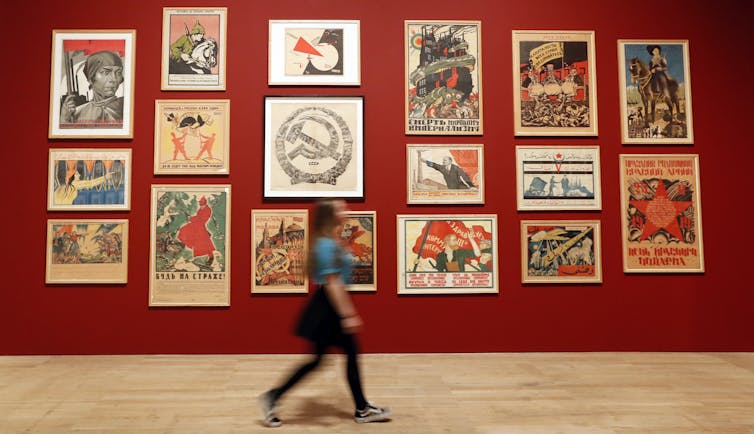 Americans are used to seeing Russian propaganda that looks like this.
AP Photo/Kirsty Wigglesworth
Americans are used to seeing Russian propaganda that looks like this.
AP Photo/Kirsty Wigglesworth
Old goals, new techniques
More than 2,400 years ago, the Chinese military strategist and philosopher Sun Tzu made it an axiom of war that it’s best to “subdue the enemy without fighting.” Using information – or disinformation, or propaganda – as a weapon can be one way to destabilize a population and disable the target country. In 1984 a former KGB agent who defected to the West discussed this as a long-term process and more or less predicted what’s happening in the U.S. now.
The Russians created false social media accounts to simulate political activists – such as @TEN_GOP, which purported to be associated with the Tennessee Republican Party. Just that one account attracted more than 100,000 followers. The goal was to distribute propaganda, such as captioned photos, posters or short animated graphics, purposely designed to enrage and engage these accounts’ followers. Those people would then pass the information along through their own personal social networks.
Starting from seeds planted by Russian fakers, including some who claimed to be U.S. citizens, those ideas grew and flourished through amplification by real people. Unfortunately, whether originating from Russia or elsewhere, fake information and conspiracy theories can form the basis for discussion at major partisan media outlets.
As ideas with niche online beginnings moved into the traditional mass media landscape, they serve to keep controversies alive by sustaining divisive arguments on both sides. For instance, one Russian troll factory had its online personas host rallies both for and against each of the major candidates in the 2016 presidential election. Though the rallies never took place, the online buzz about them helped inflame divisions in society.
The trolls also set up Twitter accounts purportedly representing local news organizations – including defunct ones – to take advantage of Americans’ greater trust of local news sources than national ones. These accounts operated for several years – one for the Chicago Daily News, closed since 1978, was created in May 2014 and collected 20,000 followers – passing along legitimate local news stories, likely seeking to win followers’ trust ahead of future disinformation campaigns. Shut down before they could fulfill that end, these accounts cleverly aimed to exploit the fact that many Americans’ political views cloud their ability to separate fact from opinion in the news.
These sorts of activities are functions of traditional espionage: Foment discord and then sit back while the target population becomes distracted arguing among themselves.
Fighting digital disinformation is hard
Analyzing, let alone countering, this type of provocative behavior can be difficult. Russia isn’t alone, either: The U.S. tries to influence foreign audiences and global opinions, including through Voice of America online and radio services and intelligence services’ activities. And it’s not just governments that get involved. Companies, advocacy groups and others also can conduct disinformation campaigns.
Unfortunately, laws and regulations are ineffective remedies. Further, social media companies have been fairly slow to respond to this phenomenon. Twitter reportedly suspended more than 70 million fake accounts earlier this summer. That included nearly 50 social media accounts like the fake Chicago Daily News one.
Facebook, too, says it is working to reduce the spread of “fake news” on its platform. Yet both companies make their money from users’ activity on their sites – so they are conflicted, trying to stifle misleading content while also boosting users’ involvement.
Real defense happens in the brain
The best protection against threats to the cognitive dimension of cyberspace depends on users’ own actions and knowledge. Objectively educated, rational citizens should serve as the foundation of a strong democratic society. But that defense fails if people don’t have the skills – or worse, don’t use them – to think critically about what they’re seeing and examine claims of fact before accepting them as true.
American voters expect ongoing Russian interference in U.S. elections. In fact, it appears to have already begun. To help combat that influence, the U.S. Justice Department plans to alert the public when its investigations discover foreign espionage, hacking and disinformation relating to the upcoming 2018 midterm elections. And the National Security Agency has created a task force to counter Russian hacking of election systems and major political parties’ computer networks.
These efforts are a good start, but the real solution will begin when people start realizing they’re being subjected to this sort of cognitive attack and that it’s not all just a hoax.
Richard Forno, Senior Lecturer, Cybersecurity & Internet Researcher, University of Maryland, Baltimore County
This article was originally published on The Conversation. Read the original article.
]]>
The story by Richard Forno, Assistant Director, UMBC Center for Cybersecurity Director, Cybersecurity Graduate Program first appeared The Conversation on July 30, 2018...
https://theconversation.com/weaponized-information-seeks-a-new-target-in-cyberspace-users-minds-100069
https://beta.my.umbc.edu/api/v0/pixel/news/77690/guest@my.umbc.edu/76f6872c88ceca746deb01cf922284d5/api/pixel
conversation
csee
College of Engineering and Information Technology
https://beta.my.umbc.edu/groups/retired-95
https://assets3-beta.my.umbc.edu/system/shared/avatars/groups/000/000/095/c2a784a6cda726ef5f845e9192adb64b/xsmall.png?1496851664
https://assets1-beta.my.umbc.edu/system/shared/avatars/groups/000/000/095/c2a784a6cda726ef5f845e9192adb64b/original.jpg?1496851664
https://assets3-beta.my.umbc.edu/system/shared/avatars/groups/000/000/095/c2a784a6cda726ef5f845e9192adb64b/xxlarge.png?1496851664
https://assets3-beta.my.umbc.edu/system/shared/avatars/groups/000/000/095/c2a784a6cda726ef5f845e9192adb64b/xlarge.png?1496851664
https://assets2-beta.my.umbc.edu/system/shared/avatars/groups/000/000/095/c2a784a6cda726ef5f845e9192adb64b/large.png?1496851664
https://assets3-beta.my.umbc.edu/system/shared/avatars/groups/000/000/095/c2a784a6cda726ef5f845e9192adb64b/medium.png?1496851664
https://assets3-beta.my.umbc.edu/system/shared/avatars/groups/000/000/095/c2a784a6cda726ef5f845e9192adb64b/small.png?1496851664
https://assets3-beta.my.umbc.edu/system/shared/avatars/groups/000/000/095/c2a784a6cda726ef5f845e9192adb64b/xsmall.png?1496851664
https://assets2-beta.my.umbc.edu/system/shared/avatars/groups/000/000/095/c2a784a6cda726ef5f845e9192adb64b/xxsmall.png?1496851664
College of Engineering and Information Technology
https://assets3-beta.my.umbc.edu/system/shared/thumbnails/news/000/077/690/41f1f245596b0e981c41773561e7fc0f/xxlarge.jpg?1532959319
https://assets3-beta.my.umbc.edu/system/shared/thumbnails/news/000/077/690/41f1f245596b0e981c41773561e7fc0f/xlarge.jpg?1532959319
https://assets2-beta.my.umbc.edu/system/shared/thumbnails/news/000/077/690/41f1f245596b0e981c41773561e7fc0f/large.jpg?1532959319
https://assets3-beta.my.umbc.edu/system/shared/thumbnails/news/000/077/690/41f1f245596b0e981c41773561e7fc0f/medium.jpg?1532959319
https://assets1-beta.my.umbc.edu/system/shared/thumbnails/news/000/077/690/41f1f245596b0e981c41773561e7fc0f/small.jpg?1532959319
https://assets2-beta.my.umbc.edu/system/shared/thumbnails/news/000/077/690/41f1f245596b0e981c41773561e7fc0f/xsmall.jpg?1532959319
https://assets2-beta.my.umbc.edu/system/shared/thumbnails/news/000/077/690/41f1f245596b0e981c41773561e7fc0f/xxsmall.jpg?1532959319
0
0
false
Mon, 30 Jul 2018 09:26:34 -0400
Mon, 30 Jul 2018 10:57:57 -0400
Frequent Cold Drink Buyer Card
Purchase 4 20oz Coke products in Aug, receive the 5th FREE!
Visit the Yum Shoppe throughout the month of August for your Coke beverage needs!
Purchase 4 20oz Coke products in August and receive the 5th one FREE!
Dates: August 1st through August 31st
Offer not valid on June or July cards.
Website: bookstore.umbc.edu/yumshoppe
Twitter: @umbcbookstore
]]>
Visit the Yum Shoppe throughout the month of August for your Coke beverage needs! Purchase 4 20oz Coke products in August and receive the 5th one FREE! Dates: August 1st through August 31st...
https://beta.my.umbc.edu/api/v0/pixel/news/77687/guest@my.umbc.edu/42d5d66a6b7d35dec1c25b5fb2484fef/api/pixel
Bookstore
https://beta.my.umbc.edu/groups/bookstore
https://assets4-beta.my.umbc.edu/system/shared/avatars/groups/000/000/032/4ae67a7dd7e491f8fb6f9ea0cf25dfdb/xsmall.png?1282440796
https://assets3-beta.my.umbc.edu/system/shared/avatars/groups/000/000/032/4ae67a7dd7e491f8fb6f9ea0cf25dfdb/original.png?1282440796
https://assets1-beta.my.umbc.edu/system/shared/avatars/groups/000/000/032/4ae67a7dd7e491f8fb6f9ea0cf25dfdb/xxlarge.png?1282440796
https://assets4-beta.my.umbc.edu/system/shared/avatars/groups/000/000/032/4ae67a7dd7e491f8fb6f9ea0cf25dfdb/xlarge.png?1282440796
https://assets2-beta.my.umbc.edu/system/shared/avatars/groups/000/000/032/4ae67a7dd7e491f8fb6f9ea0cf25dfdb/large.png?1282440796
https://assets1-beta.my.umbc.edu/system/shared/avatars/groups/000/000/032/4ae67a7dd7e491f8fb6f9ea0cf25dfdb/medium.png?1282440796
https://assets2-beta.my.umbc.edu/system/shared/avatars/groups/000/000/032/4ae67a7dd7e491f8fb6f9ea0cf25dfdb/small.png?1282440796
https://assets4-beta.my.umbc.edu/system/shared/avatars/groups/000/000/032/4ae67a7dd7e491f8fb6f9ea0cf25dfdb/xsmall.png?1282440796
https://assets1-beta.my.umbc.edu/system/shared/avatars/groups/000/000/032/4ae67a7dd7e491f8fb6f9ea0cf25dfdb/xxsmall.png?1282440796
Bookstore
https://assets4-beta.my.umbc.edu/system/shared/thumbnails/news/000/077/687/4ad52be30c400316a0b80b94e1e8df52/xxlarge.jpg?1532956151
https://assets2-beta.my.umbc.edu/system/shared/thumbnails/news/000/077/687/4ad52be30c400316a0b80b94e1e8df52/xlarge.jpg?1532956151
https://assets4-beta.my.umbc.edu/system/shared/thumbnails/news/000/077/687/4ad52be30c400316a0b80b94e1e8df52/large.jpg?1532956151
https://assets2-beta.my.umbc.edu/system/shared/thumbnails/news/000/077/687/4ad52be30c400316a0b80b94e1e8df52/medium.jpg?1532956151
https://assets4-beta.my.umbc.edu/system/shared/thumbnails/news/000/077/687/4ad52be30c400316a0b80b94e1e8df52/small.jpg?1532956151
https://assets2-beta.my.umbc.edu/system/shared/thumbnails/news/000/077/687/4ad52be30c400316a0b80b94e1e8df52/xsmall.jpg?1532956151
https://assets4-beta.my.umbc.edu/system/shared/thumbnails/news/000/077/687/4ad52be30c400316a0b80b94e1e8df52/xxsmall.jpg?1532956151
2
0
true
Mon, 30 Jul 2018 09:10:13 -0400
Weaponized information seeks a new target in cyberspace: Users’ minds
 Cyberattacks target Americans’ thinking. Fancy Tapis/Shutterstock.com
Weaponized information seeks a new target in cyberspace: Users’ minds
The Russian attacks on the 2016 U.S. presidential election and the country’s continuing election-related hacking have happened across all three dimensions of cyberspace – physical, informational and cognitive. The first two are well-known: For years, hackers have exploited hardware and software flaws to gain unauthorized access to computers and networks – and stolen information they’ve found. The third dimension, however, is a newer target – and a more concerning one.
This three-dimensional view of cyberspace comes from my late mentor, Professor Dan Kuehl of the National Defense University, who expressed concern about traditional hacking activities and what they meant for national security. But he also foresaw the potential – now clear to the public at large – that those tools could be used to target people’s perceptions and thought processes, too. That’s what the Russians allegedly did, according to federal indictments issued in February and July, laying out evidence that Russian civilians and military personnel used online tools to influence Americans’ political views – and, potentially, their votes. They may be setting up to do it again for the 2018 midterm elections.
Some observers suggest that using internet tools for espionage and as fuel for disinformation campaigns is a new form of “hybrid warfare.” Their idea is that the lines are blurring between the traditional kinetic warfare of bombs, missiles and guns, and the unconventional, stealthy warfare long practiced against foreigners’ “hearts and minds” by intelligence and special forces capabilities.
However, I believe this isn’t a new form of war at all: Rather, it is the same old strategies taking advantage of the latest available technologies. Just as online marketing companies use sponsored content and search engine manipulation to distribute biased information to the public, governments are using internet-based tools to pursue their agendas. In other words, they’re hacking a different kind of system through social engineering on a grand scale.
Americans are used to seeing Russian propaganda that looks like this. AP Photo/Kirsty Wigglesworth
Old goals, new techniques
More than 2,400 years ago, the Chinese military strategist and philosopher Sun Tzu made it an axiom of war that it’s best to “subdue the enemy without fighting.” Using information – or disinformation, or propaganda – as a weapon can be one way to destabilize a population and disable the target country. In 1984 a former KGB agent who defected to the West discussed this as a long-term process and more or less predicted what’s happening in the U.S. now.
The Russians created false social media accounts to simulate political activists – such as @TEN_GOP, which purported to be associated with the Tennessee Republican Party. Just that one account attracted more than 100,000 followers. The goal was to distribute propaganda, such as captioned photos, posters or short animated graphics, purposely designed to enrage and engage these accounts’ followers. Those people would then pass the information along through their own personal social networks.
Starting from seeds planted by Russian fakers, including some who claimed to be U.S. citizens, those ideas grew and flourished through amplification by real people. Unfortunately, whether originating from Russia or elsewhere, fake information and conspiracy theories can form the basis for discussion at major partisan media outlets.
As ideas with niche online beginnings moved into the traditional mass media landscape, they serve to keep controversies alive by sustaining divisive arguments on both sides. For instance, one Russian troll factory had its online personas host rallies both for and against each of the major candidates in the 2016 presidential election. Though the rallies never took place, the online buzz about them helped inflame divisions in society.
The trolls also set up Twitter accounts purportedly representing local news organizations – including defunct ones – to take advantage of Americans’ greater trust of local news sources than national ones. These accounts operated for several years – one for the Chicago Daily News, closed since 1978, was created in May 2014 and collected 20,000 followers – passing along legitimate local news stories, likely seeking to win followers’ trust ahead of future disinformation campaigns. Shut down before they could fulfill that end, these accounts cleverly aimed to exploit the fact that many Americans’ political views cloud their ability to separate fact from opinion in the news.
These sorts of activities are functions of traditional espionage: Foment discord and then sit back while the target population becomes distracted arguing among themselves.
Fighting digital disinformation is hard
Analyzing, let alone countering, this type of provocative behavior can be difficult. Russia isn’t alone, either: The U.S. tries to influence foreign audiences and global opinions, including through Voice of America online and radio services and intelligence services’ activities. And it’s not just governments that get involved. Companies, advocacy groups and others also can conduct disinformation campaigns.
Unfortunately, laws and regulations are ineffective remedies. Further, social media companies have been fairly slow to respond to this phenomenon. Twitter reportedly suspended more than 70 million fake accounts earlier this summer. That included nearly 50 social media accounts like the fake Chicago Daily News one.
Facebook, too, says it is working to reduce the spread of “fake news” on its platform. Yet both companies make their money from users’ activity on their sites – so they are conflicted, trying to stifle misleading content while also boosting users’ involvement.
Real defense happens in the brain
The best protection against threats to the cognitive dimension of cyberspace depends on users’ own actions and knowledge. Objectively educated, rational citizens should serve as the foundation of a strong democratic society. But that defense fails if people don’t have the skills – or worse, don’t use them – to think critically about what they’re seeing and examine claims of fact before accepting them as true.
American voters expect ongoing Russian interference in U.S. elections. In fact, it appears to have already begun. To help combat that influence, the U.S. Justice Department plans to alert the public when its investigations discover foreign espionage, hacking and disinformation relating to the upcoming 2018 midterm elections. And the National Security Agency has created a task force to counter Russian hacking of election systems and major political parties’ computer networks.
These efforts are a good start, but the real solution will begin when people start realizing they’re being subjected to this sort of cognitive attack and that it’s not all just a hoax.
Richard Forno, Senior Lecturer, Cybersecurity & Internet Researcher, University of Maryland, Baltimore County
This article was originally published on The Conversation. Read the original article.
The post Weaponized information seeks a new target in cyberspace: Users’ minds appeared first on Department of Computer Science and Electrical Engineering.
]]>
Cyberattacks target Americans’ thinking. Fancy Tapis/Shutterstock.com Weaponized information seeks a new target in cyberspace: Users’ minds Richard Forno, University of Maryland, Baltimore...
https://www.csee.umbc.edu/2018/07/weaponized-information-seeks-a-new-target-in-cyberspace-users-minds/
https://beta.my.umbc.edu/api/v0/pixel/news/77688/guest@my.umbc.edu/7d92d247c93e19804dabc704d5f4e317/api/pixel
cybersecurity
news
Computer Science and Electrical Engineering
https://beta.my.umbc.edu/groups/csee
https://assets3-beta.my.umbc.edu/system/shared/avatars/groups/000/000/099/d117dca133c64bf78a4b7696dd007189/xsmall.png?1314043393
https://assets1-beta.my.umbc.edu/system/shared/avatars/groups/000/000/099/d117dca133c64bf78a4b7696dd007189/original.png?1314043393
https://assets1-beta.my.umbc.edu/system/shared/avatars/groups/000/000/099/d117dca133c64bf78a4b7696dd007189/xxlarge.png?1314043393
https://assets4-beta.my.umbc.edu/system/shared/avatars/groups/000/000/099/d117dca133c64bf78a4b7696dd007189/xlarge.png?1314043393
https://assets3-beta.my.umbc.edu/system/shared/avatars/groups/000/000/099/d117dca133c64bf78a4b7696dd007189/large.png?1314043393
https://assets1-beta.my.umbc.edu/system/shared/avatars/groups/000/000/099/d117dca133c64bf78a4b7696dd007189/medium.png?1314043393
https://assets2-beta.my.umbc.edu/system/shared/avatars/groups/000/000/099/d117dca133c64bf78a4b7696dd007189/small.png?1314043393
https://assets3-beta.my.umbc.edu/system/shared/avatars/groups/000/000/099/d117dca133c64bf78a4b7696dd007189/xsmall.png?1314043393
https://assets3-beta.my.umbc.edu/system/shared/avatars/groups/000/000/099/d117dca133c64bf78a4b7696dd007189/xxsmall.png?1314043393
Computer Science and Electrical Engineering
7
1
true
Mon, 30 Jul 2018 08:47:53 -0400
Weaponized information seeks a new target in cyberspace: Users’ minds
Cyberattacks target Americans’ thinking. Fancy Tapis/Shutterstock.com
Weaponized information seeks a new target in cyberspace: Users’ minds
The Russian attacks on the 2016 U.S. presidential election and the country’s continuing election-related hacking have happened across all three dimensions of cyberspace – physical, informational and cognitive. The first two are well-known: For years, hackers have exploited hardware and software flaws to gain unauthorized access to computers and networks – and stolen information they’ve found. The third dimension, however, is a newer target – and a more concerning one.
This three-dimensional view of cyberspace comes from my late mentor, Professor Dan Kuehl of the National Defense University, who expressed concern about traditional hacking activities and what they meant for national security. But he also foresaw the potential – now clear to the public at large – that those tools could be used to target people’s perceptions and thought processes, too. That’s what the Russians allegedly did, according to federal indictments issued in February and July, laying out evidence that Russian civilians and military personnel used online tools to influence Americans’ political views – and, potentially, their votes. They may be setting up to do it again for the 2018 midterm elections.
Some observers suggest that using internet tools for espionage and as fuel for disinformation campaigns is a new form of “hybrid warfare.” Their idea is that the lines are blurring between the traditional kinetic warfare of bombs, missiles and guns, and the unconventional, stealthy warfare long practiced against foreigners’ “hearts and minds” by intelligence and special forces capabilities.
However, I believe this isn’t a new form of war at all: Rather, it is the same old strategies taking advantage of the latest available technologies. Just as online marketing companies use sponsored content and search engine manipulation to distribute biased information to the public, governments are using internet-based tools to pursue their agendas. In other words, they’re hacking a different kind of system through social engineering on a grand scale.
Americans are used to seeing Russian propaganda that looks like this. AP Photo/Kirsty Wigglesworth
Old goals, new techniques
More than 2,400 years ago, the Chinese military strategist and philosopher Sun Tzu made it an axiom of war that it’s best to “subdue the enemy without fighting.” Using information – or disinformation, or propaganda – as a weapon can be one way to destabilize a population and disable the target country. In 1984 a former KGB agent who defected to the West discussed this as a long-term process and more or less predicted what’s happening in the U.S. now.
The Russians created false social media accounts to simulate political activists – such as @TEN_GOP, which purported to be associated with the Tennessee Republican Party. Just that one account attracted more than 100,000 followers. The goal was to distribute propaganda, such as captioned photos, posters or short animated graphics, purposely designed to enrage and engage these accounts’ followers. Those people would then pass the information along through their own personal social networks.
Starting from seeds planted by Russian fakers, including some who claimed to be U.S. citizens, those ideas grew and flourished through amplification by real people. Unfortunately, whether originating from Russia or elsewhere, fake information and conspiracy theories can form the basis for discussion at major partisan media outlets.
As ideas with niche online beginnings moved into the traditional mass media landscape, they serve to keep controversies alive by sustaining divisive arguments on both sides. For instance, one Russian troll factory had its online personas host rallies both for and against each of the major candidates in the 2016 presidential election. Though the rallies never took place, the online buzz about them helped inflame divisions in society.
The trolls also set up Twitter accounts purportedly representing local news organizations – including defunct ones – to take advantage of Americans’ greater trust of local news sources than national ones. These accounts operated for several years – one for the Chicago Daily News, closed since 1978, was created in May 2014 and collected 20,000 followers – passing along legitimate local news stories, likely seeking to win followers’ trust ahead of future disinformation campaigns. Shut down before they could fulfill that end, these accounts cleverly aimed to exploit the fact that many Americans’ political views cloud their ability to separate fact from opinion in the news.
These sorts of activities are functions of traditional espionage: Foment discord and then sit back while the target population becomes distracted arguing among themselves.
Fighting digital disinformation is hard
Analyzing, let alone countering, this type of provocative behavior can be difficult. Russia isn’t alone, either: The U.S. tries to influence foreign audiences and global opinions, including through Voice of America online and radio services and intelligence services’ activities. And it’s not just governments that get involved. Companies, advocacy groups and others also can conduct disinformation campaigns.
Unfortunately, laws and regulations are ineffective remedies. Further, social media companies have been fairly slow to respond to this phenomenon. Twitter reportedly suspended more than 70 million fake accounts earlier this summer. That included nearly 50 social media accounts like the fake Chicago Daily News one.
Facebook, too, says it is working to reduce the spread of “fake news” on its platform. Yet both companies make their money from users’ activity on their sites – so they are conflicted, trying to stifle misleading content while also boosting users’ involvement.
Real defense happens in the brain
The best protection against threats to the cognitive dimension of cyberspace depends on users’ own actions and knowledge. Objectively educated, rational citizens should serve as the foundation of a strong democratic society. But that defense fails if people don’t have the skills – or worse, don’t use them – to think critically about what they’re seeing and examine claims of fact before accepting them as true.
American voters expect ongoing Russian interference in U.S. elections. In fact, it appears to have already begun. To help combat that influence, the U.S. Justice Department plans to alert the public when its investigations discover foreign espionage, hacking and disinformation relating to the upcoming 2018 midterm elections. And the National Security Agency has created a task force to counter Russian hacking of election systems and major political parties’ computer networks.
These efforts are a good start, but the real solution will begin when people start realizing they’re being subjected to this sort of cognitive attack and that it’s not all just a hoax.
Richard Forno, Senior Lecturer, Cybersecurity & Internet Researcher, University of Maryland, Baltimore County
This article was originally published on The Conversation. Read the original article.
The post Weaponized information seeks a new target in cyberspace: Users’ minds appeared first on Department of Computer Science and Electrical Engineering.
]]>
Cyberattacks target Americans’ thinking. Fancy Tapis/Shutterstock.com Weaponized information seeks a new target in cyberspace: Users’ minds Richard Forno, University of Maryland, Baltimore...
https://www.csee.umbc.edu/2018/07/weaponized-information-seeks-a-new-target-in-cyberspace-users-minds/
https://beta.my.umbc.edu/api/v0/pixel/news/77689/guest@my.umbc.edu/709dac98bc2f0a20d6174007b3532da6/api/pixel
cybersecurity
news
UMBC Cybersecurity Institute Group
https://beta.my.umbc.edu/groups/cybersecurity
https://assets3-beta.my.umbc.edu/system/shared/avatars/groups/000/000/485/196da6a7ec6f4c31eab2e474c17a9ab7/xsmall.png?1734891477
https://assets3-beta.my.umbc.edu/system/shared/avatars/groups/000/000/485/196da6a7ec6f4c31eab2e474c17a9ab7/original.png?1734891477
https://assets4-beta.my.umbc.edu/system/shared/avatars/groups/000/000/485/196da6a7ec6f4c31eab2e474c17a9ab7/xxlarge.png?1734891477
https://assets4-beta.my.umbc.edu/system/shared/avatars/groups/000/000/485/196da6a7ec6f4c31eab2e474c17a9ab7/xlarge.png?1734891477
https://assets2-beta.my.umbc.edu/system/shared/avatars/groups/000/000/485/196da6a7ec6f4c31eab2e474c17a9ab7/large.png?1734891477
https://assets3-beta.my.umbc.edu/system/shared/avatars/groups/000/000/485/196da6a7ec6f4c31eab2e474c17a9ab7/medium.png?1734891477
https://assets3-beta.my.umbc.edu/system/shared/avatars/groups/000/000/485/196da6a7ec6f4c31eab2e474c17a9ab7/small.png?1734891477
https://assets3-beta.my.umbc.edu/system/shared/avatars/groups/000/000/485/196da6a7ec6f4c31eab2e474c17a9ab7/xsmall.png?1734891477
https://assets3-beta.my.umbc.edu/system/shared/avatars/groups/000/000/485/196da6a7ec6f4c31eab2e474c17a9ab7/xxsmall.png?1734891477
UMBC Center for Cybersecurity
0
0
true
Mon, 30 Jul 2018 08:47:53 -0400
Students Find Success As Entrepreneurs After REEF Program
May 25, 2018
At its core, the Ratcliffe Environmental Entrepreneur Fellowship is about giving graduate students options they never thought they had.
The REEF program at the Institute of Marine and Environmental Technology uses mentors and classroom lessons to teach science students how to think like business men and women.
Usually, the final product pitch marks the end of the year-long
program, but even after just one year, something unexpected happened.
Participating students were carrying the ideas they developed in REEF to
outside pitch competitions. In the program’s four years, five of those
ideas have been developed into real companies and this year alone, five
students have won funding ranging from $1,000 to $25,000 for their
companies.
“This is the next level,” said Nick Hammond,
REEF Program Director and Associate Vice President of Innovation and
Economic Development at the University of Maryland Center for
Environmental Science. “They’re taking what they learned in REEF and
entering competitions to go beyond it. It’s nice to see them out there
getting input and doing well.”
The REEF program has supported 21 students over the past four years.
For eight weekends, students come IMET in Baltimore to learn from
experts in the field. Lessons cover intellectual property, regulatory
issues, marketing, manufacturing, budgeting and how to determine if an
idea is commercially viable, financially feasible, and meaningful to
society.
Paul Silber (right) poses a
question a student after a pitch during the 2017-18 program while fellow
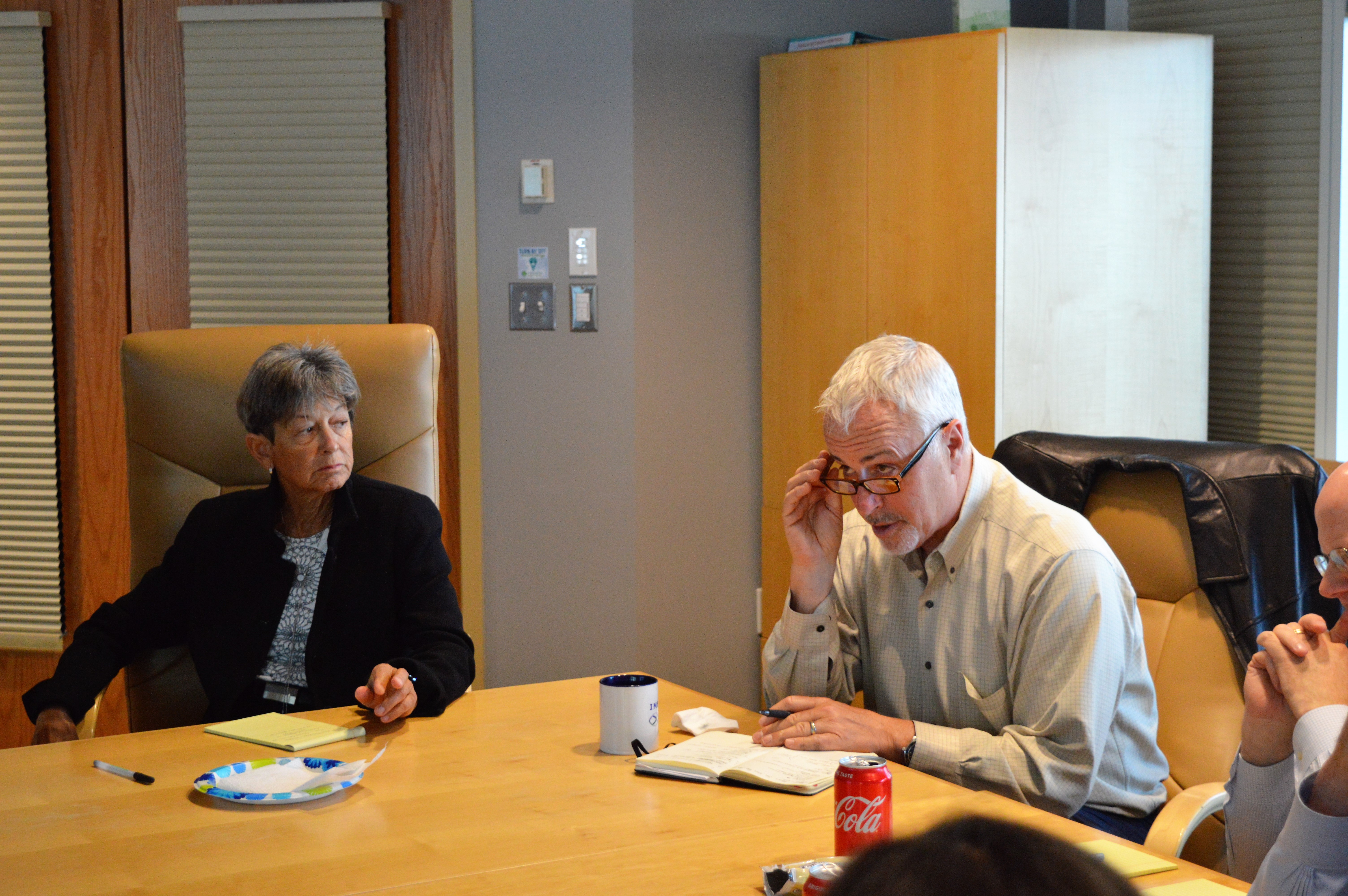
judge Carole Ratcliffe looks on.
At the end of the program, the
participating students pitch their business plan to a panel of local
investors who serve as judges. Paul Silber, founding principal at
Vienna-based Blu Venture Investors, has heard every pitch as a REEF
judge from the beginning.
“It is no easy feat to prepare and deliver a 7-minute pitch to
seasoned business people, but every one of the students succeeded in
doing so,” he said.
The panel of judges would evaluate the quality of the CEO,
specifically trying to assess their intelligence, creativity and
technical prowess, and understanding of the market they would work
within, Silber said. Students often show signs of many early-stage
entrepreneurs, in that they lacked knowledge of essential business
basics, such as how to identify customers and sell to them, he said.
“It is remarkable to see how the quality of the business plan
presentations has evolved and progressed from year-to-year. This is a
clear indication of how the REEF program is getting stronger over time,”
Silber said. “I was exceptionally impressed by the enthusiastic
presentations that I saw this year.”
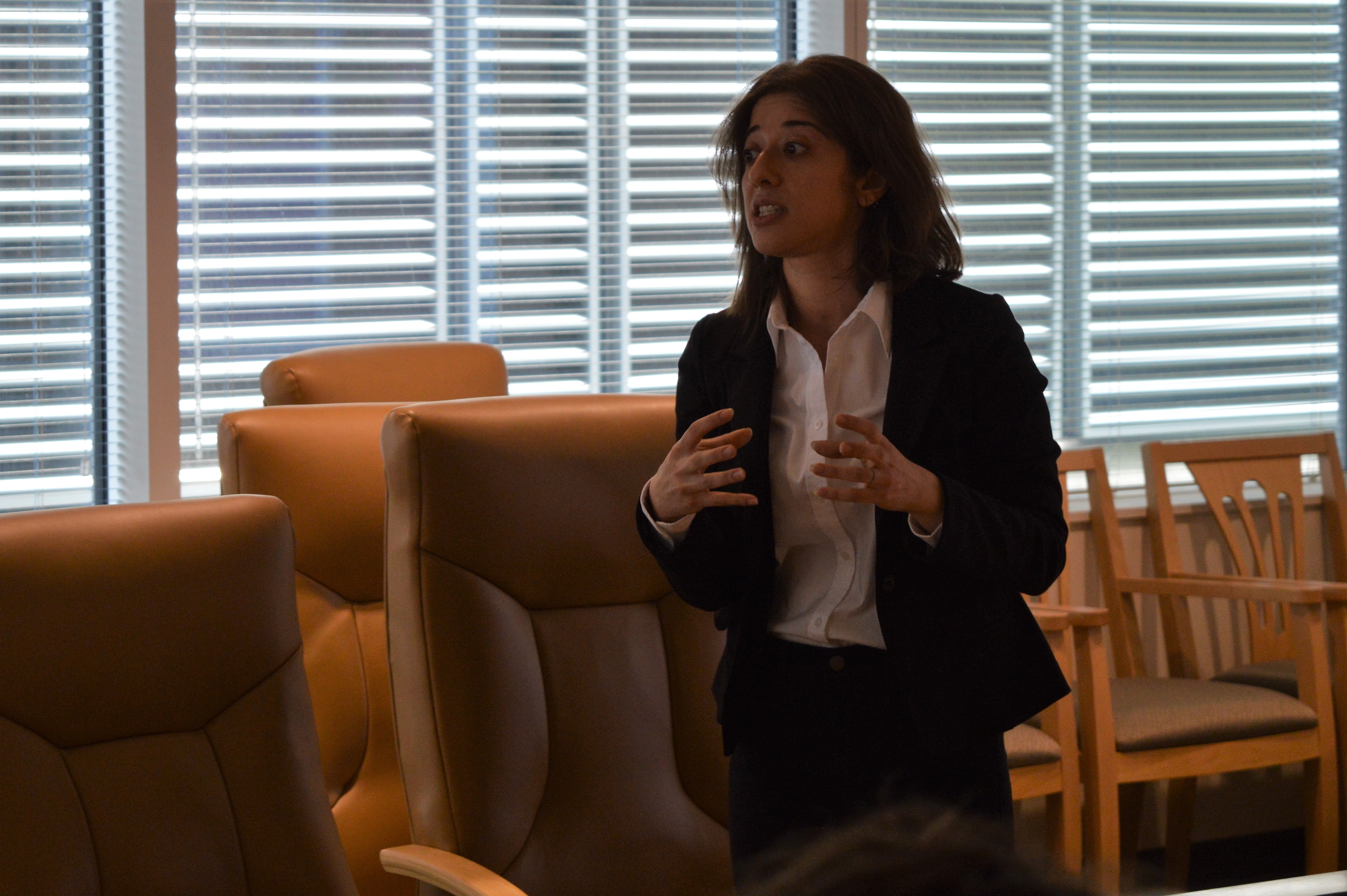
Suzan Shahrestani pitches Minnowtech at her end-of-the-year REEF presentation.
Suzan Shahrestani, a graduate student at UMCES’ Chesapeake Biological Laboratory,
started pitching her program idea, Minnowtech, to outside investors
before she had even completed her first year in the REEF program.
Minnowtech is an application and phone attachment that, with the snap
of a photo, will help anglers instantly measure and log their catch.
Fish catch information will be shared with fisheries managers to improve
assessments of fish populations and regulations.
Shahrestani and her partners won $25,000 from Accelerate Baltimore, a
13-week technology-focused program that offers funding, support and
guidance for start-up companies. They had to compete against roughly 130
applicants for a chance to pitch Minnowtech for the funding. Her group
will compete against the top 7 on June 19 with another pitch for a
chance to win $100,000.
“I had this business idea that I’m really excited about. Just because
I think it’s good doesn’t mean the world will think it’s good,” she
said. “Getting into the Accelerate Baltimore program was a validation
point for me. Other people like the idea and other people not only like
it, but they’re willing to give you money for it. That’s pretty cool.”
Mary Larkin explains her startup, Blueblood, during the end-of-the-year REEF celebration.
Mary Larkin,
an IMET/University of Maryland, Baltimore student, wanted her business
to focus on the horseshoe crab because their commercially valuable blood
helps test the safety of several biomedical products, including
vaccines.
By the end of her time in the REEF program, she knew she wanted to
keep developing the company she envisioned, Blueblood. Larkin and her
partners, Jill Arnold and Brent Whitaker, recently won $20,000
participating in the Shore Hatchery Entrepreneurship Competition at
Salisbury University.
Larkin felt REEF helped her perfect her pitch. Every month in the
program, the students would practice talking about their business
concepts in front of their fellow students, guest speakers, and Nick
Hammond, she said.
“And every month that process got easier,” she said. “The mock pitch
presentations at the end of the year were good preparation for real
pitch competitions.”
Going forward, Larkin hopes the company can secure funding through
other sources to conduct research that will allow her and her partners
to grow their business.
Two of the students who won a spot in REEF’s top 3 this year have also had success since the program ended. Miranda Marvel,
who developed Sensor Fish during REEF, won third place and $1,000 in
the Cangialosi Business Innovation Competition at University of Maryland
Baltimore County (UMBC). Kelsey Abernathy and fellow IMET student Dan Fucich won $1,000 at the University of Maryland, Baltimore (UMB) Grid Pitch for their startup, Urban Algae.
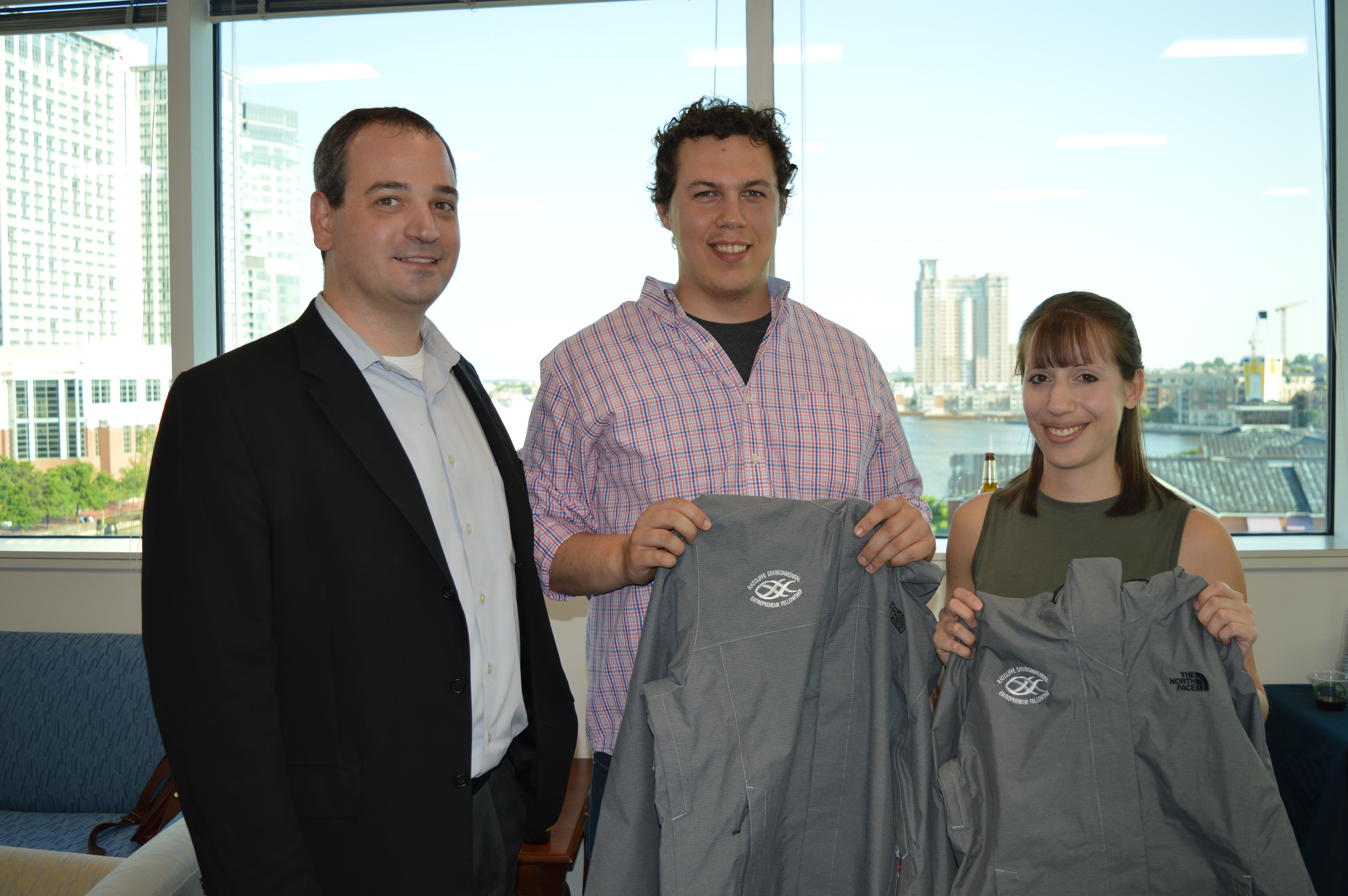
Miranda Marvel and Ryan McDonald receive a jacket from Nick Hammond for finishing the 2017-18 REEF program in the top 3.
Marvel, an IMET/UMBC graduate
student, appreciated hearing more positive feedback for her product.
Sensor Fish is a diagnostic tool that uses colors to signify different
stressors that might be affecting fish in home aquariums or pet stores
tanks.
“Having encouragement and support from the entrepreneurship program
at UMBC has given me the confidence to go ahead with more pitch
competitions and try to hone my idea and begin to think about making a
prototype and taking my business to the next step,” she said.
The funding she received will help her obtain lab supplies and
materials to start conducting research and development so she can
eventually create a product prototype. After a six-month review of her
progress, she has a chance to win another $2,000, through the UMBC
competition.
Once she has a prototype, Marvel said she will start looking for more investors and grant money to go forward with the company.
Abernathy, an IMET/UMB graduate student, stood out in the REEF
program for pitching a rapid disease diagnostic test for aquaculture
that uses the molecules found on cell surfaces that naturally act as
detectors of viruses and bacteria.
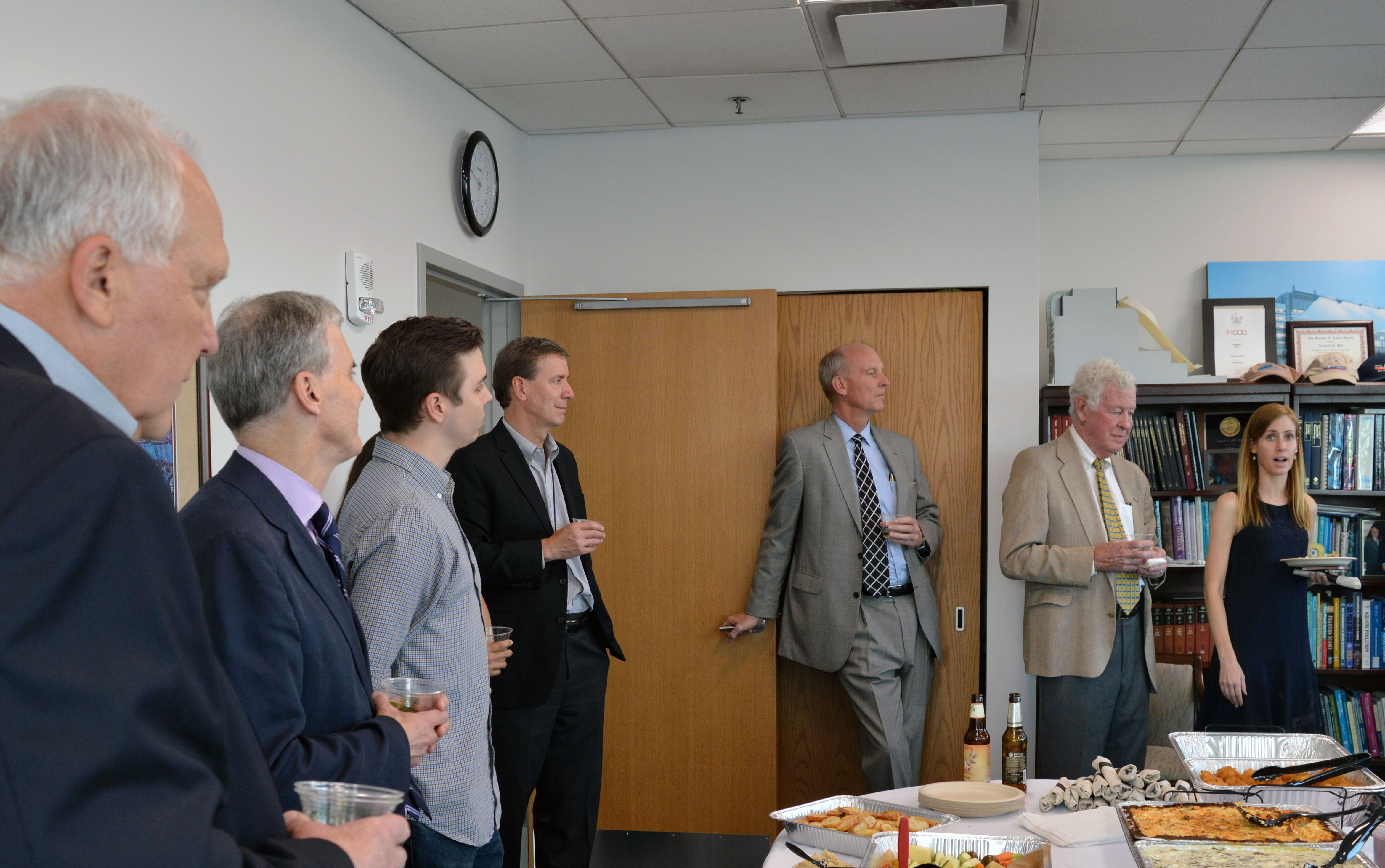
IMET Director Russell Hill
listens in as Dan Fucich discusses Urban Algae, a biotech start up aimed
at providing the public with a source of toxin-free algae for dietary
supplements.
With Fucich, an IMET/UMCES
graduate student, Abernathy pitched Urban Algae, a biotech start up
aimed at providing the public with a source of toxin-free algae for
dietary supplements all while revitalizing urban spaces by retrofitting
them with microalgal green roofs.
The team was thrilled to take their idea to the Grid Pitch finals and
found a lot of encouragement and helpful feedback along the way.
“This competition is a bit of a crash-course of REEF, focusing
primarily on the pitching element,” Fucich said. “They offered several
information sessions and instructional seminars that participants could
attend but the main element was the assigned mentor.”
They worked with the mentor for weeks leading up to the competition
to gain feedback on their pitch’s format and content. With its own
mentoring, REEF proved to be the ideal preparation for this competition.
“Pitching a company is very different from giving a scientific talk,”
Abernathy said. “The REEF program did a great job teaching us the
basics of a good pitch and required us to practice giving pitches to a
variety of audiences. Over time, this built up our confidence and
inspired us to try our skills outside of the REEF environment by
entering a pitch competition.”
Abernathy and Fucich plan to enter more pitch competitions and submit
applications for grants. This summer, they hope to do a pilot study and
begin to prototype their bioreactor.
That students are finding success beyond the REEF program tells
Hammond two things: one, that the program offers effective training, and
two, that graduate students are willing and able to turn their training
into businesses.
“Graduate students are a good source for leading innovation out of
universities, and REEF is a small representation of Maryland’s graduate
students,” he said. “We should be trying it everywhere.”
]]>
May 25, 2018 At its core, the Ratcliffe Environmental Entrepreneur Fellowship is about giving graduate students options they never thought they had. The REEF program at the Institute...
https://imet.usmd.edu/news/students-find-success-entrepreneurs-after-reef-program
https://beta.my.umbc.edu/api/v0/pixel/news/77685/guest@my.umbc.edu/c7c0a0dbc64e62e87bf834f1575ad2b1/api/pixel
Marine Biotechnology
https://beta.my.umbc.edu/groups/marinebiotechnology
https://assets4-beta.my.umbc.edu/system/shared/avatars/groups/000/000/761/ea407c6c8898c300a60b1f84d8f15d80/xsmall.png?1596561611
https://assets3-beta.my.umbc.edu/system/shared/avatars/groups/000/000/761/ea407c6c8898c300a60b1f84d8f15d80/original.jpg?1596561611
https://assets1-beta.my.umbc.edu/system/shared/avatars/groups/000/000/761/ea407c6c8898c300a60b1f84d8f15d80/xxlarge.png?1596561611
https://assets4-beta.my.umbc.edu/system/shared/avatars/groups/000/000/761/ea407c6c8898c300a60b1f84d8f15d80/xlarge.png?1596561611
https://assets1-beta.my.umbc.edu/system/shared/avatars/groups/000/000/761/ea407c6c8898c300a60b1f84d8f15d80/large.png?1596561611
https://assets4-beta.my.umbc.edu/system/shared/avatars/groups/000/000/761/ea407c6c8898c300a60b1f84d8f15d80/medium.png?1596561611
https://assets2-beta.my.umbc.edu/system/shared/avatars/groups/000/000/761/ea407c6c8898c300a60b1f84d8f15d80/small.png?1596561611
https://assets4-beta.my.umbc.edu/system/shared/avatars/groups/000/000/761/ea407c6c8898c300a60b1f84d8f15d80/xsmall.png?1596561611
https://assets3-beta.my.umbc.edu/system/shared/avatars/groups/000/000/761/ea407c6c8898c300a60b1f84d8f15d80/xxsmall.png?1596561611
Marine Biotechnology
0
0
true
Fri, 27 Jul 2018 20:34:44 -0400
Fri, 27 Jul 2018 20:54:24 -0400
Baltimore Magazine’s “Best of Baltimore” highlights UMBC arts and athletics

Baltimore Magazine’s 2018 “Best of Baltimore” issue features some of the region’s standout people, places, and events of the past year, including highlights from UMBC. The magazine hails the UMBC men’s basketball team’s historic March Madness appearance as “Best Upset” of the year. It also honors Lisa Moren, professor visual arts, with the “Best Public Art” title for her innovative NONUMENT 01::McKeldin Fountain app.
It’s been a year of firsts for the UMBC men’s basketball team—from the buzzer-beater shot heard ‘round the world to clinch the America East championship, to the unforgettable U Must Be Cinderella win against no. 1 seed University of Virginia, to an ESPY Award nomination for “Best Moment,” and things show no sign of slowing down now.
Head coach Ryan Odom reflects on the whirlwind year saying, “I’m just so proud of these guys and what they were able to accomplish in making history and inspiring our community as a whole.”
Senior captain Jourdan Grant ‘18, media and communication studies, recognizes that none of this would be possible without hometown fans, adding, “We just wanted to say thank you to Retriever Nation and the whole city of Baltimore for giving us so much support and love this season.”
“This has been such a meaningful year for the team and for UMBC, and this is further recognition of that,” said President Freeman Hrabowski. “We took that amazing March Madness moment as a chance to show the world what we’ve known all along about UMBC—that this is a community that believes in grit and achievement, and also in supporting each other. With hard work and passion, we can reach for greatness together.”
 NONUMENT 01::McKeldin Fountain app. Photo courtesy of Lisa Moren.
In the category of “Best Public Art-Virtual,” Moren’s NONUMENT app extends beyond the confines of traditional art forms by bringing an iconic public artwork back to life through technology. Baltimore’s McKeldin Fountain was demolished in 2016. Working with Jaimes Mayhew, MFA ’10, IMDA, and Slovenian artists Martin Bricelj Baraga and Neja Tomšič, Moren was able to recreate the structure in the virtual world this past May.
“We set out to make an experience that would claim public space and celebrate the people who used it,” Moren said to Bmore Art. “I hope Baltimoreans will feel like they own this as 21st century monument to everyday people, that this is part of their city now…No other city has a monument like this.”
Downloadable on iOS and Android devices, guests are able to revisit the Brutalist fountain by using “memory artifacts” to experience the events and visitors that made it a hub for social discourse. The app includes animated waterfalls and interviews with Baltimore residents, including teachers, protestors, and rappers.
About the award, Moren shared, “It’s very gratifying that ephemeral technologies are validated as a form of public art in Baltimore through this award.”

In the Best of Baltimore Readers’ Poll, UMBC’s student-run radio station WMBC was a runner-up for “Best Radio Station” in the news and media category.
The Baltimore Sun also recently released its 2018 “Best of Baltimore” rankings, which recognized UMBC for offering the area’s “Best Summer Camp” (a readers’ choice award). This year marks the 40th anniversary of UMBC Summer Day Camp, which is operated through the athletics and recreation at UMBC. The camp is designed for kids in elementary and middle school, and includes a very active curriculum of sports, games, and art and craft activities.
In addition to Summer Day Camp, UMBC’s youth basketball camp has continue to soar in popularity since its inception in 2016, with more than 150 campers attending this summer. The Retriever Aquatic Club also plays an important role in UMBC’s summer youth athletics programming. The Retriever Aquatic Club, now in its 32nd year, helps swimmers of all ages develop athletic skills, as well as teamwork, motivation, and resilience.
Club director and UMBC swimming and diving coach Chad Cradock ‘97, psychology, recently told the Baltimore Sun, “We want to give them lessons in discipline, focus, drive and goal-setting.” With a message shared by his colleagues across UMBC Athletics and beyond, Cradock said, “Our mission is to develop them in swimming as well as life.”
Banner image: Retrievers showing off their school spirit, by Marylana Demond ’11 for UMBC. Video by Corey Jennings ’10 for UMBC.
]]>
Baltimore Magazine’s 2018 “Best of Baltimore” issue features some of the region’s standout people, places, and events of the past year, including highlights from UMBC. The magazine hails the UMBC...
https://umbc.edu/stories/baltimore-magazines-best-of-baltimore-highlights-umbc-arts-and-athletics/
https://beta.my.umbc.edu/api/v0/pixel/news/120362/guest@my.umbc.edu/3c29a259445fcd56c8e2494d6320e4f9/api/pixel
athletics
cahss
community
rankings
visualarts
UMBC News & Magazine
https://beta.my.umbc.edu/groups/umbc-news-magazine
https://assets1-beta.my.umbc.edu/system/shared/avatars/groups/000/001/943/24435aa6207c452e7bc15cc74b42c7bb/xsmall.png?1748556657
https://assets1-beta.my.umbc.edu/system/shared/avatars/groups/000/001/943/24435aa6207c452e7bc15cc74b42c7bb/original.png?1748556657
https://assets2-beta.my.umbc.edu/system/shared/avatars/groups/000/001/943/24435aa6207c452e7bc15cc74b42c7bb/xxlarge.png?1748556657
https://assets2-beta.my.umbc.edu/system/shared/avatars/groups/000/001/943/24435aa6207c452e7bc15cc74b42c7bb/xlarge.png?1748556657
https://assets3-beta.my.umbc.edu/system/shared/avatars/groups/000/001/943/24435aa6207c452e7bc15cc74b42c7bb/large.png?1748556657
https://assets1-beta.my.umbc.edu/system/shared/avatars/groups/000/001/943/24435aa6207c452e7bc15cc74b42c7bb/medium.png?1748556657
https://assets2-beta.my.umbc.edu/system/shared/avatars/groups/000/001/943/24435aa6207c452e7bc15cc74b42c7bb/small.png?1748556657
https://assets1-beta.my.umbc.edu/system/shared/avatars/groups/000/001/943/24435aa6207c452e7bc15cc74b42c7bb/xsmall.png?1748556657
https://assets2-beta.my.umbc.edu/system/shared/avatars/groups/000/001/943/24435aa6207c452e7bc15cc74b42c7bb/xxsmall.png?1748556657
UMBC News & Magazine
0
0
false
Fri, 27 Jul 2018 20:00:01 -0400
Baltimore Magazine’s “Best of Baltimore” highlights UMBC arts and athletics
Baltimore Magazine recognizes men's basketball as "Best Upset" and Lisa Moren's NONUMENT app as "Best Public Art" in this year's Best of Baltimore edition.
]]>
Baltimore Magazine recognizes men's basketball as "Best Upset" and Lisa Moren's NONUMENT app as "Best Public Art" in this year's Best of Baltimore edition.
https://news.umbc.edu/baltimore-magazines-best-of-baltimore-highlights-umbc-arts-and-athletics/
https://beta.my.umbc.edu/api/v0/pixel/news/108123/guest@my.umbc.edu/badab739b3989e2d8823aa6c95c5cf99/api/pixel
athletics
cahss
community
rankings
visualarts
UMBC News
https://beta.my.umbc.edu/groups/umbc-news
https://assets2-beta.my.umbc.edu/system/shared/avatars/groups/000/001/944/2c79aeea85b1abb37f8cf9fbcdc382b0/xsmall.png?1632921809
https://assets4-beta.my.umbc.edu/system/shared/avatars/groups/000/001/944/2c79aeea85b1abb37f8cf9fbcdc382b0/original.png?1632921809
https://assets4-beta.my.umbc.edu/system/shared/avatars/groups/000/001/944/2c79aeea85b1abb37f8cf9fbcdc382b0/xxlarge.png?1632921809
https://assets1-beta.my.umbc.edu/system/shared/avatars/groups/000/001/944/2c79aeea85b1abb37f8cf9fbcdc382b0/xlarge.png?1632921809
https://assets1-beta.my.umbc.edu/system/shared/avatars/groups/000/001/944/2c79aeea85b1abb37f8cf9fbcdc382b0/large.png?1632921809
https://assets1-beta.my.umbc.edu/system/shared/avatars/groups/000/001/944/2c79aeea85b1abb37f8cf9fbcdc382b0/medium.png?1632921809
https://assets4-beta.my.umbc.edu/system/shared/avatars/groups/000/001/944/2c79aeea85b1abb37f8cf9fbcdc382b0/small.png?1632921809
https://assets2-beta.my.umbc.edu/system/shared/avatars/groups/000/001/944/2c79aeea85b1abb37f8cf9fbcdc382b0/xsmall.png?1632921809
https://assets4-beta.my.umbc.edu/system/shared/avatars/groups/000/001/944/2c79aeea85b1abb37f8cf9fbcdc382b0/xxsmall.png?1632921809
UMBC News
0
0
false
Fri, 27 Jul 2018 16:00:01 -0400
Dr. Anthony Johnson named Distinguished Traveling Lecturer
Dr. Anthony M. Johnson was nominated by the APS (American Physical Society) Division of Laser Science and has accepted an appointment as a Distinguished Traveling Lecturer.
The Division of Laser Science (DLS) of the American Physical Society announces the continuance of its sponsorship of a lecture program in Laser Science. Lecturers will visit selected academic institutions for two days, during which time they will give a public lecture open to the entire academic community and meet informally with students and faculty. They may also give guest lectures in classes related to Laser Science. The purpose of the program is to bring distinguished scientists to primarily undergraduate colleges and universities in order to convey the excitement of Laser Science to undergraduate students.
]]>
Dr. Anthony M. Johnson was nominated by the APS (American Physical Society) Division of Laser Science and has accepted an appointment as a Distinguished Traveling Lecturer. The Division of Laser...
https://beta.my.umbc.edu/api/v0/pixel/news/77683/guest@my.umbc.edu/0440fa81d7bc622275827ae5e6804f2f/api/pixel
Physics
https://beta.my.umbc.edu/groups/physics
https://assets1-beta.my.umbc.edu/system/shared/avatars/groups/000/000/602/92740316e784a1ffbc6263cda396b05a/xsmall.png?1520366549
https://assets2-beta.my.umbc.edu/system/shared/avatars/groups/000/000/602/92740316e784a1ffbc6263cda396b05a/original.jpg?1520366549
https://assets3-beta.my.umbc.edu/system/shared/avatars/groups/000/000/602/92740316e784a1ffbc6263cda396b05a/xxlarge.png?1520366549
https://assets3-beta.my.umbc.edu/system/shared/avatars/groups/000/000/602/92740316e784a1ffbc6263cda396b05a/xlarge.png?1520366549
https://assets1-beta.my.umbc.edu/system/shared/avatars/groups/000/000/602/92740316e784a1ffbc6263cda396b05a/large.png?1520366549
https://assets4-beta.my.umbc.edu/system/shared/avatars/groups/000/000/602/92740316e784a1ffbc6263cda396b05a/medium.png?1520366549
https://assets3-beta.my.umbc.edu/system/shared/avatars/groups/000/000/602/92740316e784a1ffbc6263cda396b05a/small.png?1520366549
https://assets1-beta.my.umbc.edu/system/shared/avatars/groups/000/000/602/92740316e784a1ffbc6263cda396b05a/xsmall.png?1520366549
https://assets2-beta.my.umbc.edu/system/shared/avatars/groups/000/000/602/92740316e784a1ffbc6263cda396b05a/xxsmall.png?1520366549
Physics
https://assets1-beta.my.umbc.edu/system/shared/thumbnails/news/000/077/683/1b806aff196bcc0cc103ed9e7303addf/xxlarge.jpg?1532721155
https://assets3-beta.my.umbc.edu/system/shared/thumbnails/news/000/077/683/1b806aff196bcc0cc103ed9e7303addf/xlarge.jpg?1532721155
https://assets4-beta.my.umbc.edu/system/shared/thumbnails/news/000/077/683/1b806aff196bcc0cc103ed9e7303addf/large.jpg?1532721155
https://assets2-beta.my.umbc.edu/system/shared/thumbnails/news/000/077/683/1b806aff196bcc0cc103ed9e7303addf/medium.jpg?1532721155
https://assets2-beta.my.umbc.edu/system/shared/thumbnails/news/000/077/683/1b806aff196bcc0cc103ed9e7303addf/small.jpg?1532721155
https://assets2-beta.my.umbc.edu/system/shared/thumbnails/news/000/077/683/1b806aff196bcc0cc103ed9e7303addf/xsmall.jpg?1532721155
https://assets4-beta.my.umbc.edu/system/shared/thumbnails/news/000/077/683/1b806aff196bcc0cc103ed9e7303addf/xxsmall.jpg?1532721155
5
0
false
Fri, 27 Jul 2018 15:58:30 -0400
Fall 2018 Finals schedule!
There is no reason not to know!
All,
The finals schedule for fall semester 2018 is finalized and will show in your syllabi next month. Here's a sneak peak of what to expect: Note the color codes on the bottom of the page. For Chem 490's the professors last name is listed for their courses.
CHEM
101 Monday 12/17 3:30 – 5:30 PM ENG
027, Phys 101, LH1, MEYR 030, SHER 003, ITE 104, PAHB 132
CHEM
102 Monday 12/17/18 8:30 -10:30 PM ITE
104, MEYR 030, ENG 027
CHEM 102L Wed 12/19/18 1:00 – 3:00 PM MEYR 030
CHEM 123 Wed 12/19/19 8:00 – 10:00 AM ITE 104
CHEM 300 Thurs 12/13/18 8:00 – 10:00 AM SHER 003
CHEM 301 Wed 12/19/18 8:00- 10:00 AM ITE 102, another TBA
CHEM
351 Wed 12/19/18 6:00 – 8:00 PM ENG
027, PAHB 132, PHYS 101, BS120, MEYR 030, UC115
CHEM
351L Tues 12/18/18 6:00 – 8:00 PM MEYR
030, ENG 027
CHEM 405L Tues 12/18/18 1:00 – 3:00 MEYR 272
CHEM 410 Fri 12/14/18 10:30 -12:30 PM MP104
CHEM 437 Thurs 12/13/18 6:00 – 8:00 ENG 027
CHEM 451 Thurs 12/13/18 10:30 – 12:30 PM FA001
CHEM 467 Tues 12/18/18 10:30 – 12:30 PM PAHB124
CHEM 490 (Allen) Thurs 12/13/18 8:00 -10:00 MEYR 272
CHEM 490 (An) Thurs 12/13/18 10:30 – 12:30 MEYR272
CHEM 490(Chen) Fri 12/14/18 10:30 -12:30 PM FA301
CHEM 490 (Smith) Tues 12/18/18 10:30 – 12:30 PM MEYR 272
Follows
Midterm schedule for Friday afternoon, Monday evening or Wednesday evening
exams
Common
Final spot
]]>
All, The finals schedule for fall semester 2018 is finalized and will show in your syllabi next month. Here's a sneak peak of what to expect: Note the color codes on the bottom of the page....
Document
https://assets1-beta.my.umbc.edu/system/shared/attachments/423042b82a61be8f0190402a3645946e/69fe386e/news/000/077/680/ac83d3f400e95a5d31e7c59d2743bf73/Fall 2018 finals.docx?1532718560
https://beta.my.umbc.edu/api/v0/pixel/news/77680/guest@my.umbc.edu/cbd3573f679223698544967333950ff5/api/pixel
Chemistry and Biochemistry Majors
https://beta.my.umbc.edu/groups/undergrad-chem-biochem-majors
https://assets3-beta.my.umbc.edu/images/avatars/group/4/xsmall.png?1778114318
https://assets4-beta.my.umbc.edu/images/avatars/group/4/original.png?1778114318
https://assets2-beta.my.umbc.edu/images/avatars/group/4/xxlarge.png?1778114318
https://assets1-beta.my.umbc.edu/images/avatars/group/4/xlarge.png?1778114318
https://assets1-beta.my.umbc.edu/images/avatars/group/4/large.png?1778114318
https://assets1-beta.my.umbc.edu/images/avatars/group/4/medium.png?1778114318
https://assets2-beta.my.umbc.edu/images/avatars/group/4/small.png?1778114318
https://assets3-beta.my.umbc.edu/images/avatars/group/4/xsmall.png?1778114318
https://assets3-beta.my.umbc.edu/images/avatars/group/4/xxsmall.png?1778114318
Chemistry and Biochemistry Majors
5
0
true
Fri, 27 Jul 2018 15:09:26 -0400
 Americans are used to seeing Russian propaganda that looks like this.
AP Photo/Kirsty Wigglesworth
Americans are used to seeing Russian propaganda that looks like this.
AP Photo/Kirsty Wigglesworth