talk: Methods and Models: Data Science for Campus Parking, 11:15am Mon 8/13

Methods and Models: Data Science for Campus Parking
Professor John Hoag
Associate Professor, Ohio University
11:15-12:15pm Monday, 13 August 2018 in ITE 325B
How can data science improve the parking experience for students, faculty, and staff? Or are there other motives at work? This talk will define and approach this perennial campus problem from perspectives of telematics and modeling, starting with the “Smart Cities” life cycle of data collection and analysis – from best practices through optimization. Next, we will consider relevant probabilistic models and their implementations over a century of study. We will conclude by discussing unintended consequences such as LPRs and other outcomes.
Dr. John Hoag is Associate Professor of Information and Telecommunication Systems at Ohio University in Athens, OH. He earned Ph.D. and M.S. Degrees in Operations Research from Ohio State University and holds a Bachelor’s degree in Computer Science. His current portfolio can be termed Smart Cities, which subsumes transportation, energy, finance, public health, and more, for which he is forming interdisciplinary public-private teams whose scope encompasses data collection, telemetry, storage, and analysis. The Smart Cities displaced work he started in bioinformatics and translational biomedical science, where his efforts focused on computational complexity and system performance. He maintains an adjunct appointment in EECS at Case Western Reserve University.
Host: Dr. Richard Forno (*protected email*)
The post talk: Methods and Models: Data Science for Campus Parking, 11:15am Mon 8/13 appeared first on Department of Computer Science and Electrical Engineering.
]]>
Methods and Models: Data Science for Campus Parking Professor John Hoag Associate Professor, Ohio University 11:15-12:15pm Monday, 13 August 2018 in ITE 325B How can data science improve the...
https://www.csee.umbc.edu/2018/08/talk-methods-and-models-data-science-for-campus-parking-1115am-mon-8-13/
https://beta.my.umbc.edu/api/v0/pixel/news/77868/guest@my.umbc.edu/ee48da26e32074af2b2f4334a8b5e0b0/api/pixel
computer-science
data-science
news
talks
Computer Science and Electrical Engineering
https://beta.my.umbc.edu/groups/csee
https://assets3-beta.my.umbc.edu/system/shared/avatars/groups/000/000/099/d117dca133c64bf78a4b7696dd007189/xsmall.png?1314043393
https://assets1-beta.my.umbc.edu/system/shared/avatars/groups/000/000/099/d117dca133c64bf78a4b7696dd007189/original.png?1314043393
https://assets1-beta.my.umbc.edu/system/shared/avatars/groups/000/000/099/d117dca133c64bf78a4b7696dd007189/xxlarge.png?1314043393
https://assets4-beta.my.umbc.edu/system/shared/avatars/groups/000/000/099/d117dca133c64bf78a4b7696dd007189/xlarge.png?1314043393
https://assets3-beta.my.umbc.edu/system/shared/avatars/groups/000/000/099/d117dca133c64bf78a4b7696dd007189/large.png?1314043393
https://assets1-beta.my.umbc.edu/system/shared/avatars/groups/000/000/099/d117dca133c64bf78a4b7696dd007189/medium.png?1314043393
https://assets2-beta.my.umbc.edu/system/shared/avatars/groups/000/000/099/d117dca133c64bf78a4b7696dd007189/small.png?1314043393
https://assets3-beta.my.umbc.edu/system/shared/avatars/groups/000/000/099/d117dca133c64bf78a4b7696dd007189/xsmall.png?1314043393
https://assets3-beta.my.umbc.edu/system/shared/avatars/groups/000/000/099/d117dca133c64bf78a4b7696dd007189/xxsmall.png?1314043393
Computer Science and Electrical Engineering
4
0
true
Fri, 10 Aug 2018 15:46:24 -0400
A cooler ocean predator than sharks?
Consider the mantis shrimps
A cooler ocean predator than sharks? Consider the mantis shrimps
July 27, 2018 6.44am EDT
When you think about fearsome predators in the ocean, the first thing that pops into your mind is probably a shark. Sure, sharks are OK, with their sleek, menacing shape and their gaping jaws with rows of jagged teeth. But if you were a fish living on a coral reef or cruising along the shore over the sands of a tropical island, you would fear a far more terrifying predator.
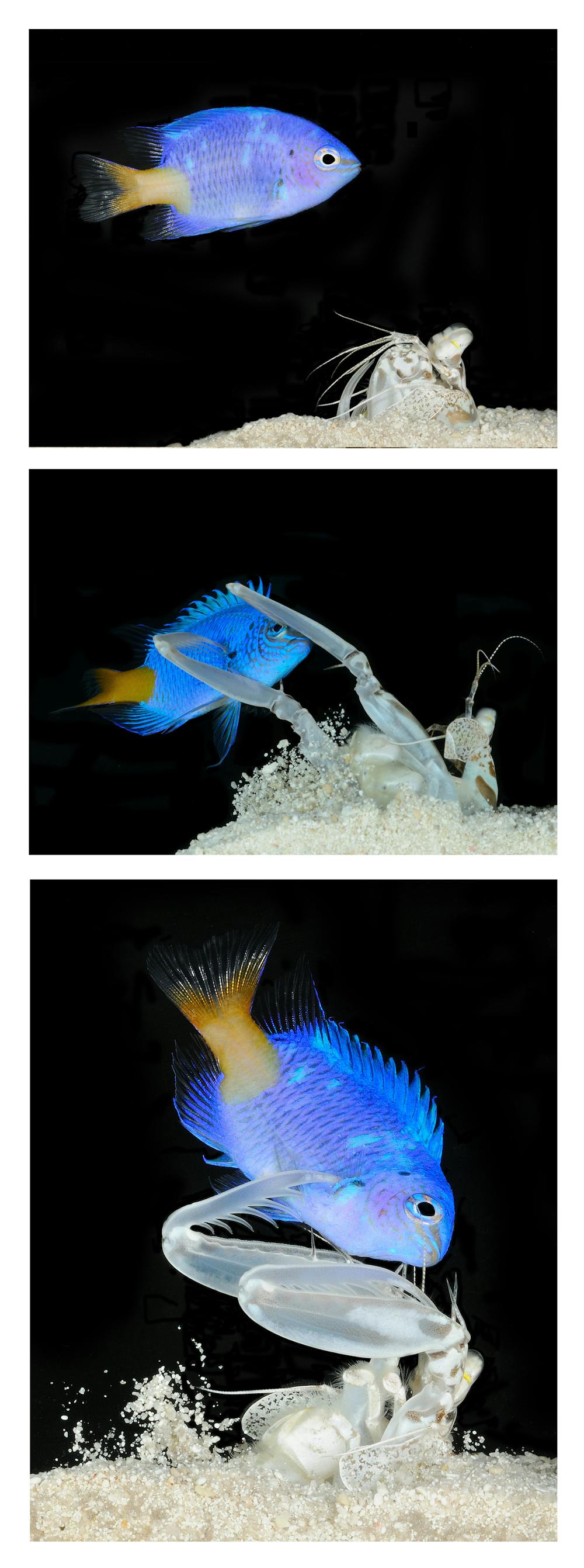
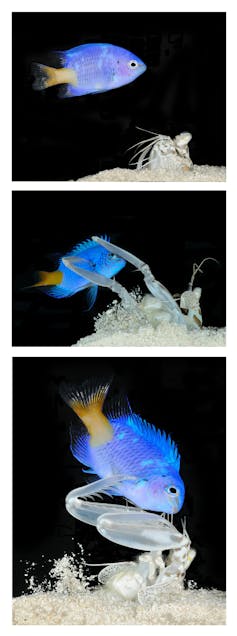 Nabbed before it knew it was in danger. Roy L. Caldwell, Department of Integrative Biology, UC Berkeley (For use only with this article), Author provided (No reuse)
Consider an armored, tank-like creature looking something like a lobster. Most are quite small, often tinier than your little finger, though some can be as long as your forearm. This animal doesn’t swim around like a shark; instead, it hides in the sand or in rocky holes in coral, searching the water above with constantly roving eyes. It can snatch prey right out of the water in a tiny fraction of a second.
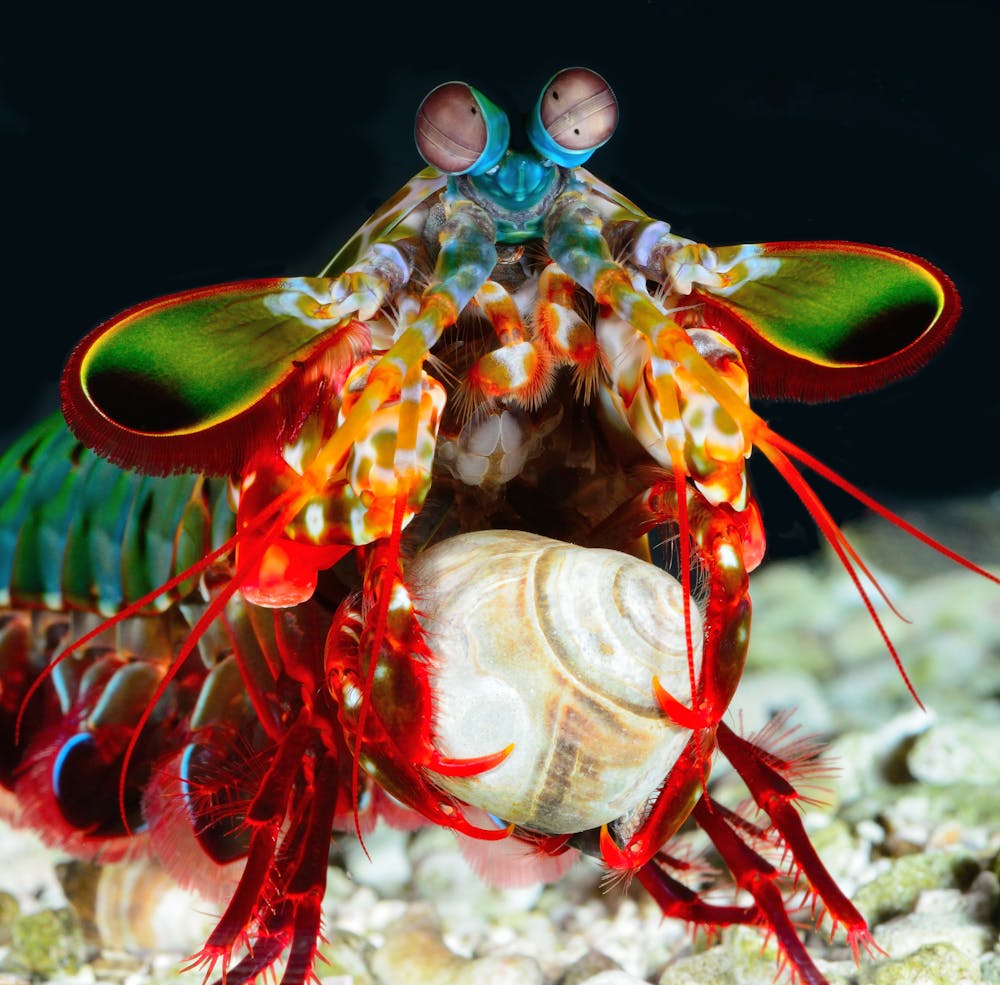
And it accomplishes this feat without claws. Instead, it’s armed with a powerful pair of what scientists call “raptorial appendages” that end in a brutal hammer or a series of vicious, pointed spines. These prey-catching arms look somewhat like the front legs of a praying mantis, which gives these creatures their name – mantis shrimps.
They’re crustaceans – the group of hard-shelled animals that includes crabs, lobsters and shrimps. The strength of the mantis shrimps’ raptorial arms together with their amazing eyes make them perfect predators.
Massively powerful predators
Mantis shrimps’ raptorial appendages contain massive muscles that can extend them to their full length in hundredths of a second, producing strike forces that in some species can smash through the glass wall of an aquarium or instantly dismember a crab. These smashing attacks are so forceful they produce tiny bubbles in the water. When these cavitation bubbles collapse in a flash of light, they release additional energy onto the target. Boat propellers and turbine blades are often ruined by cavitation forces; mantis shrimps use them to crack the hard shells of their victims.
Other species, with spiny raptorial appendages, impale fish or shrimp with a vice-like grip that allows the mantis shrimp to drag them down into its burrow – often, in the blink of an eye.
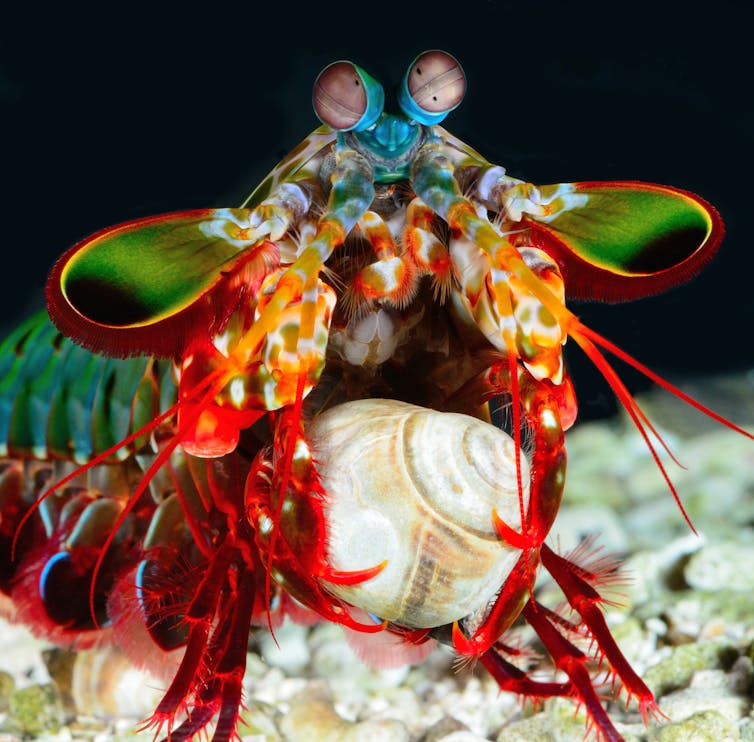 Prepare to be smashed. Roy L. Caldwell, Department of Integrative Biology, UC Berkeley (For use only with this article), Author provided (No reuse)
Mantis shrimps – properly called stomatopod crustaceans – first appeared in the oceans about 400 million years ago, and have been evolving on their own route to perfection ever since. By now, they are only distantly related to any other living animal, including ones that arose from their crustacean ancestors. They’re so unusual that they seem to have arrived from another planet - in fact, vision scientist Mike Land jokingly calls them “shrimps from Mars.”
There are almost 500 known species of mantis shrimp. However, they stay well concealed in their rocky and sandy burrows, and only a few scientists study them, so there are probably many new mantis shrimps yet to be discovered. Almost all live in shallow, marine waters, and most inhabit the tropics.
Remarkable eyes of the mantis shrimp
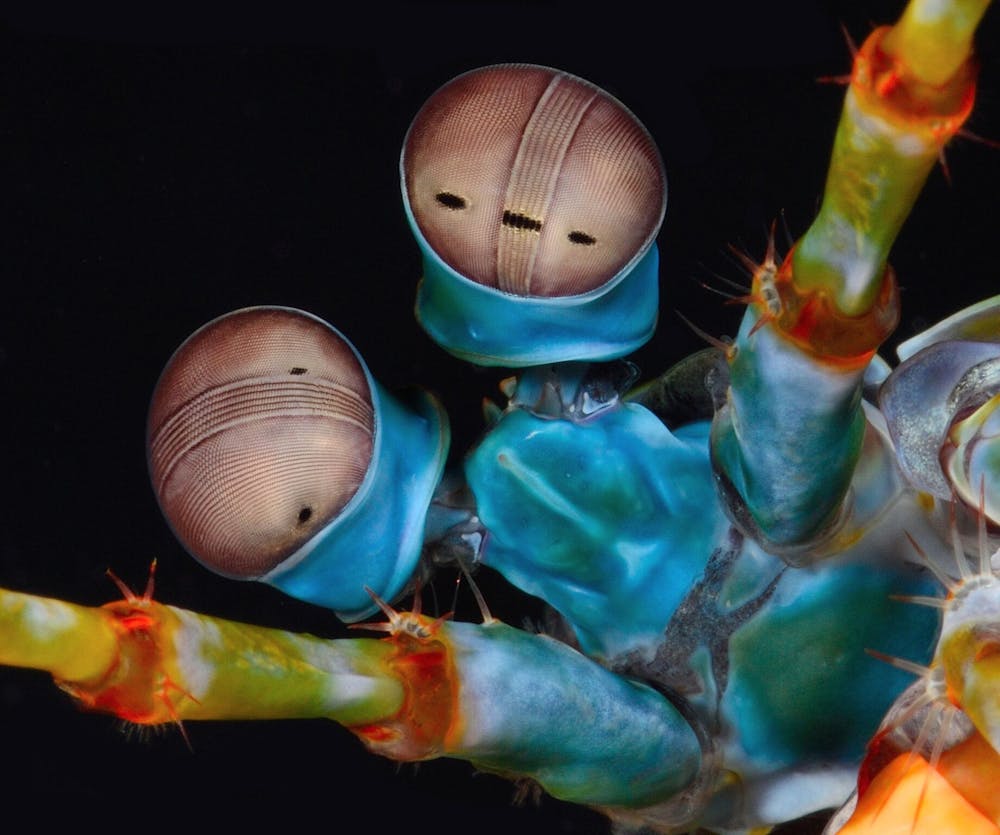
Like all crustaceans (insects, too), mantis shrimps have compound eyes – think of the eyes of crabs, bees, or butterflies. Each eye has hundreds of separate facets, each of which is a single unit of the entire compound eye. But mantis shrimp eyes are far more specialized than all other compound eyes, in some ways more than any other eyes biologists have ever discovered.
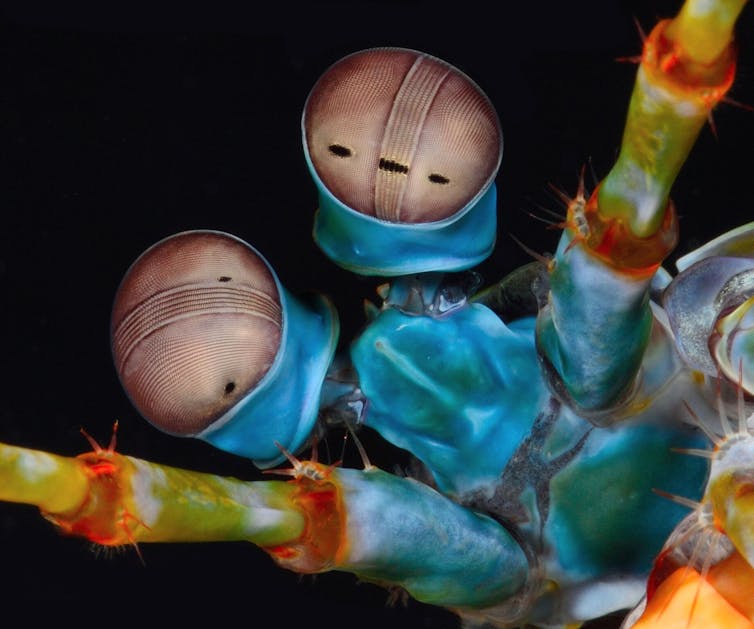 A mantis shrimp’s compound eye can be comprised of 10,000 or more individual facets. Roy L. Caldwell, Department of Integrative Biology, UC Berkeley (For use only with this article), Author provided (No reuse)
For one thing, each eye is like three eyes squeezed into one. The three parts all look at the same point in space, much as our two separate eyes focus on the same scene. We use our two eyes to locate an object in space. Mantis shrimps can work out the distance to objects they’re looking at using a single eye.
Two eye parts, at the top and bottom of the eye, are probably involved in this distance vision. The third part is built from parallel rows of facets that run around the middle of the eye like a belt. Usually there are six rows, though a few species have only two. This part of the eye is called the “midband,” and it supports many special abilities.
Further, most mantis shrimps see ultraviolet light – part of the electromagnetic spectrumthat causes sunburn in you or me and that is invisible to our eyes. Mantis shrimps not only sense this light, but with their specialized midbands they even see separate colors of it.
This feature is on top of another set of color detectors that see the same visible light we’re used to – but in eight color channels as opposed to the three primary colors we see. Imagine trying to build a TV that looks right to a mantis shrimp. Besides the red, green, and blue colors that your TV uses to create a vivid picture, it would require pixels for violet, indigo, blue-green, orange and a deeper red than we can see.
And the midband can do even more. It can detect the polarization of light – where all the waves vibrate in the same plane. Our eyes cannot see this property of light. Mantis shrimps image things using it.
So putting together all its visual talents, when a mantis shrimp sees a fish, it’s in patterns of ultraviolet colors, eight primary regular colors and polarized light. Their eyes gather all this information and pass it on to the animal’s brain, so it can decide what to attack, when to attack it, how far away it is, and what it looks like in a dozen different ways. It’s hard for a human to even imagine the visual world of a mantis shrimp.
Letting down its defenses
With superpower vision coupled to explosive predatory arms, it seems like mantis shrimps would be invincible. But even these animals have their worries. Mantis shrimps can not only kill other animals, like fish, octopus or crabs. They can also kill each other. This raises a serious problem. Eventually, it’s time to reproduce – but how does a mantis shrimp know when another one it meets wants to mate rather than make a murderous assault?
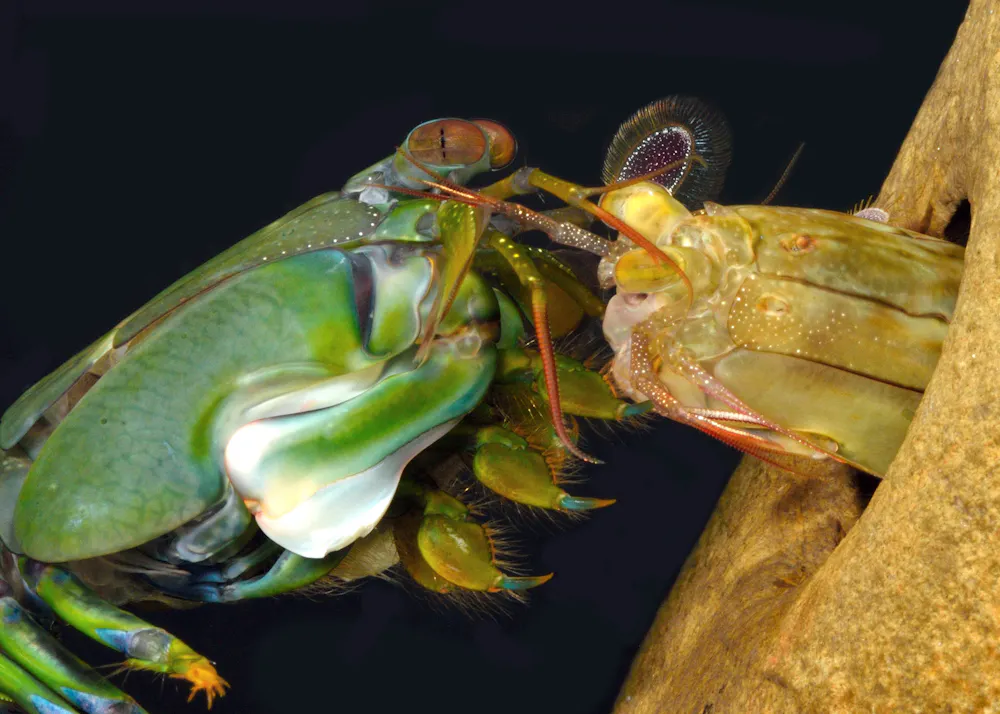
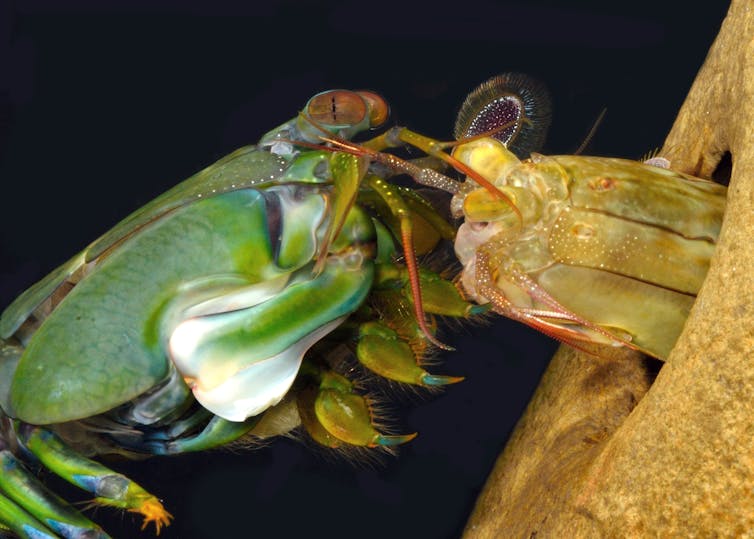 Courtship could be deadly if mantis shrimps get their signals crossed. Roy L. Caldwell, Department of Integrative Biology, UC Berkeley (For use only with this article), Author provided (No reuse)
Mantis shrimps have been forced to evolve ways to recognize when it’s safe to get intimate and to signal their own nonlethal intent. They use their special vision for this too. Mantis shrimps are often brightly colored, and they display patterns – invisible to us – in ultraviolet and polarized light. The complicated displays inform other members of their species, or of different ones, what they plan to do. If their plans include reproduction, and the viewer is of similar mind, then they can safely mate and initiate a new generation of their species.
So, yes – sharks are all right. But do they have bullet-like strikes? Do they have super-vision? Can they take down prey in milliseconds? It’s mantis shrimps that have these abilities, and they use them to become some of the world’s most impressive predators.
[Article originally appeared in "The Conversation." Click to view the original article.]
]]>
A cooler ocean predator than sharks? Consider the mantis shrimps July 27, 2018 6.44am EDT When you think about fearsome predators in the ocean, the first thing that pops into your mind is...
https://theconversation.com/a-cooler-ocean-predator-than-sharks-consider-the-mantis-shrimps-99559
https://beta.my.umbc.edu/api/v0/pixel/news/77864/guest@my.umbc.edu/818562aaa72c841604f7c29702fd4fd4/api/pixel
Department of Biological Sciences
https://beta.my.umbc.edu/groups/biol
https://assets1-beta.my.umbc.edu/system/shared/avatars/groups/000/000/430/6b175bb0e4c9635bddddedfbeb4f8c38/xsmall.png?1681829319
https://assets2-beta.my.umbc.edu/system/shared/avatars/groups/000/000/430/6b175bb0e4c9635bddddedfbeb4f8c38/original.jpg?1681829319
https://assets1-beta.my.umbc.edu/system/shared/avatars/groups/000/000/430/6b175bb0e4c9635bddddedfbeb4f8c38/xxlarge.png?1681829319
https://assets3-beta.my.umbc.edu/system/shared/avatars/groups/000/000/430/6b175bb0e4c9635bddddedfbeb4f8c38/xlarge.png?1681829319
https://assets3-beta.my.umbc.edu/system/shared/avatars/groups/000/000/430/6b175bb0e4c9635bddddedfbeb4f8c38/large.png?1681829319
https://assets3-beta.my.umbc.edu/system/shared/avatars/groups/000/000/430/6b175bb0e4c9635bddddedfbeb4f8c38/medium.png?1681829319
https://assets1-beta.my.umbc.edu/system/shared/avatars/groups/000/000/430/6b175bb0e4c9635bddddedfbeb4f8c38/small.png?1681829319
https://assets1-beta.my.umbc.edu/system/shared/avatars/groups/000/000/430/6b175bb0e4c9635bddddedfbeb4f8c38/xsmall.png?1681829319
https://assets4-beta.my.umbc.edu/system/shared/avatars/groups/000/000/430/6b175bb0e4c9635bddddedfbeb4f8c38/xxsmall.png?1681829319
Department of Biological Sciences
https://assets1-beta.my.umbc.edu/system/shared/thumbnails/news/000/077/864/57553d1dbf6b78250b572b368b285f11/xxlarge.jpg?1533915287
https://assets2-beta.my.umbc.edu/system/shared/thumbnails/news/000/077/864/57553d1dbf6b78250b572b368b285f11/xlarge.jpg?1533915287
https://assets4-beta.my.umbc.edu/system/shared/thumbnails/news/000/077/864/57553d1dbf6b78250b572b368b285f11/large.jpg?1533915287
https://assets2-beta.my.umbc.edu/system/shared/thumbnails/news/000/077/864/57553d1dbf6b78250b572b368b285f11/medium.jpg?1533915287
https://assets3-beta.my.umbc.edu/system/shared/thumbnails/news/000/077/864/57553d1dbf6b78250b572b368b285f11/small.jpg?1533915287
https://assets4-beta.my.umbc.edu/system/shared/thumbnails/news/000/077/864/57553d1dbf6b78250b572b368b285f11/xsmall.jpg?1533915287
https://assets4-beta.my.umbc.edu/system/shared/thumbnails/news/000/077/864/57553d1dbf6b78250b572b368b285f11/xxsmall.jpg?1533915287
2
0
true
Fri, 10 Aug 2018 11:36:53 -0400
Mon, 13 Aug 2018 09:13:41 -0400
Room available $475, walking distance to campus, female only
Walking distance to campus, $475
Room available, walking distance to campus, $475, including all the utilities and wifi. Female only. Central Air, laundry available in the house. If interested, text 443-851-0475 for detail. Thanks.
]]>
Room available, walking distance to campus, $475, including all the utilities and wifi. Female only. Central Air, laundry available in the house. If interested, text 443-851-0475 for detail....
https://beta.my.umbc.edu/api/v0/pixel/news/77863/guest@my.umbc.edu/eab3e039a9e869e22a79523f6d4ea441/api/pixel
Classifieds
https://beta.my.umbc.edu/groups/classifieds
https://assets4-beta.my.umbc.edu/system/shared/avatars/groups/000/001/081/27816fed47150f6fda5f96e75013749f/xsmall.png?1434550723
https://assets2-beta.my.umbc.edu/system/shared/avatars/groups/000/001/081/27816fed47150f6fda5f96e75013749f/original.png?1434550723
https://assets1-beta.my.umbc.edu/system/shared/avatars/groups/000/001/081/27816fed47150f6fda5f96e75013749f/xxlarge.png?1434550723
https://assets1-beta.my.umbc.edu/system/shared/avatars/groups/000/001/081/27816fed47150f6fda5f96e75013749f/xlarge.png?1434550723
https://assets3-beta.my.umbc.edu/system/shared/avatars/groups/000/001/081/27816fed47150f6fda5f96e75013749f/large.png?1434550723
https://assets3-beta.my.umbc.edu/system/shared/avatars/groups/000/001/081/27816fed47150f6fda5f96e75013749f/medium.png?1434550723
https://assets3-beta.my.umbc.edu/system/shared/avatars/groups/000/001/081/27816fed47150f6fda5f96e75013749f/small.png?1434550723
https://assets4-beta.my.umbc.edu/system/shared/avatars/groups/000/001/081/27816fed47150f6fda5f96e75013749f/xsmall.png?1434550723
https://assets3-beta.my.umbc.edu/system/shared/avatars/groups/000/001/081/27816fed47150f6fda5f96e75013749f/xxsmall.png?1434550723
Classifieds
1
1
true
Fri, 10 Aug 2018 11:13:49 -0400
New article from the Green Lab
Green Lab graduate students Khoa Tran and Yogita Jethmalani, post-doc Deepika Jaiswal, and mentor Erin Green have recently published an article in the Journal of Biological Chemistry titled "Set4 is a chromatin-associated protein, promotes survival during oxidative stress, and regulates stress response genes in yeast."
]]>
Green Lab graduate students Khoa Tran and Yogita Jethmalani, post-doc Deepika Jaiswal, and mentor Erin Green have recently published an article in the Journal of Biological Chemistry titled "Set4...
http://www.jbc.org/content/early/2018/08/06/jbc.RA118.003078.abstract
https://beta.my.umbc.edu/api/v0/pixel/news/77862/guest@my.umbc.edu/4d899cd0f305bdaadfb0762fe295eed2/api/pixel
Department of Biological Sciences
https://beta.my.umbc.edu/groups/biol
https://assets1-beta.my.umbc.edu/system/shared/avatars/groups/000/000/430/6b175bb0e4c9635bddddedfbeb4f8c38/xsmall.png?1681829319
https://assets2-beta.my.umbc.edu/system/shared/avatars/groups/000/000/430/6b175bb0e4c9635bddddedfbeb4f8c38/original.jpg?1681829319
https://assets1-beta.my.umbc.edu/system/shared/avatars/groups/000/000/430/6b175bb0e4c9635bddddedfbeb4f8c38/xxlarge.png?1681829319
https://assets3-beta.my.umbc.edu/system/shared/avatars/groups/000/000/430/6b175bb0e4c9635bddddedfbeb4f8c38/xlarge.png?1681829319
https://assets3-beta.my.umbc.edu/system/shared/avatars/groups/000/000/430/6b175bb0e4c9635bddddedfbeb4f8c38/large.png?1681829319
https://assets3-beta.my.umbc.edu/system/shared/avatars/groups/000/000/430/6b175bb0e4c9635bddddedfbeb4f8c38/medium.png?1681829319
https://assets1-beta.my.umbc.edu/system/shared/avatars/groups/000/000/430/6b175bb0e4c9635bddddedfbeb4f8c38/small.png?1681829319
https://assets1-beta.my.umbc.edu/system/shared/avatars/groups/000/000/430/6b175bb0e4c9635bddddedfbeb4f8c38/xsmall.png?1681829319
https://assets4-beta.my.umbc.edu/system/shared/avatars/groups/000/000/430/6b175bb0e4c9635bddddedfbeb4f8c38/xxsmall.png?1681829319
Department of Biological Sciences
https://assets3-beta.my.umbc.edu/system/shared/thumbnails/news/000/077/862/84dfcae727b313720cd2e33b517dd335/xxlarge.jpg?1533912309
https://assets3-beta.my.umbc.edu/system/shared/thumbnails/news/000/077/862/84dfcae727b313720cd2e33b517dd335/xlarge.jpg?1533912309
https://assets3-beta.my.umbc.edu/system/shared/thumbnails/news/000/077/862/84dfcae727b313720cd2e33b517dd335/large.jpg?1533912309
https://assets2-beta.my.umbc.edu/system/shared/thumbnails/news/000/077/862/84dfcae727b313720cd2e33b517dd335/medium.jpg?1533912309
https://assets1-beta.my.umbc.edu/system/shared/thumbnails/news/000/077/862/84dfcae727b313720cd2e33b517dd335/small.jpg?1533912309
https://assets1-beta.my.umbc.edu/system/shared/thumbnails/news/000/077/862/84dfcae727b313720cd2e33b517dd335/xsmall.jpg?1533912309
https://assets3-beta.my.umbc.edu/system/shared/thumbnails/news/000/077/862/84dfcae727b313720cd2e33b517dd335/xxsmall.jpg?1533912309
1
0
true
Fri, 10 Aug 2018 10:45:31 -0400
Funding basic research plays the long game for future payoff
"The Conversation" article published by Dr. Jeffrey Gardner
Funding basic research plays the long game for future payoffs
August 7, 2018 6.40am EDT
The Senate recently proposed to increase the research budgets of the National Institutes of Health, National Science Foundation and NASA. While this is encouraging to the many scientists whose research is dependent on grants from these agencies, it comes at a time when scientific research is under increased scrutiny.
Questioning the merit of scientific research is certainly not new. In the 1970s and 1980s the Golden Fleece Awards were an ignominious honor bestowed by a U.S. senator on what he considered “wasteful” research. The majority of the ire was aimed at research thought to be “useless.”
But having no obvious immediate application doesn’t mean something will never be of use.
Perhaps the difficultly in justifying basic research is in part a branding problem. The goal of this type of work is to understand the fundamental principles of nature, and it spans the STEM fields (Science, Technology, Engineering and Mathematics). Once these fundamental principles are understood, they can be applied to more translational research that can have direct benefits to patients or consumers.
But the benefits of basic research are often not instantly recognizable. Potential long-term payoffs – perhaps ones that haven’t even been imagined yet – won’t help consumers or patients now.
There are countless discoveries whose eventual impact would have been very difficult to predict when the research was in its infancy. Honors like the Golden Goose Award, presented every fall since 2012, combat the idea of basic research being “wasteful” or “useless” by underscoring that it’s actually the foundation for further scientific innovation. Given enough time and support, basic research can yield significant real-world benefits that were hard to predict in advance. Here are two examples of scientific curiosity paying substantial dividends decades after the initial discovery.
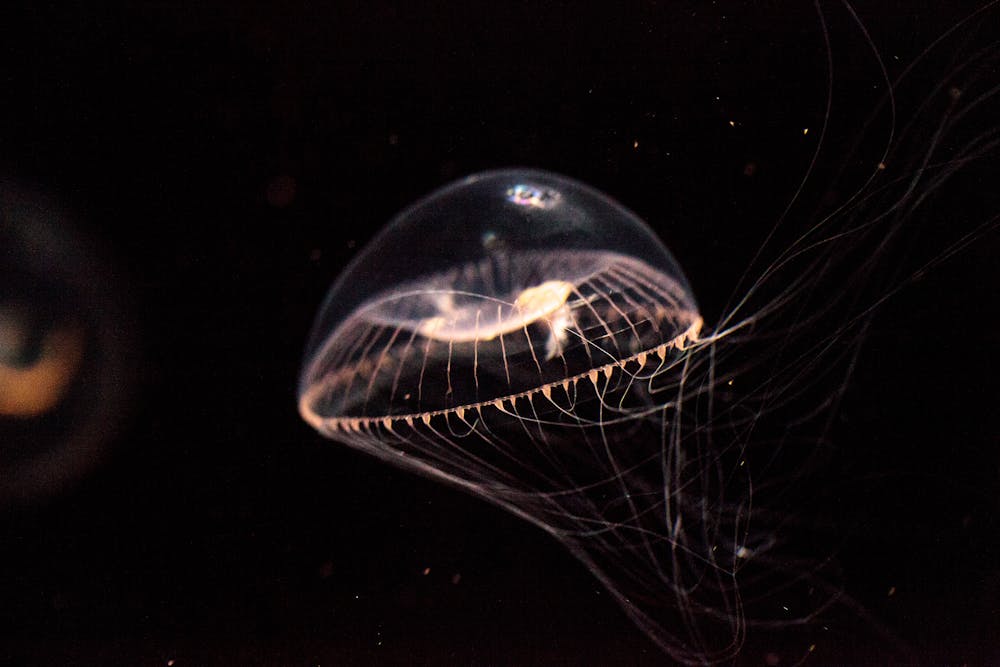
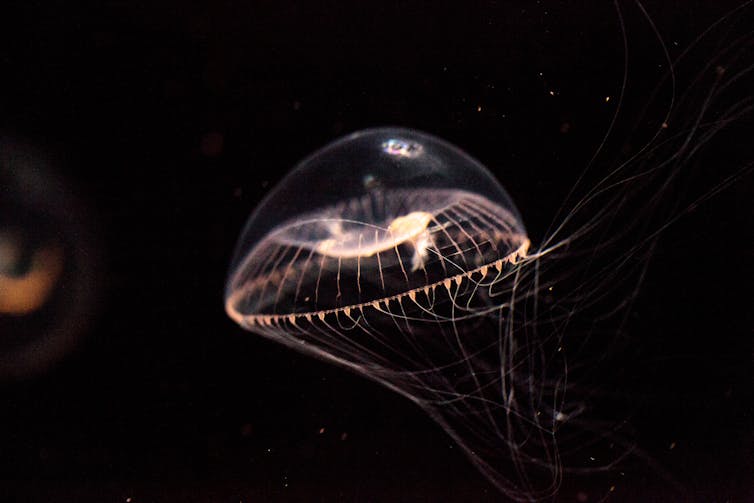 What could a bioluminescent jellyfish contribute to medical science? LagunaticPhoto/Shutterstock.com
From glowing jellyfish to biomedical imaging
It was very unlikely that scientists were thinking of medical applications when in the 1950s they started studying why some jellyfish glow. Marine biologists discovered that the jellyfish Aequorea victoria was bioluminescent. What was unclear at the time was how this jellyfish produces its light, which is a vibrant green color.
Seven years later a group of researchers discovered that the living light from the jellyfish came from a single protein they called aequorin. Strangely, the light from the purified aequorin protein was blue, not green. After another eight years of work they found that a partner protein to aequorin, which they called green fluorescent protein (GFP), produced the vibrant green-colored light seen in the living jellyfish.
The question then became how did the two proteins work together to produce this light? It took another 10 years of work to get the answer. A series of papers published in the early 1970s characterized a small molecule called a chromophore that integrated into the GFP protein structure. The structure of GFP was discovered in the early 1990s, which further helped researchers understand how this protein created light in living cells.
The first time the GFP protein was produced in an organism other than a jellyfish was in 1992. Expressing GFP in the small worm C. elegans and the bacterium E. coli made them both glow a brilliant green color. This breakthrough, nearly 40 years after the initial jellyfish study, opened the door for using GFP as powerful tool for biomedical research. Today researchers use GFP to track protein interactions and movement in living cells, which is useful in the study of cancer and bacterial diseases. A current literature search in PubMed returns over 30,000 peer-reviewed published papers using the search term “green fluorescent protein.”
The impact of GFP has also been recognized with a Nobel Prize in 2008 and an inaugural Golden Goose Award in 2012.
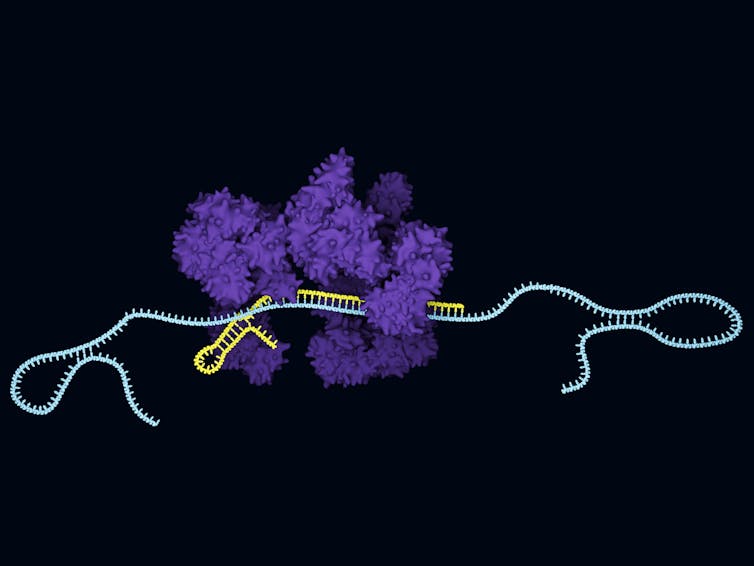 What could a bacteria’s immune system add to genetic researchers’ toolkit? Meletios Verras/Shutterstock.com
From bacterial immunity to genome editing
A more recent example of how basic research is now driving incredible innovation can be found in the fields of synthetic biology and genome editing, thanks to what actually started out very humbly as the characterization of bacteria. In the late 1980s, researchers found that certain bacteria had short repeated regions in their genome, but they didn’t know their purpose. They called these DNA sequences Clustered Regularly Interspaced Short Palindromic Repeats; you’ve probably heard its acronym nickname CRISPR. Work characterizing and cataloging bacteria that had these short repeated sequences continued for 20 years before researchers discovered proteins associated with the short DNA repeats. They called them CRISPR associated, or Cas, proteins.
One major advance happened in 2005 when researchers realized that CRISPR sequences found in bacterial genomes match DNA in phages, viruses that infect bacteria. A few more years later, scientists showed that the CRISPR-Cas system was a type of adaptive immunity that bacteria use to remember phage infection and prevent it from happening again. The Cas protein cuts invading phage’s DNA to stop infection. This discovery was groundbreaking; no one had known something as simple as a single-celled bacterium could have a sophisticated immune system.
And then in 2013, researchers realized this type of directed DNA cutting could be used to edit the genomes of other organisms, not just bacteria. The method was quickly adapted for use in yeast, worm, fruit fly, zebrafish, mouse, plant and human cells. Genome editing in this way will have far-reaching implications for everything from food production to stem cell therapies.
Thirty years after its discovery, the scope of CRISPR research is truly impressive; a current literature search in PubMed returns over 10,000 peer-reviewed published papers using the search term “CRISPR.” The technologies stemming from CRISPR have not won a Golden Goose Award or Nobel Prize yet, but some speculate it is only a matter of time.
Curiosity and patience yield dividends
Answering fundamental questions – Why do jellyfish glow? Why do bacterial genomes have short repeating DNA sequences? – can lead to innovation and tangible benefits in many aspects of everyday life. And a Golden Goose Award or Nobel Prize is not required to show that a discovery has translational application. An entrepreneurship study published in 2017 highlighted that more than 75 percent of research articles published are eventually referenced in at least one patent disclosure. This study showed a strong link between patent applications, ostensibly a quantitative metric of innovation, and basic research taking place at universities and government laboratories.
Real-world impacts stemming from basic research can take decades to unfold. If basic science is not supported and funded in the U.S., other countries will take over the innovation leadership role. Much like the goose that laid golden eggs, time and patience are required to get the most out of basic research.
[Article originally appeared in "The Conversation." Click to view the original article.]
]]>
Funding basic research plays the long game for future payoffs August 7, 2018 6.40am EDT The Senate recently proposed to increase the research budgets of the National Institutes of...
https://theconversation.com/funding-basic-research-plays-the-long-game-for-future-payoffs-100435
https://beta.my.umbc.edu/api/v0/pixel/news/77861/guest@my.umbc.edu/134b3878f658fba9a0a72ed050b3aac9/api/pixel
Department of Biological Sciences
https://beta.my.umbc.edu/groups/biol
https://assets1-beta.my.umbc.edu/system/shared/avatars/groups/000/000/430/6b175bb0e4c9635bddddedfbeb4f8c38/xsmall.png?1681829319
https://assets2-beta.my.umbc.edu/system/shared/avatars/groups/000/000/430/6b175bb0e4c9635bddddedfbeb4f8c38/original.jpg?1681829319
https://assets1-beta.my.umbc.edu/system/shared/avatars/groups/000/000/430/6b175bb0e4c9635bddddedfbeb4f8c38/xxlarge.png?1681829319
https://assets3-beta.my.umbc.edu/system/shared/avatars/groups/000/000/430/6b175bb0e4c9635bddddedfbeb4f8c38/xlarge.png?1681829319
https://assets3-beta.my.umbc.edu/system/shared/avatars/groups/000/000/430/6b175bb0e4c9635bddddedfbeb4f8c38/large.png?1681829319
https://assets3-beta.my.umbc.edu/system/shared/avatars/groups/000/000/430/6b175bb0e4c9635bddddedfbeb4f8c38/medium.png?1681829319
https://assets1-beta.my.umbc.edu/system/shared/avatars/groups/000/000/430/6b175bb0e4c9635bddddedfbeb4f8c38/small.png?1681829319
https://assets1-beta.my.umbc.edu/system/shared/avatars/groups/000/000/430/6b175bb0e4c9635bddddedfbeb4f8c38/xsmall.png?1681829319
https://assets4-beta.my.umbc.edu/system/shared/avatars/groups/000/000/430/6b175bb0e4c9635bddddedfbeb4f8c38/xxsmall.png?1681829319
Department of Biological Sciences
https://assets1-beta.my.umbc.edu/system/shared/thumbnails/news/000/077/861/230054d3ea411e1e7a2d75a60016c553/xxlarge.jpg?1533911145
https://assets2-beta.my.umbc.edu/system/shared/thumbnails/news/000/077/861/230054d3ea411e1e7a2d75a60016c553/xlarge.jpg?1533911145
https://assets4-beta.my.umbc.edu/system/shared/thumbnails/news/000/077/861/230054d3ea411e1e7a2d75a60016c553/large.jpg?1533911145
https://assets3-beta.my.umbc.edu/system/shared/thumbnails/news/000/077/861/230054d3ea411e1e7a2d75a60016c553/medium.jpg?1533911145
https://assets2-beta.my.umbc.edu/system/shared/thumbnails/news/000/077/861/230054d3ea411e1e7a2d75a60016c553/small.jpg?1533911145
https://assets1-beta.my.umbc.edu/system/shared/thumbnails/news/000/077/861/230054d3ea411e1e7a2d75a60016c553/xsmall.jpg?1533911145
https://assets2-beta.my.umbc.edu/system/shared/thumbnails/news/000/077/861/230054d3ea411e1e7a2d75a60016c553/xxsmall.jpg?1533911145
1
0
true
Fri, 10 Aug 2018 10:27:30 -0400
Fri, 10 Aug 2018 12:56:05 -0400
New Article from the Farabaugh Lab
Farabaugh Lab graduate students Kartikeya Joshi and Monika Bhatt, along with mentor Philip Farabaugh have recently had an article published in Nucleic Acids Research titled "Codon-specific effects of tRNA anticodon loop modifications on translational misreading errors in the yeast Saccharomyces cerevisiae."
To read the article:
https://academic.oup.com/nar/advance-article/doi/10.1093/nar/gky664/5061020#.W2reJRt6KF4.twitter
]]>
Farabaugh Lab graduate students Kartikeya Joshi and Monika Bhatt, along with mentor Philip Farabaugh have recently had an article published in Nucleic Acids Research titled "Codon-specific effects...
https://academic.oup.com/nar/advance-article/doi/10.1093/nar/gky664/5061020#.W2reJRt6KF4.twitter
https://beta.my.umbc.edu/api/v0/pixel/news/77860/guest@my.umbc.edu/009fabe4feb5a4a9d428d5a7bc31a03d/api/pixel
Department of Biological Sciences
https://beta.my.umbc.edu/groups/biol
https://assets1-beta.my.umbc.edu/system/shared/avatars/groups/000/000/430/6b175bb0e4c9635bddddedfbeb4f8c38/xsmall.png?1681829319
https://assets2-beta.my.umbc.edu/system/shared/avatars/groups/000/000/430/6b175bb0e4c9635bddddedfbeb4f8c38/original.jpg?1681829319
https://assets1-beta.my.umbc.edu/system/shared/avatars/groups/000/000/430/6b175bb0e4c9635bddddedfbeb4f8c38/xxlarge.png?1681829319
https://assets3-beta.my.umbc.edu/system/shared/avatars/groups/000/000/430/6b175bb0e4c9635bddddedfbeb4f8c38/xlarge.png?1681829319
https://assets3-beta.my.umbc.edu/system/shared/avatars/groups/000/000/430/6b175bb0e4c9635bddddedfbeb4f8c38/large.png?1681829319
https://assets3-beta.my.umbc.edu/system/shared/avatars/groups/000/000/430/6b175bb0e4c9635bddddedfbeb4f8c38/medium.png?1681829319
https://assets1-beta.my.umbc.edu/system/shared/avatars/groups/000/000/430/6b175bb0e4c9635bddddedfbeb4f8c38/small.png?1681829319
https://assets1-beta.my.umbc.edu/system/shared/avatars/groups/000/000/430/6b175bb0e4c9635bddddedfbeb4f8c38/xsmall.png?1681829319
https://assets4-beta.my.umbc.edu/system/shared/avatars/groups/000/000/430/6b175bb0e4c9635bddddedfbeb4f8c38/xxsmall.png?1681829319
Department of Biological Sciences
https://assets4-beta.my.umbc.edu/system/shared/thumbnails/news/000/077/860/3273190d9ea5b34592c382d6aad69908/xxlarge.jpg?1533910876
https://assets4-beta.my.umbc.edu/system/shared/thumbnails/news/000/077/860/3273190d9ea5b34592c382d6aad69908/xlarge.jpg?1533910876
https://assets2-beta.my.umbc.edu/system/shared/thumbnails/news/000/077/860/3273190d9ea5b34592c382d6aad69908/large.jpg?1533910876
https://assets4-beta.my.umbc.edu/system/shared/thumbnails/news/000/077/860/3273190d9ea5b34592c382d6aad69908/medium.jpg?1533910876
https://assets4-beta.my.umbc.edu/system/shared/thumbnails/news/000/077/860/3273190d9ea5b34592c382d6aad69908/small.jpg?1533910876
https://assets1-beta.my.umbc.edu/system/shared/thumbnails/news/000/077/860/3273190d9ea5b34592c382d6aad69908/xsmall.jpg?1533910876
https://assets4-beta.my.umbc.edu/system/shared/thumbnails/news/000/077/860/3273190d9ea5b34592c382d6aad69908/xxsmall.jpg?1533910876
1
0
true
Fri, 10 Aug 2018 10:22:16 -0400
Fri, 10 Aug 2018 10:47:52 -0400
The Stuff of Smartphones
UMBC Industry News
UMBC’s graduate certificate program in Integrated Product Development and Manufacturing provides students a unique, hands-on experience with a selection of fabrication tools for an improved understanding of the capability of each manufacturing process.
In this week’s Industry Roundup, we delve into the product world as we take a look at the wondrous material that product developers use to create smartphones.
]]>
UMBC’s graduate certificate program in Integrated Product Development and Manufacturing provides students a unique, hands-on experience with a selection of fabrication tools for an improved...
http://gritinaction.umbc.edu/smartphones/?utm_campaign=industry%20news%20smartphones&utm_source=my.umbc.edu&utm_medium=referral&utm_content=blog
https://beta.my.umbc.edu/api/v0/pixel/news/77858/guest@my.umbc.edu/3205822628f185aff5175ae60210b923/api/pixel
industry-news
smartphones
UMBC Professional Programs
https://beta.my.umbc.edu/groups/dps
https://assets2-beta.my.umbc.edu/system/shared/avatars/groups/000/000/513/2e72ed76b7b3b9ce2f15fce64178dfaf/xsmall.png?1642086701
https://assets2-beta.my.umbc.edu/system/shared/avatars/groups/000/000/513/2e72ed76b7b3b9ce2f15fce64178dfaf/original.png?1642086701
https://assets2-beta.my.umbc.edu/system/shared/avatars/groups/000/000/513/2e72ed76b7b3b9ce2f15fce64178dfaf/xxlarge.png?1642086701
https://assets4-beta.my.umbc.edu/system/shared/avatars/groups/000/000/513/2e72ed76b7b3b9ce2f15fce64178dfaf/xlarge.png?1642086701
https://assets2-beta.my.umbc.edu/system/shared/avatars/groups/000/000/513/2e72ed76b7b3b9ce2f15fce64178dfaf/large.png?1642086701
https://assets2-beta.my.umbc.edu/system/shared/avatars/groups/000/000/513/2e72ed76b7b3b9ce2f15fce64178dfaf/medium.png?1642086701
https://assets3-beta.my.umbc.edu/system/shared/avatars/groups/000/000/513/2e72ed76b7b3b9ce2f15fce64178dfaf/small.png?1642086701
https://assets2-beta.my.umbc.edu/system/shared/avatars/groups/000/000/513/2e72ed76b7b3b9ce2f15fce64178dfaf/xsmall.png?1642086701
https://assets1-beta.my.umbc.edu/system/shared/avatars/groups/000/000/513/2e72ed76b7b3b9ce2f15fce64178dfaf/xxsmall.png?1642086701
UMBC Professional Programs
https://assets2-beta.my.umbc.edu/system/shared/thumbnails/news/000/077/858/87daa66ab33033abf001dda43872be29/xxlarge.jpg?1533906319
https://assets4-beta.my.umbc.edu/system/shared/thumbnails/news/000/077/858/87daa66ab33033abf001dda43872be29/xlarge.jpg?1533906319
https://assets4-beta.my.umbc.edu/system/shared/thumbnails/news/000/077/858/87daa66ab33033abf001dda43872be29/large.jpg?1533906319
https://assets3-beta.my.umbc.edu/system/shared/thumbnails/news/000/077/858/87daa66ab33033abf001dda43872be29/medium.jpg?1533906319
https://assets1-beta.my.umbc.edu/system/shared/thumbnails/news/000/077/858/87daa66ab33033abf001dda43872be29/small.jpg?1533906319
https://assets1-beta.my.umbc.edu/system/shared/thumbnails/news/000/077/858/87daa66ab33033abf001dda43872be29/xsmall.jpg?1533906319
https://assets2-beta.my.umbc.edu/system/shared/thumbnails/news/000/077/858/87daa66ab33033abf001dda43872be29/xxsmall.jpg?1533906319
0
0
true
Fri, 10 Aug 2018 09:07:05 -0400
CMSC 201: Computer Science I for Non-CS Disciplines – Fall 2018

CMSC 201 Computer Science I for Non-CS Disciplines – Fall 2018
This fall, Dr. Susan Mitchell will teach a special section of CMSC 201 Computer Science I designed for social and biological sciences *and other majors*. The course will cover the same content and have the same rigor as the regular sections of CMSC 201 and prepare students to continue on to CMSC 202 if they wish. As with other sections, it fulfills any major’s requirement for CMSC 201. The key difference will be that the assignments and projects will emphasize topics applicable to many non-CS disciplines, such as statistical analysis, working with large data sets, and data visualization. The catalog description is:
An introduction to computer science through problem solving and computer programming. Programming techniques covered by this course include modularity, abstraction, top-down design, specifications documentation, debugging and testing. The core material for this course includes control structures, functions, lists, strings, abstract data types, file I/O, and recursion.
The course will include a lecture from 2:30pm to 3:45pm on Mondays and Wednesdays (Section 36-LEC) and a one-hour lab on either Monday (Section 37-DIS) or Wednesday (Section 38-DIS) from 11:00-11:50am.
Permission from the instructor is required to register for this section. No prior programming experience is required. The only prerequisite is that students must have completed MATH 150, 151 or 152 with a C or better; OR have MATH test placement into MATH 151; OR be concurrently enrolled in MATH 155 or completed it with a C or better.
For permission or questions, email Dr. Susan Mitchell at *protected email*
The post CMSC 201: Computer Science I for Non-CS Disciplines – Fall 2018 appeared first on Department of Computer Science and Electrical Engineering.
]]>
CMSC 201 Computer Science I for Non-CS Disciplines – Fall 2018 This fall, Dr. Susan Mitchell will teach a special section of CMSC 201 Computer Science I designed for social and biological...
https://www.csee.umbc.edu/2018/08/cmsc-201-computer-science-i-for-non-cs-disciplines-fall-2018/
https://beta.my.umbc.edu/api/v0/pixel/news/77859/guest@my.umbc.edu/052d2b83f6b11aa3ac69f256351cd1fc/api/pixel
computer-science
education
news
Computer Science and Electrical Engineering
https://beta.my.umbc.edu/groups/csee
https://assets3-beta.my.umbc.edu/system/shared/avatars/groups/000/000/099/d117dca133c64bf78a4b7696dd007189/xsmall.png?1314043393
https://assets1-beta.my.umbc.edu/system/shared/avatars/groups/000/000/099/d117dca133c64bf78a4b7696dd007189/original.png?1314043393
https://assets1-beta.my.umbc.edu/system/shared/avatars/groups/000/000/099/d117dca133c64bf78a4b7696dd007189/xxlarge.png?1314043393
https://assets4-beta.my.umbc.edu/system/shared/avatars/groups/000/000/099/d117dca133c64bf78a4b7696dd007189/xlarge.png?1314043393
https://assets3-beta.my.umbc.edu/system/shared/avatars/groups/000/000/099/d117dca133c64bf78a4b7696dd007189/large.png?1314043393
https://assets1-beta.my.umbc.edu/system/shared/avatars/groups/000/000/099/d117dca133c64bf78a4b7696dd007189/medium.png?1314043393
https://assets2-beta.my.umbc.edu/system/shared/avatars/groups/000/000/099/d117dca133c64bf78a4b7696dd007189/small.png?1314043393
https://assets3-beta.my.umbc.edu/system/shared/avatars/groups/000/000/099/d117dca133c64bf78a4b7696dd007189/xsmall.png?1314043393
https://assets3-beta.my.umbc.edu/system/shared/avatars/groups/000/000/099/d117dca133c64bf78a4b7696dd007189/xxsmall.png?1314043393
Computer Science and Electrical Engineering
2
0
true
Fri, 10 Aug 2018 09:00:52 -0400
Fall Opening Meeting 2018
Dear Members of the UMBC Community,
Each year, at the start of the fall semester, the UMBC community comes together to welcome colleagues and students back to campus, celebrate our achievements and launch the beginning of a new academic year. Please join us at the Fall Opening Meeting on Thursday, August 23, in the University Center Ballroom. A light lunch will be provided at 11:30 a.m., and the program begins promptly at noon.
The program will include the annual State of the University Address and welcoming remarks. Incoming freshman, transfer, and graduate students also will share with us why they chose to join the UMBC community.
We look forward to seeing you on Thursday, August 23.
Freeman Hrabowski and Philip Rous
]]>
Dear Members of the UMBC Community, Each year, at the start of the fall semester, the UMBC community comes together to welcome colleagues and students back to campus, celebrate our...
https://beta.my.umbc.edu/api/v0/pixel/news/77857/guest@my.umbc.edu/ee73997c1f86ddb76b7751705bcaa638/api/pixel
UMBC Community News
https://beta.my.umbc.edu/groups/insights
https://assets3-beta.my.umbc.edu/system/shared/avatars/groups/000/001/090/56c39666a7bf2e5028d5419fc903e52d/xsmall.png?1593096708
https://assets1-beta.my.umbc.edu/system/shared/avatars/groups/000/001/090/56c39666a7bf2e5028d5419fc903e52d/original.png?1593096708
https://assets4-beta.my.umbc.edu/system/shared/avatars/groups/000/001/090/56c39666a7bf2e5028d5419fc903e52d/xxlarge.png?1593096708
https://assets3-beta.my.umbc.edu/system/shared/avatars/groups/000/001/090/56c39666a7bf2e5028d5419fc903e52d/xlarge.png?1593096708
https://assets1-beta.my.umbc.edu/system/shared/avatars/groups/000/001/090/56c39666a7bf2e5028d5419fc903e52d/large.png?1593096708
https://assets1-beta.my.umbc.edu/system/shared/avatars/groups/000/001/090/56c39666a7bf2e5028d5419fc903e52d/medium.png?1593096708
https://assets3-beta.my.umbc.edu/system/shared/avatars/groups/000/001/090/56c39666a7bf2e5028d5419fc903e52d/small.png?1593096708
https://assets3-beta.my.umbc.edu/system/shared/avatars/groups/000/001/090/56c39666a7bf2e5028d5419fc903e52d/xsmall.png?1593096708
https://assets3-beta.my.umbc.edu/system/shared/avatars/groups/000/001/090/56c39666a7bf2e5028d5419fc903e52d/xxsmall.png?1593096708
UMBC Community News
6
0
true
Fri, 10 Aug 2018 08:48:18 -0400
Intern of the Week: Vincent Brown for Biology!
Check out his research position with Towson University
Name:Vincent Brown
Internship, Co-op or Research Site: Towson University
Position Title: Research Intern
Major(s)/Minor(s):Biology B.A/ Ancient Studies
Work Term:Summer 2018
Tell us about your internship, co-op, or research opportunity, including your day-to-day responsibilities.
I am conducting research at Towson University in the Devadas Lab. My research consists of synthesizing and characterizing gold nano-clusters which can be used for energy responsive applications such as light harvesting and theranostic applications with specific aims: (i) to enhance light collection efficiency using quantum sized clusters, (ii) to develop better labelling agents with enhanced two-photon cross-sections, and (iii) to generate efficient nano-vehicles for targeted drug delivery and cancer therapy. My day-to-day responsibilities include synthesizing the gold nano-clusters, and purifying and washing the products before characterizing them with UV-Vis Spectroscopy.
Describe the process of obtaining your position. When did you hear of the position and submit your application?
I was able to obtain this research position because my brother attends Towson University and has been apart of the research group since the spring semester. He was the one who told me about the opportunity to work in the lab for the summer and told his research mentor about me. I then scheduled a meeting with Dr. Devadas and she allowed me to join her lab for the summer.
What have you enjoyed the most about your position or organization?
What I have enjoyed most about my position is the fact that I am learning something new everyday. I am a biology major working in an inorganic chemistry lab so I didn't understand a lot of the things I had to do in the beginning. However, after performing my day-to-day responsibilities and reading research articles, I have gained a strong understanding of the reasoning behind my research. Reading so many various research articles has also helped me to learn how to efficiently read a research article and genuinely understand the material. It has been very enjoyable to go through this process and I look forward to continuing to learn throughout the summer.
How do you believe you have made an impact through your work?
I believe that I have brought in my hardworking character and my love for learning to my research lab. I hope that my biggest impact I make through my work is that I accomplish all the tasks I have been assigned for the summer and fulfill what has been asked of me to the best of my ability. Along with this, my intentions are that other researchers will believe the data I have collected is significant and will want to try to reproduce my results and improve my methods.
What advice would you give to another student who is seeking an internship or similar experience?
Don't be afraid to ask for internship or research opportunities! The easiest way to get involved is to simply ask a professor or faculty member if they are looking for an intern. The worst thing they can say is no.
Like the Career Center on Facebook
Follow us on Twitter and Instagram
#UMBCintern
Want to be the next Intern of the Week? Make sure to fill out this form and stay tuned. New interns are announced every Friday!
[Article originally posted on the Career Center's myUMBC group]
]]>
Name:Vincent Brown Internship, Co-op or Research Site: Towson University Position Title: Research Intern Major(s)/Minor(s):Biology B.A/ Ancient Studies Work Term:Summer 2018 Tell us about...
https://my3.my.umbc.edu/groups/careers/posts/77847
https://beta.my.umbc.edu/api/v0/pixel/news/77856/guest@my.umbc.edu/a87244d0f3d4a41639d3f72c2b3f4b8b/api/pixel
career-center
intern
internship
research
towson
undergraduate-research
vincent-brown
Department of Biological Sciences
https://beta.my.umbc.edu/groups/biol
https://assets1-beta.my.umbc.edu/system/shared/avatars/groups/000/000/430/6b175bb0e4c9635bddddedfbeb4f8c38/xsmall.png?1681829319
https://assets2-beta.my.umbc.edu/system/shared/avatars/groups/000/000/430/6b175bb0e4c9635bddddedfbeb4f8c38/original.jpg?1681829319
https://assets1-beta.my.umbc.edu/system/shared/avatars/groups/000/000/430/6b175bb0e4c9635bddddedfbeb4f8c38/xxlarge.png?1681829319
https://assets3-beta.my.umbc.edu/system/shared/avatars/groups/000/000/430/6b175bb0e4c9635bddddedfbeb4f8c38/xlarge.png?1681829319
https://assets3-beta.my.umbc.edu/system/shared/avatars/groups/000/000/430/6b175bb0e4c9635bddddedfbeb4f8c38/large.png?1681829319
https://assets3-beta.my.umbc.edu/system/shared/avatars/groups/000/000/430/6b175bb0e4c9635bddddedfbeb4f8c38/medium.png?1681829319
https://assets1-beta.my.umbc.edu/system/shared/avatars/groups/000/000/430/6b175bb0e4c9635bddddedfbeb4f8c38/small.png?1681829319
https://assets1-beta.my.umbc.edu/system/shared/avatars/groups/000/000/430/6b175bb0e4c9635bddddedfbeb4f8c38/xsmall.png?1681829319
https://assets4-beta.my.umbc.edu/system/shared/avatars/groups/000/000/430/6b175bb0e4c9635bddddedfbeb4f8c38/xxsmall.png?1681829319
Department of Biological Sciences
https://assets4-beta.my.umbc.edu/system/shared/thumbnails/news/000/077/856/42fe3904cfb738d3125ee0c1fb70b0d5/xxlarge.jpg?1533904819
https://assets3-beta.my.umbc.edu/system/shared/thumbnails/news/000/077/856/42fe3904cfb738d3125ee0c1fb70b0d5/xlarge.jpg?1533904819
https://assets2-beta.my.umbc.edu/system/shared/thumbnails/news/000/077/856/42fe3904cfb738d3125ee0c1fb70b0d5/large.jpg?1533904819
https://assets1-beta.my.umbc.edu/system/shared/thumbnails/news/000/077/856/42fe3904cfb738d3125ee0c1fb70b0d5/medium.jpg?1533904819
https://assets2-beta.my.umbc.edu/system/shared/thumbnails/news/000/077/856/42fe3904cfb738d3125ee0c1fb70b0d5/small.jpg?1533904819
https://assets1-beta.my.umbc.edu/system/shared/thumbnails/news/000/077/856/42fe3904cfb738d3125ee0c1fb70b0d5/xsmall.jpg?1533904819
https://assets4-beta.my.umbc.edu/system/shared/thumbnails/news/000/077/856/42fe3904cfb738d3125ee0c1fb70b0d5/xxsmall.jpg?1533904819
3
1
true
Fri, 10 Aug 2018 08:41:26 -0400
Fri, 10 Aug 2018 08:41:39 -0400