Apply to Serve as an Honors College Council Chair!
A message from the Honors College Council:
Hello Honors College Students!
Interested in becoming more involved with the Honors College? Want to practice new skills and gain leadership experience? Apply for an Honors College Council Chair Position!
Here are descriptions of each Chair Position:
-
Fundraising Chair -- The duties of the fundraising chair will include arranging fundraisers, acting as the primary contact for vendors, signing all pertinent fundraising and cash box forms, collecting appropriate written documentation for all transactions and communications with vendors, and reporting back to the Treasurer as well as helping with Finance Board Allocation Requests.
-
Marketing Chair -- The duties of the marketing chair include distributing quarter cards, composing and presenting the best marketing approach for agreed upon Honors College Council hosted events, collecting data on event attendance, working with CommonVision, and helping the treasurer and fundraising chair in Finance Board Allocation Requests.
Send us an email with a paragraph stating (1) which Chair Position you are interested in and (2) why you are interested!
Submissions are due to HCC President Sanya Ahmed at sa5@umbc.edu by 11:59PM on July 4th.
]]>
A message from the Honors College Council: Hello Honors College Students! Interested in becoming more involved with the Honors College? Want to practice new skills and gain leadership...
https://beta.my.umbc.edu/api/v0/pixel/news/85020/guest@my.umbc.edu/7250465a27772e9bb92030da54bbff8d/api/pixel
Honors College
https://beta.my.umbc.edu/groups/honorscollege
https://assets2-beta.my.umbc.edu/system/shared/avatars/groups/000/000/413/cd2018beeece5fb0a71a96308e567bde/xsmall.png?1339897259
https://assets1-beta.my.umbc.edu/system/shared/avatars/groups/000/000/413/cd2018beeece5fb0a71a96308e567bde/original.jpg?1339897259
https://assets1-beta.my.umbc.edu/system/shared/avatars/groups/000/000/413/cd2018beeece5fb0a71a96308e567bde/xxlarge.png?1339897259
https://assets2-beta.my.umbc.edu/system/shared/avatars/groups/000/000/413/cd2018beeece5fb0a71a96308e567bde/xlarge.png?1339897259
https://assets2-beta.my.umbc.edu/system/shared/avatars/groups/000/000/413/cd2018beeece5fb0a71a96308e567bde/large.png?1339897259
https://assets1-beta.my.umbc.edu/system/shared/avatars/groups/000/000/413/cd2018beeece5fb0a71a96308e567bde/medium.png?1339897259
https://assets1-beta.my.umbc.edu/system/shared/avatars/groups/000/000/413/cd2018beeece5fb0a71a96308e567bde/small.png?1339897259
https://assets2-beta.my.umbc.edu/system/shared/avatars/groups/000/000/413/cd2018beeece5fb0a71a96308e567bde/xsmall.png?1339897259
https://assets1-beta.my.umbc.edu/system/shared/avatars/groups/000/000/413/cd2018beeece5fb0a71a96308e567bde/xxsmall.png?1339897259
Honors College
https://assets1-beta.my.umbc.edu/system/shared/thumbnails/news/000/085/020/5974e6a5851b406db980816e2a46b42e/xxlarge.jpg?1560869476
https://assets3-beta.my.umbc.edu/system/shared/thumbnails/news/000/085/020/5974e6a5851b406db980816e2a46b42e/xlarge.jpg?1560869476
https://assets2-beta.my.umbc.edu/system/shared/thumbnails/news/000/085/020/5974e6a5851b406db980816e2a46b42e/large.jpg?1560869476
https://assets1-beta.my.umbc.edu/system/shared/thumbnails/news/000/085/020/5974e6a5851b406db980816e2a46b42e/medium.jpg?1560869476
https://assets2-beta.my.umbc.edu/system/shared/thumbnails/news/000/085/020/5974e6a5851b406db980816e2a46b42e/small.jpg?1560869476
https://assets3-beta.my.umbc.edu/system/shared/thumbnails/news/000/085/020/5974e6a5851b406db980816e2a46b42e/xsmall.jpg?1560869476
https://assets1-beta.my.umbc.edu/system/shared/thumbnails/news/000/085/020/5974e6a5851b406db980816e2a46b42e/xxsmall.jpg?1560869476
0
0
true
Tue, 18 Jun 2019 10:52:05 -0400
Updates coming to the NSF Biographical Sketch
NSF has recently put out upcoming changes to their Proposal and Awards Policies and Procedures Guide (PAPPG). Among those changes, NSF is designating the Science Experts Network Curriculum Vitae as an approved format.
Additionally starting with the next iteration of the PAPPG, only Biographical Sketches generated through an NSF approved format will be accepted.
]]>
NSF has recently put out upcoming changes to their Proposal and Awards Policies and Procedures Guide (PAPPG). Among those changes, NSF is designating the Science Experts Network Curriculum Vitae...
https://beta.my.umbc.edu/api/v0/pixel/news/85019/guest@my.umbc.edu/059faf4cb06f967a2ea7b68e0f2a1294/api/pixel
Office of Sponsored Programs (OSP)
https://beta.my.umbc.edu/groups/osp
https://assets3-beta.my.umbc.edu/system/shared/avatars/groups/000/000/752/3408b8d8a758db7c66b435a2c13352e4/xsmall.png?1382454455
https://assets3-beta.my.umbc.edu/system/shared/avatars/groups/000/000/752/3408b8d8a758db7c66b435a2c13352e4/original.jpg?1382454455
https://assets1-beta.my.umbc.edu/system/shared/avatars/groups/000/000/752/3408b8d8a758db7c66b435a2c13352e4/xxlarge.png?1382454455
https://assets4-beta.my.umbc.edu/system/shared/avatars/groups/000/000/752/3408b8d8a758db7c66b435a2c13352e4/xlarge.png?1382454455
https://assets1-beta.my.umbc.edu/system/shared/avatars/groups/000/000/752/3408b8d8a758db7c66b435a2c13352e4/large.png?1382454455
https://assets4-beta.my.umbc.edu/system/shared/avatars/groups/000/000/752/3408b8d8a758db7c66b435a2c13352e4/medium.png?1382454455
https://assets2-beta.my.umbc.edu/system/shared/avatars/groups/000/000/752/3408b8d8a758db7c66b435a2c13352e4/small.png?1382454455
https://assets3-beta.my.umbc.edu/system/shared/avatars/groups/000/000/752/3408b8d8a758db7c66b435a2c13352e4/xsmall.png?1382454455
https://assets1-beta.my.umbc.edu/system/shared/avatars/groups/000/000/752/3408b8d8a758db7c66b435a2c13352e4/xxsmall.png?1382454455
Office of Sponsored Programs (OSP)
0
0
true
Tue, 18 Jun 2019 09:59:45 -0400
Scheduled Downtime
Due to scheduled maintenance on the HPC power distribution units in the
Research Park Data Center, we will be cancelling all jobs and
powering-off the taki cluster at 5pm on June 17. We plan to have taki
fully operational again by no later than 5pm of June 19th. Thank you for
your understanding and patience as we approach June 17th.
]]>
Due to scheduled maintenance on the HPC power distribution units in the Research Park Data Center, we will be cancelling all jobs and powering-off the taki cluster at 5pm on June 17. We plan to...
https://beta.my.umbc.edu/api/v0/pixel/news/85018/guest@my.umbc.edu/f7bd91545f5aa4e7b525fcab62ba1139/api/pixel
HPCF
https://beta.my.umbc.edu/groups/hpcf
https://assets2-beta.my.umbc.edu/system/shared/avatars/groups/000/001/659/63ae3e64663572042ecdd0ef493c16e1/xsmall.png?1596736674
https://assets3-beta.my.umbc.edu/system/shared/avatars/groups/000/001/659/63ae3e64663572042ecdd0ef493c16e1/original.png?1596736674
https://assets4-beta.my.umbc.edu/system/shared/avatars/groups/000/001/659/63ae3e64663572042ecdd0ef493c16e1/xxlarge.png?1596736674
https://assets3-beta.my.umbc.edu/system/shared/avatars/groups/000/001/659/63ae3e64663572042ecdd0ef493c16e1/xlarge.png?1596736674
https://assets1-beta.my.umbc.edu/system/shared/avatars/groups/000/001/659/63ae3e64663572042ecdd0ef493c16e1/large.png?1596736674
https://assets3-beta.my.umbc.edu/system/shared/avatars/groups/000/001/659/63ae3e64663572042ecdd0ef493c16e1/medium.png?1596736674
https://assets3-beta.my.umbc.edu/system/shared/avatars/groups/000/001/659/63ae3e64663572042ecdd0ef493c16e1/small.png?1596736674
https://assets2-beta.my.umbc.edu/system/shared/avatars/groups/000/001/659/63ae3e64663572042ecdd0ef493c16e1/xsmall.png?1596736674
https://assets1-beta.my.umbc.edu/system/shared/avatars/groups/000/001/659/63ae3e64663572042ecdd0ef493c16e1/xxsmall.png?1596736674
HPCF
0
0
true
Tue, 18 Jun 2019 09:40:48 -0400
Tue, 18 Jun 2019 09:41:05 -0400
From Real Estate to Covert Agent
In May, real estate appraiser and UMBC alum Steven O'Farrell released his first YA novel, Simone LaFray and the Chocolatiers' Ball.
]]>
In May, real estate appraiser and UMBC alum Steven O'Farrell released his first YA novel, Simone LaFray and the Chocolatiers' Ball.
https://magazine.umbc.edu/from-real-estate-to-covert-agent/
https://beta.my.umbc.edu/api/v0/pixel/news/106067/guest@my.umbc.edu/b2bcab1e35fc4a72ca175c903c30bdeb/api/pixel
alumni
economics
UMBC Magazine
https://beta.my.umbc.edu/groups/umbc-magazine
https://assets4-beta.my.umbc.edu/images/avatars/group/5/xsmall.png?1778631743
https://assets4-beta.my.umbc.edu/images/avatars/group/5/original.png?1778631743
https://assets4-beta.my.umbc.edu/images/avatars/group/5/xxlarge.png?1778631743
https://assets3-beta.my.umbc.edu/images/avatars/group/5/xlarge.png?1778631743
https://assets2-beta.my.umbc.edu/images/avatars/group/5/large.png?1778631743
https://assets2-beta.my.umbc.edu/images/avatars/group/5/medium.png?1778631743
https://assets2-beta.my.umbc.edu/images/avatars/group/5/small.png?1778631743
https://assets4-beta.my.umbc.edu/images/avatars/group/5/xsmall.png?1778631743
https://assets4-beta.my.umbc.edu/images/avatars/group/5/xxsmall.png?1778631743
UMBC Magazine
0
0
false
Tue, 18 Jun 2019 09:11:25 -0400
Ongoing electrical work in Data Centers today and Saturday
Throughout the day today (Tuesday June 18th) electricians will be conducting maintenance in our backup data center located just off campus in the research park. During this work we do not expect to see any interruption of services. All of the equipment has multiple power supplies, and we are cutting power to only part of the room at a time so the electricians can work safely. There is always the potential for something to fail unexpectedly and I wanted to make sure the campus was aware of the on going work. We expect work to be completed later this afternoon in that data center and I'll send out another notice once full service is restored to that space.
We will also be finishing the work that started two weeks ago in our primary data center this coming Saturday. While we again do not expect any outage, we moved the work to the weekend with the gracious help from our facilities management group to avoid any potential interruptions of service with orientation.
I wanted to thank everyone for their patience and understanding as we perform this work to service the power conditioners and clean up the wiring in these spaces.
If you have any questions about this work or would like more information, please email me directly.
Thank You,
Damian
--
Damian Doyle
Assistant Vice President - Enterprise Infrastructure Solutions
Division of Information Technology
]]>
Throughout the day today (Tuesday June 18th) electricians will be conducting maintenance in our backup data center located just off campus in the research park. During this work we do not expect...
https://beta.my.umbc.edu/api/v0/pixel/news/85014/guest@my.umbc.edu/840aa50d19e2f206a95ad2df9d6b1f21/api/pixel
center
data
outage
power
Division of Information Technology (DoIT)
https://beta.my.umbc.edu/groups/doit
https://assets2-beta.my.umbc.edu/system/shared/avatars/groups/000/000/021/d27760c5de12c74b73faec8d0e631acf/xsmall.png?1727453227
https://assets2-beta.my.umbc.edu/system/shared/avatars/groups/000/000/021/d27760c5de12c74b73faec8d0e631acf/original.JPG?1727453227
https://assets1-beta.my.umbc.edu/system/shared/avatars/groups/000/000/021/d27760c5de12c74b73faec8d0e631acf/xxlarge.png?1727453227
https://assets3-beta.my.umbc.edu/system/shared/avatars/groups/000/000/021/d27760c5de12c74b73faec8d0e631acf/xlarge.png?1727453227
https://assets2-beta.my.umbc.edu/system/shared/avatars/groups/000/000/021/d27760c5de12c74b73faec8d0e631acf/large.png?1727453227
https://assets2-beta.my.umbc.edu/system/shared/avatars/groups/000/000/021/d27760c5de12c74b73faec8d0e631acf/medium.png?1727453227
https://assets2-beta.my.umbc.edu/system/shared/avatars/groups/000/000/021/d27760c5de12c74b73faec8d0e631acf/small.png?1727453227
https://assets2-beta.my.umbc.edu/system/shared/avatars/groups/000/000/021/d27760c5de12c74b73faec8d0e631acf/xsmall.png?1727453227
https://assets4-beta.my.umbc.edu/system/shared/avatars/groups/000/000/021/d27760c5de12c74b73faec8d0e631acf/xxsmall.png?1727453227
Division of Information Technology (DoIT)
1
0
true
Tue, 18 Jun 2019 07:14:05 -0400
New graduate student: Akram Touil
Starting Summer 2019 Akram Touil has joined the group as graduate student. His research will focus on the thermodynamics of chaotic quantum systems and quantum information scrambling. Welcome to the group!
]]>
Starting Summer 2019 Akram Touil has joined the group as graduate student. His research will focus on the thermodynamics of chaotic quantum systems and quantum information scrambling. Welcome to...
https://beta.my.umbc.edu/api/v0/pixel/news/85013/guest@my.umbc.edu/18b184c8f74b83f0f149ebe81a203b2c/api/pixel
Quantum Thermodynamics
https://beta.my.umbc.edu/groups/quthermo
https://assets1-beta.my.umbc.edu/system/shared/avatars/groups/000/001/393/cfed54c41318d9b704a1ec1b884218b1/xsmall.png?1502988446
https://assets3-beta.my.umbc.edu/system/shared/avatars/groups/000/001/393/cfed54c41318d9b704a1ec1b884218b1/original.png?1502988446
https://assets1-beta.my.umbc.edu/system/shared/avatars/groups/000/001/393/cfed54c41318d9b704a1ec1b884218b1/xxlarge.png?1502988446
https://assets4-beta.my.umbc.edu/system/shared/avatars/groups/000/001/393/cfed54c41318d9b704a1ec1b884218b1/xlarge.png?1502988446
https://assets1-beta.my.umbc.edu/system/shared/avatars/groups/000/001/393/cfed54c41318d9b704a1ec1b884218b1/large.png?1502988446
https://assets1-beta.my.umbc.edu/system/shared/avatars/groups/000/001/393/cfed54c41318d9b704a1ec1b884218b1/medium.png?1502988446
https://assets3-beta.my.umbc.edu/system/shared/avatars/groups/000/001/393/cfed54c41318d9b704a1ec1b884218b1/small.png?1502988446
https://assets1-beta.my.umbc.edu/system/shared/avatars/groups/000/001/393/cfed54c41318d9b704a1ec1b884218b1/xsmall.png?1502988446
https://assets3-beta.my.umbc.edu/system/shared/avatars/groups/000/001/393/cfed54c41318d9b704a1ec1b884218b1/xxsmall.png?1502988446
Quantum Thermodynamics
0
0
true
Tue, 18 Jun 2019 01:11:49 -0400
The Power of Community

One student’s story could appear to inspired onlookers as a meteoric rise: excelling from private school to lauded scholarship programs and landing an ivy school opportunity post-graduation. But Anna Gifty Opoku-Agyeman M26 ’19, mathematics, is clear that her success is firmly grounded in a support network formed early on—and hard fought for—when circumstances seemed to isolate her from the community she knew was necessary in order for her to thrive.
In kindergarten, her principal, Anna Puma, took special notice of her skills and ability and funded a scholarship that helped Opoku-Agyeman’s family keep her in a small private elementary school. The additional support helped her prepare and be accepted to a private school in the area for middle through high school, which would later give Opoku-Agyeman access to unique academic opportunities that would not otherwise have been available. She flourished during her years in her small, supportive school and was excited about college.
However, before Opoku-Agyeman would ultimately create the first conference for Black women in economics, graduate from UMBC surrounded by peers and mentors, and join The Research Scholar Initiative (RSI) program at Harvard University, she would have to learn to keep creating support networks along the way.
“My success is not mine, it is the work of many who saw my potential before I saw it in myself,” she says.
Creating a supportive network
At the first institution Opoku-Agyeman attended—a large campus near Washington, D.C.—she found it difficult to navigate the size and make relationships. Fear, anxiety, and loneliness quickly engulfed her. Attending her classes became difficult. Thinking about her future was overwhelming. Opoku-Agyeman’s elementary school principal, with whom she retained a close relationship, was one of many who helped her see through the clouds. Her family, faith community, and various mentors all listened to the obstacles Opoku-Agyeman was facing, gave her advice, and cheered her on as she figured out her path.
Opoku-Agyeman ultimately transferred to UMBC for its diversity, community, and academic support. Within her first year on campus, she began building critical connections with staff and students. She gained the support of Simon Stacey, director of UMBC Honors College, who referred her to Jacqueline King, assistant director of the MARC U*STAR Program and Meyerhoff team member.
“I’ve witnessed Anna’s metamorphosis from a student who was unsure of her academic capabilities to a young woman who is positioning herself to impact the economic and public policy field,” King says. “Her superpower is her ability to foster connections and collaborations to make a difference.”
 Opoku-Agyeman meets with Dr. Jacqueline King. Photo by Marlayna Demond ’11.
With newfound supports in place, Opoku-Agyeman quickly transitioned from feeling lonely and lost to being part of both program communities. She tapped into the drive she had in high school, created strong friendships, and built a professional network.
As she embarks on her graduate studies, Opoku-Agyeman is now aware of how important it is to embrace and learn from the fear, anxiety, and confusion that sometimes occurs with new experiences. “Don’t let the temporary absence of community deter you from pursuing your goals’” says Opoku-Agyeman. “Being alone helped me to build coping skills, value my family and friends, and develop humility in my achievements.”
A family foundation
In pursuing her goals, Opoku-Agyeman conducted research on the impact of malaria on educational achievement in Ghana, pioneered the first Sadie T.M. Alexander Conference for Economics and Related Fields, and tutored middle and high school students in math throughout Howard County. Opoku-Agyeman shines her way through life with a steadfast dedication for creating opportunities for others. To balance the demands of her many pursuits, she fosters strong relationships, a method modeled by her father, she says.
“I encouraged Anna to study hard from kindergarten through college,” says Ernest Opoku- Agyeman, a registered nurse who holds his Ph.D. in epidemiology. “I wanted her to equip herself for the future and vowed to support her with anything she needed to excel in college and finish debt-free. It has been a pleasure being partners in her education and seeing her present her work widely.”
 Anna with her father. Photo courtesy of the Opoku-Agyeman family.
Reciprocating kindness
As a Meyerhoff and MARC*U*Star Scholar and Honors College student, Opoku-Agyeman was able to depend on a network of faculty and staff to help navigate academic decisions and responsibilities. Her friends, Olanike Awotunde M26 ’18, biochemistry and molecular biology, Naomi Mburu M26 ’18, chemical engineering, and Brandon Enriquez M25 ’17, economics and mathematics, listened to her concerns, celebrations and, at times, served as her role models. Most importantly, her peers have provided a supportive community sharing joy, adventures, and prayer.
After Opoku-Agyeman transferred to UMBC, Awotunde was able to repay a kindness her friend had shown her in high school. “Anna approached me on my first day bubbling with excitement. She immediately introduced me to her friends making me feel welcome,” Awotunde remembers. Awontude introduced the new Retriever to Mburu and her welcoming community. ”I was impressed by her ability to lead. She voiced her opinions even when they were not popular amongst our peers in a high school with little diversity,” says Awotunde.
Throughout college, the two balanced the pressures of rigorous academic and professional paths by having fun. “We prayed together, brainstormed career ideas, and unwound by eating out, shopping, attending on-campus events, and going to the movies,” says Awotunde. A friendship they fostered even after Awotunde graduated and transitioned into a post-baccalaureate fellowship at the National Eye Institute, a part of the National Institute of Health, in preparation for a career as a physician-scientist.
Faith in friendship
Opoku-Agyeman’s strong faith is also something she shares with Mburu. “I am incredibly proud of her achievements and inspired by her discipline to stay humble and point to God throughout all of her success,” says Mburu. Their bond has grown stronger over the last year. Mburu has enjoyed cheering for Opoku-Agyeman as she inaugurated the Sadie T.M. Alexander conference for Black women in economics. “It has been beautiful to see Anna focus her energy on creating spaces for Black women and empowering other women of color to pursue and thrive in economics,” shares Mburu.
 Opoku-Agyeman, Mburu, and Awotunde have retained their close friendship even as post-graduate opportunities have taken them around the world. Photo by Marlayna Demond ’11.
Opoku-Agyeman has also been there for Mburu, helping prepare possible interview questions on a wide array of topics for her Rhodes scholarship interview, providing support on her road to being the first Rhodes Scholar in UMBC’s history. “Our relationship is based on mutual respect for our goals. We learn actively from each other’s experiences and habits,” says Mburu.
Sharing is caring
Opoku-Agyeman also learns from her friends who, like her, are often pursuing paths unfamiliar to them. When she began to think of switching her major from biological sciences to economics she had concerns. She wanted to find a way to combine education and health research to improve economic mobility for underrepresented groups. After Opoku-Agyeman learned about human capital in macroeconomics class, she found that education and health had a high correlation on social and economic mobility.
Her vast network encouraged her to reach out to Enriquez, who is currently a doctoral student in economics at MIT. “We talked about how economists study more than finance, banking, and insurance,” recalls Enriquez. “I was able to share with her how economists also study strategic behavior in labor markets, public health, political systems, and other socially relevant contexts.”
 Opoku-Agyeman with Brandon Enriquez and Terry Bridget Long, dean of the Graduate School for Education at Harvard. Photo courtesy of Opoku-Agyeman.
In addition to questions about economics, Opoku-Agyeman had questions about life post-graduation. Topics that Enriquez could answer. “Anna was strongly leaning towards going down the Ph.D. economics route. She was especially interested in my experience during my Harvard summer research program.” Together they discussed research and classes that would help her prepare for a Ph.D. program. “I was beyond thrilled when Anna shared she will be completing a post-baccalaureate research program at Harvard.”
Strength in community
Over the summer, she will be participating in the prestigious American Economic Association’s Summer Program for Minorities, at Michigan State University, which has been a major pipeline for underrepresented people groups in economics.
 Opoku-Agyeman, front row, center, with her summer cohort at Anna at Michigan State University. Photo courtesy of Opoku-Agyeman.
In fall of 2019, Opoku-Agyeman will join Harvard’s Research Scholar Initiative (RSI) program. Over the next two years, she will have the opportunity to conduct mentored research and enroll in graduate level courses in preparation for doctoral studies.
“As a high achieving student, many people have erroneously perceived my path to this moment as one without twists and turns,” reflects Opoku-Agyeman. “I have struggled greatly. I transferred after my first semester in college, changed my major several times, and dealt with mental health challenges.”
By way of these obstacles, she discovered a network of supporters who care about her well being and success in all facets of her life.
“I hope that my journey shows people that in order to achieve, you must surround yourself with unconditional love, joy, and laughter.”
 After graduation, Opoku-Agyeman is congratulated by Anna Puma, her elementary school principal and longtime mentor. Photo by Catalina Sofia Dansberger Duque.
*****
Header image by Marlayna Demond ’11.
]]>
One student’s story could appear to inspired onlookers as a meteoric rise: excelling from private school to lauded scholarship programs and landing an ivy school opportunity post-graduation. But...
https://umbc.edu/stories/the-power-of-community/
https://beta.my.umbc.edu/api/v0/pixel/news/120104/guest@my.umbc.edu/b678e04a5bd1bd19f806c12560564d1c/api/pixel
alumni
honorscollege
marcustar
meyerhoff
meyerhoffscholars
reachtogether
UMBC News & Magazine
https://beta.my.umbc.edu/groups/umbc-news-magazine
https://assets1-beta.my.umbc.edu/system/shared/avatars/groups/000/001/943/24435aa6207c452e7bc15cc74b42c7bb/xsmall.png?1748556657
https://assets1-beta.my.umbc.edu/system/shared/avatars/groups/000/001/943/24435aa6207c452e7bc15cc74b42c7bb/original.png?1748556657
https://assets2-beta.my.umbc.edu/system/shared/avatars/groups/000/001/943/24435aa6207c452e7bc15cc74b42c7bb/xxlarge.png?1748556657
https://assets2-beta.my.umbc.edu/system/shared/avatars/groups/000/001/943/24435aa6207c452e7bc15cc74b42c7bb/xlarge.png?1748556657
https://assets3-beta.my.umbc.edu/system/shared/avatars/groups/000/001/943/24435aa6207c452e7bc15cc74b42c7bb/large.png?1748556657
https://assets1-beta.my.umbc.edu/system/shared/avatars/groups/000/001/943/24435aa6207c452e7bc15cc74b42c7bb/medium.png?1748556657
https://assets2-beta.my.umbc.edu/system/shared/avatars/groups/000/001/943/24435aa6207c452e7bc15cc74b42c7bb/small.png?1748556657
https://assets1-beta.my.umbc.edu/system/shared/avatars/groups/000/001/943/24435aa6207c452e7bc15cc74b42c7bb/xsmall.png?1748556657
https://assets2-beta.my.umbc.edu/system/shared/avatars/groups/000/001/943/24435aa6207c452e7bc15cc74b42c7bb/xxsmall.png?1748556657
UMBC News & Magazine
0
0
false
Mon, 17 Jun 2019 23:29:03 -0400
UMBC celebrates student achievement in the arts, humanities, and social sciences

Faculty and staff in UMBC’s College of Arts, Humanities, and Social Sciences (CAHSS) celebrated students in the annual CAHSS awards ceremony this spring. Scholars programs and departments recognized undergraduates for academic achievements, public service, and innovation within their major and beyond.
“CAHSS’s amazing students do it all: think and learn across boundaries and borders, develop their identities as scholars and citizens, and contribute their imagination and expertise to local and global communities,” says Scott Casper, dean of CAHSS. “Given all they’ve already accomplished, it’s exciting to envision what they’ll do next.”
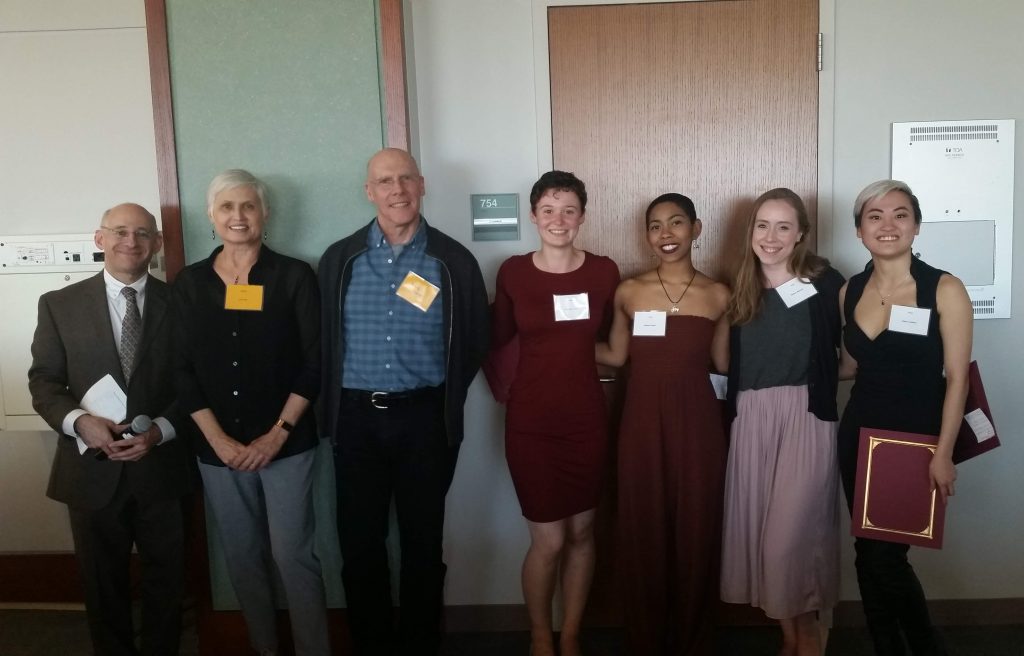 (L to R): Dean Casper; Carol Hess, dance department chair; Doug Hamby, director of the Linehan Artist Scholars program; Samantha Siegel; Giavanni Powell; Kasey Mannion ’19, dance; Emily Godfrey. Photo courtesy of CAHSS.
Combining dual passions
Among the many accolades were twelve awards to graduating students in the college’s hallmark scholar programs: the Humanities Scholars, Sondheim Public Affairs Scholars, and Linehan Artist Scholars. These include several students with dual majors.
For example, four honored dance majors were also earning a degree in another field: Linehan Artist Scholars Emily S. Godfrey ’20, dance and a psychology minor; Melissa Hudson ‘18, dance and economics; and Giavanni Powell ‘19, dance with an entrepreneurship and innovation minor; and Honors College member Samantha L. Siegel ‘19, dance and psychology.
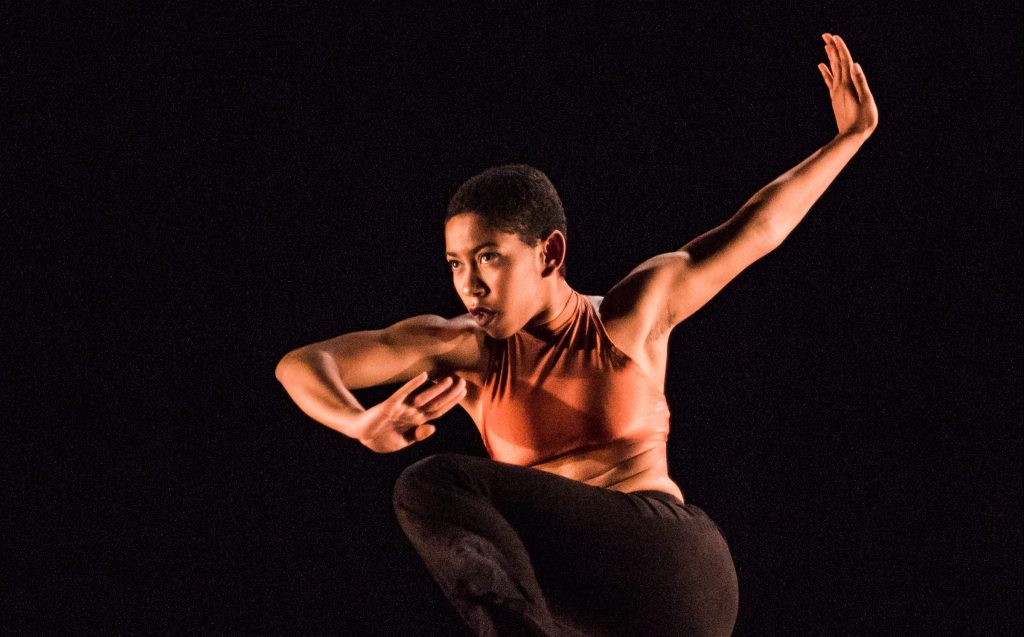
Linehan Artist Scholar Giavanni Powell
Baltimore on my mind
The ceremony also honored students who committed to giving back to Baltimore communities during their time at UMBC. Vanessa Gonzalez ‘19, American studies, worked as a student teacher in Baltimore City as a Sherman STEM Teacher Scholar and received the award for outstanding achievement in American studies.

Gonzalez working with students.
Belgian international student Tanguy Ringoir ‘18, financial economics and M.S. ‘20, economic policy analysis, was named the outstanding graduating senior in financial economics. Ringoir, a chess grandmaster, learned to play chess from his father at age seven. As he strengthened his skills he began to enjoy teaching the game.
During his time at UMBC, Ringor was part of a volunteer chess coach team for a program by TouchPoint in collaboration with UMBC and the Johns Hopkins Center for Talented Youth (CTY). TouchPoint is a community organization in Baltimore that provides free chess lessons to Baltimore youth. The coaching team included volunteers from both the UMBC chess team and chess club.
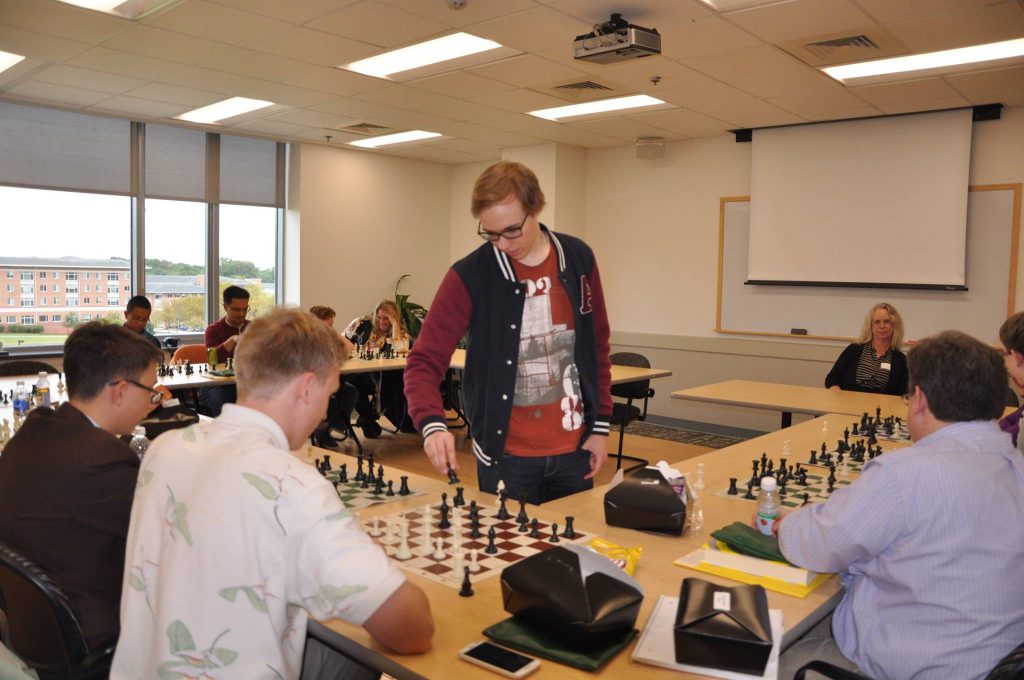
Ringoir, chess grandmaster, working with CTY students. Photo courtesy of Ringoir.
Ringoir also received a Community Service Outreach and Leadership award from the UMBC Division of Professional Studies for his dedication to creating accessible chess teams. He will continue his work with Baltimore K-12 students through the CTY program.
“I personally stay in Baltimore because I can combine my passion for finance with chess,” shares Ringoir. “UMBC gives me an education at the same time that it supports my chess development through the chess team and community volunteer opportunities.”
Like Ringoir, Ciara Jones ‘19, social work, is also an award recipient who has chosen to begin her professional career in Baltimore. She received the excellence award from Africana studies, her minor. Upon graduation, Jones will work with Sarah’s House in Druid Park, as a forensic social worker. She will also serve the Canton community through Renaissance Baltimore Church.
Global skills
In addition to maximizing their academic experience on campus and participating in an exchange of skills within Baltimore communities, CAHSS students seek to sharpen their personal and professional skills by studying abroad.
Miriam Newman-Marshall ‘19, Asian studies with a Japanese minor, received the Constantine Vaporis Academic Excellence in Asian Studies Award. Newman-Marshall has traveled to Thailand and Cambodia, and has completed three study abroad trips to Japan. These trips strengthened her research skills and historical knowledge, which were critical for her work as a research assistant. She assisted Constantine Vaporis, Asian studies director, on his book, Samurai: An Encyclopedia of Japan’s Cultured Warriors.
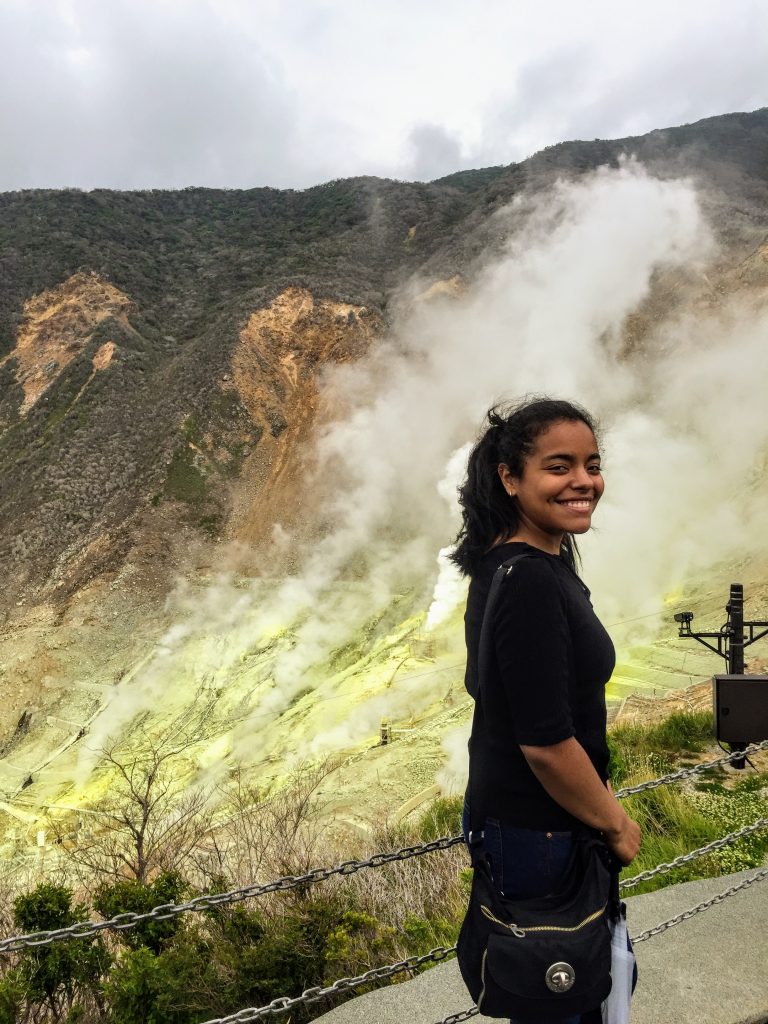
Newman-Marshall next to a volcano in Hakone, Japan. Photo courtesy of Newman-Marshall.
Vaporis encourages all students to study a foreign language overseas to accelerate and deepen their understanding of that language and culture. “Learning a language in its country of origin equips students with skills to conduct more complex research, using multi-lingual sources,” explains Vaporis. “Miriam’s knowledge of Japanese history and her ability to read Japanese greatly facilitated her work in support of my research on the samurai.”
For more CAHSS news follow @UMBC_CAHSS on Twitter.
Banner image: Linehan Artist Scholar Emily Godfrey. All photos by Marlayna Demond ’11 for UMBC unless otherwise noted.
]]>
Faculty and staff in UMBC’s College of Arts, Humanities, and Social Sciences (CAHSS) celebrated students in the annual CAHSS awards ceremony this spring. Scholars programs and departments...
https://umbc.edu/stories/umbc-celebrates-student-achievement-in-the-arts-humanities-and-social-sciences/
https://beta.my.umbc.edu/api/v0/pixel/news/120105/guest@my.umbc.edu/9c3006dfab5fdde38adffccccd67c62c/api/pixel
americanstudies
arts-and-culture
asianstudies
cahss
dance
economics
interdisciplinary
international
linehanscholars
page1
policy-and-society
shermanscholars
socialwork
UMBC News & Magazine
https://beta.my.umbc.edu/groups/umbc-news-magazine
https://assets1-beta.my.umbc.edu/system/shared/avatars/groups/000/001/943/24435aa6207c452e7bc15cc74b42c7bb/xsmall.png?1748556657
https://assets1-beta.my.umbc.edu/system/shared/avatars/groups/000/001/943/24435aa6207c452e7bc15cc74b42c7bb/original.png?1748556657
https://assets2-beta.my.umbc.edu/system/shared/avatars/groups/000/001/943/24435aa6207c452e7bc15cc74b42c7bb/xxlarge.png?1748556657
https://assets2-beta.my.umbc.edu/system/shared/avatars/groups/000/001/943/24435aa6207c452e7bc15cc74b42c7bb/xlarge.png?1748556657
https://assets3-beta.my.umbc.edu/system/shared/avatars/groups/000/001/943/24435aa6207c452e7bc15cc74b42c7bb/large.png?1748556657
https://assets1-beta.my.umbc.edu/system/shared/avatars/groups/000/001/943/24435aa6207c452e7bc15cc74b42c7bb/medium.png?1748556657
https://assets2-beta.my.umbc.edu/system/shared/avatars/groups/000/001/943/24435aa6207c452e7bc15cc74b42c7bb/small.png?1748556657
https://assets1-beta.my.umbc.edu/system/shared/avatars/groups/000/001/943/24435aa6207c452e7bc15cc74b42c7bb/xsmall.png?1748556657
https://assets2-beta.my.umbc.edu/system/shared/avatars/groups/000/001/943/24435aa6207c452e7bc15cc74b42c7bb/xxsmall.png?1748556657
UMBC News & Magazine
0
0
false
Mon, 17 Jun 2019 20:35:09 -0400
Urgent Care

This is what it looks like when researchers push beyond band-aid solutions and design better answers to pressing medical and mental-health issues.
The Patapsco Valley might not bring to mind the disruption of the technology industry the way Silicon Valley has defined itself, but UMBC student and faculty researchers are aggressively tackling disparities related to health care and changing the way people around the world access health technologies.
As a public university, UMBC’s scientific community is actively researching ways to alleviate public-health problems. In some labs this means changing the focus of research to address a more pressing medical issue, like Ph.D. student Mustafa Al-Adhami did when he veered away from studying water purification to address sepsis, a life-threatening condition that strikes over a million Americans each year.
Another example is UMBC faculty member Govind Rao, who feels a sense of urgency in addressing critical challenges that are impacting people’s quality of life. Rao, a professor of chemical, biochemical, and environmental engineering, and director of UMBC’s Center for Advanced Sensor Technology (CAST), sees UMBC students and professors using their skills and interests to make health technologies more equitable, more affordable, and more sustainable. A central focus of Rao’s collaborative work is creating health-care solutions that are not restrained by cost or geography, like an award-winning cardboard incubator his lab produced, accessible for communities with limited resources.
Rao refers to his research and the technologies he’s developed as “disruptive innovations,” and he’s not the only UMBC researcher who is working to help people change how they approach and access medical care. These developments offer novel solutions to challenges facing the world, and faculty and staff at UMBC are changing the way people receive medical care and support from medical providers.
“If I can empower students to think and come up with solutions that have a green footprint and are lower cost and sustainable, I think we can bend the curve,” explains Rao.
Treating sepsis with more accuracy
Mustafa Al-Adhami, M.S ’15, Ph.D. ’19, mechanical engineering, credits a conversation with his wife Stephanie Al-Adhami, a nurse, in changing the focus of his research. At the time Al-Adhami was working to develop a device to determine whether water was safe to consume, but after discovering devices on the market that could already filter most water to make it potable, he shifted his work to address another prevalent challenge that people around the world are facing. “We just pivoted from water to actual blood with this specific application,” he says.
Sepsis is a serious blood infection that, if not treated properly and promptly, can lead to serious complications and even death in mere days. Those at highest risk are the most vulnerable: infants, children, the elderly, and those already facing severe medical problems. According to the Centers for Disease Control and Prevention, more than one million people fight sepsis each year and about a quarter of these cases are fatal. Discouragingly, the number of sepsis cases each year is also on the rise. Al-Adhami and others are working to reverse the trend.

The challenge for physicians isn’t determining whether a person has sepsis, explains Al-Adhami, but rather identifying which antibiotics to administer to the patient. “With every one hour without proper treatment, there is a 7% less chance of survival,” he says.
Working with faculty and student researchers in CAST, Al-Adhami developed a rapid bacterial-detection test that can determine whether a patient has an infection within an hour and helps physicians determine which specific antibiotics should be administered to help fight the infection. Al-Adhami’s device, ASTEK, costs a fraction of the price of the current antibiotic susceptibility test, can reduce the duration of hospital stays, and can prevent antibiotic resistance by avoiding unnecessary antibiotic use.
In addition to its cost effectiveness, ASTEK only requires one milliliter of blood to be run. This is a breakthrough in detecting sepsis in young children. “For [traditional] blood cultures, they take four bottles of blood. Each one is eight milliliters,” explains Al-Adhami. “Because we don’t need this much blood, it could be used for newborns…the concentration of bacteria is much higher in infants.”
The device has successfully been tested in mice, and Al-Adhami hopes that it will be ready for human testing in the next couple of years. If the device is approved for human use, it has the potential to save thousands of patients each year by speeding up the process of diagnosing and administering the correct antibiotics.
Understanding behavior through social media analytics
According to the U.S. Department of Health and Human Services, more than 130 people die from opioid-related overdoses each day, and there are over 14,000 substance abuse facilities across the U.S. that treat people facing these addictions. The opioid epidemic affects every region of the country, and those watching loved ones go through the cycle of substance abuse are seeking any new ways to halt this disease in its tracks.
 Shimei Pan, assistant professor of information systems, is studying human behavior in the context of monitoring, preventing, and treating substance-abuse by analyzing how people with substance use disorders behave on social media. “On social media, there is a lot of information about each individual. Some are related to substance use, like drinking, smoking, and illicit drug use,” she says.
Pan and her collaborator Warren Bickel, a well-known behavior scientist at the Virginia Tech Addiction Treatment Center, are employing large-scale social media analytics to better understand addiction and help medical professionals provide personalized treatment to people facing addiction and substance abuse.
The clues Pan and Bickel are looking for in social media data are subtle, but have the potential to alter the way substance abuse is identified and subsequently treated. “Sometimes, people explicitly mention substance use in their social media posts,” she shares. “These are useful signals. But there are other signals in social media, sometimes even stronger than explicit mentions of substances. Substance abuse is frequently linked to mental disorders such as depression, anxiety and impulsivity. As a result, social media behavior signals related to depression, anxiety and impulsivity can also be very useful in helping us detect and understand substance abuse”
Since substance abuse could be explained by both genetic and environmental factors, with large-scale social media analytics it is possible to identify distinct patterns in its manifestation on social media, says Pan. “We want to see whether we can find those behavioral markers of addiction on social media. By identifying these markers, we can understand substance abuse a little bit better.”
Pan and her collaborators plan to continue conducting basic research, and hope to help develop new screening, diagnostic, and intervention tools in the future—another way of building a bridge to proper health care access for all.
Studying stigma and pain
Another UMBC faculty member studying human behavior is Shawn Bediako, associate professor of psychology, who focuses on the psychosocial impact of sickle cell disease. Bediako is using new technologies to assess sickle cell patients’ pain and experiences.
Previously, Bediako and his collaborators collected data using paper surveys that were sent to patients and required that patients mail them back each week. “We didn’t know when they filled [the surveys] out,” he says. “All we knew is that they would send us a packet back.”
The development of a new app-based tool, however, lessened the lag in survey responses. This new approach gives researchers a more accurate picture by providing data with integrity. Bediako explains that the app allows patients to submit their experiences directly and enables researchers like him to pose bold, new questions to patients. Each night at 7 p.m., the patients automatically receive a survey to fill out by midnight. The rapid turnaround and ease of completing the survey also “cut down on data contamination,” he says.
“Now that data analytics has expanded the range of online behaviors that we can examine, researchers like me can think about the links between health care and health outcomes in a different way,” Bediako explains.
Bediako, who is also the facilitator for UMBC’s Collaborative for the Interdisciplinary Promotion of Health Equity Research (CIPHER), hopes that his work bridges the gap between people who are doing research on sickle cell disease and people who are studying how innovative technologies can be utilized to help people with the disease. “I’m currently integrating information from history, policy, sociology, psychology, and medicine to better understand the genetics of sickle cell pain,” he says, adding this requires some “out-of-the-box type thinking.”
Like Pan, Bediako is interested in how people’s social media use differs depending on whether they are in pain versus not in pain. “Now that data analytics has expanded the range of online behaviors that we can examine, researchers like me can think about the links between health care and health outcomes in a different way,” he explains.
Supporting first responders
In a broad collaboration to understand how the stressful situations first responders encounter in their jobs can lead to anxiety and other mental health issues, UMBC faculty in emergency health services (EHS) and information systems are using existing technologies to tackle the task. Principal investigator Andrea Kleinsmith, assistant professor of information systems, is collaborating with J. Lee Jenkins, associate professor and chair of emergency health services; Helena Mentis, associate professor of information systems and associate dean in the College of Engineering and Information Technology; and Gary Williams, acting paramedic director in emergency health services.
Trainees and first responders on the job may experience an array of physiological responses when they are in a situation that is tense or challenging. UMBC students in their third and fourth years of the emergency health services program move through a series of often intense scenarios in the simulation lab in Sherman Hall to prepare them for a range of situations they may encounter on the job. Involuntary bodily reactions such as increased heart rates or perspiration are tracked by wearable devices, and allow the instructors and trainees the opportunity to assess and manage stress and improve the preparedness for future emergency scenarios.

Working with student researchers, the faculty members design, develop, and evaluate the system to assess how discussions and intentional in-class reflections on stressful situations can help trainees implement stress management strategies during their work. The team is studying how a Team Stress Reflection system can be used by paramedic trainees to “understand the events that trigger stress increases and their ability to mitigate that stress,” according to the grant proposal. This technology allows the students to identify and better understand the correlations between stressful situations and their physiological responses.
Stress, explains Kleinsmith, can lead to errors during care and long-term health concerns for medical personnel, including emergency health professionals. Williams says that it’s important for students to debrief and reflect on the simulation to make sure that they can address any stressors or points that caused them to have strong physiological responses.
“The ability to monitor and manage stress in medical personnel has the potential to improve medical care provided in stressful situations,” explains Kleinsmith.
Understanding the physiological responses during training exercises is important for trainees, explains Williams, because it allows them to improve how they cope with stress in situations that they may encounter on the job. This research is being funded by a three-year grant from the National Science Foundation, which supports the faculty in collecting data from the EHS students and developing the interface to help the students come to their own conclusions about the correlation between physiological measurements and stress to understand their stress triggers. The interface also helps facilitate the team’s discussion about stress.
Motion sensors to inform treatment

Helena Mentis is also using activity trackers and other motion sensors to assess movement and inform treatment for patients with Parkinson’s disease. In collaboration with faculty at the University of Maryland Parkinson Disease and Movement Disorders Center, Mentis designed and developed a sensor using Leap Motion devices to track and assess the movement of patients with Parkinson’s disease during deep brain stimulation.
One observation that Mentis and her collaborators made was that the presentation of data collected from the sensors impacted how the data was interpreted and used to develop customized treatment plans for patients. In 2017, Mentis presented a paper at the Association for Computing Machinery Special Interest Group on Computer-Human Interaction Conference. The paper explains that the data collected by the patients’ activity trackers led to more informed conversations between the patient with Parkinson’s and their physician.
In a well-researched disease like Parkinson’s, there’s still always room for improvements in care and access to care. Researchers have been studying Parkinson’s disease and treatment options for people with Parkinson’s since the 1960s, but there is still work to be done. Every advancement leads to better outcomes and an increased quality of life for Parkinson’s patients. Mentis and her collaborators are now using self-tracking technologies to help physicians customize treatment plans and advocate for patients.
“Determining how sensor data can be incorporated in shared decision-making is fundamental to effective patient-centered care,” explains Mentis. “Even more so for low-resource and marginalized communities, where sensor data could easily be used by medical caregivers to argue for diagnoses or treatments that are based on assumptions and biases. The sensor data in itself does not embody truth and instead should be taken into account alongside a holistic understanding of the patient and their circumstances.”
Doing good through “disruptive innovations”
Through his work, Rao focuses on addressing critical challenges by answering the fundamental question: “How can we help them?”
“These are real lives, real people who are living in desperate conditions,” Rao says, noting that he aims to empower his students to think about how they can make positive changes through their work. Rao explains that his multidisciplinary approach to research has allowed him and his colleagues and students to make tremendous impacts related to health technology. CAST allows him to work with faculty and students from a range of disciplines, and he believes it is important for engineers, scientists, sociologists and psychologists, and policymakers to have a seat at the table, because each perspective is so valuable.

“Disruptive innovation” refers to technologies and other developments that offer novel solutions to challenges facing the world. Like Bediako and other colleagues at UMBC, Rao challenges his students to consider new approaches to addressing challenges and needs in the health technologies space.
While Rao leads this research, he is quick to point out that the collaborative nature of the work and the contributions of his students are crucial to its success. “It’s not about me,” he says. “I’m just privileged enough to have such an amazing team across several disciplines and backgrounds. It’s just a blast.”
With funding and support from federal agencies, including the Defense Advanced Research Projects Agency, Rao has developed a bioreactor or “biomod” that fits inside a suitcase and allows pharmaceuticals to be produced on demand and with limited resources and time. The device was developed with soldiers in conflict zones in mind because it allows them to quickly create customized medicines to save lives based on the needs of the patient.
Additionally, Rao and his colleagues have developed low-cost incubators to support premature babies in communities with limited resources and in areas that do not have access to robust medical facilities. His research team was presented with the 2019 Global Health Research Award at the Pediatric Academic Societies Meeting in Baltimore.
The question “What have you done for others?” is the driving force behind Rao’s lab. He says that many of the health technologies that are currently available are only affordable to a small group of people, and are only helping the people who can afford them. “Just spending five to 10 minutes a day thinking about what they [students] can do with their skill set to improve the lives of others, that’s all it takes to change the world,” Rao says.
*****
All illustrations by Brucie Rosch.
]]>
This is what it looks like when researchers push beyond band-aid solutions and design better answers to pressing medical and mental-health issues. The Patapsco Valley might not bring to mind the...
https://umbc.edu/stories/tackling-disparities-related-to-healthcare-and-care-access/
https://beta.my.umbc.edu/api/v0/pixel/news/120106/guest@my.umbc.edu/2fe6c14f2765ff8f2122bf8dbbdfe314/api/pixel
cast
coeit
discovery
feature
graduateschool
spring-2019
UMBC News & Magazine
https://beta.my.umbc.edu/groups/umbc-news-magazine
https://assets1-beta.my.umbc.edu/system/shared/avatars/groups/000/001/943/24435aa6207c452e7bc15cc74b42c7bb/xsmall.png?1748556657
https://assets1-beta.my.umbc.edu/system/shared/avatars/groups/000/001/943/24435aa6207c452e7bc15cc74b42c7bb/original.png?1748556657
https://assets2-beta.my.umbc.edu/system/shared/avatars/groups/000/001/943/24435aa6207c452e7bc15cc74b42c7bb/xxlarge.png?1748556657
https://assets2-beta.my.umbc.edu/system/shared/avatars/groups/000/001/943/24435aa6207c452e7bc15cc74b42c7bb/xlarge.png?1748556657
https://assets3-beta.my.umbc.edu/system/shared/avatars/groups/000/001/943/24435aa6207c452e7bc15cc74b42c7bb/large.png?1748556657
https://assets1-beta.my.umbc.edu/system/shared/avatars/groups/000/001/943/24435aa6207c452e7bc15cc74b42c7bb/medium.png?1748556657
https://assets2-beta.my.umbc.edu/system/shared/avatars/groups/000/001/943/24435aa6207c452e7bc15cc74b42c7bb/small.png?1748556657
https://assets1-beta.my.umbc.edu/system/shared/avatars/groups/000/001/943/24435aa6207c452e7bc15cc74b42c7bb/xsmall.png?1748556657
https://assets2-beta.my.umbc.edu/system/shared/avatars/groups/000/001/943/24435aa6207c452e7bc15cc74b42c7bb/xxsmall.png?1748556657
UMBC News & Magazine
0
0
false
Mon, 17 Jun 2019 19:56:07 -0400
Learning from Ellicott City

In the aftermath of two “1000-year” floods in three years, can experts, officials, and residents agree on a way to prevent the next big one while preserving this historic town?
By Sarah Hansen M.S. ’15
Ellicott City, Maryland, rests in a steep, narrow valley at the confluence of the Tiber River, its smaller unnamed tributaries, and the much larger Patapsco River. All that water power made it the perfect place to build a mill town—as brothers Jonathan and George Ellicott did beginning in 1772.
The mill town flourished in the 1800s and was the first stop on the Baltimore and Ohio Main Line railroad (the first railroad in the United States) beginning in 1831. Housing and shops quickly sprang up along the winding street to service residents and visitors.
Today, Wilkins Rogers Mills still processes flours and cornmeal on the old site, and the B&O rail station at Ellicott City is the oldest surviving rail station in the United States. It was designated a National Historical Landmark in 1968, and the Main Street area, which retains over 200 historic buildings, was listed on the National Register of Historic Places in 1978.
But while much has stayed the same, much has also changed since Ellicott Mills’ 19th-century heyday. Rather than workaday folk gathering sundries on Main Street, droves of tourists and preservation enthusiasts now stroll the charming byway to patronize boutique shops and cafés.
Or, they used to.
 Main Street in Ellicott City is seen from above the day after a flash flood devastated the historic city on the Patapsco River. Photo: Jerry Jackson, permission from Baltimore Sun Media. All rights reserved.
In 2016, and then, extraordinarily, again in the spring of 2018, Historic Ellicott City was ravaged by flash floods that trapped diners in restaurants’ upper stories, saw empty cars and trucks careening down Main Street, destroyed homes and businesses, left debris for miles downstream, and, in total, took three lives.
The events, both dubbed “1000-year floods” in the media, have left residents and business owners with the tough decision to stay or go. The Howard County government is faced with a dilemma, too: Ellicott City is a popular attraction and has been an economic powerhouse in the county for decades. But when storms come, as they inevitably do, it becomes very dangerous, very quickly.
The floods are changing
“Ellicott City was put there for a reason, to take advantage of water power,” says Andrew Miller, professor of geography and environmental systems. “Therefore, nobody should be surprised that water power is a potential hazard.”
Faculty in UMBC’s geography and environmental systems (GES) department have been studying the local watershed for years. Miller has a particular interest in the role floods play in shaping stream channels and the local ecosystem. Matthew Baker studies watershed ecology and has been deeply involved with the removal of a dam just downstream from Ellicott City. Jeffrey Halverson is a regular contributor to The Washington Post, where he explains the mechanics of regional storm systems for the general public.
Miller says the dam project and flooding studies provide unique opportunities to study aspects of stream ecology, such as sediment movement, from interesting angles. “It’s very rare to have a research project that falls into your lap that’s two miles from your office,” he says, “and to have multiple research projects within two miles of your office intersect with each other is even more unusual.”
Flooding in Ellicott City is nothing new. One of the worst floods was in 1972, when Hurricane Agnes caused the Patapsco River to overflow its banks by 14.5 feet and fill the lower end of Ellicott City’s Main Street. This was a flood “from the bottom up,” explains Halverson. Most of the town’s previous flooding events have happened in a similar fashion—a massive rainfall event deluges the entire region, and the river slowly rises until it can no longer contain the water. Crucially, residents have plenty of time to evacuate in these storms.
 Flood waters on Main Street in Ellicott City, 1972. Photo from the Howard County Historical Society.
But the 2016 and 2018 floods were different. Rather than heavy rain everywhere over an extended period, forecasters predicted potentially devastating, shorter-term rainfall at a hyper-local level in both storms. “But there was never any attempt to localize the storm down to the county or sub-county level,” wrote Halverson for Weatherwise. Why? “Our ability to do so is practically non-existent.”
As a result, when the deluges hit Ellicott City in 2016 and 2018, “people barely had time to get to the second floor of the restaurant,” Miller says.
[rara_call_to_action title=”” button_text=”Read More” button_url=”https://umbc.edu/a-timeline-of-resilience-in-flood-prone-town/” target=”_blank” button_align=”center”]A Brief History of Major Ellicott City Floods[/rara_call_to_action]
“It’s not just the rain that makes a flash flood, it’s also the terrain and the nature of the landscape,” Halverson wrote. Considering this, other changes since the 19th century come into play. Ellicott City has become a highly desirable place to live, and suburban development now sprawls in all directions from Main Street.
Development means more impervious surfaces—roads, rooftops, driveways, patios—and impervious surfaces make it harder for a landscape to absorb rainfall. So, in the 2018 flood, when the center of the storm was a bit upstream from Ellicott City, Halverson wrote, “the torrent of stormwater runoff cascaded downslope into the topographic bowl of the town, flooding it from the top down.”
The floods are “an example of effectively a small tributary watershed ‘wagging the dog,’ making the entire Patapsco River flood before the rest of the drainage area contributed,” says Baker.
In both floods, “upslope development undoubtedly made things worse,” Miller says, but isn’t fully to blame. These events “would have exceeded any kind of storm water management that you could have put in,” he says.
Because of the way heavy rainfall on a small section of the watershed can cause severe flash flood events, Baker says, “the Patapsco River is now behaving much more like an urban river…than its general land use would suggest.” Why is less clear. It could be increasing development, or it could be changes in rainfall patterns influenced by climate change. More likely, it’s a combination of both as well as other factors.
What to do?
The local government is grappling with what to do with this beloved—and sometimes deadly—section of town. They commissioned the McCormick Taylor Report to provide a menu of options that could keep the town safe in future events similar to 2016 and 2018 while keeping the town as-is. The recommendations included $35 million in immediate improvements, plus $60 to $85 million more for longer-term projects. It’s hard to imagine anyone being willing to spend that much to protect such a small parcel of property. The plans included everything from “pipe farms” underground to store storm water until it could be released more slowly, to tunneling through bedrock to create a pathway for water through town that wouldn’t disturb the street above.
In September 2018, the county government announced a plan that would involve removing up to 10 of the historic buildings to take people out of harm’s way and improve water flow for the next major flood. The public outcry was swift and powerful, and no demolition has occurred.
[rara_call_to_action title=”” button_text=”Read More” button_url=”https://umbc.edu/an-ounce-of-prevention/” target=”_blank” button_align=”center”]UMBC Experts Discuss Preventing Future Floods[/rara_call_to_action]
Most UMBC scientists prefer not to engage in local politics, but based on their work, they can inform conversations on what the county should consider as they’re making decisions. In the days immediately following both storms, Miller and Halverson were in high demand with the news media. One question that kept coming up was whether another storm of this strength could happen again, and when.
Miller is currently working on a paper using evidence to make the case that “it’s an extraordinary event, but it’s not as extraordinary as we think it is. There’s some evidence, although right now it’s not completely conclusive, that we are seeing greater frequency of large floods,” says Miller. “So you cannot assume something like this just won’t happen again.”
 Parts of Main Street have returned to life by summer 2019. Many stores remained shuttered. Photo by Marlayna Demond ’11.
In its current state, “There’s not enough room for Main Street and the river—that’s why the river flows underneath,” explains Miller. “It’s a pipe dream that you can just make this problem go away.” In fact, dealing with the danger of water is a challenge that will only get worse as climate change leads to more strong storms and rising seas. “This is a microcosm of the much bigger problem that we face on a massive scale in this century,” Miller says.
As a local and a hydrologist, Baker sees both sides of the argument. “I appreciate the historic nature of the community, and I think something would be lost if they tore all those buildings down. At the same time, I can understand why any administrator would want to minimize the risk of loss of life, so that’s totally reasonable as well,” Baker says. “I don’t think there’s a real clear solution here, it’s just a value judgment that people have to decide what is most important in this situation.”
And so, the debate rages on. In the meantime, visitors continue to stroll, shop, and snack at the bright and cheery storefronts along Main Street, albeit in reduced numbers. Some establishments, however, remain shuttered, and storm damage is still visible through dirty windows. The contrast reinforces the fragility of this charming historic oasis, reminding tourists, scientists, and public administrators alike what happened here, and what could happen again.
How the community chooses to proceed is still uncertain, but one hopes the expertise of elected officials, scientists, and the public will all be brought to bear in a way that keeps people safe and allows Ellicott City—in whatever form it eventually takes—to thrive for years to come.
****
Header photo by Mark Baxter @SkySightVIP
]]>
In the aftermath of two “1000-year” floods in three years, can experts, officials, and residents agree on a way to prevent the next big one while preserving this historic town? By Sarah Hansen...
https://umbc.edu/stories/learning-from-ellicott-city/
https://beta.my.umbc.edu/api/v0/pixel/news/120107/guest@my.umbc.edu/721adb1f75d2531e583e20b86efbbf42/api/pixel
discovery
ehs
ellicott-city
publicpolicy
spring-2019
UMBC News & Magazine
https://beta.my.umbc.edu/groups/umbc-news-magazine
https://assets1-beta.my.umbc.edu/system/shared/avatars/groups/000/001/943/24435aa6207c452e7bc15cc74b42c7bb/xsmall.png?1748556657
https://assets1-beta.my.umbc.edu/system/shared/avatars/groups/000/001/943/24435aa6207c452e7bc15cc74b42c7bb/original.png?1748556657
https://assets2-beta.my.umbc.edu/system/shared/avatars/groups/000/001/943/24435aa6207c452e7bc15cc74b42c7bb/xxlarge.png?1748556657
https://assets2-beta.my.umbc.edu/system/shared/avatars/groups/000/001/943/24435aa6207c452e7bc15cc74b42c7bb/xlarge.png?1748556657
https://assets3-beta.my.umbc.edu/system/shared/avatars/groups/000/001/943/24435aa6207c452e7bc15cc74b42c7bb/large.png?1748556657
https://assets1-beta.my.umbc.edu/system/shared/avatars/groups/000/001/943/24435aa6207c452e7bc15cc74b42c7bb/medium.png?1748556657
https://assets2-beta.my.umbc.edu/system/shared/avatars/groups/000/001/943/24435aa6207c452e7bc15cc74b42c7bb/small.png?1748556657
https://assets1-beta.my.umbc.edu/system/shared/avatars/groups/000/001/943/24435aa6207c452e7bc15cc74b42c7bb/xsmall.png?1748556657
https://assets2-beta.my.umbc.edu/system/shared/avatars/groups/000/001/943/24435aa6207c452e7bc15cc74b42c7bb/xxsmall.png?1748556657
UMBC News & Magazine
0
0
false
Mon, 17 Jun 2019 19:32:40 -0400