Every biological sciences graduate student at UMBC knows “the face”—Tom Cronin’s signature scowl, which, contrary to appearances, signals rapt attention rather than disapproval. At a day-long symposium honoring Cronin’s remarkable career, alumni handed out life-sized cutouts of “the face” on sticks, which attendees waved playfully during talks, setting the tone for a joyful, family reunion-like event filled with laughter, affection, and mutual respect.
Cronin began his 43-year tenure at UMBC as an assistant professor at the young university. Over time, he became a giant in the field of visual ecology, primarily studying the enigmatic mantis shrimp. His work has helped unravel the mysteries of mantis shrimp eyes—biological marvels that still hold scientific secrets.
On the eve of his retirement, dozens of Cronin’s colleagues and alumni traveled from all over the world to attend the symposium, and still others attended virtually or sent pre-recorded messages. Chuan-Chin Ciao, Ph.D. ’00, biological sciences, may have come the farthest, visiting from National Tsing Hua University in Taiwan. Symposium talks spanned bumblebees, fanworms, deep-sea fish, and more, showcasing the breadth of Cronin’s network.
 “The face” is infamous among UMBC graduate students. Symposium organizers printed out copies for attendees to magnify its effect during the symposium. (Photo by Michelle Starz-Gaiano)
“You taught us how to be scientists”
Cronin’s mentees, many now leading their own labs around the world, shared how he had influenced their lives. Megan Porter, a former postdoctoral fellow in Cronin’s lab, thanked him for expanding her expertise in molecular biology and genetics to visual ecology. “When I came in, I had a Ph.D.; I thought I knew stuff. But at the first lab meeting, I realized I knew nothing about visual ecology,” Porter recalls. “I can’t thank him enough for bringing me into this community and giving me such a broad foundation.” Now she strives to do the same for her students as a professor at the University of Hawai’i.
Michael Bok, Ph.D. ’13, biological sciences, shared “Cronin wisdom,” such as “Work on something ridiculously cool,” “Surround yourself with great scientists and good friends,” and “Have patience and don’t give up”—ideas Bok has carried into his work as a researcher at the University of Lund in Sweden. Kathryn Feller, Ph.D. ’14, biological sciences, the John D. MacArthur Assistant Professor of Biological Sciences at Union College, displayed a pencil drawing of a tomcat, picked up at a thrift store and mounted in the lab for the last decade. Its inscription reads, “Tom is tough, but he’s your friend”—a sentiment that reflects Cronin’s mentorship style.
 (l-r): Megan Porter, Michael Bok, Tom Cronin, and Kate Feller enjoy each other’s company after the symposium. (Photo by Michelle Starz-Gaiano)
Alex Kingston, Ph.D. ’15, biological sciences, now an assistant professor at the University of Tulsa, thanked him for supporting her growth. “Anyone can teach you how to do science, but you taught us how to be scientists,” Kingston shared. One of Cronin’s major lab instruments is moving to Kingston’s lab in Oklahoma to enrich her research program.
Cronin taught nearly 8,000 undergraduates over 86 semesters, valuing their diverse perspectives, and described UMBC as “a place you can really succeed as a young investigator.” He thanked the UMBC faculty and staff and his family for their enduring support, especially his wife, Ros. The symposium was a testament to Cronin’s legacy—a vibrant community built on curiosity, mentorship, and connection—the influence of which will ripple through generations of creative and humble scientists who are eager to enlarge our understanding of nature’s wonders.
Learn more about UMBC graduate programs in biological sciences, or check out the beautiful Color in Nature (2024), co-authored by Tom Cronin.
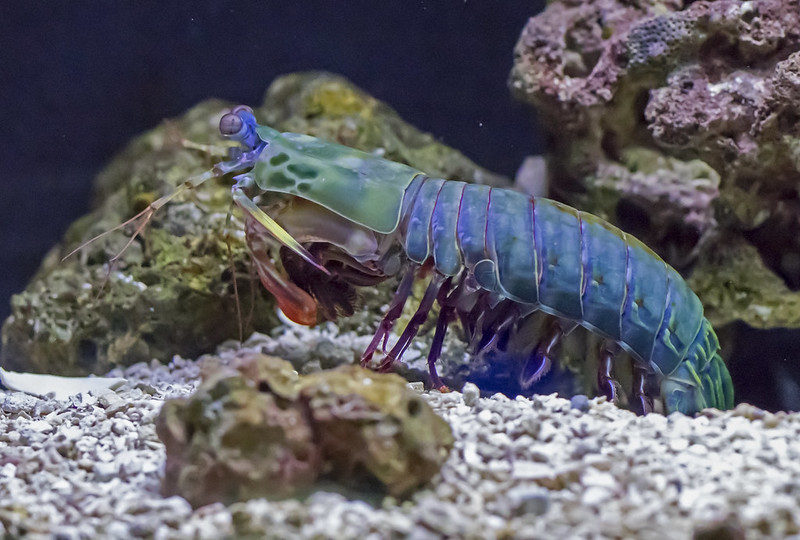 A peacock mantis shrimp, an especially colorful variety of these remarkable animals. (Richard Crook, shared under CC-BY-NC-ND 2.0)