For over 20 years, the Chemistry Biology Interface (CBI) program at UMBC has been shaping Ph.D. students into leaders who bridge chemistry and biology. Programs like CBI are critical to help meet the rising demand for researchers with wide-ranging skill sets who can communicate clearly with those outside their specialty. In the joint UMBC-University of Maryland, Baltimore (UMB) CBI program, participants complete their degrees faster than students in similar labs outside the program, and 97 percent graduate—well above the national average of 63 percent for graduate study in the life sciences.
“Everything now is interdisciplinary research,” says Aaron Smith, associate professor of chemistry and biochemistry at UMBC and CBI director.
CBI supports Ph.D. students at UMBC in chemistry, biochemistry, and biological sciences, and pharmacy students at UMB. Now it has secured five more years of funding to continue building community, creating networking opportunities, and training students in interdisciplinary research and science communication.
Communication for career success
CBI alumni credit the program with positioning them to thrive in a range of careers, from the classroom to corporate laboratories.
“I became more confident with public speaking and attribute the success of my job interview talks to the training I received in CBI,” shares Kathryn Wardrup, Ph.D. ’24, biological sciences. Today, she is a postdoctoral fellow at the Fred Hutchinson Cancer Center, an independent research institute in Seattle.
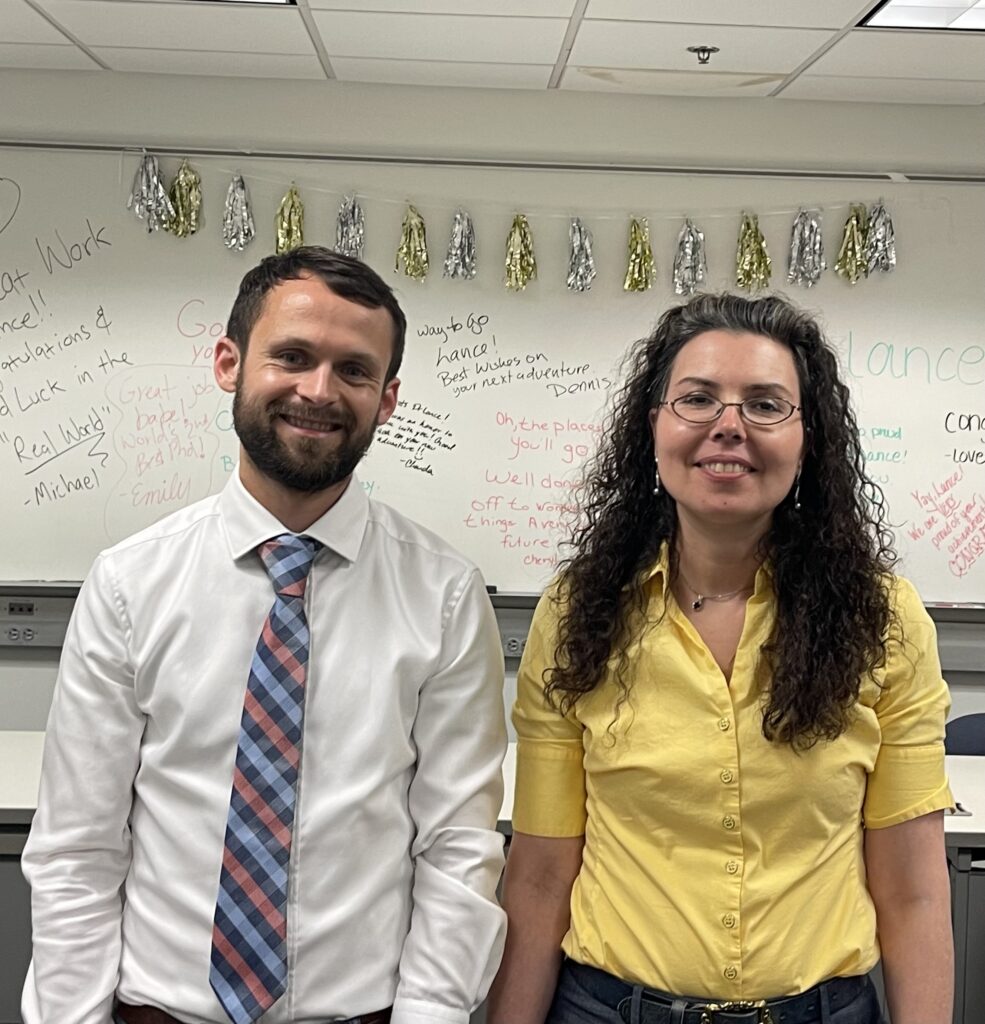 Lance Dockery (left) completed his Ph.D. with Marie-Christine Daniel, associate professor of chemistry and biochemistry. Here they celebrate his thesis defense in 2022. (Courtesy of Dockery)
“Hearing about other research on campus and learning what techniques are being used was a valuable experience,” Wardrup adds. “I felt confident in my ability to be able to have discussions outside of my scientific expertise.”
Scott Riley, Ph.D. ’20, chemistry, also benefited. “I’ve carried many of the lessons I learned into presentations, whether classroom lectures or at meetings and conferences,” he says. “I know many of my interviews were successful because of things I learned in CBI.”
Currently, Riley coordinates internship placements and teaches courses in the master’s program in pharmaceutical sciences at UMB.
Lance Dockery, Ph.D. ’22, chemistry, parlayed skills gained in CBI into a senior scientist role at biotech company AstraZeneca, and recently transitioned to a leadership role at pharmaceutical company Eli Lilly.
“In industry, projects often require coordination between chemists, biochemists, immunologists, and other specialists, similar to the collaborative environment within the CBI program,” Dockery says. “The experience of presenting research to a diverse audience within CBI strengthened my communication skills—something that has given me a clear advantage when interacting with project teams.”
Building a supportive community
CBI participants attend weekly meetings where they take turns teaching their peers about a range of scientific topics selected by the students. Following the more formal instruction period, students partake in group discussions on graduate student life and professional development topics—like mental health, time management, and creating and updating a CV—over pizza.
All this interaction promotes a strong sense of community. “This program builds a really strong rapport among the students, some of whom are in their first semester of graduate school and some of whom are preparing to defend their theses,” Smith says. “They build connections with one another; they learn how to talk with one another. I really think of it as building a community of support among the students.”
Danielle Schmitt, Ph.D. ’17, biochemistry, concurs. “I really benefited from having a cohort of fellow graduate students to support me during my Ph.D.,” she says. Today, Schmitt is an assistant professor of chemistry and biochemistry at UCLA.
CBI’s community feel also fosters shared investment in each participant’s success. “It’s a fun experience to see other students’ data and scientific talks develop as they experience growth during their time in CBI,” Wardrup says.
 Danielle Schmitt (front row, yellow shirt) took a group of her UCLA lab members to the 2nd Annual SoCal Metabolism Symposium in 2022, where several of them presented research posters. She completed her Ph.D. with Songon An, associate professor of chemistry and biochemistry. (Courtesy of Schmitt)
Hands-on cross-training
CBI includes about 40 students per year. Most of them are considered “trainees,” who receive a funding allowance to support conference travel and research expenses for cross-training in a lab outside their work with their primary Ph.D. advisor. Students have received training at the NIH, St. Jude’s Research Hospital, biotech giant Genentech, labs at universities such as UNC-Chapel Hill and UT-Austin, and UMBC and UMB labs.
Riley’s cross-training experience “allowed me to discover a new technique (electron microscopy) which played a critical role in my thesis,” he says. Schmitt adds, as a CBI fellow, “I was able to spend time at the NIH working on a collaborative project related to glucose metabolism. Because CBI supported my time at the NIH, I could move the project forward and learn new skills I might not have gained otherwise.”
 Scott Riley (front row, third from left) with his first class of graduates from the UMB master’s program in pharmaceutical sciences in 2022. (Courtesy of Riley)
Janae Baptiste Brown, Ph.D. ’18, chemistry, adds that “the cross-disciplinary training gave me the unique opportunity to conduct research at the bench with collaborators both at UMBC and the NIH.”
In addition to the benefits trainees receive, six CBI fellows per year further receive full tuition support, health care benefits, and a living stipend. The fellows serve as peer leaders, planning CBI programming in collaboration with Smith and leading group discussions.
“Beyond the bench, I have referred back to some of the leadership skills that I gained as a fellow to encourage an active learning environment in my classes,” says Baptiste Brown, who is now an assistant professor of chemistry and biochemistry at Spelman College.
 Janae Baptiste Brown (right) with members of her lab group at Spelman College. Baptiste Brown completed her Ph.D. with Michael Summers, professor of chemistry and biochemistry. (Courtesy of Baptiste Brown)
Expanding horizons through conferences
Support for conference travel is another major benefit of CBI. Conferences offered “an excellent opportunity to engage with scientists outside my realm of expertise and network with scientists in my field, ultimately landing me a job interview through a connection made at a CBI-sponsored conference,” Wardrup says.
Conferences also offer more opportunities to practice communicating one’s work with a range of audiences. “Having experience in interdisciplinary communication is invaluable,” Dockery says. “It facilitates smoother collaborations and ensures that diverse expertise contributes effectively to project success.”
“I can’t overstate the way this program dramatically enhances the graduate training outcomes for individuals,” Smith says, “so I wish we had more of these training grants for cross-disciplinary training in other fields, like chemistry-engineering or chemistry-physics.”
Embracing growth beyond comfort zones
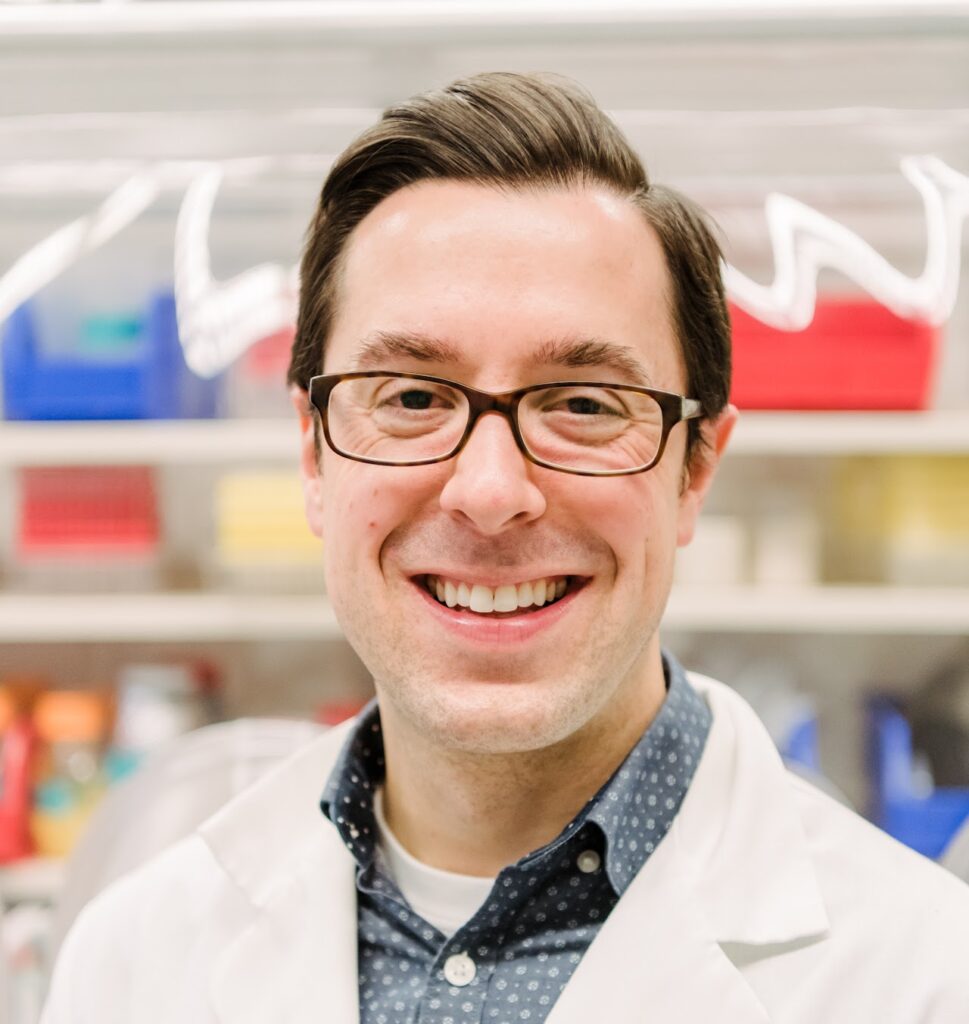 Aaron Smith has led the CBI program since 2022. (Marlayna Demond ’11/UMBC)
Smith took on leading CBI in 2022, after serving as assistant director under previous director Katherine Seley Radtke, professor of chemistry and biochemistry. “It’s a ton of work, but the benefits far outweigh the amount of time and effort that it takes to keep this program running,” he says. “It’s just a fantastic program.”
As Wardrup notes, “It can feel uncomfortable to step outside of your comfort zone to explore something new, but CBI is an extremely supportive environment to take that first step.” Riley echoes this sentiment. “Graduate school is one of the best times in your life to really dig deep and learn as many things as you can,” he says. “You will be surprised how some skills or knowledge will be relevant in your early career.”
The CBI program, with its focus on interdisciplinary training and community building, provides the perfect platform for students to do just that—equipping them with the confidence, skills, and networks to excel.