There are black holes, and then there are supermassive black holes (SMBH), with masses millions to billions of times as great as the Sun. A small percentage of SMBH are furiously gobbling up matter; these are called active galactic nuclei (AGN). Adi Foord, assistant professor of physics, is co-leading a research project designed to further understanding of how this rare type of black hole forms and changes over time.
The project, recently funded by a National Science Foundation (NSF) Astronomy and Astrophysics Research Grant, also creates prime opportunities for undergraduate and graduate students to contribute to the research and connect with leaders in the field for networking and mentorship—experiences with the potential to shape these students’ futures.
In addition to Foord, the three other co-leads are giants in the field of black hole research at institutions with powerhouse astronomy programs: Meg Urry at Yale University, David Sanders at the University of Hawaii, and Nico Cappelluti at the University of Miami. All four co-leads have collaborated for years as members of a research consortium known as the Accretion History of AGN (AHA) group.
“The goal of the NSF project is to try to map out the growth of AGN across cosmic time using as much data as humanly possible,” Foord says. “We’ll be looking at data collected by observatories in space and on the ground over a really wide range of wavelengths.”
By analyzing data from various sources, the team has a better chance of shedding light on how these black holes grow and evolve, “and how their growth mechanisms connect to things like their environments,” Foord adds, “so getting information about the host galaxies that they’re in will be key.”
Foord is particularly interested in what happens when two galaxies, each with a supermassive black hole at its center, merge, and her part of the new grant zeroes in on exploring these merging AGN. For example, the percentage of galaxies that begin to interact and then go on to complete a merger is an open question.
 Adi Foord (left) and Ph.D. students Cassie Daniele (center) and Zack Reeves discuss research data in Foord’s office. (Brad Ziegler/UMBC)
Addressing the bottleneck
Zack Reeves, a UMBC Ph.D. student mentored by Foord, is contributing to the project through his research on dual AGN—pairs of black holes in the early stages of a potential merger. Reeves started with a dataset including 2,684 confirmed AGN, based on data from the X-ray Multi-mirror Mission (XMM) Newton observatory and Sloan Digital Sky Survey. Then he pared down the data further, eventually settling on 38 AGN that met particular data standards.
“This summer, I’m going through each of the XMM X-ray sources, and looking to see if the AGN have any other significant X-ray sources nearby that could indicate a dual AGN,” Reeves says.
XMM Newton includes tools that allow scientists to filter and analyze the data to answer their specific questions, “but the process can be manual and tedious to do observation by observation,” Reeves says. To address that bottleneck, he’s coding a Python script to streamline data analysis, which he’ll run on UMBC’s High-Performance Computing Facility (HPCF), which can analyze all of the samples in parallel, producing results many times faster than completing the task sequentially by hand.
The results will provide important insights into how galaxies and AGN form. Multiple theoretical simulations describe those processes, and “these simulations disagree on certain predictions, like how the dual AGN population will evolve over the course of cosmic time,” Reeves says. “So the interesting part of this project is that we can actually look in space and observationally constrain how this population evolves, and through that we can identify what strengths and weaknesses these simulations have.”
 Weekly lab meetings with Adi Foord, left, allow students to share their progress and ask and answer questions. (Brad Ziegler/UMBC)
Empowering the next generation of astrophysicists
The NSF grant not only creates opportunities for Foord’s students to dive into cutting-edge research—it will also connect them with top scientists and grow their professional networks. For example, Reeves will begin attending regular AHA group meetings this summer and attend the AHA workshop in Miami in December.
Foord considers creating these career-building opportunities for her students a core part of her mission as a faculty member at UMBC.
“It’s really important that we give UMBC students not only great research projects and opportunities, but also visibility to the field and the ability to make connections and network with people,” Foord says.
The grant also funds UMBC undergraduate students to conduct research with the co-leads at their institutions. This summer, funded through the same NSF grant, Katherine Carver, a rising senior physics major, is interning at Yale with Meg Urry.
At Yale, “Networking with so many talented astronomers and physicists and attending unique professional development and astronomy events”—like a workshop on dark matter and a watch party for the reveal of the first Vera Rubin Observatory images—“have been the most beneficial opportunities,” Carver says.
“It’s really important that we give UMBC students not only great research projects and opportunities, but also visibility to the field and the ability to make connections and network with people.”
Adi Foord, assistant professor of physics
“The students are getting an opportunity to learn about what’s going on at these other institutions, how research teams work at these different places, and also to network with scientists there,” Foord says, “and that’s only going to help their careers if they decide to continue in astrophysics.”
“Dr. Foord has been instrumental in my success as an aspiring scientist,” Carver says, “from teaching me how to write scientific proposals to aiding the progression of my research at UMBC.”
Reeves is grateful for Foord’s guidance, too. “She’s teaching me a lot about moves that I should be making right now, and how to network and build connections, and also making those connections for me, which means a lot,” he says.
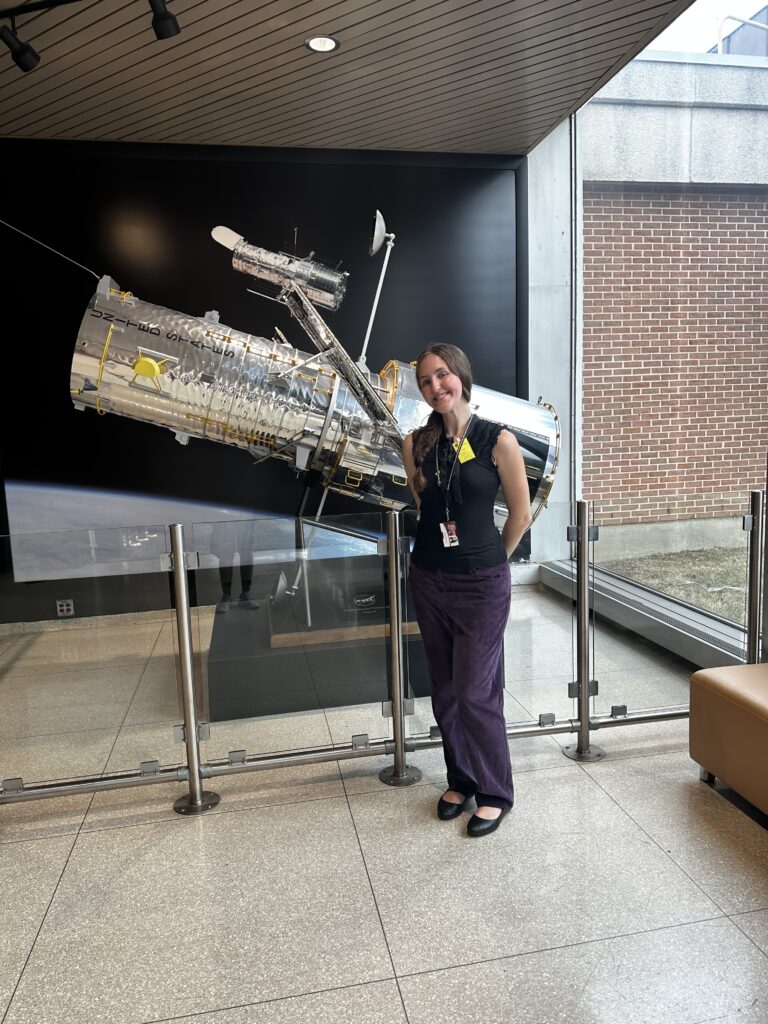 Katherine Carver stands in front of a model of the Hubble Space Telescope at NASA Goddard Space Flight Center in Greenbelt, Maryland. She took a field trip to Goddard in summer 2024 while an intern at the Johns Hopkins Space Telescope Science Institute. (Courtesy of Carver)
Big-picture questions require practical skills
Reeves says that in high school, he romanticized physics; “the lure of figuring out how the universe works” drew him in. Since then, he’s learned that to be successful in the field, big-picture wonder must be backed up with practical skills.
“I consider myself at heart to be an astrophysicist. That’s the dream. That’s what sparks joy in my heart,” he says. Luckily for him, “In practice, I also really enjoy statistics and statistical physics.”
Reeves’ work relies heavily on computer programming, data analysis, and statistics, skills he says are “absolutely critical” for astrophysicists. “I learned quickly in college you have to be really good at problem-solving to succeed in physics,” he notes. Reeves encourages anyone interested in physics to take enough computer science courses to “understand what the code is doing under the hood.” Without that foundation and a solid dose of perseverance, he says, at some point you’ll get stuck.
Thankfully, “Zack is super self-motivated, which is one of the most important aspects to being successful,” Foord says. “I’ve seen so many points in time where he’s hit some sort of wall, and then he comes back the next week and he’s figured out some way to get above that wall.”
 At a lab meeting, Zack Reeves shows how his python script generated the same figure that he created manually previously, demonstrating the code’s efficacy. (Brad Ziegler/UMBC)
Staying close to go far
Carver, too, has picked up additional skills that support her physics research. From her work in Foord’s lab and previous internships at the Johns Hopkins Applied Physics Laboratory and Space Telescope Science Institute, she gained key coding and problem-solving skills. Without that, “I would not have been able to contribute to the level I can now to my project at Yale,” she says. “Those experiences also prepared me to secure the internship.”
Foord’s students benefit from a close relationship with her and other research group members. “The energy in the group meetings and our one-to-ones is always just really positive and encouraging, and there’s no stress,” Reeves says. Foord’s guidance has turbocharged his growth, from tackling advanced projects to presenting his work clearly.
“He already has a really good idea of how to tell a story in a way that will help people who aren’t intimately familiar with his research to understand it,” Foord says.
Through Adi Foord’s mentorship, doors to cutting-edge black hole research have swung wide open for Reeves and Carver, equipping them with skills and networks to explore the cosmos as their careers progress. Already, Reeves is paying it forward, using his communication skills to share his fascination with black holes and spark curiosity about one of the universe’s most mysterious phenomena.