<?xml version="1.0"?>
<News hasArchived="false" page="36" pageCount="36" pageSize="10" timestamp="Sun, 26 Apr 2026 02:09:45 -0400" url="https://beta.my.umbc.edu/groups/umbc-ai/posts.xml?page=36">
<NewsItem contentIssues="true" id="137947" important="false" status="posted" url="https://beta.my.umbc.edu/groups/umbc-ai/posts/137947">
<Title>Apply: Spring '24 AI4ALL Ignite program</Title>
<Tagline>deadline: January 22, 2024</Tagline>
<Body>
<![CDATA[
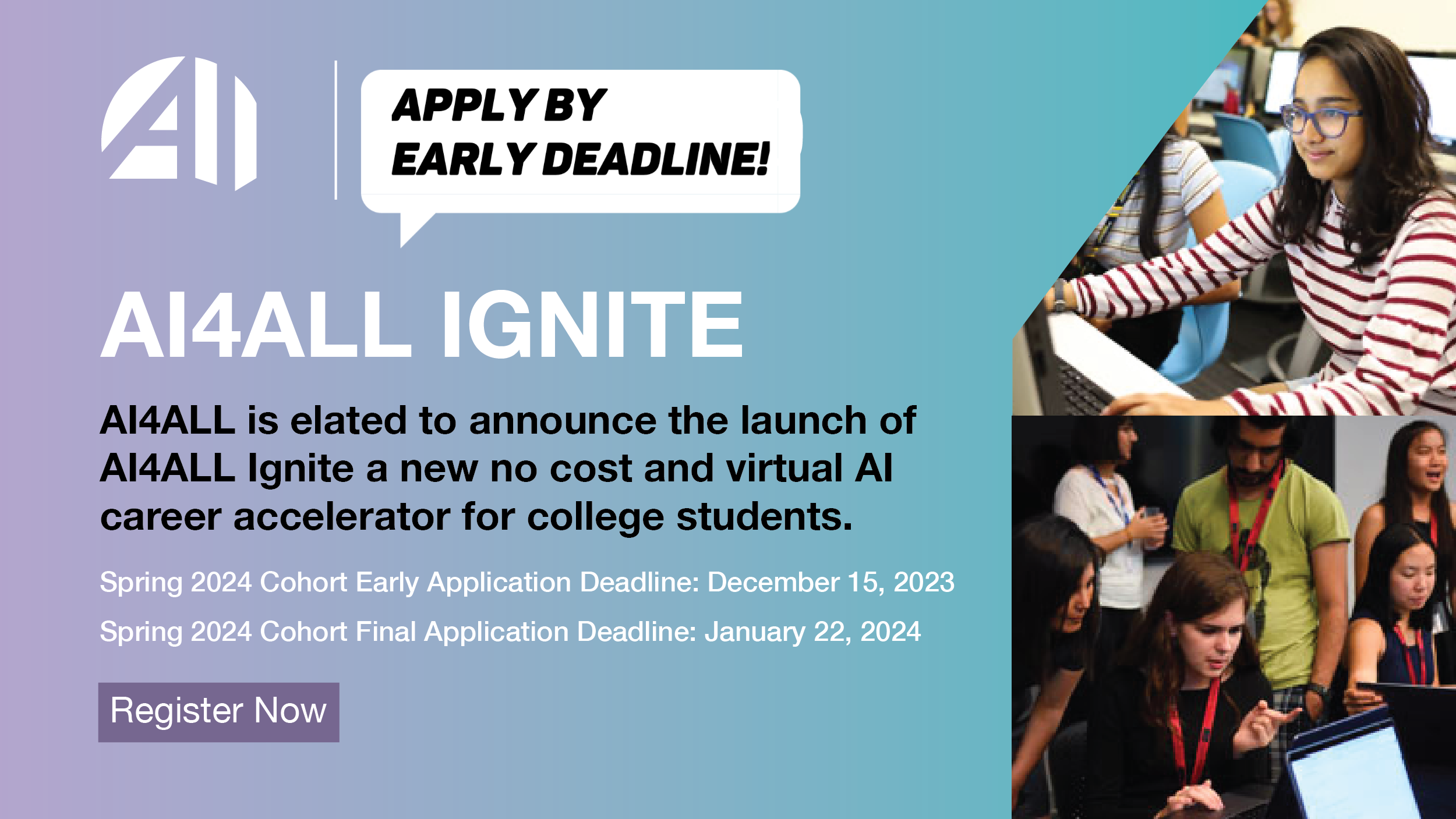
    <div class="html-content"><a href="https://ai-4-all.org/ai4all-ignite/" rel="nofollow external" class="bo"><img src="https://www.csee.umbc.edu/wp-content/uploads/sites/659/2023/12/ai4all_ignite.png" style="max-width: 100%; height: auto;"></a><div><br><div><strong>What is <a href="https://ai-4-all.org/ai4all-ignite/" rel="nofollow external" class="bo"><span>AI4ALL</span> Ignite</a>? </strong><span>The </span><span>AI4ALL</span><span> Ignite program gives <strong>undergraduates</strong> the opportunity to </span><br><ul><li>Work on an <strong>AI portfolio project</strong> with mentorship and guidance from AI industry experts</li><li>Present their AI portfolio project in a student symposium and network with AI industry professionals.</li><li>Participate in extensive and practical training in <strong>career readiness</strong> and technical AI internship interviews</li><li>Train in mock AI technical interviews and network in opportunity chats with AI recruiters</li></ul></div><div>AI4ALL Ignite  offers a no-cost and virtual groundbreaking opportunity for <strong>undergraduate students</strong> interested in Artificial Intelligence. This AI career accelerator is designed to prepare you to interview for technical AI internships and has direct networking with AI industry professionals and recruiters.  </div><div><br></div><div><div>As a UMBC student, your application will be prioritized. <span>We recommend that you apply early to the program accelerator. Admissions are made on a rolling basis and there are limited spots available. AI4ALL may close the application early if they fill the program.  </span></div></div><div><br></div><div><strong>Get more information and apply <a href="https://ai-4-all.org/ai4all-ignite/" rel="nofollow external" class="bo">here</a>.</strong><br><br>Email further questions to <a href="mailto:ai4all@cs.umbc.edu">ai4all@cs.umbc.edu</a>.</div></div></div>
]]>
</Body>
<Summary>What is AI4ALL Ignite? The AI4ALL Ignite program gives undergraduates the opportunity to    Work on an AI portfolio project with mentorship and guidance from AI industry experts  Present their AI...</Summary>
<Website>https://ai-4-all.org/ai4all-ignite/</Website>
<TrackingUrl>https://beta.my.umbc.edu/api/v0/pixel/news/137947/guest@my.umbc.edu/4dbecb65332a70552d2b0a40ba922958/api/pixel</TrackingUrl>
<Tag>ai</Tag>
<Tag>ai4all</Tag>
<Group token="umbc-ai">UMBC AI</Group>
<GroupUrl>https://beta.my.umbc.edu/groups/umbc-ai</GroupUrl>
<AvatarUrl>https://assets4-beta.my.umbc.edu/system/shared/avatars/groups/000/002/081/cfb27ebe008c2636486089a759ea5c36/xsmall.png?1691095779</AvatarUrl>
<AvatarUrl size="original">https://assets2-beta.my.umbc.edu/system/shared/avatars/groups/000/002/081/cfb27ebe008c2636486089a759ea5c36/original.png?1691095779</AvatarUrl>
<AvatarUrl size="xxlarge">https://assets1-beta.my.umbc.edu/system/shared/avatars/groups/000/002/081/cfb27ebe008c2636486089a759ea5c36/xxlarge.png?1691095779</AvatarUrl>
<AvatarUrl size="xlarge">https://assets1-beta.my.umbc.edu/system/shared/avatars/groups/000/002/081/cfb27ebe008c2636486089a759ea5c36/xlarge.png?1691095779</AvatarUrl>
<AvatarUrl size="large">https://assets1-beta.my.umbc.edu/system/shared/avatars/groups/000/002/081/cfb27ebe008c2636486089a759ea5c36/large.png?1691095779</AvatarUrl>
<AvatarUrl size="medium">https://assets3-beta.my.umbc.edu/system/shared/avatars/groups/000/002/081/cfb27ebe008c2636486089a759ea5c36/medium.png?1691095779</AvatarUrl>
<AvatarUrl size="small">https://assets3-beta.my.umbc.edu/system/shared/avatars/groups/000/002/081/cfb27ebe008c2636486089a759ea5c36/small.png?1691095779</AvatarUrl>
<AvatarUrl size="xsmall">https://assets4-beta.my.umbc.edu/system/shared/avatars/groups/000/002/081/cfb27ebe008c2636486089a759ea5c36/xsmall.png?1691095779</AvatarUrl>
<AvatarUrl size="xxsmall">https://assets1-beta.my.umbc.edu/system/shared/avatars/groups/000/002/081/cfb27ebe008c2636486089a759ea5c36/xxsmall.png?1691095779</AvatarUrl>
<Sponsor>UMBC AI</Sponsor>
<PawCount>0</PawCount>
<CommentCount>0</CommentCount>
<CommentsAllowed>true</CommentsAllowed>
<PostedAt>Tue, 26 Dec 2023 10:43:41 -0500</PostedAt>
</NewsItem>

<NewsItem contentIssues="false" id="137946" important="false" status="posted" url="https://beta.my.umbc.edu/groups/umbc-ai/posts/137946">
<Title>OpenAI research grants: agentic AI systems &amp; Superalignment</Title>
<Tagline>deadlines: 1/20/2024 and 2/18/2024</Tagline>
<Body>
<![CDATA[
    <div class="html-content"><span>Open AI's </span><a href="https://openai.smapply.org/prog/agentic-ai-research-grants/" rel="nofollow external" class="bo"><strong>Research into the Agentic AI Systems</strong></a><span> program is accepting applications until midnight ET on January 20, 2024. Grants will be between $10,000 and $100,000 for research for 3-8 month projects on the impacts of </span><strong>agentic AI systems</strong><span> and practices for making them safe. It defines </span><strong>agenticness</strong><span> as the degree to which an AI system can adaptably achieve complex goals in complex environments with limited direct supervision. </span><br><br><span>Open AI also has </span><a href="https://openai.com/blog/superalignment-fast-grants" rel="nofollow external" class="bo"><strong>Superalignment Fast Grants</strong></a><span>, which will award $100K to $2 Million grants for academic labs, nonprofits, and individual researchers researching to answer the question: How can humans steer and trust AI systems much smarter than them? The application is open, with a deadline of February 18, 2024. </span><div><span><br></span></div></div>
]]>
</Body>
<Summary>Open AI's Research into the Agentic AI Systems program is accepting applications until midnight ET on January 20, 2024. Grants will be between $10,000 and $100,000 for research for 3-8 month...</Summary>
<Website>https://openai.smapply.org/prog/agentic-ai-research-grants/</Website>
<TrackingUrl>https://beta.my.umbc.edu/api/v0/pixel/news/137946/guest@my.umbc.edu/06e8bdcea3345f8b080799e97ab3c81e/api/pixel</TrackingUrl>
<Tag>funding</Tag>
<Tag>grants</Tag>
<Tag>openai</Tag>
<Group token="umbc-ai">UMBC AI</Group>
<GroupUrl>https://beta.my.umbc.edu/groups/umbc-ai</GroupUrl>
<AvatarUrl>https://assets4-beta.my.umbc.edu/system/shared/avatars/groups/000/002/081/cfb27ebe008c2636486089a759ea5c36/xsmall.png?1691095779</AvatarUrl>
<AvatarUrl size="original">https://assets2-beta.my.umbc.edu/system/shared/avatars/groups/000/002/081/cfb27ebe008c2636486089a759ea5c36/original.png?1691095779</AvatarUrl>
<AvatarUrl size="xxlarge">https://assets1-beta.my.umbc.edu/system/shared/avatars/groups/000/002/081/cfb27ebe008c2636486089a759ea5c36/xxlarge.png?1691095779</AvatarUrl>
<AvatarUrl size="xlarge">https://assets1-beta.my.umbc.edu/system/shared/avatars/groups/000/002/081/cfb27ebe008c2636486089a759ea5c36/xlarge.png?1691095779</AvatarUrl>
<AvatarUrl size="large">https://assets1-beta.my.umbc.edu/system/shared/avatars/groups/000/002/081/cfb27ebe008c2636486089a759ea5c36/large.png?1691095779</AvatarUrl>
<AvatarUrl size="medium">https://assets3-beta.my.umbc.edu/system/shared/avatars/groups/000/002/081/cfb27ebe008c2636486089a759ea5c36/medium.png?1691095779</AvatarUrl>
<AvatarUrl size="small">https://assets3-beta.my.umbc.edu/system/shared/avatars/groups/000/002/081/cfb27ebe008c2636486089a759ea5c36/small.png?1691095779</AvatarUrl>
<AvatarUrl size="xsmall">https://assets4-beta.my.umbc.edu/system/shared/avatars/groups/000/002/081/cfb27ebe008c2636486089a759ea5c36/xsmall.png?1691095779</AvatarUrl>
<AvatarUrl size="xxsmall">https://assets1-beta.my.umbc.edu/system/shared/avatars/groups/000/002/081/cfb27ebe008c2636486089a759ea5c36/xxsmall.png?1691095779</AvatarUrl>
<Sponsor>UMBC AI</Sponsor>
<PawCount>0</PawCount>
<CommentCount>0</CommentCount>
<CommentsAllowed>true</CommentsAllowed>
<PostedAt>Tue, 26 Dec 2023 10:39:32 -0500</PostedAt>
</NewsItem>

<NewsItem contentIssues="false" id="134555" important="false" status="posted" url="https://beta.my.umbc.edu/groups/umbc-ai/posts/134555">
<Title>Prof. T&#252;lay Adali recieves NSF award for fMRI research</Title>
<Body>
<![CDATA[
    <div class="html-content">CSEE professor <a href="https://redirect.cs.umbc.edu/~adali/" rel="nofollow external" class="bo"><strong>Tülay Adali </strong></a>has received an NSF award for $400k to support her research on drawing inferences from large-scale,  multi-subject fMRI analysis datasets.<div><br></div><div><div>In many disciplines today, there is an increasing availability of multiple and complementary data associated with a given problem, and the main challenge is extracting and effectively summarizing the relevant information from these large number of datasets. Joint decomposition of these datasets, arranged as matrices or tensors, provides an attractive solution to data fusion by letting them fully interact and inform each other and yields factor matrices that are directly interpretable, where the resulting factors (components) are directly associated with quantities of interest. </div><div><br></div><div>This research will provide a powerful solution for inference from large-scale data by effectively summarizing the heterogeneity in large datasets through the definition of homogeneous subspaces such that components within a subspace are highly dependent. The success of the methods will be demonstrated through identification of homogeneous subgroups of subjects from neuroimaging data, thus enabling personalized medicine whose goal is to tailor intervention strategies for a given individual. Effectively summarizing information in large-scale datasets is at the heart of many of today's challenging problems, hence the new set of tools will impact numerous areas in science and technology, including those in medical imaging, remote sensing, image/video processing, communications, and social networks.</div><div><br></div><div>Independent vector analysis (IVA) and coupled tensor factorizations are two powerful ways for working with spatio-temporal data, each exploiting the structural/dependence information through different mechanisms. They also provide strong uniqueness guarantees, which is key for interpretability. This project leverages the complementary strengths of IVA and coupled tensor decompositions to develop a powerful framework for joint analysis/fusion of a large number of datasets through automated identification of homogeneous subspaces along with the components within these subspaces. This is accomplished by initially developing effective solutions to the problem with IVA and with coupled tensor decompositions, working in parallel.</div><div><br></div><div>Then, in a second stage, the connections between these two approaches are established, both in terms of methods and uniqueness conditions, to develop a methodology that leverages the strengths of both. The emphasis on uniqueness and interpretability of the solutions together with an application to a challenging dataset will ensure that the methods, as well as the developed theoretical foundations, are not only complete but also practically useful. </div><div><br></div><div>Another important aspect of the work is the establishing of bridges across two communities that do not necessarily communicate. The work will demonstrate that statistically and algebraically motivated approaches to data fusion are not in competition with each other but have important complementary aspects that can be effectively leveraged. In addition, a clear view of their connections as well as differences enables fair comparisons of all methods clearly highlighting their abilities together with their limitations. This will help establish a solid and well-balanced foundation for the growing fields of data science and machine learning.</div></div></div>
]]>
</Body>
<Summary>CSEE professor Tülay Adali has received an NSF award for $400k to support her research on drawing inferences from large-scale,  multi-subject fMRI analysis datasets.     In many disciplines today,...</Summary>
<Website>https://www.nsf.gov/awardsearch/showAward?AWD_ID=2316420</Website>
<TrackingUrl>https://beta.my.umbc.edu/api/v0/pixel/news/134555/guest@my.umbc.edu/4a52c0dd6e381b0d524b1897fa3134bf/api/pixel</TrackingUrl>
<Tag>image</Tag>
<Tag>learning</Tag>
<Tag>machine</Tag>
<Group token="umbc-ai">UMBC AI</Group>
<GroupUrl>https://beta.my.umbc.edu/groups/umbc-ai</GroupUrl>
<AvatarUrl>https://assets4-beta.my.umbc.edu/system/shared/avatars/groups/000/002/081/cfb27ebe008c2636486089a759ea5c36/xsmall.png?1691095779</AvatarUrl>
<AvatarUrl size="original">https://assets2-beta.my.umbc.edu/system/shared/avatars/groups/000/002/081/cfb27ebe008c2636486089a759ea5c36/original.png?1691095779</AvatarUrl>
<AvatarUrl size="xxlarge">https://assets1-beta.my.umbc.edu/system/shared/avatars/groups/000/002/081/cfb27ebe008c2636486089a759ea5c36/xxlarge.png?1691095779</AvatarUrl>
<AvatarUrl size="xlarge">https://assets1-beta.my.umbc.edu/system/shared/avatars/groups/000/002/081/cfb27ebe008c2636486089a759ea5c36/xlarge.png?1691095779</AvatarUrl>
<AvatarUrl size="large">https://assets1-beta.my.umbc.edu/system/shared/avatars/groups/000/002/081/cfb27ebe008c2636486089a759ea5c36/large.png?1691095779</AvatarUrl>
<AvatarUrl size="medium">https://assets3-beta.my.umbc.edu/system/shared/avatars/groups/000/002/081/cfb27ebe008c2636486089a759ea5c36/medium.png?1691095779</AvatarUrl>
<AvatarUrl size="small">https://assets3-beta.my.umbc.edu/system/shared/avatars/groups/000/002/081/cfb27ebe008c2636486089a759ea5c36/small.png?1691095779</AvatarUrl>
<AvatarUrl size="xsmall">https://assets4-beta.my.umbc.edu/system/shared/avatars/groups/000/002/081/cfb27ebe008c2636486089a759ea5c36/xsmall.png?1691095779</AvatarUrl>
<AvatarUrl size="xxsmall">https://assets1-beta.my.umbc.edu/system/shared/avatars/groups/000/002/081/cfb27ebe008c2636486089a759ea5c36/xxsmall.png?1691095779</AvatarUrl>
<Sponsor>Computer Science and Electrical Engineering</Sponsor>
<PawCount>1</PawCount>
<CommentCount>1</CommentCount>
<CommentsAllowed>true</CommentsAllowed>
<PostedAt>Mon, 07 Aug 2023 22:05:08 -0400</PostedAt>
</NewsItem>

<NewsItem contentIssues="true" id="134529" important="false" status="posted" url="https://beta.my.umbc.edu/groups/umbc-ai/posts/134529">
<Title>Sanjay Purushotham wins NSF CAREER award for AI &amp; healthcare</Title>
<Body>
<![CDATA[
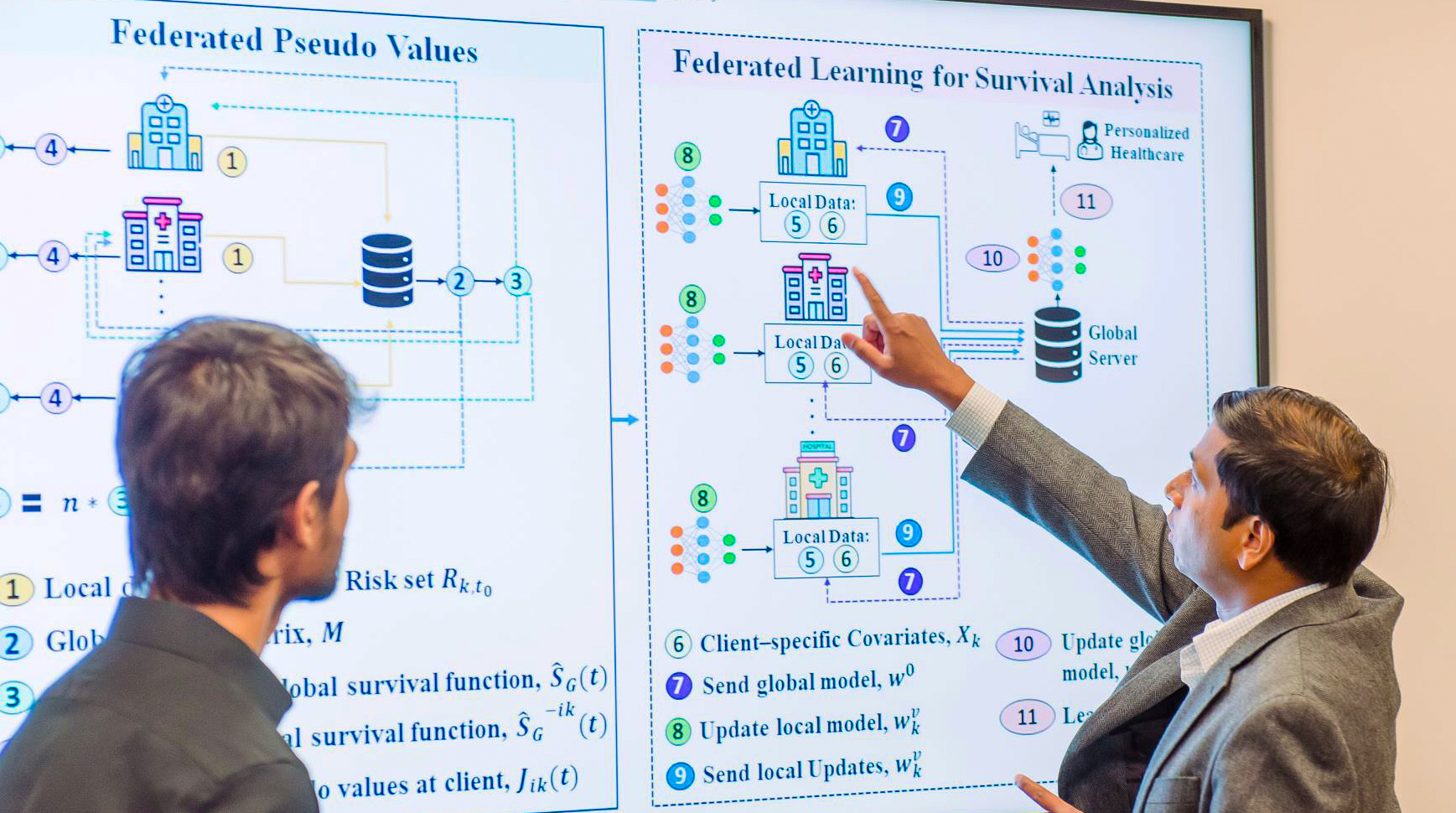
    <div class="html-content"><div><img src="https://ai.umbc.edu/wp-content/uploads/sites/734/2023/08/Sanjay-Purushotham-top-resized.jpg" style="max-width: 100%; height: auto;"></div><strong><div><strong><br></strong></div>Harnessing AI to improve healthcare: Sanjay Purushotham wins $590,000+ NSF CAREER award</strong><div><strong><br></strong></div><div><div>Today, a plethora of technologies, from image recognition tools to chatbots, are powered by machine learning. A key component to the technique's success is data -- and lots of it. For doctors and hospitals who hope to use machine learning to improve healthcare, that need for copious data presents a problem: medical data is protected by privacy laws and often exists in incomplete or diverse forms -- from doctor's notes to medical scans -- that make it difficult for machine learning models to use it effectively.</div><div><br></div><div>"Using data better to aid medical decisions is a grand challenge of the 21st century," says <a href="https://sanjayp.is.umbc.edu/" rel="nofollow external" class="bo"><strong>Sanjay Purushotham</strong></a>, an assistant professor in information systems at UMBC. "We need innovations in existing techniques to take full advantage of artificial intelligence in healthcare."</div><div><br></div><div>Together with his students, Purushotham is tackling that challenge. He recently received a prestigious NSF CAREER award to support his team's efforts to develop new ways to train health-focused machine learning models. </div><div><br></div><div>Purushotham has been contributing his expertise in computer science to <span>collaborations with doctors and hospitals for almost ten years. The </span><strong><a href="https://www.nsf.gov/awardsearch/showAward?AWD_ID=2238743&amp;HistoricalAwards=false" rel="nofollow external" class="bo">NSF CAREER award</a> </strong><span>will help Purushotham further that research in a new </span><span>direction, and ultimately, his team hopes their work will improve </span><span>medical treatments and reduce costs, benefiting patients around the </span><span>world</span></div><div><br></div><div>Read more about his research in this <strong><a href="https://umbc.edu/stories/ai-to-improve-healthcare/" rel="nofollow external" class="bo">UMBC News article</a>.</strong> </div><div>.</div></div></div>
]]>
</Body>
<Summary>Harnessing AI to improve healthcare: Sanjay Purushotham wins $590,000+ NSF CAREER award     Today, a plethora of technologies, from image recognition tools to chatbots, are powered by machine...</Summary>
<Website>https://umbc.edu/stories/ai-to-improve-healthcare/</Website>
<TrackingUrl>https://beta.my.umbc.edu/api/v0/pixel/news/134529/guest@my.umbc.edu/401a1f63bf6d9168087a77433061467a/api/pixel</TrackingUrl>
<Tag>ai</Tag>
<Tag>healthcare</Tag>
<Tag>nsf</Tag>
<Group token="umbc-ai">UMBC AI</Group>
<GroupUrl>https://beta.my.umbc.edu/groups/umbc-ai</GroupUrl>
<AvatarUrl>https://assets4-beta.my.umbc.edu/system/shared/avatars/groups/000/002/081/cfb27ebe008c2636486089a759ea5c36/xsmall.png?1691095779</AvatarUrl>
<AvatarUrl size="original">https://assets2-beta.my.umbc.edu/system/shared/avatars/groups/000/002/081/cfb27ebe008c2636486089a759ea5c36/original.png?1691095779</AvatarUrl>
<AvatarUrl size="xxlarge">https://assets1-beta.my.umbc.edu/system/shared/avatars/groups/000/002/081/cfb27ebe008c2636486089a759ea5c36/xxlarge.png?1691095779</AvatarUrl>
<AvatarUrl size="xlarge">https://assets1-beta.my.umbc.edu/system/shared/avatars/groups/000/002/081/cfb27ebe008c2636486089a759ea5c36/xlarge.png?1691095779</AvatarUrl>
<AvatarUrl size="large">https://assets1-beta.my.umbc.edu/system/shared/avatars/groups/000/002/081/cfb27ebe008c2636486089a759ea5c36/large.png?1691095779</AvatarUrl>
<AvatarUrl size="medium">https://assets3-beta.my.umbc.edu/system/shared/avatars/groups/000/002/081/cfb27ebe008c2636486089a759ea5c36/medium.png?1691095779</AvatarUrl>
<AvatarUrl size="small">https://assets3-beta.my.umbc.edu/system/shared/avatars/groups/000/002/081/cfb27ebe008c2636486089a759ea5c36/small.png?1691095779</AvatarUrl>
<AvatarUrl size="xsmall">https://assets4-beta.my.umbc.edu/system/shared/avatars/groups/000/002/081/cfb27ebe008c2636486089a759ea5c36/xsmall.png?1691095779</AvatarUrl>
<AvatarUrl size="xxsmall">https://assets1-beta.my.umbc.edu/system/shared/avatars/groups/000/002/081/cfb27ebe008c2636486089a759ea5c36/xxsmall.png?1691095779</AvatarUrl>
<Sponsor>UMBC AI</Sponsor>
<PawCount>2</PawCount>
<CommentCount>0</CommentCount>
<CommentsAllowed>true</CommentsAllowed>
<PostedAt>Fri, 04 Aug 2023 19:01:34 -0400</PostedAt>
</NewsItem>

<NewsItem contentIssues="true" id="134517" important="false" status="posted" url="https://beta.my.umbc.edu/groups/umbc-ai/posts/134517">
<Title>AI x Education Conference, free online Aug 5-6</Title>
<Body>
<![CDATA[
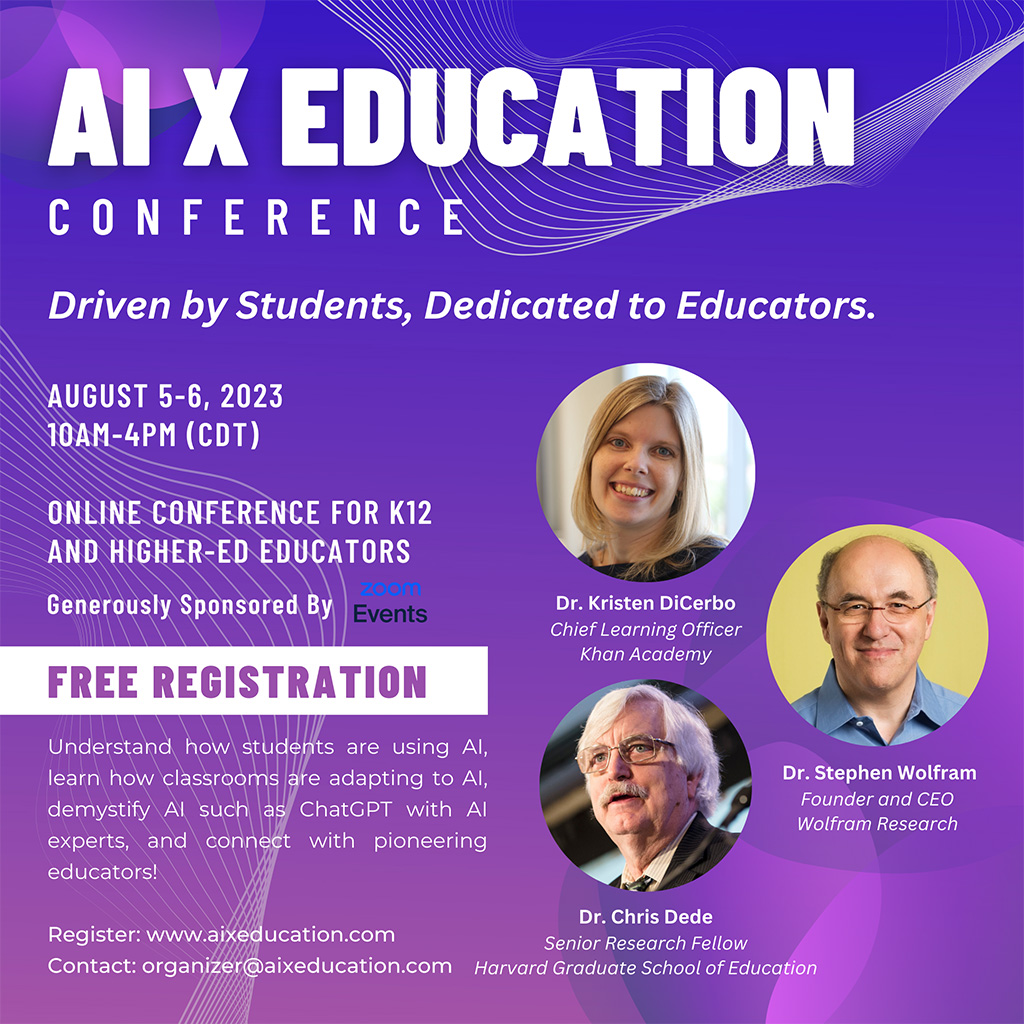
    <div class="html-content"><div><div><div>Designed for K12 and Higher-Ed Educators &amp; Administrators, the <span><strong><a href="https://www.aixeducation.com/" rel="nofollow external" class="bo">AI x Education Conference</a></strong></span><span> aims to provide a platform for educators, administrators, AI experts, students, parents, and EdTech leaders to discuss the impact of AI on education, address current challenges and potentials, share their perspectives and experiences, and explore innovative solutions. </span><a href="https://events.zoom.us/e/view/PiAKbs8qQx6ZNFPvIZ5sgQ" rel="nofollow external" class="bo"><strong>Register for free online.</strong></a></div><div><span><br></span></div><div><span>Conference outcomes</span></div><div><ul><li><span>Demystify AI and enhance understanding of AI's role and potential in education</span></li><li><span>Insight into current challenges and how to overcome them</span></li><li><span>Shared innovative experiments and solutions</span></li><li><span>Underscoring the importance of incorporating students' perspectives</span></li><li><span>Foster future discussions and collaborations with educational experiments</span></li></ul></div><div><span>A special emphasis will be placed on including students' voices in the conversation, highlighting their unique experiences and insights as the primary beneficiaries of these educational transformations.</span></div><div><br></div><div>All times are Central.</div><div><ul><li><span>10:00 AM - </span><span>Opening Note &amp; Day 1 Introduction</span></li><li><span>10:30 AM - </span><span>Keynote: Building AI Applications at Scale</span></li><li><span>11:20 AM - </span><span>Fireside Chat with AI Experts: Capabilities and Limitations of AI in Education</span></li><li><span>12:00 PM - </span><span>Higher-ed: Student Perspective and Interaction with AI</span></li><li><span>1:00 PM - </span><span>Higher-ed: Redefining Education in the AI Era </span></li><ul><li><span>Transforming Education in the Age of AI</span></li><li><span>Evaluating Learning Progress and Teaching Success</span></li><li><span>Ethics, Plagiarism, and the Role of AI</span></li></ul></ul></div><div><div><ul><li><span>2:00 PM - </span><span>Higher-ed: Brainstorming &amp; Networking Session</span></li></ul><ul><li><span>STEM Educators</span></li><li><span>Humanities and Social Sciences Educators</span></li><li><span>Language and Literature Educators</span></li><li><span>Art, Music, and Drama Educators</span></li></ul><ul><li><span>3:00 PM - </span><span>Higher-ed: Navigating Educational Policies for AI Adoption</span></li><li><span>3:50 PM - </span><span>Day 1 Closing Note &amp; Future Events</span></li></ul></div><div>The second day of the virtual conference focuses on K-12 educators following the same structured schedule and a fireside chat with Dr. Stephen Wolfram.</div><div><br></div><div>Following this conference, student volunteers will continue to provide free events and resources to foster a progressive dialogue and collaboration among educators and students, further enhancing a deeper understanding of AI's impact on education.</div></div><div><br></div><div><img src="https://ai.umbc.edu/wp-content/uploads/sites/734/2023/08/AI-x-Education-Conference-Flyer.jpg" style="max-width: 100%; height: auto;"></div></div></div></div>
]]>
</Body>
<Summary>Designed for K12 and Higher-Ed Educators &amp; Administrators, the AI x Education Conference aims to provide a platform for educators, administrators, AI experts, students, parents, and EdTech...</Summary>
<TrackingUrl>https://beta.my.umbc.edu/api/v0/pixel/news/134517/guest@my.umbc.edu/3518227642d860899189df24b65ed9a0/api/pixel</TrackingUrl>
<Tag>education</Tag>
<Group token="umbc-ai">UMBC AI</Group>
<GroupUrl>https://beta.my.umbc.edu/groups/umbc-ai</GroupUrl>
<AvatarUrl>https://assets4-beta.my.umbc.edu/system/shared/avatars/groups/000/002/081/cfb27ebe008c2636486089a759ea5c36/xsmall.png?1691095779</AvatarUrl>
<AvatarUrl size="original">https://assets2-beta.my.umbc.edu/system/shared/avatars/groups/000/002/081/cfb27ebe008c2636486089a759ea5c36/original.png?1691095779</AvatarUrl>
<AvatarUrl size="xxlarge">https://assets1-beta.my.umbc.edu/system/shared/avatars/groups/000/002/081/cfb27ebe008c2636486089a759ea5c36/xxlarge.png?1691095779</AvatarUrl>
<AvatarUrl size="xlarge">https://assets1-beta.my.umbc.edu/system/shared/avatars/groups/000/002/081/cfb27ebe008c2636486089a759ea5c36/xlarge.png?1691095779</AvatarUrl>
<AvatarUrl size="large">https://assets1-beta.my.umbc.edu/system/shared/avatars/groups/000/002/081/cfb27ebe008c2636486089a759ea5c36/large.png?1691095779</AvatarUrl>
<AvatarUrl size="medium">https://assets3-beta.my.umbc.edu/system/shared/avatars/groups/000/002/081/cfb27ebe008c2636486089a759ea5c36/medium.png?1691095779</AvatarUrl>
<AvatarUrl size="small">https://assets3-beta.my.umbc.edu/system/shared/avatars/groups/000/002/081/cfb27ebe008c2636486089a759ea5c36/small.png?1691095779</AvatarUrl>
<AvatarUrl size="xsmall">https://assets4-beta.my.umbc.edu/system/shared/avatars/groups/000/002/081/cfb27ebe008c2636486089a759ea5c36/xsmall.png?1691095779</AvatarUrl>
<AvatarUrl size="xxsmall">https://assets1-beta.my.umbc.edu/system/shared/avatars/groups/000/002/081/cfb27ebe008c2636486089a759ea5c36/xxsmall.png?1691095779</AvatarUrl>
<Sponsor>UMBC AI</Sponsor>
<PawCount>0</PawCount>
<CommentCount>0</CommentCount>
<CommentsAllowed>true</CommentsAllowed>
<PostedAt>Thu, 03 Aug 2023 13:01:07 -0400</PostedAt>
</NewsItem>

<NewsItem contentIssues="true" id="134470" important="false" status="posted" url="https://beta.my.umbc.edu/groups/umbc-ai/posts/134470">
<Title>PhD defense: Knowledge Graphs &amp; Reinforcement Learning</Title>
<Tagline>a Hybrid Approach for Cybersecurity Tasks</Tagline>
<Body>
<![CDATA[
    <div class="html-content"><h5><strong>Ph.D. Dissertation Defense</strong></h5><h5><br></h5><h4><strong>Knowledge Graphs and Reinforcement Learning:<br></strong><strong>a Hybrid Approach for Cybersecurity Tasks</strong></h4><div><br></div><h4><strong><a href="https://sites.google.com/view/aritran-piplai/" rel="nofollow external" class="bo">Aritran Piplai</a></strong></h4><div><br></div><h5>10:00am -12:00pm ET, Monday July 10, 2023</h5><div><br></div><div>Dissertation Committee: Drs. Anupam Joshi (Chair/Advisor), Charles Nicholas, Chenchen Liu, Filip Perich, Joysula R. Rao, Sudip Mittal, Tim Finin</div><div><br></div><div>With the explosion of available data and computational power, machine learning and deep learning techniques are being increasingly used to solve problems. The domain of cybersecurity is no exception, as we have seen a significant amount of research in the recent past using data-driven machine learning approaches for different tasks.</div><div><br></div><div>Rule-based and supervised machine learning-based approaches are often brittle in detecting attacks, can be defeated by adversaries that adapt, and can't use the knowledge of experts. To address this problem, we propose a novel approach for cybersecurity tasks that leverages the supply of 'explicit' knowledge expressed as Knowledge Graphs, as well as the data-driven approaches of machine learning to ascertain the 'tacit' knowledge. The inspiration for this hybrid model is drawn from the manner in which security analysts work, combining their background knowledge with observed data from host and network-based sensors.</div><div><br></div><div>We focus on the tasks of malware detection and mitigation policy generation. We are specifically interested in the capability of synthesizing variants of a malware that can be further enhanced to detect unseen attacks. We combine the knowledge that is explicit with explorations in the 'action space' of detecting novel malware attacks as well as mitigating them. Analysts use past experiences and actions that they have taken when faced with attacks that manifest characteristics similar to the new one. The other component of their approach is exploring new `actions' that might be taken to respond to a novel malware, guided by their understanding of the domain. These steps can be considered as a 'trial and error' based approach. In this dissertation, we describe knowledge graph construction techniques from open-source text as well as several Reinforcement Learning based algorithms, guided by explicit background knowledge encoded in a knowledge graph, that best mimics the approach of security analysts. We observe that the efficiency of RL algorithms has increased by ~4% by incorporating prior knowledge. We also observe that in simulated environments RL policies are able to generate more precise mitigations with the help of prior knowledge.</div><div><br></div><div><img src="https://i.imgur.com/cqHjn4U.jpg" style="max-width: 100%; height: auto;"></div><div><br></div></div>
]]>
</Body>
<Summary>Ph.D. Dissertation Defense     Knowledge Graphs and Reinforcement Learning: a Hybrid Approach for Cybersecurity Tasks     Aritran Piplai     10:00am -12:00pm ET, Monday July 10, 2023...</Summary>
<TrackingUrl>https://beta.my.umbc.edu/api/v0/pixel/news/134470/guest@my.umbc.edu/cee301d50a58d745031b0d8304ccb796/api/pixel</TrackingUrl>
<Tag>cybersecurity</Tag>
<Tag>graph</Tag>
<Tag>knowledge</Tag>
<Group token="umbc-ai">UMBC AI</Group>
<GroupUrl>https://beta.my.umbc.edu/groups/umbc-ai</GroupUrl>
<AvatarUrl>https://assets4-beta.my.umbc.edu/system/shared/avatars/groups/000/002/081/cfb27ebe008c2636486089a759ea5c36/xsmall.png?1691095779</AvatarUrl>
<AvatarUrl size="original">https://assets2-beta.my.umbc.edu/system/shared/avatars/groups/000/002/081/cfb27ebe008c2636486089a759ea5c36/original.png?1691095779</AvatarUrl>
<AvatarUrl size="xxlarge">https://assets1-beta.my.umbc.edu/system/shared/avatars/groups/000/002/081/cfb27ebe008c2636486089a759ea5c36/xxlarge.png?1691095779</AvatarUrl>
<AvatarUrl size="xlarge">https://assets1-beta.my.umbc.edu/system/shared/avatars/groups/000/002/081/cfb27ebe008c2636486089a759ea5c36/xlarge.png?1691095779</AvatarUrl>
<AvatarUrl size="large">https://assets1-beta.my.umbc.edu/system/shared/avatars/groups/000/002/081/cfb27ebe008c2636486089a759ea5c36/large.png?1691095779</AvatarUrl>
<AvatarUrl size="medium">https://assets3-beta.my.umbc.edu/system/shared/avatars/groups/000/002/081/cfb27ebe008c2636486089a759ea5c36/medium.png?1691095779</AvatarUrl>
<AvatarUrl size="small">https://assets3-beta.my.umbc.edu/system/shared/avatars/groups/000/002/081/cfb27ebe008c2636486089a759ea5c36/small.png?1691095779</AvatarUrl>
<AvatarUrl size="xsmall">https://assets4-beta.my.umbc.edu/system/shared/avatars/groups/000/002/081/cfb27ebe008c2636486089a759ea5c36/xsmall.png?1691095779</AvatarUrl>
<AvatarUrl size="xxsmall">https://assets1-beta.my.umbc.edu/system/shared/avatars/groups/000/002/081/cfb27ebe008c2636486089a759ea5c36/xxsmall.png?1691095779</AvatarUrl>
<Sponsor>UMBC AI</Sponsor>
<PawCount>0</PawCount>
<CommentCount>0</CommentCount>
<CommentsAllowed>true</CommentsAllowed>
<PostedAt>Mon, 31 Jul 2023 12:47:46 -0400</PostedAt>
</NewsItem>

</News>