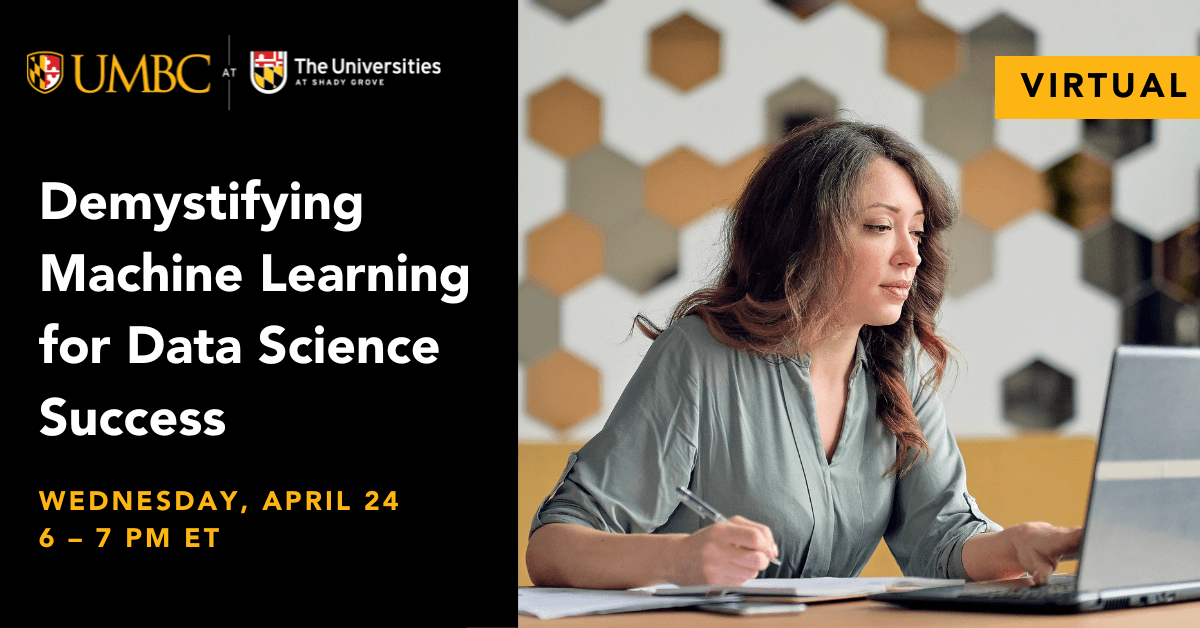
Demystifying Machine Learning in Data Science, 6-7pm ET 4/26
Have you ever wondered how self-driving cars navigate or how Netflix recommends your next binge? It's all thanks to the mind-blowing power of Machine Learning (ML). Join us for a free, fun and interactive one-hour online session where you will:
- Demystify ML in plain English: no jargon, just clear explanations that will have you saying "Aha!"
- Discover amazing ML applications: from healthcare to entertainment, see how ML shapes our world.
- Get hands-on with a famous ML challenge: use free online tools to tackle a real-world problem yourself.
This is your chance to:
Don't miss out on this exciting opportunity to step into the future of technology! No prior coding experience is needed.
Register here for this online session from
6-7pm ET, Wednesday April 24, 2024 online via WebEx.
UMBC is committed to inclusivity and accessibility. Automated closed captioning will be available during the event through Webex.
]]>
Have you ever wondered how self-driving cars navigate or how Netflix recommends your next binge? It's all thanks to the mind-blowing power of Machine Learning (ML). Join us for a free, fun and...
https://events.blackthorn.io/en/3t1z5Tf7/g/fg7KS5CJ1F/demystifying-machine-learning-for-data-science-success-4a2HVXaZ0r/overview
https://beta.my.umbc.edu/api/v0/pixel/news/141161/guest@my.umbc.edu/0211f30722b03d5c54497bfb1cab22dd/api/pixel
ai
data-science
machine-learning
umbc
UMBC AI
https://beta.my.umbc.edu/groups/umbc-ai
https://assets4-beta.my.umbc.edu/system/shared/avatars/groups/000/002/081/cfb27ebe008c2636486089a759ea5c36/xsmall.png?1691095779
https://assets2-beta.my.umbc.edu/system/shared/avatars/groups/000/002/081/cfb27ebe008c2636486089a759ea5c36/original.png?1691095779
https://assets1-beta.my.umbc.edu/system/shared/avatars/groups/000/002/081/cfb27ebe008c2636486089a759ea5c36/xxlarge.png?1691095779
https://assets1-beta.my.umbc.edu/system/shared/avatars/groups/000/002/081/cfb27ebe008c2636486089a759ea5c36/xlarge.png?1691095779
https://assets1-beta.my.umbc.edu/system/shared/avatars/groups/000/002/081/cfb27ebe008c2636486089a759ea5c36/large.png?1691095779
https://assets3-beta.my.umbc.edu/system/shared/avatars/groups/000/002/081/cfb27ebe008c2636486089a759ea5c36/medium.png?1691095779
https://assets3-beta.my.umbc.edu/system/shared/avatars/groups/000/002/081/cfb27ebe008c2636486089a759ea5c36/small.png?1691095779
https://assets4-beta.my.umbc.edu/system/shared/avatars/groups/000/002/081/cfb27ebe008c2636486089a759ea5c36/xsmall.png?1691095779
https://assets1-beta.my.umbc.edu/system/shared/avatars/groups/000/002/081/cfb27ebe008c2636486089a759ea5c36/xxsmall.png?1691095779
UMBC AI
0
0
true
Sun, 21 Apr 2024 12:34:41 -0400
Mon, 22 Apr 2024 08:38:55 -0400
Looking Out for Your Data Privacy, 12-1 ET Monday April 22
UMBC AI, Privacy, and Ethics Symposium
Looking Out for Your Data Privacy
Amy Swackhamer
12-1pm ET, Monday, April 22, 2024
Join University of Maryland, College Park's Web Librarian,
Amy Swackhamer, as she gives a brief background into the current state of digital data privacy concerns, including developments in technology and laws, and reasons to care about your data privacy. Most of our time will focus on different vectors of data surveillance, such as web browsing, smartphone apps and location data, social media, and password management, and steps for protecting your personal data from intrusion through those vectors.
Amy will mention sources for more information and provide an annotated resource list with details about organizations working in this area, books and websites focused on privacy, and other places to learn more.
Join the online presentation
here.
In the next AI Lunchbox session from the UMBC Training Centers,
Dhruv Ratra will cover
Microsoft Copilot and its use with familiar Microsoft products like Word, PowerPoint, Excel, Outlook, and Teams. Copilot is built on OpenAI's latest LLM system with additional fine-tuning to better support familiar Microsoft tools.
Discover how Microsoft Copilot integrates seamlessly into
Microsoft 365 to improve your productivity and creativity. The session will explore the innovative features of Microsoft Copilot, showing how it transforms the way you work with documents, email, and presentations. Join Dhruv to learn how to harness the power of AI to streamline your tasks, boost efficiency, and unleash your creative potential with Microsoft 365.
Whether you're a student, educator, or professional, this session will provide you with practical insights and tips to get the most out of the Microsoft 365 suite.
Register here for this free session, 12-1pm ET on Thursday, April 18, 2024.
]]>
In the next AI Lunchbox session from the UMBC Training Centers, Dhruv Ratra will cover Microsoft Copilot and its use with familiar Microsoft products like Word, PowerPoint, Excel, Outlook, and...
https://c4a.ai/#lb01
https://beta.my.umbc.edu/api/v0/pixel/news/140891/guest@my.umbc.edu/9c58cc727e0a780b6056b439eb295c5e/api/pixel
ai
chatgpt
copilot
llm
microsoft-365
UMBC AI
https://beta.my.umbc.edu/groups/umbc-ai
https://assets4-beta.my.umbc.edu/system/shared/avatars/groups/000/002/081/cfb27ebe008c2636486089a759ea5c36/xsmall.png?1691095779
https://assets2-beta.my.umbc.edu/system/shared/avatars/groups/000/002/081/cfb27ebe008c2636486089a759ea5c36/original.png?1691095779
https://assets1-beta.my.umbc.edu/system/shared/avatars/groups/000/002/081/cfb27ebe008c2636486089a759ea5c36/xxlarge.png?1691095779
https://assets1-beta.my.umbc.edu/system/shared/avatars/groups/000/002/081/cfb27ebe008c2636486089a759ea5c36/xlarge.png?1691095779
https://assets1-beta.my.umbc.edu/system/shared/avatars/groups/000/002/081/cfb27ebe008c2636486089a759ea5c36/large.png?1691095779
https://assets3-beta.my.umbc.edu/system/shared/avatars/groups/000/002/081/cfb27ebe008c2636486089a759ea5c36/medium.png?1691095779
https://assets3-beta.my.umbc.edu/system/shared/avatars/groups/000/002/081/cfb27ebe008c2636486089a759ea5c36/small.png?1691095779
https://assets4-beta.my.umbc.edu/system/shared/avatars/groups/000/002/081/cfb27ebe008c2636486089a759ea5c36/xsmall.png?1691095779
https://assets1-beta.my.umbc.edu/system/shared/avatars/groups/000/002/081/cfb27ebe008c2636486089a759ea5c36/xxsmall.png?1691095779
UMBC AI
https://assets4-beta.my.umbc.edu/system/shared/thumbnails/news/000/140/891/3a7e3251e8285102079d4561ae7ec771/xxlarge.jpg?1713032017
https://assets1-beta.my.umbc.edu/system/shared/thumbnails/news/000/140/891/3a7e3251e8285102079d4561ae7ec771/xlarge.jpg?1713032017
https://assets3-beta.my.umbc.edu/system/shared/thumbnails/news/000/140/891/3a7e3251e8285102079d4561ae7ec771/large.jpg?1713032017
https://assets1-beta.my.umbc.edu/system/shared/thumbnails/news/000/140/891/3a7e3251e8285102079d4561ae7ec771/medium.jpg?1713032017
https://assets2-beta.my.umbc.edu/system/shared/thumbnails/news/000/140/891/3a7e3251e8285102079d4561ae7ec771/small.jpg?1713032017
https://assets1-beta.my.umbc.edu/system/shared/thumbnails/news/000/140/891/3a7e3251e8285102079d4561ae7ec771/xsmall.jpg?1713032017
https://assets1-beta.my.umbc.edu/system/shared/thumbnails/news/000/140/891/3a7e3251e8285102079d4561ae7ec771/xxsmall.jpg?1713032017
0
0
true
Tue, 16 Apr 2024 15:43:28 -0400
Sat, 20 Apr 2024 10:39:01 -0400
Machine Learning for Bioprocess Sensor Innovation
UMBC's Prof. Govind Rao interviewed for GEN News article
Machine learning (ML) could allow drug firms to create predictive process models that optimize development, production, and quality control. But, before embracing ML on the factory floor, manufacturers will need data to “train” the computer algorithms that drive the approach. And this means having process sensors sophisticated enough to track multiple parameters in real-time in highly complex cell cultures according to an industry expert.
Machine learning is a specialized form of artificial intelligence in which computer programs learn to solve tasks or understand the dynamics of complex systems with minimal or no direction. The process is iterative, and the solutions improve over time as more data is introduced.
This need for training data is driving innovation in process sensors, says Govind Rao, PhD, who is director of the
Center for Advanced Sensor Technology at the University of Maryland, Baltimore County.
“At the end of the day, AI/ML tools will allow for process monitoring to be simplified once data are generated at scale to relate process conditions to critical quality attributes. The need to run QC tests on quarantined bulk drug substance will be greatly reduced,” he explains. “However, to get there will require high-density process monitoring to allow ML/AI algorithms to relate process conditions to off-line measurements such as glycosylation, aggregation, etc.”
]]>
UMBC Professor Govind Rao, was interviewed for an article on Machine Learning for Bioprocess Sensor Innovation in Genetic Engineering & Biotechnology News on the use of machine learning for...
https://www.genengnews.com/topics/bioprocessing/machine-learning-for-bioprocess-sensor-innovation/
https://beta.my.umbc.edu/api/v0/pixel/news/140958/guest@my.umbc.edu/040bd0f29e1158cb9d1036c32ca0e76f/api/pixel
ai
cbee
machine-learning
umbc
UMBC AI
https://beta.my.umbc.edu/groups/umbc-ai
https://assets4-beta.my.umbc.edu/system/shared/avatars/groups/000/002/081/cfb27ebe008c2636486089a759ea5c36/xsmall.png?1691095779
https://assets2-beta.my.umbc.edu/system/shared/avatars/groups/000/002/081/cfb27ebe008c2636486089a759ea5c36/original.png?1691095779
https://assets1-beta.my.umbc.edu/system/shared/avatars/groups/000/002/081/cfb27ebe008c2636486089a759ea5c36/xxlarge.png?1691095779
https://assets1-beta.my.umbc.edu/system/shared/avatars/groups/000/002/081/cfb27ebe008c2636486089a759ea5c36/xlarge.png?1691095779
https://assets1-beta.my.umbc.edu/system/shared/avatars/groups/000/002/081/cfb27ebe008c2636486089a759ea5c36/large.png?1691095779
https://assets3-beta.my.umbc.edu/system/shared/avatars/groups/000/002/081/cfb27ebe008c2636486089a759ea5c36/medium.png?1691095779
https://assets3-beta.my.umbc.edu/system/shared/avatars/groups/000/002/081/cfb27ebe008c2636486089a759ea5c36/small.png?1691095779
https://assets4-beta.my.umbc.edu/system/shared/avatars/groups/000/002/081/cfb27ebe008c2636486089a759ea5c36/xsmall.png?1691095779
https://assets1-beta.my.umbc.edu/system/shared/avatars/groups/000/002/081/cfb27ebe008c2636486089a759ea5c36/xxsmall.png?1691095779
UMBC AI
0
0
true
Mon, 15 Apr 2024 16:34:52 -0400
Tue, 16 Apr 2024 22:05:38 -0400
Talk: Learning to Synthesize Images, 4-5:15pm ET, Wed. 4/17
Advances in Perception, Prediction & Reasoning seminar
Learning to Synthesize Images with Multimodal and Hierarchical Inputs
April 17, 2024 4:00 – 5:15 PM
ENGR 231, UMBC or Webex
In recent years, image synthesis and manipulation has experienced remarkable advancements driven by deep learning algorithms and web-scale data, yet there persists a notable disconnect between the intricate nature of human ideas and the simplistic input structures employed by the existing models. In this talk, I will present our research towards a more natural way for controllable image synthesis inspired by the coarse-to-fine workflow of human artists and the inherently multimodal aspect of human thought processes. We consider the inputs of semantic and visual modality at varying levels of hierarchy. For the semantic modality, we introduce a general framework for modeling semantic inputs of different levels, which includes image-level text prompts and pixel-level label maps as two extremes and brings a series of mid-level regional descriptions with different precision. For the visual modality, we explore the use of low-level and high-level visual inputs aligning with the natural hierarchy of visual processing. Additionally, as the misuse of generated images becomes a societal threat, I will introduce our findings on the trustworthiness of deep generative models in the second part of this talk and potential future research directions.
Yu Zeng is a Ph.D. candidate at Johns Hopkins University advised by Vishal M. Patel. Her research interest lies in computer vision and deep learning. She has focused on two main areas: (1) deep generative models for image synthesis and editing and (2) label-efficient deep learning. By combining these research areas, she aims to bridge human creativity and machine intelligence through user-friendly and socially responsible models while minimizing the need for intensive human supervision. Yuhas collaborated with researchers at NVIDIA and Adobe through internships. Prior to her Ph.D., she worked as a researcher at Tencent Games. Yu’s research has been recognized by the KAUST Rising Stars in AI, and her Ph.D. study has been supported by a JHU Kewei Yang and Grace Xin Fellowship.
]]>
Learning to Synthesize Images with Multimodal and Hierarchical Inputs Yu Zeng, JHU April 17, 2024 4:00 – 5:15 PM ENGR 231, UMBC or Webex In recent years, image synthesis and manipulation...
https://beta.my.umbc.edu/api/v0/pixel/news/140902/guest@my.umbc.edu/dc88976cc5ca6f2a10576069fe0f9d31/api/pixel
ai
images
multimodal
vision
UMBC AI
https://beta.my.umbc.edu/groups/umbc-ai
https://assets4-beta.my.umbc.edu/system/shared/avatars/groups/000/002/081/cfb27ebe008c2636486089a759ea5c36/xsmall.png?1691095779
https://assets2-beta.my.umbc.edu/system/shared/avatars/groups/000/002/081/cfb27ebe008c2636486089a759ea5c36/original.png?1691095779
https://assets1-beta.my.umbc.edu/system/shared/avatars/groups/000/002/081/cfb27ebe008c2636486089a759ea5c36/xxlarge.png?1691095779
https://assets1-beta.my.umbc.edu/system/shared/avatars/groups/000/002/081/cfb27ebe008c2636486089a759ea5c36/xlarge.png?1691095779
https://assets1-beta.my.umbc.edu/system/shared/avatars/groups/000/002/081/cfb27ebe008c2636486089a759ea5c36/large.png?1691095779
https://assets3-beta.my.umbc.edu/system/shared/avatars/groups/000/002/081/cfb27ebe008c2636486089a759ea5c36/medium.png?1691095779
https://assets3-beta.my.umbc.edu/system/shared/avatars/groups/000/002/081/cfb27ebe008c2636486089a759ea5c36/small.png?1691095779
https://assets4-beta.my.umbc.edu/system/shared/avatars/groups/000/002/081/cfb27ebe008c2636486089a759ea5c36/xsmall.png?1691095779
https://assets1-beta.my.umbc.edu/system/shared/avatars/groups/000/002/081/cfb27ebe008c2636486089a759ea5c36/xxsmall.png?1691095779
UMBC AI
https://assets2-beta.my.umbc.edu/system/shared/thumbnails/news/000/140/902/2c74685cec3a52e4a7092bec7876e18d/xxlarge.jpg?1713184563
https://assets4-beta.my.umbc.edu/system/shared/thumbnails/news/000/140/902/2c74685cec3a52e4a7092bec7876e18d/xlarge.jpg?1713184563
https://assets1-beta.my.umbc.edu/system/shared/thumbnails/news/000/140/902/2c74685cec3a52e4a7092bec7876e18d/large.jpg?1713184563
https://assets2-beta.my.umbc.edu/system/shared/thumbnails/news/000/140/902/2c74685cec3a52e4a7092bec7876e18d/medium.jpg?1713184563
https://assets3-beta.my.umbc.edu/system/shared/thumbnails/news/000/140/902/2c74685cec3a52e4a7092bec7876e18d/small.jpg?1713184563
https://assets1-beta.my.umbc.edu/system/shared/thumbnails/news/000/140/902/2c74685cec3a52e4a7092bec7876e18d/xsmall.jpg?1713184563
https://assets4-beta.my.umbc.edu/system/shared/thumbnails/news/000/140/902/2c74685cec3a52e4a7092bec7876e18d/xxsmall.jpg?1713184563
0
0
true
Mon, 15 Apr 2024 08:44:49 -0400
Tue, 16 Apr 2024 22:06:11 -0400
GPT Dilemma: Pros, Cons & Impacts on Learning, 12-1 Mon 4/15
The GPT Dilemma: Navigating the
Pros, Cons, and Impacts on Learning
Department of Information systems
UMBC
12-1:00pm ET, Monday April 15, 2024, online
Picture this: You are in a classroom where you are free to use GPT - but should you? This session invites you to explore this dilemma. We will discuss the pros and cons of GPT in education, considering its impact on your learning, future career, and life in an AI-driven era, using examples from Dr. Chen's experience teaching two Data Science courses (one undergraduate and one graduate level) at UMBC in Fall 2023, where students were allowed to freely use GPT. Dr. Chen will share insights gained from identifying GPT-generated work, and discuss strategies for responsibly and productively engaging GPT as your personal AI assistant.
Lujie Karen Chen is an Assistant Professor in the Department of Information Systems at UMBC, where she leads the
Laboratory for Informatics for Human Flourishing. She has almost 20 years of academic and real-world experience in applied machine learning, statistics, data mining, analytics, and visualization. Before joining UMBC, she spent about 15 years at the
Auton Lab at Carnegie Mellon University, where she received her Ph.D. in Information Systems and was a fellow in the Program of Interdisciplinary Educational Research.
]]>
UMBC AI, Privacy, and Ethics Symposium The GPT Dilemma: Navigating the Pros, Cons, and Impacts on Learning Professor Lujie Karen Chen Department of Information systems UMBC 12-1:00pm...
https://my3.my.umbc.edu/groups/library/events/127070
https://beta.my.umbc.edu/api/v0/pixel/news/140894/guest@my.umbc.edu/0f05570a7cfdfcb598e4c36b6228b167/api/pixel
ai
chatgpt
education
gpt
llm
teaching
UMBC AI
https://beta.my.umbc.edu/groups/umbc-ai
https://assets4-beta.my.umbc.edu/system/shared/avatars/groups/000/002/081/cfb27ebe008c2636486089a759ea5c36/xsmall.png?1691095779
https://assets2-beta.my.umbc.edu/system/shared/avatars/groups/000/002/081/cfb27ebe008c2636486089a759ea5c36/original.png?1691095779
https://assets1-beta.my.umbc.edu/system/shared/avatars/groups/000/002/081/cfb27ebe008c2636486089a759ea5c36/xxlarge.png?1691095779
https://assets1-beta.my.umbc.edu/system/shared/avatars/groups/000/002/081/cfb27ebe008c2636486089a759ea5c36/xlarge.png?1691095779
https://assets1-beta.my.umbc.edu/system/shared/avatars/groups/000/002/081/cfb27ebe008c2636486089a759ea5c36/large.png?1691095779
https://assets3-beta.my.umbc.edu/system/shared/avatars/groups/000/002/081/cfb27ebe008c2636486089a759ea5c36/medium.png?1691095779
https://assets3-beta.my.umbc.edu/system/shared/avatars/groups/000/002/081/cfb27ebe008c2636486089a759ea5c36/small.png?1691095779
https://assets4-beta.my.umbc.edu/system/shared/avatars/groups/000/002/081/cfb27ebe008c2636486089a759ea5c36/xsmall.png?1691095779
https://assets1-beta.my.umbc.edu/system/shared/avatars/groups/000/002/081/cfb27ebe008c2636486089a759ea5c36/xxsmall.png?1691095779
UMBC AI
https://assets1-beta.my.umbc.edu/system/shared/thumbnails/news/000/140/894/a1cce5586dc4d5a22844a16af9518eb1/xxlarge.jpg?1713046228
https://assets2-beta.my.umbc.edu/system/shared/thumbnails/news/000/140/894/a1cce5586dc4d5a22844a16af9518eb1/xlarge.jpg?1713046228
https://assets3-beta.my.umbc.edu/system/shared/thumbnails/news/000/140/894/a1cce5586dc4d5a22844a16af9518eb1/large.jpg?1713046228
https://assets2-beta.my.umbc.edu/system/shared/thumbnails/news/000/140/894/a1cce5586dc4d5a22844a16af9518eb1/medium.jpg?1713046228
https://assets1-beta.my.umbc.edu/system/shared/thumbnails/news/000/140/894/a1cce5586dc4d5a22844a16af9518eb1/small.jpg?1713046228
https://assets1-beta.my.umbc.edu/system/shared/thumbnails/news/000/140/894/a1cce5586dc4d5a22844a16af9518eb1/xsmall.jpg?1713046228
https://assets1-beta.my.umbc.edu/system/shared/thumbnails/news/000/140/894/a1cce5586dc4d5a22844a16af9518eb1/xxsmall.jpg?1713046228
0
0
true
Sat, 13 Apr 2024 18:33:23 -0400
Tue, 16 Apr 2024 22:06:45 -0400
UMBC Prof. Lara Martin video on Neurosymbolic AI and LLMs
How I Learned to Stop Worrying & Love Large Language Models
UMBC professor Lara Martin gave a presentation recently at the JHU Center for Language & Speech Processing (CLSP). Her talk, Neurosymbolic AI or: How I Learned to Stop Worrying and Love the Large Language Model, covered some of her recent research on natural language processing, human-centered AI, and story generation. Here is the abstract of her talk.
Large language models like ChatGPT have shown extraordinary abilities for writing. While impressive at first glance, large language models aren't perfect and often make mistakes humans would not make. The main architecture behind ChatGPT mostly doesn't differ from early neural networks and, as a consequence, carries some of the same limitations. My work revolves around the use of neural networks like ChatGPT mixed with symbolic methods from early AI and how these two families of methods can combine to create more robust AI. I talk about some of the neurosymbolic methods I used for applications in story generation and understanding -- with the goal of eventually creating AI that can play Dungeons & Dragons. I also discuss pain points that I found for improving accessible communication and show how large language models can supplement such communication.
Dr. Martin will teach a special topics class at UMBC in Fall 2024 on
Interactive Fiction and Text Generation (CMSC 491/691) based on a
similar course she developed and co-taught at the University of Pennsylvania in 2022.
]]>
UMBC professor Lara Martin gave a presentation recently at the JHU Center for Language & Speech Processing (CLSP). Her talk, Neurosymbolic AI or: How I Learned to Stop Worrying and Love the...
https://www.youtube.com/watch?v=Kyopo5y91Bk
https://beta.my.umbc.edu/api/v0/pixel/news/140860/guest@my.umbc.edu/b3026273bcc20896257c6b2b5319cf6f/api/pixel
ai
language-generation
llm
nlp
story-generation
UMBC AI
https://beta.my.umbc.edu/groups/umbc-ai
https://assets4-beta.my.umbc.edu/system/shared/avatars/groups/000/002/081/cfb27ebe008c2636486089a759ea5c36/xsmall.png?1691095779
https://assets2-beta.my.umbc.edu/system/shared/avatars/groups/000/002/081/cfb27ebe008c2636486089a759ea5c36/original.png?1691095779
https://assets1-beta.my.umbc.edu/system/shared/avatars/groups/000/002/081/cfb27ebe008c2636486089a759ea5c36/xxlarge.png?1691095779
https://assets1-beta.my.umbc.edu/system/shared/avatars/groups/000/002/081/cfb27ebe008c2636486089a759ea5c36/xlarge.png?1691095779
https://assets1-beta.my.umbc.edu/system/shared/avatars/groups/000/002/081/cfb27ebe008c2636486089a759ea5c36/large.png?1691095779
https://assets3-beta.my.umbc.edu/system/shared/avatars/groups/000/002/081/cfb27ebe008c2636486089a759ea5c36/medium.png?1691095779
https://assets3-beta.my.umbc.edu/system/shared/avatars/groups/000/002/081/cfb27ebe008c2636486089a759ea5c36/small.png?1691095779
https://assets4-beta.my.umbc.edu/system/shared/avatars/groups/000/002/081/cfb27ebe008c2636486089a759ea5c36/xsmall.png?1691095779
https://assets1-beta.my.umbc.edu/system/shared/avatars/groups/000/002/081/cfb27ebe008c2636486089a759ea5c36/xxsmall.png?1691095779
UMBC AI
0
0
true
Fri, 12 Apr 2024 11:52:46 -0400
Talk: GeoAI for Social Good, 12-1pm ET Wed. April 10
Lean how Geospatial Artificial Intelligence is being applied
GeoAI for Social Good
Dr. Raju Vatsavai
North Carolina State University
12-1pm ET Wednesday, April 10, 2024, online
Several decades of research have led to current advances in artificial intelligence (AI), specifically machine learning (ML) and deep learning (DL). These advancements hold promise for solving major challenges facing human society – from mitigating climate change to increasing food production, designing smart cities, and optimizing scarce resources. All these problems share a common thread: they are inherently rooted in space and time. Remote sensing data serves as a prime example of spatial big data. NASA recently collected its 10 millionth Landsat image. The coarse-resolution (30 m) Landsat collection itself surpasses a petabyte in size, while private satellite data producer MAXAR holds more than 125 petabytes of high-resolution data. Applications such as disease mapping, crop monitoring, and urban studies all rely on this data. We present recent advances in GeoAI that analyze these multimodal datasets and show their applications in various fields, including climate-smart agriculture, slum mapping, and critical infrastructure monitoring.
Dr. Raju Vatsavai is a Chancellor's Faculty Excellence Program Cluster Professor of Geospatial Analytics in the Department of Computer Science at North Carolina State University (NCSU). Prior to joining NCSU, Raju served as the Lead Data Scientist for the Computational Sciences and Engineering Division (CSED) at the Oak Ridge National Laboratory (ORNL). His research focuses on the intersection of spatial and temporal big data management, machine learning, and high-performance computing. He has authored or co-authored over 100 peer-reviewed articles in conferences and journals. He has also edited two books on "Knowledge Discovery from Sensor Data." He actively participates in the academic community, serving on program committees for leading international conferences such as ACM KDD, ACM SIGSPATIAL GIS, ECML/PKDD, SDM, CIKM, and IEEE BigData. He has further co-chaired several workshops, including ICDM/SSTDM, ICDM/KDCloud, ACM SIGSPATIAL BigSpatial, ACM/IEEE Supercomputing/BDAC, ACM KDD/LDMTA, ACM KDD/Sensor-KDD, and SIAM DM/ACS. Dr. Raju holds a M.S. and Ph.D. degrees in computer science from the University of Minnesota.
]]>
GeoAI for Social Good Dr. Raju Vatsavai North Carolina State University 12-1pm ET Wednesday, April 10, 2024, online Several decades of research have led to current advances in...
https://my3.my.umbc.edu/groups/iharp/events/129212
https://beta.my.umbc.edu/api/v0/pixel/news/140697/guest@my.umbc.edu/6d3497d086574371ec27e491b1f7aa27/api/pixel
ai
geoai
gis
iharp
is
UMBC AI
https://beta.my.umbc.edu/groups/umbc-ai
https://assets4-beta.my.umbc.edu/system/shared/avatars/groups/000/002/081/cfb27ebe008c2636486089a759ea5c36/xsmall.png?1691095779
https://assets2-beta.my.umbc.edu/system/shared/avatars/groups/000/002/081/cfb27ebe008c2636486089a759ea5c36/original.png?1691095779
https://assets1-beta.my.umbc.edu/system/shared/avatars/groups/000/002/081/cfb27ebe008c2636486089a759ea5c36/xxlarge.png?1691095779
https://assets1-beta.my.umbc.edu/system/shared/avatars/groups/000/002/081/cfb27ebe008c2636486089a759ea5c36/xlarge.png?1691095779
https://assets1-beta.my.umbc.edu/system/shared/avatars/groups/000/002/081/cfb27ebe008c2636486089a759ea5c36/large.png?1691095779
https://assets3-beta.my.umbc.edu/system/shared/avatars/groups/000/002/081/cfb27ebe008c2636486089a759ea5c36/medium.png?1691095779
https://assets3-beta.my.umbc.edu/system/shared/avatars/groups/000/002/081/cfb27ebe008c2636486089a759ea5c36/small.png?1691095779
https://assets4-beta.my.umbc.edu/system/shared/avatars/groups/000/002/081/cfb27ebe008c2636486089a759ea5c36/xsmall.png?1691095779
https://assets1-beta.my.umbc.edu/system/shared/avatars/groups/000/002/081/cfb27ebe008c2636486089a759ea5c36/xxsmall.png?1691095779
UMBC AI
0
0
true
Tue, 09 Apr 2024 07:49:29 -0400
AI talks at COEIT Research Day, 10:30-12:30, Friday April 19
Six talks on current AI research at UMBC
The UMBC College of Engineering and Information Technology (COEIT)
Research Day event takes place from 9:00 am to 3:00 pm on Friday, April 19, 2024. Parallel sessions of talks on COEIT research are scheduled from 10:30 am to 12:30 pm in the ITE building.
The program of talks includes a session of six presentations on current
AI-related research in COEIT departments. Full details on the talks, including their abstracts, is available
here.- Tejas Gokhale: Towards Robust Visual Understanding: from Recognition to Reasoning
- Md Badrul Hasan, Meilin Yu, Heng Xiao, and Tim Oates: Sub-grid Scale Modeling of Meso-scale Hurricane Boundary Layer Flows using Machine Learning
- Seraj Al Mahmud Mostafa, Omar Faruque, Chenxi Wang, Jia Yue, Sanjay Purushotham, and Jianwu Wang: From Data-Efficient Machine Learning to Neuro-symbolic AI
- Houbing Song: From Data-Efficient Machine Learning to Neuro-symbolic AI
- Sai Vallurupalli, Sayontan Ghosh, Katrin Erk, Niranjan Balasubramanian, and Francis Ferraro:POQue: Asking Participant-specific Outcome Questions for a Deeper Understanding of Complex Events
- Roberto Yus, Jun Ma, Aamir Hamid, Christian Badalato, Sanaa Mironov, Hemanth Reddy Samidi, and Brian Scherzo: Democratizing the IoT through Privacy-Preserving Data Management
Get more information about COEIT Research Day and register to attend
here.
The UMBC Cyber Defense Lab presents
Shaping Opinion and Influencing Societies through Narrative Construction
CSEE Professor and Acting CoEIT Dean
12–1pm, Friday, April 12, 2024 via WebEx
There has been a significant body of work that explores “
misinformation” or “
disinformation” in the media. Research has explored how to identify misinformation, and how it spreads or goes viral. When detected, individual pieces of misinformation can be debunked. However, there is evidence that state actors (and others) are starting to launch more sophisticated information operations that try to craft a narrative that will shape public opinion. This involves combining factual information/hard news with opinions and potentially small elements of disinformation to persuade people, particularly in open societies typically found in democracies. While such influence building operations have been a tradition in statecraft, the ability to spread information fast provided by social media, and the removal of gatekeepers from the more traditional media sources, have provided a new potency to this approach. In this talk, we'll talk about disinformation, how easy it is to generate plausible “facts” in the era of
Large Language Models, and narrative constructions. We'll also describe our recent work (with PhD student
Priyanka Ranade) in creating computational approaches that might detect when a narrative is being constructed.
Anupam Joshi is the Oros Family Professor and Acting Dean of the College of Engineering and Information Technology at the University of Maryland, Baltimore County (UMBC). He also serves as the Director of UMBC’s Center for Cybersecurity. He was previously the Chair of Computer Science and Electrical Engineering Department, and is an Adjunct Professor at IIT Delhi's School of IT. He is a Fellow of IEEE and of the InCSCoE. He has published over 300 technical papers with an h-index of 91 and over 32,000 citations (per Google scholar), been granted nine patents, and has obtained research support over $22M from National Science Foundation (NSF), NASA, Defense Advanced Research Projects Agency (DARPA), US Dept of Defense (DoD), NIST, IBM, Microsoft, Qualcomm, Northrop Grumman, and Lockheed Martin amongst others.
Dr. Joshi obtained a B.Tech degree from IIT Delhi in 1989, and a Masters and Ph.D. from Purdue University in 1991 and 1993 respectively. His research interests are at the intersection of AI and Systems. He did some of the earliest work in data management and security for mobile and ad-hoc networks using AI approaches. Over the last decade, he has been exploring this intersection to improve Cybersecurity—using Distributed AI approaches for attack detection and resilience in CPS/IoT systems, and policy driven approaches to security and privacy. This work has led not just to papers but technology transfer to small Maryland companies.
Host: Alan T. Sherman,
sherman@umbc.edu. Support for this event was provided in part by the NSF under SFS grant DGE-1753681.
]]>
The UMBC Cyber Defense Lab presents Shaping Opinion and Influencing Societies through Narrative Construction Anupam Joshi CSEE Professor and Acting CoEIT Dean 12–1pm, Friday, April...
https://beta.my.umbc.edu/api/v0/pixel/news/140638/guest@my.umbc.edu/a4a284c335dd9fa66d2dd0ec9dd59961/api/pixel
ai
disinformation
llm
misinformation
UMBC AI
https://beta.my.umbc.edu/groups/umbc-ai
https://assets4-beta.my.umbc.edu/system/shared/avatars/groups/000/002/081/cfb27ebe008c2636486089a759ea5c36/xsmall.png?1691095779
https://assets2-beta.my.umbc.edu/system/shared/avatars/groups/000/002/081/cfb27ebe008c2636486089a759ea5c36/original.png?1691095779
https://assets1-beta.my.umbc.edu/system/shared/avatars/groups/000/002/081/cfb27ebe008c2636486089a759ea5c36/xxlarge.png?1691095779
https://assets1-beta.my.umbc.edu/system/shared/avatars/groups/000/002/081/cfb27ebe008c2636486089a759ea5c36/xlarge.png?1691095779
https://assets1-beta.my.umbc.edu/system/shared/avatars/groups/000/002/081/cfb27ebe008c2636486089a759ea5c36/large.png?1691095779
https://assets3-beta.my.umbc.edu/system/shared/avatars/groups/000/002/081/cfb27ebe008c2636486089a759ea5c36/medium.png?1691095779
https://assets3-beta.my.umbc.edu/system/shared/avatars/groups/000/002/081/cfb27ebe008c2636486089a759ea5c36/small.png?1691095779
https://assets4-beta.my.umbc.edu/system/shared/avatars/groups/000/002/081/cfb27ebe008c2636486089a759ea5c36/xsmall.png?1691095779
https://assets1-beta.my.umbc.edu/system/shared/avatars/groups/000/002/081/cfb27ebe008c2636486089a759ea5c36/xxsmall.png?1691095779
UMBC AI
0
0
true
Sun, 07 Apr 2024 15:18:27 -0400
Sun, 07 Apr 2024 15:35:14 -0400