<?xml version="1.0"?>
<News hasArchived="false" page="27" pageCount="36" pageSize="10" timestamp="Sun, 26 Apr 2026 11:09:49 -0400" url="https://beta.my.umbc.edu/groups/umbc-ai/posts.xml?page=27">
<NewsItem contentIssues="true" id="143190" important="false" status="posted" url="https://beta.my.umbc.edu/groups/umbc-ai/posts/143190">
<Title>Deepfake Detection Technologies Survey</Title>
<Tagline>Lunch &amp; Learn talk, 12-1pm ET, Thur. 22 August 2024, online</Tagline>
<Body>
<![CDATA[
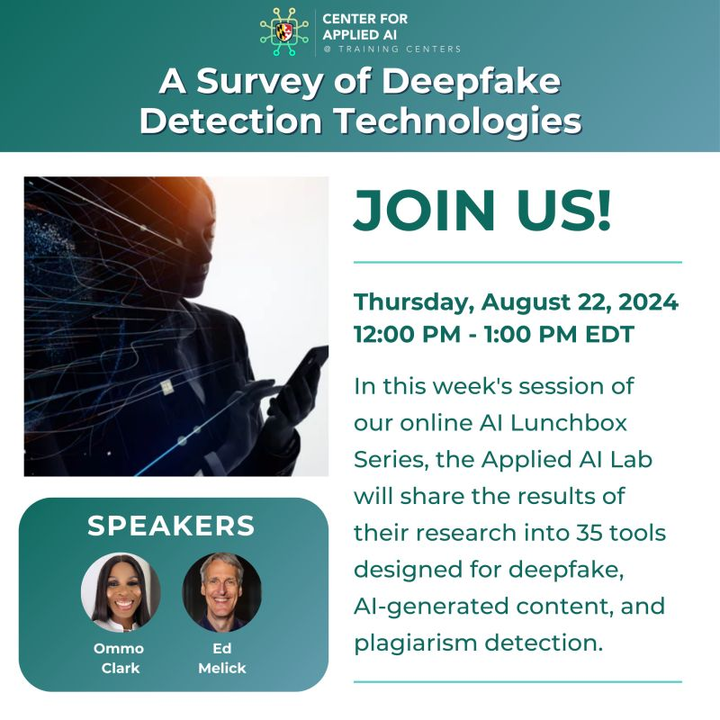
    <div class="html-content"><h4><strong>A Survey of Deepfake Detection Technologies<br></strong><strong>12-1pm ET Thursday, 22 August 2024, online</strong></h4><div><strong><br></strong></div><div>The <strong><a href="https://c4a.ai/" rel="nofollow external" class="bo">Center for Applied AI </a></strong>wIll hold an online Lunch &amp; Learn series talk on Deepfake Detection Technologies from 12-1 ET on Thursday, August 22.</div><div><div><br></div><div>Social media is awash in fake images, videos, and audio recordings – and the problem is getting worse by the day. In response to this challenge, a number of companies have developed detection platforms that vary in focus, capability, and availability. </div><div><br></div><div>Join <strong><a href="https://www.linkedin.com/in/ommo-clark-b715a23/" rel="nofollow external" class="bo">Ommo Clark </a></strong>and <strong><a href="https://www.linkedin.com/in/ed-melick-7a683/" rel="nofollow external" class="bo">Ed Melick</a></strong> as they share the results of 35 tools designed for deepfake, AI-generated content, and plagiarism detection that the Center for Applied AI recently reviewed. Register on <strong><a href="https://www.meetup.com/c4a-ai/events/302591210/" rel="nofollow external" class="bo">Meetup</a></strong> to get the link. </div><div><br></div><div><img src="https://ai.umbc.edu/wp-content/uploads/sites/734/2024/08/c4a_ll_deepfakes.png" style="max-width: 100%; height: auto;"></div><div><br></div></div>
    <hr><a href="https://ai.umbc.edu/" rel="nofollow external" class="bo"><strong>UMBC Center for AI</strong></a></div>
]]>
</Body>
<Summary>A Survey of Deepfake Detection Technologies 12-1pm ET Thursday, 22 August 2024, online     The Center for Applied AI wIll hold an online Lunch &amp; Learn series talk on Deepfake Detection...</Summary>
<Website>https://www.meetup.com/c4a-ai/events/302591210/</Website>
<TrackingUrl>https://beta.my.umbc.edu/api/v0/pixel/news/143190/guest@my.umbc.edu/e6034cad81809ec3d338f08a3825a261/api/pixel</TrackingUrl>
<Tag>ai</Tag>
<Tag>deepfake</Tag>
<Tag>genai</Tag>
<Group token="umbc-ai">UMBC AI</Group>
<GroupUrl>https://beta.my.umbc.edu/groups/umbc-ai</GroupUrl>
<AvatarUrl>https://assets4-beta.my.umbc.edu/system/shared/avatars/groups/000/002/081/cfb27ebe008c2636486089a759ea5c36/xsmall.png?1691095779</AvatarUrl>
<AvatarUrl size="original">https://assets2-beta.my.umbc.edu/system/shared/avatars/groups/000/002/081/cfb27ebe008c2636486089a759ea5c36/original.png?1691095779</AvatarUrl>
<AvatarUrl size="xxlarge">https://assets1-beta.my.umbc.edu/system/shared/avatars/groups/000/002/081/cfb27ebe008c2636486089a759ea5c36/xxlarge.png?1691095779</AvatarUrl>
<AvatarUrl size="xlarge">https://assets1-beta.my.umbc.edu/system/shared/avatars/groups/000/002/081/cfb27ebe008c2636486089a759ea5c36/xlarge.png?1691095779</AvatarUrl>
<AvatarUrl size="large">https://assets1-beta.my.umbc.edu/system/shared/avatars/groups/000/002/081/cfb27ebe008c2636486089a759ea5c36/large.png?1691095779</AvatarUrl>
<AvatarUrl size="medium">https://assets3-beta.my.umbc.edu/system/shared/avatars/groups/000/002/081/cfb27ebe008c2636486089a759ea5c36/medium.png?1691095779</AvatarUrl>
<AvatarUrl size="small">https://assets3-beta.my.umbc.edu/system/shared/avatars/groups/000/002/081/cfb27ebe008c2636486089a759ea5c36/small.png?1691095779</AvatarUrl>
<AvatarUrl size="xsmall">https://assets4-beta.my.umbc.edu/system/shared/avatars/groups/000/002/081/cfb27ebe008c2636486089a759ea5c36/xsmall.png?1691095779</AvatarUrl>
<AvatarUrl size="xxsmall">https://assets1-beta.my.umbc.edu/system/shared/avatars/groups/000/002/081/cfb27ebe008c2636486089a759ea5c36/xxsmall.png?1691095779</AvatarUrl>
<Sponsor>UMBC AI</Sponsor>
<PawCount>0</PawCount>
<CommentCount>0</CommentCount>
<CommentsAllowed>true</CommentsAllowed>
<PostedAt>Wed, 14 Aug 2024 17:19:04 -0400</PostedAt>
</NewsItem>

<NewsItem contentIssues="true" id="143175" important="false" status="posted" url="https://beta.my.umbc.edu/groups/umbc-ai/posts/143175">
<Title>Blackboard's Ally now suggests alt text descriptions for images without them</Title>
<Body>
<![CDATA[
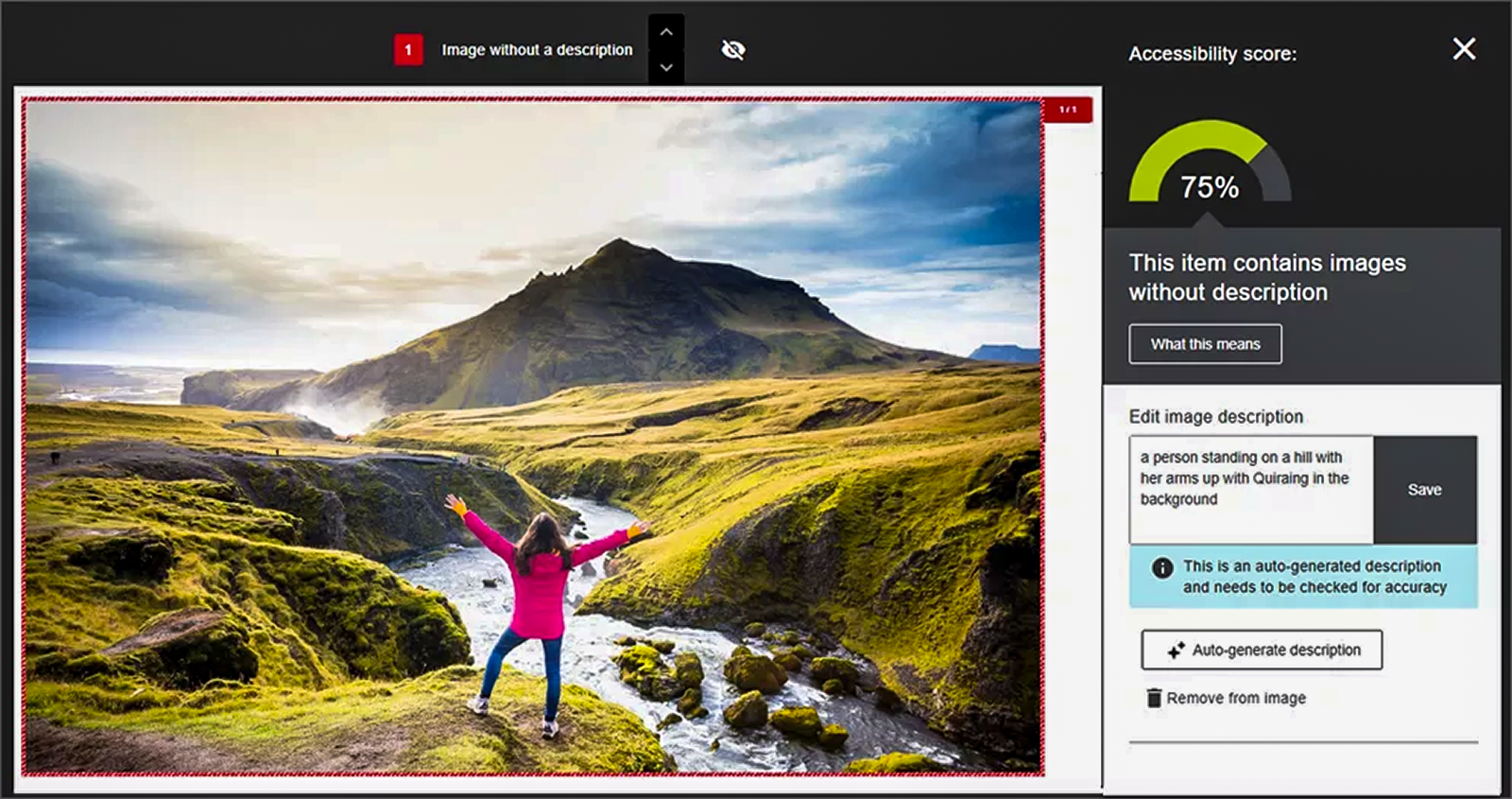
    <div class="html-content"><div><img src="https://ai.umbc.edu/wp-content/uploads/sites/734/2024/08/ally.png" style="max-width: 100%; height: auto;"></div><div>Example of Ally's AI generated image description.</div><div><br></div><div>Here's an interesting application of new GenAI systems: helping instructors make their course materials more accessible. A best practice for web accessibility is to ensure every non-decorative image has a good, descriptive alternative text (<a href="https://en.wikipedia.org/wiki/Alt_attribute" rel="nofollow external" class="bo"><strong>alt text</strong></a>) description to make content accessible to users with disabilities, particularly those who are blind or visually impaired. </div><div><br></div><div>The latest version of the <strong><a href="https://ally.ac/" rel="nofollow external" class="bo">Ally</a></strong> tool built into the Blackboard system used at UMBC will find images without alt text descriptions and offer to help by automatically generating descriptions.</div><div><br></div><div>Ally will flag images that lack a description in a Blackboard course. Instructors can enter a description themselves, mark the image as decorative, or leverage AI tools, powered by Microsoft <a href="https://azure.microsoft.com/en-us/products/ai-services/ai-vision" rel="nofollow external" class="bo"><strong>Azure AI Vision</strong></a>, to scan the image and generate a suggested description. Instructors retain full control over the image and can edit the content to make corrections or clarify the information before saving it.</div><div><br></div><div>You can read more about this new Ally capability in <strong><a href="https://my3.my.umbc.edu/groups/instructional-technology/posts/143089" rel="nofollow external" class="bo">this post</a></strong> in UMBC's <a href="https://my3.my.umbc.edu/groups/instructional-technology" rel="nofollow external" class="bo">Instructional Technology group</a>.</div>
    <hr><a href="https://ai.umbc.edu/" rel="nofollow external" class="bo"><strong>UMBC Center for AI</strong></a></div>
]]>
</Body>
<Summary>Example of Ally's AI generated image description.     Here's an interesting application of new GenAI systems: helping instructors make their course materials more accessible. A best practice for...</Summary>
<Website>https://my3.my.umbc.edu/groups/instructional-technology/posts/143089</Website>
<TrackingUrl>https://beta.my.umbc.edu/api/v0/pixel/news/143175/guest@my.umbc.edu/59cf9843074d049a0a97c180f1d71b85/api/pixel</TrackingUrl>
<Tag>ai</Tag>
<Tag>ally</Tag>
<Tag>alt-txt</Tag>
<Tag>blackboard</Tag>
<Tag>genai</Tag>
<Tag>llm</Tag>
<Group token="umbc-ai">UMBC AI</Group>
<GroupUrl>https://beta.my.umbc.edu/groups/umbc-ai</GroupUrl>
<AvatarUrl>https://assets4-beta.my.umbc.edu/system/shared/avatars/groups/000/002/081/cfb27ebe008c2636486089a759ea5c36/xsmall.png?1691095779</AvatarUrl>
<AvatarUrl size="original">https://assets2-beta.my.umbc.edu/system/shared/avatars/groups/000/002/081/cfb27ebe008c2636486089a759ea5c36/original.png?1691095779</AvatarUrl>
<AvatarUrl size="xxlarge">https://assets1-beta.my.umbc.edu/system/shared/avatars/groups/000/002/081/cfb27ebe008c2636486089a759ea5c36/xxlarge.png?1691095779</AvatarUrl>
<AvatarUrl size="xlarge">https://assets1-beta.my.umbc.edu/system/shared/avatars/groups/000/002/081/cfb27ebe008c2636486089a759ea5c36/xlarge.png?1691095779</AvatarUrl>
<AvatarUrl size="large">https://assets1-beta.my.umbc.edu/system/shared/avatars/groups/000/002/081/cfb27ebe008c2636486089a759ea5c36/large.png?1691095779</AvatarUrl>
<AvatarUrl size="medium">https://assets3-beta.my.umbc.edu/system/shared/avatars/groups/000/002/081/cfb27ebe008c2636486089a759ea5c36/medium.png?1691095779</AvatarUrl>
<AvatarUrl size="small">https://assets3-beta.my.umbc.edu/system/shared/avatars/groups/000/002/081/cfb27ebe008c2636486089a759ea5c36/small.png?1691095779</AvatarUrl>
<AvatarUrl size="xsmall">https://assets4-beta.my.umbc.edu/system/shared/avatars/groups/000/002/081/cfb27ebe008c2636486089a759ea5c36/xsmall.png?1691095779</AvatarUrl>
<AvatarUrl size="xxsmall">https://assets1-beta.my.umbc.edu/system/shared/avatars/groups/000/002/081/cfb27ebe008c2636486089a759ea5c36/xxsmall.png?1691095779</AvatarUrl>
<Sponsor>UMBC AI</Sponsor>
<PawCount>0</PawCount>
<CommentCount>0</CommentCount>
<CommentsAllowed>true</CommentsAllowed>
<PostedAt>Tue, 13 Aug 2024 21:24:53 -0400</PostedAt>
</NewsItem>

<NewsItem contentIssues="true" id="143060" important="false" status="posted" url="https://beta.my.umbc.edu/groups/umbc-ai/posts/143060">
<Title>Hilltop Institute study on predictive healthcare models</Title>
<Tagline>New paper in Medical Care journal</Tagline>
<Body>
<![CDATA[
    <div class="html-content">A research group from UMBC's <a href="https://www.hilltopinstitute.org/" rel="nofollow external" class="bo"><strong>Hilltop Institute</strong></a> has a new paper in the <a href="https://journals.lww.com/lww-medicalcare/pages/default.aspx" rel="nofollow external" class="bo">Medical Care</a> journal, <strong><a href="https://journals.lww.com/lww-medicalcare/abstract/9900/behind_the_curtain__comparing_predictive_models.256.aspx" rel="nofollow external" class="bo">Behind the Curtain: Comparing Predictive Models Performance in 2 Publicly Insured Populations</a>. </strong><div><br></div><div>Predictive models have proliferated in the health system in recent years and have been used to predict both health services utilization and medical outcomes. Less is known, however, on how these models function and how they might adapt to different contexts. </div><div><br></div><div>The paper, authored by Ruichen Sun, Morgan Henderson, Leigh Goetschius, Fei Han, and Ian Stockwell, reports on the results of a study on the inner workings of a large-scale predictive model deployed in two distinct populations, with a particular emphasis on adaptability issues. </div><div><br></div><div>They found that the model adapted to, and performed well in, both populations despite demographic differences in these two groups. However, the most salient risk factors and their relative weightings differed, sometimes dramatically, across the two populations. The unadapted Medicaid model displayed poor performance relative to the adapted model.</div><div><br></div>
    <hr><a href="https://ai.umbc.edu/" rel="nofollow external" class="bo"><strong>UMBC Center for AI</strong></a></div>
]]>
</Body>
<Summary>A research group from UMBC's Hilltop Institute has a new paper in the Medical Care journal, Behind the Curtain: Comparing Predictive Models Performance in 2 Publicly Insured Populations. ...</Summary>
<Website>https://journals.lww.com/lww-medicalcare/abstract/9900/behind_the_curtain__comparing_predictive_models.256.aspx</Website>
<TrackingUrl>https://beta.my.umbc.edu/api/v0/pixel/news/143060/guest@my.umbc.edu/83937ff978873791e086d93f7522c42f/api/pixel</TrackingUrl>
<Tag>hilltop</Tag>
<Group token="umbc-ai">UMBC AI</Group>
<GroupUrl>https://beta.my.umbc.edu/groups/umbc-ai</GroupUrl>
<AvatarUrl>https://assets4-beta.my.umbc.edu/system/shared/avatars/groups/000/002/081/cfb27ebe008c2636486089a759ea5c36/xsmall.png?1691095779</AvatarUrl>
<AvatarUrl size="original">https://assets2-beta.my.umbc.edu/system/shared/avatars/groups/000/002/081/cfb27ebe008c2636486089a759ea5c36/original.png?1691095779</AvatarUrl>
<AvatarUrl size="xxlarge">https://assets1-beta.my.umbc.edu/system/shared/avatars/groups/000/002/081/cfb27ebe008c2636486089a759ea5c36/xxlarge.png?1691095779</AvatarUrl>
<AvatarUrl size="xlarge">https://assets1-beta.my.umbc.edu/system/shared/avatars/groups/000/002/081/cfb27ebe008c2636486089a759ea5c36/xlarge.png?1691095779</AvatarUrl>
<AvatarUrl size="large">https://assets1-beta.my.umbc.edu/system/shared/avatars/groups/000/002/081/cfb27ebe008c2636486089a759ea5c36/large.png?1691095779</AvatarUrl>
<AvatarUrl size="medium">https://assets3-beta.my.umbc.edu/system/shared/avatars/groups/000/002/081/cfb27ebe008c2636486089a759ea5c36/medium.png?1691095779</AvatarUrl>
<AvatarUrl size="small">https://assets3-beta.my.umbc.edu/system/shared/avatars/groups/000/002/081/cfb27ebe008c2636486089a759ea5c36/small.png?1691095779</AvatarUrl>
<AvatarUrl size="xsmall">https://assets4-beta.my.umbc.edu/system/shared/avatars/groups/000/002/081/cfb27ebe008c2636486089a759ea5c36/xsmall.png?1691095779</AvatarUrl>
<AvatarUrl size="xxsmall">https://assets1-beta.my.umbc.edu/system/shared/avatars/groups/000/002/081/cfb27ebe008c2636486089a759ea5c36/xxsmall.png?1691095779</AvatarUrl>
<Sponsor>UMBC AI</Sponsor>
<ThumbnailUrl size="xxlarge">https://assets4-beta.my.umbc.edu/system/shared/thumbnails/news/000/143/060/e940416cb114586faa6b08432f9cc237/xxlarge.jpg?1722961783</ThumbnailUrl>
<ThumbnailUrl size="xlarge">https://assets3-beta.my.umbc.edu/system/shared/thumbnails/news/000/143/060/e940416cb114586faa6b08432f9cc237/xlarge.jpg?1722961783</ThumbnailUrl>
<ThumbnailUrl size="large">https://assets4-beta.my.umbc.edu/system/shared/thumbnails/news/000/143/060/e940416cb114586faa6b08432f9cc237/large.jpg?1722961783</ThumbnailUrl>
<ThumbnailUrl size="medium">https://assets2-beta.my.umbc.edu/system/shared/thumbnails/news/000/143/060/e940416cb114586faa6b08432f9cc237/medium.jpg?1722961783</ThumbnailUrl>
<ThumbnailUrl size="small">https://assets1-beta.my.umbc.edu/system/shared/thumbnails/news/000/143/060/e940416cb114586faa6b08432f9cc237/small.jpg?1722961783</ThumbnailUrl>
<ThumbnailUrl size="xsmall">https://assets1-beta.my.umbc.edu/system/shared/thumbnails/news/000/143/060/e940416cb114586faa6b08432f9cc237/xsmall.jpg?1722961783</ThumbnailUrl>
<ThumbnailUrl size="xxsmall">https://assets2-beta.my.umbc.edu/system/shared/thumbnails/news/000/143/060/e940416cb114586faa6b08432f9cc237/xxsmall.jpg?1722961783</ThumbnailUrl>
<PawCount>1</PawCount>
<CommentCount>0</CommentCount>
<CommentsAllowed>true</CommentsAllowed>
<PostedAt>Tue, 06 Aug 2024 12:38:18 -0400</PostedAt>
<EditAt>Tue, 06 Aug 2024 13:09:57 -0400</EditAt>
</NewsItem>

<NewsItem contentIssues="false" id="143016" important="false" status="posted" url="https://beta.my.umbc.edu/groups/umbc-ai/posts/143016">
<Title>UMBC faculty receive NSF award for audio deepfake detection</Title>
<Body>
<![CDATA[
    <div class="html-content"><span><p><span>UMBC professors <a href="https://userpages.umbc.edu/~vjaneja/" rel="nofollow external" class="bo"><strong>Vandana Janeja</strong></a>, <a href="https://hcc.umbc.edu/people/faculty/anita_komlodi/" rel="nofollow external" class="bo"><strong>Anita Komlodi</strong></a>, <a href="null" rel="nofollow external" class="bo"><strong>Christine Mallinson,</strong></a> and <a href="https://sanjayp.is.umbc.edu/" rel="nofollow external" class="bo"><strong>Sanjay Purushotham</strong></a> received an </span><a href="https://www.nsf.gov/awardsearch/showAward?AWD_ID=2346473" rel="nofollow external" class="bo"><span><strong>NSF award</strong></span></a><span> to develop a prototype </span><span>Community Infrastructure to Strengthen AI for Audio Deepfake analysis</span><span> (CISAAD).  Deepfakes, or AI-generated content, are widely recognized as a major societal concern and challenge and <a href="https://en.wikipedia.org/wiki/Audio_deepfake" rel="nofollow external" class="bo">audio deepfakes</a> are increasingly being used to spread disinformation on the web and social media and for identity theft and financial scams.</span></p><p><span>The CISAAD project builds on a 2022 <a href="https://umbc.edu/stories/can-you-catch-a-deepfake/" rel="nofollow external" class="bo"><strong>NSF EAGER grant</strong></a> to Drs. Janeja and Mallinson that studied and evaluated listener perceptions of audio deepfakes and novel interdisciplinary methods for detection.  The new effort </span><span>has three main goals:</span></p><ul><li><p><span>Helping to solve the challenges of limited data availability for audio deepfakes and human-augmented data about them through open datasets shared by the community</span></p></li><li><p><span>Enabling  both single and multi-speaker deepfake analysis across various use cases </span></p></li><li><p><span>Addressing the ethical, social, and political challenges associated with deploying deepfake technology developed from open-sourced community data</span></p></li></ul><p><span>Their work will inform our understanding of mis/dis-information as a significant societal concern and challenge. It will also help understand the opportunities for content generation in positive applications such as voice restoration and smart and connected community research. </span></p><p><span>With an interdisciplinary team across AI, linguistics, cyber infrastructure, and human-centered computing, the project develops an innovative infrastructure for expanding research informed by types of audio deepfakes. Their research and dissemination efforts will expand formal and informal learning in AI and STEM fields related to cybersecurity analytics at the intersection of technology, language, behavior, and society. The principles developed through this project will expand to multiple types of deepfakes and support media and communications experts working to address challenges related to information integrity.</span></p><p><a href="https://cisaad.umbc.edu/" rel="nofollow external" class="bo"><span><strong>CISAAD</strong></span></a><span> will be developed as a prototype community resource. It will include a deep fake data catalog and repository for English audio data, tools, models for deep fake audio analysis use cases, and educational material.</span></p><div></div></span><hr><a href="https://ai.umbc.edu/" rel="nofollow external" class="bo"><strong>UMBC Center for AI</strong></a></div>
]]>
</Body>
<Summary>UMBC professors Vandana Janeja, Anita Komlodi, Christine Mallinson, and Sanjay Purushotham received an NSF award to develop a prototype Community Infrastructure to Strengthen AI for Audio Deepfake...</Summary>
<Website>https://cisaad.umbc.edu/</Website>
<TrackingUrl>https://beta.my.umbc.edu/api/v0/pixel/news/143016/guest@my.umbc.edu/c314aba3cb0c119c5a04508c0c439113/api/pixel</TrackingUrl>
<Tag>ai</Tag>
<Tag>audio</Tag>
<Tag>cybersecurity</Tag>
<Tag>deepfake</Tag>
<Tag>speech</Tag>
<Group token="umbc-ai">UMBC AI</Group>
<GroupUrl>https://beta.my.umbc.edu/groups/umbc-ai</GroupUrl>
<AvatarUrl>https://assets4-beta.my.umbc.edu/system/shared/avatars/groups/000/002/081/cfb27ebe008c2636486089a759ea5c36/xsmall.png?1691095779</AvatarUrl>
<AvatarUrl size="original">https://assets2-beta.my.umbc.edu/system/shared/avatars/groups/000/002/081/cfb27ebe008c2636486089a759ea5c36/original.png?1691095779</AvatarUrl>
<AvatarUrl size="xxlarge">https://assets1-beta.my.umbc.edu/system/shared/avatars/groups/000/002/081/cfb27ebe008c2636486089a759ea5c36/xxlarge.png?1691095779</AvatarUrl>
<AvatarUrl size="xlarge">https://assets1-beta.my.umbc.edu/system/shared/avatars/groups/000/002/081/cfb27ebe008c2636486089a759ea5c36/xlarge.png?1691095779</AvatarUrl>
<AvatarUrl size="large">https://assets1-beta.my.umbc.edu/system/shared/avatars/groups/000/002/081/cfb27ebe008c2636486089a759ea5c36/large.png?1691095779</AvatarUrl>
<AvatarUrl size="medium">https://assets3-beta.my.umbc.edu/system/shared/avatars/groups/000/002/081/cfb27ebe008c2636486089a759ea5c36/medium.png?1691095779</AvatarUrl>
<AvatarUrl size="small">https://assets3-beta.my.umbc.edu/system/shared/avatars/groups/000/002/081/cfb27ebe008c2636486089a759ea5c36/small.png?1691095779</AvatarUrl>
<AvatarUrl size="xsmall">https://assets4-beta.my.umbc.edu/system/shared/avatars/groups/000/002/081/cfb27ebe008c2636486089a759ea5c36/xsmall.png?1691095779</AvatarUrl>
<AvatarUrl size="xxsmall">https://assets1-beta.my.umbc.edu/system/shared/avatars/groups/000/002/081/cfb27ebe008c2636486089a759ea5c36/xxsmall.png?1691095779</AvatarUrl>
<Sponsor>UMBC AI</Sponsor>
<PawCount>1</PawCount>
<CommentCount>0</CommentCount>
<CommentsAllowed>true</CommentsAllowed>
<PostedAt>Thu, 01 Aug 2024 18:31:41 -0400</PostedAt>
</NewsItem>

<NewsItem contentIssues="false" id="143013" important="false" status="posted" url="https://beta.my.umbc.edu/groups/umbc-ai/posts/143013">
<Title>Teaching with AI: a New Era of Human Learning</Title>
<Tagline>Three one-hour online sessions in Fall 2024</Tagline>
<Body>
<![CDATA[
    <div class="html-content"><div><p>UMBC's <a href="https://calt.umbc.edu/" rel="nofollow external" class="bo">Faculty Development Center</a> will hold a series of online discussion sessions on Teaching with AI, based on the book <em>T<a href="https://www.press.jhu.edu/books/title/53869/teaching-ai" rel="nofollow external" class="bo">eaching with AI: </a></em><span>(2</span><em><a href="https://www.press.jhu.edu/books/title/53869/teaching-ai" rel="nofollow external" class="bo">A Practical Guide to a New Era of Human Learning</a></em><span> </span><span>024), by José Antonio Bowen and C. Edward Watson.  UMBC faculty can register using the links below. An electronic copy of the book will also be available to registrants via UMBC's library.</span></p><p><strong><span>Teaching with AI Book Discussion: Part 1 </span></strong></p><p><strong><span>See how AI is changing the world &amp; why AI literacy is vital.</span></strong><strong></strong></p><p><span>Wednesday, October 2, 2024 · 12 - 1 PM · Online · <a href="https://my3.my.umbc.edu/groups/calt/events/130768" rel="nofollow external" class="bo">REGISTER HERE</a></span></p><div><span><hr></span></div><p><span>Join us for the first of three workshops designed to help us think together about engaging Artificial Intelligence (AI) for teaching, learning, and assessment. In the first session, we’ll explore “Thinking with AI,” part one of <em>Teaching with AI: A Practical Guide to a New Era of Human Learning</em> (2024), by José Antonio Bowen and C. Edward Watson. The introduction and the first three chapters help readers to gain context on how AI developed; how AI is changing the work world (and the changes anticipated); and why AI literacy is vital. The last chapter in this section explores how AI can interact with and enhance our creativity.</span></p></div><div><p><strong><span>Teaching with AI Book Discussion: Part 2 </span></strong></p><p><strong><span>Learn how AI can support educators and also impacts grading.</span></strong><strong></strong></p><p><span>Wednesday, October 30, 2024 · 12 - 1 PM · Online · <a href="https://my3.my.umbc.edu/groups/calt/events/130769" rel="nofollow external" class="bo">REGISTER HERE</a></span></p><div><span><hr></span></div><p><span>Join us for the second of three workshops designed to help us think together about engaging Artificial Intelligence (AI) for teaching, learning, and assessment. In the second session, we’ll explore “Teaching with AI,” part two of <em>Teaching with AI: A Practical Guide to a New Era of Human Learning</em> (2024), by José Antonio Bowen and C. Edward Watson. They explore how AI can support educators, examine how AI complicates cheating and detection, and share insights about AI policies. Arguing that C-level work is no longer acceptable, since AI can do that for all of us, the last chapter in this section looks at how AI impacts grading and our shared understanding of quality.</span></p></div><div><p><strong><span>Teaching with AI Book Discussion: Part 3 </span></strong></p><p><strong><span>Help students learn to use AI productively and responsibly.</span></strong></p><p><span>Wednesday, November 13, 2024 · 12 - 1 PM · Online · <a href="https://my3.my.umbc.edu/groups/calt/events/130770" rel="nofollow external" class="bo">REGISTER HERE</a></span></p><div><span><hr></span></div><p><span>Join us for the third of three workshops designed to help us think together about engaging Artificial Intelligence (AI) for teaching, learning, and assessment. In the third session, we’ll explore “Learning with AI,” part three of <em>Teaching with AI: A Practical Guide to a New Era of Human Learning</em> (2024), by José Antonio Bowen and C. Edward Watson. This section discusses how we can help students learn to use AI productively and responsibly in our courses, including prompts, checklists, and other adaptable tools. For example, to ask students to engage with frequent feedback, adapt their Feedback Prompt Template, which is designed to elicit useful feedback from AI for revision. Additionally, the authors examine intrinsically motivating assignment design with checklists that guide students through acceptable use of AI, adaptations for writing assignments, and AI-focused assignments.</span></p></div>
    <hr><a href="https://ai.umbc.edu/" rel="nofollow external" class="bo"><strong>UMBC Center for AI</strong></a></div>
]]>
</Body>
<Summary>UMBC's Faculty Development Center will hold a series of online discussion sessions on Teaching with AI, based on the book Teaching with AI: (2A Practical Guide to a New Era of Human Learning 024),...</Summary>
<Website>https://my3.my.umbc.edu/groups/calt/events/130768</Website>
<TrackingUrl>https://beta.my.umbc.edu/api/v0/pixel/news/143013/guest@my.umbc.edu/ed4eb5f27760737809d10ae3cd448e25/api/pixel</TrackingUrl>
<Tag>ai</Tag>
<Tag>teaching</Tag>
<Group token="umbc-ai">UMBC AI</Group>
<GroupUrl>https://beta.my.umbc.edu/groups/umbc-ai</GroupUrl>
<AvatarUrl>https://assets4-beta.my.umbc.edu/system/shared/avatars/groups/000/002/081/cfb27ebe008c2636486089a759ea5c36/xsmall.png?1691095779</AvatarUrl>
<AvatarUrl size="original">https://assets2-beta.my.umbc.edu/system/shared/avatars/groups/000/002/081/cfb27ebe008c2636486089a759ea5c36/original.png?1691095779</AvatarUrl>
<AvatarUrl size="xxlarge">https://assets1-beta.my.umbc.edu/system/shared/avatars/groups/000/002/081/cfb27ebe008c2636486089a759ea5c36/xxlarge.png?1691095779</AvatarUrl>
<AvatarUrl size="xlarge">https://assets1-beta.my.umbc.edu/system/shared/avatars/groups/000/002/081/cfb27ebe008c2636486089a759ea5c36/xlarge.png?1691095779</AvatarUrl>
<AvatarUrl size="large">https://assets1-beta.my.umbc.edu/system/shared/avatars/groups/000/002/081/cfb27ebe008c2636486089a759ea5c36/large.png?1691095779</AvatarUrl>
<AvatarUrl size="medium">https://assets3-beta.my.umbc.edu/system/shared/avatars/groups/000/002/081/cfb27ebe008c2636486089a759ea5c36/medium.png?1691095779</AvatarUrl>
<AvatarUrl size="small">https://assets3-beta.my.umbc.edu/system/shared/avatars/groups/000/002/081/cfb27ebe008c2636486089a759ea5c36/small.png?1691095779</AvatarUrl>
<AvatarUrl size="xsmall">https://assets4-beta.my.umbc.edu/system/shared/avatars/groups/000/002/081/cfb27ebe008c2636486089a759ea5c36/xsmall.png?1691095779</AvatarUrl>
<AvatarUrl size="xxsmall">https://assets1-beta.my.umbc.edu/system/shared/avatars/groups/000/002/081/cfb27ebe008c2636486089a759ea5c36/xxsmall.png?1691095779</AvatarUrl>
<Sponsor>UMBC AI</Sponsor>
<PawCount>0</PawCount>
<CommentCount>0</CommentCount>
<CommentsAllowed>true</CommentsAllowed>
<PostedAt>Wed, 31 Jul 2024 17:55:48 -0400</PostedAt>
</NewsItem>

<NewsItem contentIssues="true" id="143008" important="false" status="posted" url="https://beta.my.umbc.edu/groups/umbc-ai/posts/143008">
<Title>AI4ALL Ignite free AI program, apply by August 19, 2024</Title>
<Tagline>Starts in September 2024</Tagline>
<Body>
<![CDATA[
    <div class="html-content"><span><p><img src="https://cybersecurity.umbc.edu/wp-content/uploads/sites/10/2023/11/Screenshot-2023-11-14-at-2.20.05-PM.png" style="max-width: 100%; height: auto;"></p><p><a href="https://ai-4-all.org/ai4all-ignite/" rel="nofollow external" class="bo"><span>AI4ALL Ignite</span></a><span> offers a </span><span>v</span><span>irtual, no-cost</span><span>opportunity for undergraduate students in computing and STEM-related majors who are interested in artificial intelligence as a career option. By the end of the program, students will be empowered with the in-demand skills needed to interview for AI technical internships. </span><a href="https://app.smarterselect.com/programs/95881-Ai4-All" rel="nofollow external" class="bo"><span>APPLY HERE</span></a><span> by August 19.</span></p><p><span>Key Highlights of AI4ALL Ignite program include:</span></p><ul><li><p><span>Facetime and Collaboration with AI Industry  Professionals: </span><span>Students will have the opportunity to work on an AI technical portfolio project with peers, receiving mentorship and guidance from industry experts from companies like Nvidia, Google, and Apple</span></p></li><li><p><span>S</span><span>tudent Symposium:</span><span> Participants can present their AI projects in a symposium, providing a platform to network with AI professionals.</span></p></li><li><p><span>AI Career Readiness Training:</span><span> The program includes extensive training focusing on career readiness and preparation for technical AI internship interviews.</span></p></li><li><p><span>Mock Interviews and Networking: </span><span>Students can enhance their skills through mock AI technical interviews and engage in networking opportunities with AI recruiters.</span></p></li><li><p><span>AI Certificate of Completion: </span><span>Students are awarded an AI4ALL Certificate of Completion at the end of the accelerator.</span></p></li></ul><p><span>Eligibility and Application Deadlines:</span></p><ul><li><p><span>AI4ALL welcomes all applicants but prioritizes students from historically underrepresented groups in AI, including Black, Hispanic, Latinx, Indigenous, women, gender-expansive, and non-binary individuals.</span></p></li><li><p><span>The application deadline for Fall  2024 Cohort is August 19, 2024.</span></p></li></ul><p><span>For more information, </span><a href="https://www.eventbrite.com/e/ai4all-programs-information-sessions-tickets-390703323157?aff=oddtdtcreator&amp;utm_source=Eventbrite&amp;utm_medium=Partner+Email&amp;utm_campaign=AI4ALL+Ignite+Fall+2024" rel="nofollow external" class="bo"><span>attend one of their live info sessions</span></a><span>. You can also sign up for their </span><a href="https://ai-4-all.us16.list-manage.com/subscribe?u=5e9654dad810cf99289b27f49&amp;id=4d65783036" rel="nofollow external" class="bo"><span>monthly student newsletter</span></a><span> to </span><span>get insights into entering the AI industry and emerging AI trends.</span></p></span> <hr><a href="https://ai.umbc.edu/" rel="nofollow external" class="bo"><strong>UMBC Center for AI</strong></a></div>
]]>
</Body>
<Summary>AI4ALL Ignite offers a virtual, no-costopportunity for undergraduate students in computing and STEM-related majors who are interested in artificial intelligence as a career option. By the end of...</Summary>
<Website>https://ai-4-all.org/ai4all-ignite/</Website>
<TrackingUrl>https://beta.my.umbc.edu/api/v0/pixel/news/143008/guest@my.umbc.edu/f1da2f0146877b13a99fc138f2a4d725/api/pixel</TrackingUrl>
<Tag>ai</Tag>
<Tag>ai4all</Tag>
<Tag>free</Tag>
<Group token="umbc-ai">UMBC AI</Group>
<GroupUrl>https://beta.my.umbc.edu/groups/umbc-ai</GroupUrl>
<AvatarUrl>https://assets4-beta.my.umbc.edu/system/shared/avatars/groups/000/002/081/cfb27ebe008c2636486089a759ea5c36/xsmall.png?1691095779</AvatarUrl>
<AvatarUrl size="original">https://assets2-beta.my.umbc.edu/system/shared/avatars/groups/000/002/081/cfb27ebe008c2636486089a759ea5c36/original.png?1691095779</AvatarUrl>
<AvatarUrl size="xxlarge">https://assets1-beta.my.umbc.edu/system/shared/avatars/groups/000/002/081/cfb27ebe008c2636486089a759ea5c36/xxlarge.png?1691095779</AvatarUrl>
<AvatarUrl size="xlarge">https://assets1-beta.my.umbc.edu/system/shared/avatars/groups/000/002/081/cfb27ebe008c2636486089a759ea5c36/xlarge.png?1691095779</AvatarUrl>
<AvatarUrl size="large">https://assets1-beta.my.umbc.edu/system/shared/avatars/groups/000/002/081/cfb27ebe008c2636486089a759ea5c36/large.png?1691095779</AvatarUrl>
<AvatarUrl size="medium">https://assets3-beta.my.umbc.edu/system/shared/avatars/groups/000/002/081/cfb27ebe008c2636486089a759ea5c36/medium.png?1691095779</AvatarUrl>
<AvatarUrl size="small">https://assets3-beta.my.umbc.edu/system/shared/avatars/groups/000/002/081/cfb27ebe008c2636486089a759ea5c36/small.png?1691095779</AvatarUrl>
<AvatarUrl size="xsmall">https://assets4-beta.my.umbc.edu/system/shared/avatars/groups/000/002/081/cfb27ebe008c2636486089a759ea5c36/xsmall.png?1691095779</AvatarUrl>
<AvatarUrl size="xxsmall">https://assets1-beta.my.umbc.edu/system/shared/avatars/groups/000/002/081/cfb27ebe008c2636486089a759ea5c36/xxsmall.png?1691095779</AvatarUrl>
<Sponsor>UMBC AI</Sponsor>
<PawCount>0</PawCount>
<CommentCount>0</CommentCount>
<CommentsAllowed>true</CommentsAllowed>
<PostedAt>Wed, 31 Jul 2024 14:42:42 -0400</PostedAt>
</NewsItem>

<NewsItem contentIssues="true" id="142917" important="false" status="posted" url="https://beta.my.umbc.edu/groups/umbc-ai/posts/142917">
<Title>UMBC faculty at Teaching and Learning with AI Conference</Title>
<Body>
<![CDATA[
    <div class="html-content"><div><br></div><div>This week three UMBC faculty had papers in the Second <a href="https://digitallearning.ucf.edu/teachwithai/" rel="nofollow external" class="bo"><strong>Teaching and Learning with AI </strong></a>Conference held in Orlando and organized by the University of Central Florida.</div><div><br></div><div><br></div><div><strong>To Create or Poison? Natural Language AI Image Generators: A Controversial Tool</strong></div><div><a href="https://art.umbc.edu/visual-arts-at-umbc/faculty-staff/timothy-nohe/" rel="nofollow external" class="bo"><strong>Timothy Nohe</strong></a>, University of Maryland, Baltimore County</div><div><br></div><div>AI has grabbed headlines and sparked fervid debates among visual artists and faculty. This presentation will open an opportunity to engage on the topic of natural language AI generative image engines like Midjourney and the controversies that attend them, such as the illicit use of artists’ works to train the systems and the efforts to “poison” these generators. Timothy Nohe has investigated these tools, and exhibited works that allow him to speculate on engineered biomaterials and plants. As a graduate assistant to the late AI pioneering artist Harold Cohen, he brings over 30 years of experience to this conversation.</div><div><br></div><div><br></div><div><strong>AI Tools to Make Class Activities More Inclusive and Accessible for Students with Learning Challenges</strong></div><div><strong><a href="https://www.csee.umbc.edu/people/lecturers/muhammad-ali-yousuf/" rel="nofollow external" class="bo">Muhammad Ali Yousuf</a> </strong>&amp; <strong><a href="https://socialwork.umbc.edu/sowk-faculty-and-staff/faculty/" rel="nofollow external" class="bo">M. Nicole Belfiore</a></strong>, University of Maryland, Baltimore County</div><div>Akbar Ali, University of Virginia</div><div><br></div><div>We present a variety of innovative AI tools that show significant potential in enhancing the experience of students with learning challenges. These tools, some of which are already available and others actively in development, leverage the power of AI to address a range of challenges. These include the creation of art for the visually impaired, support for students with Dyslexia/Dyscalculia, writing tools for students with Dysgraphia, etc. We have developed activities that consider different learning styles, abilities, and limitations of the students with the help of AI. A brief presentation will follow a group discussion on the limitless possibilities.</div><div><br></div><div><br></div><div><br></div><div><br></div><div><strong>Rubric for Grading Assignments that Explicitly Allowed Students to use Generative AI</strong></div><div><a href="https://www.csee.umbc.edu/people/lecturers/muhammad-ali-yousuf/" rel="nofollow external" class="bo"><strong>Muhammad Ali Yousuf</strong></a> &amp; <strong><a href="https://socialwork.umbc.edu/sowk-faculty-and-staff/faculty/" rel="nofollow external" class="bo">M. Nicole Belfiore</a></strong>, University of Maryland, Baltimore County</div><div>Akbar Ali, University of Virginia</div><div><br></div><div>Grading of assignments created with the help of Generative AI tools poses a major challenge to instructors who were trained on rubrics developed decades ago. Such rubrics are incapable of handling situations where the work is clearly a violation of honor agreements. We propose a set of metrics that may be useful for grading student work that is at least partially generated with the help of AI. The audience is encouraged to bring their own ideas as explicit feedback will be sought and will be part of the discussion.</div><div><br></div>
    
    <hr><a href="https://ai.umbc.edu/" rel="nofollow external" class="bo"><strong>UMBC Center for AI</strong></a></div>
]]>
</Body>
<Summary>This week three UMBC faculty had papers in the Second Teaching and Learning with AI Conference held in Orlando and organized by the University of Central Florida.        To Create or Poison?...</Summary>
<Website>https://digitallearning.ucf.edu/wp-content/uploads/2024/05/Extended-Agenda_TLWAI-2024-1.pdf</Website>
<TrackingUrl>https://beta.my.umbc.edu/api/v0/pixel/news/142917/guest@my.umbc.edu/9cb9c2ddfda33adb0144e0234342199e/api/pixel</TrackingUrl>
<Tag>ai</Tag>
<Tag>education</Tag>
<Tag>teaching</Tag>
<Group token="umbc-ai">UMBC AI</Group>
<GroupUrl>https://beta.my.umbc.edu/groups/umbc-ai</GroupUrl>
<AvatarUrl>https://assets4-beta.my.umbc.edu/system/shared/avatars/groups/000/002/081/cfb27ebe008c2636486089a759ea5c36/xsmall.png?1691095779</AvatarUrl>
<AvatarUrl size="original">https://assets2-beta.my.umbc.edu/system/shared/avatars/groups/000/002/081/cfb27ebe008c2636486089a759ea5c36/original.png?1691095779</AvatarUrl>
<AvatarUrl size="xxlarge">https://assets1-beta.my.umbc.edu/system/shared/avatars/groups/000/002/081/cfb27ebe008c2636486089a759ea5c36/xxlarge.png?1691095779</AvatarUrl>
<AvatarUrl size="xlarge">https://assets1-beta.my.umbc.edu/system/shared/avatars/groups/000/002/081/cfb27ebe008c2636486089a759ea5c36/xlarge.png?1691095779</AvatarUrl>
<AvatarUrl size="large">https://assets1-beta.my.umbc.edu/system/shared/avatars/groups/000/002/081/cfb27ebe008c2636486089a759ea5c36/large.png?1691095779</AvatarUrl>
<AvatarUrl size="medium">https://assets3-beta.my.umbc.edu/system/shared/avatars/groups/000/002/081/cfb27ebe008c2636486089a759ea5c36/medium.png?1691095779</AvatarUrl>
<AvatarUrl size="small">https://assets3-beta.my.umbc.edu/system/shared/avatars/groups/000/002/081/cfb27ebe008c2636486089a759ea5c36/small.png?1691095779</AvatarUrl>
<AvatarUrl size="xsmall">https://assets4-beta.my.umbc.edu/system/shared/avatars/groups/000/002/081/cfb27ebe008c2636486089a759ea5c36/xsmall.png?1691095779</AvatarUrl>
<AvatarUrl size="xxsmall">https://assets1-beta.my.umbc.edu/system/shared/avatars/groups/000/002/081/cfb27ebe008c2636486089a759ea5c36/xxsmall.png?1691095779</AvatarUrl>
<Sponsor>UMBC AI</Sponsor>
<ThumbnailUrl size="xxlarge">https://assets1-beta.my.umbc.edu/system/shared/thumbnails/news/000/142/917/765fe558c5bc7632758f1170ade0c77c/xxlarge.jpg?1721838732</ThumbnailUrl>
<ThumbnailUrl size="xlarge">https://assets2-beta.my.umbc.edu/system/shared/thumbnails/news/000/142/917/765fe558c5bc7632758f1170ade0c77c/xlarge.jpg?1721838732</ThumbnailUrl>
<ThumbnailUrl size="large">https://assets4-beta.my.umbc.edu/system/shared/thumbnails/news/000/142/917/765fe558c5bc7632758f1170ade0c77c/large.jpg?1721838732</ThumbnailUrl>
<ThumbnailUrl size="medium">https://assets4-beta.my.umbc.edu/system/shared/thumbnails/news/000/142/917/765fe558c5bc7632758f1170ade0c77c/medium.jpg?1721838732</ThumbnailUrl>
<ThumbnailUrl size="small">https://assets1-beta.my.umbc.edu/system/shared/thumbnails/news/000/142/917/765fe558c5bc7632758f1170ade0c77c/small.jpg?1721838732</ThumbnailUrl>
<ThumbnailUrl size="xsmall">https://assets2-beta.my.umbc.edu/system/shared/thumbnails/news/000/142/917/765fe558c5bc7632758f1170ade0c77c/xsmall.jpg?1721838732</ThumbnailUrl>
<ThumbnailUrl size="xxsmall">https://assets1-beta.my.umbc.edu/system/shared/thumbnails/news/000/142/917/765fe558c5bc7632758f1170ade0c77c/xxsmall.jpg?1721838732</ThumbnailUrl>
<PawCount>0</PawCount>
<CommentCount>0</CommentCount>
<CommentsAllowed>true</CommentsAllowed>
<PostedAt>Wed, 24 Jul 2024 14:33:12 -0400</PostedAt>
<EditAt>Wed, 24 Jul 2024 14:36:04 -0400</EditAt>
</NewsItem>

<NewsItem contentIssues="true" id="142914" important="false" status="posted" url="https://beta.my.umbc.edu/groups/umbc-ai/posts/142914">
<Title>Prof. Lujie Karen Chen wins wins 5-year NSF Career award</Title>
<Tagline>Focus: undergraduate data science &amp; data literacy education</Tagline>
<Body>
<![CDATA[
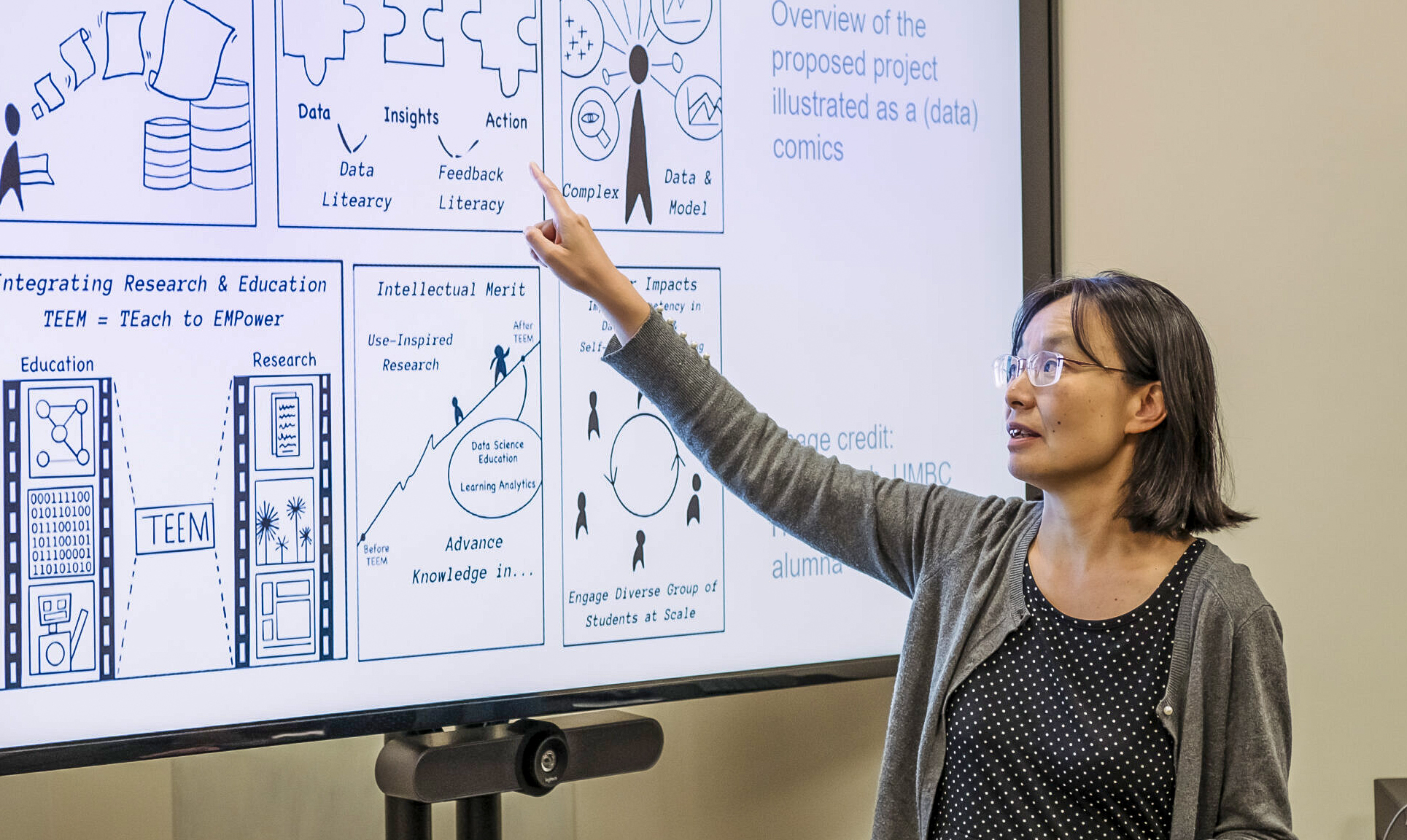
    <div class="html-content"><img src="https://ai.umbc.edu/wp-content/uploads/sites/734/2024/07/Karen-Chen-CAREER.jpg" style="max-width: 100%; height: auto;"><div><br></div><div><div>UMBC Information Systems Professor <a href="https://flourish.umbc.edu/karen-chen/" rel="nofollow external" class="bo"><strong>Lujie Karen Chen</strong></a> recently won an NSF CAREER award that puts students at the center of learning analytics—not just as subjects who supply data, but also as the designers of analytical tools and users of the insights they provide. Her five-year project, <a href="https://www.nsf.gov/awardsearch/showAward?AWD_ID=2339674" rel="nofollow external" class="bo"><strong>Teaching to Empower with Learning Analytics for College Students by College Students</strong></a>, will explore an innovative approach to empower students to become productive users and creators of learning analytics, tools that use educational data to enhance learning.</div><div><br></div><div>Chen’s <a href="https://flourish.umbc.edu/" rel="nofollow external" class="bo"><strong>Lab for Informatics for Human Flourishing</strong></a> is dedicated to using data to improve people’s lives. Education is a key pathway to advance human flourishing, Chen says, and she looks forward to improving student learning experiences and outcomes through her CAREER award project.</div><div><br></div><div>Read more about Professor Chen, her research and the NSF award in this <a href="https://umbc.edu/stories/karen-chen-nsf-career-award-student-data/" rel="nofollow external" class="bo"><strong>UMBC News article</strong></a>. </div></div><div><br></div>
    <hr><a href="https://ai.umbc.edu/" rel="nofollow external" class="bo"><strong>UMBC Center for AI</strong></a></div>
]]>
</Body>
<Summary>UMBC Information Systems Professor Lujie Karen Chen recently won an NSF CAREER award that puts students at the center of learning analytics—not just as subjects who supply data, but also as the...</Summary>
<Website>https://umbc.edu/stories/karen-chen-nsf-career-award-student-data/</Website>
<TrackingUrl>https://beta.my.umbc.edu/api/v0/pixel/news/142914/guest@my.umbc.edu/fd96a813dbba3f93018660ff17eb3298/api/pixel</TrackingUrl>
<Tag>ai</Tag>
<Tag>career</Tag>
<Tag>education</Tag>
<Tag>learning</Tag>
<Tag>nsf</Tag>
<Group token="umbc-ai">UMBC AI</Group>
<GroupUrl>https://beta.my.umbc.edu/groups/umbc-ai</GroupUrl>
<AvatarUrl>https://assets4-beta.my.umbc.edu/system/shared/avatars/groups/000/002/081/cfb27ebe008c2636486089a759ea5c36/xsmall.png?1691095779</AvatarUrl>
<AvatarUrl size="original">https://assets2-beta.my.umbc.edu/system/shared/avatars/groups/000/002/081/cfb27ebe008c2636486089a759ea5c36/original.png?1691095779</AvatarUrl>
<AvatarUrl size="xxlarge">https://assets1-beta.my.umbc.edu/system/shared/avatars/groups/000/002/081/cfb27ebe008c2636486089a759ea5c36/xxlarge.png?1691095779</AvatarUrl>
<AvatarUrl size="xlarge">https://assets1-beta.my.umbc.edu/system/shared/avatars/groups/000/002/081/cfb27ebe008c2636486089a759ea5c36/xlarge.png?1691095779</AvatarUrl>
<AvatarUrl size="large">https://assets1-beta.my.umbc.edu/system/shared/avatars/groups/000/002/081/cfb27ebe008c2636486089a759ea5c36/large.png?1691095779</AvatarUrl>
<AvatarUrl size="medium">https://assets3-beta.my.umbc.edu/system/shared/avatars/groups/000/002/081/cfb27ebe008c2636486089a759ea5c36/medium.png?1691095779</AvatarUrl>
<AvatarUrl size="small">https://assets3-beta.my.umbc.edu/system/shared/avatars/groups/000/002/081/cfb27ebe008c2636486089a759ea5c36/small.png?1691095779</AvatarUrl>
<AvatarUrl size="xsmall">https://assets4-beta.my.umbc.edu/system/shared/avatars/groups/000/002/081/cfb27ebe008c2636486089a759ea5c36/xsmall.png?1691095779</AvatarUrl>
<AvatarUrl size="xxsmall">https://assets1-beta.my.umbc.edu/system/shared/avatars/groups/000/002/081/cfb27ebe008c2636486089a759ea5c36/xxsmall.png?1691095779</AvatarUrl>
<Sponsor>UMBC AI</Sponsor>
<PawCount>2</PawCount>
<CommentCount>0</CommentCount>
<CommentsAllowed>true</CommentsAllowed>
<PostedAt>Wed, 24 Jul 2024 11:37:49 -0400</PostedAt>
<EditAt>Wed, 24 Jul 2024 11:44:56 -0400</EditAt>
</NewsItem>

<NewsItem contentIssues="true" id="142760" important="false" status="posted" url="https://beta.my.umbc.edu/groups/umbc-ai/posts/142760">
<Title>Talk: Introduction to Generative AI, 6:30-7:30 Mon July 15</Title>
<Tagline>Cascades Library, Potomac Falls, VA</Tagline>
<Body>
<![CDATA[
    <div class="html-content"><img src="https://ai.umbc.edu/wp-content/uploads/sites/734/2024/07/into_to_genai.webp" style="max-width: 100%; height: auto;"><h3><br><strong>Introduction to Generative AI</strong></h3><div><div><strong><br></strong></div><h4><strong>6:30-7:30 Monday July 15, 2024</strong></h4><div><strong><br></strong></div><h4><strong><a href="https://library.loudoun.gov/Cascades" rel="nofollow external" class="bo">Cascades Library<br></a></strong><strong>21030 Whitfield Pl, Potomac Falls, VA</strong></h4><div><br></div><div>Dr. Muhammad Ali Yousuf from <a href="https://shadygrove.umbc.edu/" rel="nofollow external" class="bo"><strong>UMBC-Shady Grove</strong></a> explores the significance of Generative AI, its growing importance, potential applications, and ethical considerations.</div><div><br></div><div><strong><a href="https://dil.umbc.edu/faculty/person/zm56817/" rel="nofollow external" class="bo">Dr. Yousuf</a> </strong>is the Graduate Program Director of Data Science in the Department of Computer Science and Electrical Engineering at UMBC-Shady Grove. He has extensive consulting experience in medical devices and AI in healthcare, and teaching experience in parallel computing, AI, robotics and intelligent manufacturing. He holds a PhD in Theoretical High Energy Physics from Quaid-i-Azam University, a postdoc in Parallel Supercomputing from SUNY Albany, and a postdoc in Medical Devices and Data from the University of Maryland, Baltimore.</div></div><div><br></div><hr><a href="https://ai.umbc.edu/" rel="nofollow external" class="bo"><strong>UMBC Center for AI</strong></a></div>
]]>
</Body>
<Summary>Introduction to Generative AI      6:30-7:30 Monday July 15, 2024     Cascades Library 21030 Whitfield Pl, Potomac Falls, VA     Dr. Muhammad Ali Yousuf from UMBC-Shady Grove explores the...</Summary>
<Website>https://loudoun.libnet.info/event/11007524</Website>
<TrackingUrl>https://beta.my.umbc.edu/api/v0/pixel/news/142760/guest@my.umbc.edu/dd13fb173545d79dc07bfc12045c7153/api/pixel</TrackingUrl>
<Tag>ai</Tag>
<Tag>genai</Tag>
<Tag>llm</Tag>
<Group token="umbc-ai">UMBC AI</Group>
<GroupUrl>https://beta.my.umbc.edu/groups/umbc-ai</GroupUrl>
<AvatarUrl>https://assets4-beta.my.umbc.edu/system/shared/avatars/groups/000/002/081/cfb27ebe008c2636486089a759ea5c36/xsmall.png?1691095779</AvatarUrl>
<AvatarUrl size="original">https://assets2-beta.my.umbc.edu/system/shared/avatars/groups/000/002/081/cfb27ebe008c2636486089a759ea5c36/original.png?1691095779</AvatarUrl>
<AvatarUrl size="xxlarge">https://assets1-beta.my.umbc.edu/system/shared/avatars/groups/000/002/081/cfb27ebe008c2636486089a759ea5c36/xxlarge.png?1691095779</AvatarUrl>
<AvatarUrl size="xlarge">https://assets1-beta.my.umbc.edu/system/shared/avatars/groups/000/002/081/cfb27ebe008c2636486089a759ea5c36/xlarge.png?1691095779</AvatarUrl>
<AvatarUrl size="large">https://assets1-beta.my.umbc.edu/system/shared/avatars/groups/000/002/081/cfb27ebe008c2636486089a759ea5c36/large.png?1691095779</AvatarUrl>
<AvatarUrl size="medium">https://assets3-beta.my.umbc.edu/system/shared/avatars/groups/000/002/081/cfb27ebe008c2636486089a759ea5c36/medium.png?1691095779</AvatarUrl>
<AvatarUrl size="small">https://assets3-beta.my.umbc.edu/system/shared/avatars/groups/000/002/081/cfb27ebe008c2636486089a759ea5c36/small.png?1691095779</AvatarUrl>
<AvatarUrl size="xsmall">https://assets4-beta.my.umbc.edu/system/shared/avatars/groups/000/002/081/cfb27ebe008c2636486089a759ea5c36/xsmall.png?1691095779</AvatarUrl>
<AvatarUrl size="xxsmall">https://assets1-beta.my.umbc.edu/system/shared/avatars/groups/000/002/081/cfb27ebe008c2636486089a759ea5c36/xxsmall.png?1691095779</AvatarUrl>
<Sponsor>UMBC AI</Sponsor>
<PawCount>0</PawCount>
<CommentCount>0</CommentCount>
<CommentsAllowed>true</CommentsAllowed>
<PostedAt>Sun, 14 Jul 2024 17:05:47 -0400</PostedAt>
<EditAt>Sun, 14 Jul 2024 17:20:39 -0400</EditAt>
</NewsItem>

<NewsItem contentIssues="true" id="142670" important="false" status="posted" url="https://beta.my.umbc.edu/groups/umbc-ai/posts/142670">
<Title>Talk: Networked Systems and Security in the age of AI</Title>
<Tagline>IEEE Systems Council Distinguished Lecture, 9am ET July 17</Tagline>
<Body>
<![CDATA[
    <div class="html-content"><div><div><br></div><div>UMBC Professor <strong><a href="https://informationsystems.umbc.edu/home/faculty-and-staff/new-faculty-spotlights/houbing-herbert-song/" rel="nofollow external" class="bo">Houbing Song</a> </strong>will give an online distinguished lecture on <strong>Networked Systems and Security Research in the Age of AI/Machine Learning</strong> at 9:00am ET on Wednesday, 17 July 2024, sponsored by the I<a href="https://ieeesystemscouncil.org/" rel="nofollow external" class="bo">EEE Systems Council</a>. <strong><a href="https://us02web.zoom.us/webinar/register/WN_jA9WLDvjRNiGHmVxSneXbA#/registration" rel="nofollow external" class="bo">Register here.</a></strong> </div><div><br></div><div>Networked systems have created new opportunities with major societal implications. At the same time, security has emerged as one of the most important socio-technical challenges confronting society. AI/machine learning (ML) techniques are expected to enable networked systems and enhance security. In this talk, I will present my recent research on networked systems and security in the age of AI/ML. First, I will introduce my ML-enabled Counter Unmanned Aircraft System(s) (C-UAS) technology that detects and safely neutralizes rogue drones without destroying them or causing them to crash. This research has been featured by 100+ news media outlets. Next I will present my follow-up research on real-time ML for quickest event (threat/intrusion/vulnerability) detection. Then I will introduce my research on data-efficient ML, particularly distant domain transfer learning.</div></div><div><br></div><hr><a href="https://ai.umbc.edu/" rel="nofollow external" class="bo"><strong>UMBC Center for AI</strong></a></div>
]]>
</Body>
<Summary>UMBC Professor Houbing Song will give an online distinguished lecture on Networked Systems and Security Research in the Age of AI/Machine Learning at 9:00am ET on Wednesday, 17 July 2024,...</Summary>
<TrackingUrl>https://beta.my.umbc.edu/api/v0/pixel/news/142670/guest@my.umbc.edu/266bea41e5c5df2abf3ab03972943581/api/pixel</TrackingUrl>
<Tag>ai</Tag>
<Tag>ieee</Tag>
<Tag>ml</Tag>
<Tag>networks</Tag>
<Tag>security</Tag>
<Group token="umbc-ai">UMBC AI</Group>
<GroupUrl>https://beta.my.umbc.edu/groups/umbc-ai</GroupUrl>
<AvatarUrl>https://assets4-beta.my.umbc.edu/system/shared/avatars/groups/000/002/081/cfb27ebe008c2636486089a759ea5c36/xsmall.png?1691095779</AvatarUrl>
<AvatarUrl size="original">https://assets2-beta.my.umbc.edu/system/shared/avatars/groups/000/002/081/cfb27ebe008c2636486089a759ea5c36/original.png?1691095779</AvatarUrl>
<AvatarUrl size="xxlarge">https://assets1-beta.my.umbc.edu/system/shared/avatars/groups/000/002/081/cfb27ebe008c2636486089a759ea5c36/xxlarge.png?1691095779</AvatarUrl>
<AvatarUrl size="xlarge">https://assets1-beta.my.umbc.edu/system/shared/avatars/groups/000/002/081/cfb27ebe008c2636486089a759ea5c36/xlarge.png?1691095779</AvatarUrl>
<AvatarUrl size="large">https://assets1-beta.my.umbc.edu/system/shared/avatars/groups/000/002/081/cfb27ebe008c2636486089a759ea5c36/large.png?1691095779</AvatarUrl>
<AvatarUrl size="medium">https://assets3-beta.my.umbc.edu/system/shared/avatars/groups/000/002/081/cfb27ebe008c2636486089a759ea5c36/medium.png?1691095779</AvatarUrl>
<AvatarUrl size="small">https://assets3-beta.my.umbc.edu/system/shared/avatars/groups/000/002/081/cfb27ebe008c2636486089a759ea5c36/small.png?1691095779</AvatarUrl>
<AvatarUrl size="xsmall">https://assets4-beta.my.umbc.edu/system/shared/avatars/groups/000/002/081/cfb27ebe008c2636486089a759ea5c36/xsmall.png?1691095779</AvatarUrl>
<AvatarUrl size="xxsmall">https://assets1-beta.my.umbc.edu/system/shared/avatars/groups/000/002/081/cfb27ebe008c2636486089a759ea5c36/xxsmall.png?1691095779</AvatarUrl>
<Sponsor>UMBC AI</Sponsor>
<ThumbnailUrl size="xxlarge">https://assets4-beta.my.umbc.edu/system/shared/thumbnails/news/000/142/670/cd1ecce9302015fedf43e56232a4c902/xxlarge.jpg?1720384655</ThumbnailUrl>
<ThumbnailUrl size="xlarge">https://assets1-beta.my.umbc.edu/system/shared/thumbnails/news/000/142/670/cd1ecce9302015fedf43e56232a4c902/xlarge.jpg?1720384655</ThumbnailUrl>
<ThumbnailUrl size="large">https://assets4-beta.my.umbc.edu/system/shared/thumbnails/news/000/142/670/cd1ecce9302015fedf43e56232a4c902/large.jpg?1720384655</ThumbnailUrl>
<ThumbnailUrl size="medium">https://assets3-beta.my.umbc.edu/system/shared/thumbnails/news/000/142/670/cd1ecce9302015fedf43e56232a4c902/medium.jpg?1720384655</ThumbnailUrl>
<ThumbnailUrl size="small">https://assets1-beta.my.umbc.edu/system/shared/thumbnails/news/000/142/670/cd1ecce9302015fedf43e56232a4c902/small.jpg?1720384655</ThumbnailUrl>
<ThumbnailUrl size="xsmall">https://assets4-beta.my.umbc.edu/system/shared/thumbnails/news/000/142/670/cd1ecce9302015fedf43e56232a4c902/xsmall.jpg?1720384655</ThumbnailUrl>
<ThumbnailUrl size="xxsmall">https://assets3-beta.my.umbc.edu/system/shared/thumbnails/news/000/142/670/cd1ecce9302015fedf43e56232a4c902/xxsmall.jpg?1720384655</ThumbnailUrl>
<PawCount>0</PawCount>
<CommentCount>0</CommentCount>
<CommentsAllowed>true</CommentsAllowed>
<PostedAt>Sun, 07 Jul 2024 16:48:30 -0400</PostedAt>
</NewsItem>

</News>