UMBC leads in environmental science & tech. research
Dr Hrabowski extols UMBC's advances & in earth sciences
From the 2013 Legislative Testimony, Dr Freeman Hrabowski, III, UMBC President
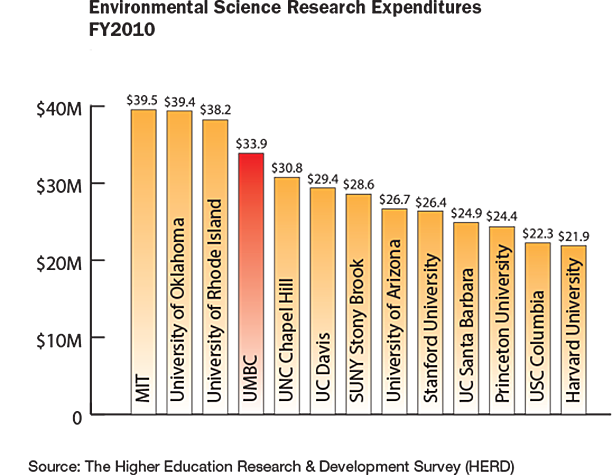
According to the Higher Education Research & Development Survey, the campus ranks 18th nationally in environmental science research and development expenditures. We recently launched the Goddard Planetary Heliophysics Institute (GPHI) through a Cooperative Agreement with the NASA Goddard Space Flight Center (GSFC) in Greenbelt, Maryland. Based at GSFC, GPHI is a center for collaborative research in solar-planetary sciences linking researchers from UMBC, the University of Maryland, College Park, and American University. The Institute focuses on phenomena ranging from solar wind to sunspots, including the effects that weather on the Sun can have on Earth and our orbiting satellites.
The recent realignment of the former University of Maryland Biotechnology Institute faculty has brought many new scientific and technology-development assets to UMBC. Maryland Sustainable Mariculture (MSM), a spin-off company founded by UMBC marine biotechnology faculty, is currently negotiating with a group of international investors who plan to lease space at the Columbus Center in downtown Baltimore to model marine aquaculture in a public display. Plasmonix, a biotechnology start-up based on technologies licensed from the Institute of Fluorescence, recently received venture capital from the Governor’s “Invest Maryland Challenge” and is now located at bwtech@UMBC, our research and technology park. In addition, our core facilities in mass spectrometry, imaging, and high-performance computing support both faculty research and companies. We work aggressively to create multi-level partnerships that connect faculty and students with companies, agencies, foundations, and school systems – and these partnerships enable us to leverage State funds. For example, we have developed major research centers and other partnerships with support from NASA and from IBM, Lockheed Martin, Northrop Grumman, SAIC, Wyeth Pharmaceuticals, the Department of Defense, the National Security Agency (NSA), and other organizations. Other partnerships with Federal and State agencies have allowed us to leverage State funds and contribute to the policy arena in gerontology (through the Erickson School for Aging, Management, and Policy and the Center for Aging Studies), the environment (through our Center for Urban Environmental Research & Education – CUERE), health care (through our Hilltop Institute), and teacher education (through the Center for History Education, the Center for Excellence in STEM Education, and the Maryland Geographic Alliance).
]]>
From the 2013 Legislative Testimony, Dr Freeman Hrabowski, III, UMBC President According to the Higher Education Research & Development Survey, the campus ranks 18th nationally in...
http://president.umbc.edu/legislative-testimony-2013/
https://beta.my.umbc.edu/api/v0/pixel/news/25588/guest@my.umbc.edu/cf88928a903087ee0c10149d47f3bbc2/api/pixel
environment
environmental
green
hrabowski
renewable
science
sustainability
technology
umbc
Sustainability Matters at UMBC
https://beta.my.umbc.edu/groups/sustainability
https://assets1-beta.my.umbc.edu/system/shared/avatars/groups/000/000/086/91091ac32f525d88daa6d6b721420ac1/xsmall.png?1586269437
https://assets3-beta.my.umbc.edu/system/shared/avatars/groups/000/000/086/91091ac32f525d88daa6d6b721420ac1/original.png?1586269437
https://assets4-beta.my.umbc.edu/system/shared/avatars/groups/000/000/086/91091ac32f525d88daa6d6b721420ac1/xxlarge.png?1586269437
https://assets2-beta.my.umbc.edu/system/shared/avatars/groups/000/000/086/91091ac32f525d88daa6d6b721420ac1/xlarge.png?1586269437
https://assets2-beta.my.umbc.edu/system/shared/avatars/groups/000/000/086/91091ac32f525d88daa6d6b721420ac1/large.png?1586269437
https://assets4-beta.my.umbc.edu/system/shared/avatars/groups/000/000/086/91091ac32f525d88daa6d6b721420ac1/medium.png?1586269437
https://assets4-beta.my.umbc.edu/system/shared/avatars/groups/000/000/086/91091ac32f525d88daa6d6b721420ac1/small.png?1586269437
https://assets1-beta.my.umbc.edu/system/shared/avatars/groups/000/000/086/91091ac32f525d88daa6d6b721420ac1/xsmall.png?1586269437
https://assets3-beta.my.umbc.edu/system/shared/avatars/groups/000/000/086/91091ac32f525d88daa6d6b721420ac1/xxsmall.png?1586269437
UMBC SUSTAINABILITY
1
0
true
Mon, 11 Mar 2013 09:56:09 -0400
Turning the University Inside Out
Michael K. Young, President, U. of Washington
Turning the University Inside Out
Michael K. Young
President, University of Washington
After an election season in which the topic of the environment was all but ignored, President Obama's pledge to action in his inaugural and State of the Union addresses has kindled long-simmering debates on how our nation should move forward in addressing our sustainability challenges. What are the most viable options for clean energy? Should we focus resources on mitigation or adaptation? What are the economic and social equity impacts of taking action on the environment? While there clearly is no single direction in which all of the answers to these and other questions will be found, any path to sustainability must run through our colleges and universities.
Increasingly, the sustainability challenges we face today require connected, integrative solutions based on highly collaborative problem-solving research that spans disciplines and reaches across geographic boundaries. Long established as incubators for discovery, universities are particularly well-suited for this kind of research. From developing clean energy sources and technologies, to Smart Grid and other initiatives, America's research universities, often in collaboration with one another as well as partners in both the public and private sectors, are at the forefront of innovation in sustainability research.
There's no question that the advances we will see in the future -- alternative energy sources, new materials that will enable us to harvest energy from those sources, policies that will govern the use of new innovations and adaptations -- will emerge from work being done at universities today. Yet while we look forward to those breakthroughs, a great deal of non-research related activity happens on campuses that underscores the unique role colleges and universities play in advancing sustainability and from which we can take both inspiration and valuable lessons right now.
Over the last several years, the Ivory Tower has undergone significant greening. Pretty much everything connected to campus life has been put under the sustainability microscope. At the University of Washington (UW), for example, our buildings have gardens on their roofs and carry certifications such as LEED Silver, Gold, and Platinum. We are biking to school and work, and recycling and composting when we get there. Our students are using sensors to measure their energy use in their residence halls, and we are reclaiming water to use in landscaping. Our custodial teams use green cleaning products, and our gardeners brew special "teas" to use instead of pesticides.
Some of the reasoning behind the decision to go green is purely financial. As a case in point, we have saved $12.83 million in utility costs over the past year at the UW as a result of the myriad energy efficiency projects we have implemented. But it really goes much deeper than money alone.
For colleges and universities -- especially public ones -- engaging with our communities is fundamental to our mission. We all have a responsibility to turn our universities inside out -- that is, to take the wealth of ideas percolating on our campuses into our community, whether that community is across the street or across the globe. By making sustainability a priority in our daily operations and practices, we demonstrate in an authentic way our commitment to making a better world for us all. At the same time, it de-mystifies the work being done at universities, connecting discernible, concrete practices with an issue as complex as climate change.
By the way we live on our campus, we also teach our students every day what it takes to live sustainably. And it's a lesson they really take to heart. Our students voted themselves on a set of fees that goes into a Campus Sustainability Fund from which they finance their own sustainability projects, including, do-it-yourself bike fix-it stations, green walls, and a bioswale to filter pollutants from storm-water runoff in a parking lot. Every year we send out about 15,000 graduates who have lived and breathed this lifestyle; it is not unrealistic to expect that they will carry this way of living with them into the real world.
In a similar vein, another unique strength of universities is our graduates who understand the innovations of today so well that they will continue developing the innovations of tomorrow. We see this process taking root every day on our UW campus where our students have undertaken such ambitious projects as building a 3D printer that can transform waste plastic into composting toilets and rain-catchment systems and developing an electric vehicle drive train that converts any car from gas to electric power. Speaking personally, I cannot wait to see what they come up with next.
The energy and commitment of our students are powerful testaments to the exceptional efficacy of colleges and universities to lead the way to sustainability. We provide laboratories for future advances, as well as for what works now. By leveraging this experience, we can change the world -- ensuring a healthier, greener, more sustainable planet for ourselves and for generations to come.
This is the first post in a seven-part series titled, "Students of Sustainability: How Higher Education Can Teach the World To Be More Planet-Minded." It is presented in partnership with the University of Washington.
]]>
Turning the University Inside Out Michael K. Young President, University of Washington After an election season in which the topic of the environment was all but ignored, President Obama's...
http://www.huffingtonpost.com/michael-k-young/green-colleges-_b_2830622.html?ncid=edlinkusaolp00000003&ir=Green
https://beta.my.umbc.edu/api/v0/pixel/news/25552/guest@my.umbc.edu/43bc714c6575fc3ec1c39a64cbb2ecb0/api/pixel
Sustainability Matters at UMBC
https://beta.my.umbc.edu/groups/sustainability
https://assets1-beta.my.umbc.edu/system/shared/avatars/groups/000/000/086/91091ac32f525d88daa6d6b721420ac1/xsmall.png?1586269437
https://assets3-beta.my.umbc.edu/system/shared/avatars/groups/000/000/086/91091ac32f525d88daa6d6b721420ac1/original.png?1586269437
https://assets4-beta.my.umbc.edu/system/shared/avatars/groups/000/000/086/91091ac32f525d88daa6d6b721420ac1/xxlarge.png?1586269437
https://assets2-beta.my.umbc.edu/system/shared/avatars/groups/000/000/086/91091ac32f525d88daa6d6b721420ac1/xlarge.png?1586269437
https://assets2-beta.my.umbc.edu/system/shared/avatars/groups/000/000/086/91091ac32f525d88daa6d6b721420ac1/large.png?1586269437
https://assets4-beta.my.umbc.edu/system/shared/avatars/groups/000/000/086/91091ac32f525d88daa6d6b721420ac1/medium.png?1586269437
https://assets4-beta.my.umbc.edu/system/shared/avatars/groups/000/000/086/91091ac32f525d88daa6d6b721420ac1/small.png?1586269437
https://assets1-beta.my.umbc.edu/system/shared/avatars/groups/000/000/086/91091ac32f525d88daa6d6b721420ac1/xsmall.png?1586269437
https://assets3-beta.my.umbc.edu/system/shared/avatars/groups/000/000/086/91091ac32f525d88daa6d6b721420ac1/xxsmall.png?1586269437
UMBC SUSTAINABILITY
0
0
true
Sun, 10 Mar 2013 18:47:51 -0400
Sun, 10 Mar 2013 18:49:36 -0400
Parks Internships available in Balitmore
Urban Resources Initiative of Parks and People Foundation
For all interested students - these are summer internships offered by
the Urban Resources Initiative of Parks and People Foundation. As they
indicate, they are particularly interested in advanced undergraduates
and graduate students. Many of these are unpaid but you can inquire
about the details if you are interested in any of them. You may be
able to earn upper-level internship credit for these. Information on
the URI program and the Summer 2013 internships can be found here:
http://www.parksandpeople.org/learn/urban-resources-initiative/internships/.
]]>
For all interested students - these are summer internships offered by the Urban Resources Initiative of Parks and People Foundation. As they indicate, they are particularly interested in...
https://beta.my.umbc.edu/api/v0/pixel/news/25408/guest@my.umbc.edu/d5025b145eba9dca106df6d6d818b38c/api/pixel
Sustainability Matters at UMBC
https://beta.my.umbc.edu/groups/sustainability
https://assets1-beta.my.umbc.edu/system/shared/avatars/groups/000/000/086/91091ac32f525d88daa6d6b721420ac1/xsmall.png?1586269437
https://assets3-beta.my.umbc.edu/system/shared/avatars/groups/000/000/086/91091ac32f525d88daa6d6b721420ac1/original.png?1586269437
https://assets4-beta.my.umbc.edu/system/shared/avatars/groups/000/000/086/91091ac32f525d88daa6d6b721420ac1/xxlarge.png?1586269437
https://assets2-beta.my.umbc.edu/system/shared/avatars/groups/000/000/086/91091ac32f525d88daa6d6b721420ac1/xlarge.png?1586269437
https://assets2-beta.my.umbc.edu/system/shared/avatars/groups/000/000/086/91091ac32f525d88daa6d6b721420ac1/large.png?1586269437
https://assets4-beta.my.umbc.edu/system/shared/avatars/groups/000/000/086/91091ac32f525d88daa6d6b721420ac1/medium.png?1586269437
https://assets4-beta.my.umbc.edu/system/shared/avatars/groups/000/000/086/91091ac32f525d88daa6d6b721420ac1/small.png?1586269437
https://assets1-beta.my.umbc.edu/system/shared/avatars/groups/000/000/086/91091ac32f525d88daa6d6b721420ac1/xsmall.png?1586269437
https://assets3-beta.my.umbc.edu/system/shared/avatars/groups/000/000/086/91091ac32f525d88daa6d6b721420ac1/xxsmall.png?1586269437
UMBC SUSTAINABILITY
2
0
true
Thu, 07 Mar 2013 15:19:29 -0500
Presidential Voices Interview Series: Jo Ann M. Gora, Ball State University
AASHE’s Presidential Voices interview series features conversations with heads of higher education institutions who are inspiring sustainability leaders. To recommend a president or chancellor for this series, contact Judy Walton, chief publications officer, at judy@aashe.org.
Jo Ann M. Gora, our guest for this interview, became President of Ball State University in 2004. She was one of 12 charter signatories to the American College & University Presidents’ Climate Commitment in December 2006. In May 2009, she and other officials broke ground on the largest geothermal district energy system in the United States. Phase One, completed in 2012, allowed Ball State to shut down two coal-fired boilers. For its sustainability commitment, the university has been ranked in The Princeton Review's “Guide to 311 Green Colleges,” and has earned a Second Nature Climate Leadership Award. The institution also earned a STARS Gold rating from AASHE in 2012. President Gora has co-authored two book chapters on campus sustainability initiatives. She earned her bachelor's degree in political science from Vassar College and master's and doctoral degrees in sociology from Rutgers University.
JW: How is sustainability at Ball State integrated into the institution’s mission, vision and values?
JG: We have integrated various dimensions of sustainability into our university’s ongoing work by seeking broad, deep engagement from all the members of the Ball State community. Several years ago, we started these efforts with the appointment of two different green committees. The first investigated ways to broaden environmental education across our curriculum, and the second was to recommend techniques for implementing the tenets of the Talloires Declaration, which my predecessor, Dr. John Worthen, had signed in 1999. 
Our Council on the Environment (COTE) was established in 1991, making it the longest-standing green committee at any college or university in the state. It represents the full breadth of constituents within our academic community and the communities that surround our campus. One of its earliest initiatives was to adopt a university statement on sustainability, which was endorsed by senior staff, academic deans, the University Senate, and finally the Board of Trustees. This public statement has been on our web page since that cycle of review and approval. We’ve expanded that public commitment by introducing sustainability concepts into our last two strategic plans and our most recent one, which was approved by the Board of Trustees in December and will guide the university through 2017.
Included in the goals and objectives is the creation of sustainability plans by 102 administrative units on campus, including my office. We give continuing attention to the structure of these plans to feed into our STARS reporting. We’ve also created an interactive “Get on the Map” web site using the STARS framework to which any member of the campus can submit updates on his/her activity either individually or as part of a collaborative group.
These sustainability plans have influenced many of our strategic planning decisions, including my decision to be one of the first 12 signatories to the American College & University Presidents’ Climate Commitment (ACUPCC). Other examples include Ball State’s move to become one of the first Midwestern universities to use electronic shuttle buses, deploying an electric car for our on-campus deliveries, acquiring hybrid electric vehicles for our automotive fleet, and moving the majority of the remaining fleet to flex-fuel capability.
Finally, we have woven sustainability into the centerpiece of a Ball State education, a form of experiential learning we call immersive learning. Immersive learning brings together an interdisciplinary team of students under a faculty mentor for at least a semester, and often as long as an academic year. This team works with a community, business, or nonprofit organization to provide a real-world solution to a real-world problem the organization is facing. Between 2007 and 2012, more than 16,400 of our students participated in at least one of more than 1,000 immersive learning projects, which have affected every Indiana citizen and taken our students as far away as Venice, Hong Kong, Vietnam, and Malawi.
We believe this form of learning is essential to shaping the collaboration and innovation skills our students need to succeed in the complex world they are entering after graduation. And I’m proud to say that several of these projects have important sustainability outcomes. I could give many examples, but here is just one. Under the guidance of Gwen White, associate professor of accounting, several teams of students have completed a series of Global Reporting Initiative sustainability reports for local organizations, similar to what most of the world’s largest 250 companies are now doing. Their efforts last spring to develop a report for Minnetrista, a cultural center and museum here in Muncie, resulted in it becoming the first U.S. museum to file a complete GRI sustainability report.
JW: Ball State’s geothermal energy system has been hailed as the nation’s largest ground-source, closed-loop district system. What was behind this effort, and how much is it expected to reduce your carbon footprint and energy costs?
JG: Our geothermal ground-source, district-scale heating and cooling system happened because several opportunities aligned at the same time. We were facing the need to replace four aging coal-fired boilers and had secured funding from the Indiana General Assembly to do that. We had committed to becoming a climate-neutral campus through my signing of ACUPCC, and we were willing to take a long-term view of the big picture. Specifically, that view meant examining such factors as the efficiencies of high-performance heat-pump technology, the elimination of Scope 1 fossil fuel (coal) combustion on campus, the future cost avoidance for potential carbon taxing, and the opportunity to engage our students and faculty in real-time and long-term research in monitoring and evaluating the performance of the system, once installed.
 We were able to secure financial support through a state appropriation, plus a U.S. Department of Energy grant to cover the cost of Phase One, which involved the drilling of some 1,800 bore holes on the northern end of our campus and installing our first two heat-pump chillers in our North Energy Station. The picture here shows then-U.S. Senator Richard Lugar standing with me at our groundbreaking ceremony for the geothermal project in 2009. We finished Phase One last spring and our early data shows that we are on target to save $1 million a year.
We have recently completed the drilling of some of the additional 1,800 bore holes required for Phase Two. These boreholes are being installed next to our boiler plant, which is located on the south end of campus. The project is on pause until additional funding is obtained, but we continue to pursue funding to complete Phase Two and are hopeful of the outcome.
With the completion of the project, the university will be able to shut down all four coal-fired boilers that generate 85,000 metric tons of CO2 equivalent emissions annually. That’s nearly 50 percent of our carbon footprint. We will be heating and cooling 47 major buildings, and our net operational savings is projected to be $2 million per year.
JW: Is there something special about Ball State’s geology, financing, etc. that made the geothermal project pencil out? Or would you say virtually any institution in the state or region could undertake a geothermal project and see similar benefits?
JG: We are convinced that this technology is appropriate for other campuses for several reasons. It is a closed-loop, water circulating system that simply transfers thermal energy throughout campus and into or out of the ground. It can be scaled to service a single building, a group of buildings, or an entire campus. It has significant immediate and long-term cost benefits given the leveraging effect of (upstream) electrical power for sourcing and sinking of thermal energy to the earth (on-site). Finally, it positions a university to avoid future costs associated with carbon taxing—whether as a straight-up tax, a fee-and-rebate system, or a cap-and-trade system.
JW: Your biography states that since your arrival in 2004, “approximately $418 million of completed or current construction and renovation has changed the face of Ball State’s campus.” What is Ball State’s commitment to green building, and how is it manifest in all of this newly built or renovated space?
JG: Yes, we have mandated through our strategic planning process that all new construction be certified as LEED at the silver level (at a minimum), and that those same criteria be used in renovation of existing facilities. We have five buildings (new and/or renovated) that have either been so certified or will achieve such recognition. Among them are classroom buildings, such as the David Letterman Communication and Media Building, built in 2007, and residence halls, including our completely renovated DeHority Complex, originally constructed in 1960. Also on that list is our Student Recreation and Wellness Center, a building used by the entire campus.
Although seeking LEED certification requires some effort on the front side by our design teams and our facilities management staff, the payoff is substantial. We will continue to use a whole-systems approach as required in our strategic planning. In fact, we have coordinated our strategic planning cycles with those of carbon reduction planning so we can integrate these two dimensions of our resource stewardship.
JW: What are some of Ball State’s leading sustainability initiatives in the areas of curriculum and outreach?
JG: In terms of how we integrate sustainability into our curriculum and our outreach programs, there are many great examples. Ball State students over the decades have majored in environmental management or minored in environmental management, environmental policy, or environmentally sustainable practices. Generations of them have gone on to demonstrate success after graduation by leading sustainability initiatives in a number of professional fields. Our students, especially those in the College of Architecture and Planning, have studied everything from recycling and reuse of building materials to applications of solar energy in locations around the world.
We recently began our doctoral degree in environmental sciences, which enables students to use their skills in biology, chemistry, and geological sciences to address environmental problems in an interdisciplinary way.
We’ve also established the Academy for Sustainability, a knowledge group that encourages new initiatives in research, education, and service across disciplinary lines. We believe these cross-disciplinary endeavors by our faculty and students are sorely needed to address the complexities of social, economic and environmental sustainability.
Our sustainability outreach endeavors stretch back three decades to when we established Ball State’s Center for Energy Research, Education, and Service (CERES). CERES is an interdisciplinary academic support unit that focuses on sustainability issues, especially energy use and conservation. Faculty and students lead its activities, which not only serve our campus, but also the surrounding community and the state of Indiana. CERES has a long history of interdisciplinary research in everything from alternative fuels to community planning and from resource analysis to materials testing. One of its most recognizable programs is the Greening of the Campus conference, which traces back to 1996 and is generally held every other year. We have reached thousands of college faculty, students, administrators, and facilities professionals through the past nine conferences to discuss sustainability issues and share effective strategies. It has had a major impact on the decision-making process regarding sustainability issues at many colleges and universities across our country.
Finally, sustainability has become a large part of our university’s student life. The Ball State Energy Action Team is a student group that leads energy awareness initiatives, including the semi-annual residence hall energy challenge, a contest to see which living unit on our campus can demonstrate the greatest reduction in energy use over a four-week period. Last fall, students in nine residence halls reduced electricity consumption by about 100,000 kilowatts, saving Ball State approximately $5,000. Another student group, Students for a Sustainable Campus, organizes the biennial teach-in on our campus examining sustainability issues as part of the national Focus the Nation initiative.
JW: From your service on the Board of the American Council on Education, and the Council of Presidents of the Association of Governing Boards, do you see sustainability issues becoming more central to the work of these organizations and to higher education in general? What would you say are the biggest challenges to advancing sustainability in higher education?
JG: I do think sustainability issues are becoming more important in higher education. I’ve been invited to make presentations at Association of Governing Boards conferences about sustainability, and a lot of AGB members are focusing on the importance of cooperation between universities and their boards of trustees in analyzing and solving these complexities. We had a group of American Council on Education Fellows visit us last summer, specifically to investigate our geothermal project and other sustainability efforts. These are the educators who are being groomed to be presidents, chancellors, and provosts, so that shows the attention sustainability is receiving.
I think the biggest challenges to advancing sustainability in higher education are thinking long-term, both economically and environmentally, and developing the interdisciplinary knowledge and resources to address its complexities. I often tell national and state leaders that our geothermal project is not just green environmentally, in that we are reducing our carbon footprint, but also economically, because we are saving money in the long run. The initial investment is substantial, but the long-term payoff is real. Unfortunately, especially in trying economic times, the tendency is to focus on the former instead of the latter.
For any institution to be successful in its strategic planning about sustainability, the vision has to be shared at every level of the administration, in every academic department, and with all of your constituencies. Sustainability efforts can’t be short-lived; you have to develop the vision, establish the integrated associations and structure, and continue to shepherd the resources needed to sustain a long-term commitment if you want to be successful.
JW: What would you like to see accomplished next in terms of sustainability at Ball State University?
JG: With the completion of our geothermal project, we will have reduced our environmental impact significantly. However, we must not pause in our efforts. While removing Scope 1 emissions from our Greenhouse Gas portfolio is critical, we must continue to make our buildings more energy efficient. By decreasing our energy needs, we will further reduce the amount of energy we purchase from third-party suppliers.
JW: What do you do in your free time?
JG: That’s an interesting question because there isn’t much of it! In addition to my duties as Ball State president, I sit on several boards, so that service is an additional time commitment.
My husband and I are outdoor enthusiasts. We walk and hike, bicycle, and play tennis and golf. We both enjoy reading, especially books and articles about issues facing higher education or about other issues of national and state politics. Family and friends get neglected far too often, but when we do have significant blocks of time, we love to visit with our two grandchildren in North Carolina. A relaxing dinner with friends or a romp in the park with a 5 and 3 year old will do wonders for your frame of mind.
]]>
AASHE’s Presidential Voices interview series features conversations with heads of higher education institutions who are inspiring sustainability leaders. To recommend a president or chancellor for...
http://feedproxy.google.com/~r/CampusSustainabilityPerspectives/~3/iHWC5Z4wDHI/presidential-voices-interview-series-jo-ann-m-gora-ball-state-university
https://beta.my.umbc.edu/api/v0/pixel/news/25316/guest@my.umbc.edu/82cf81f855d0a7d30a5c0407a70c3949/api/pixel
interviews
presidents-and-chancellors
Sustainability Matters at UMBC
https://beta.my.umbc.edu/groups/sustainability
https://assets1-beta.my.umbc.edu/system/shared/avatars/groups/000/000/086/91091ac32f525d88daa6d6b721420ac1/xsmall.png?1586269437
https://assets3-beta.my.umbc.edu/system/shared/avatars/groups/000/000/086/91091ac32f525d88daa6d6b721420ac1/original.png?1586269437
https://assets4-beta.my.umbc.edu/system/shared/avatars/groups/000/000/086/91091ac32f525d88daa6d6b721420ac1/xxlarge.png?1586269437
https://assets2-beta.my.umbc.edu/system/shared/avatars/groups/000/000/086/91091ac32f525d88daa6d6b721420ac1/xlarge.png?1586269437
https://assets2-beta.my.umbc.edu/system/shared/avatars/groups/000/000/086/91091ac32f525d88daa6d6b721420ac1/large.png?1586269437
https://assets4-beta.my.umbc.edu/system/shared/avatars/groups/000/000/086/91091ac32f525d88daa6d6b721420ac1/medium.png?1586269437
https://assets4-beta.my.umbc.edu/system/shared/avatars/groups/000/000/086/91091ac32f525d88daa6d6b721420ac1/small.png?1586269437
https://assets1-beta.my.umbc.edu/system/shared/avatars/groups/000/000/086/91091ac32f525d88daa6d6b721420ac1/xsmall.png?1586269437
https://assets3-beta.my.umbc.edu/system/shared/avatars/groups/000/000/086/91091ac32f525d88daa6d6b721420ac1/xxsmall.png?1586269437
UMBC SUSTAINABILITY
0
0
false
Wed, 06 Mar 2013 11:49:28 -0500
Wed, 06 Mar 2013 11:49:28 -0500
GES Professor on the State of the Global Ecosystem
Dr. Elis’s research emphasizes managing local ecosystems
Back from the Edge
Could our global ecosystem be careening towards a cliff? That’s what some scientists think. Erle Ellis, an associate professor of geography and environmental systems at UMBC, and a group of scientists from Australia and the United Kingdom are trying to talk their colleagues back from the edge in a new paper published this week in Trends in Ecology and Evolution.
There is growing agreement among scientists that we now live in an epoch called the Anthropocene – an age where humanity has transformed the world’s ecosystems, atmosphere and even its rocks. The question is whether humans are causing changes in Earth’s ecosystems that might soon trigger a global tipping point. Is the Anthropocene biosphere accelerating towards a point of no return?
While the idea of global tipping points is controversial, ecological tipping points at the local level are well studied. For example, “if you add nutrients to a lake it will continue on as before until you surpass a certain level of nutrients. Then the lake’s ecosystem will suddenly shift to a new state -- it will have reached its tipping point,” says Ellis. “The lake will go from having very clear water to very turbid water, the kinds of fish will change and the chemistry and the ecology of the lake will change almost completely. It is then very hard to get that lake back into its previous state.”
A planetary tipping point in Earth’s ecosystems could occur, say Ellis and his colleagues, if ecosystems across the planet responded to uniform human pressures in similar ways, or if there were strong connections across continents and ecosystems that enabled the rapid transmission of ecological impacts across the planet.
Fortunately, Ellis and his colleagues are convinced that a planetary tipping point in ecology isn’t likely to occur on Earth. To begin with, organisms and ecosystems on different continents aren’t strongly connected. Animals, plants and microbes are greatly limited in their interactions by distance and barriers such as oceans and mountain ranges. Accordingly, responses to human pressures depend largely on local conditions. Even global climate change is unlikely to produce a coherent global shift in ecology because local ecosystems respond so differently to changes in climate.
“Essentially, local changes aren’t acting to push each other over the edge, as is the case with tipping points,” Ellis says. “They are simply adding up to cause long-term global changes in ecology.”
While we still need to think about global impacts, Ellis’ research puts the emphasis back on managing ecosystems at the local and regional level. That assertion has significant policy implications and could help us avoid misguided conservation efforts. “The disadvantage of thinking in terms of global tipping points,”says Ellis,“is that if you think you are far from the brink, no need to act, and if you think you’ve passed the tipping point you might as well give up.”
(3/1/13)
]]>
Back from the Edge Could our global ecosystem be careening towards a cliff? That’s what some scientists think. Erle Ellis, an associate professor of geography and environmental systems at UMBC,...
https://beta.my.umbc.edu/api/v0/pixel/news/25309/guest@my.umbc.edu/a535d2c1617a0251fe5eeb2b662993a5/api/pixel
Sustainability Matters at UMBC
https://beta.my.umbc.edu/groups/sustainability
https://assets1-beta.my.umbc.edu/system/shared/avatars/groups/000/000/086/91091ac32f525d88daa6d6b721420ac1/xsmall.png?1586269437
https://assets3-beta.my.umbc.edu/system/shared/avatars/groups/000/000/086/91091ac32f525d88daa6d6b721420ac1/original.png?1586269437
https://assets4-beta.my.umbc.edu/system/shared/avatars/groups/000/000/086/91091ac32f525d88daa6d6b721420ac1/xxlarge.png?1586269437
https://assets2-beta.my.umbc.edu/system/shared/avatars/groups/000/000/086/91091ac32f525d88daa6d6b721420ac1/xlarge.png?1586269437
https://assets2-beta.my.umbc.edu/system/shared/avatars/groups/000/000/086/91091ac32f525d88daa6d6b721420ac1/large.png?1586269437
https://assets4-beta.my.umbc.edu/system/shared/avatars/groups/000/000/086/91091ac32f525d88daa6d6b721420ac1/medium.png?1586269437
https://assets4-beta.my.umbc.edu/system/shared/avatars/groups/000/000/086/91091ac32f525d88daa6d6b721420ac1/small.png?1586269437
https://assets1-beta.my.umbc.edu/system/shared/avatars/groups/000/000/086/91091ac32f525d88daa6d6b721420ac1/xsmall.png?1586269437
https://assets3-beta.my.umbc.edu/system/shared/avatars/groups/000/000/086/91091ac32f525d88daa6d6b721420ac1/xxsmall.png?1586269437
UMBC SUSTAINABILITY
https://assets1-beta.my.umbc.edu/system/shared/thumbnails/news/000/025/309/dc9dab195b7aeefb54a4f8bfa798d2da/xxlarge.jpg?1362586028
https://assets1-beta.my.umbc.edu/system/shared/thumbnails/news/000/025/309/dc9dab195b7aeefb54a4f8bfa798d2da/xlarge.jpg?1362586028
https://assets1-beta.my.umbc.edu/system/shared/thumbnails/news/000/025/309/dc9dab195b7aeefb54a4f8bfa798d2da/large.jpg?1362586028
https://assets4-beta.my.umbc.edu/system/shared/thumbnails/news/000/025/309/dc9dab195b7aeefb54a4f8bfa798d2da/medium.jpg?1362586028
https://assets4-beta.my.umbc.edu/system/shared/thumbnails/news/000/025/309/dc9dab195b7aeefb54a4f8bfa798d2da/small.jpg?1362586028
https://assets4-beta.my.umbc.edu/system/shared/thumbnails/news/000/025/309/dc9dab195b7aeefb54a4f8bfa798d2da/xsmall.jpg?1362586028
https://assets4-beta.my.umbc.edu/system/shared/thumbnails/news/000/025/309/dc9dab195b7aeefb54a4f8bfa798d2da/xxsmall.jpg?1362586028
2
1
true
Wed, 06 Mar 2013 11:08:16 -0500
Highly recommended Summer Environmental Leadership Program
Students are encouraged to apply, gain key skills & support
Highly recommended Summer Environmental Leadership Program for students:
Do
you want to learn how to make change through organizing? Sprog is a
program run across the country that will give you the skills and the
confidence to make the change you want to see in the world. Apply at http://ssc.wearepowershift.org/sprog!
]]>
Highly recommended Summer Environmental Leadership Program for students: Do you want to learn how to make change through organizing? Sprog is a program run across the country that will...
https://beta.my.umbc.edu/api/v0/pixel/news/25269/guest@my.umbc.edu/1a04e0cb544d979627555aa362957bb9/api/pixel
Sustainability Matters at UMBC
https://beta.my.umbc.edu/groups/sustainability
https://assets1-beta.my.umbc.edu/system/shared/avatars/groups/000/000/086/91091ac32f525d88daa6d6b721420ac1/xsmall.png?1586269437
https://assets3-beta.my.umbc.edu/system/shared/avatars/groups/000/000/086/91091ac32f525d88daa6d6b721420ac1/original.png?1586269437
https://assets4-beta.my.umbc.edu/system/shared/avatars/groups/000/000/086/91091ac32f525d88daa6d6b721420ac1/xxlarge.png?1586269437
https://assets2-beta.my.umbc.edu/system/shared/avatars/groups/000/000/086/91091ac32f525d88daa6d6b721420ac1/xlarge.png?1586269437
https://assets2-beta.my.umbc.edu/system/shared/avatars/groups/000/000/086/91091ac32f525d88daa6d6b721420ac1/large.png?1586269437
https://assets4-beta.my.umbc.edu/system/shared/avatars/groups/000/000/086/91091ac32f525d88daa6d6b721420ac1/medium.png?1586269437
https://assets4-beta.my.umbc.edu/system/shared/avatars/groups/000/000/086/91091ac32f525d88daa6d6b721420ac1/small.png?1586269437
https://assets1-beta.my.umbc.edu/system/shared/avatars/groups/000/000/086/91091ac32f525d88daa6d6b721420ac1/xsmall.png?1586269437
https://assets3-beta.my.umbc.edu/system/shared/avatars/groups/000/000/086/91091ac32f525d88daa6d6b721420ac1/xxsmall.png?1586269437
UMBC SUSTAINABILITY
https://assets4-beta.my.umbc.edu/system/shared/thumbnails/news/000/025/269/5a3f14123cb2123e5a861d42dfa7e14c/xxlarge.jpg?1362521386
https://assets1-beta.my.umbc.edu/system/shared/thumbnails/news/000/025/269/5a3f14123cb2123e5a861d42dfa7e14c/xlarge.jpg?1362521386
https://assets1-beta.my.umbc.edu/system/shared/thumbnails/news/000/025/269/5a3f14123cb2123e5a861d42dfa7e14c/large.jpg?1362521386
https://assets3-beta.my.umbc.edu/system/shared/thumbnails/news/000/025/269/5a3f14123cb2123e5a861d42dfa7e14c/medium.jpg?1362521386
https://assets1-beta.my.umbc.edu/system/shared/thumbnails/news/000/025/269/5a3f14123cb2123e5a861d42dfa7e14c/small.jpg?1362521386
https://assets2-beta.my.umbc.edu/system/shared/thumbnails/news/000/025/269/5a3f14123cb2123e5a861d42dfa7e14c/xsmall.jpg?1362521386
https://assets4-beta.my.umbc.edu/system/shared/thumbnails/news/000/025/269/5a3f14123cb2123e5a861d42dfa7e14c/xxsmall.jpg?1362521386
0
0
true
Tue, 05 Mar 2013 18:06:39 -0500
The Fracking of Rachel Carson: Rescheduled for next month
Due to the snow forecast, the lecture will be on Earth Day
This is to let you know that the lecture by Dr. Sandra Steingraber
originally scheduled for tomorrow has been rescheduled due to the snow
storm expected to hit our region tonight and tomorrow. Her talk will now
take place on Earth Day, April 22, at 4 pm.
*RESCHEDULED DUE TO WEATHER*
New date: Monday, April 22 at 4pm
Proscenium Theater, Performing Arts and Humanities Building
The Fracking of Rachel Carson: Silent Spring in an Age of Environmental
Crisis**
*Sandra Steingraber,* Professor of Education, Stanford University
A cancer survivor, Dr. Sandra Steingraber has written extensively on the
intersection of the environment and public health. She will discuss what we
have learned, and failed to learn, in the 50 years since Rachel Carson's
publication of Silent Spring , and will examine the threat to public
health that fracking poses.
*Korenman Lecture, *sponsored by the Department of Gender and Women Studies
with support from the Department of American Studies, the College of Arts,
Humanities and Social Sciences, the Dresher Center for the Humanities,
Geography and Environmental Systems, Office of the Provost, Social Sciences
Forum, and Women in Science and Engineering
Delana Gregg
UMBC Social Sciences Forum
http://www.umbc.edu/socsforum/
]]>
This is to let you know that the lecture by Dr. Sandra Steingraber originally scheduled for tomorrow has been rescheduled due to the snow storm expected to hit our region tonight and tomorrow....
https://beta.my.umbc.edu/api/v0/pixel/news/25206/guest@my.umbc.edu/ff64b52967bb7140faafb512cf696554/api/pixel
Sustainability Matters at UMBC
https://beta.my.umbc.edu/groups/sustainability
https://assets1-beta.my.umbc.edu/system/shared/avatars/groups/000/000/086/91091ac32f525d88daa6d6b721420ac1/xsmall.png?1586269437
https://assets3-beta.my.umbc.edu/system/shared/avatars/groups/000/000/086/91091ac32f525d88daa6d6b721420ac1/original.png?1586269437
https://assets4-beta.my.umbc.edu/system/shared/avatars/groups/000/000/086/91091ac32f525d88daa6d6b721420ac1/xxlarge.png?1586269437
https://assets2-beta.my.umbc.edu/system/shared/avatars/groups/000/000/086/91091ac32f525d88daa6d6b721420ac1/xlarge.png?1586269437
https://assets2-beta.my.umbc.edu/system/shared/avatars/groups/000/000/086/91091ac32f525d88daa6d6b721420ac1/large.png?1586269437
https://assets4-beta.my.umbc.edu/system/shared/avatars/groups/000/000/086/91091ac32f525d88daa6d6b721420ac1/medium.png?1586269437
https://assets4-beta.my.umbc.edu/system/shared/avatars/groups/000/000/086/91091ac32f525d88daa6d6b721420ac1/small.png?1586269437
https://assets1-beta.my.umbc.edu/system/shared/avatars/groups/000/000/086/91091ac32f525d88daa6d6b721420ac1/xsmall.png?1586269437
https://assets3-beta.my.umbc.edu/system/shared/avatars/groups/000/000/086/91091ac32f525d88daa6d6b721420ac1/xxsmall.png?1586269437
UMBC SUSTAINABILITY
https://assets4-beta.my.umbc.edu/system/shared/thumbnails/news/000/025/206/398fe2ec0161a64eb0ce33ece464fc06/xxlarge.jpg?1362493278
https://assets3-beta.my.umbc.edu/system/shared/thumbnails/news/000/025/206/398fe2ec0161a64eb0ce33ece464fc06/xlarge.jpg?1362493278
https://assets3-beta.my.umbc.edu/system/shared/thumbnails/news/000/025/206/398fe2ec0161a64eb0ce33ece464fc06/large.jpg?1362493278
https://assets4-beta.my.umbc.edu/system/shared/thumbnails/news/000/025/206/398fe2ec0161a64eb0ce33ece464fc06/medium.jpg?1362493278
https://assets2-beta.my.umbc.edu/system/shared/thumbnails/news/000/025/206/398fe2ec0161a64eb0ce33ece464fc06/small.jpg?1362493278
https://assets1-beta.my.umbc.edu/system/shared/thumbnails/news/000/025/206/398fe2ec0161a64eb0ce33ece464fc06/xsmall.jpg?1362493278
https://assets3-beta.my.umbc.edu/system/shared/thumbnails/news/000/025/206/398fe2ec0161a64eb0ce33ece464fc06/xxsmall.jpg?1362493278
1
0
true
Tue, 05 Mar 2013 09:58:43 -0500
The Beauty of Net-Zero Energy Infrastructure: Lessons from History, Actions Today, and Dreams for the Future
By Andrea Putman
Director of Corporate Partnerships, Second Nature
President, Green Innovations, LLC
As we connect the dots from ancient history to the distant future, we envision and hope for a clean and safe future for our grandchildren’s grandchildren. Sustainability professionals work diligently so that our posterity will look back at these days of the early 21st century and be pleased that their ancestors had wisdom, courage, tenacity, and imagination to overcome the huge obstacles of fast speeding and hard charging climate disruption. By honoring the ancient wisdom of our ancestors and working to protect the future occupants of our planet, our strong actions and passion may stand the tests of time. Although net-zero energy buildings currently represent a minuscule percentage of our nation’s infrastructure, they represent a hope for our descendants.
Daylighting and Passive Cooling and Heating
The Pantheon, the temple dedicated to all the gods of pagan Rome, connects us to the distant past. As the light streams in through the open oculus as it has for 2000 years, the architectural masterpiece promotes deep reflection and awe and may inspire us to work for a better future. Today, architects and engineers use daylighting extensively in high performance and green buildings. They take advantage of the daylighting’s well-documented benefits of reducing energy demand and associated costs; increasing occupants’ sense of well-being (as well as students’ test scores and retail sales).
The Research Support Facility (RSF), located on the U.S. Department of Energy’s National Renewable Energy Lab campus in Golden, Colorado, is the largest net-zero energy (NZE) building in the world and widely considered to be the nation’s greenest building. Remarkably, RSF was built at no additional costs compared to traditional construction. This building has many cutting-edge technological features and also takes advantage of simple daylight. 100 percent of the workstations are daylit with the light entering the southfacing windows and reflecting to the ceiling and deep into the space with lightreflecting devices.
Stepping out of the summer sun and into the majestic European cathedrals and mosques, one feels the striking difference of broiling hot to refreshingly cool. RSF’s planners integrated this age-old lesson. Today, RSF has a labyrinth thermal storage that provides for additional capacity for passive heating and cooling. Massive concrete structures are located in the crawl space. They store thermal energy and act as a thermal battery. This reduces the building’s cooling load in summer by pre-cooling the ventilation air. In the winter, the labyrinth stores heat from the facility’s computers. Outside air is warmed by the sun shining down on transpired solar collectors and then delivered to the labyrinth.1
Higher Education Examples
A handful of higher education institutions are pushing the limits by constructing highly energy efficient and net-zero energy infrastructure and integrating these lessons into curricula. Stellar examples include Georgia Institute of Technology in Atlanta, GA; North Shore Community College (NSCC) in Danvers, MA; and University of California, Davis.
Georgia Tech is constructing a cutting-edge Carbon Neutral Energy Solutions Laboratory with a goal of carbon neutral net zero site energy use. This is a game-changing feat in part because research universities’ laboratories have huge energy demands. Georgia Tech is working to achieve a new standard for sustainable design and is integrating passive energy technologies including extensive daylighting.2 NSCC’s Health Professions & Student Services Building is first state-owned NZE building in Massachusetts. Among its other features, this building uses natural ventilation and maximizes daylighting.3 Both institutions are integrated lesson from these buildings into curriculum, providing dynamic living labs, and inspiring students and their communities.
Students at colleges and universities throughout the country and world work diligently and collaboratively to design, construct, and monitor NZE homes. Since 2002, 112 collegiate teams have enthusiastically participated in the US Department of Energy’s Solar Decathlon. Teams of college students spend approximately two years designing and constructing homes that, among other criteria, are powered by the sun and produce as much or more energy than they consume. The Decathlon has expanded to include nearly 10,000 students. In addition to the Decathlon in the US, international competitions have been held in Europe and are planned in China in August 2013. Teams of students from US and are collaborating with students from around the world.4
We are at vitally important crossroads as we make decisions and take actions that will have long term impacts. We may dream about entire campuses that expand into communities to help restore our damaged ecosystem by not depending on fossil fuels to run our homes, offices, and schools. Although it may feel a bit fanciful to envision a net-zero energy community, University of California, Davis project at West Village, is the largest planned NZE community in the United States. This model employs a combination of aggressive energy efficiency and on-site renewable energy generation. As we marvel at NZE buildings, we can envision restorative buildings that provide energy back to the power grid to feed its voracious and growing appetite. We may begin to build communities that are not simply carbon neutral but rather “climate positive” as a mechanism to nourish and restore our earth. Let us gather ancient wisdom as we create a bright tomorrow and fortify the future.
1 http://www.nrel.gov/sustainable_nrel/pdfs/48943.pdf (accessed Feb. 27, 2013)
2 http://www.northshore.edu/sustainability/zneb (accessed Feb. 27, 2013)
3 http://www.solardecathlon.gov/about.html (accessed Feb. 27, 2013)
4 http://westvillage.ucdavis.edu/energy (accessed Feb. 27, 2013)
]]>
By Andrea Putman Director of Corporate Partnerships, Second Nature President, Green Innovations, LLC As we connect the dots from ancient history to the distant future, we envision and hope for...
http://feedproxy.google.com/~r/CampusSustainabilityPerspectives/~3/DgoshKJ8JWw/beauty-net-zero-energy-infrastructure-lessons-history-actions-today-and-dreams-future
https://beta.my.umbc.edu/api/v0/pixel/news/25192/guest@my.umbc.edu/bfb2915e75b7d98d3431e57f184a7b24/api/pixel
connecting-the-dots
Sustainability Matters at UMBC
https://beta.my.umbc.edu/groups/sustainability
https://assets1-beta.my.umbc.edu/system/shared/avatars/groups/000/000/086/91091ac32f525d88daa6d6b721420ac1/xsmall.png?1586269437
https://assets3-beta.my.umbc.edu/system/shared/avatars/groups/000/000/086/91091ac32f525d88daa6d6b721420ac1/original.png?1586269437
https://assets4-beta.my.umbc.edu/system/shared/avatars/groups/000/000/086/91091ac32f525d88daa6d6b721420ac1/xxlarge.png?1586269437
https://assets2-beta.my.umbc.edu/system/shared/avatars/groups/000/000/086/91091ac32f525d88daa6d6b721420ac1/xlarge.png?1586269437
https://assets2-beta.my.umbc.edu/system/shared/avatars/groups/000/000/086/91091ac32f525d88daa6d6b721420ac1/large.png?1586269437
https://assets4-beta.my.umbc.edu/system/shared/avatars/groups/000/000/086/91091ac32f525d88daa6d6b721420ac1/medium.png?1586269437
https://assets4-beta.my.umbc.edu/system/shared/avatars/groups/000/000/086/91091ac32f525d88daa6d6b721420ac1/small.png?1586269437
https://assets1-beta.my.umbc.edu/system/shared/avatars/groups/000/000/086/91091ac32f525d88daa6d6b721420ac1/xsmall.png?1586269437
https://assets3-beta.my.umbc.edu/system/shared/avatars/groups/000/000/086/91091ac32f525d88daa6d6b721420ac1/xxsmall.png?1586269437
UMBC SUSTAINABILITY
0
0
false
Tue, 05 Mar 2013 04:29:46 -0500
How Many Dots to Connect? Defining Sustainability in the Curriculum Pt. 2
By Julian Dautremont-Smith
Chief Sustainability Officer
Alfred State College
In part 1 of this post, I examined current practices for identifying sustainability courses and found that definitions of sustainability-focused and -related courses tend to leave too much room for interpretation. As a result, institutions are taking widely varying approaches to course classification and there is a huge range in scores earned on the two credits in STARS that focus on courses (ER Credits 6 and 7). Based on these findings, I argued that more guidance in STARS was necessary. In this post, I’ll make some suggestions for what this guidance should look like.
Given the wide spread of scores earned on ER 6 and 7, the first issue such guidance must address is how wide we should cast our net when classifying sustainability courses. At first blush, a more inclusive approach seems to make sense. Virtually all disciplines have an important role to play in sustainability and it seems appropriate to recognize the contributions that courses are making. Indeed, using a broad definition may enable better engagement with faculty who may not have realized that they were teaching a “sustainability” course.
The problem is that it is too easy to stretch the broader definitions to include virtually all courses. For example, some institutions classified many of their medical and nursing courses as sustainability-related, perhaps on the not-unreasonable basis that human health is an element of sustainability. However, similar logic could be used to count all economics and perhaps even most business courses as sustainability-related on the basis that they address the economic dimension of sustainability. Likewise, the logic would seem to support counting any course that addresses social well-being in one way or another, including sociology, gender studies, cultural studies, psychology, etc. To the extent that the arts contribute to human well-being, theater, music, fine arts, and even art history courses could conceivably be counted. Language courses could count because they facilitate communication across cultures, which is a prerequisite for effective global resource management. Even physical education courses could count since they contribute to human health.
Unfortunately, classifying every course as a sustainability course isn’t useful. It doesn’t provide an incentive for additional integration of sustainability concepts into the curriculum and it doesn't enable meaningful benchmarking over time or in comparison to peers. So how do we create definitions that recognize the potential contribution of all disciplines but still result in useful and comparable data?
Defining “sustainability-focused” in a way that generates more comparable data seems fairly straightforward. The key in my opinion is to make more clear that the course must explicitly focus on sustainability as an integrated concept. That means courses which emphasize just a part of sustainability do not count and neither do traditional courses that include some sustainability content. Providing some examples of courses that likely would and would not count will also help to make this clear. Here’s what I recommend:
A sustainability focused course is one in which the primary focus is sustainability as an integrated concept, including its social, economic, and environmental dimensions. This focus must be explicit. Typically, this will be achieved by including “sustainability” or “sustainable” in the course title. At a minimum, sustainability must appear prominently in the course description. As sustainability is an interdisciplinary topic, such courses generally incorporate insights from multiple disciplines. These courses are also likely to have been created recently since sustainability is a relatively new field of study.
Courses that would likely count:
- Introduction to Sustainability
- Sustainable Agriculture
- Architecture for Sustainability
- Sustainable Business
- Sustainability Science
Courses that could count if their primary focus is explicitly sustainability:
- Introduction to Environmental Studies
- Literature and Nature
- Ecological Economics
- Systems Thinking and Analysis
- International Development
- Environmental Ethics
- Global Environmental Health
- Society and the Environment
- Corporate Social Responsibility
- Urban Planning
- Environmental Technology
- Environmental Law and Policy
- Life Cycle Assessment
- Environmental History
- Resilient Societies
Courses that would likely not count:
- Cultural Anthropology
- Organic Chemistry
- Microeconomics
- Transportation Planning
- Geographic Information Systems
- Civil Engineering
- Marine Biology
- Epidemiology
- Introduction to Gender Studies
- Transcendentalist Literature
- Nursing 1
- Oncology
Redefining “sustainability-related” more precisely seems much more challenging. The nomenclature itself seems problematic. Virtually all courses are related to sustainability in some way. Even courses that likely undermine sustainability (e.g. courses on marketing luxury goods or coal mining) are related to sustainability and yet I don’t think we ought to be awarding points for such courses through STARS.
Given this, I think it might be best to retire the “sustainability-related” label and develop new labels that better reflect the different ways courses can advance sustainability. In addition to courses that are focused on sustainability, I can think of two other major categories of courses that we should seek to recognize and encourage through STARS: courses that are inclusive of sustainability and courses that are supportive of sustainability. I define these terms as follows:
A course that is inclusive of sustainability is one that is primarily focused on a topic other than sustainability but includes at least one unit or module on sustainability as an integrated concept, including its social, economic, and environmental dimensions. The word “sustainability” is likely to appear somewhere in the syllabus of such courses.
Courses that would likely count:
- an Introduction to Chemistry course that includes a module on green chemistry and chemistry’s contribution to sustainability
- an Art and Social Change course that examines art’s contribution to sustainability
- a Math in Society course in which practice problems are oriented around sustainability
- a Business in the European Union course with a unit on sustainability
- an Ethics courses that discusses inter-generational equity and the sustainability ethic
A course that is supportive of sustainability includes at least one unit or module that provides skills or knowledge directly connected to solving one or more major sustainability challenges, including: climate change and ocean acidification; poverty and global inequalities; depletion of nonrenewable resources; barriers to cooperation posed by prejudice and intolerance; over-harvesting of renewable resources (e.g. fisheries, soils, and forests); habitat destruction and loss of biodiversity; undemocratic institutions and violations of human rights, over fertilization of water bodies; desertification and water scarcity; violence and war; and toxics in the environment. Such courses do not necessarily cover “sustainability” as a concept but should address more than one of the three dimensions of sustainability (i.e. social well being, economic prosperity, and environmental health).
Courses that would likely count:
- Photovoltaic and Wind Turbine Installation
- a Construction Management course in which students help construct a green building
- Conservation Biology
- Environmental Journalism
- Peace Studies
- Development Studies
- Natural Resource Management
- Organic Agriculture
- Neglected Diseases
- an Urban Planning course in which students develop plans for sustainable redevelopment of a city park
- Bioremediation
- Climate Adaptation
- Integrated Pest Management
- National Environmental Policy Act
- an HVAC course that includes a unit on high-efficiency and geothermal systems
- Life Cycle Assessment
- Geo-engineering
- Cause Marketing
- Green Chemistry
- Environmental Design
Admittedly, these definitions (especially the one for courses that are supportive of sustainability) still leave more room for interpretation than might seem ideal for comparability purposes, but I’m not sure how much additional specificity is possible. I couldn’t figure out how to be more specific without excluding courses that I think we really do want to be able to recognize and encourage through STARS. Given the diversity of courses offered by STARS participants, allowing some room for interpretation seems inevitable and probably desirable. My hope is that these proposed definitions would significantly reduce, if not eliminate, variability in how institutions are classifying and reporting on sustainability courses.
If AASHE were to incorporate these new definitions into STARS, I’d recommend counting all three types of sustainability courses equally. It's not obvious that one type of course inherently contributes more to sustainability than another. Valuing the courses equally also reflects the reality that the differences in content between a course that is focused on sustainability and a course that is supportive of sustainability may be quite small in some cases. This approach is likely to lead to more accurate categorization since participants would not be tempted to classify each course in the most lucrative category possible.
I'm keenly aware that diagnosing the problem is much easier than proposing a workable solution so I’d love comments on these proposed definitions. Constructive suggestions are especially welcome! Are they clear? Too open-ended or too narrow? What would make them better?
]]>
By Julian Dautremont-Smith Chief Sustainability Officer Alfred State College In part 1 of this post, I examined current practices for identifying sustainability courses and found that...
http://feedproxy.google.com/~r/CampusSustainabilityPerspectives/~3/Xb1vnsX8s3k/how-many-dots-connect-defining-sustainability-curriculum-pt-2
https://beta.my.umbc.edu/api/v0/pixel/news/24755/guest@my.umbc.edu/ab36feb1ff3d68ef92351a8faaf659e0/api/pixel
connecting-the-dots
Sustainability Matters at UMBC
https://beta.my.umbc.edu/groups/sustainability
https://assets1-beta.my.umbc.edu/system/shared/avatars/groups/000/000/086/91091ac32f525d88daa6d6b721420ac1/xsmall.png?1586269437
https://assets3-beta.my.umbc.edu/system/shared/avatars/groups/000/000/086/91091ac32f525d88daa6d6b721420ac1/original.png?1586269437
https://assets4-beta.my.umbc.edu/system/shared/avatars/groups/000/000/086/91091ac32f525d88daa6d6b721420ac1/xxlarge.png?1586269437
https://assets2-beta.my.umbc.edu/system/shared/avatars/groups/000/000/086/91091ac32f525d88daa6d6b721420ac1/xlarge.png?1586269437
https://assets2-beta.my.umbc.edu/system/shared/avatars/groups/000/000/086/91091ac32f525d88daa6d6b721420ac1/large.png?1586269437
https://assets4-beta.my.umbc.edu/system/shared/avatars/groups/000/000/086/91091ac32f525d88daa6d6b721420ac1/medium.png?1586269437
https://assets4-beta.my.umbc.edu/system/shared/avatars/groups/000/000/086/91091ac32f525d88daa6d6b721420ac1/small.png?1586269437
https://assets1-beta.my.umbc.edu/system/shared/avatars/groups/000/000/086/91091ac32f525d88daa6d6b721420ac1/xsmall.png?1586269437
https://assets3-beta.my.umbc.edu/system/shared/avatars/groups/000/000/086/91091ac32f525d88daa6d6b721420ac1/xxsmall.png?1586269437
UMBC SUSTAINABILITY
0
0
false
Tue, 26 Feb 2013 10:22:20 -0500
Tue, 26 Feb 2013 10:22:20 -0500
Event: Food Sustainability Panel, Thurs, Feb 28, pm
Breaking Ground project around gardening, food, health

UMBC’s Graduate Student Association (GSA) will host a discussion of community engagement and food justice next Thursday, February 28th at 6:00 p.m. in Lower Flat Tuesday’s (The Commons, UMBC). The event marks the kickoff of a collaboration between the GSA and Pigtown Food for Thought.
Panelists will include Toma Solano and Eric Jackson, Baltimore natives and community activists who founded Pigtown Food for Thought; Jessica McNeely, a UMBC graduate student in psychology studying food justice issues; and Jill Wrigley, who teaches a course about food in UMBC’s Interdisciplinary Studies program and previously served as an Open Society Institute Fellow.
