One of UMBC’s top revenue-generating technologies has just been licensed for the third time, this time to GE Healthcare. This demonstrates that the university’s strong efforts to commercialize its research are paying off.
“UMBC benefits from technology transfer not just in measurable dollars from licensing revenue but also by building relationships with companies,” says Wendy Martin, director of technology development at UMBC.
The technology allows companies to use an external sensor to measure a range of environmental factors including pH, oxygen, and carbon dioxide levels in cell culture. The sensor peels and sticks to the inside of the plastic or glassware. The entire vessel is then sterilized and sold to the customer. The sensor works by looking for a specific fluorescent signature associated with each environmental factor.
“It works much like a bar code scanner,” says Govind Rao, a professor of chemical and biochemical engineering at UMBC who developed the technology after almost 20 years of research.
Prior methods required scientists to use something like an “electrical dipstick.” That is, says Rao, “they had to place a corded, electrical probe into the cell culture,” risking contamination of the entire culture. “It’s like moving from a corded phone to a cordless phone,” he says.
Because the adhesive probe allows scientists to avoid costly contamination it saves companies millions in labor and materials. For the general population this means that the time to market for new drugs can be reduced -- an innovation that positively impacts human health.
]]>
One of UMBC’s top revenue-generating technologies has just been licensed for the third time, this time to GE Healthcare. This demonstrates that the university’s strong efforts to commercialize its...http://www.umbc.edu/research/blog/2011/09/umbc_research_proves_valuable.htmlhttps://beta.my.umbc.edu/api/v0/pixel/news/46491/guest@my.umbc.edu/f04688e6572ae258ee51b929a7a4c16e/api/pixelovpr-news-2011Archived RCA Newshttps://beta.my.umbc.edu/groups/researchhttps://assets4-beta.my.umbc.edu/system/shared/avatars/groups/000/000/794/4bca2aa331eb7e472d63d97e0798b600/xsmall.png?1743706368https://assets2-beta.my.umbc.edu/system/shared/avatars/groups/000/000/794/4bca2aa331eb7e472d63d97e0798b600/original.jpg?1743706368https://assets3-beta.my.umbc.edu/system/shared/avatars/groups/000/000/794/4bca2aa331eb7e472d63d97e0798b600/xxlarge.png?1743706368https://assets4-beta.my.umbc.edu/system/shared/avatars/groups/000/000/794/4bca2aa331eb7e472d63d97e0798b600/xlarge.png?1743706368https://assets2-beta.my.umbc.edu/system/shared/avatars/groups/000/000/794/4bca2aa331eb7e472d63d97e0798b600/large.png?1743706368https://assets4-beta.my.umbc.edu/system/shared/avatars/groups/000/000/794/4bca2aa331eb7e472d63d97e0798b600/medium.png?1743706368https://assets4-beta.my.umbc.edu/system/shared/avatars/groups/000/000/794/4bca2aa331eb7e472d63d97e0798b600/small.png?1743706368https://assets4-beta.my.umbc.edu/system/shared/avatars/groups/000/000/794/4bca2aa331eb7e472d63d97e0798b600/xsmall.png?1743706368https://assets3-beta.my.umbc.edu/system/shared/avatars/groups/000/000/794/4bca2aa331eb7e472d63d97e0798b600/xxsmall.png?1743706368Office of the Vice President for Research00falseThu, 29 Sep 2011 12:00:00 -0400Quality Assisted Living: A New Book from UMBC’s Center for Aging Studies
Contact:
Dinah Winnick
Communications Manager
University of Maryland, Baltimore County (UMBC)
410-455-8117 dwinnick@umbc.edu
Today, 75 million baby boomers are poised to become the next generation of assisted living residents. The sheer size of this population emphasizes the importance of creating, sustaining and evaluating quality in these settings to ensure that elders can access housing that fits their wants and needs. With this in mind, a team of researchers at the UMBC Center for Aging Studies has published “Quality Assisted Living: Informing Practice through Research” (Springer 2011).
This innovate volume is unique in its approach—explicitly delving into the lives of those who inhabit assisted living facilities, seeking to understand and evaluate their perceptions of what constitutes quality of life. The book also includes staff and family member perspectives, collected through interviews by authors Leslie A. Morgan, Ann Christine Frankowski, Erin G. Roth, Lynn Keimig, Sheryl Zimmerman and J. Kevin Eckert, chair of UMBC’s Department of Sociology and Anthropology.
Looking for a high quality assisted living facility can be a stressful experience for older adults and their families. Co-author Leslie Morgan notes the challenge starts when we ask, “What is high quality?” In a preview video introducing the book, Morgan suggests a more helpful question would be: “What facility would best meet the individual personality and needs of my loved one?”
“Quality Assisted Living” provides accessible discussion of assisted living topics ranging from dining preferences to housing regulations to financial issues. Grounded in rigorous qualitative research funded by the National Institute on Aging, and conveying residents’ own words, the book is of interest to popular and academic audiences alike.
]]>
Contact: Dinah Winnick Communications Manager University of Maryland, Baltimore County (UMBC) 410-455-8117 dwinnick@umbc.edu Today, 75 million baby boomers are poised to become the next...http://www.umbc.edu/research/blog/2011/08/quality_assisted_living_a_new_3.htmlhttps://beta.my.umbc.edu/api/v0/pixel/news/46492/guest@my.umbc.edu/85481ae4f2db397e8e5c5ff180d57a72/api/pixelovpr-news-2011Archived RCA Newshttps://beta.my.umbc.edu/groups/researchhttps://assets4-beta.my.umbc.edu/system/shared/avatars/groups/000/000/794/4bca2aa331eb7e472d63d97e0798b600/xsmall.png?1743706368https://assets2-beta.my.umbc.edu/system/shared/avatars/groups/000/000/794/4bca2aa331eb7e472d63d97e0798b600/original.jpg?1743706368https://assets3-beta.my.umbc.edu/system/shared/avatars/groups/000/000/794/4bca2aa331eb7e472d63d97e0798b600/xxlarge.png?1743706368https://assets4-beta.my.umbc.edu/system/shared/avatars/groups/000/000/794/4bca2aa331eb7e472d63d97e0798b600/xlarge.png?1743706368https://assets2-beta.my.umbc.edu/system/shared/avatars/groups/000/000/794/4bca2aa331eb7e472d63d97e0798b600/large.png?1743706368https://assets4-beta.my.umbc.edu/system/shared/avatars/groups/000/000/794/4bca2aa331eb7e472d63d97e0798b600/medium.png?1743706368https://assets4-beta.my.umbc.edu/system/shared/avatars/groups/000/000/794/4bca2aa331eb7e472d63d97e0798b600/small.png?1743706368https://assets4-beta.my.umbc.edu/system/shared/avatars/groups/000/000/794/4bca2aa331eb7e472d63d97e0798b600/xsmall.png?1743706368https://assets3-beta.my.umbc.edu/system/shared/avatars/groups/000/000/794/4bca2aa331eb7e472d63d97e0798b600/xxsmall.png?1743706368Office of the Vice President for Research00falseMon, 22 Aug 2011 12:00:00 -0400New Study by UMBC-led Research Team Details Glacier Ice Loss Following Ice Shelf Collapse
Anthony Lane
University of Maryland, Baltimore County (UMBC)
410-455-5793 alane@umbc.edu
Patrick Lynch
NASA Goddard Space Flight Center, Greenbelt, Md.
757-897-2047 patrick.lynch@nasa.gov
Katherine Leitzell
National Snow and Ice Data Center, Boulder, Colo.
University of Colorado
303-492-1497
leitzell@nsidc.org
GREENBELT, Md. -- An international team of researchers has combined data from multiple sources to provide the clearest account yet of how much glacial ice surges into the sea following the collapse of Antarctic ice shelves.
The work by researchers at the University of Maryland, Baltimore County (UMBC), the Laboratoire d'Etudes en Géophysique et Océanographie Spatiales, Centre National de la Recherche Scientifique at the University of Toulouse, France, and the University of Colorado's National Snow and Ice Data Center, Boulder, Colo. details recent ice losses while promising to sharpen future predictions of further ice loss and sea level rise likely to result from ongoing changes along the Antarctic Peninsula.
"Not only do you get an initial loss of glacial ice when adjacent ice shelves collapse, but you get continued ice losses for many years — even decades — to come," says Christopher Shuman, a researcher at UMBC's Joint Center for Earth Systems Technology (JCET) at the NASA Goddard Space Flight Center, Greenbelt, Md. "This further demonstrates how important ice shelves are to Antarctic glaciers."
Shuman is lead author of the study “2001–2009 elevation and mass losses in the Larsen A and B embayments, Antarctic Peninsula“ published online today in the Journal of Glaciology.
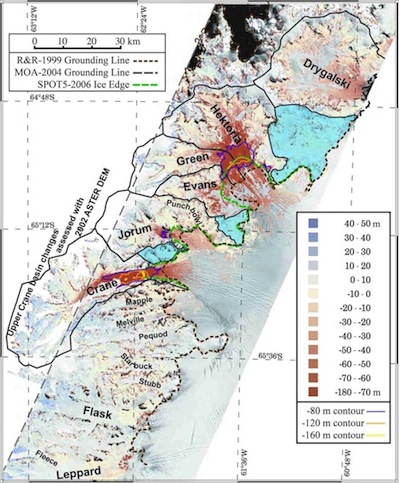
An ice shelf is a thick floating tongue of ice, fed by a tributary glacier, extending into the sea off a land mass. Previous research showed that the recent collapse of several ice shelves in Antarctica led to acceleration of the glaciers that feed into them. Combining satellite data from NASA and the French space agency CNES, along with measurements collected during aircraft missions similar to ongoing NASA IceBridge flights, Shuman, Etienne Berthier of the University of Toulouse and Ted Scambos of the University of Colorado produced detailed ice loss maps from 2001 to 2009 for the main tributary glaciers of the Larsen A and B ice shelves, which collapsed in 1995 and 2002, respectively.
"The approach we took drew on the strengths of each data source to produce the most complete picture yet of how these glaciers are changing," Berthier said, noting that the study relied on easy access to remote sensing information provided by NASA and CNES. The team used data from NASA sources including the MODerate Imaging Spectroradiometer (MODIS) instruments and the Ice, Cloud and land Elevation Satellite (ICESat).
The analysis reveals rapid elevation decreases of more than 500 feet for some glaciers, and it puts the total ice loss from 2001 to 2006 squarely between the widely varying and less certain estimates produced using an approach that relies on assumptions about a glacier's mass budget.
The authors’ analysis shows ice loss in the study area of at least 11.2 gigatons per year from 2001 to 2006. Their ongoing work shows ice loss from 2006 to 2010 was almost as large, averaging 10.2 gigatons per year.
“This study shows where the tracking of sea level rise is heading in terms of the level of detail possible and the instrumentation that can be brought to bear,” Scambos said. “We’re showing that glacier changes can start fast, with a single climate or ocean ‘bang’, but they have a long persistence.”
An animation showing ice edge changes for the Larsen B ice shelf and its adjacent tributary glaciers is available online, along with a larger version of the map below showing elevation changes of tributary glaciers.
A companion paper — “The triggering of sub glacial lake drainage during rapid glacier drawdown: Crane Glacier, Antarctic Peninsula” — by the same three authors, led by Scambos, is also available online in the Annals of Glaciology in the issue “Earth's Disappearing Ice: Drivers, Responses and Impacts.”
]]>
Anthony Lane University of Maryland, Baltimore County (UMBC) 410-455-5793 alane@umbc.edu Patrick Lynch NASA Goddard Space Flight Center, Greenbelt, Md. 757-897-2047...http://www.umbc.edu/research/blog/2011/07/new_study_by_umbcled_research.htmlhttps://beta.my.umbc.edu/api/v0/pixel/news/46493/guest@my.umbc.edu/586107689dfdee1917383beacf57b9b0/api/pixelovpr-news-2011Archived RCA Newshttps://beta.my.umbc.edu/groups/researchhttps://assets4-beta.my.umbc.edu/system/shared/avatars/groups/000/000/794/4bca2aa331eb7e472d63d97e0798b600/xsmall.png?1743706368https://assets2-beta.my.umbc.edu/system/shared/avatars/groups/000/000/794/4bca2aa331eb7e472d63d97e0798b600/original.jpg?1743706368https://assets3-beta.my.umbc.edu/system/shared/avatars/groups/000/000/794/4bca2aa331eb7e472d63d97e0798b600/xxlarge.png?1743706368https://assets4-beta.my.umbc.edu/system/shared/avatars/groups/000/000/794/4bca2aa331eb7e472d63d97e0798b600/xlarge.png?1743706368https://assets2-beta.my.umbc.edu/system/shared/avatars/groups/000/000/794/4bca2aa331eb7e472d63d97e0798b600/large.png?1743706368https://assets4-beta.my.umbc.edu/system/shared/avatars/groups/000/000/794/4bca2aa331eb7e472d63d97e0798b600/medium.png?1743706368https://assets4-beta.my.umbc.edu/system/shared/avatars/groups/000/000/794/4bca2aa331eb7e472d63d97e0798b600/small.png?1743706368https://assets4-beta.my.umbc.edu/system/shared/avatars/groups/000/000/794/4bca2aa331eb7e472d63d97e0798b600/xsmall.png?1743706368https://assets3-beta.my.umbc.edu/system/shared/avatars/groups/000/000/794/4bca2aa331eb7e472d63d97e0798b600/xxsmall.png?1743706368Office of the Vice President for Research00falseMon, 25 Jul 2011 12:00:00 -0400UMBC Receives Grant to Operate NASA Center Focused on Space Weather
The University of Maryland, Baltimore County (UMBC) will administer a new NASA research center focused on studying space weather and the impact it can have on human activities.
The Goddard Planetary Heliophysics Institute (GPHI), operating under a 5-year, $10 million cooperative agreement, will provide support and resources for university researchers to collaborate with scientists at NASA’s Goddard Space Flight Center as they refine efforts to predict the solar activity that ejects charged particles into space. The “weather” created by these events interferes with power grids, telecommunication systems and other activities on Earth, while also threatening spacecraft and creating risks for space travel.
“This agreement offers a great opportunity to continue research that is deepening our understanding of solar and magnetospheric physics,” said Jan Merka, director of the new center. “The main goal is to more reliably predict space weather so we can avoid the impacts on space and Earth activities caused by extreme solar and magnetospheric events."
The GPHI research portfolio was formerly part of the UMBC-administered Goddard Earth Sciences and Technology Center (GEST). The cooperative agreement that established GEST in 2000 expired in May, and research now encompassed by GPHI was re-competed separately from the rest of the GEST portfolio. The remainder of GEST is now administered under a new cooperative agreement between NASA and the University Space Research Association.
The research group at GEST that focused on heliophysics has expanded to 16 researchers at GPHI.
UMBC has a long history of working closely with scientists at NASA and the Goddard Space Flight Center. In addition to GPHI, UMBC administers the Joint Center for Earth Systems Technology (JCET), which focuses on geosciences and is now in its sixteenth year. The university is also a partner in the Center for Research and Exploration in Space Science and Technology (CRESST), which focuses on astrophysics.
"We are delighted to continue collaborating with NASA in the area of planetary and heliophsyics research as GPHI scientists work to expand our understanding of space weather," said Geoff Summers, UMBC's vice president for research. "This ongoing area of research is particularly exciting as it both increases our understanding of the solar system and helps explain the effect of space weather on Earth."
]]>
Contact: Anthony Lane alane@umbc.edu (410) 455-5793 The University of Maryland, Baltimore County (UMBC) will administer a new NASA research center focused on studying space weather and...http://www.umbc.edu/research/blog/2011/06/umbc_receives_grant_to_operate_1.htmlhttps://beta.my.umbc.edu/api/v0/pixel/news/46494/guest@my.umbc.edu/e8e0aebec5d22ecb74fcd3d01c1dad57/api/pixelovpr-news-2011Archived RCA Newshttps://beta.my.umbc.edu/groups/researchhttps://assets4-beta.my.umbc.edu/system/shared/avatars/groups/000/000/794/4bca2aa331eb7e472d63d97e0798b600/xsmall.png?1743706368https://assets2-beta.my.umbc.edu/system/shared/avatars/groups/000/000/794/4bca2aa331eb7e472d63d97e0798b600/original.jpg?1743706368https://assets3-beta.my.umbc.edu/system/shared/avatars/groups/000/000/794/4bca2aa331eb7e472d63d97e0798b600/xxlarge.png?1743706368https://assets4-beta.my.umbc.edu/system/shared/avatars/groups/000/000/794/4bca2aa331eb7e472d63d97e0798b600/xlarge.png?1743706368https://assets2-beta.my.umbc.edu/system/shared/avatars/groups/000/000/794/4bca2aa331eb7e472d63d97e0798b600/large.png?1743706368https://assets4-beta.my.umbc.edu/system/shared/avatars/groups/000/000/794/4bca2aa331eb7e472d63d97e0798b600/medium.png?1743706368https://assets4-beta.my.umbc.edu/system/shared/avatars/groups/000/000/794/4bca2aa331eb7e472d63d97e0798b600/small.png?1743706368https://assets4-beta.my.umbc.edu/system/shared/avatars/groups/000/000/794/4bca2aa331eb7e472d63d97e0798b600/xsmall.png?1743706368https://assets3-beta.my.umbc.edu/system/shared/avatars/groups/000/000/794/4bca2aa331eb7e472d63d97e0798b600/xxsmall.png?1743706368Office of the Vice President for Research00falseTue, 21 Jun 2011 12:00:00 -0400UMBC Researchers Find 1 in 30 Maryland Adults Have a Gambling Problem
Contact:
Dinah Winnick
Communications Manager
University of Maryland, Baltimore County (UMBC)
410-455-8117 dwinnick@umbc.edu
On June 13, 2011, Maryland’s Department of Health and Mental Hygiene (DHMH) released Gambling Prevalence in Maryland: A Baseline Analysis, prepared by a team from UMBC’s Maryland Institute for Policy Analysis and Research (MIPAR). The study on gambling habits and pathological gambling behaviors found that although gambling is largely a positive activity for Marylanders, 3.4% of Maryland adults experience problem or pathological gambling.
According to the report, the essential features of “pathological gambling” include “continuous or periodic loss of control over gambling, progression in gambling involvement, and a continuation of involvement despite adverse consequences” such as damage to “personal, family or vocational pursuits.” Interventions, such as counseling, can prevent less severe “problem gambling” from progressing to the more serious disorder.
This study was mandated by a 2007 law authorizing video lottery terminals and expanding the gambling environment in Maryland. Study team leader Judith Shinogle, MIPAR research scientist, explains “the baseline study determines the geographic regions where Marylanders gambled prior to the implementation of slots.” Future replication studies will be necessary “to determine whether the implementation of slots can be associated with any subsequent changes in problem gambling behaviors and negative social impacts.”
Additional study collaborators, beyond MIPAR at UMBC, include Gemini Research, Inc., and the University of Baltimore Schaefer Center for Public Policy, which collected the data. They contacted 56,807 households between September 7, 2010 and October 31, 2010 for a final sample of 5,975. Their survey assessed gambling through casinos, lottery, horse and dog racing, bingo, sports, private games and websites.
Tom Carigulo, Director of the Maryland Alcohol and Drug Abuse Administration, says, “The results will help us design the next steps directed toward preventing and treating gambling disorders.” The full report is available at www.umbc.edu/mipar.
This study is the second major piece of gambling research produced by UMBC social scientists in recent months. Robert E. Carpenter, Evan L. Perlman and Donald F. Norris coauthored “Who Pays for the Maryland Lottery? Evidence from Point of Sale Data” in The Journal of Gambling Business and Economics. The research used a novel interdisciplinary approach including GIS maps to examine lottery sales in relation to demographics.
Their findings show “the voluntary tax collected by the Maryland lottery comes disproportionately from census tracts populated by African American s and low-income residents,” specifically those “with less than a high-school education, and people age 65 and older.” Speaking to policymakers, the researchers write that states “must consider if the burden of the voluntary tax represented by lottery expenditures and the fact that lottery revenues are drawn disproportionately from what are commonly thought to be disadvantaged socio-economic groups is consistent with their broader social policies.”
]]>
Contact: Dinah Winnick Communications Manager University of Maryland, Baltimore County (UMBC) 410-455-8117 dwinnick@umbc.edu On June 13, 2011, Maryland’s Department of Health and Mental...http://www.umbc.edu/research/blog/2011/06/umbc_researchers_find_1_in_30.htmlhttps://beta.my.umbc.edu/api/v0/pixel/news/46495/guest@my.umbc.edu/a7d481acedadcebba3051cba15d9211f/api/pixelovpr-news-2011Archived RCA Newshttps://beta.my.umbc.edu/groups/researchhttps://assets4-beta.my.umbc.edu/system/shared/avatars/groups/000/000/794/4bca2aa331eb7e472d63d97e0798b600/xsmall.png?1743706368https://assets2-beta.my.umbc.edu/system/shared/avatars/groups/000/000/794/4bca2aa331eb7e472d63d97e0798b600/original.jpg?1743706368https://assets3-beta.my.umbc.edu/system/shared/avatars/groups/000/000/794/4bca2aa331eb7e472d63d97e0798b600/xxlarge.png?1743706368https://assets4-beta.my.umbc.edu/system/shared/avatars/groups/000/000/794/4bca2aa331eb7e472d63d97e0798b600/xlarge.png?1743706368https://assets2-beta.my.umbc.edu/system/shared/avatars/groups/000/000/794/4bca2aa331eb7e472d63d97e0798b600/large.png?1743706368https://assets4-beta.my.umbc.edu/system/shared/avatars/groups/000/000/794/4bca2aa331eb7e472d63d97e0798b600/medium.png?1743706368https://assets4-beta.my.umbc.edu/system/shared/avatars/groups/000/000/794/4bca2aa331eb7e472d63d97e0798b600/small.png?1743706368https://assets4-beta.my.umbc.edu/system/shared/avatars/groups/000/000/794/4bca2aa331eb7e472d63d97e0798b600/xsmall.png?1743706368https://assets3-beta.my.umbc.edu/system/shared/avatars/groups/000/000/794/4bca2aa331eb7e472d63d97e0798b600/xxsmall.png?1743706368Office of the Vice President for Research00falseThu, 16 Jun 2011 12:00:00 -0400UMBC faculty awarded grant to introduce high school students to psychological science
June 8, 2011
Contact
Chelsea Haddaway
Communications Manager
410-455-6380 chaddaway@umbc.edu
Three faculty members from the University of Maryland, Baltimore County (UMBC) psychology department have been awarded a $3,000 grant by the American Psychological Association to increase the diversity “pipeline” into the field of psychology. The project, called ASPIRE (Applied Social Psychology Intensive Research Experience), is funded through an implementation grant overseen by the APA’s Office of Ethnic Minority Affairs.
Shawn Bediako, associate professor of psychology, will serve as the lead investigator. Danielle Beatty, assistant professor of psychology, and Adia Garrett Butler, psychology lecturer, will serve as co-investigators.
The aim of the project is to provide high school juniors from Baltimore City schools with an intensive, mentored research experience during the 2011-2012 school year. Bediako expects that the program will benefit the students in several ways. “While the initial focus is on increasing each student’s aptitude in the social sciences, we expect that the majority of ASPIRE participants will eventually begin their college careers as psychology majors,” he said.
“Youth in urban school settings have limited exposure to the social sciences, which makes them less likely to consider majoring in psychology,” agreed Beatty. “If we can get them interested and prepared in the discipline during their high school years, then we can hopefully get them involved in conducting research much earlier in their undergraduate experience—and we know that students who are heavily involved in research are more likely to be accepted into graduate programs.”
Bediako said that one goal of the program is to increase the number of minority students who pursue graduate degrees and careers in psychology, noting that many minority students who study psychology at the undergraduate level do not pursue graduate work. “Clearly, as you go farther up the career ladder in psychology, there are fewer and fewer people of color. With this project, we want to approach this problem by doing things that will increase the talent pool so that the other programs and initiatives that occur later in the academic trajectory will have a critical mass of individuals with whom to work,” he said.
Bediako, who received funding from the National Science Foundation to bring the 16th annual Black Graduate Conference in Psychology to UMBC last summer, will work with Beatty and Butler to initiate the ASPIRE program with a cohort of high school juniors from Baltimore City Public Schools. The students will meet after school twice a month and complete didactic training in the responsible conduct of research, research methods and statistics and scientific writing and dissemination. Students chosen to participate in the program will receive a stipend and will present their independent research at one of the local science fairs endorsed by the BCPS and at an inaugural ASPIRE Symposium, which is planned for the spring.
About UMBC
UMBC balances a deep commitment to undergraduate education with its rapid development as a distinguished public research university. For the second year in a row, U.S. News & World Report recognized UMBC as the top university in the nation on a list of “Up-and-Coming” schools to watch. The Princeton Review and Kiplingers recently ranked UMBC among the “best values” among public universities in the nation, recognizing educational excellence with affordability. UMBC offers undergraduates an honors university experience with special learning opportunities traditionally found at small liberal arts colleges and is building one of the most inclusive graduate education communities in the nation. For more information, visit www.umbc.edu or contact Chelsea Haddaway, 410-455-6380 or chaddaway@umbc.edu.
About the American Psychological Association
Based in Washington, D.C., the American Psychological Association (APA) is a scientific and professional organization that represents psychology in the United States. With more than 154,000 members, APA is the largest association of psychologists worldwide. The mission of the APA is to advance the creation, communication and application of psychological knowledge to benefit society and improve people’s lives.
The APA Office of Ethnic Minority Affairs convenes a Committee on Ethnic Minority Recruitment, Retention and Training to award the Implementation Grants to various institutions through a competitive application and review process. The ASPIRE proposal was among four applications approved for funding in the Applied Experiences and Service Learning priority area.
]]>
June 8, 2011 Contact Chelsea Haddaway Communications Manager 410-455-6380 chaddaway@umbc.edu Three faculty members from the University of Maryland, Baltimore County (UMBC) psychology...http://www.umbc.edu/research/blog/2011/06/umbc_faculty_awarded_grant_to.htmlhttps://beta.my.umbc.edu/api/v0/pixel/news/46496/guest@my.umbc.edu/ae724c89d95b6b67cde643c6e56c389d/api/pixelovpr-news-2011Archived RCA Newshttps://beta.my.umbc.edu/groups/researchhttps://assets4-beta.my.umbc.edu/system/shared/avatars/groups/000/000/794/4bca2aa331eb7e472d63d97e0798b600/xsmall.png?1743706368https://assets2-beta.my.umbc.edu/system/shared/avatars/groups/000/000/794/4bca2aa331eb7e472d63d97e0798b600/original.jpg?1743706368https://assets3-beta.my.umbc.edu/system/shared/avatars/groups/000/000/794/4bca2aa331eb7e472d63d97e0798b600/xxlarge.png?1743706368https://assets4-beta.my.umbc.edu/system/shared/avatars/groups/000/000/794/4bca2aa331eb7e472d63d97e0798b600/xlarge.png?1743706368https://assets2-beta.my.umbc.edu/system/shared/avatars/groups/000/000/794/4bca2aa331eb7e472d63d97e0798b600/large.png?1743706368https://assets4-beta.my.umbc.edu/system/shared/avatars/groups/000/000/794/4bca2aa331eb7e472d63d97e0798b600/medium.png?1743706368https://assets4-beta.my.umbc.edu/system/shared/avatars/groups/000/000/794/4bca2aa331eb7e472d63d97e0798b600/small.png?1743706368https://assets4-beta.my.umbc.edu/system/shared/avatars/groups/000/000/794/4bca2aa331eb7e472d63d97e0798b600/xsmall.png?1743706368https://assets3-beta.my.umbc.edu/system/shared/avatars/groups/000/000/794/4bca2aa331eb7e472d63d97e0798b600/xxsmall.png?1743706368Office of the Vice President for Research00falseWed, 08 Jun 2011 12:00:00 -0400Anthropologist and Artist Collaborate in Prosthetics Experience Research
Contact:
Dinah Winnick
Communications Manager
University of Maryland, Baltimore County (UMBC)
410-455-8117 dwinnick@umbc.edu
UMBC associate professor of anthropology Seth Messinger has partnered with University of Washington visual arts professor Ellen Garvens in arts-based research exploring the everyday lived experiences of people who wear prosthetics. Through artwork, particularly photography, they seek to challenge cultural assumptions about limb loss, prosthetics and how technologies redefine the physical body.
The researchers argue that although prosthetic technologies capture people’s imaginations, the everyday physical and psychological experiences of prosthetics wearers are underexplored. These include the processes of adjusting to limb loss and adapting to a prosthetic limb. This new collaboration enables Messinger and Garvens to use systematic data collection and analysis, along with non-documentary creative exploration, to examine the prosthetics wearing experience from multiple points of view.
Although they have different research processes, the scholars share similar goals. Messinger reflects, “Meaning formation is a deeply personal process and there are many ways to try to access it. Art offers a provocative way to extend the anthropological encounter with bodies and technology.” Messinger and Garvens hope to expand on initial work at Walter Reed Army Medical Center, finding new ways to visualize prosthetic limbs and connect with both soldiers who have experienced limb loss and prosthetics-makers.
This research builds on Messinger’s previous work with American servicemembers returning from deployments in Iraq and Afghanistan, as described in his recent interview on North Carolina Public Radio’s “The State of Things.” Messinger contributed to the seminal volume "Psychoprosthetics" (2008) and his research findings have appeared in American Anthropologist, Medical Anthropology Quarterly, Disability and Rehabilitation, and Qualitative Health Research, among other journals.
Garvens is known for her photography, sculpture and drawing, and for working at the intersections of art, social sciences and healthcare. Her artwork has been reviewed in the New York Times, Village Voice, Arts Magazine, Art on Paper, Sculpture Magazine, New Art Examiner, Creative Camera London and SF Camerawork.
Photo by Ellen Garvins, all rights reserved.
]]>
Contact: Dinah Winnick Communications Manager University of Maryland, Baltimore County (UMBC) 410-455-8117 dwinnick@umbc.edu UMBC associate professor of anthropology Seth Messinger has...http://www.umbc.edu/research/blog/2011/05/anthropologist_and_artist_coll.htmlhttps://beta.my.umbc.edu/api/v0/pixel/news/46497/guest@my.umbc.edu/706ad4a9f2c54185118a8918d82612dc/api/pixelovpr-news-2011Archived RCA Newshttps://beta.my.umbc.edu/groups/researchhttps://assets4-beta.my.umbc.edu/system/shared/avatars/groups/000/000/794/4bca2aa331eb7e472d63d97e0798b600/xsmall.png?1743706368https://assets2-beta.my.umbc.edu/system/shared/avatars/groups/000/000/794/4bca2aa331eb7e472d63d97e0798b600/original.jpg?1743706368https://assets3-beta.my.umbc.edu/system/shared/avatars/groups/000/000/794/4bca2aa331eb7e472d63d97e0798b600/xxlarge.png?1743706368https://assets4-beta.my.umbc.edu/system/shared/avatars/groups/000/000/794/4bca2aa331eb7e472d63d97e0798b600/xlarge.png?1743706368https://assets2-beta.my.umbc.edu/system/shared/avatars/groups/000/000/794/4bca2aa331eb7e472d63d97e0798b600/large.png?1743706368https://assets4-beta.my.umbc.edu/system/shared/avatars/groups/000/000/794/4bca2aa331eb7e472d63d97e0798b600/medium.png?1743706368https://assets4-beta.my.umbc.edu/system/shared/avatars/groups/000/000/794/4bca2aa331eb7e472d63d97e0798b600/small.png?1743706368https://assets4-beta.my.umbc.edu/system/shared/avatars/groups/000/000/794/4bca2aa331eb7e472d63d97e0798b600/xsmall.png?1743706368https://assets3-beta.my.umbc.edu/system/shared/avatars/groups/000/000/794/4bca2aa331eb7e472d63d97e0798b600/xxsmall.png?1743706368Office of the Vice President for Research00falseThu, 05 May 2011 12:00:00 -0400Anna Shields, honors college, tapped for new roles
Contact:
Chelsea Haddaway
Communications Manager
(410)-455-6380 chaddaway@umbc.edu
Anna Shields, director of the Honors College and associate professor of Chinese, has been elected the President of the T’ang Studies Society. The society is dedicated to furthering research and education about China during the T’ang dynasty. Shields is a researcher of T’ang China.
The society has about 120 members. Shields has served as an elected executive board member and co-organized the society’s 25th anniversary conference in 2009, which attracted scholars from around the world. Shields is the first woman to serve as president, and was the youngest female scholar to be published in their journal.
Shields has also been named the East Asia section editor for the Journal of the American Oriental Society. The journal is divided into four regions - Asia, Ancient and Near East, Southern and Inner Asia, and Islam – and examines the literature, religion, and philosophy of each.
“As a literary scholar, I’m also interested in religion and philology,” Shields said. She has previously published an article and book reviews in the journal.
Shields will be officially installed into both roles at the annual conference of the American Oriental Society this week in Chicago. The T’ang Studies Society is not affiliated with the American Oriental Society.
]]>
Contact: Chelsea Haddaway Communications Manager (410)-455-6380 chaddaway@umbc.edu Anna Shields, director of the Honors College and associate professor of Chinese, has been elected the...http://www.umbc.edu/research/blog/2011/03/anna_shields_honors_college_ta.htmlhttps://beta.my.umbc.edu/api/v0/pixel/news/46498/guest@my.umbc.edu/00b8671e36b6270f9e6bf8b9dc995554/api/pixelovpr-news-2011Archived RCA Newshttps://beta.my.umbc.edu/groups/researchhttps://assets4-beta.my.umbc.edu/system/shared/avatars/groups/000/000/794/4bca2aa331eb7e472d63d97e0798b600/xsmall.png?1743706368https://assets2-beta.my.umbc.edu/system/shared/avatars/groups/000/000/794/4bca2aa331eb7e472d63d97e0798b600/original.jpg?1743706368https://assets3-beta.my.umbc.edu/system/shared/avatars/groups/000/000/794/4bca2aa331eb7e472d63d97e0798b600/xxlarge.png?1743706368https://assets4-beta.my.umbc.edu/system/shared/avatars/groups/000/000/794/4bca2aa331eb7e472d63d97e0798b600/xlarge.png?1743706368https://assets2-beta.my.umbc.edu/system/shared/avatars/groups/000/000/794/4bca2aa331eb7e472d63d97e0798b600/large.png?1743706368https://assets4-beta.my.umbc.edu/system/shared/avatars/groups/000/000/794/4bca2aa331eb7e472d63d97e0798b600/medium.png?1743706368https://assets4-beta.my.umbc.edu/system/shared/avatars/groups/000/000/794/4bca2aa331eb7e472d63d97e0798b600/small.png?1743706368https://assets4-beta.my.umbc.edu/system/shared/avatars/groups/000/000/794/4bca2aa331eb7e472d63d97e0798b600/xsmall.png?1743706368https://assets3-beta.my.umbc.edu/system/shared/avatars/groups/000/000/794/4bca2aa331eb7e472d63d97e0798b600/xxsmall.png?1743706368Office of the Vice President for Research00falseTue, 15 Mar 2011 12:00:00 -0400Database by UMBC Researchers Offers New Perspective for Studying Genetic Disorders
The goal of personalizing medical treatment on a genetic level is complicated by the human genome’s size: It contains about 22,000 genes that serve as blueprints for an even greater number of proteins needed to make cells function. Linking diseases and disorders to individual protein defects — and underlying genetic mutations — is a monumental and challenging task.
Researchers at the University of Maryland, Baltimore County (UMBC) are simplifying this task and accelerating progress toward personalized medicine by offering a new tool that catalogs these defects as they appear in the roughly 4,000 protein domains that recur in proteins.
The Domain Mapping of Disease Mutations (DMDM) database, bioinf.umbc.edu/dmdm, enables researchers to look for new links between diseases and therapeutic approaches by providing a map of the flaws that show up in what amounts to a “parts warehouse” for proteins.
“We are trying to change from a gene-centric perspective to a domain-centric view,” says Maricel Kann, an assistant professor in UMBC’s Department of Biological Sciences. “This approach will provide valuable perspective as researchers grapple with the vast amount of data that gene-sequencing technology has made available.”
Kann’s multidisciplinary research team — consisting of undergraduates and graduate students — described the database in an article published in August in the journal Bioinformatics. Updated this month, DMDM now tracks more than 120,000 mutations drawn from the three primary databases tallying research in genetic diseases, mutations and protein structures.
The DMDM database currently receives about 1,200 visits a week. Visitors can search by disease, gene, protein or domain. At each level, the database shows the location of known mutations. For domains, the database shows the number of mutations found in each location, with information about the associated proteins.
Domains are the basic functional units of proteins. Highly conserved throughout evolution, each domain gives a protein a new capability, such as the ability to bind to DNA or to catalyze a specific reaction.
To build the DMDM database, UMBC researchers downloaded the known disease-causing point mutations (a point mutation causes a change from one amino acid to another) from several public databases. They then mapped the mutations to positions within individual proteins and protein domains, finding that more than 75 percent of the disease mutations fall within protein domains.
This finding shows that domains are critical to the proper functioning of proteins: When a mutation falls within a protein domain, the protein’s function is often disrupted and disease can result.
As more and more individual genomes are sequenced, more new mutations will be identified. Researchers can use DMDM to check if a mutation falls within a domain to see if it is likely to disrupt protein function. Researchers can also check if a mutation in a certain position within the domain has previously been linked to disease. Ultimately, mutation “hotspots” within domains could be targeted by pharmaceutical companies for drug development.
A screenshot from the database is below:
]]>
Contact: Anthony Lane 410-455-5793 alane@umbc.edu The goal of personalizing medical treatment on a genetic level is complicated by the human genome’s size: It contains about 22,000 genes...http://www.umbc.edu/research/blog/2011/02/database_by_umbc_researchers_o_1.htmlhttps://beta.my.umbc.edu/api/v0/pixel/news/46499/guest@my.umbc.edu/bb35ba46e441388fbc49f0f4bd151231/api/pixelovpr-news-2011Archived RCA Newshttps://beta.my.umbc.edu/groups/researchhttps://assets4-beta.my.umbc.edu/system/shared/avatars/groups/000/000/794/4bca2aa331eb7e472d63d97e0798b600/xsmall.png?1743706368https://assets2-beta.my.umbc.edu/system/shared/avatars/groups/000/000/794/4bca2aa331eb7e472d63d97e0798b600/original.jpg?1743706368https://assets3-beta.my.umbc.edu/system/shared/avatars/groups/000/000/794/4bca2aa331eb7e472d63d97e0798b600/xxlarge.png?1743706368https://assets4-beta.my.umbc.edu/system/shared/avatars/groups/000/000/794/4bca2aa331eb7e472d63d97e0798b600/xlarge.png?1743706368https://assets2-beta.my.umbc.edu/system/shared/avatars/groups/000/000/794/4bca2aa331eb7e472d63d97e0798b600/large.png?1743706368https://assets4-beta.my.umbc.edu/system/shared/avatars/groups/000/000/794/4bca2aa331eb7e472d63d97e0798b600/medium.png?1743706368https://assets4-beta.my.umbc.edu/system/shared/avatars/groups/000/000/794/4bca2aa331eb7e472d63d97e0798b600/small.png?1743706368https://assets4-beta.my.umbc.edu/system/shared/avatars/groups/000/000/794/4bca2aa331eb7e472d63d97e0798b600/xsmall.png?1743706368https://assets3-beta.my.umbc.edu/system/shared/avatars/groups/000/000/794/4bca2aa331eb7e472d63d97e0798b600/xxsmall.png?1743706368Office of the Vice President for Research00falseThu, 24 Feb 2011 12:00:00 -0500UMBC Center for Aging Studies Awarded Grants to Study Autonomy, Generativity and Stigma
Contact:
Dinah Winnick
Communications Manager
University of Maryland, Baltimore County (UMBC)
410-455-8117 dwinnick@umbc.edu
Faculty of UMBC’s Center for Aging Studies, affiliated with the Department of Sociology and Anthropology, have received several large grants from the National Institute on Aging to support groundbreaking research in recent months, including three beginning this semester.
“Autonomy in Assisted Living: A Cultural Analysis,” led by PIs Ann Christine Frankowski and Robert L. Rubinstein, is a four-year grant to study autonomy in six diverse assisted living settings, which provide residential and functional assistance to primarily older adults through a person-centered, consumer-oriented, social model of care. Researchers have demonstrated that older adults’ sense of autonomy – expressed as independence, choice or control – is integral to their health and well-being. The research team will examine how autonomy, a core American value and a key component of assisted living philosophy, is defined, experienced and negotiated by assisted living residents. This ethnographic research will inform policy and practice on how assisted living can provide an environment resulting in a better quality of life and care for the increasing number of adults living longer and moving into senior housing.
“Generativity in the Lives of Older Women” (GLOW) is a four-year project led by PI Robert L. Rubinstein and co-PI Kate de Medeiros aimed at better understanding how older women without children invest themselves in future generations. People often wrongly assume older women are mothers and/or grandmothers. In reality, approximately 20% of people 65 and over in the U.S. were “childless” in 2011—a figure that is expected to grow to 30% in 2030. GLOW researchers will interview 200 women to explore their views on the meaning that not having children has had in their lives; talk about ways they have influenced future generations through volunteerism, teaching, passing along personal objects and other creative activities; and discuss their plans for managing future health care needs, which might include family caregiving. This study will allow us to learn more about an important yet often overlooked population with an eye to helping service organizations and policymakers rethink assumptions about family structure in older age. GLOW is accompanied by a supplemental grant focusing on older Russian women who immigrated to the U.S. after the fall of communism.
Department chair J. Kevin Eckert and co-PI Brandy Harris-Wallace received a Research Supplement to Promote Diversity in Health-Related Research for “Stigma and the Multicultural Workforce.” This project will focus on cultural differences among direct care workers, their experiences of stigma and their own stigmatizing attitudes and behavior toward others in assisted living settings. The researchers will develop and pilot a survey instrument to measure these experiences, attitudes and behaviors, which could be used in the future to identify actual and potential conflict areas and develop training programs to address stigma in direct care work.
]]>
Contact: Dinah Winnick Communications Manager University of Maryland, Baltimore County (UMBC) 410-455-8117 dwinnick@umbc.edu Faculty of UMBC’s Center for Aging Studies, affiliated with the...http://www.umbc.edu/research/blog/2011/02/umbc_center_for_aging_studies_1.htmlhttps://beta.my.umbc.edu/api/v0/pixel/news/46500/guest@my.umbc.edu/c71767b878ddb099853e9ee67b422be7/api/pixelovpr-news-2011Archived RCA Newshttps://beta.my.umbc.edu/groups/researchhttps://assets4-beta.my.umbc.edu/system/shared/avatars/groups/000/000/794/4bca2aa331eb7e472d63d97e0798b600/xsmall.png?1743706368https://assets2-beta.my.umbc.edu/system/shared/avatars/groups/000/000/794/4bca2aa331eb7e472d63d97e0798b600/original.jpg?1743706368https://assets3-beta.my.umbc.edu/system/shared/avatars/groups/000/000/794/4bca2aa331eb7e472d63d97e0798b600/xxlarge.png?1743706368https://assets4-beta.my.umbc.edu/system/shared/avatars/groups/000/000/794/4bca2aa331eb7e472d63d97e0798b600/xlarge.png?1743706368https://assets2-beta.my.umbc.edu/system/shared/avatars/groups/000/000/794/4bca2aa331eb7e472d63d97e0798b600/large.png?1743706368https://assets4-beta.my.umbc.edu/system/shared/avatars/groups/000/000/794/4bca2aa331eb7e472d63d97e0798b600/medium.png?1743706368https://assets4-beta.my.umbc.edu/system/shared/avatars/groups/000/000/794/4bca2aa331eb7e472d63d97e0798b600/small.png?1743706368https://assets4-beta.my.umbc.edu/system/shared/avatars/groups/000/000/794/4bca2aa331eb7e472d63d97e0798b600/xsmall.png?1743706368https://assets3-beta.my.umbc.edu/system/shared/avatars/groups/000/000/794/4bca2aa331eb7e472d63d97e0798b600/xxsmall.png?1743706368Office of the Vice President for Research00falseFri, 18 Feb 2011 12:00:00 -0500