Prof. Kate Brown Awarded Alfred J. Beveridge Prize by AHA
by Sierra Francis
For the year of 2014, UMBC Professor of History Kate Brown was awarded the Alfred J. Beveridge prize by the American Historical Association for her new book, Plutopia. This prize has been awarded annually since 1945 in order to recognize outstanding historical writing on the history of the Americas from 1492 to the present.
Plutopia is a book about the first two cities in the world to produce plutonium, one American and one Soviet, during the Cold War, and the nuclear footprint they left behind. During the time period, both locations developed into seeming utopias for the working class plant workers and their families, but after surrounding communities became sick from the radioactive waste being dumped into the rivers and soil, suspicion quickly arose. What especially sets this book apart is the comparative history presented between America and the Soviet Union. According to Professor Brown, analyzing both of these histories in tandem has exposed the similarities in nuclear weapons states despite the vast differences in national cultures and ideology.
After the incredible amount of work put into her research and writing, Professor Brown states, “It has been gratifying that Plutopia has won the premier prizes in a number of different categories - in American history, Slavic studies, and environmental history. This validation across fields tells me that this experiment in transnational history was a success.”
]]>
by Sierra Francis For the year of 2014, UMBC Professor of History Kate Brown was awarded the Alfred J. Beveridge prize by the American Historical Association for her new book, Plutopia. This...
https://beta.my.umbc.edu/api/v0/pixel/news/48919/guest@my.umbc.edu/878d4fb26b9c56c64ffc3ba181a106f0/api/pixel
america
brown
cold
history
kate
ovpr-news-2015
plutonium
plutopia
soviet
third-eye-blind
union
war
Archived RCA News
https://beta.my.umbc.edu/groups/research
https://assets4-beta.my.umbc.edu/system/shared/avatars/groups/000/000/794/4bca2aa331eb7e472d63d97e0798b600/xsmall.png?1743706368
https://assets2-beta.my.umbc.edu/system/shared/avatars/groups/000/000/794/4bca2aa331eb7e472d63d97e0798b600/original.jpg?1743706368
https://assets3-beta.my.umbc.edu/system/shared/avatars/groups/000/000/794/4bca2aa331eb7e472d63d97e0798b600/xxlarge.png?1743706368
https://assets4-beta.my.umbc.edu/system/shared/avatars/groups/000/000/794/4bca2aa331eb7e472d63d97e0798b600/xlarge.png?1743706368
https://assets2-beta.my.umbc.edu/system/shared/avatars/groups/000/000/794/4bca2aa331eb7e472d63d97e0798b600/large.png?1743706368
https://assets4-beta.my.umbc.edu/system/shared/avatars/groups/000/000/794/4bca2aa331eb7e472d63d97e0798b600/medium.png?1743706368
https://assets4-beta.my.umbc.edu/system/shared/avatars/groups/000/000/794/4bca2aa331eb7e472d63d97e0798b600/small.png?1743706368
https://assets4-beta.my.umbc.edu/system/shared/avatars/groups/000/000/794/4bca2aa331eb7e472d63d97e0798b600/xsmall.png?1743706368
https://assets3-beta.my.umbc.edu/system/shared/avatars/groups/000/000/794/4bca2aa331eb7e472d63d97e0798b600/xxsmall.png?1743706368
Office of the Vice President for Research
https://assets1-beta.my.umbc.edu/system/shared/thumbnails/news/000/048/919/49f3964a40121e8b424ea3861432a77b/xxlarge.jpg?1420665261
https://assets2-beta.my.umbc.edu/system/shared/thumbnails/news/000/048/919/49f3964a40121e8b424ea3861432a77b/xlarge.jpg?1420665261
https://assets1-beta.my.umbc.edu/system/shared/thumbnails/news/000/048/919/49f3964a40121e8b424ea3861432a77b/large.jpg?1420665261
https://assets4-beta.my.umbc.edu/system/shared/thumbnails/news/000/048/919/49f3964a40121e8b424ea3861432a77b/medium.jpg?1420665261
https://assets2-beta.my.umbc.edu/system/shared/thumbnails/news/000/048/919/49f3964a40121e8b424ea3861432a77b/small.jpg?1420665261
https://assets1-beta.my.umbc.edu/system/shared/thumbnails/news/000/048/919/49f3964a40121e8b424ea3861432a77b/xsmall.jpg?1420665261
https://assets1-beta.my.umbc.edu/system/shared/thumbnails/news/000/048/919/49f3964a40121e8b424ea3861432a77b/xxsmall.jpg?1420665261
1
0
true
Wed, 07 Jan 2015 16:16:09 -0500
Mon, 02 Mar 2015 14:13:30 -0500
UMBC Magazine interviews Dr. Karl Steiner, VP for Research
UMBC’s growing status as a hub for cybersecurity was highlighted in October by the university’s central role in an award by the U.S. Department of Commerce – National Institute of Standards and Technology (NIST) to the MITRE Corporation for a new Federally Funded Research and Development Center (FFRDC). Where does this activity weave into UMBC’s profile as a research institution? UMBC Magazine talked with Karl V. Steiner, Vice President for Research at UMBC, about the award and the university’s burgeoning research program.
UMBC Magazine: You’ve been at UMBC for a little more than a year now. What attracted you to UMBC, and what are its strengths as a research university?
Karl Steiner: The first thing I heard about UMBC was about its remarkable undergraduate success. The story has been told many times, about its STEM pathways for students and reaching out to underrepresented populations in those fields, and really providing a remarkable overall undergraduate experience. And obviously I knew about President Freeman A. Hrabowski, III, who has positioned the entire institution such that UMBC is now a recognized national leader in this area. The other part that struck me when I first came on campus were the people – the faculty members, the academic leadership and many of the outstanding students I had a chance to meet with. UMBC is an exciting place to come to every morning and the chance to work with the campus community makes this a very exciting opportunity for my family and me.
Once I looked at UMBC in more detail, I realized: “Here’s an institution that has come a long way over the past 20 years but I know it’s ready for another major jump over the next decade or so.
Many great pieces are already in place at UMBC – and I’m calling them “pieces” because I think many of them were not connected quite yet the way I know we can combine them. We are now creating a structure that benefits from our existing strengths in research and scholarship, our national reputation for undergraduate education and our status as a U.S News & World Report number one “up and coming” university for six years in a row. We will continue building UMBC as an institution with a very vibrant, collaborative research and scholarship culture.
What advantages accrue to UMBC from our proximity to Washington, DC, and to the major research hub that has developed between that city and Baltimore?
It is vital for our future plans to have this very rich environment around UMBC – including the proximity of numerous federal laboratories, and to federal and state agencies. Within an hour’s drive of campus we have NASA Goddard, the National Security Agency (NSA), NIST, the Army Research Lab, the Naval Research Lab, the National Institutes of Health (NIH), the National Science Foundation (NSF), the Social Security Administration and the US Department of Education.
Did you know that Maryland as a state has the second highest amount of federal R&D obligations in the Nation? It is a remarkable positioning for our faculty to build meaningful collaborations and partnerships – and provides future employment opportunities for our students.
UMBC’s current research strengths are well aligned with key national priorities such as healthcare, the environment and national security. These topics are not only in the forefront of today’s discussions, but they are long-term issues that won’t be solved over the next five years.
Collaboration seems to be another key strength in UMBC’s research profile
UMBC is a highly collaborative campus. As I like to say: “We play well with others” – both within our campus and with external partners. And as a university, we have always been proactively looking for collaborations. These can be collaborations with federal agencies, with local industry, or with other academic institutions in Maryland and across the country.
It’s a major strength for us as a mid-sized research institution to have so many faculty who go back and forth between departments across colleges. These faculty members actually encourage our academic leadership – including myself, our deans and all the way to Provost Philip Rous and President Hrabowski – to think not only within the academic structure but also within the solution space that we need to find to address major research issues.
It creates an environment where faculty from the social sciences and the humanities can collaborate and provide key solutions. For example, there are ethical questions and social science approaches needed for all of these research segments – especially in the life sciences, but also in climate change, and in cyber-security. None of these challenges can be addressed properly without thinking about the societal context.
Our location close to two major urban centers provides us with many opportunities to pursue our research mission in partnership with our communities, such as our scholarship and creative activity in the arts at Station North in Baltimore or research studies of the urban environment and its impact on underserved neighborhoods.
We have the chance to offer a comprehensive approach to solve some of society’s largest challenges together, which positions UMBC in many ways better than other institutions.
You mentioned some of the key strengths in UMBC’s research profile. What are some of the ways that we’re using those strengths?
One example is the close relationship we’re creating between UMBC and our partner institution, the University of Maryland, Baltimore (UMB), especially in health sciences. UMB has outstanding expertise in such areas as medicine, pharmacy, dentistry and nursing, and in turn our faculty members in such areas as engineering, IT, biology, biochemistry or statistics have unique skills that provide a fertile ground for successful collaborations with our colleagues.
A key to our success in this is that our senior leaders – including President Hrabowski and UMB President Jay Perman – are committed to establishing meaningful and sustainable relationships between our two campuses.
The Partnership Pilot Grants for five collaborations between researchers at UMBC and UMB that we launched last fall set the stage for even deeper relationships, and we’ll announce a second round of Partnership Pilot Grants recipients early next year. I have been impressed by the level of interest expressed by faculty on both campuses as we shared and discussed these opportunities with them.
As an example of the promise of this partnership, there is Mike Summers, a professor of chemistry and biochemistry at UMBC – one of only two Howard Hughes Medical Institute (HHMI) investigators at a public institution in Maryland – who is leading a large research group that is using nuclear magnetic resonance (NMR) techniques to study the structure and function of proteins, such as the AIDS virus. Just a few years ago, Dr. Summers joined with colleagues at UMB and at College Park and together they successfully competed for a major instrumentation grant from NIH for a state-of-the-art 950 Megahertz superconducting NMR instrument. This is what research excellence combined with strategic collaborations can do for us.
In the end, this relationship has to lead to multi-faceted interactions where individual researchers – perhaps a surgeon or a materials researcher for dental implants at UMB – know they can find partners in UMBC’s mechanical engineering or computer sciences departments for a particular orthopedic device, a new test method for materials, or an innovative computer simulation. It might be a partner in our mathematics and statistics department working with so-called Big Data containing 3-D MRI or CT scans or the rapidly growing amount of electronic health records. What we are trying to build is a natural synergy between our two institutions, where research collaborations flourish easily and on multiple levels.
I call this “weaving the fabric” -rather than just building individual bridges.
In what other research areas is UMBC pushing forward into new vistas?
The environmental sciences, clearly. UMBC has a multi-decade history of working closely with NASA Goddard, with over 100 researchers working within three joint centers between UMBC and Goddard. And there’s a significant benefit for our campus by having these very active links between us.
I just returned from a tour over in our Physics Building and saw our LIDAR (Light Detection and Ranging) facility in action, where we conduct research measuring pollution, rainfall, and other environmental factors. So much of that work – and the other work we do with NASA – has a direct impact on our understanding of climate change.
UMBC’s research in this area also extends to the Center for Urban Environmental Research and Education (CUERE), which provides not only a global perspective to the issue of climate change but a true local and regional perspective as well. The director of CUERE, Claire Welty, and her team are looking into environmental, social and economic consequences of the transformation of the urban landscape in and around Baltimore.
Upal Ghosh in UMBC’s chemical and biochemical engineering and Kevin Sowers at our Institute of Marine and Environmental Technology (IMET), located at Baltimore’s Inner Harbor, are successfully working on research in microbial bioremediation to understand the effects and fate of heavy metals and organic pollutants in bays and oceans.
So we have actually a very unique footprint here in research on the environment. Our challenge and our opportunity – I always like combined those two words – are to take that footprint and grow it by working with other institutions, agencies, foundations or the private sector.
While we are talking about the environment and climate change, I should also mention that we’re conducting relevant research into the broader life sciences at a unique facility – the Aquaculture Research Center that we have downtown at the Columbus Center with IMET, led by Russell Hill and Yonathan Zohar.
To my knowledge, there is no other site like this in the world that is able to create sustainable aqua farming from the egg all the way to a harvestable fish. And just like UMBC’s connection to NASA, IMET provides our institution with a way to open the door and create even more collaborative research efforts that actually build communities of excellence.
We have faculty like Govind Rao, director of the Center for Advanced Sensor Technologies (CAST), who is currently working under a major grant from the Defense Advanced Research Projects Agency (DARPA) on ways of literally disrupting the current pharmaceutical manufacturing paradigm by producing drugs in small, portable devices, either at the bedside of the patient – or in the battle field. This is path-breaking research with direct impact on life sciences and beyond.
And then we have Don Norris, director of the Maryland Institute for Policy Analysis and Research (MIPAR), a highly respected leader for scholarly research on policy and policy-related issues in the social sciences and related disciplines. Their work connects the analytic capability of UMBC scholars to the policy issues facing public sector decision makers in the region, state and nation.
Along the same line, our Shriver Center serves as a national leader in applied learning, civic engagement and community-based service delivery programs.
We’ve also developed a considerable reputation in information sciences – especially in what is called “Big Data.” That’s a buzzword that’s been around for some time now, but what it means is that we are working today in Terabytes, Petabytes and even Exabytes – on scales that even just a decade ago were unfathomable. And between Yelena Yesha in computer science and electrical engineering and the Center for Hybrid Multicore Productivity and Research (CHMPR) and Mathias Gobbert’s High Performance Computing Facility (HPCF) in mathematics and statistics, UMBC is well positioned to work with experts in a variety of scientific fields. We’re using our high-performance, big data computing capability to get answers to some of the key research questions out there.
Speaking of information sciences, what does the recent award made by the National Institute of Standards and Technology (NIST) to the MITRE Corporation and the University System of Maryland for a new Federally Funded Research and Development Center (FFRDC) mean for UMBC’s status as a growing hub for cybersecurity research?
I like to say “we were cyber before cyber was cool.” UMBC outstanding professors, including Anupam Joshi, Tim Finin, Charles Nicholas, Alan Sherman, and many others, who work in this field, have positioned UMBC in a very prominent spot within this rapidly growing field of cybersecurity. And we’re also one of the top producers of cybersecurity talent for the NSA, located just 15 miles south of our campus.
It is vital that this new FFRDC is positioned in Maryland. Five or six of the major federal cyber security labs are located in Maryland. We have the NSA obviously. We have the US Cyber Command. We have the Intelligence Advanced Research Projects Agency (IARPA) and the Defense Information Systems Agency Headquarters (DISA). And last year, NIST created the National Cybersecurity Center of Excellence (NCCoE), with a focus on cybersecurity issues in the private sector, which now coordinates our joint efforts on the FFRDC.
This new FFRDC is even more vital for UMBC. As I said earlier, all of these centers are within less than an hour’s drive from our campus. It literally positions us in the middle of everything. So – we are in a perfect location and we have outstanding faculty and remarkable students. And more than half of the companies in bwtech@UMBC – our research park – are cyber related. We have an incredibly strong cyber footprint as an institution within a state that itself has a national reputation as a leader in cybersecurity.
As a campus, I think we will benefit tremendously from this form of collaboration with NIST, with MITRE and with our colleagues at College Park. We will be at the table when many of the key questions are being discussed. And this is vital, because unless you are in the room, and you’re at the table, you will not even be aware of many of the challenges and opportunities that are facing us.
NIST is, by its national mandate, a measurement standard laboratory focused on working with the private sector and developing buy-in and adaptation from the community into agreed-upon practices. It’s a way of working together that lends itself to building a strong partnership between NIST, the private sector and academic leaders, all of whom provide advanced thinking on these issues.
As one of the two leading academic partners – together with College Park – we will be coordinating the interactions with our affiliate academic partners, including George Mason University, the Massachusetts Institute of Technology, Purdue University, the University of Alabama Birmingham, the University of California Berkeley, the University of Delaware, the University of Illinois at Urbana-Champaign and the University of Texas campuses in Dallas and in San Antonio.
Where do you see UMBC as a research institution in the next five years?
I expect that UMBC will continue to be known as an institutional leader providing outstanding opportunities for our undergraduates. But we also want to be known as an institution that has remarkable and talented faculty members who are engaged in world-class research, scholarship and creative activity. By growing this pool of talent, we will attract a very strong group of both graduate students and post-doctoral researchers. These growing research and graduate programs will have a direct and positive impact on the experience of our undergraduates.
Increased funding will be one outcome of this direction, but even more important is to grow and recognize the strong research culture embedded in our institutional fabric. But so is UMBC being at the head of the table when possible solutions to the challenges of today and tomorrow are being discussed. That will bring in an increasing number of talented researchers from across the country and even across the globe to participate in these very exciting endeavors. And in the long term, it will create opportunities that will lead to more collaboratively funded research efforts, new spin-offs and, therefore, new economic growth for our state.
Richard Byrne ’86
UMBC Magazine Fall 2014
]]>
UMBC’s growing status as a hub for cybersecurity was highlighted in October by the university’s central role in an award by the U.S. Department of Commerce – National Institute of Standards and...
Image
https://assets2-beta.my.umbc.edu/system/shared/attachments/8aab5237c23942e952845bbe6ce38b82/69eaba6f/news/000/048/684/7259202cea475e0e98aa076037cc3f15/Steiner.png?1418662427
https://beta.my.umbc.edu/api/v0/pixel/news/48684/guest@my.umbc.edu/27239a948094464faa621e269c0dc5b5/api/pixel
ovpr-news-2014
Archived RCA News
https://beta.my.umbc.edu/groups/research
https://assets4-beta.my.umbc.edu/system/shared/avatars/groups/000/000/794/4bca2aa331eb7e472d63d97e0798b600/xsmall.png?1743706368
https://assets2-beta.my.umbc.edu/system/shared/avatars/groups/000/000/794/4bca2aa331eb7e472d63d97e0798b600/original.jpg?1743706368
https://assets3-beta.my.umbc.edu/system/shared/avatars/groups/000/000/794/4bca2aa331eb7e472d63d97e0798b600/xxlarge.png?1743706368
https://assets4-beta.my.umbc.edu/system/shared/avatars/groups/000/000/794/4bca2aa331eb7e472d63d97e0798b600/xlarge.png?1743706368
https://assets2-beta.my.umbc.edu/system/shared/avatars/groups/000/000/794/4bca2aa331eb7e472d63d97e0798b600/large.png?1743706368
https://assets4-beta.my.umbc.edu/system/shared/avatars/groups/000/000/794/4bca2aa331eb7e472d63d97e0798b600/medium.png?1743706368
https://assets4-beta.my.umbc.edu/system/shared/avatars/groups/000/000/794/4bca2aa331eb7e472d63d97e0798b600/small.png?1743706368
https://assets4-beta.my.umbc.edu/system/shared/avatars/groups/000/000/794/4bca2aa331eb7e472d63d97e0798b600/xsmall.png?1743706368
https://assets3-beta.my.umbc.edu/system/shared/avatars/groups/000/000/794/4bca2aa331eb7e472d63d97e0798b600/xxsmall.png?1743706368
Office of the Vice President for Research
https://assets3-beta.my.umbc.edu/system/shared/thumbnails/news/000/048/684/c2037f1bef729e4fb3a577be958857b9/xxlarge.jpg?1418663182
https://assets1-beta.my.umbc.edu/system/shared/thumbnails/news/000/048/684/c2037f1bef729e4fb3a577be958857b9/xlarge.jpg?1418663182
https://assets4-beta.my.umbc.edu/system/shared/thumbnails/news/000/048/684/c2037f1bef729e4fb3a577be958857b9/large.jpg?1418663182
https://assets3-beta.my.umbc.edu/system/shared/thumbnails/news/000/048/684/c2037f1bef729e4fb3a577be958857b9/medium.jpg?1418663182
https://assets3-beta.my.umbc.edu/system/shared/thumbnails/news/000/048/684/c2037f1bef729e4fb3a577be958857b9/small.jpg?1418663182
https://assets4-beta.my.umbc.edu/system/shared/thumbnails/news/000/048/684/c2037f1bef729e4fb3a577be958857b9/xsmall.jpg?1418663182
https://assets1-beta.my.umbc.edu/system/shared/thumbnails/news/000/048/684/c2037f1bef729e4fb3a577be958857b9/xxsmall.jpg?1418663182
0
0
true
Mon, 15 Dec 2014 11:55:03 -0500
Mon, 15 Dec 2014 12:07:55 -0500
Prof. DiClemente to serve on Nat'l Council on Alcohol Abuse
Psychology Professor Carlo DiClemente has been appointed to the National Advisory Council on Alcohol Abuse and Alcoholism. The council advises and makes recommendations to the U.S. Health and Human Services (HHS) secretary, the National Institutes of Health (NIH) secretary, and the National Institute on Alcohol Abuse and Alcoholism (NIAAA) director on research program and policy matters in the field of alcohol abuse and alcoholism.
The council consists of 15 members appointed by the HHS secretary who are leaders in scientific disciplines relevant to NIAAA activities, including public health, behavioral and social sciences, public policy, law, health policy, economics, and management.
DiClemente’s research focuses on smoking cessation, motivation and stages of change for a variety of health behaviors, understanding the mechanism of change in alcohol and substance abuse, and Screening, Brief Intervention, and Referral to Treatment (SBIRT) training in medical residency programs.
Last year, DiClemente received a Lifetime Achievement Award from the Addictive Behaviors Special Interest Group (AB-SIG) of the Association for Behavioral and Cognitive Therapies (ABCT). To learn more, click here.
The National Advisory Council on Alcohol Abuse and Alcoholism appointment is a four-year term. To learn more about the council, click here.
]]>
Psychology Professor Carlo DiClemente has been appointed to the National Advisory Council on Alcohol Abuse and Alcoholism. The council advises and makes recommendations to the U.S. Health and...
https://beta.my.umbc.edu/api/v0/pixel/news/48521/guest@my.umbc.edu/2db5422286d4dff6fa73b26cf5dc6364/api/pixel
ovpr-news-2014
Archived RCA News
https://beta.my.umbc.edu/groups/research
https://assets4-beta.my.umbc.edu/system/shared/avatars/groups/000/000/794/4bca2aa331eb7e472d63d97e0798b600/xsmall.png?1743706368
https://assets2-beta.my.umbc.edu/system/shared/avatars/groups/000/000/794/4bca2aa331eb7e472d63d97e0798b600/original.jpg?1743706368
https://assets3-beta.my.umbc.edu/system/shared/avatars/groups/000/000/794/4bca2aa331eb7e472d63d97e0798b600/xxlarge.png?1743706368
https://assets4-beta.my.umbc.edu/system/shared/avatars/groups/000/000/794/4bca2aa331eb7e472d63d97e0798b600/xlarge.png?1743706368
https://assets2-beta.my.umbc.edu/system/shared/avatars/groups/000/000/794/4bca2aa331eb7e472d63d97e0798b600/large.png?1743706368
https://assets4-beta.my.umbc.edu/system/shared/avatars/groups/000/000/794/4bca2aa331eb7e472d63d97e0798b600/medium.png?1743706368
https://assets4-beta.my.umbc.edu/system/shared/avatars/groups/000/000/794/4bca2aa331eb7e472d63d97e0798b600/small.png?1743706368
https://assets4-beta.my.umbc.edu/system/shared/avatars/groups/000/000/794/4bca2aa331eb7e472d63d97e0798b600/xsmall.png?1743706368
https://assets3-beta.my.umbc.edu/system/shared/avatars/groups/000/000/794/4bca2aa331eb7e472d63d97e0798b600/xxsmall.png?1743706368
Office of the Vice President for Research
https://assets1-beta.my.umbc.edu/system/shared/thumbnails/news/000/048/521/6736e5c695862a09a624bd125dbb023a/xxlarge.jpg?1417982511
https://assets4-beta.my.umbc.edu/system/shared/thumbnails/news/000/048/521/6736e5c695862a09a624bd125dbb023a/xlarge.jpg?1417982511
https://assets1-beta.my.umbc.edu/system/shared/thumbnails/news/000/048/521/6736e5c695862a09a624bd125dbb023a/large.jpg?1417982511
https://assets2-beta.my.umbc.edu/system/shared/thumbnails/news/000/048/521/6736e5c695862a09a624bd125dbb023a/medium.jpg?1417982511
https://assets1-beta.my.umbc.edu/system/shared/thumbnails/news/000/048/521/6736e5c695862a09a624bd125dbb023a/small.jpg?1417982511
https://assets4-beta.my.umbc.edu/system/shared/thumbnails/news/000/048/521/6736e5c695862a09a624bd125dbb023a/xsmall.jpg?1417982511
https://assets1-beta.my.umbc.edu/system/shared/thumbnails/news/000/048/521/6736e5c695862a09a624bd125dbb023a/xxsmall.jpg?1417982511
0
0
true
Sun, 07 Dec 2014 15:02:11 -0500
Maurice Berger Awarded Grant from Creative Capital
Maurice Berger, research professor and chief curator of the Center for Art, Design and Visual Culture, has been awarded a $30,000 Arts Writers Grant from Creative Capital | Andy Warhol Foundation.
The grant supports research for Berger’s monthly column, Race Stories, for the Lens Blog of The New York Times. The blog explores the relationship of photography to concepts, themes, and social or regional issues about race not usually covered in the mainstream media.
Berger plans to conduct research on Robert Frank, focusing on contact sheets, notes, and shooting scripts for a two-part essay on Frank’s representations of race in The Americans. He will also conduct research for essays exploring parallel developments in African American, Latino, and Asian American photo-based art and photography from the 1960s to the present, focusing on the ways this work has challenged stereotypes and prevailing ideas about identity. More about the award can be found here.
Designed to support writing about contemporary art, as well as to create a broader audience for arts writing, the Arts Writers Grant Program aims to strengthen the field as a whole and to ensure that critical writing remains a valued mode of engaging the visual arts.
]]>
Maurice Berger, research professor and chief curator of the Center for Art, Design and Visual Culture, has been awarded a $30,000 Arts Writers Grant from Creative Capital | Andy Warhol Foundation....
http://umbcinsights.wordpress.com/2014/12/04/maurice-berger-cadvc-receives-award-from-creative-capital-warhol-foundation/
https://beta.my.umbc.edu/api/v0/pixel/news/48508/guest@my.umbc.edu/17e3a0cd23f9fe510602732b4c04dc21/api/pixel
Archived RCA News
https://beta.my.umbc.edu/groups/research
https://assets4-beta.my.umbc.edu/system/shared/avatars/groups/000/000/794/4bca2aa331eb7e472d63d97e0798b600/xsmall.png?1743706368
https://assets2-beta.my.umbc.edu/system/shared/avatars/groups/000/000/794/4bca2aa331eb7e472d63d97e0798b600/original.jpg?1743706368
https://assets3-beta.my.umbc.edu/system/shared/avatars/groups/000/000/794/4bca2aa331eb7e472d63d97e0798b600/xxlarge.png?1743706368
https://assets4-beta.my.umbc.edu/system/shared/avatars/groups/000/000/794/4bca2aa331eb7e472d63d97e0798b600/xlarge.png?1743706368
https://assets2-beta.my.umbc.edu/system/shared/avatars/groups/000/000/794/4bca2aa331eb7e472d63d97e0798b600/large.png?1743706368
https://assets4-beta.my.umbc.edu/system/shared/avatars/groups/000/000/794/4bca2aa331eb7e472d63d97e0798b600/medium.png?1743706368
https://assets4-beta.my.umbc.edu/system/shared/avatars/groups/000/000/794/4bca2aa331eb7e472d63d97e0798b600/small.png?1743706368
https://assets4-beta.my.umbc.edu/system/shared/avatars/groups/000/000/794/4bca2aa331eb7e472d63d97e0798b600/xsmall.png?1743706368
https://assets3-beta.my.umbc.edu/system/shared/avatars/groups/000/000/794/4bca2aa331eb7e472d63d97e0798b600/xxsmall.png?1743706368
Office of the Vice President for Research
https://assets4-beta.my.umbc.edu/system/shared/thumbnails/news/000/048/508/36952a03115ac27c7e672d4663689cb0/xxlarge.jpg?1417813399
https://assets1-beta.my.umbc.edu/system/shared/thumbnails/news/000/048/508/36952a03115ac27c7e672d4663689cb0/xlarge.jpg?1417813399
https://assets1-beta.my.umbc.edu/system/shared/thumbnails/news/000/048/508/36952a03115ac27c7e672d4663689cb0/large.jpg?1417813399
https://assets4-beta.my.umbc.edu/system/shared/thumbnails/news/000/048/508/36952a03115ac27c7e672d4663689cb0/medium.jpg?1417813399
https://assets2-beta.my.umbc.edu/system/shared/thumbnails/news/000/048/508/36952a03115ac27c7e672d4663689cb0/small.jpg?1417813399
https://assets2-beta.my.umbc.edu/system/shared/thumbnails/news/000/048/508/36952a03115ac27c7e672d4663689cb0/xsmall.jpg?1417813399
https://assets4-beta.my.umbc.edu/system/shared/thumbnails/news/000/048/508/36952a03115ac27c7e672d4663689cb0/xxsmall.jpg?1417813399
0
0
true
Fri, 05 Dec 2014 16:03:48 -0500
UMBC Hosts Inaugural Research Forum
"The Nexus of Social Sciences and Human Health"
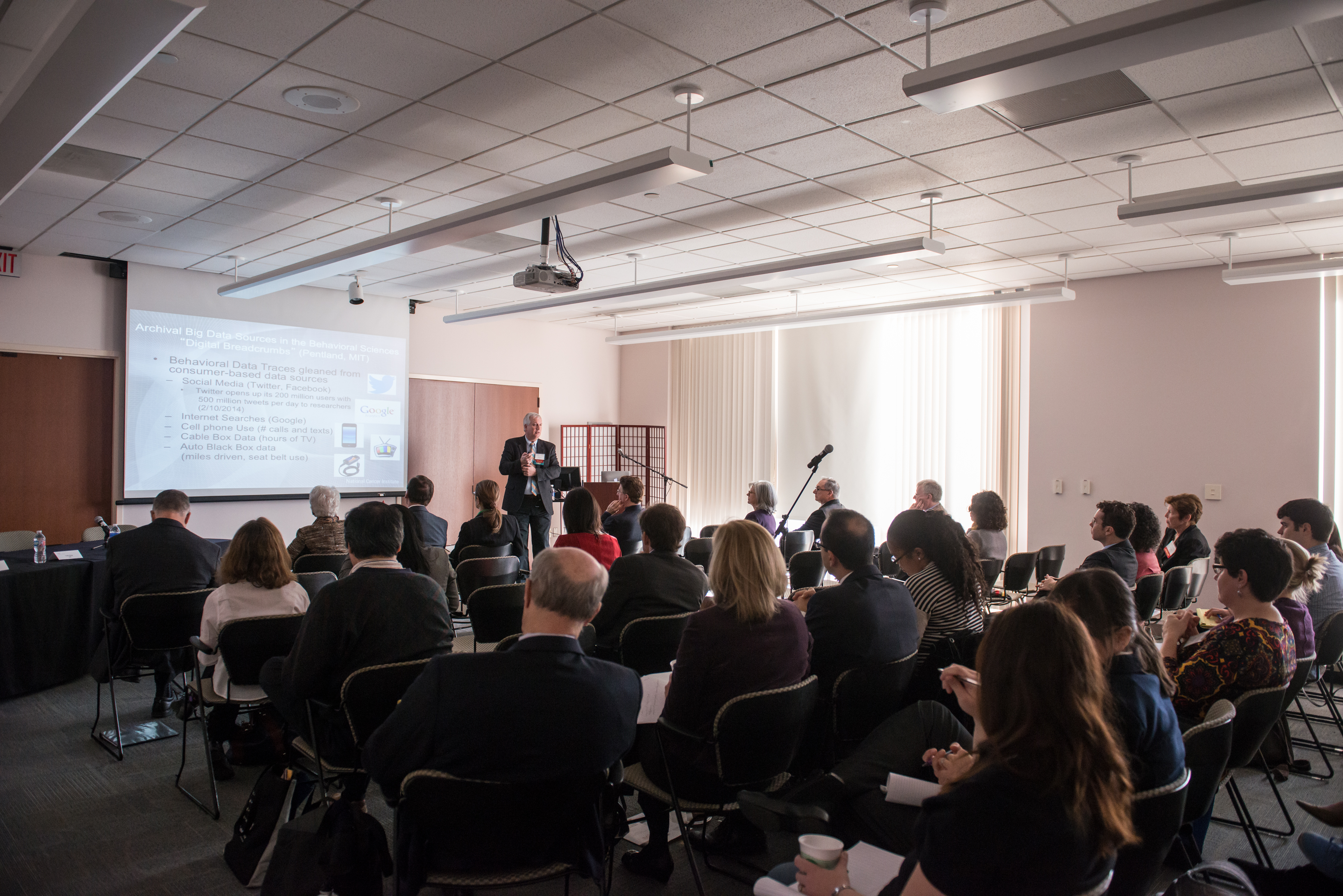
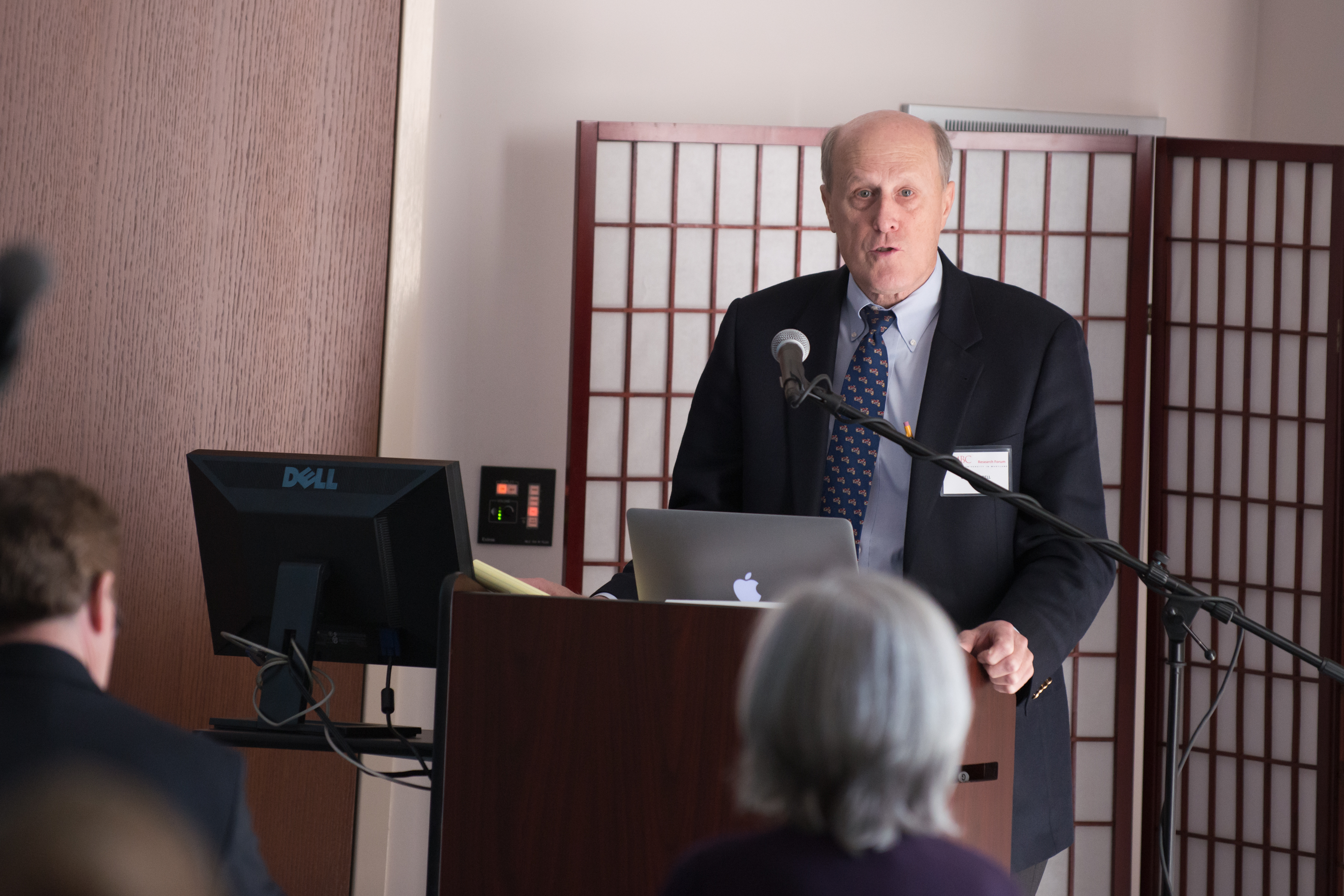
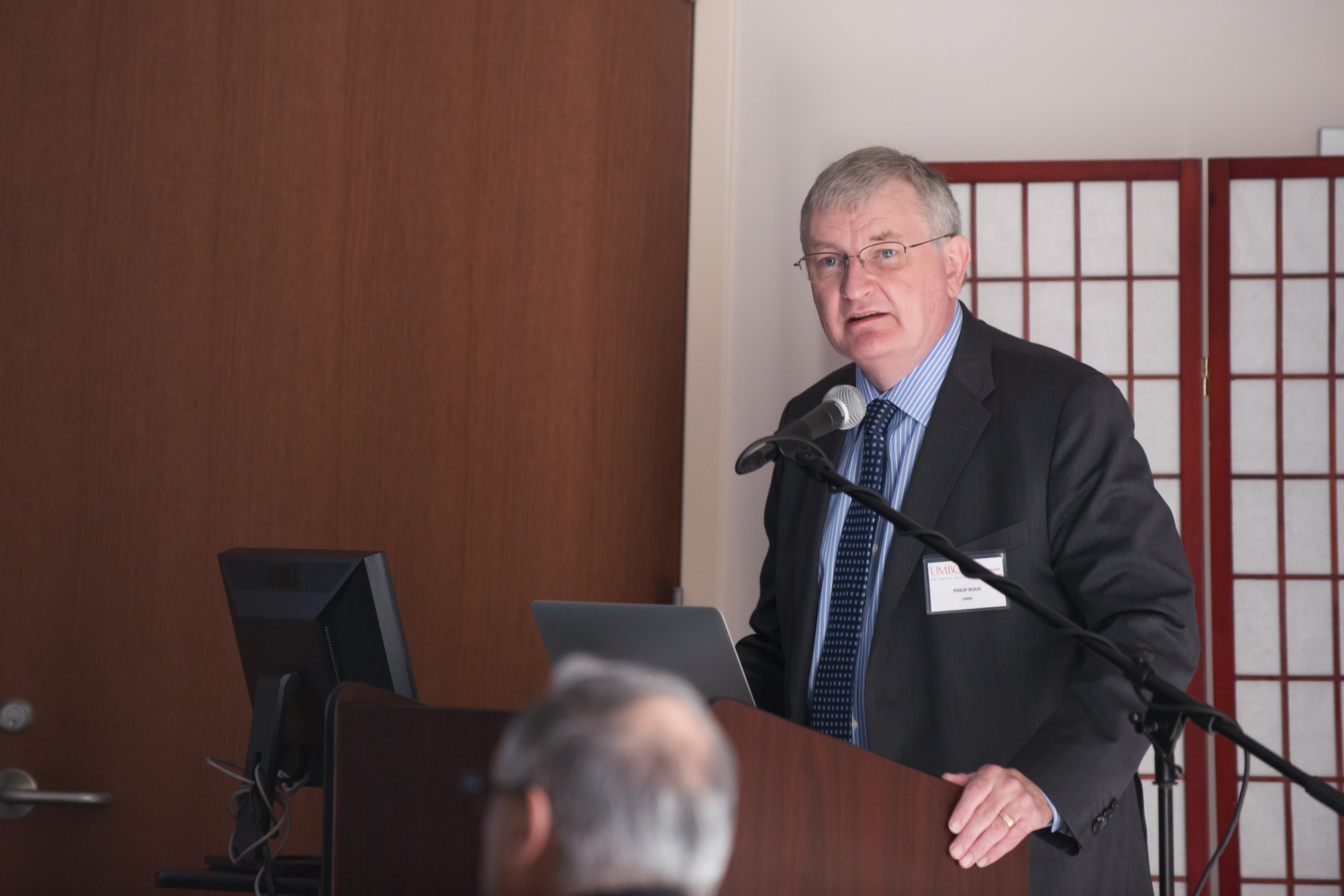
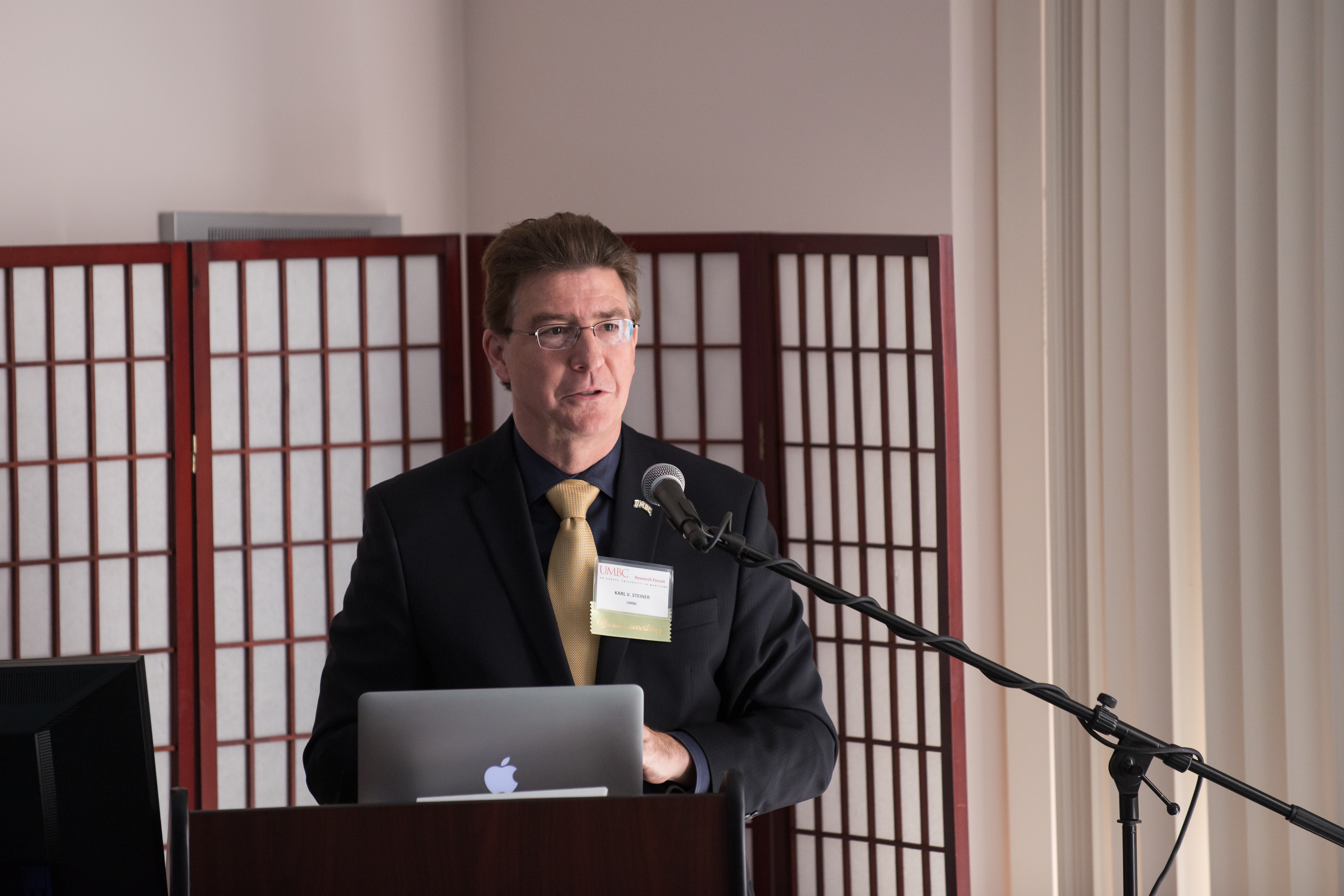
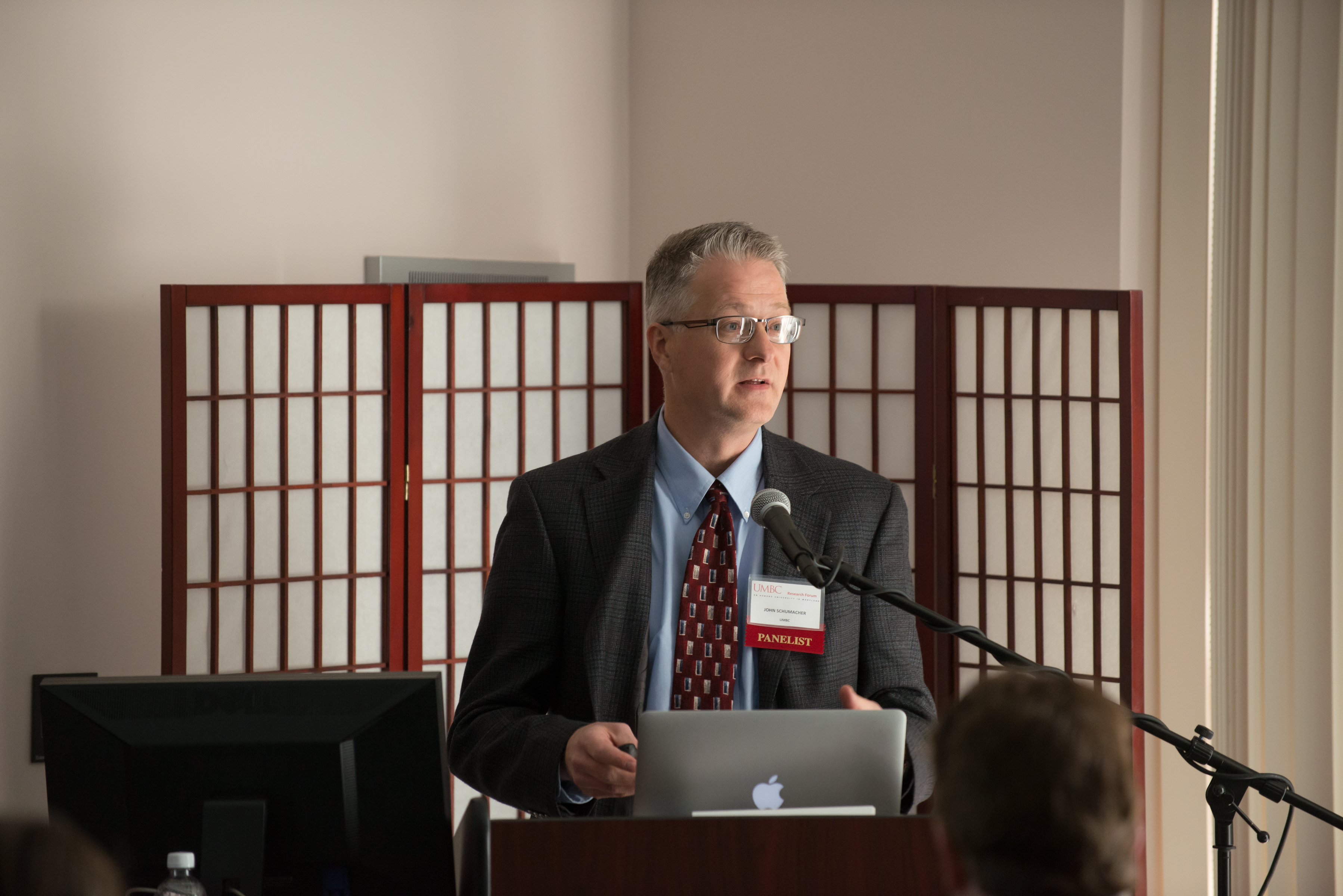
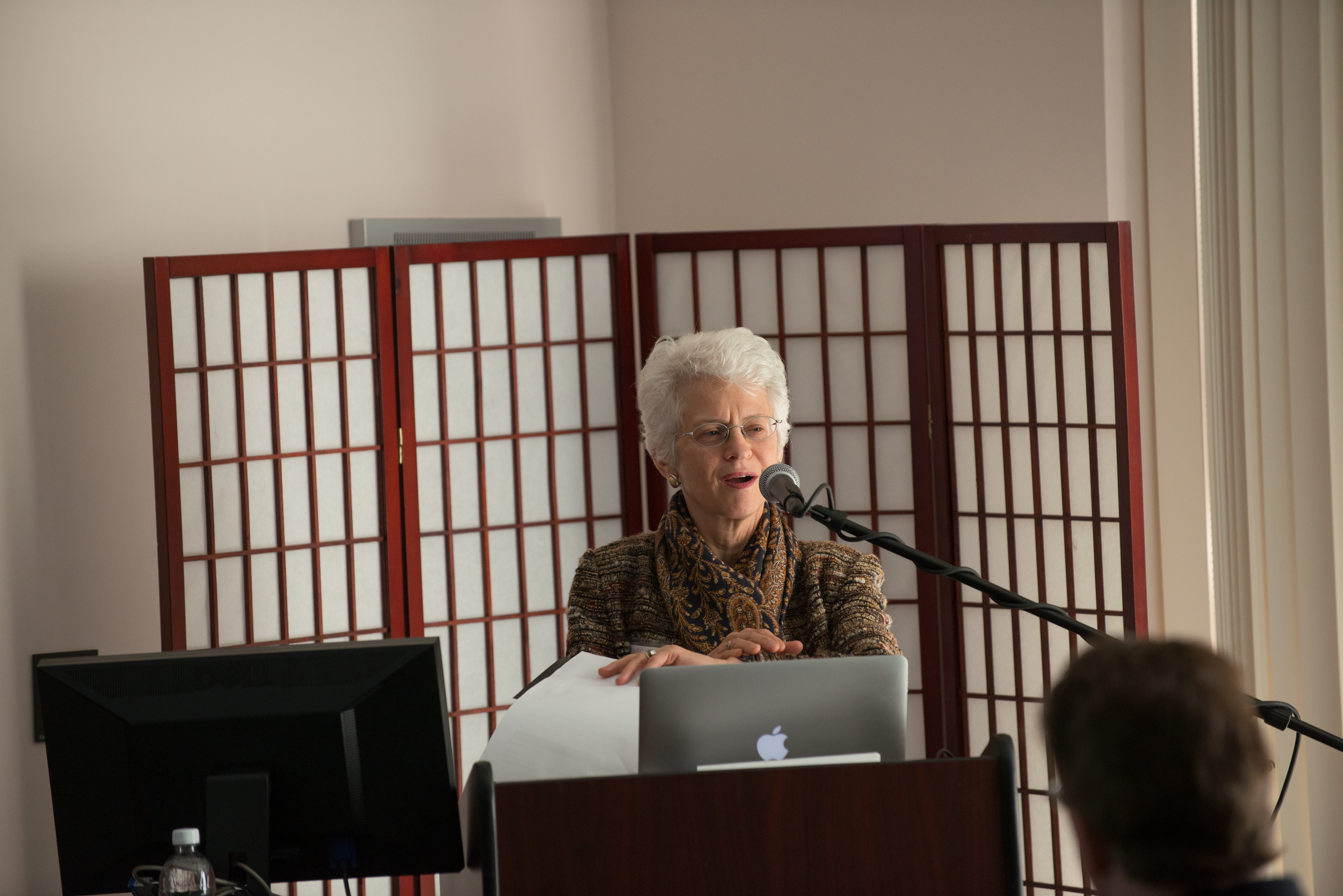
On Friday, November 21, UMBC hosted its inaugural Research Forum, the first event in a new, semi-annual series to bring together researchers and scientists from across UMBC and partner institutions to establish collaborations around common research themes. The first event was titled, “The Nexus of Social Sciences and Human Health Research,” and it was sponsored by the Office of the Provost and the Office of the Vice President for Research. The forum aimed to advance intra-campus and inter-campus collaborations in the social and health sciences and to initiate conversations about the role of social sciences in basic and translational research.
Dr. William Riley, the Acting Director of the NIH Office of Behavioral and Social Sciences Research (OBSSR), presented the event’s keynote address [PDF]. Dr. Riley discussed how researchers are now faced with a data-rich environment to enhance their work when conducting investigations, including advances with item response theory, computer adaptive testing, and other sensor technologies which generate reports in real-time.
Researchers from UMBC and UMB participated in a panel discussion that focused on developing meaningful links across disciplines. John Schumacher, an associate professor of sociology, discussed strategies for seeking research partners and establishing leaders and milestones to advance interdisciplinary research projects. Fadia Shaya, a professor of pharmaceutical health services research at UMB, discussed how developing peer support and establishing social networks can lead to improved outcomes. UMBC professors Shari Waldstein (psychology) and Brian Cullum (chemistry and biochemistry), shared their insights on strategies for collaboration across disciplines, including building on pilot data and prior research to advance projects. Lee Boot, associate director of UMBC’s Imaging Research Center, discussed how discipline silos no longer exist and how collaboration is needed to solve problems.
Future Research Forums will focus on high-performance computation and environmental sciences and remote sensing. For more information, visit research.umbc.edu.
Photo Credit: Marlayna Demond
]]>
On Friday, November 21, UMBC hosted its inaugural Research Forum, the first event in a new, semi-annual series to bring together researchers and scientists from across UMBC and partner...
Image
https://assets4-beta.my.umbc.edu/system/shared/attachments/63ff66dc0f939d358297362829e7b116/69eaba6f/news/000/048/468/86877d253ef379074b8e49c9306879de/Research_Forum-8728.jpg?1418931487
https://beta.my.umbc.edu/api/v0/pixel/news/48468/guest@my.umbc.edu/29412534a3153a4f78604f72ac956926/api/pixel
ovpr-news-2014
Archived RCA News
https://beta.my.umbc.edu/groups/research
https://assets4-beta.my.umbc.edu/system/shared/avatars/groups/000/000/794/4bca2aa331eb7e472d63d97e0798b600/xsmall.png?1743706368
https://assets2-beta.my.umbc.edu/system/shared/avatars/groups/000/000/794/4bca2aa331eb7e472d63d97e0798b600/original.jpg?1743706368
https://assets3-beta.my.umbc.edu/system/shared/avatars/groups/000/000/794/4bca2aa331eb7e472d63d97e0798b600/xxlarge.png?1743706368
https://assets4-beta.my.umbc.edu/system/shared/avatars/groups/000/000/794/4bca2aa331eb7e472d63d97e0798b600/xlarge.png?1743706368
https://assets2-beta.my.umbc.edu/system/shared/avatars/groups/000/000/794/4bca2aa331eb7e472d63d97e0798b600/large.png?1743706368
https://assets4-beta.my.umbc.edu/system/shared/avatars/groups/000/000/794/4bca2aa331eb7e472d63d97e0798b600/medium.png?1743706368
https://assets4-beta.my.umbc.edu/system/shared/avatars/groups/000/000/794/4bca2aa331eb7e472d63d97e0798b600/small.png?1743706368
https://assets4-beta.my.umbc.edu/system/shared/avatars/groups/000/000/794/4bca2aa331eb7e472d63d97e0798b600/xsmall.png?1743706368
https://assets3-beta.my.umbc.edu/system/shared/avatars/groups/000/000/794/4bca2aa331eb7e472d63d97e0798b600/xxsmall.png?1743706368
Office of the Vice President for Research
https://assets4-beta.my.umbc.edu/system/shared/thumbnails/news/000/048/468/ced4fb1590cc9ce002430ea32a907dbc/xxlarge.jpg?1417638176
https://assets3-beta.my.umbc.edu/system/shared/thumbnails/news/000/048/468/ced4fb1590cc9ce002430ea32a907dbc/xlarge.jpg?1417638176
https://assets4-beta.my.umbc.edu/system/shared/thumbnails/news/000/048/468/ced4fb1590cc9ce002430ea32a907dbc/large.jpg?1417638176
https://assets4-beta.my.umbc.edu/system/shared/thumbnails/news/000/048/468/ced4fb1590cc9ce002430ea32a907dbc/medium.jpg?1417638176
https://assets4-beta.my.umbc.edu/system/shared/thumbnails/news/000/048/468/ced4fb1590cc9ce002430ea32a907dbc/small.jpg?1417638176
https://assets4-beta.my.umbc.edu/system/shared/thumbnails/news/000/048/468/ced4fb1590cc9ce002430ea32a907dbc/xsmall.jpg?1417638176
https://assets1-beta.my.umbc.edu/system/shared/thumbnails/news/000/048/468/ced4fb1590cc9ce002430ea32a907dbc/xxsmall.jpg?1417638176
0
0
true
Wed, 03 Dec 2014 15:23:18 -0500
Fri, 30 Jan 2015 16:08:39 -0500
Dr. Michael Nichols new Director, Ofc of Sponsored Programs
November 28, 2014
| To: | The UMBC Community |
| From: | Karl Steiner. Vice President, Office of the Vice President for Research
Dean Drake, Associate VP, Office of the Vice President for Research |
| Reference: | Dr. Michael Nichols new Director, Office of Sponsored Programs |
We are pleased to announce that Dr. Michael Nichols has been hired as the new Director of the Office of Sponsored Programs (OSP), effective November 10, 2014. This is actually a welcome home for Michael, who has desired to return to UMBC after his departure in 2008.
Michael has a Juris Doctor, a Masters in Public Administration, and is currently pursuing a Doctorate in Higher Education Management at the University of Pennsylvania. Michael is also a Certified Research Administrator (CRA) with over twelve years of significant pre-award and select post-award research administration experience; including ten years of Sponsored Programs Office management and supervisory experience. In addition to UMBC, Michael has worked at California State, Emory and American Universities. He has several years of experience in teaching, mentoring and training in the areas of research administration.
We are delighted that Michael is joining our team and leading such a critical office. Michael’s skills and experience will enable UMBC to continue its growing national research reputation, and to further expand our positive relationships internally with our faculty and externally with government, industry and other sponsoring organizations.
Please join us in welcoming Michael back to the UMBC Community.
]]>
November 28, 2014 To:The UMBC Community From:Karl Steiner. Vice President, Office of the Vice President for Research Dean Drake, Associate VP, Office of the Vice President for Research...
https://beta.my.umbc.edu/api/v0/pixel/news/48389/guest@my.umbc.edu/6ab8208892f62ad0d1780fb710cdbd8f/api/pixel
ovpr-news-2014
Archived RCA News
https://beta.my.umbc.edu/groups/research
https://assets4-beta.my.umbc.edu/system/shared/avatars/groups/000/000/794/4bca2aa331eb7e472d63d97e0798b600/xsmall.png?1743706368
https://assets2-beta.my.umbc.edu/system/shared/avatars/groups/000/000/794/4bca2aa331eb7e472d63d97e0798b600/original.jpg?1743706368
https://assets3-beta.my.umbc.edu/system/shared/avatars/groups/000/000/794/4bca2aa331eb7e472d63d97e0798b600/xxlarge.png?1743706368
https://assets4-beta.my.umbc.edu/system/shared/avatars/groups/000/000/794/4bca2aa331eb7e472d63d97e0798b600/xlarge.png?1743706368
https://assets2-beta.my.umbc.edu/system/shared/avatars/groups/000/000/794/4bca2aa331eb7e472d63d97e0798b600/large.png?1743706368
https://assets4-beta.my.umbc.edu/system/shared/avatars/groups/000/000/794/4bca2aa331eb7e472d63d97e0798b600/medium.png?1743706368
https://assets4-beta.my.umbc.edu/system/shared/avatars/groups/000/000/794/4bca2aa331eb7e472d63d97e0798b600/small.png?1743706368
https://assets4-beta.my.umbc.edu/system/shared/avatars/groups/000/000/794/4bca2aa331eb7e472d63d97e0798b600/xsmall.png?1743706368
https://assets3-beta.my.umbc.edu/system/shared/avatars/groups/000/000/794/4bca2aa331eb7e472d63d97e0798b600/xxsmall.png?1743706368
Office of the Vice President for Research
https://assets2-beta.my.umbc.edu/system/shared/thumbnails/news/000/048/389/d2ca2dfee94527d1f8f81d70c1ffc43f/xxlarge.jpg?1417220740
https://assets2-beta.my.umbc.edu/system/shared/thumbnails/news/000/048/389/d2ca2dfee94527d1f8f81d70c1ffc43f/xlarge.jpg?1417220740
https://assets1-beta.my.umbc.edu/system/shared/thumbnails/news/000/048/389/d2ca2dfee94527d1f8f81d70c1ffc43f/large.jpg?1417220740
https://assets2-beta.my.umbc.edu/system/shared/thumbnails/news/000/048/389/d2ca2dfee94527d1f8f81d70c1ffc43f/medium.jpg?1417220740
https://assets1-beta.my.umbc.edu/system/shared/thumbnails/news/000/048/389/d2ca2dfee94527d1f8f81d70c1ffc43f/small.jpg?1417220740
https://assets1-beta.my.umbc.edu/system/shared/thumbnails/news/000/048/389/d2ca2dfee94527d1f8f81d70c1ffc43f/xsmall.jpg?1417220740
https://assets1-beta.my.umbc.edu/system/shared/thumbnails/news/000/048/389/d2ca2dfee94527d1f8f81d70c1ffc43f/xxsmall.jpg?1417220740
0
0
true
Fri, 28 Nov 2014 19:25:52 -0500
Fri, 28 Nov 2014 19:32:14 -0500
Anupam Joshi named an IEEE Fellow
CSEE Professor Anupam Joshi has been named an IEEE Fellow, recognized for his for contributions to security, privacy and data management in mobile and pervasive systems. This designation is conferred by the IEEE Board of Directors on individuals with an outstanding record of accomplishments in any of the IEEE fields of interest and is recognized by the technical community as a prestigious honor and an important career achievement. No more than 0.1% of the total IEEE voting membership can be selected in a year.
Dr. Joshi joined UMBC’s faculty in 1998 and currently is the Oros Family Professor of Technology and Director of the UMBC Center for Cybersecurity. He previously held faculty appointments at the University of Missouri, Columbia and Purdue University. He received a Ph.D. in Computer Science from Purdue University and a B. Tech in Electrical Engineering from the Indian Institute of Technology, Delhi. While at UMBC he has taught both undergraduate and graduate courses in operating systems, mobile computing and security. He developed and teaches an Honors College seminar on “Privacy and Security in a Mobile Social World”. He has mentored nine Ph.D. graduates and a large number of M.S. students.
Joshi has made many contributions to the design, analysis and development of intelligent systems for mobile, social and secure computing. Twenty years ago he was one of a handful of researchers who recognized that mobility introduced new challenges for data management, security and privacy over and above those brought about by wireless connectivity. His key insight was to model mobile and pervasive systems as distributed systems that are both open, in that they do not pre-identify a set of known participants, and dynamic, in that the participants change regularly.
He observe that applications on mobile devices require greater degrees of decision making and autonomy as they become increasingly sophisticated and intelligent and can’t always assume connectivity to central servers. Entities in these pervasive computing systems must exchange information about the data and services offered and sought and their associated security and privacy policies, negotiate for information and resource sharing, be aware of their context, and monitor for and report on suspicious or anomalous behavior. Dr. Joshi has addressed these challenges across the stack, from network protocols to data management to policy controlled interactions between autonomous entities.
Much of his research has been done in collaboration with colleagues in industry such as IBM, Microsoft, Northrop Grumman and Qualcomm. It has been funded by not just them, but also NSF, DARPA, AFOSR, ARL, NIST and other federal agencies. Joshi has published prolifically with more than 200 publications in refereed journals and conferences, many of which are highly cited. He has served as the General or Program Chair of many key conferences including the IEEE International Conference on Intelligence and Security Informatics which will be held in Baltimore in May 2015.
The IEEE is the world’s leading professional association for advancing technology for humanity. Through its 400,000 members in 160 countries, it is a leading authority on a wide variety of areas ranging from aerospace systems, computers and telecommunications to biomedical engineering, electric power and consumer electronics. Dedicated to the advancement of technology, the IEEE publishes 30 percent of the world’s literature in the electrical and electronics engineering and computer science fields, and has developed more than 900 active industry standards.
]]>
CSEE Professor Anupam Joshi has been named an IEEE Fellow, recognized for his for contributions to security, privacy and data management in mobile and pervasive systems. This designation is...
https://beta.my.umbc.edu/api/v0/pixel/news/48388/guest@my.umbc.edu/3881f93dfc11e52e609da4d0815aaa19/api/pixel
ovpr-news-2014
Archived RCA News
https://beta.my.umbc.edu/groups/research
https://assets4-beta.my.umbc.edu/system/shared/avatars/groups/000/000/794/4bca2aa331eb7e472d63d97e0798b600/xsmall.png?1743706368
https://assets2-beta.my.umbc.edu/system/shared/avatars/groups/000/000/794/4bca2aa331eb7e472d63d97e0798b600/original.jpg?1743706368
https://assets3-beta.my.umbc.edu/system/shared/avatars/groups/000/000/794/4bca2aa331eb7e472d63d97e0798b600/xxlarge.png?1743706368
https://assets4-beta.my.umbc.edu/system/shared/avatars/groups/000/000/794/4bca2aa331eb7e472d63d97e0798b600/xlarge.png?1743706368
https://assets2-beta.my.umbc.edu/system/shared/avatars/groups/000/000/794/4bca2aa331eb7e472d63d97e0798b600/large.png?1743706368
https://assets4-beta.my.umbc.edu/system/shared/avatars/groups/000/000/794/4bca2aa331eb7e472d63d97e0798b600/medium.png?1743706368
https://assets4-beta.my.umbc.edu/system/shared/avatars/groups/000/000/794/4bca2aa331eb7e472d63d97e0798b600/small.png?1743706368
https://assets4-beta.my.umbc.edu/system/shared/avatars/groups/000/000/794/4bca2aa331eb7e472d63d97e0798b600/xsmall.png?1743706368
https://assets3-beta.my.umbc.edu/system/shared/avatars/groups/000/000/794/4bca2aa331eb7e472d63d97e0798b600/xxsmall.png?1743706368
Office of the Vice President for Research
https://assets4-beta.my.umbc.edu/system/shared/thumbnails/news/000/048/388/4a4774a8fd7cb5194f05ba4386d408bf/xxlarge.jpg?1417220148
https://assets2-beta.my.umbc.edu/system/shared/thumbnails/news/000/048/388/4a4774a8fd7cb5194f05ba4386d408bf/xlarge.jpg?1417220148
https://assets1-beta.my.umbc.edu/system/shared/thumbnails/news/000/048/388/4a4774a8fd7cb5194f05ba4386d408bf/large.jpg?1417220148
https://assets2-beta.my.umbc.edu/system/shared/thumbnails/news/000/048/388/4a4774a8fd7cb5194f05ba4386d408bf/medium.jpg?1417220148
https://assets1-beta.my.umbc.edu/system/shared/thumbnails/news/000/048/388/4a4774a8fd7cb5194f05ba4386d408bf/small.jpg?1417220148
https://assets2-beta.my.umbc.edu/system/shared/thumbnails/news/000/048/388/4a4774a8fd7cb5194f05ba4386d408bf/xsmall.jpg?1417220148
https://assets1-beta.my.umbc.edu/system/shared/thumbnails/news/000/048/388/4a4774a8fd7cb5194f05ba4386d408bf/xxsmall.jpg?1417220148
0
0
true
Fri, 28 Nov 2014 19:15:59 -0500
Fri, 28 Nov 2014 19:18:03 -0500
Surdna Foundation Awards IRC Funds for Liz Lerman Residency
The Surdna Foundation, which is dedicated to fostering sustainable communities in the United States, has awarded $95,882 to the Imaging Research Center, in partnership with the College of Arts, Humanities and Social Sciences, to establish a Spring 2015 residency by renowned choreographer Liz Lerman.
The purpose of this residency is to develop an approach to building and sustaining an online interface for Liz Lerman’s “toolbox” of artistic practices in community-engaged projects, and to do so in a way that incorporates the needs and perspectives of a diverse community of users. Lerman will join researchers at the IRC at UMBC as a Research Professor, and from that “home base” will directly engage with the university and regional communities, and with the broader world via an interactive website. Her work at the IRC will begin with the specific focus of disseminating her lauded developmental work on important behavioral and creativity tools that are valuable not only to artists, but also across diverse communities where creativity in a social context is a key demand. IRC researchers will work with her and diverse groups to create online digital media to make accessible the processes Lerman conceived and developed during her career as a socially-engaged dancer and choreographer. The work will engage broad audiences and this particular project will leverage current research and resources that UMBC, CAHSS, and IRC are investing in the communities of Baltimore. The development of a user-focused website of Lerman’s work is a challenge that matches both the IRC’s mission and expertise in visual communication, collaboration, learning and online dissemination of important information to the general public. Of equal importance will be Lerman’s engagement as a visiting artist/scholar with UMBC’s faculty, staff, students and regional communities.
“I am convinced that creative research laboratories bring significant information to various fields. They provide new platforms for building relationships between artists and universities, and between organizations and their neighborhoods, and they provide convening spaces for the explosion of trans-domain activities that are naturally occurring in response to the complex questions of our time,” noted Lerman.
Liz Lerman is a choreographer, performer, writer, educator and speaker, and the recipient of numerous honors, including a 2002 MacArthur “Genius Grant” Fellowship, a 2011 United States Artists Ford Fellowship in Dance, and the 2014 Dance/USA Honor Award. A key aspect of her artistry is opening her process to various publics from shipbuilders to physicists, construction workers to ballerinas, resulting in both research and outcomes that are participatory, relevant, urgent, and usable by others. She founded Liz Lerman Dance Exchange in 1976 and cultivated the company’s unique multi-generational ensemble into a leading force in contemporary dance until 2011. She was an artist-in-residence and visiting lecturer at Harvard University in 2011, the same year that she instigated the National Civil War Project. Her investigation of the impact of war on medicine, Healing Wars, premiered at Arena Stage in 2014. Other projects include the genre-twisting work Blood Muscle Bone with Jawole Willa Jo Zollar and Urban Bush Women; teaching her Critical Response Process around the world from the UK (Puppet Animation, Sadler’s Wells Theatre, the Guildhall School of Music and Drama, the London Sinfonietta. The Federation of Scottish Theatres) to Australia; and an online project called “The Treadmill Tapes: Ideas on the Move.” In 2013 she curated Wesleyan University’s symposium “Innovations: Intersection of Art and Science,” bringing together teams of artists and scientists from North America to present their methods and findings. Her collection of essays, Hiking the Horizontal: Field Notes from a Choreographer, was published in 2011 by Wesleyan University Press and was released in paperback in 2014.
Read more about the grant here on the IRC’s website.
]]>
The Surdna Foundation, which is dedicated to fostering sustainable communities in the United States, has awarded $95,882 to the Imaging Research Center, in partnership with the College of Arts,...
http://umbcinsights.wordpress.com/2014/11/17/surdna-foundation-awards-imaging-research-center-funds-for-liz-lerman-residency/
https://beta.my.umbc.edu/api/v0/pixel/news/48187/guest@my.umbc.edu/78cc586d20fba224c3abde974c41efb8/api/pixel
arts
center
community
foundation
humanities
imaging
irc
research
surdna
sustainability
Archived RCA News
https://beta.my.umbc.edu/groups/research
https://assets4-beta.my.umbc.edu/system/shared/avatars/groups/000/000/794/4bca2aa331eb7e472d63d97e0798b600/xsmall.png?1743706368
https://assets2-beta.my.umbc.edu/system/shared/avatars/groups/000/000/794/4bca2aa331eb7e472d63d97e0798b600/original.jpg?1743706368
https://assets3-beta.my.umbc.edu/system/shared/avatars/groups/000/000/794/4bca2aa331eb7e472d63d97e0798b600/xxlarge.png?1743706368
https://assets4-beta.my.umbc.edu/system/shared/avatars/groups/000/000/794/4bca2aa331eb7e472d63d97e0798b600/xlarge.png?1743706368
https://assets2-beta.my.umbc.edu/system/shared/avatars/groups/000/000/794/4bca2aa331eb7e472d63d97e0798b600/large.png?1743706368
https://assets4-beta.my.umbc.edu/system/shared/avatars/groups/000/000/794/4bca2aa331eb7e472d63d97e0798b600/medium.png?1743706368
https://assets4-beta.my.umbc.edu/system/shared/avatars/groups/000/000/794/4bca2aa331eb7e472d63d97e0798b600/small.png?1743706368
https://assets4-beta.my.umbc.edu/system/shared/avatars/groups/000/000/794/4bca2aa331eb7e472d63d97e0798b600/xsmall.png?1743706368
https://assets3-beta.my.umbc.edu/system/shared/avatars/groups/000/000/794/4bca2aa331eb7e472d63d97e0798b600/xxsmall.png?1743706368
Office of the Vice President for Research
https://assets2-beta.my.umbc.edu/system/shared/thumbnails/news/000/048/187/6c684e11fdc88423611171996bd4d043/xxlarge.jpg?1416459098
https://assets1-beta.my.umbc.edu/system/shared/thumbnails/news/000/048/187/6c684e11fdc88423611171996bd4d043/xlarge.jpg?1416459098
https://assets4-beta.my.umbc.edu/system/shared/thumbnails/news/000/048/187/6c684e11fdc88423611171996bd4d043/large.jpg?1416459098
https://assets2-beta.my.umbc.edu/system/shared/thumbnails/news/000/048/187/6c684e11fdc88423611171996bd4d043/medium.jpg?1416459098
https://assets1-beta.my.umbc.edu/system/shared/thumbnails/news/000/048/187/6c684e11fdc88423611171996bd4d043/small.jpg?1416459098
https://assets2-beta.my.umbc.edu/system/shared/thumbnails/news/000/048/187/6c684e11fdc88423611171996bd4d043/xsmall.jpg?1416459098
https://assets1-beta.my.umbc.edu/system/shared/thumbnails/news/000/048/187/6c684e11fdc88423611171996bd4d043/xxsmall.jpg?1416459098
2
0
true
Wed, 19 Nov 2014 23:52:26 -0500
Wed, 19 Nov 2014 23:53:16 -0500
Dean Drake Promoted to Associate Vice President for Research
November 14, 2014
From: Karl V. Steiner, Ph.D., Vice President for Research
To: Campus Community
RE: Dean Drake - Promotion to Associate Vice President for Research
I am delighted to announce that Dean Drake has been promoted to Associate Vice President for Research, effective November 1, 2014.
Since leaving the Defense Industry, Dean has accumulated over 20 years of experience in University based research. During his nearly 15 years with USM, Dean has established and managed offices of Sponsored Programs, Research Compliance, as well as technology protection and commercialization. He has participated on review panels, taught, and has also consulted in several areas associated with research administration. He is an advocate for strong internal customer support, the cornerstone to effective research development.
Dean joined UMBC in 2010 as Assistant Vice President for Research with primary responsibilities for the Office of Technology Development (OTD) and for what was then known as HARPO - the Human and Animals Research Protections Office. He has been a tireless advocate for our research community over these past four and a half years. During this time, we revamped HARPO into the Office of Research Protections and Compliance (ORPC), established Export Control and Principal Investigator policies as well as training programs, and expanded the technical skill set within the offices. He has participated in several internal and external committees and workgroups, and was invaluable during my transition to UMBC.
In his new role, Dean’s responsibilities will formally include functional oversight of the Office of Sponsored Programs (OSP), the Office of Research Protections and Compliance (ORPC) and the Office of Technology Development (OTD). Dean has been effectively handling these responsibilities for over two years. I am very thankful for his energy and experience, as we move forward in building a strong and sustainable research culture and infrastructure at UMBC.
Please join me in congratulating Dean on this well-deserved promotion.
]]>
November 14, 2014 From: Karl V. Steiner, Ph.D., Vice President for Research To: Campus Community RE: Dean Drake - Promotion to Associate Vice President for Research I am delighted to...
https://beta.my.umbc.edu/api/v0/pixel/news/48095/guest@my.umbc.edu/8eb44dd8759e008bd156314fe3ef91f2/api/pixel
ovpr-news-2014
Archived RCA News
https://beta.my.umbc.edu/groups/research
https://assets4-beta.my.umbc.edu/system/shared/avatars/groups/000/000/794/4bca2aa331eb7e472d63d97e0798b600/xsmall.png?1743706368
https://assets2-beta.my.umbc.edu/system/shared/avatars/groups/000/000/794/4bca2aa331eb7e472d63d97e0798b600/original.jpg?1743706368
https://assets3-beta.my.umbc.edu/system/shared/avatars/groups/000/000/794/4bca2aa331eb7e472d63d97e0798b600/xxlarge.png?1743706368
https://assets4-beta.my.umbc.edu/system/shared/avatars/groups/000/000/794/4bca2aa331eb7e472d63d97e0798b600/xlarge.png?1743706368
https://assets2-beta.my.umbc.edu/system/shared/avatars/groups/000/000/794/4bca2aa331eb7e472d63d97e0798b600/large.png?1743706368
https://assets4-beta.my.umbc.edu/system/shared/avatars/groups/000/000/794/4bca2aa331eb7e472d63d97e0798b600/medium.png?1743706368
https://assets4-beta.my.umbc.edu/system/shared/avatars/groups/000/000/794/4bca2aa331eb7e472d63d97e0798b600/small.png?1743706368
https://assets4-beta.my.umbc.edu/system/shared/avatars/groups/000/000/794/4bca2aa331eb7e472d63d97e0798b600/xsmall.png?1743706368
https://assets3-beta.my.umbc.edu/system/shared/avatars/groups/000/000/794/4bca2aa331eb7e472d63d97e0798b600/xxsmall.png?1743706368
Office of the Vice President for Research
https://assets3-beta.my.umbc.edu/system/shared/thumbnails/news/000/048/095/e176f74f5a1ff41be39a04f6fc2178f6/xxlarge.jpg?1416019826
https://assets2-beta.my.umbc.edu/system/shared/thumbnails/news/000/048/095/e176f74f5a1ff41be39a04f6fc2178f6/xlarge.jpg?1416019826
https://assets1-beta.my.umbc.edu/system/shared/thumbnails/news/000/048/095/e176f74f5a1ff41be39a04f6fc2178f6/large.jpg?1416019826
https://assets3-beta.my.umbc.edu/system/shared/thumbnails/news/000/048/095/e176f74f5a1ff41be39a04f6fc2178f6/medium.jpg?1416019826
https://assets1-beta.my.umbc.edu/system/shared/thumbnails/news/000/048/095/e176f74f5a1ff41be39a04f6fc2178f6/small.jpg?1416019826
https://assets2-beta.my.umbc.edu/system/shared/thumbnails/news/000/048/095/e176f74f5a1ff41be39a04f6fc2178f6/xsmall.jpg?1416019826
https://assets1-beta.my.umbc.edu/system/shared/thumbnails/news/000/048/095/e176f74f5a1ff41be39a04f6fc2178f6/xxsmall.jpg?1416019826
1
0
true
Fri, 14 Nov 2014 21:51:17 -0500
Fri, 14 Nov 2014 21:54:55 -0500
Professor Yesha to head NSF Center for Hybrid Multicore
Dr. Yelena Yesha, UMBC Professor of Computer Science and Electrical Engineering, is the new Director of the Center for Hybrid Multicore Productivity Research (CHMPR). Led by UMBC, CHMPR is a multi-university research center that includes an impressive and growing array of academic, industry, and government partners.
About CHMPR
Over the past several decades, computing power has increased exponentially. Processing power (per dollar spent) usually doubles every nine months. While computing power has increased, so too has the amount of data. In many important problems – from medical research to national security – the information is too large for a single, traditional computer to handle. While some problems can be broken up nicely into smaller pieces, with each piece being handed to a different computer, there are other problems which require that a large amount of information be processed together in a more coordinated fashion.
In retail products such as home computers, smartphones and tablets, there has been a trend in recent years to put multiple processors into a single device. There has also been a trend to include specialized processors, such as graphics processing units (GPUs), which are designed to be particularly good at certain types of calculations. While it might seem that adding more processors (also known as "cores") into a device would immediately make it faster, this is not so straightforward. To achieve the best performance, the results of the calculations done by each processor must sometimes be combined before going on to the next stage in a calculation. Writing programs which take advantage of multiple cores becomes even more challenging when dealing with a hybrid system, which is a single device that includes different types of specialized cores.
With these challenges in mind, UMBC established the Center for Hybrid Multicore Productivity Research (CHMPR) in 2009. The depth of the technical challenges in hybrid multicore computing are matched by a comparably broad set of application areas of great interest to a wide range of industry and government organizations. Accordingly, CHMPR was created with support from NSF in the form of an Industry/University Cooperative Research Center (I/UCRC) grant. The I/UCRC model provides initial funding for a group of universities to conduct research that is of interest to companies and government agencies. Over time, I/UCRCs transition to being funded predominantly by these companies' and agencies' board membership fees. In exchange, the board has a voice in determining the research activities of the center and is kept up-to-date on the cutting edge research conducted by the center.
New Partnerships, Opportunities, and Leadership
Since the inception of CHMPR, when Dr. Yesha served as a co-principal investigator on the initial proposal, she has served as UMBC Site Director within the larger CHMPR. In this role, she has led UMBC's research activities and worked with Dr. Milt Halem, the director of the overall multi-site initiative. Dr. Yesha is now taking on the overarching leadership role which has been held by Dr. Halem, while he transitions to the new role of CHMPR's Executive Manager, where he will focus on leading the center's activities in the areas of hardware and supercomputing.
Yelena Yesha is a tenured Professor at the Department of Computer Science and Electrical Engineering, the University of Maryland, Baltimore County. She received her B.Sc. degrees in Computer Science and in Applied Mathematics from York University, Toronto, Canada, in 1984, and her M.Sc. degree and Ph.D. degrees from The Ohio State University in 1986 and 1989, respectively. She joined the Department of Computer Science at the University of Maryland, Baltimore County as an Assistant Professor in 1989. In 1994 she was promoted to the rank of tenured Associate Professor, and in 1995 she was promoted to the rank of tenured Professor. In 1994-1995, while on leave from the University of Maryland, Baltimore County, she was the Director of the Center for Applied Information Technology (CAIT) at the National Institute of Standards and Technology, as a United States federal government employee (civil servant). In 1995 she became the Director of the Center of Excellence in Space Data and Information Sciences (CESDIS) at the NASA Goddard Space Flight Center. She has published 12 books as author or editor, and more than 200 papers in prestigious refereed journals and refereed conference proceedings, and has been awarded external funding in a total amount exceeding 30 million dollars.
Dr. Yesha is taking the reigns at an auspicious time for the center. The growth of CHMPR has led to it maturing from a departmental center into its new recognition as a college center within the College of Engineering and Information Technology. Now in its fifth year, CHMPR has grown considerably and continues to expand its national footprint. CHMPR will soon include five university sites, with the University of California Santa Cruz and North Carolina State University joining the existing academic partnership between UMBC, UCSD and the University of Utah. Several very large public companies and federal agencies are slated to join an already impressive membership roster, which includes NASA, NOAA, NIST, FDA, IBM, Lockheed Martin and many others.
There are several proposals in development which would expand CHMPR's infrastructure, including new forays into the frontier of quantum computing. Even while CHMPR continues to grow its physical infrastructure, the center has become increasingly focused on challenges inherent to maximizing the value of very large datasets. Many of CHMPR's new projects and partnerships are less about hardware than they are about data and the role that data can play in improving people's lives. Looking to the future of CHMPR, Dr. Yesha says "we are embarking on some new research paths that will have significant human and economic impact on society. We are addressing problems of national imperative that should bring international recognition to UMBC in the fields of Personalized Medicine, Climate Change and Data Science." Despite CHMPR's many accomplishments over the past five years, it seems quite likely that its productivity and impact will continue to increase.
]]>
Dr. Yelena Yesha, UMBC Professor of Computer Science and Electrical Engineering, is the new Director of the Center for Hybrid Multicore Productivity Research (CHMPR). Led by UMBC, CHMPR is a...
https://beta.my.umbc.edu/api/v0/pixel/news/47600/guest@my.umbc.edu/bb137ae4cd95fbe8284c506f72e7cb58/api/pixel
ovpr-news-2014
Archived RCA News
https://beta.my.umbc.edu/groups/research
https://assets4-beta.my.umbc.edu/system/shared/avatars/groups/000/000/794/4bca2aa331eb7e472d63d97e0798b600/xsmall.png?1743706368
https://assets2-beta.my.umbc.edu/system/shared/avatars/groups/000/000/794/4bca2aa331eb7e472d63d97e0798b600/original.jpg?1743706368
https://assets3-beta.my.umbc.edu/system/shared/avatars/groups/000/000/794/4bca2aa331eb7e472d63d97e0798b600/xxlarge.png?1743706368
https://assets4-beta.my.umbc.edu/system/shared/avatars/groups/000/000/794/4bca2aa331eb7e472d63d97e0798b600/xlarge.png?1743706368
https://assets2-beta.my.umbc.edu/system/shared/avatars/groups/000/000/794/4bca2aa331eb7e472d63d97e0798b600/large.png?1743706368
https://assets4-beta.my.umbc.edu/system/shared/avatars/groups/000/000/794/4bca2aa331eb7e472d63d97e0798b600/medium.png?1743706368
https://assets4-beta.my.umbc.edu/system/shared/avatars/groups/000/000/794/4bca2aa331eb7e472d63d97e0798b600/small.png?1743706368
https://assets4-beta.my.umbc.edu/system/shared/avatars/groups/000/000/794/4bca2aa331eb7e472d63d97e0798b600/xsmall.png?1743706368
https://assets3-beta.my.umbc.edu/system/shared/avatars/groups/000/000/794/4bca2aa331eb7e472d63d97e0798b600/xxsmall.png?1743706368
Office of the Vice President for Research
https://assets3-beta.my.umbc.edu/system/shared/thumbnails/news/000/047/600/09e5f16cc4ebf42dc661d58a9f2fa023/xxlarge.jpg?1414426501
https://assets1-beta.my.umbc.edu/system/shared/thumbnails/news/000/047/600/09e5f16cc4ebf42dc661d58a9f2fa023/xlarge.jpg?1414426501
https://assets2-beta.my.umbc.edu/system/shared/thumbnails/news/000/047/600/09e5f16cc4ebf42dc661d58a9f2fa023/large.jpg?1414426501
https://assets4-beta.my.umbc.edu/system/shared/thumbnails/news/000/047/600/09e5f16cc4ebf42dc661d58a9f2fa023/medium.jpg?1414426501
https://assets2-beta.my.umbc.edu/system/shared/thumbnails/news/000/047/600/09e5f16cc4ebf42dc661d58a9f2fa023/small.jpg?1414426501
https://assets4-beta.my.umbc.edu/system/shared/thumbnails/news/000/047/600/09e5f16cc4ebf42dc661d58a9f2fa023/xsmall.jpg?1414426501
https://assets4-beta.my.umbc.edu/system/shared/thumbnails/news/000/047/600/09e5f16cc4ebf42dc661d58a9f2fa023/xxsmall.jpg?1414426501
1
0
true
Mon, 27 Oct 2014 12:18:48 -0400