National Endowment for the Humanities Workshop at UMBC
Dresher Center and CAHSS host regional NEH Grants Workshop
UMBC welcomed the National Endowment for the Humanities (NEH) for a regional grant-writing workshop on February 20, 2015. The workshop, conducted by the NEH’s Division of Research Programs, was sponsored by the Dresher Center for the Humanities; the College of Arts, Humanities, and Social Sciences (CAHSS); and the Office of the Vice President for Research.
Faculty participants from UMBC and seven area colleges and universities learned about NEH grant and fellowship programs, and special initiatives. The Maryland Humanities Council also spoke about its grant opportunities. A “mock” evaluation panel, led by UMBC NEH Fellows Kate Brown (History), Thomas Field (MLLI), and Anna Shields (MLLI), discussed the NEH proposal review process. Grant application-writing strategies were also shared.
"The Dresher Center was pleased to welcome the NEH to campus,” noted director Jessica Berman. “Workshops like these give a shot in the arm to researchers, who then begin to consider how their work fits into national priorities and initiatives. The workshop also showcased the strengths of UMBC faculty work in the humanities.”
With an annual program budget of $108 million, the NEH awards grants to individuals and groups of humanities researchers at universities, museums, libraries and archives, and other cultural and educational organizations. These highly competitive grants, which are evaluated by scholars and other experts in their field, have an average award rate of between seven and ten per cent per year. If denied, NEH encourages applicants to re-submit.
The Endowment also supports public programs and special initiatives, like the new “Common Good: The Humanities in the Public Square,” which seeks to bring humanities scholarship to public attention in new, significant ways. The NEH’s Office of Digital Humanities provides grants to projects that integrate new technologies in humanities research, as well as those that study digital culture from a humanistic perspective.
NEH-funded research projects often cross the disciplinary boundaries between the arts, humanities, and social sciences. At UMBC, NEH fellowships and grants have been awarded to CAHSS faculty in the departments of Africana Studies; English; Geography and Environmental Systems; History; Modern Languages, Linguistics, and Intercultural Communication; Political Science, Sociology-Anthropology, Theatre, and Visual Arts.
For information on NEH programs, contact Rachel Brubaker, Assistant Director for Grants and Program Development, Dresher Center for the Humanities: rbruba1@umbc.edu.
Photo (from left to right): Anna Shields, MLLI; Tom Field, MLLI; and Kate Brown, History
]]>
UMBC welcomed the National Endowment for the Humanities (NEH) for a regional grant-writing workshop on February 20, 2015. The workshop, conducted by the NEH’s Division of Research Programs, was...
https://beta.my.umbc.edu/api/v0/pixel/news/50201/guest@my.umbc.edu/b478db983d417b11788e84b445f2a908/api/pixel
center
dresher
humanities
mlli
neh
ovpr-news-2015
Archived RCA News
https://beta.my.umbc.edu/groups/research
https://assets4-beta.my.umbc.edu/system/shared/avatars/groups/000/000/794/4bca2aa331eb7e472d63d97e0798b600/xsmall.png?1743706368
https://assets2-beta.my.umbc.edu/system/shared/avatars/groups/000/000/794/4bca2aa331eb7e472d63d97e0798b600/original.jpg?1743706368
https://assets3-beta.my.umbc.edu/system/shared/avatars/groups/000/000/794/4bca2aa331eb7e472d63d97e0798b600/xxlarge.png?1743706368
https://assets4-beta.my.umbc.edu/system/shared/avatars/groups/000/000/794/4bca2aa331eb7e472d63d97e0798b600/xlarge.png?1743706368
https://assets2-beta.my.umbc.edu/system/shared/avatars/groups/000/000/794/4bca2aa331eb7e472d63d97e0798b600/large.png?1743706368
https://assets4-beta.my.umbc.edu/system/shared/avatars/groups/000/000/794/4bca2aa331eb7e472d63d97e0798b600/medium.png?1743706368
https://assets4-beta.my.umbc.edu/system/shared/avatars/groups/000/000/794/4bca2aa331eb7e472d63d97e0798b600/small.png?1743706368
https://assets4-beta.my.umbc.edu/system/shared/avatars/groups/000/000/794/4bca2aa331eb7e472d63d97e0798b600/xsmall.png?1743706368
https://assets3-beta.my.umbc.edu/system/shared/avatars/groups/000/000/794/4bca2aa331eb7e472d63d97e0798b600/xxsmall.png?1743706368
Office of the Vice President for Research
https://assets1-beta.my.umbc.edu/system/shared/thumbnails/news/000/050/201/eccbc7cdf4dfd00792d431e1a1d896fa/xxlarge.jpg?1425323364
https://assets3-beta.my.umbc.edu/system/shared/thumbnails/news/000/050/201/eccbc7cdf4dfd00792d431e1a1d896fa/xlarge.jpg?1425323364
https://assets2-beta.my.umbc.edu/system/shared/thumbnails/news/000/050/201/eccbc7cdf4dfd00792d431e1a1d896fa/large.jpg?1425323364
https://assets3-beta.my.umbc.edu/system/shared/thumbnails/news/000/050/201/eccbc7cdf4dfd00792d431e1a1d896fa/medium.jpg?1425323364
https://assets1-beta.my.umbc.edu/system/shared/thumbnails/news/000/050/201/eccbc7cdf4dfd00792d431e1a1d896fa/small.jpg?1425323364
https://assets4-beta.my.umbc.edu/system/shared/thumbnails/news/000/050/201/eccbc7cdf4dfd00792d431e1a1d896fa/xsmall.jpg?1425323364
https://assets3-beta.my.umbc.edu/system/shared/thumbnails/news/000/050/201/eccbc7cdf4dfd00792d431e1a1d896fa/xxsmall.jpg?1425323364
0
0
true
Mon, 02 Mar 2015 14:10:35 -0500
Tue, 24 Mar 2015 11:29:29 -0400
Kate Brown Awarded ACLS Collaborative Research Fellowship
by Sierra Francis
This year, in an interdisciplinary collaboration with evolutionary biologist Timothy A. Mousseau (University of South Carolina), UMBC environmental historian Kate Brown was awarded the highly competitive Collaborative Research Fellowship by the American Council of Learned Societies (ACLS). According to ACLS, “The ten teams of scholars selected for funding cross boundaries of discipline, methodology, and geography to undertake new research projects that will result in joint publications.”
Both professors will co-author journal articles for the 30th anniversary of the Chernobyl Nuclear Power Plant accident in April 2016, as well as a monograph that examines the relationship between scientific knowledge and the historical contexts of its production.
Why is this significant? To this day there is still no consensus on the impact the accident had. The collaborative project between Brown and Mousseau will explore how both knowledge and ignorance of Chernobyl’s disastrous effects have been produced over the last thirty years. ACLS states, “The researchers will analyze the historical trajectory of the funding, production of three decades of scientific research on Chernobyl from 1986 to the present, and in Fukushima from 2011 on, in order to describe what is known and debated about the impact of long term, low dose exposure to ionizing radiation on plants, animals, and humans.”
For more information please visit: https://www.acls.org/research/fellow.aspx?cid=0dd290b2-00a8-e411-9417-000c29879dd6
Congratulations Professor Brown!
]]>
by Sierra Francis This year, in an interdisciplinary collaboration with evolutionary biologist Timothy A. Mousseau (University of South Carolina), UMBC environmental historian Kate Brown was...
https://www.acls.org/research/fellow.aspx?cid=0dd290b2-00a8-e411-9417-000c29879dd6
https://beta.my.umbc.edu/api/v0/pixel/news/50200/guest@my.umbc.edu/effe12b5ebd0e24ba59f27813c1b9cf7/api/pixel
acls
american
brown
council
fellowship
kate
learned
societies
Archived RCA News
https://beta.my.umbc.edu/groups/research
https://assets4-beta.my.umbc.edu/system/shared/avatars/groups/000/000/794/4bca2aa331eb7e472d63d97e0798b600/xsmall.png?1743706368
https://assets2-beta.my.umbc.edu/system/shared/avatars/groups/000/000/794/4bca2aa331eb7e472d63d97e0798b600/original.jpg?1743706368
https://assets3-beta.my.umbc.edu/system/shared/avatars/groups/000/000/794/4bca2aa331eb7e472d63d97e0798b600/xxlarge.png?1743706368
https://assets4-beta.my.umbc.edu/system/shared/avatars/groups/000/000/794/4bca2aa331eb7e472d63d97e0798b600/xlarge.png?1743706368
https://assets2-beta.my.umbc.edu/system/shared/avatars/groups/000/000/794/4bca2aa331eb7e472d63d97e0798b600/large.png?1743706368
https://assets4-beta.my.umbc.edu/system/shared/avatars/groups/000/000/794/4bca2aa331eb7e472d63d97e0798b600/medium.png?1743706368
https://assets4-beta.my.umbc.edu/system/shared/avatars/groups/000/000/794/4bca2aa331eb7e472d63d97e0798b600/small.png?1743706368
https://assets4-beta.my.umbc.edu/system/shared/avatars/groups/000/000/794/4bca2aa331eb7e472d63d97e0798b600/xsmall.png?1743706368
https://assets3-beta.my.umbc.edu/system/shared/avatars/groups/000/000/794/4bca2aa331eb7e472d63d97e0798b600/xxsmall.png?1743706368
Office of the Vice President for Research
https://assets2-beta.my.umbc.edu/system/shared/thumbnails/news/000/050/200/82fe25a27e8ed79a081a927d0bead98b/xxlarge.jpg?1425322585
https://assets2-beta.my.umbc.edu/system/shared/thumbnails/news/000/050/200/82fe25a27e8ed79a081a927d0bead98b/xlarge.jpg?1425322585
https://assets3-beta.my.umbc.edu/system/shared/thumbnails/news/000/050/200/82fe25a27e8ed79a081a927d0bead98b/large.jpg?1425322585
https://assets2-beta.my.umbc.edu/system/shared/thumbnails/news/000/050/200/82fe25a27e8ed79a081a927d0bead98b/medium.jpg?1425322585
https://assets4-beta.my.umbc.edu/system/shared/thumbnails/news/000/050/200/82fe25a27e8ed79a081a927d0bead98b/small.jpg?1425322585
https://assets1-beta.my.umbc.edu/system/shared/thumbnails/news/000/050/200/82fe25a27e8ed79a081a927d0bead98b/xsmall.jpg?1425322585
https://assets1-beta.my.umbc.edu/system/shared/thumbnails/news/000/050/200/82fe25a27e8ed79a081a927d0bead98b/xxsmall.jpg?1425322585
0
0
true
Mon, 02 Mar 2015 13:56:42 -0500
Mon, 02 Mar 2015 14:12:42 -0500
$50k awarded to CAST team for preemie respiration monitor
by Sarah Hansen
Right: The winners and judges after the NCC-PDI conference and competition.
Govind Rao, UMBC Professor and Director of the Center for Advanced Sensor Technology (CAST), was the only attendee at the National Capital Consortium for Pediatric Device Innovation (NCC-PDI) to offer more than one presentation to the crowd of scientists, engineers, students, and entrepreneurs. The first focused on a disposable incubator project that the consortium funded last year. The second promoted a non-invasive respiration monitor for premature newborns, which was competing for funding among 12 finalists from 31 original applicants. University of Maryland–College Park hosted the event on February 12, 2015, and five of the finalists took home fat checks.
The National Capital Consortium for Pediatric Device Innovation is an FDA-funded consortium led by the Sheikh Zayed Institute for Pediatric Surgical Innovation at Children’s National Health System and the A. James Clark School of Engineering at the University of Maryland.
“What we’re trying to do is completely change the paradigm,” said Rao. The current standard practice for monitoring oxygen and carbon dioxide in babies uses a technique that requires heating the skin and often results in burns. An alternative technology requires drawing blood—a painful procedure that removes the precious red stuff from tiny neonates, who may only have a few teaspoons to begin with. Traditional methods also take several minutes to produce a reading, whereas Rao’s product only takes one. In clinical trials (on nine babies so far, and at least one dedicated graduate student) the results from the new device were just as accurate as established methods. Rao said, “Without doing any calibration or anything, it’s showing amazing correlation. Now the problem is how can I get this scaled up and out there.”
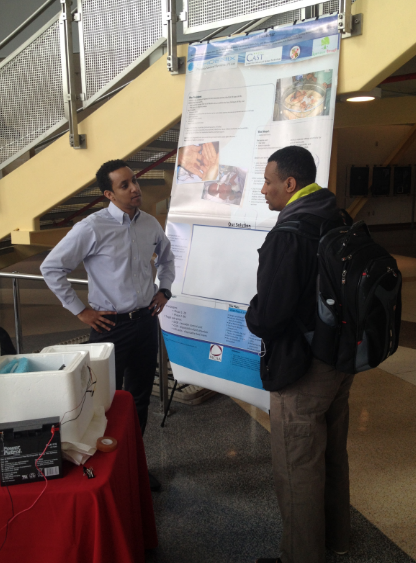
Dagmawi Tilahun, left, discusses CAST projects with a UMD-CP student at the conference. Tilahun is a UMBC alum who now works full-time at CAST.
Judges at competitions aren’t the only ones excited about the invention. “We showed this device off to doctors and nurses who had actually used the device that causes burns, and they were just amazed at the alternative,” said Rao. He has collaborations in the works with health organizations in Ethiopia, Nepal, the Philippines, and India.
At this point, the device is up and running but still physically a bit clunky. The lab will use the new funds to automate and miniaturize the monitor. That way, Madhubanti Chatterjee, whose PhD dissertation focused on developing the project, doesn’t have to hand-hold doctors as they use it. With a smile, Rao describes his plan to accomplish a compact design: “I’ve already lined up a [UMBC] computer science class where the teacher wants to help the students write apps, so I’ve got my student labor all set.”
Discounting cheap student labor, Rao still doesn’t expect the compact version to be expensive. “We’re leveraging all the cell phone technology, so it will actually be a very low-cost device.” Eventually, after miniaturization and further testing on babies, General Electric (GE) will take over manufacturing of the monitor.
The win for Rao and his team (GE and a team of physicians from the University of Maryland Medical School) at the NCC-PDI was especially sweet after missing out on funding at a similar competition in October 2014. After that letdown, Rao promised not to give up and encouraged his students, several of whom have spent countless hours developing the project, to do the same. Their hard work and dedication finally paid off. Perhaps a handheld, painless, non-invasive respiration monitor will be coming to a hospital near you someday soon.
For a story that describes more details of the device’s mechanism, click here.
A press release including the other grant winners can be found here.
]]>
by Sarah Hansen Right: The winners and judges after the NCC-PDI conference and competition. Govind Rao, UMBC Professor and Director of the Center for Advanced Sensor Technology (CAST), was the...
Image
https://assets2-beta.my.umbc.edu/system/shared/attachments/45c46ac7d5a4610db9bd5404df03eb8d/69eb0c3e/news/000/050/147/053b47ac39ef2ea08d354ee54baadabb/D at NCC-PDI.PNG?1424994858
https://beta.my.umbc.edu/api/v0/pixel/news/50147/guest@my.umbc.edu/b3e026f626d3406b6143ef3ea1c71483/api/pixel
ovpr-news-2015
Archived RCA News
https://beta.my.umbc.edu/groups/research
https://assets4-beta.my.umbc.edu/system/shared/avatars/groups/000/000/794/4bca2aa331eb7e472d63d97e0798b600/xsmall.png?1743706368
https://assets2-beta.my.umbc.edu/system/shared/avatars/groups/000/000/794/4bca2aa331eb7e472d63d97e0798b600/original.jpg?1743706368
https://assets3-beta.my.umbc.edu/system/shared/avatars/groups/000/000/794/4bca2aa331eb7e472d63d97e0798b600/xxlarge.png?1743706368
https://assets4-beta.my.umbc.edu/system/shared/avatars/groups/000/000/794/4bca2aa331eb7e472d63d97e0798b600/xlarge.png?1743706368
https://assets2-beta.my.umbc.edu/system/shared/avatars/groups/000/000/794/4bca2aa331eb7e472d63d97e0798b600/large.png?1743706368
https://assets4-beta.my.umbc.edu/system/shared/avatars/groups/000/000/794/4bca2aa331eb7e472d63d97e0798b600/medium.png?1743706368
https://assets4-beta.my.umbc.edu/system/shared/avatars/groups/000/000/794/4bca2aa331eb7e472d63d97e0798b600/small.png?1743706368
https://assets4-beta.my.umbc.edu/system/shared/avatars/groups/000/000/794/4bca2aa331eb7e472d63d97e0798b600/xsmall.png?1743706368
https://assets3-beta.my.umbc.edu/system/shared/avatars/groups/000/000/794/4bca2aa331eb7e472d63d97e0798b600/xxsmall.png?1743706368
Office of the Vice President for Research
https://assets1-beta.my.umbc.edu/system/shared/thumbnails/news/000/050/147/67e8febce085bb4da13693cc87dca326/xxlarge.jpg?1424994163
https://assets2-beta.my.umbc.edu/system/shared/thumbnails/news/000/050/147/67e8febce085bb4da13693cc87dca326/xlarge.jpg?1424994163
https://assets1-beta.my.umbc.edu/system/shared/thumbnails/news/000/050/147/67e8febce085bb4da13693cc87dca326/large.jpg?1424994163
https://assets2-beta.my.umbc.edu/system/shared/thumbnails/news/000/050/147/67e8febce085bb4da13693cc87dca326/medium.jpg?1424994163
https://assets3-beta.my.umbc.edu/system/shared/thumbnails/news/000/050/147/67e8febce085bb4da13693cc87dca326/small.jpg?1424994163
https://assets2-beta.my.umbc.edu/system/shared/thumbnails/news/000/050/147/67e8febce085bb4da13693cc87dca326/xsmall.jpg?1424994163
https://assets2-beta.my.umbc.edu/system/shared/thumbnails/news/000/050/147/67e8febce085bb4da13693cc87dca326/xxsmall.jpg?1424994163
3
0
true
Thu, 26 Feb 2015 19:03:02 -0500
Thu, 26 Feb 2015 21:38:30 -0500
Yujie Wang receives NASA Peer Award
Atmospheric correction algorithm aids air quality research
By Sarah Hansen
Yujie Wang, Associate Research Scientist at the NASA Goddard Space Flight Center in Greenbelt, MD and part of the Joint Center for Earth Systems Technology (JCET) between UMBC and Goddard, recently received the NASA Peer Award for Outstanding Scientific Support. The award recognized his contributions to the development of a new algorithm that detects light reflected from Earth’s surface. Surface reflectance data are used to study Earth’s total energy budget, enhance climate models, reveal natural vegetation dynamics, and detect human-generated land surface change. The algorithm is known as MAIAC (Multi-Angle Implementation of Atmospheric Correction).
Models have existed to derive surface reflectance from satellite measurements for decades. What makes MAIAC groundbreaking is that it significantly improves accuracy by better detecting clouds and removing atmospheric effects, in particular scattering and absorption of light caused by tiny pollutant particles called aerosols.
“MAIAC is the only algorithm that provides one kilometer resolution aerosol data, as compared to three to approximately 20 kilometer data from standard algorithms,” said Alexei Lyapustin, Physical Research Scientist at Goddard and Wang’s nominator and colleague. The extra resolution is especially valuable in regions with complex topography or in urban areas where air quality can change significantly over small distances.
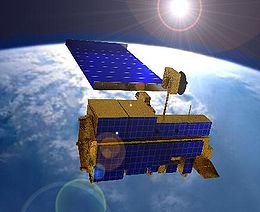
An image of Terra, one of the satellites that carries the MAIAC algorithm
(http://en.wikipedia.org/wiki/Terra_%28satellite%29)
The aerosol properties MAIAC provides are turning out to be extremely valuable. “At the beginning we were just focusing on surface reflectance, but lately the aerosol product has been gaining popularity,” said Wang. “A large and diverse air quality community uses this information to assess aerosol impact on human health.”
Another huge advantage to the new system, and remote sensing in general, is its scope. The algorithm is implemented in the MODIS instrument (MODerate resolution Imaging Spectroradiometer) on two satellites, Terra and Aqua. Every two days, together the satellites cover the entire Earth. “If you do ground measurements that takes a lot time, a lot of money, a lot of people, and you cannot do full coverage. But a satellite can easily get global coverage,” explains Wang.
The MAIAC algorithm takes advantage of high-powered computers to incorporate time-series and spatial data into the analysis. Because of computing limitations, previous methods examined one image at a time, pixel by pixel. Using those methods, the problem is not well defined because for each measurement there are two variables: actual surface reflectance and the amount of aerosols. So out of necessity, most models make simplifications and assumptions. But with MAIAC, “We keep 10 to 16 days of images in the memory,” said Lyapustin, “and we have enough information to solve the problem without major assumptions.”
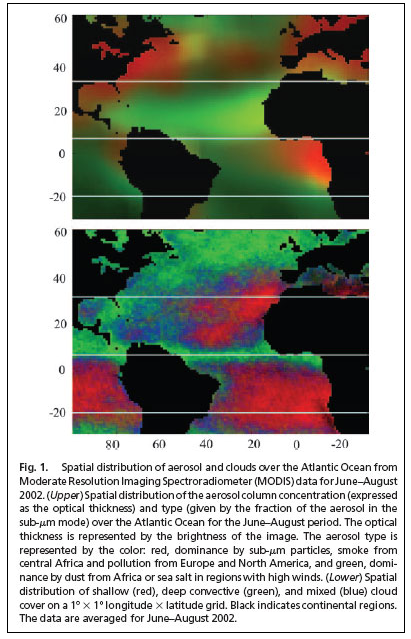
An example of an aerosol image provided by MODIS
(http://modis-atmos.gsfc.nasa.gov/MOD04_L2/sample.html)
The fully-developed algorithm has been a long time coming. Wang started thinking about this when he first arrived at JCET in 2002. “At the beginning it was just an idea—that we could use more time-dependent and spatial information to do this,” he said. After running some preliminary tests using other instruments, full-on algorithm development started in 2004. Wang has been at it since then.
“He more than deserves this award,” said Lyapustin. “Besides supporting scientific development of MAIAC, Yujie’s major contribution came from a programming perspective,” he said. “He has excellent programming skills and developed a very sophisticated system. It allows us to work with the time series of data and use both individual pixel information and spatial information about a pixel’s surroundings.” Wang’s expertise allows Lyapustin and others to dive into the data collected from the satellites. Thanks to Wang, they can easily manipulate time and space dimensions to look for patterns.
The Peer Award comes with a small monetary prize, which Lyapustin sees as “encouragement to continue great work,” but he points out, “Yujie has no need of encouragement.”
Besides conducting his own research, Wang plays the important role of communicating with other researchers and providing them the MAIAC data they request to explore fields like air quality and climate change. “Now that more and more people are using our products, they are getting some really exciting results from the data—I kind of provided them with those new data, and they are pretty happy about that,” he said.
]]>
By Sarah Hansen Yujie Wang, Associate Research Scientist at the NASA Goddard Space Flight Center in Greenbelt, MD and part of the Joint Center for Earth Systems Technology (JCET) between UMBC and...
Image
https://assets1-beta.my.umbc.edu/system/shared/attachments/ecb1da3f40902a5e2abdcc6b7cc0f194/69eb0c3e/news/000/050/078/2e6106f57b3dbfdb6d57e017209c7c87/modis data.PNG?1424871653
https://beta.my.umbc.edu/api/v0/pixel/news/50078/guest@my.umbc.edu/b4745d646100848aed543502b3619e87/api/pixel
ovpr-news-2015
Archived RCA News
https://beta.my.umbc.edu/groups/research
https://assets4-beta.my.umbc.edu/system/shared/avatars/groups/000/000/794/4bca2aa331eb7e472d63d97e0798b600/xsmall.png?1743706368
https://assets2-beta.my.umbc.edu/system/shared/avatars/groups/000/000/794/4bca2aa331eb7e472d63d97e0798b600/original.jpg?1743706368
https://assets3-beta.my.umbc.edu/system/shared/avatars/groups/000/000/794/4bca2aa331eb7e472d63d97e0798b600/xxlarge.png?1743706368
https://assets4-beta.my.umbc.edu/system/shared/avatars/groups/000/000/794/4bca2aa331eb7e472d63d97e0798b600/xlarge.png?1743706368
https://assets2-beta.my.umbc.edu/system/shared/avatars/groups/000/000/794/4bca2aa331eb7e472d63d97e0798b600/large.png?1743706368
https://assets4-beta.my.umbc.edu/system/shared/avatars/groups/000/000/794/4bca2aa331eb7e472d63d97e0798b600/medium.png?1743706368
https://assets4-beta.my.umbc.edu/system/shared/avatars/groups/000/000/794/4bca2aa331eb7e472d63d97e0798b600/small.png?1743706368
https://assets4-beta.my.umbc.edu/system/shared/avatars/groups/000/000/794/4bca2aa331eb7e472d63d97e0798b600/xsmall.png?1743706368
https://assets3-beta.my.umbc.edu/system/shared/avatars/groups/000/000/794/4bca2aa331eb7e472d63d97e0798b600/xxsmall.png?1743706368
Office of the Vice President for Research
https://assets2-beta.my.umbc.edu/system/shared/thumbnails/news/000/050/078/fe89212bb70a74806d901ea170627867/xxlarge.jpg?1424871596
https://assets1-beta.my.umbc.edu/system/shared/thumbnails/news/000/050/078/fe89212bb70a74806d901ea170627867/xlarge.jpg?1424871596
https://assets1-beta.my.umbc.edu/system/shared/thumbnails/news/000/050/078/fe89212bb70a74806d901ea170627867/large.jpg?1424871596
https://assets3-beta.my.umbc.edu/system/shared/thumbnails/news/000/050/078/fe89212bb70a74806d901ea170627867/medium.jpg?1424871596
https://assets1-beta.my.umbc.edu/system/shared/thumbnails/news/000/050/078/fe89212bb70a74806d901ea170627867/small.jpg?1424871596
https://assets3-beta.my.umbc.edu/system/shared/thumbnails/news/000/050/078/fe89212bb70a74806d901ea170627867/xsmall.jpg?1424871596
https://assets4-beta.my.umbc.edu/system/shared/thumbnails/news/000/050/078/fe89212bb70a74806d901ea170627867/xxsmall.jpg?1424871596
2
0
true
Wed, 25 Feb 2015 08:56:43 -0500
Wed, 25 Feb 2015 09:13:11 -0500
Physics Prof. Martins discusses his climate satellite on NPR
Dr. Vanderlei Martins, UMBC Professor of Physics, was on NPR this week to discuss his CubeSat, a tiny satellite which measures atmospheric composition from space.
]]>
Dr. Vanderlei Martins, UMBC Professor of Physics, was on NPR this week to discuss his CubeSat, a tiny satellite which measures atmospheric composition from space. The NPR interview is available...
https://beta.my.umbc.edu/api/v0/pixel/news/49943/guest@my.umbc.edu/ed4d74b8735f9a7dac727a25ec390cae/api/pixel
ovpr-news-2015
Archived RCA News
https://beta.my.umbc.edu/groups/research
https://assets4-beta.my.umbc.edu/system/shared/avatars/groups/000/000/794/4bca2aa331eb7e472d63d97e0798b600/xsmall.png?1743706368
https://assets2-beta.my.umbc.edu/system/shared/avatars/groups/000/000/794/4bca2aa331eb7e472d63d97e0798b600/original.jpg?1743706368
https://assets3-beta.my.umbc.edu/system/shared/avatars/groups/000/000/794/4bca2aa331eb7e472d63d97e0798b600/xxlarge.png?1743706368
https://assets4-beta.my.umbc.edu/system/shared/avatars/groups/000/000/794/4bca2aa331eb7e472d63d97e0798b600/xlarge.png?1743706368
https://assets2-beta.my.umbc.edu/system/shared/avatars/groups/000/000/794/4bca2aa331eb7e472d63d97e0798b600/large.png?1743706368
https://assets4-beta.my.umbc.edu/system/shared/avatars/groups/000/000/794/4bca2aa331eb7e472d63d97e0798b600/medium.png?1743706368
https://assets4-beta.my.umbc.edu/system/shared/avatars/groups/000/000/794/4bca2aa331eb7e472d63d97e0798b600/small.png?1743706368
https://assets4-beta.my.umbc.edu/system/shared/avatars/groups/000/000/794/4bca2aa331eb7e472d63d97e0798b600/xsmall.png?1743706368
https://assets3-beta.my.umbc.edu/system/shared/avatars/groups/000/000/794/4bca2aa331eb7e472d63d97e0798b600/xxsmall.png?1743706368
Office of the Vice President for Research
https://assets4-beta.my.umbc.edu/system/shared/thumbnails/news/000/049/943/a8662ed4ce0b8a5a8d7c768c026092bd/xxlarge.jpg?1424314251
https://assets4-beta.my.umbc.edu/system/shared/thumbnails/news/000/049/943/a8662ed4ce0b8a5a8d7c768c026092bd/xlarge.jpg?1424314251
https://assets4-beta.my.umbc.edu/system/shared/thumbnails/news/000/049/943/a8662ed4ce0b8a5a8d7c768c026092bd/large.jpg?1424314251
https://assets1-beta.my.umbc.edu/system/shared/thumbnails/news/000/049/943/a8662ed4ce0b8a5a8d7c768c026092bd/medium.jpg?1424314251
https://assets3-beta.my.umbc.edu/system/shared/thumbnails/news/000/049/943/a8662ed4ce0b8a5a8d7c768c026092bd/small.jpg?1424314251
https://assets2-beta.my.umbc.edu/system/shared/thumbnails/news/000/049/943/a8662ed4ce0b8a5a8d7c768c026092bd/xsmall.jpg?1424314251
https://assets2-beta.my.umbc.edu/system/shared/thumbnails/news/000/049/943/a8662ed4ce0b8a5a8d7c768c026092bd/xxsmall.jpg?1424314251
4
0
true
Wed, 18 Feb 2015 21:52:26 -0500
UMBC-UMB Partnership Awards a Catalyst for Collaboration
UMBC and UMB celebrate research partnerships with symposium and innovation grants.
Celebrating the rapid growth of our collaborative research programs, UMBC and the University of Maryland, Baltimore (UMB) joined together for an inaugural Research & Innovation Partnership Symposium on Friday, January 30, 2015.
UMBC President Freeman Hrabowski and UMB President Jay Perman greeted a standing-room only audience of faculty researchers, students, and research support staff, and reflected on the value of collaborative research for both institutions. Yvonne Maddox, acting director of the NIH Institute on Minority Health and Health Disparities (NIMHD), delivered a keynote address focusing on the need to expand research on health disparities and how our institutions can support diverse young researchers entering this field. Scientific talks presented by collaborative research teams that received UMBC-UMB Partnership Grants in 2013 and an interactive poster session rounded out the symposium agenda.
“We are thrilled about the positive response by our campus communities to this inaugural research symposium,” stated Karl V. Steiner, UMBC’s vice president for research. “It serves as an important milestone for us to take stock of how far we have come with our relationship, but to also recognize how much more work and opportunities still lay ahead.”
The UMBC-UMB Research & Innovation Partnership Seed Grant program seeks to establish, enhance, and promote inter-institutional research collaborations between the two USM institutions and to stimulate joint grant proposals to federal agencies and foundations. USM Chancellor
William E. Kirwan has
praised the program for its “focus on cutting-edge science and health concerns” and its emphasis on interdisciplinary teamwork. The grant program is now in its second year, and the symposium offered an exciting stage to announce a new group of grant recipients.
This year’s grant program consists of two tracks — Innovation Seed Grants of up to $50,000 and Innovation Challenge Grants for senior researchers for up to $75,000 per year for two years. The committee received 21 applications — nine for the innovation seed track and 12 for the innovation challenge track — and awarded funding to four teams of three researchers each.
Innovation Seed Grant recipients include the following teams
- Ronghui Ma and Liang Zhu (UMBC, Mechanical Engineering) and Hongbing Wang (UMB School of Pharmacy)
- Nirmala Roy and Aryya Gangopadhyay (UMBC, Information Systems) and Elizabeth Galik (UMB School of Nursing).
Innovation Challenge Grant recipients include the following teams
- Raimi Quiton (UMBC, Psychology), Radi Masri, and David Seminowics (UMB School of Dentistry);
- Zeev Rosenzweig (UMBC, Chemistry and Biochemistry), Toni Antalis, and Rajabrata Sarkar (UMB School of Medicine).
Ronghui Ma, associate professor in mechanical engineering, is working with her colleagues to create a 3D-printed chip that will allow scientists to test drugs on cells from different organs at the same time. She says that with this work, made possible by the grant program, the team can provide a new model for drug testing.
Zeev Rosenzweig, chair and professor of chemistry and biochemistry, and his UMB colleagues are working to develop a new method to prevent or delay amputation in diabetes patients. He explains that his goal is to prepare an NIH proposal using the preliminary data obtained during the next two years of research. “Without this funding mechanism,” Rosenzweig shares, “this collaboration wouldn’t happen.”
- Kathleen Hoffman (UMBC, Mathematics and Statistics) and Asaf Keller (UMB School of Medicine)
- Tülay Adali (UMBC, CSEE) and Kelly Westlake (UMB School of Medicine)
- Charles Bieberich (UMBC, Biological Sciences) and Paul Shapiro (UMB School of Pharmacy)
- Marie-Christine Daniel (UMBC, Chemistry and Biochemistry) and Peter Swaan (UMB School of Pharmacy)
- Bradford Peercy (UMBC, Mathematics and Statistics) and Martin Schneider (UMB School of Medicine)
The grant recipients describe the program as having a dramatic impact on their work. “This program helped me start a whole new collaboration,” says Kathleen Hoffman, professor of mathematics and statistics.
Charles Bieberich, professor of biological sciences, agrees. “Having a pool of money that I could apply for made me stop and think about whom at UMB I could reach out to and establish a collaboration,” he says. “The funding acts as a catalyst to move the work forward.”
The UMBC-UMB Partnership Grants program is supported by the Office of the Provost and Office of the Vice President for Research at UMBC, and by the deans of the UMB schools of medicine, pharmacy, nursing, and dentistry.
Photo Credit: Marlayna Demond
Pictured, left to right: Zeev Rosenzweig (UMBC), Toni Antalis (UMB), Rajabrata Sarkar (UMB), Elizabeth Galik (UMB), Nirmalya Roy (UMBC), Hongbing Wang (UMB), Ronghui Ma (UMBC), Radi Masri (UMC), and Raimi Quiton (UMBC)
]]>
UMBC and UMB celebrate research partnerships with symposium and innovation grants. [story re-posted from www.umbc.edu] Celebrating the rapid growth of our collaborative research programs,...
Photo
https://assets3-beta.my.umbc.edu/system/shared/attachments/8b5dcef7a8a5e9dd6d00d2ef6073a2ce/69eb0c3e/news/000/049/901/911b10b73d26005b82c8d2b5256f2403/Symposium15-1025.jpg?1424198789
https://beta.my.umbc.edu/api/v0/pixel/news/49901/guest@my.umbc.edu/aadf20333415404f67942f87cf440571/api/pixel
ovpr-news-2015
Archived RCA News
https://beta.my.umbc.edu/groups/research
https://assets4-beta.my.umbc.edu/system/shared/avatars/groups/000/000/794/4bca2aa331eb7e472d63d97e0798b600/xsmall.png?1743706368
https://assets2-beta.my.umbc.edu/system/shared/avatars/groups/000/000/794/4bca2aa331eb7e472d63d97e0798b600/original.jpg?1743706368
https://assets3-beta.my.umbc.edu/system/shared/avatars/groups/000/000/794/4bca2aa331eb7e472d63d97e0798b600/xxlarge.png?1743706368
https://assets4-beta.my.umbc.edu/system/shared/avatars/groups/000/000/794/4bca2aa331eb7e472d63d97e0798b600/xlarge.png?1743706368
https://assets2-beta.my.umbc.edu/system/shared/avatars/groups/000/000/794/4bca2aa331eb7e472d63d97e0798b600/large.png?1743706368
https://assets4-beta.my.umbc.edu/system/shared/avatars/groups/000/000/794/4bca2aa331eb7e472d63d97e0798b600/medium.png?1743706368
https://assets4-beta.my.umbc.edu/system/shared/avatars/groups/000/000/794/4bca2aa331eb7e472d63d97e0798b600/small.png?1743706368
https://assets4-beta.my.umbc.edu/system/shared/avatars/groups/000/000/794/4bca2aa331eb7e472d63d97e0798b600/xsmall.png?1743706368
https://assets3-beta.my.umbc.edu/system/shared/avatars/groups/000/000/794/4bca2aa331eb7e472d63d97e0798b600/xxsmall.png?1743706368
Office of the Vice President for Research
https://assets2-beta.my.umbc.edu/system/shared/thumbnails/news/000/049/901/73ba35e79382576ee90746daa3fa80d2/xxlarge.jpg?1424198748
https://assets1-beta.my.umbc.edu/system/shared/thumbnails/news/000/049/901/73ba35e79382576ee90746daa3fa80d2/xlarge.jpg?1424198748
https://assets4-beta.my.umbc.edu/system/shared/thumbnails/news/000/049/901/73ba35e79382576ee90746daa3fa80d2/large.jpg?1424198748
https://assets2-beta.my.umbc.edu/system/shared/thumbnails/news/000/049/901/73ba35e79382576ee90746daa3fa80d2/medium.jpg?1424198748
https://assets3-beta.my.umbc.edu/system/shared/thumbnails/news/000/049/901/73ba35e79382576ee90746daa3fa80d2/small.jpg?1424198748
https://assets4-beta.my.umbc.edu/system/shared/thumbnails/news/000/049/901/73ba35e79382576ee90746daa3fa80d2/xsmall.jpg?1424198748
https://assets1-beta.my.umbc.edu/system/shared/thumbnails/news/000/049/901/73ba35e79382576ee90746daa3fa80d2/xxsmall.jpg?1424198748
1
0
true
Tue, 17 Feb 2015 13:48:17 -0500
Thu, 14 May 2015 10:21:59 -0400
UMBC-UMB Partnership Symposium celebrates collaboration
New grants awarded and previous recipients report progress
Inaugural UMBC-UMB Research and Innovation Partnership Symposium celebrates cross-campus collaboration
By Sarah Hansen
Right: UMB President Jay Perman (left), UMBC President Freeman Hrabowski (center), and Acting Director of the National Institute of Minority Health and Health Disparities Yvonne Maddox
The first annual UMBC-UMB Research and Innovation Partnership Symposium held on January 30, 2015 in the Albin O. Kuhn Library at UMBC celebrated partnerships between the University of Maryland, Baltimore County and University of Maryland, Baltimore. The program specifically highlighted recipients of the UMBC-UMB Research and Innovation Partnership Grant Program. Initiated in 2013, the program awards up to $150,000 over up to 24 months for research projects led by teams including both UMBC and UMB faculty.
UMBC President Freeman Hrabowski opened the symposium with an African proverb: “If you want to go fast, you go alone. If you want to go far, you go together.” That spirit of collaboration permeated this historic event.
Success Stories
UMBC Associate Professor of Chemistry and Biochemistry Marie-Christine Daniel, who received a partnership grant last year for her work with UMB Professor of Pharmaceutical Sciences Peter Swann, commented, “Peter and I have complementary expertise, and thanks to the partnership grant, that actually gave us the opportunity to start interacting and working on this project.” The team’s research seeks to develop a new drug delivery system using nanoparticles. Other recipients echoed Daniel’s sentiments regarding the importance of interdisciplinary partnerships.
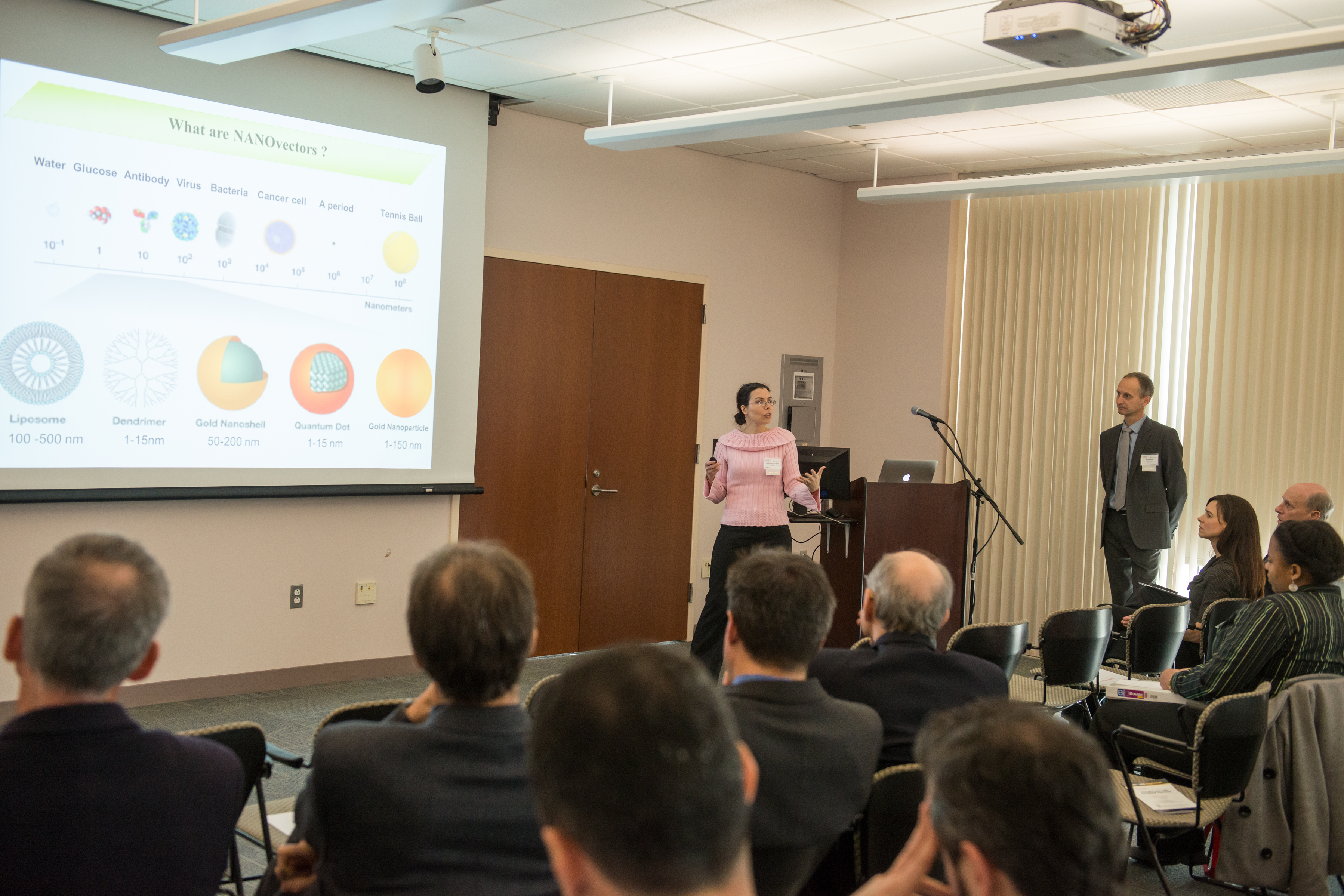
Daniel (center) and Swann (right) present their research on a nanoparticle-based drug delivery system.
“Collaborations with Kathleen [Hoffman] in the [UMBC] math department were instrumental,” said Asaf Keller, UMB Professor of Anatomy and Neurobiology. His research focuses on determining what’s happening in the brains of patients suffering from chronic pain. He hopes new knowledge will open the door for new treatment methods. “[Working with Hoffman] allowed us to ask questions that we cannot ask experimentally,” he said.
UMBC Professor of Biological Sciences Charles (Chuck) Biebrich is working with UMB Professor of Pharmaceutical Sciences Paul Shapiro. Shapiro’s research focuses on developing new drugs that target treatment-resistant cancer cells, and Biebrich is developing a method for evaluating the new drugs’ efficacy. “We were able to show, using the support of our seed grant, that this actually does work,” Biebrich said. “Twenty-five percent of all pharma R&D is doing the same category of work Paul is doing,” he said, so the benefit of Biebrich’s work will be widespread.
Kelly Westlake, Assistant Professor of Physical Therapy and Rehabilitation at UMB, uses imaging techniques and clinical rehabilitation to study motor control recovery in stroke patients. She teamed up with UMBC Professor of Computer Science and Electrical Engineering Tülay Adali, whose programming skills allowed them to visualize small changes in stroke patients’ brains before and after different rehabilitation interventions. Westlake also commented, “It was really the seed grant that helped us forge ahead.”
But these grants don’t only affect faculty members. “The most rewarding and tangible result of having access to these seed grants was our ability to co-train or co-mentor students,” said Keller. He and Hoffman were able to train two additional graduate students: a math student at UMBC learned some biological techniques from Keller, and Hoffman taught a student from the UMB School of Medicine computational modeling skills.
This year’s partnership grant recipients were also announced at the symposium.
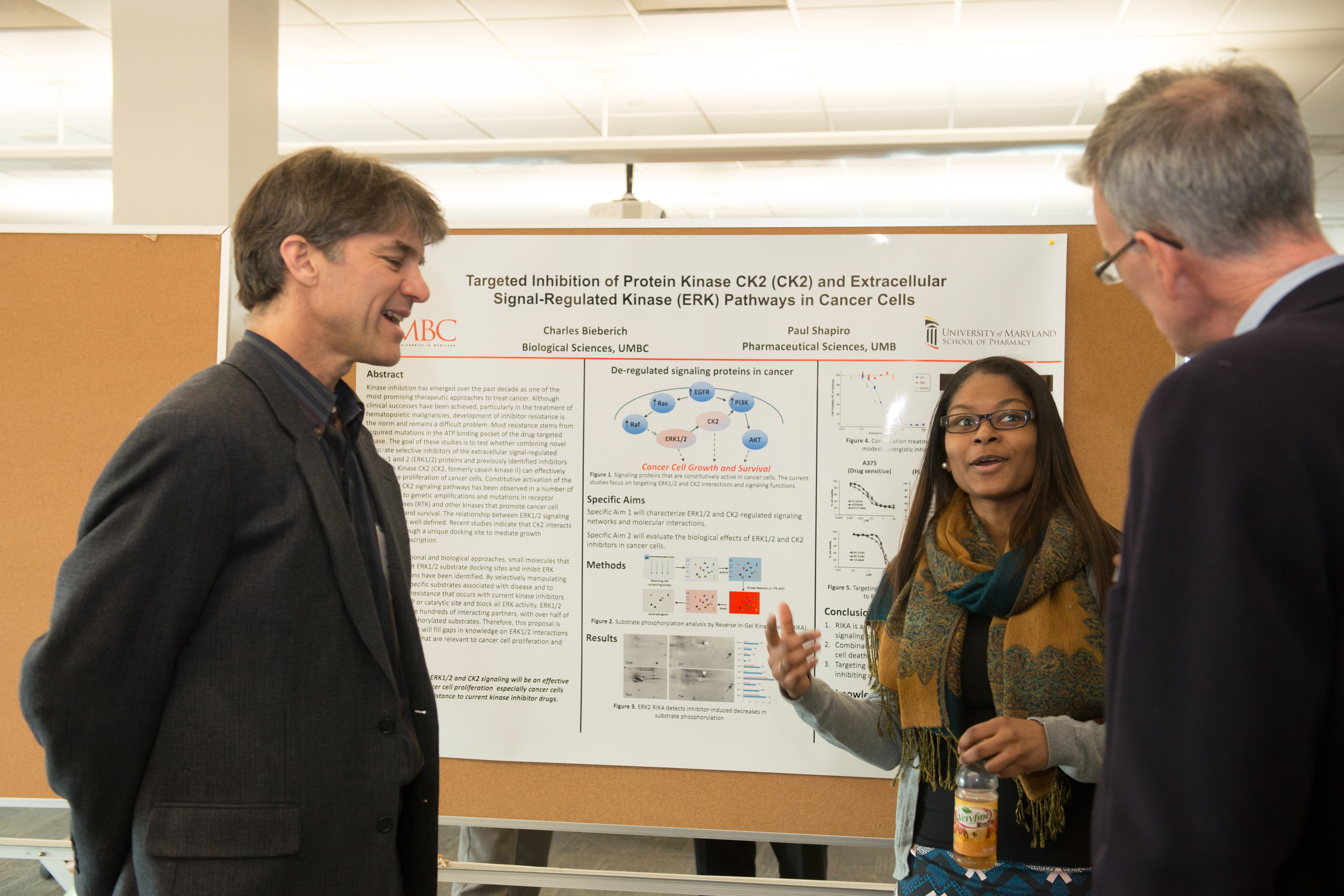
Shapiro (left) and Biebrich (right) discuss their project, which aims to develop effective drugs for treatment-resistant cancer cells, with a student.
Keynote Inspiration
Keynote speaker Yvonne Maddox, Acting Director of the National Institute of Minority Health and Health Disparities, was the perfect centerpiece to the symposium’s program. “Dr. Maddox has practiced and championed why we are here today,” said Bill LaCourse, Dean of the College of Natural and Mathematical Sciences at UMBC. “She knows about partnerships.” Maddox was thrilled to have the opportunity to speak at the symposium. “To be here on this campus when you are collaborating and working together… You are the universities of the future,” she said.
She advocated for the new science of health disparities and even asked for the audience’s help in shaping the burgeoning field. She acknowledged past progress but also the need for much more. “We’ve done almost everything we can above the iceberg,” she said in reference to reducing infant mortality, one of her priorities, but “two-thirds of the iceberg is under the water level. Let’s look under the water level.” And how are we going to accomplish deeper, long-lasting change? “Partnerships are going to help us,” she stated.
Maddox also promoted the need for a diverse workforce. The NIH recently awarded UMBC $18 million through the Building Infrastructure Leading to Diversity (BUILD) grant program. “The BUILD program is just the cat’s whiskers,” she said. “It’ll make it happen. I’m convinced.”
UMB President Jay Perman captured the symposium’s positive, action-driven vibe in his opening address. “We’re preaching to the choir here. You’ve seen the power of collaboration, you’ve led by collaboration,” he said. “I want you to diffuse it out and tell your colleagues who haven’t quite discovered the opportunities that the two campuses have together to go and grab them.” And most importantly, “We’ll support them.”
Dr. Maddox's presentation is attached below.
]]>
Inaugural UMBC-UMB Research and Innovation Partnership Symposium celebrates cross-campus collaboration By Sarah Hansen Right: UMB President Jay Perman (left), UMBC President Freeman Hrabowski...
Image
https://assets3-beta.my.umbc.edu/system/shared/attachments/663341b274f6cb2b544fe21343a1b884/69eb0c3f/news/000/049/818/9a912f218d27a625d946ed56081d9123/Symposium - Perman, Hrabowski, Maddox.jpg?1423793649
https://beta.my.umbc.edu/api/v0/pixel/news/49818/guest@my.umbc.edu/e9a24890ac0b5c357e24cbe136f61125/api/pixel
ovpr-news-2015
Archived RCA News
https://beta.my.umbc.edu/groups/research
https://assets4-beta.my.umbc.edu/system/shared/avatars/groups/000/000/794/4bca2aa331eb7e472d63d97e0798b600/xsmall.png?1743706368
https://assets2-beta.my.umbc.edu/system/shared/avatars/groups/000/000/794/4bca2aa331eb7e472d63d97e0798b600/original.jpg?1743706368
https://assets3-beta.my.umbc.edu/system/shared/avatars/groups/000/000/794/4bca2aa331eb7e472d63d97e0798b600/xxlarge.png?1743706368
https://assets4-beta.my.umbc.edu/system/shared/avatars/groups/000/000/794/4bca2aa331eb7e472d63d97e0798b600/xlarge.png?1743706368
https://assets2-beta.my.umbc.edu/system/shared/avatars/groups/000/000/794/4bca2aa331eb7e472d63d97e0798b600/large.png?1743706368
https://assets4-beta.my.umbc.edu/system/shared/avatars/groups/000/000/794/4bca2aa331eb7e472d63d97e0798b600/medium.png?1743706368
https://assets4-beta.my.umbc.edu/system/shared/avatars/groups/000/000/794/4bca2aa331eb7e472d63d97e0798b600/small.png?1743706368
https://assets4-beta.my.umbc.edu/system/shared/avatars/groups/000/000/794/4bca2aa331eb7e472d63d97e0798b600/xsmall.png?1743706368
https://assets3-beta.my.umbc.edu/system/shared/avatars/groups/000/000/794/4bca2aa331eb7e472d63d97e0798b600/xxsmall.png?1743706368
Office of the Vice President for Research
https://assets4-beta.my.umbc.edu/system/shared/thumbnails/news/000/049/818/1bf4b10b058cd14143bf1c9caeb5fe83/xxlarge.jpg?1423794141
https://assets2-beta.my.umbc.edu/system/shared/thumbnails/news/000/049/818/1bf4b10b058cd14143bf1c9caeb5fe83/xlarge.jpg?1423794141
https://assets2-beta.my.umbc.edu/system/shared/thumbnails/news/000/049/818/1bf4b10b058cd14143bf1c9caeb5fe83/large.jpg?1423794141
https://assets3-beta.my.umbc.edu/system/shared/thumbnails/news/000/049/818/1bf4b10b058cd14143bf1c9caeb5fe83/medium.jpg?1423794141
https://assets2-beta.my.umbc.edu/system/shared/thumbnails/news/000/049/818/1bf4b10b058cd14143bf1c9caeb5fe83/small.jpg?1423794141
https://assets4-beta.my.umbc.edu/system/shared/thumbnails/news/000/049/818/1bf4b10b058cd14143bf1c9caeb5fe83/xsmall.jpg?1423794141
https://assets4-beta.my.umbc.edu/system/shared/thumbnails/news/000/049/818/1bf4b10b058cd14143bf1c9caeb5fe83/xxsmall.jpg?1423794141
1
0
true
Thu, 12 Feb 2015 21:33:28 -0500
Fri, 13 Feb 2015 10:02:52 -0500
The Science of Attraction
Biologist Tamra Mendelson explains how sexual selection plays a major role in the evolution of vibrant features, from stripes to tail feathers.
Male cardinals are red. Male peacocks have bright tail plumage. Conventional biological wisdom says that species look different because they are adapting to different environments — food, predators, or climate. That assumption is missing a major piece of the puzzle, say researchers at UMBC and the University of Colorado, Boulder.
In a recent study published in the journal Ecology Letters and featured in The Baltimore Sun, Tamra Mendelson and her co-authors suggest that sexual attraction plays a significant role in how animals — even those of the same species living in similar environments — can adapt different characteristics to attract mates. The researchers propose that animals don’t just respond to their environments, they respond to each other.
“It turns out males in particular don’t have to adapt to the environment,” says Mendelson, an associate professor of biological sciences at UMBC and lead author on the study. “They’re adapting to the opposite sex.”
This implies, says Mendelson, that populations in similar environments may come up with different ways to solve the same problem. For example, males in one population might evolve a flashy feather to attract females, whereas males in another population might evolve a colorful beak.
This helps explain the wide array of vivid colors and arresting features we finding in creatures like birds-of-paradise. It also highlights the point that just because two individuals don’t look the same or act the same, doesn’t mean they’re not the same species.
The next steps will involve testing the model, Mendelson explains. She will do experiments called reciprocal transplants: placing species A in the habitat of species B, and species B in the habitat of species A. According to Mendelson’s model there shouldn’t be any difference in how the males perform in their reversed habitats.
Next, Mendelson and her colleagues will do a reciprocal transplant of the sexual environment. This involves allowing males of species A to compete with each other for females of species B and vice versa.
Mendelson says, “I want to understand why and what ornaments are going to be particularly attractive.” She hopes this will help scientists understand the development of such varied and complex ornamentation.
“What kind of a mutation would be successful?” Mendelson asks. “Mutations drive evolution. You could argue that it is mutation that is the most important thing. What is it about the female fish brain that makes certain male ornamentation more attractive?”
Mendelson and Natalie Roberts, PhD student in biological sciences, will use video animations of darter fish to ask that question in their ongoing research. Amazingly, fish respond readily to video images of other fish, so the researchers will manipulate videos of male darters to see if and how they can make them more attractive to fish of the opposite sex.
“We can use the videos to create mutations that don’t exist yet, to see what could happen in the future," says Mendelson.
Will an extra fin stripe or spot of color make a fish more attractive? Only the TV-watching darters can tell us.
]]>
Biologist Tamra Mendelson explains how sexual selection plays a major role in the evolution of vibrant features, from stripes to tail feathers. Male cardinals are red. Male peacocks have...
https://beta.my.umbc.edu/api/v0/pixel/news/49781/guest@my.umbc.edu/9be0fd3e3f8069fb2a6d8a4de1a3591e/api/pixel
ovpr-news-2015
Archived RCA News
https://beta.my.umbc.edu/groups/research
https://assets4-beta.my.umbc.edu/system/shared/avatars/groups/000/000/794/4bca2aa331eb7e472d63d97e0798b600/xsmall.png?1743706368
https://assets2-beta.my.umbc.edu/system/shared/avatars/groups/000/000/794/4bca2aa331eb7e472d63d97e0798b600/original.jpg?1743706368
https://assets3-beta.my.umbc.edu/system/shared/avatars/groups/000/000/794/4bca2aa331eb7e472d63d97e0798b600/xxlarge.png?1743706368
https://assets4-beta.my.umbc.edu/system/shared/avatars/groups/000/000/794/4bca2aa331eb7e472d63d97e0798b600/xlarge.png?1743706368
https://assets2-beta.my.umbc.edu/system/shared/avatars/groups/000/000/794/4bca2aa331eb7e472d63d97e0798b600/large.png?1743706368
https://assets4-beta.my.umbc.edu/system/shared/avatars/groups/000/000/794/4bca2aa331eb7e472d63d97e0798b600/medium.png?1743706368
https://assets4-beta.my.umbc.edu/system/shared/avatars/groups/000/000/794/4bca2aa331eb7e472d63d97e0798b600/small.png?1743706368
https://assets4-beta.my.umbc.edu/system/shared/avatars/groups/000/000/794/4bca2aa331eb7e472d63d97e0798b600/xsmall.png?1743706368
https://assets3-beta.my.umbc.edu/system/shared/avatars/groups/000/000/794/4bca2aa331eb7e472d63d97e0798b600/xxsmall.png?1743706368
Office of the Vice President for Research
https://assets4-beta.my.umbc.edu/system/shared/thumbnails/news/000/049/781/94404d7b55216b9a39adcc8bbac07a47/xxlarge.jpg?1423710489
https://assets1-beta.my.umbc.edu/system/shared/thumbnails/news/000/049/781/94404d7b55216b9a39adcc8bbac07a47/xlarge.jpg?1423710489
https://assets2-beta.my.umbc.edu/system/shared/thumbnails/news/000/049/781/94404d7b55216b9a39adcc8bbac07a47/large.jpg?1423710489
https://assets1-beta.my.umbc.edu/system/shared/thumbnails/news/000/049/781/94404d7b55216b9a39adcc8bbac07a47/medium.jpg?1423710489
https://assets1-beta.my.umbc.edu/system/shared/thumbnails/news/000/049/781/94404d7b55216b9a39adcc8bbac07a47/small.jpg?1423710489
https://assets3-beta.my.umbc.edu/system/shared/thumbnails/news/000/049/781/94404d7b55216b9a39adcc8bbac07a47/xsmall.jpg?1423710489
https://assets2-beta.my.umbc.edu/system/shared/thumbnails/news/000/049/781/94404d7b55216b9a39adcc8bbac07a47/xxsmall.jpg?1423710489
0
0
true
Wed, 11 Feb 2015 22:08:29 -0500
Timothy Nohe Selected as Warnock Foundation Social Innovator
by Sierra Francis
Tim Nohe, UMBC Professor of Visual Arts and director of the Center for Innovation, Research and Creativity in the Arts has recently been selected by the Warnock Foundation as a "social innovator" for his work with urban woods, particularly Springfield Woods of Northeast Baltimore. Professor Nohe and UMBC Professor of Geography and Environmental Systems Matthew Baker are geotagging the woods, using GPS technology to create an inventory of its natural features. Mr. Butch Berry of Friends of Springfield Woods, Baltimore Green Space, and a group of students from the Friends School of Baltimore led by Josh Carlin have also aided in the endeavor. The information being gathered is to be put into an online database that anyone will be able to use. Implications for this kind of work are limitless; from better understanding the historic and economic history of the area, to learning how to care for trees, to identifying birds' song, and so on.
Nohe explains that, while Springfield Woods might not look like much on the surface, it essentially contains an encyclopedia's worth of information. In addition, with the knowledge that this particular spot on the map can reveal so much about Baltimore, other urban forests around the country could potentially reveal even more valuable information. Nohe states, "This award adds to the much needed project support that we have already received from the Breaking Ground initiative at UMBC... I'm so pleased to connect the creative energy and research of my public research university directly to neighborhoods in the city that I love, Baltimore."
Photo credit: Bob Reagan
UMBC Vice President for Research Karl V. Steiner and Vice Provost for Academic Affairs Antonio Moreira traveled to Fukuoka, Japan for the opening of Japan’s first academic Cybersecurity Center, housed at Kyushu University (KU). Steiner and Moreira both gave keynote addresses at the Cybersecurity Center Opening Ceremony and Cybersecurity Symposium January 21-23. The visit was a follow-up to a Memorandum of Understanding signed by both universities in June 2014 at UMBC that formalized an agreement to forge collaborations in research and education.
The partnership was initiated by KU. “They sought us out specifically around cybersecurity,” stated Moreira. KU is in the process of moving to a brand-new, high-tech campus, and is growing its cybersecurity programs. “As they are laying the foundation for what courses to give and what research to pursue, they were looking for a partner that had a track record and some experience,” added Moreira.
UMBC fit the bill. “UMBC has a very good reputation in cybersecurity, and Maryland is positioned as a hub of cybersecurity research,” Steiner said. Surrounded by government agencies and now with the creation of a new National Lab for Cybersecurity, “Within our strategic research goals, cybersecurity is clearly one of the main focal areas for our institution,” Steiner said.
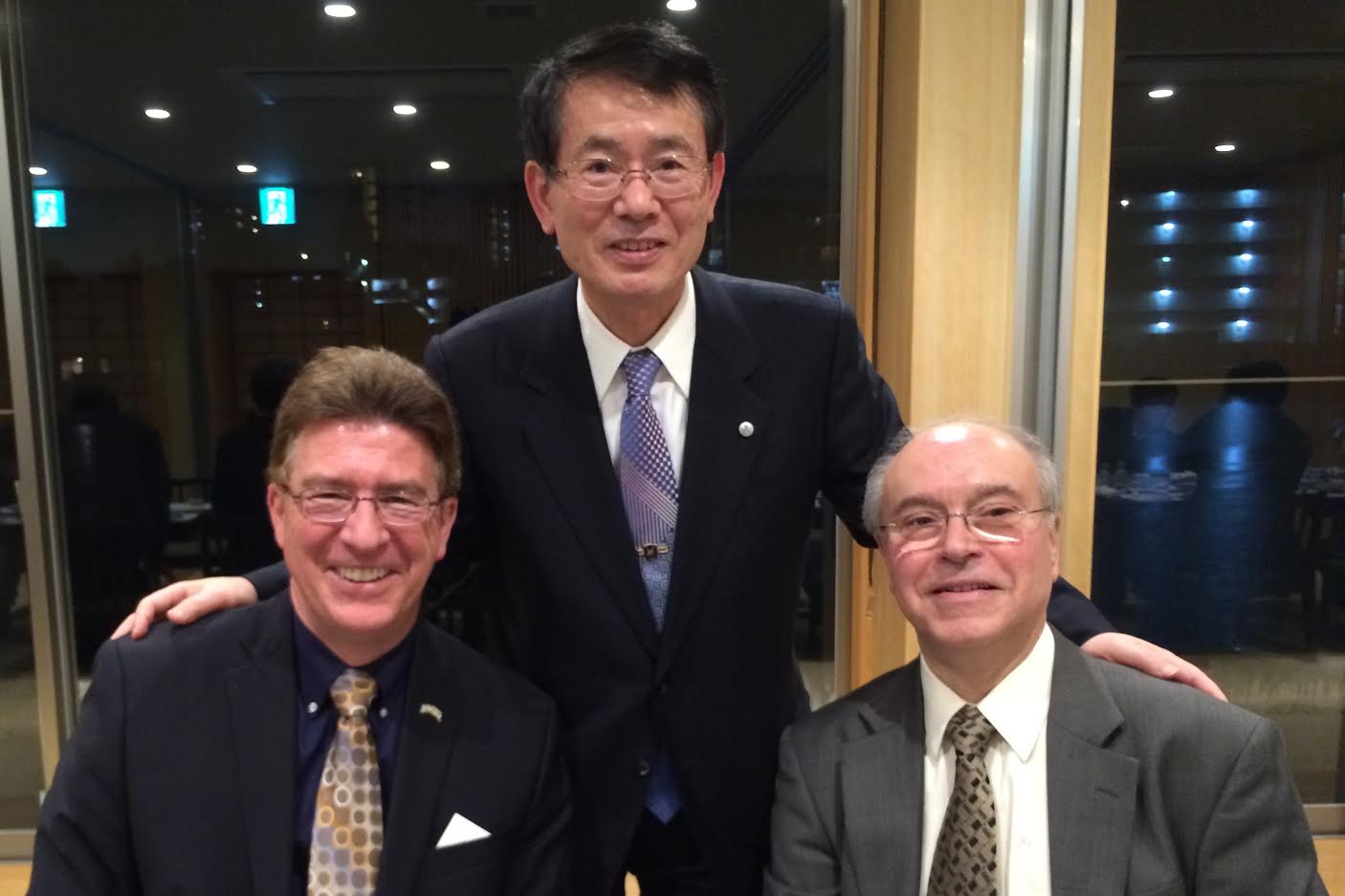
From left to right: Steiner, Kyushu University President Chiharu Kubo, Moreira
KU has a great deal to offer, as well. While the primary focus of the visit was cybersecurity collaboration, “We saw a variety of other areas that KU is very strong in. We’re beginning to look at where are other opportunities?” Steiner said. The schools of design, medicine, and engineering were particularly impressive. “There were moments when they opened the door and we were impressed by the unique state-of-the-art equipment available in KU’s labs,” Steiner remarked. “It was eye-opening to see some of the research they were doing.”
By combining the expertise of the universities, “I think we can really benefit from each other,” Steiner said. But practicalities like the 14-hour time difference between Baltimore and Fukuoka pose a challenge. UMBC and KU are planning a live video-conference colloquium for Fall 2015. Getting classrooms full of students on both sides may require “some free sushi for dinner on our side and possibly coffee and donuts for breakfast on the other side, to put us all into a cross-cultural mindset,” said Steiner.
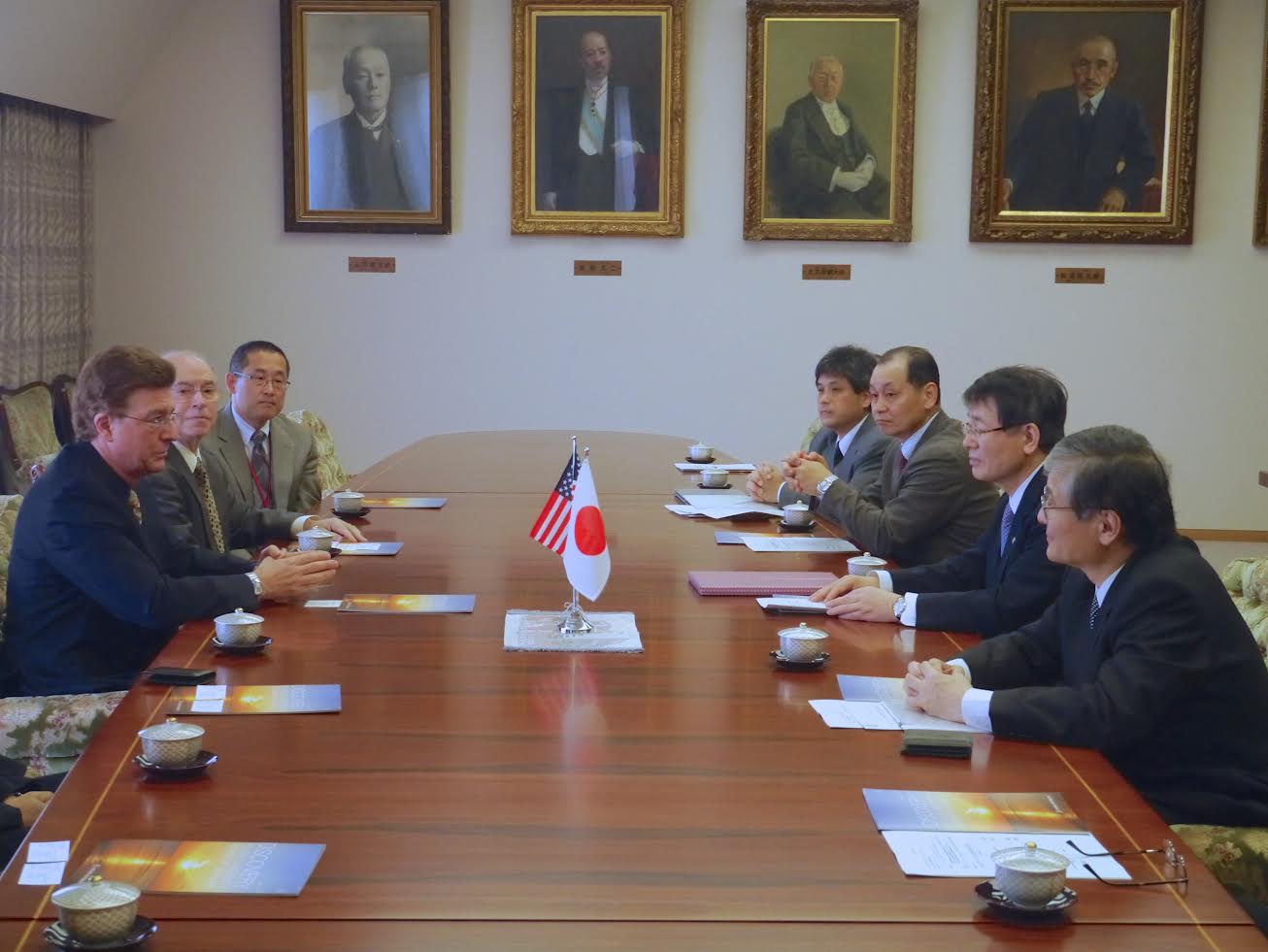
Representatives from UMBC and KU discuss plans for the institutions' partnership.
Overcoming challenges is worth it, though, to expand collaboration in this critical area and afford students opportunities for international interaction. “I think it is vital for our students to look beyond the borders of our country,” Steiner said. While faculty and student exchanges are a primary goal of the partnership, Steiner and Moreira are looking for ways that the UMBC-KU relationship can impact more than those few students who will travel to Japan or host Japanese students here. Steiner said, “A handful of faculty and students will visit and stay at the other institution and yes, their lives will be changed, but how can we make this a broader, more meaningful and sustainable relationship?” Moreira chimed in: “Such a sustained relationship between partners who share common interests will lead to meaningful advancements with global impact in research and education.”
These are the questions UMBC needs to answer as it continues to grow into a major research institution on the international stage. “It is an integral part of being a research-intensive university, to have relationships like this,” Steiner said. “Science cannot be local, science is global. Research is global.”
]]>
By Sarah Hansen UMBC Vice President for Research Karl V. Steiner and Vice Provost for Academic Affairs Antonio Moreira traveled to Fukuoka, Japan for the opening of Japan’s first academic...
Image
https://assets2-beta.my.umbc.edu/system/shared/attachments/07553dc2ae376c20ed0b4bae9ea0583d/69eb0c3f/news/000/049/717/151ea8c2d98ce89c2336324c11b1e107/Steiner Moreira Japan.jpg?1423671538
https://beta.my.umbc.edu/api/v0/pixel/news/49717/guest@my.umbc.edu/1c537729d94c72746494cfccdd91761f/api/pixel
ovpr-news-2015
Archived RCA News
https://beta.my.umbc.edu/groups/research
https://assets4-beta.my.umbc.edu/system/shared/avatars/groups/000/000/794/4bca2aa331eb7e472d63d97e0798b600/xsmall.png?1743706368
https://assets2-beta.my.umbc.edu/system/shared/avatars/groups/000/000/794/4bca2aa331eb7e472d63d97e0798b600/original.jpg?1743706368
https://assets3-beta.my.umbc.edu/system/shared/avatars/groups/000/000/794/4bca2aa331eb7e472d63d97e0798b600/xxlarge.png?1743706368
https://assets4-beta.my.umbc.edu/system/shared/avatars/groups/000/000/794/4bca2aa331eb7e472d63d97e0798b600/xlarge.png?1743706368
https://assets2-beta.my.umbc.edu/system/shared/avatars/groups/000/000/794/4bca2aa331eb7e472d63d97e0798b600/large.png?1743706368
https://assets4-beta.my.umbc.edu/system/shared/avatars/groups/000/000/794/4bca2aa331eb7e472d63d97e0798b600/medium.png?1743706368
https://assets4-beta.my.umbc.edu/system/shared/avatars/groups/000/000/794/4bca2aa331eb7e472d63d97e0798b600/small.png?1743706368
https://assets4-beta.my.umbc.edu/system/shared/avatars/groups/000/000/794/4bca2aa331eb7e472d63d97e0798b600/xsmall.png?1743706368
https://assets3-beta.my.umbc.edu/system/shared/avatars/groups/000/000/794/4bca2aa331eb7e472d63d97e0798b600/xxsmall.png?1743706368
Office of the Vice President for Research
https://assets3-beta.my.umbc.edu/system/shared/thumbnails/news/000/049/717/f303dc9c7efda3e8fc5463088620af20/xxlarge.jpg?1423512088
https://assets3-beta.my.umbc.edu/system/shared/thumbnails/news/000/049/717/f303dc9c7efda3e8fc5463088620af20/xlarge.jpg?1423512088
https://assets2-beta.my.umbc.edu/system/shared/thumbnails/news/000/049/717/f303dc9c7efda3e8fc5463088620af20/large.jpg?1423512088
https://assets2-beta.my.umbc.edu/system/shared/thumbnails/news/000/049/717/f303dc9c7efda3e8fc5463088620af20/medium.jpg?1423512088
https://assets2-beta.my.umbc.edu/system/shared/thumbnails/news/000/049/717/f303dc9c7efda3e8fc5463088620af20/small.jpg?1423512088
https://assets2-beta.my.umbc.edu/system/shared/thumbnails/news/000/049/717/f303dc9c7efda3e8fc5463088620af20/xsmall.jpg?1423512088
https://assets1-beta.my.umbc.edu/system/shared/thumbnails/news/000/049/717/f303dc9c7efda3e8fc5463088620af20/xxsmall.jpg?1423512088
1
0
true
Mon, 09 Feb 2015 15:26:48 -0500
Wed, 11 Feb 2015 14:17:54 -0500