UMBC’s Evan Avila wins iOme Challenge
Entry aims to help millennials save for retirement
Evan Avila ‘20, economics and political science, is a millennial with retirement on his mind, and his fresh ideas are now capturing the interest of policymakers. Avila recently won first place in the national 2018
iOme Challenge, which asked students across the United States to innovate policies to help millennials save for retirement. Avila presented his winning paper,
Rethinking Millennial Retirement: Policy Recommendations for a Gig Economy, to policymakers on June 20 at a symposium on Capitol Hill.
Evan Avila delivers his award-winning paper. Photo courtesy of WISER.
This year’s iOme (“I Owe Me”) Challenge asked participants to imagine they were invited to join a bipartisan task force to address a growing retirement crisis in the U.S. What policies might they propose on issues relating to gig economy workers or using social media to increase awareness about saving for retirement?
Avila had dealt with these topics before, in the classroom and through volunteering with tax assistance and financial counseling. Avila has served as a certified volunteer in the federal
Volunteers Income Tax Assistance (VITA) program at UMBC, which provides tax return filing support for eligible people no cost to them. He’s also offered financial literacy clinics for fellow college students and was familiar with their common questions and concerns about how to make smart financial decisions.
Avila applied this knowledge and experience to creating an iOme Challenge entry that contest judge David Wegge, interim dean of Schneider School of Business and Economics at St. Norbert College, said, “demonstrated great policy depth, a keen understanding of the challenges millennials face, and creativity in devising solutions that are achievable for this age cohort.”
Cindy Hounsell is president of the
Women’s Institute for a Secure Retirement (WISER), which sponsored the competition. She shared, “We are impressed by Mr. Avila’s response to the more complicated challenges and deterrents millennials face in preparing for their future retirement.”
L to R: Doug Lamdin, Cindy Hounsell, Evin Avila. Photo courtesy of WISER.
UMBC economics professor Doug Lamdin mentored Avila as he developed his three-part policy proposal and transformed his essay into a
video. He shares that typically students enter the contest as teams, but he wasn’t surprised that even competing as a team of one Avila emerged the winner.
“That Evan won the competition is not exactly a surprise. He had a very strong proposal,” said Lamdin. “Evan balanced the demands of the competition, usually placed on a team, exceptionally well in addition to a full class schedule, working as a teaching assistant, a research assistant, presenting at the Undergraduate Research and Creative Activities Day (URCAD), volunteering at the Esperanza Center teaching English, and his activities as a Sondheim Scholar.”
Avila, who recently completed his fourth semester with a 4.0, is currently serving as an intern in the Office of Comptroller of the Currency in Washington, D.C. This follows an
internship in 2017 at the U.S. Census Bureau, where he worked in the Economics Indicators division, focusing on how to efficiently process massive quantities of survey data in a precise way.
Looking ahead, Avila plans to pursue a career in tax or administrative law. “I came from a Peruvian and Mexican household. I saw how hard my parents worked and the challenges they faced to have financial security,” says Avila. “In college, I see my peers trying to make sense of personal budgets, savings, loans, credit, and retirement. It is very rewarding to help people be financially literate and understand the laws and policies that affect their wallet.”
Banner image: Evan Avila with his economics internship supervisor in 2017. Photo by Marlayna Demond ’11 for UMBC.
]]>
By Catalina Sofia Dansberger Duque for news.umbc.edu Evan Avila ‘20, economics and political science, is a millennial with retirement on his mind, and his fresh ideas are now capturing the...
Photo
https://assets4-beta.my.umbc.edu/system/shared/attachments/32fed2ed24833f915532bb3483339be9/69ecc6de/news/000/077/408/3f54e27d6a63e1397fe94938013a9161/DSC_7991-e1530118475246-1024x635.jpg?1530904137
https://beta.my.umbc.edu/api/v0/pixel/news/77408/guest@my.umbc.edu/6dd2d8d93858281c3bcc22f30a026b8c/api/pixel
ovpr-news-2018
Archived RCA News
https://beta.my.umbc.edu/groups/research
https://assets4-beta.my.umbc.edu/system/shared/avatars/groups/000/000/794/4bca2aa331eb7e472d63d97e0798b600/xsmall.png?1743706368
https://assets2-beta.my.umbc.edu/system/shared/avatars/groups/000/000/794/4bca2aa331eb7e472d63d97e0798b600/original.jpg?1743706368
https://assets3-beta.my.umbc.edu/system/shared/avatars/groups/000/000/794/4bca2aa331eb7e472d63d97e0798b600/xxlarge.png?1743706368
https://assets4-beta.my.umbc.edu/system/shared/avatars/groups/000/000/794/4bca2aa331eb7e472d63d97e0798b600/xlarge.png?1743706368
https://assets2-beta.my.umbc.edu/system/shared/avatars/groups/000/000/794/4bca2aa331eb7e472d63d97e0798b600/large.png?1743706368
https://assets4-beta.my.umbc.edu/system/shared/avatars/groups/000/000/794/4bca2aa331eb7e472d63d97e0798b600/medium.png?1743706368
https://assets4-beta.my.umbc.edu/system/shared/avatars/groups/000/000/794/4bca2aa331eb7e472d63d97e0798b600/small.png?1743706368
https://assets4-beta.my.umbc.edu/system/shared/avatars/groups/000/000/794/4bca2aa331eb7e472d63d97e0798b600/xsmall.png?1743706368
https://assets3-beta.my.umbc.edu/system/shared/avatars/groups/000/000/794/4bca2aa331eb7e472d63d97e0798b600/xxsmall.png?1743706368
Office of the Vice President for Research
https://assets1-beta.my.umbc.edu/system/shared/thumbnails/news/000/077/408/d1568bcfec4cb93b5ae6503a29516f9e/xxlarge.jpg?1530904489
https://assets3-beta.my.umbc.edu/system/shared/thumbnails/news/000/077/408/d1568bcfec4cb93b5ae6503a29516f9e/xlarge.jpg?1530904489
https://assets1-beta.my.umbc.edu/system/shared/thumbnails/news/000/077/408/d1568bcfec4cb93b5ae6503a29516f9e/large.jpg?1530904489
https://assets3-beta.my.umbc.edu/system/shared/thumbnails/news/000/077/408/d1568bcfec4cb93b5ae6503a29516f9e/medium.jpg?1530904489
https://assets3-beta.my.umbc.edu/system/shared/thumbnails/news/000/077/408/d1568bcfec4cb93b5ae6503a29516f9e/small.jpg?1530904489
https://assets2-beta.my.umbc.edu/system/shared/thumbnails/news/000/077/408/d1568bcfec4cb93b5ae6503a29516f9e/xsmall.jpg?1530904489
https://assets4-beta.my.umbc.edu/system/shared/thumbnails/news/000/077/408/d1568bcfec4cb93b5ae6503a29516f9e/xxsmall.jpg?1530904489
0
0
true
Fri, 06 Jul 2018 15:16:01 -0400
Rapid sepsis test wins UMBC Cangialosi Business Competition
Six finalists pitched creative business ideas to a panel of judges during UMBC’s fifth annual Cangialosi Business Innovation Competition (CBIC), held on April 25, 2018 in the new UMBC Event Center. The business ideas ranged from online tools and apps to products with medical applications.
The Cangialosi Business Innovation Competition is for undergraduate and graduate students who are serious about starting a business, explains Vivian Armor ’73, American studies, director of the Alex. Brown Center for Entrepreneurship at UMBC. Throughout the course of the competition, each team is paired with an industry mentor who provides guidance and professional advice ahead of a final Shark Tank-style event. The structure of the event and its focus on mentorship are inspired by the vision of entrepreneur Greg Cangialosi ‘96, English, reflecting on his own undergraduate days at UMBC and what he has learned in the years since then about moving from an idea to a successful company.
Miranda Marvel, Ph.D. ‘19, marine estuarine environmental sciences, shared SensorFish, which took third place in the competition. She explained how fish mortality due to stress is a common problem that fish owners face. SensorFish are special type of zebrafish bred to change color based on common stressors that fish commonly encounter, such as poor water quality or particular illnesses. Because the fish change color immediately when they are experiencing a problem in the tank, their owners can more quickly work to fix the problem, keeping the fish healthy.
Miranda Marvel presented SensorFish at the Cangialosi Business Innovation Competition.
Second place was awarded to Matrix Cast, an idea presented by Flo de Sande ‘18, mechanical engineering. Matrix Cast is a plastic cast that can be altered to fit all arm shapes and sizes. de Sande explained that Matrix Cast offers a low-cost cast option for physicians working in remote or low-resource locations, such as communities served through Doctors Without Borders or military installations in conflict zones. The cast is a “pressure vessel” type design, which, while made from plastic, is very sturdy, explained de Sande during her business pitch.
Flo de Sande was recognized with second place in the 2018 competition.
GermoSense, a rapid sepsis-detection test developed by Mustafa Al-Adhami, M.S. ‘15, mechanical engineering, Ph.D. ‘19, mechanical engineering, received first place in the competition. Sepsis is a life-threatening blood infection that, if not treated promptly, can lead to serious complications and even death in mere days. Currently, the test that medical professionals rely on to determine antibiotic efficacy for sepsis patients can take several days to yield results. Because of this challenge, physicians often start patients who they suspect have sepsis on broad spectrum antibiotics, which can possibly help if the patient has sepsis but might be unnecessary and ineffective for people facing other medical conditions that are presenting similarly to sepsis, or in the case of antibiotic resistance.
Al-Adhami explained that GermoSense is able to determine whether a patient has sepsis within one hour, which can lead to shorter hospital stays, help prevent antibiotic resistance by avoiding unnecessary antibiotic use, and reduce medical costs. GermoSense costs approximately $100 to use, compared to comparable tests that can cost $170 or more. At last year’s CBIC, Al-Adhami presented GermoSense, then at an earlier stage of development, and took third place in the competition.
Mustafa Al-Adhami received first place in the competition for GermoSense, a rapid sepsis-detection test.
The contest’s additional three finalists included UniVerse by Allison Gross ‘18, certificate in English as a second language; Frey Custom Cues by Christopher Bodan ‘19, interdisciplinary studies, and Michelle Barrow ‘08, gender and women’s studies, and marketing coordinator in the division of professional studies at UMBC, and James Baker; and Skanaroo by Vincent Celebrado-Royer ‘17, business technology administration, and Tyler Little ‘20, computer science.
For Cangialosi, the event was not just about identifying top projects, but, more broadly, about helping young entrepreneurs move toward success one step at a time. Taking in the creativity and energy of the event, he reflected, “This room is filled with dreams and entrepreneurial spirit.”
Banner image: Mustafa Al-Adhami, M.S. ‘15, mechanical engineering, Ph.D. ‘19, mechanical engineering, left; Greg Cangialosi ’96, English; Flo de Sande ’18, mechanical engineering; and Miranda Marvel ‘Ph.D. ‘19, marine estuarine environmental sciences, after the competition. All photos by Marlayna Demond ’11 for UMBC.
]]>
By Megan Hanks for news.umbc.edu. Six finalists pitched creative business ideas to a panel of judges during UMBC’s fifth annual Cangialosi Business Innovation Competition (CBIC), held on April...
Photo
https://assets3-beta.my.umbc.edu/system/shared/attachments/99d4c38fcda48f22c74262bb5770092a/69ecc6de/news/000/077/407/99644a15c905e2bea0236398dd480dd5/Cangialosi-CBIC-event18-7667.jpg?1530903602
https://beta.my.umbc.edu/api/v0/pixel/news/77407/guest@my.umbc.edu/d002e84d4977806095dfca273fd0685e/api/pixel
ovpr-news-2018
Archived RCA News
https://beta.my.umbc.edu/groups/research
https://assets4-beta.my.umbc.edu/system/shared/avatars/groups/000/000/794/4bca2aa331eb7e472d63d97e0798b600/xsmall.png?1743706368
https://assets2-beta.my.umbc.edu/system/shared/avatars/groups/000/000/794/4bca2aa331eb7e472d63d97e0798b600/original.jpg?1743706368
https://assets3-beta.my.umbc.edu/system/shared/avatars/groups/000/000/794/4bca2aa331eb7e472d63d97e0798b600/xxlarge.png?1743706368
https://assets4-beta.my.umbc.edu/system/shared/avatars/groups/000/000/794/4bca2aa331eb7e472d63d97e0798b600/xlarge.png?1743706368
https://assets2-beta.my.umbc.edu/system/shared/avatars/groups/000/000/794/4bca2aa331eb7e472d63d97e0798b600/large.png?1743706368
https://assets4-beta.my.umbc.edu/system/shared/avatars/groups/000/000/794/4bca2aa331eb7e472d63d97e0798b600/medium.png?1743706368
https://assets4-beta.my.umbc.edu/system/shared/avatars/groups/000/000/794/4bca2aa331eb7e472d63d97e0798b600/small.png?1743706368
https://assets4-beta.my.umbc.edu/system/shared/avatars/groups/000/000/794/4bca2aa331eb7e472d63d97e0798b600/xsmall.png?1743706368
https://assets3-beta.my.umbc.edu/system/shared/avatars/groups/000/000/794/4bca2aa331eb7e472d63d97e0798b600/xxsmall.png?1743706368
Office of the Vice President for Research
https://assets2-beta.my.umbc.edu/system/shared/thumbnails/news/000/077/407/f45a4830dc8235969beca82304d14506/xxlarge.jpg?1530903749
https://assets2-beta.my.umbc.edu/system/shared/thumbnails/news/000/077/407/f45a4830dc8235969beca82304d14506/xlarge.jpg?1530903749
https://assets2-beta.my.umbc.edu/system/shared/thumbnails/news/000/077/407/f45a4830dc8235969beca82304d14506/large.jpg?1530903749
https://assets1-beta.my.umbc.edu/system/shared/thumbnails/news/000/077/407/f45a4830dc8235969beca82304d14506/medium.jpg?1530903749
https://assets2-beta.my.umbc.edu/system/shared/thumbnails/news/000/077/407/f45a4830dc8235969beca82304d14506/small.jpg?1530903749
https://assets1-beta.my.umbc.edu/system/shared/thumbnails/news/000/077/407/f45a4830dc8235969beca82304d14506/xsmall.jpg?1530903749
https://assets2-beta.my.umbc.edu/system/shared/thumbnails/news/000/077/407/f45a4830dc8235969beca82304d14506/xxsmall.jpg?1530903749
0
0
true
Fri, 06 Jul 2018 15:02:38 -0400
Fri, 06 Jul 2018 15:02:47 -0400
UMBC faculty and alumnus honored by Maryland Science Center
A UMBC faculty member and a UMBC alumnus were recognized by the Maryland Science Center for their outstanding work in engineering and science. Lee Blaney, associate professor of chemical, biochemical and environmental engineering, was one of two people to receive the 2017 Outstanding Young Engineer Award, and Phillip Graff ’08, physics, was awarded one of two 2017 Outstanding Young Scientist Awards. The ceremony, hosted annually by the Maryland Science Center and the Maryland Academy of Sciences, highlights the work being done by young scientists and engineers in Maryland to advance the fields.
In his work, Blaney develops technology used to recover nutrients, such as phosphorus, from poultry litter. The phosphorus found in poultry litter often saturates the soil on the Eastern Shore of Maryland, making the water that runs off into the Chesapeake Bay a hazard for aquatic life. The technology he is testing in his lab could reduce the amount of phosphorus that ends up in the Chesapeake Bay from manure by about 90 percent.
“I was extremely delighted to receive the 2017 Maryland Outstanding Young Engineer Award. Of course, this award reflects a much larger team, and I would like to acknowledge my graduate and undergraduate research assistants for their hard work in the laboratory. This award is theirs as much as mine,” Blaney says. “Much of our research focuses on environmental issues in Maryland and the Chesapeake Bay watershed, and so it was a particular honor to be recognized by the Maryland Academy of Sciences. One of my mentors likes to say that every award comes with a great responsibility to live up to the associated expectations. So, we are looking forward to continuing our research to ensure environmental quality in the Chesapeake Bay watershed for the coming decades.”
Earlier this year, Blaney received a CAREER Award from the National Science Foundation to address contaminants of emerging concern, from personal care products and pharmaceuticals, found in the Gwynns Falls watershed.
“Dr. Blaney is a dedicated professor with unique and innovative research ideas. He is a great mentor who encourages his students to think about research problems from multiple angles and asks tough questions to push us to reach for the best solution,” says Mamatha Hopanna, Ph.D. ‘22, environmental engineering, who works in Blaney’s lab.
Blaney is the faculty advisor of the UMBC’s Engineers Without Borders student organization. He has led several trips to Kenya, where he and his students developed a clean-water supply for a village with a population of 500.
Graff currently works as a data scientist and astrophysicist at the Johns Hopkins University Applied Physics Laboratory in Baltimore. He has industry experience in many fields including cybersecurity. Previously, he worked at NASA Goddard Space Flight Center and helped develop an algorithm for the Laser Interferometry Gravitational Wave Observatory. He has also developed algorithms to protect the nation’s computer networks for the Department of Homeland Security National Cyber Protection System.
The Outstanding Young Scientist Award and Outstanding Young Engineer Award have been presented each year since 1959 and 1988, respectively. To be eligible for the award, nominees must be 35 or younger if working in academic settings, or younger than 40, if working in industry.
Banner image: Lee Blaney. Photo by Marlayna Demond ’11 for UMBC. Videos courtesy of the Maryland Science Center.
]]>
By Megan Hanks for news.umbc.edu A UMBC faculty member and a UMBC alumnus were recognized by the Maryland Science Center for their outstanding work in engineering and science. Lee Blaney,...
https://beta.my.umbc.edu/api/v0/pixel/news/77406/guest@my.umbc.edu/a88bf07f93798e29411054be323a5c9b/api/pixel
ovpr-news-2018
Archived RCA News
https://beta.my.umbc.edu/groups/research
https://assets4-beta.my.umbc.edu/system/shared/avatars/groups/000/000/794/4bca2aa331eb7e472d63d97e0798b600/xsmall.png?1743706368
https://assets2-beta.my.umbc.edu/system/shared/avatars/groups/000/000/794/4bca2aa331eb7e472d63d97e0798b600/original.jpg?1743706368
https://assets3-beta.my.umbc.edu/system/shared/avatars/groups/000/000/794/4bca2aa331eb7e472d63d97e0798b600/xxlarge.png?1743706368
https://assets4-beta.my.umbc.edu/system/shared/avatars/groups/000/000/794/4bca2aa331eb7e472d63d97e0798b600/xlarge.png?1743706368
https://assets2-beta.my.umbc.edu/system/shared/avatars/groups/000/000/794/4bca2aa331eb7e472d63d97e0798b600/large.png?1743706368
https://assets4-beta.my.umbc.edu/system/shared/avatars/groups/000/000/794/4bca2aa331eb7e472d63d97e0798b600/medium.png?1743706368
https://assets4-beta.my.umbc.edu/system/shared/avatars/groups/000/000/794/4bca2aa331eb7e472d63d97e0798b600/small.png?1743706368
https://assets4-beta.my.umbc.edu/system/shared/avatars/groups/000/000/794/4bca2aa331eb7e472d63d97e0798b600/xsmall.png?1743706368
https://assets3-beta.my.umbc.edu/system/shared/avatars/groups/000/000/794/4bca2aa331eb7e472d63d97e0798b600/xxsmall.png?1743706368
Office of the Vice President for Research
https://assets3-beta.my.umbc.edu/system/shared/thumbnails/news/000/077/406/7d26c14b4a096a0afc48154974c4b7d6/xxlarge.jpg?1530903361
https://assets1-beta.my.umbc.edu/system/shared/thumbnails/news/000/077/406/7d26c14b4a096a0afc48154974c4b7d6/xlarge.jpg?1530903361
https://assets2-beta.my.umbc.edu/system/shared/thumbnails/news/000/077/406/7d26c14b4a096a0afc48154974c4b7d6/large.jpg?1530903361
https://assets1-beta.my.umbc.edu/system/shared/thumbnails/news/000/077/406/7d26c14b4a096a0afc48154974c4b7d6/medium.jpg?1530903361
https://assets2-beta.my.umbc.edu/system/shared/thumbnails/news/000/077/406/7d26c14b4a096a0afc48154974c4b7d6/small.jpg?1530903361
https://assets2-beta.my.umbc.edu/system/shared/thumbnails/news/000/077/406/7d26c14b4a096a0afc48154974c4b7d6/xsmall.jpg?1530903361
https://assets1-beta.my.umbc.edu/system/shared/thumbnails/news/000/077/406/7d26c14b4a096a0afc48154974c4b7d6/xxsmall.jpg?1530903361
2
0
true
Fri, 06 Jul 2018 14:56:26 -0400
Fri, 06 Jul 2018 15:03:49 -0400
UMBC researchers open cybersecurity startup w/ TEDCO support
UMBC’s George Karabatis, associate professor of information systems, and Ahmed AlEroud M.S. ‘12, information systems, Ph.D. ‘14, information systems, recently launched the cybersecurity startup Cyves through $150,000 in grant funding from TEDCO, an organization create by the Maryland State Legislature to support tech entrepreneurship, and an investment from InnovativeTech Ventures, led by Gerard Eldering.
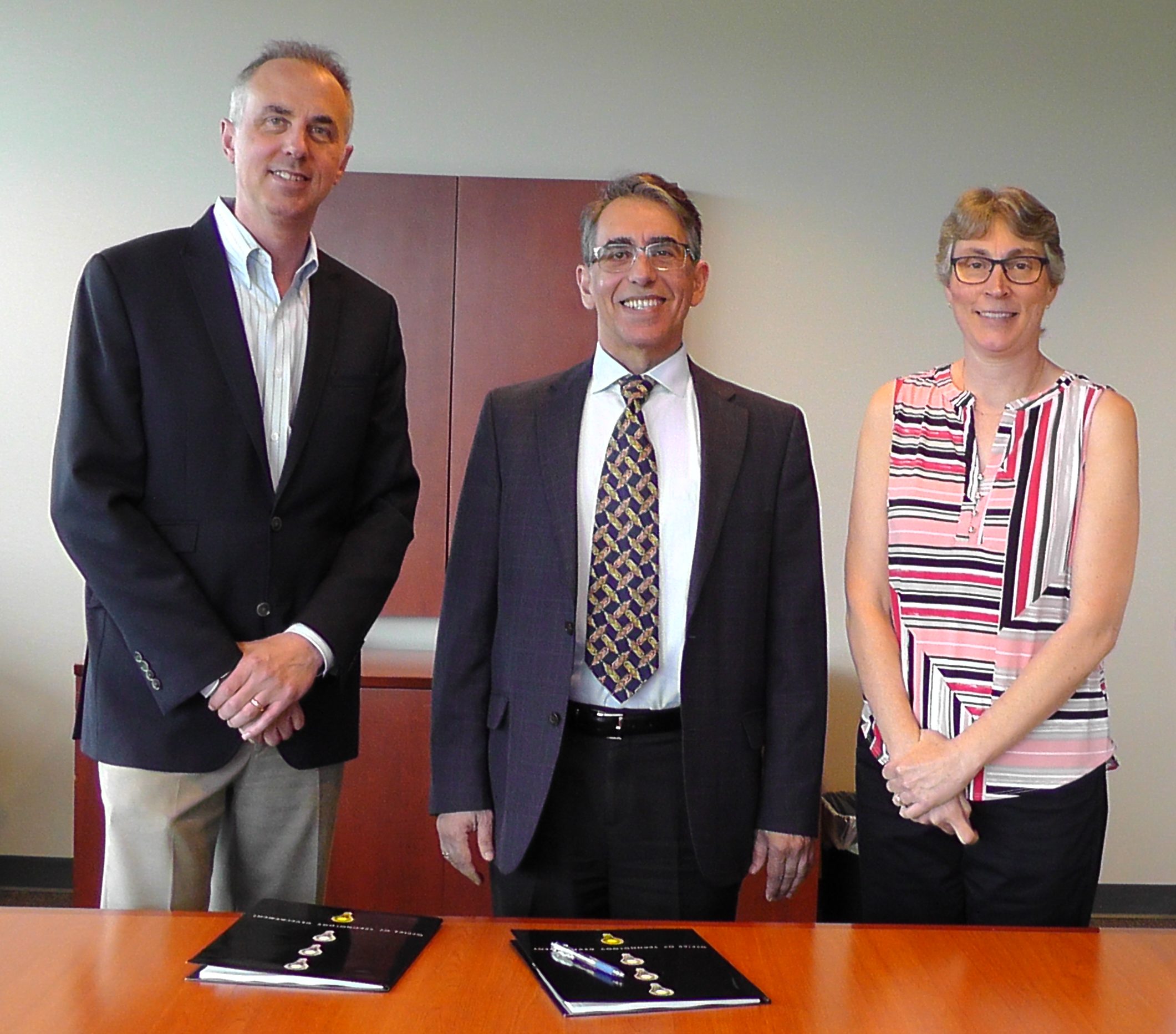 George Karabatis, center, with Gerard Eldering and Wendy Martin at the signing.
With the launch of the company, Karabatis and AlEroud enter phase three of TEDCO’s tech commercialization process, after completing robust market analysis and business planning to ensure a solid launch (in part through AlEroud’s dissertation research). Phase three will focus on commercializing the research, hiring officers and employees to run the company, and refining the technology behind Cyves’s cybersecurity product.
“This work is important because it reveals a new way of identifying incoming cyber attacks and actually stopping them, based on intrinsic features of the attacks and how these features correlate with each other,” says Karabatis. “In addition, this research is capable of identifying not only well-known attacks, but most importantly unknown attacks that have not been identified yet.”
Karabatis explains that the Cyves technology detects cyber attacks by analyzing characteristics of these intrusions at a high level, and comparing them with incoming traffic. By relying on semantic and contextual information, the Cyves technology is able to analyze existing attacks and behaviors and extrapolate findings that can be used to identify patterns and flag future attacks quickly after they occur. This approach to detecting cyber attacks not only identifies possible intrusions, but also reduces the number of false alarms that are raised.
In testing, Karabatis says, the technology accurately identified not only known cyber attacks, but also 90% of unknown (0-day) attacks that previously would have likely gone unnoticed. Identifying such attacks can play a significant role in protecting sensitive information like social security numbers, credit card numbers, and birthdates, stored in vulnerable databases.
“Technology transfer is just one piece of the continuum of support that is needed to advance new concepts developed by our researchers. Investment in research projects that have commercial potential, assistance in obtaining state proof-of-concept funding, and access to business incubation and mentoring all play a part,” says Wendy Martin, director of the office technology development. “We encourage entrepreneurial researchers, like George Karabatis, to start their own companies, so they can continue their involvement in bringing their innovations to the marketplace.”
Image: The Information and Technology Engineering building. Photo by Marlayna Demond ’11 for UMBC.
]]>
UMBC’s George Karabatis, associate professor of information systems, and Ahmed AlEroud M.S. ‘12, information systems, Ph.D. ‘14, information systems, recently launched the cybersecurity startup...
Photo
https://assets4-beta.my.umbc.edu/system/shared/attachments/f2c66b4efb62c2ce23aa40b8f466dbaa/69ecc6de/news/000/077/405/67da624214ee8e89992ce70459e669a3/Cyves-signing-1-e1522935351228.jpg?1530902183
https://beta.my.umbc.edu/api/v0/pixel/news/77405/guest@my.umbc.edu/8eda11663b5982e762a42de168101fb5/api/pixel
ovpr-news-2018
Archived RCA News
https://beta.my.umbc.edu/groups/research
https://assets4-beta.my.umbc.edu/system/shared/avatars/groups/000/000/794/4bca2aa331eb7e472d63d97e0798b600/xsmall.png?1743706368
https://assets2-beta.my.umbc.edu/system/shared/avatars/groups/000/000/794/4bca2aa331eb7e472d63d97e0798b600/original.jpg?1743706368
https://assets3-beta.my.umbc.edu/system/shared/avatars/groups/000/000/794/4bca2aa331eb7e472d63d97e0798b600/xxlarge.png?1743706368
https://assets4-beta.my.umbc.edu/system/shared/avatars/groups/000/000/794/4bca2aa331eb7e472d63d97e0798b600/xlarge.png?1743706368
https://assets2-beta.my.umbc.edu/system/shared/avatars/groups/000/000/794/4bca2aa331eb7e472d63d97e0798b600/large.png?1743706368
https://assets4-beta.my.umbc.edu/system/shared/avatars/groups/000/000/794/4bca2aa331eb7e472d63d97e0798b600/medium.png?1743706368
https://assets4-beta.my.umbc.edu/system/shared/avatars/groups/000/000/794/4bca2aa331eb7e472d63d97e0798b600/small.png?1743706368
https://assets4-beta.my.umbc.edu/system/shared/avatars/groups/000/000/794/4bca2aa331eb7e472d63d97e0798b600/xsmall.png?1743706368
https://assets3-beta.my.umbc.edu/system/shared/avatars/groups/000/000/794/4bca2aa331eb7e472d63d97e0798b600/xxsmall.png?1743706368
Office of the Vice President for Research
https://assets4-beta.my.umbc.edu/system/shared/thumbnails/news/000/077/405/4b62e74aafdab466726fefc30ec8f80c/xxlarge.jpg?1530902690
https://assets1-beta.my.umbc.edu/system/shared/thumbnails/news/000/077/405/4b62e74aafdab466726fefc30ec8f80c/xlarge.jpg?1530902690
https://assets1-beta.my.umbc.edu/system/shared/thumbnails/news/000/077/405/4b62e74aafdab466726fefc30ec8f80c/large.jpg?1530902690
https://assets3-beta.my.umbc.edu/system/shared/thumbnails/news/000/077/405/4b62e74aafdab466726fefc30ec8f80c/medium.jpg?1530902690
https://assets3-beta.my.umbc.edu/system/shared/thumbnails/news/000/077/405/4b62e74aafdab466726fefc30ec8f80c/small.jpg?1530902690
https://assets4-beta.my.umbc.edu/system/shared/thumbnails/news/000/077/405/4b62e74aafdab466726fefc30ec8f80c/xsmall.jpg?1530902690
https://assets2-beta.my.umbc.edu/system/shared/thumbnails/news/000/077/405/4b62e74aafdab466726fefc30ec8f80c/xxsmall.jpg?1530902690
0
0
true
Fri, 06 Jul 2018 14:45:13 -0400
Prof. Lin receives NIDA grant on e-cigarette flavor safety
UMBC’s Weihong Lin is helping to close a major gap in knowledge about e-cigarettes, with a focus on flavorings. The National Institute for Drug Abuse has awarded Lin, associate professor of biological sciences, a two-year, approximately $400,000 grant to supply much-needed objective data that can help inform regulation of flavorings in electronic cigarettes and protect the consumers of today and tomorrow, especially children and teens.
The dangers of nicotine are fairly well understood, but today’s e-cigarettes also include ingredients that are not well known. “A primary concern about e-cigarettes right now is that they use a huge number of flavoring components,” says Lin. A 2014 study found that 460 e-cigarette brands used 7,760 different flavorings. It also connected “e-juice” flavors—from “cotton candy” to “double chocolate”—to a rise in e-cigarette use by young people.
Rishit Patel ’19 (left), who received an Undergraduate Research Award to work on the e-cigarette flavoring project; Kayla Lemons (center), Ph.D. candidate in biological sciences; and Weihong Lin (right), observe tissue under the microscope.
Scents and flavorings “tap into our mood and our motivation,” Lin explains. She also notes that the feelings that come along with scents and flavors can actually pose challenges to doing research on the safety of e-cigarettes.
The positive emotional associations people have with certain aromas and tastes, like eating cotton candy at an amusement park or coming home to the smell of chocolate brownies in the oven, can override the warning sensations caused by high levels of artificial flavorings or nicotine, says Lin. This means that asking people about irritation levels in their mouths and throats after using e-cigarette products with familiar or pleasant tastes may not provide an accurate picture of e-cigarettes’ actual negative effects.
E-cigarettes usually include a heating coil, solvents, nicotine, and flavoring components, all of which reach extremely high temperatures during the device’s vaporization process. Even if flavorings are considered safe for food products, they can be irritating when inhaled at higher levels. Plus, the extreme heat could change the components’ chemical make-up and convert benign substances into toxic ones. “But if you have the flavoring to mask physical irritation,” says Lin, “it becomes a more tolerable or pleasurable experience.”
Weihong Lin (left); Ashley Majekodunmi ’21 (center), biological sciences, and a UMBC STEM BUILD Trainee; and Abdullah Al-Matrouk (right), a Ph.D. candidate in biological sciences, process mouse neural tissue.
To push past that mask, Lin will go to a deeper sensory level, with the help of sensory systems in mice’s nasal passages, which are responsible for the sense of smell and detecting airway irritation.
Lin’s lab will explore how specific sensory systems that detect irritation respond in the presence of e-cigarette flavorings. “It’s an objective way to measure to what degree the e-juice will activate this system,” explains Lin. “We’re asking, ‘At what level will these flavorings cause an acute, irritating sensation?’”
Lin’s group will study popular flavors used in various electronic cigarette liquid brands. The results could inform future regulations on chemicals used as e-cigarette flavorings. Lin hopes to eventually extend this work to also explore the longer-term effects of low-dose exposure to these chemicals.
As a neurobiologist, Lin says, “I’ve always been curious about how chemicals affect humans’ daily choices,” from the foods we eat to the people we choose to date. But this current research project is also personally meaningful for her, as a teacher of young people.
“You see so many young kids experimenting with e-cigarettes, and they don’t necessarily know the harm,” says Lin. “If we can give them a science-based warning and help protect them from respiratory illnesses and nicotine addition, it’s going to be good for science and for society.”
Banner image from left to right: Kayla Lemons; Avantika Krishna ’21, biological sciences, and a UMBC STEM BUILD Trainee; Abdullah Al-Matrouk; Ashley Majekodunmi; Tatsuya Ogura, research assistant professor in biological sciences; Weihong Lin; Rishit Patel; and Mark Gabriana ’19, biological sciences. All photos by Marlayna Demond ’11 for UMBC.
]]>
This story was initially written on news.umbc.edu by Sarah Hansen UMBC’s Weihong Lin is helping to close a major gap in knowledge about e-cigarettes, with a focus on flavorings. The National...
Photo
https://assets1-beta.my.umbc.edu/system/shared/attachments/9f1748bfb51e7fe53ba870f27c95879a/69ecc6de/news/000/077/404/3ec7b0f8bc5bf7eb2a73ea78a115d94a/Weihong-Lin-3268.jpg?1530901232
https://beta.my.umbc.edu/api/v0/pixel/news/77404/guest@my.umbc.edu/1e7ad27af6cd57e2b345ec4da25a7a2c/api/pixel
ovpr-news-2018
Archived RCA News
https://beta.my.umbc.edu/groups/research
https://assets4-beta.my.umbc.edu/system/shared/avatars/groups/000/000/794/4bca2aa331eb7e472d63d97e0798b600/xsmall.png?1743706368
https://assets2-beta.my.umbc.edu/system/shared/avatars/groups/000/000/794/4bca2aa331eb7e472d63d97e0798b600/original.jpg?1743706368
https://assets3-beta.my.umbc.edu/system/shared/avatars/groups/000/000/794/4bca2aa331eb7e472d63d97e0798b600/xxlarge.png?1743706368
https://assets4-beta.my.umbc.edu/system/shared/avatars/groups/000/000/794/4bca2aa331eb7e472d63d97e0798b600/xlarge.png?1743706368
https://assets2-beta.my.umbc.edu/system/shared/avatars/groups/000/000/794/4bca2aa331eb7e472d63d97e0798b600/large.png?1743706368
https://assets4-beta.my.umbc.edu/system/shared/avatars/groups/000/000/794/4bca2aa331eb7e472d63d97e0798b600/medium.png?1743706368
https://assets4-beta.my.umbc.edu/system/shared/avatars/groups/000/000/794/4bca2aa331eb7e472d63d97e0798b600/small.png?1743706368
https://assets4-beta.my.umbc.edu/system/shared/avatars/groups/000/000/794/4bca2aa331eb7e472d63d97e0798b600/xsmall.png?1743706368
https://assets3-beta.my.umbc.edu/system/shared/avatars/groups/000/000/794/4bca2aa331eb7e472d63d97e0798b600/xxsmall.png?1743706368
Office of the Vice President for Research
https://assets3-beta.my.umbc.edu/system/shared/thumbnails/news/000/077/404/f24e4dee49697069d0bb6832628bc2e2/xxlarge.jpg?1530901449
https://assets2-beta.my.umbc.edu/system/shared/thumbnails/news/000/077/404/f24e4dee49697069d0bb6832628bc2e2/xlarge.jpg?1530901449
https://assets2-beta.my.umbc.edu/system/shared/thumbnails/news/000/077/404/f24e4dee49697069d0bb6832628bc2e2/large.jpg?1530901449
https://assets3-beta.my.umbc.edu/system/shared/thumbnails/news/000/077/404/f24e4dee49697069d0bb6832628bc2e2/medium.jpg?1530901449
https://assets4-beta.my.umbc.edu/system/shared/thumbnails/news/000/077/404/f24e4dee49697069d0bb6832628bc2e2/small.jpg?1530901449
https://assets3-beta.my.umbc.edu/system/shared/thumbnails/news/000/077/404/f24e4dee49697069d0bb6832628bc2e2/xsmall.jpg?1530901449
https://assets4-beta.my.umbc.edu/system/shared/thumbnails/news/000/077/404/f24e4dee49697069d0bb6832628bc2e2/xxsmall.jpg?1530901449
1
0
true
Fri, 06 Jul 2018 14:24:33 -0400
Fri, 06 Jul 2018 14:26:03 -0400
UMBC launches cybersecurity research collaboration
to focus on infrastructure; partners are in Japan and the UK
UMBC is one of three leading academic institutions collaborating on a new research initiative focused on cybersecurity for critical national infrastructures, including information technology, public transit, and financial services. University leaders signed the three-nation agreement in a ceremony at the sixth International Cybersecurity Symposium in Japan.
UMBC, Keio Research Institute (KRIS) in Japan, and Royal Holloway University of London (RHUL) in the UK will partner to investigate the use of common system simulation tools for modeling critical national infrastructure. This partnership is part of a broader international collaboration, the International Cybersecurity Center of Excellence (INCS-COE). It will also involve Hitachi, an international operator in power systems, telecommunication, railways, and other core infrastructure areas.
Because cybersecurity attacks may not be limited to national borders, this collaboration argues that defense against such attacks should not be siloed either.
“Cybersecurity can no longer be treated as a national issue,” emphasizes Karl V. Steiner, vice president for research at UMBC. “Long-term and productive international collaborations are needed to make significant progress.”
Jun Murai, professor of environment and information studies at Keio University, notes, “We look forward to working with our research colleagues in the UK and U.S. to help address the increasingly challenging cyber threats to the security of our respective critical national infrastructures.”
University leaders, including Karl V. Steiner, third from right, signed the three-nation agreement in a ceremony at the sixth International Cybersecurity Symposium in Japan. Photo courtesy of Karl V. Steiner.
Left to right: Paul Madden CMG, British Ambassador to Japan; Keith Mayes, Head of the School of Mathematics and Information Security, Royal Holloway, University of London; Jun Murai, Dean and Professor, Graduate School of Media and Governance, Keio University; Karl V. Steiner, Vice President for Research, UMBC; Akira Haseyama, President, Keio University; Satoru Tezuka, Director, Cyber Security Research Center, Keio University.
Working with a common toolset will enable mixed nationality teams to run simulations together. This will help cybersecurity experts learn how to more effectively address human factors, including cultural differences, in predicting how attacks and responses to those attacks might play out across different geographies.
“We are excited to participate in this new research collaboration with our colleagues in Japan and the UK to help us better understand and address some of the key cybersecurity challenges that our nations face from increasingly aggressive international adversaries,” says Anupam Joshi, director of UMBC’s Center for Cybersecurity.
The partners in this research see the modeling of system security as increasingly vital for industry and government, for both training purposes and vulnerability analysis.
“This initiative creates many future opportunities including, for example, the opportunity to address the impact on critical national infrastructure security of the exponential growth of the internet of things, and for potential exchanges of expert staff and students,” explains Keith Mayes, head of the Information Security Group (ISG) at Royal Holloway University.
Steiner shares Mayes’s excitement about expanding opportunities for both established and emerging researchers in this growing field. Thanks to leading academic programs in cybersecurity, the bwtech@UMBC Cyber Incubator, and UMBC’s internationally-known Center for Cybersecurity, he says, “UMBC is uniquely positioned in Maryland to become a major global force for research in cybersecurity.”
“This partnership,” says Steiner, “builds important connections to move this essential work forward.”
]]>
This story initially appeared on news.umbc.edu and was written by Megan Hanks UMBC is one of three leading academic institutions collaborating on a new research initiative focused on...
Photo
https://assets3-beta.my.umbc.edu/system/shared/attachments/495f00c1864b03d69a7f5a4592a8acca/69ecc6de/news/000/077/401/84cceab50d4e4208c84aa83480ebdcf2/UMBCKRISRHUL.jpg?1530894375
https://beta.my.umbc.edu/api/v0/pixel/news/77401/guest@my.umbc.edu/c7a394b2e51c18a1136e7ea776fd3e98/api/pixel
ovpr-news-2018
Archived RCA News
https://beta.my.umbc.edu/groups/research
https://assets4-beta.my.umbc.edu/system/shared/avatars/groups/000/000/794/4bca2aa331eb7e472d63d97e0798b600/xsmall.png?1743706368
https://assets2-beta.my.umbc.edu/system/shared/avatars/groups/000/000/794/4bca2aa331eb7e472d63d97e0798b600/original.jpg?1743706368
https://assets3-beta.my.umbc.edu/system/shared/avatars/groups/000/000/794/4bca2aa331eb7e472d63d97e0798b600/xxlarge.png?1743706368
https://assets4-beta.my.umbc.edu/system/shared/avatars/groups/000/000/794/4bca2aa331eb7e472d63d97e0798b600/xlarge.png?1743706368
https://assets2-beta.my.umbc.edu/system/shared/avatars/groups/000/000/794/4bca2aa331eb7e472d63d97e0798b600/large.png?1743706368
https://assets4-beta.my.umbc.edu/system/shared/avatars/groups/000/000/794/4bca2aa331eb7e472d63d97e0798b600/medium.png?1743706368
https://assets4-beta.my.umbc.edu/system/shared/avatars/groups/000/000/794/4bca2aa331eb7e472d63d97e0798b600/small.png?1743706368
https://assets4-beta.my.umbc.edu/system/shared/avatars/groups/000/000/794/4bca2aa331eb7e472d63d97e0798b600/xsmall.png?1743706368
https://assets3-beta.my.umbc.edu/system/shared/avatars/groups/000/000/794/4bca2aa331eb7e472d63d97e0798b600/xxsmall.png?1743706368
Office of the Vice President for Research
https://assets1-beta.my.umbc.edu/system/shared/thumbnails/news/000/077/401/ac1d4fe70e5493515f90c0794f8ccbac/xxlarge.jpg?1530894393
https://assets3-beta.my.umbc.edu/system/shared/thumbnails/news/000/077/401/ac1d4fe70e5493515f90c0794f8ccbac/xlarge.jpg?1530894393
https://assets2-beta.my.umbc.edu/system/shared/thumbnails/news/000/077/401/ac1d4fe70e5493515f90c0794f8ccbac/large.jpg?1530894393
https://assets3-beta.my.umbc.edu/system/shared/thumbnails/news/000/077/401/ac1d4fe70e5493515f90c0794f8ccbac/medium.jpg?1530894393
https://assets1-beta.my.umbc.edu/system/shared/thumbnails/news/000/077/401/ac1d4fe70e5493515f90c0794f8ccbac/small.jpg?1530894393
https://assets3-beta.my.umbc.edu/system/shared/thumbnails/news/000/077/401/ac1d4fe70e5493515f90c0794f8ccbac/xsmall.jpg?1530894393
https://assets1-beta.my.umbc.edu/system/shared/thumbnails/news/000/077/401/ac1d4fe70e5493515f90c0794f8ccbac/xxsmall.jpg?1530894393
1
0
true
Fri, 06 Jul 2018 12:26:47 -0400
Fri, 06 Jul 2018 12:39:29 -0400
UMBC and University of Limpopo Formalize Partnership
A commitment to collaborate via joint research and exchanges
This story was first published here and was written by Sarah Hansen.
On June 12, leaders from UMBC and the
University of Limpopo in South Africa formalized commitments to
collaborate through joint research as well as faculty and student
exchanges. UMBC has steadily grown its international partnerships with
universities in Germany, Japan, Portugal, Peru, and other nations around the globe. This is the first such agreement between UMBC and a university in Africa.
“It gives us a lot of joy…to be the first African university with which you sign an agreement like this,” shared Jesika Singh, deputy
vice chancellor for research, innovation and partnership at University
of Limpopo. “There is so much potential that we see.”
This relationship grew out of the
African International Conference (AIC) on Statistics, an event organized
annually since 2014 by UMBC statistics faculty and international
partners. Past conferences have occurred in Senegal, Ethiopia, Cameroon,
South Africa, and Botswana, including statisticians from all across
Africa as well as a dozen U.S. institutions. The next two conferences
will take place in Ethiopia and Morocco.
Yehenew Kifle,
associate professor at the University of Limpopo and currently visiting
faculty at UMBC, first connected with UMBC during the 2015 AIC at Jimma
University in Ethiopia. Inspired to build on the success of the
conference, Kifle asked UMBC to partner on a grant from the South
African government to support faculty development.
The grant, managed by Professor
Kingsley Ayisi, calls for University of Limpopo junior faculty, some of
whom do not yet hold doctoral degrees, to travel to UMBC to pursue
doctoral-level training in statistics. Through a similar agreement,
other Limpopo faculty will travel to Iowa State University for
agricultural training.
“This is really a milestone for us,” said Bimal Sinha,
professor of statistics at UMBC and a leader in organizing the AIC, at
the signing. “I hope that once other African universities see this, they
will want to participate as well.”
In addition to Limpopo faculty
traveling to UMBC, UMBC faculty will travel to South Africa to provide
short training courses in statistical methods. Those courses will
specifically focus on how statistics are used in the study of climate
and climate change, which is already producing severe effects throughout
the African continent.
Beyond the statistics training
program, the partners also signed an agreement outlining plans to pursue
joint research projects, exchange programs for UMBC and Limpopo
students, and other collaborations across a wide range of departments
and programs.
“The way I see it, all sides have quite a bit to gain from this collaboration,” said Rouben Rostamian, professor and chair of mathematics and statistics at UMBC.
“This agreement goes far beyond statistics,” said Antonio Moreira,
UMBC’s vice provost for academic affairs. “We are using education
between our two countries and our two young universities—both less than
60 years old—to truly change the world by educating, training, and
cultivating the future.”
William LaCourse, dean of the
College of Natural and Mathematical Sciences at UMBC, is equally excited
for the partnership. He shared, “We’re very proud to be here on this
joint venture and to take this journey with you.”
Singh echoed his feeling. What
started as a small gathering of colleagues from two continents, she
said, “has very quickly developed into something that we can look
forward to for many years to come.”
This story was first published here and was written by Catalina Sofia Dansberger Duque.
How does unequal access to health
care affect the lives and experiences of people from different
communities across Baltimore and the nation? UMBC’s Public Humanities
and Health Justice Research Forum addressed this question through remarks and conversations with researchers from UMBC’s College of Arts, Humanities, and Social Sciences (CAHSS), College of Engineering and Information Technology (COEIT), and College of Natural and Mathematical Sciences (CNMS), as well as Johns Hopkins University, Morgan State University, Coppin State University, and Columbia University.
The forum was the fourth in a series organized by UMBC’s Office of the Vice President for Research
to bring together faculty tackling shared topics from widely diverse
angles. “We established the research forum series in 2014 to provide an
opportunity for scientists and scholars to collaboratively explore
multiple facets of a topic central to the research and scholarship of
UMBC,” says Karl Steiner,
vice president for research. Previous forum focus areas include
high-performance computing, climate change and the environment, and the
visualization of science.
UMBC’s Dresher Center for the Humanities
sponsored and helped organize the latest forum, focused on how the
humanities can help address challenges related to health care access.
Dresher Center Director Jessica Berman
shared, “It was exciting to see how much humanistic scholarship is
taking place all across campus and the potential partnerships it
creates, between UMBC and other universities. This research forum helped
to highlight the humanities in their capacity not only to ask good
questions but also to help solve important problems such as health
justice and access.”
Racism in Health Care Policy
Keynote speaker Graham Mooney,
professor in the Institute of the History of Medicine at Johns Hopkins
University, presented his research on the Baltimore Medical Care Plan of
1948. “By using the history of medicine and public policy we can better
understand how the process of racism and segregation have interacted to
prevent black residents’ access to quality medical care in Baltimore,”
explained Mooney.
The topic led to an interactive
conversation about the negative impact the 1948 plan had on the quality
of life of Baltimore’s black community and how it served as a model for
similar approaches in other states, and later for Medicare and Medicaid.
During the discussion, Shawn Bediako,
associate professor of psychology, argued that analyses of health care
access across U.S. history should also include how black communities
have responded to inequities. He mentioned, as examples, the
establishment of the National Negro Health Movement and Office of Negro
Health Work.
Listening to Communities
Valuing community voices was a key
theme in the two interdisciplinary panel discussions that followed.
These discussions revealed how key humanities methods, such as attending
to history, paying attention to narrative—including who gets to speak and when—and
thinking critically about how we understand and value specific human
experiences can be crucial to addressing issues important to
contemporary public life.
In the first of those panels, Kristen
Slesar, from the Narrative Medicine Program at Columbia University,
shared her experience using personal narratives to inform medical
research. Slesar is a licensed clinical social worker and
psychotherapist who focuses on child trauma. She regularly teaches about
health care justice and health care for underserved communities.
Scott Casper, dean of the College of arts, humanities, and social sciences (CAHSS), then
moderated a discussion on “Listening as Public Practice: Towards Equity
and Justice” that included Bediako as well as colleagues Drew Holladay, assistant professor of English; Amy Hurst, associate professor of information systems; and Denise Meringolo,
associate professor of history. The panelists explored how centering
the narratives of individuals in their research improves the quality of
their findings and the potential impact of their work. “Confronting the
barriers to health equity compels us to look across disciplines and
toward collaborations among social scientists, scientists and engineers,
and humanists and artists,” noted Casper.
Lawrence Brown, assistant professor
of community health and policy at Morgan State University, spoke during
the second panel about the impacts of residential displacement and
financial disinvestment on community health. In addition to his work on
the impact of historical trauma on community health, he also leads the
student-driven #BmoreLEADfree project focused on ending lead poisoning
in Baltimore.
Berman then led a group discussion on the topic “Communication, the Urban Environment, and Health Justice,” with Dena Aufseeser,
assistant professor of geography and environmental systems; Katherine
Bankole-Medina, professor of history at Coppin State University; Dawn Biehler, associate professor of geography and environmental systems; and Jennifer Maher,
associate professor of English. The discussion showed how paying
attention to the ways local communities understand issues of health and
the environment can challenge the kinds of changes we propose and the
ways we communicate about them.
New Health Equity Collaborative
The forum also introduced UMBC’s new
Collaborative for the Interdisciplinary Promotion of Health Equity
Research (CIPHER). The collaborative will form working groups bringing
together UMBC researchers across different fields to examine current
challenges to health care equity, and to inform innovative solutions for
the future.
Bediako, whose research focuses on
health care inequities experienced by patients with sickle cell disease,
will serve as the founding convener of this initiative. He shares, “I
am most excited that CIPHER will aim to reach across disciplinary
boundaries and use multiple perspectives to address specific challenges
to health equity.”
This year the German Academic Exchange Service (DAAD) offers an information visit to Germany for Postdocs working in the field of Artificial Intelligence who are interested to explore new career and cooperation opportunities. The Postdoctoral Researchers’ Networking Tour 2018 offers on-site visits to universities, research institutes and companies in the field of artificial intelligence, discussions with experts and numerous networking opportunities. Programme related costs and a travel allowance are covered by DAAD.
The “Postdoctoral Researchers’ Networking Tour” includes:
- a practice orientated and diverse programme to suit the requirements of the participants
- coverage of programme related costs in Germany (accommodation, domestic travel, most meals)
- a lump sum travel allowance if such costs are not borne by a third party. This will also be provided if the stay is extended by up to five working days in order to allow for additional professional networking.
The dates of the tour are September 23 -29, 2018, the application deadline is July 15, 2018.
Detailed information is available at: www.daad.de/postdocnet
Areas of interest include:
* AI supported case processing
* Human-technology interaction
* Brain-computer interfaces and neuroscience
* Interactive robots
* Knowledge Management in Bioinformatics
* Machine Learning for Software Engineering
* Cognitive Robotics and Adaptive Systems
* Smart home, smart transport and traffic, etc.
]]>
This year the German Academic Exchange Service (DAAD) offers an information visit to Germany for Postdocs working in the field of Artificial Intelligence who are interested to explore new career...
https://beta.my.umbc.edu/api/v0/pixel/news/77397/guest@my.umbc.edu/e8035250c48756b08fb848389714c972/api/pixel
Office of Postdoctoral Affairs
https://beta.my.umbc.edu/groups/postdocs
https://assets1-beta.my.umbc.edu/system/shared/avatars/groups/000/000/394/5b3a93d103a66345e5d404c61c5b5081/xsmall.png?1340160424
https://assets4-beta.my.umbc.edu/system/shared/avatars/groups/000/000/394/5b3a93d103a66345e5d404c61c5b5081/original.jpg?1340160424
https://assets4-beta.my.umbc.edu/system/shared/avatars/groups/000/000/394/5b3a93d103a66345e5d404c61c5b5081/xxlarge.png?1340160424
https://assets2-beta.my.umbc.edu/system/shared/avatars/groups/000/000/394/5b3a93d103a66345e5d404c61c5b5081/xlarge.png?1340160424
https://assets1-beta.my.umbc.edu/system/shared/avatars/groups/000/000/394/5b3a93d103a66345e5d404c61c5b5081/large.png?1340160424
https://assets3-beta.my.umbc.edu/system/shared/avatars/groups/000/000/394/5b3a93d103a66345e5d404c61c5b5081/medium.png?1340160424
https://assets2-beta.my.umbc.edu/system/shared/avatars/groups/000/000/394/5b3a93d103a66345e5d404c61c5b5081/small.png?1340160424
https://assets1-beta.my.umbc.edu/system/shared/avatars/groups/000/000/394/5b3a93d103a66345e5d404c61c5b5081/xsmall.png?1340160424
https://assets4-beta.my.umbc.edu/system/shared/avatars/groups/000/000/394/5b3a93d103a66345e5d404c61c5b5081/xxsmall.png?1340160424
Office of Postdoctoral Affairs
https://assets2-beta.my.umbc.edu/system/shared/thumbnails/news/000/077/397/10a7a7a3b874dcb9422ddc8efafc790f/xxlarge.jpg?1530884265
https://assets2-beta.my.umbc.edu/system/shared/thumbnails/news/000/077/397/10a7a7a3b874dcb9422ddc8efafc790f/xlarge.jpg?1530884265
https://assets2-beta.my.umbc.edu/system/shared/thumbnails/news/000/077/397/10a7a7a3b874dcb9422ddc8efafc790f/large.jpg?1530884265
https://assets2-beta.my.umbc.edu/system/shared/thumbnails/news/000/077/397/10a7a7a3b874dcb9422ddc8efafc790f/medium.jpg?1530884265
https://assets3-beta.my.umbc.edu/system/shared/thumbnails/news/000/077/397/10a7a7a3b874dcb9422ddc8efafc790f/small.jpg?1530884265
https://assets4-beta.my.umbc.edu/system/shared/thumbnails/news/000/077/397/10a7a7a3b874dcb9422ddc8efafc790f/xsmall.jpg?1530884265
https://assets1-beta.my.umbc.edu/system/shared/thumbnails/news/000/077/397/10a7a7a3b874dcb9422ddc8efafc790f/xxsmall.jpg?1530884265
0
0
true
Fri, 06 Jul 2018 09:38:40 -0400
Kuali COI Module Implementation
Dear Faculty,
As part of UMBC’s transitioning from the research management format in PeopleSoft to the cloud-based Kuali system, the Office of the Vice President for Research is ready to implement the next steps of the Kuali COI module.
Investigators who are considered “Key Persons” in grant proposal submissions to funding agencies (e.g., PHS or NSF) are required to disclose any potential significant financial conflicts of interests to ensure there is no reasonable perception of a conflict in the design, conduct, or reporting of research. While the current UMBC policies have not changed; the procedure to disclose has changed.
What This Means For You?
Kuali COI replaces the Office of Research Protections and Compliance (ORPC) paper document/email notification disclosure routing process. This means all COI disclosures will now be handle via the Kuali COI module. Many faculty colleagues have already been using the Kuali COI module during the transition to using Kuali Proposal Development.
Effective July 9th 2018, the Kuali COI module will be updated. For those already using Kuali COI, you will see the COI certification question in Kuali Proposal Development has been eliminated. All COI related questions are now housed in the Kuali COI module. The Annual Disclosure status under Key personnel in Proposal Development must state “Up to Date”. If the Annual Disclosure says “Update Needed” or “Expired”, the identified Key Personnel must go into the COI module to complete or update their COI answers before the Office of Sponsored Programs (OSP) can approve the proposal. Kuali will send an automated email notification to any named Key Person once the proposal has been saved in Kuali. At a minimum, all “Key Persons” named on a proposal will be required to answer 5 core COI questions.
The ORPC will work with faculty who have submitted paper COI disclosures for previously submitted proposals (via the PeopleSoft Finance process) to ensure that all disclosures are current and up to date.
Also note, if you plan to submit a proposal to a Public Health Services (PHS) entity [e.g., NIH], the requirement to take the CITI FCOI training is still in effect.
Next Steps
Self-Study Option: Go to COI Training page to read the Kuali COI User Guide - a Power Point presentation that includes step-by-step instructions and screen shots. This should give you enough information to understand, certify, route, COI disclosures via workflow.
Still not comfortable? Then sign up for one of the multiple in-person training options that are offered monthly.
Please keep an eye out for information regarding Phase Two, which will focus on OSP functionality (awards, negotiations, sub-awards), but will also include information and modules of interest to the broader UMBC community using Kuali (protocols - IRB & IACUC, reporting, unfunded agreements – MTAs, NDAs, DUAs, etc.).
For more detailed information regarding Kuali, please visit the OVPR Kuali page at http://research.umbc.edu/kuali-research-at-umbc/.
]]>
Dear Faculty, As part of UMBC’s transitioning from the research management format in PeopleSoft to the cloud-based Kuali system, the Office of the Vice President for Research is ready to...
http://research.umbc.edu/kuali-research-at-umbc/
https://beta.my.umbc.edu/api/v0/pixel/news/77355/guest@my.umbc.edu/864dd4ee4138e832f53a2c3c1fbb630b/api/pixel
Office of Research Protections and Compliance
https://beta.my.umbc.edu/groups/compliance
https://assets2-beta.my.umbc.edu/system/shared/avatars/groups/000/000/163/aea9789988c08f28538422f1c3427388/xsmall.png?1406813901
https://assets2-beta.my.umbc.edu/system/shared/avatars/groups/000/000/163/aea9789988c08f28538422f1c3427388/original.jpg?1406813901
https://assets1-beta.my.umbc.edu/system/shared/avatars/groups/000/000/163/aea9789988c08f28538422f1c3427388/xxlarge.png?1406813901
https://assets1-beta.my.umbc.edu/system/shared/avatars/groups/000/000/163/aea9789988c08f28538422f1c3427388/xlarge.png?1406813901
https://assets1-beta.my.umbc.edu/system/shared/avatars/groups/000/000/163/aea9789988c08f28538422f1c3427388/large.png?1406813901
https://assets2-beta.my.umbc.edu/system/shared/avatars/groups/000/000/163/aea9789988c08f28538422f1c3427388/medium.png?1406813901
https://assets4-beta.my.umbc.edu/system/shared/avatars/groups/000/000/163/aea9789988c08f28538422f1c3427388/small.png?1406813901
https://assets2-beta.my.umbc.edu/system/shared/avatars/groups/000/000/163/aea9789988c08f28538422f1c3427388/xsmall.png?1406813901
https://assets1-beta.my.umbc.edu/system/shared/avatars/groups/000/000/163/aea9789988c08f28538422f1c3427388/xxsmall.png?1406813901
Office of Research Protections and Compliance
0
0
false
Mon, 02 Jul 2018 16:44:58 -0400
Tue, 27 Apr 2021 11:57:21 -0400
