Hilltop Helps Maryland Lower Health Insurance Premiums
Open enrollment is now underway, and premiums for health insurance offered through the Maryland Health Connection, Maryland’s Affordable Care Act (ACA) marketplace, will be lower in 2020 because of the state’s reinsurance program.
The Hilltop Institute at UMBC was an important behind-the-scenes player in developing the reinsurance program. Working with the Maryland Health Benefit Exchange (MHBE) in early 2018, Hilltop estimated the cost of a state reinsurance program using the state’s all-payer claims database. Governor Larry Hogan signed into law House Bill (HB) 1795 on April 5, 2018, authorizing the reinsurance program and directing the MHBE to apply for a §1332 waiver from the federal government. This waiver was required to implement Maryland’s program. To fund the reinsurance program, the Governor signed HB 1782 on April 10, 2018, which authorized the state to collect the 2019 health insurance provider tax that the federal government had suspended that year.
Hilltop assisted with the §1332 waiver application submitted to the Centers for Medicare & Medicaid Services (CMS) on May 31, 2018. CMS approved the waiver on August 22, and insurers immediately re-filed 2019 rates with the Maryland Insurance Administration (MIA). Prior to approval of the reinsurance program, insurers requested an average rate increase of 30 percent; with reinsurance, the MIA approved 2020 rates with a decrease of 10.3 percent. Coupled with last year’s decrease of 13.2 percent, the two-year cumulative impact is a rate decrease of more than 22 percent versus 2018 premiums.
To learn more, contact Laura Spicer, Director of Health Reform Studies.
To learn more about Hilltop’s work supporting health care access and affordability, go here.
]]>
Open enrollment is now underway, and premiums for health insurance offered through the Maryland Health Connection, Maryland’s Affordable Care Act (ACA) marketplace, will be lower in 2020 because...
http://www.hilltopinstitute.org
Image
https://assets3-beta.my.umbc.edu/system/shared/attachments/fde2406a07869add5e1b6a64a31dacb2/69eb0cab/news/000/088/430/7cfad14b3b5b81135d9bd6fd52372b1e/blue-and-silver-stetoscope-pexels-cropped.jpg?1573665149
https://beta.my.umbc.edu/api/v0/pixel/news/88430/guest@my.umbc.edu/093d51b5dc3311139f419ba05104d3cf/api/pixel
Archived RCA News
https://beta.my.umbc.edu/groups/research
https://assets4-beta.my.umbc.edu/system/shared/avatars/groups/000/000/794/4bca2aa331eb7e472d63d97e0798b600/xsmall.png?1743706368
https://assets2-beta.my.umbc.edu/system/shared/avatars/groups/000/000/794/4bca2aa331eb7e472d63d97e0798b600/original.jpg?1743706368
https://assets3-beta.my.umbc.edu/system/shared/avatars/groups/000/000/794/4bca2aa331eb7e472d63d97e0798b600/xxlarge.png?1743706368
https://assets4-beta.my.umbc.edu/system/shared/avatars/groups/000/000/794/4bca2aa331eb7e472d63d97e0798b600/xlarge.png?1743706368
https://assets2-beta.my.umbc.edu/system/shared/avatars/groups/000/000/794/4bca2aa331eb7e472d63d97e0798b600/large.png?1743706368
https://assets4-beta.my.umbc.edu/system/shared/avatars/groups/000/000/794/4bca2aa331eb7e472d63d97e0798b600/medium.png?1743706368
https://assets4-beta.my.umbc.edu/system/shared/avatars/groups/000/000/794/4bca2aa331eb7e472d63d97e0798b600/small.png?1743706368
https://assets4-beta.my.umbc.edu/system/shared/avatars/groups/000/000/794/4bca2aa331eb7e472d63d97e0798b600/xsmall.png?1743706368
https://assets3-beta.my.umbc.edu/system/shared/avatars/groups/000/000/794/4bca2aa331eb7e472d63d97e0798b600/xxsmall.png?1743706368
Office of the Vice President for Research
0
0
true
Wed, 13 Nov 2019 12:12:51 -0500
We have liftoff! UMBC mini satellite to study climate, air
This story was written by Sarah Hansen and first appeared on news.umbc.edu
In the early morning hours of Saturday, November 2, a few hundred guests at the NASA Wallops Flight Facility gathered at the VIP launch viewing site—a grassy pad near a large tent. Sitting on metal bleachers and in camping chairs, they gazed upward. The NASA Antares rocket and Cygnus capsule stared back at them from two miles away, more than 14 stories high and loaded with supplies for the International Space Station (ISS). Also on board were more than 30 “cubesats”—small satellites no bigger than large loaves of bread—all of them containing scientific instruments their makers hoped would contribute to a better understanding of our world.
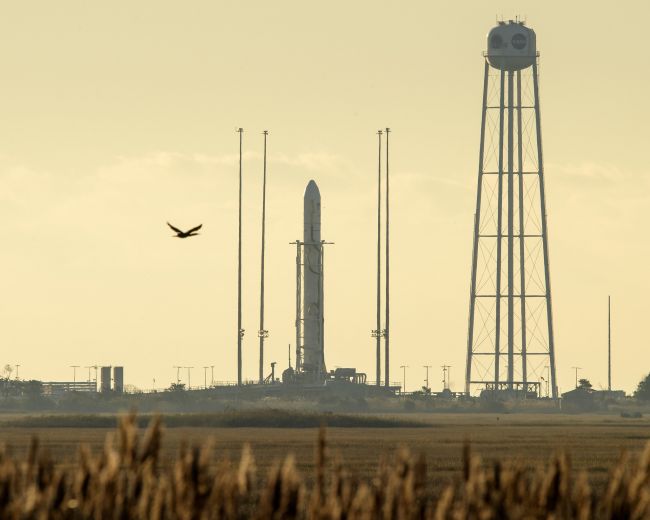
The Cygnus capsule containing UMBC’s HARP cubesat sits atop the Antares rocket on the launchpad. Photo by Bill Ingalls/NASA.
One cubesat, the Hyper-Angular Rainbow Polarimeter (HARP), has been a labor of love for a small group of dedicated UMBC scientists and engineers for the last five years. There were times when they weren’t sure if HARP would ever get to space, but the big moment had finally arrived. Today, HARP was headed up. Way up.
Around 9:55 a.m., the crowd quieted. Their thoughtful silence spoke to years of late nights, early mornings, sighs and tears, hugs and high-fives. They thought back to team meetings with frantic napkin scribbling, spacecraft models made of children’s toys when an idea struck at home, and big dreams.
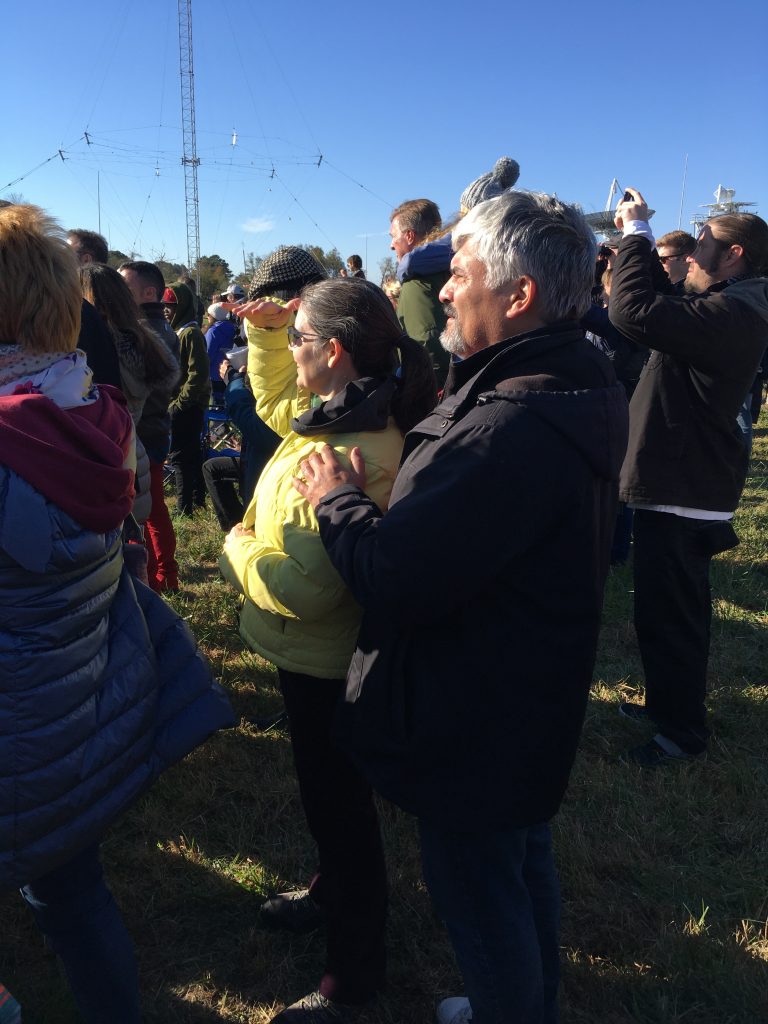
Roberto Borda, one of the core engineers on the HARP project, anticipates the launch with his wife. Photo by Sarah Hansen, M.S. ’15.
UMBC’s Roberto Borda, one of the core engineers for HARP, stood at the front of the viewing area, his arms around his wife. “It’s happening, it’s happening!” he whispered excitedly in her ear. Other team members stood nearby with their spouses, children, and friends.
The crowd collectively held its breath and squinted across open fields at the rocket, which was backed almost directly by the low morning sun. And then, finally, it got loud. Really loud. The silent guests watched as Antares and Cygnus roared to life, 440,000 pounds of oxygen fueling eight massive explosions generating upwards of a million pounds of thrust.
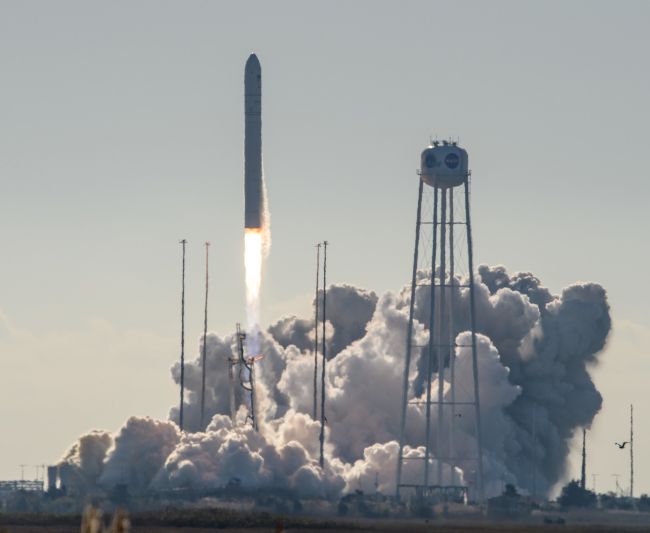
LIFTOFF! Photo by Bill Ingalls/NASA.
At exactly 9:59:37, right on schedule, the rocket burst from its restraints and bolted upward into the sky. Cheers erupted, and the nervous tension dissipated as the rocket rose ever higher. Within four minutes, it was 100 miles above the Earth, headed to the space station at 17,000 miles per hour.
A few minutes later, champagne bottles popped and the celebration began.
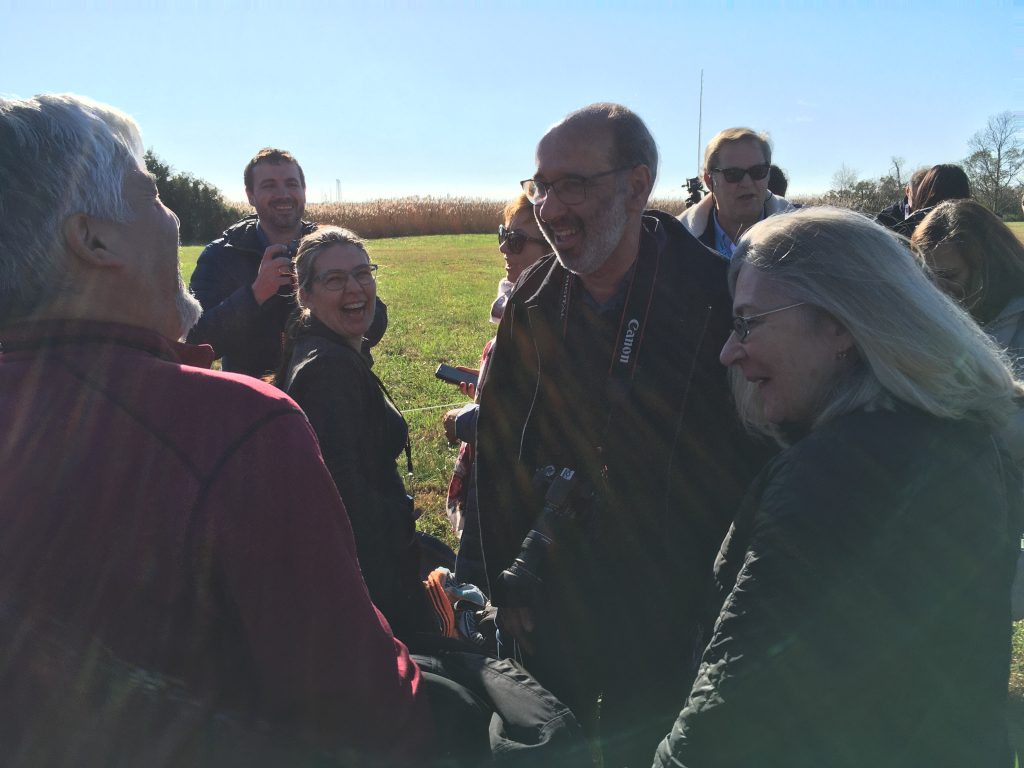
From left to right: Roberto Borda, Dominik Cieslak, Borda’s wife, Vanderlei Martins, and Pam Millar, director of the NASA Earth Science Technology Office, react just after the rocket launch. Photo by Sarah Hansen, M.S. ’15.
Observing particles in Earth’s atmosphere
The HARP satellite’s unique sensors will collect new kinds of information about clouds and tiny particles in Earth’s atmosphere, such as wildfire smoke, desert dust, and human-generated pollutants. These particles, collectively known as aerosols, have a multitude of effects on the global climate and the health of organisms. For example, rain droplets condense around the particles, so they play a role in global precipitation. The particles can also reflect light away from Earth as well as trap energy inside Earth’s atmosphere, which both affect climate. And pollutants can lead to various respiratory ailments in humans and other animals.
With its innovative design, HARP is able to observe the particles from many angles at once to give scientists a more comprehensive view of what’s going on in the atmosphere. The new data will equip scientists with information they need to better understand climate and air quality concerns.
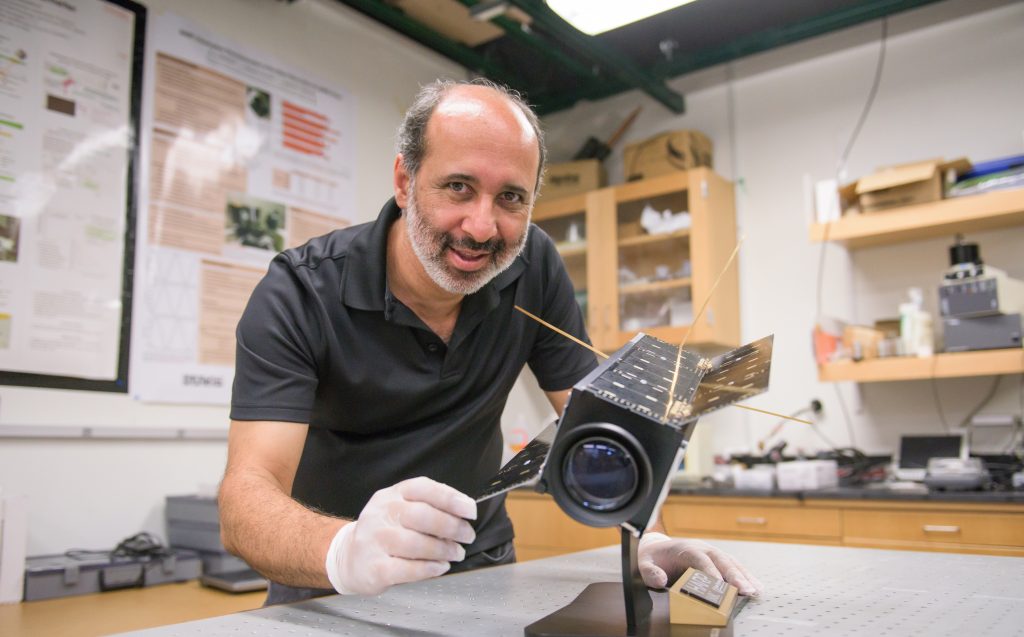
Vanderlei Martins with the HARP satellite. Photo by Marlayna Demond ’11 for UMBC.
“HARP is really a technology demonstration mission,” explains Vanderlei Martins, the lead researcher on HARP and director of UMBC’s Earth and Space Institute, “but our goal is to also do some science with the data.”
The team is comprised of engineers, physicists, and mathematicians. “As an engineer, I’m looking to develop technology that can make the science happen,” says Dominik Cieslak, an assistant research scientist with the Joint Center for Earth Systems Technology (JCET), a UMBC partnership with NASA. Other team members are developing algorithms to effectively analyze the data that will eventually be arriving in huge quantities. Cieslak notes that the data could be used in new ways for years to come as researchers develop new algorithms and computing power continues to grow.
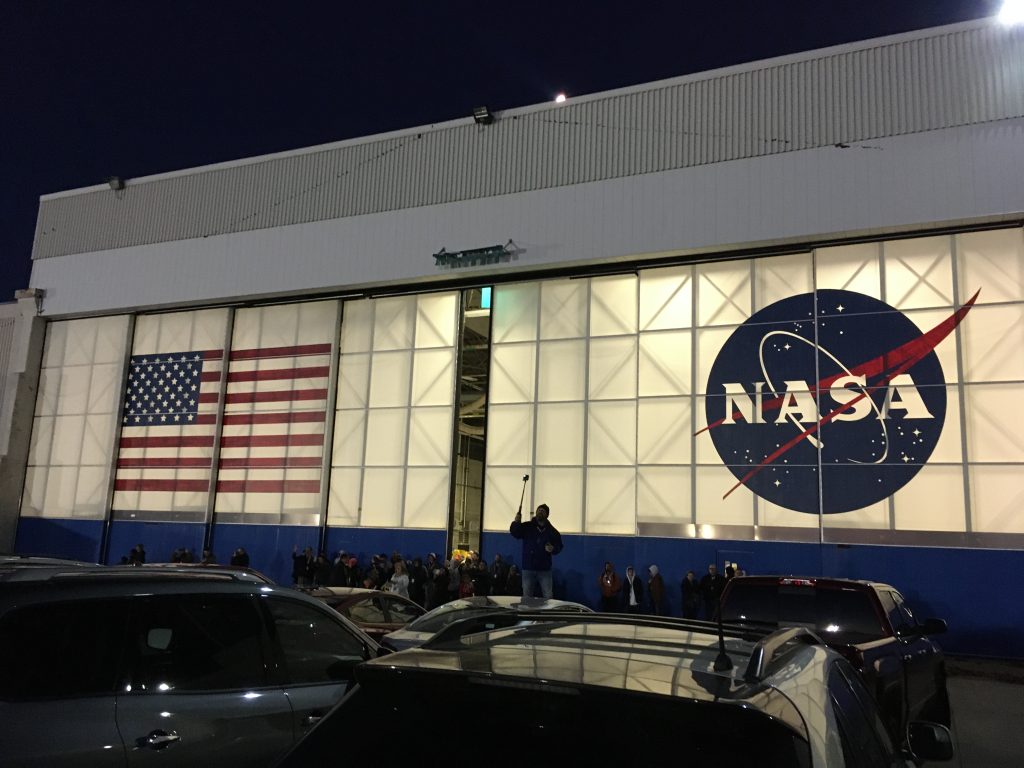
The launch guests mingled in this huge NASA hangar from about 6 to 8 a.m. before boarding buses for the viewing area. Photo by Sarah Hansen, M.S. ’15.
Awaiting “first light”
“We’re going to celebrate every step,” Martins said on the morning of the rocket launch. He is careful to note that the launch is just one step—a particularly exciting one—in a still-lengthy sequence. Only when the satellite is orbiting Earth and sending back data will he and his team know if HARP is working the way they intended.
Cieslak shared Martins’ cautious optimism. “There are many ways for things to go wrong,” he said, “but there is only one way for everything to go right.”
To increase the likelihood of things going right, the team tested HARP many times on two different kinds of aircraft that fly at high and low altitudes, to ensure the instrument is working properly. But still, says Borda, “It’s a different beast going in a plane versus going to space.”
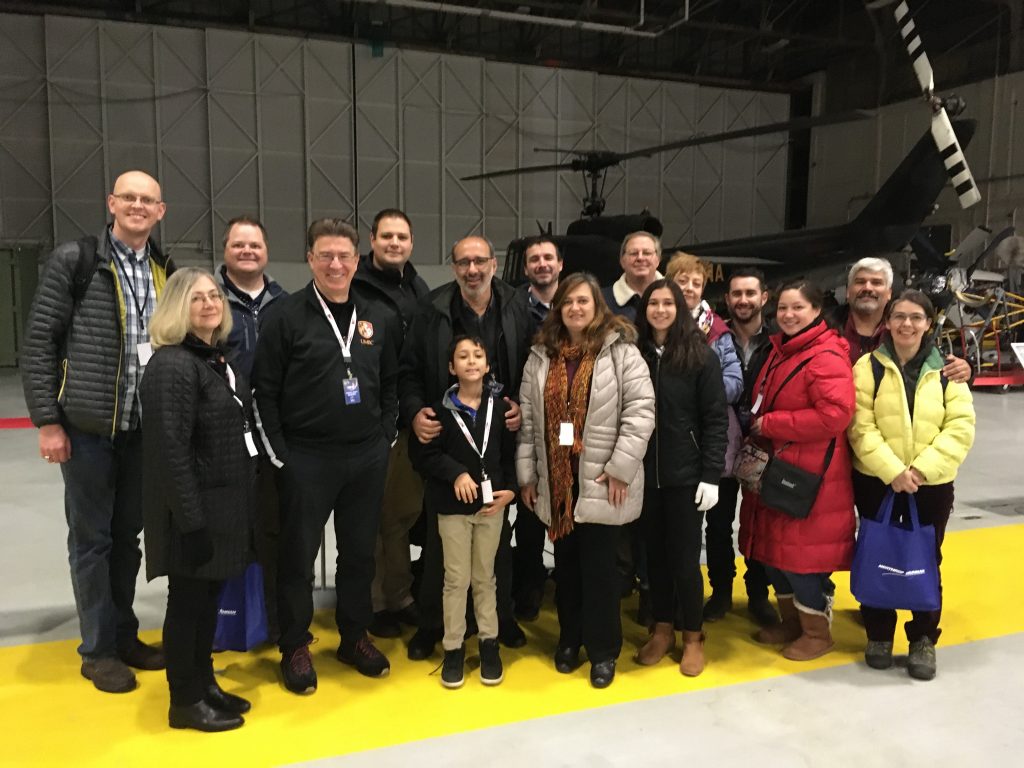
The HARP cubesat team and their colleagues from Space Dynamics Laboratory wait in the NASA hangar with their families on the morning of the rocket launch. Photo by Sarah Hansen, M.S. ’15.
On Monday, November 4, the Cygnus capsule made it safely to the ISS. Another step completed. In about a month, astronauts will launch it and its cubesat companions into space. If that goes smoothly, the satellite will stabilize and enter low-Earth orbit. Then, Earth-bound instrumentation will need to successfully establish a connection with the satellite for transferring data.
If that succeeds, the team will anxiously await the first images from the satellite, which Martins refers to as “first light.” “I’ll really really celebrate when we get the first light,” Martins says.
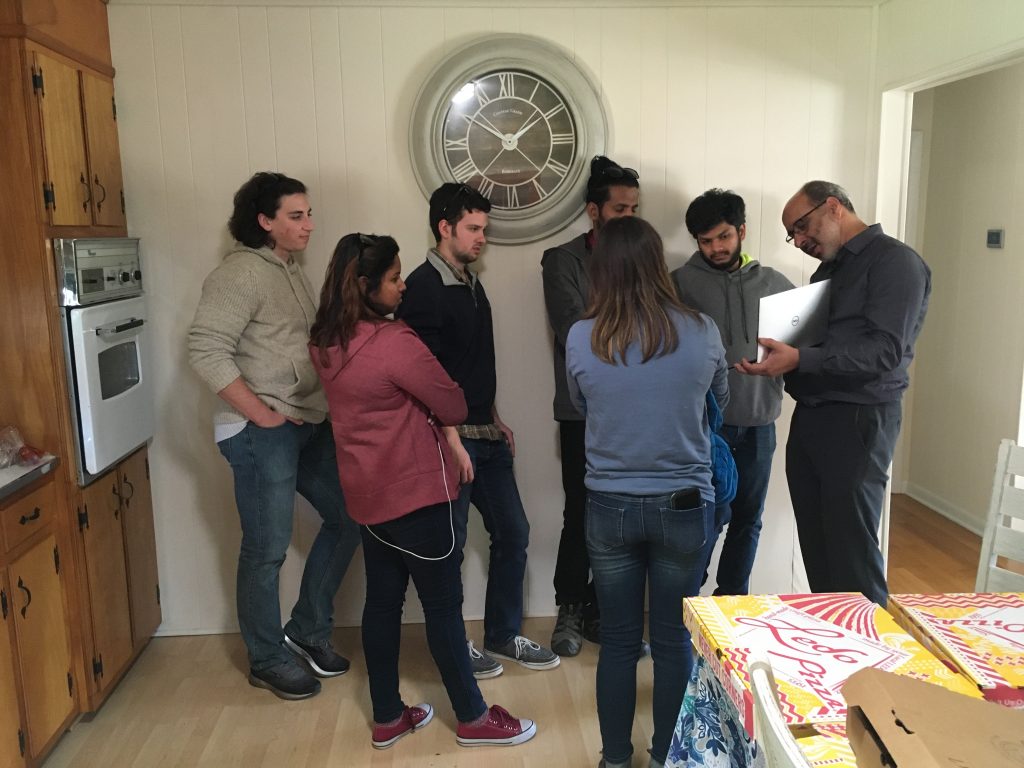
Vanderlei Martins is an educator as much as a scientist. After the launch, he pulled out his laptop to teach a group of his undergraduate students, who made the trip to Virginia, what HARP will do once it enters orbit. Photo by Sarah Hansen, M.S. ’15.
An important day
Despite the additional steps to come, the launch “is a big milestone,” says Brent McBride ’14, physics, a current Ph.D. student in atmospheric physics. With the setbacks the project has experienced over five years, to arrive at launch day “is a wonderful thing.”
“We’re all really invested in the spacecraft and the work that will come out of it,” says Ryan Martineau, from the Utah State University Space Dynamics Laboratory, which partnered with UMBC on HARP, and “there’s still more to do.”
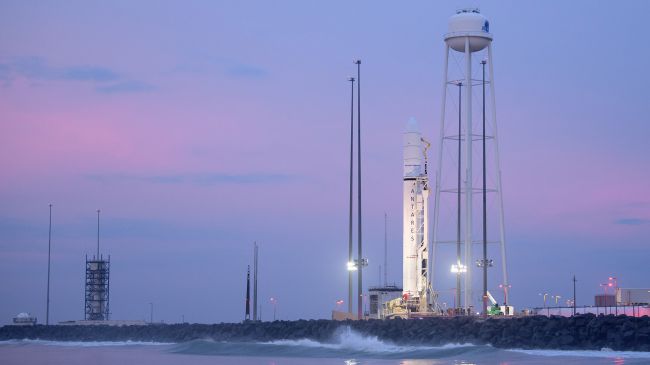
Dawn gradually breaks behind the Antares rocket on launch morning. Photo by Bill Ingalls/NASA.
Karl Steiner, UMBC’s vice president for research, was thrilled to witness his first NASA rocket launch, especially after being inspired by the moon landing and Apollo missions as a child. “To have seen Vanderlei and his team work on this as long as I’ve known them, and know the amount of work and sacrifice they’ve put in, the chance to be with them on this important day…” He trailed off, brimming with emotion. “It’s a very special day for the team and for UMBC.”
At a pizza party after the launch, the team members reminisced about the time they’ve spent together—some as many as 15 years on other projects and five years on HARP—as the excitement of making it to this next big step began to sink in.
“Life can surprise you. Even five years ago I couldn’t have imagined I’d be here today. So keep dreaming,” said Cieslak. “Keep dreaming.”
Banner image: Vanderlei Martins, Roberto Borda, and Dominik Cieslak with HARP at UMBC. Photo by Marlayna Demond ’11 for UMBC.
]]>
This story was written by Sarah Hansen and first appeared on news.umbc.edu In the early morning hours of Saturday, November 2, a few hundred guests at the NASA Wallops Flight Facility...
Photo
https://assets1-beta.my.umbc.edu/system/shared/attachments/4b7c8cf871da8119b901017e7f127b4e/69eb0cab/news/000/088/285/95276ef6535840ec6e432a7fc28688cb/0.jpg?1573210773
https://beta.my.umbc.edu/api/v0/pixel/news/88285/guest@my.umbc.edu/b0cd21ad8ca56b74180208bff3ad6fde/api/pixel
ovpr-news-2019
Archived RCA News
https://beta.my.umbc.edu/groups/research
https://assets4-beta.my.umbc.edu/system/shared/avatars/groups/000/000/794/4bca2aa331eb7e472d63d97e0798b600/xsmall.png?1743706368
https://assets2-beta.my.umbc.edu/system/shared/avatars/groups/000/000/794/4bca2aa331eb7e472d63d97e0798b600/original.jpg?1743706368
https://assets3-beta.my.umbc.edu/system/shared/avatars/groups/000/000/794/4bca2aa331eb7e472d63d97e0798b600/xxlarge.png?1743706368
https://assets4-beta.my.umbc.edu/system/shared/avatars/groups/000/000/794/4bca2aa331eb7e472d63d97e0798b600/xlarge.png?1743706368
https://assets2-beta.my.umbc.edu/system/shared/avatars/groups/000/000/794/4bca2aa331eb7e472d63d97e0798b600/large.png?1743706368
https://assets4-beta.my.umbc.edu/system/shared/avatars/groups/000/000/794/4bca2aa331eb7e472d63d97e0798b600/medium.png?1743706368
https://assets4-beta.my.umbc.edu/system/shared/avatars/groups/000/000/794/4bca2aa331eb7e472d63d97e0798b600/small.png?1743706368
https://assets4-beta.my.umbc.edu/system/shared/avatars/groups/000/000/794/4bca2aa331eb7e472d63d97e0798b600/xsmall.png?1743706368
https://assets3-beta.my.umbc.edu/system/shared/avatars/groups/000/000/794/4bca2aa331eb7e472d63d97e0798b600/xxsmall.png?1743706368
Office of the Vice President for Research
https://assets2-beta.my.umbc.edu/system/shared/thumbnails/news/000/088/285/eb007223a9ca6ab699c5070ced080113/xxlarge.jpg?1573210937
https://assets2-beta.my.umbc.edu/system/shared/thumbnails/news/000/088/285/eb007223a9ca6ab699c5070ced080113/xlarge.jpg?1573210937
https://assets1-beta.my.umbc.edu/system/shared/thumbnails/news/000/088/285/eb007223a9ca6ab699c5070ced080113/large.jpg?1573210937
https://assets1-beta.my.umbc.edu/system/shared/thumbnails/news/000/088/285/eb007223a9ca6ab699c5070ced080113/medium.jpg?1573210937
https://assets1-beta.my.umbc.edu/system/shared/thumbnails/news/000/088/285/eb007223a9ca6ab699c5070ced080113/small.jpg?1573210937
https://assets3-beta.my.umbc.edu/system/shared/thumbnails/news/000/088/285/eb007223a9ca6ab699c5070ced080113/xsmall.jpg?1573210937
https://assets3-beta.my.umbc.edu/system/shared/thumbnails/news/000/088/285/eb007223a9ca6ab699c5070ced080113/xxsmall.jpg?1573210937
3
0
true
Fri, 08 Nov 2019 06:05:45 -0500
Spotlight on collaboration in ribbon-cutting, GRIT-X talks
This story was written by Sarah Hansen and first appeared on news.umbc.edu
During the height of UMBC Homecoming festivities on October 12, the university community and supporters from across Maryland gathered to celebrate the opening of UMBC’s Interdisciplinary Life Sciences Building (ILSB). “With the addition of this incredible, world-class facility, the state of Maryland will continue to lead the way,” Governor Larry Hogan told the crowd, speaking from behind a festive ribbon twisted in the form of a double helix . “And UMBC will continue to push the boundaries, achieve significant breakthroughs, and shine as a national and global leader in innovation.”
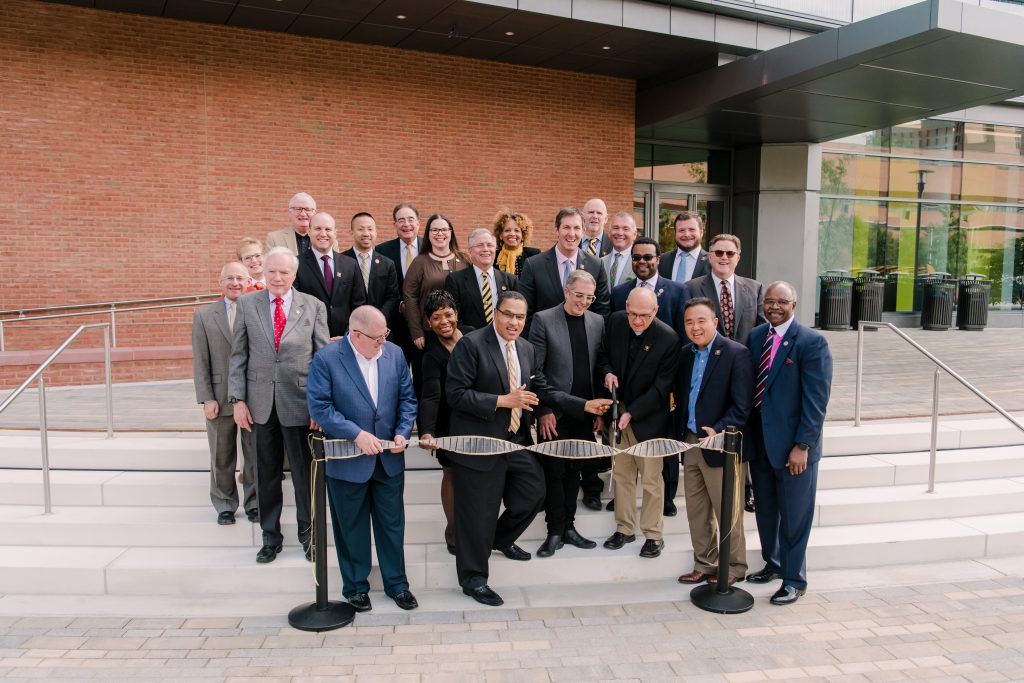 Dean Bill LaCourse cuts the ribbon, surrounded by distinguished guests, at the ILSB opening celebration on the building’s terrace.
Vision for the future
When thinking about how this building came to be, Bill LaCourse, dean of the College of Natural and Mathematical Sciences, sees convergence—people and ideas coming together from different directions to create something new and meaningful—as the central concept.
“Already there are research teams working in this building on such complex issues as age-related disease, environmental degradation, and health disparities,” he notes. Why these topics? Solutions to our most complex challenges “are found through a convergence of talent and effort,” bringing together the perspectives of people from different fields and backgrounds, he shared at the opening event. This is what the new building is designed to achieve.
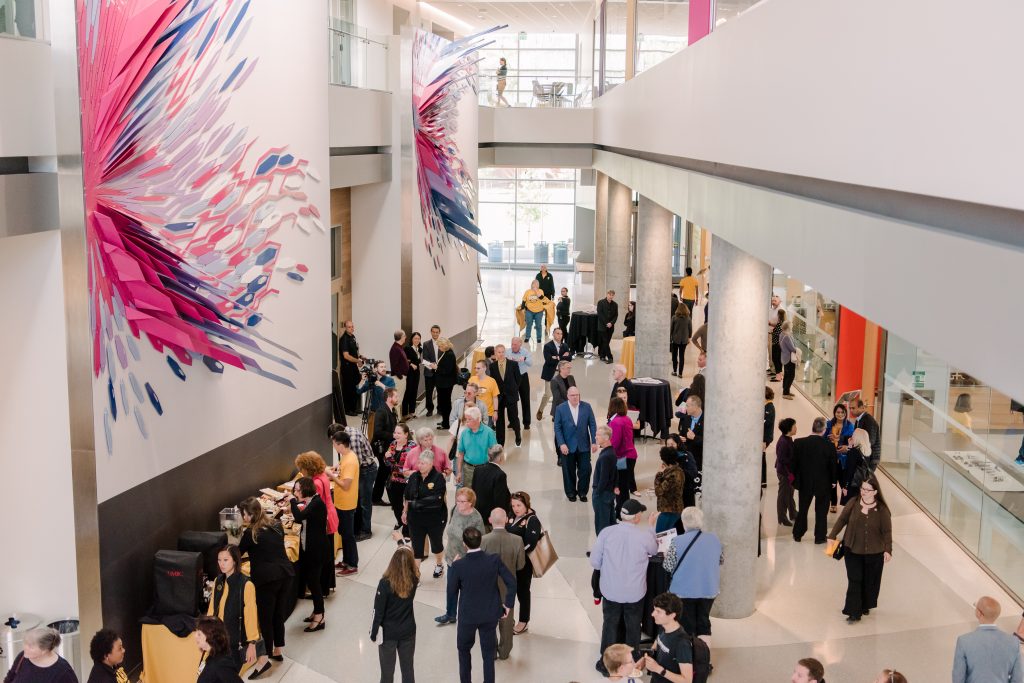
Visitors explore the ILSB after the ribbon-cutting ceremony.
The ILSB is a physical space where people from all over UMBC converge to learn and discover, and it was developed with that goal in mind. “This was a shared effort,” LaCourse said. “This building belongs to everybody on this campus.”
But the benefits of the building will extend far beyond those who study, experiment, and collaborate inside it. “The vision is that we prepare the citizens of this state for the workforce, so everybody has a better life,” shared UMBC President Freeman Hrabowski. “This building will lead to so many people in science, in engineering, and in medicine, saving lives. And it’s that vision I want everyone to think about.”
Alumni leaders reflect
In addition to Governor Hogan, several local and state leaders, who are also UMBC alumni, joined in to celebrate what the new building represents: UMBC’s investment in inclusive, problem-oriented, team-based approaches to teaching and research that will also support economic and workforce development in the state.
Baltimore County Executive John “Johnny O.” Olszewski, Ph.D. ’17, public policy, lauded the numerous and diverse UMBC graduates who go on to own local STEM-oriented businesses and employ other Marylanders. “UMBC is a special place, and I couldn’t be prouder to have a degree from this incredible institution,” he added.
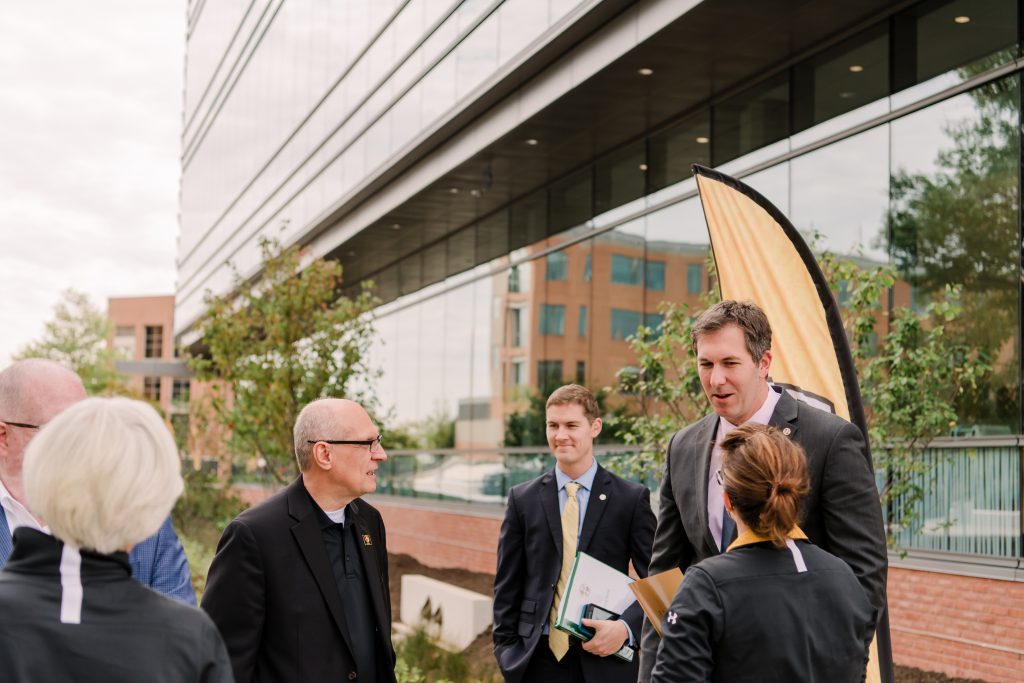
John Olszewski, Ph.D. ’17, (right) chats with Dean Bill LaCourse (left) and other attendees outside the ILSB before the ribbon-cutting ceremony.
Maryland Speaker of the House Adrienne Jones ’76, psychology, also expressed her appreciation for UMBC. “UMBC is really setting the bar high in terms of science, and I commend you for what you continue to do,” she shared. “I’m proud to be an alumna.”
Delegates Mark Chang ’99, psychology, and Charles Sydnor III ’00, policy sciences, also attended. Senate President Mike Miller gave remarks, as did Ken Skrzesz, executive director of the Maryland Arts Council, which supported the construction of the ILSB’s public art installation.
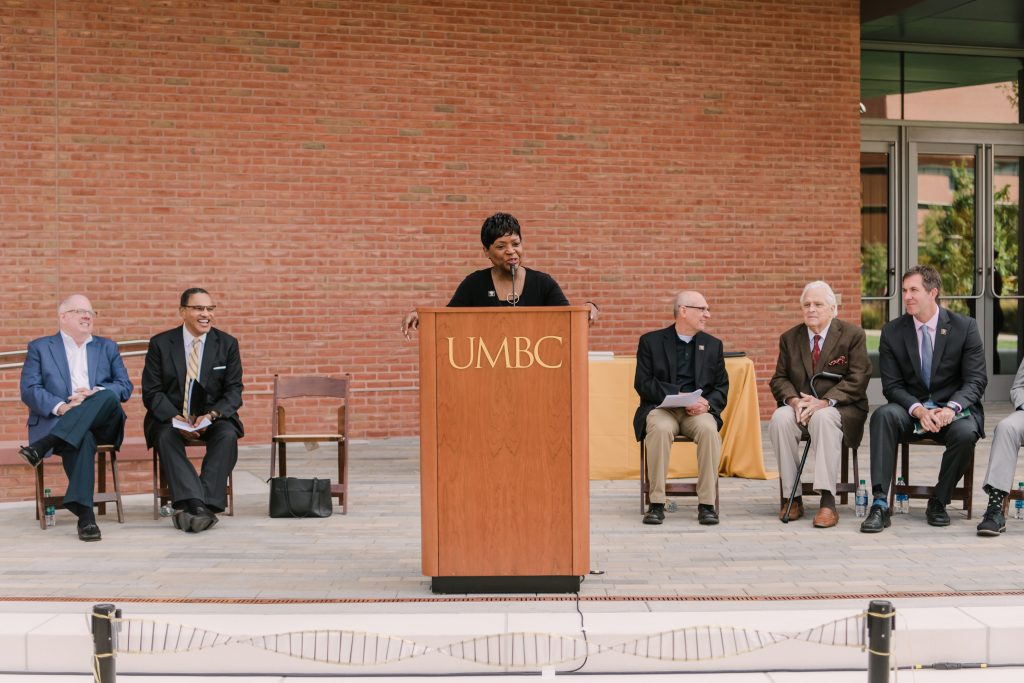
Maryland Speaker of the House Adrienne Jones ’76 speaks at the ILSB opening celebration.
Environment for growth
Following the ribbon-cutting ceremony, the ILSB opened for building tours and hands-on, family-friendly science activities in the teaching labs, including making slime and using microscopes. The building also hosted an active learning demonstration in a tech-enabled classroom and UMBC’s fourth annual GRIT-X talks.
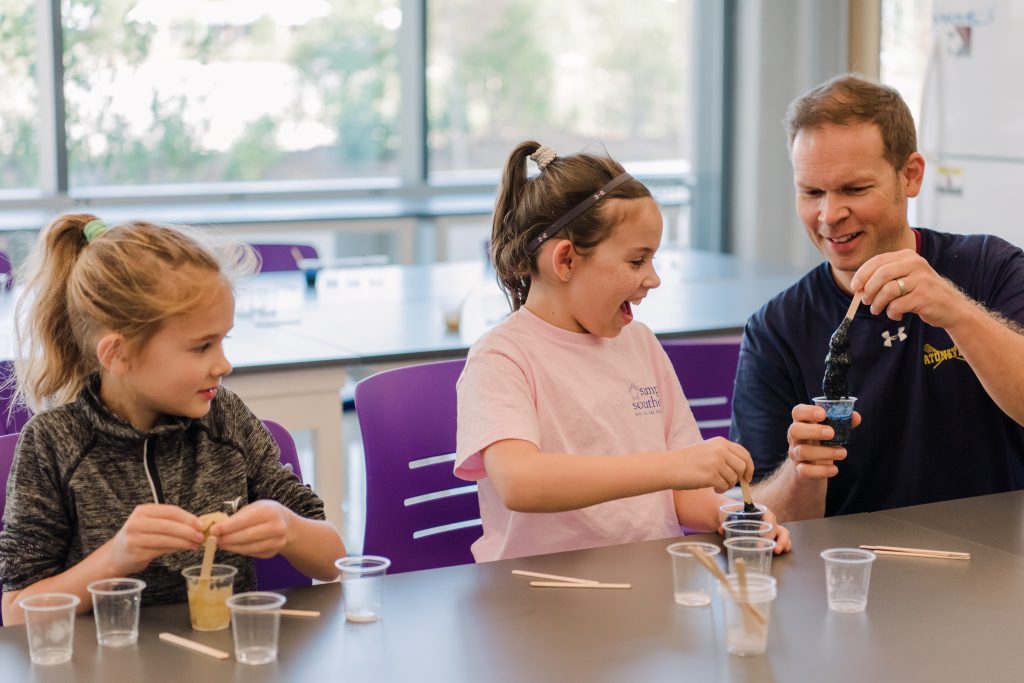
A family enjoys making black and gold slime in one of the ILSB’s teaching labs at the building’s opening celebration.
Nine GRIT-X speakers shared their stories of discovery, creativity, collaboration, and perseverance with a standing-room-only crowd in the ILSB. They included two alumni, six faculty members, and one graduate student, representing all three UMBC colleges.
Crystal Watkins-Johannson ’95, M3, biological sciences, reflected on how her experience at UMBC shaped her future. Today, she combines her expertise in neuroscience with her passion for education and patient care as director of the memory clinic in the Sheppard Pratt Health System and assistant professor of psychiatry and behavioral sciences at Johns Hopkins University.
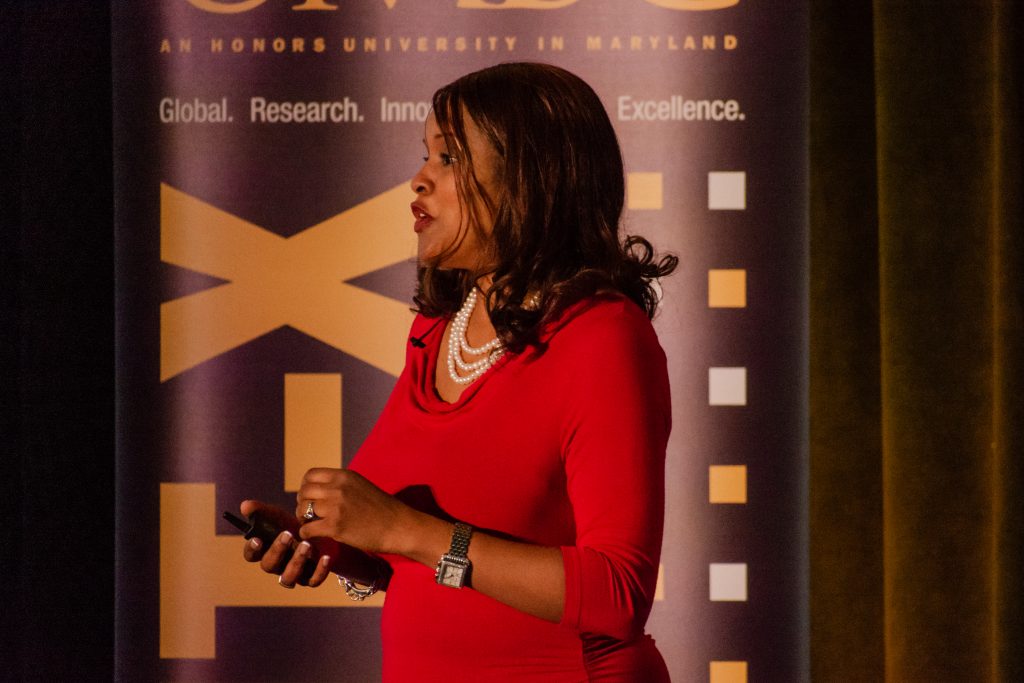
Crystal Watkins-Johannson ’95 speaks at GRIT-X 2019. Photo by Arionna Gonsalves.
“I’d always felt like I was different, but when I came to UMBC for the accepted Meyerhoff Scholars weekend, everyone around me had accomplished just as much as I had,” Watkins-Johannson shared. “It really inspired me that I was going to have an environment that would allow me to grow, think about new ideas, and propel me to the next step.”
Today, she uses the grit she internalized at UMBC to help her patients with memory loss. “I’m able to help other people look at memory loss and persevere through it,” she says.
Empowering experiences
Fellow alumnus Premal Shah ’98, biochemistry and molecular biology, earned his Ph.D. in biochemistry and molecular biophysics at Caltech, and then launched a career as a socially-conscious entrepreneur. In 2018, he co-founded Citizen, a company that helps people access their healthcare data for free. The goal is to improve health outcomes by empowering people to take a more active role in their healthcare.
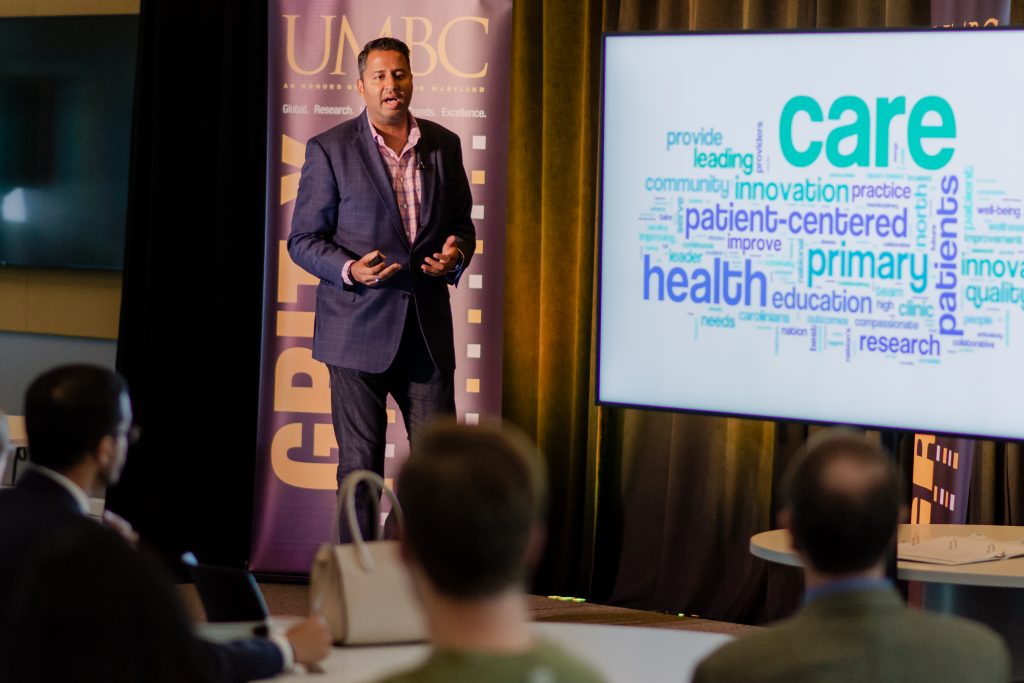
Premal Shah ’98 speaks at GRIT-X 2019. Photo by Arionna Gonsalves.
Like Watkins-Johannson, Shah’s UMBC experience was pivotal in his development. “I want to emphasize that I’ve been fortunate enough to have very good people in my life,” he shared at GRIT-X. “People who have taken an interest in me, people who have cared about me, people who’ve shown me the difference between right and wrong—and therefore I’ve been able to achieve what I have in my career.”
Other speakers included Kevin Omland, professor of biological sciences; Tinoosh Mohsenin, associate professor of computer science and electrical engineering; Lisa Moren, professor of visual arts; Mustafa Al-Adhami, Ph.D. ’20, mechanical engineering; Greg Szeto, assistant professor of chemical, biochemical, and environmental engineering; Carolyn Forestiere, associate professor of political science; and Yonathan Zohar, professor of marine biotechnology. Their talks covered a range of topics including the value of study abroad experiences, sustainable aquaculture, artificial intelligence, and the need for diversity among scientists.
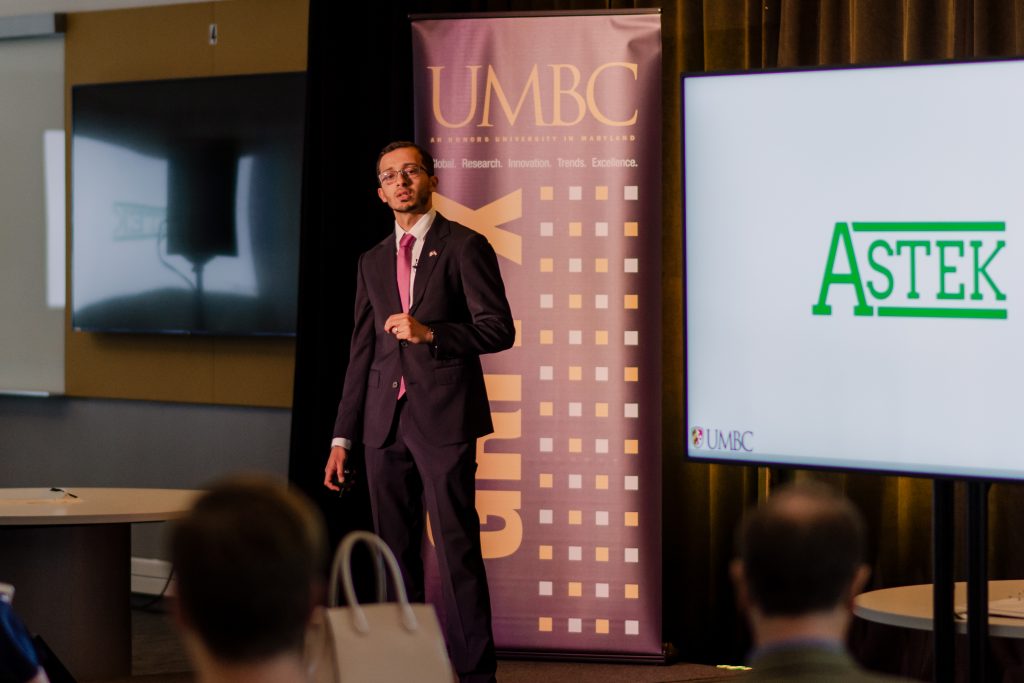
Mustafa Al-Adhami, Ph.D. ’20, mechanical engineering, speaks at GRIT-X 2019. Photo by Arionna Gonsalves.
At the ribbon-cutting, President Hrabowski reflected on the broad and impactful work members of the UMBC community have already accomplished, and which the ILSB will continue to support for current and future Retrievers.
Whether it’s changing the world through research or training the next generation, “When you have a great goal, it’s important to build a large and diverse community,” to work toward that goal, Hrabowski said. “This building is really teaching us the power of convergence.”
Banner image: Supporters gather outside the ILSB in advance of the ribbon-cutting ceremony. All photos by Marlayna Demond ’11 for UMBC unless otherwise noted.
]]>
This story was written by Sarah Hansen and first appeared on news.umbc.edu During the height of UMBC Homecoming festivities on October 12, the university community and supporters from across...
Photo
https://assets2-beta.my.umbc.edu/system/shared/attachments/0af697e1869a468a66cb3d4b8f5d456a/69eb0cab/news/000/087/785/5b209bd59025f74b380134f741207b20/0.jpg?1571749133
https://beta.my.umbc.edu/api/v0/pixel/news/87785/guest@my.umbc.edu/8c0a77489e17bb4da0630117b19d063d/api/pixel
ovpr-news-2019
Archived RCA News
https://beta.my.umbc.edu/groups/research
https://assets4-beta.my.umbc.edu/system/shared/avatars/groups/000/000/794/4bca2aa331eb7e472d63d97e0798b600/xsmall.png?1743706368
https://assets2-beta.my.umbc.edu/system/shared/avatars/groups/000/000/794/4bca2aa331eb7e472d63d97e0798b600/original.jpg?1743706368
https://assets3-beta.my.umbc.edu/system/shared/avatars/groups/000/000/794/4bca2aa331eb7e472d63d97e0798b600/xxlarge.png?1743706368
https://assets4-beta.my.umbc.edu/system/shared/avatars/groups/000/000/794/4bca2aa331eb7e472d63d97e0798b600/xlarge.png?1743706368
https://assets2-beta.my.umbc.edu/system/shared/avatars/groups/000/000/794/4bca2aa331eb7e472d63d97e0798b600/large.png?1743706368
https://assets4-beta.my.umbc.edu/system/shared/avatars/groups/000/000/794/4bca2aa331eb7e472d63d97e0798b600/medium.png?1743706368
https://assets4-beta.my.umbc.edu/system/shared/avatars/groups/000/000/794/4bca2aa331eb7e472d63d97e0798b600/small.png?1743706368
https://assets4-beta.my.umbc.edu/system/shared/avatars/groups/000/000/794/4bca2aa331eb7e472d63d97e0798b600/xsmall.png?1743706368
https://assets3-beta.my.umbc.edu/system/shared/avatars/groups/000/000/794/4bca2aa331eb7e472d63d97e0798b600/xxsmall.png?1743706368
Office of the Vice President for Research
https://assets3-beta.my.umbc.edu/system/shared/thumbnails/news/000/087/785/f0c28c550d55c407a393cd97dc40e763/xxlarge.jpg?1571749388
https://assets3-beta.my.umbc.edu/system/shared/thumbnails/news/000/087/785/f0c28c550d55c407a393cd97dc40e763/xlarge.jpg?1571749388
https://assets2-beta.my.umbc.edu/system/shared/thumbnails/news/000/087/785/f0c28c550d55c407a393cd97dc40e763/large.jpg?1571749388
https://assets4-beta.my.umbc.edu/system/shared/thumbnails/news/000/087/785/f0c28c550d55c407a393cd97dc40e763/medium.jpg?1571749388
https://assets2-beta.my.umbc.edu/system/shared/thumbnails/news/000/087/785/f0c28c550d55c407a393cd97dc40e763/small.jpg?1571749388
https://assets1-beta.my.umbc.edu/system/shared/thumbnails/news/000/087/785/f0c28c550d55c407a393cd97dc40e763/xsmall.jpg?1571749388
https://assets3-beta.my.umbc.edu/system/shared/thumbnails/news/000/087/785/f0c28c550d55c407a393cd97dc40e763/xxsmall.jpg?1571749388
0
0
true
Tue, 22 Oct 2019 09:03:22 -0400
Kuali IRB Protocol Transition
The ORPC team is excited to share updates about our ongoing
efforts with Kuali Protocols for IRB. As we’ve been announcing, UMBC is continuing to transition its research
related processes into the Kuali system.
One part of the transition is configuring the IRB Protocols
module to mirror current human subjects research use protocol application
processes. Our group has provided configuration sessions since July for
investigators to have the opportunity to see what the IRB Protocol module looks
like and get input on the design and content of the module. If you haven’t yet,
please register for upcoming sessions
today. We look forward to getting your input. If the session times do not work
for you, no problem! Anyone with a UMBC logon can see the current version of
the IRB module in the Kuali Protocol
Sandbox. We’ve created a protocol entry
guide to provide you basic steps to create an IRB protocol in Kuali. Let us
know what you think by leaving
us feedback or sending us a comment to compliance@umbc.edu.
Another part of the transition is adding currently approved
IRB protocols to the production version of the Kuali IRB module – this is
what’s used when protocols Go Live. The ORPC team will be spending time later
in the semester to upload the most recent version of you protocol file to
Kuali.
This upload will include the all versions of the
application, recruitment materials, questionnaires/measure and consent
documents. Once we create this legacy file, we’ll send you a link(s) to these
protocols in Kuali. We’ll ask that you to review the legacy materials for
content correctness and ask you to approve. Once done, this protocol is active
in the Kuali IRB system. Future modifications, renewal reports or closures will
be handled by Kuali – no more paper! New protocols are entered once Kuali IRB
is officially live.
Stay tuned to the ORPC myUMBC page
for updates and other announcements.
If you haven’t yet, sign up as part of the ORPC
myUMBC group.
]]>
The ORPC team is excited to share updates about our ongoing efforts with Kuali Protocols for IRB. As we’ve been announcing, UMBC is continuing to transition its research related processes into...
https://research.umbc.edu/kuali-compliance/kuali-compliance-kuali-protocols/
https://beta.my.umbc.edu/api/v0/pixel/news/87415/guest@my.umbc.edu/fce9e04ae9ece7497a17a8a9489fc7e8/api/pixel
Office of Research Protections and Compliance
https://beta.my.umbc.edu/groups/compliance
https://assets2-beta.my.umbc.edu/system/shared/avatars/groups/000/000/163/aea9789988c08f28538422f1c3427388/xsmall.png?1406813901
https://assets2-beta.my.umbc.edu/system/shared/avatars/groups/000/000/163/aea9789988c08f28538422f1c3427388/original.jpg?1406813901
https://assets1-beta.my.umbc.edu/system/shared/avatars/groups/000/000/163/aea9789988c08f28538422f1c3427388/xxlarge.png?1406813901
https://assets1-beta.my.umbc.edu/system/shared/avatars/groups/000/000/163/aea9789988c08f28538422f1c3427388/xlarge.png?1406813901
https://assets1-beta.my.umbc.edu/system/shared/avatars/groups/000/000/163/aea9789988c08f28538422f1c3427388/large.png?1406813901
https://assets2-beta.my.umbc.edu/system/shared/avatars/groups/000/000/163/aea9789988c08f28538422f1c3427388/medium.png?1406813901
https://assets4-beta.my.umbc.edu/system/shared/avatars/groups/000/000/163/aea9789988c08f28538422f1c3427388/small.png?1406813901
https://assets2-beta.my.umbc.edu/system/shared/avatars/groups/000/000/163/aea9789988c08f28538422f1c3427388/xsmall.png?1406813901
https://assets1-beta.my.umbc.edu/system/shared/avatars/groups/000/000/163/aea9789988c08f28538422f1c3427388/xxsmall.png?1406813901
Office of Research Protections and Compliance
0
0
false
Tue, 08 Oct 2019 13:41:13 -0400
Tue, 27 Apr 2021 11:54:26 -0400
Dresher Center's Rachel Brubaker receives USM Staff Award
Rachel Brubaker, the Assistant Director in UMBC's Dresher Center, recently won a University System of Maryland (USM) Board of Regents Staff Award for Exceptional Contribution to the Institution.
Rachel has spearheaded two kinds of external funding for the Dresher Center for the Humanities--for arts and humanities faculty at UMBC and for the Dresher Center itself. Over the past five years in her position, she has supported 59 faculty members seeking funding. She issues a regular newsletter that includes funding opportunities; she has built a reference bank of successful proposals; she coordinates with the Vice President for Research on application workshops and processes; and—most importantly—works one-on-one with the faculty. In addition, Rachel was instrumental in securing significant funding from both the National Endowment for the Humanities and the Mellon Foundation in support of the Dresher Center. As UMBC President Freeman Hrabowski has observed: “Rachel’s vision and focus have helped place UMBC at the forefront of humanities learning, teaching, and research.”
]]>
Rachel Brubaker, the Assistant Director in UMBC's Dresher Center, recently won a University System of Maryland (USM) Board of Regents Staff Award for Exceptional Contribution to the Institution....
https://beta.my.umbc.edu/api/v0/pixel/news/87280/guest@my.umbc.edu/d89bf2487a415ca4d1cf7d9d09bf443e/api/pixel
ovpr-news-2019
Archived RCA News
https://beta.my.umbc.edu/groups/research
https://assets4-beta.my.umbc.edu/system/shared/avatars/groups/000/000/794/4bca2aa331eb7e472d63d97e0798b600/xsmall.png?1743706368
https://assets2-beta.my.umbc.edu/system/shared/avatars/groups/000/000/794/4bca2aa331eb7e472d63d97e0798b600/original.jpg?1743706368
https://assets3-beta.my.umbc.edu/system/shared/avatars/groups/000/000/794/4bca2aa331eb7e472d63d97e0798b600/xxlarge.png?1743706368
https://assets4-beta.my.umbc.edu/system/shared/avatars/groups/000/000/794/4bca2aa331eb7e472d63d97e0798b600/xlarge.png?1743706368
https://assets2-beta.my.umbc.edu/system/shared/avatars/groups/000/000/794/4bca2aa331eb7e472d63d97e0798b600/large.png?1743706368
https://assets4-beta.my.umbc.edu/system/shared/avatars/groups/000/000/794/4bca2aa331eb7e472d63d97e0798b600/medium.png?1743706368
https://assets4-beta.my.umbc.edu/system/shared/avatars/groups/000/000/794/4bca2aa331eb7e472d63d97e0798b600/small.png?1743706368
https://assets4-beta.my.umbc.edu/system/shared/avatars/groups/000/000/794/4bca2aa331eb7e472d63d97e0798b600/xsmall.png?1743706368
https://assets3-beta.my.umbc.edu/system/shared/avatars/groups/000/000/794/4bca2aa331eb7e472d63d97e0798b600/xxsmall.png?1743706368
Office of the Vice President for Research
0
0
true
Wed, 02 Oct 2019 23:43:02 -0400
President Hrabowski's NCURA Keynote Address
On August 5th, 2019, President Hrabowski delivered the Keynote at the 61st Annual Meeting of the National Council of University Research Administrators (NCURA) in Washington, D.C.
A recording of the address is now available to view on the OSP website here
]]>
On August 5th, 2019, President Hrabowski delivered the Keynote at the 61st Annual Meeting of the National Council of University Research Administrators (NCURA) in Washington, D.C. A recording...
https://beta.my.umbc.edu/api/v0/pixel/news/87060/guest@my.umbc.edu/428d74180cb5f28fcf2e5f509fd8c971/api/pixel
ovpr-news-2019
Archived RCA News
https://beta.my.umbc.edu/groups/research
https://assets4-beta.my.umbc.edu/system/shared/avatars/groups/000/000/794/4bca2aa331eb7e472d63d97e0798b600/xsmall.png?1743706368
https://assets2-beta.my.umbc.edu/system/shared/avatars/groups/000/000/794/4bca2aa331eb7e472d63d97e0798b600/original.jpg?1743706368
https://assets3-beta.my.umbc.edu/system/shared/avatars/groups/000/000/794/4bca2aa331eb7e472d63d97e0798b600/xxlarge.png?1743706368
https://assets4-beta.my.umbc.edu/system/shared/avatars/groups/000/000/794/4bca2aa331eb7e472d63d97e0798b600/xlarge.png?1743706368
https://assets2-beta.my.umbc.edu/system/shared/avatars/groups/000/000/794/4bca2aa331eb7e472d63d97e0798b600/large.png?1743706368
https://assets4-beta.my.umbc.edu/system/shared/avatars/groups/000/000/794/4bca2aa331eb7e472d63d97e0798b600/medium.png?1743706368
https://assets4-beta.my.umbc.edu/system/shared/avatars/groups/000/000/794/4bca2aa331eb7e472d63d97e0798b600/small.png?1743706368
https://assets4-beta.my.umbc.edu/system/shared/avatars/groups/000/000/794/4bca2aa331eb7e472d63d97e0798b600/xsmall.png?1743706368
https://assets3-beta.my.umbc.edu/system/shared/avatars/groups/000/000/794/4bca2aa331eb7e472d63d97e0798b600/xxsmall.png?1743706368
Office of the Vice President for Research
https://assets2-beta.my.umbc.edu/system/shared/thumbnails/news/000/087/060/f927a60c3d1e1341a694ddedbc9cf6ed/xxlarge.jpg?1569483775
https://assets2-beta.my.umbc.edu/system/shared/thumbnails/news/000/087/060/f927a60c3d1e1341a694ddedbc9cf6ed/xlarge.jpg?1569483775
https://assets3-beta.my.umbc.edu/system/shared/thumbnails/news/000/087/060/f927a60c3d1e1341a694ddedbc9cf6ed/large.jpg?1569483775
https://assets4-beta.my.umbc.edu/system/shared/thumbnails/news/000/087/060/f927a60c3d1e1341a694ddedbc9cf6ed/medium.jpg?1569483775
https://assets2-beta.my.umbc.edu/system/shared/thumbnails/news/000/087/060/f927a60c3d1e1341a694ddedbc9cf6ed/small.jpg?1569483775
https://assets4-beta.my.umbc.edu/system/shared/thumbnails/news/000/087/060/f927a60c3d1e1341a694ddedbc9cf6ed/xsmall.jpg?1569483775
https://assets3-beta.my.umbc.edu/system/shared/thumbnails/news/000/087/060/f927a60c3d1e1341a694ddedbc9cf6ed/xxsmall.jpg?1569483775
0
0
true
Thu, 26 Sep 2019 03:43:07 -0400
Learn more about Kuali Protocols for IRB
UMBC is continuing to transition its research related processes into the Kuali system. Proposal Submission, Awards and Conflict of Interest modules have gone live and researchers are using these modules. The next step in the Kuali transition is the
Kuali Protocols module. Protocols will replace current paper/email based submission processes.
The staff in the ORPC are in the process of configuring the IRB Protocols module to mirror the current human subjects research use protocol application process. Our process is two-fold: first, provide an interactive opportunity to look at what the IRB Protocol module looks like. We want to get your input on the design and content of the module from your perspective. Second, we ask that you help us test the system by entering a real protocol (one of yours) in Kuali. The members of the IRB are also participating in this effort; your recommendations are also extremely valuable.
The ORPC has created times to learn more about Kuali. All configuration sessions will be held in the ORPC conference room, bwTECH North, 5523 Research Park Drive, Suite 310, Baltimore MD 21228.
Please look at the
ORPC myUMBC events page to find a date and time that works for your schedule. Bring your laptop to click through the steps or watch on our screen as we present. We look forward to seeing you.
This story was written by Sarah Hansen and first appeared on news.umbc.edu
An interdisciplinary team of UMBC professors has received $2.8 million from the National Science Foundation to create a new master’s program focused on developing a more diverse environmental science workforce. The program, called the Interdisciplinary Consortium for Applied Research in Ecology and Evolution (ICARE), is funded by a highly competitive NSF Research Traineeship (NRT) grant.
Student projects through the program will focus on environmental issues faced by the Baltimore Harbor and the surrounding region. To ensure students are developing research projects with tangible impacts, they will collaborate with partners in all levels of government as well as non-profit and community organizations focused on the environment.
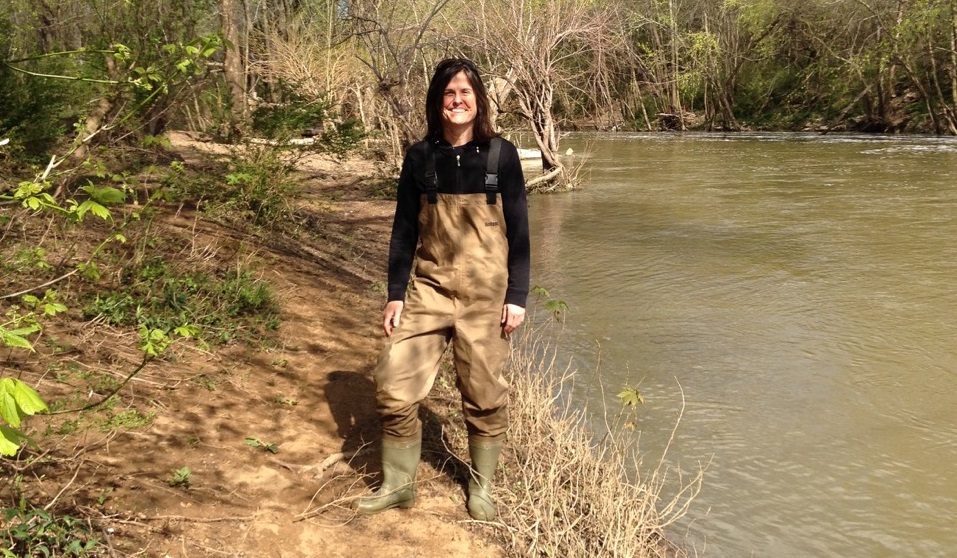
Tamra Mendelson at a research field site. Photo courtesy Tamra Mendelson.
The ICARE NRT also creates new opportunities to build a more diverse environmental workforce. “The primary mission of UMBC is inclusive excellence, and our NRT applies that mission to the environmental sciences,” says Tamra Mendelson, professor of biological sciences and the lead on the project. “Our main objectives are to bring a diversity of backgrounds to the environmental workforce and to improve the way that scientific research is applied to environmental problems.”
Baltimore in focus
UMBC is known for its links to Baltimore City, and ICARE’s deliberate focus on the Baltimore Harbor and its surroundings builds on that connection. “The students’ thesis projects need to be tied directly to solving problems in the Baltimore Harbor, which is in the spirit of what UMBC does,” says Chris Swan, professor of geography and environmental systems.
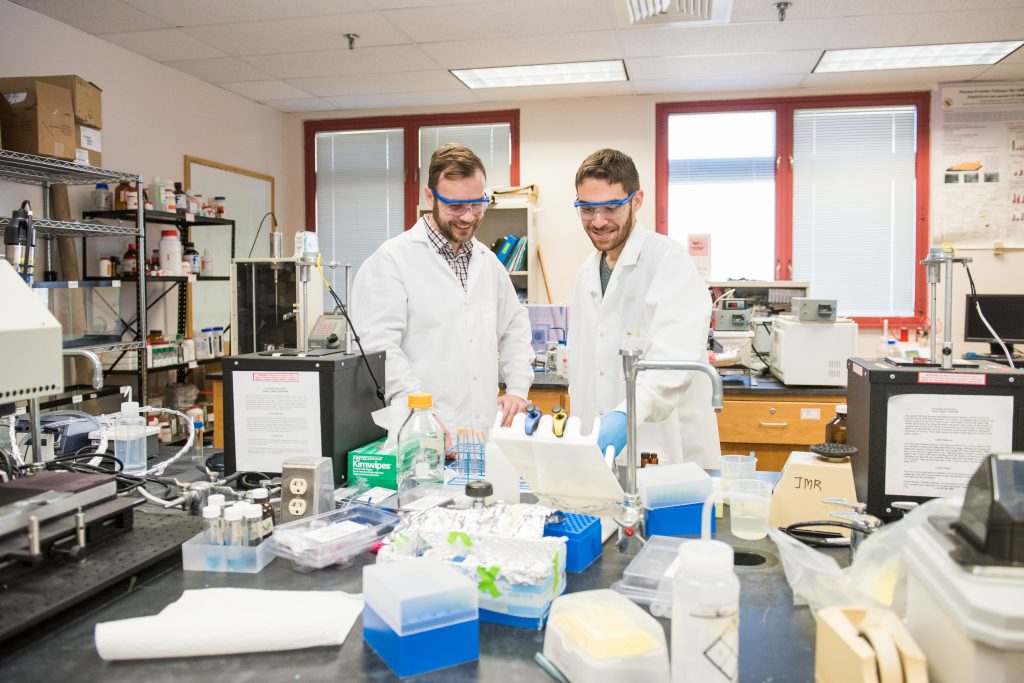
Lee Blaney and Daniel Ocasio ’17, chemical engineering, working in UMBC’s Engineering Building.
The challenges the region is facing reflect environmental challenges the country and planet are facing on a larger scale, from shifting weather patterns, to air pollution and heat island effects, to water quality concerns.
“The health of the Baltimore Harbor is improving, and I am hopeful that the work of ICARE will bolster ongoing efforts to make the Baltimore Harbor a model for the whole country,” says Lee Blaney, associate professor of chemical, biochemical, and environmental engineering. “It is my hope that the research focus on the Baltimore Harbor will set up ICARE and UMBC to make lasting, sustainable, and positive impacts in our city.”
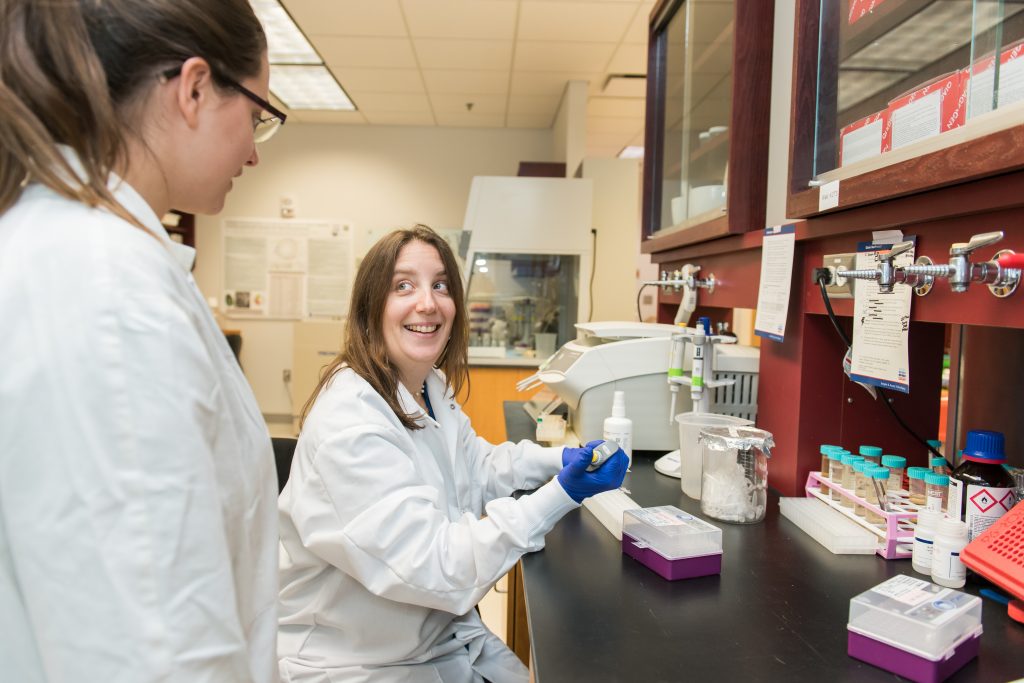
Colleen Burge in her lab at the Institute of Marine and Environmental Technology.
For faculty who live in the city, the new program is personal. “As a UMBC employee who lives in Baltimore and works at the Institute of Marine and Environmental Technology in Baltimore’s Inner Harbor, I am especially looking forward to the opportunity to train students who can impact the quality of the environment in Baltimore,” shares Colleen Burge, assistant professor of marine biotechnology. “I’m extremely hopeful that this program will attract local students who will be trained to be the next generation of scientists in their communities.”
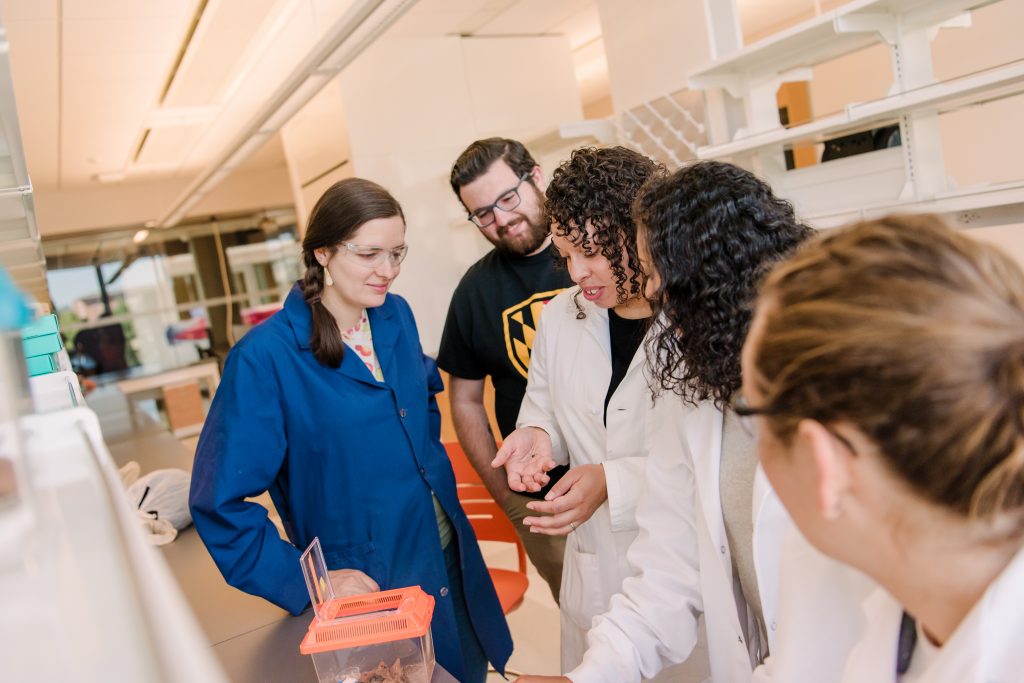
From left to right: Postdoc Sarah Stellwagen, Ph.D. student Tyler Brown, assistant professor Mercedes Burns, and two undergraduate students check out a harvestman, a type of arachnid related to spiders, in a research lab in the Interdisciplinary Life Sciences Building (ILSB).
“As part of developing the ICARE NRT proposal, we identified a number of stakeholders in and around Baltimore City that have a strong interest in better understanding and improving the community,” adds Mercedes Burns, assistant professor of biological sciences, “and since I live in the city, I consider myself a beneficiary, too.”
Many of UMBC’s students come from the region, so this program is also an opportunity for them to make a difference to a resource that is at the center of city life, both literally and figuratively. “Baltimore’s harbor is really integral to the fabric of the city,” says Kevin Omland, professor of biological sciences, “the same way that the Chesapeake Bay is embedded in the culture of the state of Maryland.”
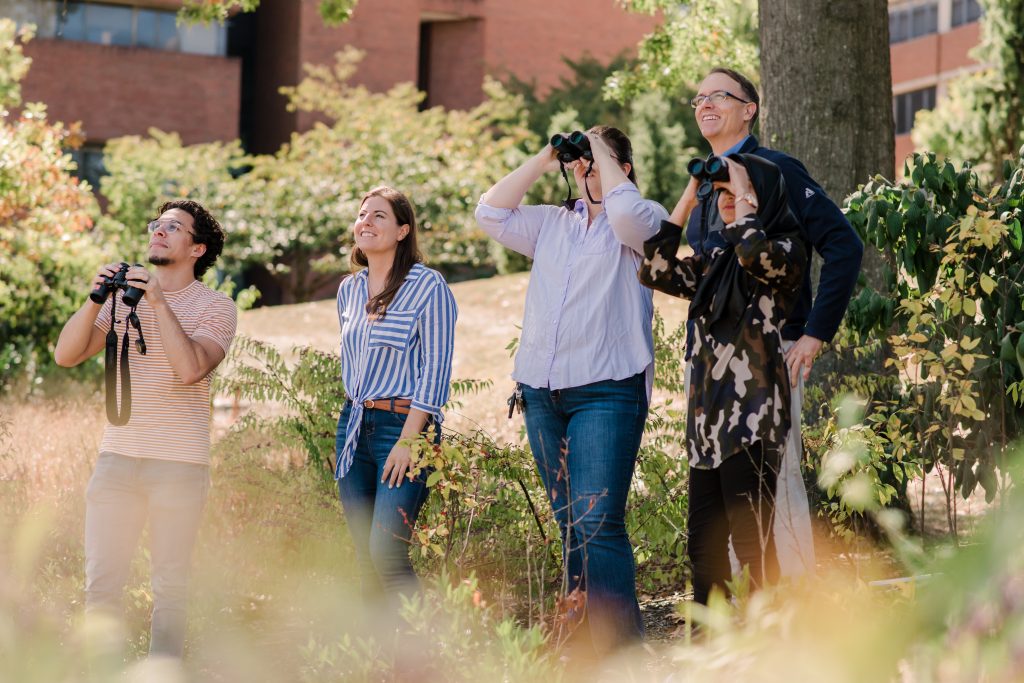
Kevin Omland, rear, goes birdwatching near UMBC’s Library Pond with some of his students. Left to right: Jon Sikora ’20, Ph.D. student Janine Antalffy, Ph.D. student Evangeline Rose, and Aiman Raza ’22.
Direct career development
The unique structure of the program will create opportunities that students might not find in a more traditional master’s program. “We provide a degree program that allows students to get real-world experience in environmental problems, by partnering with government agencies, nonprofits, industry, and community stakeholders,” shares Mendelson.
Students are required to have someone from outside UMBC—in fact, outside any academic institution—on their master’s thesis committee. In that way, “The program is a catalyst for partnerships,” Swan says.
Maggie Holland, associate professor of geography and environmental systems, agrees. “We have been able to involve partner organizations working actively in the city from the very beginning of our planning for this program,” she says. “It’s thrilling to think that we can continue to deepen those collaborations and extend the network over the next several years. Their involvement is part of what will help us to innovate and adapt graduate student training as we move forward.”
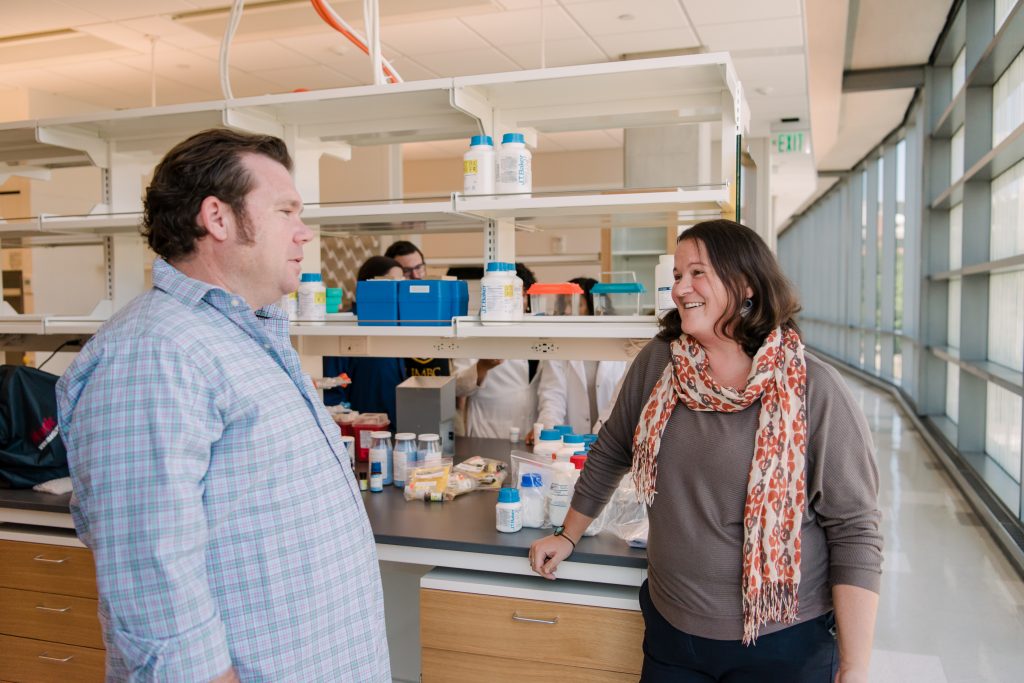
Maggie Holland (right) and Chris Swan in an ILSB lab.
The environment needs everyone
Creating a master’s program that serves as a direct pathway to environmental careers, and funding students to participate (which is rare in master’s programs), opens the door to a wider range of people who want to pursue this line of work, but who may not be in a position to commit to a five-plus year Ph.D. program or an unfunded master’s degree.
“I’m excited to help diversify environmental science through this program,” shares Burns, “as I think the perspectives of people of color are desperately needed in this field.”
“Big picture, the planet is being challenged in huge ways. So it’s totally a situation of needing all hands on deck,” Omland says. “We think this is a really good way to help broaden the kinds of people who are able to make contributions to basic research and applied action. Ultimately, some of these people might end up working for environmental non-profits, on the policy end, or in other capacities.”
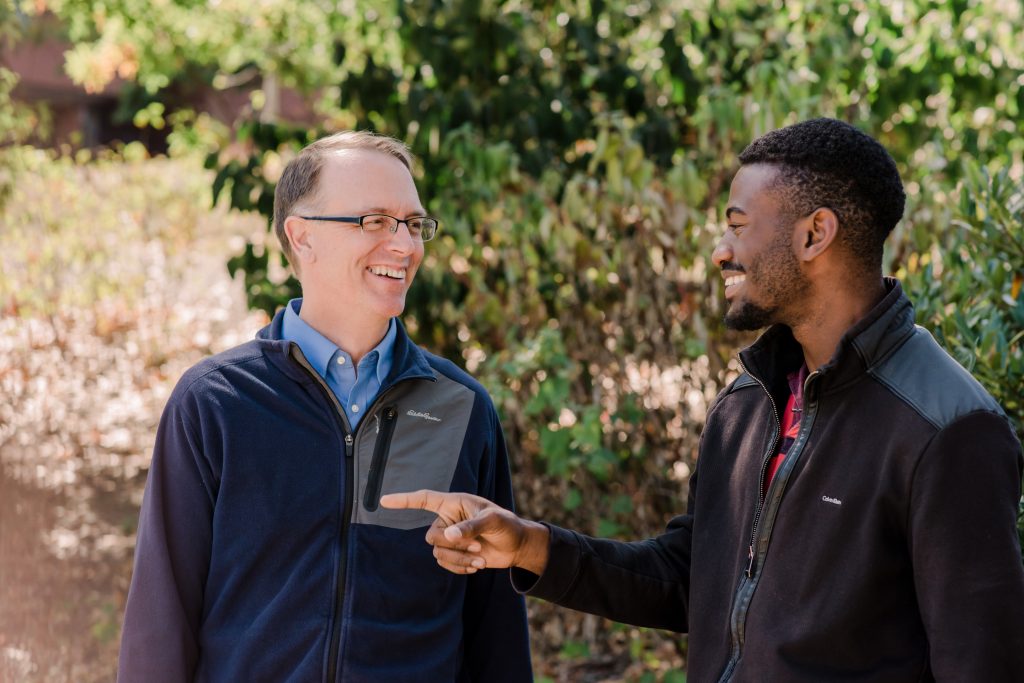
Kevin Omland and Sheridan Danquah ’20, biological sciences.
This program builds on successes UMBC has had in diversifying other fields. “UMBC has done a singularly outstanding job preparing underrepresented students for careers in the biomedical sciences,” Mendelson says. “We’re thrilled to apply these best practices to the environmental sciences and tackle some of the biggest problems facing our city, nation, and planet.”
Now, everyone involved is excited to get to work designing new courses, cultivating partnerships, and, overall, making a difference in Baltimore and beyond. In short, “We’re super jazzed about this,” says Swan. “It’s something we can be really proud of.”
Banner image: Mercedes Burns (left), Maggie Holland (center), and Chris Swan are all part of the ICARE NRT project. All photos by Marlayna Demond ’11 for UMBC unless otherwise noted.
]]>
This story was written by Sarah Hansen and first appeared on news.umbc.edu An interdisciplinary team of UMBC professors has received $2.8 million from the National Science Foundation to...
Photo
https://assets1-beta.my.umbc.edu/system/shared/attachments/33e38b0095e0312c23ee1f5aa9bdccb0/69eb0cab/news/000/086/938/71f0603a717117b0bc2df3f784862801/0.jpg?1569253535
https://beta.my.umbc.edu/api/v0/pixel/news/86938/guest@my.umbc.edu/20d5d1854363f676126e6fbcb0cdb5d4/api/pixel
ovpr-news-2019
Archived RCA News
https://beta.my.umbc.edu/groups/research
https://assets4-beta.my.umbc.edu/system/shared/avatars/groups/000/000/794/4bca2aa331eb7e472d63d97e0798b600/xsmall.png?1743706368
https://assets2-beta.my.umbc.edu/system/shared/avatars/groups/000/000/794/4bca2aa331eb7e472d63d97e0798b600/original.jpg?1743706368
https://assets3-beta.my.umbc.edu/system/shared/avatars/groups/000/000/794/4bca2aa331eb7e472d63d97e0798b600/xxlarge.png?1743706368
https://assets4-beta.my.umbc.edu/system/shared/avatars/groups/000/000/794/4bca2aa331eb7e472d63d97e0798b600/xlarge.png?1743706368
https://assets2-beta.my.umbc.edu/system/shared/avatars/groups/000/000/794/4bca2aa331eb7e472d63d97e0798b600/large.png?1743706368
https://assets4-beta.my.umbc.edu/system/shared/avatars/groups/000/000/794/4bca2aa331eb7e472d63d97e0798b600/medium.png?1743706368
https://assets4-beta.my.umbc.edu/system/shared/avatars/groups/000/000/794/4bca2aa331eb7e472d63d97e0798b600/small.png?1743706368
https://assets4-beta.my.umbc.edu/system/shared/avatars/groups/000/000/794/4bca2aa331eb7e472d63d97e0798b600/xsmall.png?1743706368
https://assets3-beta.my.umbc.edu/system/shared/avatars/groups/000/000/794/4bca2aa331eb7e472d63d97e0798b600/xxsmall.png?1743706368
Office of the Vice President for Research
https://assets3-beta.my.umbc.edu/system/shared/thumbnails/news/000/086/938/aa2f073d33d93488bdc3bfb5b52e3e2b/xxlarge.jpg?1569253661
https://assets2-beta.my.umbc.edu/system/shared/thumbnails/news/000/086/938/aa2f073d33d93488bdc3bfb5b52e3e2b/xlarge.jpg?1569253661
https://assets3-beta.my.umbc.edu/system/shared/thumbnails/news/000/086/938/aa2f073d33d93488bdc3bfb5b52e3e2b/large.jpg?1569253661
https://assets4-beta.my.umbc.edu/system/shared/thumbnails/news/000/086/938/aa2f073d33d93488bdc3bfb5b52e3e2b/medium.jpg?1569253661
https://assets2-beta.my.umbc.edu/system/shared/thumbnails/news/000/086/938/aa2f073d33d93488bdc3bfb5b52e3e2b/small.jpg?1569253661
https://assets1-beta.my.umbc.edu/system/shared/thumbnails/news/000/086/938/aa2f073d33d93488bdc3bfb5b52e3e2b/xsmall.jpg?1569253661
https://assets1-beta.my.umbc.edu/system/shared/thumbnails/news/000/086/938/aa2f073d33d93488bdc3bfb5b52e3e2b/xxsmall.jpg?1569253661
0
0
true
Mon, 23 Sep 2019 11:47:52 -0400
NOAA funds Recirculating Aquaculture System (RAS) research
A new article in Undercurrent News details a $1.2 million investment by the National Oceanic and Atmospheric Administration (NOAA) in building an Atlantic salmon recirculating aquaculture system (RAS) consortium which includes UMBC as a founding member.
]]>
A new article in Undercurrent News details a $1.2 million investment by the National Oceanic and Atmospheric Administration (NOAA) in building an Atlantic salmon recirculating aquaculture system...
https://beta.my.umbc.edu/api/v0/pixel/news/86937/guest@my.umbc.edu/982a7ba05202876a972298571a240e5a/api/pixel
ovpr-news-2019
Archived RCA News
https://beta.my.umbc.edu/groups/research
https://assets4-beta.my.umbc.edu/system/shared/avatars/groups/000/000/794/4bca2aa331eb7e472d63d97e0798b600/xsmall.png?1743706368
https://assets2-beta.my.umbc.edu/system/shared/avatars/groups/000/000/794/4bca2aa331eb7e472d63d97e0798b600/original.jpg?1743706368
https://assets3-beta.my.umbc.edu/system/shared/avatars/groups/000/000/794/4bca2aa331eb7e472d63d97e0798b600/xxlarge.png?1743706368
https://assets4-beta.my.umbc.edu/system/shared/avatars/groups/000/000/794/4bca2aa331eb7e472d63d97e0798b600/xlarge.png?1743706368
https://assets2-beta.my.umbc.edu/system/shared/avatars/groups/000/000/794/4bca2aa331eb7e472d63d97e0798b600/large.png?1743706368
https://assets4-beta.my.umbc.edu/system/shared/avatars/groups/000/000/794/4bca2aa331eb7e472d63d97e0798b600/medium.png?1743706368
https://assets4-beta.my.umbc.edu/system/shared/avatars/groups/000/000/794/4bca2aa331eb7e472d63d97e0798b600/small.png?1743706368
https://assets4-beta.my.umbc.edu/system/shared/avatars/groups/000/000/794/4bca2aa331eb7e472d63d97e0798b600/xsmall.png?1743706368
https://assets3-beta.my.umbc.edu/system/shared/avatars/groups/000/000/794/4bca2aa331eb7e472d63d97e0798b600/xxsmall.png?1743706368
Office of the Vice President for Research
https://assets1-beta.my.umbc.edu/system/shared/thumbnails/news/000/086/937/c02c8bddcfd1f152e71319974b4fd1e3/xxlarge.jpg?1569253418
https://assets3-beta.my.umbc.edu/system/shared/thumbnails/news/000/086/937/c02c8bddcfd1f152e71319974b4fd1e3/xlarge.jpg?1569253418
https://assets3-beta.my.umbc.edu/system/shared/thumbnails/news/000/086/937/c02c8bddcfd1f152e71319974b4fd1e3/large.jpg?1569253418
https://assets1-beta.my.umbc.edu/system/shared/thumbnails/news/000/086/937/c02c8bddcfd1f152e71319974b4fd1e3/medium.jpg?1569253418
https://assets2-beta.my.umbc.edu/system/shared/thumbnails/news/000/086/937/c02c8bddcfd1f152e71319974b4fd1e3/small.jpg?1569253418
https://assets4-beta.my.umbc.edu/system/shared/thumbnails/news/000/086/937/c02c8bddcfd1f152e71319974b4fd1e3/xsmall.jpg?1569253418
https://assets2-beta.my.umbc.edu/system/shared/thumbnails/news/000/086/937/c02c8bddcfd1f152e71319974b4fd1e3/xxsmall.jpg?1569253418
2
0
true
Mon, 23 Sep 2019 11:41:40 -0400
Mon, 23 Sep 2019 11:43:46 -0400
Prof Kyoung developing 4D map of a cell’s metabolic pathways
This story was written by Sarah Hansen and first appeared on news.umbc.edu
Scientists understand many of the body’s processes, like breaking down sugars and generating energy for the cell, pretty well. They know what chemical reactions are involved, what molecules they produce, and in what order everything happens. Complex maps even exist of how the different processes interact with one another. There’s a problem, though: the maps are two-dimensional, and cells are three-dimensional. Add the element of time, and you’re up to four dimensions.
Minjoung Kyoung, assistant professor of chemistry and biochemistry, has never been satisfied with 2D maps of 4D processes. “I’ve always been interested in how proteins are working in the real system, in real time, in real action,” she says.
To address the limits of current understanding, Kyoung and her graduate student, Erin Kennedy, ordered parts to build an innovative type of microscope, found in just a few labs around the world. This new tool gave them the rare ability to look at entire living cells at exquisite resolution, as they change in real time. Finally, they could move forward with constructing a 4D map of cellular metabolic pathways.
Kyoung’s preliminary results with the new instrument are promising. Now, with a five-year, $1.6 million grant from the National Institutes of Health, she’s poised to make serious breakthroughs in how we understand the functional relationship between metabolic pathways. Her first targets will include essential basic processes like glucose metabolism (sugar breakdown) and cellular respiration (energy production for the cell, which relies on glucose). Both are fundamental to diseases like diabetes, cancer, and obesity.
Anticipating disease
One thing Kyoung’s early results suggested is that the enzymes important for breaking down glucose and for generating energy are physically close together in the cell—but only when both pathways are functioning normally. “So when they are functionally linked, they are spatially related,” Kyoung says. Her continuing research will try to determine how and why that happens, by looking very carefully at what’s going on in whole cells at various time points and under different cellular conditions.
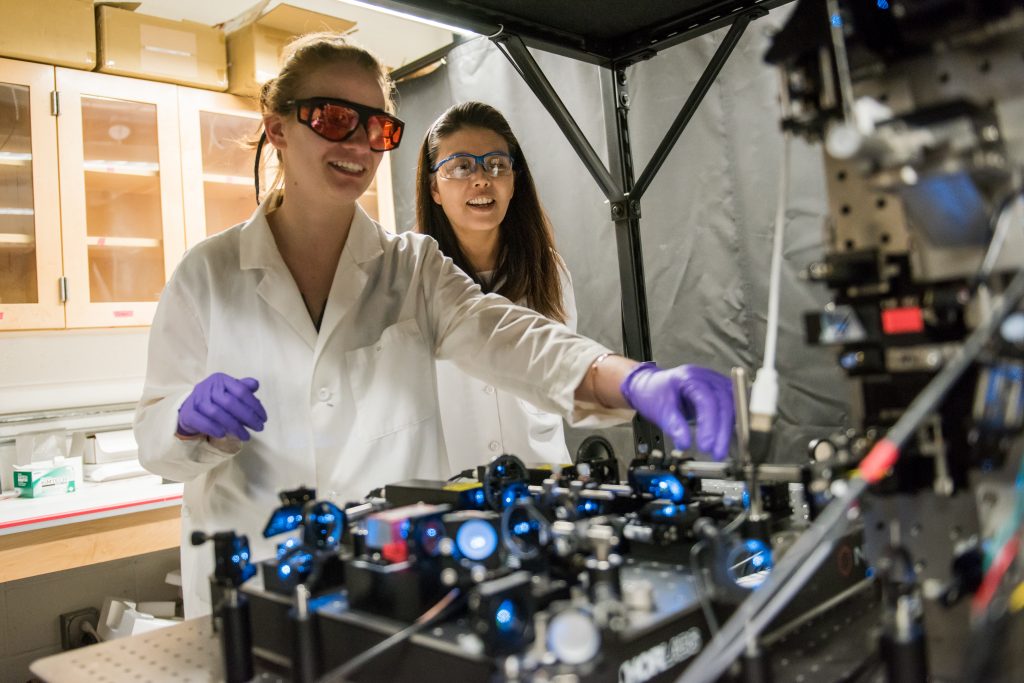
Minjoung Kyoung and Erin Kennedy work on the lab’s unique microscope. Photo by Marlayna Demond ’11 for UMBC.
Kyoung also finds the glucose pathway itself to be fascinating. It takes place in the cytoplasm, the watery fluid that fills cells. But somehow, the enzymes required to break down glucose form dense clusters, which Kyoung has dubbed “condensates,” even though the clusters don’t have a formal boundary. “The fundamental mechanism for how these condensates are reversibly assembled and disassembled is one of the specific aims that we’re going to study,” Kyoung says.
The enzymes for the cellular energy pathway also cluster, but they are enclosed inside mitochondria, a structure surrounded by a membrane. A single cell can contain from zero to thousands of mitochondria, depending on the cell’s job. Kyoung explains, “Mitochondria are very important for various metabolic diseases—cancer, diabetes, obesity, and so on. How these mitochondria relate to glucose metabolism is the most important part. So, by understanding them, I truly believe that we can get much, much closer to understanding how these diseases are caused, thus promoting therapeutic intervention.”
“My dream is to be able to predict disease before symptoms occur,” she shares. “That would be the best.”
Ready for a challenge
Getting to the point of recognizing disease before symptoms are apparent won’t be easy. The imaging techniques Kyoung, Kennedy, new graduate student Tao Zhang, and UMBC collaborator Songon An, associate professor of chemistry and biochemistry, are employing are so new, and so difficult, Kyoung anticipates many challenges.
“There is no previous data whatsoever. There is no technical approach whatsoever. There is no approach to data analysis whatsoever,” says Kyoung. She describes being at this cutting edge as both exciting and intimidating. To even successfully collect useful data, “many things have to go right,” Kyoung says.
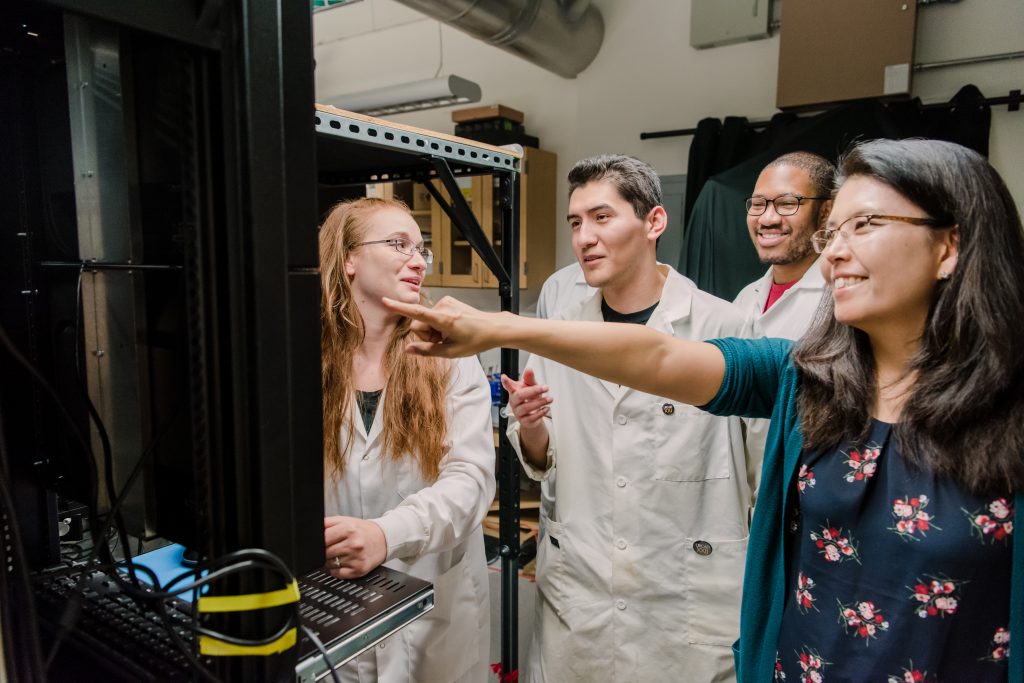
Minjoung Kyoung explains a result to her students. Photo by Marlayna Demond ’11 for UMBC.
To see what they want to see inside the cells, such as a particular enzyme, Kyoung’s team will need to tag it with a fluorescent protein, a process that is successful in 50 to 60 percent of cells. That’s not a problem when you use a conventional microscope, because you can see lots of cells at once. But the microscope that enables observing living cells with the resolution Kyoung needs can only see a few cells at a time. So finding the tagged cells has been the first challenge.
After the images are collected, a complex mathematical process called “deconvolution” removes the distortion that the microscope’s light beam itself generates in the images. That takes several hours for a single cell. And then they can actually analyze the images to see which enzymes are where, when. This process takes several days for one cell. Only at that point do they know if the experiment worked.
And, “Because no one has done this type of research before, we have to figure out how we are going to validate our results, too,” Kyoung says. “There is no precedent.” Despite all these challenges, Kyoung is excited to get to work. She believes the kinds of relationships they’ve started to see between glucose metabolism and mitochondria are only the tip of the iceberg as far as spatial relationships between metabolic pathways in the cell.
“Just a start”
“This is just a start. So far we have focused on these two metabolic pathways, but I believe this phenomenon is not limited to just these two,” Kyoung says. “So I envision that this will be the beginning for a big 4D map of all the metabolic networks.”
Kyoung and her team have significant funding from NIH to support their work, the microscope they need to do it, a healthy sense of optimism, and a commitment to helping answer some of the fundamental questions surrounding emerging epidemics like cancers, diabetes and obesity. With the key elements in place, they are bound to make breakthroughs that move the needle on tackling some of today’s most challenging diseases.
Banner image: Minjoung Kyoung and her UMBC lab group. From left to right: Keynon Bell, Minjoung Kyoung, Erin Kennedy, Manuel Huerta-Alvarado, and Tao Zhang. Photo by Marlayna Demond ’11 for UMBC.
]]>
This story was written by Sarah Hansen and first appeared on news.umbc.edu Scientists understand many of the body’s processes, like breaking down sugars and generating energy for the cell,...
Photo
https://assets1-beta.my.umbc.edu/system/shared/attachments/59414b059615515415dde0d9d7c377e6/69eb0cab/news/000/086/404/61cd29e0ffa769ecebb1acfc6748b4fe/0.jpg?1567737293
https://beta.my.umbc.edu/api/v0/pixel/news/86404/guest@my.umbc.edu/72665473b76a3e817cfcdfb864851873/api/pixel
ovpr-news-2019
Archived RCA News
https://beta.my.umbc.edu/groups/research
https://assets4-beta.my.umbc.edu/system/shared/avatars/groups/000/000/794/4bca2aa331eb7e472d63d97e0798b600/xsmall.png?1743706368
https://assets2-beta.my.umbc.edu/system/shared/avatars/groups/000/000/794/4bca2aa331eb7e472d63d97e0798b600/original.jpg?1743706368
https://assets3-beta.my.umbc.edu/system/shared/avatars/groups/000/000/794/4bca2aa331eb7e472d63d97e0798b600/xxlarge.png?1743706368
https://assets4-beta.my.umbc.edu/system/shared/avatars/groups/000/000/794/4bca2aa331eb7e472d63d97e0798b600/xlarge.png?1743706368
https://assets2-beta.my.umbc.edu/system/shared/avatars/groups/000/000/794/4bca2aa331eb7e472d63d97e0798b600/large.png?1743706368
https://assets4-beta.my.umbc.edu/system/shared/avatars/groups/000/000/794/4bca2aa331eb7e472d63d97e0798b600/medium.png?1743706368
https://assets4-beta.my.umbc.edu/system/shared/avatars/groups/000/000/794/4bca2aa331eb7e472d63d97e0798b600/small.png?1743706368
https://assets4-beta.my.umbc.edu/system/shared/avatars/groups/000/000/794/4bca2aa331eb7e472d63d97e0798b600/xsmall.png?1743706368
https://assets3-beta.my.umbc.edu/system/shared/avatars/groups/000/000/794/4bca2aa331eb7e472d63d97e0798b600/xxsmall.png?1743706368
Office of the Vice President for Research
https://assets2-beta.my.umbc.edu/system/shared/thumbnails/news/000/086/404/90398bbeb94cc0d80e6d54bfa7c8b3d2/xxlarge.jpg?1567737422
https://assets1-beta.my.umbc.edu/system/shared/thumbnails/news/000/086/404/90398bbeb94cc0d80e6d54bfa7c8b3d2/xlarge.jpg?1567737422
https://assets4-beta.my.umbc.edu/system/shared/thumbnails/news/000/086/404/90398bbeb94cc0d80e6d54bfa7c8b3d2/large.jpg?1567737422
https://assets3-beta.my.umbc.edu/system/shared/thumbnails/news/000/086/404/90398bbeb94cc0d80e6d54bfa7c8b3d2/medium.jpg?1567737422
https://assets3-beta.my.umbc.edu/system/shared/thumbnails/news/000/086/404/90398bbeb94cc0d80e6d54bfa7c8b3d2/small.jpg?1567737422
https://assets2-beta.my.umbc.edu/system/shared/thumbnails/news/000/086/404/90398bbeb94cc0d80e6d54bfa7c8b3d2/xsmall.jpg?1567737422
https://assets4-beta.my.umbc.edu/system/shared/thumbnails/news/000/086/404/90398bbeb94cc0d80e6d54bfa7c8b3d2/xxsmall.jpg?1567737422
0
0
true
Thu, 05 Sep 2019 22:37:30 -0400