$1M NIH grant to Prof Gong for wearable sensor
helps breast cancer survivors maintain medication schedules
This story was written by Megan Hanks and first appeared on news.umbc.edu
After patients with breast cancer finish their treatment, they are prescribed daily medications to prevent cancer recurrence. There are many factors that impact whether patients take their medications as prescribed, from medication cost and access to ability to keep track of a complex medication schedule.
“Despite the life-saving benefits of these medications, rates of adherence are low,” explains Jiaqi Gong, assistant professor of information systems at UMBC. He’s trying to change that and, in turn, to reduce rates of cancer recurrence.
Understanding behaviors
Gong is working with researchers at the University of Virginia and San Diego State University to study the links among a broad range of factors that can influence medication-taking behavior in breast cancer survivors. The research is being funded by a four-year grant that totals more than $1 million from the National Institutes of Health.
The goal of the project is to design an intelligent, wearable sensor system for breast cancer survivors to help them more closely follow their prescribed medication routine, he explains. The study homes in on the times patients take medications each day. Why? Patients who do not take their medications at the same time each day can develop health issues in the future, such as kidney disease.
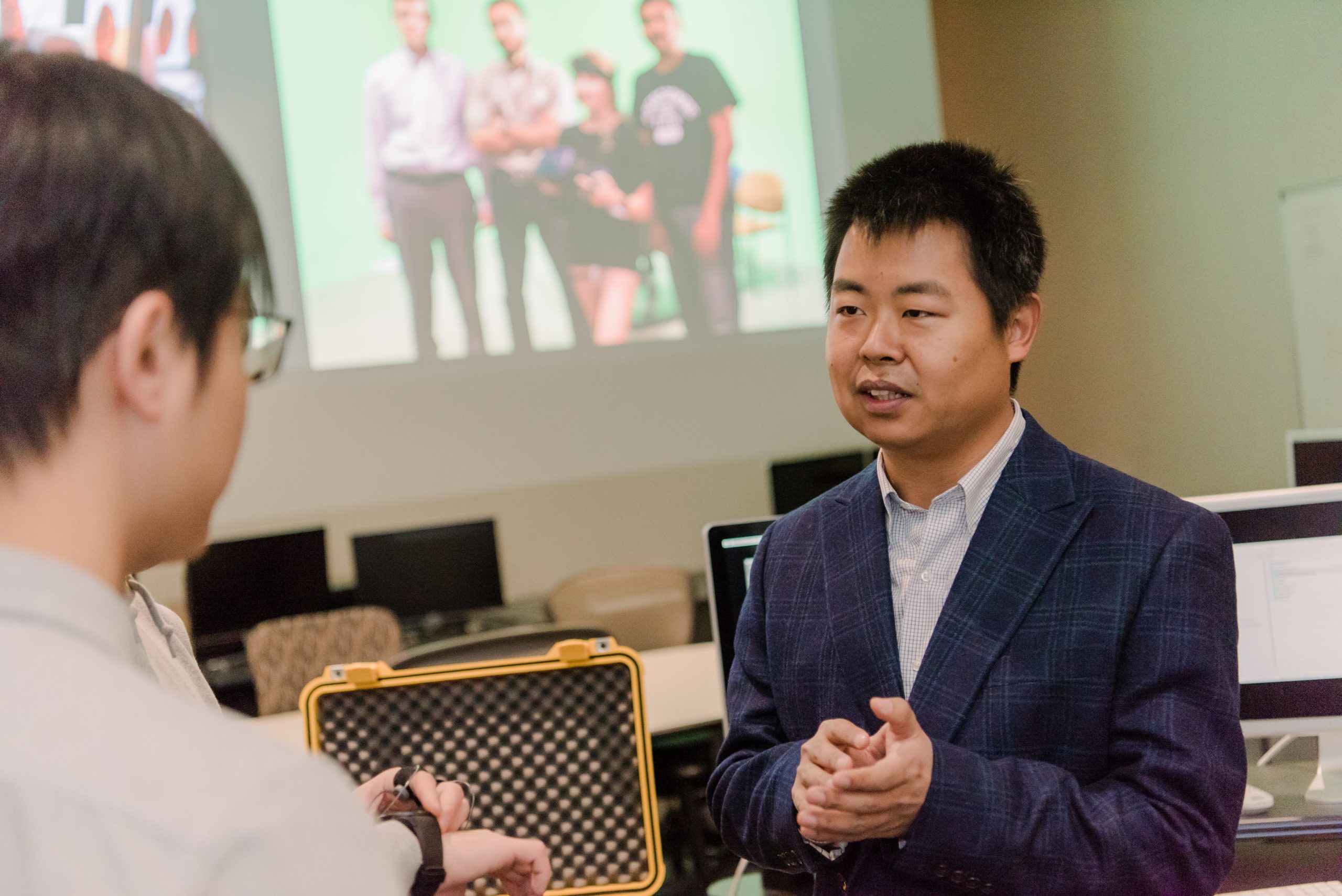
Jiaqi Gong. Photo by Marlayna Demond ’11 for UMBC.
“This interdisciplinary team will develop a new paradigm in dynamic monitoring and modeling of medication adherence,” says Gong. “We will focus on understanding the links between environmental, personal, and behavioral contexts of medication-taking behavior.”
“Since coming on board I have been involved in data analysis and preliminary literature reviews. I have focused on analyzing data derived from previous questionnaires and sensor monitoring,” explains Akiri Surely, M.S. ‘22, human centered computing. “Eventually, the hope is that this research will provide an innovative way to improve medication adherence among breast cancer survivors in years to come.”
Identifying patterns
The project includes three phases. First, the team will develop a system to monitor when patients take their medication. The system will rely on wearable sensors that are connected to each patient’s smartphone. Gong explains that the system will provide researchers with continuous data that will help them to identify patterns related to taking the medications.
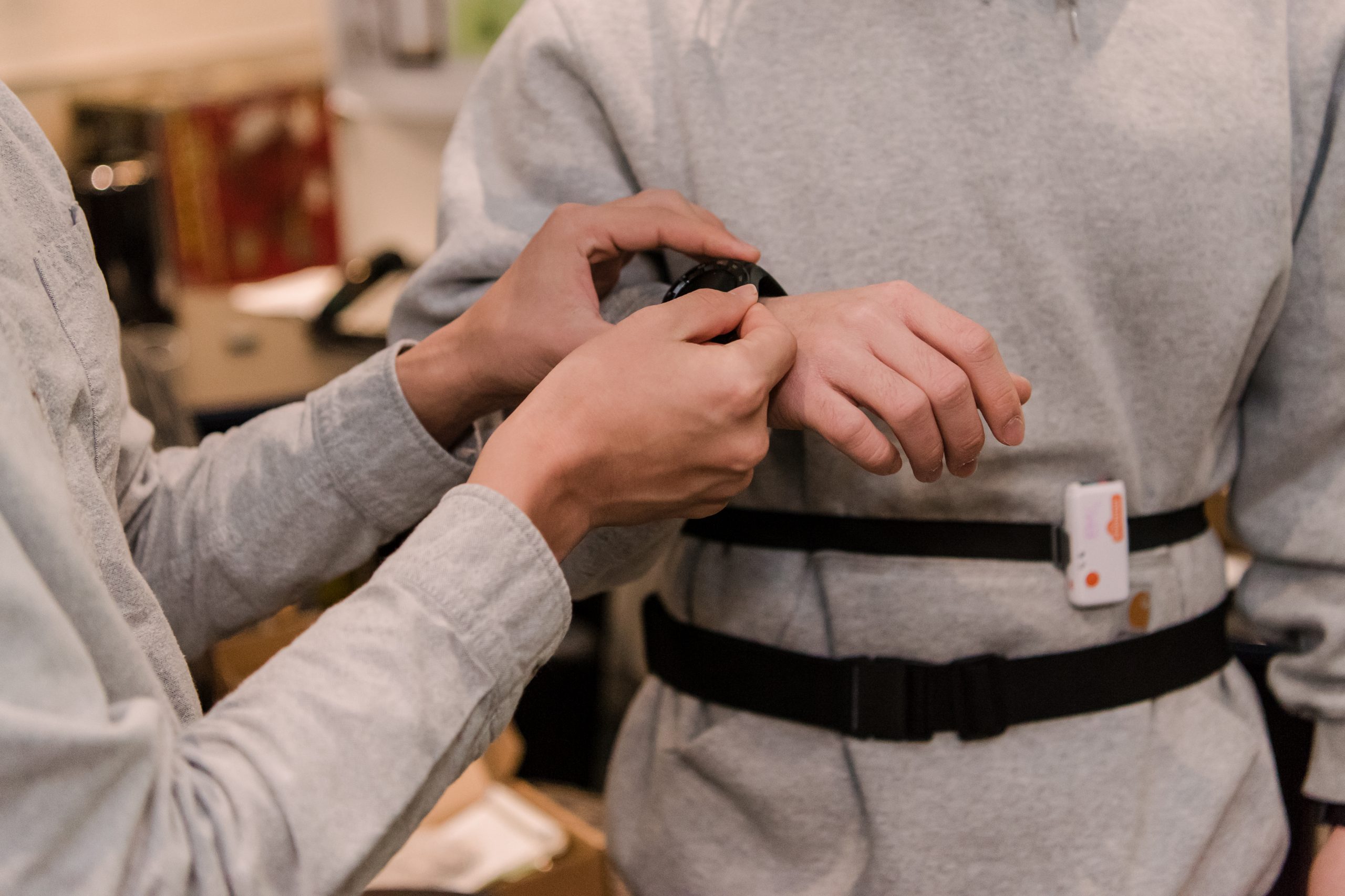
The wearable sensors being used in Jiaqi Gong’s research. Photo by Marlayna Demond ’11 for UMBC.
Once the system has been developed, a small group of breast cancer survivors will begin phase two: using the devices to track when they take their medications. This will give the researchers an opportunity to identify and analyze patterns in how they take medications using real data. After the pilot, phase three will begin: testing the system with a larger number of breast cancer survivors.
This work is one of the first attempts to deliver personalized interventions to increase medication adherence. Although the study focuses on breast cancer survivors specifically, Gong hopes the findings will have a broader impact. He explains, “By increasing our understanding of medication adherence in breast cancer survivors, we hope this study will provide a general framework that can apply to chronic diseases beyond breast cancer.”
Banner image: Jiaqi Gong, right, working with Dae-young Leroy Kim, Ph.D. ’25, information systems, and Xishi Zhu ’23, information systems. Photo by Marlayna Demond ’11 for UMBC.
]]>
This story was written by Megan Hanks and first appeared on news.umbc.edu After patients with breast cancer finish their treatment, they are prescribed daily medications to prevent cancer...
Photo
https://assets2-beta.my.umbc.edu/system/shared/attachments/8ddcf799ce16875b0d7bd00d001edc89/69ef55f5/news/000/089/814/34ba30e0f862c55b46622ab5d0aec71f/0.jpg?1579796015
https://beta.my.umbc.edu/api/v0/pixel/news/89814/guest@my.umbc.edu/5452d46b3f8e2119b4eac47224411ba2/api/pixel
ovpr-news-2020
Archived RCA News
https://beta.my.umbc.edu/groups/research
https://assets4-beta.my.umbc.edu/system/shared/avatars/groups/000/000/794/4bca2aa331eb7e472d63d97e0798b600/xsmall.png?1743706368
https://assets2-beta.my.umbc.edu/system/shared/avatars/groups/000/000/794/4bca2aa331eb7e472d63d97e0798b600/original.jpg?1743706368
https://assets3-beta.my.umbc.edu/system/shared/avatars/groups/000/000/794/4bca2aa331eb7e472d63d97e0798b600/xxlarge.png?1743706368
https://assets4-beta.my.umbc.edu/system/shared/avatars/groups/000/000/794/4bca2aa331eb7e472d63d97e0798b600/xlarge.png?1743706368
https://assets2-beta.my.umbc.edu/system/shared/avatars/groups/000/000/794/4bca2aa331eb7e472d63d97e0798b600/large.png?1743706368
https://assets4-beta.my.umbc.edu/system/shared/avatars/groups/000/000/794/4bca2aa331eb7e472d63d97e0798b600/medium.png?1743706368
https://assets4-beta.my.umbc.edu/system/shared/avatars/groups/000/000/794/4bca2aa331eb7e472d63d97e0798b600/small.png?1743706368
https://assets4-beta.my.umbc.edu/system/shared/avatars/groups/000/000/794/4bca2aa331eb7e472d63d97e0798b600/xsmall.png?1743706368
https://assets3-beta.my.umbc.edu/system/shared/avatars/groups/000/000/794/4bca2aa331eb7e472d63d97e0798b600/xxsmall.png?1743706368
Office of the Vice President for Research
https://assets3-beta.my.umbc.edu/system/shared/thumbnails/news/000/089/814/37a7704489de14c9a08d68765b0ddefd/xxlarge.jpg?1579796101
https://assets3-beta.my.umbc.edu/system/shared/thumbnails/news/000/089/814/37a7704489de14c9a08d68765b0ddefd/xlarge.jpg?1579796101
https://assets4-beta.my.umbc.edu/system/shared/thumbnails/news/000/089/814/37a7704489de14c9a08d68765b0ddefd/large.jpg?1579796101
https://assets1-beta.my.umbc.edu/system/shared/thumbnails/news/000/089/814/37a7704489de14c9a08d68765b0ddefd/medium.jpg?1579796101
https://assets1-beta.my.umbc.edu/system/shared/thumbnails/news/000/089/814/37a7704489de14c9a08d68765b0ddefd/small.jpg?1579796101
https://assets3-beta.my.umbc.edu/system/shared/thumbnails/news/000/089/814/37a7704489de14c9a08d68765b0ddefd/xsmall.jpg?1579796101
https://assets3-beta.my.umbc.edu/system/shared/thumbnails/news/000/089/814/37a7704489de14c9a08d68765b0ddefd/xxsmall.jpg?1579796101
0
0
true
Thu, 23 Jan 2020 11:15:09 -0500
Hilltop and UMB SOM to Develop New Hospital Quality Measure

UMBC’s Hilltop
Institute and UMB SOM’s Department of Emergency Medicine to Develop Algorithm
to Augment 30-Day All-Cause Readmission Measure
The Hilltop Institute at UMBC, in partnership with the
University of Maryland School of Medicine’s (UMB SOM’s) Department of Emergency
Medicine, has just received funding to develop and test a measure of hospital
quality that assesses hospitals based on the frequency of downstream clinically
relevant readmissions (DCRR) as opposed to blanket 30-day all-cause readmissions.
Read the full story here: https://hilltopinstitute.org/bulletin/umbcs-hilltop-institute-and-umb-soms-department-of-emergency-medicine-to-develop-algorithm-to-augment-30-day-all-cause-readmission-measure/
]]>
UMBC’s Hilltop Institute and UMB SOM’s Department of Emergency Medicine to Develop Algorithm to Augment 30-Day All-Cause Readmission Measure The Hilltop Institute at UMBC, in partnership with...
https://hilltopinstitute.org/bulletin/umbcs-hilltop-institute-and-umb-soms-department-of-emergency-medicine-to-develop-algorithm-to-augment-30-day-all-cause-readmission-measure/
Photo
https://assets1-beta.my.umbc.edu/system/shared/attachments/00258aa7bb67d4fec1ed983b63614171/69ef55f5/news/000/089/709/dec0f433860ff18f2df8be7cac5437ef/hospital bed-unsplash.jpg?1579274814
https://beta.my.umbc.edu/api/v0/pixel/news/89709/guest@my.umbc.edu/13dff3cb2dd528a83afcf0f108ac9fc1/api/pixel
Archived RCA News
https://beta.my.umbc.edu/groups/research
https://assets4-beta.my.umbc.edu/system/shared/avatars/groups/000/000/794/4bca2aa331eb7e472d63d97e0798b600/xsmall.png?1743706368
https://assets2-beta.my.umbc.edu/system/shared/avatars/groups/000/000/794/4bca2aa331eb7e472d63d97e0798b600/original.jpg?1743706368
https://assets3-beta.my.umbc.edu/system/shared/avatars/groups/000/000/794/4bca2aa331eb7e472d63d97e0798b600/xxlarge.png?1743706368
https://assets4-beta.my.umbc.edu/system/shared/avatars/groups/000/000/794/4bca2aa331eb7e472d63d97e0798b600/xlarge.png?1743706368
https://assets2-beta.my.umbc.edu/system/shared/avatars/groups/000/000/794/4bca2aa331eb7e472d63d97e0798b600/large.png?1743706368
https://assets4-beta.my.umbc.edu/system/shared/avatars/groups/000/000/794/4bca2aa331eb7e472d63d97e0798b600/medium.png?1743706368
https://assets4-beta.my.umbc.edu/system/shared/avatars/groups/000/000/794/4bca2aa331eb7e472d63d97e0798b600/small.png?1743706368
https://assets4-beta.my.umbc.edu/system/shared/avatars/groups/000/000/794/4bca2aa331eb7e472d63d97e0798b600/xsmall.png?1743706368
https://assets3-beta.my.umbc.edu/system/shared/avatars/groups/000/000/794/4bca2aa331eb7e472d63d97e0798b600/xxsmall.png?1743706368
Office of the Vice President for Research
0
0
true
Fri, 17 Jan 2020 10:29:19 -0500
UMBC receives NSF support to enhance data science
Scope includes courses, research, and student experiences
This story was written by Megan Hanks and first appeared on news.umbc.edu
Data science has rapidly grown at UMBC, and faculty are now working to enhance data science courses, research, and student experiences. The goal is to ensure they are inclusive, empowering, and effective in preparing students to tackle the urgent problems our society is working to solve, and can scale up to meet student and workforce demands.
Faculty in both information systems, and computer science and electrical engineering have recently received two grants from the National Science Foundation to conduct research toward this aim.
Making data science more inclusive
NSF awarded funding to a team of researchers at UMBC; the University of California, Berkeley; and Mills College in California through the Improving Undergraduate STEM Education program. This funding will support the Undergraduate Data Science at Scale project at UMBC, including the development and implementation of a unique data science education program for undergraduate students in STEM and non-STEM disciplines, says Vandana Janeja, professor and interim chair of information systems (IS).
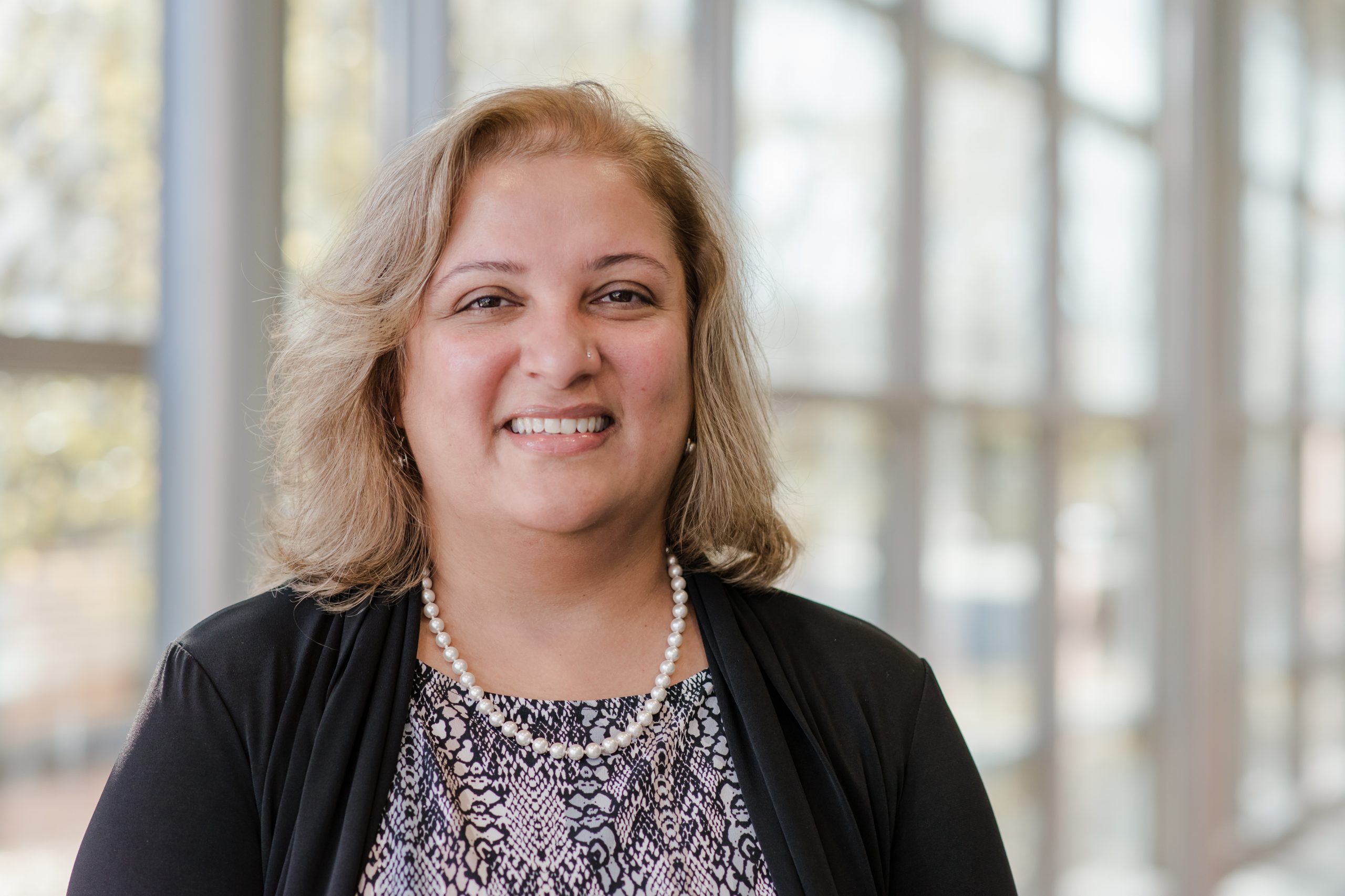
Vandana Janeja. Photo by Marlayna Demond ’11 for UMBC.
The data science field is relatively new as compared to the more established computing education, Janeja explains, and there are very few studies examining how these topics are taught to students. “This project will generate new knowledge about a data science curriculum and pedagogy designed to promote learning among diverse undergraduate students, many from groups underrepresented in STEM,” she says.
This novel approach to teaching data science will also “empower students as generators of new knowledge rather than passive recipients of existing information,” Janeja explains.
Another component of the project is the data scholars program, which will include students from traditionally underrepresented groups in STEM fields.
With these changes, Janeja anticipates that data science at UMBC will continue to expand. She’s working with UMBC’s Division of Information Technology to explore how UMBC, and other universities, will need to adapt and scale up offerings to meet the changing needs of students over time. “The findings will drive a community transformation in undergraduate data science education that can scale with student demand, and ultimately broaden participation in data science across multiple and diverse institutional settings.”
Janeja and UMBC colleagues are excited to develop a model that can have a nationwide impact, bringing new students into the field, and shaping how they approach work in data science. She expects that this work will set a foundation for colleges across the country looking to implement data science programs and better support the learning of data science students.
High-impact, team-based student research
Outside of the classroom, undergraduate students in computer science, information systems, and business technology administration will have the opportunity to work with government agencies in Baltimore City to tackle real challenges through a new NSF-funded program. Aryya Gangopadhyay, professor of information systems, has received support for the new program through the Data Science Corps under NSF’s Harnessing the Data Revolution (HDR) initiative.
HDR is one of NSF’s 10 “Big Ideas”: bold, visionary, national-scale activities to open up new frontiers in science and engineering. This program allows researchers to answer fundamental questions through new modes of data-driven discovery, Gangopadhyay explains. On this project, he will work with colleagues and students to collect and analyze data for projects that seek to improve Baltimore residents’ quality of life.
Gangopadhyay will partner with UMBC faculty including Anupam Joshi, professor and chair of computer science and electrical engineering (CSEE); Tim Oates, professor of CSEE; Nirmalya Roy, associate professor of IS; and Sanjay Purushotham, assistant professor of IS. The UMBC team will collaborate with faculty at Bowie State University, Towson University, and the University of Baltimore. Gangopadhyay and his team will work with UMBC’s Faculty Development Center to evaluate student learning outcomes for this project.
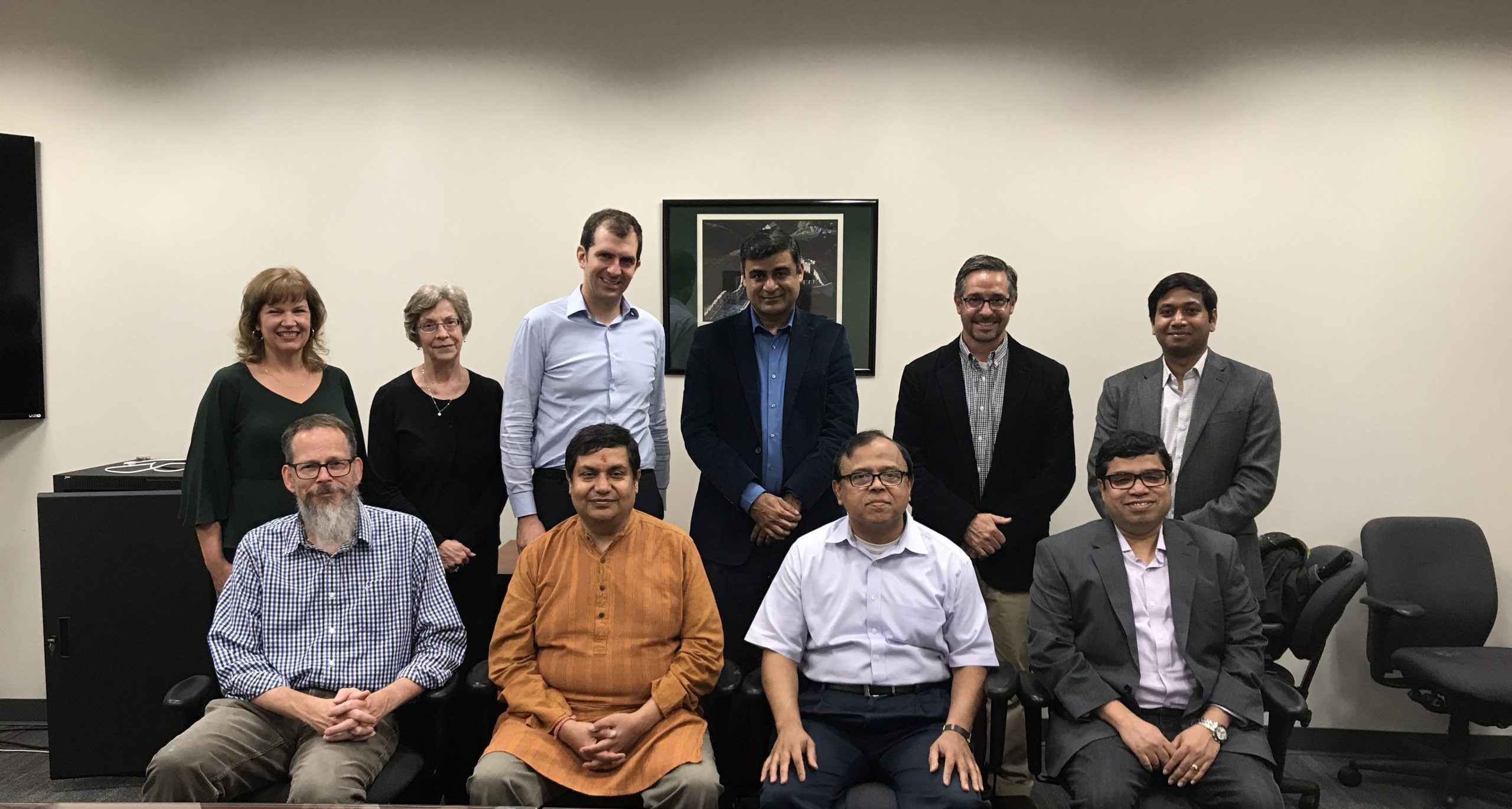
The researchers working on the HDR grant. Photo courtesy of Aryya Gangopadhyay.
“The goal of the project is to develop a team-based data science program for undergraduate students in computing,” explains Gangopadhyay. Both undergraduate and graduate students will contribute to this research, gaining hands-on experience with the complexity of addressing urban infrastructure challenges, such as traffic congestion.
Students will also examine a range of ethical considerations, including data privacy, as they process information. Street sensors, for example, can collect sensitive information on peoples’ patterns of daily life. Students will come to better understand their role as researchers in protecting privacy, and other ethical considerations, as they cull through the data, says Gangopadhyay.
“Data science is poised to change the world by improving the quality of life through smart technologies,” explains Gangopadhyay. “Our students will play a part in bringing about some of these changes. Through their projects, students will develop analytical and coding skills and learn how to collaboratively work in real life projects with industry, government and academia, under the guidance of faculty mentors.”
Banner image: A student using a computer. Photo by Marlayna Demond ’11 for UMBC.
]]>
This story was written by Megan Hanks and first appeared on news.umbc.edu Data science has rapidly grown at UMBC, and faculty are now working to enhance data science courses, research, and...
Photo
https://assets1-beta.my.umbc.edu/system/shared/attachments/9804e1d110b357ba248bf473e045615f/69ef55f5/news/000/089/538/c9571bae638b1e00f6ce64325c44c285/0.jpg?1578656011
https://beta.my.umbc.edu/api/v0/pixel/news/89538/guest@my.umbc.edu/9183dbe01b27596664518a92cb086115/api/pixel
ovpr-news-2020
Archived RCA News
https://beta.my.umbc.edu/groups/research
https://assets4-beta.my.umbc.edu/system/shared/avatars/groups/000/000/794/4bca2aa331eb7e472d63d97e0798b600/xsmall.png?1743706368
https://assets2-beta.my.umbc.edu/system/shared/avatars/groups/000/000/794/4bca2aa331eb7e472d63d97e0798b600/original.jpg?1743706368
https://assets3-beta.my.umbc.edu/system/shared/avatars/groups/000/000/794/4bca2aa331eb7e472d63d97e0798b600/xxlarge.png?1743706368
https://assets4-beta.my.umbc.edu/system/shared/avatars/groups/000/000/794/4bca2aa331eb7e472d63d97e0798b600/xlarge.png?1743706368
https://assets2-beta.my.umbc.edu/system/shared/avatars/groups/000/000/794/4bca2aa331eb7e472d63d97e0798b600/large.png?1743706368
https://assets4-beta.my.umbc.edu/system/shared/avatars/groups/000/000/794/4bca2aa331eb7e472d63d97e0798b600/medium.png?1743706368
https://assets4-beta.my.umbc.edu/system/shared/avatars/groups/000/000/794/4bca2aa331eb7e472d63d97e0798b600/small.png?1743706368
https://assets4-beta.my.umbc.edu/system/shared/avatars/groups/000/000/794/4bca2aa331eb7e472d63d97e0798b600/xsmall.png?1743706368
https://assets3-beta.my.umbc.edu/system/shared/avatars/groups/000/000/794/4bca2aa331eb7e472d63d97e0798b600/xxsmall.png?1743706368
Office of the Vice President for Research
https://assets2-beta.my.umbc.edu/system/shared/thumbnails/news/000/089/538/b73763220b2d3e6a9f9954ceb881c67f/xxlarge.jpg?1578656277
https://assets3-beta.my.umbc.edu/system/shared/thumbnails/news/000/089/538/b73763220b2d3e6a9f9954ceb881c67f/xlarge.jpg?1578656277
https://assets4-beta.my.umbc.edu/system/shared/thumbnails/news/000/089/538/b73763220b2d3e6a9f9954ceb881c67f/large.jpg?1578656277
https://assets3-beta.my.umbc.edu/system/shared/thumbnails/news/000/089/538/b73763220b2d3e6a9f9954ceb881c67f/medium.jpg?1578656277
https://assets2-beta.my.umbc.edu/system/shared/thumbnails/news/000/089/538/b73763220b2d3e6a9f9954ceb881c67f/small.jpg?1578656277
https://assets2-beta.my.umbc.edu/system/shared/thumbnails/news/000/089/538/b73763220b2d3e6a9f9954ceb881c67f/xsmall.jpg?1578656277
https://assets3-beta.my.umbc.edu/system/shared/thumbnails/news/000/089/538/b73763220b2d3e6a9f9954ceb881c67f/xxsmall.jpg?1578656277
0
0
true
Fri, 10 Jan 2020 06:38:04 -0500
Team led by UMBC’s Benna is first to map a planet’s winds
This story was written by Sarah Hansen and first appeared on news.umbc.edu
Today, a paper published in Science documents for the first time the global wind circulation patterns in the upper atmosphere of a planet, 120 to 300 kilometers above the surface. The findings are based on local observations, rather than indirect measurements, unlike many prior measurements taken on Earth’s upper atmosphere. But it didn’t happen on Earth: it happened on Mars. On top of that, all the data came from an instrument and a spacecraft that weren’t originally designed to collect wind measurements.
In 2016, Mehdi Benna and his colleagues proposed to the Mars Atmosphere and Volatile EvolutioN (MAVEN) project team that they remotely reprogram the MAVEN spacecraft and its Natural Gas and Ion Mass Spectrometer (NGIMS) instrument to do a unique experiment. They wanted to see if parts of the instrument that were normally stationary could “swing back and forth like a windshield wiper fast enough,” to enable the tool to gather a new kind of data.
Initially, the MAVEN project team was reluctant to implement the modifications Benna and his colleagues requested. After all, MAVEN and NGIMS had been orbiting Mars since 2013, and they were working quite well collecting information about the composition of the Mars atmosphere. Why put all that at risk? Benna and his colleagues argued that this project would collect new kinds of data that could shape our understanding of the upper atmosphere on Mars, inform similar studies on Earth, and help us better understand planetary climate.
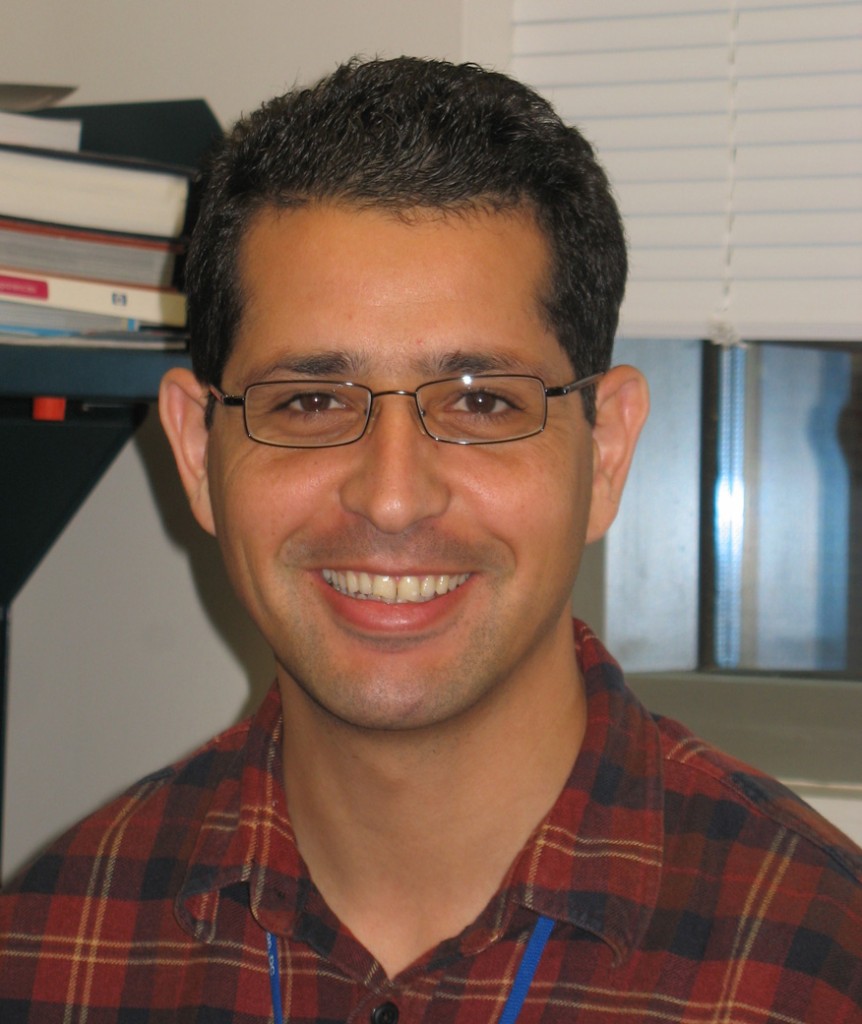
Mehdi Benna. Photo courtesy of Mehdi Benna.
Benna, a planetary scientist operating out of the NASA Goddard Space Flight Center with the UMBC Center for Space Sciences Technology (CSST), came up with the windshield-wiper idea while brainstorming how to create an instrument that could collect information about global circulation patterns in Earth’s upper atmosphere. It occurred to him that, together, MAVEN and NGIMS could do the same thing on Mars—and they were already in space.
With some persistence and a lot of preliminary analyses, Benna and his colleagues convinced the MAVEN mission leadership to give their idea a try, after Lockheed Martin, the spacecraft manufacturer, determined the modifications might be possible without damaging the satellite. “It’s a clever reengineering in flight of how to operate the spacecraft and the instrument,” Benna says. “And by doing both—the spacecraft doing something it was not designed to and the instrument doing something it was not designed to do—we made the wind measurements possible.”
Ripple effect
The new paper was completed in collaboration with Yuni Lee, also of UMBC’s CSST, and colleagues from the University of Michigan, George Mason University, and NASA. It is based on data collected two days per month for two years from 2016 to 2018. Some results were expected, and others were big surprises. “The refreshing thing is that the patterns that we observed in the upper atmosphere match globally what one would predict from models,” says Benna. “The physics works.”
Overall, the average circulation patterns from season to season were very stable on Mars. This is like saying that on the East Coast of the United States, throughout the year, weather systems generally flow from the West to the East in a predictable way.
One surprise came when the team analyzed the shorter-term variability of winds in the upper atmosphere, which was greater than anticipated. “On Mars, the average circulation is steady, but if you take a snapshot at any given time, the winds are highly variable,” Benna says. More work is needed to determine why these contrasting patterns exist.
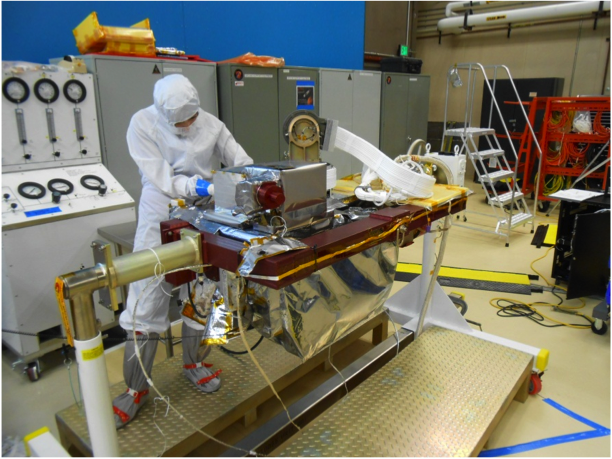
The NGIMS instrument undergoes final preparations before heading to Mars on MAVEN. Photo courtesy of NASA.
A second surprise was that the wind hundreds of kilometers above the planet’s surface still contained information about landforms below, like mountains, canyons, and basins. As the air mass flows over those features, “it creates waves—ripple effects—that flow up to the upper atmosphere” and can be detected by MAVEN and NGIMS, Benna explains. “On Earth, we see the same kind of waves, but not at such high altitudes. That was the big surprise, that these can go up to 280 kilometers high.”
Benna and colleagues have two hypotheses for why the waves, called “orthographic waves,” last so long unchanged. For one, the atmosphere on Mars is much thinner than it is on Earth, so the waves can travel farther unimpeded, like ripples traveling farther in water than in molasses. Also, the average difference between geographic peaks and valleys is much greater on Mars than it is on Earth. It’s not uncommon for mountains to be 20 kilometers tall on Mars, whereas Mt. Everest is not quite nine kilometers tall, and most terrestrial mountains are much shorter.
“The topography of Mars is driving this in a more pronounced way than it is on Earth,” Benna says.
Forging ahead
Continuing to analyze the data from this study may help scientists figure out whether the same basic processes are in action on Earth’s upper atmosphere. Ironically, “We had to go take these measurements on Mars to eventually understand the same phenomenon on Earth,” Benna says. “Ultimately the results will help us understand the climate of Mars. What is its state and how is it evolving?”
But the team isn’t satisfied with the current data set. “We want to keep measuring. We have two years of data, but we’re not stopping there,” Benna says. Even with the data set they already have, “We have many years of modeling and analysis ahead of us.” It’s a trove of information that can be examined in ways not yet imagined, to learn even more about how planets work.
Banner image: The MAVEN spacecraft orbits Mars (artist’s concept), courtesy of NASA.
]]>
This story was written by Sarah Hansen and first appeared on news.umbc.edu Today, a paper published in Science documents for the first time the global wind circulation patterns in the upper...
Photo
https://assets2-beta.my.umbc.edu/system/shared/attachments/08b46d00cbf0494e58f89b185cf69096/69ef55f5/news/000/089/510/e089f46f54a3f4123a6cd11cc45fb64e/0.jpg?1578519361
https://beta.my.umbc.edu/api/v0/pixel/news/89510/guest@my.umbc.edu/4b4798c55d678e9be1c8d9f45e8e160b/api/pixel
ovpr-news-2020
Archived RCA News
https://beta.my.umbc.edu/groups/research
https://assets4-beta.my.umbc.edu/system/shared/avatars/groups/000/000/794/4bca2aa331eb7e472d63d97e0798b600/xsmall.png?1743706368
https://assets2-beta.my.umbc.edu/system/shared/avatars/groups/000/000/794/4bca2aa331eb7e472d63d97e0798b600/original.jpg?1743706368
https://assets3-beta.my.umbc.edu/system/shared/avatars/groups/000/000/794/4bca2aa331eb7e472d63d97e0798b600/xxlarge.png?1743706368
https://assets4-beta.my.umbc.edu/system/shared/avatars/groups/000/000/794/4bca2aa331eb7e472d63d97e0798b600/xlarge.png?1743706368
https://assets2-beta.my.umbc.edu/system/shared/avatars/groups/000/000/794/4bca2aa331eb7e472d63d97e0798b600/large.png?1743706368
https://assets4-beta.my.umbc.edu/system/shared/avatars/groups/000/000/794/4bca2aa331eb7e472d63d97e0798b600/medium.png?1743706368
https://assets4-beta.my.umbc.edu/system/shared/avatars/groups/000/000/794/4bca2aa331eb7e472d63d97e0798b600/small.png?1743706368
https://assets4-beta.my.umbc.edu/system/shared/avatars/groups/000/000/794/4bca2aa331eb7e472d63d97e0798b600/xsmall.png?1743706368
https://assets3-beta.my.umbc.edu/system/shared/avatars/groups/000/000/794/4bca2aa331eb7e472d63d97e0798b600/xxsmall.png?1743706368
Office of the Vice President for Research
https://assets4-beta.my.umbc.edu/system/shared/thumbnails/news/000/089/510/406a620413833a4fc470b8c05d2a08ac/xxlarge.jpg?1578519430
https://assets3-beta.my.umbc.edu/system/shared/thumbnails/news/000/089/510/406a620413833a4fc470b8c05d2a08ac/xlarge.jpg?1578519430
https://assets2-beta.my.umbc.edu/system/shared/thumbnails/news/000/089/510/406a620413833a4fc470b8c05d2a08ac/large.jpg?1578519430
https://assets3-beta.my.umbc.edu/system/shared/thumbnails/news/000/089/510/406a620413833a4fc470b8c05d2a08ac/medium.jpg?1578519430
https://assets4-beta.my.umbc.edu/system/shared/thumbnails/news/000/089/510/406a620413833a4fc470b8c05d2a08ac/small.jpg?1578519430
https://assets3-beta.my.umbc.edu/system/shared/thumbnails/news/000/089/510/406a620413833a4fc470b8c05d2a08ac/xsmall.jpg?1578519430
https://assets2-beta.my.umbc.edu/system/shared/thumbnails/news/000/089/510/406a620413833a4fc470b8c05d2a08ac/xxsmall.jpg?1578519430
0
0
true
Wed, 08 Jan 2020 16:37:20 -0500
January Opportunities for Postdocs
Some you can even do from the warmth of home! Brrr!
Hello UMBC Postdocs! I wanted to make you aware of three opportunities upcoming in January that may be of interest to you. Our team is working on creating a lineup of other opportunities that will be on campus in 2020 and I look forward to sharing those ideas with you soon. Feel free to contact me anytime:
rcresisk@umbc.edu.
The Postdoc Academy: Succeeding as a Postdoc
In this FREE 5 week online course (requiring 1-4 hours per week of attention/work), create a rewarding postdoc experience that will launch you into your chosen career path by developing strategies and skills to successfully navigate your time as a postdoc. Begins January 13, 2020.
Note: If you're interested in this, please let me know! If there are a few of us at UMBC doing the course, we could have an in person learning community/session to process what's being learned together. https://www.edx.org/course/the-postdoc-academy-succeeding-as-a-postdoc
Writing and Publishing a Scientific Paper
This four-session, writing-intensive workshop is designed for NIH trainees and biomedical scientists. Participants will write a draft of a research paper based on data generated from their current or previous study for publication in a peer-reviewed science journal...Non-NIH scientists are also welcome. Participants from satellite NIH campuses and other locations across the country can participate via live webinar. Sessions are Fridays in January, 2-4pm. Cost $125 (I apologize but we do not have funds to cover this cost for you at this time). https://faes.org/content/writing-publishing-scientific-paper-workshop
Being Faculty at a Predominantly Undergraduate Institution (PUI)
This is one of four tracks of a one-day (9am-4pm) conference being held at the University of Maryland College Park (about 40 minutes from here). While the conference as originally created with graduate schools in mind, it is actually open to postdocs across the University System of Maryland including UMBC and this specific track is a part of the Promise Academy I mentioned earlier.
The website says there is a $20 deposit required for registration but postdocs should contact Blessing Enekwe, Program Director for Postdoctoral Affairs at UMCP, to register without having to put down a deposit:
blessing@umd.edu
I hope these are of interest to you. Starting in the spring, I'll be hosting a monthly postdoctoral breakfast (bagels, donuts) so we can get to know one another and discuss topics of importance to you all. I look forward to meeting you in person! Have a lovely and safe winter break!
Robin H. Cresiski, Ph.D. Assistant Vice Provost for Graduate Student Development and Postdoctoral Affairs
University of Maryland, Baltimore County
Director, AGEP PROMISE Academy Alliance
This story was written by Sarah Hansen and first appeared on news.umbc.edu
At some point in its development, every drug, high-tech piece of clothing, and synthetic building material was touched by a chemist. However, getting the atoms attached to each other in just the right way to treat infection, keep you dry in the woods, or construct your home often requires extreme measures. Harsh chemicals and dangerous byproducts from those manufacturing processes have the potential to cause environmental damage and impact the health of lab workers.
Lisa Kelly, associate professor of chemistry and biochemistry at UMBC, is developing techniques to make some of those same chemicals in much safer ways. The National Science Foundation has funded her with $450,000 for three years to further this work, which also has biomedical applications.
“The approach that we propose will induce chemical reactions that would otherwise need a lot of harsh reagents and organic solvents, and just a lot of nasty stuff,” Kelly says. “This is a greener route.”
Radical reactions
The technique Kelly is using can be very helpful for inducing the formation of strong chemical bonds between two molecules, when their interaction would typically be much weaker.
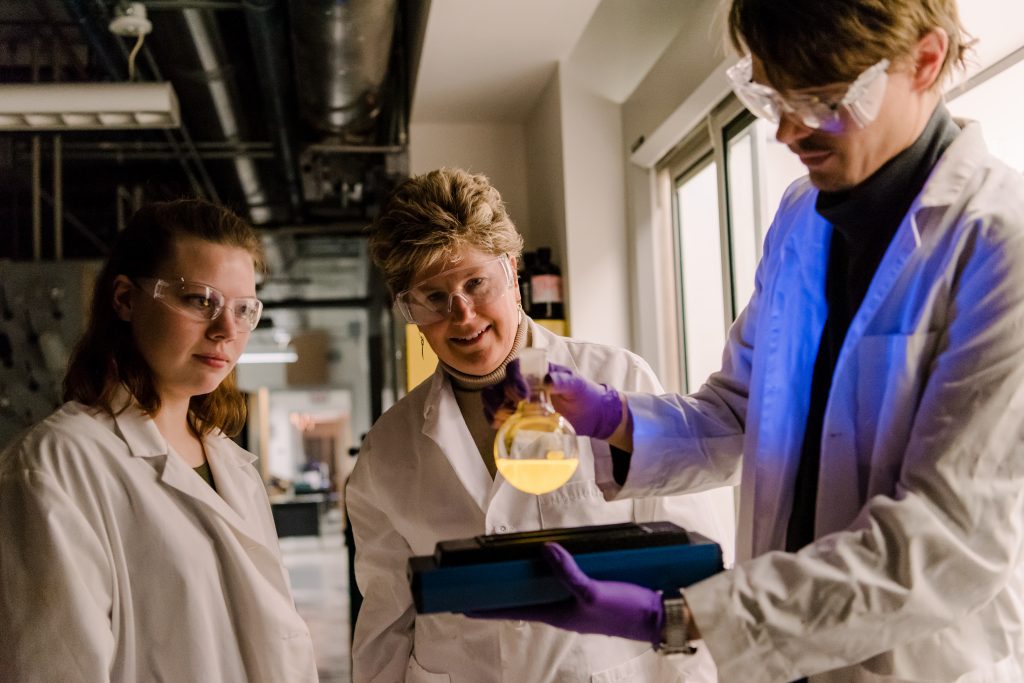
Gabrielle Pozza ’20, chemistry, Lisa Kelly, and Ph.D. student Ryan Grant examine a fluorescent dye used in their research to determine the properties of compounds they work with.
The first step is to chemically attach a special compound to one of the two molecules you want to connect. Shining UV light on the compound causes it to release a single atom with a negative electric charge, called a radical. Because it is charged, that atom will react strongly with molecules around it. In this case, the radical initiates the formation of a strong bond between the two molecules you want to connect. The only byproduct of the reaction is carbon dioxide, and it can be carried out in water, so it’s much safer than existing methods.
This process can be used for a variety of purposes. For example, you can induce strong bonds between a drug and its target to better understand the drug’s mechanism. This essentially freezes their fleeting interaction in time, giving a scientist the chance to observe it.
“It’s a photochemical tool to be able to visualize where the drug actually bound,” Kelly says. “That lets you say, ‘This drug is so powerful because it binds here and this one is less powerful because it binds here.’” That kind of insight could lead to more effective pharmaceuticals.
This technique can also be used in a more general biological context, to better understand how an enzyme and its target protein interact. And it could increase the efficiency and safety of generating polymers—long chains of molecules—used in various industries, like adhesives or flame retardants. It could also be used to add molecules to surfaces to give them desirable properties.
Adding to the biological toolbox
With the NSF funding, Kelly’s lab will look at how efficiently different compounds can create radicals, and what kinds of reactions the radicals are best at initiating. She’s hoping that their findings will be useful for researchers in a range of fields, including medicine. “They could take the information that we’ve disseminated and then use it in their bigger biological toolbox,” Kelly says.
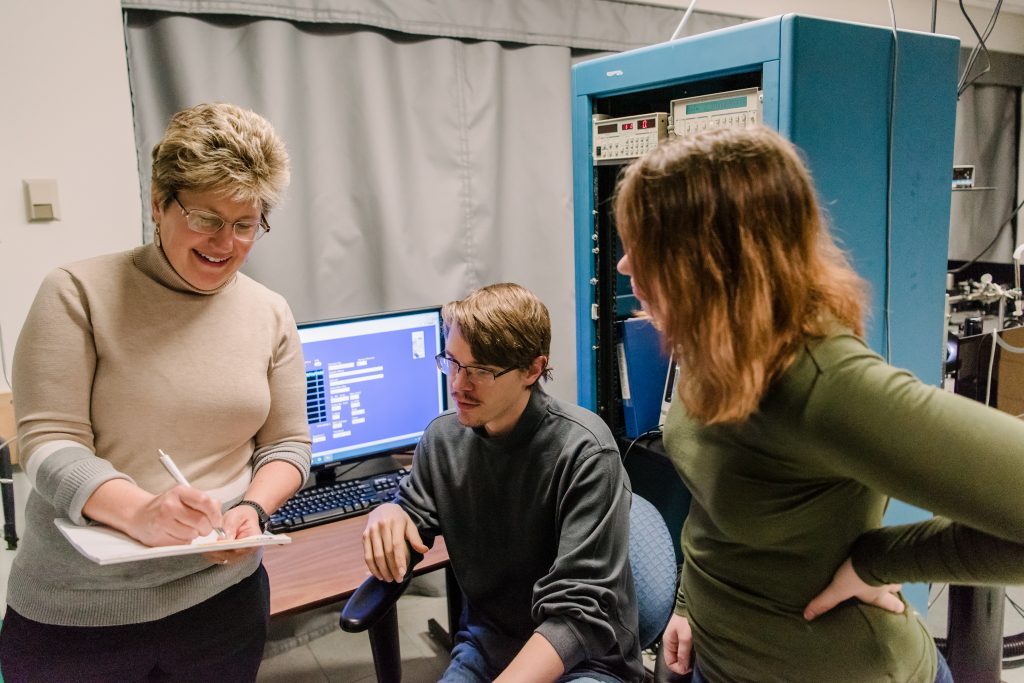
Lisa Kelly, Ryan Grant, and Gabrielle Pozza (left to right) discuss results from a recent experiment in the lab.
Kelly is also involved with a startup in Utah using a similar technique to create a natural alternative to the metal stents that treat heart disease. Staining the artery with the special compounds and then exposing them to light creates a rigid structure that avoids the need for a traditional stent. The product is currently undergoing FDA approval.
“We’re able to give guidance to the drug discovery companies based on our insight into the chemical mechanisms,” Kelly says. “That’s what’s really exciting to me: We can actually come up with practical information to help guide better drugs and structural biology tools.”
Creating opportunities for students
Kelly is also excited about how her new funding will impact UMBC students. “Part of the grant support is not just doing the lab work, but also disseminating it, so my team and I can travel to present the work at national conferences,” she says. “It’s really important to me to be able to bring graduate students with me when I go to meetings and have them share the same sort of networking opportunities that I benefited from.”
Kelly has cultivated rich connections within the photochemistry community, a field she chose intentionally. “It struck me as a way to be able to do everything that I was interested in without having to be this or this or that,” she says. “It was a multidisciplinary, practical field that’s served me well in my career.” And now, she’s introducing UMBC graduate students to this unique field and how scientists can bridge multiple disciplines to impact society.
As a photochemist, “It’s not good enough for me to make something and show that it does something cool,” Kelly says. “I want to map out all the driving forces that control it, and when I understand that, then I can make the process happen better.”
Banner image: Lisa Kelly, right, Ryan Grant, center, and Gabriella Pozza work with the laser setup in Kelly’s lab. All photos by Marlayna Demond ’11 for UMBC.
]]>
This story was written by Sarah Hansen and first appeared on news.umbc.edu At some point in its development, every drug, high-tech piece of clothing, and synthetic building material was...
Photo
https://assets3-beta.my.umbc.edu/system/shared/attachments/8a8641d2f9fa164800bcd694e2598bcf/69ef55f5/news/000/089/291/28a32c20769baa8373833005b125864b/0.jpg?1576699038
https://beta.my.umbc.edu/api/v0/pixel/news/89291/guest@my.umbc.edu/2e5a9e1fbd5eb1de7a43c95e4d94d0a0/api/pixel
ovpr-news-2019
Archived RCA News
https://beta.my.umbc.edu/groups/research
https://assets4-beta.my.umbc.edu/system/shared/avatars/groups/000/000/794/4bca2aa331eb7e472d63d97e0798b600/xsmall.png?1743706368
https://assets2-beta.my.umbc.edu/system/shared/avatars/groups/000/000/794/4bca2aa331eb7e472d63d97e0798b600/original.jpg?1743706368
https://assets3-beta.my.umbc.edu/system/shared/avatars/groups/000/000/794/4bca2aa331eb7e472d63d97e0798b600/xxlarge.png?1743706368
https://assets4-beta.my.umbc.edu/system/shared/avatars/groups/000/000/794/4bca2aa331eb7e472d63d97e0798b600/xlarge.png?1743706368
https://assets2-beta.my.umbc.edu/system/shared/avatars/groups/000/000/794/4bca2aa331eb7e472d63d97e0798b600/large.png?1743706368
https://assets4-beta.my.umbc.edu/system/shared/avatars/groups/000/000/794/4bca2aa331eb7e472d63d97e0798b600/medium.png?1743706368
https://assets4-beta.my.umbc.edu/system/shared/avatars/groups/000/000/794/4bca2aa331eb7e472d63d97e0798b600/small.png?1743706368
https://assets4-beta.my.umbc.edu/system/shared/avatars/groups/000/000/794/4bca2aa331eb7e472d63d97e0798b600/xsmall.png?1743706368
https://assets3-beta.my.umbc.edu/system/shared/avatars/groups/000/000/794/4bca2aa331eb7e472d63d97e0798b600/xxsmall.png?1743706368
Office of the Vice President for Research
https://assets3-beta.my.umbc.edu/system/shared/thumbnails/news/000/089/291/7af9847769434df16b179cc7f1d0de60/xxlarge.jpg?1576699129
https://assets4-beta.my.umbc.edu/system/shared/thumbnails/news/000/089/291/7af9847769434df16b179cc7f1d0de60/xlarge.jpg?1576699129
https://assets1-beta.my.umbc.edu/system/shared/thumbnails/news/000/089/291/7af9847769434df16b179cc7f1d0de60/large.jpg?1576699129
https://assets2-beta.my.umbc.edu/system/shared/thumbnails/news/000/089/291/7af9847769434df16b179cc7f1d0de60/medium.jpg?1576699129
https://assets3-beta.my.umbc.edu/system/shared/thumbnails/news/000/089/291/7af9847769434df16b179cc7f1d0de60/small.jpg?1576699129
https://assets1-beta.my.umbc.edu/system/shared/thumbnails/news/000/089/291/7af9847769434df16b179cc7f1d0de60/xsmall.jpg?1576699129
https://assets4-beta.my.umbc.edu/system/shared/thumbnails/news/000/089/291/7af9847769434df16b179cc7f1d0de60/xxsmall.jpg?1576699129
2
0
true
Wed, 18 Dec 2019 14:58:56 -0500
Prof. Smith receives $1.5M to examine role of iron in health
This story was written by Sarah Hansen and first appeared on news.umbc.edu
UMBC’s Aaron Smith is now thinking “bigger picture” about how his lab’s research can support human health at the molecular level thanks to $1.5 million in new research funding.
Smith, assistant professor of chemistry and biochemistry, focuses on how biological systems take up and process iron. Last winter he received a significant grant for research on developing new antibiotic targets. Now, he’s earned a prestigious $500,000 National Science Foundation CAREER Award and $1 million from the National Institute of General Medical Sciences, a division of the NIH. The work he and his students are doing is at the molecular level, but it has implications for everything from cardiovascular disease to embryonic development.
Opening the molecular toolbox
Smith’s bioinorganic chemistry lab works to understand how metals function in biological systems, with a particular focus on iron. While it may be strange to think about metals functioning in our bodies, they are critical. “For biological systems to expand the types of chemistry that they can do, they need metal ions,” Smith says. “Metals open up the toolbox for the protein to be able to accomplish so much more.”
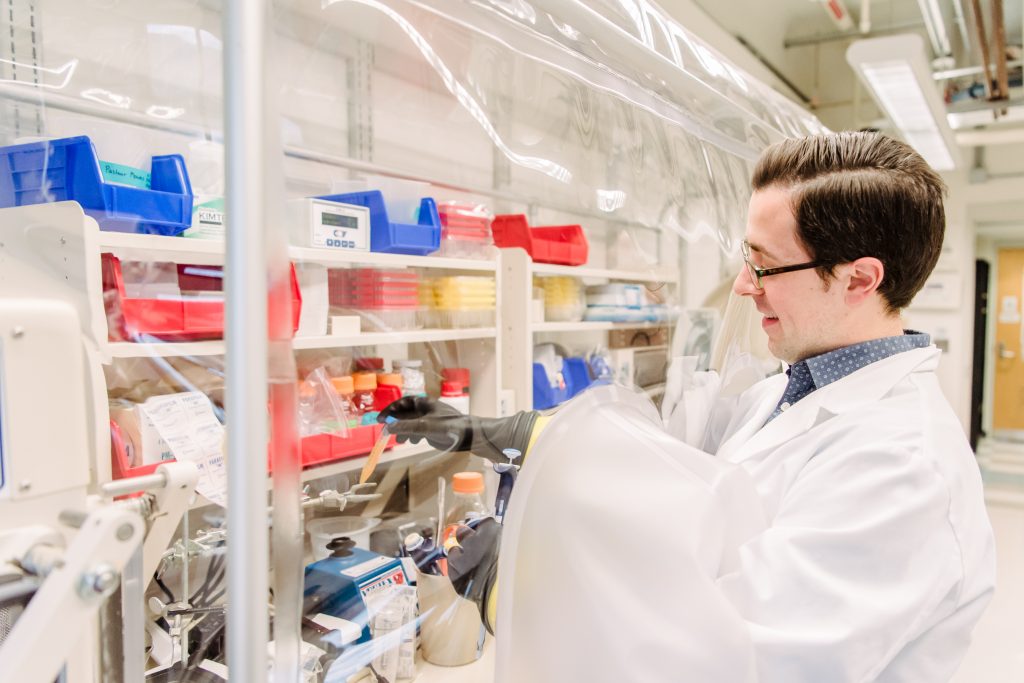
Aaron Smith works at the hood in his lab.
The NSF and NIH funding will allow Smith’s lab to increase understanding of how iron is involved in adding molecules to proteins after they are made. This process is known as post-translational modification.
“Post-translational modifications are incredibly important,” Smith says. Even the most complex organisms don’t have more than a few tens of thousands of genes that provide instructions for unique proteins, but proteins perform many times that many functions in the body. Post-translational modification “really diversifies the number of functions that proteins can serve,” Smith says.
Smith’s lab is studying a specific post-translational modification called arginylation. An enzyme known as ATE1 carries out arginylation, by attaching the amino acid arginine to proteins. Then, “the arginine functions as a molecular flag that says, ‘I should be degraded,’” Smith explains. The ability to break down the right proteins, and then use their building blocks to rebuild other cellular materials, is crucial for the healthy functioning of our bodies over time.
“ATE1 is very impactful, but we don’t know a lot about how it does what it does,” Smith says. Even the structure of ATE1 is unknown, as well as the mechanism by which it adds arginine to proteins. Smith says his lab has an idea, “but my guess is it’s going to be much more complex when we figure this out.”
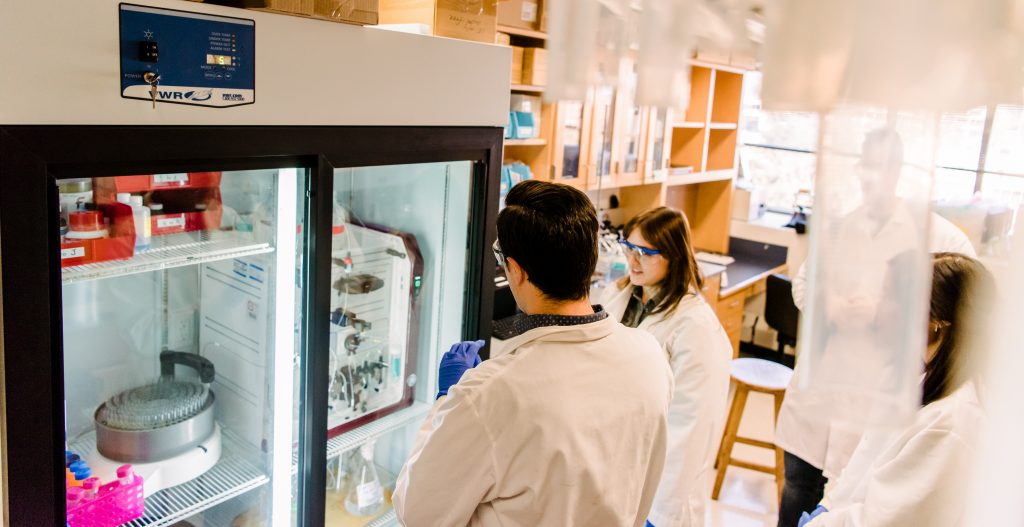
The lab at work.
Smith’s research niche: the atomic level
Research on arginylation is increasing rapidly, and Smith believes his lab has a particular role to play. Most labs are looking at arginylation at the cellular level and up, asking questions like how it affects different processes in a cell or even an entire organism. But Smith is taking things to another level by studying the atomic structure of individual ATE1 enzymes and the proteins they interact with.
“We think that we fit in very nicely in this research space,” Smith says, “We’re filling a niche that remains really uncovered at this point.”
Smith’s group is looking at how ATE1 is regulated, such as how it knows which proteins to add arginine to or how it responds to changes in the cell. They’ve already gotten some promising results related to iron’s role in regulating ATE1. And they’re getting close to revealing the enzyme’s complete molecular structure, which would provide big clues into how it works. The NIH and NSF funding will help answer these questions.
Once the structure and mechanism are in hand, it will be time to explore applications. For example, “Could we think about then making this protein a target for therapeutic development?” Smith asks. “Given how important it is in these various cellular processes, if we understood better the structure and the mechanism, we could think about ways to develop small molecules that could help with diseases associated with arginylation.”
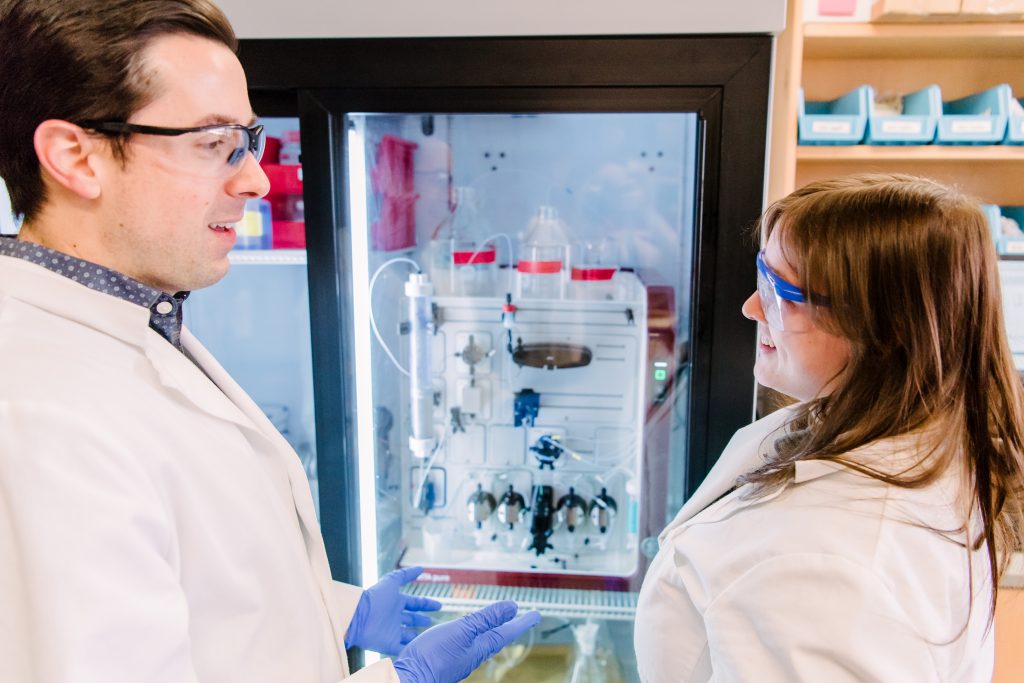
Aaron Smith and Alexandrea Sestok discuss a new instrument.
Representation in research
In addition to aiding the progress of his research, Smith is excited that both grants will allow him to expose more students to bioinorganic chemistry. His CAREER Award proposal “has an additional education component that’s about specifically trying to leverage the diversity efforts already going on here at UMBC, and to help increase diversity in bioinorganic chemistry.”
To that end, Smith will introduce all of the first-year chemistry courses at UMBC to bioinorganic chemistry. He’s also developing a new upper-level elective on bioinorganic chemistry. Smith hopes that by taking the course, students may then “consider going into a research career for a field that they didn’t even know existed, that helps tackle some of the most important chemical transformations on the planet.”
“I’m proud to think that my lab reflects the diversity that we see on UMBC’s campus, and I’m happy to continue moving forward with that,” Smith shares. “It’s important to have a lab that reflects this university and the country, to benefit from a broad range of perspectives and to train the researchers of tomorrow.”
This new funding will significantly expand the opportunities available to Smith and his students, and it’s reshaping how they think about the work. Having strong funding “affords you the ability to imagine more,” he says, “to think bigger picture about different avenues you might pursue.” Now, Smith and his students will be dreaming big as they steward this new research funding to better understand arginylation, metal transport, and their roles in human health.
Banner image: Aaron Smith works with his students in the lab. From left to right: graduate students Alexandrea Sestok, Verna Van, and Nathan Max. All photos by Marlayna Demond ’11 for UMBC.
]]>
This story was written by Sarah Hansen and first appeared on news.umbc.edu UMBC’s Aaron Smith is now thinking “bigger picture” about how his lab’s research can support human health at the...
Photo
https://assets4-beta.my.umbc.edu/system/shared/attachments/d0e6179d227f37987e2d76ac0e021ab5/69ef55f5/news/000/089/290/dec2236203d220c20de58dc2a0040258/0.jpg?1576698348
https://beta.my.umbc.edu/api/v0/pixel/news/89290/guest@my.umbc.edu/516b5936a28ab2fd64c7cedb7a5fbca2/api/pixel
ovpr-news-2019
Archived RCA News
https://beta.my.umbc.edu/groups/research
https://assets4-beta.my.umbc.edu/system/shared/avatars/groups/000/000/794/4bca2aa331eb7e472d63d97e0798b600/xsmall.png?1743706368
https://assets2-beta.my.umbc.edu/system/shared/avatars/groups/000/000/794/4bca2aa331eb7e472d63d97e0798b600/original.jpg?1743706368
https://assets3-beta.my.umbc.edu/system/shared/avatars/groups/000/000/794/4bca2aa331eb7e472d63d97e0798b600/xxlarge.png?1743706368
https://assets4-beta.my.umbc.edu/system/shared/avatars/groups/000/000/794/4bca2aa331eb7e472d63d97e0798b600/xlarge.png?1743706368
https://assets2-beta.my.umbc.edu/system/shared/avatars/groups/000/000/794/4bca2aa331eb7e472d63d97e0798b600/large.png?1743706368
https://assets4-beta.my.umbc.edu/system/shared/avatars/groups/000/000/794/4bca2aa331eb7e472d63d97e0798b600/medium.png?1743706368
https://assets4-beta.my.umbc.edu/system/shared/avatars/groups/000/000/794/4bca2aa331eb7e472d63d97e0798b600/small.png?1743706368
https://assets4-beta.my.umbc.edu/system/shared/avatars/groups/000/000/794/4bca2aa331eb7e472d63d97e0798b600/xsmall.png?1743706368
https://assets3-beta.my.umbc.edu/system/shared/avatars/groups/000/000/794/4bca2aa331eb7e472d63d97e0798b600/xxsmall.png?1743706368
Office of the Vice President for Research
https://assets4-beta.my.umbc.edu/system/shared/thumbnails/news/000/089/290/976e12a4a433d85272aba3a86d56f1a9/xxlarge.jpg?1576698459
https://assets4-beta.my.umbc.edu/system/shared/thumbnails/news/000/089/290/976e12a4a433d85272aba3a86d56f1a9/xlarge.jpg?1576698459
https://assets2-beta.my.umbc.edu/system/shared/thumbnails/news/000/089/290/976e12a4a433d85272aba3a86d56f1a9/large.jpg?1576698459
https://assets3-beta.my.umbc.edu/system/shared/thumbnails/news/000/089/290/976e12a4a433d85272aba3a86d56f1a9/medium.jpg?1576698459
https://assets4-beta.my.umbc.edu/system/shared/thumbnails/news/000/089/290/976e12a4a433d85272aba3a86d56f1a9/small.jpg?1576698459
https://assets1-beta.my.umbc.edu/system/shared/thumbnails/news/000/089/290/976e12a4a433d85272aba3a86d56f1a9/xsmall.jpg?1576698459
https://assets4-beta.my.umbc.edu/system/shared/thumbnails/news/000/089/290/976e12a4a433d85272aba3a86d56f1a9/xxsmall.jpg?1576698459
1
0
true
Wed, 18 Dec 2019 14:47:48 -0500
Update to IRB Special Topics - Participant Compensation
The IRB recently revised its webpage guidance for investigators to use when proposing compensation for research participants for their time or travel or be offered in-kind compensation for their participation in human subject use research. This compensation is outlined in a human subjects use application submitted to the IRB for review.
The guidance update includes:
- a clarified definition of what is considered compensation for participants;
- how to describe investigator methods to avoid undue influence or prevent coercion; and
- what vulnerable populations require safeguards and protections when office a payment for participating in a research study.
Instructions for SSO login for new and current CITI users are found on the ORPC
Research Education and Training webpage. Also, please bookmark the
Kuali@UMBC page for specific references to training record linkages in our protocol guides as well as Kuali FAQs.
And, as always, please contact the ORPC will any questions or requests for assistance at
compliance@umbc.edu.
Looking for Environmental Health Sciences alumni:
http://careers.umass.edu/amherst/en-us/job/495101/assistant-professor-in-environmental-health-sciences
Any questions can be directed to Dr. Alicia Timme-Laragy, chair of the faculty search for this position: aliciat@umass.edu
]]>
Looking for Environmental Health Sciences alumni: http://careers.umass.edu/amherst/en-us/job/495101/assistant-professor-in-environmental-health-sciences Any questions can be directed to Dr....
http://careers.umass.edu/amherst/en-us/job/495101/assistant-professor-in-environmental-health-sciences
https://beta.my.umbc.edu/api/v0/pixel/news/88440/guest@my.umbc.edu/9ba634819714881062ac150a743bc605/api/pixel
Office of Postdoctoral Affairs
https://beta.my.umbc.edu/groups/postdocs
https://assets1-beta.my.umbc.edu/system/shared/avatars/groups/000/000/394/5b3a93d103a66345e5d404c61c5b5081/xsmall.png?1340160424
https://assets4-beta.my.umbc.edu/system/shared/avatars/groups/000/000/394/5b3a93d103a66345e5d404c61c5b5081/original.jpg?1340160424
https://assets4-beta.my.umbc.edu/system/shared/avatars/groups/000/000/394/5b3a93d103a66345e5d404c61c5b5081/xxlarge.png?1340160424
https://assets2-beta.my.umbc.edu/system/shared/avatars/groups/000/000/394/5b3a93d103a66345e5d404c61c5b5081/xlarge.png?1340160424
https://assets1-beta.my.umbc.edu/system/shared/avatars/groups/000/000/394/5b3a93d103a66345e5d404c61c5b5081/large.png?1340160424
https://assets3-beta.my.umbc.edu/system/shared/avatars/groups/000/000/394/5b3a93d103a66345e5d404c61c5b5081/medium.png?1340160424
https://assets2-beta.my.umbc.edu/system/shared/avatars/groups/000/000/394/5b3a93d103a66345e5d404c61c5b5081/small.png?1340160424
https://assets1-beta.my.umbc.edu/system/shared/avatars/groups/000/000/394/5b3a93d103a66345e5d404c61c5b5081/xsmall.png?1340160424
https://assets4-beta.my.umbc.edu/system/shared/avatars/groups/000/000/394/5b3a93d103a66345e5d404c61c5b5081/xxsmall.png?1340160424
Office of Postdoctoral Affairs
https://assets2-beta.my.umbc.edu/system/shared/thumbnails/news/000/088/440/9086cb7d92b4e9f49ccfde13a087475d/xxlarge.jpg?1573668157
https://assets2-beta.my.umbc.edu/system/shared/thumbnails/news/000/088/440/9086cb7d92b4e9f49ccfde13a087475d/xlarge.jpg?1573668157
https://assets1-beta.my.umbc.edu/system/shared/thumbnails/news/000/088/440/9086cb7d92b4e9f49ccfde13a087475d/large.jpg?1573668157
https://assets2-beta.my.umbc.edu/system/shared/thumbnails/news/000/088/440/9086cb7d92b4e9f49ccfde13a087475d/medium.jpg?1573668157
https://assets4-beta.my.umbc.edu/system/shared/thumbnails/news/000/088/440/9086cb7d92b4e9f49ccfde13a087475d/small.jpg?1573668157
https://assets4-beta.my.umbc.edu/system/shared/thumbnails/news/000/088/440/9086cb7d92b4e9f49ccfde13a087475d/xsmall.jpg?1573668157
https://assets1-beta.my.umbc.edu/system/shared/thumbnails/news/000/088/440/9086cb7d92b4e9f49ccfde13a087475d/xxsmall.jpg?1573668157
0
0
false
Wed, 13 Nov 2019 13:03:16 -0500