<?xml version="1.0"?>
<News hasArchived="false" page="7" pageCount="18" pageSize="10" timestamp="Sun, 19 Apr 2026 19:54:55 -0400" url="https://beta.my.umbc.edu/groups/mcs/posts.xml?page=7">
<NewsItem contentIssues="true" id="128755" important="false" status="posted" url="https://beta.my.umbc.edu/groups/mcs/posts/128755">
<Title>15 Minutes of Shame Discussion</Title>
<Body>
<![CDATA[
    <div class="html-content"><span>Please consider joining us for a panel discussion on the documentary </span><em><a href="https://www.hbomax.com/feature/urn:hbo:feature:GYVwB2QzURrmjIwEAAABa" rel="nofollow external" class="bo">15 Minutes of Shame</a></em><span>, which focuses on public shaming, cyber-bullying, and cancel culture.  The event is Wednesday, 10/26, 4:00-5:30 at Flat Tuesdays.  There will be snacks!  We'll be screening some clips from the documentary, but you can also watch it for free before that ... link on the attached flyer.  Hope to see you there!</span></div>
]]>
</Body>
<Summary>Please consider joining us for a panel discussion on the documentary 15 Minutes of Shame, which focuses on public shaming, cyber-bullying, and cancel culture.  The event is Wednesday, 10/26,...</Summary>
<Website>https://www.hbomax.com/feature/urn:hbo:feature:GYVwB2QzURrmjIwEAAABa</Website>
<AttachmentKind>Flyer</AttachmentKind>
<AttachmentUrl>https://assets3-beta.my.umbc.edu/system/shared/attachments/413dcadc2f500e16812ee9b0751df07f/69e56b4f/news/000/128/755/b816130e1431fcf42ec895b272d975bd/15minutes_flyer (2).jpg?1666796197</AttachmentUrl>
<Attachments>
<Attachment kind="Flyer" url="https://beta.my.umbc.edu/groups/mcs/posts/128755/attachments/45008"></Attachment>
</Attachments>
<TrackingUrl>https://beta.my.umbc.edu/api/v0/pixel/news/128755/guest@my.umbc.edu/23ff4b64774479813bb02565c1f06406/api/pixel</TrackingUrl>
<Group token="mcs">Media &amp;amp; Communication Studies</Group>
<GroupUrl>https://beta.my.umbc.edu/groups/mcs</GroupUrl>
<AvatarUrl>https://assets4-beta.my.umbc.edu/system/shared/avatars/groups/000/000/491/e2e495edc31bdc4fe9517af2ddcb3202/xsmall.png?1639004057</AvatarUrl>
<AvatarUrl size="original">https://assets1-beta.my.umbc.edu/system/shared/avatars/groups/000/000/491/e2e495edc31bdc4fe9517af2ddcb3202/original.png?1639004057</AvatarUrl>
<AvatarUrl size="xxlarge">https://assets3-beta.my.umbc.edu/system/shared/avatars/groups/000/000/491/e2e495edc31bdc4fe9517af2ddcb3202/xxlarge.png?1639004057</AvatarUrl>
<AvatarUrl size="xlarge">https://assets2-beta.my.umbc.edu/system/shared/avatars/groups/000/000/491/e2e495edc31bdc4fe9517af2ddcb3202/xlarge.png?1639004057</AvatarUrl>
<AvatarUrl size="large">https://assets4-beta.my.umbc.edu/system/shared/avatars/groups/000/000/491/e2e495edc31bdc4fe9517af2ddcb3202/large.png?1639004057</AvatarUrl>
<AvatarUrl size="medium">https://assets3-beta.my.umbc.edu/system/shared/avatars/groups/000/000/491/e2e495edc31bdc4fe9517af2ddcb3202/medium.png?1639004057</AvatarUrl>
<AvatarUrl size="small">https://assets3-beta.my.umbc.edu/system/shared/avatars/groups/000/000/491/e2e495edc31bdc4fe9517af2ddcb3202/small.png?1639004057</AvatarUrl>
<AvatarUrl size="xsmall">https://assets4-beta.my.umbc.edu/system/shared/avatars/groups/000/000/491/e2e495edc31bdc4fe9517af2ddcb3202/xsmall.png?1639004057</AvatarUrl>
<AvatarUrl size="xxsmall">https://assets1-beta.my.umbc.edu/system/shared/avatars/groups/000/000/491/e2e495edc31bdc4fe9517af2ddcb3202/xxsmall.png?1639004057</AvatarUrl>
<Sponsor>Media &amp; Communication Studies</Sponsor>
<ThumbnailUrl size="xxlarge">https://assets3-beta.my.umbc.edu/system/shared/thumbnails/news/000/128/755/b369d61cbc6cec3d9fd68600c58ee431/xxlarge.jpg?1666796204</ThumbnailUrl>
<ThumbnailUrl size="xlarge">https://assets4-beta.my.umbc.edu/system/shared/thumbnails/news/000/128/755/b369d61cbc6cec3d9fd68600c58ee431/xlarge.jpg?1666796204</ThumbnailUrl>
<ThumbnailUrl size="large">https://assets4-beta.my.umbc.edu/system/shared/thumbnails/news/000/128/755/b369d61cbc6cec3d9fd68600c58ee431/large.jpg?1666796204</ThumbnailUrl>
<ThumbnailUrl size="medium">https://assets3-beta.my.umbc.edu/system/shared/thumbnails/news/000/128/755/b369d61cbc6cec3d9fd68600c58ee431/medium.jpg?1666796204</ThumbnailUrl>
<ThumbnailUrl size="small">https://assets1-beta.my.umbc.edu/system/shared/thumbnails/news/000/128/755/b369d61cbc6cec3d9fd68600c58ee431/small.jpg?1666796204</ThumbnailUrl>
<ThumbnailUrl size="xsmall">https://assets2-beta.my.umbc.edu/system/shared/thumbnails/news/000/128/755/b369d61cbc6cec3d9fd68600c58ee431/xsmall.jpg?1666796204</ThumbnailUrl>
<ThumbnailUrl size="xxsmall">https://assets2-beta.my.umbc.edu/system/shared/thumbnails/news/000/128/755/b369d61cbc6cec3d9fd68600c58ee431/xxsmall.jpg?1666796204</ThumbnailUrl>
<PawCount>0</PawCount>
<CommentCount>0</CommentCount>
<CommentsAllowed>true</CommentsAllowed>
<PostedAt>Wed, 26 Oct 2022 10:57:37 -0400</PostedAt>
<EditAt>Wed, 26 Oct 2022 10:57:37 -0400</EditAt>
</NewsItem>

<NewsItem contentIssues="true" id="128628" important="false" status="posted" url="https://beta.my.umbc.edu/groups/mcs/posts/128628">
<Title>Faculty Highlight: Dr. Fan Yang</Title>
<Tagline>Read our Q&amp;A with Dr. Yang, an Associate Professor of MCS!</Tagline>
<Body>
<![CDATA[
    <div class="html-content"><span><p><span>By: Sophia Possidente</span></p><br><p><span>Photo Credit: Marlayna Demond</span></p><p><span><br></span></p><p><span>Dr. Fan Yang is an Associate Professor in UMBC’s Media and Communication Studies department and a faculty affiliate in the Asian Studies program. Her current research project, "Shenzhen: A Media City of the Global South" analyzes the role of the city as a global nexus in technology production, examining its transition into AI development in the context of globalization.</span></p><p><span><strong><br></strong></span></p><p><span>I spoke to Dr. Yang about her ongoing research, previous publications, favorite MCS courses, and advice for aspiring researchers.</span></p><p><span><strong><br></strong></span></p><p><span>Q: What is your favorite MCS class to teach and why?</span></p><p><span><strong><br></strong></span></p><p><span>A: I always say 333 is one of my favorites, and 334 too because they’re kind of connected. 333 offers different lenses for people to think about media phenomenon, media events and media artifacts, and I feel like it’s very empowering as an educator to allow students to start seeing things differently.</span></p><p><span><strong><br></strong></span></p><p><span>Connecting to 334, that’s when you connect the theories to global media phenomenon and think about the connectivity between different places, different people, different media industries, and consumers. I see them as twin classes, so that’s why I always say they’re my favorites to teach.</span></p><p><span><strong><br></strong></span></p><p><span>Q: What is a recent accomplishment – it can be anything; a research project, or a talk you gave – that you’re especially proud of? Why is that topic so important to you?</span></p><p><span><strong><br></strong></span></p><p><span>A: I gave a talk as part of the Association for Cultural Studies in a series that they organized. The talk I gave there was about Shenzhen, a city located near Hong Kong that is mainly known as the manufacturing site for a lot of Apple products, among other digital gadgets. It’s almost the symbol of “Made in China”, but it has recently been reinventing itself to be a site for “Made in China, Intelligently”, so things like AI production. My talk was centered around thinking about Shenzhen in relation to the global south in terms of development of AI infrastructure. </span></p><p><span><strong><br></strong></span></p><p><span>I also just finished a paper about Shenzhen and future; it’s for a special issue called </span><span>Interrogating Futurity</span><span>. I looked at two specific examples out of Shenzhen; one is the robot as this non-human figure that becomes very dominant in imaginations of the future of the nation. The other artifact is the drone; a Shenzhen company called DJI has 70% of the market share for consumer drones globally, and their drones were used by both Ukraine and Russia. It’s really interested in branding itself as this futuristic company; its headquarters is the most anticipated architectural piece to be completed this year because it combines the aesthetics of the drone with material structure. It’s envisioned to be another iconic figure of the future of architecture in Shenzhen. So those are the things that are combining into this project called “Shenzhen: A Media City of the Global South”, which to me is an opportunity to situate China not just in globalization, but in thinking about the global south as a concept.</span></p><p><span><strong><br></strong></span></p><p><span>Q: What has your research process been and what are some of the most exciting things that you’re learning during this project?</span></p><p><span><strong><br></strong></span></p><p><span>A: I think just learning more about AI itself. My students in 499 know that for the past few semesters I’ve used the book </span><span>Race After Technology</span><span>, which talks about the systemic bias that informs some of the AI development in the west. An interesting case in relation to Shenzhen is that there is a Shenzhen-based company that produces phones that are very popular in Africa, in part because their algorithms configure the camera lens to showcase dark skinned individuals better than the hegemonic global brands. Simultaneously, it </span><span>is</span><span> still a data extraction of the population, but then it’s also informing new aesthetics; they brand themselves as wanting to make beauty not whiteness. “Blackness as beauty” is one of their slogans. I feel like it’s very exciting to learn about AI, and then to think about the different contestations of power between the north and the south.</span></p><p><span><strong><br></strong></span></p><p><span>Q: I have to ask… what inspired your recent paper on </span><span>Too Hot to Handle</span><span>? Why is it so important to study reality TV?</span></p><p><span><strong><br></strong></span></p><p><span>A: I try to always think about the very mundane experiences that we have, especially things that we sometimes associate with stigma. Reality TV is something that we don’t necessarily celebrate. But for cultural studies people, when things like </span><span>Too Hot To Handle </span><span>become the top viewed shows on Netflix, that means something. Especially at that particular moment of the pandemic, with people just starting to isolate in the west. The show has a robot that has “Factory, China” as its origin when introduced – just like the way they show where the contestants are from – which brings up so many layers. It’s a tongue-in-cheek joke because so many of our gadgets are made in China, but then there’s also the notion that this robot is keeping everyone from touching each other. In that way, people were already saying: “is this robot kind of like the coronavirus that’s </span><span>also</span><span> from China?”. So all of these layers come into play in the discourses around it that made me really interested in exploring what’s happening there. Through that I was also able to think about Netflix, the platform on which the show was screened. If you think about the mechanism of the robot, which is, according to the narrative, absorbing all the data and trying to figure out ways to respond, that’s kind of what Netflix does. It’s one of the first platforms that uses user data to configure their shows and advertisements to feed people what they “want”. So that’s how we get this connection between the robot, China, coronavirus, Netflix, and what this means at the moment. A lot of times we ask questions like: “why this, why now?” trying to reveal complexities related to something as mundane as a reality TV show.</span></p><p><span><strong><br></strong></span></p><p><span>Q: What is one piece of advice you would give to someone who either wants to get into MCS research or is conducting their very first project?</span></p><p><span><br></span></p><p><span>A: I would really encourage them to be open to different possibilities. There’s so much you can say about one thing, and once you start researching you will find so much more than you expect, whether it’s on the production side of the phenomenon or the audience side. I think that open mindedness could be very beneficial in terms of broadening your scope of research.</span></p><div><span><br></span></div><div><span><br></span></div></span></div>
]]>
</Body>
<Summary>By: Sophia Possidente   Photo Credit: Marlayna Demond     Dr. Fan Yang is an Associate Professor in UMBC’s Media and Communication Studies department and a faculty affiliate in the Asian Studies...</Summary>
<TrackingUrl>https://beta.my.umbc.edu/api/v0/pixel/news/128628/guest@my.umbc.edu/5020015da62285924c939ec0ca2c6cbb/api/pixel</TrackingUrl>
<Group token="mcs">Media &amp;amp; Communication Studies</Group>
<GroupUrl>https://beta.my.umbc.edu/groups/mcs</GroupUrl>
<AvatarUrl>https://assets4-beta.my.umbc.edu/system/shared/avatars/groups/000/000/491/e2e495edc31bdc4fe9517af2ddcb3202/xsmall.png?1639004057</AvatarUrl>
<AvatarUrl size="original">https://assets1-beta.my.umbc.edu/system/shared/avatars/groups/000/000/491/e2e495edc31bdc4fe9517af2ddcb3202/original.png?1639004057</AvatarUrl>
<AvatarUrl size="xxlarge">https://assets3-beta.my.umbc.edu/system/shared/avatars/groups/000/000/491/e2e495edc31bdc4fe9517af2ddcb3202/xxlarge.png?1639004057</AvatarUrl>
<AvatarUrl size="xlarge">https://assets2-beta.my.umbc.edu/system/shared/avatars/groups/000/000/491/e2e495edc31bdc4fe9517af2ddcb3202/xlarge.png?1639004057</AvatarUrl>
<AvatarUrl size="large">https://assets4-beta.my.umbc.edu/system/shared/avatars/groups/000/000/491/e2e495edc31bdc4fe9517af2ddcb3202/large.png?1639004057</AvatarUrl>
<AvatarUrl size="medium">https://assets3-beta.my.umbc.edu/system/shared/avatars/groups/000/000/491/e2e495edc31bdc4fe9517af2ddcb3202/medium.png?1639004057</AvatarUrl>
<AvatarUrl size="small">https://assets3-beta.my.umbc.edu/system/shared/avatars/groups/000/000/491/e2e495edc31bdc4fe9517af2ddcb3202/small.png?1639004057</AvatarUrl>
<AvatarUrl size="xsmall">https://assets4-beta.my.umbc.edu/system/shared/avatars/groups/000/000/491/e2e495edc31bdc4fe9517af2ddcb3202/xsmall.png?1639004057</AvatarUrl>
<AvatarUrl size="xxsmall">https://assets1-beta.my.umbc.edu/system/shared/avatars/groups/000/000/491/e2e495edc31bdc4fe9517af2ddcb3202/xxsmall.png?1639004057</AvatarUrl>
<Sponsor>Media &amp; Communication Studies</Sponsor>
<ThumbnailUrl size="xxlarge">https://assets1-beta.my.umbc.edu/system/shared/thumbnails/news/000/128/628/c91d8b8b90d75ecc0e58652d909c8155/xxlarge.jpg?1666293233</ThumbnailUrl>
<ThumbnailUrl size="xlarge">https://assets2-beta.my.umbc.edu/system/shared/thumbnails/news/000/128/628/c91d8b8b90d75ecc0e58652d909c8155/xlarge.jpg?1666293233</ThumbnailUrl>
<ThumbnailUrl size="large">https://assets3-beta.my.umbc.edu/system/shared/thumbnails/news/000/128/628/c91d8b8b90d75ecc0e58652d909c8155/large.jpg?1666293233</ThumbnailUrl>
<ThumbnailUrl size="medium">https://assets1-beta.my.umbc.edu/system/shared/thumbnails/news/000/128/628/c91d8b8b90d75ecc0e58652d909c8155/medium.jpg?1666293233</ThumbnailUrl>
<ThumbnailUrl size="small">https://assets1-beta.my.umbc.edu/system/shared/thumbnails/news/000/128/628/c91d8b8b90d75ecc0e58652d909c8155/small.jpg?1666293233</ThumbnailUrl>
<ThumbnailUrl size="xsmall">https://assets3-beta.my.umbc.edu/system/shared/thumbnails/news/000/128/628/c91d8b8b90d75ecc0e58652d909c8155/xsmall.jpg?1666293233</ThumbnailUrl>
<ThumbnailUrl size="xxsmall">https://assets3-beta.my.umbc.edu/system/shared/thumbnails/news/000/128/628/c91d8b8b90d75ecc0e58652d909c8155/xxsmall.jpg?1666293233</ThumbnailUrl>
<PawCount>0</PawCount>
<CommentCount>0</CommentCount>
<CommentsAllowed>true</CommentsAllowed>
<PostedAt>Thu, 20 Oct 2022 15:17:51 -0400</PostedAt>
</NewsItem>

<NewsItem contentIssues="true" id="128449" important="false" status="posted" url="https://beta.my.umbc.edu/groups/mcs/posts/128449">
<Title>Faculty Spotlight: An Interview with Dr. Jason Loviglio</Title>
<Tagline>Dr. Loviglio shares about MCS history, his new book, &amp; more</Tagline>
<Body>
<![CDATA[
    <div class="html-content"><span><p><span>By</span><span>:</span><span> Ava Sekowski</span></p><p><span><br></span></p><p><span>Photo Credit:</span><span> Marlayna Demond and Routledge</span></p><p><span><br></span></p><p><span>Have you ever wondered who was the first Media and Communications Studies professor? Or who started the major at UMBC? Well you are in luck.</span></p><br><p><span>I recently sat down with Dr. Jason Loviglio, Associate Professor and founding chair of the UMBC Media and Communication Studies department. Dr. Loviglio started at UMBC in 1999 as a professor in the American Studies department, but in 2007 moved to MCS. As of today he has taught almost all of the MCS core curriculum cores, courses in radio and sound studies, media theory, media and politics, and more! He also recently published a new book titled </span><span>The Routledge Companion to Radio and Podcast Studies</span><span>. Today, we get to hear more about the courses Dr. Loviglio teaches, the history of the department, his new book, and a special surprise announcement!</span></p><br><p><span>Q: What is your favorite class that you teach? </span></p><br><p><span>My favorite class that I've ever taught at UMBC is probably the course on radio and soundwork, which I got to teach one time, and I'm hoping to teach again, which explores  the history of radio and other audio technologies, and also investigates the growing universe of podcasting. And I also have students do some very basic audio recording work themselves so that they get some  sensitivity to the soundscapes around them and also start thinking in terms of composing with sound and making arguments with sound and communicating sonically and not just visually or through writing.</span></p><br><p><span>Q. Can you talk about where you were at UMBC before MCS and how the department came about? </span></p><br><p><span>I was an Assistant Professor in American Studies and the campus leadership at the time wanted a communications department. But they didn't have any money to build a big production-heavy program, and they didn't want it to be duplicative of what is already happening at Towson, Morgan, and Maryland. So it had to sort of thread a pretty small needle. They said, “Can you do this? You don't have any resources, we have no money and you can't duplicate what else is happening.”</span></p><br><p><span>I was going up for tenure that year, so I was still very junior. And so what I did is I just borrowed the smart people in English and MLLI and Art and Music and American Studies and many other programs and said, “let's figure out what classes you have in your departments that we could pull together.” And we made a very bare bones,  skeletal curriculum where we were teaching MCS 222 and MCS 499 and MCS 333, and that was it. First I brought Dr. Donald Snyder on board. And the two of us were teaching those three courses and everything else was farmed out. And then over the years, we were lucky to get a first tenure track hire Dr. Rebecca Adelman in 2009. And she said, “well, you know, this is great, but it's not global l enough.” So we created MCS 334, which is the global media class. And then we were lucky enough to get Dr. Fan Yang on two years later. And she really helped us continue to think internationally and every couple of years we were able to hire another amazing person and each time they helped us reimagine a more ambitious department, and then we could offer the classes. So in the last and maybe five or six years, we didn’t need to borrow from all of these other departments. We have a curriculum. And so that's the major that you're in now.</span></p><p><span> </span></p><p><span>Q. In terms of the future of MCS, where would you like to see it go? What other classes or things would you like to offer to the students?</span></p><br><p><span>That's a really good question. I mean, there's two things. One is we've always balanced between the theory, like the classes you and I are in now (MCS 222) and the practice, like the class you're in with Professor Anchor (MCS 370). You're making and doing and Professor Anchor and Professor Shewbridge have been really the leaders in not only teaching those classes, but inventing them, creating them.</span></p><br><p><span>And so they've been our visionaries. And it's always about how to find the right balance between the theory and the production. And as Professor Shewbridge, and Professor Anchor, will tell you, their classes are informed by theories as well and our classes are informed by practice as well. So how do we continue to make that mix right? Maybe we need more faculty on the production side. Maybe we need to make more production based assignments in MCS 222. You're making a Quipu. I consider that production. Do we need more of that? So for me it's about how we meet the moment, what the workforce and the planet that you're graduating into, the world, what do you need to be successful? What do you need more? You know, how do we make that mix always relevant? What are the things that we need to do to make that work?</span></p><br><p><span>Q. Tell me about your new book, </span><span>The Routledge Companion to Radio and Podcast Studies</span><span>. What was the process like in creating this book? And where did the idea come from?</span></p><br><p><span>That's a great question. I've edited two other collections of scholarship about radio in the past, both of them with Routledge, which is an international academic publisher that has really good distribution all over the world. So it's easy for people to buy it in other non-U.S. countries. Typically America has sort of been the least interested or one of the less interested in radio compared to a lot of developing countries as well as the UK, Canada, Australia, and New Zealand—they've all been more interested in radio. So the idea for doing this one was to really make a truly international collection and my co-editor Mia Lindgren, who lives in Australia, approached me and said, “let's do this together,” and you can bring in lots of North American scholars.. So we did a call for papers and we invited people from all over the world and we got hundreds of submissions and we narrowed it down to 46. And  that's the 46 chapters that we wound up with.</span></p><br><p><span>Q. How long have you been working on it? </span></p><br><p><span>It started in 2018. So it took four years from conception to blind peer review to asking folks to submit abstracts to choosing, and editing multiple drafts to production and publication. I mean, it was during a pandemic, so that slowed it down.. </span></p><br><p><span>Q. Special announcement: I heard rumors that WMBC might be making a comeback this year? Is this true? </span></p><br><p><span>Yes, I hopeful that it will be. I'm the advisor, long time advisor with WMBC, which has been sort of in absentia, sort of been in abeyance for the last couple of years, partly due to the pandemic. And a new group of very dedicated and dynamic students across the campus are starting it up again, which is wonderful.</span></p><br><hr><br><p><span>Dr. Loviglio Podcast Recommendation: </span></p><p><span>Heavyweight </span></p><p><span>by: Gimlet Media</span></p><br><p><span>“Heavyweight is a really good podcast and it's this guy who finds people who are estranged from each other and he tries to create a rapprochement. And it's funny and it's touching.” </span></p><p><span>- Dr. Loviglio </span></p><br><p><span>Dr. Loviglio Music Recommendation:</span></p><p><span>Black Thought</span></p><br><p><span>“Black Thought is just a very inspired rapper and a very heady, very dense, it's not like trap, it's not like club music. It's very literary and heavy with references. It's very deep. It's like conscious rap.” - Dr. Loviglio</span></p><div><span><br></span></div></span></div>
]]>
</Body>
<Summary>By: Ava Sekowski     Photo Credit: Marlayna Demond and Routledge     Have you ever wondered who was the first Media and Communications Studies professor? Or who started the major at UMBC? Well you...</Summary>
<TrackingUrl>https://beta.my.umbc.edu/api/v0/pixel/news/128449/guest@my.umbc.edu/1bd8cc01a027852fcc90df3dcbabb9db/api/pixel</TrackingUrl>
<Group token="mcs">Media &amp;amp; Communication Studies</Group>
<GroupUrl>https://beta.my.umbc.edu/groups/mcs</GroupUrl>
<AvatarUrl>https://assets4-beta.my.umbc.edu/system/shared/avatars/groups/000/000/491/e2e495edc31bdc4fe9517af2ddcb3202/xsmall.png?1639004057</AvatarUrl>
<AvatarUrl size="original">https://assets1-beta.my.umbc.edu/system/shared/avatars/groups/000/000/491/e2e495edc31bdc4fe9517af2ddcb3202/original.png?1639004057</AvatarUrl>
<AvatarUrl size="xxlarge">https://assets3-beta.my.umbc.edu/system/shared/avatars/groups/000/000/491/e2e495edc31bdc4fe9517af2ddcb3202/xxlarge.png?1639004057</AvatarUrl>
<AvatarUrl size="xlarge">https://assets2-beta.my.umbc.edu/system/shared/avatars/groups/000/000/491/e2e495edc31bdc4fe9517af2ddcb3202/xlarge.png?1639004057</AvatarUrl>
<AvatarUrl size="large">https://assets4-beta.my.umbc.edu/system/shared/avatars/groups/000/000/491/e2e495edc31bdc4fe9517af2ddcb3202/large.png?1639004057</AvatarUrl>
<AvatarUrl size="medium">https://assets3-beta.my.umbc.edu/system/shared/avatars/groups/000/000/491/e2e495edc31bdc4fe9517af2ddcb3202/medium.png?1639004057</AvatarUrl>
<AvatarUrl size="small">https://assets3-beta.my.umbc.edu/system/shared/avatars/groups/000/000/491/e2e495edc31bdc4fe9517af2ddcb3202/small.png?1639004057</AvatarUrl>
<AvatarUrl size="xsmall">https://assets4-beta.my.umbc.edu/system/shared/avatars/groups/000/000/491/e2e495edc31bdc4fe9517af2ddcb3202/xsmall.png?1639004057</AvatarUrl>
<AvatarUrl size="xxsmall">https://assets1-beta.my.umbc.edu/system/shared/avatars/groups/000/000/491/e2e495edc31bdc4fe9517af2ddcb3202/xxsmall.png?1639004057</AvatarUrl>
<Sponsor>Media &amp; Communication Studies</Sponsor>
<ThumbnailUrl size="xxlarge">https://assets2-beta.my.umbc.edu/system/shared/thumbnails/news/000/128/449/852d2ac57963b14a847a5871b710f4c9/xxlarge.jpg?1665671927</ThumbnailUrl>
<ThumbnailUrl size="xlarge">https://assets3-beta.my.umbc.edu/system/shared/thumbnails/news/000/128/449/852d2ac57963b14a847a5871b710f4c9/xlarge.jpg?1665671927</ThumbnailUrl>
<ThumbnailUrl size="large">https://assets3-beta.my.umbc.edu/system/shared/thumbnails/news/000/128/449/852d2ac57963b14a847a5871b710f4c9/large.jpg?1665671927</ThumbnailUrl>
<ThumbnailUrl size="medium">https://assets2-beta.my.umbc.edu/system/shared/thumbnails/news/000/128/449/852d2ac57963b14a847a5871b710f4c9/medium.jpg?1665671927</ThumbnailUrl>
<ThumbnailUrl size="small">https://assets3-beta.my.umbc.edu/system/shared/thumbnails/news/000/128/449/852d2ac57963b14a847a5871b710f4c9/small.jpg?1665671927</ThumbnailUrl>
<ThumbnailUrl size="xsmall">https://assets3-beta.my.umbc.edu/system/shared/thumbnails/news/000/128/449/852d2ac57963b14a847a5871b710f4c9/xsmall.jpg?1665671927</ThumbnailUrl>
<ThumbnailUrl size="xxsmall">https://assets4-beta.my.umbc.edu/system/shared/thumbnails/news/000/128/449/852d2ac57963b14a847a5871b710f4c9/xxsmall.jpg?1665671927</ThumbnailUrl>
<PawCount>1</PawCount>
<CommentCount>0</CommentCount>
<CommentsAllowed>false</CommentsAllowed>
<PostedAt>Thu, 13 Oct 2022 10:47:04 -0400</PostedAt>
</NewsItem>

<NewsItem contentIssues="false" id="127489" important="false" status="posted" url="https://beta.my.umbc.edu/groups/mcs/posts/127489">
<Title>Stefanie Mavronis, '12, named Alumni Rising Star</Title>
<Body>
<![CDATA[
    <div class="html-content"><span>Stefanie Mavronis is the chief of staff for the Mayor's Office of Neighborhood Safety and Engagement. She will be honored by the Alumni Association at a ceremony on October 27th.</span><div><span><br></span></div><br></div>
]]>
</Body>
<Summary>Stefanie Mavronis is the chief of staff for the Mayor's Office of Neighborhood Safety and Engagement. She will be honored by the Alumni Association at a ceremony on October 27th.</Summary>
<Website>https://www.alumni.umbc.edu/s/1325/21/1col.aspx?sid=1325&amp;gid=1&amp;pgid=2614&amp;cid=5455&amp;ecid=5455&amp;crid=0&amp;calpgid=61&amp;calcid=4986</Website>
<TrackingUrl>https://beta.my.umbc.edu/api/v0/pixel/news/127489/guest@my.umbc.edu/aedf0146e99cbd1f08d61d24c2138d01/api/pixel</TrackingUrl>
<Group token="mcs">Media &amp;amp; Communication Studies</Group>
<GroupUrl>https://beta.my.umbc.edu/groups/mcs</GroupUrl>
<AvatarUrl>https://assets4-beta.my.umbc.edu/system/shared/avatars/groups/000/000/491/e2e495edc31bdc4fe9517af2ddcb3202/xsmall.png?1639004057</AvatarUrl>
<AvatarUrl size="original">https://assets1-beta.my.umbc.edu/system/shared/avatars/groups/000/000/491/e2e495edc31bdc4fe9517af2ddcb3202/original.png?1639004057</AvatarUrl>
<AvatarUrl size="xxlarge">https://assets3-beta.my.umbc.edu/system/shared/avatars/groups/000/000/491/e2e495edc31bdc4fe9517af2ddcb3202/xxlarge.png?1639004057</AvatarUrl>
<AvatarUrl size="xlarge">https://assets2-beta.my.umbc.edu/system/shared/avatars/groups/000/000/491/e2e495edc31bdc4fe9517af2ddcb3202/xlarge.png?1639004057</AvatarUrl>
<AvatarUrl size="large">https://assets4-beta.my.umbc.edu/system/shared/avatars/groups/000/000/491/e2e495edc31bdc4fe9517af2ddcb3202/large.png?1639004057</AvatarUrl>
<AvatarUrl size="medium">https://assets3-beta.my.umbc.edu/system/shared/avatars/groups/000/000/491/e2e495edc31bdc4fe9517af2ddcb3202/medium.png?1639004057</AvatarUrl>
<AvatarUrl size="small">https://assets3-beta.my.umbc.edu/system/shared/avatars/groups/000/000/491/e2e495edc31bdc4fe9517af2ddcb3202/small.png?1639004057</AvatarUrl>
<AvatarUrl size="xsmall">https://assets4-beta.my.umbc.edu/system/shared/avatars/groups/000/000/491/e2e495edc31bdc4fe9517af2ddcb3202/xsmall.png?1639004057</AvatarUrl>
<AvatarUrl size="xxsmall">https://assets1-beta.my.umbc.edu/system/shared/avatars/groups/000/000/491/e2e495edc31bdc4fe9517af2ddcb3202/xxsmall.png?1639004057</AvatarUrl>
<Sponsor>Media &amp; Communication Studies</Sponsor>
<PawCount>2</PawCount>
<CommentCount>0</CommentCount>
<CommentsAllowed>true</CommentsAllowed>
<PostedAt>Mon, 12 Sep 2022 14:07:04 -0400</PostedAt>
</NewsItem>

<NewsItem contentIssues="false" id="127488" important="false" status="posted" url="https://beta.my.umbc.edu/groups/mcs/posts/127488">
<Title>"Breaking the M.O.L.D." initiative and the inaugural cohort</Title>
<Body>
<![CDATA[
    <div class="html-content"><span>Liz Patton was selected as part of the inaugural cohort to explore leadership in higher education at UMBC. During the year-long commitment, she will shadow senior leaders, attend leadership development discussions/events, and develop a strategy to pursue her promotion to full professor.</span></div>
]]>
</Body>
<Summary>Liz Patton was selected as part of the inaugural cohort to explore leadership in higher education at UMBC. During the year-long commitment, she will shadow senior leaders, attend leadership...</Summary>
<Website>https://breakingthemold.umbc.edu/umbc-cohort/</Website>
<TrackingUrl>https://beta.my.umbc.edu/api/v0/pixel/news/127488/guest@my.umbc.edu/800543d038914e7f96005ede66293438/api/pixel</TrackingUrl>
<Group token="mcs">Media &amp;amp; Communication Studies</Group>
<GroupUrl>https://beta.my.umbc.edu/groups/mcs</GroupUrl>
<AvatarUrl>https://assets4-beta.my.umbc.edu/system/shared/avatars/groups/000/000/491/e2e495edc31bdc4fe9517af2ddcb3202/xsmall.png?1639004057</AvatarUrl>
<AvatarUrl size="original">https://assets1-beta.my.umbc.edu/system/shared/avatars/groups/000/000/491/e2e495edc31bdc4fe9517af2ddcb3202/original.png?1639004057</AvatarUrl>
<AvatarUrl size="xxlarge">https://assets3-beta.my.umbc.edu/system/shared/avatars/groups/000/000/491/e2e495edc31bdc4fe9517af2ddcb3202/xxlarge.png?1639004057</AvatarUrl>
<AvatarUrl size="xlarge">https://assets2-beta.my.umbc.edu/system/shared/avatars/groups/000/000/491/e2e495edc31bdc4fe9517af2ddcb3202/xlarge.png?1639004057</AvatarUrl>
<AvatarUrl size="large">https://assets4-beta.my.umbc.edu/system/shared/avatars/groups/000/000/491/e2e495edc31bdc4fe9517af2ddcb3202/large.png?1639004057</AvatarUrl>
<AvatarUrl size="medium">https://assets3-beta.my.umbc.edu/system/shared/avatars/groups/000/000/491/e2e495edc31bdc4fe9517af2ddcb3202/medium.png?1639004057</AvatarUrl>
<AvatarUrl size="small">https://assets3-beta.my.umbc.edu/system/shared/avatars/groups/000/000/491/e2e495edc31bdc4fe9517af2ddcb3202/small.png?1639004057</AvatarUrl>
<AvatarUrl size="xsmall">https://assets4-beta.my.umbc.edu/system/shared/avatars/groups/000/000/491/e2e495edc31bdc4fe9517af2ddcb3202/xsmall.png?1639004057</AvatarUrl>
<AvatarUrl size="xxsmall">https://assets1-beta.my.umbc.edu/system/shared/avatars/groups/000/000/491/e2e495edc31bdc4fe9517af2ddcb3202/xxsmall.png?1639004057</AvatarUrl>
<Sponsor>Media &amp; Communication Studies</Sponsor>
<PawCount>2</PawCount>
<CommentCount>0</CommentCount>
<CommentsAllowed>true</CommentsAllowed>
<PostedAt>Mon, 12 Sep 2022 14:02:42 -0400</PostedAt>
</NewsItem>

<NewsItem contentIssues="true" id="126709" important="false" status="posted" url="https://beta.my.umbc.edu/groups/mcs/posts/126709">
<Title>MCS Alumni Elliot Talbert-Goldstein with Data &amp; Marketing</Title>
<Tagline>New Up &amp; Coming MCS Class &amp; Professor</Tagline>
<Body>
<![CDATA[
    <div class="html-content"><span><p><span>By: Elena Kim</span></p><p> </p><p><span>The MCS department has very exciting updates for the upcoming fall semester. Not only will there be a new elective, MCS 370: Data in Marketing, but the MCS department will also be gaining a new professor who happens to also be a UMBC, MCS alumni, Elliot Talbert-Goldstein. I have the privilege to introduce Professor Talbert-Goldstein and share about his journey after graduating and about the new MCS elective that I hope will be insightful for you, MCSers.  </span></p><p> </p><p><span>Elliot Talbert-Goldstein graduated from UMBC in 2011 as a MCS major and a Sociology minor, and currently works in digital marketing at UMBC. He shared that his fun fact is that he really enjoys cooking and nerds out on tahini (for those who do not know tahini, I googled it for you, and its said to be</span><span>a Middle Eastern condiment made from toasted ground hulled sesame often used in hummus). </span><span>Professor Talbert-Goldstein is also looking forward to finishing up coursework for his PhD and teaching the new MCS elective. I split the blog into two sections: the first part is about Professor Talbert-Goldstein and his journey with MCS and post-graduation, the second part reveals exclusive details about MCS 370: Data in Marketing coming out in the fall semester. </span></p><br><p><span>How has MCS impacted you and your career path?</span></p><p><span> </span></p><p><span>Understanding the media landscape is incredibly important in this day and age. That includes both theoretical and real-world knowledge. If you can apply what you learn to your work, in conversation, and to interpret the world around you, you will go far.</span></p><br><p><span>Communication is incredibly important, whether between you and your friends, family, teachers, coworkers, or between governments, companies, and leaders. Having a rigorous understanding of those skills will help set you up for success in any role. Applying this to professions like marketing, public relations, and management is also great. But being an excellent communicator regardless of what you're trying to do, and expanding that skillset, especially in conflict management, has always been a great way to break down barriers and find the things you're looking for. My mantra (I like this word, a 'sacred utterance') has been "things always can be communicated better," I think about this in every conversation, email, blog post, research paper, advertisement, whatever: how can I communicate this better?</span></p><br><p><span>MCS prepared me for a more in-depth understanding of how people communicate in any setting, professional or personal, and study more complex problems academically.</span></p><p> </p><p> </p><p><span>What is/are the careers(s) that you have worked on post-graduation.</span></p><br><p><span>First I did a lot of freelance/contract marketing for NGOs &amp; nonprofits, especially in digital. In 2013-14 I did my master's degree in international conflict resolution &amp; mediation. This was a great mix of international relations, management, and communications. I'm now an instructor in this program, teaching mediation in a UN certified workshop to graduate students.</span></p><br><p><span>I worked for a few years as an account/project manager supporting international companies to create digital marketing tools including interactive applications, VR, training tools, mobile apps, and websites. I also did a little bit of technical work at a startup before coming to work at UMBC.</span></p><br><p><span>I'm currently the director of digital marketing strategy in the Division of Professional Studies, and a PhD student in the information systems program. I oversee all of our digital marketing and marketing technology in this division, and work with lots of people on campus on those topics.</span></p><br><p><span>What did the position(s) entail?</span></p><br><p><span>I have done a lot of technical project management. I was never a *great* designer, programmer, or copywriter, I'm much better at bringing all those people together to make really cool projects. In my master's I learned a lot about supporting cooperation and managing healthy conflict, which has been super important and something I have focused on as my career has grown.</span></p><br><p><span>I'm also a PhD student in IS, studying software engineering and cybersecurity. I really like the communication and cooperation aspects of these studies, and I'm learning a lot about how people need to work together to create technology that meets user's needs and protects their privacy. Learning about computing academically is also rewarding. I like to say that I'm studying "Technology Conflict &amp; Cooperation."</span></p><p> </p><p> </p><p> </p><p><span>What is MCS 370: Data in Marketing?</span></p><p><span>The goal of the data in marketing course is to give students a look at how data is used everyday to create and sell products and services. Whether you work in marketing, or are just curious about how companies use your information, this course will be very informative. We will look at a lot of the major tools and approaches that are typical of modern marketing departments large and small, and use a research methods approach to identify best practices. We will also look critically at the marketing industry and learn what is concerning to consumers and regulators, e.g. ethics and privacy.</span><span><br></span><span><br></span><span></span><span>For example, what information is important for an advertiser to sell you a car, a local government to promote public health, an influencer promoting a product, or a VR company trying to reach new customers?</span><span><br></span><span><br></span><span></span><span>The original title of the course was "Data-Driven Marketing" but we wanted to make sure it included some critical components and that students who weren't necessarily planning to be marketers could enjoy it as well. What this means is that students who are curious about how to conduct social science research, use data in their daily lives, and who want to be informed consumers will have a lot of great takeaways.  The plan is to have active and applied coursework that can be used immediately in the real world.</span><span><br><br></span></p><p><span>How can it be useful outside of the classroom setting?</span></p><p><span>Students will get hands-on experience and anyone interested in pursuing marketing/communications work would be able to use this information from day 1 to day 3000 of their career and beyond. Because we are looking at fundamental research methods approaches, this will also be a good course for those interested in the basics of research in any social science. Students will learn skills such as data storytelling, data analysis, and ethics, as well as popular tools to do this work. Students with an interest in how digital media works regardless of their career will have a greater understanding of how data is collected and used by companies, what your rights are, and how you can make informed decisions about what types of data you want to share, as well as when, and where you share them.</span><span><br><br></span></p><p><span>Is this a skill the marketplace is looking for at the moment? If so, why?</span></p><p><span>Being able to collect, analyze, use, and share data are incredibly important skills for anyone in their career. Whether it's conducting interviews, sending out surveys, using Excel, or digital advertising, being literate with data is always in demand. We will also look at industry standard platforms so that the first time you hear about them isn't in your job interview.</span><span><br></span><span><br></span><span></span><span>In my work we heavily regard data analysis skills and we expect our team to be prepared to interpret data, whether it's quantitative or qualitative. Being able to read charts and graphs, interpret feedback, and convey that information to your peers and superiors is a skill everyone needs, and with the right experience, will look great on a resume.</span><span><br><br></span></p><p><span>What can I expect from MCS 370: Data in Marketing?</span></p><p><span>Students can look forward to learning about the daily tasks and processes that companies go through when they think about data in their marketing efforts. On the flip side, it will also cover the things we need to think about to be informed consumers. We will review the basics of modern data use, from granular topics like pivot tables in Excel to broad theories like surveillance capitalism. This includes research foundations, software tools in use, critical thinking and ethics, as well as relevant laws and regulations. We haven't finalized the coursework yet, but students can look forward to work focused on practical applications and performing tasks in the real world.</span><span><br><br></span></p><p><span>What are you most excited about being an MCS alumnus to teaching an MCS class?</span></p><p><span>As a former student I'm very excited to come back and show what I've learned over the years and bring it back to the knowledge I gained in the program. I still think back to the terms and concepts I learned throughout my degree and I look forward to making those connections for the next generation of students.</span></p><div><span><br></span></div></span></div>
]]>
</Body>
<Summary>By: Elena Kim     The MCS department has very exciting updates for the upcoming fall semester. Not only will there be a new elective, MCS 370: Data in Marketing, but the MCS department will also...</Summary>
<TrackingUrl>https://beta.my.umbc.edu/api/v0/pixel/news/126709/guest@my.umbc.edu/15f815fe45e9ae73b5d5eb916346a291/api/pixel</TrackingUrl>
<Tag>mcsalum</Tag>
<Group token="mcs">Media &amp;amp; Communication Studies</Group>
<GroupUrl>https://beta.my.umbc.edu/groups/mcs</GroupUrl>
<AvatarUrl>https://assets4-beta.my.umbc.edu/system/shared/avatars/groups/000/000/491/e2e495edc31bdc4fe9517af2ddcb3202/xsmall.png?1639004057</AvatarUrl>
<AvatarUrl size="original">https://assets1-beta.my.umbc.edu/system/shared/avatars/groups/000/000/491/e2e495edc31bdc4fe9517af2ddcb3202/original.png?1639004057</AvatarUrl>
<AvatarUrl size="xxlarge">https://assets3-beta.my.umbc.edu/system/shared/avatars/groups/000/000/491/e2e495edc31bdc4fe9517af2ddcb3202/xxlarge.png?1639004057</AvatarUrl>
<AvatarUrl size="xlarge">https://assets2-beta.my.umbc.edu/system/shared/avatars/groups/000/000/491/e2e495edc31bdc4fe9517af2ddcb3202/xlarge.png?1639004057</AvatarUrl>
<AvatarUrl size="large">https://assets4-beta.my.umbc.edu/system/shared/avatars/groups/000/000/491/e2e495edc31bdc4fe9517af2ddcb3202/large.png?1639004057</AvatarUrl>
<AvatarUrl size="medium">https://assets3-beta.my.umbc.edu/system/shared/avatars/groups/000/000/491/e2e495edc31bdc4fe9517af2ddcb3202/medium.png?1639004057</AvatarUrl>
<AvatarUrl size="small">https://assets3-beta.my.umbc.edu/system/shared/avatars/groups/000/000/491/e2e495edc31bdc4fe9517af2ddcb3202/small.png?1639004057</AvatarUrl>
<AvatarUrl size="xsmall">https://assets4-beta.my.umbc.edu/system/shared/avatars/groups/000/000/491/e2e495edc31bdc4fe9517af2ddcb3202/xsmall.png?1639004057</AvatarUrl>
<AvatarUrl size="xxsmall">https://assets1-beta.my.umbc.edu/system/shared/avatars/groups/000/000/491/e2e495edc31bdc4fe9517af2ddcb3202/xxsmall.png?1639004057</AvatarUrl>
<Sponsor>Media &amp; Communication Studies</Sponsor>
<ThumbnailUrl size="xxlarge">https://assets4-beta.my.umbc.edu/system/shared/thumbnails/news/000/126/709/636cc4b14c5215cc3b9a190a54d4352a/xxlarge.jpg?1659636903</ThumbnailUrl>
<ThumbnailUrl size="xlarge">https://assets1-beta.my.umbc.edu/system/shared/thumbnails/news/000/126/709/636cc4b14c5215cc3b9a190a54d4352a/xlarge.jpg?1659636903</ThumbnailUrl>
<ThumbnailUrl size="large">https://assets2-beta.my.umbc.edu/system/shared/thumbnails/news/000/126/709/636cc4b14c5215cc3b9a190a54d4352a/large.jpg?1659636903</ThumbnailUrl>
<ThumbnailUrl size="medium">https://assets1-beta.my.umbc.edu/system/shared/thumbnails/news/000/126/709/636cc4b14c5215cc3b9a190a54d4352a/medium.jpg?1659636903</ThumbnailUrl>
<ThumbnailUrl size="small">https://assets4-beta.my.umbc.edu/system/shared/thumbnails/news/000/126/709/636cc4b14c5215cc3b9a190a54d4352a/small.jpg?1659636903</ThumbnailUrl>
<ThumbnailUrl size="xsmall">https://assets4-beta.my.umbc.edu/system/shared/thumbnails/news/000/126/709/636cc4b14c5215cc3b9a190a54d4352a/xsmall.jpg?1659636903</ThumbnailUrl>
<ThumbnailUrl size="xxsmall">https://assets4-beta.my.umbc.edu/system/shared/thumbnails/news/000/126/709/636cc4b14c5215cc3b9a190a54d4352a/xxsmall.jpg?1659636903</ThumbnailUrl>
<PawCount>0</PawCount>
<CommentCount>0</CommentCount>
<CommentsAllowed>true</CommentsAllowed>
<PostedAt>Thu, 04 Aug 2022 14:15:36 -0400</PostedAt>
<EditAt>Wed, 24 May 2023 12:03:16 -0400</EditAt>
</NewsItem>

<NewsItem contentIssues="true" id="125927" important="false" status="posted" url="https://beta.my.umbc.edu/groups/mcs/posts/125927">
<Title>Faculty Highlight: Dr. Patton</Title>
<Body>
<![CDATA[
    <div class="html-content"><span><p><span>By Elisabeth Chen</span></p><br><p><span>Dr. Elizabeth Patton, who teaches MCS 399: Methods in Media and Communication Studies (the class the precedes MCS 499, the capstone seminar), is an Associate Professor for Media and Communication Studies as well as an affiliate faculty member for Gender, Women’s, + Sexuality Studies. Dr. Patton recently received an award from The National Endowment for the Humanities (NEH) for her research. Her book </span><span>Easy Living: The Rise of the Home Office</span><span> was published in 2020, and she is currently working on a new book project. She will be teaching MCS 399 again as well as MCS 101 in the Fall 2022 semester. </span></p><br><p><span>Dr. Patton graciously agreed to this interview even though she is currently on sabbatical.</span></p><br><p><span>What was your research about? Why is it important to you? Why is your research important for others? </span></p><br><p><span>“Most research on tourism and leisure does not examine personal media practices in relation to race, representation, resistance, and the role of place. My current research seeks to understand how everyday leisure practices are intertwined with public narratives and in conflict with them through the lens of media history. My goal is to examine how Black people resisted white supremacy during Jim Crow by documenting leisure practices and creating safe spaces for leisure and tourism. The right to leisure is important because everyone should be able to make time for rest, relaxation, and entertainment as part of our collective survival. Historically, the right to leisure has been connected to limiting the workday to eight hours and is defined in Article 24 of the Universal Declaration of Human Rights. This article argues everyone has a fundamental right to rest and leisure, which includes a limit on work hours and paid holidays. In terms of Black identities, I want to consider what the right to leisure means and its implications for those whose historical worth was defined by labor.”</span></p><br><br><p><span>As mentioned previously, Dr. Patton has taught MCS 399, which is a class that focuses a lot on how to effectively conduct research and what methods of research to use. As someone who has taken the class, I wanted to know how this class informed the way she conducted her own research:</span></p><br><p><span>How do you think the concepts specifically in MCS 399: Methods in Media and Communication Studies have factored into your research process?</span></p><br><p><span>“I used several of the research methods taught in MCS 399. For example, I plan to conduct oral history interviews with people that are willing to share their memories traveling during Jim Crow. I also use other historical methods, such as archival research, and textual methods such as ideological analysis and semiotics to analyze the meaning and significance of historical records such as advertisements and home movies. Many of the theory-informed methods discussed in class, e.g., intersectionality, and theories used in cultural studies, such as political economy also guide my theoretical perspective in interpreting historical records.” </span></p><br><p><span>What is your new book project about and what inspired you to begin this project? </span></p><br><p><span>“My new book project, </span><span>Documenting Black Leisure as a Form of Resistance</span><span>, is based on the research I previously described. I was inspired by two recent experiences. First, I recently looked through my grandparents’ photo album, which I hadn’t done since I was a child. My family’s collection of photographs and home videos will provide a starting point for my book. These records provide an insight into my family's leisure and travel experiences and their response to and resistance to segregation during the Jim Crow era. Second, I have always loved to travel and increasingly have engaged with online travel blogs, Facebook groups, such as Nomadness, and Black content creators’ vlogs on YouTube to identify safe places to visit. The Black Travel Movement community is a network of resources for travelers of color. It is a digitized </span><span>Green Book</span><span> on steroids!”</span></p><br><br><p><span>What do you hope readers will gain from this book? What have you gained through the writing process so far? What have been some challenges?  </span></p><br><p><span>“The pandemic has certainly been a problem for research regarding travel and leisure, especially accessing archival documents. Fortunately, travel is starting to happen again, and I have been able to visit a few archives, such as the Kodak archives at the University of Rochester. Ultimately, I hope readers will understand the political importance of leisure in a system of capitalism and how African-Americans during Jim Crow practiced leisure as a form of resistance.” </span></p><div><span><br></span></div></span></div>
]]>
</Body>
<Summary>By Elisabeth Chen   Dr. Elizabeth Patton, who teaches MCS 399: Methods in Media and Communication Studies (the class the precedes MCS 499, the capstone seminar), is an Associate Professor for...</Summary>
<TrackingUrl>https://beta.my.umbc.edu/api/v0/pixel/news/125927/guest@my.umbc.edu/412a0b6e90505e722a099d462f7145f4/api/pixel</TrackingUrl>
<Group token="mcs">Media &amp;amp; Communication Studies</Group>
<GroupUrl>https://beta.my.umbc.edu/groups/mcs</GroupUrl>
<AvatarUrl>https://assets4-beta.my.umbc.edu/system/shared/avatars/groups/000/000/491/e2e495edc31bdc4fe9517af2ddcb3202/xsmall.png?1639004057</AvatarUrl>
<AvatarUrl size="original">https://assets1-beta.my.umbc.edu/system/shared/avatars/groups/000/000/491/e2e495edc31bdc4fe9517af2ddcb3202/original.png?1639004057</AvatarUrl>
<AvatarUrl size="xxlarge">https://assets3-beta.my.umbc.edu/system/shared/avatars/groups/000/000/491/e2e495edc31bdc4fe9517af2ddcb3202/xxlarge.png?1639004057</AvatarUrl>
<AvatarUrl size="xlarge">https://assets2-beta.my.umbc.edu/system/shared/avatars/groups/000/000/491/e2e495edc31bdc4fe9517af2ddcb3202/xlarge.png?1639004057</AvatarUrl>
<AvatarUrl size="large">https://assets4-beta.my.umbc.edu/system/shared/avatars/groups/000/000/491/e2e495edc31bdc4fe9517af2ddcb3202/large.png?1639004057</AvatarUrl>
<AvatarUrl size="medium">https://assets3-beta.my.umbc.edu/system/shared/avatars/groups/000/000/491/e2e495edc31bdc4fe9517af2ddcb3202/medium.png?1639004057</AvatarUrl>
<AvatarUrl size="small">https://assets3-beta.my.umbc.edu/system/shared/avatars/groups/000/000/491/e2e495edc31bdc4fe9517af2ddcb3202/small.png?1639004057</AvatarUrl>
<AvatarUrl size="xsmall">https://assets4-beta.my.umbc.edu/system/shared/avatars/groups/000/000/491/e2e495edc31bdc4fe9517af2ddcb3202/xsmall.png?1639004057</AvatarUrl>
<AvatarUrl size="xxsmall">https://assets1-beta.my.umbc.edu/system/shared/avatars/groups/000/000/491/e2e495edc31bdc4fe9517af2ddcb3202/xxsmall.png?1639004057</AvatarUrl>
<Sponsor>Media &amp; Communication Studies</Sponsor>
<ThumbnailUrl size="xxlarge">https://assets4-beta.my.umbc.edu/system/shared/thumbnails/news/000/125/927/2b4046375d6edc47f398e6cbffe7cc22/xxlarge.jpg?1655392089</ThumbnailUrl>
<ThumbnailUrl size="xlarge">https://assets3-beta.my.umbc.edu/system/shared/thumbnails/news/000/125/927/2b4046375d6edc47f398e6cbffe7cc22/xlarge.jpg?1655392089</ThumbnailUrl>
<ThumbnailUrl size="large">https://assets2-beta.my.umbc.edu/system/shared/thumbnails/news/000/125/927/2b4046375d6edc47f398e6cbffe7cc22/large.jpg?1655392089</ThumbnailUrl>
<ThumbnailUrl size="medium">https://assets4-beta.my.umbc.edu/system/shared/thumbnails/news/000/125/927/2b4046375d6edc47f398e6cbffe7cc22/medium.jpg?1655392089</ThumbnailUrl>
<ThumbnailUrl size="small">https://assets2-beta.my.umbc.edu/system/shared/thumbnails/news/000/125/927/2b4046375d6edc47f398e6cbffe7cc22/small.jpg?1655392089</ThumbnailUrl>
<ThumbnailUrl size="xsmall">https://assets4-beta.my.umbc.edu/system/shared/thumbnails/news/000/125/927/2b4046375d6edc47f398e6cbffe7cc22/xsmall.jpg?1655392089</ThumbnailUrl>
<ThumbnailUrl size="xxsmall">https://assets1-beta.my.umbc.edu/system/shared/thumbnails/news/000/125/927/2b4046375d6edc47f398e6cbffe7cc22/xxsmall.jpg?1655392089</ThumbnailUrl>
<PawCount>3</PawCount>
<CommentCount>0</CommentCount>
<CommentsAllowed>true</CommentsAllowed>
<PostedAt>Thu, 16 Jun 2022 11:09:54 -0400</PostedAt>
</NewsItem>

<NewsItem contentIssues="true" id="125701" important="false" status="posted" url="https://beta.my.umbc.edu/groups/mcs/posts/125701">
<Title>Faculty Spotlight: Q&amp;A with Jamyla Krempel</Title>
<Tagline>Prof. Krempel talks podcasting &amp; radio history in Baltimore</Tagline>
<Body>
<![CDATA[
    <div class="html-content"><span><p><span>by Jordan Lomax </span></p><p><span>Photo credit: Jamyla Krempel</span></p><br><p><span>I recently got to sit down with Jamyla Krempel, an Adjunct Instructor in the MCS Department. She teaches MCS 366: Podcasting, and works as a Digital Content Director at WYPR, a public radio station in Baltimore. Today, we get to learn about the new podcast Professor Krempel worked as well as a behind-the-scenes look at what podcast production is like.</span></p><br><br><p><span>Q: What’s your podcast called, and what’s it about?</span></p><br><p><span>It’s called </span><span>Wavelength: Baltimore's Public Radio Journey</span><span>, and it looks at four public radio stations in Baltimore: their origin stories, their evolutions, and what’s next for them. We focus on WEAA, WBJC, WTMD, and WYPR.</span></p><br><br><p><span>Q: How did the idea for this podcast come about?</span></p><br><p><span>It came from our General Manager, LaFontaine Oliver. It’s WYPR’s 20th anniversary year, and he wanted to do something that takes a look at our history, but he didn’t want it to be just a vanity project. We have a really great radio community in Baltimore, and so he wanted to talk about this shared story about radio in Baltimore, so we decided to look at those four stations and chronicle their rise and evolution. </span></p><br><br><p><span>Q: What topics do you cover in the podcast?</span></p><br><p><span>A lot of the stations started as college-run stations, so we started at the beginning, from the origins of radio period and then the origins of radio in Baltimore, going back to the 1920s. And each episode covers a specific time period, so the one that drops next Wednesday [per the date of this conversation] covers 1985 to 1995, so we’re looking at specific time periods and what was going on at those stations at the time. We have first-hand accounts from people who have worked at those stations, so there’s a lot of voices, we have some sound, air checks, and clips from shows during those particular years that we’re covering, so there are a lot of elements in each episode.</span></p><br><p><span>Q: What was it like doing the preparation, research, and pre-production for the project?</span></p><br><p><span>It was a lot. I have a Google folder that’s probably over 40 articles long of just things I’ve been reading– everything from newspaper articles, to old program guides, to academic articles about radio, videos, lots of things I’ve been collecting as I started to learn about these stations. I grew up in this area, so I was familiar with a lot of these stations but certainly not how they got started, so I learned a lot about them. I also learned a lot just from speaking to people. There's three of us on the team –myself (I’m the executive producing it), and then we have a producer and an audio editor– and so myself and our producer just started calling people and getting recommendations from people, and getting a lot of history that way just from talking to folks who were there at the time.</span></p><br><br><p><span>Q: What was the biggest challenge in producing the podcast?</span></p><br><p><span>Trying to cover such a wide span of history with so many different stations, because you want to be fair and you want to make sure every station is getting their story told. For example, for this episode, I have four voices from one particular radio station and two from another, and I was a little stressed about that, like “should I have four voices from each?” But that’s just not possible for everyone. But just wanting to do justice to each station’s story and trying to get as many voices as possible. There are a lot of people that want to participate that we don’t have the ability to incorporate, so that’s a little bit of a challenge.</span></p><br><p><span>And then, as we’re talking about the 60s and 70s, people don’t always remember every single detail, so trying to make sure this is a product of journalism where you want to fact check and you want things to be accurate, but sometimes there’s just no way to check these things. There was a funny thing that happened with the last episode in which someone gave us some tape. They didn’t lead us to believe it was their voice, but they didn’t say that it wasn’t, and it sounded like their voice. But after the podcast dropped –because in the script “this is so and so’s voice”– and they came back to the producer and said “oh, that wasn’t my voice,” and the producer was like “what do you mean?” So it can be tricky when you’re going back in time with something that covers history, but the pros outweigh the cons, so it’s fun.</span></p><br><br><p><span>Q: What has been your favorite part about producing the podcast?</span></p><br><p><span>Probably interviewing people, because it’s been a couple years since I’ve had the opportunity to do that. Just getting people’s stories, writing questions, and kind of letting the interviewee direct where the conversation was going, and go on tangents and remember things. I was listening back to an interview today with a host that I recorded, and he started singing one of the songs that he always used to play on the air. It’s just these really nice, personal moments and people have such a connection to that kind of work and are really proud of it, so it’s nice to be able to remind people of their contributions to the radio community.</span></p><br><br><p><span>—</span></p><span>You can listen to </span><span>Wavelength: Baltimore's Public Radio Journey </span><span>anywhere that you listen to your podcasts, as well as at </span><a href="https://www.wypr.org/wavelength" rel="nofollow external" class="bo"><span>wypr.org/wavelength</span></a><span>. In another MCS twist,</span></span><span> Dr. Loviglio is </span><span>featured in several episodes of </span><span>Wavelength</span><span>, including this month's, on the era of 2000-2010, which dropped this week!  </span></div>
]]>
</Body>
<Summary>by Jordan Lomax   Photo credit: Jamyla Krempel   I recently got to sit down with Jamyla Krempel, an Adjunct Instructor in the MCS Department. She teaches MCS 366: Podcasting, and works as a...</Summary>
<TrackingUrl>https://beta.my.umbc.edu/api/v0/pixel/news/125701/guest@my.umbc.edu/a476601cea85bf6923c04e438f7183ae/api/pixel</TrackingUrl>
<Group token="mcs">Media &amp;amp; Communication Studies</Group>
<GroupUrl>https://beta.my.umbc.edu/groups/mcs</GroupUrl>
<AvatarUrl>https://assets4-beta.my.umbc.edu/system/shared/avatars/groups/000/000/491/e2e495edc31bdc4fe9517af2ddcb3202/xsmall.png?1639004057</AvatarUrl>
<AvatarUrl size="original">https://assets1-beta.my.umbc.edu/system/shared/avatars/groups/000/000/491/e2e495edc31bdc4fe9517af2ddcb3202/original.png?1639004057</AvatarUrl>
<AvatarUrl size="xxlarge">https://assets3-beta.my.umbc.edu/system/shared/avatars/groups/000/000/491/e2e495edc31bdc4fe9517af2ddcb3202/xxlarge.png?1639004057</AvatarUrl>
<AvatarUrl size="xlarge">https://assets2-beta.my.umbc.edu/system/shared/avatars/groups/000/000/491/e2e495edc31bdc4fe9517af2ddcb3202/xlarge.png?1639004057</AvatarUrl>
<AvatarUrl size="large">https://assets4-beta.my.umbc.edu/system/shared/avatars/groups/000/000/491/e2e495edc31bdc4fe9517af2ddcb3202/large.png?1639004057</AvatarUrl>
<AvatarUrl size="medium">https://assets3-beta.my.umbc.edu/system/shared/avatars/groups/000/000/491/e2e495edc31bdc4fe9517af2ddcb3202/medium.png?1639004057</AvatarUrl>
<AvatarUrl size="small">https://assets3-beta.my.umbc.edu/system/shared/avatars/groups/000/000/491/e2e495edc31bdc4fe9517af2ddcb3202/small.png?1639004057</AvatarUrl>
<AvatarUrl size="xsmall">https://assets4-beta.my.umbc.edu/system/shared/avatars/groups/000/000/491/e2e495edc31bdc4fe9517af2ddcb3202/xsmall.png?1639004057</AvatarUrl>
<AvatarUrl size="xxsmall">https://assets1-beta.my.umbc.edu/system/shared/avatars/groups/000/000/491/e2e495edc31bdc4fe9517af2ddcb3202/xxsmall.png?1639004057</AvatarUrl>
<Sponsor>Media &amp; Communication Studies</Sponsor>
<ThumbnailUrl size="xxlarge">https://assets1-beta.my.umbc.edu/system/shared/thumbnails/news/000/125/701/1d43b1097671dbcad9058ca73a3cd454/xxlarge.jpg?1654116854</ThumbnailUrl>
<ThumbnailUrl size="xlarge">https://assets1-beta.my.umbc.edu/system/shared/thumbnails/news/000/125/701/1d43b1097671dbcad9058ca73a3cd454/xlarge.jpg?1654116854</ThumbnailUrl>
<ThumbnailUrl size="large">https://assets3-beta.my.umbc.edu/system/shared/thumbnails/news/000/125/701/1d43b1097671dbcad9058ca73a3cd454/large.jpg?1654116854</ThumbnailUrl>
<ThumbnailUrl size="medium">https://assets1-beta.my.umbc.edu/system/shared/thumbnails/news/000/125/701/1d43b1097671dbcad9058ca73a3cd454/medium.jpg?1654116854</ThumbnailUrl>
<ThumbnailUrl size="small">https://assets2-beta.my.umbc.edu/system/shared/thumbnails/news/000/125/701/1d43b1097671dbcad9058ca73a3cd454/small.jpg?1654116854</ThumbnailUrl>
<ThumbnailUrl size="xsmall">https://assets4-beta.my.umbc.edu/system/shared/thumbnails/news/000/125/701/1d43b1097671dbcad9058ca73a3cd454/xsmall.jpg?1654116854</ThumbnailUrl>
<ThumbnailUrl size="xxsmall">https://assets1-beta.my.umbc.edu/system/shared/thumbnails/news/000/125/701/1d43b1097671dbcad9058ca73a3cd454/xxsmall.jpg?1654116854</ThumbnailUrl>
<PawCount>1</PawCount>
<CommentCount>0</CommentCount>
<CommentsAllowed>true</CommentsAllowed>
<PostedAt>Wed, 01 Jun 2022 16:57:25 -0400</PostedAt>
</NewsItem>

<NewsItem contentIssues="true" id="119370" important="false" status="posted" url="https://beta.my.umbc.edu/groups/mcs/posts/119370">
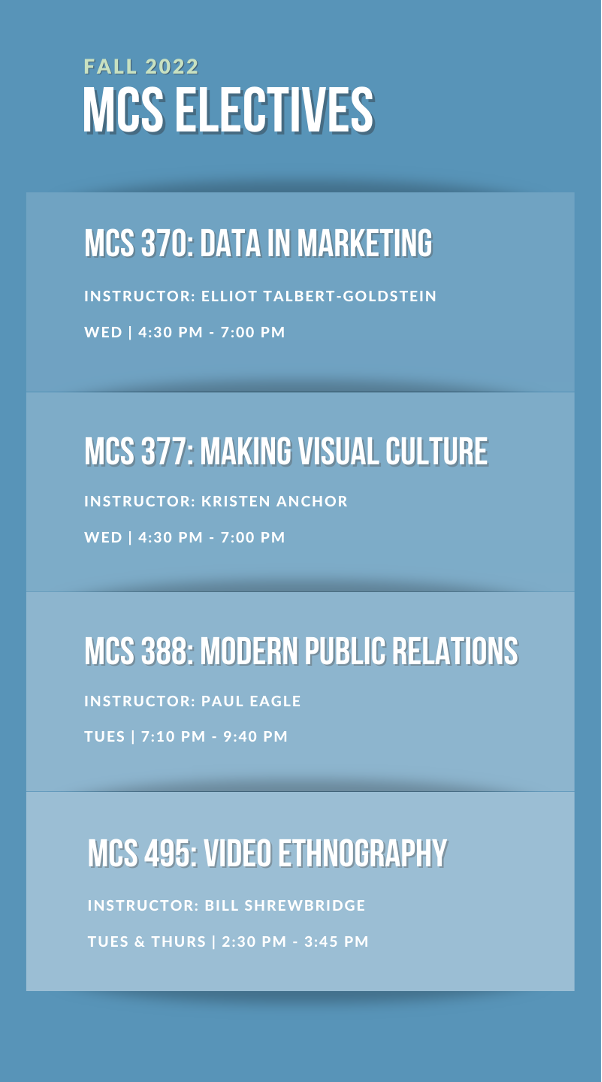
<Title>MCS Fall '22 Electives</Title>
<Body>
<![CDATA[
    <div class="html-content"><span><p><span><img src="https://mcs.umbc.edu/files/2022/05/BlogPost2_DeptNews.png" style="max-width: 100%; height: auto;"></span></p><p><span><br></span></p></span><span><p><span>By Joy Au</span></p></span><span><br></span><blockquote><span><p><span>Still looking for an elective next fall? From media theory to marketing, </span><span>MCS has a wide selection of courses that will equip you well with media literacy and communication skill sets valuable in any professional environment. While this broad array may seem overwhelming at first, I encourage you to take advantage of it and explore through media topics you may be unfamiliar with or even just slightly interested in! With any course you take with MCS, it’s never a matter of </span><span>if</span><span> it will be applicable, but just a matter of </span><span>when</span><span> — hence the reason you’ll find many UMBC scholars adding MCS as a double major to enhance their other degree. As you learn how media is woven through every aspect of society, you’ll be surprised to find how easily applicable the coursework is throughout seemingly unrelated aspects of your career and personal life. MCS 355 (Social Media: Networking) sparked my initial interest in the field of marketing and introduced the career option of social media marketing — something I hadn’t previously known existed at all; furthermore, the social media marketing campaign in MCS 355 (Social Media: Networking) definitely came in use as I proposed a rebranding project at my current job as a social media manager. All the research I’m currently doing on the westernization of Chinese food in MCS 499 (Senior Seminar) has me reconsidering a career of food journalism — something I’d previously written off. So take a look at what the MCS department has to offer, whether you’re an MCS major or not! </span></p></span></blockquote><span><br><p><span>Here’s what we have open for Fall 2022:</span></p><p><span>Visit the schedule of classes for scheduled times.</span></p><br><p><span>MCS 370 | Data in Marketing </span></p><p><span>Develop in-demand career skills for data-driven marketing through data collection &amp; research analysis as you study multidisciplinary theories and tools through information systems, economics, psychology and human-computer interaction.</span></p><br><p><span>MCS 377 | Making Visual Culture </span></p><p><span>Explore key terms and techniques of visual media production through the study of visual culture &amp; analysis and hands-on practice of professional production tools such as Adobe Suite and Wordpress.</span></p><br><p><span>MCS 388 | Modern Public Relations </span></p><p><span>Study key skills and insights of public relations engagement throughout the non-profit, corporate, and agency sectors as you analyze real-life case studies &amp; crisis communications strategies alongside industry ethics and issues.</span></p><br><p><span>MCS 495: Video Ethnography </span></p><p><span>Discover video production as a means of exploring the social world: students will gain experience in video production techniques as they collaborate with Baltimore community members in creating reflective documentaries amplifying community voices.</span></p><br><p><span>If none of these classes seem to be calling your attention or don’t fit in your schedule for next semester, it’s never too late to plan ahead! Add them to your planner — and check out some of the other MCS electives:</span></p><br><p><span>MCS 355 | Social Media: Networking &amp; Mobility</span></p><p><span>Critically engage with the growing role of social media, online networks, and mobile communication technologies in both your own personal life and the larger society you live in; through topics of social media technologies and trends, social theories, and ethics and privacy concerns, students will reflect on the role social media plays in shaping an increasingly digital society and vice versa. </span></p><br><br><p><span>MCS 366 | Podcasting </span></p><p><span>Learn to create a comprehensive podcasting experience through this course: As students learn to think critically about the media they consume and the ethics of telling other people’s stories, students will study production techniques such sound-gathering, interviewing, script writing, and audio editing towards a final product of a documentary-style audio story. </span></p><br><br><p><span>MCS 395 | Television Production</span></p><p><span>Develop your television production skills as a team member of on-campus TV productions, studying camera operations, video recording, control consoles, lighting instruments and general operating procedures.</span></p><br><p><span>Please note that the course descriptions above are only abridged versions — you may find full information regarding these courses in the official UMBC schedule of classes. </span></p><p><br></p><div><span><br></span></div></span></div>
]]>
</Body>
<Summary>By Joy Au    Still looking for an elective next fall? From media theory to marketing, MCS has a wide selection of courses that will equip you well with media literacy and communication skill sets...</Summary>
<TrackingUrl>https://beta.my.umbc.edu/api/v0/pixel/news/119370/guest@my.umbc.edu/193612031029ff52b4a7d67543b4516a/api/pixel</TrackingUrl>
<Group token="mcs">Media &amp;amp; Communication Studies</Group>
<GroupUrl>https://beta.my.umbc.edu/groups/mcs</GroupUrl>
<AvatarUrl>https://assets4-beta.my.umbc.edu/system/shared/avatars/groups/000/000/491/e2e495edc31bdc4fe9517af2ddcb3202/xsmall.png?1639004057</AvatarUrl>
<AvatarUrl size="original">https://assets1-beta.my.umbc.edu/system/shared/avatars/groups/000/000/491/e2e495edc31bdc4fe9517af2ddcb3202/original.png?1639004057</AvatarUrl>
<AvatarUrl size="xxlarge">https://assets3-beta.my.umbc.edu/system/shared/avatars/groups/000/000/491/e2e495edc31bdc4fe9517af2ddcb3202/xxlarge.png?1639004057</AvatarUrl>
<AvatarUrl size="xlarge">https://assets2-beta.my.umbc.edu/system/shared/avatars/groups/000/000/491/e2e495edc31bdc4fe9517af2ddcb3202/xlarge.png?1639004057</AvatarUrl>
<AvatarUrl size="large">https://assets4-beta.my.umbc.edu/system/shared/avatars/groups/000/000/491/e2e495edc31bdc4fe9517af2ddcb3202/large.png?1639004057</AvatarUrl>
<AvatarUrl size="medium">https://assets3-beta.my.umbc.edu/system/shared/avatars/groups/000/000/491/e2e495edc31bdc4fe9517af2ddcb3202/medium.png?1639004057</AvatarUrl>
<AvatarUrl size="small">https://assets3-beta.my.umbc.edu/system/shared/avatars/groups/000/000/491/e2e495edc31bdc4fe9517af2ddcb3202/small.png?1639004057</AvatarUrl>
<AvatarUrl size="xsmall">https://assets4-beta.my.umbc.edu/system/shared/avatars/groups/000/000/491/e2e495edc31bdc4fe9517af2ddcb3202/xsmall.png?1639004057</AvatarUrl>
<AvatarUrl size="xxsmall">https://assets1-beta.my.umbc.edu/system/shared/avatars/groups/000/000/491/e2e495edc31bdc4fe9517af2ddcb3202/xxsmall.png?1639004057</AvatarUrl>
<Sponsor>Media &amp; Communication Studies</Sponsor>
<PawCount>0</PawCount>
<CommentCount>0</CommentCount>
<CommentsAllowed>true</CommentsAllowed>
<PostedAt>Wed, 11 May 2022 14:06:57 -0400</PostedAt>
<EditAt>Wed, 11 May 2022 14:09:21 -0400</EditAt>
</NewsItem>

<NewsItem contentIssues="true" id="119161" important="false" status="posted" url="https://beta.my.umbc.edu/groups/mcs/posts/119161">
<Title>MCS Student Spotlight: Grace Bundy, &#8216;22</Title>
<Tagline>Bundy reflects on her internship, MCS, and post-grad plans</Tagline>
<Body>
<![CDATA[
    <div class="html-content"><span><p><span>by Jordan Lomax </span></p><br><p><span>Photo by Amisha Mathur</span></p><br><p><span>As someone who has always been interested in content creation, senior MCS major Grace Bundy knew that MCS would help her reach her goals. She started her internship at Further Insights, a marketing firm that handles inbound and outbound marketing for small businesses across the country, in the summer of 2021.</span></p><br><p><span>“We have around 10 or so clients that we do digital marketing for, which involves analyzing data, running ads on platforms like Google and Facebook, and then also doing social publishing for them; blog posts, pretty much, we manage anything and everything content creation,” said Bundy.</span></p><br><p><span>In her position as a Junior Account Manager, she mostly creates content and manages social media for select clients. She creates content and manages the social media for clients in a range of fields, including real estate and music. The content she makes includes graphic advertisements for social media, copywriting for blogs and written advertisements, and creating and sending emails to her clients’ subscriber lists.</span></p><br><p><span>Although she primarily works remotely, going to events that her clients are hosting or are a part of is necessary. By attending such events, she captures videos and images for the client’s social media pages, in addition to communicating with on-site staff to make sure the brand is being represented accurately as a sponsor of said event. </span></p><br><p><span>“One of the main in person events I work is with a real estate company and their monthly meetups featuring prominent guest speakers,” said Bundy. “I check people in, do on site social posting, and listen to our guest speaker in order to send out a recap email to attendees.”</span></p><br><p><span>As isolating as remote work can be, a big part of her internship is team work. There is a lot of overlap between her responsibilities and her coworkers –including creating and scheduling posts for up to four months in advance– so communication and collaboration is a necessity. “If I’m making content for a client and it’s going to be put up as an ad on Facebook, we need to make sure that [we work together] and everything’s all good.”</span></p><br><p><span>How has MCS helped her at her internship?</span></p><br><p><span>“I really like to see my skills that I’ve learned in MCS reflect into my work,” she said.</span></p><br><p><span>Bundy said that her MCS coursework has helped her in many ways at her internship. The two classes she cites as the most influential and impactful in regards to this position are MCS 377: Making Visual Culture and MCS 101: Media Literacy. 377 taught her design and how to use Adobe products and Canva, which she uses every day, and 101 gave her foundational knowledge of social media platforms.</span></p><br><p><span>She added, “I feel like in MCS 101 it was definitely a lot of discussion based stuff that we were learning and talking about, but that information has definitely been great and has reflected in my knowledge of social media platforms in general.” </span></p><br><p><span>Connections, connections, connections!</span></p><br><p><span>One of the requirements of the MCS major is to complete an internship in any MCS-related field. She was talking to her neighbor who works at Further Insights about what she is studying at UMBC and what her career outcomes are, and the neighbor came back to Bundy soon after with this internship opportunity.</span></p><br><p><span>She stressed that in order to have a successful career, making and maintaining professional connections are key. “Connections are so important,” Bundy said. The more people you know, the more ins you have anywhere.”</span></p><br><p><span>Bundy urges any MCS student looking for an internship to consider turning towards people they know, or to people they know, to find an opportunity. She also said that when searching for a job or internship, making sure you have the proper skills, certifications, and preparations for the position is extremely important.</span></p><br><p><span>“Preparing for that job with solidified skills you can bring to the company is so important,” she said. “LinkedIn is also a great spot to check for job listings and it is easy for companies to look at your skill set.”</span></p><br><p><span>What’s on the horizon for Grace?</span></p><br><p><span>For most students, the job search is the first step to take after graduation. However, Bundy’s hard work, dedication, and passion for her craft earned her a full time position at Further Insights after she graduates this spring.</span></p><br><p><span>“I am so grateful for this opportunity and am really excited to be able to dive more fully into the work I am already doing,” she concluded.</span></p><br></span></div>
]]>
</Body>
<Summary>by Jordan Lomax    Photo by Amisha Mathur   As someone who has always been interested in content creation, senior MCS major Grace Bundy knew that MCS would help her reach her goals. She started...</Summary>
<TrackingUrl>https://beta.my.umbc.edu/api/v0/pixel/news/119161/guest@my.umbc.edu/2e8f3f34d91aff6c5713a50d74f0bab9/api/pixel</TrackingUrl>
<Group token="mcs">Media &amp;amp; Communication Studies</Group>
<GroupUrl>https://beta.my.umbc.edu/groups/mcs</GroupUrl>
<AvatarUrl>https://assets4-beta.my.umbc.edu/system/shared/avatars/groups/000/000/491/e2e495edc31bdc4fe9517af2ddcb3202/xsmall.png?1639004057</AvatarUrl>
<AvatarUrl size="original">https://assets1-beta.my.umbc.edu/system/shared/avatars/groups/000/000/491/e2e495edc31bdc4fe9517af2ddcb3202/original.png?1639004057</AvatarUrl>
<AvatarUrl size="xxlarge">https://assets3-beta.my.umbc.edu/system/shared/avatars/groups/000/000/491/e2e495edc31bdc4fe9517af2ddcb3202/xxlarge.png?1639004057</AvatarUrl>
<AvatarUrl size="xlarge">https://assets2-beta.my.umbc.edu/system/shared/avatars/groups/000/000/491/e2e495edc31bdc4fe9517af2ddcb3202/xlarge.png?1639004057</AvatarUrl>
<AvatarUrl size="large">https://assets4-beta.my.umbc.edu/system/shared/avatars/groups/000/000/491/e2e495edc31bdc4fe9517af2ddcb3202/large.png?1639004057</AvatarUrl>
<AvatarUrl size="medium">https://assets3-beta.my.umbc.edu/system/shared/avatars/groups/000/000/491/e2e495edc31bdc4fe9517af2ddcb3202/medium.png?1639004057</AvatarUrl>
<AvatarUrl size="small">https://assets3-beta.my.umbc.edu/system/shared/avatars/groups/000/000/491/e2e495edc31bdc4fe9517af2ddcb3202/small.png?1639004057</AvatarUrl>
<AvatarUrl size="xsmall">https://assets4-beta.my.umbc.edu/system/shared/avatars/groups/000/000/491/e2e495edc31bdc4fe9517af2ddcb3202/xsmall.png?1639004057</AvatarUrl>
<AvatarUrl size="xxsmall">https://assets1-beta.my.umbc.edu/system/shared/avatars/groups/000/000/491/e2e495edc31bdc4fe9517af2ddcb3202/xxsmall.png?1639004057</AvatarUrl>
<Sponsor>Media &amp; Communication Studies</Sponsor>
<ThumbnailUrl size="xxlarge">https://assets4-beta.my.umbc.edu/system/shared/thumbnails/news/000/119/161/21701a7a53e7177ac4599bd5d4b2fad8/xxlarge.jpg?1651608805</ThumbnailUrl>
<ThumbnailUrl size="xlarge">https://assets4-beta.my.umbc.edu/system/shared/thumbnails/news/000/119/161/21701a7a53e7177ac4599bd5d4b2fad8/xlarge.jpg?1651608805</ThumbnailUrl>
<ThumbnailUrl size="large">https://assets4-beta.my.umbc.edu/system/shared/thumbnails/news/000/119/161/21701a7a53e7177ac4599bd5d4b2fad8/large.jpg?1651608805</ThumbnailUrl>
<ThumbnailUrl size="medium">https://assets2-beta.my.umbc.edu/system/shared/thumbnails/news/000/119/161/21701a7a53e7177ac4599bd5d4b2fad8/medium.jpg?1651608805</ThumbnailUrl>
<ThumbnailUrl size="small">https://assets1-beta.my.umbc.edu/system/shared/thumbnails/news/000/119/161/21701a7a53e7177ac4599bd5d4b2fad8/small.jpg?1651608805</ThumbnailUrl>
<ThumbnailUrl size="xsmall">https://assets2-beta.my.umbc.edu/system/shared/thumbnails/news/000/119/161/21701a7a53e7177ac4599bd5d4b2fad8/xsmall.jpg?1651608805</ThumbnailUrl>
<ThumbnailUrl size="xxsmall">https://assets2-beta.my.umbc.edu/system/shared/thumbnails/news/000/119/161/21701a7a53e7177ac4599bd5d4b2fad8/xxsmall.jpg?1651608805</ThumbnailUrl>
<PawCount>2</PawCount>
<CommentCount>0</CommentCount>
<CommentsAllowed>true</CommentsAllowed>
<PostedAt>Tue, 03 May 2022 16:17:04 -0400</PostedAt>
</NewsItem>

</News>