<?xml version="1.0"?>
<News hasArchived="false" page="1" pageCount="1" pageSize="10" timestamp="Sun, 03 May 2026 01:53:54 -0400" url="https://beta.my.umbc.edu/groups/jcet/posts.xml?tag=physics">
<NewsItem contentIssues="true" id="89659" important="false" status="posted" url="https://beta.my.umbc.edu/groups/jcet/posts/89659">
<Title>JCET Seminar Series Spring 2020</Title>
<Tagline>Application of Artificial Intelligence (AI) in Earth Science</Tagline>
<Body>
<![CDATA[
    <div class="html-content"><h6><span>The JCET Department at UMBC, led by Dr. Zhibo Zhang, is excited to
    introduce it's Spring 2020 JCET seminar series on the <strong>Application
    of Artificial Intelligence (AI) in Earth Sciences</strong>.  Theseminar series looks to provide 1) an introductory overview of the
    basic AI and “big-data” techniques; 2) hand-on experiences with AI-based
    algorithms for satellite remote sensing; 3) an outlook of cutting-edge research
    of the applications of AI in Earth Sciences. There is a
    great teaching team in place, including three professors from the Department of
    Information Systems of UMBC, two JCET faculty, and several external
    scientists/researchers. <strong>This seminar series, scheduled on Tuesdays 11:15 AM
    ~12:15 PM, will be made available online</strong> <strong>to JCET faculty working
    at GSFC through WebEx. <br></strong></span><strong><span><br></span></strong></h6><h6><strong><span>For UMBC
    graduate students</span></strong><span>: this
    seminar series will be a one-credit PHYS650-04 Special Topic Course under my
    name.<br></span><strong><span><br></span></strong></h6><h6><strong><span>For JCET
    faculty/staff</span></strong><span>: WebEx
    information will be sent out before each seminar (we are testing the recording
    system and might be able to publish the recorded lecture as well).<br></span><span><br></span></h6><h6><span>For more
    information, </span><strong>please visit the webpage for this course</strong><span>:</span></h6><h6><span><br></span></h6><h6><a href="https://mailtrack.io/trace/link/31e9b4ff51af860b80f523cbc18ced516832ed38?url=https%3A%2F%2Fsites.google.com%2Fumbc.edu%2Facros%2Fnews%2Fjcet_seminar_series_2020_on_ai&amp;userId=2047914&amp;signature=a3c92e6a1e163f08" rel="nofollow external" class="bo">https://sites.google.com/umbc.edu/acros/news/jcet_seminar_series_2020_on_ai<br></a><p><br></p><p><br></p></h6>


    <div><br></div></div>
]]>
</Body>
<Summary>The JCET Department at UMBC, led by Dr. Zhibo Zhang, is excited to introduce it's Spring 2020 JCET seminar series on the Application of Artificial Intelligence (AI) in Earth Sciences.  Theseminar...</Summary>
<Website>https://sites.google.com/umbc.edu/acros/news/jcet_seminar_series_2020_on_ai</Website>
<TrackingUrl>https://beta.my.umbc.edu/api/v0/pixel/news/89659/guest@my.umbc.edu/3ee314dca9a18db3ce5607b8c851c927/api/pixel</TrackingUrl>
<Tag>ai</Tag>
<Tag>earth</Tag>
<Tag>jcet</Tag>
<Tag>physics</Tag>
<Tag>sciences</Tag>
<Tag>seminar</Tag>
<Tag>series</Tag>
<Group token="jcet">Joint Center for Earth Systems Technology</Group>
<GroupUrl>https://beta.my.umbc.edu/groups/jcet</GroupUrl>
<AvatarUrl>https://assets2-beta.my.umbc.edu/system/shared/avatars/groups/000/000/429/5f87a3fcca7c117d0f4186749a5c6c59/xsmall.png?1524593851</AvatarUrl>
<AvatarUrl size="original">https://assets4-beta.my.umbc.edu/system/shared/avatars/groups/000/000/429/5f87a3fcca7c117d0f4186749a5c6c59/original.JPG?1524593851</AvatarUrl>
<AvatarUrl size="xxlarge">https://assets1-beta.my.umbc.edu/system/shared/avatars/groups/000/000/429/5f87a3fcca7c117d0f4186749a5c6c59/xxlarge.png?1524593851</AvatarUrl>
<AvatarUrl size="xlarge">https://assets4-beta.my.umbc.edu/system/shared/avatars/groups/000/000/429/5f87a3fcca7c117d0f4186749a5c6c59/xlarge.png?1524593851</AvatarUrl>
<AvatarUrl size="large">https://assets4-beta.my.umbc.edu/system/shared/avatars/groups/000/000/429/5f87a3fcca7c117d0f4186749a5c6c59/large.png?1524593851</AvatarUrl>
<AvatarUrl size="medium">https://assets1-beta.my.umbc.edu/system/shared/avatars/groups/000/000/429/5f87a3fcca7c117d0f4186749a5c6c59/medium.png?1524593851</AvatarUrl>
<AvatarUrl size="small">https://assets1-beta.my.umbc.edu/system/shared/avatars/groups/000/000/429/5f87a3fcca7c117d0f4186749a5c6c59/small.png?1524593851</AvatarUrl>
<AvatarUrl size="xsmall">https://assets2-beta.my.umbc.edu/system/shared/avatars/groups/000/000/429/5f87a3fcca7c117d0f4186749a5c6c59/xsmall.png?1524593851</AvatarUrl>
<AvatarUrl size="xxsmall">https://assets4-beta.my.umbc.edu/system/shared/avatars/groups/000/000/429/5f87a3fcca7c117d0f4186749a5c6c59/xxsmall.png?1524593851</AvatarUrl>
<Sponsor>Joint Center for Earth Systems Technology</Sponsor>
<ThumbnailUrl size="xxlarge">https://assets1-beta.my.umbc.edu/system/shared/thumbnails/news/000/089/659/9973d8abdcc7b2df223c5ac1cf4435a0/xxlarge.jpg?1579118598</ThumbnailUrl>
<ThumbnailUrl size="xlarge">https://assets1-beta.my.umbc.edu/system/shared/thumbnails/news/000/089/659/9973d8abdcc7b2df223c5ac1cf4435a0/xlarge.jpg?1579118598</ThumbnailUrl>
<ThumbnailUrl size="large">https://assets4-beta.my.umbc.edu/system/shared/thumbnails/news/000/089/659/9973d8abdcc7b2df223c5ac1cf4435a0/large.jpg?1579118598</ThumbnailUrl>
<ThumbnailUrl size="medium">https://assets3-beta.my.umbc.edu/system/shared/thumbnails/news/000/089/659/9973d8abdcc7b2df223c5ac1cf4435a0/medium.jpg?1579118598</ThumbnailUrl>
<ThumbnailUrl size="small">https://assets4-beta.my.umbc.edu/system/shared/thumbnails/news/000/089/659/9973d8abdcc7b2df223c5ac1cf4435a0/small.jpg?1579118598</ThumbnailUrl>
<ThumbnailUrl size="xsmall">https://assets3-beta.my.umbc.edu/system/shared/thumbnails/news/000/089/659/9973d8abdcc7b2df223c5ac1cf4435a0/xsmall.jpg?1579118598</ThumbnailUrl>
<ThumbnailUrl size="xxsmall">https://assets3-beta.my.umbc.edu/system/shared/thumbnails/news/000/089/659/9973d8abdcc7b2df223c5ac1cf4435a0/xxsmall.jpg?1579118598</ThumbnailUrl>
<PawCount>0</PawCount>
<CommentCount>0</CommentCount>
<CommentsAllowed>true</CommentsAllowed>
<PostedAt>Wed, 15 Jan 2020 15:04:05 -0500</PostedAt>
</NewsItem>

<NewsItem contentIssues="true" id="77115" important="false" status="posted" url="https://beta.my.umbc.edu/groups/jcet/posts/77115">
<Title>Lipi Mukherjee Wins Best Student Poster Award</Title>
<Tagline>Asia Oceania Geosciences Society (AOGS) 2018</Tagline>
<Body>
<![CDATA[
    <div class="html-content"><span>Lipi Mukherjee
    receives the Best Student Poster Award for Atmospheric Science Section in the
    2018 annual meeting of Asia Oceania Geosciences Society (AOGS). In addition to
    receiving an award certificate, Lipi will also receive a complimentary
    registration to attend the AOGS Annual Meeting the following year.<br>
    <br>
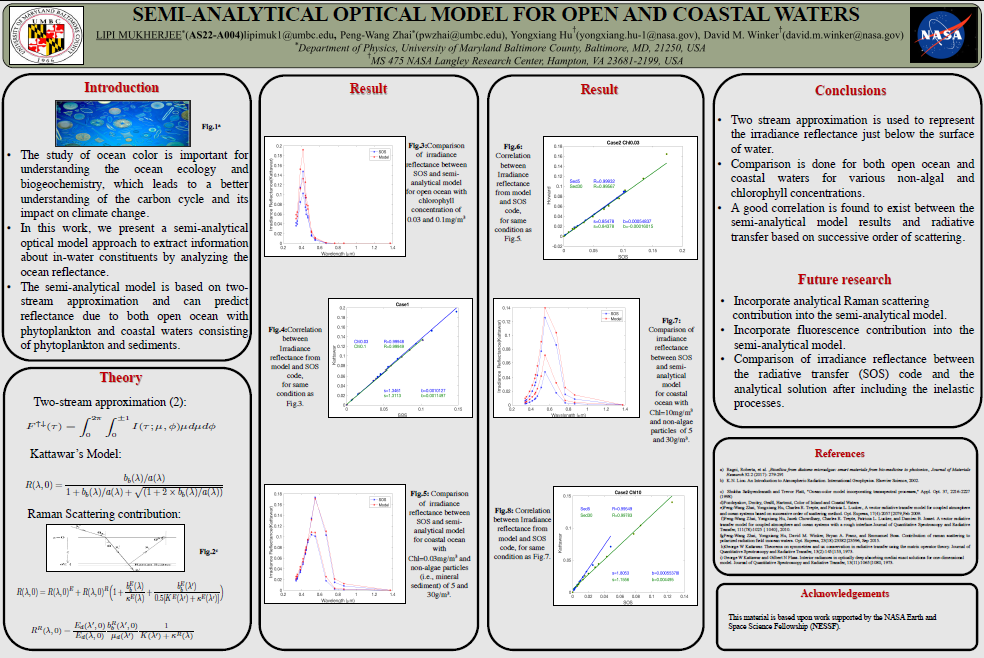
    </span><div><p><span>Summary of Work:</span></p><p><span>The study of ocean color is important for understanding the
    ocean ecology and biogeochemistry, which leads to a better understanding of the
    carbon cycle and its impact on climate change. Water leaving radiance from
    oceans, obtained from satellite sensors contains information about ocean
    constituents including sediments, phytoplankton and pollutants in water.
    Radiative transfer models can be used to interpret and extract information from
    measurement data. However, radiative transfer simulations are computationally
    expensive and generally cannot be used on the fly in the retrieval algorithms.
    In this work, we present a semi-analytical optical model approach to extract
    information about in-water constituents by analyzing the ocean reflectance. The
    model is based on two-stream approximation and can predict reflectance due to
    both open ocean with phytoplankton and coastal waters consisting of
    phytoplankton and sediments. We compare this model with the successive order of
    scattering based radiative transfer code. A good correlation was found to exist
    between the semi-analytical optical model results for both open and coastal
    waters. Major inelastic scattering contributors like Raman scattering and
    fluorescence from chlorophyll will be included in the reflectance model as part
    of the future work.</span></p><p><img src="https://jcet.umbc.edu/files/2018/06/Lipi-Mukherjee-AOGS-Poster.bmp" style="max-width: 100%; height: auto;"></p></div></div>
]]>
</Body>
<Summary>Lipi Mukherjee receives the Best Student Poster Award for Atmospheric Science Section in the 2018 annual meeting of Asia Oceania Geosciences Society (AOGS). In addition to receiving an award...</Summary>
<Website>http://www.asiaoceania.org/aogs2018/public.asp?page=posterAwards2.htm</Website>
<TrackingUrl>https://beta.my.umbc.edu/api/v0/pixel/news/77115/guest@my.umbc.edu/832baa4ecc0793de323c997c4979b80f/api/pixel</TrackingUrl>
<Tag>aogs</Tag>
<Tag>ecology</Tag>
<Tag>jcet</Tag>
<Tag>ocean</Tag>
<Tag>physics</Tag>
<Group token="jcet">Joint Center for Earth Systems Technology</Group>
<GroupUrl>https://beta.my.umbc.edu/groups/jcet</GroupUrl>
<AvatarUrl>https://assets2-beta.my.umbc.edu/system/shared/avatars/groups/000/000/429/5f87a3fcca7c117d0f4186749a5c6c59/xsmall.png?1524593851</AvatarUrl>
<AvatarUrl size="original">https://assets4-beta.my.umbc.edu/system/shared/avatars/groups/000/000/429/5f87a3fcca7c117d0f4186749a5c6c59/original.JPG?1524593851</AvatarUrl>
<AvatarUrl size="xxlarge">https://assets1-beta.my.umbc.edu/system/shared/avatars/groups/000/000/429/5f87a3fcca7c117d0f4186749a5c6c59/xxlarge.png?1524593851</AvatarUrl>
<AvatarUrl size="xlarge">https://assets4-beta.my.umbc.edu/system/shared/avatars/groups/000/000/429/5f87a3fcca7c117d0f4186749a5c6c59/xlarge.png?1524593851</AvatarUrl>
<AvatarUrl size="large">https://assets4-beta.my.umbc.edu/system/shared/avatars/groups/000/000/429/5f87a3fcca7c117d0f4186749a5c6c59/large.png?1524593851</AvatarUrl>
<AvatarUrl size="medium">https://assets1-beta.my.umbc.edu/system/shared/avatars/groups/000/000/429/5f87a3fcca7c117d0f4186749a5c6c59/medium.png?1524593851</AvatarUrl>
<AvatarUrl size="small">https://assets1-beta.my.umbc.edu/system/shared/avatars/groups/000/000/429/5f87a3fcca7c117d0f4186749a5c6c59/small.png?1524593851</AvatarUrl>
<AvatarUrl size="xsmall">https://assets2-beta.my.umbc.edu/system/shared/avatars/groups/000/000/429/5f87a3fcca7c117d0f4186749a5c6c59/xsmall.png?1524593851</AvatarUrl>
<AvatarUrl size="xxsmall">https://assets4-beta.my.umbc.edu/system/shared/avatars/groups/000/000/429/5f87a3fcca7c117d0f4186749a5c6c59/xxsmall.png?1524593851</AvatarUrl>
<Sponsor>Joint Center for Earth Systems Technology</Sponsor>
<ThumbnailUrl size="xxlarge">https://assets4-beta.my.umbc.edu/system/shared/thumbnails/news/000/077/115/6effc1ffad0d58976c4dcf7c83932330/xxlarge.jpg?1528804501</ThumbnailUrl>
<ThumbnailUrl size="xlarge">https://assets2-beta.my.umbc.edu/system/shared/thumbnails/news/000/077/115/6effc1ffad0d58976c4dcf7c83932330/xlarge.jpg?1528804501</ThumbnailUrl>
<ThumbnailUrl size="large">https://assets2-beta.my.umbc.edu/system/shared/thumbnails/news/000/077/115/6effc1ffad0d58976c4dcf7c83932330/large.jpg?1528804501</ThumbnailUrl>
<ThumbnailUrl size="medium">https://assets2-beta.my.umbc.edu/system/shared/thumbnails/news/000/077/115/6effc1ffad0d58976c4dcf7c83932330/medium.jpg?1528804501</ThumbnailUrl>
<ThumbnailUrl size="small">https://assets4-beta.my.umbc.edu/system/shared/thumbnails/news/000/077/115/6effc1ffad0d58976c4dcf7c83932330/small.jpg?1528804501</ThumbnailUrl>
<ThumbnailUrl size="xsmall">https://assets1-beta.my.umbc.edu/system/shared/thumbnails/news/000/077/115/6effc1ffad0d58976c4dcf7c83932330/xsmall.jpg?1528804501</ThumbnailUrl>
<ThumbnailUrl size="xxsmall">https://assets1-beta.my.umbc.edu/system/shared/thumbnails/news/000/077/115/6effc1ffad0d58976c4dcf7c83932330/xxsmall.jpg?1528804501</ThumbnailUrl>
<PawCount>5</PawCount>
<CommentCount>0</CommentCount>
<CommentsAllowed>true</CommentsAllowed>
<PostedAt>Tue, 12 Jun 2018 07:57:05 -0400</PostedAt>
<EditAt>Tue, 12 Jun 2018 07:59:08 -0400</EditAt>
</NewsItem>

<NewsItem contentIssues="true" id="74535" important="false" status="posted" url="https://beta.my.umbc.edu/groups/jcet/posts/74535">
<Title>UMBC Physicists' New Discovery</Title>
<Tagline>Unexpected Effect of African Wildfires on Climate</Tagline>
<Body>
<![CDATA[
    <div class="html-content"><p>Clouds play a prominent role in moderating Earth’s climate, but their role is still poorly understood. Generally, clouds cool the Earth by reflecting incoming sunlight back out into space. Reducing the clouds’ reflectivity—with a layer of pollution, for example—reduces the cooling effect. However, <a href="http://www.pnas.org/content/early/2018/02/27/1713703115" rel="nofollow external" class="bo">new research in <em>Proceedings of the National Academy of Sciences </em></a>by <strong>Zhibo Zhang</strong>, associate professor of atmospheric physics at UMBC, two of his students, and collaborators from University of Wyoming, University of Science and Technology of China, Universities Space Research Association, and University of Michigan adds another level of complexity to this model.</p><p>Every fall, fires race across central and southern Africa. Many are wildfires; others are intentionally set by humans to clear farmland. They create so much smoke that it’s clearly visible from space. Wind sweeps the smoke westward over the Atlantic Ocean, where it rises above the largest semi-permanent gathering of clouds in the world. For years, scientists believed that overall, the smoke diminishes the clouds’ cooling effect by absorbing light that the clouds beneath otherwise would reflect. The new study by Zhang and colleagues doesn’t dispute the existence of this effect, but introduces a new mechanism that counteracts it by making the clouds more reflective.</p><p>“The purpose of this paper is to look at these competing processes. Which one is more important?” asks Zhang. A previous paper by <strong>Chamara Rajapakshe</strong>, a Ph.D. candidate in Zhang’s group (the <a href="https://sites.google.com/umbc.edu/acros/home" rel="nofollow external" class="bo">UMBC ACROS group</a>) and co-author on the new paper, was crucial to answering that question. Using data from a LiDAR system on the International Space Station, Rajapakshe found that the smoke and cloud layers are much closer to each other than previously observed. That means the smoke, which is in the form of tiny particles known as aerosols, can physically interact with the clouds, affecting how they form at the microscopic level. Previous studies usually overlooked these microphysical changes caused by aerosols’ interactions with the clouds.</p><p>Clouds need “seeds” to grow. A seed can be any tiny particle around which cloud droplets condense. Aerosols are perfect for seeding clouds, and with more seeds, many small cloud droplets replace fewer large droplets, which then collectively reflect more light and increase the cooling effect.</p><p>The team found that in smoky conditions, there are almost twice as many “seeds” per cubic centimeter. By running computer simulations under different conditions, they determined that overall, “The seeding effect is winning,” Zhang says. So, contrary to long-held understanding, the overall effect of the hovering smoke on the clouds near Africa appears to be a cooling one.</p><p>Zhang is quick to point out that this result is not an argument in favor of fires. “Aerosols are a very local phenomenon, and they are also short-lived,” he says, so their cooling effects are short-lived, too. “The lifetime of carbon dioxide and other greenhouse gases,” which are released in abundance when plant material burns, “is hundreds of years.”</p><p>The team’s ultimate goal is to refine global climate models by improving how they account for clouds. Zhang’s other Ph.D. student and another co-author,<strong> Zhifeng Yang</strong>, has contributed to that effort by analyzing data collected by a satellite that stays put in the sky (rather than orbiting Earth) to get a more accurate sense of how cloud cover changes in daily cycles.</p><p>The next step is to evaluate existing climate models against the team’s new finding. “Now that we know there are two competing mechanisms, and the seeding effect is winning, we can see whether climate models consider these processes properly when they predict the weather and climate in this area,” explains Zhang.</p><p>Zhang, Rajapakshe, and Yang are excited to present their findings to the atmospheric physics community in their new paper, and to continue working in this area to further improve climate models—but the more they learn about the complexity of the processes involved, the harder it gets.</p><p>“First we had to simulate the clouds correctly. Then we had to simulate the aerosols correctly, and now we have to also simulate the interactions between them correctly,” says Zhang. “It’s becoming a much harder question to address.”</p><p>Still, they are up for the challenge. A new <a href="https://pace.gsfc.nasa.gov/" rel="nofollow external" class="bo">NASA mission called PACE</a> is expected to launch in 2020. It will be able to detect polarized light, in addition to everything LiDAR can do.</p><p>“With the new satellite you can look at things from different perspectives,” says Zhang, and develop three-dimensional models of the interactions between aerosols and clouds. “Hopefully we can look at this phenomenon even better.”</p><p>Beyond the upcoming NASA mission, what really excites Zhang and his team is the opportunity to play a role in making sure communities around the world have the best information available as they prepare for the effects of climate change.</p><p><em>Image: View from a data-collecting aircraft over the Atlantic Ocean, where a layer of smoke is visible above the clouds. (NASA/Kirk Knobelspiesse)</em></p><p><em>Related Articles:  <a href="https://phys.org/news/2018-03-physicists-interactions-clouds-unexpected-cooling.html">https://phys.org/news/2018-03-physicists-interactions-clouds-unexpected-cooling.html</a></em></p><p></p><p><a href="http://www.uwyo.edu/uw/news/2018/03/uw-researchers-lead-study-that-discovers-south-african-wildfires-create-climate-cooling.html" rel="nofollow external" class="bo">http://www.uwyo.edu/uw/news/2018/03/uw-researchers-lead-study-that-discovers-south-african-wildfires-create-climate-cooling.html</a></p><p><br></p><div><div><a href="https://news.umbc.edu/#facebook" title="Facebook" rel="nofollow external" class="bo"><span></span></a><a href="https://news.umbc.edu/#twitter" title="Twitter" rel="nofollow external" class="bo"><span></span></a><a href="https://news.umbc.edu/#linkedin" title="LinkedIn" rel="nofollow external" class="bo"><span></span></a><a href="https://www.addtoany.com/share#url=https%3A%2F%2Fnews.umbc.edu%2Fumbc-physicists-discover-unexpected-effect-of-african-wildfires-on-climate%2F&amp;title=UMBC%20physicists%20discover%20unexpected%20effect%20of%20African%20wildfires%20on%20climate" rel="nofollow external" class="bo"><span></span></a></div></div></div>
]]>
</Body>
<Summary>Clouds play a prominent role in moderating Earth’s climate, but their role is still poorly understood. Generally, clouds cool the Earth by reflecting incoming sunlight back out into space....</Summary>
<Website>https://news.umbc.edu/umbc-physicists-discover-unexpected-effect-of-african-wildfires-on-climate/</Website>
<TrackingUrl>https://beta.my.umbc.edu/api/v0/pixel/news/74535/guest@my.umbc.edu/a68c03877712436ba3661919ee33dc39/api/pixel</TrackingUrl>
<Tag>african</Tag>
<Tag>climate</Tag>
<Tag>discovery</Tag>
<Tag>effect</Tag>
<Tag>physics</Tag>
<Tag>wildfires</Tag>
<Group token="jcet">Joint Center for Earth Systems Technology</Group>
<GroupUrl>https://beta.my.umbc.edu/groups/jcet</GroupUrl>
<AvatarUrl>https://assets2-beta.my.umbc.edu/system/shared/avatars/groups/000/000/429/5f87a3fcca7c117d0f4186749a5c6c59/xsmall.png?1524593851</AvatarUrl>
<AvatarUrl size="original">https://assets4-beta.my.umbc.edu/system/shared/avatars/groups/000/000/429/5f87a3fcca7c117d0f4186749a5c6c59/original.JPG?1524593851</AvatarUrl>
<AvatarUrl size="xxlarge">https://assets1-beta.my.umbc.edu/system/shared/avatars/groups/000/000/429/5f87a3fcca7c117d0f4186749a5c6c59/xxlarge.png?1524593851</AvatarUrl>
<AvatarUrl size="xlarge">https://assets4-beta.my.umbc.edu/system/shared/avatars/groups/000/000/429/5f87a3fcca7c117d0f4186749a5c6c59/xlarge.png?1524593851</AvatarUrl>
<AvatarUrl size="large">https://assets4-beta.my.umbc.edu/system/shared/avatars/groups/000/000/429/5f87a3fcca7c117d0f4186749a5c6c59/large.png?1524593851</AvatarUrl>
<AvatarUrl size="medium">https://assets1-beta.my.umbc.edu/system/shared/avatars/groups/000/000/429/5f87a3fcca7c117d0f4186749a5c6c59/medium.png?1524593851</AvatarUrl>
<AvatarUrl size="small">https://assets1-beta.my.umbc.edu/system/shared/avatars/groups/000/000/429/5f87a3fcca7c117d0f4186749a5c6c59/small.png?1524593851</AvatarUrl>
<AvatarUrl size="xsmall">https://assets2-beta.my.umbc.edu/system/shared/avatars/groups/000/000/429/5f87a3fcca7c117d0f4186749a5c6c59/xsmall.png?1524593851</AvatarUrl>
<AvatarUrl size="xxsmall">https://assets4-beta.my.umbc.edu/system/shared/avatars/groups/000/000/429/5f87a3fcca7c117d0f4186749a5c6c59/xxsmall.png?1524593851</AvatarUrl>
<Sponsor>Joint Center for Earth Systems Technology</Sponsor>
<ThumbnailUrl size="xxlarge">https://assets2-beta.my.umbc.edu/system/shared/thumbnails/news/000/074/535/edfa0dea401c63103b072fd358c1d702/xxlarge.jpg?1520286835</ThumbnailUrl>
<ThumbnailUrl size="xlarge">https://assets2-beta.my.umbc.edu/system/shared/thumbnails/news/000/074/535/edfa0dea401c63103b072fd358c1d702/xlarge.jpg?1520286835</ThumbnailUrl>
<ThumbnailUrl size="large">https://assets3-beta.my.umbc.edu/system/shared/thumbnails/news/000/074/535/edfa0dea401c63103b072fd358c1d702/large.jpg?1520286835</ThumbnailUrl>
<ThumbnailUrl size="medium">https://assets4-beta.my.umbc.edu/system/shared/thumbnails/news/000/074/535/edfa0dea401c63103b072fd358c1d702/medium.jpg?1520286835</ThumbnailUrl>
<ThumbnailUrl size="small">https://assets2-beta.my.umbc.edu/system/shared/thumbnails/news/000/074/535/edfa0dea401c63103b072fd358c1d702/small.jpg?1520286835</ThumbnailUrl>
<ThumbnailUrl size="xsmall">https://assets2-beta.my.umbc.edu/system/shared/thumbnails/news/000/074/535/edfa0dea401c63103b072fd358c1d702/xsmall.jpg?1520286835</ThumbnailUrl>
<ThumbnailUrl size="xxsmall">https://assets2-beta.my.umbc.edu/system/shared/thumbnails/news/000/074/535/edfa0dea401c63103b072fd358c1d702/xxsmall.jpg?1520286835</ThumbnailUrl>
<PawCount>1</PawCount>
<CommentCount>0</CommentCount>
<CommentsAllowed>true</CommentsAllowed>
<PostedAt>Mon, 05 Mar 2018 16:59:31 -0500</PostedAt>
<EditAt>Mon, 26 Mar 2018 15:04:57 -0400</EditAt>
</NewsItem>

</News>