UMBC volleyball wins third-consecutive America East championship

UMBC volleyball continued their hot streak, capturing their third-consecutive America East championship title over the weekend. The second-seeded Retrievers defeated Bryant in four sets before sweeping fourth-seeded University of New Hampshire in three sets on the road for the Championship, cementing UMBC’s fifth NCAA appearance in program history.
It’s Sweep-Victory for UMBC Earning their Third-Straight #AEVB Title! Learn more about today's #AEVB Championship Game below!
]]>
UMBC volleyball continued their hot streak, capturing their third-consecutive America East championship title over the weekend. The second-seeded Retrievers defeated Bryant in four sets before...
https://umbc.edu/stories/umbc-volleyball-wins-third-consecutive-america-east-championship/
https://beta.my.umbc.edu/api/v0/pixel/news/129378/guest@my.umbc.edu/040b563894c3c5d789c018c9d0c6d4c0/api/pixel
athletics
cahss
cnms
community
news
UMBC News & Magazine
https://beta.my.umbc.edu/groups/umbc-news-magazine
https://assets1-beta.my.umbc.edu/system/shared/avatars/groups/000/001/943/24435aa6207c452e7bc15cc74b42c7bb/xsmall.png?1748556657
https://assets1-beta.my.umbc.edu/system/shared/avatars/groups/000/001/943/24435aa6207c452e7bc15cc74b42c7bb/original.png?1748556657
https://assets2-beta.my.umbc.edu/system/shared/avatars/groups/000/001/943/24435aa6207c452e7bc15cc74b42c7bb/xxlarge.png?1748556657
https://assets2-beta.my.umbc.edu/system/shared/avatars/groups/000/001/943/24435aa6207c452e7bc15cc74b42c7bb/xlarge.png?1748556657
https://assets3-beta.my.umbc.edu/system/shared/avatars/groups/000/001/943/24435aa6207c452e7bc15cc74b42c7bb/large.png?1748556657
https://assets1-beta.my.umbc.edu/system/shared/avatars/groups/000/001/943/24435aa6207c452e7bc15cc74b42c7bb/medium.png?1748556657
https://assets2-beta.my.umbc.edu/system/shared/avatars/groups/000/001/943/24435aa6207c452e7bc15cc74b42c7bb/small.png?1748556657
https://assets1-beta.my.umbc.edu/system/shared/avatars/groups/000/001/943/24435aa6207c452e7bc15cc74b42c7bb/xsmall.png?1748556657
https://assets2-beta.my.umbc.edu/system/shared/avatars/groups/000/001/943/24435aa6207c452e7bc15cc74b42c7bb/xxsmall.png?1748556657
UMBC News & Magazine
3
0
false
Wed, 23 Nov 2022 12:01:08 -0500
Wed, 23 Nov 2022 12:01:08 -0500
Meet a Retriever — Maria Bruno ’19, social work

Meet Maria Bruno ’19, social work, a first-generation college student who transferred to UMBC at The Universities at Shady Grove from Montgomery College. Currently working as a mental health specialist, Maria kept herself busy at UMBC as a peer navigator and the president of the Social Work Club. Thanks for sharing your story, Maria!
Q: What’s one thing you’d like people to know about studying at UMBC at the Universities at Shady Grove?
A: That UMBC truly cares about its students. And that UMBC professors and staff are always supportive.
Q: Why did you decide to study social work?
A: I decided to study social work for a variety of reasons. My passion to help others has been part of me for as long as I can remember. I had a desire to give back to the community. My experiences working with social workers in the past lead me to understand the importance of the social work role. There is much work to do in this field with a variety of areas that can benefit from the social work practice.
I graduated in May of 2022 from University of Maryland, Baltimore with my master’s in social work and plan to further my education next year. Currently, I work with Sheppard Pratt in the School and Community Youth Services Division at Winston Churchill High School as a Mental Health Specialist. I love this position working with adolescents. They are my favorite population to work with and I learn something new every day from them.
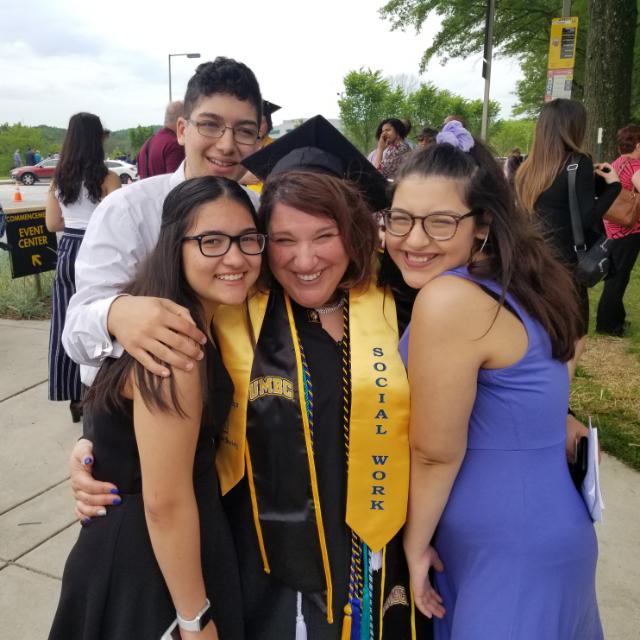 Maria Bruno ’19, social work, center, celebrates her graduation from UMBC with her children, Eugene Chirikov, Julia Chirikov, and Sofia Chirikov. Photo courtesy of Bruno.
UMBC professors and staff are always supportive.
Maria Bruno ’19, social work
Q: Tell us about someone who has supported you at UMBC.
A: Chelsea Moyer (director of UMBC at the Universities at Shady Grove) has been a mentor and supportive of my journey since day one. And all the professors, including Katie Morris (Ph.D. ’21, language, literacy, and culture) and Chelsea Moyer, have been supportive and helped direct me toward realizing my dreams.
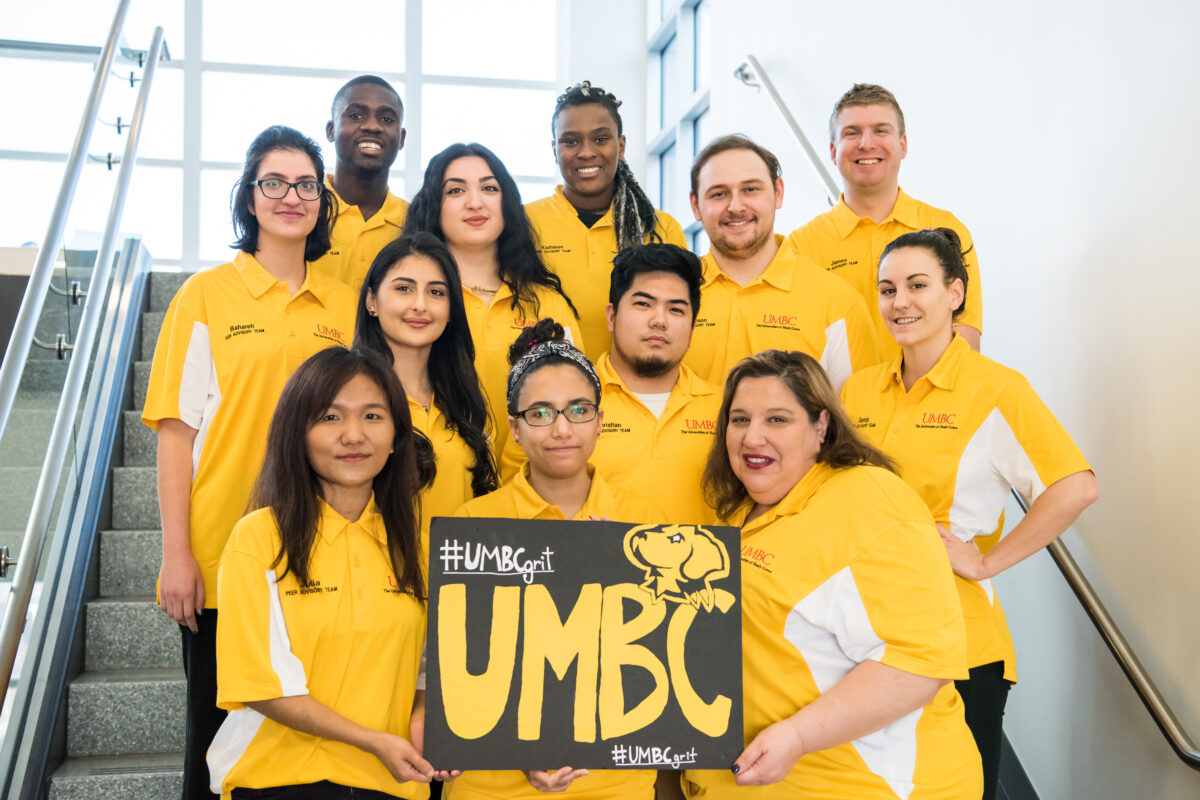 Maria Bruno, bottom right, with other students at Shady Grove. (Marlayna Demond ’11/UMBC)
Q: Can you talk about being a first-generation college student, and the support systems you’ve found at USG?
A: I never knew what the importance of being first-generation was until I was at UMBC. All my life I struggled with school. My first language was Sicilian and my parents were unable to help me with homework. Neither of my parents had higher than a sixth grade education. I wish I had as much support in my younger years of school as I did in higher ed. USG has a wealth of support systems that I utilized. The writing department was one of my biggest support systems. English grammar has been difficult for as long as I can remember and having someone to help support me when it came to writing papers was amazing! It would take hours and hours to explain how fortunate I have been to have attended UMBC at USG! I am so grateful for the best experience of my higher education.
* * * * *
UMBC’s greatest strength is its people. When people meet Retrievers and hear about the passion they bring, the relationships they create, the ways they support each other, and the commitment they have to inclusive excellence, they truly get a sense of our community. That’s what “Meet a Retriever” is all about.
Learn more about how UMBC can help you achieve your goals.
]]>
Meet Maria Bruno ’19, social work, a first-generation college student who transferred to UMBC at The Universities at Shady Grove from Montgomery College. Currently working as a mental health...
https://umbc.edu/stories/meet-a-retriever-maria-bruno-19-social-work/
https://beta.my.umbc.edu/api/v0/pixel/news/129399/guest@my.umbc.edu/b6f5f8ac0629e13ffa0a81dde196eb1e/api/pixel
alumni
impact
magazine
meet-a-retriever
perspectives
socialwork
universities-at-shady-grove
UMBC News & Magazine
https://beta.my.umbc.edu/groups/umbc-news-magazine
https://assets1-beta.my.umbc.edu/system/shared/avatars/groups/000/001/943/24435aa6207c452e7bc15cc74b42c7bb/xsmall.png?1748556657
https://assets1-beta.my.umbc.edu/system/shared/avatars/groups/000/001/943/24435aa6207c452e7bc15cc74b42c7bb/original.png?1748556657
https://assets2-beta.my.umbc.edu/system/shared/avatars/groups/000/001/943/24435aa6207c452e7bc15cc74b42c7bb/xxlarge.png?1748556657
https://assets2-beta.my.umbc.edu/system/shared/avatars/groups/000/001/943/24435aa6207c452e7bc15cc74b42c7bb/xlarge.png?1748556657
https://assets3-beta.my.umbc.edu/system/shared/avatars/groups/000/001/943/24435aa6207c452e7bc15cc74b42c7bb/large.png?1748556657
https://assets1-beta.my.umbc.edu/system/shared/avatars/groups/000/001/943/24435aa6207c452e7bc15cc74b42c7bb/medium.png?1748556657
https://assets2-beta.my.umbc.edu/system/shared/avatars/groups/000/001/943/24435aa6207c452e7bc15cc74b42c7bb/small.png?1748556657
https://assets1-beta.my.umbc.edu/system/shared/avatars/groups/000/001/943/24435aa6207c452e7bc15cc74b42c7bb/xsmall.png?1748556657
https://assets2-beta.my.umbc.edu/system/shared/avatars/groups/000/001/943/24435aa6207c452e7bc15cc74b42c7bb/xxsmall.png?1748556657
UMBC News & Magazine
0
0
false
Wed, 23 Nov 2022 10:52:38 -0500
Wed, 23 Nov 2022 10:52:38 -0500
Meet a Retriever — Phil Shockley ’04, M.P.P. ’09
Meet UMBC Retriever Phil Shockley ’04, political science and information systems, M.P.P. ’09. As an undergraduate, he was Student Government Association president and took part in leadership roles on and off campus, as well as interesting internships, and as an alum and donor he continues to engage and give back to his alma mater. He’s made a UMBC education even more accessible to others by endowing a scholarship in honor of his parents. Thanks for sharing your story, Phil!
Q: What’s one thing you’d want people to know about you?
A: I was raised on a family farm and while I did not appreciate the advantage of that gift when I was growing up, I now fully embrace the lessons it taught and wish everyone could experience just one summer working on a farm. I believe their outlook would completely change.
Q: How did you wind up at UMBC?
A: I was unfamiliar with UMBC until my high school guidance counselor encouraged me to consider it. I looked into the university and found myself impressed with its many accomplishments. Since it was not too far from where I lived on the Lower Eastern Shore of Maryland, I signed up for admissions event for prospective students. I had planned to go further away to school. I vividly remember walking on campus for the first time and being welcomed by the Admissions folks. Lori Smith-Watson ’85 will always stand out to me (I believe she was either from the Eastern Shore or had a connection to the place where I grew up). Later as I toured around campus, there was discussion about the many new buildings popping up including The Commons, which at that point, was not yet complete. That first encounter was a life changing experience, and I knew then UMBC was meant for me.
UMBC is special to me for countless reasons, but if I had to single out one area, I would say I felt like I was able to come into my own for the first time in my life. People genuinely respected what I had to offer and encouraged me to take on leadership roles all while demonstrating moral character and ethical conduct. There were many experiences that I had, including: working as a student for a department on campus and learning about the importance of alumni and corporate engagement; being elected a senator and then president of the Student Government Association; serving as an ambassador for the Office of Admissions, giving tours and introducing students to the campus; and serving as the student regent for the University System of Maryland my senior year. Nothing happens in a vacuum and the genuine support I felt at every turn cannot be understated.
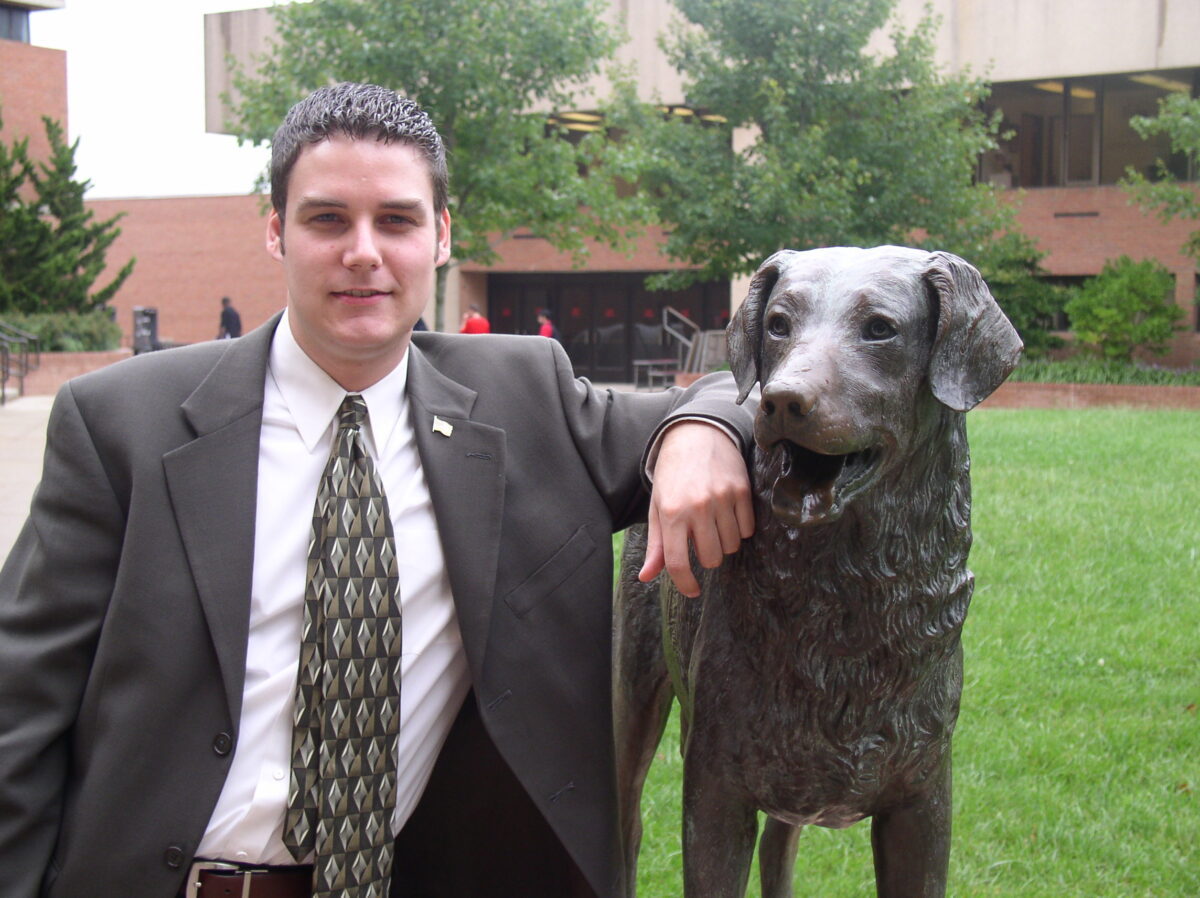 Shockley poses with True Grit in November 2003 after being name student regent. Photo courtesy of Shockley.
Q: What did you love most about your programs of study?
A: My academic programs were varied and each fulfilled me in very different ways. The information systems management program tapped into my love of technology while solidifying the importance of a plan and process—key traits that would serve me well in both my career and my life. The political science program nurtured my interest in politics and government. It showed me how government can truly be a force for good.
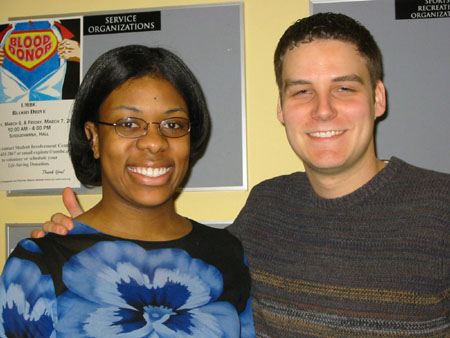 Shockley and fellow SGA officer Ada Orie in The Commons, 2003. Photo courtesy of Shockley.
Q: Were there any ways that UMBC particularly helped support you as a student?
A: I was incredibly fortunate that after enrolling at UMBC, I was offered the opportunity to compete against a small group of students for one of two full scholarships through a new gift to the school by the T. Rowe Price Foundation. I never imagined I’d get selected and with it came the opportunity for a summer internship. For a kid raised in rural Maryland on a farm, it was quite an experience. Growing up, I was most certainly not the popular kid. I had poofy hair, big glasses, and braces at a young age. Not to mention, I was laser-focused on my studies and was not blessed with any athletic ability. In high school, I ran each year for student government positions to no avail. UMBC was first place I truly felt like I was given the opportunity to try my leadership skills and mentored by others to grow and develop them.
This growth led to an introduction to John Erickson, founder of Erickson Retirement Communities (now Erickson Senior Living) by former UMBC President Dr. Freeman Hrabowski. Erickson was working on instituting information technology products throughout their healthcare business which was ahead of the time for the industry, and were looking for those majoring in these fields. I never though I’d work for a company whose focus was senior housing and healthcare, but John was charming and persuasive. Dr. Hrabowski spoke very highly of his commitment to UMBC through his many gifts to help build new residence halls on campus. This introduction turned into a career that gave me a deep sense of meaning knowing that I was able to help older adults continue to live a life of significance, as they aged, that was valued up until the very end. John was instrumental in providing support and guidance as I branched out within the company and relocated to several different locations around the country for new opportunities.
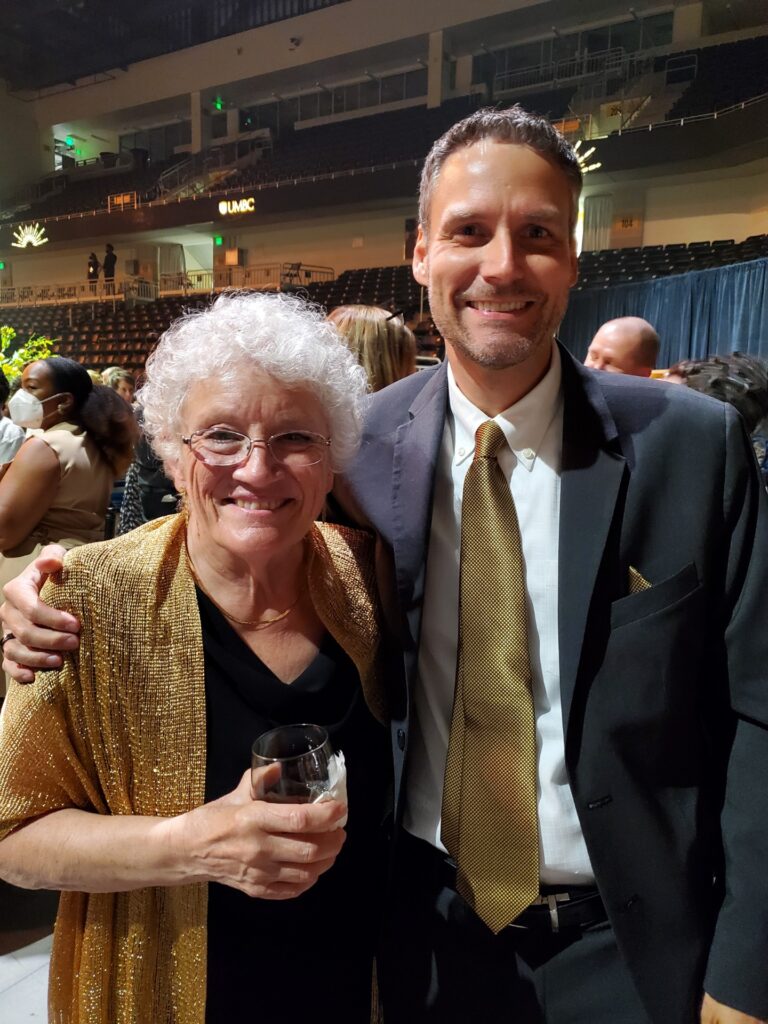
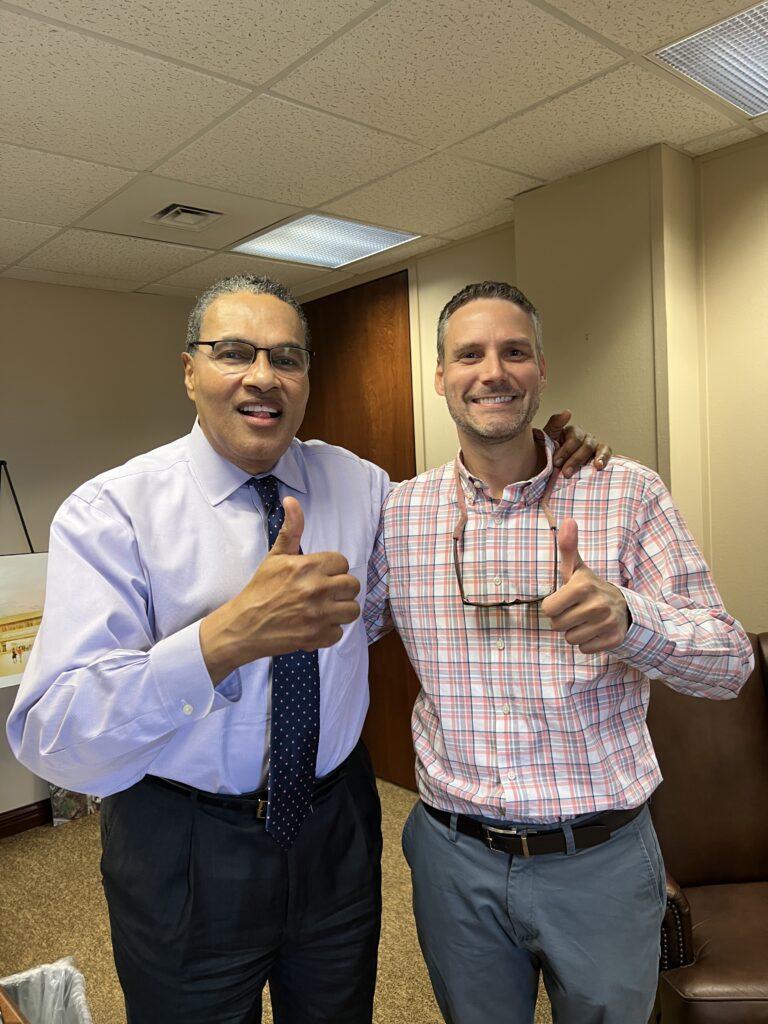 At left, Shockley with retired Vice Provost and Dean of Undergraduate Education Diane Lee. At right, Shockley with President Emeritus Freeman Hrabowski. Photos courtesy of Shockley.
Q: Why did you choose UMBC for your philanthropy?
A: My sister and I were the first to go to college and I wanted others to be able to have that experience, too. We were very fortunate in that the financial cost was not an obstacle to either of us being able to pursue our dreams. I never considered not going to college—that was just the plan from an early age and it was clear that’s what my family was going to make happen if it was what I wanted and I had the aptitude.
UMBC will always have a deeply special place in my heart. From the moment I first stepped onto campus, I remember the incredible feelings of being welcomed to UMBC. There was such excitement and energy and I wanted to be a part of it. As a freshman, I worked in the Office of Institutional Advancement (OIA) for some of the same folks that partner with me today in giving back. The varied experiences I had as a student worker in OIA opened my eyes to the importance of alumni engagement and giving. As my time at UMBC progressed, I found myself very involved in both on and off campus leadership activities that I could never have imaged. One of my proudest moments was being able to serve as the student regent on the University System of Maryland’s (USM) Board of Regents, a Gubernatorial appointment. Being able to make a difference on behalf of all the students that made up the USM was an honor. Through my gifts, I want to provide opportunities for students, particularly from the Lower Eastern Shore of Maryland, to be able to attend UMBC and explore the plethora of opportunities open to them.
I started and continue to support the Shockley Family Scholarship in honor of my parents, David and Sandra Shockley. I intend to start an additional scholarship for my maternal grandparents, Sam and Bertha Rothenstein, in the future.
Q: What’s one thing you’d want folks to know about UMBC?
A: Anyone and everyone is welcome. No matter your background or where you were raised, UMBC will support, nurture, and help you share your gifts with the community as a whole. It is this diversity of individuals, experiences, and talents that make the university such a remarkable place.
* * * * *
UMBC’s greatest strength is its people. When people meet Retrievers and hear about the passion they bring, the relationships they create, the ways they support each other, and the commitment they have to inclusive excellence, they truly get a sense of our community. That’s what “Meet a Retriever” is all about.
Learn more about how UMBC can help you achieve your goals.
]]>
Meet UMBC Retriever Phil Shockley ’04, political science and information systems, M.P.P. ’09. As an undergraduate, he was Student Government Association president and took part in leadership roles...
https://umbc.edu/stories/meet-a-retriever-phil-shockley-04-m-p-p-09/
https://beta.my.umbc.edu/api/v0/pixel/news/129349/guest@my.umbc.edu/a76d87ae7329daf8a5828cca15ae9aad/api/pixel
impact
information-systems
magazine
meet-a-retriever
perspectives
politicalscience
publicpolicy
sga
UMBC News & Magazine
https://beta.my.umbc.edu/groups/umbc-news-magazine
https://assets1-beta.my.umbc.edu/system/shared/avatars/groups/000/001/943/24435aa6207c452e7bc15cc74b42c7bb/xsmall.png?1748556657
https://assets1-beta.my.umbc.edu/system/shared/avatars/groups/000/001/943/24435aa6207c452e7bc15cc74b42c7bb/original.png?1748556657
https://assets2-beta.my.umbc.edu/system/shared/avatars/groups/000/001/943/24435aa6207c452e7bc15cc74b42c7bb/xxlarge.png?1748556657
https://assets2-beta.my.umbc.edu/system/shared/avatars/groups/000/001/943/24435aa6207c452e7bc15cc74b42c7bb/xlarge.png?1748556657
https://assets3-beta.my.umbc.edu/system/shared/avatars/groups/000/001/943/24435aa6207c452e7bc15cc74b42c7bb/large.png?1748556657
https://assets1-beta.my.umbc.edu/system/shared/avatars/groups/000/001/943/24435aa6207c452e7bc15cc74b42c7bb/medium.png?1748556657
https://assets2-beta.my.umbc.edu/system/shared/avatars/groups/000/001/943/24435aa6207c452e7bc15cc74b42c7bb/small.png?1748556657
https://assets1-beta.my.umbc.edu/system/shared/avatars/groups/000/001/943/24435aa6207c452e7bc15cc74b42c7bb/xsmall.png?1748556657
https://assets2-beta.my.umbc.edu/system/shared/avatars/groups/000/001/943/24435aa6207c452e7bc15cc74b42c7bb/xxsmall.png?1748556657
UMBC News & Magazine
0
0
false
Thu, 17 Nov 2022 15:38:37 -0500
Thu, 17 Nov 2022 15:38:37 -0500
UMBC chemical engineering students win ChemE Jeopardy national championship
UMBC is again a national champion, now in ChemE Jeopardy. A UMBC student team of chemical engineering majors emerged victorious last weekend at the national competition in Phoenix, Arizona, hosted by the American Institute of Chemical Engineers (AIChE), besting fellow finalists University of Iowa and University of Southern California.
This was a long-sought victory for the team, which won second place in both 2020 and 2021, narrowly missing the title. This ascent is particularly remarkable considering that UMBC only began competing in 2019.
The ChemE Jeopardy competition experience
Members of the 2022 national champion team include Catherine Wraback ’23, president of the UMBC chapter of AIChE; Max Bobbin ’23, vice president of the group; Colin Jones ’25; and Pavan Umashankar ’24. Supporting the team are Jeopardy Chair Taylor DeSilva ‘23, chemical engineering, and AIChE chapter advisor Mariajosé Castellanos, undergraduate program director and principal lecturer in chemical biochemical, and environmental engineering (CBEE).
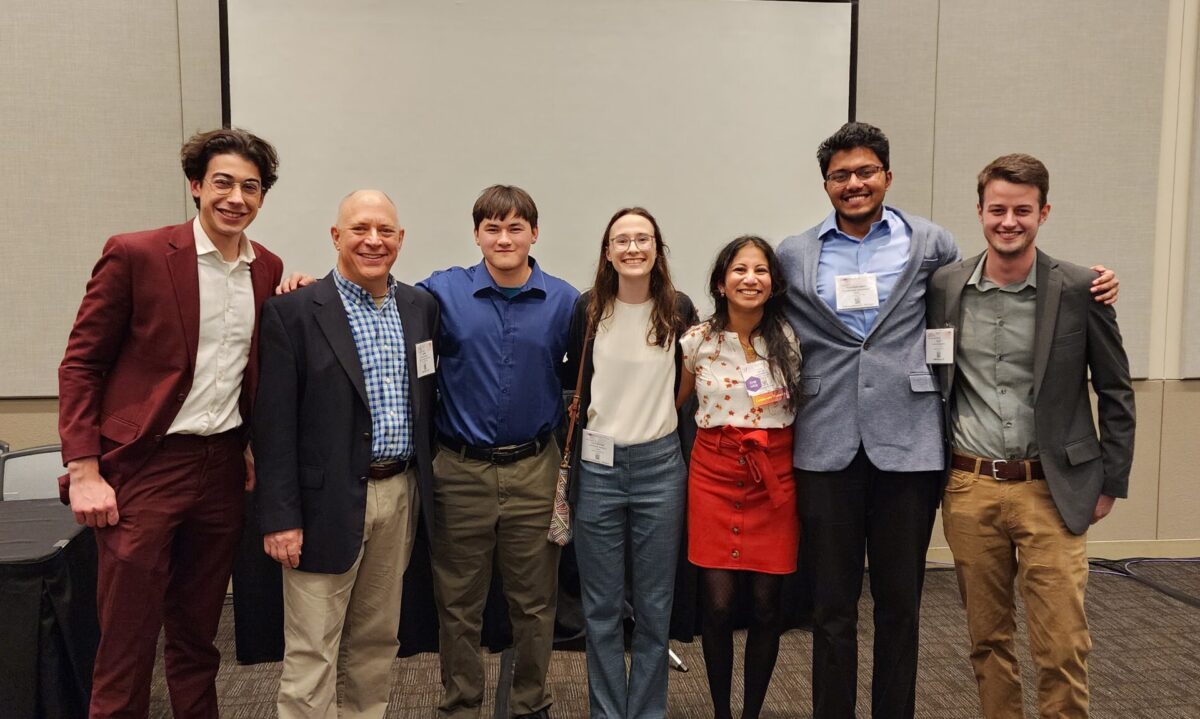 UMBC’s Chemical Engineering Jeopardy National Championship team and supporters (l-r): Max Bobbin, CBEE Professor and Chair Mark Marten, Colin Jones, Catherine Wraback, Lecturer Neha Raikar (team advisor), Pavan Umashankar, and Alex Von Gunten ’20, chemical engineering (prior team member). (Image courtesy of CBEE)
“This was my first time attending the national competition,” says Wraback. “Walking into the room and seeing three tables set-up (one for each team) with all the buzzers and scratch paper and pencil, was an unparalleled feeling.” Wraback explains that each competition board consists of six categories, drawing from core engineering courses (such as thermodynamics and heat and mass transfer), general science and math (such as organic chemistry and linear algebra), and general knowledge.
“You can feel the energy in the room with the other teams and it is contagious,” she says. In particular, she appreciated the support her team had in the packed competition room, from UMBC faculty to students she had met at the conference who came with their classmates to cheer for the team.
And UMBC students who couldn’t join them in Phoenix were supporting them through well wishes in their Discord server. “It made us feel supported and empowered,” says Wraback.
Road to the finals
“The students practiced extensively in preparation for the finals,” says team advisor Neha Raikar, lecturer in CBEE. This included not just studying technical content, but also building trust, bonding as a team, and prioritizing communication with each other.
“The team is well-balanced,” Raikar notes. “Members range from second-year students to seniors, representing all three CBEE tracks: traditional, biotechnology and bioengineering, and environmental engineering and sustainability. They play to each other’s strengths.”
Wraback agrees, sharing, “The most challenging part of being on the team has been understanding that it is okay not to know everything. I never want to let any of my team members down, but I also know that we all have our unique strengths, which overall makes us an incredibly strong team.”
That team’s sense of connection came through in the final round of competition. “As the answers were revealed, we found out we were the only team to get the question right so it really came down to the wagers we put,” Wraback recalls.
“I remember grabbing the hands of my teammates as we waited for the wagers to be revealed,” she says. “In an instant we saw the final scores and that we won by 200 points—such a close game. We all cheered and screamed and were just in absolute shock. It was so exciting, especially since we have been working so hard for this for so long.”
Making a name for themselves
On the path to victory, UMBC at one point bested Virginia Tech with a score of 7,100 to 63. “We compete against top schools at both regional and national levels, which shows the strength of UMBC’s chemical engineering program and our students’ fighting spirit,” says Raikar. “Even though we are a relatively small department, we pose a challenge to bigger schools.”
That’s in large part thanks to UMBC’s supportive community, says Wraback, who, after graduation, will help develop next-generation flight technology and aerospace systems at GE Aerospace, while also pursuing a master’s degree in materials science and engineering. She notes, “I truly believe that behind every successful person and team there is a community that is lifting them up and supporting them.”
In just a few years of national competition, the team has already made a name for itself. The competition’s organizing committee projected UMBC to be a finalist, and other universities are now reaching out to collaborate.
]]>
UMBC is again a national champion, now in ChemE Jeopardy. A UMBC student team of chemical engineering majors emerged victorious last weekend at the national competition in Phoenix, Arizona, hosted...
https://umbc.edu/stories/umbc-chemical-engineering-students-win-cheme-jeopardy-national-championship/
https://beta.my.umbc.edu/api/v0/pixel/news/129275/guest@my.umbc.edu/57814825f9301be8f2856a1608d66a32/api/pixel
cbee
coeit
news
science-and-tech
UMBC News & Magazine
https://beta.my.umbc.edu/groups/umbc-news-magazine
https://assets1-beta.my.umbc.edu/system/shared/avatars/groups/000/001/943/24435aa6207c452e7bc15cc74b42c7bb/xsmall.png?1748556657
https://assets1-beta.my.umbc.edu/system/shared/avatars/groups/000/001/943/24435aa6207c452e7bc15cc74b42c7bb/original.png?1748556657
https://assets2-beta.my.umbc.edu/system/shared/avatars/groups/000/001/943/24435aa6207c452e7bc15cc74b42c7bb/xxlarge.png?1748556657
https://assets2-beta.my.umbc.edu/system/shared/avatars/groups/000/001/943/24435aa6207c452e7bc15cc74b42c7bb/xlarge.png?1748556657
https://assets3-beta.my.umbc.edu/system/shared/avatars/groups/000/001/943/24435aa6207c452e7bc15cc74b42c7bb/large.png?1748556657
https://assets1-beta.my.umbc.edu/system/shared/avatars/groups/000/001/943/24435aa6207c452e7bc15cc74b42c7bb/medium.png?1748556657
https://assets2-beta.my.umbc.edu/system/shared/avatars/groups/000/001/943/24435aa6207c452e7bc15cc74b42c7bb/small.png?1748556657
https://assets1-beta.my.umbc.edu/system/shared/avatars/groups/000/001/943/24435aa6207c452e7bc15cc74b42c7bb/xsmall.png?1748556657
https://assets2-beta.my.umbc.edu/system/shared/avatars/groups/000/001/943/24435aa6207c452e7bc15cc74b42c7bb/xxsmall.png?1748556657
UMBC News & Magazine
0
0
false
Thu, 17 Nov 2022 10:15:50 -0500
Thu, 17 Nov 2022 10:15:50 -0500
Influx of students from India drives US college enrollment up, but the number of students from China is down

David L. Di Maria, Associate Vice Provost for International Education, UMBC.
India is up. China is down. Very few U.S. students studied abroad during the first year of the pandemic.
Those three points, in a nutshell, represent key findings from recent data released jointly on Nov. 14, 2022, by the U.S. Department of State and the Institute of International Education.
The “Open Doors Report on International Educational Exchange” is published each year at the start of International Education Week. It provides detailed insights regarding study abroad and international students.
Rise in virtual study abroad
This year’s report shows a 91% decline in the total number of U.S. students who studied abroad during the 2020-2021 academic year. The pandemic also led colleges to develop more online global learning opportunities. In fact, 62% of colleges offered virtual internships with multinational companies, collaborative online coursework with students abroad and other experiences.
While virtual learning cannot replace the immersive experiences of study abroad, it can expand access to other cultures and international perspectives for greater numbers of students. For this reason, technology is likely to continue to serve as a key part of international education programming.
Number of international students grows in the US
While the COVID-19 pandemic contributed to a 45.6% decline in new international students in 2020, the latest data, covering the 2021-2022 academic year, indicates that the total number of international students in the U.S. – 948,519 – has started to recover. This can be seen in a 3.8% increase over the 914,095 international students in the U.S. in 2020. Still, the number is well below the nearly 1.1 million international students reported in 2018. Much of the recent growth is driven by an increase in the number of new international students – 261,961 – which is up 80% over the 145,528 from 2020 but still 2.14% below the 267,712 from 2019.
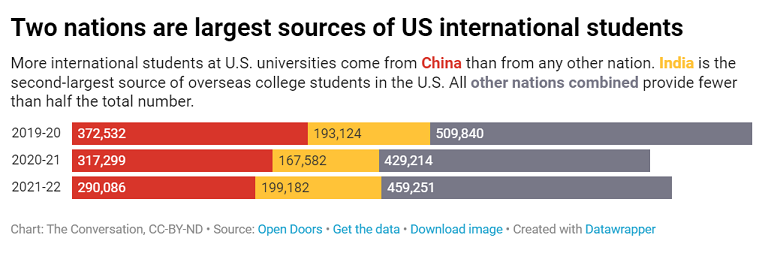
Students from China and India comprise more than half – 52% – of all international students. That isn’t anything new, but what is noteworthy is that during the 2021-2022 academic year, Chinese student enrollment fell 9% and the number of Indian students increased by 19% over the prior year. This has big implications for international diversity at U.S. colleges. This is because Chinese students tend to enroll in a range of majors, while most Indian students – 66.4% – study in just a handful of programs: engineering, math and computer science.
Souring relations with China
Over the past decade, U.S. colleges enrolled more students from China than from any other country. While the onset of the global pandemic effectively halted travel between China and the U.S. due to flight restrictions and widespread lockdowns, the decline in Chinese enrollment began years earlier.
Contributing factors include Chinese parents’ concerns for their children’s safety in the U.S., development of China’s own world-class universities and souring relations between the two countries, which has spilled over into the higher education sector. In fact, in 2019, China’s Ministry of Education warned students against studying in the U.S. due to the risk of encountering visa problems.
College and careers draw many out of India
China and India each have around 1.4 billion people, but by 2023 the United Nations predicts that India will overtake China as the world’s most populous country. This continued growth will further strain India’s higher education system, leading to more students pursuing advanced degrees abroad. At the same time, poor job prospects at home are driving many Indian students to pursue academic and career pathways that lead away from India. This is especially true in high-paying, high-growth fields like computers and information technology.
Other contributing factors to the increase from India include a change in tone on the part of the U.S. government. The Biden administration is working to reestablish the U.S. as a welcoming destination for international students by enacting reversals of Trump-era immigration policies. Those policies caused uncertainty and fear among international students. The Biden administration has also prioritized the processing of student visas in India.
Looking forward
The Institute of International Education also released data from a Fall 2022 Snapshot Survey, which includes responses from more than 600 U.S. colleges and universities. The findings point to a 7% increase in new international students enrolled.
While the U.S. Department of State continues to prioritize student visas in India by adding more staff and streamlining the process, Chinese visa approvals are trending lower than in years past, although it’s difficult to pinpoint a single factor as to why. A further decline in Chinese students presents major challenges for the U.S., its colleges and the communities in which they are based. This is because in addition to the US$32 billion that international students collectively contribute to the U.S. economy, the friendships and cultural insights that they develop while studying at local colleges serve to promote U.S. foreign policy in the form of positive relations between the U.S. and other countries.
As the number of U.S. college students is projected to decline across much of the country, college recruiters will increase outreach to international students in order to fill empty seats. However, whether international student recruitment alone can fill those empty seats is yet to be seen.
This article is republished from The Conversation under a Creative Commons license. Read the original article.
]]>
David L. Di Maria, Associate Vice Provost for International Education, UMBC. India is up. China is down. Very few U.S. students studied abroad during the first year of the pandemic....
https://umbc.edu/stories/influx-of-students-from-india-drives-us-college-enrollment-up-but-the-number-of-students-from-china-is-down/
https://beta.my.umbc.edu/api/v0/pixel/news/129206/guest@my.umbc.edu/e71631cacd89674c2154794547b75216/api/pixel
admissions
cge
discovery
international-education-services
magazine
study-abroad
UMBC News & Magazine
https://beta.my.umbc.edu/groups/umbc-news-magazine
https://assets1-beta.my.umbc.edu/system/shared/avatars/groups/000/001/943/24435aa6207c452e7bc15cc74b42c7bb/xsmall.png?1748556657
https://assets1-beta.my.umbc.edu/system/shared/avatars/groups/000/001/943/24435aa6207c452e7bc15cc74b42c7bb/original.png?1748556657
https://assets2-beta.my.umbc.edu/system/shared/avatars/groups/000/001/943/24435aa6207c452e7bc15cc74b42c7bb/xxlarge.png?1748556657
https://assets2-beta.my.umbc.edu/system/shared/avatars/groups/000/001/943/24435aa6207c452e7bc15cc74b42c7bb/xlarge.png?1748556657
https://assets3-beta.my.umbc.edu/system/shared/avatars/groups/000/001/943/24435aa6207c452e7bc15cc74b42c7bb/large.png?1748556657
https://assets1-beta.my.umbc.edu/system/shared/avatars/groups/000/001/943/24435aa6207c452e7bc15cc74b42c7bb/medium.png?1748556657
https://assets2-beta.my.umbc.edu/system/shared/avatars/groups/000/001/943/24435aa6207c452e7bc15cc74b42c7bb/small.png?1748556657
https://assets1-beta.my.umbc.edu/system/shared/avatars/groups/000/001/943/24435aa6207c452e7bc15cc74b42c7bb/xsmall.png?1748556657
https://assets2-beta.my.umbc.edu/system/shared/avatars/groups/000/001/943/24435aa6207c452e7bc15cc74b42c7bb/xxsmall.png?1748556657
UMBC News & Magazine
0
0
false
Tue, 15 Nov 2022 12:10:08 -0500
Tue, 15 Nov 2022 12:10:08 -0500
Historical Lens: Preserving the photography of social documentarian Lewis Hine

The photographer Lewis Hine secured a place in history as a documentarian of early 20th century life, including a transformational investigation into the conditions for child laborers.
From 1908 through 1930, Hine worked closely with the National Child Labor Committee (NCLC), an organization devoted to preventing the exploitation of children in the workplace. Hine criss-crossed the U.S., creating portraits of a diverse array of children working in fields and factories.
Hine’s body of work was revelatory and immensely impactful in the efforts to implement child labor laws in U.S., and continues to be a relevant resource for researchers working in the intersections of art, history, politics, and more.
For nearly 50 years, UMBC Special Collections has been the caretaker of the Lewis Hine Collection, comprising some 5,400 photographs taken by Hine during his career. This year, the Special Collections team at UMBC’s Albin O. Kuhn Library received a Preservation Assistance Grant from the National Endowment for the Humanities to support conservation of this groundbreaking collection.
“Our set is particularly important because it’s an almost complete collection of the photographs Hine made for the NCLC. It is very rare to have this incredible collection as a whole body,” says Beth Saunders, head of special collections. “It’s one of our most important and most used collections, and it was in immediate danger.”
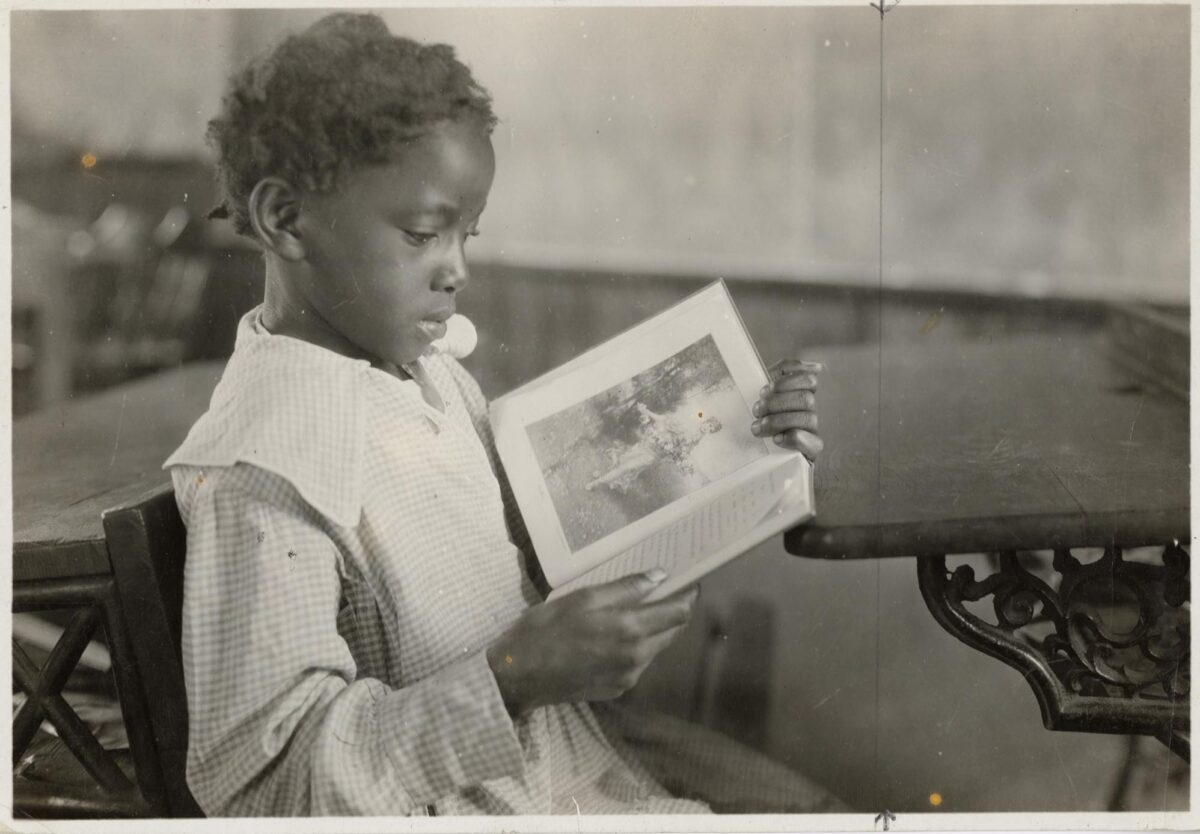
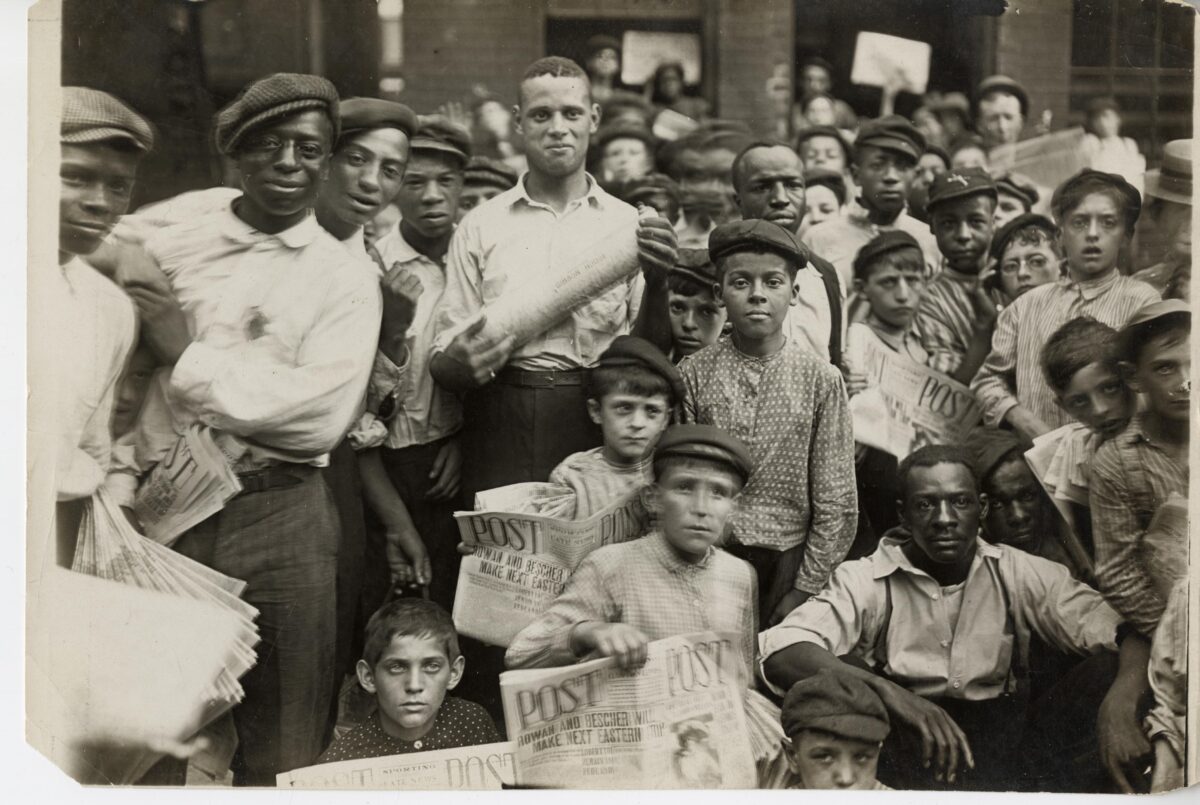 At left: Lewis Hine, Pupil in Pleasant Green School, Pocahontas Co., Pocahontas County, Marlinton, West Virginia, 1921. 5 x 7 in. The Photography Collections, University of Maryland, Baltimore County (P1050) At right: Lewis Hine, Newsboys and Supply Men Waiting At Newspaper Office For Base-Ball Edition, Cincinnati, Ohio, 1908. 5 x 7 in. The Photography Collections, University of Maryland, Baltimore County (P3)
Preserving the work of Lewis Hine
For many decades, the photographs in the collection were protected in envelopes, held in place with adhesive strips. With age, the adhesive has begun to deteriorate, putting the collection at risk.
“If the glue migrates and the photographs are stuck, you have the risk of tearing, discoloration, all the terrible things,” Saunders says. “They’re not mounted, so the versos—the backs—are visible. All of the original inscriptions, notations by Hine or other folks at NCLC, extended captions, those are all intact.”
Part of the current preservation effort will include photographing the detail written on the backs of the photographs, which have until now never been officially digitized.
“It was an opportunity to record the versos of the photographs. We needed to build a new overhead camera setup, and we’re very grateful that Melissa Cormier [M.F.A. ’17] with UMBC’s office of Research Graphics helped us to get that going,” says Saunders, who notes that while the behind-the-scenes work of preservation is unglamorous, the work requires a dedicated multidisciplinary team across the university community.
“My colleagues, Lindsey Loeper [’04] and Susan Graham [’98] have just written an essay about the teaching exercises that they’ve developed out of the Hine collections,” Saunders says. “Lindsey runs our instruction program, and Susan is the mastermind of this project. She’s been the one troubleshooting, setting the standards, and training everybody to do the work.”
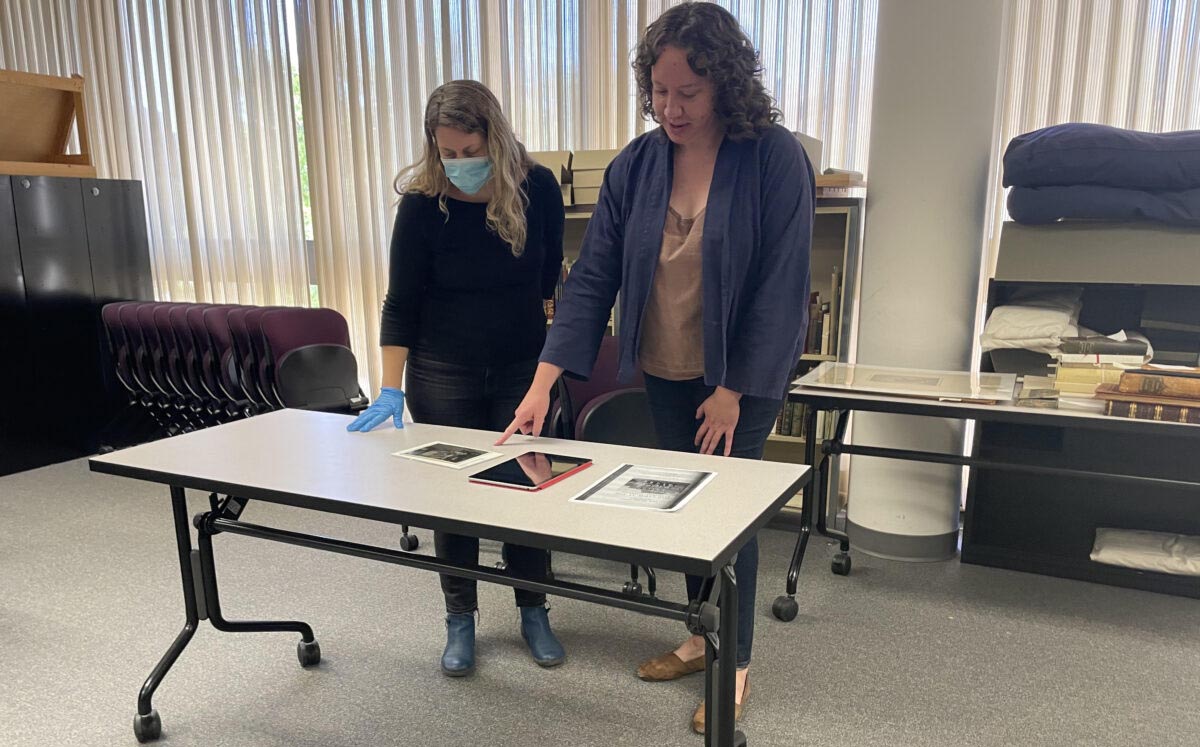 Special Collections staff Susan Graham ’98 and Lindsey Loeper ’04 share pieces of the Lewis Hine collection with students.
Learning from our past
Meredith Power, a graduate student in UMBC’s historical studies program who has been interning with the preservation project, notes the power Hine’s images still possess.
“Some are heartbreaking, some are thought-provoking, while others made me stop short and smile as I pulled them from their storage folder to photograph them,” Power says. “From the bright, sad eyes of the young boys who spent their days underground opening and closing gates inside coal mines, to the cheerful joy on the face of a girl who sold eggs as she hugs her beloved hen, the collection still manages to evoke an emotional response. It’s that emotional connection, the shared sense of experiencing something.”
Next year, the Special Collections department will celebrate its 50th anniversary. The Hine collection was among the inaugural collections for UMBC’s Special Collections, leading in turn to a specific focus on photography in the collection.
In 1974, the Hine collection was acquired by the then new Special Collections program from the NCLC, facilitated by former Library Director Antonio Raimo and Jerry Stephany, a photographer in the visual arts department who had once worked at the George Eastman Museum in Rochester.
“Jerry really saw the importance of a teaching collection of photography,” says Saunders. “The idea behind collecting this particular body of work was to show photography’s relationship to a variety of social issues and the way that photography can be used as a tool of visual communication across disciplines.”
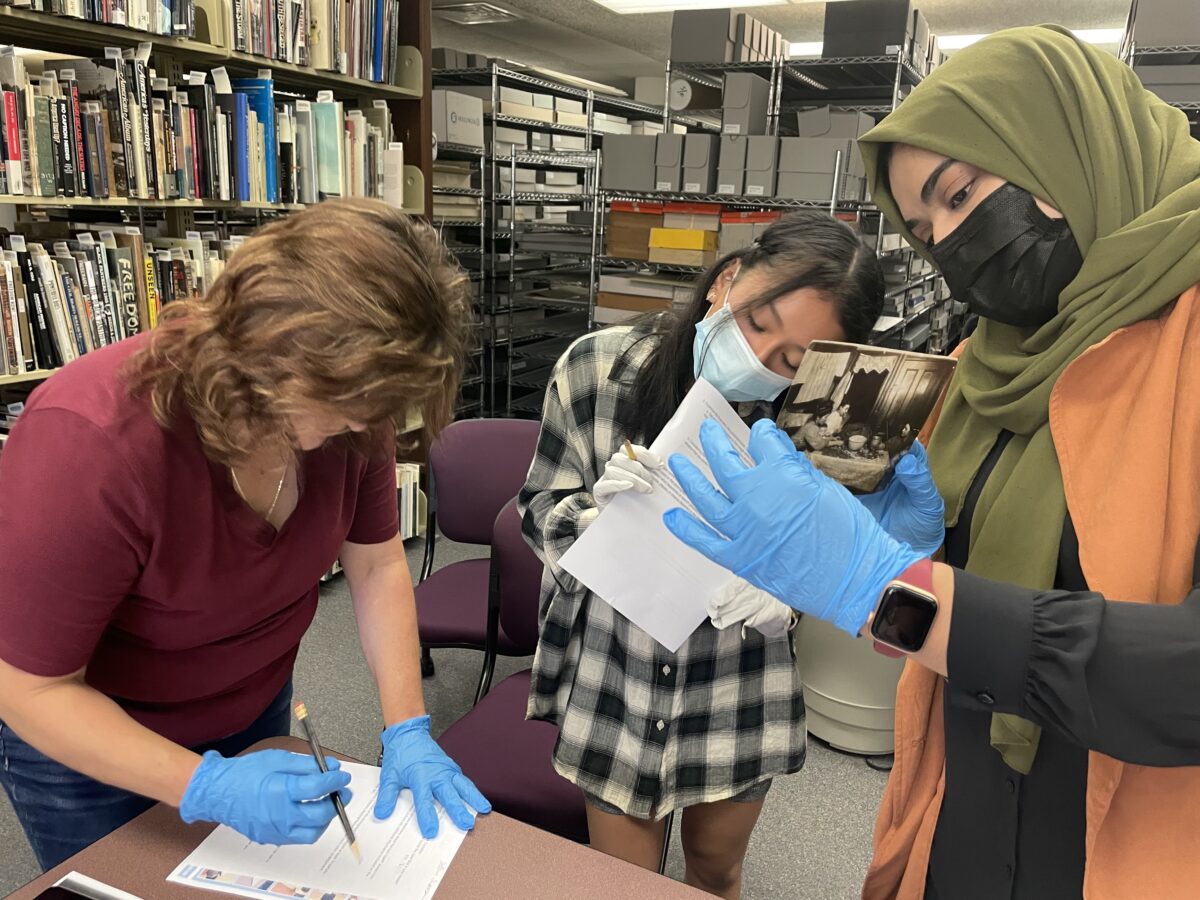
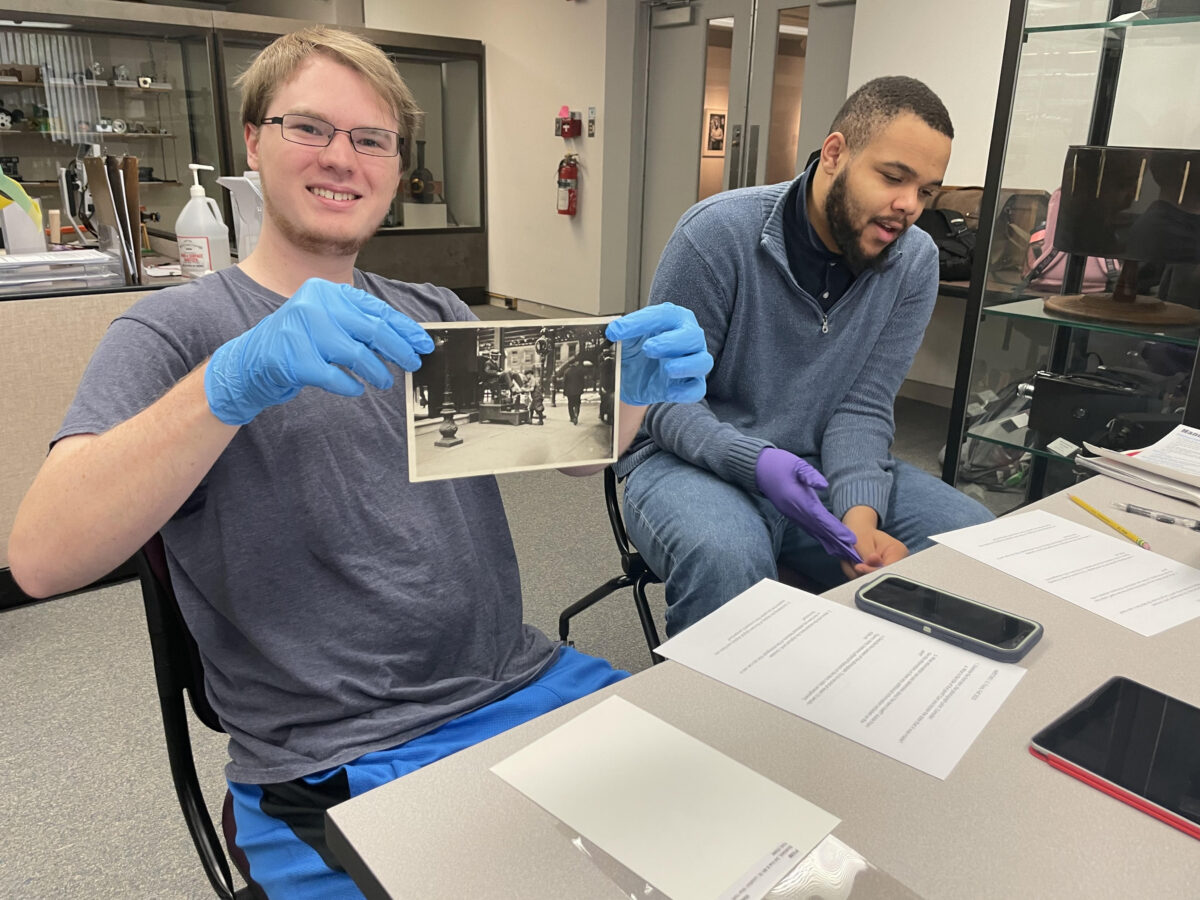 Students in Sarah Fouts’ Approaches to American Studies AMST300 class take part in an activity where student look at the same/similar photographs in a book, in the digital collections, and then the original photo print, and the features and contextual information available with each format. At left (L-R): Hellen Swanson, Sissi Castro, and Fairuaz Mukarama. At right (L-R): Kyle Warfield and Edward Robinson. Photos courtesy of Sarah Fouts.
Power, who is currently working towards an M.A. in UMBC’s historical studies program, researching solitary fourteenth-century religious Englishwomen, notes the interdisciplinary power of the Hine collection and the need to preserve it.
“On the surface, photographs of early twentieth century American child laborers have very little in common with my own academic research,” Power says. “However, as we’ve all learned since COVID-19’s arrival, physical access to research or archival material is sometimes impossible. In those cases, digitized resources and online information about them are invaluable. This is just as true for materials related to medieval religious history as it is for those who are looking into U.S. child labor reform.”
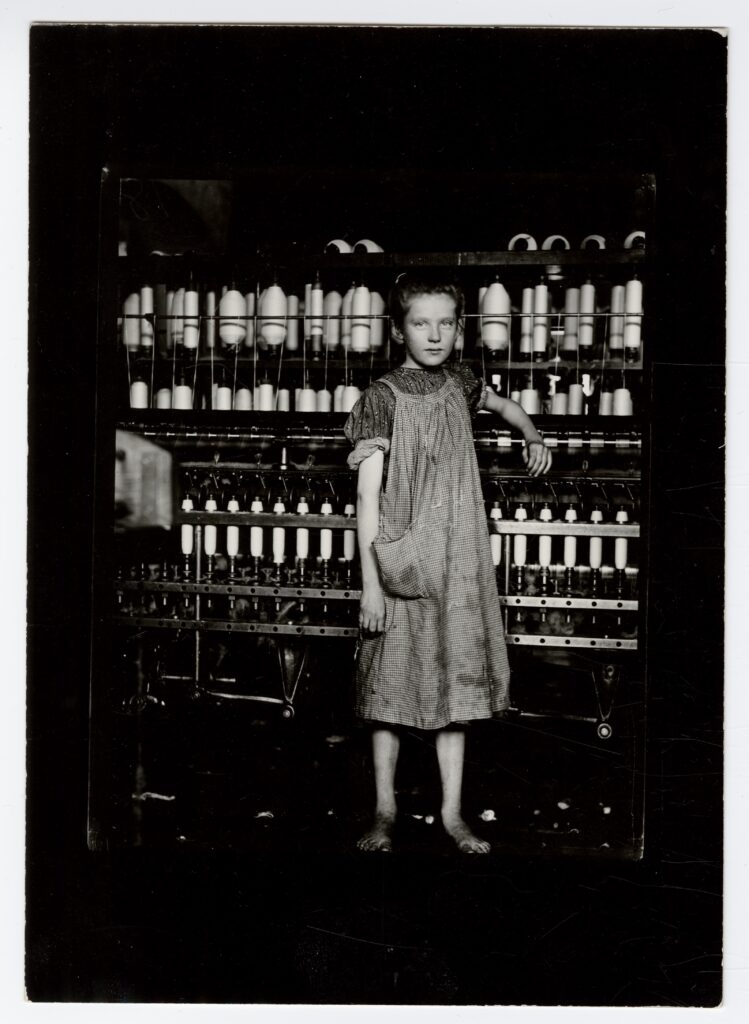 Lewis Hine, Anaemic Little Spinner in North Pownal Cotton Mill, Vermont, 1910. Gelatin silver print, 5 x 7 in. The Photography Collections, University of Maryland, Baltimore County (P1050)
A shared history
Today, UMBC Special Collections holds an estimated three million photographs stretching back to 1840, including the Baltimore Sun archive.
“There is a strong emphasis on documentary photography, which kind of came out of the Hine collection,” says Saunders. “We’re also particularly strong in Maryland history, including the Maryland Traditions archive, the state folklore archive.”
Additionally, Special Collections holds the collection of radical literature from the Alternative Press Center, an extensive collection of historic science fiction, the UMBC archive, and the new Eileen J. Garret Parapsychology Foundation Collection.
]]>
The photographer Lewis Hine secured a place in history as a documentarian of early 20th century life, including a transformational investigation into the conditions for child laborers. From...
https://umbc.edu/stories/preserving-the-photography-of-lewis-hine/
https://beta.my.umbc.edu/api/v0/pixel/news/129185/guest@my.umbc.edu/a1f21e61816717034b9fcac1000f4415/api/pixel
albin-o-kuhn-library-and-gallery
arts-and-culture
cahss
discovery
graduateschool
historical-studies
lewis-hine
magazine
news
special-collections
UMBC News & Magazine
https://beta.my.umbc.edu/groups/umbc-news-magazine
https://assets1-beta.my.umbc.edu/system/shared/avatars/groups/000/001/943/24435aa6207c452e7bc15cc74b42c7bb/xsmall.png?1748556657
https://assets1-beta.my.umbc.edu/system/shared/avatars/groups/000/001/943/24435aa6207c452e7bc15cc74b42c7bb/original.png?1748556657
https://assets2-beta.my.umbc.edu/system/shared/avatars/groups/000/001/943/24435aa6207c452e7bc15cc74b42c7bb/xxlarge.png?1748556657
https://assets2-beta.my.umbc.edu/system/shared/avatars/groups/000/001/943/24435aa6207c452e7bc15cc74b42c7bb/xlarge.png?1748556657
https://assets3-beta.my.umbc.edu/system/shared/avatars/groups/000/001/943/24435aa6207c452e7bc15cc74b42c7bb/large.png?1748556657
https://assets1-beta.my.umbc.edu/system/shared/avatars/groups/000/001/943/24435aa6207c452e7bc15cc74b42c7bb/medium.png?1748556657
https://assets2-beta.my.umbc.edu/system/shared/avatars/groups/000/001/943/24435aa6207c452e7bc15cc74b42c7bb/small.png?1748556657
https://assets1-beta.my.umbc.edu/system/shared/avatars/groups/000/001/943/24435aa6207c452e7bc15cc74b42c7bb/xsmall.png?1748556657
https://assets2-beta.my.umbc.edu/system/shared/avatars/groups/000/001/943/24435aa6207c452e7bc15cc74b42c7bb/xxsmall.png?1748556657
UMBC News & Magazine
2
0
false
Mon, 14 Nov 2022 15:22:11 -0500
Mon, 14 Nov 2022 15:22:11 -0500
Voting Is an Everyday Practice
Today, millions of college students across the country are voting. Other students are not voting—they might be discouraged that their voice can make a difference, uninformed about their voting rights, or just unengaged with the political process.
In a conversation facilitated by UMBC Magazine, Musa Jafri ’24, political science, SGA director of civic engagement, Sunil Dasgupta, professor of political science, and founder and host of the podcast “I Hate Politics,” and David Hoffman, Ph.D. ’13, language, literacy, and culture, the director of UMBC’s Center for Democracy and Civic Life, discuss the vital democratic process—on campus and off—and the daily practice of voting.
“Voting is about you taking a stand and stating, ‘I’m here, I matter, I exist, and I have a voice.’ It’s a form of resistance, a way to try to change the climate you find yourself in.” says Jafri,co-chair of the University System of Maryland Student Civic Leaders Committee.
“I don’t understand how democracy became compartmentalized to something that happens every four years. Voting is the culmination of the work that we have done for the past four years between the time we last voted and now,” says Dasgupta. “Voting is a moment of celebration. A moment where we find out whether the work we did in between votes really mattered. There is no other way to think about democracy. Voting is what we do every day.”
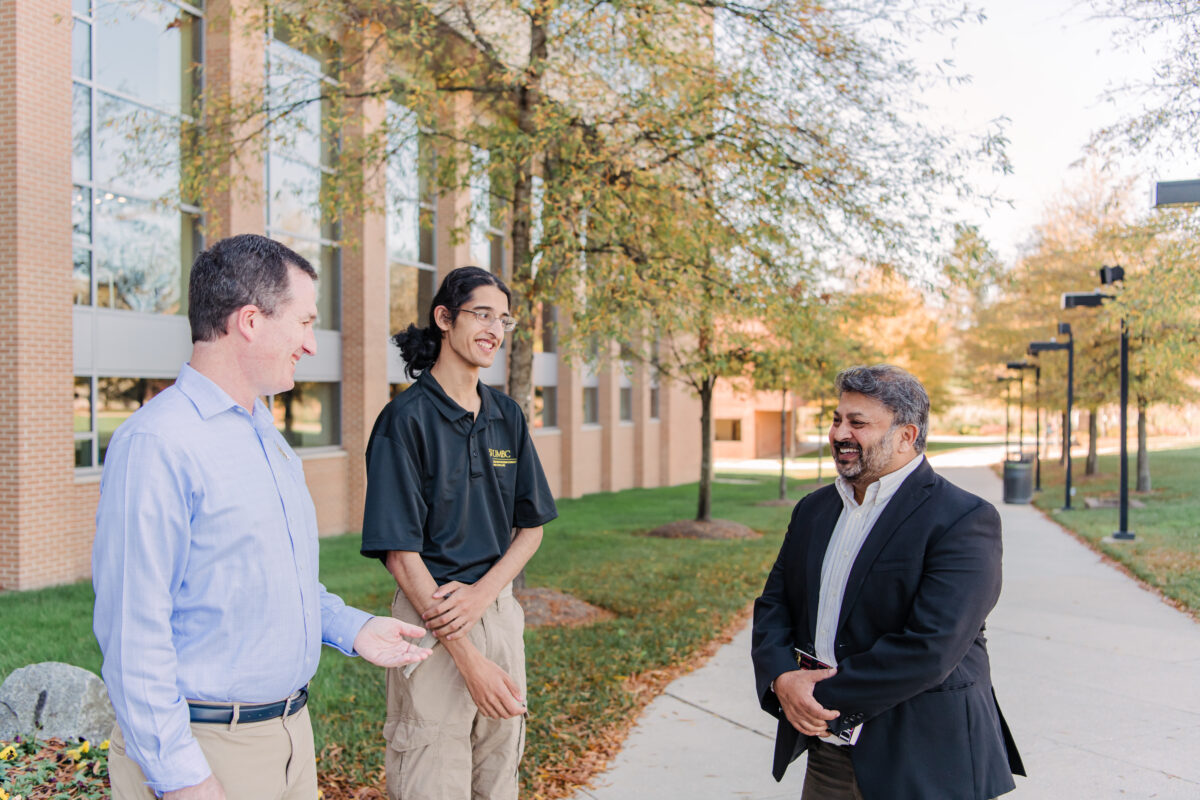 Hoffman, Jafri, and Dasgupta. (Marlayna Demond ’11/UMBC)
Dasgupta: From my way of thinking, a university campus can be very different than society at large. What is the difference and how does that manifest in civic life, on campus, and in communities? How do we navigate those differences?
Hoffman: In our broader culture, we speak too easily of universities as separate from the rest of society: as ivory towers where students are being prepared for the ‘real world.’ The reality is that universities are life. Students are alive right now and they are part of many communities within and beyond the university. What happens here matters to the lives of everyone at UMBC and the communities they are part of.
Jafri: I agree. There are many instances where the university and local community needs overlap. Recently, some UMBC students organized an event where we invited the Catonsville and Arbutus communities to meet the candidates in our district. By including these two communities we realized that we had similar concerns including education, clean water, and environmental protection.
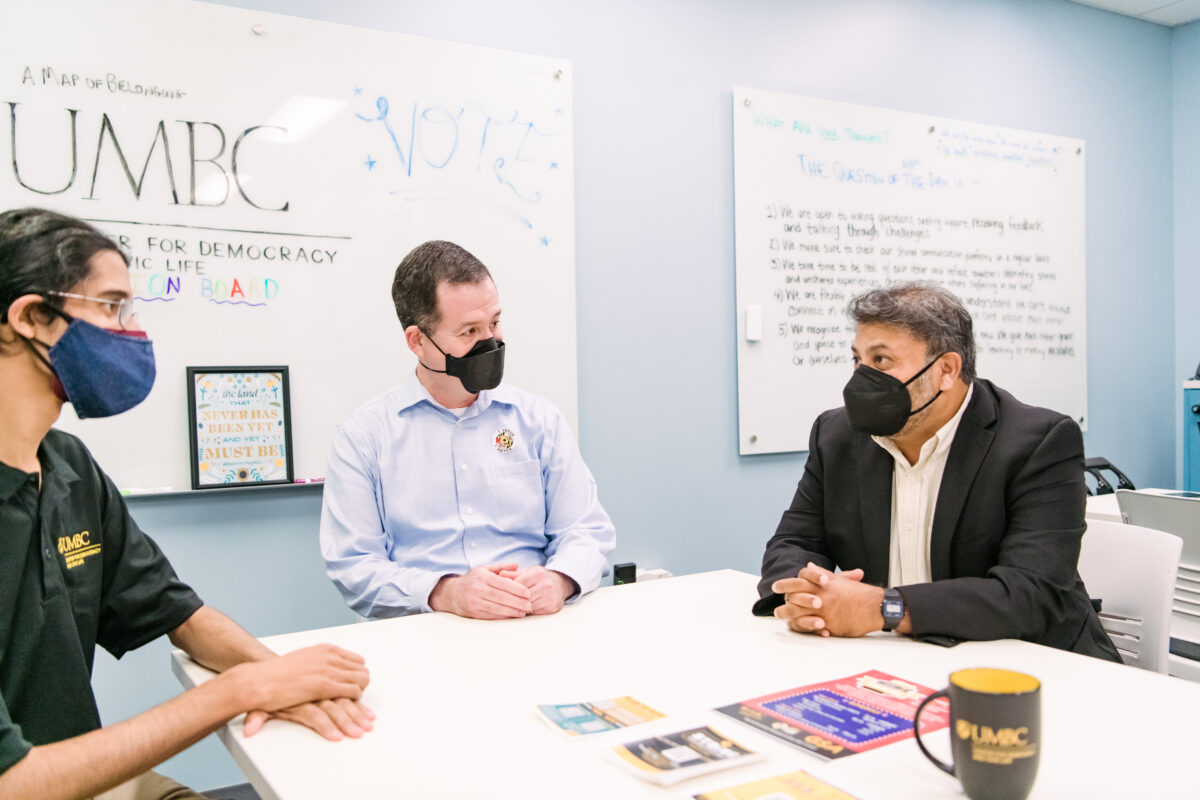 Jafri, Hoffman, and Dasgupta in the Center for Democracy and Civic Life. (Marlayna Demond ’11/UMBC)
Jafri: My generation is very politically active when it comes to voting and getting out to the polls. But with the plethora of social media platforms and news outlets how can students ensure they are getting valid and factual news?
Dasgupta: Let me be a professor and say there is more reading to be done. If your news derives from digital platforms, these platforms are algorithmic with a selection bias problem that is not your selection bias problem. You are essentially hostage to their selection bias. The way you have to overcome this is to move beyond one or two or even three sources of news. What all of us need to do is a triangulation between you and multiple sources. That takes work. Social media won’t replace in-person organizing or knocking on doors. On the other hand, organizing alone can be more effective with social media’s reach. The combination is necessary. At the risk of saying go do more work, I do think we have to understand that choosing one approach is not sufficient.
Hoffman: A part of what happens when you get involved in on-the-ground organizing is that you become better able to discern the plausibility of claims that you might encounter online. You become a better evaluator of the information you are receiving. One of the premises of Center for Democracy and Civic Life’s work is that democracy is not just a form of government, it’s not just politics and elections, it is a way of life that can be enacted in everyday settings. Ideally, people vote because they are so thoroughly engaged with the issues in their community and nation and understand them so well that voting is an obvious way to contribute. It’s one facet of how we shape our collective future, but far from the only one.
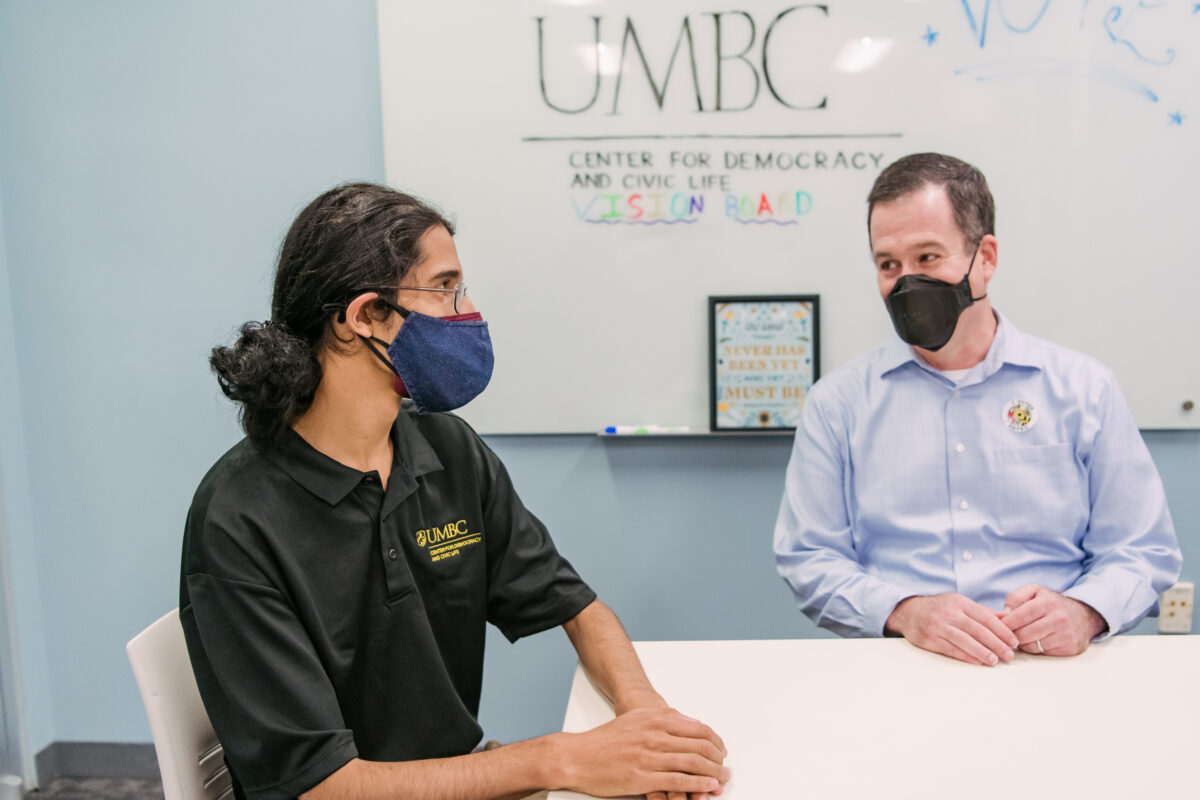 Jafri and Hoffman. (Marlayna Demond ’11/UMBC)
Jafri: One of the comments I often hear from students is that their one vote will not matter because it doesn’t determine the outcome. How can students and the broader community understand that voting is important even if their one vote may not be the deciding vote?
Hoffman: There are a lot of reasons to vote including enacting a symbolic and moral commitment to the well-being of your community. If your vote does not determine the outcome it will still be counted. Candidates and elected officials will review voting data to learn about who voted. In the elected official’s mind if a high percentage of young people voted then their concerns are important. This matters a lot.
Hoffman: What can communities do to help heal the deep divisions in our society that are evident all around us every day?
Jafri: I lean a lot on the power of storytelling—of meeting people where they are and hearing their stories. The divisions in the broader U.S. and in our communities come from a lack of understanding of someone else’s experience. Listening to another’s experience is very powerful and helps us see multiple realities. Maybe we can work together to address our concerns even if our approaches are different.
Dasgupta: I agree with Musa. Storytelling is very powerful and important especially when communities are in need of reliable news sources. I created my podcast to fill a gap in news coverage in Montgomery County. Providing a sound space where community leaders and elected officials can share their insights and plans for the future is one way I give back to the community, especially in areas where there isn’t a local newspaper.
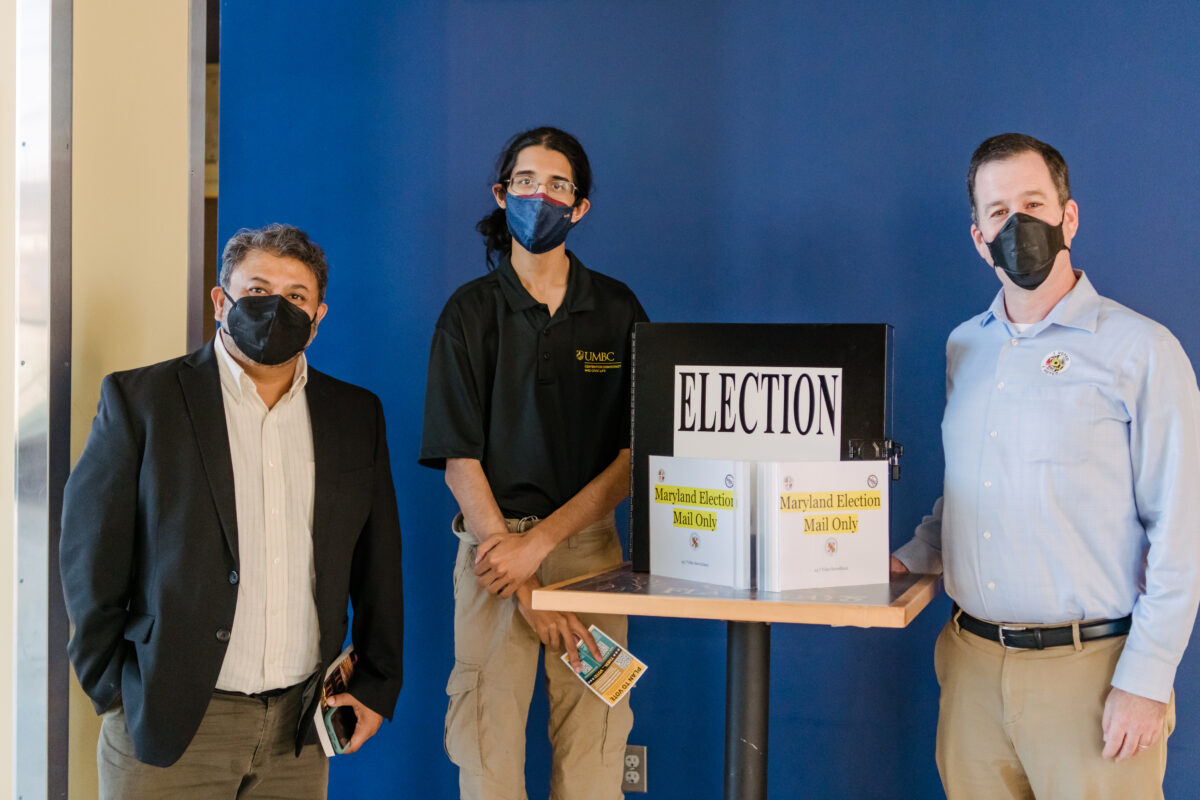 Dasgupta, Jafri, and Hoffman. (Marlayna Demond ’11/UMBC)
Hoffman: What are some practical examples of things students can do that may not be obvious to them as opportunities for civic engagement?
Jafri: Some define democracy and civic engagement as just voting. I don’t think that is a fair description of democracy and civic engagement. Simple things such as gathering with friends and inviting someone who has different views than your own is a very basic way to be civically engaged. I think that can do a lot of good in helping heal the divide.
UMBC Magazine: What wisdom can you impart to inspire students to not give up and to show up and vote?
Dasgupta: The challenges are always going to remain. Our lives’ work is to work through these challenges with hope. We don’t have to solve everything but we are duty-bound to try solve some of the issues we face.
Hoffman: I believe that the moral arc of the universe bends towards justice but that achieving it in our lifetime requires constant organizing. I also believe that democracy is a journey, not a destination. We will never fully achieve the just society that we aspire to but we can get closer and closer and work together to prevent backsliding. I have seen a lot of positive changes in my lifetime including the expansion of rights and the recognition of people based on their identities. The backsliding we have experienced lately has not fully erased this progress so I have hope that together we can build a more just society and that in fact, the seeds of that society have already been planted.
]]>
Today, millions of college students across the country are voting. Other students are not voting—they might be discouraged that their voice can make a difference, uninformed about their voting...
https://umbc.edu/stories/voting-is-an-everyday-practice/
https://beta.my.umbc.edu/api/v0/pixel/news/129026/guest@my.umbc.edu/f27ed75a0cdf002972d962dc5e5cbd62/api/pixel
cahss
campus-life
center-for-democracy-and-civic-life
language-literacy-and-culture
magazine
politicalscience
shadygrove
UMBC News & Magazine
https://beta.my.umbc.edu/groups/umbc-news-magazine
https://assets1-beta.my.umbc.edu/system/shared/avatars/groups/000/001/943/24435aa6207c452e7bc15cc74b42c7bb/xsmall.png?1748556657
https://assets1-beta.my.umbc.edu/system/shared/avatars/groups/000/001/943/24435aa6207c452e7bc15cc74b42c7bb/original.png?1748556657
https://assets2-beta.my.umbc.edu/system/shared/avatars/groups/000/001/943/24435aa6207c452e7bc15cc74b42c7bb/xxlarge.png?1748556657
https://assets2-beta.my.umbc.edu/system/shared/avatars/groups/000/001/943/24435aa6207c452e7bc15cc74b42c7bb/xlarge.png?1748556657
https://assets3-beta.my.umbc.edu/system/shared/avatars/groups/000/001/943/24435aa6207c452e7bc15cc74b42c7bb/large.png?1748556657
https://assets1-beta.my.umbc.edu/system/shared/avatars/groups/000/001/943/24435aa6207c452e7bc15cc74b42c7bb/medium.png?1748556657
https://assets2-beta.my.umbc.edu/system/shared/avatars/groups/000/001/943/24435aa6207c452e7bc15cc74b42c7bb/small.png?1748556657
https://assets1-beta.my.umbc.edu/system/shared/avatars/groups/000/001/943/24435aa6207c452e7bc15cc74b42c7bb/xsmall.png?1748556657
https://assets2-beta.my.umbc.edu/system/shared/avatars/groups/000/001/943/24435aa6207c452e7bc15cc74b42c7bb/xxsmall.png?1748556657
UMBC News & Magazine
2
0
false
Tue, 08 Nov 2022 11:12:08 -0500
Tue, 08 Nov 2022 11:12:08 -0500
Voting Is an Everyday Practice
Today, millions of college students across the country are voting. Other students are not voting—they might be discouraged that their voice can make a difference, uninformed about their voting rights, or just unengaged with the political process.
In a conversation facilitated by UMBC Magazine, Musa Jafri ’24, political science, SGA director of civic engagement, Sunil Dasgupta, professor of political science, and founder and host of the podcast “I Hate Politics,” and David Hoffman, Ph.D. ’13, language, literacy, and culture, the director of UMBC’s Center for Democracy and Civic Life, discuss the vital democratic process—on campus and off—and the daily practice of voting.
“Voting is about you taking a stand and stating, ‘I’m here, I matter, I exist, and I have a voice.’ It’s a form of resistance, a way to try to change the climate you find yourself in.” says Jafri,co-chair of the University System of Maryland Student Civic Leaders Committee.
“I don’t understand how democracy became compartmentalized to something that happens every four years. Voting is the culmination of the work that we have done for the past four years between the time we last voted and now,” says Dasgupta. “Voting is a moment of celebration. A moment where we find out whether the work we did in between votes really mattered. There is no other way to think about democracy. Voting is what we do every day.”
Hoffman, Jafri, and Dasgupta. (Marlayna Demond ’11/UMBC)
Dasgupta: From my way of thinking, a university campus can be very different than society at large. What is the difference and how does that manifest in civic life, on campus, and in communities? How do we navigate those differences?
Hoffman: In our broader culture, we speak too easily of universities as separate from the rest of society: as ivory towers where students are being prepared for the ‘real world.’ The reality is that universities are life. Students are alive right now and they are part of many communities within and beyond the university. What happens here matters to the lives of everyone at UMBC and the communities they are part of.
Jafri: I agree. There are many instances where the university and local community needs overlap. Recently, some UMBC students organized an event where we invited the Catonsville and Arbutus communities to meet the candidates in our district. By including these two communities we realized that we had similar concerns including education, clean water, and environmental protection.
Jafri, Hoffman, and Dasgupta in the Center for Democracy and Civic Life. (Marlayna Demond ’11/UMBC)
Jafri: My generation is very politically active when it comes to voting and getting out to the polls. But with the plethora of social media platforms and news outlets how can students ensure they are getting valid and factual news?
Dasgupta: Let me be a professor and say there is more reading to be done. If your news derives from digital platforms, these platforms are algorithmic with a selection bias problem that is not your selection bias problem. You are essentially hostage to their selection bias. The way you have to overcome this is to move beyond one or two or even three sources of news. What all of us need to do is a triangulation between you and multiple sources. That takes work. Social media won’t replace in-person organizing or knocking on doors. On the other hand, organizing alone can be more effective with social media’s reach. The combination is necessary. At the risk of saying go do more work, I do think we have to understand that choosing one approach is not sufficient.
Hoffman: A part of what happens when you get involved in on-the-ground organizing is that you become better able to discern the plausibility of claims that you might encounter online. You become a better evaluator of the information you are receiving. One of the premises of Center for Democracy and Civic Life’s work is that democracy is not just a form of government, it’s not just politics and elections, it is a way of life that can be enacted in everyday settings. Ideally, people vote because they are so thoroughly engaged with the issues in their community and nation and understand them so well that voting is an obvious way to contribute. It’s one facet of how we shape our collective future, but far from the only one.
Jafri and Hoffman. (Marlayna Demond ’11/UMBC)
Jafri: One of the comments I often hear from students is that their one vote will not matter because it doesn’t determine the outcome. How can students and the broader community understand that voting is important even if their one vote may not be the deciding vote?
Hoffman: There are a lot of reasons to vote including enacting a symbolic and moral commitment to the well-being of your community. If your vote does not determine the outcome it will still be counted. Candidates and elected officials will review voting data to learn about who voted. In the elected official’s mind if a high percentage of young people voted then their concerns are important. This matters a lot.
Hoffman: What can communities do to help heal the deep divisions in our society that are evident all around us every day?
Jafri: I lean a lot on the power of storytelling—of meeting people where they are and hearing their stories. The divisions in the broader U.S. and in our communities come from a lack of understanding of someone else’s experience. Listening to another’s experience is very powerful and helps us see multiple realities. Maybe we can work together to address our concerns even if our approaches are different.
Dasgupta: I agree with Musa. Storytelling is very powerful and important especially when communities are in need of reliable news sources. I created my podcast to fill a gap in news coverage in Montgomery County. Providing a sound space where community leaders and elected officials can share their insights and plans for the future is one way I give back to the community, especially in areas where there isn’t a local newspaper.
Dasgupta, Jafri, and Hoffman. (Marlayna Demond ’11/UMBC)
Hoffman: What are some practical examples of things students can do that may not be obvious to them as opportunities for civic engagement?
Jafri: Some define democracy and civic engagement as just voting. I don’t think that is a fair description of democracy and civic engagement. Simple things such as gathering with friends and inviting someone who has different views than your own is a very basic way to be civically engaged. I think that can do a lot of good in helping heal the divide.
UMBC Magazine: What wisdom can you impart to inspire students to not give up and to show up and vote?
Dasgupta: The challenges are always going to remain. Our lives’ work is to work through these challenges with hope. We don’t have to solve everything but we are duty-bound to try solve some of the issues we face.
Hoffman: I believe that the moral arc of the universe bends towards justice but that achieving it in our lifetime requires constant organizing. I also believe that democracy is a journey, not a destination. We will never fully achieve the just society that we aspire to but we can get closer and closer and work together to prevent backsliding. I have seen a lot of positive changes in my lifetime including the expansion of rights and the recognition of people based on their identities. The backsliding we have experienced lately has not fully erased this progress so I have hope that together we can build a more just society and that in fact, the seeds of that society have already been planted.
Update: In late November 2022, the ALL IN Campus Democracy Challenge released the results of its national student voter pledge competition. UMBC finished at #4 in the nation in the number of students pledging to vote in Election 2022, moving our campus community up from #9 in 2020.
]]>
Today, millions of college students across the country are voting. Other students are not voting—they might be discouraged that their voice can make a difference, uninformed about their voting...
https://umbc.edu/stories/voting/
https://beta.my.umbc.edu/api/v0/pixel/news/129063/guest@my.umbc.edu/13659b49b350a23d36641f16fee49a54/api/pixel
cahss
campus-life
center-for-democracy-and-civic-life
language-literacy-and-culture
magazine
politicalscience
shadygrove
UMBC News & Magazine
https://beta.my.umbc.edu/groups/umbc-news-magazine
https://assets1-beta.my.umbc.edu/system/shared/avatars/groups/000/001/943/24435aa6207c452e7bc15cc74b42c7bb/xsmall.png?1748556657
https://assets1-beta.my.umbc.edu/system/shared/avatars/groups/000/001/943/24435aa6207c452e7bc15cc74b42c7bb/original.png?1748556657
https://assets2-beta.my.umbc.edu/system/shared/avatars/groups/000/001/943/24435aa6207c452e7bc15cc74b42c7bb/xxlarge.png?1748556657
https://assets2-beta.my.umbc.edu/system/shared/avatars/groups/000/001/943/24435aa6207c452e7bc15cc74b42c7bb/xlarge.png?1748556657
https://assets3-beta.my.umbc.edu/system/shared/avatars/groups/000/001/943/24435aa6207c452e7bc15cc74b42c7bb/large.png?1748556657
https://assets1-beta.my.umbc.edu/system/shared/avatars/groups/000/001/943/24435aa6207c452e7bc15cc74b42c7bb/medium.png?1748556657
https://assets2-beta.my.umbc.edu/system/shared/avatars/groups/000/001/943/24435aa6207c452e7bc15cc74b42c7bb/small.png?1748556657
https://assets1-beta.my.umbc.edu/system/shared/avatars/groups/000/001/943/24435aa6207c452e7bc15cc74b42c7bb/xsmall.png?1748556657
https://assets2-beta.my.umbc.edu/system/shared/avatars/groups/000/001/943/24435aa6207c452e7bc15cc74b42c7bb/xxsmall.png?1748556657
UMBC News & Magazine
0
0
false
Tue, 08 Nov 2022 11:12:08 -0500
Tue, 08 Nov 2022 11:12:08 -0500
Political violence in America isn’t going away anytime soon
Richard Forno, principal lecturer in Computer science and Electrical Engineering, UMBC
A warning about the threat of political violence heading into the 2022 midterm elections was issued to state and local law enforcement officials by the U.S. Department of Homeland Security on Oct. 28, 2022.
The bulletin was released the same day that Speaker of the House of Representatives Nancy Pelosi’s husband was hospitalized after a home invasion by a lone right-wing extremist seeking to harm her.
This incident is the latest in an increasing stream of extremist confrontations taking place across the United States in recent years. These incidents have primarily targeted Democrats, including a plot to kidnap Michigan Gov. Gretchen Whitmer in 2020. But threats from both sides of the political spectrum are up significantly.
And, of course, there was the Jan. 6, 2021, insurrection at the U.S. Capitol, where supporters of a defeated Republican president, acting on a widespread lie he perpetuated, violently attempted to prevent the certification of electoral votes. According to well-documented public evidence, some rioters planned to find and execute both Speaker Pelosi and Vice President Mike Pence.
Such incidents reflect a disturbing trend that targets the very fabric, foundation and future of U.S. democracy. But what led to this point?
As a researcher taking a critical and apolitical eye toward security issues, I believe the rise in contemporary right-wing political extremism – and violence – began with an outdated focus in national communications policy.
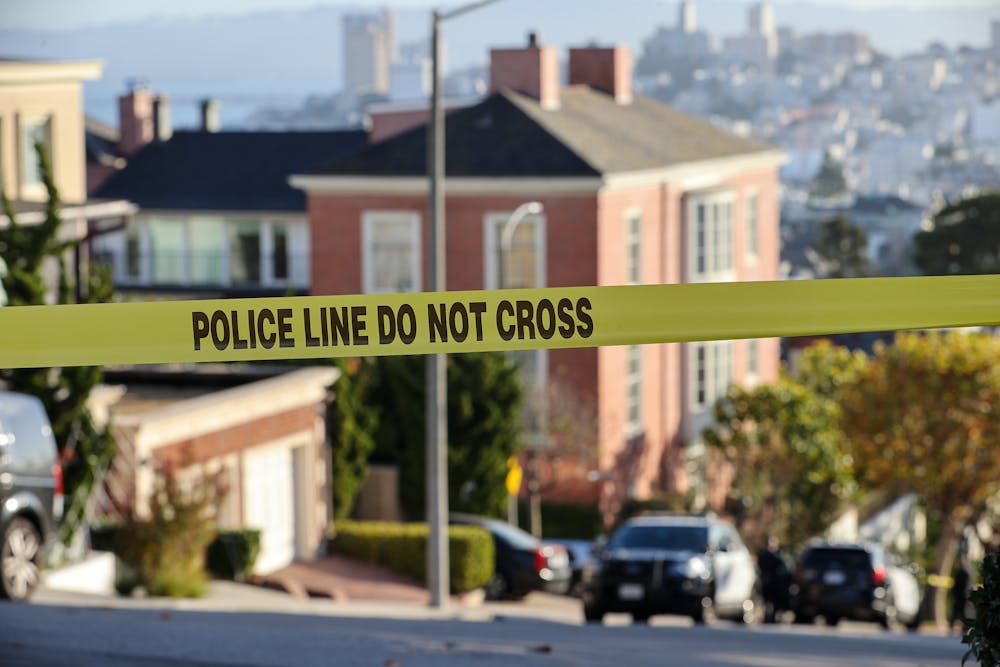
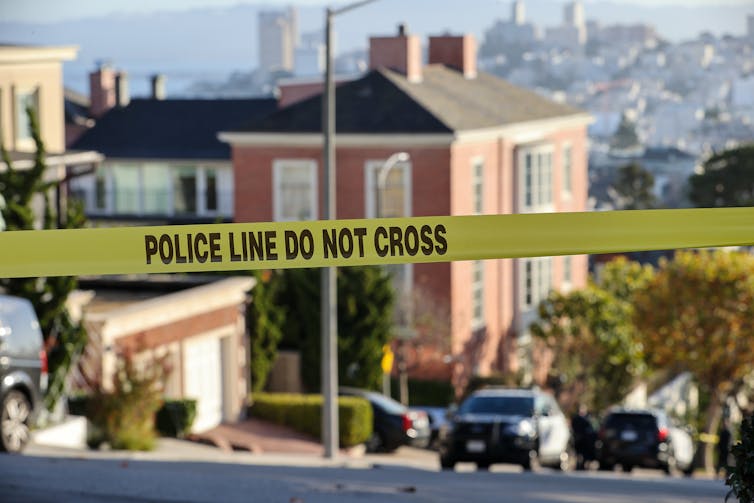 Police take measurements around House Speaker Nancy Pelosi’s San Francisco home after her husband, Paul Pelosi, was assaulted inside the home on Oct. 28, 2022. Tayfun Coskun/Anadolu Agency via Getty Images
Media-induced slow burn
Until the late 1980s, the Federal Communications Commission’s Fairness Doctrine required traditional licensed broadcasters to offer competing viewpoints on controversial public issues. But these rules did not apply to cable or satellite providers. As a result, the rise of cable news channels in the 1990s led to highly partisan programming that helped divide American society in the ensuing decades.
This programming fueled increasing polarization in the public and political arenas. Bipartisanship was abandoned in the 1990s, when the Republican Congress under Speaker Newt Gingrich embraced a “scorched-earth” policy of governing. That meant treating the minority party not as the loyal opposition and respected elected colleagues who had differences over policy, but as enemies.
In addition to emerging partisan cable television networks like MSNBC and Fox News, in the early 2000s, an increasingly polarized Congress and the public received a new source of division: social media.
Internet platforms such as Twitter, Facebook, and 4Chan allowed anyone, anywhere, to create, produce and distribute political commentary and extremist rhetoric that could be amplified by other users and drive the day’s news cycle.
Political pundits and influencers across the spectrum became less concerned about correctly informing the public. Instead, they stoked outrage in the search for money-generating clicks and advertising dollars. And political parties exploited this outrage to satisfy and energize their voting base or funders.
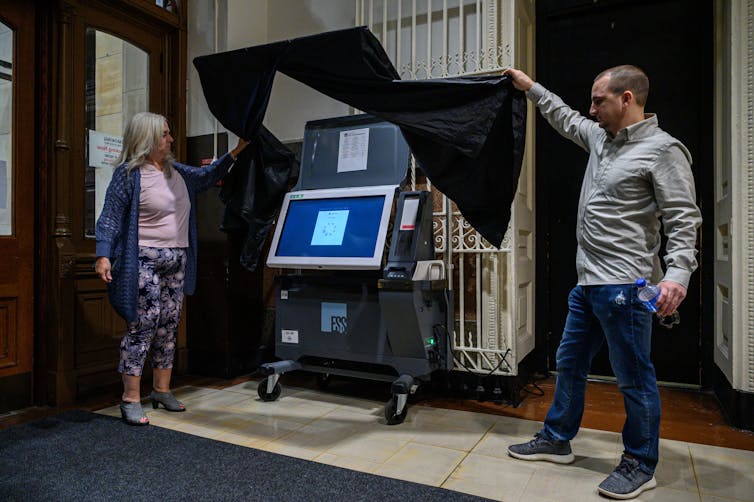 Philadelphia city commissioners display a voting machine in Philadelphia City Hall on Oct. 24, 2022. Ed Jones/AFP via Getty Images
Moderation or censorship?
To combat online extremism, social media companies reluctantly began moderating user posts and sometimes banned prominent users who violated their community standards or terms of service.
In response to what it dubbed “censorship” from Big Tech, the right-wing splintered into numerous niche platforms catering to their conspiracy theories and extremist or violent views such as Truth Social – run by former President Trump – Gab, Parler, Rumble and others.
Compared with Democrats, Republicans have mastered this form of gutter politics. One example: Right-wing political figures have mocked Paul Pelosi for being attacked, spread baseless conspiracy theories about his personal life and used the incident for applause lines at campaign rallies.
Accordingly, today’s voters and politicians end up confronting one another in the public sphere not on matters and substance affecting the future of the country, but on fundamental facts and conspiracy theories, or to address distractions often generated by their respective media ecosystems. This is only exacerbated by a prolonged nationwide decline in media literacy and civics education.
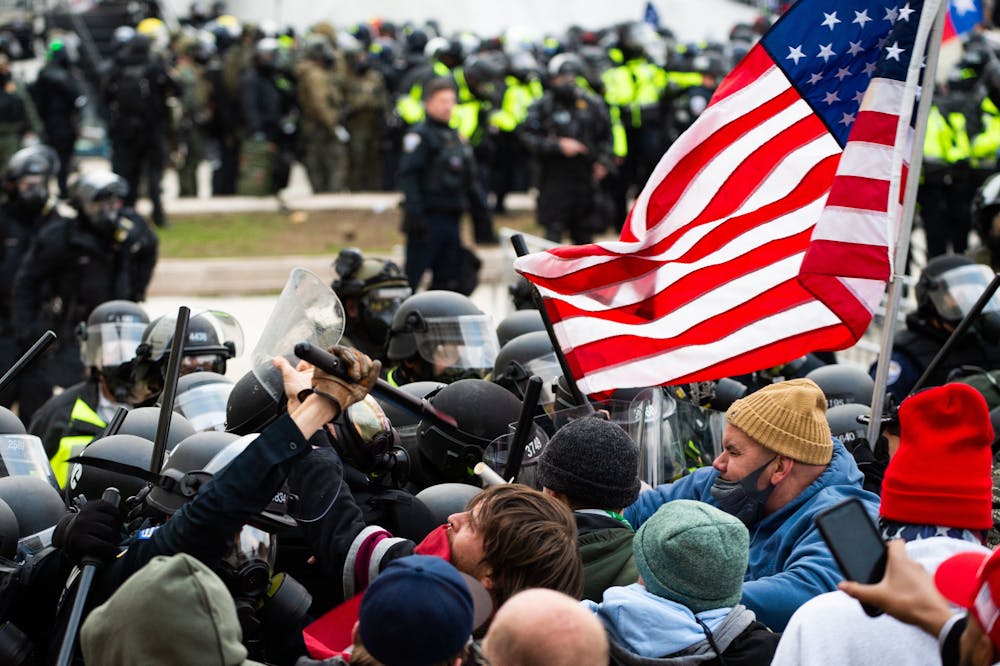
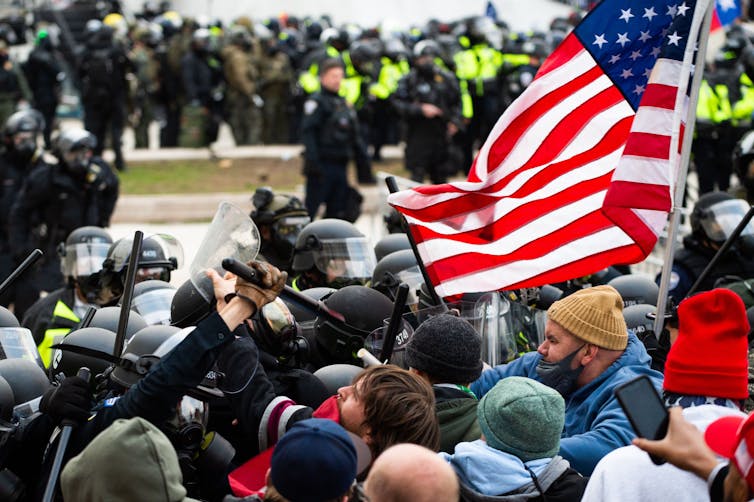 Rioters outside the U.S. Capitol Building on Jan. 6, 2021, clash with police. Roberto Schmidt/AFP via Getty Images
Law enforcement’s unique problem
Against this backdrop, federal law enforcement has become more vocal in warning about the dangers of domestic political extremism, including a bulletin issued in February 2022. The Oct. 28 DHS bulletin further underscores this concern.
But it’s hard for law enforcement to effectively address political extremism, because speech protected under the First Amendment is a major consideration. Phrases like “I’m fighting for you!” or “Saving our country!” might seem like typical political bluster to one person. But they could be seen by others as an implied call for intimidation or violent action against political opponents, election officials, volunteer poll workers and even ordinary voters.
How does speech turn into violent action? Security specialists and scholars use the term “stochastic terrorism” to capture how a single, hard-to-locate person might be inspired or influenced toward violence by broader extremist rhetoric, as appears to have been the case with the man who allegedly tried to kill Paul Pelosi with a hammer.
Law enforcement’s problem is made worse by right-wing lawmakers who normalize or actively praise the actions of violent extremists, calling them “patriots” and demanding their prison sentences be overturned or pardoned. This helps obscure the actual reasons for such incidents, often by deflecting them into broader conspiracy theories involving their opponents.
Certainly there are controversial left-leaning politicians, pundits, activists and talking points too.
But few – if any – openly disregard the fabric of American government, scheme to overturn democratic elections by force or plot to assassinate politicians.
By contrast, there are over 300 Republican election deniers running for office this year, including many incumbents – the vast majority of whom endorse political violence such as the Jan. 6 attack either by their actions or their silence.
Hope for the best; prepare for the worst
Tensions are high heading into the 2022 midterms. Politicians are making final arguments, and the online messaging machines are spreading campaign information, fundraising requests – and plenty of disinformation as well.
Americans expect a peaceful transfer of political power after elections, but recent history shows we must prepare for the worst. It’s clear that the modern Republican Party is openly and successfully embracing and exploiting misinformation, outrage and attacks on democracy and the rule of law.
Until Republicans actively disavow their extremist rhetoric and the misinformation contributing to it, I believe the likelihood for political violence in America increases with each passing day.
This article is republished from The Conversation under a Creative Commons license. Read the original article.
]]>
Richard Forno, principal lecturer in Computer science and Electrical Engineering, UMBC A warning about the threat of political violence heading into the 2022 midterm elections was issued to...
https://umbc.edu/stories/political-violence-in-america-isnt-going-away-anytime-soon/
https://beta.my.umbc.edu/api/v0/pixel/news/129011/guest@my.umbc.edu/217a019608d283460481692288b4e4b8/api/pixel
coeit
computer-engineering
computerscience
discovery
magazine
UMBC News & Magazine
https://beta.my.umbc.edu/groups/umbc-news-magazine
https://assets1-beta.my.umbc.edu/system/shared/avatars/groups/000/001/943/24435aa6207c452e7bc15cc74b42c7bb/xsmall.png?1748556657
https://assets1-beta.my.umbc.edu/system/shared/avatars/groups/000/001/943/24435aa6207c452e7bc15cc74b42c7bb/original.png?1748556657
https://assets2-beta.my.umbc.edu/system/shared/avatars/groups/000/001/943/24435aa6207c452e7bc15cc74b42c7bb/xxlarge.png?1748556657
https://assets2-beta.my.umbc.edu/system/shared/avatars/groups/000/001/943/24435aa6207c452e7bc15cc74b42c7bb/xlarge.png?1748556657
https://assets3-beta.my.umbc.edu/system/shared/avatars/groups/000/001/943/24435aa6207c452e7bc15cc74b42c7bb/large.png?1748556657
https://assets1-beta.my.umbc.edu/system/shared/avatars/groups/000/001/943/24435aa6207c452e7bc15cc74b42c7bb/medium.png?1748556657
https://assets2-beta.my.umbc.edu/system/shared/avatars/groups/000/001/943/24435aa6207c452e7bc15cc74b42c7bb/small.png?1748556657
https://assets1-beta.my.umbc.edu/system/shared/avatars/groups/000/001/943/24435aa6207c452e7bc15cc74b42c7bb/xsmall.png?1748556657
https://assets2-beta.my.umbc.edu/system/shared/avatars/groups/000/001/943/24435aa6207c452e7bc15cc74b42c7bb/xxsmall.png?1748556657
UMBC News & Magazine
0
0
false
Mon, 07 Nov 2022 14:15:57 -0500
Mon, 07 Nov 2022 14:15:57 -0500
International Education Week - November 14-18, 2022
Let’s bring the world to UMBC!
Join us from November 14th - 18th for a week of exciting presentations, contests, lectures and fun activities all week long to support international education efforts at UMBC!
Visit the
International Education Week website for event details!
Week-Long Events:
Event Passport Raffle
International Photo Contest
International Education Week Sticker Giveaway
Monday, November 14
Fulbright International Education Administrator Award
Korean Game Corner!
Finding and Creating Community Away from Home
Postgraduate Study in Scotland
Going Global For Graduate School!
Fulbright U.S. Student Program Information Session
Gratefulness Beyond Borders
Tuesday, November 15
What Exactly is Race Got to do With Maryland? Intersecting Race, Displacement, Identity and the Pleasure of (Second) Language Learning
English Program in Korea (EPIK) Visit
Wednesday, November 16
Conducting Research in a Foreign Environment: Stories and Secrets from International Researchers
Gender, Latin America, and Performance
The Rise of the Far-Right in Europe
Thursday, November 17
Finding your Program Fit for Study/Intern Abroad
Infinite Transformations: Multimedia Explorations of Embodied Persian Poetry
Alumni Spotlight: Insights from EFL Educators
Friday, November 18
Saying Thanks Around the World
UMBC Men's Basketball Game
UMBC Women's Basketball Game