New “Life Magnified” USPS stamp series features Tagide deCarvalho’s images of microscopic life
Tagide deCarvalho, director of the Keith R. Porter Imaging Facility in UMBC’s College of Natural and Mathematical Sciences, produces artistic images that reveal microscopic life in vivid, thought-provoking ways. Her work combines her skill at the lab bench and behind the microscope with her artist’s eye, and it continues to earn her accolades worldwide.
deCarvalho has been recognized repeatedly in the Nikon Small World Photomicrography Competition. In 2020, she won the 2019 Olympus Image of the Year Global Life Science Light Microscopy Award for an image of a tardigrade, also known as a “water bear.” This year, she won the 2022 Zeiss Microscopy Image Contest in the Life Sciences category.
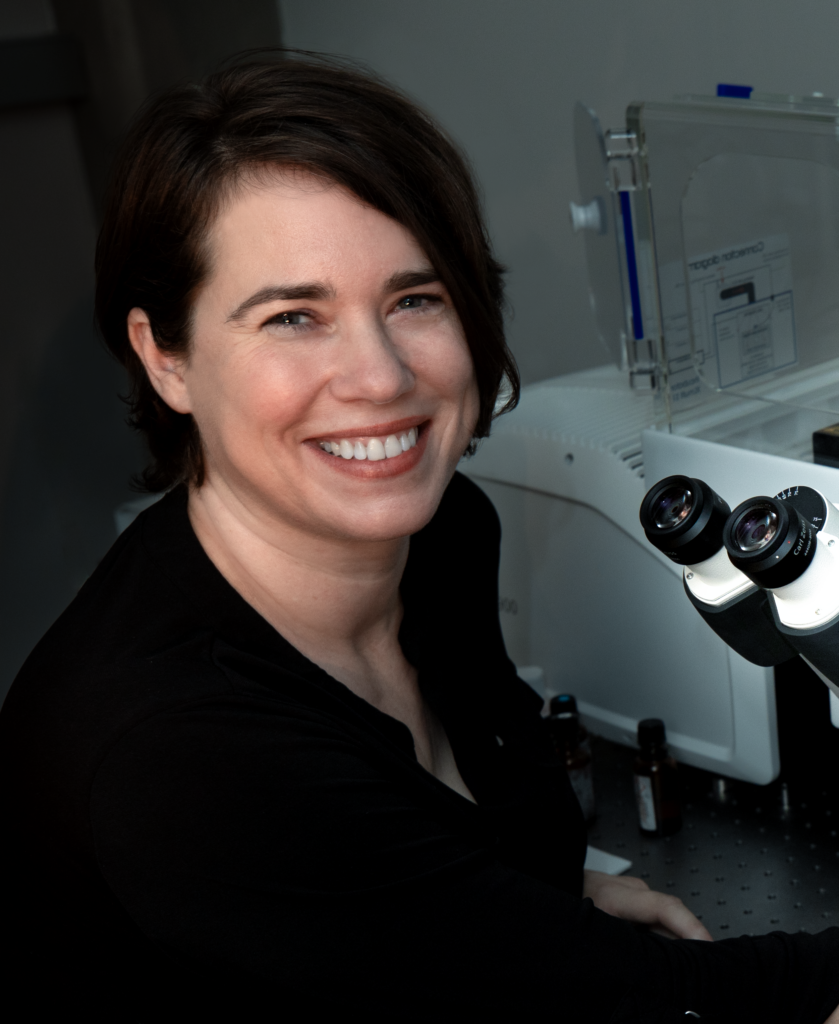 Tagide deCarvalho in front of a confocal microscope in the Keith R. Porter Imaging Facility at UMBC. (Melissa Cormier/UMBC)
“We use their equipment. I’m a big fan of their instruments, so it was nice to be recognized by that company,” deCarvalho says of the Zeiss award. The winning image portrayed bacteria that she scraped from her own tongue. At the time, she simply needed a quick sample to test some new materials for preparing specimens in the lab. Only later did she decide to refine the image into something beautiful.
“My superpower is finding everyday specimens and making them glamorous,” deCarvalho says, a bit tongue in cheek. She recently learned that her images will now reach a larger audience than ever before.
Putting her stamp on the art world
This summer, deCarvalho received an exciting request: An art curator wanted to include two of her images in an upcoming collection—except this was no typical art exhibit. A United States Postal Service (USPS) curator wanted to include deCarvalho’s work in a stamp collection featuring microscope images. USPS officially announced the “Life Magnified” collection in December, and the stamps will become available later in 2023.
The USPS recognition holds special significance for deCarvalho, whose grandfather collected stamps. When he passed away, deCarvalho inherited his collection. Her grandfather was a physician-scientist, and deCarvalho enjoyed looking through his microscopes as a child. He always told his granddaughter she would be a scientist one day.
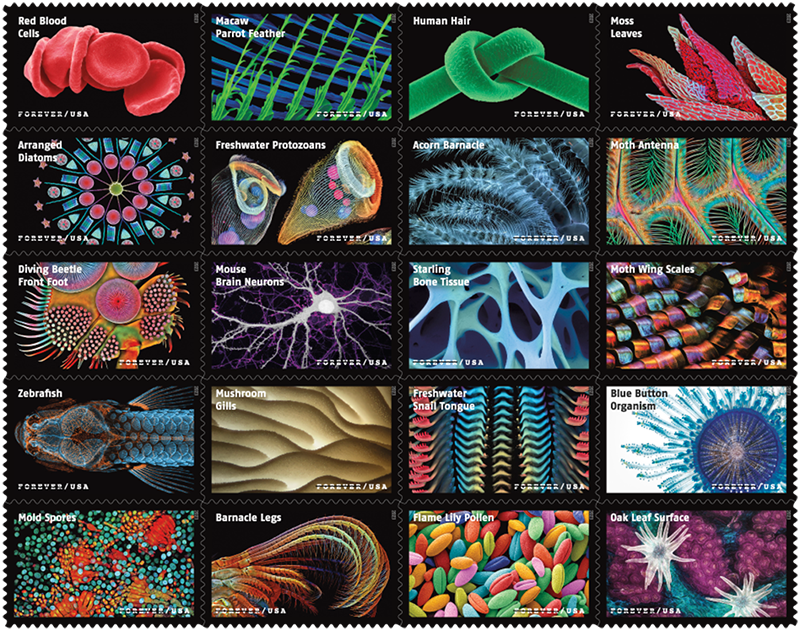 The “Life Magnified” stamp series, set to be released later this year. deCarvalho’s images are the Moss Leaves (upper right) and Mold Spores (lower left). (Image courtesy of U.S. Postal Service)
deCarvalho has had a lifelong interest in art, too, and began her academic career as an art photography major. As an undergraduate, she wanted to learn to use microscopes to create art in a biological context. To that end, she worked for a faculty member at the University of New Mexico School of Medicine creating transmission electron microscope images.
The professor was thrilled to work with a student who already knew how to develop film—the hardest thing to teach, and something deCarvalho had been doing for years in her own darkroom. In the lab, she started to learn techniques essential to her work today, but she never got to put her artistic talents to work. Instead, deCarvalho launched a scientific career, fulfilling her grandfather’s prophecy and eventually landing at UMBC in 2016.
Once she arrived at UMBC, art finally returned to her life. “Suddenly I realized I could do it,” deCarvalho says. “I’d say it was about 20 years later. I came full circle.”
Creating art, informing scientific research
The process of creating an artistic microscope image begins the exact same way as creating a research image. It’s only the post-processing that differs, deCarvalho explains.
“I take things further than what might be considered ethical for a research image, where there are clear guidelines as to what you can do,” she says. In a research image, “You can’t manipulate the image to alter any of the content.” For her art, she removes distracting elements like debris around the main specimen, and emphasizes the specimen’s key elements in a way that makes it more visually engaging.
Her modifications “allow you to focus your attention on [the specimen] more, and to find it more aesthetically pleasing,” explains deCarvalho. She believes this makes viewers “more interested in the content than you would be if I hadn’t slightly altered it,” she says. “I think it makes it more compelling.”
Her artistic work can still inform scientific image production. “I push the limits of my expertise by doing these art images,” deCarvalho says. “I can bring some of the experience and new techniques that I learn in doing that back to the research. It goes both ways.”
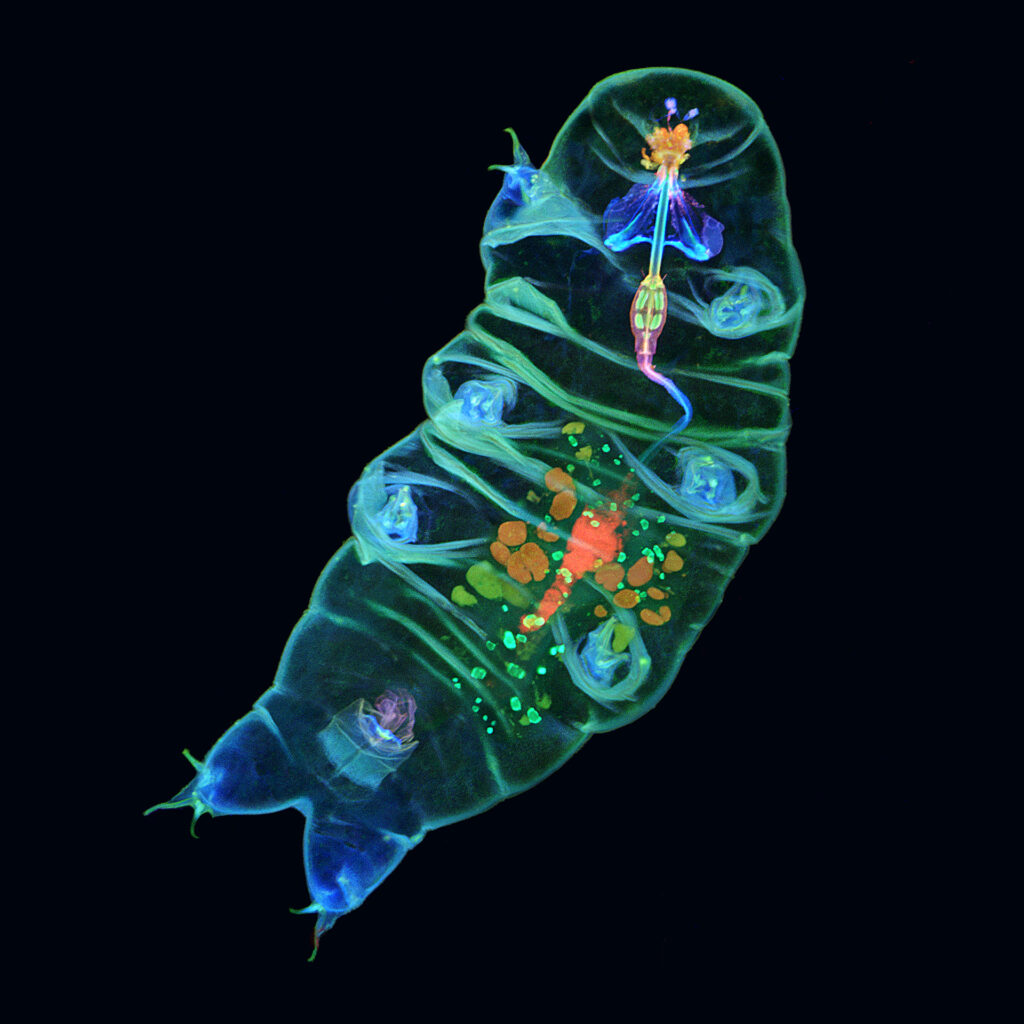 Tagide deCarvalho’s winning image of a tardigrade, or “water bear.” Tardigrades are approximately one millimeter long. (Image courtesy of deCarvalho)
For example, for the winning tardigrade image, “I came up with that staining just to create that pretty picture, and I’ve had tardigrade experts all across the world and people that use tardigrades in classrooms ask me for my technique, because they could see structures stained that they weren’t able to see before with the traditional staining techniques,” deCarvalho says. “So it informed research, just from me trying to make a nice picture.”
Public art, amplified
One of the images selected for “Life Magnified” features moss that deCarvalho scraped off the exterior of the UMBC Biological Sciences Building. “I feel like it’s kind of an homage to UMBC that one of the samples was taken right off the building,” she says.
When asked about her motivations for turning microscope images into beautiful works of art, her answer was simple. “It’s super cheesy, but I just get so excited when I see things under the microscope,” she says. “I look through the microscope, and I just think, ‘Wow, I can’t believe that’s real, and that it just looks so amazing.’” Her art, she says, is “a way to capture the excitement and share it with other people.”
In addition to the connections to UMBC and to her grandfather, having her work on stamps is special because it grants her images the ultimate visibility, she explains. Stamps “are like a public art museum,” deCarvalho says. “Each one is like a little piece of art—it’s the most public art form. So when USPS approached me, I thought, ‘This is the highest honor.’”
]]>
Tagide deCarvalho, director of the Keith R. Porter Imaging Facility in UMBC’s College of Natural and Mathematical Sciences, produces artistic images that reveal microscopic life in vivid,...
https://umbc.edu/stories/microscopic-life-stamps/
https://beta.my.umbc.edu/api/v0/pixel/news/130304/guest@my.umbc.edu/6fe8a84fcc3a5777f2abfd00df1fbb45/api/pixel
biology
cnms
kpif
news
rca-2
science-and-tech
UMBC News & Magazine
https://beta.my.umbc.edu/groups/umbc-news-magazine
https://assets1-beta.my.umbc.edu/system/shared/avatars/groups/000/001/943/24435aa6207c452e7bc15cc74b42c7bb/xsmall.png?1748556657
https://assets1-beta.my.umbc.edu/system/shared/avatars/groups/000/001/943/24435aa6207c452e7bc15cc74b42c7bb/original.png?1748556657
https://assets2-beta.my.umbc.edu/system/shared/avatars/groups/000/001/943/24435aa6207c452e7bc15cc74b42c7bb/xxlarge.png?1748556657
https://assets2-beta.my.umbc.edu/system/shared/avatars/groups/000/001/943/24435aa6207c452e7bc15cc74b42c7bb/xlarge.png?1748556657
https://assets3-beta.my.umbc.edu/system/shared/avatars/groups/000/001/943/24435aa6207c452e7bc15cc74b42c7bb/large.png?1748556657
https://assets1-beta.my.umbc.edu/system/shared/avatars/groups/000/001/943/24435aa6207c452e7bc15cc74b42c7bb/medium.png?1748556657
https://assets2-beta.my.umbc.edu/system/shared/avatars/groups/000/001/943/24435aa6207c452e7bc15cc74b42c7bb/small.png?1748556657
https://assets1-beta.my.umbc.edu/system/shared/avatars/groups/000/001/943/24435aa6207c452e7bc15cc74b42c7bb/xsmall.png?1748556657
https://assets2-beta.my.umbc.edu/system/shared/avatars/groups/000/001/943/24435aa6207c452e7bc15cc74b42c7bb/xxsmall.png?1748556657
UMBC News & Magazine
1
0
false
Thu, 19 Jan 2023 19:03:01 -0500
Thu, 19 Jan 2023 19:03:01 -0500
Organ-on-a-chip models allow researchers to conduct studies closer to real-life conditions – and possibly grease the drug development pipeline
Chengpeng Chen, Assistant Professor of Chemistry and Biochemistry, UMBC
Bringing a new drug to market costs billions of dollars and can take over a decade. These high monetary and time investments are both strong contributors to today’s skyrocketing health care costs and significant obstacles to delivering new therapies to patients. One big reason behind these barriers is the lab models researchers use to develop drugs in the first place.
Preclinical trials, or studies that test a drug’s efficacy and toxicity before it enters clinical trials in people, are mainly conducted on cell cultures and animals. Both are limited by their poor ability to mimic the conditions of the human body. Cell cultures in a petri dish are unable to replicate every aspect of tissue function, such as how cells interact in the body or the dynamics of living organs. And animals are not humans – even small genetic differences between species can be amplified to major physiological differences.
Fewer than 8% of successful animal studies for cancer therapies make it to human clinical trials. Because animal models often fail to predict drug effects in human clinical trials, these late-stage failures can significantly drive up both costs and patient health risks.
To address this translation problem, researchers have been developing a promising model that can more closely mimic the human body – organ-on-a-chip.
As an analytical chemist, I have been working to develop organ and tissue models that avoid the simplicity of common cell cultures and the discrepancies of animal models. I believe that, with further development, organs-on-chips can help researchers study diseases and test drugs in conditions that are closer to real life.
Organs-on-chips offer an alternative model for early-phase biomedical research.
What are organs-on-chips?
In the late 1990s, researchers figured out a way to layer elastic polymers to control and examine fluids at a microscopic level. This launched the field of microfluidics, which for the biomedical sciences involves the use of devices that can mimic the dynamic flow of fluids in the body, such as blood.
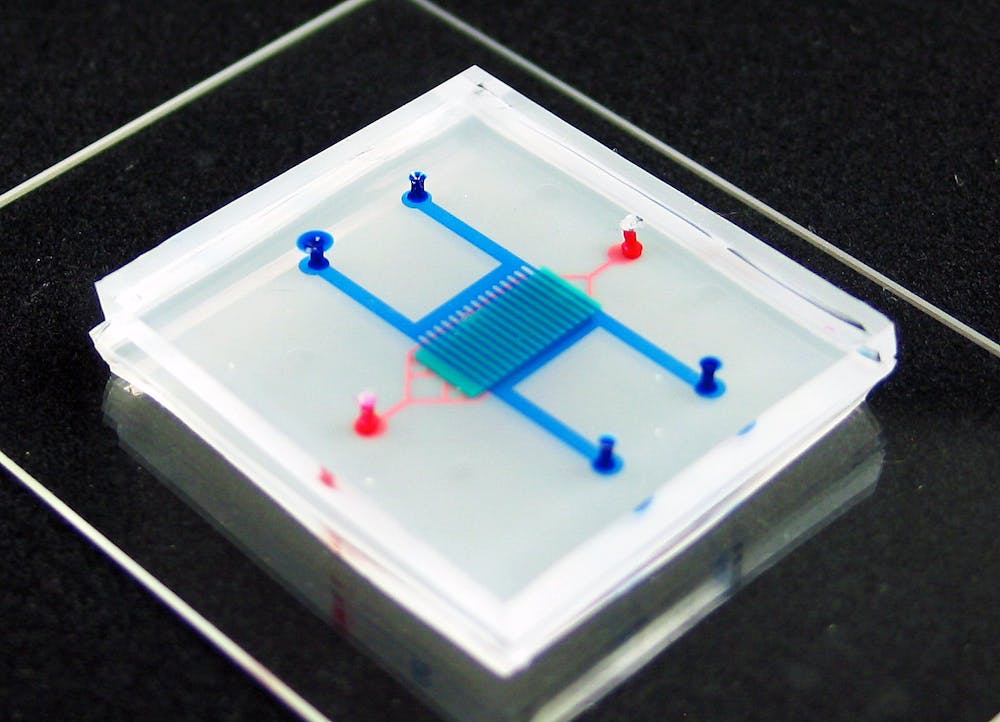
Advances in microfluidics have provided researchers a platform to culture cells that function more closely to how they would in the human body, specifically with organs-on-chips. The “chip” refers to the microfluidic device that encases the cells. They’re commonly made using the same technology as computer chips.
Not only do organs-on-chips mimic blood flow in the body, these platforms have microchambers that allow researchers to integrate multiple types of cells to mimic the diverse range of cell types normally present in an organ. The fluid flow connects these multiple cell types, allowing researchers to study how they interact with each other.
Microfluidics can be used for many applications in biological research.
This technology can overcome the limitations of both static cell cultures and animal studies in several ways. First, the presence of fluid flowing in the model allows it to mimic both what a cell experiences in the body, such as how it receives nutrients and removes wastes, and how a drug will move in the blood and interact with multiple types of cells. The ability to control fluid flow also enables researchers to fine-tune the optimal dosing for a particular drug.
The lung-on-a-chip model, for instance, is able to integrate both the mechanical and physical qualities of a living human lung. It’s able to mimic the dilation and contraction, or inhalation and exhalation, of the lung and simulate the interface between the lung and air. The ability to replicate these qualities allows researchers to better study lung impairment across different factors.
Bringing organs-on-chips to scale
While organ-on-a-chip pushes the boundaries of early-stage pharmaceutical research, the technology has not been widely integrated into drug development pipelines. I believe that a core obstacle for wide adoption of such chips is its high complexity and low practicality.
Current organ-on-a-chip models are difficult for the average scientist to use. Also, because most models are single-use and allow only one input, which limits what researchers can study at a given time, they are both expensive and time- and labor-intensive to implement. The high investments required to use these models might dampen enthusiasm to adopt them. After all, researchers often use the least complex models available for preclinical studies to reduce time and cost.
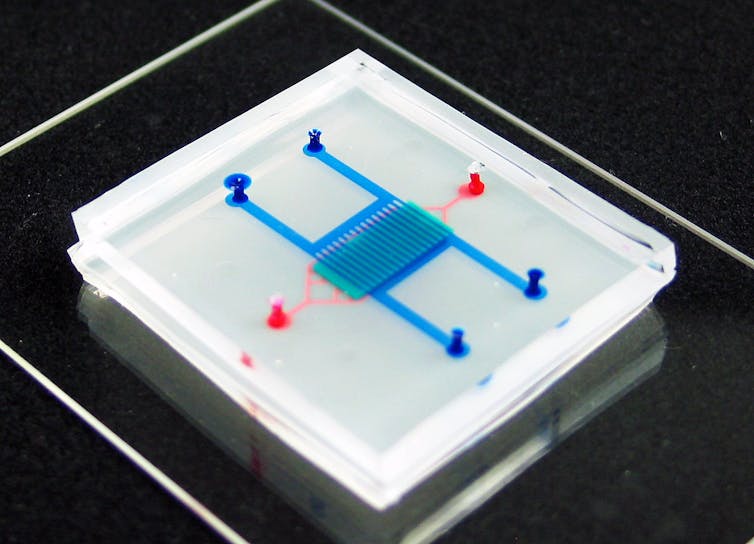 This chip mimics the blood-brain barrier. The blue dye marks where brain cells would go, and the red dye marks the route of blood flow. (Vanderbilt University/Flickr)
Lowering the technical bar to make and use organs-on-chips is critical to allowing the entire research community to take full advantage of their benefits. But this does not necessarily require simplifying the models. My lab, for example, has designed various “plug-and-play” tissue chips that are standardized and modular, allowing researchers to readily assemble premade parts to run their experiments.
The advent of 3D printing has also significantly facilitated the development of organ-on-a-chip, allowing researchers to directly manufacture entire tissue and organ models on chips. 3D printing is ideal for fast prototyping and design-sharing between users and also makes it easy for mass production of standardized materials.
I believe that organs-on-chips hold the potential to enable breakthroughs in drug discovery and allow researchers to better understand how organs function in health and disease. Increasing this technology’s accessibility could help take the model out of development in the lab and let it make its mark on the biomedical industry.
Chengpeng Chen, Assistant Professor of Chemistry and Biochemistry, University of Maryland, Baltimore County
This article is republished from The Conversation under a Creative Commons license. Read the original article.
]]>
Chengpeng Chen, Assistant Professor of Chemistry and Biochemistry, UMBC Bringing a new drug to market costs billions of dollars and can take over a decade. These high monetary and time...
https://umbc.edu/stories/organ-on-a-chip-speeds-drug-development/
https://beta.my.umbc.edu/api/v0/pixel/news/130133/guest@my.umbc.edu/18eb1b7f6349ba863ffc966b1063f288/api/pixel
chembiochem
cnms
discovery
magazine
the-conversation
theconversation
UMBC News & Magazine
https://beta.my.umbc.edu/groups/umbc-news-magazine
https://assets1-beta.my.umbc.edu/system/shared/avatars/groups/000/001/943/24435aa6207c452e7bc15cc74b42c7bb/xsmall.png?1748556657
https://assets1-beta.my.umbc.edu/system/shared/avatars/groups/000/001/943/24435aa6207c452e7bc15cc74b42c7bb/original.png?1748556657
https://assets2-beta.my.umbc.edu/system/shared/avatars/groups/000/001/943/24435aa6207c452e7bc15cc74b42c7bb/xxlarge.png?1748556657
https://assets2-beta.my.umbc.edu/system/shared/avatars/groups/000/001/943/24435aa6207c452e7bc15cc74b42c7bb/xlarge.png?1748556657
https://assets3-beta.my.umbc.edu/system/shared/avatars/groups/000/001/943/24435aa6207c452e7bc15cc74b42c7bb/large.png?1748556657
https://assets1-beta.my.umbc.edu/system/shared/avatars/groups/000/001/943/24435aa6207c452e7bc15cc74b42c7bb/medium.png?1748556657
https://assets2-beta.my.umbc.edu/system/shared/avatars/groups/000/001/943/24435aa6207c452e7bc15cc74b42c7bb/small.png?1748556657
https://assets1-beta.my.umbc.edu/system/shared/avatars/groups/000/001/943/24435aa6207c452e7bc15cc74b42c7bb/xsmall.png?1748556657
https://assets2-beta.my.umbc.edu/system/shared/avatars/groups/000/001/943/24435aa6207c452e7bc15cc74b42c7bb/xxsmall.png?1748556657
UMBC News & Magazine
0
0
false
Tue, 10 Jan 2023 11:35:26 -0500
Tue, 10 Jan 2023 11:35:26 -0500
Manil Suri’s new book, “The Big Bang of Numbers,” introduces readers to the wonder of math

It’s rare to meet a mathematician who is also a bestselling novelist, but UMBC’s Manil Suri, professor of mathematics, is happy to be unique. Suri is the author of a famed trilogy named for Hindu gods, including The Death of Vishnu (2001), which was long-listed for the Booker Prize, The Age of Shiva (2008), and The City of Devi (2013). He recently published his latest book, The Big Bang of Numbers: How to Build the Universe Using Only Math, to global acclaim.
The Big Bang of Numbers is Suri’s first nonfiction book, written to show people who aren’t necessarily fond of math that the discipline is foundational to our world—and can even be fun.
“The concept is intriguing, if hard to get your head around: Can you understand the creation of the universe purely through basic mathematics?” writes The Washingtonian. Suri’s answer with The Big Bang of Numbers is a resounding ‘yes.’ The book “explores many areas of seemingly pure math that explain the natural world, from the shapes of galaxies and living creatures to weather, gravity, beauty, and even art,” Kirkus Reviewswrites.
In his role as math professor, Suri works hard to convince his students that math doesn’t just matter, it is also endlessly interesting—extending his instruction well beyond the basics of calculations and into the field’s fundamental ideas.
“All your life, you keep hearing that maths is all about calculations,” Suri told Telegraph India, “while in essence, maths is all about ideas.” Suri first expounded on this theme in a 2013 New York Times op-ed, “How to Fall in Love with Math.” When the op-ed became shockingly popular, the idea for a book grew from there.
Manil Suri speaks about The Big Bang of Numbers at a special event to mark the book’s publication and success on November 14 at UMBC’s Albin O. Kuhn Library & Gallery.
A new challenge
With The Big Bang of Numbers, which the Wall Street Journal has called “imaginative and organized,” Suri isn’t just seeking to help a wider audience understand or feel comfortable with math, but feel a sense of fascination with it. According to the Mathematical Association of America, Suri’s approach—rich in humor and narrative elements—goes beyond “simply telling the reader about these ideas”; instead, he “allow[s] readers to experience the attitude of curious exploration that attracts mathematicians to the discipline, but is often absent from low-level math classes.”
“With evocative and engaging examples ranging from multidimensional crochet to the Mona Lisa’s asymmetrical smile, as well as ingenious storytelling that helps illuminate complex concepts like infinity and relativity, The Big Bang of Numbers charts a playful, inventive course to existence,” writes the Deccan Herald, which named the book its “read of the week” in mid-October.
For Suri, while the book was very different in some ways from his previous works of fiction, The Big Bang of Numbers hews closely to his style that relies on humor and engaging narrative to draw the reader into unfamiliar topics. His novels all take place in India, a place that feels far away and unknown to many of his readers. “After explaining India in three internationally released books to many readers who didn’t know much about the country, I was ready to take on an even bigger challenge,” he told Frontline, a major English-language magazine in India, “—explaining mathematics to a general audience!”
Manil Suri speaks at GRIT-X, an event during UMBC’s Homecoming festivities, in 2018.
Math as a game
“Usually math is thought of as something that we invent, perhaps, to explain things around us. I’m kind of reversing this perspective and saying that math is the true driver of the universe, and the universe itself is a model of the mathematical principles,” Suri recently told NPR’s Marketplace.
Put another way, the Sunday Times of London explains the central thesis of the book is that “maths, the creative language in which reality is written, is ‘the life force that drives the universe,’ and you could build one—stars, worlds, you and me—from scratch using maths alone.” The review notes, “It sounds intimidating, but Suri has a knack for clarity and a welcome habit of grounding tricky concepts in the tangible.”
In the end, according to Suri’s book, math is a “force that forever enthralls, not just through the answers it gives but also through the new mysteries it poses.” But he hopes his readers will also understand math as a game.
“For mathematicians, I suspect the most appealing characteristic of the subject is its playfulness,” Suri told Frontline. “Maths is a game in which you start with a bunch of rules and then deduce away to see where you can get. You can play it anywhere—in the shower, on the bus, while eating lunch—all you need is your mind.”
]]>
It’s rare to meet a mathematician who is also a bestselling novelist, but UMBC’s Manil Suri, professor of mathematics, is happy to be unique. Suri is the author of a famed trilogy named for Hindu...
https://umbc.edu/stories/the-big-bang-of-numbers/
https://beta.my.umbc.edu/api/v0/pixel/news/130097/guest@my.umbc.edu/16dad0e299dce213100136c2d82a5735/api/pixel
cnms
mathstat
news
science-and-tech
UMBC News & Magazine
https://beta.my.umbc.edu/groups/umbc-news-magazine
https://assets1-beta.my.umbc.edu/system/shared/avatars/groups/000/001/943/24435aa6207c452e7bc15cc74b42c7bb/xsmall.png?1748556657
https://assets1-beta.my.umbc.edu/system/shared/avatars/groups/000/001/943/24435aa6207c452e7bc15cc74b42c7bb/original.png?1748556657
https://assets2-beta.my.umbc.edu/system/shared/avatars/groups/000/001/943/24435aa6207c452e7bc15cc74b42c7bb/xxlarge.png?1748556657
https://assets2-beta.my.umbc.edu/system/shared/avatars/groups/000/001/943/24435aa6207c452e7bc15cc74b42c7bb/xlarge.png?1748556657
https://assets3-beta.my.umbc.edu/system/shared/avatars/groups/000/001/943/24435aa6207c452e7bc15cc74b42c7bb/large.png?1748556657
https://assets1-beta.my.umbc.edu/system/shared/avatars/groups/000/001/943/24435aa6207c452e7bc15cc74b42c7bb/medium.png?1748556657
https://assets2-beta.my.umbc.edu/system/shared/avatars/groups/000/001/943/24435aa6207c452e7bc15cc74b42c7bb/small.png?1748556657
https://assets1-beta.my.umbc.edu/system/shared/avatars/groups/000/001/943/24435aa6207c452e7bc15cc74b42c7bb/xsmall.png?1748556657
https://assets2-beta.my.umbc.edu/system/shared/avatars/groups/000/001/943/24435aa6207c452e7bc15cc74b42c7bb/xxsmall.png?1748556657
UMBC News & Magazine
6
0
false
Fri, 06 Jan 2023 15:52:34 -0500
Fri, 06 Jan 2023 15:52:34 -0500
Star power: UMBC’s Carlos Romero-Talamás explains why fusion is grabbing headlines
On a recent Tuesday in December, UMBC’s Carlos Romero-Talamás escorted a TV crew from Baltimore into one of his labs. The reporters were there to talk about a just announced fusion power milestone achieved at Lawrence Livermore National Laboratory in California, but they quickly became interested in Romero-Talamás’s own experiments too. He is questing after the same fusion milestone using equipment that’s much simpler and cheaper.
Bringing the energy of the stars to Earth
Fusion is the atomic engine that powers stars. Inside the cores of these celestial infernos, fast-moving hydrogen atoms, stripped of their electrons, ricochet around. Occasionally they collide in such ways that they transform into helium atoms. When that happens, a lot of energy is released.
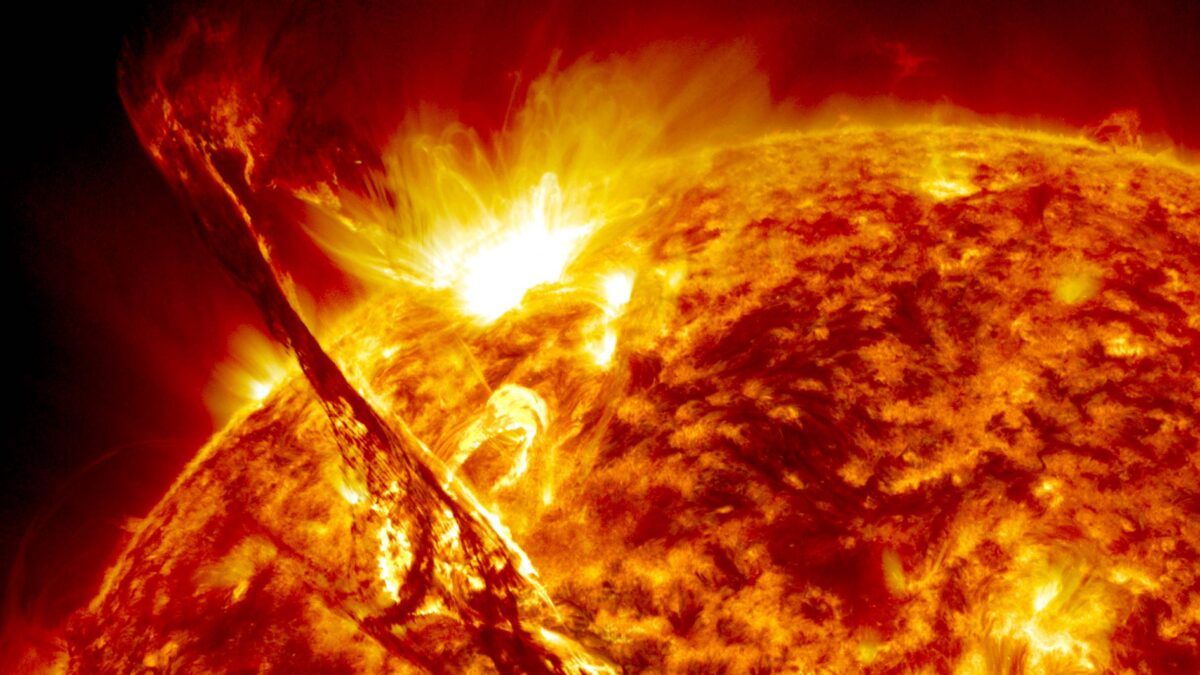 The enormous power of the sun comes from fusion reactions that turn hydrogen into helium. (NASA/SDO)
For decades, humanity has dreamed of harnessing fusion power on Earth to make safe, clean, and near limitless energy. But thorny physics and engineering challenges made the goal elusive, with scientists coming to joke that “fusion power is 30 years away—and always will be.”
Yet now, a growing excitement is displacing some of the skepticism. Governments are directing more money toward fusion research and private investors such as Bill Gates and Jeff Bezos are collectively pitching in billions of dollars. Some companies are promising commercial fusion power in 10 years.
Romero-Talamás’s own work has benefited from the renewed attention. In 2020, he was awarded a $4 million grant from the U.S. Department of Energy to explore a promising alternative to traditional fusion power approaches. Rather than blast hydrogen atoms with lasers (the approach used at Lawrence Livermore) or squeeze them into a donut-shaped ring using enormous magnets (the approach epitomized by the multi-billion-dollar, nearly 100-foot-tall ITER fusion reactor under construction in France), Romero-Talamás and his team plan to confine their hydrogen atoms in a supersonic whirlwind shaped by a novel arrangement of magnets and an electrically conducting central rod.
If the concept works, it could lead to a commercial fusion reactor relatively quickly, Romero-Talamás says, because it uses equipment that is smaller, cheaper, and simpler to operate than the equipment required by other approaches.
A simpler fusion reactor
Romero-Talamás’ team, which includes collaborators from the University of Maryland, College Park, has already built a test machine in a lab on the College Park campus. While the machine does not have the capacity to operate as an energy-generating reactor, initial experiments on it show the hydrogen atoms are being trapped in the whirlwind as hoped. If experiments continue to go well, the team will soon begin work on a bigger, next-generation machine. That machine could be fitted to produce more power than it takes to run, a key milestone on the road to commercial fusion power.
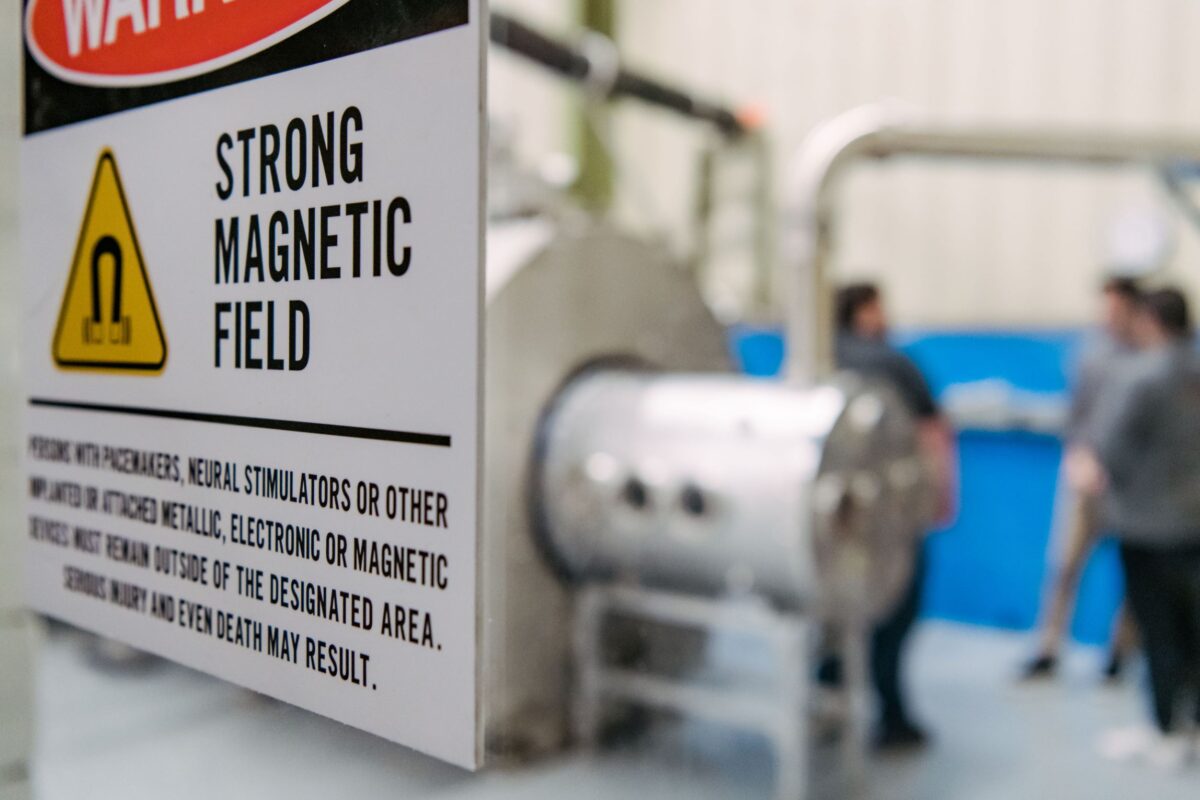 Strong magnets help control the hydrogen atoms inside the test machine. (Marlayna Demond ’11/UMBC)
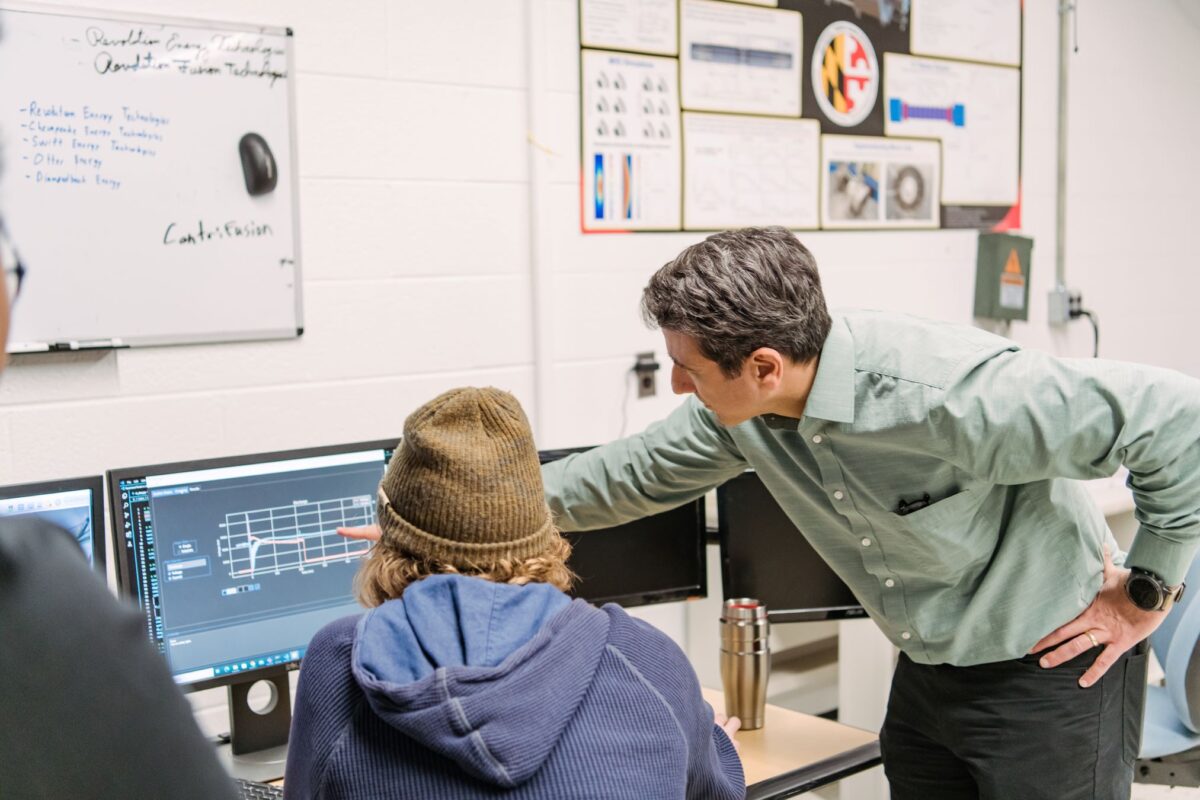 Carlos Romero-Talamás and UMBC graduate student Nathan Eschbach look at diagnostic data. (Marlayna Demond ’11/UMBC)
We sat down to chat with Romero-Talamás about the wonder of fusion and the excitement of scientists who feel they may be on the cusp of world-changing innovations. The following interview has been edited for brevity.
Conversation with Carlos Romero-Talamás
UMBC News: It feels like fusion is having a moment. Do you agree?
Romero-Talamás: The announcement from Lawrence Livermore gained a lot of attention, but fusion has actually been having a moment, so to speak, for the last few years. And the reason these years have been different is because the private sector got interested. The amount of money they bring is changing the equation. I’ve told people our concept will take tens of millions of dollars for the next machine—which is not a reactor, but a reactor-sized experiment—and they don’t even flinch. They are people who are used to handling that kind of money.
UMBC News: What are some of the challenges that remain?
Romero-Talamás: There are still big questions. Some are about the physics—how the particles behave. Some are engineering—how are you actually going to build something that can operate day in and day out. We also need people, not just graduate students, but also technicians who know the technology.
Some of these fusion companies and concepts are probably going to fail. And hopefully, that won’t spook the investors, because the success of one will be beneficial to everyone.
UMBC News: How did you get interested in fusion?
Romero-Talamás: When I was an undergraduate, there was a fusion experiment where for a brief amount of time they produced about 60% of the energy they put in. I had never heard of fusion until then—that’s when I learned about it. I thought, “Okay, by the time I’m a scientist, they are going to have fusion reactors.” Of course, that didn’t happen.
But in graduate school, I learned about fusion energy more from the fundamental physics side, and I thought it was fascinating. I actually got funding as a student to go to Lawrence Livermore, and I did a lot of my research there.
UMBC News: What excites you about this research?
Romero-Talamás: We all need energy, and many metrics even measure a country’s economic strength by the amount of energy it produces and consumes. Fusion is considered the “holy grail” of energy. It could provide virtually unlimited energy for millions of years. It is clean and carbon free. I think finally it is getting the attention it deserves.
And, of course, the students are the heart of the work. They believe they can change the world.
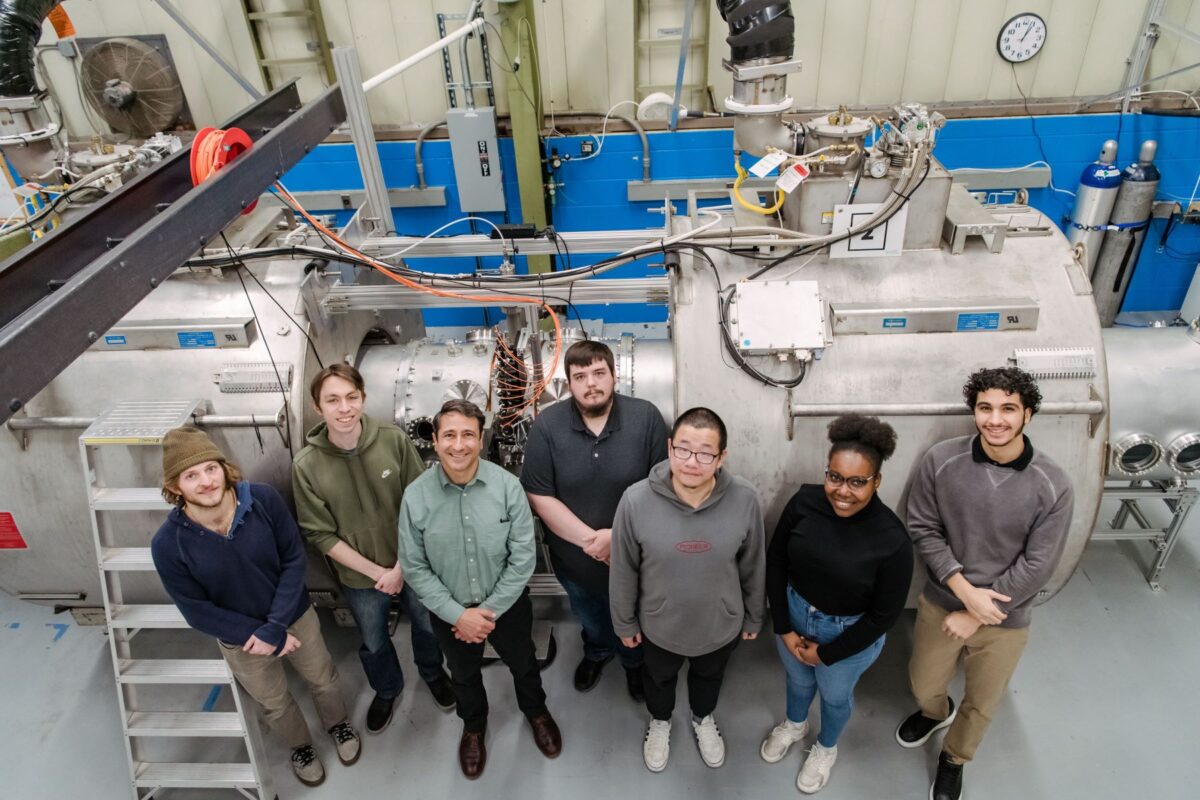 Carlos Romero-Talamás in front of the test machine with students and colleagues from UMBC and UMD who are working on the project. From left to right: Nathan Eschbach, Ryan Schneider, Carlos Romero-Talamás, Zachary Short, Quan Gan, Autumn Bartholomew, and Mohamed Nasser. (Marlayna Demond ’11/UMBC)
]]>
On a recent Tuesday in December, UMBC’s Carlos Romero-Talamás escorted a TV crew from Baltimore into one of his labs. The reporters were there to talk about a just announced fusion power milestone...
https://umbc.edu/stories/star-power-umbcs-carlos-romero-talamas-explains-why-fusion-is-grabbing-headlines/
https://beta.my.umbc.edu/api/v0/pixel/news/130090/guest@my.umbc.edu/6a604f5ea6b2be1376790162b811ac98/api/pixel
coeit
meche
news
research
science-and-tech
UMBC News & Magazine
https://beta.my.umbc.edu/groups/umbc-news-magazine
https://assets1-beta.my.umbc.edu/system/shared/avatars/groups/000/001/943/24435aa6207c452e7bc15cc74b42c7bb/xsmall.png?1748556657
https://assets1-beta.my.umbc.edu/system/shared/avatars/groups/000/001/943/24435aa6207c452e7bc15cc74b42c7bb/original.png?1748556657
https://assets2-beta.my.umbc.edu/system/shared/avatars/groups/000/001/943/24435aa6207c452e7bc15cc74b42c7bb/xxlarge.png?1748556657
https://assets2-beta.my.umbc.edu/system/shared/avatars/groups/000/001/943/24435aa6207c452e7bc15cc74b42c7bb/xlarge.png?1748556657
https://assets3-beta.my.umbc.edu/system/shared/avatars/groups/000/001/943/24435aa6207c452e7bc15cc74b42c7bb/large.png?1748556657
https://assets1-beta.my.umbc.edu/system/shared/avatars/groups/000/001/943/24435aa6207c452e7bc15cc74b42c7bb/medium.png?1748556657
https://assets2-beta.my.umbc.edu/system/shared/avatars/groups/000/001/943/24435aa6207c452e7bc15cc74b42c7bb/small.png?1748556657
https://assets1-beta.my.umbc.edu/system/shared/avatars/groups/000/001/943/24435aa6207c452e7bc15cc74b42c7bb/xsmall.png?1748556657
https://assets2-beta.my.umbc.edu/system/shared/avatars/groups/000/001/943/24435aa6207c452e7bc15cc74b42c7bb/xxsmall.png?1748556657
UMBC News & Magazine
0
0
false
Fri, 06 Jan 2023 14:08:54 -0500
Fri, 06 Jan 2023 14:08:54 -0500
NSF awards UMBC’s Lauren Clay $624K Convergence Accelerator grant to address food insecurity in disasters
Carlos Romero-Talamás in front of the test machine with students and colleagues from UMBC and UMD who are working on the project. From left to right: Nathan Eschbach, Ryan Schneider, Carlos Romero-Talamás, Zachary Short, Quan Gan, Autumn Bartholomew, and Mohamed Nasser. (Marlayna Demond ’11/UMBC)
]]>
On a recent Tuesday in December, UMBC’s Carlos Romero-Talamás escorted a TV crew from Baltimore into one of his labs. The reporters were there to talk about a just announced fusion power milestone...
https://umbc.edu/stories/star-power-umbcs-carlos-romero-talamas-explains-why-fusion-is-grabbing-headlines/
https://beta.my.umbc.edu/api/v0/pixel/news/130090/guest@my.umbc.edu/6a604f5ea6b2be1376790162b811ac98/api/pixel
coeit
meche
news
research
science-and-tech
UMBC News & Magazine
https://beta.my.umbc.edu/groups/umbc-news-magazine
https://assets1-beta.my.umbc.edu/system/shared/avatars/groups/000/001/943/24435aa6207c452e7bc15cc74b42c7bb/xsmall.png?1748556657
https://assets1-beta.my.umbc.edu/system/shared/avatars/groups/000/001/943/24435aa6207c452e7bc15cc74b42c7bb/original.png?1748556657
https://assets2-beta.my.umbc.edu/system/shared/avatars/groups/000/001/943/24435aa6207c452e7bc15cc74b42c7bb/xxlarge.png?1748556657
https://assets2-beta.my.umbc.edu/system/shared/avatars/groups/000/001/943/24435aa6207c452e7bc15cc74b42c7bb/xlarge.png?1748556657
https://assets3-beta.my.umbc.edu/system/shared/avatars/groups/000/001/943/24435aa6207c452e7bc15cc74b42c7bb/large.png?1748556657
https://assets1-beta.my.umbc.edu/system/shared/avatars/groups/000/001/943/24435aa6207c452e7bc15cc74b42c7bb/medium.png?1748556657
https://assets2-beta.my.umbc.edu/system/shared/avatars/groups/000/001/943/24435aa6207c452e7bc15cc74b42c7bb/small.png?1748556657
https://assets1-beta.my.umbc.edu/system/shared/avatars/groups/000/001/943/24435aa6207c452e7bc15cc74b42c7bb/xsmall.png?1748556657
https://assets2-beta.my.umbc.edu/system/shared/avatars/groups/000/001/943/24435aa6207c452e7bc15cc74b42c7bb/xxsmall.png?1748556657
UMBC News & Magazine
0
0
false
Fri, 06 Jan 2023 14:08:54 -0500
Fri, 06 Jan 2023 14:08:54 -0500
NSF awards UMBC’s Lauren Clay $624K Convergence Accelerator grant to address food insecurity in disasters
Longstanding food insecurity problems in the U.S. and around the world, exacerbated by the pandemic, are projected to increase over the coming decades, as food, water, and energy demands increase and environmental crises worsen. With this in mind, the National Science Foundation (NSF) is investing $11 million toward solutions to address the nutritional needs of vulnerable and under-resourced communities through its Convergence Accelerator Program.
UMBC’s Lauren Clay, associate professor and chair of emergency health services, is one 16 Convergence Accelerator awardees selected for Phase I of the program. Clay was awarded $624,000 for her project to improve food system resilience and decrease disaster-induced food insecurity in communities impacted by hurricanes.
Supporting food system resilience
Clay’s proposal explains that 11-15 percent of the U.S. population experienced food insecurity annually between 2008 and 2018, and households that are struggling with food insecurity before a disaster are at greatest risk for serious food access issues when a disaster strikes, and long after.
“Food and nutrition insecurity rates can increase threefold following disasters,” Clay notes. “Increased food and nutrition insecurity rates persist for years while households and communities recover.”
 Food and clothing relief center for Hurricane Sandy survivors in New York City in 2012. (“Walter Jennings”/Wikimedia Commons)
“Communities across the U.S. are planning for growing threats related to climate disasters. Food security is a basic human need and is highly susceptible to disruption when families and communities experience disasters,” says Clay. “I’m excited to work with a multi-disciplinary and multi-sector team to develop a new tool for measuring community food security to support communities planning for, responding to, and recovering from hurricanes.”
Converging on solutions
The NSF Convergence Accelerator Program seeks to address national-scale challenges in science, engineering, and society through a collaborative research process that brings together expertise from multiple scientific disciplines, known as convergence research. The food and nutrition focus was recently added to the Convergence Accelerator, which also includes approaches towards combating challenges related to population health and climate change.
“We hope to create a group of synergistic efforts that advance regenerative agriculture practices, reduce water usage, provide equitable access to nutritious and affordable food for disadvantaged communities, and spur technology and job creation,” says Douglas Maughan, head of the Convergence Accelerator, in NSF’s announcement of award recipients.
Over the course of nine months, Clay and her team will work to develop the Food Index for Resilience, Security, & Tangible Solutions, called FIRST. This index will measure food system functioning in communities and is intended to be a resource that can be used to respond to and recover from disasters and environmental changes.
This effort builds on Clay’s prior and ongoing research to address disaster-specific food insecurity issues. She was also recently awarded an NSF Faculty Early Career Development (CAREER) award to develop a sociocultural model called Food Environment in Disasters (FED) and other tools to improve the understanding and monitoring of food availability, acceptability, and accessibility during disasters.
Following Phase I of this project, participating teams will take part in a formal pitch and Phase II proposal and could receive up to $5 million of additional support. Selected Phase II teams will further develop their solutions and sustainability development plans over the course of 24 months, to rapidly meet the needs of global communities.
]]>
Longstanding food insecurity problems in the U.S. and around the world, exacerbated by the pandemic, are projected to increase over the coming decades, as food, water, and energy demands increase...
https://umbc.edu/stories/convergence-accelerator-grant-food-insecurity-in-disasters/
https://beta.my.umbc.edu/api/v0/pixel/news/130098/guest@my.umbc.edu/3b254c269b2dc52563c49eefac025498/api/pixel
cahss
ehs
news
policy-and-society
rca-1
research
UMBC News & Magazine
https://beta.my.umbc.edu/groups/umbc-news-magazine
https://assets1-beta.my.umbc.edu/system/shared/avatars/groups/000/001/943/24435aa6207c452e7bc15cc74b42c7bb/xsmall.png?1748556657
https://assets1-beta.my.umbc.edu/system/shared/avatars/groups/000/001/943/24435aa6207c452e7bc15cc74b42c7bb/original.png?1748556657
https://assets2-beta.my.umbc.edu/system/shared/avatars/groups/000/001/943/24435aa6207c452e7bc15cc74b42c7bb/xxlarge.png?1748556657
https://assets2-beta.my.umbc.edu/system/shared/avatars/groups/000/001/943/24435aa6207c452e7bc15cc74b42c7bb/xlarge.png?1748556657
https://assets3-beta.my.umbc.edu/system/shared/avatars/groups/000/001/943/24435aa6207c452e7bc15cc74b42c7bb/large.png?1748556657
https://assets1-beta.my.umbc.edu/system/shared/avatars/groups/000/001/943/24435aa6207c452e7bc15cc74b42c7bb/medium.png?1748556657
https://assets2-beta.my.umbc.edu/system/shared/avatars/groups/000/001/943/24435aa6207c452e7bc15cc74b42c7bb/small.png?1748556657
https://assets1-beta.my.umbc.edu/system/shared/avatars/groups/000/001/943/24435aa6207c452e7bc15cc74b42c7bb/xsmall.png?1748556657
https://assets2-beta.my.umbc.edu/system/shared/avatars/groups/000/001/943/24435aa6207c452e7bc15cc74b42c7bb/xxsmall.png?1748556657
UMBC News & Magazine
0
0
false
Fri, 06 Jan 2023 14:04:22 -0500
Fri, 06 Jan 2023 14:04:22 -0500
UMBC’s Top Stories of 2022
Just like the people that are part of our community, UMBC experienced a year of change, growth, and opportunity in 2022. Exciting achievements, transformative leadership, and groundbreaking research made this another year for the record books. Looking back at 2022, we’re reminded of all the reasons we’re proud to call UMBC home.
1. University milestones
-
UMBC welcomed Valerie Sheares Ashby as the president, following the retirement of Freeman A. Hrabowski III, who served as UMBC’s leader for a remarkable 30 years. President Sheares Ashby joined UMBC from Duke University’s Trinity College of Arts & Sciences, where she had served as dean. Since starting her tenure, Sheares Ashby has made herself accessible to students through weekly office hours. She’s also enjoyed taking part in some time-honored UMBC traditions, like rubbing True Grit’s nose for luck and taking in all that Homecoming has to offer.
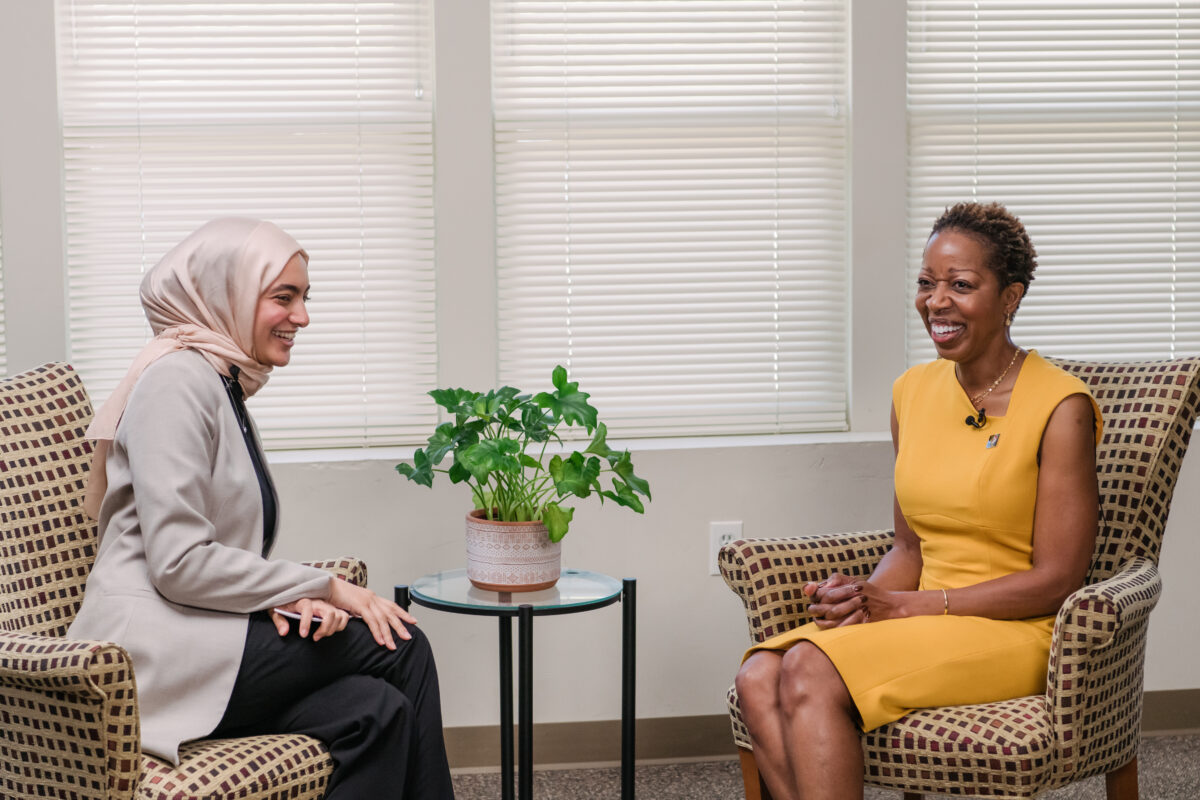 Farah Helal ’24 speaks with President Sheares Ashby. (Marlayna Demond ’11/UMBC)
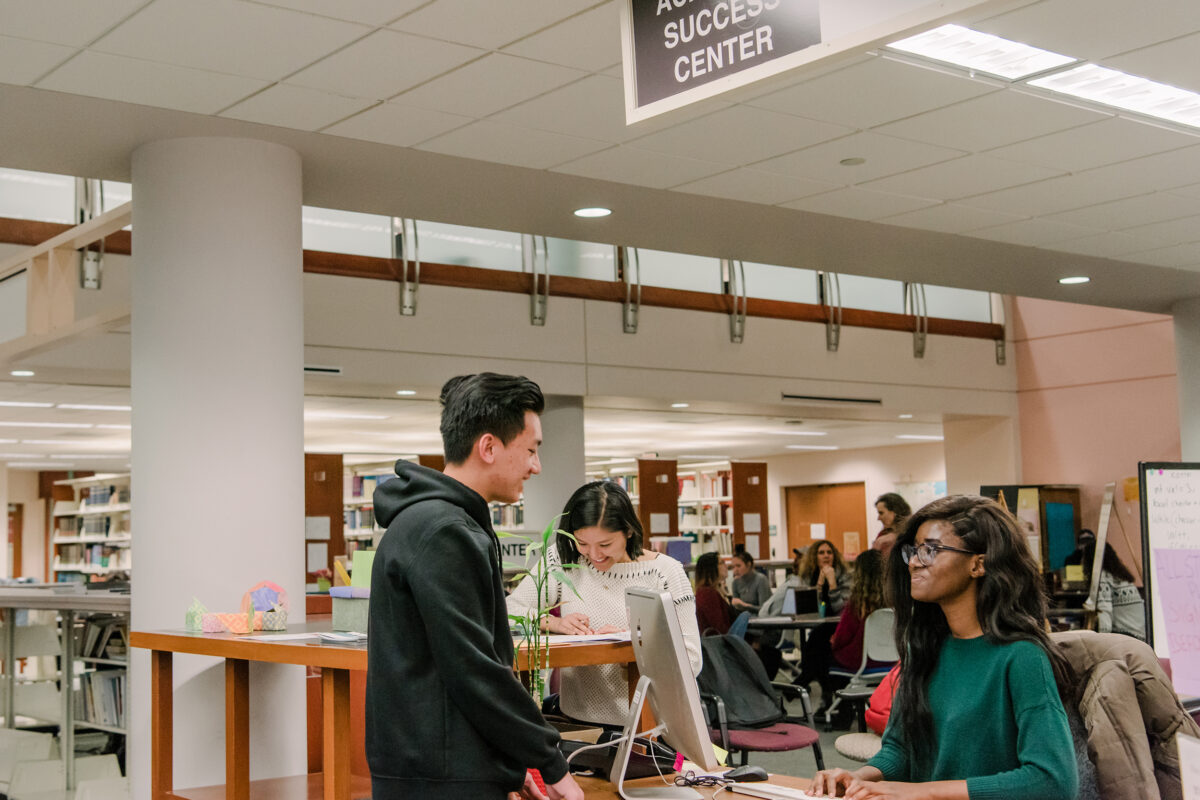 Students utilizing UMBC’s Academic Success Center. (Marlayna Demond ’11/UMBC)
- The 2022 – 23 U.S. News and World Report Best Colleges undergraduate rankings show UMBC jumping an impressive 25 spots on the list of Best National Universities, in addition to ranking #9 nationally for undergraduate teaching and #10 most innovative, tied with Johns Hopkins. U.S. News also announced its 2023 Best Graduate School rankings, including outstanding UMBC graduate programs across all three colleges.
2. Student and alumni experiences
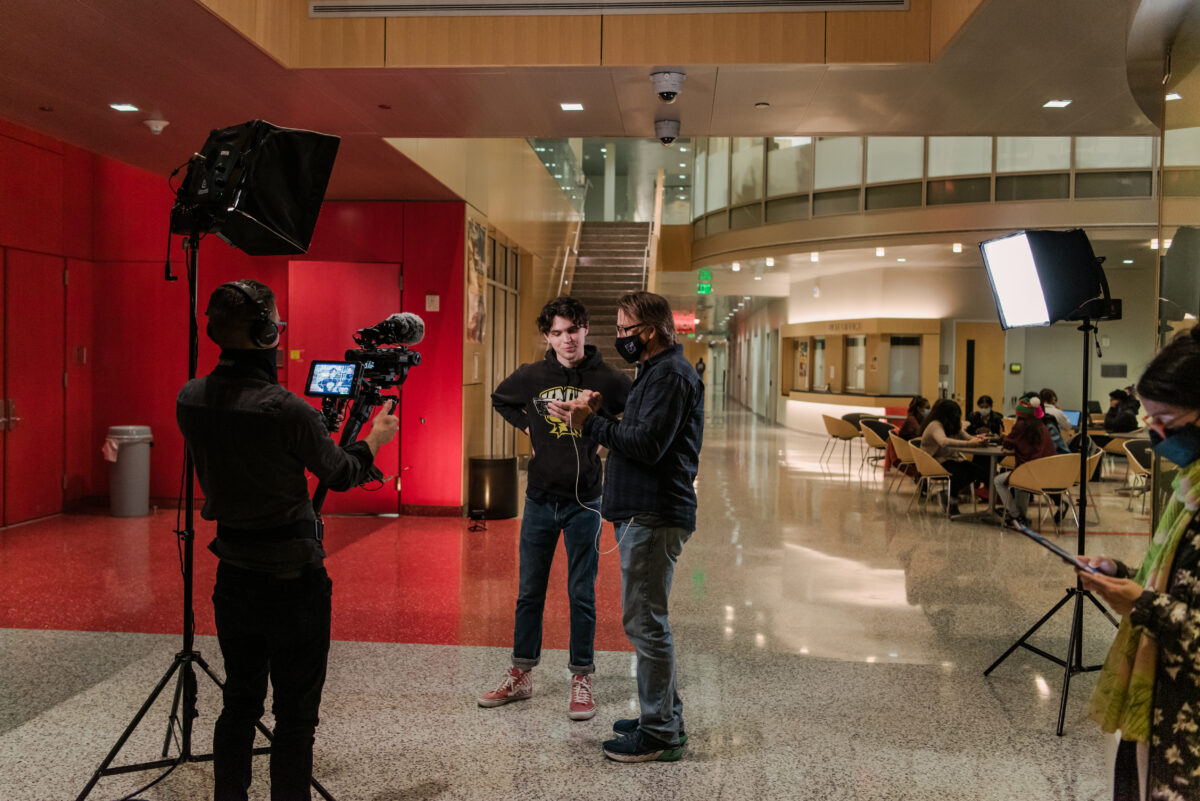 Behind the scenes filming The College Tour for Amazon Prime. (Marlayna Demond ’11/UMBC)
- Fearless, a company founded by Delali Dzirasa ’04, computer engineering, led the development of the Searchable Museum to complement the National Museum of African American History and Culture’s (NMAAHC) “Slavery and Freedom” exhibition. The team included visual arts, computer science, and computer engineering alumni.
-
Jok Abraham Thon, UMBC’s first Peaceworker Global Fellow and the first Retriever from South Sudan, shared his story of leadership and social impact at UMBC’s Fall Opening Meeting and his experience as an international student in the Baltimore Sun.
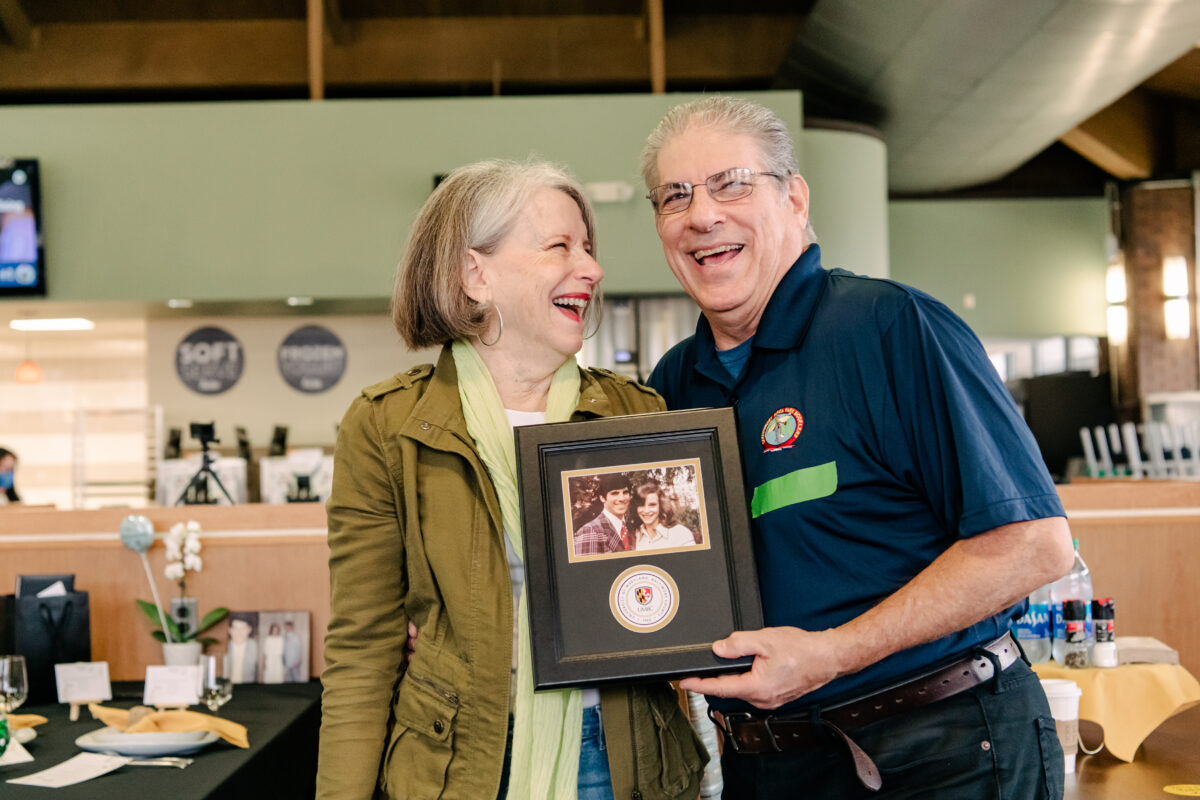 Marcie and David Zisow enjoying their recreated date at True Grit’s. (Marlayna Demond ’11/UMBC)
-
Marcie and David Zisow marked the 53rd anniversary of their first conversation at a shared table at True Grit’s. The Zisows’ youngest child was inspired by their love story to create a surprise celebration for her parents, recreating their 1969 meet-cute. UMBC Dining offered up their services, including baking an anniversary cake, playing music from the ’60s and ’70s, and creating a photo slideshow of Marcie (’72, M.A. ’84) and David (’71) to show on the screens of the dining hall.
3. Student leadership and achievement
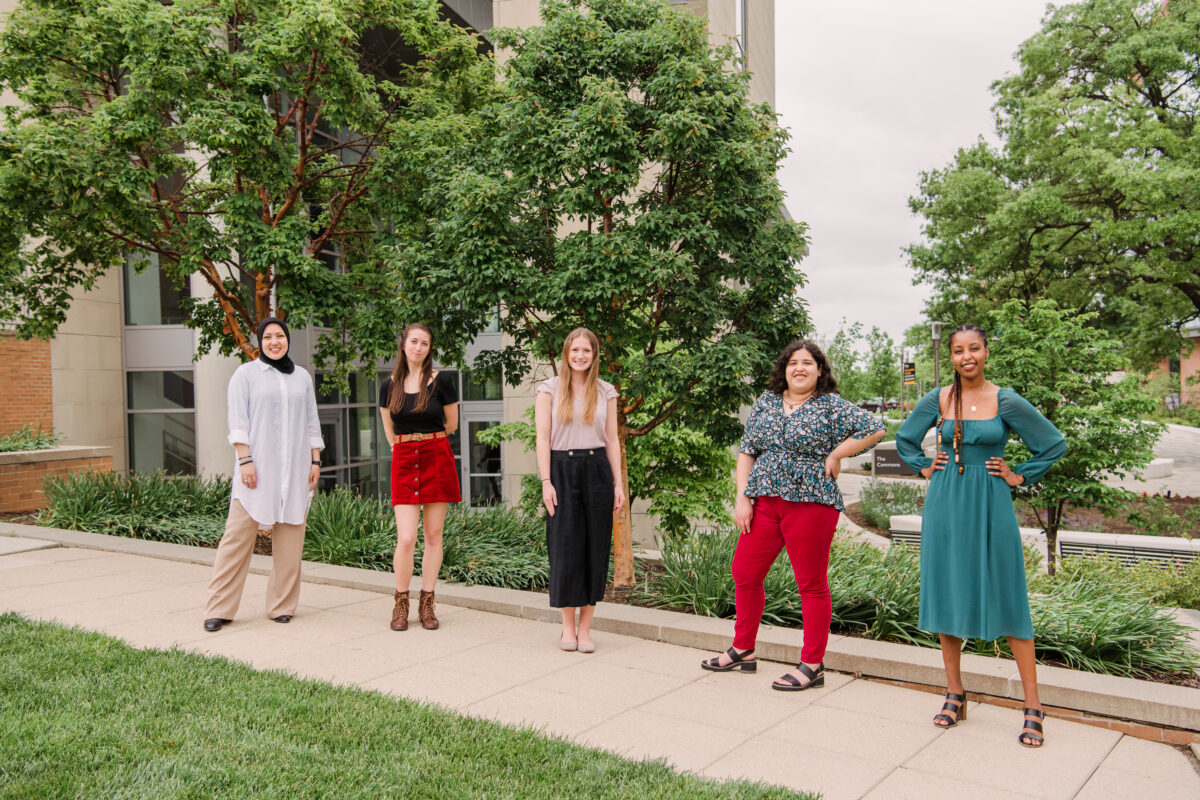 Five of UMBC’s 2022 Fulbright student scholars (l-r): Maryam Elhabashy, Kaitlyn Szekerczes, Kaitlyn Keaton, Adrianna-Marie Urbina-Ruiz, and Chemutai Wangui Nganga. (Marlayna Demond ’11/UMBC)
-
Haleemat Adekoya ’23, political science, was named one of just 58 new Truman Scholars nationwide. Adekoya is the fifth UMBC student to receive this honor, focused on public service. Truman Scholarship finalist Rehman Liaqat ’22, political science, received the inaugural Campus Compact Mid-Atlantic Civic Fellowship, for student leaders who are “engaged global citizens, actively contributing to the creation of equitable, healthy, sustainable, and socially just communities.”
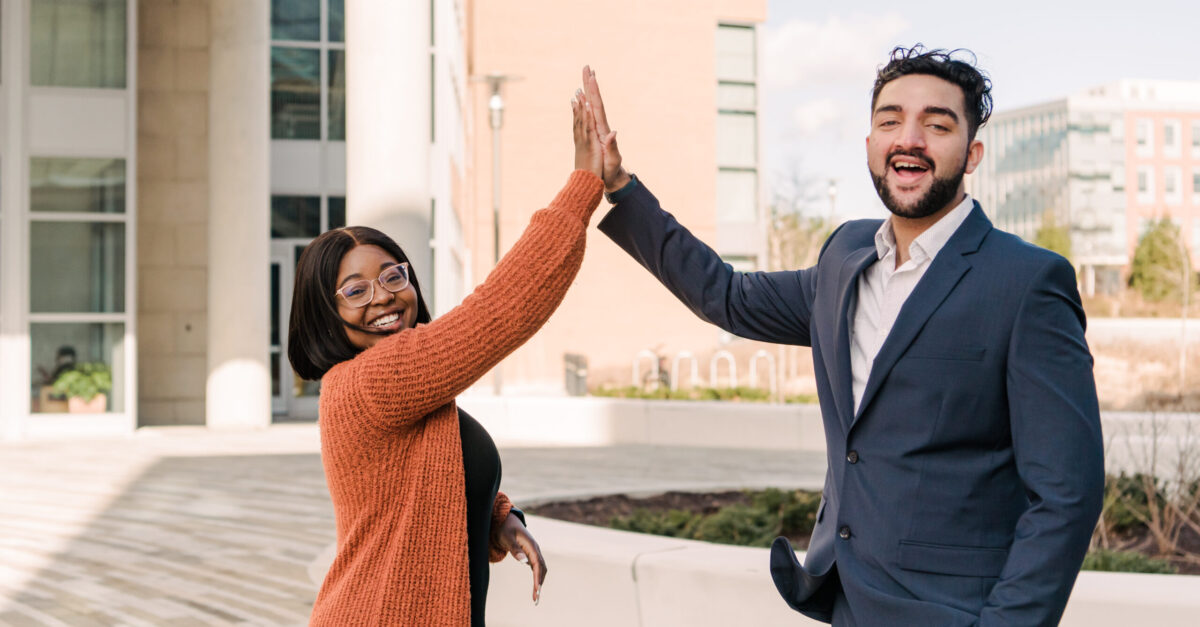 Haleemat Adekoya (l) and Rehman Liaqat (r), 2022. (Marlayna Demond ’11/UMBC)
4. Achievements in athletics and intellectual sports
- Three was the magic number for UMBC Athletics this past year. Both UMBC volleyball and softball captured their third consecutive America East titles to continue on at NCAA tournament play.
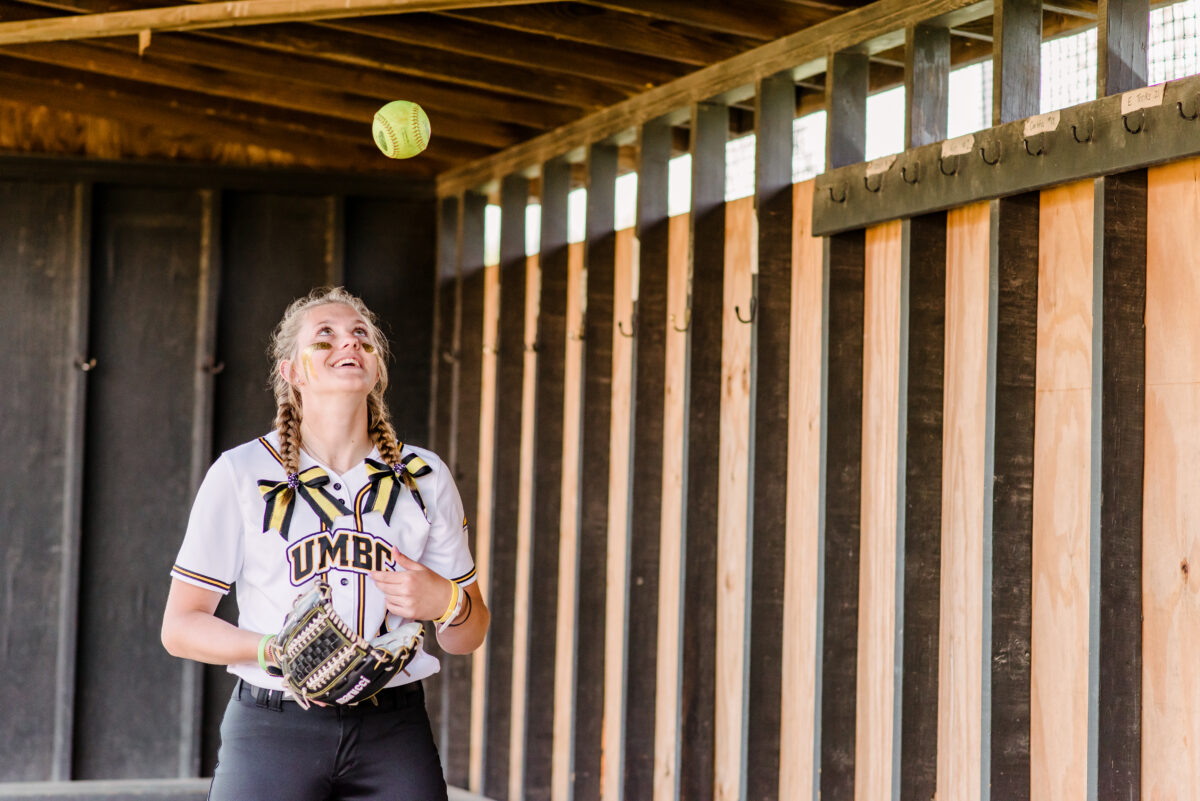 Courtney Coppersmith warms up before a game.
- Softball star Courtney Coppersmith ’22, biochemistry and molecular biology, was named America East Woman of the Year. Coppersmith was the first Retriever in university history to achieve this honor.
- UMBC men’s swimming and diving reclaimed the 2022 America East Championship title to win their 13th championship out of 15 appearances.
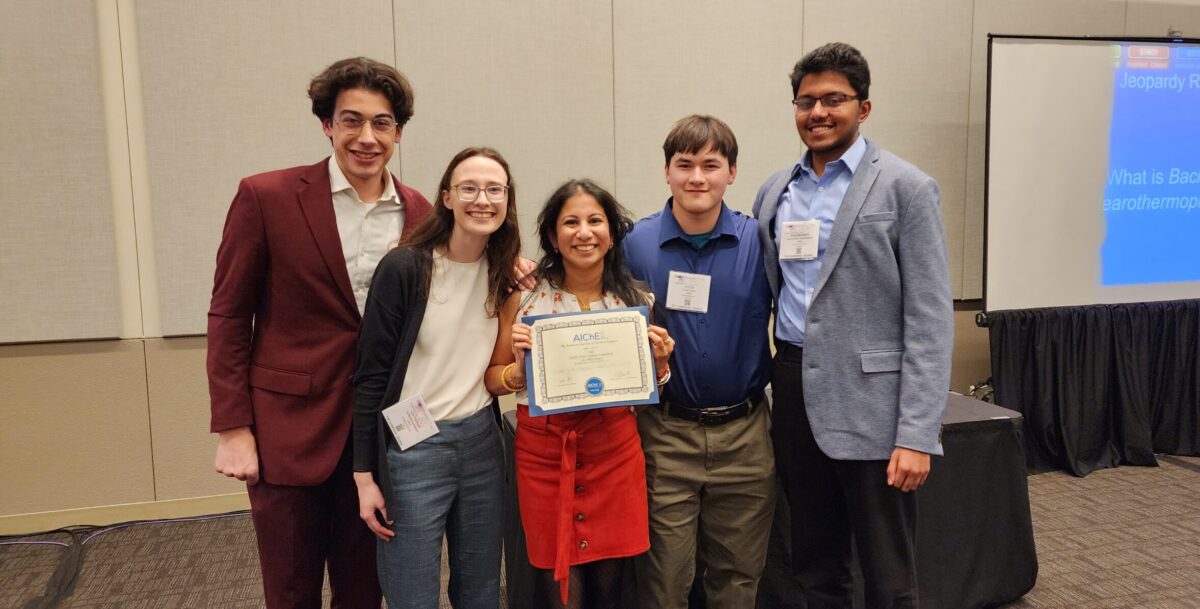 UMBC’s Chemical Engineering Jeopardy National Championship team and their advisor (l-r): Max Bobbin, Catherine Wraback, Neha Raikar (team advisor), Colin Jones, and Pavan Umashankar. (Image courtesy of CBEE)
- UMBC is again a national champion, now in ChemE Jeopardy. A UMBC student team of chemical engineering majors emerged victorious at the national competition hosted by the American Institute of Chemical Engineers.
5. Public research for the public good
-
GRIT-X returned to UMBC for its sixth year, delivering a wide-ranging lineup of Retriever excellence in action—highlighting research and creative achievement from different fields. One presenter, Airi Yoshioka, professor of music, illuminated how the cultural background of a composer manifests in the music they create.
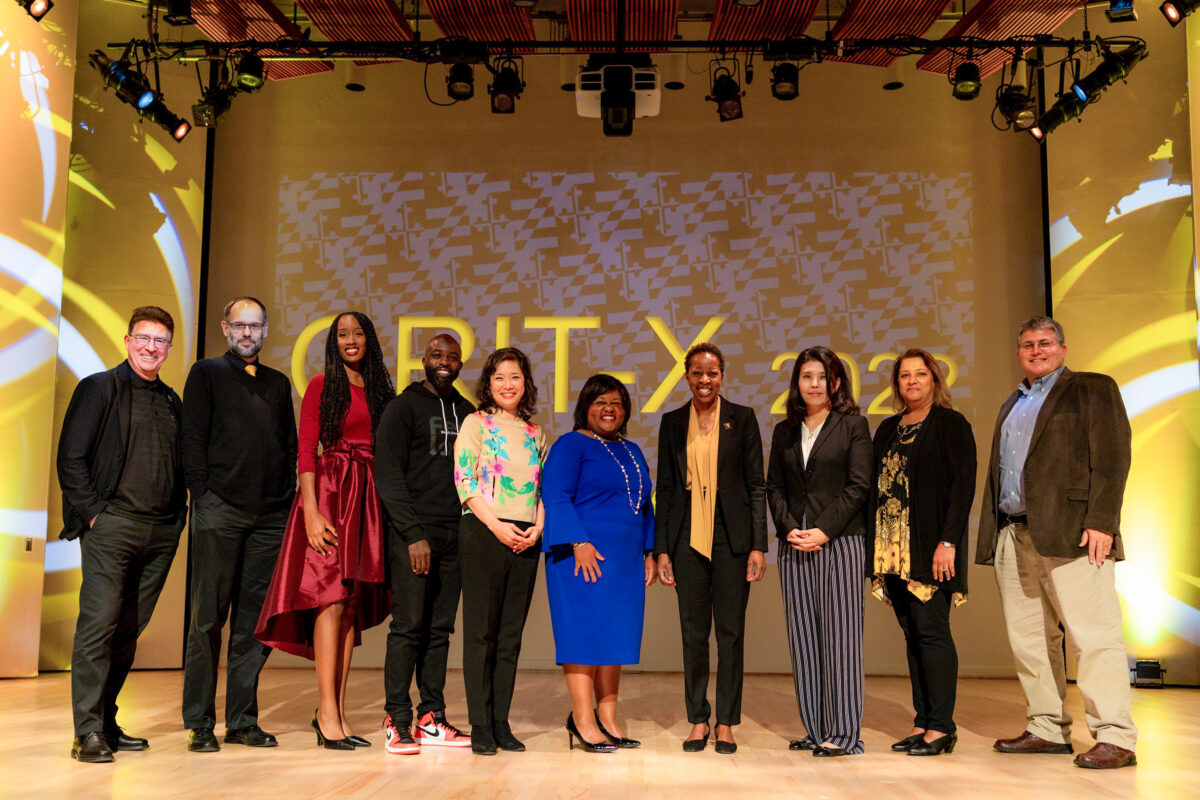 GRIT-X 2022 presenters with Karl Steiner (far left) and President Valerie Sheares Ashby (center, in yellow shirt). (Image by Kiirstn Pagan for UMBC)
-
Katherine Seley-Radtke, professor of chemistry and biochemistry, is part of a consortium that will receive $65 million over five years from the National Institute of Allergy and Infectious Diseases to develop virus-fighting fleximer compounds. At the same time, Phyllis Robinson, professor of biological sciences, has received a $2.5 million grant from NIH to advance study of critical eye protein.
-
Vandana Janeja, professor and chair of information systems, is the principal investigator on a five-year, $13 million National Science Foundation (NSF) grant from the Harnessing the Data Revolution (HDR) Big Idea program to analyze enormous volumes of climate data and Arctic and Antarctic observations in ways that could help populations prepare for and respond to sea level rise and other risks.
- Numerous humanities and social science faculty received prominent fellowships to support innovative research. The Henry Luce Foundation and American Council of Learned Societies awarded Christopher K. Tong, assistant professor of modern languages, linguistics, and intercultural communication, a fellowship to examine ecological consciousness and political representation in modern China. Yolanda Valencia, assistant professor of geography and environmental studies, and María Célleri, assistant professor of gender, women’s, and sexuality studies, received Mellon Fellowships for research on an immigrant community in Washington and postcolonial transformation of Quito, Ecuador, respectively. Elizabeth Patton, associate professor of media and communication studies; Mirjam Voerkelius, assistant professor of history; and Amy Froide, professor and chair of history, received fellowships to explore unique historical events in the United States, Soviet Union, and United Kingdom.
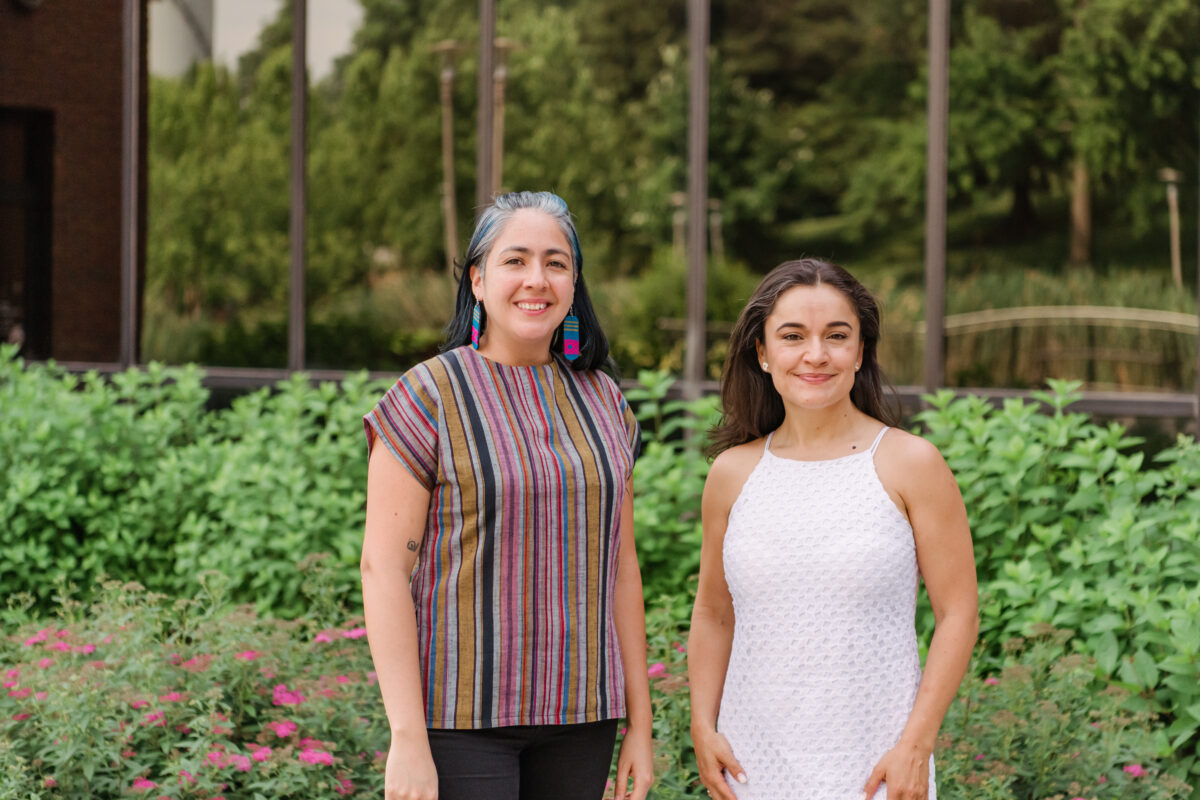 María Célleri (l) and Yolanda Valencia (r). (Marlayna Demond ’11/UMBC)
- UMBC faculty earned prestigious NSF CAREER Awards. Cynthia Matuszek, computer science and electrical engineering, will use her award to study how robots learn about the physical world from spoken language to improve how they work with people. Lauren Clay, associate professor and chair of emergency health services, will develop a sociocultural model called Food Environment in Disasters (FED) to improve the understanding and monitoring of food availability, acceptability, and accessibility during disasters. Stay tuned for news of 2023 CAREER Award recipients, coming soon.
6. Investments in high-impact UMBC programs
- The largest gift in the history of UMBC—a $21 million donation from the Sherman Family Foundation—will dramatically expand the reach and impact of the university’s K-12 and early childhood education work.
 Betsy Sherman at Lakeland Elementary/Middle School. (Marlayna Demond ’11/UMBC)
- UMBC will expand its work boosting diversity in academia from Maryland to the national level through a new NSF INCLUDES Alliance: Re-Imagining STEM Equity Utilizing Postdoc Pathways (RISE UPP). RISE UPP seeks to help R1, R2, and teaching-intensive institutions recruit and train postdoctoral scholars from underrepresented backgrounds in STEM.
- UMBC’s College of Natural and Mathematical Sciences is receiving $5.6 million over five years from the National Institutes of Health to fund the Graduate Research Training Initiative for Student Enhancement (G-RISE). This program supports graduate students from underrepresented groups in STEM with funding for up to three years and a broad range of training opportunities.
Contributing authors: Catalina Sofia Dansberger Duque; Adriana Fraser; Sarah Hansen, M.S. ’15; Randianne Leyshon ’09; Megan Hanks Mastrola; Kait McCaffrey; Jenny O’Grady; and Dinah Winnick.
]]>
Just like the people that are part of our community, UMBC experienced a year of change, growth, and opportunity in 2022. Exciting achievements, transformative leadership, and groundbreaking...
https://umbc.edu/stories/umbcs-top-stories-of-2022/
https://beta.my.umbc.edu/api/v0/pixel/news/130085/guest@my.umbc.edu/abfc338efc64244878ff650f2346eeb3/api/pixel
cahss
cnms
coeit
community
news
research
UMBC News & Magazine
https://beta.my.umbc.edu/groups/umbc-news-magazine
https://assets1-beta.my.umbc.edu/system/shared/avatars/groups/000/001/943/24435aa6207c452e7bc15cc74b42c7bb/xsmall.png?1748556657
https://assets1-beta.my.umbc.edu/system/shared/avatars/groups/000/001/943/24435aa6207c452e7bc15cc74b42c7bb/original.png?1748556657
https://assets2-beta.my.umbc.edu/system/shared/avatars/groups/000/001/943/24435aa6207c452e7bc15cc74b42c7bb/xxlarge.png?1748556657
https://assets2-beta.my.umbc.edu/system/shared/avatars/groups/000/001/943/24435aa6207c452e7bc15cc74b42c7bb/xlarge.png?1748556657
https://assets3-beta.my.umbc.edu/system/shared/avatars/groups/000/001/943/24435aa6207c452e7bc15cc74b42c7bb/large.png?1748556657
https://assets1-beta.my.umbc.edu/system/shared/avatars/groups/000/001/943/24435aa6207c452e7bc15cc74b42c7bb/medium.png?1748556657
https://assets2-beta.my.umbc.edu/system/shared/avatars/groups/000/001/943/24435aa6207c452e7bc15cc74b42c7bb/small.png?1748556657
https://assets1-beta.my.umbc.edu/system/shared/avatars/groups/000/001/943/24435aa6207c452e7bc15cc74b42c7bb/xsmall.png?1748556657
https://assets2-beta.my.umbc.edu/system/shared/avatars/groups/000/001/943/24435aa6207c452e7bc15cc74b42c7bb/xxsmall.png?1748556657
UMBC News & Magazine
0
0
false
Fri, 06 Jan 2023 12:56:19 -0500
Fri, 06 Jan 2023 12:56:19 -0500
UMBC graduates ready to embark on a bright future

Temperatures may have been cold, but the Chesapeake Employers Insurance Arena was warmed by the cheers of congratulations for this year’s graduates. More than 800 undergraduate and graduate students turned their tassels this week during UMBC’s 79th Commencement Ceremonies.
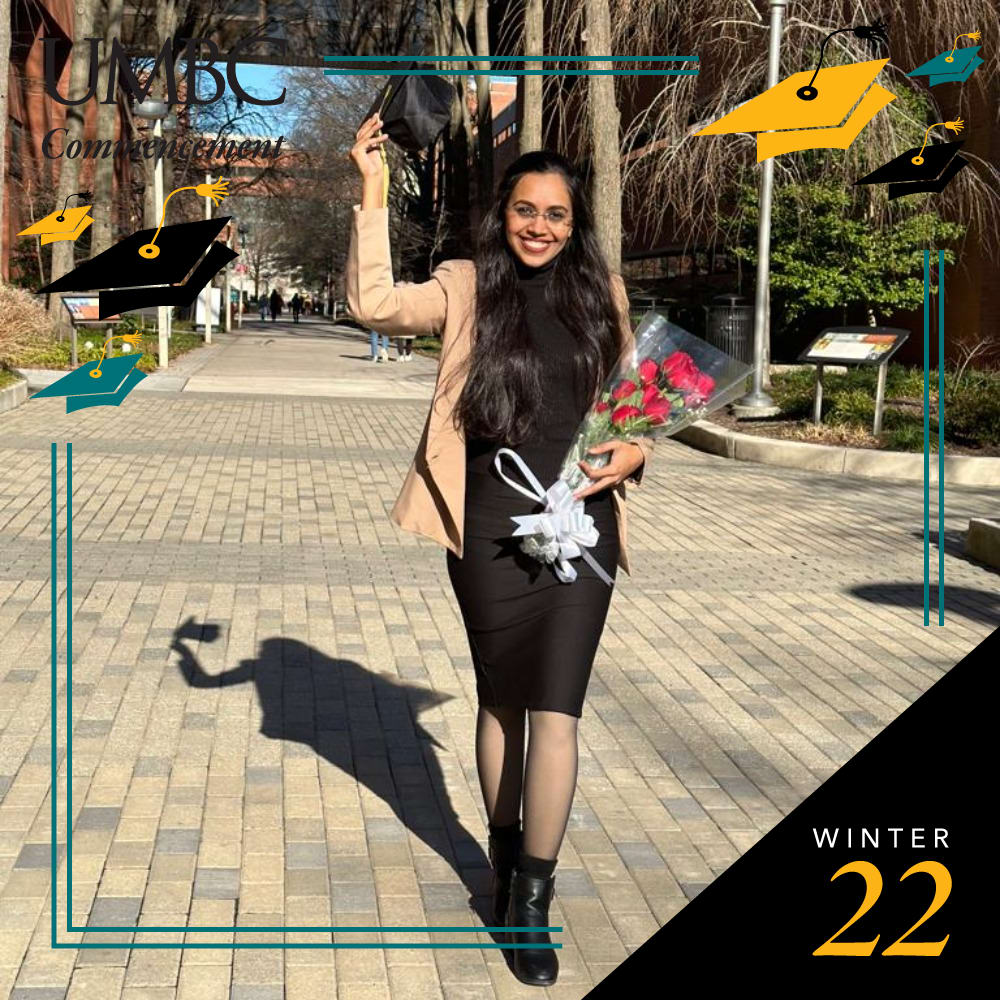
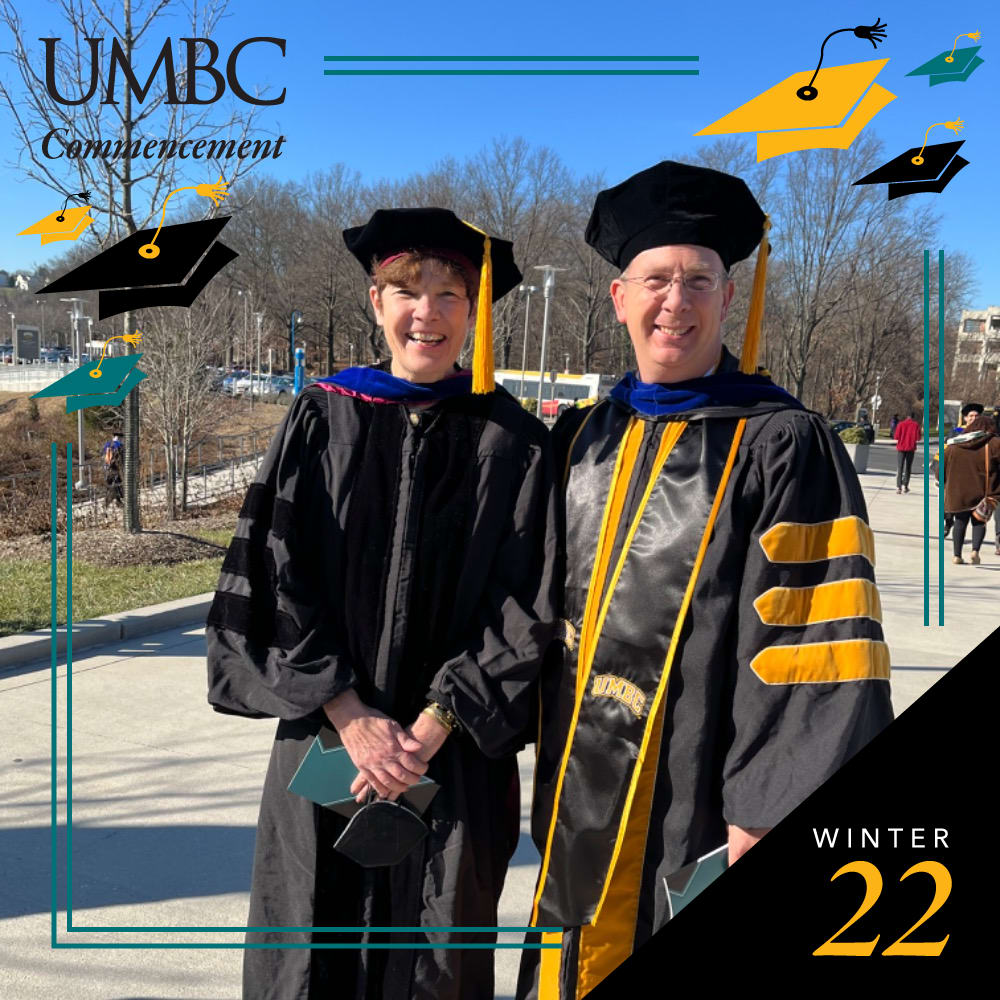
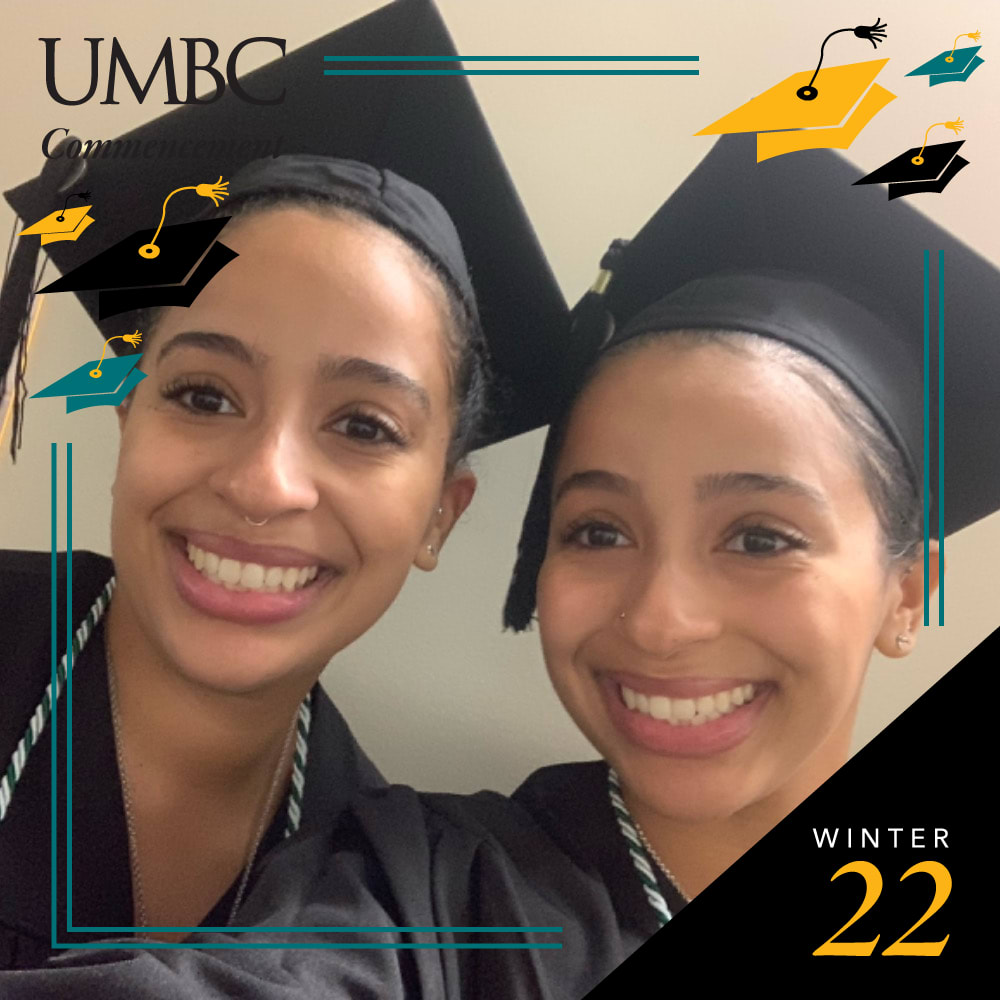
This was a week of firsts, with President Sheares Ashby presiding over her first commencement and alumni speakers returning for the first time to offer words of wisdom during winter exercises.
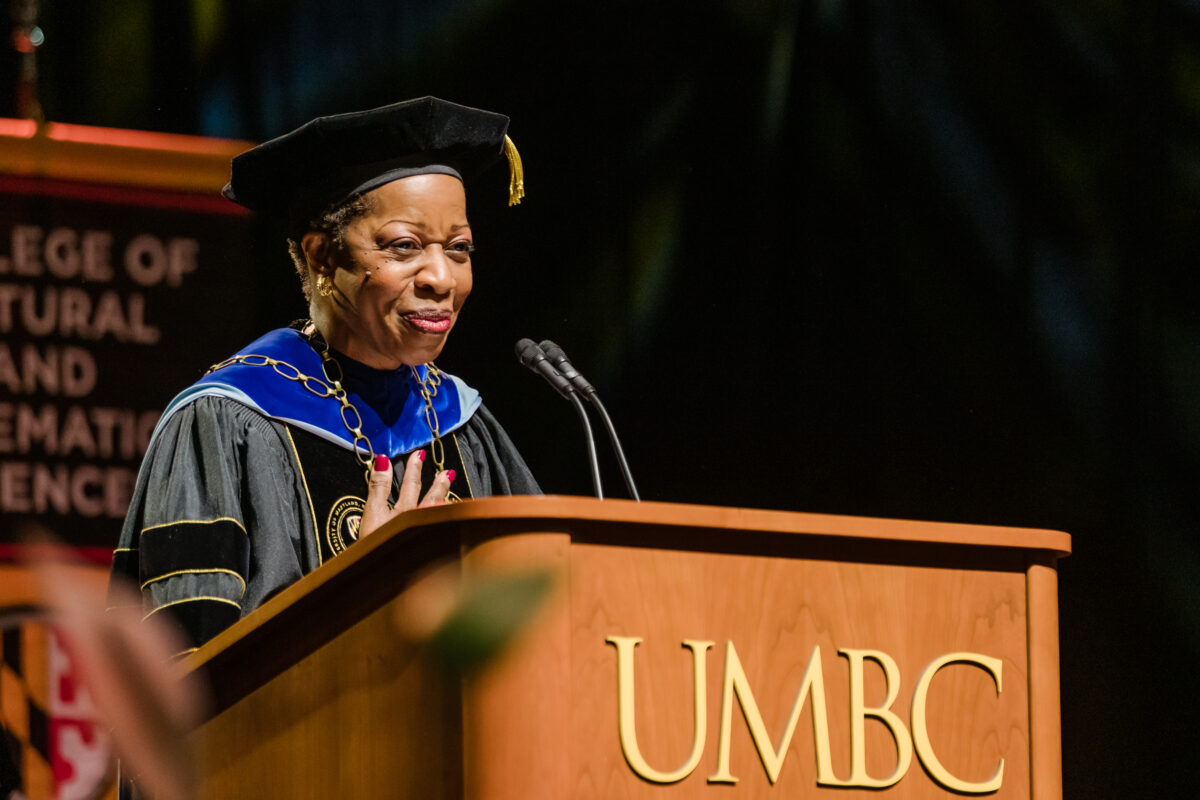 President Valerie Sheares Ashby pauses to take in her first UMBC Commencement. (Marlayna Demond ’11/UMBC)
While some elements are new, this year’s ceremonies still had all the trappings that make UMBC’s commencement so special – hugs between classmates, whispered words of gratitude to mentors and colleagues, and misty eyes turned upwards as confetti made the Arena into a verifiable snow globe.
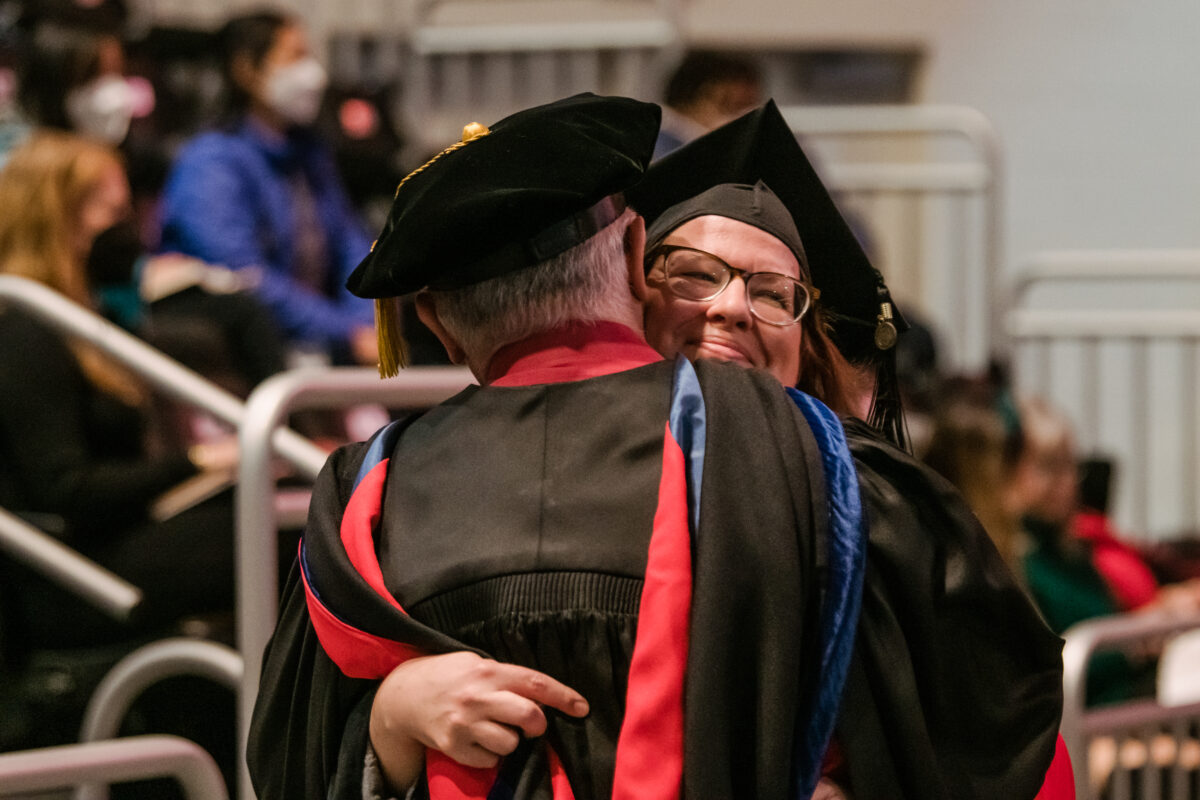 A UMBC graduate stops for a quick hug. (Marlayna Demond ’11/UMBC)
Sheares Ashby acknowledged the milestone and underscored the importance of those who got our Retrievers across the finish line, such as parents, families, and others.
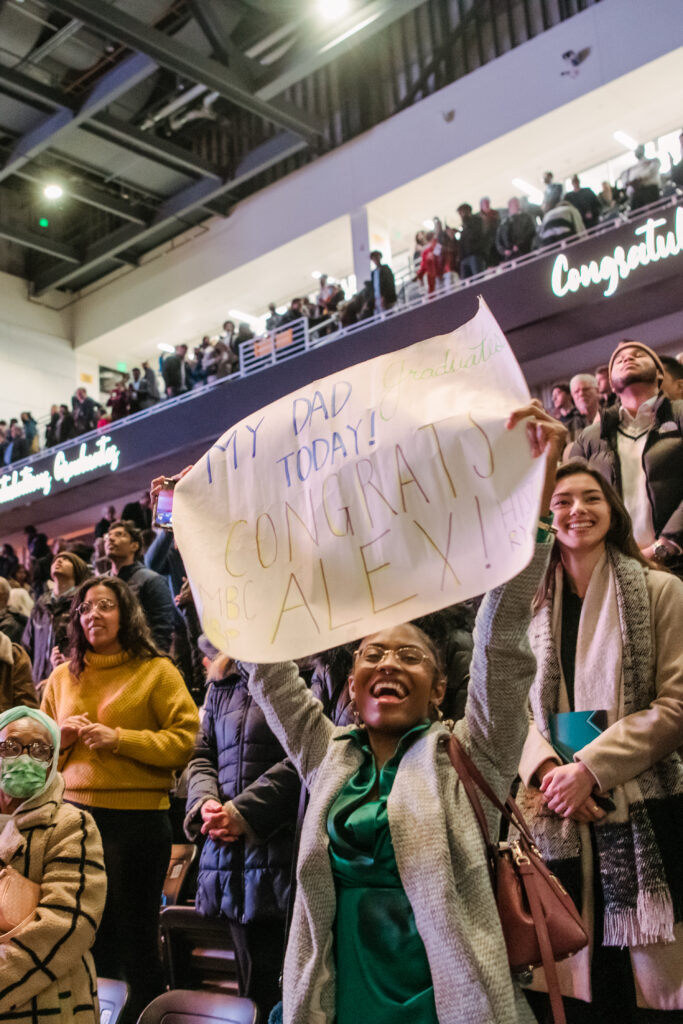 We’re also big fans of Alex’s cheering section! (Marlayna Demond ’11/UMBC)
“This is an extraordinary moment and we owe a lot of gratitude to those of you who are sitting here in the audience,” says Sheares Ashby.
Tales from the heart
Stories, more than anything, were at the heart of this year’s commencement. Graduate commencement speaker Mustafa Al-Adhami, M.S. ’15, Ph.D. ’20, mechanical engineering, accomplished remarkable things during his master’s and doctoral journey at UMBC. But he took care in his speech to share how his background foundation helped forge his future.
“Growing up in Baghdad, my life was a series of changes that I could do little to control,” he said. “Following the 2003 war, we no longer had reliable access to meat, electricity, or entertainment. I had to find new ways to pass my time and earn some pocket money, and I found the answer in fixing radios.”
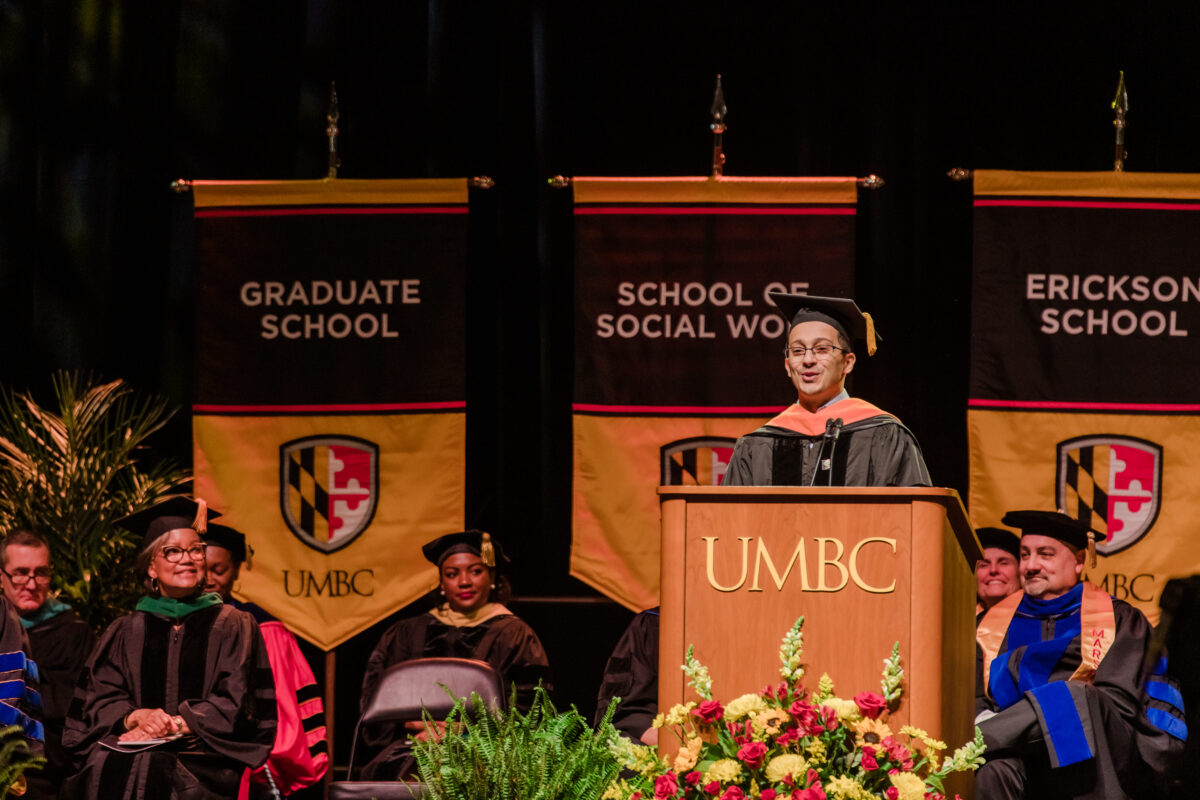 Al-Adhami addresses the sea of master’s and Ph.D. students. (Marlayna Demond ’11/UMBC)
Al-Adhami’s early penchant for problem solving led him to his position of Chief Executive Officer of Astek Diagnostics, a company he founded, dedicated to developing low-cost solutions for global public health problems.
Undergraduate speaker Stefanie Mavronis ’12, political science and media and communication studies, shared that growing up in a working class neighborhood, she didn’t have much exposure to the world of higher education. But through support from mentors, she was given opportunities that allowed her to envision a career and a future.
Beyond honored to deliver the commencement address at my alma mater @UMBC tomorrow.
My reaction when I received President Sheares Ashby’s call to invite me to speak: “Are you serious???”
Congratulations Winter 2022 graduates! You should all be very proud.
]]>
Temperatures may have been cold, but the Chesapeake Employers Insurance Arena was warmed by the cheers of congratulations for this year’s graduates. More than 800 undergraduate and graduate...
https://umbc.edu/stories/umbc-graduates-ready-to-embark-on-a-bright-future/
https://beta.my.umbc.edu/api/v0/pixel/news/129970/guest@my.umbc.edu/dc649482a3222e7de740bc69940244a7/api/pixel
campus-life
community
magazine
news
UMBC News & Magazine
https://beta.my.umbc.edu/groups/umbc-news-magazine
https://assets1-beta.my.umbc.edu/system/shared/avatars/groups/000/001/943/24435aa6207c452e7bc15cc74b42c7bb/xsmall.png?1748556657
https://assets1-beta.my.umbc.edu/system/shared/avatars/groups/000/001/943/24435aa6207c452e7bc15cc74b42c7bb/original.png?1748556657
https://assets2-beta.my.umbc.edu/system/shared/avatars/groups/000/001/943/24435aa6207c452e7bc15cc74b42c7bb/xxlarge.png?1748556657
https://assets2-beta.my.umbc.edu/system/shared/avatars/groups/000/001/943/24435aa6207c452e7bc15cc74b42c7bb/xlarge.png?1748556657
https://assets3-beta.my.umbc.edu/system/shared/avatars/groups/000/001/943/24435aa6207c452e7bc15cc74b42c7bb/large.png?1748556657
https://assets1-beta.my.umbc.edu/system/shared/avatars/groups/000/001/943/24435aa6207c452e7bc15cc74b42c7bb/medium.png?1748556657
https://assets2-beta.my.umbc.edu/system/shared/avatars/groups/000/001/943/24435aa6207c452e7bc15cc74b42c7bb/small.png?1748556657
https://assets1-beta.my.umbc.edu/system/shared/avatars/groups/000/001/943/24435aa6207c452e7bc15cc74b42c7bb/xsmall.png?1748556657
https://assets2-beta.my.umbc.edu/system/shared/avatars/groups/000/001/943/24435aa6207c452e7bc15cc74b42c7bb/xxsmall.png?1748556657
UMBC News & Magazine
0
0
false
Thu, 22 Dec 2022 16:18:56 -0500
Thu, 22 Dec 2022 16:18:56 -0500
FTX’s collapse mirrors an infamous 18th century British financial scandal

Amy Froide, professor of history, UMBC
Enron. Bernie Madoff. FTX.
In modern capitalism, it seems as if stories of companies and managers who engage in fraud and swindle their investors occur like the changing of the seasons.
In fact, these scandals can be traced back to the origins of publicly traded companies, when the first stockbrokers bought and sold company shares and government securities in the coffee houses of London’s Exchange Alley during the 1700s.
As a historian of 18th century finance, I am struck by the similarities between what’s known as the Charitable Corporation Scandal and the recent collapse of FTX.
A noble cause
The Charitable Corporation was established in London in 1707 with the noble mission of providing “relief of the industrious poor by assisting them with small sums at legal interest.”
Essentially, it sought to provide low-interest loans to poor tradesmen, shielding them from predatory pawnbrokers who charged as much as 30% interest. The corporation made loans available at the rate of 5% in return for a pledge of property for security.
The Charitable Corporation was modeled on Monti di Pietà, a charitable institution of credit established in Catholic countries during the Renaissance era to combat usury, or high rates of interest.
Unlike the Monti di Pietà, however, the British version – despite its name – wasn’t a nonprofit. Instead, it was a business venture. The enterprise was funded by offering shares to investors who, in return, would make money while doing good. Under its original mission, it was like an 18th century version of today’s socially responsible investing, or “sustainable investment funds.”
Raiding the fund
In 1725, the Charitable Corporation diverted from its original mission when a new board of directors took over.
These men turned the corporation into their own piggy bank, taking money from it to buy shares and prop up their other companies. At the same time, the company’s employees began to engage in fraud: Safety checks ceased, books were kept irregularly and pledges went unrecorded.
Investigators would ultimately find that £400,000 or more in capital was missing – roughly $108 million in today’s U.S. dollars.
In the autumn of 1731, rumors began to circulate about the solvency of the Charitable Corporation. The warehouse keeper at the time, John Thomson, who was in charge of all loans and pledges but also in league with the five fraudulent directors, hid the company’s books and fled the country.
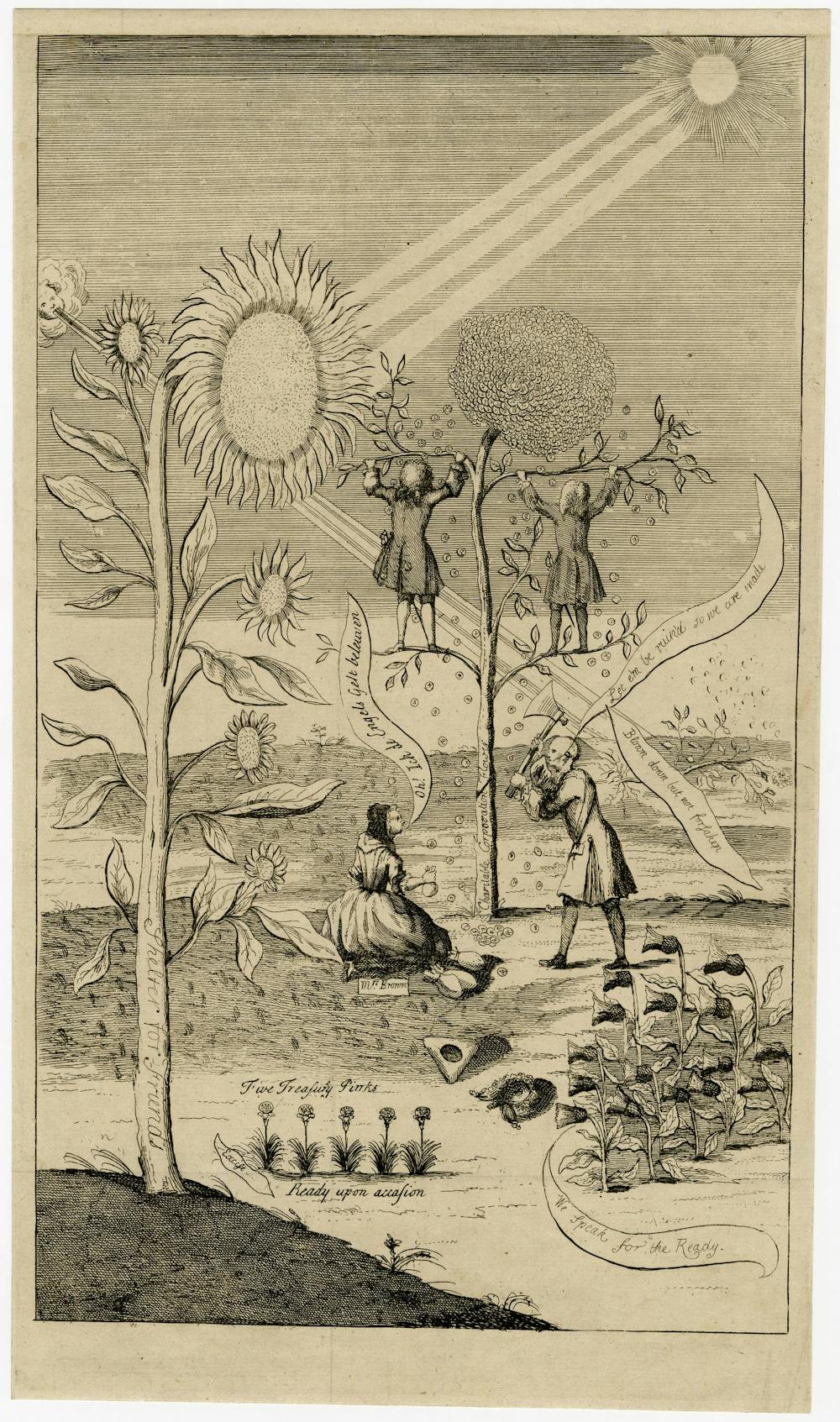
 ‘Let ’em be ruined so we are made,’ a man says in a 1734 satirical print criticizing the Charitable Corporation and its ties to government. © The Trustees of the British Museum
At the shareholders’ quarterly meeting, they found that money, pledges and accounts had all gone missing. At this point, the proprietors of the Charitable Corporation stock appealed to the British Parliament for redress. One-third of those who petitioned were women, a proportion that equaled the percentage of women who held shares in the Charitable Corporation.
Many women were drawn to the corporation because of its public mission in providing small loans to working people. It’s also possible that they had been intentionally targeted for fraud.
The parliamentary investigation led to various charges being leveled against both managers and employees of the Charitable Corporation. Many of them were forced to appear before Parliament and were arrested if they did not. The managers and employees deemed most responsible for the 1732 fraud, such as William Burroughs, had their assets seized and inventoried in order to help pay back the shareholder losses.
Bankruptcy proceedings were started against the banker and broker, George Robinson, and the warehouse keeper, Thomson. Both Sir Robert Sutton and Sir Archibald Grant were expelled as members of the House of Commons, with Grant being prevented from leaving the country and Sutton ultimately prosecuted in several courts.
In the end, the shareholders received a partial government bailout – Parliament authorized a lottery that reimbursed only 40% of what the corporation’s creditors had lost.
The risks of concentrated power
There are several key characteristics that stand out in the collapses of both the Charitable Corporation and FTX. Both companies were offering something new or venturing into a new sector. In the former’s case, it was microloans. In FTX’s case, it was cryptocurrency.
Meanwhile, the management of both ventures was centralized in the hands of just a few people. The Charitable Corporation got into trouble when it reduced its directors from 12 to five and when it consolidated most of its loan business in the hands of one employee – namely, Thomson. FTX’s example is even more extreme, with founder Sam Bankman-Fried calling all the shots.
In both cases, the key fraud was using the assets of one company to prop up another company managed by the same people. For example, in 1732, the corporation’s directors bought stock in the York Buildings Company, in which many of them were also involved. They hoped to juice stock prices. When that didn’t happen, they realized they couldn’t cover what they had taken out of the Charitable Corporation’s funds.
Fast forward nearly 300 years, and a similar story seems to have played out. Bankman-Fried allegedly took money out his customer accounts in FTX to cover his cryptocurrency trading firm, Alameda Research.
News of both frauds also came as a surprise, with little advance warning. Part of this is due to the ways in which managers were well respected and well connected to both politicians and the financial world. Few public figures mistrusted them, and this proved to be a useful screen for deceit.
I would also argue that in both cases the company’s connection to philanthropy lent it another level of cover. The Charitable Corporation’s very name announced its altruism. And even after the scandal subsided, commentators pointed out that the original business of microlending was useful. FTX’s founder Bankman-Fried is an advocate of effective altruism and has argued that it was useful for him and his companies to make lots of money so he could give it away to what he deemed effective causes.
After the Charitable Corporation’s collapse in 1732, Parliament didn’t institute any regulation that would prevent such a fraud from happening again.
A tradition of loose oversight and regulations has been the hallmark of Anglo-American capitalism. If the response to the 2008 financial crash is any indication of what will come in the wake of FTX’s collapse, it’s possible that some bad actors, like Bankman-Fried, will be punished. But any regulation will be undone at the first opportunity – or never put in place to begin with.
Amy Froide, Professor of History, University of Maryland, Baltimore County
This article is republished from The Conversation under a Creative Commons license. Read the original article.
]]>
Amy Froide, professor of history, UMBC Enron. Bernie Madoff. FTX. In modern capitalism, it seems as if stories of companies and managers who engage in fraud and swindle their investors...
https://umbc.edu/stories/ftxs-collapse-mirrors-an-infamous-18th-century-british-financial-scandal/
https://beta.my.umbc.edu/api/v0/pixel/news/129940/guest@my.umbc.edu/e20eb7b9365a3a35994ea386b2e7315a/api/pixel
cahss
discovery
history
magazine
the-conversation
UMBC News & Magazine
https://beta.my.umbc.edu/groups/umbc-news-magazine
https://assets1-beta.my.umbc.edu/system/shared/avatars/groups/000/001/943/24435aa6207c452e7bc15cc74b42c7bb/xsmall.png?1748556657
https://assets1-beta.my.umbc.edu/system/shared/avatars/groups/000/001/943/24435aa6207c452e7bc15cc74b42c7bb/original.png?1748556657
https://assets2-beta.my.umbc.edu/system/shared/avatars/groups/000/001/943/24435aa6207c452e7bc15cc74b42c7bb/xxlarge.png?1748556657
https://assets2-beta.my.umbc.edu/system/shared/avatars/groups/000/001/943/24435aa6207c452e7bc15cc74b42c7bb/xlarge.png?1748556657
https://assets3-beta.my.umbc.edu/system/shared/avatars/groups/000/001/943/24435aa6207c452e7bc15cc74b42c7bb/large.png?1748556657
https://assets1-beta.my.umbc.edu/system/shared/avatars/groups/000/001/943/24435aa6207c452e7bc15cc74b42c7bb/medium.png?1748556657
https://assets2-beta.my.umbc.edu/system/shared/avatars/groups/000/001/943/24435aa6207c452e7bc15cc74b42c7bb/small.png?1748556657
https://assets1-beta.my.umbc.edu/system/shared/avatars/groups/000/001/943/24435aa6207c452e7bc15cc74b42c7bb/xsmall.png?1748556657
https://assets2-beta.my.umbc.edu/system/shared/avatars/groups/000/001/943/24435aa6207c452e7bc15cc74b42c7bb/xxsmall.png?1748556657
UMBC News & Magazine
2
0
false
Wed, 21 Dec 2022 13:41:39 -0500
Wed, 21 Dec 2022 13:41:39 -0500
UMBC’s Matthew Baker and team study how urban trees respond to heat stress
On a sunny fall day in October, a handful of student and faculty researchers are scuttling around outside the Albin O. Kuhn Library and Gallery. High-tech instruments sprawl across folding tables, alongside lower-tech equipment like a hole-punch, glass jars, clippers, and Ziploc bags. A drone about the size of a couch cushion sits on the grass nearby, awaiting instructions.
A student returns from a tree a couple of hundred yards away with a small clipping in a vase-like jar, and the work begins. Different team members examine leaves using the full range of equipment on the tables, collecting different information with each instrument.
Each month from May to October, the researchers complete this process 60 times over two days, collecting data from 60 different trees on UMBC’s main campus representing nine common species of urban trees. Plus, once an hour, the drone flies a pre-programmed route above campus, collecting additional information. Passing UMBC students occasionally stop to ask questions, and the team is happy to share their work.
Michael Alonzo, an assistant professor at American University, leads the project, and Matthew Baker, professor of geography and environmental systems at UMBC, is co-lead. Their students help out on the data collection days. The work also includes faculty and students from Temple University. The goal is to understand how the trees are responding to heat and moisture stress. By looking at trees from different species and in different locations, the research team can learn which trees might be most resilient in a warming world.
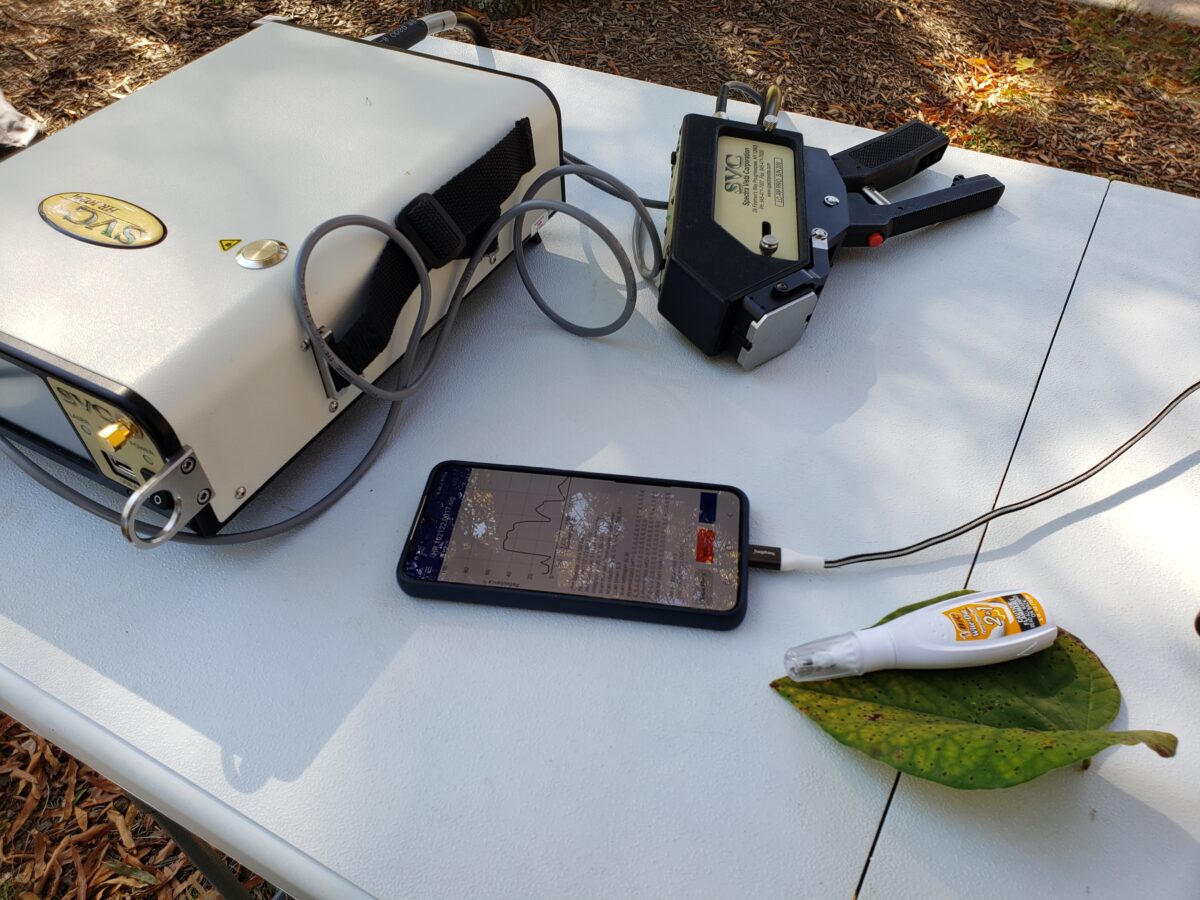 Data collection equipment is ready to go on a folding table outside the library. (Sarah Hansen, M.S. ’15/UMBC)
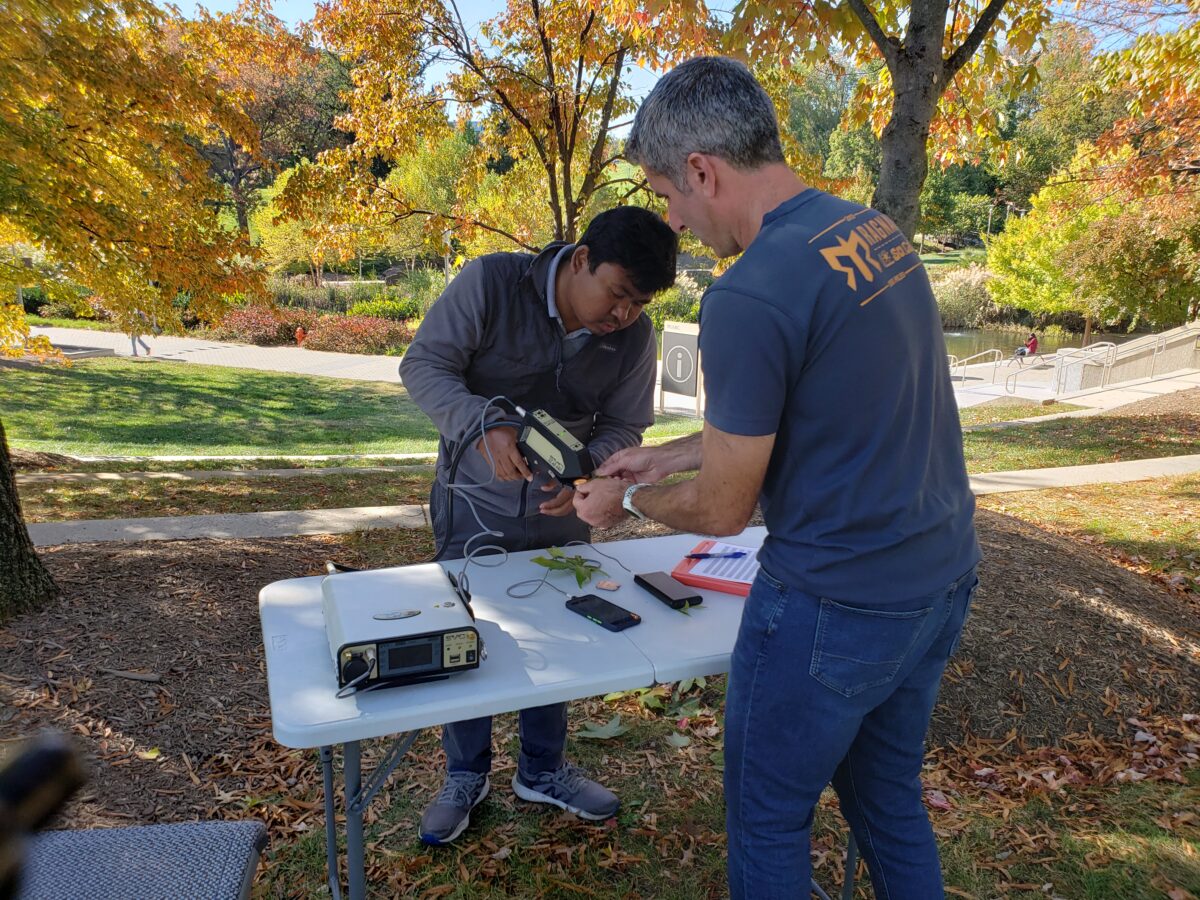 Michael Alonzo and Thu Ya Kyaw, a postdoc at American University, collect data. (Sarah Hansen, M.S. ’15/UMBC)
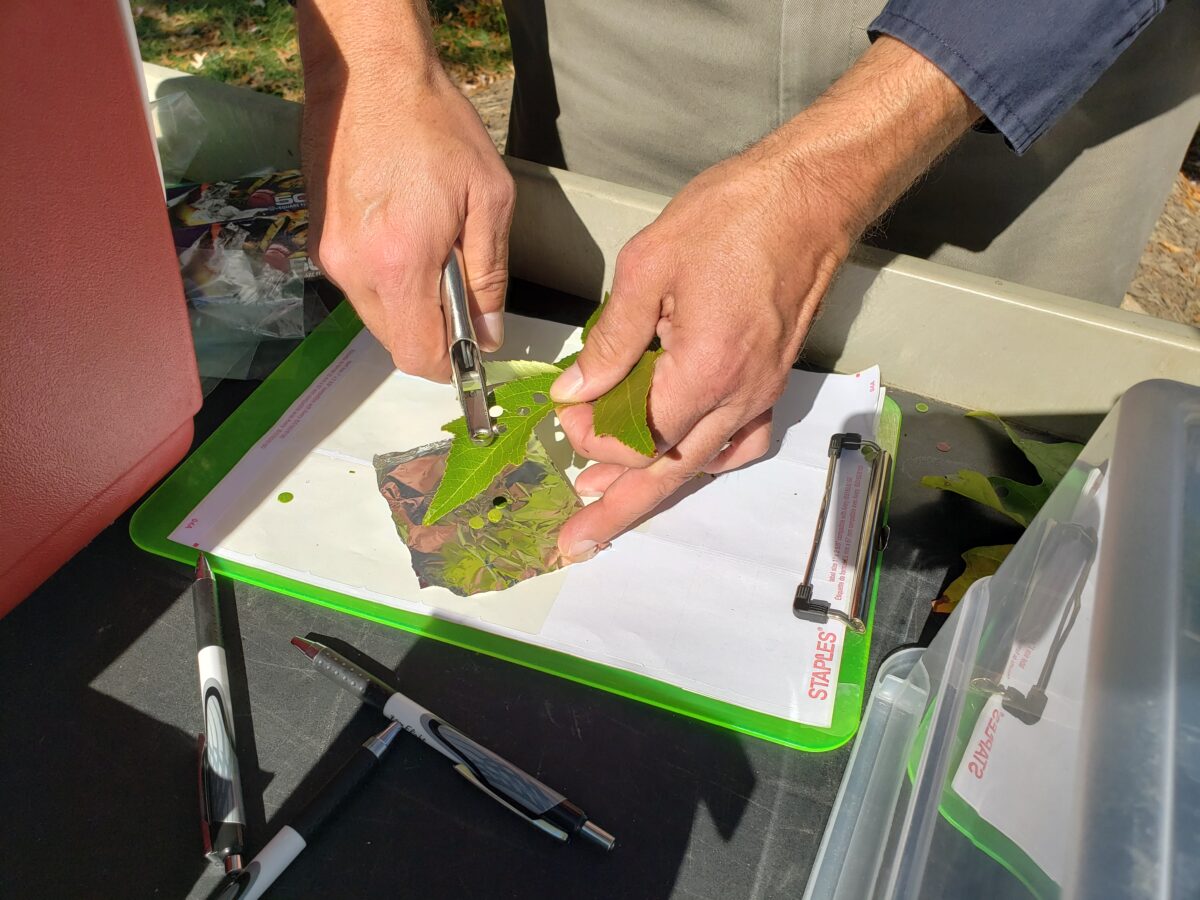 Matthew Baker takes samples from a leaf. (Sarah Hansen, M.S. ’15/UMBC)
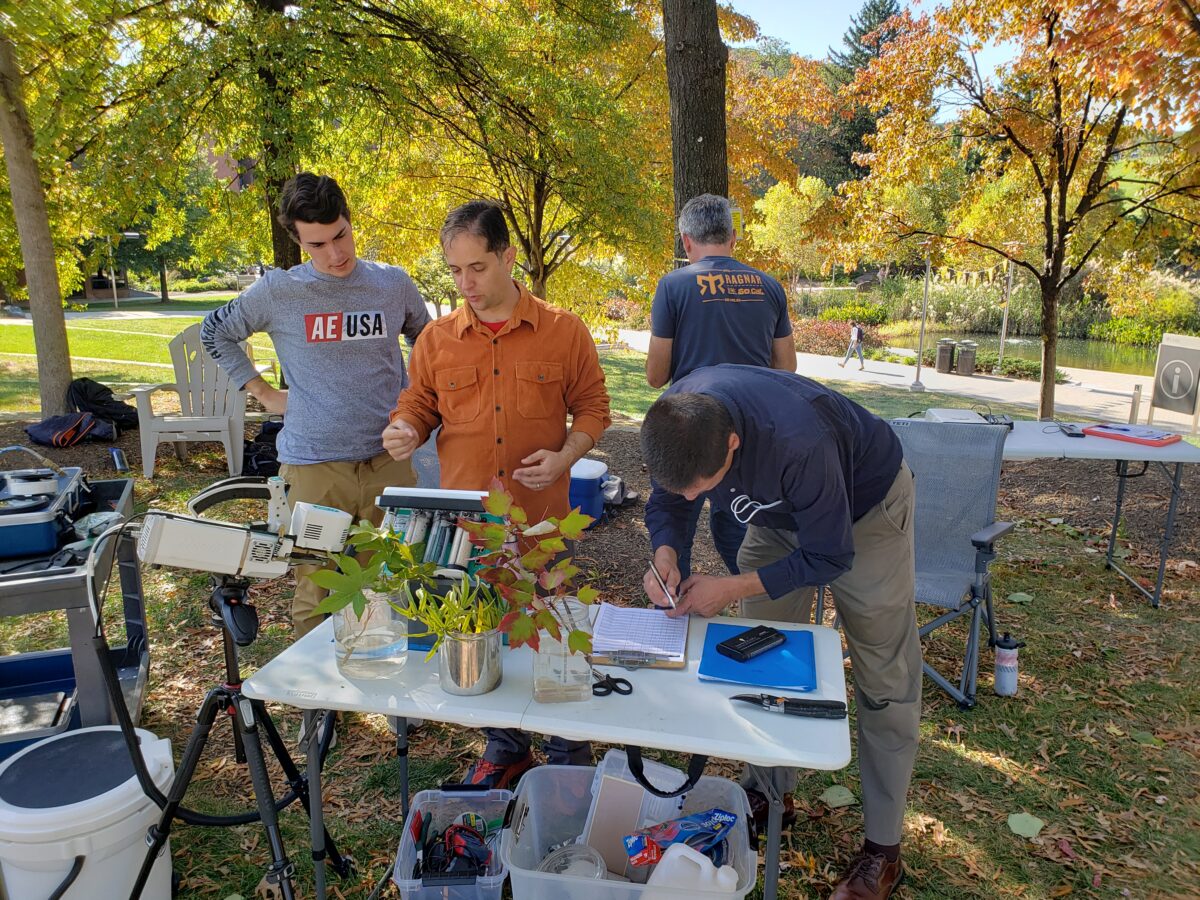 Lucas Martinez (left), a student at American University; Josh Caplan (second from left), a professor at Temple University; Matthew Baker (right) and Michael Alonzo (background, facing away) all work on data collection. (Sarah Hansen, M.S. ’15/UMBC)
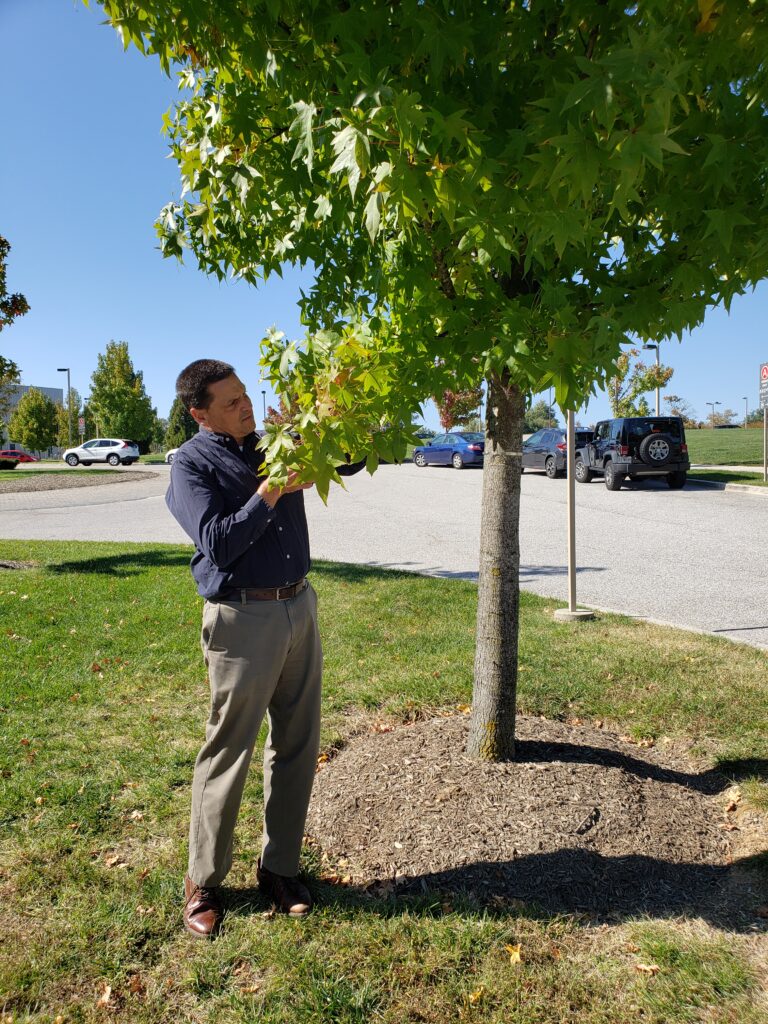 Matthew Baker takes a small clipping from a tree in the study. (Sarah Hansen, M.S. ’15/UMBC)
Innovation and transpiration
The UMBC campus, with its variety of tree habitats—like parking lots, grass fields, and natural areas—provides an excellent site to conduct the study. And because urban areas, which tend to include more pavement, are already experiencing higher temperatures on average than less developed areas, “Trees in these heat islands may provide a glimpse into the future about how they’ll respond elsewhere,” Baker says.
The instruments on the tables can measure things like how much and which wavelengths of light individual leaves are absorbing and their rate of photosynthesis. There are also sensors placed directly on the trees, which collect data in real time. A sensor in a metal box on each tree measures the rate at which water is flowing from its roots to its leaves, a process known as transpiration that is central to the water cycle. An instrument called a Scholander pressure bomb looks at a similar measure, but in the leaves. By gradually applying more pressure to a single leaf, it detects how hard the water is being pulled as it journeys from the roots, to the leaves, to the atmosphere.
By comparing the rates of photosynthesis and transpiration, which are typically closely linked, the researchers can see if the relationship between the two processes is shifting under stress.
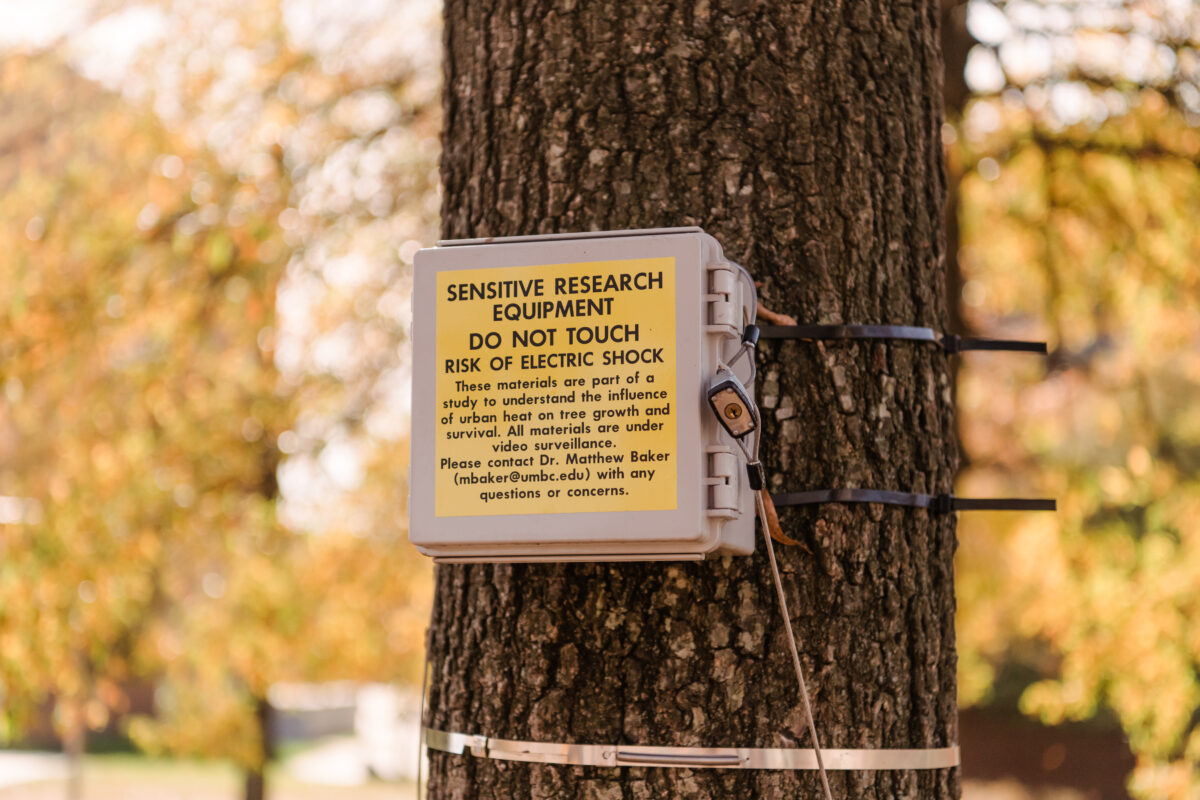 A box containing a sensor on one of the trees in the study. (Marlayna Demond ’11/UMBC)
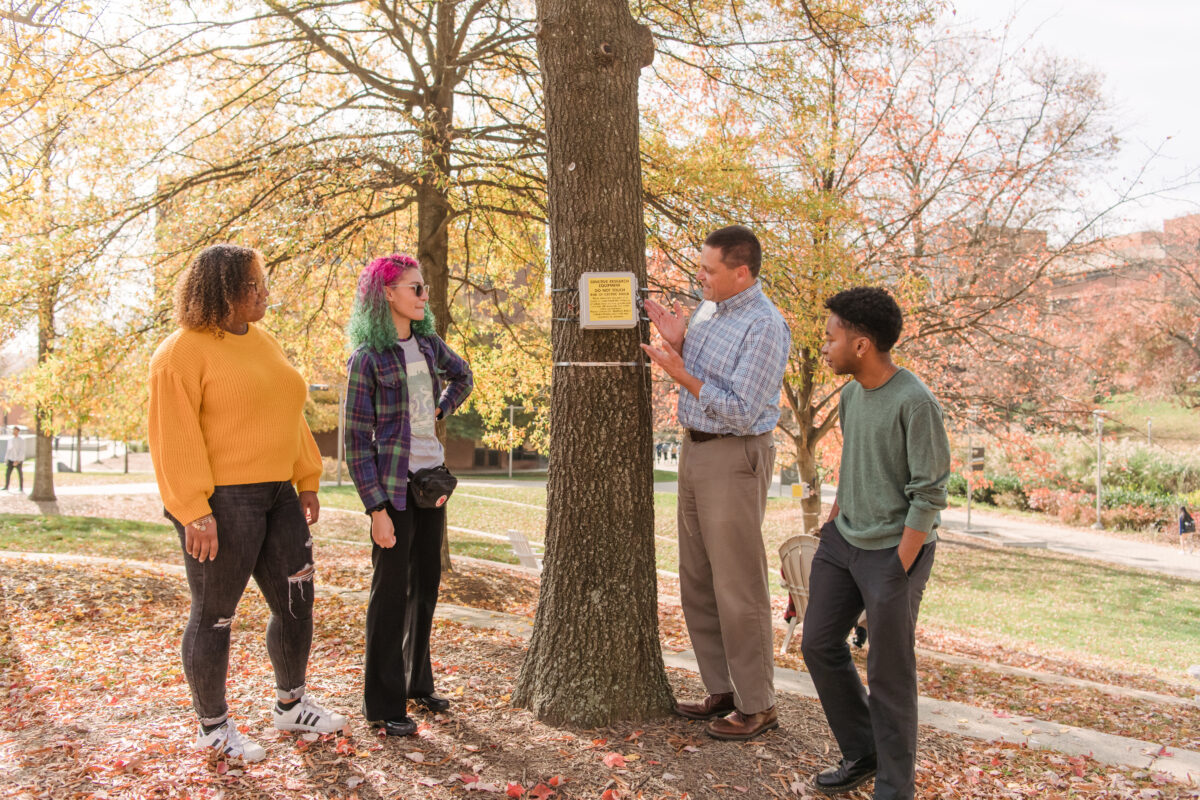 Matthew Baker talks about the research project with UMBC graduate students who have participated in data collection. Left to right: Tyrah Cobb-Davis, Erin Hamner, Matthew Baker, Drew Powell. (Marlayna Demond ’11/UMBC)
It’s a bird, it’s a plane, it’s… a research drone?
The team also uses a drone with a thermal camera to measure the heat signature of the tree canopy compared to the surrounding environment. “As long as the canopy is transpiring, the canopy should appear cooler than nearby pavement in our imagery,” Baker says. That temperature difference between the canopy and the surroundings can help determine how much transpiration is happening.
The researchers compare the findings from the drone’s hourly flights with what they’re seeing on the ground. “We’re in the ‘do we trust you’ phase of the relationship” with the drone and its data, Alonzo says. The hope is that if the drone data matches the ground data well enough, the team can use it to gather the same information in a much less labor-intensive way and over larger geographic areas.
Permission to use the drone also required cooperation and trust-building with several UMBC departments, such as UMBC Police, environmental safety and health, and facilities management, as well as BWI Airport. This project is the first time drones have been allowed on campus for research, following a recent revision of federal aviation and campus safety policies.
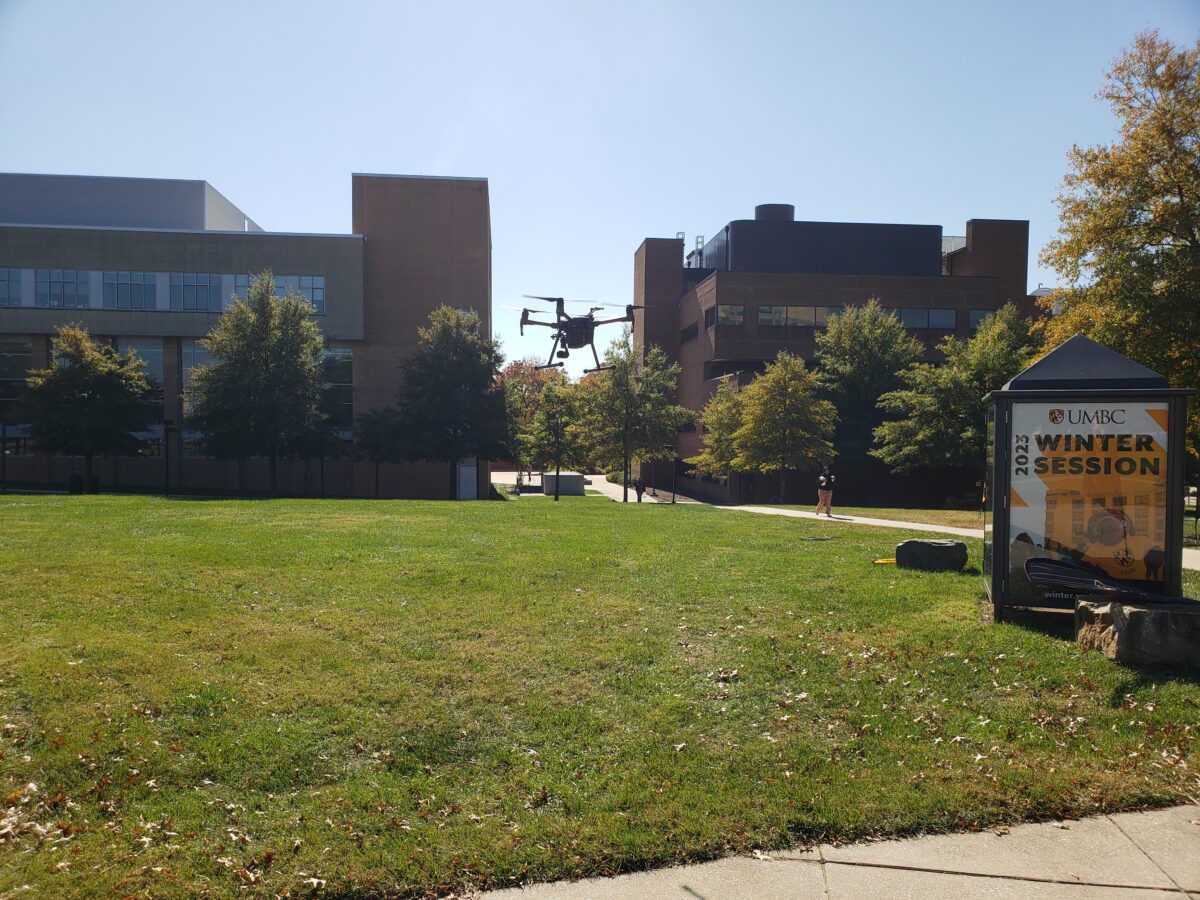 The research drone lands on the grass after its programmed flight. (Sarah Hansen, M.S. ’15/UMBC)
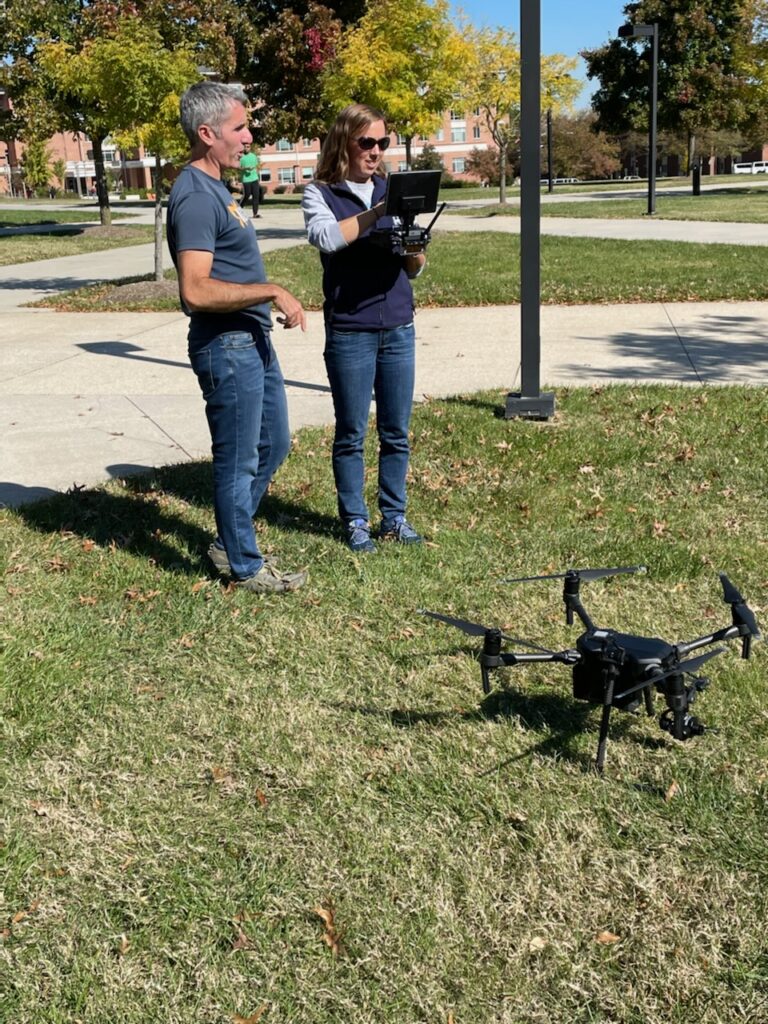 Michael Alonzo (left) and Sarah Hansen send the drone out for its hourly data-collection flight. (Image by Matthew Baker)
Growing the fleet
In addition to the thermal camera on the drone, the team is using a hyperspectral camera (on loan from NASA) to collect imagery from the roofs of both the library and the Physics Building. Hyperspectral imagery provides information about canopy stress, water content, and leaf pigments like chlorophyll, which drive photosynthesis. Next year, they hope to have this camera mounted on a drone, too. Together, these two cameras collecting data from above “are the link to being able to perform similar measurements over much broader areas, like metropolitan Baltimore, with airborne or spaceborne platforms,” Baker says.
In fact, the team has already started related work in 11 other cities in the Eastern U.S., including research on how trees help cool cities using data from Washington, DC.
The study on campus is already turning up differences in how various tree species respond to warming. The team discovered that some species intermittently reduce their transpiration rate, possibly as a stress response. Some trees even stop the process altogether during the hottest part of the day—a phenomenon Alonzo calls a “tree siesta.”
It remains to be seen if photosynthesis slows down along with transpiration. If it does, this could indicate that the trees are prioritizing protective measures to prevent overheating and water loss over growth. A reduced growth rate would also reduce the amount of carbon the trees are taking out of the atmosphere, which is an important factor when estimating how much planting trees could benefit the future climate.
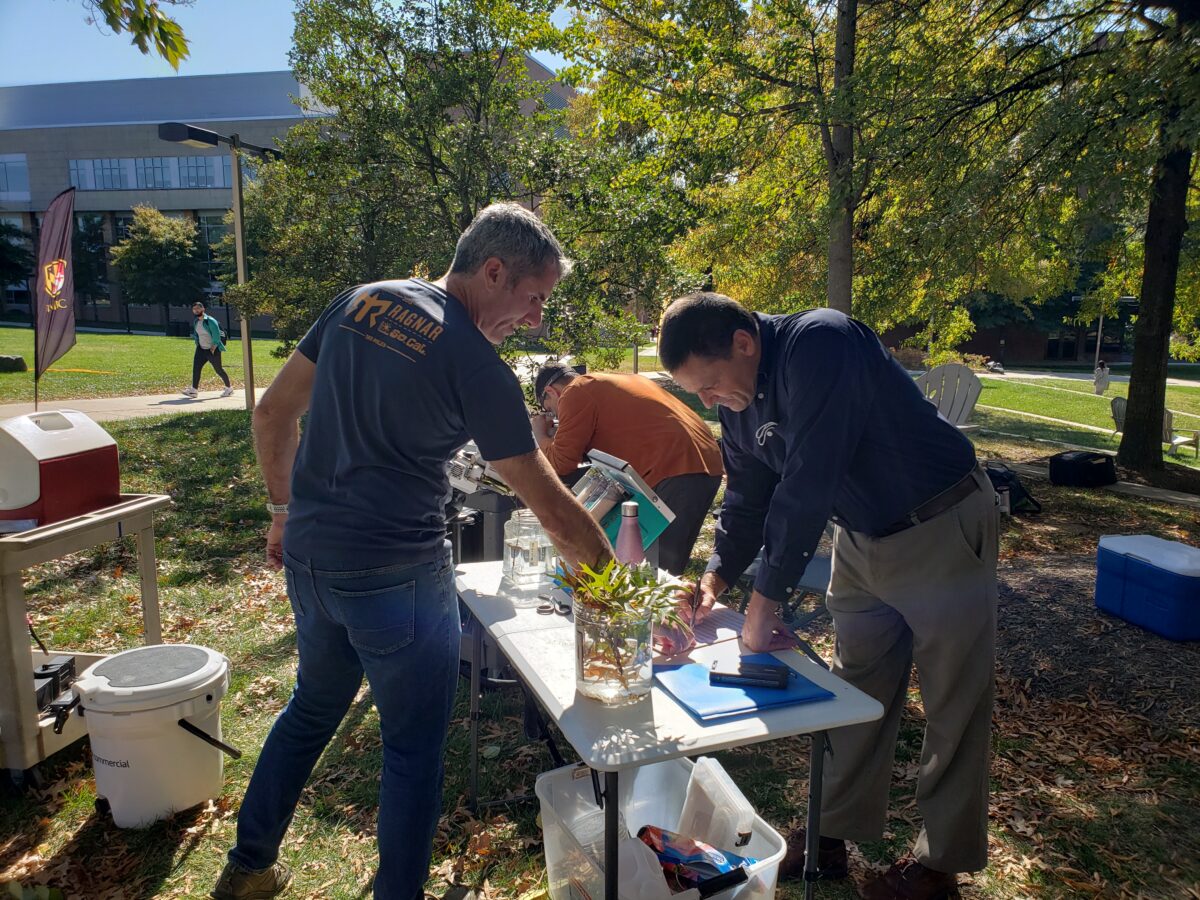 Matthew Baker (right), Michael Alonzo (left), and Josh Caplan (center) collect tree data outside the Albin O. Kuhn Library and Gallery. (Sarah Hansen, M.S. ’15/UMBC)
Informing the future
All aspects of the project have involved undergraduate and graduate students. More than 15 students have contributed, including Caitlin Beckjord ’23, geography and environmental systems, who first got involved in forest research through a summer project while she was a student at Howard Community College. Micah Polsky ’25, geography and environmental systems, has a leading role in a complementary study with the USDA Forest Service. They take precise weekly measurements of the trees’ girth—another way to measure their water status as well as their growth rate.
Faculty teach each student how to use the full range of instruments used in this study, making this project an excellent training opportunity for students in majors from environmental science to physics or information systems. The project brings together important new details about how trees are responding to stress, testing and verification of new technologies, and student engagement and training in a way that is likely to have a significant impact on the participants and the future of this research field.
]]>
On a sunny fall day in October, a handful of student and faculty researchers are scuttling around outside the Albin O. Kuhn Library and Gallery. High-tech instruments sprawl across folding tables,...
https://umbc.edu/stories/urban-trees/
https://beta.my.umbc.edu/api/v0/pixel/news/129931/guest@my.umbc.edu/50b0bacd966a8787a947ae0a0afaa983/api/pixel
cahss
discovery
ges
magazine
research
UMBC News & Magazine
https://beta.my.umbc.edu/groups/umbc-news-magazine
https://assets1-beta.my.umbc.edu/system/shared/avatars/groups/000/001/943/24435aa6207c452e7bc15cc74b42c7bb/xsmall.png?1748556657
https://assets1-beta.my.umbc.edu/system/shared/avatars/groups/000/001/943/24435aa6207c452e7bc15cc74b42c7bb/original.png?1748556657
https://assets2-beta.my.umbc.edu/system/shared/avatars/groups/000/001/943/24435aa6207c452e7bc15cc74b42c7bb/xxlarge.png?1748556657
https://assets2-beta.my.umbc.edu/system/shared/avatars/groups/000/001/943/24435aa6207c452e7bc15cc74b42c7bb/xlarge.png?1748556657
https://assets3-beta.my.umbc.edu/system/shared/avatars/groups/000/001/943/24435aa6207c452e7bc15cc74b42c7bb/large.png?1748556657
https://assets1-beta.my.umbc.edu/system/shared/avatars/groups/000/001/943/24435aa6207c452e7bc15cc74b42c7bb/medium.png?1748556657
https://assets2-beta.my.umbc.edu/system/shared/avatars/groups/000/001/943/24435aa6207c452e7bc15cc74b42c7bb/small.png?1748556657
https://assets1-beta.my.umbc.edu/system/shared/avatars/groups/000/001/943/24435aa6207c452e7bc15cc74b42c7bb/xsmall.png?1748556657
https://assets2-beta.my.umbc.edu/system/shared/avatars/groups/000/001/943/24435aa6207c452e7bc15cc74b42c7bb/xxsmall.png?1748556657
UMBC News & Magazine
6
0
false
Wed, 21 Dec 2022 11:22:25 -0500
Wed, 21 Dec 2022 11:22:25 -0500
Finding Joy in the Democratic Process

On a Tuesday evening in early November, Main Street in The Commons was uncommonly crowded. Hundreds of democratically-minded students eagerly—and perhaps, anxiously—milled around watching the 2022 mid-term election returns. Dilnaz Hasim ’25, economics, found the scene fitting, saying, “Election Night Extravaganza is supposed to be experienced as a community, rather than as a single person, because when you make a vote, you’re making it for the whole community.”
Jointly hosted by the Center for Democracy and Civic Life, the Student Government Association (SGA), and the Graduate Student Association, the campus-based election event has been around since 2004. Students from every political affiliation bonded over a breakfast buffet and made room for bipartisan conversations in multiple breakout spaces. Other rooms had craft tables set up for students to creatively distract themselves while results rolled in.
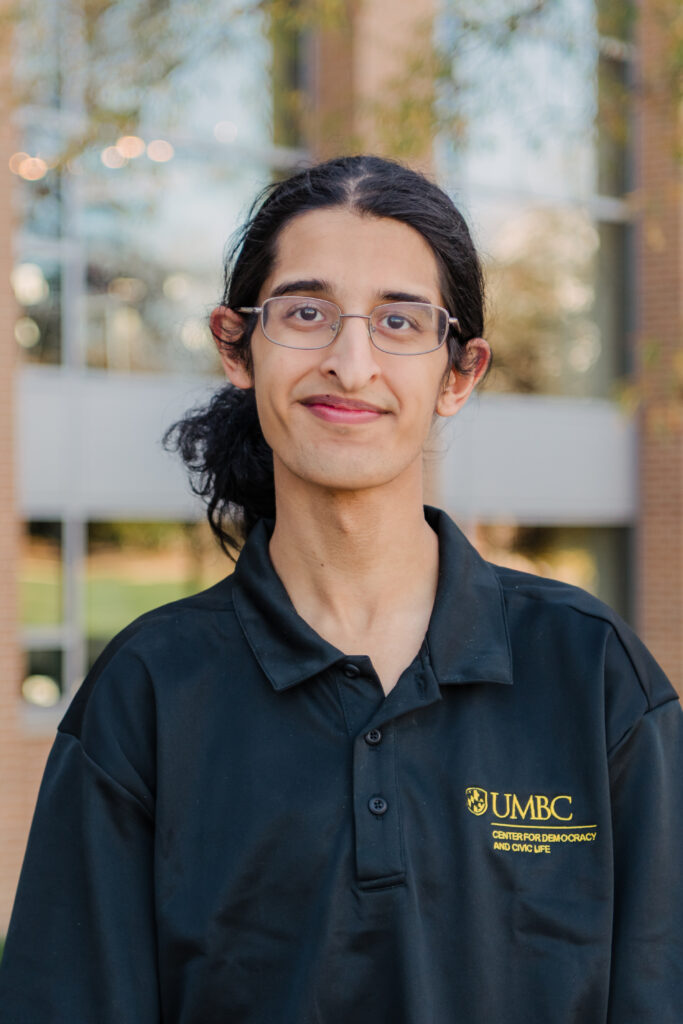 One of Election Night Extravaganza’s student organizers, Musa Jafri. (Marlayna Demond ’11/UMBC)
As exciting as this night is, it’s only one part of efforts put forth throughout the year by the Center for Democracy and Civic Life to engage students in the day-to-day processes of democratic involvement. Leading up to elections, students are encouraged to “cast your whole vote”—an idea from Henry David Thoreau’s essay on civil disobedience—to commit fully to building strong, inclusive, just communities in which everyone can thrive. Following elections, students, staff, and faculty can take part in Together Beyond November discussions to talk about the election outcomes and envision a common future.
In late November 2022, the ALL IN Campus Democracy Challenge released the results of its national student voter pledge competition. UMBC finished at #4 in the nation in the number of students pledging to vote in Election 2022, moving our campus community up from #9 in 2020.
Musa Jafri ’24, political science, SGA’s director of civic engagement, was heartened by the turnout. “Democracy doesn’t end at the voting booth,” said Jafri, who is also co-chair of the University System of Maryland Student Civic Leaders Committee. “There’s so much more we can do as we watch the results and come together as a community. Even after whatever happens, we have fellow Retrievers coming together, watching the results, having food, and playing games.”
Another one of the event organizers, Meghna Chandrasekaran ’25, biology, hosted a social takeover during the night, interviewing her fellow students about their civic engagement. Many mentioned feeling the need to have their voices heard on issues they cared about. To wrap up the evening, Chandrasekaran said, “Election Night Extravaganza is an event to celebrate that we did come out. We had one job as citizens to come out and vote, express our concerns about certain things, and show that we are part of the process.”
To read more about engaging college students in everyday democratic practices, check out an extended Q&A with Musa Jafri, Sunil Dasgupta, professor of political science, and founder and host of the podcast “I Hate Politics,” and David Hoffman, Ph.D. ’13, language, literacy, and culture, the director of UMBC’s Center for Democracy and Civic Life.
— Levi Lewis ’23 & Randianne Leyshon ’09
]]>
On a Tuesday evening in early November, Main Street in The Commons was uncommonly crowded. Hundreds of democratically-minded students eagerly—and perhaps, anxiously—milled around watching the 2022...
https://umbc.edu/stories/finding-joy-in-the-democratic-election-process/
https://beta.my.umbc.edu/api/v0/pixel/news/129815/guest@my.umbc.edu/ee1477970d0089efa9c51bea369128fd/api/pixel
biology
campus-life
center-for-democracy-and-civic-life
economics
fall-2022
impact
magazine
political
UMBC News & Magazine
https://beta.my.umbc.edu/groups/umbc-news-magazine
https://assets1-beta.my.umbc.edu/system/shared/avatars/groups/000/001/943/24435aa6207c452e7bc15cc74b42c7bb/xsmall.png?1748556657
https://assets1-beta.my.umbc.edu/system/shared/avatars/groups/000/001/943/24435aa6207c452e7bc15cc74b42c7bb/original.png?1748556657
https://assets2-beta.my.umbc.edu/system/shared/avatars/groups/000/001/943/24435aa6207c452e7bc15cc74b42c7bb/xxlarge.png?1748556657
https://assets2-beta.my.umbc.edu/system/shared/avatars/groups/000/001/943/24435aa6207c452e7bc15cc74b42c7bb/xlarge.png?1748556657
https://assets3-beta.my.umbc.edu/system/shared/avatars/groups/000/001/943/24435aa6207c452e7bc15cc74b42c7bb/large.png?1748556657
https://assets1-beta.my.umbc.edu/system/shared/avatars/groups/000/001/943/24435aa6207c452e7bc15cc74b42c7bb/medium.png?1748556657
https://assets2-beta.my.umbc.edu/system/shared/avatars/groups/000/001/943/24435aa6207c452e7bc15cc74b42c7bb/small.png?1748556657
https://assets1-beta.my.umbc.edu/system/shared/avatars/groups/000/001/943/24435aa6207c452e7bc15cc74b42c7bb/xsmall.png?1748556657
https://assets2-beta.my.umbc.edu/system/shared/avatars/groups/000/001/943/24435aa6207c452e7bc15cc74b42c7bb/xxsmall.png?1748556657
UMBC News & Magazine
2
0
false
Wed, 14 Dec 2022 16:07:30 -0500
Wed, 14 Dec 2022 16:07:30 -0500