UMBC humanities faculty receive NEH fellowships for research into “the why and how of our past”

The National Endowment for the Humanities (NEH) has announced that George Derek Musgrove ‘97, associate professor of history, and Elizabeth Patton, associate professor of media and communication studies, have received the highly competitive 2023 NEH fellowship.
Only 70 scholars out of 1,029 applicants nationwide received the coveted fellowship this year. The one-year award supports individual scholars pursuing projects that embody exceptional humanistic research, rigorous analysis, and clear writing. Each scholar will receive $60,000 to support a current book project. Musgrove and Patton have received multiple fellowships supporting their prior and current work, affirming the importance of their scholarship.
Black political and cultural mobilizations
Musgrove, a 2022 Andrew Carnegie fellow, will be working on “We must take to the streets again:” The Black Power Resurgence in Conservative America, 1980–1997. The book aims to provide an in-depth history of the years between the Civil Rights movement and today’s Black Lives Matter movement. This new work will also further Musgrove’s highly acclaimed research on African American history in the nation’s capital, completed over the past decade.
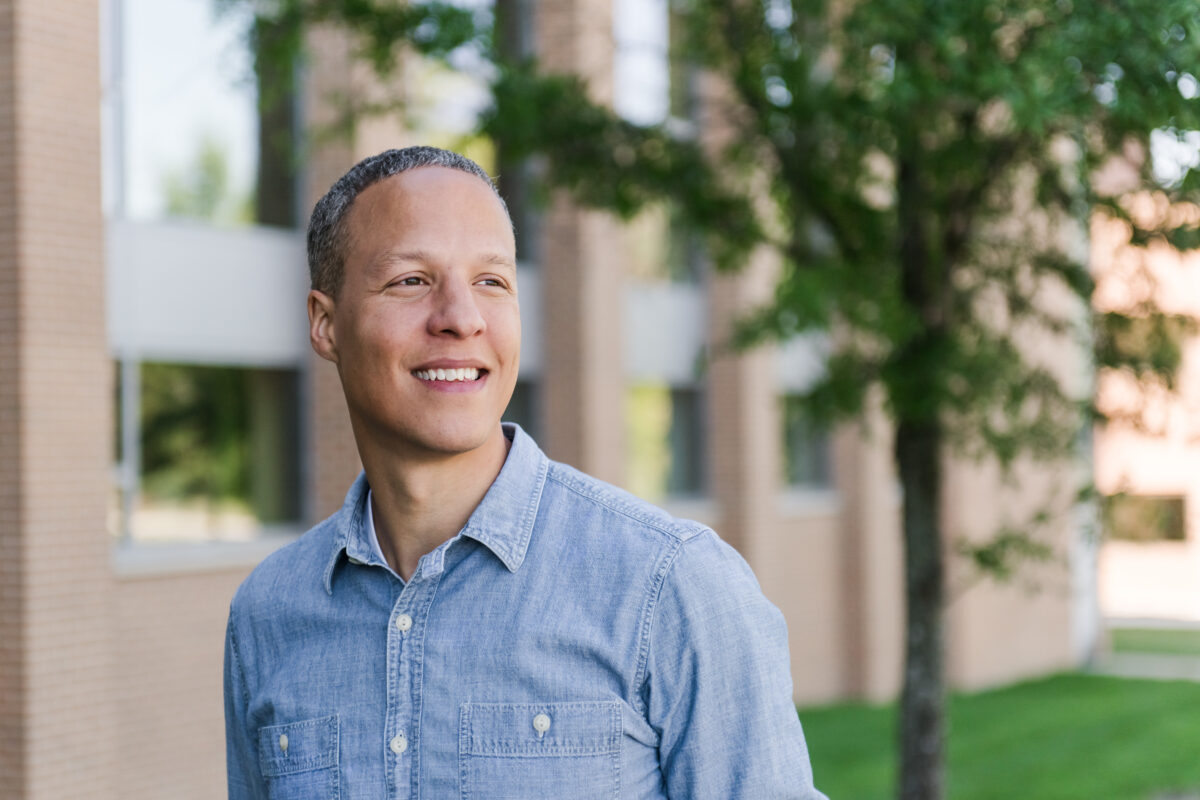 Derek Musgrove. (Marlayna Demond ’11/UMBC)
“The NEH Fellowship is one of the most prestigious awards granted in the humanities and I am honored that the selection committee deemed my forthcoming project worthy of support,” shares Musgrove. “That I was selected is a testament to my colleagues in the history department and Rachel Brubaker, who encouraged me to apply and shared essential feedback. UMBC’s generous, collaborative culture allows those of us who are lucky enough to work here to do amazing things.”
UMBC’s Dresher Center for the Humanities provides key support to faculty engaging in major scholarly and public projects. Rachel Brubaker, director of program administration at the Dresher Center, works with faculty one on one to identify and successfully apply for research funding.
After receiving the Carnegie Fellowship, Musgrove shared that the support his scholarship has garnered is “a powerful endorsement of the importance of exploring the Black political and cultural mobilizations of the 1980s and ‘90s.” He noted, “We continue to live in the world those activists helped make and to fight the battles that those activists fought.”
Black leisure and tourism
Patton, who was also a 2022 NEH summer fellow, will advance research for her forthcoming book Representation as a Form of Resistance: Documenting African American Spaces of Leisure during the Jim Crow Era. The book will examine the history of Black leisure and tourism in the U.S. through the perspective of photography and home movies. She seeks to put into context lingering forms of racism that still affect Black tourism on platforms like Airbnb.
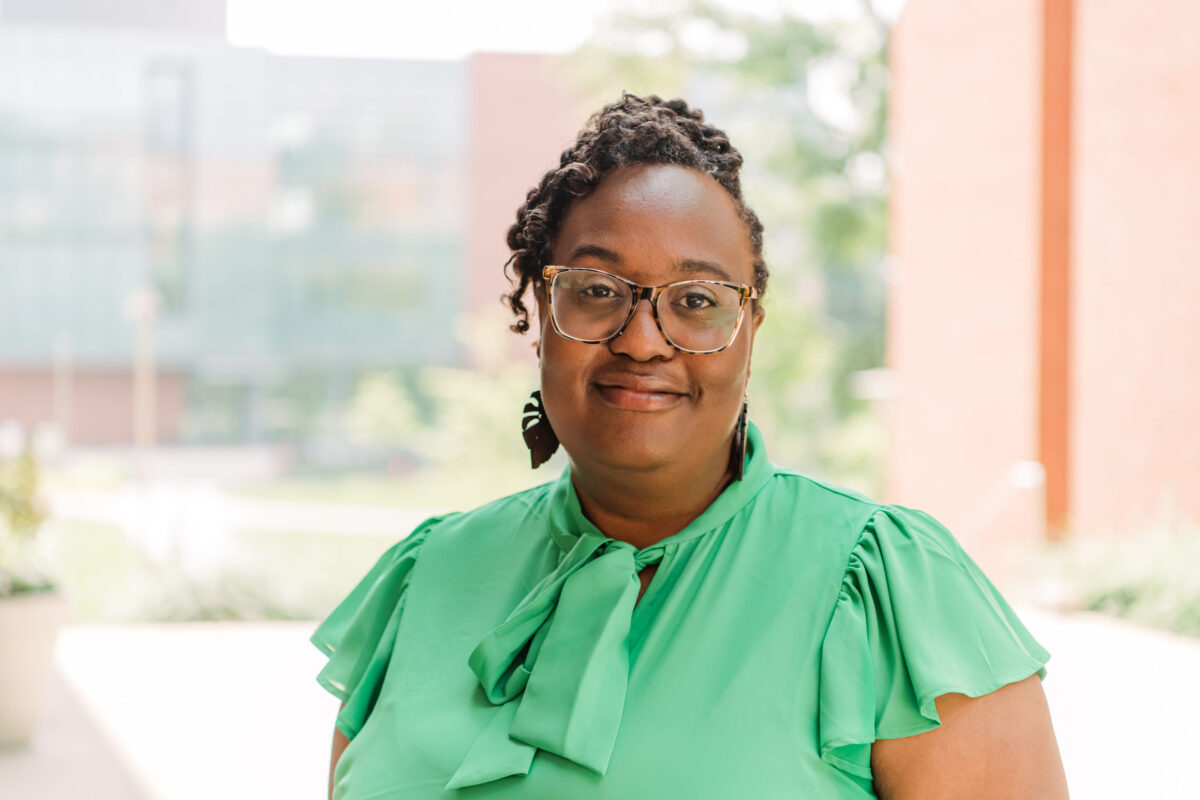 Elizabeth Patton. (Marlayna Demond ’11/UMBC)
The 2023 NEH award will further Patton’s archival research, begun in 2022 with combined funding from Duke University’s John W. Hartman Center for Sales, Advertising & Marketing History, the John Hope Franklin Research Center for African American History and Culture, and UMBC’s CAHSS Research Fund.
“I have found hundreds of examples of spaces where there is a history of people of color using those spaces, desegregating those spaces, or creating their own spaces for leisure and travel,” Patton said, after receiving her 2022 NEH summer fellowship. “These rich data sources will help me tell the invisible history of African American leisure through historical methods, discourse analysis, semiotics, and oral history.”
Humanities at work
Preminda Jacob, associate professor of visual arts and associate dean of the College of Arts, Humanities, and Social Sciences is thrilled the NEH continues to support UMBC’s leading humanities research. “Humanities scholarship at UMBC pursues the why and how of our past, present, and future with painstaking rigor,” says Jacob. “The NEH fellowship acknowledges our faculty’s innovative and relentless pursuit of answers to these questions.”
Musgrove and Patton join several previous UMBC NEH Fellows. A few of the university’s prior recipients include Anne Sarah Rubin, professor of history; Susan McDonough, associate professor of history; and Whitney Schwab, associate professor of philosophy.
]]>
The National Endowment for the Humanities (NEH) has announced that George Derek Musgrove ‘97, associate professor of history, and Elizabeth Patton, associate professor of media and communication...
https://umbc.edu/stories/neh-fellowships-2023/
https://beta.my.umbc.edu/api/v0/pixel/news/130994/guest@my.umbc.edu/2ef5d7d3b8be707d1d65f3be61292544/api/pixel
arts-and-culture
cahss
cahssresearch
history
majoraward
mcs
news
policy-and-society
rca-2
research
UMBC News & Magazine
https://beta.my.umbc.edu/groups/umbc-news-magazine
https://assets1-beta.my.umbc.edu/system/shared/avatars/groups/000/001/943/24435aa6207c452e7bc15cc74b42c7bb/xsmall.png?1748556657
https://assets1-beta.my.umbc.edu/system/shared/avatars/groups/000/001/943/24435aa6207c452e7bc15cc74b42c7bb/original.png?1748556657
https://assets2-beta.my.umbc.edu/system/shared/avatars/groups/000/001/943/24435aa6207c452e7bc15cc74b42c7bb/xxlarge.png?1748556657
https://assets2-beta.my.umbc.edu/system/shared/avatars/groups/000/001/943/24435aa6207c452e7bc15cc74b42c7bb/xlarge.png?1748556657
https://assets3-beta.my.umbc.edu/system/shared/avatars/groups/000/001/943/24435aa6207c452e7bc15cc74b42c7bb/large.png?1748556657
https://assets1-beta.my.umbc.edu/system/shared/avatars/groups/000/001/943/24435aa6207c452e7bc15cc74b42c7bb/medium.png?1748556657
https://assets2-beta.my.umbc.edu/system/shared/avatars/groups/000/001/943/24435aa6207c452e7bc15cc74b42c7bb/small.png?1748556657
https://assets1-beta.my.umbc.edu/system/shared/avatars/groups/000/001/943/24435aa6207c452e7bc15cc74b42c7bb/xsmall.png?1748556657
https://assets2-beta.my.umbc.edu/system/shared/avatars/groups/000/001/943/24435aa6207c452e7bc15cc74b42c7bb/xxsmall.png?1748556657
UMBC News & Magazine
1
0
false
Wed, 15 Feb 2023 14:59:43 -0500
Wed, 15 Feb 2023 14:59:43 -0500
UMBC’s Christopher Slaughter, engineering student with health equity focus, wins prestigious Gates Cambridge Scholarship

Christopher Slaughter ’23, M31 computer engineering, has won a Gates Cambridge Scholarship to pursue graduate work at the University of Cambridge in the United Kingdom next fall. Slaughter is the fifth student from UMBC to be recognized with the prestigious award, established by the University of Cambridge in 2000 with a donation from the Bill and Melinda Gates Foundation.
Gates Cambridge Scholars are selected from around the world for their academic talents and commitment to improving the lives of others. Each year around 25 of the 80 total awards are offered to students from the United States.
Slaughter will pursue a Ph.D. in electrical engineering at the University of Cambridge, which is the world’s third oldest surviving university, founded in 1209. His career goals are to develop novel biomedical technologies that meet the healthcare needs of under-resourced communities.
“We are so proud of Chris,” says UMBC President Valerie Sheares Ashby. “He exemplifies UMBC’s values and the Gates Cambridge vision of preparing leaders who demonstrate not only academic excellence, but also a deep commitment to improving the lives of others. Congratulations to Chris, and my thanks and appreciation to those among the UMBC community who have served as influential teachers, mentors, and supporters for Chris throughout his educational journey.”
Research as a way to change the world
Slaughter grew up in a “STEM family,” but he didn’t initially envision a future in research. His perspective changed, however, after he traveled to Germany and Ghana to visit family during his high school years.
While traveling, Slaughter noticed how different communities had inequitable access to healthcare, and he started to think about the disparities that also existed back home in the United States. New biomedical technologies, he realized, might help underserved communities get better care.
Guided by a passion for improving people’s lives, Slaughter began his first of many biomedical research projects. At UMBC’s Bioelectronics Laboratory, he worked on technology to help patients who are insensitive to pain avoid burns. Most recently, he has been working at UMBC’s Center for Advanced Sensor Technology (CAST) in the lab of Govind Rao, professor of chemical and biochemical engineering.
Slaughter is helping develop technology that can sense glucose levels through the skin. This could lead to a device that continuously monitors glucose for people with diseases such as diabetes without painful finger pricks or repeated blood draws. He has presented the work at leading scientific conferences, including the IEEE/EMB Healthcare Innovations Point of Care Technologies conference as the sole undergraduate oral presenter.
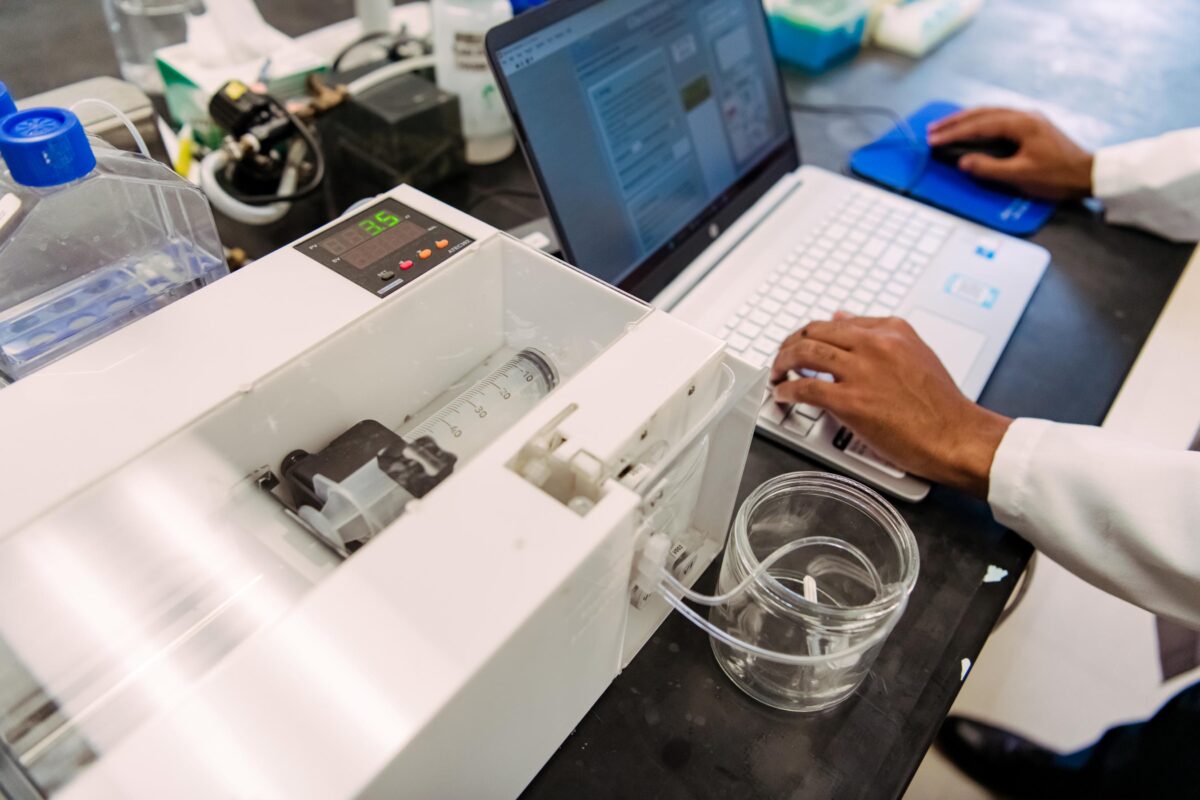
The glucose monitor that Chris Slaughter is helping develop. (Marlayna Demond ’11/UMBC)
“What strikes you immediately about Chris is his sheer enthusiasm, curiosity, and positivity,” Rao says. “He is always eager to be in the lab.”
“Chris’ intense energy and his genuine interest in the topic made him the best mentee you can ask for,” says Hasib Hasan, an electrical engineering Ph.D. student in the department of computer science and electrical engineering who is mentoring Slaughter on the glucose monitor project. “I have no doubt about his ability to become a successful researcher. The Gates Cambridge Scholarship will support him as he pursues work that will improve lives.”
The value of mentorship
Throughout his time at UMBC, Slaughter found mentors to help him grow and learn. He was part of the Meyerhoff Scholars Program, a nationally recognized effort to foster diversity in science, technology, engineering, and mathematics by supporting students who intend to pursue advanced degrees in these fields. He has also been inspired and supported by scholars throughout the UMBC community, such as Rao; Freeman Hrabowski, president emeritus; and Charles LaBerge, professor of the practice in computer science and electrical engineering.
“Mentorship has been so important for me,” Slaughter says. “I knew that in order to succeed, I needed to be in a community that could push me to be my best, hold me accountable, and support me at the same time. To accomplish what I wanted to accomplish—getting a Ph.D. in a scientific field—there was no place better for me to start than UMBC.”
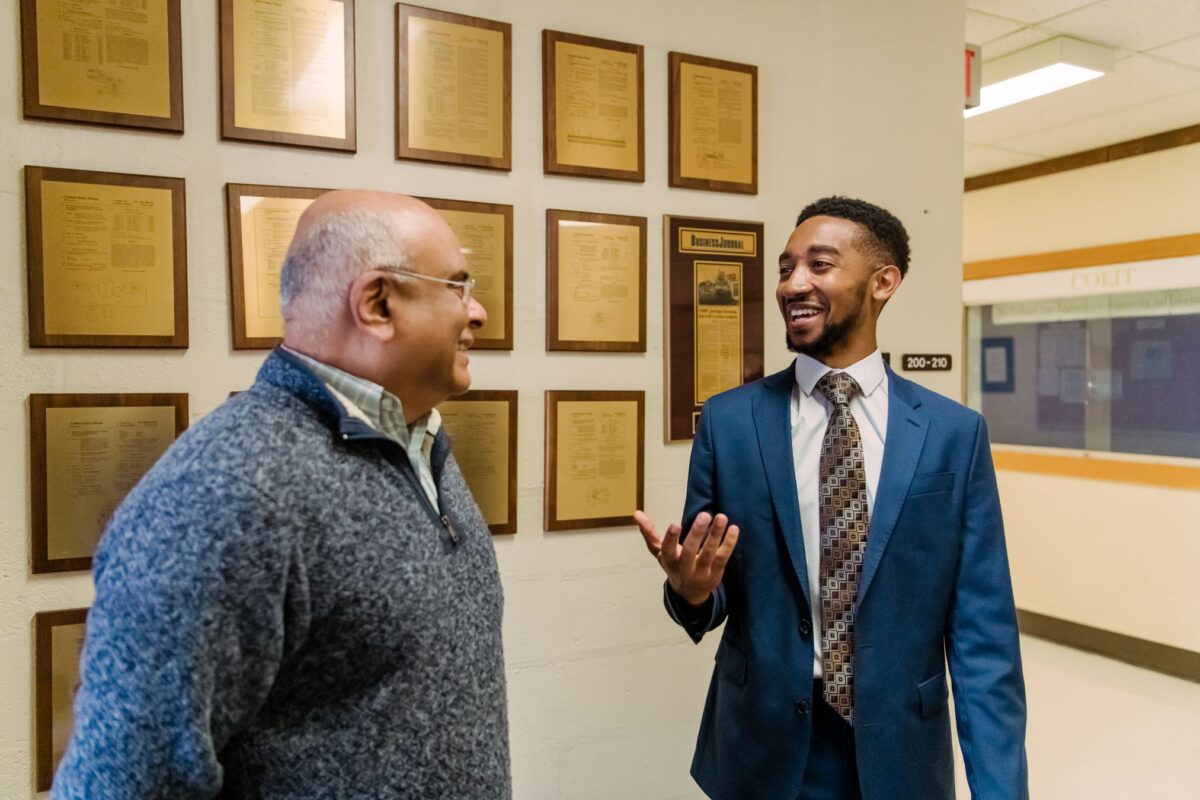
Chris Slaughter (right) is working in the lab of Govind Rao (left). (Marlayna Demond ’11/UMBC)
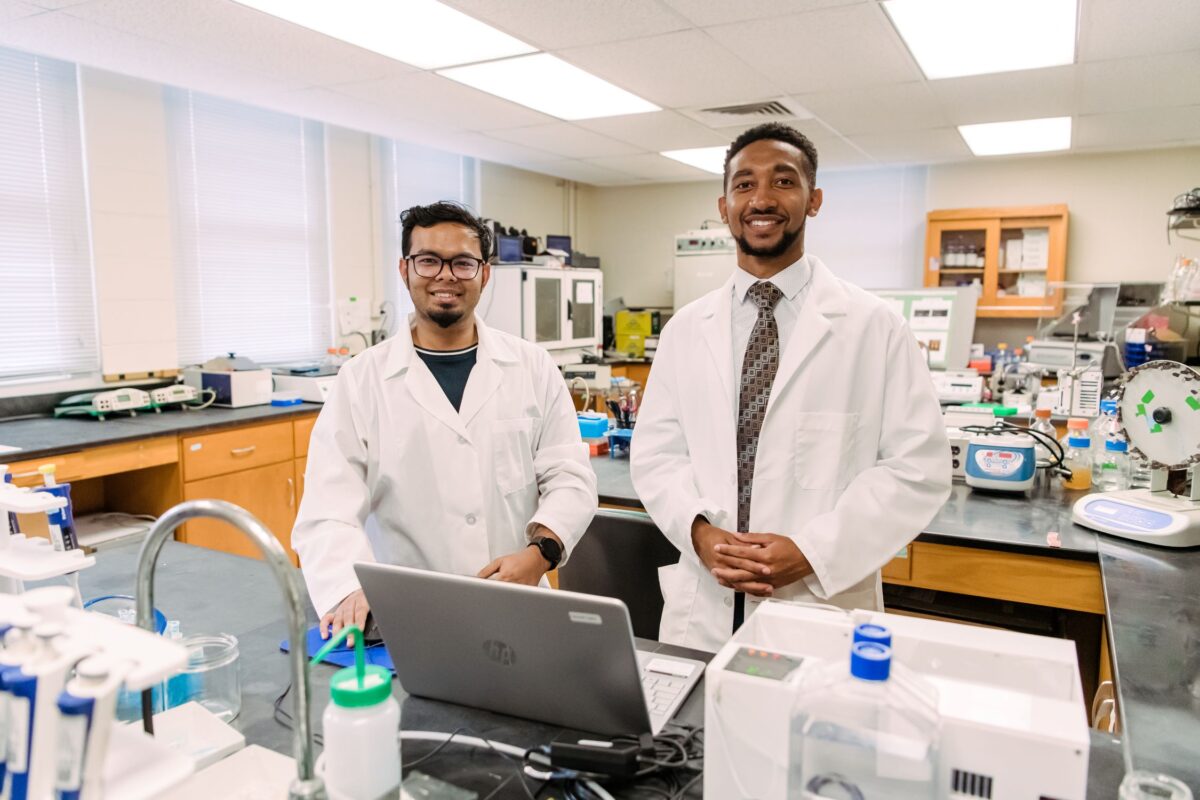
Hasib Hasan (left) and Chris Slaughter (right) in the lab where they are working on a glucose monitoring device. (Marlayna Demond ’11/UMBC)
Slaughter’s application for the Gates Cambridge Scholarship was supported by UMBC’s Office of Prestigious Scholarships, which was established six years ago with the ambition to focus on three major international scholarships as well as others in the U.S., says April Householder, director of undergraduate research and prestigious scholarships at UMBC.
“With Chris’s win, I am happy to say that we have now achieved the trifecta—UMBC alumni simultaneously supported by all three major U.K. scholarships,” she says. The alumni are Rhodes Scholars Naomi Mburu and Sam Patterson at the University of Oxford, Marshall Scholar Joshua Slaughter at the University of Edinburgh, and now Gates Scholar Christopher Slaughter, heading tothe University of Cambridge.
Paying it forward
Having benefited from a culture of mentoring and support at UMBC, Slaughter embraces opportunities to become a mentor and leader himself.
Slaughter was named a Goldwater Scholar in 2022, recognizing him among the top engineering students in the nation. He is president of the UMBC chapter of the National Society of Black Engineers and, through volunteering at local schools, encourages middle and high school students to develop technical skills and aspire to careers in science and technology. In addition, he serves as the vice president of the UMBC chapter of the Institute of Electrical and Electronics Engineers and the UMBC Club Taekwondo team. He also serves as the lead peer advisor in the Meyerhoff Scholars Program, responsible for organizing events and managing peer advisor relationships across the program.
“I think the way we honor the people who invest so much in us is by turning around and doing the same thing for somebody else,” Slaughter says. “Regardless of what I do, I want to make sure I am giving back.”
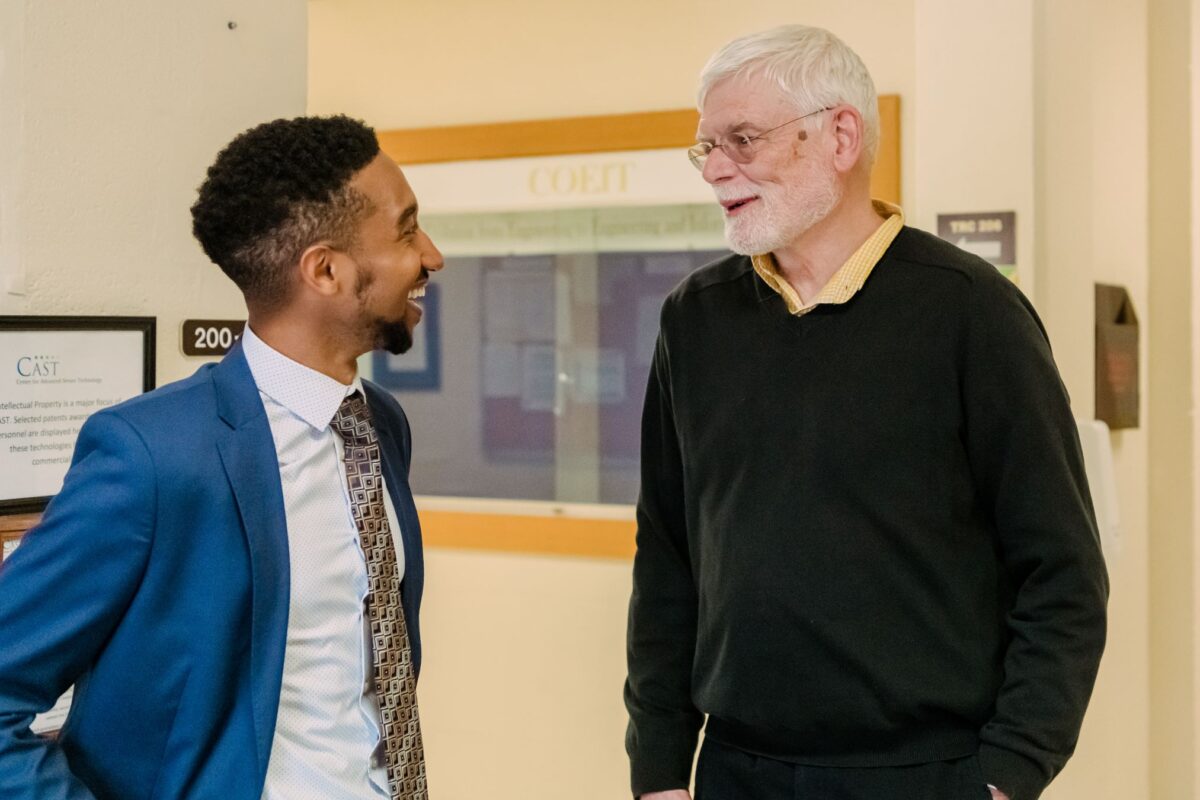 Chris Slaughter (left) talks with mentor Charles LaBerge (right). (Marlayna Demond ’11/UMBC)
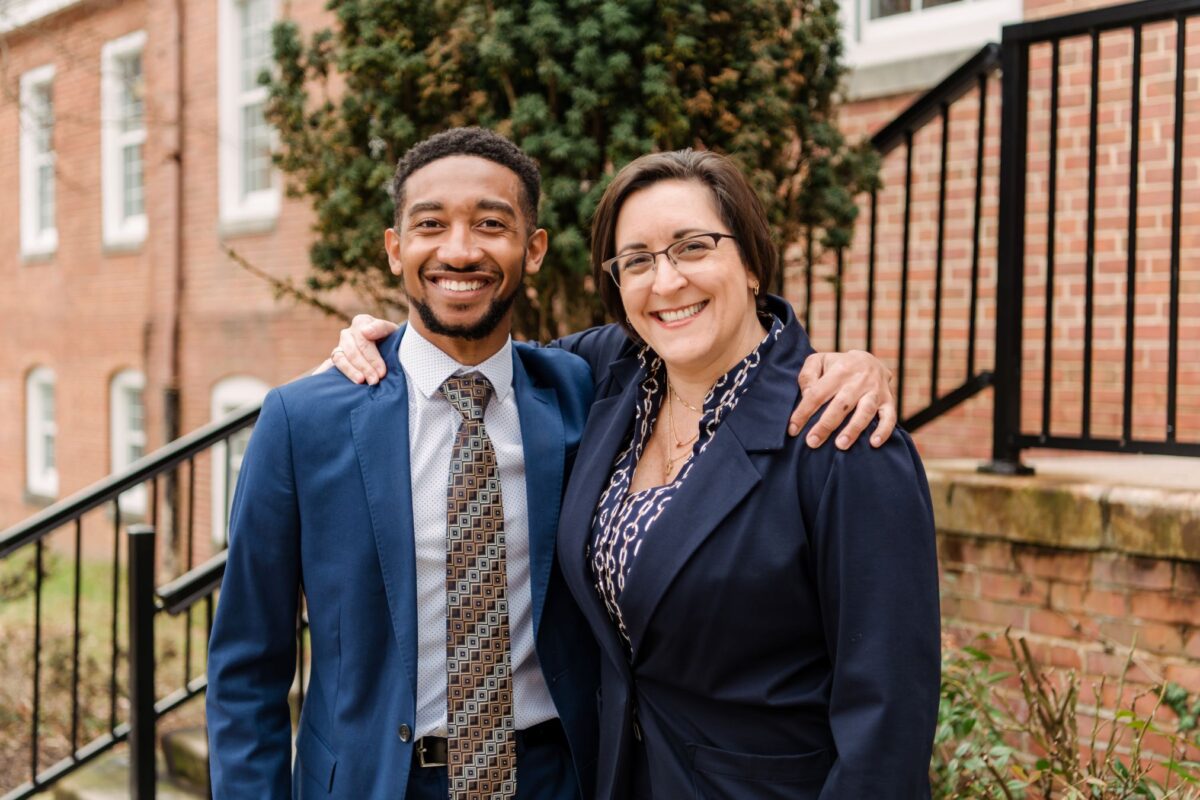 April Householder (right) helped guide Slaughter (left) through the Gates Cambridge process. (Marlayna Demond ’11/UMBC)
Reflecting on his time as a Retriever, Slaughter says he wants to spread the culture of support he encountered at UMBC wherever he goes next. “I think that the great thing about UMBC is we all work together,” he reflects. “I hope throughout my career to make more communities like that because ultimately, I think that’s how we solve the problems that we face today.”
Householder echoes that sentiment. “Chris’s experiences in the Meyerhoff Scholars Program, a national model for STEM student success, have prepared him to be a leader and to lift up others. UMBC has provided a culture of support and mentoring similar to what he will experience as part of a Gates cohort,” she says. “I can’t wait to see how being a Gates Cambridge Scholar will not only help him grow, but how he will transform Cambridge as an institution.”
]]>
Christopher Slaughter ’23, M31 computer engineering, has won a Gates Cambridge Scholarship to pursue graduate work at the University of Cambridge in the United Kingdom next fall. Slaughter is the...
https://umbc.edu/stories/gates-cambridge-scholarship/
https://beta.my.umbc.edu/api/v0/pixel/news/130944/guest@my.umbc.edu/2d4ebfe00a62eac215d0f7a276afe45f/api/pixel
cast
cbee
class-of-2023
coeit
community
csee
news
scholarships
UMBC News & Magazine
https://beta.my.umbc.edu/groups/umbc-news-magazine
https://assets1-beta.my.umbc.edu/system/shared/avatars/groups/000/001/943/24435aa6207c452e7bc15cc74b42c7bb/xsmall.png?1748556657
https://assets1-beta.my.umbc.edu/system/shared/avatars/groups/000/001/943/24435aa6207c452e7bc15cc74b42c7bb/original.png?1748556657
https://assets2-beta.my.umbc.edu/system/shared/avatars/groups/000/001/943/24435aa6207c452e7bc15cc74b42c7bb/xxlarge.png?1748556657
https://assets2-beta.my.umbc.edu/system/shared/avatars/groups/000/001/943/24435aa6207c452e7bc15cc74b42c7bb/xlarge.png?1748556657
https://assets3-beta.my.umbc.edu/system/shared/avatars/groups/000/001/943/24435aa6207c452e7bc15cc74b42c7bb/large.png?1748556657
https://assets1-beta.my.umbc.edu/system/shared/avatars/groups/000/001/943/24435aa6207c452e7bc15cc74b42c7bb/medium.png?1748556657
https://assets2-beta.my.umbc.edu/system/shared/avatars/groups/000/001/943/24435aa6207c452e7bc15cc74b42c7bb/small.png?1748556657
https://assets1-beta.my.umbc.edu/system/shared/avatars/groups/000/001/943/24435aa6207c452e7bc15cc74b42c7bb/xsmall.png?1748556657
https://assets2-beta.my.umbc.edu/system/shared/avatars/groups/000/001/943/24435aa6207c452e7bc15cc74b42c7bb/xxsmall.png?1748556657
UMBC News & Magazine
2
0
false
Wed, 15 Feb 2023 09:20:00 -0500
Wed, 15 Feb 2023 09:20:00 -0500
UMBC partners on STAR-X, a $3M NASA mission concept study through the CRESST II research consortium
UMBC researchers are partnering on STAR-X, a nine-month mission concept study investigating black holes, galaxy clusters, and often-elusive transient cosmic events like supernova explosions. STAR-X stands for Survey and Time-domain Astrophysical Research Explorer. It is one of two Explorer missions to receive $3 million from NASA for this concept phase, before NASA selects one in 2024 to proceed with implementation, targeted for launch in 2028.
“With STAR-X, we want to come up with a survey that will catch very rare transient events,” said Antara Basu-Zych, a UMBC associate research scientist with the Center for Research and Exploration in Space Science & Technology II (CRESST II). “We’re aiming to understand at what rate these events are happening, what types of systems they involve, and where in the universe they’re happening.”
Maintaining STAR-X’s mission data
 Antara Basu-Zych. (Photo curtesy of Antara Basu-Zych)
This mission reflects the important role of strategic research partnerships in moving forward space science—what CRESST II was designed to achieve. UMBC’s CRESST II partners on STAR-X include NASA’s Goddard Space Flight Center (GSFC) and the Massachusetts Institute of Technology, providing an X-ray telescope; the University of Colorado, providing an ultraviolet telescope; and Ball Aerospace, providing the spacecraft. UMBC’s role will focus on the mission data retrieved from STAR-X.
Basu-Zych works with NASA’s High Energy Astrophysics Science Archive Research Center (HEASARC). If the mission is selected for launch, HEASARC will house the data that STAR-X collects. Basu-Zych is currently developing a process to organize the data, along with methods of alerting the scientific community of interesting STAR-X discoveries, called targets of opportunity, that could be further explored.
“Our role is to make it so that average scientists outside of the mission are able to do something valuable with the mission data,” she said.
An agile spacecraft
The mission will conduct a medium survey covering 300 square degrees of the sky on a weekly basis, and a deep survey on a daily basis covering 12 square degrees. As NASA has described, those deep surveys would seek to map black holes and hot gas trapped in distant clusters of galaxies. Combined with infrared observations from NASA’s Roman Space Telescope, these observations would enable researchers to trace how massive galaxy clusters were built up over time.
Additionally, the spacecraft would be able to turn rapidly to point its wide-field X-ray and UV telescopes at transient cosmic sources, such as supernova explosions, gravitational wave events, and extreme black hole feeding events.
“STAR-X is fast moving, very agile, and can quickly go to a source that is interesting,” explains Basu-Zych. “It would be able to slew the sky within a day or within a couple of hours, depending on what event was happening, and target something very quickly.”
In addition to being agile, she notes, “the instrument itself has a large field of view and low particle background, so that helps us with picking out faint objects and will help us get to areas of deep sensitivity.”
With these time-domain surveys and detecting cosmic targets of opportunity, STAR-X seeks to address several key priorities outlined in the “Pathways to Discovery in Astronomy and Astrophysics for the 2020s,” the latest decadal survey of the field released by the National Academies.
]]>
UMBC researchers are partnering on STAR-X, a nine-month mission concept study investigating black holes, galaxy clusters, and often-elusive transient cosmic events like supernova explosions....
https://umbc.edu/stories/star-x-nasa-mission/
https://beta.my.umbc.edu/api/v0/pixel/news/130905/guest@my.umbc.edu/f8c6d5ac6a997ba6ee11dde520d63403/api/pixel
csst
nasa
nasa-goddard-space-flight-center
news
rca-2
research
science-and-tech
UMBC News & Magazine
https://beta.my.umbc.edu/groups/umbc-news-magazine
https://assets1-beta.my.umbc.edu/system/shared/avatars/groups/000/001/943/24435aa6207c452e7bc15cc74b42c7bb/xsmall.png?1748556657
https://assets1-beta.my.umbc.edu/system/shared/avatars/groups/000/001/943/24435aa6207c452e7bc15cc74b42c7bb/original.png?1748556657
https://assets2-beta.my.umbc.edu/system/shared/avatars/groups/000/001/943/24435aa6207c452e7bc15cc74b42c7bb/xxlarge.png?1748556657
https://assets2-beta.my.umbc.edu/system/shared/avatars/groups/000/001/943/24435aa6207c452e7bc15cc74b42c7bb/xlarge.png?1748556657
https://assets3-beta.my.umbc.edu/system/shared/avatars/groups/000/001/943/24435aa6207c452e7bc15cc74b42c7bb/large.png?1748556657
https://assets1-beta.my.umbc.edu/system/shared/avatars/groups/000/001/943/24435aa6207c452e7bc15cc74b42c7bb/medium.png?1748556657
https://assets2-beta.my.umbc.edu/system/shared/avatars/groups/000/001/943/24435aa6207c452e7bc15cc74b42c7bb/small.png?1748556657
https://assets1-beta.my.umbc.edu/system/shared/avatars/groups/000/001/943/24435aa6207c452e7bc15cc74b42c7bb/xsmall.png?1748556657
https://assets2-beta.my.umbc.edu/system/shared/avatars/groups/000/001/943/24435aa6207c452e7bc15cc74b42c7bb/xxsmall.png?1748556657
UMBC News & Magazine
0
0
false
Tue, 14 Feb 2023 09:31:31 -0500
Tue, 14 Feb 2023 09:31:31 -0500
Studying abroad is poised to make a post-pandemic comeback – here are 5 questions students who plan to study overseas should ask
Written by David L. Di Maria, associate vice provost for international education, UMBC
Before the pandemic struck in 2020, the number of U.S. students studying abroad had been pretty much rising steadily each year.
Whereas more than 154,000 students from the U.S. participated in study abroad programs during the 2000-2001 academic year, that number more than doubled – to over 347,000 – during the 2018-2019 academic year. That’s according to the Institute of International Education.
The global spread of COVID-19, however, brought the steady growth in study abroad to a screeching halt in early 2020. Students were evacuated from host countries and study abroad programs got canceled. Lockdowns and travel restrictions led the number of U.S. students studying abroad during the 2020-2021 academic year to plummet by 91% to just 14,549.
While official study abroad numbers for 2021-2022 are not yet published, there is reason to expect a rebound. A national survey conducted in April 2022 revealed that roughly 90% of colleges and universities were planning to offer some form of study abroad by the summer of that year.
As a university administrator who specializes in international education, I believe the number of students studying abroad will continue to rise. I see that as a positive development given the research that shows studying abroad supports academic success, promotes career readiness and prepares students to interact with people from other cultures. Moreover, increasing the number of U.S. students studying abroad supports U.S. foreign policy goals that rely on people-to-people exchanges and public diplomacy.
However, as studying abroad makes its comeback, much has changed with how study abroad programs operate. Below are five questions to ask when planning to study abroad in a post-pandemic world.
1. What is the Plan B in case my program gets disrupted?
In 2020, as students were recalled to the U.S. by their home institutions, a key concern was how students could remain on track for their degrees without losing both time and money due to the cancellations – which stemmed from reasons beyond their own control.
An important question for students to ask is how study abroad programs would ensure that they can continue their studies in case of a disruption, whether it’s caused by rare events, such as a pandemic or international conflict, but also more routine matters, such as a national strike.
2. Do I need extra insurance?
Students should not assume that their regular U.S. health insurance will provide the level of coverage needed while abroad. In fact, the cost of a medical evacuation can run as high as US$250,000.
Most study abroad programs offer, and many require, participants to enroll in an affordable international travel insurance policy. In addition to paying for medical expenses, benefits may include coverage for costs associated with trip cancellation, required periods of quarantine, and emergency evacuations. Additionally, the policy may provide non-insurance travel assistance services, such as helping to replace lost or stolen documents. Students should ask about the availability of these policies and know what is covered.
3. What are the host country restrictions?
At the height of the pandemic, countries’ COVID-19 policies ranged from status quo to complete lockdown. In some instances, travelers could be fined or jailed for failing to follow local restrictions. The U.S. Department of State created a web page with information on the COVID-19 restrictions of each country. While most countries have dialed back restrictions, it is still very important to review this information because these policies can affect a student’s ability to travel and participate in certain activities once they are abroad.
4. What are the latest travel risks?
While the Centers for Disease Control and Prevention provides data on traveling in the era of COVID-19, including risk ratings and vaccination recommendations by country, it is also important to understand how the pandemic may have influenced other risks, such as by contributing to political tensions and applying pressure to already fragile health care systems.
Students should review the country-specific information published by the State Department, as well as register for real-time updates from the local U.S. embassy. Additionally, students should inquire about other resources, such as in-country staff available to assist with emergencies, who may be available to support program participants once they are abroad.
5. What scholarships can help cover the cost?
Because study abroad programs were mostly paused for the past few years, the scholarship funds that colleges have dedicated to these programs may have been left largely untouched. Fund balances could be higher now and there may be a possibility to obtain a larger award than in years past. Students should inquire with their college’s study abroad and financial aid offices about scholarship opportunities. Such funding can vary greatly by program duration, location and other factors, so students should be flexible with their plans to receive the maximum award.
Whether or not their college offers generous scholarships for study abroad, students should also consider applying for external funding. The Fund for Education Abroad, an organization committed to increasing the number of underrepresented students studying abroad, maintains a listing of more than 20 dedicated scholarships. Additionally, the State Department compiles information on applying for study abroad programs and scholarships supported by the U.S. government. Some of these programs and scholarships are designed to lead to a federal job. The department also keeps a list of various scholarships from foreign governments.
This article is republished from The Conversation under a Creative Commons license. Read the original article and see more than 250 UMBC articles available in The Conversation.
]]>
Written by David L. Di Maria, associate vice provost for international education, UMBC Before the pandemic struck in 2020, the number of U.S. students studying abroad had been pretty much...
https://umbc.edu/stories/studying-abroad-to-make-a-post-pandemic-comeback/
https://beta.my.umbc.edu/api/v0/pixel/news/130868/guest@my.umbc.edu/66dfd23c678b261973b7ef413b2efb8c/api/pixel
cge
discovery
international-education-services
magazine
the-conversation
theconversation
UMBC News & Magazine
https://beta.my.umbc.edu/groups/umbc-news-magazine
https://assets1-beta.my.umbc.edu/system/shared/avatars/groups/000/001/943/24435aa6207c452e7bc15cc74b42c7bb/xsmall.png?1748556657
https://assets1-beta.my.umbc.edu/system/shared/avatars/groups/000/001/943/24435aa6207c452e7bc15cc74b42c7bb/original.png?1748556657
https://assets2-beta.my.umbc.edu/system/shared/avatars/groups/000/001/943/24435aa6207c452e7bc15cc74b42c7bb/xxlarge.png?1748556657
https://assets2-beta.my.umbc.edu/system/shared/avatars/groups/000/001/943/24435aa6207c452e7bc15cc74b42c7bb/xlarge.png?1748556657
https://assets3-beta.my.umbc.edu/system/shared/avatars/groups/000/001/943/24435aa6207c452e7bc15cc74b42c7bb/large.png?1748556657
https://assets1-beta.my.umbc.edu/system/shared/avatars/groups/000/001/943/24435aa6207c452e7bc15cc74b42c7bb/medium.png?1748556657
https://assets2-beta.my.umbc.edu/system/shared/avatars/groups/000/001/943/24435aa6207c452e7bc15cc74b42c7bb/small.png?1748556657
https://assets1-beta.my.umbc.edu/system/shared/avatars/groups/000/001/943/24435aa6207c452e7bc15cc74b42c7bb/xsmall.png?1748556657
https://assets2-beta.my.umbc.edu/system/shared/avatars/groups/000/001/943/24435aa6207c452e7bc15cc74b42c7bb/xxsmall.png?1748556657
UMBC News & Magazine
0
0
false
Mon, 13 Feb 2023 09:49:32 -0500
Mon, 13 Feb 2023 09:49:32 -0500
Meet a Retriever: Basil Udo ’22, entrepreneur and bwtech@UMBC technologist

Meet Basil Udo ’22, biochemistry and molecular biology, an entrepreneur and technologist in the third cohort of bwtech@UMBC’s Maryland New Venture Fellowship for Cybersecurity program, where teams work together to create the commercially viable solutions the nation needs to secure physical and virtual infrastructures. Basil walks us through the timeline of creating his business venture as an undergraduate, support from campus leaders to help finesse his vision, his entrepreneurial award, and how he made the most of his UMBC connections to find a job in his area of industry.
Q: How did you get involved with bwtech@UMBC?
A: In Spring 2022, I gained access to bwtech@UMBC’s CyberHive via the Student Idea Lab for my venture, Xeddy. At Xeddy, we are innovating the punch card experience with digital loyalty programs for restaurants and cafes. What I enjoy most about this work is the potential to impact many lives in a net positive way. In October, I was awarded a 2022 Student Entrepreneur Award at bwtech@UMBC’s Cyber & Tech Awards.
Q: Tell us about your primary WHY, and how it led you to UMBC.
A: I came to UMBC because of a 2018 summer research experience with the Build a Bridge to STEM program. My team conducted research with Jeffrey Gardner, associate professor in biological sciences, where we developed and rendered designs for biomass containment devices and tested their efficiency in measuring the degradation of polysaccharides. Later that summer, my research team and I went on to present our findings at UMBC’s Summer Undergraduate Research Fest. Ultimately, this experience was an inflection point in my feelings of self-efficacy and interest in new information.
Who is someone in the community who has supported you, and how?
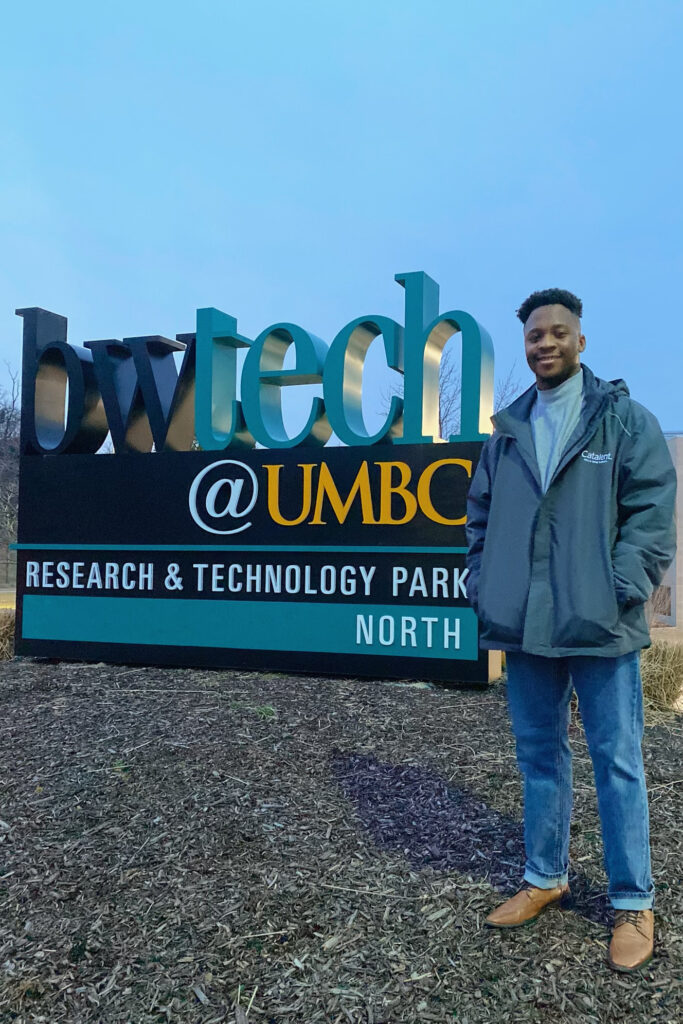
Udo in front of bwtech@UMBC North, February 2023;. Photo courtesy of Alina Momin.
A: In 2021, I was actively practicing my elevator pitch around Xeddy and when the opportunity presented itself to share it with an audience, I did. It was the first day of my Introduction to Entrepreneurship class, and this led to me connecting with my professor, Scott Weber, outside of class. He introduced me to more resources on campus, specifically Kevin Fulmer, the director of the Alex. Brown Center for Entrepreneurship, where I received foundational support to materialize my ideas and tighten my pitch.
How have you taken your entrepreneurial skills to the next level?
A: I am a technologist in the third cohort of bwtech@UMBC’s Maryland New Venture Fellowship for Cybersecurity. Every week, we are introduced to new resources and left with actionable steps to take that further our internal company missions. This greatly appreciated added layer of accountability encourages myself and my team to strategically look past our launch.
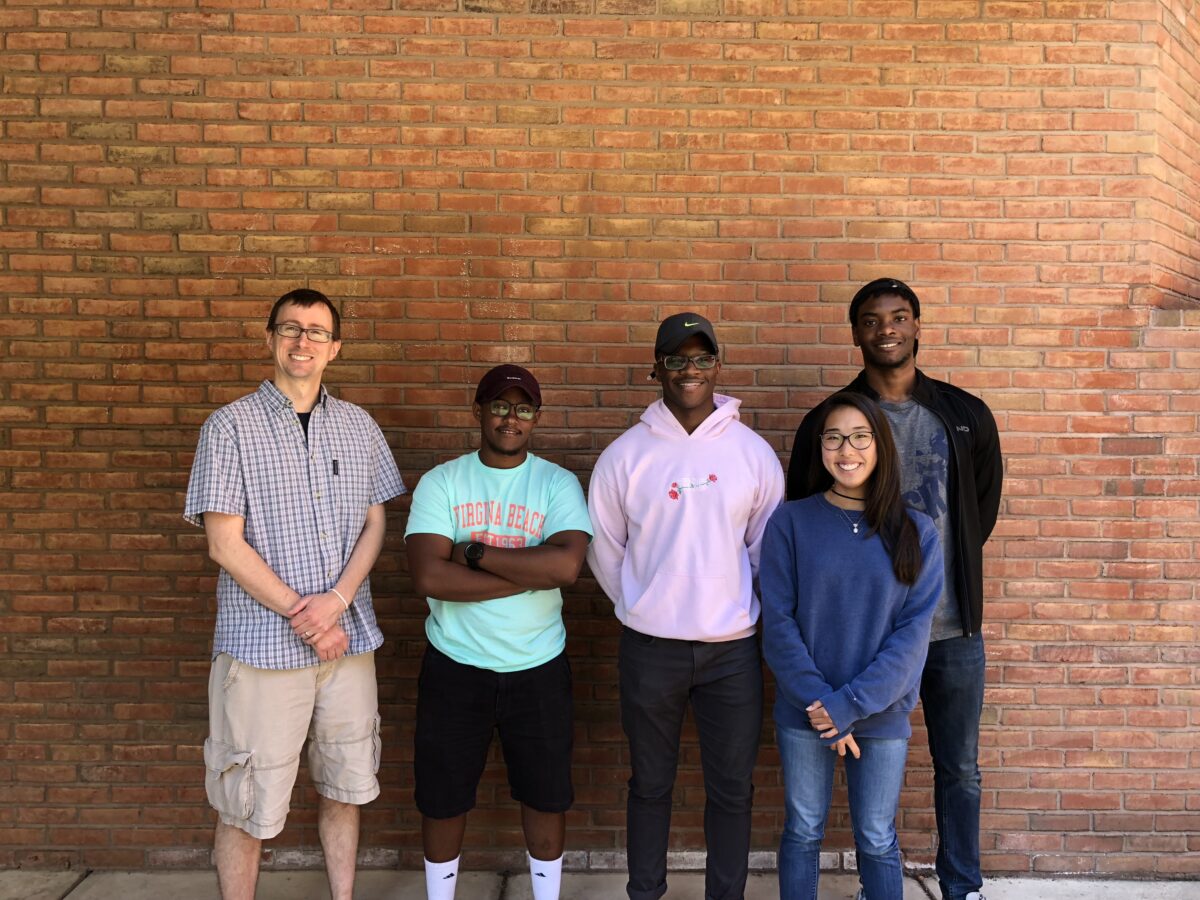 Build A Bridge To STEM Internship Wrap-up, pictured with Jeffrey Gardner, Mussie Legesse, Joseph Forbin, Julia Corns (left to right); August 2018.
Tell us about the people who helped you grow at UMBC, and why their HOW made such a difference to you.
A: In my last semester at UMBC, I virtually met with a science career advisor, Susan Hindle. She helped me rework my résumé and highlight my strongest attributes. A few weeks later, I grabbed lunch with a leader in bwtech’s community, and he suggested that I learn more about a company called Catalent Pharma Solutions.
Another few weeks went by, and I was passing by a Catalent information booth near the bookstore in The Commons. I recall making the conscious decision to return after my class to connect with the team of recruiters. Upon my arrival at the booth, I saw (and met for the first time in person) my career advisor, who then gave me a lovely introduction to the recruiters. In November, I received my offer letter to get started!
I enjoy heading over to UMBC’s main campus to get involved with entrepreneurial affairs… Exploring these opportunities from an alumnus perspective has given me an added appreciation for the resources and support that are active and growing in our community.
Basil Udo ’22
I am now a manufacturing associate at Catalent. Every day I learn something new and it provides me with a way to support and enrich myself as I pursue my personal endeavors with Xeddy. Additionally, the exposure to corporate systems has introduced a new perspective on logistical efficiency, which makes me better at facilitating direction as a founder.
What’s your favorite part of Retriever Nation?
A: Since I spend a lot of my time at the Research & Technology Park, I enjoy heading over to UMBC’s main campus to get involved with entrepreneurial affairs run by the Alex. Brown Center and volunteer events such as HackUMBC. Exploring these opportunities from an alumnus perspective has given me an added appreciation for the resources and support that are active and growing in our community.
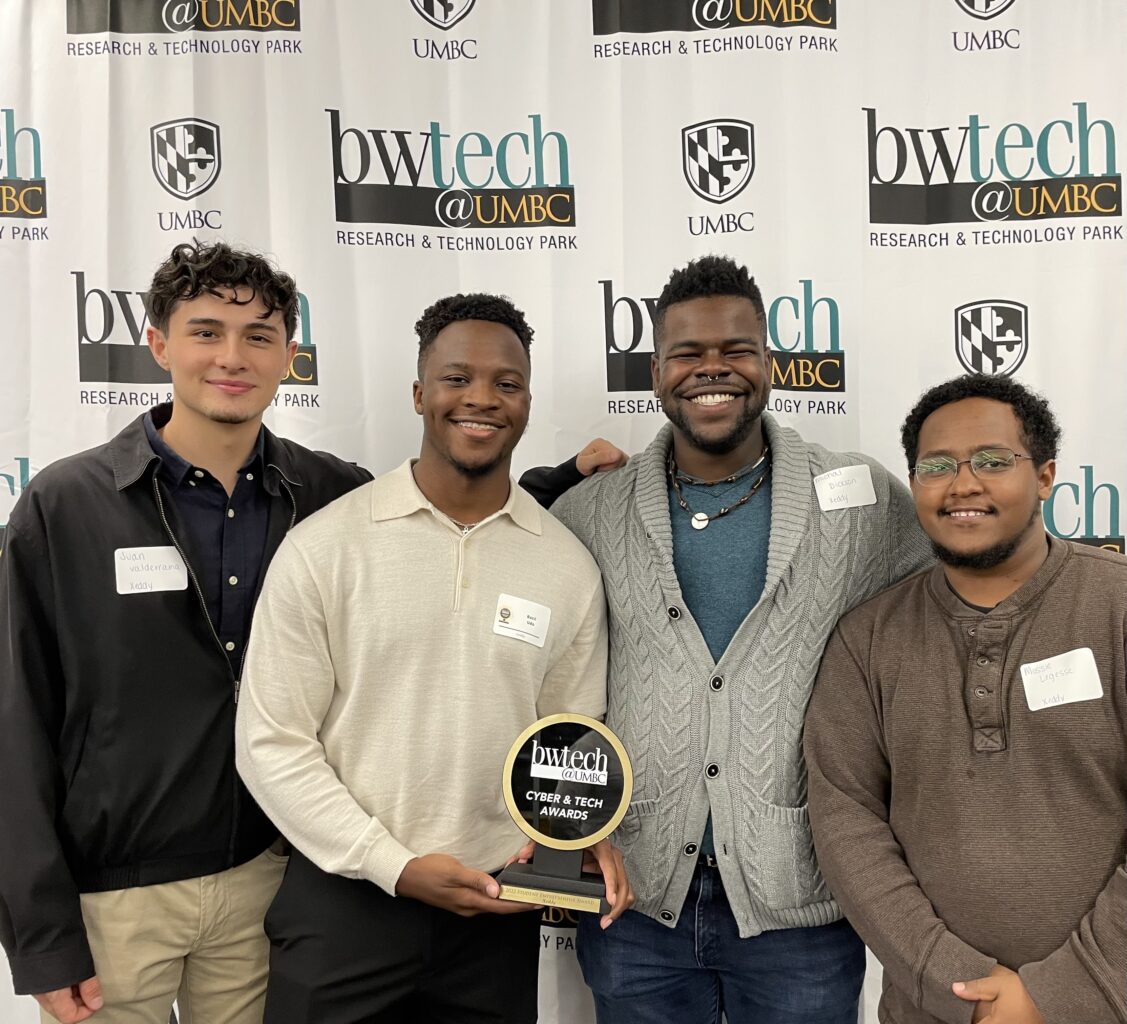 Receiving bwtech@UMBC’s 2022 Student Entrepreneur Award with three members of Xeddy, Juan Valderrama (left), Michal Dickson (immediate right), Mussie Legesse (far right); October 2022.
What’s the one thing you’d want someone who hasn’t joined the UMBC community to know about the support you find here?
A: The entrepreneurial community at UMBC is growing and innovating each year. If you intentionally want to start a venture, UMBC will avidly support you. Starting with resources like the Alex. Brown Center, HackUMBC, and entrepreneurship classes will provide someone unsure of how to start with direction, potential cofounders, and info on the entrepreneurial mindset.
* * * * *
UMBC’s greatest strength is its people. When people meet Retrievers and hear about the passion they bring, the relationships they create, the ways they support each other, and the commitment they have to inclusive excellence, they truly get a sense of our community. That’s what “Meet a Retriever” is all about.
Learn more about how UMBC can help you achieve your goals.
]]>
Meet Basil Udo ’22, biochemistry and molecular biology, an entrepreneur and technologist in the third cohort of bwtech@UMBC’s Maryland New Venture Fellowship for Cybersecurity program, where teams...
https://umbc.edu/stories/meet-a-retriever-basil-udo-entrepreneur-bwtech/
https://beta.my.umbc.edu/api/v0/pixel/news/130809/guest@my.umbc.edu/4298aa4797944dc2f66ccfaa6f050aaa/api/pixel
biochemistry-and-molecular-biology
bwtech-at-umbc
cnms
impact
magazine
meet-a-retriever
perspectives
UMBC News & Magazine
https://beta.my.umbc.edu/groups/umbc-news-magazine
https://assets1-beta.my.umbc.edu/system/shared/avatars/groups/000/001/943/24435aa6207c452e7bc15cc74b42c7bb/xsmall.png?1748556657
https://assets1-beta.my.umbc.edu/system/shared/avatars/groups/000/001/943/24435aa6207c452e7bc15cc74b42c7bb/original.png?1748556657
https://assets2-beta.my.umbc.edu/system/shared/avatars/groups/000/001/943/24435aa6207c452e7bc15cc74b42c7bb/xxlarge.png?1748556657
https://assets2-beta.my.umbc.edu/system/shared/avatars/groups/000/001/943/24435aa6207c452e7bc15cc74b42c7bb/xlarge.png?1748556657
https://assets3-beta.my.umbc.edu/system/shared/avatars/groups/000/001/943/24435aa6207c452e7bc15cc74b42c7bb/large.png?1748556657
https://assets1-beta.my.umbc.edu/system/shared/avatars/groups/000/001/943/24435aa6207c452e7bc15cc74b42c7bb/medium.png?1748556657
https://assets2-beta.my.umbc.edu/system/shared/avatars/groups/000/001/943/24435aa6207c452e7bc15cc74b42c7bb/small.png?1748556657
https://assets1-beta.my.umbc.edu/system/shared/avatars/groups/000/001/943/24435aa6207c452e7bc15cc74b42c7bb/xsmall.png?1748556657
https://assets2-beta.my.umbc.edu/system/shared/avatars/groups/000/001/943/24435aa6207c452e7bc15cc74b42c7bb/xxsmall.png?1748556657
UMBC News & Magazine
1
0
false
Thu, 09 Feb 2023 16:04:34 -0500
Thu, 09 Feb 2023 16:04:34 -0500
Getting Your Research Off the Ground—Balloons Give Students New Perspectives

On a brisk but clear day in early December, half a dozen brightly colored weather balloons barely squeeze through the double doors of Sondheim Hall’s lower level one by one.
A group of four or five students handles each balloon, proceeding to the quad in front of the Interdisciplinary Life Sciences Building in a makeshift parade. A red balloon rises aloft as a demonstration, and then the remaining groups fan out across campus to follow suit. By 9:30 a.m., anyone walking across campus can see colorful dots hundreds of feet high, tethered by ropes that each end at a student on the ground.
This is the peak experience of GES 286, “Exploring the Environment: A Geospatial Perspective.” The course is structured around various data gathering projects, explains Charles Kaylor, the instructor and director of GIS (geographic information systems) and cartography labs in the department of geography and environmental systems (GES). “We use the campus as a laboratory,” he says.
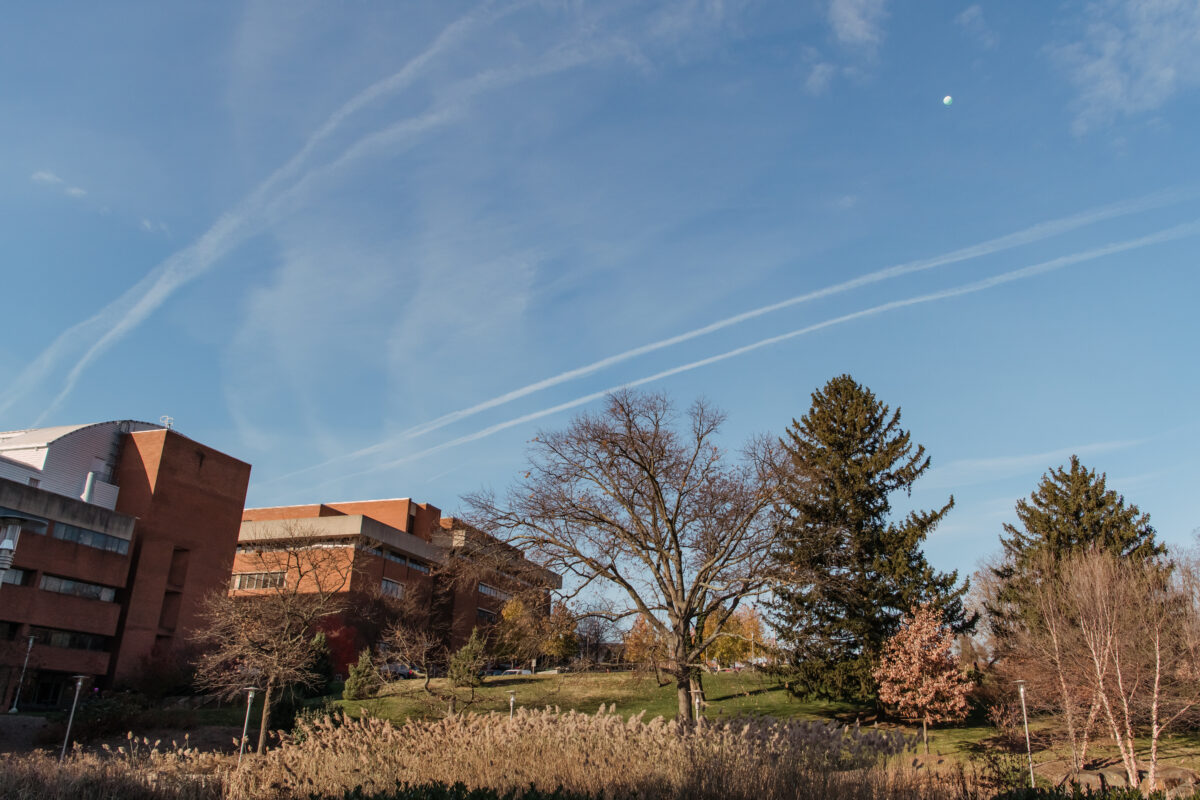
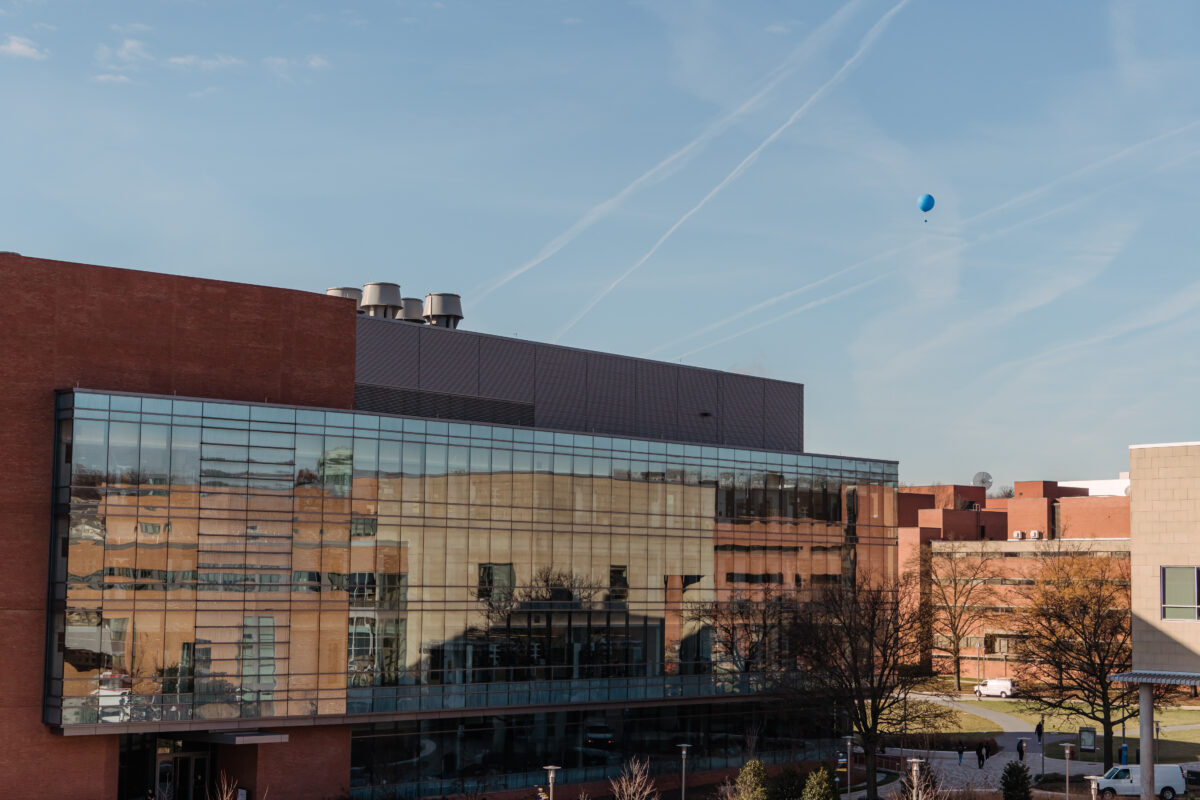
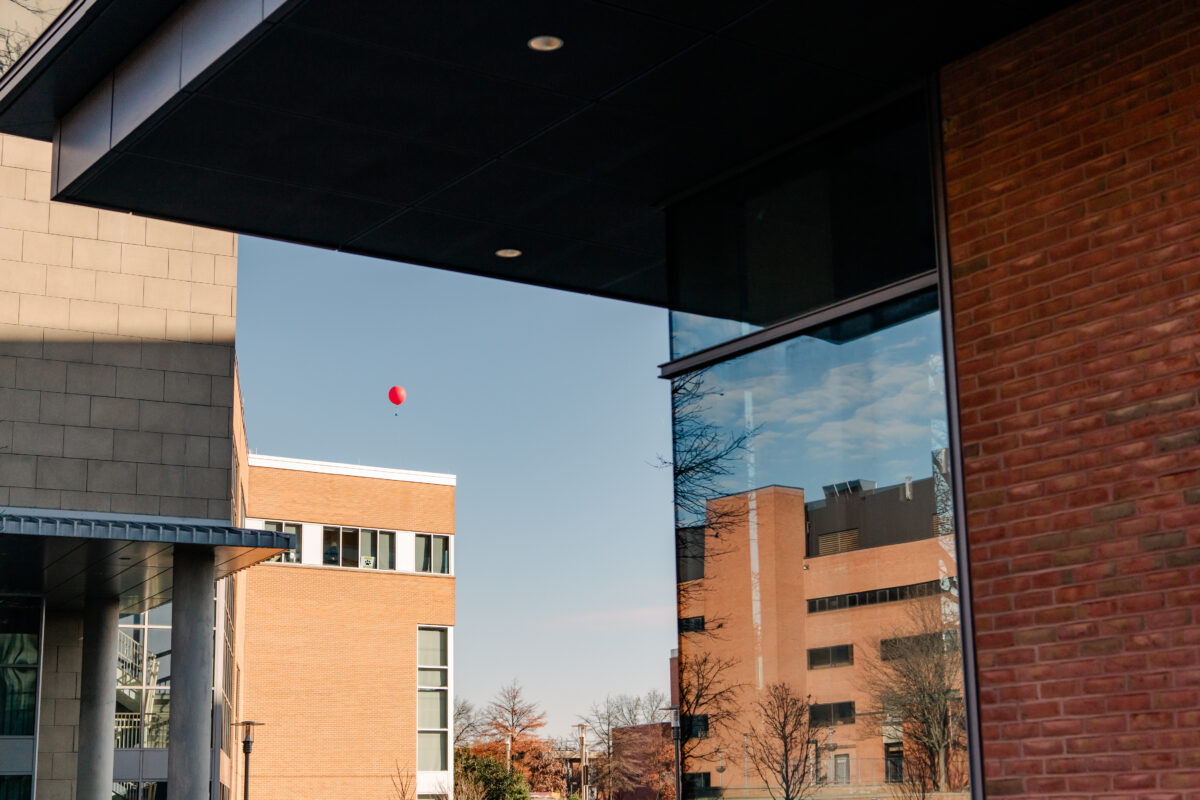
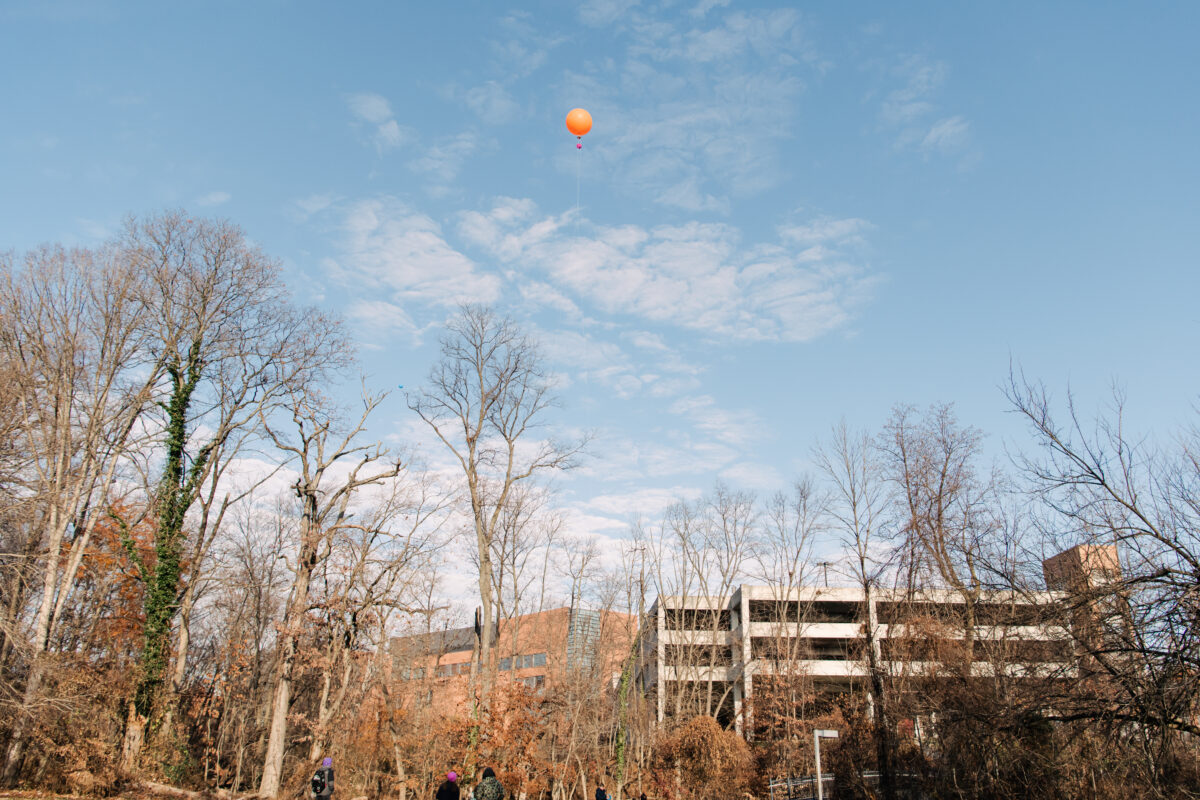
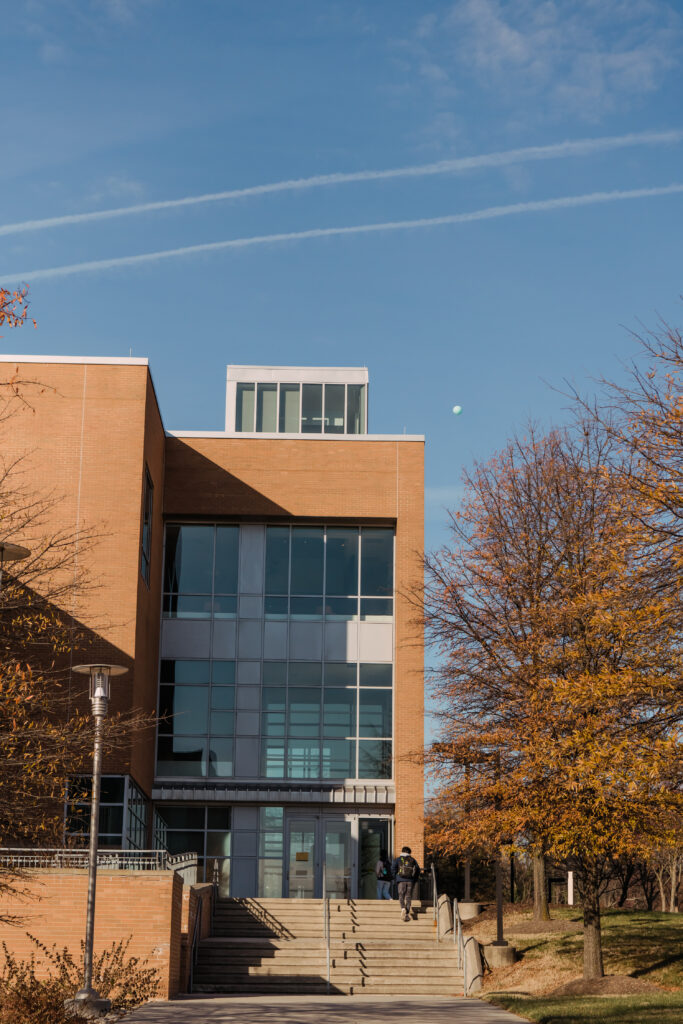
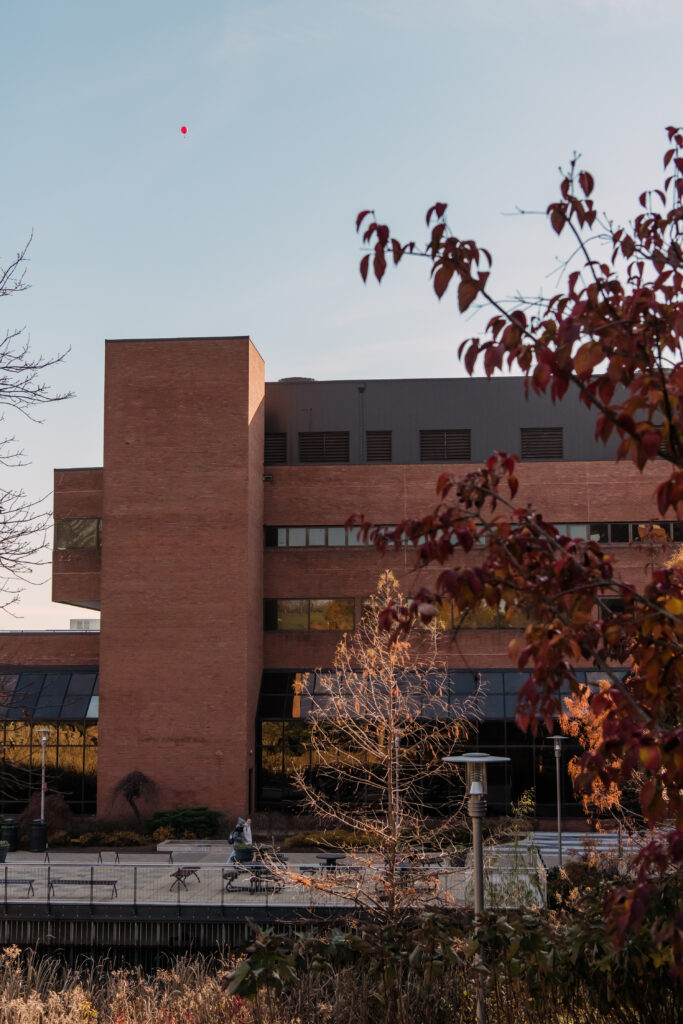 On “balloon day,” the balloons are visible from all over campus. (Marlayna Demond ’11/UMBC)
“Where are we?”
Kaylor opens the first class with a deceptively simple question: “Where are we, and how do we know that?” After beginning with a basic orienteering activity (no smartphones allowed!), the course advances through the surprisingly complex answer to Kaylor’s question, which leads students to develop skills in statistics, data analysis, and various software programs. They also pick up knowledge in disciplines like ecology, sociology, and hydrology.
Given its interdisciplinary bent, the course attracts students from a range of majors, most often those in the GES department (like environmental science) and computer science. With a background in GIS and environmental education, Kaylor is a perfect fit to teach the course to this mixed audience.
At the beginning of the semester, “computer science students will understand that it’s data science-driven. GES students will understand the hands-on sciences,” Kaylor says. By the end, “they’ll meet in the middle. It’s actually a really interesting blend of students to work with, and it’s fun to see how their strengths play off each other.”
Learning in real time
But back to the balloons. Each balloon flies with a digital camera attached, pointed at the ground. Previous students in the course coded a hack into the cameras that commands them to take a picture every 15 seconds as they float above campus.
Far below, students lay what look like paper archery targets flat on the ground and record their precise coordinates using GPS. These targets will show up in the photos taken by the camera on the balloon. Using the targets as reference points, the students will then be able to “geolocate” (tie to a point on the Earth’s surface) other objects—like buildings, trees, even people—in the camera’s photos.
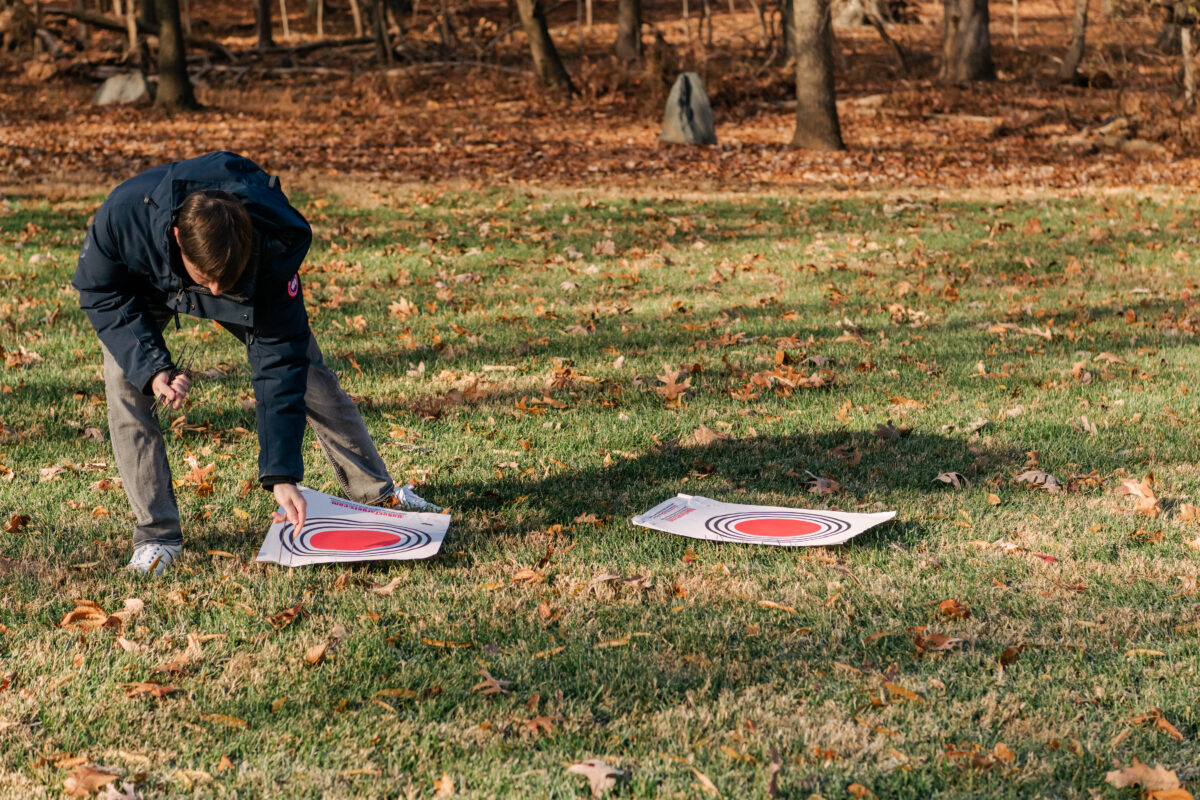 Matthew Parsons, computer science, sets reference targets on the ground. (Marlayna Demond ’11/UMBC)
Kaylor creates a blank digital map at the start of the morning to record the coordinates. “It’s fun to watch in the lab while students are out in the field doing it,” Kaylor says, “because it starts blooming. You see students adding points in real time.”
In what other class…
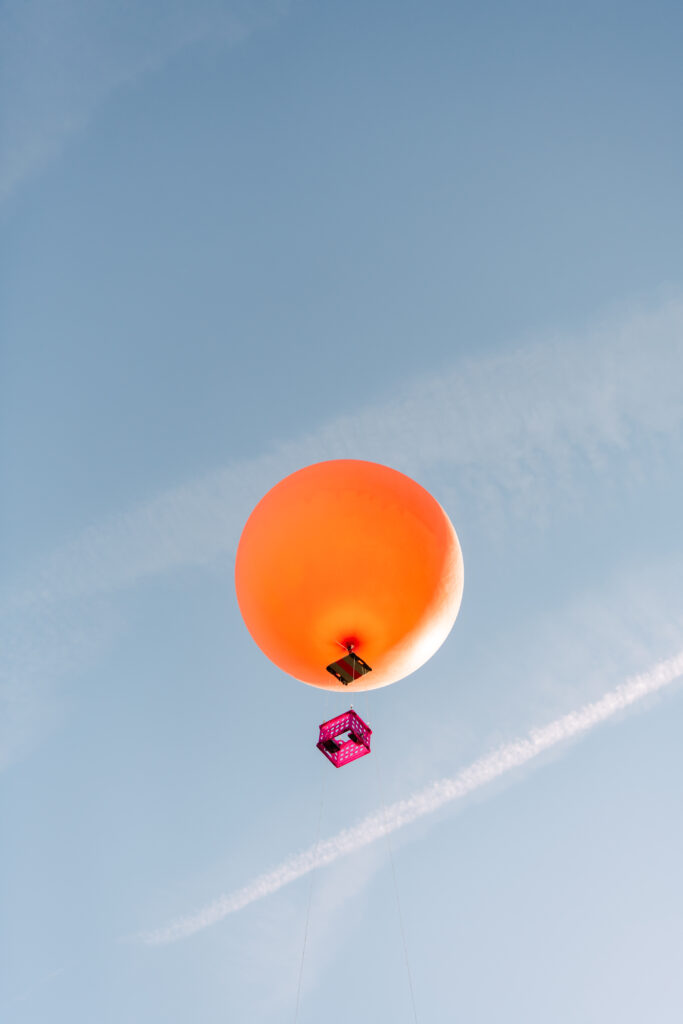 A pink crate dangling from the bottom of a balloon holds a small digital camera horizontal as the balloon flies. (Marlayna Demond ’11/UMBC)
The balloons have been a mystery to much of the campus community for years, with the colorful orbs dotting the campus sky in the tenth week of the semester. But for the students in Kaylor’s class, the balloons represent a culmination of the knowledge and skills they’ve gained.
Each student has their own reasons for taking the course. For some, it’s an opportunity to learn GIS skills—a must in the environmental field today—without spending too much time in front of a computer. As Kamsy Nwaiwau ’23, geography and environmental systems, puts it, “What other class do you get to hold a balloon 450 feet in the air? It’s something different.”
Whereas Alex Flitter ’23, mathematics and computer science, has a different perspective. He’s conducting research with Bedřich Sousedik, associate professor of mathematics, on how to model disease spread using ArcGIS—the same tool the students are using to locate points on the ground. GES 286 is “adding to my ability to visualize my research,” he says.
Learning openness
The course integrates a range of activities to get students thinking about how they could apply GIS to many fields of study. For one assignment, the students explore their own neighborhoods and mark the location of different businesses, like restaurants, pharmacies, and retail shops, and other neighborhood elements, like parks or bus stops. Then they use available data sets to see if they can identify associations with other neighborhood factors, like median income or education level.
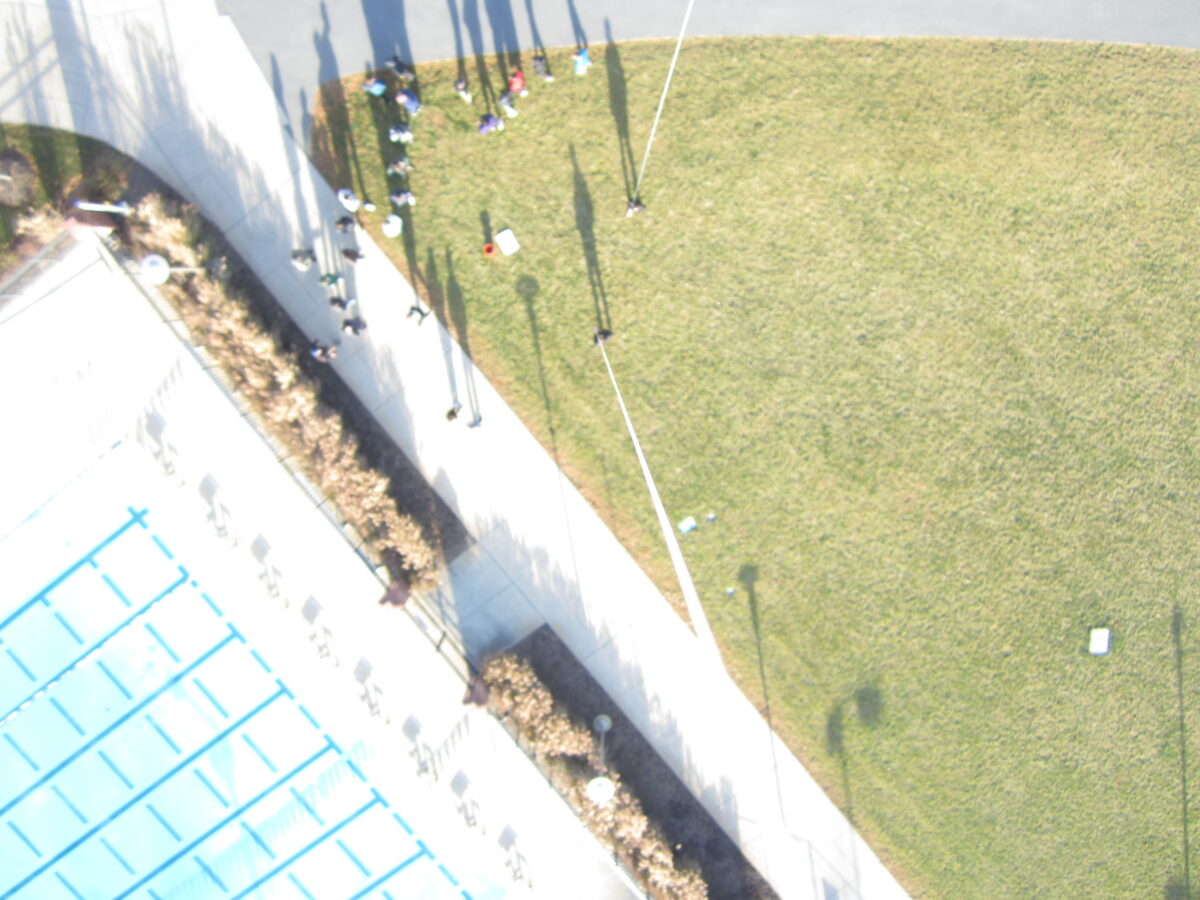
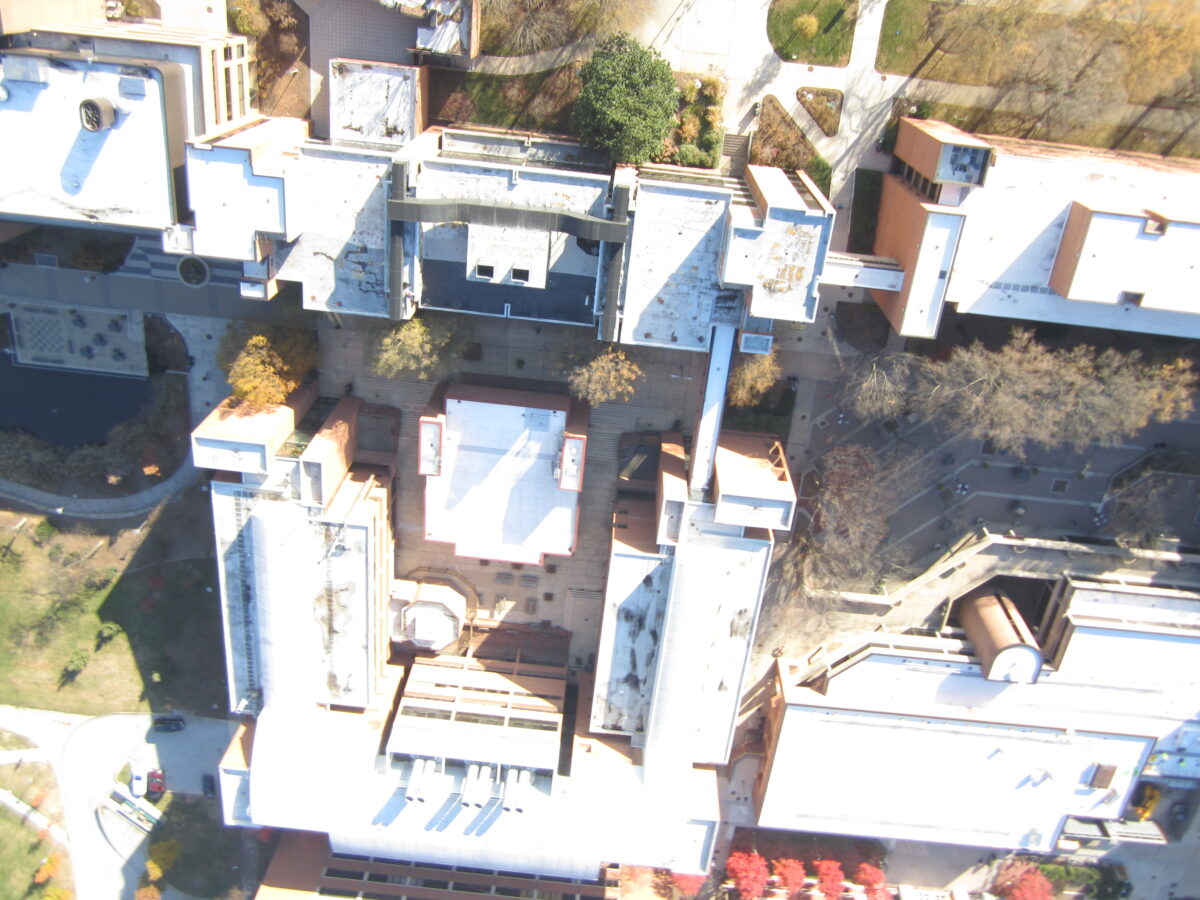
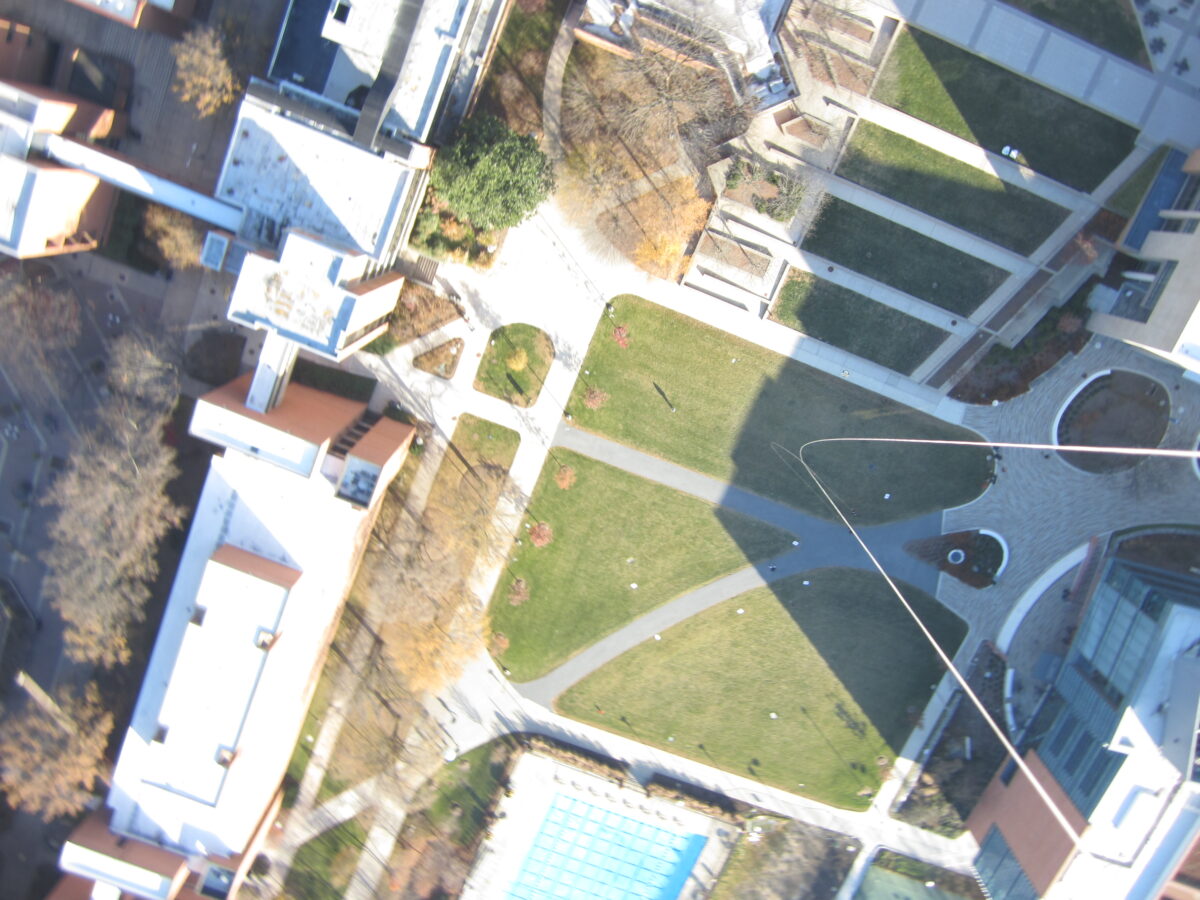 Images captured by one of the balloons. At left, the class gathers to observe the first balloon launch of the morning. (Images courtesy of Charles Kaylor)
This project “gets at the scientific process,” Kaylor says. He tells his students, “Any time a data set floats by, take a look at it and go, ‘What questions could I ask with this data?’ It’s a certain mode of openness.” Each in their own time, students get the idea. “What I love about GIS is—and you can count on it—any student who tries is going to have a GIS epiphany and start figuring things out,” Kaylor says, “and because it’s so applied and so tangible, it’s captivating.”
Making it real
This is Kaylor’s second time teaching the course after coming to UMBC from Temple University. He inherited the course backbone from Joe School, emeritus professor of GES, who still teaches the course in the summer. Kaylor has already made substantial changes, but has more in mind. One major goal is to create more opportunities for the students’ efforts to connect to real research projects.
“What I love about GIS is—and you can count on it—any student who tries is going to have a GIS epiphany and start figuring things out. And because it’s so applied and so tangible, it’s captivating.”
Charles Kaylor
Kaylor has already launched a collaboration with Facilities Management at UMBC to compare the latest data set of campus trees to the reality on the ground. So far, the students have checked about 10 percent of the listed trees, and Kaylor plans to add more each semester.
“I’m hoping to integrate more things like that, that have an obvious practical application or benefit to campus,” Kaylor says. “Since we’re measuring things on campus, we might as well see what we can do with that.” For example, Kaylor has discussed with Matthew Baker, professor of geography and environmental systems, how his students might be able to support Baker’s environmental monitoring work on campus.
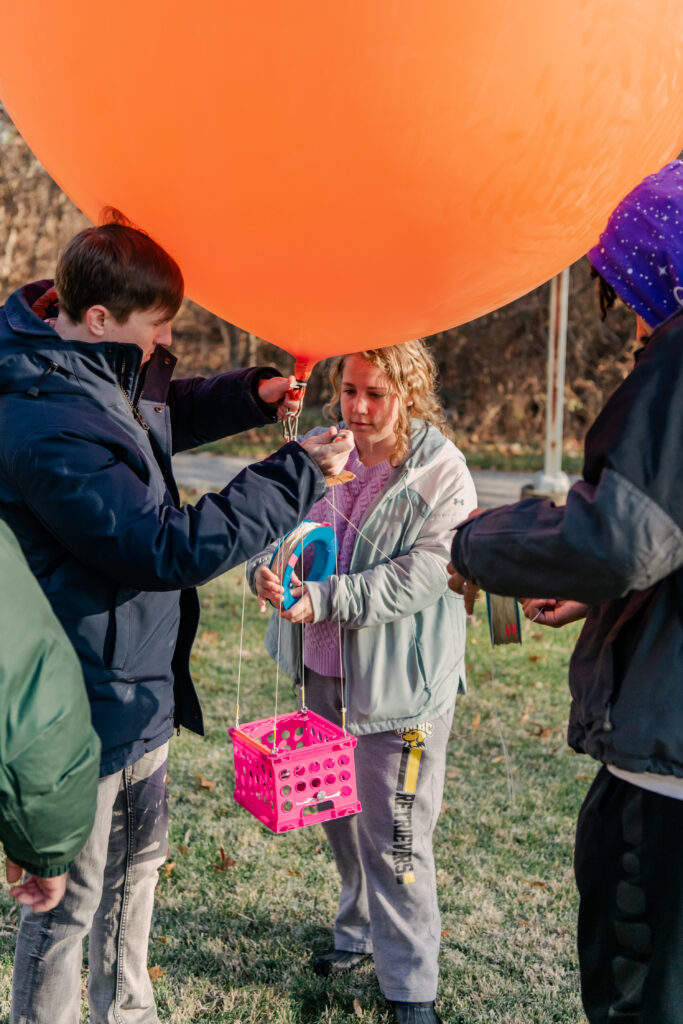 Matthew Parsons, computer science, Olivia Amaral, computer science, and Langston Smith, GES, attach the camera to their balloon and prepare for launch. (Marlayna Demond ’11/UMBC)
No matter what direction they go—whether epidemiology, ecology, or other fields—students who complete GES 286 will be better prepared to ask and answer useful questions about the world around them.
Teaching the class has been a rewarding experience for Kaylor as an instructor, too. The course “reconnected me with something that makes [GIS] live and breathe in a different way—a more exciting way,” he says. “Taking a more applied approach to it is a fun challenge. I’ve been having a great time teaching this class.”
Geography applies to everything
Finally, it’s time for the balloons to come down. As the students are wrangling them down and heading back to Sondheim Hall for a debrief, Joey Laiosa ’23, environmental science, shares that he previously worked in public safety as a dispatcher, then came back to school. He’s interested in conservation ecology, and using remote sensing to measure environmental health has particularly caught his attention.
“GIS is a really sought-after skill to have in a range of industries,” he says. That includes public safety, Laiosa says, where it could involve better pinpointing the location of an emergency in a complex environment like a construction site or an amusement park. “Geography applies to everything.”
Learn more about undergraduate research opportunities at UMBC.
]]>
On a brisk but clear day in early December, half a dozen brightly colored weather balloons barely squeeze through the double doors of Sondheim Hall’s lower level one by one. A group of four...
https://umbc.edu/stories/getting-your-research-off-the-ground-gis-balloons/
https://beta.my.umbc.edu/api/v0/pixel/news/130542/guest@my.umbc.edu/7b6e1b2bd1fb1d7c780b2953ccfd4562/api/pixel
cahss
cnms
coeit
csee
discovery
ges
magazine
mathstat
UMBC News & Magazine
https://beta.my.umbc.edu/groups/umbc-news-magazine
https://assets1-beta.my.umbc.edu/system/shared/avatars/groups/000/001/943/24435aa6207c452e7bc15cc74b42c7bb/xsmall.png?1748556657
https://assets1-beta.my.umbc.edu/system/shared/avatars/groups/000/001/943/24435aa6207c452e7bc15cc74b42c7bb/original.png?1748556657
https://assets2-beta.my.umbc.edu/system/shared/avatars/groups/000/001/943/24435aa6207c452e7bc15cc74b42c7bb/xxlarge.png?1748556657
https://assets2-beta.my.umbc.edu/system/shared/avatars/groups/000/001/943/24435aa6207c452e7bc15cc74b42c7bb/xlarge.png?1748556657
https://assets3-beta.my.umbc.edu/system/shared/avatars/groups/000/001/943/24435aa6207c452e7bc15cc74b42c7bb/large.png?1748556657
https://assets1-beta.my.umbc.edu/system/shared/avatars/groups/000/001/943/24435aa6207c452e7bc15cc74b42c7bb/medium.png?1748556657
https://assets2-beta.my.umbc.edu/system/shared/avatars/groups/000/001/943/24435aa6207c452e7bc15cc74b42c7bb/small.png?1748556657
https://assets1-beta.my.umbc.edu/system/shared/avatars/groups/000/001/943/24435aa6207c452e7bc15cc74b42c7bb/xsmall.png?1748556657
https://assets2-beta.my.umbc.edu/system/shared/avatars/groups/000/001/943/24435aa6207c452e7bc15cc74b42c7bb/xxsmall.png?1748556657
UMBC News & Magazine
2
0
false
Wed, 01 Feb 2023 11:11:15 -0500
Wed, 01 Feb 2023 11:11:15 -0500
Mini creatures with mighty voices know their audience and focus on a single frequency
Written by Bernard Lohr, associate professor of biological sciences, UMBC
In the cloud forests of South America, amid the constant cacophony of bird and insect noise, a deafening blare pierces through the background from time to time. Belonging to the loudest known bird, the white bellbird, Procnias albus, this sound would be painful to humans listening nearby and capable of causing immediate hearing damage from about a yard away.
Listen to the world’s loudest bird call.
Made exclusively by males serenading females, these vocalizations can reach peak levels of more than 120 decibels on the sound pressure level scale (dB SPL), which is equivalent to a jet aircraft taking off from 100 yards away. The female bellbird listens some distance from the male, presumably trading off being close enough to assess his quality as a mate without damaging her ears.
I study the hearing ability of animals and the sounds they make to communicate. A great number of calls exist throughout the animal kingdom – and many are used to attract mates or defend territories. Evolution has favored those able to make sounds efficiently. The louder and more focused the energy in the call and the closer in pitch it is to the intended listener’s optimal hearing range, the farther away a potential mate or rival will hear it.
Many large mammals, such as singing whales, roaring lions and rumbling elephants, produce loud low-pitched sounds that travel especially well through most habitats. Because of their petite physical size, small animals are not capable of making these far-reaching low-frequency sounds.
Ultrasonic calls
Human ears are most sensitive to the highest notes on a piano – about 4 kHz – a unit of measurement that is the physical metric for pitch. Anything above 20 kHz is considered ultrasonic – undetectable to human ears. But such sounds are not undetectable to all ears.
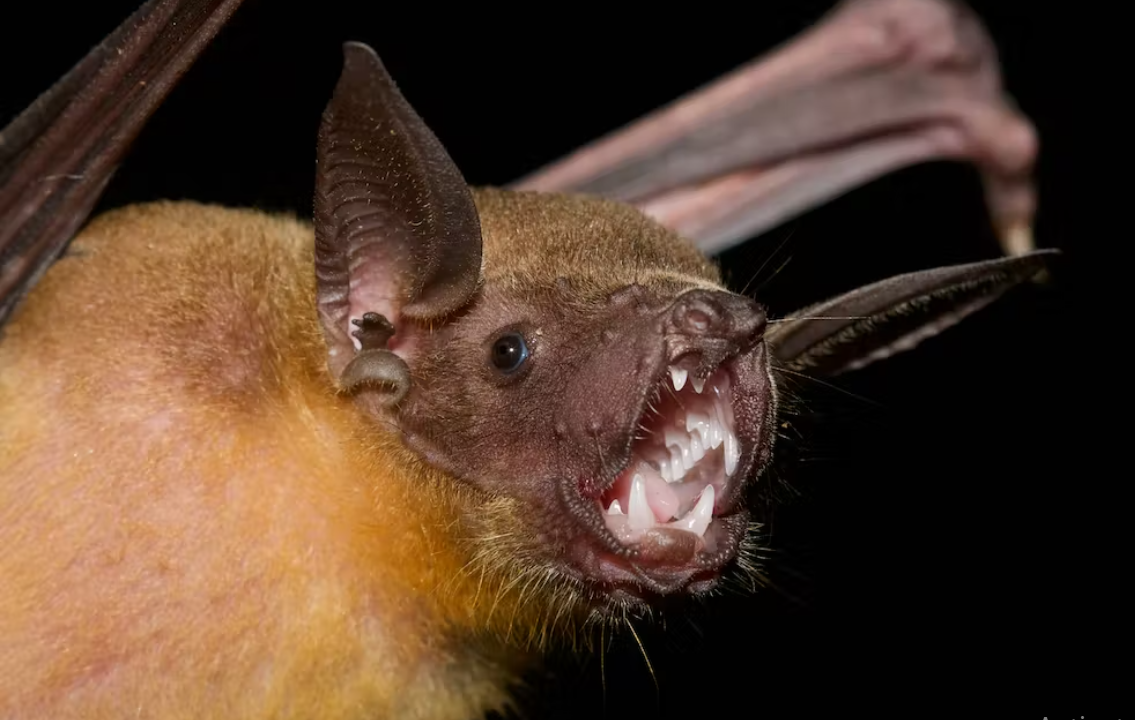 The greater bulldog bat’s ear is engineered for ultrasonic hearing. (Thomas Cuypers/flickr, CC BY-NC-ND)
For example, the greater bulldog bat, Noctilio leporinus, can produce ultrasonic echolocation calls between 30 and 60 kHz when hunting prey and maneuvering during flight. These calls can also get incredibly loud – above 140 dB SPL.
Many other small mammals, including other bats, and even some primates such as tiny tarsiers, produce loud ultrasonic sounds humans can’t perceive. In part, these sounds can reach such volumes because their acoustic power is concentrated in a pure tone or single frequency.
Creating speakers
Insects are some of the smallest animals to produce loud sounds, chief among them the cicadas and the orthopterans, which include katydids, grasshoppers and crickets.
In North America, the robust conehead, Neoconocephalus robustus, a type of katydid, regularly surpasses 105 dB SPL. These calls are produced to attract mates and, like many such calls, are competing against a clamor of comparable sounds from similar species.
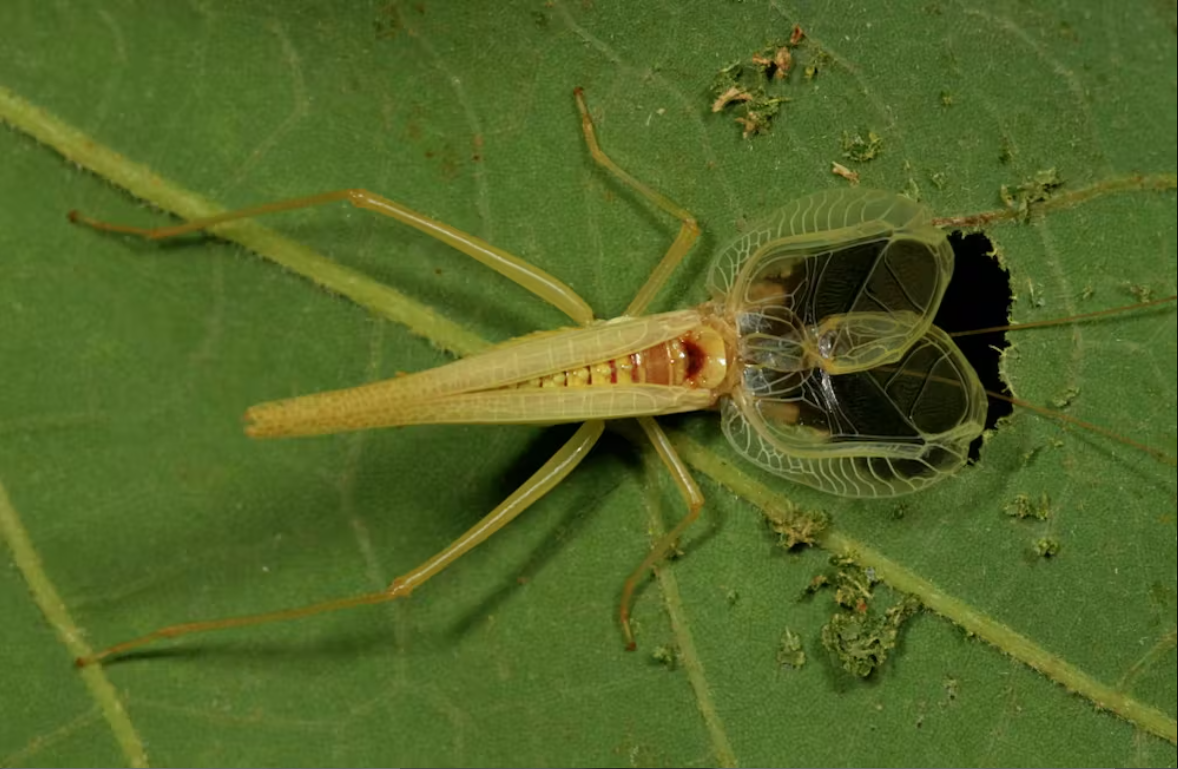 A two-spotted tree cricket, Neoxabea bipunctata, chews a hole just the right size for its fore wings. It then ‘sings’ by poking the wings through the hole and rubbing them together. (Patrick Coin/flickr, CC BY-NC-SA)
Some insects go one step further, amplifying their sounds by building the functional equivalent of audio speakers. Some tree crickets chew holes in leaves, place their vibrating wings in the opening and use the surrounding leaf as a baffle to prevent the loss of sound energy around the edges of their wings.
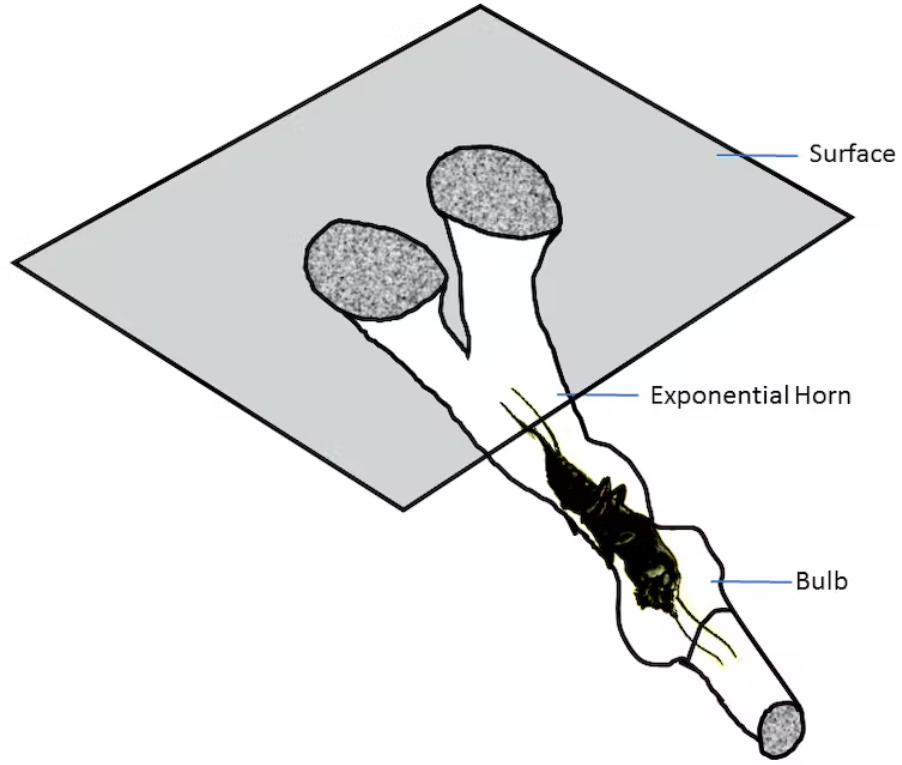 The male mole cricket sings from his specially designed burrow, which amplifies sound like a horn. (Ian Alexander, new drawing based on Bennet-Clark, 1970 with public domain insect from Lydekker 1879, CC BY-SA)
Mole crickets, Gryllotalpa vineae, go even further by constructing a burrow that acts like a wind instrument, creating a cavity of vibrating air that amplifies the sound energy they produce. These crickets’ songs can travel almost half a mile (0.8 kilometer).
Irksome invaders
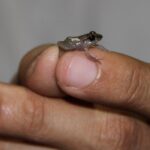
The official mascot of Puerto Rico is a 1-to-2-inch (2-5-centimeter) frog called the coquí, Eleutherodactylus coqui, whose call is a combination of two pure tones – “ko” and “kee,” from which it gets its name. At 114-120 dB SPL, the frog’s calls are so loud they actually must protect their own hearing when vocalizing, by increasing the air pressure inside their middle ear.
Unfortunately, in the past few decades humans have accidentally introduced the coquí to a number of areas outside their native range, in particular the Hawaiian islands, where they have no natural predators and have become invasive pests. Since coquí calls are within an octave of humans’ best hearing – and they’re nocturnal – many Hawaiians suffer sleep disruptions because of the tiny frogs.
So even if you’re small, it’s not impossible to make yourself heard. You just have to blast all your acoustic energy in a single frequency, and hit the sweet spot of your audience’s hearing.
This article is republished from The Conversation under a Creative Commons license. Read the original article and see more than 250 UMBC articles available in The Conversation.
]]>
Written by Bernard Lohr, associate professor of biological sciences, UMBC In the cloud forests of South America, amid the constant cacophony of bird and insect noise, a deafening blare...
https://umbc.edu/stories/mini-creatures-with-mighty-voices/
https://beta.my.umbc.edu/api/v0/pixel/news/130522/guest@my.umbc.edu/0f7dca78ddc416a99930d7a81b7788b5/api/pixel
biological-sciences
cnms
discovery
magazine
the-conversation
theconversation
UMBC News & Magazine
https://beta.my.umbc.edu/groups/umbc-news-magazine
https://assets1-beta.my.umbc.edu/system/shared/avatars/groups/000/001/943/24435aa6207c452e7bc15cc74b42c7bb/xsmall.png?1748556657
https://assets1-beta.my.umbc.edu/system/shared/avatars/groups/000/001/943/24435aa6207c452e7bc15cc74b42c7bb/original.png?1748556657
https://assets2-beta.my.umbc.edu/system/shared/avatars/groups/000/001/943/24435aa6207c452e7bc15cc74b42c7bb/xxlarge.png?1748556657
https://assets2-beta.my.umbc.edu/system/shared/avatars/groups/000/001/943/24435aa6207c452e7bc15cc74b42c7bb/xlarge.png?1748556657
https://assets3-beta.my.umbc.edu/system/shared/avatars/groups/000/001/943/24435aa6207c452e7bc15cc74b42c7bb/large.png?1748556657
https://assets1-beta.my.umbc.edu/system/shared/avatars/groups/000/001/943/24435aa6207c452e7bc15cc74b42c7bb/medium.png?1748556657
https://assets2-beta.my.umbc.edu/system/shared/avatars/groups/000/001/943/24435aa6207c452e7bc15cc74b42c7bb/small.png?1748556657
https://assets1-beta.my.umbc.edu/system/shared/avatars/groups/000/001/943/24435aa6207c452e7bc15cc74b42c7bb/xsmall.png?1748556657
https://assets2-beta.my.umbc.edu/system/shared/avatars/groups/000/001/943/24435aa6207c452e7bc15cc74b42c7bb/xxsmall.png?1748556657
UMBC News & Magazine
0
0
false
Tue, 31 Jan 2023 17:29:46 -0500
Tue, 31 Jan 2023 17:29:46 -0500
New center director to take NASA-supported Earth science research into next era at UMBC
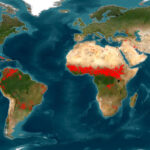
The UMBC-led Goddard Earth Science Technology and Research (GESTAR) Center II includes over 120 researchers advancing Earth and atmospheric sciences and launching the next generation of scientists. GESTAR II scientists and engineers are tracking the effects of shipping regulations on air pollution, predicting fires in India, and much more, often relying on data collected via remote sensing from NASA satellites.
NASA awarded $72 million for UMBC to establish GESTAR II in fall 2021, in collaboration with primary partner Morgan State University and six other institutions. After a national search, a new director is taking the helm of this high-impact collaboration.
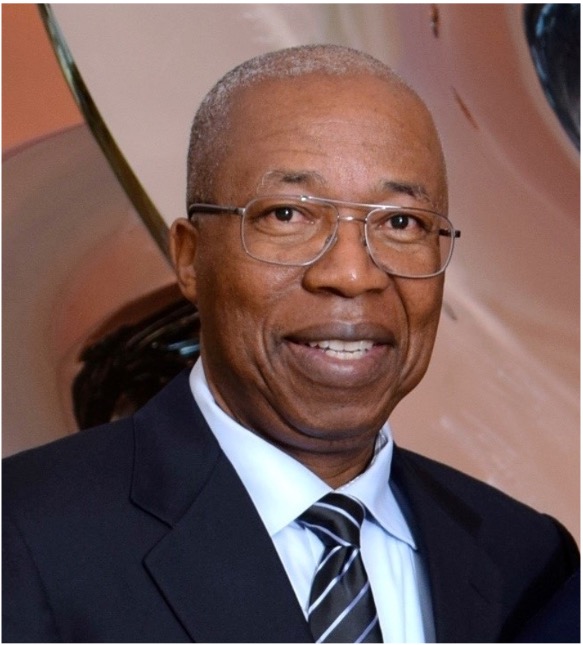 Charles Ichoku (image courtesy of Ichoku)
The new director, Charles Ichoku, brings deep and well-rounded experience in Earth science research, at NASA, and in student development programs—exactly the elements GESTAR II brings together and hopes to expand upon. Ichoku comes to GESTAR II from concurrent roles as professor of Earth and environmental sciences at Howard University and as the Distinguished Scientist of the National Oceanic and Atmospheric Administration (NOAA) Cooperative Science Center in Atmospheric Sciences and Meteorology (NCAS-M). Prior to that, he served at NASA Goddard Space Flight Center in Greenbelt, Maryland for 20 years in various research and management roles.
“Dr. Ichoku brings impressive credentials to this important leadership position at UMBC, not only as a world-class scientist, but also as a long-term NASA-based scientist and program manager,” shares Karl V. Steiner, Vice President for Research and Creative Achievement at UMBC. “He is a perfect fit for both GESTAR II and UMBC.”
Earth science from hundreds of miles up
Ichoku’s research program focuses on applying remote sensing—collecting data from a significant distance, most often from satellites orbiting Earth—and other data to study large-scale processes that affect the environment on land, weather, and air quality. In addition to directing GESTAR II, Ichoku will have an appointment as professor of geography and environmental systems (GES) at UMBC, where he will continue to conduct research, mentor students, and teach courses.
“GES is a good fit,” Ichoku says, “because I’m not just looking at developing the approaches and instrumentation to measure specific parameters, but I’m interested in how you apply the data, knowledge, and science to actually understand phenomena that happen on the ground and in the atmosphere.”
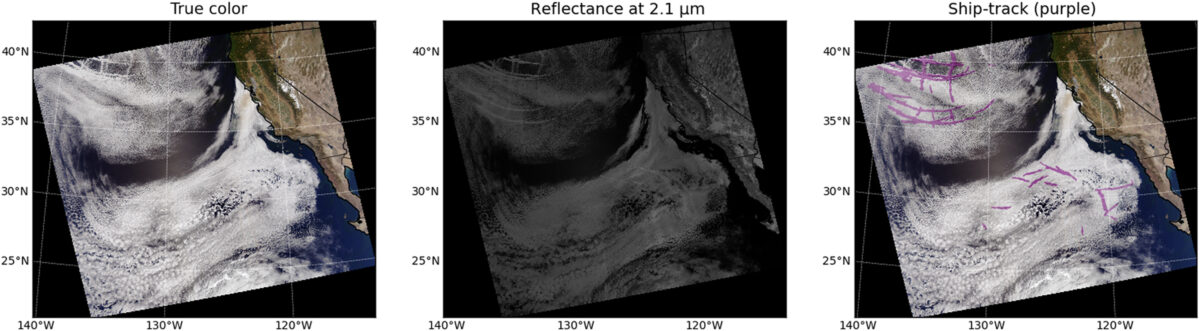 An image collected by NASA’s MODIS satellite of the U.S. West Coast (left) shows tracks of air pollution generated by shipping traffic (purple lines, right), which was detected by a GESTAR II research team’s algorithm.
Elevating African research
Ichoku’s work is influenced by his youth in West Africa, and focuses on phenomena that especially affect that region. For example, frequent agricultural fires send various particles into the atmosphere, which can affect air quality, precipitation, and more. In addition, Lake Chad in Central Africa has nearly dried up over the last few decades in part because of severe drought, resulting in widespread conflict and suffering. Drought also sends dust and other particles into the atmosphere, affecting air quality. These particles and other environmental components (like clouds) interact with radiation from the Sun, driving processes that can adversely impact human life on Earth’s surface, Ichoku explains.
“I’m very interested in seeing research and the application of its results improve in Africa overall, but in particular in Western and Central Africa,” Ichoku says. “So I hope to be able to continue research in that region.”
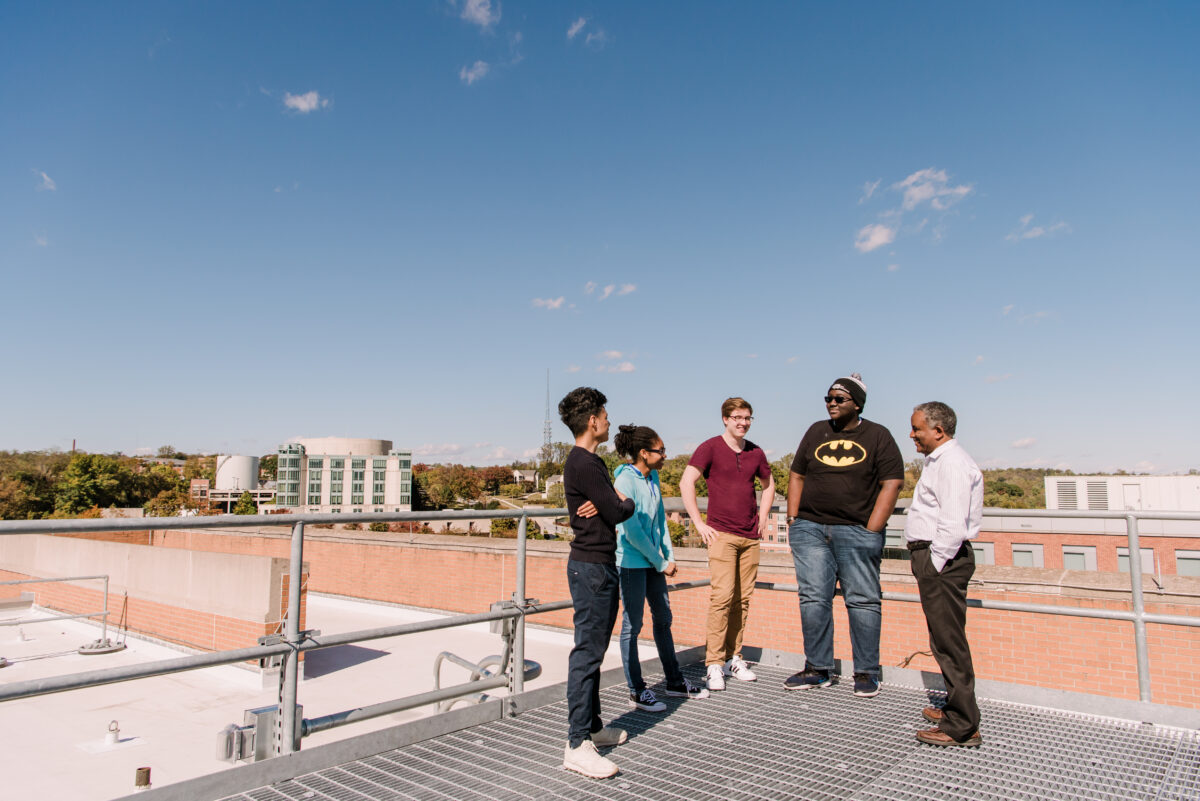 Belay Demoz, right, talks with students on the roof of the UMBC Physics Building. (Marlayna Demond ’11/UMBC)
To that end, a few years ago Ichoku joined with colleagues to initiate the U.S.-West African Coastal Resilience Research Consortium (CRRC). In addition, he recently played an important role in the inauguration of the African Meteorological Society (AfMS), where he serves as chair of the Diaspora and Friends of Africa Committee. The committee involves a significant number of colleagues who are similarly passionate about the advancement of scientific research and applications in Africa.
Those colleagues include GESTAR II’s inaugural director, Belay Demoz, whose research is similarly inspired by experiences with drought, displacement, and resulting conflict during his youth in East Africa—challenges that continue today. Demoz, professor of physics at UMBC, will continue in his departmental role after Ichoku takes up his post.
Demoz notes Ichoku’s extensive experience with Howard University (which is also a partner in UMBC’s Center for Space Sciences Technology) and at NASA as strengths, and shares his interest in expanding UMBC’s research and education efforts in Africa. “I’m looking forward to him leading the next iteration of GESTAR II, and increasing involvement of GES in what we do,” Demoz says.
Clearing the pathway for students
In addition to his own research, Ichoku has demonstrated a deep commitment to student research and success throughout his career. He moved from NASA to Howard and NCAS-M so he could focus more on student training, particularly supporting underrepresented minority students in Earth science.
With NCAS-M, on top of his typical professorial duties, Ichoku was responsible for matching students with appropriate research projects and NOAA mentors across 13 institutions. He also supported students’ success throughout their graduate projects, ensuring they persisted to graduation and were prepared to be competitive for sought-after professional roles, often at NOAA, NASA, or in academia.
With Demoz, Ichoku also served as co-PI for the NASA-funded Student Airborne Science Activation (SaSa) project, involving three NASA centers and six minority-serving Institutions, including UMBC. This past summer, 24 students, including four from UMBC, spent four weeks at UMBC as part of the SaSa program.
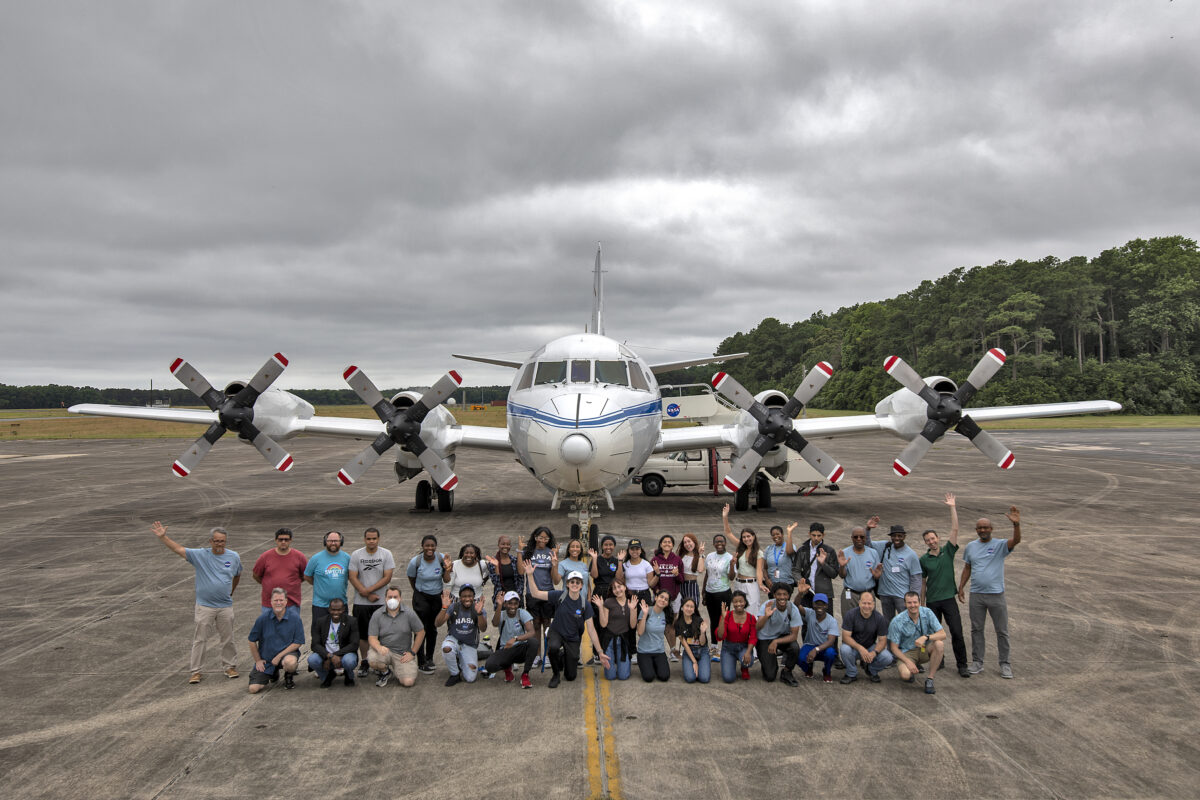 Participants in the 2022 SaSa program at NASA Wallops Flight Facility. (Image courtesy of Belay Demoz)
Now at GESTAR II, Ichoku is interested in continuing to enhance the connection between researchers, who often conduct their work at Goddard Space Flight Center, and members of the larger UMBC community—including students at all levels.
“I think it’s a good thing for a researcher to connect with students. Even if they are not teaching them in a traditional class setting, they can be mentors for interns, which I did myself for many years while I was at NASA as a research scientist,” Ichoku says. “I know that our faculty have a lot to offer to our students, so I will do my best to help facilitate that. My role will be to support the clearing of the pathway and the removal of any obstacles.”
A shining example
Ichoku also brings to GESTAR II and UMBC substantial experience in deepening relationships across institutions. He already has relationships with the scientific leads at other GESTAR II institutions, such as the Pennsylvania State University, Arizona State University, and University of Colorado Boulder, and is excited to continue working with them in a new capacity.
“When we start talking, ideas will flow,” Ichoku says. “We will then synthesize the ideas into strategic initiatives and make them happen.”
Moving forward, Ichoku plans to continue to emphasize top-quality research while enhancing opportunities for students and building bridges between the GESTAR II institutions. And he is especially looking forward to doing all of that at UMBC.
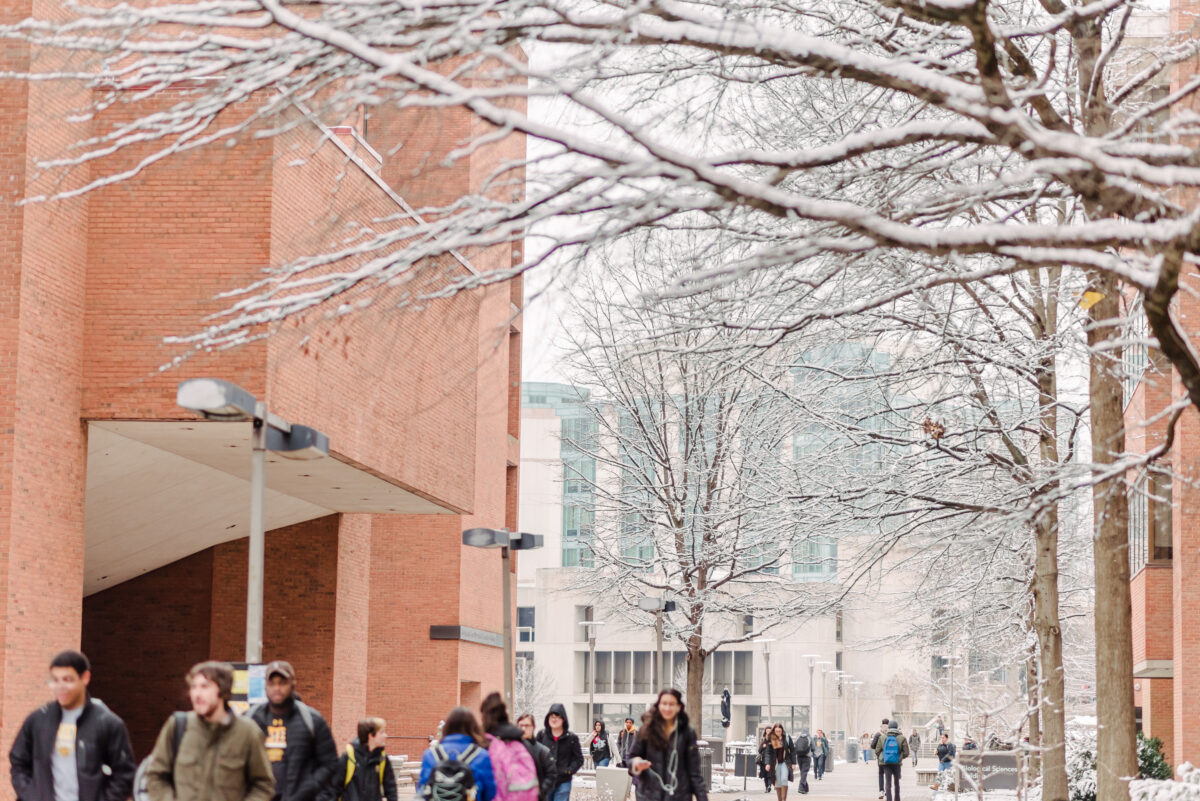 Students bustle through UMBC’s Academic Row on a winter day. (Marlayna Demond ’11/UMBC)
The opportunity to lead GESTAR II “is both a great pleasure and an honor for me, as I have always admired UMBC for being a shining example in all areas of university performance, including education, scholarship, research, innovation, technology, diversity, sports, environmental sustainability, and community outreach,” Ichoku says. “I am proud of UMBC for attaining the status of Carnegie R1 Doctoral Institution.”
“It is also a great blessing to have this wonderful opportunity to contribute to scientific discoveries and knowledge expansion for human advancement through NASA, and, in particular, Goddard Space Flight Center,” he adds. “I feel highly privileged to be involved in a program that connects two of the organizations that perform at the highest levels in their respective domains of activity, namely academia (UMBC) and space (NASA).”
]]>
The UMBC-led Goddard Earth Science Technology and Research (GESTAR) Center II includes over 120 researchers advancing Earth and atmospheric sciences and launching the next generation of...
https://umbc.edu/stories/new-director-to-take-earth-science-research-into-next-era/
https://beta.my.umbc.edu/api/v0/pixel/news/130456/guest@my.umbc.edu/84327406f7fb19fbcc10b317b3683061/api/pixel
cahss
cnms
ges
gestar
news
physics
science-and-tech
UMBC News & Magazine
https://beta.my.umbc.edu/groups/umbc-news-magazine
https://assets1-beta.my.umbc.edu/system/shared/avatars/groups/000/001/943/24435aa6207c452e7bc15cc74b42c7bb/xsmall.png?1748556657
https://assets1-beta.my.umbc.edu/system/shared/avatars/groups/000/001/943/24435aa6207c452e7bc15cc74b42c7bb/original.png?1748556657
https://assets2-beta.my.umbc.edu/system/shared/avatars/groups/000/001/943/24435aa6207c452e7bc15cc74b42c7bb/xxlarge.png?1748556657
https://assets2-beta.my.umbc.edu/system/shared/avatars/groups/000/001/943/24435aa6207c452e7bc15cc74b42c7bb/xlarge.png?1748556657
https://assets3-beta.my.umbc.edu/system/shared/avatars/groups/000/001/943/24435aa6207c452e7bc15cc74b42c7bb/large.png?1748556657
https://assets1-beta.my.umbc.edu/system/shared/avatars/groups/000/001/943/24435aa6207c452e7bc15cc74b42c7bb/medium.png?1748556657
https://assets2-beta.my.umbc.edu/system/shared/avatars/groups/000/001/943/24435aa6207c452e7bc15cc74b42c7bb/small.png?1748556657
https://assets1-beta.my.umbc.edu/system/shared/avatars/groups/000/001/943/24435aa6207c452e7bc15cc74b42c7bb/xsmall.png?1748556657
https://assets2-beta.my.umbc.edu/system/shared/avatars/groups/000/001/943/24435aa6207c452e7bc15cc74b42c7bb/xxsmall.png?1748556657
UMBC News & Magazine
0
0
false
Fri, 27 Jan 2023 19:40:56 -0500
Fri, 27 Jan 2023 19:40:56 -0500
UMBC researchers listed among the world’s top 2% of most-cited scientists and engineers
More than 40 active UMBC researchers are listed among the top 2% of the world’s most-cited scientists and engineers in an analysis recently published by Elsevier.
These researchers include faculty across all three of UMBC’s academic colleges as well as UMBC’s NASA-funded centers, such as the Goddard Earth Sciences Technology and Research (GESTAR II) Center. Their work covers an incredibly diverse array of topics. Represented academic departments include:
- biological sciences
- chemical, biochemical, and environmental engineering
- chemistry and biochemistry
- computer science and electrical engineering
- geography and environmental systems
- information systems
- mathematics and statistics
- mechanical engineering
- physics
- psychology
“We perform research to further our understanding of how the various aspects of our world function,” says Karl V. Steiner, vice president for research and creative achievement. “One of the highest recognitions in the scientific community is when other members of this community cite our work.”
He notes, “The Elsevier analysis shows that our researchers are truly impacting the scientific community in a significant way.”
History of citation honors
The list includes faculty researchers who have also received other “highly cited” researcher accolades. In 2022, Erle Ellis, professor of geography and environmental systems (GES), was featured on Clarivate’s Highly Cited Researchers list, which includes papers ranked in the top 1% of citations within Clarivate’s Web of Science database. About 0.1% of the world’s researchers have received this distinction. Ellis is known for his transformational work on human-managed ecosystems, with his research described as top discovery of 2021 by the Smithsonian National Museum of Natural History.
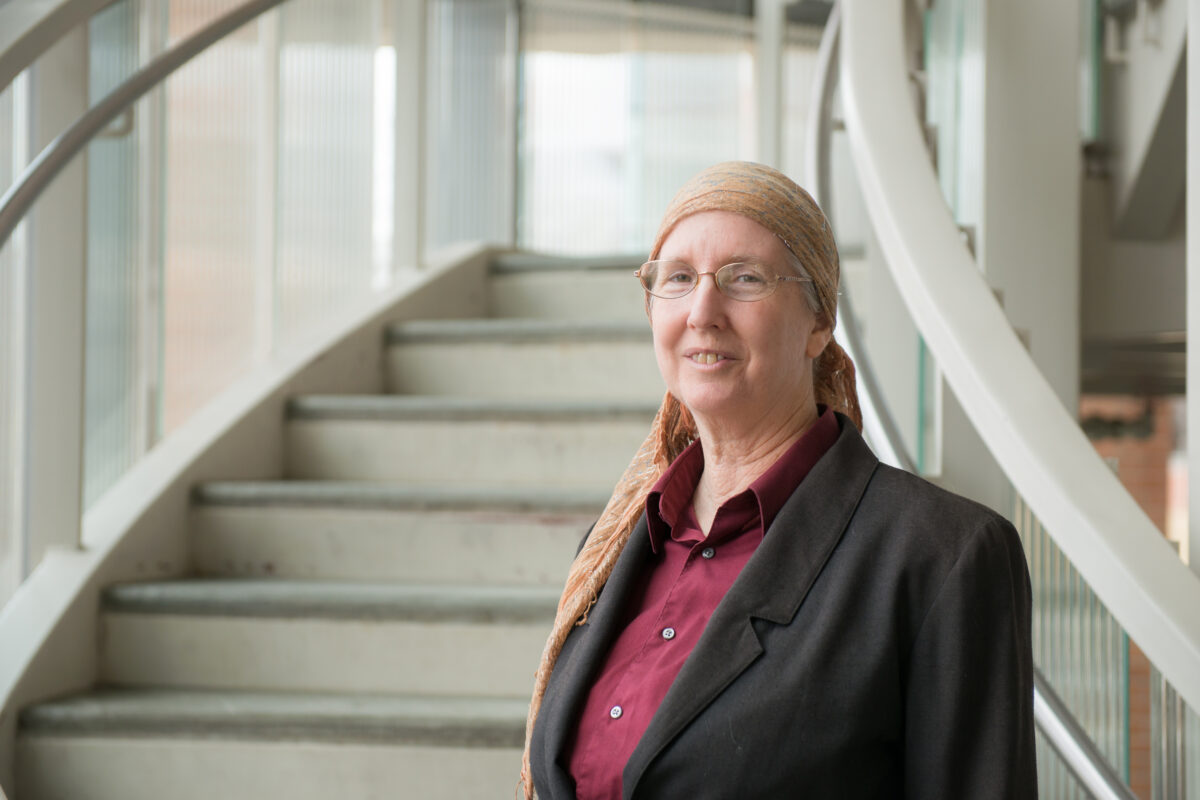 Lorraine Remer (Marlayna Demond ’11/UMBC)
Lorraine Remer, research professor for the Joint Center for Earth Systems Technology, who is affiliated with both GES and physics, is frequently honored for her geophysics publications. She received the 2019 UMBC Research Faculty Excellence Award following her recognition as one of “The Most Influential Scientific Minds” on the Thomson Reuters highly cited researchers list.
Anupam Joshi, director of UMBC’s Center for Cybersecurity and professor and chair of computer science and electrical engineering, was also included on Elsevier’s highly-cited list. His career trajectory demonstrates how UMBC faculty balance high-impact research with other forms of leadership. He has published more than 275 papers, has been granted nine patents, and has obtained research support from a variety of federal and industrial sources. At the same time, he is now serving as a 2022–23 American Council on Education (ACE) Fellow, an intensive program focused on agility and innovative problem solving among higher education leaders.
Measuring impact
This latest most-cited researchers list is based on data annually compiled from author profiles in Elsevier’s abstract and citation database, Scopus.
Elsevier’s 2022 database of standardized citation indicators classifies researchers into 22 fields and 174 subfields. Those with a composite indicator (c-score) within the top 2% of each subfield are included in the most-cited list. The list’s authors indicate that c-score is used because it “focuses on impact (citations) rather than productivity (number of publications)” and because it includes granular information on authorship, including co-authorship and author position (e.g., single, first, or last author).
]]>
More than 40 active UMBC researchers are listed among the top 2% of the world’s most-cited scientists and engineers in an analysis recently published by Elsevier. These researchers include...
https://umbc.edu/stories/most-cited-scientists-2022/
https://beta.my.umbc.edu/api/v0/pixel/news/130830/guest@my.umbc.edu/0a8209cd9947fb4136c6c8893cdbfae1/api/pixel
cahss
cbee
cnms
coeit
csee
cybersecurity
ges
gestar
is
jcet
meche
news
physics
rca-1
research
science-and-tech
UMBC News & Magazine
https://beta.my.umbc.edu/groups/umbc-news-magazine
https://assets1-beta.my.umbc.edu/system/shared/avatars/groups/000/001/943/24435aa6207c452e7bc15cc74b42c7bb/xsmall.png?1748556657
https://assets1-beta.my.umbc.edu/system/shared/avatars/groups/000/001/943/24435aa6207c452e7bc15cc74b42c7bb/original.png?1748556657
https://assets2-beta.my.umbc.edu/system/shared/avatars/groups/000/001/943/24435aa6207c452e7bc15cc74b42c7bb/xxlarge.png?1748556657
https://assets2-beta.my.umbc.edu/system/shared/avatars/groups/000/001/943/24435aa6207c452e7bc15cc74b42c7bb/xlarge.png?1748556657
https://assets3-beta.my.umbc.edu/system/shared/avatars/groups/000/001/943/24435aa6207c452e7bc15cc74b42c7bb/large.png?1748556657
https://assets1-beta.my.umbc.edu/system/shared/avatars/groups/000/001/943/24435aa6207c452e7bc15cc74b42c7bb/medium.png?1748556657
https://assets2-beta.my.umbc.edu/system/shared/avatars/groups/000/001/943/24435aa6207c452e7bc15cc74b42c7bb/small.png?1748556657
https://assets1-beta.my.umbc.edu/system/shared/avatars/groups/000/001/943/24435aa6207c452e7bc15cc74b42c7bb/xsmall.png?1748556657
https://assets2-beta.my.umbc.edu/system/shared/avatars/groups/000/001/943/24435aa6207c452e7bc15cc74b42c7bb/xxsmall.png?1748556657
UMBC News & Magazine
0
0
false
Wed, 25 Jan 2023 11:47:33 -0500
Fri, 10 Feb 2023 17:01:24 -0500
U.S. News ranks UMBC’s online master’s in information systems among best in the nation

U.S. News and World Report has recognized UMBC’s online master’s degree in information systems as #41 on their national list of 2023 Best Online Master’s in Information Technology Programs, as well as #20 for veterans.
The U.S. News rankings, released today, evaluate programs based on qualities such as strong faculty credentials, a good reputation among peer institutions, and the opportunity for students to use diverse online learning tools and engage with their instructors and classmates.
Michael Brown, graduate program director for UMBC’s online information system master’s program, says its wide range of electives, as well as free textbooks and course material, distinguish it from similar programs at other institutions.
The program offers a foundations course for people who do not have degrees or experience in technology fields, as well as four career-specific tracks that allow students to specialize in high-demand areas such as artificial intelligence and cybersecurity. The large number of available electives allows students to further customize their learning, Brown says.
Career opportunities
Graduates of UMBC’s online master’s program in information systems regularly land jobs as cybersecurity specialists, data analysts, systems administrators, and more.
Simbiat Odeshina, a master’s degree student in information systems, is currently enrolled in the program while also working as an associate software tester at Wabtec. “I really enjoy the flexibility with the program. Since I work full-time, I really like being able to attend class after work,” she says. Since beginning the program, she shares, “I am thinking about ways to improve how I approach certain things at my job.”
This ranking follows UMBC’s recognition as #9 in the nation for undergraduate teaching and #10 in the nation for innovation in the 2022–23 U.S. News and World Report Best Colleges undergraduate rankings released last September.
]]>
U.S. News and World Report has recognized UMBC’s online master’s degree in information systems as #41 on their national list of 2023 Best Online Master’s in Information Technology Programs, as...
https://umbc.edu/stories/u-s-news-ranks-umbcs-online-masters-in-information-systems-among-best-in-the-nation/
https://beta.my.umbc.edu/api/v0/pixel/news/130332/guest@my.umbc.edu/e896473b1e940cd4c6f35d138907ac2b/api/pixel
coeit
is
news
rankings
science-and-tech
UMBC News & Magazine
https://beta.my.umbc.edu/groups/umbc-news-magazine
https://assets1-beta.my.umbc.edu/system/shared/avatars/groups/000/001/943/24435aa6207c452e7bc15cc74b42c7bb/xsmall.png?1748556657
https://assets1-beta.my.umbc.edu/system/shared/avatars/groups/000/001/943/24435aa6207c452e7bc15cc74b42c7bb/original.png?1748556657
https://assets2-beta.my.umbc.edu/system/shared/avatars/groups/000/001/943/24435aa6207c452e7bc15cc74b42c7bb/xxlarge.png?1748556657
https://assets2-beta.my.umbc.edu/system/shared/avatars/groups/000/001/943/24435aa6207c452e7bc15cc74b42c7bb/xlarge.png?1748556657
https://assets3-beta.my.umbc.edu/system/shared/avatars/groups/000/001/943/24435aa6207c452e7bc15cc74b42c7bb/large.png?1748556657
https://assets1-beta.my.umbc.edu/system/shared/avatars/groups/000/001/943/24435aa6207c452e7bc15cc74b42c7bb/medium.png?1748556657
https://assets2-beta.my.umbc.edu/system/shared/avatars/groups/000/001/943/24435aa6207c452e7bc15cc74b42c7bb/small.png?1748556657
https://assets1-beta.my.umbc.edu/system/shared/avatars/groups/000/001/943/24435aa6207c452e7bc15cc74b42c7bb/xsmall.png?1748556657
https://assets2-beta.my.umbc.edu/system/shared/avatars/groups/000/001/943/24435aa6207c452e7bc15cc74b42c7bb/xxsmall.png?1748556657
UMBC News & Magazine
0
0
false
Tue, 24 Jan 2023 09:32:27 -0500
Tue, 24 Jan 2023 09:32:27 -0500