Creating pathways for UMBC student success in Maryland’s growing biotech industry
The biotech industry—or technology-based business that harnesses the power of biology—is booming in Maryland. And with more than 3,000 biotech companies currently operating in the state (with more on the way) and an economic impact estimated at around 17 billion dollars, according to the Maryland Chamber of Commerce, there’s never been a greater demand for highly-skilled workers to fill specialized roles as researchers, biomedical engineers, and technicians.
With its presence expanding beyond the home campus in Catonsville at The Universities at Shady Grove campus in Montgomery County, a hotspot for biotech growth, and its commitment to inclusive excellence, UMBC is uniquely positioned to prepare students for fulfilling jobs in this industry, both at entry and advanced levels.
We sat down with William R. LaCourse, dean of UMBC’s College of Natural and Mathematical Sciences, and Annica Wayman ’99, mechanical engineering, associate dean for Shady Grove Affairs in the College of Natural and Mathematical Sciences, to hear more about what makes UMBC’s programs distinctive, and why it’s so important to make this type of education and training accessible to as many types of students as possible.
UMBC Magazine: Dr. Wayman, you came back to UMBC in 2018 after a career in the biotech industry, at least in part because of UMBC’s emerging work in the translational life sciences. Can you tell us about what drew you here?
Dr. Wayman: When I saw the Translational Life Science Technology (TLST) degree program that UMBC was launching at the Shady Grove site in Rockville, it got me really excited. Because for me, this space of translational science, biotech, and the ability to have a high-impact career where you can help people with their healthcare challenges, is really exciting. The other exciting piece was the interdisciplinary nature of the curriculum—how many types of work can be brought together in new ways—and so it really spoke to those things that I’ve always been interested in. Being able to train students for careers in this space is exciting to me, and I have enjoyed being a part of this community so far.
Dean LaCourse: And speaking of a community, Maryland has such a growing and vibrant biotechnology industry, and it really is all about responding to this great need in the workforce for biotechnology. It’s a tremendous opportunity for students to be trained for really good-paying jobs in the applied sciences. This is something where you can roll your sleeves up and get working.
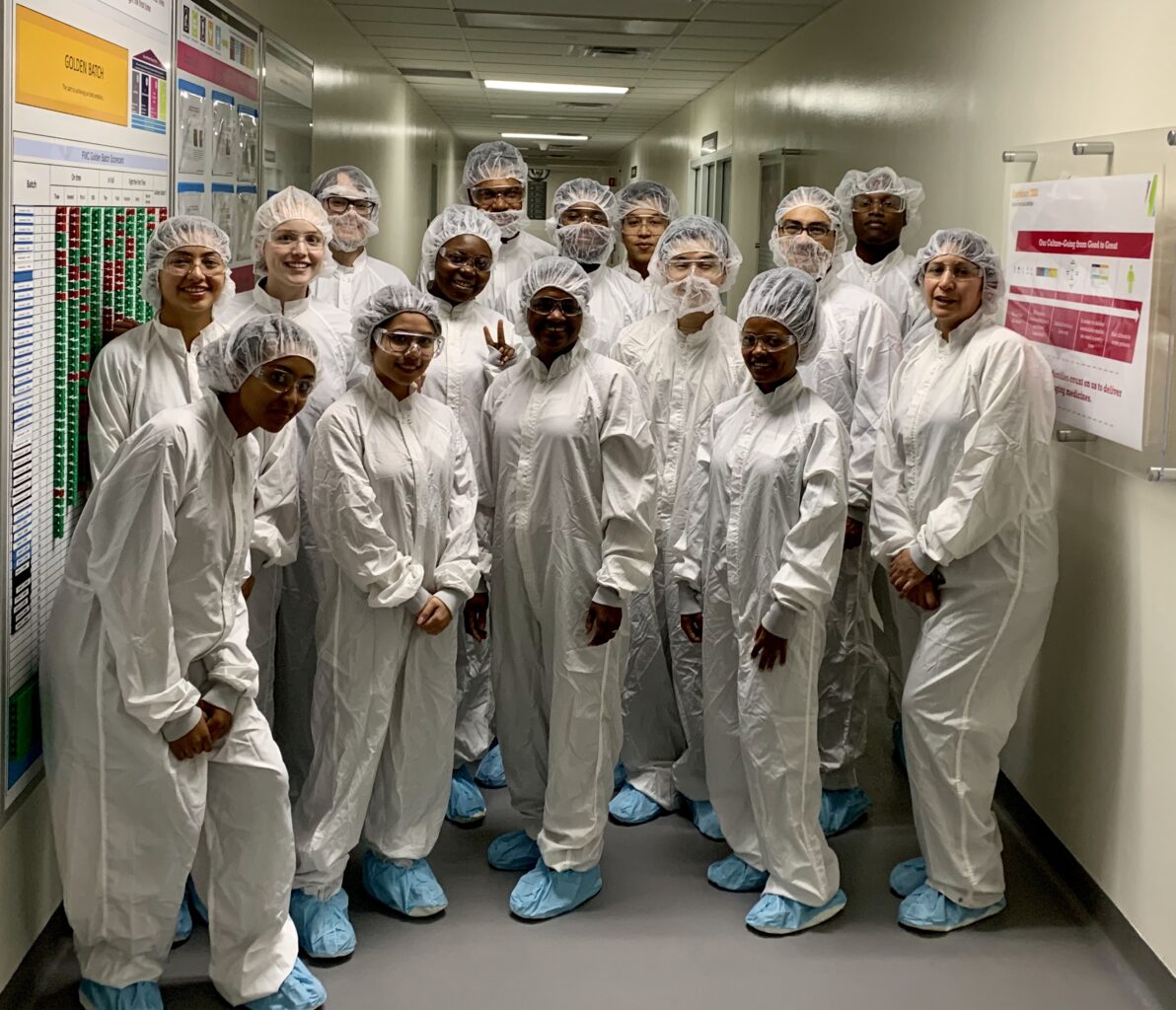 Students in UMBC’s TLST program share a moment together during a class trip to biotech company AstraZeneca. Photo courtesy of the TLST program.
UMBC Magazine: So, what does the journey look like for a student interested in this sort of work?
Dr. Wayman: The idea is to train students for critical jobs that are needed in the biotechnology industry primarily in the private sector at companies like AstraZeneca, Catalent or Kite Pharma. About 70 percent of our students in the TLST bachelor of science degree program come to us after getting their associate’s degree from Montgomery College. We’re seeing a big workforce gap in a number of areas, including cell and gene therapy. So we have this program that increases the pipeline but also trains students in an interdisciplinary way. Students are not just getting the biology, biochemistry, and chemistry. They get bioinformatics, but they also get engineering classes, so biochemical engineering and biomanufacturing. We have a lot of faculty members who are from the industry teaching these courses on a part-time basis, and a lot of guest lecturers from companies who can share what, for example, bioprocess design really looks like in the field and how highly regulated the environment is. And so students really get the skills that they need to hit the ground running in the industry. It really is exciting to see students get all of this out of one degree.
Dean LaCourse: We’re also thinking a lot about the continuum of education. So we have the undergraduate TLST program and then, after students get some work experience and want to build into more of a managerial or technical leadership track, they can come and do the professional master’s in biotechnology to get those leadership and technical skills. I love how UMBC is thinking about this continuum of education where people can come on and off as they see fit, for certain skills or knowledge that they need to gain and move their careers forward.
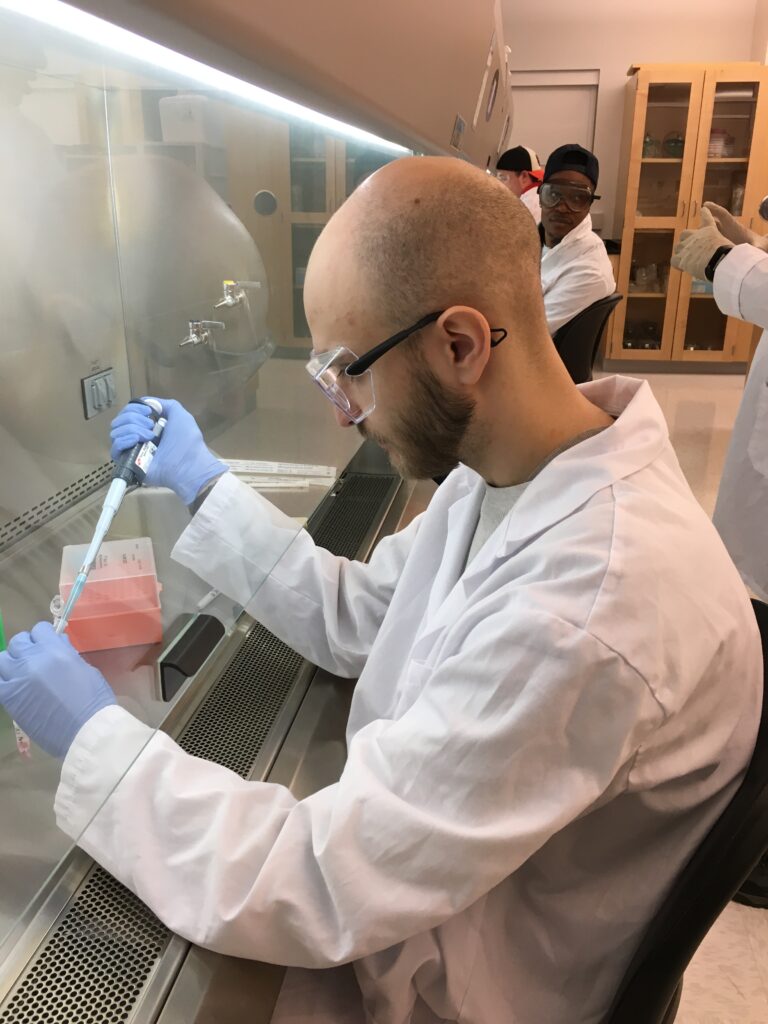 A TLST student in a lab class. Photo courtesy of the TLST program.
UMBC Magazine: Why is it so important to you to make this education accessible to students of all backgrounds? And why is it so important for the industry itself?
Dr. Wayman: These are well-paying jobs with high earning potential where you can leverage your scientific interest and skill to have enormous societal impact. Our TLST and MPS Biotech students are contributing to life-saving solutions. Some students may think that being a doctor or nurse is the only pathway if they are good in science, but these biotech jobs are other possibilities where you’re enabling thousands of doctors and nurses in helping patients – and impacting even more lives. And it’s important that those who work on these life-saving solutions come from diverse backgrounds to bring unique perspectives that reflect the diverse populations being served.
Dean LaCourse: That’s why we create our education systems for everyone. You’re admitted to UMBC, so we owe you the best education possible. No matter what path you took to get here, what disadvantages you have. And that’s why we emphasize professional advising, mentorship, applied learning experiences, compassion, and fairness. Inclusive excellence is what we’re all about.
Learn more about UMBC’s TLST program, the M.P.S. in Biotechnology, and other exciting pathways here.
You know why your goals matter, and UMBC knows how to get you there. Apply to UMBC today!
]]>
The biotech industry—or technology-based business that harnesses the power of biology—is booming in Maryland. And with more than 3,000 biotech companies currently operating in the state (with more...
https://umbc.edu/stories/creating-paths-for-success-in-biotech-industry/
https://beta.my.umbc.edu/api/v0/pixel/news/131452/guest@my.umbc.edu/224e519bce5968adc371b9092310fae8/api/pixel
cnms
discovery
magazine
tlst
universities-at-shady-grove
UMBC News & Magazine
https://beta.my.umbc.edu/groups/umbc-news-magazine
https://assets1-beta.my.umbc.edu/system/shared/avatars/groups/000/001/943/24435aa6207c452e7bc15cc74b42c7bb/xsmall.png?1748556657
https://assets1-beta.my.umbc.edu/system/shared/avatars/groups/000/001/943/24435aa6207c452e7bc15cc74b42c7bb/original.png?1748556657
https://assets2-beta.my.umbc.edu/system/shared/avatars/groups/000/001/943/24435aa6207c452e7bc15cc74b42c7bb/xxlarge.png?1748556657
https://assets2-beta.my.umbc.edu/system/shared/avatars/groups/000/001/943/24435aa6207c452e7bc15cc74b42c7bb/xlarge.png?1748556657
https://assets3-beta.my.umbc.edu/system/shared/avatars/groups/000/001/943/24435aa6207c452e7bc15cc74b42c7bb/large.png?1748556657
https://assets1-beta.my.umbc.edu/system/shared/avatars/groups/000/001/943/24435aa6207c452e7bc15cc74b42c7bb/medium.png?1748556657
https://assets2-beta.my.umbc.edu/system/shared/avatars/groups/000/001/943/24435aa6207c452e7bc15cc74b42c7bb/small.png?1748556657
https://assets1-beta.my.umbc.edu/system/shared/avatars/groups/000/001/943/24435aa6207c452e7bc15cc74b42c7bb/xsmall.png?1748556657
https://assets2-beta.my.umbc.edu/system/shared/avatars/groups/000/001/943/24435aa6207c452e7bc15cc74b42c7bb/xxsmall.png?1748556657
UMBC News & Magazine
0
0
false
Thu, 02 Mar 2023 14:25:46 -0500
Thu, 02 Mar 2023 14:25:46 -0500
Unlocking the secrets of materials that turn heat into electricity: UMBC’s Deepa Madan wins NSF CAREER Award

Deepa Madan, an assistant professor of mechanical engineering at UMBC, has received a prestigious National Science Foundation (NSF) CAREER award for research on materials that could improve wearable medical devices, reduce energy waste, and power sensors to monitor everything from the safety of infrastructure to the paths pollutants travel.
The roughly $500,000 grant, given over five years, will further Madan’s research on materials called thermoelectrics, which can turn a temperature difference into electricity, or vice versa.
“It’s a fantastic feeling to be recognized with this award, but I know that it is just the beginning,” says Madan. “The coming years will be an opportunity not only to meet the research goals, but also to contribute to public outreach and to give diverse students opportunities to connect to the research.”
“CAREER awards are one of the most significant awards at NSF for researchers,” says Erin Lavik, professor of chemical, biochemical, and environmental engineering. As associate dean for research and faculty development in the College of Engineering and Information Technology (COEIT), she helped COEIT researchers hone their NSF CAREER award applications to access more support and visibility for their high-impact work.
“Dr. Madan is absolutely brilliant, and I was so excited to hear that she got this award,” Lavik says. “It will allow her to build out her research and educational program in a way that aligns beautifully with where the next generation of materials needs to move to address environmental and sustainability concerns.”
Heat into electricity
Heat is all around us. It radiates from sweaty skin, pours out of hot car engines, and seeps out of sunbaked sidewalks at night. Thermoelectric materials tap into this ubiquitous form of energy, turning temperature differences into electrical current. (The materials can also run in reverse, using electricity to heat or cool.)
Thermoelectric materials can already be found in niche applications—such as chilling wine and powering spacecraft—but their more widespread adoption has been held back by their limited efficiency and rigid nature.
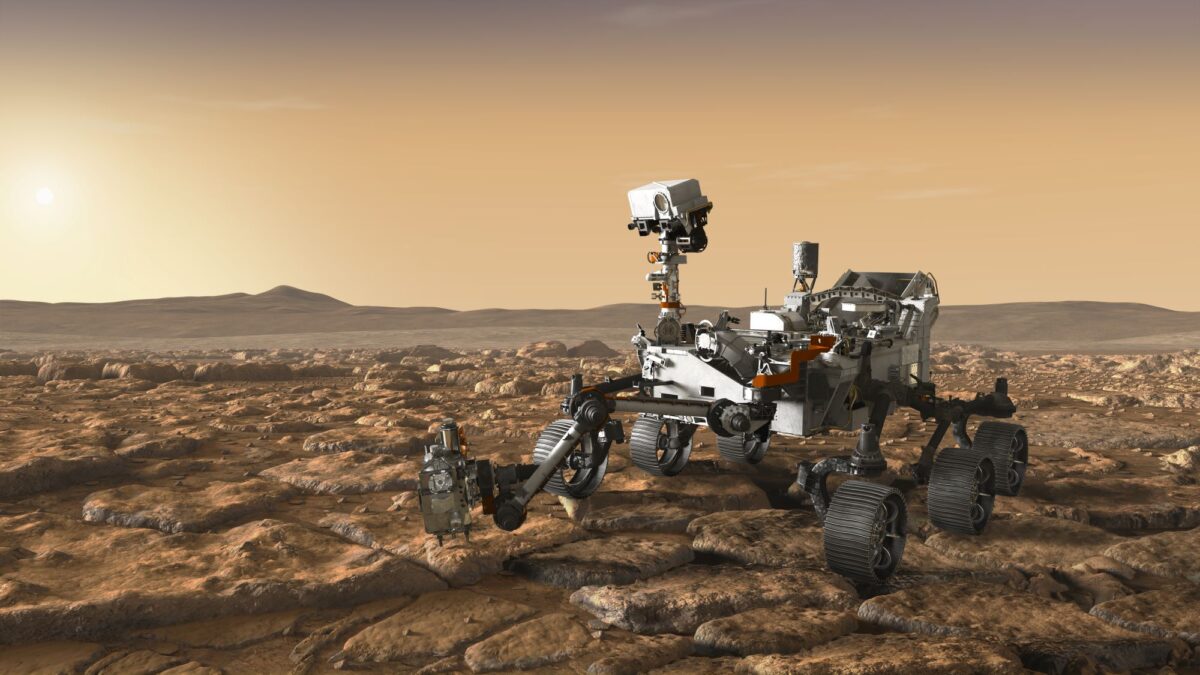 The Perseverance Rover, sent by NASA to Mars in 2020, uses a thermoelectric system to convert heat from a radioactive material into electricity. (Image credit: NASA/JPL-Caltech)
Madan’s research tackles both these challenges. She mixes grains of thermoelectric material with a pliable glue-like substance called a binder. The resulting composite material can be twisted and bent, making it more versatile. It’s also more affordable.
Adding the binder normally makes a thermoelectric material less efficient. In addition, when making a composite, researchers have historically baked the material at extremely high temperatures to harden the binder, which takes a lot of energy.
Madan is striving to keep her process efficient, low-energy, and environmentally friendly. At the same time, she is answering fundamental questions about the relationship between structure, process, and properties of her materials. That knowledge will help illuminate the best path toward further improving the materials’ properties.
Furthering fundamental science
Generally, when materials conduct electricity well, they also conduct heat well (think of the feel of a metal bench in winter). However, thermoelectrics require the opposite—they work best when they conduct electricity well, but conduct heat poorly. That way they can maintain the temperature difference that drives the electrons.
Madan’s research group aims to make materials optimized with high electrical conductivity and low thermal conductivity by studying the underlying science.
To start, they mix a small amount of a binder made from the shells of crustaceans with grains of a thermoelectric material called bismuth antimony telluride. Some of the thermoelectric grains are about the size of pollen grains, while others are thousands of times smaller. They form the mixture into the desired shape using a 3D printer, and then squeeze it together while applying gentle heat.
The researchers then study how each step affects the microscopic structure of the material and, consequently, its properties.
So far, they have found that the relatively large grains squeezed together provide a path for electrons to travel through the material, boosting its electrical conductivity. Meanwhile the super tiny grains and small defects where the grains meet the binder disrupt the waves of molecular vibrations that transport heat, keeping the thermal conductivity low.
Powering outreach
Ultimately, Madan hopes her thermoelectrics will power environmentally friendly devices of the future, but also drive students to become interested in the world of materials science. As part of her project, she will create a new class on flexible electronics and recruit high school and community college student researchers to work in her lab, in addition to her current UMBC students. She will also create an outreach kit for middle and high school students to make their own thermoelectrically-powered devices.
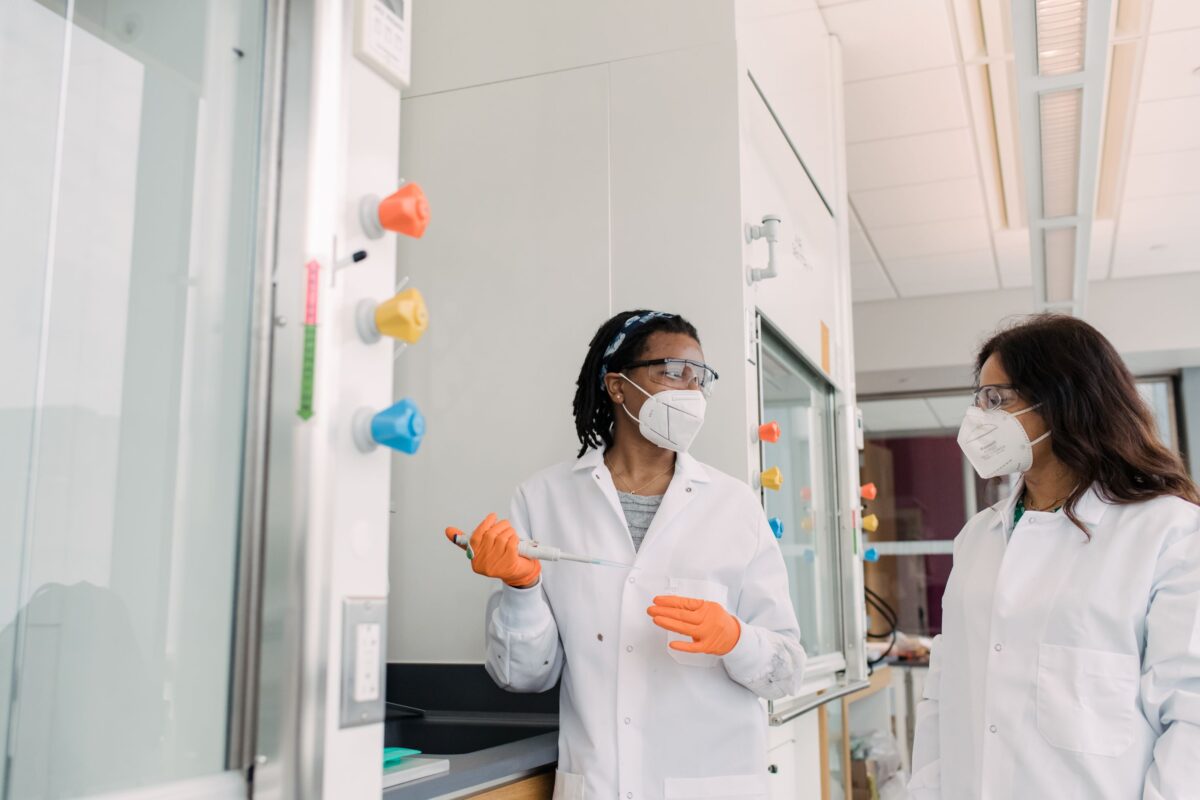
Deepa Madan talks with a student in her lab. The student is working on a related project on flexible batteries. (Marlayna Demond ’11/UMBC)
“I’m very passionate about education and outreach and UMBC gives us immense opportunities to connect with diverse populations,” says Madan. “I’m hoping with this award I can involve more students, especially women, who will get passionate about changing the world through STEM.”
]]>
Deepa Madan, an assistant professor of mechanical engineering at UMBC, has received a prestigious National Science Foundation (NSF) CAREER award for research on materials that could improve...
https://umbc.edu/stories/unlocking-the-secrets-of-materials-that-turn-heat-into-electricity-umbcs-deepa-madan-wins-nsf-career-award/
https://beta.my.umbc.edu/api/v0/pixel/news/131390/guest@my.umbc.edu/547e66521b30f0f6023519df720dccfe/api/pixel
career-award
coeit
meche
news
rca-1
research
science-and-tech
UMBC News & Magazine
https://beta.my.umbc.edu/groups/umbc-news-magazine
https://assets1-beta.my.umbc.edu/system/shared/avatars/groups/000/001/943/24435aa6207c452e7bc15cc74b42c7bb/xsmall.png?1748556657
https://assets1-beta.my.umbc.edu/system/shared/avatars/groups/000/001/943/24435aa6207c452e7bc15cc74b42c7bb/original.png?1748556657
https://assets2-beta.my.umbc.edu/system/shared/avatars/groups/000/001/943/24435aa6207c452e7bc15cc74b42c7bb/xxlarge.png?1748556657
https://assets2-beta.my.umbc.edu/system/shared/avatars/groups/000/001/943/24435aa6207c452e7bc15cc74b42c7bb/xlarge.png?1748556657
https://assets3-beta.my.umbc.edu/system/shared/avatars/groups/000/001/943/24435aa6207c452e7bc15cc74b42c7bb/large.png?1748556657
https://assets1-beta.my.umbc.edu/system/shared/avatars/groups/000/001/943/24435aa6207c452e7bc15cc74b42c7bb/medium.png?1748556657
https://assets2-beta.my.umbc.edu/system/shared/avatars/groups/000/001/943/24435aa6207c452e7bc15cc74b42c7bb/small.png?1748556657
https://assets1-beta.my.umbc.edu/system/shared/avatars/groups/000/001/943/24435aa6207c452e7bc15cc74b42c7bb/xsmall.png?1748556657
https://assets2-beta.my.umbc.edu/system/shared/avatars/groups/000/001/943/24435aa6207c452e7bc15cc74b42c7bb/xxsmall.png?1748556657
UMBC News & Magazine
1
0
false
Thu, 02 Mar 2023 11:59:15 -0500
Thu, 02 Mar 2023 11:59:15 -0500
How UMBC’s humanistic approach to AI creates positive community change

Artificial intelligence, or AI, is all over the news these days. For those who aren’t working in this sphere, it might feel mysterious or even like a science fiction film. However, for researchers at UMBC, AI is just another tool in a growing collection of instruments that can make life better for their fellow human beings. AI-driven thinking opens up possibilities for improvements and problem solving in health care, the environment, civil engineering, and beyond. It can make previously unthinkable amounts of data easy to analyze. But work of this magnitude also calls for an ethical approach, both in how it’s taught and applied.
We sat down with Keith J Bowman, dean of UMBC’s College of Engineering and Information Technology (COEIT), and Vandana Janeja, professor and chair, Information Systems, to talk about why taking a humanistic route to research and teaching AI is such an important way of making a positive difference in our community and the world, and why UMBC is the perfect place for students with an interest in this emerging field.
UMBC Magazine: With UMBC’s “public research for public good” approach in mind, what are a few examples of creative ways our researchers are breaking boundaries with AI?
If we can curate good data, there’s lots of good stuff we can do with AI. One NSF funded project example at UMBC was done by Dr. Nirmalya Roy in the Information Systems (IS) department, who combines sensor data with social media. The sensors read the water levels, and the water levels are shared with the community over tweets, tweets on flood severity can be quantified/measured and confirmed by water level sensors as well, so this is a very good example of how you can actually make an impact in the community right where you are. It actually impacted our neighborhood.
And then there are other things like studying deep fakes. That’s an NSF funded project that’s happening in my lab along with Dr. Christine Mallinson in the Center for Social Science Scholarship (CS3). We are trying to understand how to better educate our students in understanding deep fakes. On the one side, these audio files are created as fakes through AI, but then we are also trying to work with our colleagues to see how we can improve the detection and discernment of it, either through training the students or making algorithms aware of the human side of things—introducing humanistic aspects to AI.
There are ways by which we can train our algorithms to be really, really precise in tasks that may be difficult for humans to see, but then we also have to be careful how to balance it with well-curated, well-trained data.
Keith Bowman: Often people think about AI only in relation to computing topics. But Tyler Josephson in chemical engineering at UMBC is working on trying to develop and use machine learning (where a machine learns to imitate human intelligence) and artificial intelligence tools in order to assess complex properties of some materials. These computational tools can be applied to chemical reactions, phase changes, statistical variability, or even human factors involved in chemical processing and materials manufacturing. They can also be used to foster improvements in theoretical understanding. The artificial intelligence can work through all of the cases and all of the examples that may be there.
Almost every engineering field has people working on how to apply AI and AI tools to work on things that have been challenges for many years, or trying to find faster ways to come to a resolution or a solution in areas as varied as the x-ray or ultrasound imaging used in human healthcare or the health of aging bridges and buildings.
There’s health monitoring that is useful for infrastructure for public safety, for instance. Radiography and ultrasound can be used to look for flaws or potential failures in bridges buildings or even aircraft components. But then human beings end up interpreting the images. Increasingly, we are able to collect massive amounts of information and artificial intelligence tools can help with quantifying information used in predicting outcomes. For instances with a high degree of complexity, having computational tools assist in the analysis can enhance the quality of the result. And also any place as a real backup to where humans might drop the ball in some cases.
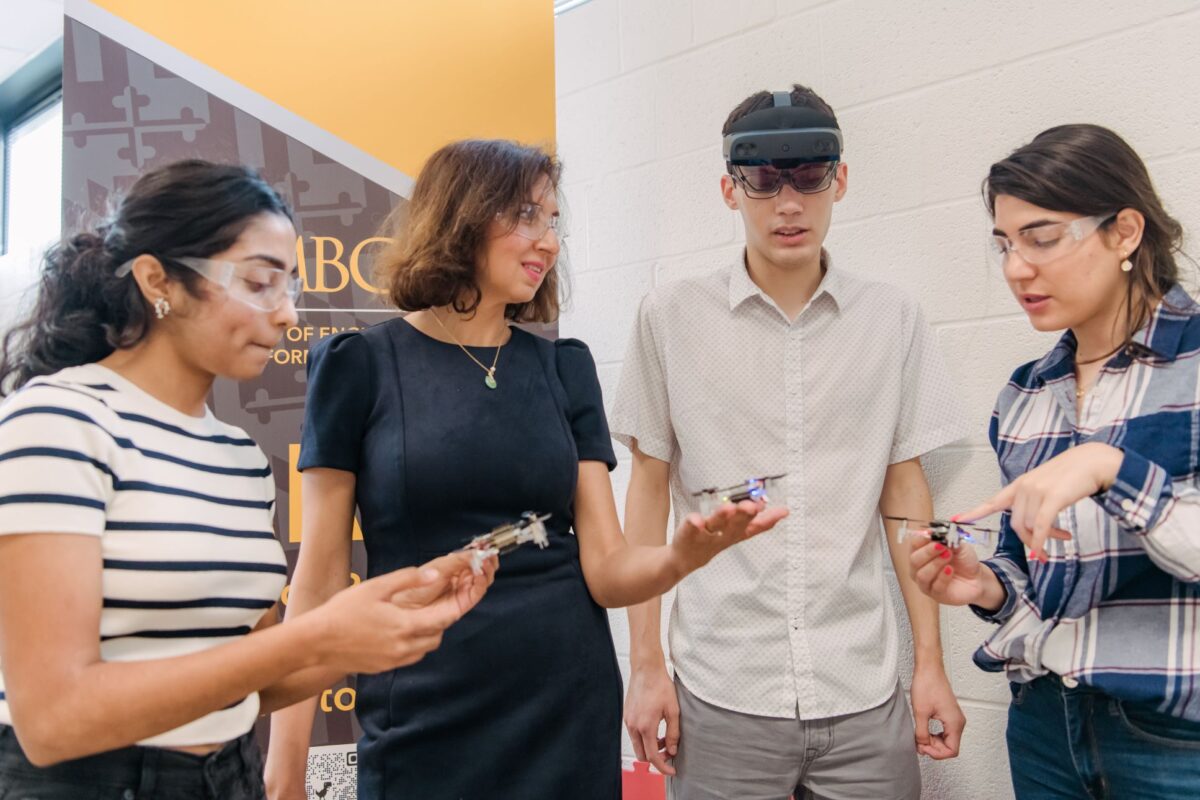 Associate Professor Tinoosh Mohsenin (second from the left) and students display small drones. (Marlayna Demond ’11/UMBC) Read the full story on UMBC News.
UMBC Magazine: It’s amazing to think about just how broad the use of AI could be.
Vandana Janeja: I want to emphasize one of the things that Keith said, and I think that’s really the crux of it where AI can be helpful, is literally the massive amounts of data we have, the terms of scalability and complexity we are talking about, that we literally cannot compute at the current capacity of our minds. And you’re talking about decision making that a human has to make. But now if you augment it with AI, it does so much better.
And another NSFfunded project I should mention, iHarp—which focuses on climate data in polar regions—where there’s so many different systems and subsystems, just to put all of that data together and make these complex connections, even thousands of scientists may not be able to do it. But if you start making those connections across even some of those subsystems, it advances the science by leaps, tens of years. So that’s the kind of impact that AI can have. Now the trick is, can we make those connections well? Can we train and have well curated data? Because all data is not good data.
UMBC Magazine: That’s a great segue into the human piece of all this. Can you talk to us about why UMBC takes such a humanistic approach to AI?
Vandana Janeja: You can look at it from multiple perspectives. And we are also impacting our students on how they are thinking. It’s very important to see who’s at the center of the AI application. You can ask, who are we impacting? Who are we working with? And who’s helping us create these connections? And then finally, are we able to produce algorithms that don’t harm individuals? So the positive impact, making sure it’s in ethical bounds, and then also making sure who we are working with. In all of the project examples we mentioned, there is a community impact. If you go onto the IS department research website you see that almost every project has a community partner. And then most importantly, it’s hard, but you really have to work with different disciplines.
UMBC Magazine: So for a student who’s interested in this kind of work, what would you give them in terms of advice?
Keith Bowman: To me, the thing that we need more of is students from other disciplines who do coursework in some of these related topics. That includes completing certificates and minors. A lot of COEIT students will do a second major or do a minor in other places on campus, and I think that’s fine. But I also think you need more students from other areas who can and are willing to do the reverse and establish some technical backgrounds. We need a broader range of people, including those from arts, humanities, social sciences, and life sciences, who also have enough of the technical background to even ask better questions regarding AI.
Vandana Janeja: People will come at data from different angles. I had a student talk about social justice in one of my classes, about the data and use of data, how it is empowering or disempowering people. And I encourage this.
At the end of the day, I say to my students: keep asking questions. Can you connect what you are doing to the big picture? You want to use your own inner compass as a guide, think how are you contributing? Not everything has to be this big life-shattering thing, but at the same time, are you chipping away at it? Are you contributing to society as such? The UMBC education and the ecosystem we have at UMBC really empowers students to do that.
Learn more about UMBC’s College of Engineering and Information Technology and other exciting pathways here.
You know why your goals matter, and UMBC knows how to get you there. Apply to UMBC today!
]]>
Artificial intelligence, or AI, is all over the news these days. For those who aren’t working in this sphere, it might feel mysterious or even like a science fiction film. However, for researchers...
https://umbc.edu/stories/how-umbcs-humanistic-ai-approach-creates-change/
https://beta.my.umbc.edu/api/v0/pixel/news/131424/guest@my.umbc.edu/2f41b2013c2000966783406b7a534b43/api/pixel
coeit
discovery
iharp
information-systems
magazine
UMBC News & Magazine
https://beta.my.umbc.edu/groups/umbc-news-magazine
https://assets1-beta.my.umbc.edu/system/shared/avatars/groups/000/001/943/24435aa6207c452e7bc15cc74b42c7bb/xsmall.png?1748556657
https://assets1-beta.my.umbc.edu/system/shared/avatars/groups/000/001/943/24435aa6207c452e7bc15cc74b42c7bb/original.png?1748556657
https://assets2-beta.my.umbc.edu/system/shared/avatars/groups/000/001/943/24435aa6207c452e7bc15cc74b42c7bb/xxlarge.png?1748556657
https://assets2-beta.my.umbc.edu/system/shared/avatars/groups/000/001/943/24435aa6207c452e7bc15cc74b42c7bb/xlarge.png?1748556657
https://assets3-beta.my.umbc.edu/system/shared/avatars/groups/000/001/943/24435aa6207c452e7bc15cc74b42c7bb/large.png?1748556657
https://assets1-beta.my.umbc.edu/system/shared/avatars/groups/000/001/943/24435aa6207c452e7bc15cc74b42c7bb/medium.png?1748556657
https://assets2-beta.my.umbc.edu/system/shared/avatars/groups/000/001/943/24435aa6207c452e7bc15cc74b42c7bb/small.png?1748556657
https://assets1-beta.my.umbc.edu/system/shared/avatars/groups/000/001/943/24435aa6207c452e7bc15cc74b42c7bb/xsmall.png?1748556657
https://assets2-beta.my.umbc.edu/system/shared/avatars/groups/000/001/943/24435aa6207c452e7bc15cc74b42c7bb/xxsmall.png?1748556657
UMBC News & Magazine
0
0
false
Thu, 02 Mar 2023 10:33:55 -0500
Thu, 02 Mar 2023 10:33:55 -0500
UMBC’s galleries deliver interactive and thoughtful art

UMBC’s art galleries are already in full bloom for the spring. With exhibits showcasing historic and innovative 20th century photography, interactive hip-hop data visualization, and the legacies of political resistance as seen through Black hair, the university’s exhibition spaces are bountiful with thought-provoking work.
Hip-Hop and Data at CADVC
Tahir Hemphill: Rap Research Lab runs at the Center for Art, Design, and Visual Culture (CADVC) through March 18. In this exhibition, Tahir Hemphill, the inaugural Fellow for Faculty Diversity in the Visual Arts at UMBC, presents a collection of interactive works that explore what he calls “the hybrid area between art, technology, social engagement, and interdisciplinary research.”
Visitors are invited to participate in Hemphill’s design and research process through evolving artworks, including “Visualisation of Authority,” a kinetic sculpture drawing on Library of Congress research data, and “Mapper’s Delight,” an interactive augmented reality-based middle-school curriculum Hemphill designed in collaboration with Verizon Innovative Learning.
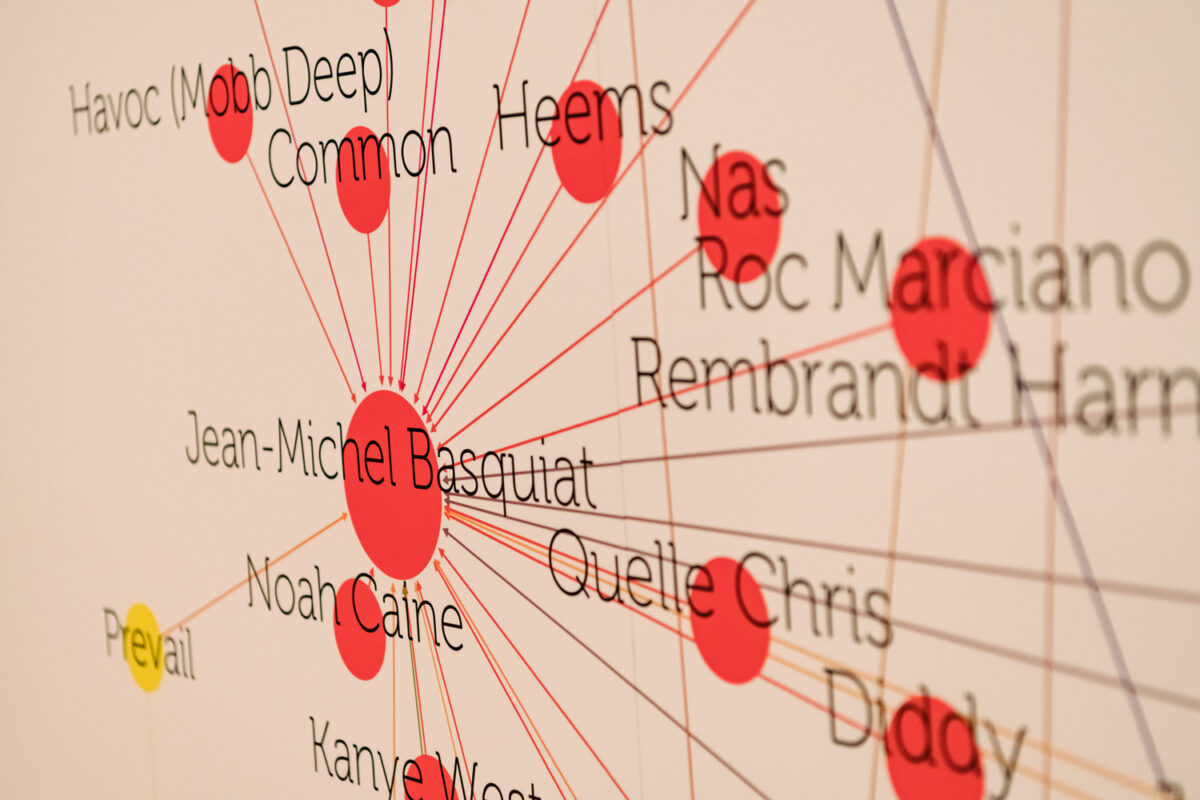 Data visualization from Hemphill’s Rap Research Lab at the CADVC. (Marlayna Demond ’11/UMBC)
Hemphill is using the exhibition space for teaching as well. In a course offered in collaboration between Visual Arts and the UMBC Image Research Center (IRC) students have the opportunity to mine the “Rap Almanac,” Hemphill’s expansive dataset of rap lyrics, to produce work in an internship-based research practicum.
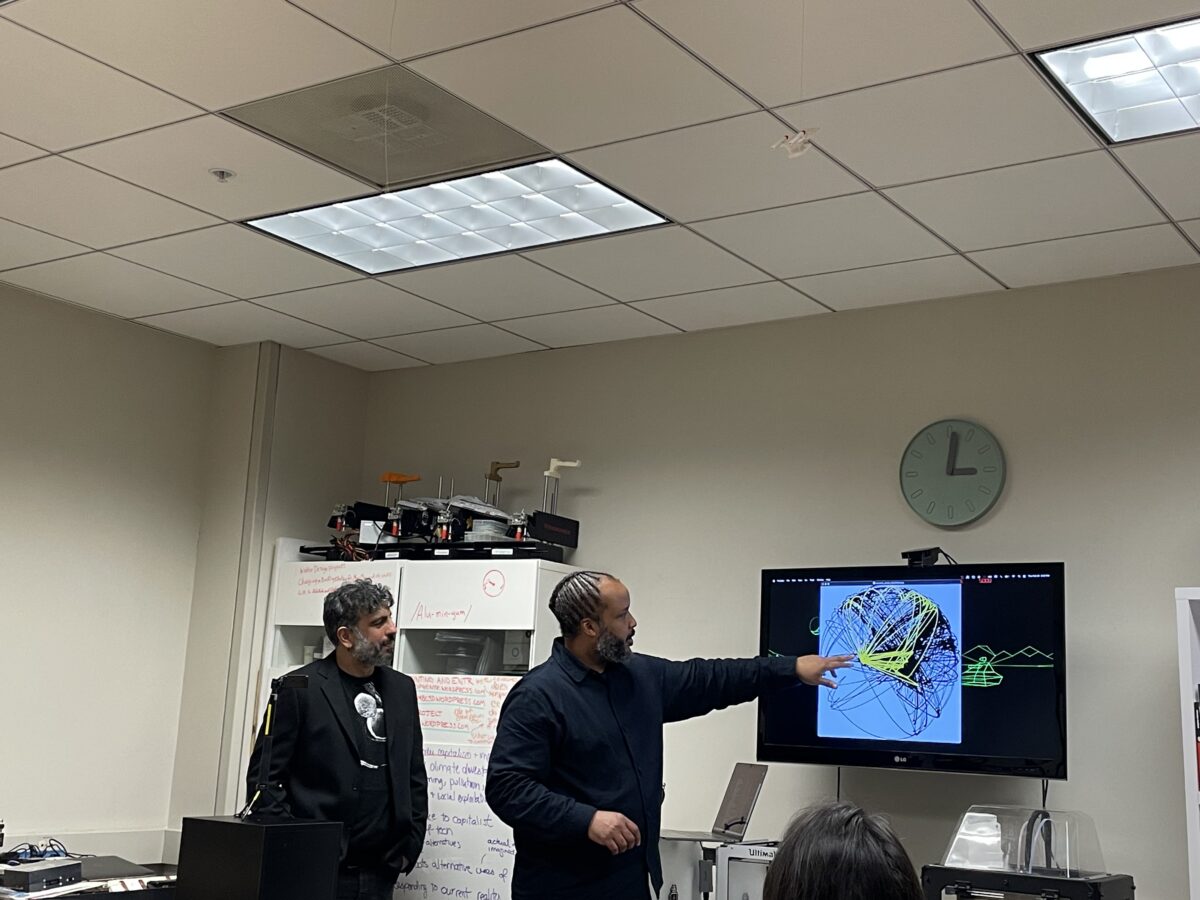 Hamidi, left, and Hemphill, right, talk through data visualization. (Marlayna Demond ’11/UMBC)
“CADVC operates as an art gallery and research center dedicated to scholarship and experimentation in art and culture,” says CADVC Director Rebecca Uchill. “This exhibition demonstrates a terrific range of scholarly inquiries, by Hemphill and his collaborators, into many facets of cultural history and the power of creative data visualization strategies. It is very exciting to watch this research develop in a public-facing presentation!”
Additional programming for the exhibition will include a series of public events such as a choreographed activation of a programmable robot arm, a partnership project with assistant professor Foad Hamidi from the Human-Centered Computing program in Information Systems, and a series of pop-up events.
Historic Hair and Formative Photography at AOK
The Albin O. Kuhn Library Gallery currently features two shows—Aaron Siskind: Formations and Sonya Clark: Hair/Craft—both on view through March 12.
Multidisciplinary artist Sonya Clark presents five works made with human hair and fiber art techniques to explore Black visibility and identity, and to examine the ways Black hair has been employed as an instrument of political resistance across the African diaspora. Clark, whose work explores issues of identity, race, cultural heritage, and collective memory, engages everyday objects and craft traditions to examine narrative threads connecting modern issues with historical origins, including the Black national anthem “Lift Every Voice and Sing” and the biography of Madam C. J. Walker, who became the first female self-made millionaire by selling hair care products to Black women.
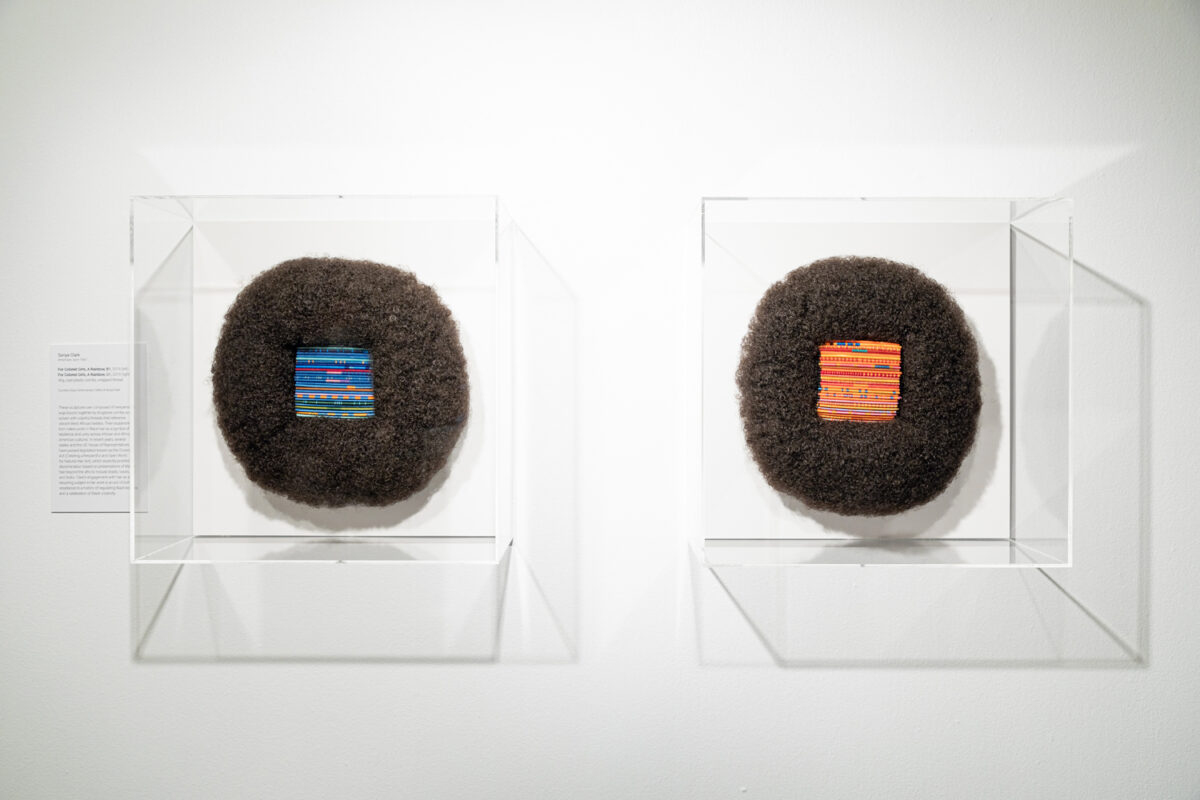 Sonya Clark’s Hair/Craft exhibit at the AOK Library Gallery. (Melissa Penley Cormier, M.F.A. ’17, for Research Graphics)
Influential photographer Aaron Siskind is celebrated through 55 works spanning his prolific career, all part of UMBC’s Photography Collections. Beginning with early documentary works Siskind made as part of the New York Film and Photo League in the 1930s and his groundbreaking abstract works of the 1940s and 1950s, the exhibition continues through phases of architectural studies, travel photography, and Siskind’s famous series focused on divers suspended in mid-air, “Terrors and Pleasures of Levitation.”
 The Aaron Siskind exhibit in the AOK Library Gallery. (Melissa Penley Cormier, M.F.A. ’17, for Research Graphics)
Mind’s Eye in Toronto
With Mind’s Eye: The Psychic Photographs of Ted Serios, UMBC’s Special Collections has gone international. The Image Centre of Toronto Metropolitan University invited UMBC’s Curator of Exhibitions Emily Cullen to curate a show featuring one of AOK’s more fascinating collections, the Jule Eisenbud Collection on Ted Serios and Thoughtographic Photography.
Serios claimed to have the ability to psychically transfer his thoughts onto Polaroid film, a process called “thoughtography.” Chicago psychiatrist Jule Eisenbud investigated these claims, experimenting with Serios for several years in the mid-1960s, and the archive of those results is now part of UMBC’s permanent collection.
Mind’s Eye: The Psychic Photographs of Ted Serios opens at the IMC tomorrow, on view January 25–April 1!
]]>
UMBC’s art galleries are already in full bloom for the spring. With exhibits showcasing historic and innovative 20th century photography, interactive hip-hop data visualization, and the legacies...
https://umbc.edu/stories/umbcs-galleries-deliver-interactive-art/
https://beta.my.umbc.edu/api/v0/pixel/news/131356/guest@my.umbc.edu/5fd578a744572090ba95cb818c844cba/api/pixel
aok-library
arts-and-culture
cadvc
campus-life
is
magazine
media-and-communication-studies
news
special-collections
visual-arts
UMBC News & Magazine
https://beta.my.umbc.edu/groups/umbc-news-magazine
https://assets1-beta.my.umbc.edu/system/shared/avatars/groups/000/001/943/24435aa6207c452e7bc15cc74b42c7bb/xsmall.png?1748556657
https://assets1-beta.my.umbc.edu/system/shared/avatars/groups/000/001/943/24435aa6207c452e7bc15cc74b42c7bb/original.png?1748556657
https://assets2-beta.my.umbc.edu/system/shared/avatars/groups/000/001/943/24435aa6207c452e7bc15cc74b42c7bb/xxlarge.png?1748556657
https://assets2-beta.my.umbc.edu/system/shared/avatars/groups/000/001/943/24435aa6207c452e7bc15cc74b42c7bb/xlarge.png?1748556657
https://assets3-beta.my.umbc.edu/system/shared/avatars/groups/000/001/943/24435aa6207c452e7bc15cc74b42c7bb/large.png?1748556657
https://assets1-beta.my.umbc.edu/system/shared/avatars/groups/000/001/943/24435aa6207c452e7bc15cc74b42c7bb/medium.png?1748556657
https://assets2-beta.my.umbc.edu/system/shared/avatars/groups/000/001/943/24435aa6207c452e7bc15cc74b42c7bb/small.png?1748556657
https://assets1-beta.my.umbc.edu/system/shared/avatars/groups/000/001/943/24435aa6207c452e7bc15cc74b42c7bb/xsmall.png?1748556657
https://assets2-beta.my.umbc.edu/system/shared/avatars/groups/000/001/943/24435aa6207c452e7bc15cc74b42c7bb/xxsmall.png?1748556657
UMBC News & Magazine
1
0
false
Wed, 01 Mar 2023 14:37:02 -0500
Wed, 01 Mar 2023 14:37:02 -0500
Travel signatures and DS-2019s extensions
Dear Exchange Visitors,
I will be out of office from April 4 until April 18. If you need any travel signatures, please
book an appointment with me soon.
If you need an extension to your DS-2019s, please contact your department as early as today so they can start the process for you. Otherwise, I will handle your requests when I return to work on April 19.
Let me know if you have any questions!
Best regards,
Diane Zeenny Ghorayeb
International Scholar Coordinator, ISSS, Center for Global Engagement | UC 207| isss.umbc.edu | #umbc_isss | @UMBC_ISSS
On-campus: Monday, Wednesday, Thursday; Telework: Tuesday, Friday.


Danielle Giese ’99, political science and Africana studies, remembers her first paychecks were hot and cheesy pizza lunches. They were the reward for volunteering at the Southern Maryland Tri-County Community Action Committee where her father, Dana M. Jones, served as chief executive officer for 30 years. At 12 years old, Giese and her two brothers, Rondell and Gregory, were tasked with answering phones, doing data entry, and directing people to the corresponding service.
Giese watched as her father advocated for and administered federal and state-funded local programs for vulnerable communities for decades. Giese quickly learned that her participation was vital to helping connect people to necessary resources, and Jones had no qualms about his children’s ability to do their job well. Slacking off was not an option, Giese reminisces with a smile.
“I began working on my political science and Africana studies degrees years before coming to UMBC,” says Giese who is the assistant director at the U.S. Government Accountability Office where she has dedicated over two decades. She leads performance audits of government programs at the request of congressional committees, a policy-making process to help ensure federal programs are meeting community needs.
Day-to-day work of social change
 Danielle and Michael Giese early in their relationship. Photo courtesy of Giese.
What she remembers most about volunteering for her father is getting a glimpse into the myriad needs of her community. Doing data entry for the food bank increased her awareness of the number of families whose paychecks were not enough to feed their families. “I saw people who had jobs and sometimes were also receiving other types of support,” says Giese, “show up month after month after month. I learned just how difficult it was for people to make ends meet and put food on the table.”
As the hub of entry for new and existing clients, Giese quickly learned community members’ needs went beyond being connected with other agencies and resources. Direct services like a Head Start program and an elder care program provided the spectrum of direct support caretakers needed to seek and maintain employment. And for those who needed housing, the organization also raised funds to supplement federal and state allocations to build affordable housing. Her father would even do home visits to inform families on energy efficiency.
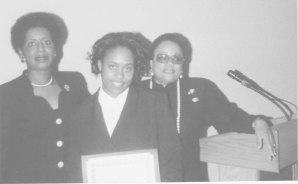 Giese, center, while as a student at UMBC. Photo courtesy of Giese.
What Giese didn’t know at the time was that she was an active participant in the War on Poverty, a social welfare legislation introduced in the 1960s by President Lyndon Bates Johnson intended to help end poverty in the United States. The people she welcomed were part of the about 13 percent of Americans who were living in poverty at the time. When she volunteered, it freed more employees to serve more families. In those informative years, Giese watched her father be a liaison between the federal and state government and local communities carrying out the day-to-day work of social change, and she saw a place for herself in that world.
From local to federal change
Once at UMBC, Giese, a Humanities Scholar and a McNair Scholar, chose a path that broadened the foundation her father had given her. Giese passionately describes the long-term impact her gender and women’s studies courses—taught by Patrice McDermott, now vice provost for faculty affairs—have had on her work with childcare policies at the federal level.
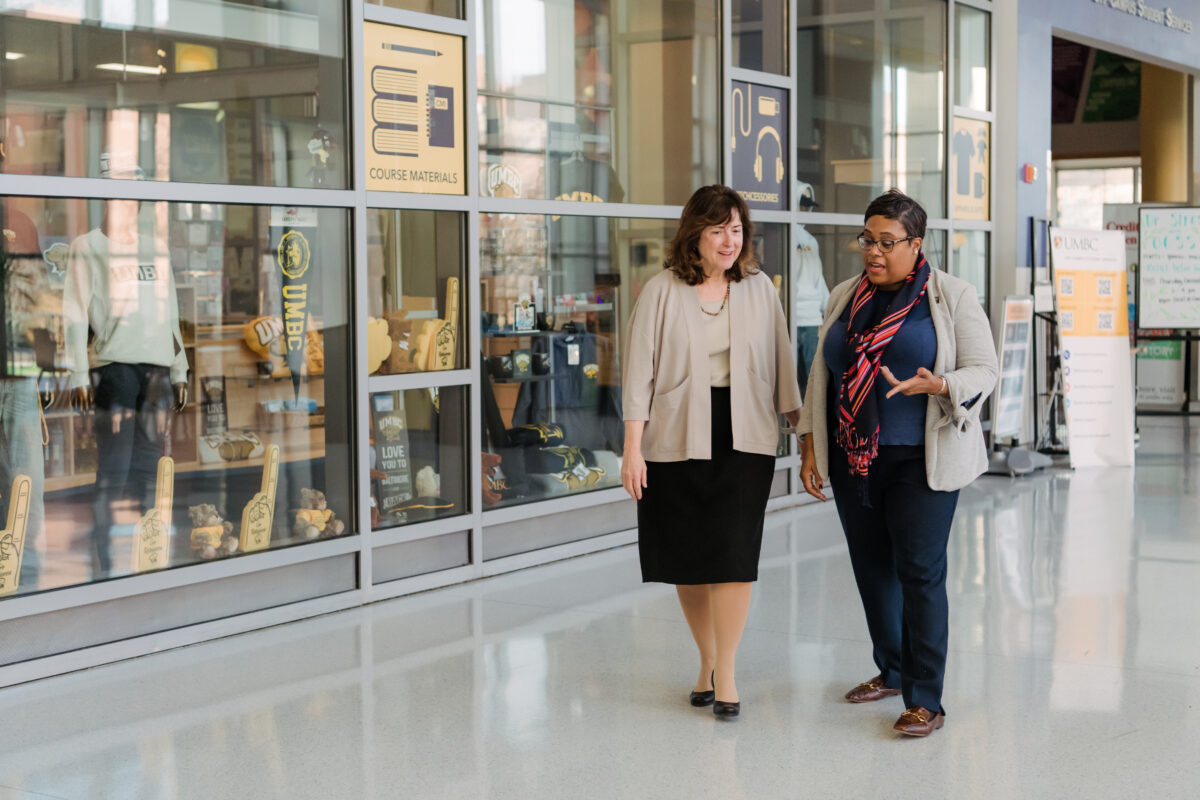 Patrice McDermott and Danielle Giese. (Marlayna Demond ’11/UMBC)
“Learning about how the social construct of gender controls access to work and its distribution, income, and wealth inspired me to engage in conversations about how we define and value ‘male’ work versus ‘female’ work, especially in the childcare industry,” says Giese. “Finally, after 20 years, policymakers are willing to discuss viable wages for childcare workers that will allow them to sustain a family.”
UMBC laid the foundation for so many aspects of Giese’s professional career, but also would determine the personal side of her life too. Danielle Jones met Michael Giese ’97, history, at Humanities Scholars gatherings where they found they shared an agricultural background dating back to the 1860s—with her family’s liberation and landownership and his family’s immigration from a farm in Germany to one in Maryland. He also took McDermott’s gender and women’s studies class. These shared bonds deepened their understanding of the world and each other leading to their marriage and their two children: Kent, 12, and Luke, 10.
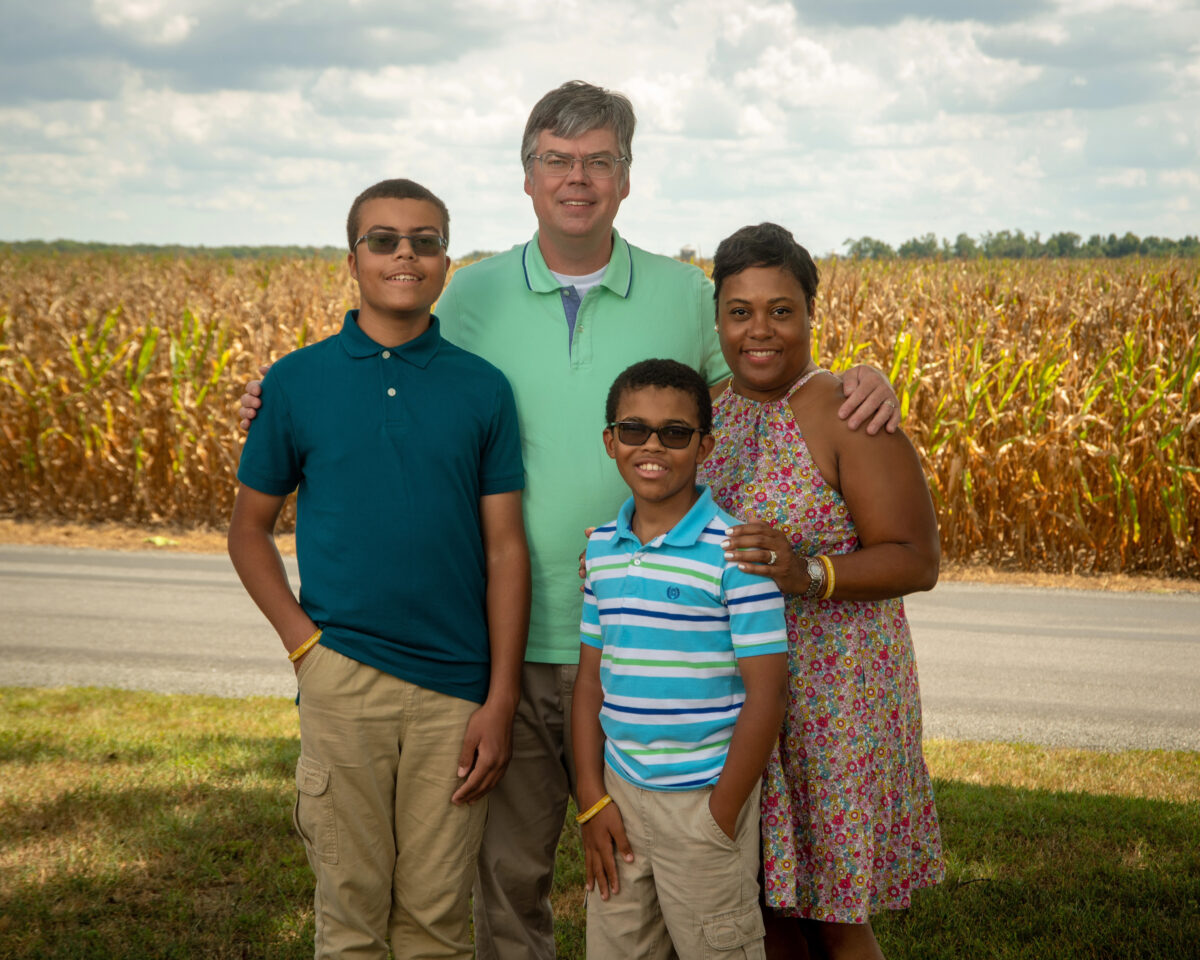 The Giese family. Photo courtesy of Giese.
“Danielle’s courses in gender, women’s, and sexuality studies shaped not only her understanding of herself but also the ways she pursues her work in the world,” shares McDermott. “Her story is a testament to the powerful ways our graduates draw on these lessons within their workplaces and society at large.”
From theory to action
Giese recently spoke about the joy she experienced as an Africana studies major in a video celebrating the department’s 50th anniversary. She shared the pivotal role Willie Lamousé-Smith, professor emeritus and former chair, had in her understanding of race and power in society and the global systems that have supported and perpetuated racism. Giese also shared about the transformative power of her class with Thomas Robinson, professor of Africana studies, on the psychology of racism and how it affects home, work, and personal relationships.
Reflecting on the on-going legacy of the department, Gloria Chuku, current chair and professor of Africana studies said, “The goal of the Africana studies department is to educate about the Africana heritage which includes the experiences, successes, challenges, and progress of people of African descent in the U.S. and across the globe.”
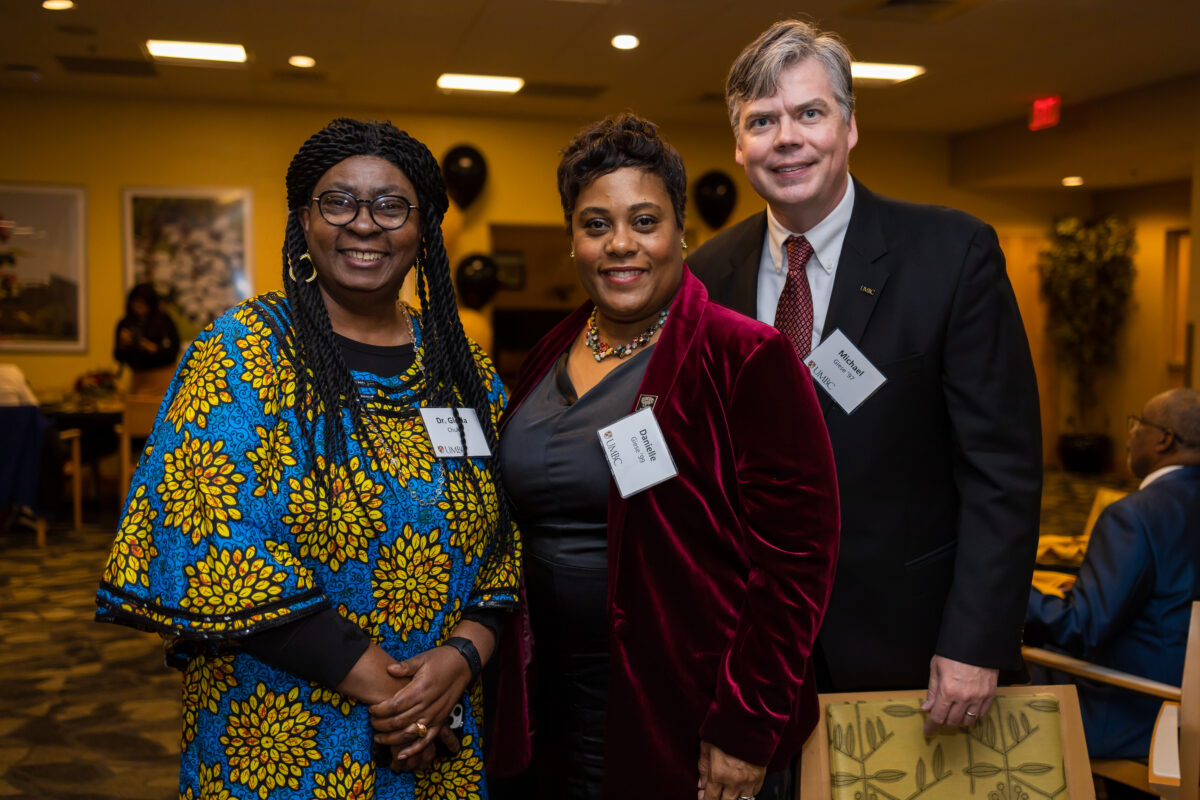 (l-r): Gloria Chuku, Danielle and Michael Giese. (Marlayna Demond ’11/UMBC)
Before graduating, Giese applied her experience from volunteering with her father that she continued to build on at UMBC to serve as an intern within an organization tackling housing issues in the Maryland Housing and Community Development Agency. Once again, she experienced the intricacies of collaborative work between state and local and state and federal programs. Even as a student, Giese could envision the impact she could have if she continued down this path at a federal level.
“The humanities, the cultural studies, provide important insights that we all need to basically influence the nation that we live in. It makes you think creatively about how you want to live your life,” says Giese. “Combining Africana studies with political science has given me incredible insights into how our government systems affect people of color. Change requires daily committed engagement through tough conversations that push the dialogue incrementally. Both majors have given me a leg up in a lot of ways.”
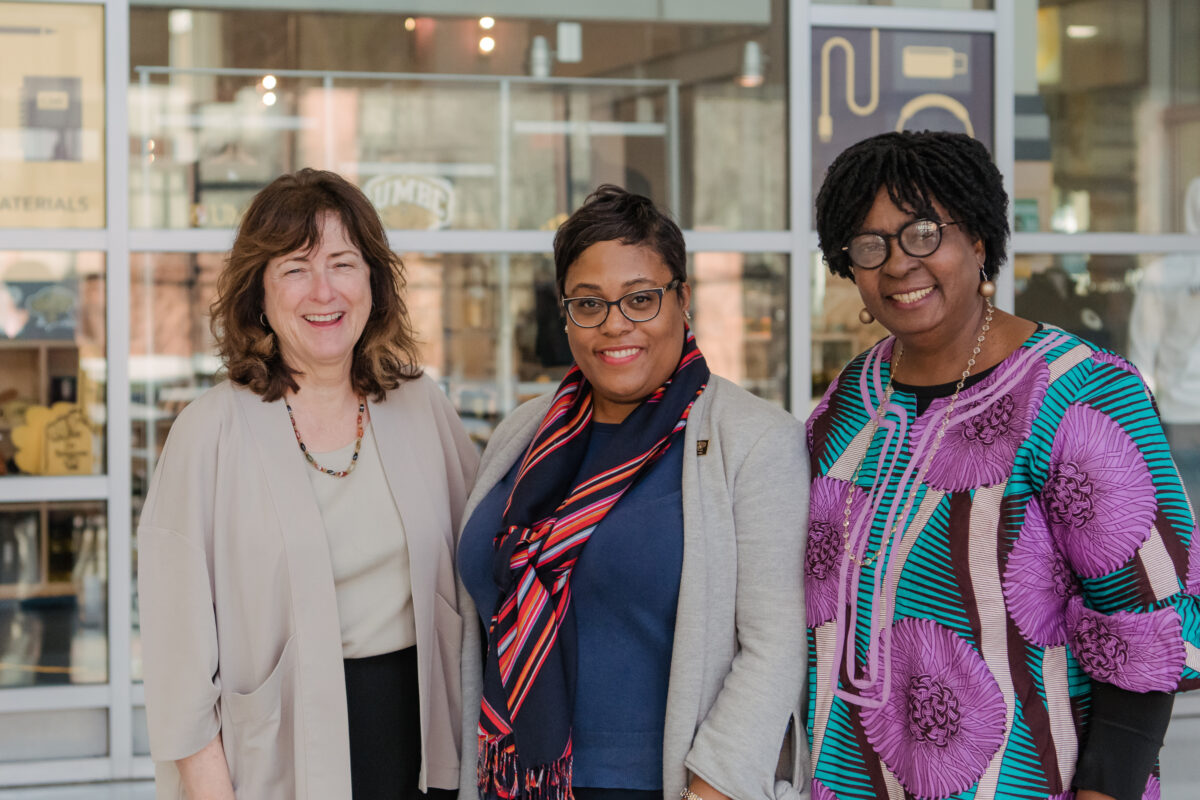 (l-r): McDermott, Giese, and Chuku. (Marlayna Demond ’11/UMBC)
Improving the country
“My work, like my dad’s, is ever-changing because it is always about improving the lives of communities across the country,” says Giese. She specializes in issues related to education, income and workforce security, equitable wages, worker protections, and subsidized childcare programs.
“It’s about engaging in dialogue on whether the federal programs meet the goal, the vision we have for serving people and for improving their lives.” She has no qualms about her ability to do the job well. Slacking off is not an option.
]]>
Danielle Giese ’99, political science and Africana studies, remembers her first paychecks were hot and cheesy pizza lunches. They were the reward for volunteering at the Southern Maryland...
https://umbc.edu/stories/rooted-in-advocacy-federal-programs-meet-needs/
https://beta.my.umbc.edu/api/v0/pixel/news/131287/guest@my.umbc.edu/554028ddcd3fb1887b5cf4f404092bdf/api/pixel
africana-studies
alumni
cahss
gwst
history
impact
magazine
politicalscience
UMBC News & Magazine
https://beta.my.umbc.edu/groups/umbc-news-magazine
https://assets1-beta.my.umbc.edu/system/shared/avatars/groups/000/001/943/24435aa6207c452e7bc15cc74b42c7bb/xsmall.png?1748556657
https://assets1-beta.my.umbc.edu/system/shared/avatars/groups/000/001/943/24435aa6207c452e7bc15cc74b42c7bb/original.png?1748556657
https://assets2-beta.my.umbc.edu/system/shared/avatars/groups/000/001/943/24435aa6207c452e7bc15cc74b42c7bb/xxlarge.png?1748556657
https://assets2-beta.my.umbc.edu/system/shared/avatars/groups/000/001/943/24435aa6207c452e7bc15cc74b42c7bb/xlarge.png?1748556657
https://assets3-beta.my.umbc.edu/system/shared/avatars/groups/000/001/943/24435aa6207c452e7bc15cc74b42c7bb/large.png?1748556657
https://assets1-beta.my.umbc.edu/system/shared/avatars/groups/000/001/943/24435aa6207c452e7bc15cc74b42c7bb/medium.png?1748556657
https://assets2-beta.my.umbc.edu/system/shared/avatars/groups/000/001/943/24435aa6207c452e7bc15cc74b42c7bb/small.png?1748556657
https://assets1-beta.my.umbc.edu/system/shared/avatars/groups/000/001/943/24435aa6207c452e7bc15cc74b42c7bb/xsmall.png?1748556657
https://assets2-beta.my.umbc.edu/system/shared/avatars/groups/000/001/943/24435aa6207c452e7bc15cc74b42c7bb/xxsmall.png?1748556657
UMBC News & Magazine
0
0
false
Mon, 27 Feb 2023 15:52:33 -0500
Mon, 27 Feb 2023 15:52:33 -0500
Meet a Retriever—Nate Dissmeyer ’07, alumni leader and recurring donor

Meet Nate Dissmeyer ’07, information systems, a program manager with Galapagos Federal Systems, providing Army IT support at the Aberdeen Proving Ground. Dissmeyer finds fulfillment in helping to develop IT professionals and supporting the Department of Defense community. And UMBC really gave him the skills to succeed in his position, he says. Dissmeyer, who is a recurring donor and a member of the Alumni Association Board of Directors (AABoD), found his way at UMBC through involvement with the Habitat for Humanity chapter and as a member of Triangle Fraternity.
Q: What’s the one thing you’d want someone who hasn’t joined the UMBC community to know about the support you find here?
A: UMBC is simply a beacon of greatness. We attract some of the best minds, people, staff, leaders, and professors. Support is always present, always available even if you don’t necessarily seek it. There is a sense of if you succeed, we all succeed. Greatness doesn’t always come easy and there are times you’re going to struggle, but with a little grit and help from those around you, you will persevere and succeed.
Q: What brought you to UMBC in the first place?
A: I first came to UMBC for an Odyssey of the Mind competition in middle school. I remember walking around campus and just being amazed with the setting. When it was time to apply to colleges, UMBC was the only one I wanted to attend. It was the perfect size, not too small but not so large that I would be lost in the crowd or just a number on paper. UMBC was rising in the ranks as one of the best schools in the area, and I knew I was going to be challenged in my academic endeavors. Doing well here would help me succeed down the road.
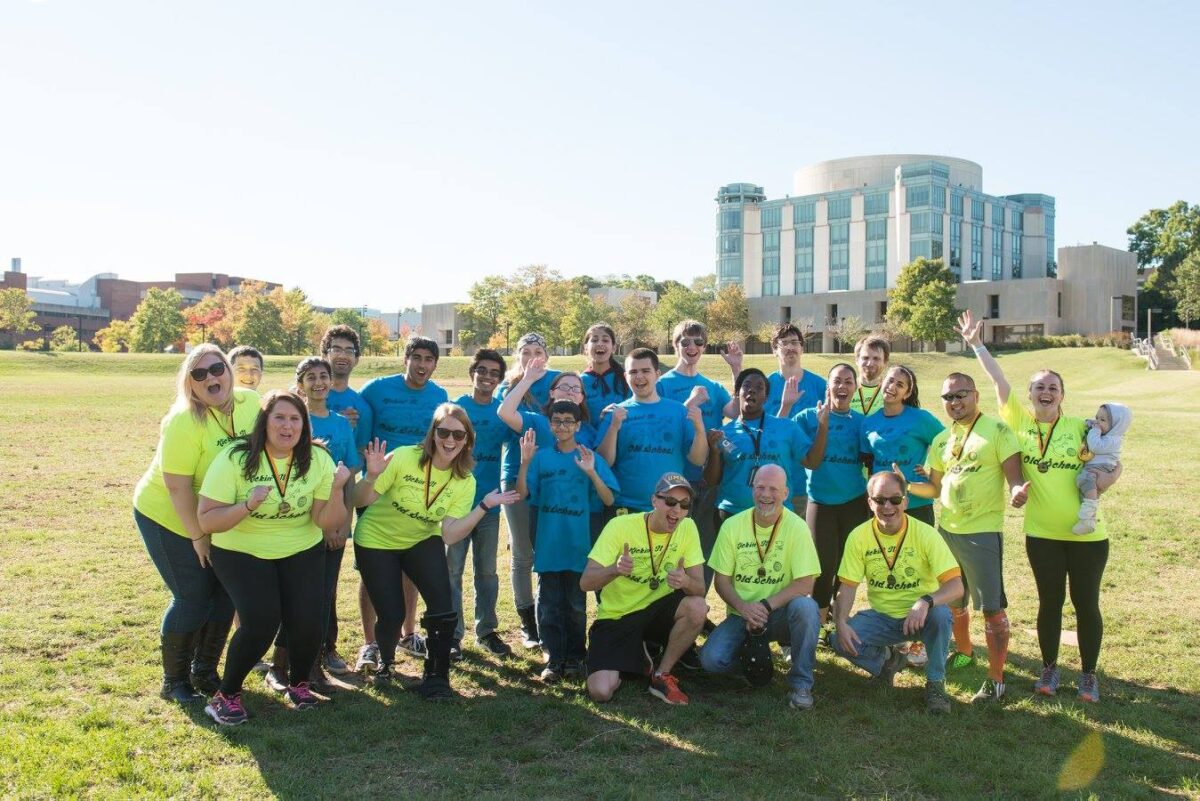 Chapter of Young Alumni gather for the 2015 Student and Alumni Kickball game at Erickson Field. Dissmeyer is second from right.
Q: Tell us about the people who helped you grow at UMBC, and why their HOW made such a difference to you.
A: UMBC provided me much more than a place to get a degree. UMBC surrounded me with amazing people who have continued to influence me. My academic adviser encouraged me to make a degree change when I was struggling my sophomore year. A professor of my project management class who saw something in me to recommend Jim Collins’ Good to Great, which cultivated my management style.
I’ve gotten to see first hand how the money raised for the Alumni Endowment Scholarship helps our current students… Whether a semester’s worth of books, or one less job shift so they can spend more time at home raising their family; being able to help is rewarding.
Nate Dissmeyer ’07
Through my involvement with the Habitat for Humanity chapter, I had the opportunity to help several families in West Baltimore and annually in Florida for our Spring Break build trip. I would have never dreamt that my Greek Life family would introduce me to my amazing wife (Sena Dissmeyer ’08, biochemistry and molecular biology), jump start my professional career, and form some of the most meaningful friendships I have. I am forever grateful for the impact, influence, and experiences UMBC has and will continue to give me.
Q: Tell us what you love about your role as an alumni leader.
A: Participating in the alumni organizations has been very special. I’ve thoroughly enjoyed the efforts to recognize amazing alumni and hearing their stories at the Alumni Awards. I would highly recommend current students to attend at least one event. I’ve also been so pleased to help award scholarships to students, whether raising money through the Chapter of Young Alumni or being part of the selection committee on the AABoD.
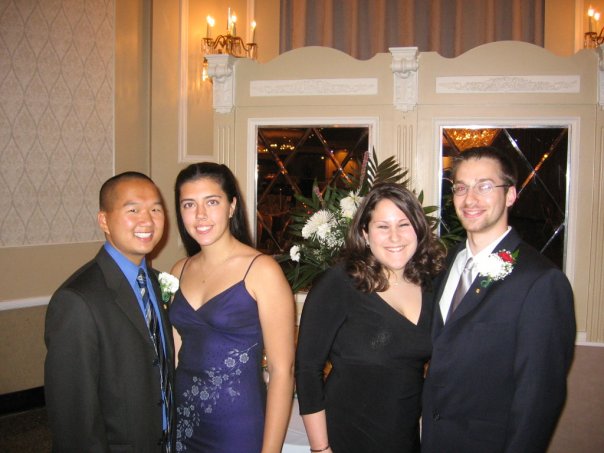
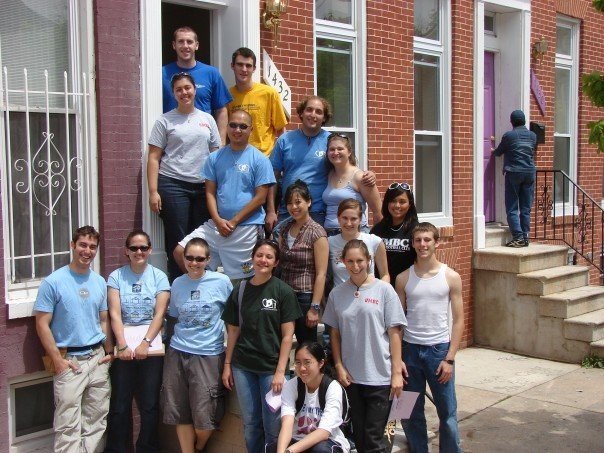 Left; Nate and Sena Dissmeyer stand with Wendy and Adam Bishop (’06, information systems) at the 2007 Triangle Fraternity formal. Right; At a 2007 UMBC Habitat for Humanity house dedication in Sandtown, West Baltimore. Dissmeyer stands in the center with his hands folded together.
Q: What drives you to support UMBC?
A: As a recurring donor, it’s easy to set up my monthly automatic donation, and I’ve gotten to see first hand how the money raised for the Alumni Endowment Scholarship helps our current students from all walks of life continue to achieve their academic success by removing some of the financial stress. Whether a semester’s worth of books, or one less job shift so they can spend more time at home raising their family; being able to help is rewarding.
Q: Who in the community has inspired you or supported you, and how?
A: Honestly, a huge shoutout to Greg Simmons (M.P.P. ’04, vice president for Institutional Advancement) and his Office of Institutional Advancement team. Since joining the alumni groups, I’ve had the privilege of working with amazing staff and leaders. I never quite understood the depths of their work, but they do so much both visibly and behind the scenes. Now in my tenth year of consecutive giving, their hard work truly inspires me to participate and continue to contribute my skills and abilities for the betterment of UMBC.

One of Nate and Sena Dissmeyer’s favorite spots on campus is the Joseph Beuys Sculpture Garden.
Q: What’s your favorite part of being a part of Retriever Nation?
A: I love how passionate we are about UMBC and how supportive we are of one another. The strong passion leads to some great connections within the group, and my circle of friends and professional network connections continue to grow.
* * * * *
UMBC’s greatest strength is its people. When people meet Retrievers and hear about the passion they bring, the relationships they create, the ways they support each other, and the commitment they have to inclusive excellence, they truly get a sense of our community. That’s what “Meet a Retriever” is all about.
Learn more about how UMBC can help you achieve your goals. Donate to the scholarship or program of your choice.
]]>
Meet Nate Dissmeyer ’07, information systems, a program manager with Galapagos Federal Systems, providing Army IT support at the Aberdeen Proving Ground. Dissmeyer finds fulfillment in helping to...
https://umbc.edu/stories/meet-a-retriever-dissmeyer-leader-recurring-donor/
https://beta.my.umbc.edu/api/v0/pixel/news/131268/guest@my.umbc.edu/fc5c3a1fb350356f995c0c0e89ce78ff/api/pixel
alumni-association
coeit
cya
greek-life
impact
information-systems
magazine
meet-a-retriever
perspectives
UMBC News & Magazine
https://beta.my.umbc.edu/groups/umbc-news-magazine
https://assets1-beta.my.umbc.edu/system/shared/avatars/groups/000/001/943/24435aa6207c452e7bc15cc74b42c7bb/xsmall.png?1748556657
https://assets1-beta.my.umbc.edu/system/shared/avatars/groups/000/001/943/24435aa6207c452e7bc15cc74b42c7bb/original.png?1748556657
https://assets2-beta.my.umbc.edu/system/shared/avatars/groups/000/001/943/24435aa6207c452e7bc15cc74b42c7bb/xxlarge.png?1748556657
https://assets2-beta.my.umbc.edu/system/shared/avatars/groups/000/001/943/24435aa6207c452e7bc15cc74b42c7bb/xlarge.png?1748556657
https://assets3-beta.my.umbc.edu/system/shared/avatars/groups/000/001/943/24435aa6207c452e7bc15cc74b42c7bb/large.png?1748556657
https://assets1-beta.my.umbc.edu/system/shared/avatars/groups/000/001/943/24435aa6207c452e7bc15cc74b42c7bb/medium.png?1748556657
https://assets2-beta.my.umbc.edu/system/shared/avatars/groups/000/001/943/24435aa6207c452e7bc15cc74b42c7bb/small.png?1748556657
https://assets1-beta.my.umbc.edu/system/shared/avatars/groups/000/001/943/24435aa6207c452e7bc15cc74b42c7bb/xsmall.png?1748556657
https://assets2-beta.my.umbc.edu/system/shared/avatars/groups/000/001/943/24435aa6207c452e7bc15cc74b42c7bb/xxsmall.png?1748556657
UMBC News & Magazine
0
0
false
Fri, 24 Feb 2023 12:15:31 -0500
Fri, 24 Feb 2023 12:15:31 -0500
UMBC experts guide TV viewers through the promises and pitfalls of artificial intelligence
Over the past week, UMBC faculty and students have given primetime TV news watchers in Baltimore a glimpse of the frontiers of artificial intelligence (AI) research. WJZ, Baltimore’s CBS News affiliate, aired the AI series in six segments, four of which featured UMBC researchers.
Harnessing data to predict sea level rise
The Wednesday evening spot featured Vandana Janeja, chair of information systems (IS). She described how she and other researchers aim to harness artificial intelligence and new data analysis techniques to better predict how climate-driven changes at Earth’s poles, such as melting glaciers, could impact the rest of the world. Janeja directs iHARP, an NSF-funded institute based at UMBC that brings together data scientists and polar experts from across academia, industry, and the government to tackle a defining challenge of our times.
Connecting robots and AI
The Thursday evening segment featured UMBC faculty and students showcasing their work connecting AI and robots for applications such as disaster response and battlefield readiness. IS professors Aryya Gangopadhyay and Nirmalya Roy and computer science and electrical engineering (CSEE) associate professor Tinoosh Mohsenin from the Center for Real-time Distributed Sensing and Autonomy joined computer science students Kevin Rippy ’24, Warren Funk ’24, Hong Nguyen ’25, and Ben Polyakov ’23, computer engineering Ph.D. students Arnab Mazumder and Mozhgan Navardi, and information systems Ph.D. students Indrajeet Ghosh and Neil Kpamegan to explain the technology.
They demonstrated devices such as miniature drones and a robot that could be controlled from afar with hand motions. The researchers are working to develop the brains of such systems so that they can intelligently work with other robots and with human beings.
Explaining ChatGPT
On Friday, Anupam Joshi, professor of CSEE and director of the UMBC Center for Cybersecurity helped viewers grasp an AI invention now making headlines: ChatGPT. The sophisticated chatbot can write text ranging from computer code to essays on the American Revolution, but Joshi explained how it does make errors and should be used carefully.
Identifying harmful biases in AI
Finally, echoing the theme of responsible and cautious AI use, James Foulds, an assistant professor of IS, and Shaniah Reece, a senior majoring in IS, described to TV viewers how biases from the human world can find their way into AI systems, with harmful effects. They are working to identify such biases where they appear, improving the fairness of AI systems.
]]>
Over the past week, UMBC faculty and students have given primetime TV news watchers in Baltimore a glimpse of the frontiers of artificial intelligence (AI) research. WJZ, Baltimore’s CBS News...
https://umbc.edu/stories/umbc-experts-on-promises-and-pitfalls-of-artificial-intelligence/
https://beta.my.umbc.edu/api/v0/pixel/news/131162/guest@my.umbc.edu/d8926082f3b8d08e17786aea6f7aa9b4/api/pixel
cards
coeit
csee
iharp
is
news
research
science-and-tech
UMBC News & Magazine
https://beta.my.umbc.edu/groups/umbc-news-magazine
https://assets1-beta.my.umbc.edu/system/shared/avatars/groups/000/001/943/24435aa6207c452e7bc15cc74b42c7bb/xsmall.png?1748556657
https://assets1-beta.my.umbc.edu/system/shared/avatars/groups/000/001/943/24435aa6207c452e7bc15cc74b42c7bb/original.png?1748556657
https://assets2-beta.my.umbc.edu/system/shared/avatars/groups/000/001/943/24435aa6207c452e7bc15cc74b42c7bb/xxlarge.png?1748556657
https://assets2-beta.my.umbc.edu/system/shared/avatars/groups/000/001/943/24435aa6207c452e7bc15cc74b42c7bb/xlarge.png?1748556657
https://assets3-beta.my.umbc.edu/system/shared/avatars/groups/000/001/943/24435aa6207c452e7bc15cc74b42c7bb/large.png?1748556657
https://assets1-beta.my.umbc.edu/system/shared/avatars/groups/000/001/943/24435aa6207c452e7bc15cc74b42c7bb/medium.png?1748556657
https://assets2-beta.my.umbc.edu/system/shared/avatars/groups/000/001/943/24435aa6207c452e7bc15cc74b42c7bb/small.png?1748556657
https://assets1-beta.my.umbc.edu/system/shared/avatars/groups/000/001/943/24435aa6207c452e7bc15cc74b42c7bb/xsmall.png?1748556657
https://assets2-beta.my.umbc.edu/system/shared/avatars/groups/000/001/943/24435aa6207c452e7bc15cc74b42c7bb/xxsmall.png?1748556657
UMBC News & Magazine
0
0
false
Wed, 22 Feb 2023 13:24:42 -0500
Wed, 22 Feb 2023 13:24:42 -0500
Satellite data: The other type of smartphone data you might not know about

Co-written by Alicia Sabatino ’20, M.S. ’24, geography and environmental systems, UMBC.
When you think about location data on your mobile phone, tablet or laptop, what comes to mind? Mailing addresses? Postal codes? These data indicate where you live, where you work, and the places you visit.
When combined with other types of data over time, companies and governments use them to analyze your consumption patterns, occupation, education, health and financial status.
Turning location services off only prevents smartphone apps from receiving location data. Smartphones can still be located by cell towers and wireless networks when location services are switched off.
This was highlighted by German politician Malte Spitz over a decade ago when he sued his cellphone provider, Deutsche Telekom, for any personal data they had about him.
When the case was settled and he eventually received the data, Spitz found 35,000 references to his location. He was able to visually reconstruct his movements over the previous six months, demonstrating the relevance of data protection laws to the public.
But there is more. By using critical code and documentary research methods, we found that raw satellite location measurement data are perpetually created in our devices all the time.
Because satellite data are building blocks used by our phones to determine where we are, they don’t always get turned off — nor are they collected and treated the same way as location data.
Data outputs
Smartphones determine your location in several ways. The first way involves phones triangulating distances between cell towers or Wi-Fi routers.
The second way involves smartphones interacting with navigation satellites. When satellites pass overhead, they transmit signals to smartphones, which allows smartphones to calculate their own location. This process uses a specialized piece of hardware called the Global Navigation Satellite System (GNSS) chipset. Every smartphone has one.
When these GNSS chipsets calculate navigation satellite signals, they output data in two standardized formats (known as protocols or languages): the GNSS raw measurement protocol and the National Marine Electronics Association protocol (NMEA 0183).
 When satellites pass overhead, they transmit signals to smartphones, which enable smartphones to calculate their own location. (Shutterstock)
GNSS raw measurements include data such as the distance between satellites and cellphones and measurements of the signal itself.
NMEA 0183 contains similar information to GNSS raw measurements, but also includes additional information such as satellite identification numbers, the number of satellites in a constellation, what country owns a satellite, and the position of a satellite.
NMEA 0183 was created and is governed by the NMEA, a not-for-profit lobby group that is also a marine electronics trade organization. The NMEA was formed at the 1957 New York Boat Show when boating equipment manufacturers decided to build stronger relationships within the electronic manufacturing industry.
In the decades since, the NMEA 0183 data standard has improved marine electronics communications and is now found on a wide variety of non-marine communications devices today, including smartphones.
Who has access to these data?
It is difficult to know who has access to data produced by these protocols. Access to NMEA protocols is only available under licence to businesses for a fee.
GNSS raw measurements, on the other hand, are a universal standard and can be read by different devices in the same way without a license. In 2016, Google allowed industries to have open access to it to foster innovation around device tracking accuracy, precision, analytics about how we move in real-time, and predictions about our movements in the future.
While automated processes can quietly harvest location data — like when a French-based company extracted location data from Salaat First, a Muslim prayer app — these data don’t need to be taken directly from smartphones to be exploited.
Data can be modelled, experimented with, or emulated in licensed devices in labs for innovation and algorithmic development.
Satellite-driven raw measurements from our devices were used to power global surveillance networks like STRIKE3, a now defunct European-led initiative that monitored and reported perceived threats to navigation satellites.
Data and citizen rights
Our research raises questions about how rights are protected in the midst of these practices. Citizens have little to no access to the data output from NMEA 0183 and GNSS raw measurements. Because of this, people are unable to negotiate the visibility of their data in these datasets.
The data output from NMEA 0183 and GNSS raw measurements flow unrestricted from every smartphone on the planet. Smartphones have unique identifiers — IMEI numbers — that are known to the tech ecosystem. They can be connected to a user’s personal details.
The flow of NMEA 0183 and GNSS data is invisible to the average person, meaning citizens are unsure of how these data are used, or with whom they are shared. Because of this, it’s impossible for people to challenge how their personal data are used.
 A U.S. Coast Guard boat in Biscayne Bay, Fla., in June 2022. The National Marine Electronics Association is working on improving search-and-rescue operations by ensuring radio distress signals sent by marines contain GPS information. (AP Photo/Lynne Sladky)
As interest in the supposed security, entertainment and surveillance value of these protocols continue to grow, these protocols are increasingly susceptible to misuse by third-party developers.
But there is another layer to this: NMEA 0183 and GNSS raw measurements are standards in industries that offer products and services that many of us benefit from. The NMEA has foundations in safe passage at sea, making their data an important part of emergency services operations. GNSS raw measurements are also utilized for safety purposes.
Could solutions restrict the use of these data for life-critical situations only? Is there an oversight body that could assess what impacts industrial usage of these data might have upon smartphone owner rights and liberties? What about an audit led by civil society, who would be appropriately positioned to objectively inspect these issues to determine whether they might harm the public? For example, consider the way the federal privacy commissioner reviews app data activities.
Location data now flows constantly from GNSS chipsets. There is uncertainty about who is using these data, and for what purposes. Until industry and government reassure citizens that personal data are not being exploited and that rights are protected, these remain open questions.
This article is republished from The Conversation under a Creative Commons license. Read the original article and see more than 250 UMBC articles available in The Conversation.
]]>
Co-written by Alicia Sabatino ’20, M.S. ’24, geography and environmental systems, UMBC. When you think about location data on your mobile phone, tablet or laptop, what comes to mind? Mailing...
https://umbc.edu/stories/satellite-data-the-other-type-of-smartphone-datat/
https://beta.my.umbc.edu/api/v0/pixel/news/131109/guest@my.umbc.edu/452b125ba75b4e308706be8598c56bf3/api/pixel
cahss
cahssresearch
cs3
discovery
ges
magazine
the-conversation
UMBC News & Magazine
https://beta.my.umbc.edu/groups/umbc-news-magazine
https://assets1-beta.my.umbc.edu/system/shared/avatars/groups/000/001/943/24435aa6207c452e7bc15cc74b42c7bb/xsmall.png?1748556657
https://assets1-beta.my.umbc.edu/system/shared/avatars/groups/000/001/943/24435aa6207c452e7bc15cc74b42c7bb/original.png?1748556657
https://assets2-beta.my.umbc.edu/system/shared/avatars/groups/000/001/943/24435aa6207c452e7bc15cc74b42c7bb/xxlarge.png?1748556657
https://assets2-beta.my.umbc.edu/system/shared/avatars/groups/000/001/943/24435aa6207c452e7bc15cc74b42c7bb/xlarge.png?1748556657
https://assets3-beta.my.umbc.edu/system/shared/avatars/groups/000/001/943/24435aa6207c452e7bc15cc74b42c7bb/large.png?1748556657
https://assets1-beta.my.umbc.edu/system/shared/avatars/groups/000/001/943/24435aa6207c452e7bc15cc74b42c7bb/medium.png?1748556657
https://assets2-beta.my.umbc.edu/system/shared/avatars/groups/000/001/943/24435aa6207c452e7bc15cc74b42c7bb/small.png?1748556657
https://assets1-beta.my.umbc.edu/system/shared/avatars/groups/000/001/943/24435aa6207c452e7bc15cc74b42c7bb/xsmall.png?1748556657
https://assets2-beta.my.umbc.edu/system/shared/avatars/groups/000/001/943/24435aa6207c452e7bc15cc74b42c7bb/xxsmall.png?1748556657
UMBC News & Magazine
0
0
false
Tue, 21 Feb 2023 12:04:16 -0500
Tue, 21 Feb 2023 12:04:16 -0500
Inaugural UMBC Paw Poll reveals high levels of student civic engagement

During the November 2022 election, students in Ian Anson’s Public Opinion class had a unique opportunity to examine just how civically engaged UMBC students are, and they found the answers remarkable. The students designed and ran the first UMBC Paw Poll, a survey that gathered information about UMBC undergraduates’ voting behavior and voter registration status, as well as numerous other factors.
“My guiding philosophy is to create applied-learning projects that have legs—that go beyond the classroom context,” says Ian Anson, associate professor of political science. “I want students to experience how political science theories and applications impact communities—in this case, the UMBC community.”
The Paw Poll found UMBC undergraduate students exceed national averages along measures of civic engagement. “UMBC students are the future leaders of our democracy. The Paw Poll is statistical evidence that Retrievers’ civic engagement overwhelmingly outpaces other higher learning institutions in Maryland and beyond,” says Anson.
“Our students are fantastically thoughtful and understand the consequences of their actions for politics,” he reflects. “This is one of UMBC’s most important legacies.”
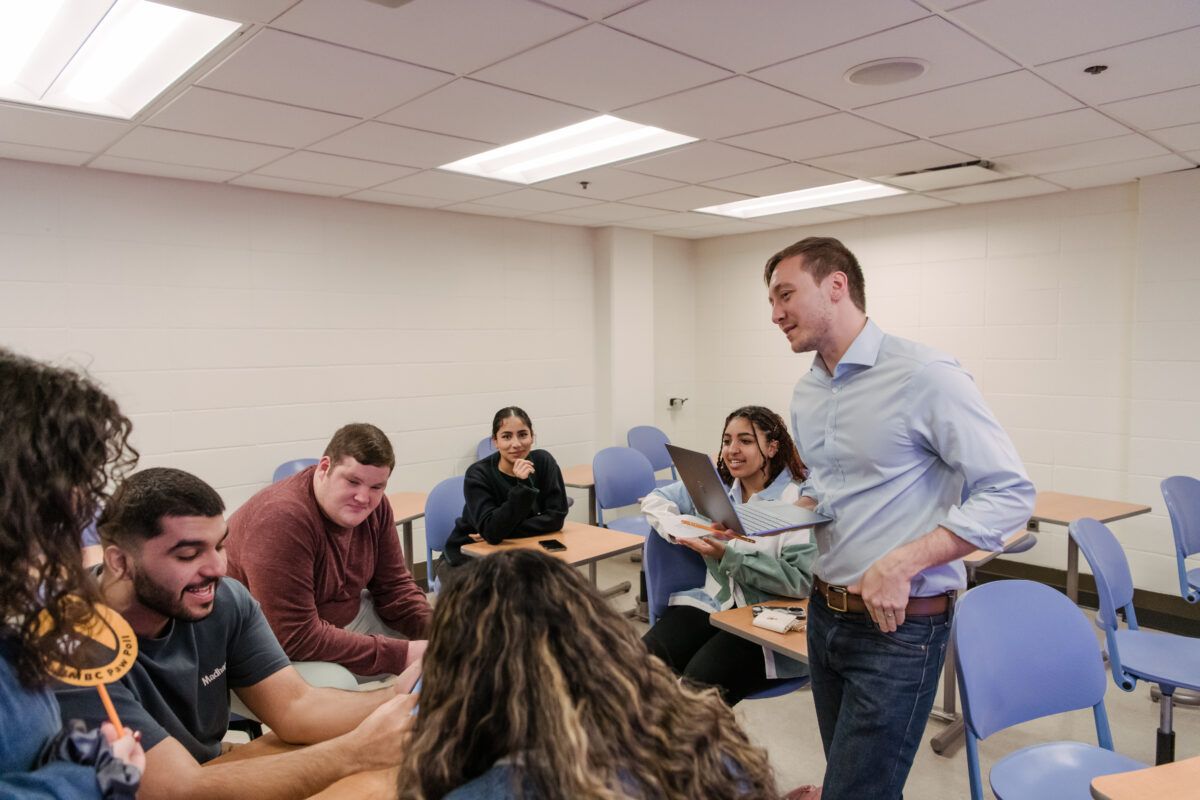 Ian Anson with students in his political science class. (Marlayna Demond ’11/UMBC)
Exceeding national averages
Over 450 undergraduate Retrievers responded to the Paw Poll, a response rate of 15.9%. The survey data (available through the Paw Poll app) reveal that UMBC undergraduate students are highly engaged in the electoral process.
Anson’s Paw Poll report showed that in the 2022 general election (a midterm rather than presidential election year), UMBC registered voters participated at a rate of 53%. This rate is 13% higher than the Institute for Democracy and Higher Educations’ National Study of Learning, Voting, and Engagement (NSLVE) estimate for voting rates among all college students in the 2018 midterm election—the best available comparison. The NSLVE is the nation’s largest study of college and university student voting. It includes nearly 1,200 colleges and universities in all 50 states and the District of Columbia.
Voting in the 2020 presidential election was also higher among UMBC students than the national average of 66% provided by NSLVE. Among students who were at least 20 years old in November 2022 (therefore exceeding the minimum voting age of 18 years old in 2020), all age groups report having voted more often than the national average. Even the subgroup that was 18-19 in 2020 reports having voted at a rate of 78.9%, which is more than 12% higher than the national average. Again, the higher voting rate among UMBC students relative to the national average is statistically significant.
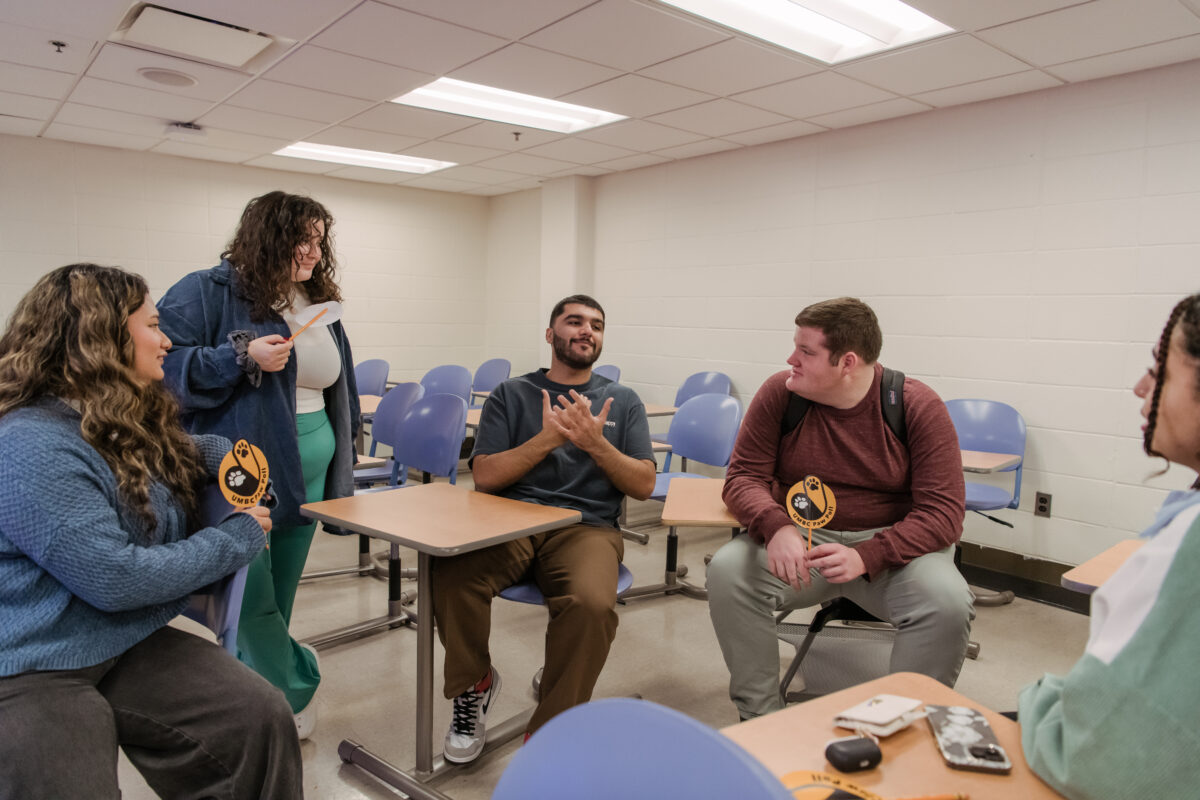 UMBC political science students. (Marlayna Demond ’11/UMBC)
While the Paw Poll shows strong evidence of voter engagement among UMBC students, some groups had higher engagement rates than others. The poll used students’ major designation to distinguish them based on their College or School within UMBC. Registered undergraduates in the College of Engineering and Information Technology and the College of Natural and Mathematical Sciences showed lower rates of participation in the 2022 election than students in the College of Arts, Humanities and Social Sciences and social work programs, indicating an opportunity for greater engagement in the future.
The science of polling
Anson’s Public Opinion class immersed students in the process of exit polling for the first time in 2018. Students surveyed voters in person at Baltimore County voting sites. They logged and analyzed the data in real-time, leading the class to accurately call the race for former Governor Larry Hogan well before the official announcement. Anson wrote about the process in “Who are the Hogan Democrats? UMBC knows” for The Baltimore Sun.
Four years later, voting behaviors had changed dramatically due to COVID-19, with a sharp increase in mail-in ballots. Anson saw this as an opportunity to teach students how to pivot when circumstances change and how to work with a variety of partners to create something new. Together, Anson’s students, the political science department, the Center for Social Science Scholarship, and the Center for Democracy and Civic Life created the new virtual polling project.
Irene Otunla ‘23, political science and media and communication studies, a student in Anson’s Political Opinion class, enjoyed the multifaceted project. Otunla learned about the theories behind polling, how to design a poll item, the grammar of good survey questions, how to encode the responses into software, and how to analyze survey results. She was particularly excited to explore the relationship between believing that voting is a choice or a duty and traits like race, age, gender, and political affiliation.
“I hope UMBC is able to use the data to create more courses like this unique course,” says Otunla, “and find new ways of encouraging students and staff, outside of the political science department, to participate in voting or at least have a greater awareness of politics in general.”
Poised for leadership
The quest to understand student perspectives on civic engagement and to encourage greater levels of it continues among the Paw Poll partners. For example, David Hoffman, Ph.D. ’13, language, literacy, and culture, and the director of UMBC’s Center for Democracy and Civic Life, is working with intern Musa Jafri ’24, political science, and others to gain further insights that will inform future Center programming.
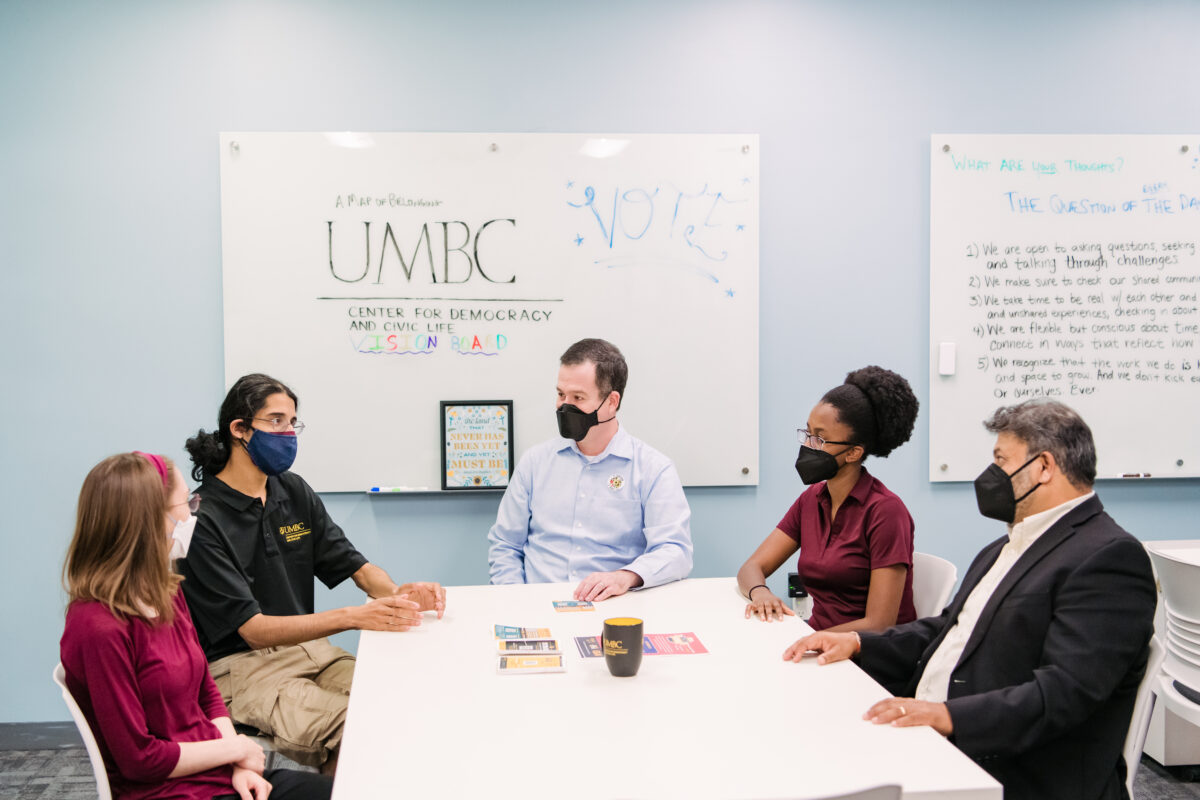 (l-r): Tess McRae ’22, individualized study, coordinator for Civic Design at the Center for Democracy and Civic Life, Jafri, Hoffman, Markya Reed ’18, M.S. ’23, psychology, a graduate assistant at the Center for Democracy and Civic Life, and Sunil Dasgupta, professor of political science. (Marlayna Demond ’11/UMBC)
And the Paw Poll itself will likely continue to grow as well. “In future iterations of the Paw Poll, we hope to further examine the various forms of political activism and engagement that characterize the UMBC student body,” says Anson.
“For now,” he shares, “we remain optimistic that UMBC students are well equipped to become leaders in their communities and to remain engaged with the political process.”
]]>
During the November 2022 election, students in Ian Anson’s Public Opinion class had a unique opportunity to examine just how civically engaged UMBC students are, and they found the answers...
https://umbc.edu/stories/stronginaugural-umbc-student-paw-poll-strong/
https://beta.my.umbc.edu/api/v0/pixel/news/131110/guest@my.umbc.edu/0b659774c2ac91705ad12127a4ac2c55/api/pixel
cahss
cahssresearch
center-for-democracy-and-civic-life
language-literacy-and-culture
mcs
policy-and-society
politicalscience
research
UMBC News & Magazine
https://beta.my.umbc.edu/groups/umbc-news-magazine
https://assets1-beta.my.umbc.edu/system/shared/avatars/groups/000/001/943/24435aa6207c452e7bc15cc74b42c7bb/xsmall.png?1748556657
https://assets1-beta.my.umbc.edu/system/shared/avatars/groups/000/001/943/24435aa6207c452e7bc15cc74b42c7bb/original.png?1748556657
https://assets2-beta.my.umbc.edu/system/shared/avatars/groups/000/001/943/24435aa6207c452e7bc15cc74b42c7bb/xxlarge.png?1748556657
https://assets2-beta.my.umbc.edu/system/shared/avatars/groups/000/001/943/24435aa6207c452e7bc15cc74b42c7bb/xlarge.png?1748556657
https://assets3-beta.my.umbc.edu/system/shared/avatars/groups/000/001/943/24435aa6207c452e7bc15cc74b42c7bb/large.png?1748556657
https://assets1-beta.my.umbc.edu/system/shared/avatars/groups/000/001/943/24435aa6207c452e7bc15cc74b42c7bb/medium.png?1748556657
https://assets2-beta.my.umbc.edu/system/shared/avatars/groups/000/001/943/24435aa6207c452e7bc15cc74b42c7bb/small.png?1748556657
https://assets1-beta.my.umbc.edu/system/shared/avatars/groups/000/001/943/24435aa6207c452e7bc15cc74b42c7bb/xsmall.png?1748556657
https://assets2-beta.my.umbc.edu/system/shared/avatars/groups/000/001/943/24435aa6207c452e7bc15cc74b42c7bb/xxsmall.png?1748556657
UMBC News & Magazine
0
0
false
Wed, 15 Feb 2023 15:50:27 -0500
Wed, 15 Feb 2023 15:50:27 -0500