Meet a Retriever—Karndeep Singh ’18, M26, CYA president

Meet Karndeep Singh ’18, M26, biochemistry and molecular biology, a graduate student at the University of Maryland School of Medicine in the biochemistry and molecular biology Ph.D. program. Singh is conducting his thesis research in Dr. Michael Summers’ laboratory at UMBC. Outside of research, he’s been involved with UMBC’s Chapter of Young Alumni (CYA), serving as the president since summer of 2020. Singh says he’s found his way at UMBC through involvement in research, residential life, and networking with alumni at UMBC.
Q: What’s the one thing you’d want someone who hasn’t joined the UMBC community to know about the support you find here?
A: UMBC will push you to your limits and help you realize that you were meant to break those limits. UMBC will challenge you academically, but you have so much support here as everyone wants you to succeed—it is just a matter of asking for help which can be the hardest first step to take. Do not shy away from asking for help; there is a very high likelihood that others around you need help, too.
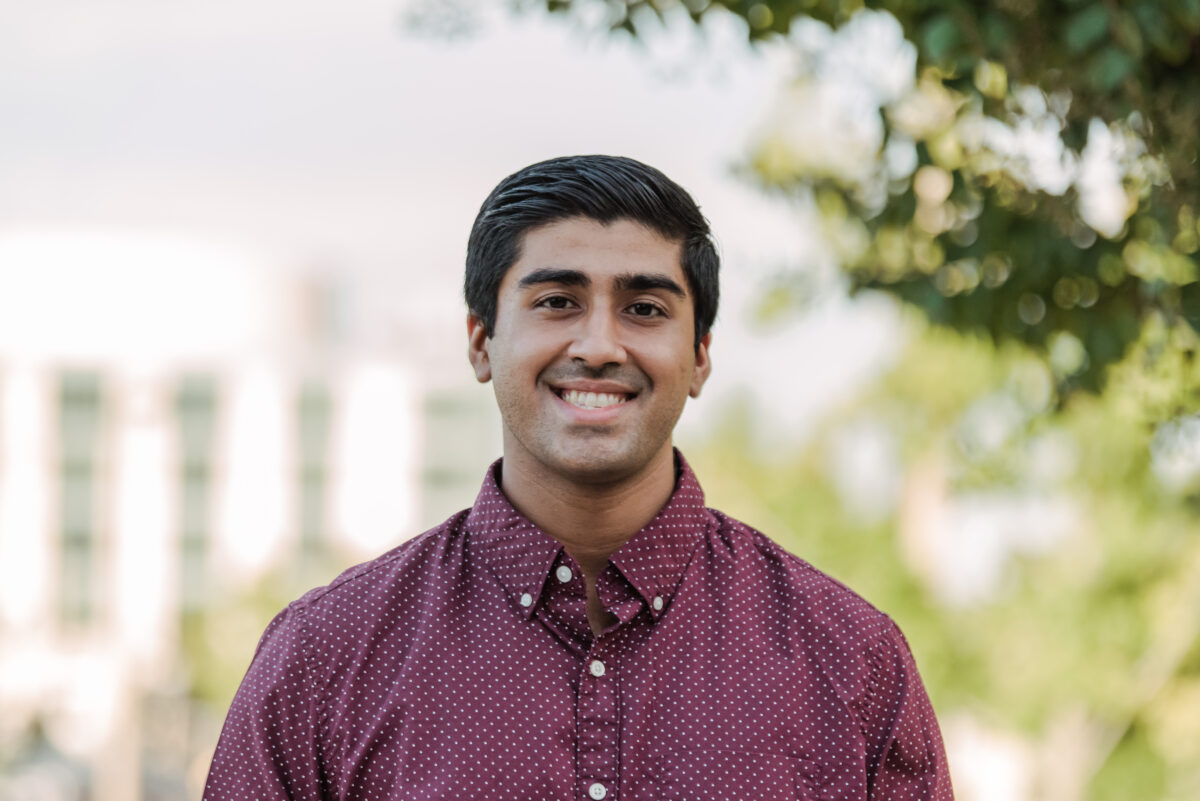 Karndeep Singh ’18, M26 (Marlayna Demond ’11/UMBC)
Q: Tell us about someone in the community who has inspired you or supported you, and how they did it.
A: There has been a village of people at UMBC who have helped me succeed. My advisors in the Meyerhoff Scholars Program guided me as a student by helping me to find research opportunities during my time at UMBC and post-UMBC. Bethany Birago ’99 (emergency health services) taught me and demonstrated all of the professionalism I would need in healthcare and in the workplace.
Last and certainly not least, I met my amazing partner at UMBC—Aishwarya Iyer ’18, M26, biochemistry and molecular biology. She has been one of the hardest workers I have ever seen and continues to inspire me to work harder to have a positive impact at UMBC, in the Baltimore community, and in this world.
UMBC will push you to your limits and help you realize that you were meant to break those limits. UMBC will challenge you academically, but you have so much support here as everyone wants you to succeed.
Karndeep Singh ’18, M26
Q: Tell us about what you love about your academic program or an organization you’re involved in.
A: I joined Residential Life as a resident assistant (RA) during my sophomore year and ultimately became lead RA in Potomac Hall during my senior year. Every year, the staff members I worked with acted as a family, especially my staff during my time in Potomac Hall. We would hold Thanksgiving dinners together, compete with the other residential halls during our summer and winter trainings, game nights, movie nights, etc. At every moment, I felt loved by my staff and knew that any of them would support me if I needed anything at all.
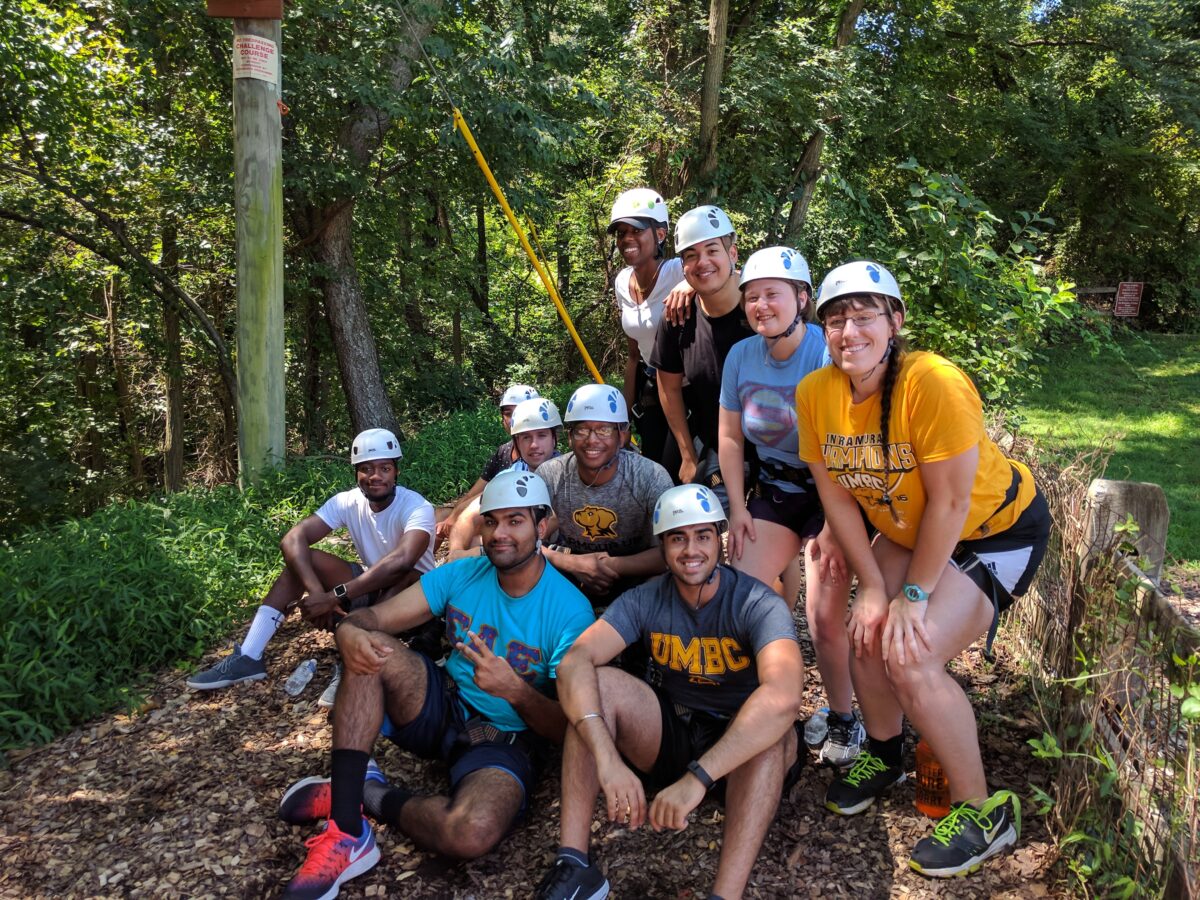 Singh, seated center, poses with other members of Potomac’s Res Life staff.
Q: Where are you currently in your studies, and what do you enjoy most about what you’re doing now?
A: Currently, I am a 4th year Ph.D. candidate in the biochemistry and molecular biology program at the University of Maryland, School of Medicine. I conduct my thesis research in Dr. Michael Summers’ HHMI laboratory at UMBC where my project is focused on investigating how the HIV-1 RNA genome interacts with cap-dependent translational machinery. One of the greatest parts of my role is having the opportunity to mentor undergraduate students as they conduct undergraduate research in our laboratory. My role as their mentor is not to persuade them to do a career in research but teach them how to conduct good science and carry the skills they learn in the laboratory to their future endeavors.
Q: What brought you to UMBC in the first place? Tell us about your primary WHY, and how it led you to UMBC.
A: I attended Western School of Technology and Environmental Science (Western Tech) where a number of our high school events were held at UMBC. I learned about UMBC’s reputation by speaking to current UMBC students and I knew that this was the school to attend if I ultimately wanted a career in STEM. The school was known for its diversity and its community—values that were instilled into me by attending Western Tech and I knew that UMBC embodied those same values and would uphold them.
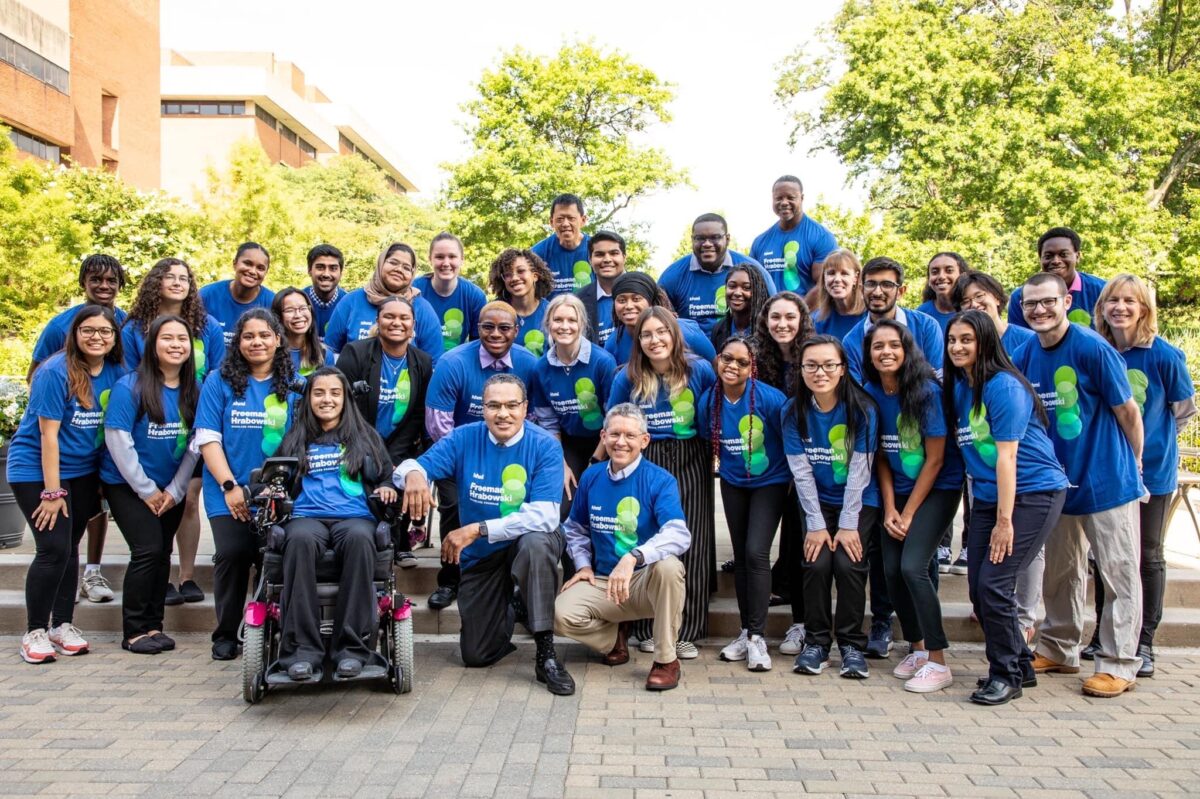 Dr. Michael Summers’ lab group poses with Dr. Hrabowski. Singh is fourth from left, standing in the back row.
Q: Tell us about the people who helped you grow at UMBC, and why their HOW made such a difference to you.
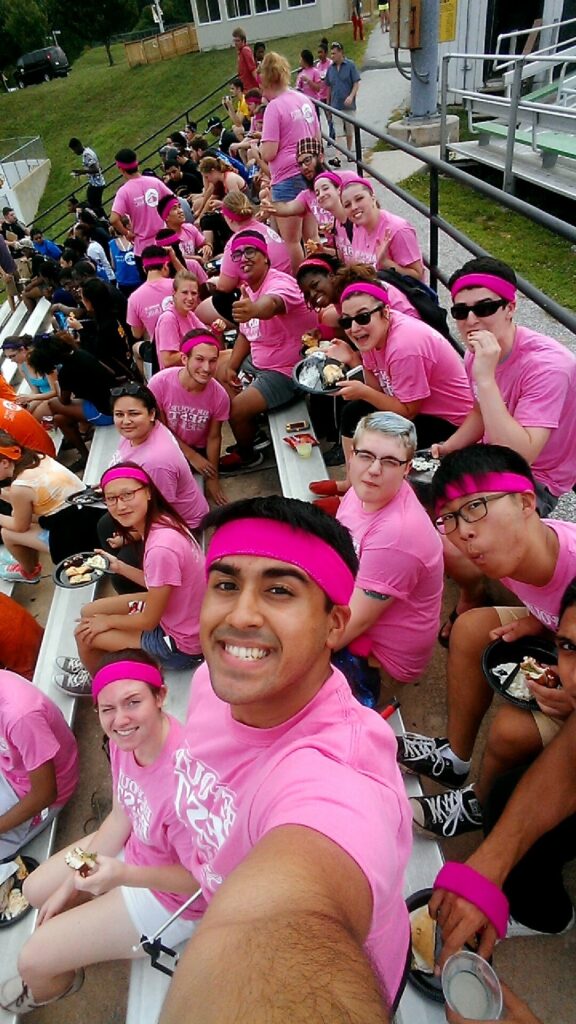 Singh takes a selfie with a group of Res Life staff.
A: During my undergraduate experience, I had a couple of research opportunities, but I did not feel confident to succeed in graduate school. After graduating from UMBC in May 2018, I took a gap year where I joined Dr. Michael Summers’ laboratory as a laboratory technician to supervise and mentor Dr. Joshua Brown’s (Ph.D. ’18, biochemistry) group as he returned to medical school to complete his last two years of his M.D.-Ph.D. program at UMSOM. My partner, Aishwarya Iyer, worked for Dr. Brown and trained me for a few weeks in the laboratory.
It was a weird feeling to go from a position where I was uncomfortable with research and did not feel confident in my abilities as a researcher to now supervising a group of undergraduate students and high school students that were relying on me to guide them about the research project. All of the members in Dr. Summers’ laboratory taught me how to critically think about experiments, how to decide the next steps about our project, how to present my work to others, and how to feel confident in the research I was conducting. It was this research opportunity that solidified my intent to pursue graduate school and continue my career as a scientist.
Fast forward 4-plus years later, I now have my own group of undergraduate students and laboratory technicians (the largest group in the entire laboratory) who conduct research to advance our project.
Q: What’s your favorite part of being a part of Retriever Nation?
A: I love to attend the alumni events put on by the different alumni organizations. With the work I have done with CYA, I have had the chance to host some of these events and meet so many amazing alumni through happy hour events, trivia nights, and the Alumni Awards. The best part of hosting the events is working with the fantastic Alumni Engagement and Development team—they represent some of the best staff I have ever had the opportunity to work with and when you are planning and hosting events with them, it does not even feel like work.
 Singh poses with his partner Aishwarya Iyer ’18, M26.
Q: If you’re a donor, what drives you to support UMBC?
A: Throughout my undergraduate experience, I had a wide array of positions to help financially support my family while attending school. It is a lot to manage especially as you are trying to participate in different activities like research, extracurricular activities, or just spending some time with your friends or roommates. Whether or not there is a student who is in a similar predicament as I was, I donate to help alleviate some of the financial stress of school.
* * * * *
UMBC’s greatest strength is its people. When people meet Retrievers and hear about the passion they bring, the relationships they create, the ways they support each other, and the commitment they have to inclusive excellence, they truly get a sense of our community. That’s what “Meet a Retriever” is all about.
Learn more about how UMBC can help you achieve your goals.
]]>
Meet Karndeep Singh ’18, M26, biochemistry and molecular biology, a graduate student at the University of Maryland School of Medicine in the biochemistry and molecular biology Ph.D. program. Singh...
https://umbc.edu/stories/meet-a-retriever-karndeep-singh-cya-president/
https://beta.my.umbc.edu/api/v0/pixel/news/131832/guest@my.umbc.edu/08ffa0af22887b38ff43276315cb06fd/api/pixel
alumni
biochemistry-and-molecular-biology
cya
impact
magazine
meet-a-retriever
meyerhoffscholars
perspectives
UMBC News & Magazine
https://beta.my.umbc.edu/groups/umbc-news-magazine
https://assets1-beta.my.umbc.edu/system/shared/avatars/groups/000/001/943/24435aa6207c452e7bc15cc74b42c7bb/xsmall.png?1748556657
https://assets1-beta.my.umbc.edu/system/shared/avatars/groups/000/001/943/24435aa6207c452e7bc15cc74b42c7bb/original.png?1748556657
https://assets2-beta.my.umbc.edu/system/shared/avatars/groups/000/001/943/24435aa6207c452e7bc15cc74b42c7bb/xxlarge.png?1748556657
https://assets2-beta.my.umbc.edu/system/shared/avatars/groups/000/001/943/24435aa6207c452e7bc15cc74b42c7bb/xlarge.png?1748556657
https://assets3-beta.my.umbc.edu/system/shared/avatars/groups/000/001/943/24435aa6207c452e7bc15cc74b42c7bb/large.png?1748556657
https://assets1-beta.my.umbc.edu/system/shared/avatars/groups/000/001/943/24435aa6207c452e7bc15cc74b42c7bb/medium.png?1748556657
https://assets2-beta.my.umbc.edu/system/shared/avatars/groups/000/001/943/24435aa6207c452e7bc15cc74b42c7bb/small.png?1748556657
https://assets1-beta.my.umbc.edu/system/shared/avatars/groups/000/001/943/24435aa6207c452e7bc15cc74b42c7bb/xsmall.png?1748556657
https://assets2-beta.my.umbc.edu/system/shared/avatars/groups/000/001/943/24435aa6207c452e7bc15cc74b42c7bb/xxsmall.png?1748556657
UMBC News & Magazine
1
0
false
Wed, 15 Mar 2023 16:15:13 -0400
Wed, 15 Mar 2023 16:15:13 -0400
Meet a Retriever—Anthony Rivera, information systems major and student researcher
Meet Anthony Rivera, a senior information systems (IS) major and a first-generation college student. When he’s not working on research related to improving equity for Medicaid recipients, you can also find him exploring his creative side through photography and a minor in theatre. Take it away, Anthony!
Q: Tell us about how you wound up at UMBC.
A: Hello, my name is Anthony Rivera and I am a senior information systems (IS) major, theatre minor student using he/him pronouns. I study IS because I am fascinated by the way people interact with technology and seeing those trends in human activity. I plan to continue schooling past undergrad to have the fullest understanding possible of the way we use and will continue to use technology. Outside of school my main hobbies are photography, bodybuilding, and musical theatre. Photography is one of my favorite hobbies and I will probably do it for the rest of my life.
Q: What do you love most about your academic program?
A: Something I really enjoy is the collaboration between students. It’s clear we are all here to improve ourselves and to learn. I find that all of my colleagues in class have been willing to help, offer unique insight, and foster a great environment for learning. When we all work together and work hard, each task and goal seems feasible rather than impossible.
Q: Are you a member of any academic groups? What’s it like?
A: I am a member of CWIT (Center for Women in Technology), more specifically the Cyber Scholars Program. I really appreciate CWIT for their guidance, allowing me to discuss what classes I should take, what research I should do, and helping me craft my resume which ultimately led to my first internship at CU Boulder in Colorado, where I did research on gamification principles and their relation to learning performance with music, a experience I will never forget.
If my research … is successful then we will have created a system that allows those who previously would not have received care or who have to wait a very long time for Medicaid to receive it sooner…I think this research is invaluable and a step in the right direction.
Anthony Rivera
Senior information systems student
Q: We like to use a saying at UMBC that we do “public research for public good”…so I’m wondering if you might speak to the ways your current research might fit into this idea?
A: I wanted to know more about machine learning, and Dr. James Foulds (IS) happened to give a lecture about his work during a CWIT Cyber Practicum, so I reached out to see if I could assist him in his work and learn about the topics he does research about. I was not prepared for such a project that is so focused on equity for all in Medicaid, but it has opened my eyes further to the inequalities people face due to variables and factors outside of their control. Projects like this enable people to get care so that they focus on their lives and those goals are in line with my personal philosophies.
If my research with Dr. Foulds is successful then we will have created a system that allows those who previously would not have received care or who have to wait a very long time for Medicaid to receive it sooner. This allows people to return to their lives, go back to contributing to society, ultimately lifting a burden on those who cannot afford private care.
I think this research is invaluable and a step in the right direction, which I believe is guaranteed care for all. I do not think anyone, regardless of financial background, class, race, gender orientation, or ability, should be denied whatever care they require, especially when we are the richest country in the history of humanity. So I believe projects like this move the needle in terms of what we should and can expect from our government healthcare systems, and I think that we can slowly begin to realize what truly is fair for the people.
Q: When you’re not in class or conducting research, how do you like to spend your free time?
A: I am a member of the Musical Theatre Club, a place where I am allowed to focus on the non-STEM and activate a different part of my brain with a different type of expression and it’s nice having that kind of balance.
 Students from the Musical Theatre Club perform in the 25th Annual Putnam County Spelling Bee in fall 2022. Photo courtesy of Rivera.
Q: Have you found a supportive environment at UMBC?
A: Most of my friends that I still have, since I am a senior, actually came from my freshman year in a computer science. I think being in that shared environment where our mutual interests tended to align sort of fostered an easy relationship between me and the friends I have now. All of them are brilliant in their own unique ways and I have never been around so many diverse people all allowing me to learn and see more about life in general that I had not before.
 Anthony enjoys spending his free time working on his photography. Photo courtesy of Rivera.
Q: As a first-generation college student, what advice would you give to others in similar situations?
A: Keep your head up. As time passes, all you will regret is if you did not work harder, but make sure you find balance.
* * * * * *
UMBC’s greatest strength is its people. When people meet Retrievers and hear about the passion they bring, the relationships they create, the ways they support each other, and the commitment they have to inclusive excellence, they truly get a sense of our community. That’s what “Meet a Retriever” is all about.
Learn more about how UMBC can help you achieve your goals. Donate to the scholarship or program of your choice.
]]>
Meet Anthony Rivera, a senior information systems (IS) major and a first-generation college student. When he’s not working on research related to improving equity for Medicaid recipients, you can...
https://umbc.edu/stories/meet-anthony-rivera-information-systems/
https://beta.my.umbc.edu/api/v0/pixel/news/131811/guest@my.umbc.edu/3ccbeb5e8a3249ccd9712fc37557aabd/api/pixel
cwit
cyberscholars
information-systems
magazine
meet-a-retriever
perspectives
UMBC News & Magazine
https://beta.my.umbc.edu/groups/umbc-news-magazine
https://assets1-beta.my.umbc.edu/system/shared/avatars/groups/000/001/943/24435aa6207c452e7bc15cc74b42c7bb/xsmall.png?1748556657
https://assets1-beta.my.umbc.edu/system/shared/avatars/groups/000/001/943/24435aa6207c452e7bc15cc74b42c7bb/original.png?1748556657
https://assets2-beta.my.umbc.edu/system/shared/avatars/groups/000/001/943/24435aa6207c452e7bc15cc74b42c7bb/xxlarge.png?1748556657
https://assets2-beta.my.umbc.edu/system/shared/avatars/groups/000/001/943/24435aa6207c452e7bc15cc74b42c7bb/xlarge.png?1748556657
https://assets3-beta.my.umbc.edu/system/shared/avatars/groups/000/001/943/24435aa6207c452e7bc15cc74b42c7bb/large.png?1748556657
https://assets1-beta.my.umbc.edu/system/shared/avatars/groups/000/001/943/24435aa6207c452e7bc15cc74b42c7bb/medium.png?1748556657
https://assets2-beta.my.umbc.edu/system/shared/avatars/groups/000/001/943/24435aa6207c452e7bc15cc74b42c7bb/small.png?1748556657
https://assets1-beta.my.umbc.edu/system/shared/avatars/groups/000/001/943/24435aa6207c452e7bc15cc74b42c7bb/xsmall.png?1748556657
https://assets2-beta.my.umbc.edu/system/shared/avatars/groups/000/001/943/24435aa6207c452e7bc15cc74b42c7bb/xxsmall.png?1748556657
UMBC News & Magazine
1
0
false
Tue, 14 Mar 2023 10:04:49 -0400
Tue, 14 Mar 2023 10:04:49 -0400
Immigration Orientation for Exchange Scholars
Mandatory reading for Exchange Scholars and their dependents
The document shares your rights in the US and other important information for you to start your journey in the US. Please take some time to read it and let me know if you have any questions!
Diane
]]>
The document shares your rights in the US and other important information for you to start your journey in the US. Please take some time to read it and let me know if you have any questions!...
https://www.canva.com/design/DAFU7mAqxwA/pi6GuHDPSPao3Iz78fphVA/view?utm_content=DAFU7mAqxwA&utm_campaign=designshare&utm_medium=link2&utm_source=sharebutton
https://beta.my.umbc.edu/api/v0/pixel/news/131660/guest@my.umbc.edu/de50132df81e5fc0c0c24ea85b3bcf0d/api/pixel
Exchange Visitors
https://beta.my.umbc.edu/groups/j-1
https://assets3-beta.my.umbc.edu/system/shared/avatars/groups/000/001/488/175f9f6b6c231ae5de90058948f6228c/xsmall.png?1525966942
https://assets3-beta.my.umbc.edu/system/shared/avatars/groups/000/001/488/175f9f6b6c231ae5de90058948f6228c/original.jpg?1525966942
https://assets2-beta.my.umbc.edu/system/shared/avatars/groups/000/001/488/175f9f6b6c231ae5de90058948f6228c/xxlarge.png?1525966942
https://assets1-beta.my.umbc.edu/system/shared/avatars/groups/000/001/488/175f9f6b6c231ae5de90058948f6228c/xlarge.png?1525966942
https://assets2-beta.my.umbc.edu/system/shared/avatars/groups/000/001/488/175f9f6b6c231ae5de90058948f6228c/large.png?1525966942
https://assets1-beta.my.umbc.edu/system/shared/avatars/groups/000/001/488/175f9f6b6c231ae5de90058948f6228c/medium.png?1525966942
https://assets1-beta.my.umbc.edu/system/shared/avatars/groups/000/001/488/175f9f6b6c231ae5de90058948f6228c/small.png?1525966942
https://assets3-beta.my.umbc.edu/system/shared/avatars/groups/000/001/488/175f9f6b6c231ae5de90058948f6228c/xsmall.png?1525966942
https://assets4-beta.my.umbc.edu/system/shared/avatars/groups/000/001/488/175f9f6b6c231ae5de90058948f6228c/xxsmall.png?1525966942
Exchange Visitors
https://assets1-beta.my.umbc.edu/system/shared/thumbnails/news/000/131/660/77cbbfdd8009c0c0d1de2aa4b04a1062/xxlarge.jpg?1678736807
https://assets1-beta.my.umbc.edu/system/shared/thumbnails/news/000/131/660/77cbbfdd8009c0c0d1de2aa4b04a1062/xlarge.jpg?1678736807
https://assets2-beta.my.umbc.edu/system/shared/thumbnails/news/000/131/660/77cbbfdd8009c0c0d1de2aa4b04a1062/large.jpg?1678736807
https://assets3-beta.my.umbc.edu/system/shared/thumbnails/news/000/131/660/77cbbfdd8009c0c0d1de2aa4b04a1062/medium.jpg?1678736807
https://assets3-beta.my.umbc.edu/system/shared/thumbnails/news/000/131/660/77cbbfdd8009c0c0d1de2aa4b04a1062/small.jpg?1678736807
https://assets1-beta.my.umbc.edu/system/shared/thumbnails/news/000/131/660/77cbbfdd8009c0c0d1de2aa4b04a1062/xsmall.jpg?1678736807
https://assets2-beta.my.umbc.edu/system/shared/thumbnails/news/000/131/660/77cbbfdd8009c0c0d1de2aa4b04a1062/xxsmall.jpg?1678736807
0
0
true
Mon, 13 Mar 2023 15:47:24 -0400
Deepak Koirala to grow understanding of how enteroviruses replicate with $786K NSF CAREER Award
Diseases such as polio, the common cold, and meningitis are all caused by closely related viruses and the way these viruses multiply in the body is poorly understood. Deepak Koirala, assistant professor of chemistry and biochemistry at UMBC, has already begun to unravel the mystery. Now, with a $786,000 NSF CAREER Award, his research group will be able to answer even more questions. In particular, they will investigate the RNA structures within the genetic material in these viruses and how those structures enable the viruses to multiply inside cells. The answers could eventually lead to drugs that attack specific mechanisms critical for viral replication, stopping these diseases in their tracks.
Koirala’s lab works on enteroviruses, a group of viruses that have a genome made of a single strand of RNA, rather than double-stranded DNA (like in humans). “RNA is a really versatile and dynamic molecule that functions in pretty much every aspect of cellular processes,” Koirala says.
In viruses with RNA genomes, the genome must control both the process that copies (replicates) the genome and the process that converts the genetic code into proteins. Both processes involve coordination of numerous viral and host cell proteins. The RNA must also somehow continually “decide” between the two processes. In DNA genomes, the DNA is only responsible for replication.
With the new grant, Koirala’s group seeks to better understand how enteroviruses make the decision between copying their genome and building proteins. But before they can do that, they need to nail down the three-dimensional RNA structures within the enterovirus genome that are involved in those processes.
Defining the target
Based on the way enterovirus genomes behave in biochemical studies, previous research has predicted that the beginning of an enterovirus’s genomic RNA strand folds up on itself, forming a shape resembling a cloverleaf. That structure builds a platform to assemble the viral and host proteins required for replication. This idea is widely accepted, but the precise three-dimensional structure of this region, the so-called “cloverleaf RNA domain,” and how it regulates viral replication is unknown. Figuring that out is the Koirala lab’s main task.
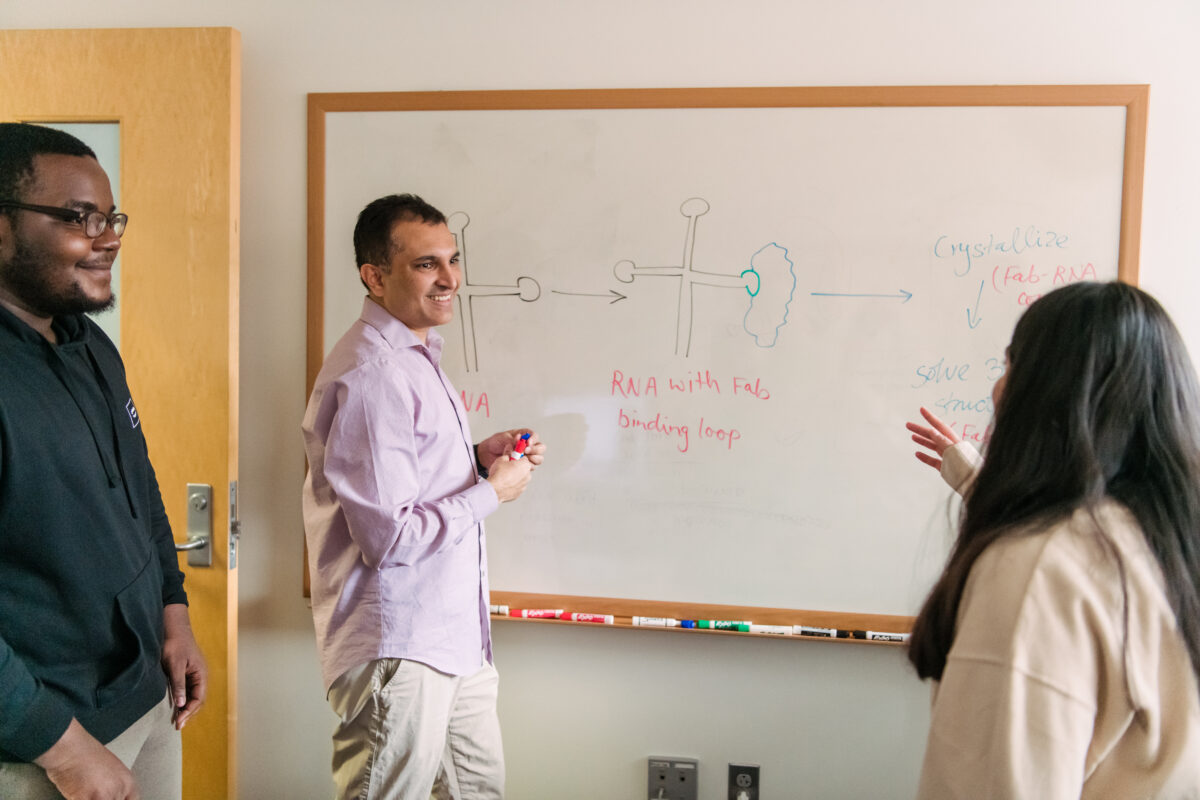 Deepak Koirala draws a basic cloverleaf RNA on the whiteboard and discusses with students Senali Dansou (left) and Alisha Patel. (Marlayna Demond ’11/UMBC)
They are well on their way. Koirala’s group recently determined the cloverleaf structure from a coxsackievirus, which causes hand-foot-and-mouth disease, and is an important model system for studying many other human viruses. It will be published in a forthcoming paper in Nature Communications. “I think the field will be really excited to see this,” Koirala says. “It would be the first three-dimensional structure of the full-length cloverleaf domain for the entire enterovirus genus.”
Because the cloverleaf domain is so important for viral replication, the expectation is that its structure will be similar, if not identical, across all enteroviruses. With the new grant, Koirala hopes to determine the 3D structures of this region in several more enteroviruses. The structures the sequences form that are the same or similar across species are most likely to play similar key roles in the viral life cycle.
“That will create the opportunity to get a generic target that might be able to treat more than one of these viruses,” Koirala says. “If you really hit a structure in coxsackievirus, for example, that’s shared across many other enteroviruses, then that could be equally useful for, say, rhinovirus. In the long term, that could be really powerful.”
Crystals and X-rays
Determining the 3D structure of RNA is notoriously difficult. Koirala’s group uses a technique called X-ray crystallography, where one must first turn the RNA into a crystal through a laborious process. Then a machine directs X-rays through the crystal and then a detector records the reflections that come out. By examining those reflections, called diffraction patterns, the researchers can deduce the molecule’s shape in the crystal. Then, they map the known sequence of RNA bases onto the shape for a final 3D structure.
To make this a little easier, Koirala’s group uses a cutting-edge technique that results in successful crystallization more often than traditional methods. Koirala came to UMBC in 2020 after completing a postdoctoral fellowship in the research group at the University of Chicago that pioneered the technique.
The technique involves attaching a fragment of a synthetic antibody to the RNA, which serves as a “chaperone” to help the RNA crystallize. RNA is coated with negative charges, which repel each other and make it harder to pack the molecules tightly together—a necessary part of crystal formation. When the RNA binds to the protein, those negative charges are neutralized. And, because the protein’s structure is known, that makes it easier to detect the unknown RNA structure in the crystal.
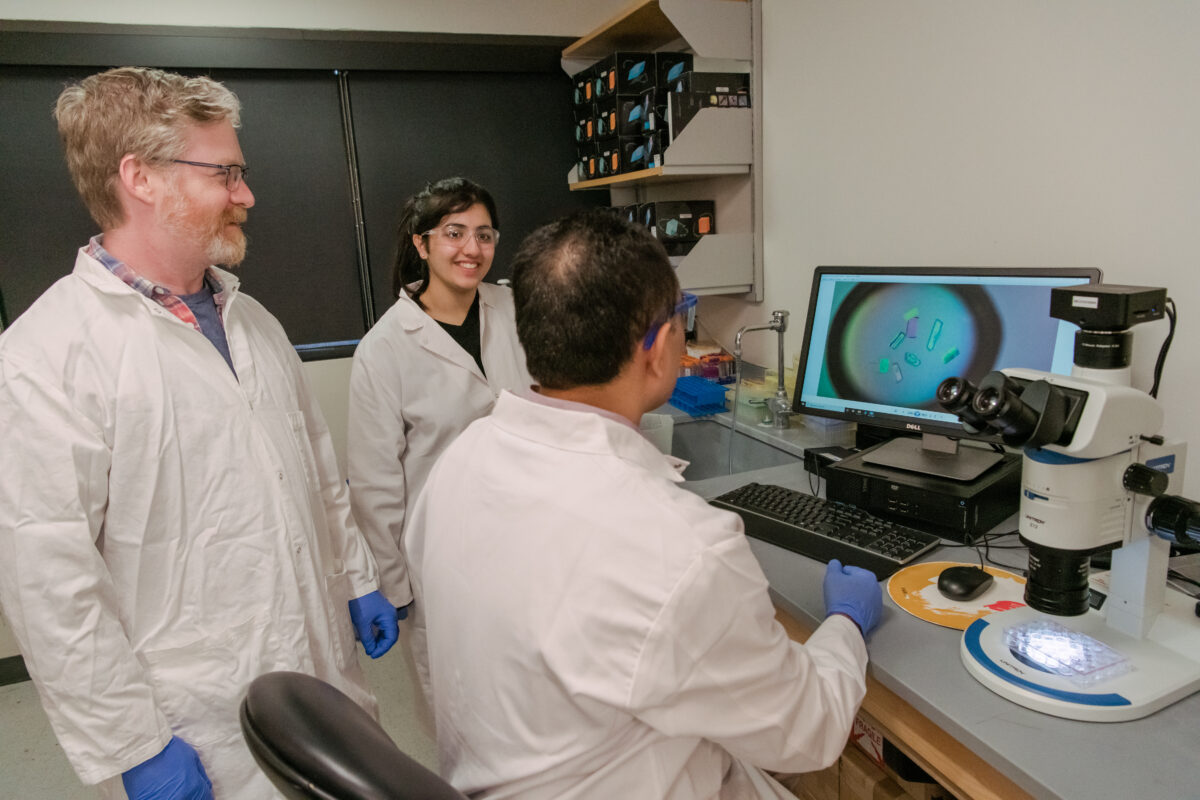 Deepak Koirala, seated, looks at a microscope image of RNA crystals with students Jeffrey Vogt (left) and Zohra Mian. (Marlayna Demond ’11/UMBC)
“Just the beginning”
But even after all that, “The structure is just the beginning,” Koirala says.
RNA does not normally exist as crystals. Therefore, for one, it is important to know if the 3D structure of the protein-bound, crystallized RNA accurately represents what the RNA looks like in a biological context. But with the crystal structure in hand, “Now we have more idea about what to do next,” Koirala says, “to show what the important features of that particular structure are that dictate or define the function.” Follow-up biochemical experiments with deliberately modified versions of the RNA can help tease out which parts of the structure are critical for different functions.
And finally, Koirala says, “Now, with a well-characterized RNA structure, one has an opportunity to design a drug molecule, for example, that precisely targets that RNA structure and stops the genome replication.”
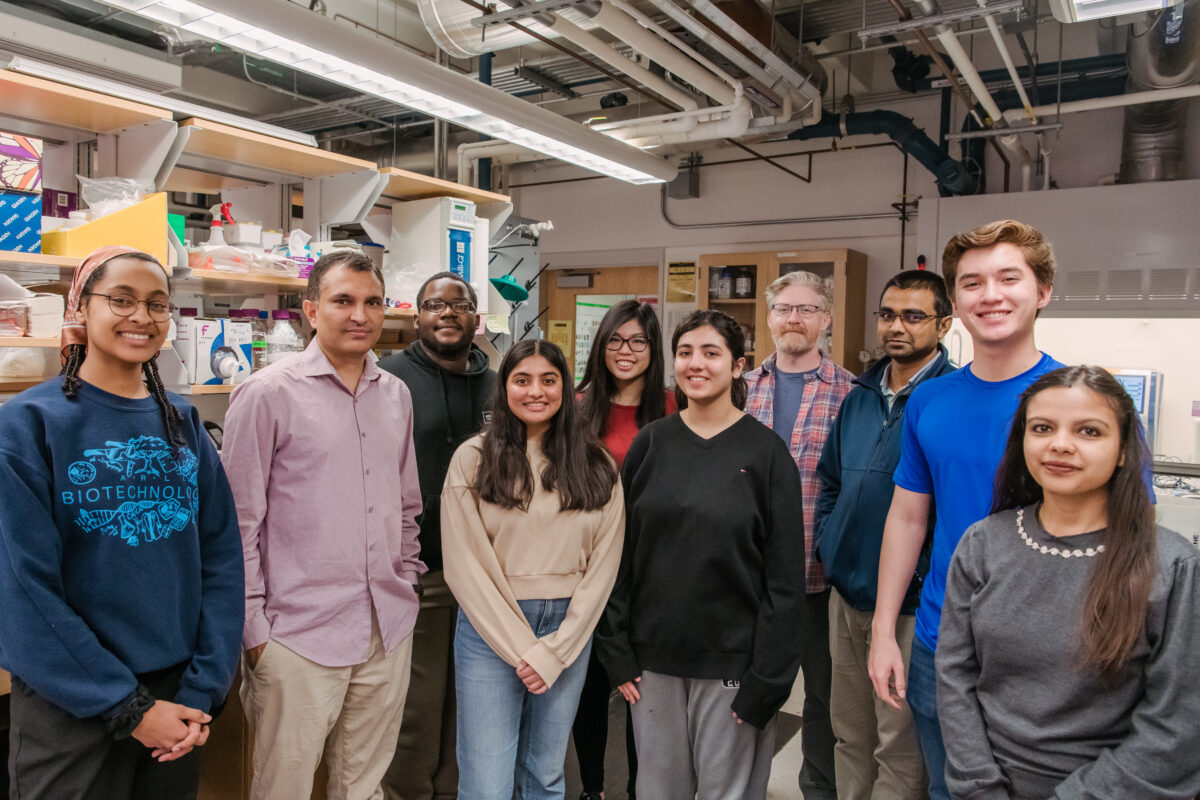 Deepak Koirala’s current lab group. From left to right: Huda Abdelghani, Deepak Koirala, Senali Dansou, Alisha Patel, Megan Nguyen, Zohra Mian, Jeffrey Vogt, Naba Krishna Das, Jason Daniels, and Manju Ojha. (Marlayna Demond ’11/UMBC)
A strong team
With the new funding, Koirala will be able to grow his already sizable team. That way he can accomplish more in the lab—and also expose more students to research. Koirala is happy to bring on UMBC freshmen and sophomores as well as students with more research experience. Even local high school students have gotten involved.
“If you expose students to research early on, that gives them the opportunity to decide which career will work for them,” Koirala says. And by getting students involved right away, they are apt to stay in the lab for a few years—enough time to significantly grow their skills and even become authors on a scientific paper, he explains.
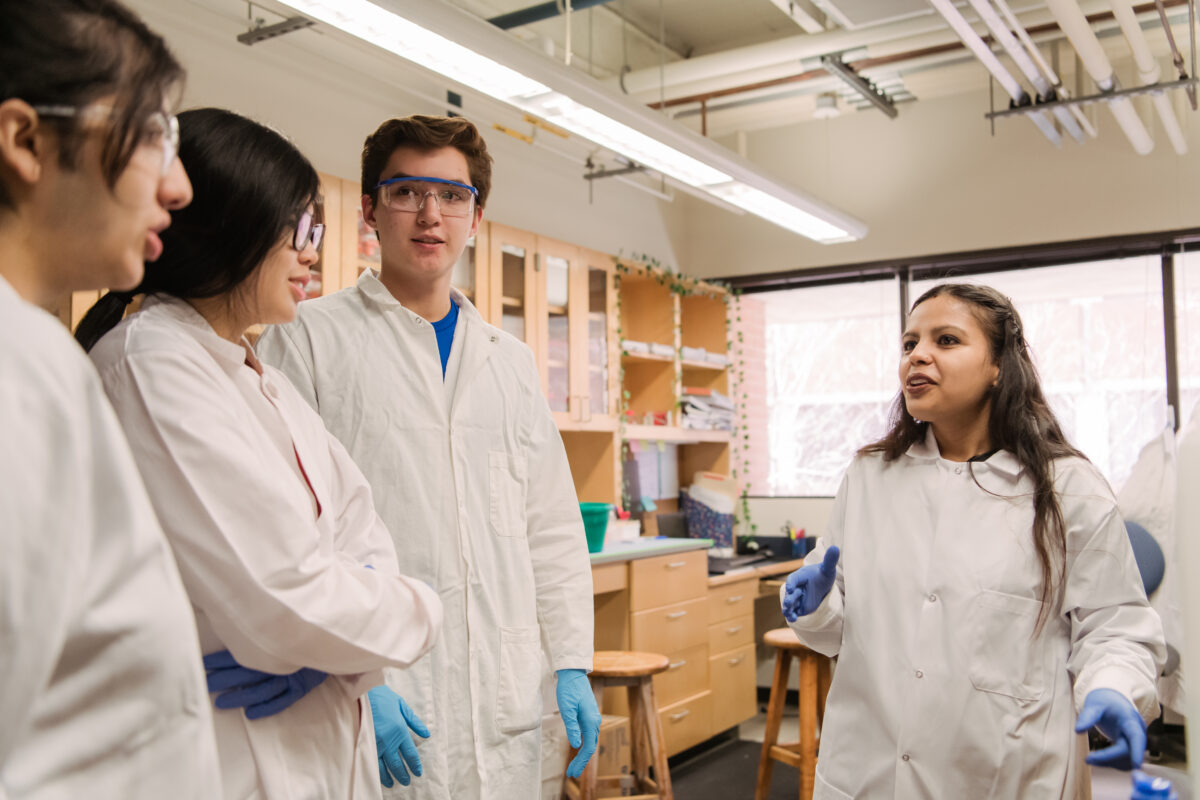 Ph.D. student Manju Ojha (right) explains an experiment to undergraduates in the lab. (Marlayna Demond ’11/UMBC)
In addition to conducting their own research, the students “also get great experiences with mentoring,” Koirala says. With a group of 11 students (“Or 12, including me,” Koirala adds), a mentorship structure forms naturally among the lab members, with more experienced team members guiding and supporting newer team members. “And wherever they go, academia or industry, they will be the future scientists—they will mentor the younger ones.”
Koirala’s method seems to be working. Two high school students in the lab are headed to college next year, one to M.I.T. and one to Bowdoin College in Maine. Tasnia Sadat ’23, biochemistry and molecular biology, is headed to medical school at Georgetown. Jeff Vogt ’23, biochemistry and molecular biology, is on his way to Johns Hopkins for a Ph.D., and Senali Dansou ’23, biochemistry and molecular biology, will matriculate at University of Minnesota for an M.D.-Ph.D.
With such an engaged group of researchers, thoughtful research questions, and effective techniques, Koirala’s team is well prepared to reach its goals and further the understanding of enteroviruses, leading the way for life-changing treatments.
]]>
Diseases such as polio, the common cold, and meningitis are all caused by closely related viruses and the way these viruses multiply in the body is poorly understood. Deepak Koirala, assistant...
https://umbc.edu/stories/nsf-career-award-enteroviruses-replication/
https://beta.my.umbc.edu/api/v0/pixel/news/131671/guest@my.umbc.edu/37802fe95afc6fa6ad8cbcccc6fd006d/api/pixel
career-award
chembiochem
cnms
majoraward
news
research
science-and-tech
UMBC News & Magazine
https://beta.my.umbc.edu/groups/umbc-news-magazine
https://assets1-beta.my.umbc.edu/system/shared/avatars/groups/000/001/943/24435aa6207c452e7bc15cc74b42c7bb/xsmall.png?1748556657
https://assets1-beta.my.umbc.edu/system/shared/avatars/groups/000/001/943/24435aa6207c452e7bc15cc74b42c7bb/original.png?1748556657
https://assets2-beta.my.umbc.edu/system/shared/avatars/groups/000/001/943/24435aa6207c452e7bc15cc74b42c7bb/xxlarge.png?1748556657
https://assets2-beta.my.umbc.edu/system/shared/avatars/groups/000/001/943/24435aa6207c452e7bc15cc74b42c7bb/xlarge.png?1748556657
https://assets3-beta.my.umbc.edu/system/shared/avatars/groups/000/001/943/24435aa6207c452e7bc15cc74b42c7bb/large.png?1748556657
https://assets1-beta.my.umbc.edu/system/shared/avatars/groups/000/001/943/24435aa6207c452e7bc15cc74b42c7bb/medium.png?1748556657
https://assets2-beta.my.umbc.edu/system/shared/avatars/groups/000/001/943/24435aa6207c452e7bc15cc74b42c7bb/small.png?1748556657
https://assets1-beta.my.umbc.edu/system/shared/avatars/groups/000/001/943/24435aa6207c452e7bc15cc74b42c7bb/xsmall.png?1748556657
https://assets2-beta.my.umbc.edu/system/shared/avatars/groups/000/001/943/24435aa6207c452e7bc15cc74b42c7bb/xxsmall.png?1748556657
UMBC News & Magazine
0
0
false
Mon, 13 Mar 2023 15:17:10 -0400
Mon, 13 Mar 2023 15:17:10 -0400
Meet a Retriever—Adeola Ojomo, sociology major and academic peer advocate

Meet Adeola Ojomo, a sophomore sociology major who started working on campus helping other students as an academic peer advocate (APA) after being inspired by another APA who helped her with some excellent advice. Take it away, Adeola!
Q: Tell us about yourself. What’s one essential thing you’d want another Retriever to know about you?
A: My name is Adeola Ojomo and I work at the Academic Success Center as an academic peer advocate. Some activities I enjoy outside of school include Tai Chi and gardening. I’m also a music lover! I can vibe with music from any decade and genre.
Q: What’s the one thing you’d want someone who hasn’t joined the UMBC community to know about the support you find here?
A: The support is plentiful and there are people with different experiences who are relatable. UMBC is a loving community that enables students to strive for alignment with their goals and fulfillment.
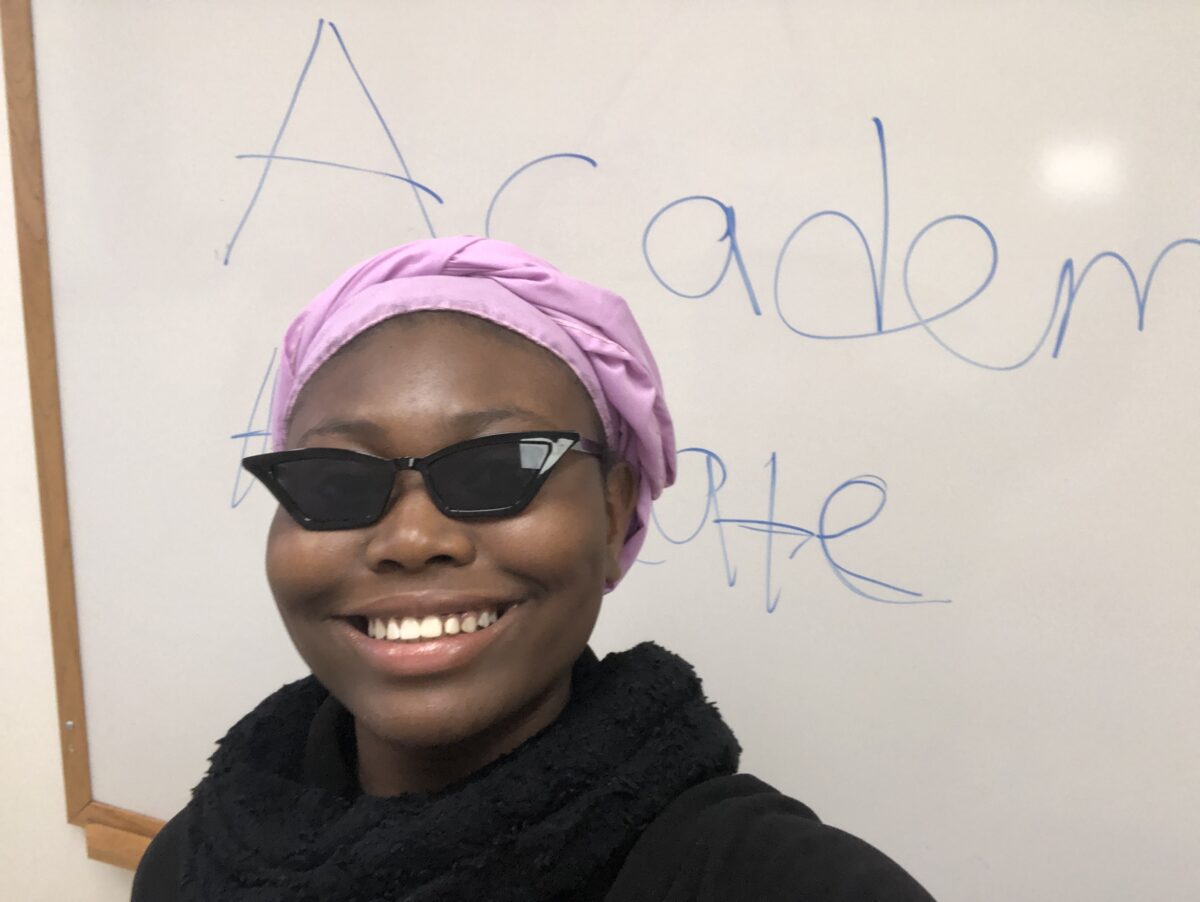 Her future’s so bright, she has to wear shades. Photo courtesy of Adeola Ojomo.
Q: Tell us about what you love about your academic program or an organization you’re involved in.
A: As an academic peer advocate (APA), I help students navigate campus resources. That involves me assisting students with study skills, time management, motivation, etc. It was a former APA (Rachael Joslow) who piqued my interest in becoming an APA when I spoke with her in the fall of 2021. When I planned to take two winter classes my first year, she recommended I only take one class at that time to avoid burnout and enjoy the learning process. I finished with a 4.0 winter GPA, and I’m so grateful for her advice because I realized that I could take my time with courses.
I became an APA in fall 2022 and the experience has been amazing so far. Being an APA at the Academic Success Center gives me the confidence and reassurance that UMBC truly cares about academic and career success. The program values the overall well-being of others and has a welcoming atmosphere.
Being an APA at the Academic Success Center gives me the confidence and reassurance that UMBC truly cares about academic and career success. The program values the overall well-being of others and has a welcoming atmosphere.
Adeola Ojomo
Sociology major and Academic Peer Advocate
Q: What clubs, teams, or organizations are you a part of? What do you love about them?
A: I’m involved in meditation at UMBC and the Sociology Society as a general body member. I love the fact the organizations I’m in reflect my personality and bring me out of my comfort zone when it comes to conversing with other people.
Q: How has receiving a scholarship allowed you to embrace your time at UMBC?
A: I’m extremely grateful for the chance to have a scholarship because I can focus on academics and socializing. I would tell people to enjoy the journey and cherish every moment because these years go by fast, and it’s always beneficial to have friends who are willing to experience the highs and lows of college. Balance is attainable.
* * * * *
UMBC’s greatest strength is its people. When people meet Retrievers and hear about the passion they bring, the relationships they create, the ways they support each other, and the commitment they have to inclusive excellence, they truly get a sense of our community. That’s what “Meet a Retriever” is all about.
Learn more about how UMBC can help you achieve your goals. Donate to the scholarship or program of your choice.
]]>
Meet Adeola Ojomo, a sophomore sociology major who started working on campus helping other students as an academic peer advocate (APA) after being inspired by another APA who helped her with some...
https://umbc.edu/stories/meet-adeola-ojomo-academic-peer-advocate/
https://beta.my.umbc.edu/api/v0/pixel/news/131652/guest@my.umbc.edu/fac8bdd31163a2165d49186fcc0744fb/api/pixel
cahss
magazine
meet-a-retriever
perspectives
sociology
UMBC News & Magazine
https://beta.my.umbc.edu/groups/umbc-news-magazine
https://assets1-beta.my.umbc.edu/system/shared/avatars/groups/000/001/943/24435aa6207c452e7bc15cc74b42c7bb/xsmall.png?1748556657
https://assets1-beta.my.umbc.edu/system/shared/avatars/groups/000/001/943/24435aa6207c452e7bc15cc74b42c7bb/original.png?1748556657
https://assets2-beta.my.umbc.edu/system/shared/avatars/groups/000/001/943/24435aa6207c452e7bc15cc74b42c7bb/xxlarge.png?1748556657
https://assets2-beta.my.umbc.edu/system/shared/avatars/groups/000/001/943/24435aa6207c452e7bc15cc74b42c7bb/xlarge.png?1748556657
https://assets3-beta.my.umbc.edu/system/shared/avatars/groups/000/001/943/24435aa6207c452e7bc15cc74b42c7bb/large.png?1748556657
https://assets1-beta.my.umbc.edu/system/shared/avatars/groups/000/001/943/24435aa6207c452e7bc15cc74b42c7bb/medium.png?1748556657
https://assets2-beta.my.umbc.edu/system/shared/avatars/groups/000/001/943/24435aa6207c452e7bc15cc74b42c7bb/small.png?1748556657
https://assets1-beta.my.umbc.edu/system/shared/avatars/groups/000/001/943/24435aa6207c452e7bc15cc74b42c7bb/xsmall.png?1748556657
https://assets2-beta.my.umbc.edu/system/shared/avatars/groups/000/001/943/24435aa6207c452e7bc15cc74b42c7bb/xxsmall.png?1748556657
UMBC News & Magazine
2
0
false
Mon, 13 Mar 2023 11:08:37 -0400
Mon, 13 Mar 2023 11:08:37 -0400
Pi gets all the fanfare, but other numbers also deserve their own math holidays

Written by Manil Suri, professor of mathematics and statistics, UMBC
March 14 is celebrated as Pi Day because the date, when written as 3/14, matches the start of the decimal expansion 3.14159… of the most famous mathematical constant.
By itself, pi is simply a number, one among countless others between 3 and 4. What makes it famous is that it’s built into every circle you see – circumference equals pi times diameter – not to mention a range of other, unrelated contexts in nature, from the bell curve distribution to general relativity.
The true reason to celebrate Pi Day is that mathematics, which is a purely abstract subject, turns out to describe our universe so well. My book “The Big Bang of Numbers” explores how remarkably hardwired into our reality math is. Perhaps the most striking evidence comes from mathematical constants: those rare numbers, including pi, that break out of the pack by appearing so frequently – and often, unexpectedly – in natural phenomena and related equations, that mathematicians like me exalt them with special names and symbols.
So, what other mathematical constants are worth celebrating? Here are my proposals to start filling out the rest of the calendar.
The Golden Ratio
For January, I nominate the Golden Ratio, phi. Two quantities are said to be in this ratio if dividing the larger by the smaller quantity gives the same answer as dividing the sum of the two quantities by the larger quantity. Phi equals 1.618…, and since there’s no Jan. 61, we could celebrate it on Jan. 6.
First calculated by Euclid, this ratio was popularized by Italian mathematician Luca Pacioli, who wrote a book in 1509 extravagantly extolling its aesthetic properties. Supposedly, Leonardo da Vinci, who drew 60 drawings for this book, incorporated it into the dimensions of Mona Lisa’s features, a choice some claim is responsible for her beauty.
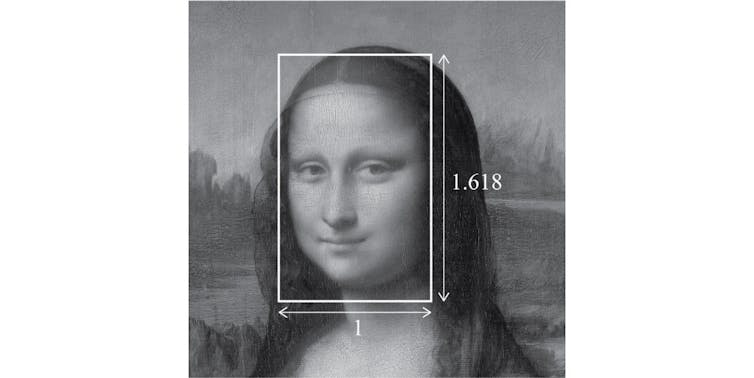 The vertical and horizontal measures of Mona Lisa’s face fit the Golden Ratio. (Image from ‘The Big Bang of Numbers’)
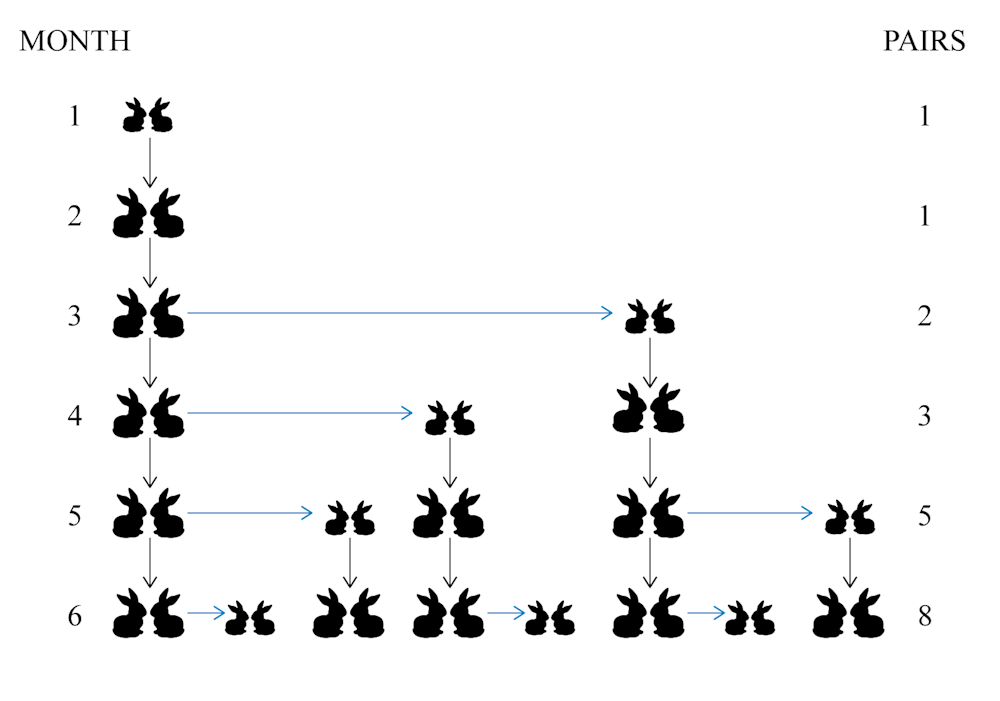
The first inkling that phi occurs in nature came from another Italian, Fibonacci, while studying how rabbits multiply. A common reproductive assumption was that each pair of rabbits begets another pair every month. Start with a single rabbit pair, and successive populations will then follow the sequence 1, 2, 4, 8, 16, 32, 64, 128, 256 and so on – that is, get multiplied by a monthly “growth ratio” of 2.
What Fibonacci observed, though, was that rabbits spent the first cycle reaching sexual maturity and only began reproducing after that. A single pair now gives the new, slower progression 1, 1, 2, 3, 5, 8, 13, 21, 34… instead. This is the famous sequence named after Fibonacci; notice that each population turns out to be the sum of its two predecessors.
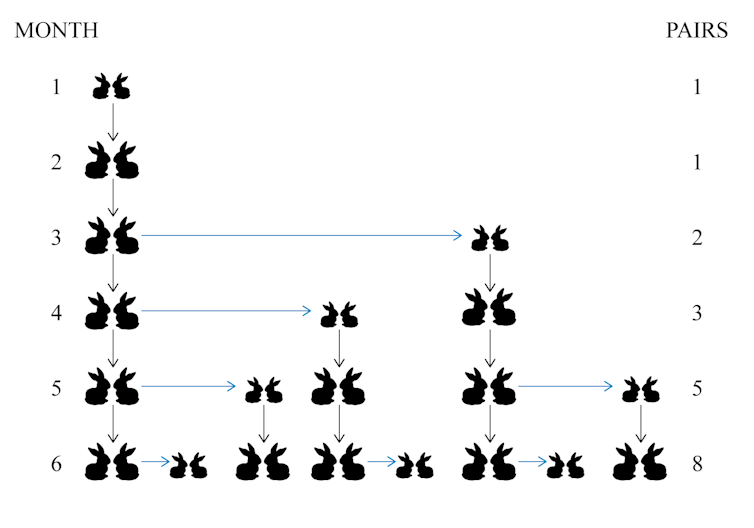 Fibonacci’s rabbits don’t really double their population each generation – their growth ratio actually approaches the 1.618… of phi. (Image from ‘The Big Bang of Numbers’)
How does phi show up amid all these randy rabbits? Well, progressing through the sequence, you see that each number is about 1.6 times the previous one. In fact, this growth ratio keeps getting closer and closer to 1.618…. For instance, 21 equals about 1.615 times 13, and 34 equals about 1.619 times 21. This means the rabbits settle down to reproducing with a growth ratio that is no longer 2, but rather, gets closer and closer to the Golden Ratio.
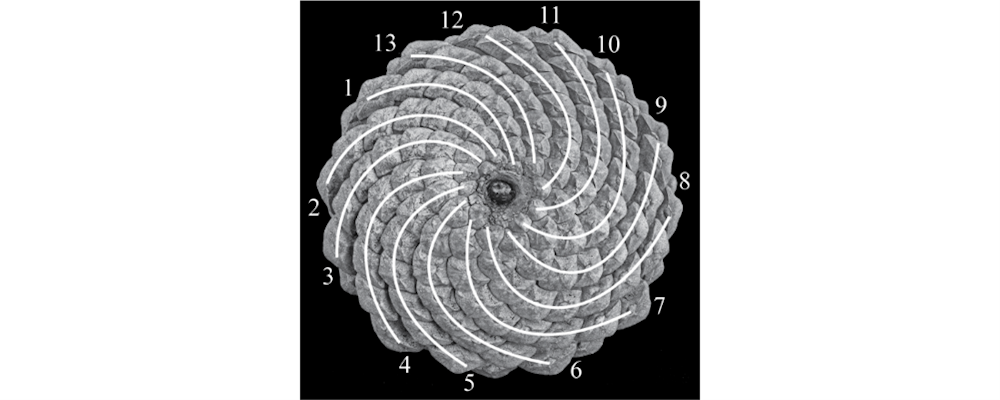
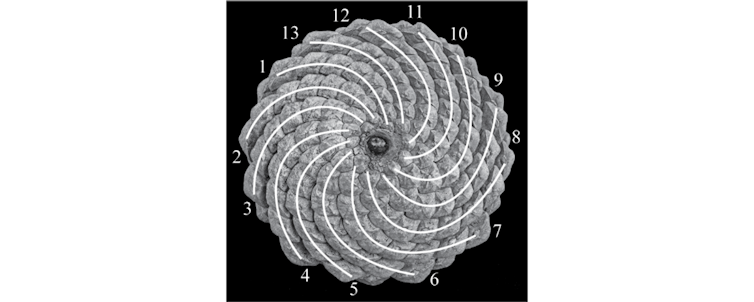 The number of spirals in a pine cone is usually a Fibonacci number. (Image from ‘The Big Bang of Numbers’)
Actual rabbits are unlikely to follow this rule precisely. For one, they have the unfortunate tendency to get eaten by predators. But the Fibonacci numbers – like 5, 8, 13 and so on – show up extensively in nature, like in the number of spirals you might see in a typical pine cone. And yes, phi itself makes a few appearances as well, perhaps most notably in the way leaves arrange themselves around a stem to maximize exposure to sunlight.
The constant ‘e’
February offers another blockbuster constant, Euler’s number e, which has the value 2.718…. So mark next Feb. 7 for the shindig.
To understand e, consider “doubling” growth again, but now in terms of the “population” of dollars in your bank account. By some miracle, your money in this example is earning you 100% interest, compounded each year. Each $1 invested becomes $2 at year’s end.
Suppose, however, the interest is compounded semiannually. Then 50% of the interest is credited midyear, giving you $1.50. You get the remaining 50% interest on this $1.50 at the end of the year, which works out to $0.75, giving you $2.25 ($1.50 + $0.75). So your investment gets multiplied by 2.25, rather than 2.
What if a war broke out between banks, each offering to compound the same 100% interest over shorter and more frequent intervals? Would the sky be the limit in terms of your payout? The answer is no. You could raise your growth ratio from 2 to about 2.718 – more precisely, to e – but no higher. Although you get more frequent credits, they have progressively diminishing returns.
(Table by The Conversation, CC-BY-ND. Source: ‘50 Maths Ideas You Really Need to Know’ by Tony Crilly.)
In the late 17th century, the discovery of calculus led to a quantum leap in people’s ability to grapple with the universe. Math could now analyze anything that changed – which extended its domain to most phenomena in nature. The constant e is famous because of its iconic role in calculus: It turns out to be the most natural growth factor to track change. Consequently, it shows up in laws describing many natural processes – from population growth to radioactive decay. The constant e is a big part of calculus – and turns up in all kinds of natural phenomena.
The constant e is a big part of calculus – and turns up in all kinds of natural phenomena.
Next on our calendar of mathematical constants would come pi, of course, for March. My nominee for April is Feigenbaum’s constant delta, which equals 4.669… and measures how quickly growth processes spin off into chaos.
I’ll wait for my first batch to achieve official holiday status before going any further – happy to consider any candidates you want to nominate.
This article is republished from The Conversation under a Creative Commons license. Read the original article and see more than 250 UMBC articles available in The Conversation.
]]>
Written by Manil Suri, professor of mathematics and statistics, UMBC March 14 is celebrated as Pi Day because the date, when written as 3/14, matches the start of the decimal expansion...
https://umbc.edu/stories/pi-gets-all-the-fanfare-but-other-numbers-also-deserve-their-own-math-holidays/
https://beta.my.umbc.edu/api/v0/pixel/news/131551/guest@my.umbc.edu/d2499dc23a6d0d0c6e520f517bdd825a/api/pixel
cnms
discovery
magazine
mathstat
UMBC News & Magazine
https://beta.my.umbc.edu/groups/umbc-news-magazine
https://assets1-beta.my.umbc.edu/system/shared/avatars/groups/000/001/943/24435aa6207c452e7bc15cc74b42c7bb/xsmall.png?1748556657
https://assets1-beta.my.umbc.edu/system/shared/avatars/groups/000/001/943/24435aa6207c452e7bc15cc74b42c7bb/original.png?1748556657
https://assets2-beta.my.umbc.edu/system/shared/avatars/groups/000/001/943/24435aa6207c452e7bc15cc74b42c7bb/xxlarge.png?1748556657
https://assets2-beta.my.umbc.edu/system/shared/avatars/groups/000/001/943/24435aa6207c452e7bc15cc74b42c7bb/xlarge.png?1748556657
https://assets3-beta.my.umbc.edu/system/shared/avatars/groups/000/001/943/24435aa6207c452e7bc15cc74b42c7bb/large.png?1748556657
https://assets1-beta.my.umbc.edu/system/shared/avatars/groups/000/001/943/24435aa6207c452e7bc15cc74b42c7bb/medium.png?1748556657
https://assets2-beta.my.umbc.edu/system/shared/avatars/groups/000/001/943/24435aa6207c452e7bc15cc74b42c7bb/small.png?1748556657
https://assets1-beta.my.umbc.edu/system/shared/avatars/groups/000/001/943/24435aa6207c452e7bc15cc74b42c7bb/xsmall.png?1748556657
https://assets2-beta.my.umbc.edu/system/shared/avatars/groups/000/001/943/24435aa6207c452e7bc15cc74b42c7bb/xxsmall.png?1748556657
UMBC News & Magazine
1
0
false
Wed, 08 Mar 2023 12:31:42 -0500
Wed, 08 Mar 2023 12:31:42 -0500
Important tax reminder!
Your tax return is due by April 18, 2023.
Dear Exchange Visitors,
As an international scholar, you are a nonresident in the US. If you received US income during the calendar year 2022, you are legally required to file a tax return by April 18, 2023.
Even if you did not work or receive income in the US, you are still obliged to file a Form 8843 with the IRS.
Sprintax was used by over 200,000 international students, scholars and nonresidents last year, and the average Federal refund received by eligible individuals was over $1,017.84.
In the link above, you will find detailed guidance on how to file taxes; workshop videos, and a special code to use. For any questions, please contact Sprintax directly, not our office.
I wish you a good day!
Diane
]]>
Dear Exchange Visitors, As an international scholar, you are a nonresident in the US. If you received US income during the calendar year 2022, you are legally required to file a tax return by...
https://mailchi.mp/umbc/umbc-isss-sprintax-for-tax-year-17018967
https://beta.my.umbc.edu/api/v0/pixel/news/131505/guest@my.umbc.edu/4475b0abdb94f2f6d80c3505dff35bb0/api/pixel
Exchange Visitors
https://beta.my.umbc.edu/groups/j-1
https://assets3-beta.my.umbc.edu/system/shared/avatars/groups/000/001/488/175f9f6b6c231ae5de90058948f6228c/xsmall.png?1525966942
https://assets3-beta.my.umbc.edu/system/shared/avatars/groups/000/001/488/175f9f6b6c231ae5de90058948f6228c/original.jpg?1525966942
https://assets2-beta.my.umbc.edu/system/shared/avatars/groups/000/001/488/175f9f6b6c231ae5de90058948f6228c/xxlarge.png?1525966942
https://assets1-beta.my.umbc.edu/system/shared/avatars/groups/000/001/488/175f9f6b6c231ae5de90058948f6228c/xlarge.png?1525966942
https://assets2-beta.my.umbc.edu/system/shared/avatars/groups/000/001/488/175f9f6b6c231ae5de90058948f6228c/large.png?1525966942
https://assets1-beta.my.umbc.edu/system/shared/avatars/groups/000/001/488/175f9f6b6c231ae5de90058948f6228c/medium.png?1525966942
https://assets1-beta.my.umbc.edu/system/shared/avatars/groups/000/001/488/175f9f6b6c231ae5de90058948f6228c/small.png?1525966942
https://assets3-beta.my.umbc.edu/system/shared/avatars/groups/000/001/488/175f9f6b6c231ae5de90058948f6228c/xsmall.png?1525966942
https://assets4-beta.my.umbc.edu/system/shared/avatars/groups/000/001/488/175f9f6b6c231ae5de90058948f6228c/xxsmall.png?1525966942
Exchange Visitors
https://assets4-beta.my.umbc.edu/system/shared/thumbnails/news/000/131/505/2f51c2752425afd8ede9b4456729251b/xxlarge.jpg?1678199968
https://assets4-beta.my.umbc.edu/system/shared/thumbnails/news/000/131/505/2f51c2752425afd8ede9b4456729251b/xlarge.jpg?1678199968
https://assets2-beta.my.umbc.edu/system/shared/thumbnails/news/000/131/505/2f51c2752425afd8ede9b4456729251b/large.jpg?1678199968
https://assets2-beta.my.umbc.edu/system/shared/thumbnails/news/000/131/505/2f51c2752425afd8ede9b4456729251b/medium.jpg?1678199968
https://assets3-beta.my.umbc.edu/system/shared/thumbnails/news/000/131/505/2f51c2752425afd8ede9b4456729251b/small.jpg?1678199968
https://assets4-beta.my.umbc.edu/system/shared/thumbnails/news/000/131/505/2f51c2752425afd8ede9b4456729251b/xsmall.jpg?1678199968
https://assets4-beta.my.umbc.edu/system/shared/thumbnails/news/000/131/505/2f51c2752425afd8ede9b4456729251b/xxsmall.jpg?1678199968
0
0
true
Tue, 07 Mar 2023 09:41:54 -0500
Tue, 07 Mar 2023 09:42:29 -0500
Mercedes Burns to study arachnid evolution in Japan through prestigious NSF CAREER Award

Mammals are “all-in” on sexual reproduction, explains Mercedes Burns, assistant professor of biological sciences at UMBC. They even have “mechanisms that reinforce the maintenance of sex and make it so that asexual reproduction”—that is, without a mate—“isn’t possible anymore,” she adds. But why?
Even beyond mammals, most vertebrates require a mate to reproduce, but some organisms can reproduce on their own. Both modes of reproduction are relatively common throughout the tree of life. However, animals that are able to switch between the two modes of reproduction are incredibly rare, Burns says.
One example is an organism Burns studies—a member of a group of arachnids known as harvestmen, or more popularly as daddy-longlegs. The species Burns studies only exists on the two northernmost islands of Japan. Through a $987,000 grant from the National Science Foundation, she’ll soon travel there with a group of students to learn more about them.
“The questions I’m asking in this CAREER grant set the stage,” she says, for discovering how species that can reproduce both sexually (with a mate) and asexually (without a mate) “control whether it’s going to be one reproductive mode or the other,” Burns says. “Ultimately we want to understand what allows for this kind of reproductive strategy in these systems, which we don’t see commonly in animals.”
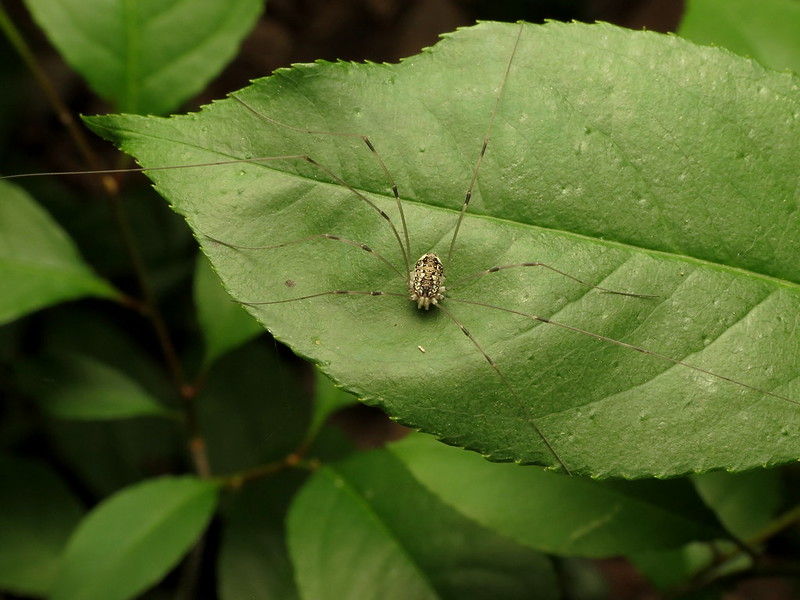 An Eastern Harvestman, which is common in the mid-Atlantic region. (Image by Katja Schulz, used under CC-BY 2.0)
Different environments, different strategies
The NSF CAREER Award recognizes early-career faculty researchers who “have the potential to serve as academic role models in research and education and lead advances in the mission of their department or organization.” The award supports five years of work on a major research project.
Sexual coercion and harassment are widespread across the animal kingdom. Burns’s project will investigate how these kinds of sexual conflict may drive whether females in the species she is studying reproduce sexually or asexually in different situations. She has already found that populations in prime habitats tend to be dense and consist of a nearly equal number of males and females. However, in more remote, lower quality habitats, the populations are nearly exclusively female.
“We think that over evolutionary time, females are perhaps better able to persist away from these populations of high density, because they have this other (asexual) reproductive method,” Burns explains. She also expects the females that live in denser populations with more males to be more resistant to coercion, because they experience more of it and over time adapt to better avoid it.
To test her hypothesis, Burns and her students will travel to Japan to collect females from various harvestmen populations. In captivity, they will present the females with males and record their behavior. They expect females from populations with a large number of males to respond differently from females taken from populations made up almost exclusively of females. Burns and her students will also do genetic testing on eggs produced by the collected females, to see what portion of the eggs (if any) result from mating with the male they encountered in captivity.
Best of both worlds
Burns finds it odd that the ability to use both sexual and asexual reproduction isn’t more common across the animal kingdom. Having the option to use either method “is kind of the ideal reproductive mode,” she says, because the balance of pros and cons for each method changes with the circumstances.
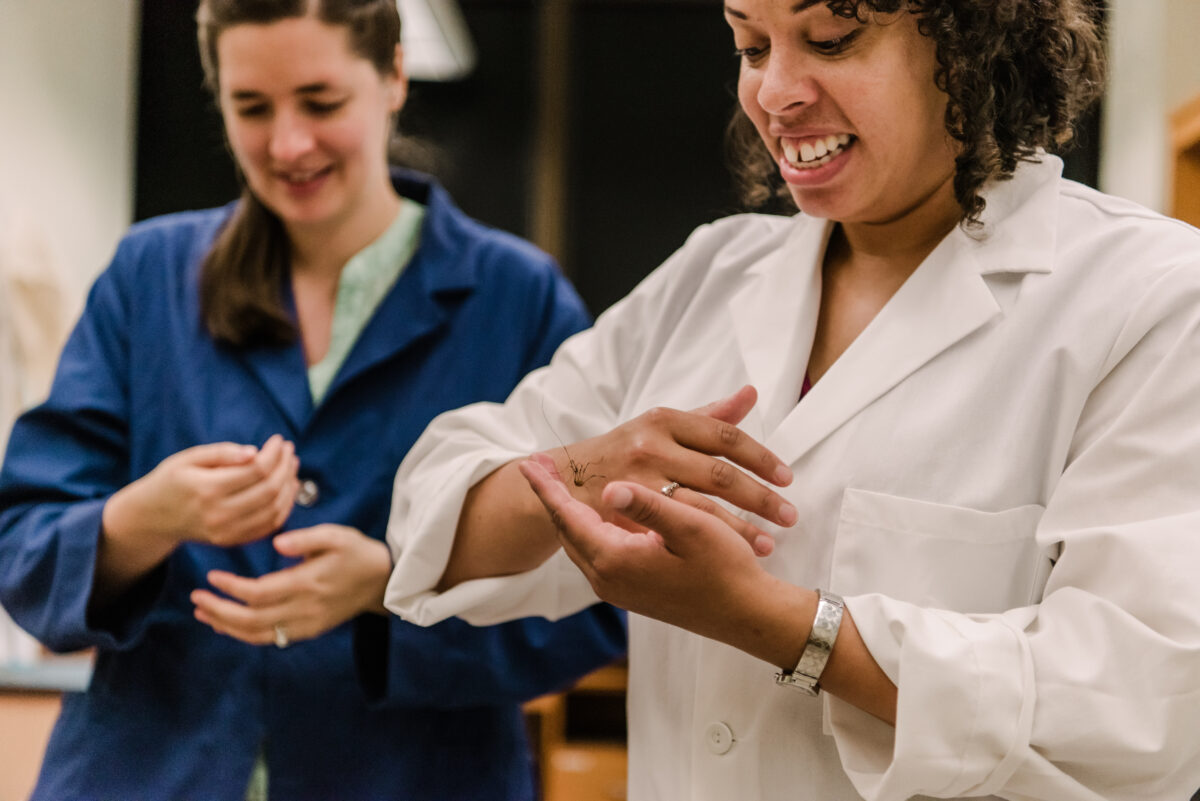 Mercedes Burns handles a harvestman in her laboratory. Sarah Stellwagen, Burns’s former postdoctoral fellow and current collaborator, stands in the background. (Marlayna Demond ’11/UMBC)
In sexual reproduction, “you’re able to mix your genes to produce offspring that are going to be different from you, and perhaps will be better adapted to future conditions,” Burns says, which is helpful if the environment is changing or the mother’s genetic traits aren’t well-suited to the current environment. “But when you have excellent genetic combinations, you’re well adapted to your environment, and the environment isn’t changing much, it’s better to not pay the costs associated with sex,” she says, which include breaking up that excellent genome, passing on fewer of your own genes, and even potentially suffering stress and physical harm from sexual encounters.
And yet, using a mix of reproductive strategies is extremely rare. “Because we don’t see it commonly in nature, we want to learn more,” says Burns. “ What are the forces and mechanisms that keep these reproductive modes separate in animals, except in these rare cases?”
Breaking down barriers
Alongside the research component of the CAREER Award is a teaching and mentoring component. Burns and colleagues in modern languages, linguistics, and intercultural communications at UMBC will create an in-depth mentoring program for the students who will accompany Burns to Japan. A course on Japanese language and culture, introspective journaling exercises about their expectations and reflections, and more will help the students get the most out of their experience.
The CAREER Award will also support some of Burns’s work as the Diversity, Equity, and Inclusion (DEI) Committee chair for the American Arachnological Society. This includes her efforts to add DEI material to the society’s website and to conduct a demographic survey of its membership. The survey would help the organization better understand its members and the kinds of DEI programming they might be interested in.
Burns has been pursuing this work for some time, but an experience in 2021 inspired her to go further. In April of that year, researchers named a newly discovered spider species Ummidia mercedesburnsae in honor of her contributions to the field, recognizing her as the first known female African American arachnologist. “That kind of spurred me to think, ‘I could do something to leave a legacy for the organization and for the field,’” Burns reflects. “After realizing you’re the first or only one, you want to make sure it isn’t like that forever.”
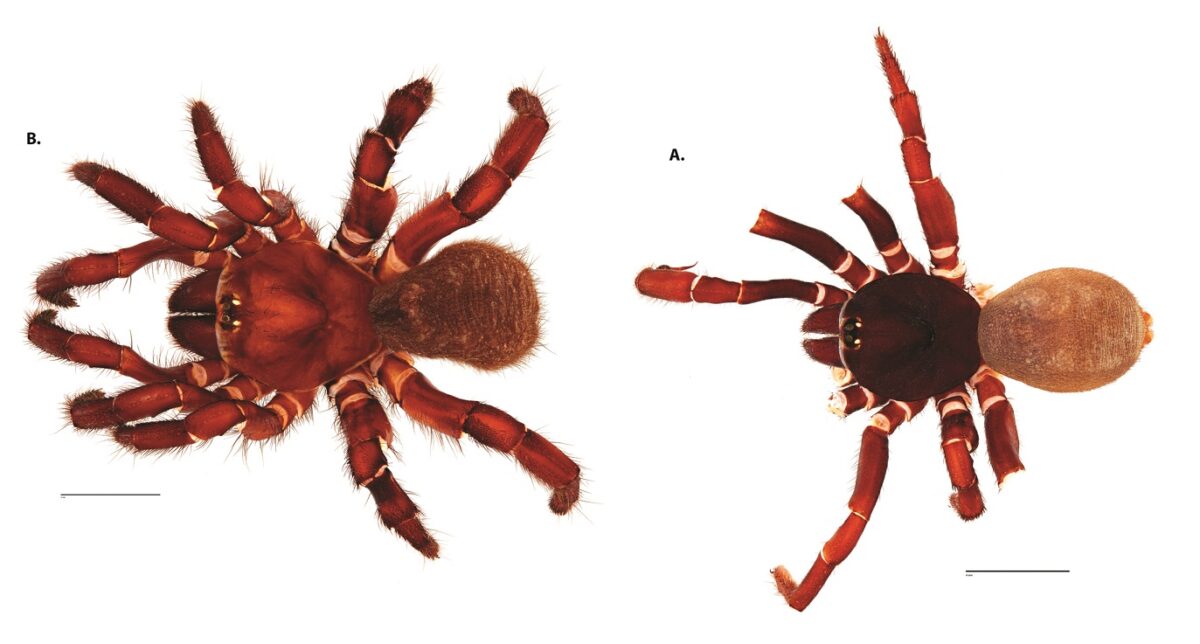 Ummidia mercedesburnsae, the trapdoor spider named after Mercedes Burns. Female at left, male at right. (Figure from paper published in ZooKeys in 2021)
Learning to love arthropods
In addition to inspiring her own lab group and members of the American Arachnological Society through her research, Burns will bring her love of arachnids and beyond to UMBC students through developing an undergraduate course on arthropod biodiversity and applications.
Despite the immediate “eww” that frequently accompanies bug sightings, “Altogether, I think there are a lot of opportunities to kindle some sort of curiosity and familiarity around insects, arachnids, and crustaceans,” Burns says. “That way we can challenge some of those negative connotations and fears and develop an appreciation for this huge, evolutionarily successful group of organisms. It’s a group that is incredibly diverse and that touches our lives in so many ways.”
]]>
Mammals are “all-in” on sexual reproduction, explains Mercedes Burns, assistant professor of biological sciences at UMBC. They even have “mechanisms that reinforce the maintenance of sex and make...
https://umbc.edu/stories/arachnid-evolution-nsf-career-award/
https://beta.my.umbc.edu/api/v0/pixel/news/131488/guest@my.umbc.edu/8113b1496214569445b4c449d5548c95/api/pixel
biology
career-award
cnms
news
research
science-and-tech
UMBC News & Magazine
https://beta.my.umbc.edu/groups/umbc-news-magazine
https://assets1-beta.my.umbc.edu/system/shared/avatars/groups/000/001/943/24435aa6207c452e7bc15cc74b42c7bb/xsmall.png?1748556657
https://assets1-beta.my.umbc.edu/system/shared/avatars/groups/000/001/943/24435aa6207c452e7bc15cc74b42c7bb/original.png?1748556657
https://assets2-beta.my.umbc.edu/system/shared/avatars/groups/000/001/943/24435aa6207c452e7bc15cc74b42c7bb/xxlarge.png?1748556657
https://assets2-beta.my.umbc.edu/system/shared/avatars/groups/000/001/943/24435aa6207c452e7bc15cc74b42c7bb/xlarge.png?1748556657
https://assets3-beta.my.umbc.edu/system/shared/avatars/groups/000/001/943/24435aa6207c452e7bc15cc74b42c7bb/large.png?1748556657
https://assets1-beta.my.umbc.edu/system/shared/avatars/groups/000/001/943/24435aa6207c452e7bc15cc74b42c7bb/medium.png?1748556657
https://assets2-beta.my.umbc.edu/system/shared/avatars/groups/000/001/943/24435aa6207c452e7bc15cc74b42c7bb/small.png?1748556657
https://assets1-beta.my.umbc.edu/system/shared/avatars/groups/000/001/943/24435aa6207c452e7bc15cc74b42c7bb/xsmall.png?1748556657
https://assets2-beta.my.umbc.edu/system/shared/avatars/groups/000/001/943/24435aa6207c452e7bc15cc74b42c7bb/xxsmall.png?1748556657
UMBC News & Magazine
0
0
false
Mon, 06 Mar 2023 13:11:25 -0500
Mon, 06 Mar 2023 13:11:25 -0500
UMBC’s Smith lab discovers enzyme ATE1’s role in cellular stress response, opening a door to new therapeutic targets

A new paper in Nature Communications illuminates how a previously poorly understood enzyme works in the cell. Many diseases are tied to chronic cellular stress, and UMBC’s Aaron T. Smith and colleagues discovered that this enzyme plays an important role in the cellular stress response. Better understanding how this enzyme functions and is controlled could lead to the discovery of new therapeutic targets for these diseases.
The enzyme is named ATE1, and it belongs to a family of enzymes called arginyl-tRNA transferases. These enzymes add arginine (an amino acid) to proteins, which often flags the proteins for destruction in the cell. Destroying proteins that are misfolded, often as a result of cellular stress, is important to prevent those proteins from wreaking havoc with cellular function. An accumulation of malfunctioning proteins can cause serious problems in the body, leading to diseases like Alzheimer’s or cancer, so being able to get rid of these proteins efficiently is key to long-term health.
Tantalizing implications
The new paper demonstrates that ATE1 binds to clusters of iron and sulfur ions, and that the enzyme’s activity increases two- to three-fold when it is bound to one of these iron-sulfur clusters. What’s more, when the researchers blocked cells’ ability to produce the clusters, ATE1 activity decreased dramatically. They also found that ATE1 is highly sensitive to oxygen, which they believe relates to its role in moderating the cell’s stress response through a process known as oxidative stress.
![At left, two different molecular structures, represented by red and yellow balls connected by black lines, labeled "[4Fe-4S]" and "[2Fe-2S]". A silver arrow points from the structures to an orange blob labeled ATE1. Below the orange blob, there is a blue blob to the left labeled "tRNA-Arg." It has a small green dotted-line circle with an R inside attached to it. Below right of the orange blob, there is another blue blob, labeled "substrate." It also has a green circle with an R inside attached to it. An arrow passing from the blue blob on the left to the blue blob on the right is labeled "Arginylation."](https://umbc.edu/wp-content/uploads/2023/03/FeSabstract-v24-1200x600.png) An illustration of the basic function of the enzyme ATE1. Iron-sulfur clusters (red and yellow circles at left) bind to the ATE1 enzyme (orange blob, center), increasing its efficacy. ATE1 effects the transfer of arginine (small green circle) from a tRNA (blue blob, left) to another protein (blue blob, right). (Illustration by Verna Van, Ph.D. ’22)
An illustration of the basic function of the enzyme ATE1. Iron-sulfur clusters (red and yellow circles at left) bind to the ATE1 enzyme (orange blob, center), increasing its efficacy. ATE1 effects the transfer of arginine (small green circle) from a tRNA (blue blob, left) to another protein (blue blob, right). (Illustration by Verna Van, Ph.D. ’22)
“We were very excited about that, because it has lots of very tantalizing downstream implications,” particularly related to the enzyme’s role in disease, says Smith, associate professor of chemistry and biochemistry.
Smith’s lab works initially with the yeast protein but also showed that the mouse version of ATE1 behaves similarly. That’s important, Smith explains. “Since the yeast protein and the mouse protein behave the same way,” he says, “there’s reason to believe, that because the human protein is quite similar to the mouse protein, it likely behaves the same way as well.”
A new approach
Before they made their breakthrough discovery, Smith and then-graduate student Verna Van, Ph.D. ’22, biochemistry and molecular biology, had been attempting for quite some time to induce ATE1 to bind with heme, a compound that contains iron and is necessary to bind oxygen in blood, to confirm another group’s results. It wasn’t working, and they were getting frustrated, Smith admits. But one day, as Smith was preparing a lecture on proteins that bind with clusters of metal and sulfur atoms, he realized the proteins he was about to cover with his students looked similar to ATE1.
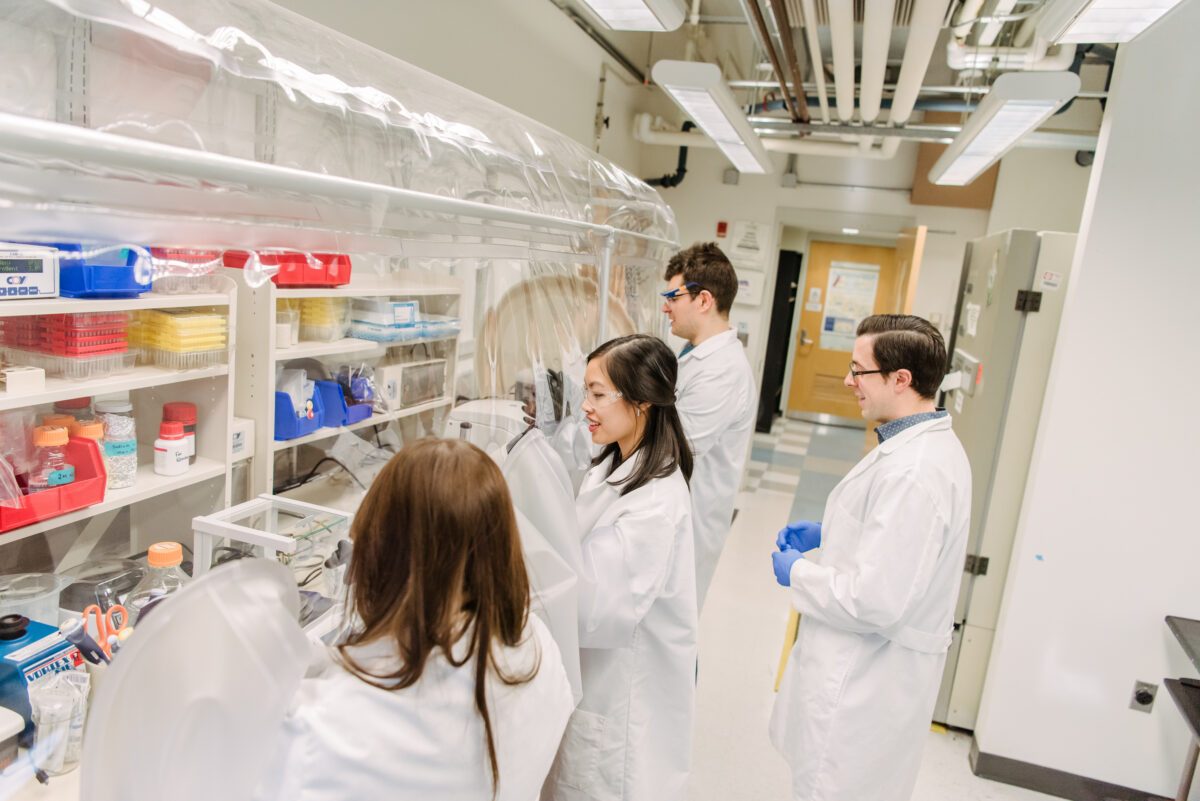 Aaron Smith (right) works in his laboratory with students at the chemical fume hood. (Marlayna Demond ’11/UMBC)
After that realization, Smith and Van took a new approach. In the lab, they added the raw materials for creating iron-sulfur clusters to a solution with ATE1, and the results showed that ATE1 did indeed bind the clusters. “This looks promising,” Smith remembers thinking. “We were super excited about it.”
The fact that the enzyme binds the clusters at all was interesting and new, “but then we also asked if that’s affecting the enzyme’s ability to do what it does,” Smith says. The answer, after more than a year of additional experiments, was a resounding yes. In the process, Smith’s group also determined the structure of ATE1 in yeast (without the cluster bound to it), which they published in the Journal of Molecular Biology in November 2022.
Subtle but significant
Around the same time, another group also published a slightly different ATE1 structure. The other group’s structure had a zinc ion (another metal) bound in place of the iron-sulfur cluster. With the zinc in place, one key amino acid is rotated about 60 degrees. It might seem inconsequential, but Smith believes that rotation, which he presumes is similar with the cluster, is the key to the cluster’s role in ATE1’s function.
The rotated amino acid is directly adjacent to where a protein would interact with ATE1 to be modified, ultimately flagging it for degradation. Changing the angle of that amino acid changes the shape of the location the protein would bind “very subtly,” but changes its activity “more than subtly,” Smith says.
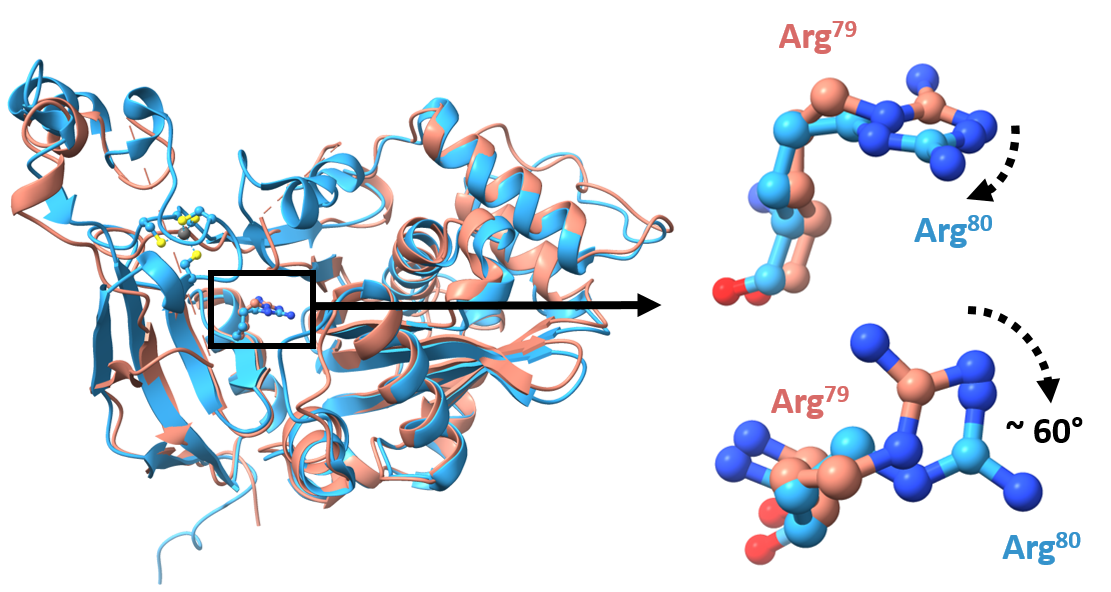 The representation of ATE1’s structure as determined by Smith’s team is on the left. The inset shows how a particular, key location in the enzyme differs if it is bound to a zinc ion (bottom), as in another research group’s structure, or not bound to any metal (top, Smith’s team’s structure). (Figures from Smith’s 2022 paper in Journal of Molecular Biology on the structure of ATE1)
Looking ahead and looking back
Smith would also like to explore how other metals, beyond zinc and the iron-sulfur cluster, may affect the enzyme’s activity. Additionally, his lab is working to determine the structure of ATE1 in an organism other than yeast and to confirm the ATE1 structure with an iron-sulfur cluster bound.
All these steps will build up a clearer picture of how ATE1 functions and is regulated in the cell. Smith also says he believes proteins that so far have not been shown to bind iron-sulfur clusters may indeed rely on them.
This new paper actually harks back to Smith’s first days at UMBC. He has always been interested in protein modifications, and adding arginine is a more unusual one. “It’s always something that I had filed back in my mind, and thought, ‘Oh, it would be really interesting to get a better understanding of how that works,’” he says.
Several years later, his group is now on the leading edge of discovering how arginine modifications influence cellular function and disease.
]]>
A new paper in Nature Communications illuminates how a previously poorly understood enzyme works in the cell. Many diseases are tied to chronic cellular stress, and UMBC’s Aaron T. Smith and...
https://umbc.edu/stories/smith-lab-discovers-enzymes-role-in-cellular-stress-response/
https://beta.my.umbc.edu/api/v0/pixel/news/131489/guest@my.umbc.edu/6b2ea844f8e7ba916befece9ede0be41/api/pixel
chembiochem
cnms
news
research
science-and-tech
UMBC News & Magazine
https://beta.my.umbc.edu/groups/umbc-news-magazine
https://assets1-beta.my.umbc.edu/system/shared/avatars/groups/000/001/943/24435aa6207c452e7bc15cc74b42c7bb/xsmall.png?1748556657
https://assets1-beta.my.umbc.edu/system/shared/avatars/groups/000/001/943/24435aa6207c452e7bc15cc74b42c7bb/original.png?1748556657
https://assets2-beta.my.umbc.edu/system/shared/avatars/groups/000/001/943/24435aa6207c452e7bc15cc74b42c7bb/xxlarge.png?1748556657
https://assets2-beta.my.umbc.edu/system/shared/avatars/groups/000/001/943/24435aa6207c452e7bc15cc74b42c7bb/xlarge.png?1748556657
https://assets3-beta.my.umbc.edu/system/shared/avatars/groups/000/001/943/24435aa6207c452e7bc15cc74b42c7bb/large.png?1748556657
https://assets1-beta.my.umbc.edu/system/shared/avatars/groups/000/001/943/24435aa6207c452e7bc15cc74b42c7bb/medium.png?1748556657
https://assets2-beta.my.umbc.edu/system/shared/avatars/groups/000/001/943/24435aa6207c452e7bc15cc74b42c7bb/small.png?1748556657
https://assets1-beta.my.umbc.edu/system/shared/avatars/groups/000/001/943/24435aa6207c452e7bc15cc74b42c7bb/xsmall.png?1748556657
https://assets2-beta.my.umbc.edu/system/shared/avatars/groups/000/001/943/24435aa6207c452e7bc15cc74b42c7bb/xxsmall.png?1748556657
UMBC News & Magazine
0
0
false
Mon, 06 Mar 2023 11:51:13 -0500
Mon, 06 Mar 2023 11:51:13 -0500
Remembering E. Michael Richards
Remembering E. Michael Richards
It is with sorrow that we share the passing of E. Michael Richards, professor emeritus of music.
One of the world’s leading interpreters of contemporary music for the clarinet, Michael was an exemplary performer, researcher, and educator. He joined the UMBC faculty in 2001, was promoted to full professor in 2009, and twice served as chair of the music department before retiring with emeritus status in 2021.
Michael’s superb leadership skills were evident soon after his arrival on campus. Linda Dusman, professor of music and former chair, shares, “When we hired Michael in 2001, I did not know at the time that he would become my right hand in revitalizing the music department, recruiting students and new faculty growing from a department of 4 full-time faculty and 60 students to 15 faculty and 150 students in a very short time. Michael brought vision, administrative skills, and extraordinary artistry to UMBC.”
Michael’s contributions to that remarkable departmental growth were myriad. Working in partnership with Kazuko Tanosaki, he founded the Post-Baccalaureate Certificate in American Contemporary Music, an international program that brought several cohorts of students from Japan to UMBC. He established an exchange program with the Conservatorio “G. Nicolini” in Piacenza, Italy, which enabled a steady flow of faculty and students between institutions. He helped manage the completion of the music portion of the Performing Arts and Humanities Building, outfitting spaces and hiring staff to manage its complex operations. As director of the UMBC Symphony, he transformed the ensemble from one that was essentially a community orchestra, with little student involvement, to one comprising 80% UMBC students, and from virtually every major. At UMBC’s 50th Anniversary in 2016, the Symphony capped a weekend of festivities, performing outside with fireworks overhead.
An internationally recognized performer and researcher
An internationally recognized performer, Michael was a respected force on concert stages around the world, both as a soloist and with the Tanosaki-Richards Duo, formed with his wife and longtime collaborator Kazuko Tanosaki. He and the duo often premiered works written for them — more than 150 in all — building a substantial new repertoire for the clarinet and the clarinet-piano ensemble.
“As a composer, creating music for him as a soloist and for the Tanosaki-Richards Duo constituted high points of my career,” says Dusman. “His ability to understand the deep meanings in a musical score, to shape the color and time-space of music for clarinet for me was not only a personal gift, but also a legacy to the entire global community of contemporary music making.”
Michael was also a founding member of the UMBC new music ensemble RUCKUS. During his years with the group, the ensemble performed numerous times at UMBC, enjoyed residencies at Stanford University and the New England Conservatory of Music, and performed at venues such as the Smithsonian Institution and the Baltimore Museum of Art.
Michael (center) performing in a 2017 RUCKUS concert with colleagues Patrick Crossland, Tom Goldstein, Lisa Cella, and Airi Yoshioka. Photo by Marlayna Demond ’11 for UMBC.
A particular research focus for Michael centered around extended techniques for the clarinet, especially the use of microtones (tones that are “between” the traditional notes in the Western musical scale) and multiphonics (the ability to play two or more notes simultaneously). His book The Clarinet of the Twenty-First Century, which investigates these techniques, quickly became a de facto standard reference for students and professionals alike.
A dedicated teacher and mentor
At both UMBC and Hamilton College, where he taught before coming to Baltimore, Michael touched the lives of hundreds of students. At UMBC, he directed a symphony that included not only music majors, but also students majoring in biology, electrical engineering, English, psychology, and many other fields.
“I will never forget the hours that Dr. Richards would stay after symphony rehearsal to just hang out with us and chat or the time that he entrusted me with doing a design for an upcoming concert,” remembered Megan Clelan ’19, visual arts, a Linehan Artist Scholar who minored in music. “He believed in each and every one of his students to excel — both in their careers and as people. His empathy and kindness, no matter how frustrating the situation, will be something that I will always remember and carry with me.”
Christian Hartman ’20, music, and also a Linehan Artist Scholar, recalled, “Dr. Richards was more than a teacher and mentor — he was a great friend as well. He awakened and kindled my passion for contemporary music, and supported my openness to different musical styles. I wouldn’t be where I am today without Dr. Richards’ mentorship, encouragement, and guidance, and I am so grateful that I got to know and learn from him.”
While Michael inspired students to be their best and to challenge themselves, he was also an inspiration to his colleagues in the music department. “Michael was a consummate pedagogue and truly loved teaching,” adds professor and violinist Airi Yoshioka, a close colleague. “He saw each student as having innate abilities to blossom and knew how to bring brilliance out of them. I learned so much from talking to him about how to support, encourage and patiently watch their development. He shared so many astute observations about my own students and put me on track when facing challenges. I am so grateful for all the wisdom he shared with me because he helped me grow as a teacher.”
A generous personality
Known for his quote, “I’m not mad, I’m just excited!” Michael never hesitated to share his positive energy with those around him. Possessed with a razor sharp wit and quick smile, his often quirky sense of humor put people at ease. Faculty, staff, students and alumni alike valued his warm and affable personality.
“When Michael joined the UMBC Music Department over 20 years ago, he and I became great friends immediately,” shared Tom Goldstein, recently retired from the music department. “It would be almost impossible to overstate Michael’s contributions to UMBC as a phenomenal musician, conductor, teacher, Department Chair, and perhaps most of all, mentor and inspiration to many, many students. I will miss him incredibly.”
Michael leading the UMBC Symphony in performance during the university’s 50th Anniversary celebration.
Celebrating Michael’s life
Michael is survived by his wife, Dr. Kazuko Tanosaki, a concert pianist well known to many in the campus community, and sister, Dr. Melinda Richards Banks.
A celebration of life event hosted by the family on Saturday, March 4 will be viewable by Zoom. Friends are encouraged to visit the site of the Sterling-Ashton-Schwab-Witzke Funeral Home of Catonsville, Inc., to share memories and photographs.
In lieu of flowers, the family suggests memorial contributions in honor of Michael can be made to the UMMC Heart Center Nursing Fund (under designation please choose Heart Center Nursing Fund), the Baltimore Symphony Orchestra’s OrchKids program, or to the UMBC Department of Music (designate Music as your recipient).
The Department of Music will honor Michael with a named seat in Earl and Darielle Linehan Concert Hall and provide an annual award to a member of the UMBC Symphony.
On Tuesday, March 7 from 6 to 7 p.m. in Earl and Darielle Linehan Concert Hall, the campus community is invited to gather together to share memories. This event will be livestreamed on Vimeo. A space for written memories has been created outside the Music Box.
Read more about Michael’s work with the UMBC Symphony in UMBC Magazine.
Kimberly R. Moffitt, Dean
College of Arts, Humanities, and Social Sciences
Top photo of E. Michael Richards by Richard Anderson.
]]>
Remembering E. Michael Richards It is with sorrow that we share the passing of E. Michael Richards, professor emeritus of music. One of the world’s leading interpreters of contemporary music...
https://umbc.edu/stories/remembering-e-michael-richards/
https://beta.my.umbc.edu/api/v0/pixel/news/131419/guest@my.umbc.edu/60a5fcf05abfa37f56150e415784fc7e/api/pixel
in-memoriam
rss
UMBC News & Magazine
https://beta.my.umbc.edu/groups/umbc-news-magazine
https://assets1-beta.my.umbc.edu/system/shared/avatars/groups/000/001/943/24435aa6207c452e7bc15cc74b42c7bb/xsmall.png?1748556657
https://assets1-beta.my.umbc.edu/system/shared/avatars/groups/000/001/943/24435aa6207c452e7bc15cc74b42c7bb/original.png?1748556657
https://assets2-beta.my.umbc.edu/system/shared/avatars/groups/000/001/943/24435aa6207c452e7bc15cc74b42c7bb/xxlarge.png?1748556657
https://assets2-beta.my.umbc.edu/system/shared/avatars/groups/000/001/943/24435aa6207c452e7bc15cc74b42c7bb/xlarge.png?1748556657
https://assets3-beta.my.umbc.edu/system/shared/avatars/groups/000/001/943/24435aa6207c452e7bc15cc74b42c7bb/large.png?1748556657
https://assets1-beta.my.umbc.edu/system/shared/avatars/groups/000/001/943/24435aa6207c452e7bc15cc74b42c7bb/medium.png?1748556657
https://assets2-beta.my.umbc.edu/system/shared/avatars/groups/000/001/943/24435aa6207c452e7bc15cc74b42c7bb/small.png?1748556657
https://assets1-beta.my.umbc.edu/system/shared/avatars/groups/000/001/943/24435aa6207c452e7bc15cc74b42c7bb/xsmall.png?1748556657
https://assets2-beta.my.umbc.edu/system/shared/avatars/groups/000/001/943/24435aa6207c452e7bc15cc74b42c7bb/xxsmall.png?1748556657
UMBC News & Magazine
2
0
false
Thu, 02 Mar 2023 17:36:07 -0500
Thu, 02 Mar 2023 17:36:07 -0500