The math (and the man) behind our national security
In the 1960s, a common routine for elementary school students was to practice hiding under their desks in case of a nuclear blast. Following the Bay of Pigs standoff in 1961, international tensions remained high as the United States and the Soviet Union continued advancing their nuclear weapons. But global armament was only a minor inconvenience to Stanley Czajkowski in those days. As a third grader in Miss Hamill’s class, he was busy falling in love with the riddle of math.
Unbeknownst to this future Retriever was how he would eventually use those foundational mathematical skills to develop algorithms designed to protect presidential communications in case of a nuclear threat.
Czajkowski, who is nearing retirement after more than four decades of service to this project and other issues of national security, is leaving the mission in good hands. Among the experts on his team are several other UMBC alumni—working side by side to ensure the success of nuclear deterrence.
Accounting for all the probabilities
Knowing what he would do with math only came after Czajkowski earned two sequential degrees in the subject at UMBC. Immediately following his bachelor’s in 1976, Czajkowski completed his master’s in mathematics in 1977, focusing on probability and statistics. He discovered the Johns Hopkins Applied Physics Laboratory (APL) headquartered in Laurel, Maryland, at a career fair on campus, interviewed for a position, and has been working for the research division of Johns Hopkins for the past 45 years.
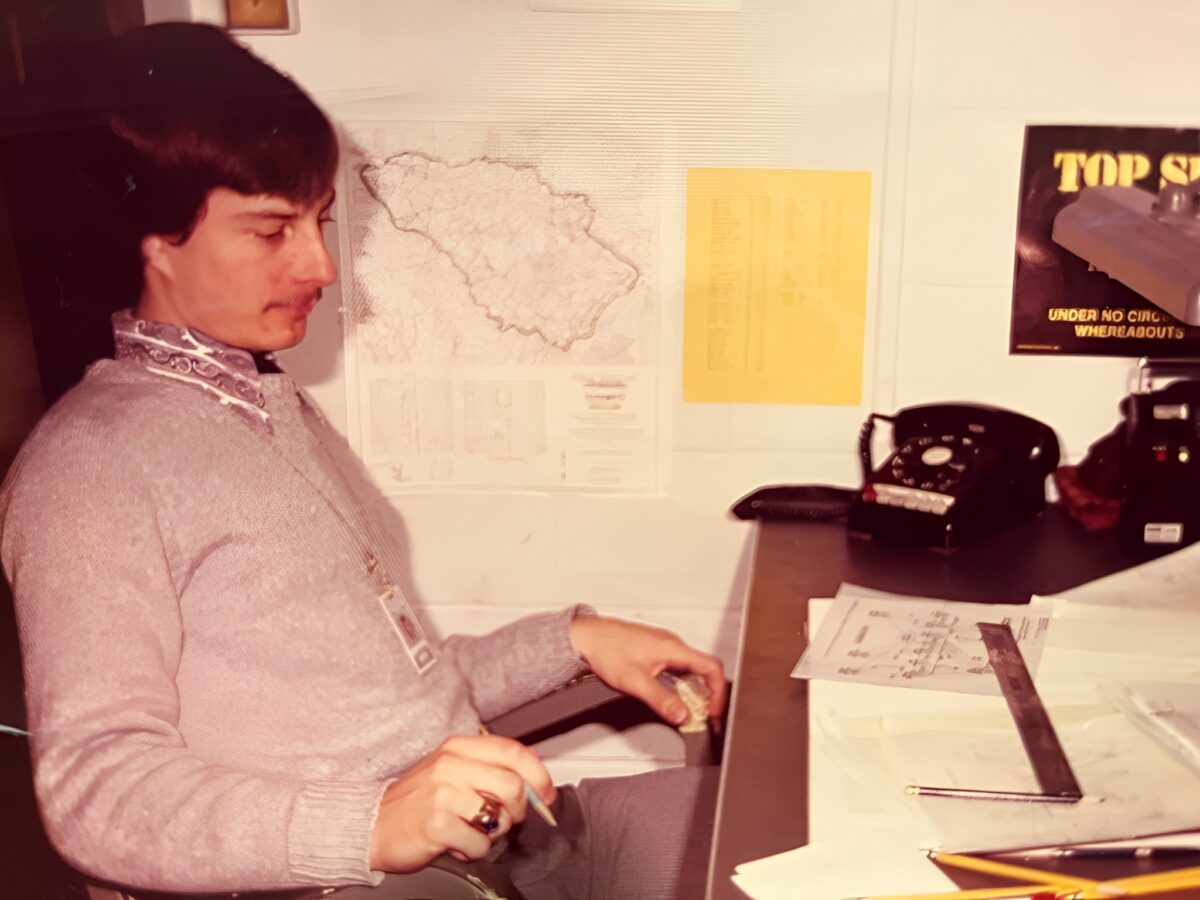 Czajkowski at his desk at APL in 1977. Courtesy of Czajkowski.
Early on at APL (where more than 350 Retrievers work currently), Czajkowski got to see the real world impact of his work when tasked by the Navy to develop the mathematical methodology used to determine how many new aircraft to buy for a specific mission. Sixteen was the answer. “And those aircraft have been in operation for 30-plus years, doing an important mission,” says Czajkowski. “It gave me great satisfaction that, even at that young age, I had an impact on national security and when they put it all together, it was probably over a billion dollars at the time, for purchase.”
But this would not be the defining calculation of Czajkowski’s career. Among the many projects tasked with in the intervening decades, Czajkowski’s main efforts have focused on developing the mathematical models used to evaluate the communication systems that the president uses to command all the nuclear forces. “To assure that, under any circumstances, wherever the president is, in the White House, or on an airplane traveling, that he can communicate to the nuclear forces if needed,” says Czajkowski.
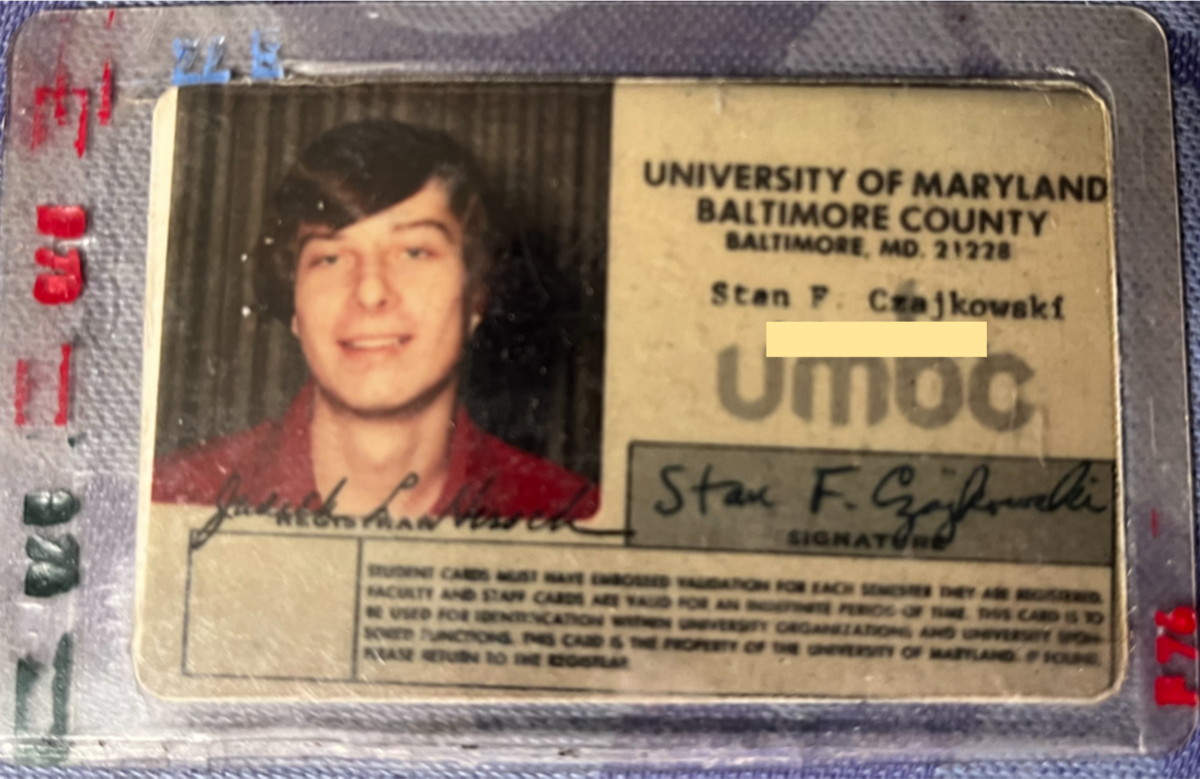 Czajkowski’s student ID card. Courtesy of Czajkowski.
With a background in probability and statistics, Czajkowski’s job is to represent how well dedicated frequencies used for communications via aircraft, ships, or satellites will work in various situations. “The math comes in trying to figure out how well those communications will work in different environments,” explains Czajkowski. He gives an example of a submerged submarine, listening in on their antenna at a distant location. If you send information over the radio frequencies, how sure are you that it will be received?
“You have to account for all the probabilities of different random events, and we have data that goes into the model that you have to calculate statistics on in order to support that calculation.”
Early in Czajkowski’s career, he helped design the simulation model used to do just that—and it’s still being used by both the U.S. Navy and the Air Force. “It’s become the national standard for modeling that kind of communications to submarines, bombers, and intercontinental ballistic missiles,” he says.
Defense relies on teamwork
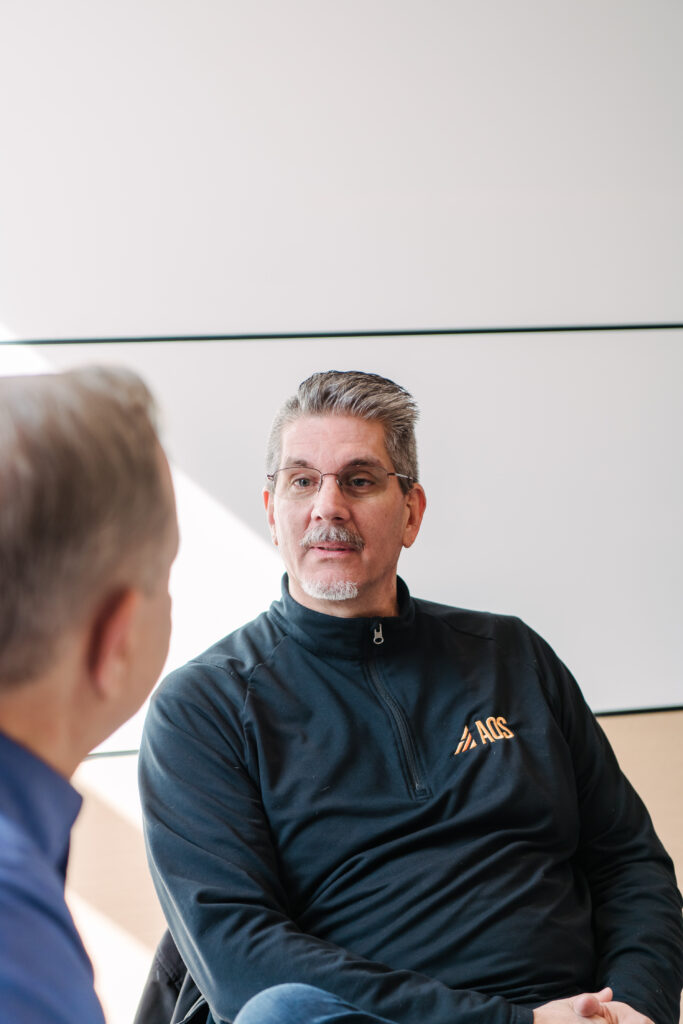 Miller in conversation with Czajkowski. Marlayna Demond ’11/UMBC
Czajkowski, who writes the algorithms and performs analysis for this project, is relieved not to be working alone. “I concentrate on the analytical side, the math and statistics stuff. But it’s pretty much a team effort in our group—we have mathematicians, computer scientists, electrical engineers, and physicists, all working together to solve the problems.”
Some of those key players are other Retrievers. Meet Jim Miller ’87, computer science, who is now the group supervisor of Czajkowski and other technical staff members of the Nuclear Command Communications Systems Group of the Asymmetric Operations Sector.
Miller has only been in this role for about a year and half, but has worked for APL for 28 years.
“Our group collects and analyzes data to ensure the readiness state of our nation’s nuclear triad of bombers, ICBMs [intercontinental ballistic missiles], and SSBNs [submarines],” explains Miller. “So when the president needs to communicate with the joint chiefs while some major national security event is happening, we know that they have a robust, resilient, and secure communications path with our nuclear triad to effectively carry out our mission. And that mission is not only nuclear. That mission can be related to natural disasters, like Hurricane Katrina, when the president needs to deploy forces to help with humanitarian aid.”
Grounded in leadership
Miller—whose son James Miller ’13 and daughter Christine Miller ’17 are also Retrievers with computer science degrees—sees the root of his success stemming from his early growth at UMBC. “UMBC allowed me to have that opportunity to make relationships and understand how important they were, rather than being a lemming or a drone, just rotely going to class and not getting a full experience out of college,” says Miller.
Those interpersonal skills have allowed him to take on increasingly larger leadership roles. “What I pride myself on today is building personal relationships with people, because each and every one of us has something to offer, and my job as the supervisor is to figure out what that is,” says Miller.
One of Miller’s newest team members is also a UMBC alumnus. Nick Sica ’22, computer science and history, started at APL just under a year ago. While his title is vaguely defined as “associate professional staff,” Sica says his main duties fall under software engineering, but also include data communications, data analysis, and cybersecurity.
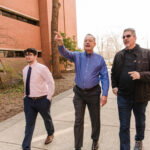
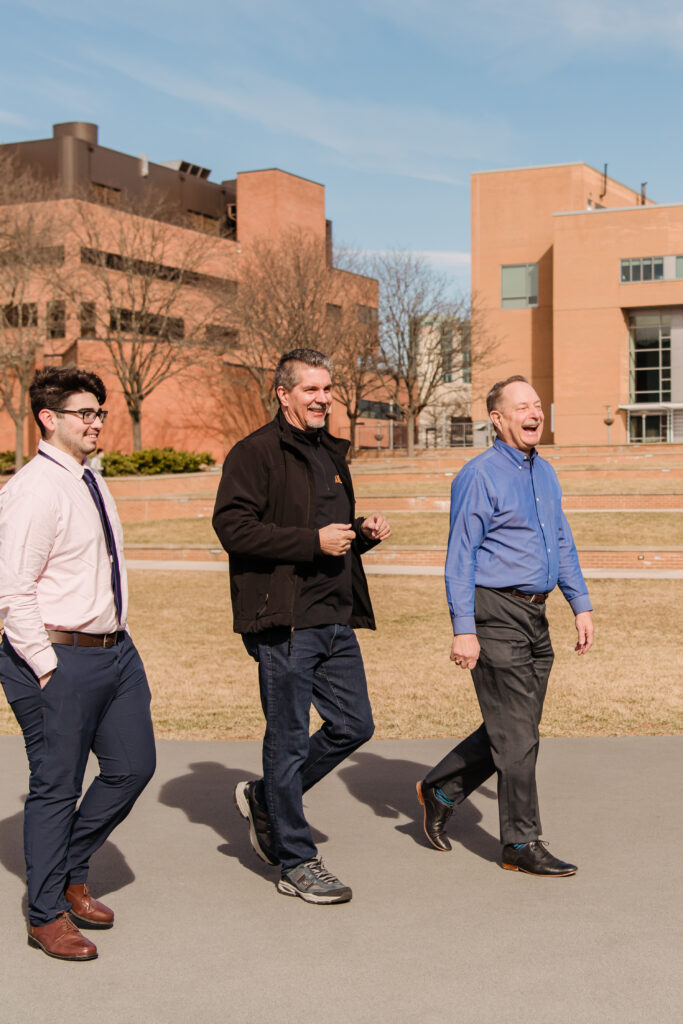 From left to right, Sica, Miller, and Czajkowski walk across the Quad on a visit to campus in February 2023. Marlayna Demond ’11/UMBC
When Sica was interviewing at APL, he was asked his placement preference within the organization. His first choice was in NC3 (Nuclear Command, Control, and Communications) because of Miller. “It seemed he cared more about what I wanted to do in my position and what I was comfortable in doing and my growth, and less about just finding someone to cover the position,” said Sica. And since then, “he’s been making sure that I’ve transitioned well.”
As a recent graduate, many of the tasks require new skill sets for Sica, including work in computer and electrical engineering. But he knows just who to go to if he needs help, one of the longest serving leads on the team, Czajkowski.
Every Wednesday, in a team meeting, Sica sits down with Czajkowski and gets “his input on the progress that I’ve made on the task, as well as making sure that I understand the context of the situation and what we’re doing. This helps me create better code for the mission that we’re doing here.”
“Given the fact that I’ve been working in this area for so long,” says Czajkowski, “I’m looked at as a subject matter expert, so I often get consulted. This might involve getting together with team members on a particular project, discussing what the problems are, looking into, okay, ‘How do we move forward to solving this particular problem?’”
These algorithms support democracy
“Stan is my trusted advisor,” says Miller. “He was in my seat before. To see someone with 45 years experience still have that desire and dedication, it’s amazing.”
 Czajkowski aboard a presidential helicopter to collect data for mathematical analysis of a presidential communications system. Courtesy of Czajkowski.
Czajkowski, who plans to partially retire this year, is more mindful than ever of the need to pass down his knowledge, as well as the weight of the mission his team is responsible for.
Miller compares his team’s project to his previous position working in the Air and Missile Defense Sector, which would publicly demonstrate U.S. interceptors intercepting a missile. “We would launch a test missile, and would have our Aegis destroyers track it, engage it, and destroy it. The events are filmed for analysis and also demonstrate to the world that we have a very impressive capability, and it’s very effective,” says Miller.
He points out that for nuclear capability, there’s no way to publicly display those ironclad defenses. “People just have our word that we are going to be able to respond. And so we back that up by ensuring that we can do that. But there’s no public display of that. So it’s harder for others to see the importance of what we do, but it’s absolutely critical.”
“We have preserved our democracy for all these years through nuclear deterrence,” continues Miller. “And Stan’s work is a testament to that.”
Vital work requires excellence
On an unseasonably warm winter day in February, Czajkowski, Miller, and Sica walk around UMBC’s campus together, at ease in their off-the-cuff camaraderie. Sica, who only graduated the year before, takes the lead on introducing his colleagues to an entirely new landscape in the loop. While peeking into some of the bright, state-of-the-art classrooms in the Interdisciplinary Life Sciences Building, Sica shares that he was in class here when UMBC announced the start of remote learning in early March 2020.
This leads to Miller’s memory of hearing of the 1986 Challenger disaster on the radio while on his commute to UMBC. The conversation moves on from dwelling on heavy topics. This visit is more of a field trip, a chance to take a break from the weightier aspects of their day-to-day mandate.
Czajkowski, a men’s basketball season ticket holder, looks around campus with a sense of wonder. It’s come a long way since his tenure in the 1970s, but then again, so has he. Most people will not stay with the same employer for their entire career, much less continue to solve problems in the same area, and yet, Czajkowski has found satisfaction doing exactly that.
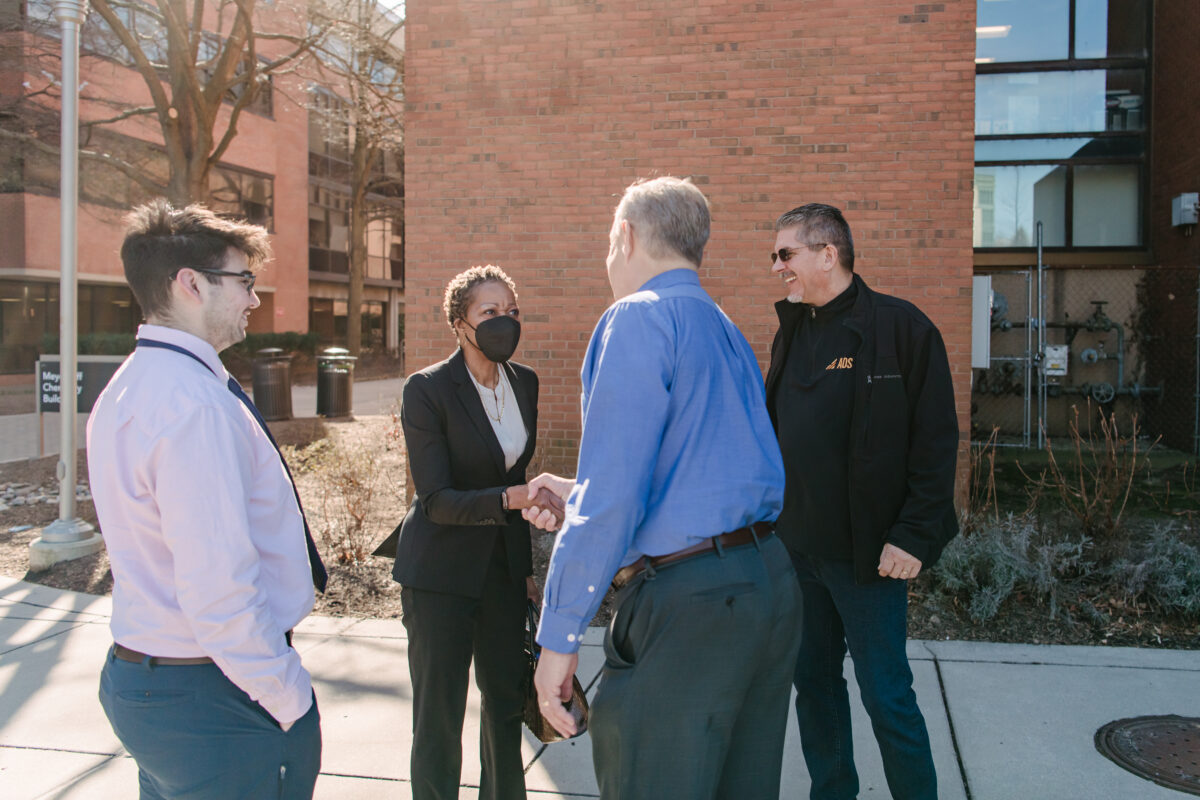 On their walk across campus, Sica, Czajkowski, and Miller met President Valerie Sheares Ashby. Marlayna Demond ’11/UMBC
“We have a very important mission that we’re working on, and I’m passionate about making sure that it is done well,” says Czajkowski. “One of the things that I’d say that UMBC taught me was how to think logically in the mathematical world, and dig deep into problems, and to be able to say, ‘Look, here’s how you approach the problem that’s being presented to you, and figure out a way to get to a solution.’”
“And the focus that I’ve applied throughout my career is, be excellent in everything you do, and make sure you do everything the right way. That’s just me as a person. It just gives me great satisfaction to know that I’m applying myself the best I can, and not taking shortcuts. You don’t want to be wrong in this world.”
]]>
In the 1960s, a common routine for elementary school students was to practice hiding under their desks in case of a nuclear blast. Following the Bay of Pigs standoff in 1961, international...
https://umbc.edu/stories/the-math-and-the-man-behind-our-national-security/
https://beta.my.umbc.edu/api/v0/pixel/news/132444/guest@my.umbc.edu/6093e45dad4b10a2bdcf6ebe4893f1ae/api/pixel
alumni
cnms
coeit
computer-science
impact
magazine
mathematics
spring-2023
UMBC News & Magazine
https://beta.my.umbc.edu/groups/umbc-news-magazine
https://assets1-beta.my.umbc.edu/system/shared/avatars/groups/000/001/943/24435aa6207c452e7bc15cc74b42c7bb/xsmall.png?1748556657
https://assets1-beta.my.umbc.edu/system/shared/avatars/groups/000/001/943/24435aa6207c452e7bc15cc74b42c7bb/original.png?1748556657
https://assets2-beta.my.umbc.edu/system/shared/avatars/groups/000/001/943/24435aa6207c452e7bc15cc74b42c7bb/xxlarge.png?1748556657
https://assets2-beta.my.umbc.edu/system/shared/avatars/groups/000/001/943/24435aa6207c452e7bc15cc74b42c7bb/xlarge.png?1748556657
https://assets3-beta.my.umbc.edu/system/shared/avatars/groups/000/001/943/24435aa6207c452e7bc15cc74b42c7bb/large.png?1748556657
https://assets1-beta.my.umbc.edu/system/shared/avatars/groups/000/001/943/24435aa6207c452e7bc15cc74b42c7bb/medium.png?1748556657
https://assets2-beta.my.umbc.edu/system/shared/avatars/groups/000/001/943/24435aa6207c452e7bc15cc74b42c7bb/small.png?1748556657
https://assets1-beta.my.umbc.edu/system/shared/avatars/groups/000/001/943/24435aa6207c452e7bc15cc74b42c7bb/xsmall.png?1748556657
https://assets2-beta.my.umbc.edu/system/shared/avatars/groups/000/001/943/24435aa6207c452e7bc15cc74b42c7bb/xxsmall.png?1748556657
UMBC News & Magazine
1
0
false
Fri, 07 Apr 2023 16:36:32 -0400
Fri, 07 Apr 2023 16:36:32 -0400
Michelle R. Scott illuminates the lives of Black Vaudeville performers and their broader social impact in Jazz Age America

Michelle Scott, associate professor of history, will discuss her new book T.O.B.A. Time: Black Vaudeville and the Theater Owners Booking Association in Jazz Age America(University of Illinois Press, 2023) on April 11, presenting the history department’s annual Lowe Lecture. In a conversation with UMBC News, Scott shares the artistic, social, and historic context of an association that brought Black artists to both Black and white audiences across the United States during the 1920s.
 Michelle Scott. (Marlayna Demond ’11/UMBC)
UMBC News: What are some of the central themes the book explores?
Scott: The book explores the lives of the performers, theater owners, producers, managers, and audiences that were part of Black Vaudeville and the Theater Owners Booking Association (T.O.B.A.). It’s a story about how these Black- and white-owned theaters fostered Black artistic exploration and development and the growth of Black-owned businesses. T.O.B.A. is the foundation of Black live entertainment in the 20th century. This is the first in-depth study of this circuit during a time of transition in the entertainment industry between WWI and the Great Depression in segregated America.
UMBC News: Who were some of the artists who began with T.O.B.A. and grew famous, leading to profitable and stable careers?
Scott: T.O.B.A. is a cornerstone in the history of the African American entertainment industry where artists like Cab Calloway, the famed singer, songwriter, bandleader, conductor, and dancer, honed their talents. Other artists include “The Empress of the Blues,” Bessie Smith, and Ethel Waters, who became the first Black woman to receive equal billing with white stars on Broadway. These headliners, including Sammy Davis Jr., the tap-dancing Nicholas Brothers, Count Basie, and the comedic duo Butterbeans and Susie, found fame lasting decades beyond the Jazz Age.
But there was also a place for novelty acts, like the person doing the hula hoop or playing the harmonica with their nostrils. There were also tabloid plays. These abbreviated musical comedies bootlegged off-Broadway plays in a few songs. It’s a much shorter version of today’s Broadway tours. Think of a cabaret version of Hamilton represented in three songs.
It might be a few minutes, but T.O.B.A gave an opportunity to a wide variety of talents to create shows that appealed to a wide audience.
It was a family, where many had multiple jobs to make the show happen. Singers would do makeup. An actor would help with costuming. It wasn’t “the show must go on.” It was “the show will go on.”
UMBC News: T.O.B.A. enabled artists to channel their talents and broaden their networks. What was the association’s impact beyond performances?
Scott: This was the entertainment business. In 1929, T.O.B.A. was among the 12th most profitable black-owned industries in the United States, alongside black-owned insurance agencies, beauty businesses, dressmakers, etc. It had headquarters in Chicago, Washington, D.C., and Chattanooga, Tennessee, running 100 theaters over a decade. For Black and white theater owners, T.O.B.A. provided a steady stream of entertainers, helping to contribute to the local and national economy.
 The Howard Theater in Washington DC, on T Street, Northwest. Photo by Dhousch, Wikemedia Commons.
The hospitality industry grew to meet the demands. This was a particularly important business venture for leading Black artists who were paid well like Cab Calloway and the “Mother of the Blues” Ma Rainey, who was paid $800 for four performances and could spend money on fine room, board, and clothing while traveling for performances. In segregated towns, the Black hospitality industry played an essential role in meeting the needs of entertainers. Black women found opportunities to operate boarding room homes and cook meals, and workers created a key union to fight for fair wages.
As traveling performers, women were also allowed more financial, sexual, and artistic freedom away from families that could be strict and religious. Yet, they also faced gender discrimination and sexual violence on the road.
UMBC News: Jazz Age America was a time of expansive Black artistic exploration and innovation within a heightened period of racial violence and segregation. How did this affect T.O.B.A.?
Scott: The world was trying to recover from WWI, the devastation of the Spanish Flu, and a slowly declining economy that would lead to the Great Depression. Returning white veterans and communities felt threatened by the prospect of losing jobs and housing to Black veterans and to families moving from the South. All of these tensions led to the “Red Summer” of 1919. Mass shootings, lynchings, and race riots spread throughout the country including in Chicago, Washington, D.C., and Baltimore.
Most of the T.O.B.A. theaters were in the South. Artists traveling the country and performing in theaters often risked their safety to make a living from their art. The Black working-class audiences were taking a risk going to see live shows and spending their hard-earned money while surrounded by racial violence and segregation.
One of the most haunting accounts that I found was of the Dreamland Theatre in Tulsa, Oklahoma owned by a Black couple. It was one of the earliest theaters to join the circuit. In 1921, it was leveled during the Tulsa Race Massacre. I was shocked that their records survived, allowing the shared history of the theater, owners, artists, and local community to be witness to the importance of Black theater to Tulsa’s Black community. The owners eventually opened up other Dreamland Theatres in Oklahoma.
T.O.B.A. is monumental because it helped Black artists and Black communities continue to thrive while fighting white supremacy. Many times, if churches were not able to provide a space to organize marches, communities organized in theaters. Sometimes, theater entrance fees were donated to help activists or communities hit by natural disasters, or to help with legal fees.
History definitely talks about the violence inflicted on Black communities, the death toll, and poverty, but it doesn’t always tell about Black innovation, economic prosperity, creativity, and thriving Black communities that existed before, during, and after the Jazz Age. It doesn’t always talk about art as an alternative resistance. T.O.B.A. is that story.
Learn more about this new book in Michelle Scott’s Low Lecture on April 11, 4-5 p.m., in the Albin O. Kuhn Library 7th floor. Research for the book was partially supported by UMBC’s Dresher Center for the Humanities and the CAHSS research grant.
]]>
Michelle Scott, associate professor of history, will discuss her new book T.O.B.A. Time: Black Vaudeville and the Theater Owners Booking Association in Jazz Age America(University of Illinois...
https://umbc.edu/stories/strongmichelle-r-scott-illuminates-the-lives-of-black-vaudeville-performers-in-jazz-age-america-strong/
https://beta.my.umbc.edu/api/v0/pixel/news/132431/guest@my.umbc.edu/6929e550dfebce03421d7732f37337f9/api/pixel
arts-and-culture
cahss
cahssresearch
dreshercenter
history
humanities
news
policy-and-society
rca-2
research
UMBC News & Magazine
https://beta.my.umbc.edu/groups/umbc-news-magazine
https://assets1-beta.my.umbc.edu/system/shared/avatars/groups/000/001/943/24435aa6207c452e7bc15cc74b42c7bb/xsmall.png?1748556657
https://assets1-beta.my.umbc.edu/system/shared/avatars/groups/000/001/943/24435aa6207c452e7bc15cc74b42c7bb/original.png?1748556657
https://assets2-beta.my.umbc.edu/system/shared/avatars/groups/000/001/943/24435aa6207c452e7bc15cc74b42c7bb/xxlarge.png?1748556657
https://assets2-beta.my.umbc.edu/system/shared/avatars/groups/000/001/943/24435aa6207c452e7bc15cc74b42c7bb/xlarge.png?1748556657
https://assets3-beta.my.umbc.edu/system/shared/avatars/groups/000/001/943/24435aa6207c452e7bc15cc74b42c7bb/large.png?1748556657
https://assets1-beta.my.umbc.edu/system/shared/avatars/groups/000/001/943/24435aa6207c452e7bc15cc74b42c7bb/medium.png?1748556657
https://assets2-beta.my.umbc.edu/system/shared/avatars/groups/000/001/943/24435aa6207c452e7bc15cc74b42c7bb/small.png?1748556657
https://assets1-beta.my.umbc.edu/system/shared/avatars/groups/000/001/943/24435aa6207c452e7bc15cc74b42c7bb/xsmall.png?1748556657
https://assets2-beta.my.umbc.edu/system/shared/avatars/groups/000/001/943/24435aa6207c452e7bc15cc74b42c7bb/xxsmall.png?1748556657
UMBC News & Magazine
0
0
false
Fri, 07 Apr 2023 11:15:07 -0400
Fri, 07 Apr 2023 11:15:07 -0400
Innies, outies and omphalophobia: 7 navel-gazing questions about belly buttons answered

Written by Sarah Leupen, senior lecturer of biological sciences, UMBC
Everyone has one, but you might not know much about it. Here biologist Sarah Leupen, who teaches human and comparative animal physiology, explains the ins and outs of belly buttons.
1. Why do I even have a belly button?
Your belly button, or navel – clinically, your umbilicus – is the permanent scar left from where your umbilical cord connected your circulatory system, when you were a fetus, to the placenta. Fetuses don’t breathe, eat or eliminate waste, so the placenta provides an exchange site for the mother to deliver oxygen and nutrients from her bloodstream to the fetus, as well as collecting its wastes to eliminate from her body.
 Once the umbilical cord is cut, the stump dries up and falls off, revealing the baby’s navel. Wacharaphong/iStock via Getty Images Plus
After the baby is born, the physician or other attendant cuts the cord and clamps off the stub, which then dries and falls off after about a week, leaving the point of connection – your belly button – remaining.
If the cord is not cut, as has been the practice in some times and places and as is becoming trendy again in others, it will close off after an hour or so, then naturally detach a few days after birth. Some health care practitioners are concerned that this “lotus birth” could be an infection risk, since the umbilical cord remains attached to the placenta, which is dead tissue once out of the mother’s body.
2. If it’s a scar, why doesn’t it disappear over time?
If you injure just the outer layers of your skin, as in a cut or burn, the scar will soon completely disappear, especially in young people. And newborns are very young people. But unlike in those situations, the umbilicus involves more tissue layers — not just the skin but the connective tissue underneath – so it makes sense it doesn’t just blend in with the rest of your abdominal wall once it’s healed.
What about some pretty complicated surgeries that don’t leave scars? Doctors perform many operations in ways that deliberately avoid scarring, which is not nature’s way. In fact, one way to minimize scarring for surgeries uses this existing scar – surgeons can take advantage of the navel as an incision site for removing your appendix or gall bladder or for weight-loss surgery.
But if you don’t like the way your umbilical scar looks, plastic surgery to change its appearance, called umbilicoplasty, is possible. People sometimes take this cosmetic option after pregnancy or the removal of a piercing, or just to make an “outie” into an “innie.”
 Outies are much less common than innies. Zeev Barkan/Flickr, CC BY
3. But why do some people have outies, anyway?
The look of your belly button is not related to the location of the clamp or where your doctor cut the cord.
Outies are simply an example of normal human variation, like the way some people have curly hair or dimples. When the tip of the umbilical cord’s remnant pokes out past the skin around it, you have an outie; about 10% of people have these. Any concave navel is called an “innie” and a convex one an “outie.”
Sometimes outies can be caused by an umbilical hernia in the baby or another medical problem, but most of it is just due to what your genes encoded. You might also temporarily have an outie during late pregnancy, when the abdominal pressure from the growing fetus stretches your navel and may push it out.
4. How deep does it go?
You can probably easily probe the depth of your own navel – there are no hidden recesses there. What’s under it is the same as what’s under the skin of the rest of your abdomen: your abdominal muscles, to which the navel is attached by a short umbilical stalk, and the peritoneum, the membrane that lines the abdominal cavity. Under that lie your guts – that is, your intestines and other abdominal organs. If you keep following this imaginary journey back, you’ll get to your spine – the belly button is usually lined up between the third and fourth lumbar vertebrae (L3 and L4).
Learn how to find your pet’s belly button.
5. Do other animals have belly buttons?
Because the navel is a scar from where the umbilical cord connected the fetus to the placenta, all placental mammals have them. That includes all mammals except marsupials (like kangaroos and possums) and monotremes (like platypuses and echidnas).
Your cat or dog or guinea pig does have a belly button, but because it’s a flatter scar than a person’s rather than a concave one, and is covered in fur, you might have missed it.
6. Is there anything besides lint in there?
Like any concave surface, if you have an innie, it probably gathers bits of debris occasionally. Your navel also has a microbial community, just like the rest of your skin. Because it’s pretty protected from soap and abrasion, a more stable and diverse bacterial community lives in your navel than elsewhere on your skin’s surface.
The innovative Belly Button Biodiversity project at North Carolina State University has revealed a lot about these little friends. The researchers found over 2,000 species of bacteria in the first 60 belly buttons they investigated.
It looks like most people have a set of eight common belly button bacteria, but the project is discovering new ones all the time.
7. Why do belly buttons gross out some people?
There hasn’t really been much research into why some people find belly buttons to be repulsive.
It may overlap with omphalophobia, the fear of belly buttons and touching them. There’s no specific treatment beyond the therapy or anti-anxiety medications a doctor might prescribe for any other phobia.
Whatever your feelings about belly buttons, they’re harmless. What’s more, they’re part of your evolutionary legacy as a mammal, the group of animals so invested in their offspring that they invented a way to deliver nutrients and oxygen, the mother’s bread and breath, straight into their developing young. Your navel can be a reminder of that first life-sustaining care you received from another person before you were even born.
This article is republished from The Conversation under a Creative Commons license. Read the original article and see more than 250 UMBC articles available in The Conversation.
]]>
Written by Sarah Leupen, senior lecturer of biological sciences, UMBC Everyone has one, but you might not know much about it. Here biologist Sarah Leupen, who teaches human and comparative...
https://umbc.edu/stories/questions-about-belly-buttons-answered/
https://beta.my.umbc.edu/api/v0/pixel/news/132302/guest@my.umbc.edu/4dda39ebf01cbe4ec2a1c677ea958d28/api/pixel
biological-sciences
biologicalsciences
biology
cnms
discovery
magazine
the-conversation
UMBC News & Magazine
https://beta.my.umbc.edu/groups/umbc-news-magazine
https://assets1-beta.my.umbc.edu/system/shared/avatars/groups/000/001/943/24435aa6207c452e7bc15cc74b42c7bb/xsmall.png?1748556657
https://assets1-beta.my.umbc.edu/system/shared/avatars/groups/000/001/943/24435aa6207c452e7bc15cc74b42c7bb/original.png?1748556657
https://assets2-beta.my.umbc.edu/system/shared/avatars/groups/000/001/943/24435aa6207c452e7bc15cc74b42c7bb/xxlarge.png?1748556657
https://assets2-beta.my.umbc.edu/system/shared/avatars/groups/000/001/943/24435aa6207c452e7bc15cc74b42c7bb/xlarge.png?1748556657
https://assets3-beta.my.umbc.edu/system/shared/avatars/groups/000/001/943/24435aa6207c452e7bc15cc74b42c7bb/large.png?1748556657
https://assets1-beta.my.umbc.edu/system/shared/avatars/groups/000/001/943/24435aa6207c452e7bc15cc74b42c7bb/medium.png?1748556657
https://assets2-beta.my.umbc.edu/system/shared/avatars/groups/000/001/943/24435aa6207c452e7bc15cc74b42c7bb/small.png?1748556657
https://assets1-beta.my.umbc.edu/system/shared/avatars/groups/000/001/943/24435aa6207c452e7bc15cc74b42c7bb/xsmall.png?1748556657
https://assets2-beta.my.umbc.edu/system/shared/avatars/groups/000/001/943/24435aa6207c452e7bc15cc74b42c7bb/xxsmall.png?1748556657
UMBC News & Magazine
0
0
false
Wed, 05 Apr 2023 13:34:16 -0400
Wed, 05 Apr 2023 13:34:16 -0400
Meet a Retriever—Xavier Smith ’23, M31, computer engineering, scholar and mentor

Meet Xavier Smith, a senior computer engineering student who is heading to MIT next year to pursue his dreams of earning a Ph.D. and starting a biotech company. As a part of UMBC’s Meyerhoff Scholars Program, the U-RISE Scholars Program, and a number of other organizations on campus, he truly understands the meaning of community. Take it away, Xavier!
Q: What’s one essential thing you’d want another Retriever to know about you?
A: I am a senior studying computer engineering on the communications track. In fall of 2023, I will be attending the Massachusetts Institute of Technology (MIT), where I will be pursuing my Ph.D. in electrical engineering as a recipient of the MIT Presidential Fellowship supported from the Lemelson Foundation (Lemelson Minority Engineering Fellowship).
I will be focusing on engineering magnetic nanoparticles for wireless neural stimulation with hopes of developing non-invasive therapeutic treatments for individuals diagnosed with neurodegenerative diseases and psychiatric disorders. My future career goals are to start a biotechnology company that practically implements these therapeutic innovations in a translational manner, and my professional goals are to make biomedical technology more accessible and equitable for individuals from all socioeconomic and ethnic backgrounds.

Xavier Smith, ’23, M31, U-RISE Cohort 2
Q: What’s the one thing you’d want someone who hasn’t joined the UMBC community to know about the support you find here?
A: UMBC has many niche communities, and although it’s important to find the one that fits you, the university has a way of mixing those communities together in an energetic way that helps spark interesting conversations and life-long connections. Additionally, UMBC is hyper-focused on their students, which allows your voice to be heard on a larger scale.
Q: Tell us about someone in your community who has inspired you or supported you, and how they did it.
A: My father, Brian Smith, has inspired me as an black engineer and entrepreneur in STEM through the various companies he has owned that are either technologically-based or focus on exposing students to opportunities in science and engineering. His tenacity, optimism, work ethic, positive attitude, adaptability, and collective success of more than 25 years motivates me to push the boundaries of science and technology in my community, and to be just like him.
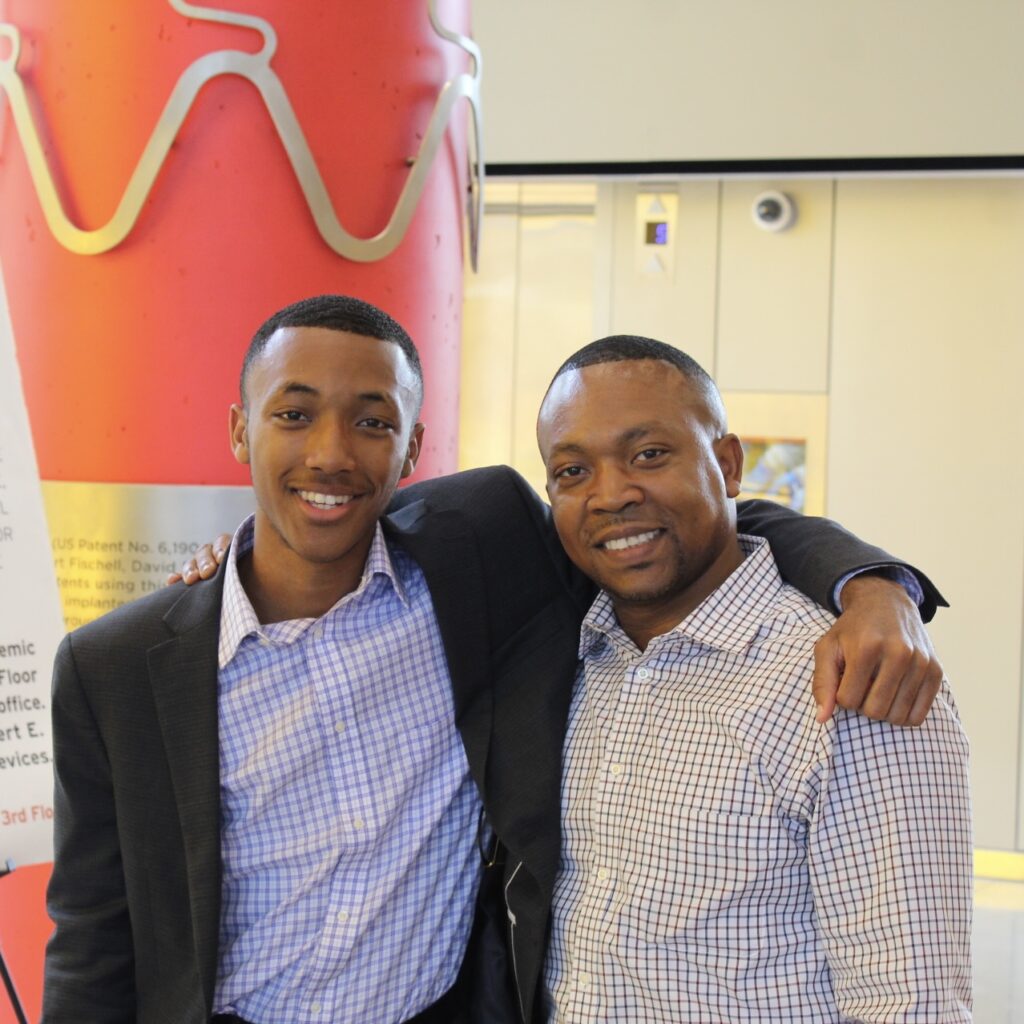 Xavier Smith (left) with his father, Brian Smith (right) at a research presentation in 2018. Photo courtesy of Smith.
Q: Tell us what you love about your academic program or an organization you’re involved in.
A: What I love about UMBC’s computer engineering program is the overall focus of implementation and practicality of content. The faculty prepare students to tackle real-world problems from a plethora of perspectives not just from STEM. Separately, I am currently president of the Institute of Electronics and Electrical Engineers (IEEE) at UMBC, and I lead this organization with my stellar executive board of friends I made along the way in computer engineering. What I love about this organization is its versatility of impact as we focus on getting students of all majors and backgrounds excited about STEM, and exposed to real-world opportunities and applications of science and technology.
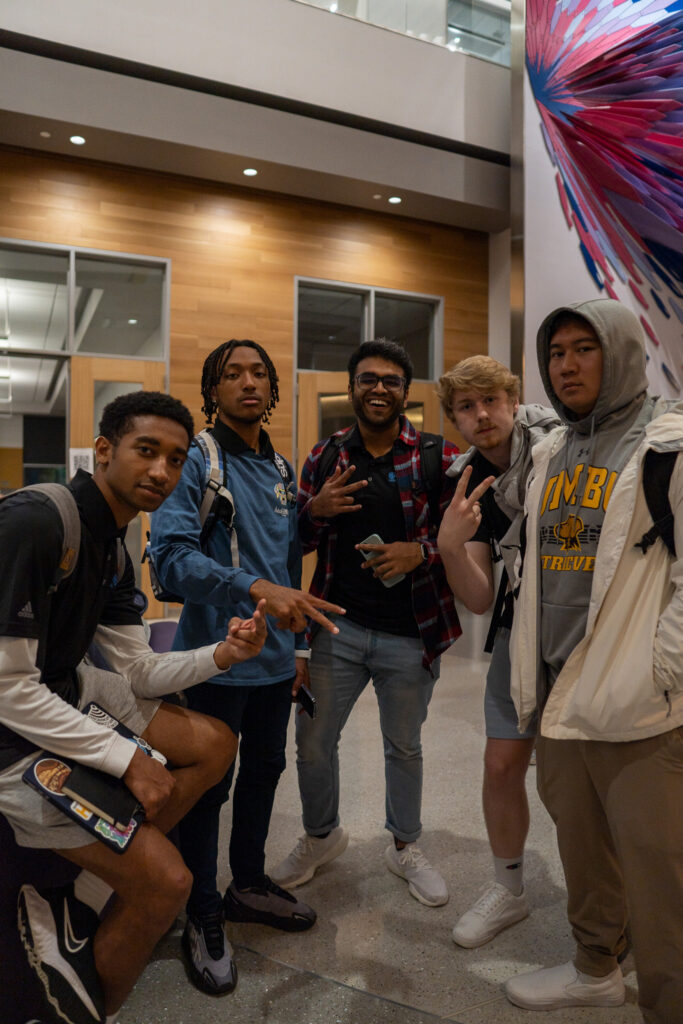 Smith with computer engineering friends and IEEE executive board members running an event at hackUMBC, from left to right: Christopher Slaughter ’23 (vice president), Xavier Smith ’23 (president), Andrew Mathew ’23 (secretary), Caden Ertel ’23 (lab director), and David Nguyen ’23 (public relations chair/historian). (Nkosi Cruickshank, the group’s treasurer, is not pictured). Photo courtesy of Smith.
Q: What brought you to UMBC?
A: I came to UMBC because of the Meyerhoff Scholars Program, which is a Ph.D. pipeline-program focused on preparing historically underrepresented students for higher education in academia and industry. I knew I wanted to earn a Ph.D., but I didn’t know why or in what specific field, and the Meyerhoff Program here at UMBC provided me with resources that helped me figure out the answer to those questions. As I took advantage of these opportunities to set my foundation in research, I joined the U-RISE Program here, which guided me on manifesting my desire to enter the world of biomedical science.
I got involved with organizations here such as the Institute of Electronics and Electrical Engineers (IEEE), the National Society of Black Engineers (NSBE), Black Student Union (BSU), etc. and teaching opportunities as a teaching assistant and learning assistant in the computer engineering department. Overall, before I entered UMBC I had one perspective of what the university had to offer me, however, as I continued to explore, I began to see the multitude of opportunities that UMBC provides that can be encompassed into one word: community.
Not only have I found exactly what field of science I want to pursue and why, I have found my voice in STEM and the confidence to pursue my goals and dreams of making a lasting difference in the world because of the Meyerhoff Scholars and U-RISE Scholars programs.
Xavier Smith ’23
Q: What are some of the benefits of your involvement in student activities?
A: I am a student leader in many different contexts: the president of IEEE, a peer advisor in the Meyerhoff Program for incoming computer engineering students, and a research project leader in Dr. Ramana Vinjamuri’s Brain Computer Interfaces lab. As president of IEEE, I get a chance to break the barriers of the club in terms of our impact, event sizes, and activities with my friends on the executive board. We have focused on creating a makerspace for students of all majors and backgrounds, giving them a physical place to be able to express themselves, explore their creative interests, or simply complete homework with friends.
As a peer advisor for the Meyerhoff Program, I have the opportunity of mentoring other students in the program interested in computer engineering. I serve not only as their go-to person for when they need help, but also as an advocate for them if they need support inside or outside the program.
Lastly, as a research project leader in Dr. Vinjamuri’s lab, I’m mentoring students on projects that focus on improving the lives of patients with physical and mental disparities by engineering novel myoelectric prosthetics, neuroprosthetics, recording devices, and robust decoding systems. I love being able to give direction and inspiration to the next generation of students in science through my efforts, especially to those who originate from historically underrepresented communities.
Q: What’s it like to be part of a scholars community at UMBC?
A: I am part of the Meyerhoff Scholars and U-RISE Scholars programs here at UMBC, and the main thing I enjoy about both programs is the overarching support that they provide me as I’m working toward reaching my academic, career, and professional goals. The resources that they routinely provide me are invaluable: mentoring, contacts, support groups, advising, and most importantly, communication. Not only have I found exactly what field of science I want to pursue and why, I have found my voice in STEM and the confidence to pursue my goals and dreams of making a lasting difference in the world because of both programs.
* * * * *
UMBC’s greatest strength is its people. When people meet Retrievers and hear about the passion they bring, the relationships they create, the ways they support each other, and the commitment they have to inclusive excellence, they truly get a sense of our community. That’s what “Meet a Retriever” is all about.
Learn more about how UMBC can help you achieve your goals.
]]>
Meet Xavier Smith, a senior computer engineering student who is heading to MIT next year to pursue his dreams of earning a Ph.D. and starting a biotech company. As a part of UMBC’s Meyerhoff...
https://umbc.edu/stories/meet-a-retriever-xavier-smith-scholar-mentor/
https://beta.my.umbc.edu/api/v0/pixel/news/132336/guest@my.umbc.edu/d465490c504b9aacc2af654c76a3d6b8/api/pixel
computer-engineering
impact
magazine
meet-a-retriever
meyerhoff-scholars
perspectives
UMBC News & Magazine
https://beta.my.umbc.edu/groups/umbc-news-magazine
https://assets1-beta.my.umbc.edu/system/shared/avatars/groups/000/001/943/24435aa6207c452e7bc15cc74b42c7bb/xsmall.png?1748556657
https://assets1-beta.my.umbc.edu/system/shared/avatars/groups/000/001/943/24435aa6207c452e7bc15cc74b42c7bb/original.png?1748556657
https://assets2-beta.my.umbc.edu/system/shared/avatars/groups/000/001/943/24435aa6207c452e7bc15cc74b42c7bb/xxlarge.png?1748556657
https://assets2-beta.my.umbc.edu/system/shared/avatars/groups/000/001/943/24435aa6207c452e7bc15cc74b42c7bb/xlarge.png?1748556657
https://assets3-beta.my.umbc.edu/system/shared/avatars/groups/000/001/943/24435aa6207c452e7bc15cc74b42c7bb/large.png?1748556657
https://assets1-beta.my.umbc.edu/system/shared/avatars/groups/000/001/943/24435aa6207c452e7bc15cc74b42c7bb/medium.png?1748556657
https://assets2-beta.my.umbc.edu/system/shared/avatars/groups/000/001/943/24435aa6207c452e7bc15cc74b42c7bb/small.png?1748556657
https://assets1-beta.my.umbc.edu/system/shared/avatars/groups/000/001/943/24435aa6207c452e7bc15cc74b42c7bb/xsmall.png?1748556657
https://assets2-beta.my.umbc.edu/system/shared/avatars/groups/000/001/943/24435aa6207c452e7bc15cc74b42c7bb/xxsmall.png?1748556657
UMBC News & Magazine
1
0
false
Mon, 03 Apr 2023 10:29:09 -0400
Mon, 03 Apr 2023 10:29:09 -0400
Declines in math readiness underscore the urgency of math awareness

Written by Manil Suri, professor of mathematics and statistics, UMBC
When President Ronald Reagan proclaimed the first National Math Awareness Week in April 1986, one of the problems he cited was that too few students were devoted to the study of math.
“Despite the increasing importance of mathematics to the progress of our economy and society, enrollment in mathematics programs has been declining at all levels of the American educational system,” Reagan wrote in his proclamation.
Nearly 40 years later, the problem that Reagan lamented during the first National Math Awareness Week – which has since evolved to become “Mathematics and Statistics Awareness Month” – not only remains but has gotten worse.
Whereas 1.63%, or about 16,000, of the nearly 1 million bachelor’s degrees awarded in the U.S. in the 1985-1986 school year went to math majors, in 2020, just 1.4%, or about 27,000, of the 1.9 million bachelor’s degrees were awarded in the field of math – a small but significant decrease in the proportion.
Post-pandemic data suggests the number of students majoring in math in the U.S. is likely to decrease in the future.
A key factor is the dramatic decline in math learning that took place during the lockdown. For instance, whereas 34% of eighth graders were proficient in math in 2019, test data shows the percentage dropped to 26% after the pandemic.
These declines will undoubtedly affect how much math U.S. students can do at the college level. For instance, in 2022, only 31% of graduating high school seniors were ready for college-level math – down from 39% in 2019.
These declines will also affect how many U.S. students are able to take advantage of the growing number of high-paying math occupations, such as data scientists and actuaries. Employment in math occupations is projected to increase by 29% in the period from 2021 to 2031.
About 30,600 math jobs are expected to open up per year from growth and replacement needs. That exceeds the 27,000 or so math graduates being produced each year – and not all math degree holders go into math fields. Shortages will also arise in several other areas, since math is a gateway to many STEM fields.
For all of these reasons and more, as a mathematician who thinks deeply about the importance of math and what it means to our world – and even to our existence as human beings – I believe this year, and probably for the foreseeable future, educators, policymakers and employers need to take Mathematics and Statistics Awareness Month more seriously than ever before.
Struggles with mastery
Subpar math achievement has been endemic in the U.S. for a long time.
Data from the National Assessment of Educational Progress shows that no more than 26% of 12th graders have been rated proficient in math since 2005.
The pandemic disproportionately affected racially and economically disadvantaged groups. During the lockdown, these groups had less access to the internet and quiet studying spaces than their peers. So securing Wi-Fi and places to study are key parts of the battle to improve math learning.
Some people believe math teaching techniques need to be revamped, as they were through the Common Core, a new set of educational standards that stressed alternative ways to solve math problems. Others want a return to more traditional methods. Advocates also argue there is a need for colleges to produce better-prepared teachers.
Other observers believe the problem lies with the “fixed mindset” many students have – where failure leads to the conviction that they can’t do math – and say the solution is to foster a “growth” mindset – by which failure spurs students to try harder.
Although all these factors are relevant, none address what in my opinion is a root cause of math underachievement: our nation’s ambivalent relationship with mathematics.
Low visibility
Many observers worry about how U.S. children fare in international rankings, even though math anxiety makes many adults in the U.S. steer clear of the subject themselves.
Mathematics is not like art or music, which people regularly enjoy all over the country by visiting museums or attending concerts. It’s true that there is a National Museum of Mathematics in New York, and some science centers in the U.S. devote exhibit space to mathematics, but these can be geographically inaccessible for many.
A 2020 study on media portrayals of math found an overall “invisibility of mathematics” in popular culture. Other findings were that math is presented as being irrelevant to the real world and of little interest to most people, while mathematicians are stereotyped to be singular geniuses or socially inept nerds, and white and male.
Math is tough and typically takes much discipline and perseverance to succeed in. It also calls for a cumulative learning approach – you need to master lessons at each level because you’re going to need them later.
While research in neuroscience shows almost everyone’s brain is equipped to take up the challenge, many students balk at putting in the effort when they don’t score well on tests. The myth that math is just about procedures and memorization can make it easier for students to give up. So can negative opinions about math ability conveyed by peers and parents, such as declarations of not being “a math person.”
A positive experience
Here’s the good news. A 2017 Pew poll found that despite the bad rap the subject gets, 58% of U.S. adults enjoyed their school math classes. It’s members of this legion who would make excellent recruits to help promote April’s math awareness. The initial charge is simple: Think of something you liked about math – a topic, a puzzle, a fun fact – and go over it with someone. It could be a child, a student, or just one of the many adults who have left school with a negative view of math.
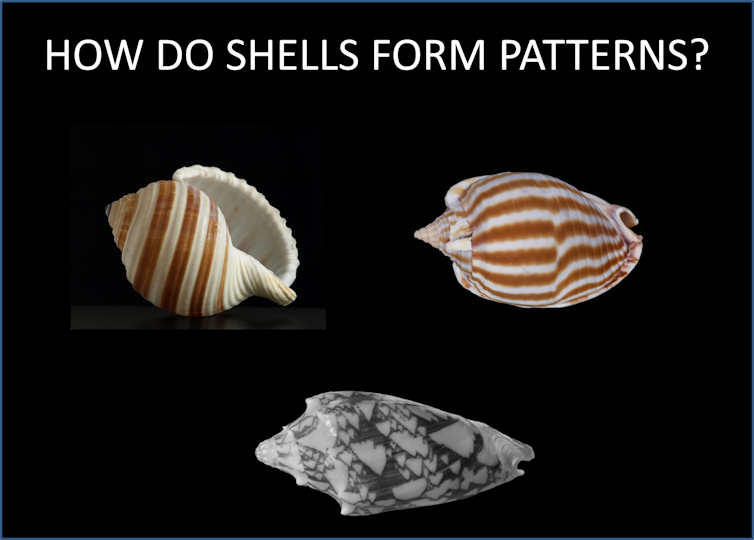 Math exercise for shells can be downloaded at https://www.manilsuri.com/assets/shell_patterns.pptx. Manil Suri, Author provided
Can something that sounds so simplistic make a difference? Based on my years of experience as a mathematician, I believe it can – if nothing else, for the person you talk to. The goal is to stimulate curiosity and convey that mathematics is much more about exhilarating ideas that inform our universe than it is about the school homework-type calculations so many dread.
Raising math awareness is a first step toward making sure people possess the basic math skills required not only for employment, but also to understand math-related issues – such as gerrymandering or climate change – well enough to be an informed and participating citizen. However, it’s not something that can be done in one month.
Given the decline in both math scores and the percentage of students studying math, it may take many years before America realizes the stronger relationship with math that President Reagan’s proclamation called for during the first National Math Awareness Week in 1986.
This article is republished from The Conversation under a Creative Commons license. Read the original article and see more than 250 UMBC articles available in The Conversation.
]]>
Written by Manil Suri, professor of mathematics and statistics, UMBC When President Ronald Reagan proclaimed the first National Math Awareness Week in April 1986, one of the problems he cited...
https://umbc.edu/stories/math-awareness-needed-to-raise-math-readiness/
https://beta.my.umbc.edu/api/v0/pixel/news/132166/guest@my.umbc.edu/efda1e890b49c0d6462271d892092a7d/api/pixel
cnms
discovery
magazine
mathstat
UMBC News & Magazine
https://beta.my.umbc.edu/groups/umbc-news-magazine
https://assets1-beta.my.umbc.edu/system/shared/avatars/groups/000/001/943/24435aa6207c452e7bc15cc74b42c7bb/xsmall.png?1748556657
https://assets1-beta.my.umbc.edu/system/shared/avatars/groups/000/001/943/24435aa6207c452e7bc15cc74b42c7bb/original.png?1748556657
https://assets2-beta.my.umbc.edu/system/shared/avatars/groups/000/001/943/24435aa6207c452e7bc15cc74b42c7bb/xxlarge.png?1748556657
https://assets2-beta.my.umbc.edu/system/shared/avatars/groups/000/001/943/24435aa6207c452e7bc15cc74b42c7bb/xlarge.png?1748556657
https://assets3-beta.my.umbc.edu/system/shared/avatars/groups/000/001/943/24435aa6207c452e7bc15cc74b42c7bb/large.png?1748556657
https://assets1-beta.my.umbc.edu/system/shared/avatars/groups/000/001/943/24435aa6207c452e7bc15cc74b42c7bb/medium.png?1748556657
https://assets2-beta.my.umbc.edu/system/shared/avatars/groups/000/001/943/24435aa6207c452e7bc15cc74b42c7bb/small.png?1748556657
https://assets1-beta.my.umbc.edu/system/shared/avatars/groups/000/001/943/24435aa6207c452e7bc15cc74b42c7bb/xsmall.png?1748556657
https://assets2-beta.my.umbc.edu/system/shared/avatars/groups/000/001/943/24435aa6207c452e7bc15cc74b42c7bb/xxsmall.png?1748556657
UMBC News & Magazine
5
0
false
Fri, 31 Mar 2023 16:59:22 -0400
Fri, 31 Mar 2023 16:59:22 -0400
Important Immigration Reminders!
Report address changes
Report changes of address to the A/RO within 10 days of the
address change, change in phone number or email address, or change in name.
Submit a change in the UMBC Scholar Portal or email dianezg@umbc.edu.
Engage in appropriate activities
Each category has a definition and expectations for the
activities of the exchange visitor, which must be met. For example, a Research
Scholar or Professor is here to perform research or teach.
Be employed only with authorization
Unauthorized employment is a violation of program status. An
exchange visitor's participation is subject to termination when he or she
engages in unauthorized employment. 22 CFR 62.16(b). Submit a request for authorization for
concurrent employment in the UMBC Scholar Portal.
Maintain valid health insurance coverage
Every exchange visitor (both J-1 and J-2) is required to
obtain health insurance which meets the minimum requirements specified at 22
CFR 62.14 . This insurance must be maintained throughout the entire program
participation period. Please consult the requirements here.
Maintain required documents
Exchange visitors are at all times expected to maintain a
valid DS-2019, a valid passport, and an I-94 recorded marked "D/S."
Duration of status
"D/S" stands for "duration of
status." 8 CFR 214.2(j)(1)(ii) defines J-1 "duration of
status" as "a period up to 30 days before the report date or start of
the approved program listed on Form DS-2019...the period specified on Form
DS-2019, plus a period of 30 days for the purposes of travel...".
]]>
Report address changes Report changes of address to the A/RO within 10 days of the address change, change in phone number or email address, or change in name. Submit a change in the UMBC...
https://beta.my.umbc.edu/api/v0/pixel/news/132047/guest@my.umbc.edu/1f270f03b26b1b7e38e6880a3036d11e/api/pixel
Exchange Visitors
https://beta.my.umbc.edu/groups/j-1
https://assets3-beta.my.umbc.edu/system/shared/avatars/groups/000/001/488/175f9f6b6c231ae5de90058948f6228c/xsmall.png?1525966942
https://assets3-beta.my.umbc.edu/system/shared/avatars/groups/000/001/488/175f9f6b6c231ae5de90058948f6228c/original.jpg?1525966942
https://assets2-beta.my.umbc.edu/system/shared/avatars/groups/000/001/488/175f9f6b6c231ae5de90058948f6228c/xxlarge.png?1525966942
https://assets1-beta.my.umbc.edu/system/shared/avatars/groups/000/001/488/175f9f6b6c231ae5de90058948f6228c/xlarge.png?1525966942
https://assets2-beta.my.umbc.edu/system/shared/avatars/groups/000/001/488/175f9f6b6c231ae5de90058948f6228c/large.png?1525966942
https://assets1-beta.my.umbc.edu/system/shared/avatars/groups/000/001/488/175f9f6b6c231ae5de90058948f6228c/medium.png?1525966942
https://assets1-beta.my.umbc.edu/system/shared/avatars/groups/000/001/488/175f9f6b6c231ae5de90058948f6228c/small.png?1525966942
https://assets3-beta.my.umbc.edu/system/shared/avatars/groups/000/001/488/175f9f6b6c231ae5de90058948f6228c/xsmall.png?1525966942
https://assets4-beta.my.umbc.edu/system/shared/avatars/groups/000/001/488/175f9f6b6c231ae5de90058948f6228c/xxsmall.png?1525966942
Exchange Visitors
https://assets2-beta.my.umbc.edu/system/shared/thumbnails/news/000/132/047/58a69ba617189250cbf22fdd02dd4ce4/xxlarge.jpg?1680029598
https://assets4-beta.my.umbc.edu/system/shared/thumbnails/news/000/132/047/58a69ba617189250cbf22fdd02dd4ce4/xlarge.jpg?1680029598
https://assets1-beta.my.umbc.edu/system/shared/thumbnails/news/000/132/047/58a69ba617189250cbf22fdd02dd4ce4/large.jpg?1680029598
https://assets4-beta.my.umbc.edu/system/shared/thumbnails/news/000/132/047/58a69ba617189250cbf22fdd02dd4ce4/medium.jpg?1680029598
https://assets2-beta.my.umbc.edu/system/shared/thumbnails/news/000/132/047/58a69ba617189250cbf22fdd02dd4ce4/small.jpg?1680029598
https://assets2-beta.my.umbc.edu/system/shared/thumbnails/news/000/132/047/58a69ba617189250cbf22fdd02dd4ce4/xsmall.jpg?1680029598
https://assets4-beta.my.umbc.edu/system/shared/thumbnails/news/000/132/047/58a69ba617189250cbf22fdd02dd4ce4/xxsmall.jpg?1680029598
1
0
false
Tue, 28 Mar 2023 14:54:49 -0400
UMBC’s Ivan Erill demonstrates fast, low-cost method to monitor spread of antibiotic resistance over time
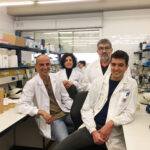
Growing resistance to antibiotics and other antimicrobial treatments is a serious global healthcare challenge. A new study in Antibioticsdemonstrates a method for tracking the spread of genes for antimicrobial resistance among bacterial populations over time. The new computational technique relies on the rapidly increasing availability of bacterial genetic sequences in public databases such as GenBank.
“Our idea is that this could be used as a monitoring system,” explains Ivan Erill, professor of biological sciences at UMBC and the study’s senior author. “It’s great for studies trying to find insight into what’s happening in bacterial genomes.”
The code Erill and colleagues Miquel Sánchez-Osuna and Jordi Barbé at the Universitat Autònoma de Barcelona developed can analyze the sequences of all known bacterial plasmids (little circular pieces of DNA that can exchange genes between bacteria) in about an hour. The results reveal which resistance genes are spreading most and the genes’ likely origin.
A computational analysis like this is much faster and less expensive than complex systems involving coordination among clinicians around the world. This means it could be carried out more frequently to help doctors and researchers stay updated on shifting resistance threats.
“There’s going to be more and more data that you can mine this way,” Erill says, noting that the amount of genetic sequence data available is doubling approximately every two years. He adds, “I love it because it’s simple. It’s fast, and you can deploy it in a flash.”
 Ivan Erill (Marlayna Demond ’11/UMBC)
Genetic detective work
So how does this new technique work? Microbial DNA, like all DNA, is made up of four bases: A, T, G, and C. A pairs with T, and G pairs with C. However, the ratio of the bases varies considerably across microbial species. Some bacteria are split 50-50 between AT and GC pairs, while other bacterial genomes may contain anywhere from 30 to 70 percent GC pairs. In a previous study, Erill and colleagues leveraged this variability to investigate the emergence of resistance against sulfonamides, an early class of antimicrobials.
As resistance genes hop from species to species via plasmids, they largely retain the GC ratio of their original source. So, if there is a mismatch between the GC ratio of the resistance gene and the rest of a bacterium’s genome, that means the resistance gene has come from elsewhere. The simplicity of this technique means it is not only faster than clinical methods at tracking the movement of resistance genes, but also faster than other computational methods.
If a resistance gene has been in a species long enough, its genetic sequence may eventually begin to approach the GC content of its new host, but that could take millions of years. “For what we’re looking at, which is gene movement in the last 60 to 100 years,” Erill says, “it’s basically a snapshot.”
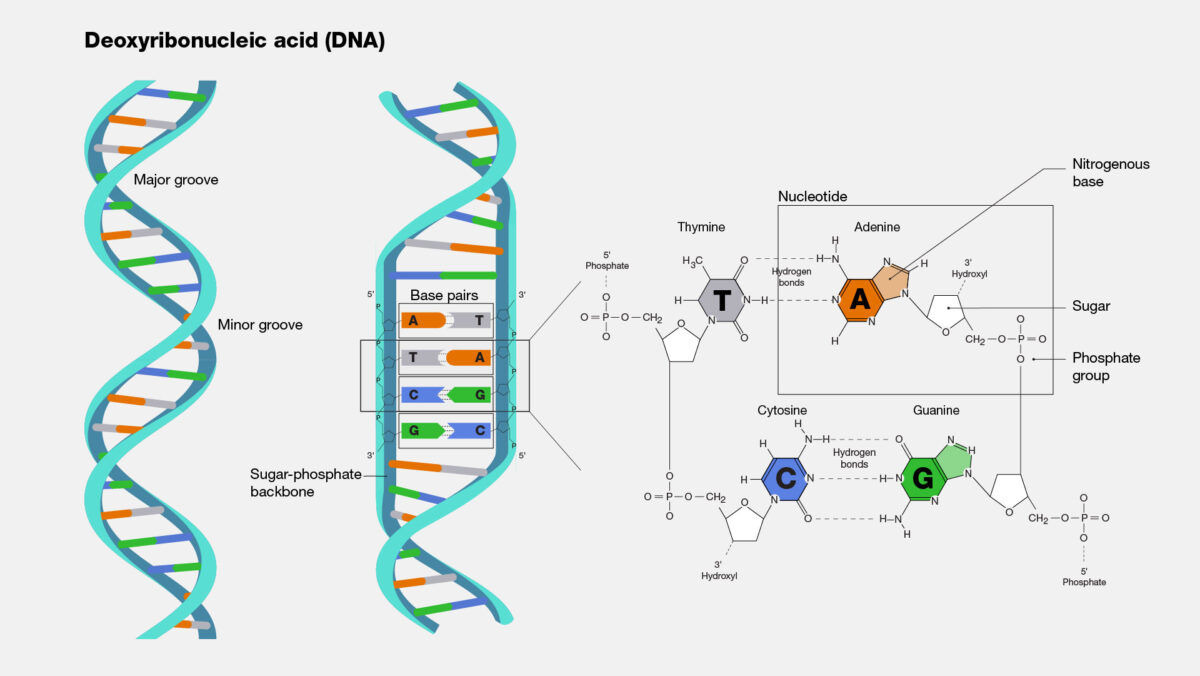 DNA is made up of adenine-thymine (AT) bonds and guanine-cytosine (GC) bonds. The frequency of each type of bond differs substantially across bacterial species. (Image by the National Human Genome Research Institute)
Specialists spread faster
Using the new monitoring technique, the study authors confirmed that resistance genes are most likely to spread if they are on conjugative plasmids, a type of plasmid that can easily transfer between bacterial cells. Researchers generally already understood this, but confirming it with the new method helped verify the technique’s efficacy.
The new study also found that resistance genes effectively targeting very specific antibiotics spread the most. These genes generally require so many mutations to evolve that they are unlikely to have arisen naturally in any given bacterium since humans started using antibiotics. But if they are present anywhere in the bacterial population when the corresponding antibiotic is introduced, they will spread quickly.
“As soon as there is selective pressure from that antibiotic, there is selective pressure to move this thing around, because it is a bacterium’s silver bullet against that antibiotic,” Erill says. In contrast, generic resistance that requires only a few mutations to existing genes is less likely to spread rapidly, Erill explains. “There isn’t a lot of selective pressure to pass it along, because by the time it comes, the bacterium has likely already discovered it,” he says.
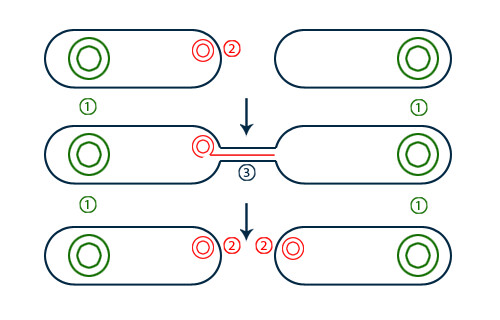 Bacterial cells (black outlines) contain plasmids (red) in addition to their main genome (green). A conjugative plasmid can transfer genetic material between cells as shown here, which can spread antibiotic resistance genes among species. (Image by Zappys Technology Solutions, used under CC-BY)
Hospitals aren’t likely the culprit
The new study also found that genes for resistance to antibiotics used in livestock or prescribed outside of hospitals were likely to spread through the global bacterial population. Resistance to antibiotics used in more limited settings hardly spread at all. “That tells you that if you use things cautiously, then there is not so much selective pressure,” Erill says.
Perhaps most important for antibiotic policy moving forward, Erill’s team found that most of the resistance genes came from a single source and then spread, rather than evolving independently multiple times. “Resistance is in the environment,” Erill says, explaining that it needs a vehicle to get into the mainstream.
If antibiotics were only used in hospitals, rather than in livestock and other environments, resistance would be much less common, Erill argues. This is because resistance from hospital use alone “would presume that you have naturally resistant bacteria living in the hospital already, ready to pass on their genes,” he suggests. While there are certainly infectious microbes present in hospitals, “most of the microbial diversity is in the soil and the water,” Erill says. If antibiotics never reach the cells that happen to be resistant, that resistance won’t spread.
 A tractor sprays an apple orchard. Antibiotics are regularly used on “top fruit” crops like apples, oranges, and pears, which can contribute to antibiotic resistance when the spray runs off into waterways and soil. (Photo by Barbara Eckstein, used under CC BY-NC-ND)
While the new study is “a methods paper more than a results paper,” Erill says, “we believe it’s an important contribution.” It puts forward a process for continually monitoring shifts in bacterial genomes over time, which could influence future antibiotic development research or treatment regimens. Perhaps it could even encourage limits on antibiotic use in agriculture and other settings where the drugs can end up in the environment.
Best of all, other research teams can use the new method to pursue answers to their own questions, Erill explains. “You can use it with a very fine comb to poke at whatever you are interested in.”
]]>
Growing resistance to antibiotics and other antimicrobial treatments is a serious global healthcare challenge. A new study in Antibioticsdemonstrates a method for tracking the spread of genes for...
https://umbc.edu/stories/novel-method-to-monitor-spread-of-antibiotic-resistance/
https://beta.my.umbc.edu/api/v0/pixel/news/131968/guest@my.umbc.edu/d58d5a6c499d62f7f465a5191dbcf7f3/api/pixel
biology
cnms
news
research
science-and-tech
UMBC News & Magazine
https://beta.my.umbc.edu/groups/umbc-news-magazine
https://assets1-beta.my.umbc.edu/system/shared/avatars/groups/000/001/943/24435aa6207c452e7bc15cc74b42c7bb/xsmall.png?1748556657
https://assets1-beta.my.umbc.edu/system/shared/avatars/groups/000/001/943/24435aa6207c452e7bc15cc74b42c7bb/original.png?1748556657
https://assets2-beta.my.umbc.edu/system/shared/avatars/groups/000/001/943/24435aa6207c452e7bc15cc74b42c7bb/xxlarge.png?1748556657
https://assets2-beta.my.umbc.edu/system/shared/avatars/groups/000/001/943/24435aa6207c452e7bc15cc74b42c7bb/xlarge.png?1748556657
https://assets3-beta.my.umbc.edu/system/shared/avatars/groups/000/001/943/24435aa6207c452e7bc15cc74b42c7bb/large.png?1748556657
https://assets1-beta.my.umbc.edu/system/shared/avatars/groups/000/001/943/24435aa6207c452e7bc15cc74b42c7bb/medium.png?1748556657
https://assets2-beta.my.umbc.edu/system/shared/avatars/groups/000/001/943/24435aa6207c452e7bc15cc74b42c7bb/small.png?1748556657
https://assets1-beta.my.umbc.edu/system/shared/avatars/groups/000/001/943/24435aa6207c452e7bc15cc74b42c7bb/xsmall.png?1748556657
https://assets2-beta.my.umbc.edu/system/shared/avatars/groups/000/001/943/24435aa6207c452e7bc15cc74b42c7bb/xxsmall.png?1748556657
UMBC News & Magazine
1
0
false
Fri, 24 Mar 2023 16:54:51 -0400
Fri, 24 Mar 2023 16:54:51 -0400
What is the National Cybersecurity Strategy? A cybersecurity expert explains what it is and what the Biden administration has changed

Written by Richard Forno, principal lecturer in computer science and electrical engineering, UMBC
The Biden administration released its first National Cybersecurity Strategy on March 2, 2023. The last version was issued in 2018 during the Trump administration.
As the National Security Strategy does for national defense, the National Cybersecurity Strategy outlines a president’s priorities regarding cybersecurity issues. The document is not a directive. Rather, it describes in general terms what the administration is most concerned about, who its major adversaries are and how it might achieve its goals through legislation or executive action. These types of strategy statements are often aspirational.
As expected, the 2023 Biden National Cybersecurity Strategy reiterates previous recommendations about how to improve American cybersecurity. It calls for improved sharing of information between the government and private sector about cybersecurity threats, vulnerabilities and risks. It prescribes coordinating cybersecurity incident response across the federal government and enhancing regulations. It describes the need to expand the federal cybersecurity workforce. It emphasizes the importance of protecting the country’s critical infrastructure and federal computer systems. And it identifies China, Russia, Iran and North Korea as America’s main adversaries in cyberspace.
However, as a former cybersecurity industry practitioner and current cybersecurity researcher, I think that the 2023 document incorporates some fresh ideas and perspectives that represent a more holistic approach to cybersecurity. At the same time, though, some of what is proposed may not be as helpful as envisioned.
Some of the key provisions in the current National Cybersecurity Strategy relate to the private sector, both in terms of product liability and cybersecurity insurance. It also aims to reduce the cybersecurity burden on individuals and smaller organizations. However, I believe it doesn’t go far enough in fostering information-sharing or addressing the specific tactics and techniques used by attackers.
Acting National Cybersecurity Director Kemba Walden discusses the Biden administration’s National Cybersecurity Strategy.
The end of vendor indemnification?
For decades, the technology industry has operated under what is known as “shrink-wrap” licensing. This refers to the multiple pages of legal text that customers, both large and small, routinely are forced to accept before installing or using computer products, software and services.
While much has been written about these agreements, such licenses generally have one thing in common: They ultimately protect vendors such as Microsoft or Adobe from legal consequences for any damages or costs arising from a customer’s use of their products, even if the vendor is at fault for producing a flawed or insecure product that affects the end user.
In a groundbreaking move, the new cybersecurity strategy says that while no product is totally secure, the administration will work with Congress and the private sector to prevent companies from being shielded from liability claims over the security of their products. These products underpin most of modern society.
Removing that legal shield is likely to encourage companies to make security a priority in their product development cycles and have a greater stake in the reliability of their products beyond the point of sale.
In another noteworthy shift, the strategy observes that end users bear too great a burden for mitigating cybersecurity risks. It states that a collaborative approach to cybersecurity and resiliency “cannot rely on the constant vigilance of our smallest organizations and individual citizens.” It stresses the importance of manufacturers of critical computer systems, as well as companies that operate them, in taking a greater role in improving the security of their products. It also suggests expanded regulation toward that goal may be forthcoming.
Interestingly, the strategy places great emphasis on the threat from ransomware as the most pressing cybercrime facing the U.S. at all levels of government and business. It now calls ransomware a national security threat and not simply a criminal matter.
Backstopping cyber insurance
The new strategy also directs the federal government to consider taking on some responsibility for so-called cybersecurity insurance.
Here, the administration wants to ensure that insurance companies are adequately funded to respond to claims following a significant or catastrophic cybersecurity incident. Since 2020, the market for cybersecurity-related insurance has grown nearly 75%, and organizations of all sizes consider such policies necessary.
This is understandable given how many companies and government agencies are reliant on the internet and corporate networks to conduct daily operations. By protecting, or “backstopping,” cybersecurity insurers, the administration hopes to prevent a major systemic financial crisis for insurers and victims during a cybersecurity incident.
However, cybersecurity insurance should not be treated as a free pass for complacency. Thankfully, insurers now often require policyholders to prove they are following best cybersecurity practices before approving a policy. This helps protect them from issuing policies that are likely to face claims arising from gross negligence by policyholders.
Looking forward
In addition to dealing with present concerns, the strategy also makes a strong case for ensuring the U.S. is prepared for the future. It speaks about fostering technology research that can improve or introduce cybersecurity in such fields as artificial intelligence, critical infrastructure and industrial control systems.
The strategy specifically warns that the U.S. must be prepared for a “post-quantum future” where emerging technologies could render existing cybersecurity controls vulnerable. This includes current encryption systems that could be broken by future quantum computers.
Practical quantum computers, when they arrive, will force a change in how the internet is secured.
Where the strategy falls short
While the National Cybersecurity Strategy calls for continuing to expand information-sharing related to cybersecurity, it pledges to review federal classification policy to see where additional classified access to information is necessary.
The federal government already suffers from overclassification, so if anything, I believe less classification of cybersecurity information is needed to facilitate better information-sharing on this issue. It’s important to reduce administrative and operational obstacles to effective and timely interaction, especially where collaborative relationships are needed between industry, academia and federal and state governments. Excessive classification is one such challenge.
Further, the strategy does not address the use of cyber tactics, techniques and procedures in influence or disinformation campaigns and other actions that might target the U.S. This omission is perhaps intentional because, although cybersecurity and influence operations are often intertwined, reference to countering influence operations could lead to partisan conflicts over freedom of speech and political activity. Ideally, the National Cybersecurity Strategy should be apolitical.
That being said, the 2023 National Cybersecurity Strategy is a balanced document. While in many ways it reiterates recommendations made since the first National Cybersecurity Strategy in 2002, it also provides some innovative ideas that could strengthen U.S. cybersecurity in meaningful ways and help modernize America’s technology industry, both now and into the future.
This article is republished from The Conversation under a Creative Commons license. Read the original article and see more than 250 UMBC articles available in The Conversation.
]]>
Written by Richard Forno, principal lecturer in computer science and electrical engineering, UMBC The Biden administration released its first National Cybersecurity Strategy on March 2,...
https://umbc.edu/stories/what-is-the-national-cybersecurity-strategy-a-cybersecurity-expert-explains-what-it-is-and-what-the-biden-administration-has-changed/
https://beta.my.umbc.edu/api/v0/pixel/news/131946/guest@my.umbc.edu/8f0fb08533e1662d7cb3b7276021f3fe/api/pixel
coeit
csee
discovery
magazine
the-conversation
UMBC News & Magazine
https://beta.my.umbc.edu/groups/umbc-news-magazine
https://assets1-beta.my.umbc.edu/system/shared/avatars/groups/000/001/943/24435aa6207c452e7bc15cc74b42c7bb/xsmall.png?1748556657
https://assets1-beta.my.umbc.edu/system/shared/avatars/groups/000/001/943/24435aa6207c452e7bc15cc74b42c7bb/original.png?1748556657
https://assets2-beta.my.umbc.edu/system/shared/avatars/groups/000/001/943/24435aa6207c452e7bc15cc74b42c7bb/xxlarge.png?1748556657
https://assets2-beta.my.umbc.edu/system/shared/avatars/groups/000/001/943/24435aa6207c452e7bc15cc74b42c7bb/xlarge.png?1748556657
https://assets3-beta.my.umbc.edu/system/shared/avatars/groups/000/001/943/24435aa6207c452e7bc15cc74b42c7bb/large.png?1748556657
https://assets1-beta.my.umbc.edu/system/shared/avatars/groups/000/001/943/24435aa6207c452e7bc15cc74b42c7bb/medium.png?1748556657
https://assets2-beta.my.umbc.edu/system/shared/avatars/groups/000/001/943/24435aa6207c452e7bc15cc74b42c7bb/small.png?1748556657
https://assets1-beta.my.umbc.edu/system/shared/avatars/groups/000/001/943/24435aa6207c452e7bc15cc74b42c7bb/xsmall.png?1748556657
https://assets2-beta.my.umbc.edu/system/shared/avatars/groups/000/001/943/24435aa6207c452e7bc15cc74b42c7bb/xxsmall.png?1748556657
UMBC News & Magazine
0
0
false
Thu, 23 Mar 2023 14:46:52 -0400
Thu, 23 Mar 2023 14:46:52 -0400
Calls for a ‘green’ Ramadan revive Islam’s long tradition of sustainability and care for the planet

Written by Noorzehra Zaidi, assistant professor of history, UMBC
For many Muslims breaking fast in mosques around the world this Ramadan, something will be missing: plastics.
The communal experience of iftars – the after-sunset meal that brings people of the faith together during the holy month starting on March 22, 2023 – often necessitates the use of utensils designed for mass events, such as plastic knives and forks, along with bottles of water.
But to encourage Muslims to be more mindful of the impact of Ramadan on the environment, mosques are increasingly dispensing of single-use items, with some banning the use of plastics altogether.
As a historian of Islam, I see this “greening” of Ramadan as entirely in keeping with the traditions of the faith, and in particular the observance of Ramadan.
The month – during which observant Muslims must abstain from even a sip of water or food from sun up to sun down – is a time for members of the faith to focus on purifying themselves as individuals against excess and materialism.
But in recent years, Muslim communities around the world have used the period to rally around themes of social awareness. And this includes understanding the perils of wastefulness and embracing the link between Ramadan and environmental consciousness.
The ban on plastics – a move encouraged by the Muslim Council of Britain as a way for Muslims “to be mindful of [God’s] creation and care for the environment” – is just one example.
 Environmental consciousness has gained traction in Muslim communities over recent years. Yasser Chalid via Getty Images.
Many other mosques and centers are discouraging large or extravagant evening meals altogether. The fear is such communal events generate food waste and overconsumption and often rely on nonbiodegradable materials for cutlery, plates and serving platters.
Quranic environmentalism
While the move toward environmental consciousness has gained traction in Muslim communities in recent years, the links between Islam and sustainability can be found in the faith’s foundational texts.
Scholars have long emphasized principles outlined in the Quran that highlight conservation, reverence for living creatures and the diversity of living things as a reminder of God’s creation.
The Quran repeatedly emphasizes the idea of “mizan,” a kind of cosmic and natural balance, and the role of humans as stewards and khalifa, or “viceregents,” on Earth – terms that also carry an environmental interpretation.
Recently, Islamic environmental activists have highlighted the numerous hadith – sayings of the Prophet Muhammad that provide guidance to followers of the faith – that emphasize that Muslims should avoid excess, respect resources and living things, and consume in moderation.
Although present from the outset of the faith, Islam’s ties to environmentalism received major visibility with the works of Iranian philosopher Seyyed Hossein Nasr, and a series of lectures he delivered at the University of Chicago in 1966. The lectures and a subsequent book, “Man and Nature: The Spiritual Crisis in Modern Man,” warned that humans had broken their relationship with nature and thus placed themselves in grave ecological danger.
Nasr blamed modern and Western science for being materialistic, utilitarian and inhuman, claiming it had destroyed traditional views of nature. Nasr argued that Islamic philosophy, metaphysics, scientific tradition, arts and literature emphasize the spiritual significance of nature. But he noted that numerous contemporary factors, such as mass rural-to-urban migration and poor and autocratic leadership, had prevented the Muslim world from realizing and implementing the Islamic view of the natural environment.
Scholars and activists expanded on Nasr’s work through the 1980s and 1990s, among them Fazlun Khalid, one of the world’s leading voices on Islam and environmentalism. In 1994, Khalid founded the Islamic Foundation for Ecology and Environmental Sciences, an organization dedicated to the maintenance of the planet as a healthy habitat for all living beings. Khalid and other Muslim environmentalists suggest that Islam’s nearly 2 billion adherents can participate in the tasks of environmental sustainability and equity not through Western models and ideologies but from within their own traditions.
Partnering with the United Nations Environment Program, Khalid and other leading scholars crafted Al-Mizan, a worldwide project for Muslim leaders interested in Muslims’ religious commitments to nature. “The ethos of Islam is that it integrates belief with a code of conduct which pays heed to the essence of the natural world,” Khalid wrote in “Signs on the Earth: Islam, Modernity, and the Climate Crisis.”
Going beyond an eco-Ramadan
Environmental crises disproportionately affect the world’s poorest populations, and academics have highlighted the particular vulnerabilities of Muslim communities around the world, such as the victims of devastating floods in Pakistan in 2022.
By highlighting Islamic principles, policies and community approaches, academics have shown how Islam can represent a model for environmental stewardship.
This push for environmental consciousness extends beyond Ramadan. In recent years, Muslims have tried to introduce green practices into the shrine cities in Iraq during pilgrimage seasons in Ashura and Arbaeen.
 Pilgrims at the Holy Shrine in Karbala, Iraq. Jasmin Merdan via Getty Images.
This has included awareness campaigns encouraging the 20 million pilgrims who visit Arbaeen annually to reduce the tons of trash they leave every year that clog up Iraq’s waterways. Quoting from Shiite scholarship and drawing on testimonials from community leaders, the Green Pilgrim movement suggests carrying cloth bags and reusable water bottles, turning down plastic cutlery, and hosting eco-friendly stalls along the walk.
Muslim-owned businesses and nonprofits are joining these wider efforts. Melanie Elturk, the founder of the successful hijab brand Haute Hijab, regularly ties together faith, fashion, commerce and environmentalism by highlighting the brand’s focus on sustainability and environmental impact. The Washington, D.C., nonprofit Green Muslims pioneered the first “leftar” – a play on the word “iftar” – using leftovers and reusable containers.
These efforts are but a few of the diverse ways that Muslim communities are addressing environmental impact. The greening of Ramadan fits into a broader conversation about how often communities can tackle climate change within their own frameworks.
But Islamic environmentalism is more than just the dispensing of plastic forks and water bottles – it taps into a worldview ingrained in the faith from the outset, and can continue to guide adherents as they navigate environmentalism, a space where they may otherwise be marginalized.
This article is republished from The Conversation under a Creative Commons license. Read the original article and see more than 250 UMBC articles available in The Conversation.
]]>
Written by Noorzehra Zaidi, assistant professor of history, UMBC For many Muslims breaking fast in mosques around the world this Ramadan, something will be missing: plastics. The...
https://umbc.edu/stories/calls-for-a-green-ramadan-revive-islams-long-tradition-of-sustainability/
https://beta.my.umbc.edu/api/v0/pixel/news/131916/guest@my.umbc.edu/123d3fb77b6d8173dd023f293969d815/api/pixel
cahss
cahssresearch
discovery
ges
history
magazine
the-conversation
UMBC News & Magazine
https://beta.my.umbc.edu/groups/umbc-news-magazine
https://assets1-beta.my.umbc.edu/system/shared/avatars/groups/000/001/943/24435aa6207c452e7bc15cc74b42c7bb/xsmall.png?1748556657
https://assets1-beta.my.umbc.edu/system/shared/avatars/groups/000/001/943/24435aa6207c452e7bc15cc74b42c7bb/original.png?1748556657
https://assets2-beta.my.umbc.edu/system/shared/avatars/groups/000/001/943/24435aa6207c452e7bc15cc74b42c7bb/xxlarge.png?1748556657
https://assets2-beta.my.umbc.edu/system/shared/avatars/groups/000/001/943/24435aa6207c452e7bc15cc74b42c7bb/xlarge.png?1748556657
https://assets3-beta.my.umbc.edu/system/shared/avatars/groups/000/001/943/24435aa6207c452e7bc15cc74b42c7bb/large.png?1748556657
https://assets1-beta.my.umbc.edu/system/shared/avatars/groups/000/001/943/24435aa6207c452e7bc15cc74b42c7bb/medium.png?1748556657
https://assets2-beta.my.umbc.edu/system/shared/avatars/groups/000/001/943/24435aa6207c452e7bc15cc74b42c7bb/small.png?1748556657
https://assets1-beta.my.umbc.edu/system/shared/avatars/groups/000/001/943/24435aa6207c452e7bc15cc74b42c7bb/xsmall.png?1748556657
https://assets2-beta.my.umbc.edu/system/shared/avatars/groups/000/001/943/24435aa6207c452e7bc15cc74b42c7bb/xxsmall.png?1748556657
UMBC News & Magazine
3
0
false
Wed, 22 Mar 2023 12:07:31 -0400
Wed, 22 Mar 2023 12:07:31 -0400
CIDER program supports new approach to measuring nursing home quality, plus more research collaborations

Assessing the quality of nursing home care has historically been a challenging and complex process that considers only a portion of the factors involved—generally, clinical indicators reported by the nursing homes themselves. UMBC researchers are collaborating on a new measure of nursing home quality that combines care experiences with clinical data. And they are doing it with funding from a new UMBC program designed to support novel research across different teams.
Principal investigator Roberto Millar M.A ’19, sociology, Ph.D. ’20, gerontology, who is a policy analyst advanced at The Hilltop Institute, is collaborating on the study with Nancy Kusmaul, associate professor of social work, and Ian Stockwell, associate professor of information systems. Their goal is to create “a more complete measure that nursing homes will be able to use to evaluate how they’re doing to improve the resident experience,” says Kusmaul.
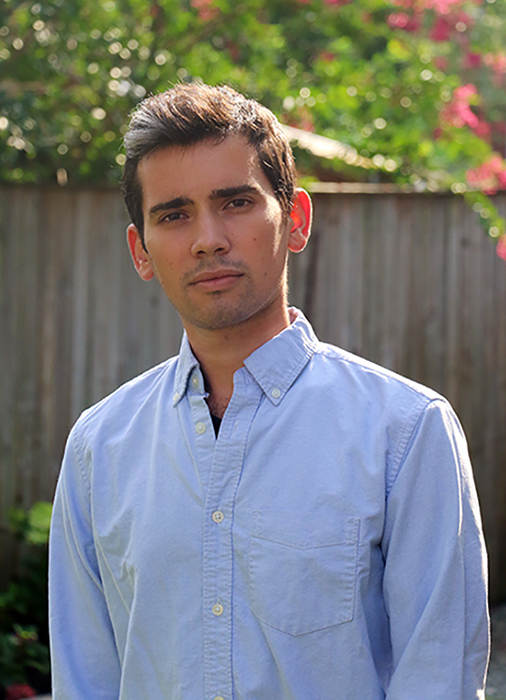 Roberto Millar (Image courtesy of The Hilltop Institute)
 Nancy Kusmaul (Marlayna Demond ’11/UMBC)
 Ian Stockwell (Image courtesy of The Hilltop Institute)
The researchers will, for the first time, combine data from the Centers for Medicare and Medicaid Services’ Care Compare database and results of the Maryland Family Satisfaction Survey. The survey assesses the experiences of family members with loved ones in Maryland nursing homes and, Kusmaul notes, offers a unique approach to measuring quality of care.
“There are no national measures of nursing home quality that consider that side of things,” she explains. “When we think about what quality is and what are the outcomes that we’re measuring, we have to think about the different perspectives of what is good nursing home care.”
Creating a new national model
On a national level, the typical approach to measuring nursing home care focuses on clinical indicators that are measured quantitatively, Millar notes. This includes factors such as number of hospitalizations, vaccination rates, and staff training. It does not include more qualitative data that considers the experiences of people in nursing homes or their families. Maryland is one of only three states that assesses family satisfaction.
“What’s key here is bringing these two approaches together to see if these quantitative measures from the federal approach are actually predictive of family satisfaction across more qualitative domains,” says Millar.
“What we’re talking about is perhaps scaling this collection of qualitative data to a national level that does not exist right now,” says Stockwell. “We want to better measure quality of care to drive changes in the nursing home industry that would best help the patients.”
The team hopes to eventually create a more robust technical infrastructure to capture this data. Eventually, they might be able to utilize machine learning and artificial intelligence to better match prospective care recipients with the most suitable care facility.
Funding new collaborations
The nursing home study was funded through UMBC’s Office of Research Development via the new CIDER (Center and Institute Departmentally-Engaged Research) program. This internal funding opportunity brings together researchers from different disciplines and types of research units across UMBC.
At UMBC, a large volume of research and creative activity (RCA) happens within academic departments and colleges as well as outside of them, in a range of research centers and institutes. In fiscal year 2022, centers and institutes outside of academic departments were responsible for 48.6% of UMBC’s sponsored RCA expenditures ($42.3 million), with most of the rest falling within the departments. But while both groups contribute substantially, they don’t often receive shared project funding to collaborate.
CIDER was designed to increase collaboration between these groups. In this first round, four research teams were each awarded a $50,000 CIDER grant for 18 months to pursue their studies.
In addition to Millar’s team, the other three winning proposals include research across a very broad range of fields:
- “Visualizing the Factors in K-12 Education Success” is led by Lee Boot, director of UMBC’s Imaging Research Center (IRC), with co-investigator Amy Tondreau, assistant professor of education, and Anita Komlodi, associate professor of information systems and associate director of the IRC.
- “Harnessing the Power of Machine Learning to Discover What Powers Distant Galaxies” is led by Antara Basu-Zych, the Center for Research and Exploration in Space Science & Technology II, with co-investigator Sanjay Purushotham, assistant professor of information systems, and Kristen Garofali, NASA.
- “Model Development for Polarimetric Remote Sensing of Clouds in the Thermal Infrared” is led by Xiaoguang Xu, Goddard Earth Sciences Technology and Research II, with co-investigator Vanderlei Martins, professor of physics, and Jie Gong, NASA.
 Don Engel (Marlayna Demond ’11/UMBC)
Don Engel, associate vice president for research development and director of the Center for Space Sciences and Technology (CSST), helped to create CIDER. “We wanted to find a systemic way to make sure that everyone could draw value from being close to other researchers within the institution,” says Engel. “In addition to that, we wanted to make sure that research center faculty have internal funding opportunities that better connect them with the rest of the university. This better integrates them into the university and also makes sure that they have more opportunities to both contribute to and draw from the university’s other strengths and dimensions.”
Additional CIDER program creators include Cynthia Woodcock, director of The Hilltop Institute and Christine Mallinson, professor of language, literacy, and culture (LLC) and director of the Center of Social Science Scholarship. Kara Seidel ’18, psychology, an LLC doctoral student, also provided support in the program’s creation.
Program founders hope that CIDER can help kick-start successful partnerships that generate additional external support and grow far into the future. “We were really excited to see how much interest we had in this program,” says Engel. “We hope that our researchers can draw from each other’s expertise and this funding opportunity can enable the awardees to get subsequent grant funding.”
Ian Stockwell finds this kind of collaborative effort essential and can already see its growing impact. “It’s important for UMBC to facilitate the interaction of faculty across departments and in research centers. We are grateful for this opportunity in particular.”
]]>
Assessing the quality of nursing home care has historically been a challenging and complex process that considers only a portion of the factors involved—generally, clinical indicators reported by...
https://umbc.edu/stories/cider-program-nursing-home-study/
https://beta.my.umbc.edu/api/v0/pixel/news/131814/guest@my.umbc.edu/34544d5bfa4acb007b99792edf767459/api/pixel
coeit
gestar
hilltopinstitute
information-systems
news
policy-and-society
rca-2
research
socialwork
UMBC News & Magazine
https://beta.my.umbc.edu/groups/umbc-news-magazine
https://assets1-beta.my.umbc.edu/system/shared/avatars/groups/000/001/943/24435aa6207c452e7bc15cc74b42c7bb/xsmall.png?1748556657
https://assets1-beta.my.umbc.edu/system/shared/avatars/groups/000/001/943/24435aa6207c452e7bc15cc74b42c7bb/original.png?1748556657
https://assets2-beta.my.umbc.edu/system/shared/avatars/groups/000/001/943/24435aa6207c452e7bc15cc74b42c7bb/xxlarge.png?1748556657
https://assets2-beta.my.umbc.edu/system/shared/avatars/groups/000/001/943/24435aa6207c452e7bc15cc74b42c7bb/xlarge.png?1748556657
https://assets3-beta.my.umbc.edu/system/shared/avatars/groups/000/001/943/24435aa6207c452e7bc15cc74b42c7bb/large.png?1748556657
https://assets1-beta.my.umbc.edu/system/shared/avatars/groups/000/001/943/24435aa6207c452e7bc15cc74b42c7bb/medium.png?1748556657
https://assets2-beta.my.umbc.edu/system/shared/avatars/groups/000/001/943/24435aa6207c452e7bc15cc74b42c7bb/small.png?1748556657
https://assets1-beta.my.umbc.edu/system/shared/avatars/groups/000/001/943/24435aa6207c452e7bc15cc74b42c7bb/xsmall.png?1748556657
https://assets2-beta.my.umbc.edu/system/shared/avatars/groups/000/001/943/24435aa6207c452e7bc15cc74b42c7bb/xxsmall.png?1748556657
UMBC News & Magazine
0
0
false
Wed, 15 Mar 2023 17:19:27 -0400
Wed, 15 Mar 2023 17:19:27 -0400