UMBC Belongs to All of Us

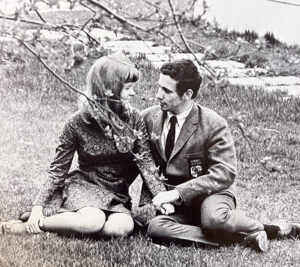
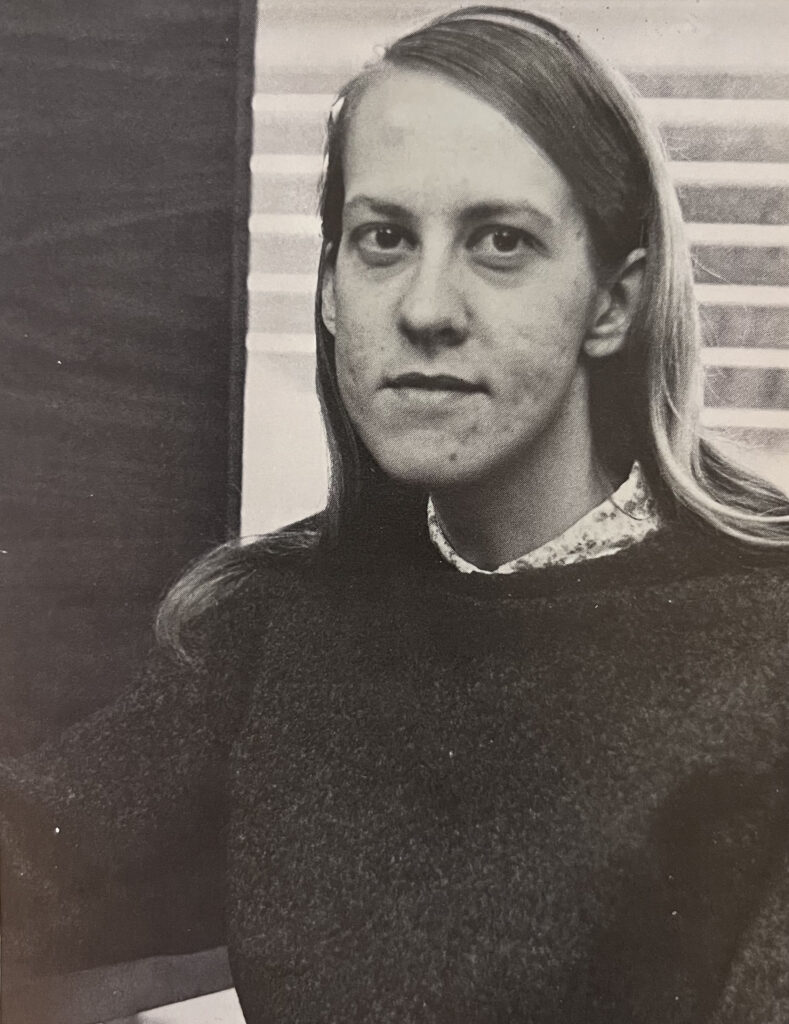 Diane Tichnell from the 1970 Skipjack, UMBC’s yearbook.
UMBC is a young institution—and not only do we have active alumni from the first four graduating classes still working to make an impact on campus and beyond, we are still discovering new stories about the establishment of the university and the ways the campus community was invited to co- create UMBC at its inception.
In fact, Diane Tichnell ’70, political science, describes the impetus for the Founding Four’s book, This Belongs to Us (2023), as its own sort of inception. Several years ago, she had a dream—literal dream while she was asleep. In it, she was attending a lecture given by then-President Freeman Hrabowski. He was talking about the books he had written, and afterward, Tichnell went up to speak to him. In her dream, she said, “We need to get the first four years of UMBC documented because soon we’re all going to be gone. Maybe in a hundred years, somebody will write it down, but why not do it now?” Dream Freeman replied, “Write that book.”
Mimi Dietrich ’70, American studies, remembers an event at the Wisdom Institute—UMBC’s association for retired faculty and staff—where a UMBC professor expressed surprise by Dietrich’s story about the plywood sidewalks that connected campus during the construction in the early years. “What do you mean you’ve never heard that story?” Dietrich responded—she figured everyone remembered what it was like in the beginning. “So Diane and I, and later Dale [Gough ’70, American studies] and Bob [Dietrich ’70, biological sciences, Mimi’s husband] came together on this; and we just started saying, ‘We have to do this. We have to do this right now.’”
Left: Co-authors Mimi and Bob Dietrich in UMBC’s 1970 yearbook Skipjack. Right: Dale Gough (pictured with Betty Huesman ’70) in the 1969 Skipjack.
Those four brainstormed the idea and knew that this labor of love would need to be as inclusive as possible. “We needed to engage the collective memory of everybody that we could possibly ask to write a story from the first four classes who were on campus,” says Tichnell. They sent newsletters, emails, mail, and even knocked on doors to capture the voices of as many graduates as possible.
In the end, 84 authors contributed more than 100 stories to This Belongs to Us, a kaleidoscopic retelling of the colorful and authentic story of UMBC. Proceeds from the book (at the clever price of $19.66) go to several scholarships supported by the founding four classes.
The Founding Four marvel at what their young institution has grown into. “All those flags in The Commons are so incredible to me,” says Joan Costello ’73, social work, a contributing author. “Because they’re from different countries. But when we came here, we were just from different neighborhoods.”
]]>
Diane Tichnell from the 1970 Skipjack, UMBC’s yearbook. UMBC is a young institution—and not only do we have active alumni from the first four graduating classes still working to make an impact...
https://umbc.edu/stories/umbc-belongs-to-all-of-us-founding-four/
https://beta.my.umbc.edu/api/v0/pixel/news/133982/guest@my.umbc.edu/49059143f75149be9cf1041938729431/api/pixel
alumni
american-studies
biological-sciences
erickson-school
founding-four
impact
magazine
spring-2023
UMBC News & Magazine
https://beta.my.umbc.edu/groups/umbc-news-magazine
https://assets1-beta.my.umbc.edu/system/shared/avatars/groups/000/001/943/24435aa6207c452e7bc15cc74b42c7bb/xsmall.png?1748556657
https://assets1-beta.my.umbc.edu/system/shared/avatars/groups/000/001/943/24435aa6207c452e7bc15cc74b42c7bb/original.png?1748556657
https://assets2-beta.my.umbc.edu/system/shared/avatars/groups/000/001/943/24435aa6207c452e7bc15cc74b42c7bb/xxlarge.png?1748556657
https://assets2-beta.my.umbc.edu/system/shared/avatars/groups/000/001/943/24435aa6207c452e7bc15cc74b42c7bb/xlarge.png?1748556657
https://assets3-beta.my.umbc.edu/system/shared/avatars/groups/000/001/943/24435aa6207c452e7bc15cc74b42c7bb/large.png?1748556657
https://assets1-beta.my.umbc.edu/system/shared/avatars/groups/000/001/943/24435aa6207c452e7bc15cc74b42c7bb/medium.png?1748556657
https://assets2-beta.my.umbc.edu/system/shared/avatars/groups/000/001/943/24435aa6207c452e7bc15cc74b42c7bb/small.png?1748556657
https://assets1-beta.my.umbc.edu/system/shared/avatars/groups/000/001/943/24435aa6207c452e7bc15cc74b42c7bb/xsmall.png?1748556657
https://assets2-beta.my.umbc.edu/system/shared/avatars/groups/000/001/943/24435aa6207c452e7bc15cc74b42c7bb/xxsmall.png?1748556657
UMBC News & Magazine
4
0
false
Tue, 13 Jun 2023 13:31:26 -0400
Tue, 13 Jun 2023 13:31:26 -0400
Meet a Retriever—Hope Weisman ’14, M.A. ’18, transfer student advocate
Meet Hope Weisman ’14, psychology, M.A. ’18, applied sociology, a Transfer Academic Advocate and member of the UMBC community for 10 years and counting. As a transfer to UMBC herself, Hope has found the perfect professional role for herself at UMBC’s Academic Success Center. Thanks for sharing your story, Hope!
Q: Tell us about your primary why, and how it led you to UMBC.
A: I came to UMBC as an undergraduate student because it felt like it was the right fit for me. I was transferring from a local community college and I had never even been to UMBC. I did a campus tour with my mom and I knew from that moment that this was the environment I wanted to be in. UMBC checked all the boxes I wanted in a place of higher education. I wanted an environment that would challenge me academically and provide me with the tools and resources to be successful. As such, I took ownership of my undergraduate career and utilized the many opportunities for me on campus and continued my studies in the Graduate School. Now, as a professional staff member, I can definitely say I made the right decision applying to UMBC all those years ago. My life would be surely different without UMBC!
Q: How did you transition from transfer student to transfer advocate?
My world at UMBC is transfer related—all day, every day! As an undergraduate, I served as a Transfer Student Network Leader in Off-Campus Student Services (OCSS). I wanted to share my own experiences as a transfer to help other students with their transitions to UMBC. Now, I get to do that in a professional role as the Transfer Academic Advocate in the Academic Success Center.
Q: What part of your job do you enjoy the most and why?
A: As my title is ‘Transfer Academic Advocate,’ it is no surprise that my favorite part of the job is getting to work with our transfer students! I get to work with a population that is so near and dear to my heart to provide them with the resources and support so that they can achieve their goals and dreams, just like I did. I love getting to hear their stories and help them along on their UMBC journey. Getting to see them walk across the stage and have a huge smile on their face brings me so much joy.
Additionally, I enjoy the connections I have made by working with fellow campus partners together to best support our students. I also have to give a shout out to my fantastic team in the Academic Success Center who deeply care about student success AND have fun doing so!
Q: What’s the one thing you’d want someone to know about the UMBC community?
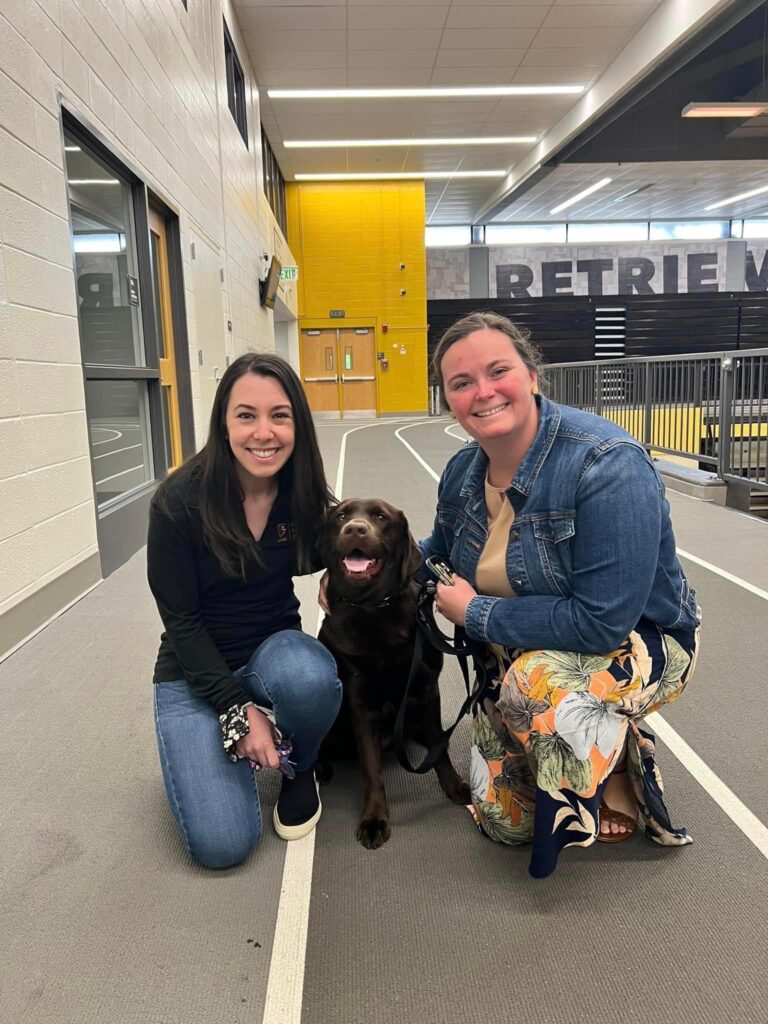
Weisman, left, along with a colleague Alison Larsen and UMBC’s campus dog, Chip.
A: Relationships are everything at UMBC. From my own experience, I have gained some of the most incredible friendships (one of my bridesmaids!) and partnerships. I value relationships and partnerships that foster a supportive and collaborative community to best support our students.
Relationships are everything at UMBC.
Hope Weisman
I would also like to share that UMBC gives you the opportunity to grow. When I started as a student, I was very shy and introverted. However, I took the steps to come out of my comfort zone and try new things. For example, I signed up for a public speaking course and served as one of the Transfer Student Seminar (TRS) Peer Leaders. I wanted to become more confident and these opportunities have been helpful as I continue in my professional role.
Q: Tell us about someone in the community who has inspired you, and how they did it.
A: There are many people at UMBC who have inspired and supported me during my time here. Many of my former professors, supervisors, and colleagues have each fostered learning opportunities in order for me to grow and develop as a student and a professional staff member. I’m grateful for each person who has helped me get to where I am today.
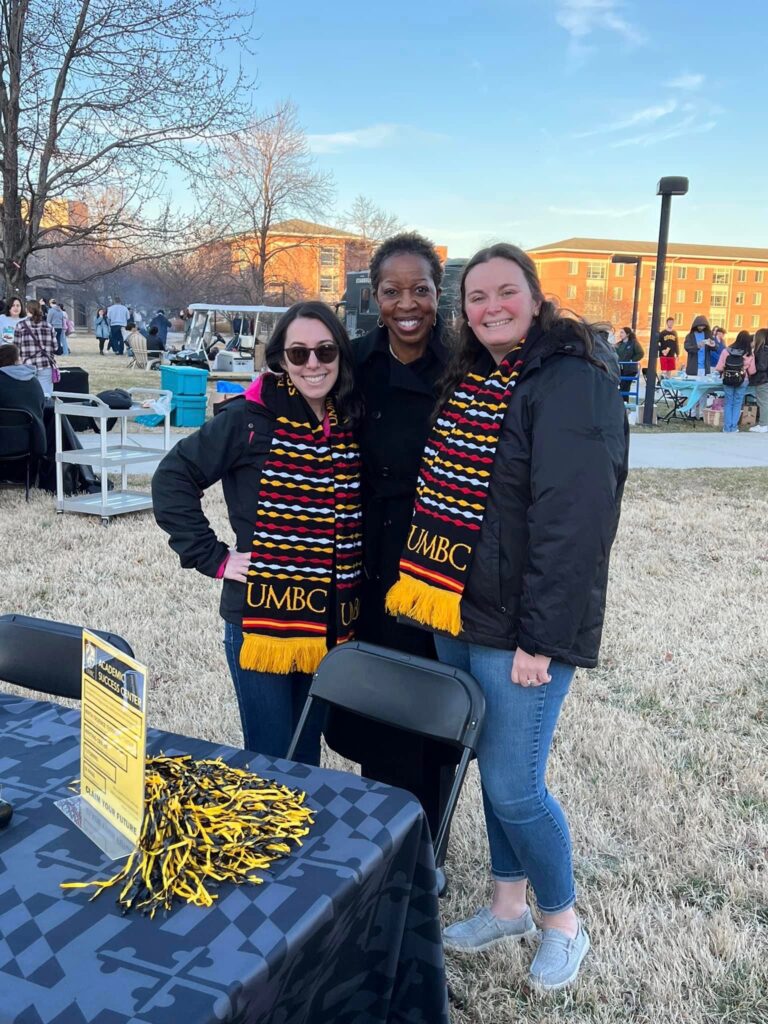 Weisman at an Academic Success Center event with colleague Alison Larsen and UMBC President Valerie Sheares Ashby.
Specifically, I’d like to recognize two UMBC community members who have helped pave the way for me at UMBC. Christine Mair from the Applied Sociology Program advised me as a graduate student. Dr. Mair encouraged me to explore my own academic/educational interests, and always provided unwavering support during my master’s program. Second, Amanda Knapp, associate vice provost and assistant dean, has provided endless guidance and support to me within the Academic Success Center. She has allowed me to grow professionally and has always believed in me. Most notably, Dr. Knapp always creates an environment where I feel supported and always pushes me to succeed. I am truly grateful!
Q: Are you involved in any campus organizations? Tell us about what you love about them!
A: This past year, I served as a mentee for the Professional Staff Senate. It was a wonderful experience and I enjoyed getting to have a mentor who was a fantastic support. I’m also involved in the Financial Literacy Education Committee which works to provide resources and educational tools for financial wellness—a topic that is of interest and importance to me having worked in the Office of Financial Aid and Scholarships! Additionally, I serve on many different transfer-related committees where we work together to create initiatives that will best support our transfer student population.
Q: What would you tell someone who is considering a career at UMBC?
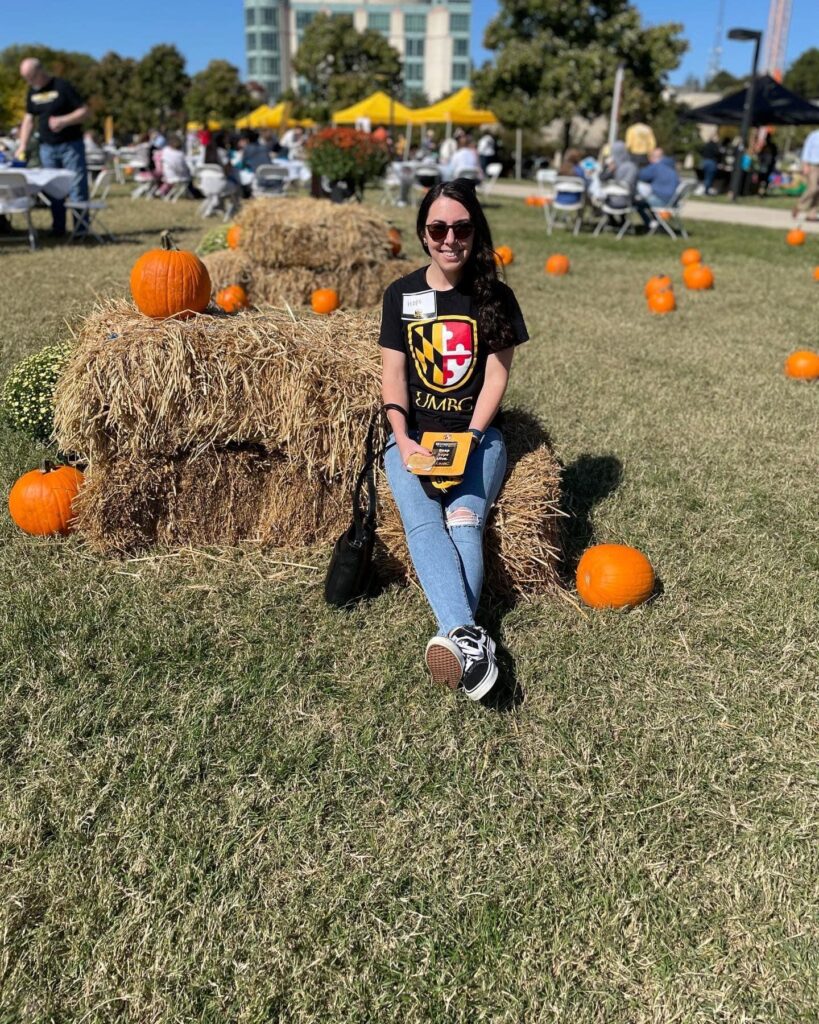
A: UMBC was a great place for me as a student and continues to be a great place to be as a staff member. I value the relationships and connections I have formed that continue beyond UMBC. I appreciate that every day is a brand new day and I have an opportunity to learn and grow within my role. I have been a part of the UMBC campus for ten years and I’m looking forward to what the future brings us!
*******
UMBC’s greatest strength is its people. When people meet Retrievers and hear about the passion they bring, the relationships they create, the ways they support each other, and the commitment they have to inclusive excellence, they truly get a sense of our community. That’s what “Meet a Retriever” is all about.
Learn more about how UMBC can help you achieve your goals.
]]>
Meet Hope Weisman ’14, psychology, M.A. ’18, applied sociology, a Transfer Academic Advocate and member of the UMBC community for 10 years and counting. As a transfer to UMBC herself, Hope has...
https://umbc.edu/stories/meet-a-retriever-transfer-student-advocate/
https://beta.my.umbc.edu/api/v0/pixel/news/133976/guest@my.umbc.edu/138a8fb8152bb50bcdbc32e6da62d210/api/pixel
alumni
applied-sociology
cahss
campus-life
magazine
meet-a-retriever
psychology
UMBC News & Magazine
https://beta.my.umbc.edu/groups/umbc-news-magazine
https://assets1-beta.my.umbc.edu/system/shared/avatars/groups/000/001/943/24435aa6207c452e7bc15cc74b42c7bb/xsmall.png?1748556657
https://assets1-beta.my.umbc.edu/system/shared/avatars/groups/000/001/943/24435aa6207c452e7bc15cc74b42c7bb/original.png?1748556657
https://assets2-beta.my.umbc.edu/system/shared/avatars/groups/000/001/943/24435aa6207c452e7bc15cc74b42c7bb/xxlarge.png?1748556657
https://assets2-beta.my.umbc.edu/system/shared/avatars/groups/000/001/943/24435aa6207c452e7bc15cc74b42c7bb/xlarge.png?1748556657
https://assets3-beta.my.umbc.edu/system/shared/avatars/groups/000/001/943/24435aa6207c452e7bc15cc74b42c7bb/large.png?1748556657
https://assets1-beta.my.umbc.edu/system/shared/avatars/groups/000/001/943/24435aa6207c452e7bc15cc74b42c7bb/medium.png?1748556657
https://assets2-beta.my.umbc.edu/system/shared/avatars/groups/000/001/943/24435aa6207c452e7bc15cc74b42c7bb/small.png?1748556657
https://assets1-beta.my.umbc.edu/system/shared/avatars/groups/000/001/943/24435aa6207c452e7bc15cc74b42c7bb/xsmall.png?1748556657
https://assets2-beta.my.umbc.edu/system/shared/avatars/groups/000/001/943/24435aa6207c452e7bc15cc74b42c7bb/xxsmall.png?1748556657
UMBC News & Magazine
1
0
false
Mon, 12 Jun 2023 17:08:19 -0400
Office Hours

Each week, UMBC President Valerie Sheares Ashby invites students to her office hours to chat about their lives and their experiences at UMBC. Today, she’s speaking with Viridiana Colosio-Martinez ’22, modern languages, linguistics, and intercultural communication, and M.A. ’24, intercultural communication, who emigrated from Mexico and is currently working on community-engaged research with immigrant communities in Baltimore’s Highlandtown neighborhood. Read more about Colosio-Martinez’s life and work in Shared Stories, Shared Purpose.
UMBC Magazine: Viridiana, you have such a compelling personal story. When you first met Dr. Sheares Ashby, what was the most important thing you wanted to convey to her about your story and why?
Colosio-Martinez: President Sheares Ashby has been very inspiring to me. Because in my experience as a student and also as a Latino woman in the U.S., through the many institutions I’ve attended…I haven’t seen the presence of women, especially in positions like this. For me, it’s really inspiring and it gives me hope as a woman to know what is possible, because sadly in our society, we’re still dealing with a lot of discrimination and misconceptions.
Having this opportunity is really important. It makes me feel that any student—no matter if you’re Latino, or if you’re African American, or if you are Haitian American, or Asian, or international—can have the opportunity to meet people in power. You can connect and mak bridges and share your needs and experiences.
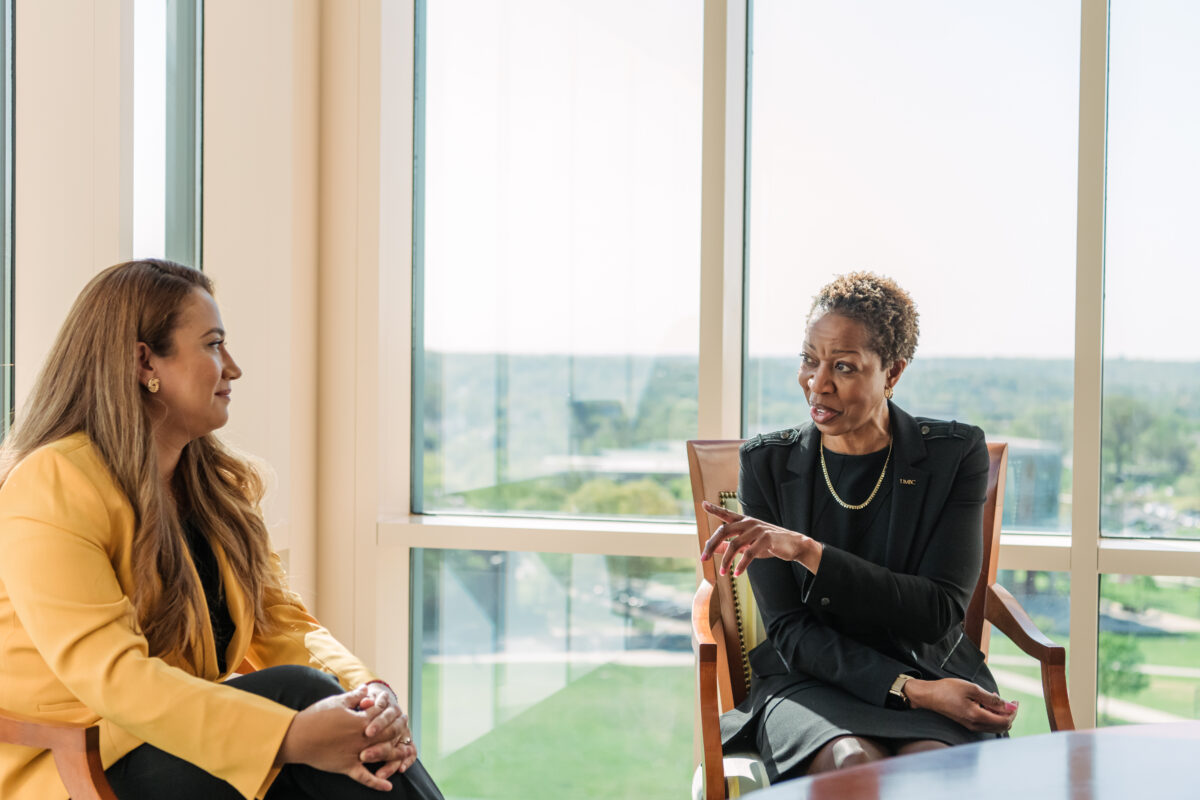
UMBC Magazine: President Sheares Ashby, you’re meeting with many students in your first months here through your regular office hours and in other ways. How does it impact you as a leader to get to know people on an individual level?
President Sheares Ashby: I am a teacher at heart…it is in my heart and my mind. I love teaching because it gives me the opportunity to look for greatness in my students and then help them see it for themselves. And so, I love it when a student comes to me and I can get to know who they are, where they come from, and how I can be supportive.
I am sitting here looking at you [Viridiana] thinking, “Okay, who is she going to become? And what is possible for her?” And the fact is, everything is possible. She is going to run and she is going to make a big difference in the world. And now I can ask myself, “How can I support her and help her do that?” That is what my brain is always doing. And so, I love it. I love when students come to me.
Colosio-Martinez: I feel like you’re very approachable. In September, there was a meet-and-greet for the Latino/Hispanic Faculty Association. I was there supporting my professors, and I saw you there talking with every single person. I saw how you wanted to give us space and recognize our community.
UMBC Magazine: You’re finishing up your master’s degree, Viridiana, and like the president, you’re a teacher. What will you take from UMBC with you after you graduate?
Colosio-Martinez: I would like to become a professor. When I have my office hours with students now, I’m always thinking the same thing: “Who are they? And do they need help with anything?” I want to help others…I would like to continue with my research in the Latinx community, to make space for the wonderful stories of people who are doing good things and all the challenges that our communities experience.
And what will I take with me? I will take all the passion, all the knowledge from my professors and mentors, like my mentor Tania Lizarazo, and all of the skills. I will take the friendships of my classmates…and the wonderful experience of teaching undergrads. I’m taking every single experience and I will remember every single student, and I’m taking all of those things with me to make sure that I use them in the future.
President Sheares Ashby: You are so inspiring, Viridiana. Thank you for sharing your story!
]]>
Each week, UMBC President Valerie Sheares Ashby invites students to her office hours to chat about their lives and their experiences at UMBC. Today, she’s speaking with Viridiana Colosio-Martinez...
https://umbc.edu/stories/office-hours-president-sheares-ashby/
https://beta.my.umbc.edu/api/v0/pixel/news/133970/guest@my.umbc.edu/999ece4123650374a9fdea4bd977c223/api/pixel
cahss
campus-life
magazine
office-hours
sheares-ashby
spring-2023
UMBC News & Magazine
https://beta.my.umbc.edu/groups/umbc-news-magazine
https://assets1-beta.my.umbc.edu/system/shared/avatars/groups/000/001/943/24435aa6207c452e7bc15cc74b42c7bb/xsmall.png?1748556657
https://assets1-beta.my.umbc.edu/system/shared/avatars/groups/000/001/943/24435aa6207c452e7bc15cc74b42c7bb/original.png?1748556657
https://assets2-beta.my.umbc.edu/system/shared/avatars/groups/000/001/943/24435aa6207c452e7bc15cc74b42c7bb/xxlarge.png?1748556657
https://assets2-beta.my.umbc.edu/system/shared/avatars/groups/000/001/943/24435aa6207c452e7bc15cc74b42c7bb/xlarge.png?1748556657
https://assets3-beta.my.umbc.edu/system/shared/avatars/groups/000/001/943/24435aa6207c452e7bc15cc74b42c7bb/large.png?1748556657
https://assets1-beta.my.umbc.edu/system/shared/avatars/groups/000/001/943/24435aa6207c452e7bc15cc74b42c7bb/medium.png?1748556657
https://assets2-beta.my.umbc.edu/system/shared/avatars/groups/000/001/943/24435aa6207c452e7bc15cc74b42c7bb/small.png?1748556657
https://assets1-beta.my.umbc.edu/system/shared/avatars/groups/000/001/943/24435aa6207c452e7bc15cc74b42c7bb/xsmall.png?1748556657
https://assets2-beta.my.umbc.edu/system/shared/avatars/groups/000/001/943/24435aa6207c452e7bc15cc74b42c7bb/xxsmall.png?1748556657
UMBC News & Magazine
1
0
false
Mon, 12 Jun 2023 16:20:21 -0400
Grin and Bear It
When asked to describe the cinematic masterpiece that is Cocaine Bear, Scott Seiss ’16, media and communication studies, didn’t mince any words to deliver his thoughts on the hit film based on true events.
“I think ‘cocaine’ and ‘bear,’ just those two words pretty much sum it up. A wild rollercoaster ride of gore and jokes.”
What started as a Facebook message to then-agentless Seiss’ spam folder with the suspicious but apt subject line “COCAINE” has led to a debut on the silver screen and launched this Retriever from Dundalk onto the national comedy stage.
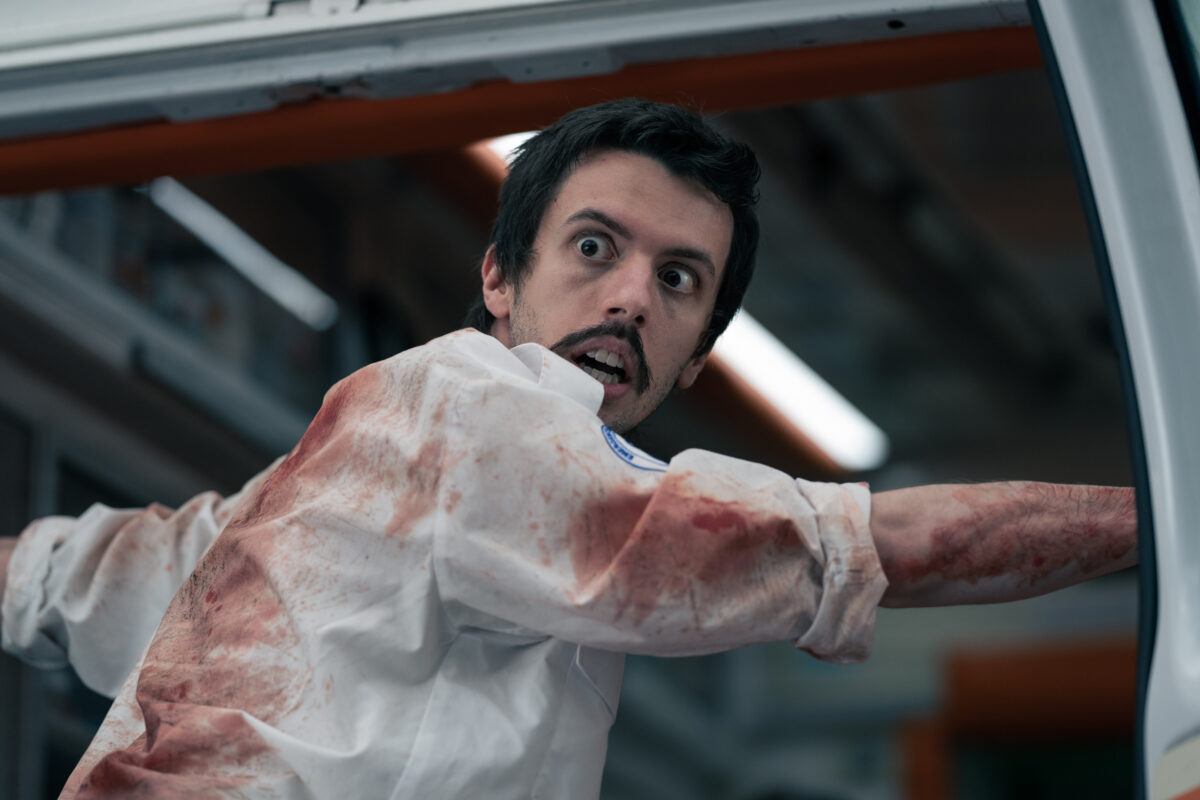 Seiss, a Dundalk native, plays an ill-fated paramedic
named Tom. Photo courtesy Pat Redmond / Universal Pictures
Seiss, a Dundalk native, plays an ill-fated paramedic
named Tom. Photo courtesy Pat Redmond / Universal Pictures
Bear for now, dog for life
Seiss, who plays the ill-fated paramedic Tom in Elizabeth Banks’ recent romp, Cocaine Bear, credits much of his comedic career to the opportunities and support he got while attending UMBC.
“There were a lot of things that came from UMBC that I think really just helped me along the comedy journey and gave me a lot of confidence and experience and skills that I might not have necessarily had going somewhere else,” says Seiss.
At this point in his career, there are a few places you may have seen Seiss—on stage performing with Dog-Collar Comedy Troupe (he was a part of the founding group at UMBC 10 years ago), on TikTok with his viral “Angry Ikea Guy” series, or opening for the likes of Patton Oswalt (on tour in 2022) or for Bo Burnham at UMBC in 2014. (At the time he thought, “Well, I’ve peaked. This is the coolest thing I’ll ever get to do in comedy.”)
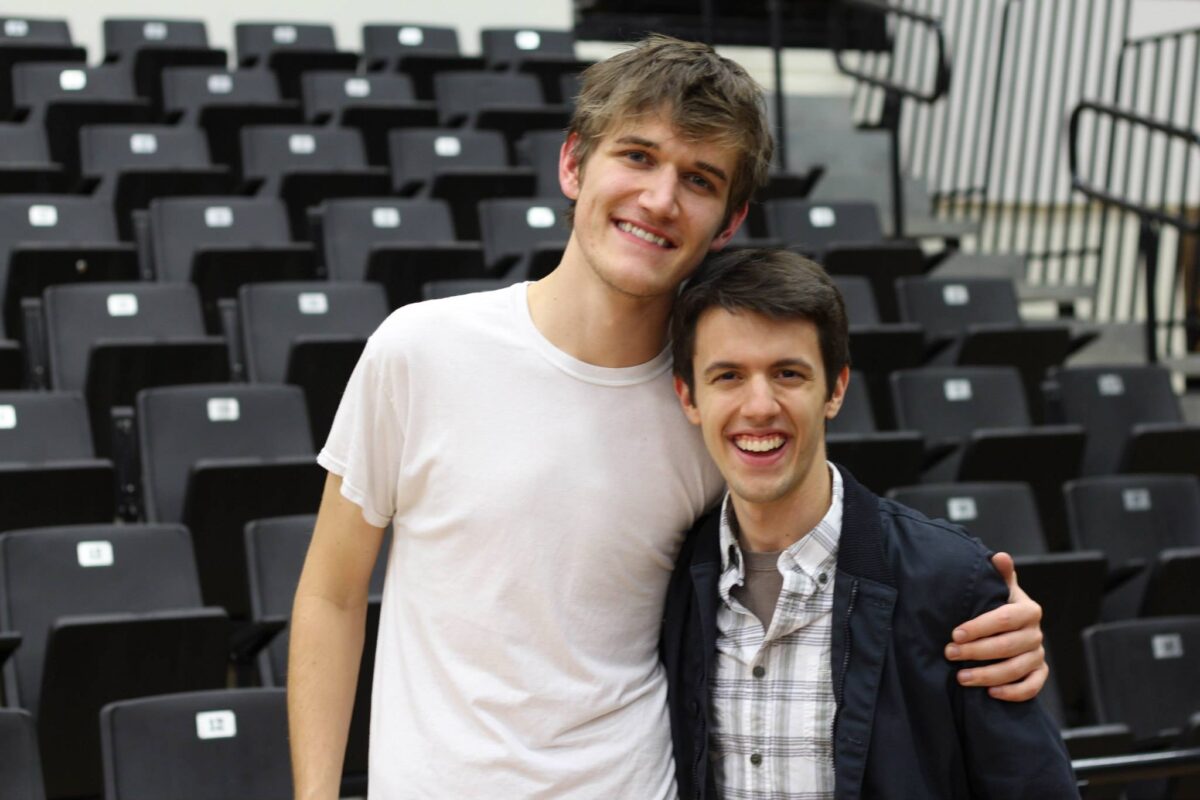 Seiss, right, with Bo Burnham at UMBC in 2014. Photo courtesy of Seiss.
Seiss got his start on UMBC’s Flat Tuesdays stage and then started bouncing around Baltimore to begin his stand-up journey. He eventually moved to New Jersey, pursued stand up in New York every night, and then the pandemic happened. That’s when he turned to TikTok. Drawing on his own experiences in customer service, Seiss soon amassed a massive following and, once a compilation video of his hits started making the rounds, Hollywood took notice.
Seiss explains, “Elizabeth Banks and her husband and producing partner Max Handelman saw the videos and loved them, thought they were funny, and they were like, ‘We got to see this guy screaming for his life.’”
Retriever skills on the silver screen
They got their money’s worth from Seiss’ shouts. On set, he says, “I had to do one day of all screaming, where I was just screaming and getting attacked.” He credits Lynn Watson, theatre, for his vocal technique. “I did all the stuff that she had taught me, the Fitzmaurice diaphragmatic breathing, tremors, all this kind of stuff, to be able to project and scream. I never lost my voice.”
In fact, Seiss often thought of advice he got from UMBC while filming. “Eve Muson, who is the best acting professor of all time, is also the best acting coach of all time. It was always her voice in my head when I was acting. I could just hear her saying, ‘Don’t pretend to be afraid of the bear, be afraid of the bear.’ That was one of her go-tos: don’t pretend, actually do it,” says Seiss. “So, every time I did a take on Cocaine Bear, I would just go back and I’d go, ‘Oh my God, would Eve have liked that?’ That was my barometer for if it was good.”
It’s a mutual admiration for Muson. “I loved working with Scott when he was a student here at UMBC. He was my assistant director for our epic production of Rhinoceros. Scott was our chief script doctor—every night I would send him home with notes to update this classic work of political theatre,” said Muson, who has been at UMBC since 2009. “Every day he’d come in with really funny gags and jokes for the actors to try out. I’m delighted (but hardly surprised) that Scott’s considerable comedic talents are being recognized by his TikTok following and now the film industry.”
 Seiss during his Dog-Collar Comedy days. Photo courtesy of Seiss.
The mentorship he received from the UMBC faculty played a huge part in his success. “Jason Loviglio from media and communications is just incredible. He really encouraged me when it came to comedy, specifically,” remembers Seiss.
Seiss also attributes some of his comedy prowess to his peers, including the other performers in UMBC’s Dog-Collar Comedy Troupe. “It was just nice being around such a creative and funny and supportive group of people who just wanted to push each other and try to be as funny as possible,” says Seiss.
Sitting down to write for stand up
Cocaine Bear may have wrapped, but fans looking for more can catch him in Randall Park’s directorial debut, Shortcomings, which premiered at Sundance earlier this year. He’s also working on new content for his stand-up tour.
“My writing style is pretty chaotic. Sometimes I’ll sit down and try to go through some sort of free-write exercise to pull an idea out, and then sometimes it’s just like you’re walking around, you get an idea,” says Seiss.
For any budding creatives looking to break into the business, Seiss says, “The most important thing is that you have to make your own stuff and you have to show people that you can do it before they will start letting you.”
Well, that and always check your spam messages on Facebook (proceed with caution).
]]>
When asked to describe the cinematic masterpiece that is Cocaine Bear, Scott Seiss ’16, media and communication studies, didn’t mince any words to deliver his thoughts on the hit film based on...
https://umbc.edu/stories/grin-and-cocaine-bear-it/
https://beta.my.umbc.edu/api/v0/pixel/news/133962/guest@my.umbc.edu/86aad8bb24d1262588dba667a2a5c165/api/pixel
alumni
cahss
magazine
media-and-communication-studies
performing-arts
spring-2023
UMBC News & Magazine
https://beta.my.umbc.edu/groups/umbc-news-magazine
https://assets1-beta.my.umbc.edu/system/shared/avatars/groups/000/001/943/24435aa6207c452e7bc15cc74b42c7bb/xsmall.png?1748556657
https://assets1-beta.my.umbc.edu/system/shared/avatars/groups/000/001/943/24435aa6207c452e7bc15cc74b42c7bb/original.png?1748556657
https://assets2-beta.my.umbc.edu/system/shared/avatars/groups/000/001/943/24435aa6207c452e7bc15cc74b42c7bb/xxlarge.png?1748556657
https://assets2-beta.my.umbc.edu/system/shared/avatars/groups/000/001/943/24435aa6207c452e7bc15cc74b42c7bb/xlarge.png?1748556657
https://assets3-beta.my.umbc.edu/system/shared/avatars/groups/000/001/943/24435aa6207c452e7bc15cc74b42c7bb/large.png?1748556657
https://assets1-beta.my.umbc.edu/system/shared/avatars/groups/000/001/943/24435aa6207c452e7bc15cc74b42c7bb/medium.png?1748556657
https://assets2-beta.my.umbc.edu/system/shared/avatars/groups/000/001/943/24435aa6207c452e7bc15cc74b42c7bb/small.png?1748556657
https://assets1-beta.my.umbc.edu/system/shared/avatars/groups/000/001/943/24435aa6207c452e7bc15cc74b42c7bb/xsmall.png?1748556657
https://assets2-beta.my.umbc.edu/system/shared/avatars/groups/000/001/943/24435aa6207c452e7bc15cc74b42c7bb/xxsmall.png?1748556657
UMBC News & Magazine
3
0
false
Mon, 12 Jun 2023 13:04:23 -0400
Mon, 12 Jun 2023 13:04:23 -0400
How to Make a Pinhole Camera

When Chris Peregoy ’81, visual and performing arts, M.F.A. ’99, intermedia and digital arts, received a tin full of Christmas cookies from his sister around the year 2000, he immediately dumped the contents out on the table to eat later. He had a moment of inspiration staring at the empty container—“This tin would make a great camera.”
If you’ve ever looked at an oatmeal container, a hollowed-out book, a mailbox, or an entire room, and thought, “This object would make a great camera,” chances are you are familiar with the concept of a pinhole camera. It’s photography distilled to its most basic elements: a light-proof box, a lens—which is often just a literal hole made from a pin—and some film or photographic paper.
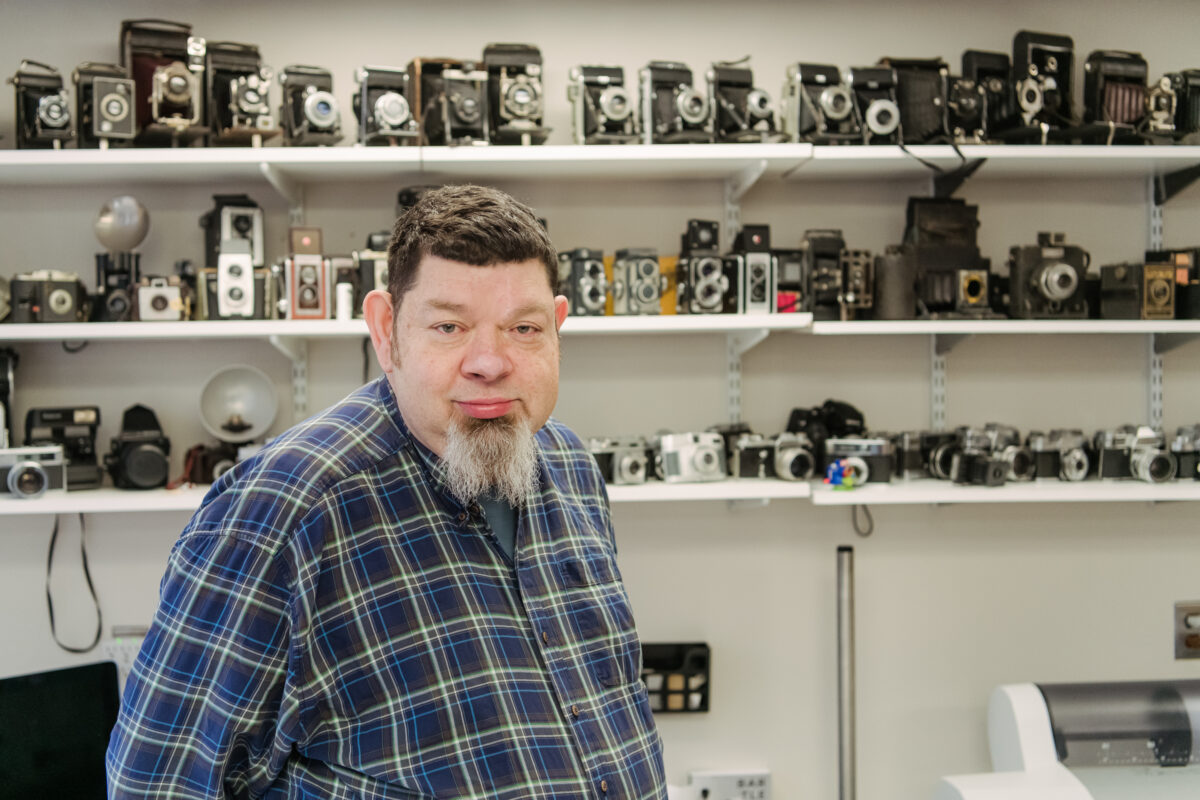
Peregoy, the lab manager for the Department of Visual Arts, has worked at UMBC since graduating from the photography program in 1981 and will retire this summer, but he leaves behind a substantial legacy in his 6-foot 8-inch wake. He’s also leaving behind a few dozen handcrafted pinhole cameras from his company Pinhole Blender for students to keep using in their photo classes.
In addition to the helpful labels on each camera describing exposure time in different types of light, Peregoy has some useful hints for the rest of us who might want to dabble in the non-digital world of making photos.
Tools of the Trade:
- A light-proof container—a great second life for the shipping tube your diploma arrives in
- A pin to make the eponymous pinhole
- Small square of black tape to act as a shutter
- Film or photo paper
- Access to a darkroom (but if not, you can still make it work)
Step 1: MAKE YOUR CAMERA (OR BUY ONE FROM PEREGOY’S COMPANY).
Cookie tins aside, Peregoy says he isn’t someone who makes cameras out of odd objects for the most part, although those people are out there. Shipping tubes and oatmeal containers (especially before Quaker changed their lids to transparent plastic) are his go-tos (although he’s making a camera for his retirement party out of an old whiskey barrel the brewery near his house is giving him).
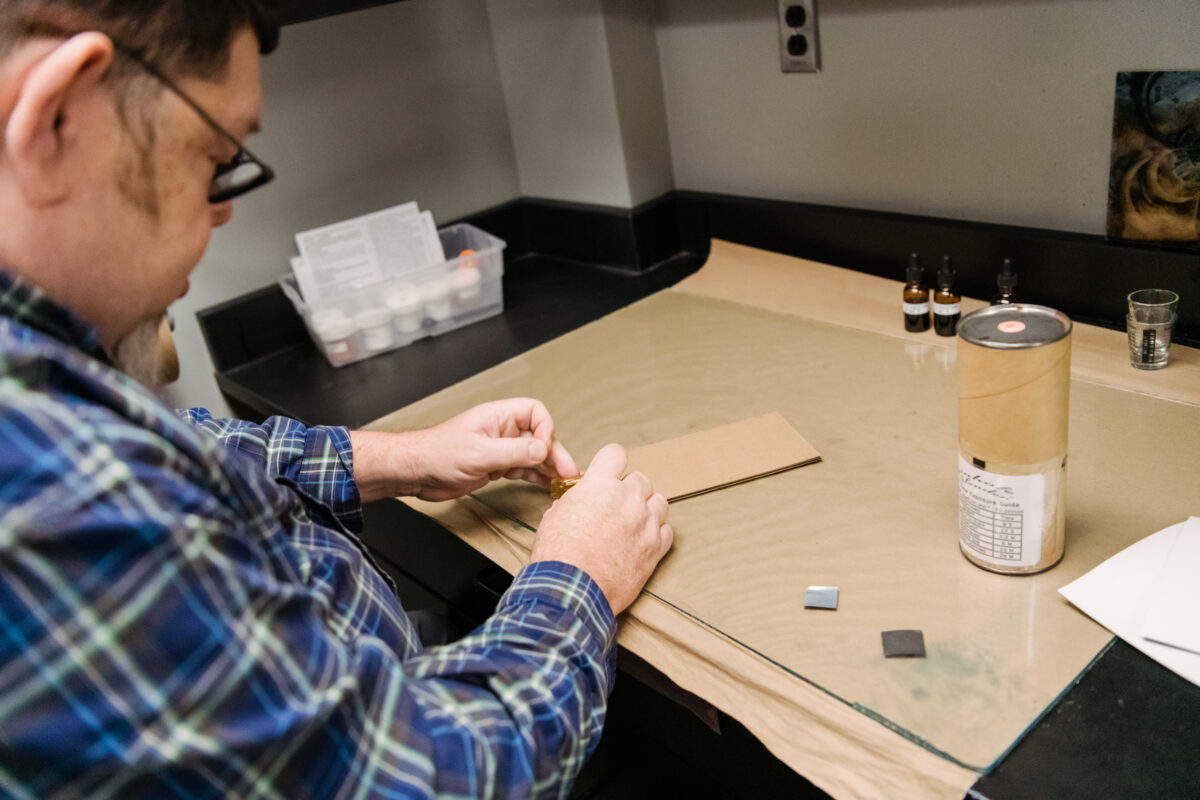
You need an opening large enough to arrange the film in the containers and a way to reseal the box/tube/pumpkin/ etc. When you make the pinhole, Peregoy recommends pushing a pin through a small square of soda-can material and smoothing out any burrs with fine sandpaper. Affix this metal piece to the camera body with black tape. Then you need to attach a shutter— something that ends the light exposure—like a piece of black electrical tape.
Step 2: LOAD YOUR CAMERA.
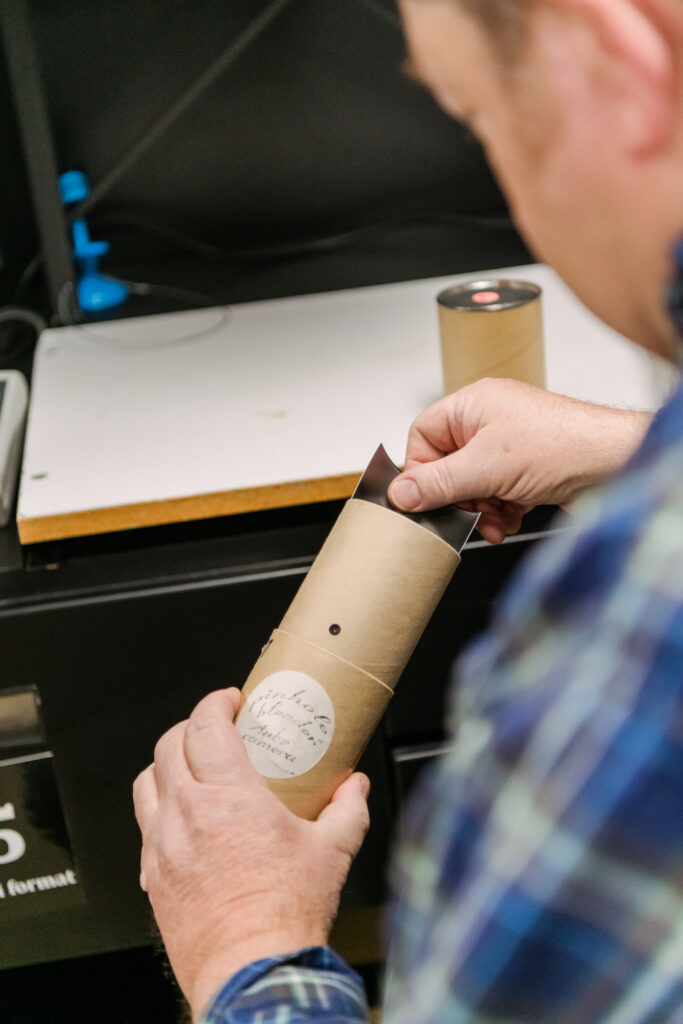
Load the camera with the film or photo paper in a darkroom (you can improvise with cardboard taped over your bathroom window, in a pinch). Now you need to choose your subject. “One of the aspects of the pinhole camera is that although it might not create a sharp picture like a real lens, it has an incredible range of focus,” says Peregoy. “So things a quarter inch away from the pinhole will be as focused as things that are 30 feet away.” In his own pinhole work, Peregoy often uses miniature dolls or statues as subjects in the photos, using the strength of the camera to play with perspectives.
Most often, when students are released from the classroom to go take photos, for time reasons, they don’t stray far. “I’ve seen a lot of pictures of the Fine Arts building,” laughs Peregoy. But even so, he’s still surprised sometimes. In one image of a rocky scene with a building in the background, Peregoy did a double take; despite his many decades on this campus and specifically in this building, he didn’t recognize the shot. The student revealed they had laid down in a drainage ditch, and yes, indeed, it was still Fine Arts in the background.
Step 3: DEVELOP YOUR FILM.
Next comes film development. For students, that means learning the rules of the darkroom. “I didn’t know what a pinhole camera was,” says Erin Cusick, a sophomore who is taking the class for elective credit. “It’s been so fun to see how exposing the paper to light and then using time to play with the way the image develops,” says Cusick as she leans over a tray of chemicals in the darkroom watching her image appear.
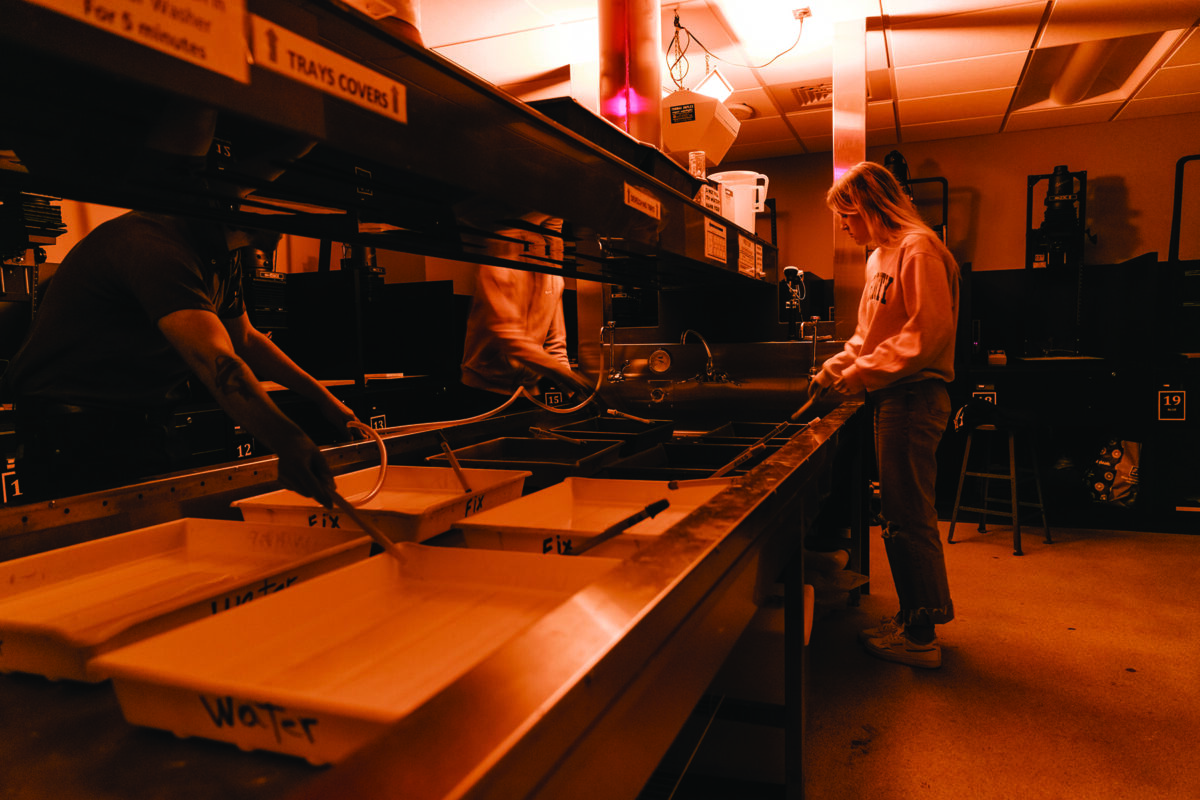
But Peregoy offers two alternatives for a darkroom-free pinhole experience—solargraphy and lumen photography. Solargraphy uses a pinhole camera and exposes the image outside for several months, burning the path of the sun and the stars into the paper. Lumen prints use photo paper overlaid with flowers or other objects, which after exposure to sunlight will create an ethereal image on the paper. It’s a fragile process, says Peregoy, and the paper should be scanned digitally because eventually the image will fade from the paper.
Step 4: KEEP PLAYING AROUND WITH ANALOG.
“Digital has taken most of the cameras away from us,” says Peregoy. “But there are lots of old options and ways to turn old things into film or pinhole.” Cusick, in the photo class, is struck by how simple-seeming the whole process is, “but the simplicity makes it all the more confusing how it works,” she marvels.
Outside Fine Arts, the sun shines brightly on the building and Jamal Jackson, a visual arts major who transferred from Montgomery College, aligns his pinhole camera just so. “The versatility of the camera makes it so fun to play with,” he says. “It’s letting me capture my own voice in photos.”
The more you know: Discover more pinhole resources.
]]>
When Chris Peregoy ’81, visual and performing arts, M.F.A. ’99, intermedia and digital arts, received a tin full of Christmas cookies from his sister around the year 2000, he immediately dumped...
https://umbc.edu/stories/how-to-make-a-pinhole-camera/
https://beta.my.umbc.edu/api/v0/pixel/news/133961/guest@my.umbc.edu/e283b139552c0360790057d949553f8f/api/pixel
alumni
cahss
campus-life
how-to
intermedia-and-digital-arts
magazine
spring-2023
visual-and-performing-arts
UMBC News & Magazine
https://beta.my.umbc.edu/groups/umbc-news-magazine
https://assets1-beta.my.umbc.edu/system/shared/avatars/groups/000/001/943/24435aa6207c452e7bc15cc74b42c7bb/xsmall.png?1748556657
https://assets1-beta.my.umbc.edu/system/shared/avatars/groups/000/001/943/24435aa6207c452e7bc15cc74b42c7bb/original.png?1748556657
https://assets2-beta.my.umbc.edu/system/shared/avatars/groups/000/001/943/24435aa6207c452e7bc15cc74b42c7bb/xxlarge.png?1748556657
https://assets2-beta.my.umbc.edu/system/shared/avatars/groups/000/001/943/24435aa6207c452e7bc15cc74b42c7bb/xlarge.png?1748556657
https://assets3-beta.my.umbc.edu/system/shared/avatars/groups/000/001/943/24435aa6207c452e7bc15cc74b42c7bb/large.png?1748556657
https://assets1-beta.my.umbc.edu/system/shared/avatars/groups/000/001/943/24435aa6207c452e7bc15cc74b42c7bb/medium.png?1748556657
https://assets2-beta.my.umbc.edu/system/shared/avatars/groups/000/001/943/24435aa6207c452e7bc15cc74b42c7bb/small.png?1748556657
https://assets1-beta.my.umbc.edu/system/shared/avatars/groups/000/001/943/24435aa6207c452e7bc15cc74b42c7bb/xsmall.png?1748556657
https://assets2-beta.my.umbc.edu/system/shared/avatars/groups/000/001/943/24435aa6207c452e7bc15cc74b42c7bb/xxsmall.png?1748556657
UMBC News & Magazine
1
0
false
Mon, 12 Jun 2023 11:57:11 -0400
Mon, 12 Jun 2023 11:57:11 -0400
Out of office—Developing underwater technologies to best support ocean life
Three weeks exploring the beautiful, pristine waters of Indonesia to study seagrasses—that was the plan. But before Terry Smith ’00, computer science, could get to work, he had another problem to solve. What do you do when half of your research equipment gets stuck in customs? For Smith, that just means it’s time to get creative. “I love finding the fun problems,” he says. So, he created a camera float using any materials he could get his hands on—PVC pipe, a life ring, and a bit of rope.
Smith is a solutions engineer on the Tidal project in Alphabet’s X division, a semi-secret research and development organization founded by Google in 2010. The Tidal project’s initial focus is on developing technologies that bring greater clarity to what’s going on below the ocean surface, with the goal of preserving ocean life and sustainably providing food for humanity. Recently, Smith worked with the governments of Indonesia and Australia to come up with technology to visualize, analyze, and track the growth of seagrasses, which are particularly effective at absorbing carbon dioxide from shallow waters.
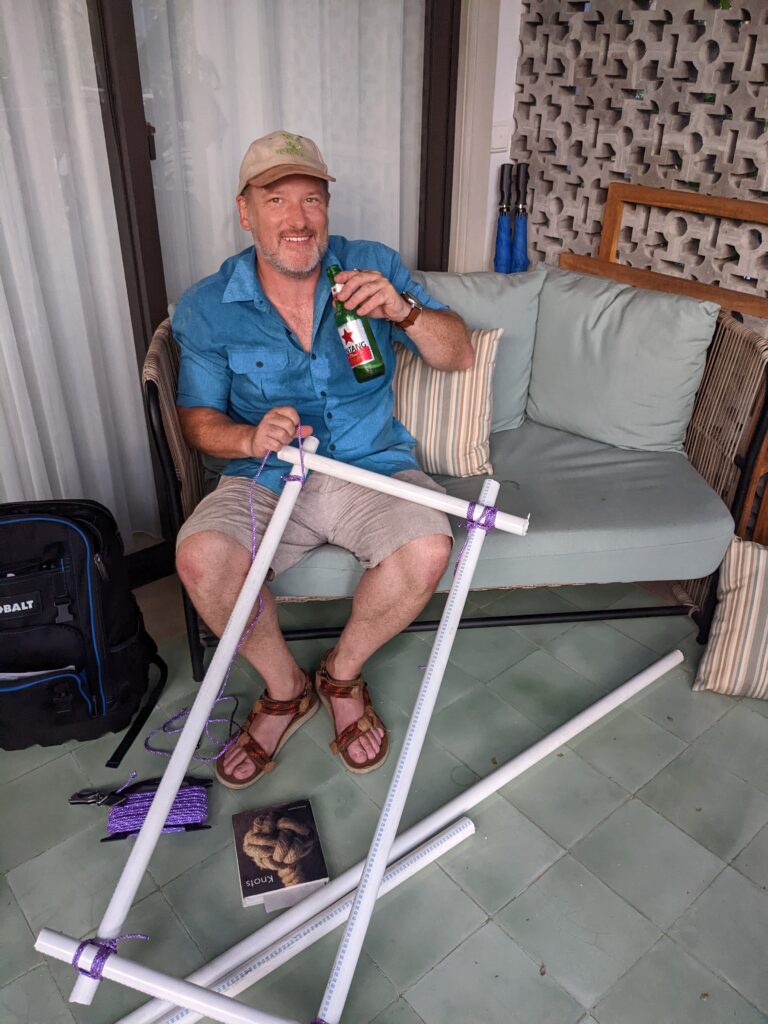 Smith working on a handmade prototype for ocean mapping technology made from PVC pipes. His well-used book of knots is nearby.
“Traditionally, if you wanted to make a map of all of the seagrasses, it would probably take 10 years and 1,000 grad students,” explains Smith. “We’re trying to come up with technology that’ll make that happen a lot faster. So, I go out into the water with some prototype technologies that my team built and run robots over seagrass and then do 3D visualization of the data we capture.”
Tidal is just the latest in a long line of exciting projects Smith has gotten to be part of throughout his career, which has seen him travel all over the world. And throughout it all, Smith follows a simple philosophy: “Go see what’s happening in your field and make early contact with the real world.”
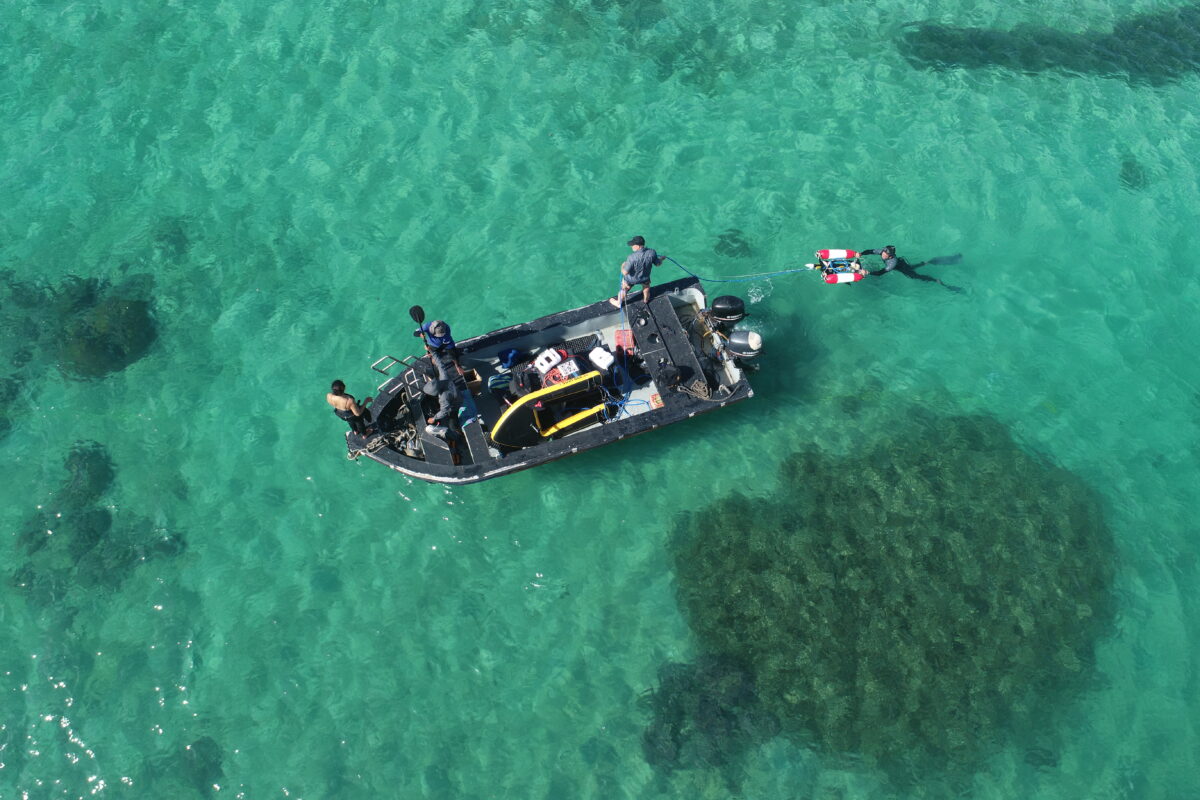 A bird’s-eye view of Smith and his team studying seagrass in the islands near Labuan Bajo, Indonesia. Smith is standing, guiding the umbilical cable between the cameras and the computers.
This core belief has guided Smith from UMBC all the way to X—the so-called moonshot factory in California. But this journey from coast to coast was not a linear adventure. Like many UMBC alumni, Smith’s story doesn’t even begin at UMBC. His story starts a little further south.
Hands-on industry experience
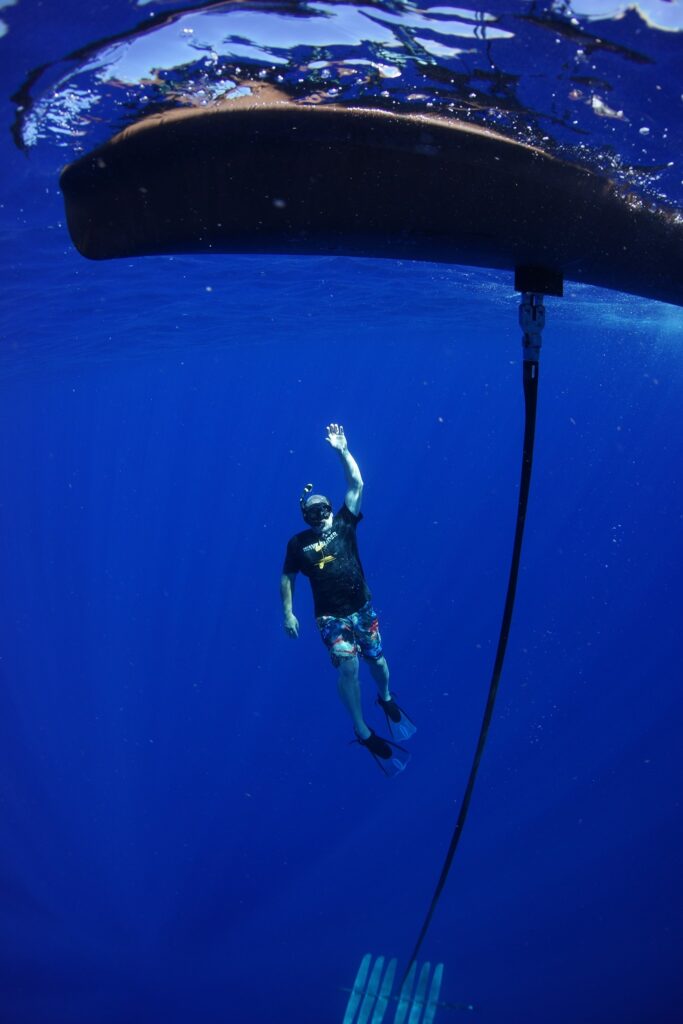 Smith inspecting an autonomous wave glider for Liquid Robotics around 2018.
For three years, Smith studied electrical engineering at the Florida Institute of Technology, but then he pressed pause. Eventually, he transferred to UMBC in 1997 to be closer to his parents. He decided to lean into the tech boom and major in computer science.
“I found a really amazing department,” said Smith. “There are so many opportunities at UMBC to work with outside companies. Being able to interact with industry gives you such an advantage.”
Smith parlayed all of this experience and his natural charisma into a part-time job while still in school, but not in the way you may think. As a bartender on Main Street, Ellicott City. Smith says one of his regulars asked about his summer plans. “Serving you drinks,” said Smith. The regular, a hiring manager at TRW Inc., a defense contractor since acquired by Northrop Grumman, ended up helping Smith find a summer job in the signals processing lab near Fort Meade.
That summer job eventually turned into a part-time job and then, “I left UMBC with a full-time job in hand and a lot of experience,” says Smith.
After working at TRW for a few years, Smith moved up to Boston, working at Draper Laboratory and eventually M.I.T. Lincoln Laboratory. But, like any good engineer, Smith continued to wonder what was next. So, he headed out west, eventually landing a job at NASA’s Ames Research Center, working on the next generation of air traffic control.
At that point, Smith says, “I had done a lot of work in simulation and I wanted to get back to the real world.” He moved on to Liquid Robotics, a Boeing company that works on wave-powered ocean robots to track whale migration using hydrophones or look for oil leaks around oil rigs using hydrocarbon sensors. After seven years there, X and the Tidal project came calling.
X marks the spot
Smith has been at X just shy of two years, working on Tidal to find ways to use Google technology to benefit ocean life.
“We’re using the experience we got doing salmon aquaculture to branch out into different areas, like the seagrass experiments in Indonesia” said Smith. “We’re looking for ways that AI, ocean robotics, and the other technologies we developed can be used to make human work on the ocean more efficient, sustainable, and better for both people and the ocean.”
Staying anchored to UMBC
No matter what he’s doing, or what far-flung location he finds himself, Smith has continued to find ways to stay connected with the UMBC community. He jumps at the opportunity to attend events whenever UMBC makes it out to the West Coast—most recently during the San Francisco stop on the 2022 RetriEVER Grateful Tour—and he remains close with his college roommate, Tim Craig ’02, computer science, who also relocated to California. “We see each other quite a lot,” says Smith. “His kids play with my kids.”
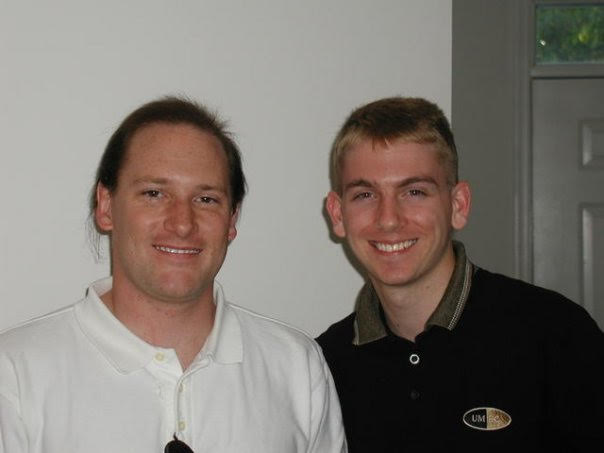 Smith and Tim Craig met as college roommates and still keep in touch. Pictured here circa 2002.
Smith is also working with the UMBC Alumni Engagement team to host an event at X for UMBC alumni working in Google-affiliated companies. “We all try to find each other,” says Smith of his fellow California-based Retrievers.
“Terry Smith’s example provides a road map for other alumni in how to stay engaged with UMBC,” says Stacey Sickels, UMBC Associate Vice President for Alumni Engagement and Development. “Terry has shared about job opportunities with the UMBC Career Services Office, his work could have potential research synergies with UMBC faculty, he wants to create a UMBC community within his company, he attends Bay Area alumni events, and Terry gives back with his time and giving.”
Up next for Smith, he will be investigating new areas to apply X’s machine learning and artificial intelligence technology, prototyping novel solutions, and helping commercialize Tidal’s aquaculture platform across the world. “It’s going to be a busy couple of years,” jokes Smith.
]]>
Three weeks exploring the beautiful, pristine waters of Indonesia to study seagrasses—that was the plan. But before Terry Smith ’00, computer science, could get to work, he had another problem to...
https://umbc.edu/stories/protecting-ocean-life-sustainable-aquaculture/
https://beta.my.umbc.edu/api/v0/pixel/news/133946/guest@my.umbc.edu/0f352ebd3353a077163e825b370b38a3/api/pixel
alumni
coeit
computer-science
impact
magazine
spring-2023
UMBC News & Magazine
https://beta.my.umbc.edu/groups/umbc-news-magazine
https://assets1-beta.my.umbc.edu/system/shared/avatars/groups/000/001/943/24435aa6207c452e7bc15cc74b42c7bb/xsmall.png?1748556657
https://assets1-beta.my.umbc.edu/system/shared/avatars/groups/000/001/943/24435aa6207c452e7bc15cc74b42c7bb/original.png?1748556657
https://assets2-beta.my.umbc.edu/system/shared/avatars/groups/000/001/943/24435aa6207c452e7bc15cc74b42c7bb/xxlarge.png?1748556657
https://assets2-beta.my.umbc.edu/system/shared/avatars/groups/000/001/943/24435aa6207c452e7bc15cc74b42c7bb/xlarge.png?1748556657
https://assets3-beta.my.umbc.edu/system/shared/avatars/groups/000/001/943/24435aa6207c452e7bc15cc74b42c7bb/large.png?1748556657
https://assets1-beta.my.umbc.edu/system/shared/avatars/groups/000/001/943/24435aa6207c452e7bc15cc74b42c7bb/medium.png?1748556657
https://assets2-beta.my.umbc.edu/system/shared/avatars/groups/000/001/943/24435aa6207c452e7bc15cc74b42c7bb/small.png?1748556657
https://assets1-beta.my.umbc.edu/system/shared/avatars/groups/000/001/943/24435aa6207c452e7bc15cc74b42c7bb/xsmall.png?1748556657
https://assets2-beta.my.umbc.edu/system/shared/avatars/groups/000/001/943/24435aa6207c452e7bc15cc74b42c7bb/xxsmall.png?1748556657
UMBC News & Magazine
0
0
false
Fri, 09 Jun 2023 14:47:10 -0400
Fri, 09 Jun 2023 14:47:10 -0400
El Niño is back – that’s good news or bad news, depending on where you live
Written by Bob Leamon, research scientist, Partnership for Heliophysics and Space Environment Research (PHaSER), UMBC
El Niño is officially here, and while it’s still weak right now, federal forecasters expect this global disrupter of worldwide weather patterns to gradually strengthen.
That may sound ominous, but El Niño – Spanish for “the little boy” – is not malevolent, or even automatically bad.
Here’s what forecasters expect, and what it means for the U.S.
What is El Niño?
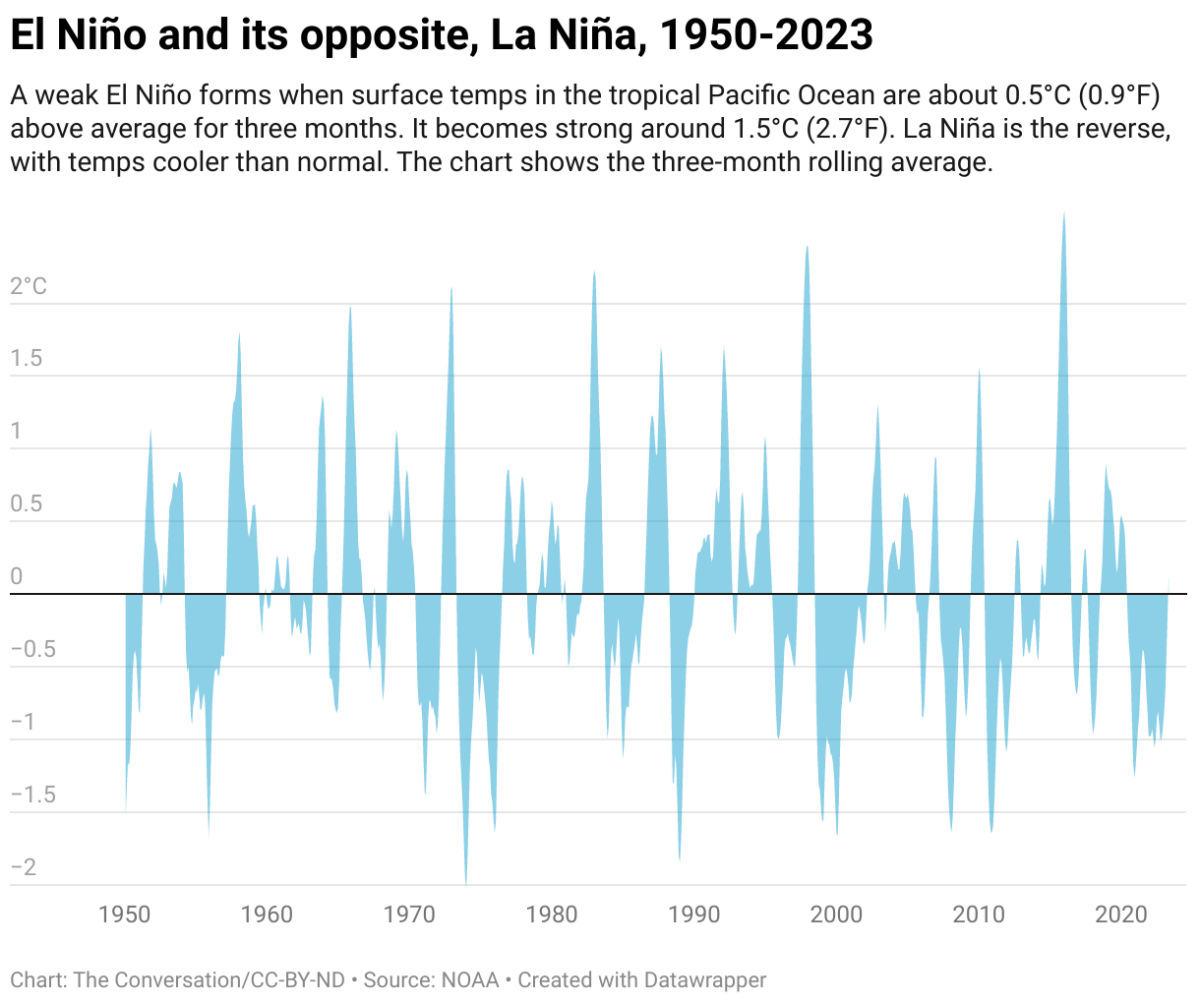
El Niño is a climate pattern that starts with warm water building up in the tropical Pacific west of South America. This happens every three to seven years or so. It might last a few months or a couple of years.
Normally, the trade winds push warm water away from the coast there, allowing cooler water to surface. But when the trade winds weaken, water near the equator can heat up, and that can have all kinds of effects through what are known as teleconnections. The ocean is so vast – covering approximately one-third of the planet, or about 15 times the size of the U.S. – that those sloshings of warm water have knock-on effects around the globe.
The National Oceanic and Atmospheric Administration explains teleconnections and the impact of El Niño.
That warming at the equator during El Niño leads to the warming of the stratosphere, starting about 6.2 miles (10 kilometers) above the surface. Scientists are still studying how exactly this teleconnection occurs.
At the same time, the lower tropical stratosphere cools.
That combination can shift the upper-level winds known as the jet stream, which blow from west to east. Altering the jet stream can affect all kinds of weather variables, from temperatures to storms and winds that can tear hurricanes apart.
Basically, what happens in the Pacific doesn’t stay in the Pacific.
So, what does all that mean for you and me?
With apologies to Charles Dickens, El Niño tends to create a tale of two regions: the best of times for some, and the worst of times for others.
On average, El Niño years are warmer globally than La Niña years – El Niño’s opposite. Globally, a strong El Niño can boost temperatures by about 0.7 degrees Fahrenheit (0.4 Celsius). But in North America, there is a lot of local variation.
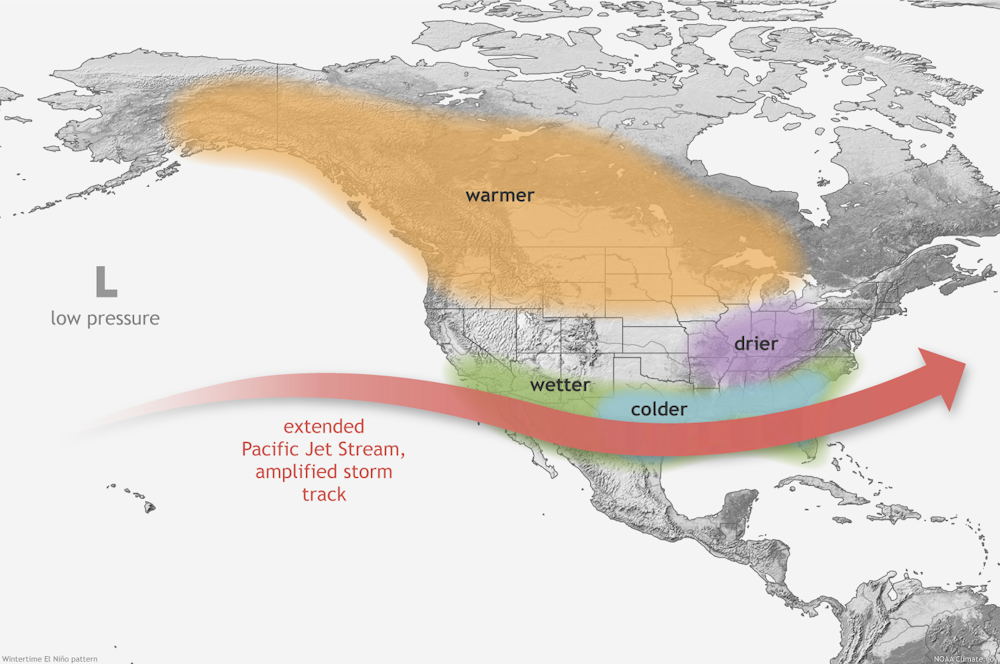
El Niño years tend to be warmer across the northern part of the U.S. and in Canada, and the Pacific Northwest and Ohio Valley are often drier than usual in the winter and fall. The Southwest, on the other hand, tends to be cooler and wetter than average.
El Niño typically shifts the jet stream farther south, so it blows pretty much due west to east over the southern U.S. That shift tends to block moisture from the Gulf of Mexico, reducing the fuel for thunderstorms in the Southeast. La Niña, conversely, is associated with a more wavy and northward-shifted jet stream, which can enhance severe weather activity in the South and Southeast.
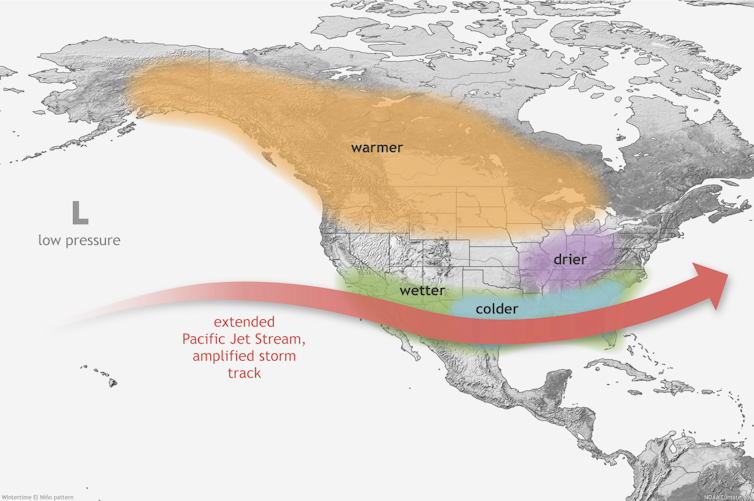 El Niño’s typical effects in winter. (Image courtesy of NOAA)
El Niño also affects hurricanes, but in different ways in the Atlantic and Pacific.
Over the Atlantic, El Niño tends to increase wind shear – the change in wind speed with height in the atmosphere – which can tear apart hurricanes. But El Niño has the opposite effect in the eastern Pacific, where it can mean more storms. The ocean heat can also raise the risk of marine heat waves that can devastate corals and ecosystems fish rely on.
In the middle of the U.S., El Niño is generally associated with warmer and drier conditions that can mildly increase the chances of a bountiful corn crop.
In contrast, El Niño can wreak havoc on crops in Southern Africa and Australia and increase Australia’s fire risk with dangerously dry conditions. Brazil and northern South America also tend to be drier, while parts of Argentina and Chile tend to be wetter.
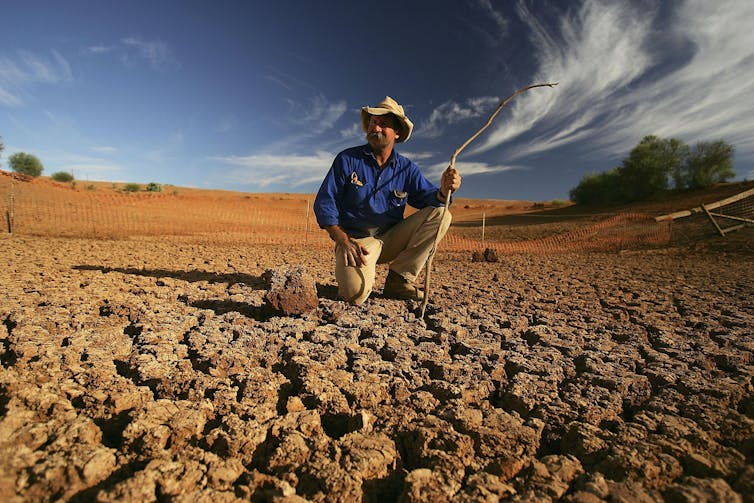 Australia endured its worst drought in decades in 2005 with the combined effect of increasing temperatures and an El Niño. (Image by Ian Waldie/Getty Images)
Of course, just because this is normally what happens doesn’t mean it happens every time. Witness California’s record rainfalls from multiple atmospheric rivers at the end of the last La Niña, which normally would mean dry conditions.
Every weather event is somewhat different, so the influence of El Niño is a matter of probability, not certainty. How El Niño and La Niña will be influenced over time by climate change isn’t yet clear.
The forecasts don’t all agree
Is 2023 going to be a record-breaking year? That’s the multibillion-dollar question.
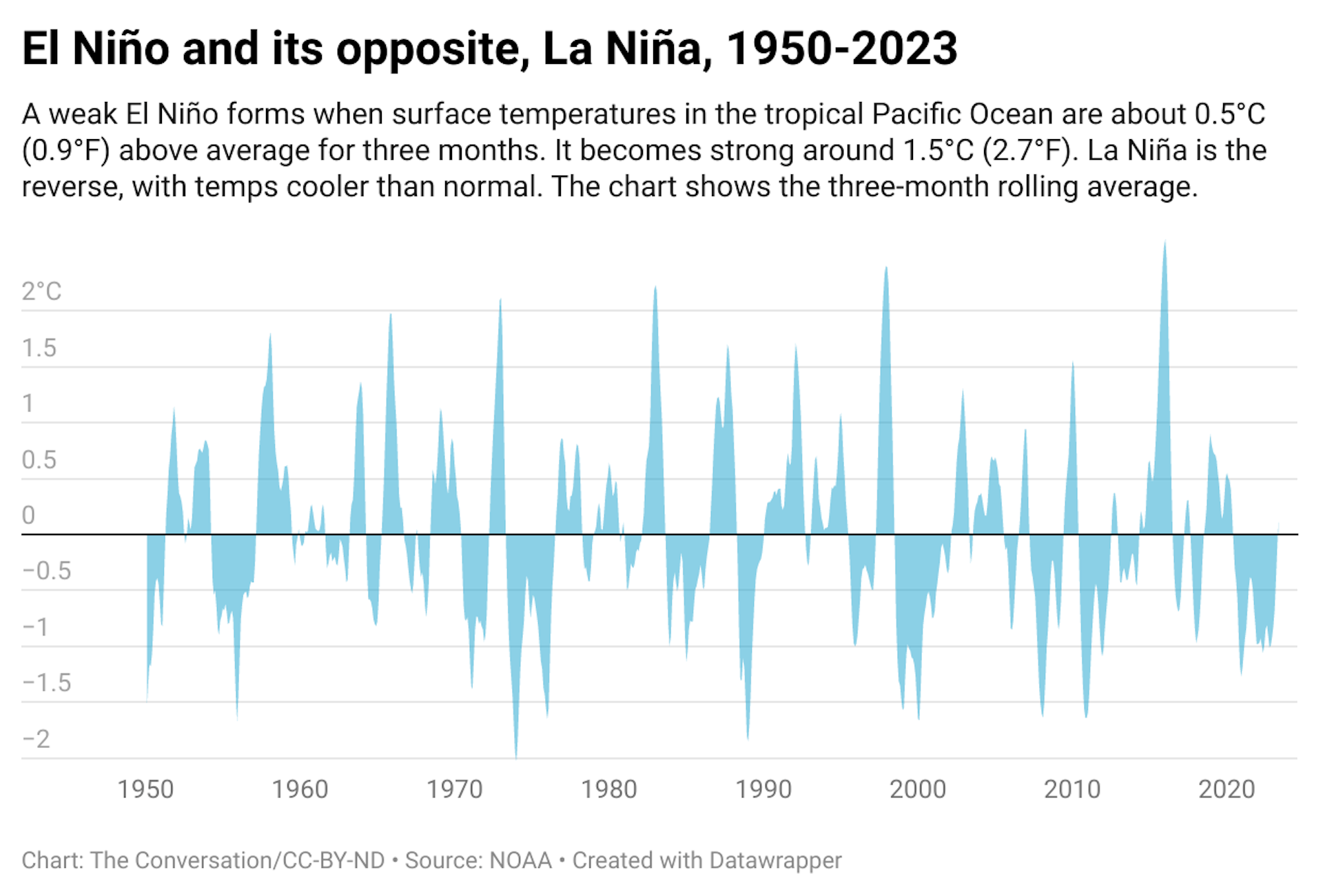
The National Weather Service declares the onset of El Niño when water temperatures are at least 0.9 F (0.5 C) above normal for a three-month period in what’s known as the Niño3.4 region. That’s a large imaginary rectangle south of Hawaii along the equator.
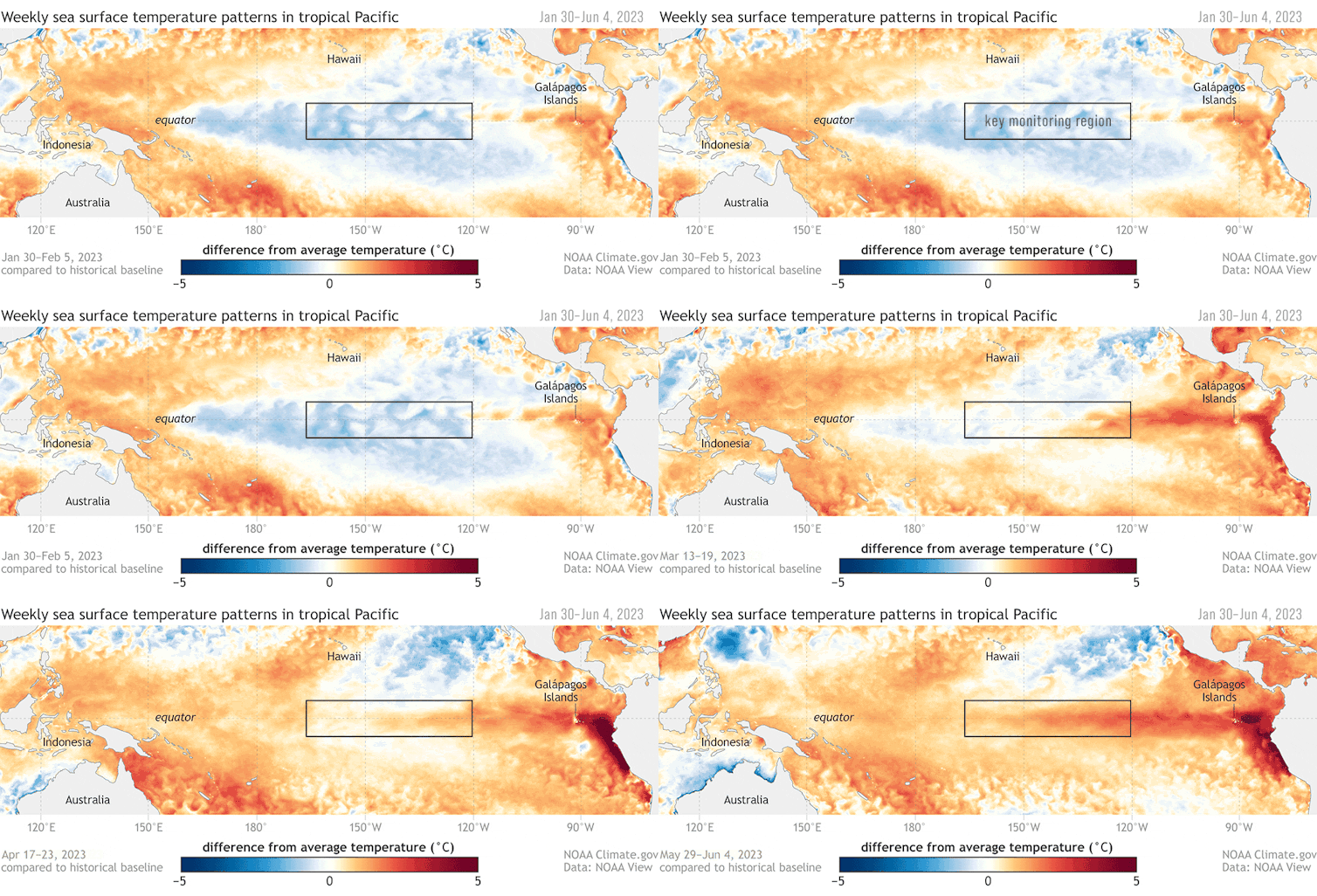 Watching El Niño develop in the tropical Pacific, January to June 2023. The box shows the Niño3.4 region. (Animation by NOAA at Climate.gov)
For a strong El Niño, the Niño3.4 region needs to warm by 2.7 F (1.5 C) for three months. It’s not clear as of right now whether this El Niño will meet that threshold this year.
The National Oceanic and Atmospheric Administration’s first El Niño advisory of the year, released on June 8, sees an 84% chance of El Niño being greater than moderate by winter and a 56% chance that it will be strong.
Those forecasts can change, though, and different forecasting methods offer different forecasts of the magnitude.
“Dynamical” models, similar to the models used for typical weather forecasts, have projected a very strong El Niño, whereas “static” or statistical models are far less optimistic. Personally, I’m a statistical modeler, and my own model doesn’t suggest a strong El Niño in 2023. Rather, my model – like other static models – predicts that 2023 will fizzle out, and after a couple of quiet, or neutral, years, we will see a strong El Niño in 2026. I did get the recent unusual “triple dip” La Niña right, but I’m willing to be proved wrong by observations, as any good scientist should be.
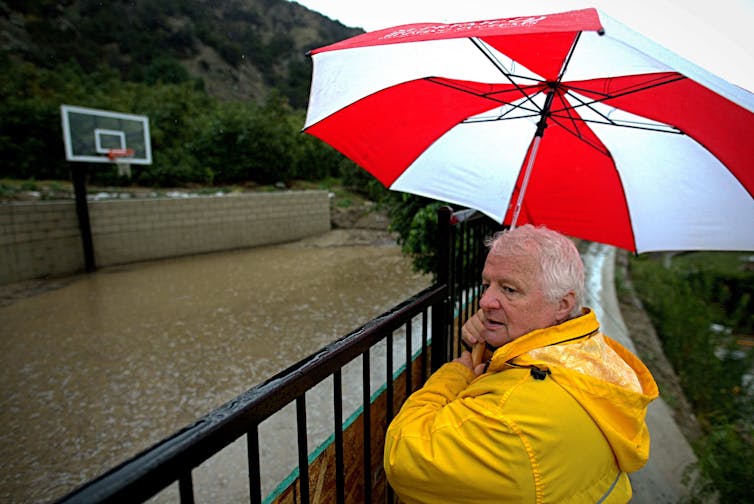 El Niño often means winter rain for California. While it’s needed, it’s sometimes too much. (Image by Watchara Phomicinda/MediaNews Group/The Press-Enterprise via Getty Images)
But no computer model of any flavor has had experience with the globally super-high ocean temperatures that are occurring right now. The Atlantic is unusually warm, and that could offset some of the usual forces that come with El Niño.
This article is republished from The Conversation under a Creative Commons license. Read the original article and see more than 250 UMBC articles available in The Conversation.
]]>
Written by Bob Leamon, research scientist, Partnership for Heliophysics and Space Environment Research (PHaSER), UMBC El Niño is officially here, and while it’s still weak right now, federal...
https://umbc.edu/stories/el-nino-is-back/
https://beta.my.umbc.edu/api/v0/pixel/news/133940/guest@my.umbc.edu/5a2d8eb7c85b0bce4b643fd56438209c/api/pixel
discovery
gphi
magazine
phaser
UMBC News & Magazine
https://beta.my.umbc.edu/groups/umbc-news-magazine
https://assets1-beta.my.umbc.edu/system/shared/avatars/groups/000/001/943/24435aa6207c452e7bc15cc74b42c7bb/xsmall.png?1748556657
https://assets1-beta.my.umbc.edu/system/shared/avatars/groups/000/001/943/24435aa6207c452e7bc15cc74b42c7bb/original.png?1748556657
https://assets2-beta.my.umbc.edu/system/shared/avatars/groups/000/001/943/24435aa6207c452e7bc15cc74b42c7bb/xxlarge.png?1748556657
https://assets2-beta.my.umbc.edu/system/shared/avatars/groups/000/001/943/24435aa6207c452e7bc15cc74b42c7bb/xlarge.png?1748556657
https://assets3-beta.my.umbc.edu/system/shared/avatars/groups/000/001/943/24435aa6207c452e7bc15cc74b42c7bb/large.png?1748556657
https://assets1-beta.my.umbc.edu/system/shared/avatars/groups/000/001/943/24435aa6207c452e7bc15cc74b42c7bb/medium.png?1748556657
https://assets2-beta.my.umbc.edu/system/shared/avatars/groups/000/001/943/24435aa6207c452e7bc15cc74b42c7bb/small.png?1748556657
https://assets1-beta.my.umbc.edu/system/shared/avatars/groups/000/001/943/24435aa6207c452e7bc15cc74b42c7bb/xsmall.png?1748556657
https://assets2-beta.my.umbc.edu/system/shared/avatars/groups/000/001/943/24435aa6207c452e7bc15cc74b42c7bb/xxsmall.png?1748556657
UMBC News & Magazine
0
0
false
Fri, 09 Jun 2023 10:37:16 -0400
US, Chinese warships’ near miss in Taiwan Strait hints at ongoing troubled diplomatic waters, despite chatter about talks

Written by Meredith Oyen, associate professor of history and Asian studies, UMBC.
An encounter in which a Chinese naval ship cut across the path of a U.S. destroyer in the Taiwan Strait on June 3, 2023, has both Beijing and Washington pointing fingers at each other.
It was the second near miss in the space of just a few weeks; in late May a Chinese plane crossed in front of an American surveillance aircraft above the South China Sea.
Meredith Oyen, an expert on China-U.S. relations at the University of Maryland, Baltimore County, helps explain the context of the recent encounters and how they fit within growing tensions between the two countries.
What do we know about the Taiwan Strait incident?
It came as the U.S. and Canada were conducting a joint transit of the Taiwan Strait – a body of water that separates the island of Taiwan from mainland China. Washington does these transits fairly regularly, but not usually with another country.
As the American destroyer USS Chung-Hoon and Canadian frigate HMCS Montreal traveled up the channel, a Chinese warship passed and veered across the U.S. vessel’s path at a pretty close range, according to U.S. Indo-Pacific Command. As a result, the USS Chung-Hoon had to reduce its speed to avoid a collision.
The U.S. has characterized the incident as an “unsafe” maneuver on behalf of the Chinese and protested that it took place in international waters.
The perspective from Beijing is that the U.S. and Canada were “deliberately provoking risk” by sailing a warship through Chinese waters.
Who is right? Did it take place in international or Chinese waters?
The United Nations Convention on the Law of the Sea stipulates that a country’s “territorial waters” extend 12 nautical miles off its coast – anything above or on the sea in that zone is considered part of the country’s territory. After that, there is a further 12-mile “contiguous zone,” over which a coastal state has rights to prevent infringement of the country’s “customs, fiscal, immigration or sanitary” laws, according to the UN treaty.
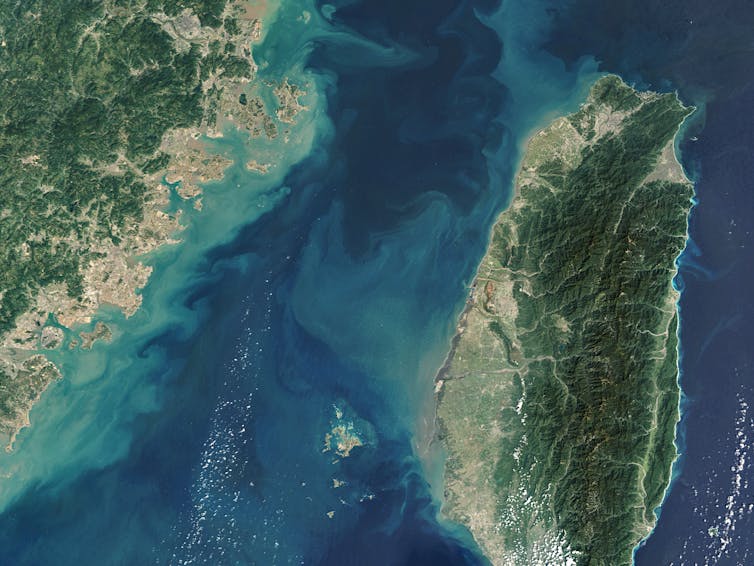 The Taiwan Strait. Gallo Images/Orbital Horizon/Copernicus Sentinel Data
Complicating matters, Beijing – a signatory to the Convention on the Law of the Sea, unlike the U.S. – claims the island of Taiwan as part of China. Under the U.N. convention’s stipulations, this would also mean Beijing can claim the 12 miles of territorial waters off Taiwan’s coast, as well as a 12-mile contiguous zone.
But even at its narrowest point, the Taiwan Strait is around 86 miles wide. So even accepting Beijing’s territorial claim, there would, under U.N. law, be a channel that falls outside its territory.
Nonetheless, Beijing claims sovereignty of the entirety of the waters between Taiwan and China under its exclusive economic zone.
Despite not signing the U.N. Convention on the Law of the Sea, the U.S. abides by the 12-mile standard and views a large chunk of the strait as international waters.
How common are these ‘near misses’?
The United States has regularly sailed vessels through the Taiwan Strait for decades. At times of tension – notably during the Korean War and Taiwan Straits crises of 1954-55, 1958 and 1962 – the U.S. has deployed destroyers in the channel as a deliberate show of military strength and support for Taiwan.
This continued after the U.S. normalized relations with China in 1978 until today, with few incidents that caused the level of tit-for-tat recriminations such as in the latest case. But there have been “near misses” in the sky, noticeably the recent airplane-to-airplane encounter that preceded this incident.
What we have increasingly seen, though, is Chinese officials protest these Taiwan Strait transits by the U.S. And the number of protests by China has increased in recent years, as tension over Taiwan has increased.
How does this incident fit growing maritime tension in the region?
The past few years have seen a deterioration in U.S.-China relations. There have been no direct, high-level military talks between the two countries since 2019. Meanwhile, relations have further soured on other topics, such as the ongoing trade war, the issue of Taiwan and allegations relating to the spread of COVID-19.
At times of better relations between Beijing and Washington, military transits such as the one in the Taiwan Strait might have gone largely unremarked upon. But amid such tensions, any incident is elevated to the level of uniquely bad provocation.
The broader context is that the U.S. regularly holds military drills and “freedom of navigation” operations in the South China Sea. These activities are used by the U.S. Department of Defense to demonstrate that the U.S. has a right to sail in waters it views as international, even if they are claimed by nation states.
The concern is that with tensions as they are – and with no official direct line of dialogue – a near miss during such a drill, or, worse still, an actual collision, could escalate beyond control, leading to military conflict.
Any significance over why this happened now?
The near miss came at a curious time – while top diplomats and defense chiefs from both the U.S. and China were attending the Shangri-La Dialogue in Singapore.
At that security summit, U.S. Defense Secretary Lloyd Austin shook the hand of his Chinese counterpart, Li Shangfu. But they didn’t hold a side meeting – as some observers had hoped.
Austin also underscored the importance of the Taiwan Strait to Washington: “The whole world has a stake in maintaining peace and stability in the Taiwan Strait. The security of commercial shipping lanes and global supply chains depends on it. And so does freedom of navigation worldwide. Make no mistake: conflict in the Taiwan Strait would be devastating.”
Washington has suggested that it wants to resume official talks with Beijing. Incidents such as that in the Taiwan Strait underscore the potential need for such discussions, if only to avoid encounters escalating into something more serious.
This article is republished from The Conversation under a Creative Commons license. Read the original article and see more than 250 UMBC articles available in The Conversation.
]]>
Written by Meredith Oyen, associate professor of history and Asian studies, UMBC. An encounter in which a Chinese naval ship cut across the path of a U.S. destroyer in the Taiwan Strait on...
https://umbc.edu/stories/us-chinese-warships-near-miss-in-taiwan-strait-hints-at-ongoing-troubled-diplomatic-waters-despite-chatter-about-talks/
https://beta.my.umbc.edu/api/v0/pixel/news/133938/guest@my.umbc.edu/a70a732e2515dfb64ecfc4535303c33d/api/pixel
asianstudies
cahss
cahssresearch
discovery
international-stories
magazine
the-conversation
UMBC News & Magazine
https://beta.my.umbc.edu/groups/umbc-news-magazine
https://assets1-beta.my.umbc.edu/system/shared/avatars/groups/000/001/943/24435aa6207c452e7bc15cc74b42c7bb/xsmall.png?1748556657
https://assets1-beta.my.umbc.edu/system/shared/avatars/groups/000/001/943/24435aa6207c452e7bc15cc74b42c7bb/original.png?1748556657
https://assets2-beta.my.umbc.edu/system/shared/avatars/groups/000/001/943/24435aa6207c452e7bc15cc74b42c7bb/xxlarge.png?1748556657
https://assets2-beta.my.umbc.edu/system/shared/avatars/groups/000/001/943/24435aa6207c452e7bc15cc74b42c7bb/xlarge.png?1748556657
https://assets3-beta.my.umbc.edu/system/shared/avatars/groups/000/001/943/24435aa6207c452e7bc15cc74b42c7bb/large.png?1748556657
https://assets1-beta.my.umbc.edu/system/shared/avatars/groups/000/001/943/24435aa6207c452e7bc15cc74b42c7bb/medium.png?1748556657
https://assets2-beta.my.umbc.edu/system/shared/avatars/groups/000/001/943/24435aa6207c452e7bc15cc74b42c7bb/small.png?1748556657
https://assets1-beta.my.umbc.edu/system/shared/avatars/groups/000/001/943/24435aa6207c452e7bc15cc74b42c7bb/xsmall.png?1748556657
https://assets2-beta.my.umbc.edu/system/shared/avatars/groups/000/001/943/24435aa6207c452e7bc15cc74b42c7bb/xxsmall.png?1748556657
UMBC News & Magazine
0
0
false
Fri, 09 Jun 2023 08:01:11 -0400
Shared Stories, Shared Purpose

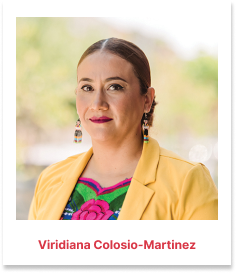
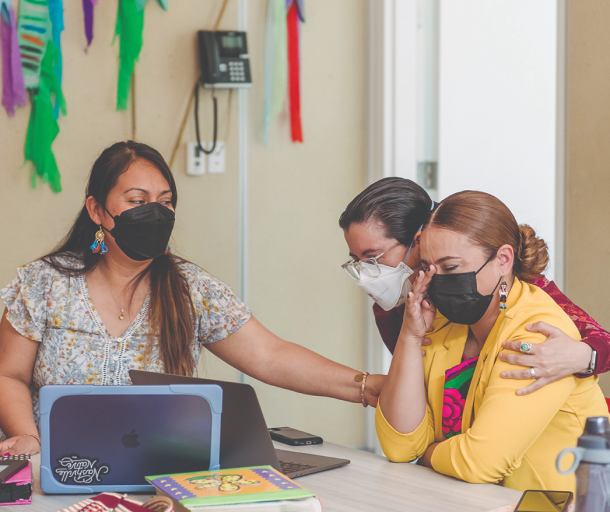
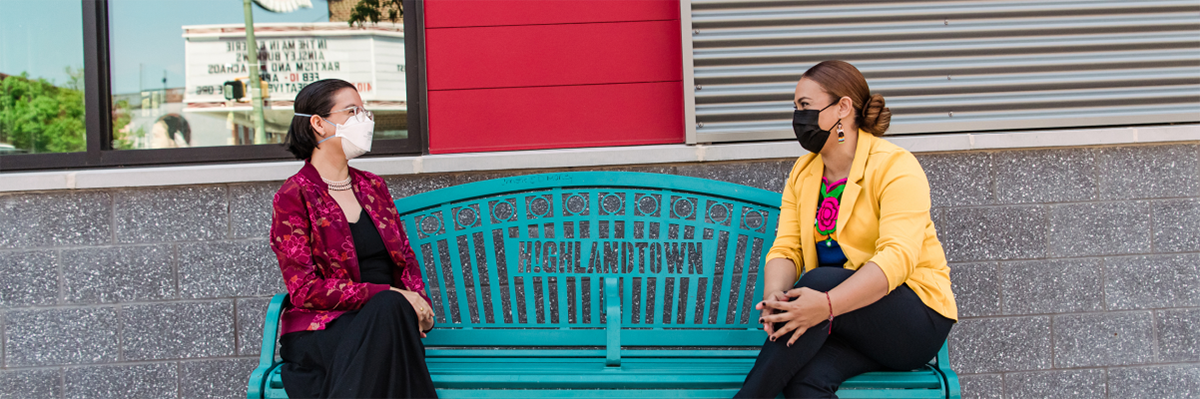
On a warm and bright sunny day in April when the trees in Baltimore City’s Patterson Park are changing from bright green buds to full leaf and the birds are competing with the car horns, Viridiana Colosio-Martinez ’22, modern languages, linguistics, and intercultural communication, and M.A. ’24, intercultural communication, waits in front of the Creative Alliance, a community and performance space a few blocks away from the park. After three years of undergraduate and graduate classes with her professor Tania Lizarazo, Colosio-Martinez is finally meeting her in person.
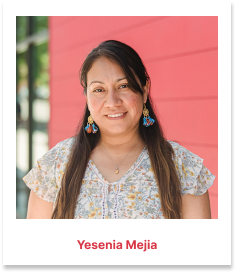
“I’m nervous and excited,” she says, waving to Lizarazo, associate professor of modern languages, linguistics and intercultural communication and global studies, as Lizarazo crosses the street to meet her and collaborator Yesenia Mejia, director of Creative Immigrant Educators of Latin American Origin (CIELO) and the Artesanas Latin American cultural enrichment program coordinator at the Creative Alliance.
“I can’t believe it’s the first time I’m seeing them outside of Webex,” says Colosio-Martinez.
There was a lot of hugging—the kind of hugging that is reserved for a friend you haven’t seen in years. Together, the group is gathering to review digital storytelling projects they’ve been working on together virtually for the past year, which they will present at the International Digital Storytelling Conference in Baltimore this summer.
Led by Lizarazo, and in collaboration with local Latin American communities, they are working to center the human experience by collecting and sharing a range of immigrant journeys that have previously been unrecognized.
“Lived experience is knowledge and should be part of knowledge production. A lot of our students are immigrants or their parents are immigrants and seeing experiences of migration beyond academic writing motivates them to explore their own personal and family stories,” says Lizarazo.
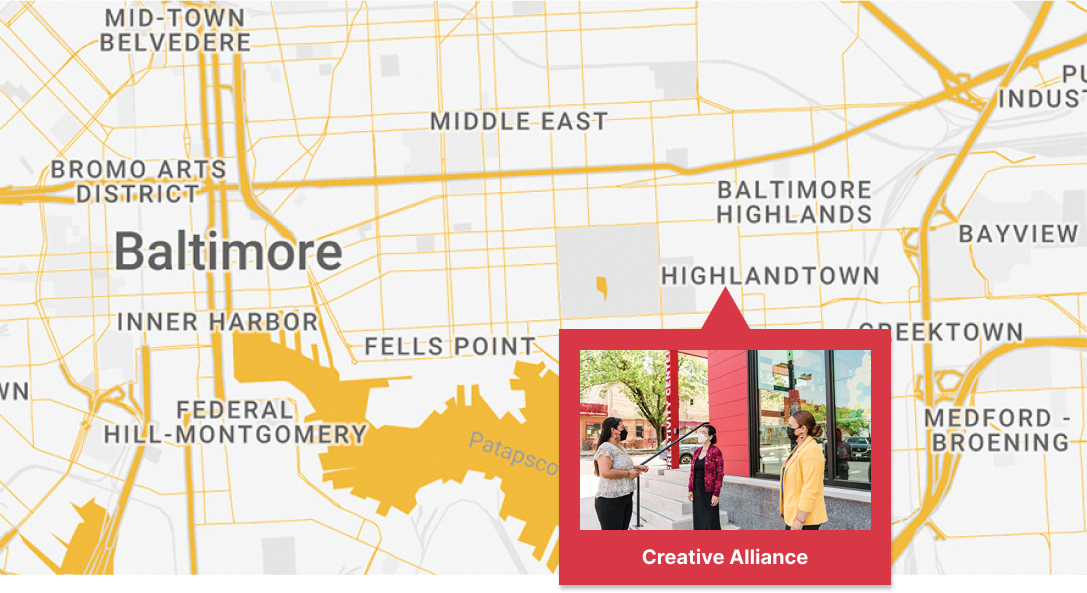
Tania Lizarazo, Viridiana Colosio-Martinez ’22, M.A. ’24, and Yesenia Mejia have been working together to tell the immigration stories of Baltimore’s Latin American communities.
Making teaching and research accessible
When Lizarazo moved from the University of California, Davis (UC Davis) to teach at UMBC in 2015, she felt an urgent need to create community. It had been easy to find a Latinx community in Davis but less so in Maryland.
“I arrived in Baltimore and suddenly I’m walking into places where I’m the only Latina. I don’t think that it’s healthy for anyone,” says Lizarazo. She began volunteering at the Creative Alliance where she met Mejia and started Latinas in Baltimore.
During the pandemic, Lizarazo, who is chronically ill and immunocompromised, has found that virtual classes and tools allow her to continue teaching and engaging in research with the community. In fact, the pandemic made accessibility that had previously been considered impossible the norm.
“We were so close to reimagining what community care could look like in 2020. We should not leave anyone behind or require people to choose between showing up or protecting themselves, their families, and their communities,” says Lizarazo.
“I am also committed to showing that we don’t have to choose between presence and safety. We can imagine collaborations that do not require additional exposures during an ongoing pandemic, that acknowledge that we have different access to resources such as healthcare, and that value interdependence and community care. Not only do I want to collaborate in producing knowledge but I want to be mindful of the context of these collaborations and not pick and choose what justice is when marginalized people keep being the most affected by the pandemic.”
Together with the Baltimore Field School, a part of UMBC’s overarching public humanities programming, and her partner researchers, Lizarazo has spent numerous hours building the relationships needed to help community members tell their stories.
“In the same way, community members rarely feel included in academia in different ways than research subjects. Creating opportunities for dialogues opens up opportunities to imagine new interactions and collaborations where not only the researcher’s knowledge is valued. Researchers would not be able to do anything without relationships and collaborations with students and community members.”
Slow research
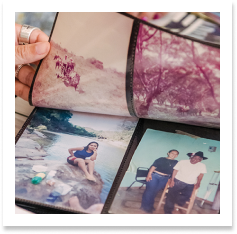
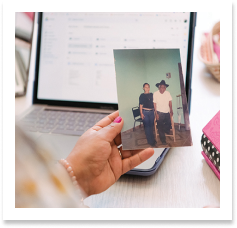
The researchers sit around a table and listen to Mejia describe photos of her family back in Santa María Zacatepec, Oaxaca, Mexico, during the 1990s. A faded photo shows her and her sister riding horses at a ranch. She picks up a picture of her father and pauses. “I didn’t get to see him.” Mejia has not been able to return to Mexico for almost 20 years, during which her father died. Colosio-Martinez and Lizarazo nod, understanding the pain and joy in between Baltimore and Oaxaca.
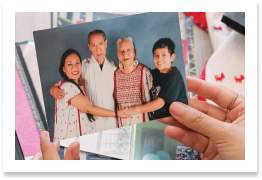
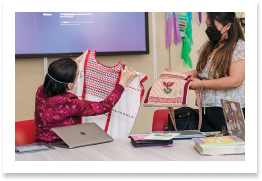
Mejia, a Baltimore Field School fellow, is working on a digital story, a story map, and website for her project on Representations of Indigenous Traditions from Latin America in Baltimore. She unfolds a calf-length, white cotton huipil (tunic) hand embroidered with red and orange nahuales and proudly shows a family picture with her mom wearing the same huipil.
“My mom always wears her huipil,” says Mejia. “Nahuales are spirit animals that are assigned to a baby according to the day they were born.” This spurs a lot of questions about the nahuales while she shows another hand-embroidered item, a bag with nahuales made by a fellow Indigenous Tacuate artist from Zacatepec.
This community-centered approach to research where students and community members are the knowledge creators is a key approach to Lizarazo’s community-engaged research on Latin American studies, transnational feminism using collaborative methods. It’s a shift away from the colonial-minded ethnography methods created by academics in the global north to research communities in the global south.
“We need to recognize that trust-building is a slow process,” says Lizarazo. “It’s based on reciprocity and it’s essential to meaningful communication and collaboration with communities.”
“Academia has historically excluded marginalized groups while extracting their knowledge. This extraction translates into personal gain for researchers but rarely benefits the communities that have been researched. As universities are not always reflections of the local communities where they are located, I have always been interested in learning from community members,” says Lizarazo. “I enjoy creating, collaborating on, and supporting projects that would not have an exclusively academic audience and won’t exist (only) behind paywalls. This is particularly important in public universities.”
Lizarazo calls this “slow research.” She had been practicing it in her home country of Colombia and at UC Davis as a doctoral student.
“Tania was an early proponent of experimenting with digital storytelling as a research method. Uncomfortable with academic ‘interventions’ into communities, she liked the idea of putting digital communication tools in the hands of vulnerable groups, like migrants, who might not otherwise have access to share their experiences in the public sphere,” shares Lizarazo’s mentor, Robert Irwin, director of the UC Davis Global Migration Center.
“She was an advocate for listening to and learning from migrants. Hers was an important voice in the research group that designed our first strategies for deploying this methodology.”
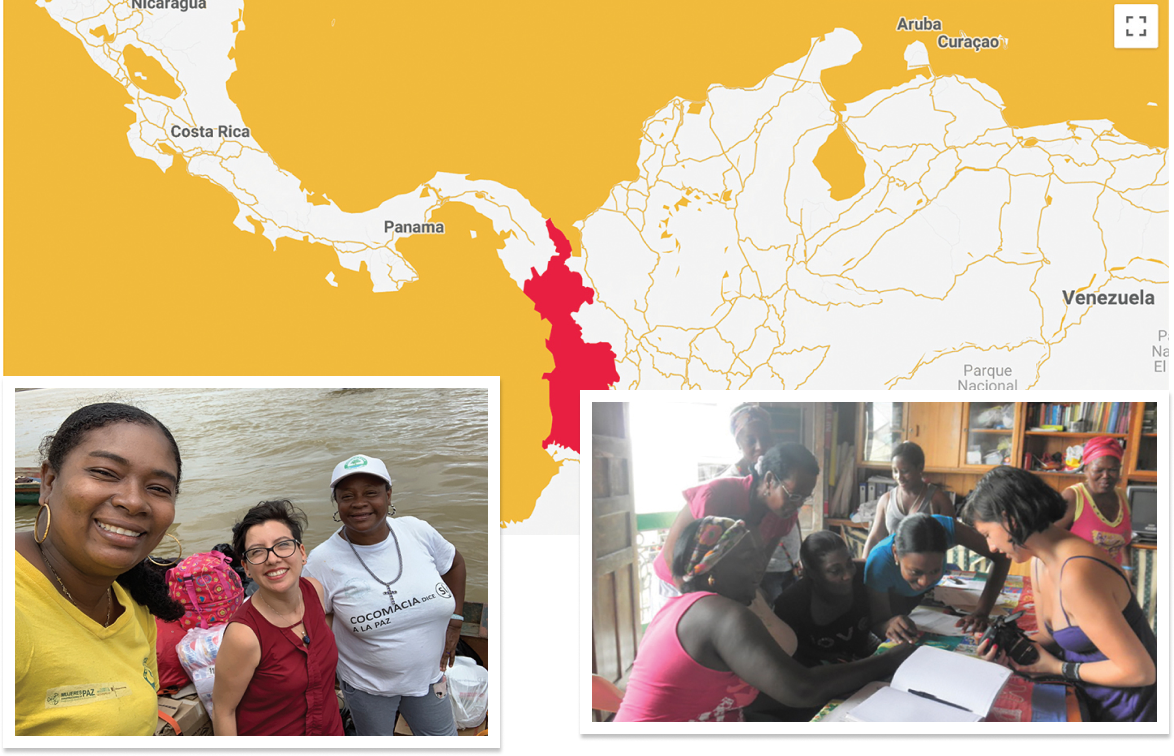 At left: Lizarazo (center) meets with community journalist Lucely Rivas (left) and Gender Commissioner Julia Susana Mena Becerra at the Atrato River. At right: Working with partners on the Mujeres Pacíficas project at the Gender Commission’s office in downtown Quibdó in 2013. Pictured (l-r): Rubiela Cuesta Córdoba, María del Socorro Mosquera Pérez, Yenny Palacios Romaña, Carmen Aides Navia Mena, Banessa Rivas López (in blue), Luz Adonis Mena Becerra and Ana Rosa Heredia Cuesta. Photos courtesy of Lizarazo.
Listening and learning
“Mujeres Pacíficas” was Lizarazo’s first digital storytelling project in collaboration with Afro-Colombian women activists in the department of Chocó, in Western Colombia, who were also advocates for land rights and women’s rights. She met the group in 2008. “Women were doing the work alongside men for years but their work had gone unrecognized,” says Lizarazo.
One of the first shared stories, recorded after five years of community building, was created in collaboration with Luz Adonis Mena Becerra, a member of the Main Community Council of the Integral Peasant Association of the Atrato River, a Black farmers’ association in the Colombian Pacific, where Black communities were officially granted territorial rights in 1993.
“In the process of creating Luz Adonis’s story, I found out she had faced forced displacement and had lost everything she owned in a fire years later,” says Lizarazo. “Despite this, she reconstructed her memories through community photographs for her story.”
The project inspired Lizarazo’s forthcoming book from the University of Illinois Press, Postconflict Utopias: Performing Everyday Survival in the Colombian Pacific, a part of the “Dissident Feminisms” series. “The willingness to imagine these stories before they had audiences, and in spite of the absence of personal archives, is utopian,” says Lizarazo. “Not because these stories are ideal or unrealistic but because they invite the audience to imagine what seems impossible: the end of decades of violent conflict into a material reality.”
Student-teacher and the teacher-student
Parting with colonial-minded immigration research means developing new frameworks that humanize data and shift the process of gathering and disseminating information from one person to a community with a diverse and evolving set of skills and expertise.
“Equipping immigrants with the tools and methods to co-create personal stories can help us understand migration as a hemispheric experience in the context of globalization, colonialism, neoliberalism, genocide, and marginalization, especially of Black and Indigenous communities in Latin America,” says Lizarazo.
These voices highlight the multitude of paths immigrants take that are equally stories of joy, success, family, and community love as they are stories of survival, sacrifice, separation, and pain. There isn’t one Central American experience, Mexican American life, or Latin American journey. Before immigrants became people of color, Latinos, or minorities, they were Aymara, Taino, Mayan, Colombian, Mexican.
“It’s important to critically study the connections between local and global contexts of production and consumption of these stories,” says Lizarazo.
“It’s a more horizontal teaching-learning experience, where students, community members, and instructors are teaching and learning. The world is messy; when we listen to each other, we can do things that we didn’t know were possible before.”
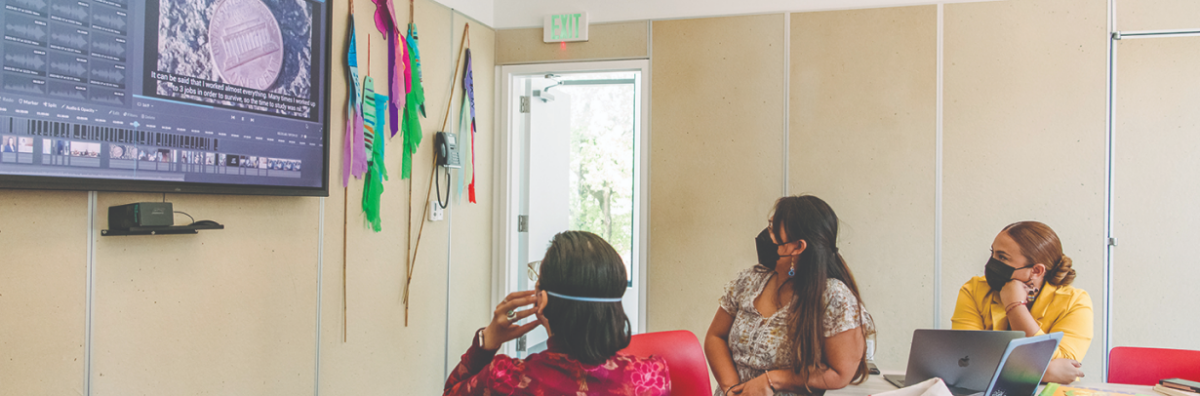 Colosio-Martinez shares photos and stories of her family’s journey with Mejia and Lizarazo.
One penny
After Mejia places her photos and huipil on the table, Colosio-Martinez, research assistant for the Moving Stories: Latinas In Baltimore digital storytelling project led by Lizarazo, takes a deep breath and preempts the debut of her digital story draft by apologizing for the tears to come. A clip of a map shows a blue line tracing the miles of her life from Caborca, Sonora, Mexico, three hours from Phoenix, Arizona, to New Haven, Connecticut, to Baltimore.
A small picture of a penny appears on the screen.
“I’ll never forget when me and my mom tried to register for community college,” she begins, “but we were short one penny.” With each description, the penny gets bigger. “The registrar said she didn’t have a penny and shut the window in our faces.” The penny fills the screen. “My mom and I went outside and searched the floor until we found a penny.”
The pursuit of education is the connecting thread throughout the narrative. A photo of Colosio-Martinez wearing her cap and gown and celebrating with her husband after earning her associate’s degree is followed later by a screenshot of an email welcoming her to UMBC.
Colosio-Martinez covered her eyes to hide her tears. Lizarazo hugged her. Mejia touched her shoulder. They suggest she not cut her story.
]]>
On a warm and bright sunny day in April when the trees in Baltimore City’s Patterson Park are changing from bright green buds to full leaf and the birds are competing with the car horns, Viridiana...
https://umbc.edu/stories/shared-stories-shared-purpose-slow-research/
https://beta.my.umbc.edu/api/v0/pixel/news/133967/guest@my.umbc.edu/211995ee0714763b85b5693f515054b1/api/pixel
baltimore-field-school
cahss
discovery
global-studies
magazine
mlli
public-humanities
research
spring-2023
UMBC News & Magazine
https://beta.my.umbc.edu/groups/umbc-news-magazine
https://assets1-beta.my.umbc.edu/system/shared/avatars/groups/000/001/943/24435aa6207c452e7bc15cc74b42c7bb/xsmall.png?1748556657
https://assets1-beta.my.umbc.edu/system/shared/avatars/groups/000/001/943/24435aa6207c452e7bc15cc74b42c7bb/original.png?1748556657
https://assets2-beta.my.umbc.edu/system/shared/avatars/groups/000/001/943/24435aa6207c452e7bc15cc74b42c7bb/xxlarge.png?1748556657
https://assets2-beta.my.umbc.edu/system/shared/avatars/groups/000/001/943/24435aa6207c452e7bc15cc74b42c7bb/xlarge.png?1748556657
https://assets3-beta.my.umbc.edu/system/shared/avatars/groups/000/001/943/24435aa6207c452e7bc15cc74b42c7bb/large.png?1748556657
https://assets1-beta.my.umbc.edu/system/shared/avatars/groups/000/001/943/24435aa6207c452e7bc15cc74b42c7bb/medium.png?1748556657
https://assets2-beta.my.umbc.edu/system/shared/avatars/groups/000/001/943/24435aa6207c452e7bc15cc74b42c7bb/small.png?1748556657
https://assets1-beta.my.umbc.edu/system/shared/avatars/groups/000/001/943/24435aa6207c452e7bc15cc74b42c7bb/xsmall.png?1748556657
https://assets2-beta.my.umbc.edu/system/shared/avatars/groups/000/001/943/24435aa6207c452e7bc15cc74b42c7bb/xxsmall.png?1748556657
UMBC News & Magazine
0
0
false
Thu, 08 Jun 2023 19:47:46 -0400
Thu, 08 Jun 2023 19:47:46 -0400
Open to Interpretation
What if you could ask yourself a big question and then use your intuition to follow it wherever it led for as long as it took? It would take a certain kind of guts, right? But, with a willingness to get lost on a tangent, to joyfully put themselves in positions of not knowing, truly creative thinkers can find new ways of translating the world around them.
Enter the following: A dancer who makes beautiful movement from fish research. An information systems professor who turns poetry into wine. A data visualizer who draws connections while splattering paint. A mapper and sculptor of hip hop facts. A harnesser of color and language and culture.
This is the sort of magic that can happen when you’re open to interpretation.

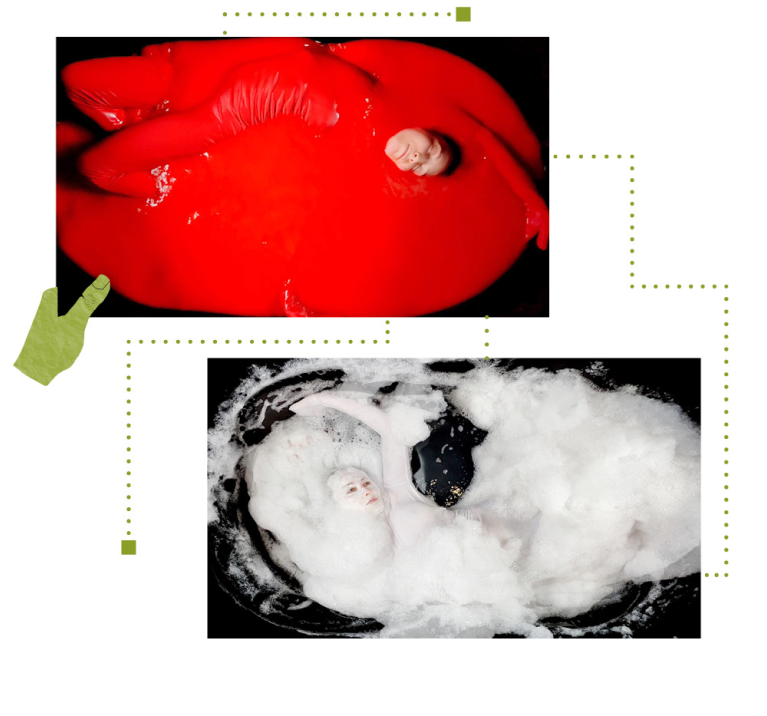
On a molecular level, the push and pull of an ecosystem may feel too infinitesimal for humans to experience visually. A researcher can track the data in a spreadsheet as a series of characters and marks or explain it with the structure of a scientific article. Microscopes may capture stills or video of tiny worlds, but what about the emotional landscape of life in motion?
“I really am fascinated with the small things we cannot see that are so important,” says Ann Sofie Clemmensen, assistant professor of dance, who spent a year in residence at the Institute of Marine & Environmental Technology (IMET) next to Baltimore’s Inner Harbor working with scientists who study a variety of topics adjacent to aquaculture, environment, and sustainability.
Clemmensen began her residency by diving deeply into the research of the IMET scientists around her—learning about everything from rainbow trout viruses to the ecological wear and tear of red tides. As she built relationships with researchers, she found herself drawn into the details of their studies—and wondering how she might translate what she learned into something that might encourage viewers to learn more about their world.
“There’s a sort of unpacking of the language of that field. Because movement, while it’s not a spoken language, it is language,” she explains, ever the eager translator. “We have to understand the concept we are trying to embody in order for the physical embodiment to carry the meaning.”
Working with student dancers, Clemmensen choreographed and filmed a series of movements and scenes meant to depict biological processes she learned about from her IMET counterparts. In one, students in masks represent the generic differences of virulent and avirulent strains of the VHSV rainbow trout virus. In another, dancer Michaela Emmerich ’24 (covered in clay powder) rolls in the dirt to show the effect of argonite in reducing levels of phosphorus in farming run-off.
While Clemmensen’s scenes of red tides, green biomass, and white, milky foams are objectively beautiful, don’t be fooled. Nature isn’t pretty, Clemmensen says. But taking a good close look can help us all understand our environment a bit better.
“For many doing art, dance, and data-driven research, it’s like looking at an abstract painting. If you don’t have a little key that can unveil or reveal some of those secrets, then it’s just chaos.”
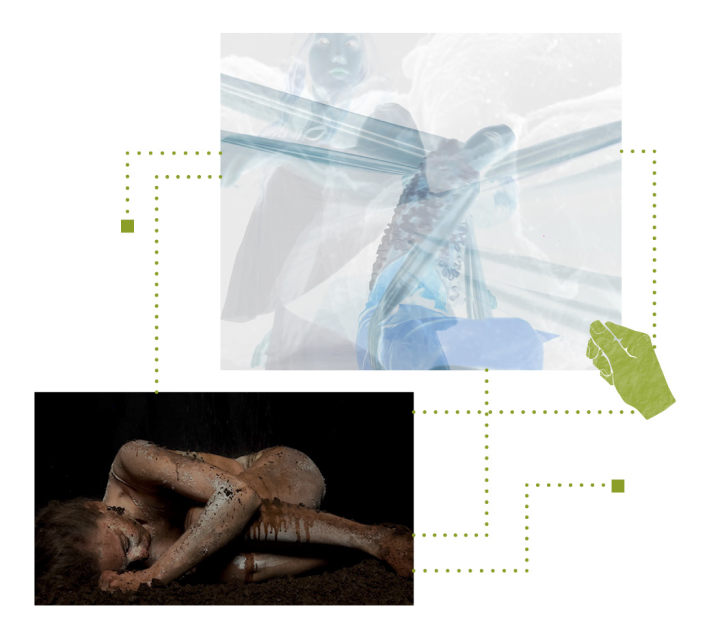
Assistant professor Ann Sofie Clemmensen worked with
researchers at IMET to create a series of videos depicting
microscopic processes like red tides and battling
dinoflaggelates. Photos courtesy of Clemmensen.

A poem crosses time and space, building in meaning as it travels from person to person, from generation to generation. With each new reader, it becomes something new and specific—but also potentially loses something of itself along the way.
As a trained computer scientist, Foad Hamidi, assistant professor of information systems, is fascinated by the practical challenge of being able to retrieve information lost when data is duplicated—an inevitable fact of digital life. As a lifelong lover of Sufi poetry from his home country of Iran, he also can’t help but wonder how to preserve the heart of these precious words, even as circumstances—generations, distance, cultural leanings—might dilute or change them.
“There’s always some information loss” in data duplication, he explains. “However, a very interesting theorem in information theory also says that if you have a lot of replicas of the same code…you can recover the original message in the presence of errors that was in all these codes.”
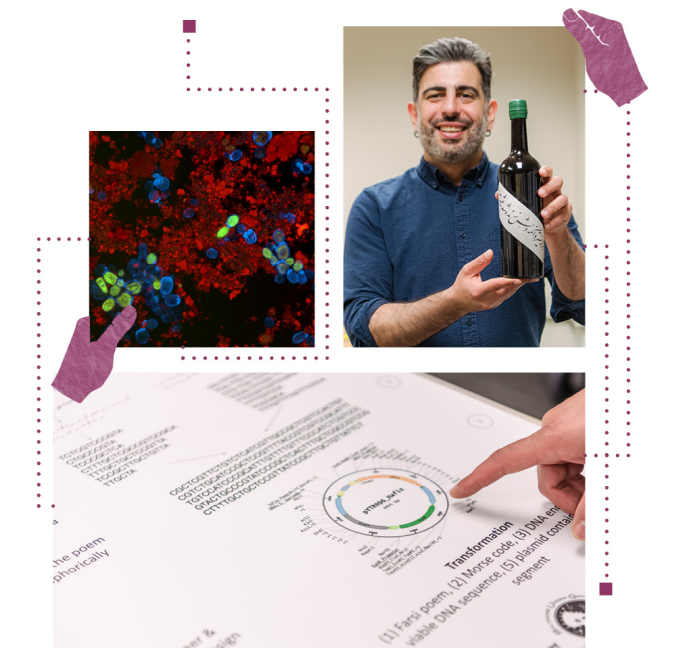
Information systems Professor Foad Hamidi has
translated a favorite childhood poem into DNA code,
wine, and more. Top image (magnified photo of yeast
cells with the modified DNA Hamidi made)
courtesy of Tagide deCarvalho.
Years ago, Hamidi learned about a song that was encoded by Japanese musician Etsuko Yakushimaru using living bacteria as a sort of language, “and it really made me think of the possibilities of information and culture and data and encoding.” And so, at the start of the pandemic, he began exploring ways of translating the poetry of Hafiz, a 14th-century Persian poet, into new, living forms and of sharing the experience with others.
Hamidi’s bio-art-inspired creative inquiry led him first to interpret the poetry as code—DNA, to be precise—culled from the words themselves. He then created a “poetry-infused transgenic wine” using yeast modified with the DNA encoding of the poem. Craving community, he took the idea to other researchers in music, biology, imaging, and beyond to joyfully build further iterations of the chain. These efforts led to an Imaging Research Center (IRC) Faculty Research Fellowship (with Linda Dusman, professor of music), and today, he continues to explore new translations of the coded poem through music, cellular imagery, and even a cluster of mushrooms growing in Hamidi’s office.
With each new link in Hamidi’s poetic chain, the information is replicated and the “data” is one step closer to being saved through this fascinating theorem. In doing so, Hamidi also is able to bring together curious new friends who might not have had reason to collaborate otherwise.
Although Hamidi’s “translations” may seem outside the box, the practice of making a poem one’s own “has a long history,” he explains. “These poems are the DNA of my culture…so our architecture, our music, our visual arts, our cultural traditions, are very much impacted by poetry.”

In a far corner hangs an enormous painting of a brain, with bright blue lines, red arrows, and clips of phrases suggesting ideas in motion. In every direction above it, threads of red and blue crisscross the room anchoring one artwork to the next—a system of knit synapses representing not only 25 years of research but the artistic process that fuels it.
“What I try to do, above and beyond anything else, is show as transparently as possible what that process looks like,” says Lee Boot, director of UMBC’s Imaging Research Center (IRC), whose retrospective exhibit “Abstracts & Artifacts” showed at Baltimore’s Peale Museum earlier this spring.
For Boot, that means a room filled with numbers, images—some animated, many bursting with color—and the connective tissue of the personal paintings he created to process information and experiences related to the various subjects of his research.
“The work is immersive. I paint my brain out as a meditative, reflective process. And then that gets honed, and reshaped, and…out of that automatically comes new perspectives and new ways of framing problems.”
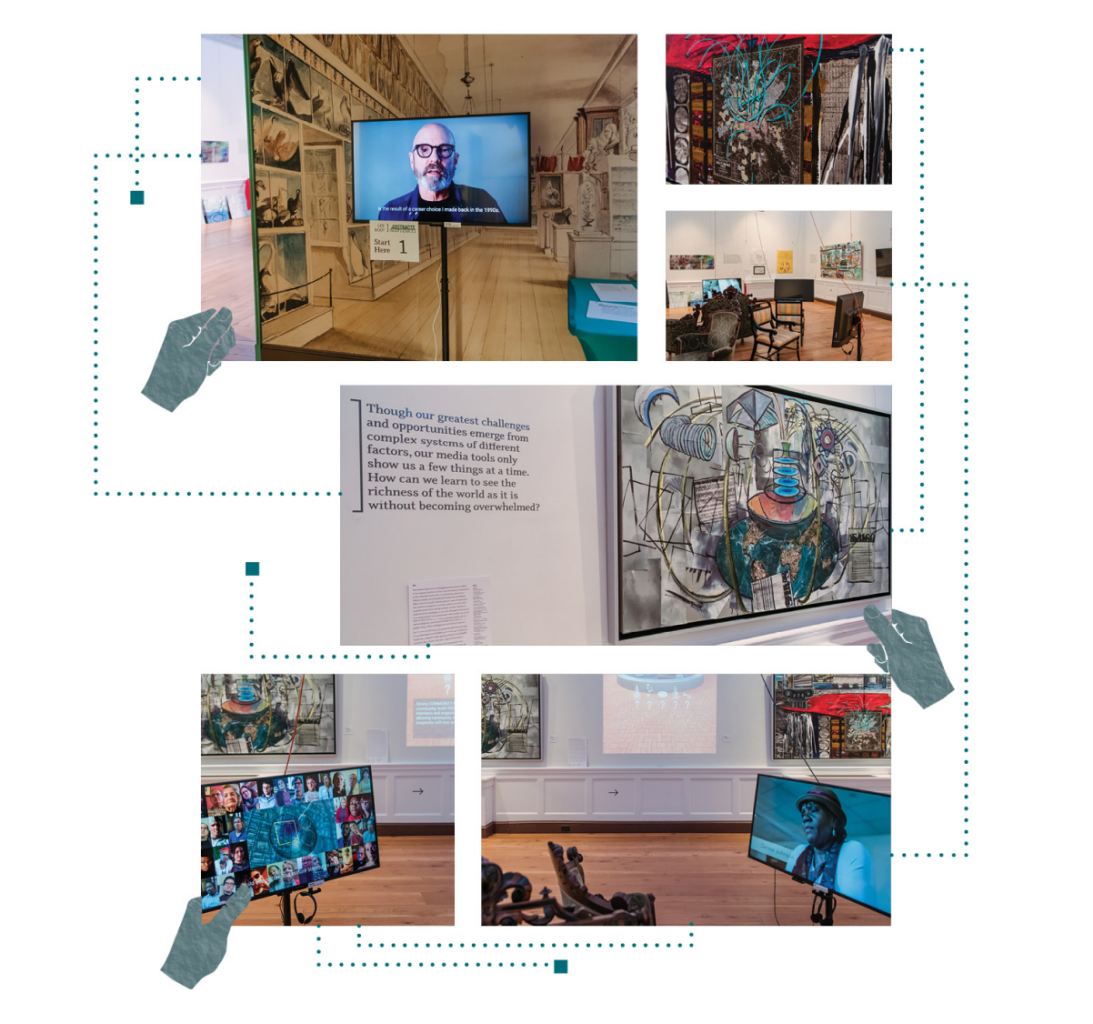 In his exhibit “Abstracts & Artifacts,” Lee Boot asks
viewers to consider new ways of solving problems.
“Almost like dreaming, making art with a question
in mind reveals meaning through metaphor. How
is it that metaphors seem to be both specific and
ambiguous—both personal and universal—at once?”
In his exhibit “Abstracts & Artifacts,” Lee Boot asks
viewers to consider new ways of solving problems.
“Almost like dreaming, making art with a question
in mind reveals meaning through metaphor. How
is it that metaphors seem to be both specific and
ambiguous—both personal and universal—at once?”
Boot lives to solve problems, and believes deeply in the power of combining artists’ ways of thinking with other disciplines to ask questions and find solutions in new ways. Over the years, the IRC has brought together multidisciplinary teams of artists, scientists, and social scientists from state and local agencies, foundations, and other organizations who are open to tackling everything from substance misuse to educational achievement gaps to the epidemiology of pandemics.
And while technology runs much of what the IRC builds, nothing is quite so essential to the heart of the work as one’s own intuition, says Boot. As a classically-trained painter, that means returning to the canvas and allowing his brush to take him in new directions—not to create something beautiful, per se, but to open himself to ideas accessible only through such a personal process.
With each stroke of the brush, and each new color, he pulls from the deepest reaches of experience, community, and understanding, creating a road map for what’s next.
“I’m not trying to make something pretty,” he says. “I am trying to understand how a set of issues sits in being, in my psyche, on the landscape of the world as I understand it. I’m trying to see what I cannot see.”

On the table sit three football-sized forms of light plastic. Each has been sculpted in a 3D printer using zigzag motions specifically programmed to mimic the map lit up behind them showing an orange globe splashed with green arcs. Dots on the screen represent locations mentioned in thousands of hip-hop and rap lyrics, as big as the oft-mentioned city of Atlanta and as hyperlocal as the intersection in front of a neighborhood convenience store.
A student gingerly picks up a gold-colored sculpture, and asks, “Is this Kendrick Lamar?” Tahir Hemphill, a faculty fellow, music aficionado, and self-described “creative technologist who works with art,” nods as a collective “oooh” makes its way around the room.
“It’s data sculpture, literally. It’s making things as real as possible,” says Hemphill, whose ever-evolving body of work, The Rap Research Lab, made its home at UMBC’s Center for Art, Design, and Visual Culture this spring. “This is what it feels like to touch a rapper’s rhymes.”
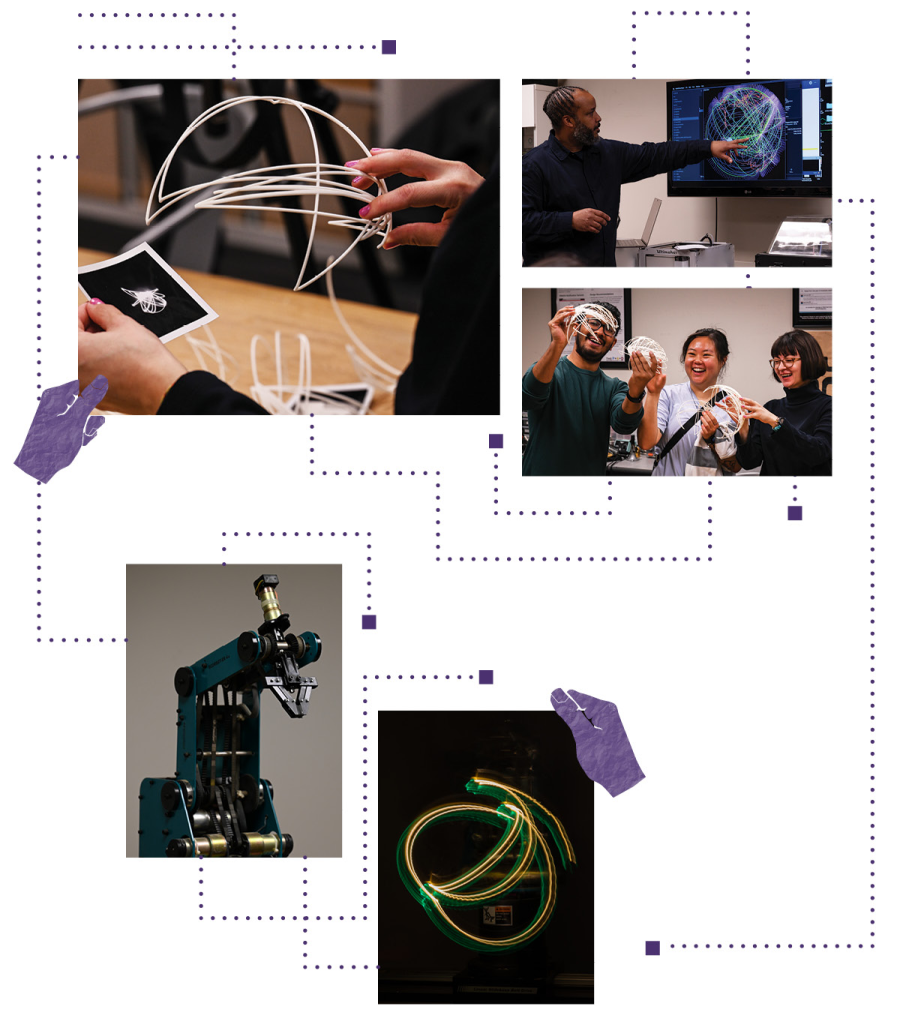
Located at the intersection of hip-hop and data visualization, and built as an interactive teaching space, the lab features the “Mapper’s Delight” tool that, using augmented and virtual reality, cross-references locations from thousands of rap song lyrics along with a variety of other art pieces that speak to Hemphill’s goal of finding “relationships and shapes in the data.”
Over the course of the semester, UMBC students helped Hemphill delve further into the data while middle schoolers from around the state visited the teaching lab with their classes to try their own hands at research using Hemphill’s lyrics database.
On this particular day, Hemphill demonstrates yet another incorporation of the geographic lyric data. In collaboration, Foad Hamidi helped Hemphill program a robotic arm, and by inserting a LED pen into the robot hand and filming movements at a long exposure, he’s able to make “light pen drawings” of the data, à la Pablo Picasso.
With the lights dimmed and the robot arm making ethereal data shapes before their eyes, Hemphill tinkers with his projected spreadsheet in real time. There are just so many threads to follow and infinite stories hidden within.
“My job is to draw them out—pun intended,” he laughs.
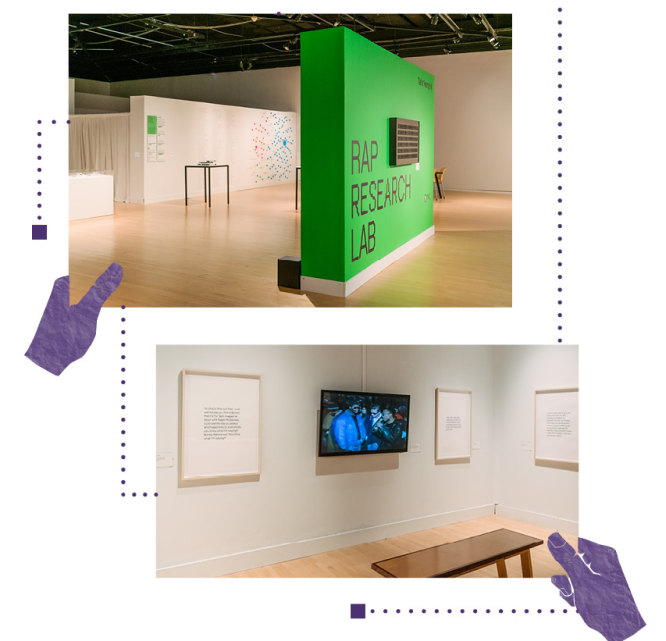
Tahir Hemphill, a faculty fellow, music aficionado, and
self-described “creative technologist who works with
art,” uses data visualization tools to reveal new levels
within hip-hop.
Read how artist Hadieh Shafie, M.F.A. ’04, channels the power of language and her childhood experiences in Iran into intricate and colorful pieces of art.
]]>
What if you could ask yourself a big question and then use your intuition to follow it wherever it led for as long as it took? It would take a certain kind of guts, right? But, with a willingness...
https://umbc.edu/stories/researchers-artists-open-to-interpretation/
https://beta.my.umbc.edu/api/v0/pixel/news/133965/guest@my.umbc.edu/7d78d7c39a954622fea6ad99411873aa/api/pixel
cadvc
dance
discovery
information-systems
irc
magazine
research
spring-2023
UMBC News & Magazine
https://beta.my.umbc.edu/groups/umbc-news-magazine
https://assets1-beta.my.umbc.edu/system/shared/avatars/groups/000/001/943/24435aa6207c452e7bc15cc74b42c7bb/xsmall.png?1748556657
https://assets1-beta.my.umbc.edu/system/shared/avatars/groups/000/001/943/24435aa6207c452e7bc15cc74b42c7bb/original.png?1748556657
https://assets2-beta.my.umbc.edu/system/shared/avatars/groups/000/001/943/24435aa6207c452e7bc15cc74b42c7bb/xxlarge.png?1748556657
https://assets2-beta.my.umbc.edu/system/shared/avatars/groups/000/001/943/24435aa6207c452e7bc15cc74b42c7bb/xlarge.png?1748556657
https://assets3-beta.my.umbc.edu/system/shared/avatars/groups/000/001/943/24435aa6207c452e7bc15cc74b42c7bb/large.png?1748556657
https://assets1-beta.my.umbc.edu/system/shared/avatars/groups/000/001/943/24435aa6207c452e7bc15cc74b42c7bb/medium.png?1748556657
https://assets2-beta.my.umbc.edu/system/shared/avatars/groups/000/001/943/24435aa6207c452e7bc15cc74b42c7bb/small.png?1748556657
https://assets1-beta.my.umbc.edu/system/shared/avatars/groups/000/001/943/24435aa6207c452e7bc15cc74b42c7bb/xsmall.png?1748556657
https://assets2-beta.my.umbc.edu/system/shared/avatars/groups/000/001/943/24435aa6207c452e7bc15cc74b42c7bb/xxsmall.png?1748556657
UMBC News & Magazine
1
0
false
Thu, 08 Jun 2023 19:21:59 -0400
Thu, 08 Jun 2023 19:21:59 -0400