Michelle Starz-Gaiano brings leadership experience, relationships to new department chair role

Michelle Starz-Gaiano, professor of biological sciences, joined the UMBC faculty as an assistant professor in 2008, fresh from a postdoctoral fellowship at Johns Hopkins University. Since then, her research program has blossomed, she’s mentored half a dozen graduate students and more than 50 undergraduates, and she’s taken on numerous leadership roles. In 2014, she received the Donald Creighton Outstanding Faculty Member Award from the UMBC Graduate Student Association for her excellent mentorship.
This August, she’ll bring all of that experience to a new role: department chair. As department chair, Starz-Gaiano will be responsible for leading the department into a new era at UMBC, as well as managing day-to-day tasks from teaching assignments to faculty meetings. The role requires managerial skills as well as a deep understanding of the department and its needs.
“I think it’s an important time to step into the job,” Starz-Gaiano says, given setbacks like restricted lab access during the COVID-19 pandemic and recent flood damage in the Biological Sciences Building. “This gives us an opportunity to reevaluate what is working well and what we can improve on or change to make the department grow stronger. I think we have amazing people working and studying here, and I really want to make sure they can be successful.”
Starz-Gaiano has grown up as an independent researcher within the department. “That means that I know inside out what works well in the department and what we can do better,” she says.
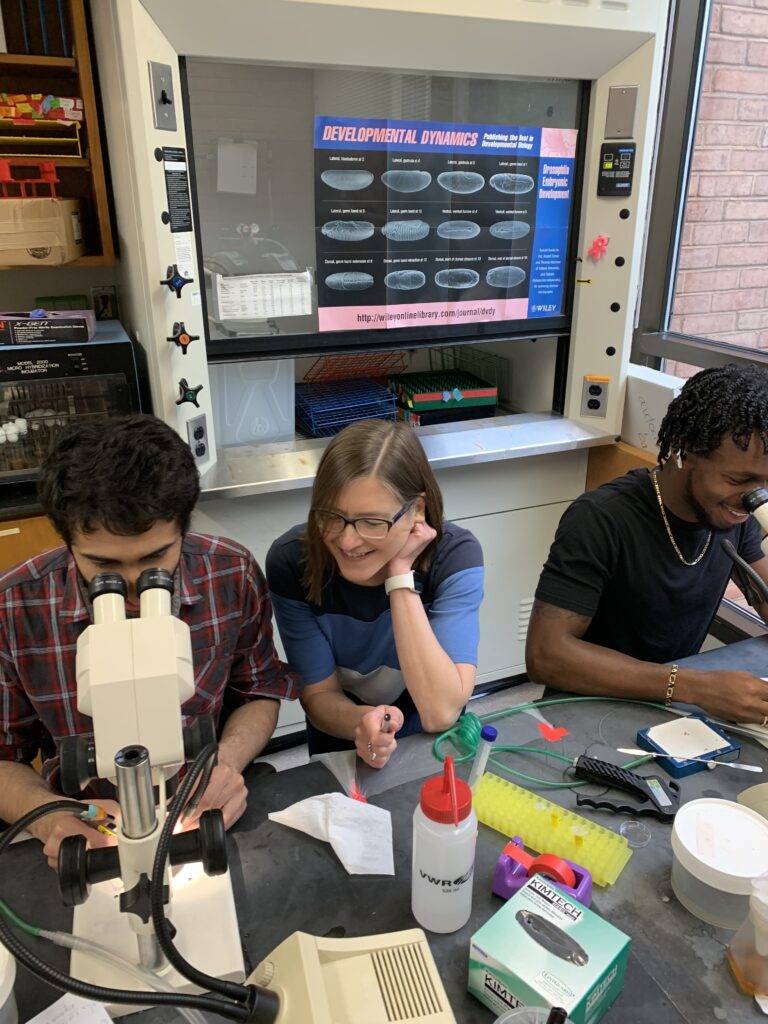 Michelle Starz-Gaiano (center) works with Shahabal Azhar ’24, biological sciences, and Jarrett Lloyd ’24, biological sciences, in her laboratory. (Image courtesy of Starz-Gaiano)
A supportive environment
Starz-Gaiano didn’t come to UMBC expecting to be department chair one day, however. In fact, when she started her undergraduate career as a first-generation college student, she didn’t even know what a professor did. But with supportive mentors and colleagues—the same kind of support she now offers to others—she found her way.
The opportunity to do many different things as a faculty member was a good fit, Starz-Gaiano says, and UMBC, in particular, attracted her with its reputation for innovation. “It’s really cool to be in a place where we’re building new things and not entrenched in historical perspectives,” she says.
That innovation includes opportunities at UMBC for faculty to receive mentorship and gain important skills beyond their research discipline, such as in teaching, leadership, and management. Starz-Gaiano has taken advantage of many such opportunities. The College of Natural and Mathematical Sciences (CNMS) Entrepreneurial Skills Training program, a week of sessions led by Gib Mason ’95, economics; the Teacher Scholar Program from UMBC’s Faculty Development Center; and UMBC’s Women in Science and Engineering group all offered resources, support, and training opportunities as Starz-Gaiano’s career progressed, preparing her to take on future opportunities.
Paying mentorship forward
After gaining tenure, Starz-Gaiano became a mentor for the Teacher Scholar Program, and in 2015, she took on the role of graduate program director (GPD) in the biological sciences department. A GPD must do everything from support students experiencing challenges to enforce program policies and manage recruitment efforts. It requires effective mentoring of students and collaboration with colleagues.
“I benefited a lot from having good relationships with my mentors,” Starz-Gaiano says, so now she works hard to do the same for her mentees and every graduate student she meets.“It’s challenging to be a mentor, because everybody needs something different. And working that out means it’s never perfect. But being open to that reality is part of the strategy to make mentoring work well.”
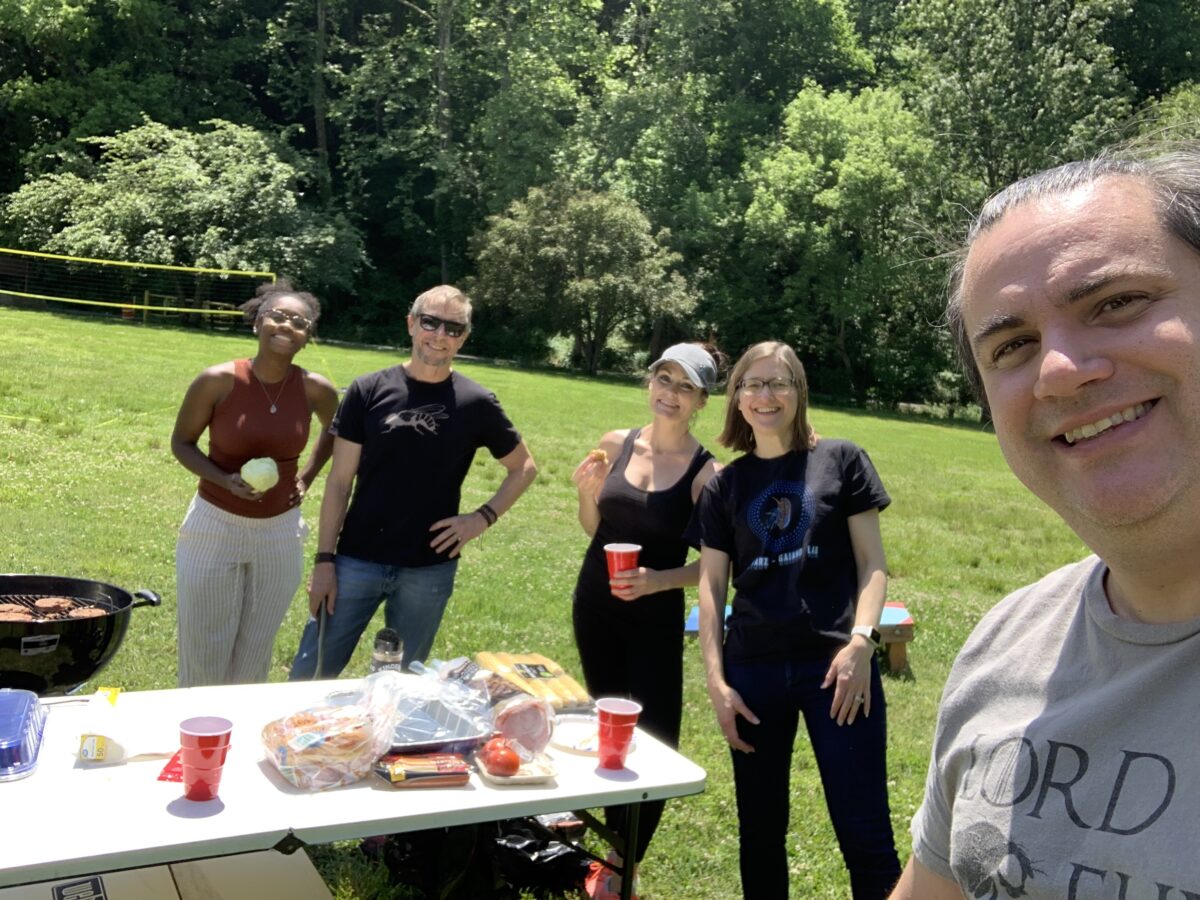 Relationship building happens outside of the academic setting, too. Devonique Brissett, Ph.D. student; Jeff Leips, professor; Shonda Campbell, Ph.D. student; Michelle Starz-Gaiano, professor; and Fernando Vonhoff, assistant professor, attend the annual biology picnic. (Image by Vonhoff)
Putting students first
Amanda Monahan, Ph.D. ’15, biological sciences, says that Starz-Gaiano’s adaptability is one of her biggest strengths as a mentor. “She is able to read and conform to her trainee’s personality, needs, and comfort. I was more independent and she gave me that leeway,” Monahan says, but “some people need a little more hands-on mentorship, and she will provide that in those cases. It is rare to see the level of adaptability that Dr. Starz-Gaiano is able and willing to offer.”
Monahan continued to turn to Starz-Gaiano for guidance after graduation, especially as she transitioned from a research role to one in scientific publishing. “Even though I was no longer her student, she listened to me and provided reassurance and advice throughout the entire process,” Monahan says. “This is just who she is. She will always put her students as a top priority, even when they are no longer her active students.”
For Philip Farabaugh, professor of biological sciences and the outgoing department chair, Starz-Gaiano’s outstanding work with graduate students makes her a natural choice to succeed him. “I have come to rely on Michelle in her role as the graduate program director,” he says. “Michelle has led the graduate committee to ensure we have the best possible students in our M.S. and Ph.D. programs and provided mentorship and friendship to all. Her work in this pivotal position showed me that she had all the skills and personality traits to make her a great department leader.”
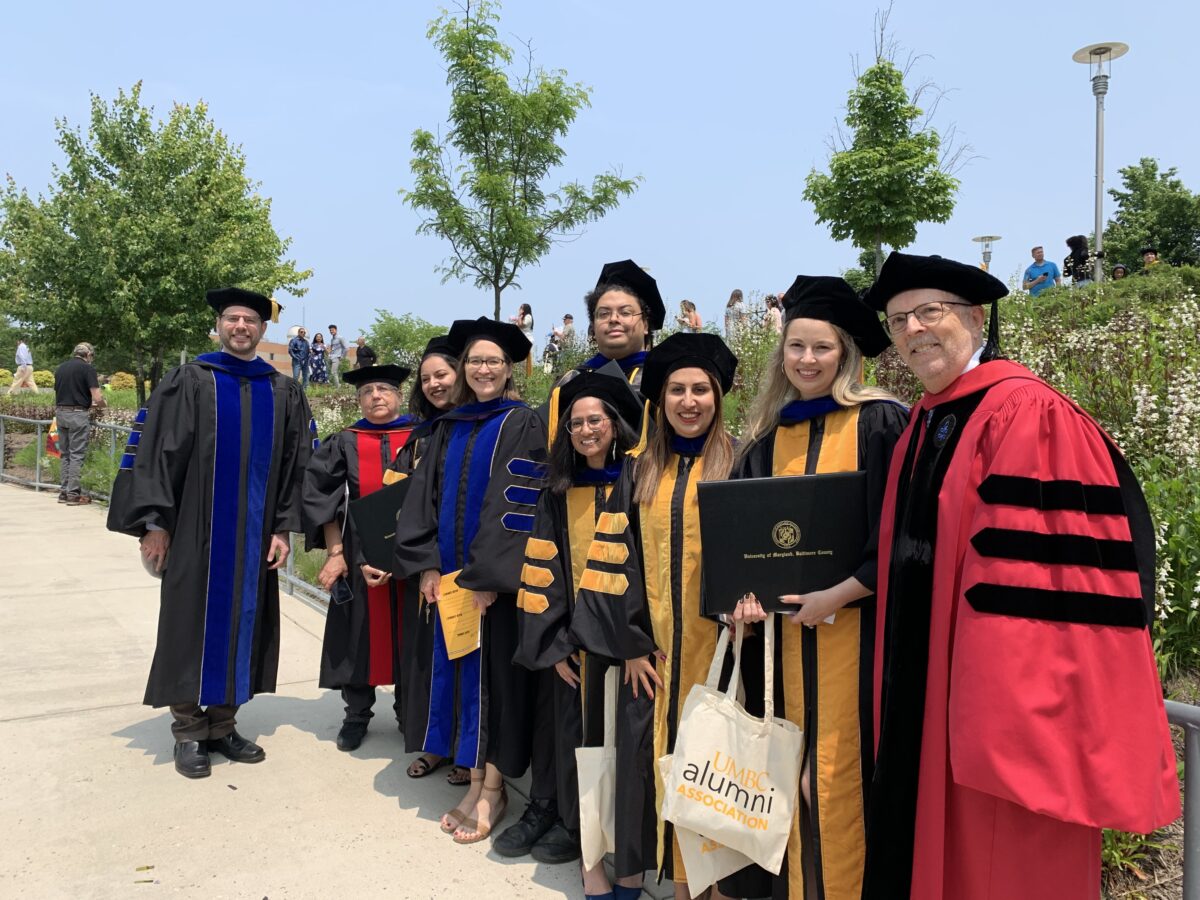 UMBC biological sciences faculty and students graduating with their doctorates in biological sciences in May 2023. From left to right: Daniel Lobo, associate professor; Phyllis Robinson, professor; Mallika Bhattacharya, Ph.D. ’23; Michelle Starz-Gaiano; John Fenimore, Ph.D. ’23; Archana Hari, Ph.D. ’23; Sima Saleh, Ph.D. ’23, Alexis Nobleman, Ph.D. ’23; and Philip Farabaugh.
Embracing change
As chair, Starz-Gaiano says she is “excited to get to know what my colleagues are doing even more. I’m hoping to be able to energize people around each other’s work,” noting that new hybrid work patterns can make it more difficult to keep up with colleagues. “I’m hoping we can build relationships a little more in the department and maybe beyond the department. I think there’s a lot of potential.”
She also wants to take advantage of university-level transitions, such as the new president and future new provost, to advocate for the department’s needs. Farabaugh supports that vision.
“Michelle has a clear sense of the direction the department should take to tap opportunities and meet challenges as UMBC adjusts to its new status as a Carnegie R1 institution, while making sure that we continue to provide the excellent undergraduate education and research training that UMBC is renowned for,” Farabaugh says. “I have the greatest respect for her as a colleague and am certain that she will be a terrific chair, the first woman to hold that position in our department.”
Building on strengths
While there is always room to grow, there are so many existing strengths to build on. “I think the research people are doing is exceptionally strong, and I think our department is great at meeting students where they are and helping them be successful, without taking on a sink or swim approach,” Starz-Gaiano says. “I think we have amazing teaching faculty. We have lecturers who not only do their job but do research in pedagogy and try to find best practices and then actually change their teaching based on their findings.”
To more junior faculty looking to find their footing, Starz-Gaiano says, “I think getting involved is really important, and doing the things that are of interest and important to you.” Starz-Gaiano has been doing that for 15 years at UMBC, resulting in lasting positive impact on her students and colleagues. As the new chair, there’s no sign of her stopping now.
]]>
Michelle Starz-Gaiano, professor of biological sciences, joined the UMBC faculty as an assistant professor in 2008, fresh from a postdoctoral fellowship at Johns Hopkins University. Since then,...
https://umbc.edu/stories/michelle-starz-gaiano-department-chair/
https://beta.my.umbc.edu/api/v0/pixel/news/134097/guest@my.umbc.edu/e4144981b36b98ae1e5503611b18d1f5/api/pixel
biology
cnms
community
news
science-and-tech
UMBC News & Magazine
https://beta.my.umbc.edu/groups/umbc-news-magazine
https://assets1-beta.my.umbc.edu/system/shared/avatars/groups/000/001/943/24435aa6207c452e7bc15cc74b42c7bb/xsmall.png?1748556657
https://assets1-beta.my.umbc.edu/system/shared/avatars/groups/000/001/943/24435aa6207c452e7bc15cc74b42c7bb/original.png?1748556657
https://assets2-beta.my.umbc.edu/system/shared/avatars/groups/000/001/943/24435aa6207c452e7bc15cc74b42c7bb/xxlarge.png?1748556657
https://assets2-beta.my.umbc.edu/system/shared/avatars/groups/000/001/943/24435aa6207c452e7bc15cc74b42c7bb/xlarge.png?1748556657
https://assets3-beta.my.umbc.edu/system/shared/avatars/groups/000/001/943/24435aa6207c452e7bc15cc74b42c7bb/large.png?1748556657
https://assets1-beta.my.umbc.edu/system/shared/avatars/groups/000/001/943/24435aa6207c452e7bc15cc74b42c7bb/medium.png?1748556657
https://assets2-beta.my.umbc.edu/system/shared/avatars/groups/000/001/943/24435aa6207c452e7bc15cc74b42c7bb/small.png?1748556657
https://assets1-beta.my.umbc.edu/system/shared/avatars/groups/000/001/943/24435aa6207c452e7bc15cc74b42c7bb/xsmall.png?1748556657
https://assets2-beta.my.umbc.edu/system/shared/avatars/groups/000/001/943/24435aa6207c452e7bc15cc74b42c7bb/xxsmall.png?1748556657
UMBC News & Magazine
11
0
false
Fri, 23 Jun 2023 10:47:57 -0400
UMBC awarded $1 million in grants from the Jack Kent Cooke Foundation to support promising STEM students with financial need
UMBC has been awarded $1 million in grants from the Jack Kent Cooke Foundation to support students with financial need who intend to pursue degrees in science, technology, engineering, and mathematics (STEM) fields.
The Foundation lauded UMBC’s demonstrated record of advancing the success of underrepresented students in STEM. UMBC is the country’s #1 producer of Black undergraduates who go on to earn doctorates in the life sciences and math and computer sciences combined, and also the nation’s leading producer of Black undergraduates who go on to earn the combined M.D.-Ph.D. (physician scientists).
UMBC has one of the country’s most diverse undergraduate communities, with more than 60 percent of its students being from minority groups. UMBC has been at the forefront of efforts to increase diversity and student success in STEM, particularly through the Meyerhoff Scholars Program, which supports undergraduate students of all backgrounds who plan to pursue doctoral study in the sciences or engineering and who are interested in the advancement of minorities in those fields. The program has served as a national model that has been replicated by several other institutions.
“The Meyerhoff Scholars Program is one example of how UMBC has long worked to redefine excellence in higher education,” says UMBC President Valerie Sheares Ashby. “We are deeply grateful for the partnership of the Jack Kent Cooke Foundation and its support in the form of this new grant, which will allow us to touch even more lives and advance inclusive excellence in the State of Maryland and beyond.”
UMBC is one of only two research universities to receive the grants this year—the University of California, Merced is the other.
“UC Merced and UMBC are models for our nation. Both schools have resolved to ensure that all students—especially students from underrepresented backgrounds—are set up to succeed from day one in rigorous STEM classes,” says Seppy Basili, executive director of the Jack Kent Cooke Foundation. “In advancement of our mission to help exceptional students reach their fullest potential, we are honored to support the work of these important institutions.”
At each university, the grants will provide $500,000 in current-use funding—to support over the next two academic years incoming and current students with financial need who intend to pursue STEM degrees—and $500,000 in endowed scholarship support for STEM undergraduates with financial need.
These grants are part of a $7 million commitment from the Jack Kent Cooke Foundation to support underrepresented student success in STEM fields. To date, the Foundation has granted $1 million to each of the following: Alabama A&M University (2021), Florida A&M University (2021), Morgan State University (2022), Norfolk State University (2021), and North Carolina A&T State University (2021).
]]>
UMBC has been awarded $1 million in grants from the Jack Kent Cooke Foundation to support students with financial need who intend to pursue degrees in science, technology, engineering, and...
https://umbc.edu/stories/jack-kent-cooke-foundation-grants-stem/
https://beta.my.umbc.edu/api/v0/pixel/news/134065/guest@my.umbc.edu/2506c43ef75485e759ff8edf723879e6/api/pixel
cnms
coeit
meyerhoff-scholars
news
science-and-tech
stem-education
UMBC News & Magazine
https://beta.my.umbc.edu/groups/umbc-news-magazine
https://assets1-beta.my.umbc.edu/system/shared/avatars/groups/000/001/943/24435aa6207c452e7bc15cc74b42c7bb/xsmall.png?1748556657
https://assets1-beta.my.umbc.edu/system/shared/avatars/groups/000/001/943/24435aa6207c452e7bc15cc74b42c7bb/original.png?1748556657
https://assets2-beta.my.umbc.edu/system/shared/avatars/groups/000/001/943/24435aa6207c452e7bc15cc74b42c7bb/xxlarge.png?1748556657
https://assets2-beta.my.umbc.edu/system/shared/avatars/groups/000/001/943/24435aa6207c452e7bc15cc74b42c7bb/xlarge.png?1748556657
https://assets3-beta.my.umbc.edu/system/shared/avatars/groups/000/001/943/24435aa6207c452e7bc15cc74b42c7bb/large.png?1748556657
https://assets1-beta.my.umbc.edu/system/shared/avatars/groups/000/001/943/24435aa6207c452e7bc15cc74b42c7bb/medium.png?1748556657
https://assets2-beta.my.umbc.edu/system/shared/avatars/groups/000/001/943/24435aa6207c452e7bc15cc74b42c7bb/small.png?1748556657
https://assets1-beta.my.umbc.edu/system/shared/avatars/groups/000/001/943/24435aa6207c452e7bc15cc74b42c7bb/xsmall.png?1748556657
https://assets2-beta.my.umbc.edu/system/shared/avatars/groups/000/001/943/24435aa6207c452e7bc15cc74b42c7bb/xxsmall.png?1748556657
UMBC News & Magazine
2
0
false
Tue, 20 Jun 2023 09:59:03 -0400
The US has a child labor problem – recalling an embarrassing past that Americans may think they’ve left behind

Written by Beth Saunders, Curator and Head of Special Collections and Gallery, UMBC.
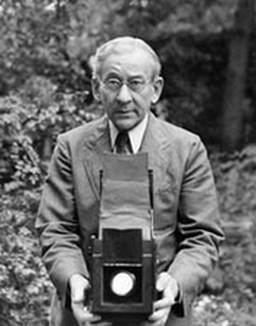
At the University of Maryland, Baltimore County’s Special Collections, where I am head curator, we’ve recently completed a major digitization and rehousing project of our collection of over 5,400 photographs made by Lewis Wickes Hine in the early 20th century.
Traveling the country with his camera, Hine captured the often oppressive working conditions of thousands of children – some as young as 3 years old.
As I’ve worked with this collection over the past two years, the social and political implications of Hine’s photographs have been very much on my mind. The patina of these black-and-white photographs suggests a bygone era – an embarrassing past that many Americans might imagine they’ve left behind.
But with numerous reports of child labor violations, many involving immigrants, occurring in the U.S., along with an uptick in state legislation rolling back the legal working age, it’s clear that Hine’s work is as relevant today as it was a century ago.
‘An investigator with a camera’
A sociologist by training, Hine began making photographs in 1903 while working as a teacher at the progressive Ethical Culture School in New York City.
Between 1903 and 1908, he and his students photographed migrants at Ellis Island. Hine believed that the future of the U.S. rested in its identity as an immigrant nation – a position that contrasted with escalating xenophobic fears.
Based on this work, the National Child Labor Committee, which advocated for child labor laws, hired Hine to document the living and working conditions of American children.
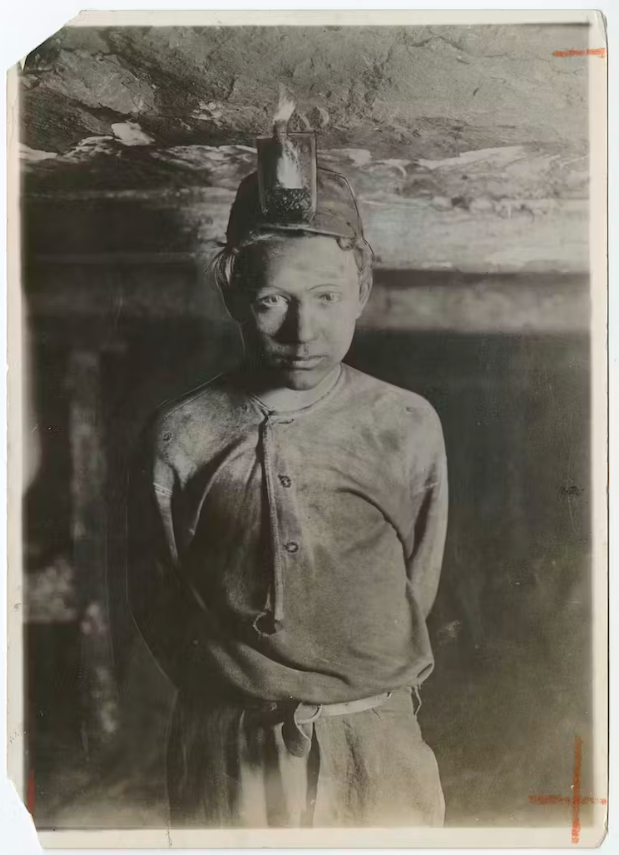 Lewis Wickes Hine, ‘Trapper Boy, Turkey Knob Mine, MacDonald, West Virginia, 1908.’ Gelatin silver print. 5 x 7 in. The Photography Collections, University of Maryland, Baltimore County (P148), CC BY-SA
By the late 19th century, several states had passed laws limiting the age of child laborers and establishing maximum working hours. But at the turn of the century, the number of working kids soared – between 1890 and 1910, 18% of children ages 10 to 15 were employed.
In his work for the National Child Labor Committee, Hine journeyed to farms and mills in the industrializing South and the streets and factories of the Northeast. He used a Graflex camera with 5-by-7-inch glass plate negatives and employed flash powder for nighttime and interior shots, hauling upward of 50 pounds of equipment on his slight frame.
To gain entry into factories and other facilities, Hine sometimes disguised himself as a Bible, postcard or insurance salesman. Other times he’d wait outside to catch workers arriving for or departing from their shifts.
Along with photographic records, Hine collected his subjects’ personal stories, including their ages and ethnicities. He documented their working lives, such as their typical hours and any injuries or ailments they incurred as a result of their labor.
Hine, who considered himself “an investigator with a camera,” used this information to create what he termed “photo stories” – combinations of images and text that could be used on posters, in public lectures and in published reports to help the organization advance its mission.
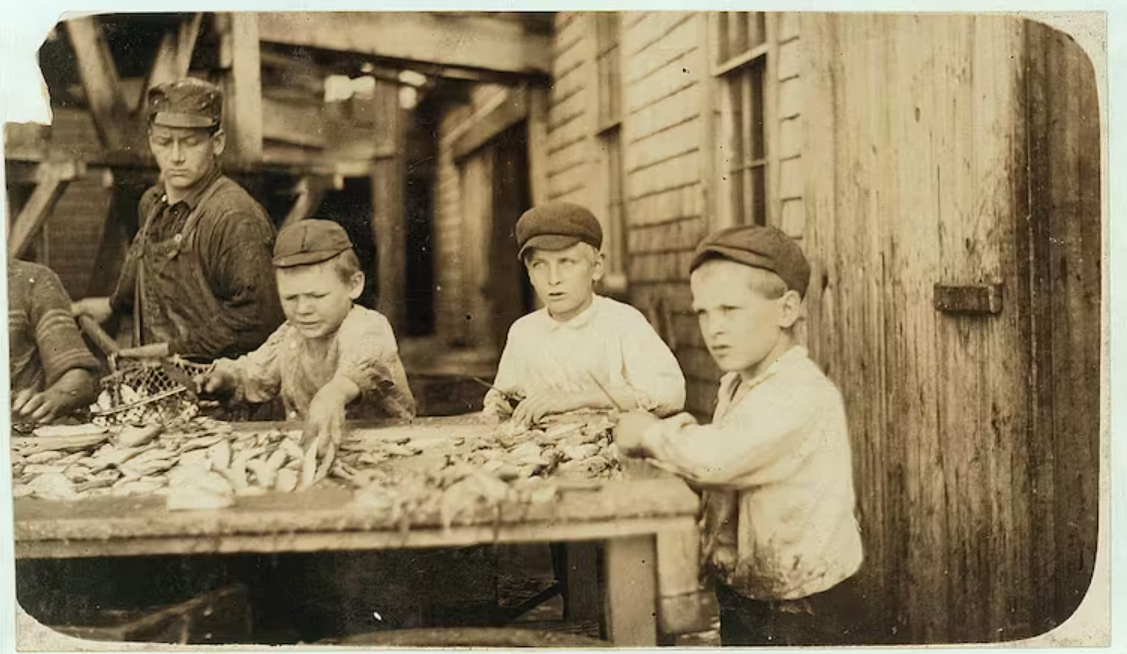 Lewis Wickes Hine’s photograph of three young fish cutters working at the Seacoast Canning Co. in Eastport, Maine. National Child Labor Committee collection, Library of Congress, Prints and Photographs Division
Legislation follows
Hine’s muckraking photographs exemplify the genre of documentary photography, which relies upon the perceived truthfulness of photography to make a case for social change.
The camera serves as an eyewitness to a societal ill, a problem that needs a solution. Hine portrayed his subjects in a direct manner, typically frontally and looking straight into the camera, against the backdrop of the very factories, farmland or cities where they worked.
By capturing details of his sitters’ bare feet, tattered clothes, soiled faces and hands, and diminutive stature against hulking industrial equipment, Hine made a direct statement about the poor conditions and precarity of these children’s lives.
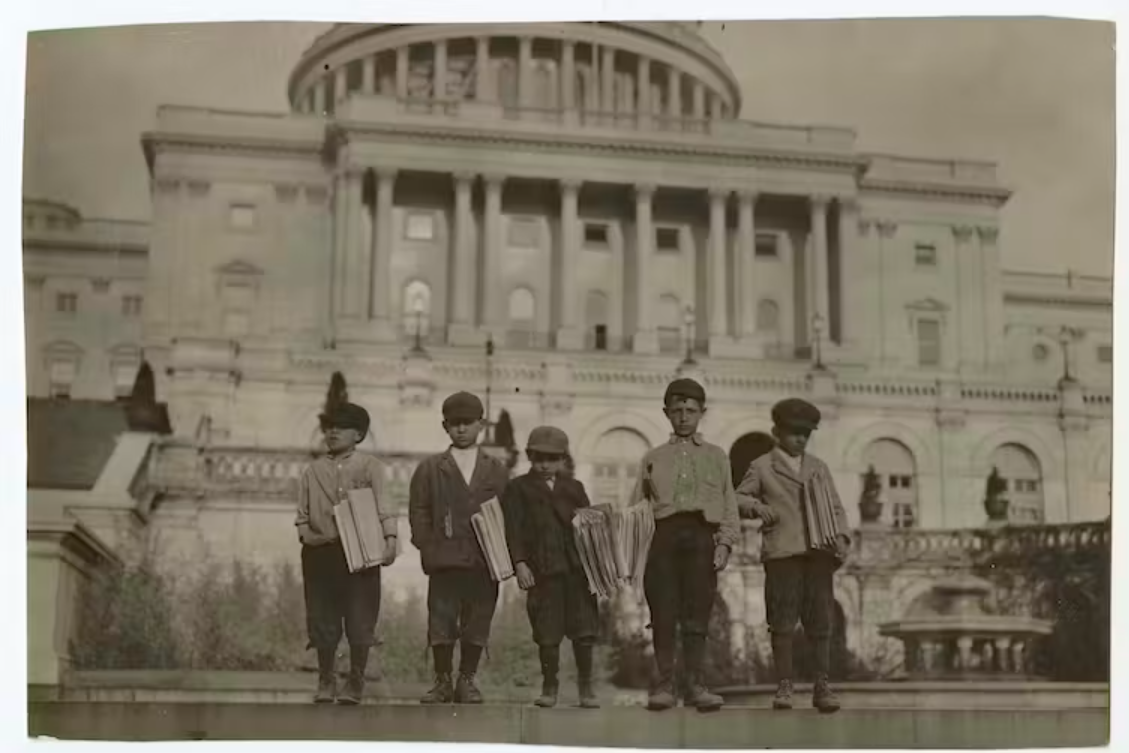 Lewis Wickes Hine, ‘Group of newsies selling on Capitol steps, April 11, 1912.’ The Photography Collections, University of Maryland, Baltimore County (P2904), CC BY-SA
Hine’s photographs made a successful case for child labor reform.
Notably, the National Child Labor Committee’s efforts resulted in Congress establishing the Children’s Bureau in 1912 and passing the Keating-Owen Act in 1916, which limited working hours for children and prohibited the interstate sale of goods produced by child labor.
Although the Supreme Court later ruled it and a subsequent Child Labor Tax Law of 1919 unconstitutional, momentum for enshrining protections for child workers had been created. In 1938, Congress passed the Fair Labor Standards Act, which established restrictions and protections on employing children.
The National Child Labor Committee’s project also included advocacy for the enforcement of existing child labor regulations, a regulatory problem reemerging today as the Department of Labor – the agency tasked with enforcing labor laws – comes under fire for failing to protect child workers.
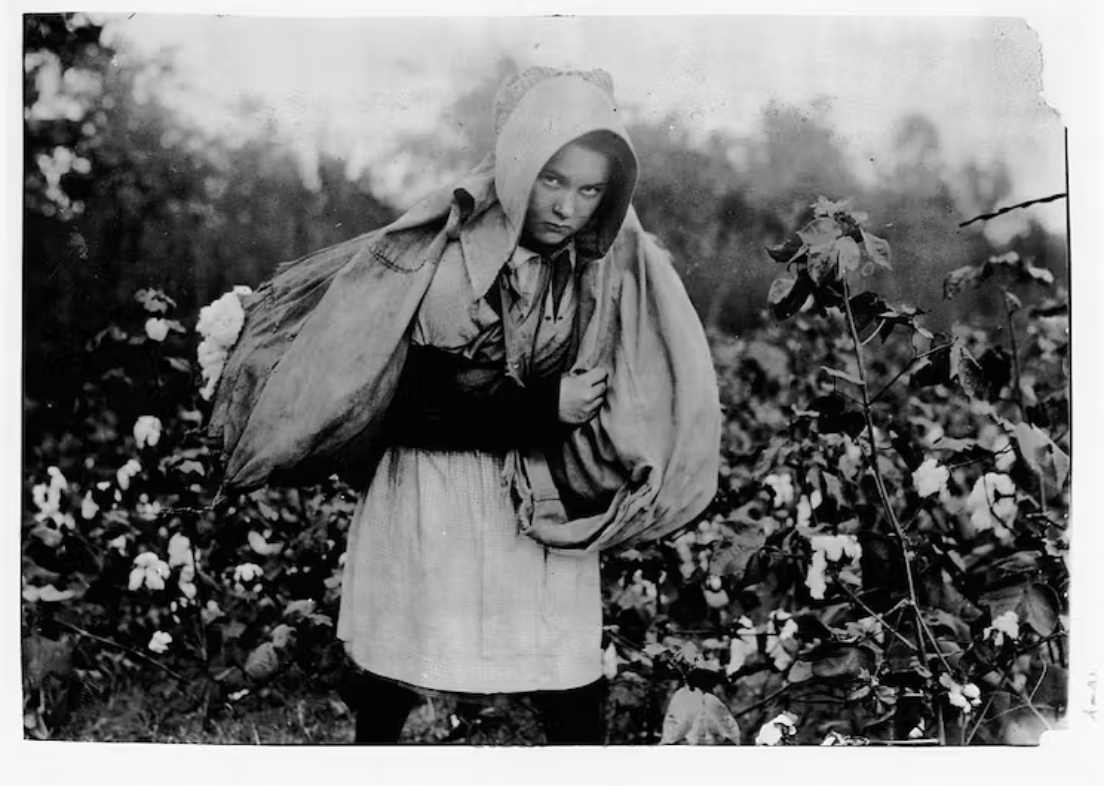 A young picker carries a large sack of cotton on her back. Lewis Wickes Hine/Library of Congress via Getty Images
The ethics of picturing child labor
A recent surge of unaccompanied minors, primarily from Central America, has brought new attention to America’s old problem of child labor and has threatened the very laws Hine and the National Child Labor Committee worked to enact.
Some estimates suggest that one-third of migrants under 18 are working illegally, whether it’s laboring more hours than current laws permit, or working without the proper authorizations. Many of them perform hazardous jobs similar to those of Hine’s subjects: handling dangerous equipment and being exposed to noxious chemicals in factories, slaughterhouses and industrial farms.
While the content of Hine’s photographs remains pertinent to today’s child labor crisis, a key distinction between the subject of Hine’s photographs and working children today is race.
Hine focused his camera almost exclusively on white children who arrived in the country during waves of immigration from Europe during the late-19th and early-20th centuries. As art historian Natalie Zelt argues, Hine’s pictorial treatment of Black children – either ignored or forced to the margins of his images – implied to viewers that the face of childhood in America was, by default, white.
The perceived racial hierarchies of Hine’s era reverberate into the present, where underage migrants of color live and work at the margins of society.
 Workers protest outside a Popeye’s restaurant in Oakland, Calif., on May 18, 2023, after reports emerged of the franchise exploiting child labor. Jane Tyska/Digital First Media/East Bay Times via Getty Images
Contemporary reports of child labor violations offer few images to accompany their texts, graphs and statistics. There are legitimate reasons for this. By not including identifying personal information or portraits, news outlets protect a vulnerable population. Ethical guidelines frown upon revealing private details of the lives of children interviewed. And, as Hine’s experience demonstrates, it can be difficult to infiltrate the sites of these labor violations, since they are typically kept secure.
Digital cameras and smartphones offer a workaround. Beginning in 2015, the International Labor Organization urged child laborers in Myanmar to become “young activists” and use their own images and words to create “photo stories” – echoing Hine’s use of the term – that the organization could then disseminate.
Photographs of child labor in foreign countries are far more common than those made in the U.S., which leaves the impression that child labor is someone else’s problem, not ours. Perhaps it’s too hard for Americans to look at this domestic issue square in the eyes.
A similar effect is at work when viewing Hine’s photographs today. While they were originally valued for their immediacy, they can seem to belong to a distant past.
But if Hine’s photographic archive of child laborers is evidence of the power of photography to sway public opinion, does the lack of images in today’s reporting – even if nobly intended – create a disconnect?
Is the public capable of understanding the harmful consequences of lack of labor enforcement when the faces of the people affected are missing from the picture?
This article is republished from The Conversation under a Creative Commons license. Read the original article and see more than 250 UMBC articles available in The Conversation.
]]>
Written by Beth Saunders, Curator and Head of Special Collections and Gallery, UMBC. At the University of Maryland, Baltimore County’s Special Collections, where I am head curator, we’ve...
https://umbc.edu/stories/the-conversation-us-child-labor-problem/
https://beta.my.umbc.edu/api/v0/pixel/news/134034/guest@my.umbc.edu/900a55b9775015504e5a594fcc4fc295/api/pixel
aok-gallery
aok-library
aok-library-gallery
discovery
magazine
special-collections
the-conversation
UMBC News & Magazine
https://beta.my.umbc.edu/groups/umbc-news-magazine
https://assets1-beta.my.umbc.edu/system/shared/avatars/groups/000/001/943/24435aa6207c452e7bc15cc74b42c7bb/xsmall.png?1748556657
https://assets1-beta.my.umbc.edu/system/shared/avatars/groups/000/001/943/24435aa6207c452e7bc15cc74b42c7bb/original.png?1748556657
https://assets2-beta.my.umbc.edu/system/shared/avatars/groups/000/001/943/24435aa6207c452e7bc15cc74b42c7bb/xxlarge.png?1748556657
https://assets2-beta.my.umbc.edu/system/shared/avatars/groups/000/001/943/24435aa6207c452e7bc15cc74b42c7bb/xlarge.png?1748556657
https://assets3-beta.my.umbc.edu/system/shared/avatars/groups/000/001/943/24435aa6207c452e7bc15cc74b42c7bb/large.png?1748556657
https://assets1-beta.my.umbc.edu/system/shared/avatars/groups/000/001/943/24435aa6207c452e7bc15cc74b42c7bb/medium.png?1748556657
https://assets2-beta.my.umbc.edu/system/shared/avatars/groups/000/001/943/24435aa6207c452e7bc15cc74b42c7bb/small.png?1748556657
https://assets1-beta.my.umbc.edu/system/shared/avatars/groups/000/001/943/24435aa6207c452e7bc15cc74b42c7bb/xsmall.png?1748556657
https://assets2-beta.my.umbc.edu/system/shared/avatars/groups/000/001/943/24435aa6207c452e7bc15cc74b42c7bb/xxsmall.png?1748556657
UMBC News & Magazine
0
0
false
Thu, 15 Jun 2023 18:35:31 -0400
Growing Fruitful Campus Connections
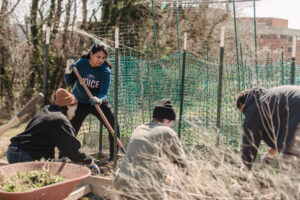
The occasional clang of a shovel rings through the chilly spring air amid the chatter of a small group of cheerful students at the UMBC Community Garden. The students and Ariel Barbosa, program coordinator for Retriever Essentials at UMBC and a master’s student in community leadership, are working hard to ready seven garden plots for crop production the growing season. Already, cold-hardy greens are on their way in one bed, and cucumbers and eggplant are growing indoors awaiting transplant.
The gardening effort is a new initiative of Retriever Essentials, a faculty, staff, and student partnership to tackle food insecurity within the UMBC community. “We were hearing from the UMBC community that canned food does not provide the nutrition we need. What we need are fresh fruits and vegetables in the Essential Space.” Barbosa says, referring to the main food distribution site on campus, located in the Retriever Activities Center. The Essential Space distributes hundreds of pounds of donated food per week.
Growing to give back
They’re able to meet the needs of community members—and respond to new requests, like fresh produce—through robust and fruitful connections with UMBC staff members who want to help. Emily Paul ’21, global studies, service learning and community engagement program specialist at UMBC’s Shriver Center, co-instructs PRAC 096, a service-learning course that allows volunteers to earn course credit for their work in the garden. In addition to offering hands-on garden advice, Paul also helps recruit volunteers for the weekly free farmers markets and to maintain the garden over the summer.
Scenes from the spring clean-up day for the Retriever Essentials garden plots. (Marlayna Demond ’11/UMBC)
As a student, Paul was struck by the growing impact Retriever Essentials was making on the campus community, and as a staff member, she wanted to give back. “I am hoping that students learn about the strength of community and their own ability to take action through joining the garden project,” says Paul. “It’s empowering to grow food and nourish your community.”
Beyond farmers markets
Barbosa’s first step toward providing fresh produce for UMBC community members in need was to partner with So What Else, a non-profit that sets up “free farmers markets” in the Baltimore-Washington region. The resulting markets on campus have been quite successful, but “if there’s a way for us to produce it ourselves, we would like to do that,” Barbosa says. “So we started dreaming up this idea of having our own garden.”
Eli Gooding ’24, biological sciences, and vice president of The Garden at UMBC, worked with Barbosa to offer seven plots in UMBC’s Community Garden. The Garden is a student organization that maintains the beds near the UMBC Police Station and works to address problems such as food waste and food insecurity through service opportunities.
“I am hoping that students learn about the strength of community and their own ability to take action through joining the garden project. It’s empowering to grow food and nourish your community.”
Emily Paul ’21
Barbosa is highly invested in the project given her role with Retriever Essentials, but other staff members have also pitched in to offer support. In fact, UMBC track and field coach David Bobb “is going above and beyond to support this project,” Barbosa says, by providing gardening expertise, seeds, and encouraging his athletes to volunteer.
“Last spring he brought bags of spinach to donate—which he grew from his own garden,” Barbosa says. “That was the first time I thought, we can accept produce! Now it’s time to grow our own.”
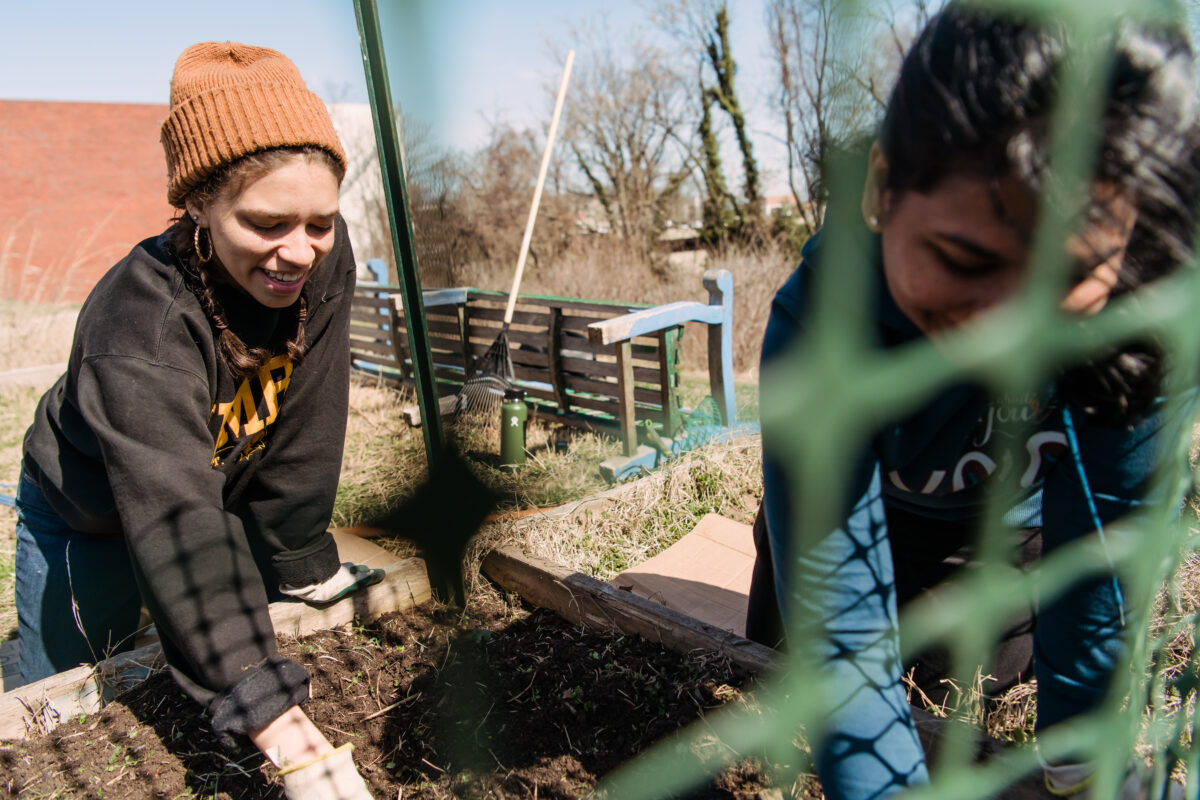 Ariel Barbosa, left, helps get a garden plot cleared for the growing season. (Marlayna Demond ’11/UMBC)
Ryan Kmetz, director of sustainability, and Claire Runquist, environmental sustainability coordinator, have also “been very present and always willing to pitch in and explore new ideas,” Barbosa says.
For the gardening effort to be successful as the growing season gets into full swing, it will be important for volunteers to tend the plots consistently. “We’re trying to prove that we have a sustainable steady thing going on,” Barbosa says, adding that the garden and the Essential Space “are meeting a real need.” The dedicated team is not just growing crops, after all—they’re growing connections across the UMBC community and a broader commitment to fighting food insecurity.
Learn more about Retriever Essentialsand how to get involved or email the team.
]]>
The occasional clang of a shovel rings through the chilly spring air amid the chatter of a small group of cheerful students at the UMBC Community Garden. The students and Ariel Barbosa, program...
https://umbc.edu/stories/growing-fruitful-connections-retriever-essentials/
https://beta.my.umbc.edu/api/v0/pixel/news/134030/guest@my.umbc.edu/1d4facea82047849cf2177288247a1e3/api/pixel
campus-life
community-leadership
global-studies
magazine
retriever-essentials
spring-2023
UMBC News & Magazine
https://beta.my.umbc.edu/groups/umbc-news-magazine
https://assets1-beta.my.umbc.edu/system/shared/avatars/groups/000/001/943/24435aa6207c452e7bc15cc74b42c7bb/xsmall.png?1748556657
https://assets1-beta.my.umbc.edu/system/shared/avatars/groups/000/001/943/24435aa6207c452e7bc15cc74b42c7bb/original.png?1748556657
https://assets2-beta.my.umbc.edu/system/shared/avatars/groups/000/001/943/24435aa6207c452e7bc15cc74b42c7bb/xxlarge.png?1748556657
https://assets2-beta.my.umbc.edu/system/shared/avatars/groups/000/001/943/24435aa6207c452e7bc15cc74b42c7bb/xlarge.png?1748556657
https://assets3-beta.my.umbc.edu/system/shared/avatars/groups/000/001/943/24435aa6207c452e7bc15cc74b42c7bb/large.png?1748556657
https://assets1-beta.my.umbc.edu/system/shared/avatars/groups/000/001/943/24435aa6207c452e7bc15cc74b42c7bb/medium.png?1748556657
https://assets2-beta.my.umbc.edu/system/shared/avatars/groups/000/001/943/24435aa6207c452e7bc15cc74b42c7bb/small.png?1748556657
https://assets1-beta.my.umbc.edu/system/shared/avatars/groups/000/001/943/24435aa6207c452e7bc15cc74b42c7bb/xsmall.png?1748556657
https://assets2-beta.my.umbc.edu/system/shared/avatars/groups/000/001/943/24435aa6207c452e7bc15cc74b42c7bb/xxsmall.png?1748556657
UMBC News & Magazine
2
0
false
Thu, 15 Jun 2023 15:03:02 -0400
UMBC’s 2023 Cybersecurity Exploratory Project Awardees Announced

UMBC’s Cybersecurity Leadership Task Force has recently awarded funding to seven exploratory projects on cybersecurity education and research, with a goal of enhancing UMBC’s role as a leader in cybersecurity.
Proposals were submitted by teams from all three academic colleges and several of UMBC’s research centers and institutes, covering a broad range of topics. Recipients were awarded up to $25,000 in funding, beginning May 1, 2023 through January 31, 2024.
The selected exploratory projects include:
- “To Create a Course on the History of Cybersecurity and Cyberwarfare,” led by Mary Laurents, associate professor of history, and Amy Froide, chair and professor of history.
- “Policy Integrated Blockchain to Automate HIPAA Part 2 Compliance Applied to Medicaid Data,” led by Jim Clavin, chief technology and compliance officer at the Hilltop Institute, and Karuna Joshi, associate professor of information systems.
- “Post-Quantum Cryptography: Will Quantum Memories help?” led by Todd Pittman, professor of physics.
- “CyberCELL: Cybersecurity Curriculum Express Learning Library,” led by Ida Ngambeki, assistant professor of information systems, and Deborah Kariuki, director and clinical faculty of computer science education.
- “Vulnerable Populations’ Perspectives on Data Security and Privacy of Mental Health Technologies,” led by Helena Mentis, professor of information systems.
- “The UMBC Ethical Software Lab (ESL),” led by Mohammad Samarah, professor of information systems, and Melissa Morris, professor of information systems.
- “Investigating Cybersecurity Educational Initiatives to Support Older Adults,” led by Ravi Kuber, associate professor of information systems.
New cybersecurity courses, research, and outreach will result from these projects. This internal funding opportunity was created by the Cybersecurity Leadership Task Force, co-led by Keith J Bowman, dean of the College of Engineering and Information Technology (COEIT), and Karl V. Steiner, vice president for research and creative achievement.
The task force is composed of cross-disciplinary members with diverse perspectives and extensive working knowledge across the UMBC community. It was established to conduct the ongoing search for the inaugural Director of the UMBC Cybersecurity Leadership Institute, and to review and approve exploratory projects on Cybersecurity Research and Education. Funding for the exploratory projects was provided by the Office of the Provost, with partial funding provided by COEIT.
Visit UMBC’s internal funding opportunities website for more information on open calls for proposals.
]]>
UMBC’s Cybersecurity Leadership Task Force has recently awarded funding to seven exploratory projects on cybersecurity education and research, with a goal of enhancing UMBC’s role as a leader in...
https://umbc.edu/stories/2023-cybersecurity-exploratory-project/
https://beta.my.umbc.edu/api/v0/pixel/news/134007/guest@my.umbc.edu/240fb8dba35d04c02e899685ecb7ed0f/api/pixel
cahss
cnms
coeit
news
research
science-and-tech
UMBC News & Magazine
https://beta.my.umbc.edu/groups/umbc-news-magazine
https://assets1-beta.my.umbc.edu/system/shared/avatars/groups/000/001/943/24435aa6207c452e7bc15cc74b42c7bb/xsmall.png?1748556657
https://assets1-beta.my.umbc.edu/system/shared/avatars/groups/000/001/943/24435aa6207c452e7bc15cc74b42c7bb/original.png?1748556657
https://assets2-beta.my.umbc.edu/system/shared/avatars/groups/000/001/943/24435aa6207c452e7bc15cc74b42c7bb/xxlarge.png?1748556657
https://assets2-beta.my.umbc.edu/system/shared/avatars/groups/000/001/943/24435aa6207c452e7bc15cc74b42c7bb/xlarge.png?1748556657
https://assets3-beta.my.umbc.edu/system/shared/avatars/groups/000/001/943/24435aa6207c452e7bc15cc74b42c7bb/large.png?1748556657
https://assets1-beta.my.umbc.edu/system/shared/avatars/groups/000/001/943/24435aa6207c452e7bc15cc74b42c7bb/medium.png?1748556657
https://assets2-beta.my.umbc.edu/system/shared/avatars/groups/000/001/943/24435aa6207c452e7bc15cc74b42c7bb/small.png?1748556657
https://assets1-beta.my.umbc.edu/system/shared/avatars/groups/000/001/943/24435aa6207c452e7bc15cc74b42c7bb/xsmall.png?1748556657
https://assets2-beta.my.umbc.edu/system/shared/avatars/groups/000/001/943/24435aa6207c452e7bc15cc74b42c7bb/xxsmall.png?1748556657
UMBC News & Magazine
0
0
false
Wed, 14 Jun 2023 14:38:58 -0400
Squaring the Circle: The Powerful Art of Hadieh Shafie
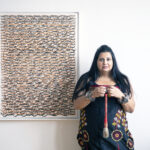
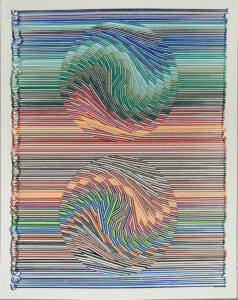
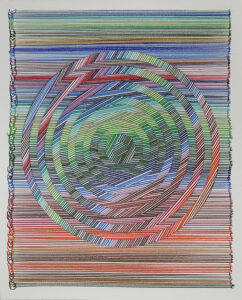
The most recent artworks by Hadieh Shafie, M.F.A. ’04, intermedia and digital arts, appear like optical illusions, tricks. Tightly stacked lines of colored pencil suddenly twist and warp into circles. The two-dimensional surface swirls and vibrates, like eddy lines in a river or sound waves blasting from a speaker. Tucked into these dancing lines, Shafie has written the Persian word for passionate love: eshgh.
The drawings pull together many themes from Shafie’s work and life experience, of leaving her home country of Iran in 1983 at the age of 12 and never going back. From her childhood there, she recalls how women were banned from reading certain texts.
“The importance of books and the power of language, the seed of that idea was implanted in my heart and mind then,” says Shafie, a 2014 Alumni Award recipient. “I saw things as a child there that were really traumatic. So, I felt that while my culture is imbued with all this poetry and love for beauty—things that are beautiful, and homes are decorated, and there’s this idea of paradise in the Persian carpet—there was a lack of really practicing any of it.”
Work documentation of Shafie’s Draw, Cut, Rotate series by Robert J. Fagan.
Love and the circle have shown up in her art since the beginning, since her days studying painting at the Pratt Institute in the nineties and intermedia and digital arts at UMBC in the early aughts. Her work now resides in collections of the British Museum, the Metropolitan Museum of Art, the Brooklyn Museum, and the Los Angeles County Museum of Art and in exhibits from Virginia to Dubai to Australia.
She considers herself a Brooklynite, but when she found the M.F.A. program at UMBC, she was ready for a break from the city. She was drawn to the program because it was small, intimate, and she was excited about the writings on performance art by Kathy O’Dell, a faculty member in the Department of Visual Arts.
 Photo by Erin Collette.
At UMBC, Shafie began a deeper exploration of the Whirling Dervishes, the religious art form of spinning meditative circle dance, and the poems of Rumi, the 13th-century Persian mystic who expounded on the idea of passionate love. Shafie started whirling at UMBC.
“I was getting better at it, only to come to realize that as an Iranian woman, the very first session when I was whirling and I got sick, and I fell on the ground and slammed into the wall—that was my work,” says Shafie, explaining that was symbolic of the role of women in Iranian society. “As a woman I’m never allowed to forget I’m a woman, my place in society, and the things that are barriers to me, so that was very significant.”
Shafie carried these themes into the “Paper Works” series, where she packs a frame with tightly rolled and stacked sheaves of colored paper that have been filled with texts. The effect is a dizzying mosaic of thousands of circles.
“I started with fragments of poems and then kept reducing it to one word, and the word and the common denominator for all of our problems was love and hate,” Shafie says. “I didn’t want to use the word hate. So I use the word for passionate love.”
In her new body of work, the optical “Cut & Rotate Series,” love continues to prevail, the word eshgh appearing like notches, like dragonflies that have landed on rivers of color and line.
“This word that’s so ordinary holds so much power,” Shafie says.
By Alex V. Cipolle
Other members of the UMBC community are also asking big questions and using their intuition to follow the question for as long as it takes. Read about these creative thinkers willing to get lost on a tangent, to joyfully put themselves in positions of not knowing, and looking for new ways of translating the world around them in Open to Interpretation.
]]>
The most recent artworks by Hadieh Shafie, M.F.A. ’04, intermedia and digital arts, appear like optical illusions, tricks. Tightly stacked lines of colored pencil suddenly twist and warp into...
https://umbc.edu/stories/squaring-the-circle-the-powerful-art-of-hadieh-shafie/
https://beta.my.umbc.edu/api/v0/pixel/news/134006/guest@my.umbc.edu/429dcf6d6e78b36f33e722f450c118e3/api/pixel
uncategorized
UMBC News & Magazine
https://beta.my.umbc.edu/groups/umbc-news-magazine
https://assets1-beta.my.umbc.edu/system/shared/avatars/groups/000/001/943/24435aa6207c452e7bc15cc74b42c7bb/xsmall.png?1748556657
https://assets1-beta.my.umbc.edu/system/shared/avatars/groups/000/001/943/24435aa6207c452e7bc15cc74b42c7bb/original.png?1748556657
https://assets2-beta.my.umbc.edu/system/shared/avatars/groups/000/001/943/24435aa6207c452e7bc15cc74b42c7bb/xxlarge.png?1748556657
https://assets2-beta.my.umbc.edu/system/shared/avatars/groups/000/001/943/24435aa6207c452e7bc15cc74b42c7bb/xlarge.png?1748556657
https://assets3-beta.my.umbc.edu/system/shared/avatars/groups/000/001/943/24435aa6207c452e7bc15cc74b42c7bb/large.png?1748556657
https://assets1-beta.my.umbc.edu/system/shared/avatars/groups/000/001/943/24435aa6207c452e7bc15cc74b42c7bb/medium.png?1748556657
https://assets2-beta.my.umbc.edu/system/shared/avatars/groups/000/001/943/24435aa6207c452e7bc15cc74b42c7bb/small.png?1748556657
https://assets1-beta.my.umbc.edu/system/shared/avatars/groups/000/001/943/24435aa6207c452e7bc15cc74b42c7bb/xsmall.png?1748556657
https://assets2-beta.my.umbc.edu/system/shared/avatars/groups/000/001/943/24435aa6207c452e7bc15cc74b42c7bb/xxsmall.png?1748556657
UMBC News & Magazine
1
0
false
Wed, 14 Jun 2023 14:01:43 -0400
Squaring the Circle: The Powerful Art of Hadieh Shafie
The most recent artworks by Hadieh Shafie, M.F.A. ’04, intermedia and digital arts, appear like optical illusions, tricks. Tightly stacked lines of colored pencil suddenly twist and warp into circles. The two-dimensional surface swirls and vibrates, like eddy lines in a river or sound waves blasting from a speaker. Tucked into these dancing lines, Shafie has written the Persian word for passionate love: eshgh.
The drawings pull together many themes from Shafie’s work and life experience, of leaving her home country of Iran in 1983 at the age of 12 and never going back. From her childhood there, she recalls how women were banned from reading certain texts.
“The importance of books and the power of language, the seed of that idea was implanted in my heart and mind then,” says Shafie, a 2014 Alumni Award recipient. “I saw things as a child there that were really traumatic. So, I felt that while my culture is imbued with all this poetry and love for beauty—things that are beautiful, and homes are decorated, and there’s this idea of paradise in the Persian carpet—there was a lack of really practicing any of it.”
Work documentation of Shafie’s Draw, Cut, Rotate series by Robert J. Fagan.
Love and the circle have shown up in her art since the beginning, since her days studying painting at the Pratt Institute in the nineties and intermedia and digital arts at UMBC in the early aughts. Her work now resides in collections of the British Museum, the Metropolitan Museum of Art, the Brooklyn Museum, and the Los Angeles County Museum of Art and in exhibits from Virginia to Dubai to Australia.
She considers herself a Brooklynite, but when she found the M.F.A. program at UMBC, she was ready for a break from the city. She was drawn to the program because it was small, intimate, and she was excited about the writings on performance art by Kathy O’Dell, a faculty member in the Department of Visual Arts.
Photo by Erin Collette.
At UMBC, Shafie began a deeper exploration of the Whirling Dervishes, the religious art form of spinning meditative circle dance, and the poems of Rumi, the 13th-century Persian mystic who expounded on the idea of passionate love. Shafie started whirling at UMBC.
“I was getting better at it, only to come to realize that as an Iranian woman, the very first session when I was whirling and I got sick, and I fell on the ground and slammed into the wall—that was my work,” says Shafie, explaining that was symbolic of the role of women in Iranian society. “As a woman I’m never allowed to forget I’m a woman, my place in society, and the things that are barriers to me, so that was very significant.”
Shafie carried these themes into the “Paper Works” series, where she packs a frame with tightly rolled and stacked sheaves of colored paper that have been filled with texts. The effect is a dizzying mosaic of thousands of circles.
“I started with fragments of poems and then kept reducing it to one word, and the word and the common denominator for all of our problems was love and hate,” Shafie says. “I didn’t want to use the word hate. So I use the word for passionate love.”
In her new body of work, the optical “Cut & Rotate Series,” love continues to prevail, the word eshgh appearing like notches, like dragonflies that have landed on rivers of color and line.
“This word that’s so ordinary holds so much power,” Shafie says.
By Alex V. Cipolle
Other members of the UMBC community are also asking big questions and using their intuition to follow the question for as long as it takes. Read about these creative thinkers willing to get lost on a tangent, to joyfully put themselves in positions of not knowing, and looking for new ways of translating the world around them in Open to Interpretation.
]]>
The most recent artworks by Hadieh Shafie, M.F.A. ’04, intermedia and digital arts, appear like optical illusions, tricks. Tightly stacked lines of colored pencil suddenly twist and warp into...
https://umbc.edu/stories/squaring-the-circle-the-art-of-hadieh-shafie/
https://beta.my.umbc.edu/api/v0/pixel/news/134021/guest@my.umbc.edu/d1011cd575f62583e4711fffb0556af2/api/pixel
alumni
alumni-award
imda
magazine
spring-2023
UMBC News & Magazine
https://beta.my.umbc.edu/groups/umbc-news-magazine
https://assets1-beta.my.umbc.edu/system/shared/avatars/groups/000/001/943/24435aa6207c452e7bc15cc74b42c7bb/xsmall.png?1748556657
https://assets1-beta.my.umbc.edu/system/shared/avatars/groups/000/001/943/24435aa6207c452e7bc15cc74b42c7bb/original.png?1748556657
https://assets2-beta.my.umbc.edu/system/shared/avatars/groups/000/001/943/24435aa6207c452e7bc15cc74b42c7bb/xxlarge.png?1748556657
https://assets2-beta.my.umbc.edu/system/shared/avatars/groups/000/001/943/24435aa6207c452e7bc15cc74b42c7bb/xlarge.png?1748556657
https://assets3-beta.my.umbc.edu/system/shared/avatars/groups/000/001/943/24435aa6207c452e7bc15cc74b42c7bb/large.png?1748556657
https://assets1-beta.my.umbc.edu/system/shared/avatars/groups/000/001/943/24435aa6207c452e7bc15cc74b42c7bb/medium.png?1748556657
https://assets2-beta.my.umbc.edu/system/shared/avatars/groups/000/001/943/24435aa6207c452e7bc15cc74b42c7bb/small.png?1748556657
https://assets1-beta.my.umbc.edu/system/shared/avatars/groups/000/001/943/24435aa6207c452e7bc15cc74b42c7bb/xsmall.png?1748556657
https://assets2-beta.my.umbc.edu/system/shared/avatars/groups/000/001/943/24435aa6207c452e7bc15cc74b42c7bb/xxsmall.png?1748556657
UMBC News & Magazine
0
0
false
Wed, 14 Jun 2023 14:01:43 -0400
Wed, 14 Jun 2023 14:01:43 -0400
Retriever for Life

Very few Retrievers can say they’ve spent as many years on campus or enjoyed quite so many roles in doing so as Joan Costello ’73, social work. From her first days as a student and student worker; to 41 years as a staff member in the library, audiovisual (AV) services, and multimedia center; to her current role as basketball season ticket holder, committee member of the Founding Four, and board member of the Wisdom Institute—UMBC’s organization for retired staff and faculty—Costello shares why she’s chosen to make UMBC her second home for more than 50 years.
The first days
I grew up two miles away, and when this new school opened, I thought I would give UMBC a shot. In my memory, it rained at the beginning of most semesters—a nice complement to the on-going construction. But I really enjoyed the experience of being part of a young university. It was fun seeing everything grow up with me.
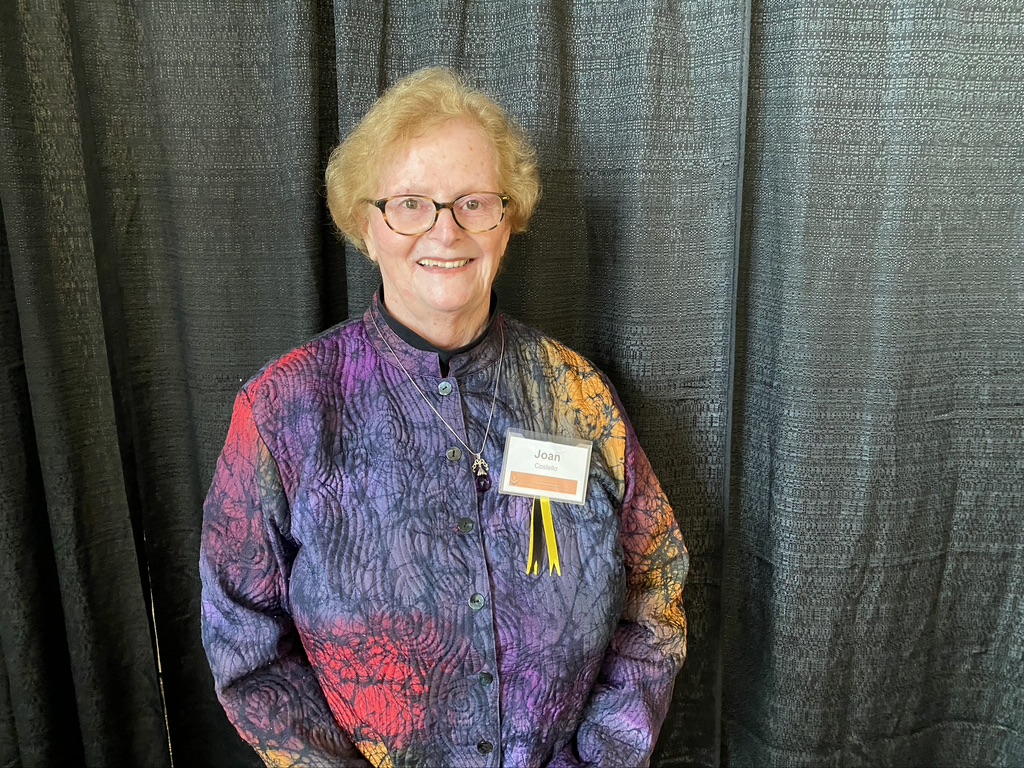 Costello at a 2023 Wisdom Institute event.
College was hard at first. It was a big change for me academically; even the language used was very different from what I was used to. Terms like mean and median and bell curve I had never heard of! I took a statistics course and I thought I was doing okay compared with everybody else. We were all on that same curve, right? But when it came to the final, I ended up getting a D in that class. I didn’t know yet about repeating classes, or dropping them at the last minute, so it took me a while to bring my GPA up, but I did.
In my second semester, I got a job at the library—not yet the Albin O. Kuhn Library that Retrievers have access to now—and it gave me an outlet to learn more about the campus, faculty, staff, student workers, and patrons. The library was a great place to work. We learned each other’s jobs so that we could help in a pinch, and we had the best parties—staff Olympics and talent contests like the Gong Show. We were all young, students and staff, and many of those bonds have lasted over 50 years.
Returning to work at UMBC
After I graduated, I worked at the Good Shepherd School for Girls for five months, but UMBC called me and offered me a job in the library, so I happily returned. I eventually became a supervisor of Record and Tape. Back then there was an AV department on campus that did the movies and equipment around campus, which eventually went under the wing of the library. It became two jobs: supervising Record and Tape and AV services. AV was located in the Chem/Physics building, which had to be the worst office ever because it was in the basement and you got the lovely fumes from the labs.
We later moved to a new building, Academic IV (now Sherman Hall). Victor Aulestia (director of instructional technology) made his case to put the media areas together—AV services, the International Media Center (the Language Lab), and the TV studio.
I always loved getting to know the students, staff, and faculty. And I liked to help. If somebody needed help in a pinch, I would try to arrange it. I later worked in the International Media Center in Academic IV. It was a great study area for students to hang out.
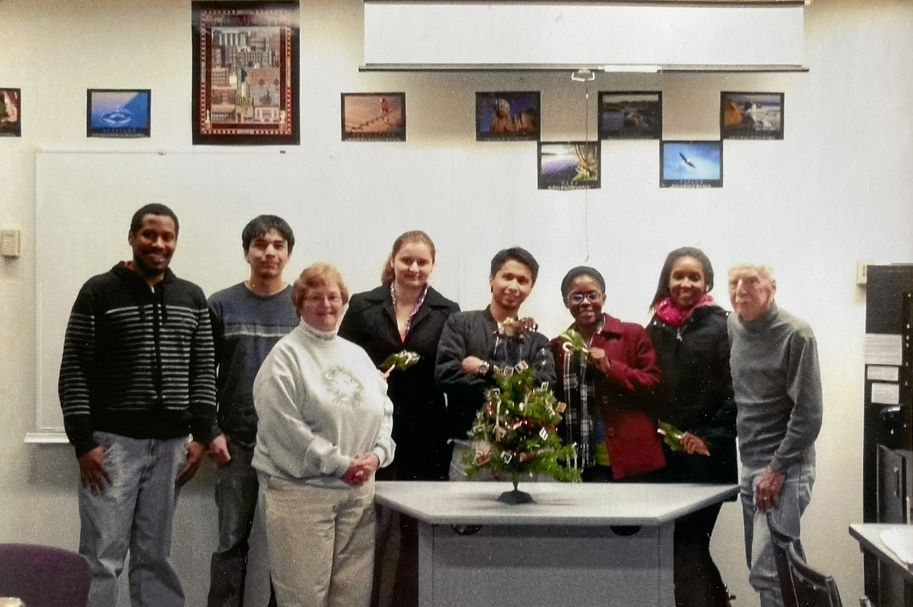 Costello (center front) with student workers in 2012.
At the beginning of the school year, kids often looked lost, and so I tried to help with directions and encourage them—I really enjoyed that. I had a crew of students who worked with me—students from all over the place—and it was fun getting to know all of them. I wanted to make them feel comfortable because some of them were away from home for the first time.
Long-term Retriever
I’ve found ways to stay involved. I am a part of the Founding Four group (our members include the first four graduating classes of UMBC). It’s been rewarding to be involved with that group and to hear other people’s stories. In fact, we have just put together a book of early recollections, This Belongs to Us. I go to the UMBC theatre to see the plays as often as I can, and I’m also a basketball season ticket holder. I always see friends there.
I’m also on the board of the Wisdom Institute, a group of UMBC retirees always working to bring folks together with activities and volunteering and camaraderie. We’ve done luncheons, we’ve gone to plays and concerts at Lurman Woodland Theatre, in Catonsville. We also get people involved in service, like helping tutor or mentor students in the nearby schools, and that’s a great way of giving back. Our biggest hit as an institute is our annual special talk and luncheon—we’ve had some great speakers, and you get to see so many people coming back to campus.
That’s the best part. You get to keep your connections to people you knew at UMBC, and maybe you wouldn’t think of getting together with them otherwise, but we have this venue that makes it easy and makes it so much fun.
I’ve stayed connected to UMBC for all this time because it’s familiar, convenient, and like another family. UMBC is its own community within the loop. I enjoyed the people…and I still do!
Learn more about the Wisdom Institute, now celebrating its fifth anniversary.
]]>
Very few Retrievers can say they’ve spent as many years on campus or enjoyed quite so many roles in doing so as Joan Costello ’73, social work. From her first days as a student and student worker;...
https://umbc.edu/stories/retriever-for-life/
https://beta.my.umbc.edu/api/v0/pixel/news/134002/guest@my.umbc.edu/4be79e06579bbc4114f2eca340a76207/api/pixel
alumni
cahss
founding-four
magazine
social-work
spring-2023
UMBC News & Magazine
https://beta.my.umbc.edu/groups/umbc-news-magazine
https://assets1-beta.my.umbc.edu/system/shared/avatars/groups/000/001/943/24435aa6207c452e7bc15cc74b42c7bb/xsmall.png?1748556657
https://assets1-beta.my.umbc.edu/system/shared/avatars/groups/000/001/943/24435aa6207c452e7bc15cc74b42c7bb/original.png?1748556657
https://assets2-beta.my.umbc.edu/system/shared/avatars/groups/000/001/943/24435aa6207c452e7bc15cc74b42c7bb/xxlarge.png?1748556657
https://assets2-beta.my.umbc.edu/system/shared/avatars/groups/000/001/943/24435aa6207c452e7bc15cc74b42c7bb/xlarge.png?1748556657
https://assets3-beta.my.umbc.edu/system/shared/avatars/groups/000/001/943/24435aa6207c452e7bc15cc74b42c7bb/large.png?1748556657
https://assets1-beta.my.umbc.edu/system/shared/avatars/groups/000/001/943/24435aa6207c452e7bc15cc74b42c7bb/medium.png?1748556657
https://assets2-beta.my.umbc.edu/system/shared/avatars/groups/000/001/943/24435aa6207c452e7bc15cc74b42c7bb/small.png?1748556657
https://assets1-beta.my.umbc.edu/system/shared/avatars/groups/000/001/943/24435aa6207c452e7bc15cc74b42c7bb/xsmall.png?1748556657
https://assets2-beta.my.umbc.edu/system/shared/avatars/groups/000/001/943/24435aa6207c452e7bc15cc74b42c7bb/xxsmall.png?1748556657
UMBC News & Magazine
1
0
false
Wed, 14 Jun 2023 12:56:09 -0400
Caregiving Goes Both Ways

For more than a decade, Rita Choula was the primary caregiver for her late mother who lived with frontotemporal degeneration (FTD), a lesser known form of early onset dementia that typically affects people under the age of 60.
“My mother started saying things like ‘I don’t feel like myself. I feel like I’m losing my mind.’ She used to be someone that was really engaged and outgoing and she started to pull back a bit. She used to be very empathetic, very people-loving, and showed a lot of concern, and it reached a point where that empathy went straight out the window,” recalls Choula ’95, information systems management, M.A. ’16, aging services.
The process of learning what was affecting her mother, who passed away in October 2020, was a long and challenging one for Choula and her family. That’s why in her current role as the senior director of caregiving at the AARP Public Policy Institute, Choula advances equitable, culturally responsive policies and practices by elevating the unique nature of each caregiving experience.
 Headshot of Rita Choula.
After four years of misdiagnoses and cycling through several neurologists and medical practitioners, Choula’s mother, at age 60, was finally diagnosed with behavioral variant FTD, a subtype of early onset dementia that doesn’t specifically impact memory, but instead causes personality changes, apathy, and a progressive decline in socially appropriate behavior, judgment, self-control, and empathy.
“It was a true battle to determine her diagnosis. The lack of an early diagnosis left me bitter because it took away a lot of opportunities for us to just be with her,” says Choula. “So much of our journey was me figuring it out and having to educate professionals on it.”
Developing as a leader in aging services
But how did she go from a frustrated family caregiver to a leader in the aging studies field?
Nearly 20 years after receiving her undergraduate degree, Choula returned to UMBC to continue her academic journey at the Erickson School of Aging while in the throes of caring for mother. Her caregiving experience encouraged her to learn more about how to more adequately and holistically care for aging adults and the caregivers that supported them, like herself.
“The program was shaped in a way that allowed a working caregiver and mother to be able to pursue her dreams of getting a degree, while still helping me navigate a really difficult time in my life,” says Choula.
Becoming a critical thinker
In the 1990s, UMBC was one of Choula’s top university choices, stemming from the keynote speech delivered at her high school graduation by none other than UMBC’s then-president, Freeman A. Hrabowski, III.
“Hearing this educated Black man speaking about the importance of education and quoting Langston Hughes’ ‘A Dream Deferred’ made me say ‘[UMBC] is where I want to go.”
“The program was shaped in a way that allowed a working caregiver and mother to be able to pursue her dreams of getting a degree, while still helping me navigate a really difficult time in my life.”
Rita Choula ’95, M.A. ’16
Choula, who hails from Suitland, Maryland, was interested in information systems management because of UMBC’s strong computer science programs. She found value in coupling her major with a minor in Africana Studies. Her educational experience helped her to “broaden how I saw myself as a Black woman in this world,” Choula shares.
Choula cites professors emeritus Acklyn Lynch and the late Miriam Decosta-Willis as mentors who helped expose her to many Black scholars and thinkers across the African diaspora.
“I was challenged across my courses to critically think about what we were learning, to ask those difficult questions, and to work together as a student body on many different issues to push forward change.”
A personal touch
When Choula returned to earn her degree in the Erickson School, she says the professors imparted much more than academic knowledge—they also assisted her in her personal caregiving experience, especially when it came time to transitioning her mother into living at a nursing home facility. “I went to several of my professors and asked how I should navigate this. They picked up the phone to make calls to care facilities on my behalf—it impacted me tremendously and taught me the importance of seeing a student as a whole person.”
 Choula kisses her mother, Theresa Bryant.
Choula’s experience as a Retriever laid the foundation for the work that she does in support of family caregivers. She specifically remembers a class with Joseph DeMattos, president of the Health Facilities Association of Maryland— the state’s largest and oldest long-term care association. Choula noted how DeMattos’ guidance on leadership helped to inform her current career pursuits. “DeMattos taught me how to position myself as a leader, the different types of leadership styles, and what type of impact I want to have not just on my work but on the people who I’m leading,” says Choula.
Choula applies all that she’s learned at UMBC to bring together policy, research, and practice—the three critical areas of aging services. With her expertise, she works to bridge the three areas, centering on identifying and supporting the needs of diverse family caregivers across ethnicities, cultures, and generations.
“I learned so much about myself as a UMBC student. My experience taught me to take on issues from a place of critical thinking and ensure that we center the needs of people while working with them to affect change and impact.”
]]>
For more than a decade, Rita Choula was the primary caregiver for her late mother who lived with frontotemporal degeneration (FTD), a lesser known form of early onset dementia that typically...
https://umbc.edu/stories/caregiving-goes-both-ways-dementia-aarp/
https://beta.my.umbc.edu/api/v0/pixel/news/133996/guest@my.umbc.edu/eda637ba8ff38f5a2fed6afc848da32d/api/pixel
alumni
coeit
erickson-school
information-systems
magazine
spring-2023
UMBC News & Magazine
https://beta.my.umbc.edu/groups/umbc-news-magazine
https://assets1-beta.my.umbc.edu/system/shared/avatars/groups/000/001/943/24435aa6207c452e7bc15cc74b42c7bb/xsmall.png?1748556657
https://assets1-beta.my.umbc.edu/system/shared/avatars/groups/000/001/943/24435aa6207c452e7bc15cc74b42c7bb/original.png?1748556657
https://assets2-beta.my.umbc.edu/system/shared/avatars/groups/000/001/943/24435aa6207c452e7bc15cc74b42c7bb/xxlarge.png?1748556657
https://assets2-beta.my.umbc.edu/system/shared/avatars/groups/000/001/943/24435aa6207c452e7bc15cc74b42c7bb/xlarge.png?1748556657
https://assets3-beta.my.umbc.edu/system/shared/avatars/groups/000/001/943/24435aa6207c452e7bc15cc74b42c7bb/large.png?1748556657
https://assets1-beta.my.umbc.edu/system/shared/avatars/groups/000/001/943/24435aa6207c452e7bc15cc74b42c7bb/medium.png?1748556657
https://assets2-beta.my.umbc.edu/system/shared/avatars/groups/000/001/943/24435aa6207c452e7bc15cc74b42c7bb/small.png?1748556657
https://assets1-beta.my.umbc.edu/system/shared/avatars/groups/000/001/943/24435aa6207c452e7bc15cc74b42c7bb/xsmall.png?1748556657
https://assets2-beta.my.umbc.edu/system/shared/avatars/groups/000/001/943/24435aa6207c452e7bc15cc74b42c7bb/xxsmall.png?1748556657
UMBC News & Magazine
1
0
false
Wed, 14 Jun 2023 10:49:48 -0400
Faculty Unleash Their Inner Coach

In spring 2022, UMBC softball swept all three tournament games to win their third America East championship. The Retrievers held their opponents scoreless, becoming the first team in conference history to achieve this milestone. And no one cheered louder for their success than Jamie Gurganus, faculty in engineering and computing education and mechanical engineering. Decked out in softball gear (and now with a championship ring necklace gifted from the team engraved with “Prof. G”), Gurganus ’04, M.S. ’11, Ph.D. ’20, mechanical engineering, ended her inaugural semester as honorary faculty coach to the record-breaking team on a high note. (UMBC Softball would go on to nab a fourth consecutive America East championship in 2023.)
But beyond cheering on their successful teams, how do honorary faculty coaches “coach” their teams? Enter Adriana Mason, associate athletic director for academics, who originally envisioned the role of “faculty liaison honorary coaches” lending their expertise to UMBC’s 17 Division 1 teams—maybe not moving magnets around a tactics board and giving game instructions but providing another listening ear and being a loud member of the cheering section.
“The goal is to foster and strengthen the relationships between athletics and academics. Sometimes there can be a disconnect, so we really wanted to try to build that bridge,” explains Mason, who initiated this program alongside Athletic Director Brian Barrio.
Since spring 2022, each UMBC athletic program has had its very own faculty coach. While “coach” may be in the title, squad selection, tactics, and practice plans are still in the hands of professionals.
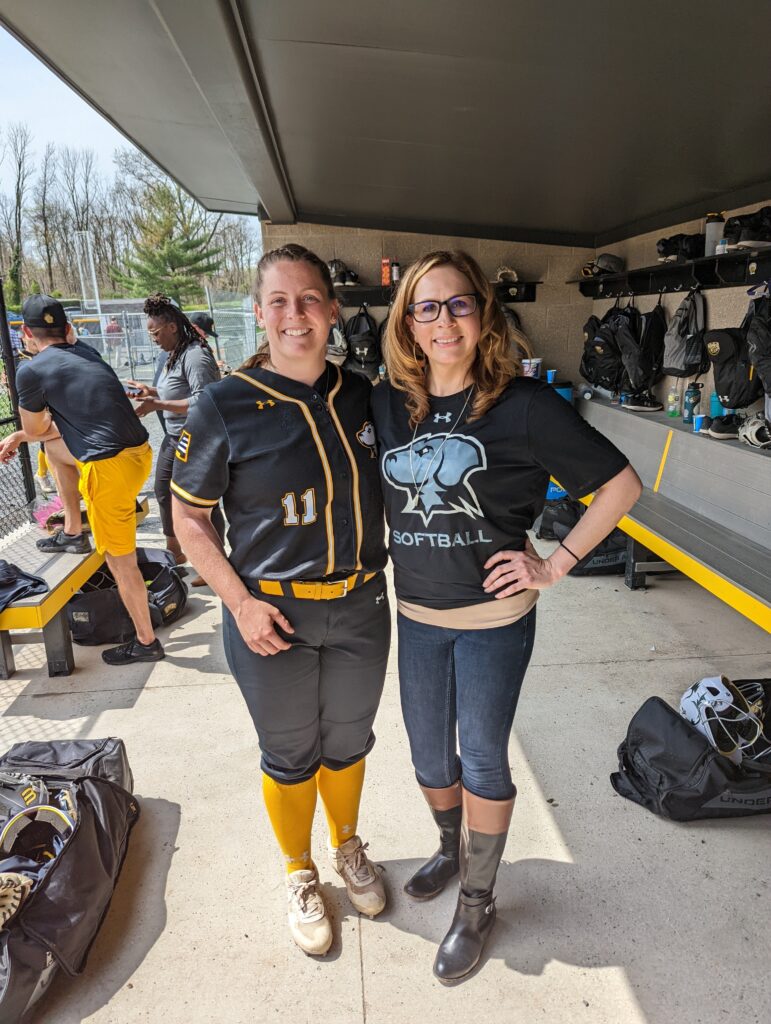 Gurganus with Logan Hawker ’22, catcher on the UMBC Softball team.
When she met the softball team, Gurganus (known as “Prof. G” to many) made it a point to ask each team member. “‘Who are you? Tell me about your major.’ I blocked out time to figure out who every single person was.”
“You have to be the initiator because sometimes they don’t know how to approach you,” says Gurganus. “I came down wearing a softball shirt, and I’m like ‘I’m one of you.’”
“When we were assigned her, I thought it’d be like the university saying, ‘Hey, professor, you have to be the honorary coach.’ But when she’s coming in so often and actually talking to us, and complimenting us, we can tell she actually wants to be here,” says first-year softball player Mikayla Bryant, chemical engineering.
It’s not only about the winning moments—Gurganus is no fair weather fan. During a recent tough moment for the team, “she showed up,” shares Bryant. “It wasn’t like she was forced to be there, but she had some words of advice for us and that was really nice. At that moment everyone was like, ‘Wow, she’s really here for us.’”
Coaches have also witnessed the benefits of the initiative. “We have several students who have a close relationship with her and, more as a mentor or a sounding board for different things going on in their own lives,” says UMBC softball Head Coach Chris Kuhlmeyer, who has led the team to four consecutive championships.
Honorary faculty coaches have their own reasons for wanting to participate in the initiative.
“Honestly, there are research centers that if I wanted to do pure research, I could go do that,” explains Jeff Leips, honorary coach of the UMBC swim and dive team and biological sciences professor. “But when I’m sitting here alone in my office thinking about science, and then I go talk to the team, that’s a great break.”
For Leips, the chance to get out of his office and “doing what I can to promote learning in whatever environment that I can,” is what taking on this role has been all about.
“It definitely changed my thinking about how to facilitate the learning environment for athletic students,” says Gurganus.
Even though the faculty coach initiative is still in its infancy, Leips and Gurganus see the potential for UMBC to continue leading the way in student support. “We can come together to help support these students in a bigger way, and a very non-traditional way, unlike any other university, I think,” says Gurganus.
— Eric Widemann ’21
]]>
In spring 2022, UMBC softball swept all three tournament games to win their third America East championship. The Retrievers held their opponents scoreless, becoming the first team in conference...
https://umbc.edu/stories/faculty-unleashing-their-inner-coach/
https://beta.my.umbc.edu/api/v0/pixel/news/133995/guest@my.umbc.edu/255091d990c0964e3d0277ee132c8125/api/pixel
athletics
cbee
coeit
impact
magazine
meche
softball
spring-2023
UMBC News & Magazine
https://beta.my.umbc.edu/groups/umbc-news-magazine
https://assets1-beta.my.umbc.edu/system/shared/avatars/groups/000/001/943/24435aa6207c452e7bc15cc74b42c7bb/xsmall.png?1748556657
https://assets1-beta.my.umbc.edu/system/shared/avatars/groups/000/001/943/24435aa6207c452e7bc15cc74b42c7bb/original.png?1748556657
https://assets2-beta.my.umbc.edu/system/shared/avatars/groups/000/001/943/24435aa6207c452e7bc15cc74b42c7bb/xxlarge.png?1748556657
https://assets2-beta.my.umbc.edu/system/shared/avatars/groups/000/001/943/24435aa6207c452e7bc15cc74b42c7bb/xlarge.png?1748556657
https://assets3-beta.my.umbc.edu/system/shared/avatars/groups/000/001/943/24435aa6207c452e7bc15cc74b42c7bb/large.png?1748556657
https://assets1-beta.my.umbc.edu/system/shared/avatars/groups/000/001/943/24435aa6207c452e7bc15cc74b42c7bb/medium.png?1748556657
https://assets2-beta.my.umbc.edu/system/shared/avatars/groups/000/001/943/24435aa6207c452e7bc15cc74b42c7bb/small.png?1748556657
https://assets1-beta.my.umbc.edu/system/shared/avatars/groups/000/001/943/24435aa6207c452e7bc15cc74b42c7bb/xsmall.png?1748556657
https://assets2-beta.my.umbc.edu/system/shared/avatars/groups/000/001/943/24435aa6207c452e7bc15cc74b42c7bb/xxsmall.png?1748556657
UMBC News & Magazine
2
0
false
Wed, 14 Jun 2023 10:22:14 -0400
Wed, 14 Jun 2023 10:22:14 -0400