Creating Queer Arab Joy

Seven years ago, Mejdulene Bernard Shomali began a search for her queer Arab women “banat” ancestors. Shomali, a queer Palestinian poet, was looking for mirrors and searching for hope in other queer Arab women, queer Arab banat. Their lives and names were unknown to her, blurred as they were by Western, Orientalism, and Arab hetero-patriarchal representations of Arab femininity.
Shomali came to UMBC in 2015 as a member of the third cohort of UMBC’s Postdoctoral Fellows which recognizes and supports talented scholars who are emerging as cutting-edge researchers and educators in their fields. In 2016, Shomali joined the faculty as an assistant professor of gender, women’s, and sexuality studies.
Shomali wondered if one could be queer and Arab and okay all at the same time especially if representation of queer banat desire was missing from popular cultural texts and films. In the darkest of times, during a global pandemic shutdown, she found her answer— it was a resounding, YES. Not only can one be queer and Arab and okay, you can also create queer Arab joy.
In 2019, Shomali received The Woodrow Wilson National Fellowship Foundation Career Enhancement Fellowship to continue research for her manuscript. After seven years of research throughout the Arab diaspora, Shomali published her first book, Between Banat: Queer Arab Critique and Transnational Arab Archives. It is the first study of desire that addresses the contemporary cultures and lives of queer Arab women.
“This book is my love letter to my unnamed queer Palestinian ancestors. It is the knowing glance, playful wink, and double entendre between us,” Shomali writes in her book. “It is the ways we call one another, not only for recognition and community but to action and movement toward a joyful and pleasurable queer Arab future.”
Shomali, who has developed university-wide programming around Arab and Muslim identity, discussed her book at the Dresher Center for the Humanities 2023 Spring Humanities Forum. “It is not easy to work at the intersection of several disciplines and build both sophisticated and intelligible arguments for all audiences,” said Carole McCann, professor and chair of gender, women’s, and sexuality studies, who introduced Shomali. “However, Dr. Shomali deploys the conceptual tools of critical cultural studies, literary theory, transnational feminist theory, and queer of color critique with great dexterity demonstrating both a sharp intellect and immense writerly talent.”
UMBC Dresher Center for the Humanities 2023 Spring Humanities Forum.
Queer Arab Critique
Moving between Arabic, English, and Arabish (Arab+English), Shomali takes us as far back as the 10th century to analyze the famed Persian, Arab, Indian, and Asian tale of The Thousand and One Nights where Scheherazade saves herself, other women, and the nation by telling the king—who killed his virgin wives each morning—stories over 1001 nights. “As a storyteller and state queen, she evades the three typical representations of Arab femininity: silent veiled Muslima, hypersexual dancer or harem girl, and female terrorist,” notes Shomali. “She is hailed as an ancestor, muse, and icon for many Arab and Arab American writers.”
Shomali analyzes an 1855 and 1995 translation and three modern versions. “Scheherazade has also been used as a key figure in the portrayal of Arab women’s femininity, elitism, heteronormative sexuality, and anti-Blackness and has served to perpetuate colonial and Orientalist beliefs of the Arab world,” explains Shomali. Orientalism defines the West as civilized colonizers with progressive ideas and the East as foreign, uncivilized, primitive, and “other” that must be tamed through colonization. “Studying Scheherazade can reveal how representations of Arab women and femininity change given the cultural and political context in which they emerge,” says Shomali.
Where would one find queer Arab representation in a text that defines heterosexuality as the norm of Arab femininity? Like many queer people and people of color who do not see themselves represented in literature, art, business, or academia Shomali had to design her own solution—what she calls a Queer Arab Critique.
Queer Arab Critique is about finding the unseen, “the what ifs,” reading critically and between the lines. Using this lens, Shomali reexamines Scheherazade’s story and two films from the Golden Era of Egyptian Cinema (1940s – 70s). It is as much a mirror for queer Arab women of queer Arab women’s desires, sexuality, space, and time. It is also evidence that Western colonization and Western queer thought do not define nor erase mainstream queer Arab culture.
“Queer Arab Critique allows us to see the traces of queer desire in mainstream Arab cultures and undermines the erasure of queer people from Arab histories,” Shomali explains, “and reveals how queerness and Arabness are constructed relationally, between many locations, texts, and times.”
For and by queer Arab women
Between Banat is equally about undoing the archives of the past as it is about creating a new queer Arab archive. One that centers on literature, arts, film, and activism by and for trans and cis Arab women, femmes, and those Arabs who identify with femininity.
Searching for these vibrant communities pre-pandemic would have taken multiple trips to several countries, scouring state and local archives, and finding the hidden and active network of queer Arab communities. A global pandemic meant shifting gears. Shomali took to digital sleuthing in English and Arabic. Posting questions, following helpers, and clicking through online bootleg archives in Lebanon, Syria, Saudi Arabia, and Palestine.

“Bareed Mista3ji” by Meem.
One find includes three biographical essay collections: “Haqi: An A’ish, An Akhtar, An Akoon” (My Right: To Live, To Choose, To Be) and “Waqfet Banat” (Women’s Stand) by Astwa in Palestine, and “Bareed Mista3ji” (Priority Mail) by Meem in Lebanon. Through anonymous and first-name authorship, banat write about their experiences, identities, and communities and publish their work via queer feminist organizations that advocate for LGBTI+ communities like Astwa and Meem.
In her search, Shomali also found three novels: Elham Mansour’s Ana Hiya Inti (I Am You), Seba al-Herz’s Al Akharuun (The Others), and Samar Yazbek’s Ra’ihat il Kirfathree (The Scent of Cinnamon). Once more written by, for, and about queer Arab women. These rich narratives take place in Lebanon, Saudi Arabia, and Syria respectively, giving readers a complex, close, and varied experience of same-sex desires and practices within Arab communities, families, spaces, and politics.
“It often comes as a surprise to Western and some Arab audiences that the majority of works about same-sex desires and practices between Arab women are not, as Orientalism would have us believe, originating in the West or in English,” says Shomali, who was named the 2017 Outstanding Faculty Ally at the Lavender Celebration, UMBC’s yearly event honoring LGBTQIA+ students, faculty, and staff. “They are works by Arab authors and artists, produced in Arabic, in Arab nations.”
A free and joyful queer future
In addition to texts, Shomali connected with filmakers, artists, and designers currently advancing perceptions and practices of gender, sexuality, and liberation from oppressive systems within Arab culture creating a joyful and thriving present and future in film, fashion, and illustration.
Maysaloun Hamoud’s 2016 narrative film Bar Bahar (In Between) tells the friendship of three Palestinian roommates living in occupied Palestine working through issues of cultural expectations, identity, desire, and freedom. Nöl Collective is a clothing production company and intersectional feminist and political fashion collective based in Ramallah, Palestine. It works with Palestinian women artisans to create clothes based on traditional methods as a platform to bring awareness to political, environmental, and intersectionality issues as shared on their website.
The political reality for Palestinians is shaped by the military occupation which touches and shapes every element of our lives, including creativity. Isolated from one another geographically most of the artisans we are working with have never met and even need to work together digitally to bring garments to life, representing a creative endeavor which has triumphed over imposed borders.
Detroit’s own Maamoul Press is a small multidisciplinary art collective that supports the production and circulation of creative works in the genres of comics, printmaking, and book arts in the Arab diaspora.
“Ultimately, Bar Bahar, Nöl Collective, and Maamoul Press are geared toward a queer Arab future whose ethnic, sexual, and gender politics point toward collective liberation rather than community gatekeeping and social erasure,” says Shomali. “They do so by centering diverse voices, substantiating a future in which queer Arabs not only exist and experience pleasure, but whose existence, pleasures, and activists are essential to a sexually free future.”
Shomali chose the word banat because it is void of the western, Orientalist, and hetero-patriarchal gaze that has defined queer Arab women into three stereotypes of Arab women’s religion, sexuality, and political beliefs. Between Banat is about all the spaces in between queer Arab women’s loving and living. Their past and future, visibility and invisibility, heterosexuality and queerness, empires and colonies, western and Arab.
“When I felt like it was impossible to write this book, I thought about my Palestinian ancestors and how I was bringing to bear a future we couldn’t have imagined,” says Shomali. “I believe in our joy and I believe our freedom is coming. I am grateful to them for teaching me that I am not alone.”
]]>
Seven years ago, Mejdulene Bernard Shomali began a search for her queer Arab women “banat” ancestors. Shomali, a queer Palestinian poet, was looking for mirrors and searching for hope in other...
https://umbc.edu/stories/creating-queer-arab-joy/
https://beta.my.umbc.edu/api/v0/pixel/news/134473/guest@my.umbc.edu/16f7fdf860bd129bbc54caf5d1aef2ac/api/pixel
cahss
cahssresearch
discovery
gwst
international-stories
magazine
research
UMBC News & Magazine
https://beta.my.umbc.edu/groups/umbc-news-magazine
https://assets1-beta.my.umbc.edu/system/shared/avatars/groups/000/001/943/24435aa6207c452e7bc15cc74b42c7bb/xsmall.png?1748556657
https://assets1-beta.my.umbc.edu/system/shared/avatars/groups/000/001/943/24435aa6207c452e7bc15cc74b42c7bb/original.png?1748556657
https://assets2-beta.my.umbc.edu/system/shared/avatars/groups/000/001/943/24435aa6207c452e7bc15cc74b42c7bb/xxlarge.png?1748556657
https://assets2-beta.my.umbc.edu/system/shared/avatars/groups/000/001/943/24435aa6207c452e7bc15cc74b42c7bb/xlarge.png?1748556657
https://assets3-beta.my.umbc.edu/system/shared/avatars/groups/000/001/943/24435aa6207c452e7bc15cc74b42c7bb/large.png?1748556657
https://assets1-beta.my.umbc.edu/system/shared/avatars/groups/000/001/943/24435aa6207c452e7bc15cc74b42c7bb/medium.png?1748556657
https://assets2-beta.my.umbc.edu/system/shared/avatars/groups/000/001/943/24435aa6207c452e7bc15cc74b42c7bb/small.png?1748556657
https://assets1-beta.my.umbc.edu/system/shared/avatars/groups/000/001/943/24435aa6207c452e7bc15cc74b42c7bb/xsmall.png?1748556657
https://assets2-beta.my.umbc.edu/system/shared/avatars/groups/000/001/943/24435aa6207c452e7bc15cc74b42c7bb/xxsmall.png?1748556657
UMBC News & Magazine
2
0
false
Mon, 31 Jul 2023 13:54:48 -0400
Mon, 31 Jul 2023 13:54:48 -0400
Alum Bentley Corbett-Wilson trumpets the pep band and school spirit
Bentley Corbett-Wilson ’17, music education, M.A. ’20, teaching, is UMBC’s director of athletic bands, leading the school pep ensemble, the Down and Dirty Dawg Band. He is a musician (trumpet is his main instrument), band director at Lake Elkhorn Middle School, and faculty member at the International School of Music. But he introduces himself as UMBC’s pep band director first.
Q: How long have you been involved in music and performance?
A: I think I officially became a “musician” in middle school band in sixth grade. I joined the Las Vegas Youth Orchestra Philharmonic and traveled to China, then I performed in Carnegie Hall my senior year.
Q: What was your undergraduate experience at UMBC like?
A: From the beginning I really wanted to get super involved on campus to make it feel like a second home. I was involved in (seb), and was president of the Student Government Association my last year. I was also just doing things like honing in on the different skills that might make me a better person.
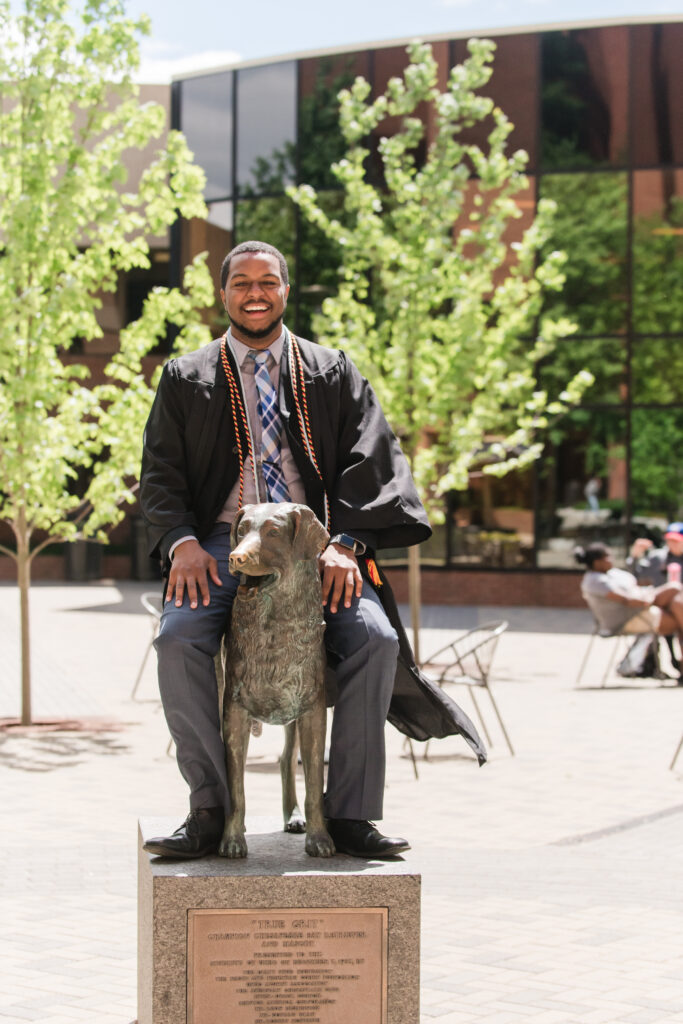 Corbett-Wilson celebrates his graduation with True Grit. Photo courtesy of Corbett-Wilson.
Q: Were you in the pep band as an undergraduate?
A: I was in it for two years and then was the student director for two years. I probably would have done it for my fifth year in college but as the SGA president, it felt like a little bit too much on my plate. I was still in the orchestra ensemble, so I got to have a performance outlet then, too.
Having school spirit means knowing what your university stands for, and doing your best to help create that in whatever way you choose to live by—professionally, academically, athletically, musically, etc.
Bentley Corbett-Wilson ’17, M.A. ’20, pep band director
Q: How did you come to be the current pep band director, and what’s the position like?
A: The pep band started in 1999, soI’m only its fifth director. When the band director knows it’s their time to leave, they put out an all-call for people who might be interested, or they reach out to someone musical and skilled.
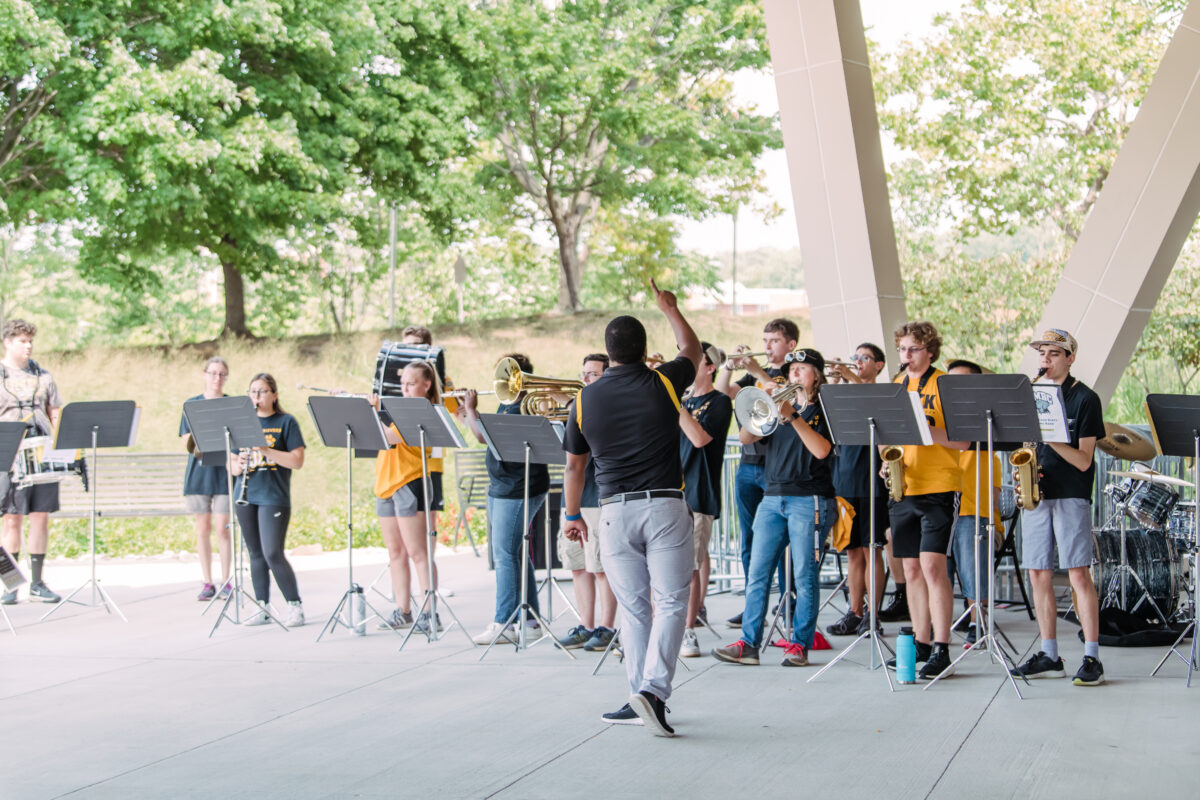 Corbett-Wilson directs the Down and Dirty Dawg Band at Convocation 2022. (Marlayna Demond ’11/UMBC)
We’re under the Athletic Department, but we have a lot of autonomy over our musical decisions. So you make awesome experiences for all students in the band, and fans in the stadium.
Q: What’s your favorite pep band memory?
A: Being able to travel with the basketball team as they make their tournaments is so fun. The energy is awesome. You get to know that you are supporting your university at a different college. We have 40 people able to go to tournaments, and even though we’re all different majors with different backgrounds, we make music.
See the Down and Dirty Dawg Band play from Corbett-Wilson’s perspective at the Chesapeake Employers Insurance Arena. Video courtesy of Corbett-Wilson.
Q: Were you in the band during the famous 2018 UMBC vs. Virginia basketball game?
A: I wasn’t part of the band at the time, but I happened to bring my trumpet to the game. I ran down to the band section and played at the very end while we were winning. It was the coolest thing ever.
Q: What does “school spirit” mean to you?
A: Having school spirit means knowing what your university stands for, and doing your best to help create that in whatever way you choose to live by—professionally, academically, athletically, musically, etc.
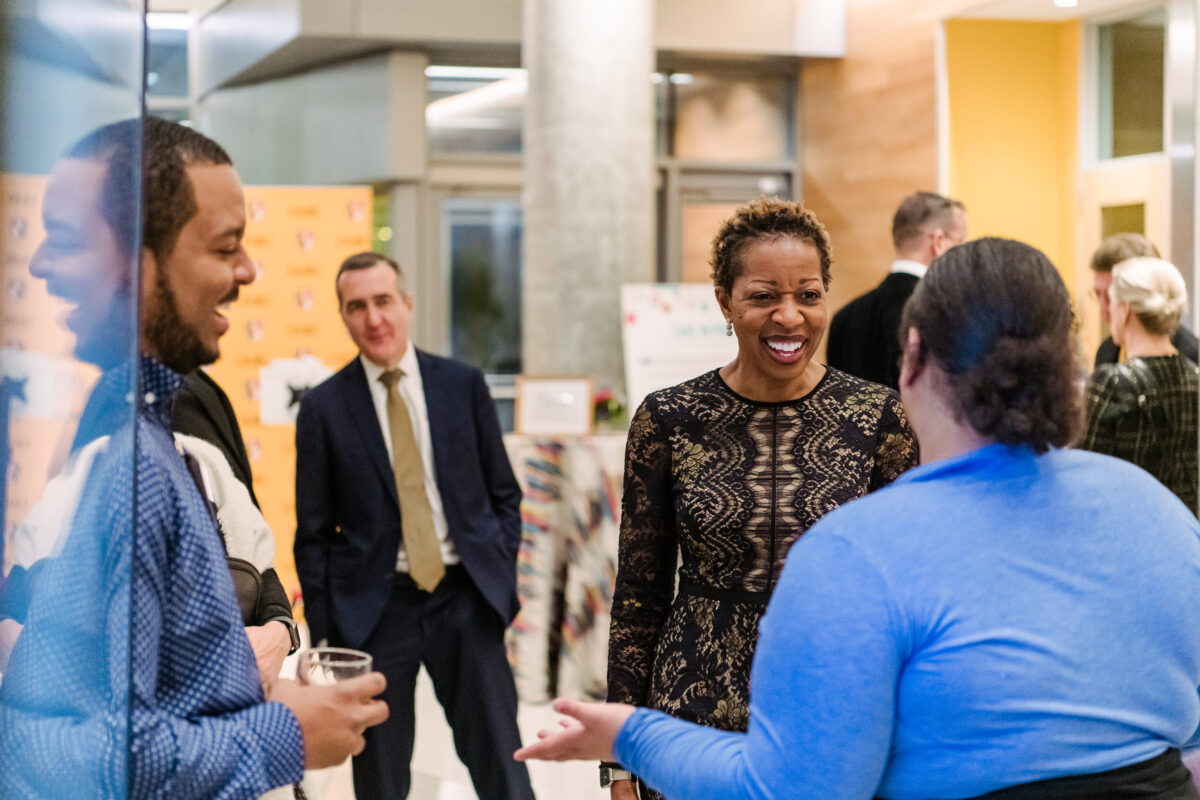 Corbett-Wilson, left, laughs with President Valerie Sheares Ashby and others at an on-campus event. (Marlayna Demond ’11/UMBC)
It’s also about showing your pride, whether that be going to events, donating, volunteering, or mentoring at UMBC. Do anything that you can to make the community better than you found it. Even just showing up is really great, because sometimes that’s all people need. UMBC does a really good job of stressing that idea of being there for others.
Q: How do you think the pep band showcases school spirit?
A: It is a really great place to practice being your best self. Not only is it one of the embodiments of school spirit, but music has so much to do with developing a person as a whole. I am proud to be the band director. Reach out if you want to join!
Visit Corbett-Wilson’s website to learn more about his work.
]]>
Bentley Corbett-Wilson ’17, music education, M.A. ’20, teaching, is UMBC’s director of athletic bands, leading the school pep ensemble, the Down and Dirty Dawg Band. He is a musician (trumpet is...
https://umbc.edu/stories/qa-bentley-corbett-wilson-trumpets-the-pep-band-and-school-spirit/
https://beta.my.umbc.edu/api/v0/pixel/news/134463/guest@my.umbc.edu/56cd7c8cc6f5be9603db6fce2c5ba6ed/api/pixel
alumni
cahss
campus-life
magazine
music
UMBC News & Magazine
https://beta.my.umbc.edu/groups/umbc-news-magazine
https://assets1-beta.my.umbc.edu/system/shared/avatars/groups/000/001/943/24435aa6207c452e7bc15cc74b42c7bb/xsmall.png?1748556657
https://assets1-beta.my.umbc.edu/system/shared/avatars/groups/000/001/943/24435aa6207c452e7bc15cc74b42c7bb/original.png?1748556657
https://assets2-beta.my.umbc.edu/system/shared/avatars/groups/000/001/943/24435aa6207c452e7bc15cc74b42c7bb/xxlarge.png?1748556657
https://assets2-beta.my.umbc.edu/system/shared/avatars/groups/000/001/943/24435aa6207c452e7bc15cc74b42c7bb/xlarge.png?1748556657
https://assets3-beta.my.umbc.edu/system/shared/avatars/groups/000/001/943/24435aa6207c452e7bc15cc74b42c7bb/large.png?1748556657
https://assets1-beta.my.umbc.edu/system/shared/avatars/groups/000/001/943/24435aa6207c452e7bc15cc74b42c7bb/medium.png?1748556657
https://assets2-beta.my.umbc.edu/system/shared/avatars/groups/000/001/943/24435aa6207c452e7bc15cc74b42c7bb/small.png?1748556657
https://assets1-beta.my.umbc.edu/system/shared/avatars/groups/000/001/943/24435aa6207c452e7bc15cc74b42c7bb/xsmall.png?1748556657
https://assets2-beta.my.umbc.edu/system/shared/avatars/groups/000/001/943/24435aa6207c452e7bc15cc74b42c7bb/xxsmall.png?1748556657
UMBC News & Magazine
1
0
false
Fri, 28 Jul 2023 16:47:59 -0400
Fri, 28 Jul 2023 16:47:59 -0400
From nurture to apocalypse (and back again) —The Mundane Afrofuturism of multimedia artist Safiyah Cheatam

Safiyah Cheatam, M.F.A. ’21, intermedia and digital arts, always has her hands in something.
In just the past few years, the multidisciplinary conceptual artist has exhibited work at The Peale and VisArts. She co-produced OBSIDIAN, a Rubys Grant-funded Afrofuturist podcast, with alum Adetola Abdulkadir ’17, and served as curatorial research assistant at the Smithsonian’s National Museum of African American History and Culture for the special exhibition Afrofuturism: A History of Black Futures. This summer, Cheatam is also serving as a juror for the Hamiltonian Artists Fellowship.
Cheatam devotes her days to providing programming for teen artists as the assistant manager of teen programs at the Walters Art Museum. Over the last decade, she’s led arts programming for young artists at a variety of institutions, including the Baltimore Museum of Art, Wide Angle Youth Media, the University of Maryland, College Park, and UMBC.
“My grandmother, almost everybody in my family, is an educator, so I’m in a long line of educators,” says Cheatam. “One of the things that I decided after undergrad was I wanted to do museum programming; I wanted to lead in a good alternative learning space like the museum.”
Cheatam notes that an attractive aspect of working as a museum educator is the level of engagement.
“I’ve been lucky to get kids who actually want to be there,” she says. “Nobody goes to a museum unless they want to, and so the students come and want to learn what I have planned for them. It’s a good feeling.”
 Artist Safiyah Cheatam runs a workshop with students through the Baltimore Museum of Art. Photo courtesy of Cheatam.
What Happens When We Nurture
Last year, Cheatam co-founded Islam & Print with her husband, Dan Flounders. A community print fellowship that champions diverse Muslim experiences housed at Maryland Art Place, Islam & Print celebrated its inaugural year with an exhibition at Black Artist Research Space.
This exhibition, What Happens When We Nurture, features the work of 2022 artist fellows Suldano Abdiruhman, Tayyab Maqsood, Anysa Saleh, and Leili Arai Tavallaei, and will be on view through July 30. Cheatam and Flounders designed the exhibit to center on the work each artist developed as part of the Islam & Print cohort as they learned the techniques and processes of printmaking.
“We want people who come to the show to know that Islamic art is not monolithic. You’re not going to see much geometric patterning or Arabic calligraphy; it’s not that kind of show,” says Cheatam. “We don’t even really like to say Islamic art—it’s just Muslims making work. The goal is that they have a community where they can critique with artists who come from a similar understanding.”
 Cheatam and Flounders put the finishing touches on their show. (Marlayna Demond ’11/UMBC)
When Islam & Print initially launched, Cheatam and Flounders received applications from across the country, but ultimately decided to focus on artists in the DMV region for the first year. The size of the show and existing exhibition calendars initially presented a hurdle for finding a venue for What Happens When We Nurture, Cheatam says. But when they began talking with Black Artist Research Space founder Rhea Beckett—faculty with MICA’s Curatorial MFA program—things clicked into place.
“I’m very grateful and excited that we’ve gotten to this place,” says Cheatam. “At first I wasn’t going to pitch it to them because only one person in our cohort is Black and I didn’t want to disrupt the integrity of the space, but Rhea was open to it. She clarified that her space is open to making cultural connections between different races and ethnicities, and she was very interested to talk about the long and important history of Muslims in Baltimore.”
Left: Visitors enjoy the opening reception of What Happens When We Nurture. Photo by Timothy Nohe. Right: Cheatam and her husband and co-curator Dan Flounders outside their exhibit. (Marlayna Demond ’11/UMBC)
The Rhetoric of Apocalypse
After the exhibition closes, Cheatam and Flounders will begin planning the next cohort for Islam & Print. And while they plan, Cheatam will spend August and September as a fellow at Baltimore’s Waller Gallery, where she will produce a new, large body of work—larger than her current studio space can hold—based in the history of American apocalyptic religious messaging.
“We’ve been going to my husband’s family’s house in Allentown, Pennsylvania, and driving a lot of country roads. You see these Christian propaganda billboards, like ‘Jesus now before you die.’ And you know, I found that the Nation of Islam has a similar kind of rhetoric,” Cheatam says.
It’s a body of work that is still in development, so Cheatam is coy about what the end product will look like.
“No spoilers, but for this series I’m going to explore the imagery and texts from the Nation of Islam,” Cheatam says. “I’m interested in the history of literacy within Black Muslims in America, how design and literature is to Muslims. Because almost a third of the enslaved Africans brought here were Muslim, so there’s a rich history of literacy with Black Muslims in America that I want to investigate.”
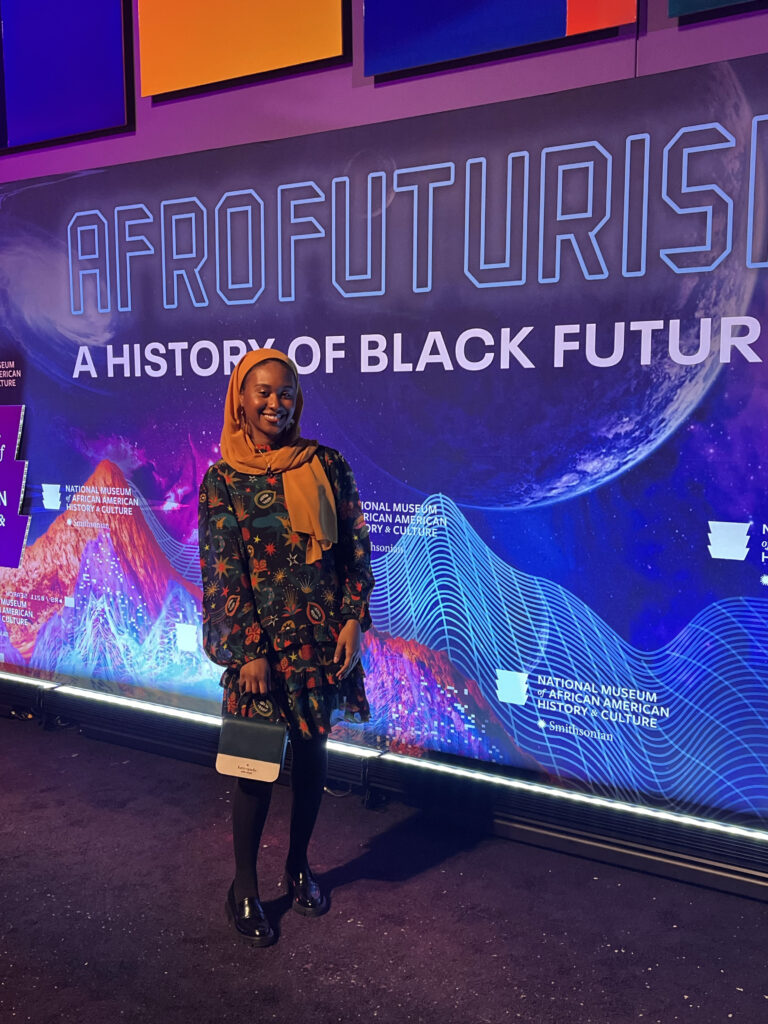 Cheatam at the opening reception of the Smithsonian’s National Museum of African American History and Culture exhibit Afrofuturism: A History of Black Futures, with which she assisted. Photo courtesy of Cheatam.
Cheatam began research for this new body of work delving into the archives of Muhammad Speaks, which was published between 1960 and 1975 as the official newspaper of the Nation of Islam.
“They’re very alarming in their speech sometimes, and I know they have a bad rap with a lot of people, but I really wanted to lean in and learn more about their messaging,” Cheatam says. “And one of the things I noticed about their newspapers is that their headlines are saying things that people, even non-Muslims, feel today.”
During her Waller Gallery fellowship, Cheatam will be making work investigating the underpinning of this messaging, filtering through the Mundane Afrofuturist lens that unites her work.
“I am a big sci-fi enthusiast, and I love disaster movies. I’m obsessed with apocalypses,” says Cheatam. “I like to see how people portray human nature in disaster times and look at how they answer questions like, do we help each other? Do we hurt each other? What does sustainability look like after the apocalypse? How are we taking care of each other?”
* * * * * * *
Learn more about Cheatam’s ongoing work.
Apply to UMBC’s Imaging and Digital Arts M.F.A. program.
]]>
Safiyah Cheatam, M.F.A. ’21, intermedia and digital arts, always has her hands in something. In just the past few years, the multidisciplinary conceptual artist has exhibited work at The...
https://umbc.edu/stories/afrofuturism-multimedia-artist-safiyah-cheatam/
https://beta.my.umbc.edu/api/v0/pixel/news/134430/guest@my.umbc.edu/367ffedd503fba70d337532823b86adf/api/pixel
alumni
cahss
graduateschool
imda
magazine
UMBC News & Magazine
https://beta.my.umbc.edu/groups/umbc-news-magazine
https://assets1-beta.my.umbc.edu/system/shared/avatars/groups/000/001/943/24435aa6207c452e7bc15cc74b42c7bb/xsmall.png?1748556657
https://assets1-beta.my.umbc.edu/system/shared/avatars/groups/000/001/943/24435aa6207c452e7bc15cc74b42c7bb/original.png?1748556657
https://assets2-beta.my.umbc.edu/system/shared/avatars/groups/000/001/943/24435aa6207c452e7bc15cc74b42c7bb/xxlarge.png?1748556657
https://assets2-beta.my.umbc.edu/system/shared/avatars/groups/000/001/943/24435aa6207c452e7bc15cc74b42c7bb/xlarge.png?1748556657
https://assets3-beta.my.umbc.edu/system/shared/avatars/groups/000/001/943/24435aa6207c452e7bc15cc74b42c7bb/large.png?1748556657
https://assets1-beta.my.umbc.edu/system/shared/avatars/groups/000/001/943/24435aa6207c452e7bc15cc74b42c7bb/medium.png?1748556657
https://assets2-beta.my.umbc.edu/system/shared/avatars/groups/000/001/943/24435aa6207c452e7bc15cc74b42c7bb/small.png?1748556657
https://assets1-beta.my.umbc.edu/system/shared/avatars/groups/000/001/943/24435aa6207c452e7bc15cc74b42c7bb/xsmall.png?1748556657
https://assets2-beta.my.umbc.edu/system/shared/avatars/groups/000/001/943/24435aa6207c452e7bc15cc74b42c7bb/xxsmall.png?1748556657
UMBC News & Magazine
0
0
false
Thu, 27 Jul 2023 10:09:44 -0400
Thu, 27 Jul 2023 10:09:44 -0400
UMBC’s Achuth Padmanabhan to pursue promising ovarian cancer research with $1.5 million in grants
No one wants to receive a cancer diagnosis. Ovarian cancer can be particularly scary, because its vague symptoms make it difficult to detect early—and when caught late, after the cancer has already metastasized into nearby organs, the five-year survival rate of ovarian cancer is less than 30 percent.
However, if caught early, that number rises sharply to 90 percent, explains Achuth Padmanabhan, assistant professor of biological sciences. Padmanabhan, who received his Ph.D. from UMBC in 2011 and returned as a faculty member in 2019, has made it the mission of his long-term research program to improve these daunting statistics.
Padmanabhan’s research group, which includes graduate, undergraduate, and high school students, is revealing new potential treatment options by expanding understanding of the basic biology of ovarian cancer. Overall, “our goal is to eliminate ovarian cancer mortality,” he says.
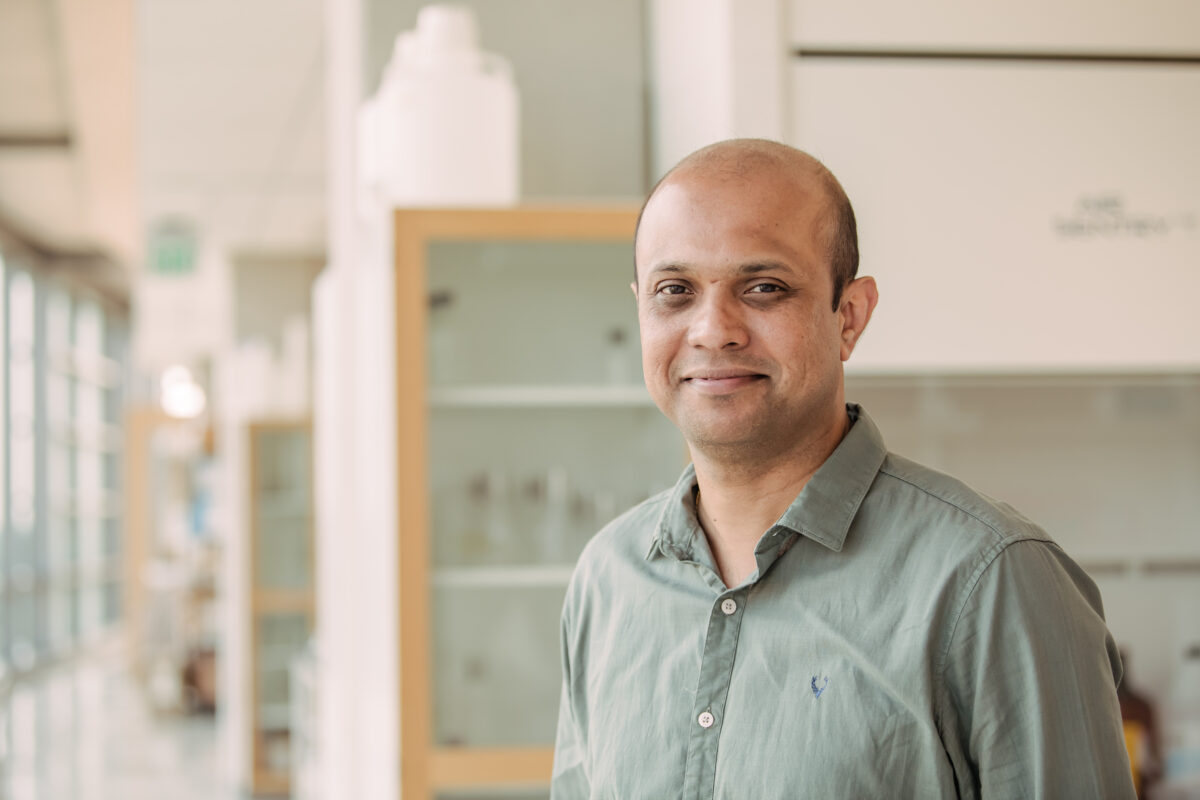 Achuth Padmanabhan in his laboratory. (Image by Marlayna Demond ’11/UMBC)
Starting this summer, Padmanabhan will be in an even stronger position to pursue that ambitious goal: He has received a two-year, $387,000 Ovarian Cancer Pilot Award and a four-year, $1.2 million Ovarian Cancer Academy Early-Career Award, both from the U.S. Department of Defense (DoD). In addition to funding, the Academy offers valuable opportunities for mentorship from leading ovarian cancer researchers, including Padmanabhan’s mentor le-Ming Shih, professor of gynecology and obstetrics at Johns Hopkins University. Workshops and training sessions with all Academy members also offer networking opportunities and exposure to the latest knowledge and techniques for fighting this life-threatening disease.
Opening doors to new treatment and diagnostic tools
Padmanabhan has already contributed to the understanding of how ovarian cancer progression is regulated, opening new avenues to developing treatments. His lab discovered that a protein called zinc finger protein 217, or ZNF217, is frequently present in unusually high amounts in ovarian cancer tumors and is associated with tumor growth, metastasis, and resistance to chemotherapy. “We believe it is central to driving metastasis,” Padmanabhan says.
Early data also suggest high levels of ZNF217 might cause changes in the chemical environment inside a tumor, which impacts how a patient responds to different therapeutics. “If we can reduce ZNF217 in tumor cells, there is the potential to extend the life of the patient and give other therapies a chance to work more effectively,” Padmanabhan explains.
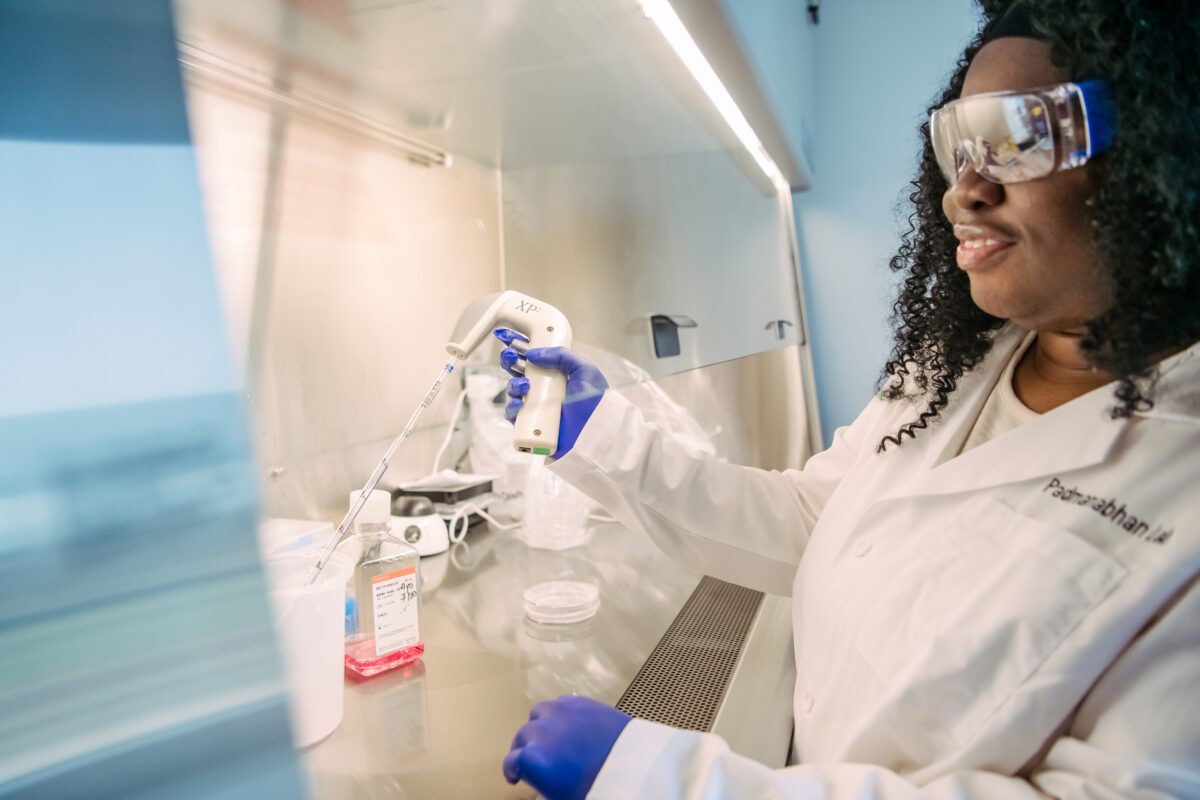 Ayo Ogunsanya, a Ph.D. student in Padmanabhan’s lab, works at a cell culture hood. (Image by Marlayna Demond ’11/UMBC)
With the new grant, Padmanabhan and his students will further explore the effects of ZNF217 on ovarian cancer progression, treatment resistance, and the environment inside tumors. If the lab can confirm its preliminary data about ZNF217’s significant role in ovarian cancer, they will then explore their hypotheses for how to reduce the amount of ZNF217 in cancer cells, thereby reducing its detrimental effects.
Overall, the work has the potential to significantly increase treatment options and improve outcomes for patients.
Exploring every angle
At the same time, the $387,000 Pilot Award will allow Padmanabhan’s team to test different combinations of existing cancer drugs in cell lines and in mice. Some of these drugs target a tumor suppressor protein called p53. In cancer cells, p53 is frequently mutated in such a way that it helps the tumor grow rather than suppressing it. In the most lethal version of ovarian cancer, p53 is mutated more than 96 percent of the time, Padmanabhan explains.
“We think the new drug combinations will more effectively target mutated p53, and because the drugs are already approved for use in cancer patients, effective new combinations could be translated to the clinic more quickly,” Padmanabhan says.
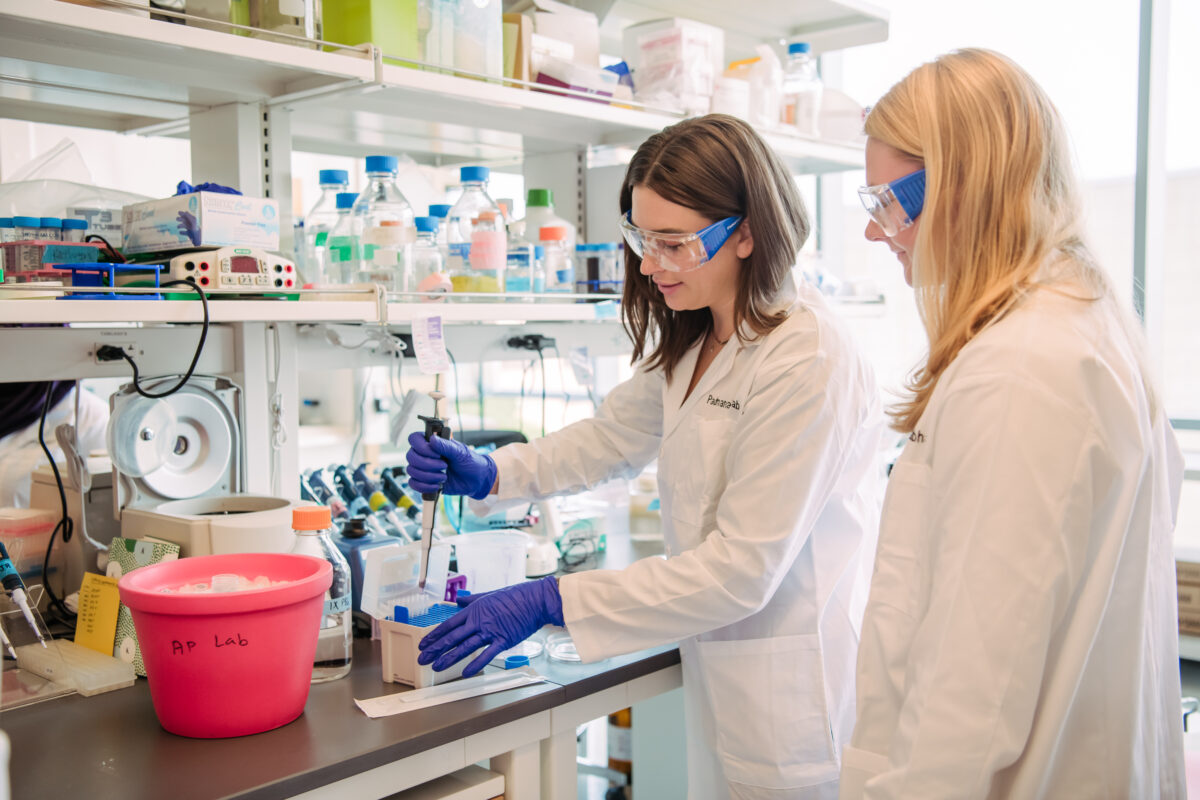 Kathryn Wardrup (left), a fourth-year Ph.D. student with Padmanabhan, was instrumental in collecting data that led to the group’s new Academy grant. Here she works with Jessica Hoffman ’26, biological sciences in the laboratory. (Image by Marlayna Demond ’11/UMBC)
The work for both new grants builds on support Padmanabhan previously received, which includes internal sources at UMBC. UMBC’s Alex Brown Center for Entrepreneurship CENTRE Funding Initiative, the UMBC Technology Catalyst Fund, and the Accelerated Translational Incubator Pilot (a joint grant program between University of Maryland, Baltimore and UMBC), as well as external funders like the Rivkin Foundation and Elsa U. Pardee Foundation, have supported Padmanabhan’s work. “All of this support got us to the DoD grant,” he says.
It takes a team
Padmanabhan is a strong believer in involving students in research, and his lab’s new projects will be no exception. The grant will allow him to hire another postdoctoral fellow, and there are currently several graduate and undergraduate students in the lab who will contribute their energy to this work. Dedicated high school students are also welcome. He gives every lab member an independent project, and several have made key contributions that got the lab to the place it is now.
Kathryn Wardrup, a fourth-year Ph.D. student in Padmanabhan’s lab, generated the bulk of the data that led to the Academy grant. Noel Amadu, M.S. ’20, applied molecular biology, and Megha Pandya, M.S. ’21, applied molecular biology, generated data that led to the DoD Pilot Award. Amadu is in the third-year of his Ph.D., and Pandya is in her first year—although she previously worked with Padmanabhan in the applied molecular biology program and then as a laboratory technician.
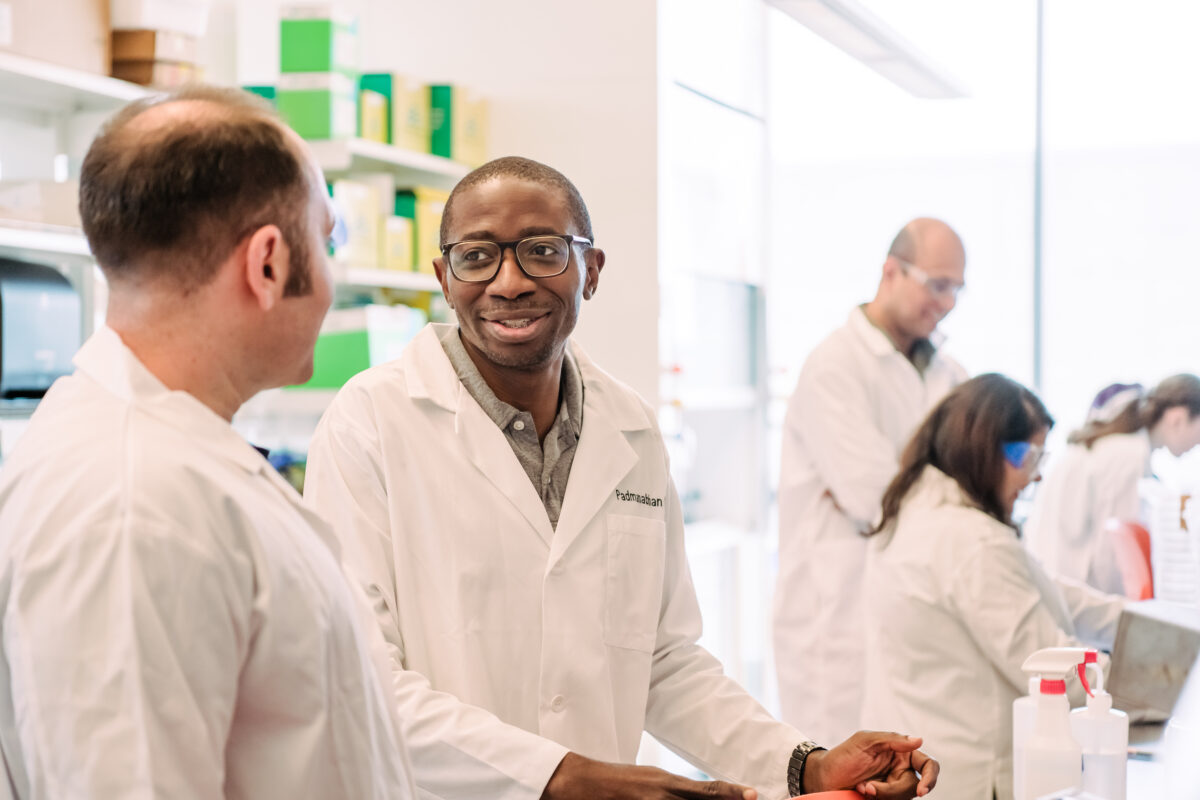 Work by Noel Amadu, center left, and Megha Pandya (right, blue goggles) conducted experiments that led to the Pilot Award. Here Amadu talks with research assistant Joseph Lobianco, and Pandya works at the bench with Padmanabhan. (Image by Marlayna Demond ’11/UMBC)
“It’s important for students to realize how challenging and rewarding research can be,” Padmanabhan says, “and it’s most rewarding when you have something you can call yours.”
Having a large team will help the group make progress on several scientific questions at once. “All of our previous work is coming together in these new grants,” Padmanabhan says. While it is still early days in their line of research, there is high potential for it to translate to clinical trials later on and have a major impact on the future of ovarian cancer treatment—which is Padmanabhan’s overarching goal.
“There’s a lot that needs to be understood at the basic science level that will hopefully allow us to translate it someday,” Padmanabhan says. “I guess that’s every person’s dream—you just want to help people.”
]]>
No one wants to receive a cancer diagnosis. Ovarian cancer can be particularly scary, because its vague symptoms make it difficult to detect early—and when caught late, after the cancer has...
https://umbc.edu/stories/promising-ovarian-cancer-research-grants/
https://beta.my.umbc.edu/api/v0/pixel/news/134422/guest@my.umbc.edu/a58d8a245b009c1e475481bc2ce5532e/api/pixel
biology
cnms
gradresearch
graduateschool
news
rca-1
research
science-and-tech
UMBC News & Magazine
https://beta.my.umbc.edu/groups/umbc-news-magazine
https://assets1-beta.my.umbc.edu/system/shared/avatars/groups/000/001/943/24435aa6207c452e7bc15cc74b42c7bb/xsmall.png?1748556657
https://assets1-beta.my.umbc.edu/system/shared/avatars/groups/000/001/943/24435aa6207c452e7bc15cc74b42c7bb/original.png?1748556657
https://assets2-beta.my.umbc.edu/system/shared/avatars/groups/000/001/943/24435aa6207c452e7bc15cc74b42c7bb/xxlarge.png?1748556657
https://assets2-beta.my.umbc.edu/system/shared/avatars/groups/000/001/943/24435aa6207c452e7bc15cc74b42c7bb/xlarge.png?1748556657
https://assets3-beta.my.umbc.edu/system/shared/avatars/groups/000/001/943/24435aa6207c452e7bc15cc74b42c7bb/large.png?1748556657
https://assets1-beta.my.umbc.edu/system/shared/avatars/groups/000/001/943/24435aa6207c452e7bc15cc74b42c7bb/medium.png?1748556657
https://assets2-beta.my.umbc.edu/system/shared/avatars/groups/000/001/943/24435aa6207c452e7bc15cc74b42c7bb/small.png?1748556657
https://assets1-beta.my.umbc.edu/system/shared/avatars/groups/000/001/943/24435aa6207c452e7bc15cc74b42c7bb/xsmall.png?1748556657
https://assets2-beta.my.umbc.edu/system/shared/avatars/groups/000/001/943/24435aa6207c452e7bc15cc74b42c7bb/xxsmall.png?1748556657
UMBC News & Magazine
3
0
false
Wed, 26 Jul 2023 17:54:17 -0400
Wed, 26 Jul 2023 17:54:17 -0400
UMBC alum leads successful pilot of method for monitoring biodiversity on farms
Research led by Adam Dixon, Ph.D. ’21, geography and environmental systems, describes the successful pilot of a novel method to study how well grassland birds are faring on croplands. The study, published in Ecological Applications, may serve as a model for monitoring wildlife on working lands more generally, which can also include cattle ranches and logged forests. It’s an example of the kind of work that’s needed to help humanity move toward a more sustainable coexistence between agriculture and biodiversity.
Farmers lead a challenging existence, frequently operating on extremely thin financial margins and relying on fickle weather, Dixon says, which incentivizes them to simplify and control the landscape as much as possible. Unfortunately, that can lead to environmental harm. Grassland species are in particular peril given their habitat is converted to farmland at an alarming rate. Through his work, Dixon wants to help find a middle way that supports both farmers and the environment.
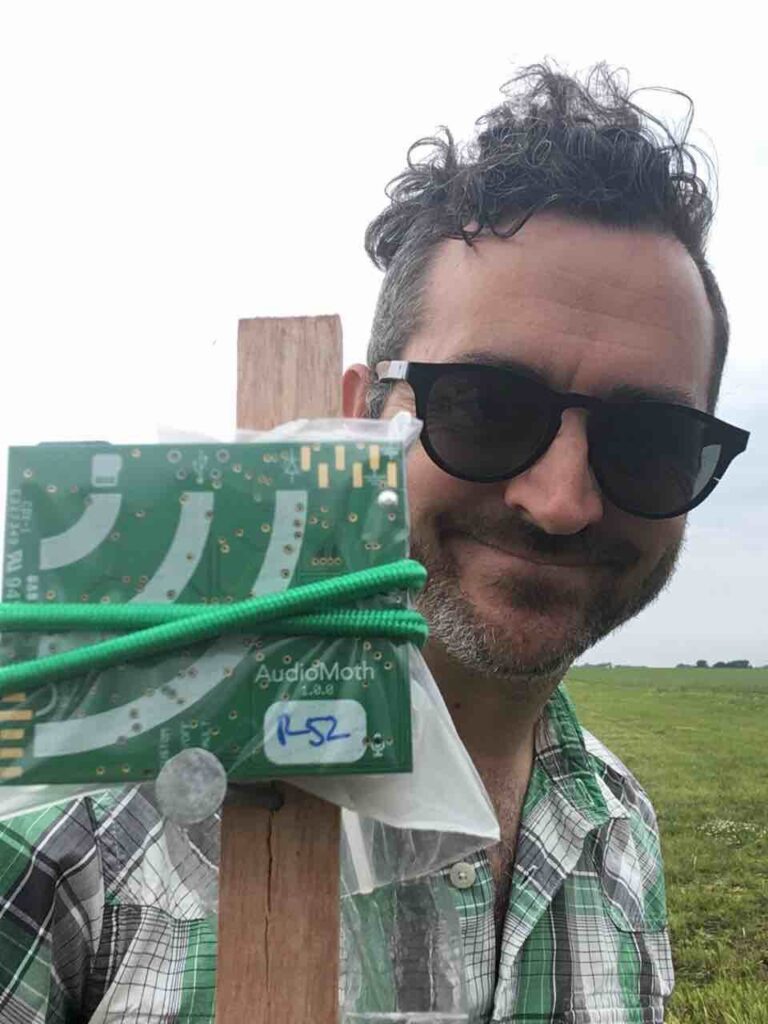 Adam Dixon poses with a bioacoustic recorder at one of the study sites. (Image courtesy of Dixon)
More, better habitat needed
The new study combined satellite imagery data and recordings from simple audio recorders to look at how grassland birds were using 44 pockets of vegetation in the gaps between crop rows and at the edges of fields on lands under intensive cultivation in Iowa. Both methods were low-cost and required very few visits to the lands under study, demonstrating the scalability of this approach to monitoring biodiversity.
The researchers analyzed the satellite imagery data to determine the pockets’ area and “texture,” referring to the variety in plant species, height, and density in the habitat. The bioacoustic recorders—essentially circuit boards with a battery and mini cell phone microphone attached, all sealed in a plastic bag—helped the team identify which bird species were using the habitat.
“Using novel methods, we found that agricultural habitats are good for birds in general, but when you look at grassland birds specifically, either there’s not enough habitat or the habitat characteristics aren’t good,” says Dixon, who studies working lands biodiversity in the northern U.S. plains for the World Wildlife Fund.
The study’s relatively small sample size limited the strength of the findings. Still, the study showed that their unique method combining satellite imagery and bioacoustic data can help researchers effectively measure habitat quality and bird biodiversity. The authors hope their work encourages future studies incorporating more study sites to strengthen the statistical power of the results.
Beyond protected areas
Erle Ellis, professor of geography and environmental systems, is senior author on the paper and served as Dixon’s Ph.D. advisor. Dixon says he knew working with Ellis would be the right fit after their first meeting.
“I saw a lot of research emphasis on protected areas,” Dixon says, whereas he wanted to focus on the intersection of intensive agriculture and ecology. Dixon grew up surrounded by large wheat farms in the Midwest and observed their effects on the environment, which informed his career goals. His formative experiences, he says, led to an understanding that protected areas alone are not enough to solve the biodiversity, food, and health challenges the U.S. and the world are facing.
“That’s why I came to work with Erle,” Dixon says. “His whole thing is, ‘Why are you trying to separate people from nature?’” Ellis’s work has focused for decades on the longstanding relationships between humans and landscapes across the planet.
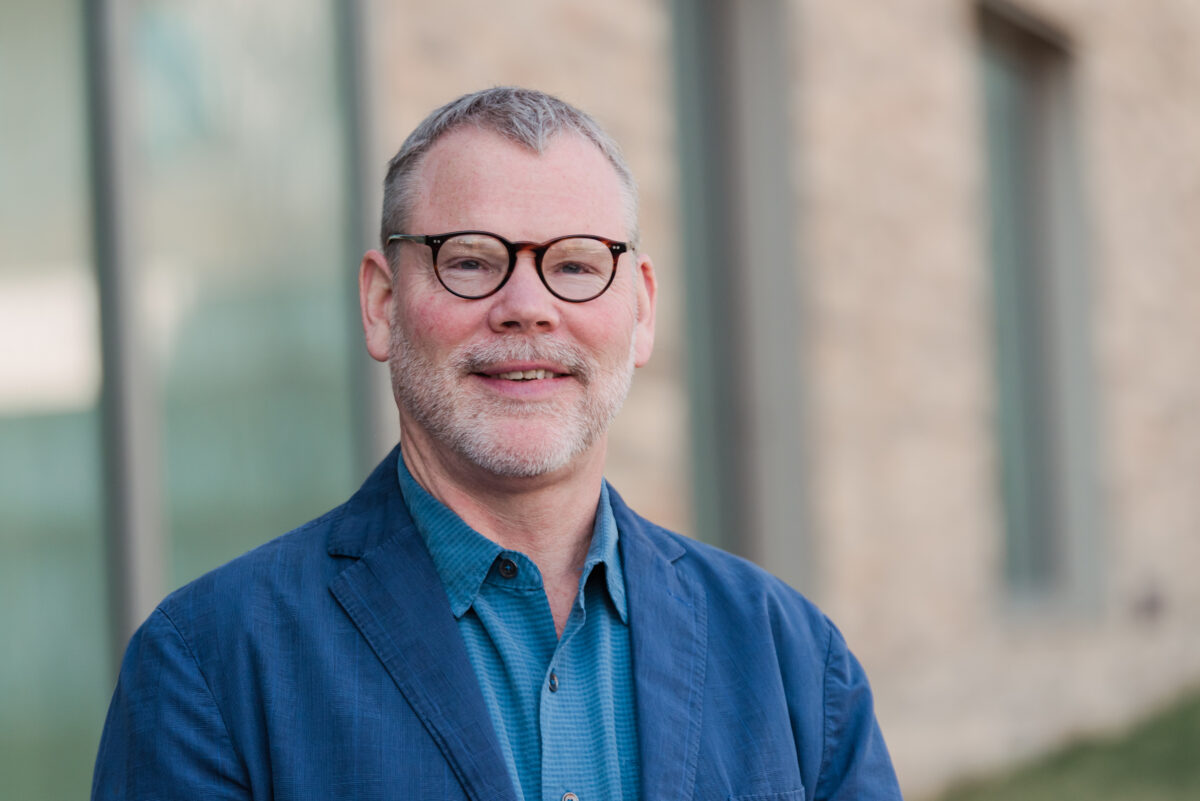 Erle Ellis. (Image by Marlayna Demond ’11/UMBC)
“Agriculture covers more of this planet than protected areas do, and Adam’s research on bird habitats in Iowa farmlands confirms that even some of the most intensively managed agricultural landscapes on Earth can sustain significant biodiversity,” Ellis shares. “More research like Adam’s is needed to conserve, restore, and monitor biodiversity in the working landscapes needed to sustain both people and wildlife across more than three quarters of Earth’s land.”
Community collaboration
The new study is also an example of another aspect of the human elements of research, since it took place on privately held farmland. Dixon worked with landowners to get permission to conduct research on their property, and in some cases farmers placed the recorders themselves.
“It’s difficult but not impossible to work on private lands,” Dixon says. “You just need to build trust and relationships.” In the future, Dixon would like to deepen his collaboration with farmers. Gathering more information about their management practices would open up additional research questions. Plus, learning about any barriers farmers face to participating in research could make it more likely that other projects requiring farmer buy-in would get off the ground.
Other collaborators brought their own strengths to the paper: Matthew Baker, professor of geography and environmental systems and a co-author, added his expertise to the project, including his familiarity with using remote sensing methods for major mapping projects and combining on-the-ground measurements with satellite imagery to answer complex environmental questions. Baker’s previous research has included using such combinations to study urban tree canopy, streams in the Chesapeake Bay watershed, and the effects of a major dam removal.
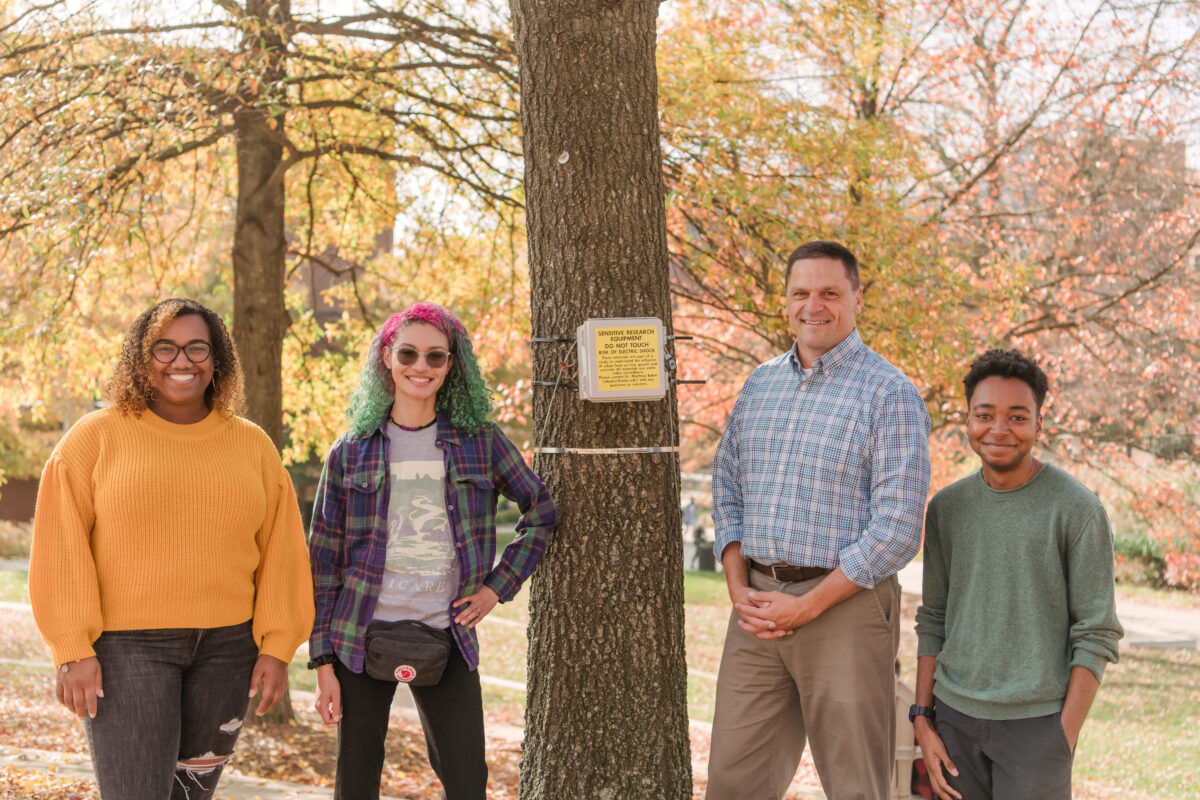 Matthew Baker and UMBC master’s students in geography and environmental systems stand next to one of the trees on UMBC’s main campus included in the urban canopy research project. Left to right: Tyrah Cobb-Davis, Erin Hamner, Matthew Baker, Drew Powell. (Image by Marlayna Demond ’11/UMBC)
“What was impressive about Adam’s investigation was his willingness to employ novel technology and ideas to overcome what has historically been an absolute challenge in surveying working landscapes,” Baker says. “His example has really shown the potential and the need for additional study.”
Supporting farmers and the environment
Questions remain as Dixon and others seek to support biodiversity on working lands.
“How do we move from the necessity for farmers to simplify the system to something that’s more balanced and takes into account the entire environment? To something that understands the unique ecology of a place and integrates that into management, and allows the farmer to prosper across generations? How can we find a better solution besides just hoping that we’re going to protect these small patches?” Dixon asks.
Those questions are why Dixon has pursued research into biodiversity on working lands, he says. While the new paper may be a small step to better understanding how wildlife is and is not flourishing on working lands, it is a step in the right direction and opens the door for future projects.
“We need to integrate conservation solutions into our most intensive places,” Dixon says. “So this research identifies that as an area of valid research and also shows how that research might be done.”
]]>
Research led by Adam Dixon, Ph.D. ’21, geography and environmental systems, describes the successful pilot of a novel method to study how well grassland birds are faring on croplands. The study,...
https://umbc.edu/stories/monitoring-biodiversity-on-working-lands/
https://beta.my.umbc.edu/api/v0/pixel/news/134413/guest@my.umbc.edu/344bded2aa9af00605d87bbbd2682316/api/pixel
alumni
cahss
ges
gradresearch
news
research
science-and-tech
UMBC News & Magazine
https://beta.my.umbc.edu/groups/umbc-news-magazine
https://assets1-beta.my.umbc.edu/system/shared/avatars/groups/000/001/943/24435aa6207c452e7bc15cc74b42c7bb/xsmall.png?1748556657
https://assets1-beta.my.umbc.edu/system/shared/avatars/groups/000/001/943/24435aa6207c452e7bc15cc74b42c7bb/original.png?1748556657
https://assets2-beta.my.umbc.edu/system/shared/avatars/groups/000/001/943/24435aa6207c452e7bc15cc74b42c7bb/xxlarge.png?1748556657
https://assets2-beta.my.umbc.edu/system/shared/avatars/groups/000/001/943/24435aa6207c452e7bc15cc74b42c7bb/xlarge.png?1748556657
https://assets3-beta.my.umbc.edu/system/shared/avatars/groups/000/001/943/24435aa6207c452e7bc15cc74b42c7bb/large.png?1748556657
https://assets1-beta.my.umbc.edu/system/shared/avatars/groups/000/001/943/24435aa6207c452e7bc15cc74b42c7bb/medium.png?1748556657
https://assets2-beta.my.umbc.edu/system/shared/avatars/groups/000/001/943/24435aa6207c452e7bc15cc74b42c7bb/small.png?1748556657
https://assets1-beta.my.umbc.edu/system/shared/avatars/groups/000/001/943/24435aa6207c452e7bc15cc74b42c7bb/xsmall.png?1748556657
https://assets2-beta.my.umbc.edu/system/shared/avatars/groups/000/001/943/24435aa6207c452e7bc15cc74b42c7bb/xxsmall.png?1748556657
UMBC News & Magazine
1
0
false
Wed, 26 Jul 2023 09:20:14 -0400
Wed, 26 Jul 2023 09:20:14 -0400
Meet a Retriever – Ken Baron, advising champion
Meet Ken Baron, Assistant Vice Provost for Academic Advising and Student Success in the Office of Academic and Pre-Professional Advising at UMBC. As a first-generation student himself, Ken truly appreciates the importance of student support at every level, and finds joy in bringing that philosophy to his work every day through advising at UMBC. Take it away, Ken!
Q: What is your favorite part of your job?
A: Meeting with students and parents. Even though much of my work includes administrative duties, I am still very much involved with direct daily contact with undergraduate students, their families, and supporters. I manage a caseload of exploratory students every semester and field student referrals from faculty, fellow administrators, and staff throughout the university. Continuing to work directly with students enables me to remain current and knowledgeable about how students experience their academic opportunities here at UMBC and navigate their academic planning through our technologies and policies. As a first-generation transfer student, I can relate very closely to the kinds of concerns, questions, and expectations our students have concerning academic advising. The opportunity to connect with a student through active listening and loads of genuine empathy helps foster meaningful, uplifting, inspiring relationships from orientation all the way through to post-graduate opportunities!
Q: What are the best pieces of advising advice you most often give to students just starting out at UMBC?
A: Number one, it’s really important to take a moment to review ALL the majors, minors, and certificates we offer here at UMBC. Even if you think you know what you want to do, you might be surprised by many of the unique programs we offer, like Management of Aging Services (so strategic for anyone interested in any health professions career) or our minors in Entrepreneurship, Computing, or Management that can help boost the marketability of any major.
Next, I suggest that every new student (first-year or transfer) meet with professional staff in our Career Center, Shriver Center, Education Abroad Office, and Office for Undergraduate Research and Prestigious Scholarships. These campus centers and offices offer students resources, opportunities, and guidance on exploring their career ideas, engaging in community service, securing internships and part-time jobs, conducting research, and pursuing educational opportunities abroad.
And finally, the sooner students connect with the passionate staff who work in these offices and centers, the more excited they will become about their upcoming experience here at UMBC. And they will become more confident in their academic planning process – knowing that whatever their major, they can find creative ways to apply what they learned in real-world capacities. Ultimately, employers hire, and graduate schools and professional schools accept dynamic candidates who have built “overall” educational and experiential learning portfolios that illustrate how they can add diversity and value to their organizations and institutions. New students should be aware of this notion early in their academic journey so that they pursue majors they love and become marketable and competitive over time.
For me, UMBC has provided more than just a job; it has offered a rewarding and intellectually stimulating way of life.
Ken Baron
Q: Tell us about your primary “why,” and how it led you to UMBC.
A: I came to UMBC because it allowed me to use all the skills and knowledge I have accrued throughout my career. During the interview, I was “sizing up” all the advising needs and constituencies I could serve if I took an advising leadership position here. I am delighted to share that I have found ample opportunities to work with students interested in pursuing the health professions and law (an area of expertise fostered in my years at Emory University and the University of Tennessee, Knoxville), and I love that I get to work with student-athletes, international students, students interested in study abroad, and students pursuing prestigious scholarships. I also use my professional counseling certifications in counseling and career counseling daily with students, staff, and other colleagues on campus. I genuinely feel a sense of “career actualization” after 17 years here that I am not sure I would have found elsewhere.
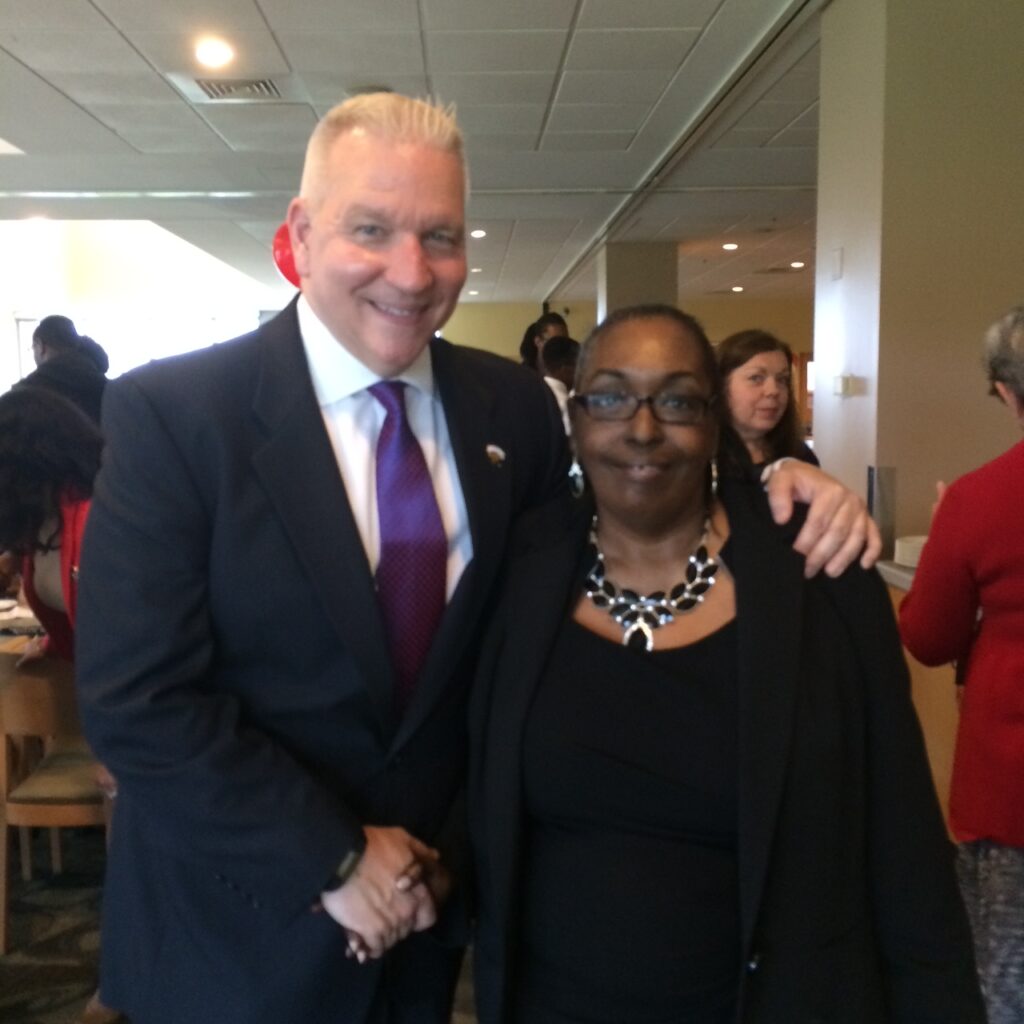 Ken Baron and Paula Ashby at Ashby’s retirement party on campus. Photo courtesy of Baron.
Q: Tell us about someone in our community who inspired or supported you, and how they did it.
A: During my two-day interview here at UMBC in 2006, I met Paula Ashby ’76 and was immediately struck by her authenticity, kindness, and fiery passion for health professions advising. As a former director of health professions advising at Emory University, I instantly connected with Paula over the common travails and triumphs of advising pre-med students. During my interview, she asked informed and probing questions about my experience with health professions advising, which impressed me greatly as a candidate. Knowing that Paula would be on my staff significantly influenced my decision to accept a great offer from UMBC to become the director of academic advising at that time.
For the next decade, it was an honor and a delight to work alongside Paula in a variety of meaningful and memorable capacities, including summer and winter orientation leadership, helping exploratory students find their academic paths, and of course, a tremendous focus and dedication toward students in the health professions – especially those interested in allied health. Paula’s retirement celebration in 2016 filled every inch of the Skylight Room with adoring fans – including [former UMBC president Freeman] Hrabowski, with whom she worked during her time as a graduate and professional school coordinator for the Meyerhoff Scholars Program earlier in her career. Students and colleagues alike were drawn to Paula based on her genuine, caring nature. She loved helping people – every hour, every day, every week, every month, every year. Sadly, Paula passed in 2017, yet for 36 years, she brandished that love of helping people – which became her legacy and hallmark as an academic advising pioneer at UMBC. Paula still inspires me, and our office is honored to help steward and administer the Paula O. Ashby Scholarship, along with her family and the Office for Institutional Advancement.
Q: Are you involved in any organizations that you particularly enjoy?
A: I have recently loved my UMBC/University Innovation Alliance (UIA) team member role. UMBC’s partnership with UIA has been inspiring and invigorating. Working closely with my UMBC team members and forward-thinking colleagues from outstanding institutions across the country provides a dynamic forum for sharing best practices and common challenges that many institutions face in terms of improving graduation rates, retention, time to degree, and increasing the number and diversity of college graduates, particularly low-income students, first-generation students, and students of color in the United States.
I am also grateful for the opportunity I have been offered for the last decade to serve as a Meyerhoff Coach during their Summer Bridge Program. I meet with cohort representatives early in their initial onboarding to work on their collective “vision statement.” This highly interactive exercise is always enlightening and rewarding regarding the rich discussions, creative ideas, and exploration of values our work together reveals. I always leave these sessions with a renewed sense of possibilities for the future which these incredible students are already starting to act upon so early in their academic journeys here at UMBC. I love challenging them to think about the skills and aptitudes they will need to foster as future leaders (perhaps in STEM fields and research areas that haven’t yet been discovered).
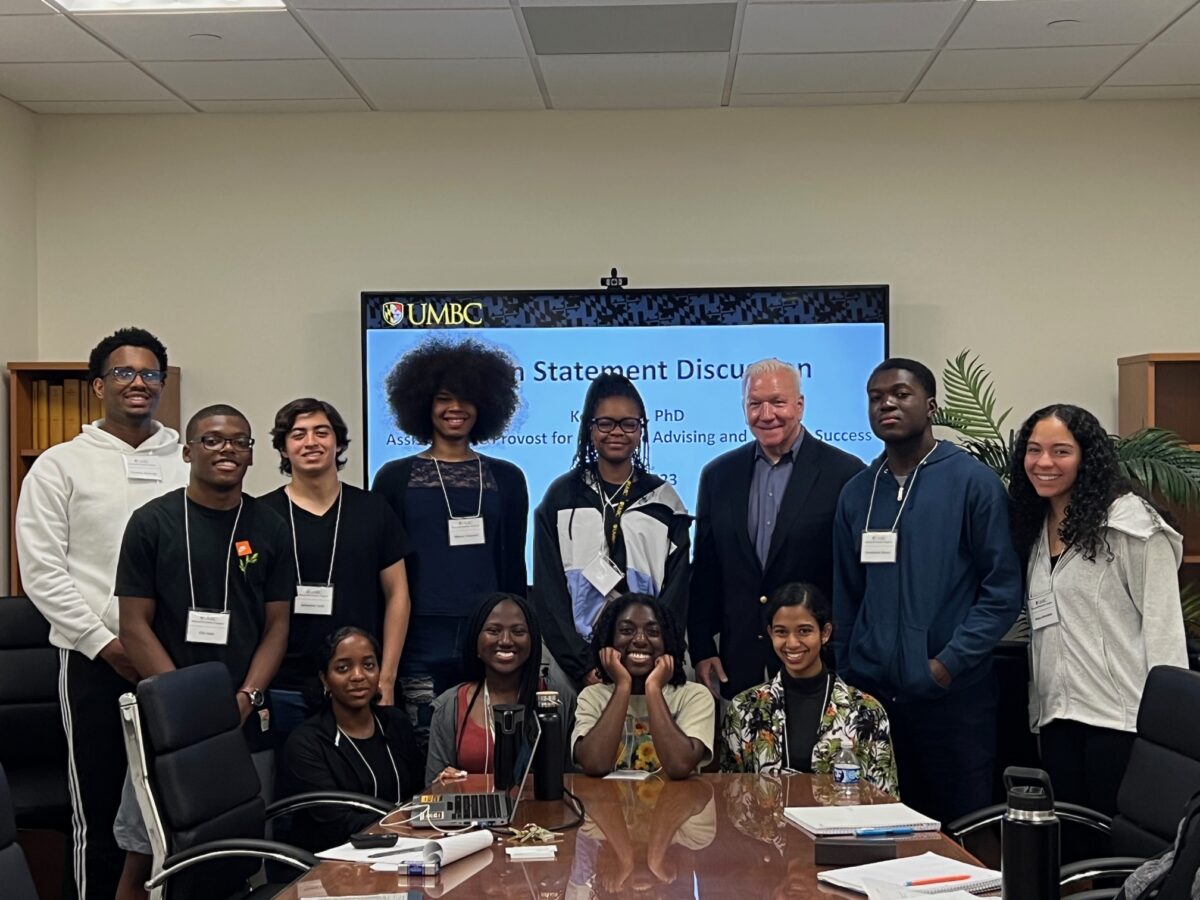 Baron, back row, shares a moment with new Meyerhoff Scholars during the 2023 Summer Bridge program. Photo courtesy of Baron.
Q: What would you tell someone who is considering a career at UMBC?
A: Please come and be ready to enjoy a career and a community of caring, diverse students and colleagues that will captivate your imagination and heart. Prepare to work hard, listen, engage, participate, and enjoy all we offer. For me, UMBC has provided more than just a job; it has offered a rewarding and intellectually stimulating way of life. I love attending our athletic events (about to purchase season tickets for Women’s Volleyball), theatre, music concerts, lectures, and other varied campus events. I am proud to have my family and friends join me for those, and I am so pleased that my partner, Ann Kellogg, Ph.D. ’20, public policy, decided to further her education here. She now teaches graduate students in the Public Policy program and involves herself in the campus community in ways we could not have imagined when we moved here from Chicago in 2006.
* * * * *
UMBC’s greatest strength is its people. When people meet Retrievers and hear about the passion they bring, the relationships they create, the ways they support each other, and the commitment they have to inclusive excellence, they truly get a sense of our community. That’s what “Meet a Retriever” is all about.
Learn more about how UMBC can help you achieve your goals.
]]>
Meet Ken Baron, Assistant Vice Provost for Academic Advising and Student Success in the Office of Academic and Pre-Professional Advising at UMBC. As a first-generation student himself, Ken truly...
https://umbc.edu/stories/meet-a-retriever-ken-baron-advising-champion/
https://beta.my.umbc.edu/api/v0/pixel/news/134446/guest@my.umbc.edu/5653dba1ee2cdb4a94b785e2af09ebd4/api/pixel
magazine
meet-a-retriever
perspectives
student-success
UMBC News & Magazine
https://beta.my.umbc.edu/groups/umbc-news-magazine
https://assets1-beta.my.umbc.edu/system/shared/avatars/groups/000/001/943/24435aa6207c452e7bc15cc74b42c7bb/xsmall.png?1748556657
https://assets1-beta.my.umbc.edu/system/shared/avatars/groups/000/001/943/24435aa6207c452e7bc15cc74b42c7bb/original.png?1748556657
https://assets2-beta.my.umbc.edu/system/shared/avatars/groups/000/001/943/24435aa6207c452e7bc15cc74b42c7bb/xxlarge.png?1748556657
https://assets2-beta.my.umbc.edu/system/shared/avatars/groups/000/001/943/24435aa6207c452e7bc15cc74b42c7bb/xlarge.png?1748556657
https://assets3-beta.my.umbc.edu/system/shared/avatars/groups/000/001/943/24435aa6207c452e7bc15cc74b42c7bb/large.png?1748556657
https://assets1-beta.my.umbc.edu/system/shared/avatars/groups/000/001/943/24435aa6207c452e7bc15cc74b42c7bb/medium.png?1748556657
https://assets2-beta.my.umbc.edu/system/shared/avatars/groups/000/001/943/24435aa6207c452e7bc15cc74b42c7bb/small.png?1748556657
https://assets1-beta.my.umbc.edu/system/shared/avatars/groups/000/001/943/24435aa6207c452e7bc15cc74b42c7bb/xsmall.png?1748556657
https://assets2-beta.my.umbc.edu/system/shared/avatars/groups/000/001/943/24435aa6207c452e7bc15cc74b42c7bb/xxsmall.png?1748556657
UMBC News & Magazine
0
0
false
Tue, 25 Jul 2023 17:24:01 -0400
Tue, 25 Jul 2023 17:24:01 -0400
UMBC’s 2023-2024 Fulbright Student Program recipients announced
This year, the U.S. Fulbright Student Program, the U.S. government’s flagship international exchange program, has awarded nine UMBC students and alumni top research and teaching placements in countries such as Japan, Taiwan, and North Macedonia.
Each year, more than 10,000 students apply with just over 2,000 selected from hundreds of colleges and universities across the U.S. In the last decade, UMBC students and alumni have received more than 85 Fulbright U.S. Student Program awards for research and teaching placements in Africa, Asia and the Pacific, the Middle East, South America, and Europe. UMBC was named a Fulbright Top Producing Institution in 2019 – 2020.
This year’s class includes research award recipient Paul Ocone ’22, individualized study, who will be conducting research at Meiji University School of Global Japanese Studies in Japan. Fulbright research awards provide funding for research and training efforts overseas with a focus on non-Western foreign languages and area studies. Additionally, there are eight UMBC recipients of the English Teaching Assistant (ETA) award. ETA’s develop their own language skills and knowledge of their host country while working with student in elementary through college to strengthen their English-language abilities and knowledge of the U.S.
Three alumni will be headed to Taiwan to further their passion for global languages and communities: Nailah-Benā Chambers ’23, global studies, Kara Gavin ’20, English, and Milan Richardson ’23, bioinformatics.
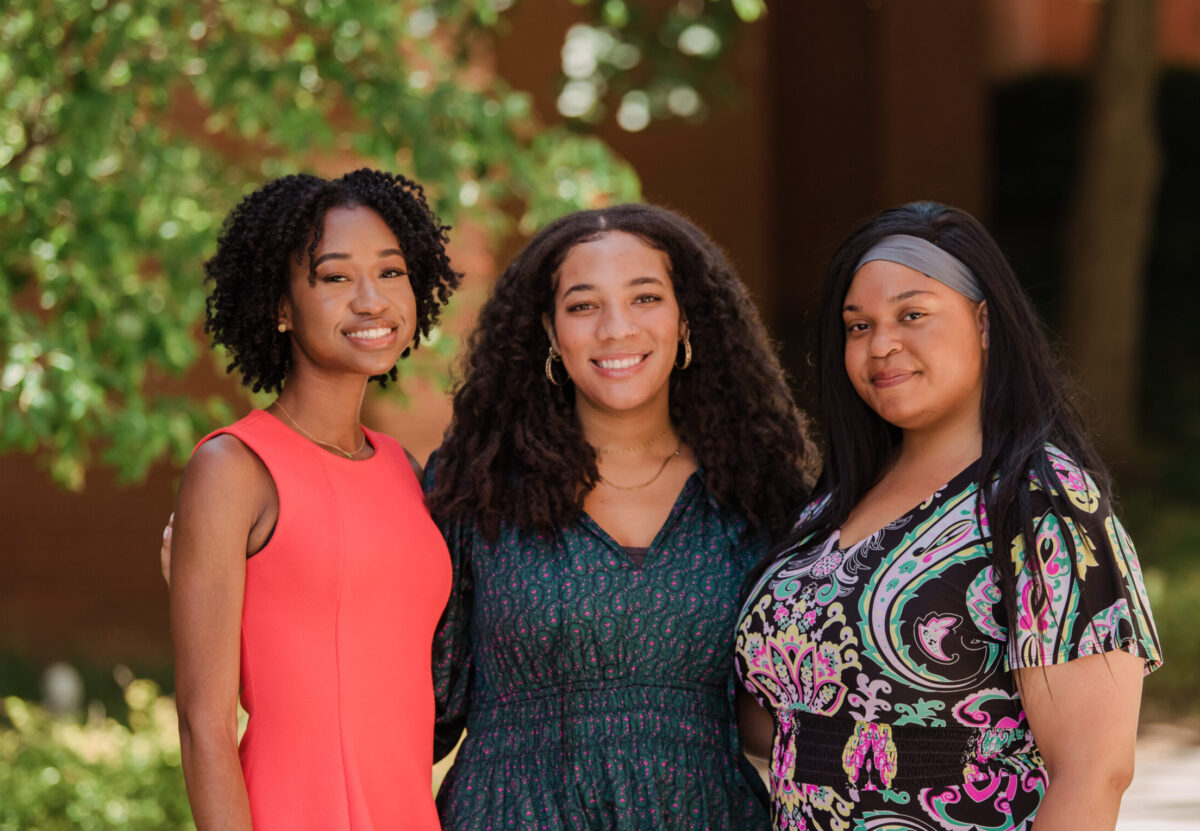 Kara Gavin, Nailah-Benā Chambers, and Milan Richardson. (Marlayna Demond ’11/UMBC)
Gavin brings experience as a Teaching of English as a Second Language (TESOL) volunteer which she completed during her study abroad program at the University of Brighton in the U.K. Chambers began learning how to move between different languages early in life as a student in a Chinese-language skills course. She later became a tutor, a skill she continued at UMBC’s English Language Institute (ELI). Teaching Baltimore Public City School’s diverse student population inspired Richardson to apply to the Fulbright program where she will continue working with students from all backgrounds.
David Bullman ’22, ancient studies, served in the U.S. Army as a musician and public diplomat. He will be returning to North Macedonia, one of the countries he previously served in.
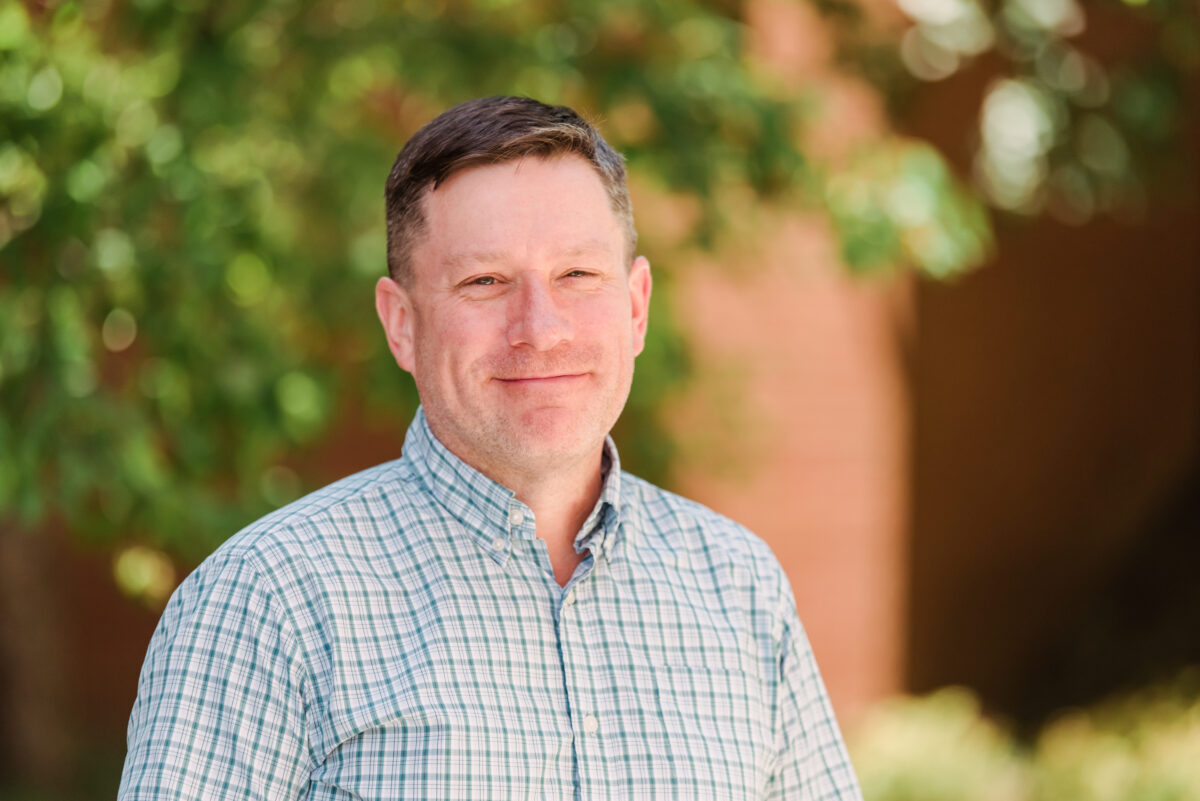 David Bullman. (Marlayna Demond ’11/UMBC)
In addition to teaching English, Leah Michaels, M.F.A ’21, intermedia and digital arts, will be conducting research for two films and teaching film workshops for the community in Piła, Poland.
 Leah Michaels in Cape May shooting the horseshoe crab mating period for a film she’s working on. (Image courtesy of Leah Michaels)
Tiffany Powell ’23, TESOL, spent three years teaching English in Seoul, Korea and will continue teaching in Romania after she graduates in December.
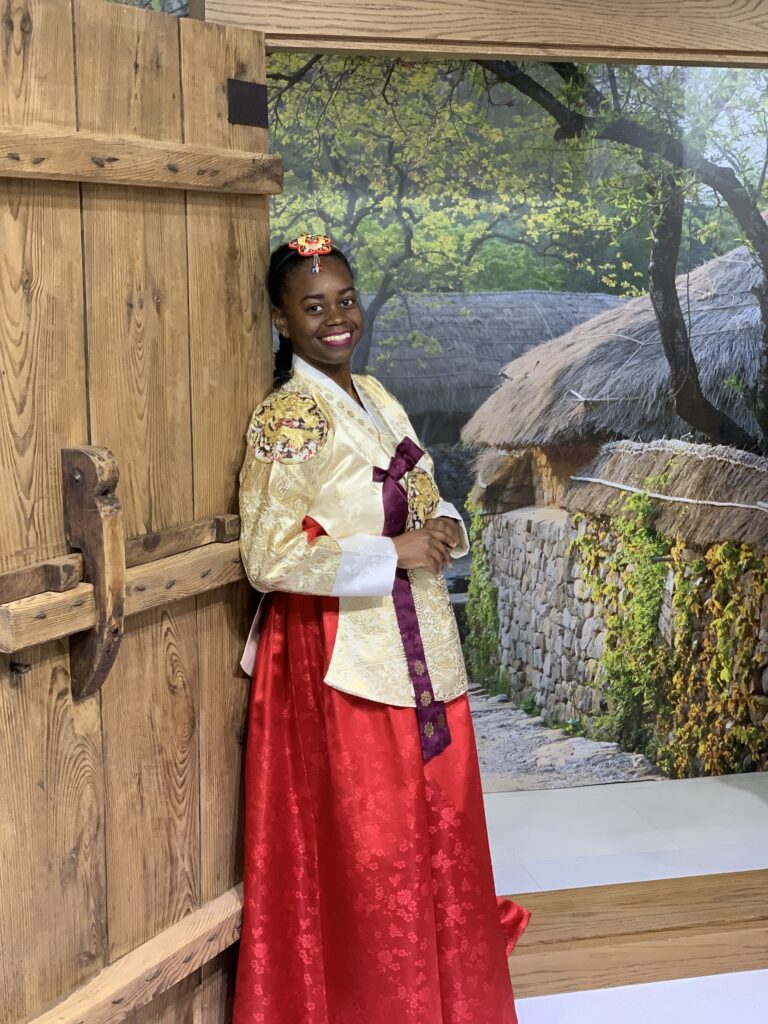 Tiffany Powell in Seoul wearing a hanbok, South Korean traditional clothing. (Image courtesy of Tiffany Powell)
Sianna Serio ’23, computer science, who studied abroad in France, Spain, and the U.K., will head to the Slovak Republic to teach high school students.
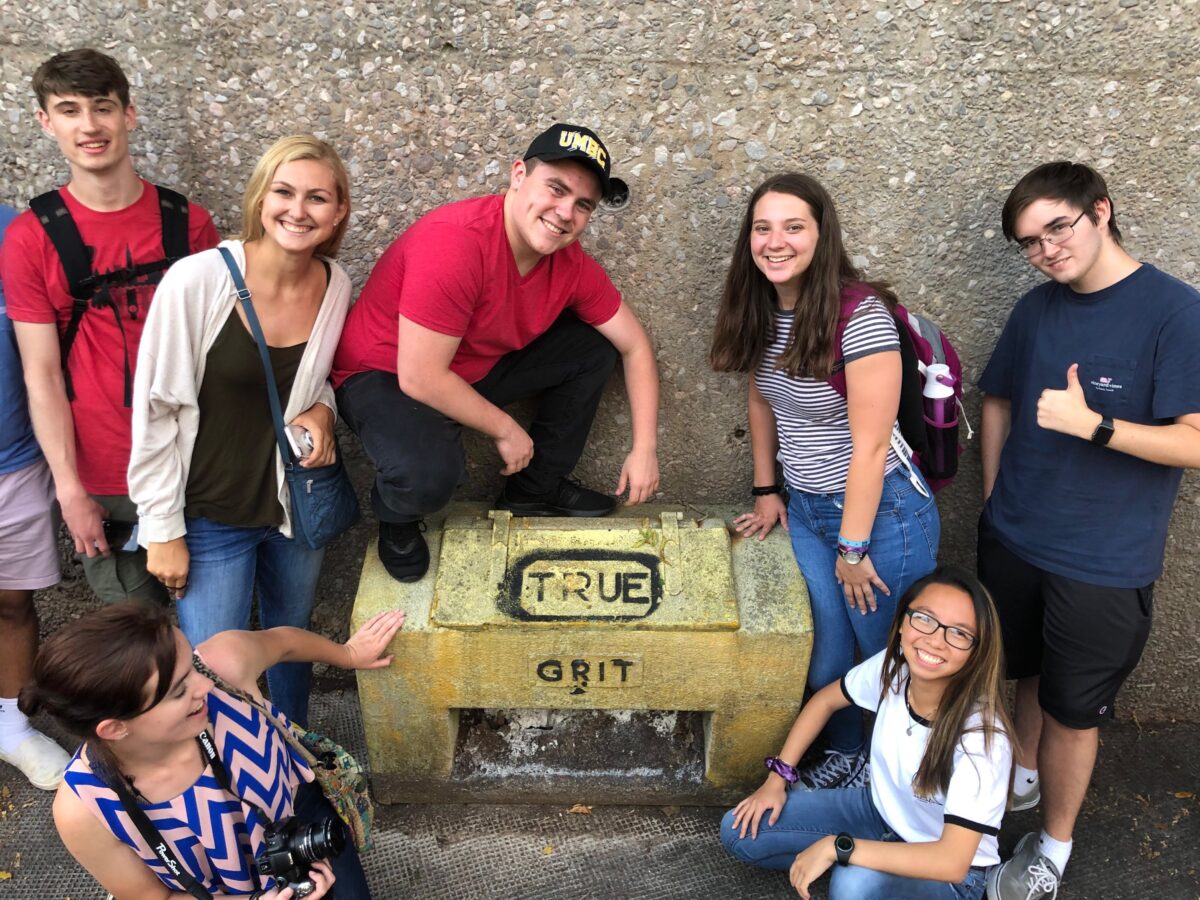 Sianna Serio, kneeling on right, in Bristol, U.K. (Image courtesy of Sianna Serios)
As a former marketing assistant at the ELI, Tasneem Mansour ’20, modern languages, linguistics and intercultural communication, supported visiting students from Peru, Nagoya and Tokyo, Japan. Mansour will head to South Korea.
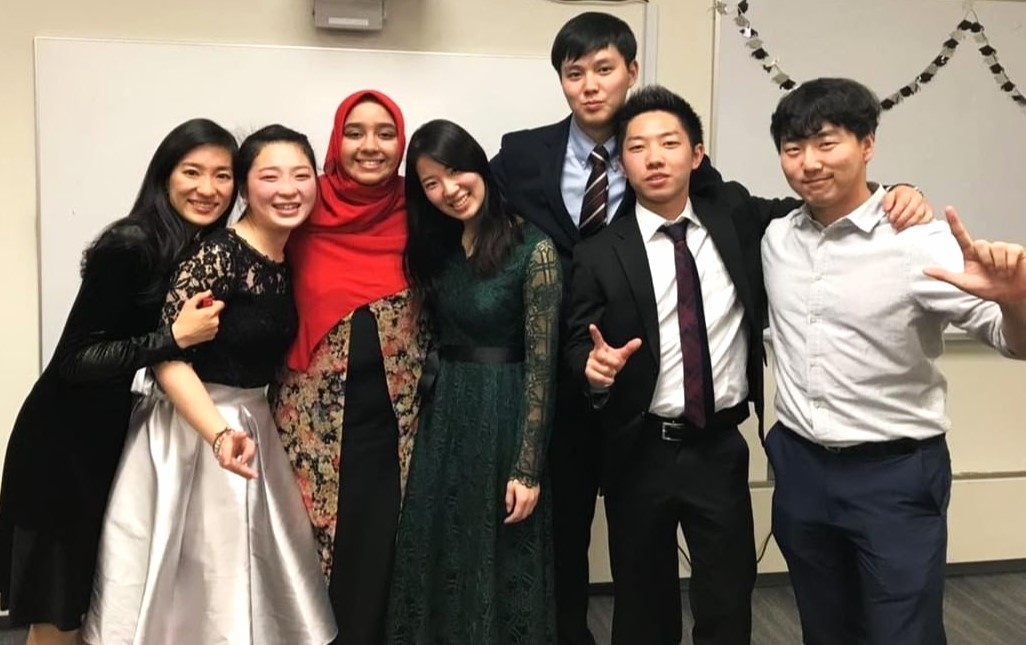
Tasneem Mansour, third from the left, with students from Nippon Sport-Science University in Tokyo, Japan. (Image courtesy of Tasneem Mansour)
UMBC’s global outlook
UMBC’s commitment to international collaboration and research begins at the Center for Global Engagement, which connects students and faculty from the U.S. with students and distinguished faculty from more than 100 countries with unique international academic opportunities. Together, they further the research and skills needed to address long-standing and new global challenges.
Brian Souders, M.A.’19, TESOL and Ph.D. ’09, language, literacy and culture, the associate director of global learning of the Center for Global Engagement, has led students through the Fulbright application process, as UMBC’s Fulbright Program advisor, for the last decade. “Our students are high achievers, the application process is a place for them to share their story,” says Souders. “Faculty and staff are there to ensure each student’s application reflects their years of hard work and the skills they have developed to collaborate with partners across the world.”
Research at home and abroad
With the vast network of Fulbright alumni at UMBC and across the U.S., it’s always helpful to get tips on how to conduct research in a new country and in a new language. Fulbright recipient Ocone, a long time fan of all things anime, began developing his ethnographic research skills with the support of Bambi Chapin, associate professor of anthropology. Chapin, a 1999 – 2000 Fulbright recipient, taught Ocone the theoretical and practical aspects of ethnographic research which he will now use to research the politics of inclusion and exclusion in otaku (anime/manga fan) spaces.
Chapin, along with Julie Christ Oakes, the assistant director of curriculum and retention of the Honors College and a 2001 – 2002 Fulbright research award recipient to Japan, also workshopped Ocone’s research proposal and Fulbright application. Oakes also shared her insights on the Fulbright experience.
“I went to Japan to do research for my dissertation research,” says Oakes. “I have a good idea of what [Ocone] will face as a relative “newbie” abroad and a non-native Japanese speaker and reader.”
The Fulbright experience is also about nurturing relationships with faculty abroad. Ocone said he feels honored for the opportunity to further his research with Kaichiro Morikawa, an associate professor at Meiji University and author of one of the foundational books on otaku spaces. Morikawa will help Ocone navigate the various resources on otaku culture. He wrote in Ocone’s recommendation letter that his “research is highly original as well as effectively focused,” and says he looks forward to supporting Ocone during his time at the university and in Japan.
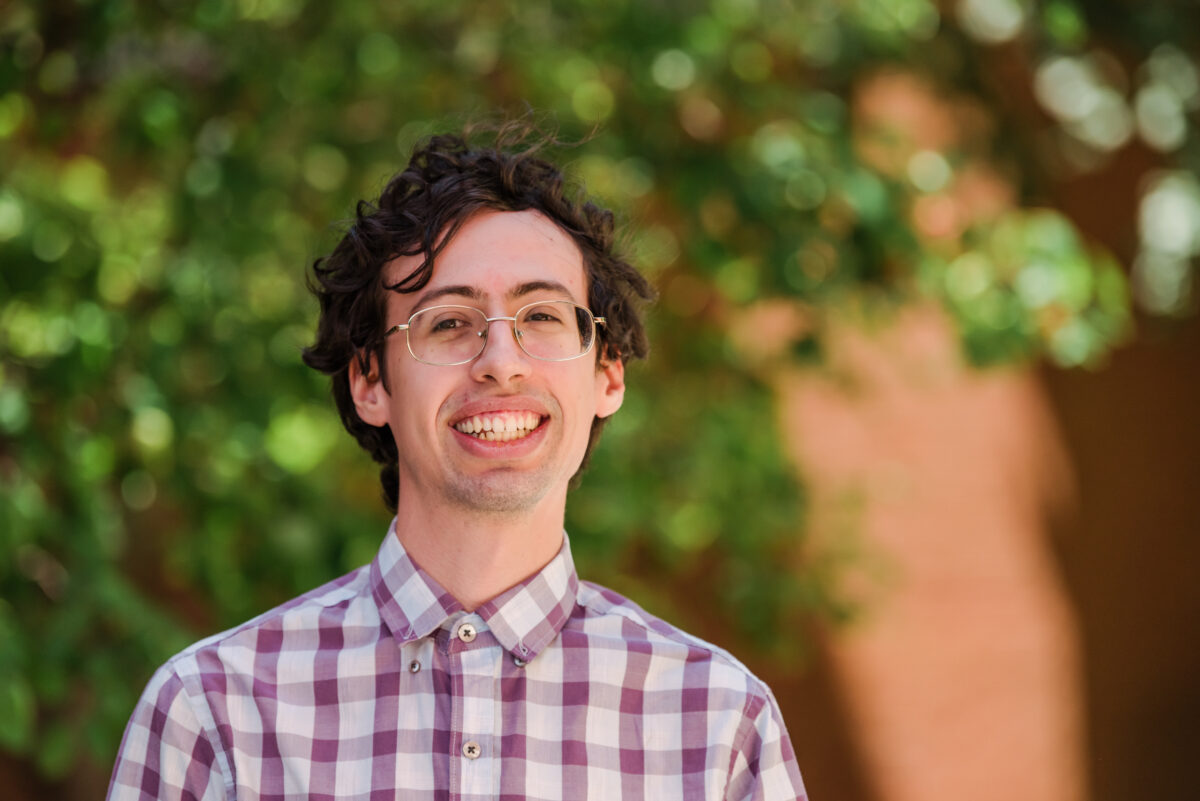 Paul Ocone. (Marlayna Demond ’11/UMBC)
“I am immensely grateful to all of my mentors for guiding me on my journey through my undergraduate degree—from my earliest fuzzy and broad ideas of what I wanted to do, to the more specific research plans, and to the rewarding thesis that eventually emerged,” says Ocone. “I’ll be continuing research on topics that I care deeply about, research that I will likely build upon in graduate school and beyond.”
Fulbright support network
The road to being a Fulbright recipient begins day one students’ UMBC experience as they explore majors, create a network of mentors, and hone their research skills. At the end of their junior year, students develop their initial application at the Fulbright Base Camp led by Souders, who is a 2023 – 2024 Fulbright International Education Administrator award recipient. “The camp helps elevate and support students to reach their Fulbright goals,” says Souders. “Students share drafts of their essays with me for feedback prior to the campus deadline, the first day of the fall semester. They participate in a campus evaluation process with UMBC faculty and staff to receive feedback on their applications.”
Souders, Chapin, and Maryam Elhabashy ’21, anthropology, a research assistant at Rutgers University and a 2022 Fulbright recipient to Kuwait City, discuss this process on the Retrieving the Social Science podcast, produced by UMBC’s Center for Social Science Scholarship.
“The panel gives students advice about how to craft a project, like how to take it apart and re-put it back together, what we see as strengths,” says Chapin. “We support them and encourage them as they go through that really difficult intellectual work, emotional work of figuring out how to make their strong projects even stronger.”
Learn more about the UMBC’s international education opportunities.
]]>
This year, the U.S. Fulbright Student Program, the U.S. government’s flagship international exchange program, has awarded nine UMBC students and alumni top research and teaching placements in...
https://umbc.edu/stories/2023-fulbright-recipients/
https://beta.my.umbc.edu/api/v0/pixel/news/134370/guest@my.umbc.edu/516ede6d25c349e81ae689cbf97868dc/api/pixel
ancientstudies
anthropology
cahss
coeit
computer-science
english
globalstudies
honorscollege
inds
intermedia-and-digital-arts
international-stories
llc
mlli
news
policy-and-society
rca-2
tesol
UMBC News & Magazine
https://beta.my.umbc.edu/groups/umbc-news-magazine
https://assets1-beta.my.umbc.edu/system/shared/avatars/groups/000/001/943/24435aa6207c452e7bc15cc74b42c7bb/xsmall.png?1748556657
https://assets1-beta.my.umbc.edu/system/shared/avatars/groups/000/001/943/24435aa6207c452e7bc15cc74b42c7bb/original.png?1748556657
https://assets2-beta.my.umbc.edu/system/shared/avatars/groups/000/001/943/24435aa6207c452e7bc15cc74b42c7bb/xxlarge.png?1748556657
https://assets2-beta.my.umbc.edu/system/shared/avatars/groups/000/001/943/24435aa6207c452e7bc15cc74b42c7bb/xlarge.png?1748556657
https://assets3-beta.my.umbc.edu/system/shared/avatars/groups/000/001/943/24435aa6207c452e7bc15cc74b42c7bb/large.png?1748556657
https://assets1-beta.my.umbc.edu/system/shared/avatars/groups/000/001/943/24435aa6207c452e7bc15cc74b42c7bb/medium.png?1748556657
https://assets2-beta.my.umbc.edu/system/shared/avatars/groups/000/001/943/24435aa6207c452e7bc15cc74b42c7bb/small.png?1748556657
https://assets1-beta.my.umbc.edu/system/shared/avatars/groups/000/001/943/24435aa6207c452e7bc15cc74b42c7bb/xsmall.png?1748556657
https://assets2-beta.my.umbc.edu/system/shared/avatars/groups/000/001/943/24435aa6207c452e7bc15cc74b42c7bb/xxsmall.png?1748556657
UMBC News & Magazine
3
0
false
Sat, 22 Jul 2023 01:43:12 -0400
Sat, 22 Jul 2023 01:43:12 -0400
Sustainability Fellow Isabel Dastvan ’22 grows her career and invasive species management at UMBC

It’s a spring morning, and Isabel Dastvan ’22, geography and environmental systems, is slowly wending her way through the Conservation Environmental Research Area (CERA) at the southern edge of UMBC’s main campus. Braving the uneven terrain and an occasional thorny branch, she’s carefully recording the presence of a long list of invasive species with photos and in a notebook: garlic mustard there, wavyleaf basketgrass over there, and porcelainberry everywhere.
Over several weeks in fall 2022 and again in spring 2023, Dastvan painstakingly completed a survey of campus invaders—from English ivy to Japanese stiltgrass—all the way from CERA to wooded land north of UMBC’s dorms. Dastvan’s work revealed that there are at least 100 invasive plant species present in natural and managed spaces on campus, which can threaten native species, reduce ecosystem functions like pollination and water filtration, and increase the chance of fires by thickening vegetation.
“UMBC has a long history of agricultural use and urban development, and with land disturbance we’re seeing a lot more invasive species,” says Dastvan, who is excited to apply knowledge she gained as a UMBC undergraduate to real ecological challenges. Some invasives are weakening or even killing native trees, she explains, and trees “are one of the important environmental assets we want to protect to be a more resilient campus in the face of climate change.”
Growing capacity, training leaders
Throughout the academic year, and in deep collaboration with Facilities Management staff, Dastvan completed on-the-ground surveys, created maps of invasive species on campus, identified the most urgent invasive threats, and determined the best ways to combat their spread. The end result is a 187-page, comprehensive Invasive Species Management Plan for UMBC, which Dastvan published in June. Moving forward, Facilities Management staff, led by landscape and grounds manager Charles Hogan, will implement the plan, continuing UMBC’s legacy of prioritizing sustainability and stewarding the land the university occupies.
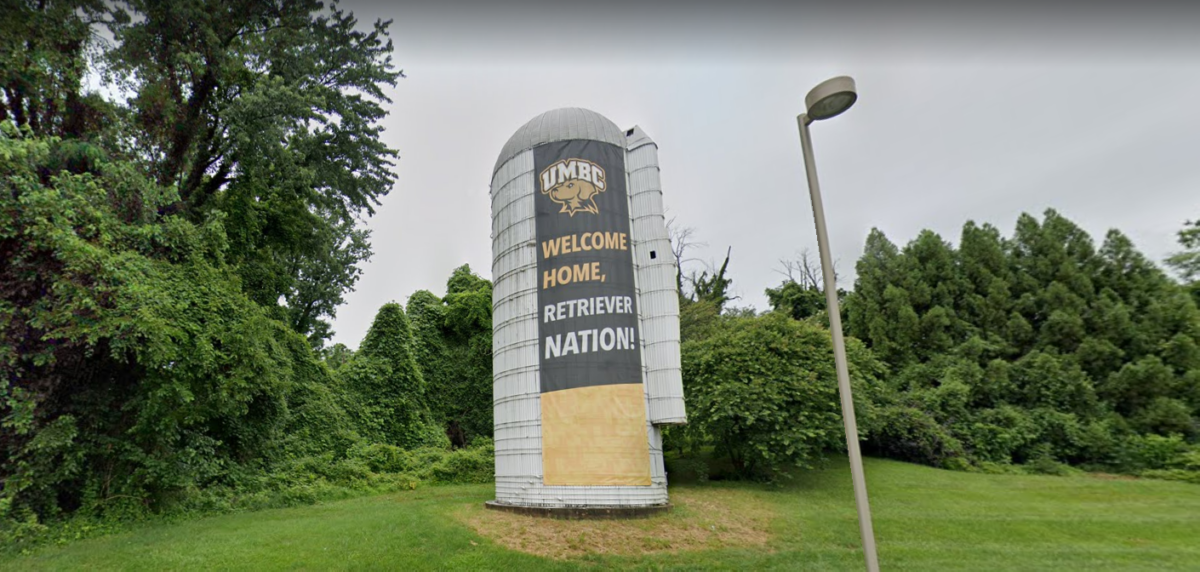 Invasive kudzu blankets vegetation at the entrance to UMBC. Plants underneath—even full-grown trees—are at risk of being smothered. (Image by Google 2023)
Dastvan completed the plan as a 2022 – 2023 Sustainability Fellow with Climate Corps, a program for recent college graduates supported by the non-profit Strategic Energy Innovations in California and the Hannon Armstrong Foundation in Annapolis, MD. Climate Corps connects emerging leaders like Dastvan with non-profits, businesses, governments, and universities with sustainability project needs. Fellows gain valuable professional experience and the institutions they support gain capacity to reach their sustainability goals.
Connecting with the community
UMBC will benefit for years from Dastvan’s work as a Fellow. In addition to the invasive species management plan, she worked to increase awareness of invasive species throughout the UMBC community by meeting with student organizations and informally engaging with people on campus. Dastvan collaborated with the student-led Environmental Task Force club to host weekly cleanups removing invasive plant species in addition to their weekly trash cleanups on campus.
Dastvan also co-hosted an art-making event at Oca Mocha using invasive plant material from campus and recycled paper with Jessie Houff, who has an M.F.A. in community art and is passionate about papermaking and teaching. Dastvan even collaborated with UMBC Dining to inform students about invasive species and offer them at True Grit’s—Chesapeake Bay Blue Catfish, anyone?
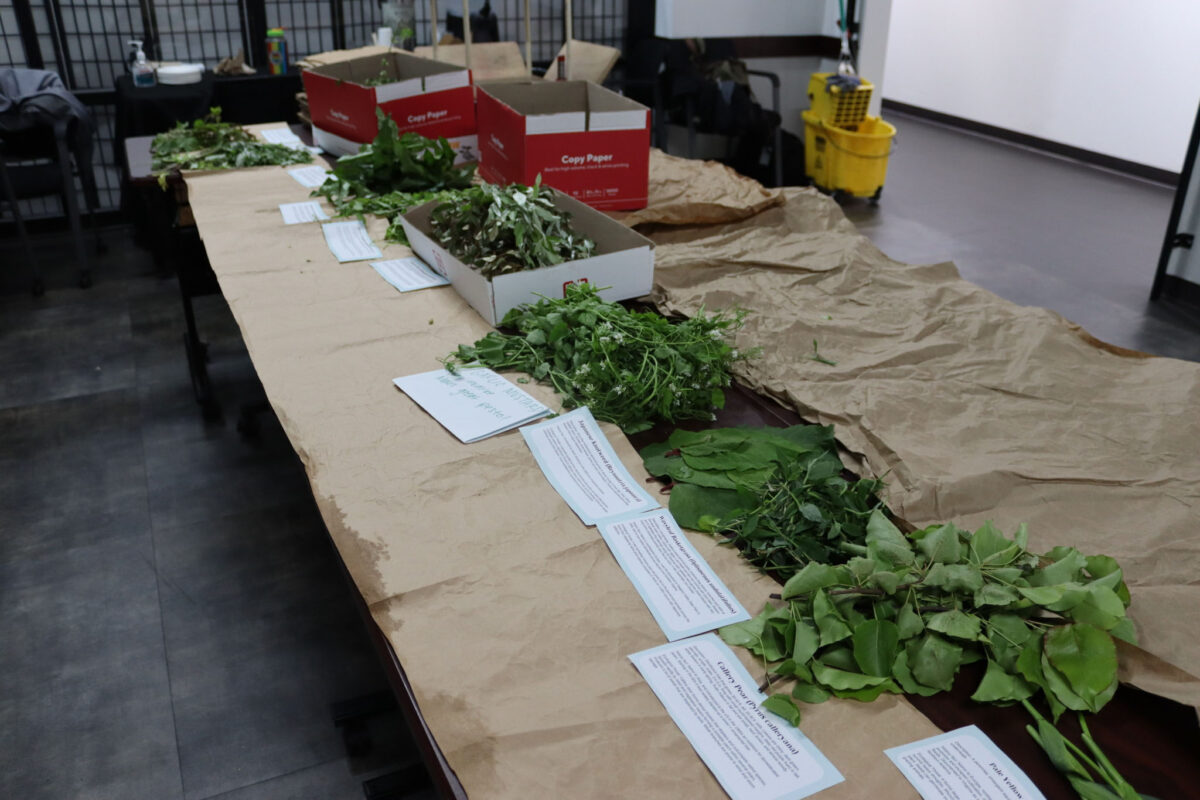 Invasive plant clippings, accompanied by information about the plants, ready to be turned into art.
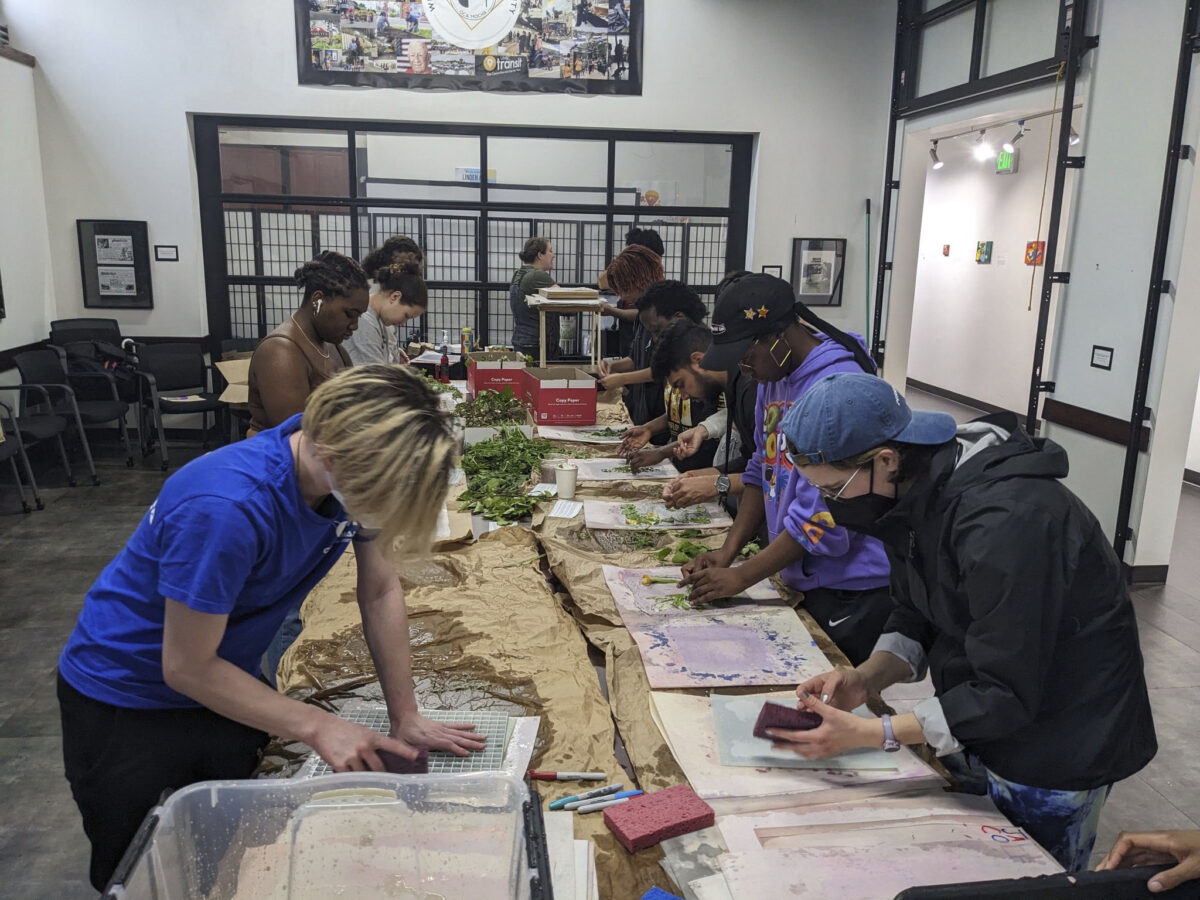 Participants hard at work on their invasive plant art.
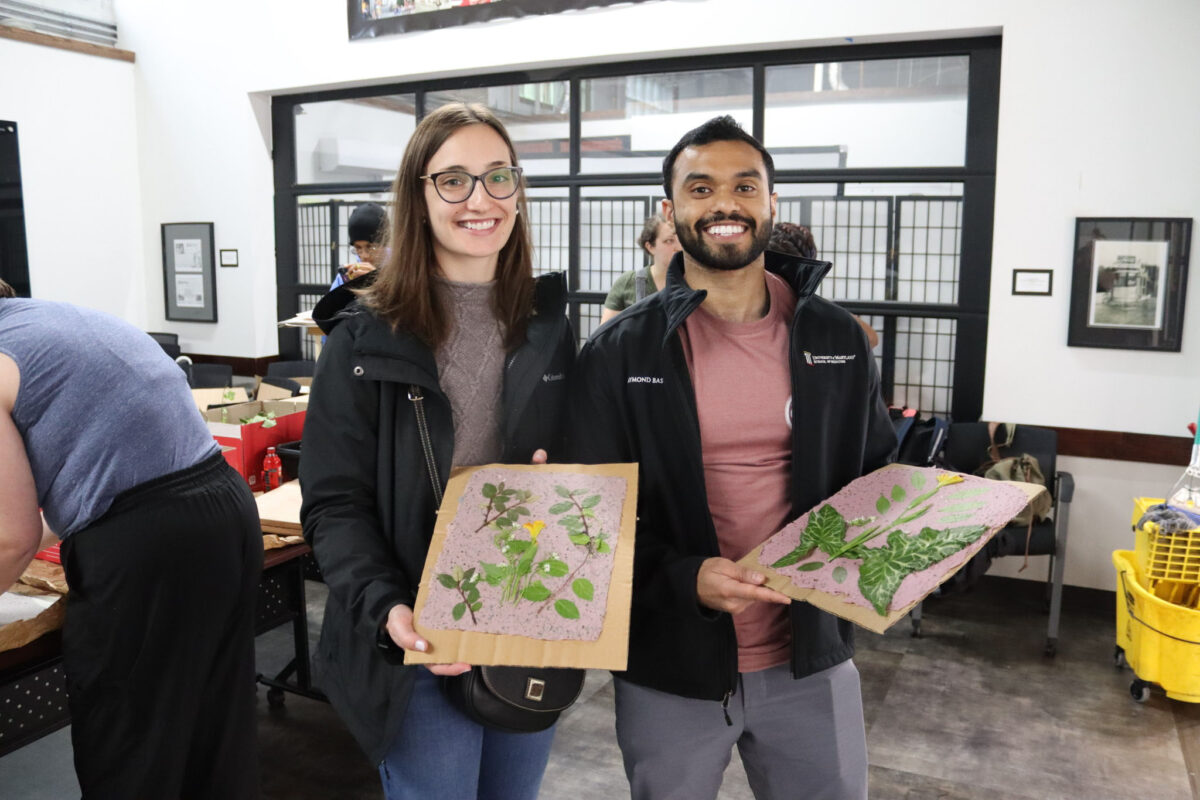 The finished product. (Images by Claire Runquist)
The threat of invasive species is “something that needs to be taken more seriously,” Dastvan says, “so if there are different ways that we can get the community involved, and genuinely excited, I think that’s the best way to go about tackling it. There are a lot of people who are enthusiastic about learning and willing to help out, and a community that creates a space for that is absolutely necessary.”
Claire Runquist, environmental sustainability coordinator at UMBC, oversaw Dastvan’s work. “Bella’s work on invasive species was incredibly valuable to campus—prior to this we didn’t have a comprehensive understanding of what invasive species we had on campus or where exactly they all were,” she shares. “Her project combined GIS mapping along with best management practices and led to prioritization for management.”
Finding her own path
For Dastvan, the impact of her fellowship will likely be even longer-lasting than her invasive species management plan. As a GES major at UMBC, Dastvan threw herself into her studies, including working with the Office of Sustainability to support a farmer’s market on campus. But when she started UMBC’s accelerated master’s program in GES while finishing her Bachelor’s degree program, she quickly experienced burnout. She decided to take some time off from her studies to gain relevant professional experience, and when she saw the Climate Corps program on a UMBC graduate student listserv, it was the perfect fit.
 Isabel Dastvan (UMBC sweatshirt, center) shares information about invasive species with people in the UMBC Commons. (Image by Claire Runquist)
When she was selected as UMBC’s Sustainability Fellow through the program, it was a homecoming. “I was very excited to be able to work with the sustainability office from a different lens and be involved on campus in a new way,” Dastvan says.
Her undergraduate degree from UMBC provided the foundational knowledge and skills to make her an effective fellow, and through the Climate Corps program, she gained additional technical and leadership skills and confirmed her desire for a career in a related field. Dastvan was recently thrilled to accept a position as a horticultural technician at Silvec Biologics—and she’ll carry her UMBC experiences everywhere she goes, she says, adding, “I’m just really grateful to have had this opportunity to be on campus and contribute.”
]]>
It’s a spring morning, and Isabel Dastvan ’22, geography and environmental systems, is slowly wending her way through the Conservation Environmental Research Area (CERA) at the southern edge of...
https://umbc.edu/stories/growing-a-career-and-umbc-invasive-species-mgmt/
https://beta.my.umbc.edu/api/v0/pixel/news/134232/guest@my.umbc.edu/babef8334a595a047e207ba7fbf9d33f/api/pixel
alumni
cahss
campus-life
ges
magazine
sustainability
UMBC News & Magazine
https://beta.my.umbc.edu/groups/umbc-news-magazine
https://assets1-beta.my.umbc.edu/system/shared/avatars/groups/000/001/943/24435aa6207c452e7bc15cc74b42c7bb/xsmall.png?1748556657
https://assets1-beta.my.umbc.edu/system/shared/avatars/groups/000/001/943/24435aa6207c452e7bc15cc74b42c7bb/original.png?1748556657
https://assets2-beta.my.umbc.edu/system/shared/avatars/groups/000/001/943/24435aa6207c452e7bc15cc74b42c7bb/xxlarge.png?1748556657
https://assets2-beta.my.umbc.edu/system/shared/avatars/groups/000/001/943/24435aa6207c452e7bc15cc74b42c7bb/xlarge.png?1748556657
https://assets3-beta.my.umbc.edu/system/shared/avatars/groups/000/001/943/24435aa6207c452e7bc15cc74b42c7bb/large.png?1748556657
https://assets1-beta.my.umbc.edu/system/shared/avatars/groups/000/001/943/24435aa6207c452e7bc15cc74b42c7bb/medium.png?1748556657
https://assets2-beta.my.umbc.edu/system/shared/avatars/groups/000/001/943/24435aa6207c452e7bc15cc74b42c7bb/small.png?1748556657
https://assets1-beta.my.umbc.edu/system/shared/avatars/groups/000/001/943/24435aa6207c452e7bc15cc74b42c7bb/xsmall.png?1748556657
https://assets2-beta.my.umbc.edu/system/shared/avatars/groups/000/001/943/24435aa6207c452e7bc15cc74b42c7bb/xxsmall.png?1748556657
UMBC News & Magazine
1
0
false
Thu, 06 Jul 2023 16:37:11 -0400
Thu, 06 Jul 2023 16:37:11 -0400
The UMBC International Scholar Newsletter
The fifth issue is here!
Highlights:
- Immigration reminders - please read them carefully!
- 4th of July celebrations
- The Maryland Great Outdoors Bucket List
]]>
Highlights: Immigration reminders - please read them carefully! 4th of July celebrations The Maryland Great Outdoors Bucket List
https://www.canva.com/design/DAFmpYe0yHA/TrLZFcKZUxPvLzlS5Obw4Q/view?utm_content=DAFmpYe0yHA&utm_campaign=designshare&utm_medium=link&utm_source=publishsharelink
Image
https://assets1-beta.my.umbc.edu/system/shared/attachments/9d9e189ca00b6d498e81bd62f7ba3be6/6a098e5f/news/000/134/125/8eadf40572785446ae7cb39cad8c1737/Screenshot 2023-06-26 164246 resized.jpg?1687812421
https://beta.my.umbc.edu/api/v0/pixel/news/134125/guest@my.umbc.edu/fad7a77807493a3a39a50a4f9803b689/api/pixel
Exchange Visitors
https://beta.my.umbc.edu/groups/j-1
https://assets3-beta.my.umbc.edu/system/shared/avatars/groups/000/001/488/175f9f6b6c231ae5de90058948f6228c/xsmall.png?1525966942
https://assets3-beta.my.umbc.edu/system/shared/avatars/groups/000/001/488/175f9f6b6c231ae5de90058948f6228c/original.jpg?1525966942
https://assets2-beta.my.umbc.edu/system/shared/avatars/groups/000/001/488/175f9f6b6c231ae5de90058948f6228c/xxlarge.png?1525966942
https://assets1-beta.my.umbc.edu/system/shared/avatars/groups/000/001/488/175f9f6b6c231ae5de90058948f6228c/xlarge.png?1525966942
https://assets2-beta.my.umbc.edu/system/shared/avatars/groups/000/001/488/175f9f6b6c231ae5de90058948f6228c/large.png?1525966942
https://assets1-beta.my.umbc.edu/system/shared/avatars/groups/000/001/488/175f9f6b6c231ae5de90058948f6228c/medium.png?1525966942
https://assets1-beta.my.umbc.edu/system/shared/avatars/groups/000/001/488/175f9f6b6c231ae5de90058948f6228c/small.png?1525966942
https://assets3-beta.my.umbc.edu/system/shared/avatars/groups/000/001/488/175f9f6b6c231ae5de90058948f6228c/xsmall.png?1525966942
https://assets4-beta.my.umbc.edu/system/shared/avatars/groups/000/001/488/175f9f6b6c231ae5de90058948f6228c/xxsmall.png?1525966942
Exchange Visitors
https://assets4-beta.my.umbc.edu/system/shared/thumbnails/news/000/134/125/3c698034bf38af698fef6476da642fc9/xxlarge.jpg?1687812398
https://assets3-beta.my.umbc.edu/system/shared/thumbnails/news/000/134/125/3c698034bf38af698fef6476da642fc9/xlarge.jpg?1687812398
https://assets4-beta.my.umbc.edu/system/shared/thumbnails/news/000/134/125/3c698034bf38af698fef6476da642fc9/large.jpg?1687812398
https://assets1-beta.my.umbc.edu/system/shared/thumbnails/news/000/134/125/3c698034bf38af698fef6476da642fc9/medium.jpg?1687812398
https://assets3-beta.my.umbc.edu/system/shared/thumbnails/news/000/134/125/3c698034bf38af698fef6476da642fc9/small.jpg?1687812398
https://assets4-beta.my.umbc.edu/system/shared/thumbnails/news/000/134/125/3c698034bf38af698fef6476da642fc9/xsmall.jpg?1687812398
https://assets1-beta.my.umbc.edu/system/shared/thumbnails/news/000/134/125/3c698034bf38af698fef6476da642fc9/xxsmall.jpg?1687812398
0
0
true
Mon, 26 Jun 2023 16:49:34 -0400
UMBC teams with the Navy and the University of Arizona to develop new capabilities for hypersonic flight
When the Wright brothers first launched their famous plane off the tall sand dunes near Kitty Hawk, North Carolina, it flew slower than a person can run. Now, military fighter jets routinely rip through the air at supersonic speeds of 1,000 miles per hour or more. Uncrewed experimental aircraft have even gone hypersonic, traveling more than five times faster than the speed of sound.
Flying at such breakneck speeds presents an array of engineering challenges, from the stresses on the materials to the struggle to control the aircraft.
“When flying above the speed of sound, the operating environment can degrade extremely quickly and there is very little time to react,” says Ankit Goel, an assistant professor of mechanical engineering at UMBC. “If a correcting control signal is not applied quickly enough, catastrophic failure is almost always guaranteed.”
 On left, the Wright Flyer on display at the Smithsonian Air and Space Museum in Washington, D.C. (Smithsonian Institution). On the right, an F-22 Raptor (U.S. Air Force photo by 2nd Lt. Samuel Eckholm.)
Goel has been investigating better ways to control aircraft flying at hypersonic speeds, by primarily focusing on the vehicle’s engine. He recently received more than $850,000 in funding from the Office of Naval Research to further the investigations. Over the next three years he will partner with Kyle Hanquist at the University of Arizona and researchers from the Naval Air Warfare Center (NAWC) to develop improved engine control strategies and assess their performance in ground experiments conducted at the NAWC facility at China Lake, California.
Powering superfast flight
The first airplane to break the sound barrier—the Bell X-1 piloted by Chuck Yeager in 1947—was dropped from the bomb bay of a Boeing B-29 and fired rocket engines to accelerate to its top speed.
 Chuck Yeager in front of the X-1. (U.S. Air Force)
Rockets are incredibly powerful, but they also guzzle fuel. A more efficient alternative for fast flight is an air-breathing engine called a ramjet. Ramjets, which work best above the speed of sound, exploit the fast forward motion of the plane to effectively “ram” air into the engine and compress it. Squeezing the air heats it up, and the hot air then spontaneously ignites the fuel. As the burning mixture is channeled out the back of the engine, it pushes the aircraft forward.
Ramjets can burn either liquid or solid fuel. In the solid fuel version, which Goel and his collaborators are concentrating on in this latest project, sand-like grains of solid fuel are pressed together and embedded in the sides of the engine. This eliminates the need for pumps and other equipment to inject liquid fuel. It also means the fuel can more easily be transported and stored.
A solid fuel ramjet engine’s design is simple, but its operation is finicky. Structural vibrations, changes in airflow, and too much or too little heat can all cause the engine to stop working suddenly. Sometimes the engine will “buzz” in a rapid series of undesirable starts and stops, a state known as “engine unstart.”
“More reliable control of the engine could enable faster flight, longer range, and better maneuverability,” says Goel. To get that better control, Goel and his collaborators must grapple with the complex and chaotic environment inside the engine.
A tricky controls problem
Imagine a car driving along a hilly road. If the driver wants to maintain a constant speed, they must press the gas pedal harder going up the hills. If the car has cruise control, a computer can do the work of the driver. This is an example of a relatively simple control problem.
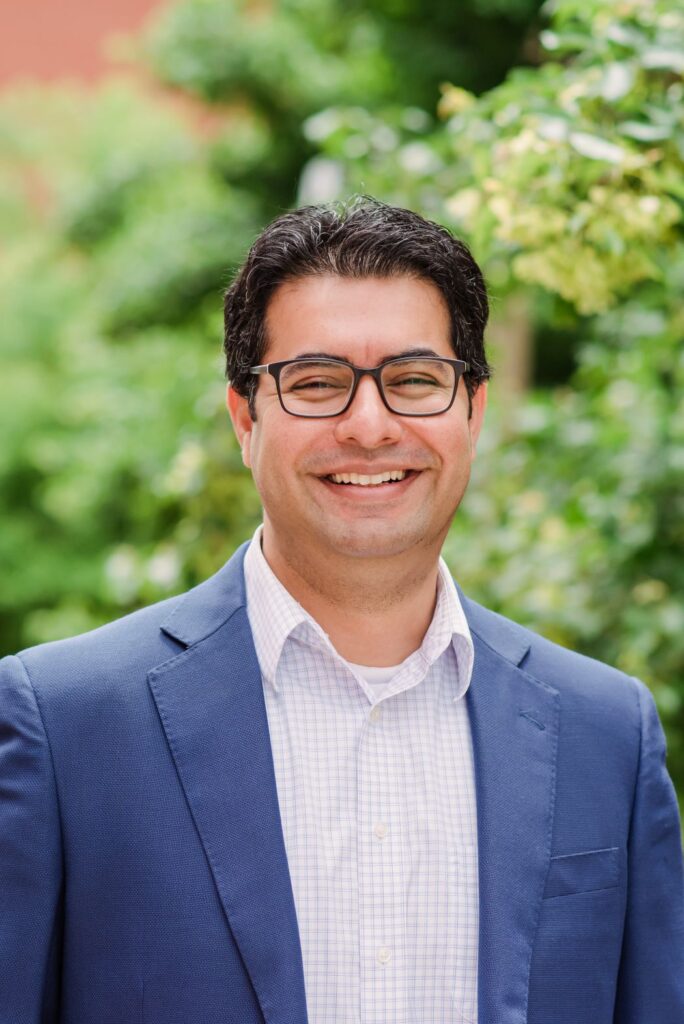
Ankit Goel (Marlayna Demond ’11/UMBC)
The inside of a solid fuel ramjet engine presents an example of a not-so-simple control problem.
A number of factors make the problem especially difficult. For starters, conditions inside the engine are constantly and rapidly changing. As the solid fuel burns away, the shape of the combustion zone inside the engine changes, which changes the airflow, which affects the rate of burning. Conditions shift dramatically in less than one-thousandth of a second. The system is also very sensitive to slight perturbations. A small change in flow conditions upstream can lead to big changes downstream.
It’s nearly impossible to completely understand and model what is going on.
In the face of such complexity, Goel is turning to a control technique that’s relatively novel in aerospace applications: machine learning. The beauty of machine learning is that it can solve problems without needing a conceptual understanding of them. The downside is that most machine learning requires enormous datasets and large amounts of computational power to work, two resources that aerospace applications typically lack. However, Goel and his collaborators have found a potential solution.
Real-time learning for aerospace
The researchers are experimenting with a technique that can learn, quite literally, on the fly, rather than being trained ahead of time. This distinguishes the technique from typical machine learning. While the ramjet is operating, the learning algorithms will continually re-evaluate the relationship between two simple factors—a measure of the air that’s being let into the engine and the thrust that the engine is generating—and use that relationship to drive the generated thrust to a desired value. By implementing a learning-based control scheme, the technique can control the output of the engine while ignoring the complexity of what’s actually happening inside.
The researchers plan to test their model first on computer simulations of a ramjet engine, and then on the real thing.
The ultimate goal is to embed the learning controller in a system that would take pressure sensor measurements from an engine in flight and use them to rapidly adjust the airflow into the engine—perhaps making thousands of small changes a second—to control the thrust. This would mean that flight operators could count on getting the requested thrust from the engine, even if flight conditions are changing.
Goel says the proposed learning technique could also be used on systems far removed from superfast aircraft. “The key insights into what makes the technique work in highly unmodeled and uncertain systems will allow us to generalize it to a large body of interesting dynamic problems,” he says. The team is already thinking about applying it to other types of aircraft, such as vehicles that use flapping wings or that take off and land vertically.
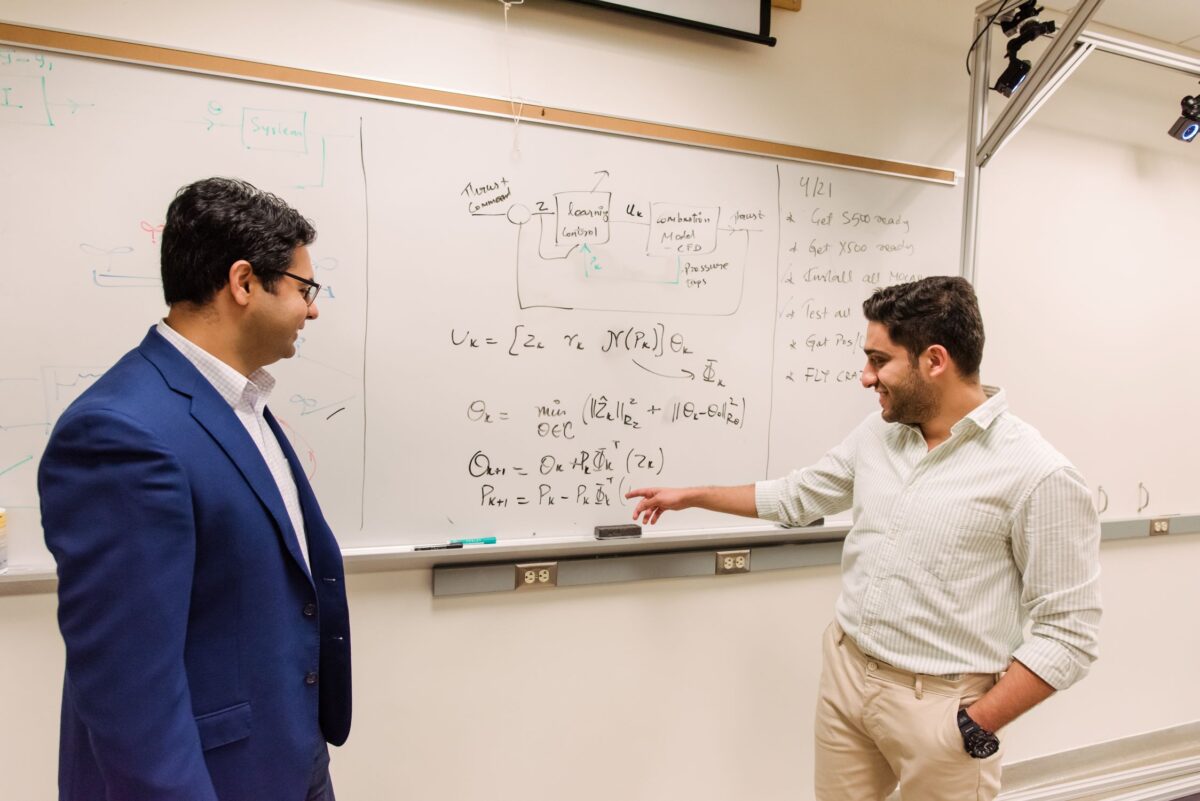 Ankit Goel (left) and Parham Oveissi (right) are working to develop better control techniques for ramjet engines. (Marlayna Demond ’11/UMBC)
Parham Oveissi, a Ph.D student in mechanical engineering at UMBC who will be involved in the research, says he is motivated by a deep interest in developing control techniques for aircraft, an interest he has nurtured since childhood, when his parents gave him a toy quadcopter. “This early encounter ignited an enduring curiosity within me, driving me to unravel the mysteries of flight and explore methods of controlling these machines,” he says.
The research project will be an exciting opportunity to develop his knowledge and skills. “I’m excited to collaborate with professionals, gain valuable research experience, and see the impact of my contributions,” he says.
The success of the project will hinge on the joint efforts of researchers with a variety of skill sets, from a variety of institutions.
“This work requires an interdisciplinary team,” says Kyle Hanquist, an assistant professor in the Department of Aerospace and Mechanical Engineering at the University of Arizona who will contribute his expertise in reactive flow modeling to the project. “We are working together to tackle a difficult problem that none of us could tackle on our own.”
]]>
When the Wright brothers first launched their famous plane off the tall sand dunes near Kitty Hawk, North Carolina, it flew slower than a person can run. Now, military fighter jets routinely rip...
https://umbc.edu/stories/umbc-advances-hypersonic-flight/
https://beta.my.umbc.edu/api/v0/pixel/news/134100/guest@my.umbc.edu/d1624005a7d8cafcf78fbe2ba7e7982f/api/pixel
coeit
meche
news
research
science-and-tech
UMBC News & Magazine
https://beta.my.umbc.edu/groups/umbc-news-magazine
https://assets1-beta.my.umbc.edu/system/shared/avatars/groups/000/001/943/24435aa6207c452e7bc15cc74b42c7bb/xsmall.png?1748556657
https://assets1-beta.my.umbc.edu/system/shared/avatars/groups/000/001/943/24435aa6207c452e7bc15cc74b42c7bb/original.png?1748556657
https://assets2-beta.my.umbc.edu/system/shared/avatars/groups/000/001/943/24435aa6207c452e7bc15cc74b42c7bb/xxlarge.png?1748556657
https://assets2-beta.my.umbc.edu/system/shared/avatars/groups/000/001/943/24435aa6207c452e7bc15cc74b42c7bb/xlarge.png?1748556657
https://assets3-beta.my.umbc.edu/system/shared/avatars/groups/000/001/943/24435aa6207c452e7bc15cc74b42c7bb/large.png?1748556657
https://assets1-beta.my.umbc.edu/system/shared/avatars/groups/000/001/943/24435aa6207c452e7bc15cc74b42c7bb/medium.png?1748556657
https://assets2-beta.my.umbc.edu/system/shared/avatars/groups/000/001/943/24435aa6207c452e7bc15cc74b42c7bb/small.png?1748556657
https://assets1-beta.my.umbc.edu/system/shared/avatars/groups/000/001/943/24435aa6207c452e7bc15cc74b42c7bb/xsmall.png?1748556657
https://assets2-beta.my.umbc.edu/system/shared/avatars/groups/000/001/943/24435aa6207c452e7bc15cc74b42c7bb/xxsmall.png?1748556657
UMBC News & Magazine
1
0
false
Fri, 23 Jun 2023 11:31:26 -0400
Fri, 23 Jun 2023 11:31:26 -0400
 Book cover illustration by Aude Nasr.

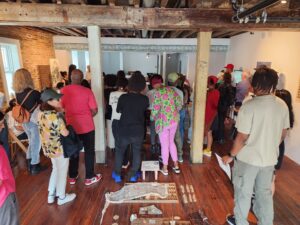
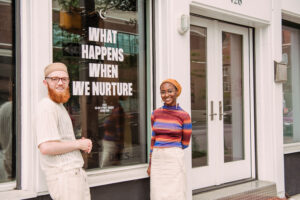
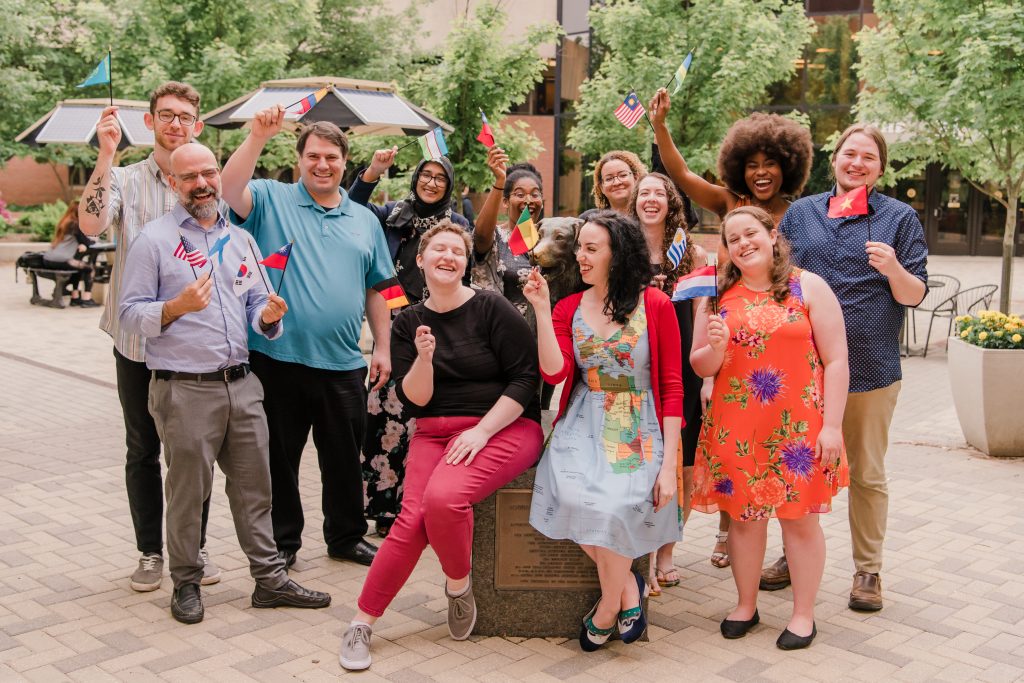 Souders (front left)with UMBC’s