Free Speech, Respect, and Civil Discourse
Dear UMBC Community,
As the crisis in Israel and Gaza deepens, reports of antisemitism and Islamophobia are on the rise, including on college campuses in the U.S. These incidents are deeply troubling, and we know that they add to the anxiety and concern that our own community members are feeling.
College campuses have long been epicenters of activism, including protest against military action and government policy here and abroad. In recent years, campuses also have become targets in American culture wars, in part because of the very values we espouse as institutions of higher learning. Among those core values are the free exchange of ideas and information and a respect for diverse perspectives. These, along with
academic freedom, are key to our mission to advance knowledge and understanding.
We write to you today to reaffirm our commitment to these values and to provide practical guidance on what it means to live these values, especially in times of conflict. We know that recent events on campus and posts on social media have raised concerns. Individuals have reported feeling unsafe in response to language they have seen or heard, and some have expressed fear of speaking out for fear of reprisals of various kinds, including doxxing. We want to be clear: We are hearing these concerns from students, faculty, and staff who represent all sides of the issues. We hear calls simultaneously to curtail speech and calls to protect it.
Ensuring freedom of expression, especially at a public institution, means protecting speech with which we may disagree or even find offensive or objectionable. The right to free speech comes with responsibility, as our collective belonging in this extraordinary UMBC community comes with the responsibility to respect and care for one another, even when–perhaps especially when–we disagree. Free speech does not extend to harassment or true threats.
Learn more about speech that is protected under the First Amendment, as well as types of speech that are unprotected.
We urge all recognized campus groups and members of our community to provide constructive outlets for dissenting views when addressing controversial or divisive issues. We encourage you to avail yourselves of information and resources for knowing how to express your voice effectively and in ways that are consistent with legal guidelines, university policies and practices, and our institutional values. Guidance on how to have challenging discourse productively, how to organize peaceful protest, how to distribute information on campus, and more can be found on the
Using Your Voice page provided by the Center for Democracy and Civil Life. More resources are listed below for your reference.
We ask that you continue to show kindness, grace, and flexibility to one another, knowing that students, faculty, and staff may be struggling. Let us work together, every day, to support UMBC as a community that embraces vibrant dialogue and mutual respect.
Sincerely,
President Valerie Sheares Ashby
Interim Provost and Senior Vice President for Academic Affairs David P. Dauwalder
Vice President for Institutional Equity and Chief Diversity Officer Tanyka M. Barber
Vice President for Student Affairs Renique T. Kersh
Resources for Building Support for Social Change and Constructive Dialogue for Dissenting Views
]]>
Dear UMBC Community, As the crisis in Israel and Gaza deepens, reports of antisemitism and Islamophobia are on the rise, including on college campuses in the U.S. These incidents are deeply...
https://my3.my.umbc.edu/groups/announcements/posts/136695
https://beta.my.umbc.edu/api/v0/pixel/news/136711/guest@my.umbc.edu/d624a427d2c740036acb1e959c7c71d6/api/pixel
president
UMBC News & Magazine
https://beta.my.umbc.edu/groups/umbc-news-magazine
https://assets1-beta.my.umbc.edu/system/shared/avatars/groups/000/001/943/24435aa6207c452e7bc15cc74b42c7bb/xsmall.png?1748556657
https://assets1-beta.my.umbc.edu/system/shared/avatars/groups/000/001/943/24435aa6207c452e7bc15cc74b42c7bb/original.png?1748556657
https://assets2-beta.my.umbc.edu/system/shared/avatars/groups/000/001/943/24435aa6207c452e7bc15cc74b42c7bb/xxlarge.png?1748556657
https://assets2-beta.my.umbc.edu/system/shared/avatars/groups/000/001/943/24435aa6207c452e7bc15cc74b42c7bb/xlarge.png?1748556657
https://assets3-beta.my.umbc.edu/system/shared/avatars/groups/000/001/943/24435aa6207c452e7bc15cc74b42c7bb/large.png?1748556657
https://assets1-beta.my.umbc.edu/system/shared/avatars/groups/000/001/943/24435aa6207c452e7bc15cc74b42c7bb/medium.png?1748556657
https://assets2-beta.my.umbc.edu/system/shared/avatars/groups/000/001/943/24435aa6207c452e7bc15cc74b42c7bb/small.png?1748556657
https://assets1-beta.my.umbc.edu/system/shared/avatars/groups/000/001/943/24435aa6207c452e7bc15cc74b42c7bb/xsmall.png?1748556657
https://assets2-beta.my.umbc.edu/system/shared/avatars/groups/000/001/943/24435aa6207c452e7bc15cc74b42c7bb/xxsmall.png?1748556657
UMBC News & Magazine
0
0
false
Tue, 31 Oct 2023 16:10:43 -0400
UMBC team makes first-ever observation of a virus attaching to another virus
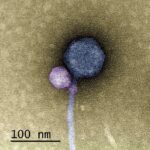
No one had ever seen one virus latching onto another virus, until anomalous sequencing results sent a UMBC team down a rabbit hole leading to a first-of-its-kind discovery.
It’s known that some viruses, called satellites, depend not only on their host organism to complete their life cycle, but also on another virus, known as a “helper,” explains Ivan Erill, professor of biological sciences. The satellite virus needs the helper either to build its capsid, a protective shell that encloses the virus’s genetic material, or to help it replicate its DNA. These viral relationships require the satellite and the helper to be in proximity to each other at least temporarily, but there were no known cases of a satellite actually attaching itself to a helper—until now.
In a paper published in the Journal of the International Society of Microbial Ecology, a UMBC team and colleagues from Washington University in St. Louis (WashU) describe the first observation of a satellite bacteriophage (a virus that infects bacterial cells) consistently attaching to a helper bacteriophage at its “neck”—where the capsid joins the tail of the virus.
In detailed electron microscopy images taken by Tagide deCarvalho, assistant director of the College of Natural and Mathematical Sciences core facilities and first author on the new paper, 80 percent (40 out of 50) helpers had a satellite bound at the neck. Some of those that did not had remnant satellite tendrils present at the neck. Erill, senior author on the paper, describes them as appearing like “bite marks.”
“When I saw it, I was like, ‘I can’t believe this,’” deCarvalho says. “No one has ever seen a bacteriophage—or any other virus—attach to another virus.”
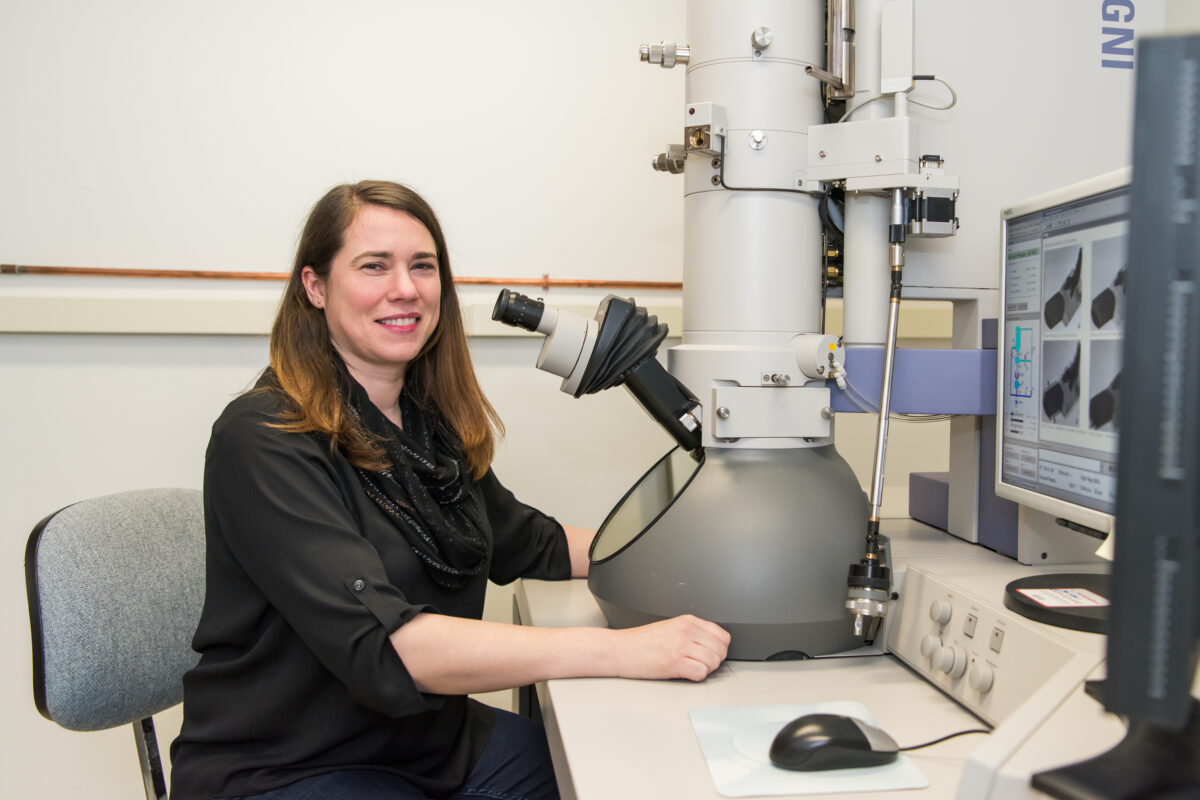 Tagide deCarvalho in the Keith R. Porter Imaging Facility. deCarvalho took advantage of the facility’s transmission electron microscope (TEM) to capture striking images of the satellite-helper virus system discussed in the new paper. (Marlayna Demond ’11/UMBC)
A long-term virus relationship
After the initial observations, Elia Mascolo, a graduate student in Erill‘s research group and co-first author on the paper, analyzed the genomes of the satellite, helper, and host, which revealed further clues about this never-before-seen viral relationship. Most satellite viruses contain a gene that allows them to integrate into the host cell’s genetic material after they enter the cell. This allows the satellite to reproduce whenever a helper happens to enter the cell from then on. The host cell also copies the satellite’s DNA along with its own when it divides.
 Ivan Erill co-leads the SEA-PHAGES program at UMBC. His research group focuses on bioinformatics. (Image by Marlayna Demond ’11/UMBC)
A bacteriophage sample from WashU also contained a helper and a satellite. The WashU satellite has a gene for integration and does not directly attach to its helper, similar to previously observed satellite-helper systems.
However, the satellite in UMBC’s sample, named MiniFlayer by the students who isolated it, is the first known case of a satellite with no gene for integration. Because it can’t integrate into the host cell’s DNA, it must be near its helper—named MindFlayer—every time it enters a host cell if it is going to survive. Given that, although the team did not directly prove this explanation, “Attaching now made total sense,” Erill says, “because otherwise, how are you going to guarantee that you are going to enter into the cell at the same time?”
Additional bioinformatics analysis by Mascolo and Julia López-Pérez, another Ph.D. student working with Erill, revealed that MindFlayer and MiniFlayer have been co-evolving for a long time. “This satellite has been tuning in and optimizing its genome to be associated with the helper for, I would say, at least 100 million years,” Erill says, which suggests there may be many more cases of this kind of relationship waiting to be discovered.
Contamination or discovery?
This groundbreaking discovery could easily have been missed. The project started out as a typical semester in the SEA-PHAGES program—an investigative curriculum where undergraduates isolate bacteriophages from environmental samples, send them out for sequencing, and then use bioinformatics tools to analyze the results. When the sequencing lab at the University of Pittsburgh reported contamination in the sample from UMBC expected to contain the MindFlayer phage, the journey began.
 Steven Caruso co-leads the SEA-PHAGES program at UMBC. He also conducts pedagogy research to improve science education. (Marlayna Demond ’11/UMBC)
The sample included one large sequence: the phage they expected. “But instead of just finding that, we also found a small sequence, which didn’t map to anything we knew,” says Erill, who is also one of the leads for UMBC’s SEA-PHAGES program, called Phage Hunters, along with Steven Caruso, principal lecturer of biological sciences. Caruso ’94, Ph.D. ’02, biological sciences, ran the isolation again, sent it out for sequencing—and got identical results.
That’s when the team pulled in deCarvalho to get a visual of what was going on with the transmission electron microscope (TEM) at UMBC’s Keith R. Porter Imaging Facility (KPIF). Without the images, the discovery would have been impossible.
“Not everyone has a TEM at their disposal,” deCarvalho notes. But with the instruments at the KPIF, deCarvalho says, “I’m able to follow up on some of these observations and validate them with imaging. There’s elements of discovery we can only make using the TEM.”
The team’s discovery sets the stage for future work to figure out how the satellite attaches, how common this phenomenon is, and much more. “It’s possible that a lot of the bacteriophages that people thought were contaminated were actually these satellite-helper systems,” deCarvalho says. “So now, with this paper, people might be able to recognize more of these systems.”
]]>
No one had ever seen one virus latching onto another virus, until anomalous sequencing results sent a UMBC team down a rabbit hole leading to a first-of-its-kind discovery. It’s known that...
https://umbc.edu/stories/first-observed-virus-attaching-to-another/
https://beta.my.umbc.edu/api/v0/pixel/news/136708/guest@my.umbc.edu/c2bf2528852f8aaedcbec04ce669e903/api/pixel
biology
cnms
news
research
science-and-tech
UMBC News & Magazine
https://beta.my.umbc.edu/groups/umbc-news-magazine
https://assets1-beta.my.umbc.edu/system/shared/avatars/groups/000/001/943/24435aa6207c452e7bc15cc74b42c7bb/xsmall.png?1748556657
https://assets1-beta.my.umbc.edu/system/shared/avatars/groups/000/001/943/24435aa6207c452e7bc15cc74b42c7bb/original.png?1748556657
https://assets2-beta.my.umbc.edu/system/shared/avatars/groups/000/001/943/24435aa6207c452e7bc15cc74b42c7bb/xxlarge.png?1748556657
https://assets2-beta.my.umbc.edu/system/shared/avatars/groups/000/001/943/24435aa6207c452e7bc15cc74b42c7bb/xlarge.png?1748556657
https://assets3-beta.my.umbc.edu/system/shared/avatars/groups/000/001/943/24435aa6207c452e7bc15cc74b42c7bb/large.png?1748556657
https://assets1-beta.my.umbc.edu/system/shared/avatars/groups/000/001/943/24435aa6207c452e7bc15cc74b42c7bb/medium.png?1748556657
https://assets2-beta.my.umbc.edu/system/shared/avatars/groups/000/001/943/24435aa6207c452e7bc15cc74b42c7bb/small.png?1748556657
https://assets1-beta.my.umbc.edu/system/shared/avatars/groups/000/001/943/24435aa6207c452e7bc15cc74b42c7bb/xsmall.png?1748556657
https://assets2-beta.my.umbc.edu/system/shared/avatars/groups/000/001/943/24435aa6207c452e7bc15cc74b42c7bb/xxsmall.png?1748556657
UMBC News & Magazine
0
0
false
Tue, 31 Oct 2023 15:34:34 -0400
Tue, 31 Oct 2023 15:34:34 -0400
Academic Success Center earns elite international distinction

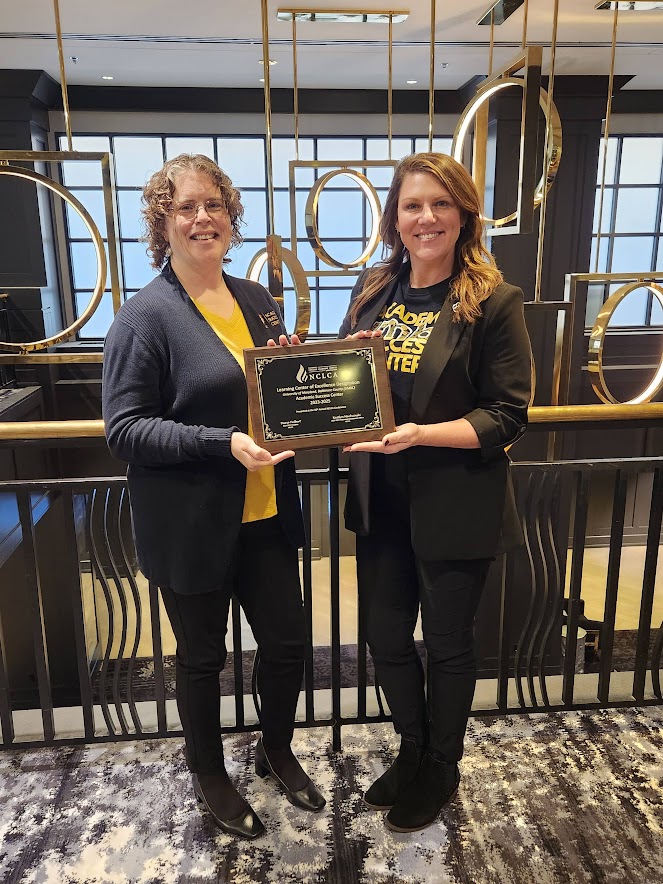 Director of academic learning resources, assessment, and analysis Delana Gregg, M.S. ’04, Ph.D. ’19, and Amanda Knapp pose with the Academic Success Center’s Learning Center of Excellence award. Photo courtesy of Knapp, associate vice provost and assistant dean for undergraduate academic affairs.
In September 2023, the UMBC Academic Success Center (ASC) gained a Learning Center of Excellence designation from the International College Learning Center Association (ICLCA). There are only six other institutions in the world with an active designation of excellence from ICLCA, shares Amanda Knapp, associate vice provost and assistant dean for undergraduate academic affairs.
“It’s remarkable what has been achieved since establishing our one-stop shop learning center model in 2019,” says Knapp. “We can now say with full evidence that our ASC is among the best in the world!”
It was no small feat. ASC staff—in addition to their role providing centralized support services to all undergraduate students at UMBC—completed a rigorous application and peer review process, meeting many standards along the way.
The Learning Center of Excellence designation came at the same time that ASC’s Tutoring Program met the College Reading and Learning Association rigorous standards and successfully completed the International Tutor Training Program Certification peer review process. SI PASS—ASC’s peer-assisted study sessions—gained programmatic accreditation through the International Center for Supplemental Instruction.
In spring 2024, the ASC will have a grand opening of the newly renovated, expanded, and highly visible first floor location in the Albin O. Kuhn Library and Gallery.
]]>
Director of academic learning resources, assessment, and analysis Delana Gregg, M.S. ’04, Ph.D. ’19, and Amanda Knapp pose with the Academic Success Center’s Learning Center of Excellence award....
https://umbc.edu/stories/academic-success-center-earns-elite-distinction/
https://beta.my.umbc.edu/api/v0/pixel/news/136697/guest@my.umbc.edu/f44cac4ffe341e9346dd0acb2918b795/api/pixel
academic-success-center
campus-life
magazine
quick-post
UMBC News & Magazine
https://beta.my.umbc.edu/groups/umbc-news-magazine
https://assets1-beta.my.umbc.edu/system/shared/avatars/groups/000/001/943/24435aa6207c452e7bc15cc74b42c7bb/xsmall.png?1748556657
https://assets1-beta.my.umbc.edu/system/shared/avatars/groups/000/001/943/24435aa6207c452e7bc15cc74b42c7bb/original.png?1748556657
https://assets2-beta.my.umbc.edu/system/shared/avatars/groups/000/001/943/24435aa6207c452e7bc15cc74b42c7bb/xxlarge.png?1748556657
https://assets2-beta.my.umbc.edu/system/shared/avatars/groups/000/001/943/24435aa6207c452e7bc15cc74b42c7bb/xlarge.png?1748556657
https://assets3-beta.my.umbc.edu/system/shared/avatars/groups/000/001/943/24435aa6207c452e7bc15cc74b42c7bb/large.png?1748556657
https://assets1-beta.my.umbc.edu/system/shared/avatars/groups/000/001/943/24435aa6207c452e7bc15cc74b42c7bb/medium.png?1748556657
https://assets2-beta.my.umbc.edu/system/shared/avatars/groups/000/001/943/24435aa6207c452e7bc15cc74b42c7bb/small.png?1748556657
https://assets1-beta.my.umbc.edu/system/shared/avatars/groups/000/001/943/24435aa6207c452e7bc15cc74b42c7bb/xsmall.png?1748556657
https://assets2-beta.my.umbc.edu/system/shared/avatars/groups/000/001/943/24435aa6207c452e7bc15cc74b42c7bb/xxsmall.png?1748556657
UMBC News & Magazine
1
0
false
Tue, 31 Oct 2023 11:37:32 -0400
Tue, 31 Oct 2023 11:37:32 -0400
UMBC’s Vandana Janeja aims to boost high-performance computing know-how to tackle environmental science challenges with a $1 million NSF grant

The discovery of the Higgs boson. The first picture of a black hole. The Covid-19 vaccine. Many recent scientific advances, such as these, owe much to a largely unsung hero: high-performance computing.

Vandana Janeja (Marlayna Demond ’11/UMBC)
Yet the use of high-performance computing is generally limited to a niche group. “Some researchers are very sophisticated in the use of these tools, but many are not,” says Vandana Janeja, a professor of information systems at UMBC.
Janeja is on a mission to spread advanced computing know-how far beyond its current borders. “It’s not just for the elites,” she says.
She was recently awarded a nearly $1 million grant from the National Science Foundation (NSF) that will help further that mission. The grant is part of a larger NSF collaborative award with the University of Maryland Center for Environmental Sciences (UMCES).
Janeja and her UMBC and UMCES colleagues will work to connect a wide range of students and faculty with high-performance computing experts, creating and nurturing what has been called the cyberinfrastructure pipeline. The ultimate goal is to facilitate the flow of knowledge.
“Once one person gains experience, they can turn around and help someone else,” Janeja says. “It’s about supporting and connecting people with resources and not just about setting up the hardware and software.”
Building a high-performance computing workforce
The need for fast computers in research is driven in part by a modern deluge of data. For example, NASA estimates that it will soon have accumulated hundreds of petabytes of Earth science data, from sources such as satellites flying overhead and sensors installed on the ground. Making full use of all that data requires new approaches to computing. While traditional computers generally perform calculations one at a time, high-performance computing facilities break up the work between multiple computing nodes and run processes in parallel.
UMBC has its own high-performance computing facility, which houses computing equipment that can process data significantly faster than a standard laptop. University researchers have employed the fast computers to study topics as diverse as weather modeling, cancer treatment, and flight dynamics.
“Learning how to use high-performance computing is not straight-forward,” says Janeja. Users have to gain a good understanding of the infrastructure of the computers, and also hone their skills in identifying the best techniques to take full advantage of that infrastructure.
People with a good understanding of how these machines and their software work will be in high demand, Janeja adds.
Many modern AI algorithms, which are used by scientific researchers and big tech companies alike, require high-performance computing to operate. “While everyone is running toward the shiny object of AI, many don’t realize that there is a backbone, called cyberinfrastructure, that runs AI,” says Janeja.
Part of Janeja’s goal with the new grant is to educate students who may pursue careers building, maintaining, utilizing, and improving that cyberinfrastructure backbone. She also cares deeply about ensuring diverse groups of people have access to these roles.
“We are trying to democratize the use of cyberinfrastructure and make it accessible to people who have never used it,” Janeja says.
Jack Suess, ‘81, M.S. ‘94, UMBC’s vice president of information technology, says he is excited for his division to play a key role in the award, helping shape best practices and build a national cyberinfrastructure support structure. “I look forward to watching how this work informs not just how we support faculty, but how we train and support advanced undergraduates and graduate students to evolve into these roles,” he says.
Tackling environmental challenges
While there is no shortage of scientific questions that might be tackled with high-performance computing, Janeja and her colleagues on the new grant will test-run their collaborative initiatives with projects in environmental science.

Changes to the ice and snow in Greenland could contribute to sea level rise. (Image credit: NASA)
Janeja is also director of iHARP, an NSF-funded institute that aims to harness big data and advanced computing tools to better model how climate change will affect the polar regions. As part of the new grant, iHARP and UMCES researchers will partner with cyberinfrastructure professionals to explore environmental science questions, such as in iHARP investigating how to predict the rate of snow melting in Greenland.
Scientists increasingly rely on big data and high-performance computing to understand and predict changes in the environment. As human activities continue to put pressure on natural systems, it will be more important than ever to forge collaborations between researchers and computing experts that advance the science.
“I’m excited to leverage high-performance computing to solve real-world problems and make it accessible to students and researchers of all backgrounds,” Janeja says.
]]>
The discovery of the Higgs boson. The first picture of a black hole. The Covid-19 vaccine. Many recent scientific advances, such as these, owe much to a largely unsung hero: high-performance...
https://umbc.edu/stories/vandana-janeja-nsf-grant-computing/
https://beta.my.umbc.edu/api/v0/pixel/news/136681/guest@my.umbc.edu/df7ee24459cf2e6c8d3cbbcb80877422/api/pixel
coeit
doit
is
news
rca-1
research
science-and-tech
UMBC News & Magazine
https://beta.my.umbc.edu/groups/umbc-news-magazine
https://assets1-beta.my.umbc.edu/system/shared/avatars/groups/000/001/943/24435aa6207c452e7bc15cc74b42c7bb/xsmall.png?1748556657
https://assets1-beta.my.umbc.edu/system/shared/avatars/groups/000/001/943/24435aa6207c452e7bc15cc74b42c7bb/original.png?1748556657
https://assets2-beta.my.umbc.edu/system/shared/avatars/groups/000/001/943/24435aa6207c452e7bc15cc74b42c7bb/xxlarge.png?1748556657
https://assets2-beta.my.umbc.edu/system/shared/avatars/groups/000/001/943/24435aa6207c452e7bc15cc74b42c7bb/xlarge.png?1748556657
https://assets3-beta.my.umbc.edu/system/shared/avatars/groups/000/001/943/24435aa6207c452e7bc15cc74b42c7bb/large.png?1748556657
https://assets1-beta.my.umbc.edu/system/shared/avatars/groups/000/001/943/24435aa6207c452e7bc15cc74b42c7bb/medium.png?1748556657
https://assets2-beta.my.umbc.edu/system/shared/avatars/groups/000/001/943/24435aa6207c452e7bc15cc74b42c7bb/small.png?1748556657
https://assets1-beta.my.umbc.edu/system/shared/avatars/groups/000/001/943/24435aa6207c452e7bc15cc74b42c7bb/xsmall.png?1748556657
https://assets2-beta.my.umbc.edu/system/shared/avatars/groups/000/001/943/24435aa6207c452e7bc15cc74b42c7bb/xxsmall.png?1748556657
UMBC News & Magazine
0
0
false
Mon, 30 Oct 2023 15:12:27 -0400
Mon, 30 Oct 2023 15:12:27 -0400
The Academic Minute: Democratizing access to digital tools in the documentation of the Innu language

For centuries, books have been the primary method of documenting spoken and written languages. This method has given us insights into the formal and informal uses of language within communities and those outside the community. However, books and even tape recordings haven’t always captured the intricacies and uniqueness of a language. Advances in technology have broadened the scope and quality of language documentation and preservation, but these digital tools have also created a skills gap between researchers and communities.
UMBC’s Renée Lambert-Brétière, associate professor of modern languages, linguistics, and intercultural communication, is working on bridging this gap through a collaborative and community-engaged research project with Innu-speaking communities in Quebec, Canada, that seeks to democratize access to digital tools involved in the documentation of their language.
“Mobilizing methodologies of linguistics, digital and public humanities, this research makes an important contribution to current developments in language documentation research and constitutes a major step in broadening the tools for language preservation within the Innu speech communities,” Lambert-Brétière explains to Lynn Pasquerella, president of the American Association of Colleges and Universities and host of The Academic Minute, a daily show featuring faculty from colleges and universities worldwide speaking about their cutting-edge research.
UMBC’s Academic Minute takeover week
Lambert-Brétière joined five UMBC scholars this fall in UMBC’s first Academic Minute Takeover Week, featuring the latest research in media and communication studies; philosophy; language, literacy, and culture; and history. This series is republished on NPR podcasts and Inside Higher Ed.https://academicminute.org/2023/09/renee-lambert-bretiere-democratizing-access-to-digital-tools-in-the-documentation-of-the-innu-language/
Lambert-Brétière’s book, À la recherche d’un signe perdu: Jean-Baptiste de La Brosse, S.J., Éléments de langue montagnaise (1768) (Chemins de tr@verse, 2018), is the first edition of the grammar of the Innu language written in Latin in 1768 by the Jesuit Jean-Baptiste de La Brosse. It offers a unique testimony on the state of this nomadic language in the middle of the eighteenth century. Her research has appeared in peer-reviewed outlets that include the Journal of Language Diversity, Anthropological Linguistics, Journal de la société des océanistes, and Annual Review of Cognitive Linguistics.
Learn more about UMBC’s modern languages, linguistics, and intercultural communication program.
]]>
For centuries, books have been the primary method of documenting spoken and written languages. This method has given us insights into the formal and informal uses of language within communities...
https://umbc.edu/stories/the-academic-minute-democratizing-digital-tools/
https://beta.my.umbc.edu/api/v0/pixel/news/136640/guest@my.umbc.edu/8ea7fcb92183c1ad22a767dc4ee80790/api/pixel
cahss
mlli
news
policy-and-society
research
UMBC News & Magazine
https://beta.my.umbc.edu/groups/umbc-news-magazine
https://assets1-beta.my.umbc.edu/system/shared/avatars/groups/000/001/943/24435aa6207c452e7bc15cc74b42c7bb/xsmall.png?1748556657
https://assets1-beta.my.umbc.edu/system/shared/avatars/groups/000/001/943/24435aa6207c452e7bc15cc74b42c7bb/original.png?1748556657
https://assets2-beta.my.umbc.edu/system/shared/avatars/groups/000/001/943/24435aa6207c452e7bc15cc74b42c7bb/xxlarge.png?1748556657
https://assets2-beta.my.umbc.edu/system/shared/avatars/groups/000/001/943/24435aa6207c452e7bc15cc74b42c7bb/xlarge.png?1748556657
https://assets3-beta.my.umbc.edu/system/shared/avatars/groups/000/001/943/24435aa6207c452e7bc15cc74b42c7bb/large.png?1748556657
https://assets1-beta.my.umbc.edu/system/shared/avatars/groups/000/001/943/24435aa6207c452e7bc15cc74b42c7bb/medium.png?1748556657
https://assets2-beta.my.umbc.edu/system/shared/avatars/groups/000/001/943/24435aa6207c452e7bc15cc74b42c7bb/small.png?1748556657
https://assets1-beta.my.umbc.edu/system/shared/avatars/groups/000/001/943/24435aa6207c452e7bc15cc74b42c7bb/xsmall.png?1748556657
https://assets2-beta.my.umbc.edu/system/shared/avatars/groups/000/001/943/24435aa6207c452e7bc15cc74b42c7bb/xxsmall.png?1748556657
UMBC News & Magazine
0
0
false
Fri, 27 Oct 2023 13:59:17 -0400
Fri, 27 Oct 2023 13:59:17 -0400
A love letter to Homecoming

When you think about UMBC’s Homecoming, you undoubtedly conjure images of carnival rides, black and gold decorations, and the beloved Puppy Parade. But what Homecoming is really about, for us, is the people. We asked social media intern Allison John ‘24, psychology, to share what it was like to walk a mile (or more accurately, many, many miles) in her shoes during this year’s Homecoming.
We always hope the skies will be blue and the sun will be shining for UMBC’s Homecoming, but that unfortunately wasn’t the case this year. Luckily, that did not stop students, alumni, family, and friends from taking part in all the festivities that Homecoming brings! This year I was lucky to not only partake as a student, but also as a board member of UMBC’s Student Events Board (seb), and as an intern for University Communications and Marketing (UCM). Being involved in all these roles meant I got to see Homecoming through a different lens.
As a student, I loved going to the carnival with all my friends on Homecoming preview night. We enjoyed all the different rides, played carnival games, and took in the moments knowing that college goes by so quickly and if we don’t cherish it while we’re here, it’ll be gone before we notice.
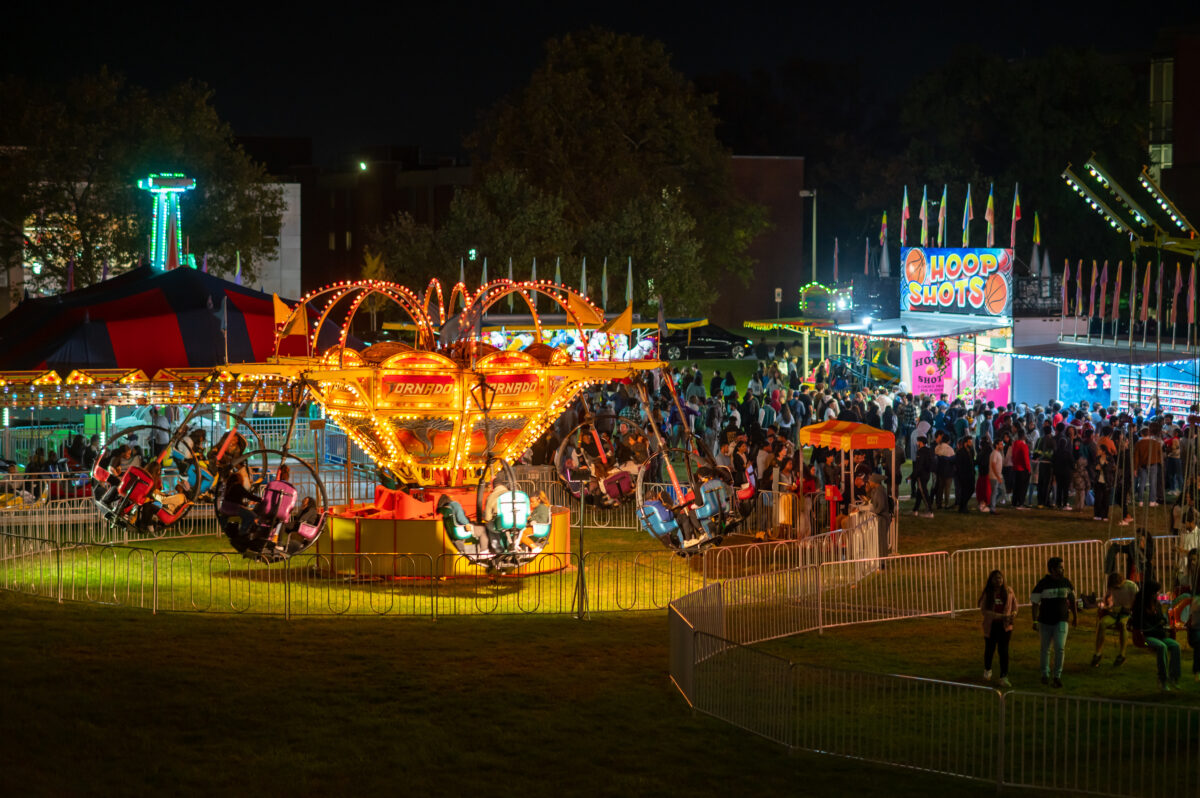 Homecoming preview night is a great time to get a sneak peek of what the weekend will bring! (Photo by Max Franz for UMBC)
Helping co-create Homecoming
As a board member of (seb), I loved getting involved with activities that I may not have participated in otherwise. I got the chance to interact with all the amazing vendors we had, ranging from the petting zoo and food trucks, to the balloon and caricature artists. This role allowed me to create amazing memories for so many people and to play a part in the magic that happens on campus during Homecoming. I even got the chance to ride around campus on golf carts, placing the huge Homecoming stickers on the sidewalk that always amazed me when I was a first-year student.
 Families had a great time decorating pumpkins and making them their own! (Photo by Erika Nizborski for UMBC)
By far, my favorite role of all was the role I played as a UCM intern. I had the opportunity to capture memories throughout Homecoming weekend by taking pictures at the Puppy Parade and seeing all the festive dogs that got to partake in such a fun tradition. I also had the opportunity to explore the Alumni and Friends Tent and meet so many alumni and witness them reconnecting with old friends and talking about how much has changed since they graduated.
 True Grit and Chip feeling all the love (for each other) at Homecoming Hype. Photo by Marlayna Demond ’11 for UMBC)
Being a senior now, I got emotional throughout Homecoming weekend. I know that although I can always come back for Homecoming, this was the last time I had the chance to make an impact on the UMBC community as a student and help create the special memories that Homecoming is all about. Homecoming is truly a culmination of so many different events including the annual bonfire, Athletics games, the 5k run, Puppy Parade, carnival, food trucks, pumpkin painting, the Alumni and Friends Tent, and so much more.
As I took the time to reflect on Homecoming, I came to realize that, at its core, Homecoming is about one thing—you. It’s about your story and how UMBC has played a part in that story. Homecoming is so special because it brings so many people together in one place to reconnect, and whether it’s been one year since you graduated or 30, there are still so many memories to be made at Homecoming.
 Face painting fun during Homecoming 2023. Photo by Erika Nizborski for UMBC.
During my time talking to alumni, our conversations would always lead to me learning more about how college played a role in who they are now. Some told me about lessons that they learned while attending UMBC, and I even learned about one alum who met her fiancé here. It’s these lessons and memories that make us who we are. Homecoming is what reminds us every year how special these moments are and why we should take a break from the chaos of life and enjoy the people that surround us. Homecoming 2023 was one to remember because it’s a reminder that even the weather can’t put a damper on the importance and strength of a community, our UMBC community.
By Allison John ’24, psychology
]]>
When you think about UMBC’s Homecoming, you undoubtedly conjure images of carnival rides, black and gold decorations, and the beloved Puppy Parade. But what Homecoming is really about, for us, is...
https://umbc.edu/stories/a-love-letter-to-homecoming-2023/
https://beta.my.umbc.edu/api/v0/pixel/news/136641/guest@my.umbc.edu/d9186d0f1ba8197c937ed3735241d687/api/pixel
campus-life
homecoming
magazine
seb
UMBC News & Magazine
https://beta.my.umbc.edu/groups/umbc-news-magazine
https://assets1-beta.my.umbc.edu/system/shared/avatars/groups/000/001/943/24435aa6207c452e7bc15cc74b42c7bb/xsmall.png?1748556657
https://assets1-beta.my.umbc.edu/system/shared/avatars/groups/000/001/943/24435aa6207c452e7bc15cc74b42c7bb/original.png?1748556657
https://assets2-beta.my.umbc.edu/system/shared/avatars/groups/000/001/943/24435aa6207c452e7bc15cc74b42c7bb/xxlarge.png?1748556657
https://assets2-beta.my.umbc.edu/system/shared/avatars/groups/000/001/943/24435aa6207c452e7bc15cc74b42c7bb/xlarge.png?1748556657
https://assets3-beta.my.umbc.edu/system/shared/avatars/groups/000/001/943/24435aa6207c452e7bc15cc74b42c7bb/large.png?1748556657
https://assets1-beta.my.umbc.edu/system/shared/avatars/groups/000/001/943/24435aa6207c452e7bc15cc74b42c7bb/medium.png?1748556657
https://assets2-beta.my.umbc.edu/system/shared/avatars/groups/000/001/943/24435aa6207c452e7bc15cc74b42c7bb/small.png?1748556657
https://assets1-beta.my.umbc.edu/system/shared/avatars/groups/000/001/943/24435aa6207c452e7bc15cc74b42c7bb/xsmall.png?1748556657
https://assets2-beta.my.umbc.edu/system/shared/avatars/groups/000/001/943/24435aa6207c452e7bc15cc74b42c7bb/xxsmall.png?1748556657
UMBC News & Magazine
0
0
false
Fri, 27 Oct 2023 13:45:58 -0400
Fri, 27 Oct 2023 13:45:58 -0400
The Academic Minute: The Long History of Financial Fraud

Banks, large corporations, small businesses, non-profit organizations, and individuals alike lend and loan money to make more money, spur corporate growth, buy property, start a business, and help those in need. Funding prosperity and goodwill can be one outcome of financial investments. However, it’s not all good news. Today, we often hear about financial mismanagement, embezzlement, and money laundering, sometimes leading to bankruptcy and/or government bailouts—But financial fraud is not a modern story.
UMBC’s Amy Froide, professor of history, teaches courses in British history and European women’s history between 1500-1800 and researches social, economic, and gender history. During a research trip to the U.K., Froide found documents about the Charitable Corporation’s financial disaster of 1732, which she wrote about in The Conversation.
Listen here, or view on The Academic Minute site
“The Charitable Corporation was notable in having a high proportion of female investors—35 percent of the funders in the 1700s were women,” Froide explains to Lynn Pasquerella, president of the American Association of Colleges and Universities and host of The Academic Minute, a daily show featuring faculty from colleges and universities worldwide speaking about their cutting-edge research. “When the financial scandal came to light, it was these women who led activist shareholders to call for government compensation.”
UMBC’s Academic Minute takeover week
Froide joined five UMBC scholars this fall in UMBC’s first Academic Minute Takeover Week, featuring the latest research in media and communication studies; modern languages, linguistics, and intercultural communication; language, literacy, and culture; and history. This series is republished on NPR podcasts and Inside Higher Ed.
Learn more about Amy Froide’s research:
Learn more about UMBC’s history major and graduate programs.
]]>
Banks, large corporations, small businesses, non-profit organizations, and individuals alike lend and loan money to make more money, spur corporate growth, buy property, start a business, and help...
https://umbc.edu/stories/the-academic-minute-amy-froide-financial-fraud/
https://beta.my.umbc.edu/api/v0/pixel/news/136619/guest@my.umbc.edu/e615459a8a0010cced7809358592e561/api/pixel
cahss
history
news
policy-and-society
research
UMBC News & Magazine
https://beta.my.umbc.edu/groups/umbc-news-magazine
https://assets1-beta.my.umbc.edu/system/shared/avatars/groups/000/001/943/24435aa6207c452e7bc15cc74b42c7bb/xsmall.png?1748556657
https://assets1-beta.my.umbc.edu/system/shared/avatars/groups/000/001/943/24435aa6207c452e7bc15cc74b42c7bb/original.png?1748556657
https://assets2-beta.my.umbc.edu/system/shared/avatars/groups/000/001/943/24435aa6207c452e7bc15cc74b42c7bb/xxlarge.png?1748556657
https://assets2-beta.my.umbc.edu/system/shared/avatars/groups/000/001/943/24435aa6207c452e7bc15cc74b42c7bb/xlarge.png?1748556657
https://assets3-beta.my.umbc.edu/system/shared/avatars/groups/000/001/943/24435aa6207c452e7bc15cc74b42c7bb/large.png?1748556657
https://assets1-beta.my.umbc.edu/system/shared/avatars/groups/000/001/943/24435aa6207c452e7bc15cc74b42c7bb/medium.png?1748556657
https://assets2-beta.my.umbc.edu/system/shared/avatars/groups/000/001/943/24435aa6207c452e7bc15cc74b42c7bb/small.png?1748556657
https://assets1-beta.my.umbc.edu/system/shared/avatars/groups/000/001/943/24435aa6207c452e7bc15cc74b42c7bb/xsmall.png?1748556657
https://assets2-beta.my.umbc.edu/system/shared/avatars/groups/000/001/943/24435aa6207c452e7bc15cc74b42c7bb/xxsmall.png?1748556657
UMBC News & Magazine
0
0
false
Fri, 27 Oct 2023 08:53:21 -0400
Fri, 27 Oct 2023 08:53:21 -0400
Top 6 ways to celebrate (a slightly spine-chilling) autumn at UMBC
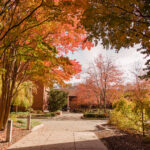
The leaves of the trees on campus are turning red, orange, and gold as the temperature finally starts to cool down. The semester is halfway over now as the autumn weather settles in, but there are still many great events to look forward to. So take a sip of your apple crisp oat milk macchiato and let’s look at six of the best ways to get in the spirit of the season at UMBC.
Peek “Beyond the Veil”
Throughout the months of October and November, online “Beyond the Veil” lectures will take a look at the ways different cultural histories intermingle with the spirit world, pulling from the Special Collections’ Eileen J. Garrett Parapsychology Foundation collection. Topics include the root of everyday African cultures in spirituality, the origins of Hoodoo during chattel slavery, and the influence of Spiritualism. Join any session of this speaking series for the chance to celebrate cultural histories and the supernatural.
Shiver Your Timbers with Mind’s Eye
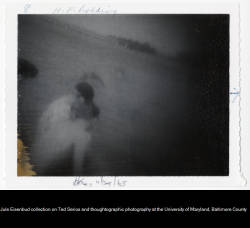 Thoughtograph by Ted Serios.
“The extraordinary story of the Chicago bellhop who attempted to transfer mental images to Polaroid film,” is how the Mind’s Eye: The Psychic Photographs of Ted Serios is billed for interested readers. Out this October, the book features photography from the Jule Eisenbud collection in the Albin O. Kuhn Library and Gallery’s Special Collections, as well as essays by Emily Hauver ’06, visual arts, exhibition curator, and Beth Saunders, head of Special Collections. If the idea of “thoughtography” (Serios thought he was psychically transferring his thoughts to film) intrigues you, take a look at the images and data created by the mind’s eye of Ted Serios.
If You Dare, Go See Dracula
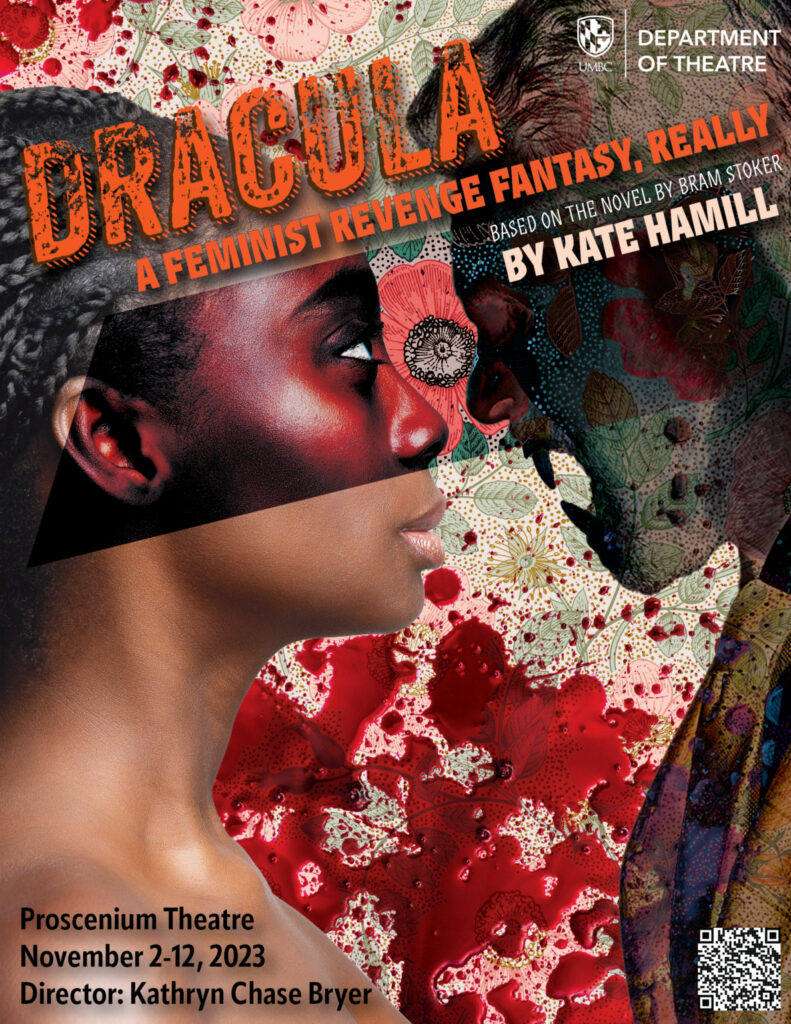
If you enjoy drama, the story of Dracula, copious stage blood, or the idea of the deconstruction of horror through a feminist lens, take your seat and enjoy the show! UMBC’s Theatre Department is staging Dracula: a Feminist Revenge Fantasy, Really, from November 2 to November 12. The show—which one might compare more to Kill Bill than Saw—will have a free matinee for UMBC students with an actor talk-back for its final performance.
Production stage manager Tessara Morgan Farley has been researching stage blood for several months to present the most realistic color, texture, and spray. The director of the show, Kathryn Chase Bryer, says, “The fact that I’m working on a show that has a blood person, that’s really special and well done for UMBC.”
Quake in Your Boots with the Hallowzine
With Halloween comes the Hallowzine, commonvision’s annual spooky zine and digital gallery. “It’s very creative and accepting,” says Anna Mishonova ’24, media and communications studies, who submitted to the Hallowzine last year before joining the commonvision staff. “I really enjoyed it, and everyone is very talented. There are some really nice photos, and the poetry can be very moving.”
Check Out Holly Horror by Alum Michelle Jabès Corpora

A girl named Evie moves into a place called the Horror House (her first mistake), where the previous resident mysteriously vanished from her bedroom. Michelle Corpora ’03, English, penned Holly Horror, a young adult book published by Penguin Random House earlier this year as a dark twist on a beloved classic. If you enjoy ghosts, mysteries, and scary stories, this book is for you.
Groove Along to Some Halloween Jazz
Strange things are afoot at UMBC. Come spend the afternoon with the UMBC Jazz Ensemble performing an all-Halloween-themed live (or undead) show. Treat yourself to these tricky grooves! Bring your human soul to the Earl and Darielle Linehan Concert Hall on Sunday, October 29 at 3 p.m., if you dare!
Selections include Giant Steps by John Coltrane, Dance You Monster To My Soft Song by Maria Schneider, Over the Rainbow by Harold Arlen, A Call For All Demons by Sun Ra, Oh! by Ernie Wilkins, and more!
 The UC at night. (Marlayna Demond ’11/UMBC)
]]>
The leaves of the trees on campus are turning red, orange, and gold as the temperature finally starts to cool down. The semester is halfway over now as the autumn weather settles in, but there are...
https://umbc.edu/stories/top-6-ways-to-celebrate-a-spine-chilling-autumn/
https://beta.my.umbc.edu/api/v0/pixel/news/136602/guest@my.umbc.edu/d6ee6e505cd5e3a3d3b2ea65e05e3a40/api/pixel
campus-life
magazine
UMBC News & Magazine
https://beta.my.umbc.edu/groups/umbc-news-magazine
https://assets1-beta.my.umbc.edu/system/shared/avatars/groups/000/001/943/24435aa6207c452e7bc15cc74b42c7bb/xsmall.png?1748556657
https://assets1-beta.my.umbc.edu/system/shared/avatars/groups/000/001/943/24435aa6207c452e7bc15cc74b42c7bb/original.png?1748556657
https://assets2-beta.my.umbc.edu/system/shared/avatars/groups/000/001/943/24435aa6207c452e7bc15cc74b42c7bb/xxlarge.png?1748556657
https://assets2-beta.my.umbc.edu/system/shared/avatars/groups/000/001/943/24435aa6207c452e7bc15cc74b42c7bb/xlarge.png?1748556657
https://assets3-beta.my.umbc.edu/system/shared/avatars/groups/000/001/943/24435aa6207c452e7bc15cc74b42c7bb/large.png?1748556657
https://assets1-beta.my.umbc.edu/system/shared/avatars/groups/000/001/943/24435aa6207c452e7bc15cc74b42c7bb/medium.png?1748556657
https://assets2-beta.my.umbc.edu/system/shared/avatars/groups/000/001/943/24435aa6207c452e7bc15cc74b42c7bb/small.png?1748556657
https://assets1-beta.my.umbc.edu/system/shared/avatars/groups/000/001/943/24435aa6207c452e7bc15cc74b42c7bb/xsmall.png?1748556657
https://assets2-beta.my.umbc.edu/system/shared/avatars/groups/000/001/943/24435aa6207c452e7bc15cc74b42c7bb/xxsmall.png?1748556657
UMBC News & Magazine
0
0
false
Thu, 26 Oct 2023 13:45:29 -0400
Thu, 26 Oct 2023 13:45:29 -0400
UMBC mathematician Kathleen Hoffman contributes to research on animal decision-making, with robotics applications
The UC at night. (Marlayna Demond ’11/UMBC)
]]>
The leaves of the trees on campus are turning red, orange, and gold as the temperature finally starts to cool down. The semester is halfway over now as the autumn weather settles in, but there are...
https://umbc.edu/stories/top-6-ways-to-celebrate-a-spine-chilling-autumn/
https://beta.my.umbc.edu/api/v0/pixel/news/136602/guest@my.umbc.edu/d6ee6e505cd5e3a3d3b2ea65e05e3a40/api/pixel
campus-life
magazine
UMBC News & Magazine
https://beta.my.umbc.edu/groups/umbc-news-magazine
https://assets1-beta.my.umbc.edu/system/shared/avatars/groups/000/001/943/24435aa6207c452e7bc15cc74b42c7bb/xsmall.png?1748556657
https://assets1-beta.my.umbc.edu/system/shared/avatars/groups/000/001/943/24435aa6207c452e7bc15cc74b42c7bb/original.png?1748556657
https://assets2-beta.my.umbc.edu/system/shared/avatars/groups/000/001/943/24435aa6207c452e7bc15cc74b42c7bb/xxlarge.png?1748556657
https://assets2-beta.my.umbc.edu/system/shared/avatars/groups/000/001/943/24435aa6207c452e7bc15cc74b42c7bb/xlarge.png?1748556657
https://assets3-beta.my.umbc.edu/system/shared/avatars/groups/000/001/943/24435aa6207c452e7bc15cc74b42c7bb/large.png?1748556657
https://assets1-beta.my.umbc.edu/system/shared/avatars/groups/000/001/943/24435aa6207c452e7bc15cc74b42c7bb/medium.png?1748556657
https://assets2-beta.my.umbc.edu/system/shared/avatars/groups/000/001/943/24435aa6207c452e7bc15cc74b42c7bb/small.png?1748556657
https://assets1-beta.my.umbc.edu/system/shared/avatars/groups/000/001/943/24435aa6207c452e7bc15cc74b42c7bb/xsmall.png?1748556657
https://assets2-beta.my.umbc.edu/system/shared/avatars/groups/000/001/943/24435aa6207c452e7bc15cc74b42c7bb/xxsmall.png?1748556657
UMBC News & Magazine
0
0
false
Thu, 26 Oct 2023 13:45:29 -0400
Thu, 26 Oct 2023 13:45:29 -0400
UMBC mathematician Kathleen Hoffman contributes to research on animal decision-making, with robotics applications
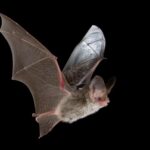
Animals must constantly make the choice between using energy to gather information about their environment or to carry out goal-driven tasks. Animals use sensory input, including humans’ five senses and other senses like electromagnetics and echolocation, to make those decisions.
A new study published in Nature Machine Intelligencefinds that all 11 species the research team investigated—ranging from amoebas to humans—demonstrate similar patterns of movement. These results have implications for robotics, because robots must be programmed to make the same kinds of decisions animals do to move safely and efficiently through unpredictable environments.
The research team ran experiments with glass knifefish, and then analyzed data available in the scientific literature on 10 other species: humans, mice, bats, moles, three butterflies, cockroaches, and two amoebas. Every single species demonstrated the same pattern of decision making, which involved turning the information-gathering mode, called “explore,” on and off depending on how uncertain the animals were about their environment.
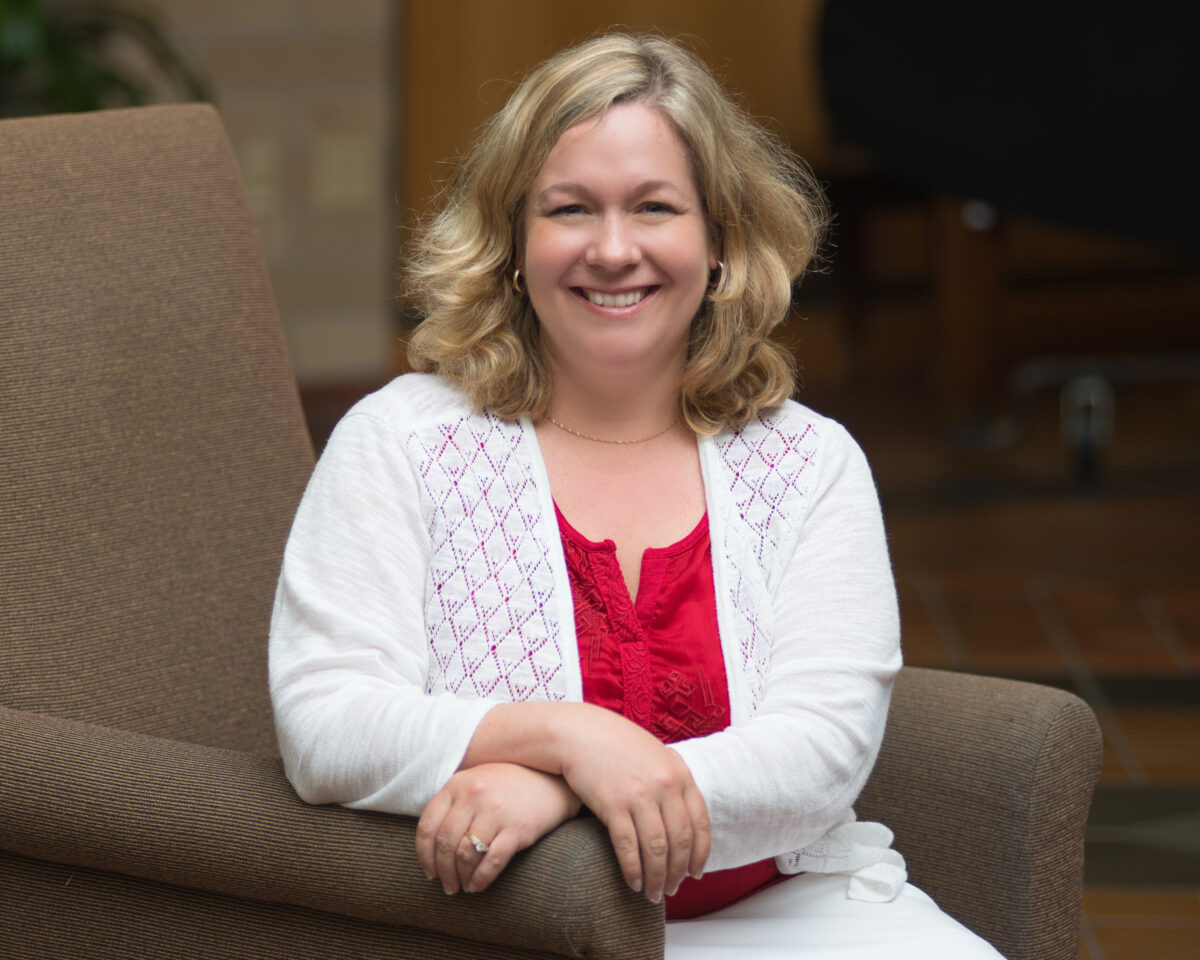 Kathleen Hoffman says the research team for this project “was one of the coolest interdisciplinary groups I’ve worked in.” (Image courtesy of Hoffman)
The mathematical strategy that best represented the animals’ behavior “is the trace of a covariance matrix—which I don’t think the fish is actually computing,” jokes Kathleen Hoffman, professor of mathematics and statistics and an author on the new paper.
Robots, too, must constantly interpret the sensory input they’re receiving and use that information to make decisions. Understanding how real animals tackle that process, even if they don’t know themselves, is useful for robotics, Hoffman explains, “because the robot actually can compute the trace of a covariance matrix.”
Interdisciplinary innovation advances robotics
Specifically, the paper’s results showed that an animal explores until its certainty about its environment decreases below a given threshold. Then it switches to using that information for tasks, which is called “exploit” mode. When uncertainty rises again, it goes back to exploring. This kind of mode-switching is called “triggered excitation.” It differs from a model called “persistent excitation,” which involves constant exploring.
Applications involving sensory processing, like robots, often use the persistent excitation model, so the team was surprised to discover that persistent excitation is not consistent with their observations and analysis. The team’s findings could have a significant impact in the field of sensory modeling.
The work for this paper required many areas of expertise, and the team included researchers in mathematics, engineering, and biology. Debojyoti Biswas, a postdoctoral fellow at Johns Hopkins University, is the first author on the new paper, and the other authors include Hoffman and researchers at University of Minnesota, Cornell University, and the New Jersey Institute of Technology.
The project grew out of a conversation between Hoffman and John Guckenheimer, an emeritus professor of mathematics at Cornell. They invited the rest of the team members on board as their expertise was needed. From figuring out how to track the position of the knifefish in the experiments with extreme precision, to analyzing the data on other species, to interpreting the math in a way that made sense in a biological context, everyone had a role to play.
“This was one of the coolest interdisciplinary groups I’ve worked in,” Hoffman says. “I really don’t think that any one of us could have done it on our own.”
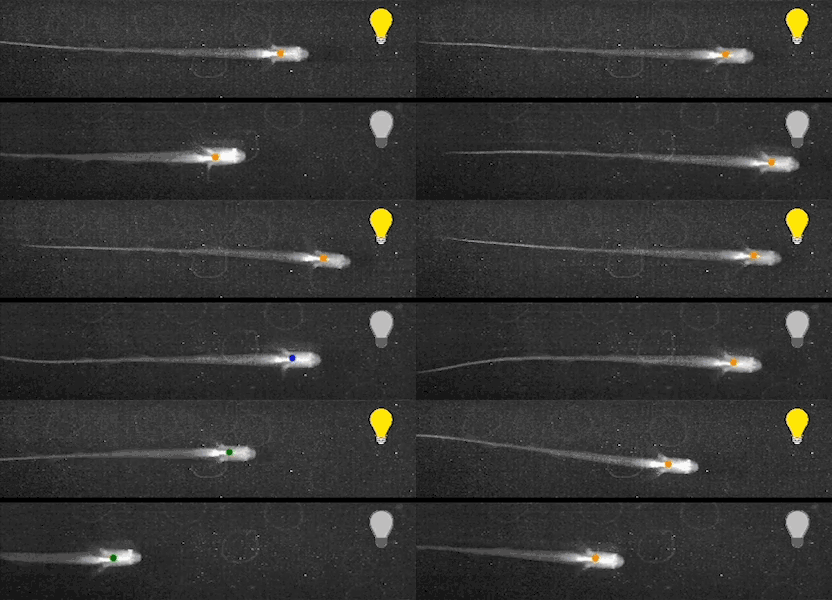 This clip of the knifefish in the team’s experiments shows how they switch between darting forward and back to “explore” their surroundings and “exploiting” that information to keep themselves in the middle. (Video courtesy of Debojyoti Biswas)
The remaining “head-scratcher”
The new paper has generated new questions as well as answers. “Here’s the head-scratcher,” Hoffman says: “What’s the mechanism that leads to this?” The team observed the same pattern in species as different as butterflies and moles, which use completely different senses. And they were able to deduce the pattern from published research that was originally undertaken to answer completely different questions.
Moving forward, some of the same team members, including Hoffman, plan to dig deeper into the mechanism behind this surprising pattern—and whether the mechanism is the same or different across species. “To me,” Hoffman says, “this is fundamental and really important.”
Hoffman is grateful to have been a part of the team. She took the opportunity to grow as a mathematician by contributing primarily to the project’s data analysis, when her focus is usually in mathematical modeling.
“I wanted to really push the limits of what I could do and make it broader. I wanted to develop skills that I didn’t have before,” she says. Overall, “I had fun. You never know what you’re going to be working on as an applied mathematician.”
]]>
Animals must constantly make the choice between using energy to gather information about their environment or to carry out goal-driven tasks. Animals use sensory input, including humans’ five...
https://umbc.edu/stories/animal-decision-making-with-robotics-applications/
https://beta.my.umbc.edu/api/v0/pixel/news/136596/guest@my.umbc.edu/8afd71252e517d05e89ad06926198b36/api/pixel
cnms
mathstat
news
research
science-and-tech
UMBC News & Magazine
https://beta.my.umbc.edu/groups/umbc-news-magazine
https://assets1-beta.my.umbc.edu/system/shared/avatars/groups/000/001/943/24435aa6207c452e7bc15cc74b42c7bb/xsmall.png?1748556657
https://assets1-beta.my.umbc.edu/system/shared/avatars/groups/000/001/943/24435aa6207c452e7bc15cc74b42c7bb/original.png?1748556657
https://assets2-beta.my.umbc.edu/system/shared/avatars/groups/000/001/943/24435aa6207c452e7bc15cc74b42c7bb/xxlarge.png?1748556657
https://assets2-beta.my.umbc.edu/system/shared/avatars/groups/000/001/943/24435aa6207c452e7bc15cc74b42c7bb/xlarge.png?1748556657
https://assets3-beta.my.umbc.edu/system/shared/avatars/groups/000/001/943/24435aa6207c452e7bc15cc74b42c7bb/large.png?1748556657
https://assets1-beta.my.umbc.edu/system/shared/avatars/groups/000/001/943/24435aa6207c452e7bc15cc74b42c7bb/medium.png?1748556657
https://assets2-beta.my.umbc.edu/system/shared/avatars/groups/000/001/943/24435aa6207c452e7bc15cc74b42c7bb/small.png?1748556657
https://assets1-beta.my.umbc.edu/system/shared/avatars/groups/000/001/943/24435aa6207c452e7bc15cc74b42c7bb/xsmall.png?1748556657
https://assets2-beta.my.umbc.edu/system/shared/avatars/groups/000/001/943/24435aa6207c452e7bc15cc74b42c7bb/xxsmall.png?1748556657
UMBC News & Magazine
0
0
false
Thu, 26 Oct 2023 11:06:50 -0400
Thu, 26 Oct 2023 11:06:50 -0400
Music Education Helps Others Find the Right Note

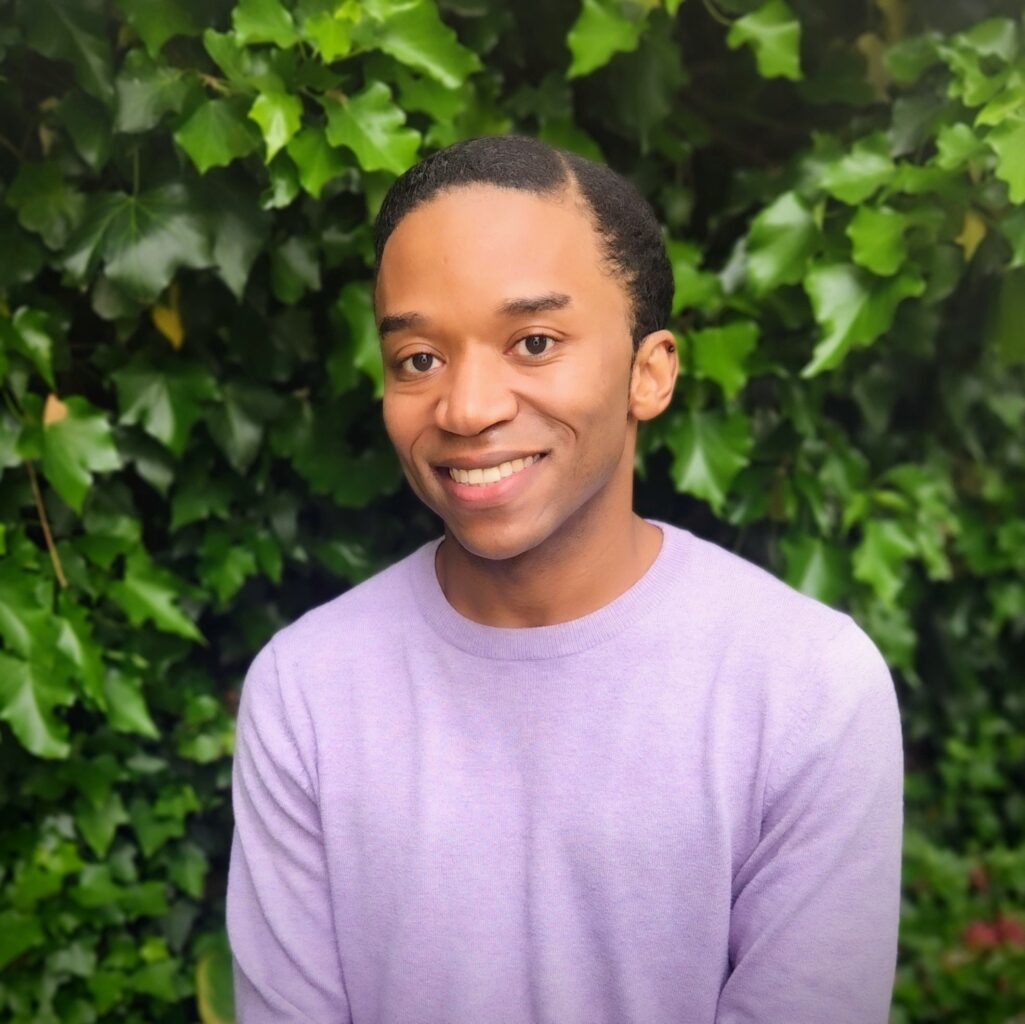 Headshot of James Dorsey.
When James Dorsey arrived at UMBC in 2002 to major in music performance and composition, becoming an educator was not the original plan. But when opportunity knocked, Dorsey answered the call to teach.
In the intervening years, Dorsey’s interactive, empowering methods of teaching music to kids have made him popular, and this fall he marks his 19th year of teaching music and performance to the elementary school students in the Prince George’s County Public School system. And if that wasn’t enough, Dorsey ’05, music, is back at UMBC, sharing his pedagogical experience with a new generation of musicians and educators.
“I didn’t have pedagogy as part of my undergrad experience when I started at UMBC. The music education department was just beginning, so there were things that I just missed,” says Dorsey, who will receive UMBC’s 2023 alumni award for the performing and visual arts this Thursday, October 26. “But it’s great to enter education from a non-traditional pathway, because I really had to rely on my artistry, to help me connect with young learners and help them grow musically.”
A detour-turned-career
Dorsey entered the resident teacher program with Prince George’s County while still an undergrad at UMBC. After six years of apprentice teaching and taking summer classes, he was certified, launching an esteemed career that has made him a sought-after resource in musical education—and a key to that success has been in helping students tap into their creativity.
“Throughout my teaching career, as I have studied pedagogy and methods more carefully, I’m consistently working with people through the lens of ‘How can I help them create and connect with the world around them?’” says Dorsey. “How can I help them understand that music is a way to respond to what’s happening around them?”
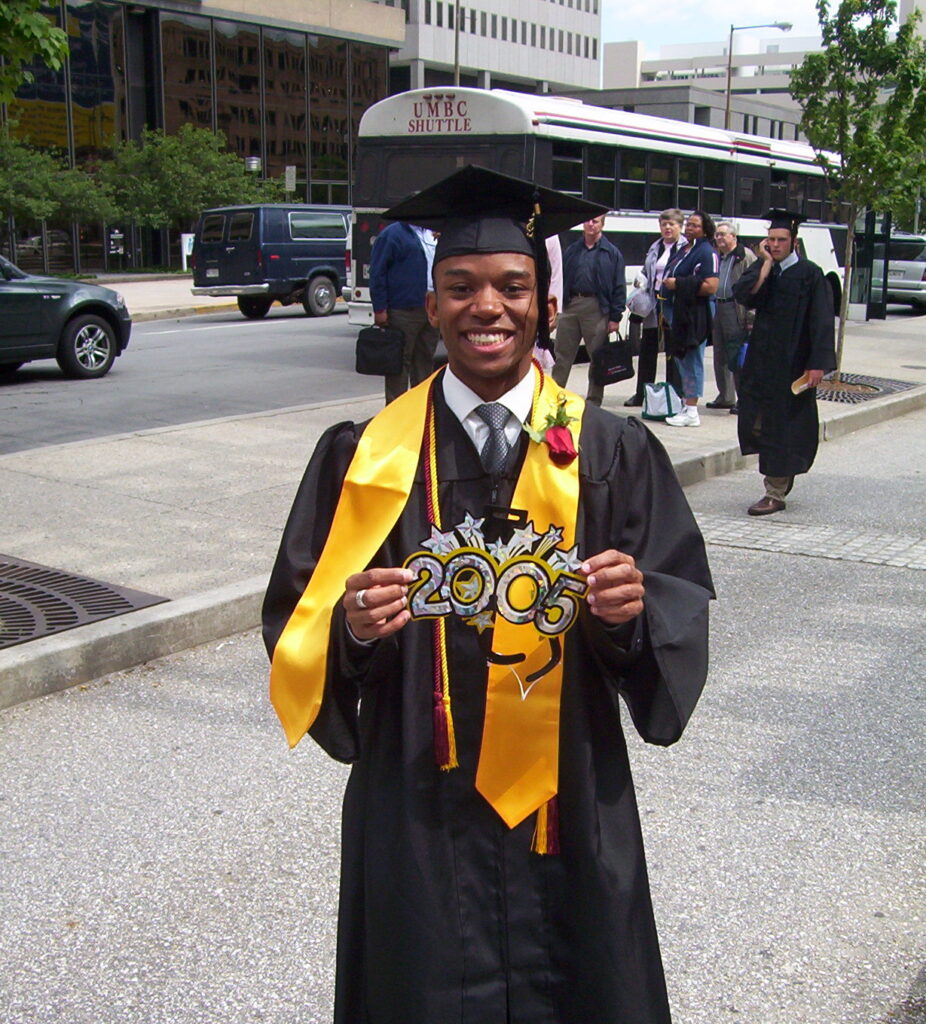 Dorsey at his 2005 UMBC Commencement at which he sang the National Anthem.
With this approach to musical pedagogy, Dorsey has expanded his reach beyond the elementary classroom. In addition to his ordinary course load in the Prince George’s County school system, Dorsey also teaches music educators at Loyola—where he received his master’s degree—and back at UMBC, where Brian Kaufman, director of the UMBC Wind Ensemble, invited to Dorsey to coach the ensemble in creating original music for their programs.
“It’s really a full circle moment,” Dorsey says.“I’ve gotten to reimagine what music education looks like in elementary and secondary settings, and now I’m working with teachers who want to help their students create. I get to be a facilitator to help other people through that program, and not only am I helping them pedagogically, I also feel like I’m growing as a person and as an artist.”
“Making Music That Sounds Like Me”
Dorsey believes that a key to his success in teaching music to young people is allowing them room to fully express themselves. Every year, rather than selecting and rehearsing an existing musical play, Dorsey guides his students in writing and producing an original musical, a process which he finds to be both effective in teaching students how to be artists, and in honing his own craft.
“I don’t think of creativity as something that belongs to only a select group of people. I think creativity is something that everyone deserves to do,” Dorsey says. “And I’m included in that. Teaching has really taught me how to be a better artist.”
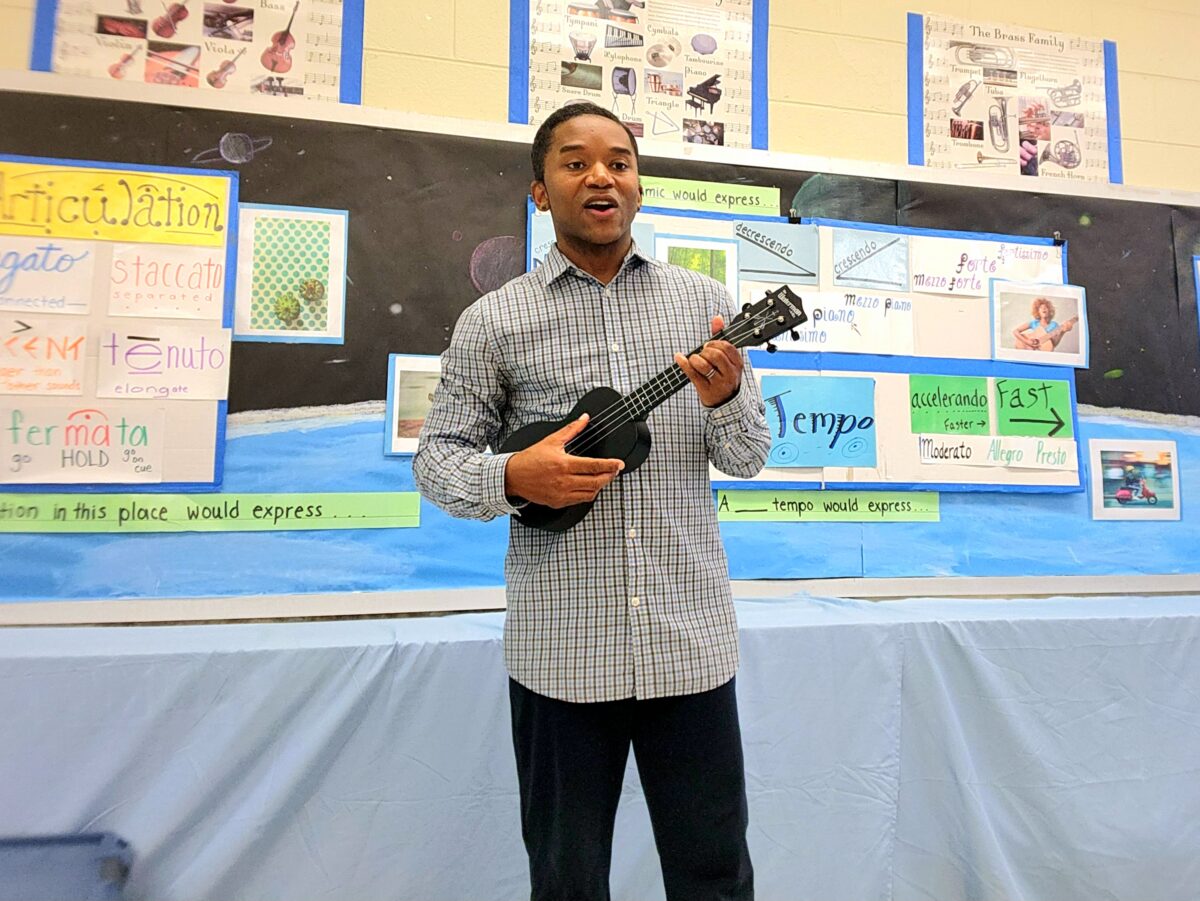 Dorsey leads students to create music using a variety of instruments, including ukuleles.
By putting the tools of creating a musical into the hands of his students, Dorsey has enjoyed watching them flourish, while exercising his compositional skills to create original electronic music with their direction.
“When people think of a musical, they have an idea of what that’s supposed to sound like,” he says. “But with the musicals we create, I really get the chance to make music that I enjoy and that students really relate to, organized around prevalent rhythms and the style and vocal delivery that goes with it. They can say, ‘I got to make music that sounds like me.’ Just by teaching, I have seen so much evidence that trusting the process and making decisions based on an idea is a comfortable pathway to going from idea, to creating, and then realizing, ‘I can do that.’”
Dorsey’s pedagogical successes caught the attention of the Maryland State Department of Education Fine Arts office, who tapped him to begin offering professional development classes for other teachers centered around the creative process. To this end, he currently serves as a roster artist for Maryland Centers for Creative Classrooms (MC3), supporting arts educators in developing skills and knowledge in providing quality arts-based instruction.
In this role, Dorsey facilitates sessions for instructors to think through their teaching strategies for helping people create, and along the way, they get the chance to create something. The result is powerful, says Dorsey. ”They know from their own experience creating music what they need to do to help other people feel comfortable. We really need to give everyone a chance to express their ideas through what they create.”
]]>
Headshot of James Dorsey. When James Dorsey arrived at UMBC in 2002 to major in music performance and composition, becoming an educator was not the original plan. But when opportunity knocked,...
https://umbc.edu/stories/helping-find-the-right-note-music-education/
https://beta.my.umbc.edu/api/v0/pixel/news/136525/guest@my.umbc.edu/15b620ec61842cc74f4a15e4495fa99d/api/pixel
alumni
alumni-awards
cahss
magazine
music-education
UMBC News & Magazine
https://beta.my.umbc.edu/groups/umbc-news-magazine
https://assets1-beta.my.umbc.edu/system/shared/avatars/groups/000/001/943/24435aa6207c452e7bc15cc74b42c7bb/xsmall.png?1748556657
https://assets1-beta.my.umbc.edu/system/shared/avatars/groups/000/001/943/24435aa6207c452e7bc15cc74b42c7bb/original.png?1748556657
https://assets2-beta.my.umbc.edu/system/shared/avatars/groups/000/001/943/24435aa6207c452e7bc15cc74b42c7bb/xxlarge.png?1748556657
https://assets2-beta.my.umbc.edu/system/shared/avatars/groups/000/001/943/24435aa6207c452e7bc15cc74b42c7bb/xlarge.png?1748556657
https://assets3-beta.my.umbc.edu/system/shared/avatars/groups/000/001/943/24435aa6207c452e7bc15cc74b42c7bb/large.png?1748556657
https://assets1-beta.my.umbc.edu/system/shared/avatars/groups/000/001/943/24435aa6207c452e7bc15cc74b42c7bb/medium.png?1748556657
https://assets2-beta.my.umbc.edu/system/shared/avatars/groups/000/001/943/24435aa6207c452e7bc15cc74b42c7bb/small.png?1748556657
https://assets1-beta.my.umbc.edu/system/shared/avatars/groups/000/001/943/24435aa6207c452e7bc15cc74b42c7bb/xsmall.png?1748556657
https://assets2-beta.my.umbc.edu/system/shared/avatars/groups/000/001/943/24435aa6207c452e7bc15cc74b42c7bb/xxsmall.png?1748556657
UMBC News & Magazine
0
0
false
Mon, 23 Oct 2023 15:43:56 -0400
Mon, 23 Oct 2023 15:43:56 -0400