Your story belongs here
Joining a new community can be tough sometimes, especially post-pandemic. And with new Retrievers coming from every background imaginable, it’s important to make sure everyone feels welcome when they get here.
That’s where “Your Story Belongs Here” comes in. Now in its second year, this video storytelling collaboration between Initiatives for Identity, Inclusion, and Belonging (i3b) and the Department of Theatre brings students together to learn how to share—and celebrate—their own stories of belonging.
“I think it’s pretty common to enter college and be worried that you’re not going to find your people. It’s very different from high school,” said Adam Bayoumi, a public health major, who spoke about the worries he faced about keeping up with school after his father passed away. “I personally thought the transition would kind of knock me out…and it wasn’t easy, and it wasn’t quick, but I did find my people eventually.”
Guiding students’ steps
The resulting film, which was shown at Welcome Week to incoming students, showcases the experiences of 10 students from a variety of backgrounds. Some explore identity or overcoming imposter syndrome. Others speak from the perspectives of adult learners reentering college or international students settling into a new culture. Some felt comfortable in front of a camera while others had to overcome that fear over time. Thankfully, in this second iteration of the project, students took advantage of a four-week workshop-style internship to perfect their performances with help from their cohort and guidance from faculty and staff co-creators.
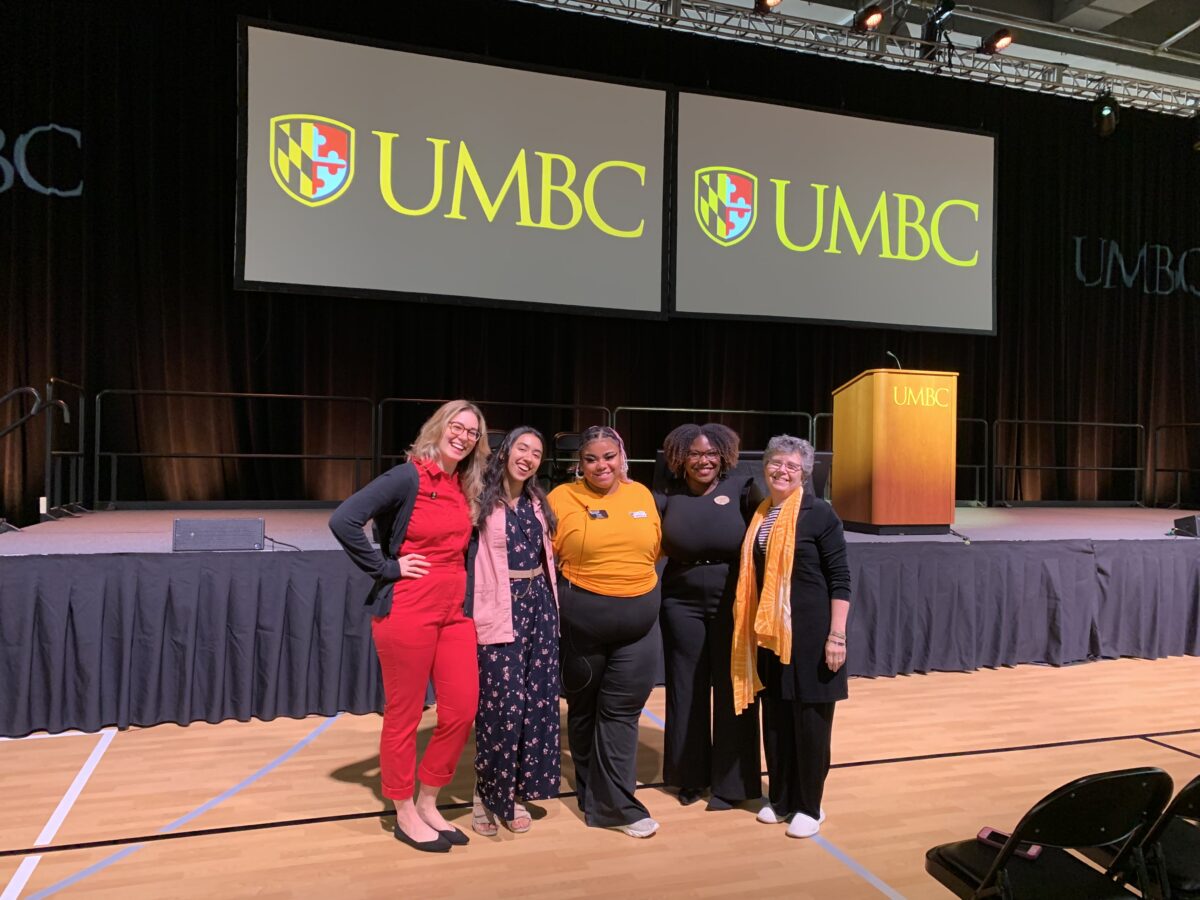 Members of the Your Story Belongs Here group gather before the Welcome Week event. Photo courtesy of Eve Muson.
“We got to have much, much more time with students this year to develop their storylines and infuse some social justice education around identity…storytelling and monologuing, all that good stuff,” said Ciara Christian, acting director of i3b, and a co-founder of the project. “We also had a really cool opportunity to take students to see some live theatre performances…there was a storytelling event in Washington, D.C., that we took the students to, to help inspire them, and it was a beautiful process.”
Project co-founder Eve Muson, associate professor of theatre, called the workshop experiences “magical.” She also brought in alumna Kiirstn Pagan ’11 to film and edit the work. “Because we had more time, the stories were more complex and students were really talking honestly about the identity that they bring with them when they come to UMBC—their doubts, their fears, their trepidations, all of that,” said Muson. “And then there’s the moment when they discover themselves at UMBC. So, that’s the shape of every story.”
Finding your “second family”
When Jaya Marshall, a transfer student focusing on cinematic arts, first arrived at UMBC, she, too, worried she wouldn’t fit in, that she might be the lone theatre person in a sea of STEM students—something she realizes now was a misperception. But seeing the inaugural “Your Story Belongs Here” video at her own Welcome Week in 2022 helped change her mind—and also inspired her to take part in the project the following summer.
“When I saw that video I was like, oh, thank you,” said Marshall, who quickly found several clubs to join after arriving at UMBC. “Thank God, I am not the only one. I hope people who are arts and humanities will see that and be like, okay, I’m not alone.”
Public health major Mashaal Awan chose to share her story of going to UMBC’s STRiVE leadership retreat, which she says had “a huge impact on me in terms of realizing my values” and also helped her make friends she now considers her “second family.” In her video, Awan recalled the first evening of STRiVE, walking outside with friends beneath a beautiful night sky.
“I remember feeling a sense of freedom I had been craving my whole life with these people I instantly felt such a strong connection with,” she recalled in the video.
Bayoumi hopes that the vulnerability students show through their storytelling helps incoming students feel more comfortable and welcome at UMBC.
“Fast forward to the end of the school year, and I had done stuff that I never thought I would have achieved in college,” he said. “So to me at 17 years old, I would just like to say, ‘Hang in there. Life dealt you some hard cards, and it’s going to be okay.’”
]]>
Joining a new community can be tough sometimes, especially post-pandemic. And with new Retrievers coming from every background imaginable, it’s important to make sure everyone feels welcome when...
https://umbc.edu/stories/your-story-belongs-here/
https://beta.my.umbc.edu/api/v0/pixel/news/137171/guest@my.umbc.edu/5fe0a3db7ab4b51af0a159cb162ca9f9/api/pixel
campus-life
magazine
UMBC News & Magazine
https://beta.my.umbc.edu/groups/umbc-news-magazine
https://assets1-beta.my.umbc.edu/system/shared/avatars/groups/000/001/943/24435aa6207c452e7bc15cc74b42c7bb/xsmall.png?1748556657
https://assets1-beta.my.umbc.edu/system/shared/avatars/groups/000/001/943/24435aa6207c452e7bc15cc74b42c7bb/original.png?1748556657
https://assets2-beta.my.umbc.edu/system/shared/avatars/groups/000/001/943/24435aa6207c452e7bc15cc74b42c7bb/xxlarge.png?1748556657
https://assets2-beta.my.umbc.edu/system/shared/avatars/groups/000/001/943/24435aa6207c452e7bc15cc74b42c7bb/xlarge.png?1748556657
https://assets3-beta.my.umbc.edu/system/shared/avatars/groups/000/001/943/24435aa6207c452e7bc15cc74b42c7bb/large.png?1748556657
https://assets1-beta.my.umbc.edu/system/shared/avatars/groups/000/001/943/24435aa6207c452e7bc15cc74b42c7bb/medium.png?1748556657
https://assets2-beta.my.umbc.edu/system/shared/avatars/groups/000/001/943/24435aa6207c452e7bc15cc74b42c7bb/small.png?1748556657
https://assets1-beta.my.umbc.edu/system/shared/avatars/groups/000/001/943/24435aa6207c452e7bc15cc74b42c7bb/xsmall.png?1748556657
https://assets2-beta.my.umbc.edu/system/shared/avatars/groups/000/001/943/24435aa6207c452e7bc15cc74b42c7bb/xxsmall.png?1748556657
UMBC News & Magazine
4
0
false
Fri, 17 Nov 2023 12:43:48 -0500
Fri, 17 Nov 2023 12:43:48 -0500
Office Hours
Each week during her student-facing office hours, UMBC President Valerie Sheares Ashby meets with students to chat about their lives and experiences at UMBC. Today, she’s speaking with Okechukwu Tabugbo ’25, computer engineering, president of UMBC’s Black Men’s Society, a group that provides mentorship, skills training, and community to students while trying to eliminate negative narratives and stigma around what it means to be a Black man in America.
Okechukwu Tabugbo: I found out about UMBC’s Black Men’s Society when I was in my first year. I knew Marvin Onwukwe, the club secretary at the time. He was always walking around campus smiling, and I would ask him, “Why are you smiling so much, Marvin?” He would say, “It’s because I have my life together. I have everything going for me. So what reason do I have to frown?” I would say, “Why do you have everything going for you?” He said, “Because I’m on top of my work. I can help you out, too. You should come to Black Men’s Society so that we can all be on top of our work.”
President Sheares Ashby: Oh, that is so good.
Tabugbo: But, in all honesty, I did not go to the first one. Then Amery Thompson…the current advisor, told me that I should come out, and I have to be honest, I did not go at that time either. [Laughs.] Then, finally, our current vice president, Israel Funmilayo…invited me, and he said, “It’s about financial literacy…I just need you to come out.” I looked at my bank account, and I said, “Okay.”
After getting there, I sat down. Amery was giving the introduction on financial literacy and telling us everything that we need to know. It honestly just made me feel at home and appreciated, the fact that someone took the time out of their day to teach me something that I constantly left on the back burner. I took that for what the club is.
I take it especially as a safe space for Black men on campus—to make them feel appreciated, to give them the time they need to grow in a world that rushes them so often. I appreciate the overall aspect of giving Black people on campus a space for professional development that they may not have had before and giving us a space to talk about issues surrounding the community. The Society allows everyone, despite their views, to be understood and to have time to understand others.
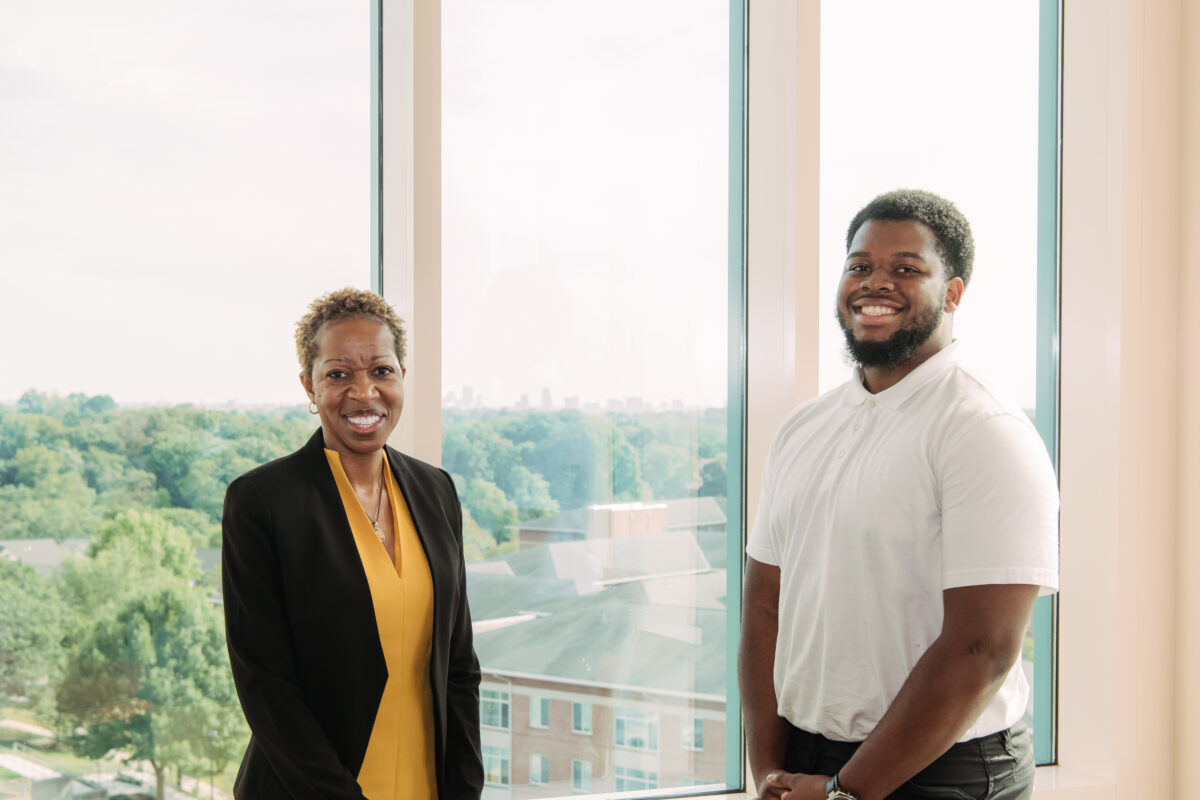 Sheares Ashby and Tabugbo pose on the 7th floor of the library. (Marlayna Demond ’11/UMBC)
Sheares Ashby: That is amazing. And what is so interesting to me is the mentorship of the more senior students to the younger students because I see it all the time. I see the senior students saying, “Hey, come on over here. This is where we are. This is what we’re doing. This is how we can support you.” They’re really living out the mentorship in ways that are so important. And it is so wonderful to see the younger students come in and then become those mentors to other people. I can see that growth even in a year.
Tabugbo: Exactly. And on that note of mentorship, that’s why we wanted to start moving toward outreach programs, especially to local high schools and middle schools. This effort is spearheaded by our secretary, Daniel Bajulaiye. If we can get to these students early and make them know that they’re appreciated, make them know that they can be heard, that will be important in fostering a good relationship, especially as they come into UMBC. Just letting people know that you’re there for them is so important because a lot of people, especially on this campus, don’t know their potential.
Sheares Ashby: I one hundred percent agree. One of the things I’m really excited about for UMBC is the work that we continue to do in Baltimore. We’re right here, and we know that there are a lot of Black men, young men, in Baltimore who would benefit. I don’t think too many Black men in Baltimore walk around feeling appreciated.
If we can get to these students early and make them know that they’re appreciated, make them know that they can be heard, that will be important in fostering a good relationship, especially as they come into UMBC.
Okechukwu Tabugbo ’25
Tabugbo: Even when I did get the role [as president of Black Men’s Society], I still had imposter syndrome. I didn’t truly feel I belonged until actually stepping into the shoes and having to take over. Talking to my brother all summer, the amount of encouragement he had to give me to say just, “You can do this. You are here for a reason.” Hearing it from Amery, hearing it from Israel, it took a lot to be able to have the confidence to come and do this again and again every day.
Sheares Ashby: Mentorship has always been important. Sometimes it just takes somebody to look at you and tell you, “I see you, and I think you’re pretty special,” or, “I see this gift or talent that you have,” and it can change somebody’s life just like that. I don’t know anybody who doesn’t need encouragement.
]]>
Each week during her student-facing office hours, UMBC President Valerie Sheares Ashby meets with students to chat about their lives and experiences at UMBC. Today, she’s speaking with Okechukwu...
https://umbc.edu/stories/office-hours-with-president-shears-ashby/
https://beta.my.umbc.edu/api/v0/pixel/news/137162/guest@my.umbc.edu/fb1a98339cc8ace85e30431255ecdccc/api/pixel
campus-life
coeit
computer-engineering
fall-2023
magazine
office-hours
perspectives
UMBC News & Magazine
https://beta.my.umbc.edu/groups/umbc-news-magazine
https://assets1-beta.my.umbc.edu/system/shared/avatars/groups/000/001/943/24435aa6207c452e7bc15cc74b42c7bb/xsmall.png?1748556657
https://assets1-beta.my.umbc.edu/system/shared/avatars/groups/000/001/943/24435aa6207c452e7bc15cc74b42c7bb/original.png?1748556657
https://assets2-beta.my.umbc.edu/system/shared/avatars/groups/000/001/943/24435aa6207c452e7bc15cc74b42c7bb/xxlarge.png?1748556657
https://assets2-beta.my.umbc.edu/system/shared/avatars/groups/000/001/943/24435aa6207c452e7bc15cc74b42c7bb/xlarge.png?1748556657
https://assets3-beta.my.umbc.edu/system/shared/avatars/groups/000/001/943/24435aa6207c452e7bc15cc74b42c7bb/large.png?1748556657
https://assets1-beta.my.umbc.edu/system/shared/avatars/groups/000/001/943/24435aa6207c452e7bc15cc74b42c7bb/medium.png?1748556657
https://assets2-beta.my.umbc.edu/system/shared/avatars/groups/000/001/943/24435aa6207c452e7bc15cc74b42c7bb/small.png?1748556657
https://assets1-beta.my.umbc.edu/system/shared/avatars/groups/000/001/943/24435aa6207c452e7bc15cc74b42c7bb/xsmall.png?1748556657
https://assets2-beta.my.umbc.edu/system/shared/avatars/groups/000/001/943/24435aa6207c452e7bc15cc74b42c7bb/xxsmall.png?1748556657
UMBC News & Magazine
0
0
false
Fri, 17 Nov 2023 11:24:07 -0500
Fri, 17 Nov 2023 11:24:07 -0500
The Academic Minute: Caring for kinless older adults
Social, cultural, and scientific advancements have helped people live longer. Not only are people living longer, but they also have fewer children than at any previous time in human history. This shift will present a unique situation where there will be more older adults outnumbering infants and teenagers in about four decades. How will the world take care of this burgeoning population?
Christine A. Mair, associate professor of sociology and gerontology and director of UMBC’s Center for Health, Equity, and Agingin the department of sociology, anthropology, and public health, examines the presence or absence of family and non-family ties. Mair seeks to document how social integration and support (or lack thereof; e.g., “kinlessness”) shape mental health, physical health, end-of-life experiences, and other aspects of well-being especially cross-nationally.
“Many of these older adults will also be unpartnered due to never marrying, divorce, or their eventual widowhood. These three intersecting trends of high longevity, low fertility, and low partnership will culminate to produce a growing population of people who are both unpartnered and childless. This group is sometimes referred to as ‘kinless,’” Mair explains to Lynn Pasquerella, president of the American Association of Colleges and Universities and host of The Academic Minute, a daily show featuring faculty from colleges and universities worldwide speaking about their cutting-edge research.
UMBC’s Academic Minute series
Mair joined six other UMBC scholars this fall in UMBC’s first Academic Minute series, featuring the latest research in media and communication studies; modern languages, linguistics, and intercultural communication; language, literacy, and culture; philosophy; gender, women’s, and sexuality studies; and history. This series is republished on NPR podcasts and Inside Higher Ed.
Learn more about Christine Mair’s research:
Learn more about UMBC’s program in sociology, anthropology, and public health.
]]>
Social, cultural, and scientific advancements have helped people live longer. Not only are people living longer, but they also have fewer children than at any previous time in human history. This...
https://umbc.edu/stories/academic-minute-caring-for-kinless-adults/
https://beta.my.umbc.edu/api/v0/pixel/news/137158/guest@my.umbc.edu/1c499ca8c67b564e85980ab3ede5bbb0/api/pixel
cahss
cahssresearch
news
policy-and-society
research
saph
UMBC News & Magazine
https://beta.my.umbc.edu/groups/umbc-news-magazine
https://assets1-beta.my.umbc.edu/system/shared/avatars/groups/000/001/943/24435aa6207c452e7bc15cc74b42c7bb/xsmall.png?1748556657
https://assets1-beta.my.umbc.edu/system/shared/avatars/groups/000/001/943/24435aa6207c452e7bc15cc74b42c7bb/original.png?1748556657
https://assets2-beta.my.umbc.edu/system/shared/avatars/groups/000/001/943/24435aa6207c452e7bc15cc74b42c7bb/xxlarge.png?1748556657
https://assets2-beta.my.umbc.edu/system/shared/avatars/groups/000/001/943/24435aa6207c452e7bc15cc74b42c7bb/xlarge.png?1748556657
https://assets3-beta.my.umbc.edu/system/shared/avatars/groups/000/001/943/24435aa6207c452e7bc15cc74b42c7bb/large.png?1748556657
https://assets1-beta.my.umbc.edu/system/shared/avatars/groups/000/001/943/24435aa6207c452e7bc15cc74b42c7bb/medium.png?1748556657
https://assets2-beta.my.umbc.edu/system/shared/avatars/groups/000/001/943/24435aa6207c452e7bc15cc74b42c7bb/small.png?1748556657
https://assets1-beta.my.umbc.edu/system/shared/avatars/groups/000/001/943/24435aa6207c452e7bc15cc74b42c7bb/xsmall.png?1748556657
https://assets2-beta.my.umbc.edu/system/shared/avatars/groups/000/001/943/24435aa6207c452e7bc15cc74b42c7bb/xxsmall.png?1748556657
UMBC News & Magazine
0
0
false
Fri, 17 Nov 2023 09:07:11 -0500
Living in vivid color—Kate Feller, Ph.D., is pushing boundaries in biology research and teaching
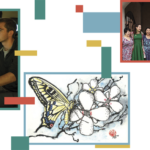
The shower was full of mantis shrimp. Bubblers burbled and the cranky crustaceans skulked in their tanks, looking for things to punch with their famously fast strikes. Complicated electronics for measuring brain activity stood sentinel beside the bed in the next room. And out on the balcony, Kathryn Feller, Ph.D. ’14, biological sciences, was wearing a respirator and gloves, working with nasty chemicals.
In other words, it was another day of fieldwork as a behavioral neuroscientist—a career Feller has embraced after a journey of self-exploration that took her to surgical operating theaters, drama summer camps, and a range of research institutions around the world. At UMBC, Feller found a robust research atmosphere, supportive lab mates, and a lifelong mentor. Now, as a professor and mentor herself, she’s able to exercise her natural creativity in a way she might never have predicted and play off her strengths from visual arts to handling sensitive scientific instruments.
Feller was in Malaga, Spain, living and working out of an attic apartment in her collaborator’s mother’s home. She was collecting data for her work at the University of Cambridge, where she was fulfilling a two-year Marie Skłodowska-Curie Actions Postdoctoral Fellowship focused on a new line of research into mantis shrimp vision.
Mantis shrimp are famous for two things: their powerful punches and their vision. Humans have three types of cones in our eyes for seeing color. Mantis shrimp have 16. They can see UV light and polarized light, and there is still more to learn. Feller’s Ph.D. at UMBC in Thomas Cronin’s lab focused on vision in mantis shrimp larvae. At the time there was almost no work in that area.
“While studying the visual system, a lot of times I kept wondering: ‘There’s all these cool things that mantis shrimp eyes can do, but what are they actually using this for?’” Feller says. “What are the consequences of this in a behavioral context?”
Her Ph.D. opened up the field of larval mantis shrimp vision and took her down rabbit hole after rabbit hole. “If something interests me, I follow it, and—uh-oh—here’s something else I’m interested in,” Feller jokes. In the end, her thesis explored the visual system using umpteen different scientific techniques, each providing its own insights, she says. “It was like the whole package of describing mantis shrimp
visual systems.”
Want weekly Top Stories sent to your inbox?
The broad scientific foundation Feller obtained at UMBC set her up well for postdoctoral experiences that have taken her around the world, including stints studying butterflies in Japan, mouse brains in Minnesota, and insects in England. In fall 2020, she launched her own laboratory as an assistant professor of biology at Union College in Schenectady, New York.
Feller’s research interests now include new projects on the connections between vision and behavior and work on brain-machine interfaces, initially inspired by a student in one of her classes. That work helped spawn a brand-new course on cyborgs that she’s teaching with Union colleagues in English and computer science.
Things are going well.
“Life is awesome. It really is. You know, it has its ups and downs; it’s not like every day is a dreamboat—I live with a two-year-old,” Feller laughs. But “at this point, I’m just really jazzed about the research I’m doing.”
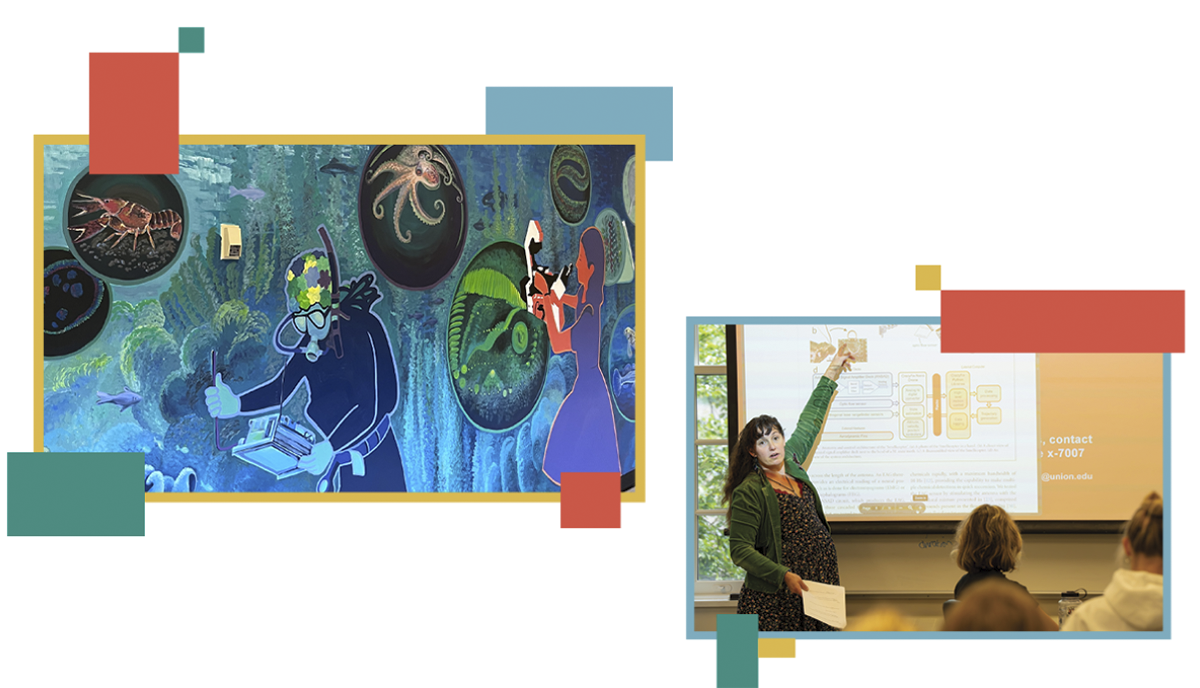 (Left) Feller is the only identifiable person in the mural on the first floor of the Biological Sciences Building at UMBC. Her swim cap covered in bright plastic flowers is unmistakable. (Image; Randianne Leyshon ’09/UMBC) (Right) Kate Feller, left, teaching a new course she co-developed with English and computer science colleagues at Union College on cyborgs. (Image by Paul Buckowski/Union College)
Back in Malaga, Feller was getting lots of great data, “but also psychologically it was a bit difficult,” she says. She didn’t speak Spanish, and her hosts barely spoke English. “For six weeks, I was just alone in someone’s house, doing science.” And then came the email: an invitation to participate in FameLab, an international competition for scientists based out of the United Kingdom. Each participant had three minutes to explain a scientific concept using only their body and any props they could carry on the stage—no slides. Entries were judged on content, clarity, and charisma.
“I got this email, and I wrote my script in one night,” Feller says. The topic? Glittery camouflage structures in the eyes of mantis shrimp larvae. “When you’re in the field, you have a finite number of hours to do what you need to do, so you need to push yourself to the extreme—but you also need to take a break. And that was my break—just to sit down and poke fun at the ridiculousness of my life.”
She won her region in the U.K. and got to spend a weekend in Devonshire, England, with the other county winners, learning about science communication and refining her talk. The final performance was at the London Museum of Science.
“I didn’t win, but it was awesome,” Feller says. After that, she was hooked on science performance. Back in Cambridge, she pursued science stand-up comedy with a group called “The Variables.”
Research requires creativity
Feller’s affinity for performance didn’t come out of nowhere. As a teenager, she attended Camp Quin, a summer arts camp in the Finger Lakes region of New York. And despite a natural affinity for visual arts, she ended up focusing on drama at the camp. A skit she developed with other campers “was hilarious, and it was a hit, and from that I was like, ‘I really like this,’” Feller remembers.
As an undergraduate at Hobart and William Smith Colleges (HWS), she participated in an improv comedy troupe and in her senior year, the Shakespeare club. In the summers, she served as a counselor at Camp Quin. Performance may have taken a backseat in her life for now, but Feller still finds that her communication skills and natural creative energy are huge benefits in her current role.
“As I’ve progressed as a scientist, I’ve learned how much imagination it takes to be a researcher,” Feller says. “And now that I’m a faculty member, I understand how much creativity you need to run an interesting class. I love that aspect—designing a new course is a super fun and creative process, and I find that my students respond quite well to the different ways of communicating I throw at them.”
Feller also applies her visual arts skills to creating research talks and class lectures. “The art of slide design is underrated,” she says. “I think that’s why I’ve been invited to give so many talks—not only do I have that performance element, but I understand the connection between hearing and seeing and information transfer.”
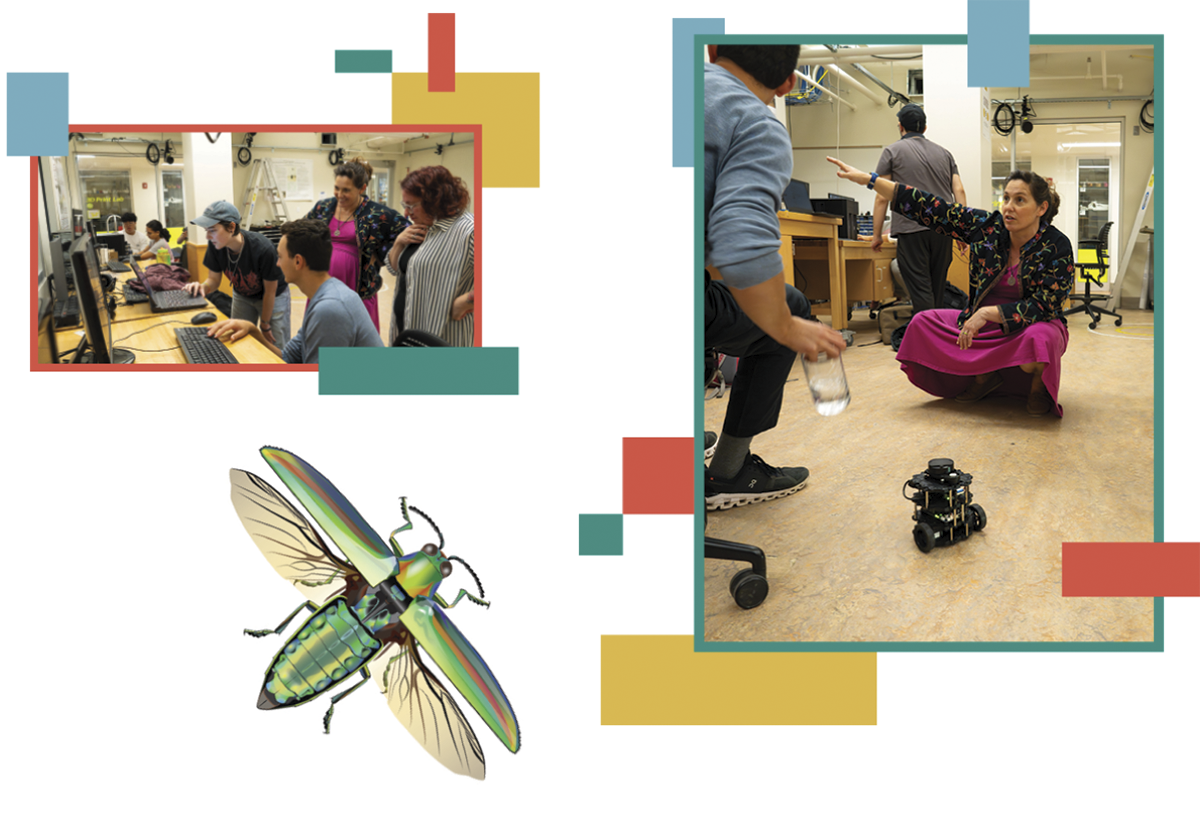 Feller (pink dress) is involved with a robotics laboratory at Union College. Her work has recently expanded into brain-machine interfaces after a student in one of her classes expressed enthusiasm for the topic—just one example of how her teaching continues to inform her research. (Image by Paul Buckowski/Union College) (Lower left) One of Feller’s digital designs. She has been hired to create logos for other labs and continues to make art as a hobby—ranging from using iridescent eye shadow to recreate beetle carapaces to shaping clay sculptures.
An “all-in” personality
Feller has always recognized her artistic side, but she wasn’t always encouraged to integrate it into her career plans. She was a good student, and her kindergarten teacher told her parents she would probably become a doctor. “I got that message my whole life,” Feller says.
It sunk in, and she started at HWS on the pre-med track. As an undergrad, she took an internship as a surgical assistant in a hospital. “There was a major clash with who I was as a person,” Feller says. “Literally, you are in a sterile environment. So while I was good at that job, it crushed me.”
But expectations die hard, and in her junior year, she was still looking at medical school. She decided she should do research to boost her chances. “Literally, it was just for my CV,” she says. Little did she know the experience would permanently shift her trajectory.
For this design, Feller incorporated the organisms studied in the UMBC biological sciences department for its annual, informal graduate student t-shirt.
Feller did some background research and requested a meeting with HWS biology assistant professor Kristy Kenyon, who studies development of the visual system in frogs and fruit flies, to pitch an honors project. As it turned out, her pitch was a little off the mark. “It was at least within the organ system that I worked,” Kenyon says. Yet, Kenyon decided to give her a chance.
Why? “Kate Feller is such a dynamic person,” Kenyon says. “She was such an all-in, live-life-to-the-fullest kind of person, that it was very easy for me to get excited about working on a project with her despite having never had her in a class. The energy, the creativity, the curiosity—those are three words I would use to describe that initial impression of Kate.”
Feller and Kenyon settled on a bat vision project, and it transformed Feller’s future. Kenyon gave her a crash course in what she needed to know, and Feller thrived. The project led to Feller’s first scientific publication, reporting the discovery of a type of UV-sensitive cell in bat eyes that is evolutionarily related to the same cells in mice.
“I loved it,” Feller says. “Just the idea of thinking about how a different creature sees, because I’m so visual—it just fit so well. It took me a while to realize why I found it so exciting, but then I was like, ‘Oh, that makes sense.’”
And yet. After graduating with a double major in biology and environmental science, Feller took a position as an ophthalmology surgical assistant. She quickly soured on that, though, for the same reasons she had struggled with roles in sterile environments before. Her personal life brought her to Baltimore, and looking for new opportunities, she found Tom Cronin on a Google search.
She applied to other Ph.D. programs, but when she visited UMBC, “there was the pond, and all the grass, and meeting Tom, and I was like, ‘Oh, this is where I need to be.’”
Feller’s Ph.D. years spanned a special time in the Cronin lab. “It was an incredible group of people who formed a tight-knit community and helped each other grow into outstanding scientists,” says Megan Porter, a postdoctoral fellow in the lab during that time. Sometimes, that support involved tough love. An intervention conversation Porter had with Feller when she was experiencing a third-year slump helped get Feller’s Ph.D. back on track. The exchange helped Porter as well.
“It has helped me to be a better mentor to my students now, to have had that conversation first with a friend,” says Porter, who now is a professor at the University of Hawai‘i at Mānoa. “It’s an important conversation to have with any graduate student, as it isn’t the right path for everyone. There are many other careers out there for anyone who loves science.”
If Porter was the nurturing mother figure in the lab, Michael Bok, Ph.D. ’14, biological sciences, was the goofy uncle. Feller and Bok started the same year, and both needed to earn an advanced level of scuba certification to conduct fieldwork in Australia. Given the limited diving options in the mid-Atlantic, “we spent a total of 15 hours goofing around in a pretty uninspiring quarry, but it was worth it for the diving we got to do in Australia,” says Bok, who is now a researcher at Lund University in Sweden.
Feller and Bok conducted fieldwork at Lizard Island Research Station off the northeast coast of Australia for many months across five years. “Some of these stressful and intensive work experiences would probably strain some people’s friendship, but Kate and I seemed to always be quite happy with each other despite having pretty different personalities,” Bok says. “We were definitely kindred in our love for science, appreciation for being out in nature, and senses of humor.”
Feller came to love diving and did so with typical flair. “You could always tell where Kate was in the water,” Cronin says, because she always wore a brightly colored swim cap with plastic flowers stuck all over it. “It was very Kate because it made her look kind of silly but also very distinctive, because even underwater far away you could identify her.”
Dance parties and lost turtles
Alex Kingston, Ph.D. ’15, biological sciences, arrived in the lab after Porter, Bok, and Feller. “I really wouldn’t be where I am today without each of them,” she says.
Kingston, who today is an assistant professor at The University of Tulsa, was always very organized and on top of things, Cronin recalls—“very type A.” She kept the lab running smoothly as lab manager but wasn’t afraid to have fun. Feller and Kingston would have dance parties as a break from drafting scientific manuscripts. “It was hilarious when other people would come into the lab, not expecting us in the middle of the lab blaring music and dancing around,” Kingston remembers.
The group had other shared adventures, like caring for Scott, a box turtle who frequently escaped, necessitating a lab-wide search. And Feller took it as her role to decorate the lab. “In my lab today you can still see Kate stuff,” Cronin says. “She had a tendency of sticking stuff up there that didn’t want to come down again.”
Cronin’s approach to mentorship allowed each of his students to find their own way, with the level of support or independence that worked best for each of them. That means Cronin’s students have complete ownership of both their successes and their struggles and grow the confidence to face both once they leave UMBC.
“Tom was really hands off. However, he was so supportive,” Feller says. “Pretty much any time I came to him with an idea, he was like, ‘Cool, let’s do it.’ So it was that mix of, you’re steering the ship, but you don’t have to worry about resources.”
“Kate was not afraid to try anything— she was particularly inclined to do things her own way,” Cronin recalls. While she may have taken some time to find her footing, in the end, “she did really great work—really original and creative work.”
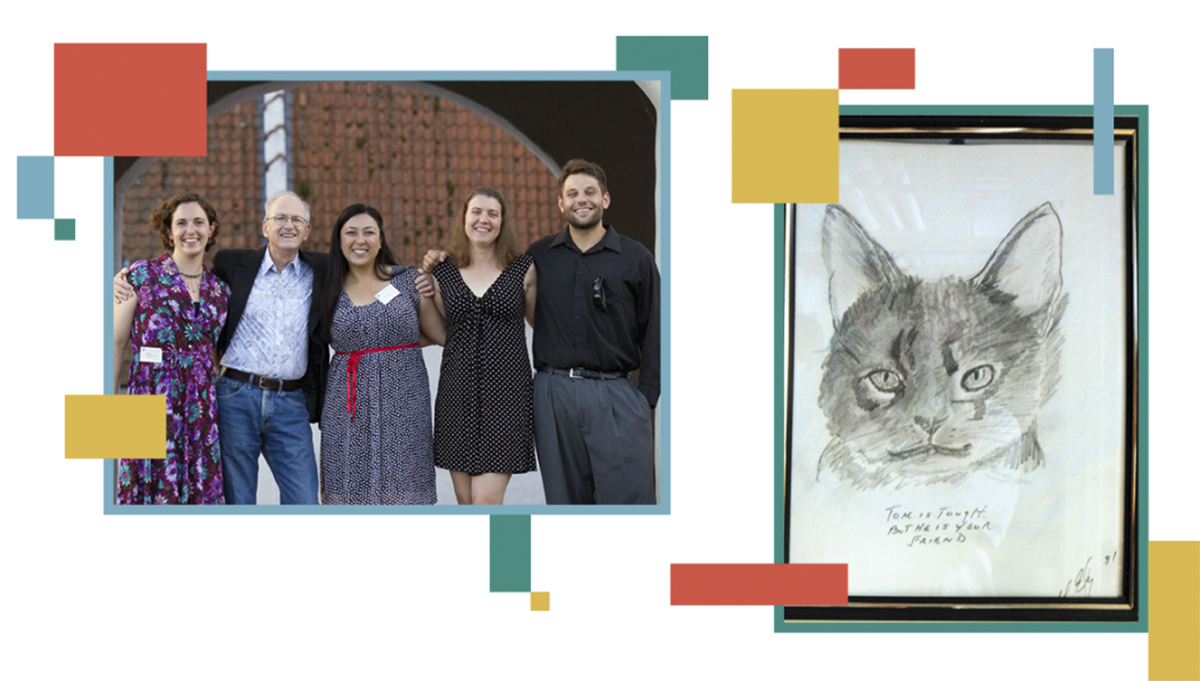 (Left) Current and former members of Tom Cronin’s research group have made it a tradition to reunite at professional conferences and take a “family photo.” From left to right: Kate Feller, Tom Cronin, Alex Kingston, Megan Porter, and Michael Bok in 2013. (Image courtesy of Tom Cronin) (Right) Feller contributed substantially to decorating Tom Cronin’s lab. One day she came home from a thrift shop with a gift for Cronin: this sketch of a cat, with the inscription, “Tom is tough. But he is your friend.” It was a perfect fit for an advisor who held high expectations along with offering generous support. It still hangs in the Cronin lab today.
Rigor, excitement, and resilience
Today, Feller is focused on furthering her research, engaging her students, and raising her family—her second child arrived this October. As a faculty member, Feller is maintaining old connections and forging new ones.
“Kate is really doing a fantastic job of creating and maintaining a network across different areas of science and education, in the research that she does but also in the way that she teaches and the way she facilitates those connections across institutions,” Kenyon, her mentor from HWS, says. For example, Kenyon is now collaborating with a colleague at Union because Feller connected them. And Kenyon is using a book in her courses that features the Cronin lab’s research— including some carried out by Feller.
“What I have thoroughly enjoyed is watching Kate progress at each step along the way, and find her passion, and be able to pursue something with such rigor, and excitement and resilience,” says Kenyon.
Whether creating art, performing on stage or in the classroom, working hard in the lab, or collecting specimens underwater, Feller is embracing each stage of her life and career with a zest that is uniquely hers. As Cronin puts it, “She was always Kate. She never started or stopped being Kate.”
“The thing that I love most is just trying to figure out how the world works,” Feller says. “I like to describe myself as an explorer. I am not a Magellan or a person on a ship looking to explore new places—I’m pushing the boundaries of knowledge. Where is the edge, and how can I shed light on the unknown?”
Feller is on the exploration of a lifetime, discovering new things about how brains work, transforming the lives of students, and doing it all in full color. As her research program takes off, her family grows, and her network broadens, her greatest adventures may be ahead of her.
]]>
The shower was full of mantis shrimp. Bubblers burbled and the cranky crustaceans skulked in their tanks, looking for things to punch with their famously fast strikes. Complicated electronics for...
https://umbc.edu/stories/living-in-vivid-color-biology-research/
https://beta.my.umbc.edu/api/v0/pixel/news/137495/guest@my.umbc.edu/14652561244235525f10f70bae9ccc98/api/pixel
uncategorized
UMBC News & Magazine
https://beta.my.umbc.edu/groups/umbc-news-magazine
https://assets1-beta.my.umbc.edu/system/shared/avatars/groups/000/001/943/24435aa6207c452e7bc15cc74b42c7bb/xsmall.png?1748556657
https://assets1-beta.my.umbc.edu/system/shared/avatars/groups/000/001/943/24435aa6207c452e7bc15cc74b42c7bb/original.png?1748556657
https://assets2-beta.my.umbc.edu/system/shared/avatars/groups/000/001/943/24435aa6207c452e7bc15cc74b42c7bb/xxlarge.png?1748556657
https://assets2-beta.my.umbc.edu/system/shared/avatars/groups/000/001/943/24435aa6207c452e7bc15cc74b42c7bb/xlarge.png?1748556657
https://assets3-beta.my.umbc.edu/system/shared/avatars/groups/000/001/943/24435aa6207c452e7bc15cc74b42c7bb/large.png?1748556657
https://assets1-beta.my.umbc.edu/system/shared/avatars/groups/000/001/943/24435aa6207c452e7bc15cc74b42c7bb/medium.png?1748556657
https://assets2-beta.my.umbc.edu/system/shared/avatars/groups/000/001/943/24435aa6207c452e7bc15cc74b42c7bb/small.png?1748556657
https://assets1-beta.my.umbc.edu/system/shared/avatars/groups/000/001/943/24435aa6207c452e7bc15cc74b42c7bb/xsmall.png?1748556657
https://assets2-beta.my.umbc.edu/system/shared/avatars/groups/000/001/943/24435aa6207c452e7bc15cc74b42c7bb/xxsmall.png?1748556657
UMBC News & Magazine
0
0
false
Wed, 15 Nov 2023 15:22:11 -0500
Wed, 15 Nov 2023 15:22:11 -0500
The Academic Minute: Challenging misconceptions about queer sexualities in Arab cultures
For centuries, media has portrayed Arab culture as misogynistic and homophobic, leaving little room for the possibility that queer Arab communities exist and thrive. Adding to this sense of erasure is the belief some Arab communities have in thinking that homosexuality is not inherently Arab but something the Western world brought to the Arab world. However, the reality queer Arabs and those in the diaspora live is much more positive and complex.
Mejdulene Bernard Shomali, a queer Palestinian poet and associate professor in the department of gender, women’s, and sexuality studies,wrote the first study of desire that addresses the contemporary cultures and lives of queer Arab women in her book, Between Banat: Queer Arab Critique and Transnational Arab Archives (Duke University Press, 2023).
“My research looks at how Arab people experience and narrate their queerness in unexpected ways. For example, Arabs may be in same-sex relationships but might not claim gay or lesbian identities,” Shomali explains to Lynn Pasquerella, president of the American Association of Colleges and Universities and host of The Academic Minute, a daily show featuring faculty from colleges and universities worldwide speaking about their cutting-edge research. “Many queer Arabs might not check off Western benchmarks of LGBT identity, like being ‘out.’ Some of the existing Arabic terms for queer people have negative connotations and are also not popular.”
UMBC’s Academic Minute series
Shomali joined seven other UMBC scholars this fall in UMBC’s first Academic Minute series, featuring the latest research in media and communication studies; modern languages, linguistics, and intercultural communication; language, literacy, and culture; philosophy; gender, women’s, and sexuality studies; sociology, anthropology, and public health; and history. This series is republished on NPR podcasts and Inside Higher Ed.
Learn more about Mejdulene Bernard Shomali’s research:
- She is currently a 2023-24 Society for the Humanities fellow at Cornell University, where she is working on a project called Palestine Matters: Aesthetics, Embodiment, and Pleasure in Palestine and also teaching a seminar called “Feeling Free: Radical Aesthetics and Political Affects.”
- Her essays on gender and sexuality in transnational Arab culture include:
Learn more about UMBC’s gender, women’s, and sexuality studies.
]]>
For centuries, media has portrayed Arab culture as misogynistic and homophobic, leaving little room for the possibility that queer Arab communities exist and thrive. Adding to this sense of...
https://umbc.edu/stories/the-academic-minute-queer-arab-sexualities/
https://beta.my.umbc.edu/api/v0/pixel/news/137120/guest@my.umbc.edu/48393014434e3fb25e6433d4c10cf236/api/pixel
cahss
cahssresearch
gwss
magazine
news
policy-and-society
research
UMBC News & Magazine
https://beta.my.umbc.edu/groups/umbc-news-magazine
https://assets1-beta.my.umbc.edu/system/shared/avatars/groups/000/001/943/24435aa6207c452e7bc15cc74b42c7bb/xsmall.png?1748556657
https://assets1-beta.my.umbc.edu/system/shared/avatars/groups/000/001/943/24435aa6207c452e7bc15cc74b42c7bb/original.png?1748556657
https://assets2-beta.my.umbc.edu/system/shared/avatars/groups/000/001/943/24435aa6207c452e7bc15cc74b42c7bb/xxlarge.png?1748556657
https://assets2-beta.my.umbc.edu/system/shared/avatars/groups/000/001/943/24435aa6207c452e7bc15cc74b42c7bb/xlarge.png?1748556657
https://assets3-beta.my.umbc.edu/system/shared/avatars/groups/000/001/943/24435aa6207c452e7bc15cc74b42c7bb/large.png?1748556657
https://assets1-beta.my.umbc.edu/system/shared/avatars/groups/000/001/943/24435aa6207c452e7bc15cc74b42c7bb/medium.png?1748556657
https://assets2-beta.my.umbc.edu/system/shared/avatars/groups/000/001/943/24435aa6207c452e7bc15cc74b42c7bb/small.png?1748556657
https://assets1-beta.my.umbc.edu/system/shared/avatars/groups/000/001/943/24435aa6207c452e7bc15cc74b42c7bb/xsmall.png?1748556657
https://assets2-beta.my.umbc.edu/system/shared/avatars/groups/000/001/943/24435aa6207c452e7bc15cc74b42c7bb/xxsmall.png?1748556657
UMBC News & Magazine
0
0
false
Wed, 15 Nov 2023 15:05:14 -0500
Wed, 15 Nov 2023 15:05:14 -0500
Meet a Retriever—Brian Frazee ’11, M.P.P. ’12, Alumni Association President
Meet Brian Frazee, the president and CEO of the Delaware Hospital Association. Brian is a double alum—earning his political science degree in 2011 and his M.P.P. in health policy in 2012—a former resident assistant (RA), and the current president of the UMBC Alumni Association Board of Directors. But most importantly, he would say, Brian is married to Angela Frazee ‘11, psychology, whom he met during his time at UMBC, and the couple have three daughters. Take it away, Brian!
Q: What’s one essential thing you’d want another Retriever to know about you?
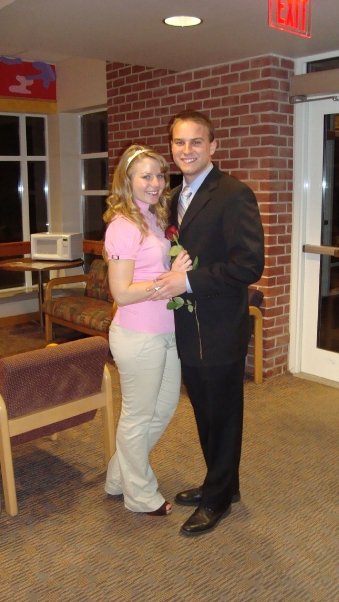
A: I am an alumnus who met his wife, who was a fellow RA in another residence hall, at UMBC. (On the right here, we’re posing for Valentine’s Day in 2009 in the Erickson Hall lobby.) We are now the proud parents of three girls and recently moved to Delaware. Our family loves UMBC and we plan to be lifelong engaged alumni!
Q: How have you stayed connected with the UMBC community?
A: I have had the privilege of serving as president of the UMBC Alumni Association Board of Directors since 2020. Leading this board through the pandemic and historic leadership transition has been the honor of a lifetime and has allowed me to give back to UMBC in more ways than I ever could have imagined. Through this experience, I’ve seen firsthand the dedication, commitment, and contributions that make UMBC the special community it is.
Q: What’s the one thing you’d want someone who hasn’t joined the UMBC community to know about the support you find here?
A: The culture of UMBC is very special. Everyone has a place at UMBC. The commitment to inclusive excellence is real, whether you are a student or an alum. There are countless opportunities to get involved and no contribution or commitment is too small!
I’ve seen firsthand the dedication, commitment, and contributions that make UMBC the special community it is.
Brian Frazee ’11, M.P.P. ’12
Q: Tell us about someone in the community who has inspired you, and how they did it.
A: People who volunteer their time in an effort to better their community inspire me most. With all of the challenges we face in this post-pandemic period, it is inspiring when people step up to do the hard work of making their community better for everyone without expecting anything in return. These unsung heroes give me hope and confidence that our best days are ahead of us.
Q: Tell us about your current job. What do you like most about it?
A: I am the president and CEO of the Delaware Healthcare Association. The privilege and opportunity to advance healthcare policy with the goal of enabling Delawareans to reach optimal health is what I enjoy most about the work. The hospital, health system, and healthcare-related organizations that make up the membership of my organization inspire me with the innovative and dedicated work they do every day to make progress toward this goal.
Q: What is your WHY? What brought you to UMBC?
A: I was attracted to UMBC because of its unique culture of inclusive community that has only gotten stronger since my time as a student. UMBC is not a place; it’s a community. That special and unique culture became evident quickly when I arrived on campus and it’s why I have remained engaged as an alumnus.
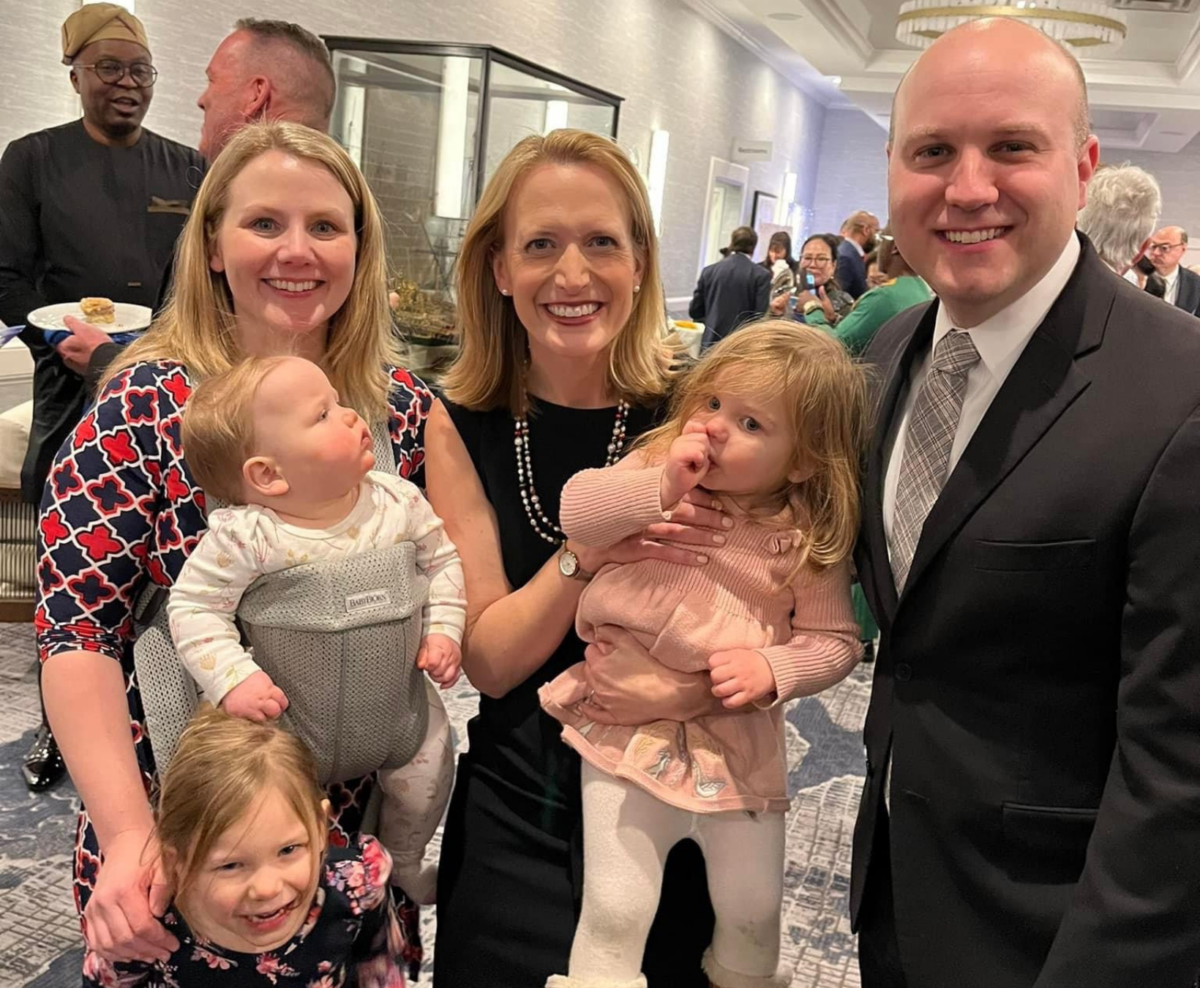
The Frazee family with Maryland Comptroller Brooke Lierman at her inaugural celebration. “We took our girls to Annapolis for the ceremony and celebration because it was important to us that they witnessed the historic swearing-in of the first woman independently elected to state-wide office in Maryland,” says Frazee.
Q: Where have you found support in the UMBC community?
A: There are so many people who have supported me along my UMBC journey. The individualized attention that is engrained in our culture certainly helped me get to where I am today. Service learning volunteering opportunities through the Shriver Center, internships, campus involvement and leadership, and dedicated professors are specific examples of ways the UMBC community supported me.
Q: What’s your favorite part of Retriever Nation?
A: The special pride we share as members of Retriever Nation is my favorite part of our community. That instant connection and understanding I feel when I meet a fellow member never gets old!
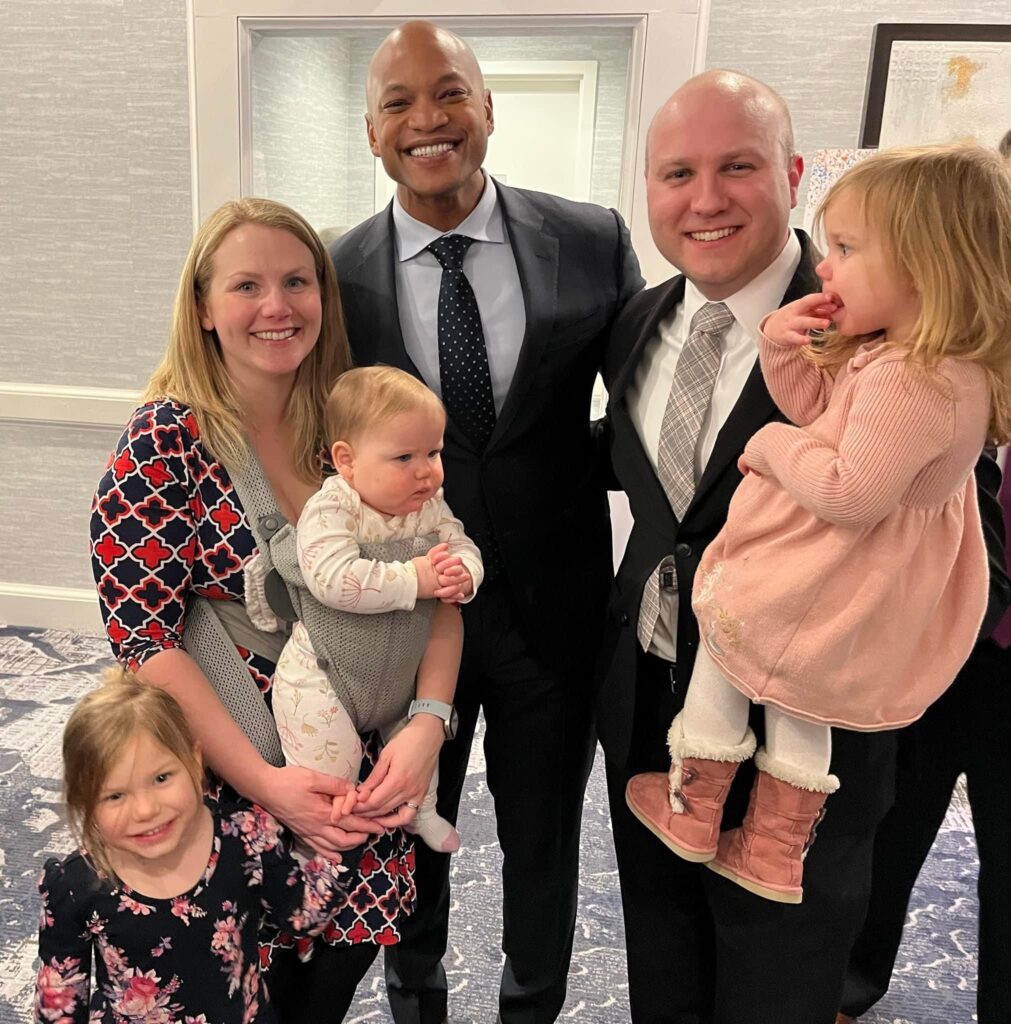 The Frazee family with Maryland Governor Wes Moore during the 2023 inaugural celebrations.
Q: What drives you to support UMBC?
A: We support the UMBC Alumni Endowed Scholarship Fund which is led by the UMBC Alumni Association Board of Directors. While we see the value in giving to all parts of the UMBC community, my wife and I believe that this fund most directly supports future generations of Retrievers. My wife benefited from this fund as an undergraduate and supporting it as alumni is our way of paying it forward!
* * * * *
UMBC’s greatest strength is its people. When people meet Retrievers and hear about the passion they bring, the relationships they create, the ways they support each other, and the commitment they have to inclusive excellence, they truly get a sense of our community. That’s what “Meet a Retriever” is all about.
Learn more about how UMBC can help you achieve your goals.
]]>
Meet Brian Frazee, the president and CEO of the Delaware Hospital Association. Brian is a double alum—earning his political science degree in 2011 and his M.P.P. in health policy in 2012—a former...
https://umbc.edu/stories/meet-a-retriever-brian-frazee-alumni-president/
https://beta.my.umbc.edu/api/v0/pixel/news/137157/guest@my.umbc.edu/42bb624c88c840deea37f6749f87bf17/api/pixel
alumni
alumni-association
impact
magazine
meet-a-retriever
mpp
perspectives
political-science
UMBC News & Magazine
https://beta.my.umbc.edu/groups/umbc-news-magazine
https://assets1-beta.my.umbc.edu/system/shared/avatars/groups/000/001/943/24435aa6207c452e7bc15cc74b42c7bb/xsmall.png?1748556657
https://assets1-beta.my.umbc.edu/system/shared/avatars/groups/000/001/943/24435aa6207c452e7bc15cc74b42c7bb/original.png?1748556657
https://assets2-beta.my.umbc.edu/system/shared/avatars/groups/000/001/943/24435aa6207c452e7bc15cc74b42c7bb/xxlarge.png?1748556657
https://assets2-beta.my.umbc.edu/system/shared/avatars/groups/000/001/943/24435aa6207c452e7bc15cc74b42c7bb/xlarge.png?1748556657
https://assets3-beta.my.umbc.edu/system/shared/avatars/groups/000/001/943/24435aa6207c452e7bc15cc74b42c7bb/large.png?1748556657
https://assets1-beta.my.umbc.edu/system/shared/avatars/groups/000/001/943/24435aa6207c452e7bc15cc74b42c7bb/medium.png?1748556657
https://assets2-beta.my.umbc.edu/system/shared/avatars/groups/000/001/943/24435aa6207c452e7bc15cc74b42c7bb/small.png?1748556657
https://assets1-beta.my.umbc.edu/system/shared/avatars/groups/000/001/943/24435aa6207c452e7bc15cc74b42c7bb/xsmall.png?1748556657
https://assets2-beta.my.umbc.edu/system/shared/avatars/groups/000/001/943/24435aa6207c452e7bc15cc74b42c7bb/xxsmall.png?1748556657
UMBC News & Magazine
1
0
false
Wed, 15 Nov 2023 14:56:09 -0500
Grab a Seat at the Table
These days, it’s tempting to grow numb to the polarization of society and the breakdown in public discourse and to retreat into our silos of solidarity. But a liberal arts education has the potential to offer an antidote to these seemingly inevitable fates—through modeling and practicing empathy. At UMBC, students are invited to the table to share their stories and listen to their peers. These acts of educational hospitality help Retrievers find their why and pursue the public good.
Want weekly Top Stories sent to your inbox?

It’s the first day of class. You’re looking around, bright-eyed and a little nervous, and then your instructor smiles at the class and says, “One day you are all going to die.” Are you offended? Shocked? Titillated? Horrified? Collectively, the class titters. Already social bonds are forming as Christine Armstrong Mair, associate professor of sociology who specializes in gerontology, continues her spiel. “And if we’re all lucky, that won’t be for a long time.”
As sociologists, says Mair, or more broadly as leaders in an educational setting, “it’s not our task to make somebody think a certain way. Our task is to show them what exists in society and help them feel empathy for the human experience.”
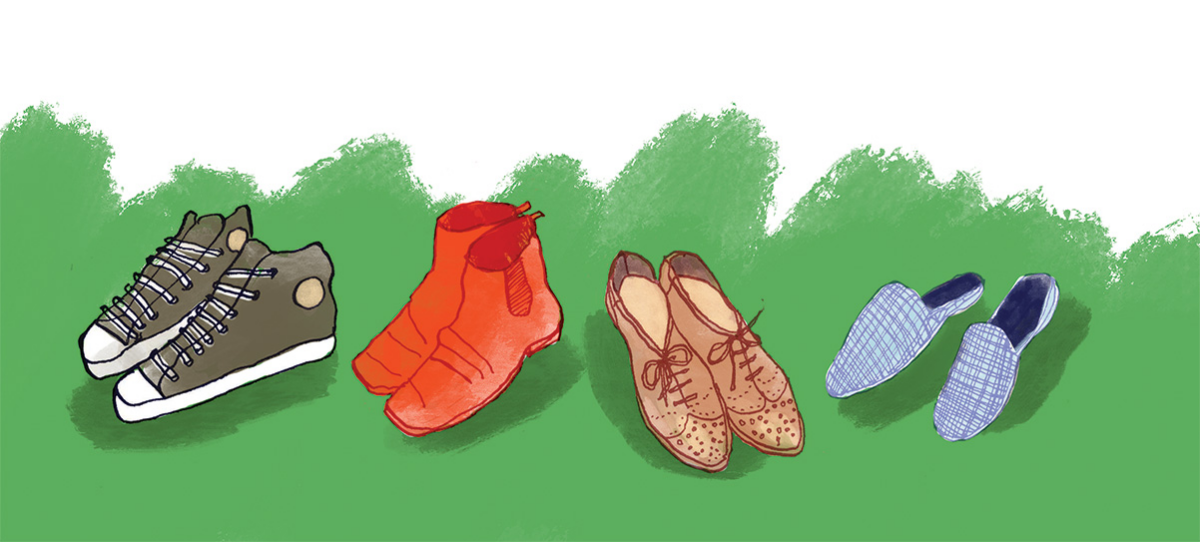
At its most pedestrian roots, empathy is putting yourself in someone else’s shoes. How can someone else’s emotional experience inform your own personal perspective?
In the best-case scenario, a college campus is a microcosm of its society: a crosshatch of races, ages, and socio-economic backgrounds. And UMBC holds true to those measures. But something different happens when you step into the Loop—you sit next to someone who didn’t go to your high school. You eat at the same table with someone outside of your cultural background. You take a test side by side with someone who voted differently than you. And even more than sharing space, you start sharing notes and books and stories—even your own story—with these strangers and then suddenly they’re no longer strangers.
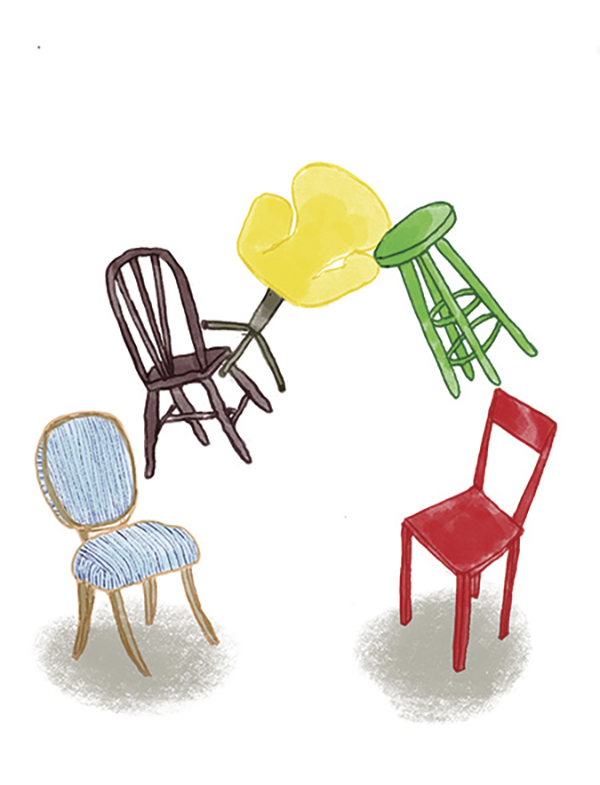
When empathy is on the table, students and colleagues expand their capacity for hard work. You might change your thesis to address human trafficking or leave your home island to work toward healthy aging for all populations. So pull up a chair, step into someone else’s shoes, and partake in this grand educational potluck.
“With my background—what I’ve seen with human trafficking and migrant smuggling—what can I do as a person with my knowledge and responsibility?”
– Saydeh Karabatis, Ph.D. candidate
Building bridges across campus
You’re sitting at a beach-side cafe in Greece with your husband. It’s 2015 and Greece’s financial troubles are in the news, but the waves of migrants washing ashore are not yet as publicized. As you enjoy your coffee, you see a group of 40 to 50 people sitting seemingly aimless and distraught nearby. Based on their clothing, you make a guess that they are Muslims and Arabic speakers. What do you do?
If you’re Saydeh Karabatis, originally from Lebanon—and a survivor of the 17-year Lebanon civil war—and fluent in Arabic, you let that immediate moment of empathy guide you and approach the group.
Karabatis and her husband George, a professor of information systems at UMBC and from Greece, changed the plans for their summer in the Mediterranean to volunteer as translators, food finders, and listeners for the refugees, primarily fleeing the war in Syria and arriving in Greece in dire straits. They did so again in 2017.
As Karabatis interacted with these desperate groups and read more about their plight, she realized familiar patterns were emerging in their stories. They were not just migrants fleeing a war, they were trafficked people, paying dearly for not-safe passage, and many others headed toward labor and a life they did not sign up for. Struck by the limits of her actions—and even her emotional capacity for empathy—when Karabatis returned home to Maryland, she found her next step.
Karabatis, who has a master’s in computer science from UMBC and works for the university’s Division of Information Technology, knew she would need to fill her time when her two sons left for college. Karabatis asked herself, “With my background—what I’ve seen with human trafficking and migrant smuggling—what can I do as a person with my knowledge and responsibility?”
She contacted Vandana Janeja, then chair of information systems, and explained the project she wanted to complete for her Ph.D. During her master’s, Karabatis had tried to conduct a research project on human trafficking for a class with Janeja but couldn’t find a robust data set to use for her project and ended up having to leave the work incomplete. This time, she pitched using the stories of trafficked people. “Instead of dealing with numbers, numbers as data, I am now dealing with stories as data—the stories of people being trafficked,” says Karabatis.
It’s not been easy going. Many trafficked people are not open about their stories, for fear of retribution or simply because of how horrific the experience was. Additionally, it’s hard for Karabatis to take in their trauma. “I’m reading about all these abuses,” says Karabatis. “I’m reading about sex trafficking, labor trafficking, organ trafficking, human smuggling. I can’t imagine—how can a human being do something like that to another human?”
Eventually though, with the end goal of combating the network of smuggling routes, Karabatis says, you need to reach a level where you can try to put your emotions aside: “You need to detach yourself from these emotions if you want to do something to help these people. If your emotions are the only thing driving you, you wouldn’t be able to produce the research. Use these emotions as a spark and then put them on the side.”
Caring starts with listening
You’re a teenager riding the bus for fun in Puerto Rico, killing time by people watching. You’re struck by the number of older adults on the bus, noticing their many bags stuffed with x-rays and other apparent medical paperwork. Unthinkingly, you just assume they’re enjoying the ride like yourself, but this older generation seems eager to talk.
If you’re Jaminette Nazario, a curious if bored high schooler, you strike up a conversation.
What she heard from her fellow travelers shook her: “‘We don’t have people to help….’ ‘My wife just died of cancer….’ ‘I need to use this bus to get to my medical appointments.’” It wasn’t until she was pursuing her bachelor’s degree in social sciences that Nazario was hit by the realization that those conversations might have been the only time those older bus riders had talked to someone that day. “So I started thinking about the many barriers older adults have in order to achieve healthy aging,” she says. “When older adults don’t have resources or people, they miss out on social networks that are vital to healthy aging.”
This aha moment would propel Nazario to a master’s degree in public health with a focus on gerontology, but in order to study further, she’d have to leave her island for the next academic step.
Now in her second year of UMBC’s Ph.D. program in gerontology—a joint program with the University of Maryland, Baltimore—Nazario is beginning to research aging Hispanic immigrants and their increasing challenges accessing medical care.
And unlike her fellow bus riders, she’s not doing this alone. “Even though it’s really hard to be far from family, I feel like I’m home here. And I love how Dr. Mair teaches.” Like most classes, says Nazario, there are readings and discussion, but Mair brings a “specific dynamic” to the setting. Each class starts with questions prepared by the students, which is really empowering, says Nazario. It might end up that the class all resonates with one question and they stay on that topic, guiding the trajectory of the discussion.
In summer 2022, Nazario joined Mair and others from the gerontology program at a conference in Japan. She presented a poster on her research and walked away from her talk with a new level of confidence. “There were professionals from Japan and China and they’re asking me about something in the United States…it was kind of cool. People came up and treated me with so much respect.”
Students in Mair’s gerontology classes are finding their drive to solve crises in aging care not only because they might have loved ones suffering, but because aging (if we’re lucky) and death are unifying elements. “It’s something that really applies to all of us,” says Mair, “to make sure that we’re taking care and setting up a good system so that when we all arrive there, that us and all of our people that we care about are okay.”
Inclusive classrooms by design
You walk to the front of the media and communications class you’re teaching. Students are sitting in traditional desks in rows, facing the whiteboard where you’ll teach. They’re silent, spaced out or on their phones. They seem to breathe a sigh of relief when you walk in, grateful to know where to put their attention. Later, in a different section of that class, you meet in a newly designed lecture hall filled with round tables and no clear lectern space. In this format, the students are already grouped together and chatting.
If you’re Donald Snyder, principal lecturer in media and communication studies, you know there is science behind what forms good class cohesion and participation. He learned it from the experts in UMBC’s Faculty Development Center (FDC).
In addition to learning about and playing around with classroom set-up to facilitate more natural conversations (and to rid the learning experience from a “perceived hierarchy” as FDC Director Linda Hodges calls it), Snyder and others who use the FDC are supported in using inclusive and culturally responsive teaching.
While culturally responsive pedagogy isn’t a new concept—it centers and nurtures students’ unique cultural strengths—Hodges says that recent world events have brought the teaching style more into focus. Citing the death of George Floyd and the nation’s response—especially young people—and the COVID-19 pandemic as two significant flashpoints, Hodges says inclusive pedagogy and empathetic practices have become more imperative than ever. Room design is just one tool in the FDC toolbelt that can work to democratize students’ experience. It can erase the divide between the front row handraiser and the back row hider, giving equal footing to all types of students and their stories.
“Instructors are recognizing that they need to try to connect with and hear their students’ voices,” says Hodges. “This will create a sense of belonging. It’s become quite clear in the research that one of the key factors in whether students succeed and persist in education is the feeling of belonging.”
Snyder has made the most of the FDC’s offerings, including inviting Hodges’ team to observe his teaching and offer feedback. He starts many of his classes with some tools for students to learn about self-regulation, basically how to use available resources to make the most of education. He introduces them to Bloom’s Taxonomy, which places rote memorization at the bottom of the pyramid and evaluating and creating a unique argument at top. “I want the students to know, I’m not asking to memorize anything,” says Snyder, “but we need to learn to be critical when we’re thinking about media and communication texts and how these things operate.”
Giving students tools to succeed in college—go to office hours, block out time for studying, get enough sleep—may seem basic and far afield from teaching and practicing empathy, but in the taxonomy of educational success, says Snyder, this foundation leads to the heavy-lifting tools at the top of the pyramid.
Snyder helps them harness existing interests, in tech or media, and then run with it, academically. He wants them to ask, “‘How can I turn that switch? What is the thing that I can grab onto? What do I really want to know about?’”
He also listens to them, and attempts to model vulnerability in the classroom. “Yes, these are students and they need to understand content, but they’re also humans who are struggling and we’re all struggling and there’s a human condition aspect we can’t ignore as instructors.”

Swapping stories strengthens neighborly bonds
You’re driving your car on tour in Texas when you’re hit by a criminally intoxicated drunk driver. You survive, but a host of physical and psychological repercussions are still taking their toll 10 years later. As a musician, you fuel your art with your resiliency and work through the healing process by creating music. But when the pandemic hits, and live, in-person music disappears, you look for a pivot point—and the community you’re missing.
If you’re Kristin Putchinski, a student in UMBC’s M.F.A. program for intermedia and digital arts, you lean into the concept of “platonic intimacy.”
Putchinski coined the term to sum up her goal of “trying to strengthen neighborly bonds. What I’m looking for is an intimate experience between two people. And when people hear intimacy, they tend to think that it’s about a romantic or sexual component. But how do I frame that intimacy—and how important intimacy is—in terms of friendship and neighborliness?”
Through a graduate assistantship jointly funded by jointly funded by UMBC and the University of Maryland, Baltimore’s Community Engagement Center (CEC), Putchinski was given the opportunity to shadow CEC’s then-director Tyrone Roper and learn about the center’s mission, which includes strengthening neighborly bonds. Roper told Putchinski they were looking for ways to engage the 18- to 24-year-old demographic. When Putchinski was tasked with creating an art project for CEC the following semester, she kept this age goal in mind.
As a student in UMBC’s intermedia program, Putchinski “explores the textures between mediums,” she says. As a musical artist who performed under the stage name ellen cherry, “I have 25 years of experience as a performing songwriter and storyteller, creating my own and interpreting other people’s stories.” So she began to imagine a strange game of telephone that would give participants the opportunity to swap stories, with the end result of creating instances of platonic intimacy.
This multifaceted project connected post-high-school-aged individuals with older generations through curated, facilitated sessions. The participant-pairs met four different times and talked about a song, a photograph, and a memory—and at the last session, the neighbors “swapped” their stories. A recording of the swap was sent to local artists who interpreted the stories into their own mediums—painting, poetry, and a video soundscape. Then, at an event open to the public in the CEC, the storytellers took the stage, retelling their neighbor’s story. For example, a Latinx college graduate took to the stage to reshare her stranger-turned-partner’s tale of being raised in foster care in 1970s Baltimore.
Putchinski was eager to find out “when you talk to somebody that’s 40 years different from you…did your perceptions change about yourself, about them, and what were those changes and the answers?”
It makes sense she’s asking these questions based on her ongoing empathy toward the man who altered her life in an accident 10 years ago. “It was very conflicting for me to be the victim of a crime that I really feel like was committed not by a criminal but by a person who abuses alcohol. At the base level, he’s a human being. How can we think about his human potential after this experience and mine?”
“Imagine intensely” a better way forward
One of the greatest assertions of the liberal arts comes from Percy Bysshe Shelley’s essay “A Defence of Poetry.” The short-lived husband of Frankenstein’s creator writes, “A man, to be greatly good, must imagine intensely and comprehensively; he must put himself in the place of another and of many others; the pains and pleasures of his species must become his own.”
On college campuses, and at UMBC in particular, through thoughtful classroom instruction and intentional commitment to community, students trade their stories—pains and pleasures alike. Less of a transaction and more of a gift, these stories are invitations to grow in understanding, change your opinion, or shape your research.
But walking in someone else’s shoes doesn’t mean you misplace your own shoes along the way—in fact professors hope it helps you find your footing at UMBC. “That open-mindedness and appreciation and empathy does not necessarily mean that you lose other parts of yourself,” says Anne Brodsky, professor and chair of the psychology department. “It shouldn’t be a zero-sum game.”
You’re walking down Academic Row. You’re a first-generation college student with a lot of questions. You’re a returning student giving college a second (or third) chance. You’re a first-year who misses the familiar halls of high school. You see other Retrievers walking in groups, heading into classrooms, rubbing True Grit’s bronze nose, making conversation with their peers. What do you do?
]]>
These days, it’s tempting to grow numb to the polarization of society and the breakdown in public discourse and to retreat into our silos of solidarity. But a liberal arts education has the...
https://umbc.edu/stories/grab-a-seat-at-the-table-empathy/
https://beta.my.umbc.edu/api/v0/pixel/news/137271/guest@my.umbc.edu/777eb34ff02b7fc72d1664adf771099a/api/pixel
campus-life
coeit
computer-science
fall-2023
feature
imda
information-systems
magazine
mcs
UMBC News & Magazine
https://beta.my.umbc.edu/groups/umbc-news-magazine
https://assets1-beta.my.umbc.edu/system/shared/avatars/groups/000/001/943/24435aa6207c452e7bc15cc74b42c7bb/xsmall.png?1748556657
https://assets1-beta.my.umbc.edu/system/shared/avatars/groups/000/001/943/24435aa6207c452e7bc15cc74b42c7bb/original.png?1748556657
https://assets2-beta.my.umbc.edu/system/shared/avatars/groups/000/001/943/24435aa6207c452e7bc15cc74b42c7bb/xxlarge.png?1748556657
https://assets2-beta.my.umbc.edu/system/shared/avatars/groups/000/001/943/24435aa6207c452e7bc15cc74b42c7bb/xlarge.png?1748556657
https://assets3-beta.my.umbc.edu/system/shared/avatars/groups/000/001/943/24435aa6207c452e7bc15cc74b42c7bb/large.png?1748556657
https://assets1-beta.my.umbc.edu/system/shared/avatars/groups/000/001/943/24435aa6207c452e7bc15cc74b42c7bb/medium.png?1748556657
https://assets2-beta.my.umbc.edu/system/shared/avatars/groups/000/001/943/24435aa6207c452e7bc15cc74b42c7bb/small.png?1748556657
https://assets1-beta.my.umbc.edu/system/shared/avatars/groups/000/001/943/24435aa6207c452e7bc15cc74b42c7bb/xsmall.png?1748556657
https://assets2-beta.my.umbc.edu/system/shared/avatars/groups/000/001/943/24435aa6207c452e7bc15cc74b42c7bb/xxsmall.png?1748556657
UMBC News & Magazine
1
0
false
Wed, 15 Nov 2023 14:07:28 -0500
The long shot—4-time Olympian Cleopatra Borel ’02 inducted to Athletics Hall of Fame
Cleopatra Borel had no athletic aspirations when she arrived in Baltimore from Trinidad and Tobago in 1997. She enrolled at what was then Coppin State College on the advice of her high school math teacher, a Coppin alum. Powerfully built and an eager learner, Borel quickly developed in the throwing events and broke Coppin’s shot put record early in her tenure there.
After the Eagles’ coach left the program, UMBC offered Borel an athletic scholarship and she made the move to Hilltop Circle.
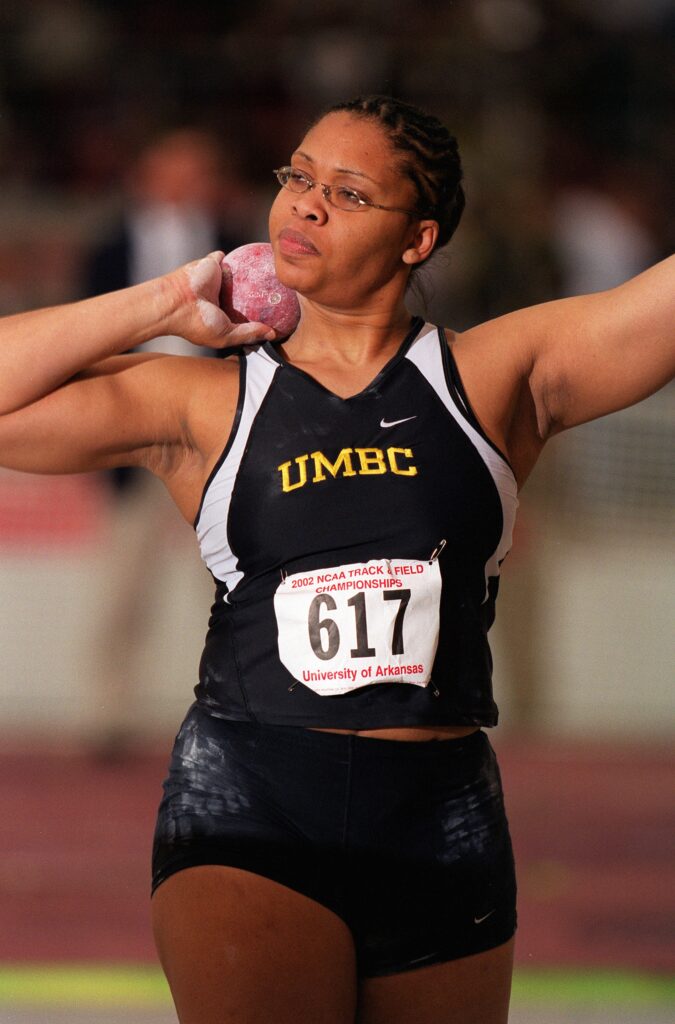 Borel at a competition when she was a student. Photo courtesy of Borel.
Borel ’02, interdisciplinary studies, flourished both academically and athletically at UMBC. She earned All-America honors (top eight) in the shot put both indoors and outdoors in the 2000 – 01 season. However, she would have only one more crack at the NCAAs, with one year of indoor track and field eligibility remaining.
On March 9, 2002, Cleo, as she was known at UMBC, took to the shot put circle at the University of Arkansas. On her next-to-last throw, she uncorked a personal best of 17.50 meters (57’5”), putting her in first place. When the last shot had landed, the black-and-gold clad Retriever had outdistanced the field and captured UMBC’s first Division I national title.
In her first year of eligibility (2006 – 07), the UMBC Athletic Hall of Fame Committee tabbed Borel for induction. However, some events on her calendar kept getting in the way of her returning to campus—namely the 2004, 2008, 2012, and 2016 Olympics. At 37 years old, she produced her best finish, placing seventh at the 2016 Rio Games. Her final Olympic moment occurred as she served as Trinidad and Tobago’s flag bearer at the closing ceremonies.
Borel returned to the United States in January 2022 to coach the throwers at the University of Texas Rio Grande Valley. And, in October 2023, she finally made the journey back to Hilltop Circle to be inducted into the UMBC Athletics Hall of Fame.
We asked Borel to reflect on her incredible journey.
Q: You arrived at UMBC under unusual circumstances and remain the only Retriever to win an individual NCAA Championship. Reflecting on your time here, what did it mean for you to be a Retriever and how did your UMBC experience assist you in all of your endeavors?
Borel: I walked away from a very good situation at Coppin State College, not knowing how things would evolve at UMBC. However, I have to say, taking a chance on UMBC is still among the top three best decisions I have made thus far. My UMBC student-athlete experience prepared me for life as an Olympic athlete, essentially taking on the world.
I believe I was prepared to navigate life on the professional track and field circuit because of [UMBC Athletics Director] Dr. Charles Brown’s sports management class and because my event Coach Brian King and track and field Head Coach David Bobb ’97 taught me to work hard, be confident, and play to my strengths.
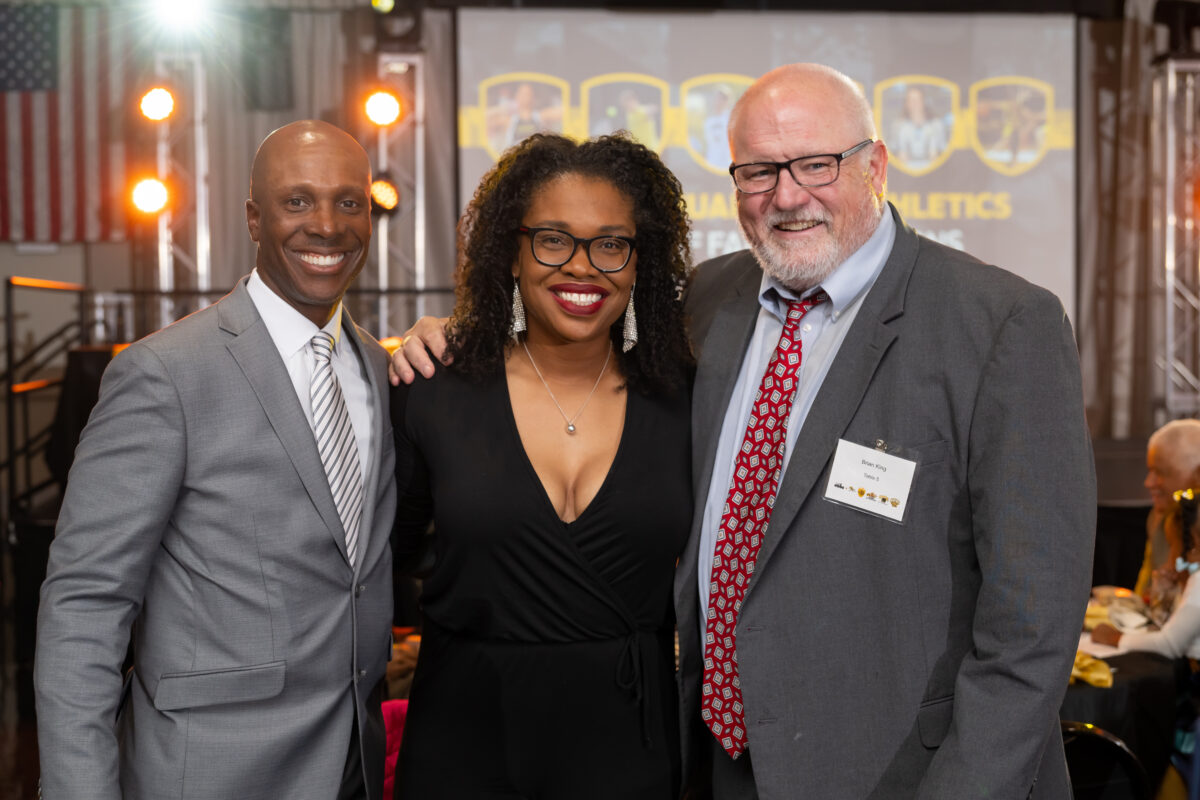 Left to right, David Bobb ’97, Borel, and Brian King. Photo by Max Franz for UMBC.
UMBC’s academic accomplishments, artistic expressions, community outreach initiatives, and of course athletic triumphs reflect the unwavering commitment we all share in making our school a truly exceptional place—a special place where a young person can take a chance and, through hard work and dedication, rise to the top of their field.
Q: What did it mean for you to represent Trinidad and Tobago in international competitions, including four Olympic Games?
Borel: Trinidad and Tobago is a small, developing nation in the Caribbean with a population of less than 1.4 million individuals on two islands. As a result, I felt like one of a few sporting ambassadors representing my country. I am proud to have been responsible for the playing of my national anthem at stadiums across the globe.
UMBC’s academic accomplishments, artistic expressions, community outreach initiatives, and of course athletic triumphs reflect the unwavering commitment we all share in making our school a truly exceptional place.
Cleopatra Borel ’02
Q: What prompted you to develop the Cleopatra Borel Foundation and what is its mission?
Borel: The mission of the Cleopatra Borel Foundation is to facilitate the development of youth through sport and education. We believe this can be accomplished at the grassroots level in Trinidad and Tobago by assisting with coaches’ education, gear, and equipment distribution.
Q: Anything else you would like to share with the UMBC community?
Borel: It was indeed an honor to represent you at the NCAAs and on a global level. I am a proud Retriever, excited to see how UMBC will continue to positively influence Maryland and the world.
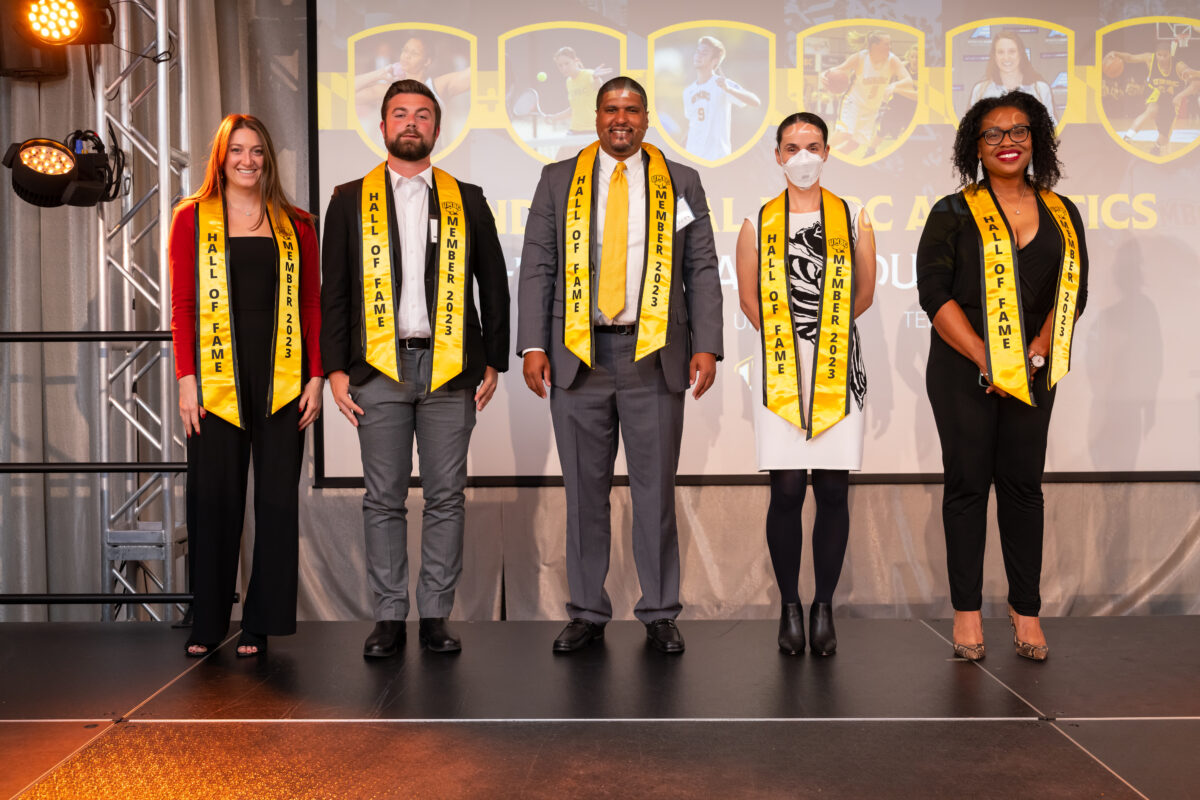 The 2023 Hall of Fame inductees included (left to right) Emily Escobedo, ’17, women’s swimming and diving; Pete Caringi III, ’15, men’s soccer; Brian Hodges, ’07, men’s basketball; Cornelia Carapcea, ’09, tennis and Cleopatra Borel, ’02 , track and field. Carlee Cassidy Dewey ’10, women’s basketball, could not attend for personal reasons and will be formally inducted in 2024. Photo by Max Franz for UMBC.
By Steve Levy ’85
]]>
Cleopatra Borel had no athletic aspirations when she arrived in Baltimore from Trinidad and Tobago in 1997. She enrolled at what was then Coppin State College on the advice of her high school math...
https://umbc.edu/stories/olympian-shot-put-cleopatra-borel-hall-of-fame/
https://beta.my.umbc.edu/api/v0/pixel/news/137085/guest@my.umbc.edu/be0c6305c621b5c05fcc162d2e4b26a5/api/pixel
alumni
at-play
athletics
fall-2023
inds
magazine
UMBC News & Magazine
https://beta.my.umbc.edu/groups/umbc-news-magazine
https://assets1-beta.my.umbc.edu/system/shared/avatars/groups/000/001/943/24435aa6207c452e7bc15cc74b42c7bb/xsmall.png?1748556657
https://assets1-beta.my.umbc.edu/system/shared/avatars/groups/000/001/943/24435aa6207c452e7bc15cc74b42c7bb/original.png?1748556657
https://assets2-beta.my.umbc.edu/system/shared/avatars/groups/000/001/943/24435aa6207c452e7bc15cc74b42c7bb/xxlarge.png?1748556657
https://assets2-beta.my.umbc.edu/system/shared/avatars/groups/000/001/943/24435aa6207c452e7bc15cc74b42c7bb/xlarge.png?1748556657
https://assets3-beta.my.umbc.edu/system/shared/avatars/groups/000/001/943/24435aa6207c452e7bc15cc74b42c7bb/large.png?1748556657
https://assets1-beta.my.umbc.edu/system/shared/avatars/groups/000/001/943/24435aa6207c452e7bc15cc74b42c7bb/medium.png?1748556657
https://assets2-beta.my.umbc.edu/system/shared/avatars/groups/000/001/943/24435aa6207c452e7bc15cc74b42c7bb/small.png?1748556657
https://assets1-beta.my.umbc.edu/system/shared/avatars/groups/000/001/943/24435aa6207c452e7bc15cc74b42c7bb/xsmall.png?1748556657
https://assets2-beta.my.umbc.edu/system/shared/avatars/groups/000/001/943/24435aa6207c452e7bc15cc74b42c7bb/xxsmall.png?1748556657
UMBC News & Magazine
0
0
false
Tue, 14 Nov 2023 15:11:49 -0500
Tue, 14 Nov 2023 15:11:49 -0500
Study finds strongest evidence yet for local sources of cosmic ray electrons

A new study using data from the CALorimetric Electron Telescope (CALET)instrument on the International Space Station has found evidence for nearby, young sources of cosmic ray electrons, contributing to a greater understanding of how the galaxy functions as a whole.
The study included more than seven million data points representing particles arriving at CALET’s detector since 2015, and CALET’s ability to detect electrons at the highest energies is unique. As a result, the data includes more electrons at high energies than any previous work. That makes the statistical analysis of the data more robust and lends support to the conclusion that there are one or more local sources of cosmic ray electrons.
“This is one of the primary things that CALET is made to look for,” says Nicholas Cannady, an assistant research scientist with UMBC’s Center for Space Sciences and Technology, a partnership with NASA Goddard Space Flight Center, and a leader on the study. With this paper, he adds, “We were really able to push into the realm where we have few events and start to look for things at the highest energies, which is exciting.”
A better understanding of the galaxy
 Nicholas Cannady, the lead U.S. scientist on the new study, is excited that the CALET mission is bearing fruitful results. (Image courtesy of Cannady)
Current theory posits that the aftermath of supernovae (exploding stars), called supernova remnants, produce these high energy electrons, which are a specific type of cosmic ray. Electrons lose energy very quickly after leaving their source, so the rare electrons arriving at CALET with high energy are believed to originate in supernova remnants that are relatively nearby (on a cosmic scale), Cannady explains.
The study’s results are “a strong indicator that the paradigm that we have for understanding these high-energy electrons—that they come from supernova remnants and that they are accelerated the way that we think they are—is correct,” Cannady says. The findings “give insight into what’s going on in these supernova remnants, and offer a way to understand the galaxy and these sources in the galaxy better.”
CALET is a collaborative project built and operated by groups in Japan, Italy, and the United States, led by Shoji Torii. The lead contributors to this work in Japan are Torii, Yosui Akaike, and Holger Motz at Waseda University in Tokyo, and Louisiana State University is the lead institution in the U.S. The findings were published in Physical Review Letters.
New data lead to new cosmic ray sources
Previous work found that the number of electrons arriving at CALET decreased steadily as energy increased up to about 1 teravolt (TeV), or 1 trillion electron volts. The number of electrons arriving with even greater energy was extremely low. But in this study, CALET did not see the expected dropoff. Instead, the results suggest that the number of particles plateau, and then even increase, at the highest energies—all the way up to 10 TeV in a few cases.
Previous experiments could only measure particles up to about 4 TeV, so the highest energy event candidates above that in this study are a crucial new source of information about potential nearby sources of cosmic ray electrons. Cannady led the effort to individually analyze each of those events to confirm they represent a real signal, and a deeper dive into those events is forthcoming.
Addressing challenges
It’s difficult to distinguish between electrons and protons at high energies, and there are many more protons arriving than electrons, which poses challenges to an accurate analysis. To tell the particles apart, a program developed by the researchers analyzes how the particles break down when they hit the detector. Protons and electrons break down differently, so comparing the cascade of particles they create in that process can filter out the protons. However, at the highest energies, the differences between protons and electrons decrease, making it harder to accurately remove only the protons from the data.
To address this, Cannady led the CALET team’s effort to simulate the breakdown patterns of both protons and electrons coming from the exact direction each of the high-energy events arrived from. That increased the team’s ability to determine whether the events are electrons or protons as accurately as possible.
Based on that work, “We believe we are evaluating the likelihood of events being protons in a realistic fashion,” Cannady says. Enough presumed electrons remain in the dataset after that careful analysis to conclude there is a real signal.
 An x-ray image of Cassiopeia A, an example of a young supernova remnant. (Image courtesy of NASA)
Pushing boundaries
T. Gregory Guzik, professor of physics at LSU and the U.S. CALET collaboration lead, is excited that further analysis of the data suggested that electrons coming from the three best candidates for nearby supernova remnants can explain the high-energy arrivals.
“These CALET observations open the tantalizing possibility that matter from a particular nearby supernova remnant can be measured at Earth,” Guzik shares. “Continued CALET measurement through the life of the International Space Station will help shed new light on the origin and transport of relativistic matter in our galaxy.”
For Cannady, “The most exciting part is seeing things at the highest energies. We have some candidates above 10 TeV—and if it is borne out that these are real electron events, it’s really a smoking gun for clear evidence of a nearby source,” he says. “This is essentially what CALET was put up to do, so it’s exciting to be working on this and to finally be getting results that are pushing the bounds of what we’ve seen before.”
]]>
A new study using data from the CALorimetric Electron Telescope (CALET)instrument on the International Space Station has found evidence for nearby, young sources of cosmic ray electrons,...
https://umbc.edu/stories/calet-detects-high-energy-cosmic-ray-electrons/
https://beta.my.umbc.edu/api/v0/pixel/news/137074/guest@my.umbc.edu/d13963f002bb21b25ab24a7c0429d237/api/pixel
csst
news
research
science-and-tech
UMBC News & Magazine
https://beta.my.umbc.edu/groups/umbc-news-magazine
https://assets1-beta.my.umbc.edu/system/shared/avatars/groups/000/001/943/24435aa6207c452e7bc15cc74b42c7bb/xsmall.png?1748556657
https://assets1-beta.my.umbc.edu/system/shared/avatars/groups/000/001/943/24435aa6207c452e7bc15cc74b42c7bb/original.png?1748556657
https://assets2-beta.my.umbc.edu/system/shared/avatars/groups/000/001/943/24435aa6207c452e7bc15cc74b42c7bb/xxlarge.png?1748556657
https://assets2-beta.my.umbc.edu/system/shared/avatars/groups/000/001/943/24435aa6207c452e7bc15cc74b42c7bb/xlarge.png?1748556657
https://assets3-beta.my.umbc.edu/system/shared/avatars/groups/000/001/943/24435aa6207c452e7bc15cc74b42c7bb/large.png?1748556657
https://assets1-beta.my.umbc.edu/system/shared/avatars/groups/000/001/943/24435aa6207c452e7bc15cc74b42c7bb/medium.png?1748556657
https://assets2-beta.my.umbc.edu/system/shared/avatars/groups/000/001/943/24435aa6207c452e7bc15cc74b42c7bb/small.png?1748556657
https://assets1-beta.my.umbc.edu/system/shared/avatars/groups/000/001/943/24435aa6207c452e7bc15cc74b42c7bb/xsmall.png?1748556657
https://assets2-beta.my.umbc.edu/system/shared/avatars/groups/000/001/943/24435aa6207c452e7bc15cc74b42c7bb/xxsmall.png?1748556657
UMBC News & Magazine
2
0
false
Tue, 14 Nov 2023 11:50:52 -0500
Tue, 14 Nov 2023 11:50:52 -0500
Is time travel even possible? An astrophysicist explains the science behind the science fiction


Written by Adi Foord, assistant professor of physics, UMBC
Curious Kids is a series for children of all ages. If you have a question you’d like an expert to answer, send it to CuriousKidsUS@theconversation.com.
Will it ever be possible for time travel to occur? – Alana C., age 12, Queens, New York
Have you ever dreamed of traveling through time, like characters do in science fiction movies? For centuries, the concept of time travel has captivated people’s imaginations. Time travel is the concept of moving between different points in time, just like you move between different places. In movies, you might have seen characters using special machines, magical devices or even hopping into a futuristic car to travel backward or forward in time.
But is this just a fun idea for movies, or could it really happen?
The question of whether time is reversible remains one of the biggest unresolved questions in science. If the universe follows the laws of thermodynamics, it may not be possible. The second law of thermodynamics states that things in the universe can either remain the same or become more disordered over time.
It’s a bit like saying you can’t unscramble eggs once they’ve been cooked. According to this law, the universe can never go back exactly to how it was before. Time can only go forward, like a one-way street.
Time is relative
However, physicist Albert Einstein’s theory of special relativity suggests that time passes at different rates for different people. Someone speeding along on a spaceship moving close to the speed of light – 671 million miles per hour! – will experience time slower than a person on Earth.
People have yet to build spaceships that can move at speeds anywhere near as fast as light, but astronauts who visit the International Space Station orbit around the Earth at speeds close to 17,500 mph. Astronaut Scott Kelly has spent 520 days at the International Space Station, and as a result has aged a little more slowly than his twin brother – and fellow astronaut – Mark Kelly. Scott used to be 6 minutes younger than his twin brother. Now, because Scott was traveling so much faster than Mark and for so many days, he is 6 minutes and 5 milliseconds younger.
Time isn’t the same everywhere.
Some scientists are exploring other ideas that could theoretically allow time travel. One concept involves wormholes, or hypothetical tunnels in space that could create shortcuts for journeys across the universe. If someone could build a wormhole and then figure out a way to move one end at close to the speed of light – like the hypothetical spaceship mentioned above – the moving end would age more slowly than the stationary end. Someone who entered the moving end and exited the wormhole through the stationary end would come out in their past.
However, wormholes remain theoretical: Scientists have yet to spot one. It also looks like it would be incredibly challenging to send humans through a wormhole space tunnel.
Paradoxes and failed dinner parties
There are also paradoxes associated with time travel. The famous “grandfather paradox” is a hypothetical problem that could arise if someone traveled back in time and accidentally prevented their grandparents from meeting. This would create a paradox where you were never born, which raises the question: How could you have traveled back in time in the first place? It’s a mind-boggling puzzle that adds to the mystery of time travel.
Famously, physicist Stephen Hawking tested the possibility of time travel by throwing a dinner party where invitations noting the date, time and coordinates were not sent out until after it had happened. His hope was that his invitation would be read by someone living in the future, who had capabilities to travel back in time. But no one showed up.
As he pointed out: “The best evidence we have that time travel is not possible, and never will be, is that we have not been invaded by hordes of tourists from the future.”
Telescopes are time machines
Interestingly, astrophysicists armed with powerful telescopes possess a unique form of time travel. As they peer into the vast expanse of the cosmos, they gaze into the past universe. Light from all galaxies and stars takes time to travel, and these beams of light carry information from the distant past. When astrophysicists observe a star or a galaxy through a telescope, they are not seeing it as it is in the present, but as it existed when the light began its journey to Earth millions to billions of years ago. https://www.youtube.com/embed/QeRtcJi3V38?wmode=transparent&start=0 Telescopes are a kind of time machine – they let you peer into the past.
NASA’s newest space telescope, the James Webb Space Telescope, is peering at galaxies that were formed at the very beginning of the Big Bang, about 13.7 billion years ago.
While we aren’t likely to have time machines like the ones in movies anytime soon, scientists are actively researching and exploring new ideas. But for now, we’ll have to enjoy the idea of time travel in our favorite books, movies and dreams.
This article is republished from The Conversation under a Creative Commons license. Read the original article and see more than 250 UMBC articles available in The Conversation.
]]>
Written by Adi Foord, assistant professor of physics, UMBC Curious Kids is a series for children of all ages. If you have a question you’d like an expert to answer, send it to...
https://umbc.edu/stories/science-behind-potential-for-time-travel/
https://beta.my.umbc.edu/api/v0/pixel/news/137027/guest@my.umbc.edu/1eecb70bc4d7c05aabbe161ef0946b87/api/pixel
cnms
discovery
magazine
physics
the-conversation
UMBC News & Magazine
https://beta.my.umbc.edu/groups/umbc-news-magazine
https://assets1-beta.my.umbc.edu/system/shared/avatars/groups/000/001/943/24435aa6207c452e7bc15cc74b42c7bb/xsmall.png?1748556657
https://assets1-beta.my.umbc.edu/system/shared/avatars/groups/000/001/943/24435aa6207c452e7bc15cc74b42c7bb/original.png?1748556657
https://assets2-beta.my.umbc.edu/system/shared/avatars/groups/000/001/943/24435aa6207c452e7bc15cc74b42c7bb/xxlarge.png?1748556657
https://assets2-beta.my.umbc.edu/system/shared/avatars/groups/000/001/943/24435aa6207c452e7bc15cc74b42c7bb/xlarge.png?1748556657
https://assets3-beta.my.umbc.edu/system/shared/avatars/groups/000/001/943/24435aa6207c452e7bc15cc74b42c7bb/large.png?1748556657
https://assets1-beta.my.umbc.edu/system/shared/avatars/groups/000/001/943/24435aa6207c452e7bc15cc74b42c7bb/medium.png?1748556657
https://assets2-beta.my.umbc.edu/system/shared/avatars/groups/000/001/943/24435aa6207c452e7bc15cc74b42c7bb/small.png?1748556657
https://assets1-beta.my.umbc.edu/system/shared/avatars/groups/000/001/943/24435aa6207c452e7bc15cc74b42c7bb/xsmall.png?1748556657
https://assets2-beta.my.umbc.edu/system/shared/avatars/groups/000/001/943/24435aa6207c452e7bc15cc74b42c7bb/xxsmall.png?1748556657
UMBC News & Magazine
0
0
false
Mon, 13 Nov 2023 12:22:12 -0500