 “Ace of Cakes” star baker Jeffrey “Duff” Goldman ’97, history, is expanding his brand to include a line of cake-inspired Blue Bunny ice cream flavors, the Baltimore Sun reports.
Read the full story in the Baltimore Sun.
]]>“Ace of Cakes” star baker Jeffrey “Duff” Goldman ’97, history, is expanding his brand to include a line of cake-inspired Blue Bunny ice cream flavors, the Baltimore Sun reports.
Read the full story in the Baltimore Sun.
]]>Benyam Kinde ’10, biological sciences, is one of 10 students in 2011 to be named a Gilliam Fellow by the Howard Hughes Medical Institute (HHMI). Kinde, who was UMBC’s 2010 valedictorian and a member of the 18th cohort of the Meyerhoff Scholars Program, is in the Harvard-MIT combined MD-PhD Program.
Read more about the award here.
]]>
UMBC President Freeman A. Hrabowski, III, often says that part of his formula for the success of his campus is engaging his colleagues in questions about education and innovation.
“We are constantly asking questions about important issues. How do we ensure that students from all backgrounds excel? How do we use technology to strengthen teaching and learning?”
It’s this practice that has helped UMBC create an institutional model of inclusive excellence and increase the representation of minority students in science and engineering.
Now, Hrabowski has been recognized for this work with the 2011 TIAA-CREF Theodore M. Hesburgh Award for Leadership Excellence. Developed to recognize leadership excellence that reflects both commitment to higher education and contributions to the greater good, the Hesburgh Award is one of the most prestigious and respected awards in the higher education community.
“The achievements this award celebrates are really those of my colleagues and students,” said Hrabowski. “The award says that people around the country are recognizing what we are doing. We believe in the power of education to transform lives.”
The Hesburgh award is named in honor of Reverend Theodore M. Hesburgh, C.S.C., president emeritus of the University of Notre Dame, nationally renowned educator and world humanitarian.
“On behalf of the University System of Maryland, I am very pleased to congratulate Freeman Hrabowski on receiving this prestigious and well-deserved honor, “ said University System of Maryland Chancellor Brit Kirwan. “As president of UMBC and throughout his career, Freeman has championed academic and research excellence; diversity and inclusion; and access and success for underrepresented students, especially in the STEM fields.”
“It’s an honor to be in the company of Chancellor Kirwan, who received last year’s Hesburgh award,” said Hrabowski, who became president of UMBC in 1992. “This recognition highlights the strong support that our Governor, legislators and other state officials give to higher education in Maryland.”
In 2008, Hrabowski was named one of America’s Best Leaders by U.S. News and World Report, which in both 2009 and 2010 ranked UMBC the #1 “Up-and-Coming” university in the nation. In 2009, Time magazine named him one of America’s 10 Best College Presidents.
With Baltimore philanthropist Robert Meyerhoff, Hrabowski co-founded the Meyerhoff Scholars Program at UMBC in 1988 for minority students committed to pursuing advanced degrees in science and engineering. Today, UMBC is among the nation’s leading institutions in producing African American graduates who go on to complete STEM Ph.D.s and M.D./Ph.D.s. Hrabowski recently chaired a National Academies committee that has recommended strategies for expanding underrepresented minority participation in science and engineering.
UMBC is committed to providing a distinctive undergraduate experience, providing students with learning communities and hands-on research and creative opportunities throughout the Baltimore-Washington region and beyond. The success of the Meyerhoff program has led to initiatives that provide opportunities for all students to learn in community. For example, the University has redesigned first-year STEM courses, emphasizing group learning and technology, resulting in higher pass rates, and the campus is now part of an NSF-funded program to track student success and enhance STEM retention and graduation rates.
Model undergraduate scholars programs in the humanities, arts and public affairs; living-learning communities in residence halls; and First-Year Seminars and the Introduction to an Honors University course also build on the group-learning model, while at the same time providing connections to faculty from the moment students arrive on campus. Competitive awards in undergraduate research are offered across disciplines, and student work is celebrated during Undergraduate Research & Creative Achievement Day and in two undergraduate journals.
In addition, UMBC’s NSF-funded PROMISE program is providing support and resources for graduate students in order to increase the graduate student population in STEM fields. Also, UMBC’s NSF-supported ADVANCE program has been instrumental in helping to increase the number of women faculty in science and engineering.
UMBC also is committed to supporting economic development and enhancing the region’s quality of life. Over the past 20 years, UMBC has been a model for developing partnerships focused on technology development and commercialization, supported by bwtech@UMBC, UMBC’s research park and incubator. Two sites house more than 70 biotech, IT/engineering and cybersecurity tenants.
Hrabowski said that innovation within the academy is critical as the nation faces an unprecedented set of challenges.
“It takes all of us in the academy to build our institutions and prepare the next generation of leaders. Higher education is more important now than ever before for both our nation and humankind. I am honored to accept this award on behalf of my UMBC colleagues and students, and to have our work associated with the example of extraordinary leadership provided by Father Hesburgh.”
Click on www.umbc.edu/aboutumbc/innovation to read more about innovative initiatives at UMBC.
(3/7/11)
]]>
In 2006, Susan McCully, a dramaturg and lecturer in UMBC’s Department of Theatre, decided to take action against a problem that seemed to crop every with every production: “In faculty meeting after faculty meeting, we would say ‘We have ten women in our scene class, and there just isn’t a decent play with substantial roles for even four women.’ And every theatre department has the same problem–I had this experience when I was in college.” Her solution was to inaugurate the annual “IN 10” festival, which commissioned short plays (most about ten minutes in length) with roles for female actors.
Now known as the GRRL PARTS festival, the tradition continues this year from March 2 through 6 at the UMBC Theatre with a presentation of three plays–two world premieres and one U.S. premiere–all directed by Eve Muson, an assistant professor in UMBC’s Department of Theatre. The commissioned works include Runaways by Ellen McLaughlin, whose plays have been staged throughout the U.S.; Snip, by Karen Hartman, whose multiple awards have included grants from the Rockefeller Foundation and the National Endowment for the Arts; and What Is the Custom of Your Grief? by Timberlake Wertenbaker, a renowned British playwright who is a recipient of the New York Drama Critics Award.
McCully comments, “This is very engaging literature, and it’s the first time the plays as a group have had a global perspective. The three plays share a theme of young women–sisters, wives, mothers and lovers–bound together by desires and destinies beyond their control.”
Over the past seven years, GRRL PARTS has commissioned new plays by Heather McDonald (The Two Marys), Tina Howe (Milk and Water), Naomi Wallace (Duet for Water), Lee Blessing (Into You), Caridad Svich (Stepping on Water), Kia Corthron (Trickle), Phyllis Nagy (The One, The Other) and Naomi Iizuka (This Girl I Used to Know).
McCully plans to eventually publish all the commissioned works as an anthology. “The value of the anthology is that people will be able to pull from it according to their needs–these will be used by colleges and universities throughout the country.”
More information about the GRRL PARTS festival is available at http://www.umbc.edu/arts.
Dept of Theatre
Susan McCully
Eve Muson
(2/25/11)
]]>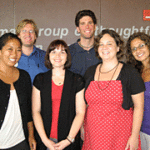
On March 1, 1961, President Kennedy established the Peace Corps by executive order, initiating a program that has sent over 200,000 volunteers to promote global peace through service in 139 countries. The Shriver Peaceworker Program has been a natural extension of the Peace Corps since 1985, when the Shriver family created it to forge a pathway for Returned Peace Corps Volunteers (RCPVs) to become public service leaders.
The Shrivers later expanded and refined the Peaceworker Program, making it an integral part of the UMBC Shriver Center, where RCPVs now pursue graduate study while continuing their service work locally. More than 125 RCPVs have received advanced degrees through the UMBC program and over the last five years although just 15% of UMBC Peaceworkers have come from Maryland, 90% have chosen to stay and serve the Baltimore-DC region after completing the program.
The Peaceworker Program supports the Shriver Center’s mission to “address the need for remedies to the problems of our central cities,” extending beyond the primarily international mandate of the Peace Corps to tackle the challenges urban America is facing today. After all, reflected professor emeritus and former Peace Corps Member Ed Orser at a recent Peaceworker event, “Baltimore is a hard city to love, but at the same time, it’s a city that’s in so much need of love and so much need of understanding.”
No one understood this challenge better than Sargent Shriver, who served as first director of the Peace Corps and helped craft the Shriver Center’s mission statement. UMBC joined the Shriver family and the nation in mourning Shriver’s passing last month. Today, the campus community is committed to carrying on Eunice Kennedy Shriver and Sargent Shriver’s extraordinary legacy of public service.
At UMBC, the Peaceworker Program seeks “to educate and train a new generation of citizen leaders who are able to critically, creatively and responsibly address…complex economic, social and cultural problems.” Program alumnus and Practical Idealist Award recipient Richard Kimball ’10, Ph.D., health policy, used his period of service to redesign the Baltimore Homeless Census. Now affiliated with Johns Hopkins, he focuses on caregiving for people with long-term degenerative diseases.
UMBC Peaceworkers combine graduate study, intensive community service with Greater Baltimore community partners and ethical reflection to “intellectually and personally…integrate the practical, theoretical and moral dimensions of their experience.” Sally Scott (Association of Baltimore Area Grantmakers) recognizes, “It’s very hard just on your own to go show up on some city street and say, ‘Hey, I’m here to help.’” The goal is that alumni, like Kimball, develop the knowledge, skills and community connections to identify and implement solutions to deep-rooted social problems.
Even at this time of fiscal challenges, there is broad recognition that service has the potential to profoundly impact society. President Obama signed into law the largest Peace Corps appropriation to-date for FY 2010: $400 million.
UMBC will celebrate the Peace Corps turning 50 – a tremendous milestone in service history – at “Bringing the World Home: Stories from 50 Years of the Peace Corps” on March 1 at Baltimore’s Creative Alliance. For more information on service opportunities and the Peaceworker Program, see the Shriver Center website or contact program Director Joby Taylor or Deputy Director Jennifer Arndt Robinson.
(2/25/11)
]]>
On March 3, four philosophy students will become UMBC’s first Ethics Bowl team to compete in the national Ethics Bowl tournament. The National Ethics Bowl will be held in Cincinnati, Ohio as part of the Association for Practical and Professional Ethics’ 20th anniversary meeting.
Although UMBC has previously participated in mock ethics bowls, this is the first year that the university has supported a registered team. The team placed third out of 16 in the Mid-Atlantic regional tournament, which was held on November 20.
An ethics bowl is structured similarly to a debate tournament. However, rather than being judged on whether their position is convincing, teams are judged on their ability to think through the moral implications of their possible decisions. The 40 teams invited to the National Ethics Bowl, who represent the top four teams from each of the 10 regional ethics bowls, were given 15 ethical issues to research. They will not know the specific question they have to answer until the day of the tournament.
“There’s excitement in having to think on your feet and find that loophole in your opponent’s argument. By the end you learn so much critical thinking-wise,” said Kayla Smith ’12, biological sciences and philosophy.
The ethics bowl team has met with Greg Ealick ’89, philosophy, and adjunct professor of philosophy, twice a week since the beginning of the semester to discuss the issues. The group has discussed moral dilemmas ranging from advertisements targeted towards children to alcoholic drinks enhanced with caffeine, from “Don’t Ask, Don’t Tell” to hybrid animals.
In order to prepare, the group learned to look at the issues from all sides and consider the repercussions of potential decisions. For example, for a case on punishments for violating a school’s academic integrity policy, the students thought about how their possible position might affect the student, their classmates, their professor, the university and their future employers.
“The first time you see a case you see it from a certain perspective, but when you take the time to discuss it you start to see things about it that you didn’t see before,” said Nana Owusu-Boaitey ’11, philosophy and biological sciences.
Danielle Albrecht ’13, philosophy and political science, agrees. “It’s only when we come here and discuss the problems as a group that all these different ideas start to come out and we see all these different possibilities. That’s part of what makes it so exciting, and what makes it really relevant,” she said.
The ethics bowl team members agreed that what they’ve learned preparing for the ethics bowl is applicable to their life outside the tournament as well. They cite the fact that they’ve learned to look at a problem from multiple angles and think quickly on their feet. “It helps you communicate with people who might disagree with you and it helps you to get your point across,” said Smith.
It’s also, the team said, made them trust their own thoughtful opinions. “It’s pretty confidence-boosting to present a viewpoint and know that you had some great arguments and made some great points,” said Michael Iafolla ’11, philosophy and English.
Still not sure what the ethics bowl team does? Watch this video of the team practicing.
(2/25/11)
]]>
 When Mary Wyatt ’74, American studies, was a little girl, she loved to retreat to a secret space in her backyard. There, in a patch of grass surrounded by a grove of apple trees, she spent lazy summer days lying on her back and gazing up at the passing clouds. Flash forward to the present day, where the concept behind Wyatt’s favorite childhood ritual – connecting to nature in a ‘sacred’ space – plays a central role in the organization for which she serves as executive director.
While the parallels between Wyatt’s favorite childhood indulgence and her current job may be pure coincidence, she insists that the ties between her education at UMBC and her professional life are not. As an American studies major, Wyatt indulged in an array of interests – literature, history, music, sociology, art, pop culture – all related to the experience of being an American.
“It infected me with a desire to do something with my life that would really make a difference – in a place where I could actually make a ripple, here in America,” she says.
Although it would be almost two decades and a number of jobs (including positions in property management in Annapolis and in finance with the Rouse Company), Wyatt never lost sight of her aspiration.
In 1992, after a hiatus from the workplace to take care of her children, Wyatt decided she was ready to return to the workforce full-time. A quirky job advertisement in a local newspaper caught her eye. It began: “Renaissance man seeking assistant with good communication skills…”
Wyatt found herself employed by Tom and Kitty Stoner, husband and wife entrepreneurs interested in launching a private foundation whose focus, when Wyatt met them, wasn’t entirely clear. “They knew they wanted to do something that had to do with the environment, and the healing power of nature,” she says.
For the next few years, Wyatt and her new employers researched established foundations whose goals and objectives they respected. Then, they went on a weekend-long retreat in Vermont. In a whirlwind brainstorming session, the three of them drafted a mission statement, a vision statement, and a business plan for what would become the TKF Foundation.
The TKF Foundation, a private grant-making foundation, formed in 1996 on the premise of inspiring and creating “open spaces, sacred places” – open, that is, to people from every culture, religion, and economic background, explains Wyatt.
Since its launch, the TKF Foundation has funded over 100 “open spaces, sacred places” projects and supported scores of neighborhood-level greening projects in Baltimore, Anne Arundel County, and Washington, D.C. Of the many proposals it receives annually, the foundation chooses organizations that best share its vision: the creation of ‘sacred spaces’ for the purpose of facilitating an increased sense of community and deepening human connections.
At the helm of each of these projects is someone the TKF Foundation considers a “firesoul,” a person whose passion and vision serve as the driving forces behind the creation of a public green space where users might find respite, even an antidote, to an otherwise stressful and sometimes isolating world. “We look for kindred spirits,” Wyatt says.
Though Wyatt resists naming a favorite sacred space, she believes some of the foundation’s projects have made a considerable impact on their target communities.
One is a garden recently created at the Maryland Correctional Institute at Jessup. “To see these guys in prison grow something from seed, it’s amazing,” Wyatt says.
Another TKF-funded project Wyatt finds particularly inspirational is a garden in the unassuming fenced backyard of a rowhouse on Baltimore City’s Belvedere Avenue, which houses the nonprofit Advocates for Survivors of Torture and Trauma. “They get here [to Baltimore], find a room somewhere, and are afraid to come out. This helps them reinvent their lives,” says Wyatt, noting that the garden not only has brought some clients out of hiding, but also has encouraged them to grow vegetables they once ate in their native lands.
Having established over 100 thriving sacred spaces regionally for diverse clients – hospitals, schools, jails and beyond – the TKF Foundation is now embarking on its next and perhaps final phase.
In addition to continuing to support existing regional partners through 2015, the foundation plans to fund up to five new sacred spaces nationwide. Each of these projects would serve as a demonstration and research site to study the impact of nature on the human spirit.
“The research will prove what we [at TKF] believe – that nature is sacred,” Wyatt says.
— Elizabeth Heubeck ’91
]]>
 Back in 2001, Kaliope Parthemos ’93, psychology, got some career advice that has resonated with her over a decade of public service.
Parthemos was clerking for Baltimore Judge John C. Themelis at the time, and she recalls that he turned to her one day and said: “You belong in the courtroom and you belong as an advocate. Don’t be one of those people who talks about how things should be done, but has never actually worked it and lived it. You know the people. You understand the people. Go fight for the people.”
As Baltimore City Deputy Mayor of Economic and Neighborhood Development, Parthemos is now engaged in that advocacy every day. She oversees 17 city agencies, addressing issues from transportation to tourism to the arts – a great fit given her keen appreciation of Baltimore’s cultural institutions and its underground art and music scene. Some of her current projects – including a “Vacants to Value” housing initiative and a push for “healthy food zones” to transform some of Baltimore’s food deserts – have tackled deep-rooted challenges to Baltimore’s public health and safety.
Parthemos sees her own career trajectory as very individual – based on opportunity as much as her longstanding interest in social issues and her passion to serve the needs of Baltimore’s children. After graduating from UMBC and working as a social service caseworker in Baltimore, she took a law degree at the University of Maryland School of Law.
Having grown up in the Baltimore City public school system, she saw her subsequent job as a public defender focusing on juvenile law as a way to effectively serve Baltimore’s youth. When Parthemos left the public defender’s office in 2006, she intended to start her own practice, but public service beckoned again when Stephanie Rawlings-Blake – a friend and colleague who served on Baltimore’s City Council and eventually became mayor in 2010 – recruited her to work in the city’s administration. Reflecting on her time at UMBC, Parthemos says that her experiences with Choice – a UMBC/Shriver Center program that offers youth in Maryland’s juvenile justice system a wide array of resources, counseling, employment skills development, educational support, and after-school and weekend activities – gave her an opportunity to witness first-hand the struggles that many of Baltimore’s children face when unfairly dealt a tough deck in life.
Parthemos’ work with Choice and the Department of Social Services has informed her approach to serving the needs of Baltimore’s children and other residents while also managing the city’s unprecedented budget problems.
“When we came into office we had a $120 million budget deficit,” notes Parthemos. One of her first tasks was negotiating with area non-profit organizations, hospitals, colleges and universities on a controversial “bed tax” to help plug the budget gap. She attributes the success of that effort, which the Daily Record reported will net the city $20.4 million over six years, to balancing the needs of these groups and their value to the city with the need for new revenue.
Parthemos is now enmeshed in another difficult budgetary challenge: assessing how to spend the city’s limited recreation funds to best serve city children. “They don’t deserve a building that’s basically glued together and only has one person at the door that’s basically just allowing kids to come in, with no actual structured activities in place for them,” she says. “What we’re hoping to do is have a smaller number of recreation centers… but ensuring that the kids have a safe environment with structured activities.”
Parthemos says that her training as a lawyer and the educational experiences that enabled her to make friends from different socioeconomic and cultural backgrounds has been a key to meeting the challenges she faces in city government. She laments that some Baltimore residents do not have such opportunities to meet people outside of their own circles: “It strikes me really profoundly… how limiting that is to one’s ability to grow and one’s ability to see something through someone else’s eyes.” Being an effective public servant, she says, means “understanding the city of Baltimore, understanding the people, understanding the struggles that people have on a daily basis.” It also means combining awareness of those challenges with knowledge about how government agencies “interact with one another in order to create the services and systems that Baltimore City residents require and should have.”
— Dinah Winnick
]]>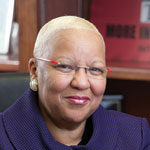
 In an office on Chase Street in Baltimore, a fiery one-woman pep rally for a young African-American professional is under way.
Diane Bell-McKoy ’73, sociology, is holding forth on the necessity of building as many business alliances as this young woman can, regardless of whether or not she knows precisely where her career is headed. Bell-McKoy is emphatic for a reason. She is determined to see young African-American professionals succeed in the workplace. And she knows first-hand that the strategy she espouses works.
Bell-McKoy credits her long-term career success with her own ability to choose mentors carefully and to build business relationships. Judging by her resume – which includes a stint as a senior fellow at the Annie E. Casey Foundation, a 10-year tenure as president and CEO of Empower Baltimore Management Corporation, and her current position as president and CEO of Associated Black Charities (ABC) – it’s fair to say the tactic has proven effective.
“I would not be where I am today without a host of mentors. I learned early on to go after them,” says Bell-McKoy, who counts former Baltimore Mayor Kurt Schmoke; acclaimed developer James Rouse; and Joseph Haskins, Jr., President and Chief Executive Officer of Harbor Bank of Maryland as some of the many professionals who have guided her career.
Bell-McKoy has always had a knack for making alliances with like-minded thinkers. She found plenty of them at UMBC. Bell-McKoy notes that many of these peers in her time at UMBC later went on to make up the ‘Who’s Who’ of local African American professionals, including David W. Young ’74, sociology, associate judge for Baltimore City Circuit Court and James Wiggins ’75, political science, a lawyer in private practice.
“They [the university’s administration] referred to us as the UMBC Mafia,” Bell-McKoy recalls with a wry smile, explaining that she and her college friends were not averse to challenging the administration when they wanted to effect change on campus. “My friends from UMBC were a great source of support, and provided lots of conversation about issues,” she says.
Conversations in the classroom fed those in the dormitory and beyond. “UMBC helped me develop critical thinking skills,” says Bell-McKoy, adding that UMBC was the first place she attended where learning to problem solve came from critical thinking and deconstruction of issues.
It is on these premises that Bell-McKoy has advanced her career. Most recently, that growth has taken shape at ABC, a 25-year-old public foundation in Baltimore that seeks to close the gap in economic and health disparities among Maryland’s African-American communities, thereby boosting the entire state’s vitality.
Bell-McKoy admits she eyed the job of president and CEO of ABC for quite some time, but doesn’t regret waiting to take the top spot there. “I have developed a huge set of relationships in this region,” she says. “I needed those relationships to move this organization forward.”
Since taking the reins at ABC four years ago, Bell-McKoy has used her vision and connections to shift the foundation away from its origins as a direct service provider. “It’s much more effective to be a broker, a grant maker, a public policy advocate,” she says.
Bell-McKoy also narrowed the foundation’s focus, shaving it down from a broad swath of issues concerning African-American communities. “Our two core focuses now are health and wealth disparities. We need to close those gaps to have a vibrant state,” Bell-McKoy says.
One of ABC’s primary wealth-building initiatives, dubbed More in the Middle, seeks to retain, grow, and attract middle-income African-American residents throughout Maryland. ABC is concentrating on five core investment areas: higher education, workforce development, homeownership and foreclosure prevention, business and economic development, and asset building.
Of these investment areas, ABC is honing in on workforce development at present. ABC is choosing up to ten area African-American-owned businesses it sees as potentially prolific job engines as pilot companies, which it will then pair with larger more established organizations which will act as mentors. It’s a chance for Bell-McKoy to adapt her personal reliance on relationship-building and mentoring to a larger stage.
One might think that after 35 years of forging business relationships of her own, Bell-McKoy would be ready to think about retirement. So what keeps her in the fray? Bell-McKoy responds candidly: “I have to make sure I develop a pipeline.”
— Elizabeth Heubeck ’91
]]>
 Zombies have been multiplying rapidly in our popular consciousness in recent years. Whether it’s the high drama of AMC’s new television hit The Walking Dead or the high comedy of Seth Grahame-Smith’s Jane Austen parody Pride and Prejudice and Zombies, the dead aren’t just walking, but marching on popular culture. Arnold T. Blumberg ’93, English, thinks a lot about zombies and pop culture. He’s written a book – Zombiemania – about the phenomenon and even teaches a course on zombies in media at the University of Baltimore. (He’s also written widely and taught on other topics in popular culture, including Doctor Who and comic books.) So why are zombies worth a scholar’s attention? Professor Blumberg clues us in:
When you say the word “zombie,” you get predictably strong reactions. We’re more fascinated with all those shambling (or running), undead (or alive), flesh- (or brain-) eating hordes of zombies (or “walkers”… you get the idea) than ever before. They’ve arguably even passed their vampire cousins in the zeitgeist. But why am I teaching a course about them?
For me it began with a VHS box cover in a shadowy corner of the local video rental store in the early ’80s. Anyone of a certain age who was steeped in genre entertainment – especially horror – will remember the skull-faced monstrosity on the box, worms wriggling in one eye socket, and below that nightmarish visage and a chilling tagline (“We are going to eat you!”) one word in bright red letters:
Zombie.
I never actually saw the film back then. Only the cover. But it was enough to convince me that one day I just had to watch that movie. Until then, I contented myself with Night of the Living Dead, Re-Animator and countless other zombie romps that were just one part of my lifetime diet of comics, science fiction and horror entertainment. As the years passed, that box cover image became a standard, worn proudly by the horror fan community on countless black t-shirts. Ol’ Worm-Eye was everywhere. But why?
Step two came in my freshman year at UMBC, when I met fellow pop culture enthusiast Andy Hershberger ’99, American studies. Years later, we wrote an exhaustive guide to zombie cinema, Zombiemania. While working on that book, I realized just how varied and complex the genre truly was. When the opportunity arose to help the University of Baltimore launch its new pop culture minor with a course that could take my interest in zombies to the next level, I jumped – not shambled or shuffled – at the chance.
So why are we fascinated with zombies? On one level, what we’re really asking is why we are so fascinated with death. Zombies are the embodiment of life’s ultimate mystery, the terrifying and inexorable certainty of an end to our existence arriving prematurely to torment and claim us.
But there’s more to it than that. “Zombie” has become an umbrella term that grew out of western culture’s first exposure to the Voudoun traditions of the West Indies and now encompasses a wide range of similar fantasy creatures, living and dead and everything in between. They are one of the most direct and potent reflections of where we are at any given time as a people, as a culture – what we think, feel and fear. They’re our family, our friends, even ourselves.
Today, the zombie tends to embody our fears of terrorism, of the collapse of society following insidious attack from without and within, and the idea of widespread viral infection or contagion. However, the zombie is a constantly evolving symbol that has shown us how we feel about other religious traditions, how we respond to military conflict, and how we address our own natural drive to survive when faced with insurmountable obstacles. As anyone watching the new TV series The Walking Dead can understand, zombies often form the backdrop for an exploration of morality, ethics, racial and gender issues, and other fundamental aspects of our “civilized” society.
And what’s the value of a college course in zombies? In one important respect, zombies are not the point. As educators, it is not just our duty to prepare young people to pursue a trade and build a career. We need to give them the tools they require not just to build computers or cars or homes, but to interpret the torrent of media that bombards them from every direction on a daily basis. Students should become intelligent, informed consumers of that media, rather than allow its often-manipulative messages to shape their identities. If we fail, we will raise generations of passive workers with no ability to think for themselves. And if the process of learning to sift through and analyze those media messages means having some fun as well, where’s the harm in that?
There are people that think I “love” zombies. I don’t really… well, not in that way. I do love Doctor Who, however; ask me about that sometime. And Zombie? I finally saw the movie when I co-wrote Zombiemania, and it’s not the masterpiece some think it is. But it does have a zombie fighting a shark to a draw, and that’s something no other cultural or academic experience can hope to equal.
Want to know more about Arnold T. Blumberg’s work? Check out his website: www.atbpublishing.com.
]]>