Dan Louisignau ’12, Sociology, Named Men’s Soccer Player of the Week
UMBC senior goalkeeper Dan Louisignau was named America East Conference Men’s Soccer Player of the Week for games ending September 4, 2011.
Moreover, Louisignau was selected to TopDrawerSoccer.com’s “College Team of the Week.”
Read more here.
]]>
UMBC senior goalkeeper Dan Louisignau was named America East Conference Men’s Soccer Player of the Week for games ending September 4, 2011. Moreover, Louisignau was selected to...
https://umbc.edu/stories/dan-louisignau-12-sociology-named-mens-soccer-player-of-the-week/
https://beta.my.umbc.edu/api/v0/pixel/news/124508/guest@my.umbc.edu/a1b2a39965103b21b85d9978463b91c9/api/pixel
athletics
community
UMBC News & Magazine
https://beta.my.umbc.edu/groups/umbc-news-magazine
https://assets1-beta.my.umbc.edu/system/shared/avatars/groups/000/001/943/24435aa6207c452e7bc15cc74b42c7bb/xsmall.png?1748556657
https://assets1-beta.my.umbc.edu/system/shared/avatars/groups/000/001/943/24435aa6207c452e7bc15cc74b42c7bb/original.png?1748556657
https://assets2-beta.my.umbc.edu/system/shared/avatars/groups/000/001/943/24435aa6207c452e7bc15cc74b42c7bb/xxlarge.png?1748556657
https://assets2-beta.my.umbc.edu/system/shared/avatars/groups/000/001/943/24435aa6207c452e7bc15cc74b42c7bb/xlarge.png?1748556657
https://assets3-beta.my.umbc.edu/system/shared/avatars/groups/000/001/943/24435aa6207c452e7bc15cc74b42c7bb/large.png?1748556657
https://assets1-beta.my.umbc.edu/system/shared/avatars/groups/000/001/943/24435aa6207c452e7bc15cc74b42c7bb/medium.png?1748556657
https://assets2-beta.my.umbc.edu/system/shared/avatars/groups/000/001/943/24435aa6207c452e7bc15cc74b42c7bb/small.png?1748556657
https://assets1-beta.my.umbc.edu/system/shared/avatars/groups/000/001/943/24435aa6207c452e7bc15cc74b42c7bb/xsmall.png?1748556657
https://assets2-beta.my.umbc.edu/system/shared/avatars/groups/000/001/943/24435aa6207c452e7bc15cc74b42c7bb/xxsmall.png?1748556657
UMBC News & Magazine
0
0
false
Wed, 07 Sep 2011 13:32:53 -0400
Can You Hear Me Now?

Commercials will tell you to blame your cell phone carrier for problems with reception. They’re partly right, though location also plays a role — a Metro train might not be the best place for a heart-to-heart with a loved one.
But a seldom acknowledged source of bad reception comes from a basic challenge of signal processing. Cell phones convert data from two distinct channels of radio waves into information that can be used and understood. The same signal processing challenge applies for a wide range of devices used in communications, medicine and other fields.
For decades, engineers made various assumptions to simplify the data so they could design devices efficiently. They traded clarity for speed, reducing costs but also leaving us with garbled phone calls and reduced precision for some medical tests.
Now researchers at UMBC are receiving wide recognition for describing a mathematical technique that allows researchers to avoid this tradeoff.
“People have been making simplifying assumptions that don’t make good use of the data,” explains Tülay Adali, a professor of computer science and electrical engineering. “With the framework we developed, researchers don’t have to do that.”
The technique is not technically new. The researcher D.H. Brandwood described similar ideas in a 1983 paper. But Adali describes a “lightbulb” moment in 2006 when she was discussing that paper with Hualiang Li ’08, Ph.D., electrical engineering, who has since become a research assistant professor at UMBC.
The two researchers realized the technique could be applied broadly to process a range of data without having to simplify those assumptions.
“People had missed that one elegant, simple point,” Adali says.
Subsequent research at UMBC linked the technique to work published in the early 20th century by the Austrian mathematician Wilhelm Wirtinger. Adali and Li, along with Mike Novey ’09, Ph.D., computer science, and French researcher Jean-Francois Cardoso, described the technique and developed a framework for applying it to a range of problems in “Complex ICA Using Nonlinear Functions,” a paper published in IEEE Transactions on Signal Processing in 2008.
The four researchers were honored in May with the 2010 IEEE Signal Processing Society Best Paper Award, presented in Prague at the 2011 International Conference on Acoustics, Speech and Signal Processing. Given annually, the award recognizes up to six recent papers with significant impact on the field.
While cell phone reception problems frustrate many consumers on a daily basis, the same challenges present themselves in satellite communications, acoustics, radar, medical imaging and other fields. Adali’s research now focuses on an analysis of medical data from functional magnetic resonance imaging (fMRI) and other sources. Researchers often use fMRI to see what is happening in subjects’ brains while they are at rest or performing tasks such as driving or solving problems.
Applying Wirtinger’s techniques to analyze fMRI data, Adali and her colleagues have shown, on average, a 20 percent improvement in sensitivity detecting brain activity. The technique also does a better job highlighting which brain regions are involved in certain tasks, providing insights that can be used to more accurately diagnose mental disorders.
It’s a discovery that translates into shorter, more accurate tests and, for the broad field of signal processing, a more effective and efficient way to use data.
— Anthony Lane
]]>
Commercials will tell you to blame your cell phone carrier for problems with reception. They’re partly right, though location also plays a role — a Metro train might not be the best place for a...
https://umbc.edu/stories/can-you-hear-me-now/
https://beta.my.umbc.edu/api/v0/pixel/news/124509/guest@my.umbc.edu/1a5acb2a691ef1cbe44de03d4dfd58a3/api/pixel
alumni
anthony-lane
hualiang-li
institute-of-electrical-and-electronics-engineers
mike-novey
pro-tools
signal-processing
technology
umbc
university-of-maryland-baltimore-county
UMBC News & Magazine
https://beta.my.umbc.edu/groups/umbc-news-magazine
https://assets1-beta.my.umbc.edu/system/shared/avatars/groups/000/001/943/24435aa6207c452e7bc15cc74b42c7bb/xsmall.png?1748556657
https://assets1-beta.my.umbc.edu/system/shared/avatars/groups/000/001/943/24435aa6207c452e7bc15cc74b42c7bb/original.png?1748556657
https://assets2-beta.my.umbc.edu/system/shared/avatars/groups/000/001/943/24435aa6207c452e7bc15cc74b42c7bb/xxlarge.png?1748556657
https://assets2-beta.my.umbc.edu/system/shared/avatars/groups/000/001/943/24435aa6207c452e7bc15cc74b42c7bb/xlarge.png?1748556657
https://assets3-beta.my.umbc.edu/system/shared/avatars/groups/000/001/943/24435aa6207c452e7bc15cc74b42c7bb/large.png?1748556657
https://assets1-beta.my.umbc.edu/system/shared/avatars/groups/000/001/943/24435aa6207c452e7bc15cc74b42c7bb/medium.png?1748556657
https://assets2-beta.my.umbc.edu/system/shared/avatars/groups/000/001/943/24435aa6207c452e7bc15cc74b42c7bb/small.png?1748556657
https://assets1-beta.my.umbc.edu/system/shared/avatars/groups/000/001/943/24435aa6207c452e7bc15cc74b42c7bb/xsmall.png?1748556657
https://assets2-beta.my.umbc.edu/system/shared/avatars/groups/000/001/943/24435aa6207c452e7bc15cc74b42c7bb/xxsmall.png?1748556657
UMBC News & Magazine
0
0
false
Tue, 06 Sep 2011 21:05:27 -0400
Manil Suri, Mathematics, to Serve on Panels
Manil Suri, professor of mathematics, will serve on two panels at the Centre Pompidou library in Paris as part of an event with Indian authors. Suri’s most recent book is “The Age of Shiva.” Suri also teaches in the Asian studies program.
]]>
Manil Suri, professor of mathematics, will serve on two panels at the Centre Pompidou library in Paris as part of an event with Indian authors. Suri’s most recent book is “The Age of Shiva.” Suri...
https://umbc.edu/stories/manil-suri-mathematics-to-serve-on-panels/
https://beta.my.umbc.edu/api/v0/pixel/news/124510/guest@my.umbc.edu/ff797869a171b18469772de832354686/api/pixel
policy-and-society
UMBC News & Magazine
https://beta.my.umbc.edu/groups/umbc-news-magazine
https://assets1-beta.my.umbc.edu/system/shared/avatars/groups/000/001/943/24435aa6207c452e7bc15cc74b42c7bb/xsmall.png?1748556657
https://assets1-beta.my.umbc.edu/system/shared/avatars/groups/000/001/943/24435aa6207c452e7bc15cc74b42c7bb/original.png?1748556657
https://assets2-beta.my.umbc.edu/system/shared/avatars/groups/000/001/943/24435aa6207c452e7bc15cc74b42c7bb/xxlarge.png?1748556657
https://assets2-beta.my.umbc.edu/system/shared/avatars/groups/000/001/943/24435aa6207c452e7bc15cc74b42c7bb/xlarge.png?1748556657
https://assets3-beta.my.umbc.edu/system/shared/avatars/groups/000/001/943/24435aa6207c452e7bc15cc74b42c7bb/large.png?1748556657
https://assets1-beta.my.umbc.edu/system/shared/avatars/groups/000/001/943/24435aa6207c452e7bc15cc74b42c7bb/medium.png?1748556657
https://assets2-beta.my.umbc.edu/system/shared/avatars/groups/000/001/943/24435aa6207c452e7bc15cc74b42c7bb/small.png?1748556657
https://assets1-beta.my.umbc.edu/system/shared/avatars/groups/000/001/943/24435aa6207c452e7bc15cc74b42c7bb/xsmall.png?1748556657
https://assets2-beta.my.umbc.edu/system/shared/avatars/groups/000/001/943/24435aa6207c452e7bc15cc74b42c7bb/xxsmall.png?1748556657
UMBC News & Magazine
0
0
false
Tue, 06 Sep 2011 19:27:36 -0400
Manil Suri, Mathematics, in Newsweek
Manil Suri, professor of mathematics, reflects on returning to Mumbai, the Indian city of a million incarnations, in the July 17 issue of Newsweek magazine. Suri also teaches in the Asian studies program.
In his piece, he compared Mumbai to a Hindu goddess. “In some ways, Mumbai is called upon to be even more subsuming than other goddesses. Her population is enormously diverse and regularly at odds on the basis of religion, language, ethnicity, and a host of other schisms. Her visibility attracts benign and malignant elements from inside and outside the country. These factors can result in heinous acts of terror. Yet somehow, Mumbai always manages to recover, no matter how grievous her wounds,” he writes.
The full piece can be read here.
]]>
Manil Suri, professor of mathematics, reflects on returning to Mumbai, the Indian city of a million incarnations, in the July 17 issue of Newsweek magazine. Suri also teaches in the Asian studies...
https://umbc.edu/stories/manil-suri-mathematics-in-newsweek/
https://beta.my.umbc.edu/api/v0/pixel/news/124511/guest@my.umbc.edu/544e956870ee84a22d1fd63ea375887a/api/pixel
policy-and-society
UMBC News & Magazine
https://beta.my.umbc.edu/groups/umbc-news-magazine
https://assets1-beta.my.umbc.edu/system/shared/avatars/groups/000/001/943/24435aa6207c452e7bc15cc74b42c7bb/xsmall.png?1748556657
https://assets1-beta.my.umbc.edu/system/shared/avatars/groups/000/001/943/24435aa6207c452e7bc15cc74b42c7bb/original.png?1748556657
https://assets2-beta.my.umbc.edu/system/shared/avatars/groups/000/001/943/24435aa6207c452e7bc15cc74b42c7bb/xxlarge.png?1748556657
https://assets2-beta.my.umbc.edu/system/shared/avatars/groups/000/001/943/24435aa6207c452e7bc15cc74b42c7bb/xlarge.png?1748556657
https://assets3-beta.my.umbc.edu/system/shared/avatars/groups/000/001/943/24435aa6207c452e7bc15cc74b42c7bb/large.png?1748556657
https://assets1-beta.my.umbc.edu/system/shared/avatars/groups/000/001/943/24435aa6207c452e7bc15cc74b42c7bb/medium.png?1748556657
https://assets2-beta.my.umbc.edu/system/shared/avatars/groups/000/001/943/24435aa6207c452e7bc15cc74b42c7bb/small.png?1748556657
https://assets1-beta.my.umbc.edu/system/shared/avatars/groups/000/001/943/24435aa6207c452e7bc15cc74b42c7bb/xsmall.png?1748556657
https://assets2-beta.my.umbc.edu/system/shared/avatars/groups/000/001/943/24435aa6207c452e7bc15cc74b42c7bb/xxsmall.png?1748556657
UMBC News & Magazine
0
0
false
Tue, 06 Sep 2011 19:22:57 -0400
E-Refunds for Students Coming in October
Beginning in October of 2011, UMBC will transition from issuing student refunds via paper checks to E-Refunds (electronic deposit of refunds).
Parent refunds will continue to be issued via paper checks.
Why Direct Deposit?
- Students will have access to refunds much sooner!
- Provides convenient access to refunds, on and off campus, via a debit card.
- Eliminates refund checks lost in the mail.
- Provides efficient customer support, easy online tracking of refunds and immediate text message notifications, as soon as refunds are available.
- Supports the campus “green” initiatives.
How It Will Work
- Students will receive the UMBC Student Refund Card (a MasterCard Debit Card offered by UMBC & Higher One) in the mail, in October.
- They will go online and select to have their student refunds deposited to the Student Refund Card OR provide their own banking information, to have refunds deposited to an existing account of their choosing.
Direct inquiries regarding the new Student Refund Card to Student Business Services at ext. 5-2288.
For more information on the Student Refund Card please visit www.umbc.edu/sbs/erefunds.
]]>
Beginning in October of 2011, UMBC will transition from issuing student refunds via paper checks to E-Refunds (electronic deposit of refunds). Parent refunds will continue to be issued via paper...
https://umbc.edu/stories/e-refunds-for-students-coming-in-october/
https://beta.my.umbc.edu/api/v0/pixel/news/124512/guest@my.umbc.edu/28716558f250e58fe33f34e540fa6157/api/pixel
community
UMBC News & Magazine
https://beta.my.umbc.edu/groups/umbc-news-magazine
https://assets1-beta.my.umbc.edu/system/shared/avatars/groups/000/001/943/24435aa6207c452e7bc15cc74b42c7bb/xsmall.png?1748556657
https://assets1-beta.my.umbc.edu/system/shared/avatars/groups/000/001/943/24435aa6207c452e7bc15cc74b42c7bb/original.png?1748556657
https://assets2-beta.my.umbc.edu/system/shared/avatars/groups/000/001/943/24435aa6207c452e7bc15cc74b42c7bb/xxlarge.png?1748556657
https://assets2-beta.my.umbc.edu/system/shared/avatars/groups/000/001/943/24435aa6207c452e7bc15cc74b42c7bb/xlarge.png?1748556657
https://assets3-beta.my.umbc.edu/system/shared/avatars/groups/000/001/943/24435aa6207c452e7bc15cc74b42c7bb/large.png?1748556657
https://assets1-beta.my.umbc.edu/system/shared/avatars/groups/000/001/943/24435aa6207c452e7bc15cc74b42c7bb/medium.png?1748556657
https://assets2-beta.my.umbc.edu/system/shared/avatars/groups/000/001/943/24435aa6207c452e7bc15cc74b42c7bb/small.png?1748556657
https://assets1-beta.my.umbc.edu/system/shared/avatars/groups/000/001/943/24435aa6207c452e7bc15cc74b42c7bb/xsmall.png?1748556657
https://assets2-beta.my.umbc.edu/system/shared/avatars/groups/000/001/943/24435aa6207c452e7bc15cc74b42c7bb/xxsmall.png?1748556657
UMBC News & Magazine
0
0
false
Tue, 06 Sep 2011 15:17:18 -0400
Responding to Sexual Assault and Relationship Violence at UMBC (9/20)
Faculty and staff are invited to learn more about the Voices Against Violence Program, as well as the steps one must follow when reporting incidents of sexual assault and relationship violence, Tuesday, September 20, 2-3 p.m., in the Commons room 329.
At the end of the session, you will be able to clearly identify the University’s protocol for responding to and reporting incidents of sexual assault and relationship violence on campus; understand the steps a staff or faculty member must take when reporting such an incident; comprehend the importance of reporting this information, both for the victim as well as the University; clearly recognize the role and members of the Sexual Assault and Relationship Violence Team; and be familiar with on and off campus resources for victims of violence.
Jennifer K. Lepus and Alison Rohrbach, University Health Services, will present the session.
To register, visit the Training and Organization Development website at www.umbc.edu/training.
Contact Alison Rohrbach with questions at ext. 5-1599 or arohrbach@umbc.edu.
For more information about the Voices Against Violence Program, visit www.umbc.edu/vav.
]]>
Faculty and staff are invited to learn more about the Voices Against Violence Program, as well as the steps one must follow when reporting incidents of sexual assault and relationship violence,...
https://umbc.edu/stories/responding-to-sexual-assault-and-relationship-violence-at-umbc-920/
https://beta.my.umbc.edu/api/v0/pixel/news/124513/guest@my.umbc.edu/6553447a2bd6c239f988a90e45c038e6/api/pixel
community
UMBC News & Magazine
https://beta.my.umbc.edu/groups/umbc-news-magazine
https://assets1-beta.my.umbc.edu/system/shared/avatars/groups/000/001/943/24435aa6207c452e7bc15cc74b42c7bb/xsmall.png?1748556657
https://assets1-beta.my.umbc.edu/system/shared/avatars/groups/000/001/943/24435aa6207c452e7bc15cc74b42c7bb/original.png?1748556657
https://assets2-beta.my.umbc.edu/system/shared/avatars/groups/000/001/943/24435aa6207c452e7bc15cc74b42c7bb/xxlarge.png?1748556657
https://assets2-beta.my.umbc.edu/system/shared/avatars/groups/000/001/943/24435aa6207c452e7bc15cc74b42c7bb/xlarge.png?1748556657
https://assets3-beta.my.umbc.edu/system/shared/avatars/groups/000/001/943/24435aa6207c452e7bc15cc74b42c7bb/large.png?1748556657
https://assets1-beta.my.umbc.edu/system/shared/avatars/groups/000/001/943/24435aa6207c452e7bc15cc74b42c7bb/medium.png?1748556657
https://assets2-beta.my.umbc.edu/system/shared/avatars/groups/000/001/943/24435aa6207c452e7bc15cc74b42c7bb/small.png?1748556657
https://assets1-beta.my.umbc.edu/system/shared/avatars/groups/000/001/943/24435aa6207c452e7bc15cc74b42c7bb/xsmall.png?1748556657
https://assets2-beta.my.umbc.edu/system/shared/avatars/groups/000/001/943/24435aa6207c452e7bc15cc74b42c7bb/xxsmall.png?1748556657
UMBC News & Magazine
0
0
false
Mon, 05 Sep 2011 14:25:42 -0400
Up on the Roof – Fall 2011

UMBC President Freeman A. Hrabowski, III takes your questions.
Q. UMBC ended its successful Exceptional by Example capital campaign by raising $15 million more than the $100 million target for the effort. What gave you the faith that this target of $100 million could be met? How gratified are you that the goal was surpassed in the end?
— Richard Byrne ’86
A. I am very encouraged by the success of the campaign. We appreciate the support that people have given us. This success also lays the foundation for future campaigns.
What we’ve been doing at UMBC is developing a culture of philanthropy. The reason that we thought we could reach the target was the encouragement that we got from our partners. There are certain names that you hear and recognize on campus: Meyerhoff, Erickson, Shriver, Linehan, Dresher and Shattuck. They are very important names, because they are leaders in our community who believe in UMBC.
The campaign also speaks to the growing support we get from our alumni – and the ways that we are increasing the engagement of our alumni with campus.
Here is the challenge: We’re still in our first 50 years. But we are competing against institutions that are hundreds of years old and which have had much more experience in developing support from various groups, including alumni. We have to be as good as, if not better, than the best.
The success of this campaign reflects the fact that people are willing to support this institution, because of the quality of the enterprise. You know, 20 years ago, we hadn’t even raised $5 million. So to command the respect to raise $100 million not only shows how far we have come, but how far we could go. Because success is never final.
Q. Why has UMBC invested so heavily in Homecoming in recent years? What makes Homecoming matter – to you and to the university?
— Amanda Winters ’11
A. Homecoming gives us a great opportunity to get people back to campus. It gives alumni a chance to remember and to reflect on their experience here. It also gives alumni a chance to see how the university is changing – and to understand that the change that’s happening at UMBC isn’t just physical. Homecoming is a chance for alumni to come and talk with people here. And when they do, they have the chance to see the rise in our prominence as an “up and coming” university. They are amazed, for instance, to find out that UMBC is being compared with places like Stanford University in terms of our opportunities for undergraduates.
Homecoming is also a time for alumni to be really proud of their alma mater. To feel that UMBC really is, indeed, home. And it also provides an opportunity, with our annual Outstanding Alumni of the Year awards, to celebrate the achievements of our alumni.
And UMBC Homecoming also points to something else. Our academic program gets stronger and stronger all the time, but the university also celebrates the fact that out athletic program is getting stronger and stronger as well. One of the highlights of the weekend is the men’s soccer game on Friday night, October 14. It’s a showcase for a team that has become a national powerhouse in soccer. A lot of people don’t know that our men’s soccer team won its conference championship last year and went to the NCAA tournament, where they beat Princeton University in the first round.
Homecoming at UMBC is a chance to celebrate our academic and our athletic successes. That’s Homecoming to me.
]]>
UMBC President Freeman A. Hrabowski, III takes your questions. Q. UMBC ended its successful Exceptional by Example capital campaign by raising $15 million more than the $100 million target for...
https://umbc.edu/stories/up-on-the-roof-fall-2011/
https://beta.my.umbc.edu/api/v0/pixel/news/124514/guest@my.umbc.edu/726fa5bebaefa5d83b3dd40d92cb0479/api/pixel
fall-2011
freeman-hrabowski
perspectives
up-on-the-roof
UMBC News & Magazine
https://beta.my.umbc.edu/groups/umbc-news-magazine
https://assets1-beta.my.umbc.edu/system/shared/avatars/groups/000/001/943/24435aa6207c452e7bc15cc74b42c7bb/xsmall.png?1748556657
https://assets1-beta.my.umbc.edu/system/shared/avatars/groups/000/001/943/24435aa6207c452e7bc15cc74b42c7bb/original.png?1748556657
https://assets2-beta.my.umbc.edu/system/shared/avatars/groups/000/001/943/24435aa6207c452e7bc15cc74b42c7bb/xxlarge.png?1748556657
https://assets2-beta.my.umbc.edu/system/shared/avatars/groups/000/001/943/24435aa6207c452e7bc15cc74b42c7bb/xlarge.png?1748556657
https://assets3-beta.my.umbc.edu/system/shared/avatars/groups/000/001/943/24435aa6207c452e7bc15cc74b42c7bb/large.png?1748556657
https://assets1-beta.my.umbc.edu/system/shared/avatars/groups/000/001/943/24435aa6207c452e7bc15cc74b42c7bb/medium.png?1748556657
https://assets2-beta.my.umbc.edu/system/shared/avatars/groups/000/001/943/24435aa6207c452e7bc15cc74b42c7bb/small.png?1748556657
https://assets1-beta.my.umbc.edu/system/shared/avatars/groups/000/001/943/24435aa6207c452e7bc15cc74b42c7bb/xsmall.png?1748556657
https://assets2-beta.my.umbc.edu/system/shared/avatars/groups/000/001/943/24435aa6207c452e7bc15cc74b42c7bb/xxsmall.png?1748556657
UMBC News & Magazine
0
0
false
Fri, 02 Sep 2011 20:11:35 -0400
Today's Forecast: Stellar
Researchers at UMBC’s newly formed NASA research center wrestle with basic questions about our neighborhood star – and the effects that its weather can create on Earth.
By Anthony Lane
On the morning of September 1, 1859, a British solar astronomer was using his telescope to look at a projected image of the sun when something strange happened: Two brilliant patches of white light pierced the thicket of sunspots he’d been tracking.
Richard Carrington, the astronomer, was astounded by what he saw. He scrambled outside to find someone to join him as a witness to the amazing spectacle, but by the time he’d grabbed a bystander and returned a minute later, the solar eruption was nearly over.
Carrington’s account of the event might have been ignored or forgotten were it not for a much more widespread spectacle that commenced about 17 hours later. Auroras – which are normally seen only from the planet’s far north and south extremes – laced the night sky above Cuba, El Salvador and Hawaii. And according to a whimsical account in the Baltimore American and Commercial Advertiser, Marylanders saw an aurora that shined brighter than a full moon, appearing to “cover the whole firmament, apparently like a luminous cloud, through which the stars of the larger magnitude indistinctly shone.”
 Charged particles from the sun sometimes penetrate Earth’s magnetosphere near the poles, resulting in dramatic auroras, such as this one over Alaska. Credit: Joshua Strang, USAF
But the beauties of that 1859 light display masked the minor destruction wrought worldwide by an event that scientists now say was a once-in-every-500-year solar flare. As strands of light pulsed overhead in the early morning of that September day, Earth’s changing magnetic field induced electric currents within telegraph wires. Some transmissions were blocked, and fires erupted at a few telegraph stations. Aleksandre “Sandro” Taktakishvili, a researcher and space weather forecaster at UMBC’s newly formed Goddard Planetary Heliophysics Institute (GPHI), observes that if such an event were to occur today, the results could be calamitous. He speaks in hushed tones about the likelihood of damaged and destroyed satellites, overloaded power grids, and useless GPS devices.
“It would be devastating,” Taktakishvili says. “The more dependent we are on satellites, the more vulnerable we are to these events.”
Fortunately, our knowledge of the sun and its capacity to hurl masses of plasma toward Earth has come a long way since 1859. Taktakishvili, who works with other GPHI researchers at NASA’s Goddard Space Flight Center, is part of a rotation of scientists at NASA charged with monitoring the sun’s activity and forecasting what impacts it could have on Earth or on the satellites that orbit around it. He has live access to streams of data
coming from a battery of instruments trained on the sun, and, based on that information, he is confident he can predict the impact that routine solar flares and coronal mass ejections (CMEs) will have on Earth.
Taktakishvili admits that he and other scientists at GPHI, NASA and in the broader research community still have much to learn about how the sun produces flares such as the one that Carrington observed in 1859 – as well as the ways in which such events can play havoc with Earth’s magnetic field.
“With the monitoring we have, we are pretty well prepared,” Taktakishvili says. “Still, you cannot exclude the possibility of something major happening.”
TRACKING SOLAR WIND
Despite the possibility of damaging solar events, Jan Merka, director of GPHI, sounds a more soothing note when he talks about the lucky constellation of events that put Earth in just the right position in relation to the sun for life to thrive on this planet.
“Earth is a homey place,” Merka observes. “We need some radiation, but not too much. We need it to be warm, but not too warm.”
Earth’s magnetic field is an essential part of its suitability for life. Produced by the movement of molten iron in Earth’s outer core, the magnetic field effectively guards the planet against solar wind – a constant barrage of charged particles hurled from the sun. Without that protection, solar wind would have long since stripped away much of the planet’s atmosphere, making Earth a dreary and inhospitable place.
In the absence of solar wind, Earth’s magnetic field would send out an expanding and uniform series of field lines stretching from north to south. A drawing of this field would show lines organized in the sort of lobed race-track pattern that iron filings make when strewn around a bar magnet.
The solar wind, however, distorts the magnetic field, giving it a complex, changing form known as a magnetosphere. Artists’ renditions of the magnetosphere sometimes make it look like a ghostly octopus, with a small head facing the sun and spindly legs stretching out into the solar system.
The 16 scientists at GPHI investigate a range of topics related to solar activity and the magnetosphere. Taktakishvili and several others are concerned with making better forecasts and observations of solar events, providing information that can be used to protect satellites or inform decisions about how close airplanes should fly to Earth’s magnetic poles, where charged particles from the sun are most likely to work their way into the atmosphere.
The risk of illness or even death for those exposed to these particles is a particular challenge for space travel, making better predictions very important, especially in the event that a space crew ever ventures out from the relative safety of the magnetosphere for a months-long journey to Mars.
Other scientists at the institute work with teams that are analyzing data sent from the MESSENGER spacecraft orbiting Mercury or other NASA missions aimed at deepening human knowledge of solar activity and its impacts. Merka talks excitedly about seemingly basic questions that researchers still haven’t answered about solar phenomena. For instance, why and how are charged particles quickly accelerated to speeds of several hundred or even thousands of miles per second after they leave the sun?
“We need to understand all the pieces to reliably simulate space weather and make good predictions,” Merka says.
Merka’s own research delves into the complexities of solar wind and the interactions that occur when this torrent of charged particles collide with Earth’s magnetosphere. In the absence of major solar activity, solar wind can be relatively gentle, with particles cruising through space at about 250 miles per second before being slowed and redirected by Earth’s magnetic field. But things get more interesting when particles kicked out during solar events such as solar flares or coronal mass ejections speed through space at much greater speeds.
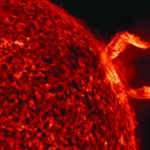
 Solar flares as seen in extreme ultraviolet range. Credit: NASA/SDO
These fast-moving particles plow past their leisurely cousins. The result, Merka explains, is much like what happens when a jet breaks the sound barrier in Earth’s atmosphere. The sonic “boom” you might hear living next to an Air Force base is actually a shock wave that results from air not being able to get out of a speeding plane’s way fast enough. This forms a sharp boundary between the undisturbed air and air that has piled up in front of the plane. In space, there’s no boom anyone could hear. Instead, charged particles pile up in front of the faster-moving sections of the solar wind. This produces an “interplanetary shockwave,” accelerating particles that can then slam into Earth’s magnetosphere and force it to reconfigure.
Predicting and modeling these shocks is one challenge. Another challenge is understanding what happens when solar wind comes in range of Earth’s magnetic field. Just as charged particles pile up when fast sections of solar wind encounter slower parts, the particles start to pile up when they encounter Earth’s magnetic field and need to find a way around it. This forms another shock wave that scientists refer to as the “bow shock.”
In artists’ renditions, the bow shock often looks like a massive deflector shield from a Star Trek episode. Things aren’t totally calm behind it, however. Solar wind slows, compresses, and then heats up at the bow shock, becoming turbulent in a region known as the magnetosheath. Moving closer to Earth, the pressure from the solar particles gradually decreases until it is balanced by the outward pressure exerted by Earth’s magnetic field. The magnetopause is the final boundary beyond which relatively few particles can penetrate.
Understanding how these layers react when the barrage of particles intensifies due to solar storms and interplanetary shocks is critical for predicting the impact these events will have on satellites, power grids and a host of other systems that people on Earth care about.
GPHI scientist Yongli Wang, who works with Merka and other scientists at NASA to accurately model these changes, explains that current modeling techniques face serious limitations. To understand changes in one layer, he frets, scientists have had to treat the others as unchanging or make simplifying assumptions about their shape.
Wang believes that an alternative he is developing with Merka and other colleagues will allow scientists to “forget about assuming structure.” They are working on a new technique which will allow scientists to deal with all the layers simultaneously, drawing on a database that catalogs a wealth of satellite observations collected over four decades. Just as meteorologists have developed ever better models to understand and predict the intensification of hurricanes as they cross Earth’s oceans, Wang and Merka are putting finishing touches on a model that makes sense of data from solar storms. Such a model should help scientists at NASA and elsewhere more accurately predict both the course and consequences of these events.
“This is the golden key to solving this problem,” Wang says.
OBSERVING CYCLES
The prospect of new discoveries in the developing research field of space weather isn’t limited to tracking solar wind and eruptions on the sun.
Keith Strong, a GPHI scientist affiliated with the University of Maryland at College Park, describes a different set of challenges associated with understanding and predicting solar activity. Scientists have known for more than 150 years that solar activity waxes and wanes in cycles of about 11 years, but the mechanism that controls the sun’s magnetic activity – and ultimately produces this cycle – remains a mystery.
“That’s the holy grail of solar physics,” Strong says.
Finding that grail is not just an interesting task for researchers. Sunspots regularly appear on the sun’s surface as small, dark patches. Scientists now know that these patches are associated with intense magnetic activity which reduces the amount of energy escaping. That’s why the spots appear dark: Sunspots are actually cooler than neighboring parts of the sun with weaker magnetic fields.
 A Coronal Mass Ejection, as seen using the LASCO instrument. The dark disk blocks the sun to allow researchers to observe structures in the corona. The inner circle shows the size and position of the sun. Credit: SOHO/ESA/NASA
Even with limited understanding of what causes these spots, astronomers have monitored and tracked them for more than 400 years. And for a 70-year period ending around 1715, there was relatively little such activity for these astronomers to see: The sun had entered an extended period of limited activity that is known as the Maunder Minimum.
Scientists debate the extent to which this period of minimal solar activity can be linked to an extended cold snap beginning around 1650 that brought decades of abnormally rainy summers and cold and snowy winters to Europe and North America. And how and why solar activity ebbed during this period is also a mystery.
More recently, the solar cycle that started in 1996 dragged on for 12.6 years, petering out only near the end of 2008. Predictions about the new cycle have repeatedly been wrong, Strong notes, highlighting the gaps in our knowledge: “It is fascinating to realize how little we do understand.”
Ascertaining the underlying mechanism of solar activity could be a huge asset in protecting our satellites and communications systems. It will also be critical if we ever embark on a new phase of space travel. A trip to Mars, for instance, would take about two years, and astronauts during that time could be exposed to potentially lethal streams of high-energy charged particles. Being able to predict when solar activity will be at a minimum will be critical.
Despite its tendency to belch vast quantities of high-energy particles during solar storms, the sun is a much less volatile neighbor than many other stars in the galaxy. As Merka notes, our sun’s relative consistency has been essential for life on Earth to develop. With astronomers discovering an increasing number of planets in orbit around distant stars, Strong says, the ability to recognize the signature of equally stable stars could serve as a “Rosetta Stone” for picking likely candidates to support life.
“By understanding variability,” Strong says, “we might be able to understand what planets could be habitable.”
Since March, Strong has been sharing his fascination with a potentially unlimited audience by posting daily videos on YouTube under the username “drkstrong.” Each episode of “The Sun Today” lasts about five minutes as Strong guides viewers through a series of observations about recent solar activity and explains the mechanics of such events as solar flares and coronal mass ejections (CMEs).
On Aug. 2, Strong began his program with exciting news: “We’ve had a proton flare!” He notes it was a significant, though not unusual flare, and he quickly segues to the day’s trivia question: “How many times brighter than this… flare was the largest flare ever observed by astronomers?” Strong goes on to show data and images from a variety of NASA instruments and satellites, with animations illustrating the blast of charged particles surging into space. At the end of the program, he answers the trivia question, recalling that the observation of the largest flare ever was made six years ago by astronomers looking at the star II Pegasi. That flare, Strong says, was 100 million times larger than the one just observed on the sun.
“That would have had some very serious consequences for the Earth,” he observes. “Like, our civilizations would probably be reduced to rubble, assuming any of us survived.”
But you needn’t worry about that happening here on planet earth. At least not yet.
“Just be thankful,” he says, “that we live around a star that is quiescent enough that we survived, but variable enough to be interesting.”
* * * * *
Web Extras
Complex Solar Eruption
Having a Solar Blast
Spacecraft Observes Coronal Mass Ejection
]]>
Researchers at UMBC’s newly formed NASA research center wrestle with basic questions about our neighborhood star – and the effects that its weather can create on Earth. By Anthony Lane On the...
https://umbc.edu/stories/todays-forecast-stellar-2/
https://beta.my.umbc.edu/api/v0/pixel/news/124515/guest@my.umbc.edu/687a3c1753319ef3bdb2254910195327/api/pixel
aleksandre-taktakishvili
discovery
fall-2011
gphi
jan-merka
keith-strong
nasa
yongli-wang
UMBC News & Magazine
https://beta.my.umbc.edu/groups/umbc-news-magazine
https://assets1-beta.my.umbc.edu/system/shared/avatars/groups/000/001/943/24435aa6207c452e7bc15cc74b42c7bb/xsmall.png?1748556657
https://assets1-beta.my.umbc.edu/system/shared/avatars/groups/000/001/943/24435aa6207c452e7bc15cc74b42c7bb/original.png?1748556657
https://assets2-beta.my.umbc.edu/system/shared/avatars/groups/000/001/943/24435aa6207c452e7bc15cc74b42c7bb/xxlarge.png?1748556657
https://assets2-beta.my.umbc.edu/system/shared/avatars/groups/000/001/943/24435aa6207c452e7bc15cc74b42c7bb/xlarge.png?1748556657
https://assets3-beta.my.umbc.edu/system/shared/avatars/groups/000/001/943/24435aa6207c452e7bc15cc74b42c7bb/large.png?1748556657
https://assets1-beta.my.umbc.edu/system/shared/avatars/groups/000/001/943/24435aa6207c452e7bc15cc74b42c7bb/medium.png?1748556657
https://assets2-beta.my.umbc.edu/system/shared/avatars/groups/000/001/943/24435aa6207c452e7bc15cc74b42c7bb/small.png?1748556657
https://assets1-beta.my.umbc.edu/system/shared/avatars/groups/000/001/943/24435aa6207c452e7bc15cc74b42c7bb/xsmall.png?1748556657
https://assets2-beta.my.umbc.edu/system/shared/avatars/groups/000/001/943/24435aa6207c452e7bc15cc74b42c7bb/xxsmall.png?1748556657
UMBC News & Magazine
0
0
false
Fri, 02 Sep 2011 20:00:09 -0400
Today’s Forecast: Stellar
Researchers at UMBC’s newly formed NASA research center wrestle with basic questions about our neighborhood star – and the effects that its weather can create on Earth.
By Anthony Lane
On the morning of September 1, 1859, a British solar astronomer was using his telescope to look at a projected image of the sun when something strange happened: Two brilliant patches of white light pierced the thicket of sunspots he’d been tracking.
Richard Carrington, the astronomer, was astounded by what he saw. He scrambled outside to find someone to join him as a witness to the amazing spectacle, but by the time he’d grabbed a bystander and returned a minute later, the solar eruption was nearly over.
Carrington’s account of the event might have been ignored or forgotten were it not for a much more widespread spectacle that commenced about 17 hours later. Auroras – which are normally seen only from the planet’s far north and south extremes – laced the night sky above Cuba, El Salvador and Hawaii. And according to a whimsical account in the Baltimore American and Commercial Advertiser, Marylanders saw an aurora that shined brighter than a full moon, appearing to “cover the whole firmament, apparently like a luminous cloud, through which the stars of the larger magnitude indistinctly shone.”
Charged particles from the sun sometimes penetrate Earth’s magnetosphere near the poles, resulting in dramatic auroras, such as this one over Alaska. Credit: Joshua Strang, USAF
But the beauties of that 1859 light display masked the minor destruction wrought worldwide by an event that scientists now say was a once-in-every-500-year solar flare. As strands of light pulsed overhead in the early morning of that September day, Earth’s changing magnetic field induced electric currents within telegraph wires. Some transmissions were blocked, and fires erupted at a few telegraph stations. Aleksandre “Sandro” Taktakishvili, a researcher and space weather forecaster at UMBC’s newly formed Goddard Planetary Heliophysics Institute (GPHI), observes that if such an event were to occur today, the results could be calamitous. He speaks in hushed tones about the likelihood of damaged and destroyed satellites, overloaded power grids, and useless GPS devices.
“It would be devastating,” Taktakishvili says. “The more dependent we are on satellites, the more vulnerable we are to these events.”
Fortunately, our knowledge of the sun and its capacity to hurl masses of plasma toward Earth has come a long way since 1859. Taktakishvili, who works with other GPHI researchers at NASA’s Goddard Space Flight Center, is part of a rotation of scientists at NASA charged with monitoring the sun’s activity and forecasting what impacts it could have on Earth or on the satellites that orbit around it. He has live access to streams of data
coming from a battery of instruments trained on the sun, and, based on that information, he is confident he can predict the impact that routine solar flares and coronal mass ejections (CMEs) will have on Earth.
Taktakishvili admits that he and other scientists at GPHI, NASA and in the broader research community still have much to learn about how the sun produces flares such as the one that Carrington observed in 1859 – as well as the ways in which such events can play havoc with Earth’s magnetic field.
“With the monitoring we have, we are pretty well prepared,” Taktakishvili says. “Still, you cannot exclude the possibility of something major happening.”
TRACKING SOLAR WIND
Despite the possibility of damaging solar events, Jan Merka, director of GPHI, sounds a more soothing note when he talks about the lucky constellation of events that put Earth in just the right position in relation to the sun for life to thrive on this planet.
“Earth is a homey place,” Merka observes. “We need some radiation, but not too much. We need it to be warm, but not too warm.”
Earth’s magnetic field is an essential part of its suitability for life. Produced by the movement of molten iron in Earth’s outer core, the magnetic field effectively guards the planet against solar wind – a constant barrage of charged particles hurled from the sun. Without that protection, solar wind would have long since stripped away much of the planet’s atmosphere, making Earth a dreary and inhospitable place.
In the absence of solar wind, Earth’s magnetic field would send out an expanding and uniform series of field lines stretching from north to south. A drawing of this field would show lines organized in the sort of lobed race-track pattern that iron filings make when strewn around a bar magnet.
The solar wind, however, distorts the magnetic field, giving it a complex, changing form known as a magnetosphere. Artists’ renditions of the magnetosphere sometimes make it look like a ghostly octopus, with a small head facing the sun and spindly legs stretching out into the solar system.
The 16 scientists at GPHI investigate a range of topics related to solar activity and the magnetosphere. Taktakishvili and several others are concerned with making better forecasts and observations of solar events, providing information that can be used to protect satellites or inform decisions about how close airplanes should fly to Earth’s magnetic poles, where charged particles from the sun are most likely to work their way into the atmosphere.
The risk of illness or even death for those exposed to these particles is a particular challenge for space travel, making better predictions very important, especially in the event that a space crew ever ventures out from the relative safety of the magnetosphere for a months-long journey to Mars.
Other scientists at the institute work with teams that are analyzing data sent from the MESSENGER spacecraft orbiting Mercury or other NASA missions aimed at deepening human knowledge of solar activity and its impacts. Merka talks excitedly about seemingly basic questions that researchers still haven’t answered about solar phenomena. For instance, why and how are charged particles quickly accelerated to speeds of several hundred or even thousands of miles per second after they leave the sun?
“We need to understand all the pieces to reliably simulate space weather and make good predictions,” Merka says.
Merka’s own research delves into the complexities of solar wind and the interactions that occur when this torrent of charged particles collide with Earth’s magnetosphere. In the absence of major solar activity, solar wind can be relatively gentle, with particles cruising through space at about 250 miles per second before being slowed and redirected by Earth’s magnetic field. But things get more interesting when particles kicked out during solar events such as solar flares or coronal mass ejections speed through space at much greater speeds.
Solar flares as seen in extreme ultraviolet range. Credit: NASA/SDO
These fast-moving particles plow past their leisurely cousins. The result, Merka explains, is much like what happens when a jet breaks the sound barrier in Earth’s atmosphere. The sonic “boom” you might hear living next to an Air Force base is actually a shock wave that results from air not being able to get out of a speeding plane’s way fast enough. This forms a sharp boundary between the undisturbed air and air that has piled up in front of the plane. In space, there’s no boom anyone could hear. Instead, charged particles pile up in front of the faster-moving sections of the solar wind. This produces an “interplanetary shockwave,” accelerating particles that can then slam into Earth’s magnetosphere and force it to reconfigure.
Predicting and modeling these shocks is one challenge. Another challenge is understanding what happens when solar wind comes in range of Earth’s magnetic field. Just as charged particles pile up when fast sections of solar wind encounter slower parts, the particles start to pile up when they encounter Earth’s magnetic field and need to find a way around it. This forms another shock wave that scientists refer to as the “bow shock.”
In artists’ renditions, the bow shock often looks like a massive deflector shield from a Star Trek episode. Things aren’t totally calm behind it, however. Solar wind slows, compresses, and then heats up at the bow shock, becoming turbulent in a region known as the magnetosheath. Moving closer to Earth, the pressure from the solar particles gradually decreases until it is balanced by the outward pressure exerted by Earth’s magnetic field. The magnetopause is the final boundary beyond which relatively few particles can penetrate.
Understanding how these layers react when the barrage of particles intensifies due to solar storms and interplanetary shocks is critical for predicting the impact these events will have on satellites, power grids and a host of other systems that people on Earth care about.
GPHI scientist Yongli Wang, who works with Merka and other scientists at NASA to accurately model these changes, explains that current modeling techniques face serious limitations. To understand changes in one layer, he frets, scientists have had to treat the others as unchanging or make simplifying assumptions about their shape.
Wang believes that an alternative he is developing with Merka and other colleagues will allow scientists to “forget about assuming structure.” They are working on a new technique which will allow scientists to deal with all the layers simultaneously, drawing on a database that catalogs a wealth of satellite observations collected over four decades. Just as meteorologists have developed ever better models to understand and predict the intensification of hurricanes as they cross Earth’s oceans, Wang and Merka are putting finishing touches on a model that makes sense of data from solar storms. Such a model should help scientists at NASA and elsewhere more accurately predict both the course and consequences of these events.
“This is the golden key to solving this problem,” Wang says.
OBSERVING CYCLES
The prospect of new discoveries in the developing research field of space weather isn’t limited to tracking solar wind and eruptions on the sun.
Keith Strong, a GPHI scientist affiliated with the University of Maryland at College Park, describes a different set of challenges associated with understanding and predicting solar activity. Scientists have known for more than 150 years that solar activity waxes and wanes in cycles of about 11 years, but the mechanism that controls the sun’s magnetic activity – and ultimately produces this cycle – remains a mystery.
“That’s the holy grail of solar physics,” Strong says.
Finding that grail is not just an interesting task for researchers. Sunspots regularly appear on the sun’s surface as small, dark patches. Scientists now know that these patches are associated with intense magnetic activity which reduces the amount of energy escaping. That’s why the spots appear dark: Sunspots are actually cooler than neighboring parts of the sun with weaker magnetic fields.
A Coronal Mass Ejection, as seen using the LASCO instrument. The dark disk blocks the sun to allow researchers to observe structures in the corona. The inner circle shows the size and position of the sun. Credit: SOHO/ESA/NASA
Even with limited understanding of what causes these spots, astronomers have monitored and tracked them for more than 400 years. And for a 70-year period ending around 1715, there was relatively little such activity for these astronomers to see: The sun had entered an extended period of limited activity that is known as the Maunder Minimum.
Scientists debate the extent to which this period of minimal solar activity can be linked to an extended cold snap beginning around 1650 that brought decades of abnormally rainy summers and cold and snowy winters to Europe and North America. And how and why solar activity ebbed during this period is also a mystery.
More recently, the solar cycle that started in 1996 dragged on for 12.6 years, petering out only near the end of 2008. Predictions about the new cycle have repeatedly been wrong, Strong notes, highlighting the gaps in our knowledge: “It is fascinating to realize how little we do understand.”
Ascertaining the underlying mechanism of solar activity could be a huge asset in protecting our satellites and communications systems. It will also be critical if we ever embark on a new phase of space travel. A trip to Mars, for instance, would take about two years, and astronauts during that time could be exposed to potentially lethal streams of high-energy charged particles. Being able to predict when solar activity will be at a minimum will be critical.
Despite its tendency to belch vast quantities of high-energy particles during solar storms, the sun is a much less volatile neighbor than many other stars in the galaxy. As Merka notes, our sun’s relative consistency has been essential for life on Earth to develop. With astronomers discovering an increasing number of planets in orbit around distant stars, Strong says, the ability to recognize the signature of equally stable stars could serve as a “Rosetta Stone” for picking likely candidates to support life.
“By understanding variability,” Strong says, “we might be able to understand what planets could be habitable.”
Since March, Strong has been sharing his fascination with a potentially unlimited audience by posting daily videos on YouTube under the username “drkstrong.” Each episode of “The Sun Today” lasts about five minutes as Strong guides viewers through a series of observations about recent solar activity and explains the mechanics of such events as solar flares and coronal mass ejections (CMEs).
On Aug. 2, Strong began his program with exciting news: “We’ve had a proton flare!” He notes it was a significant, though not unusual flare, and he quickly segues to the day’s trivia question: “How many times brighter than this… flare was the largest flare ever observed by astronomers?” Strong goes on to show data and images from a variety of NASA instruments and satellites, with animations illustrating the blast of charged particles surging into space. At the end of the program, he answers the trivia question, recalling that the observation of the largest flare ever was made six years ago by astronomers looking at the star II Pegasi. That flare, Strong says, was 100 million times larger than the one just observed on the sun.
“That would have had some very serious consequences for the Earth,” he observes. “Like, our civilizations would probably be reduced to rubble, assuming any of us survived.”
But you needn’t worry about that happening here on planet earth. At least not yet.
“Just be thankful,” he says, “that we live around a star that is quiescent enough that we survived, but variable enough to be interesting.”
* * * * *
Web Extras
Complex Solar Eruption
Having a Solar Blast
Spacecraft Observes Coronal Mass Ejection
]]>
Researchers at UMBC’s newly formed NASA research center wrestle with basic questions about our neighborhood star – and the effects that its weather can create on Earth. By Anthony Lane On...
https://umbc.edu/stories/todays-forecast-stellar/
https://beta.my.umbc.edu/api/v0/pixel/news/124516/guest@my.umbc.edu/f8ff89fdec7107a81cc055cca0fe010c/api/pixel
aleksandre-taktakishvili
discovery
fall-2011
gphi
jan-merka
keith-strong
nasa
yongli-wang
UMBC News & Magazine
https://beta.my.umbc.edu/groups/umbc-news-magazine
https://assets1-beta.my.umbc.edu/system/shared/avatars/groups/000/001/943/24435aa6207c452e7bc15cc74b42c7bb/xsmall.png?1748556657
https://assets1-beta.my.umbc.edu/system/shared/avatars/groups/000/001/943/24435aa6207c452e7bc15cc74b42c7bb/original.png?1748556657
https://assets2-beta.my.umbc.edu/system/shared/avatars/groups/000/001/943/24435aa6207c452e7bc15cc74b42c7bb/xxlarge.png?1748556657
https://assets2-beta.my.umbc.edu/system/shared/avatars/groups/000/001/943/24435aa6207c452e7bc15cc74b42c7bb/xlarge.png?1748556657
https://assets3-beta.my.umbc.edu/system/shared/avatars/groups/000/001/943/24435aa6207c452e7bc15cc74b42c7bb/large.png?1748556657
https://assets1-beta.my.umbc.edu/system/shared/avatars/groups/000/001/943/24435aa6207c452e7bc15cc74b42c7bb/medium.png?1748556657
https://assets2-beta.my.umbc.edu/system/shared/avatars/groups/000/001/943/24435aa6207c452e7bc15cc74b42c7bb/small.png?1748556657
https://assets1-beta.my.umbc.edu/system/shared/avatars/groups/000/001/943/24435aa6207c452e7bc15cc74b42c7bb/xsmall.png?1748556657
https://assets2-beta.my.umbc.edu/system/shared/avatars/groups/000/001/943/24435aa6207c452e7bc15cc74b42c7bb/xxsmall.png?1748556657
UMBC News & Magazine
0
0
false
Fri, 02 Sep 2011 20:00:09 -0400
To You – Fall 2011

 Time flies when you’re having fun. And the three years that I have spent as editor of UMBC Magazine have flown by quickly. One reason is this time has flown is the terrific stories about the university and its alumni that I encounter almost every day in the course of editing the magazine.
Sometimes they arrive in an e-mail. Occasionally, it’s a phone call. And some of them come in a stamped envelope. Many stories also come from encounters that I have with students, faculty and staff on campus. I’ve even been accosted on the MARC train as I commute to UMBC, and in my neighborhood in Washington, DC, by people with a UMBC story to tell.
Each one of these stories is individual. They are unique in their struggles and in their triumphs, their joys and their sorrows. But as the editor of the magazine who gathers them, I see them accumulate a collective weight. They weave together into patterns and create broader narratives.
Part of that narrative is rooted in UMBC’s position as a public university.
Public universities are special because their openness and academic excellence serve as engines of transformation in people’s lives. Most of us who attended UMBC in any era of the university’s 45 years of existence do not come from a position of economic privilege. So many of the stories that I hear are tales of alumni who had to work at a job as they studied through UMBC, or who had to sacrifice – personally or as a family – to obtain their degrees.
Yet the work and sacrifice and smarts that UMBC alumni put into their degrees also left them savoring their university experience that much more. We worked hard at UMBC – and we played hard, too.
I hope that UMBC Magazine is way for you to rediscover that narrative.
In this issue, for instance, you can read about how one alumnus, Joseph T. Jones, Jr. ’06, surmounted a life that began with a broken home and selling drugs to become one of the leading voices in the nation for creating economic opportunity and repairing families. You can also read about how many individuals and institutions – alumni, corporations, friends of UMBC – banded together collectively to aid the university in its successful capital campaign (Exceptional by Example) to raise $115 million to support the aspirations of students, faculty and staff.
We’ve also devoted a few stories to another collective experience for alumni and the larger university community: UMBC Homecoming (October 12-15). I hope the stories will entice you to look at the schedule of events at the UMBC Homecoming website.
Whether you like UMBC soccer under the lights, or terrific food and fellowship, or want a chance to sample the work of alumni filmmakers, UMBC Homecoming is another chance to weave your story back into the university community. And also to have a great time as you do it. I hope I’ll see you there!
— Richard Byrne ’86
]]>
Time flies when you’re having fun. And the three years that I have spent as editor of UMBC Magazine have flown by quickly. One reason is this time has flown is the terrific stories about the...
https://umbc.edu/stories/to-you-fall-2011/
https://beta.my.umbc.edu/api/v0/pixel/news/124517/guest@my.umbc.edu/6a4706d2f6af2d8b6d55b3f07d79aea6/api/pixel
fall-2011
perspectives
UMBC News & Magazine
https://beta.my.umbc.edu/groups/umbc-news-magazine
https://assets1-beta.my.umbc.edu/system/shared/avatars/groups/000/001/943/24435aa6207c452e7bc15cc74b42c7bb/xsmall.png?1748556657
https://assets1-beta.my.umbc.edu/system/shared/avatars/groups/000/001/943/24435aa6207c452e7bc15cc74b42c7bb/original.png?1748556657
https://assets2-beta.my.umbc.edu/system/shared/avatars/groups/000/001/943/24435aa6207c452e7bc15cc74b42c7bb/xxlarge.png?1748556657
https://assets2-beta.my.umbc.edu/system/shared/avatars/groups/000/001/943/24435aa6207c452e7bc15cc74b42c7bb/xlarge.png?1748556657
https://assets3-beta.my.umbc.edu/system/shared/avatars/groups/000/001/943/24435aa6207c452e7bc15cc74b42c7bb/large.png?1748556657
https://assets1-beta.my.umbc.edu/system/shared/avatars/groups/000/001/943/24435aa6207c452e7bc15cc74b42c7bb/medium.png?1748556657
https://assets2-beta.my.umbc.edu/system/shared/avatars/groups/000/001/943/24435aa6207c452e7bc15cc74b42c7bb/small.png?1748556657
https://assets1-beta.my.umbc.edu/system/shared/avatars/groups/000/001/943/24435aa6207c452e7bc15cc74b42c7bb/xsmall.png?1748556657
https://assets2-beta.my.umbc.edu/system/shared/avatars/groups/000/001/943/24435aa6207c452e7bc15cc74b42c7bb/xxsmall.png?1748556657
UMBC News & Magazine
0
0
false
Fri, 02 Sep 2011 19:57:12 -0400
