Could a telescope ever see the beginning of time? An astronomer explains


By Adi Foord, Assistant Professor of Astronomy and Astrophysics, UMBC
Curious Kids is a series for children of all ages. If you have a question you’d like an expert to answer, send it to curiouskidsus@theconversation.com.
If the James Webb telescope was 10 times more powerful, could we see the beginning of time? – Sam H., age 12, Prosper, Texas
The James Webb Space Telescope, or JWST for short, is one of the most advanced telescopes ever built. Planning for JWST began over 25 years ago, and construction efforts spanned over a decade. It was launched into space on Dec. 25, 2021, and within a month arrived at its final destination: 930,000 miles away from Earth. Its location in space allows it a relatively unobstructed view of the universe.
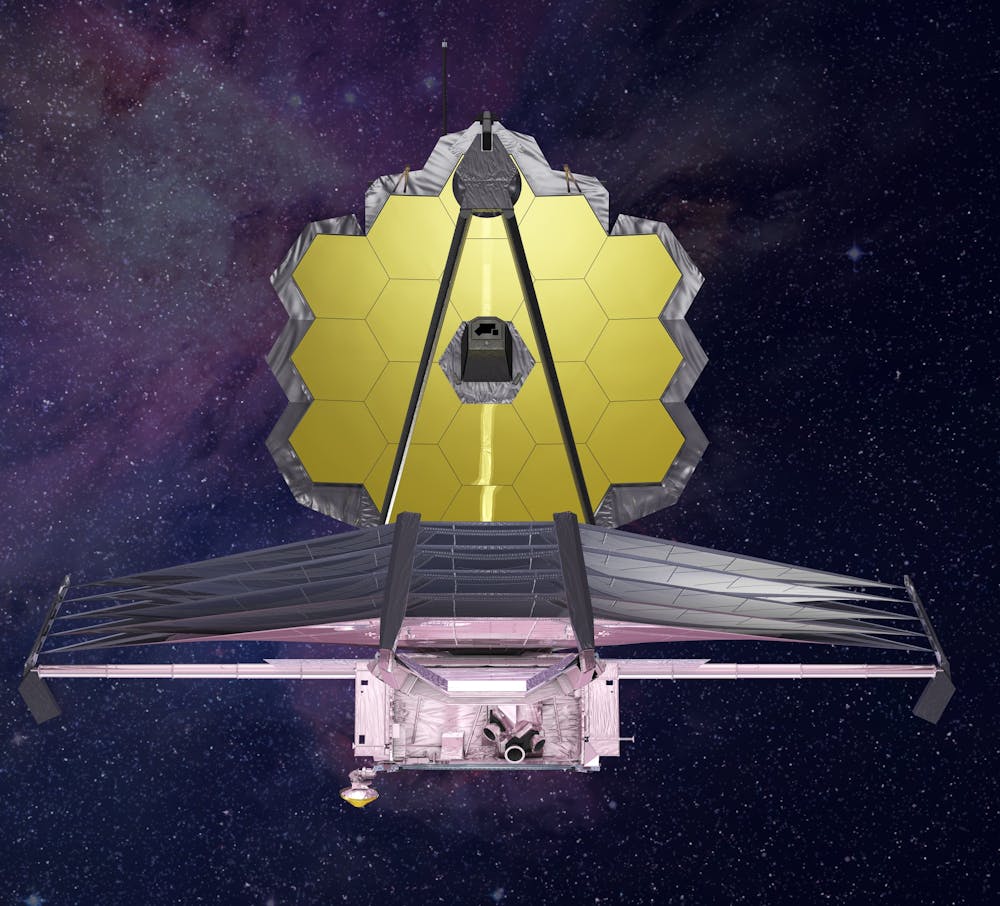
The telescope design was a global effort, led by NASA and intended to push the boundaries of astronomical observation with revolutionary engineering. Its mirror is massive – about 21 feet (6.5 meters) in diameter. That’s nearly three times the size of the Hubble Space Telescope, which launched in 1990 and is still working today.
It’s a telescope’s mirror that allows it to collect light. JWST’s is so big that it can “see” the faintest and farthest galaxies and stars in the universe. Its state-of-the-art instruments can reveal information about the composition, temperature and motion of these distant cosmic objects.
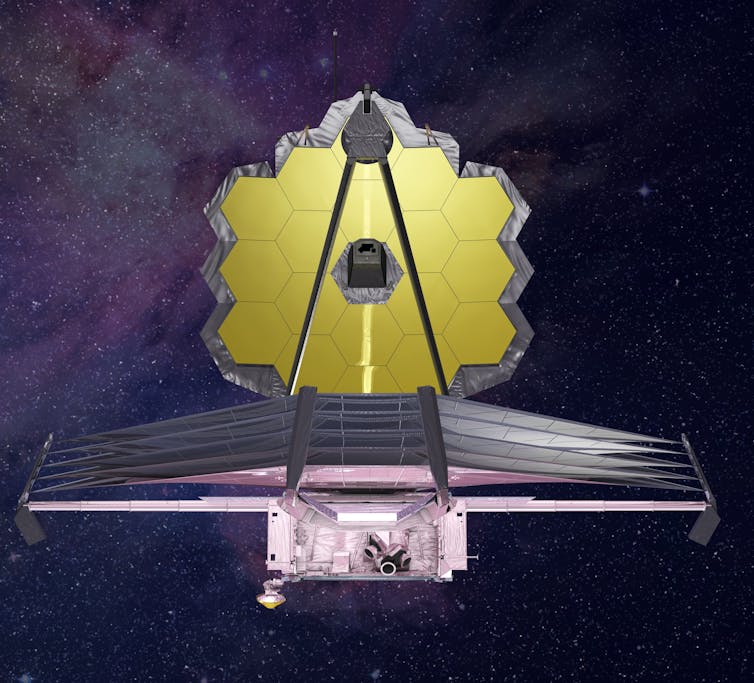 This illustration of the front view of the James Webb Space Telescope shows its sun shield and golden mirrors. NASA/ESA/CSA/Northrop Grumman
As an astrophysicist, I’m continually looking back in time to see what stars, galaxies and supermassive black holes looked like when their light began its journey toward Earth, and I’m using that information to better understand their growth and evolution. For me, and for thousands of space scientists, the James Webb Space Telescope is a window to that unknown universe.
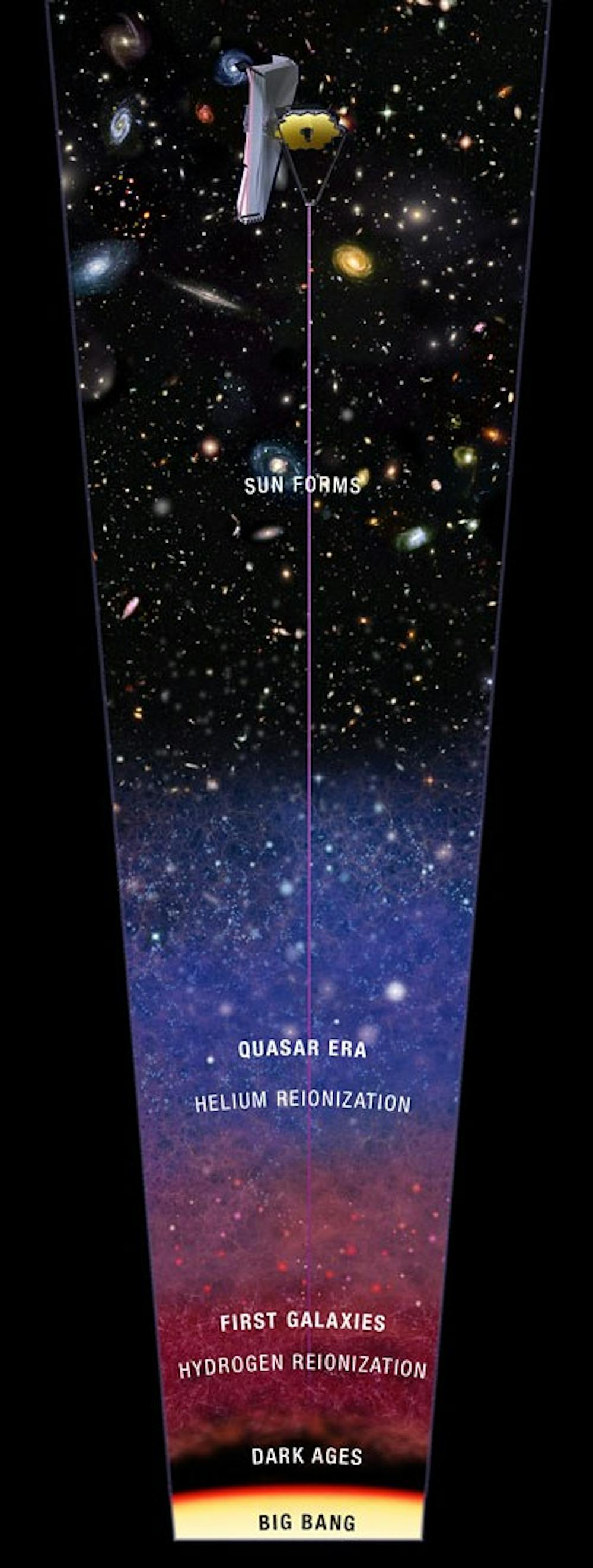
Just how far back can JWST peer into the cosmos and into the past? About 13.5 billion years.
Time travel
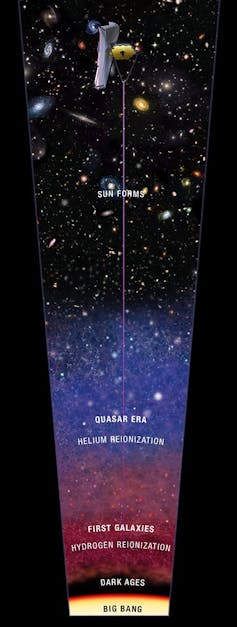 The James Webb Space Telescope can see back 13.5 billion years – back to when the first stars and galaxies began to form. STScI
A telescope does not show stars, galaxies and exoplanets as they are right now. Instead, astronomers are catching a glimpse of how they were in the past. It takes time for light to travel across space and reach our telescopes. In essence, that means a look into space is also a trip back in time.
This is even true for objects that are quite close to us. The light you see from the Sun left it about 8 minutes, 20 seconds earlier. That’s how long it takes for the Sun’s light to travel to Earth.
You can easily do the math on this. All light – whether sunlight, a flashlight or a light bulb in your house – travels at 186,000 miles (almost 300,000 kilometers) per second. That’s just over 11 million miles (about 18 million kilometers) per minute. The Sun is about 93 million miles (150 million kilometers) from Earth. That comes out to about 8 minutes, 20 seconds.
But the farther away something is, the longer its light takes to reach us. That’s why the light we see from Proxima Centauri, the closest star to us aside from our Sun, is 4 years old; that is, it’s about 25 trillion miles (approximately 40 trillion kilometers) away from Earth, so that light takes just over four years to reach us. Or, as scientists like to say, four light years.
Most recently, JWST observed Earendel, one of the farthest stars ever detected. The light that JWST sees from Earendel is about 12.9 billion years old.
The James Webb Space Telescope is looking much farther back in time than previously possible with other telescopes, such as the Hubble Space Telescope. For example, although Hubble can see objects 60,000 times fainter than the human eye is able, the JWST can see objects almost nine times fainter than even Hubble can.
The Big Bang
But is it possible to see back to the beginning of time?
The Big Bang is a term used to define the beginning of our universe as we know it. Scientists believe it occurred about 13.8 billion years ago. It is the most widely accepted theory among physicists to explain the history of our universe.
The name is a bit misleading, however, because it suggests that some sort of explosion, like fireworks, created the universe. The Big Bang more closely represents the appearance of rapidly expanding space everywhere in the universe. The environment immediately after the Big Bang was similar to a cosmic fog that covered the universe, making it hard for light to travel beyond it. Eventually, galaxies, stars and planets started to grow.
That’s why this era in the universe is called the “cosmic dark ages.” As the universe continued to expand, the cosmic fog began to rise, and light was eventually able to travel freely through space. In fact, a few satellites have observed the light left by the Big Bang, about 380,000 years after it occurred. These telescopes were built to detect the splotchy leftover glow from the Big Bang, whose light can be tracked in the microwave band.
However, even 380,000 years after the Big Bang, there were no stars and galaxies. The universe was still a very dark place. The cosmic dark ages wouldn’t end until a few hundred million years later, when the first stars and galaxies began to form.
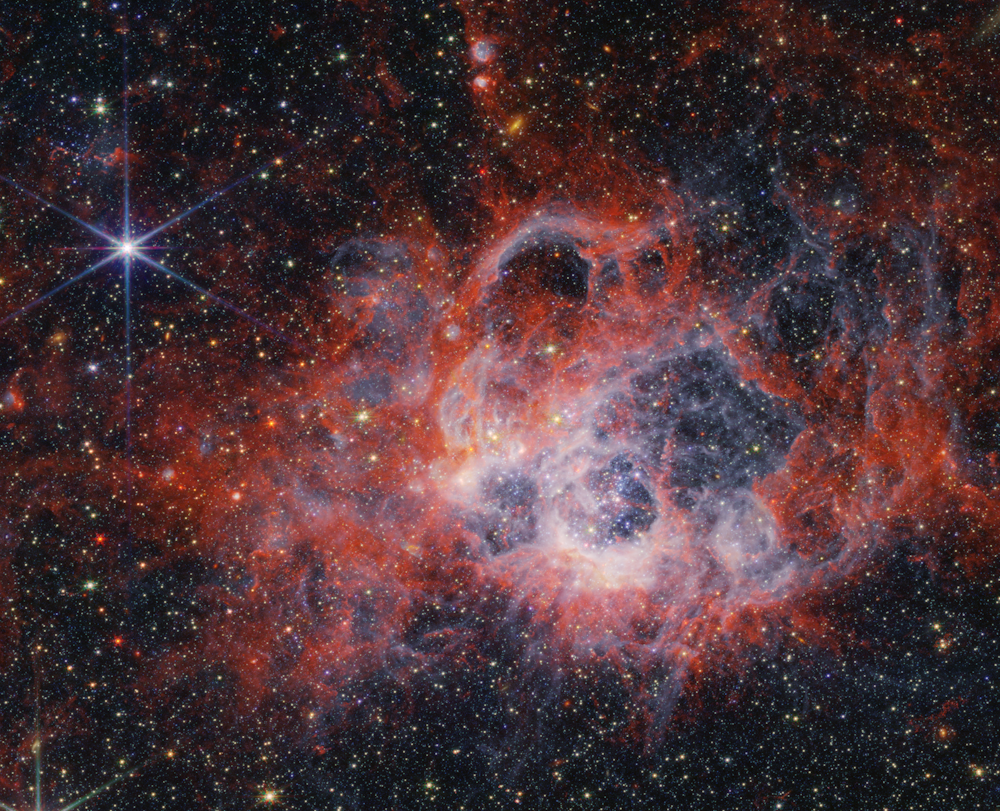
 This is a JWST image of NGC 604, a star-forming region about 2.7 million light years from Earth. NASA/ESA/CSA/STScI
The James Webb Space Telescope was not designed to observe as far back as the Big Bang, but instead to see the period when the first objects in the universe began to form and emit light. Before this time period, there is little light for the James Webb Space Telescope to observe, given the conditions of the early universe and the lack of galaxies and stars.
Peering back to the time period close to the Big Bang is not simply a matter of having a larger mirror – astronomers have already done it using other satellites that observe microwave emission from very soon after the Big Bang. So, the James Webb Space Telescope observing the universe a few hundred million years after the Big Bang isn’t a limitation of the telescope. Rather, that’s actually the telescope’s mission. It’s a reflection of where in the universe we expect the first light from stars and galaxies to emerge.
By studying ancient galaxies, scientists hope to understand the unique conditions of the early universe and gain insight into the processes that helped them flourish. That includes the evolution of supermassive black holes, the life cycle of stars, and what exoplanets – worlds beyond our solar system – are made of.
Adi Foord, Assistant Professor of Astronomy and Astrophysics, UMBC
This article is republished from The Conversation under a Creative Commons license. Read the original article.
]]>
By Adi Foord, Assistant Professor of Astronomy and Astrophysics, UMBC Curious Kids is a series for children of all ages. If you have a question you’d like an expert to answer, send it to...
https://umbc.edu/stories/could-a-telescope-ever-see-the-beginning-of-time/
https://beta.my.umbc.edu/api/v0/pixel/news/140684/guest@my.umbc.edu/86ab35c9379b6d4c0cbbb353b271286f/api/pixel
cnms
discovery
magazine
perspectives
physics
story
the-conversation
UMBC News & Magazine
https://beta.my.umbc.edu/groups/umbc-news-magazine
https://assets1-beta.my.umbc.edu/system/shared/avatars/groups/000/001/943/24435aa6207c452e7bc15cc74b42c7bb/xsmall.png?1748556657
https://assets1-beta.my.umbc.edu/system/shared/avatars/groups/000/001/943/24435aa6207c452e7bc15cc74b42c7bb/original.png?1748556657
https://assets2-beta.my.umbc.edu/system/shared/avatars/groups/000/001/943/24435aa6207c452e7bc15cc74b42c7bb/xxlarge.png?1748556657
https://assets2-beta.my.umbc.edu/system/shared/avatars/groups/000/001/943/24435aa6207c452e7bc15cc74b42c7bb/xlarge.png?1748556657
https://assets3-beta.my.umbc.edu/system/shared/avatars/groups/000/001/943/24435aa6207c452e7bc15cc74b42c7bb/large.png?1748556657
https://assets1-beta.my.umbc.edu/system/shared/avatars/groups/000/001/943/24435aa6207c452e7bc15cc74b42c7bb/medium.png?1748556657
https://assets2-beta.my.umbc.edu/system/shared/avatars/groups/000/001/943/24435aa6207c452e7bc15cc74b42c7bb/small.png?1748556657
https://assets1-beta.my.umbc.edu/system/shared/avatars/groups/000/001/943/24435aa6207c452e7bc15cc74b42c7bb/xsmall.png?1748556657
https://assets2-beta.my.umbc.edu/system/shared/avatars/groups/000/001/943/24435aa6207c452e7bc15cc74b42c7bb/xxsmall.png?1748556657
UMBC News & Magazine
0
0
false
Mon, 08 Apr 2024 16:09:52 -0400
Meet a Retriever—Sean McWilliams, M.S. ’16, Alumni Association Alumni Awards Committee Co-Chair

Meet Sean McWilliams, M.S. ‘16, applied mathematics. Sean is a portfolio manager at T. Rowe Price and an active member of the UMBC Alumni Association Board of Directors, serving as one of the co-chairs of the Alumni Awards committee. Sean was a non-traditional student who found his way to UMBC as a part-time graduate student while working full-time at T. Rowe Price. Take it away, Sean!
Q: What is your WHY? What brought you to UMBC?
A: After working for a few years I deeply missed the academic rigor of studying mathematics. I wanted to study more math at the graduate level, mostly out of personal interest, while I continued to work. I also wanted to take the same classes that the full-time graduate students would be taking. UMBC’s applied mathematics program was the only one that offered classes with the level of rigor I was seeking that would work with my schedule.
Q: What’s your favorite part of Retriever Nation?
A: I love meeting new alumni and learning about how UMBC helped launch their personal and professional successes after graduation.
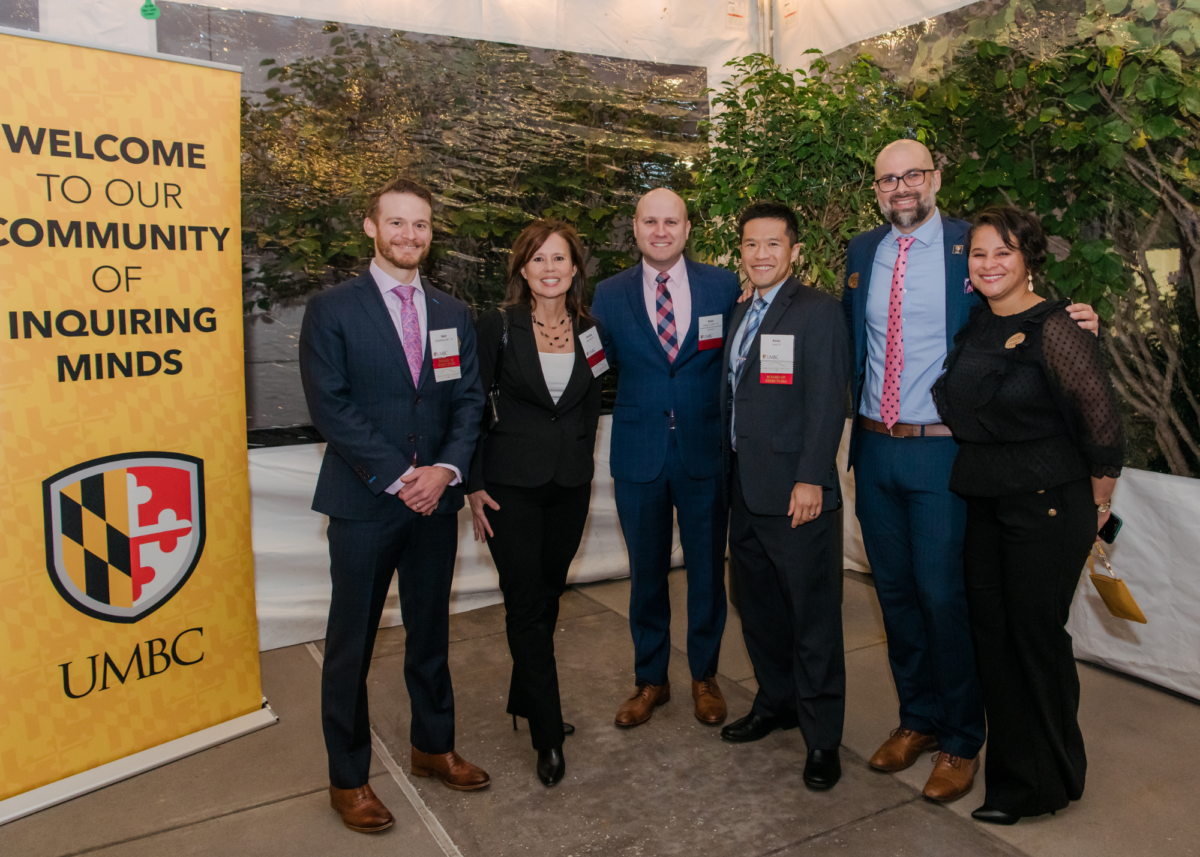 Members of the Alumni Association Board of Directors with UMBC’s Director of Alumni Engagement, Stanyell Odom. Pictured left to right: Sean McWilliams, M.S. ’16, Zozscha Bomhardt ’93, Brian Frazee ’11, M.P.P. ’12., Kevin Yang ’07, Bobby Lubaszewski ’10, M.P.S. ’23, and Stanyell Odom.
Q. What is your HOW? Where did you find support?
A: I enjoyed all of my classes at UMBC and found the professors to be almost universally excellent and passionate teachers. I had especially memorable experiences taking partial differential equations with Kathleen Hoffman, stochastic processes with Muruhan Rathinam, and applied analysis with Animikh Biswas.
Q: What drives you to support UMBC?
A: I specifically donate to support the Alumni Endowed Scholarship Fund. The scholarships this fund supports often have a direct and immediate impact on the recipients’ ability to complete their degrees. It’s gratifying to know my donations help support the fund’s ability to continue to deliver that impact.
About the Alumni Association Board of Directors
UMBC’s Alumni Association is a non-dues-paying organization and is led by a volunteerBoard of Directors—volunteer graduates, like Sean, who support advancing the mission and vision of the association and, by extension, UMBC, through their visibility as alumni leaders and active participants in the ongoing work of the board and its committees.
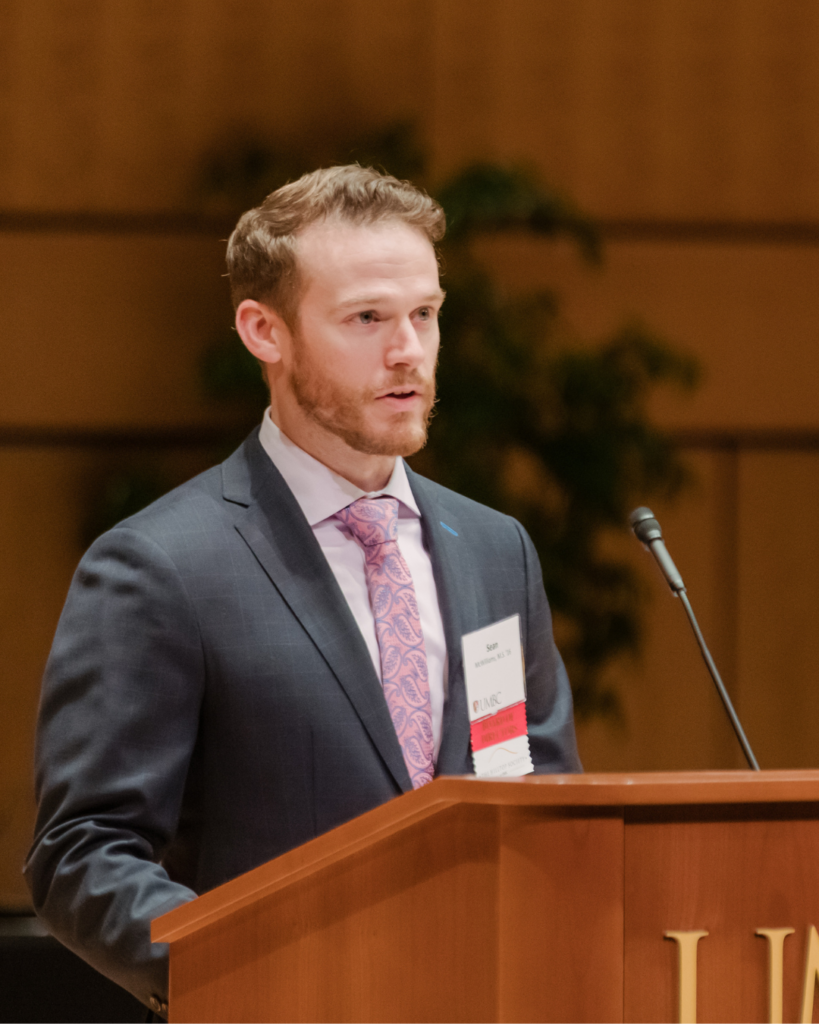
(Pictured left: Sean McWilliams, Alumni Awards co-chair, at the podium during Alumni Awards 2022.)
About the Alumni Awards
Extraordinary UMBC alumni, faculty, and staff are making a difference in the world, and the UMBC Alumni Association Board of Directors holds an annual celebration of their accomplishments. Past winners have included a U.S. Surgeon General, a Lucasfilm sound editor, the New Yorker‘s social media director, chief judges, teachers, and scientists advancing fields such as medicine, chemical engineering, physics, and biology. We also honor outstanding UMBC faculty and staff members for their role in guiding and nurturing students.
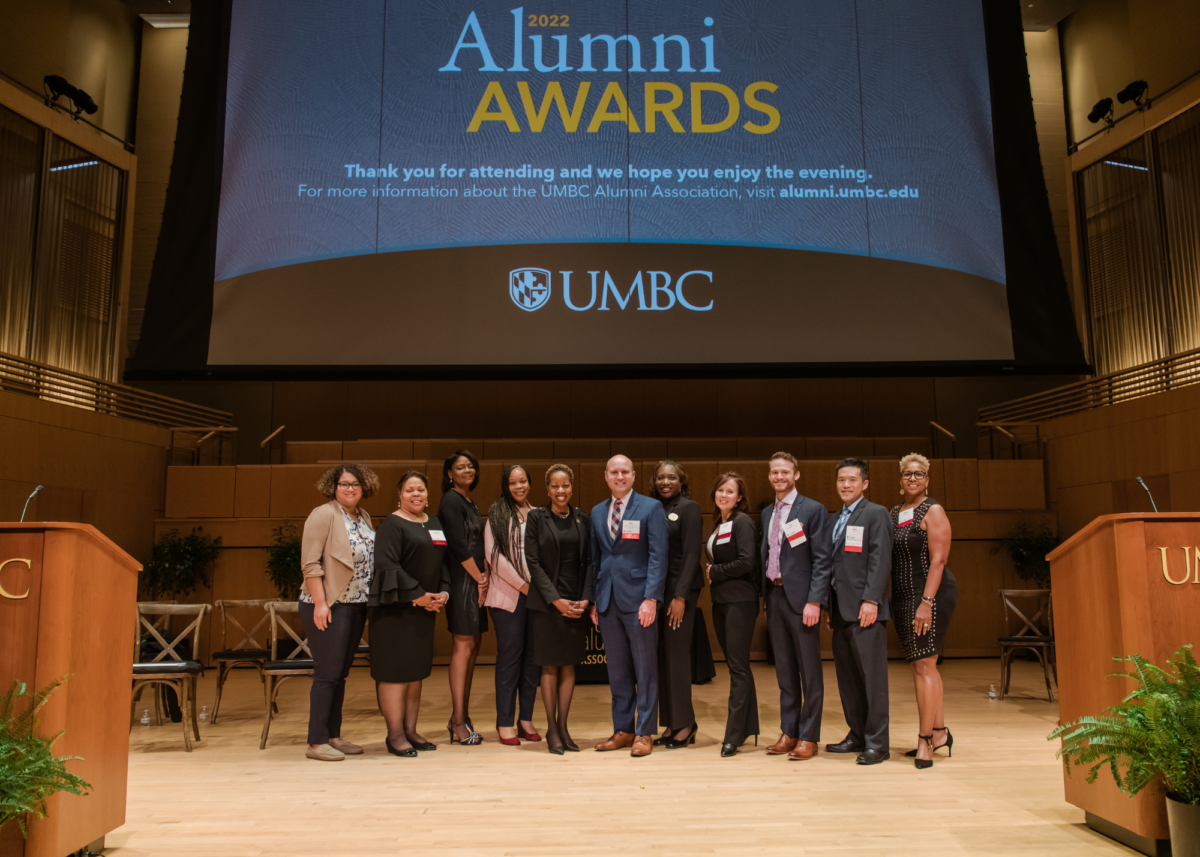 Alumni Awards 2022 group photo. Alumni Awards committee members with UMBC President Valerie Sheares Ashby and Alumni Association President Brian Frazee ’11, M.P.P. ’12.
Five types of awards are given: Outstanding Graduate, Distinguished Service, Rising Star, Outstanding Faculty, and Outstanding Staff.
* * * * *
UMBC’s greatest strength is its people. When people meet Retrievers and hear about the passion they bring, the relationships they create, the ways they support each other, and the commitment they have to inclusive excellence, they truly get a sense of our community. That’s what “Meet a Retriever” is all about.
Learn more about how UMBC can help you achieve your goals.
]]>
Meet Sean McWilliams, M.S. ‘16, applied mathematics. Sean is a portfolio manager at T. Rowe Price and an active member of the UMBC Alumni Association Board of Directors, serving as one of the...
https://umbc.edu/stories/meet-sean-mcwilliams-alumni-awards-co-chair/
https://beta.my.umbc.edu/api/v0/pixel/news/140907/guest@my.umbc.edu/9b42927e23fae63593d0071bed522301/api/pixel
alumni
alumni-association
alumni-awards
alumni-endowed-scholarship
impact
magazine
mathematics
meet-a-retriever
story
UMBC News & Magazine
https://beta.my.umbc.edu/groups/umbc-news-magazine
https://assets1-beta.my.umbc.edu/system/shared/avatars/groups/000/001/943/24435aa6207c452e7bc15cc74b42c7bb/xsmall.png?1748556657
https://assets1-beta.my.umbc.edu/system/shared/avatars/groups/000/001/943/24435aa6207c452e7bc15cc74b42c7bb/original.png?1748556657
https://assets2-beta.my.umbc.edu/system/shared/avatars/groups/000/001/943/24435aa6207c452e7bc15cc74b42c7bb/xxlarge.png?1748556657
https://assets2-beta.my.umbc.edu/system/shared/avatars/groups/000/001/943/24435aa6207c452e7bc15cc74b42c7bb/xlarge.png?1748556657
https://assets3-beta.my.umbc.edu/system/shared/avatars/groups/000/001/943/24435aa6207c452e7bc15cc74b42c7bb/large.png?1748556657
https://assets1-beta.my.umbc.edu/system/shared/avatars/groups/000/001/943/24435aa6207c452e7bc15cc74b42c7bb/medium.png?1748556657
https://assets2-beta.my.umbc.edu/system/shared/avatars/groups/000/001/943/24435aa6207c452e7bc15cc74b42c7bb/small.png?1748556657
https://assets1-beta.my.umbc.edu/system/shared/avatars/groups/000/001/943/24435aa6207c452e7bc15cc74b42c7bb/xsmall.png?1748556657
https://assets2-beta.my.umbc.edu/system/shared/avatars/groups/000/001/943/24435aa6207c452e7bc15cc74b42c7bb/xxsmall.png?1748556657
UMBC News & Magazine
0
0
false
Fri, 05 Apr 2024 13:11:26 -0400
6 Earth Day events that will ground you to our planet
While Earth Day may be a one-day affair, our everyday actions affect the Earth 365 days of the year. This April, UMBC is celebrating Earth Month, allowing the community to dedicate time to reflect more deeply on the environmental challenges we are facing and also celebrate the many gifts our world has to offer. In partnership with the Environmental Protection Agency (EPA) and the United States Geological Survey (USGS), UMBC is hosting a lineup of free, exciting, Earth Day events happening all month! You don’t even need to leave campus to join in on the fun all while learning about how we can all do our part to take care of our planet.
1. Watch the Solar Eclipse (with proper glasses)
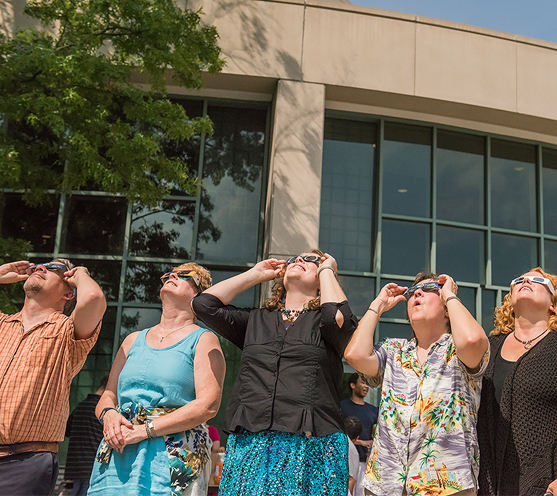
Head over to the Quad, on April 8 from 2 to 4 p.m., and join your fellow earthlings from the Astronomy Club for a watch party of the solar eclipse! The eclipse will trace a narrow path of darkness across North America where the moon will pass between the Sun and the Earth, creating a partial eclipse. Watch as more than 88 percent of the Sun will be obstructed from view at UMBC. (Left, a group watches the 2017 eclipse in front of the AOK Library.)
2. Go see the play “SLIME”
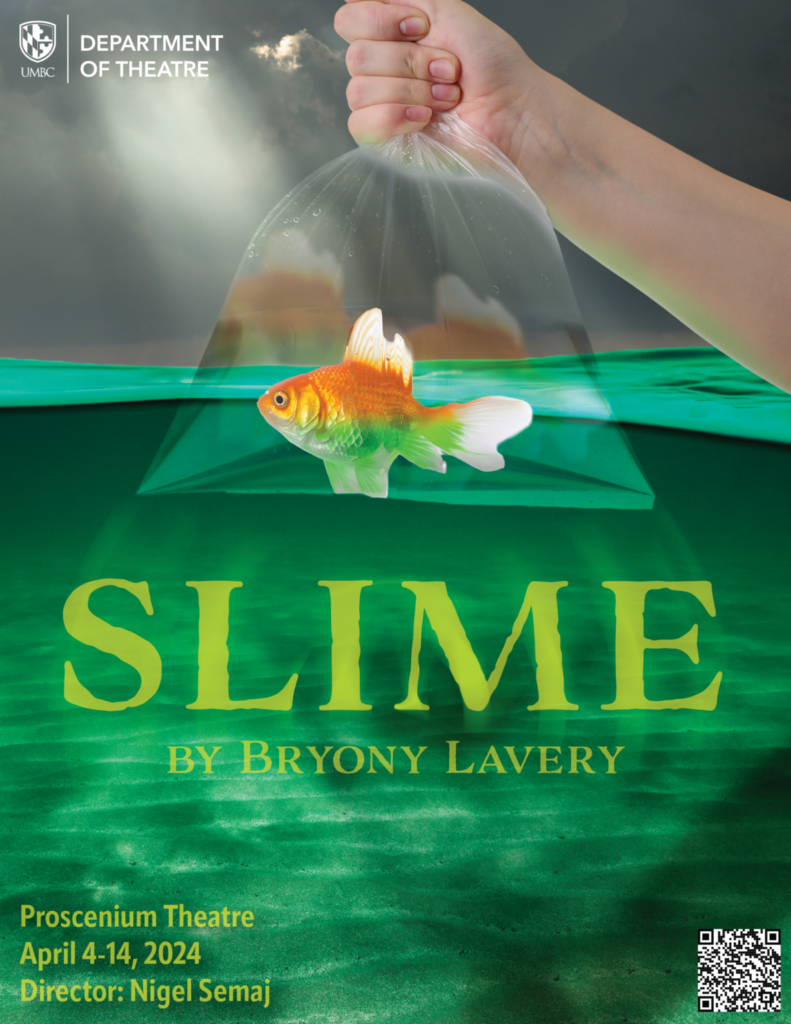
As part of the Plays for Our Planet initiative, the Department of Theatre is producing Byrony Lavery’s “SLIME,” directed by Nigel Semaj. The play is about seven graduate students who appear at the Third Annual Slime Crisis Conference, fighting to save the Earth from a toxic slime that is threatening all animal life.
Performances will take place from April 4 to 14, and on April 14, there will be a free matinee for students, followed by a post-show actor talk-back, featuring, Dawn Biehler of UMBC’s Department of Geography and Environmental Systems. You don’t want to miss this opportunity to educate yourself on climate change in an engaging and entertaining way.
3. Run the Earth Day 3K
Enjoy the spring weather and head over to RAC for the annual free Earth Day 3K Run on April 17. Don’t worry if you’re not a competitive runner, walking is encouraged as well. If you’re up for the challenge, you can sign up here, or via walk-up registration the day of from 11 a.m.to noon. Prizes will be awarded to the top finishers, and the first 100 completed racers will receive Earth Day T-Shirts.
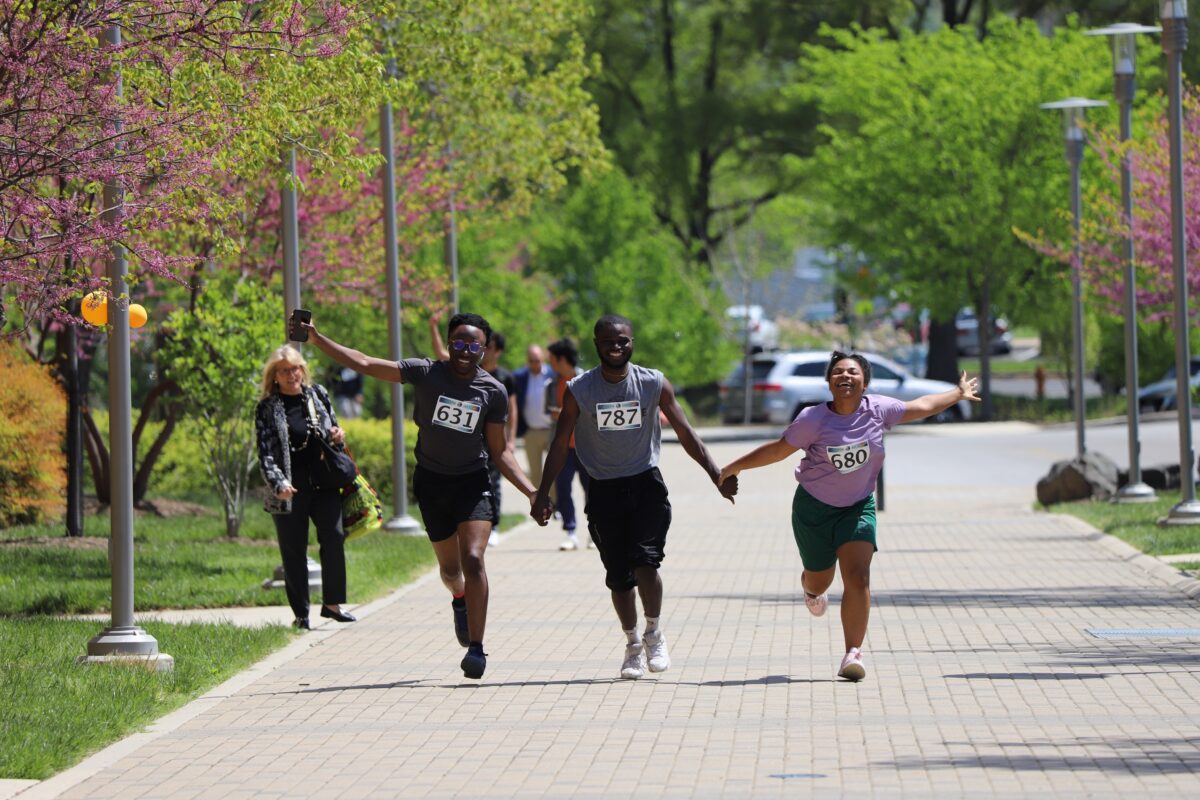 A group of students running the 2022 Earth Day 3K on campus.
The event begins at 12:15 p.m. and refreshments will be provided post-race. All participants will have a chance to connect with the community and become more aware of earth sciences and the environment. UMBC students, faculty, as well as anyone in the Baltimore community is encouraged to participate!
4. Bring global change down to Earth
For most of us, managing greenhouse gas emissions and watching distant islands flood or glaciers melt are far beyond our reach. However, the pervasive reach of an environmental reckoning means we have local issues, with much for all of us to work on. This panel on April 22 will bring together scholars from public policy, geography and environmental systems, and beyond to discuss multiple ways to understand climate work.
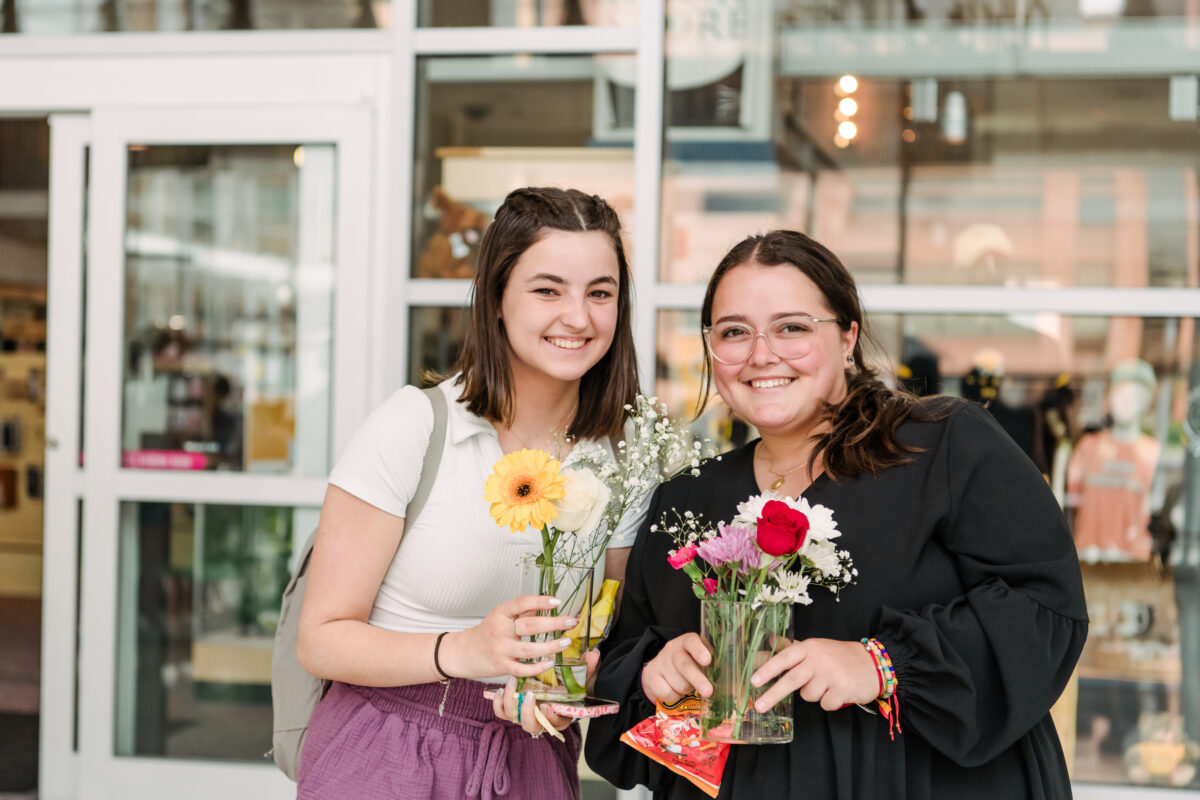 Students gathered in The Commons to make bouquets of flowers in spring 2023. (Marlayna Demond ’11/UMBC)
5. Check out research from the UMBC community
There is so much groundbreaking research happening at UMBC conducted by students, faculty, staff, and community members, and you can learn all about it at Earth Day Community Day on the Quad on April 22. There will be two sessions, one starts at 10 a.m. and another at 1 p.m. Take this time to enrich your understanding of the research being carried out at UMBC and how it has had a significant impact on the Baltimore community and beyond.
6. Attend an Earth Day panel
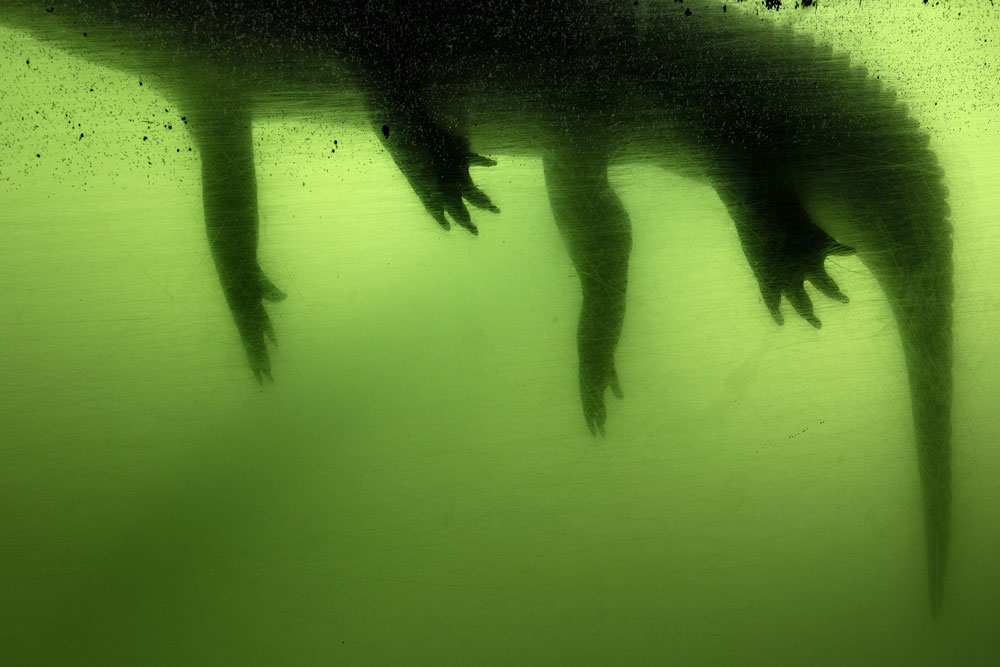
After checking out Community Day on the Quad, be sure to catch the panel, Climate Change, Science Communication, and the Arts. Artist Anastasia Samoylova (Gator, 2017, left) will be joining scientists and media historians for a panel discussion on April 22.
Along with Anastasia Samoylova—the photographer behind the vivid pictures in the exhibit “Floodzone” which takes a look at how climate change has affected the southern U.S.—the panelists will include, Autumn Powell, a UMBC graduate student in geography and environmental systems, Lavar Thomas, a special assistant within the EPA’s administrator’s office, and Tracy Tinga, assistant professor in media and communication studies. This event will be a discussion of how to use of how to use alternate forms of communication, including art, to describe climate change findings to a general audience. The event will take place at the AOK Library Gallery at 5 p.m.
]]>
While Earth Day may be a one-day affair, our everyday actions affect the Earth 365 days of the year. This April, UMBC is celebrating Earth Month, allowing the community to dedicate time to reflect...
https://umbc.edu/stories/6-earth-day-events-that-ground-you-to-our-planet/
https://beta.my.umbc.edu/api/v0/pixel/news/140608/guest@my.umbc.edu/c1ca080f96cc69268bdf418c5ed3affc/api/pixel
aok-library
cahss
campus-life
cnms
coeit
ges
magazine
mcs
story
theatre
UMBC News & Magazine
https://beta.my.umbc.edu/groups/umbc-news-magazine
https://assets1-beta.my.umbc.edu/system/shared/avatars/groups/000/001/943/24435aa6207c452e7bc15cc74b42c7bb/xsmall.png?1748556657
https://assets1-beta.my.umbc.edu/system/shared/avatars/groups/000/001/943/24435aa6207c452e7bc15cc74b42c7bb/original.png?1748556657
https://assets2-beta.my.umbc.edu/system/shared/avatars/groups/000/001/943/24435aa6207c452e7bc15cc74b42c7bb/xxlarge.png?1748556657
https://assets2-beta.my.umbc.edu/system/shared/avatars/groups/000/001/943/24435aa6207c452e7bc15cc74b42c7bb/xlarge.png?1748556657
https://assets3-beta.my.umbc.edu/system/shared/avatars/groups/000/001/943/24435aa6207c452e7bc15cc74b42c7bb/large.png?1748556657
https://assets1-beta.my.umbc.edu/system/shared/avatars/groups/000/001/943/24435aa6207c452e7bc15cc74b42c7bb/medium.png?1748556657
https://assets2-beta.my.umbc.edu/system/shared/avatars/groups/000/001/943/24435aa6207c452e7bc15cc74b42c7bb/small.png?1748556657
https://assets1-beta.my.umbc.edu/system/shared/avatars/groups/000/001/943/24435aa6207c452e7bc15cc74b42c7bb/xsmall.png?1748556657
https://assets2-beta.my.umbc.edu/system/shared/avatars/groups/000/001/943/24435aa6207c452e7bc15cc74b42c7bb/xxsmall.png?1748556657
UMBC News & Magazine
0
0
false
Fri, 05 Apr 2024 12:06:31 -0400
Fri, 05 Apr 2024 12:06:31 -0400
Leadership Announcement
Dear UMBC Community,
I am thrilled to announce the appointment of Tracey A. Reeves as Vice President for Communications and Marketing at UMBC. Tracey is a strategic thinker whose experience, expertise, and capacities as a highly collaborative leader will enable us to take communications and marketing at UMBC to great new heights in service of our ambitious aims. She joins UMBC from Bates College in Lewiston, Maine, where she serves currently as vice president for communications and marketing. She will begin at UMBC on June 3.
In her role at Bates, Tracey has been a trusted advisor to the president and senior leadership team on all aspects of strategic communications, and she has led a 17-member team of professionals in advancing Bates’ enrollment marketing, media relations, storytelling, and crisis and emergency response communications efforts, among others. She is a data-driven planner who is skilled at change management, building and supporting teams, and leveraging technology to help strengthen organizations and their brands.
At Bates and, before that, at the Georgia Institute of Technology, where she served first as assistant vice president for campus communications and then as associate vice president for research, academic, and faculty communications, Tracey developed and led comprehensive strategic plans for communications and marketing. She successfully implemented those plans through myriad challenges both local and global, including the COVID-19 pandemic, a national racial reckoning, deepening political and cultural divides, and, tragically, a mass shooting in Lewiston. Her skills and sensitivity in navigating crises are matched by her ability to envision and deliver innovative strategic initiatives, including several to promote Georgia Tech’s $1.2-billion research enterprise and the impact of its research on the communities it serves.
In joining our community at UMBC, Tracey is returning to the Baltimore area that she loves, a region where she spent more than two decades, including for the 10 years she served as director of media relations at the Johns Hopkins University. At Johns Hopkins from 2008 through 2018, she led a team of media relations representatives for the university’s central communications office, crafted high-level messaging and announcements, and served as a university spokesperson. She joined Johns Hopkins following a successful career as a newspaper reporter, including as a national and congressional correspondent for Knight Ridder Newspapers and as a staff writer and assistant editor with The Washington Post.
I know that Tracey is excited to return to Maryland and deeply inspired by UMBC’s mission and vision and the opportunity to join this institution she has long admired. As we welcome her, we embark upon a new era for communications and marketing at the university—to build upon UMBC’s remarkable momentum to help strengthen and sustain our position among the nation’s leading institutions and create the future we envision for UMBC. I could not be more enthusiastic about Tracey taking on this role, and I am grateful to the search committee and all who participated in this effort that has resulted in such an outstanding appointment. Thank you, and welcome, Tracey!
Sincerely,
President Valerie Sheares Ashby
]]>
Dear UMBC Community, I am thrilled to announce the appointment of Tracey A. Reeves as Vice President for Communications and Marketing at UMBC. Tracey is a strategic thinker whose experience,...
https://my3.my.umbc.edu/groups/announcements/posts/140565
https://beta.my.umbc.edu/api/v0/pixel/news/140592/guest@my.umbc.edu/8495cff5402b4ce1ea0231c50d09a136/api/pixel
president
story
UMBC News & Magazine
https://beta.my.umbc.edu/groups/umbc-news-magazine
https://assets1-beta.my.umbc.edu/system/shared/avatars/groups/000/001/943/24435aa6207c452e7bc15cc74b42c7bb/xsmall.png?1748556657
https://assets1-beta.my.umbc.edu/system/shared/avatars/groups/000/001/943/24435aa6207c452e7bc15cc74b42c7bb/original.png?1748556657
https://assets2-beta.my.umbc.edu/system/shared/avatars/groups/000/001/943/24435aa6207c452e7bc15cc74b42c7bb/xxlarge.png?1748556657
https://assets2-beta.my.umbc.edu/system/shared/avatars/groups/000/001/943/24435aa6207c452e7bc15cc74b42c7bb/xlarge.png?1748556657
https://assets3-beta.my.umbc.edu/system/shared/avatars/groups/000/001/943/24435aa6207c452e7bc15cc74b42c7bb/large.png?1748556657
https://assets1-beta.my.umbc.edu/system/shared/avatars/groups/000/001/943/24435aa6207c452e7bc15cc74b42c7bb/medium.png?1748556657
https://assets2-beta.my.umbc.edu/system/shared/avatars/groups/000/001/943/24435aa6207c452e7bc15cc74b42c7bb/small.png?1748556657
https://assets1-beta.my.umbc.edu/system/shared/avatars/groups/000/001/943/24435aa6207c452e7bc15cc74b42c7bb/xsmall.png?1748556657
https://assets2-beta.my.umbc.edu/system/shared/avatars/groups/000/001/943/24435aa6207c452e7bc15cc74b42c7bb/xxsmall.png?1748556657
UMBC News & Magazine
2
0
false
Thu, 04 Apr 2024 17:16:10 -0400
Why rural white Americans’ resentment is a threat to democracy

Written by Thomas F. Schaller, professor of political science, UMBC
Rural white voters have long enjoyed outsize power in American politics. They have inflated voting power in the U.S. Senate, the U.S. House and the Electoral College.
Although there is no uniform definition of “rural,” and even federal agencies cannot agree on a single standard, roughly 20% of Americans live in rural communities, according to the Census Bureau’s definition. And three-quarters of them – or approximately 15% of the U.S. population – are white.
Since the rise of Jacksonian democracy and the expansion of the vote to all white men in the late 1820s, however, the support of rural white people has been vital to the governing power of almost every major party coalition. Which is why my co-author Paul Waldman and I describe rural white people as America’s “essential minority” in our book White Rural Rage: The Threat to American Democracy.
As a political scientist, I’ve written or co-written five books addressing issues of racial politics at some level of government or part of the country. My latest, White Rural Rage, seeks to understand the complex intersections of race, place and opinion and the implications they hold for our political system.
The unfortunate fact is that polls suggest many rural white people’s commitment to the American political system is eroding. Even when they are not members of militant organizations, rural white people, as a group, now pose four interconnected threats to the fate of the United States’ pluralist, constitutional democracy.
Although these do not apply to all rural white people, nor exclusively to them in general, when compared with other Americans, rural white people:
- Express the most racist, least inclusive, most xenophobic, most anti-LGBTQ+ and most anti-immigrant sentiments.
- Subscribe at the highest rates to conspiracy theories about QAnon, the 2020 presidential election, Barack Obama’s citizenship and COVID-19 vaccines.
- Support a variety of antidemocratic and unconstitutional positions and exhibit strong attachments to white nationalist and white Christian nationalist movements inimical to secular, constitutional governance.
- Are most likely to justify, if not call for, force or violence as acceptable alternatives to deliberative, peaceful democracy.
Let’s examine a few data points.
Xenophobia
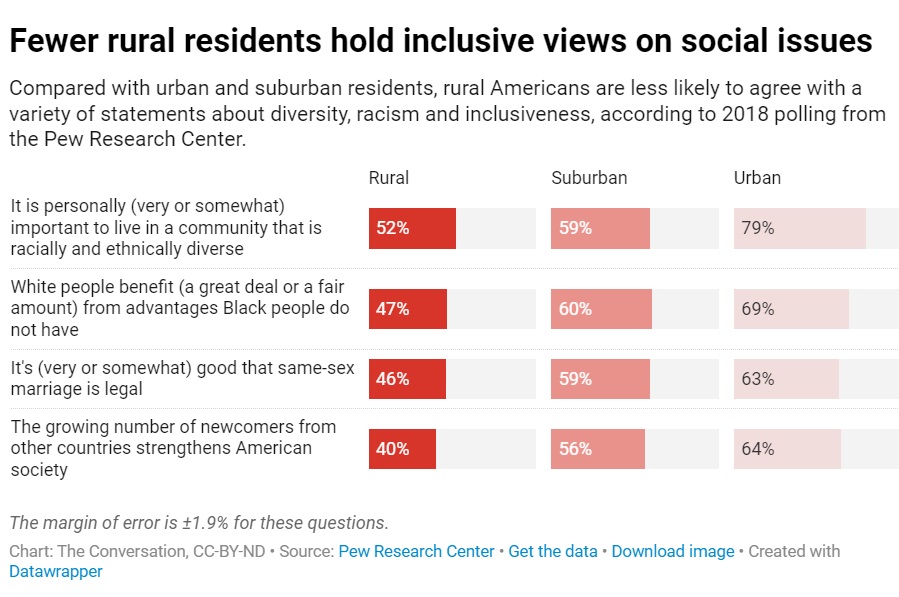
In a Pew Research Center poll conducted in 2018, 46% of white rural Americans said it is important to live in a diverse community. That’s a lower proportion than urban and suburban dwellers and even nonwhite rural residents.
And in rural areas, fewer than half the people said white people have advantages Black people do not, approve of the legalization of same-sex marriage, and say immigrants make American society stronger.
In addition, Cornell researchers found that rural whites reported feeling less comfortable with gay and lesbian people than urban whites do. And 49% of rural LGBTQ+ people between the ages of 10 and 24 called their own towns “unaccepting” of LGBTQ+ people – nearly twice the rate of suburban and urban LGBTQ+ young people who said the same about their communities.
Conspiracism
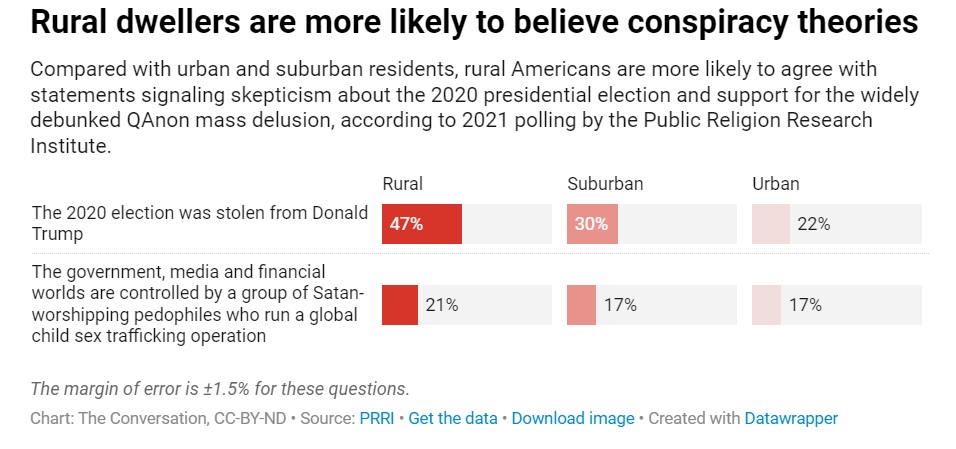
Polls in 2020 and 2021 indicated that QAnon supporters are 1.5 times more likely to live in rural areas than urban ones, and 49% of rural residents – 10 points higher than the national average – believe a “deep state” undermines Trump.
Rural residents are also more likely than urban and suburban residents to believe the 2020 election was stolen from Trump, according to 2021 polling by the Public Religion Research Institute.
And people who live in rural areas are also less confident as a whole than those who live in urban areas that votes will be counted accurately and fairly in their state or across the country, according to a 2022 poll from the Bipartisan Policy Center.
In addition, by our analysis, of the 139 U.S. House members who voted to reject the certification of Joe Biden’s presidential election just hours after a violent mob of Trump supporters rampaged through the Capitol, 103 – 74% – represented either “purely rural” or “rural/suburban” districts, as categorized by Bloomberg’s CityLab project.
Rural antidemocratic beliefs
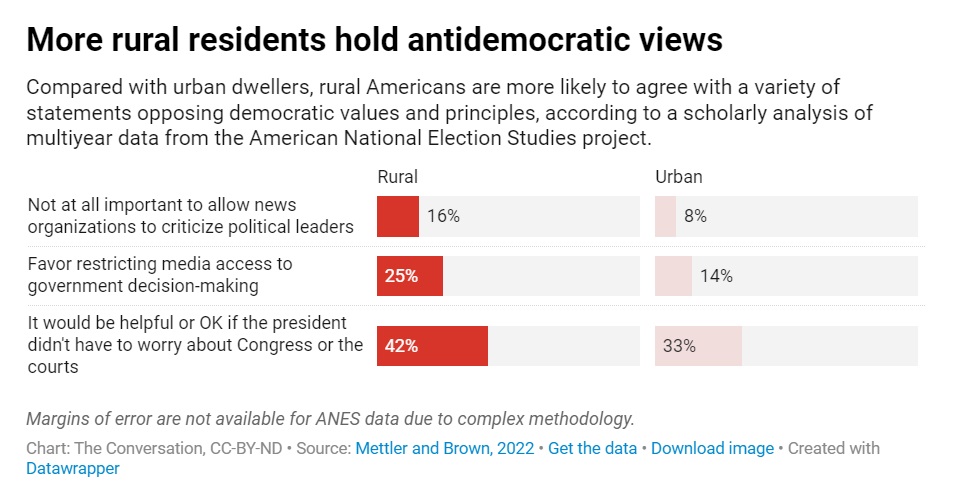
A scholarly analysis of multiyear data from the American National Election Studies project finds that rural citizens are “much more likely (than urban residents) to favor restrictions on the press” and to say it would be “helpful if the president could unilaterally work” without regard to Congress or the courts.
In addition, more than half of rural residents surveyed by the Public Religion Research Institute said being a Christian is important to “being truly American” – 10 percentage points more than in surburban or urban areas.
This is one of several signals that rural residents are disproportionately likely to support white Christian nationalism, an ideology that reaches beyond Christian ideas of faith and morality and into government. Its followers want the United States to base its laws on Christian values rather than maintain the centuries-old separation of church and state the founders saw as fundamental to a secular democracy.
Justification of violence
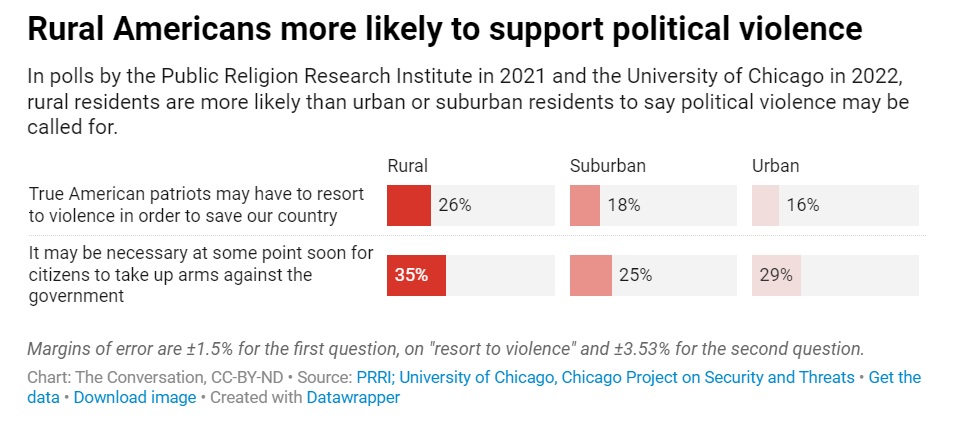
Rural residents are more likely than urban or suburban residents to say the political situation in the country is heading to a point where violence may be necessary to preserve the nation, according to polls from the Public Religion Research Institute in 2021 and the University of Chicago Institute of Politics in 2022.
Of the estimated 21 million Americans who in late 2021 said Joe Biden’s 2020 presidential win was “illegitimate,” according to the Chicago Project on Security and Threats, 30% lived in rural areas. And 27% of Americans who say Trump should be returned to office even if “by force” are rural residents. Those are minority views, but both proportions are significantly higher than the rural proportion of the overall population.
With the 2024 election fast approaching, the views of rural white people are once again of vital importance because they and the members of Congress who represent them disproportionately believe the 2020 election was stolen from Donald Trump by Joe Biden. A Pew Research Center study found 71% of rural white voters voted for Trump in 2020, so their preference in November will be key to who returns to the White House for a second term.
This article is republished from The Conversation under a Creative Commons license. Read the original article and see more than 250 UMBC articles available in The Conversation.
]]>
Written by Thomas F. Schaller, professor of political science, UMBC Rural white voters have long enjoyed outsize power in American politics. They have inflated voting power in the U.S....
https://umbc.edu/stories/rural-white-americans-resentment-and-democracy/
https://beta.my.umbc.edu/api/v0/pixel/news/140576/guest@my.umbc.edu/8c98be77372d135f63986d6f7f90bda3/api/pixel
cahss
cahss-research
discovery
magazine
political-science
research
story
UMBC News & Magazine
https://beta.my.umbc.edu/groups/umbc-news-magazine
https://assets1-beta.my.umbc.edu/system/shared/avatars/groups/000/001/943/24435aa6207c452e7bc15cc74b42c7bb/xsmall.png?1748556657
https://assets1-beta.my.umbc.edu/system/shared/avatars/groups/000/001/943/24435aa6207c452e7bc15cc74b42c7bb/original.png?1748556657
https://assets2-beta.my.umbc.edu/system/shared/avatars/groups/000/001/943/24435aa6207c452e7bc15cc74b42c7bb/xxlarge.png?1748556657
https://assets2-beta.my.umbc.edu/system/shared/avatars/groups/000/001/943/24435aa6207c452e7bc15cc74b42c7bb/xlarge.png?1748556657
https://assets3-beta.my.umbc.edu/system/shared/avatars/groups/000/001/943/24435aa6207c452e7bc15cc74b42c7bb/large.png?1748556657
https://assets1-beta.my.umbc.edu/system/shared/avatars/groups/000/001/943/24435aa6207c452e7bc15cc74b42c7bb/medium.png?1748556657
https://assets2-beta.my.umbc.edu/system/shared/avatars/groups/000/001/943/24435aa6207c452e7bc15cc74b42c7bb/small.png?1748556657
https://assets1-beta.my.umbc.edu/system/shared/avatars/groups/000/001/943/24435aa6207c452e7bc15cc74b42c7bb/xsmall.png?1748556657
https://assets2-beta.my.umbc.edu/system/shared/avatars/groups/000/001/943/24435aa6207c452e7bc15cc74b42c7bb/xxsmall.png?1748556657
UMBC News & Magazine
1
0
false
Thu, 04 Apr 2024 10:45:00 -0400
Thu, 04 Apr 2024 10:45:00 -0400
Department of Justice-UMBC Agreement
Dear UMBC Community,
Today, UMBC voluntarily entered into an agreement with the U.S. Department of Justice that will bring meaningful improvements to the university’s work to prevent and respond to reports of sexual misconduct and sex discrimination under Title IX. This agreement concludes the DOJ investigation of UMBC’s Title IX compliance, the findings of which were announced on March 18. If you have not already viewed my letter and video message about the DOJ’s findings, which focused on the period 2015-2020, I encourage you to do so.
The agreement we signed today commits UMBC to implement measures to enhance the strength, accountability, and independence of the university’s Title IX office; provide specific support for student-athletes and the Athletics Department staff who serve them; expand training for students and employees to improve UMBC’s prevention and response to sex discrimination; and provide financial relief to certain current and former members of the Men’s and Women’s Swimming and Diving team, as determined by the DOJ. The agreement requires regular reporting by UMBC to the DOJ and will remain in effect through the 2028-2029 academic year. You can read the full agreement here.
Many of the agreement’s provisions are already under way. In the agreement, the DOJ acknowledges the significant steps the university has taken recently to help prevent and strengthen our response to sex discrimination and sexual misconduct. Those efforts have enhanced our Title IX reporting structures and procedures, expanded training and prevention initiatives, and provided additional support and resources to students and employees. The work is ongoing, and it has included the following improvements since my tenure began in 2022:
Created the role of and hired a Vice President for Institutional Equity and Chief Diversity Officer to oversee the work of the Office of Equity and Civil Rights, which is well on its way to being staffed with five full-time, permanent positions, including a Director and Title IX Coordinator, Training and Prevention Manager, Case Manager, and two investigatorsRestructured the Office of Equity and Civil Rights to provide greater access and privacy for students and employeesAppointed an external specialist to provide interim Title IX expertiseUpdated the Title IX website and developed targeted educational resourcesUndertook the process of strengthening the university’s Title IX and anti-discrimination policies and proceduresLaunched an annual mandatory online Title IX training module for all studentsImplemented mandatory reporter training for employeesExpanded Title IX training for all athletics staff, coaches, and student-athletes
Those efforts, combined with the additional measures to which we have committed in the agreement, will help us better serve our students and all members of the UMBC community. You can access our resources here. If you need immediate help, please contact the Retriever Support Line at 410-455-3167 or retrieversupport@umbc.edu.
As I have shared with many of you in recent days, the DOJ investigation has caused us to reckon with the past. We cannot take away the suffering and trauma that many of our students endured in those years, nor can we undo the actions or inactions of the past.
We can control how we respond to that painful past and how we ensure that this never happens again. Our resolve and resilience are our strengths, and my confidence in the UMBC community has never been greater. Today’s agreement with the DOJ is an important step forward toward healing and accountability. Our commitment and our work to ensure a safe and vibrant environment where all students may thrive will continue well beyond today.
Sincerely,
President Valerie Sheares Ashby
]]>
Dear UMBC Community, Today, UMBC voluntarily entered into an agreement with the U.S. Department of Justice that will bring meaningful improvements to the university’s work to prevent and respond...
https://my3.my.umbc.edu/groups/announcements/posts/140540
https://beta.my.umbc.edu/api/v0/pixel/news/140556/guest@my.umbc.edu/a5eb169faeafdb3299235b093ddeb71c/api/pixel
president
story
UMBC News & Magazine
https://beta.my.umbc.edu/groups/umbc-news-magazine
https://assets1-beta.my.umbc.edu/system/shared/avatars/groups/000/001/943/24435aa6207c452e7bc15cc74b42c7bb/xsmall.png?1748556657
https://assets1-beta.my.umbc.edu/system/shared/avatars/groups/000/001/943/24435aa6207c452e7bc15cc74b42c7bb/original.png?1748556657
https://assets2-beta.my.umbc.edu/system/shared/avatars/groups/000/001/943/24435aa6207c452e7bc15cc74b42c7bb/xxlarge.png?1748556657
https://assets2-beta.my.umbc.edu/system/shared/avatars/groups/000/001/943/24435aa6207c452e7bc15cc74b42c7bb/xlarge.png?1748556657
https://assets3-beta.my.umbc.edu/system/shared/avatars/groups/000/001/943/24435aa6207c452e7bc15cc74b42c7bb/large.png?1748556657
https://assets1-beta.my.umbc.edu/system/shared/avatars/groups/000/001/943/24435aa6207c452e7bc15cc74b42c7bb/medium.png?1748556657
https://assets2-beta.my.umbc.edu/system/shared/avatars/groups/000/001/943/24435aa6207c452e7bc15cc74b42c7bb/small.png?1748556657
https://assets1-beta.my.umbc.edu/system/shared/avatars/groups/000/001/943/24435aa6207c452e7bc15cc74b42c7bb/xsmall.png?1748556657
https://assets2-beta.my.umbc.edu/system/shared/avatars/groups/000/001/943/24435aa6207c452e7bc15cc74b42c7bb/xxsmall.png?1748556657
UMBC News & Magazine
1
0
false
Wed, 03 Apr 2024 17:47:48 -0400
Mellon Foundation grants CAHSS $750K to establish Global Asias Initiative
Kimberly Moffitt, dean of the College of Arts, Humanities, and Socials Sciences, and co-pi Tamara Bhalla, associate professor of American studies and director of the Asian American studies minor, have been awarded a $750,000 grant from the Mellon Foundation to establish the Global Asias Initiative. The initiative will support the rethinking of Asian American issues on campus in a global, diasporic, and collaborative framework through community-engaged, public-facing scholarship and teaching.
“The impact and influence of the Asian diaspora in this region makes it clear that our world has more to offer in providing valuable opportunities for our students, while also creating additional partnerships with the greater Baltimore community,” says Moffitt.
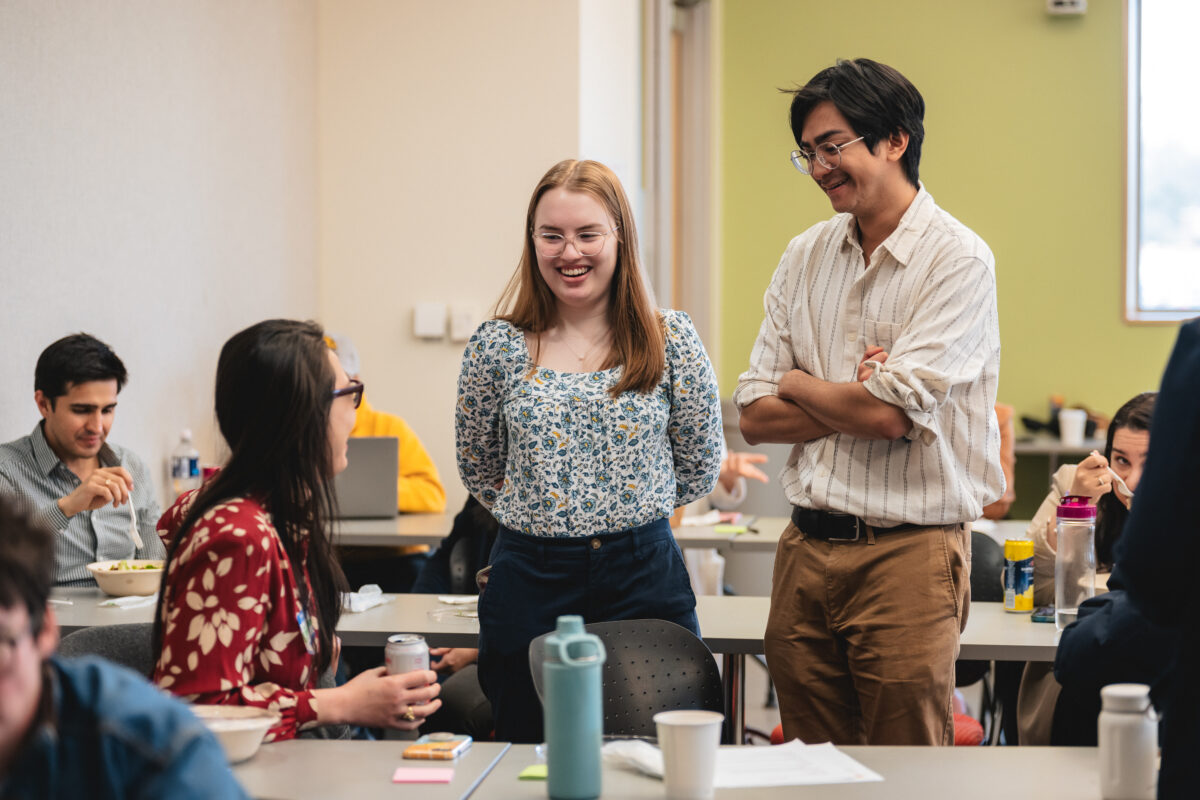 (l-r) Emily Yoon and students at the Global Asias Initiative launch workshop.
(Abnet Shiferaw)
UMBC’s existing Asian studies program and Asian American studies minor will grow into a more expansive Global Asias program that better serves and represents UMBC’s Asian American community, interested students, and beyond. This includes launching an undergraduate community-based research fellowship in Global Asias and the conversation series “Reframing Global Asias,” which invites prominent leaders, scholars, and community members in the field to present and discuss key issues, possibilities, challenges, and new research.
“Together,” says Bhalla, “we will create a forum for engaging in difficult yet productive intellectual conversations in Asian American studies, Asian diaspora studies, and Asian studies.”
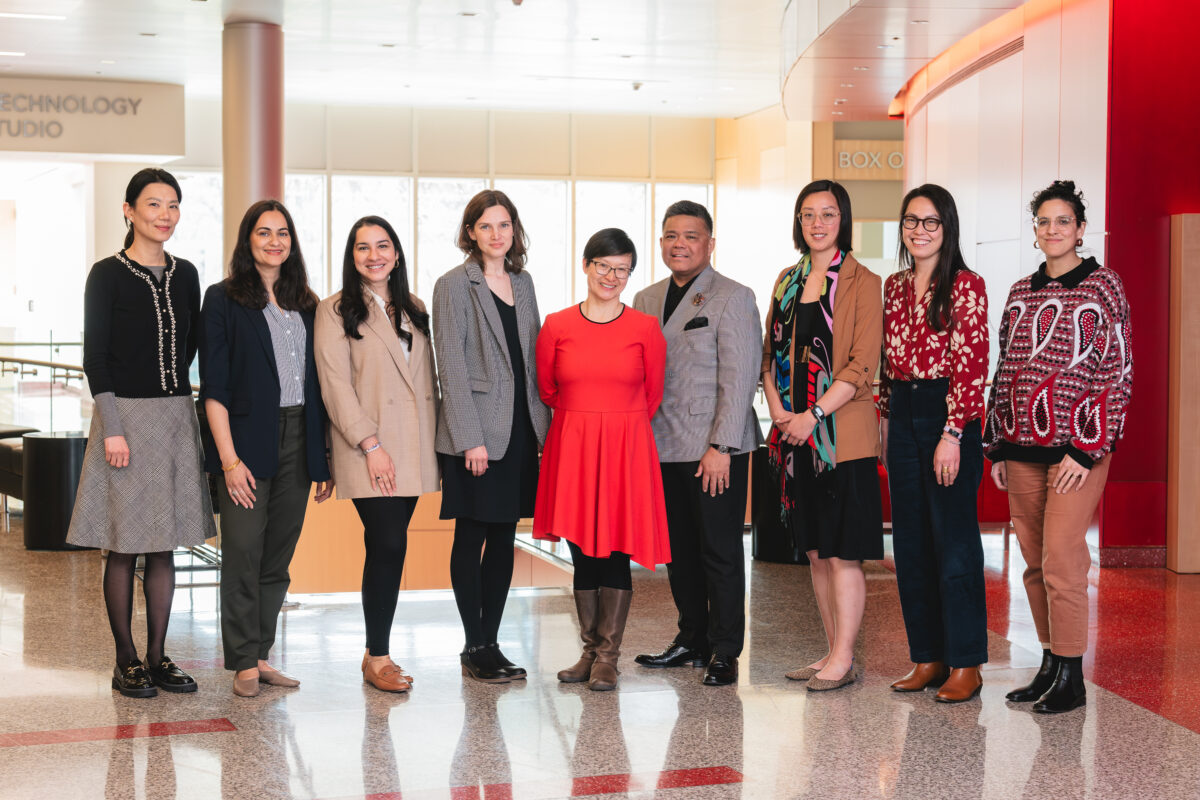 Global Asias Advisory Board, AY2023-2024. (l-r) Tamara Bhalla, Noor Zaidi, Meredith Oyen, Fan Yang, Theo Gonzalvez, Emily Yoon, and Priya Bhayana, project manager for the Global Asias Initiative. (Abnet Shiferaw)
Faculty across UMBC are collaborating to bring the Global Asia Initiative to fruition along with community partners:
-
Meredith Oyen, associate professor of history and director of the Asian studies program
-
Shin Yon Kim, Asian studies lecturer
-
Fan Yang, associate professor of media and communication studies
-
Emily Yoon, assistant professor of English
-
Noor Zaidi, assistant professor of history
-
Christopher Tong, associate professor of modern languages, linguistics, and intercultural communication
-
Theo Gonzalves, former American studies chair and professor, curator of Asian-Pacific American history at the Smithsonian National Museum of American History
-
Robbin Lee ’13, visual arts and media and communications studies, director of partnerships and mobilization at UpSurge Baltimore
Learn more about the Global Asias Iniatiave and Asian studies program.
]]>
Kimberly Moffitt, dean of the College of Arts, Humanities, and Socials Sciences, and co-pi Tamara Bhalla, associate professor of American studies and director of the Asian American studies minor,...
https://umbc.edu/quick-posts/umbc-to-establish-global-asias-initiative/
https://beta.my.umbc.edu/api/v0/pixel/news/140528/guest@my.umbc.edu/32bd2a6ff02002d0cfa31ee10d13251e/api/pixel
american-studies
asian-studies
cahss
english
history
mcs
mlli
news
policy-and-society
quick-post
quick-posts
research
visual-arts
UMBC News & Magazine
https://beta.my.umbc.edu/groups/umbc-news-magazine
https://assets1-beta.my.umbc.edu/system/shared/avatars/groups/000/001/943/24435aa6207c452e7bc15cc74b42c7bb/xsmall.png?1748556657
https://assets1-beta.my.umbc.edu/system/shared/avatars/groups/000/001/943/24435aa6207c452e7bc15cc74b42c7bb/original.png?1748556657
https://assets2-beta.my.umbc.edu/system/shared/avatars/groups/000/001/943/24435aa6207c452e7bc15cc74b42c7bb/xxlarge.png?1748556657
https://assets2-beta.my.umbc.edu/system/shared/avatars/groups/000/001/943/24435aa6207c452e7bc15cc74b42c7bb/xlarge.png?1748556657
https://assets3-beta.my.umbc.edu/system/shared/avatars/groups/000/001/943/24435aa6207c452e7bc15cc74b42c7bb/large.png?1748556657
https://assets1-beta.my.umbc.edu/system/shared/avatars/groups/000/001/943/24435aa6207c452e7bc15cc74b42c7bb/medium.png?1748556657
https://assets2-beta.my.umbc.edu/system/shared/avatars/groups/000/001/943/24435aa6207c452e7bc15cc74b42c7bb/small.png?1748556657
https://assets1-beta.my.umbc.edu/system/shared/avatars/groups/000/001/943/24435aa6207c452e7bc15cc74b42c7bb/xsmall.png?1748556657
https://assets2-beta.my.umbc.edu/system/shared/avatars/groups/000/001/943/24435aa6207c452e7bc15cc74b42c7bb/xxsmall.png?1748556657
UMBC News & Magazine
0
0
false
Wed, 03 Apr 2024 11:06:07 -0400
Wed, 03 Apr 2024 11:06:07 -0400
Leadership Transitions
Dear UMBC Community,
I write to you today to communicate about some significant changes at the leadership level of the university. I felt it was important to share this information with you, as well as our plans for navigating the changes, both in the short term and the long term.
Director of Athletics
Very soon, we will launch a national search for a new director of athletics, as Brian Barrio is no longer serving in the role. I have met with the Athletics Department staff—both administrative staff and coaches—and many student-athletes to discuss this transition and assure them of my continued support. As a search gets under way, I have asked two members of the administrative team to take on temporary co-leadership of the department. Whitney Ames, associate athletic director for compliance, and Rich Franchak, senior associate athletic director for business and finance, will be serving in this capacity. Thank you, Whitney and Rich, for your dedication and leadership.
Vice President for Government Relations and Community Affairs
Candace Dodson-Reed has resigned from her role leading government relations and community affairs. Yaakov “Jake” Weissmann ’06, who has been serving as associate vice president for government and community affairs, is stepping in to lead the office. A veteran of Maryland state politics, Jake served as chief of staff for two state senate presidents and as assistant chief administrative officer for Montgomery County Executive Marc Elrich before joining UMBC last year. He has already proven to be an outstanding and expert colleague and advisor, and I am grateful for his service to UMBC.
Vice President for Institutional Advancement
Greg Simmons is departing from his role leading advancement for UMBC. We will move quickly to conduct a national search, and we will update you on that process soon. In the near term, we are grateful to Stanyell Odom, director of alumni engagement, and Kim Robinson, director of major gifts, who have agreed to provide temporary management and leadership of the division and its operations. We know this is a busy time of year for our advancement colleagues, so we felt it was critical to designate key leaders who could serve as point people for their colleagues in the division and who would have a direct line of communication to me and others in senior leadership. Thank you, Stanyell and Kim, for serving in these roles.
Office of the General Counsel
Our search for a general counsel, following last year’s retirement of David Gleason, is under way, and I expect to name a new chief legal advisor for the university in the near future. Bobbie Hoye, who had been serving as the point of contact for the Office of the General Counsel, has left her role as senior associate general counsel.
These transitions are significant, and they follow other changes in our senior leadership personnel and structure since I arrived at UMBC in August 2022. I understand some may worry that such transitions will be destabilizing for UMBC, and I know the impact of these transitions is in many cases felt personally, not just operationally or institutionally. I assure you that we will work to move UMBC as swiftly as possible through this period while attending thoughtfully to stability, continuity, and care for the community.
Universities, many of them centuries old, have a remarkable capacity to endure and evolve through all manner of demands, challenges, and opportunities. UMBC may be younger than many of its peers, but it is no less remarkable in its ability to grow, adapt, renew, and rise to any challenge. In the weeks and months ahead, we will celebrate our graduates who make us so proud, and we will welcome the newest members of Retriever Nation from around the state and around the world. They have placed their trust, and their futures, in UMBC because they recognize that we are a dynamic public research university that is dedicated to inclusive excellence in everything we do. I have every confidence we are worthy of their trust and will exceed their ambitious expectations.
The mission and values of this institution are strong and sure. I believe in UMBC and in all of you, and I am as dedicated as ever to the work of creating UMBC’s future.
Sincerely,
President Valerie Sheares Ashby
]]>
Dear UMBC Community, I write to you today to communicate about some significant changes at the leadership level of the university. I felt it was important to share this information with you, as...
https://my3.my.umbc.edu/groups/announcements/posts/140492
https://beta.my.umbc.edu/api/v0/pixel/news/140508/guest@my.umbc.edu/3247210982f6ec50f4cc680cf67012f6/api/pixel
president
story
UMBC News & Magazine
https://beta.my.umbc.edu/groups/umbc-news-magazine
https://assets1-beta.my.umbc.edu/system/shared/avatars/groups/000/001/943/24435aa6207c452e7bc15cc74b42c7bb/xsmall.png?1748556657
https://assets1-beta.my.umbc.edu/system/shared/avatars/groups/000/001/943/24435aa6207c452e7bc15cc74b42c7bb/original.png?1748556657
https://assets2-beta.my.umbc.edu/system/shared/avatars/groups/000/001/943/24435aa6207c452e7bc15cc74b42c7bb/xxlarge.png?1748556657
https://assets2-beta.my.umbc.edu/system/shared/avatars/groups/000/001/943/24435aa6207c452e7bc15cc74b42c7bb/xlarge.png?1748556657
https://assets3-beta.my.umbc.edu/system/shared/avatars/groups/000/001/943/24435aa6207c452e7bc15cc74b42c7bb/large.png?1748556657
https://assets1-beta.my.umbc.edu/system/shared/avatars/groups/000/001/943/24435aa6207c452e7bc15cc74b42c7bb/medium.png?1748556657
https://assets2-beta.my.umbc.edu/system/shared/avatars/groups/000/001/943/24435aa6207c452e7bc15cc74b42c7bb/small.png?1748556657
https://assets1-beta.my.umbc.edu/system/shared/avatars/groups/000/001/943/24435aa6207c452e7bc15cc74b42c7bb/xsmall.png?1748556657
https://assets2-beta.my.umbc.edu/system/shared/avatars/groups/000/001/943/24435aa6207c452e7bc15cc74b42c7bb/xxsmall.png?1748556657
UMBC News & Magazine
1
0
false
Tue, 02 Apr 2024 18:52:10 -0400
Restaurateur and Retriever Lane Harlan goes back for seconds

Some have dark wood and cozy corners, some have bright, natural light and textured walls—but each of Lane Harlan’s establishments can be looked at like a love letter to the people of Baltimore, thoughtfully decorated with hand-chosen, local pieces and, in some cases, even the decor from her own living room.
The different vibes, each sumptuous in their own ways, are transporting for patrons. Harlan says that’s intentional. “I want them to feel like they’re elsewhere. They’re not in Baltimore, they’re somewhere else. I think it’s important if you can feel like you’re on an adventure.”
To say Harlan ’21, political science—the highly-accomplished restaurateur who opened W.C. Harlan, Clavel Mescaleria, Fadensonnen, the Coral Wig, and more—is well-known throughout Baltimore would be an understatement. Her acclaim continues to grow after the recent announcement that Clavel is a finalist for a coveted James Beard Award for “Outstanding Bar” (one step and one sip inside the unique taqueria and within a second, you’ll understand why). But while we all know of her success, it may come as a surprise that just like many students, she hit some academic roadblocks along the way.
The first course
When Harlan joined UMBC as a political science major in 2005, she was already a little different than your average first-year student. Growing up in a military family, she spent her childhood often moving. After graduating high school early, Harlan took her own version of a gap year, traveling to Spain to start her informal education in the hospitality industry. Upon return to Baltimore, she decided to set down roots at UMBC and experience life as an independent adult living in the city.
Brian Grodsky, political science chair, was one of the professors who helped Harlan connect with her major, especially in his classes about international justice.
“That class made me want to go to school forever. I felt like it was so fascinating and challenging at the same time,” says Harlan.
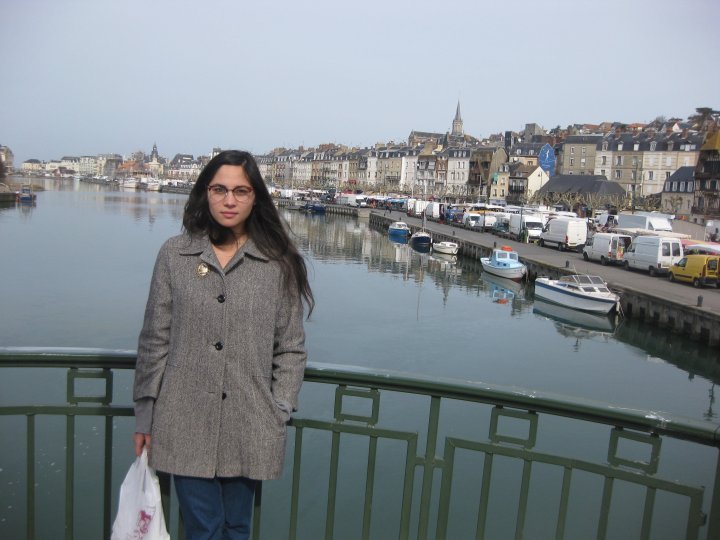 Harlan enjoys a trip abroad in France in 2010. (Photo courtesy of Harlan)
Reflecting back on the student he taught nearly 15 years prior, Grodsky remembers Harlan as “one of those students for whom class didn’t just stop when she went home—she was always grappling with issues long after we walked out of the classroom.”
But if her childhood taught her anything, Harlan knew she still had a lot of the world to explore. “Studying abroad was one of the most important things I did in college. And if I hadn’t gone to UMBC, I wouldn’t have had that opportunity,” says Harlan.
Harlan spent a year studying abroad in France, learning the restaurant and bar business from the ground up. While she excelled academically in her upper-level courses through UMBC, she struggled with her math requirement. And so, when the opportunity to return to France through a teaching assistantship arose, she jumped at the chance and eventually decided to leave her formal education at UMBC behind.
Recipe for success
Over the next several years, Harlan worked with partners to build her growing restaurant dynasty, starting with W.C. Harlan, a foreclosed upon former dive bar turned accidental speakeasy. But she harkened back to lessons she learned at UMBC to help her during the exhaustive process.
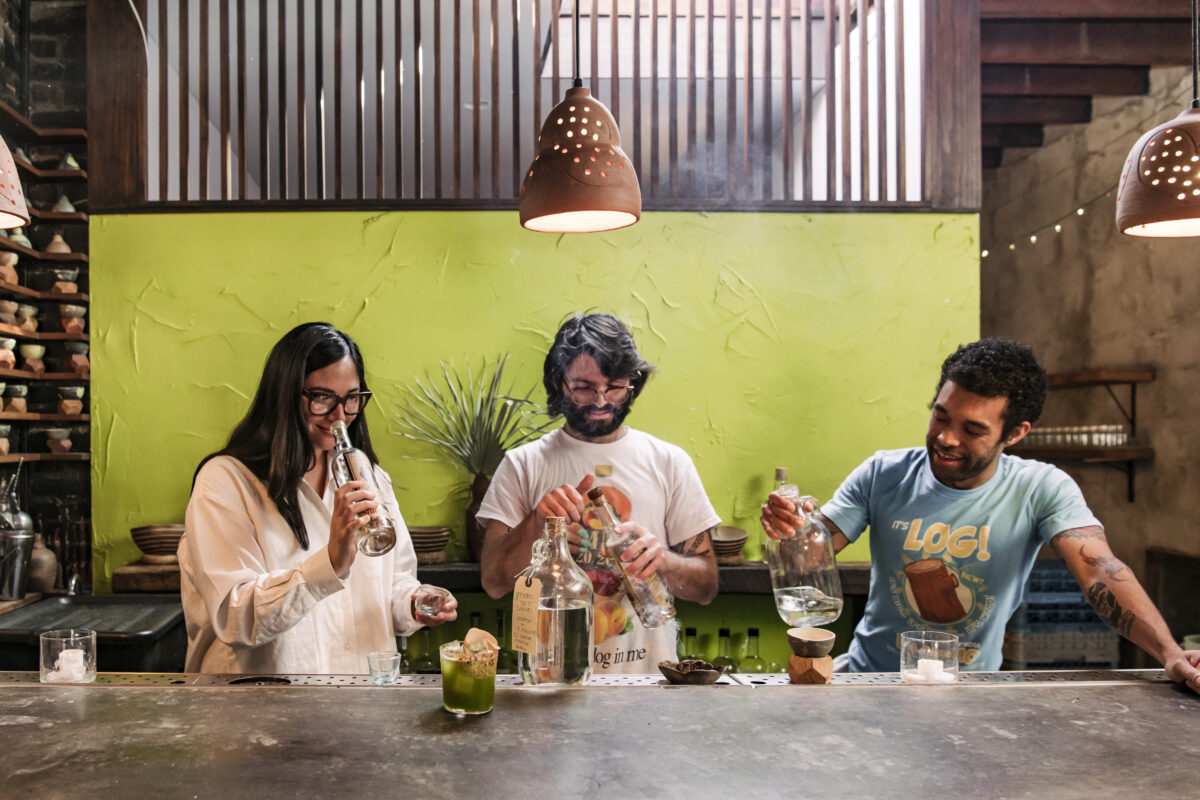 Behind the bar is where the magic happens and Harlan and her colleagues are testing out what they’ll serve patrons at Clavel that night. (Marlayna Demond ’11/UMBC)
“I used my sense of political science in that I was walking around with the petition to the neighbors, getting people to sign, saying that they supported the reopening of the bar, as well as taking it to the neighborhood associations and speaking with the council people,” she says.
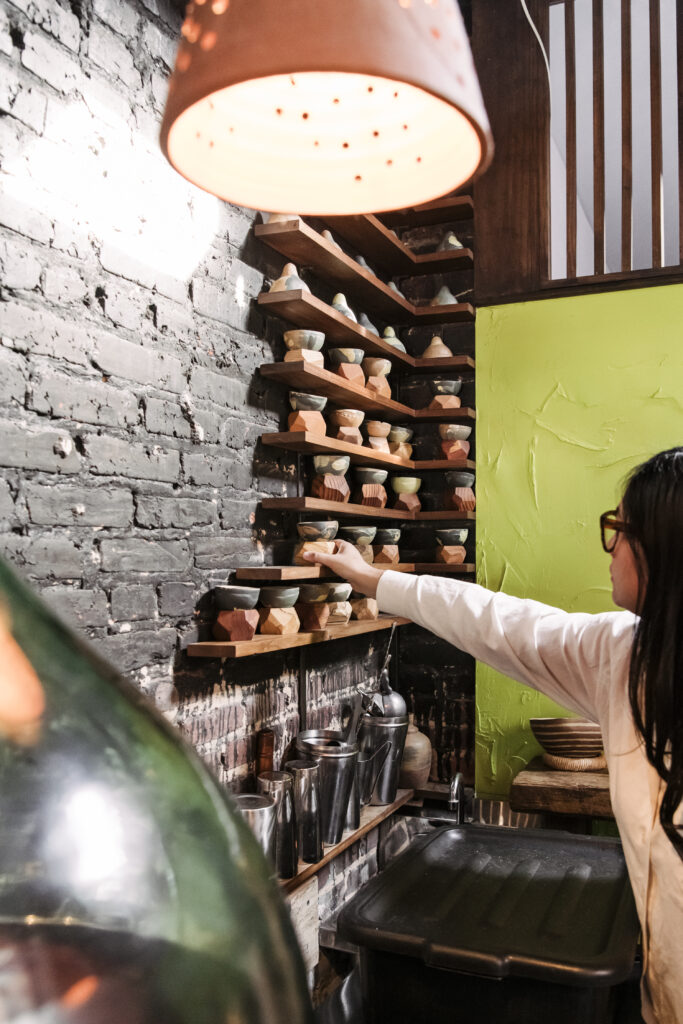 Harlan reaches for a functional and pleasingly aesthetic vessel for serving mezcal behind the bar. (Marlayna Demond ’11/UMBC)
After all this success, how is it that Harlan found herself back in the (virtual) UMBC classroom? In short—COVID.
“In the pandemic, businesses had to close, restaurants became carry-out operations, and suddenly there was more time in my life,” says Harlan. “I started to think about my time at UMBC, and I felt like I didn’t have closure from that period.”
Through UMBC’s Finish Line Program, Harlan re-enrolled and found herself again coming face to face with her one-time nemesis—the math requirement. She hired a tutor to come to Clavel once a week to help her study and go over homework. And though she admits it was difficult getting back into the swing of academia after so many years away, she persisted and completed her degree.
“I texted a photo of my diploma to my parents, and I said, ‘Dad, hang it on your wall! Be proud of me,’” she jokes. “But really, the reason I wanted to finish also was because everyone in life, you have many chapters, and I might want to have another chapter. And I knew I couldn’t do that without my undergraduate degree.”
While Harlan spends her free time traveling the world and even expanding her business ventures globally, she’s not going anywhere any time soon. “I love Baltimore. I can’t imagine my restaurants anywhere else, actually. I think Baltimore is filled with artists and opportunities and people who do things and they own them.”
]]>
Some have dark wood and cozy corners, some have bright, natural light and textured walls—but each of Lane Harlan’s establishments can be looked at like a love letter to the people of Baltimore,...
https://umbc.edu/stories/going-back-for-seconds/
https://beta.my.umbc.edu/api/v0/pixel/news/140495/guest@my.umbc.edu/a08cda9aad73f2ca01acb1a2a3b3e0db/api/pixel
alumni
cahss
magazine
polisci
spring-2024
story
UMBC News & Magazine
https://beta.my.umbc.edu/groups/umbc-news-magazine
https://assets1-beta.my.umbc.edu/system/shared/avatars/groups/000/001/943/24435aa6207c452e7bc15cc74b42c7bb/xsmall.png?1748556657
https://assets1-beta.my.umbc.edu/system/shared/avatars/groups/000/001/943/24435aa6207c452e7bc15cc74b42c7bb/original.png?1748556657
https://assets2-beta.my.umbc.edu/system/shared/avatars/groups/000/001/943/24435aa6207c452e7bc15cc74b42c7bb/xxlarge.png?1748556657
https://assets2-beta.my.umbc.edu/system/shared/avatars/groups/000/001/943/24435aa6207c452e7bc15cc74b42c7bb/xlarge.png?1748556657
https://assets3-beta.my.umbc.edu/system/shared/avatars/groups/000/001/943/24435aa6207c452e7bc15cc74b42c7bb/large.png?1748556657
https://assets1-beta.my.umbc.edu/system/shared/avatars/groups/000/001/943/24435aa6207c452e7bc15cc74b42c7bb/medium.png?1748556657
https://assets2-beta.my.umbc.edu/system/shared/avatars/groups/000/001/943/24435aa6207c452e7bc15cc74b42c7bb/small.png?1748556657
https://assets1-beta.my.umbc.edu/system/shared/avatars/groups/000/001/943/24435aa6207c452e7bc15cc74b42c7bb/xsmall.png?1748556657
https://assets2-beta.my.umbc.edu/system/shared/avatars/groups/000/001/943/24435aa6207c452e7bc15cc74b42c7bb/xxsmall.png?1748556657
UMBC News & Magazine
3
0
false
Tue, 02 Apr 2024 14:18:39 -0400
Tue, 02 Apr 2024 14:18:39 -0400
Meet a Retriever—Aiman Raza ’22, applied environmental researcher in UMBC’s ICARE graduate program
Meet Aiman Raza ’22, biological sciences, and a current biological sciences master’s student in the Interdisciplinary Consortium for Applied Research in the Environment (ICARE) program. After studying at UMBC as an undergraduate, Aiman is thrilled to continue her graduate journey at UMBC studying brook trout using environmental DNA (eDNA). She says building connections in her cohort has helped enrich her academic experience and see the importance of interdisciplinary collaborations in environmental work.
Q: What’s the one thing you’d want someone who hasn’t joined the UMBC community to know about it?
A: The diversity of the UMBC community is one of the biggest strengths of this institution. No matter your background or interests, there is always a space for you to grow and thrive at UMBC.
Q: Tell us about someone in the community who has inspired you or supported you.
A: My faculty advisor, Tamra Mendelson, professor of biological sciences, has inspired and supported me throughout my academic journey. I first met Tamra when I was a freshman, and her passion for her research left such an impression on me that I decided to join her lab three years later as a graduate student.
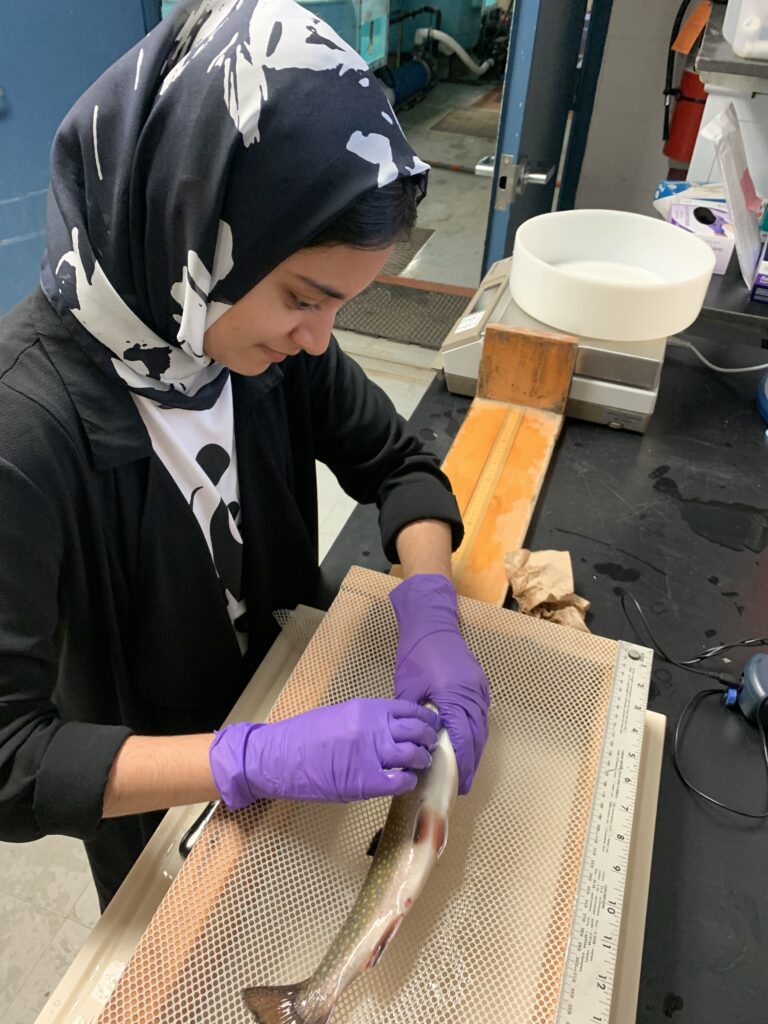 Aiman Raza tags a brook trout at the USGS Eastern Ecological Science Center in Leetown, WV, in January 2023. (Courtesy of Raza)
Q: Tell us about what you love about your academic program.
A: The ICARE program is making incredible strides in bridging the gap between research and environmental justice around Baltimore. With an interdisciplinary network of scientists and community leaders, ICARE is fulfilling its dual mission of increasing the diversity of the environmental workforce and conducting community-engaged research in and around Baltimore.
Q: What led you to pursue graduate education at UMBC?
A: I came back to UMBC as a master’s student because I was drawn to the ICARE program’s mission. I am passionate about conducting applied research with practical implications for my community. As an undergrad, I was involved with research in the biology department and heard about the ICARE program through my mentor. I knew that graduate school was the next step in pursuing a career in applied research, and the ICARE program’s goals aligned well with mine. I wanted to learn and grow in a program that brought diverse perspectives and focused on environmental justice in addressing environmental issues.
The ICARE program is making incredible strides in bridging the gap between research and environmental justice around Baltimore.
Aiman Raza ’22
Q: How has being part of a cohort-based program influenced your experience?
A: The ICARE program has cultivated a community of professionals who care deeply about building a more just and equitable future for all. Every day, I get to learn from my cohort members, who come from various backgrounds and disciplines. Their unique research projects and diverse perspectives have helped me realize the importance of interdisciplinary collaborations in environmental work. Building close connections with my cohort has enriched my graduate school experience both professionally and personally. I am constantly inspired by their passion and look forward to seeing the great work we accomplish in the future.
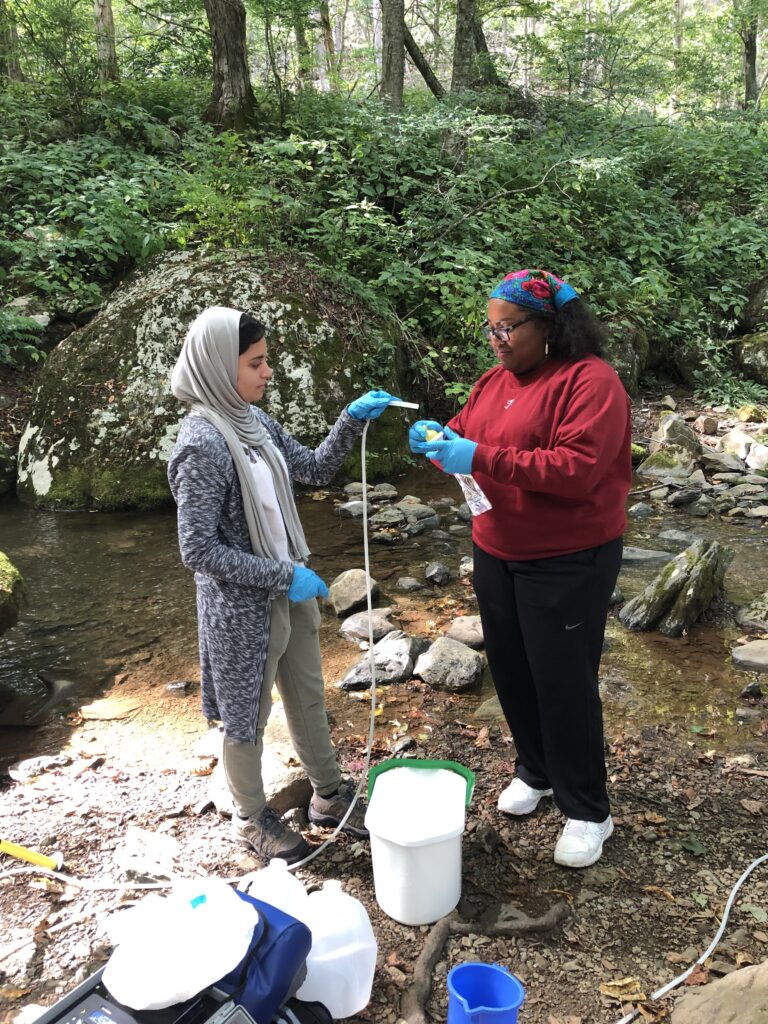 Aiman Raza (left) and fellow ICARE program member Autumn Powell collect water samples in Shenandoah National Park in September 2023. (Courtesy of Raza)
]]>
Meet Aiman Raza ’22, biological sciences, and a current biological sciences master’s student in the Interdisciplinary Consortium for Applied Research in the Environment (ICARE) program. After...
https://umbc.edu/stories/meet-a-retriever-aiman-raza-icare-masters-student/
https://beta.my.umbc.edu/api/v0/pixel/news/140545/guest@my.umbc.edu/35b69cce24da191080380fe45d77c793/api/pixel
alumni
biology
cnms
gradresearch
icare
impact
magazine
meet-a-retriever
perspectives
research
story
UMBC News & Magazine
https://beta.my.umbc.edu/groups/umbc-news-magazine
https://assets1-beta.my.umbc.edu/system/shared/avatars/groups/000/001/943/24435aa6207c452e7bc15cc74b42c7bb/xsmall.png?1748556657
https://assets1-beta.my.umbc.edu/system/shared/avatars/groups/000/001/943/24435aa6207c452e7bc15cc74b42c7bb/original.png?1748556657
https://assets2-beta.my.umbc.edu/system/shared/avatars/groups/000/001/943/24435aa6207c452e7bc15cc74b42c7bb/xxlarge.png?1748556657
https://assets2-beta.my.umbc.edu/system/shared/avatars/groups/000/001/943/24435aa6207c452e7bc15cc74b42c7bb/xlarge.png?1748556657
https://assets3-beta.my.umbc.edu/system/shared/avatars/groups/000/001/943/24435aa6207c452e7bc15cc74b42c7bb/large.png?1748556657
https://assets1-beta.my.umbc.edu/system/shared/avatars/groups/000/001/943/24435aa6207c452e7bc15cc74b42c7bb/medium.png?1748556657
https://assets2-beta.my.umbc.edu/system/shared/avatars/groups/000/001/943/24435aa6207c452e7bc15cc74b42c7bb/small.png?1748556657
https://assets1-beta.my.umbc.edu/system/shared/avatars/groups/000/001/943/24435aa6207c452e7bc15cc74b42c7bb/xsmall.png?1748556657
https://assets2-beta.my.umbc.edu/system/shared/avatars/groups/000/001/943/24435aa6207c452e7bc15cc74b42c7bb/xxsmall.png?1748556657
UMBC News & Magazine
2
0
false
Mon, 01 Apr 2024 15:58:34 -0400
Aiman Raza (left) and fellow ICARE program member Autumn Powell collect water samples in Shenandoah National Park in September 2023. (Courtesy of Raza)
]]>
Meet Aiman Raza ’22, biological sciences, and a current biological sciences master’s student in the Interdisciplinary Consortium for Applied Research in the Environment (ICARE) program. After...
https://umbc.edu/stories/meet-a-retriever-aiman-raza-icare-masters-student/
https://beta.my.umbc.edu/api/v0/pixel/news/140545/guest@my.umbc.edu/35b69cce24da191080380fe45d77c793/api/pixel
alumni
biology
cnms
gradresearch
icare
impact
magazine
meet-a-retriever
perspectives
research
story
UMBC News & Magazine
https://beta.my.umbc.edu/groups/umbc-news-magazine
https://assets1-beta.my.umbc.edu/system/shared/avatars/groups/000/001/943/24435aa6207c452e7bc15cc74b42c7bb/xsmall.png?1748556657
https://assets1-beta.my.umbc.edu/system/shared/avatars/groups/000/001/943/24435aa6207c452e7bc15cc74b42c7bb/original.png?1748556657
https://assets2-beta.my.umbc.edu/system/shared/avatars/groups/000/001/943/24435aa6207c452e7bc15cc74b42c7bb/xxlarge.png?1748556657
https://assets2-beta.my.umbc.edu/system/shared/avatars/groups/000/001/943/24435aa6207c452e7bc15cc74b42c7bb/xlarge.png?1748556657
https://assets3-beta.my.umbc.edu/system/shared/avatars/groups/000/001/943/24435aa6207c452e7bc15cc74b42c7bb/large.png?1748556657
https://assets1-beta.my.umbc.edu/system/shared/avatars/groups/000/001/943/24435aa6207c452e7bc15cc74b42c7bb/medium.png?1748556657
https://assets2-beta.my.umbc.edu/system/shared/avatars/groups/000/001/943/24435aa6207c452e7bc15cc74b42c7bb/small.png?1748556657
https://assets1-beta.my.umbc.edu/system/shared/avatars/groups/000/001/943/24435aa6207c452e7bc15cc74b42c7bb/xsmall.png?1748556657
https://assets2-beta.my.umbc.edu/system/shared/avatars/groups/000/001/943/24435aa6207c452e7bc15cc74b42c7bb/xxsmall.png?1748556657
UMBC News & Magazine
2
0
false
Mon, 01 Apr 2024 15:58:34 -0400
 This illustration of the front view of the James Webb Space Telescope shows its sun shield and golden mirrors. NASA/ESA/CSA/Northrop Grumman
 The James Webb Space Telescope can see back 13.5 billion years – back to when the first stars and galaxies began to form. STScI
 This is a JWST image of NGC 604, a star-forming region about 2.7 million light years from Earth. NASA/ESA/CSA/STScI