Vote in the 2024 SGA Elections
Dear Students,
Student Government Association (SGA) election season is upon us! Every undergraduate student is a member of the SGA, and the SGA serves to represent undergraduates in the shared work of creating the best possible student experience and advancing the university.
The 2024 SGA elections are soon to be under way: Online early voting begins at 5 p.m. on Friday, April 12, and runs through Sunday, April 14. You can vote in person on campus between 10 a.m. and 7 p.m. Monday, April 15, through Thursday, April 18.
The elections matter, because SGA’s work is important—to you and to all of UMBC. Please take some time to visit SGA’s website to learn about the candidates in all of the races and find out about voting locations and hours. Then, cast your vote so that your voice is heard.
Sincerely,
President Valerie Sheares Ashby
]]>
Dear Students, Student Government Association (SGA) election season is upon us! Every undergraduate student is a member of the SGA, and the SGA serves to represent undergraduates in the...
https://my3.my.umbc.edu/groups/announcements-undergraduates/posts/140769
https://beta.my.umbc.edu/api/v0/pixel/news/140827/guest@my.umbc.edu/5232e05de43ea28c61e2b0ab43bc4ead/api/pixel
president
story
UMBC News & Magazine
https://beta.my.umbc.edu/groups/umbc-news-magazine
https://assets1-beta.my.umbc.edu/system/shared/avatars/groups/000/001/943/24435aa6207c452e7bc15cc74b42c7bb/xsmall.png?1748556657
https://assets1-beta.my.umbc.edu/system/shared/avatars/groups/000/001/943/24435aa6207c452e7bc15cc74b42c7bb/original.png?1748556657
https://assets2-beta.my.umbc.edu/system/shared/avatars/groups/000/001/943/24435aa6207c452e7bc15cc74b42c7bb/xxlarge.png?1748556657
https://assets2-beta.my.umbc.edu/system/shared/avatars/groups/000/001/943/24435aa6207c452e7bc15cc74b42c7bb/xlarge.png?1748556657
https://assets3-beta.my.umbc.edu/system/shared/avatars/groups/000/001/943/24435aa6207c452e7bc15cc74b42c7bb/large.png?1748556657
https://assets1-beta.my.umbc.edu/system/shared/avatars/groups/000/001/943/24435aa6207c452e7bc15cc74b42c7bb/medium.png?1748556657
https://assets2-beta.my.umbc.edu/system/shared/avatars/groups/000/001/943/24435aa6207c452e7bc15cc74b42c7bb/small.png?1748556657
https://assets1-beta.my.umbc.edu/system/shared/avatars/groups/000/001/943/24435aa6207c452e7bc15cc74b42c7bb/xsmall.png?1748556657
https://assets2-beta.my.umbc.edu/system/shared/avatars/groups/000/001/943/24435aa6207c452e7bc15cc74b42c7bb/xxsmall.png?1748556657
UMBC News & Magazine
1
0
false
Thu, 11 Apr 2024 15:26:41 -0400
Stitching it all together, or how Ephraim Ruttenberg ’25 got hooked on math and crochet

In the back of a classroom, at a desk strewn with a colorful palette of commingled notebooks and skeins of yarn, sits Ephraim Ruttenberg ’25, mathematics. His fingers nimbly and nearly subconsciously manipulate a crochet hook while his ears eagerly take in a lecture on differential equations—one of his favorite subjects. Ruttenberg loves unraveling the principles behind complex theorems, and he’s eagerly extended that passion from mathematics to crochet.
Ruttenberg’s first love is math—he only picked up crochet in 2023 after seeing a math YouTuber explaining concepts with crocheted models of mathematical forms. But Ruttenberg’s math-themed crochet, where he creates intricate 3D shapes that bring abstract ideas into the physical world, has quickly become an important part of his life.
“Anything creative and artistic very much appeals to me, and I’m very inspired by what other people can make. Art seems to be a core part of the human experience,” Ruttenberg says. In particular, he says, “I like visual art. And this is the most fun and success I’ve had with making visual art.”
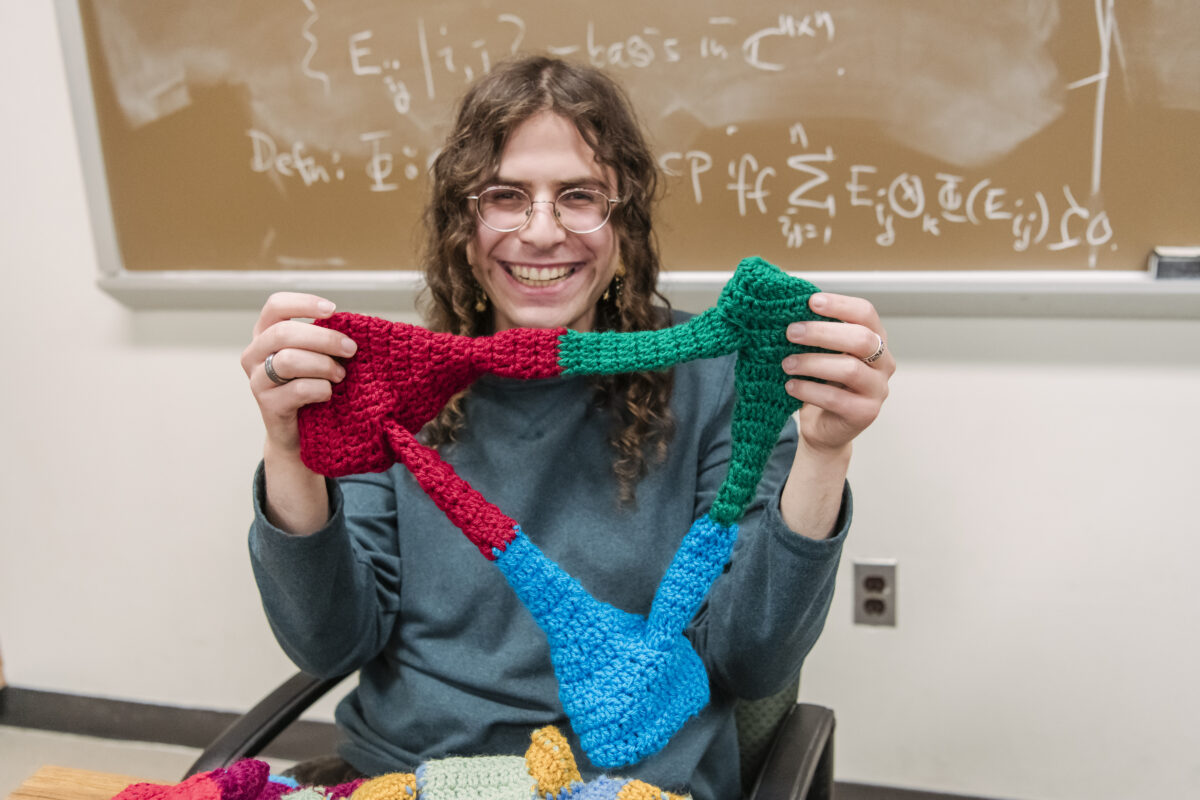 One of Ruttenberg’s creations is three Klein bottles stitched together. (Marlayna Demond ’11/UMBC)
Klein bottles and sea slugs
Although Ruttenberg’s primary motivation for pursuing crochet is as a hobby distinct from mathematics, as something to do with his hands while his mind chews on other things and simply as a way to create beautiful physical objects, he couldn’t help weaving in some math. He relies on a shape’s mathematical properties and reference images to translate them into crochet.
The shapes Ruttenberg creates include Klein bottles, single-sided surfaces reminiscent of Möbius strips closed up on themselves. Ruttenberg created a Klein bottle that can be worn as a hat, and another creation stitches three Klein bottles together. He’s also constructed dozens of what are called saddle surfaces, which are examples of “curved space” and look a lot like a brain coral or a sea slug with all of their folds and convolutions. Ruttenberg used three complete skeins of yarn—that’s nine football fields in length—to stitch the largest of these, and the surface’s curvaceous outer edge measures 50 feet despite it only being about a foot across.
 This saddle surface is Ruttenberg’s largest. Each shade of green required the same length of yarn, demonstrating how much the curvature adds length as you approach the perimeter of the piece. (Marlayna Demond ’11/UMBC)
Through his creations, Ruttenberg is hoping to investigate some mathematical concepts “that haven’t been explored in physical reality,” he says. “Also, I would like to do some math about crochet,” he says, such as how the physical properties of a crocheted object influence or define the pattern that describes it. In addition to the math, though, crochet for Ruttenberg is also “a creative, artistic pursuit.”
The beauty of patterns

Ruttenberg doesn’t use traditional crochet patterns for his work, choosing instead to invent his own shorthand notation for various stitches. “Because I like to make it up as I go along, it’s a little more satisfying to me,” he says. In fact, the symbols for stitches in crochet patterns echo the symbols and patterns in mathematics that he enjoys. “I was always interested in the aesthetics and visuals of math; all the symbols and things were sort of fascinating to me,” he shares.
This eye for patterns extends to Ruttenberg’s other interests and hobbies, like word games and juggling. “I love English spelling. I think the confluence of different languages is super cool. It makes patterns that I find very aesthetically pleasing,” he says. Ruttenberg is a Scrabble aficionado and typically has an online game going with friends.
Even mathematics has its own language to absorb. While the discipline’s lingo may puzzle non-mathematicians, “Something that I love about mathematics is all the different words, and all the jargon,” Ruttenberg says. “I love that math co-opts all these normal words for very technical things,” he says, like “ring” or “flag.”
With juggling, “There’s some math in there if you get into complicated patterns,” he says. “It’s all about permutations, and ‘How long does this ball stay in the air?’, and all that.”
Threading math joy throughout life
Ruttenberg is selling a few of his creations on Etsy, and he takes time to share his passion for mathematics in other ways. He tutors students from elementary school through college.
“I like the puzzle of teaching someone something, especially if they already have a misconception of the material that’s not serving them,” Ruttenberg says. “That, I find, is a cool puzzle—what’s the core of the misunderstanding here, and how can we give them a better way of thinking about it?”
Justin Webster, associate professor of mathematics and Ruttenberg’s academic advisor, quickly noted his mathematical talent and willingness to help others when Ruttenberg was in one of his courses. Ruttenberg is the president of UMBC’s chapter of Pi Mu Epsilon, the national mathematics honor society, which serves as UMBC’s math club. Pi Mu Epsilon hosts events for students and participates in outreach at local middle and high schools.
 Justin Webster serves as Ruttenberg’s academic advisor and the faculty advisor to UMBC’s chapter of Pi Mu Epsilon, the national mathematics honor society.
At these events, “Ephraim’s crochet work always steals the show,” Webster says. “The students are perplexed and engaged by his work. It is wonderful to have something which is both visual and tactile to engage the younger students.”
In part as a result of Webster’s mentoring, Ruttenberg plans to pursue a Ph.D. after graduating from UMBC. Exactly what he’ll study is uncertain. “Ephraim’s interests are very broad. And, like him, they are unique,” Webster says. “There is a certain amount of intellectual confidence that he has, which is rare.”
Ruttenberg will carry that confidence paired with generosity as he moves forward, melding his artistic and mathematical instincts in the world as he perceives it—a world where abstract theorems collide with soft fibers, and the geometry of a sphere meets the warmth of scarves. His work proves that equations need not be confined to dusty textbooks; they can be stitched into existence, one loop at a time.
]]>
In the back of a classroom, at a desk strewn with a colorful palette of commingled notebooks and skeins of yarn, sits Ephraim Ruttenberg ’25, mathematics. His fingers nimbly and nearly...
https://umbc.edu/stories/stitching-it-all-together-math-and-crochet/
https://beta.my.umbc.edu/api/v0/pixel/news/140828/guest@my.umbc.edu/1593675d67ced084d5a5cf66454a07b4/api/pixel
campus-life
cnms
magazine
mathstat
story
UMBC News & Magazine
https://beta.my.umbc.edu/groups/umbc-news-magazine
https://assets1-beta.my.umbc.edu/system/shared/avatars/groups/000/001/943/24435aa6207c452e7bc15cc74b42c7bb/xsmall.png?1748556657
https://assets1-beta.my.umbc.edu/system/shared/avatars/groups/000/001/943/24435aa6207c452e7bc15cc74b42c7bb/original.png?1748556657
https://assets2-beta.my.umbc.edu/system/shared/avatars/groups/000/001/943/24435aa6207c452e7bc15cc74b42c7bb/xxlarge.png?1748556657
https://assets2-beta.my.umbc.edu/system/shared/avatars/groups/000/001/943/24435aa6207c452e7bc15cc74b42c7bb/xlarge.png?1748556657
https://assets3-beta.my.umbc.edu/system/shared/avatars/groups/000/001/943/24435aa6207c452e7bc15cc74b42c7bb/large.png?1748556657
https://assets1-beta.my.umbc.edu/system/shared/avatars/groups/000/001/943/24435aa6207c452e7bc15cc74b42c7bb/medium.png?1748556657
https://assets2-beta.my.umbc.edu/system/shared/avatars/groups/000/001/943/24435aa6207c452e7bc15cc74b42c7bb/small.png?1748556657
https://assets1-beta.my.umbc.edu/system/shared/avatars/groups/000/001/943/24435aa6207c452e7bc15cc74b42c7bb/xsmall.png?1748556657
https://assets2-beta.my.umbc.edu/system/shared/avatars/groups/000/001/943/24435aa6207c452e7bc15cc74b42c7bb/xxsmall.png?1748556657
UMBC News & Magazine
3
0
false
Thu, 11 Apr 2024 15:18:13 -0400
Thu, 11 Apr 2024 15:18:13 -0400
First data from UMBC’s HARP2 instrument on NASA PACE mission goes public

Data from NASA’s newest Earth-observing satellite, which will provide insight into ocean health, air quality, and the effects of a changing climate, are now available. The Plankton, Aerosol, Cloud, ocean Ecosystem (PACE) satellite launched on February 8, and after several subsequent weeks of testing of the spacecraft and instruments, the mission is gathering data that the public can access.
PACE includes three instruments: The Ocean Color Instrument (OCI), built at NASA Goddard Space Flight Center, observes the ocean, land, and atmosphere across more than 200 unique wavelengths spanning ultraviolet, visible, and near infrared light. It is particularly suited to identifying phytoplankton communities in the ocean.
HARP2, designed and built by UMBC scientists and engineers, and SPEXOne, built at the Netherlands Institute for Space Research (SRON) and Airbus Netherlands B.V., are both polarimeters, which measure light that has reflected off clouds and particles in the atmosphere. These particles, known as aerosols, can range from dust to smoke to sea spray and more.
“First light,” as the first data received from satellites in orbit is known, is a key milestone in the progression of any scientific instrument destined for space.
“When I look at the first light PACE images, I feel like I have put on magical eye glasses and am seeing the true characteristics of aerosol plumes from a satellite for the first time.”
Lorraine Remer
UMBC Climate Scientist
“To me, first light means the conclusion of all the engineering work to develop HARP2 and the beginning of our science quest exploring and understanding the data from PACE,” shares Vanderlei Martins, professor of physics at UMBC and lead of the HARP2 team. “First light means ‘It is working!’ and the question right after first light is, ‘What does it mean?’”
Answering big questions about Earth’s interrelated systems
With data from PACE’s polarimeters, scientists will be able to measure cloud properties and monitor, analyze, and identify atmospheric aerosols to better inform the public about air quality. Scientists will also be able to learn how aerosols interact with clouds and impact cloud formation, which is essential to creating accurate climate models.
The HARP2 team will focus on air pollution, the effect of aerosols produced by humans on cloud formation, and the energy balance of the planet, Martins says. “We will learn about the type of aerosols in Earth’s atmosphere: What they look like in terms of size and shape matters in terms of their health effects,” he says. “The way they absorb and scatter light affects how they interact with solar radiation and influence the energy balance of the planet: Do they produce heating or cooling of the planet, and in which circumstances?”
“I have plans to use PACE aerosol and ocean products to better understand how nutrient-rich aerosols are deposited into the global ocean and how ocean plankton communities respond to this nutrient source,” adds Lorraine Remer, a UMBC climate researcher affiliated with the Goddard Earth Science Technology and Research Center II, one of UMBC’s NASA-partnered research centers.
First, though, “We will spend the next weeks and months tuning our parameters to coax out the most and best possible information on aerosols and clouds,” Remer says. “Then, the next step is to compare PACE’s output with established sensors on the ground.” A validation experiment in September 2024 called PACE-PAX will enable and encourage those comparisons.
 The Ocean Color Instrument (OCI) has the unique ability to detect light that allows scientists to differentiate among communities of phytoplankton. This first image released from OCI identifies two different communities of these microscopic marine organisms in the ocean off the coast of South Africa on February 28, 2024. The central panel shows Synechococcus in pink and picoeukaryotes in green. The left panel shows a natural color view of the ocean, and the right panel displays the concentration of chlorophyll-a, a photosynthetic pigment used to identify the presence of phytoplankton. (Image by NASA)
PACE lets scientists put on “magical eye glasses”
Because of the power and unique capabilities of the instruments on PACE, “We see confident atmospheric parameters that have never been seen from any previous NASA mission,” Remer says. And because the data will be completely public, the benefits will go far beyond work that current PACE scientists will do.
“PACE data will be free for everyone around the globe and will be useful for decades to come,” Martins says. “Events on Earth will come and go, and they will be recorded forever by the PACE sensors. Beyond our own science studying aerosols, clouds, and the energy balance of the planet, this data will be explored by students and scientists for all sorts of applications that I can’t even imagine.”
Martins expects UMBC scientists to write proposals to analyze PACE data for many years, and many of these projects will involve opportunities for students at all levels to gain experience with research. For now, PACE scientists are still relishing the successful launch and return of first light from the PACE instruments.
“When I look at the first light PACE images,” Remer says, “I feel like I have put on magical eye glasses and am seeing the true characteristics of aerosol plumes from a satellite for the first time.”
Jeremy Werdell, PACE project scientist, shepherded the project from start to finish, beginning when Martins pitched him the idea of including a HARP2-like instrument on board. “We’ve been dreaming of PACE-like imagery for over two decades. It’s surreal to finally see the real thing,” he says. “The data from all three instruments is of such high quality that we can start distributing it publicly less than two months from launch, and I’m proud of our team for making that happen.”
]]>
Data from NASA’s newest Earth-observing satellite, which will provide insight into ocean health, air quality, and the effects of a changing climate, are now available. The Plankton, Aerosol,...
https://umbc.edu/stories/first-light-from-harp2-on-pace/
https://beta.my.umbc.edu/api/v0/pixel/news/140823/guest@my.umbc.edu/f6e83a436b1feb9f205418cba2f162e3/api/pixel
cnms
esi
gestar2
news
physics
research
science-and-tech
story
UMBC News & Magazine
https://beta.my.umbc.edu/groups/umbc-news-magazine
https://assets1-beta.my.umbc.edu/system/shared/avatars/groups/000/001/943/24435aa6207c452e7bc15cc74b42c7bb/xsmall.png?1748556657
https://assets1-beta.my.umbc.edu/system/shared/avatars/groups/000/001/943/24435aa6207c452e7bc15cc74b42c7bb/original.png?1748556657
https://assets2-beta.my.umbc.edu/system/shared/avatars/groups/000/001/943/24435aa6207c452e7bc15cc74b42c7bb/xxlarge.png?1748556657
https://assets2-beta.my.umbc.edu/system/shared/avatars/groups/000/001/943/24435aa6207c452e7bc15cc74b42c7bb/xlarge.png?1748556657
https://assets3-beta.my.umbc.edu/system/shared/avatars/groups/000/001/943/24435aa6207c452e7bc15cc74b42c7bb/large.png?1748556657
https://assets1-beta.my.umbc.edu/system/shared/avatars/groups/000/001/943/24435aa6207c452e7bc15cc74b42c7bb/medium.png?1748556657
https://assets2-beta.my.umbc.edu/system/shared/avatars/groups/000/001/943/24435aa6207c452e7bc15cc74b42c7bb/small.png?1748556657
https://assets1-beta.my.umbc.edu/system/shared/avatars/groups/000/001/943/24435aa6207c452e7bc15cc74b42c7bb/xsmall.png?1748556657
https://assets2-beta.my.umbc.edu/system/shared/avatars/groups/000/001/943/24435aa6207c452e7bc15cc74b42c7bb/xxsmall.png?1748556657
UMBC News & Magazine
2
0
false
Thu, 11 Apr 2024 15:05:00 -0400
Thu, 11 Apr 2024 15:05:00 -0400
Domestic violence survivors seek homeless services from a system that often leaves them homeless

Written by Nkiru Nnawulezi, associate professor of psychology at UMBC, and Lauren Cattaneo, George Mason University
About 1 in every 3 women, and 1 in 4 men, will experience domestic violence over their lifetime. Since domestic violence can escalate to the point of serious injury or murder, survivors must take action to increase their safety – potentially even fleeing their homes.
Of the total homicides that occurred in the U.S. in 2020, 34% of women and 6% of men were murdered by their intimate partners.
Research has clearly shown the connection between domestic violence and homelessness. For example, a California study found that domestic violence survivors were four times more likely to experience housing instability compared with those who hadn’t experienced domestic violence.
We are two psychologists based in Washington D.C., who study the experiences, struggles and strengths of domestic violence survivors.
In Washington, 1 in 4 people experiencing homelessness report a history of domestic violence, with nearly half citing it as the direct reason for their homelessness.
Domestic violence and housing instability
Housing instability brings its own set of problems for survivors, including poor health, economic insecurity and the risk of future violence. These stresses can lead survivors back to the abusive relationship or into other unsafe housing situations.
Because the vicious cycle between domestic violence and housing instability is well known, domestic violence experts have argued for policies to provide quick, specialized assistance for survivors who seek emergency housing support.
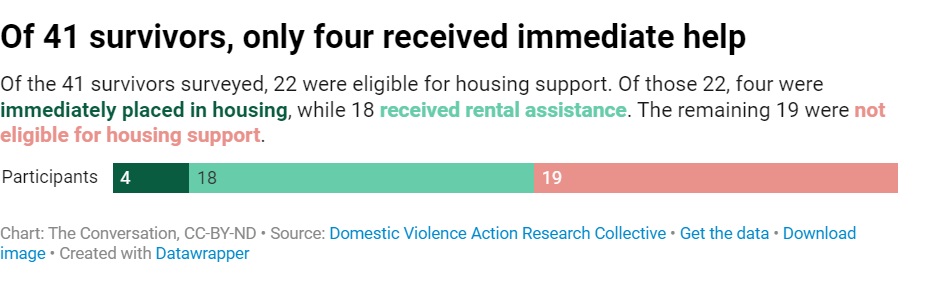
Too often, however, these policies fall flat. Our 2018-2019 study of domestic violence survivors in the city’s services for homelessness found that out of 41 participants, only four received immediate housing, with either a bed in a shelter or a hotel.
We collaborate with domestic violence advocates and attorneys as members of the Domestic Violence Action Research Collective, a project of the DC Coalition Against Domestic Violence. This group collectively decides on research questions through discussions about what hinders community practitioners’ ability to support domestic violence survivors.
Domestic violence advocates and attorneys in our group alerted us to repeated stories about how the district government’s homelessness services system was failing survivors. The group designed a study to find out why.
Survivors’ access to homelessness services
From May 2018 to May 2019, our team recruited study participants in the waiting room of the Virginia Williams Family Resource Center, which is the gateway for families needing emergency housing in Washington.
Of 779 clients we screened, 183 responded that domestic violence was the reason for their housing instability; 41 of those agreed to interviews about their experiences accessing homelessness services.
A Washington law states that survivors of domestic violence do not have to prove their residency in the district in order to be eligible for homeless services. Policy also dictates that survivors should be asked questions to sensitively assess their circumstances and should meet with an on-site domestic violence housing coordinator to connect them with resources.
Instead of receiving this specialized assistance, many of our participants said they found the intake process confusing and unpredictable. Almost half said they waited more than three hours to meet with staff, sometimes only to find out they needed different information to prove eligibility and would have to restart the process another day.
Participants told us that they hesitated to disclose their domestic violence experiences to staff and described inconsistent responses when they did. Of 20 participants who said they did disclose experiences with domestic violence during their intake, only 11 said they were asked about their experiences by staff, and only two met with the domestic violence specialist at the facility. Several participants shared that when they revealed experiences of domestic violence, staff members simply moved on without asking for further details.
The lack of assistance in response to the disclosure of domestic violence left many participants in distress. As one participant described it: “I left feeling discouraged and embarrassed that I told all of these people I did not know my business, just for them to say it wasn’t good enough.”
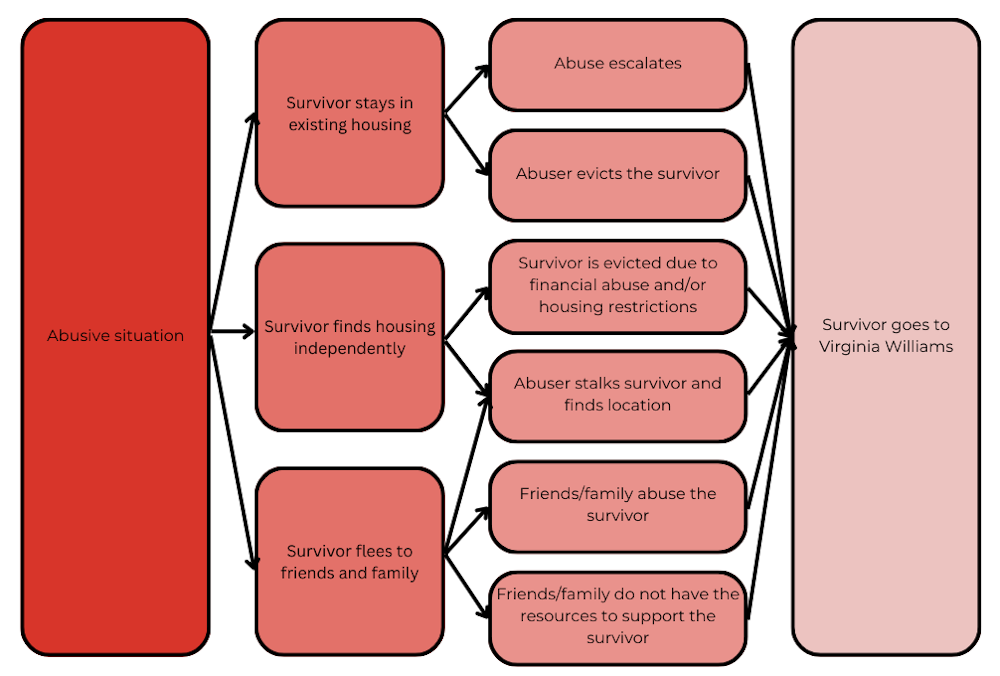
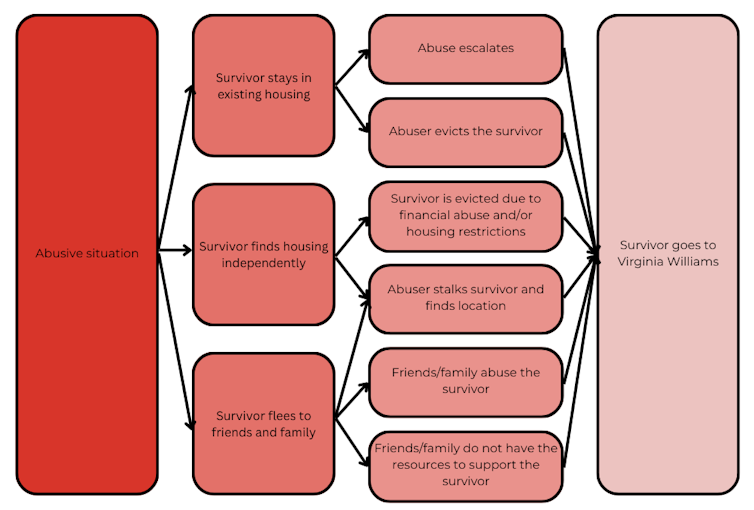 A flowchart shows how participants started in abusive situations and ended up seeking services at Virginia Williams. The Conversation, derived from Domestic Violence Action Research Collective, CC BY-ND
The impact of homelessness services on survivors
Many participants felt that staff ignored their safety concerns, especially when staff insisted that survivors stay with friends, family or their abusive partner, rather than using public resources. Participants said that staff sometimes even contacted those individuals without survivors’ knowledge.
Only 22 of our 41 participants were deemed eligible for services. Four received immediate shelter. Eighteen participants received referrals to public or private sources of housing assistance, or both, but too often these resources were also dead ends. Participants were put on long waitlists, landlords didn’t accept vouchers, or referral options were not responsive to participants’ immediate needs.
For example, a frequent referral was “rapid rehousing” – a program that provides governmental rental subsidies for up to one year, after which people must pay their own rent. Survivors who are eligible for rapid rehousing must find affordable housing in the district, which is a formidable obstacle to program effectiveness.
As one survivor put it: “Where am I going to be able to rent at, that’s not a slumlord, or not in certain dangerous neighborhoods? I’m looking for safety. Running to safety doesn’t mean that I’m trying to run into harm.”
The 19 survivors ineligible for services were given varied reasons, often involving their inability to prove they were homeless. Ten participants told us that at the time they left Virginia Williams, they and their children had nowhere to go. Leaving without assistance prompted difficult choices, including maxing out credit cards to stay in hotels or begging to stay with family and friends in conditions that created new problems.
Some of the people we interviewed believed that the denial of assistance was due to racist and classist stereotypes of Black women seeking to “exploit the system.” Given that 39 of the 41 participants in this study were Black, as was the majority of the clientele at the center, we believe the possibility that racial bias influenced the frequent denial of services is significant.
Underserving domestic violence survivors
If we focus just on the interaction between staff and participants, the simplest interpretation of these results could be that staff are uninformed, unfeeling or both. Or one might wonder whether something is amiss with the survivors seeking assistance – that they are being turned away because they are not following the right steps to receive help.
We believe those interpretations miss the larger context: In our estimation, these interactions are the predictable result of service providers and survivors trying to function within an unworkable system in a context that has very little housing support available to the community.
The need at housing programs in our area dramatically outstrips capacity. This drives survivors who lack resources into an unaffordable rental market, setting off a series of cascading problems. There is a disproportionate impact on communities already subject to structural and interpersonal discrimination, such as the Black women in our study.
Our study shows that this translates into a system that is more focused on determining eligibility than determining needs and restricting spending rather than increasing survivors’ safety, because staff are in the unenviable position of meting out insufficient assistance to many desperate people.
These interactions leave many without good options. One of the participants we interviewed summed up her experience this way: “I was upset. I was discouraged. And it just left me with the thought, well, maybe I’m not in so much danger. Maybe I can just stick it out a little bit longer, just try not to make him upset or anything. I was just trying to make it the best that I could.”
This article is republished from The Conversation under a Creative Commons license. Read the original article.
]]>
Written by Nkiru Nnawulezi, associate professor of psychology at UMBC, and Lauren Cattaneo, George Mason University About 1 in every 3 women, and 1 in 4 men, will experience domestic violence...
https://umbc.edu/stories/domestic-violence-survivors-and-homelessness/
https://beta.my.umbc.edu/api/v0/pixel/news/140804/guest@my.umbc.edu/cff5ba96726cfe7bcfde896f85448eb1/api/pixel
cahss
cahss-research
discovery
magazine
psychology
research
story
UMBC News & Magazine
https://beta.my.umbc.edu/groups/umbc-news-magazine
https://assets1-beta.my.umbc.edu/system/shared/avatars/groups/000/001/943/24435aa6207c452e7bc15cc74b42c7bb/xsmall.png?1748556657
https://assets1-beta.my.umbc.edu/system/shared/avatars/groups/000/001/943/24435aa6207c452e7bc15cc74b42c7bb/original.png?1748556657
https://assets2-beta.my.umbc.edu/system/shared/avatars/groups/000/001/943/24435aa6207c452e7bc15cc74b42c7bb/xxlarge.png?1748556657
https://assets2-beta.my.umbc.edu/system/shared/avatars/groups/000/001/943/24435aa6207c452e7bc15cc74b42c7bb/xlarge.png?1748556657
https://assets3-beta.my.umbc.edu/system/shared/avatars/groups/000/001/943/24435aa6207c452e7bc15cc74b42c7bb/large.png?1748556657
https://assets1-beta.my.umbc.edu/system/shared/avatars/groups/000/001/943/24435aa6207c452e7bc15cc74b42c7bb/medium.png?1748556657
https://assets2-beta.my.umbc.edu/system/shared/avatars/groups/000/001/943/24435aa6207c452e7bc15cc74b42c7bb/small.png?1748556657
https://assets1-beta.my.umbc.edu/system/shared/avatars/groups/000/001/943/24435aa6207c452e7bc15cc74b42c7bb/xsmall.png?1748556657
https://assets2-beta.my.umbc.edu/system/shared/avatars/groups/000/001/943/24435aa6207c452e7bc15cc74b42c7bb/xxsmall.png?1748556657
UMBC News & Magazine
2
0
false
Thu, 11 Apr 2024 08:58:27 -0400
Thu, 11 Apr 2024 08:58:27 -0400
Bollywood is playing a large supporting role in India’s elections

By Preminda Jacob, associate professor of art history and museum studies
As the largest electorate in history goes to the polls in India from April 19 to June 1, 2024, political parties are seeking to influence voters’ decisions – through cinema.
The incumbent Bharatiya Janata Party, or BJP, seeking a third term in office under the leadership of Prime Minister Narendra Modi, has deployed the medium of cinema, more than others, to spread the party’s goals and ideas.
The BJP claims India as a Hindu nation. The Modi government openly supports films that promote the BJP ideology through providing tax breaks and removing regulatory restrictions, especially when such films are strategically timed to release in theaters ahead of the elections. “Swatantrya Veer Savarkar,” a biopic on an ardent advocate of a purely Hindu nation, was released a few weeks before polling begins for the 2024 elections.
India’s entertainment film industry is a complex behemoth with an output of about 1,500 releases per year and a base of fans that extends around the world. Fabulously choreographed dance routines, catchy lyrics, memorable dialogue and historical and religious imagery make it a favored medium of communication – even for political parties.
The use of Indian popular cinema for political ends has a long history – one that predates Indian independence. As an art historian, I documented how cinematic imagery was used to produce a heroic aura around political figures in the south Indian state of Tamil Nadu in my 2009 book “Celluloid Deities: The Visual Culture of Cinema and Politics in South India.”
The connection between cinema and politics made it the primary vehicle for the lengthy careers of numerous charismatic politicians – some of them screenwriters and film producers, others leading actors and actresses. Since the 1980s, it also set in motion a nationwide trend of using cinematic means to capture the attention of voters.
Mobilizing film fans for electoral campaigns
Viewing movies in theaters is an eventful and enjoyable experience that draws a mass audience. As sociologist Lakshmi Srinivas describes in her 2016 book “House Full,” the release of highly anticipated blockbusters is much like a festival. Most striking is the excitement of audiences as they recite the dialogues, dance to the lyrics and hail stars as they appear on the screen.
In an Indian context, cinema’s impact extends from the movie theater to the street in the form of advertisements, fashion and film music that dominate public spaces. Art historian Shalini Kakar argues that the spectacle of cinema brings forth passionate responses from viewing masses that are much like religious emotion. She discusses case studies of film fans who even worship their favorite celebrities as deities by creating temples to these stars within residential and commercial spaces. These fans conduct religious ceremonies and organize public festivities for their favored stars.
But more often, fans are part of a large and vocal collective. Media theorist S.V. Srinivas found that film fans can make or destroy the careers and lives of stars. If a star decides to venture into politics, these film fans can become active participants in the star’s political campaigns. But if the star does something that the fans disapprove of, they will as easily boycott his films and even destroy the star’s career.
An alignment of cinema and politics
The cinema industry in Tamil Nadu, more than any other in India, has evolved closely with political and social developments in the region since the 1940s. The ideals of Tamil nationalism, a political movement that changed the course of history in Tamil Nadu, were powerfully communicated through the medium of entertainment films. Often, the personalities associated with these films were physically present alongside politicians at party meetings.
 Voters’ choices can be influenced by popular films in India. AP Photo/Ajit Solanki
In my research, I found that the alignment of cinema and politics in Tamil Nadu was helped by the use of identical advertising media. Political parties regularly commissioned advertisers to produce “star images” of politicians. A favored publicity medium of both the cinema industry and party members was the hand-painted plywood cutout. These full-length portraits, 20 feet to 100 feet in height, featured charismatic leaders of Tamil nationalist parties such as M. Karunanidhi, a prolific and influential scriptwriter, and J. Jayalalithaa, a famous film star turned politician.
Though these political portraits were meant to be realistic rather than melodramatic, the style and scale of these portraits resembled the cinematic star image. In this way, they helped to transfer the power of the cinematic star image to the image of the leader.
I argued that these advertisements played an important role in visualizing, and shaping, the identity politics of Tamil nationalism.
The audience for these images numbered in the millions. When these vibrantly colored portraits of film stars and political leaders appeared side by side in public spaces, they soared above the skyline like celestial beings. Often, the images became the focus of adulation. They were feted and garlanded, people danced, burst crackers, cheered and crowded around these images, and posed next to them for photographs.
The charismatic politicians of the Tamil nationalist movement set the trend of combining the sheen of the star image, the power of political portraiture and the divine aura of icons in their advertising.
Cinema’s role in divisive politics
Under Modi’s leadership, three themes emerge in a cluster of films that favor the BJP’s goals and policies and are endorsed by the party: claiming credit for welfare initiatives, instilling Hindu nationalist beliefs in society, and heightening tensions between the Hindu majority and Muslim minority communities.
For example, a film released in 2017, “Toilet: Ek Prem ki Katha,” or “Toilet: A Love Story,” tells the story of a couple whose marriage starts to fall apart over the lack of a toilet within the home. At the beginning of the film, which is an entertaining musical melodrama, viewers are informed that while Mahatma Gandhi championed for a clean environment, it is Modi who is making that dream a reality through budgeting for the construction of toilets nationwide.
Another series of films in the biopic genre showcases the historical legacy of right-wing Hindu nationalist organizations and their leaders. “PM Narendra Modi,” which reminded voters of the prime minister’s rise from poverty, was scheduled for release just before the 2019 elections. But the Election Commission of India, an independent body charged with ensuring free and fair elections, ordered that the film could be released only after the elections.
A third and more troubling genre is politically polarizing films. Drawing on ethnically charged actual events in which communities of Hindus and Muslims clashed, the scripts for these films dramatize highly biased narratives in which Hindus are cast as the victims while Muslims are the villainous perpetrators.
Widely viewed examples of this genre include “Kashmir Files,” which shows the mass exodus of Hindus from the north Indian state of Kashmir in the early 1990s when they were targeted by a pro-Pakistan armed uprising of Kashmiri Muslims. The film, which demonizes Muslims and shows them committing extremely barbaric and cruel acts, is among those publicly endorsed by the prime minister himself.
Film producers and distributors I interviewed for my research were unanimous that it was impossible to accurately predict whether a film would succeed at the box office, as are the results of the elections.
Should the BJP succeed, however, it would be fair to conclude that one element in the hat trick was a clever endorsement of cinema as a vehicle for party propaganda.
*****
Preminda Jacob, Associate Professor of Art History and Museum Studies, University of Maryland, Baltimore County
This article is republished from The Conversation under a Creative Commons license. Read the original article.
]]>
By Preminda Jacob, associate professor of art history and museum studies As the largest electorate in history goes to the polls in India from April 19 to June 1, 2024, political parties are...
https://umbc.edu/stories/bollywood-is-playing-a-role-in-indias-elections/
https://beta.my.umbc.edu/api/v0/pixel/news/140770/guest@my.umbc.edu/598b7a66ffbdaa8d125fb5ddc06e0580/api/pixel
art-history
cahss
magazine
museum-studies
perspectives
story
the-conversation
UMBC News & Magazine
https://beta.my.umbc.edu/groups/umbc-news-magazine
https://assets1-beta.my.umbc.edu/system/shared/avatars/groups/000/001/943/24435aa6207c452e7bc15cc74b42c7bb/xsmall.png?1748556657
https://assets1-beta.my.umbc.edu/system/shared/avatars/groups/000/001/943/24435aa6207c452e7bc15cc74b42c7bb/original.png?1748556657
https://assets2-beta.my.umbc.edu/system/shared/avatars/groups/000/001/943/24435aa6207c452e7bc15cc74b42c7bb/xxlarge.png?1748556657
https://assets2-beta.my.umbc.edu/system/shared/avatars/groups/000/001/943/24435aa6207c452e7bc15cc74b42c7bb/xlarge.png?1748556657
https://assets3-beta.my.umbc.edu/system/shared/avatars/groups/000/001/943/24435aa6207c452e7bc15cc74b42c7bb/large.png?1748556657
https://assets1-beta.my.umbc.edu/system/shared/avatars/groups/000/001/943/24435aa6207c452e7bc15cc74b42c7bb/medium.png?1748556657
https://assets2-beta.my.umbc.edu/system/shared/avatars/groups/000/001/943/24435aa6207c452e7bc15cc74b42c7bb/small.png?1748556657
https://assets1-beta.my.umbc.edu/system/shared/avatars/groups/000/001/943/24435aa6207c452e7bc15cc74b42c7bb/xsmall.png?1748556657
https://assets2-beta.my.umbc.edu/system/shared/avatars/groups/000/001/943/24435aa6207c452e7bc15cc74b42c7bb/xxsmall.png?1748556657
UMBC News & Magazine
0
0
false
Wed, 10 Apr 2024 12:59:14 -0400
Chinese migration to US is nothing new – but the reasons for recent surge at Southern border are

Written by Meredith Oyen, associate professor of history, UMBC
The brief closure of the Darien Gap – a perilous 66-mile jungle journey linking South American and Central America – in February 2024 temporarily halted one of the Western Hemisphere’s busiest migration routes. It also highlighted its importance to a small but growing group of people that depend on that pass to make it to the U.S.: Chinese migrants.
While a record 2.5 million migrants were detained at the United States’ southwestern land border in 2023, only about 37,000 were from China.
I’m a scholar of migration and China. What I find most remarkable in these figures is the speed with which the number of Chinese migrants is growing. Nearly 10 times as many Chinese migrants crossed the southern border in 2023 as in 2022. In December 2023 alone, U.S. Border Patrol officials reported encounters with about 6,000 Chinese migrants, in contrast to the 900 they reported a year earlier in December 2022.
The dramatic uptick is the result of a confluence of factors that range from a slowing Chinese economy and tightening political control by President Xi Jinping to the easy access to online information on Chinese social media about how to make the trip.
Middle-class Chinese migrants
Journalists reporting from the border have generalized that Chinese migrants come largely from the self-employed middle class. They are not rich enough to use education or work opportunities as a means of entry, but they can afford to fly across the world.
According to a report from Reuters, in many cases those attempting to make the crossing are small-business owners who saw irreparable damage to their primary or sole source of income due to China’s “zero COVID” policies. The migrants are women, men and, in some cases, children accompanying parents from all over China.
Chinese nationals have long made the journey to the United States seeking economic opportunity or political freedom. Based on recent media interviews with migrants coming by way of South America and the U.S.’s southern border, the increase in numbers seems driven by two factors.
First, the most common path for immigration for Chinese nationals is through a student visa or H1-B visa for skilled workers. But travel restrictions during the early months of the pandemic temporarily stalled migration from China. Immigrant visas are out of reach for many Chinese nationals without family or vocation-based preferences, and tourist visas require a personal interview with a U.S. consulate to gauge the likelihood of the traveler returning to China.
 Map: The Conversation, CC-BY-NDEmbed Download image Created with Datawrapper
Social media tutorials
Second, with the legal routes for immigration difficult to follow, social media accounts have outlined alternatives for Chinese who feel an urgent need to emigrate. Accounts on Douyin, the TikTok clone available in mainland China, document locations open for visa-free travel by Chinese passport holders. On TikTok itself, migrants could find information on where to cross the border, as well as information about transportation and smugglers, commonly known as “snakeheads,” who are experienced with bringing migrants on the journey north.
With virtual private networks, immigrants can also gather information from U.S. apps such as X, YouTube, Facebook and other sites that are otherwise blocked by Chinese censors.
Inspired by social media posts that both offer practical guides and celebrate the journey, thousands of Chinese migrants have been flying to Ecuador, which allows visa-free travel for Chinese citizens, and then making their way over land to the U.S.-Mexican border.
This journey involves trekking through the Darien Gap, which despite its notoriety as a dangerous crossing has become an increasingly common route for migrants from Venezuela, Colombia and all over the world.
In addition to information about crossing the Darien Gap, these social media posts highlight the best places to cross the border. This has led to a large share of Chinese asylum seekers following the same path to Mexico’s Baja California to cross the border near San Diego.
Chinese migration to US is nothing new
The rapid increase in numbers and the ease of accessing information via social media on their smartphones are new innovations. But there is a longer history of Chinese migration to the U.S. over the southern border – and at the hands of smugglers.
From 1882 to 1943, the United States banned all immigration by male Chinese laborers and most Chinese women. A combination of economic competition and racist concerns about Chinese culture and assimilability ensured that the Chinese would be the first ethnic group to enter the United States illegally.
With legal options for arrival eliminated, some Chinese migrants took advantage of the relative ease of movement between the U.S. and Mexico during those years. While some migrants adopted Mexican names and spoke enough Spanish to pass as migrant workers, others used borrowed identities or paperwork from Chinese people with a right of entry, like U.S.-born citizens. Similarly to what we are seeing today, it was middle- and working-class Chinese who more frequently turned to illegal means. Those with money and education were able to circumvent the law by arriving as students or members of the merchant class, both exceptions to the exclusion law.
Though these Chinese exclusion laws officially ended in 1943, restrictions on migration from Asia continued until Congress revised U.S. immigration law in the Hart-Celler Act in 1965. New priorities for immigrant visas that stressed vocational skills as well as family reunification, alongside then Chinese leader Deng Xiaoping’s policies of “reform and opening,” helped many Chinese migrants make their way legally to the U.S. in the 1980s and 1990s.
Even after the restrictive immigration laws ended, Chinese migrants without the education or family connections often needed for U.S. visas continued to take dangerous routes with the help of “snakeheads.”
One notorious incident occurred in 1993, when a ship called the Golden Venture ran aground near New York, resulting in the drowning deaths of 10 Chinese migrants and the arrest and conviction of the snakeheads attempting to smuggle hundreds of Chinese migrants into the United States.
Existing tensions
Though there is plenty of precedent for Chinese migrants arriving without documentation, Chinese asylum seekers have better odds of success than many of the other migrants making the dangerous journey north.
An estimated 55% of Chinese asylum seekers are successful in making their claims, often citing political oppression and lack of religious freedom in China as motivations. By contrast, only 29% of Venezuelans seeking asylum in the U.S. have their claim granted, and the number is even lower for Colombians, at 19%.
The new halt on the migratory highway from the south has affected thousands of new migrants seeking refuge in the U.S. But the mix of push factors from their home country and encouragement on social media means that Chinese migrants will continue to seek routes to America.
And with both migration and the perceived threat from China likely to be features of the upcoming U.S. election, there is a risk that increased Chinese migration could become politicized, leaning further into existing tensions between Washington and Beijing.
This article is republished from The Conversation under a Creative Commons license. Read the original article and see more than 250 UMBC articles available in The Conversation.
]]>
Written by Meredith Oyen, associate professor of history, UMBC The brief closure of the Darien Gap – a perilous 66-mile jungle journey linking South American and Central America – in February...
https://umbc.edu/stories/chinese-migrants-to-us/
https://beta.my.umbc.edu/api/v0/pixel/news/140750/guest@my.umbc.edu/d86e47addba7edac583c9de2e7440c07/api/pixel
cahss
cahss-research
discovery
history
magazine
research
story
UMBC News & Magazine
https://beta.my.umbc.edu/groups/umbc-news-magazine
https://assets1-beta.my.umbc.edu/system/shared/avatars/groups/000/001/943/24435aa6207c452e7bc15cc74b42c7bb/xsmall.png?1748556657
https://assets1-beta.my.umbc.edu/system/shared/avatars/groups/000/001/943/24435aa6207c452e7bc15cc74b42c7bb/original.png?1748556657
https://assets2-beta.my.umbc.edu/system/shared/avatars/groups/000/001/943/24435aa6207c452e7bc15cc74b42c7bb/xxlarge.png?1748556657
https://assets2-beta.my.umbc.edu/system/shared/avatars/groups/000/001/943/24435aa6207c452e7bc15cc74b42c7bb/xlarge.png?1748556657
https://assets3-beta.my.umbc.edu/system/shared/avatars/groups/000/001/943/24435aa6207c452e7bc15cc74b42c7bb/large.png?1748556657
https://assets1-beta.my.umbc.edu/system/shared/avatars/groups/000/001/943/24435aa6207c452e7bc15cc74b42c7bb/medium.png?1748556657
https://assets2-beta.my.umbc.edu/system/shared/avatars/groups/000/001/943/24435aa6207c452e7bc15cc74b42c7bb/small.png?1748556657
https://assets1-beta.my.umbc.edu/system/shared/avatars/groups/000/001/943/24435aa6207c452e7bc15cc74b42c7bb/xsmall.png?1748556657
https://assets2-beta.my.umbc.edu/system/shared/avatars/groups/000/001/943/24435aa6207c452e7bc15cc74b42c7bb/xxsmall.png?1748556657
UMBC News & Magazine
0
0
false
Wed, 10 Apr 2024 09:53:28 -0400
Wed, 10 Apr 2024 09:53:28 -0400
New York City greenlights congestion pricing – here’s how this toll plan is expected to improve traffic, air quality and public transit

Written by John Rennie Short, professor emeritus of public policy, UMBC
New York City is poised to launch the first congestion pricing plan to reduce traffic in a major U.S. metropolitan area. Like many journeys in the Big Apple, this one has been punctuated by delays. Once the system starts up, however, it’s expected to significantly reduce gridlock in Manhattan and generate billions of dollars to improve public transit citywide.
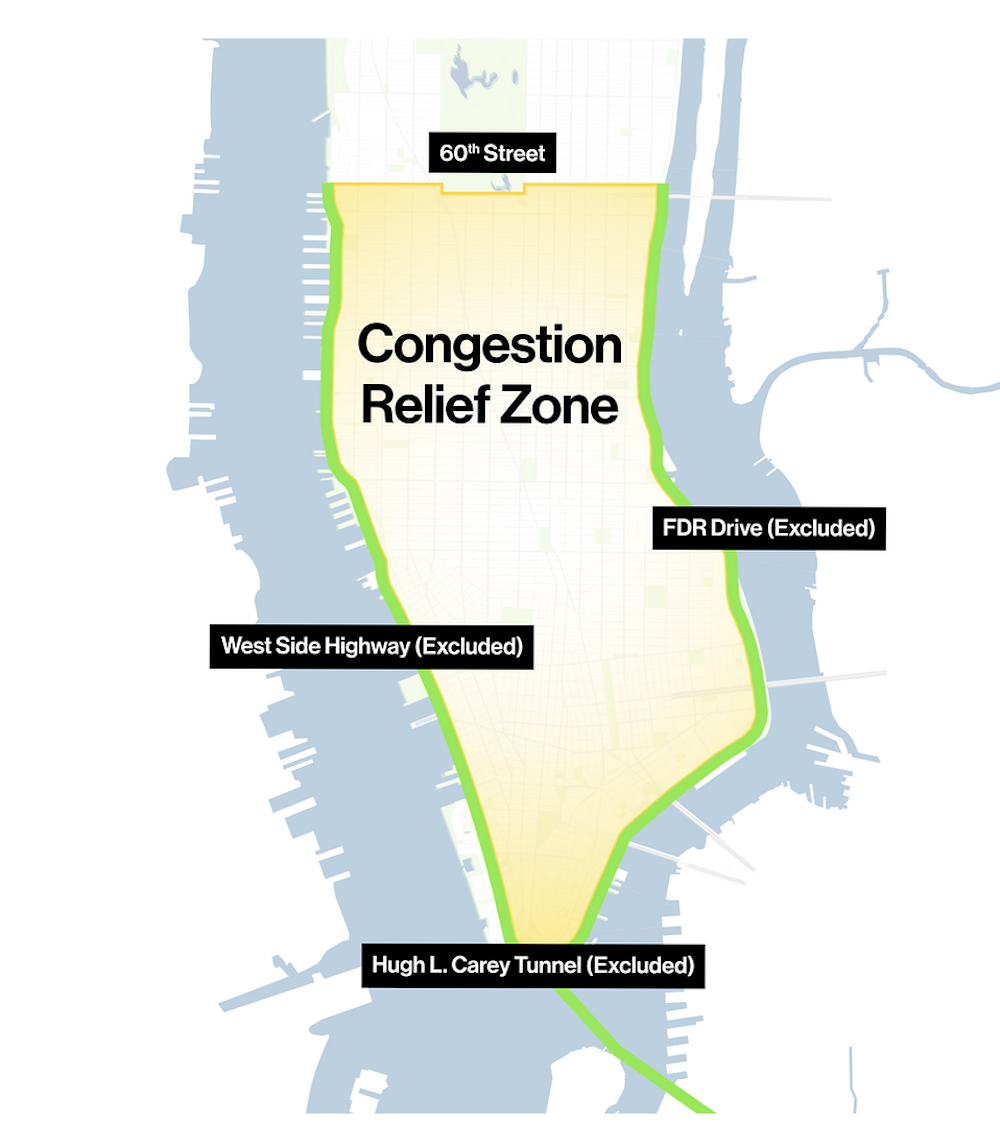
The basic idea is simple. To enter the Congestion Relief Zone, which covers Manhattan south of 60th Street, large trucks will pay $36, small trucks $24, passenger vehicles $15 and motorcycles $7.50. Ride-share vehicles and taxis will pay $2.50 and $1.25, respectively. Peak hours run from 5 a.m. to 9 p.m. on weekdays and 9 a.m. to 9 p.m. on weekends; overnight tolls are discounted by 75%.
Evidence from cities around the world shows that charging motorists fees for driving into city centers during busy periods is a rarity in urban public policy: a measure that works and is cost-effective. Congestion pricing has succeeded in cities including London, Singapore and Stockholm, where it has eased traffic, sped up travel times, reduced pollution and provided funds for public transportation and infrastructure investments.
As an urban policy scholar, I’m looking forward to seeing New York’s plan go into effect. There may well be surprises and adjustments as officials see how it works in practice. But given the heavy costs that traffic imposes on public health and productivity, I’m encouraged to see a major U.S. city finally test this approach. https://www.youtube.com/embed/vbYFpKeVTO0?wmode=transparent&start=0 Congestion pricing in New York City has traveled a long and winding road to adoption.
Nudging drivers
Congestion pricing is a response to externalities – costs or benefits that are generated by one party but incurred by another. Clogged city streets and air pollution are externalities created by urban car users, many of whom live outside the city.
This concept has been around for some time. British economist Arthur Pigou discussed it as early as 1920 as part of his attempt to remedy the suboptimal workings of the market system. In Pigou’s view, taxing harmful activities would discourage people from engaging in them.
Other thinkers took up this idea. In 1963, Canadian economist William Vickrey, a future Nobel laureate, argued that roads were scarce resources that needed to be valued by imposing costs on users.
This approach is behind behavioral economics, the policy strategy of using “nudges” that preserve choice but encourage certain actions. Congestion pricing assumes that increased prices will make people heading into New York think more carefully about their travel patterns, and about alternatives to driving.
New York City public transit receives priority
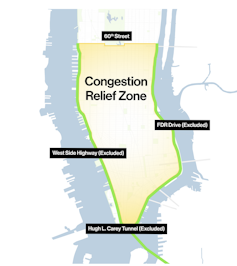 New York’s Congestion Relief Zone covers all of Manhattan below 60th Street, except for the highways around its perimeter and the Carey Tunnel from Battery Park to Brooklyn. Metropolitan Transit Authority, CC BY-ND
Congestion pricing in a city a big as New York is no small step. The New York plan was presented to the board of the Metropolitan Transit Authority in November 2023 after years of study and a detailed environmental impact assessment, required by federal law.
Project sponsors, which include several city agencies and the state transportation department, stated in the impact assessment that on an average weekday, an estimated 1.86 million people entered lower Manhattan by motor vehicle. Travel speeds in Manhattan’s central business district, below 60th Street, declined by 23% between 2010 and 2019, from 9.1 to 7.1 mph. The traffic was generating air and noise pollution, wasting travelers’ time, increasing business costs and preventing emergency vehicles from responding quickly to accidents.
The agencies estimated that the proposed toll system would reduce traffic in the Congestion Relief Zone by 17%, with an associated decline in air pollution. It also would generate US$15 billion for capital improvements to the city’s public transit system, including making stations accessible for passengers with disabilities and buying new electric buses and commuter rail and subway cars.
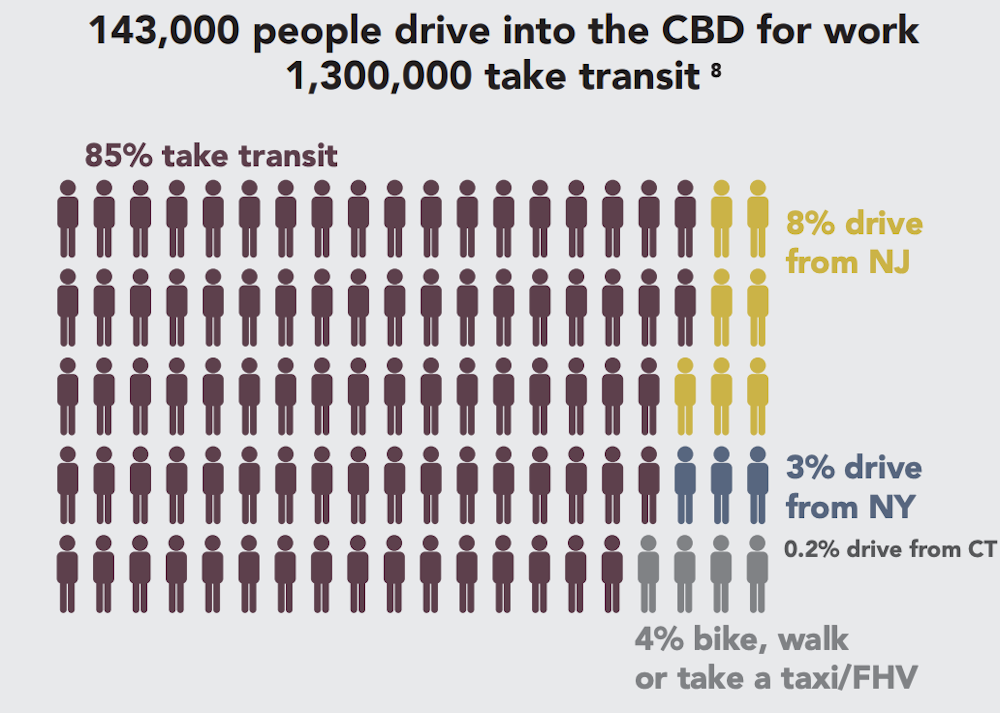
More than 75% of all trips into the central business district are made by public transit. The system has been plagued by breakdowns over the past decade. The Metropolitan Transit Authority recently adopted a $52 billion capital improvement program to update its network, some parts of which are more than 100 years old.
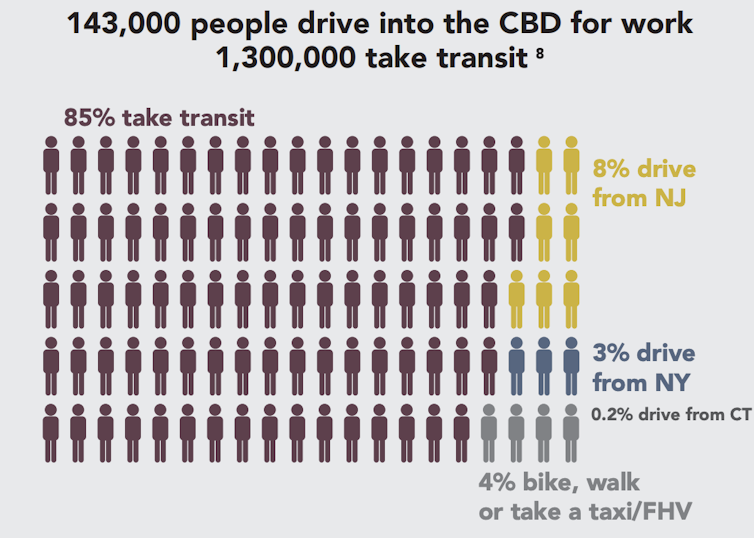 About 90% of the people who work in lower and midtown Manhattan get there by public transit, which will receive significant investments funded by congestion tolls. NY Traffic Mobility Review Board, CC BY-ND
Over several months of public hearings, the MTA heard both broad support for congestion pricing and thousands of requests for credits, discounts and exemptions, most of which were denied. The limited number of exemptions includes private commuter buses, school buses and city-owned vehicles, including emergency vehicles.
In addition, drivers who travel via Franklin D. Roosevelt Drive on Manhattan’s eastern edge, the West Side Highway on its western edge, or the Carey Tunnel between Brooklyn and Battery Park will not be charged if they do not enter any street in the Congestion Relief Zone. Drivers from the Bronx, Queens and Staten Island will be eligible for rebates and discounts on certain bridge tolls.
There were widespread complaints from New Yorkers in the outer boroughs of the Bronx, Brooklyn and Queens, and from car commuters who live outside of the city. New Jersey is suing the MTA, arguing among other things that the plan is unconstitutional because it burdens interstate commerce. This suit could delay the start of congestion pricing.
Nonetheless, the board adopted the plan with just one dissenting vote, from a representative of Nassau County on Long Island.
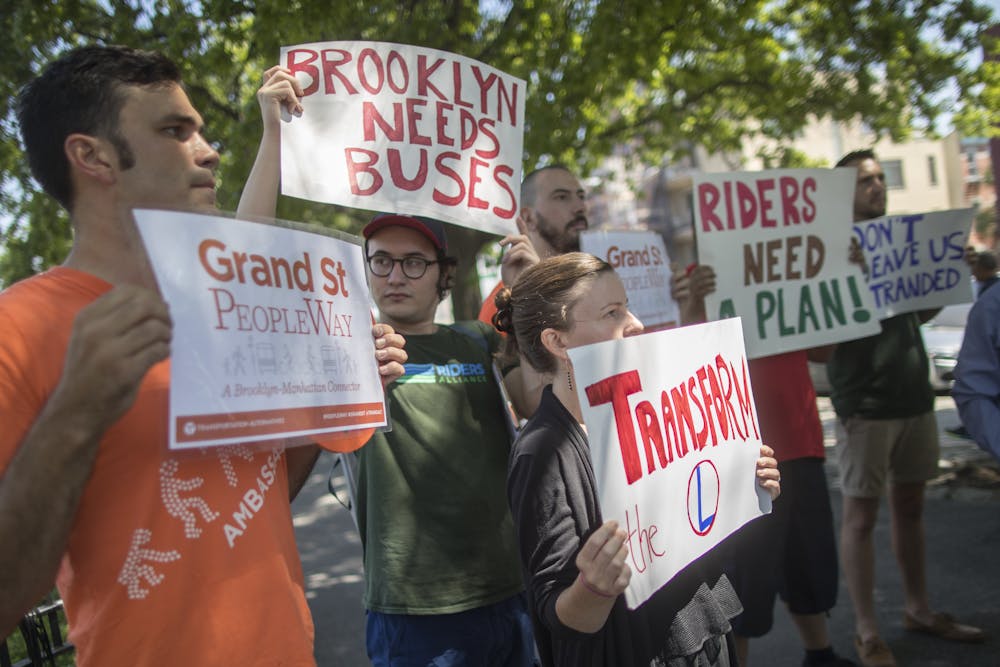
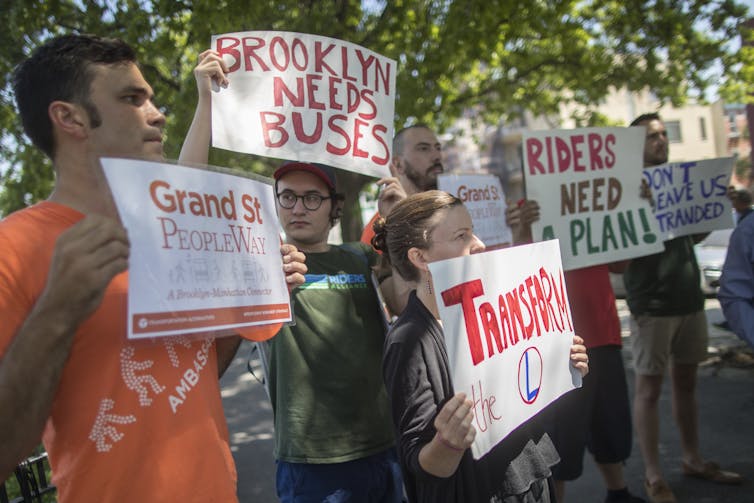 Transit advocates demonstrate in Brooklyn for better service in July 2017 during a period of mounting delays and breakdowns in New York’s subway system. AP Photo/Mary Altaffer
Starting the journey
Many questions will only be answered once the system starts up in June 2024, or later if it is delayed by lawsuits. Will toll prices be high enough to spur people to switch to another mode of transportation or combine trips, while still generating enough revenue for the MTA’s ambitious capital improvement program? How will toll revenue be spent? And how will commuters respond when they find that trains and subways initially are more crowded, before capital upgrades improve the system?
Some low-income and minority communities that already experience heavy traffic, such as the Bronx, could see increased congestion as drivers detour around the toll zone. To help mitigate some of these effects, the transit authority is planning to invest millions of dollars to reduce pollution in these environmental justice areas through steps such as installing air filters in schools, planting more trees and electrifying trucks at the massive Hunts Point Food Distribution Center in the Bronx.
No one likes to pay for something that was previously free. But freedom for car users has imposed health and economic costs on millions of New Yorkers for many years. Congestion charges do raise equity issues, but only 5% percent of people who commute into the central business district travel by car, and most of those drivers have relatively high incomes.
The MTA may need to adjust tolls, the zone’s borders or other aspects of the plan. But if New York’s experiment succeeds, it could provide a model and valuable insights for other traffic-clogged U.S. cities.
This article is republished from The Conversation under a Creative Commons license. Read the original article and see more than 250 UMBC articles available in The Conversation.
]]>
Written by John Rennie Short, professor emeritus of public policy, UMBC New York City is poised to launch the first congestion pricing plan to reduce traffic in a major U.S. metropolitan...
https://umbc.edu/stories/new-york-city-greenlights-congestion-pricing/
https://beta.my.umbc.edu/api/v0/pixel/news/140746/guest@my.umbc.edu/70ffcf51f19c4f16196f03bfee1b7ae2/api/pixel
cahss
cahss-research
discovery
magazine
public-policy
research
story
UMBC News & Magazine
https://beta.my.umbc.edu/groups/umbc-news-magazine
https://assets1-beta.my.umbc.edu/system/shared/avatars/groups/000/001/943/24435aa6207c452e7bc15cc74b42c7bb/xsmall.png?1748556657
https://assets1-beta.my.umbc.edu/system/shared/avatars/groups/000/001/943/24435aa6207c452e7bc15cc74b42c7bb/original.png?1748556657
https://assets2-beta.my.umbc.edu/system/shared/avatars/groups/000/001/943/24435aa6207c452e7bc15cc74b42c7bb/xxlarge.png?1748556657
https://assets2-beta.my.umbc.edu/system/shared/avatars/groups/000/001/943/24435aa6207c452e7bc15cc74b42c7bb/xlarge.png?1748556657
https://assets3-beta.my.umbc.edu/system/shared/avatars/groups/000/001/943/24435aa6207c452e7bc15cc74b42c7bb/large.png?1748556657
https://assets1-beta.my.umbc.edu/system/shared/avatars/groups/000/001/943/24435aa6207c452e7bc15cc74b42c7bb/medium.png?1748556657
https://assets2-beta.my.umbc.edu/system/shared/avatars/groups/000/001/943/24435aa6207c452e7bc15cc74b42c7bb/small.png?1748556657
https://assets1-beta.my.umbc.edu/system/shared/avatars/groups/000/001/943/24435aa6207c452e7bc15cc74b42c7bb/xsmall.png?1748556657
https://assets2-beta.my.umbc.edu/system/shared/avatars/groups/000/001/943/24435aa6207c452e7bc15cc74b42c7bb/xxsmall.png?1748556657
UMBC News & Magazine
0
0
false
Wed, 10 Apr 2024 09:02:52 -0400
NASA selects UMBC-led lunar instrument for implementation on Artemis III Moon landing mission

The University of Maryland Baltimore County (UMBC), along with several institutional partners, has been selected to develop one of the first three lunar instruments chosen for implementation and deployment as part of NASA’s forthcoming Artemis III mission, humanity’s first return to the lunar surface in more than 50 years.
The Lunar Environment Monitoring Station (LEMS), led by planetary scientist Mehdi Benna of UMBC’s Center for Space Sciences Technology (CSST), was selected as one of the first three candidate payloads to be a part of Artemis III, NASA’s mission that will send astronauts to explore the region near the lunar South Pole. Artemis III, currently planned to launch in 2026, will be the first time humans will return to the moon’s surface since the historic Apollo program in 1969-1972.
LEMS is a compact, autonomous seismometer designed to carry out continuous, long-term monitoring of seismic activity, namely ground motion from moonquakes, in the lunar south polar region, according to NASA’s recent announcement of the selected Artemis III instruments. During the Artemis III mission, LEMS will accompany the Lunar Effects on Agricultural Flora instrument, led by researchers at Space Lab Technologies in Boulder, Colorado, and the Lunar Dielectric Analyzer instrument, led by researchers at the University of Tokyo and supported by the Japan Aerospace Exploration Agency.
The LEMS project is the culmination of several years of collaboration between UMBC and partnering institutions, of which includes the University of Maryland, College Park (through deputy principal investigator Nicholas Schmerr) and NASA’s Goddard Space Flight Center, which will lead LEMS’ technical implementation process. The University of Arizona will supply LEMS’ two state-of-the-art seismometer sensors; Morehead State University will provide LEMS’ telecommunication system, and Washington University in St. Louis will manage the instrument’s data processing and dissemination to the larger scientific community.
Designed to withstand extreme conditions
Principal Investigator Benna, who operates out of the NASA’s Goddard Space Flight Center with the CSST, began conceptualizing with his team the idea behind the LEMS instrument in 2018 after realizing the need for technology that could withstand the Moon’s harsh conditions in order to measure lunar geophysical activity for a long duration of time.
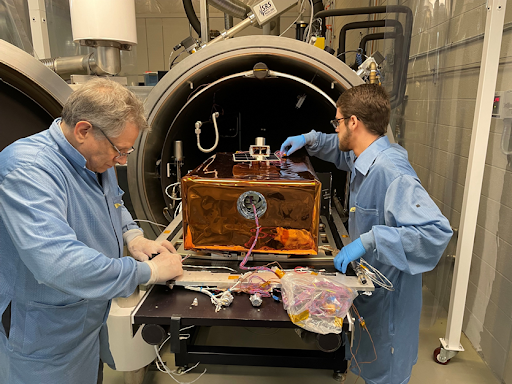 Team members during the final preparation of the Lunar Environment Monitoring Station (LEMS) engineering units for thermal-vacuum testing. During this test the LEMS prototype was subjected to the ultra-high vacuum and harsh thermal conditions that mimic the surface of the Moon to demonstrate the station can sustain itself and operate unassisted for long durations. (Photo Credit: NASA MSFC)
“The lunar environment is one of the harshest environments in the solar system. It’s hard to survive [on] the Moon because it rotates very slowly around itself—daytime on the Moon lasts about 15 Earth days, and night on the Moon lasts 15 Earth days,” says Benna. “Because the Moon doesn’t have an atmosphere, the days are very hot and the nights get really cold.”
Benna’s team began developing his idea of a small, self-sustaining station that operates almost like a buoy in the ocean—what Benna calls a “lunar buoy”—that can survive on the surface through the lunar night and operate during the day for an extended amount of time. In 2018, Benna’s team received funding from NASA’s Development and Advancement of Lunar Instrumentation program for engineering development and risk reduction of the LEMS instrument, which allowed it to reach the required NASA flight readiness level.
“The Apollo 11 of our generation”
LEMS, which is of the size of a standard carry-on airplane suitcase, is intended to operate on the lunar surface from three months up to two years following its deployment. The station’s battery is designed to be charged by its solar panels during the day. The stored power is used to keep the station operational at night. The LEMS instrument would then autonomously beam its data to one of NASA’s Deep Space Network ground stations once a month via its own communication antennas and radio system.
With the data retrieved from LEMS’ two distinct lunar-night-surviving seismometers, scientists will be able to characterize the structure of the local crust and mantle.
“Artemis III is the Apollo 11 of our generation—that’s significant. Landing astronauts on the Moon doesn’t get any easier 50 years later. Being a part of this adventure is extremely exciting,” shares Benna.
For more information on the Lunar Environment Monitoring Station (LEMS) science and technology, please contact: The University of Maryland, Baltimore County- Adriana Fraser; NASA’s Goddard Space Flight Center- Molly Wasser, Nancy Jones; The University of Arizona- Mikayla Kelley; Morehead State University- April Hobbs Nutter, Rick L. Hesterberg; Washington University in St. Louis- Paul Byrne; NASA Headquarters- Erin Morton.
]]>
The University of Maryland Baltimore County (UMBC), along with several institutional partners, has been selected to develop one of the first three lunar instruments chosen for implementation and...
https://umbc.edu/stories/lems-nasa-moon-instrument/
https://beta.my.umbc.edu/api/v0/pixel/news/140744/guest@my.umbc.edu/848c0ddb2c722e39f920edef140c1e7c/api/pixel
csst
nasa-goddard-space-flight-center
news
rca-1
research
science-and-tech
story
UMBC News & Magazine
https://beta.my.umbc.edu/groups/umbc-news-magazine
https://assets1-beta.my.umbc.edu/system/shared/avatars/groups/000/001/943/24435aa6207c452e7bc15cc74b42c7bb/xsmall.png?1748556657
https://assets1-beta.my.umbc.edu/system/shared/avatars/groups/000/001/943/24435aa6207c452e7bc15cc74b42c7bb/original.png?1748556657
https://assets2-beta.my.umbc.edu/system/shared/avatars/groups/000/001/943/24435aa6207c452e7bc15cc74b42c7bb/xxlarge.png?1748556657
https://assets2-beta.my.umbc.edu/system/shared/avatars/groups/000/001/943/24435aa6207c452e7bc15cc74b42c7bb/xlarge.png?1748556657
https://assets3-beta.my.umbc.edu/system/shared/avatars/groups/000/001/943/24435aa6207c452e7bc15cc74b42c7bb/large.png?1748556657
https://assets1-beta.my.umbc.edu/system/shared/avatars/groups/000/001/943/24435aa6207c452e7bc15cc74b42c7bb/medium.png?1748556657
https://assets2-beta.my.umbc.edu/system/shared/avatars/groups/000/001/943/24435aa6207c452e7bc15cc74b42c7bb/small.png?1748556657
https://assets1-beta.my.umbc.edu/system/shared/avatars/groups/000/001/943/24435aa6207c452e7bc15cc74b42c7bb/xsmall.png?1748556657
https://assets2-beta.my.umbc.edu/system/shared/avatars/groups/000/001/943/24435aa6207c452e7bc15cc74b42c7bb/xxsmall.png?1748556657
UMBC News & Magazine
1
0
false
Wed, 10 Apr 2024 08:17:34 -0400
Wed, 10 Apr 2024 08:17:34 -0400
Kelley Bell named Baker Artist Awardee, Corrie Francis Parks and Katie Hileman are finalists

On May 30, Kelley Bell, M.F.A. ’06, associate professor of visual arts, was named one of the six 2024 Baker Artist Awardees, receiving the $10,000 Mary Sawyers Baker Prize. The awardees were selected by an anonymous jury from a field of almost 700 artists from across the greater Baltimore region. Corrie Francis Parks, associate professor of visual arts, and Katie Hileman ’12, theatre, and general associate in the department of theatre, were among the finalists for the prestigious 2024 Baker Artist Award.
Established in 2009, the Baker Artist program was created to support artists and promote greater Baltimore as a strong creative community. Since then, more than 150 artists have been awarded $1.3 million in grant money. The program was established by the William G. Baker, Jr. Memorial Fund and is managed by the Greater Baltimore Cultural Alliance.
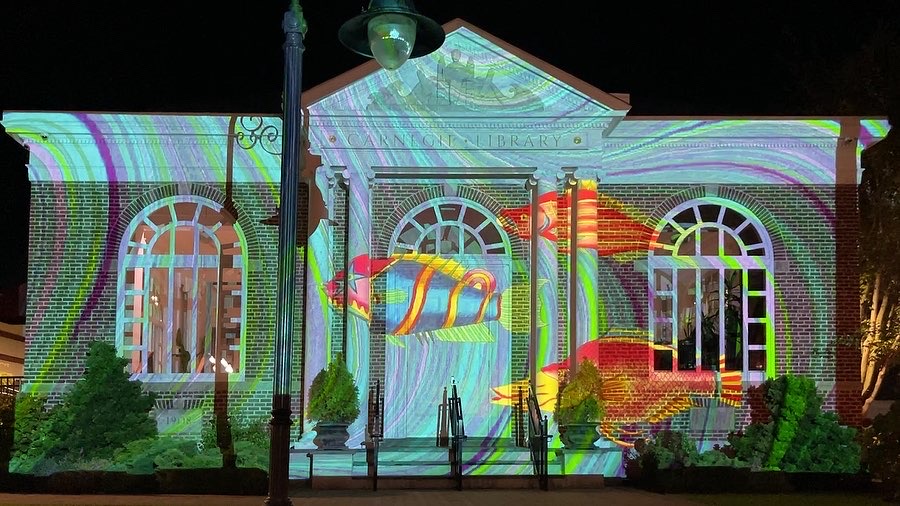 Still from Paper Palazzo by Kelley Bell. Image courtesy of the artist.
As part of the Baker program, artists across six disciplines—visual arts, film/video, interdisciplinary, literary arts, performance, and music—are invited to establish online portfolios of their work, which are housed on the Baker Artist Awards website. The 2024 portfolios, numbering more than 700, were reviewed by an anonymous jury which selected the 36 finalists. One artist in each of the disciplines was awarded the $10,000 Mary Sawyers Baker prize, and one of those six awardees was selected to receive the additional $30,000 Mary Sawyers Imboden prize.
 I Will Eat You Alive, written and directed by Katie Hileman ’12. Pictured from left, actors Betse Lyons, Vicky Graham ’20, and Meghan Taylor. Photo by Kiirstn Pagan ’11.
The work of Bell, Parks, Hileman, and other finalists will be featured in a series of finalist showcases. Kelley Bell’s work (in the interdisciplinary category) will be on display at Current Space from April 20 to June 2; Katie Hileman’s work (in the performance category) will be featured at Theatre Project on April 27 at 7:30 p.m. and on April 28 at 4 p.m. The showcase that will feature the work of Corrie Parks (and others in the film/video category) has yet to be scheduled.
UMBC is no stranger to the Baker Artist Awards. Previous recipients have included:
- 2011—Andrew Liang, M.F.A. ’24 ($1,000 b-grant)
- 2013—Jenny O’Grady, assistant vice president, strategic content ($1,000 b-grant)
- 2015—Eric Dyer ’95, visual arts, and professor, visual arts ($25,000 Mary Sawyers Baker prize); and Dominique Zeltzman, M.F.A. ’14, ($5,000 Nancy Haragan award)
- 2018—Lafayette Gilchrist ’92 ($10,000 Mary Sawyers Baker prize)
- 2021—Rahne Alexander, M.F.A. ’21, ($2,500 Baker Artist award); and Mina Cheon, M.F.A. ’02 ($2,500 Baker Artist award)
“Being counted among the 2024 Mary Sawyers Baker Prize awardees is amazing,” said Bell. “I am fiercely proud to call Baltimore my home and inspirational wellspring—it‘s a city like no other, and there is no other creative community I‘d rather be a part of. My colleagues from CAHSS, Katie Hileman and Corrie Francis Parks, were also included in the finalist‘s circle for this prestigious acknowledgment, and that’s a testament to the wonderful things that can happen when UMBC supports and invests in the arts and culture—our colleagues, our institution, and our city all reap the benefits of an active and vibrant creative community.”
Bell’s work will be featured in an exhibition of works by Baker Award recipients at the Baltimore Museum of Art in spring 2025.
]]>
On May 30, Kelley Bell, M.F.A. ’06, associate professor of visual arts, was named one of the six 2024 Baker Artist Awardees, receiving the $10,000 Mary Sawyers Baker Prize. The awardees were...
https://umbc.edu/stories/umbc-artists-named-baker-artist-award-finalists/
https://beta.my.umbc.edu/api/v0/pixel/news/140718/guest@my.umbc.edu/814e0714b03b3e788a512d5b30275cf0/api/pixel
arts-and-culture
cahss
imda
news
story
theatre
visual-arts
UMBC News & Magazine
https://beta.my.umbc.edu/groups/umbc-news-magazine
https://assets1-beta.my.umbc.edu/system/shared/avatars/groups/000/001/943/24435aa6207c452e7bc15cc74b42c7bb/xsmall.png?1748556657
https://assets1-beta.my.umbc.edu/system/shared/avatars/groups/000/001/943/24435aa6207c452e7bc15cc74b42c7bb/original.png?1748556657
https://assets2-beta.my.umbc.edu/system/shared/avatars/groups/000/001/943/24435aa6207c452e7bc15cc74b42c7bb/xxlarge.png?1748556657
https://assets2-beta.my.umbc.edu/system/shared/avatars/groups/000/001/943/24435aa6207c452e7bc15cc74b42c7bb/xlarge.png?1748556657
https://assets3-beta.my.umbc.edu/system/shared/avatars/groups/000/001/943/24435aa6207c452e7bc15cc74b42c7bb/large.png?1748556657
https://assets1-beta.my.umbc.edu/system/shared/avatars/groups/000/001/943/24435aa6207c452e7bc15cc74b42c7bb/medium.png?1748556657
https://assets2-beta.my.umbc.edu/system/shared/avatars/groups/000/001/943/24435aa6207c452e7bc15cc74b42c7bb/small.png?1748556657
https://assets1-beta.my.umbc.edu/system/shared/avatars/groups/000/001/943/24435aa6207c452e7bc15cc74b42c7bb/xsmall.png?1748556657
https://assets2-beta.my.umbc.edu/system/shared/avatars/groups/000/001/943/24435aa6207c452e7bc15cc74b42c7bb/xxsmall.png?1748556657
UMBC News & Magazine
1
0
false
Tue, 09 Apr 2024 10:45:44 -0400
Thu, 13 Jun 2024 10:45:44 -0400
UMBC joins BRAIN Center to advance innovations in neurotechnologies
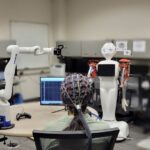
Ramana Vinjamuri, associate professor in computer science and electrical engineering, recently received funding from the National Science Foundation (NSF) to support UMBC’s participation in a industry-university cooperative research center aiming to improve how we diagnose and treat people with conditions such as neurological disorders, brain injury, mental illness, limb loss, and paralysis. The center, called BRAIN (Building Reliable Advances and Innovations in Neurotechnology), brings together partners from academia, industry, and the regulatory and clinical communities to develop safe, effective, and affordable personalized neurotechnologies.
The need for such technologies is driven by an increase in survivable trauma and an aging population, Vinjamuri says. However, several challenges are holding back progress, including costly equipment, lagging standards for verifying the safety, efficacy, and reliability of devices, and an undersupply of physicians and engineers trained in emerging technologies.
The BRAIN Center aims to tackle these challenges by bringing together experts in a wide range of topics, from neural, cognitive, and rehabilitation engineering to neurorobotics, neuromodulation, and ethical artificial intelligence. As an Industry–University Cooperative Research Center (I/UCRC), it emphasizes academic research conducted jointly with innovative industry partners, and UMBC’s location will facilitate cooperation with northeast-based biomedical companies.
“BRAIN will become a neurotechnology hub by creating a pipeline from discoveries to solutions, while helping students, scientists, and engineers solve one of the greatest unmet medical and healthcare needs of our time,” Vinjamuri says.
UMBC’s participation will expand the center’s research into new areas such as artificial intelligence, neural signal processing, cyber-human systems, human-centered computing, neural imaging and stimulation, and virtual/augmented/mixed reality. Other UMBC researchers who will contribute to the center’s activities include Tulay Adali, Nilanjan Banerjee, Fow-sen Choa, Don Engel, Seung-Jun Kim, and Charles Nicholas. BRAIN is the second I/UCRC at UMBC, joining the Center for Accelerated Real Time Analytics (CARTA), which recently received a second round of funding.
]]>
Ramana Vinjamuri, associate professor in computer science and electrical engineering, recently received funding from the National Science Foundation (NSF) to support UMBC’s participation in a...
https://umbc.edu/quick-posts/umbc-joins-brain-center/
https://beta.my.umbc.edu/api/v0/pixel/news/140702/guest@my.umbc.edu/3f3c676307e701deff91f375fa297fa2/api/pixel
coeit
csee
news
quick-post
quick-posts
research
science-and-tech
UMBC News & Magazine
https://beta.my.umbc.edu/groups/umbc-news-magazine
https://assets1-beta.my.umbc.edu/system/shared/avatars/groups/000/001/943/24435aa6207c452e7bc15cc74b42c7bb/xsmall.png?1748556657
https://assets1-beta.my.umbc.edu/system/shared/avatars/groups/000/001/943/24435aa6207c452e7bc15cc74b42c7bb/original.png?1748556657
https://assets2-beta.my.umbc.edu/system/shared/avatars/groups/000/001/943/24435aa6207c452e7bc15cc74b42c7bb/xxlarge.png?1748556657
https://assets2-beta.my.umbc.edu/system/shared/avatars/groups/000/001/943/24435aa6207c452e7bc15cc74b42c7bb/xlarge.png?1748556657
https://assets3-beta.my.umbc.edu/system/shared/avatars/groups/000/001/943/24435aa6207c452e7bc15cc74b42c7bb/large.png?1748556657
https://assets1-beta.my.umbc.edu/system/shared/avatars/groups/000/001/943/24435aa6207c452e7bc15cc74b42c7bb/medium.png?1748556657
https://assets2-beta.my.umbc.edu/system/shared/avatars/groups/000/001/943/24435aa6207c452e7bc15cc74b42c7bb/small.png?1748556657
https://assets1-beta.my.umbc.edu/system/shared/avatars/groups/000/001/943/24435aa6207c452e7bc15cc74b42c7bb/xsmall.png?1748556657
https://assets2-beta.my.umbc.edu/system/shared/avatars/groups/000/001/943/24435aa6207c452e7bc15cc74b42c7bb/xxsmall.png?1748556657
UMBC News & Magazine
1
0
false
Tue, 09 Apr 2024 10:14:46 -0400
Tue, 09 Apr 2024 10:14:46 -0400