Update from the UMBC Core Team – Federal Immigration Enforcement General Information Card and FAQs
Dear UMBC Community,
The UMBC Core Team, a team composed of senior leadership that meets weekly to discuss updates related to all facets of federal policy changes, is writing about two items created to provide additional support and clarity regarding federal immigration enforcement: 1) a general information card, should a UMBC community member encounter a federal immigration enforcement agent, and 2) FAQs, which expand upon the items on the card.
You can now find a printable version of the general information card on the Federal Orders and Actions site; you will see a link to the printable card on the “Campus Communications” section of the home page. Click on the yellow box underneath the card that says “View General Information PDF” and you can print it from the screen that displays both the front and back of the card.
The related FAQs are the first questions and answers listed in the FAQs section on the same page.
The general information cards are currently being printed and will be available in several offices across campus soon; once the cards are available, we will send an update to campus.
Thank you.
Regards,
The UMBC Core Team
Valerie Sheares Ashby, President
Manfred H. M. van Dulmen, Provost and Senior Vice President, Academic Affairs
Tanyka M. Barber, Vice President, Institutional Equity and Chief Diversity Officer
D. Paul Monteiro, Vice President, Government Relations and Community Affairs
Paul A. Meggett, Vice President and General Counsel
Kacey Hammel, Chief of Staff to the President
Renique T. Kersh, Vice President, Student Affairs
Karl V. Steiner, Vice President, Research and Creative Achievement
Lisa K. Van Riper, Vice President, University Communications and Marketing
Ana Oskoz, Vice Provost, Faculty Affairs
David L. Di Maria, Vice Provost, Global Engagement
]]>
Dear UMBC Community, The UMBC Core Team, a team composed of senior leadership that meets weekly to discuss updates related to all facets of federal policy changes, is writing about two items...
https://umbc.edu/stories/update-from-the-umbc-core-team-federal-immigration-enforcement-general-information-card-and-faqs/
https://beta.my.umbc.edu/api/v0/pixel/news/156720/guest@my.umbc.edu/aff6558b9af910b5ca6060c502fcb99a/api/pixel
federal-orders
rss
story
UMBC News & Magazine
https://beta.my.umbc.edu/groups/umbc-news-magazine
https://assets1-beta.my.umbc.edu/system/shared/avatars/groups/000/001/943/24435aa6207c452e7bc15cc74b42c7bb/xsmall.png?1748556657
https://assets1-beta.my.umbc.edu/system/shared/avatars/groups/000/001/943/24435aa6207c452e7bc15cc74b42c7bb/original.png?1748556657
https://assets2-beta.my.umbc.edu/system/shared/avatars/groups/000/001/943/24435aa6207c452e7bc15cc74b42c7bb/xxlarge.png?1748556657
https://assets2-beta.my.umbc.edu/system/shared/avatars/groups/000/001/943/24435aa6207c452e7bc15cc74b42c7bb/xlarge.png?1748556657
https://assets3-beta.my.umbc.edu/system/shared/avatars/groups/000/001/943/24435aa6207c452e7bc15cc74b42c7bb/large.png?1748556657
https://assets1-beta.my.umbc.edu/system/shared/avatars/groups/000/001/943/24435aa6207c452e7bc15cc74b42c7bb/medium.png?1748556657
https://assets2-beta.my.umbc.edu/system/shared/avatars/groups/000/001/943/24435aa6207c452e7bc15cc74b42c7bb/small.png?1748556657
https://assets1-beta.my.umbc.edu/system/shared/avatars/groups/000/001/943/24435aa6207c452e7bc15cc74b42c7bb/xsmall.png?1748556657
https://assets2-beta.my.umbc.edu/system/shared/avatars/groups/000/001/943/24435aa6207c452e7bc15cc74b42c7bb/xxsmall.png?1748556657
UMBC News & Magazine
1
0
false
Wed, 18 Feb 2026 21:05:08 -0500
Is fusion the future? Carlos Romero Talamás’ lab gets congressional attention
Piles of snow and bitter cold didn’t deter U.S. congressional representative Don Beyer from meeting with UMBC’s Carlos Romero Talamás in late January to discuss the hot topic of fusion energy. Fusion reactions, which release massive amounts of energy when multiple light atomic nuclei merge to form a single heavier nucleus, power the Sun, and it is hoped they will soon deliver clean, reliable, and abundant energy generation on Earth, too.
Rep. Beyer, of the 8th District of Virginia, founded and co-chairs the bipartisan Congressional Fusion Energy Caucus, dedicated to advancing fusion energy technology, while Romero Talamás, an associate professor of mechanical engineering, leads a laboratory exploring a novel fusion energy concept that may offer an easier path to a commercially viable reactor. During the visit on January 29, Romero Talamás gave Beyer a tour of the lab, which is located on the University of Maryland, College Park campus and brings together faculty and students from both UMBC and UMD.
A simpler fusion machine
 Images captured by NASA’s Solar Dynamics Observatory show loops of hot plasma trapped by the Sun’s magnetic field. A solar flare flashes on the left side. (Credit: NASA/GSFC/SDO)
The centerpiece of the lab is a large machine where the researchers have been testing a relatively new approach to confining plasma—the unruly soup of particles that forms when gas gets super hot. At high enough temperatures (typically more than 100 million degrees Celsius on Earth) and densities, particles in a plasma can slam into each other with enough energy to fuse together.
The Maryland group’s confinement approach, called a centrifugal mirror, traps the blazing hot plasma in a linear tube with strong magnetic fields at the ends that push charged particles toward the center (the magnetic mirror), while also whipping them at supersonic speeds around a central conducting rod (the centrifugal part). The rotation creates stabilizing forces that can pull a plasma back together in the face of inherent instabilities that threaten to rip it apart.
Recent experiments confirm that the physics used to model the confinement approach accurately predicts its real-world behavior, giving the researchers confidence that they could take the approach all the way to a working fusion reactor.
In fact, Romero Talamás has founded a company, called Terra Fusion, to do just that. The company has offices in College Park and is currently looking for laboratory space in Baltimore where it can build a next-generation machine.
The start-up joins a host of other fusion companies, primarily in the U.S. The entire field has attracted billions of dollars in private investments, including from such big players as Microsoft co-founder Bill Gates and OpenAI CEO Sam Altman. While Romero Talamás’ company is just getting started, he’s confident Terra Fusion can catch up and overcome competitors because of its relatively compact, inexpensive, and simple machine design.
 Many approaches to building a fusion reactor rely on strong magnetic fields to contain the hot plasma. (Marlayna Demond ’11/UMBC)
All the companies still face big engineering hurdles, such as finding materials that can withstand the punishing onslaught of particles and radiation within the reactor. A simpler machine should make the path to overcoming these challenges much easier.
Public-private partnerships fuel innovation
Fusion research in the U.S. in recent years offers an example of how the public and private sectors can work in tandem to address daunting challenges. The initial experiments on the current centrifugal mirror machine were funded by the U.S. Department of Energy. Once those experiments confirmed the promise of the approach, private sector investment jumped in. Romero Talamás says the U.S. government also supports private sector research by offering companies access to the specialized expertise, experimental facilities, and advanced modeling capabilities at the national laboratories.
U.S. fusion experts hope the jostle of competing commercial ideas will shorten the time it takes to demonstrate a fusion reactor design that could meet a significant portion of humanity’s ever-growing energy demands more cleanly, cheaply, and reliably than alternative energy approaches. Despite the proliferation of groups vying to make the next big fusion breakthrough, a mostly collaborative spirit still prevails within the research community, Romero Talamás says. “If any one of these technologies succeed,” he points out, “it will benefit us all.”
]]>
Piles of snow and bitter cold didn’t deter U.S. congressional representative Don Beyer from meeting with UMBC’s Carlos Romero Talamás in late January to discuss the hot topic of fusion energy....
https://umbc.edu/stories/fusion-carlos-romero-talamas-lab-gets-congressional-attention/
https://beta.my.umbc.edu/api/v0/pixel/news/156704/guest@my.umbc.edu/14d1121de2559948ecd0ecb5b8e598f0/api/pixel
coeit
meche
news
research
science-and-tech
story
UMBC News & Magazine
https://beta.my.umbc.edu/groups/umbc-news-magazine
https://assets1-beta.my.umbc.edu/system/shared/avatars/groups/000/001/943/24435aa6207c452e7bc15cc74b42c7bb/xsmall.png?1748556657
https://assets1-beta.my.umbc.edu/system/shared/avatars/groups/000/001/943/24435aa6207c452e7bc15cc74b42c7bb/original.png?1748556657
https://assets2-beta.my.umbc.edu/system/shared/avatars/groups/000/001/943/24435aa6207c452e7bc15cc74b42c7bb/xxlarge.png?1748556657
https://assets2-beta.my.umbc.edu/system/shared/avatars/groups/000/001/943/24435aa6207c452e7bc15cc74b42c7bb/xlarge.png?1748556657
https://assets3-beta.my.umbc.edu/system/shared/avatars/groups/000/001/943/24435aa6207c452e7bc15cc74b42c7bb/large.png?1748556657
https://assets1-beta.my.umbc.edu/system/shared/avatars/groups/000/001/943/24435aa6207c452e7bc15cc74b42c7bb/medium.png?1748556657
https://assets2-beta.my.umbc.edu/system/shared/avatars/groups/000/001/943/24435aa6207c452e7bc15cc74b42c7bb/small.png?1748556657
https://assets1-beta.my.umbc.edu/system/shared/avatars/groups/000/001/943/24435aa6207c452e7bc15cc74b42c7bb/xsmall.png?1748556657
https://assets2-beta.my.umbc.edu/system/shared/avatars/groups/000/001/943/24435aa6207c452e7bc15cc74b42c7bb/xxsmall.png?1748556657
UMBC News & Magazine
0
0
false
Wed, 18 Feb 2026 13:10:26 -0500
Wed, 18 Feb 2026 13:10:26 -0500
Retriever-led video game design teams showcase their creations to thousands at MAGFest
Two Retriever-led video game design teams were selected to present their games at Super MAGFest (short for “Music And Gaming Festival”), one of the largest and most prominent fan-driven festivals in the U.S. dedicated to celebrating the gaming community. The event, which runs 24 hours a day, was held January 8 – 11 at the Gaylord National Resort in National Harbor, Maryland, and attracted tens of thousands of game enthusiasts.
Evan McRae ’25, computer science and individualized studies, was a member of both teams. The first team presented a game called King Scribble, in which the player must help the main character—a doodle from a notebook—find his way back to his kingdom by drawing (or erasing) platforms and objects to traverse sketched landscapes and solve physics puzzles. The second team presented the game Phantom Feline, in which the titular ghost cat character navigates through 32 haunting levels by controlling lights and turning into a shadow to scale illuminated walls.
Both teams found support for their creative and technical endeavors in UMBC’s vibrant game development classes and clubs. Computer science majors can choose to follow the game development track, and any interested student can join the Game Developers Club. In 2025, UMBC was ranked #1 in Maryland and #20 on the East Coast in game design education by Animation Career Review.
The Game Developers Club is advised by computer science associate professor Marc Olano, who pioneered the procedural shading algorithms that are used to generate color, texture, and lighting in real-time on graphics hardware and are now a standard feature on every PC and game platform.
It was in Olano’s Capstone Games Group Project class that King Scribble first took shape. The class includes both student artists in the animation track and programmers in the game development track. McRae pitched the King Scribble idea—which he had first thought up in first grade—to his classmates, who selected it as one of four games to develop. Since the end of the class, the King Scribble team has continued improving the game. They started a limited liability company and have plans to ultimately commercialize the game. People can currently wishlist the game on Steam, a large digital distribution platform for PC gaming.
Phantom Feline was first developed during the Game Developers Club 2025 Spring Game Jam, and is free to play on Windows and Linux.
Creating the games “has been a dream come true,” says McRae. “I owe so much to the teams for coming together to make them a playable reality.” In addition to McRae, the King Scribble team members are Jay Cina ’25, computer science; Brian Lawser ’25, computer science; Colby Frashure ’25, computer science; Sormeh Jaribion ’25, computer science; Justin Gaylord ’25, visual arts; and Ginger Sealy, Halle Onyeador, and Anthony Bonilla Duron, all current visual arts students. The Phantom Feline team includes McRae and Scott Serafin ’25, computer science; Aidan Brown ’25, computer science; Jet Thompson ’25, computer science; and Joshua Epstein, a current student in music technology and music composition.
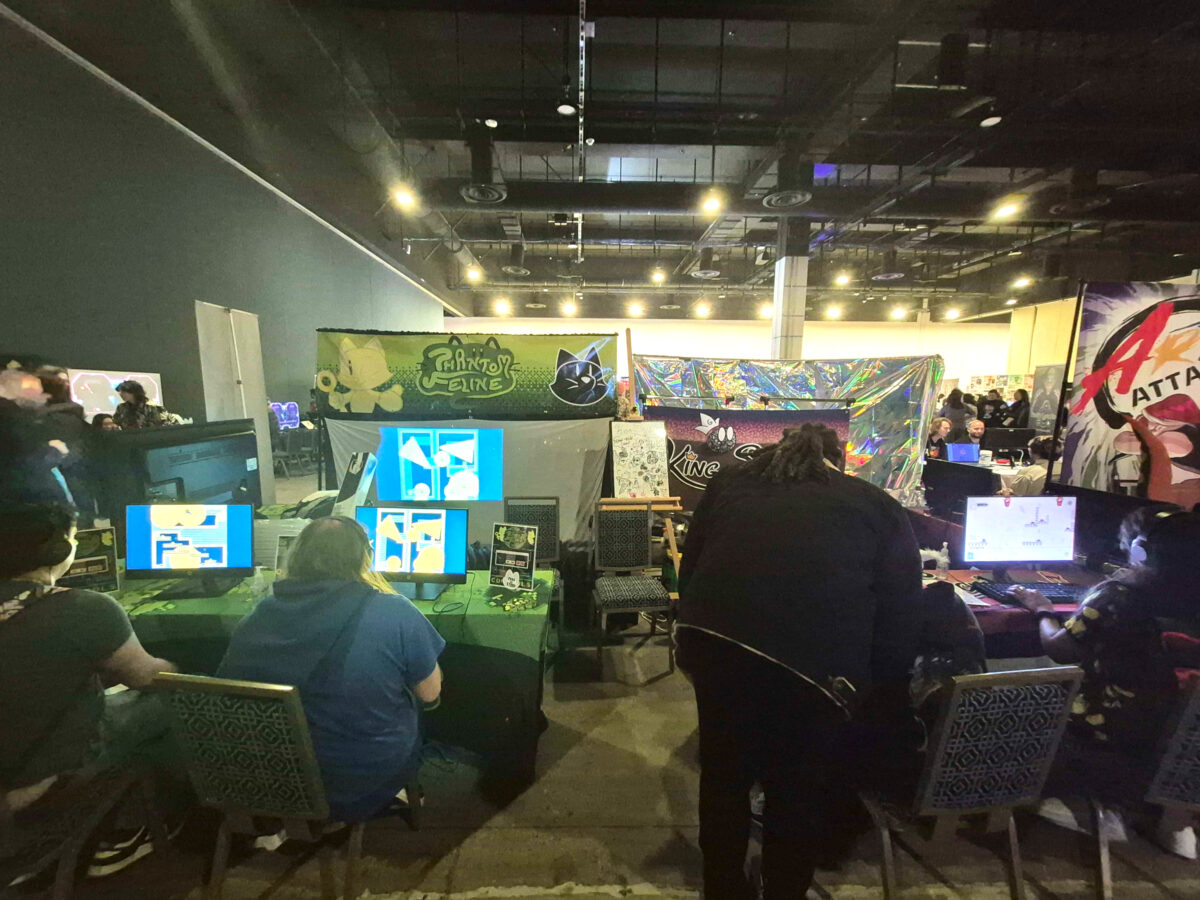 MAGFest attendees playing the games at the King Scribble and Phantom Feline booths. Seeing people play the games is “what meant the most to us as presenters at MAGFest,” McRae says. (Photo courtesy of McRae)
]]>
Two Retriever-led video game design teams were selected to present their games at Super MAGFest (short for “Music And Gaming Festival”), one of the largest and most prominent fan-driven festivals...
https://umbc.edu/stories/video-game-design-teams-at-magfest/
https://beta.my.umbc.edu/api/v0/pixel/news/156651/guest@my.umbc.edu/048db872ca6c370a5021fe36d99cdf44/api/pixel
cahss
coeit
community
csee
inds
music
news
science-and-tech
story
visual-arts
UMBC News & Magazine
https://beta.my.umbc.edu/groups/umbc-news-magazine
https://assets1-beta.my.umbc.edu/system/shared/avatars/groups/000/001/943/24435aa6207c452e7bc15cc74b42c7bb/xsmall.png?1748556657
https://assets1-beta.my.umbc.edu/system/shared/avatars/groups/000/001/943/24435aa6207c452e7bc15cc74b42c7bb/original.png?1748556657
https://assets2-beta.my.umbc.edu/system/shared/avatars/groups/000/001/943/24435aa6207c452e7bc15cc74b42c7bb/xxlarge.png?1748556657
https://assets2-beta.my.umbc.edu/system/shared/avatars/groups/000/001/943/24435aa6207c452e7bc15cc74b42c7bb/xlarge.png?1748556657
https://assets3-beta.my.umbc.edu/system/shared/avatars/groups/000/001/943/24435aa6207c452e7bc15cc74b42c7bb/large.png?1748556657
https://assets1-beta.my.umbc.edu/system/shared/avatars/groups/000/001/943/24435aa6207c452e7bc15cc74b42c7bb/medium.png?1748556657
https://assets2-beta.my.umbc.edu/system/shared/avatars/groups/000/001/943/24435aa6207c452e7bc15cc74b42c7bb/small.png?1748556657
https://assets1-beta.my.umbc.edu/system/shared/avatars/groups/000/001/943/24435aa6207c452e7bc15cc74b42c7bb/xsmall.png?1748556657
https://assets2-beta.my.umbc.edu/system/shared/avatars/groups/000/001/943/24435aa6207c452e7bc15cc74b42c7bb/xxsmall.png?1748556657
UMBC News & Magazine
7
0
false
Tue, 17 Feb 2026 08:19:21 -0500
Tue, 17 Feb 2026 08:19:21 -0500
Electrical, biomedical, and computer science researchers team up to develop a ‘cybergut’
MAGFest attendees playing the games at the King Scribble and Phantom Feline booths. Seeing people play the games is “what meant the most to us as presenters at MAGFest,” McRae says. (Photo courtesy of McRae)
]]>
Two Retriever-led video game design teams were selected to present their games at Super MAGFest (short for “Music And Gaming Festival”), one of the largest and most prominent fan-driven festivals...
https://umbc.edu/stories/video-game-design-teams-at-magfest/
https://beta.my.umbc.edu/api/v0/pixel/news/156651/guest@my.umbc.edu/048db872ca6c370a5021fe36d99cdf44/api/pixel
cahss
coeit
community
csee
inds
music
news
science-and-tech
story
visual-arts
UMBC News & Magazine
https://beta.my.umbc.edu/groups/umbc-news-magazine
https://assets1-beta.my.umbc.edu/system/shared/avatars/groups/000/001/943/24435aa6207c452e7bc15cc74b42c7bb/xsmall.png?1748556657
https://assets1-beta.my.umbc.edu/system/shared/avatars/groups/000/001/943/24435aa6207c452e7bc15cc74b42c7bb/original.png?1748556657
https://assets2-beta.my.umbc.edu/system/shared/avatars/groups/000/001/943/24435aa6207c452e7bc15cc74b42c7bb/xxlarge.png?1748556657
https://assets2-beta.my.umbc.edu/system/shared/avatars/groups/000/001/943/24435aa6207c452e7bc15cc74b42c7bb/xlarge.png?1748556657
https://assets3-beta.my.umbc.edu/system/shared/avatars/groups/000/001/943/24435aa6207c452e7bc15cc74b42c7bb/large.png?1748556657
https://assets1-beta.my.umbc.edu/system/shared/avatars/groups/000/001/943/24435aa6207c452e7bc15cc74b42c7bb/medium.png?1748556657
https://assets2-beta.my.umbc.edu/system/shared/avatars/groups/000/001/943/24435aa6207c452e7bc15cc74b42c7bb/small.png?1748556657
https://assets1-beta.my.umbc.edu/system/shared/avatars/groups/000/001/943/24435aa6207c452e7bc15cc74b42c7bb/xsmall.png?1748556657
https://assets2-beta.my.umbc.edu/system/shared/avatars/groups/000/001/943/24435aa6207c452e7bc15cc74b42c7bb/xxsmall.png?1748556657
UMBC News & Magazine
7
0
false
Tue, 17 Feb 2026 08:19:21 -0500
Tue, 17 Feb 2026 08:19:21 -0500
Electrical, biomedical, and computer science researchers team up to develop a ‘cybergut’
 Mehdi Kiani (Brad Ziegler/UMBC)
Personalized and precise treatments will improve patients’ quality of life in a fast-approaching future driven by AI, wearable tech, and other innovations. UMBC student and faculty researchers led by Mehdi Kiani, a professor in the Department of Computer Science and Electrical Engineering, are at the frontiers of these changes.
They recently teamed up with colleagues at New York Institute of Technology and Pennsylvania State University to develop a system that combines state-of-the-art, millimeter-sized medical implants, computational models, and machine learning to better monitor and treat stomach disorders. A grant from the National Institutes of Health will fund the work through 2029.
The research offers the promise of improving individual medical treatment for gastric disorders such as gastroparesis, a chronic condition causing nausea and unexplained vomiting that affects more than 1.5 million people in the U.S. It also has broader implications for improving our general understanding of how the nervous system controls organs.
“This type of research is vital, because it addresses fundamental gaps in how we monitor and treat complex organ functions,” says Kiani. “By integrating advanced sensing, modeling, and intelligent control, we can move beyond today’s limited approaches toward precise, adaptive therapies. These innovations have the potential to transform patient care not only for gastric disorders but across many areas of medicine.”
Shrinking medical implants
Kiani has extensive experience developing advanced, wireless medical implants. While at Penn State prior to joining UMBC, Kiani and his team developed a device that could harness energy from magnetic field and ultrasound sources simultaneously. The dual-powered feature is important, the researchers say, because it means the device can harness enough power to operate even as it is shrunk to millimeter-sized dimensions and implanted in a living body, where safety concerns limit the frequency of electromagnetic radiation that can be used to power and communicate with the device.
Shrinking medical devices makes implanting them less invasive. It also means that many devices can be implanted across a wide area in the body, improving the ability to both monitor and treat disease.
 Kiani holds a medical device that could harness energy from magnetic field and ultrasound sources simultaneously. (Brad Ziegler/UMBC)
As part of the new research, Kiani and his colleagues envision a network of multiple tiny devices, called “gastric seeds,” implanted in the submucosal tissue of the stomach. The seeds will wirelessly monitor the electrical signals in the stomach that control its rhythmic contractions. They can also deliver electrical stimulation to correct misfiring signals.
The seeds will be linked to a wearable band wrapped around the outside of the body, and will use the dual magnetic field and ultrasonic channels to both receive power and transmit and receive data.
Building a virtual stomach
In addition to developing advanced implantable medical devices, the team will also build a virtual stomach to model the complex electrical and mechanical dynamics of a real stomach. This information, in turn, will help determine how best to use the gastric seeds to deliver treatment.
The team will first construct an intricate and accurate model on a personal computer, and then use data from that model to train a machine learning model that can operate using the limited computing power of the wearable band. The machine learning model will efficiently interpret the sparse signals from the gastric seeds to determine optimal electrical stimulation treatments in real time.
What excites me most about this research is its truly multidisciplinary nature, bringing together expertise needed to tackle medical challenges no single field can solve alone.
Mehdi Kiani
The team will test the integrated system on anesthetized rats toward the end of the project.
Aydin Farajidavar, a professor of electrical and computer engineering at New York Institute of Technology and director of the Integrated Medical Systems Laboratory, and Farnaz Tehranchi, an assistant professor of engineering design and innovation at Penn State, will lead the computational organ model and machine learning model design elements of the project.
For the machine learning dimension of the work, the researchers will use computational models called physics-informed neural networks, which have attracted increasing attention for their ability to combine data-driven learning with fundamental physical laws. “When enhanced with human-like learning strategies, such as self-learning and adaptive optimization, these networks can evolve into significantly more powerful analytical tools,” Tehranchi says.
The advanced framework will provide deeper insights into stomach dynamics and disease progression, supporting more precise and personalized clinical interventions, she explains.
“What excites me most about this research is its truly multidisciplinary nature, bringing together expertise needed to tackle medical challenges no single field can solve alone,” Kiani says. “It’s also inspiring to work with talented students and help shape their careers as we develop technologies that can meaningfully advance patient care and improve quality of life.”
]]>
Mehdi Kiani (Brad Ziegler/UMBC) Personalized and precise treatments will improve patients’ quality of life in a fast-approaching future driven by AI, wearable tech, and other innovations. UMBC...
https://umbc.edu/stories/researchers-team-up-to-develop-a-cybergut/
https://beta.my.umbc.edu/api/v0/pixel/news/156377/guest@my.umbc.edu/032e9e97d6c510d0e698bd22ec6a2cf1/api/pixel
coeit
csee
news
research
science-and-tech
story
UMBC News & Magazine
https://beta.my.umbc.edu/groups/umbc-news-magazine
https://assets1-beta.my.umbc.edu/system/shared/avatars/groups/000/001/943/24435aa6207c452e7bc15cc74b42c7bb/xsmall.png?1748556657
https://assets1-beta.my.umbc.edu/system/shared/avatars/groups/000/001/943/24435aa6207c452e7bc15cc74b42c7bb/original.png?1748556657
https://assets2-beta.my.umbc.edu/system/shared/avatars/groups/000/001/943/24435aa6207c452e7bc15cc74b42c7bb/xxlarge.png?1748556657
https://assets2-beta.my.umbc.edu/system/shared/avatars/groups/000/001/943/24435aa6207c452e7bc15cc74b42c7bb/xlarge.png?1748556657
https://assets3-beta.my.umbc.edu/system/shared/avatars/groups/000/001/943/24435aa6207c452e7bc15cc74b42c7bb/large.png?1748556657
https://assets1-beta.my.umbc.edu/system/shared/avatars/groups/000/001/943/24435aa6207c452e7bc15cc74b42c7bb/medium.png?1748556657
https://assets2-beta.my.umbc.edu/system/shared/avatars/groups/000/001/943/24435aa6207c452e7bc15cc74b42c7bb/small.png?1748556657
https://assets1-beta.my.umbc.edu/system/shared/avatars/groups/000/001/943/24435aa6207c452e7bc15cc74b42c7bb/xsmall.png?1748556657
https://assets2-beta.my.umbc.edu/system/shared/avatars/groups/000/001/943/24435aa6207c452e7bc15cc74b42c7bb/xxsmall.png?1748556657
UMBC News & Magazine
0
0
false
Mon, 09 Feb 2026 16:22:53 -0500
Mon, 09 Feb 2026 16:22:53 -0500
No animal alive today is ‘primitive’— why are so many still labeled that way?
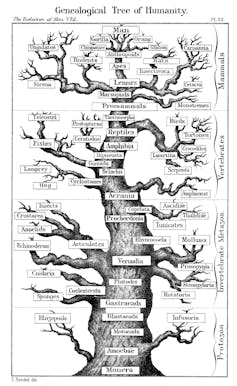 ‘Man’ is at the very top looking down at all other forms of life in Ernst Haeckel’s drawing. Ernst Haeckel/Photos.com via Getty Images Plus
Written by Kevin Omland, professor of biological sciences, UMBC
We humans have long viewed ourselves as the pinnacle of evolution. People label other species as “primitive” or “ancient” and use terms like “higher” and “lower” animals.
This anthropocentric perspective was entrenched in 1866, when German scientist Ernst Haeckel drew one of the first trees of life. He placed “Man,” clearly labeled, at the top. This illustration helped establish the popular view that we are the ultimate goal of evolution.
Modern evolutionary biology and genomics debunk that flawed perspective, showing there is no hierarchy in evolution. All species alive today, from chimpanzees to bacteria, are cousins that each have equally long lineages, rather than ancestors or descendants.
Unfortunately, these outdated notions remain prevalent in scientific journals and science journalism. In my new book, “Understanding the Tree of Life,” I explore why it is fundamentally misleading to view any current species as primitive, ancient or simple. As an evolutionary biologist, I offer an alternative view that emphasizes evolution’s complex, nonhierarchical, interconnected history.
Not primitive, just different
Egg-laying mammals, the monotremes, are frequently labeled the most “primitive” living mammals. This category includes the platypus and four species of echidnas. Indeed, their egg-laying is an ancient characteristic shared with reptiles.
But platypuses also have many unique recent adaptations that make them well suited to their lifestyle: They have webbed feet for swimming and a bill with specialized electroreceptors that detect prey in the mud. Males have spurs with venom that they can use to defend themselves against rivals. If you take a platypus’s view, they’re the pinnacle of evolution for their specific ecological niche.
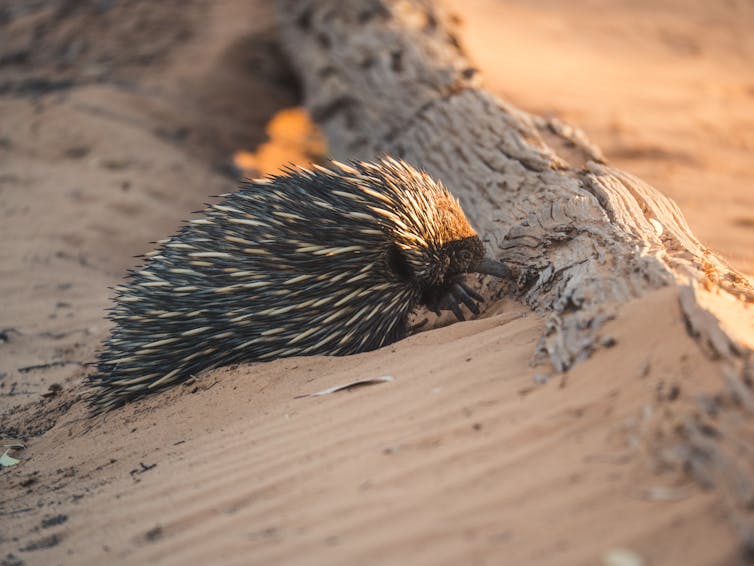 Echidnas have just what it takes to flourish in their unique niche. Chris Beavon/Moment via Getty Images
Echidnas may seem primitive, especially because they lack a capability that humans have—giving birth to live young. Yet they possess many extraordinary traits that humans lack. Echidnas are known for their outer covering of protective spines. They also have powerful claws for digging, a sensitive beak and a long sticky tongue, all of which they use foraging for ants and termites. In a head-to-head competition foraging for prey in a termite mound, an echidna would easily outperform any human.
Other mammals native to Australia also turn up on lists of primitive mammals, such as many species of marsupials – pouched mammals, including kangaroos, koalas and wombats. These species generally give birth to small, minimally developed young that move to the mother’s pouch where they complete development. Pouch development may seem inferior to the human way, but it does have advantages. For example, kangaroos can simultaneously nurture young at three stages of development.
Evolutionary tree appearance depends on focus
Marsupials such as opossums, or monotremes such as the platypus, are often shown at the bottom or left side of an evolutionary tree. However, that does not mean that they are older, more primitive or less evolved.
Evolutionary trees—what scientists call phylogenies—show cousin relationships. Just as your second or third cousin is no more primitive than you are, it is misleading to think of a koala or echidna as primitive because of where they are depicted on these trees.
When scientists and journalists choose which species to include in the evolutionary trees in their publications, it can influence how the public perceives these species. But species shown lower on the page are not “lower” on some evolutionary scale.
Rather, they are placed there because the focus of many of those trees is on placental mammals, such as humans, other primates, carnivores, rodents and so on. When the focus is on placental mammals, it makes sense to include one or two species of marsupials as comparisons for reference.
 A phylogenetic tree focused on marsupials shows humans as one of the species included for comparison. Spiekman, S., Werneburg, I. Sci Rep 7, 43197 (2017), CC BY
In contrast, in a tree focused on marsupials, one or two placental mammals could be included at the bottom of the page for comparison.
Why understanding the tree of life matters
Viewing humans as the goal of evolution leads to a misunderstanding of the entire evolutionary process. Since evolution is the conceptual foundation for all biology, this flawed perspective can hinder all biological and biomedical science.
Mastering a modern understanding of evolutionary trees is crucial to advances in fields ranging from animal behavior and physiology to conservation and biomedicine. For example, because rhesus monkeys are much more closely related to us than are capuchins, rhesus monkeys are generally better subjects for preliminary tests of human vaccines. Opossums, incorrectly considered to be primitive, are a great species for providing a broader framework for studies of neurobiology and aging because they are distantly related to us, not because they are lower or more ancestral.
Grasping the profound reality that humans are not the pinnacle of evolution, but one branch among many, is foundational for all modern biology. Understanding the tree of life is central to fully embracing the shared modern status of all animals, from platypuses to people.
This article is republished from The Conversation under a Creative Commons license. Read the original article and see more than 300 UMBC articles available in The Conversation.
]]>
‘Man’ is at the very top looking down at all other forms of life in Ernst Haeckel’s drawing. Ernst Haeckel/Photos.com via Getty Images Plus Written by Kevin Omland, professor of biological...
https://umbc.edu/stories/no-animal-alive-today-is-primitive-why-are-so-many-still-labeled-that-way/
https://beta.my.umbc.edu/api/v0/pixel/news/156361/guest@my.umbc.edu/579b4c20ffcd65ab5def01337ebca42f/api/pixel
biology
cnms
discovery
magazine
story
the-conversation
UMBC News & Magazine
https://beta.my.umbc.edu/groups/umbc-news-magazine
https://assets1-beta.my.umbc.edu/system/shared/avatars/groups/000/001/943/24435aa6207c452e7bc15cc74b42c7bb/xsmall.png?1748556657
https://assets1-beta.my.umbc.edu/system/shared/avatars/groups/000/001/943/24435aa6207c452e7bc15cc74b42c7bb/original.png?1748556657
https://assets2-beta.my.umbc.edu/system/shared/avatars/groups/000/001/943/24435aa6207c452e7bc15cc74b42c7bb/xxlarge.png?1748556657
https://assets2-beta.my.umbc.edu/system/shared/avatars/groups/000/001/943/24435aa6207c452e7bc15cc74b42c7bb/xlarge.png?1748556657
https://assets3-beta.my.umbc.edu/system/shared/avatars/groups/000/001/943/24435aa6207c452e7bc15cc74b42c7bb/large.png?1748556657
https://assets1-beta.my.umbc.edu/system/shared/avatars/groups/000/001/943/24435aa6207c452e7bc15cc74b42c7bb/medium.png?1748556657
https://assets2-beta.my.umbc.edu/system/shared/avatars/groups/000/001/943/24435aa6207c452e7bc15cc74b42c7bb/small.png?1748556657
https://assets1-beta.my.umbc.edu/system/shared/avatars/groups/000/001/943/24435aa6207c452e7bc15cc74b42c7bb/xsmall.png?1748556657
https://assets2-beta.my.umbc.edu/system/shared/avatars/groups/000/001/943/24435aa6207c452e7bc15cc74b42c7bb/xxsmall.png?1748556657
UMBC News & Magazine
0
0
false
Mon, 09 Feb 2026 13:40:33 -0500
Mon, 09 Feb 2026 13:40:33 -0500
Chronic illness redirected Jaime Miller’s medical career—today she advocates for people with lupus, including herself
When Jaime Miller ’06, biochemistry, was in the final stages of her M.D/Ph.D., she did not expect her 15-year educational journey to be derailed by her own medical mystery. She certainly didn’t foresee finding peace and purpose through turning her chronic illness into a life of advocacy—but that’s exactly what’s happened.
Before coming to UMBC, Miller seized early opportunities: Her teachers encouraged her interests in STEM, leading her to attend the Baltimore Polytechnic Institute (Poly), a STEM magnet high school requiring a combined bus and light rail commute from her home in Baltimore’s Morrell Park neighborhood. After her junior year, a summer neuroscience program for high schoolers at the University of Maryland further ignited her love for life science. As a first-generation college student, she entered these unfamiliar spaces with an uncommon boldness.
“I didn’t wear a plain Jane suit to the interview for the University of Maryland program. It was mint green, which is hilarious, looking back,” she says. “I didn’t know what I was doing. But I’ve just always been somebody that hasn’t feared failure. You just learn and keep on going. It’s like a building step.”
The summer program, where Miller thrived in a lab studying Alzheimer’s disease under mentor Mervin Monteiro, extended into her senior year through Poly’s research practicum, where she continued lab work, wrote a thesis, and won first prize at the Intel Science Talent Search (now the Regeneron STS). When Miller learned from a lab colleague that most M.D./Ph.D. programs pay for medical school, it was “like fireworks going off in my head,” she says, knowing medical school would be beyond her family’s budget. Aware of UMBC’s reputation for preparing STEM majors to excel in graduate study, Miller decided to use the local institution as a launchpad for a funded graduate program.
Right on track
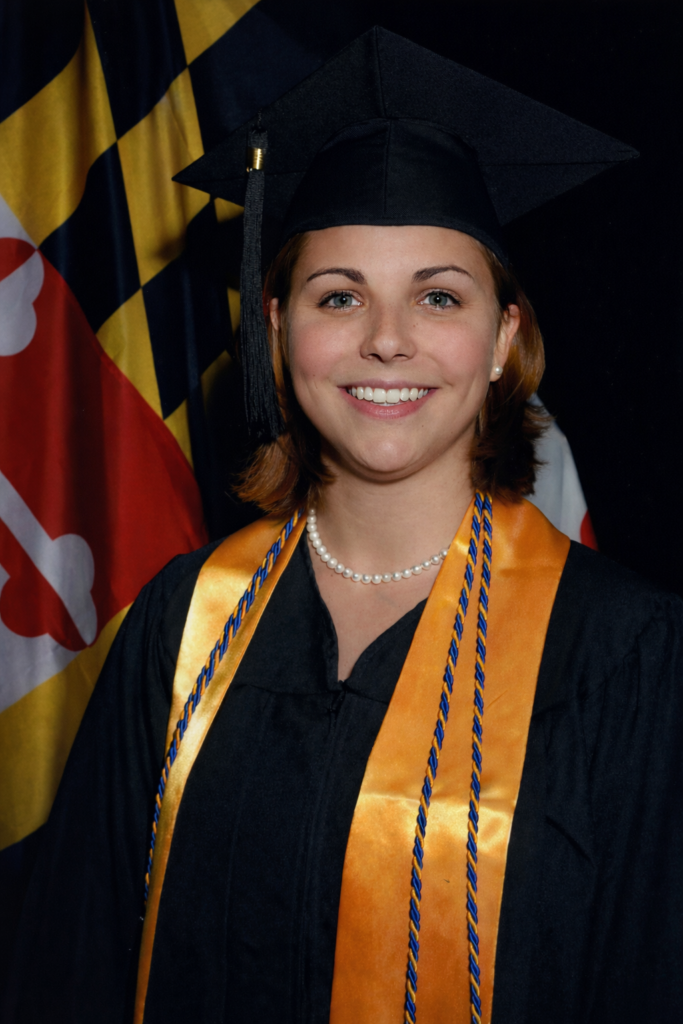 Jaime Miller graduated magna cum laude from UMBC and was inducted into the prestigious Phi Beta Kappa National Honor Society. (Courtesy of Miller)
Drawn to UMBC’s supportive environment, strong science programs, and proximity to home, Miller accepted a College Bound scholarship and a small award from a pharmaceutical company. Miller found a minor in philosophy complemented her scientific pursuits by honing her critical thinking and providing diverse insights. She particularly enjoyed courses in moral theory, she says, exploring challenging topics like euthanasia, abortion, and pornography in a safe environment for discussion.
The emphasis on clarity, precision, and organization in philosophical arguments directly enhanced her scientific communication and planning skills, too: “You want to make sure any experimental design is clean and succinct, so that when you present it, everybody understands what you’re doing and what your goal is.”
Again seizing opportunities, Miller emailed Michael Summers, distinguished professor of chemistry and biochemistry, about joining his lab, even negotiating her pay. “It was my first foray in advocating for myself,” she reflects. Summers remembers Miller as “a wonderful, caring person” with standout “resilience, professionalism, and commitment to others in need.” Her work with his research group led to a publication in Proceedings of the National Academy of Sciences.
After UMBC, Miller pursued an M.D./Ph.D. at the University of Virginia, focusing on epigenetics and blood disorders. “There was something about blood and blood cancers that I was just really drawn toward,” she says. After being selected for a fellowship in hematology-oncology at the University of Pittsburgh Medical Center (UPMC) in 2015, Miller seemed poised for a thriving clinical and research career.
Redirected by chronic illness
In 2018, however, a constellation of nagging symptoms escalated: extreme fatigue, joint pain, swollen lymph nodes, and, finally, pneumonia. After seemingly endless testing and specialist visits, she was diagnosed with systemic lupus erythematosus, an autoimmune disease. Lupus, she explains, “can affect literally any organ in the body” and manifests in every patient differently. Unfortunately, “I ran into a lot of obstacles” when requesting accommodations like no overnight shifts, she says, including dismissive comments about her “mystery illness.” Ultimately, UPMC terminated her, refusing a part-time option.
 Jaime Miller (Courtesy of Miller)
This setback could have been devastating after 15 years of rigorous training, but Miller channeled it into purpose. “Despite how negative it sounds, it’s not tragic. My husband could see I was mentally breaking from sacrificing so much of my quality of life for my career. Leaving medicine was a brutal reality check, but it also showed me how much else I could explore and enjoy,” Miller says. For example, “When I was too sick to do much, I started small things I’d always wanted: I bought a guitar to learn music, a sewing machine to make clothes—simple activities I could do sitting in a chair. It was an eye-opener. I’m happier now—100 percent.”
As an ambassador for the Lupus Foundation of America, she co-facilitates a Pittsburgh support group and organized the city’s first officially sponsored Walk to End Lupus Now in 2025, raising $60,000. She has also found a way to continue her medical career on a part-time basis by voluntarily consulting for All4Cure, an online platform where specialists like her provide guidance for multiple myeloma patients, ensuring equitable care for those in rural areas treated by general oncologists.
From adversity to purpose
Miller spent years practicing self-advocacy on her academic journey, and now she’s using those skills to benefit others, as well. This resilience shines in her advice for the chronic illness community: “You have to take care of yourself. You can’t take care of anything else unless you take care of yourself, both physically and mentally.” She emphasizes seeking counseling early and advocating fiercely for one’s needs, even when it feels isolating.
Miller was raised in the Catholic church but drifted toward atheism during her medical training. After her diagnosis, however, she found herself sensing the voice of her grandmother, a committed Christian who also had lupus: “Maybe this is happening for a reason. You’re a physician and you’ll be able to educate and advocate a lot better for those that can’t advocate for themselves.” Today she is still navigating her spiritual life, but for now she believes in “something out there in the universe that makes things the way that they are”—an energy or presence that gives meaning to hardship and opens new paths.
UMBC played a foundational role in where Miller finds herself today, fostering her confidence and research skills in a nurturing setting. Today, at 41, Miller embraces a fuller life than a traditional physician path would have allowed. Her mantra extends to younger generations, who she hopes will try new things, take risks, and forge their own paths. “Failure is okay,” Miller reiterates. “It’s nothing more than a learning step to success.”
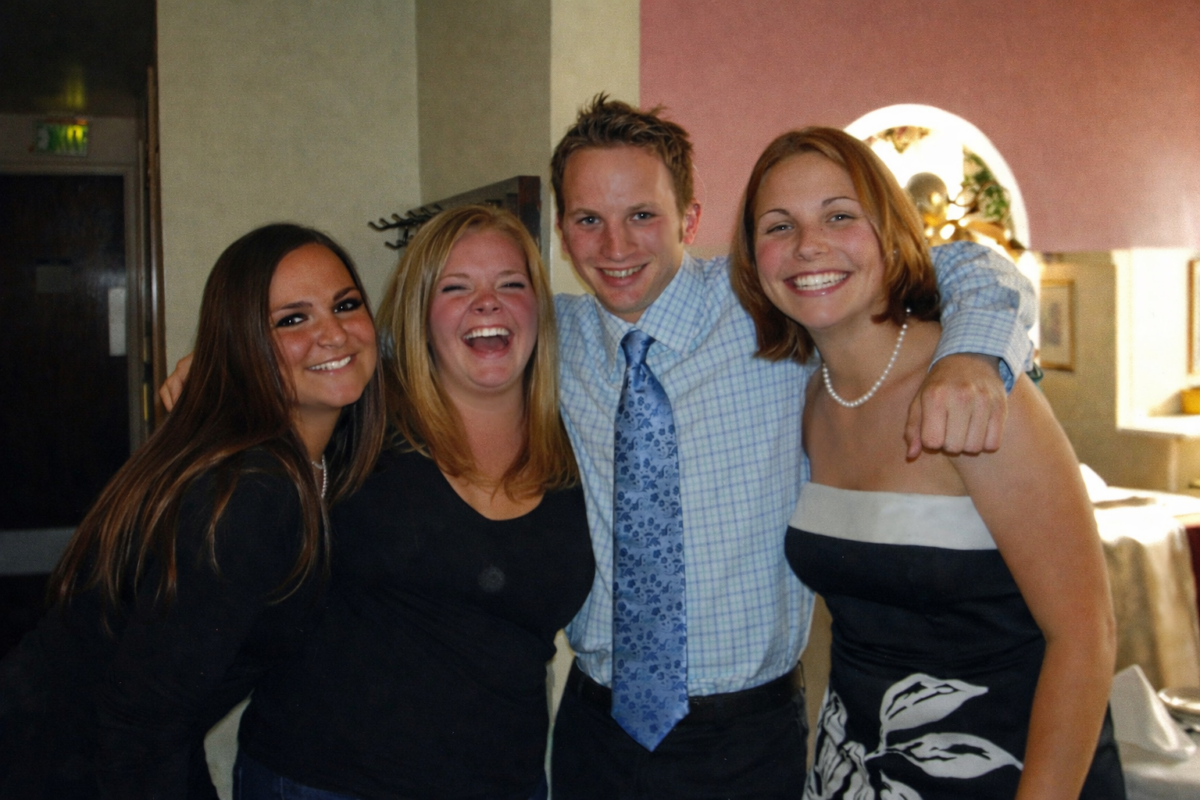 Jaime Miller, right, celebrates with close friends in Baltimore’s Little Italy after her UMBC graduation. (Courtesy of Miller)
]]>
When Jaime Miller ’06, biochemistry, was in the final stages of her M.D/Ph.D., she did not expect her 15-year educational journey to be derailed by her own medical mystery. She certainly didn’t...
https://umbc.edu/stories/jaime-miller-chronic-illness-advocacy/
https://beta.my.umbc.edu/api/v0/pixel/news/156309/guest@my.umbc.edu/2a56dc826183bc717c791a68645ab6e4/api/pixel
alumni
chemistry-and-biochemistry
cnms
community
news
story
UMBC News & Magazine
https://beta.my.umbc.edu/groups/umbc-news-magazine
https://assets1-beta.my.umbc.edu/system/shared/avatars/groups/000/001/943/24435aa6207c452e7bc15cc74b42c7bb/xsmall.png?1748556657
https://assets1-beta.my.umbc.edu/system/shared/avatars/groups/000/001/943/24435aa6207c452e7bc15cc74b42c7bb/original.png?1748556657
https://assets2-beta.my.umbc.edu/system/shared/avatars/groups/000/001/943/24435aa6207c452e7bc15cc74b42c7bb/xxlarge.png?1748556657
https://assets2-beta.my.umbc.edu/system/shared/avatars/groups/000/001/943/24435aa6207c452e7bc15cc74b42c7bb/xlarge.png?1748556657
https://assets3-beta.my.umbc.edu/system/shared/avatars/groups/000/001/943/24435aa6207c452e7bc15cc74b42c7bb/large.png?1748556657
https://assets1-beta.my.umbc.edu/system/shared/avatars/groups/000/001/943/24435aa6207c452e7bc15cc74b42c7bb/medium.png?1748556657
https://assets2-beta.my.umbc.edu/system/shared/avatars/groups/000/001/943/24435aa6207c452e7bc15cc74b42c7bb/small.png?1748556657
https://assets1-beta.my.umbc.edu/system/shared/avatars/groups/000/001/943/24435aa6207c452e7bc15cc74b42c7bb/xsmall.png?1748556657
https://assets2-beta.my.umbc.edu/system/shared/avatars/groups/000/001/943/24435aa6207c452e7bc15cc74b42c7bb/xxsmall.png?1748556657
UMBC News & Magazine
0
0
false
Fri, 06 Feb 2026 14:26:37 -0500
Fri, 06 Feb 2026 14:26:37 -0500
Meet a Retriever—Manpreet Suri ’14, M.S. ’15 is an entrepreneur and digital tool builder
Jaime Miller, right, celebrates with close friends in Baltimore’s Little Italy after her UMBC graduation. (Courtesy of Miller)
]]>
When Jaime Miller ’06, biochemistry, was in the final stages of her M.D/Ph.D., she did not expect her 15-year educational journey to be derailed by her own medical mystery. She certainly didn’t...
https://umbc.edu/stories/jaime-miller-chronic-illness-advocacy/
https://beta.my.umbc.edu/api/v0/pixel/news/156309/guest@my.umbc.edu/2a56dc826183bc717c791a68645ab6e4/api/pixel
alumni
chemistry-and-biochemistry
cnms
community
news
story
UMBC News & Magazine
https://beta.my.umbc.edu/groups/umbc-news-magazine
https://assets1-beta.my.umbc.edu/system/shared/avatars/groups/000/001/943/24435aa6207c452e7bc15cc74b42c7bb/xsmall.png?1748556657
https://assets1-beta.my.umbc.edu/system/shared/avatars/groups/000/001/943/24435aa6207c452e7bc15cc74b42c7bb/original.png?1748556657
https://assets2-beta.my.umbc.edu/system/shared/avatars/groups/000/001/943/24435aa6207c452e7bc15cc74b42c7bb/xxlarge.png?1748556657
https://assets2-beta.my.umbc.edu/system/shared/avatars/groups/000/001/943/24435aa6207c452e7bc15cc74b42c7bb/xlarge.png?1748556657
https://assets3-beta.my.umbc.edu/system/shared/avatars/groups/000/001/943/24435aa6207c452e7bc15cc74b42c7bb/large.png?1748556657
https://assets1-beta.my.umbc.edu/system/shared/avatars/groups/000/001/943/24435aa6207c452e7bc15cc74b42c7bb/medium.png?1748556657
https://assets2-beta.my.umbc.edu/system/shared/avatars/groups/000/001/943/24435aa6207c452e7bc15cc74b42c7bb/small.png?1748556657
https://assets1-beta.my.umbc.edu/system/shared/avatars/groups/000/001/943/24435aa6207c452e7bc15cc74b42c7bb/xsmall.png?1748556657
https://assets2-beta.my.umbc.edu/system/shared/avatars/groups/000/001/943/24435aa6207c452e7bc15cc74b42c7bb/xxsmall.png?1748556657
UMBC News & Magazine
0
0
false
Fri, 06 Feb 2026 14:26:37 -0500
Fri, 06 Feb 2026 14:26:37 -0500
Meet a Retriever—Manpreet Suri ’14, M.S. ’15 is an entrepreneur and digital tool builder
Meet Manpreet Suri ’14, M.S. ’15, information systems, an entrepreneur, digital solutions problem solver, McNair Scholar, and a member of the Alumni Association Board of Directors. Suri found a community of support during his time at UMBC, and he credits his professors and UMBC Assistant Vice Provost and Assistant Dean Laila Shishineh for challenging him to meet his full potential. In his work, he finds fulfillment in building tools that make someone’s day easier and more efficient.
Q: What brought you to UMBC?
A: I wanted to be in a place where I wouldn’t get lost in the crowd—a place where I could learn, be challenged, and be supported. UMBC offered all of that, plus a community that genuinely cared about who I was becoming.
Q: What would you want another Retriever to know about you?
A: I recently joined Asurion as a group product manager on the Enterprise Client Experience team. At Asurion, I lead product strategy for tools that support the end-to-end experience of Fortune 500 partners and their customers, from digital onboarding to service delivery. I am a two-time master’s graduate, having earned my first degree at UMBC and my second at the University of Florida’s Warrington College of Business while working full time. My journey blends entrepreneurship, real estate, and digital innovation, always with a focus on solving real-world problems through community-driven solutions.
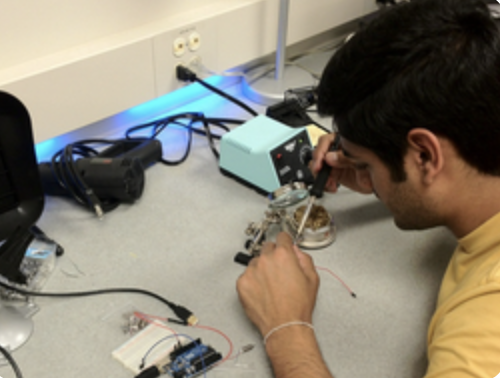
Q: What’s the one thing you’d want someone who hasn’t joined the UMBC community to know about the support you find here?
A: You’re never alone here. Whether it’s faculty, peers, or alumni—someone always shows up for you, challenges you to grow, and reminds you that your ideas and voice matter.
Left: Suri during his McNair Summer Research Fellowship designing a hardware-software prototype: a wearable Braille-based device for the visually impaired.
Q: Tell us about someone in the UMBC community who has inspired you or supported you, and how they did it.
A: Dr. Laila Shishineh encouraged me to merge my technical background with my passion for supporting others. Her mentorship helped me take risks, try new experiences, and believe that innovation can start in the classroom.
Dr. Shishineh was my Summer Bridge mentor and had an enormous influence on both my personal and professional trajectory. She encouraged me to take on extra credits early, accelerating my progress and building my confidence, and pushed me to get involved beyond the classroom—to form meaningful connections, volunteer, and embrace opportunities I otherwise might have overlooked.
With that encouragement, I joined the Refugee Youth Project through the Shriver Center, which eventually helped me connect with recruiters at General Electric. She supported my interest in becoming a resident assistant in the Discovery Scholars Living-Learning Community, and she constantly encouraged me to step into leadership roles, attend retreats like STRiVE, and explore other parts of campus life, including student government and community service.
 Suri at the McNair Scholars induction ceremony in 2012.
Her mentorship came at a time when I was navigating unfamiliar territory as a first-generation student. My parents didn’t go to college, so having someone who believed in me, challenged me, and celebrated my wins made an enormous difference. She even supported me in applying to the McNair Scholars Program and helped me think about potential future paths in tech.
In so many ways, Laila was the single most influential person in my college journey—a steady source of humor, enthusiasm, and encouragement. I truly wouldn’t be where I am today without her.
Q: Tell us about what you loved about your academic program at UMBC.
A: The information systems program provided a powerful blend of technical skills and practical application. What I appreciated most was how interdisciplinary it felt—it taught me to think not just about technology itself, but about the people, systems, and structures that surround it. That balance shaped the way I approach product management and innovation today.
My professors saw potential I didn’t see in myself. They helped me land my first internships, encouraged me to explore entrepreneurship, and taught me that curiosity and kindness are just as important as credentials.
Manpreet Suri '14, M.S. '15
Q: How did UMBC foster your interest in entrepreneurship?
A: My interest in entrepreneurship definitely sparked while at UMBC. While in Dr. Shaun Kane’s Prototyping and Design Lab I worked on a wearable Braille-based device for users with visual impairments. That was my first real experience with human-centered technology design. That project ultimately became the foundation of my McNair Scholars research and showed me how innovation and empathy can come together to solve real-world problems. It planted the seed for the entrepreneurial mindset I carry with me today.
Q: Since joining the UMBC community, in what ways have you felt supported and experienced personal growth?
A: My professors saw potential I didn’t see in myself. They helped me land my first internships, encouraged me to explore entrepreneurship, and taught me that curiosity and kindness are just as important as credentials.
Dr. Kimberly R. Moffitt remains one of the most memorable and impactful professors I’ve had in any academic setting. Her classes pushed me to consider identity, community, and social systems in ways I never had before. She introduced me to a world of nonfiction that I didn’t realize I’d been missing, and the discussions in her classroom helped balance the technical focus of my information systems coursework.
Her teaching style—thoughtful, engaging, and deeply human—broadened my perspective and made my overall academic experience richer and more holistic. I’m still grateful for the lasting impact her classes had on how I view people and the world.
Q: What’s your favorite thing about being a part of Retriever Nation?
A: Retriever Nation is about hustle, heart, and humility. I love how UMBC fosters change makers who don’t just talk about impact, they do the work and bring others with them.
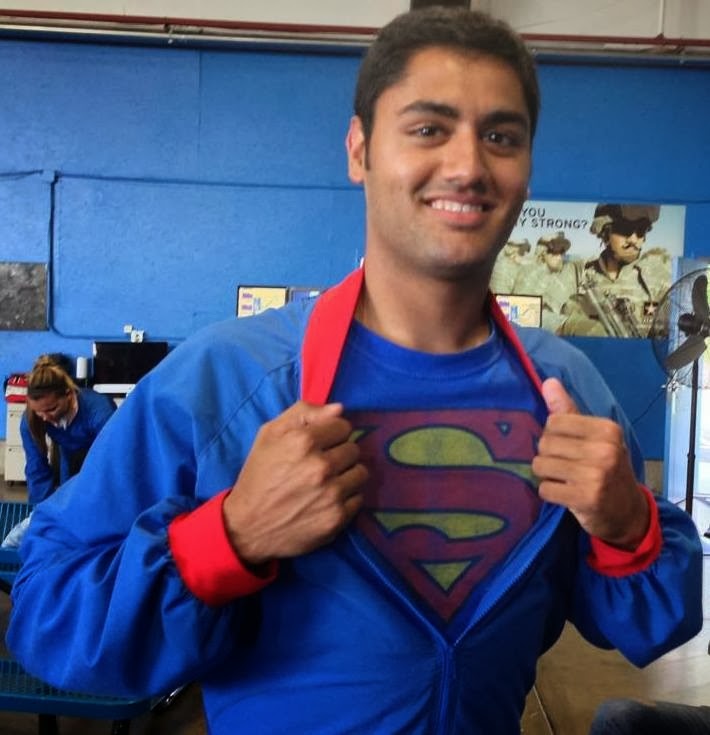
Right: Suri as an undergraduate student at a skydiving experience during his summer internship with GE Aviation.
Q: What drives you to support UMBC?
A: UMBC changed the trajectory of my life. Giving back is my way of paying it forward—especially to programs that support first-generation students and innovators who just need a chance to be seen and supported. I’ll always be proud to support and be part of a community that shows up for people the way UMBC showed up for me.
UMBC’s greatest strength is its people. When people meet Retrievers and hear about the passion they bring, the relationships they create, the ways they support each other, and the commitment they have to inclusive excellence, they truly get a sense of our community. That’s what “Meet a Retriever” is all about.
Learn more about how UMBC can help you achieve your goals.
]]>
Meet Manpreet Suri ’14, M.S. ’15, information systems, an entrepreneur, digital solutions problem solver, McNair Scholar, and a member of the Alumni Association Board of Directors. Suri found a...
https://umbc.edu/stories/meet-a-retriever-manpreet-suri-entrepreneur/
https://beta.my.umbc.edu/api/v0/pixel/news/156274/guest@my.umbc.edu/d5724b4c4bb823c631d2b22c6681ee2e/api/pixel
alumni
coeit
is
magazine
mcnair
meet-a-retriever
perspectives
story
trio
UMBC News & Magazine
https://beta.my.umbc.edu/groups/umbc-news-magazine
https://assets1-beta.my.umbc.edu/system/shared/avatars/groups/000/001/943/24435aa6207c452e7bc15cc74b42c7bb/xsmall.png?1748556657
https://assets1-beta.my.umbc.edu/system/shared/avatars/groups/000/001/943/24435aa6207c452e7bc15cc74b42c7bb/original.png?1748556657
https://assets2-beta.my.umbc.edu/system/shared/avatars/groups/000/001/943/24435aa6207c452e7bc15cc74b42c7bb/xxlarge.png?1748556657
https://assets2-beta.my.umbc.edu/system/shared/avatars/groups/000/001/943/24435aa6207c452e7bc15cc74b42c7bb/xlarge.png?1748556657
https://assets3-beta.my.umbc.edu/system/shared/avatars/groups/000/001/943/24435aa6207c452e7bc15cc74b42c7bb/large.png?1748556657
https://assets1-beta.my.umbc.edu/system/shared/avatars/groups/000/001/943/24435aa6207c452e7bc15cc74b42c7bb/medium.png?1748556657
https://assets2-beta.my.umbc.edu/system/shared/avatars/groups/000/001/943/24435aa6207c452e7bc15cc74b42c7bb/small.png?1748556657
https://assets1-beta.my.umbc.edu/system/shared/avatars/groups/000/001/943/24435aa6207c452e7bc15cc74b42c7bb/xsmall.png?1748556657
https://assets2-beta.my.umbc.edu/system/shared/avatars/groups/000/001/943/24435aa6207c452e7bc15cc74b42c7bb/xxsmall.png?1748556657
UMBC News & Magazine
0
0
false
Thu, 05 Feb 2026 14:52:43 -0500
Thu, 05 Feb 2026 14:52:43 -0500
Sisters in science: How one UMBC lab kindled a family tradition of discovery
On the fourth floor of UMBC’s Meyerhoff Chemistry Building, where students are hard at work exploring the intricacies of RNA molecules that may hold the key to combating viral diseases, a unique family tradition has taken root. Three sisters—Huda, Reem, and Rowah Abdelghani—have each stepped into the same research space and found the thrill of discovery, the warmth of community, and a mentor who welcomes eager learners at all levels.
It began with Huda, the trailblazing eldest of the three sisters. As a high school junior in Howard County’s Applications and Research Laboratory (ARL) biotechnology program, she dove into the program’s intensive training—mastering lab basics like micropipetting, PCR, and gel electrophoresis alongside students from across the county. ARL encourages seniors to pursue off-site internships, so Huda cold-emailed labs at nearby universities. “It was tough,” she recalls. “Some of my friends emailed over 30 people before finding a spot. I got lucky with Dr. Koirala.”

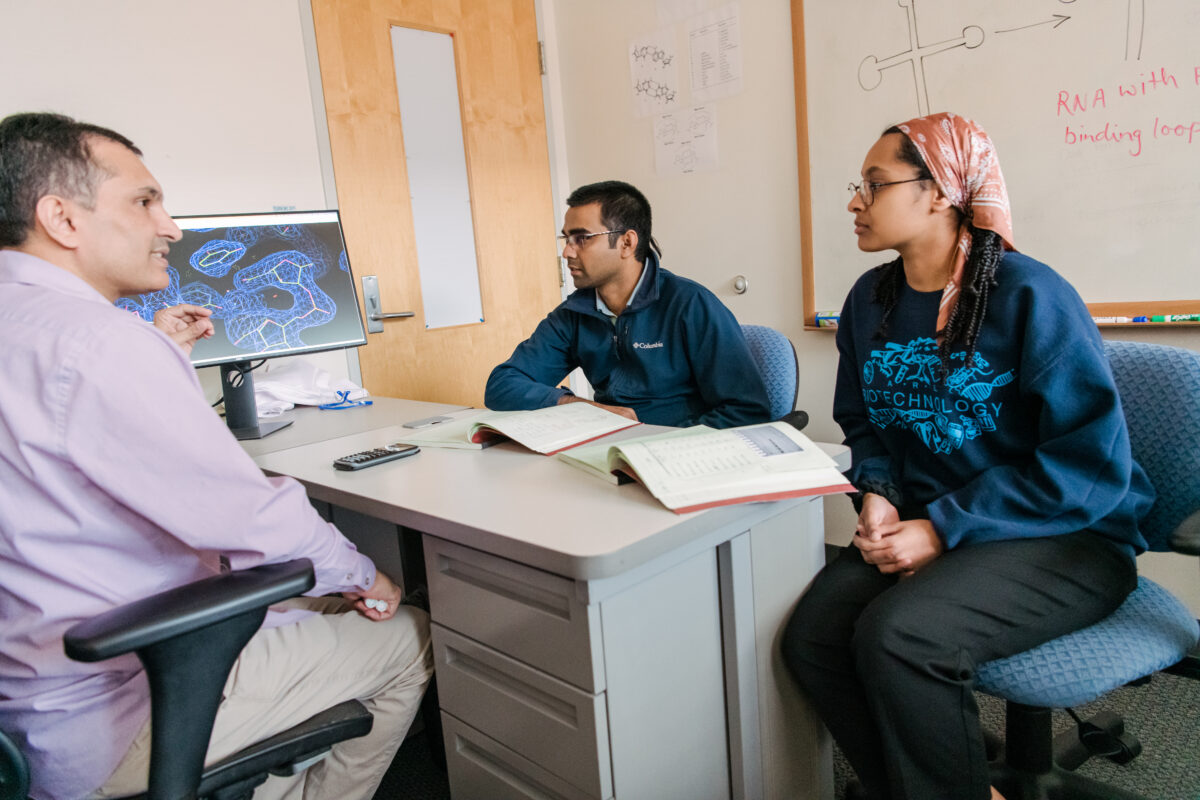 Huda Abdelghani (left) was the first of her three sisters to work in Deepak Koirala’s lab through Howard County’s Applications and Research Laboratory program. At right: Deepak Koirala (left), Naba Krishna Das (center), and Huda Abdelghani discuss their research in Koirala’s office. (Photos by Marlayna Demond ’11/UMBC)
Skills that apply everywhere
Deepak Koirala, associate professor of chemistry and biochemistry, leads a UMBC research group that studies the structures of RNA in enteroviruses—a family of pathogens behind illnesses like hand-foot-and-mouth disease, polio, and myocarditis. Huda joined in the summer of 2022 and stayed through spring 2023. Mentored by a Ph.D. student in the lab, Hasan Al Banna, she quickly learned that scientific research frequently involves failure—but that’s no reason to give up.
“You can do everything right and still not get results,” she says. “It’s not personal—that’s just science.” This lesson in perseverance stuck with her, as did Koirala’s individualized attention. When her graduate student mentor was away, he spent hours helping her set up trays of crystallization plates for her experiments.
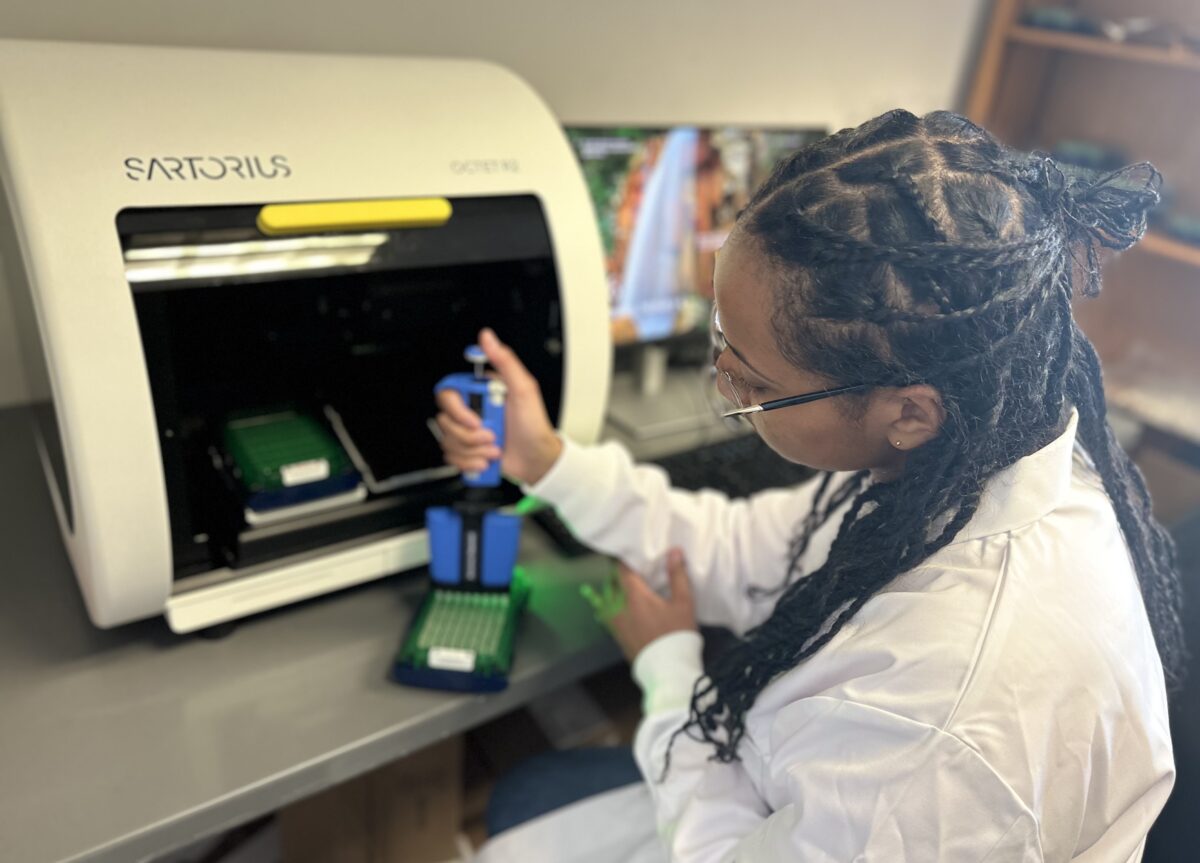
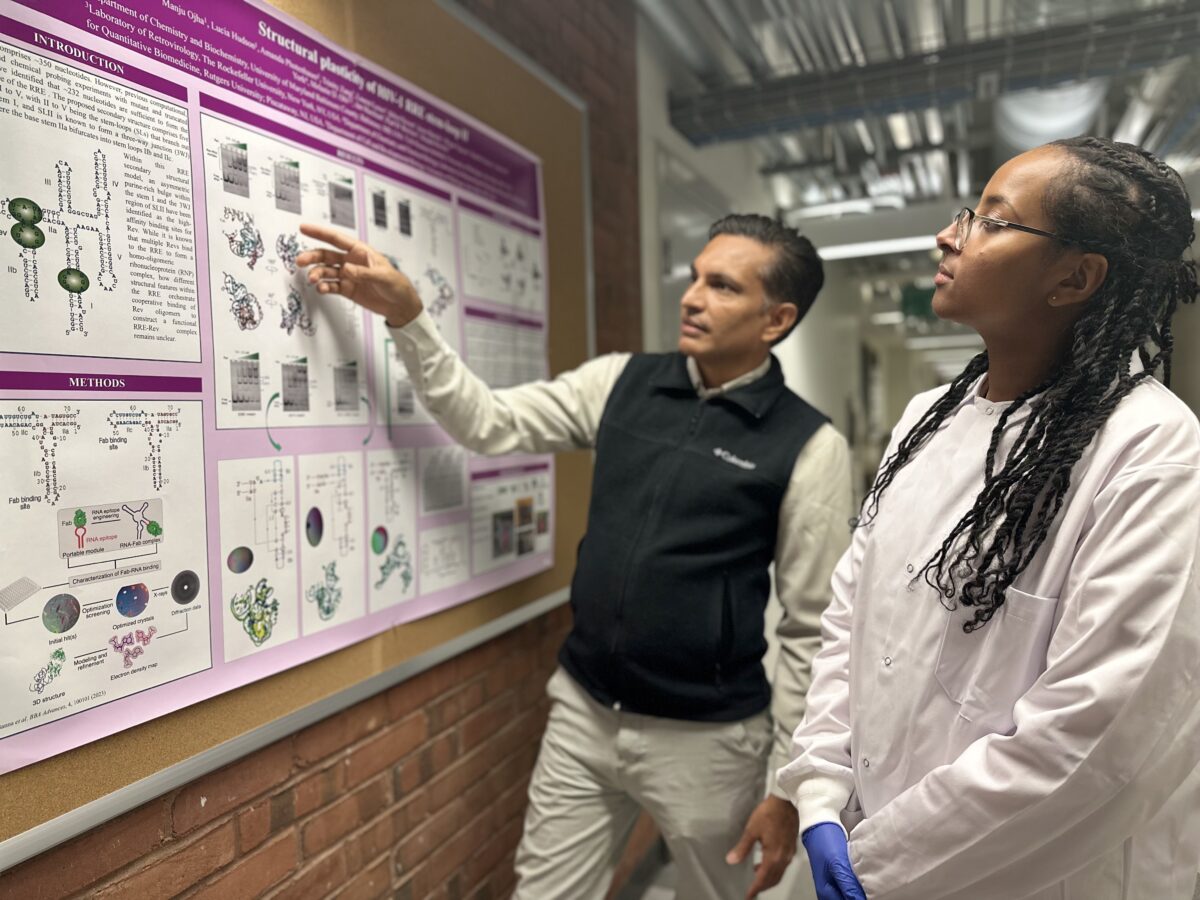 Left: Reem Abdelghani works with a multi-channel micropipet in the lab. Right: Reem and Deepak Koirala discuss research at a poster in the hallway outside Koirala’s lab. (Photos courtesy of Deepak Koirala)
Huda is now a junior mechanical engineering major at MIT, spending this semester on co-op with Apple’s Mac product design team in Austin, Texas—but the lab’s influence lingers. It sparked her interest in tools that help accelerate biochemistry research, like imaging platforms. “The technical and soft skills I gained at UMBC can apply anywhere,” she reflects. Even her first MIT lab connection came from a conversation overheard down the hall from her bench in Koirala’s lab. “It showed me the interconnectedness of academia,” she says.
Shattering preconceptions
Huda’s enthusiasm inspired Reem, the middle sister, to reach out to Koirala for her own ARL biotech internship. She started in Koirala’s lab in the summer of 2024, before her senior year of high school. “I saw how happy Huda was—and it looked like something I’d enjoy, too,” Reem says.
Mentored by Ph.D. student Naba Krishna Das, who isnow a postdoctoral fellow at the National Cancer Institute in Frederick, Maryland, Reem immersed herself in the lab’s operations, from presenting at lab meetings to executing tasks like sterilizing equipment and generating crystal structures of RNA and protein complexes. The lab’s collaborative vibe shattered her preconceptions. “I was worried grad school could be isolating, but it’s so interactive, with people at every stage of their scientific careers,” she explains.
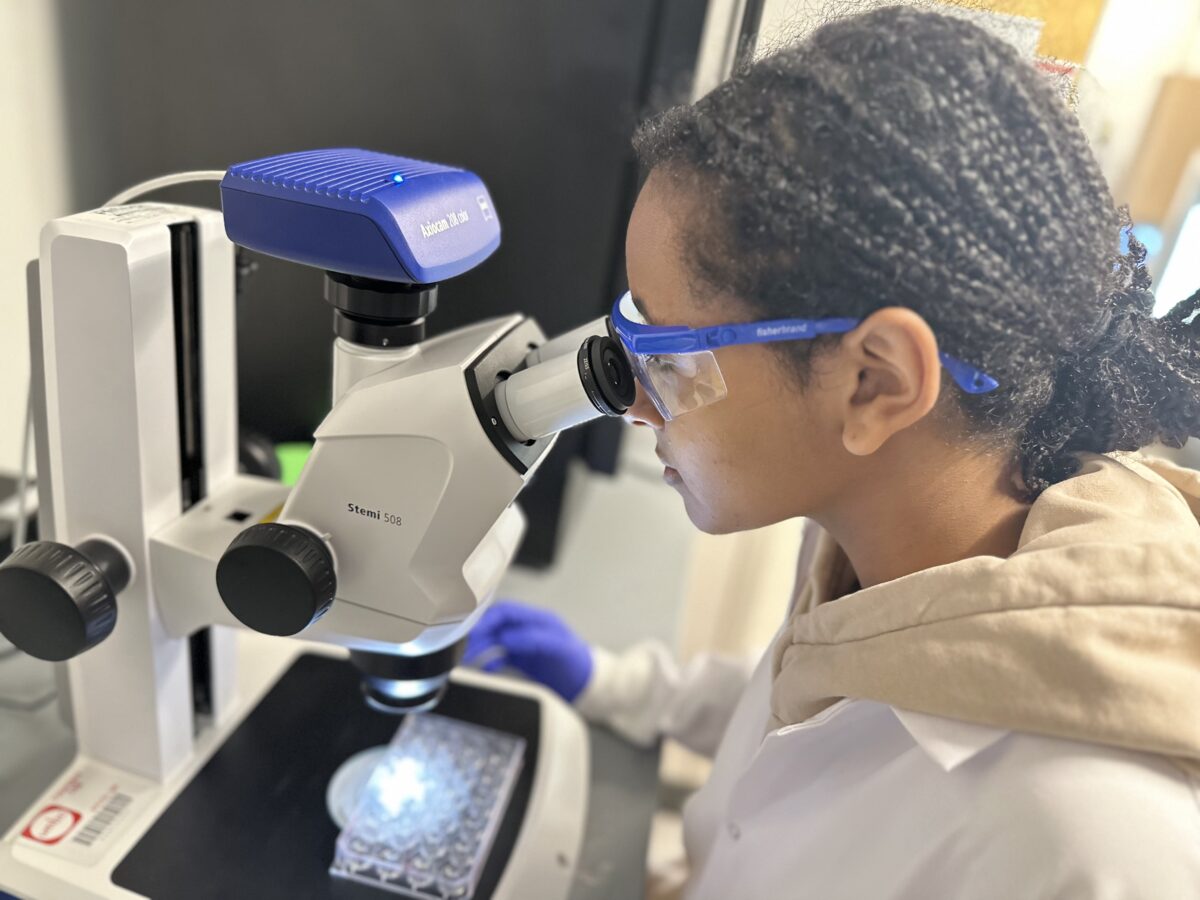
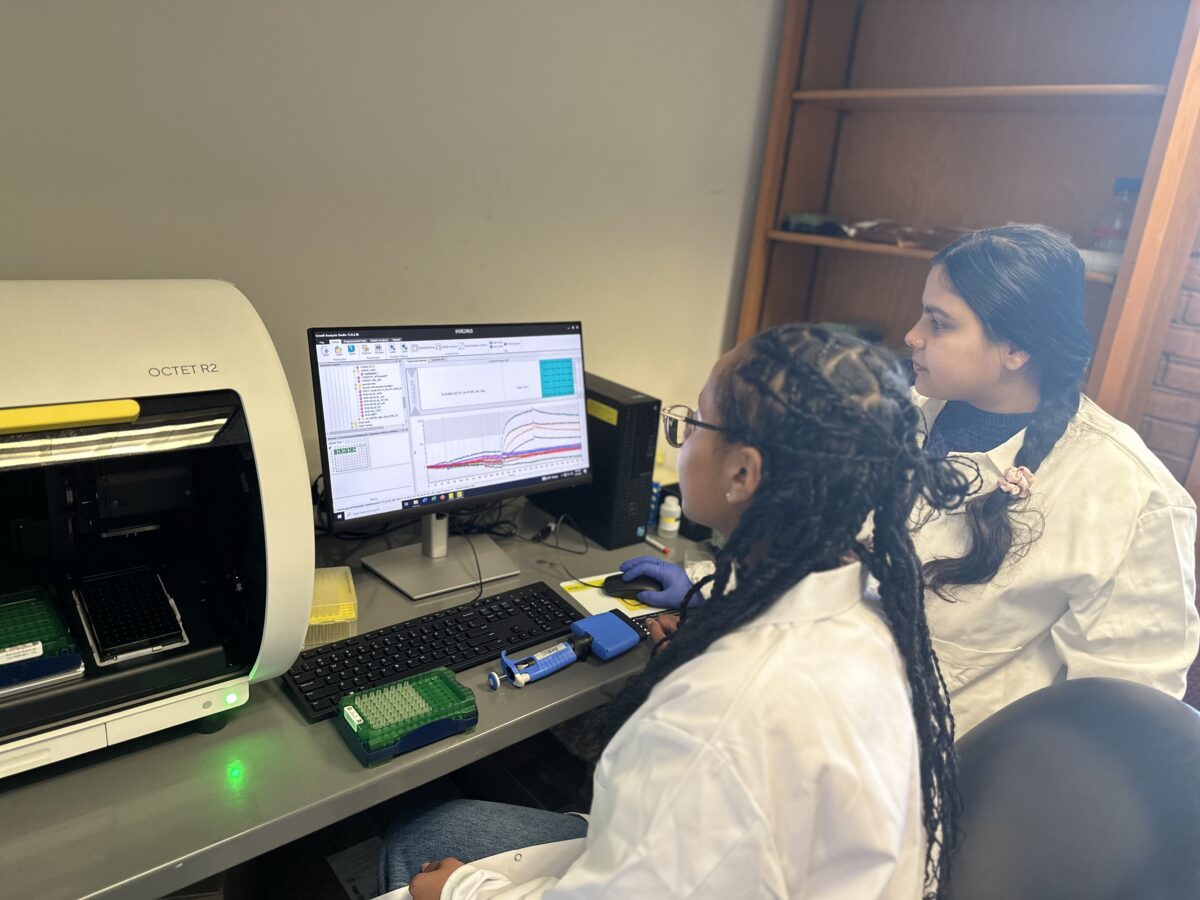 All three sisters gained valuable experience and skills working with Koirala. Left: Rowah looks at experimental wells under a microscope. Right: Reem (left) and Manju Ojha analyze data. (Photos courtesy of Deepak Koirala)
Reem conducted experiments for a project on viral replication, earning co-authorship on a 2025 Nature Communications paper as a high schooler. “I never expected to be so involved—I feel privileged,” she says. The process taught her the value of replication and troubleshooting. “Sometimes it’s trial and error as you’re exploring something new,” she says.
Now a first-year student at UMBC majoring in biochemistry, Reem plans to return to the Koirala lab as soon as space becomes available. “I didn’t consider grad school before, but now it’s definitely on the table,” she says—a perspective born of early research experiences that revealed what the scientific process is really like.
A real community
Rowah, a high school senior, joined the lab last fall. Her expectations of a “scary, strict PI” melted away. “Dr. Koirala is one of the kindest people I’ve met,” Rowah says. The lab’s supportive dynamic impressed her, too. Members shared resources, brainstormed next steps, and lifted each other up. “They push each other to do better—it’s a real community.”
Building on her ARL skills, Rowah felt like a valued member of the team. Her mentor in the lab, Ph.D. student Bethel G. Beyene, provided scientific papers for context, ensuring she grasped the concepts behind the team’s research, not just individual lab techniques. She, too, came face to face with failure and learned from it.
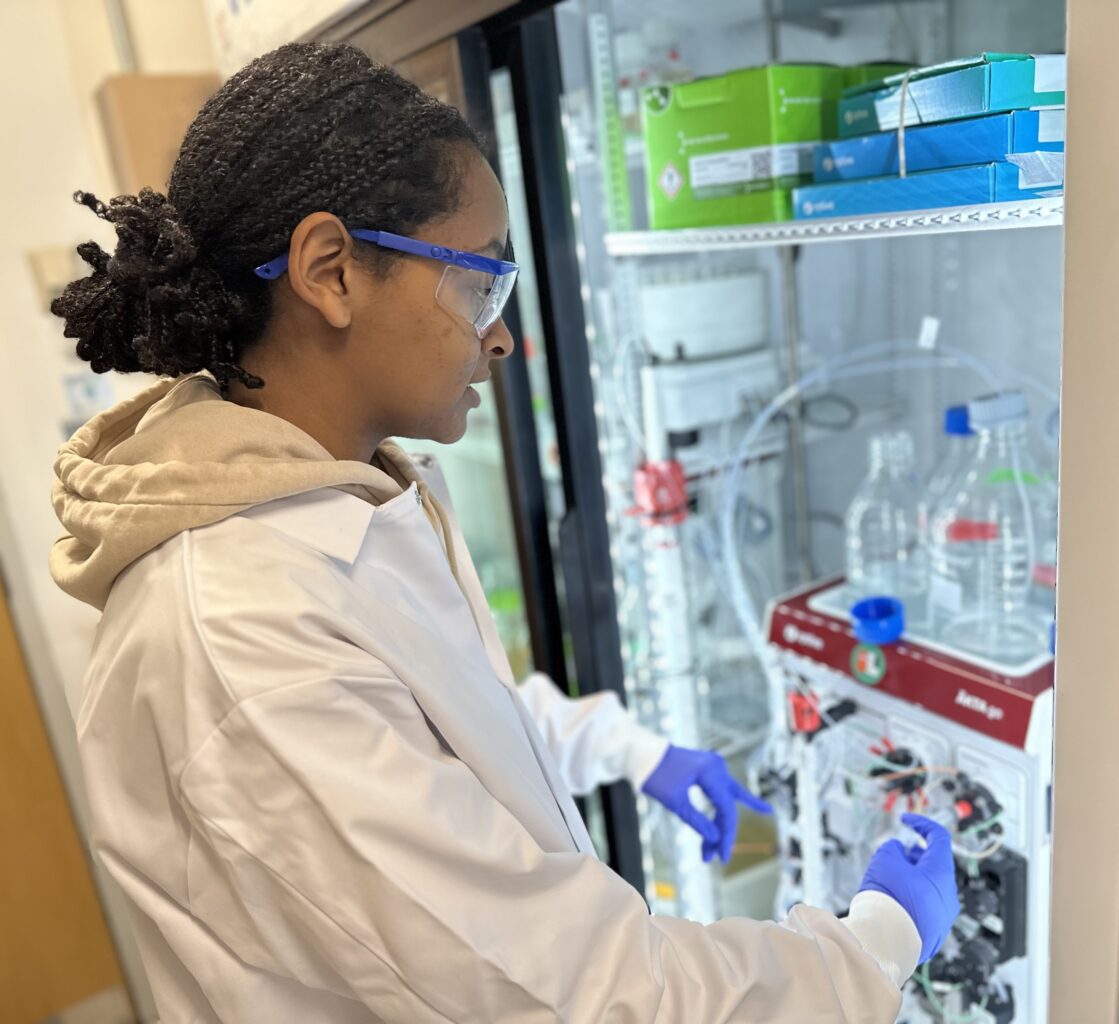
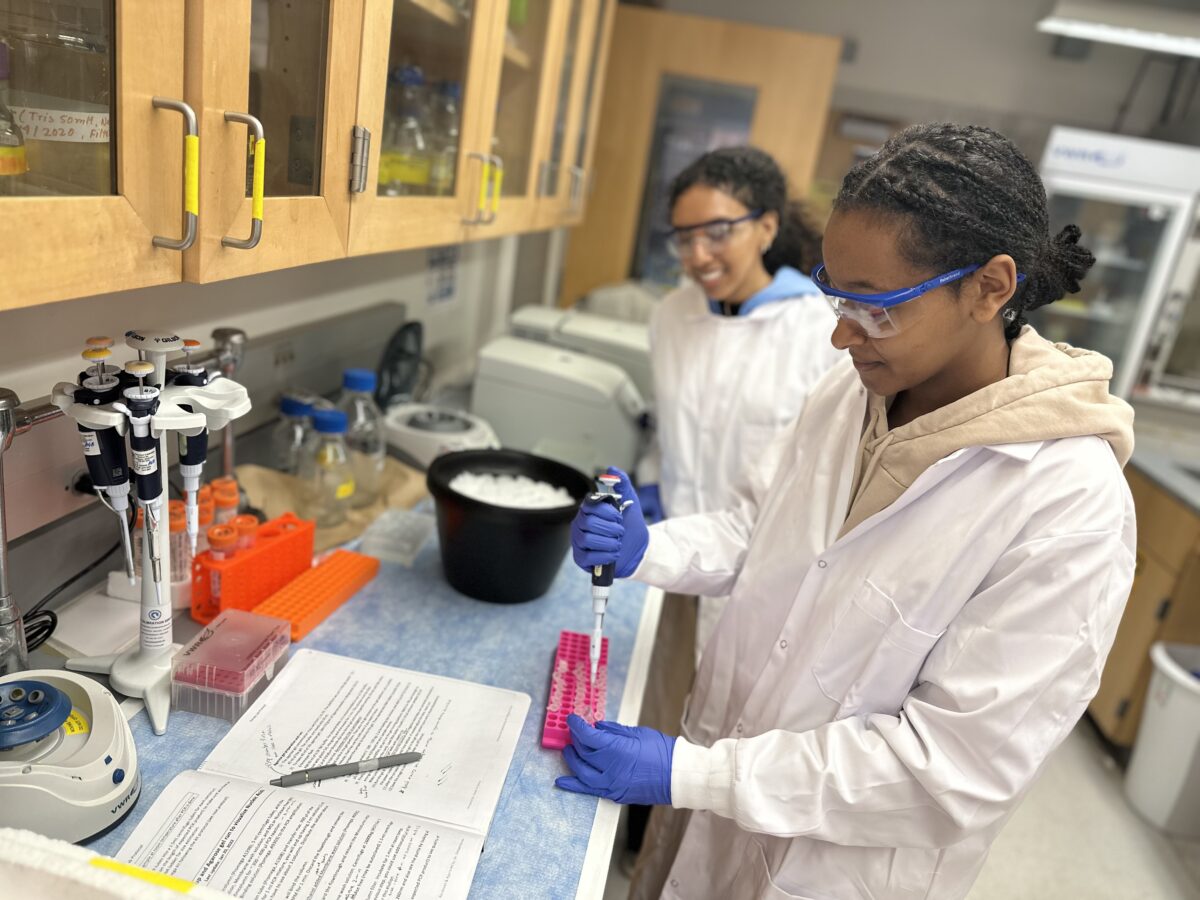 Rowah (at left and pipetting on right) received supportive mentorship from Ph.D. student Bethel Beyene (right photo, background). (Photos courtesy of Deepak Koirala)
“When things go wrong, we sit down and figure it out. It’s not that failure means you’re wrong; overcoming it is how you succeed.” That creative problem-solving carried over into her high school robotics competitions. “I applied lab thinking by evaluating all the possible sources of error to debug our robot—it felt great,” Rowah says. With her interests across biology and engineering, Rowah is considering a biomedical engineering major in the future. “The Koirala lab showed me that I don’t have to choose between my interests,” she says.
Making science better
The sisters’ bond fueled their experiences. “We talk openly—about lab life, plans, even arguments,” Reem laughs. Rowah says her admiration for Huda encouraged her to pursue working in Koirala’s lab. Though they never overlapped in the lab, Huda’s path reassured the others. “If I hadn’t had that chance, I couldn’t have shared it with my family,” Huda says.
Koirala credits the ARL program for bringing talented high schoolers like the Abdelghanis into his group. “They’re not just mentioned in the acknowledgments for completing experiments, but contributing intellectually at the level of authorship,” he says, noting the paper Reem co-authored.
His inclusive approach welcomes students with diverse backgrounds, training the next generation of scientists. “High schoolers, undergrads, women and men from varied backgrounds—they’re all making science better,” Koirala says. Clearly, including less experienced scientists isn’t hurting the lab’s output. Koirala has received multiple major grants and published high-profile papers since he arrived at UMBC in 2020.
In Koirala’s welcoming space, beginners become contributors, failures forge innovators, and family ties amplify ambition. As Rowah troubleshoots gels, Reem eyes graduate school, and Huda designs bioimaging tech at MIT, their paths affirm that science thrives on curiosity, community, and the courage to explore.
]]>
On the fourth floor of UMBC’s Meyerhoff Chemistry Building, where students are hard at work exploring the intricacies of RNA molecules that may hold the key to combating viral diseases, a unique...
https://umbc.edu/stories/sisters-in-science/
https://beta.my.umbc.edu/api/v0/pixel/news/156260/guest@my.umbc.edu/87ca52c1e4d306e0d8b68899f861ab8c/api/pixel
chembiochem
cnms
community
news
research
science-and-tech
story
undergradresearch
UMBC News & Magazine
https://beta.my.umbc.edu/groups/umbc-news-magazine
https://assets1-beta.my.umbc.edu/system/shared/avatars/groups/000/001/943/24435aa6207c452e7bc15cc74b42c7bb/xsmall.png?1748556657
https://assets1-beta.my.umbc.edu/system/shared/avatars/groups/000/001/943/24435aa6207c452e7bc15cc74b42c7bb/original.png?1748556657
https://assets2-beta.my.umbc.edu/system/shared/avatars/groups/000/001/943/24435aa6207c452e7bc15cc74b42c7bb/xxlarge.png?1748556657
https://assets2-beta.my.umbc.edu/system/shared/avatars/groups/000/001/943/24435aa6207c452e7bc15cc74b42c7bb/xlarge.png?1748556657
https://assets3-beta.my.umbc.edu/system/shared/avatars/groups/000/001/943/24435aa6207c452e7bc15cc74b42c7bb/large.png?1748556657
https://assets1-beta.my.umbc.edu/system/shared/avatars/groups/000/001/943/24435aa6207c452e7bc15cc74b42c7bb/medium.png?1748556657
https://assets2-beta.my.umbc.edu/system/shared/avatars/groups/000/001/943/24435aa6207c452e7bc15cc74b42c7bb/small.png?1748556657
https://assets1-beta.my.umbc.edu/system/shared/avatars/groups/000/001/943/24435aa6207c452e7bc15cc74b42c7bb/xsmall.png?1748556657
https://assets2-beta.my.umbc.edu/system/shared/avatars/groups/000/001/943/24435aa6207c452e7bc15cc74b42c7bb/xxsmall.png?1748556657
UMBC News & Magazine
0
0
false
Thu, 05 Feb 2026 13:43:47 -0500
Thu, 05 Feb 2026 13:43:47 -0500
A place to spark scientific curiosity—UMBC hosts 1,200 high schoolers at Science Olympiad invitational
On a cloudy Saturday in January, UMBC buzzed with the energy of over 1,200 high school students from across the Mid-Atlantic region. For the third consecutive year, UMBC’s College of Natural and Mathematical Sciences (CNMS) hosted its Science Olympiad Invitational Tournament, transforming the campus into a vibrant hub of hands-on scientific discovery for the high school competitors.
From building hovercrafts and bridges to tackling exams in anatomy, astronomy, and beyond, the event showcased 23 competitive challenges across an array of STEM disciplines. What started as a modest gathering of 40 teams three years ago has ballooned into Maryland’s largest invitational, drawing participants from Virginia, Delaware, New Jersey, Pennsylvania, and D.C.
The tournament exemplifies UMBC’s commitment to nurturing young talent and building community connections. “A couple of years ago, I suggested a Science Olympiad tournament as a way to invite more high school students onto the campus and get them excited about science—and UMBC,” shared event co-organizer Bindu Abraham, Ph.D. ’06, chemistry, assistant teaching professor of chemistry and biochemistry, and executive director of Maryland Science Olympiad.
Abraham first encountered Science Olympiad as a homeschool parent watching a passion for science emerge in her son. Now, she is happy to be involved in encouraging a similar enthusiasm for science in students across the region. This year’s event also spotlighted partnerships with organizations like STEM Champions of Baltimore, ensuring under-resourced Baltimore City schools could participate in a dedicated league and envision futures at UMBC.
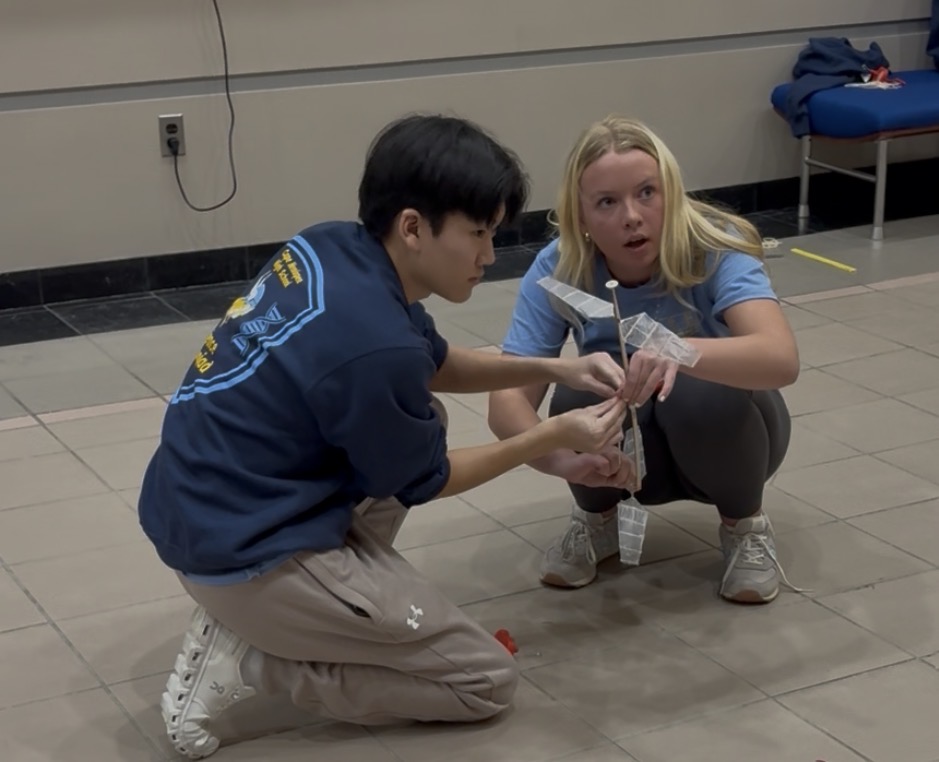
 Cape Henlopen High School in Delaware brought three complete teams to the Science Olympiad at UMBC. Left: Nathaniel Hoang and Ellie Sprague compete in the helicopter event. Right: Quinton Eisenmann and Ava Lewis prepare for the hovercraft event. (Photos courtesy of Priscilla Coolbaugh)
Inspiring students’ interest in science
Volunteers—including UMBC faculty, alumni, current students—made the day possible, each driven by motivations rooted in their own journeys. Mark Grzanna, M.S. ’15, biological sciences, today a Science Olympiad coach at John Carroll High School in Bel Air, Maryland, brought two teams of eager students for his third year at the UMBC tournament. Grzanna teaches biology, anatomy and physiology, and a biotech course he designed at John Carroll, and he views the Olympiad as a gateway to scientific curiosity.
“Education is so important. I became a teacher to get kids interested in science—or at least to help them understand enough science to navigate their world,” he said. His co-coach, John Carroll teacher Andrew Ketchum, echoed the sentiment: “It’s a great experience for our kids to see other students excited about science.”
Frank Tagaytay, a senior physics and math major, supervised the “boomilever” event, where teams tested structures’ strength and integrity. Based on experience as president of his high school Science Olympiad club, Tagaytay patiently guided participants through event regulations, offering encouragement amid the occasional structural mishap.

 Left: Frank Tagaytay (left), a senior UMBC physics and math major, encourages Aalyna Johnson (center) and Cassidy Mehegan from Cape Henlopen High School as they set up their “boomilever” for competition. (Photo by Sarah Hansen, M.S. ’15/UMBC) Right: Cape Henlopen students Theodore Noe Fellows, Shouta Sano, Quinton Eisenmann, and Ava Lewis (left to right) carry their equipment to the competition site in the UMBC Physics Building. (Photo courtesy of Priscilla Coolbaugh)
“It’s an early season event for teams to work out the kinks,” he explained, highlighting how the low-stakes environment builds confidence and resilience. For Tagaytay, volunteering bridges his past and present, reinforcing UMBC’s supportive community.
Fareedah Owolabi, a junior chemical engineering major who recently transferred from the Community College of Baltimore County, found the event particularly meaningful. “I have a soft spot for STEM outreach, because it’s how I was introduced to UMBC,” she shared. Through the Upward Bound Math and Science program, Owolabi connected with UMBC tutors as a high schooler. Now, as a volunteer, she fielded questions from participants about campus life. “I want to inspire younger students,” she said, embodying the cycle of mentorship that defines the tournament.
Broadening their horizons
Priscilla Coolbaugh, Science Olympiad coach at Cape Henlopen High School in Delaware, started her team three years ago after loving Science Olympiad as a student herself. “I want to share that love,” she said. Her three full teams traveled far to compete. “They get to see themselves at these universities. They might have planned to stay close to home, but this way they get exposure to out-of-state schools,” Coolbaugh said. “It broadens their horizons to different schools as well as different STEM fields.”

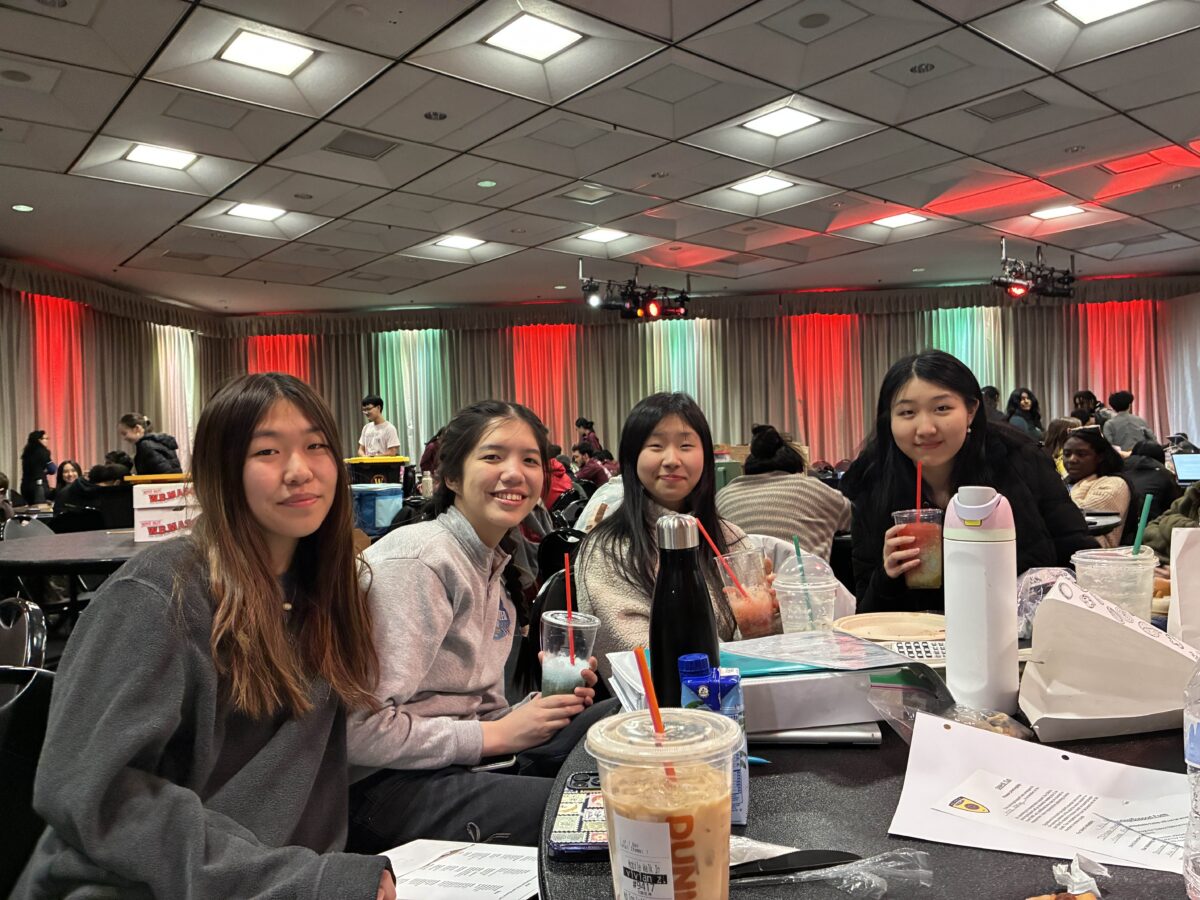 Students and a coach from Winston Churchill High School in Potomac, Maryland, relax in the UMBC Ballroom between events. (Photos courtesy of Jonathan Lee)
Students expressed their sense of community and excitement about their experiences at the UMBC event. Cape Henlopen freshman Aalya Desai noted how the event helped her make friends despite starting as a newcomer, and sophomore Grace Eanes appreciated the chance to bond with peers across grades while exploring the beautiful campus. Michael Song, a junior from Winston Churchill High School in Potomac, Maryland, who with his teammate, Leo Jiang, earned the top score in the hovercraft event, commented, “UMBC is much bigger than I expected. It’s a lot of fun to travel to Olympiad events.”
In good hands
Faculty and staff volunteers underscored the event’s broader impact. CNMS dean William R. LaCourse, surveying the awards ceremony, reflected on the promise of the participants. “As I stood on the stage looking over the ballroom filled with excited and creative students, I couldn’t help feeling as if I was looking into the future and thinking, ‘We (all of us) are in good hands,’” he said.
Zeev Rosenzweig, professor of chemistry and biochemistry, supervised the rocks and minerals test with three undergraduates and three of his graduate students. “Being here is just an important thing to do,” he said. “It’s a great outlet to show them that their interests matter,” he noted. “The kids who come to the Olympiad—they’re our people.” Ph.D. student Kushani Mendis, a Ph.D. student in Rosenzweig’s lab, added, “The best way to support the next generation in STEM is to organize events like this and spend time with them.”
In April, UMBC will host the Maryland State Science Olympiad for the first time, building on this invitational’s momentum. “It’s fun to see young people so excited about different areas of STEM,” shared Michelle Starz-Gaiano, professor and chair of biological sciences, adding, “It’s critical to foster the growth of young scientists. We love the energy and enthusiasm that they bring.”
]]>
On a cloudy Saturday in January, UMBC buzzed with the energy of over 1,200 high school students from across the Mid-Atlantic region. For the third consecutive year, UMBC’s College of Natural and...
https://umbc.edu/stories/1200-high-schoolers-at-science-olympiad/
https://beta.my.umbc.edu/api/v0/pixel/news/156251/guest@my.umbc.edu/8fcd1fc51406ee5d71336ef39bd47917/api/pixel
biology
cbee
chembiochem
cnms
coeit
community
news
physics
science-and-tech
story
trio
UMBC News & Magazine
https://beta.my.umbc.edu/groups/umbc-news-magazine
https://assets1-beta.my.umbc.edu/system/shared/avatars/groups/000/001/943/24435aa6207c452e7bc15cc74b42c7bb/xsmall.png?1748556657
https://assets1-beta.my.umbc.edu/system/shared/avatars/groups/000/001/943/24435aa6207c452e7bc15cc74b42c7bb/original.png?1748556657
https://assets2-beta.my.umbc.edu/system/shared/avatars/groups/000/001/943/24435aa6207c452e7bc15cc74b42c7bb/xxlarge.png?1748556657
https://assets2-beta.my.umbc.edu/system/shared/avatars/groups/000/001/943/24435aa6207c452e7bc15cc74b42c7bb/xlarge.png?1748556657
https://assets3-beta.my.umbc.edu/system/shared/avatars/groups/000/001/943/24435aa6207c452e7bc15cc74b42c7bb/large.png?1748556657
https://assets1-beta.my.umbc.edu/system/shared/avatars/groups/000/001/943/24435aa6207c452e7bc15cc74b42c7bb/medium.png?1748556657
https://assets2-beta.my.umbc.edu/system/shared/avatars/groups/000/001/943/24435aa6207c452e7bc15cc74b42c7bb/small.png?1748556657
https://assets1-beta.my.umbc.edu/system/shared/avatars/groups/000/001/943/24435aa6207c452e7bc15cc74b42c7bb/xsmall.png?1748556657
https://assets2-beta.my.umbc.edu/system/shared/avatars/groups/000/001/943/24435aa6207c452e7bc15cc74b42c7bb/xxsmall.png?1748556657
UMBC News & Magazine
1
0
false
Thu, 05 Feb 2026 11:30:12 -0500
Thu, 05 Feb 2026 11:30:12 -0500
Starting the Spring Semester
Dear UMBC Community,
With the cold and wintry conditions that delayed the start of in-person classes by a week, it seems strange to refer to this as the spring semester! I hope that you all stayed warm and safe as we worked to resume normal campus operations.
I know that beyond our campus, the challenges in our nation and world are increasingly difficult and felt deeply by members of our community, whether you are affected directly or indirectly. As we begin this new semester together, I hope you will take advantage of every opportunity to lean on and lift up one another, and that the inspiring and essential public mission of UMBC helps sustain us and propel our work every day.
I hope, as well, that each of you found time to rest, reflect, and renew over the winter break. For me—someone who has essentially never left college—such breaks in the academic year are not only a much-needed respite, they also are energizing periods of reflection, planning, and prioritizing for the semester ahead.
After spending a few days with my family in North Carolina—where we gathered in full force, as always—I returned to Baltimore and got down to work. By the end of the break, as usual, my kitchen island was covered with piles of different colored sticky notes, each of them representing different priorities for me and for our leadership team. It looks pretty chaotic, but this is my process for getting to some order. It is what I do to start the semester with a clear sense of the work ahead, what comes next, and what is possible.
When I was a faculty member teaching organic chemistry, I would spend time before every semester thinking about my syllabus and the activities I was going to do in class. I would match pictures from the student directory with the names of those enrolled in my class, so that I would recognize them and be able to call them by name in class.
Today, I think about our students, staff, and faculty and our departments and units across UMBC. I think about our alumni and how I can engage them more deeply in the life of the university. I think about our neighbors in Catonsville and Arbutus, the city of Baltimore, and the state of Maryland, and how we can partner to address challenges and continue to improve our communities. I think about what went well in the last semester and what I could have done better. And I think about our future, mapping out the work I can do to keep us advancing toward our shared vision for UMBC.
Finally, I want to celebrate and amplify a couple of pieces of terrific news: First, UMBC has again been classified as a
Carnegie Community Engaged Campus, recognizing the university-wide commitment of our students, faculty, and staff to engage collaboratively in strengthening our communities. Congratulations and thanks to all who contribute to this work that is so deeply embedded in our identity and culture, and to all who played a part in the rigorous effort to achieve this classification from the American Council on Education and the Carnegie Foundation for the Advancement of Teaching.
My best to you all for a productive and fulfilling semester!
Sincerely,
President Valerie Sheares Ashby
]]>
Dear UMBC Community, With the cold and wintry conditions that delayed the start of in-person classes by a week, it seems strange to refer to this as the spring semester! I hope that you all...
https://umbc.edu/stories/starting-the-spring-semester-2/
https://beta.my.umbc.edu/api/v0/pixel/news/156124/guest@my.umbc.edu/3ae99437bf0bd47eacb4c75db4481cc4/api/pixel
president
rss
story
UMBC News & Magazine
https://beta.my.umbc.edu/groups/umbc-news-magazine
https://assets1-beta.my.umbc.edu/system/shared/avatars/groups/000/001/943/24435aa6207c452e7bc15cc74b42c7bb/xsmall.png?1748556657
https://assets1-beta.my.umbc.edu/system/shared/avatars/groups/000/001/943/24435aa6207c452e7bc15cc74b42c7bb/original.png?1748556657
https://assets2-beta.my.umbc.edu/system/shared/avatars/groups/000/001/943/24435aa6207c452e7bc15cc74b42c7bb/xxlarge.png?1748556657
https://assets2-beta.my.umbc.edu/system/shared/avatars/groups/000/001/943/24435aa6207c452e7bc15cc74b42c7bb/xlarge.png?1748556657
https://assets3-beta.my.umbc.edu/system/shared/avatars/groups/000/001/943/24435aa6207c452e7bc15cc74b42c7bb/large.png?1748556657
https://assets1-beta.my.umbc.edu/system/shared/avatars/groups/000/001/943/24435aa6207c452e7bc15cc74b42c7bb/medium.png?1748556657
https://assets2-beta.my.umbc.edu/system/shared/avatars/groups/000/001/943/24435aa6207c452e7bc15cc74b42c7bb/small.png?1748556657
https://assets1-beta.my.umbc.edu/system/shared/avatars/groups/000/001/943/24435aa6207c452e7bc15cc74b42c7bb/xsmall.png?1748556657
https://assets2-beta.my.umbc.edu/system/shared/avatars/groups/000/001/943/24435aa6207c452e7bc15cc74b42c7bb/xxsmall.png?1748556657
UMBC News & Magazine
1
0
false
Mon, 02 Feb 2026 20:59:40 -0500


