The Passing of Antonio Moreira
Dear UMBC Community,
I write to you today with the sad news that Antonio Moreira, UMBC’s long-serving vice provost for academic affairs, has died. Tony passed away May 21 after a brief battle with pancreatic cancer.
Tony has been a trusted colleague and an academic leader at UMBC for decades, having served in the provost’s office since 1995. He has been a valued colleague and partner to me personally, as well as to all in the provost’s office and across campus. His devotion to UMBC and to academic excellence, his integrity, and his deep caring for students, faculty, and staff permeated everything he did.
His impact on the university has been profound, including through his leadership of Institutional Research, Analysis, and Decision Support; the Albin O. Kuhn Library & Gallery; the Center for Global Engagement; the Hilltop Institute; and the Office of Accessibility and Disability Services. Over the years, he helped lead the strengthening of UMBC’s academic profile and reputation and contributed significantly to the enhancement of opportunities afforded to our students and faculty through international programs and academic partnerships. He played a major role in all academic planning and academic space planning on campus, chaired the campus IT Steering Committee, the Classroom Committee, and the UMBC Diversity Council.
Tony joined UMBC in 1990 as professor and director of the Chemical and Biochemical Engineering Program, and he served as associate dean of what was then the College of Engineering before taking on the role of associate provost for academic affairs in 1995. He became vice provost in 1997, serving under five provosts during his tenure with the office. Throughout, Tony maintained teaching and research responsibilities and mentored many graduate students in the Department of Chemical, Biochemical, and Environmental Engineering, and he served as director of the Biochemical Regulatory Engineering program. He served on the International Board of Directors for the International Society for Pharmaceutical Engineering and as an associate editor for the Parenteral Drug Association’s Journal of Pharmaceutical Science and Technology.
Tony earned a B.S. in chemical engineering from the University of Porto in his native Portugal, completed his M.S. and Ph.D. in chemical and biochemical engineering at the University of Pennsylvania, and did postdoctoral work at the University of Waterloo in Canada. He served for several years on the faculty of Colorado State University and then spent a decade in the private biopharma sector before returning to academia and joining the UMBC community. During his time in the private sector, Tony led the biotechnology development group at Merck that brought alpha interferon to the market. Since joining UMBC, he has played a major role in promoting UMBC’s international reputation, spearheading research and scholarly collaboration with the University of Porto and the country of Portugal. He was honored by the president of Portugal with the National Order of Public Education and awarded the title of Comendador.
Tony will be long remembered for his kindness and decency as a mentor, colleague, and friend. I know his students, friends, and colleagues throughout the university and well beyond this campus will miss him deeply.
He is survived by his loving wife, Maria; daughters, Cecilia and Joana; their husbands, Christopher and Thomas; and four granddaughters, Danielle, Alexandra, Leanne, and Juliet. Our thoughts and condolences are with them during this difficult time. A memorial service and celebration of life will be held on June 11 at 5 p.m. at the University of Maryland College Park Chapel.
Sincerely,
David P. Dauwalder
Interim Provost and Senior Vice President for Academic Affairs
]]>
Dear UMBC Community, I write to you today with the sad news that Antonio Moreira, UMBC’s long-serving vice provost for academic affairs, has died. Tony passed away May 21 after a brief...
https://my3.my.umbc.edu/groups/announcements/posts/142176
https://beta.my.umbc.edu/api/v0/pixel/news/142178/guest@my.umbc.edu/816658b0b08a3c0153cf286c273711de/api/pixel
in-memoriam
rss
story
UMBC News & Magazine
https://beta.my.umbc.edu/groups/umbc-news-magazine
https://assets1-beta.my.umbc.edu/system/shared/avatars/groups/000/001/943/24435aa6207c452e7bc15cc74b42c7bb/xsmall.png?1748556657
https://assets1-beta.my.umbc.edu/system/shared/avatars/groups/000/001/943/24435aa6207c452e7bc15cc74b42c7bb/original.png?1748556657
https://assets2-beta.my.umbc.edu/system/shared/avatars/groups/000/001/943/24435aa6207c452e7bc15cc74b42c7bb/xxlarge.png?1748556657
https://assets2-beta.my.umbc.edu/system/shared/avatars/groups/000/001/943/24435aa6207c452e7bc15cc74b42c7bb/xlarge.png?1748556657
https://assets3-beta.my.umbc.edu/system/shared/avatars/groups/000/001/943/24435aa6207c452e7bc15cc74b42c7bb/large.png?1748556657
https://assets1-beta.my.umbc.edu/system/shared/avatars/groups/000/001/943/24435aa6207c452e7bc15cc74b42c7bb/medium.png?1748556657
https://assets2-beta.my.umbc.edu/system/shared/avatars/groups/000/001/943/24435aa6207c452e7bc15cc74b42c7bb/small.png?1748556657
https://assets1-beta.my.umbc.edu/system/shared/avatars/groups/000/001/943/24435aa6207c452e7bc15cc74b42c7bb/xsmall.png?1748556657
https://assets2-beta.my.umbc.edu/system/shared/avatars/groups/000/001/943/24435aa6207c452e7bc15cc74b42c7bb/xxsmall.png?1748556657
UMBC News & Magazine
17
0
false
Fri, 24 May 2024 10:33:19 -0400
Pam Voulalas ’24—From molecular neuropharmacologist to classical music composer
As a high school student, Pam Voulalas ’24 was an aspiring clarinetist, determined to major in music and secure a position in a major symphony orchestra. But, on learning how infrequently symphony positions become available, she put down her clarinet. For 37 years.
Instead, she embarked on a career in the sciences, earning a Ph.D. and joining the faculty at the University of Maryland School of Pharmacy. Now, decades later, she returned to school, and graduates this week with a B.A. in music from UMBC.
Q: What was your career path in the sciences?
A: My Ph.D. studies were focused on synaptic plasticity in the brain—how the brain physically changes in response to exposure to novel stimuli.
When you’re exposed to something new, the brain processes that incoming information, creating a physical network that underlies long-term memory storage and retrieval. An important part of this network is an area of the brain called the hippocampus—the seat of learning and memory—which acts like a relay station. I was focusing on that part of the brain, trying to understand how different neurotransmitters interact with each other through their receptor systems to cause short-term stimuli to be transformed into long-term memories.
After completing my Ph.D. I went on to work as a postdoctoral fellow at the National Institutes of Health and Johns Hopkins School of Medicine before I then landed at the University of Maryland, Baltimore as a senior fellow (while I had three kids!). Later I joined the faculty in the School of Pharmacy there.
Q: What prompted you to leave your career and enroll in an undergraduate music program?
A: That was a sort of series of unexpected life events. I was collaborating with another researcher on a project studying plasticity in chronic neuropathic pain, and the funding was running out. Meanwhile, my husband and I both had parents with serious health issues, so I took what I thought was going to be a leave of absence to care for them. But I was also at a point where I was feeling like I was ready for a change, ready to move away from academic research.
During that period, I wanted to take a class in music theory at Howard Community College, but I learned that I couldn’t just take one class, I had to take three: theory, ear training, and piano keyboard skills. I thought I would just take the theory class, sign up for the other two, and drop them! Two years later I finished at HCC with an associate’s degree in music performance and my husband then asked me, “Are you going to finish this?” So I applied to UMBC.
Siblings, in Twelve Tones by Pam Voulalas, performed by Alice Massey, Braden McKibben, and Jennifer Sorrells.
(Video courtesy of Voulalas, Massey, McKibben, Sorrells, and the UMBC Department of Music)
Q: Why music composition?
A: As a scientist, I was very interested in the tiny details of brain function, down to the molecular level: what is learning and memory all about? What is the pathology of these processes? What does that look like? How does that work? In music, I think that composition was a purposeful choice of mine—it makes sense because I like learning about, if you will, the mechanics of music, the finer details.
I chose composition because I initially wanted to compose for clarinet ensembles. In 2016, I had picked up my clarinet again and joined the local community band. Within that group I found a bunch of interested clarinetists, and with them I formed a clarinet choir. We were together for about two years before COVID-19 hit. We performed at a few senior living communities and rehab centers, when it struck me that I could combine my musical skills with my knowledge of learning and memory and how to keep our neural circuits healthy throughout our lives.
As I got back to studying clarinet, I took lessons with people who were 70 to 85 years old who were still amazing players. I started thinking that a practical application of my love and interest in music would be to establish programs at senior living communities—places where people are still living independently and may still be playing or want to play their instruments. I could help them form ensembles on site, ideally leading to a performance. And that way they’re not just listening to music, they’re actively engaging—which is great for our brains—it’s great for everyone’s psyche, and it’s great for other residents to enjoy.
Q: You returned to school after a successful career in the sciences. What was it like being around other students who were so much younger than you?
A: Well, I was very nervous about transferring to UMBC. One of the players in my clarinet choir was a retired nurse, and she and I did the program together at HCC. I’m happy to say that both at HCC and also at UMBC, I never felt like I was playing the mother or the parent to younger students.
In fact, I feel like I added something to the classroom because, for example, some students can be timid about asking questions and putting themselves out there. I feel like I helped to be a role model for them, helping them by breaking the ice in certain circumstances.
I was just telling a friend of mine at lunch that I’ve had UMBC students want to hang out and talk, which I do feel has been pretty genuine. I can’t really explain that. I do believe that there is something special about the students who come to UMBC. I think this place attracts very open-minded individuals.
Q: At UMBC, who has been a mentor to you, or who has supported you in your work?
A: Who wasn’t a mentor?! I spent the most time with Dr. Linda Dusman, and then the three large ensemble directors, Dr. Philip Mann (Symphony Orchestra), Dr. Brian Kaufman (Wind Ensemble), and Dr. Patrick Crossland (New Music Ensemble). I had never had the opportunity to play in an orchestra before coming to UMBC! The very first person I connected with for orchestra was Dr. Nell Flanders, who was the orchestral director my second semester here. I was incredibly excited to be able to play orchestral repertoire. All of the faculty take their students seriously, setting the bar high. I love that. I love how the professors, every one of them from Dr. Airi Yoshioka to Dr. Lisa Cella, all push in a very gentle, supportive way. And I think this takes a lot of finesse—to encourage without completely stressing students out.
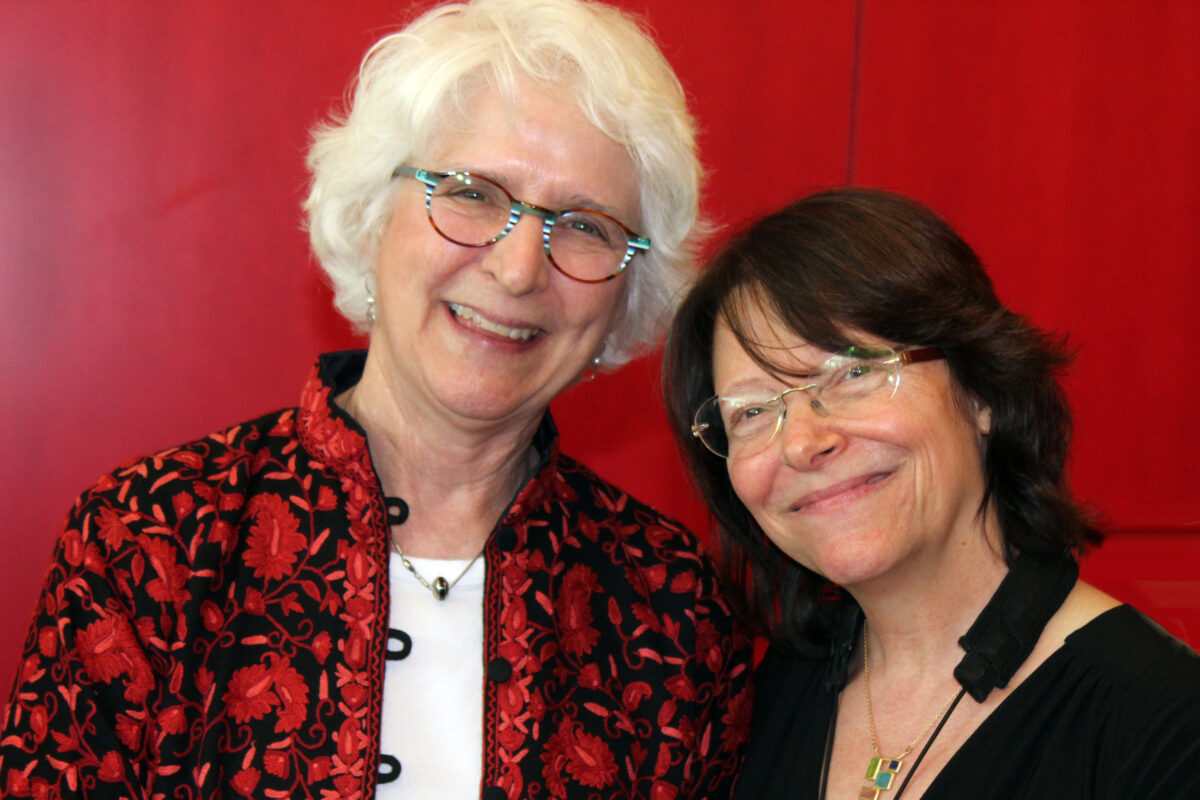 Pam Voulalas (right) with Linda Dusman, professor of music.
(Image courtesy of Voulalas)
Q: As an undergraduate composition major, you had your works performed by professional ensembles that visited UMBC, including the Bergamot String Quartet and the Strata ensemble. That must have been an unusual experience.
A: That is one of the huge gifts and the glorious insights and understanding that Dr. Dusman has given to her composition students. And that’s another thing that I think really elevates the composition program here—that we do have those opportunities to write music for people who have the skills to be able to attack more complex pieces.
That’s a wonderful feeling—when you can compose something challenging knowing that the ensemble will be able to handle it. It’s both exciting and a little intimidating, because you’re hoping you’re going to write something that the musicians enjoy playing. And then when it all works, it’s magical, something being brought to life, very surreal.
Q: Out of the works you composed during your time at UMBC, is there one that stands out for you?
A: I have to say that two pieces stand out. One was this piece that I call my “sleep piece” entitled To Sleep, Perchance to Dream. The assignment was to compose a piece based on a graphic score. That was challenging, but it was also fun because I ended up tapping into my neuroscience background to develop the idea. It demanded improvisation, which is not something that I had ever done before. I felt like I grew a lot with that experience, because I needed to compose in a very different way. And since I was also a member of the ensemble in that case, I had to learn how to feel comfortable improvising. It ended up being a multimedia piece, so that was more complex than anything I had tackled before. The successful performance of that piece was very gratifying.
With improvisation, there are moments when a special kind of cohesion occurs which is very different from playing standard notation repertoire—you hope that the ensemble will reach its optimal cohesiveness during the performance. Of course, with improv, you just never know how it’s going to go! When it works well it is a wonderful feeling.
The other piece that was probably the most challenging was Phaistos, in which I had to interpret an ancient artifact—a series of hieroglyphics arranged in a spiral pattern—and compose a piece based on that. It was technically very demanding, but in the end, incredibly gratifying, especially given that the Strata trio did a fabulous job interpreting it. Those are the two standouts for me.
The Bergamot String Quartet performs Voulalas’s composition From Whence We Came.
(Video courtesy of Voulalas, the Bergamot String Quartet, and the UMBC Department of Music)
Q: This semester, as a member of UMBC’s New Music Ensemble, you performed Mauricio Kagel’s Staatstheater, a piece that features all sorts of theatrical gestures, many of which are intentionally absurd. What was that like for you?
A: Well, when Dr. Crossland first proposed it, we students were looking at each other like, “Okay….” Before I started this program, I loved all sorts of music. My husband and I have a collection that spans medieval and renaissance music, classical, jazz, minimalist, folk, rap, and a little bit of new music. But as far as really new music, very contemporary music, I hadn’t had a lot of exposure to that, and so it was very uncomfortable and foreign to me. I would put like the Kagel piece into that category, which ended up being both fun and enlightening.
One of the most interesting things that occurred to me as a student—and I was kind of warned by a student who graduated a year before me that this would happen—is that you come in as a mostly classically focused tonal person and then something happens, and your brain opens up to new musical possibilities. And I’ll never forget the moment when that happened. I was in my kitchen making breakfast, listening to the radio, a classical station, when I suddenly had this realization: This classical music was wonderful, but it’s not enough. Right? There’s so much more that can be done with instruments and music and sound. I feel like it was really then that this concept gelled for me. It was a very cool moment.
Q: What’s next for you?
A: I have a lot of experience writing grants for scientific research, and I’ve had some opportunities to do that for free for arts organizations and been very successful with that.
I’ve had a glorious career in science, but now I really am trying to focus on what kinds of work I can I do that will allow me to give back in one way or another—something that will have a lot of meaning for me and others while at the same time allowing me time to compose, because I have a lot of ideas for pieces I’d like to write for all kinds of different ensembles. And I do intend to keep studying. If I had the opportunity for advanced study in composition, I would like to do that.
I really would like to find ways to engage seniors citizens in music making. Aside from that, I have a dream to create a small, very intimate chamber space in Howard County, where we can present concerts of all genres of music performed by professionals and amateurs, including young students. Music is very big in Howard County—kids of all ages are achieving great things with their music. So that’s my dream—we’ll see!
The Strata ensemble perform’s Voulalas’s composition Phaistos.
(Video courtesy of Voulalas, Strata, and the UMBC Department of Music)
Q: Is there anything we missed?
A: I’m so in awe of and grateful for the faculty and the staff in the music department—every single one of them. I come from a field where it’s tough, the pressure is high, which can negatively affect the work environment and personal interactions, right? I know that a career in the arts is tough too. Maybe in a conservatory there’s a very different feel, but however the music department at UMBC manages to achieve it, I feel like they absolutely strike the right balance here.
And I know this sounds corny, but I feel so appreciative of the students here who I believe really accepted me as one of their own. I’m very grateful for that.
]]>
As a high school student, Pam Voulalas ’24 was an aspiring clarinetist, determined to major in music and secure a position in a major symphony orchestra. But, on learning how infrequently symphony...
https://umbc.edu/stories/pam-voulalas-24-from-molecular-neuropharmacologist-to-classical-music-composer/
https://beta.my.umbc.edu/api/v0/pixel/news/142174/guest@my.umbc.edu/109ceb47b514838d87ef5550f2782bbf/api/pixel
cahss
class-of-2024
music
news
story
UMBC News & Magazine
https://beta.my.umbc.edu/groups/umbc-news-magazine
https://assets1-beta.my.umbc.edu/system/shared/avatars/groups/000/001/943/24435aa6207c452e7bc15cc74b42c7bb/xsmall.png?1748556657
https://assets1-beta.my.umbc.edu/system/shared/avatars/groups/000/001/943/24435aa6207c452e7bc15cc74b42c7bb/original.png?1748556657
https://assets2-beta.my.umbc.edu/system/shared/avatars/groups/000/001/943/24435aa6207c452e7bc15cc74b42c7bb/xxlarge.png?1748556657
https://assets2-beta.my.umbc.edu/system/shared/avatars/groups/000/001/943/24435aa6207c452e7bc15cc74b42c7bb/xlarge.png?1748556657
https://assets3-beta.my.umbc.edu/system/shared/avatars/groups/000/001/943/24435aa6207c452e7bc15cc74b42c7bb/large.png?1748556657
https://assets1-beta.my.umbc.edu/system/shared/avatars/groups/000/001/943/24435aa6207c452e7bc15cc74b42c7bb/medium.png?1748556657
https://assets2-beta.my.umbc.edu/system/shared/avatars/groups/000/001/943/24435aa6207c452e7bc15cc74b42c7bb/small.png?1748556657
https://assets1-beta.my.umbc.edu/system/shared/avatars/groups/000/001/943/24435aa6207c452e7bc15cc74b42c7bb/xsmall.png?1748556657
https://assets2-beta.my.umbc.edu/system/shared/avatars/groups/000/001/943/24435aa6207c452e7bc15cc74b42c7bb/xxsmall.png?1748556657
UMBC News & Magazine
0
0
false
Fri, 24 May 2024 08:52:38 -0400
Fri, 24 May 2024 08:52:38 -0400
Peter Wilschke ’24, political science and economics, publishes empirical research as the sole author in the State and Local Government Review journal
Peter Wilschke’s weeks leading up to graduation have been filled with unexpected excitement. His article “Political Drivers of State Fiscal Cyclicality” has been accepted for publication in the State and Local Government Review, the official journal of the Section on Intergovernmental Administration and Management of the American Society for Public Administration. The journal shares the latest research on state and local governments and the intergovernmental dimensions of public-sector activity.
“I’m exploring whether and how political factors—political polarization, turnover, and electoral competition—work to explain why some U.S. states tend to spend more in good times and less in bad times, unlike the federal government,” says Wilschke, who presented the paper at UMBC’s 2024 Undergraduate Research and Creative Achievement Day.
During a recent conference, editors of State and Local Government Review shared with Eric Stokan, associate professor of political science and Wilschke’s mentor, that the acceptance rate of articles is about 14 percent. “That’s for the entire field of scholars,” says Stokan. “Beyond being methodologically sophisticated, several at our Midwest Political Science Association conference also noted how truly important Peter’s work is for the field and practice.”
Pursuing a research idea
A couple of years ago Wilschke attended UMBC’s Center for Social Science Scholarship’s Mullen Lecture given by Carlos A. Vegh, the Fred H. Sanderson professor of international economics at Johns Hopkins University. Vegh discussed his research on how fiscal policy is conducted over the business cycle in both developing and developed countries. Wilschke wasn’t expecting the talk would set in motion a two-year research project. “It sparked an urge in me to find out more. I knew there was more to the story,” says Wilschke.
This was Wilschke’s first time leading a research project. “I didn’t quite know what I was getting myself into,” says Wilschke. He shared the idea with Carolyn Forestiere, professor of political science and his professor for research methods in political science, and she connected him with Stokan.
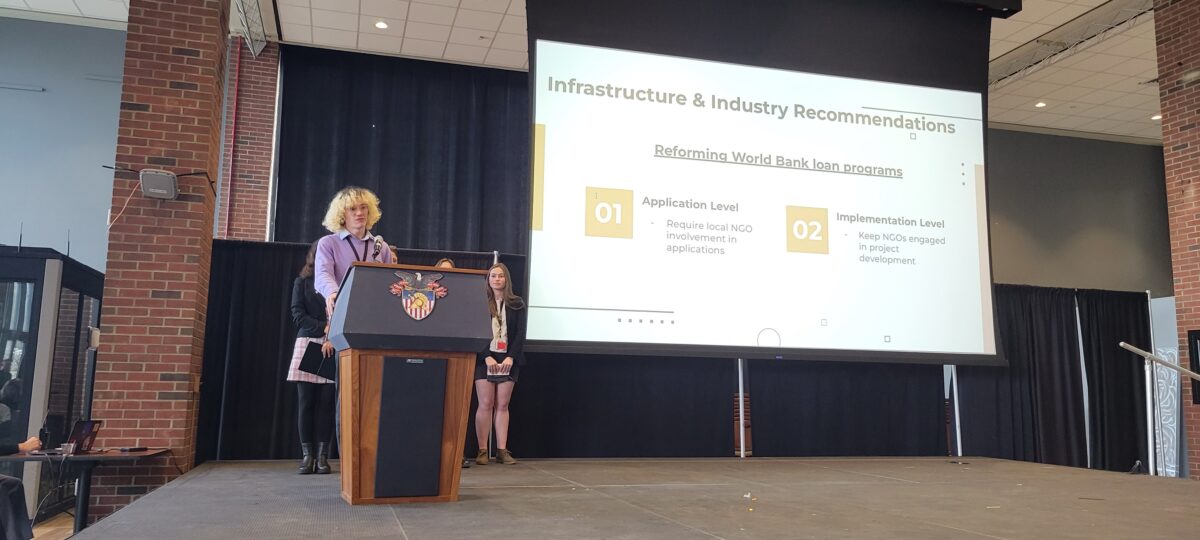 Wilschke at the 2024 Student Conference on U.S. Affairs at the United States Military Academy in West Point, NY where students work with scholars and practitioners to develop proposals that address important topics in U.S. foreign policy. (Image courtesy of Wilschke)
Stokan says he enjoyed working with Wilschke weekly over two semesters to help him think through all aspects of the work. He taught Wilschke R, a programming language for statistical computing and data visualization. Stokan also suggested pieces of literature on the topic, which helped Wilschke think through the operationalization of his variables and analytic specifications, and framing policy. “Each session he would come back far ahead of where I thought he would be. I would consistently say, ‘Okay, your next step should be X,’ and he would have done X, Y, and Z,” says Stokan. “It was amazing. He learned R more quickly than anyone I have ever met.” Wilschke adds, “It was very helpful to have a mentor who had gone through this process multiple times before.”
After several drafts, Wilschke wanted to publish it in the Pi Sigma Alpha—the national political science honor society—undergraduate research journal. Stokan encouraged Wilschke to share the paper with Forestiere, the faculty advisor for Pi Sigma Alpha. “Eric and I encouraged Peter to submit it to a professional journal,” says Forestiere. “We figured that it would be a learning experience even if it was rejected.” They were all delighted when the journal asked Wilschke to revise and resubmit. “We were ecstatic when it was finally accepted for publication!”
Preparing for the unexpected
During the same time, Wilschke was interning at The Hilltop Institute at UMBC, a nonpartisan research organization at UMBC dedicated to improving the health and wellbeing of people and communities. He worked for Morgan Henderson, principal data scientist and affiliate professor of economics, and Morgane Mouslim, policy analyst, on a research project funded by the National Science Foundation on hospital pricing transparency. His two-year internship entailed helping to organize data collected from hundreds of hospitals and writing a news brief, “The Impact of Market Concentration on Hospital Pricing” and presenting it at URCAD 2024.
“Peter is an excellent researcher who helped our hospital price transparency project significantly over the past two years,” says Henderson. “The quality of his work is top-notch—we predict that he’ll go far.”
Wilschke did not plan on contributing empirical research to the field of political science as an undergraduate student. Looking back he is grateful for the classes and opportunities UMBC afforded him that prepared him to follow a hunch. Wilschke said that he felt that some students don’t look forward to statistical analysis or research methods classes in economics or political science because they’ve heard the classes can be difficult and may appear irrelevant at the moment.
“Once you take these courses, your world is kind of open to how empirical research is actually conducted in those fields. Without these classes I would not have known where to start,” says Wilschke. He advises students to approach empirical work as a combination of two things. “You have to care about your research question to push through all the time and hard work needed,” says Wilschke, “and put to work all the research skills you’ve learned to answer a question that needs to be answered, that policymakers can use to improve people’s lives.” This summer, Wilschke will work as a research assistant at the Federal Reserve Board of Governors in Washington, D.C.
]]>
Peter Wilschke’s weeks leading up to graduation have been filled with unexpected excitement. His article “Political Drivers of State Fiscal Cyclicality” has been accepted for publication in the...
https://umbc.edu/stories/peter-wilschke-publishes-in-state-and-local-government-review/
https://beta.my.umbc.edu/api/v0/pixel/news/142164/guest@my.umbc.edu/2aaae8ad48f266dbb0e2e97a165d63cf/api/pixel
cahss
cahss-research
economics
news
policy-and-society
politicalscience
research
story
UMBC News & Magazine
https://beta.my.umbc.edu/groups/umbc-news-magazine
https://assets1-beta.my.umbc.edu/system/shared/avatars/groups/000/001/943/24435aa6207c452e7bc15cc74b42c7bb/xsmall.png?1748556657
https://assets1-beta.my.umbc.edu/system/shared/avatars/groups/000/001/943/24435aa6207c452e7bc15cc74b42c7bb/original.png?1748556657
https://assets2-beta.my.umbc.edu/system/shared/avatars/groups/000/001/943/24435aa6207c452e7bc15cc74b42c7bb/xxlarge.png?1748556657
https://assets2-beta.my.umbc.edu/system/shared/avatars/groups/000/001/943/24435aa6207c452e7bc15cc74b42c7bb/xlarge.png?1748556657
https://assets3-beta.my.umbc.edu/system/shared/avatars/groups/000/001/943/24435aa6207c452e7bc15cc74b42c7bb/large.png?1748556657
https://assets1-beta.my.umbc.edu/system/shared/avatars/groups/000/001/943/24435aa6207c452e7bc15cc74b42c7bb/medium.png?1748556657
https://assets2-beta.my.umbc.edu/system/shared/avatars/groups/000/001/943/24435aa6207c452e7bc15cc74b42c7bb/small.png?1748556657
https://assets1-beta.my.umbc.edu/system/shared/avatars/groups/000/001/943/24435aa6207c452e7bc15cc74b42c7bb/xsmall.png?1748556657
https://assets2-beta.my.umbc.edu/system/shared/avatars/groups/000/001/943/24435aa6207c452e7bc15cc74b42c7bb/xxsmall.png?1748556657
UMBC News & Magazine
0
0
false
Thu, 23 May 2024 12:56:36 -0400
Thu, 23 May 2024 12:56:36 -0400
Meet a Retriever—Garvey Chu, mechanical engineering student at UMBC-Shady Grove
Meet Garvey Chu, a first generation transfer student who is about to complete his degree in mechanical engineering at UMBC at the Universities at Shady Grove. He’s also the recipient of a Mechanical Engineering Trailblazers scholarship. When he’s not in class, you might find Garvey enjoying some recreation time. We’re excited to see what he does next. Take it away, Garvey!
Q: Briefly introduce yourself. What’s one essential thing you’d want another Retriever to know about you?
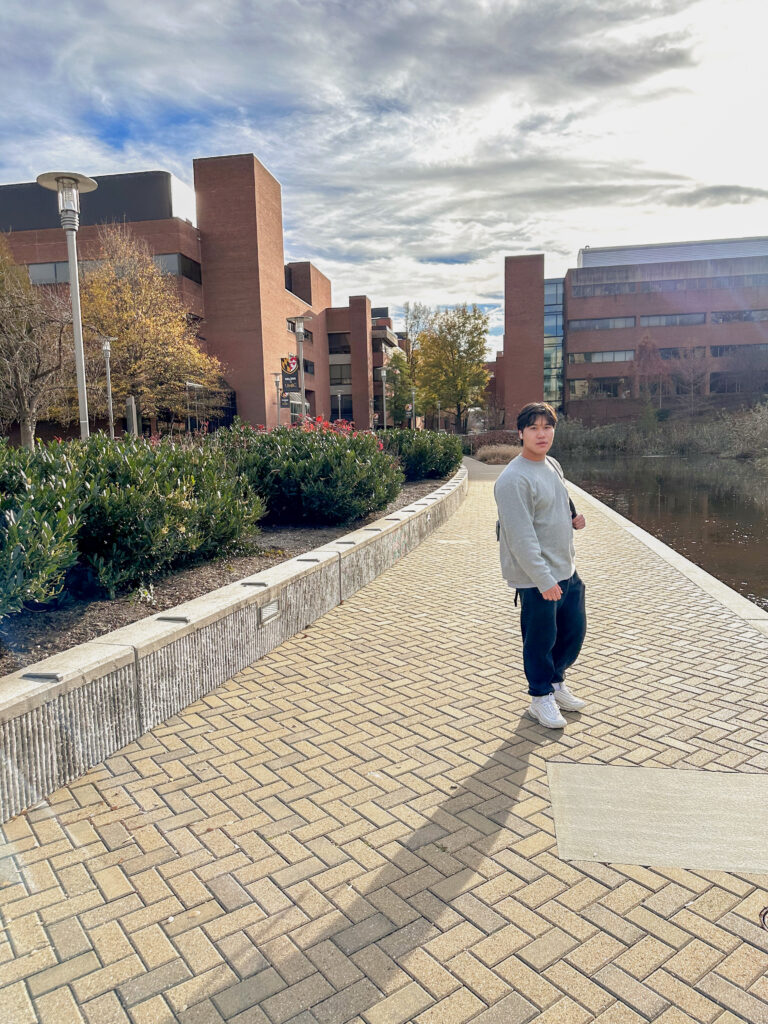
A: My current area of study is mechanical engineering and I attend the Shady Grove campus. Outside of that, I enjoy going to the gym or just playing sports like golf and basketball. Currently I am in the final weeks of my undergraduate degree.
 Garvey Chu, far right, poses with fellow classmates. Photo courtesy of Chu.
Q: Tell us about the support you’ve gotten as a student, or someone in the community who has inspired you or supported you, and how they did it.
A: The advisors at Shady Grove have been great. And, I feel that the professors at Shady Grove have played a significant role in introducing me to new fields and aspects of engineering. Specifically, Prof. [Adam] Bridendolph and Dr. [Joseph] Washington have shared their personal experiences in areas that I was previously unaware of. Professor Bridendolph has expertise in the automation side of engineering, while Dr. Washington specializes in biomechanics. Both of them have really opened my eyes to new possible areas in my future career.
Q: What brought you to UMBC in the first place?
A: I came to UMBC because they offered mechanical engineering and also because the convenience of the Shady Grove campus, which was really close to my home. I also heard that the professors in the STEM programs were very good.
[My professors] have really opened my eyes to new possible areas in my future career.
Garvey Chu, mechanical engineering student
Q: Tell us about what excites you about your academic program, what you hope to do after graduation.
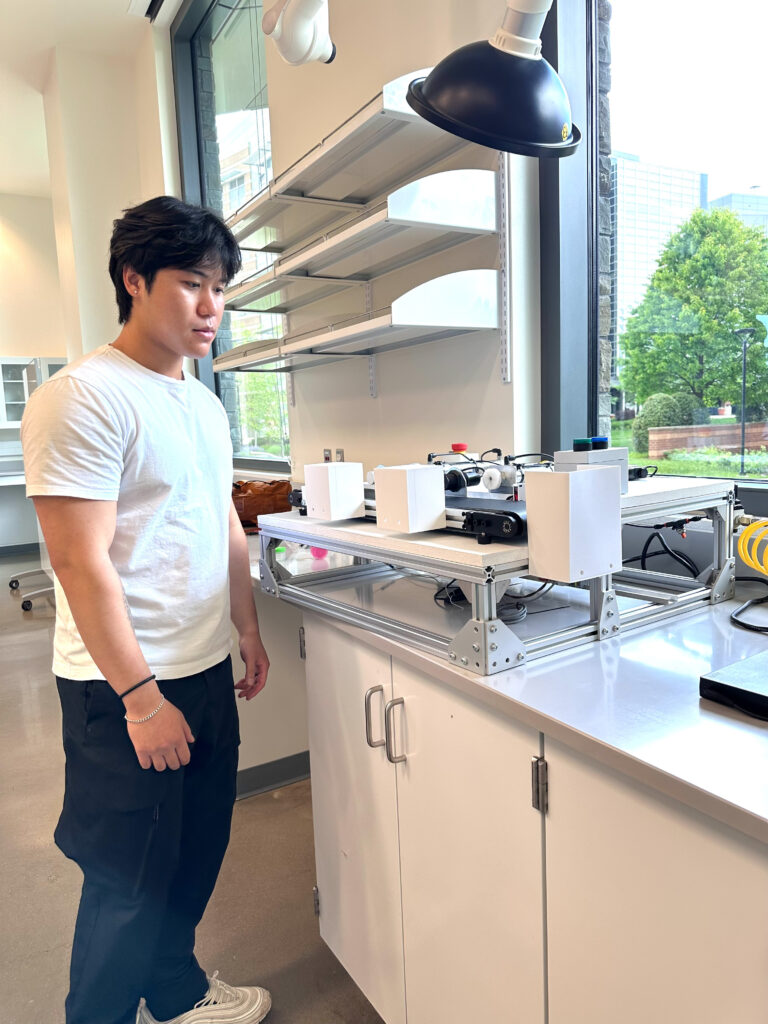
A: I’m excited about having the ability to design machines or products. And, I really enjoyed the senior capstone project, where the team was tasked with developing an automated sortation machine. Not only myself, but the team members had limited exposure to many of the components the system consisted of such as pneumatics, PLC programming, and wiring. It was a totally new experience for us. Because of our selected project, we even had the opportunity to visit a technical college that had a department specializing in automation in West Virginia. I really enjoyed that visit. After graduation, I’m hoping to work in a field related to the automotive industry, satellites, or defense.
* * * * *
UMBC’s greatest strength is its people. When people meet Retrievers and hear about the passion they bring, the relationships they create, the ways they support each other, and the commitment they have to inclusive excellence, they truly get a sense of our community. That’s what “Meet a Retriever” is all about.
Learn more about how UMBC can help you achieve your goals.
]]>
Meet Garvey Chu, a first generation transfer student who is about to complete his degree in mechanical engineering at UMBC at the Universities at Shady Grove. He’s also the recipient of a...
https://umbc.edu/stories/meet-garvey-chu-mechanical-engineering-first-generation-student-at-umbc-shady-grove/
https://beta.my.umbc.edu/api/v0/pixel/news/142163/guest@my.umbc.edu/4fa3045bb8a1f5a9b6a708f1840167b9/api/pixel
coeit
magazine
mechanical-engineering
meet-a-retriever
perspectives
story
universities-at-shady-grove
UMBC News & Magazine
https://beta.my.umbc.edu/groups/umbc-news-magazine
https://assets1-beta.my.umbc.edu/system/shared/avatars/groups/000/001/943/24435aa6207c452e7bc15cc74b42c7bb/xsmall.png?1748556657
https://assets1-beta.my.umbc.edu/system/shared/avatars/groups/000/001/943/24435aa6207c452e7bc15cc74b42c7bb/original.png?1748556657
https://assets2-beta.my.umbc.edu/system/shared/avatars/groups/000/001/943/24435aa6207c452e7bc15cc74b42c7bb/xxlarge.png?1748556657
https://assets2-beta.my.umbc.edu/system/shared/avatars/groups/000/001/943/24435aa6207c452e7bc15cc74b42c7bb/xlarge.png?1748556657
https://assets3-beta.my.umbc.edu/system/shared/avatars/groups/000/001/943/24435aa6207c452e7bc15cc74b42c7bb/large.png?1748556657
https://assets1-beta.my.umbc.edu/system/shared/avatars/groups/000/001/943/24435aa6207c452e7bc15cc74b42c7bb/medium.png?1748556657
https://assets2-beta.my.umbc.edu/system/shared/avatars/groups/000/001/943/24435aa6207c452e7bc15cc74b42c7bb/small.png?1748556657
https://assets1-beta.my.umbc.edu/system/shared/avatars/groups/000/001/943/24435aa6207c452e7bc15cc74b42c7bb/xsmall.png?1748556657
https://assets2-beta.my.umbc.edu/system/shared/avatars/groups/000/001/943/24435aa6207c452e7bc15cc74b42c7bb/xxsmall.png?1748556657
UMBC News & Magazine
0
0
false
Thu, 23 May 2024 12:34:44 -0400
Thu, 23 May 2024 12:34:44 -0400
UMBC-run program will support twice as many tech internships this summer

An innovative internship program run through UMBC that helps Maryland support growing technology businesses while also retaining talented college graduates in the region is set to more than double over the next year, thanks to a $700,000 budget investment from Governor Wes Moore and the Maryland General Assembly. The funding increase is effective July 1, making it available for the summer internship season and allowing for a growing number of employers to immediately take advantage of this proven and effective workforce development program.
Launched and administered by UMBC, the Maryland Technology Internship Program (MTIP) offers financial assistance to technology-based businesses across the state to enable them to hire more interns from colleges. To date, students from 34 Maryland colleges and universities have been placed in more than 1,000 technical internships, primarily in smaller businesses, across biohealth and life sciences, engineering, IT/software solutions, cybersecurity, and manufacturing.
“Through programs like MTIP, UMBC is driving economic development in our state, which fulfills our mission as an anchor university,” said UMBC President Valerie Sheares Ashby. “I want to thank Delegate Rosenberg for helping bring MTIP to fruition as well as Governor Moore for his leadership in making this MTIP expansion possible.”
MTIP was made possible as a result of House Bill 1317, 2014 legislation sponsored by state Del. Samuel I. “Sandy” Rosenberg, who has continued to work with UMBC and the University System of Maryland to shape the program. Originally aimed at smaller businesses, MTIP was expanded through subsequent legislation to larger technology companies as well as state and local agencies. MTIP first received funding in the FY 2019 budget, and the first MTIP-supported interns began working in the fall of 2018. This new funding, on top of the current base budget of $365,000, will make MTIP a $1 million-a-year regional growth initiative.
Among the many MTIP success stories is Courtney Cavin ’22, M.S. ’23, chemical engineering, who turned an internship into a successful career with Astek Diagnostics, a medical device company based in Halethorpe, Maryland. Astek CEO Mustafa Al-Adhami, M.S. ’15, Ph.D. ’20, mechanical engineering, describes how MTIP interns grow—and grow the companies where they work.
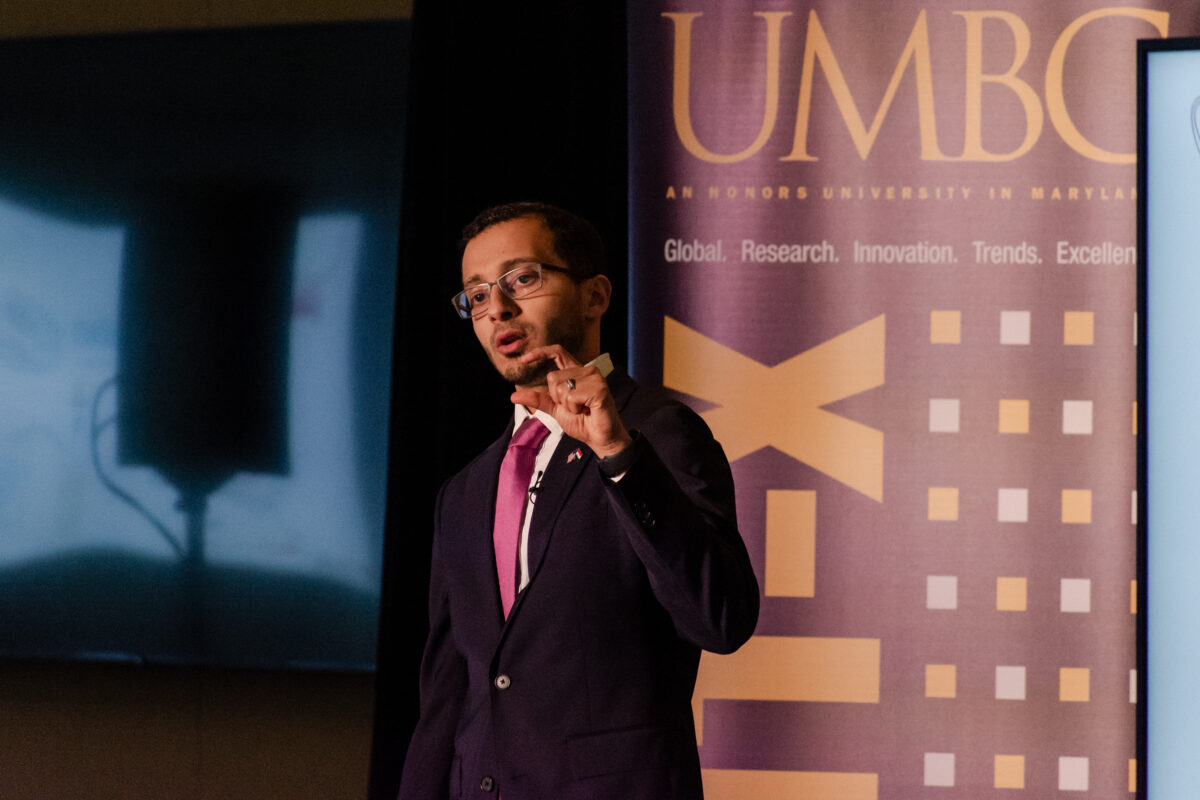 Mustafa Al-Adhami speaks at a UMBC Grit-X event.
“I came into the office during Courtney Cavin’s first week and sketched out a concept for testing urine for UTI,” said Al-Adhami. “At that point, Astek Diagnostics was just the two of us. Two years later, we’ve developed our first Alpha cartridge and she is Astek’s chief product officer.”
“We are accepting applications for summer internships now and are ready to immediately scale up,” said Jen Spencer Heilman, UMBC program director for workforce initiatives, noting that the popular program often has a waitlist of interested companies. “We currently average about 160 internships a year. This new funding will allow us to increase matching funds to employers and support more than 300 students across the state each year. Historically, we’ve had to turn away a number of employers due to reaching funding capacity. We are thrilled for this opportunity to expand our support to more companies.”
Heilman said she looks forward to the program’s partnership with UpSurge Baltimore and the Baltimore Tech Hub Consortium as an ecosystem builder for Baltimore tech. Employers interested in receiving financial support for technical intern hires should review the MTIP eligibility and guidelines.
]]>
An innovative internship program run through UMBC that helps Maryland support growing technology businesses while also retaining talented college graduates in the region is set to more than double...
https://umbc.edu/stories/umbc-program-supports-twice-as-many-internships/
https://beta.my.umbc.edu/api/v0/pixel/news/142147/guest@my.umbc.edu/31a576c82885b2bcafc6ec46b852b9ad/api/pixel
cheme
chemical-engineering
coeit
internship
mechanical-engineering
meche
news
science-and-tech
story
UMBC News & Magazine
https://beta.my.umbc.edu/groups/umbc-news-magazine
https://assets1-beta.my.umbc.edu/system/shared/avatars/groups/000/001/943/24435aa6207c452e7bc15cc74b42c7bb/xsmall.png?1748556657
https://assets1-beta.my.umbc.edu/system/shared/avatars/groups/000/001/943/24435aa6207c452e7bc15cc74b42c7bb/original.png?1748556657
https://assets2-beta.my.umbc.edu/system/shared/avatars/groups/000/001/943/24435aa6207c452e7bc15cc74b42c7bb/xxlarge.png?1748556657
https://assets2-beta.my.umbc.edu/system/shared/avatars/groups/000/001/943/24435aa6207c452e7bc15cc74b42c7bb/xlarge.png?1748556657
https://assets3-beta.my.umbc.edu/system/shared/avatars/groups/000/001/943/24435aa6207c452e7bc15cc74b42c7bb/large.png?1748556657
https://assets1-beta.my.umbc.edu/system/shared/avatars/groups/000/001/943/24435aa6207c452e7bc15cc74b42c7bb/medium.png?1748556657
https://assets2-beta.my.umbc.edu/system/shared/avatars/groups/000/001/943/24435aa6207c452e7bc15cc74b42c7bb/small.png?1748556657
https://assets1-beta.my.umbc.edu/system/shared/avatars/groups/000/001/943/24435aa6207c452e7bc15cc74b42c7bb/xsmall.png?1748556657
https://assets2-beta.my.umbc.edu/system/shared/avatars/groups/000/001/943/24435aa6207c452e7bc15cc74b42c7bb/xxsmall.png?1748556657
UMBC News & Magazine
2
0
false
Wed, 22 May 2024 15:39:41 -0400
Wed, 22 May 2024 15:39:41 -0400
PEZ—The Sweetest Hobby

Beware of crushes. Especially as a 10-year-old in 1995. They might lead to a lifelong hobby, rooms of your house dedicated to your collection, a quirky and supportive community, and even a spot in an Emmy-winning documentary. Katie Chrzanowski, however, has no regrets.
After a brief crush on someone who collected PEZ, and thinking that starting her own collection would be a fun competition, she’s now the proud owner of more than several thousand PEZ dispensers, the host of the Maryland PEZ Gathering, and an extra on the set of The Pez Outlaw. But Chrzanowski ’07, visual arts, doesn’t just collect PEZ paraphernalia for the fame and glory.
She started her collection with a pumpkin head and a snowman, gifts she held onto before knowing they would snowball into a collection requiring dozens of professional plexiglass PEZ dispenser displays. (“Otherwise, they just fall over like dominos.”) Chrzanowski, who is a senior web experience/digital designer for commonvision, UMBC’s student-facing print and design shop, attributes her long connection with the fanciful candy company to the community.
Chrzanowski gives a tour of her PEZ collection.
When she began collecting, PEZheads (as they call themselves) were already active on the nascent internet. In addition to being active on the online forum, in the mid-1990s she signed up for a monthly print newsletter, which she still receives. “Everyone was so welcoming and engaging. It’s been amazing to be a part of for so many years.”
Like the animation major she was, Chrzanowski has a sweet system for organizing her collection, starting with the studio the licensed dispenser is from—Pixar, Disney, Blue Sky, and so on. “Then I organize it by franchise release date and then oldest on the left and newer on the right.” The result is a meticulous, museum-worthy, 360-degree PEZ accumulation that lets Chrzanowski show off her almost 30-year hobby.
For anyone interested in joining Chrzanowski, she says, “Start with what you love. Whatever makes you happy—there’s no right or wrong way to collect.”
]]>
Beware of crushes. Especially as a 10-year-old in 1995. They might lead to a lifelong hobby, rooms of your house dedicated to your collection, a quirky and supportive community, and even a spot in...
https://umbc.edu/stories/pez-the-sweetest-hobby/
https://beta.my.umbc.edu/api/v0/pixel/news/142142/guest@my.umbc.edu/110a2712be5f196f472494943de87c1f/api/pixel
alumni
cahss
campus-life
magazine
spring-2024
story
visual-arts
wild-card
UMBC News & Magazine
https://beta.my.umbc.edu/groups/umbc-news-magazine
https://assets1-beta.my.umbc.edu/system/shared/avatars/groups/000/001/943/24435aa6207c452e7bc15cc74b42c7bb/xsmall.png?1748556657
https://assets1-beta.my.umbc.edu/system/shared/avatars/groups/000/001/943/24435aa6207c452e7bc15cc74b42c7bb/original.png?1748556657
https://assets2-beta.my.umbc.edu/system/shared/avatars/groups/000/001/943/24435aa6207c452e7bc15cc74b42c7bb/xxlarge.png?1748556657
https://assets2-beta.my.umbc.edu/system/shared/avatars/groups/000/001/943/24435aa6207c452e7bc15cc74b42c7bb/xlarge.png?1748556657
https://assets3-beta.my.umbc.edu/system/shared/avatars/groups/000/001/943/24435aa6207c452e7bc15cc74b42c7bb/large.png?1748556657
https://assets1-beta.my.umbc.edu/system/shared/avatars/groups/000/001/943/24435aa6207c452e7bc15cc74b42c7bb/medium.png?1748556657
https://assets2-beta.my.umbc.edu/system/shared/avatars/groups/000/001/943/24435aa6207c452e7bc15cc74b42c7bb/small.png?1748556657
https://assets1-beta.my.umbc.edu/system/shared/avatars/groups/000/001/943/24435aa6207c452e7bc15cc74b42c7bb/xsmall.png?1748556657
https://assets2-beta.my.umbc.edu/system/shared/avatars/groups/000/001/943/24435aa6207c452e7bc15cc74b42c7bb/xxsmall.png?1748556657
UMBC News & Magazine
3
0
false
Wed, 22 May 2024 12:16:26 -0400
Wed, 22 May 2024 12:16:26 -0400
Office Hours with President Sheares Ashby and URCAD student artist

During her office hours, President Valerie Sheares Ashby makes it a point to meet weekly with students and hear about their UMBC experiences and their aspirations for life after UMBC. Today, Jenna Beshara, a senior English and visual arts double major, shares her Undergraduate Research and Creative Achievement Day (URCAD) project with the president. Beshara, who spent last summer on a study abroad program in Wales, painted a series of Welsh watercolor landscapes with paints she made herself using only natural ingredients. In this excerpt of their conversation, she and President Sheares Ashby discuss the importance of pursuing art and research through a sustainability lens.
President Sheares Ashby: These paintings are just beautiful. I feel like the water is just coming off the page. Is that the way you painted it or is it actually texture?
Jenna Beshara: Thank you! It’s a little bit of both, because the pigment—no matter how much you grind it or sift it—it’s still going to be a little bit coarse and gritty. I found out that it takes about a week to make one batch of pigment. You start with flowers or vegetables or plants—red cabbage actually makes the best blue—and you put them in a pot and pour boiling water over it. Then it’s a sequence of simmering and letting it rest. After you strain out all the materials, you add in a salt compound and baking soda. You grind what’s left, which turns into a mud-like consistency. It needs a week to dry and then you grind it and strain it several times.
But to make the paint, there’s quite a bit of chemistry involved. The idea just kind of came to me because acrylic paint is like liquid plastic. It’s really bad for the environment.
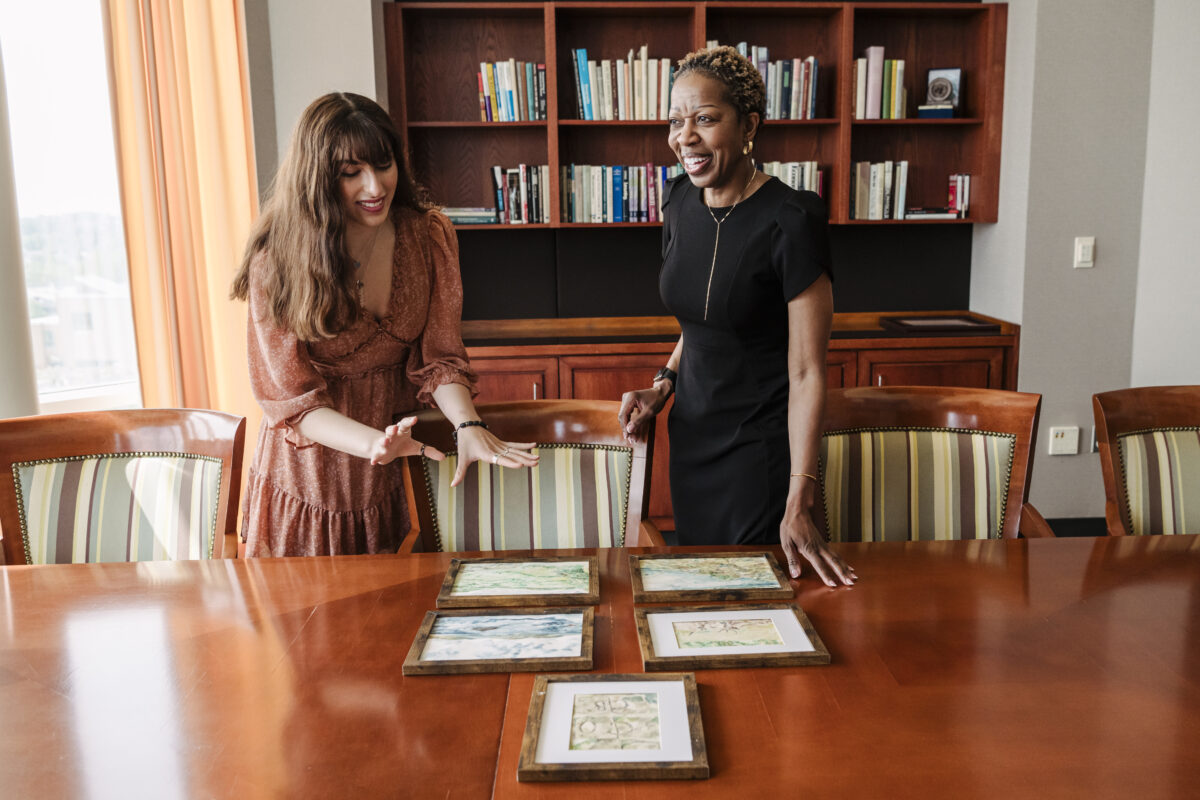 Beshara shares her paintings with President Sheares Ashby.
Sheares Ashby: I am a polymer chemist, so I know what you mean. I appreciate that you did watercolor and environmentally friendly materials. That is very impressive. How did you decide to start this project?
Beshara: After I came back from Wales, I knew I wanted to apply for a Fulbright student grant to do more arts research. My mentor, Timothy Nohe, a professor in visual arts, suggested I use URCAD as a jumping-off point for my research project. He supports me in everything that I do. I’ll come to him and I’m like, “Hey, I want to do this.” And he’s like, “Awesome, do it.”
At one point in this project, I was so frustrated because I wanted to make oil paintings. The homemade oil wasn’t drying, and it looked so gritty. So I went to Professor Nohe and said, “I don’t know what I’m doing.” And he said, “Well, if the medium isn’t working, just change it.” And that blew my mind, and I was like, “Whoa, I can do that?”
Sheares Ashby: When I look at these paintings of these beautiful landscapes, it reminds me that from an environmental framework that if we do not care for this, it will not continue to look like this. This beauty that you have captured is not guaranteed. We have a responsibility to keep this as beautiful as it is.
I love UMBC because our students are so focused on making some version of difference in the world, no matter the discipline.
President Valerie Sheares Ashby
Beshara: I’m applying for an Undergraduate Research Award to keep studying this because the supplies to make the paint can get a little pricey. But it’s so important, with climate change, that sustainability and art can go hand-in-hand.
Sheares Ashby: I love UMBC because our students are so focused on making some version of difference in the world, no matter the discipline. It is rare that I run into a student who doesn’t think about whatever they care about in an interdisciplinary way. Most of my students—like you—are thinking about how they are going to change something in the world to make it better.
]]>
During her office hours, President Valerie Sheares Ashby makes it a point to meet weekly with students and hear about their UMBC experiences and their aspirations for life after UMBC. Today, Jenna...
https://umbc.edu/stories/office-hours-with-president-shears-ashby-2/
https://beta.my.umbc.edu/api/v0/pixel/news/142122/guest@my.umbc.edu/79494f0d2927aa37691f432bd65d99fd/api/pixel
cahss
campus-life
english
magazine
office-hours
spring-2024
story
study-abroad
undergraduate-research
urcad
visualarts
UMBC News & Magazine
https://beta.my.umbc.edu/groups/umbc-news-magazine
https://assets1-beta.my.umbc.edu/system/shared/avatars/groups/000/001/943/24435aa6207c452e7bc15cc74b42c7bb/xsmall.png?1748556657
https://assets1-beta.my.umbc.edu/system/shared/avatars/groups/000/001/943/24435aa6207c452e7bc15cc74b42c7bb/original.png?1748556657
https://assets2-beta.my.umbc.edu/system/shared/avatars/groups/000/001/943/24435aa6207c452e7bc15cc74b42c7bb/xxlarge.png?1748556657
https://assets2-beta.my.umbc.edu/system/shared/avatars/groups/000/001/943/24435aa6207c452e7bc15cc74b42c7bb/xlarge.png?1748556657
https://assets3-beta.my.umbc.edu/system/shared/avatars/groups/000/001/943/24435aa6207c452e7bc15cc74b42c7bb/large.png?1748556657
https://assets1-beta.my.umbc.edu/system/shared/avatars/groups/000/001/943/24435aa6207c452e7bc15cc74b42c7bb/medium.png?1748556657
https://assets2-beta.my.umbc.edu/system/shared/avatars/groups/000/001/943/24435aa6207c452e7bc15cc74b42c7bb/small.png?1748556657
https://assets1-beta.my.umbc.edu/system/shared/avatars/groups/000/001/943/24435aa6207c452e7bc15cc74b42c7bb/xsmall.png?1748556657
https://assets2-beta.my.umbc.edu/system/shared/avatars/groups/000/001/943/24435aa6207c452e7bc15cc74b42c7bb/xxsmall.png?1748556657
UMBC News & Magazine
5
0
false
Tue, 21 May 2024 14:32:07 -0400
Tue, 21 May 2024 14:32:07 -0400
Alberta Ndille ’24—transfer student with an eye for public health and social justice
From Cameroon to Baltimore City, Alberta Ndille’s worldview has inspired her hands-on approach to understanding the underlying causes of health and social disparities. Throughout her time at UMBC, Ndille ’24, sociology, anthropology, and public health, has participated in and led groups and activities within the African Student Union, as a First Year Ambassador and Orientation Peer Advisor, in InterVarsity Christian Fellowship, STRiVE, and as an Academic Peer Advocate. Now she’s preparing to begin a prestigious summer internship at the Maryland Department of Health Cancer and Chronic Disease Bureau where she will help implement public health awareness programs and events, including during The Raven’s pregame parties at M&T Bank Stadium.
Q: What was your path to UMBC?
A: I was born in Maryland but was raised in Cameroon. I began my college experience at Prince George’s Community College. At that time, most of the classes were still online due to COVID-19. It made me crave a more traditional college experience. Once things began to open up more, I applied to UMBC and was accepted into the Honors College.
Q: How did you choose your major?
A: Internationalization has a big influence. I’m interested in global health and epidemiological research. I spoke with several people about my interests and they suggested I look into public health. Social determinants of health caught my attention. Living in the U.S., I saw a very different approach to maternal health than in Cameroon. Maternal health is discussed more openly in the U.S. and there is also more access to preventative care. Because Cameroon has less healthcare access, sometimes parents have to wait longer than they would want to seek care. I want to research the barriers to maternal healthcare in Cameroon and maybe that can help other countries as well.
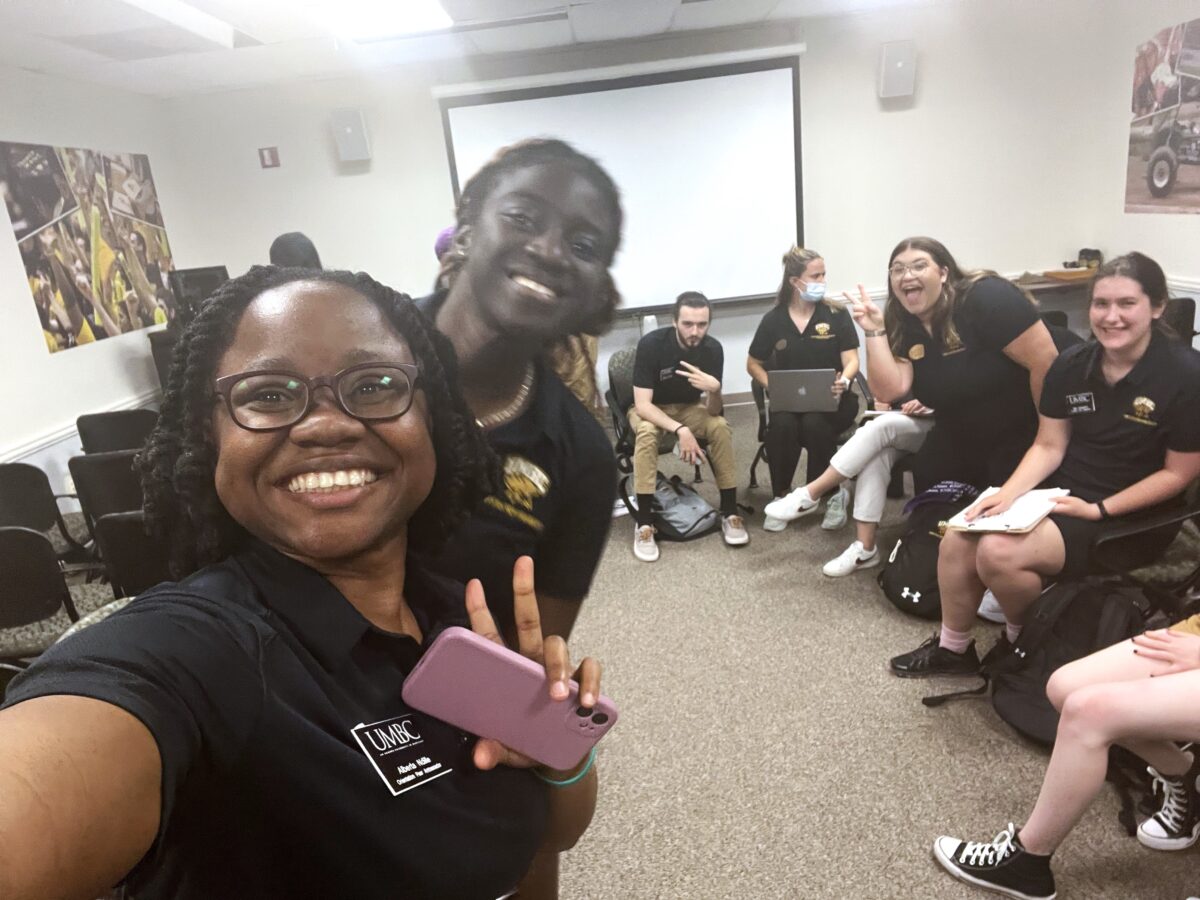 Ndille with orientation peer advisors.
(Image courtesy of Ndille)
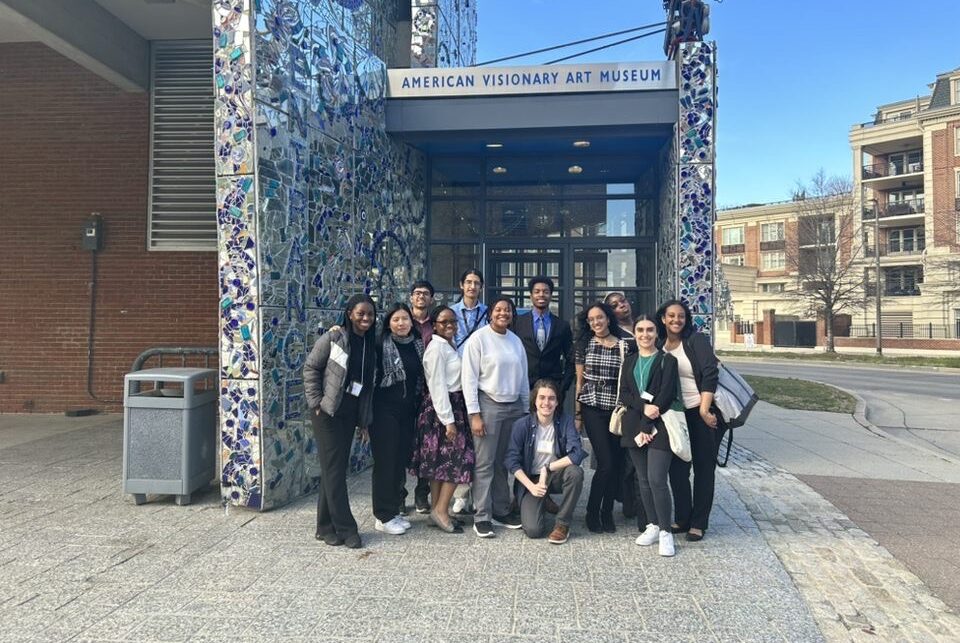 Ndille with fellow UMBC Alternative Spring Break participants. (Image courtesy of Ndille)
Q: What is your most transformative UMBC experience?
A: Working with the Center for Democracy and Civic Life’s Alternative Spring Break (ASB) program—as a participant and leader—helped me understand important issues outside the classroom. As a participant, I learned about educational justice for youth impacted by intimate partner violence. We visited Baltimore’s City Hall to speak with community members and non-governmental organizations (NGOs) working to dismantle these barriers. As a leader, I had the opportunity to co-organize a week of experiences on a topic of my interest.
My spring honors seminar, “Community Engaged Writing,” focused on prison narratives and counselor stories. We read books and literature by formerly incarcerated people, currently incarcerated, and recently released. We learned about the effect mass incarceration has on communities. I wanted to look at this topic within the context of Baltimore City.
I organized an ASB to understand better incarceration in Baltimore City and how to improve life in and out of prison. Throughout the week, we went to Baltimore City Hall to meet with the Department of Parole and Probation, to speak with NGOs and others who manage re-entry programs, and with people currently in re-entry programs. I learned to appreciate both the participant and the leader’s perspective.
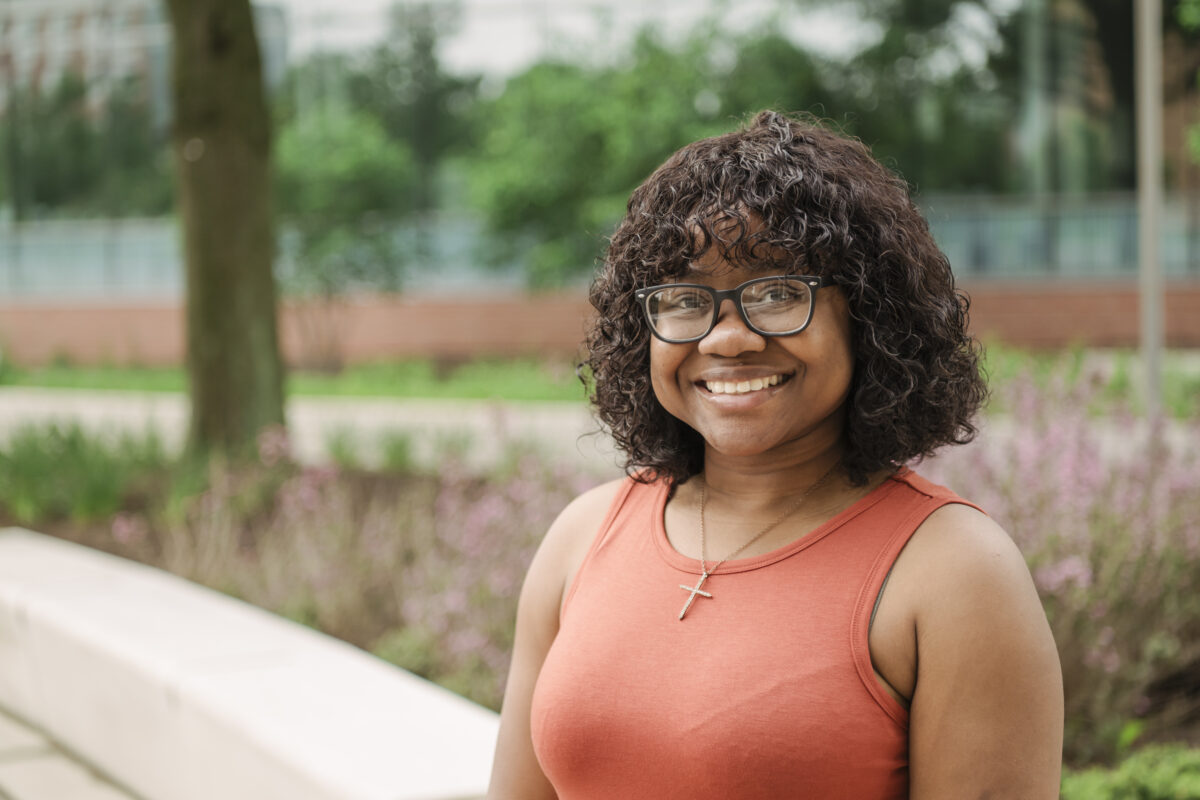
“Working with the Center for Democracy and Civic Life’s Alternative Spring Break (ASB) program—as a participant and leader—helped me understand important issues outside the classroom. As a participant, I learned about educational justice for youth impacted by intimate partner violence. As a leader, I had the opportunity to co-organize a week of experiences on a topic of my interest. I learned to appreciate both the participant and the leader’s perspective.” (l) Ndille (Marlayna Demond ’11/UMBC)
As a participant, everything seems good and easy. You enjoy your spring break. As a leader, you start preparing in September. It can be stressful. You worry about whether the students will learn anything. There are many meetings because things don’t always go as planned. It was really interesting to experience two ASB perspectives while learning about two perspectives on Baltimore.
Q: Having grown up in Cameroon, you have an international perspective. What advice do you give students about the importance of having an international perspective on their career even if they can’t study abroad?
A: I think it is important to engage internationally. The United States is so big, it can be easy to focus on what’s happening here and forget that there’s a whole world of people out there who are different from people here. Even if you don’t have the opportunity to travel internationally, there are other ways to have international experiences like international news, talking to students from other countries, and anything that helps you have a different perspective.
We don’t all hold the same things important. If we take the time to learn about the world in all its differences, we can then understand why certain cultural practices, laws, or beliefs exist. Learning about the world helps us be less judgemental and more inclusive.
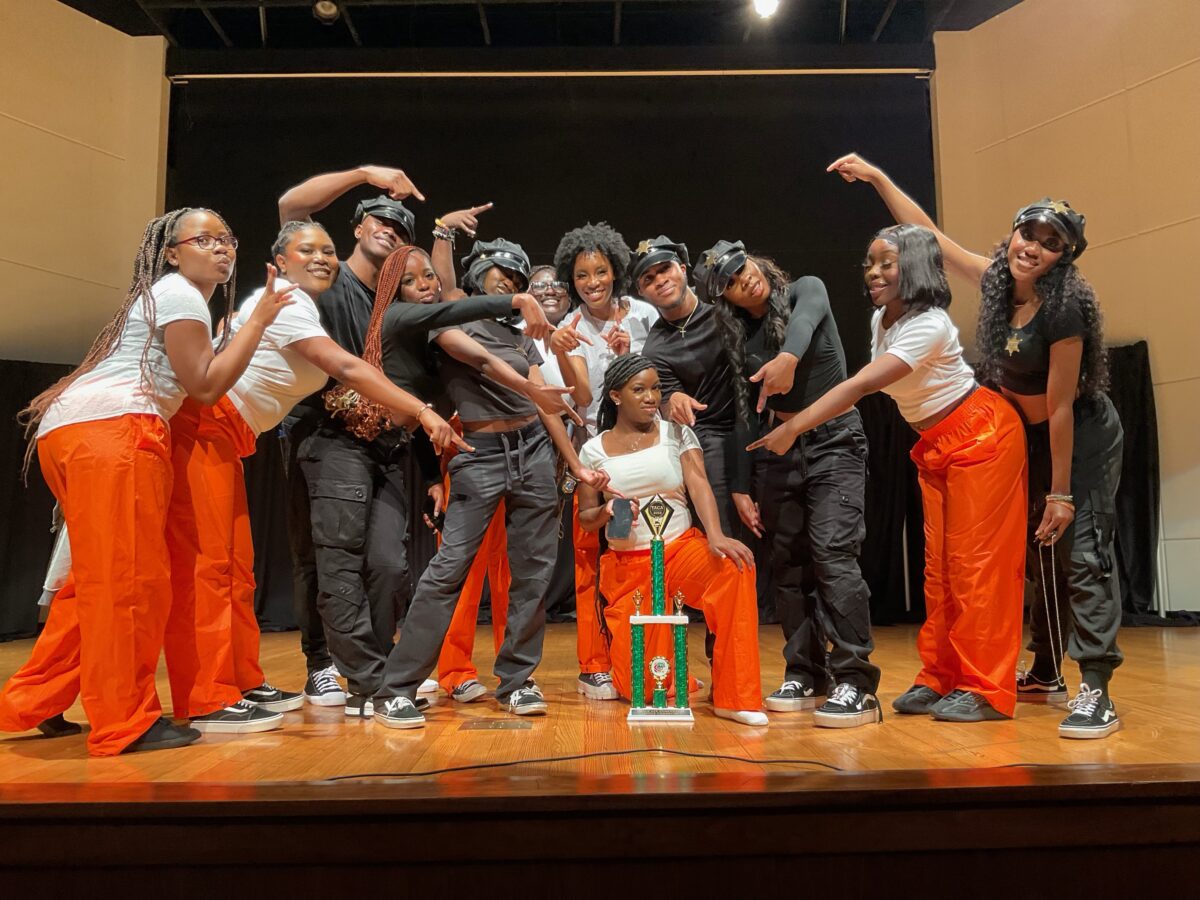 Ndille with UMBC’s Bumaye dance team. (Image courtesy of Ndille)
Q: What do you do for fun?
A: I’ve never taken a formal dance class but I love dancing. I auditioned for UMBC’s African Student Association Bumaye dance team. I made it! It’s a workout and I meet new people.
]]>
From Cameroon to Baltimore City, Alberta Ndille’s worldview has inspired her hands-on approach to understanding the underlying causes of health and social disparities. Throughout her time at UMBC,...
https://umbc.edu/stories/alberta-ndille-24-public-health-social-justice/
https://beta.my.umbc.edu/api/v0/pixel/news/142121/guest@my.umbc.edu/1a1e0f0e734d0d60a3ffe62ba85b9621/api/pixel
cahss
cdcl
class-of-2024
news
story
UMBC News & Magazine
https://beta.my.umbc.edu/groups/umbc-news-magazine
https://assets1-beta.my.umbc.edu/system/shared/avatars/groups/000/001/943/24435aa6207c452e7bc15cc74b42c7bb/xsmall.png?1748556657
https://assets1-beta.my.umbc.edu/system/shared/avatars/groups/000/001/943/24435aa6207c452e7bc15cc74b42c7bb/original.png?1748556657
https://assets2-beta.my.umbc.edu/system/shared/avatars/groups/000/001/943/24435aa6207c452e7bc15cc74b42c7bb/xxlarge.png?1748556657
https://assets2-beta.my.umbc.edu/system/shared/avatars/groups/000/001/943/24435aa6207c452e7bc15cc74b42c7bb/xlarge.png?1748556657
https://assets3-beta.my.umbc.edu/system/shared/avatars/groups/000/001/943/24435aa6207c452e7bc15cc74b42c7bb/large.png?1748556657
https://assets1-beta.my.umbc.edu/system/shared/avatars/groups/000/001/943/24435aa6207c452e7bc15cc74b42c7bb/medium.png?1748556657
https://assets2-beta.my.umbc.edu/system/shared/avatars/groups/000/001/943/24435aa6207c452e7bc15cc74b42c7bb/small.png?1748556657
https://assets1-beta.my.umbc.edu/system/shared/avatars/groups/000/001/943/24435aa6207c452e7bc15cc74b42c7bb/xsmall.png?1748556657
https://assets2-beta.my.umbc.edu/system/shared/avatars/groups/000/001/943/24435aa6207c452e7bc15cc74b42c7bb/xxsmall.png?1748556657
UMBC News & Magazine
3
0
false
Tue, 21 May 2024 14:00:41 -0400
Tue, 21 May 2024 14:00:41 -0400
Meet a Retriever—Amy Caballero ’22, new social worker with strong ties to UMBC-Shady Grove

Amy Caballero graduated from UMBC 2022 with her bachelor’s degree in social work. She stayed on at the Shady Grove campus to complete her master’s in social work from the University of Maryland, Baltimore, and she graduates this May. She has a job lined up as a youth development specialist at a local nonprofit. Outside of academia, she says, she’s obsessed with her two dogs, enjoys bouldering, reading fiction and manga, and hanging out with friends. Take it away, Amy!
Q: What’s the one thing you’d want someone to know about the support you find at UMBC?
A: The support is here, and many are here to help! It can sometimes be scary to ask for help, but people here want to ensure that you succeed during your time at UMBC and beyond! I have still maintained contact with professors and staff post-graduation. I’d recommend that you look into the resources on campus and remember that they are there for you to use.
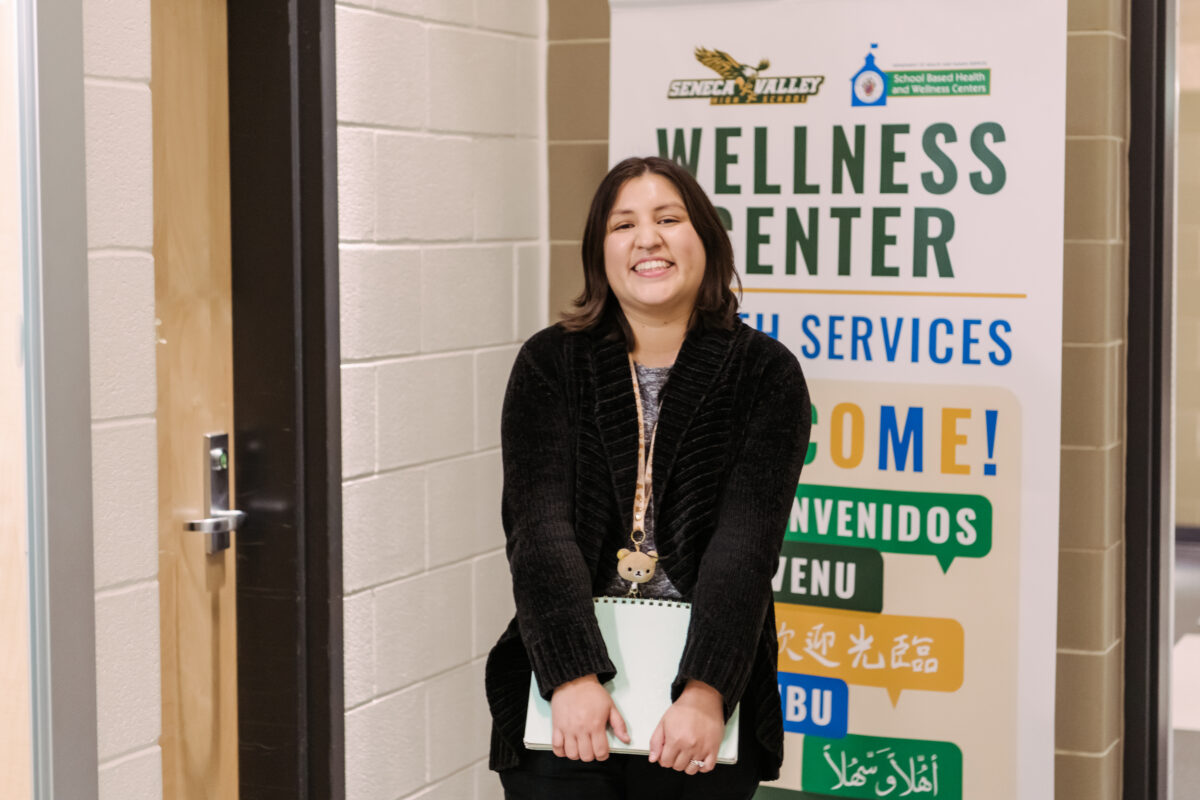 Caballero at her social work field placement.
Q: Tell us about someone in the community who has inspired you or supported you, and how they did it.
A: Dr. Katie Morris [Ph.D. ’21, language, literacy, and culture], the program director at UMBC-Shady Grove, was a great source of support for me during my undergrad years. Prior to starting, she advocated on my behalf to ensure that certain credits were accepted to fulfill the minor requirement. She provided a space to discuss any ideas or concerns I had while providing feedback. She is a great inspiration to me because of her advocacy on behalf of students.
Q: Tell us what you love about your academic program.
A: I loved how passionate all my professors were about social work and their love for the subject they taught. They were all eager to teach and ensure that all of us understood the subject matter. I was involved with the Social Worker Student Association (SWSA) and the creative freedom in creating events was something I enjoyed. It provided me with opportunities to learn more about the UMBC-Shady Grove community, meet other students, and network as well. During my time at SWSA, we were able to collect over 200 menstrual products and donate them to a local nonprofit, I Support the Girls.
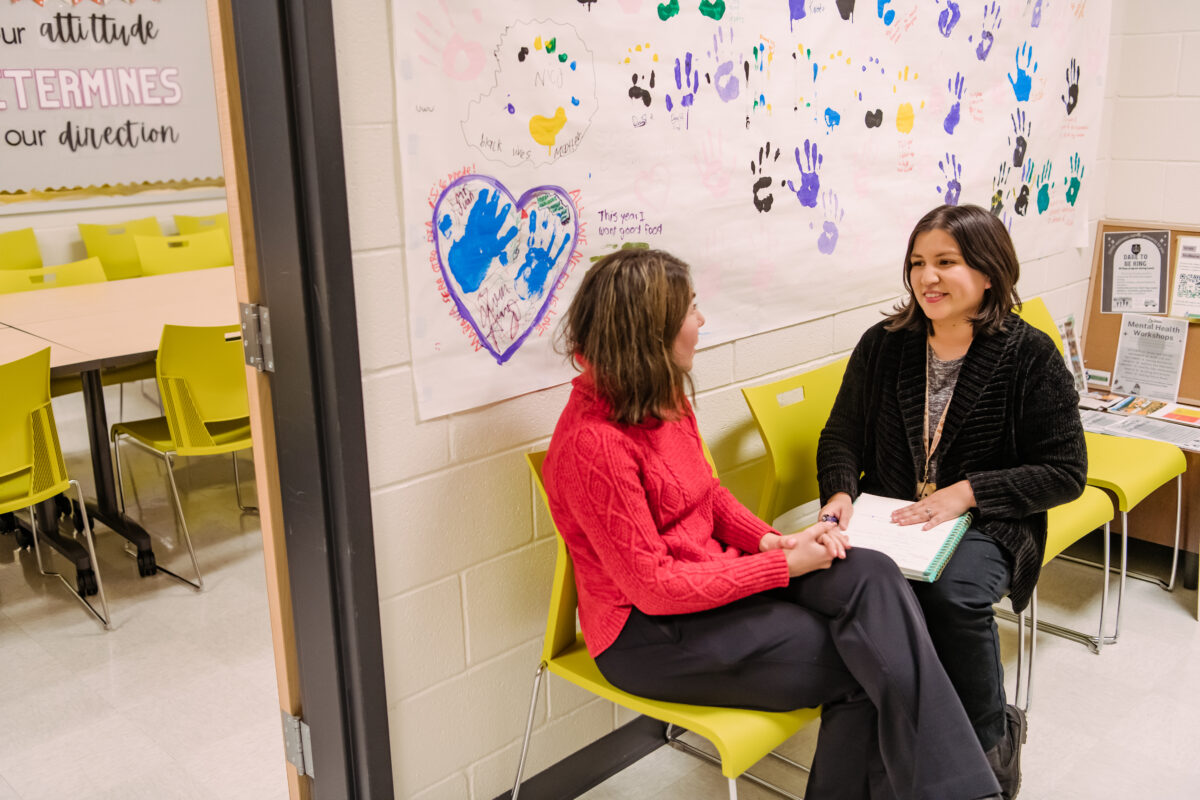 Amy Caballero ’22 talks with a colleague at her social work field placement in Seneca Valley High School.
Q: Tell us about your primary WHY, and how it led you to UMBC.
A: I became interested in social work because it has an interdisciplinary approach to social issues and advocacy. I came to UMBC because I had heard about its amazing social work program and saw that it was available at the UMBC-Shady Grove campus.
Q: Tell us about the people who helped you grow at UMBC, and why their HOW made such a difference to you.
A: I have found support through professors and staff at the UMBC-Shady Grove location. They helped connect me with internship and scholarship opportunities. They were really passionate about what they taught and are a prime example of the different routes you can take as a social worker.
Q: What’s your favorite part of being a part of Retriever Nation?
A: My favorite part is receiving UMBC Magazine and reading about updates related to UMBC. It’s pretty cool that they have events to welcome back alums!
(Right: Caballero’s dogs, Nori and Cookie.)

* * * * *
UMBC’s greatest strength is its people. When people meet Retrievers and hear about the passion they bring, the relationships they create, the ways they support each other, and the commitment they have to inclusive excellence, they truly get a sense of our community. That’s what “Meet a Retriever” is all about.
Learn more about how UMBC can help you achieve your goals.
]]>
Amy Caballero graduated from UMBC 2022 with her bachelor’s degree in social work. She stayed on at the Shady Grove campus to complete her master’s in social work from the University of Maryland,...
https://umbc.edu/stories/meet-a-retriever-amy-caballero-social-worker-shady-grove/
https://beta.my.umbc.edu/api/v0/pixel/news/142135/guest@my.umbc.edu/dbeb92f5f3ae0c6dbbdfef4fa70876e1/api/pixel
alumni
cahss
impact
magazine
meet-a-retriever
shady-grove
social-work
story
UMBC News & Magazine
https://beta.my.umbc.edu/groups/umbc-news-magazine
https://assets1-beta.my.umbc.edu/system/shared/avatars/groups/000/001/943/24435aa6207c452e7bc15cc74b42c7bb/xsmall.png?1748556657
https://assets1-beta.my.umbc.edu/system/shared/avatars/groups/000/001/943/24435aa6207c452e7bc15cc74b42c7bb/original.png?1748556657
https://assets2-beta.my.umbc.edu/system/shared/avatars/groups/000/001/943/24435aa6207c452e7bc15cc74b42c7bb/xxlarge.png?1748556657
https://assets2-beta.my.umbc.edu/system/shared/avatars/groups/000/001/943/24435aa6207c452e7bc15cc74b42c7bb/xlarge.png?1748556657
https://assets3-beta.my.umbc.edu/system/shared/avatars/groups/000/001/943/24435aa6207c452e7bc15cc74b42c7bb/large.png?1748556657
https://assets1-beta.my.umbc.edu/system/shared/avatars/groups/000/001/943/24435aa6207c452e7bc15cc74b42c7bb/medium.png?1748556657
https://assets2-beta.my.umbc.edu/system/shared/avatars/groups/000/001/943/24435aa6207c452e7bc15cc74b42c7bb/small.png?1748556657
https://assets1-beta.my.umbc.edu/system/shared/avatars/groups/000/001/943/24435aa6207c452e7bc15cc74b42c7bb/xsmall.png?1748556657
https://assets2-beta.my.umbc.edu/system/shared/avatars/groups/000/001/943/24435aa6207c452e7bc15cc74b42c7bb/xxsmall.png?1748556657
UMBC News & Magazine
0
0
false
Tue, 21 May 2024 13:13:54 -0400
An Dang ’24: A chemical engineer who helped pull off a big student conference

An Dang ’24, chemical engineering, an international student from Vietnam, arrived at UMBC in 2021 as a transfer student from Montgomery College. When switching colleges, she also switched majors: from biology to chemical engineering. She quickly became involved in activities in the Department of Chemical, Biochemical, and Environmental Engineering and this year helped the student chapter of the American Institute of Chemical Engineers (AIChE) pull together a major student conference for the first time.
Q: What drew you to UMBC?
A: I talked to Mark Marten, the chair of the Department of Chemical, Biochemical, and Environmental Engineering (CBEE), and I got the sense that the department is small and they really support their students. That caring environment is what I wanted. It’s also, honestly, an affordable option.
Q: Who were some of your mentors?
A: I’m working in the lab of Lee Blaney, one of the environmental engineering professors. He’s my research advisor and really helped me navigate the process of applying to grad school. In the fall, I’m going to the University of Michigan in Ann Arbor to pursue my Ph.D. And Neha Raikar, a senior lecturer in the department, devotes so much of her time to making sure students are supported. She’s like a motherly figure for a lot of us.
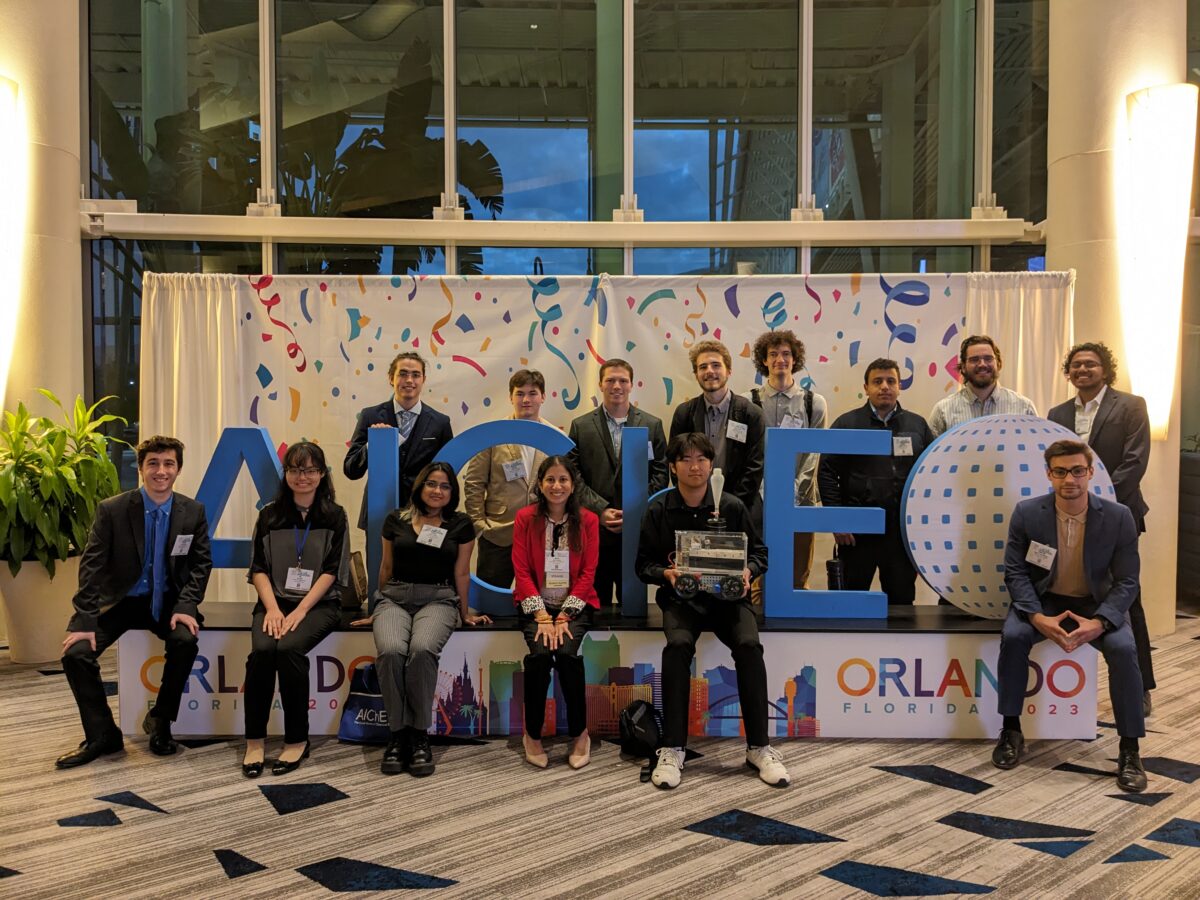 An Dang (seated second from left) and other UMBC AIChE student chapter members with advisor Neha Raikar at the AIChE Annual Meeting in Orlando in November. (Photo courtesy of An Dang.)
Q: What clubs and activities were you involved in?
A: I was a CBEE student ambassador. We went to high schools and community colleges to advertise the department and answer student questions. I’m also involved in the AIChE student chapter. At first I was the service chair and I mostly helped with planning K-12 outreach events. This year, we hosted the AIChE Mid-Atlantic Regional Conference and I was on the planning committee. I was in charge of corporate and university relations—I helped secure sponsors for the conference, and made sure we had funding.
Q: What were some of the skills you developed serving in these roles?
A: I’m not an extrovert, and being in these roles forced me to go out of my comfort zone. I learned how to speak professionally with people in higher positions, so they take me seriously, and maybe even want to give us money. The other big thing I realized is that no matter how well I prepare, sometimes things will go wrong, and that’s okay. We all need to give ourselves grace.
Q: How did it feel to host a big conference?
A: It was a lot of hard work! The student organizers spent a lot of time together, and we really got to know each other well and develop close relationships. There are only 28 people from the department in my graduating class, and many of them are in AIChE. When the conference went well, it felt great!
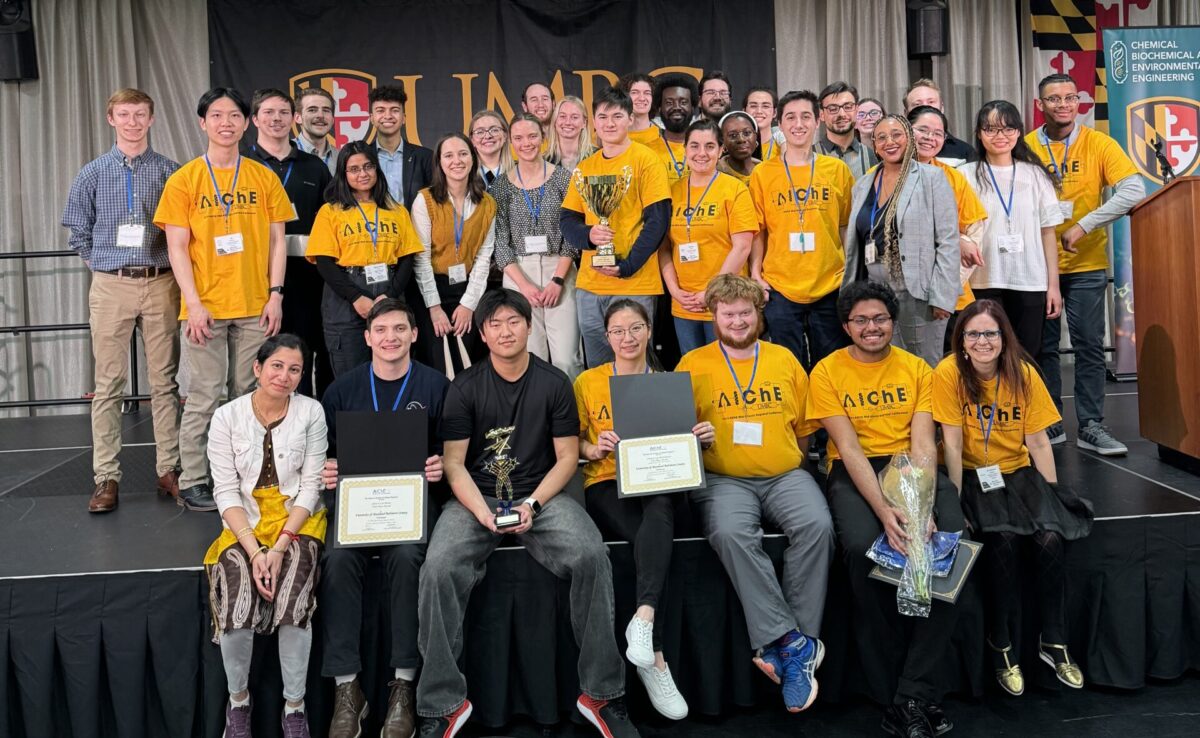 Volunteers, including An Dang (second from right) gather for a photo after the successful hosting of the AIChE Mid-Atlantic Student Regional Conference at UMBC. (Photo courtesy of An Dang)
Q: What other places did you find community at UMBC?
A: I am an international student, and I worked for International Student and Scholar Services (ISSS). I got to know some of the staff in the office really well. One problem that I ran into while I was here is that I lost my social security card. I had a lot of challenges getting a new one because there was a mix-up in the social security office with my middle and first name. ISSS helped me write a very good letter to justify my case, and I finally got my card. I’m very grateful that I got that help from them because it’s an important piece of documentation.
Q: What are your plans for the future?
A: I’m continuing in chemical engineering and plan to go to grad school to study catalysis engineering, which is studying how to speed up chemical reactions. I’d like to work in industry, particularly in the field of renewable energy. Anything that helps with the environment—that’s what I want to focus on.
]]>
An Dang ’24, chemical engineering, an international student from Vietnam, arrived at UMBC in 2021 as a transfer student from Montgomery College. When switching colleges, she also switched majors:...
https://umbc.edu/stories/an-dang-chemical-engineer/
https://beta.my.umbc.edu/api/v0/pixel/news/142119/guest@my.umbc.edu/0b3dcf2da3f70e5f89bd7842f6ae0f35/api/pixel
cbee
class-of-2024
coeit
news
story
UMBC News & Magazine
https://beta.my.umbc.edu/groups/umbc-news-magazine
https://assets1-beta.my.umbc.edu/system/shared/avatars/groups/000/001/943/24435aa6207c452e7bc15cc74b42c7bb/xsmall.png?1748556657
https://assets1-beta.my.umbc.edu/system/shared/avatars/groups/000/001/943/24435aa6207c452e7bc15cc74b42c7bb/original.png?1748556657
https://assets2-beta.my.umbc.edu/system/shared/avatars/groups/000/001/943/24435aa6207c452e7bc15cc74b42c7bb/xxlarge.png?1748556657
https://assets2-beta.my.umbc.edu/system/shared/avatars/groups/000/001/943/24435aa6207c452e7bc15cc74b42c7bb/xlarge.png?1748556657
https://assets3-beta.my.umbc.edu/system/shared/avatars/groups/000/001/943/24435aa6207c452e7bc15cc74b42c7bb/large.png?1748556657
https://assets1-beta.my.umbc.edu/system/shared/avatars/groups/000/001/943/24435aa6207c452e7bc15cc74b42c7bb/medium.png?1748556657
https://assets2-beta.my.umbc.edu/system/shared/avatars/groups/000/001/943/24435aa6207c452e7bc15cc74b42c7bb/small.png?1748556657
https://assets1-beta.my.umbc.edu/system/shared/avatars/groups/000/001/943/24435aa6207c452e7bc15cc74b42c7bb/xsmall.png?1748556657
https://assets2-beta.my.umbc.edu/system/shared/avatars/groups/000/001/943/24435aa6207c452e7bc15cc74b42c7bb/xxsmall.png?1748556657
UMBC News & Magazine
2
0
false
Tue, 21 May 2024 12:49:54 -0400
Tue, 21 May 2024 12:49:54 -0400