STEM BUILD at UMBC leads to lasting institutional change, benefiting STEM students and beyond
From its outset, UMBC’s STEM BUILD—a 10-year undergraduate success initiative and research study at UMBC funded by the National Institutes of Health—has had a unique vision: To emphasize the inclusive reach of the program, STEM BUILD’s motto is “500, not 50.”
The program, which is wrapping up its timeline, was created to identify effective interventions that could be implemented at scale to support all science, technology, engineering and math (STEM) students at UMBC, and to find ways to continue those interventions beyond the existence of STEM BUILD.
“Looking back on nearly 10 years of work, STEM BUILD has been nothing short of wildly successful,” said Justine Johnson, executive director of STEM BUILD and assistant dean for inclusive excellence in the College of Natural and Mathematical Sciences (CNMS).
A research study to support budding researchers
STEM BUILD was carefully designed as a controlled research study, where evaluators randomly assigned students accepted into the program into three cohorts: Trainee, Living Learning Community (LLC), and Comparison.
BUILD Trainees benefited from the most interventions, such as monthly community meetings, intensive monitoring and advising, and multiple group research experiences during “Summer Bridge” programming. Another cohort lived on campus in the STEM Living Learning Community (LLC)—which did not exist prior to STEM BUILD—along with the Trainees, but did not receive additional interventions. A third cohort consisted of similarly qualified students who did not receive targeted interventions or live in the STEM LLC.
According to an analysis by the evaluation team, by the end of their fourth year at UMBC, BUILD Trainees had increased their reported sense of “research self-efficacy,” or their own understanding of their competency as researchers, from 3.50 to 3.87 on a five-point scale, which registered at the highest level of statistical significance. Students in the other two cohorts shifted from 3.66 to 3.61, which was not statistically significant.
Victoria Baskerville ’19, biological sciences, and a BUILD Training program alumna, said the research experiences provided by the program were invaluable.
“They gave me the confidence to navigate in a lab space and gave me the competitive edge I needed to get my position as a technician in a prestigious lab,” said Baskerville, who is currently pursuing her Ph.D. in integrative and biomedical physiology at The Pennsylvania State University.
“I have often received positive comments regarding the amount of research experience I gathered as an undergraduate during interviews,” Baskerville said.
The percentages tell the story
Victor Omoniyi ’20, biological sciences, a former STEM BUILD Trainee, is currently pursuing a Ph.D. in neuroscience at Johns Hopkins University, in the cellular and molecular medicine program.
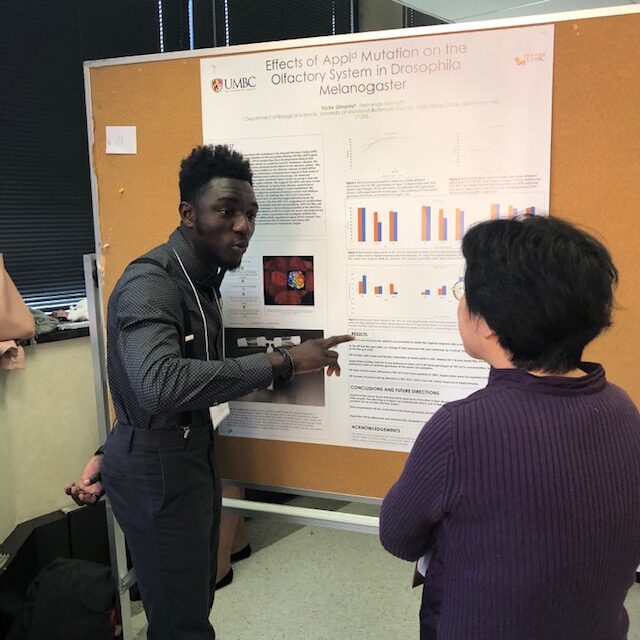 Victor Omoniyi (left) presents research at the 2019 UMBC Undergraduate Research Symposium.
“BUILD was helpful in starting my scientific journey and exposing me to different areas of research and people to network with, which has contributed significantly to where I am now, pursuing a Ph.D.,” Ominiyi said.
Ominiyi’s experience is not unique among Trainees. BUILD Trainees reported completing significantly more research experiences than students in the comparison groups: 45.4 percent completed one to three research experiences, 33.7 percent participated in four to six research experiences, and 9.9 percent completed seven or more research experiences. That’s compared to 53.1 percent, 10.6 percent, and 1.9 percent, respectively, in the comparison groups. Those experiences build students’ confidence with research and nurture relationships with mentors, which likely contribute to students choosing to remain in STEM and pursue graduate education.
Outcomes for BUILD Trainees in cohorts one through five, as of fall 2023, were similarly outstanding, with 56 percent of Trainees having completed a bachelor’s degree, 16 percent having completed or being enrolled in a master’s program, 13 percent attending professional school, and 11 percent pursuing Ph.D. or M.D./Ph.D. programs. All together, 96 percent of Trainees completed their undergraduate degrees, and 40 percent are actively pursuing or have completed an advanced degree.
Bridging the success beyond CNMS
STEM BUILD’s impact goes far beyond its direct benefits to BUILD Trainees. UMBC’s College of Natural and Mathematical Sciences has implemented numerous new programs as part of STEM BUILD that will continue supporting all students after BUILD officially ends—meeting the “500, not 50” goal.
For example, the Active Learning, Inquiry Teaching (ALIT) certificate program is designed to support faculty in adopting teaching approaches that foster the retention of students in STEM majors and support the development of their students as STEM professionals. Initially required for BUILD faculty mentors, today the program is available to all faculty in CNMS and UMBC’s College of Engineering and Information Technology, and a related program inspired by ALIT now also exists in the College of Arts, Humanities, and Social Sciences.
CNMS also developed new courses and summer programs, initially targeting STEM BUILD students but now open to all, focusing on ethics, communication skills, introductory laboratory skills, and more.
CNMS hired a success coach, who offers on-demand mentoring for students in skills like time management, exam preparation, and stress reduction. The coach also offers workshops through The Learning Collaboratory (TLC), another new CNMS initiative. A diversity mentoring program matches STEM students with mentors in STEM from underrepresented backgrounds.
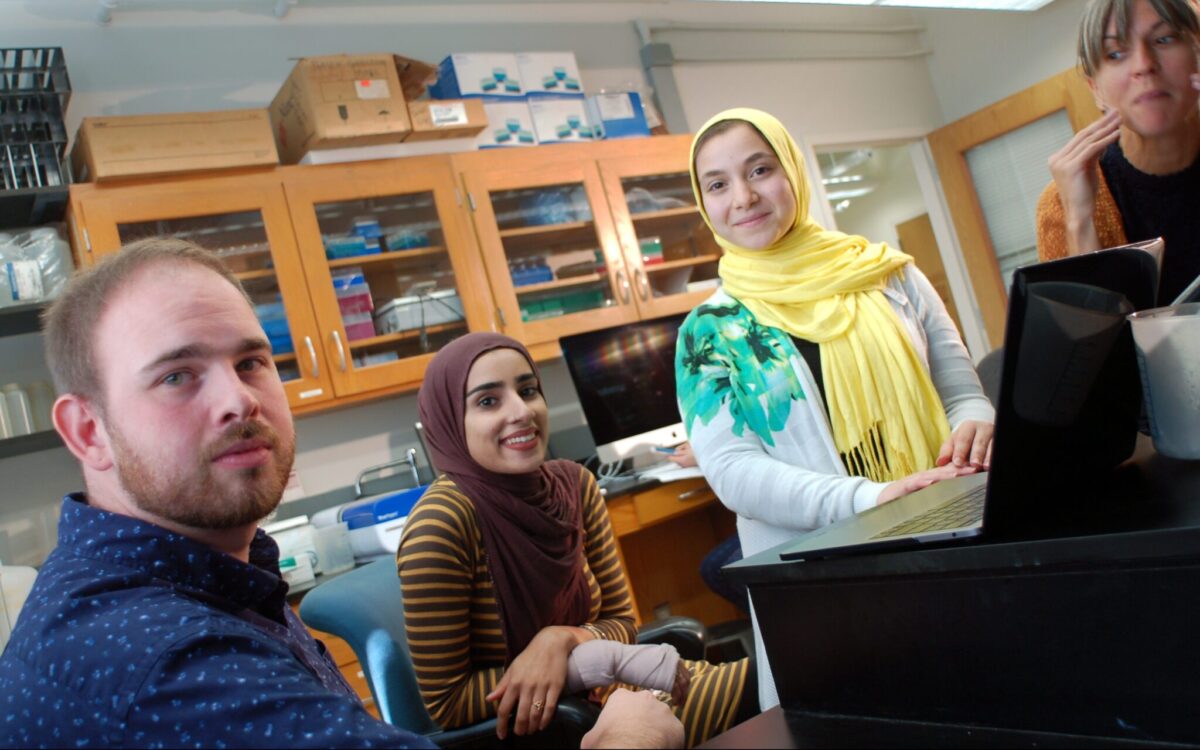 Michael Mercado (left), Zulekha Karachiwalla (center) and Rahaf Alhabashi (right) participated in the Build a Bridge to STEM Internship; Mercado’s ASL interpreter is at the far right. (Photo by Tim Ford)
BUILD has even benefited students who attend other universities.
The BUILD a Bridge to STEM Internship has offered students the opportunity to spend the summer at UMBC, learning laboratory skills and then working in small groups to conduct research with UMBC faculty members and present at UMBC’s Summer Undergraduate Research Fest. Students from regional community colleges, Morgan State University, and Gallaudet University all participated, the latter with the full-time support of ASL interpreters.
Long-lasting, sustainable change
Though STEM BUILD’s 10 years are coming to an end, the institutional change the program has enabled will endure at UMBC.
 Dean William R. LaCourse has led STEM BUILD at UMBC for the last 10 years. (Marlayna Demond ’11/UMBC)
STEM students will have access to more and better training and professional development opportunities, faculty are employing more effective teaching and mentoring strategies, and scaffolded research experiences are available to prepare students for further study, explained William R. LaCourse, CNMS dean.
As the ideator and champion of many STEM BUILD initiatives that will continue, LaCourse is thrilled to see the impact those initiatives are having on students’ experiences and trajectories.
“It has been my passion and purpose to support all students, especially thosewho are in the middle of the achievement curve when they arrive at UMBC,” LaCourse said. “The STEM BUILD program showed that every student has the potential to excel as a scholar, if given the opportunity and support. By infusing the interventions developed in STEM BUILD into the four-year curriculum for all students, maybe our motto should have been ‘5,000, not 50.’”
]]>
From its outset, UMBC’s STEM BUILD—a 10-year undergraduate success initiative and research study at UMBC funded by the National Institutes of Health—has had a unique vision: To emphasize the...
https://umbc.edu/stories/umbc-stem-build-leads-to-institutional-change/
https://beta.my.umbc.edu/api/v0/pixel/news/142401/guest@my.umbc.edu/f471c4ea3eb95006b2384bd0b610138d/api/pixel
biology
cnms
news
science-and-tech
stembuild
story
UMBC News & Magazine
https://beta.my.umbc.edu/groups/umbc-news-magazine
https://assets1-beta.my.umbc.edu/system/shared/avatars/groups/000/001/943/24435aa6207c452e7bc15cc74b42c7bb/xsmall.png?1748556657
https://assets1-beta.my.umbc.edu/system/shared/avatars/groups/000/001/943/24435aa6207c452e7bc15cc74b42c7bb/original.png?1748556657
https://assets2-beta.my.umbc.edu/system/shared/avatars/groups/000/001/943/24435aa6207c452e7bc15cc74b42c7bb/xxlarge.png?1748556657
https://assets2-beta.my.umbc.edu/system/shared/avatars/groups/000/001/943/24435aa6207c452e7bc15cc74b42c7bb/xlarge.png?1748556657
https://assets3-beta.my.umbc.edu/system/shared/avatars/groups/000/001/943/24435aa6207c452e7bc15cc74b42c7bb/large.png?1748556657
https://assets1-beta.my.umbc.edu/system/shared/avatars/groups/000/001/943/24435aa6207c452e7bc15cc74b42c7bb/medium.png?1748556657
https://assets2-beta.my.umbc.edu/system/shared/avatars/groups/000/001/943/24435aa6207c452e7bc15cc74b42c7bb/small.png?1748556657
https://assets1-beta.my.umbc.edu/system/shared/avatars/groups/000/001/943/24435aa6207c452e7bc15cc74b42c7bb/xsmall.png?1748556657
https://assets2-beta.my.umbc.edu/system/shared/avatars/groups/000/001/943/24435aa6207c452e7bc15cc74b42c7bb/xxsmall.png?1748556657
UMBC News & Magazine
2
0
false
Tue, 11 Jun 2024 10:56:39 -0400
Tue, 11 Jun 2024 10:56:39 -0400
Announcing Janet Rutledge’s Retirement
Dear UMBC Community,
Please join us in congratulating Vice Provost and Dean of the Graduate School Janet Rutledge, who has informed us of her intention to retire, effective June 30. Janet retires after 15 years in the role and 25 years with the University System of Maryland (23 of those at UMBC).
Under Janet’s leadership, the Graduate School has developed tremendously, and its enrollment has grown from 2,596 to 3,657. The Graduate School manages the full life cycle of a graduate student—from recruitment and admission through completion and graduation—and among Janet’s accomplishments was the creation of a graduate student development unit that focuses on issues and activities related to diversity, retention, and student success. That unit has expanded to include postdoctoral professional development. Grant funding through the National Science Foundation (NSF) Alliances for Graduate Education and the Professoriate and other sponsors spurred innovative programming that now has been institutionalized. This past year, the Mentoring Others Results in Excellence (MORE) program was launched to improve communications between faculty and graduate students.
A member of the faculty in the Department of Computer Science and Electrical Engineering, Janet has served previously in the Graduate School as associate dean, senior associate dean, and interim vice provost. Long dedicated to the development of students and faculty, before joining UMBC, she spent several years at the NSF, serving as the program director for the Graduate Research Fellowship Program. Janet chaired the NSF’s coordinating committee for the Faculty Early Career Development Program (CAREER). She has been very active in the graduate education community nationally and internationally, serving as a member of the Alfred P. Sloan Foundation Minority Ph.D. Program Advisory Committee and chairing the Council of Graduate Schools (CGS) Advancement Advisory Committee and the Advisory Committee on Strengthening Connections to Postgraduate Education in the Global South. She formerly served on the CGS Board of Directors, the TOEFL (English language test) Advisory Board, and the GRE (graduate admissions test) Advisory Board (serving as chair 2017 – 2018).
Janet’s academic career includes several years on the faculty at the University of Maryland, Baltimore and at Northwestern University. She has served as principal investigator or co-principal investigator on more than $25 million in grant funding for research and graduate education and was co-PI on NSF’s ADVANCE grant that aimed to increase the number of women faculty in STEM and support their career advancement.
We are grateful to Janet for her many years of service to UMBC and the Graduate School. And we extend our gratitude, as well, to Jeffrey Halverson, associate dean of the Graduate School and professor of geography, who has agreed to serve in an interim capacity as vice provost and dean for the upcoming academic year.
We look forward to the arrival in July of our incoming provost, Manfred H. M. van Dulmen, who will lead a national search for the next dean of the Graduate School.
For now, please join us in expressing our deepest thanks and congratulations to Janet on a wonderful career and best wishes for a happy retirement!
Sincerely,
President Valerie Sheares Ashby
David P. Dauwalder
Interim Provost and Senior Vice President for Academic Affairs
]]>
Dear UMBC Community, Please join us in congratulating Vice Provost and Dean of the Graduate School Janet Rutledge, who has informed us of her intention to retire, effective June 30. Janet...
https://my3.my.umbc.edu/groups/announcements/posts/142382
https://beta.my.umbc.edu/api/v0/pixel/news/142388/guest@my.umbc.edu/a6c5b2ef37df5ec8f59702845565a86f/api/pixel
president
story
UMBC News & Magazine
https://beta.my.umbc.edu/groups/umbc-news-magazine
https://assets1-beta.my.umbc.edu/system/shared/avatars/groups/000/001/943/24435aa6207c452e7bc15cc74b42c7bb/xsmall.png?1748556657
https://assets1-beta.my.umbc.edu/system/shared/avatars/groups/000/001/943/24435aa6207c452e7bc15cc74b42c7bb/original.png?1748556657
https://assets2-beta.my.umbc.edu/system/shared/avatars/groups/000/001/943/24435aa6207c452e7bc15cc74b42c7bb/xxlarge.png?1748556657
https://assets2-beta.my.umbc.edu/system/shared/avatars/groups/000/001/943/24435aa6207c452e7bc15cc74b42c7bb/xlarge.png?1748556657
https://assets3-beta.my.umbc.edu/system/shared/avatars/groups/000/001/943/24435aa6207c452e7bc15cc74b42c7bb/large.png?1748556657
https://assets1-beta.my.umbc.edu/system/shared/avatars/groups/000/001/943/24435aa6207c452e7bc15cc74b42c7bb/medium.png?1748556657
https://assets2-beta.my.umbc.edu/system/shared/avatars/groups/000/001/943/24435aa6207c452e7bc15cc74b42c7bb/small.png?1748556657
https://assets1-beta.my.umbc.edu/system/shared/avatars/groups/000/001/943/24435aa6207c452e7bc15cc74b42c7bb/xsmall.png?1748556657
https://assets2-beta.my.umbc.edu/system/shared/avatars/groups/000/001/943/24435aa6207c452e7bc15cc74b42c7bb/xxsmall.png?1748556657
UMBC News & Magazine
2
0
false
Mon, 10 Jun 2024 11:03:38 -0400
China turns to private hackers as it cracks down on online activists on Tiananmen Square anniversary

Written by Christopher K. Tong, associate professor of Asian studies at UMBC
Every year ahead of the June 4 commemoration of the Tiananmen Square massacre, the Chinese government tightens online censorship to suppress domestic discussion of the event.
Critics, dissidents and international groups anticipate an uptick in cyber activity ranging from emails with malicious links to network attacks in the days and weeks leading up to the anniversary.
Much of this cyber activity by Beijing is done covertly. But a recent restructuring of China’s cyberforce and a document leak exposing the activities of Chinese tech firm i-Soon have shed some light on how Beijing goes about the business of hacking.
As a China expert and open-source researcher, I believe the latest revelations draw the curtain back on a contractor ecosystem in which government officials and commercial operators are increasingly working together. In short, Beijing is outsourcing its cyber operations to a patchwork army of private-sector hackers who offer their services out of a mix of nationalism and profit.
From censorship to cyberattacks
Chinese authorities restrict the flow of information online by banning search terms, scanning social media for subversive messages and blocking access to foreign media and applications that may host censored content. Control of online activity is particularly stringent around the anniversary of the protests at Tiananmen Square in 1989 that ended with a bloody crackdown on demonstrators by troops on June 4 of that year.
Since then pro-democracy activists have sought to commemorate the massacre on its anniversary – and Beijing has sought to counter mention of the crackdown. Chinese internet users note more restrictions and censorship in the run-up to the anniversary, with more words being banned and even certain emojis – like candles, denoting vigils – disappearing.
In 2020, Chinese authorities ordered Zoom, an American tech firm with a development team in China, to suspend the accounts of U.S.-based activists commemorating June 4 and to cancel online vigils hosted on the platform. Zoom complied, stating that it was following local laws.
Beyond censorship, cyberattacks on dissident groups and Chinese-language media in the diaspora have also occurred on or around the anniversary.
On June 4, 2022, Media Today, a Chinese-language media group in Australia, experienced an unattributed cyberattack against its user accounts. And earlier this year, the U.S. Department of Justice charged seven China-based hackers with sending malicious tracking emails to members of the Inter-Parliamentary Alliance on China, a group set up in 2020 on the anniversary of the Tiananmen Square massacre.
China’s cyberforce
The increasing sophistication of online attacks on dissident and international groups comes as China has been restructuring the agencies responsible for its cyber operations.
Today, much of China’s malicious cyber activities are carried out by the Ministry of State Security, or MSS, the country’s main intelligence agency and secret police. But prior to the MSS expanding into this role, the People’s Liberation Army, or PLA, was responsible for the earliest cyberattacks attributed to the Chinese government. In 2015, the PLA dedicated a new service to cyberwarfare and network security, the Strategic Support Force.
But in April 2024, the PLA abruptly announced the Strategic Support Force’s disbandment and the creation of three new forces: the Aerospace Force, the Cyberspace Force and the Information Support Force. They, along with the existing Joint Logistics Support Force, report directly to the Chinese Communist Party.
This restructuring comes at a time of political uncertainty for China’s leadership. In 2023, Defense Minister Li Shangfu was removed just months into his new role, along with Foreign Minister Qin Gang and Li Yuchao, commander of the Rocket Force.
While Beijing has yet to offer details on the military reorganization, its timing appears to send a message. President Xi Jinping personally presided over the inauguration of the Information Support Force, telling members of the force that they must “listen to the party’s orders” and be “absolutely loyal, absolutely pure, absolutely reliable.”
Hackers: Patriots, pirates or profiteers?
The restructuring of China’s cyberforces coincides with a trend that has seen the outsourcing of malicious cyber operations to private sector contractors acting with the state’s explicit or tacit approval.
In February 2024, a document leak exposed an underground network of Chinese cyber contractors hacking for profit.
Cyber experts have long suspected that hackers may collaborate with the Chinese government, but the leak shows how operators working for Chinese firm i-Soon sold services and products to Chinese government entities and state-sponsored threat groups. The company was founded in 2010 by Wu Haibo, a former member of the Green Army, often described as China’s earliest hacker community.
The Green Army was formed in 1997 for hackers to learn and exchange hacking techniques. By 1998, patriotic Chinese hackers began organizing cyberattacks. For example, when riots in Indonesia triggered by the Asian financial crisis gave rise to racial violence against Chinese Indonesians, Chinese hackers targeted Indonesian government websites.
In 1999, Chinese hackers vandalized U.S. government websites following NATO’s accidental bombing of the Chinese embassy in Belgrade. The term “honker,” meaning “red hacker” in Chinese, emerged around this time to designate Chinese hackers motivated by ideology and nationalism.
Yet, Chinese hackers have had an uneasy relationship with the authorities. While they offer cyber skills as well as plausible deniability for the Chinese government, they tend to muddle Beijing’s foreign policy when their actions go too far and draw criticism.
They are also prone to commit cybercrimes such as fraud and theft of intellectual property alongside state-sponsored espionage.
The Chinese government and prominent “patriotic” hackers have previously tried to rein in the community and promote legitimate work such as cybersecurity.
The i-Soon leak, however, documents how Chinese state-sponsored contractors engage in bribery and other illicit activities.
Exploiting security flaws
China’s cyber capabilities have grown through the control and exploitation of cyber professionals, state-sponsored or otherwise. But it’s a complicated relationship.
To phase out the criminal behavior of hackers, Beijing has developed a pipeline to train its cyber workforce. And in part to keep them from sharing expertise with foreigners, Chinese cyber professionals are generally banned from international hacking competitions.
While cybersecurity is improved when security professionals share newly discovered security flaws, Chinese regulations limit the flow of such information. By law, software vulnerabilities discovered in China must be immediately reported to the Chinese government. Experts believe the Ministry of State Security subsequently exploits this data to develop cyber offensive capabilities.
Still, the i-Soon leak points to corruption in at least one corner of China’s growing network of commercial hacking. Internal correspondence shows contractors bribing government officials with money, alcohol and other favors. Messages also show contractors failing to generate sales, delivering subpar work and complaining about their working-class salary.
With local governments in China struggling to pay for basic services in a weak economy, companies such as i-Soon that support Beijing’s cyber operations face not only political but also financial headwinds. Despite Beijing’s intention to implement an online crackdown every year on June 4, the cyberforces it employs to do so face their own issues that invite scrutiny and rectification by the Chinese Communist Party.
This article is republished from The Conversation under a Creative Commons license. Read the original article and see more than 250 UMBC articles available in The Conversation.
]]>
Written by Christopher K. Tong, associate professor of Asian studies at UMBC Every year ahead of the June 4 commemoration of the Tiananmen Square massacre, the Chinese government tightens...
https://umbc.edu/stories/china-private-hackers-tiananmen-square-anniversary/
https://beta.my.umbc.edu/api/v0/pixel/news/142369/guest@my.umbc.edu/adec3fc5c60c1be9c9f3b7824baf49e9/api/pixel
asian-studies
cahss
cahss-research
discovery
magazine
research
story
UMBC News & Magazine
https://beta.my.umbc.edu/groups/umbc-news-magazine
https://assets1-beta.my.umbc.edu/system/shared/avatars/groups/000/001/943/24435aa6207c452e7bc15cc74b42c7bb/xsmall.png?1748556657
https://assets1-beta.my.umbc.edu/system/shared/avatars/groups/000/001/943/24435aa6207c452e7bc15cc74b42c7bb/original.png?1748556657
https://assets2-beta.my.umbc.edu/system/shared/avatars/groups/000/001/943/24435aa6207c452e7bc15cc74b42c7bb/xxlarge.png?1748556657
https://assets2-beta.my.umbc.edu/system/shared/avatars/groups/000/001/943/24435aa6207c452e7bc15cc74b42c7bb/xlarge.png?1748556657
https://assets3-beta.my.umbc.edu/system/shared/avatars/groups/000/001/943/24435aa6207c452e7bc15cc74b42c7bb/large.png?1748556657
https://assets1-beta.my.umbc.edu/system/shared/avatars/groups/000/001/943/24435aa6207c452e7bc15cc74b42c7bb/medium.png?1748556657
https://assets2-beta.my.umbc.edu/system/shared/avatars/groups/000/001/943/24435aa6207c452e7bc15cc74b42c7bb/small.png?1748556657
https://assets1-beta.my.umbc.edu/system/shared/avatars/groups/000/001/943/24435aa6207c452e7bc15cc74b42c7bb/xsmall.png?1748556657
https://assets2-beta.my.umbc.edu/system/shared/avatars/groups/000/001/943/24435aa6207c452e7bc15cc74b42c7bb/xxsmall.png?1748556657
UMBC News & Magazine
0
0
false
Fri, 07 Jun 2024 13:05:43 -0400
Fri, 07 Jun 2024 13:05:43 -0400
Meet a Retriever—Michelle Jabes Corpora ‘03, young adult author and editor

MeetMichelle Jabes Corpora’03, English and theatre. Michelle is the author of nine novels, an editor for commercial fiction, and an avid student of Brazilian Jiu-Jitsu. She came to UMBC as a Linehan Artist Scholar in 1999 to study theatre before deciding to double major in English. Michelle has found that her background in theatre has been a helpful tool in her writing. Take it away, Michelle!
Q: What’s one essential thing you’d want another Retriever to know about you?
A: I am a 2003 alumna, a double major in English and theatre. Today, I am the author of nine novels for young readers, and have been an editor of commercial fiction for 17 years for both big publishing companies in New York and a book packaging company based out of London.
My latest novel, Holly Horror: The Longest Night, is scheduled to release on August 13, 2024. It is a young adult horror story and the terrifying sequel to Holly Horror.
The first book in my newest series, a trilogy that was pitched as “Ancient Egyptian Game of Thrones for YA readers,” is slated to be published by Sourcebooks Fire in Summer 2025. Stay tuned!
Q: What is your WHY? What brought you to UMBC?
A: Initially, I came to UMBC as a Linehan Artist Scholar studying theatre, but once I began my years on campus, I realized I wanted to supplement my studies with a major in English. The experiences I had in both academic departments went on to inform my choice of career in book publishing, and the way that I write novels. Learning about drama helped significantly with my approach to character, plot, and pacing.
Pictured right: Michelle as ‘Cleo’ AKA Fraulein Kost in a 2001 UMBC Theatre production of Cabaret.

Q: Tell us more about your career. What do you like most about writing and editing?
A: I am an author as well as a senior commissioning editor at Working Partners, Ltd. Fiction has always been my passion, so I love working creatively every day and writing books for young readers. But it’s been a long road to get where I am today!
After receiving my bachelor’s degree in English and theatre from UMBC, I went on to earn a master’s degree in Children’s Literature from Hollins University. After that, I did some weird stuff. I was a wedding singer for a while. I also worked with animals in a vet’s office and at a wildlife rehabilitation center. Eventually, I moved to New York and worked as an assistant editor at Greenwillow Books before getting my job with Working Partners. All of these serendipitous events eventually led me to the #AuthorLife.
 An author photo of Michelle Jabes Corpora (Picturesque Photography).
Before I wrote books with my name on the cover, I was a ghostwriter for a world-famous middle-grade mystery series. I wrote my first five novels in that series, and enjoyed every minute of it. It was an honor to be a part of a legacy that is cherished by so many. Looking back, all those detours were exactly what I needed. Not only do different experiences help you become a more well-rounded person and writer, they allowed me both to meet people who would become so important in my career, and teach me—through learning to be an editor—what really makes a good book. It also taught me to embrace my “chameleon” self—I’ve always loved many different genres of fiction, and felt that it was somehow a personal failing that I could never choose just one. Today, I’m happy to say that I’ve written mysteries, historical fiction, horror, and fantasy, and I see no reason to stop now.
UMBC is a place that allows people to find their way in the world, even if your journey might take you off the beaten path.
Michelle Jabes Corpora ’03
Q: What do you like to do when you’re not writing?
A. I live in Frederick, Maryland, with my dear husband, my two wonderful daughters, two guinea pigs named Fireball and Olive, and a rescue mutt named Charlie. When I’m not writing and editing books, you can usually find me at Crazy 88 MMA, training in the art of Brazilian Jiu-Jitsu. Competing at tournaments and being promoted to blue belt in BJJ were some of the proudest moments of my life. Some people may see videos of me rolling around on the floor and fighting my friends and think that I’m crazy. I can neither confirm nor deny the validity of this statement.
Q: What’s the one thing you’d want someone who hasn’t joined the UMBC community to know about the support you find here?
A: UMBC is a tight-knit community. Even though it’s a public state university, it has a private college feel with big university resources. It’s a place that allows people to find their way in the world, even if your journey might take you off the beaten path.
Q: What’s your favorite part of being a part of Retriever Nation?
A: I meet so many other UMBC alumni out in the world, and we always have great stories to tell about our time on campus. It’s a wonderful shared experience that always feels personal.
* * * * *
UMBC’s greatest strength is its people. When people meet Retrievers and hear about the passion they bring, the relationships they create, the ways they support each other, and the commitment they have to inclusive excellence, they truly get a sense of our community. That’s what “Meet a Retriever” is all about.
Learn more about how UMBC can help you achieve your goals.
]]>
MeetMichelle Jabes Corpora’03, English and theatre. Michelle is the author of nine novels, an editor for commercial fiction, and an avid student of Brazilian Jiu-Jitsu. She came to UMBC as a...
https://umbc.edu/stories/meet-young-adult-author-michelle-jabes-corpora/
https://beta.my.umbc.edu/api/v0/pixel/news/142331/guest@my.umbc.edu/07ad54d75f785c8978779d7c42242173/api/pixel
author
cahss
english
holly-horror
linehan-artist-scholar
meet-a-retriever
story
theatre
uncategorized
UMBC News & Magazine
https://beta.my.umbc.edu/groups/umbc-news-magazine
https://assets1-beta.my.umbc.edu/system/shared/avatars/groups/000/001/943/24435aa6207c452e7bc15cc74b42c7bb/xsmall.png?1748556657
https://assets1-beta.my.umbc.edu/system/shared/avatars/groups/000/001/943/24435aa6207c452e7bc15cc74b42c7bb/original.png?1748556657
https://assets2-beta.my.umbc.edu/system/shared/avatars/groups/000/001/943/24435aa6207c452e7bc15cc74b42c7bb/xxlarge.png?1748556657
https://assets2-beta.my.umbc.edu/system/shared/avatars/groups/000/001/943/24435aa6207c452e7bc15cc74b42c7bb/xlarge.png?1748556657
https://assets3-beta.my.umbc.edu/system/shared/avatars/groups/000/001/943/24435aa6207c452e7bc15cc74b42c7bb/large.png?1748556657
https://assets1-beta.my.umbc.edu/system/shared/avatars/groups/000/001/943/24435aa6207c452e7bc15cc74b42c7bb/medium.png?1748556657
https://assets2-beta.my.umbc.edu/system/shared/avatars/groups/000/001/943/24435aa6207c452e7bc15cc74b42c7bb/small.png?1748556657
https://assets1-beta.my.umbc.edu/system/shared/avatars/groups/000/001/943/24435aa6207c452e7bc15cc74b42c7bb/xsmall.png?1748556657
https://assets2-beta.my.umbc.edu/system/shared/avatars/groups/000/001/943/24435aa6207c452e7bc15cc74b42c7bb/xxsmall.png?1748556657
UMBC News & Magazine
2
0
false
Wed, 05 Jun 2024 11:57:37 -0400
Wed, 05 Jun 2024 11:57:37 -0400
Rotting sargassum is choking the Caribbean’s white sand beaches, fueling an economic and public health crisis

Written by Farah Nibbs, assistant professor of emergency and disaster health systems at UMBC
The Caribbean’s sandy beaches, clear turquoise water and vibrant coral reefs filled with an amazing variety of sea creatures have long been the pride of the islands.
The big three – sun, sea and sand – have made this tropical paradise the most tourism-reliant region in the world.
But now, all of that is under threat. The explosive growth of a type of seaweed called sargassum is wreaking havoc on economies, coastal environments and human health across the islands.
I study the intersection of critical infrastructure and disasters, particularly in the Caribbean. The sargassum invasion has worsened since it exploded in the region in 2011. Forecasts and the seaweed already washing up suggest that 2024 will be another alarming year.
 Sargassum levels were already high around many eastern Caribbean islands in late May 2024. Forecasters expect increasing sargassum washing up in June on many of the islands and in the Gulf of Mexico. NOAA and University of South Florida
The Sargasso Sea
The Sargasso Sea is often referred to as a golden, floating rainforest for its vast floating sargassum blooms and the wide variety of sea life that it supports.
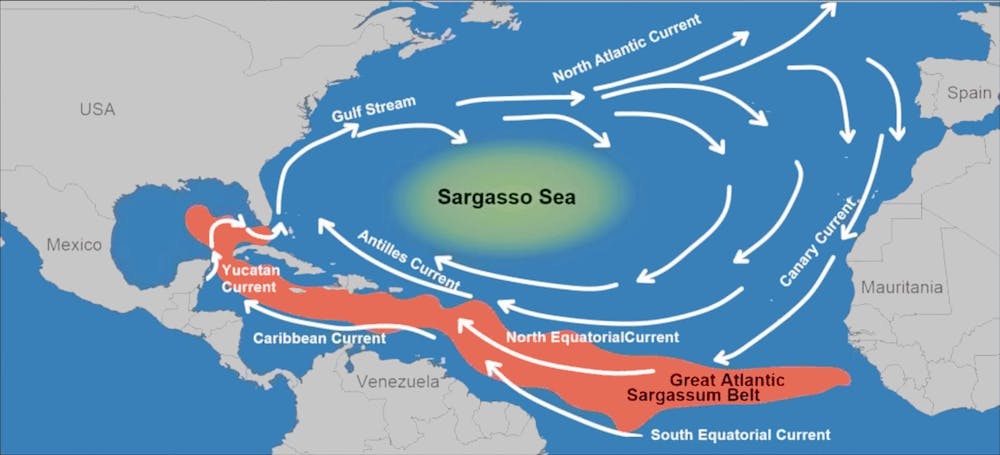
It is the only sea in the world with no land borders. Instead, it is bounded by four Atlantic Ocean currents: the North Atlantic current, the Gulf Stream, the North Atlantic Equatorial Current and the Canary Current.
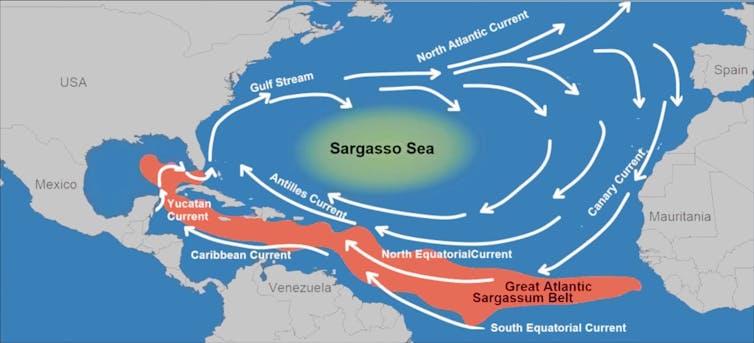 The Great Atlantic sargassum belt and Sargasso Sea. JL López Miranda, et al., via Wikimedia, CC BY
Without human interference, and under normal conditions, sargassum is a good thing. It has existed in the Caribbean for centuries, providing habitat and food for ocean wildlife, including threatened and endangered species such as the porbeagle shark and the anguillid eel.
Conditions over the past decade around the Caribbean Sea, North Atlantic and Gulf of Mexico, however, have been anything but normal.
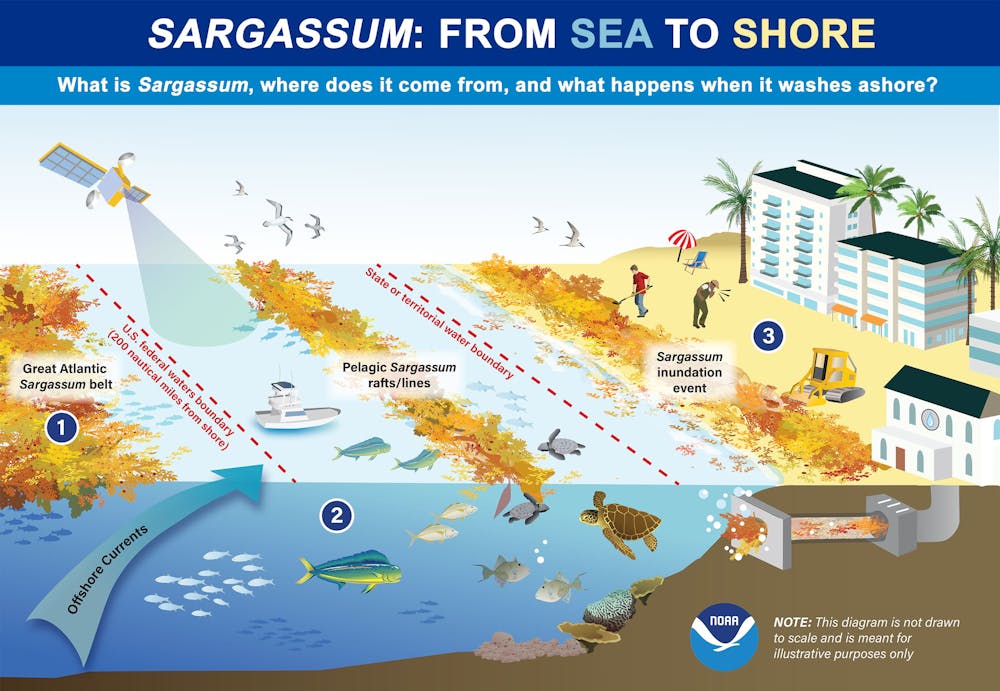
Since 2011, vast mats of sargassum seaweed have been washing up on Caribbean islands. On shore, they pile up into a dead and stinky mass.
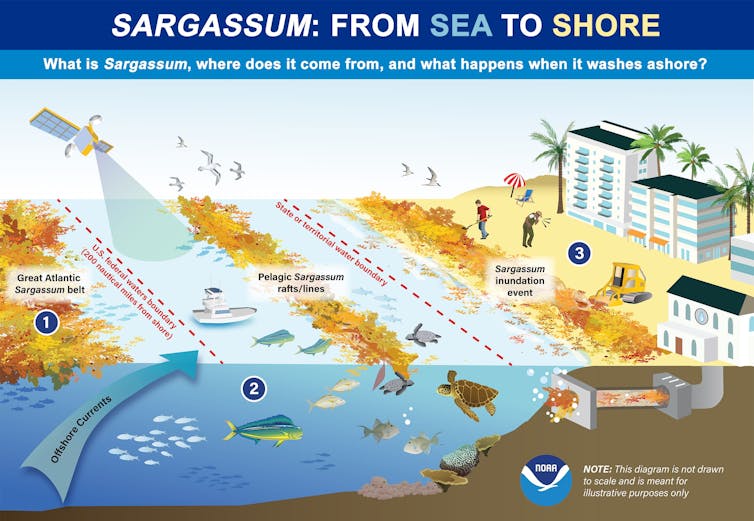 (1) Sargassum rafts from a vast bloom known as the sargassum belt are transported to shore by ocean currents. (2) Free-floating sargassum provides food and habitat. (3) But on shore, it rots and clogs water intakes and beaches. NOAA
These sargassum events have been occurring more frequently and are lasting longer, and the amount of algae is increasing.
The situation has gotten so bad that NOAA created a weekly sargassum inundation risk index in collaboration with the University of South Florida. They have predicted that 2024 will be another terrible year for the Caribbean.
Pollution fuels a hazardous algae bloom
So, what is causing the explosive growth of this algae? Studies have pointed to pollution that the Caribbean region itself has done little to contribute to.
Humans are altering the nutrient cycle by releasing fertilizer runoff and industrial wastewater into rivers, which sends phosphates and nitrates down river systems and out into the oceans. These are key nutrients for plant growth.
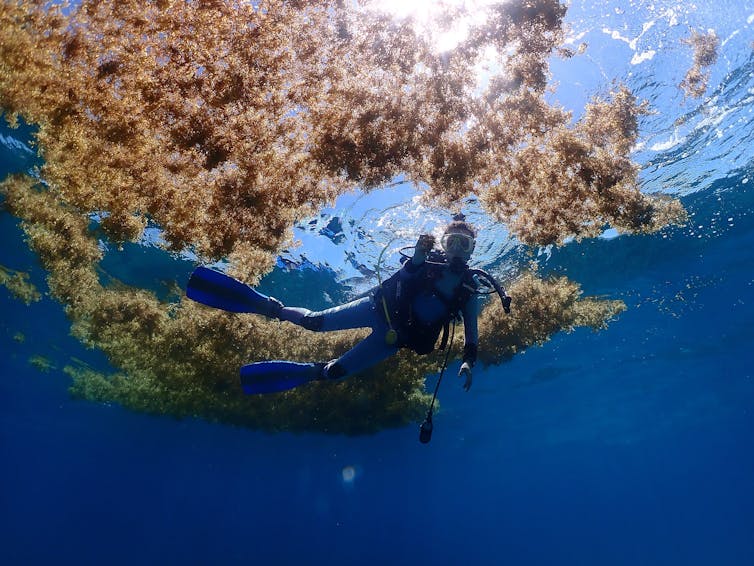 A diver swims below a sargassum mat. Dan Eidsmoe via Flickr, CC BY
A rapid increase in ranching, logging and agriculture along the Amazon River in South America is one source, sending huge amounts of nutrients washing into the river, which terminates in the Caribbean Sea.
Another culprit is the Mississippi River, which carries nutrient-rich effluent from farms and industries into the Gulf of Mexico.
The Congo River in Africa also carries pollutants into the ocean from deforestation, and burning forests can deliver nutrients, such as nitrogen, phosphorus and iron, that further fuel algae growth.
These pollutants are swept up by ocean currents. An increase in phosphate and nitrogen water pollution, combined with warming waters, is believed to have supercharged seaweed normally carried by currents from the Sargasso Sea and created the sargassum belt, which persists across the Caribbean today.
Coasts, fishing industries can’t escape the harm
In small quantities, sargassum plays a role in beach nourishment. But when it inundates coastlines, the rotting seaweed smothers beaches and reduces the amount of oxygen in the water, killing fish and harming fragile coral reefs.
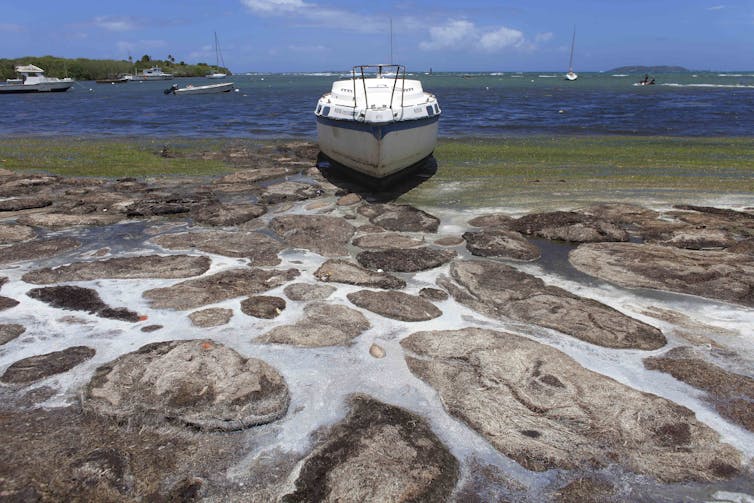 Sargassum can get into boat propellers and make it hard to approach shore. This was Puerto Rico in 2015. AP Photo/Ricardo Arduengo
The massive influx of sargassum has also disrupted fishing operations. Fishers find themselves struggling to maintain their livelihoods as sargassum is diminishing their catch. The seaweed has damaged fishing gear and boat engines and blocked access to harbors and mooring sites.
In addition, sargassum can concentrate arsenic, which poses the risk of contaminating fish and harming people who may eat them.
Sargassum on land is a public health threat
Sargassum rots quickly when stranded. Within 48 hours, it begins to degrade, releasing hydrogen sulphide and ammonia. At certain concentrations, these gases become not only toxic to the marine environment but also to human health.
There have been a growing number of reported cases of neurological, digestive and respiratory disorders associated with the noxious gases being emitted. Guadeloupe’s air-quality monitoring institute Gwad’Air has issued red alerts in recent years because of dangerous levels of hydrogen sulfide gas being emitted from rotting sargassum. https://www.youtube.com/embed/CH7MpiGCdgU?wmode=transparent&start=0 The growing sargassum problem.
The most common symptoms experienced by people living within close proximity to sargassum are headache, dizziness, abdominal pain, cough, rashes, eye disorders and effects on mood. Sargassum odors have led to an increase in nausea and headaches among school-age children. Pregnant women in the region are also being affected, with increasing reported cases of preeclampsia.
Sargassum has also clogged water intake tubes for desalination plants and power plants that use seawater for cooling, causing these units to shut down.
In the British Virgin Islands, sargassum sucked into the main desalination plant in 2023 led to smelly tap water and sporadic water shut-offs. In Virgin Gorda and St. Croix, people have reported smells, a burning sensation and skin rashes from their tap water.
Sargassum blooms also damage economies
Millions of tons of dead and rotting seaweed washing ashore can have widespread economic consequences.
The odor of the rotting seaweed attracts insects, which has been a repellent for some tourists. Cleaning the beaches and disposing of tons of debris, typically in landfills, cost the Caribbean about US$120 million in 2018.
That doesn’t include the economic losses for hotels, fisheries and other businesses.
Small businesses such as Jet Ski rentals that depend on the coast for revenue generation have at times been forced to shut down because of the odorous gases released from the decaying mass.
Is there a solution?
Research and entrepreneurial initiatives are underway to try to deal with the seaweed. Companies have tried turning it into fertilizer, cattle feed and concrete, but so far only at small scale. https://www.youtube.com/embed/5QoGoAWbvEA?wmode=transparent&start=0 Sargassum cleanup in Martinique in 2023.
Governments have made little progress beyond agreeing to some fisheries management rules to protect vulnerable species. A few countries have draft management strategies, but action is typically focused on protecting the tourism industry, with little attention given to fisherfolk and local communities.
The sargassum invasion is fueled by global pollution, and fixing that requires a global response.
The United Nations Environment Program has called for increased international cooperation to understand the causes and impact of sargassum invasions and to find ways to help the countries affected. But so far, the international community has done little to address the pollution at the root of the problem.
This article is republished from The Conversation under a Creative Commons license. Read the original article and see more than 250 UMBC articles available in The Conversation.
]]>
Written by Farah Nibbs, assistant professor of emergency and disaster health systems at UMBC The Caribbean’s sandy beaches, clear turquoise water and vibrant coral reefs filled with an...
https://umbc.edu/stories/rotting-sargassum-in-caribbean/
https://beta.my.umbc.edu/api/v0/pixel/news/142322/guest@my.umbc.edu/0a1136fdd0afa970b5b6f81e5b39211f/api/pixel
cahss
cahss-research
discovery
edhs
magazine
research
story
UMBC News & Magazine
https://beta.my.umbc.edu/groups/umbc-news-magazine
https://assets1-beta.my.umbc.edu/system/shared/avatars/groups/000/001/943/24435aa6207c452e7bc15cc74b42c7bb/xsmall.png?1748556657
https://assets1-beta.my.umbc.edu/system/shared/avatars/groups/000/001/943/24435aa6207c452e7bc15cc74b42c7bb/original.png?1748556657
https://assets2-beta.my.umbc.edu/system/shared/avatars/groups/000/001/943/24435aa6207c452e7bc15cc74b42c7bb/xxlarge.png?1748556657
https://assets2-beta.my.umbc.edu/system/shared/avatars/groups/000/001/943/24435aa6207c452e7bc15cc74b42c7bb/xlarge.png?1748556657
https://assets3-beta.my.umbc.edu/system/shared/avatars/groups/000/001/943/24435aa6207c452e7bc15cc74b42c7bb/large.png?1748556657
https://assets1-beta.my.umbc.edu/system/shared/avatars/groups/000/001/943/24435aa6207c452e7bc15cc74b42c7bb/medium.png?1748556657
https://assets2-beta.my.umbc.edu/system/shared/avatars/groups/000/001/943/24435aa6207c452e7bc15cc74b42c7bb/small.png?1748556657
https://assets1-beta.my.umbc.edu/system/shared/avatars/groups/000/001/943/24435aa6207c452e7bc15cc74b42c7bb/xsmall.png?1748556657
https://assets2-beta.my.umbc.edu/system/shared/avatars/groups/000/001/943/24435aa6207c452e7bc15cc74b42c7bb/xxsmall.png?1748556657
UMBC News & Magazine
0
0
false
Tue, 04 Jun 2024 14:59:07 -0400
Tue, 04 Jun 2024 14:59:07 -0400
Finding Gold on the Water

Push, pull, push, pull. On goes this routine of synchronized oar movements as rowers—nestled in long, tapered boats—move through the water with precision and speed. The trim boats glide through the water with seemingly effortlessness, and as a child, Mark Couwenhoven finds himself entranced.
One day he’ll learn just how much effort this smooth process takes, but for now, Couwenhoven watches his older sister and her fellow competitors shoot through the water with dolphin-like gracefulness.
“I went to my sister’s races and became enthralled with rowing—I knew that it was what I wanted to do when I got older,” Couwenhoven ’20, biology, recalled.
Nearly two decades later—and after countless pre-dawn hours on the water—his childhood dreams of competitive rowing came true when Couwenhoven landed a spot on the 2019 and 2023 USRowing national teams.
“I was excited to represent the United States and UMBC,” shares Couwenhoven. “When you race, practice, and put in so much work and hard training—medaling at the games and seeing the rewards of that training makes it all worth it.”
But Couwenhoven’s journey to the top echelons of the sport hasn’t come without its challenges and tribulations. The sport, and life along the way, came with its difficulties but Couwenhoven found support at UMBC and in other areas as he pursued his podium and personal goals.
A Rower’s Journey
Couwenhoven began his competitive rowing career during his first year of high school, a passion he continued all throughout his academic career. He learned that what he once considered as “effortless” required a lot of practice and training.
“Rowing is very hard to start. It’s not a very natural movement. You can be an elite rower that has been rowing for years and still have technical flaws. I don’t think the difficulty really ever deterred me from the sport because I enjoyed learning about it,” says Couwhenhoven.
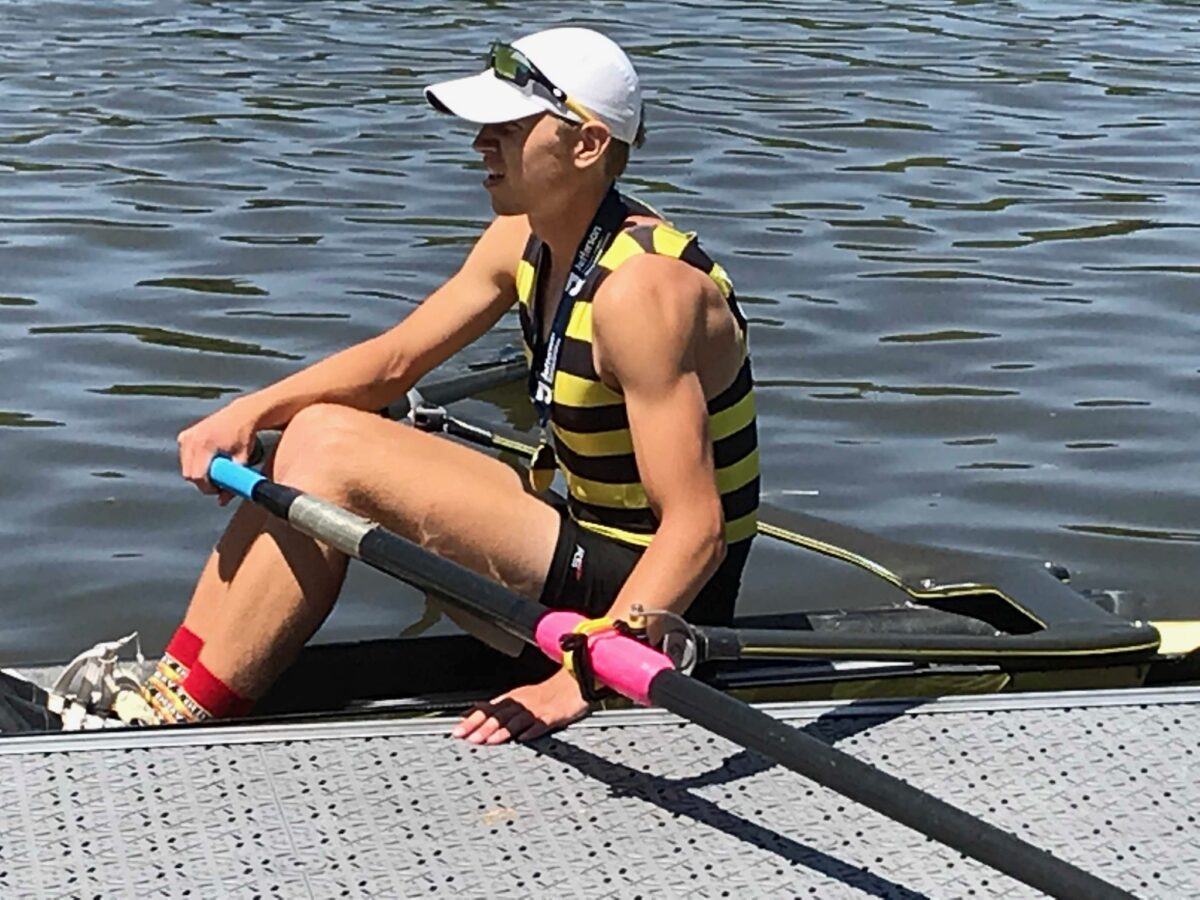 Mark Couwenhoven representing UMBC during the 2019 Dad Vail Regatta. (Photo courtesy of Couwenhoven)
As a high school student, he frequently made the USRowing’s youth national teams. During the school year, the Parkton, Maryland, native strengthened his rowing skills as a member of the Baltimore Community Rowing Club and continued his training in Philadelphia at rowing camps during the summer.
“I stayed committed to rowing when I got into college and I took it to the next level,” said Couwenhoven, who originally enrolled at the University of Delaware and joined the men’s crew team where he helped the varsity lightweight eight team secure a victory at the Dad Vail Regatta, the largest regular intercollegiate rowing event in the country. However, Couwenhoven’s athletic pursuits took a backseat when his mother was diagnosed with breast cancer in 2017.
After learning about his mother’s diagnosis, Couwenhoven moved back to the Baltimore area to help her through the illness. The transition back home didn’t discourage Couwenhoven from his academic and athletic pursuits. “It was a tough time, but I very strongly wanted to finish my education and continue with rowing,” he said.
An International Champion Emerges
Couwenhoven started the process of transferring to UMBC in 2018and “enjoyed the campus and the community,” he said. “Being at UMBC allowed me to be close to my mother, focus on my academics, and find a way back to rowing.”
Even amid her chemotherapy treatments, Cowenhoven’s mother did all that she could to support her son’s rowing ambitions.
“While that was definitely a strenuous battle, she never let it stop her from doing the things she loved. [My mom] would wake up with me in the mornings and we would carpool down to the boathouse.”
 Mark Couwenhoven poses after representing UMBC and winning first place in the men’s single event at the 2019 Dad Vail Regatta. (Photo courtesy of Couwenhoven)
Couwenhoven’s father was also there every step of the way in his rowing career, cheering him along, he says. “My dad was there at every race to help me and I really could not have achieved all of this without his support.”
During his time as a Retriever, Couwenhoven recommitted himself to rowing and began competing as an American Collegiate Rowing Association (ACRA) rower, winning the single scull (solo) event at the 2018 and 2019 ACRA National Championship Regatta. He also went on to represent UMBC at the 2019 Dad Vail Regatta, winning first place in the men’s single event wearing black and gold stripes and Old Bay-themed socks. Following these victories, Couwenhoven tried out for the Under 23 (U23) USRowing national team and secured a spot on the U23 men’s doubles team. Couwenhoven and his doubles partner finished in 10th place at the 2019 World Rowing U23 Championships.
“It was always my dream to make the U23 team, and I was thrilled to make it. Our 10th place finish was the best the U.S. team had done in the doubles category since U23 became an event,” Couwenhoven beamed.
When joining the USRowing team—the governing body that represents the United States in international rowing competitions that include the world championships, the Pan American Games, and the Olympics—Couwenhoven set his sights on competing amongst the top rowers from around the world. Following his success on the U23 team, Couwenhoven landed a spot on the 2023 Pan American Games team.
His determination, combined with endless hours of training in the water, culminated in Couwenhoven winning a gold medal in the mixed eight rowing event and a bronze medal in the men’s double sculls event at the 2023 Pan American Games, held in Santiago, Chile.
Although Couwenhoven’s team were successful in securing a gold medal, the team came into the games without having practiced together as a unit due to their individual homebases. The team’s first official practice occurred as soon as they all landed in Chile.
“We got off to a shaky start in our first heat [in the mixed eight event] and we lost to the Chile team by hundredths of a second,” said Couwenhoven. The team then moved on to the repechage heat, in which first-round losers are given another chance to qualify for the semifinals.
“We found an extra gear during our repechage and we won by a lot. Going into the final, we all felt confident that we were going to accomplish something great.”
Couwenhoven’s victories contributed to the team’s 10 total medals, the U.S. team’s best rowing performance at the Pan American Games since 1999.
 Couwenhoven (right) and partner receiving the bronze medal for the men’s double sculls event at the 2023 Pan American Games.
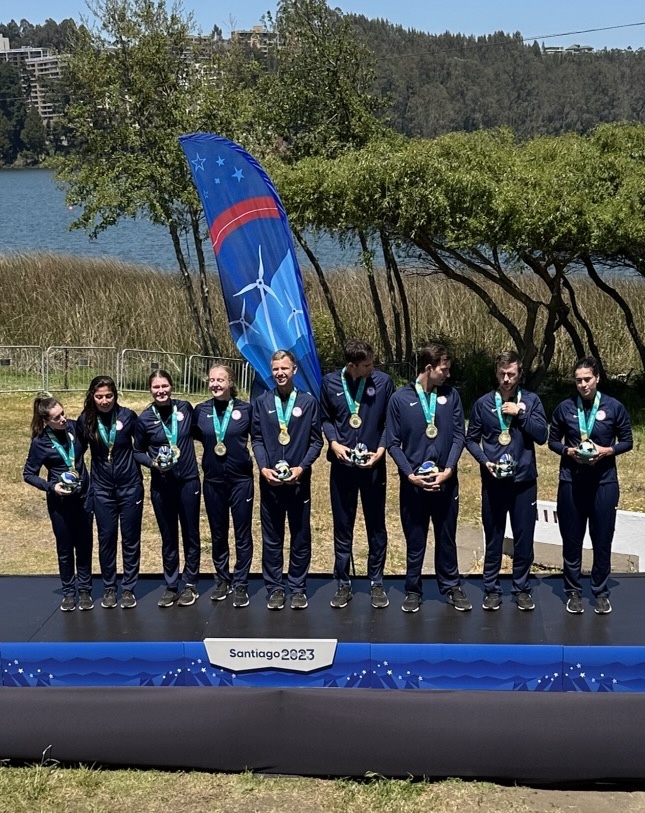 Couwenhoven (fifth from left) and his team with their gold medals after winning the mixed eight rowing event at the 2023 Pan American Games. (Photos courtesy of Couwenhoven)
Life Beyond the Oars
While his ascension in rowing continued during his time at UMBC, Couwenhoven remained dedicated to his academic career and credits much of his success in balancing his life as a student-athlete to his advisor Esther Fleischmann, senior lecturer in biology.
“Fleischmann was absolutely invaluable. Her advising really helped me build that balance that I needed to focus on my academic and athletic goals. She was very supportive,” says Couwenhoven.
As a biology student, Couwenhoven developed an interest in dentistry, and says that his UMBC instructors helped “prepared me well for the rigors of studying and being prepared for a career in dentistry.”
Since graduating, Couwenhoven has relocated to Philadelphia where he currently shadows the oral and maxillofacial surgery team at the Children’s Hospital of Philadelphia (CHOP). He also volunteers at CHOP as a nursing companion for children undergoing treatment. Couwenhoven’s mother, who has now been in remission for five years, inspired his motivation to volunteer as a nursing companion, he said.
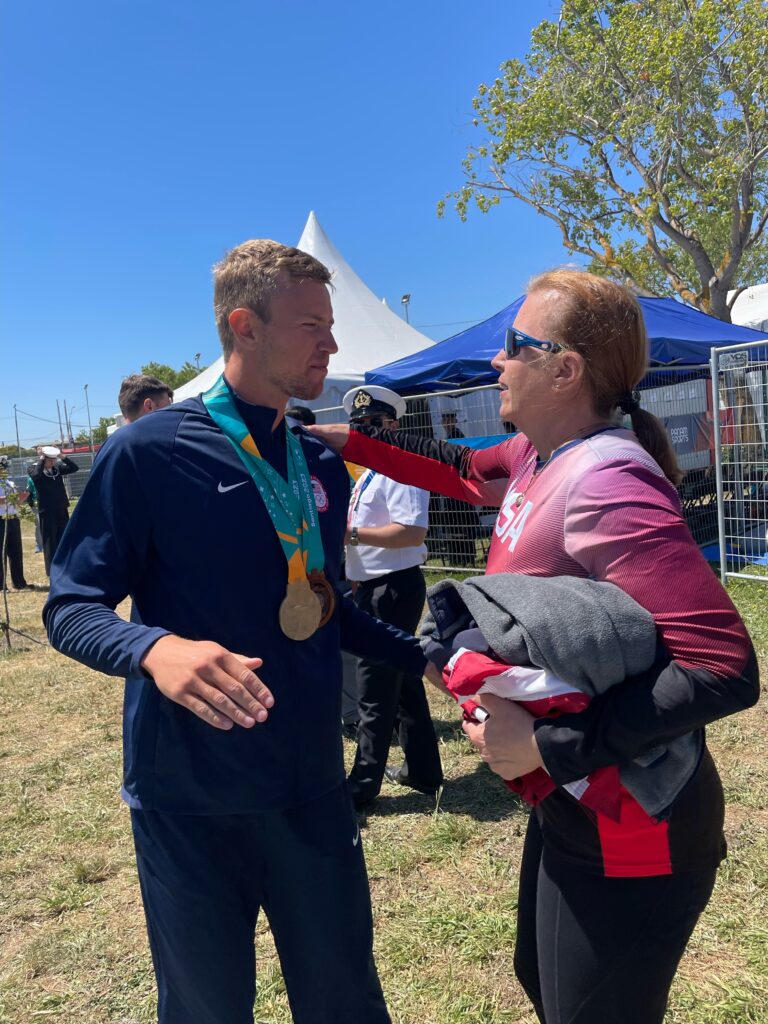 Couwenhoven and his mother after the medal ceremonies at the 2023 Pan American Games. (Photo courtesy of Couwenhoven)
“It’s especially difficult to be in the hospital when you don’t have loved ones with you. At CHOP, kids will sometimes have parents that are away because of work or remote-living situations,” says Couwenhoven. “I think of how important it is to be that person that’s there to help them smile—giving patients a positive distraction can turn their day around.”
For now, Couwenhoven is dedicating more of his time to advancing his career interests, however he hasn’t lost focus of his passion for being out on the water, even if it means waking up at 4:30 a.m. on most mornings to train.
“Waking up early in the morning and getting to the boat house, seeing the rays of light as the sun rises makes it all worth it,” he says. “When I’m in the water, it’s about getting that really good stroke and I’m reminded all over again that I’m doing something that I really love. I’m looking forward to continuing rowing competitively and pursuing my goal of rowing at the highest level internationally.”
]]>
Push, pull, push, pull. On goes this routine of synchronized oar movements as rowers—nestled in long, tapered boats—move through the water with precision and speed. The trim boats glide through...
https://umbc.edu/stories/finding-gold-on-the-water/
https://beta.my.umbc.edu/api/v0/pixel/news/142296/guest@my.umbc.edu/693be967a5837ccf855e3b6650a480cd/api/pixel
alumni
athletics
biology
campus-life
cnms
magazine
spring-2024
story
UMBC News & Magazine
https://beta.my.umbc.edu/groups/umbc-news-magazine
https://assets1-beta.my.umbc.edu/system/shared/avatars/groups/000/001/943/24435aa6207c452e7bc15cc74b42c7bb/xsmall.png?1748556657
https://assets1-beta.my.umbc.edu/system/shared/avatars/groups/000/001/943/24435aa6207c452e7bc15cc74b42c7bb/original.png?1748556657
https://assets2-beta.my.umbc.edu/system/shared/avatars/groups/000/001/943/24435aa6207c452e7bc15cc74b42c7bb/xxlarge.png?1748556657
https://assets2-beta.my.umbc.edu/system/shared/avatars/groups/000/001/943/24435aa6207c452e7bc15cc74b42c7bb/xlarge.png?1748556657
https://assets3-beta.my.umbc.edu/system/shared/avatars/groups/000/001/943/24435aa6207c452e7bc15cc74b42c7bb/large.png?1748556657
https://assets1-beta.my.umbc.edu/system/shared/avatars/groups/000/001/943/24435aa6207c452e7bc15cc74b42c7bb/medium.png?1748556657
https://assets2-beta.my.umbc.edu/system/shared/avatars/groups/000/001/943/24435aa6207c452e7bc15cc74b42c7bb/small.png?1748556657
https://assets1-beta.my.umbc.edu/system/shared/avatars/groups/000/001/943/24435aa6207c452e7bc15cc74b42c7bb/xsmall.png?1748556657
https://assets2-beta.my.umbc.edu/system/shared/avatars/groups/000/001/943/24435aa6207c452e7bc15cc74b42c7bb/xxsmall.png?1748556657
UMBC News & Magazine
1
0
false
Mon, 03 Jun 2024 14:35:12 -0400
Mon, 03 Jun 2024 14:35:12 -0400
How to count time: Professor Curtis Menyuk brings his expertise in optics to an age-old problem

Time—We buy it and spend it, save it and waste it; it seems to race by as we watch our children grow or drag on in the last hour of a Friday work day. Shakespeare marked “time’s thievish progress” in wrinkles like “mouthed graves.” But for a more objective accounting, humans have turned to physics, measuring days, hours, minutes, and seconds using rhythmic natural phenomena such as the Earth’s rotation, the swing of a pendulum, the vibration of quartz crystals, and, most recently, the oscillation of light waves.
“I have been fascinated by time and how we tell it for as long as I can remember,” says Curtis Menyuk, a professor in the Department of Computer Science and Electrical Engineering, who for the past 20 years has applied his expertise in optics to a host of questions at the frontiers of time-keeping science.
Defining time
We measure time in chunks—the international standard unit for a chunk being the second. For centuries, the second was understood as a fraction of an Earth day, but because the Earth’s rotational speed varies slightly, a second defined in this way is not constant. The invention of atomic clocks in the middle of the 20th century allowed scientists to redefine the second based on the (as far as we know) unchanging properties of atoms. Today, one second is the time it takes the electric field of microwaves that are absorbed and emitted by cesium atoms at a specific frequency to cycle up and down 9,192,631,770 times.
But it’s likely the second will soon be redefined again. Newer versions of atomic clocks, called optical clocks, measure time’s passage with visible light instead of microwaves. Visible light waves oscillate much faster than microwaves—and faster oscillations in principle mean better time-keeping. Many optical clocks keep time so well that if they could have started running when the universe began and kept going until today, they still would not have lost or gained a single second.
 A artistic rendering of a microresonator frequency comb. (Image credit: NIST)
Shortly after the first all-optical atomic clocks were developed in the early 2000s, Menyuk began collaborating with scientists at the National Institute of Standards and Technology (NIST) to study a key component of the clocks called a frequency comb. Frequency combs provide the bridge between high-frequency light, which forms the heart of optical clocks, and modern electronics, which can only process lower-frequency signals. The combs are made from extremely short light pulses, called solitons, that travel without dispersing, similar to how tsunami waves traverse the ocean. And it just so happens that Menyuk is an expert on solitons, having become captivated by the “almost magical balance” of forces that keep the waves from being torn apart ever since he first learned about the phenomenon at the age of 27.
Shrinking the world’s most precise clocks
In 2013, Menyuk collaborated with a colleague to derive the basic equations describing how solitons are created when light travels in a circle around a small crystalline disk called a microresonator. Microresonators offer a compact alternative to the bulky lasers originally required to make frequency combs, and Menyuk and some of his NIST colleagues recently published a paper in the prestigious scientific journal Nature that reports a new approach to simplifying the use and improving the performance of microresonator-based combs.
Shrinking the components of optical clocks is a key step toward taking full advantage of their powers. Their potential extends beyond the possibility of one day setting the time for your computer. Atomic clocks are a critical component of today’s GPS system, which helps billions of people find their way around each day. Compact optical clocks might improve GPS accuracy to within a few centimeters. Optical time-keeping can also serve as a back-up to GPS, which is vulnerable to disruptions and attacks. Menyuk is tackling this very issue with the recent launch of the Center for Navigation, Timing, and Frequency Research at UMBC, which he directs in collaboration with the Army Research Laboratory and other partners.
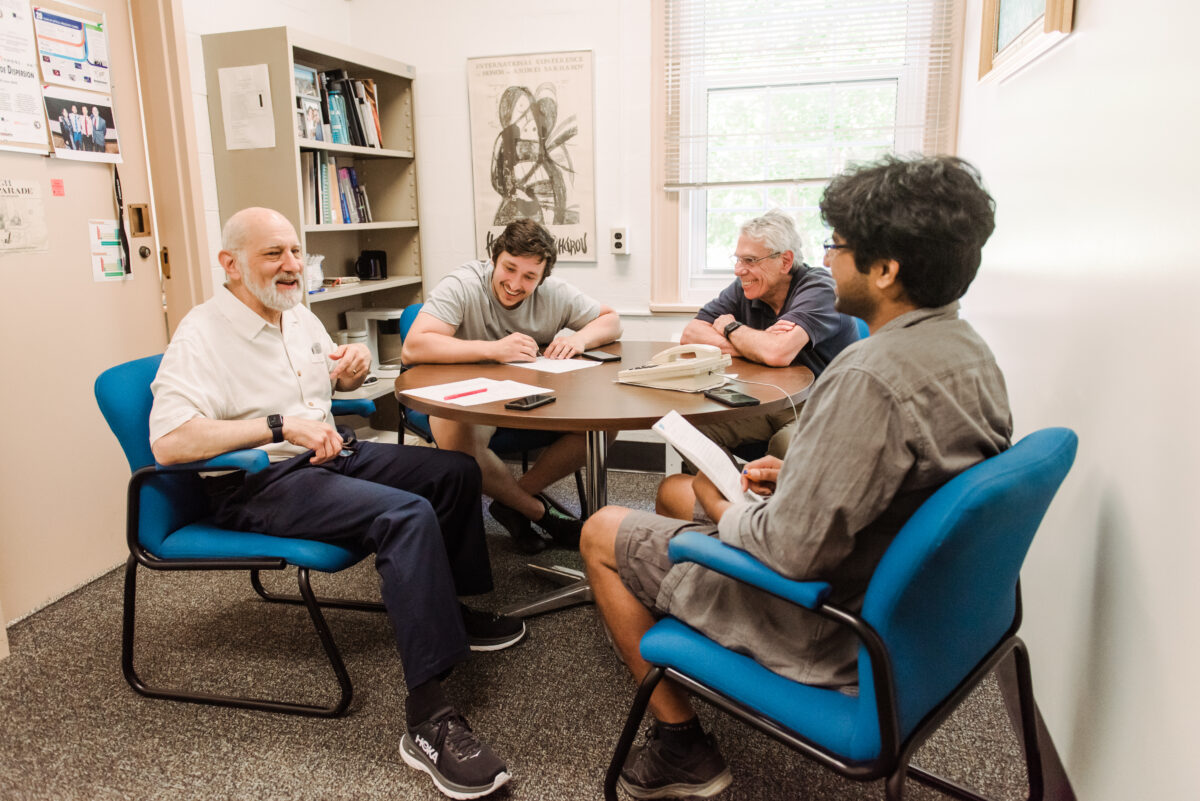 Menyuk (left) discusses research with (from left to right) graduate student Logan Courtright, Professor Gary Carter, and graduate student Pradyoth Shandilya. (Marlayna Demond ’11/UMBC)
New clocks may even make possible groundbreaking discoveries about the fabric of the universe, helping scientists search for dark matter and test whether the laws of physics change over time.
For Menyuk, passing time has not noticeably dimmed his prolific research output (of which clocks are just a portion). And while the years add age, they also add perspective. “Curtis is a leading theorist with decades of experience,” says Kartik Srinivasan, one of the NIST scientists who collaborated with Menyuk on the recent Nature paper. Srinivasan noted that some of the equations he learned in grad school for predicting light’s behavior in optical fibers were developed by Menyuk in the 1980s. “Curtis’ reservoir of historical knowledge is not something you can easily find.” Even with the use of an atomic clock.
]]>
Time—We buy it and spend it, save it and waste it; it seems to race by as we watch our children grow or drag on in the last hour of a Friday work day. Shakespeare marked “time’s thievish progress”...
https://umbc.edu/stories/time-and-optics-research-curtis-menyuk/
https://beta.my.umbc.edu/api/v0/pixel/news/142292/guest@my.umbc.edu/5950f499f9fc3cb524d9d24b03ecec55/api/pixel
coeit
csee
discovery
magazine
research
spring-2024
story
UMBC News & Magazine
https://beta.my.umbc.edu/groups/umbc-news-magazine
https://assets1-beta.my.umbc.edu/system/shared/avatars/groups/000/001/943/24435aa6207c452e7bc15cc74b42c7bb/xsmall.png?1748556657
https://assets1-beta.my.umbc.edu/system/shared/avatars/groups/000/001/943/24435aa6207c452e7bc15cc74b42c7bb/original.png?1748556657
https://assets2-beta.my.umbc.edu/system/shared/avatars/groups/000/001/943/24435aa6207c452e7bc15cc74b42c7bb/xxlarge.png?1748556657
https://assets2-beta.my.umbc.edu/system/shared/avatars/groups/000/001/943/24435aa6207c452e7bc15cc74b42c7bb/xlarge.png?1748556657
https://assets3-beta.my.umbc.edu/system/shared/avatars/groups/000/001/943/24435aa6207c452e7bc15cc74b42c7bb/large.png?1748556657
https://assets1-beta.my.umbc.edu/system/shared/avatars/groups/000/001/943/24435aa6207c452e7bc15cc74b42c7bb/medium.png?1748556657
https://assets2-beta.my.umbc.edu/system/shared/avatars/groups/000/001/943/24435aa6207c452e7bc15cc74b42c7bb/small.png?1748556657
https://assets1-beta.my.umbc.edu/system/shared/avatars/groups/000/001/943/24435aa6207c452e7bc15cc74b42c7bb/xsmall.png?1748556657
https://assets2-beta.my.umbc.edu/system/shared/avatars/groups/000/001/943/24435aa6207c452e7bc15cc74b42c7bb/xxsmall.png?1748556657
UMBC News & Magazine
0
0
false
Mon, 03 Jun 2024 13:26:28 -0400
Mon, 03 Jun 2024 13:26:28 -0400
Molly Mollica wins American Heart Association Career Development Award

Molly Mollica, an assistant professor in mechanical engineering who joined UMBC in August 2023, has been selected for an American Heart Association (AHA) Career Development Award, which will provide more than $200,000 to fund her research for the next three years.
Mollica studies the biomechanics of blood platelets, which play an essential role in healthy blood clotting, but can also contribute to the formation of blood clots that cause heart attacks and strokes. Bleeding and clotting have been shown to vary between males and females, but the reasons are not well understood. In her AHA-funded research, Mollica will investigate how platelets from males versus females, and from donors with varying hormone levels, respond to and generate mechanical forces. She hopes the information she uncovers will help doctors better understand healthy platelet function, design more inclusive health research, and develop better treatments.
“I’m honored to receive this award,” said Mollica. “We look forward to better understanding sex and hormone differences in platelet function. This research is important in providing tools to develop new preventative and curative therapeutics.”
]]>
Molly Mollica, an assistant professor in mechanical engineering who joined UMBC in August 2023, has been selected for an American Heart Association (AHA) Career Development Award, which will...
https://umbc.edu/quick-posts/molly-mollica-wins-american-heart-association-career-development-award/
https://beta.my.umbc.edu/api/v0/pixel/news/142289/guest@my.umbc.edu/9b1b1b2f758064f4c07495e0736cd205/api/pixel
coeit
meche
news
quick-post
research
science-and-tech
UMBC News & Magazine
https://beta.my.umbc.edu/groups/umbc-news-magazine
https://assets1-beta.my.umbc.edu/system/shared/avatars/groups/000/001/943/24435aa6207c452e7bc15cc74b42c7bb/xsmall.png?1748556657
https://assets1-beta.my.umbc.edu/system/shared/avatars/groups/000/001/943/24435aa6207c452e7bc15cc74b42c7bb/original.png?1748556657
https://assets2-beta.my.umbc.edu/system/shared/avatars/groups/000/001/943/24435aa6207c452e7bc15cc74b42c7bb/xxlarge.png?1748556657
https://assets2-beta.my.umbc.edu/system/shared/avatars/groups/000/001/943/24435aa6207c452e7bc15cc74b42c7bb/xlarge.png?1748556657
https://assets3-beta.my.umbc.edu/system/shared/avatars/groups/000/001/943/24435aa6207c452e7bc15cc74b42c7bb/large.png?1748556657
https://assets1-beta.my.umbc.edu/system/shared/avatars/groups/000/001/943/24435aa6207c452e7bc15cc74b42c7bb/medium.png?1748556657
https://assets2-beta.my.umbc.edu/system/shared/avatars/groups/000/001/943/24435aa6207c452e7bc15cc74b42c7bb/small.png?1748556657
https://assets1-beta.my.umbc.edu/system/shared/avatars/groups/000/001/943/24435aa6207c452e7bc15cc74b42c7bb/xsmall.png?1748556657
https://assets2-beta.my.umbc.edu/system/shared/avatars/groups/000/001/943/24435aa6207c452e7bc15cc74b42c7bb/xxsmall.png?1748556657
UMBC News & Magazine
1
0
false
Mon, 03 Jun 2024 12:57:12 -0400
Mon, 03 Jun 2024 12:57:12 -0400
Capping years of rising success, UMBC chemical engineering club shines as student conference hosts
On the first weekend of April, hundreds of chemical engineering students from across the Mid-Atlantic converged on the UMBC campus for two days of learning, networking, and friendly competition. They heard talks from academic and industry leaders, attended workshops and a career fair, competed in rounds of ChemE Jeopardy, mixed chemicals to power small cars along a track in the ChemE Car competition, and mingled over catered lunches, dinners, and cups of evening hot cocoa.
The activities were all part of the 2024 Mid-Atlantic Student Regional Conference of the American Institute of Chemical Engineers (AIChE)—hosted by the UMBC student chapter of the national group. Around 400 people attended the event, an increase from last year’s conference at Virginia Tech. Organizing the logistics, recruiting speakers and sponsors, securing rooms, and ordering thousands of plates worth of food presented a formidable challenge—one that the UMBC students tackled with aplomb.
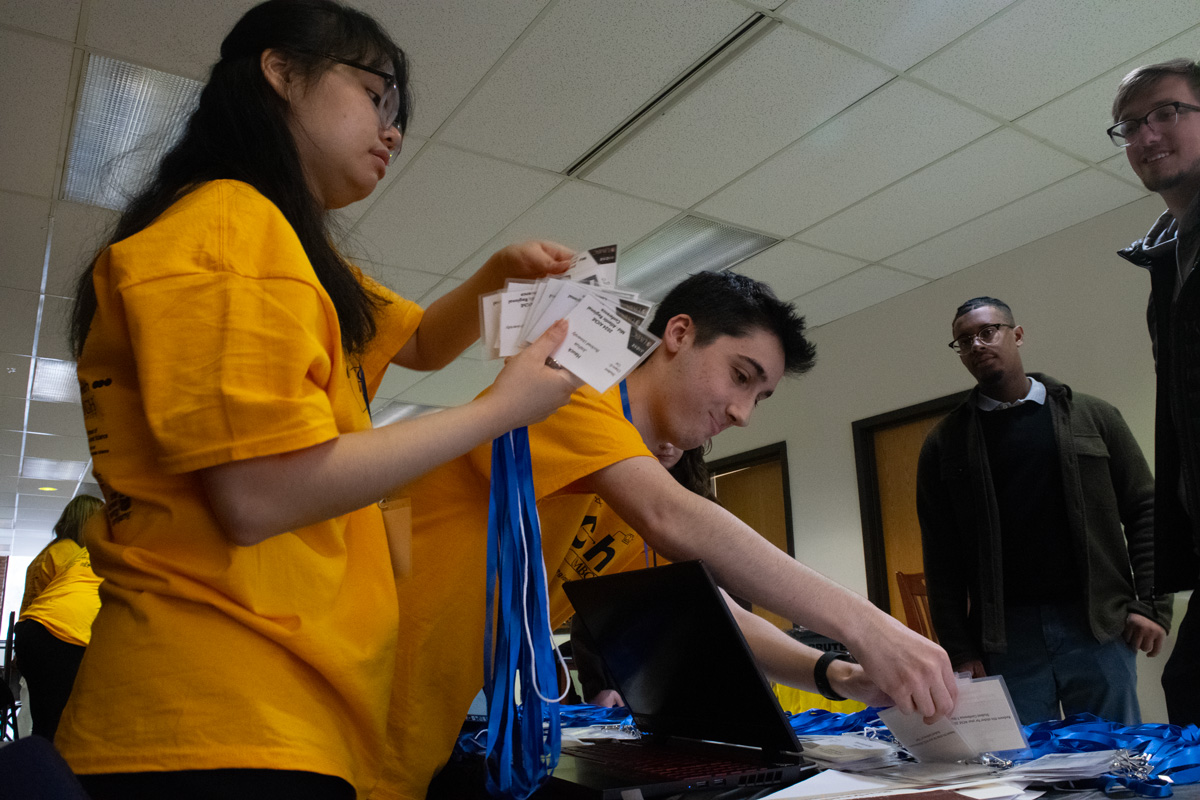 Managing check-in. (Photo by Danielle Clark)
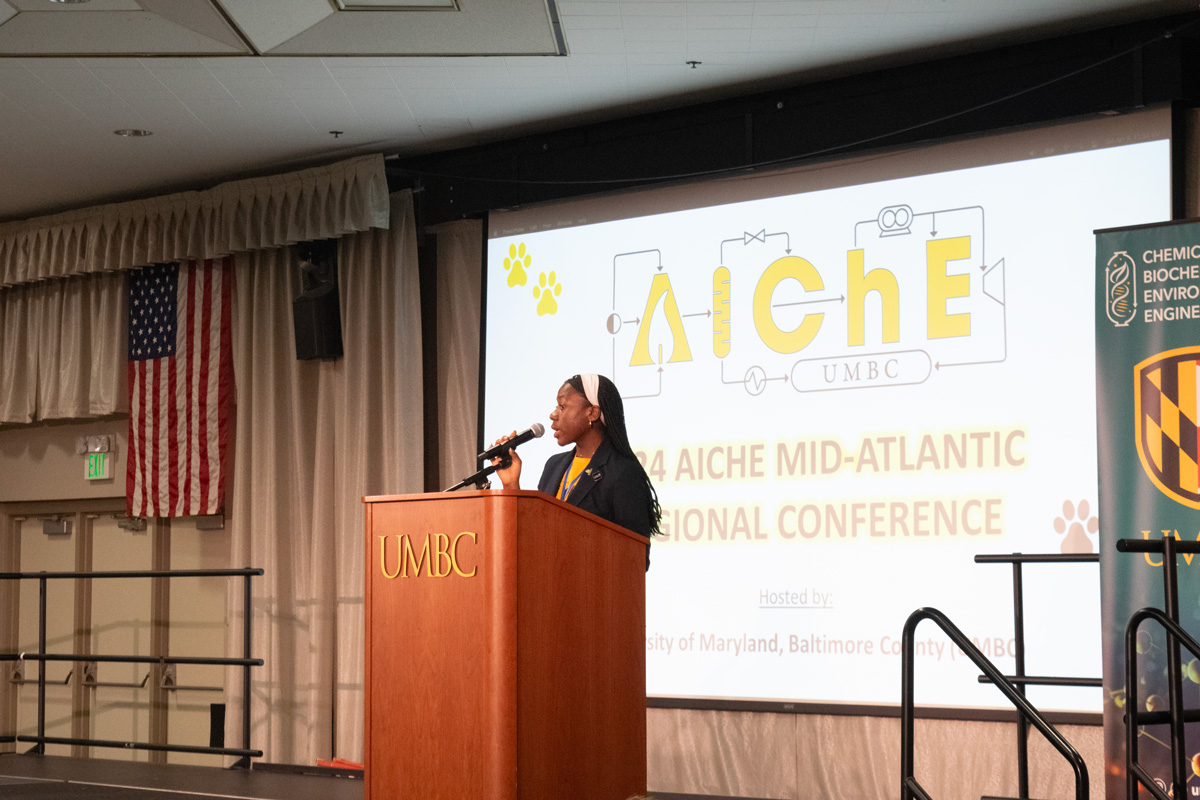 Welcoming attendees. (Photo by Danielle Clark)
 Delivering pizza. (Photo by Julianna Falconer)
“I am feeling fantastic after the conference,” says Pavan Umashankar ’25, chemical engineering and biochemistry and molecular biology, who served as the chair of the conference organizing committee. “I am super proud of everyone’s commitment and dedication to make it a resounding success.”
“Truly, I could gush about the UMBC conference planning team all day,” says Alyssa Block, the membership associate of ChemE student programs for AIChE. “These students really are the future leaders of their profession and of AIChE: engaged, excited, collaborative, supportive of each other, and willing to lend a hand.”
A club on the upswing
Hosting an AIChE regional conference for the first time at UMBC marked a milestone for a student club that has seen increasing levels of engagement and success in recent years. While many college clubs across the country are in decline post-Covid, UMBC’s AIChE student chapter is on a clear upward trajectory. The club sent its first team to compete in ChemE Jeopardy at the spring 2019 AIChE regional meeting. Just three years later, the UMBC team won the national ChemE Jeopardy competition.
Neha Raikar, a senior lecturer in the Department of Chemical, Biochemical, and Environmental Engineering (CBEE) and one of the advisors to the student AIChE chapter, remembers attending the 2019 meeting: “Back then, we wondered if we would ever be able to host a regional conference at UMBC,” she says. “We’ve achieved that goal.”
It was especially remarkable, she adds, to see some members of UMBC’s first ChemE Jeopardy and ChemE car teams return to this year’s conference as industry representatives.
Strong attendance and smooth conference logistics weren’t the only successes of the weekend—UMBC also triumphed in the ChemE Jeopardy and ChemE car competitions.
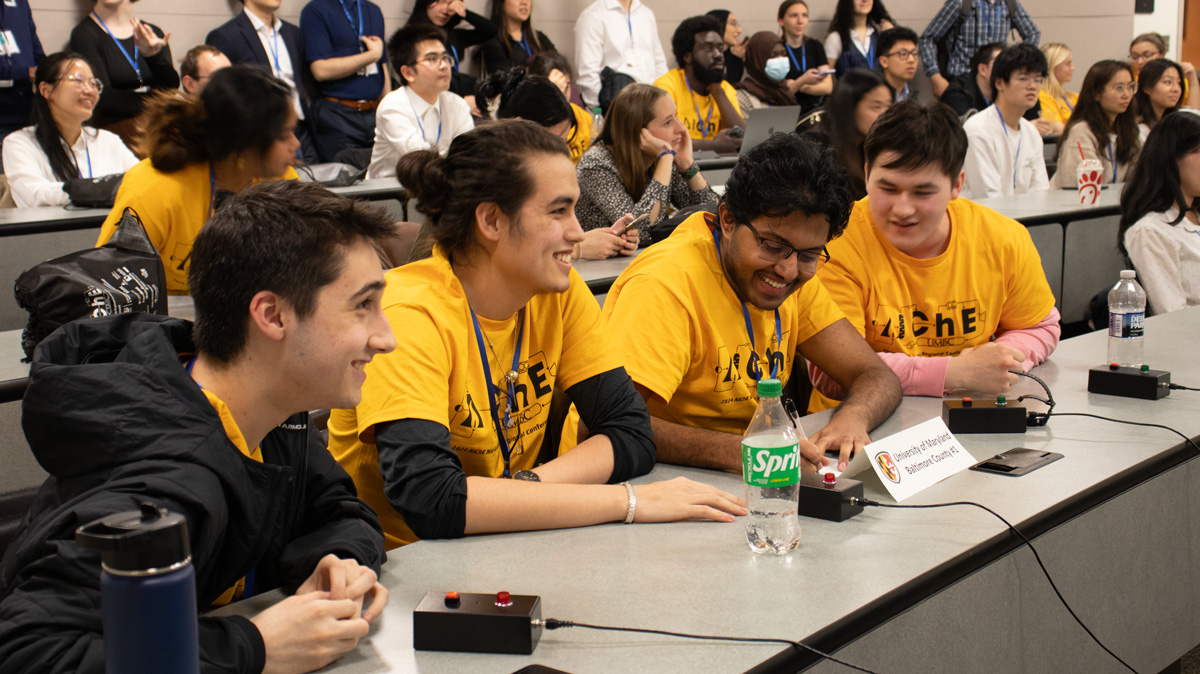 The UMBC #1 Jeopardy team during a preliminary round. (Photo by Patch Hatley)
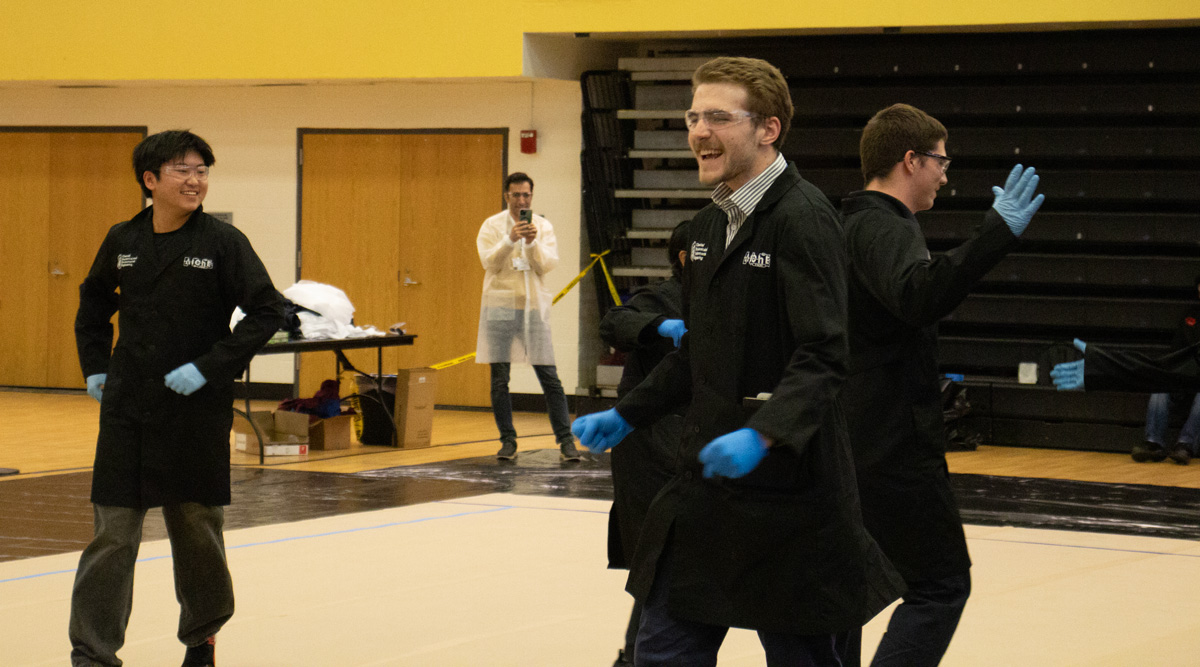 The UMBC ChemE Car team celebrates a good run. (Photo by Patch Hatley)
“Planning for the conference was already a significant undertaking, and on top of that, many of our students participated, and excelled, in the competitions,” says Raikar. “Their achievements not only showcased their individual capabilities but also the strength of our club as a whole, which is growing and thriving.”
A winning formula
AIChE chapter members and their advisors ascribe the club’s success to the hard work and dedication of the students coupled with the support of the CBEE department, college, and university. Thirteen CBEE students formed the conference planning committee, which met regularly to ensure all conference planning efforts were on track. An additional 37 students and 14 faculty and staff also volunteered their time—as check-in staff, poster and presentation judges, and more. About 10 UMBC alumni actively participated in the conference, and others contributed to fundraising efforts, helping the organizing committee secure sponsorships from notable companies such as AstraZeneca, ExxonMobil, Advanced Thermal Batteries, and Astek Diagnostics and from the chemical engineering department of Columbia University.
An Dang ’24, chemical engineering, led the fundraising efforts. She gamely approached industry representatives at the UMBC career fair and made the pitch. “I’m not an extrovert, and being in these roles forced me to go out of my comfort zone,” she says.
“Securing sponsorships was vital for making the conference possible, and An did a remarkable job” says Mariajosé Castellanos, another CBEE faculty who advises the AIChE chapter. Castellanos also praised the management skills of conference planning committee chair Umashankar. “Despite his modesty, Pavan is a true mastermind in everything he does,” she says.
For their part, the students applauded the support of the CBEE department, especially the work of their two advisors, Raikar and Castellanos, and the event planning support of Andrea Miller, the CBEE graduate program coordinator.
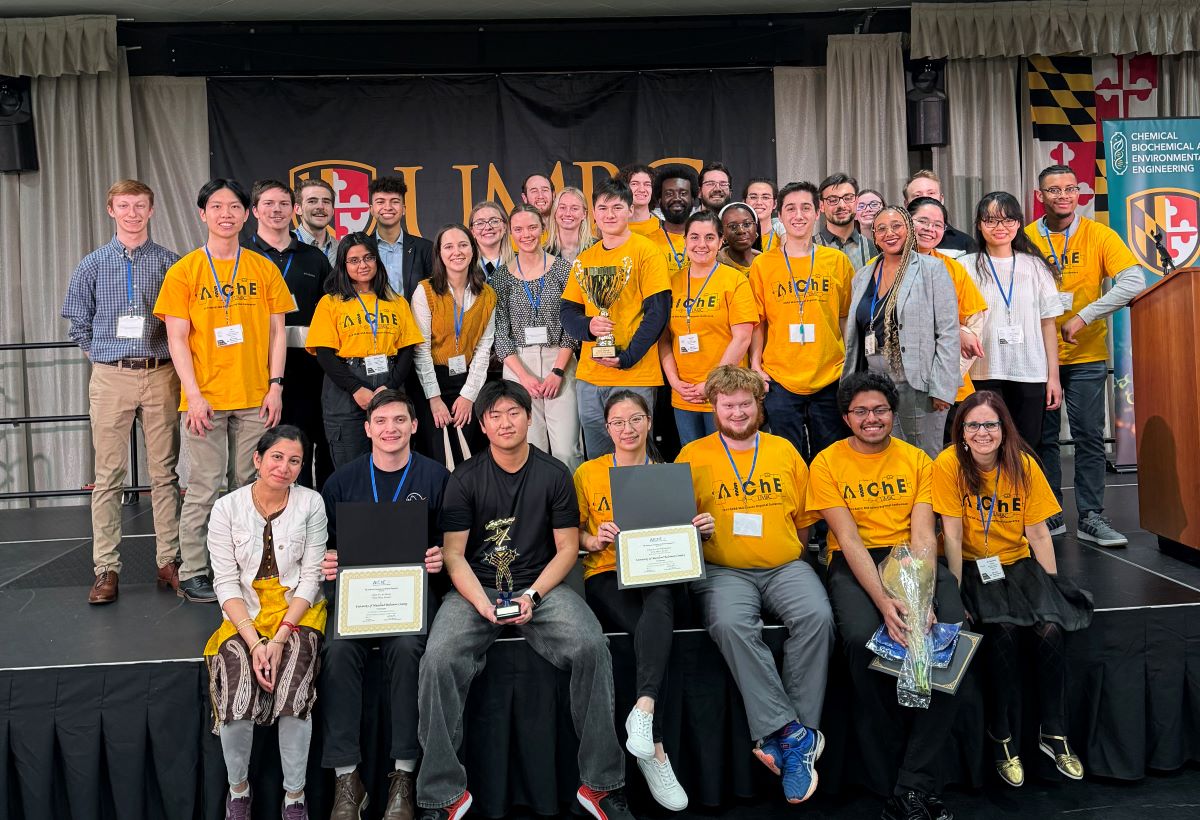 UMBC AIChE chapter students and faculty advisors pose for a group photo after a successful conference. (Photo courtesy of Mariajosé Castellanos.)
The conference was both a marker of the club’s success and an opportunity for individual students to grow their skill sets.
“I have developed leadership and project management skills, which will be incredibly useful throughout my professional career,” says Umashankar.
Ben Welling ’25, chemical engineering, the leader of the UMBC ChemE car team, believes his experience with the competition helped him land internships. “I talked about it extensively with employers. They like leadership experience and it shows you are willing to do more than is required.”
Raikar sees a bright future for the student stars of this year’s conference and for the club as a whole. “I hope the conference will boost the club membership and participation of students in other AIChE activities,” she says. And, she adds, the conference shows that with support, “UMBC students can accomplish any task.”
]]>
On the first weekend of April, hundreds of chemical engineering students from across the Mid-Atlantic converged on the UMBC campus for two days of learning, networking, and friendly competition....
https://umbc.edu/stories/umbc-chemical-engineering-club-shines-as-student-conference-hosts/
https://beta.my.umbc.edu/api/v0/pixel/news/142266/guest@my.umbc.edu/73e17cd25ad64e55b2130e8bf14c39f0/api/pixel
cbee
coeit
community
news
story
UMBC News & Magazine
https://beta.my.umbc.edu/groups/umbc-news-magazine
https://assets1-beta.my.umbc.edu/system/shared/avatars/groups/000/001/943/24435aa6207c452e7bc15cc74b42c7bb/xsmall.png?1748556657
https://assets1-beta.my.umbc.edu/system/shared/avatars/groups/000/001/943/24435aa6207c452e7bc15cc74b42c7bb/original.png?1748556657
https://assets2-beta.my.umbc.edu/system/shared/avatars/groups/000/001/943/24435aa6207c452e7bc15cc74b42c7bb/xxlarge.png?1748556657
https://assets2-beta.my.umbc.edu/system/shared/avatars/groups/000/001/943/24435aa6207c452e7bc15cc74b42c7bb/xlarge.png?1748556657
https://assets3-beta.my.umbc.edu/system/shared/avatars/groups/000/001/943/24435aa6207c452e7bc15cc74b42c7bb/large.png?1748556657
https://assets1-beta.my.umbc.edu/system/shared/avatars/groups/000/001/943/24435aa6207c452e7bc15cc74b42c7bb/medium.png?1748556657
https://assets2-beta.my.umbc.edu/system/shared/avatars/groups/000/001/943/24435aa6207c452e7bc15cc74b42c7bb/small.png?1748556657
https://assets1-beta.my.umbc.edu/system/shared/avatars/groups/000/001/943/24435aa6207c452e7bc15cc74b42c7bb/xsmall.png?1748556657
https://assets2-beta.my.umbc.edu/system/shared/avatars/groups/000/001/943/24435aa6207c452e7bc15cc74b42c7bb/xxsmall.png?1748556657
UMBC News & Magazine
0
0
false
Thu, 30 May 2024 12:51:16 -0400
Thu, 30 May 2024 12:51:16 -0400
On PACE to Unravel Earth’s Mysteries

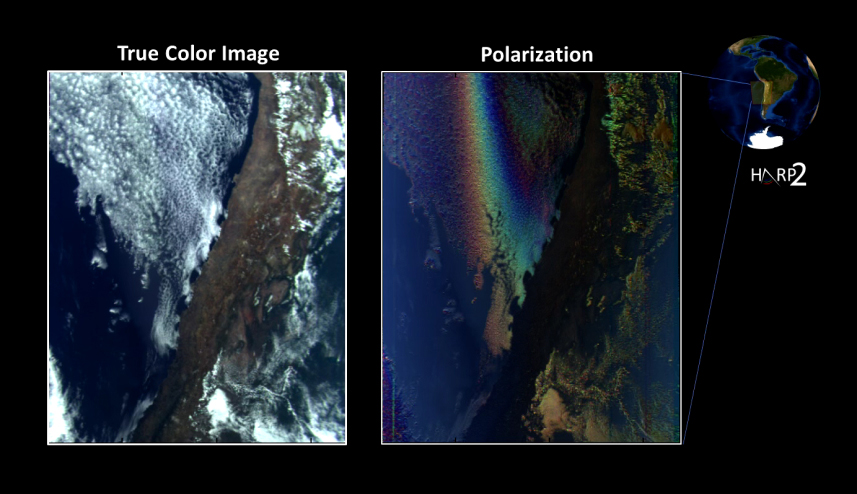
The third time’s the charm. Against a calm and crisp dark night sky on Florida’s Cape Canaveral on February 8, 2024, just after 1:30 a.m., the Plankton, Aerosol, Cloud, Ocean Ecosystem (PACE) spacecraft rocketed to orbit carrying on board Hyper-Angular Rainbow Polarimeter (HARP2)–UMBC’s wide-angle imaging polarimeter. The launch marked the first time NASA deployed a university payload on a large operational Earth science space mission.
Written by: Anne Wainscott-Sargent

Following two scrubbed night launches the two previous nights due to strong winds, Thursday’s successful takeoff was well worth the wait for the core team of UMBC Earth and Space Institute researchers, graduate students, and their families and friends who journeyed from Baltimore to watch the historic launch.
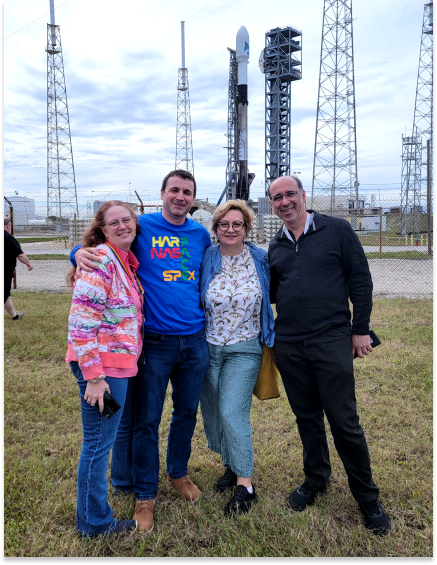 Left to right: Margo Young, Dominik Cieslak, Magdalena Kuzmicz-Cieslak, and Vanderlei Martins stand in front of the PACE spacecraft the day before its launch.
Photo credit: Margo Young
Arriving by bus a little before midnight to the Banana Creek Launch Viewing Area at Kennedy Space Center, just over six miles from Space Launch Complex-40, the close-knit UMBC entourage huddled together waiting for the final countdown.
When it came, they—along with hundreds of other space launch watchers—held their breath and then yelled and clapped as SpaceX’s Falcon 9 rocket blasted off and propelled PACE 400 miles above Earth into sun-synchronous orbit. Minutes later the Falcon 9’s first stage—SpaceX’s reusable rocket booster—successfully landed at Landing Zone 1. The crowd gasped audibly at the sonic boom, caused when the spacecraft broke the sound barrier.
“It still doesn’t quite feel real,” said Noah Christian Sienkiewicz, a calibration scientist who earned his master’s degree in atmospheric physics from UMBC in 2019 and expects to complete his physics doctorate this summer. “I grew up watching Carl Sagan and dreamed of going into astrophysics. I never thought I’d be the person making the instruments that will go up and do the measurements.”
“It’s so exciting—I’m going to cry,” uttered Margo Young from the upper bleacher. “I don’t always see the pieces and parts put together, so this is really historic.”
Young serves as UMBC’s HARP program administrator, where she has overseen procurement and other back-end support for HARP since the program’s inception in 2013. “I get to see students come full circle—working in the lab and then graduating and becoming civil servants where they continue to be involved because it’s such an amazing project,” she explained.
On the path to PACE
The UMBC HARP team’s remarkable journey from idea to mission reality spanned over 15 years, and involved countless hours of design, modeling, testing, and validation. Earlier iterations of HARP flew first on private aircraft over the Maryland countryside and then an award-winning “cubesat” version launched into orbit from the International Space Station (ISS), all stepping stones on the path to PACE.
For the three multidisciplinary HARP2 physics, optics, and research engineering leads, Vanderlei Martins, Roberto Borda, and Dominik Cieslak, HARP2’s launch represents a career-defining moment that at times seemed against all odds for a mid-size public university. UMBC’s strong partnerships with NASA, such as the Goddard Earth Science Technology and Research (GESTAR) Center II that supports Borda’s and Cieslak’s roles, help enable milestones like this.
“I feel like I’m still dreaming,” said a visibly emotional Cieslak, research engineer, who captured the launch on his long-range camera. Transfixed by the sight of live satellite footage of the PACE spacecraft heading to orbit, he added, “This is the last time we will physically see it [HARP2],” before hugging his long-time colleague, Borda.
“We’re very proud to have UMBC in space,” added Martins, professor of physics, who watched the big moment from a VIP viewing area three miles from the launch site. “We dreamed big from the beginning. The team persevered and just kept going.”
Always more to do
“I never despaired of having HARP2 on the PACE satellite,” admitted UMBC’s HARP2 manager, Lorraine Remer, research professor in the Joint Center for Earth Systems Technology. Her bigger worry wasn’t HARP2’s viability, but whether PACE would ever launch. “PACE was canceled four times and reinstated four times,” she recalled, noting that the program “survived a lengthy government shutdown and a global pandemic that destroyed our supply chains.”
Immediately after launch, Remer had to return to Maryland and the Goddard Space Flight Center to oversee HARP2 being turned on within 36 hours of launch. “It would be nice to bask in the successful launch, but I haven’t had much time to contemplate the success. There is just more work to do all the time,” she said.
Remer and the rest of the team would soon be relieved to learn that HARP2 had successfully begun its operations and was transmitting data back to Earth as designed. The first data, known as “first light,” from HARP2 and the other instruments on PACE arrived as planned, and NASA released the first wave of data on April 11. All of the data from PACE will be free to access and completely public, allowing anyone to conduct their own analyses and contribute to our understanding of Earth’s complex systems.
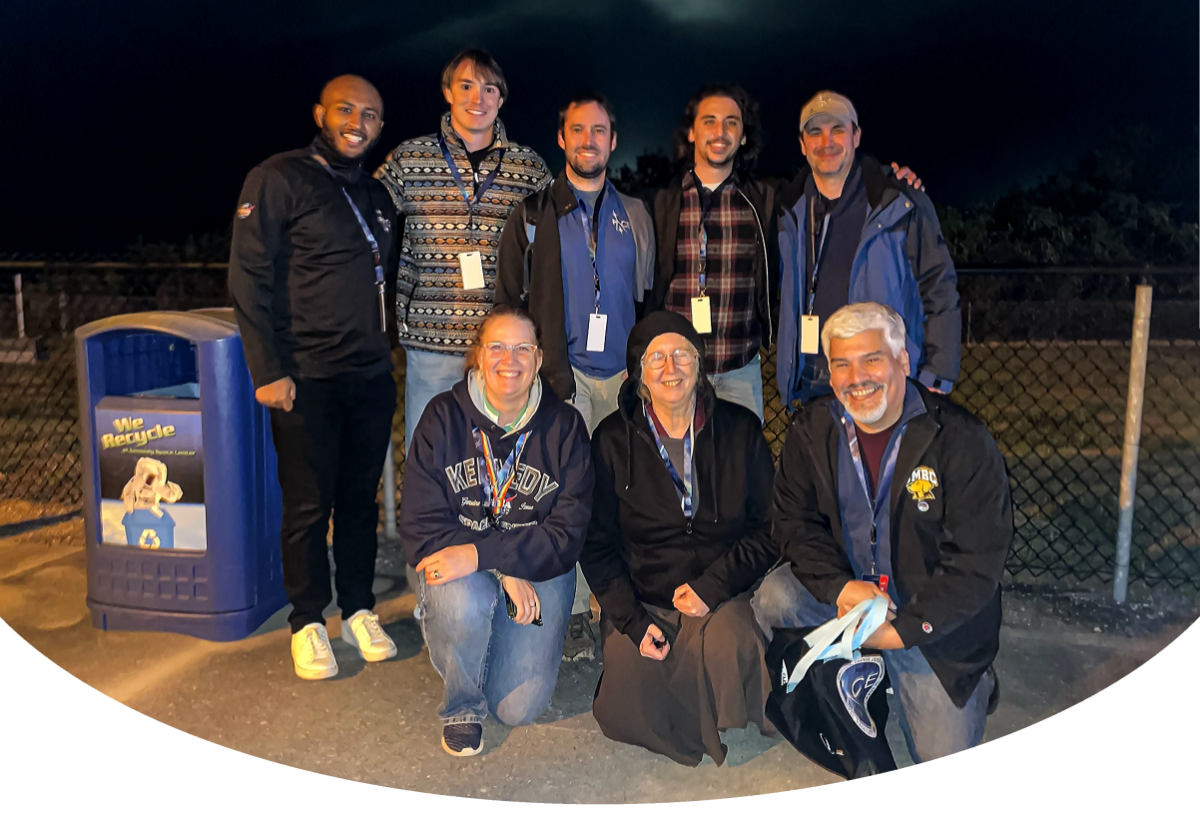 Members of the HARP team eagerly await the PACE launch at Kennedy Space Center’s Banana Creek Launch Viewing Area before the final countdown. Top, left to right: Yomiyu Fekadu, Ian Decker, Ben Cramer, Noah Sienkiewicz, Dominik Cieslak. Bottom, left to right: Margo Young, Lorraine Remer, Roberto Borda. Photo credit: Anne Wainscott-Sargent
An international effort
NASA’s PACE mission clears the path for revolutionary new measurements of Earth’s oceans and atmosphere. HARP2 measures aerosol particles and clouds, as well as properties of land and water surfaces. By analyzing particles like dust, wildfire smoke, or urban pollution, the science community gains deeper insights into air quality as well as global warming and its impacts. Scientists will be able see through things like sun glint to ascertain patterns never before possible.
A second polarimeter on PACE, the Spectro-polarimeter for Planetary Exploration (SPEXone), developed through a Dutch consortium consisting of SRON Netherlands Institute for Space Research and Airbus Defence and Space Netherlands, will measure sunlight reflected from Earth’s atmosphere, land surface and ocean.
There are undergraduate students and Ph.D.s integrated into the team who put in a lot of effort to make this real. We’re really thankful for the environment at this university—we’re able to work with students who find a career in this industry and field of research.
Roberto Borda
These two companion polarimeter instruments are important because the interaction between aerosols and clouds is the biggest unknown factor in atmospheric temperature change, according to reports from the U.N.’s Intergovernmental Panel on Climate Change.
“I have watched Dr. Martins and his team work toward this moment for about a decade, and have been aware of the trials and tribulations along the way. Seeing the smiles on their faces in the control station after the launch made it all worthwhile,” shared UMBC Vice President for Research Karl V. Steiner. “The HARP2 mission as an integral part of PACE is making all of us proud here on the UMBC campus. We cannot wait to see the science that will come from this engineering masterpiece conceptualized and created right here in Maryland.”

Waiting game
In the days leading up to the PACE launch, the HARP2 team knew there might be delays because of the weather so they rented a large Airbnb in neighboring Cocoa Beach for the full week. Earlier in the week, over grilled food at the shared house, the team reflected on their journey.
According to Martins, a key strategy was bringing together engineering and physics students, who typically don’t communicate well across disciplines.
“We introduced engineering students to the physics students and made them work together very quickly so they spoke the same language,” he said, crediting this multidisciplinary collaboration to the team’s ability to rapidly iterate and problem solve.
Borda, senior research engineer overseeing HARP2’s optical design, said a key technical challenge was determining how to best compensate for the effects of polarized light waves inside the instrument.
“It’s continuous work and you cannot do it alone. We needed a fantastic team with not only the staff but also students working at different levels,” Borda said. “There are undergraduate students and Ph.D.s integrated into the team who put in a lot of effort to make this real. We’re really thankful for the environment at this university—we’re able to work with students who find a career in this industry and field of research.”
Nurturing future career scientists
Martins echoed Borda’s pride in the broad level of participation in the HARP program, from high school students to senior scientists. “We’ve had people from our team who now work in all levels of industry—at NASA, at NOAA, or in private industry. We’ve even had some students start their own company.”
Young, the program administrator, estimates that the cooperative agreements between UMBC and NASA have resulted in 20 UMBC graduates finding roles with NASA.
UMBC alumna Elissa Ogburn is one such graduate. She began working on HARP2 as a computer science major, tasked with creating a database that supported ground communications so researchers could communicate with the instrument when it was in space.
After graduating from UMBC in 2021, Ogburn joined NASA on the PACE project as a test conductor—responsible for integrating and testing the instruments onto the PACE spacecraft. During launch, she was one of five test conductors in the PACE Control Room in Titusville, Florida, who powered up the spacecraft for the last time and configured it for launch.
“I never imagined having a job at NASA or working with people who were this smart, helpful, and kind. Every single person I’ve worked with was so fun. It’s also cool to have seen the whole process beginning as a student at UMBC. PACE is my first mission, so I’m learning everything as I go,” Ogburn said.
Close collaboration
The partnership between NASA and UMBC goes back over two decades. NASA Goddard Space Flight Center and UMBC are located just up the road from one another.
Jeremy Werdell, PACE project scientist at Goddard, recalled how initial calls to industry and academia for a polarimetry instrument for PACE were not promising due to cost and other factors.
However, Martins immediately suggested to Werdell that his lab develop a polarimeter, given his team’s experience with airborne instruments and the HARP cubesat, and the rest is history. In the end, NASA selected two polarimeters—HARP2 and SPEXone. Each instrument measures polarization differently: HARP2 is multispectral (measuring only four wavelengths of light) and hyperangular, so it looks at the same piece of real estate multiple times from dozens of different viewing directions. Its wide swath coverage means HARP2 will cover the globe every two days. SPEXone, on the other hand, is hyperspectral (measuring a continuous spectrum of light from the ultraviolet to near-infrared) but only views Earth at five angles. It has a narrower swath, meaning it will take almost a month to cover the globe.
“They’re small and mighty and miraculously complement each other very, very well,” said Werdell. “Having multi-band, multi-angle polarimetry is going to open up a lot of really interesting opportunities for discovery, because we can see clouds and aerosols in very different ways.” HARP2 provides daily views that will help scientists understand how aerosols and clouds interact and their role in warming and cooling in the atmosphere.
“Understanding where aerosols are, how they’re transported, how they interact with clouds, and whether they absorb or reflect radiation is important to everybody because those characteristics are what drive warming of the atmosphere.” Werdell said.
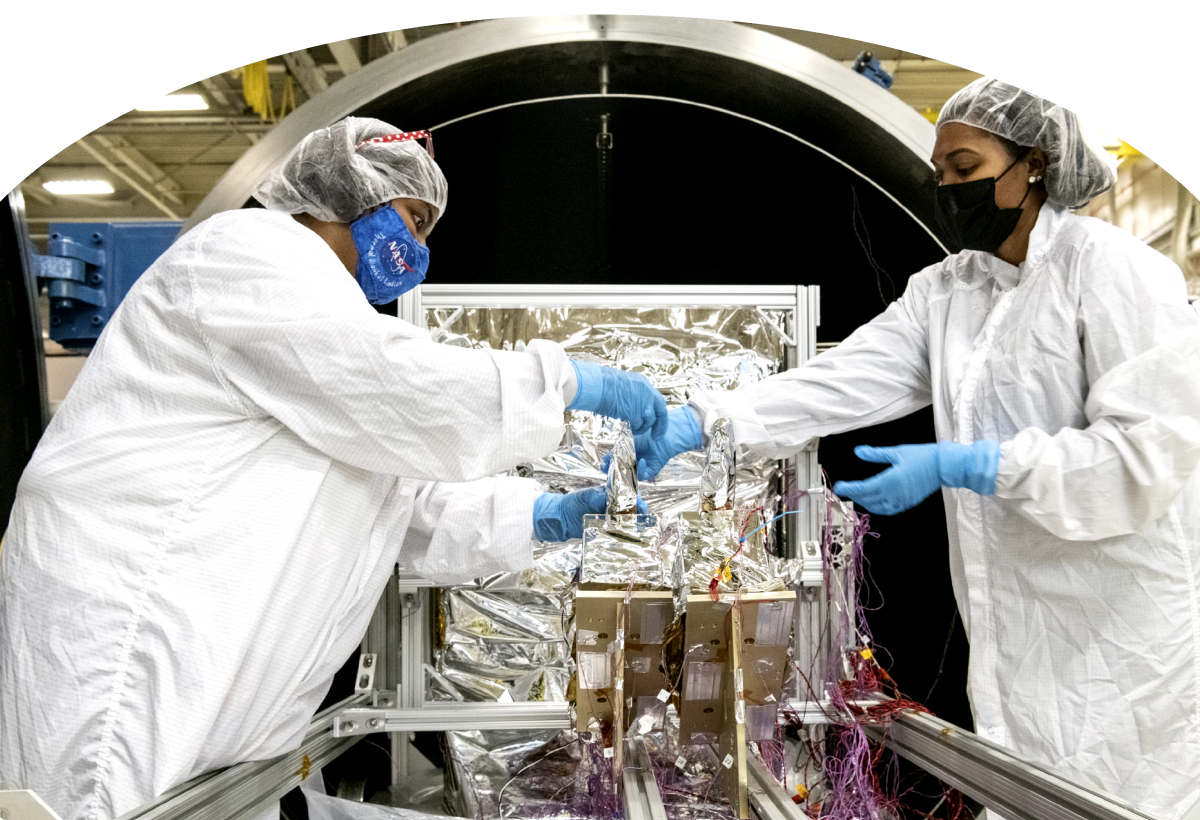 HARP2 calibration testing at Goddard Space Flight Center in Maryland, before the instrument was delivered to NASA. Photo Credit: Katherine Mellos/NASA
Better air quality models
Onsite at the Cape for the first launch attempts, Nirandi Jayasinghe and Rachel Smith, both physics graduate research assistants at UMBC, shared their excitement for the PACE mission and HARP2’s potential to help modelers predict air quality, rain, or if the atmosphere is warming or cooling.
Jayasinghe is a data modeler who comes up with different methods to retrieve information from HARP2. Originally from Sri Lanka, Jayasinghe notes that her hometown used to be one of her country’s cleanest cities, and now due to development in Sri Lanka’s dominant neighbor, India, the air quality is extremely bad. She said HARP2 can help close the gap that exists in understanding the twilight zone—where a cloud starts and where it stops—by providing more accurate measurements.
No other place would have let me be involved in the entire process…. Not only did I get to do hands-on stuff, but I also was part of the design and saw it all come together on a NASA mission.
Yomiyu Fekadu ’20, mechanical engineering, M.S. ’23, engineering management
Smith adds that this will go a long way in understanding cloud formation processes, weather patterns, forecasting, and climate modeling—information important for agriculture, transportation, disaster preparedness, and infrastructure planning.
“Even simple things like weather forecasting are impacted by how much dust is in the air,” said Smith, a 2026 doctoral candidate who earned her M.S. in atmospheric physics from UMBC in 2023. HARP2 will help address whether clouds have a net cooling effect or a net warming effect, which will allow for more accurate models of where Earth’s climate is headed. Smith notes that during events like the Canadian wildfires in 2023 no one could accurately predict rainfall, because the forecasting models were not accounting for the number of airborne aerosols.
“I’m really excited to see what new science questions come out of the instruments that we’re putting up in space,” she concluded.
Bouncing back from disaster
The first images from PACE’s HARP2 polarimeter captured data on clouds over the west coast of South America on March 11, 2024. The view of polarized light that the polarimeter “sees” (on the right) can help scientists better understand the droplets that make up the cloudbow—a rainbow produced by sunlight reflected from cloud droplets instead of rain droplets—which can reveal how the clouds respond to pollution and other particles in the atmosphere. Photo Credit: UMBC
The HARP2 team has come a long way from initial concept to PACE. What impresses Werdell the most is the UMBC team’s resilience in the face of setbacks.
The most devastating moment came in February 2022, one month before the team was set to deliver HARP2 to NASA for integration on the spacecraft. As the instrument was in the last few seconds of vibration tests, the bonding on one of the prisms loosened and shattered.
“It tactically put us to point zero,” recalled Cieslak, who was shocked and humbled when so many NASA scientists volunteered their time and expertise to help the HARP2 team get back on track. “We got an extension, and within two months we had built a new engineering model and were able to prove the new solution worked. By September, we were back to where we were before the incident,” he added.
First-time NASA launch attendee Yomiyu Fekadu ’20, mechanical engineering, M.S. ’23, engineering management, recalled that time well, as he helped assemble HARP2 as an intern under Benjamin Cramer ’17, M.S. ’20, mechanical engineer on the program.
“Especially after the failure, and the review board assessment, I helped put everything back together and do the test plans for construction and other documentation so NASA could give us the go-ahead to move on,” Fekadu said.
The experience was pivotal to his career. “It was everything I could have asked for,” said Fekado, now a systems engineer at Northrop Grumman. “No other place would have let me be involved in the entire process, including making parts for HARP2 in the machine shop. Not only did I get to do hands-on stuff, but I also was part of the design and saw it all come together on a NASA mission.”
As the HARP2 group left the viewing platform to line up for bus rides back to the Space Center, the smiles and easy camaraderie conveyed a collective sense of pride, relief, and excitement.
“I‘m now just anxious to see the first bytes of data,” said Cieslak, echoing the feeling of his colleagues.
In addition to the HARP team, several additional UMBC GESTAR II scientists and engineers were instrumental in their contributions to the overall PACE mission, including Ivona Cetinić, Andrew Sayer, Violeta Sanjuan Calzado, Bridget Seegers, Susanne Craig, Dirk Aurin, Meng Gao, and Ian Carroll.
]]>
The third time’s the charm. Against a calm and crisp dark night sky on Florida’s Cape Canaveral on February 8, 2024, just after 1:30 a.m., the Plankton, Aerosol, Cloud, Ocean Ecosystem (PACE)...
https://umbc.edu/stories/on-pace-to-unravel-earths-mysteries/
https://beta.my.umbc.edu/api/v0/pixel/news/142403/guest@my.umbc.edu/a46596b93a4edec977a7026fd62f7574/api/pixel
news
story
UMBC News & Magazine
https://beta.my.umbc.edu/groups/umbc-news-magazine
https://assets1-beta.my.umbc.edu/system/shared/avatars/groups/000/001/943/24435aa6207c452e7bc15cc74b42c7bb/xsmall.png?1748556657
https://assets1-beta.my.umbc.edu/system/shared/avatars/groups/000/001/943/24435aa6207c452e7bc15cc74b42c7bb/original.png?1748556657
https://assets2-beta.my.umbc.edu/system/shared/avatars/groups/000/001/943/24435aa6207c452e7bc15cc74b42c7bb/xxlarge.png?1748556657
https://assets2-beta.my.umbc.edu/system/shared/avatars/groups/000/001/943/24435aa6207c452e7bc15cc74b42c7bb/xlarge.png?1748556657
https://assets3-beta.my.umbc.edu/system/shared/avatars/groups/000/001/943/24435aa6207c452e7bc15cc74b42c7bb/large.png?1748556657
https://assets1-beta.my.umbc.edu/system/shared/avatars/groups/000/001/943/24435aa6207c452e7bc15cc74b42c7bb/medium.png?1748556657
https://assets2-beta.my.umbc.edu/system/shared/avatars/groups/000/001/943/24435aa6207c452e7bc15cc74b42c7bb/small.png?1748556657
https://assets1-beta.my.umbc.edu/system/shared/avatars/groups/000/001/943/24435aa6207c452e7bc15cc74b42c7bb/xsmall.png?1748556657
https://assets2-beta.my.umbc.edu/system/shared/avatars/groups/000/001/943/24435aa6207c452e7bc15cc74b42c7bb/xxsmall.png?1748556657
UMBC News & Magazine
1
0
false
Thu, 30 May 2024 11:45:24 -0400