UMBC’s new provost—an expert in young adult psychology—shares his vision for student, faculty, and staff success
On July 1, UMBC welcomed Manfred H. M. van Dulmen as our new provost and senior vice president. What is a provost exactly, and how does van Dulmen interpret his role on campus? He answered these questions and more in a Q&A as he took a break from moving into his new office on the 10th floor of the Administration Building.
Van Dulmen comes to UMBC after two decades at Kent State University in Ohio, where he has held many leadership positions including, most recently, senior associate provost and dean of the Graduate College. With an academic background in social, developmental, and adolescent psychology—increasingly focused on people in their twenties—van Dulmen brings a unique perspective to UMBC leadership that promises to further our campus commitment to student all-around well-being.
Q: What is the simplest way to describe the role of a provost at a university like UMBC?
A: The provost is responsible for overseeing the academic enterprise at an institution and providing the vision and mission for that academic enterprise. That’s the short answer. I think the longer answer is that the role of the provost at many universities has shifted significantly over the past 10 to 20 years. It’s become more inclusive of other tasks across the university, particularly for institutions that see academics as the center of campus. All other areas intersect with the academic areas, so the provost is somebody who develops close relationships with all other divisions on campus to really make sure that students can succeed.
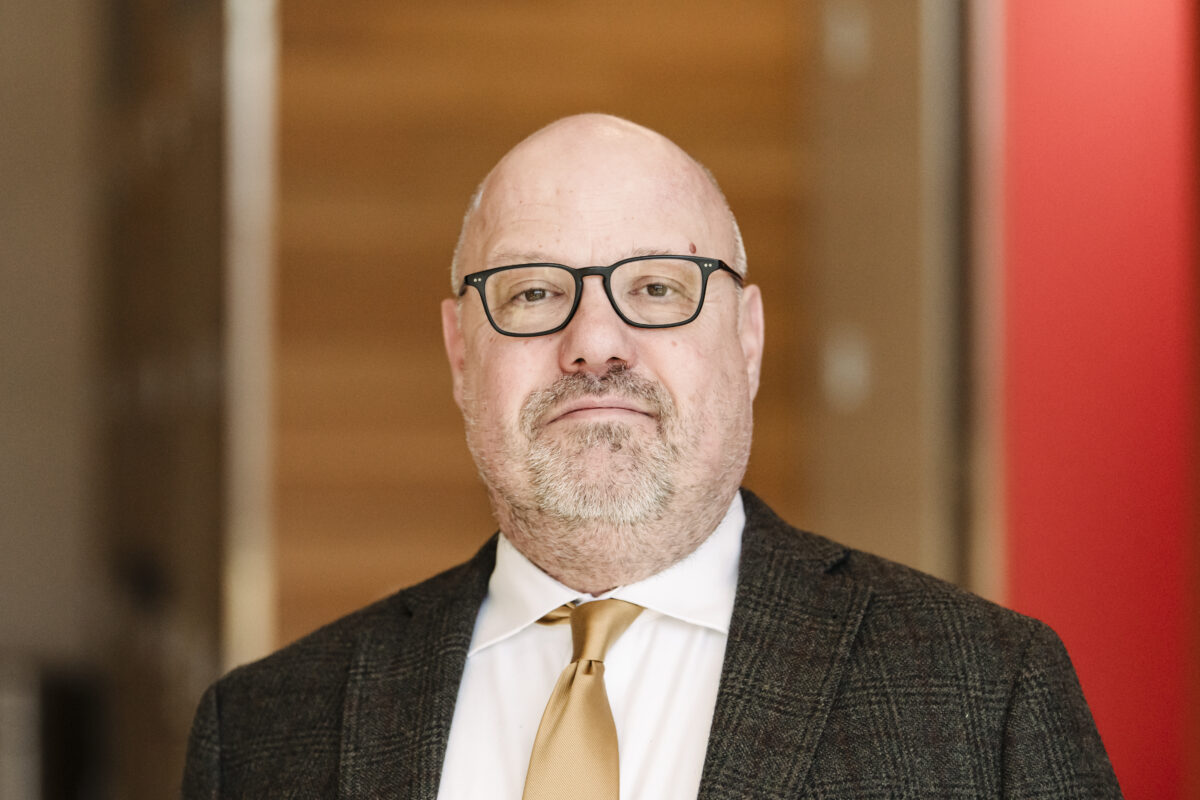 Headshot of Manfred van Dulmen. (Marlayna Demond ’11/UMBC)
Q: What drew you to UMBC?
A: UMBC’s legacy and reputation in higher education as a leader in inclusive excellence, particularly at the undergraduate level, certainly appealed to me. UMBC is known as an institution that has really led the country in how to do inclusive excellence well. I’m very passionate about access and inclusion and making sure that all students can succeed and that an institution is a place where faculty and staff can thrive. So, for me, this seemed like an incredible opportunity that I couldn’t pass up.
As I interviewed and had conversations with the search committee, faculty, and other stakeholders, it became increasingly clear to me that the people at UMBC are at the heart of all that UMBC does and does well. Also, I was drawn to the combination of being excellent in research and teaching, whereas I think at many institutions, it’s an either/or. A university that has demonstrated it can excel in both areas was really appealing to me.
Q: How do you think a provost can shape the academic experience for students?
A: A provost can have an impact by working with faculty, chairs, and deans to provide opportunities to innovate the curriculum to meet students where they are and also where faculty see that their fields are going. As provost, it’s important both to make sure that faculty can see what is possible and not focus on what the barriers are to innovation so that students have a curriculum that is exciting and innovative.
In terms of the student experience, a provost can have an impact by being an advocate of student success services and support that reflects best practices in the country. And there are many amazing people at UMBC who are involved in that work.
Q: How did your path in academia lead you to this point?
A: I’ve always been interested in and committed to service. One of the reasons I wanted to work in higher education was to improve the way that we live our lives and the communities where we live our lives. And as a psychologist, much of my work has really centered on why some people succeed while others struggle. Why do people succeed in the presence of great trauma or great challenges in life? I have increasingly focused on individuals in their twenties. So, for me, a university is a natural place to work in supporting student success.
As I interviewed…it became increasingly clear to me that the people at UMBC are at the heart of all that UMBC does and does well.
Manfred van Dulmen, provost and senior vice president
Q:In what ways do your research and your fields of study specifically impact our current student population?
A: I think in every way possible it does. Even aside from the COVID-19 pandemic, the rates of mental health problems in the United States and many other countries have increased substantially over the past 20 years. We know that many behavioral health issues present themselves first in late teens and twenties. And so, helping students succeed and really think about their needs and where we can meet them is more important than ever.
At my previous institution, I was involved in developing the student mental health strategy, where we reallocated $2 million to better support the behavioral health needs of students, and we hired many more counselors to reduce waitlists on campus. We developed telehealth options that went well beyond what we previously had done. I’ve also learned that when we think about supporting students around their mental health needs, it means having community partners that you can work with when students’ needs go beyond what the university can provide.
Q: What excites you about working with UMBC’s faculty?
A: There’s so much exciting research going on and such a commitment to student success—I really want to continue to understand better what our current strengths are and how we can make sure that the world knows about all the great things happening at UMBC. I want to understand how we can further elevate the great work that’s already happening and make sure that faculty have the resources to continue to do their great research and be excellent teachers in the classroom.
But I also want to think how we can further elevate and be a leader in the country. Where are the United States and the world going to be 10, 15 years from now? And how can we help prepare our students for that new world?
Q: How do you see yourself supporting UMBC’s mission of academic and research excellence, inclusion, and community engagement?
A: I think by listening to faculty, staff, and students, while respecting the past and growing to understand the culture, I can help people see what’s possible while making sure there is room for everyone to have a voice and be heard.
Q: What’s your impression of the UMBC campus so far?
A: It’s very serene and calm. The combination of trees and buildings and space has a very good vibe about it. And I really like seeing and feeling the diversity of the student body when I walk around campus. You can just see how much people feel at home and feel connected, and that is really a warm and safe space that supports all members of the UMBC community to be successful.
]]>
On July 1, UMBC welcomed Manfred H. M. van Dulmen as our new provost and senior vice president. What is a provost exactly, and how does van Dulmen interpret his role on campus? He answered these...
https://umbc.edu/stories/provost-van-dulmen-shares-his-vision/
https://beta.my.umbc.edu/api/v0/pixel/news/142623/guest@my.umbc.edu/0ce80175fe78601324dc5bc9b561a81b/api/pixel
campus-life
magazine
provost
psychology
senior-leadership
story
UMBC News & Magazine
https://beta.my.umbc.edu/groups/umbc-news-magazine
https://assets1-beta.my.umbc.edu/system/shared/avatars/groups/000/001/943/24435aa6207c452e7bc15cc74b42c7bb/xsmall.png?1748556657
https://assets1-beta.my.umbc.edu/system/shared/avatars/groups/000/001/943/24435aa6207c452e7bc15cc74b42c7bb/original.png?1748556657
https://assets2-beta.my.umbc.edu/system/shared/avatars/groups/000/001/943/24435aa6207c452e7bc15cc74b42c7bb/xxlarge.png?1748556657
https://assets2-beta.my.umbc.edu/system/shared/avatars/groups/000/001/943/24435aa6207c452e7bc15cc74b42c7bb/xlarge.png?1748556657
https://assets3-beta.my.umbc.edu/system/shared/avatars/groups/000/001/943/24435aa6207c452e7bc15cc74b42c7bb/large.png?1748556657
https://assets1-beta.my.umbc.edu/system/shared/avatars/groups/000/001/943/24435aa6207c452e7bc15cc74b42c7bb/medium.png?1748556657
https://assets2-beta.my.umbc.edu/system/shared/avatars/groups/000/001/943/24435aa6207c452e7bc15cc74b42c7bb/small.png?1748556657
https://assets1-beta.my.umbc.edu/system/shared/avatars/groups/000/001/943/24435aa6207c452e7bc15cc74b42c7bb/xsmall.png?1748556657
https://assets2-beta.my.umbc.edu/system/shared/avatars/groups/000/001/943/24435aa6207c452e7bc15cc74b42c7bb/xxsmall.png?1748556657
UMBC News & Magazine
5
0
false
Mon, 01 Jul 2024 11:09:58 -0400
Mon, 01 Jul 2024 11:09:58 -0400
Meet a Retriever—Karen Woodard ’90, Alumni Association Vice President and co-chair of the Alumni Awards committee

Meet Karen Woodard ‘90, English. Karen is chief of the Employment Litigation Section in the Civil Rights Division of the U.S. Department of Justice and an active member of the UMBC Alumni Association Board of Directors, serving as Vice President of Finance and one of the co-chairs of the Alumni Awards committee. As an undergrad, Karen was heavily involved on campus. She played on the women’s basketball team all four years—serving as team captain her senior year—and was a member of Delta Sigma Theta Sorority, Inc., serving as president also in her senior year. Karen credits her time at UMBC and its nurturing community for preparing her for future success. Tell us all about it, Karen!
Q: What is your WHY? What brought you to UMBC?
A: I came to UMBC because I believed I would receive a first-class education, could continue my athletic career, and would be supported in both pursuits.
Q: Where have you found support in the UMBC community?
A: As a student, I had so many opportunities to develop my leadership skills as an athlete, as part of Greek life, and in the classroom. When I decided to apply to law school, members of the UMBC community, including professors and coaches, encouraged me to aim high. I applied to and was accepted by several top law schools. I ultimately decided to attend Duke. I could not have achieved that goal without the nurturing and support of the UMBC community.
I love the sense of community I find among my basketball teammates, sorority sisters, and other alumni I am connected with.
Q: What’s one essential thing you’d want another Retriever to know about you?
A: While at UMBC, I was a member of the women’s basketball team, a four-year letter winner, and captain during my senior year. I was honored as the Outstanding Scholar Athlete for the 1989 – 1990 season. I also joined Delta Sigma Theta Sorority, Inc. Lambda Kappa Chapter, serving as president from 1989 – 1990. Additionally, I received the Student Affairs Leadership Award.
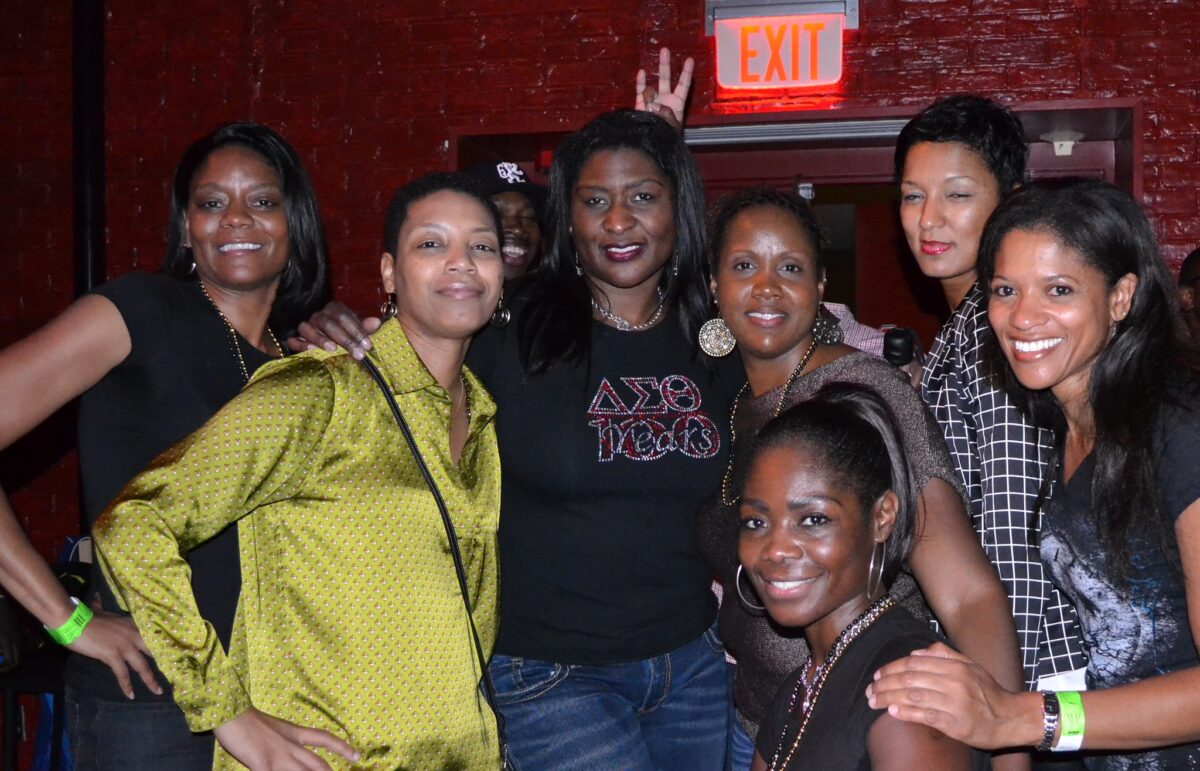
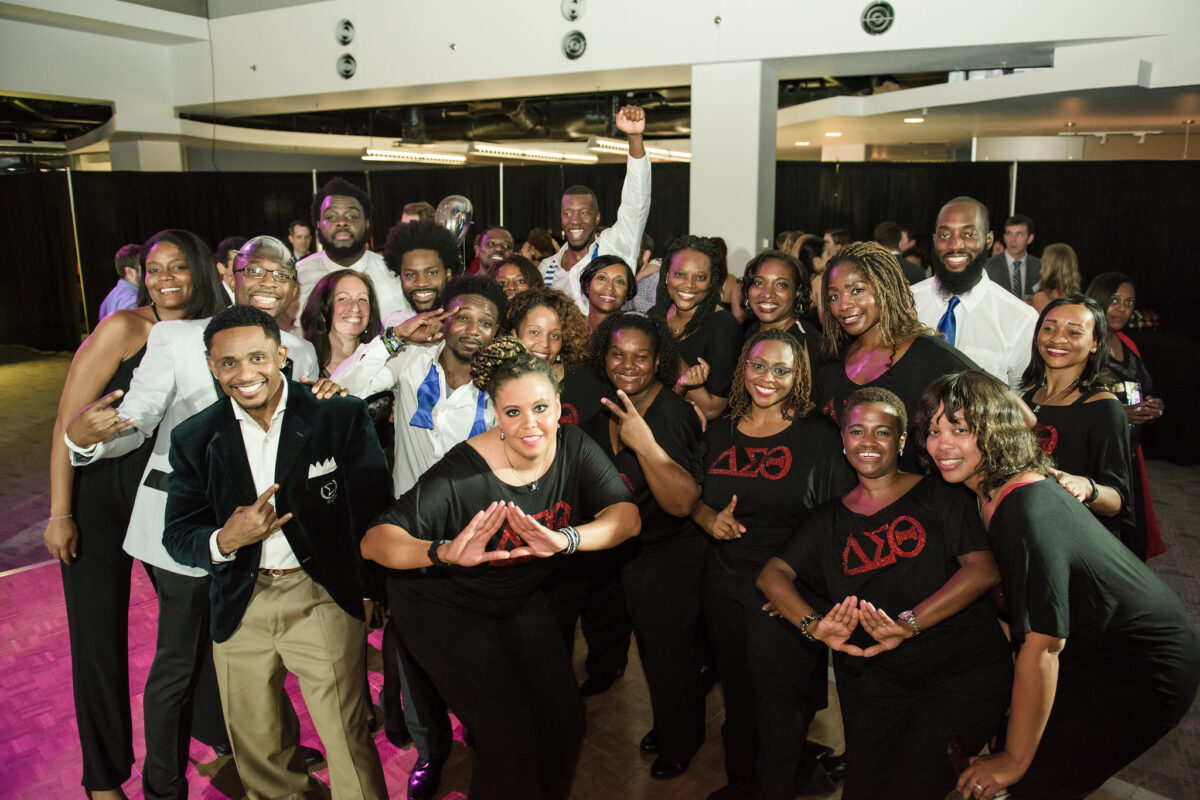
Left: Karen at the 2013 Chapter of Black & Latinx Alumni (CBLA) Homecoming Throwback Party. Right: Karen and others at the 2016 UMBC Grit & Greekness Alumni Reunion.
Q: Tell us about someone in the community who has inspired you or supported you, and how they did it.
A: During my time at UMBC, I was inspired and supported by the upperclass members of the Lambda Kappa Chapter of Delta Sigma Theta, These women were accomplished in the classroom and involved in service to the UMBC campus and Baltimore community, and they modeled how to balance all of these important parts of a student’s life with excellence. They each inspired me to achieve and encouraged and supported me as I worked my way though UMBC, and they continue to do the same even today.
After UMBC, I went on to graduate from Duke University School of Law. Currently, I am chief of the Employment Litigation Section in the Civil Rights Division of the Department of Justice.
Q: Tell us more about your current job. What do you like most about it?
A: As a civil rights attorney, I enjoy bringing cases that vindicate the rights of individuals and classes of people those who have been discriminated against to ensure the unlawful behavior is not repeated and the workplace is left better than what it was when we started our case.
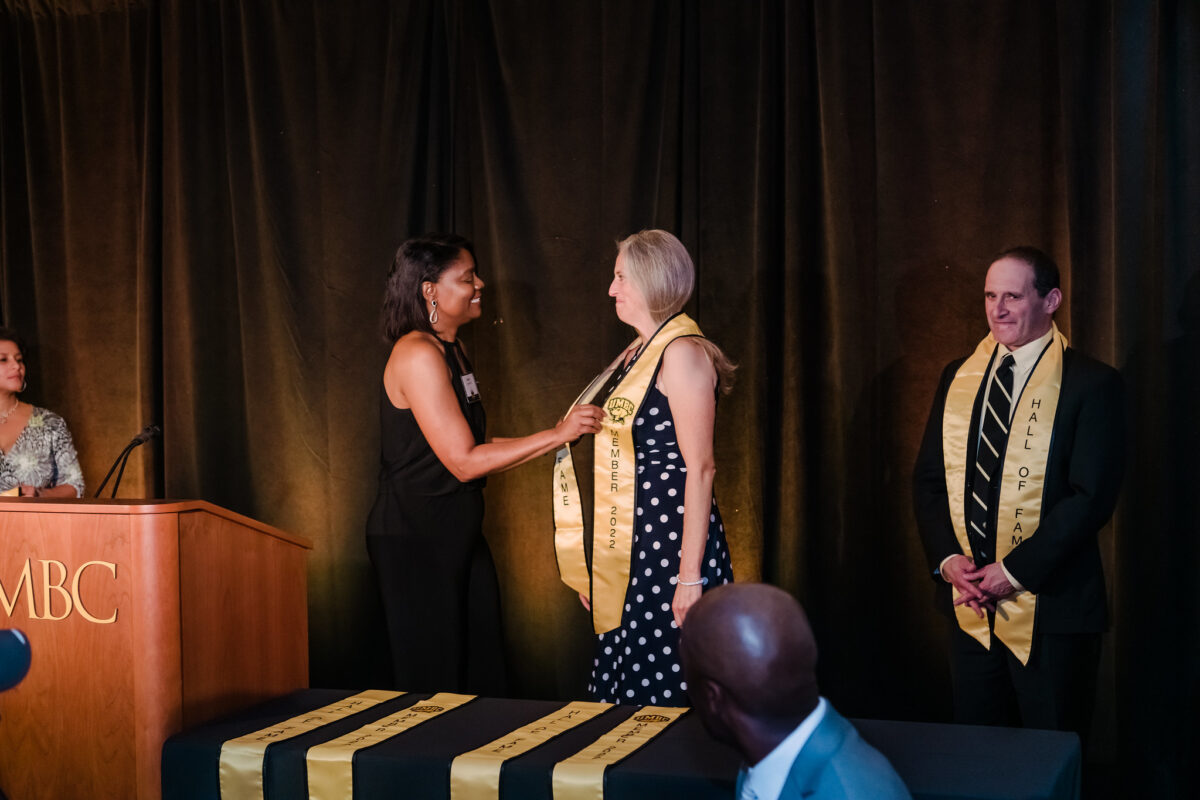 Karen at the 2022 UMBC Athletics Hall of Fame ceremony placing a commemorative stole around Dana Eberly Keiner, volleyball, 1993 – 96.
Q: How have you stayed connected with the UMBC community?
A: I truly love my work on the Alumni Association Board of Directors, and specifically as co-chair of the Alumni Awards committee. I enjoy working with fellow alumni who love UMBC and are committed to helping get more alumni involved in the Alumni Association and seeing the university continue to thrive. As the co-chair of the awards committee, I look forward to reading about the many accomplished alumni who are nominated. It fills me with a sense of pride to know UMBC produces so many accomplished individuals. I also feel very inspired by my work with the Athletic Department’s Hall of Fame committee.
About the Alumni Awards
Extraordinary UMBC alumni, faculty, and staff are making a difference in the world, and the UMBC Alumni Association Board of Directors holds an annual celebration of their accomplishments. Past winners have included a U.S. Surgeon General, a Lucasfilm sound editor, the New Yorker‘s social media director, chief judges, teachers, and scientists advancing fields such as medicine, chemical engineering, physics, and biology. We also honor outstanding UMBC faculty and staff members for their role in guiding and nurturing students. Five types of awards are given: Outstanding Graduate, Distinguished Service, Rising Star, Outstanding Faculty, and Outstanding Staff.
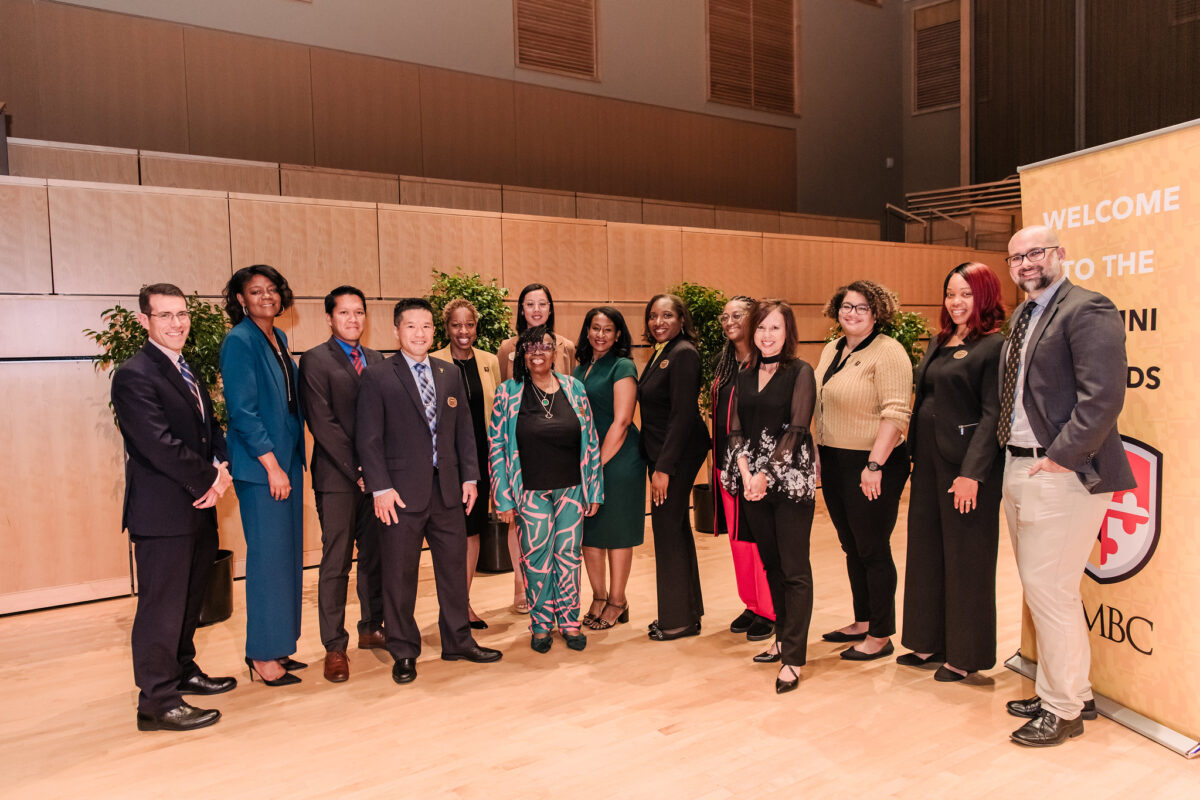 A few board members with President Valerie Sheares Ashby at the 2023 Alumni Awards.
Pictured left to right: Damian Doyle ’99, M.S., ’16 , Karen Woodard ’90, Dann Malihom ’10, M.A. ’16, Kevin Yang ’07, Robbin Lee ’13, Anita Turner Wilkins ’79, Leslie Lyles Smith ’91, Monique Cephas ’92, Vanita Murray ‘95, Zozscha Bomhardt ’93, Nancy Chiles Shaffer ‘09, Kisha Watkins Parker ‘00, Bobby Lubaszewski ’10, M.P.S. ’23
A few board members with President Valerie Sheares Ashby at the 2023 Alumni Awards.
Pictured left to right: Damian Doyle ’99, M.S., ’16 , Karen Woodard ’90, Dann Malihom ’10, M.A. ’16, Kevin Yang ’07, Robbin Lee ’13, Anita Turner Wilkins ’79, Leslie Lyles Smith ’91, Monique Cephas ’92, Vanita Murray ‘95, Zozscha Bomhardt ’93, Nancy Chiles Shaffer ‘09, Kisha Watkins Parker ‘00, Bobby Lubaszewski ’10, M.P.S. ’23
Q: What’s the one thing you’d want someone who hasn’t joined the UMBC community to know about the support you find here?
A: As an alum, you will feel supported by all levels of the university, including President Valerie Sheares Ashby—who truly cares about all who are connected to UMBC—the Office of Alumni Engagement, and the many staff members who are dedicated to supporting UMBC alumni.
Q: What drives you to support UMBC?
A: I support the Alumni Endowed Scholarship and the UMBC Athletics Department, women’s basketball program. With my support of the alumni scholarship, I know I am pouring into some of the best and brightest of UMBC’s current students. I also find it important as a women’s basketball alum to give back to the program that helped define me as a student. I learned so much and grew so much as a student and athlete during my four years on the team, and I want to do my part to help the current group of athletes succeed.
* * * * *
UMBC’s greatest strength is its people. When people meet Retrievers and hear about the passion they bring, the relationships they create, the ways they support each other, and the commitment they have to inclusive excellence, they truly get a sense of our community. That’s what “Meet a Retriever” is all about.
Learn more about how UMBC can help you achieve your goals.
]]>
Meet Karen Woodard ‘90, English. Karen is chief of the Employment Litigation Section in the Civil Rights Division of the U.S. Department of Justice and an active member of the UMBC Alumni...
https://umbc.edu/stories/meet-karen-woodard-alumni-awards-chair/
https://beta.my.umbc.edu/api/v0/pixel/news/142612/guest@my.umbc.edu/0ae3a6a2b87a92b91c115701e567e5e1/api/pixel
alumni
alumni-association
alumni-awards
alumni-endowed-scholarship-fund
cahss
impact
magazine
meet-a-retriever
story
UMBC News & Magazine
https://beta.my.umbc.edu/groups/umbc-news-magazine
https://assets1-beta.my.umbc.edu/system/shared/avatars/groups/000/001/943/24435aa6207c452e7bc15cc74b42c7bb/xsmall.png?1748556657
https://assets1-beta.my.umbc.edu/system/shared/avatars/groups/000/001/943/24435aa6207c452e7bc15cc74b42c7bb/original.png?1748556657
https://assets2-beta.my.umbc.edu/system/shared/avatars/groups/000/001/943/24435aa6207c452e7bc15cc74b42c7bb/xxlarge.png?1748556657
https://assets2-beta.my.umbc.edu/system/shared/avatars/groups/000/001/943/24435aa6207c452e7bc15cc74b42c7bb/xlarge.png?1748556657
https://assets3-beta.my.umbc.edu/system/shared/avatars/groups/000/001/943/24435aa6207c452e7bc15cc74b42c7bb/large.png?1748556657
https://assets1-beta.my.umbc.edu/system/shared/avatars/groups/000/001/943/24435aa6207c452e7bc15cc74b42c7bb/medium.png?1748556657
https://assets2-beta.my.umbc.edu/system/shared/avatars/groups/000/001/943/24435aa6207c452e7bc15cc74b42c7bb/small.png?1748556657
https://assets1-beta.my.umbc.edu/system/shared/avatars/groups/000/001/943/24435aa6207c452e7bc15cc74b42c7bb/xsmall.png?1748556657
https://assets2-beta.my.umbc.edu/system/shared/avatars/groups/000/001/943/24435aa6207c452e7bc15cc74b42c7bb/xxsmall.png?1748556657
UMBC News & Magazine
1
0
false
Mon, 01 Jul 2024 07:55:22 -0400
Mon, 01 Jul 2024 07:55:22 -0400
Partnership with biotech giant Genentech benefits UMBC graduate students
UMBC doctoral students are reaping the benefits of an innovative partnership between UMBC and biotech leader Genentech. In year three of a five-year program, sixstudents have received financial support and started conducting research with the company through Genentech Fellowships. In addition, many more students have benefited from regular contact with Genentech senior scientists through their on-campus lecture series.
By supplying training opportunities in industry before graduation—the kind of preparation that has not always been supplied in traditional life science programs—the relationship between UMBC and Genentech is opening doors to a wider range of careers for graduate students in the life sciences.
Hands-on training at Genentech
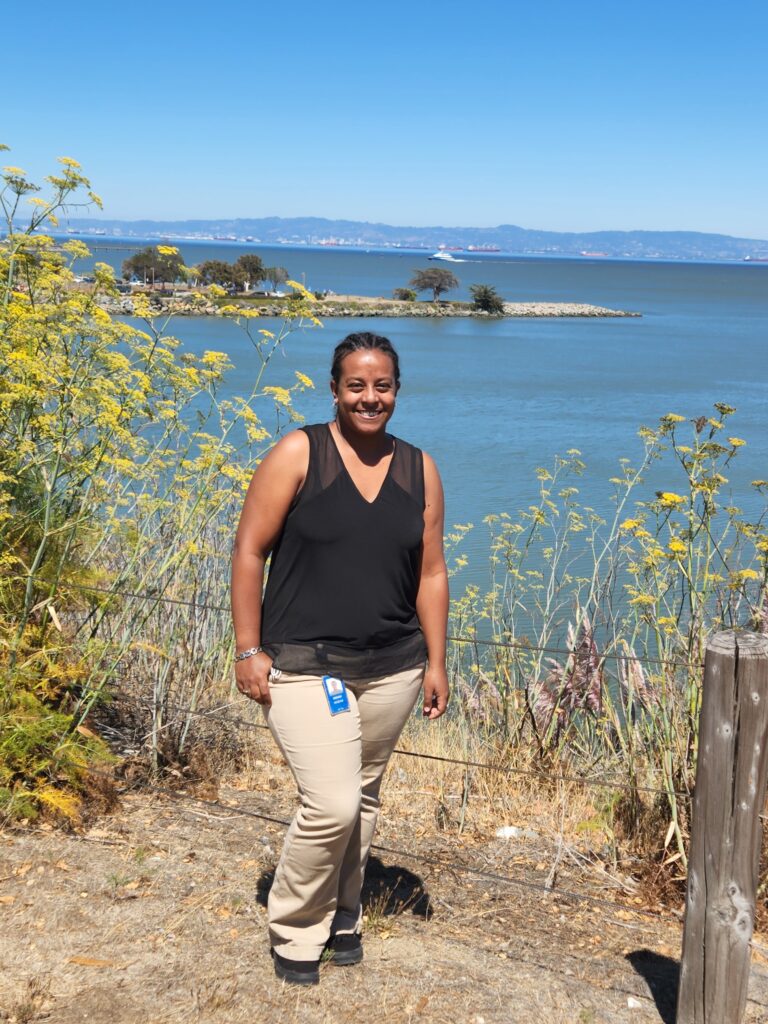 Maki Negesse on the Genentech campus in South San Francisco, California. (Photo courtesy of Negesse)
Each year during the five-year agreement, Genentech fully funds two life science Ph.D. candidates in the Meyerhoff Graduate Fellows Program who are progressing well through their doctoral work and have expressed interest in pursuing a career in industry. Selected students continue their thesis work with their Ph.D. advisors during the academic year; then they spend the summer as research interns at Genentech headquarters in South San Francisco, California. Alecia Dent ’12, biochemistry and molecular biology, who earned a Ph.D. at University of Maryland, Baltimore as a Meyerhoff Graduate Fellow and today works at Genentech, has generously helped the fellows acclimate to life on the West Coast by offering lodging at her home.
The internship at Genentech “was a great opportunity to grow my network and get hands-on training in a different area of expertise, and a great way to gain some industry experience,” shares Maki Negesse, a biological sciences Ph.D. candidate in Erin Green’s research group at UMBC.
When fellows return to UMBC, they present their research and experience at Genentech to all of the current Meyerhoff Graduate Fellows—a group that includes more than 100 UMBC and University of Maryland, Baltimore graduate students. In addition, Genentech scientists give multiple seminars at both campuses each year.
“My experience at Genentech has strengthened my desire to pursue a career in biotech companies,” Negesse adds. “I highly recommend that students pursue at least one internship during graduate school.”
Proactive steps for success
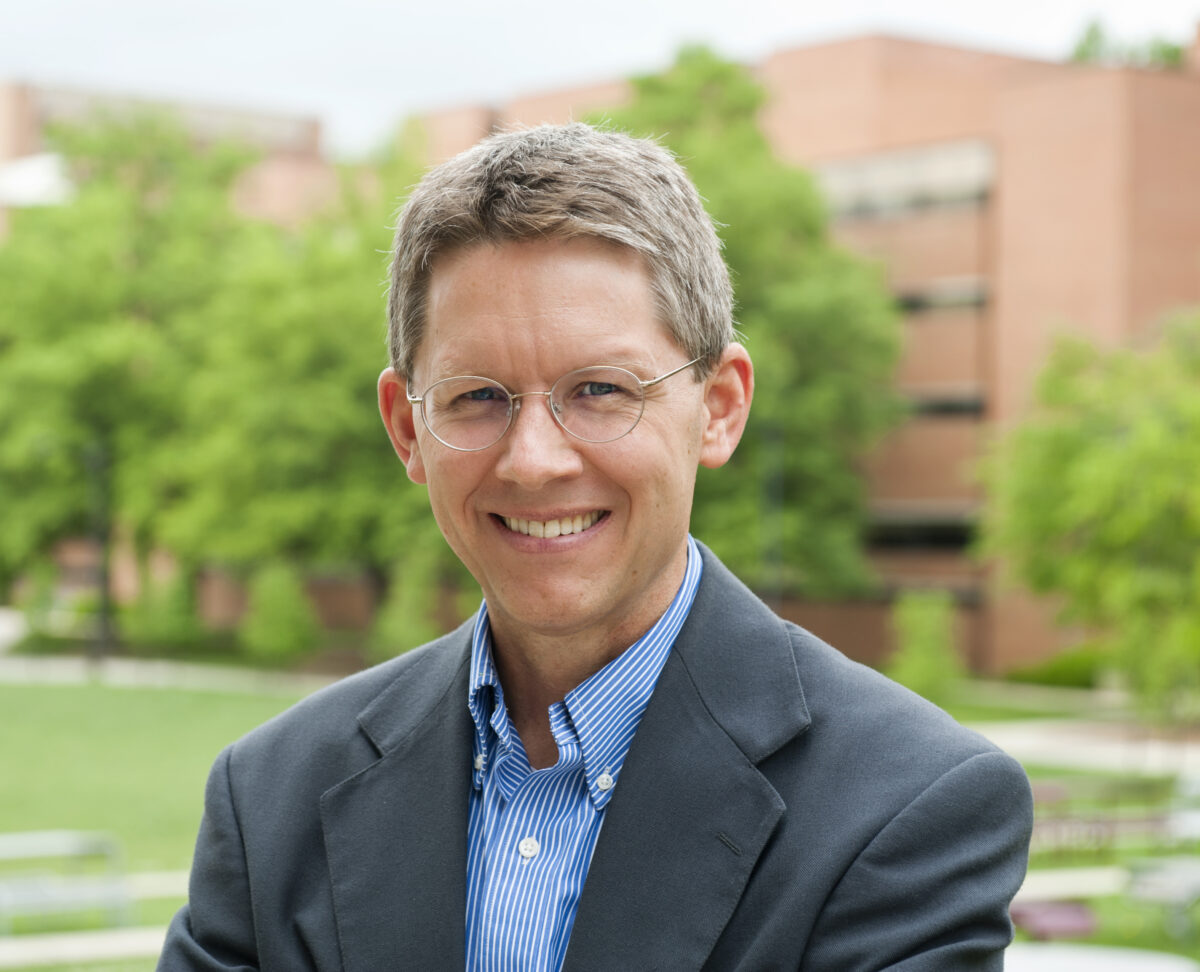 Michael Summers played a key role in the development of the Meyerhoff Graduate Fellows Program. (Photo by Marlayna Demond ’11/UMBC)
The partnership signals that UMBC is proactively taking steps to ensure its graduate training programs set students up for success in various high-demand roles. Genentech, too, is committed to supporting the next generation of highly qualified biotech workers.
“Graduate programs in the life sciences are historically geared toward preparing Ph.D. students for academic careers. This partnership fills a gap in graduate education by providing on-site training at a world-class company for students who are interested in careers in the biotechnology industry,” shares Michael Summers, Distinguished University Professor of Chemistry and Biochemistry and co-director of the Meyerhoff Graduate Fellows Program. “It also provides opportunities to diversify the scientific workforce at Genentech, providing a win-win for the company and our students.”
]]>
UMBC doctoral students are reaping the benefits of an innovative partnership between UMBC and biotech leader Genentech. In year three of a five-year program, sixstudents have received financial...
https://umbc.edu/stories/grad-students-benefit-from-genentech-partnership/
https://beta.my.umbc.edu/api/v0/pixel/news/142556/guest@my.umbc.edu/17afe8eefc376b2e89cc8917ae160145/api/pixel
cnms
gradresearch
graduate-school
meyerhoff-scholars
news
rca-1
research
science-and-tech
story
UMBC News & Magazine
https://beta.my.umbc.edu/groups/umbc-news-magazine
https://assets1-beta.my.umbc.edu/system/shared/avatars/groups/000/001/943/24435aa6207c452e7bc15cc74b42c7bb/xsmall.png?1748556657
https://assets1-beta.my.umbc.edu/system/shared/avatars/groups/000/001/943/24435aa6207c452e7bc15cc74b42c7bb/original.png?1748556657
https://assets2-beta.my.umbc.edu/system/shared/avatars/groups/000/001/943/24435aa6207c452e7bc15cc74b42c7bb/xxlarge.png?1748556657
https://assets2-beta.my.umbc.edu/system/shared/avatars/groups/000/001/943/24435aa6207c452e7bc15cc74b42c7bb/xlarge.png?1748556657
https://assets3-beta.my.umbc.edu/system/shared/avatars/groups/000/001/943/24435aa6207c452e7bc15cc74b42c7bb/large.png?1748556657
https://assets1-beta.my.umbc.edu/system/shared/avatars/groups/000/001/943/24435aa6207c452e7bc15cc74b42c7bb/medium.png?1748556657
https://assets2-beta.my.umbc.edu/system/shared/avatars/groups/000/001/943/24435aa6207c452e7bc15cc74b42c7bb/small.png?1748556657
https://assets1-beta.my.umbc.edu/system/shared/avatars/groups/000/001/943/24435aa6207c452e7bc15cc74b42c7bb/xsmall.png?1748556657
https://assets2-beta.my.umbc.edu/system/shared/avatars/groups/000/001/943/24435aa6207c452e7bc15cc74b42c7bb/xxsmall.png?1748556657
UMBC News & Magazine
1
0
false
Tue, 25 Jun 2024 15:46:44 -0400
Tue, 25 Jun 2024 15:46:44 -0400
Stepping up to the plate to preserve UMBC history

When the Fort McHenry Tunnel opened, drivers could thank Richard “Rock” Soracoe ’71, economics, for helping them see as they drove under the harbor. Soracoe spent 50-plus years in the lighting industry and helped source the original 8,870 8-ft light fixtures that lined the road. In retirement, he’s helping shed a different type of light. Soracoe and other members of the founding four classes at UMBC are putting their collective memories to work to assist in identifying people and events in UMBC’s archival material to help complete our UMBC history. One event—UMBC’s first intercollegiate athletics win—is a story Soracoe loves to tell.
I have the game ball in my hand. The red stitches feel familiar, and the leather sits in my palm like it was made to fit. I’m not on the mound winding up to pitch, however; I’m standing in the basement of the Albin O. Kuhn Library. It’s been 57 years since I last touched this baseball when UMBC won its first intercollegiate victory.
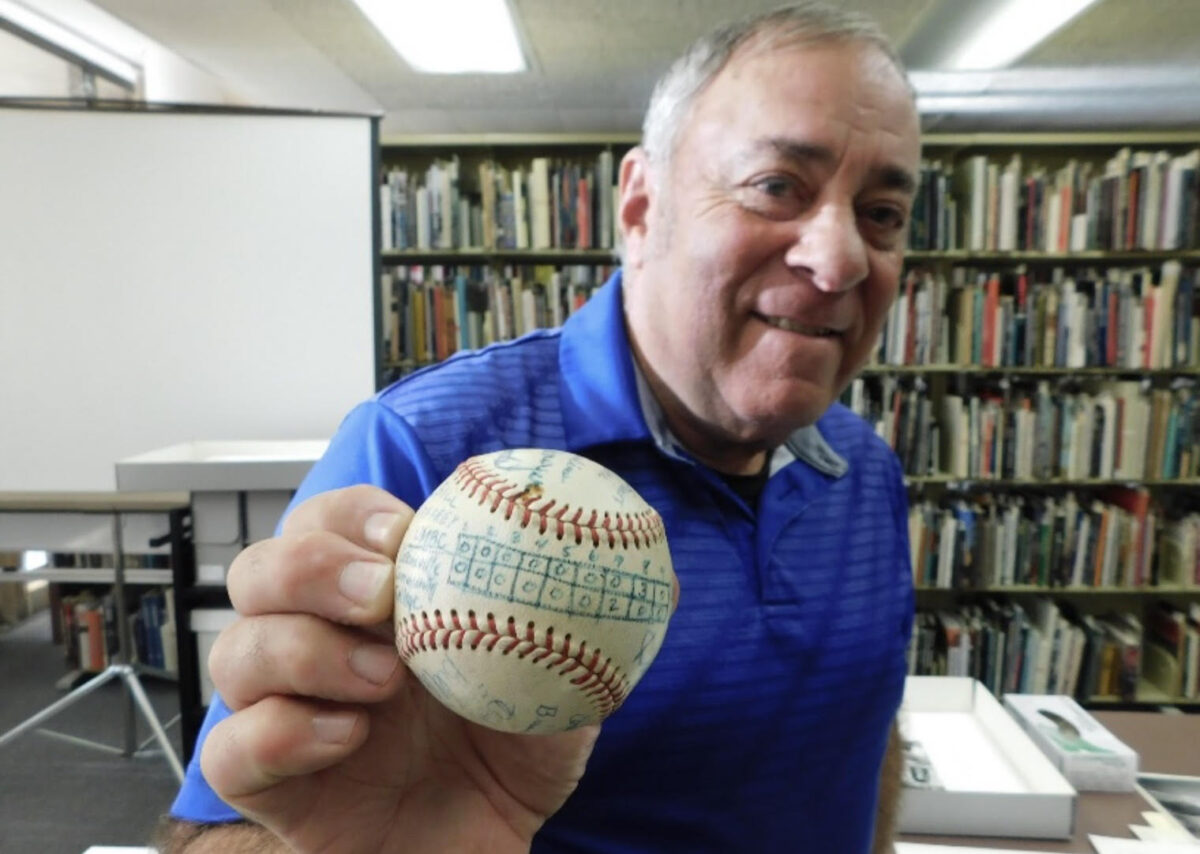 In UMBC’s Special Collections, Soracoe holds up the first game-winning baseball with the box score drawn on.
In 1967, UMBC’s inaugural fall sports season, the teams didn’t win a single game (as a member of the UMBC soccer team at the time, I was well aware of this), so it fell to baseball or lacrosse, the spring sports, to come through with the first win. While the details of that ballgame (a 3-2 win) are fuzzy now—all that remains officially is a 28-word write up in the Baltimore Sun archives—the game deserves its place of honor in the relatively short history of our institution. The budding campus newspaper, The Retriever Weekly, didn’t cover the game (although they did cover our loss to the same team the following week) and the box score is immortalized only as pen scratched onto the game ball’s leather.
Despite the lack of thorough archival material, in its own way, the game has certainly gone on to define aspects of my own life. Ken Diehl—the pitcher of the losing team, Catonsville Community College—would go on to transfer to UMBC the next year. We bonded over our shared Retriever spirit and also from our shared memories as roommates on UMBC’s first mini-mester trip to Europe in 1968. But it’s my Founding Four membership that drives me to keep memories like the first intercollegiate win alive.
As graduates of the first four classes at UMBC, we feel excited but also responsible for helping archive and catalog memories that might be unique to us. It’s one of the reasons we wrote This Belongs to Us, and it’s the reason we meet at the library to help the university archivists put appropriate names and metadata on early university yearbooks called Skipjack and other historical materials.
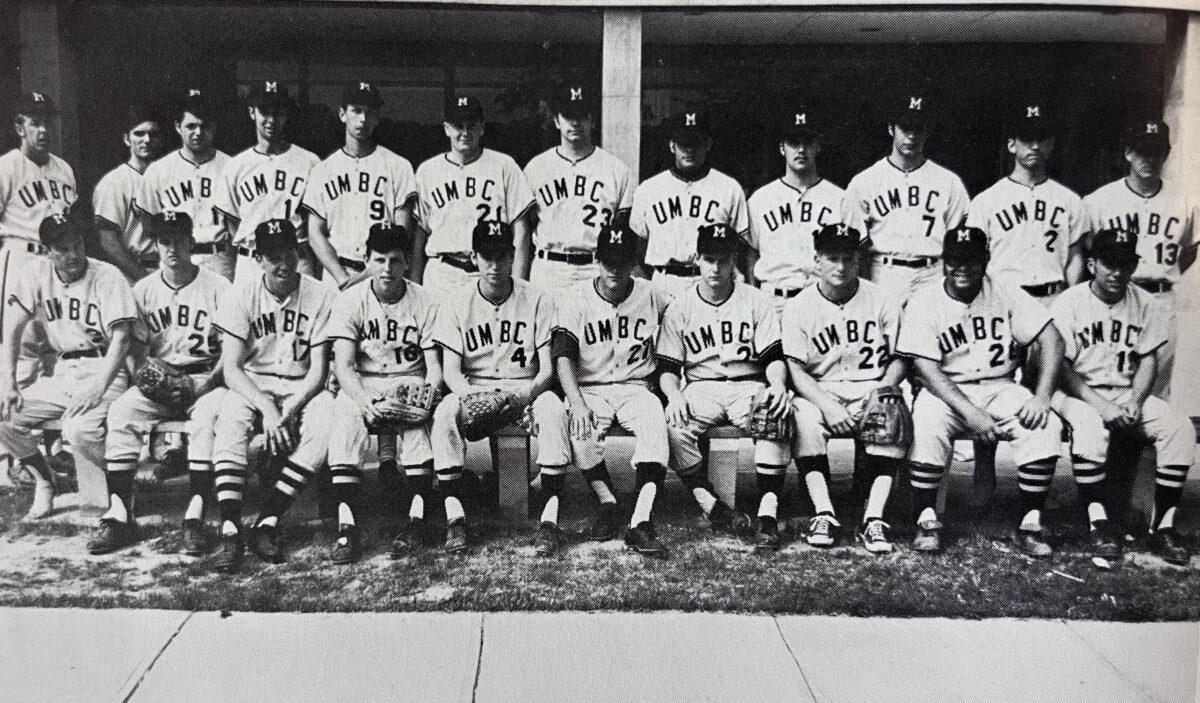
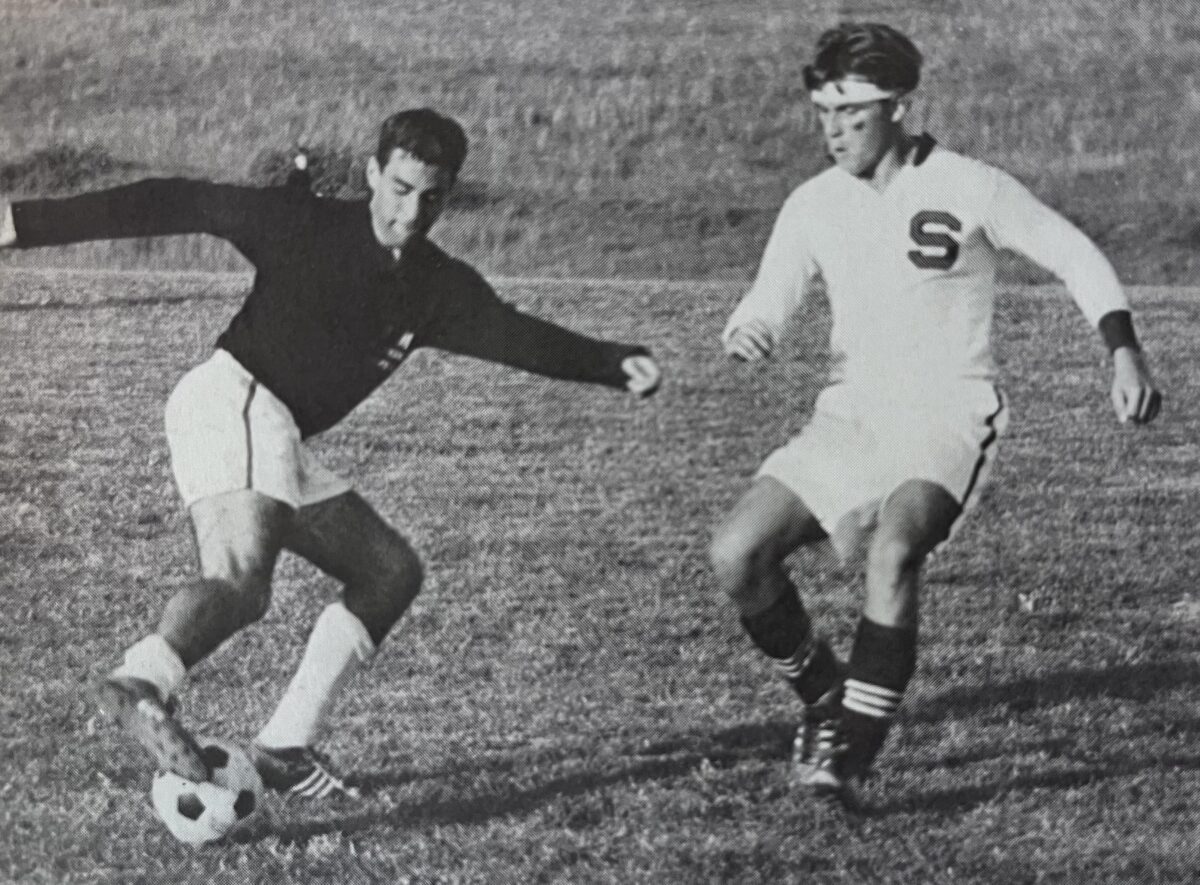
Left, the 1969 baseball team pictured in the 1969 university yearbook, Skipjack. Right, Soracoe in the black jersey also played on UMBC’s men’s soccer team.
When we were students here—walking around on plywood sidewalks on top of muddy construction sites—we weren’t thinking about creating the history of UMBC. We referred to the college as “high school plus one.” So our yearbooks rarely include captions or names and it’s up to us now to identify those people so that they’re not lost to history.
Some things have been lost to history. Louie Sowers [’70, American studies], a fellow classmate and student-athlete, stood up for Retriever women to have equal representation in university sports well before Title IX made it mandatory. She, along with Athletic Director Dick Watts, formed the women’s field hockey, basketball, and volleyball teams for the 1967 – 1968 academic year. Unfortunately, those records have been lost to time, so on paper, officially, women’s varsity sports only started in 1973.
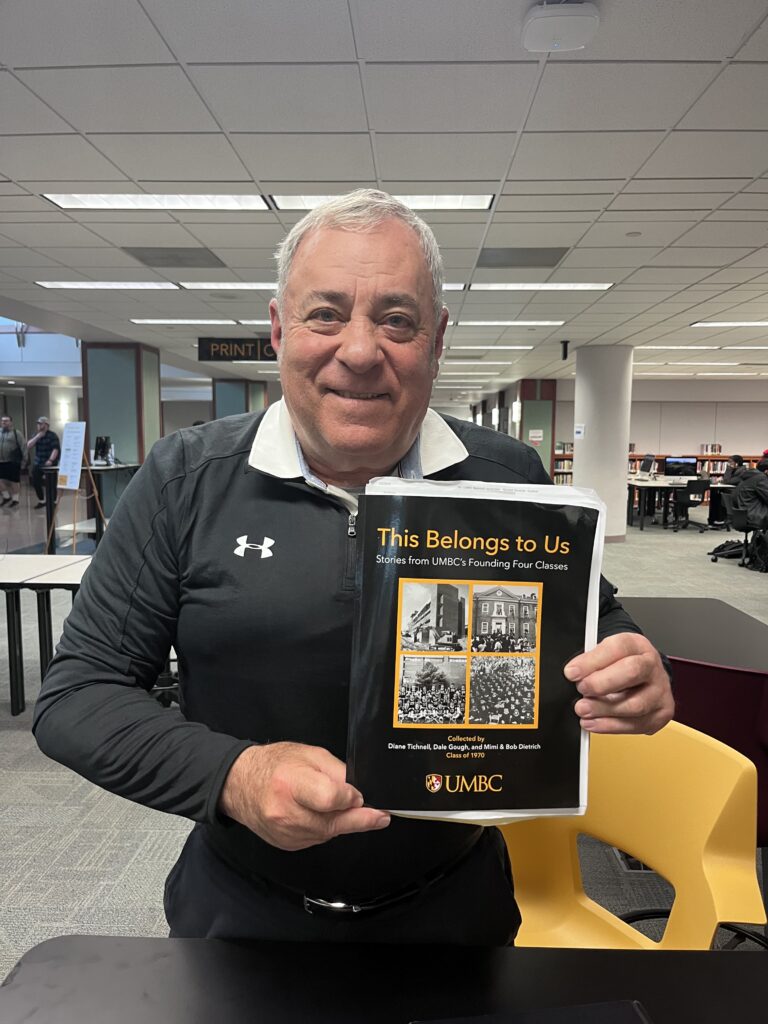 Soracoe holds a copy of This Belongs to Us—the Founding Four’s book about UMBC’s early days.
I reached out to some teammates to see if they could help me fill in the missing blanks of that game in April 1967. We played at Banneker Field in Catonsville (referred to as the “loser’s field” in the Sun write up) because UMBC did not have its own field yet. It was a low-scoring game; CCC got the first two runs in the game in the bottom of the 7th inning. The top of the 8th would be our key to victory. After one runner already came in, my teammate Bill Rust [’71, history] remembers players on second and third. He was at bat, and lined our then-opponent Ken’s pitch into left center field for what would become the game-winning RBIs.
What I remember is pitching the whole game (90 pitches according to Bill’s memory), and being so grateful when Ken [’70, psychology] joined our team the next year as an additional pitcher. And over the years, I’ve grown comfortable with the idea that the individual details don’t matter as much as the whole picture. Stepping back to see the shape of my career, my marriage, and my friends, I can see how they’ve all been defined by my UMBC experience.
UMBC was as welcoming as you wanted it to be, and still is today. My professors taught me the power of critical thinking and my coaches taught me the power of mental and physical discipline—which helped me in my job and my 36-year career as a high school and college soccer referee. I am very proud to say that I am a UMBC graduate and happy to see the tremendous achievement the university has attained from humble beginnings to worldwide status.
— Richard “Rock” Soracoe ’71, economics
]]>
When the Fort McHenry Tunnel opened, drivers could thank Richard “Rock” Soracoe ’71, economics, for helping them see as they drove under the harbor. Soracoe spent 50-plus years in the lighting...
https://umbc.edu/stories/stepping-up-to-the-plate-to-preserve-umbc-history/
https://beta.my.umbc.edu/api/v0/pixel/news/142515/guest@my.umbc.edu/1ba6502c67b2faff3c9f3194cc2c07a1/api/pixel
alumni
alumni-essay
american-studies
athletics
baseball
economics
founding-four
history
magazine
spring-2024
story
umbc-history
UMBC News & Magazine
https://beta.my.umbc.edu/groups/umbc-news-magazine
https://assets1-beta.my.umbc.edu/system/shared/avatars/groups/000/001/943/24435aa6207c452e7bc15cc74b42c7bb/xsmall.png?1748556657
https://assets1-beta.my.umbc.edu/system/shared/avatars/groups/000/001/943/24435aa6207c452e7bc15cc74b42c7bb/original.png?1748556657
https://assets2-beta.my.umbc.edu/system/shared/avatars/groups/000/001/943/24435aa6207c452e7bc15cc74b42c7bb/xxlarge.png?1748556657
https://assets2-beta.my.umbc.edu/system/shared/avatars/groups/000/001/943/24435aa6207c452e7bc15cc74b42c7bb/xlarge.png?1748556657
https://assets3-beta.my.umbc.edu/system/shared/avatars/groups/000/001/943/24435aa6207c452e7bc15cc74b42c7bb/large.png?1748556657
https://assets1-beta.my.umbc.edu/system/shared/avatars/groups/000/001/943/24435aa6207c452e7bc15cc74b42c7bb/medium.png?1748556657
https://assets2-beta.my.umbc.edu/system/shared/avatars/groups/000/001/943/24435aa6207c452e7bc15cc74b42c7bb/small.png?1748556657
https://assets1-beta.my.umbc.edu/system/shared/avatars/groups/000/001/943/24435aa6207c452e7bc15cc74b42c7bb/xsmall.png?1748556657
https://assets2-beta.my.umbc.edu/system/shared/avatars/groups/000/001/943/24435aa6207c452e7bc15cc74b42c7bb/xxsmall.png?1748556657
UMBC News & Magazine
1
0
false
Thu, 20 Jun 2024 13:02:54 -0400
Thu, 20 Jun 2024 13:02:54 -0400
UMBC Center for Global Engagement welcomes its second cohort of the Young African Leaders Initiative

This summer, UMBC’s Center for Global Engagement (CGE) is excited to welcome its second cohort of the prestigious Mandela Washington Fellowship for Young African Leaders, the six-week flagship program of the U.S. Government’s Young African Leaders Initiative (YALI). The new cohort includes 25 innovators from countries across Sub-Saharan Africa representing education, journalism, tech, health care, and more. The fellows will spend six weeks living at UMBC networking and attending diversity and leadership skills workshops. They will also meet with campus, local, and state leaders, learn more about Baltimore’s LGBTQ+ leaders of color, developmental disabilities at The ARC Baltimore, trauma-informed practices, and more.
“The fellowship is a beacon of hope,” says Jok Thon, M.P.S. ’24, entrepreneurship, innovation, and leadership, a 2018 University of Delaware YALI fellow and UMBC’s first Global Peaceworker Fellow. Thon is a father of four and the director and founder of Promised Land Primary and Secondary School and Promised Land College in Juba, South Sudan, which has educated over 1500 displaced students. “As a witness and participant in this transformative experience, I wholeheartedly attest the journey is as profound for the mentors as it is for the fellows.”
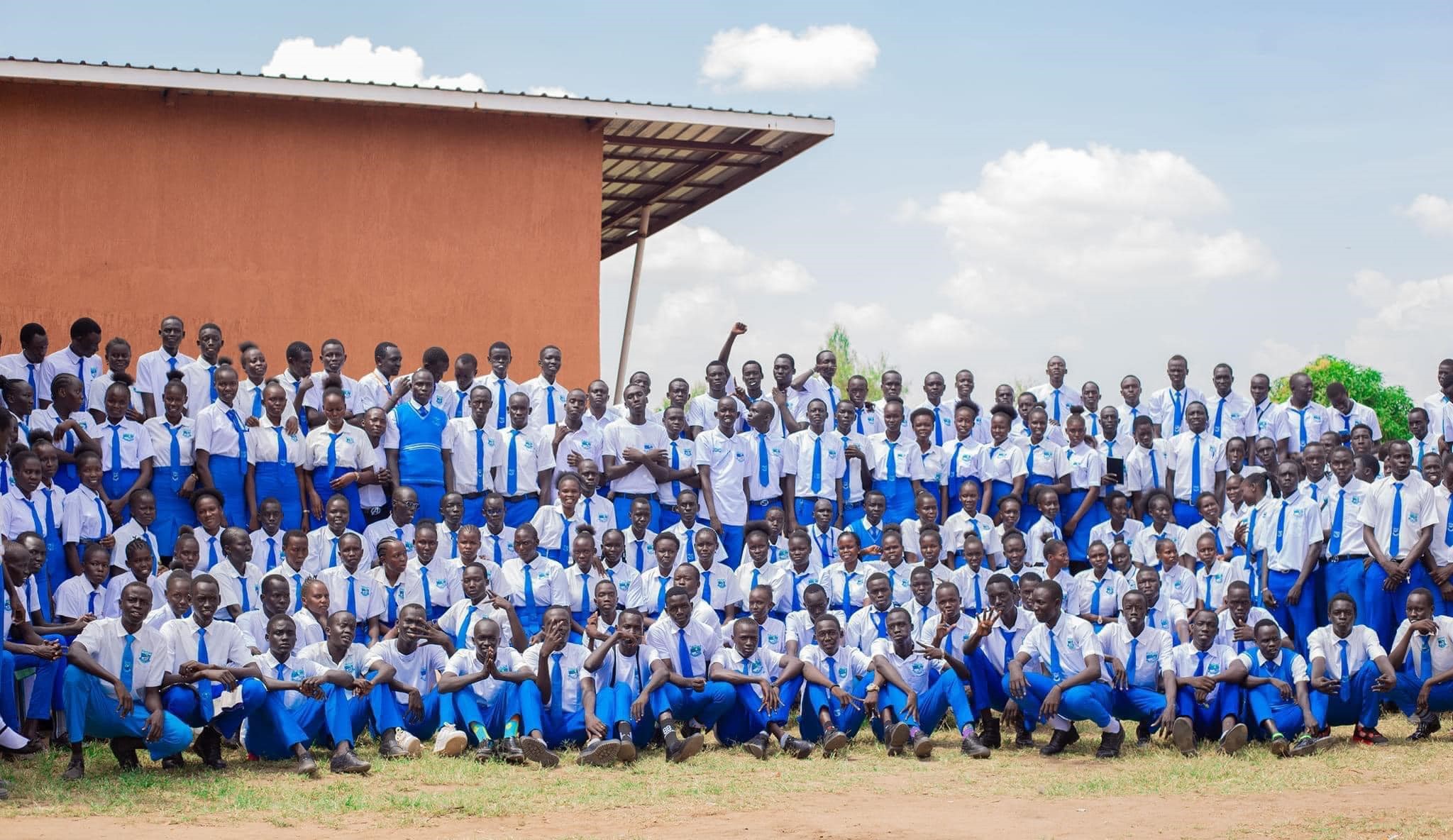 Promised Land Primary and Secondary School in Juba, South Sudan. (Image courtesy of Thon)
Thousands of leaders ages 25 – 35, across 49 Sub-Saharan African countries covet a prestigious YALI fellowship. YALI hopefuls must condense years of leadership in business, civic engagement, and public management into one application, demonstrating concrete ongoing efforts to broaden access to education, health care, and workforce development. These 700 spots across 28 U.S. educational institutions are considered a once-in-a-lifetime opportunity, for both fellows and host institutions, to strengthen connections between the U.S. and Africa and establish enduring partnerships between fellows, local communities, and private businesses through their expertise, perspectives, and experiences.
“YALI is a huge deal in my country and Africa. It’s a journey I want to take with my whole community, nation, and the world,” says 2023 UMBC YALI fellow Victoria Merab Akinyi. She is the CEO and co-founder of Streetlights Uganda, a visual and performing arts-based organization empowering children living on the streets with entrepreneurship and life skills to become self-employed and engaged citizens.
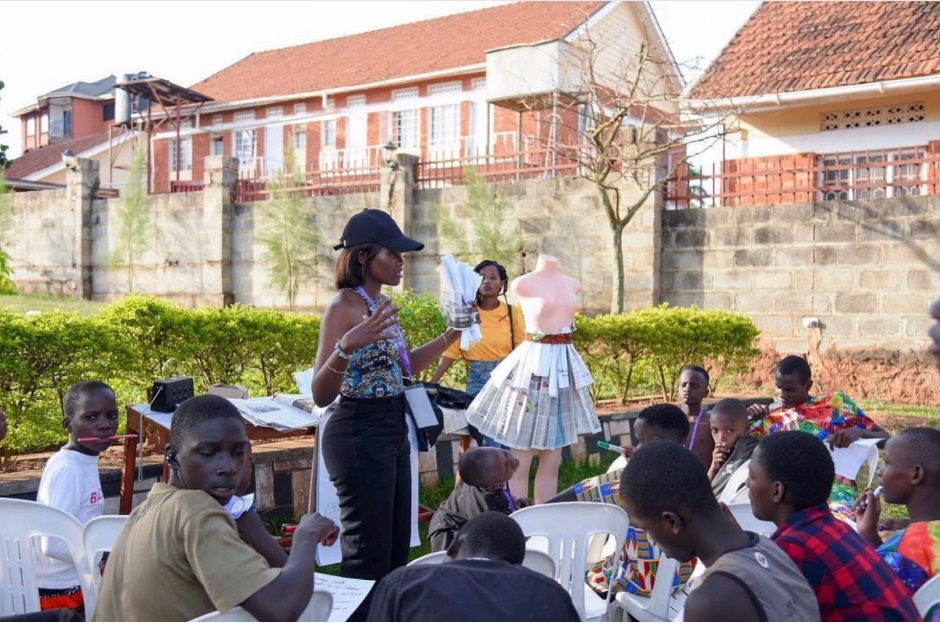 Victoria Merab Akinyi teaching a fashion design class at Streetlights Uganda. (Image courtesy of Merab Akinyi)
“I have a master’s degree in fine arts and two fashion companies. I don’t take my degrees, work with my community, and my YALI experiences for granted because they have all helped open doors for me.”
Creating a Retriever YALI Village
Becoming a YALI host is also an arduous but worthwhile process. It requires developing a six-week international residency program unique to the institution’s resources and the fellows’ needs. When Ryan Sheldon, M.A. ’15, teaching English to speakers of other languages, director of the English Language Institute and special programs within CGE, and Madison Pickard, M.A. ’24, intercultural communication, and assistant director of special programs and co-academic director of the YALI Fellowship, applied to bring YALI to UMBC in 2023, Thon was excited to join the team as a program assistant.
“It was so valuable to our fellowship having Jok as a program assistant and a resource for the fellows while they were here,” says Pickard. “Jok assisted the fellows in leadership activities, accompanied us on on-site visits, and facilitated their weekly feedback and reflection sessions as our leadership coordinator.”
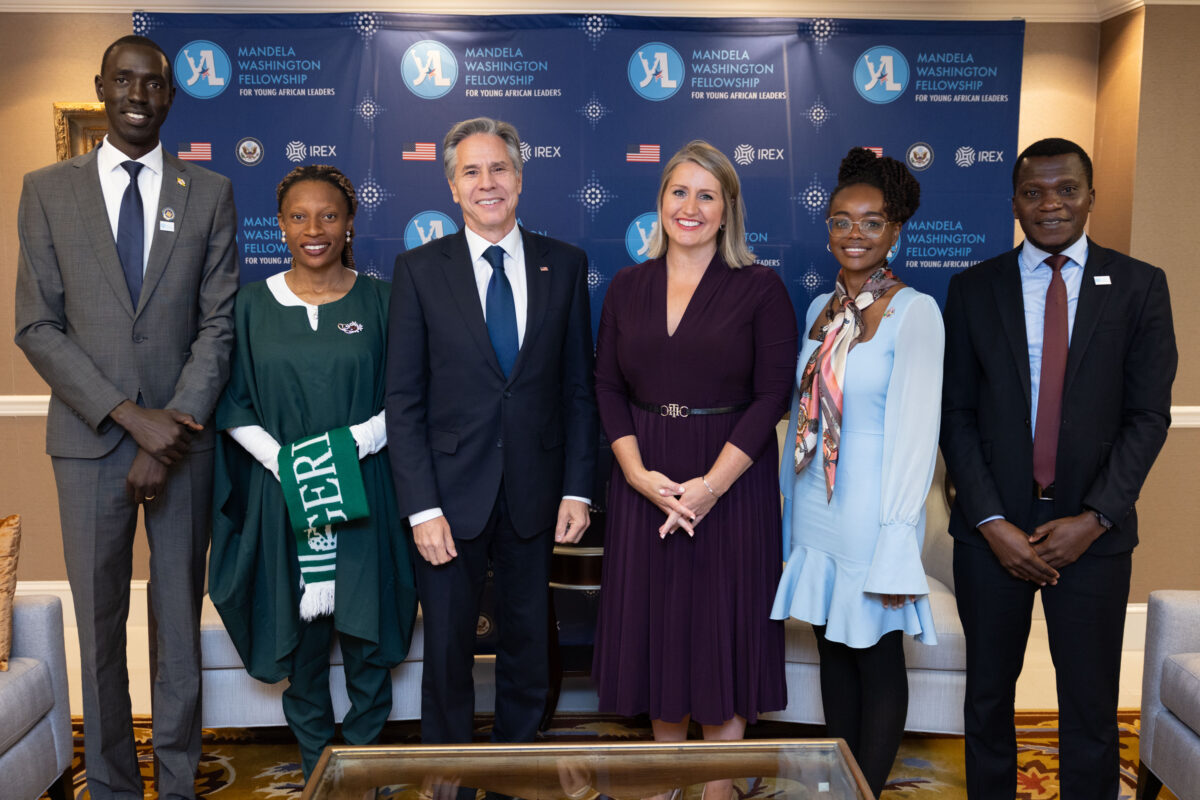 (l-r): Jok Thon, YALI fellow Blessing Ashi from Nigeria, U.S. Secretary of State Antony Blinken, Undersecretary of State Elizabeth Allen, and YALI fellows Shange-Ndamona Mungoba from Namibia and Khwima Mkamanga from Malawi. (Image courtesy of Thon)
Designing a “Retriever YALI Village” requires many hands. The village was equipped with campus housing, transportation, catering, activities, and a budget for each fellow. Thanks to campus and community partners, it also included workshops, projects, events, and speakers.
“We invited trusted partners aligned with our fellows, had conversations with them, and created a space for the fellows to choose their level of engagement,” says Pickard. The proposal was a winner.
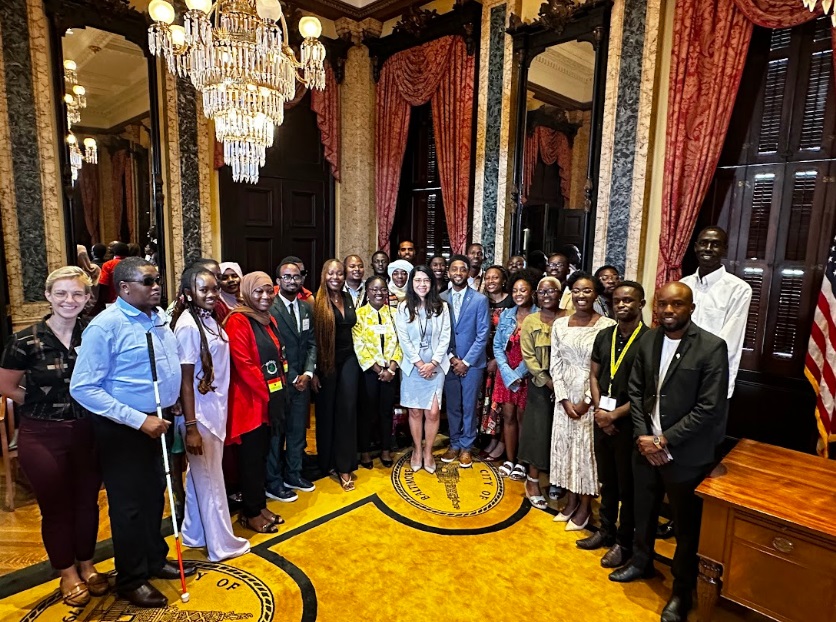 YALI fellows at Baltimore City Hall with Baltimore City Mayor Brandon Scott.
(Image courtesy of Mirab Akinyi)
In summer 2023, 24 young African leaders came to UMBC to share and learn new skills to empower them as critical leaders in addressing issues facing women, girls, and children, mental and public health, education, community organizing, NGO management, sustainability, and more. Fellows engaged in academic sessions, community service, site visits, and networking events and met state and local government leaders, businesses, and community organizations. They also joined in Baltimore’s baseball season at the Oriole Park at Camden Yards.
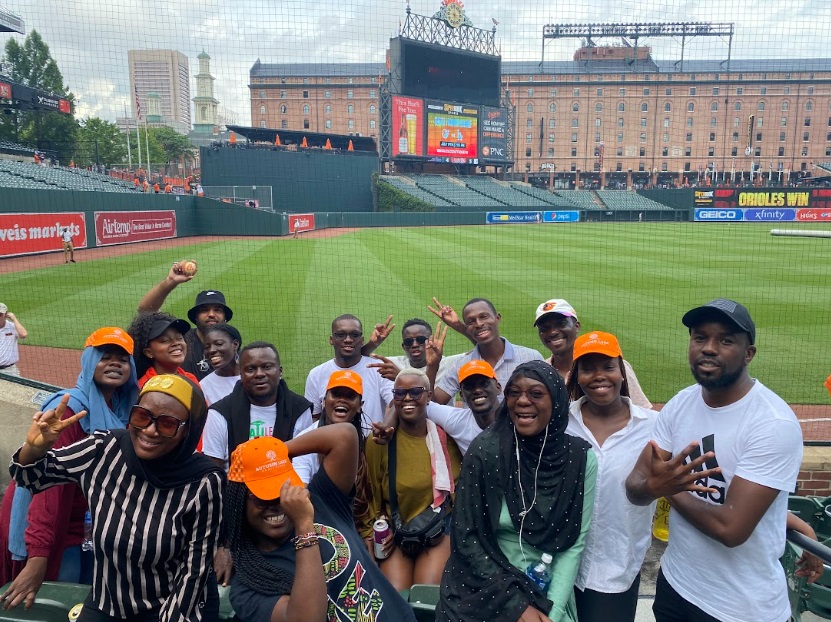 YALI fellows at the Oriole Park at Camden Yards in Baltimore City. (Image courtesy of CGE)
“Together, we explored the notion that true leadership is rooted in service and that we can drive meaningful progress by embracing diversity and harnessing collective strengths,” says Thon. Due to the program’s success, UMBC was chosen to host again in June 2024.
All for all
Fellows are often inspired into action by personal experiences. Their superpower is knowing they alone are not the answer. Fellows share their community-building strategies and acquire new expertise to address ongoing challenges. It’s not all-for-one, or one-for-all, but all-for-all.
Leveraging social media for social justice is a key approach for Ellen Kalaputse Nanyeni, a financial modeling and valuation analyst from Namibia. As a survivor of sexual and gender-based violence (SGBV), she understands the victim blaming and legal hurdles survivors face to access care and protection. Nanyeni promotes equal opportunity rights and the safety of women in Namibia via the #Shutitalldown Namibia SGBV awareness social media movement and through the #Breakfree #Befree support services initiative established by Monica Geingos, the First Lady of Namibia.
In Nigeria, Sunday Emmanuel Onuche networks with schools and disability organizations to further disability justice. Onuche promotes inclusion, leadership opportunities, and self-reliance for people with disabilities like himself via his VisionLink Initiative.
Skateboarding is John Kabiye Kalenga’s community development tool. As a professional skateboarder and the coach for Zambia’s first Olympic skateboard team at the 2022 Tokyo Olympics, Kalenga lives and breathes the sense of belonging skateboarding has given him. As vice president of the Skate Association of Zambia, he teamed up with more than 30 international skatepark construction volunteers to build Zambia’s first-ever skatepark creating a safe haven for young people.
CNN World: Zambian instructor empowers kids through skateboarding
These are just a few of the 2023 YALI fellows who connected over the summer of 2023 and returned to their countries with new leadership skills and tools for change.
Implementing the YALI Way
YALI is one summer, but it’s what comes afterward when the fellows return home that the work truly becomes YALI work. Merab Akinyi returned to Uganda intent on expanding Streetlights Uganda’s reach. She fundraised to remodel old houses in areas of high need. The additional classrooms and offices launched the Ntunga project, Changing Lives Through Fashion. It equips women and children with marketable skills to sustain their families. Her team continues to run the Mwalimu Mentorship, an apprenticeship connecting artists with youth, and the Unseen Me children’s exhibition.
Currently, Streetlights Uganda manages two training centers for women and two for street children. Merab Akinyi and her team of seven organizers have reached over 60 women in the past 3 years and over 400 street children.
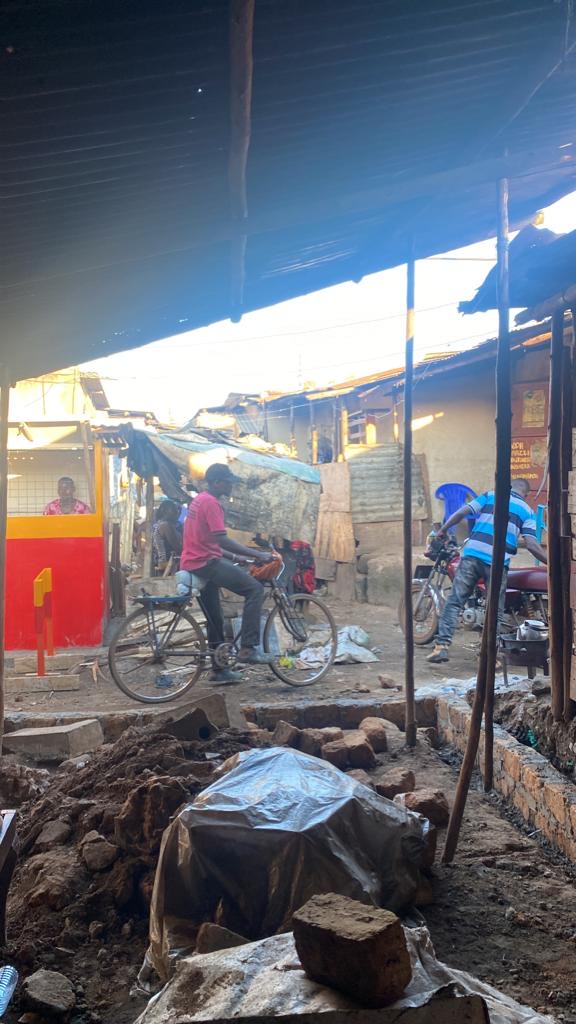
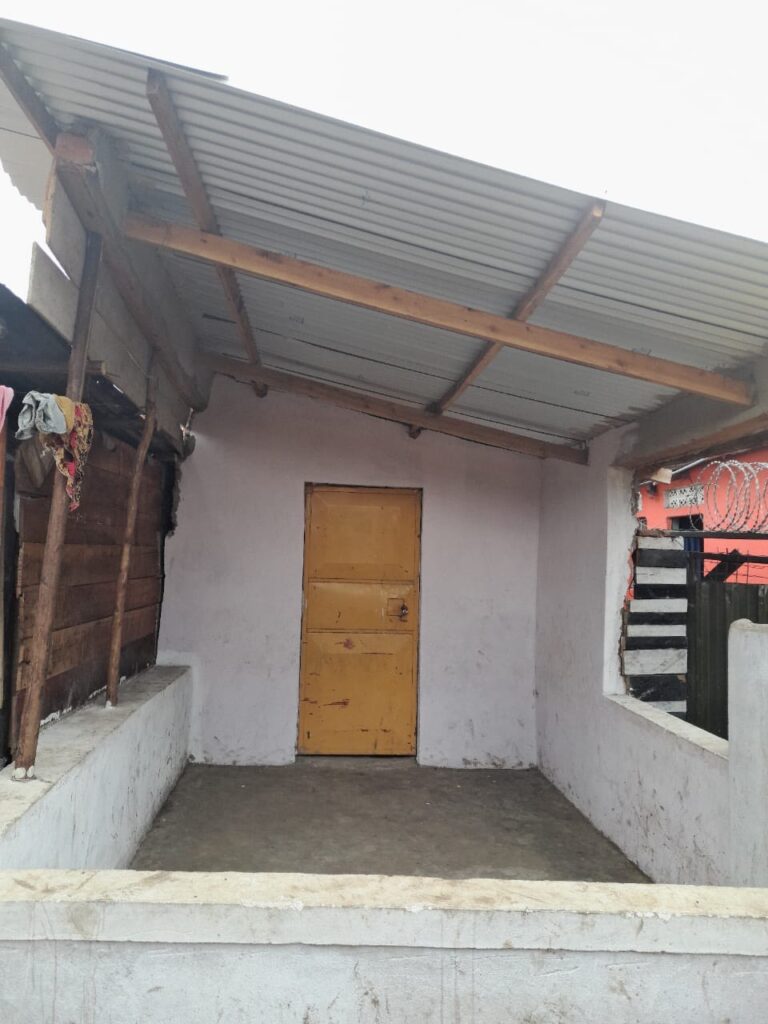
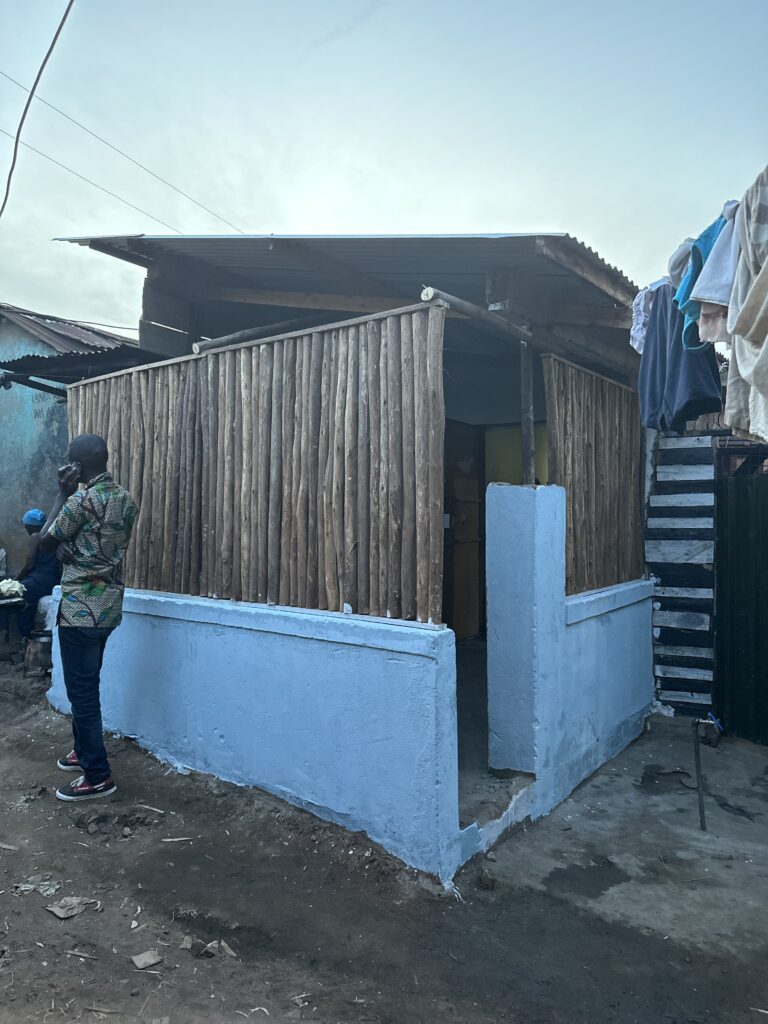 Streetlights Uganda’s phases of remodeling an additional center. (Images courtesy of Merab Akinyi)
Merab Akinyi’s next project is inspired by a YALI fellow who reuses empty bottles for building construction. “Many bottles are lying around. We are looking to develop an awareness campaign on how to use bottles to save the environment,” says Merab Akinyi. “These bottles can be repurposed to fix drainage problems around the centers and add more space.”
Pickard notes this is the goal of the fellowship. “We create opportunities for fellows to learn from each other and for everyone to challenge and develop their personal growth and values.”
Overlapping hearts and minds
The deep sense of camaraderie drew the attention of UMBC community members outside of YALI resulting in powerful friendships and mentorships that continue to this day. Pickard connected Merab Akinyi with artist Ariel Valéria Barbosa, M.P.S. ’24, community leadership, after noticing Merab Akinyi’s passion for using art as a vehicle for change. Barbosa is the program coordinator for UMBC’s food pantry Retriever Essentials and leads A Gente, an organization that gives opportunities to Black artists to travel to the African Diaspora to co-create free exhibitions for the local community.
“There are similarities in our surrealist art styles and wanting to use the little we have and our charisma and intelligence to expand impact for our people,” says Barbosa. “Victoria is really good at what she does, and I want her talents to be nurtured and supported.” Barbosa linked Pickard with DewMore, a nonprofit that uses poetry as a platform for youth leadership.
“It was full circle for me to listen to Victoria read a poem she wrote during the DewMore poetry workshop about her experience in Baltimore,” says Barbosa. “She carries herself with a lot of composure and dignity, like a voice for the people. That is just who she is.”
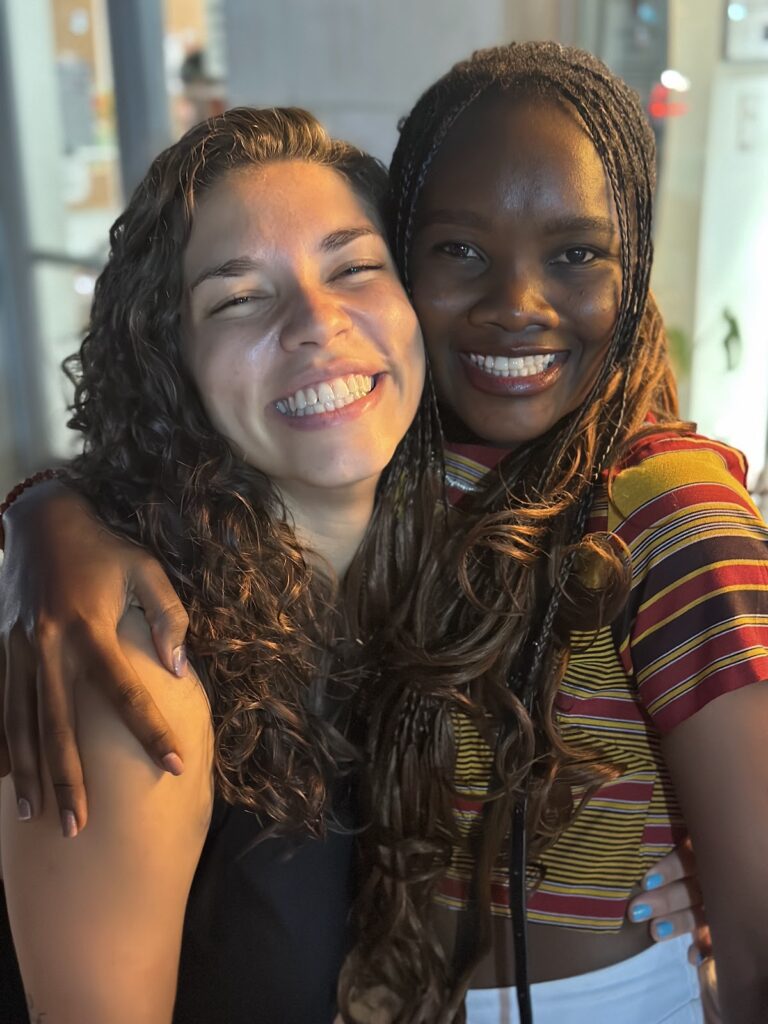
Ariel Barbosa and Victoria Merab Akinyi. (Image courtesy of Merab Akiniyi.)
A smile goes a long way
Lovetta Y. Qualah is the founder and CEO of Positive Actions Driving Safety (PADS), which addresses period poverty by providing free sanitary products to women and girls in Monrovia, Liberia. She found a kindred heart in Namrata Oruganti ’24, biology. As a summer conference assistant, Oruganti helped code keys, fold towels, organize sheets, and prepare comforters for the fellows. “I was blessed to be at that desk,” says Oruganti. The first night, the YALI group organized a party for a fellow who had arrived on his birthday.
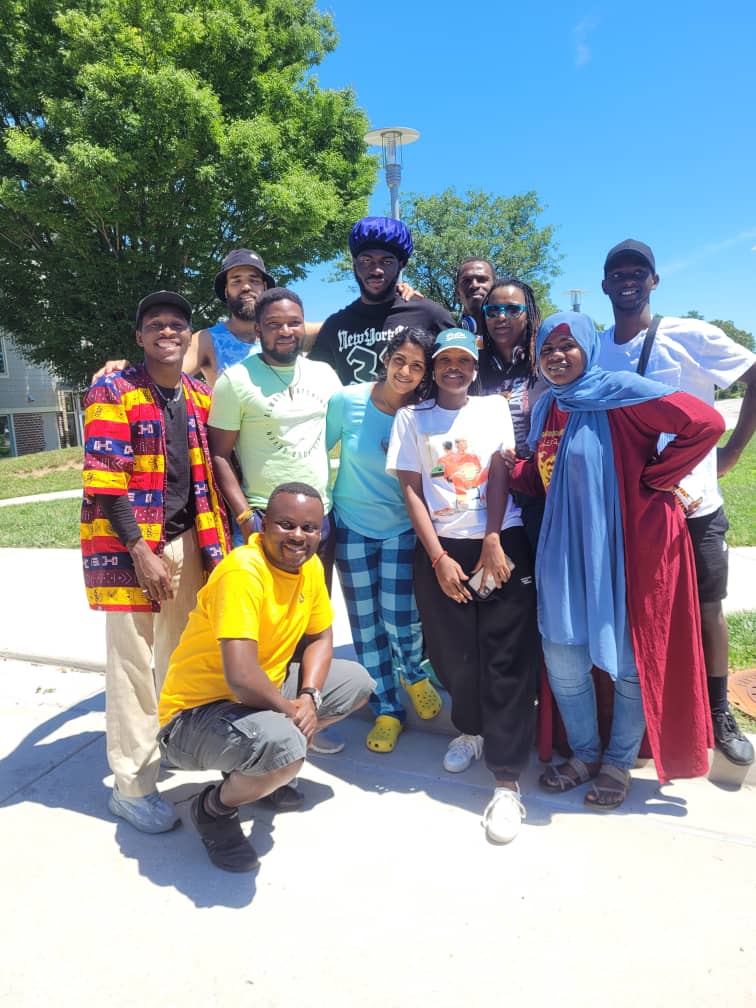
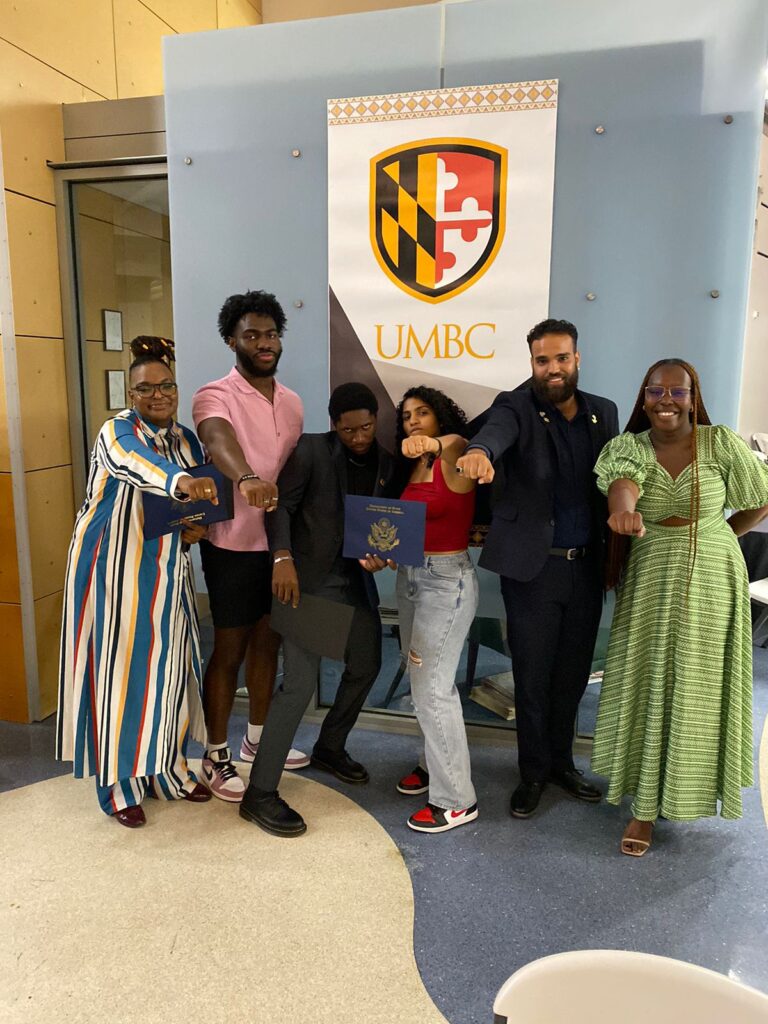 (l-r): Oruganti (center with plaid pants) with fellows on their last days and (center with red shirt) at the farewell ceremony. (Image courtesy of Oruganti)
“I couldn’t believe the fellows weren’t familiar with each other. Each person contributed something they already had,” says Oruganti. They invited her to share a meal and, once they learned of her love for Afro-beats, to dance.
Oruganti had no idea they were CEOs or experts. “Not one person made me feel like I was less than them. People in leadership sometimes forget that,” says Oruganti, known to her friends—which now include the fellows—as Smiley. “Sometimes I forget.”
“Smiley took an interest in me as a person, my work, and my progress,” says Qualah. “Smiley was a really good ambassador for UMBC. She is an image of positive energy. Always checking in on everybody.”
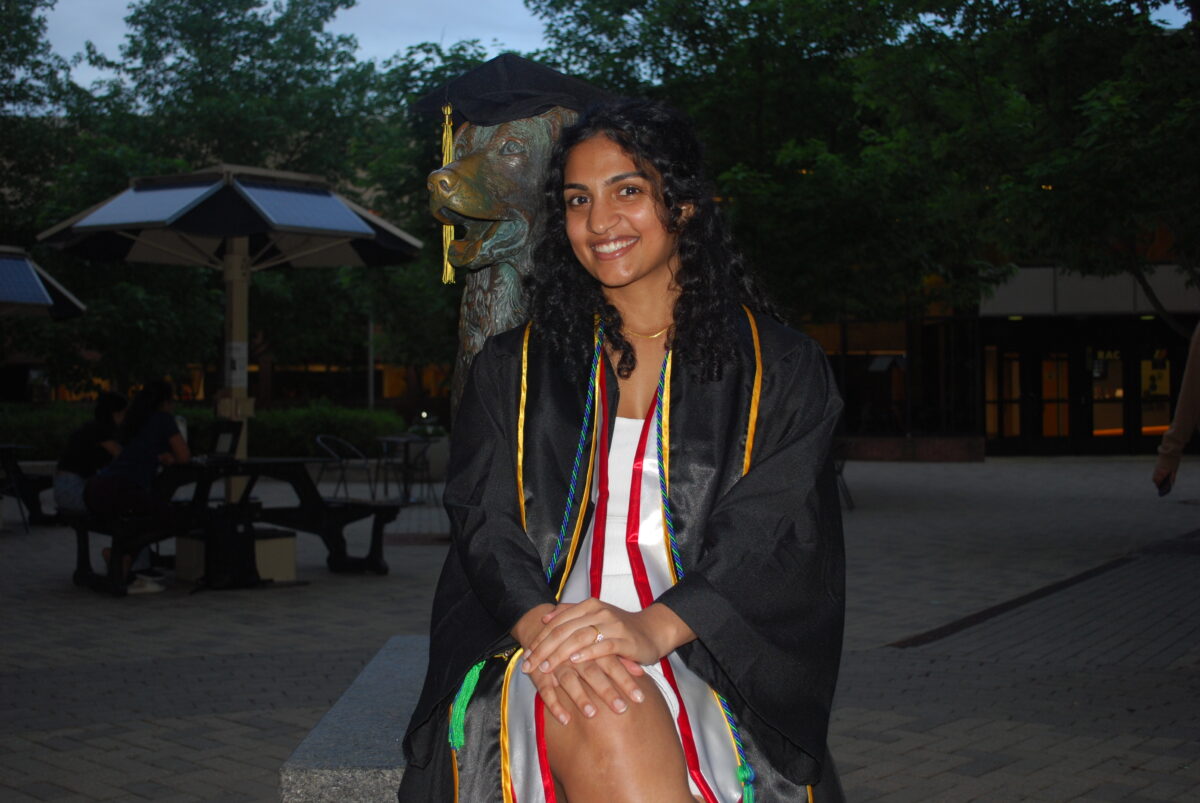
As Oruganti applies to medical school, she keeps her YALI lessons in mind. “The fellows are the most amazing, sweet, and humble people. They taught me how to be a collective,” says Oruganti. “They will always be part of my life story.” The fellows congratulated her on her recent graduation on their WhatsApp chat. “Smiley wasn’t even a part of YALI but she became an integral part,” says Qualah.
(Image courtesy of Oruganti)
Conversation + connection = action
Deep understanding is the goal. Mentorship is the path. To listen, think, share, and reflect is the YALI way. With the help of mentors like Joby Taylor, Ph.D. ’05, language, literacy, and culture, and director of the Shriver Center, fellows build mentorship tools to better communicate with their communities and instill mentorship programs. Taylor led a workshop on place, sense of place, and placemaking as social change in Africa and Baltimore City.
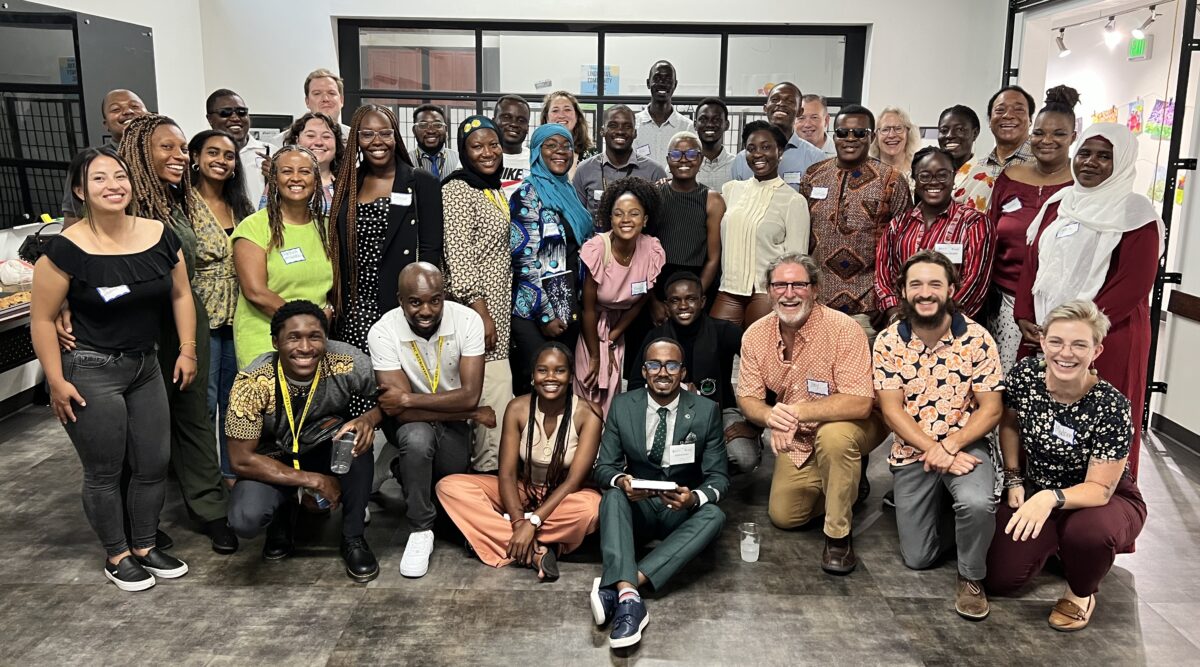 YALI fellows at OCA Mocha with UMBC Shriver Center and CGE staff, Peaceworker fellows, and the Baltimore Entrepreneurship and Leadership Network. (Image courtesy of Sally Scott, director of graduate programs in community leadership at The Shriver Center.)
“Jok and I have had a two-year conversation where we have learned so much about leadership from each other and South Sudan and Baltimore,” says Taylor, who is also Thon’s host family. “Living and working with him makes you want to be a better person.”
Thon put theory to practice by helping fellows complete paperwork and hone their professionalism skills. “This was my favorite part because I saw myself in their work and they saw themselves in my work at UMBC and back home in South Sudan,” says Thon. Heplayed basketball with them every Sunday. “They called me their mentor and big brother.”
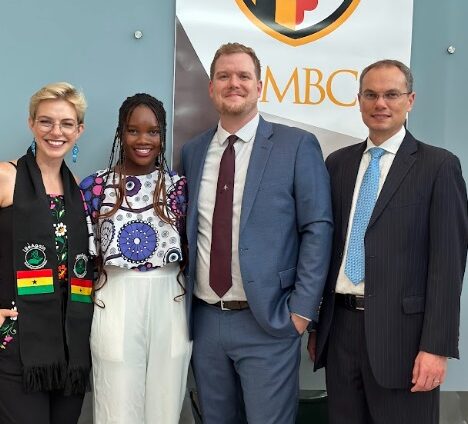
Merab Akinyi appreciated the intention, “Beyond the classes, the dedication, and humility of the facilitators—especially Ryan Sheldon, Madison, and Jok—were great lessons to me as a leader and great virtues for me to take back home.”
(l-r): Pickard, Merab Akinyi, Sheldon, David Di Maria, senior international officer and associate vice provost for international education. (Image courtesy of Mirab Akinyi)
A year later, Qualah continues to reflect on the fears she had while at YALI and how UMBC community members helped her overcome this. “While at YALI I had imposter syndrome. I was looking for validation every day,” says Qualah. “Everything changed when I met amazing people at UMBC: President Valerie Sheares Ashby, Sally Scott, Madison Pickard, Ryan Sheldon, Jok Thon, and, my dear friend and YALI fellow, Lillian Ndilwa. They challenged my perspective, highlighting the unique value I bring and the importance of my contributions. Words like ‘You deserve to be here,’ and ‘Your work is needed’ resonated deeply.” Today, Qualah puts these beliefs to work and is a visible and outspoken leader sharing PADS’ success and her UMBC YALI experience on Facebook.
Africans for Africa
This year, YALI celebrates its 10th anniversary. Nearly 6,500 leaders have taken YALI’s multi-tiered mentorship approach across all sub-Saharan countries. Thon notes convening 20-plus African leaders in one room is a feat on its own. “It’s hard bringing people together in Africa,” he says. “I can have connections in Congo or Kenya because those are my neighboring countries, but you cannot really know what the young people are doing in South Africa from South Sudan or a West African country.”
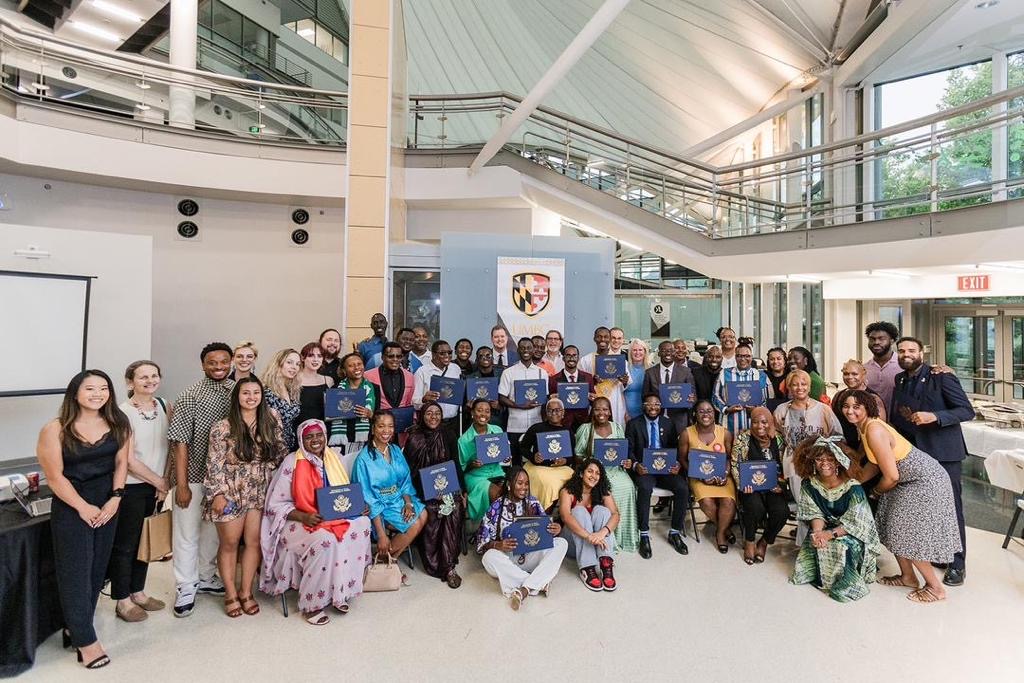 YALI 2023 fellows at their farewell ceremony with the CGE team, Peaceworker Fellows leadership, and Oruganti (center front row wearing red sneakers).
(Image courtesy of Oruganti)
This summer Thon will extend the YALI ripple effect, working as a partnership associate at CorpsAfrica, a non-profit organization focused on engaging youth and helping rural communities overcome extreme poverty.
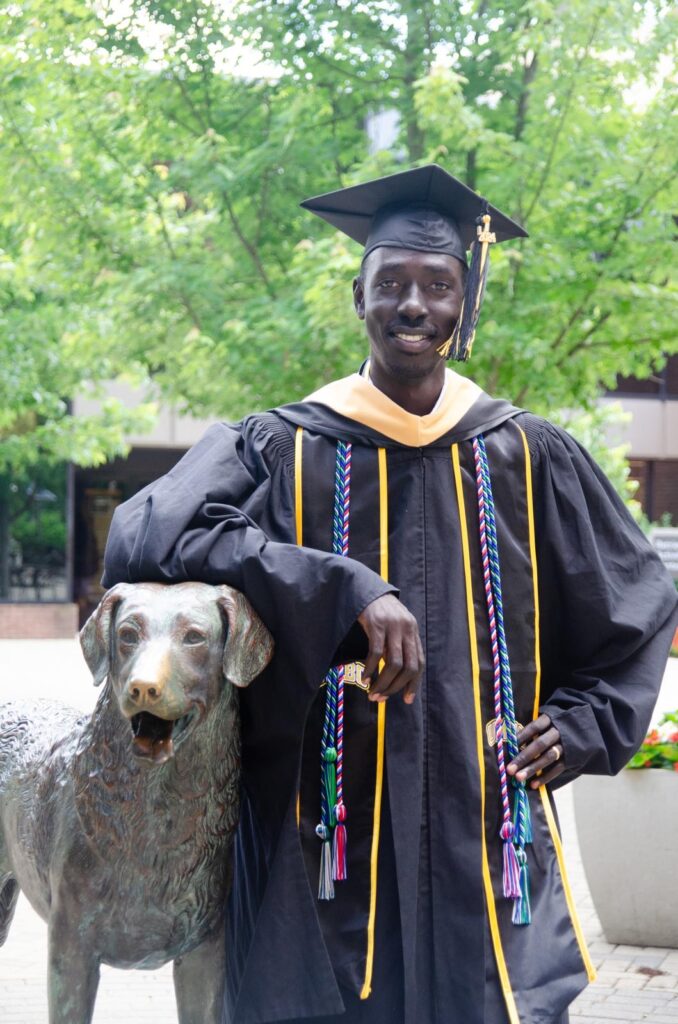 Jok Thon celebrating his 2024 graduation from UMBC.
(Image courtesy of Thon)
“Every little act of peace and kindness gets us closer to building a just and prosperous society where there is no weak or strong, poor or rich,” says Thon, “but a society that thrives on the basic principles of living a dignified life guided by empathy.”
]]>
This summer, UMBC’s Center for Global Engagement (CGE) is excited to welcome its second cohort of the prestigious Mandela Washington Fellowship for Young African Leaders, the six-week flagship...
https://umbc.edu/stories/umbc-center-for-global-engagement-welcomes-young-african-leaders/
https://beta.my.umbc.edu/api/v0/pixel/news/142500/guest@my.umbc.edu/ee1d8353c9a2f54a62f3581da961d3c9/api/pixel
biology
cge
community
international
llc
mlli
news
peaceworker
retriever-essentials
shrivercenter
story
tesol
UMBC News & Magazine
https://beta.my.umbc.edu/groups/umbc-news-magazine
https://assets1-beta.my.umbc.edu/system/shared/avatars/groups/000/001/943/24435aa6207c452e7bc15cc74b42c7bb/xsmall.png?1748556657
https://assets1-beta.my.umbc.edu/system/shared/avatars/groups/000/001/943/24435aa6207c452e7bc15cc74b42c7bb/original.png?1748556657
https://assets2-beta.my.umbc.edu/system/shared/avatars/groups/000/001/943/24435aa6207c452e7bc15cc74b42c7bb/xxlarge.png?1748556657
https://assets2-beta.my.umbc.edu/system/shared/avatars/groups/000/001/943/24435aa6207c452e7bc15cc74b42c7bb/xlarge.png?1748556657
https://assets3-beta.my.umbc.edu/system/shared/avatars/groups/000/001/943/24435aa6207c452e7bc15cc74b42c7bb/large.png?1748556657
https://assets1-beta.my.umbc.edu/system/shared/avatars/groups/000/001/943/24435aa6207c452e7bc15cc74b42c7bb/medium.png?1748556657
https://assets2-beta.my.umbc.edu/system/shared/avatars/groups/000/001/943/24435aa6207c452e7bc15cc74b42c7bb/small.png?1748556657
https://assets1-beta.my.umbc.edu/system/shared/avatars/groups/000/001/943/24435aa6207c452e7bc15cc74b42c7bb/xsmall.png?1748556657
https://assets2-beta.my.umbc.edu/system/shared/avatars/groups/000/001/943/24435aa6207c452e7bc15cc74b42c7bb/xxsmall.png?1748556657
UMBC News & Magazine
3
0
false
Tue, 18 Jun 2024 13:55:38 -0400
Tue, 18 Jun 2024 13:55:38 -0400
“Hidden” sex differences in neurological reward pathways suggest opportunity for improved psychiatric therapeutics

A new study in the Journal of Neurosciencehas discovered underlying sex differences in the molecular pathways that drive reward-related behaviors. In particular, the study found differences and similarities in the ways males and females strengthened connections between two brain regions—the hippocampus and the nucleus accumbens—involved in reward signaling.
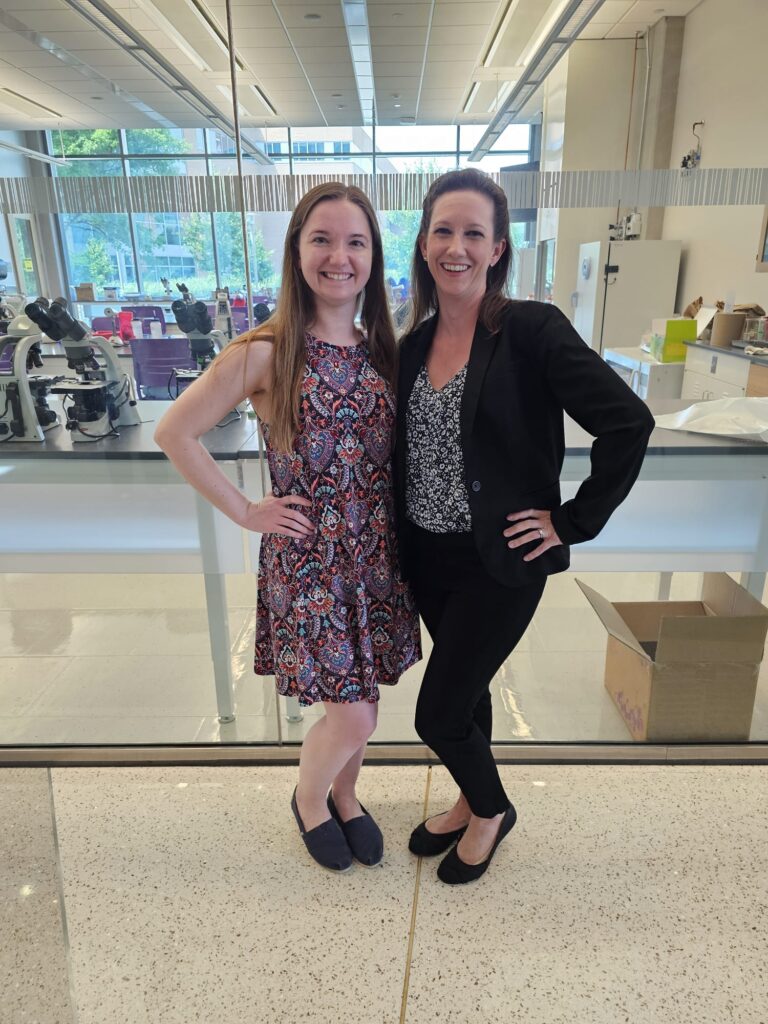 Ashley Copenhaver (left) has been working on her Ph.D. with Tara LeGates (right) since 2021. (Photo courtesy of Copenhaver)
Males and females both suffer from disorders involving these pathways, like depression and substance abuse. However, the presentation and prevalence of these conditions can differ between the sexes, and certain standard treatments are more effective on average in males or females. The new paper’s findings encourage further research to determine if the molecular differences the authors discovered may underpin differences in disease progression or medication response, which could eventually lead to more effective treatments for mental health disorders.
Although this is changing, historically, much more research has been done on male subjects (both in humans and animal models), so “we just don’t know a lot about female brains and differences between male and female brains,” says Tara LeGates, assistant professor of biological sciences and senior author on the new paper. She’s seen an increase in the number of research groups considering sex differences, and is hopeful that their work will continue to produce actionable results that lead to improved outcomes for patients.
LeGates’ previous work used optogenetics, which allows researchers to selectively stimulate particular neurons with light, to demonstrate that strengthening connections between two brain regions—the hippocampus and nucleus accumbens—is rewarding for mice. The hippocampus is best known for its roles in memory and learning, as well as emotional responses. The nucleus accumbens is a “key reward center that integrates information from different brain regions to drive goal-oriented behavior,” LeGates explains.
The hippocampus-nucleus accumbens pathway also exists in humans, and is involved in reward processes in the same way as in mice, LeGates notes, making this research highly translatable to human studies.
Surprising sex differences
The researchers used electrophysiology, which involves observing how living cells respond to stimulation of other brain regions under a microscope, to reach their conclusions about how males and females strengthen connections between the hippocampus and nucleus accumbens.
LeGates and lead author Ashley Copenhaver, a Ph.D. candidate in LeGates’ research group, found that mice of both sexes relied on activation of a particular kinase protein, CAMKII, to facilitate reward-related behavior. Neither sex required dopamine activation, which was surprising, because dopamine is commonly involved in reward-related signaling.
The neurotransmitter receptor NMDA is also commonly involved in reward pathways and strengthening connections between brain regions. The researchers found that male mice were using NMDA receptors to strengthen connections between the hippocampus and nucleus accumbens, but females were not. Instead, the females used a different channel for calcium ions and an estrogen receptor.
“We were really surprised to find this sex difference,” Copenhaver says. Because the NMDA receptor pathway is so commonly assumed to be at play, “It was just really fascinating to see, not only are males and females using different mechanisms, but one is using this NMDA receptor-dependent mechanism, whereas females are not,” Copenhaver says. “They’re using this other, non-canonical pathway—these alternative calcium ion channels. We weren’t expecting that at all.”
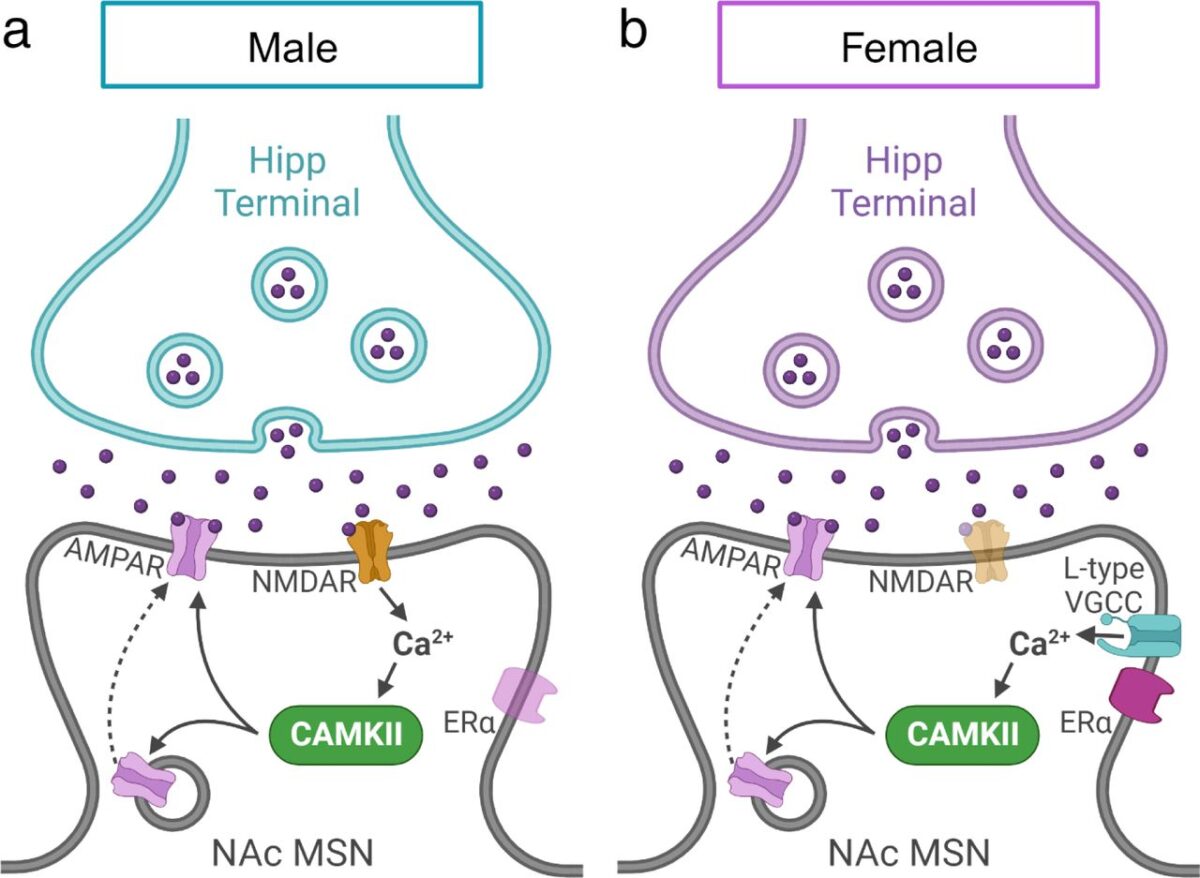 Figure 8 from Copenhaver and LeGates’ paper visually represents the similarities and differences in how males and females strengthen synapses between the nucleus accumbens and hippocampus. The NMDA receptor (gold) is required for transporting calcium into the cell (gray outline) in the male mechanism, whereas females use a different calcium transport receptor (teal) and an adjacent estrogen receptor (magenta).
Revealing these differences and similarities is an important step toward making a real difference in medical care for patients.
“If you want to understand susceptibility and develop better treatments, you have to understand the mechanisms at these synapses,” LeGates says. “You have to understand what’s happening, and you have to understand it in each of the sexes.”
New approaches for better results
Legislation required human studies to include males and females in the early 1990s, but not until 2015 did the National Institutes of Health set policy that animal studies—which are frequently used to justify further human research—must also include both sexes. As a result, there are still many open questions about how male and female physiology differs, and many opportunities to make contributions with significant biomedical impact.
LeGates became more interested in studying sex differences in brain function during her postdoctoral fellowship at the University of Maryland School of Medicine. “I think that one of the problems with trying to do sex difference research is that you’re trying to use things that have been optimized to work in male animals,” LeGates says, “and then when it doesn’t play out in females, it’s just like, ‘Oh, it’s unreliable.’ But what if it’s that the tests were optimized in males, and that’s why they don’t work in females?”
“I wanted to pursue that and appreciate the male and female differences and not try to force them into the same exact paradigms,” she adds. “Maybe we need to come up with new paradigms and a new way to approach how we study them.”
]]>
A new study in the Journal of Neurosciencehas discovered underlying sex differences in the molecular pathways that drive reward-related behaviors. In particular, the study found differences and...
https://umbc.edu/stories/sex-differences-in-neurological-reward-pathways/
https://beta.my.umbc.edu/api/v0/pixel/news/142460/guest@my.umbc.edu/4e9292dfd2de0f1c218f6bdc91f9cf80/api/pixel
biology
cnms
gradresearch
news
research
science-and-tech
story
UMBC News & Magazine
https://beta.my.umbc.edu/groups/umbc-news-magazine
https://assets1-beta.my.umbc.edu/system/shared/avatars/groups/000/001/943/24435aa6207c452e7bc15cc74b42c7bb/xsmall.png?1748556657
https://assets1-beta.my.umbc.edu/system/shared/avatars/groups/000/001/943/24435aa6207c452e7bc15cc74b42c7bb/original.png?1748556657
https://assets2-beta.my.umbc.edu/system/shared/avatars/groups/000/001/943/24435aa6207c452e7bc15cc74b42c7bb/xxlarge.png?1748556657
https://assets2-beta.my.umbc.edu/system/shared/avatars/groups/000/001/943/24435aa6207c452e7bc15cc74b42c7bb/xlarge.png?1748556657
https://assets3-beta.my.umbc.edu/system/shared/avatars/groups/000/001/943/24435aa6207c452e7bc15cc74b42c7bb/large.png?1748556657
https://assets1-beta.my.umbc.edu/system/shared/avatars/groups/000/001/943/24435aa6207c452e7bc15cc74b42c7bb/medium.png?1748556657
https://assets2-beta.my.umbc.edu/system/shared/avatars/groups/000/001/943/24435aa6207c452e7bc15cc74b42c7bb/small.png?1748556657
https://assets1-beta.my.umbc.edu/system/shared/avatars/groups/000/001/943/24435aa6207c452e7bc15cc74b42c7bb/xsmall.png?1748556657
https://assets2-beta.my.umbc.edu/system/shared/avatars/groups/000/001/943/24435aa6207c452e7bc15cc74b42c7bb/xxsmall.png?1748556657
UMBC News & Magazine
1
0
false
Fri, 14 Jun 2024 16:18:08 -0400
Fri, 14 Jun 2024 16:18:08 -0400
Ph.D. candidate Emily Faber improving climate modeling with NOAA fellowship

Over the last two years, Emily Faber, Ph.D. candidate in atmospheric physics, painstakingly replicated part of a NASA climate model on UMBC computing systems. She compared the model’s predictions to on-the-ground data collected at meteorological stations run by the National Oceanic and Atmospheric Administration (NOAA)—and she found significant differences between the two.
Specifically, the NASA model predicted wind speeds in some places above the Arabian Peninsula that differed from the observed measurements by two meters per second, even when Faber looked at the average over 20 years. Wind speed in that region, which is mostly desert, influences the presence of dust in the atmosphere, which, in turn, plays a role in everything from the greenhouse effect to nourishing the Amazon rainforest.
“I was really surprised at the magnitude of the differences,” Faber says. “It’s a model miss. We’re not modeling wind speed as well as we could.”
That’s why she created the replicate model—so she could tinker with the parameters, refining the model so it more accurately reflects reality. A publication on her results is under review, and the findings have significant implications for global climate modeling and forecasting. This will also be Faber’s first, first-author paper, which is an important milestone for any graduate student.
Model mentors
Faber’s latest modeling work would not have been possible without the Weather Program Office Innovation for Next Generation Scientists (WINGS) Dissertation Fellowship, sponsored by NOAA. Faber was one of only three fellows selected for the program’s inaugural year. The fellowship, which began in summer 2023, supplies two years of full funding for her dissertation research and provides Faber with a dedicated NOAA mentor. Her mentor, Barry Baker, Ph.D. ’14, atmospheric physics, has always been supportive and responsive to Faber’s probing questions, she says—“which is great, because I have many.”
“Emily is extremely motivated and shows the characteristics for a long and successful career within the science community. I’m excited to be working with her and help guide her through this stage of her education,” Baker says. “Emily’s work through the WINGS Fellowship will end up having direct impacts on the operational forecasts using the Unified Forecast System that NOAA provides to give advance warning of extreme particulate matter pollution caused by wind-driven processes.”
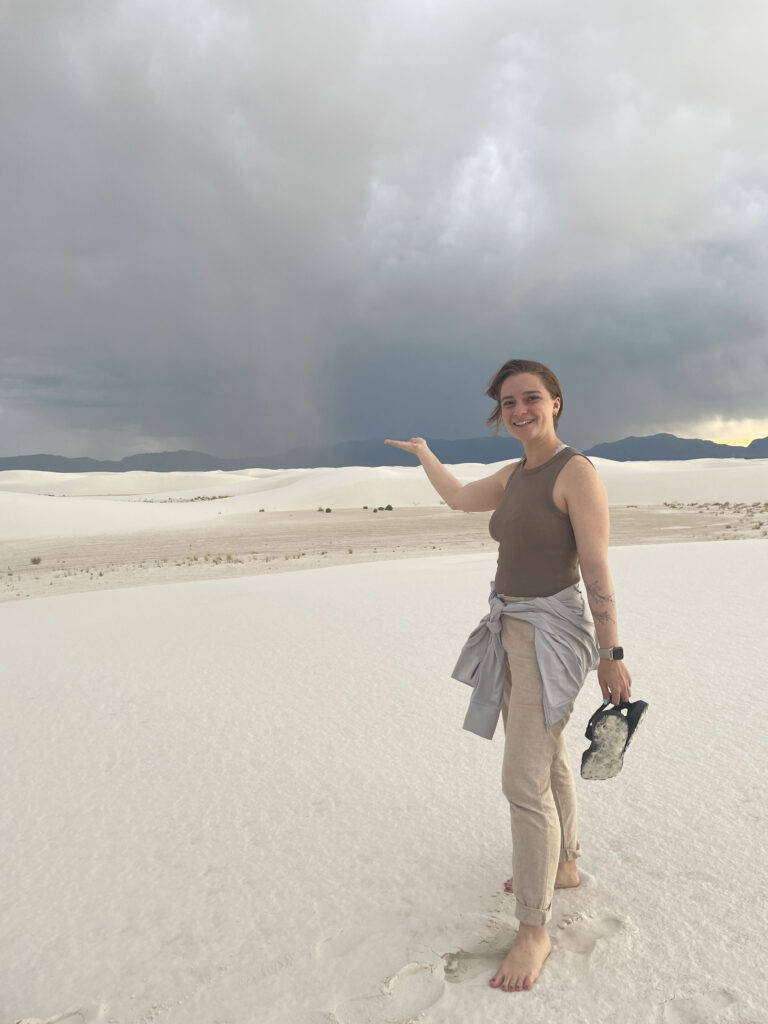 The White Sands National Monument is a great place to observe dust, which is the focus of Emily Faber’s atmospheric research. (Photo courtesy of Faber)
Adriana Rocha Lima, Ph.D. ’15, atmospheric physics, and an assistant professor of physics at UMBC, serves as Faber’s Ph.D. advisor. Faber says she appreciates Rocha Lima’s consistent encouragement and has had many opportunities to mature as a researcher under her mentorship. Faber was full of creative, ambitious research ideas when she approached Rocha Lima about joining her lab—but didn’t yet have a clear understanding of how to implement them, Faber says. “But she didn’t run away from that,” Faber says of Rocha Lima. Instead, Rocha Lima welcomed Faber into the lab and quickly got her started on both modeling and observations-based projects.
Rocha Lima is the rare physicist who has expertise in both modeling and experimental work. “There’s not a challenge I think she couldn’t handle,” Faber says.
Getting up to speed
As Rocha Lima’s first graduate student, Faber found herself in a unique position to help the lab grow from the ground up. That included opportunities to write grants and apply for fellowships, including WINGS, very early in her graduate school career.
With all that practice, “Now I know how to do it,” Faber says. “I know how to get funding and how to write a scientific statement to fit three years of work into two pages or less.”
“It’s actually helpful to have someone advising me who doesn’t have English as a first language, because if I write something and she doesn’t get it the first time, it’s not clearly communicated,” Faber adds. Rocha Lima is originally from Brazil and is a native speaker of Portuguese.
Faber has also enhanced her scientific acumen since she joined Rocha Lima’s lab in 2021. “In the beginning, she was learning how to run the model, repeating prior analyses,” Rocha Lima says. “Now she’s exploring new territory. That’s the contribution that we want to see from a Ph.D. student.”
Faber feels the shift, too. “The real building that I’ve gone through in this program is to be able to talk to other scientists who are in it and be up to speed,” she says. “I’m just now in the last year or so getting to that point where you can fire off questions and add your own ideas.”
The value of connections
As part of the WINGS fellowship, Faber traveled to the National Center for Atmospheric Research (NCAR) in Boulder, Colorado for a workshop on the United Forecast System (UFS), a huge integrated set of analysis systems that look at everything from ice to dust to vegetation in order to model the Earth as a comprehensive system.
At the workshop, Faber met some of the key people working with various systems she is interested in at NOAA. And months later, at the national American Meteorological Society conference, she saw many of them again. “Out of several thousand humans, I was like, ‘I know you, I know you, I know you…’ and I wouldn’t have known them without going out to Boulder,” Faber says.
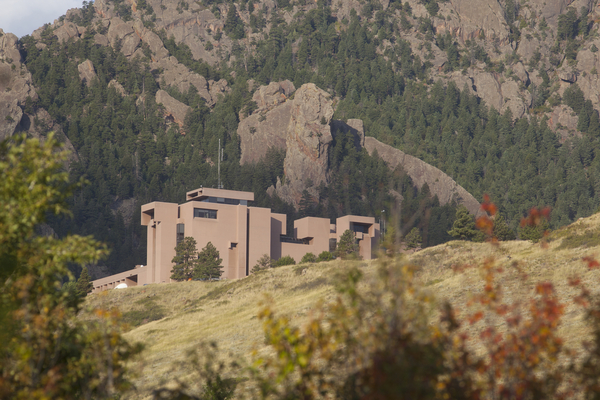 The Mesa Laboratory of the National Center for Atmospheric Research, located outside Boulder, Colorado, complements the scenic backdrop, which features the iconic Flatirons rock formations. (Photo courtesy of NCAR)
The two other WINGS fellows also attended the workshop, and the three of them have stayed in touch since. “It feels like a tiny cohort,” she says. “We do very different things, but we overlap at some point. We’re all working in the UFS system.” Faber is looking forward to meeting the incoming class of WINGS fellows, too.
Everyone wins
The WINGS program is a major stepping stone for Faber toward her long-term goal of working at one of the national laboratories, a network of research institutions across the country associated with various federal agencies.
In particular, “I really vibe with the NOAA mission,” Faber says, and the WINGS program has “turned out to be a really great interface between the national labs and the university.”
The fellowship furthers Faber’s personal career trajectory, and it also supports Rocha Lima’s growing lab by providing funding for Faber’s Ph.D. As a result, Rocha Lima has been able to add an additional graduate student to her group. NOAA and NCAR also benefit from the energy, talent, and fresh ideas coming from the fellows. Although it is new, Faber and her mentors are looking forward to it continuing to support students and the pursuit of atmospheric research.
As Faber says, “It’s a win-win.”
]]>
Over the last two years, Emily Faber, Ph.D. candidate in atmospheric physics, painstakingly replicated part of a NASA climate model on UMBC computing systems. She compared the model’s predictions...
https://umbc.edu/stories/emily-faber-climate-modeling-noaa-fellowship/
https://beta.my.umbc.edu/api/v0/pixel/news/142455/guest@my.umbc.edu/cdd870909f2e591afaee13afff2a18c8/api/pixel
alumni
cnms
gradresearch
impact
news
physics
research
science-and-tech
spring-2024
story
UMBC News & Magazine
https://beta.my.umbc.edu/groups/umbc-news-magazine
https://assets1-beta.my.umbc.edu/system/shared/avatars/groups/000/001/943/24435aa6207c452e7bc15cc74b42c7bb/xsmall.png?1748556657
https://assets1-beta.my.umbc.edu/system/shared/avatars/groups/000/001/943/24435aa6207c452e7bc15cc74b42c7bb/original.png?1748556657
https://assets2-beta.my.umbc.edu/system/shared/avatars/groups/000/001/943/24435aa6207c452e7bc15cc74b42c7bb/xxlarge.png?1748556657
https://assets2-beta.my.umbc.edu/system/shared/avatars/groups/000/001/943/24435aa6207c452e7bc15cc74b42c7bb/xlarge.png?1748556657
https://assets3-beta.my.umbc.edu/system/shared/avatars/groups/000/001/943/24435aa6207c452e7bc15cc74b42c7bb/large.png?1748556657
https://assets1-beta.my.umbc.edu/system/shared/avatars/groups/000/001/943/24435aa6207c452e7bc15cc74b42c7bb/medium.png?1748556657
https://assets2-beta.my.umbc.edu/system/shared/avatars/groups/000/001/943/24435aa6207c452e7bc15cc74b42c7bb/small.png?1748556657
https://assets1-beta.my.umbc.edu/system/shared/avatars/groups/000/001/943/24435aa6207c452e7bc15cc74b42c7bb/xsmall.png?1748556657
https://assets2-beta.my.umbc.edu/system/shared/avatars/groups/000/001/943/24435aa6207c452e7bc15cc74b42c7bb/xxsmall.png?1748556657
UMBC News & Magazine
3
0
false
Fri, 14 Jun 2024 12:00:28 -0400
Fri, 14 Jun 2024 12:00:28 -0400
Infrastructure of support after Key Bridge collapse

In 1987, Paul Flinton, then a 23-year-old senior studying at UMBC, decided to make a short documentary focused on the tollbooth workers on the Francis Scott Key Bridge.
The six-minute documentary “One Dollar”—named after the toll’s cost for cars at the time—captures a vehicle’s journey across the bridge from the driver’s point of view in one continuous take. As Flinton ’87, visual arts, drives across the bridge, audio of the tollbooth workers interviewed for the project act as the film’s narrators in which they share some of their experiences as toll operators.
Flinton, who is now a location sound manager for NFL Films, went on to win an award for “One Dollar” from the Maryland State Arts Council following its release. Nearly four decades later, Flinton all but forgot about the film’s existence until learning of the bridge’s collapse following a collision with a malfunctioning cargo ship on March 26, sending eight construction workers into the water and taking the lives of six.
“It hit a nerve,” Flinton told local news after the disaster. “[The film is] sort of a treasure…This captures something that in a lot of ways can’t really happen again.”
Paul Flinton’s short documentary entitled “One Dollar” (1987).
Supporting the impacted families
The Key Bridge opened to traffic in 1977, and regularly 30,000 vehicles crossed the 1.6 mile span over the Patapsco River. An integral part of Baltimore’s beltway, commuters, community members, and experts are now struggling to make sense of the literal change of transportation landscape. Now that the wreckage is completely cleared away and as the eventual construction commences, UMBC experts offer up their expertise and resources to confront the tragedy.
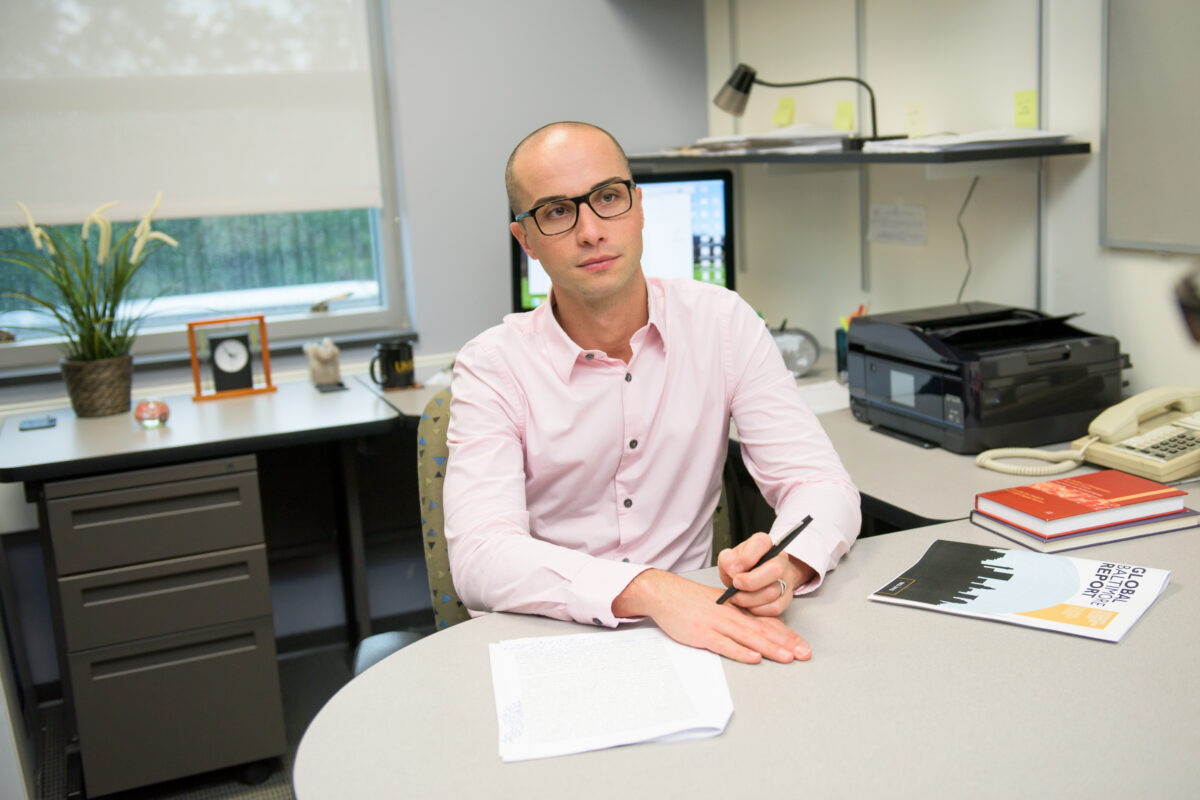 Felipe Filomeno. (Marlayna Demond ’11/UMBC)
After learning that all of the direct victims of the collapse were immigrants from countries throughout Latin America, Felipe Filomeno, associate professor of political science and global studies, immediately sprang into action with fellow members of the grassroots organization Latino Racial Justice Circle (LRJC). Filomeno, who is president of the LRJC, worked with the organization’s leadership team to establish a fundraiser in support of the families of the victims of the bridge collapse.
The crowdfunded campaign initially had a goal of raising about $5,000 for each of the families impacted, Filomeno said. Within hours of going live with the GoFundMe campaign, the organization raised $100,000 from donors located all around the world.
“The fundraiser caught a lot of traction. I have been overwhelmed by the outpouring of solidarity that we got from across the world in that week when the tragedy happened,” says Filomeno.
Following the fundraising success, the group has since directed prospective supporters to the Mayor’s Office of Immigrant Affairs’ Key Bridge Emergency Response Fund. The Mayor’s Office is working with the LRJC and case managers to distribute the funding to the six impacted families.
The tragedy has underlined key issues impacting the Latino immigrant community, challenges that Filomeno amplifies through his community-centered research at UMBC. “[The collapse] has highlighted and publicized to the world issues that we already know exist—the fact that Latino immigrants are over-represented in dangerous occupations,” says Filomeno. “There are higher incidents of work-related accidents among the Latino populations.”
Filomeno’s forthcoming book, Christian Cosmopolitanism: Faith Communities Talk Immigration (Temple University Press, 2024), explores the Honest Conversations on Immigration program he co-developed in 2017 in partnership with the LRJC. The program, Filomeno explains, was designed to build mutual understanding and collaboration between people who are diverse, but share the same religion.
“One of the goals is to build solidarity across differences,” says Filomeno. “The solidarity across differences is a principle that we also see in the Key Bridge fundraiser.”
Through his advocacy and academic scholarship, Filomeno is working to amplify the need for more long lasting efforts to stand in solidarity with Latino immigrant communities beyond moments of tragedy. “Those problems that became evident with the fall of the bridge, those challenges that the Latino immigrant population faces, they are still there,” he says. “To move the needle on those issues, it has to be more than helping those six families at this point in time.”
Examining the environmental impacts of the collapse
The ship that collided into the bridge was carrying 56 containers of hazardous materials, including corrosives, flammables, and lithium-ion batteries. The cargo ship was also carrying more than one million gallons of fuel at the time of the impact. City officials began their investigations into the incident, which included determining the environmental impacts to the Patapsco River and surrounding communities.
Upal Ghosh, professor of chemical, biochemical, and environmental engineering, whose research includes examining the effects of toxic pollutants in soils, sediments, and aquatic environments, was among the experts who weighed in on assessing the potentially hazardous effects of the containers that were resting at the bottom of the river.
 Maryland Comptroller Brooke Lierman and representatives of the Office of the Governor take a tour of the Francis Scott Key Bridge collapse site on a Maryland Department of Natural Resources police boat. (Photo source: Corey Jennings ’10, Maryland Comptroller/Flickr)
Ghosh told the Baltimore Sun days after the collapse that environmental officials’ first priority would likely be making sure none of the intact containers were breached.
“If you have containers that contain oily material, those things will, if they are breached, be releasing over time,” Ghosh said. “I would think if there is a release that goes down into the sediments under the water, it would be a local impact right there.”
Farah Nibbs, assistant professor of emergency and disaster health systems, is also thinking about future ways to contain the effects of similar disasters. Contributing factors to the bridge’s collapse, she says, can be tied to the 2012 expansion and modernization of the Port of Baltimore. Those changes did not happen hand in hand with improvements in safety management needed to accommodate ships of such huge sizes that now were able to port in the city. Risks from collisions, fuel spills, and contamination still lack proper oversight and regulation.
“A novel approach for decision-makers may be to view Maryland’s emergency management and transportation experts and service providers—as well as the physical bridge infrastructure itself—as part of the community’s lifeline systems,” said Nibbs.
More than a disaster
As plans for the bridge’s rebuilding process begins to take shape, Brian Grodsky, professor of political science, shed light on why Maryland Governor Wes Moore likely did not request a presidential disaster declaration in response to the collapse. Presidential disaster declarations, Grodsky said in a local tv news segment, are usually limited to tragedies that involve fires, floods, or explosives.
“Man-made disasters are more likely to be declined [for a presidential disaster declaration] because there is that question of public versus private ownership of the disaster,” he added. “If this ship caught on fire or exploded under the bridge, this would easily be qualified as a major disaster.”
Deborah Rudacille, professor of the practice in English, is well aware of the lives connected to the construction and opening of the Key Bridge. In 2010, she published Roots of Steel: Boom and Bust in an American Mill Town, a book exploring Baltimore’s industrial history of the Sparrows Point steel mill, but also capturing her family’s connection to the mill and Baltimore staples like the Key Bridge.
Rudacille’s mother was one of the original employees—collecting the toll that Flinton documented in his film— when the bridge first opened in 1977, and her brother worked as one of the bridge’s painters.
“They were kind of reminiscing about the fact that everything down there is now gone,” Rudacille told local media about her family. “First the steelworks, now the Key Bridge is gone. It’s like this world that they lived and worked in has vanished completely.”
]]>
In 1987, Paul Flinton, then a 23-year-old senior studying at UMBC, decided to make a short documentary focused on the tollbooth workers on the Francis Scott Key Bridge. The six-minute...
https://umbc.edu/stories/support-after-key-bridge-collapse/
https://beta.my.umbc.edu/api/v0/pixel/news/142431/guest@my.umbc.edu/85f4487fb5eddd76a8baa59270f45a52/api/pixel
cahss
cbee
coeit
discovery
edhs
english
magazine
political-science
spring-2024
story
visual-arts
UMBC News & Magazine
https://beta.my.umbc.edu/groups/umbc-news-magazine
https://assets1-beta.my.umbc.edu/system/shared/avatars/groups/000/001/943/24435aa6207c452e7bc15cc74b42c7bb/xsmall.png?1748556657
https://assets1-beta.my.umbc.edu/system/shared/avatars/groups/000/001/943/24435aa6207c452e7bc15cc74b42c7bb/original.png?1748556657
https://assets2-beta.my.umbc.edu/system/shared/avatars/groups/000/001/943/24435aa6207c452e7bc15cc74b42c7bb/xxlarge.png?1748556657
https://assets2-beta.my.umbc.edu/system/shared/avatars/groups/000/001/943/24435aa6207c452e7bc15cc74b42c7bb/xlarge.png?1748556657
https://assets3-beta.my.umbc.edu/system/shared/avatars/groups/000/001/943/24435aa6207c452e7bc15cc74b42c7bb/large.png?1748556657
https://assets1-beta.my.umbc.edu/system/shared/avatars/groups/000/001/943/24435aa6207c452e7bc15cc74b42c7bb/medium.png?1748556657
https://assets2-beta.my.umbc.edu/system/shared/avatars/groups/000/001/943/24435aa6207c452e7bc15cc74b42c7bb/small.png?1748556657
https://assets1-beta.my.umbc.edu/system/shared/avatars/groups/000/001/943/24435aa6207c452e7bc15cc74b42c7bb/xsmall.png?1748556657
https://assets2-beta.my.umbc.edu/system/shared/avatars/groups/000/001/943/24435aa6207c452e7bc15cc74b42c7bb/xxsmall.png?1748556657
UMBC News & Magazine
2
0
false
Thu, 13 Jun 2024 13:40:41 -0400
Thu, 13 Jun 2024 13:40:41 -0400
Watch: A recap of UMBC-led NASA Dissipation sounding rocket launch

Planetary scientist Mehdi Benna of UMBC’s Center for Space Sciences and Technology, along with a team of collaborators, recently released a video recounting the launch of NASA’s Dissipation sounding rocket mission.
The Dissipation sounding rocket, which launched from the Poker Flat Research Range in Fairbanks, Alaska in November 2023, carried a suite of six instruments designed to measure how Earth’s upper atmosphere at high altitudes responds to large energy inputs from the sun during auroral storms.
The video recaps how Benna, principal investigator of Dissipation, and his team of scientists and engineers overcame a series of obstacles to successfully launch the sounding rocket during the peak of the auroral activity that took place in Alaska on November 8.
The launch of NASA’s Dissipation sounding rocket from the Poker Flat Research Range in Fairbanks, Alaska on November 8, 2023.
“It was an exciting but nerve-racking experience. The countdown had to be precisely timed to target the peak of the auroral activities, which lasted less than 30 minutes from its growth to recovery phase,” said Benna in an article. “The last four minutes of the countdown felt like hours as we waited for the last items on the launch checklist to be completed before the rocket could lift off.”
Along with Benna, the Dissipation team included scientists and engineers from UMBC, Goddard Space Flight Center, the Wallops Flight Facility, the University of New Hampshire, and the University of Alaska Fairbanks.
Benna shares that the video encapsulates “the human aspect of space engineering that is rarely shown, and demonstrates that the success of these types of missions are often hinged on the real time and quick decision-making of the engineers.”
]]>
Planetary scientist Mehdi Benna of UMBC’s Center for Space Sciences and Technology, along with a team of collaborators, recently released a video recounting the launch of NASA’s Dissipation...
https://umbc.edu/quick-posts/dissipation-sounding-rocket-launch/
https://beta.my.umbc.edu/api/v0/pixel/news/142424/guest@my.umbc.edu/57ee748b1e5c3872c9c231a9486cb039/api/pixel
csst
nasa-goddard-space-flight-center
quick-post
research
UMBC News & Magazine
https://beta.my.umbc.edu/groups/umbc-news-magazine
https://assets1-beta.my.umbc.edu/system/shared/avatars/groups/000/001/943/24435aa6207c452e7bc15cc74b42c7bb/xsmall.png?1748556657
https://assets1-beta.my.umbc.edu/system/shared/avatars/groups/000/001/943/24435aa6207c452e7bc15cc74b42c7bb/original.png?1748556657
https://assets2-beta.my.umbc.edu/system/shared/avatars/groups/000/001/943/24435aa6207c452e7bc15cc74b42c7bb/xxlarge.png?1748556657
https://assets2-beta.my.umbc.edu/system/shared/avatars/groups/000/001/943/24435aa6207c452e7bc15cc74b42c7bb/xlarge.png?1748556657
https://assets3-beta.my.umbc.edu/system/shared/avatars/groups/000/001/943/24435aa6207c452e7bc15cc74b42c7bb/large.png?1748556657
https://assets1-beta.my.umbc.edu/system/shared/avatars/groups/000/001/943/24435aa6207c452e7bc15cc74b42c7bb/medium.png?1748556657
https://assets2-beta.my.umbc.edu/system/shared/avatars/groups/000/001/943/24435aa6207c452e7bc15cc74b42c7bb/small.png?1748556657
https://assets1-beta.my.umbc.edu/system/shared/avatars/groups/000/001/943/24435aa6207c452e7bc15cc74b42c7bb/xsmall.png?1748556657
https://assets2-beta.my.umbc.edu/system/shared/avatars/groups/000/001/943/24435aa6207c452e7bc15cc74b42c7bb/xxsmall.png?1748556657
UMBC News & Magazine
0
0
false
Thu, 13 Jun 2024 10:05:11 -0400
Thu, 13 Jun 2024 10:05:11 -0400
Remembering Sheldon Caplis
The Office of Institutional Advancement is saddened to share the news that Sheldon Caplis, former vice president for Institutional Advancement and UMBC emeritus staff member, passed away on Tuesday, June 11, 2024. A member of the President’s Council from 1993 to 2008, Sheldon was a treasured colleague and mentor who was instrumental in moving our alumni relations, fundraising, and marketing and communications to new levels of success.
Sheldon believed deeply in education and was passionate about philanthropy. The team he built at UMBC met challenging goals and helped establish many initiatives that are part of the campus fabric today. He guided the university in securing its first charitable gift of $1 million, and was especially proud to be a champion for the creation of the award-winning UMBC Magazine. During his tenure, he led a seven-year, $66-million fundraising campaign that exceeded its ambitious goal by $16 million.
Sheldon came to UMBC from the University of Baltimore, where he served in a variety of positions, eventually becoming the vice president for development from 1972 to 1973. He retired from UMBC in 2008 and went on to be the director of community relations at One Main Financial from 2008 to 2016 and the founder of Caplis Consulting. He was also the chair of the The Associated: Jewish Federation of Baltimore’s Life and Legacy program.
Sheldon and his wife Jamie continued to support UMBC after his retirement as loyal scholarship donors. Established in June 2003 in memory of their fathers, the Joseph Caplis and Joseph Waldman Scholarship Fund supports students in the Meyerhoff Scholars Program.
Sheldon carried his advocacy for education beyond UMBC, serving on a variety of nonprofit and educational boards, including the Community College of Baltimore County. He was born and raised in Baltimore and received his bachelor’s degree in marketing from the University of Baltimore and his M.B.A. from Morgan State University.
Sheldon is survived by his wife Jamie, his son Jon, his daughter Allison, and four grandchildren. Services will be held at Sol Levinson’s Chapel, 8900 Reisterstown Road, Pikesville, MD 21208, on Friday, June 14, 2024, at 12:00 p.m. Please omit flowers. The family will receive visitors at 113 River Oaks Circle, Pikesville, MD 21208, Friday immediately following interment and also on Sunday.
Sincerely,
Stanyell Odom, Director of Alumni Engagement
Kim Robinson, Director of Major Gifts
]]>
The Office of Institutional Advancement is saddened to share the news that Sheldon Caplis, former vice president for Institutional Advancement and UMBC emeritus staff member, passed away on...
https://my3.my.umbc.edu/groups/announcements/posts/142417
https://beta.my.umbc.edu/api/v0/pixel/news/142418/guest@my.umbc.edu/c069277de09c10a5b2ec82f0f7097a6f/api/pixel
in-memoriam
rss
story
UMBC News & Magazine
https://beta.my.umbc.edu/groups/umbc-news-magazine
https://assets1-beta.my.umbc.edu/system/shared/avatars/groups/000/001/943/24435aa6207c452e7bc15cc74b42c7bb/xsmall.png?1748556657
https://assets1-beta.my.umbc.edu/system/shared/avatars/groups/000/001/943/24435aa6207c452e7bc15cc74b42c7bb/original.png?1748556657
https://assets2-beta.my.umbc.edu/system/shared/avatars/groups/000/001/943/24435aa6207c452e7bc15cc74b42c7bb/xxlarge.png?1748556657
https://assets2-beta.my.umbc.edu/system/shared/avatars/groups/000/001/943/24435aa6207c452e7bc15cc74b42c7bb/xlarge.png?1748556657
https://assets3-beta.my.umbc.edu/system/shared/avatars/groups/000/001/943/24435aa6207c452e7bc15cc74b42c7bb/large.png?1748556657
https://assets1-beta.my.umbc.edu/system/shared/avatars/groups/000/001/943/24435aa6207c452e7bc15cc74b42c7bb/medium.png?1748556657
https://assets2-beta.my.umbc.edu/system/shared/avatars/groups/000/001/943/24435aa6207c452e7bc15cc74b42c7bb/small.png?1748556657
https://assets1-beta.my.umbc.edu/system/shared/avatars/groups/000/001/943/24435aa6207c452e7bc15cc74b42c7bb/xsmall.png?1748556657
https://assets2-beta.my.umbc.edu/system/shared/avatars/groups/000/001/943/24435aa6207c452e7bc15cc74b42c7bb/xxsmall.png?1748556657
UMBC News & Magazine
6
0
false
Wed, 12 Jun 2024 16:30:45 -0400