The News – Winter 2013

TEACHING THE FUTURE
October 6 was a special night at the Baltimore Marriott Waterfront, when 900 guests filled the main ballroom for “A Celebration of Leadership + Innovation” that honored UMBC President Freeman A. Hrabowski, III, on his 20 years as the university’s leader and inaugurated the Hrabowski Fund for Innovation to sustain and extend advances in teaching.
The celebratory buzz hadn’t yet died down when Provost Philip Rous and a committee selected to administer the fund were already at work identifying the next wave of academic innovators at UMBC. In January, the committee announced the Hrabowski Fund’s first awards.
Two large awards were made to teams led by Marie desJardins, a professor of computer science and electrical engineering (who proposed a new center to assist a redesign of UMBC’s computing curriculum) and Nagaraj K. Neerchal, chair of the mathematics and statistics department (who proposed a new “mathematics gym” to improve students’ foundational math skills.)
Four other proposals received smaller awards. Two teams, one led by Susanne Sutton, a lecturer in the modern languages and linguistics department, and another led by Anne Spence, an assistant professor in the department of mechanical engineering, received funds to develop a new experiential and service learning course requirements. A team led by Craig Saper, director of UMBC’s language, literacy and culture (LLC) program, will create an institute to expand the role for emeritus professors at UMBC. And a proposal by Bruce J. Walz, chair of the emergency health services department, will allow for new video cameras to assist in debriefing of EHS students after team exercises.
Watch video tributes from Dr. Hrabowski’s 20th anniversary celebration and the launch of the Hrabowski Fund for Innovation. Read more…
— Richard Byrne ’86
INCREASING OPPORTUNITY
Cybersecurity is one of the fastest growing fields in American defense and industry, but U.S. universities aren’t keeping up with the voracious demand for trained and certified personnel.
Helping satisfy that demand is the aim of a new collaboration between UMBC’s new Center for Cybersecurity and the Northrop Grumman Foundation: the UMBC Cyber Scholars program. The foundation has provided a $1 million grant to launch the program, which will be run in partnership with the UMBC Center for Women in Technology.
The Cyber Scholars program will recruit 15 to 20 new scholars annually, with special emphasis on increasing the number of women and underrepresented minorities who are being prepared for cybersecurity careers.
Anupam Joshi, director of the Center for Cybersecurity and the Cyber Scholars program, observes that “cybersecurity is of critical national importance, since computer systems are part of the nation’s critical infrastructure. But students often don’t understand the field and women are particularly likely to see it as a bad fit for them. The scholars program gives us a chance to change that perception and show how rewarding and socially important this work can be.”
The Cyber Scholars program continues already fruitful partnerships between UMBC, Northrop Grumman, and the company’s foundation, including the Cync program – a start-up business incubator dedicated to cultivating companies that develop innovative solutions to counter global cyberthreats.
“Northrop Grumman is proud to support education programs that will develop tomorrow’s cyber leaders,” says Wes Bush, chairman, chief executive officer and president of Northrop Grumman.
— Nicole Ruediger
INTERNATIONAL ACCLAIM
Local and national media took notice of UMBC again in September, when the university was lauded once again – for the fourth year running – as the top “Up-and-Coming” school in the U.S. News and World Report’s annual Best Colleges guide. (In 2012, UMBC shared top honors with George Mason University.)
The Best Colleges guide also ranked UMBC eighth on a list of the top national universities “where the faculty has an unusual commitment to undergraduate teaching” – a ranking that the university shared with Duke University, the University of California at Berkeley, the University of Chicago, and the University of Notre Dame. But you might have missed some significant recognition that the university gained from another prestigious journal in higher education: Times Higher Education.
In May, the London-based newspaper created its first ranking of universities worldwide that were 50 years old or less. UMBC was ranked at number 63 on that list, joining other U.S. universities including the Universities of California at Irvine (4) and Santa Cruz (7), the University of Illinois at Chicago (11), the University of Medicine and Dentistry of New Jersey (21), the Universities of Texas at Dallas (29) and San Antonio (53) and George Mason (57).
In an introduction to the table, Times Higher Education writer John Morgan observed that the goal of the “100 Under 50 University Rankings” was “to show which nations are challenging the U.S. and U.K. as higher education powerhouses – and offers insights into which institutions may be future world leaders.”
— Richard Byrne ’86
BUILDING BRIDGES

UMBC has been in the forefront of increasing student access and success in science, technology, engineering and math (STEM). And now, with a new $2.6 million grant from the Bill & Melinda Gates Foundation, the university will make pathways to these STEM fields even wider.
The three-year grant will be used to build a national model to ensure more transfer students earn degrees in these key disciplines. Anne Arundel Community College, the Community College of Baltimore County, Howard Community College and Montgomery College will work with UMBC on this “STEM Transfer Student Success Initiative.”
Almost half of American undergraduates now start their postsecondary education at a community college, and in Maryland alone, about 12,000 students transfer to four-year colleges each year. At UMBC, transfer students now account for 38 percent of new students in STEM fields each year.
“We recognize that universities and community colleges must work more closely together if we are to help more students from all backgrounds succeed in the STEM fields,” says Philip Rous, the grant’s principal investigator and UMBC’s Provost and Senior Vice President for Academic Affairs.
“Today, and increasingly in the future, the brightest career prospects will be for those with STEM degrees,” says Daniel Greenstein, director of Postsecondary Success at the Bill & Melinda Gates Foundation. “We are pleased to support this project because it will create a pathway for transfer students – many of whom are nontraditional students – to enter these professions.”
— Elyse Ashburn
]]>
TEACHING THE FUTURE October 6 was a special night at the Baltimore Marriott Waterfront, when 900 guests filled the main ballroom for “A Celebration of Leadership + Innovation” that honored UMBC...
https://umbc.edu/stories/the-news-winter-2013/
https://beta.my.umbc.edu/api/v0/pixel/news/123501/guest@my.umbc.edu/8a56e5d2b9535d924626b8cf2f5294e7/api/pixel
campus-life
winter-2013
UMBC News & Magazine
https://beta.my.umbc.edu/groups/umbc-news-magazine
https://assets1-beta.my.umbc.edu/system/shared/avatars/groups/000/001/943/24435aa6207c452e7bc15cc74b42c7bb/xsmall.png?1748556657
https://assets1-beta.my.umbc.edu/system/shared/avatars/groups/000/001/943/24435aa6207c452e7bc15cc74b42c7bb/original.png?1748556657
https://assets2-beta.my.umbc.edu/system/shared/avatars/groups/000/001/943/24435aa6207c452e7bc15cc74b42c7bb/xxlarge.png?1748556657
https://assets2-beta.my.umbc.edu/system/shared/avatars/groups/000/001/943/24435aa6207c452e7bc15cc74b42c7bb/xlarge.png?1748556657
https://assets3-beta.my.umbc.edu/system/shared/avatars/groups/000/001/943/24435aa6207c452e7bc15cc74b42c7bb/large.png?1748556657
https://assets1-beta.my.umbc.edu/system/shared/avatars/groups/000/001/943/24435aa6207c452e7bc15cc74b42c7bb/medium.png?1748556657
https://assets2-beta.my.umbc.edu/system/shared/avatars/groups/000/001/943/24435aa6207c452e7bc15cc74b42c7bb/small.png?1748556657
https://assets1-beta.my.umbc.edu/system/shared/avatars/groups/000/001/943/24435aa6207c452e7bc15cc74b42c7bb/xsmall.png?1748556657
https://assets2-beta.my.umbc.edu/system/shared/avatars/groups/000/001/943/24435aa6207c452e7bc15cc74b42c7bb/xxsmall.png?1748556657
UMBC News & Magazine
0
0
false
Tue, 05 Feb 2013 20:31:49 -0500
Space Invaders – Tanner Almon ’02 and Vicki Yasuoka-Almon ’03


When Tanner Almon ’02, visual and performing arts, and Vicki Yasuoka-Almon ’03, visual arts, collect photos of their life together, you can bet it won’t be your average family album. You’ll most likely encounter the husband-and-wife team’s work on a series of popular blogs, which feature photos of themselves sporting giant fuzzy hats or frolicking at an abandoned amusement park. And, sometimes, reviews of the work from Tanner’s mom.
The duo has been making art together since they met at UMBC in 2001. They first became acquainted through classes, but it was a film project that cemented them together as a couple.
“We knew that we were right for each other when Tanner volunteered to play a drug dealer in my Film 2 final,” jokes Yasuoka-Almon.
“My drugs were actually just a baggie full of Tic-Tacs,” quips Almon.
The couple spent some time working for Baltimore filmmaker John Waters before heading west to Los Angeles to work in film production. They eventually moved back east, to New York, where Yasuoka-Almon teaches kindergarten in Brooklyn and Almon is a producer at Howcast Media – a company that produces and streams how-to videos.
Their passion remains the art they make together, however – be it film or, more recently, photography. Using blogs as a distribution vehicle, the couple’s work has attracted serious attention among wired photography enthusiasts.
“I think our first collaboration was a series of photos we took at the Jolly Roger theme park in Ocean City,” recalls Almon. “The park is always completely shut down for winter, but not really locked up. So we sort of just walked in wearing Boy Scout uniforms we purchased at a thrift store and took photos of us on adventures in the various water slides and bumper cars.”
The couple’s shared aesthetic is imaginative and quirky, and they delight in making use of abandoned spaces for their storytelling. “The most fun part, at least for me, is creating odd characters and stories to fill up these awesome environments,” explains Almon. “The only limit is our imagination.”
Their favorite collaboration thus far has been “My Mom Reviews My Photos” – a Tumblr-based photo blog project that grew out of a trip home for the holidays.
“I was planning to take a photo every single day for a year with an instant camera,” says Almon. “And I had just bought my mom and sister these giant fluffy mouse hats, but they hated the hats, so I kept them. During our drive home after the holidays, I took a picture of Vicki at a rest stop wearing one of the hats.”
An idea was born. Almon and Yasuoka-Almon decided to take a picture of themselves wearing the hats every day and send them to Almon’s mom to review. Each week, they would fill up a big pink trunk with props and wardrobe items, the then haul it around Greenpoint, Brooklyn, or drive to some new destination.
“It was really cool to see how it evolved over time,” says Yasuoka-Almon. “At first, it was just kind of random, but it eventually turned into weekly story lines with videos, and it was funny to see what Tanner’s mom had to say about everything.”
Almon agrees: “[My mom] definitely enjoyed the collaboration, especially once she realized that we actually had a bit of following on Tumblr.”
“My Mom Reviews My Photos” eventually drew fans from around the world. “These days the Internet is so saturated with content that it’s pretty tough to get anything noticed,” says Almon. “So the fact that every so often I get nice emails from folks around the globe about our silly art projects is terrific. It definitely encourages me to keep on doing what I’m doing.”
The couple recently welcomed a new daughter, Emi Yasuoka Almon – who is already being featured in the art that intertwines with their lives and has become a life force in itself.
“If you really like doing the art but you’re not getting paid to do it,” Almon enthuses, “just keep doing it anyway. Don’t stop making art.”
— Meredith Purvis
]]>
When Tanner Almon ’02, visual and performing arts, and Vicki Yasuoka-Almon ’03, visual arts, collect photos of their life together, you can bet it won’t be your average family album. You’ll most...
https://umbc.edu/stories/space-invaders-tanner-almon-02-and-vicki-yasuoka-almon-03/
https://beta.my.umbc.edu/api/v0/pixel/news/123502/guest@my.umbc.edu/c90b1a25a001ea0f5c6ebc796843c1a5/api/pixel
alumni
winter-2013
UMBC News & Magazine
https://beta.my.umbc.edu/groups/umbc-news-magazine
https://assets1-beta.my.umbc.edu/system/shared/avatars/groups/000/001/943/24435aa6207c452e7bc15cc74b42c7bb/xsmall.png?1748556657
https://assets1-beta.my.umbc.edu/system/shared/avatars/groups/000/001/943/24435aa6207c452e7bc15cc74b42c7bb/original.png?1748556657
https://assets2-beta.my.umbc.edu/system/shared/avatars/groups/000/001/943/24435aa6207c452e7bc15cc74b42c7bb/xxlarge.png?1748556657
https://assets2-beta.my.umbc.edu/system/shared/avatars/groups/000/001/943/24435aa6207c452e7bc15cc74b42c7bb/xlarge.png?1748556657
https://assets3-beta.my.umbc.edu/system/shared/avatars/groups/000/001/943/24435aa6207c452e7bc15cc74b42c7bb/large.png?1748556657
https://assets1-beta.my.umbc.edu/system/shared/avatars/groups/000/001/943/24435aa6207c452e7bc15cc74b42c7bb/medium.png?1748556657
https://assets2-beta.my.umbc.edu/system/shared/avatars/groups/000/001/943/24435aa6207c452e7bc15cc74b42c7bb/small.png?1748556657
https://assets1-beta.my.umbc.edu/system/shared/avatars/groups/000/001/943/24435aa6207c452e7bc15cc74b42c7bb/xsmall.png?1748556657
https://assets2-beta.my.umbc.edu/system/shared/avatars/groups/000/001/943/24435aa6207c452e7bc15cc74b42c7bb/xxsmall.png?1748556657
UMBC News & Magazine
0
0
false
Tue, 05 Feb 2013 20:30:35 -0500
Net Achievements


When the number-one seed Denver Outlaws met the second-seed Chesapeake Bayhawks at Harvard University in the Major League Lacrosse championship game in August 2012, there was a Retriever reunion of sorts between the lines.
Denver Outlaws player and league MVP Brendan Mundorf ’07, sociology, is perhaps the best-known UMBC men’s lacrosse player today, but two of his Outlaws teammates – Peet Poillon ’10, interdisciplinary studies, and Terry Kimener ’09, American studies – also played their lacrosse at UMBC. And lining up against that Retriever trio for the Chesapeake Bayhawks? Former UMBC standout Drew Westervelt ’09, economics. (Westervelt also plays professional lacrosse with Mundorf in the indoor National Lacrosse League.)
Westervelt’s team came out on top that day with a 16-6 victory that gave the Bayhawks the title, but all four former Retrievers have been winners in the outdoor lacrosse league over the past few seasons. For instance, all four UMBC alumni who played in the championship game finished in the top 20 in league scoring in 2012 – with Mundorf (second) and Poillon (ninth) in the top ten.
All four players also earned various levels of All-America honors during their UMBC days, and longtime UMBC coach Don Zimmerman is proud of their continuing success as professional players. Zimmerman says that his emphasis on fundamentals and his belief that players should be exposed to varied systems of play in lacrosse has helped these four alumni adjust to playing the sport at a higher level.
“Our guys learn the game, not systems,” says Zimmerman. “We get good kids. We teach them how to play the game of lacrosse. If you have that type of background then you can go to any program and play. But if you learn a [particular] system and you’re removed from that system and put in a different system, it may not work.”
For the moment, however, it is Westervelt who has the bragging rights among UMBC’s distinguished lacrosse alumni. Ironically, he came to the Bayhawks in a trade last season from the Denver Outlaws.
“[Westervelt] has got great skills,” says Chesapeake Bayhawks coach Dave Cottle. “He’s really smart on the field, can play attack or midfield, and we were really lucky to get him,” Cottle says. “When the opportunity to pick him up came, we thought it was another piece to the puzzle that would help us win a championship.”
— Jeff Seidel ’85
]]>
When the number-one seed Denver Outlaws met the second-seed Chesapeake Bayhawks at Harvard University in the Major League Lacrosse championship game in August 2012, there was a Retriever reunion...
https://umbc.edu/stories/net-achievements/
https://beta.my.umbc.edu/api/v0/pixel/news/123503/guest@my.umbc.edu/791c5cd2ea371ab07fb33bc3fb9008c8/api/pixel
campus-life
lacrosse
winter-2013
UMBC News & Magazine
https://beta.my.umbc.edu/groups/umbc-news-magazine
https://assets1-beta.my.umbc.edu/system/shared/avatars/groups/000/001/943/24435aa6207c452e7bc15cc74b42c7bb/xsmall.png?1748556657
https://assets1-beta.my.umbc.edu/system/shared/avatars/groups/000/001/943/24435aa6207c452e7bc15cc74b42c7bb/original.png?1748556657
https://assets2-beta.my.umbc.edu/system/shared/avatars/groups/000/001/943/24435aa6207c452e7bc15cc74b42c7bb/xxlarge.png?1748556657
https://assets2-beta.my.umbc.edu/system/shared/avatars/groups/000/001/943/24435aa6207c452e7bc15cc74b42c7bb/xlarge.png?1748556657
https://assets3-beta.my.umbc.edu/system/shared/avatars/groups/000/001/943/24435aa6207c452e7bc15cc74b42c7bb/large.png?1748556657
https://assets1-beta.my.umbc.edu/system/shared/avatars/groups/000/001/943/24435aa6207c452e7bc15cc74b42c7bb/medium.png?1748556657
https://assets2-beta.my.umbc.edu/system/shared/avatars/groups/000/001/943/24435aa6207c452e7bc15cc74b42c7bb/small.png?1748556657
https://assets1-beta.my.umbc.edu/system/shared/avatars/groups/000/001/943/24435aa6207c452e7bc15cc74b42c7bb/xsmall.png?1748556657
https://assets2-beta.my.umbc.edu/system/shared/avatars/groups/000/001/943/24435aa6207c452e7bc15cc74b42c7bb/xxsmall.png?1748556657
UMBC News & Magazine
0
0
false
Tue, 05 Feb 2013 20:29:19 -0500
How To Get Your Motor Runnin’

 With Steven Storck ’08, M.S. ’09, mechanical engineering, UMBC Racing Co-Captain
by Jenny O’Grady
The call of the open road. The rev of the engine. Wind rushing through your hair. There’s simply nothing like it. Whatever comes your way.
But is it possible to properly head out on the highway without appreciating the vehicle that carries you? For UMBC’s Baja SAE (Society of Automotive Engineers) racing team, that’s no problem at all. Every year, the student-run team builds a new offroad vehicle from scratch, and every year they outmaneuver the competition in tests of endurance, speed and safety. (Last year they were third overall in the world out of 253 teams.)
Now that we have “Born to be Wild” stuck in your head, we turn to team co-captain Steven Storck ’08, M.S. ’09, mechanical engineering, for the nuts and bolts about how he and his teammates have climbed so high in the world of competitive racing. Ready? Set? Go!
Tools of the Trade
1. 3-D rendering software to design the car of your dreams
2. A workshop filled with soldering irons, raw metals and gears up the wazoo
3. A sturdy seat belt and an even sturdier barf bag
STEP 1: Assemble Your Dream Team
Building a car from scratch takes more than a head full of gears and a blow torch (although soldering experience certainly comes in handy!). It takes designers who can create 3-D schematics, drivers with stomachs of steel, business-types who can manage a budget – even visual artists to create videos and a web presence for the team. Storck prides UMBC’s operation on its well-roundedness. The team ranges from 30 to 60 members at any given time at various levels of commitment, he says.
“If someone wants to get involved, we try to find a place that makes sense for them,” he says. “It takes a lot of skills [to compete], and a lot of types of people.”
STEP 2: Respect the Rules
Knowing the rules of a competition is just as important as scoring points. Ignore the fine print, Storck says, and your car might get stuck at the starting line.
SAE competition is necessarily nitpicky when it comes to rules, with regulations covering everything from car design to vehicle specs to safety features. Budgets submitted must detail every cent spent along the way. Teams also provide a full catalogue of parts used to build the car – even those they fabricate themselves.
“There’s a huge element of project management involved,” says Storck, a stickler for details. “You’d hate to lose points off your score for missing something.”
STEP 3: Polish – And Re-Polish – Your Design
UMBC’s team fabricates nearly every square inch of its 10-horsepower car, bumper to bumper. But designing and building a vehicle that can stand up to rocky terrain, unexpected rolls and unpredictable loads takes more than a mechanical mind. It takes flexibility. And a lot of testing.
“We try to test the vehicle beyond what’s expected in the race so we’re prepared for pretty much anything,” he says. “They don’t tell you about what the race is going to be like [in advance], so you have to be ready.”
The process is perfect on-the-job training for future engineers, he says, adding that team members often make multiple car components knowing they’ll need replacing along the way.
“A lot of times you learn more making mistakes than figuring things out right away,” he says.
STEP 4: Build Your Fan Base
What do you see at a professional car race besides the cars and drivers themselves? Colorful collages of sponsorship ads.
The same is true within SAE competition, where teams compete as much for support, spare parts and raw materials from the Lockheed Martins of the world as they do for speed records. Fundraising is absolutely necessary to stay afloat, says Storck, who reports that the team gets half its budget from outside sources. They also get donations of materials and tires, some of which are stored in a tall pile in the Baja SAE workshop.
“We could not do what we’re doing without outside support,” he says, pointing out the array of sponsor stickers on the back of last year’s prototype.

STEP 5: Get Off -Road
Every time the UMBC team competes, members pile into rented U-Hauls and make a road trip to the site. Being together as a group lets them witness the wins and losses – and see how all the moving parts work successfully as a whole.
“We want everyone to have that experience, no matter how they contributed,” says Storck. And, having extra teammates around comes in handy when something inevitably goes wrong. There’s a reason why SAE racing enthusiasts lovingly refer to endurance courses as the “don’t let it break” race, after all.
“Your car will break,” he says. “The question is, are you ready to deal with it?”
* * * *
Because That’s How We Roll…
What’s it like to actually drive the car, you ask? Check out the links below to watch members of the magazine staff take their turn at the wheel. No barf bags necessary. Plus, you’ll find a web-only interview with team members, videos and stats from SAE competitions, and much, much more. Zooooom!
]]>
With Steven Storck ’08, M.S. ’09, mechanical engineering, UMBC Racing Co-Captain by Jenny O’Grady The call of the open road. The rev of the engine. Wind rushing through your hair. There’s...
https://umbc.edu/stories/how-to-get-your-motor-runnin/
https://beta.my.umbc.edu/api/v0/pixel/news/123504/guest@my.umbc.edu/5750ed9cefcc00967e967a87da314801/api/pixel
discovery
winter-2013
UMBC News & Magazine
https://beta.my.umbc.edu/groups/umbc-news-magazine
https://assets1-beta.my.umbc.edu/system/shared/avatars/groups/000/001/943/24435aa6207c452e7bc15cc74b42c7bb/xsmall.png?1748556657
https://assets1-beta.my.umbc.edu/system/shared/avatars/groups/000/001/943/24435aa6207c452e7bc15cc74b42c7bb/original.png?1748556657
https://assets2-beta.my.umbc.edu/system/shared/avatars/groups/000/001/943/24435aa6207c452e7bc15cc74b42c7bb/xxlarge.png?1748556657
https://assets2-beta.my.umbc.edu/system/shared/avatars/groups/000/001/943/24435aa6207c452e7bc15cc74b42c7bb/xlarge.png?1748556657
https://assets3-beta.my.umbc.edu/system/shared/avatars/groups/000/001/943/24435aa6207c452e7bc15cc74b42c7bb/large.png?1748556657
https://assets1-beta.my.umbc.edu/system/shared/avatars/groups/000/001/943/24435aa6207c452e7bc15cc74b42c7bb/medium.png?1748556657
https://assets2-beta.my.umbc.edu/system/shared/avatars/groups/000/001/943/24435aa6207c452e7bc15cc74b42c7bb/small.png?1748556657
https://assets1-beta.my.umbc.edu/system/shared/avatars/groups/000/001/943/24435aa6207c452e7bc15cc74b42c7bb/xsmall.png?1748556657
https://assets2-beta.my.umbc.edu/system/shared/avatars/groups/000/001/943/24435aa6207c452e7bc15cc74b42c7bb/xxsmall.png?1748556657
UMBC News & Magazine
0
0
false
Tue, 05 Feb 2013 20:27:33 -0500
Discovery – Winter 2013

PLAYING ITS PARTICLE
Sixty-four million tons of dust and pollution blow across the oceans to North America each year – and our continent itself produces about the same amount on its own. Tracking those particles could prove crucial in assessing changes in the earth’s climate, but scientists have found it difficult to locate and quantify them accurately.
Researchers at NASA’s Goddard Space Flight Center, however, have devised a way to do so using two satellites to draw a three-dimensional picture of airborne particles. In a paper published in Science magazine, the team of researchers asserted that most of what travels to this continent is dust particles, carried as high as six miles up in the atmosphere and blown by winds that disperse them around the world.
Lorraine Remer, a senior research scientist in UMBC’s Joint Center for Earth Systems Technology (JCET), was one of the team of Goddard researchers who devised the system.
“Dust is part of the natural balance,” says Remer, who cites the way that water in clouds condenses around dust particles, affecting the formation and properties of the clouds and thus altering rain patterns, as one example of its importance.
The Goddard researchers examined aerosols – a category of particles that includes both dust (the tiny grains of minerals blown up from deserts and farm lands) and pollution. Scientists know more about the latter (which is produced by industrialization, fires, and transportation) because of its harmful effects on health. Pollution is also more easily measured because it stays closer to the earth’s surface.
Dust, on the other hand, mostly remains high in the atmosphere, and is not a major health issue, says Remer. She and the rest of the team discovered that most of the dust in the skies above North America (between 49 to 77 percent of it) comes from Asia. Africa contributes 15 to 34 percent of that total, with the Middle East adding 7 to 17 percent. Deserts are one major source of dust, and droughts can increase the amount of it.
Remer observes that knowing where dust comes from – and how much there is – can aid our knowledge of climate issues other than rainfall patterns. Dust that falls on mountain ranges can alter how the snow melts and possibly produce “hydrological problems” in regions (including the American West) where that snow melt provides much of the water supply.
Dust also plays a key role in reducing global warming. Because it reflects sunlight, dust particles provide a cooling effect on the climate that mitigates – in a yet undetermined amount – warming trends in the earth’s climate.
Indeed, dust may account for about a third of the Earth’s aerosol reflectivity, which masks some of the effects of warming, says Remer. But she adds that most scientists are dubious about thought experiments that propose adding more dust-like substances (perhaps sulfate particles) to the atmosphere as a sort of “lifeboat maneuver” to further increase reflectivity for a rapidlywarming earth.
“Most people’s reactions are negative, including scientists’,” Remer says. “Scientists don’t like to fuss with the natural world.”
— Joel N. Shurkin
Dust plume over Inner Mongolia beginning its eastward journey over the Sea of Japan. Credit: NASA Earth Observatory/Jeff Schmaltz
REFLECTION AND EMOTION

It’s no surprise that associate professor of psychology Shawn Bediako treasures the sankofa: an image from African folklore that depicts a bird looking backward to retrieve what it needs to move forward. His varied endeavors have led him to do something quite similar, investigating psychology’s past and pushing the discipline into the future.
“Most of the history [of psychology] does not address the contributions that women or people of color have made,” observes Bediako. “Nor does it really address the contributions that people from places other than North America have made. And that’s very significant to me as someone of color.”
Bediako’s initial foray into excavating psychology’s diverse past was organizing a 2008 conference at the University of Cincinnati (where he served on the faculty prior to coming to UMBC) to celebrate the life of Inez Beverly Prosser, the first African American woman to earn a doctoral degree in psychology. The event – as well as his growing interest in widening the narrative of the discipline – helped him eventually to find a place on the advisory board of the Center for the History of Psychology at the University of Akron. As a board member, Bediako not only elevates marginalized voices in psychology’s past, but he also devises ways to work them into his teaching at UMBC.
Finding students who will create psychology’s future is just as important to Bediako, who obtained funding from the American Psychological Association to mentor a diverse group of Baltimore-area high school students with a nascent interest in the discipline.
Exposing those students to psychological research is a key element in Bediako’s efforts. Inspired by a structure created by UMBC professor of chemistry Mike Summers in his award-winning laboratory, Bediako hopes to expand his work with high school students by bringing them into his own research, and creating a system in which they are mentored by undergraduates, who are, in turn, advised by graduate students, and so on. “We don’t just create a pyramid,” states Bediako, who is working with Summers on implementing his vision. “We create a circle of people mentoring and being mentored.”
Interdisciplinarity is also an engine in Bediako’s efforts to infuse psychology – and his own research on attitudes about sickle cell disease –with the power and potential of the latest technology. Using funding supplied by the university, Bediako created partnerships with UMBC’s computer science and information systems departments to enlist students to help him design programs for tablet computers to research the lives of sickle cell patients. The tablets replace traditional surveys, and they promise to provide Bediako with objective and real-time information that researchers previously had no way of collecting.
Like the bird depicted in the sankofa image, Bediako says that looking back gives him a useful perspective on his own work.
“[History] helps me stay connected to this larger history of scholarship and keeps me motivated to discover something,” he says. “At some point down the line, there may be someone looking back here, at the work we’re doing now, and thinking that [work] shifted discussion about what sickle cell disease means.”
— Chelsea Haddaway
TAKING NOTE

“Twenty years ago when I was a young woman composer, I assumed that eventually women would achieve equality in contemporary music programming,” says Linda Dusman, a professor of music at UMBC. “It hasn’t happened.”
Indeed, the field of classical music composition remains male-dominated, with few new works by women composers appearing on orchestral, chamber or solo music programs. In statistics compiled by the group Women’s Philharmonic Advocacy, for instance, works by women accounted for only 0.7 percent of the works reported to the League of American Orchestras from 2001 to 2008.
So with financial assistance from UMBC’s Special Research Assistantship/Initiative Support Fund, Dusman conceived and launched I Resound Press (iresound.umbc.edu) – the first digital press and archive for music by women composers.
“This is my contribution to ending the cycle,” says Dusman.
To inaugurate the press, Dusman selected six composers (in addition to herself ) as featured artists: Sofia Kamayianni, Annea Lockwood, Ruth Lomon, Patrice Repar, Jane Rigler, and fellow UMBC professor of music Anna Rubin. She plans to expand the number of composers over time.
“At first I was going to do a personal website, and then realized that it would be more rewarding to promote the works of many people rather than simply my own,” she recalls.
Dusman says she selected her fellow composers with an ear for “voices that reflected a woman’s experience” across a wide stylistic landscape. “Lockwood and Repar are quite experimental. Ruth Lomon reflects mid-20th century formalism; and Sofia Kamayianni shows a lot of Greek and dramatic/interdisciplinary influences.”
I Resound Press solves a number of complex and often vexing issues surrounding music publication and distribution, digitally presenting handwritten or oversized scores that also might consist of several different kinds of materials. The digital distribution model also provides an opportunity for performers, composers and researchers to preview and purchase scores – in many cases for the first time. Although I Resound press specializes in digital access to handcopied scores, it also contains computer-copied scores, electroacoustic compositions, mixed media works, and audio CDs for purchase.
Dusman points to the contribution of other UMBC colleagues and alumni in I Resound’s launch. Alan Wonneberger, a lecturer in music technology, is the press’ technical director; Jennifer Roberts ’12, music, served as assistant editor before leaving for graduate studies at Bowling Green State University, and Christian Parent ’04, music, designed the press’ website.
The press is also looking to make a sonic splash on campus on Thursday, March 7, when works by I Resound composers will be featured in an evening concert at UMBC’s Fine Arts Recital Hall.
“My current intern, [UMBC sophomore] Nancy Puckett, developed the idea for this concert as a way to promote the press,” says Dusman, who adds that the aim was “to program works that are playable by students, and then to package these works to possibly interest other universities and colleges in doing the program. We are hoping to include a piece by each composer from the press on the program, and it will feature UMBC student pianists, percussionists, flutists, and string players.”
— Thomas Moore
GREEN AND CLEAN

Can Maryland’s green spaces help keep the Chesapeake Bay cleaner?
Stuart S. Schwartz, a senior research scientist at UMBC’s Center for Urban Environmental Research and Education (CUERE) is developing new methods that may help minimize potentially harmful runoff from green spaces into the Chesapeake Bay.
“What we find when you look around at construction sites is the way that we develop the landscape deeply disturbs [the soil],” says Schwartz.
One particular culprit is soil compaction, which allows runoff to flow more readily into the Chesapeake Bay or other bodies of water. So Schwartz and his team have devised a plan to loosen urban soils and mix them with vegetative compost to create a thicker, deeper soil that also allows more rainfall to infiltrate it and be retained in the soil, thus producing less runoff.
Schwartz’s plan adapts “subsoiling” – a technique commonly used in agriculture to break up the shallow compaction of soil that develops when farm vehicles go back and forth across fields. The researchers at CUERE are using deep ripping with heavy steel blades ripping (18 to 24 inches down) to pulverize the soil then they till organic material compost back into the ground.
The technique likely won’t have immediate applications in small residential yards where deep ripping would also tear up water, gas, and electrical utilities, though Schwartz says that in the right conditions (utilities on one side of houses, for instance), a collection of 25 to 50 homeowners on the same street who agreed to have it done might provide the proper economy of scale.
So in the meantime, Schwartz and his colleagues have secured a grant to test their method on vacant lots in Baltimore City where access is easier to obtain – and the researchers can also test other sustainable methods aimed at reducing pollutants even further.
Schwartz says that the tests on vacant lots are “also incorporating biochar, a very specialized form of black carbon, which has a high affinity for binding certain pollutants.”
Indeed, biochar might turn such sample lots (and any other space in which it is employed) into high-performance pollutant filters that will retain hydrocarbons, heavy metals and nutrients above and beyond what a normal soil can hold.
To accelerate the adoption of the deep ripping technique, the CUERE researchers hope to convince developers to use subsoiling at the time of building construction. Though challenges such as demolition debris that might pose constraints to deep ripping do remain, such collaborations would achieve the goal of reducing runoff and also minimize costs, since the technique requires just a little bit of extra time, an inexpensive commodity (compost) and a piece of equipment typically onsite already.
— Nicole Ruediger
]]>
PLAYING ITS PARTICLE Sixty-four million tons of dust and pollution blow across the oceans to North America each year – and our continent itself produces about the same amount on its own....
https://umbc.edu/stories/discovery-winter-2013/
https://beta.my.umbc.edu/api/v0/pixel/news/123505/guest@my.umbc.edu/fa08832030b5db406029bcd14987154f/api/pixel
discovery
winter-2013
UMBC News & Magazine
https://beta.my.umbc.edu/groups/umbc-news-magazine
https://assets1-beta.my.umbc.edu/system/shared/avatars/groups/000/001/943/24435aa6207c452e7bc15cc74b42c7bb/xsmall.png?1748556657
https://assets1-beta.my.umbc.edu/system/shared/avatars/groups/000/001/943/24435aa6207c452e7bc15cc74b42c7bb/original.png?1748556657
https://assets2-beta.my.umbc.edu/system/shared/avatars/groups/000/001/943/24435aa6207c452e7bc15cc74b42c7bb/xxlarge.png?1748556657
https://assets2-beta.my.umbc.edu/system/shared/avatars/groups/000/001/943/24435aa6207c452e7bc15cc74b42c7bb/xlarge.png?1748556657
https://assets3-beta.my.umbc.edu/system/shared/avatars/groups/000/001/943/24435aa6207c452e7bc15cc74b42c7bb/large.png?1748556657
https://assets1-beta.my.umbc.edu/system/shared/avatars/groups/000/001/943/24435aa6207c452e7bc15cc74b42c7bb/medium.png?1748556657
https://assets2-beta.my.umbc.edu/system/shared/avatars/groups/000/001/943/24435aa6207c452e7bc15cc74b42c7bb/small.png?1748556657
https://assets1-beta.my.umbc.edu/system/shared/avatars/groups/000/001/943/24435aa6207c452e7bc15cc74b42c7bb/xsmall.png?1748556657
https://assets2-beta.my.umbc.edu/system/shared/avatars/groups/000/001/943/24435aa6207c452e7bc15cc74b42c7bb/xxsmall.png?1748556657
UMBC News & Magazine
0
0
false
Tue, 05 Feb 2013 20:26:08 -0500
Back Story – Winter 2013
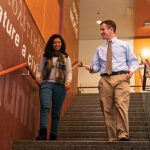
Public universities have a tradition of commitment to social responsibility. The UMBC community has taken a giant leap forward in addressing social challenges through a new movement called BreakingGround which debuted in Fall 2012. UMBC Student Government Association President Kaylesh Ramu ’13, political science, and David Hoffman, assistant director of student life for civic agency, are at the forefront of this effort to empower campus stakeholders to tackle issues that matter to them through innovative courses and co-curricular programs.
Where did the idea for BreakingGround originate?
Hoffman: UMBC has been participating for eight or ten years in national conversations about how to take the next big leap in civic engagement—helping students to see themselves as initiators and problemsolvers, not just voters and volunteers.
Ramu: BreakingGround is UMBC’s way of saying we have a strong commitment to civic engagement across campus. In the past, you saw different pockets of it here and there, but BreakingGround is a way we’re connecting everyone.
Hoffman: Democratic engagement is part of UMBC’s DNA. We’ve really been responsible for advancing the argument, nationally, that what happens on campus matters as much to students’ development as what happens in communities beyond the campus. So here at UMBC you don’t go and have a wonderful service placement with the Shriver Center, but then come back to a campus that views you as a customer. You’re a co-creator of this community.
How does this philosophy shape how students see themselves and what they can accomplish?
Ramu: As a student I never thought I would be working with administration on an $800,000 budget. Most times it’s easier to just leave students out of processes like budgeting, but in a community like ours you have so many administrators who really value giving students that opportunity and who enable reciprocal learning to happen. They recognize that one person can’t solve all our problems. It’s perspectives from across our community coming together into a greater conversation that makes change happen.
Hoffman: Part of what we hope alumni will take with them when they leave UMBC is an ability to see the people around them as full human beings, with unique skills and ambitions, and not just their social roles.
How has BreakingGround resonated with the UMBC community?
Hoffman: Part of what has amazed me about this process is how intuitive it is for so many people at UMBC. When the provost talks about UMBC as a scholarly community, I think this is what he’s talking about—a community of human beings who want to make a difference together finding ways to apply their intellects and their talents and their passions to contribute to the common good.
Ramu: I’ve seen students do amazing things here and that gives me the sense of confidence that public service is not really about your age, it’s about your determination.
Why should other universities move to boost campus-wide civic engagement?
Hoffman: Most colleges and universities are preparing students to vote and to volunteer. At UMBC we’re preparing them to innovate, to see possibilities and solve problems. That implies a very different set of skills and a very different orientation to themselves. This reflects growing consensus, articulated by the U.S. Department of Education, that this is exactly what universities need to be doing.
Ramu: I worry about colleges that don’t have this type of component, where students are running through, just taking online courses, and they miss out on other kinds of learning. If higher education is not preparing them to engage in their communities, when do they learn that? My experience with civic engagement at UMBC is part of why I feel so connected to this community. I’m going to be a proud alum.
— Dinah Winnick
Learn more about BreakingGround at umbcbreakingground.wordpress.com.
]]>
Public universities have a tradition of commitment to social responsibility. The UMBC community has taken a giant leap forward in addressing social challenges through a new movement called...
https://umbc.edu/stories/back-story-winter-2013/
https://beta.my.umbc.edu/api/v0/pixel/news/123506/guest@my.umbc.edu/228181c244ccd70d4b96ccfac2f60fd3/api/pixel
perspectives
winter-2013
UMBC News & Magazine
https://beta.my.umbc.edu/groups/umbc-news-magazine
https://assets1-beta.my.umbc.edu/system/shared/avatars/groups/000/001/943/24435aa6207c452e7bc15cc74b42c7bb/xsmall.png?1748556657
https://assets1-beta.my.umbc.edu/system/shared/avatars/groups/000/001/943/24435aa6207c452e7bc15cc74b42c7bb/original.png?1748556657
https://assets2-beta.my.umbc.edu/system/shared/avatars/groups/000/001/943/24435aa6207c452e7bc15cc74b42c7bb/xxlarge.png?1748556657
https://assets2-beta.my.umbc.edu/system/shared/avatars/groups/000/001/943/24435aa6207c452e7bc15cc74b42c7bb/xlarge.png?1748556657
https://assets3-beta.my.umbc.edu/system/shared/avatars/groups/000/001/943/24435aa6207c452e7bc15cc74b42c7bb/large.png?1748556657
https://assets1-beta.my.umbc.edu/system/shared/avatars/groups/000/001/943/24435aa6207c452e7bc15cc74b42c7bb/medium.png?1748556657
https://assets2-beta.my.umbc.edu/system/shared/avatars/groups/000/001/943/24435aa6207c452e7bc15cc74b42c7bb/small.png?1748556657
https://assets1-beta.my.umbc.edu/system/shared/avatars/groups/000/001/943/24435aa6207c452e7bc15cc74b42c7bb/xsmall.png?1748556657
https://assets2-beta.my.umbc.edu/system/shared/avatars/groups/000/001/943/24435aa6207c452e7bc15cc74b42c7bb/xxsmall.png?1748556657
UMBC News & Magazine
0
0
false
Tue, 05 Feb 2013 20:11:52 -0500
At Play – Winter 2013
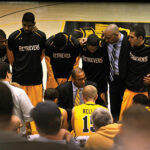
SMART WINS
Aki Thomas, acting head coach of UMBC men’s basketball team, is a cool customer at courtside. He exudes calming reassurance in team huddles, and he’s more likely to remove his glasses and stare than bark at a referee after a bad call.
Thomas became head coach in October – less than a month before the season opener – after the resignation of Randy Monroe. He has been coaching and recruiting at UMBC since 2007, after a playing career that included time at the University of Colorado and Howard University, as well as a stint playing professional basketball in Venezuela.
“I’ve been developing my own coaching philosophy for almost nine years,” Thomas says. Stylistically, he favors an up-tempo game. “I like to try to speed things up on the defensive end,” he says. “Look for opportunities in transition.”
Thomas’ approach to recruiting also fits in well with UMBC’s reputation as a school where student-athletes play hard and study hard. “The number one thing I look for in a player is intelligence,” he says. “Book smarts and what we call basketball IQ. I want them at a very high intelligence level. Because I think smart wins.”
Beneath the cool exterior, however, Thomas possesses a fierce desire to win. At a key moment in a home game against New Hampshire, the head coach reminded his players that “nobody’s hungrier than we are right now.”
The hungry Retrievers responded by seizing control of the game and cruising to a 68-57 victory.
— Richard Byrne ’86
TOURNEY TESTED

After an extraordinary run of games at the end of the season, the 2012 UMBC men’s soccer team emerged not only with an America East championship, but also a first-round victory on penalty kicks in the NCAA men’s soccer tournament against Old Dominion University.
The team’s exit from the tourney was also extraordinary: a loss on penalty kicks against the nation’s fifth-ranked team and defending NCAA men’s soccer champions, the University of North Carolina (UNC), on the Tarheels’ home field.
It was the team’s second appearance in the NCAA Men’s Soccer College Cup in the last three years.
“We’re so proud of the achievements of men’s soccer team and coach Pete Caringi,” said UMBC President Freeman A. Hrabowski, III, who observed that academic achievements have also been a hallmark of the university’s men’s soccer program.
Indeed, the day after their first round NCAA victory over Old Dominion, the men’s soccer team was also recognized with a 2011-2012 College Team Academic Award from the National Soccer Coaches Association of America (NSCAA), given to 221 men’s programs in America with a cumulative grade point average of 3.0 or higher. (The university’s women’s soccer team also was recognized with the same award, and UMBC was one of 150 programs in which both its men’s and women’s programs received the NSCAA award.)
The 2012 Retrievers sealed an automatic bid to the NCAA tournament with a victory over the University of New Hampshire in the America East championship game, held on November 10 at Retriever Soccer Park.
— Richard Byrne ’86
THE GALLERY NEXT DOOR

Each night when professor of political science Carolyn Forestiere returns to her Catonsville home, she finds a little bit of UMBC waiting on the walls – and often some fellow art lovers, too.
Opening an art gallery in one’s living room isn’t for everybody. But for Forestiere and her husband, Asher, throwing open their doors a few nights a week as the David Mikow Art Gallery (named after Asher’s father) made perfect sense.
“We thought: What’s the purpose of filling a house with art and not sharing it?” she says above the hubbub of a December opening reception for “Images in Print” – a selection of colorful monoprints and lithographs by university alumni and students, curated by visual art professors Irene Chan and Calvin Custen.
At one end of the room, Heather Brown ’13 explains how she created “Isadora II,” a lively monoprint inspired by Italo Calvino’s Invisible Cities. She rolled the paint, dashed it with solvents and the tips of various tools, she explains, “and then prayed it would turn out.”
At the other end of the room, Elizabeth Guidara ’11, political science, tells passersby about a series of prints featuring world dictators and their supposed lovers. Carving multiple layers of linoleum so they line up to allow for vibrant four-color printing is “a mix of science and luck,” she says.
As the evening rushes on, the guest book fills with names from UMBC, the neighborhood and beyond.
“When we moved to Catonsville, we wanted to make this our community,” says Forestiere. “And we have. This is something we’ve done together.”
Learn more about upcoming shows at The David Mikow Art Gallery here…
— Jenny O’Grady
SINGING SOFTLY

Nelson Emokpae ’03, psychology (a.k.a. Nelly’s Echo), has toured hundreds of colleges and universities over the past two years, but he has not yet performed at his alma mater.
Along with releasing his third record, Emokpae says that a concert at UMBC is on his “to do” list for 2013. But 2012 held its own magic for the alumnus when he was featured on NBC’s hit musical performance show The Voice.
Emokpae made waves nationally when Christina Aguilera selected him to be on her team mere seconds into his rendition of Bill Withers’ 1971 hit “Ain’t No Sunshine,” and he says that the coaching sessions he received from Aguilera during his run on the show were one of the highlights of the experience. Emokpae observes that Aguilera is “a normal person with the same fears and insecurities everyone has,” and her guidance “lent me a hand to help me with my journey.”
Despite his elimination on a subsequent episode after a one-on-one showdown with fellow contestant De’Borah, Emokpae feels immense gratitude for his national TV experience. The Voice, he enthuses, was “an episode in my life movie.”
Emokpae’s life movie has been anything but uneventful – even before The Voice. He fled his native Nigeria with most of his immediate family because of political unrest when he was only fifteen. They settled in Baltimore where they were eventually reunited with his father, Roland, who had been wrongfully imprisoned in Nigeria.
Although music had always been an integral part of his life (one favorite childhood pastime was setting his poetry to music), Emokpae majored in psychology at UMBC. Yet he also observes “your path picks you,” and his constant presence in the university’s music department – strumming his guitar and jamming with friends – exposed him to the music of the Maryland Camarata, led at that time by Aya Ueda.
Emokpae introduced himself and asked for an audition, and despite not having any previous formal vocal training, his natural ability secured him a spot with the group for the rest of his time at UMBC – an experience that offered him the chance to learn to sight-read music and sing lead in an ensemble. The latter experience in particular, says Emokpae, “really makes you grow up as a vocalist.”
After obtaining a doctorate in physical therapy, Emokpae kept making music as he also made a living as a physical therapist. But at the age of 30, he was persuaded to quit his day job and devote himself fully to his music career.
“I decided I didn’t want to be that old man on his front porch wondering ‘What if?’” explains Emokpae.
The national exposure that The Voice gave Nelly’s Echo means that Emokpae’s life movie promises to be even more interesting in years to come. Among his ambitions include winning a Grammy (“Not for the sake of validation,” he says, “but for affirmation that the voice for the soft-spoken can be heard in this sometimes very noisy world.”) and using any success to build infrastructure in the two areas in which he has worked: health care and music.
“I’d like to build hospitals and music venues in impoverished cities around the world, starting with Africa,” Emokpae says. He also believes that music venues are equally important: “These can be places in communities where young people can find hope.”
Watch Nelson Emokpae ’03, psychology, on an episode of The Voice…
– Sara Barker
]]>
SMART WINS Aki Thomas, acting head coach of UMBC men’s basketball team, is a cool customer at courtside. He exudes calming reassurance in team huddles, and he’s more likely to remove his glasses...
https://umbc.edu/stories/at-play-winter-2013/
https://beta.my.umbc.edu/api/v0/pixel/news/123507/guest@my.umbc.edu/db4e3e73b449d83a0fc787e6b157c7e4/api/pixel
campus-life
winter-2013
UMBC News & Magazine
https://beta.my.umbc.edu/groups/umbc-news-magazine
https://assets1-beta.my.umbc.edu/system/shared/avatars/groups/000/001/943/24435aa6207c452e7bc15cc74b42c7bb/xsmall.png?1748556657
https://assets1-beta.my.umbc.edu/system/shared/avatars/groups/000/001/943/24435aa6207c452e7bc15cc74b42c7bb/original.png?1748556657
https://assets2-beta.my.umbc.edu/system/shared/avatars/groups/000/001/943/24435aa6207c452e7bc15cc74b42c7bb/xxlarge.png?1748556657
https://assets2-beta.my.umbc.edu/system/shared/avatars/groups/000/001/943/24435aa6207c452e7bc15cc74b42c7bb/xlarge.png?1748556657
https://assets3-beta.my.umbc.edu/system/shared/avatars/groups/000/001/943/24435aa6207c452e7bc15cc74b42c7bb/large.png?1748556657
https://assets1-beta.my.umbc.edu/system/shared/avatars/groups/000/001/943/24435aa6207c452e7bc15cc74b42c7bb/medium.png?1748556657
https://assets2-beta.my.umbc.edu/system/shared/avatars/groups/000/001/943/24435aa6207c452e7bc15cc74b42c7bb/small.png?1748556657
https://assets1-beta.my.umbc.edu/system/shared/avatars/groups/000/001/943/24435aa6207c452e7bc15cc74b42c7bb/xsmall.png?1748556657
https://assets2-beta.my.umbc.edu/system/shared/avatars/groups/000/001/943/24435aa6207c452e7bc15cc74b42c7bb/xxsmall.png?1748556657
UMBC News & Magazine
0
0
false
Tue, 05 Feb 2013 20:09:34 -0500
ANCS Reunion Lunch, 4/6, To Feature Founding Professors
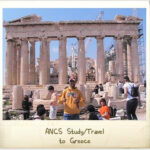
 The Ancient Studies department will hold a reunion luncheon featuring Greek foods at the Albin O. Kuhn Library (7th floor) on April 6 from noon to 3 p.m. A number of founding faculty will be present, including Walt Sherwin, Rudy Storch, and Carolyn Koehler. Jay Freyman, who is retiring this summer, will also be there.Please visit http://www.umbc.edu/blogs/ancs/events/ for more information.
WHEN: Saturday, April 6, 2013, noon – 3 p.m.
WHERE: Albin O. Kuhn Library- 7th Floor, UMBC, 1000 Hilltop Circle, Baltimore, MD 21250
COST: $30 per person for non-students; $25 per person for current UMBC students. If you would like to sponsor a UMBC student for this luncheon please note that on your registration form.
RSVP: Visit http://www.umbc.edu/blogs/ancs/events/ to download the registration form. All reservations must be received by March 22, 2013.
]]>
The Ancient Studies department will hold a reunion luncheon featuring Greek foods at the Albin O. Kuhn Library (7th floor) on April 6 from noon to 3 p.m. A number of founding faculty will be...
https://umbc.edu/stories/ancs-reunion-lunch-46-to-feature-founding-professors/
https://beta.my.umbc.edu/api/v0/pixel/news/123508/guest@my.umbc.edu/c0737a49067c3eea9e06ef13e65c79c0/api/pixel
alumni
UMBC News & Magazine
https://beta.my.umbc.edu/groups/umbc-news-magazine
https://assets1-beta.my.umbc.edu/system/shared/avatars/groups/000/001/943/24435aa6207c452e7bc15cc74b42c7bb/xsmall.png?1748556657
https://assets1-beta.my.umbc.edu/system/shared/avatars/groups/000/001/943/24435aa6207c452e7bc15cc74b42c7bb/original.png?1748556657
https://assets2-beta.my.umbc.edu/system/shared/avatars/groups/000/001/943/24435aa6207c452e7bc15cc74b42c7bb/xxlarge.png?1748556657
https://assets2-beta.my.umbc.edu/system/shared/avatars/groups/000/001/943/24435aa6207c452e7bc15cc74b42c7bb/xlarge.png?1748556657
https://assets3-beta.my.umbc.edu/system/shared/avatars/groups/000/001/943/24435aa6207c452e7bc15cc74b42c7bb/large.png?1748556657
https://assets1-beta.my.umbc.edu/system/shared/avatars/groups/000/001/943/24435aa6207c452e7bc15cc74b42c7bb/medium.png?1748556657
https://assets2-beta.my.umbc.edu/system/shared/avatars/groups/000/001/943/24435aa6207c452e7bc15cc74b42c7bb/small.png?1748556657
https://assets1-beta.my.umbc.edu/system/shared/avatars/groups/000/001/943/24435aa6207c452e7bc15cc74b42c7bb/xsmall.png?1748556657
https://assets2-beta.my.umbc.edu/system/shared/avatars/groups/000/001/943/24435aa6207c452e7bc15cc74b42c7bb/xxsmall.png?1748556657
UMBC News & Magazine
0
0
false
Tue, 05 Feb 2013 15:52:54 -0500
Inaugural Grants from the Hrabowski Fund for Innovation
FROM: Freeman Hrabowski, President
Philip Rous, Provost and Senior Vice President for Academic Affairs
We are delighted to announce the projects receiving inaugural grants from this fund. These projects build on our faculty’s strong track record of, and commitment to, reimagining what it means to teach and learn. We received a large number of outstanding applications and, unfortunately, could not fund all of the projects. Those selected for awards represent each of our colleges and a wide range of disciplines, and many of them take an interdisciplinary approach to their work.
Implementation and research grants
-
The Math Gym – A teamled by Nagaraj Neerchal, professor and chair of mathematics and statistics, will develop The Math Gym, which will feature “conditioning coaches” and “personal trainers” who will help students keep their foundational math skills in good working order. Moreover, the gym will promote healthy math habits among all our students, drawing a clear analogy between the regular work outs and conditioning needed to maintain both athletic and mathematical skill.
-
Active Computing Teaching and InnoVation Environment – A team led by Marie desJardins, professor of computer science and electrical engineering, will create ACTIVE, a dynamic “laptop laboratory.” The lab will support innovation in computing courses – with a particular focus on improving the retention and success of women, underrepresented minorities and transfer students. The laboratory will extend active-learning environments, such as CASTLE and the new English writing labs, to a new area of the university.
Seed grants
-
The Wisdom Institute – A team led by Craig Saper, professor and director of UMBC’s language, literacy, and culture program, will create an institute to expand the role for emeritus professors at UMBC.
-
Putting Students’ Language Skills to Work – A team led by Susanne Sutton, lecturer in modern languages, linguistics, and intercultural communication, will develop new experiential and service-learning course requirements for undergraduates studying German, with a particular focus on connecting students to Baltimore’s German community.
-
Service-Learning in Statics – A team led by Anne Spence, professor of the practice in mechanical engineering, will develop new service-learning requirements for undergraduates studying mechanical engineering, with a particular focus on identifying components that increase retention and student success.
-
EHS – Bruce Walz, professor and chair of emergency health services, will lead a project to integrate individual cameras into EHS exercises, so that students can receive more personalized and immediate feedback on their performance.
Begun with major grants from the Carnegie Corporation of New York and the Heinz Awards, the Innovation Fund has benefited from substantial support from alumni and friends, the local community and businesses, and State and national leaders. That support is a testament to the work we’ve already done and a vote of confidence for the national model we’re continuing to build. Projects supported by the Innovation Fund will complement the many other creative and enterprising initiatives already underway at UMBC – from the STEM Transfer Student Success Initiative to composition course redesign in English – and will build on our strong history of finding novel approaches to teaching and scholarship.
The competition for the next round of Innovation Fund grants is underway, with proposals due by Friday, February 8. For more information on how to apply, click here. We want to thank everyone who has submitted a proposal, and encourage those whose proposals could not be funded in the first round to apply again.
We are truly inspired by the creative ideas we hear each day and are delighted to be able to support more of them through this fund.
]]>
FROM: Freeman Hrabowski, President Philip Rous, Provost and Senior Vice President for Academic Affairs We are delighted to announce the projects receiving inaugural grants from this fund. These...
https://umbc.edu/stories/inaugural-grants-from-the-hrabowski-fund-for-innovation/
https://beta.my.umbc.edu/api/v0/pixel/news/123509/guest@my.umbc.edu/cf5e9b25fa18f9587ef826557e38a28e/api/pixel
admin
community
UMBC News & Magazine
https://beta.my.umbc.edu/groups/umbc-news-magazine
https://assets1-beta.my.umbc.edu/system/shared/avatars/groups/000/001/943/24435aa6207c452e7bc15cc74b42c7bb/xsmall.png?1748556657
https://assets1-beta.my.umbc.edu/system/shared/avatars/groups/000/001/943/24435aa6207c452e7bc15cc74b42c7bb/original.png?1748556657
https://assets2-beta.my.umbc.edu/system/shared/avatars/groups/000/001/943/24435aa6207c452e7bc15cc74b42c7bb/xxlarge.png?1748556657
https://assets2-beta.my.umbc.edu/system/shared/avatars/groups/000/001/943/24435aa6207c452e7bc15cc74b42c7bb/xlarge.png?1748556657
https://assets3-beta.my.umbc.edu/system/shared/avatars/groups/000/001/943/24435aa6207c452e7bc15cc74b42c7bb/large.png?1748556657
https://assets1-beta.my.umbc.edu/system/shared/avatars/groups/000/001/943/24435aa6207c452e7bc15cc74b42c7bb/medium.png?1748556657
https://assets2-beta.my.umbc.edu/system/shared/avatars/groups/000/001/943/24435aa6207c452e7bc15cc74b42c7bb/small.png?1748556657
https://assets1-beta.my.umbc.edu/system/shared/avatars/groups/000/001/943/24435aa6207c452e7bc15cc74b42c7bb/xsmall.png?1748556657
https://assets2-beta.my.umbc.edu/system/shared/avatars/groups/000/001/943/24435aa6207c452e7bc15cc74b42c7bb/xxsmall.png?1748556657
UMBC News & Magazine
0
0
false
Mon, 04 Feb 2013 22:21:03 -0500
On the Road to Plutopia

Travels and travails play a big part in award-winning UMBC historian Kate Brown’s highly-personal approach to investigating nuclear power and nationalism.
By David Glenn
A few years ago, historian Kate Brown spent several weeks in a tiny cottage in an obscure corner of Russia’s Ural Mountains. She was studying the history of Ozersk, a secret Soviet city built in the late 1940s to house the country’s first plutonium-processing plant.
Ozersk itself remains just as closed to outsiders in Vladimir Putin’s Russia as it was in Josef Stalin’s Soviet Union. So a cottage that Brown rented several miles outside the city’s gates turned out to be the closest she could get to the nuclear site.
“I would basically get up in the morning and chop the wood to take a shower,” says Brown, who is an associate professor of history at UMBC. “Carry the water in from the well. All of that stuff that you do in a village. And then I would wait for my cell phone to ring. My contact would say I have someone to meet with you – and then I would go and make my appointments.”
Brown met a number of elderly Ozersk residents who testified about the city’s early years, including a 1957 accident that released massive amounts of plutonium and led to the evacuation and destruction of more than 80 villages across the southern Urals. She also talked to younger activists who are struggling to force the Russian government to pay reparations for the slow-motion environmental devastation caused by plutonium production across the decades. Poking into the shadows of the Russian side of the Cold War decades, Brown still occasionally feared being detained or having her passport revoked.
Brown’s willingness to chop firewood or risk harassment to get closer to the history she writes is nothing new. In the late 1980s and early 1990s she traveled throughout the collapsing Soviet empire as she helped lead a glasnost-era student-exchange program. Today, at the age of 47, she commutes to UMBC by riding a bicycle across more than three miles of Washington traffic before getting on a train.
But colleagues and students observe that Brown’s physical intrepidness is matched (and even surpassed) by her willingness to take intellectual risks. For instance, her forthcoming book, Plutopia: Nuclear Families, Atomic Cities, and the Great Soviet and American Plutonium Disasters (Oxford University Press) is a tale of two cities: Ozersk and Richland, a city in Washington state that abuts the first major U.S. plutonium facility at Hanford Nuclear Reservation.
Plutopia dives deep into the history of the military, medicine, labor, culture and the environment in both Cold War powers. Yet Brown makes few explicit comparisons or contrasts between these two cities themselves, structuring the book instead as a “tandem history” that allows the reader to use each city as a prism through which to view the other entity.
Brown also frequently inserts herself into the text, explaining how she cultivated relationships with certain informants or came to a dead end in certain archives. “Historians are reluctant to be a character in their own history,” she observes. “But the fact that we’re there affects what happens. I try to set it up in a way that I can tell a story that makes the exploration, the getting of the story, a part of the journey for the reader.”
Catherine Evtuhov, a professor of history at Georgetown University, is an admirer of how Brown marries an immediacy more often found in journalism (which is, after all, history’s first draft) to the rigor of the social sciences. “Kate does her work not in some kind of theoretical way,” Evtuhov argues, “but by going and spending a good deal of time in these places, getting people to discuss their histories. She brings some of the techniques of an investigative reporter.”
THREAT ASSESSMENTS
Brown became hooked on studying Russia during six months she spent living in Leningrad in 1987, when she was a senior at the University of Wisconsin.
“Strangers would come up to me on the street and say, ‘Go home and tell them that we just want peace, and that things just aren’t working,’” she recalls.
When the regime began to crumble a few years later, Brown was not surprised. The system she saw in 1987 already seemed like something dying. She recalls being horrified that the Reagan administration had built so many nuclear warheads to counter such a hollow threat.
After she completed her Russian major at Wisconsin, Brown took a job at a Middlebury College-based student exchange program. Among other responsibilities, Brown had to keep tabs on the safety of American students who had been placed in far-flung corners of the decaying empire, especially places that had featured in previous national rebellions against the Soviet state.
“I’d take trains to Ukraine or the Baltics,” she says. “And that’s when I noticed that the real force that was pulling the Soviet Union apart was nationalism. That took us by surprise. It seems stupid now, but the thought at the time was that nationality had been tucked away.”
Brown also argues that a new openness which made it no longer dangerous to publicly excavate and talk about past crimes – even those committed by the nation’s secret police – also helped destroy the Soviet Union. “People were digging up mass graves of people who had been killed by the NKVD,” she says. “Digging up buried stories at different sites; that really put the Soviet regime on the chopping block. They just couldn’t stand up to that. That was when I understood how much history matters.”
In 1992, Brown enrolled in the doctoral program in history at the University of Washington at Seattle, which houses one of the country’s most venerable centers for the study of the Soviet Union and Eastern Europe. She was ambitious, but retained diverse interests that included the study of anthropology, literature, and other fields, and freelance reporting for National Public Radio and other venues.
“I dragged it out as long as I could,” she recalls. “Any free summer or semester I could write a grant and go study Kazakh or Polish. It was just fabulous. I did a lot of traveling under the guise of language studies.”
Brown finished her program in 2000 and did a year of postdoctoral research at Harvard University before joining the faculty at UMBC in 2001. Her investigation into how ethnic Ukrainians, Poles, Jews, and Germans coexisted in the borderland region around Chernobyl – a region that was never consolidated into any particular nation-state before it was reconfigured by the Soviets and then invaded by the Nazis before being retaken once again by the Soviets – became the subject of her first book, A Biography of No Place: From Ethnic Borderland to Soviet Heartland, which was published by Harvard University Press in 2004.
As she does in her new book, Brown blended several different modes of historical writing (including personal narrative) in A Biography of No Place, which garnered multiple prizes (including the American Historical Association’s prestigious George Louis Beer Prize for modern European international history) and has proven influential among fellow historians.
Lynne Viola, a professor of history at the University of Toronto, had never heard of Brown before Harvard sent her the manuscript, requesting a blurb. “I was very irritated, because they hadn’t asked beforehand,” Viola says. “But I looked at the manuscript and got completely pulled in. By the time I finished, I had written to Harvard and asked how I could contact Kate Brown. Because I thought this was one of the most original things I’d ever read.”
PROBING THE PARALLELS
The research project that became Plutopia had an odd birth. Knowing of her interest in the Chernobyl region, several friends sent Brown links in 2004 to a website created by a Ukrainian who had traveled by motorcycle through villages that had been abandoned after the 1986 Chernobyl nuclear disaster.
Brown was intrigued by the website. Might those empty villages be an important time capsule? Would letters or other documents reveal whether the Soviet citizens of 1986 knew that their regime was on its last legs?
When Brown went to Ukraine to investigate, it soon became clear that the motorcyclist’s website was an elaborate hoax. But as she traveled around Chernobyl with a journalist friend who was writing about the fraud, Brown began to ponder a book on nuclear disasters.
“There was a period of time when nobody was interested in nuclear issues,” she says. “We were all exhausted with it, right? The Cold War was over. We didn’t have to think about this anymore. We had to think about it for so long in so many terrifying ways. I had definitely been in that frame of mind.”
The enduring – and, in many ways, still invisible – destruction surrounding Chernobyl changed Brown’s mind. She became fascinated by the story behind the Soviet plant at Ozersk, which was built in a muddy zone with few paved roads in 1947 as the Soviets scrambled to compete with the U.S. atomic weapons program.
The Ozersk plant suffered its own Chernobyl-sized calamity: the 1957 explosion that forced the evacuation of 87 villages in the southern Urals. But the shadowy site also offered the chance to relate the decades-long destruction of the environment as well, as the Ozersk plant sent irradiated water into rivers for many years.
As Brown pondered how to tell the tale of Ozersk and the Soviet nuclear industry, she also made a connection to the other side of the Cold War divide. While studying in Seattle in the 1990s, she had been gripped by news stories about the Clinton administration’s declassification of millions of documents that revealed the extent of environmental and public-health damage associated with plutonium production across eastern Washington.
“I thought about the Hanford site,” says Brown. And the similarities between two places so far apart and yet so parallel in design and in long-term environmental destruction became insistent to her.
“I thought, what people need to know about are these military sites that have been covered up for so long,” Brown says. “They’re so much more serious in terms of environmental catastrophe than this one-off event at Chernobyl.”
COVERT CONVERSATIONS
So Brown set off on what became a six-year project, supported in part by a Guggenheim fellowship and a grant from the National Council for Eurasian and East European Research. (Brown also had support for the book from the Kennan Institute, and received a collaborative grant from the National Endowment for the Humanities.) She pored over Cold War documents at the U.S. Department of Energy and the regional Communist Party headquarters in Chelyabinsk, but also spent many months in close proximity to both sites.
In the Urals, elderly Ozersk residents shared a mixture of baroque horror stories – thousands of young workers retiring because of radiation poisoning – mixed with intense nostalgia. Though it didn’t appear on any maps, Ozersk was known as the nicest place to live in the southern Urals. Soviet authorities provided the city with parks, schools, medical care, and consumer goods that were far above the nation’s usual level. After the terrors of Stalin and World War II, Brezhnev-era Ozersk seemed like paradise.
Brown also canvassed eastern Washington state to find proud veterans of the Hanford plants and “downwinder” activists who believe plutonium contamination has caused many cancers and birth defects.
As was the case with Ozersk, Brown discovered that Richland’s proximity to the Hanford facility made it a seeming oasis of prosperity amid rural poverty. The corporate contractors who built and operated the Hanford site – Du Pont in the early years, and later General Electric – self-consciously created a “classless” model community where both nuclear engineers and blue-collar factory workers could live in single-family homes and enjoy consumer abundance.
Both the U.S. and Soviet governments used that abundance to help elite scientists reconcile themselves to lives in remote provinces. But Brown also points out that both Richland and Ozersk were anything but classless: In different ways, both plutonium complexes consigned their lowest-level workers to hardscrabble lives on the periphery.
Economic concerns were matched by both governments’ concerns about security. As the two cities evolved across the 1950s, their creators were intensely aware of each other – and even in a sort of dialogue across borders. Brown says that the questions each side asked were fundamental: “What are they doing over there? How can we do it better over here? What do we need to do to prevent them from getting our secrets or attacking us? So they’re very much in conversation with one another, but the conversation is sometimes covert.”
Brown worked hard to keep Plutopia as clear as possible, even though the book moves across national borders and contains material about a vast array of topics.
“I don’t intend to compare the cities,” Brown continues. “What I want to do is place them alongside one another, and to show how sometimes enemies that are intensely opposed to one another start to look like one another because of the force of that focus.”
LOCATING HISTORY
Getting physically close to the locales about which she writes is key to Brown’s method as a historian. Focusing on a place, she believes, allows historians to combine political, social, and scientific history in powerful ways.
“You can do all of that when you start from a place,” she says. “By circumscribing the territory you’re looking at, you can transcend these boundaries that we’ve created in these subfields of history.”
Brown pushes her students at UMBC, especially those in the master’s degree program, to pursue similarly placebased projects. To immerse them in that method, this year she is leading one class in a review of the archives of the Neighborhood Design Center, a Baltimore-based organization of activist urban planners and architects.
“Dr. Brown is incredibly supportive, but she will not hold your hand,” says Rhiannon Dowling Fredericks ’09, M.A., history, who is now in the doctoral program at the University of California at Berkeley. “She wanted us to have projects that were reasonably finished before she would review them with us. But once we got to that stage, she would have amazing suggestions about how we could expand our projects and move forward.
In moving her own work forward, Brown is now assembling a collection of historical essays tentatively titled Being There. “I hope to use this as a call to arms for doing place-based history,” she says.
She also hopes to persuade younger historians to become more comfortable with occasionally using the first person, so that they can be more candid with readers about their own biases and about the twists and turns that their research has taken.
“These stories don’t just come out of nowhere,” argues Brown. “And we’re not a god-eye looking from above. We’re on the ground. We, too, are in play.”
In the meantime, Brown is preparing for the publication of Plutopia this spring.
“What Kate has done has not been easy,” says Lynne Viola, of Toronto. “A Biography of No Place really inspired many people, and I expect that the new one will too. I think it will have a very large impact on younger scholars.”
For her part, Brown is grateful that she took that trip to Leningrad in 1987. The region has been a consuming obsession for her for the last quarter century. “It has been a wild ride,” she says, “watching this country blow itself up, put itself back together again, feud over the component parts—and now Putin is consolidating power in a way that sure feels like the Soviet Union wedded to the czarist empire. It’s been just fascinating.”
* * * *
One of the strengths of Kate Brown’s Plutopia is its sense of finding history in geography – as she does in describing a visit to Hanford in the book’s second chapter:
Gerber showed me with a sweep of her arm the site of the former Hanford Camp, set up in 1943 to house workers building the plutonium plant. I nodded unthinkingly and then looked again. She was pointing at emptiness: a flat plane, laser-graded, a few trees weakly prodding the sky. Staring, I began to make out the faint outline of streets converging at right angles. Western ghost towns usually have a few walls standing, foundations that outline a saloon or bank. This site had been expunged almost fully, although in its day the camp had been a city of 60,000 people, and for a few months had the state’s fifth largest population. Dining halls, barracks, stores, barber shops, theaters, taverns, a roller rink, dance pavilion, swimming pool, bowling alley, bank, hospital, and the state’s busiest bus depot and post office had all once stood on this site. It had been a vast camp that never slept, with round the clock shifts, or rather a place that always slept, as graveyard workers sank their blinds and hoped for quiet amidst the constant rumble of machinery. Hanford Camp went up in a few months in 1943 and disappeared in a few months in 1945. This teeming city stood all of twenty-three months, and a half-century later had vaporized back to desert.
From Plutopia: Nuclear Families, Atomic Cities, and the Great Soviet and American Plutonium Disasters (Oxford University Press)
]]>
Travels and travails play a big part in award-winning UMBC historian Kate Brown’s highly-personal approach to investigating nuclear power and nationalism. By David Glenn A few years ago,...
https://umbc.edu/stories/on-the-road-to-plutopia/
https://beta.my.umbc.edu/api/v0/pixel/news/123510/guest@my.umbc.edu/f4b60d5fde3807134e771b188214230b/api/pixel
discovery
winter-2013
UMBC News & Magazine
https://beta.my.umbc.edu/groups/umbc-news-magazine
https://assets1-beta.my.umbc.edu/system/shared/avatars/groups/000/001/943/24435aa6207c452e7bc15cc74b42c7bb/xsmall.png?1748556657
https://assets1-beta.my.umbc.edu/system/shared/avatars/groups/000/001/943/24435aa6207c452e7bc15cc74b42c7bb/original.png?1748556657
https://assets2-beta.my.umbc.edu/system/shared/avatars/groups/000/001/943/24435aa6207c452e7bc15cc74b42c7bb/xxlarge.png?1748556657
https://assets2-beta.my.umbc.edu/system/shared/avatars/groups/000/001/943/24435aa6207c452e7bc15cc74b42c7bb/xlarge.png?1748556657
https://assets3-beta.my.umbc.edu/system/shared/avatars/groups/000/001/943/24435aa6207c452e7bc15cc74b42c7bb/large.png?1748556657
https://assets1-beta.my.umbc.edu/system/shared/avatars/groups/000/001/943/24435aa6207c452e7bc15cc74b42c7bb/medium.png?1748556657
https://assets2-beta.my.umbc.edu/system/shared/avatars/groups/000/001/943/24435aa6207c452e7bc15cc74b42c7bb/small.png?1748556657
https://assets1-beta.my.umbc.edu/system/shared/avatars/groups/000/001/943/24435aa6207c452e7bc15cc74b42c7bb/xsmall.png?1748556657
https://assets2-beta.my.umbc.edu/system/shared/avatars/groups/000/001/943/24435aa6207c452e7bc15cc74b42c7bb/xxsmall.png?1748556657
UMBC News & Magazine
0
0
false
Mon, 04 Feb 2013 21:37:59 -0500
