Biotech Buzz

UMBC at the Universities at Shady Grove finds itself uniquely situated—at home within the country’s third largest biotech hub where the demand for highly skilled workers is growing. These Retrievers are filling specialized roles after graduating with the training they need to succeed in this booming industry.
It’s an early Friday morning in the Biological Sciences and Engineering Building and nine students, working in small groups, are bustling back and forth between fume hoods and a large centrifuge. They carefully swish flasks containing cells and growth medium. The smell of sanitizing alcohol pervades the space. Neon orange test tube racks and turquoise tube caps stand out within the sterile white look of the work benches, hoods, and lab coats.
As the cells use oxygen to release energy, they produce carbon dioxide. The CO2 turns the solution yellow, indicating successful cell growth. After the experiment, students sterilize their solution with bleach for disposal; in response to the alkalinity, it blooms to a brilliant magenta. In another room, one student offers tips to her classmate on how to use a pipet more effectively, and the instructor flits between groups, answering questions as needed—but for the most part, the students operate confidently on their own.
This is a regular day in Biotechnology 303: Applied Cell Biology in UMBC’s Translational Life Science Technology (TLST) program. The program, offered by UMBC’s College of Natural and Mathematical Sciences (CNMS) exclusively at the Universities at Shady Grove (USG), a multi-institution education facility in Rockville, Maryland, is designed to offer hands-on training to prepare students for careers in the booming biotech industry in USG’s backyard.
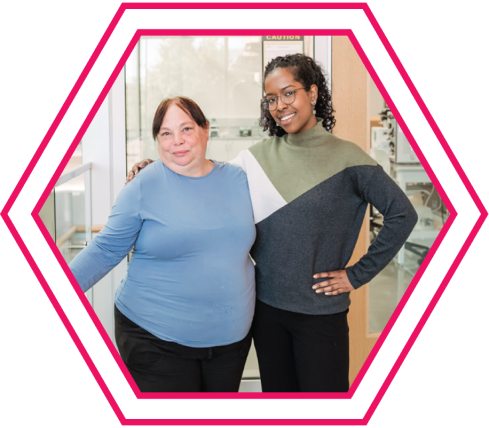
Elizabeth Friar (left) and Samantha Petros ’23 have stayed in touch since Petros graduated.
A clear direction
It was the promise of experiential work with real-world applications that drew Samantha Petros ’23 to the TLST program. “I really liked the convenience of the USG campus, and a lot of the courses were really focused on hands-on learning,” she says. Without really knowing what the work would look like before she started the program, “I was able to try out a lot of different things in a very low-stakes environment and get an idea as to what I found interesting.”
That turned out to be cell culture work. Applied Cell Biology with Elizabeth Friar, lecturer and undergraduate program director in TLST, “cemented that benchwork is what I enjoy doing,” Petros says. From then on, “There was a clearly defined arrowhead in the direction I wanted to go.”
That was a big shift from where she started, as a film major at Montgomery College (MC). A virology course to meet her science requirement turned her on to MC’s biotech associate degree, and then she transitioned to the TLST program at UMBC. After learning some basic lab techniques in TLST classes, she landed a part-time job, where she carried out entry-level manufacturing tasks for malaria vaccines. Today, Petros is thriving as a cell culture specialist studying malaria at Axle Informatics, a contractor for the National Institute of Allergy and Infectious Diseases.
The position she’s in now traditionally requires a master’s degree, which she doesn’t have—yet, anyway. “Knowing that I have valuable skill sets from TLST—working in manufacturing, getting good connections with my professors, and going to the networking events that TLST offers—all of that compounds and has got me to where I am now,” Petros says. “I genuinely believe that I wouldn’t be here if it weren’t for all of those factors, with TLST obviously being the biggest one.”
Location, location, location
TLST is a young program, but it is growing quickly. The first class—just two students—arrived in fall 2019. Friar joined in summer 2020 and began laying the groundwork for the program’s eventual growth. Today, “It’s humming along,” she says. There are currently 50 students who have declared TLST as their major. “Now we’re thinking about what we can do next. How can we expand?”
TLST is unique as the only undergraduate STEM program at UMBC without a footprint on the main campus. The location choice at USG is intentional. The Capital Biohealth Region, encompassing the District of Columbia, Virginia, and Maryland, is the third most competitive biotech hub in the country—and Montgomery County, Maryland, is the hub of the hub, boasting more than 350 life science companies and located a stone’s throw from the NIH, FDA, and National Institute of Standards and Technology (NIST). For TLST alumni, the employment options are seemingly limitless: 80 percent of American pharmaceutical companies are within a two-hour drive, and they can expect a nearly 23 percent growth rate in the biotech industry over the next 10 years—well above the national average.
As Friar puts it, “Regenxbio is down the street. MacroGenics is down the street. MilliporeSigma is opening their new lab right next door, and they’ve now hired eight of our alumni. Soon we’ll have an NIH vaccine lab right down the street. ATCC is right down the street.” All these biotech companies need qualified workers—and TLST is providing them.
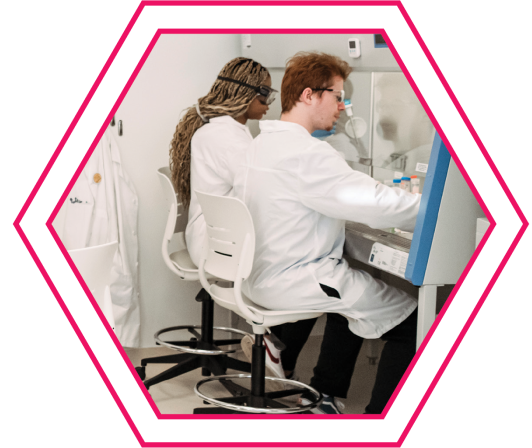
Steven Schaffer (right) and Princess Nyamali work under a biosafety cabinet in Elizabeth Friar’s Applied Cell Biology course.
Training lifetime learners
Jeff Galvin, CEO of American Gene Technologies (AGT), has hired TLST alumni and would hire more. “The TLST program seems to provide a great overview of not just biotechnology techniques,” he says, but it gives students “an understanding of the business in general. I find that UMBC students lean toward being self-motivated problem-solvers. It seems that the administration from the top all the way down promotes that idea of creating value through creative, hard work.”
Titina Sirak ’20, TLST, had a major impact at AGT. She established a brand-new laboratory certified to handle human cells from scratch, Galvin says, “And that’s not easy—there’s a lot of regulations associated with that, even economics.” While she wasn’t an expert at first, “she was able to do enough things right that the project came to life.”
Galvin emphasizes the importance of “learning how to learn,” saying, “Things are changing so fast, that it’s the folks who can adapt and become lifetime learners who are going to be the most successful.And that’s something I saw from the students coming out of TLST.”
A vision fulfilled
So far, TLST has graduated 25 students, and 94 percent of them were employed in the biotech industry within three months of walking across the Commencement stage. “We’ve had a number of really standout students who have gone on to do really great things, so I’m very excited about how it’s going,” Friar says.
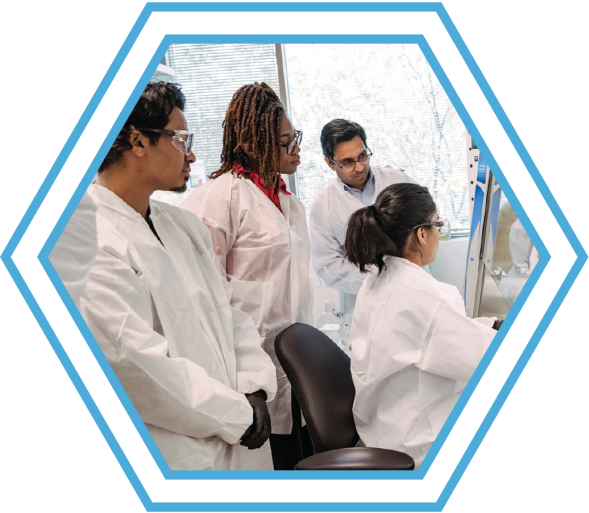
Merryll Kallungal ’24 works under a biosafety cabinet at ATCC. Interns Jason Bose (left) and Tamilore Akinde (second from left) and an ATCC lead scientist observe.
So is William R. LaCourse, CNMS dean, which offers the TLST program. He envisioned the program years before the first two students walked onto the USG campus, and it came together with input from faculty at Montgomery College and five departments at UMBC.
“TLST is an innovative and practical education that combines ‘know-what’ and ‘know-how,’” says LaCourse. “It is a highly flexible program with various pathways to serve the ever-changing needs of a growing industry. TLST is where the silos of disciplines break down and cross-disciplinary knowledge is the goal—both in content and practice.”
The program is shaping up just as LaCourse and Annica Wayman ’99, mechanical engineering, and former associate dean for Shady Grove Affairs in CNMS who led TLST’s launch, had hoped. The state of Maryland is growing its biotech hub while UMBC students are gaining the skills they need to succeed in the workplace and getting well-paying jobs, and the student population is growing.
Connections that build confidence
Just as important as high-demand lab skills, students and alumni value the relationships they’ve formed with faculty. “Every teacher I had was very supportive, very understanding, very willing to work with me,” Petros says. “I think it’s important to get your money’s worth out of college, and I definitely feel like I got that and more in TLST because of the support network that I had there and my teachers.”
Petros is still in touch periodically with Wayman and Friar. “Dr. Wayman was a shining inspiration. She’s just a wonderful person. She’s so knowledgeable and always willing to help,” Petros says. The support she has and the success she’s found now have inspired Petros to look back and help those coming up behind her. In addition to USG resources, as a student Petros attended networking events offered by BioBuzz, a community resource for biotech industry professionals and job seekers in the Capital Biohealth Region. In fact, it’s how she found her current role.
Today Petros is a BioBuzz Ambassador. “I wish I had known about BioBuzz when I first started in biotech,” she says. “Now I want to be that advocate for younger students or people who are just starting in science.”
A strong foundation
“Our students come to us because they want to make a difference in people’s lives, but they don’t necessarily want to go to medical school,” Friar says. It doesn’t hurt that “we have some really spectacular facilities that are a real draw for students,” she adds.
The Biological Sciences and Engineering Building opened at USG in fall 2019 and boasts beautiful modern laboratories and classrooms plus plenty of comfy nooks for meeting with a study group or just relaxing. TLST has also received over $1 million dollars from the National Institute for Innovation in Manufacturing Pharmaceuticals, some of which has supported further upgrades and additions to the teaching laboratories.
A flow cytometer, a machine that can detect properties of interest in up to 10,000 cells per minute, will enable a new mixed undergraduate/graduate course in flow cytometry launching next spring, for example. And equipment to practice skills like protein purification, biomanufacturing processes, and cell culture create rare opportunities for undergraduates. A required TLST course covers the wide range of instrumentation you might find in a modern biotech laboratory.
It’s normal for students to start off nervous when they use complicated and expensive equipment or work with human cells for the first time. “But by the end, they are old hands, and I think they would feel comfortable tackling anything in that lab on their own,” Friar says. “And it’s because the curriculum is really well scaffolded. We add skills as they go along, and then we repeat the old skills. The program is set up to foster growth and independence.”
Princess Nyamali stepped away from the centrifuge for a moment during Biotechnology 303 to share that the TLST coursework “is a really good foundation.” She’s currently completing an internship at NIST, and “everything I’m learning in this cell culture class is stuff I’m doing at NIST.” While it might have been daunting at first, trying so many different things across the TLST curriculum “helps you know that you want to do it,” she says, in addition to showing potential employers that you can.
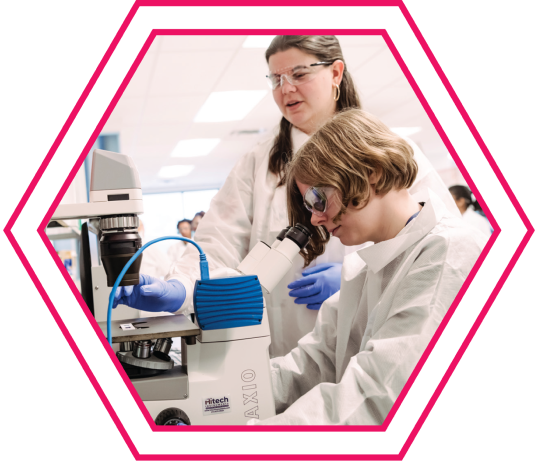
TLST student Fae Switzer works at the microscope with guidance from her mentor, Emma Todd, at ATCC.
Thinking ahead
Although the two-year program initially targeted transfers from regional community colleges, “we were getting so much interest from students on the Catonsville campus, we went ahead and put it on the list of majors for freshmen applying to UMBC,” Friar says. “That’s been the fastest growing cohort in our major.”
Steven Schaffer transferred to TLST after starting on the main campus in bioinformatics. Now he is in the bioinformatics track within TLST; the other option is a biomanufacturing track. Schaffer likes that there is a strong cohort connection because everyone takes mostly the same classes together. “I would recommend TLST. It’s a growing field and the skills you learn are very versatile,” Schaffer adds.
Schaffer hopes to eventually take on a role that leans into engineering at a place like Northrop Grumman. But before that, he’s eyeing UMBC’s Master of Professional Studies in biotechnology. The M.P.S. degree offers advanced instruction in the life sciences, plus coursework in regulatory affairs, leadership, management, and financial management. Friar describes it as “a cross between a science master’s and an M.B.A.”
Academic decathletes
Soon, the confident students in Friar’s cell biology class will arrive in labs across Montgomery County, the capital region, and beyond. They will contribute to drug discovery and production, design manufacturing processes, and, eventually, lead teams and make strategic decisions for major biotech companies.
Jeff Galvin, the ATG CEO, referred to TLST alumni as “academic decathletes.” Like decathletes, they have an array of skills and perform all of them admirably. But rather than medals, they’re seeking an opportunity to contribute to positive change through their work. They’ll translate basic science into diagnostic tests, treatments for disease, and more to improve the lives of their neighbors in Maryland and those in need around the world.
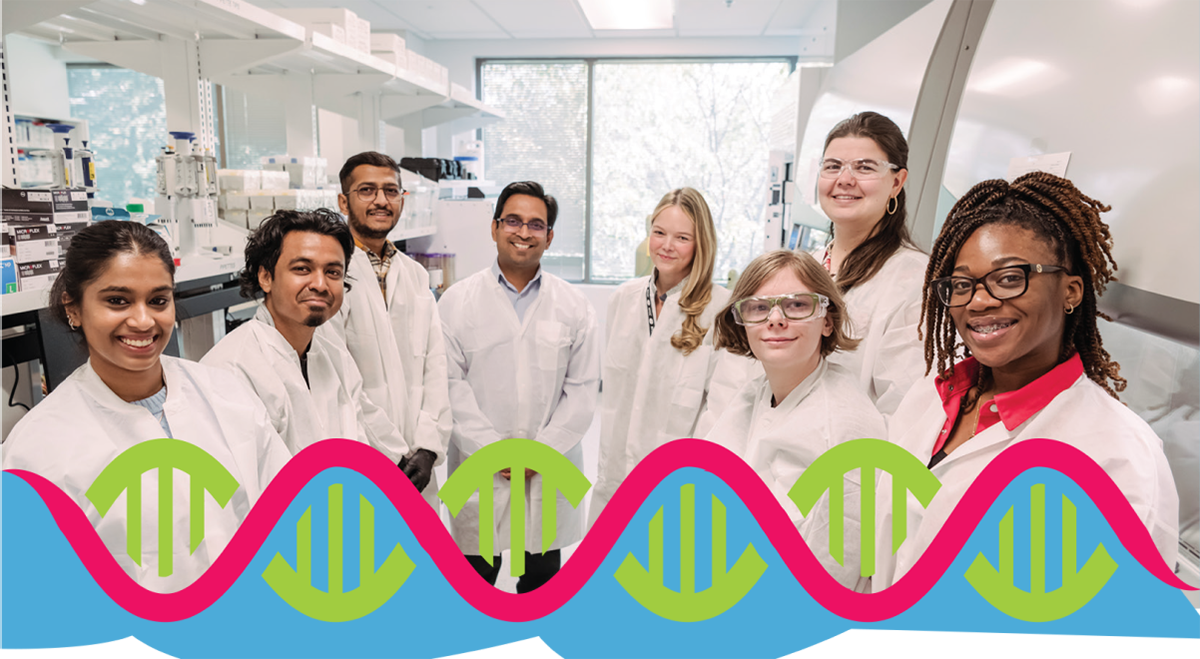
ATCC’s SPARC internship program offers opportunities for TLST students to conduct meaningful work in the biotech industry. Merryll Kallungal (far left) transitioned from her internship to a full-time role at ATCC this summer.
SPARC-ing Rewarding Careers
Just 10 minutes from USG in Gaithersburg, Maryland, biotech company ATCC has capitalized on the TLST talent pipeline. Their Student Partnership and Research Collaboration (SPARC) Program requires USG enrollment and offers qualified students paid, part-time career opportunities throughout the academic year at ATCC’s research facility. As the leading developer and supplier of authenticated cell lines, microorganisms, and associated data for academia, industry, and government, a successful internship at ATCC is a feather in the cap for students pursuing a TLST degree.
Of the seven interns selected for the SPARC program this year, four are TLST students—and they are thriving. The interns praised their SPARC experience while donning lab coats, shoe booties, safety glasses, and gloves in one of ATCC’s labs—where keeping employees safe and protecting lab samples and products from contamination is mission critical.
“I love the TLST program!” exclaimed Fae Switzer, who has wanted to pursue a career in biotech since she learned about CRISPR, the gene-editing platform, as a child. Switzer, a SPARC associate biologist in the microphysiological unit, notes that things she learned in her UMBC classes prepared her for the internship, and things she’s learning at ATCC now are helping her in her classes.
Jason Bose, a SPARC associate biologist on the microbiology team, knew he was interested in biologybut not medical school. When Bose learned about TLST, he thought, “Wow, this aligns with what I want to do,” he says. “It’s been really great so far.” He even uses the basic coding skills and tricks for Excel spreadsheets that he learned in class—which at the time he wasn’t so sure about. “Yep, I use them all the time at ATCC,” he says.
Tamilore Akinde completed an internship last summer at ATCC’s headquarters in Manassas, Virginia, and now she is a SPARC intern. “I like that TLST teaches multidisciplinary skills,” she says. Being able to pivot toward different opportunities that come her way is valuable, she adds.
“The hands-on lab training provided by the TLST program has prepared students for impactful careers at ATCC,” shares Ruth Cheng, general manager and senior vice president for research and industrial solutions at ATCC. “Witnessing students like Merryll Kallungal transition from the SPARC program to a full-time role in cryobiology R&D is a testament to the power of this collaboration.”
After interning at ATCC, Kallungal graduated from TLST in May and assumed a full-time associate biologist role in the cryobiology group in June. The lab techniques she learned in TLST came in handy at ATCC, and she has already learned a lot of new things, too. “I absolutely love what I do,” she says.

Walking into the Albin O. Kuhn Library Gallery, you always know you’re going to see some well-curated photos and works of art, but the trove of images currently on the walls for Revisions: Celebrating 50 Years of the UMBC Photography Collections (closes December 15) are assembled as an remarkable representational sample of the nearly 3 million images that make up the UMBC archive.
Known today as one of the country’s premiere university collections of photographs, the Photography Collections had a modest but auspicious beginning. In 1974, the Baltimore lithographer and photographer Edward Bafford donated to UMBC Special Collections a remarkable early image by Arthur Stieglitz (1864–1946), a photographer widely credited with helping transform photography into a serious art form. Bafford’s gift coincided with the foundational purchase of more than 5,400 photographs by labor activist Lewis Hine that documented horrific child labor practices.
Over time, the Photography Collections at UMBC have expanded through purchases and gifts. One special acquisition stands out for its regional importance: In 2014, the collection received the photo archives of the Baltimore Sun, including more than 750,000 prints, negatives, and transparencies from the 1930s through the 1980s.
Housed in the Special Collections department of the Library, the collections are open to the public, and are widely used by scholars and photographers. An increasing number of images have been digitized for online viewing, available through the Library’s website.
Looking back at a half-century of collecting, the exhibition offered thematic groupings and visual juxtapositions of photographs from the nineteenth century to the present. Co-curated by Beth Saunders, curator and head of Special Collections, and Emily Hauver ’06, curator of the Albin O. Kuhn Library Gallery, Revisions asked viewers to approach the history of photography with fresh eyes. In this photo essay, Hauver offers her thoughts on a few stand-out images in the show.
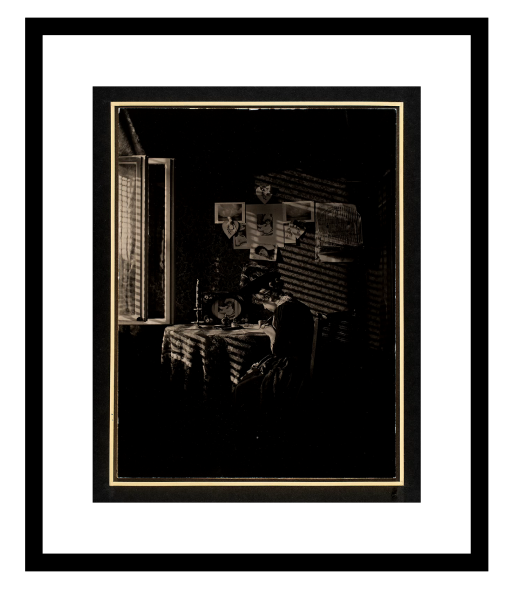
Sun Rays—Paula, Berlin, 1889
Sun Rays-Paula, Berlin is a particularly apt founding image for a university collection; it was made when the great Steiglitz was himself a student, and could thus be viewed as a symbol of the endurance of formative educational experiences on the making of an individual’s personal and professional identity. UMBC’s Photography Collections were conceived of as a teaching tool through which budding photographers enrolled at the university can contemplate the elements of successful photographs through the close study of master prints.
Alfred Stieglitz (American, 1864–1946), Sun Rays—Paula, Berlin, 1889. Gelatin silver print, 1929. Gift of Edward Bafford, P74-07-001.
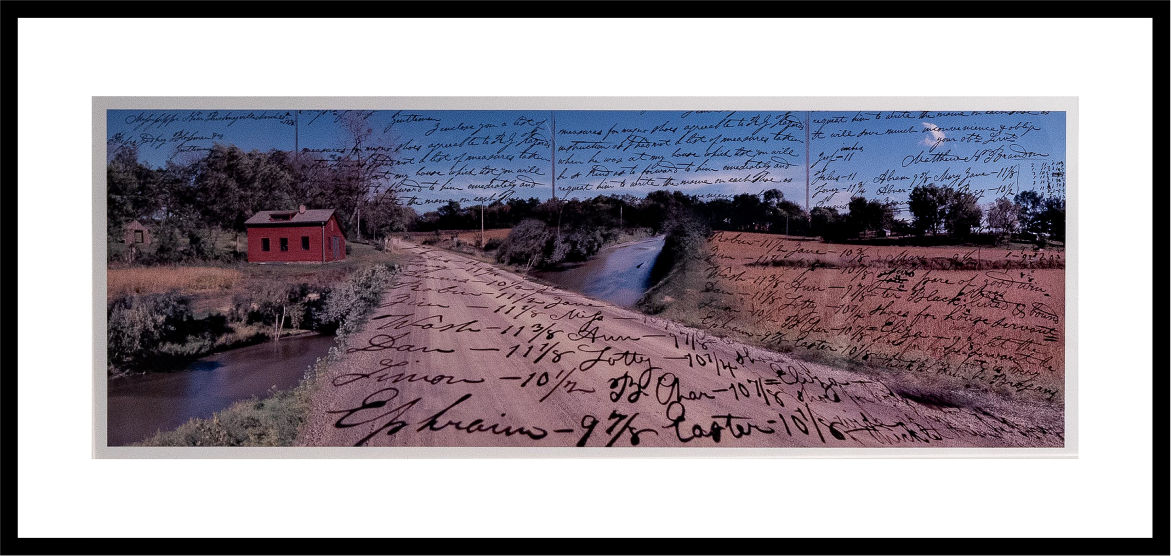
[Nishnabotna Ferry House], ca. 2001–2008
Stephen Marc, American, born 1954, [Nishnabotna Ferry House], ca. 2001–2008. Inkjet print. Stephen Marc Collection, Coll353-P001.
Bringing the past palpably into the present, this photograph by Stephen Marc utilizes digital montage to weave together elements from the landscape of slavery—in this case a site associated with the Underground Railroad, the Nishnabotna Ferry House, and an 1836 letter from a Mississippi slaveholder ordering shoes for the people he enslaved. The names of the enslaved, which appear to be marching along the path to freedom and a better future, memorialize both the individuals held captive and those who succeeded in escaping.
Ralph Gibson (American, born 1939), Elba, c.1983. Gelatin silver print. Gift of Carol A. Merritt, P93-14-004.
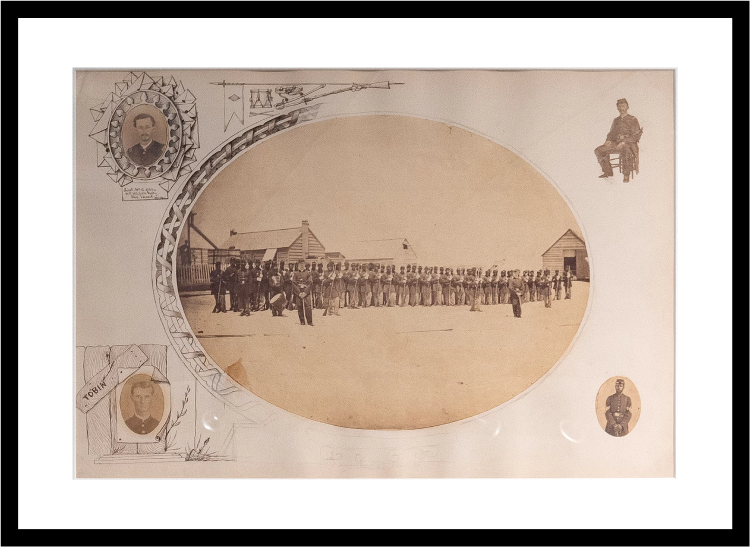
Ship Island, Miss. & 74th U.S. Colored Infantry, c. 1864
This composition comprises several photographs of Black Union soldiers and white officers and is embellished with hand-drawn elements. Posing for portraits during the Civil War— the first major conflict to be extensively documented through photography—allowed Black men to assert their newfound identity and freedom as soldiers. The person who made this composition sought to memorialize the patriotism of Black soldiers through the visual image, showcasing the commitment of these men to fight for their own liberation. The fact that the embellishments are incomplete draw a poignant, if unintentional, parallel to the unfinished business of achieving true racial equality in this country.


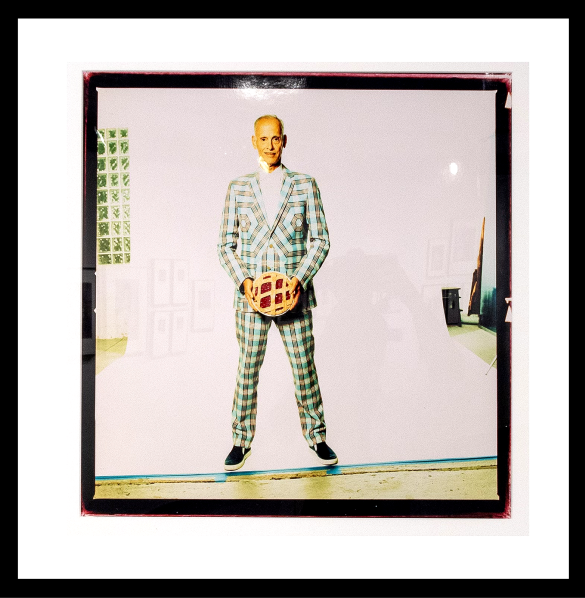
John Waters, 2013
What could be more “Baltimore” than John Waters? In this image, taken by Sam Holden, a Baltimore-based photographer who tragically passed away at the age of 44 in 2019, the filmmaker grins impishly at the camera while posing with a cherry pie.
Sam Holden (American, 1970–2014), John Waters, 2013. Cross processed chromogenic print. Sam Holden Collection, Coll255_IA-001.
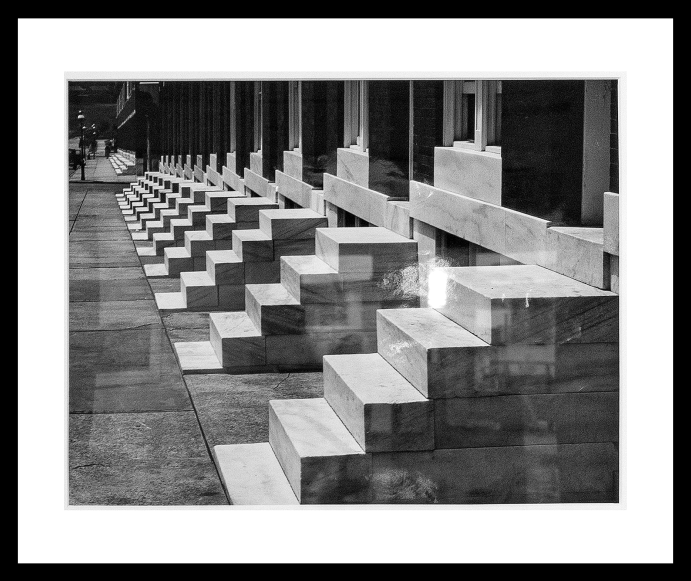
Marble Steps, 1954
Row after row of white marble steps for which the city of Baltimore is famous are seen in this photograph by Aubrey Bodine, one of Maryland’s best-known photographers. The geometry and contrasting tones of the steps pair with Bodine’s meticulous composition to manipulate the viewer’s perception by drawing the eye down the block and giving the impression of depth that defies the flat surface of this photograph.
A. Aubrey Bodine (American, 1906–1970), Marble Steps, 1954. Gelatin silver print. Gift of Mrs. A. Aubrey Bodine, P86-19-032.
Ward 81, Oregon State Hospital, Salem, Oregon, 1976
This photograph by Mary Ellen Mark flips the typical script of looking at a photograph wherein the observer looks upon a passive subject. Here, the photograph appears to be looking back. Despite the visual distortion caused by the screen covering the door’s small window, the power of this woman’s gaze implores us to make a connection, challenging us to engage on a deeper level with her and, perhaps, with ourselves. It’s made all the more compelling knowing that it was taken on Ward 81, a women’s security ward of the Oregon State Mental Institution.
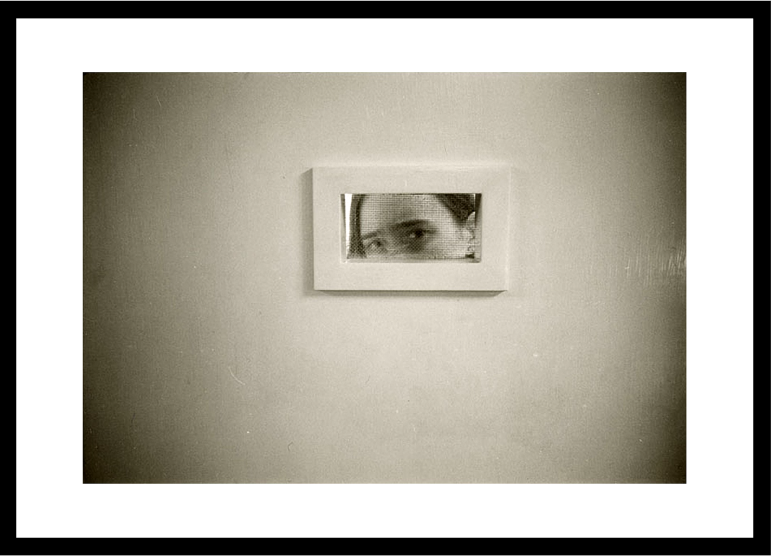
Mary Ellen Mark (American, 1940–2015), Ward 81, Oregon State Hospital, Salem, Oregon, 1976. Gelatin silver print. Gift of Andrew Cahan, P2013-32-001.
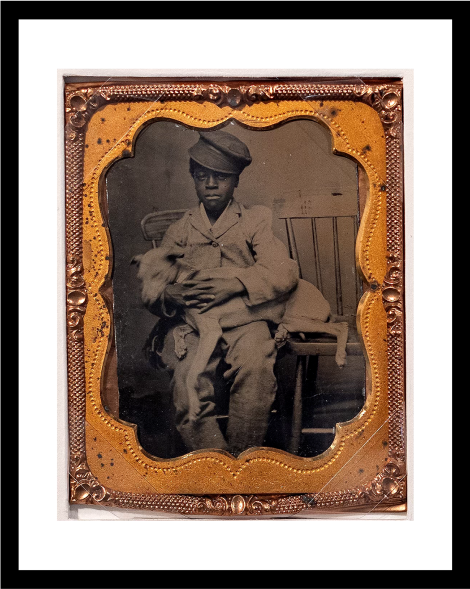
Boy and dog, c. 1870s
Our collections hold thousands of images of anonymous people. Here, a small tintype shows an unusual pairing—a Black boy with a dog—framed in a case. We don’t know his name or where the photo was taken, but we can date this image to the 1870s. As we gaze back into his eyes, we wonder: Who was he? What was his story?
Unidentified photographer, Boy and dog, c. 1870s. Tintype. Library purchase, P78-120-006.
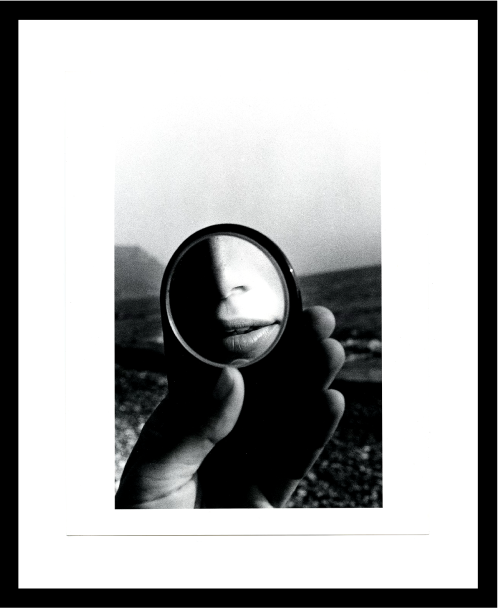
Elba, c.1983
Mirrors, with which photographs have long been metaphorically compared, offer opportunities to extend the narrative possibilities of a photograph beyond what is in front of the camera to what is behind, beside and beyond. This photograph by Ralph Gibson is compelling because it elicits conflicting reactions at once: comfort with the familiarity of the subjects (a nose, mouth, hand, landscape) and unease with the disjointed way they have been assembled.
Unidentified photographer, Boy and dog, c. 1870s. Tintype. Library purchase, P78-120-006
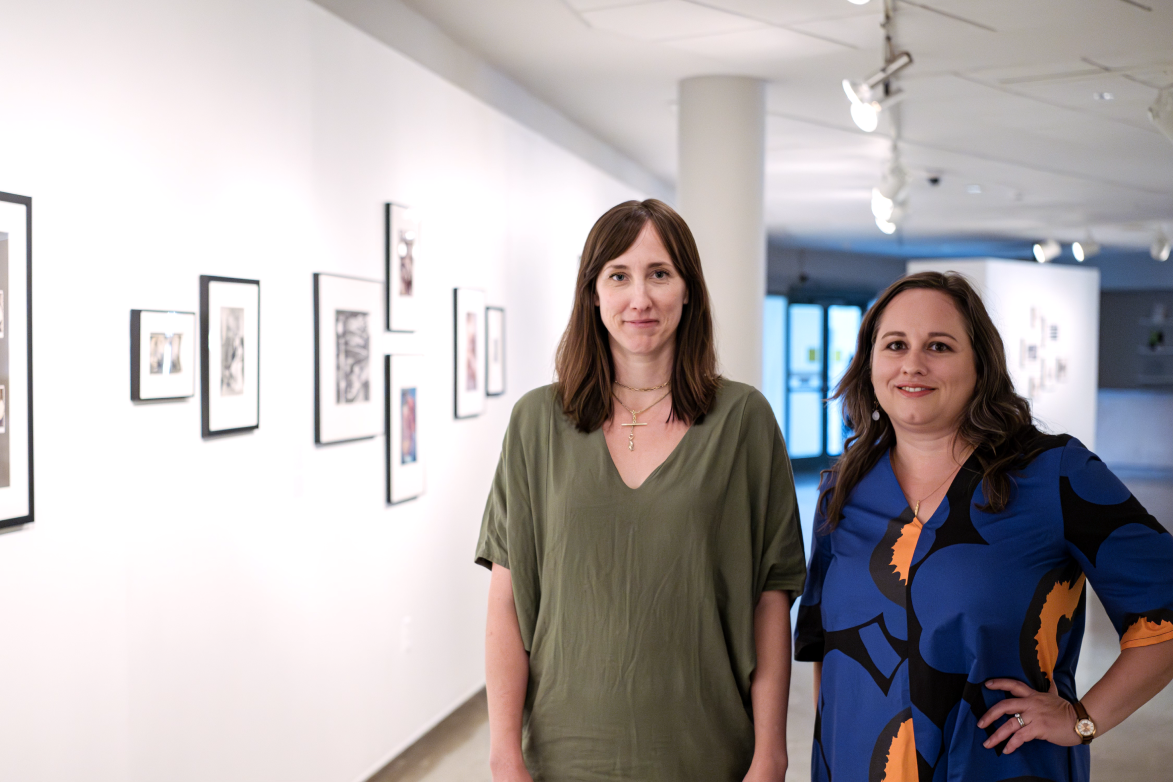
Emily Hauver ’06, curator of the Albin O. Kuhn Library Gallery, and Beth Saunders, curator and head of Special Collections, worked together to comb through the university’s extensive collections to display a stunning representation of what is available in the archives.
By Emily Hauver ’06 and Thomas Moore
]]>
Walking into the Albin O. Kuhn Library Gallery, you always know you’re going to see some well-curated photos and works of art, but the trove of images currently on the walls for Revisions:...
https://umbc.edu/stories/seeing-with-fresh-eyes-photography-collection/
https://beta.my.umbc.edu/api/v0/pixel/news/146083/guest@my.umbc.edu/26572da6ad6205c415540b7d7441f9eb/api/pixel
aok-library-gallery
campus-life
fall-2024
feature
magazine
photography-collections
story
UMBC News & Magazine
https://beta.my.umbc.edu/groups/umbc-news-magazine
https://assets1-beta.my.umbc.edu/system/shared/avatars/groups/000/001/943/24435aa6207c452e7bc15cc74b42c7bb/xsmall.png?1748556657
https://assets1-beta.my.umbc.edu/system/shared/avatars/groups/000/001/943/24435aa6207c452e7bc15cc74b42c7bb/original.png?1748556657
https://assets2-beta.my.umbc.edu/system/shared/avatars/groups/000/001/943/24435aa6207c452e7bc15cc74b42c7bb/xxlarge.png?1748556657
https://assets2-beta.my.umbc.edu/system/shared/avatars/groups/000/001/943/24435aa6207c452e7bc15cc74b42c7bb/xlarge.png?1748556657
https://assets3-beta.my.umbc.edu/system/shared/avatars/groups/000/001/943/24435aa6207c452e7bc15cc74b42c7bb/large.png?1748556657
https://assets1-beta.my.umbc.edu/system/shared/avatars/groups/000/001/943/24435aa6207c452e7bc15cc74b42c7bb/medium.png?1748556657
https://assets2-beta.my.umbc.edu/system/shared/avatars/groups/000/001/943/24435aa6207c452e7bc15cc74b42c7bb/small.png?1748556657
https://assets1-beta.my.umbc.edu/system/shared/avatars/groups/000/001/943/24435aa6207c452e7bc15cc74b42c7bb/xsmall.png?1748556657
https://assets2-beta.my.umbc.edu/system/shared/avatars/groups/000/001/943/24435aa6207c452e7bc15cc74b42c7bb/xxsmall.png?1748556657
UMBC News & Magazine
1
0
false
Tue, 03 Dec 2024 14:07:51 -0500
Tue, 03 Dec 2024 14:07:51 -0500
Then and Now—Place of Play to Protected Site

The afternoon sun dances on the water of the Library pond while fish swim below the surface. Most days, you see ducks enjoying the water. Unlike many newer places on campus, the pond has been one of UMBC’s iconic spots since the beginning. But the current generation of fish—and today’s Retrievers—don’t have a long enough memory to know that the pond was once a place of recreation for students.
Photos from UMBC’s 1969 yearbook, Skipjack, reveal students playing tug of war over the pond and other water activities such as rowing and ice skating. Splashing around in the pond is unimaginable today—signs tell those who come to the water feature about its importance to the natural wildlife and the delicate nature of the pond’s ecosystem. he terrace and landscaping around the pond has been reshaped over the years to invite students, faculty, staff, and others to sit on nearby benches admiring the site’s natural beauty.
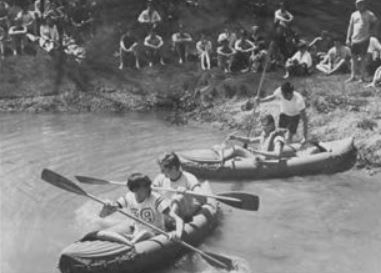
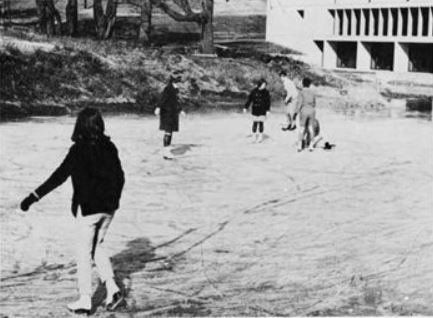
While students no longer play in its water, the pond has never been better monitored. UMBC’s Facilities Management works to keep the pond clean and safe for its many flora and fauna. “A little bit of care goes a long way,” says Ralph Ericksen, grounds manager of maintenance, who explains that Facilities Management is currently focused on controlling vegetation (mainly phragmites—the common reed—which if left unchecked can cause major problems), keeping invasive species out, and managing oxygenation levels in the water. His group works with UMBC’s Office of Sustainability to develop programs to educate students about why it’s important to conserve the pond for many generations of Retrievers to come.
“Ponds create a wonderful atmosphere.” Ericksen commented. The fish and the ducks would agree with him and so would the many visitors over the years.
]]>
The afternoon sun dances on the water of the Library pond while fish swim below the surface. Most days, you see ducks enjoying the water. Unlike many newer places on campus, the pond has been one...
https://umbc.edu/stories/place-of-play-to-protected-site-library-pond/
https://beta.my.umbc.edu/api/v0/pixel/news/146029/guest@my.umbc.edu/12cda80e9726ca91f19c0e949598e2f4/api/pixel
aok-library
campus-life
fall-2024
magazine
pond
story
sustainability
then-and-now
UMBC News & Magazine
https://beta.my.umbc.edu/groups/umbc-news-magazine
https://assets1-beta.my.umbc.edu/system/shared/avatars/groups/000/001/943/24435aa6207c452e7bc15cc74b42c7bb/xsmall.png?1748556657
https://assets1-beta.my.umbc.edu/system/shared/avatars/groups/000/001/943/24435aa6207c452e7bc15cc74b42c7bb/original.png?1748556657
https://assets2-beta.my.umbc.edu/system/shared/avatars/groups/000/001/943/24435aa6207c452e7bc15cc74b42c7bb/xxlarge.png?1748556657
https://assets2-beta.my.umbc.edu/system/shared/avatars/groups/000/001/943/24435aa6207c452e7bc15cc74b42c7bb/xlarge.png?1748556657
https://assets3-beta.my.umbc.edu/system/shared/avatars/groups/000/001/943/24435aa6207c452e7bc15cc74b42c7bb/large.png?1748556657
https://assets1-beta.my.umbc.edu/system/shared/avatars/groups/000/001/943/24435aa6207c452e7bc15cc74b42c7bb/medium.png?1748556657
https://assets2-beta.my.umbc.edu/system/shared/avatars/groups/000/001/943/24435aa6207c452e7bc15cc74b42c7bb/small.png?1748556657
https://assets1-beta.my.umbc.edu/system/shared/avatars/groups/000/001/943/24435aa6207c452e7bc15cc74b42c7bb/xsmall.png?1748556657
https://assets2-beta.my.umbc.edu/system/shared/avatars/groups/000/001/943/24435aa6207c452e7bc15cc74b42c7bb/xxsmall.png?1748556657
UMBC News & Magazine
1
0
false
Tue, 03 Dec 2024 11:48:41 -0500
Tue, 03 Dec 2024 11:48:41 -0500
UMBC students excel at annual meeting of the American Institute of Chemical Engineers
UMBC chemical engineering students excelled again at the annual meeting of the American Institute of Chemical Engineers (AIChE), held in San Diego this fall. The UMBC ChemE Jeopardy team, led by senior chemical engineering student Colin Jones, claimed third place at the national competition held during the conference; the K – 12 STEM outreach team, led by senior chemical engineering student Jemma Pryzbocki, won the top judges’ award in the high school category for designing a module to teach concepts of heat exchange; and the UMBC AIChE club won a best student chapter award.
The UMBC ChemE car team, which designed a car that starts and stops by chemical reactions, also performed respectably in a competitive field. The team was led by senior chemical engineering student Ben Welling. Several students also received individual recognitions—senior chemical engineering and biochemistry student Pavan Umashankar won a Donald F. & Mildred Topp Othmer Scholarship Award and senior Meredith Morse, chemical engineering, took third place in the student poster session in the food, pharmaceutical, and biotechnology division.
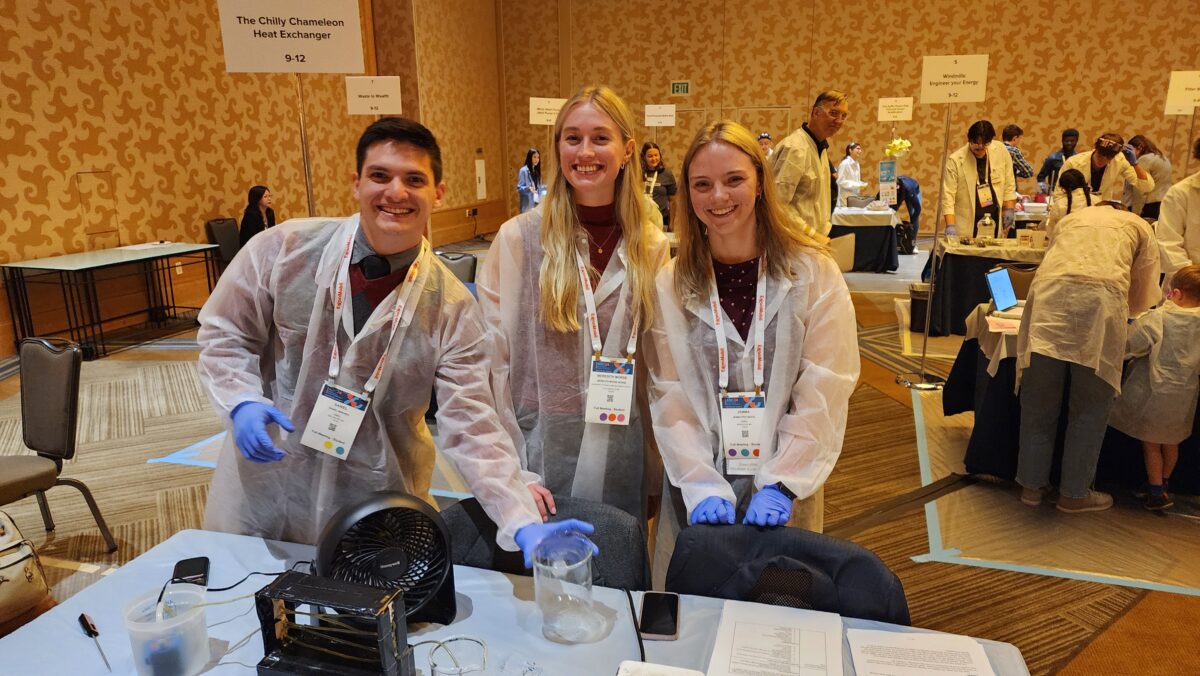 K – 12 STEM outreach team members (from left to right) Daniel Miranda, Meredith Morse, and Jemma Przybocki demonstrate their teaching module, “The Chilly Chameleon Heat Exchanger.” (Photo courtesy of Neha Raikar)
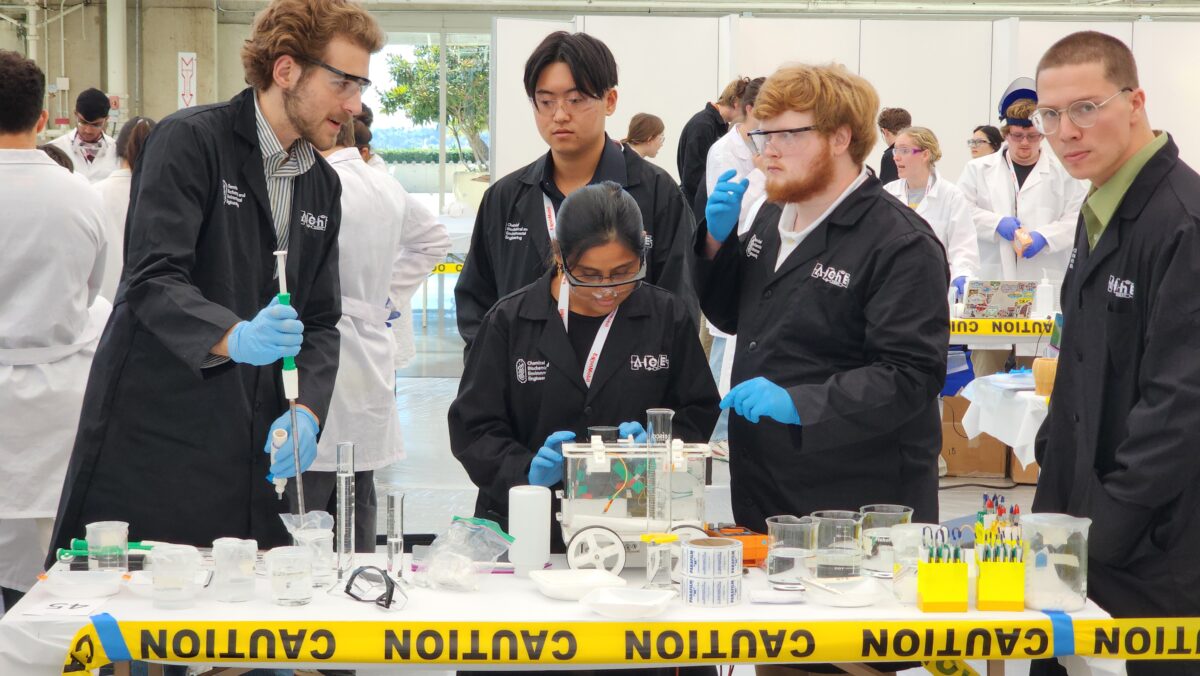 ChemE car team members (from left to right) Ben Welling (team captain), David Ni, Afrah Ahmed, Jacob Craft, and Michael Dinan prepare their car for competition. (Photo courtesy of Neha Raikar)
“The students deserve a big round of applause for all their dedication and hard work,” says Neha Raikar, a senior lecturer in the Department of Chemical, Biochemical, and Environmental Engineering (CBEE) and one of the advisors to the student AIChE chapter.
“The chemical engineering major demands exceptional attention to detail and hard work,” says Mariajosé Castellanos, another CBEE faculty who advises the AIChE chapter. “It is truly inspiring to see our students consistently apply their skills and make a lasting mark on the national stage!”
UMBC students have achieved impressive AIChE conference success for many years running. The ChemE Jeopardy team has reached the final every year since 2020, and the K – 12 STEM outreach team, which only began competing last year, has won awards at each event. Earlier this year, the UMBC student chapter showed off their growth and talents by hosting a regional meeting of AIChE for the first time.
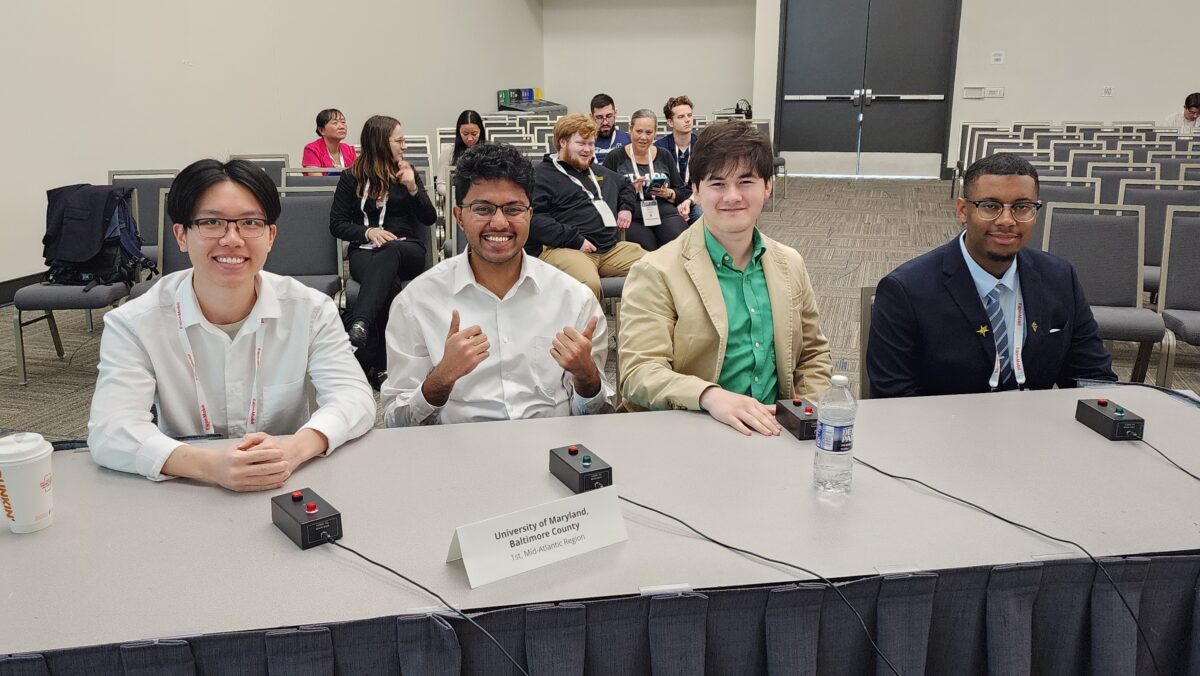 ChemE Jeopardy team members (from left to right) Jonathan Wu, Pavan Umashankar, Colin Jones, and Joshua Lewis take their places behind the buzzers. (Photo courtesy of Neha Raikar)
]]>
UMBC chemical engineering students excelled again at the annual meeting of the American Institute of Chemical Engineers (AIChE), held in San Diego this fall. The UMBC ChemE Jeopardy team, led by...
https://umbc.edu/quick-posts/umbc-students-excel-at-annual-meeting-of-the-american-institute-of-chemical-engineers/
https://beta.my.umbc.edu/api/v0/pixel/news/145956/guest@my.umbc.edu/3bc9c81a7d51b06401ccbfaa2ce1fb17/api/pixel
cbee
coeit
news
quick-post
science-and-tech
UMBC News & Magazine
https://beta.my.umbc.edu/groups/umbc-news-magazine
https://assets1-beta.my.umbc.edu/system/shared/avatars/groups/000/001/943/24435aa6207c452e7bc15cc74b42c7bb/xsmall.png?1748556657
https://assets1-beta.my.umbc.edu/system/shared/avatars/groups/000/001/943/24435aa6207c452e7bc15cc74b42c7bb/original.png?1748556657
https://assets2-beta.my.umbc.edu/system/shared/avatars/groups/000/001/943/24435aa6207c452e7bc15cc74b42c7bb/xxlarge.png?1748556657
https://assets2-beta.my.umbc.edu/system/shared/avatars/groups/000/001/943/24435aa6207c452e7bc15cc74b42c7bb/xlarge.png?1748556657
https://assets3-beta.my.umbc.edu/system/shared/avatars/groups/000/001/943/24435aa6207c452e7bc15cc74b42c7bb/large.png?1748556657
https://assets1-beta.my.umbc.edu/system/shared/avatars/groups/000/001/943/24435aa6207c452e7bc15cc74b42c7bb/medium.png?1748556657
https://assets2-beta.my.umbc.edu/system/shared/avatars/groups/000/001/943/24435aa6207c452e7bc15cc74b42c7bb/small.png?1748556657
https://assets1-beta.my.umbc.edu/system/shared/avatars/groups/000/001/943/24435aa6207c452e7bc15cc74b42c7bb/xsmall.png?1748556657
https://assets2-beta.my.umbc.edu/system/shared/avatars/groups/000/001/943/24435aa6207c452e7bc15cc74b42c7bb/xxsmall.png?1748556657
UMBC News & Magazine
1
0
false
Wed, 27 Nov 2024 14:02:22 -0500
Wed, 27 Nov 2024 14:02:22 -0500
Renaissance woman: Khadijah Ali-Coleman ’95 lends her varied voice to the Maryland humanities
ChemE Jeopardy team members (from left to right) Jonathan Wu, Pavan Umashankar, Colin Jones, and Joshua Lewis take their places behind the buzzers. (Photo courtesy of Neha Raikar)
]]>
UMBC chemical engineering students excelled again at the annual meeting of the American Institute of Chemical Engineers (AIChE), held in San Diego this fall. The UMBC ChemE Jeopardy team, led by...
https://umbc.edu/quick-posts/umbc-students-excel-at-annual-meeting-of-the-american-institute-of-chemical-engineers/
https://beta.my.umbc.edu/api/v0/pixel/news/145956/guest@my.umbc.edu/3bc9c81a7d51b06401ccbfaa2ce1fb17/api/pixel
cbee
coeit
news
quick-post
science-and-tech
UMBC News & Magazine
https://beta.my.umbc.edu/groups/umbc-news-magazine
https://assets1-beta.my.umbc.edu/system/shared/avatars/groups/000/001/943/24435aa6207c452e7bc15cc74b42c7bb/xsmall.png?1748556657
https://assets1-beta.my.umbc.edu/system/shared/avatars/groups/000/001/943/24435aa6207c452e7bc15cc74b42c7bb/original.png?1748556657
https://assets2-beta.my.umbc.edu/system/shared/avatars/groups/000/001/943/24435aa6207c452e7bc15cc74b42c7bb/xxlarge.png?1748556657
https://assets2-beta.my.umbc.edu/system/shared/avatars/groups/000/001/943/24435aa6207c452e7bc15cc74b42c7bb/xlarge.png?1748556657
https://assets3-beta.my.umbc.edu/system/shared/avatars/groups/000/001/943/24435aa6207c452e7bc15cc74b42c7bb/large.png?1748556657
https://assets1-beta.my.umbc.edu/system/shared/avatars/groups/000/001/943/24435aa6207c452e7bc15cc74b42c7bb/medium.png?1748556657
https://assets2-beta.my.umbc.edu/system/shared/avatars/groups/000/001/943/24435aa6207c452e7bc15cc74b42c7bb/small.png?1748556657
https://assets1-beta.my.umbc.edu/system/shared/avatars/groups/000/001/943/24435aa6207c452e7bc15cc74b42c7bb/xsmall.png?1748556657
https://assets2-beta.my.umbc.edu/system/shared/avatars/groups/000/001/943/24435aa6207c452e7bc15cc74b42c7bb/xxsmall.png?1748556657
UMBC News & Magazine
1
0
false
Wed, 27 Nov 2024 14:02:22 -0500
Wed, 27 Nov 2024 14:02:22 -0500
Renaissance woman: Khadijah Ali-Coleman ’95 lends her varied voice to the Maryland humanities

Early mentorship at UMBC, layered with her continued education and formative life experiences, has shaped Ali-Coleman’s voice and purpose. From her transformative years at UMBC—where she wrangled her array of interests into a self-designed major—to her current varied roles, Ali-Coleman’s commitment to the arts, education, and advocacy is clear. Her most recent project was launching the nonprofit Black Writers for Peace and Social Justice, which emerged from her experiences and inspirations gathered from a recent trip to Cuba.
Ali-Coleman’s entrepreneurial spirit is evident in her earlier work as well. In 2008, she founded an arts organization called Liberated Muse, driven by a passion for artistic expression and community engagement rather than immediate financial gain. Her leadership roles in various nonprofits provided her with the skills to formalize her initiatives with integrity and a systems mindset, she says. Collaborations with fellow UMBC alum Maceo Thomas ’93, biochemistry and molecular biology, arose from her desire to create spaces for artistic expression.
 Ali-Coleman stops the smell the roses (and a few other flowers). Photo courtesy of Ali-Coleman.
As the second poet laureate of Prince George’s County, Maryland, Khadijah Z. Ali-Coleman embodies the role’s commitment to both the arts and community. She describes the work as an ambassador for literature and writing, creating courses and spaces for writers to share their voices. “What I’ve found the greatest joy in,” says Ali-Coleman ’95, interdisciplinary studies , “is partnering with local libraries and schools to share the different literary eras that have impacted our world.” Through this position, she has launched a symposium series, focusing on the Black Arts Movement, with plans for an exploration of the Harlem Renaissance in 2025.
Listening to her mother’s voice
Ali-Coleman’s path to UMBC was heavily influenced by her mother, who encouraged her to stay local, despite initially being set on applying to schools across the country. However, during a family tour of UMBC, she felt an unexpected connection. It was, as she describes it, “love at first sight,” enamored by the warmth of the campus community and the support from then admissions counselor Yvette Mozie-Ross ’88.
Now the vice provost for enrollment management and planning, Mozie-Ross was present when Ali-Coleman won the UMBC 2024 Outstanding Alumni Award. “It’s great to see that the same passion and compassion for the genuine well-being of others that ignited and drove Khadijah as a student leader has not waned a bit,” says Mozie-Ross. “Her work in our communities continues to reflect her deep sense of humanity. We (UMBC) couldn’t be more proud of her.”
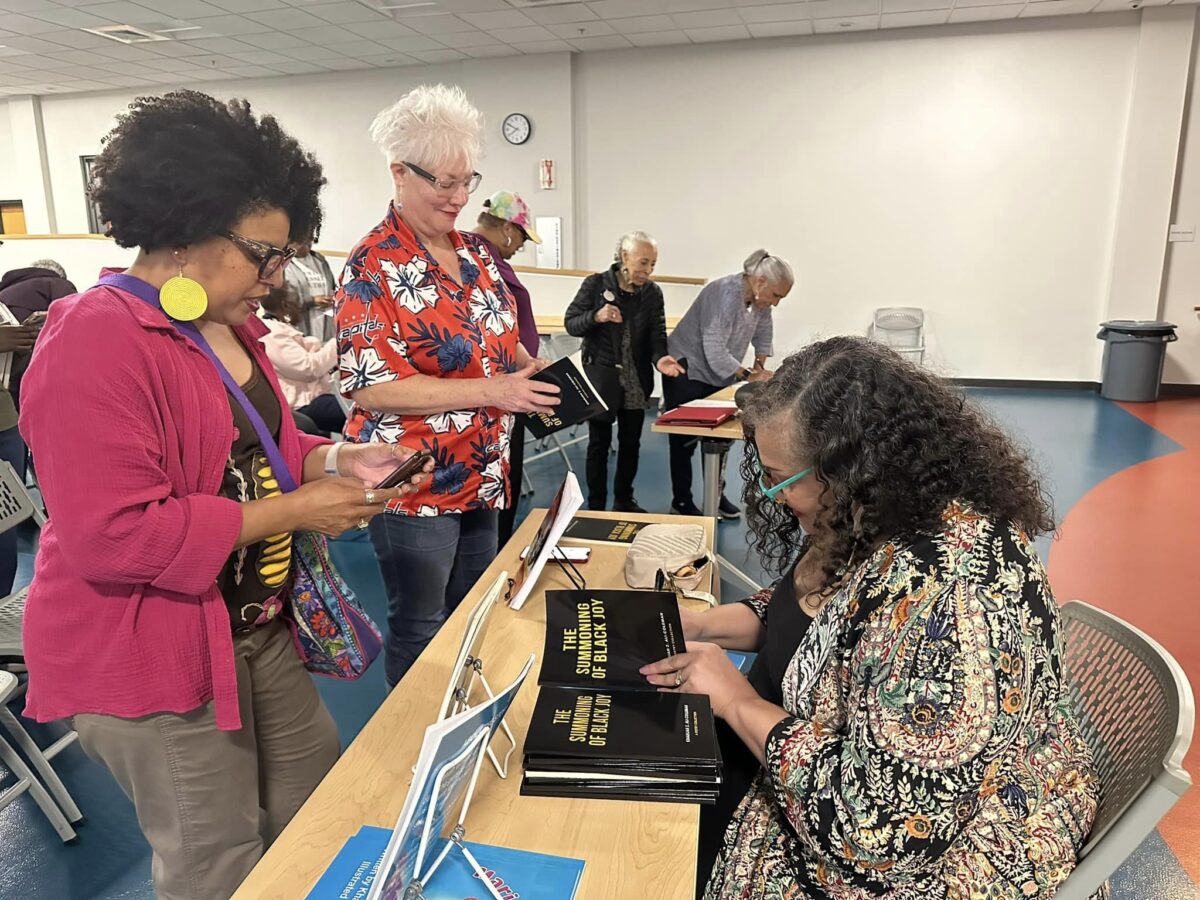 Ali-Coleman signs a copy of her poetry book The Summoning of Black Joy. Photo courtesy of Ali-Coleman.
Once at UMBC, Ali-Coleman faced the challenge of narrowing down her diverse academic interests—ranging from social work and mass media to African American history and English. She quickly realized that a traditional major wouldn’t fit her needs, and after reading the entire course catalog, she discovered the interdisciplinary studies (INDS) program, which allowed her to create a personalized curriculum. This flexibility enabled her to weave courses from African American studies, American studies, and English into a unique educational path that laid the groundwork for her future in communications and education.
Key figures at UMBC also played a significant role in shaping her journey. One of her favorite classes was Acklyn Lynch’s course on the Black Experience, where Ali-Coleman formed a lasting friendship with William Honablew ’95. This course not only stimulated intellectual discussions but also fostered ongoing connections among both students and Lynch long after graduation. Another influential mentor was Jamie Washington, who taught Ali-Coleman during her time as a student peer advisor. Washington’s ability to facilitate difficult conversations around racial tolerance during pivotal moments—such as the Rodney King trial verdict—left a lasting impression on Ali-Coleman. She often finds herself wishing she could emulate his approach as a facilitator and teacher. “Jamie Washington is by far the most impacting role model and person that I think of,” she says.
Making herself at home
Ali-Coleman draws on her inspiring mentors in her own classrooms as an associate professor of English at Coppin State University. “Baltimore is really my second home,” she shares, which started with her time at UMBC, followed by earning her master’s from Towson University, and her doctorate from Morgan State University. As someone familiar with area institutions, Ali-Coleman calls UMBC a “gem.” Aside from having high academic standards, she said it was also ahead of its time.
“Many aspects we now take for granted—like diversity, equity, and inclusion—were already being prioritized at UMBC,” says Ali-Coleman. “The university created a culture around inclusion, which was evident during my time as both an employee and a student.” As a member of the second cohort of UMBC McNair Scholars, Ali-Coleman experienced firsthand UMBC’s commitment to supporting underrepresented students in pursuing doctoral degrees. “I realized how ahead of the curve UMBC was,” said Ali-Coleman. “It didn’t sacrifice academics or cultural experiences. I don’t think people fully appreciate that.”
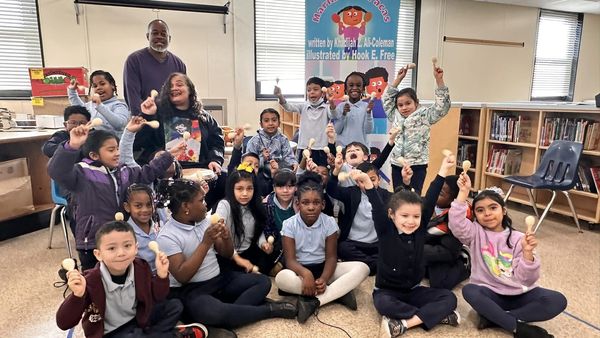 Ali-Coleman gathers with students at Chillum Elementary. Photo courtesy of Ali-Coleman.
Ali-Coleman, who was named an Outstanding Alumni at the 2024 Alumni Awards, says that her career trajectory reflects her experiences at UMBC, where she honed skills that would later serve her in various opportunities. After defending her dissertation on African American homeschool students who were dual enrolled just days before the onset of the COVID-19 pandemic, she recognized an urgent need for support among families navigating homeschooling for the first time. This led her to found Black Family Homeschool Educators and Scholars in 2020, an organization created to assist parents struggling with the transition to remote learning.
As she continues to navigate her role as poet laureate, professor, and nonprofit leader, her story showcases how pivotal moments, resilience, and a little bit of serendipity have shaped her path. “UMBC was one of the best experiences I’ve ever had, and it has been incredibly impactful,” Ali-Coleman reflects. “I’ve drawn from my time there in countless ways in all different areas of my life.”
]]>
Early mentorship at UMBC, layered with her continued education and formative life experiences, has shaped Ali-Coleman’s voice and purpose. From her transformative years at UMBC—where she wrangled...
https://umbc.edu/stories/khadijah-ali-coleman-lends-voice-to-humanities/
https://beta.my.umbc.edu/api/v0/pixel/news/145943/guest@my.umbc.edu/43d3827fa73be53f4ebb9c6f7fc98965/api/pixel
alumni
alumni-awards
alumni-profile
american-studies
english
fall-2024
inds
magazine
story
UMBC News & Magazine
https://beta.my.umbc.edu/groups/umbc-news-magazine
https://assets1-beta.my.umbc.edu/system/shared/avatars/groups/000/001/943/24435aa6207c452e7bc15cc74b42c7bb/xsmall.png?1748556657
https://assets1-beta.my.umbc.edu/system/shared/avatars/groups/000/001/943/24435aa6207c452e7bc15cc74b42c7bb/original.png?1748556657
https://assets2-beta.my.umbc.edu/system/shared/avatars/groups/000/001/943/24435aa6207c452e7bc15cc74b42c7bb/xxlarge.png?1748556657
https://assets2-beta.my.umbc.edu/system/shared/avatars/groups/000/001/943/24435aa6207c452e7bc15cc74b42c7bb/xlarge.png?1748556657
https://assets3-beta.my.umbc.edu/system/shared/avatars/groups/000/001/943/24435aa6207c452e7bc15cc74b42c7bb/large.png?1748556657
https://assets1-beta.my.umbc.edu/system/shared/avatars/groups/000/001/943/24435aa6207c452e7bc15cc74b42c7bb/medium.png?1748556657
https://assets2-beta.my.umbc.edu/system/shared/avatars/groups/000/001/943/24435aa6207c452e7bc15cc74b42c7bb/small.png?1748556657
https://assets1-beta.my.umbc.edu/system/shared/avatars/groups/000/001/943/24435aa6207c452e7bc15cc74b42c7bb/xsmall.png?1748556657
https://assets2-beta.my.umbc.edu/system/shared/avatars/groups/000/001/943/24435aa6207c452e7bc15cc74b42c7bb/xxsmall.png?1748556657
UMBC News & Magazine
1
0
false
Wed, 27 Nov 2024 09:53:23 -0500
Wed, 27 Nov 2024 09:53:23 -0500
Happy Thanksgiving from our office!
Dear Exchange Scholars,
The Office of International Students and Scholars extends its warmest wishes for a joyful Thanksgiving!
UMBC is truly fortunate to have you as part of our community. Your contributions as distinguished researchers and instructors enrich our campus in countless ways, and we are deeply grateful for the impact you make.
Whether you are experiencing this holiday for the first time or continuing the American tradition, we hope it offers you a chance to reflect on the connections and accomplishments that have made this year special.
Warm regards,
Diane Zeenny Ghorayeb
International Scholar Coordinator
** I am out of office on 11/27. UMBC is closed 11/28 and 11/29 for Thanksgiving Break. We'll be back on Monday 12/02! **
]]>
Dear Exchange Scholars, The Office of International Students and Scholars extends its warmest wishes for a joyful Thanksgiving! UMBC is truly fortunate to have you as part of our...
https://beta.my.umbc.edu/api/v0/pixel/news/145939/guest@my.umbc.edu/40762feab4d7c4ef6af5cc2d64ff2bf5/api/pixel
Exchange Visitors
https://beta.my.umbc.edu/groups/j-1
https://assets3-beta.my.umbc.edu/system/shared/avatars/groups/000/001/488/175f9f6b6c231ae5de90058948f6228c/xsmall.png?1525966942
https://assets3-beta.my.umbc.edu/system/shared/avatars/groups/000/001/488/175f9f6b6c231ae5de90058948f6228c/original.jpg?1525966942
https://assets2-beta.my.umbc.edu/system/shared/avatars/groups/000/001/488/175f9f6b6c231ae5de90058948f6228c/xxlarge.png?1525966942
https://assets1-beta.my.umbc.edu/system/shared/avatars/groups/000/001/488/175f9f6b6c231ae5de90058948f6228c/xlarge.png?1525966942
https://assets2-beta.my.umbc.edu/system/shared/avatars/groups/000/001/488/175f9f6b6c231ae5de90058948f6228c/large.png?1525966942
https://assets1-beta.my.umbc.edu/system/shared/avatars/groups/000/001/488/175f9f6b6c231ae5de90058948f6228c/medium.png?1525966942
https://assets1-beta.my.umbc.edu/system/shared/avatars/groups/000/001/488/175f9f6b6c231ae5de90058948f6228c/small.png?1525966942
https://assets3-beta.my.umbc.edu/system/shared/avatars/groups/000/001/488/175f9f6b6c231ae5de90058948f6228c/xsmall.png?1525966942
https://assets4-beta.my.umbc.edu/system/shared/avatars/groups/000/001/488/175f9f6b6c231ae5de90058948f6228c/xxsmall.png?1525966942
Exchange Visitors
https://assets4-beta.my.umbc.edu/system/shared/thumbnails/news/000/145/939/95b05417ffc8fb50e79f1c69266d4598/xxlarge.jpg?1732656080
https://assets2-beta.my.umbc.edu/system/shared/thumbnails/news/000/145/939/95b05417ffc8fb50e79f1c69266d4598/xlarge.jpg?1732656080
https://assets3-beta.my.umbc.edu/system/shared/thumbnails/news/000/145/939/95b05417ffc8fb50e79f1c69266d4598/large.jpg?1732656080
https://assets2-beta.my.umbc.edu/system/shared/thumbnails/news/000/145/939/95b05417ffc8fb50e79f1c69266d4598/medium.jpg?1732656080
https://assets2-beta.my.umbc.edu/system/shared/thumbnails/news/000/145/939/95b05417ffc8fb50e79f1c69266d4598/small.jpg?1732656080
https://assets4-beta.my.umbc.edu/system/shared/thumbnails/news/000/145/939/95b05417ffc8fb50e79f1c69266d4598/xsmall.jpg?1732656080
https://assets1-beta.my.umbc.edu/system/shared/thumbnails/news/000/145/939/95b05417ffc8fb50e79f1c69266d4598/xxsmall.jpg?1732656080
0
0
false
Tue, 26 Nov 2024 16:24:24 -0500
Tue, 26 Nov 2024 16:26:38 -0500
Meet a Retriever—James Atsaides ‘71, psychology, Founding Four member and planned giving donor
Meet James Atsaides ‘71, psychology. Jim is a Founding Four member, a management psychologist, a former Alumni Association Board of Directors president, a former adjunct faculty member, and a planned giver to the university. In 2023, Jim established the Dr. James P. Atsaides Endowment through his life insurance policy. But, most importantly of all, Jim met his wife Ardell Terry through his philanthropic work with the university. Recently, Jim took some time to reflect on his UMBC story. Take it away, Jim!
Q: What is your WHY? What brought you to UMBC?
A: I graduated from Loyola High School in 1967, and it was already a “done deal” that I would attend the University of Maryland, College Park. My brother, Sam Atsaides, was already there, which made things easier for my parents. So off I went.
Sam was a year ahead of me, and for his first year, he lived on campus. When I went there, the plan was for us to get an apartment with a few other roommates—cheaper than living on campus. When school started, Sam helped me figure out how to enroll in classes and what classes to take. I decided to become a psychology major.
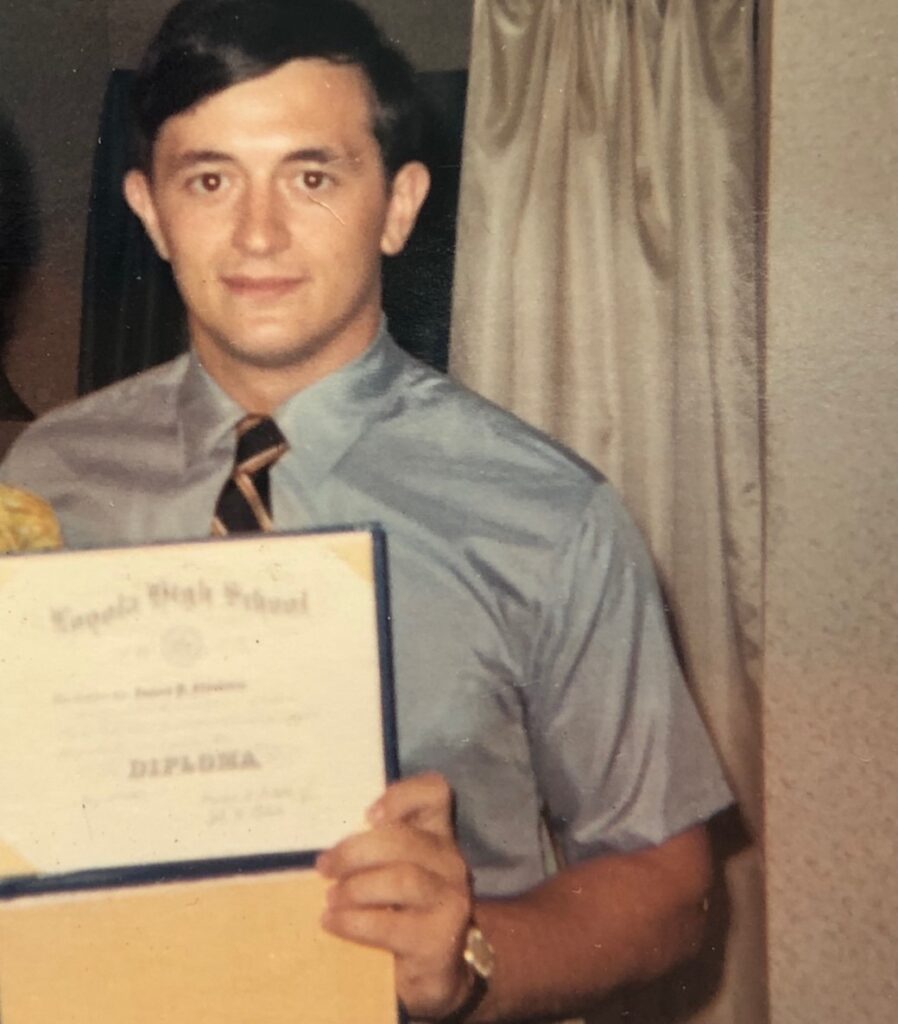 James Atsaides in 1967 holding his diploma from Loyola High School.
College Park was huge. I got lost right away. I wasn’t in high school anymore. It was also a rude awakening to how big the classes were. I was used to having 20 students in a class, but now there were 100 – 300 students in the freshmen classes. It took me weeks to get used to the size of the classes and how impersonal the school was.
Quickly, I realized that I was struggling. Sam was not a model student and always wanted to “wing it.” I couldn’t do that. Also, classes were hard, and I was also finding it difficult to make friends.
Year two at College Park was not much better—the same apartment, the same roommates, and an added twist. It was 1968 and the Vietnam War was getting a lot of attention. Students were staging “sit-ins,” and there were protest banners all over campus. I remember walking around campus wondering, “What am I doing here?” Adding to the chaos, Rev. Dr. Martin Luther King, Jr. was killed in 1968, leading to further unrest in the Washington, D.C., area.
After my second year of college, I decided I needed a change—a bold move. I decided to drop out of school. I mentioned to my parents that I needed some time off, and they understood what I was feeling. After a few jobs, I came back to my parents’ home in Catonsville and helped them at the family restaurant, Kibby’s. That’s where I first heard people talking about the new college just down the street, the University of Maryland, Baltimore County. So, I decided to check it out.
I drove to UMBC and walked around. It had only been built within the last few years and there were only a few buildings. But I liked it. Even though there was lots of dirt and mud all around, it felt just right—I felt safe. It was a small campus, unlike College Park. The students were walking with smiles on their faces, and I felt like I could relate to them. I talked it over with my parents, and the next semester I enrolled at UMBC.
Q: Tell us about what you loved most about your academic program. Was there anyone in the community who helped support you?
A: I decided to remain a psychology major and was impressed with all the courses that I could take at UMBC. I was like a kid in a candy store, just happy taking classes that were meaningful to me. The professors were also more approachable, and I started making friends. UMBC felt like home.
One friend in particular, Stan Sack, was a tremendous help. He was a fellow psychology major and had been at UMBC from the beginning. We studied together and talked about classes and professors, and he helped guide me throughout my time at UMBC. Stan helped make my time at UMBC a happy experience. As a result, my grades improved. I felt excited and energized with what I was doing.
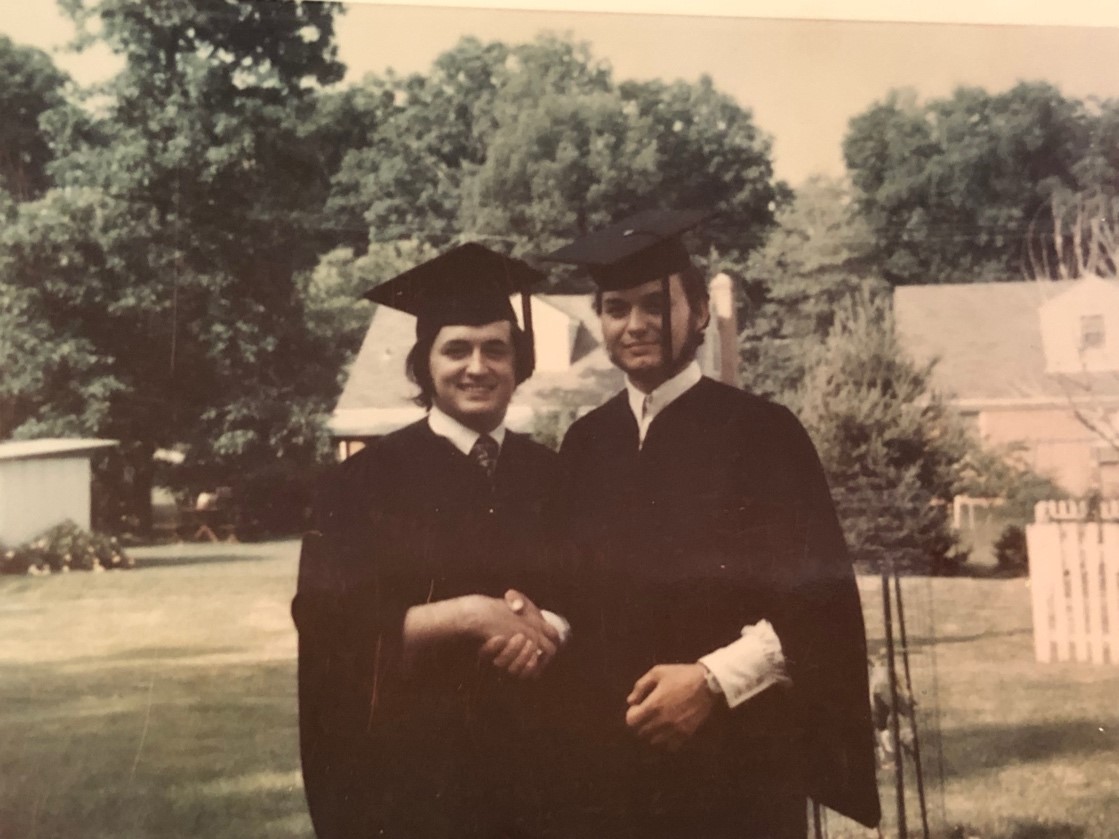 James Atsaides and his older brother Sam in their graduation regalia in 1971.
The classes I was taking also offered lots of different experiences. During an archeology class, we took a trip to the Walters Art Museum. As part of a project in a sociology class, I got to interview a local brewery manager and learn how his business impacted the community. This was a particularly meaningful experience because I always enjoyed business. I think it gave me the drive to focus on industrial psychology years later. I also did an internship at Spring Grove State Hospital, which was very meaningful in a different way as it made me realize that I did not want to become a clinical psychologist!
Q: What’s the one thing you’d want someone to know about the support you find here?
A: My time at UMBC went very quickly, but UMBC was my “savior” in a lot of ways. UMBC and the supportive community gave me the positive university experience I always wanted. UMBC also gave me direction and helped me figure out what I wanted to do with my life. I look back on my time as a UMBC student very fondly. However, it would not be my last go-around with the university.
My time at UMBC made me realize that I enjoyed learning. So I just kept going to school. I completed a master’s program at Springfield College and a Ph.D. program at the University of Kansas.
Q: Can you tell us about your career in psychology?
A: My career took me from Kansas to Oregon to work with an international firm of management psychologists. In the early 1980s, my parents and family decided to build a hotel resort on the Greek island of Rhodes where my mom had a large parcel of land. For this to materialize, however, I had to leave my career and come back to Baltimore to take over Kibby’s, the family restaurant. So in 1983, my family loaded the Hertz rental truck and settled back in Catonsville with two very young girls.
As a management psychologist, I took my own advice and hired a very good general manager to run the restaurant. This allowed me to start my professional practice in Baltimore in 1985. During this time, I met a fellow psychologist who became a very close and dear friend, John Martello. John was in a senior position at UMBC. We hit it off very well, and we spent much time talking about the work we were both doing, as well as our experiences at UMBC. John was instrumental in introducing me to the senior staff at UMBC. He introduced me to not only the head of the psychology department but also to the president of the university, Michael Hooker.
I enjoyed getting back on campus. The campus had grown so much and was still growing!
I am grateful for my time at UMBC and have appreciated the many life-long opportunities it has given me as an individual and as a professional.
James Atsaides ‘71, psychology
Management Psychologist & Business Consultant
Q: What drives you to support this community?
A: In the late 1980s, President Hooker contacted me and asked me to join the UMBC Alumni Association Board of Directors. I happily accepted.
During this time, UMBC was promoting an insurance program that alumni could establish that would create an endowment for UMBC. President Hooker and Nell Savopoulous, director of development at UMBC, asked if I would participate. I felt such a close connection to UMBC, that I said “yes.” This was my alma mater after all. Now, I just had to figure out what and who my endowment would benefit.
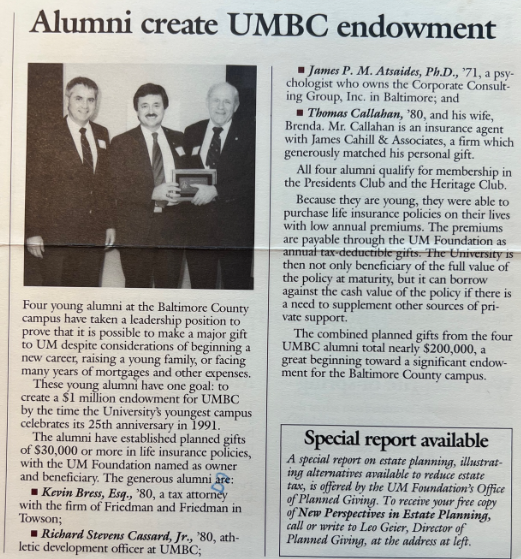 Newspaper clipping from The Retriever Weekly announcing the establishment of several endowments, including the Dr. James P. Atsaides Endowment.
As an industrial psychologist, I’m required to attend regular educational programs for continuous education (CE) credits. Students also regularly attend these conferences to make connections and gain exposure to the industry. However, these conferences are not cheap. My grandson, Dustin, for example, was graduating from Ithaca College and was honored with a request to present his senior research at a conference in Phoenix, Arizona. He was delighted with the opportunity but had to figure out how to cover airfare, lodging, and other expenses not included in his conference registration. Dustin quickly learned that there were no grants or scholarships available from the school to help him. So, he had to ask his parents and grandparents for money.
As my wife and I thought about Dustin’s situation, we both said, “Wouldn’t it be a good thing to have students apply for grants for this type of situation?” As we discussed this, we realized that we could focus the Dr. James P. Atsaides Endowment to help graduate students in need of funding to attend conferences.
I am grateful for my time at UMBC and have appreciated the many life-long opportunities it has given me as an individual and as a professional. Creating an endowment for students has been a wonderful way for me to say “Thank You” to the university and to help future students. And I am excited to share that we will award our first scholarship this academic year!
“Dr. Atsaides’ generosity to give back to both UMBC in general and our I/O Psychology program, in particular, is a testament to his professional values and his commitment to his alma mater,” says Dr. Elliot Lasson, professor of the practice and Director of UMBC’s I/O Psychology graduate program. “We look forward to using his gift to support our graduate students for years to come.”
Q. What has been your most meaningful connection at UMBC?
A: Through my work with the university, I was fortunate to meet Ardell Terry, campaign manager for UMBC. She was a positive addition to the fundraising group. Ardell and I married, and we have been together now for over 20 years. I thank UMBC for the opportunity to meet her as well.
 Ardell Terry, campaign manager for UMBC, and Kim Robinson, director of major gifts at UMBC.
Q: How have you stayed connected with UMBC?
A: In 1990, I was asked to teach an upper-level class in organizational psychology and joined the UMBC community in a new capacity—adjunct professor. I greatly enjoyed teaching the class and did so for nine years.
Along with my time on the UMBC Alumni Board, President Hooker asked me to represent the university as a member of the University System of Maryland Chancellor’s Advisory Council. This was truly an honor for me to represent my alma mater and be part of this historic transition to a state-wide education system.
In 1992, I was asked to be part of the selection committee for the next president of UMBC. As many of you probably know, this is the historic search that elevated Freeman A. Hrabowski, III, to the role of president, which he held until he retired in 2022.
In 1995, I was asked to take the position of president of the UMBC Alumni Board. This was a tremendous honor for me and allowed me to work closely with the administration. In my role as board president, I had the opportunity to be on stage while my younger cousin graduated from UMBC, which was really special.
UMBC continues to be close to my heart. It has been a large part of my life, and I am sure it will continue to be. I am honored to give back to the university in any way I can.
* * * * *
UMBC’s greatest strength is its people. When people meet Retrievers and hear about the passion they bring, the relationships they create, the ways they support each other, and the commitment they have to inclusive excellence, they truly get a sense of our community. That’s what “Meet a Retriever” is all about.
Learn more about how UMBC can help you achieve your goals.
]]>
Meet James Atsaides ‘71, psychology. Jim is a Founding Four member, a management psychologist, a former Alumni Association Board of Directors president, a former adjunct faculty member, and a...
https://umbc.edu/stories/meet-james-atsaides-psychology/
https://beta.my.umbc.edu/api/v0/pixel/news/145920/guest@my.umbc.edu/aa6ed5fa3e6fca5625c97b8bf119a57d/api/pixel
alumni
endowments
impact
magazine
meet-a-retriever
psychology
story
UMBC News & Magazine
https://beta.my.umbc.edu/groups/umbc-news-magazine
https://assets1-beta.my.umbc.edu/system/shared/avatars/groups/000/001/943/24435aa6207c452e7bc15cc74b42c7bb/xsmall.png?1748556657
https://assets1-beta.my.umbc.edu/system/shared/avatars/groups/000/001/943/24435aa6207c452e7bc15cc74b42c7bb/original.png?1748556657
https://assets2-beta.my.umbc.edu/system/shared/avatars/groups/000/001/943/24435aa6207c452e7bc15cc74b42c7bb/xxlarge.png?1748556657
https://assets2-beta.my.umbc.edu/system/shared/avatars/groups/000/001/943/24435aa6207c452e7bc15cc74b42c7bb/xlarge.png?1748556657
https://assets3-beta.my.umbc.edu/system/shared/avatars/groups/000/001/943/24435aa6207c452e7bc15cc74b42c7bb/large.png?1748556657
https://assets1-beta.my.umbc.edu/system/shared/avatars/groups/000/001/943/24435aa6207c452e7bc15cc74b42c7bb/medium.png?1748556657
https://assets2-beta.my.umbc.edu/system/shared/avatars/groups/000/001/943/24435aa6207c452e7bc15cc74b42c7bb/small.png?1748556657
https://assets1-beta.my.umbc.edu/system/shared/avatars/groups/000/001/943/24435aa6207c452e7bc15cc74b42c7bb/xsmall.png?1748556657
https://assets2-beta.my.umbc.edu/system/shared/avatars/groups/000/001/943/24435aa6207c452e7bc15cc74b42c7bb/xxsmall.png?1748556657
UMBC News & Magazine
1
0
false
Tue, 26 Nov 2024 10:24:07 -0500
Tue, 26 Nov 2024 10:24:07 -0500
Yonathan Zohar honored for lifetime of contributions to fish endocrinology research and advances in aquaculture

Yonathan Zohar, professor of marine biotechnology, has received the Lifetime Achievement Award from the International Society for Fish Endocrinology. Zohar’s work at the Institute of Marine and Environmental Technology in Baltimore’s Inner Harbor has produced fundamental discoveries in fish reproductive biology and applied the findings to the aquaculture industry, resulting in major advances. In 2020, the Binational Agricultural Research Development (BARD) Fund, a partnership program between the U.S. and Israel, also recognized Zohar for the outsize economic impact of his research.
In addition to Zohar’s core work in fish reproductive physiology, he has led a decades-long effort to develop land-based aquaculture methods that could bring fresh seafood to inland areas of the United States. Land-based fish production operations avoid pitfalls of open-water aquaculture such as disease, polluted water, and escapes. Land-based aquaculture could also limit the need for long-distance seafood transportation.
Maryland Farm and Harvest on Maryland Public Television (MPT) recently featured Zohar and his colleagues’ work. The aquaculture industry is the world’s fastest growing sector of agriculture, Zohar told MPT. American demand for seafood is rising, and currently, most of it is imported. With a $10 million grant from the USDA, Zohar has been working with team of scientists and government and industry stakeholders from the U.S. and abroad to help move land-based aquaculture toward commercial viability.
“We here at IMET, at the Aquaculture Research Center [ARC], are trying to address all these challenges, bottlenecks, hurdles to this industry so it can become economically feasible as well as—obviously as much as possible—environmentally responsible,” Zohar told MPT.
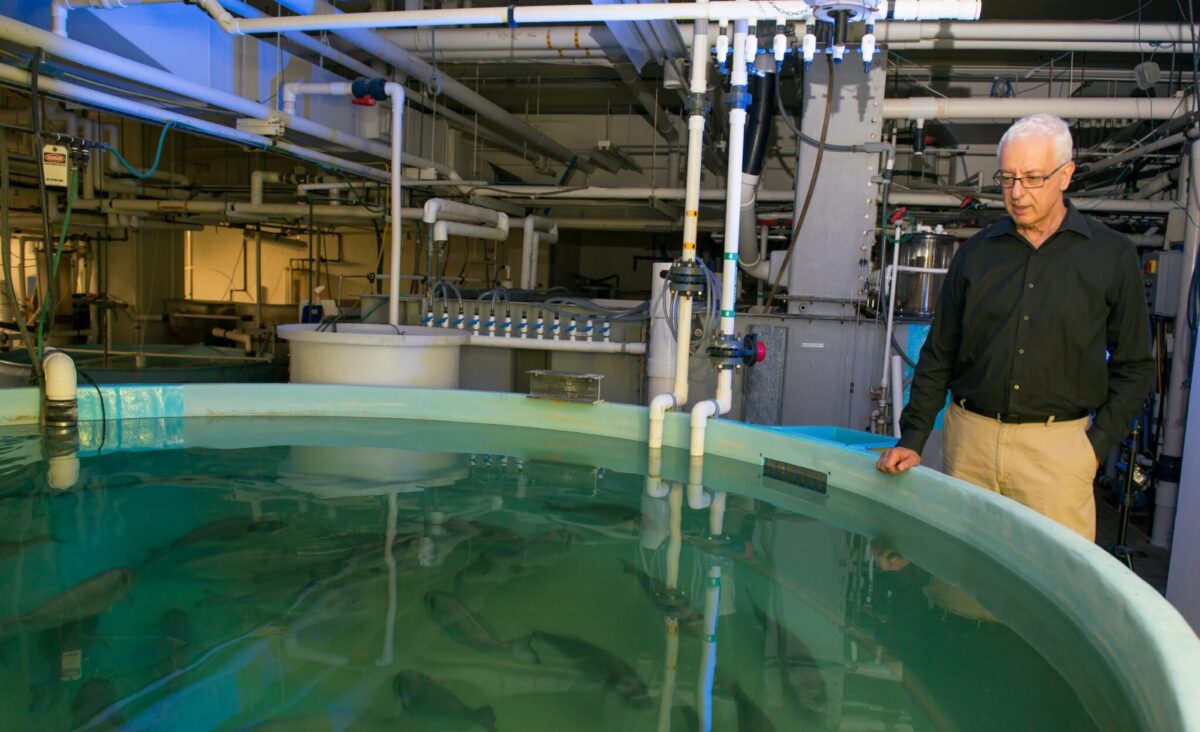 Yonathan Zohar stands next to a tank full of fish in the Aquaculture Research Center. (Marlayna Demond ’11/UMBC)
Addressing aquaculture’s hurdles
One of those hurdles is figuring out how to bring salmon to market size year round. Typically, salmon only reproduce once per year, Zohar explained. “We are using environmental manipulation to phase shift—to change the time of the spawning of the fish—so the farmer can get good quality eggs all year round,” he said. The team at the ARC has had success spawning salmon six months after their typical spawning time, Zohar told MPT, as a tray of red-orange salmon eggs spawned at IMET showed on the screen. And “if you can do it six months, you can do it four months, three months, all year round,” he said.
Another challenge to land-based systems is the accumulation of sludge—otherwise known as fish poop—in the tanks. Kevin Sowers, professor of marine biotechnology and a microbiology expert, explained that as the water in the fish tanks passes through a filter to be reused, bacterial colonies living on the surface of what look like pieces of wheel-shaped pasta break down the sludge. One of the products is methane gas.
“The goal here is to get rid of that waste, reduce it, and turn it into a product that can be used,” Sowers said. “And the product we produce, the biogas, will actually help power about 10 percent of the energy costs here in the facility.”
Still swimming along
All of these advances represent years or decades of effort by Zohar, Sowers, and additional colleagues to first understand the fundamentals of fish biology and reproduction, and then to find ways of tweaking it that serve the aquaculture industry and address the rising consumer demand for fish.
Zohar may have been doing this for a while, but with the industry on what feels like the cusp of a breakthrough, his continued enthusiasm for his work was obvious on Maryland Farm and Harvest.
“For someone who has been working on aquaculture for over 40 years, well, I have a lot of energy still to make sure that we make this happen,” Zohar told MPT—“that we stop overfishing our oceans and we satisfy the increasing demand of seafood in the United States and in the world.”
]]>
Yonathan Zohar, professor of marine biotechnology, has received the Lifetime Achievement Award from the International Society for Fish Endocrinology. Zohar’s work at the Institute of Marine and...
https://umbc.edu/stories/zohar-lifetime-achievement-aquaculture/
https://beta.my.umbc.edu/api/v0/pixel/news/145907/guest@my.umbc.edu/d0a06ae5010b6b1b2a53149708cde7ba/api/pixel
cnms
marinebiotech
news
research
science-and-tech
story
UMBC News & Magazine
https://beta.my.umbc.edu/groups/umbc-news-magazine
https://assets1-beta.my.umbc.edu/system/shared/avatars/groups/000/001/943/24435aa6207c452e7bc15cc74b42c7bb/xsmall.png?1748556657
https://assets1-beta.my.umbc.edu/system/shared/avatars/groups/000/001/943/24435aa6207c452e7bc15cc74b42c7bb/original.png?1748556657
https://assets2-beta.my.umbc.edu/system/shared/avatars/groups/000/001/943/24435aa6207c452e7bc15cc74b42c7bb/xxlarge.png?1748556657
https://assets2-beta.my.umbc.edu/system/shared/avatars/groups/000/001/943/24435aa6207c452e7bc15cc74b42c7bb/xlarge.png?1748556657
https://assets3-beta.my.umbc.edu/system/shared/avatars/groups/000/001/943/24435aa6207c452e7bc15cc74b42c7bb/large.png?1748556657
https://assets1-beta.my.umbc.edu/system/shared/avatars/groups/000/001/943/24435aa6207c452e7bc15cc74b42c7bb/medium.png?1748556657
https://assets2-beta.my.umbc.edu/system/shared/avatars/groups/000/001/943/24435aa6207c452e7bc15cc74b42c7bb/small.png?1748556657
https://assets1-beta.my.umbc.edu/system/shared/avatars/groups/000/001/943/24435aa6207c452e7bc15cc74b42c7bb/xsmall.png?1748556657
https://assets2-beta.my.umbc.edu/system/shared/avatars/groups/000/001/943/24435aa6207c452e7bc15cc74b42c7bb/xxsmall.png?1748556657
UMBC News & Magazine
0
0
false
Mon, 25 Nov 2024 16:35:06 -0500
Mon, 25 Nov 2024 16:35:06 -0500
When public service gets personal

When Patricia Mengue Bindjeme, a junior majoring in mechanical engineering, went to classes, her professors would sometimes point out how engineers’ decisions can have life-or-death consequences. But the message really hit home this past summer when Mengue Bindjeme interned at the Maryland Transit Administration (MTA), working on the Baltimore Red Line Project, a recently revived transportation project to create faster and more convenient links between the eastern and western parts of the city.
“I saw people talking about the journeys they had to make coming from West Baltimore to work at someplace like Johns Hopkins,” she says. “That’s a lot of travel.” Mengue Bindjeme realized how engineers working to ensure the safety, availability, and reliability of transportation could make huge differences to people’s everyday lives. “Having another person’s life in my hands is nerve-racking,” she says. “But the change I can make for someone else is really beautiful and impactful.”
Real tasks and real things
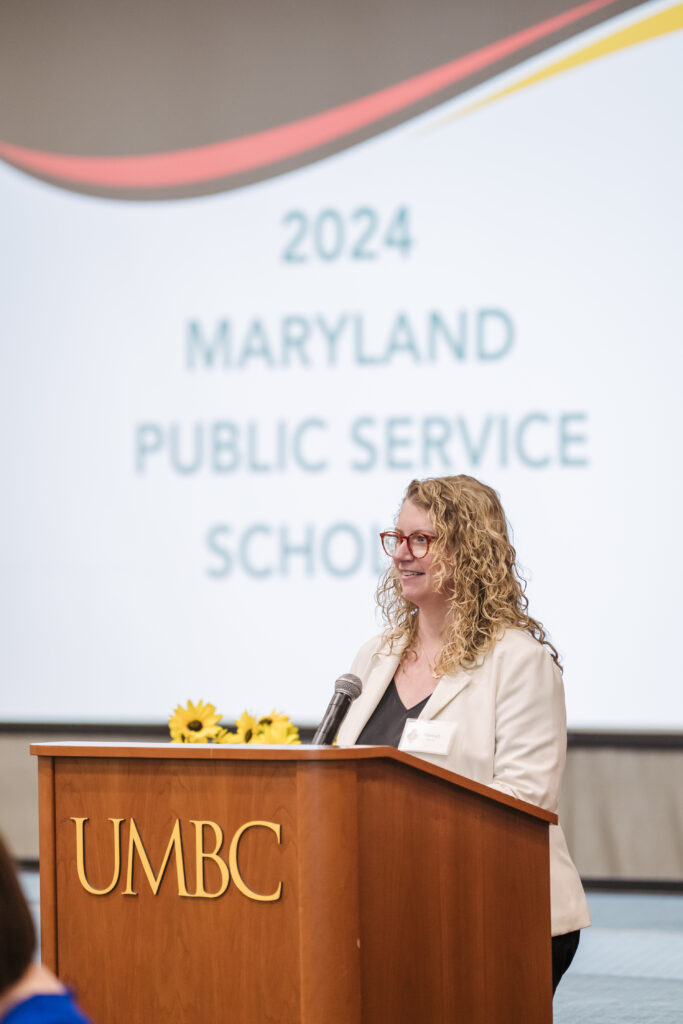 Hannah Schmitz addresses the audience at the opening gathering for the Maryland Public Service Scholars. (Marlayna Demond ’11/UMBC)
Mengue Bindjeme secured her internship at MTA through the Maryland Public Service Scholars (MPSS) program, a 12-week summer fellowship program funded by the state of Maryland and administered by the Shriver Center at UMBC. The goal of the program is to provide students across Maryland the opportunity to develop as future leaders in the state’s public and social sectors.
Mengue Bindjeme was one of five UMBC students who completed the program this past summer. The others were Tasnim Rushdan, a senior global studies major; Aziza Mattaka, a junior global studies major; Dionne Cole, a senior biology and social work major; and Samantha Fu, a junior psychology and public policy major.
The students wrapped up the fellowship with real-world experience on their résumés. “From day one, I was having real tasks and learning real things,” says Rushdan, who worked as an international affairs fellow at the Maryland Office of the Secretary of State. The international division of the office was small—with just two full-time employees—so as an intern Rushdan was immediately involved in important work such as reviewing agreements, organizing meetings, and writing memos for Maryland Secretary of State Susan C. Lee and Governor Wes Moore.
Rushdan helped organize the Pan African City Exposition to facilitate discussions with international delegates around ideas for improving economic development and making housing affordable. She also met with embassy officials, business leaders, and students from around the world.
Mattaka worked in the Governor’s Office of Crime Prevention and Policy, working with victims of crime on their compensation claims. “Sometimes when I’d call people, they would go into their stories,” she says. “It really put into perspective my privilege, but it was also rewarding to be in a place to assist.”
Pursuing the same mission
The students faced challenges throughout their fellowships, from the sometimes heavy nature of the work, to the pressures to balance their schedules, produce deliverables, and present in front of the leaders of Maryland government.
They found support from program staff, the mentors they were matched with in their workplaces, and from each other. Each Friday, all the program participants met together and attended workshops to talk through their experiences and learn new skills for success.
“We realized that, even though we come from diverse backgrounds, we were there for the same mission. We’re facing many of the same challenges, and we’re all in it together,” Rushdan says.
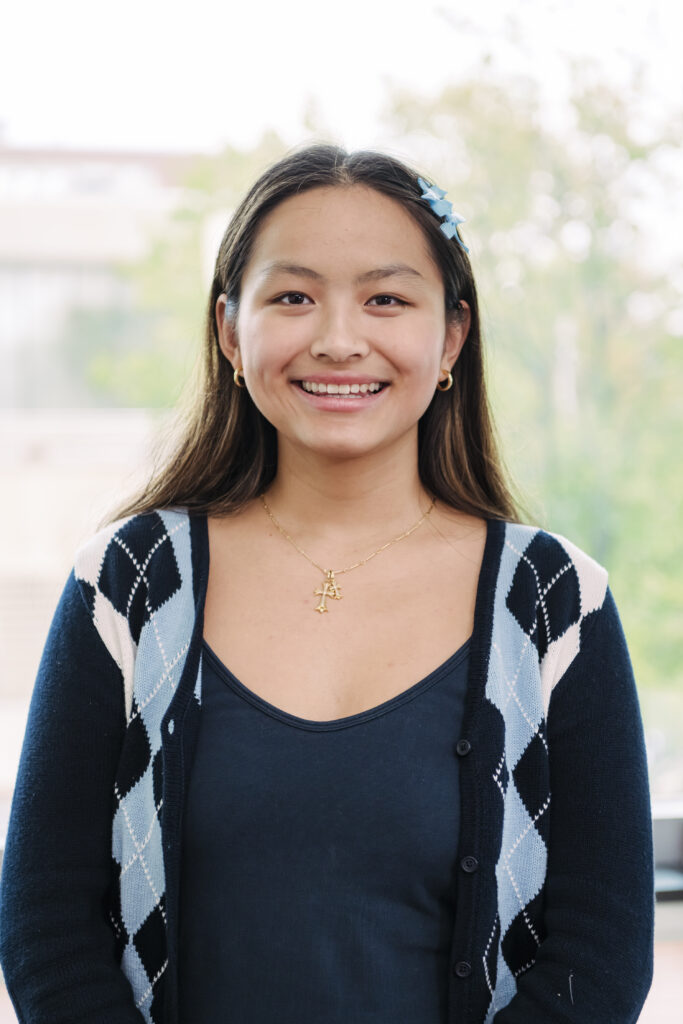
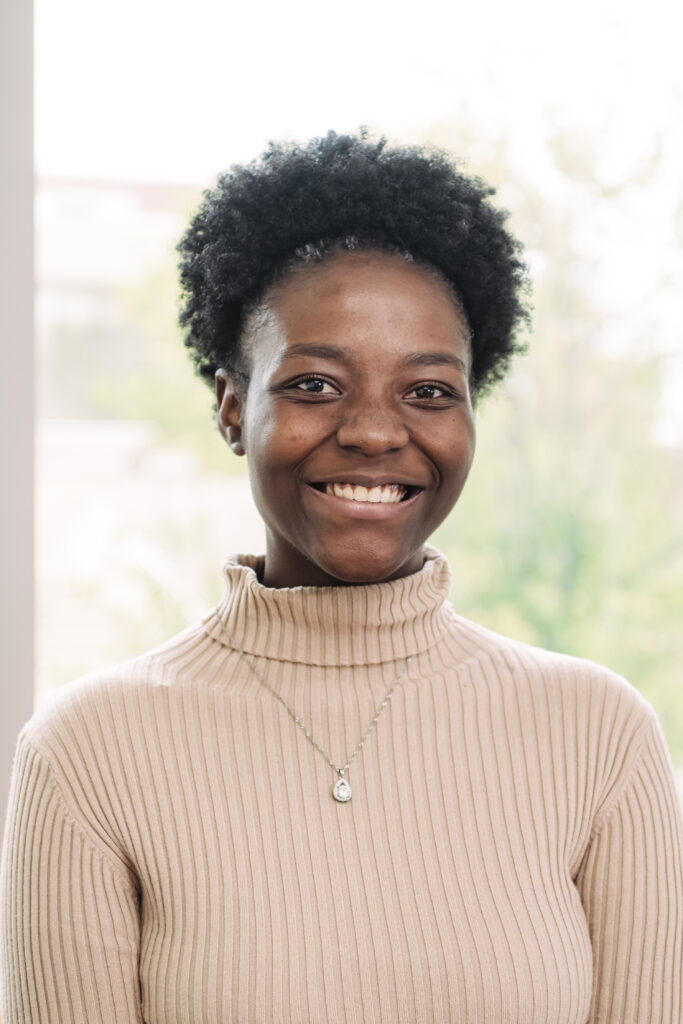
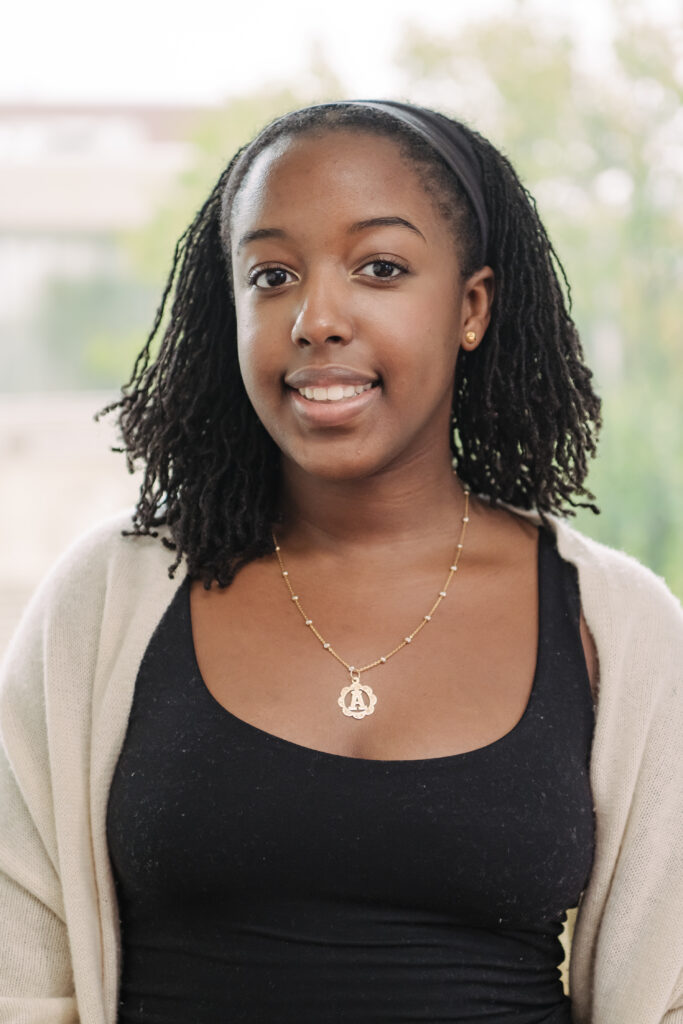
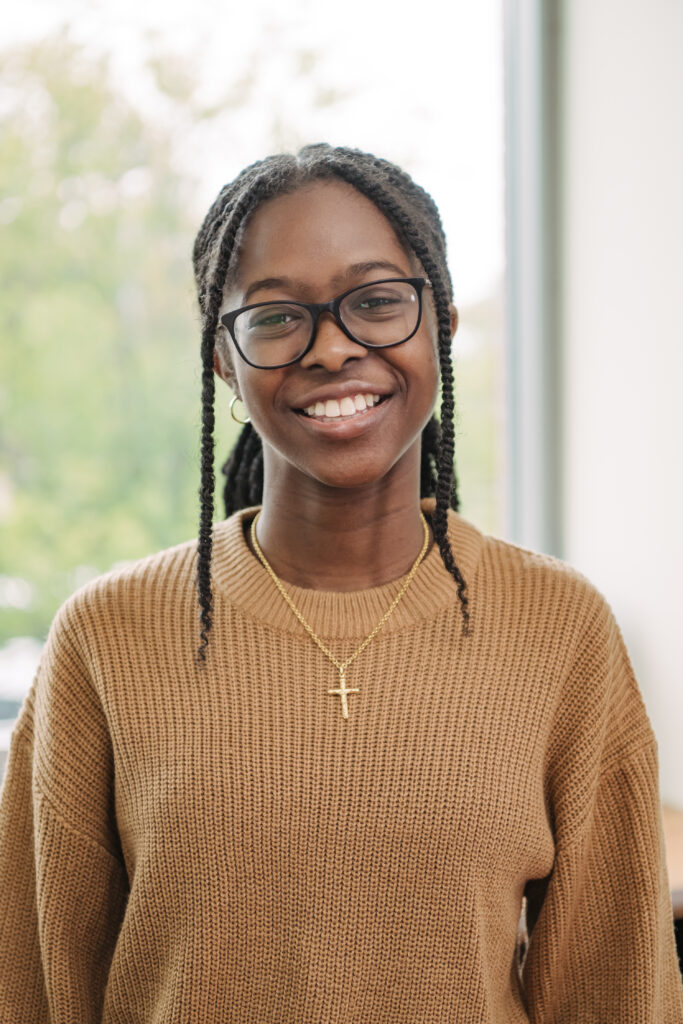
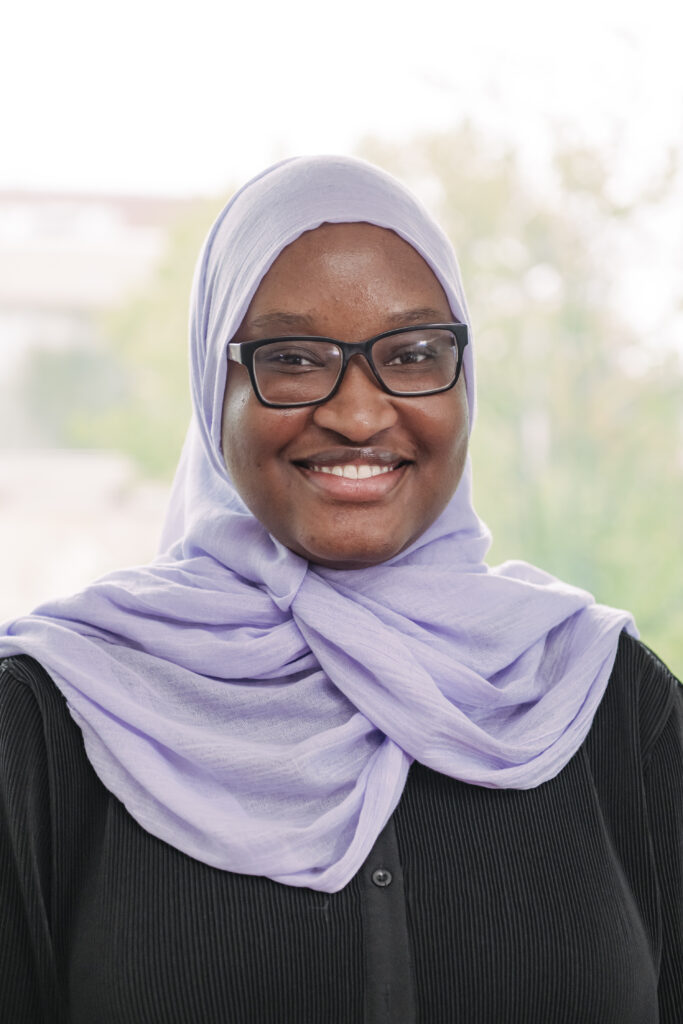
Clockwise from top left: Samantha Fu, Patricia Mengue Bindjeme, Aziza Mattaka, Dionne Cole, and Tasnim Rushdan.
“I made lifelong friends who are supporting me, and really wanting me to succeed,” says Fu, who worked at LET’S GO Boys and Girls, a nonprofit organization dedicated to fostering economic success in underserved communities through STEM education and workforce development.
Throughout the summer, the MPSS scholars pushed themselves out of their comfort zones and discovered how much they had to contribute.
“Before the program, I was afraid of public speaking,” says Fu. “By the end of the program, I was able to confidently present a grant proposal in front of a panel of nonprofit leaders. My group and I even won the grant proposal competition.”
Confident and capable
Cole, who worked at the Maryland Department of Health drafting policy recommendations for behavioral health care access for prison populations and others in the criminal justice system, says she feels much more confident after the summer. “Fear paralyzes us. But it’s like, no, we’re actually capable. You just have to look through the fear and realize, ‘Oh, snap, I could actually do this.’”
The group also ended the summer more confident of their commitment to public service.
“The public service sector truly is limitless and it affords any individual the opportunity to make a difference in their own way,” Cole says.
“Public service calls everyone,” Mattaka adds. “We are a collective, and society works better if we have people willing to develop the skills of leadership and empathy to do these jobs. Those are the skills we cultivated a lot this summer.”
]]>
When Patricia Mengue Bindjeme, a junior majoring in mechanical engineering, went to classes, her professors would sometimes point out how engineers’ decisions can have life-or-death consequences....
https://umbc.edu/stories/maryland-public-service-scholars-impact/
https://beta.my.umbc.edu/api/v0/pixel/news/145904/guest@my.umbc.edu/a98c8dba0cc948f3b35d5e265fbf12fb/api/pixel
cahss
cnms
coeit
fall-2024
impact
magazine
mpss
shriver-center
story
UMBC News & Magazine
https://beta.my.umbc.edu/groups/umbc-news-magazine
https://assets1-beta.my.umbc.edu/system/shared/avatars/groups/000/001/943/24435aa6207c452e7bc15cc74b42c7bb/xsmall.png?1748556657
https://assets1-beta.my.umbc.edu/system/shared/avatars/groups/000/001/943/24435aa6207c452e7bc15cc74b42c7bb/original.png?1748556657
https://assets2-beta.my.umbc.edu/system/shared/avatars/groups/000/001/943/24435aa6207c452e7bc15cc74b42c7bb/xxlarge.png?1748556657
https://assets2-beta.my.umbc.edu/system/shared/avatars/groups/000/001/943/24435aa6207c452e7bc15cc74b42c7bb/xlarge.png?1748556657
https://assets3-beta.my.umbc.edu/system/shared/avatars/groups/000/001/943/24435aa6207c452e7bc15cc74b42c7bb/large.png?1748556657
https://assets1-beta.my.umbc.edu/system/shared/avatars/groups/000/001/943/24435aa6207c452e7bc15cc74b42c7bb/medium.png?1748556657
https://assets2-beta.my.umbc.edu/system/shared/avatars/groups/000/001/943/24435aa6207c452e7bc15cc74b42c7bb/small.png?1748556657
https://assets1-beta.my.umbc.edu/system/shared/avatars/groups/000/001/943/24435aa6207c452e7bc15cc74b42c7bb/xsmall.png?1748556657
https://assets2-beta.my.umbc.edu/system/shared/avatars/groups/000/001/943/24435aa6207c452e7bc15cc74b42c7bb/xxsmall.png?1748556657
UMBC News & Magazine
3
0
false
Mon, 25 Nov 2024 14:42:08 -0500
Mon, 25 Nov 2024 14:42:08 -0500
Mechanical engineering professor Weidong Zhu honored for pioneering work analyzing sound and vibration
The elevator in the Shanghai Tower in China can reach speeds of more than 45 miles per hour, whisking passengers up more than 100 floors in under a minute. For elevators this fast and tall, understanding—and ultimately controlling—the vibrations in the cables is key to keeping the ride smooth. It’s a problem that mechanical engineering professor Weidong Zhu has studied, and his analysis of high-speed elevators is just one of the ways his research touches everyday life. His work analyzing sound and vibration also has applications to improving wind turbines, automotive timing belts, and more.
The American Society of Mechanical Engineers recently honored Zhu’s pioneering body of research by selecting him to deliver the Rayleigh Lecture at the society’s annual meeting this November. The lecture is named after British scientist Lord Rayleigh, who, in addition to correctly explaining why the sky is blue and discovering the noble gas argon, wrote a groundbreaking book on the theory of sound.
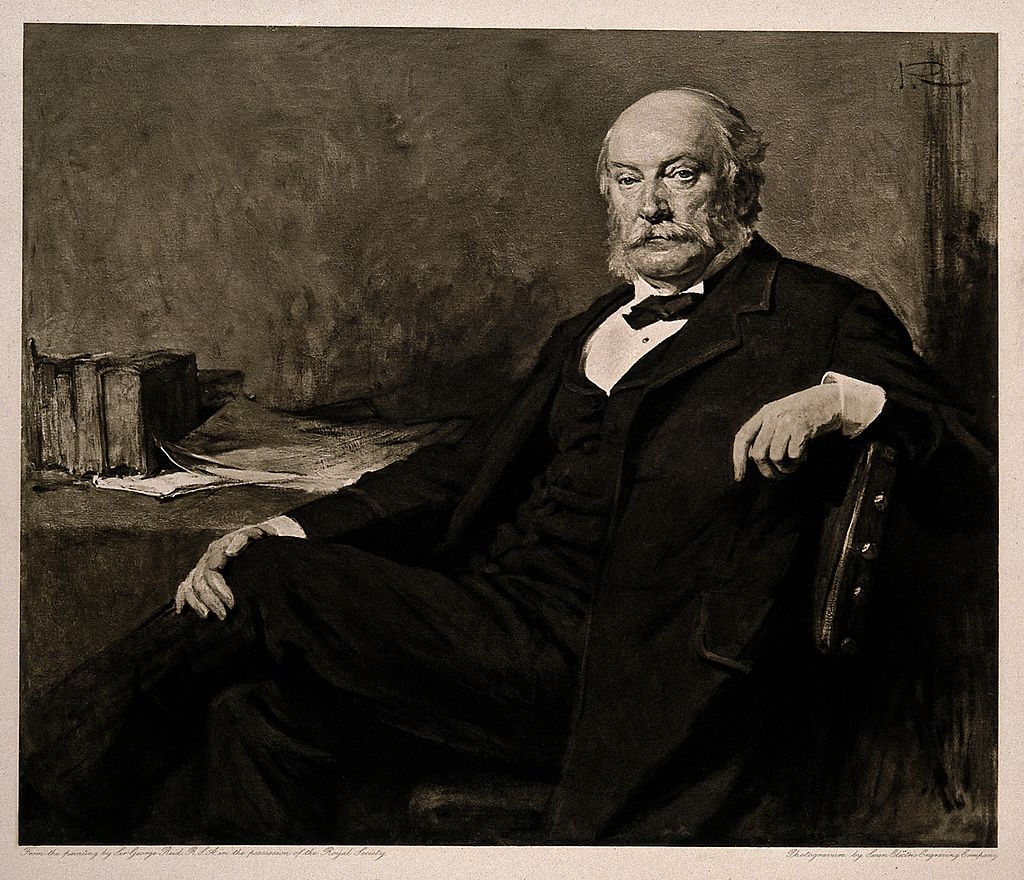 Photogravure of scientist John William Strutt, otherwise known as Lord Rayleigh. (Image credit: Wellcome Library, London, CC BY 4.0)
In his lecture delivered Nov. 20, Zhu presented new methodologies he has developed for analyzing difficult noise and vibration problems. “I’m very honored to give the Rayleigh Lecture,” says Zhu. “It’s a lifetime achievement award and one of the highest recognitions for people doing research in this area.”
Zhu’s impactful research has also been recognized with the 2020 University System of Maryland Board of Regents’ Faculty Award for Excellence in Scholarship, Research, or Creative Activity.
]]>
The elevator in the Shanghai Tower in China can reach speeds of more than 45 miles per hour, whisking passengers up more than 100 floors in under a minute. For elevators this fast and tall,...
https://umbc.edu/quick-posts/mechanical-engineering-professor-weidong-zhu-honored-for-pioneering-work-analyzing-sound-and-vibration/
https://beta.my.umbc.edu/api/v0/pixel/news/145853/guest@my.umbc.edu/d5c534390967aea9595f7019b32af078/api/pixel
coeit
meche
news
quick-post
research
science-and-tech
UMBC News & Magazine
https://beta.my.umbc.edu/groups/umbc-news-magazine
https://assets1-beta.my.umbc.edu/system/shared/avatars/groups/000/001/943/24435aa6207c452e7bc15cc74b42c7bb/xsmall.png?1748556657
https://assets1-beta.my.umbc.edu/system/shared/avatars/groups/000/001/943/24435aa6207c452e7bc15cc74b42c7bb/original.png?1748556657
https://assets2-beta.my.umbc.edu/system/shared/avatars/groups/000/001/943/24435aa6207c452e7bc15cc74b42c7bb/xxlarge.png?1748556657
https://assets2-beta.my.umbc.edu/system/shared/avatars/groups/000/001/943/24435aa6207c452e7bc15cc74b42c7bb/xlarge.png?1748556657
https://assets3-beta.my.umbc.edu/system/shared/avatars/groups/000/001/943/24435aa6207c452e7bc15cc74b42c7bb/large.png?1748556657
https://assets1-beta.my.umbc.edu/system/shared/avatars/groups/000/001/943/24435aa6207c452e7bc15cc74b42c7bb/medium.png?1748556657
https://assets2-beta.my.umbc.edu/system/shared/avatars/groups/000/001/943/24435aa6207c452e7bc15cc74b42c7bb/small.png?1748556657
https://assets1-beta.my.umbc.edu/system/shared/avatars/groups/000/001/943/24435aa6207c452e7bc15cc74b42c7bb/xsmall.png?1748556657
https://assets2-beta.my.umbc.edu/system/shared/avatars/groups/000/001/943/24435aa6207c452e7bc15cc74b42c7bb/xxsmall.png?1748556657
UMBC News & Magazine
0
0
false
Fri, 22 Nov 2024 14:40:08 -0500
Fri, 22 Nov 2024 14:40:08 -0500