Is DOGE a cybersecurity threat? A security expert explains the dangers of violating protocols and regulations that protect government computer systems

Written by Richard Forno, principal lecturer in computer science and electrical engineering, UMBC
The Department of Government Efficiency (DOGE), President Donald Trump’s special commission tasked with slashing federal spending, continues to disrupt Washington and the federal bureaucracy. According to published reports, its teams are dropping into federal agencies with a practically unlimited mandate to reform the federal government in accordance with recent executive orders.
As a 30-year cybersecurity veteran, I find the activities of DOGE thus far concerning. Its broad mandate across government, seemingly nonexistent oversight, and the apparent lack of operational competence of its employees have demonstrated that DOGE could create conditions that are ideal for cybersecurity or data privacy incidents that affect the entire nation.
Traditionally, the purpose of cybersecurity is to ensure the confidentiality and integrity of information and information systems while helping keep those systems available to those who need them. But in DOGE’s first few weeks of existence, reports indicate that its staff appears to be ignoring those principles and potentially making the federal government more vulnerable to cyber incidents.
Technical competence
Cybersecurity and information technology, like any other business function, depend on employees trained specifically for their jobs. Just as you wouldn’t let someone only qualified in first aid to perform open heart surgery, technology professionals require a baseline set of credentialed education, training and experience to ensure that the most qualified people are on the job.
Currently, the general public, federal agencies and Congress have little idea who is tinkering with the government’s critical systems. DOGE’s hiring process, including how it screens applicants for technical, operational or cybersecurity competency, as well as experience in government, is opaque. And journalists investigating the backgrounds of DOGE employees have been intimidated by the acting U.S. attorney in Washington.
DOGE has hired young people fresh out of – or still in – college or with little or no experience in government, but who reportedly have strong technical prowess. But some have questionable backgrounds for such sensitive work. And one leading DOGE staffer working at the Treasury Department has since resigned over a series of racist social media posts.
Wired’s Katie Drummond explains what the magazine’s reporters have uncovered about DOGE staffers and their activities.
According to reports, these DOGE staffers have been granted administrator-level technical access to a variety of federal systems. These include systems that process all federal payments, including Social Security, Medicare and the congressionally appropriated funds that run the government and its contracting operations.
DOGE operatives are quickly developing and deploying major software changes to very complex old systems and databases, according to reports. But given the speed of change, it’s likely that there is little formal planning or quality control involved to ensure such changes don’t break the system. Such actions run contrary to cybersecurity principles and best practices for technology management.
As a result, there’s probably no way of knowing if these changes make it easier for malware to be introduced into government systems, if sensitive data can be accessed without authorization, or if DOGE’s work is making government systems otherwise more unstable and more vulnerable.
If you don’t know what you’re doing in IT, really bad things can happen. A notable example is the failed launch of the healthcare.gov website in 2013. In the case of the Treasury Department’s systems, that’s fairly important to remember as the nation careens toward another debt-ceiling crisis and citizens look for their Social Security payments.
On Feb. 6, 2025, a federal judge ordered that DOGE staff be restricted to read-only access to the Treasury Department’s payment systems, but the legal proceedings challenging the legality of their access to government IT systems are ongoing.
DOGE email servers
DOGE’s apparent lack of cybersecurity competence is reflected in some of its first actions. DOGE installed its own email servers across the federal government to facilitate direct communication with rank-and-file employees outside official channels, disregarding time-tested best practices for cybersecurity and IT administration. A lawsuit by federal employees alleges that these systems did not undergo a security review as required by current federal cybersecurity standards.
There is an established process in the federal government to configure and deploy new systems to ensure they are stable, secure and unlikely to create cybersecurity problems. But DOGE ignored those practices, with predictable results.
For example, a journalist was able to send invitations to his newsletter to over 13,000 National Oceanic and Atmospheric Administration employees through one of these servers. In another case, the way in which employee responses to DOGE’s Fork in the Road buyout offer to federal employees are collected could easily be manipulated by someone with malicious intent – a simple social engineering attack could wrongly end a worker’s employment. And DOGE staff members reportedly are connecting their own untrusted devices to government networks, which potentially introduces new ways for cyberattackers to penetrate sensitive systems.
However, DOGE appears to be embracing creative cybersecurity practices in shielding itself. It’s reorganizing its internal communications in order to dodge Freedom of Information Act requests into its work, and it’s using cybersecurity techniques for tracking insider threats to prevent and investigate leaks of its activities.
Lacking management controls
But it’s not just technical security that DOGE is ignoring. On Feb. 2, two security officials for the U.S. Agency for International Development resisted granting a DOGE team access to sensitive financial and personnel systems until their identities and clearances were verified, in accordance with federal requirements. Instead, the officials were threatened with arrest and placed on administrative leave, and DOGE’s team gained access.
The Trump administration also has reclassified federal chief information officers, normally senior career employees with years of specialized knowledge, to be general employees subject to dismissal for political reasons. So there may well be a brain drain of IT talent in the federal government, or a constant turnover of both senior IT leadership and other technical experts. This change will almost certainly have ramifications for cybersecurity.
DOGE operatives now have direct access to the Office of Personnel Management’s database of millions of federal employees, including those with security clearances holding sensitive positions. Without oversight, this access opens up the possibilities of privacy violations, tampering with employment records, intimidation or political retribution.
Support from all levels of management is crucial to provide accountability for cybersecurity and technology management. This is especially important in the public sector, where oversight and accountability is a critical function of good democratic governance and national security. After all, if people don’t know what you’re doing, they don’t know what you’re doing wrong.
At the moment, DOGE appears to be operating with very little oversight by anyone in position willing or able to hold it responsible for its actions.
Mitigating the damage
Career federal employees trying to follow legal or cybersecurity practices for federal systems and data are now placed in a difficult position. They either capitulate to DOGE staffers’ instructions, thereby abandoning best practices and ignoring federal standards, or resist them and run the risk of being fired or disciplined.
The federal government’s vast collections of data touch every citizen and company. While government systems may not be as trustworthy as they once were, people can still take steps to protect themselves from adverse consequences of DOGE’s activities. Two good starting points are to lock your credit bureau records in case your government data is disclosed and using different logins and passwords on federal websites to conduct business.
It’s crucial for the administration, Congress and the public to recognize the cybersecurity dangers that DOGE’s activities pose and take meaningful steps to bring the organization under reasonable control and oversight.
This article is republished from The Conversation under a Creative Commons license. Read the original article and see more than 250 UMBC articles available in The Conversation.
]]>
Written by Richard Forno, principal lecturer in computer science and electrical engineering, UMBC The Department of Government Efficiency (DOGE), President Donald Trump’s special commission...
https://umbc.edu/stories/is-doge-a-cybersecurity-threat-a-security-expert-explains-the-dangers-of-violating-protocols-and-regulations-that-protect-government-computer-systems/
https://beta.my.umbc.edu/api/v0/pixel/news/147183/guest@my.umbc.edu/5b767c36739cb25e8c5fec2d28595c49/api/pixel
coeit
csee
cybersecurity
discovery
magazine
story
the-conversation
UMBC News & Magazine
https://beta.my.umbc.edu/groups/umbc-news-magazine
https://assets1-beta.my.umbc.edu/system/shared/avatars/groups/000/001/943/24435aa6207c452e7bc15cc74b42c7bb/xsmall.png?1748556657
https://assets1-beta.my.umbc.edu/system/shared/avatars/groups/000/001/943/24435aa6207c452e7bc15cc74b42c7bb/original.png?1748556657
https://assets2-beta.my.umbc.edu/system/shared/avatars/groups/000/001/943/24435aa6207c452e7bc15cc74b42c7bb/xxlarge.png?1748556657
https://assets2-beta.my.umbc.edu/system/shared/avatars/groups/000/001/943/24435aa6207c452e7bc15cc74b42c7bb/xlarge.png?1748556657
https://assets3-beta.my.umbc.edu/system/shared/avatars/groups/000/001/943/24435aa6207c452e7bc15cc74b42c7bb/large.png?1748556657
https://assets1-beta.my.umbc.edu/system/shared/avatars/groups/000/001/943/24435aa6207c452e7bc15cc74b42c7bb/medium.png?1748556657
https://assets2-beta.my.umbc.edu/system/shared/avatars/groups/000/001/943/24435aa6207c452e7bc15cc74b42c7bb/small.png?1748556657
https://assets1-beta.my.umbc.edu/system/shared/avatars/groups/000/001/943/24435aa6207c452e7bc15cc74b42c7bb/xsmall.png?1748556657
https://assets2-beta.my.umbc.edu/system/shared/avatars/groups/000/001/943/24435aa6207c452e7bc15cc74b42c7bb/xxsmall.png?1748556657
UMBC News & Magazine
18
0
false
Mon, 10 Feb 2025 09:40:17 -0500
Mon, 10 Feb 2025 09:40:17 -0500
Information and Resources for International Students
UMBC’s Center for Global Engagement (CGE) is closely monitoring the executive orders being issued and actions taken in Washington. CGE has developed an Immigration Policy Updates page that will include essential information on any new executive orders, changes to agency policies, and legal updates as courts rule on the legality and constitutionality of particular actions in ways that affect their implementation.
International students are an essential part of UMBC’s vibrant community, and we wish to reiterate our commitment to supporting all community members in this time of uncertainty.
It is as important as ever to take care of ourselves and each other. Remember that UMBC has support resources available through Retriever Integrated Health and Retriever Support Services. These resources include, but are not limited to, access to counseling services and peer support services.
For our alumni engaged in Optional Practical Training (OPT) and other forms of employment, your employer’s human resources department may also provide access to an Employee Assistance Program. We encourage you to use these resources and continue to support one another with compassion.
If you have questions, need help accessing resources, or simply wish to talk, please do not hesitate to contact CGE’s International Student and Scholar Services team. We offer walk-in advising hours during which any international student can speak with an advisor without an appointment. Walk-in advising occurs on Mondays from 10:00 a.m. to 12:00 pm., Tuesdays from 1:00 p.m. to 3:00 p.m. and Wednesdays from 10:00 a.m. to 12:00 p.m. For those farther from campus, we also offer virtual appointments and have a Help Ticket system, both of which can be accessed on the Contact Us page of our website.
Dr. David L. Di Maria
Senior International Officer & Associate Vice Provost for International Education
]]>
UMBC’s Center for Global Engagement (CGE) is closely monitoring the executive orders being issued and actions taken in Washington. CGE has developed an Immigration Policy Updates page that will...
https://my3.my.umbc.edu/groups/ies/posts/147149
https://beta.my.umbc.edu/api/v0/pixel/news/147244/guest@my.umbc.edu/e40c7a470d20c7321a89e37628c1610c/api/pixel
federal-orders
story
UMBC News & Magazine
https://beta.my.umbc.edu/groups/umbc-news-magazine
https://assets1-beta.my.umbc.edu/system/shared/avatars/groups/000/001/943/24435aa6207c452e7bc15cc74b42c7bb/xsmall.png?1748556657
https://assets1-beta.my.umbc.edu/system/shared/avatars/groups/000/001/943/24435aa6207c452e7bc15cc74b42c7bb/original.png?1748556657
https://assets2-beta.my.umbc.edu/system/shared/avatars/groups/000/001/943/24435aa6207c452e7bc15cc74b42c7bb/xxlarge.png?1748556657
https://assets2-beta.my.umbc.edu/system/shared/avatars/groups/000/001/943/24435aa6207c452e7bc15cc74b42c7bb/xlarge.png?1748556657
https://assets3-beta.my.umbc.edu/system/shared/avatars/groups/000/001/943/24435aa6207c452e7bc15cc74b42c7bb/large.png?1748556657
https://assets1-beta.my.umbc.edu/system/shared/avatars/groups/000/001/943/24435aa6207c452e7bc15cc74b42c7bb/medium.png?1748556657
https://assets2-beta.my.umbc.edu/system/shared/avatars/groups/000/001/943/24435aa6207c452e7bc15cc74b42c7bb/small.png?1748556657
https://assets1-beta.my.umbc.edu/system/shared/avatars/groups/000/001/943/24435aa6207c452e7bc15cc74b42c7bb/xsmall.png?1748556657
https://assets2-beta.my.umbc.edu/system/shared/avatars/groups/000/001/943/24435aa6207c452e7bc15cc74b42c7bb/xxsmall.png?1748556657
UMBC News & Magazine
0
0
false
Fri, 07 Feb 2025 13:44:20 -0500
Information and Resources for International Students
UMBC’s Center for Global Engagement (CGE) is closely monitoring the executive orders being issued and actions taken in Washington. CGE has developed an Immigration Policy Updates page that will include essential information on any new executive orders, changes to agency policies, and legal updates as courts rule on the legality and constitutionality of particular actions in ways that affect their implementation.
International students are an essential part of UMBC’s vibrant community, and we wish to reiterate our commitment to supporting all community members in this time of uncertainty.
It is as important as ever to take care of ourselves and each other. Remember that UMBC has support resources available through Retriever Integrated Health and Retriever Support Services. These resources include, but are not limited to, access to counseling services and peer support services.
For our alumni engaged in Optional Practical Training (OPT) and other forms of employment, your employer’s human resources department may also provide access to an Employee Assistance Program. We encourage you to use these resources and continue to support one another with compassion.
If you have questions, need help accessing resources, or simply wish to talk, please do not hesitate to contact CGE’s International Student and Scholar Services team. We offer walk-in advising hours during which any international student can speak with an advisor without an appointment. Walk-in advising occurs on Mondays from 10:00 a.m. to 12:00 pm., Tuesdays from 1:00 p.m. to 3:00 p.m. and Wednesdays from 10:00 a.m. to 12:00 p.m. For those farther from campus, we also offer virtual appointments and have a Help Ticket system, both of which can be accessed on the Contact Us page of our website.
Dr. David L. Di Maria
Senior International Officer & Associate Vice Provost for International Education
]]>
UMBC’s Center for Global Engagement (CGE) is closely monitoring the executive orders being issued and actions taken in Washington. CGE has developed an Immigration Policy Updates page that will...
https://beta.my.umbc.edu/api/v0/pixel/news/147149/guest@my.umbc.edu/53d3963e07ae4448ad6e29ce0dd52e5a/api/pixel
federal-orders
International Student and Scholar Services (ISSS)
https://beta.my.umbc.edu/groups/ies
https://assets4-beta.my.umbc.edu/system/shared/avatars/groups/000/000/431/46ad84ea8ba0baeed7c3faf29d1fd4ef/xsmall.png?1693323874
https://assets3-beta.my.umbc.edu/system/shared/avatars/groups/000/000/431/46ad84ea8ba0baeed7c3faf29d1fd4ef/original.jpeg?1693323874
https://assets1-beta.my.umbc.edu/system/shared/avatars/groups/000/000/431/46ad84ea8ba0baeed7c3faf29d1fd4ef/xxlarge.png?1693323874
https://assets1-beta.my.umbc.edu/system/shared/avatars/groups/000/000/431/46ad84ea8ba0baeed7c3faf29d1fd4ef/xlarge.png?1693323874
https://assets4-beta.my.umbc.edu/system/shared/avatars/groups/000/000/431/46ad84ea8ba0baeed7c3faf29d1fd4ef/large.png?1693323874
https://assets3-beta.my.umbc.edu/system/shared/avatars/groups/000/000/431/46ad84ea8ba0baeed7c3faf29d1fd4ef/medium.png?1693323874
https://assets1-beta.my.umbc.edu/system/shared/avatars/groups/000/000/431/46ad84ea8ba0baeed7c3faf29d1fd4ef/small.png?1693323874
https://assets4-beta.my.umbc.edu/system/shared/avatars/groups/000/000/431/46ad84ea8ba0baeed7c3faf29d1fd4ef/xsmall.png?1693323874
https://assets3-beta.my.umbc.edu/system/shared/avatars/groups/000/000/431/46ad84ea8ba0baeed7c3faf29d1fd4ef/xxsmall.png?1693323874
International Student and Scholar Services (ISSS)
https://assets2-beta.my.umbc.edu/system/shared/thumbnails/news/000/147/149/32d68928727cb003ea571b900ffc0a12/xxlarge.jpg?1738953711
https://assets1-beta.my.umbc.edu/system/shared/thumbnails/news/000/147/149/32d68928727cb003ea571b900ffc0a12/xlarge.jpg?1738953711
https://assets1-beta.my.umbc.edu/system/shared/thumbnails/news/000/147/149/32d68928727cb003ea571b900ffc0a12/large.jpg?1738953711
https://assets2-beta.my.umbc.edu/system/shared/thumbnails/news/000/147/149/32d68928727cb003ea571b900ffc0a12/medium.jpg?1738953711
https://assets4-beta.my.umbc.edu/system/shared/thumbnails/news/000/147/149/32d68928727cb003ea571b900ffc0a12/small.jpg?1738953711
https://assets4-beta.my.umbc.edu/system/shared/thumbnails/news/000/147/149/32d68928727cb003ea571b900ffc0a12/xsmall.jpg?1738953711
https://assets4-beta.my.umbc.edu/system/shared/thumbnails/news/000/147/149/32d68928727cb003ea571b900ffc0a12/xxsmall.jpg?1738953711
6
0
true
Fri, 07 Feb 2025 13:44:20 -0500
Mon, 10 Feb 2025 14:47:22 -0500
An Update on Our Work Related to Federal Executive Orders and Actions
Dear UMBC Community,
I am writing to you today to share more about the work that we are doing to monitor and respond to the developments in Washington. As I communicated with you in a
message last week, I have assembled a core team of relevant leaders with whom I am meeting frequently to assess the various executive orders and related actions of the new Trump administration and how they may affect UMBC.
I want to share the makeup of that core team, which consists of several senior leaders, as well as others whose expertise is particularly critical to our efforts. Many core team members are leading small rapid-response teams—subgroups specific to an issue, area of work, or audience. The subgroups will contract and expand—the number of groups themselves, as well as their memberships—to meet evolving needs.
Joining me on the core team are:
- Manfred H. M. van Dulmen, Provost and Senior Vice President for Academic Affairs
- Kacey Hammel, Chief of Staff to the President
- Paul A. Meggett, Vice President and General Counsel
- Yaakov “Jake” Weissmann ’06, Vice President, Government Relations and Community Affairs
-
Academic Excellence Team Leader: Ana Oskoz, Vice Provost for Faculty Affairs
-
Budget and Finance Team Leader: Kristy Michel, Associate Vice President, Administration and Finance
-
Communications Team Leaders: Tim Cobb, Interim Vice President, University Communications and Marketing; and Angela Paik, consultant
-
Enrollment Team Leader: Yvette Mozie-Ross ’88, Vice Provost for Enrollment Management and Planning
-
Inclusive Excellence Team Leader: Tanyka M. Barber, Vice President, Institutional Equity and Chief Diversity Officer
-
Global Engagement Team Leader: David L. Di Maria, Associate Vice Provost for International Education
-
Research and Creative Achievement Team Leader: Karl V. Steiner, Vice President, Research and Creative Achievement
-
Student Success Team Leader: Renique T. Kersh, Vice President, Student Affairs
Over time, I know that these leaders will draw on the expertise and perspectives of many of you; thank you in advance for your support and assistance should they reach out to you. Please also know that you may reach out to the individuals listed above with questions or concerns about specific issues.
We also have created a
website to serve as a central hub of relevant campus resources and information. Campus communications related to the Trump administration’s orders and actions will be housed there, as well as an updated list of resources related to federal actions that may impact UMBC.
We are witnessing a substantial amount of change in Washington, both in volume and scope. The impacts of that change on us as individuals, as an educational community, and as a research institution are not yet clear. What is certain—rock-solid—is our commitment to UMBC’s mission and vision. I urge you all to carry on with your important work, knowing that our support for it and for the well-being of all members of this community is unwavering.
Sincerely,
President Valerie Sheares Ashby
]]>
Dear UMBC Community, I am writing to you today to share more about the work that we are doing to monitor and respond to the developments in Washington. As I communicated with you in a...
https://my3.my.umbc.edu/groups/announcements/posts/147127
https://beta.my.umbc.edu/api/v0/pixel/news/147134/guest@my.umbc.edu/fda8c13fa7f229825914eb9b4f704f71/api/pixel
president
story
UMBC News & Magazine
https://beta.my.umbc.edu/groups/umbc-news-magazine
https://assets1-beta.my.umbc.edu/system/shared/avatars/groups/000/001/943/24435aa6207c452e7bc15cc74b42c7bb/xsmall.png?1748556657
https://assets1-beta.my.umbc.edu/system/shared/avatars/groups/000/001/943/24435aa6207c452e7bc15cc74b42c7bb/original.png?1748556657
https://assets2-beta.my.umbc.edu/system/shared/avatars/groups/000/001/943/24435aa6207c452e7bc15cc74b42c7bb/xxlarge.png?1748556657
https://assets2-beta.my.umbc.edu/system/shared/avatars/groups/000/001/943/24435aa6207c452e7bc15cc74b42c7bb/xlarge.png?1748556657
https://assets3-beta.my.umbc.edu/system/shared/avatars/groups/000/001/943/24435aa6207c452e7bc15cc74b42c7bb/large.png?1748556657
https://assets1-beta.my.umbc.edu/system/shared/avatars/groups/000/001/943/24435aa6207c452e7bc15cc74b42c7bb/medium.png?1748556657
https://assets2-beta.my.umbc.edu/system/shared/avatars/groups/000/001/943/24435aa6207c452e7bc15cc74b42c7bb/small.png?1748556657
https://assets1-beta.my.umbc.edu/system/shared/avatars/groups/000/001/943/24435aa6207c452e7bc15cc74b42c7bb/xsmall.png?1748556657
https://assets2-beta.my.umbc.edu/system/shared/avatars/groups/000/001/943/24435aa6207c452e7bc15cc74b42c7bb/xxsmall.png?1748556657
UMBC News & Magazine
0
0
false
Thu, 06 Feb 2025 15:51:18 -0500
In the world of math, the hunt for eloquent solutions excites these researchers

Some mathematical and statistical challenges are so fundamental that the solutions can be applied to an array of real-world applications—which we all benefit from. But it’s not necessarily the applications that excite researchers. They’re on the hunt to develop an elegant set of equations or a more accurate model because of the work’s inherent beauty and satisfaction, and, simply, because it’s fun.
This past fall, members of the UMBC Department of Mathematics and Statistics received at least three major grants to pursue work with significant real-world potential, from self-driving cars to treatments for Alzheimer’s. And while the mathematical work underpinning these potential uses can seem opaque, abstract, and just plain hard to many people, these mathematicians and statisticians see the process of thinking about the challenges as exciting and stimulating in and of themselves.
Optimizing optimization
 Andrei Draganescu (courtesy of Draganescu)
Andrei Draganescu, associate professor of mathematics, has received a grant from the National Science Foundation to pursue a creative new approach for solving optimization problems. Anytime a system performs a basic functionality, but you would like to make it better or more efficient, that’s an optimization problem, Draganescu explains.
Optimization means maximizing or minimizing something, such as cost, time, or power output. Think about today’s large language models, such as ChatGPT: Before it can respond effectively to any prompts, the model must rely on an algorithm to “learn” an optimal set of parameters from a vast amount of training data. Only once those parameters are fixed can it use them as a basis to determine the best response to your prompt. The time, electricity, and human work hours involved in training can cost billions of dollars, not including the capital investment in the hardware itself—so even a very small increase in efficiency makes a huge difference.
All of the possible combinations of parameters can be represented as points along a curved surface with hills and valleys. An algorithm developed by a mathematician can search for the lowest or highest point on that surface to solve the optimization problem, depending if you are looking for a minimum or a maximum. One risk with these algorithms is that they may end up at a local minimum or maximum—the peak of a single hill or the base of a single valley—that isn’t actually the global maximum or minimum across the entire surface.
In his grant application, Draganescu proposed a novel way of solving this kind of problem. “Because this type of problem is so old, it’s hard to find something new. But I think I did,” Draganescu says. Rather than searching for the minimum or maximum along a series of straight lines that approximate its curved surface, Draganescu has proposed a way to search directly along a set of well defined curves. The idea for the new approach “is a completely new angle,” he says, and in correspondence with colleagues to date, “nobody has contradicted me so far.”
 All of the possible combinations of parameters for a system can be represented as points along a curved surface with hills and valleys. (Fiona Suherman/UMBC)
Sticking with the hard problems
In math, there are many problems that are easy to express but extremely difficult to solve. Some have puzzled mathematicians for centuries. Draganescu’s Ph.D. advisor encouraged his students to think about these problems from time to time, in case they found a solution, of course, but also to keep their creative juices flowing. Draganescu continues the practice today.
“Sometimes I’ve spent days in a row on some of these very hard problems that nobody knows how to solve,” he says. “And of course I would love the glory, but honestly, that’s not where the fun is. I’m old enough to know that the fun is actually thinking about it.”
“And of course I would love the glory, but honestly, that’s not where the fun is. I’m old enough to know that the fun is actually thinking about it.”
Andrei Draganescu
Draganescu’s sticktoitiveness sometimes pays off in his everyday work. In the case of the idea that underpins his recent proposal, “I was surprised that it actually worked out. But ‘working out’ means many many months of work,” he says. “From having the initial idea to trusting that it could go somewhere, there were a lot of mistakes in the calculations and all that.” So why did he persist, knowing there was a good chance it wouldn’t “work out”? “I stuck with it because it was fun. I enjoy thinking about these problems.”
Draganescu is continuing to develop his new technique for solving optimization problems, which could improve efforts to optimize all kinds of systems, from AI to airline schedules to agriculture—all because he found joy from sitting with a sticky problem.
Replicating the real world
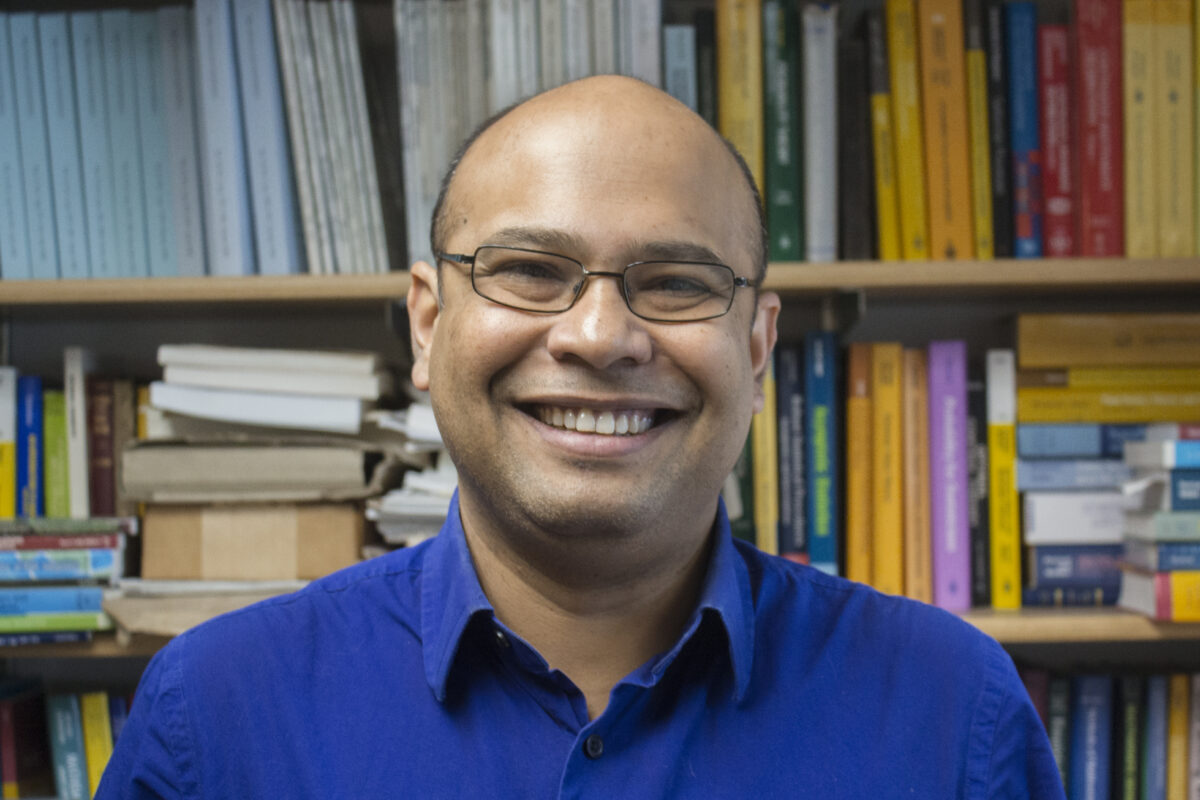 Ansu Chatterjee (courtesy of Chatterjee)
Ansu Chatterjee, professor of statistics, is another UMBC math mind whose work could have a major impact on a wide range of fields. He and UMBC colleagues Animikh Biswas, professor of mathematics, and Karuna Joshi, professor of information systems, have received an NSF grant to expand the use of “digital twin” technology. The grant proposal highlighted the potential to advance diagnosis and treatment for neurodegenerative diseases such as Alzheimer’s or Parkinson’s, but digital twin technology has a huge range of potential applications.
A digital twin is “essentially a clone of something in the physical world replicated inside a computer,” Chatterjee says. Additional applications could include forest management or weather forecasting. These twins can offer up predictions about which direction a hurricane will turn, which treatment protocol might be most effective for a particular patient, or whether it’s the right time for a prescribed burn in a forest—but there will always be uncertainties in the models.
“Measuring those uncertainties is a huge task,” Chatterjee says. How to deal with those uncertainties is one of the things the team wants to focus on with the new grant, which is very statistics-heavy, Chatterjee notes. Understanding and reducing the uncertainties requires understanding the physical processes at play in the real-world version of the system, and then working them into the model—and that’s hard.
Beyond the black box
Typical AI models are frequently “black box models,” which means even the people who created them don’t always understand exactly what they’re doing. For one thing, they are not constrained by objective truth in the physical world, Chatterjee explains. “It’s not even attempting to get the biology or the chemistry correct,” he says, and that’s not acceptable for a digital twin that’s modeling the human brain and may be used to determine a real human’s treatment plan.
“You don’t get the model right unless you get the underlying math of the molecules that constitute it right. So mathematics and statistics have to be the underpinning of anything related to digital twins.”
Ansu Chatterjee
“You don’t get the model right unless you get the underlying math of the molecules that constitute it right,” Chatterjee says. “So mathematics and statistics have to be the underpinning of anything related to digital twins.”
The digital twins Chatterjee and colleagues hope to further with their new research need not only replicate the outcomes of a system, but also the system’s mechanisms and internal processes. Again, that’s hard—especially when humans don’t yet fully understand many of these systems, such as the human brain, how cancer develops, or how various environmental factors influence carbon sequestration, for example.
“We are at the foundation of digital twins,” Chaterjee says. Once they are developed to a point where they are usable, digital twins and AI more generally would “open up a vast amount of opportunities for making fairly rapid progress with the actual science. This is where AI can help in scientific progress. It can suggest opportunities and possibilities which then can be verified,” Chatterjee says. “It would rule out certain possibilities. There would of course be false positives and false negatives, but as digital twins keep improving, it would be more and more convenient to use those first to find out a lot more interesting things.”
 A digital twin is “essentially a clone of something in the physical world replicated inside a computer,” Ansu Chatterjee says. (Illustration by Sadaf Rehman ’19/UMBC)
Fundamental building blocks
Chatterjee and colleagues are aware of the risks associated with digital twins. “There’s quite a lot of ethical issues that are related to digital twins in general, and it goes up several notches when it’s digital twins related to humans.” For example, there are regulatory concerns around who owns the data put into a digital twin (such as someone’s genomic data) and who is compensated when the twin is used for profit. “It’s exciting, and it’s also kind of a nightmare,” Chatterjee says.
That’s why he and colleagues will be working directly with federal regulatory agencies to make recommendations about how to handle these AI models. “This grant is sort of laying down the first fundamental steps—saying this is what should be done, this is how the first steps should be done,” Chatterjee says.
While that work is critical, it’s the math that truly excites Chatterjee. “For me, it’s about building the fundamental building blocks, whether it’s cancer or neurodegenerative diseases or forests” he says. “The essential ingredients for the digital component of it rely on the same math, the same statistics.”
Defining possible
 Matthew Kvalheim (courtesy of Kvalheim)
Matthew Kvalheim, assistant professor of mathematics, is also working on developing tools that can help people in a wide range of situations. His ultimate goal? To be able to tell researchers whether whatever they are trying to do with their system is possible or impossible. Sound vague? That’s the point.
“I’m never thinking about a specific application,” Kvalheim says. “I’m always working at the fundamental level, with a class of mathematical models that can describe all of them.” For Kvalheim, it’s the underlying math that is exciting—which is fortunate for all the people working on applications who will eventually use his multi-purpose tools.
“For any real world system, you might want it to do some behavior, or not do some behavior,” Kvalheim says. This might be making sure two self-driving cars don’t collide, preventing a humanoid robot from falling on its face, or keeping an electronic device at a safe temperature.
“Lots of people work on the set of models that I study,” he says, and the vast majority of them are investigating a particular application. These other researchers are very good at coming up with solutions that result in stability, or maintaining a certain state in a system, and safety, or preventing dangerous states in the system, “but there’s one thing they can’t do,” Kvalheim says. “They can’t determine if the thing they are trying to do, to make their system stable and safe in the way they want, is just fundamentally impossible. There could be a fundamental law of nature that says too bad, you can’t do it. You could try forever, but the heat death of the universe will occur first.”
 A tool Kvalheim has already published to help prove impossibility relies on math that is closely related to something called the “hairy ball theorem.” If you imagine certain 3D shapes covered by directional vectors—or, to make it simpler, hairs—”Try as you might, you can’t comb that hair flat everywhere without creating a cowlick somewhere,” Kvalheim says. (Illustration by Sadaf Rehman ’19/UMBC)
A license to look
Kvalheim would like to discover new fundamental limitations that hold true for any application you could come up with, and also new fundamental capabilities. The U.S. Air Force recently awarded him a grant to further this work. He’s trying to generate a sort of mathematical litmus test that any practitioner can use to find out whether the thing they are trying to do with their system (whatever it is!) is fundamentally possible or impossible. If it’s impossible, it saves them a lot of time, energy, and money. And if it’s possible? “It’s like giving people a license to go look for it,” Kvalheim says.
The best part is that the end user of one of Kvalheim’s tools wouldn’t need to understand all the pure math behind it. “The idea is to produce useful tools that they can use even if they don’t have the time or interest in diving into all the details,” he says.
 Kvalheim’s stability research is applicable even to the Lorenz system, which is a set of ordinary differential equations. Solutions to this system can vary chaotically depending on the initial parameters, but converge toward and stay within a bounded space. This space appears butterfly-shaped when represented visually.
(Illustration by Fiona Suherman/UMBC)
Math undergirds just about everything, Kvalhiem says, so it’s important to study the general case, rather than focus on specific applications. He wants people to see that it’s important “to know when there are fundamental laws of nature telling them that it is impossible or possible to do things that they want, and that math allows you to discover such laws of nature—and not just for one real-world system, but for many systems all at once.”
Somewhere a math or stat researcher is helping prevent your car from crashing, providing life-saving medical tools for yourself or a loved one, reducing wildfire risk where you live, or improving your experience with an AI tutor—and you might never even know it. There are humans behind each of these innovations who find joy and value in the math puzzles and problems that are all around us. And some of them work at UMBC.
]]>
Some mathematical and statistical challenges are so fundamental that the solutions can be applied to an array of real-world applications—which we all benefit from. But it’s not necessarily the...
https://umbc.edu/stories/math-hunt-for-solutions-excites-researchers/
https://beta.my.umbc.edu/api/v0/pixel/news/147113/guest@my.umbc.edu/5eda238a49360864da7dc841ee6f4d04/api/pixel
cnms
mathstat
news
research
science-and-tech
story
UMBC News & Magazine
https://beta.my.umbc.edu/groups/umbc-news-magazine
https://assets1-beta.my.umbc.edu/system/shared/avatars/groups/000/001/943/24435aa6207c452e7bc15cc74b42c7bb/xsmall.png?1748556657
https://assets1-beta.my.umbc.edu/system/shared/avatars/groups/000/001/943/24435aa6207c452e7bc15cc74b42c7bb/original.png?1748556657
https://assets2-beta.my.umbc.edu/system/shared/avatars/groups/000/001/943/24435aa6207c452e7bc15cc74b42c7bb/xxlarge.png?1748556657
https://assets2-beta.my.umbc.edu/system/shared/avatars/groups/000/001/943/24435aa6207c452e7bc15cc74b42c7bb/xlarge.png?1748556657
https://assets3-beta.my.umbc.edu/system/shared/avatars/groups/000/001/943/24435aa6207c452e7bc15cc74b42c7bb/large.png?1748556657
https://assets1-beta.my.umbc.edu/system/shared/avatars/groups/000/001/943/24435aa6207c452e7bc15cc74b42c7bb/medium.png?1748556657
https://assets2-beta.my.umbc.edu/system/shared/avatars/groups/000/001/943/24435aa6207c452e7bc15cc74b42c7bb/small.png?1748556657
https://assets1-beta.my.umbc.edu/system/shared/avatars/groups/000/001/943/24435aa6207c452e7bc15cc74b42c7bb/xsmall.png?1748556657
https://assets2-beta.my.umbc.edu/system/shared/avatars/groups/000/001/943/24435aa6207c452e7bc15cc74b42c7bb/xxsmall.png?1748556657
UMBC News & Magazine
0
0
false
Thu, 06 Feb 2025 09:24:45 -0500
Thu, 06 Feb 2025 09:24:45 -0500
Impact of Executive Orders on Research and Creative Achievement Activities
Dear Colleagues,
Like many of you, we have been following the rapid developments coming out of the new administration over the past couple of weeks. A number of federal agencies are continuing to update their policies and solicitations in response to recent White House executive orders. Several of you have shared questions about potential impact on your Research and Creative Achievement (RCA) activities.
We recognize that many of our UMBC colleagues and investigators are concerned and are looking for guidance. At this time, we are still assessing the impact on our funded programs and what steps we may need to take to follow these directives.
We are in close contact with other institutions in USM, as well as with national organizations to determine the best course of action to respond to the executive orders and the directives by the federal agencies.
As an institution, we are closely monitoring the executive orders and agency directives and are working on understanding the potential impact on our RCA community. We will navigate these challenges together and will provide more information as it becomes available. Here is some guidance we can provide you at this time:
Pre-submission and pre-award:
- Our Office of Sponsored Programs (OSP) will continue to submit proposals as submission systems at federal agencies are operational.
- As proposal deadlines approach, please check program websites and solicitations for any updates on due dates or requirements to ensure that your proposal is compliant.
- Sponsor proposal review timelines may be extended. Please continue to review specific sponsor guidelines regularly to ensure you have the most up-to-date information.
- Consider signing up for alerts from the agencies you apply to.
Existing awards:
- Please continue with business as usual. The terms and conditions of your active grant remain enforceable for the current funding period as long as the award is in good standing. This includes the ability to invoice and receive reimbursement. If there is a change to your award, OSP will notify the unit business office and principal investigator. Agencies are required to notify us if there will be changes to your funding once the contract is in place.
- Try to remain in contact with your program officers but be aware that some of them may have a pause on communications.
- Monitor policy updates from the federal agency overseeing your grant for any updates on funding or compliance requirements. See also the Council on Governmental Relations (COGR) resource page linked below.
- If PIs or RAs receive any award modifications or other notices, please forward them to the OSP as soon as possible (cc your unit business office), so that these can be reviewed and processed quickly.
- Notify OSP (and cc your unit business office) if you receive a “Stop Work” notice from a federal sponsor for an award. A stop work order typically means that all project work needs to stop immediately and no expenses can be incurred on the project as of the effective date of the stop work notice. In this case, principal investigators should work with their unit business office (department administrator), who will work with the post-award support staff and your unit’s OSP manager to determine the appropriate next steps.
- Closely monitor obligated budget balances to avoid deficits while awaiting future obligations. Anticipated future funding remains subject to availability of funds and should not be considered guaranteed.
- Make sure to meet existing deadlines for technical reports or other deliverables.
- If you have questions about your awards, please contact your unit business office, who should be in contact with your unit’s assigned OSP grants and contracts manager.
COGR resource page on executive orders and agency directives
Sincerely,
Karl V. Steiner
Vice President for Research and Creative Achievement
]]>
Dear Colleagues, Like many of you, we have been following the rapid developments coming out of the new administration over the past couple of weeks. A number of federal agencies are continuing...
https://my3.my.umbc.edu/groups/announcements-graduates/posts/147097
https://beta.my.umbc.edu/api/v0/pixel/news/147099/guest@my.umbc.edu/c0c05e8b73990222dbbc62b93991a94f/api/pixel
federal-orders
story
UMBC News & Magazine
https://beta.my.umbc.edu/groups/umbc-news-magazine
https://assets1-beta.my.umbc.edu/system/shared/avatars/groups/000/001/943/24435aa6207c452e7bc15cc74b42c7bb/xsmall.png?1748556657
https://assets1-beta.my.umbc.edu/system/shared/avatars/groups/000/001/943/24435aa6207c452e7bc15cc74b42c7bb/original.png?1748556657
https://assets2-beta.my.umbc.edu/system/shared/avatars/groups/000/001/943/24435aa6207c452e7bc15cc74b42c7bb/xxlarge.png?1748556657
https://assets2-beta.my.umbc.edu/system/shared/avatars/groups/000/001/943/24435aa6207c452e7bc15cc74b42c7bb/xlarge.png?1748556657
https://assets3-beta.my.umbc.edu/system/shared/avatars/groups/000/001/943/24435aa6207c452e7bc15cc74b42c7bb/large.png?1748556657
https://assets1-beta.my.umbc.edu/system/shared/avatars/groups/000/001/943/24435aa6207c452e7bc15cc74b42c7bb/medium.png?1748556657
https://assets2-beta.my.umbc.edu/system/shared/avatars/groups/000/001/943/24435aa6207c452e7bc15cc74b42c7bb/small.png?1748556657
https://assets1-beta.my.umbc.edu/system/shared/avatars/groups/000/001/943/24435aa6207c452e7bc15cc74b42c7bb/xsmall.png?1748556657
https://assets2-beta.my.umbc.edu/system/shared/avatars/groups/000/001/943/24435aa6207c452e7bc15cc74b42c7bb/xxsmall.png?1748556657
UMBC News & Magazine
0
0
false
Wed, 05 Feb 2025 16:32:32 -0500
Impact of Executive Orders on Research and Creative Achievement Activities
Dear Colleagues,
Like many of you, we have been following the rapid developments coming out of the new administration over the past couple of weeks. A number of federal agencies are continuing to update their policies and solicitations in response to recent White House executive orders. Several of you have shared questions about potential impact on your Research and Creative Achievement (RCA) activities.
We recognize that many of our UMBC colleagues and investigators are concerned and are looking for guidance. At this time, we are still assessing the impact on our funded programs and what steps we may need to take to follow these directives.
We are in close contact with other institutions in USM, as well as with national organizations to determine the best course of action to respond to the executive orders and the directives by the federal agencies.
As an institution, we are closely monitoring the executive orders and agency directives and are working on understanding the potential impact on our RCA community. We will navigate these challenges together and will provide more information as it becomes available. Here is some guidance we can provide you at this time:
Pre-submission and pre-award:
- Our Office of Sponsored Programs (OSP) will continue to submit proposals as submission systems at federal agencies are operational.
- As proposal deadlines approach, please check program websites and solicitations for any updates on due dates or requirements to ensure that your proposal is compliant.
- Sponsor proposal review timelines may be extended. Please continue to review specific sponsor guidelines regularly to ensure you have the most up-to-date information.
- Consider signing up for alerts from the agencies you apply to.
Existing awards:
- Please continue with business as usual. The terms and conditions of your active grant remain enforceable for the current funding period as long as the award is in good standing. This includes the ability to invoice and receive reimbursement. If there is a change to your award, OSP will notify the unit business office and principal investigator. Agencies are required to notify us if there will be changes to your funding once the contract is in place.
- Try to remain in contact with your program officers but be aware that some of them may have a pause on communications.
- Monitor policy updates from the federal agency overseeing your grant for any updates on funding or compliance requirements. See also the Council on Governmental Relations (COGR) resource page linked below.
- If PIs or RAs receive any award modifications or other notices, please forward them to the OSP as soon as possible (cc your unit business office), so that these can be reviewed and processed quickly.
- Notify OSP (and cc your unit business office) if you receive a “Stop Work” notice from a federal sponsor for an award. A stop work order typically means that all project work needs to stop immediately and no expenses can be incurred on the project as of the effective date of the stop work notice. In this case, principal investigators should work with their unit business office (department administrator), who will work with the post-award support staff and your unit’s OSP manager to determine the appropriate next steps.
- Closely monitor obligated budget balances to avoid deficits while awaiting future obligations. Anticipated future funding remains subject to availability of funds and should not be considered guaranteed.
- Make sure to meet existing deadlines for technical reports or other deliverables.
- If you have questions about your awards, please contact your unit business office, who should be in contact with your unit’s assigned OSP grants and contracts manager.
COGR resource page on executive orders and agency directives
Sincerely,
Karl V. Steiner
Vice President for Research and Creative Achievement
]]>
Dear Colleagues, Like many of you, we have been following the rapid developments coming out of the new administration over the past couple of weeks. A number of federal agencies are continuing...
https://my3.my.umbc.edu/groups/announcements-faculty/posts/147094
https://beta.my.umbc.edu/api/v0/pixel/news/147100/guest@my.umbc.edu/2b5146230b55950f7e284b19716f9ce9/api/pixel
federal-orders
story
UMBC News & Magazine
https://beta.my.umbc.edu/groups/umbc-news-magazine
https://assets1-beta.my.umbc.edu/system/shared/avatars/groups/000/001/943/24435aa6207c452e7bc15cc74b42c7bb/xsmall.png?1748556657
https://assets1-beta.my.umbc.edu/system/shared/avatars/groups/000/001/943/24435aa6207c452e7bc15cc74b42c7bb/original.png?1748556657
https://assets2-beta.my.umbc.edu/system/shared/avatars/groups/000/001/943/24435aa6207c452e7bc15cc74b42c7bb/xxlarge.png?1748556657
https://assets2-beta.my.umbc.edu/system/shared/avatars/groups/000/001/943/24435aa6207c452e7bc15cc74b42c7bb/xlarge.png?1748556657
https://assets3-beta.my.umbc.edu/system/shared/avatars/groups/000/001/943/24435aa6207c452e7bc15cc74b42c7bb/large.png?1748556657
https://assets1-beta.my.umbc.edu/system/shared/avatars/groups/000/001/943/24435aa6207c452e7bc15cc74b42c7bb/medium.png?1748556657
https://assets2-beta.my.umbc.edu/system/shared/avatars/groups/000/001/943/24435aa6207c452e7bc15cc74b42c7bb/small.png?1748556657
https://assets1-beta.my.umbc.edu/system/shared/avatars/groups/000/001/943/24435aa6207c452e7bc15cc74b42c7bb/xsmall.png?1748556657
https://assets2-beta.my.umbc.edu/system/shared/avatars/groups/000/001/943/24435aa6207c452e7bc15cc74b42c7bb/xxsmall.png?1748556657
UMBC News & Magazine
0
0
false
Wed, 05 Feb 2025 16:26:51 -0500
Regarding the Potential for Federal Immigration Enforcement at UMBC
Dear UMBC Community,
As general counsel for UMBC, I write today to share guidance in response to questions and concerns we have heard from community members regarding the possibility of federal immigration enforcement action occurring on our campus. First, I want to make clear that at this time, we are not aware of any requests or actions related to UMBC from U.S. Immigration and Customs Enforcement (ICE) or other external law enforcement agencies. What follows here is general guidance and recommended procedures for such situations.
As a public institution, UMBC’s campus is largely open to the public, but many spaces are restricted for reasons of privacy, safety, and operational needs—including residence halls, classrooms, laboratories, and administrative and faculty offices. To access such non-public areas, law enforcement must have a judicial warrant or subpoena. Additionally, federal privacy laws generally prohibit the release of information from a student’s records, including to law enforcement, without a valid court order or subpoena.
If you receive a request from external law enforcement for information, records, or access to non-public space on campus, notify UMBC Police (410-455-5555), who will coordinate with relevant university officials and respond to the request. More specifically, we advise that you:
- Call UMBC Police, as noted above.
- Inform the government/law enforcement agent that you are not authorized to provide access and that they should coordinate with UMBC Police.
- Invite them to wait in a public area while you contact UMBC Police.
- Do not accept a subpoena or warrant on behalf of the university yourself.
- Do not physically block or interfere with enforcement action.
- Document the interaction. You have the right to document the situation, including:
- Date and time
- Officer name and identification number
- Agency affiliation
- Details of the interaction
If you have further questions, please reach out to
ogc@umbc.edu. For additional information regarding immigration policy changes that may impact international students, scholars, and employees, please visit the Office of International Students and Scholars
policy updates page.
Sincerely,
Paul A. Meggett, Vice President and General Counsel
]]>
Dear UMBC Community, As general counsel for UMBC, I write today to share guidance in response to questions and concerns we have heard from community members regarding the possibility of...
https://my3.my.umbc.edu/groups/announcements/posts/147077
https://beta.my.umbc.edu/api/v0/pixel/news/147101/guest@my.umbc.edu/b249149100eb110216a11eb5c038bc66/api/pixel
federal-orders
story
UMBC News & Magazine
https://beta.my.umbc.edu/groups/umbc-news-magazine
https://assets1-beta.my.umbc.edu/system/shared/avatars/groups/000/001/943/24435aa6207c452e7bc15cc74b42c7bb/xsmall.png?1748556657
https://assets1-beta.my.umbc.edu/system/shared/avatars/groups/000/001/943/24435aa6207c452e7bc15cc74b42c7bb/original.png?1748556657
https://assets2-beta.my.umbc.edu/system/shared/avatars/groups/000/001/943/24435aa6207c452e7bc15cc74b42c7bb/xxlarge.png?1748556657
https://assets2-beta.my.umbc.edu/system/shared/avatars/groups/000/001/943/24435aa6207c452e7bc15cc74b42c7bb/xlarge.png?1748556657
https://assets3-beta.my.umbc.edu/system/shared/avatars/groups/000/001/943/24435aa6207c452e7bc15cc74b42c7bb/large.png?1748556657
https://assets1-beta.my.umbc.edu/system/shared/avatars/groups/000/001/943/24435aa6207c452e7bc15cc74b42c7bb/medium.png?1748556657
https://assets2-beta.my.umbc.edu/system/shared/avatars/groups/000/001/943/24435aa6207c452e7bc15cc74b42c7bb/small.png?1748556657
https://assets1-beta.my.umbc.edu/system/shared/avatars/groups/000/001/943/24435aa6207c452e7bc15cc74b42c7bb/xsmall.png?1748556657
https://assets2-beta.my.umbc.edu/system/shared/avatars/groups/000/001/943/24435aa6207c452e7bc15cc74b42c7bb/xxsmall.png?1748556657
UMBC News & Magazine
1
0
false
Wed, 05 Feb 2025 13:53:09 -0500
UMBC celebrates another year offering free tax prep services in partnership with the CASH Campaign of Maryland

On January 31, the CASH Campaign of Maryland, a nonprofit working to promote the economic advancement of low-to-moderate income individuals and families in Baltimore and across Maryland, kicked off the 2025 tax season with a press conference at UMBC promoting free tax prep services in the Baltimore area, including services offered on the UMBC campus.
Maryland Governor Wes Moore, Maryland Comptroller Brooke Lierman, U.S. Congressman Kweisi Mfume, and new U.S. Congressman Johnny Olszewski, Ph.D. ’17, public policy, spoke at the event, applauding the reach of the CASH Campaign and the UMBC student volunteers who make time to help their fellow Marylanders.
UMBC student Riaz Chaudry, a senior in financial economics, who has volunteered at the UMBC free tax prep site since his first year and now serves as the student president and site coordinator, also spoke about his experience.
 Financial economics senior Riaz Chaudry, who has volunteered at the UMBC free tax prep site for 4 years, spoke about his experiences. (Marlayna Demond ’11/UMBC)
Chaudry says that when he arrived on campus, he explored many student clubs and other ways to get involved. Volunteering to help prepare taxes for low-to-moderate income Marylanders was the activity that most inspired him, because he felt the immediate impact of giving back to the community.
“It’s rewarding knowing that I am making a difference in people’s lives,” he says.
Tax prep comes to UMBC
UMBC’s role as a free tax prep site started close to a decade ago, when Trisha Wells, theassistant vice provost for administration and finance for the Division of Professional Studies, says she and a few other UMBC community members who had volunteered as tax preparers at other sites came together to apply to open a UMBC site. The CASH Campaign supported the group with the application process, while UMBC partners such as Residential Life, the Division of Information Technology, the Career Center, and the Shriver Center worked to get space, computers, and more volunteers. The partnership continues with the CASH Campaign, which trains UMBC’s volunteers every year to be ready to prepare tax returns.
In the first year, the UMBC site prepared 115 tax returns, and now averages around 400 per year. Hundreds of trained student volunteers have participated in the efforts, which have saved clients hundreds of thousands of dollars.
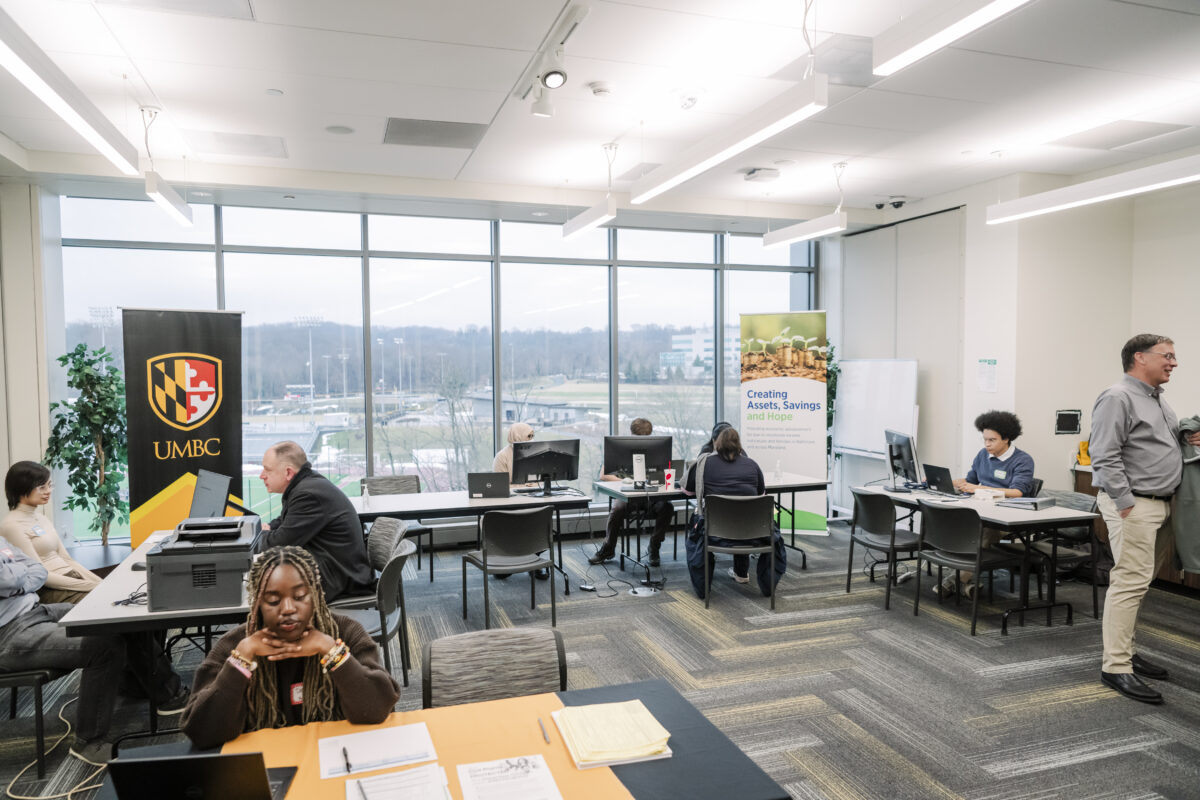 Volunteer tax preparers were on hand at the press event to help qualified Marylanders with their taxes. (Marlayna Demond ’11/UMBC)
This year, any individual or family in Maryland with a household income of $67,000 or less qualifies for the free tax prep services. Wells says a wide diversity of people have come to the UMBC site over the years, including retirees and people self-employed with jobs such as drivers and home health aides. The services not only save clients tax preparation fees—they often educate people about tax credits they didn’t know they qualified for.
Helping Marylanders save their earned money
The press conference was held on “National Earned Income Tax Credit Awareness Day,” to raise the visibility of a tax credit designed to help low-to-moderate income individuals and families save money on their taxes.
Chaudry says he remembers helping a client last year file a 2023 return, and also amend her 2022 and 2021 returns. Thanks to the earned income credit, Chaudry says the client received a refund, which she was planning to use on unpaid bills. “Delivering the news to her, I could see that she was immediately relieved,” he says. “This is one of the most rewarding feelings as a volunteer.”
Wells agrees that helping clients get better tax refunds is a great part of the job. She also loves how the effort brings together UMBC staff, community, and students, and how the student volunteers learn and grow throughout the tax season.
“Many of our students have graduated, but still come back to volunteer when they can. It is that rewarding!” she says.
]]>
On January 31, the CASH Campaign of Maryland, a nonprofit working to promote the economic advancement of low-to-moderate income individuals and families in Baltimore and across Maryland, kicked...
https://umbc.edu/stories/umbc-free-tax-prep-services/
https://beta.my.umbc.edu/api/v0/pixel/news/147031/guest@my.umbc.edu/a477df192083b073c81d55cfe9e1fe03/api/pixel
cahss
news
policy-and-society
publicpolicy
shriver-center
story
UMBC News & Magazine
https://beta.my.umbc.edu/groups/umbc-news-magazine
https://assets1-beta.my.umbc.edu/system/shared/avatars/groups/000/001/943/24435aa6207c452e7bc15cc74b42c7bb/xsmall.png?1748556657
https://assets1-beta.my.umbc.edu/system/shared/avatars/groups/000/001/943/24435aa6207c452e7bc15cc74b42c7bb/original.png?1748556657
https://assets2-beta.my.umbc.edu/system/shared/avatars/groups/000/001/943/24435aa6207c452e7bc15cc74b42c7bb/xxlarge.png?1748556657
https://assets2-beta.my.umbc.edu/system/shared/avatars/groups/000/001/943/24435aa6207c452e7bc15cc74b42c7bb/xlarge.png?1748556657
https://assets3-beta.my.umbc.edu/system/shared/avatars/groups/000/001/943/24435aa6207c452e7bc15cc74b42c7bb/large.png?1748556657
https://assets1-beta.my.umbc.edu/system/shared/avatars/groups/000/001/943/24435aa6207c452e7bc15cc74b42c7bb/medium.png?1748556657
https://assets2-beta.my.umbc.edu/system/shared/avatars/groups/000/001/943/24435aa6207c452e7bc15cc74b42c7bb/small.png?1748556657
https://assets1-beta.my.umbc.edu/system/shared/avatars/groups/000/001/943/24435aa6207c452e7bc15cc74b42c7bb/xsmall.png?1748556657
https://assets2-beta.my.umbc.edu/system/shared/avatars/groups/000/001/943/24435aa6207c452e7bc15cc74b42c7bb/xxsmall.png?1748556657
UMBC News & Magazine
0
0
false
Tue, 04 Feb 2025 11:38:10 -0500
Tue, 04 Feb 2025 11:38:10 -0500
Meet a Retriever—Emmanuella Osei, public health and sociology junior and fearless leader

Meet Emmanuella Osei, a junior studying public health and sociology and the president of UMBC’s Public Health Council of Majors. She is passionate about health equity, public service, and mentorship. As a Retriever, Emmanuella is a fearless leader, actively involved in multiple scholar programs, and volunteer initiatives across the globe—from Maryland to South Africa to Costa Rica. Her commitment to high-impact research has led her to tackle critical issues like food insecurity among students at UMBC and access to long-term COVID-19 care. She is a proud recipient of the prestigious Jack Kent Cooke Scholarship. Her dedication to making a difference continues to take her where she is most needed. Take it away, Emmanuella!
Q: Briefly introduce yourself. What’s one essential thing you’d want another Retriever to know about you?
A: I am pursuing a dual degree in public health and sociology and a certificate in the social dimensions of health. Throughout my time at UMBC, I have engaged in many experiential learning opportunities. In the summer following my freshman year, I interned at Columbia Community Care, a non-profit in Howard County that offers hunger relief, youth development, and wellness programs. In summer of 2024, I participated in the Summer Research Opportunity Program at the University of Michigan, where I researched access to long COVID care in the HELPER lab at the School of Public Health. Most recently, I participated in the AIFS study abroad program in Costa Rica where I learned about Costa Rica’s health care and tropical systems.
Q: Tell us about your primary WHY, and how it led you to UMBC.
A: I came to UMBC because of the vibrant and supportive community I felt when I first toured the campus. I knew that as an immigrant and first-generation student from Ghana [in West Africa], UMBC would be a great place to be. Because UMBC is a minority-serving institution and home to students from diverse backgrounds and identities, I felt it would offer the perfect environment for me to also grow academically while providing countless opportunities. So far, UMBC has definitely lived up to my expectations, and I truly believe that everyone can find their place here.
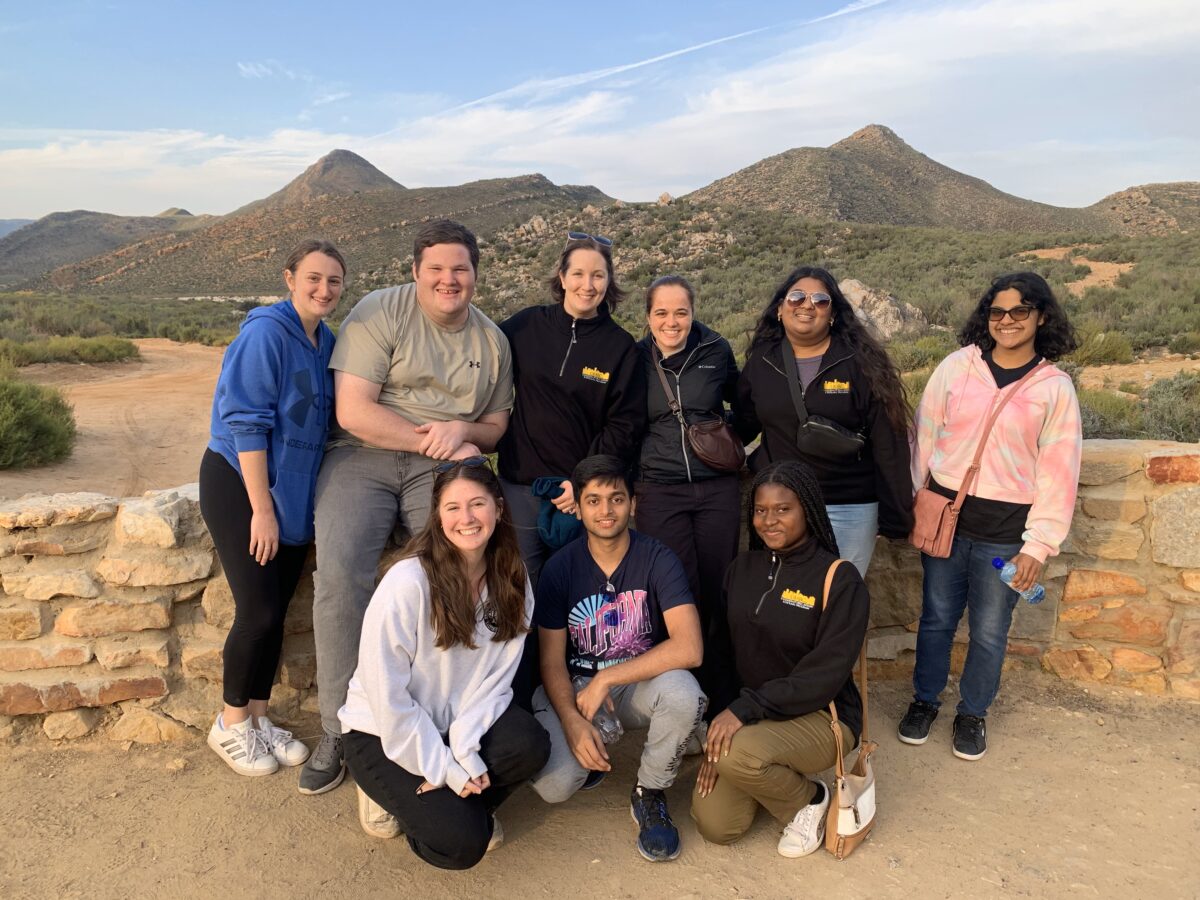 Osei (first on the right kneeling) and other Sondheim Public Affairs Scholars in South Africa. (Image courtesy of Osei)
Q: Tell us about the people who are helping you grow at UMBC, and why their HOW made such a difference to you.
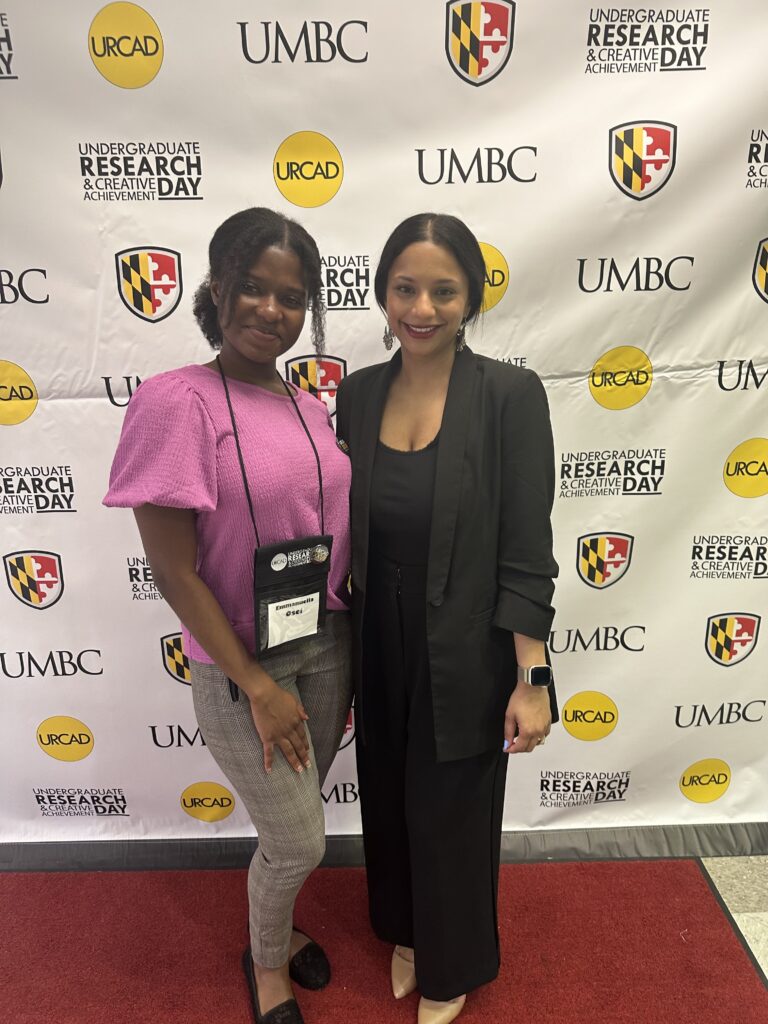 Osei and Nayak at URCAD 2024. (Image courtesy of Osei)
A: My research mentor, Dr. Sameera Nayak, has been extremely supportive of my independent research. She became my mentor during my sophomore year as part of the McNair Scholars Program. Now, as an Undergraduate Research Award Scholar studying food insecurity among students at UMBC, Dr. Nayak continues to guide me and provides feedback on each stage of the research process. After collecting and analyzing over 500 responses, I am now working on disseminating my findings beginning at UMBC’s spring Undergraduate Research and Creative Achievement Day (URCAD).
Q: Are you currently part of a scholars program or Living Learning Community at UMBC?
A: In addition to being a McNair Scholar, I am a member of UMBC’s Honors College and the Sondheim Public Affairs Scholars Program, a four-year scholarship program focused on community engagement and policy. As a Sondheim Scholar, I participated in a faculty-led study abroad summer course in Cape Town, South Africa, to learn about global community engagement and social change. In my first two years at UMBC, I was also a member of the Shriver Living Learning Community (LLC) for students passionate about service, leadership, and advocacy. I served as a peer mentor in my sophomore year, supporting first-year students as they transitioned to college.
Because UMBC is a minority-serving institution and home to students from diverse backgrounds and identities, I felt it would offer the perfect environment for me to also grow academically while providing countless opportunities. So far, UMBC has definitely lived up to my expectations, and I truly believe that everyone can find their place here.
Emmanuella Osei ’26
public health and sociology
Q: What clubs, teams, or organizations are you a part of? What do you love about them?
A: I am the president of UMBC’s Public Health Council of Majors. I love planning professional development and social events to bring public health students together. In the past year, we have hosted events such as graduate school information sessions, internship panels, resume workshops in collaboration with the Career Center, and LinkedIn headshots, among others.
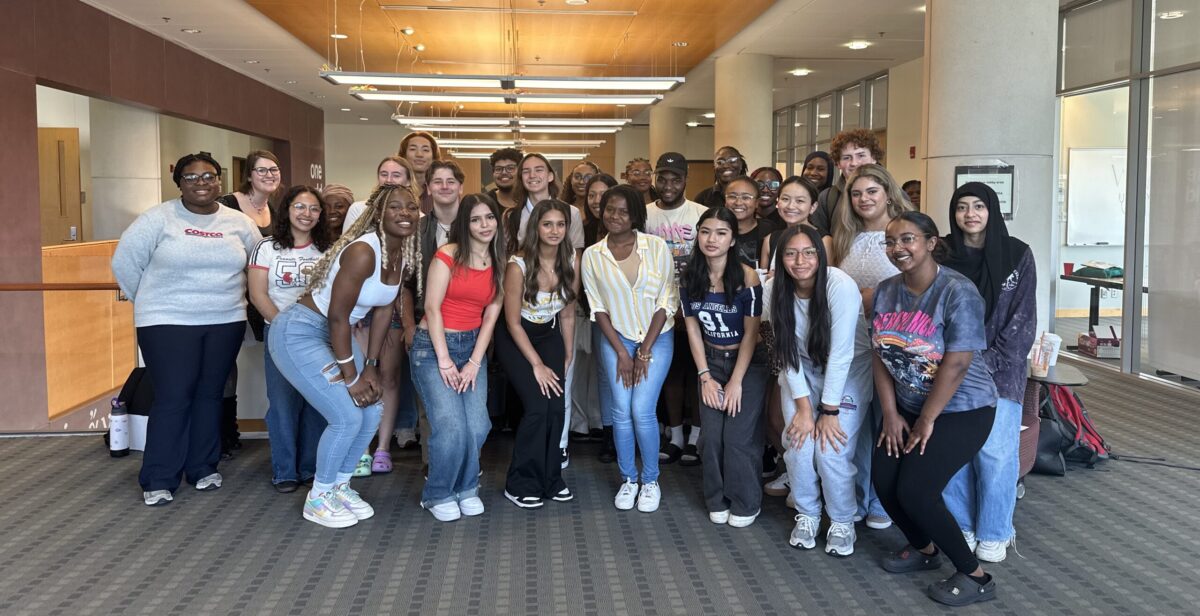 Osei (center striped shirt) with members of UMBC’s Public Health Council of Majors. (Image courtesy of Osei)
Q: How are you making a difference for other Retrievers?
A: Since my sophomore year, I have worked as an Academic Peer Advocate through UMBC’s Academic Success Center. In this role, I support other undergraduate students by connecting them to the great resources UMBC offers. Through the Shriver Center, I volunteered at the Great Kids Farm, a Baltimore City Public Schools farm-to-school program. Currently, I serve as a student ambassador for the Commodore Collegiates Program, a partnership between UMBC and Commodore John Rodgers Elementary/Middle School. I give students an exciting tour of UMBC, lead fun STEM activities, share my college experience, and engage them in discussions about college.
* * * * *
UMBC’s greatest strength is its people. When people meet Retrievers and hear about the passion they bring, the relationships they create, the ways they support each other, and the commitment they have to inclusive excellence, they truly get a sense of our community. That’s what “Meet a Retriever” is all about.
Learn more about Scholars Programs at UMBC.
]]>
Meet Emmanuella Osei, a junior studying public health and sociology and the president of UMBC’s Public Health Council of Majors. She is passionate about health equity, public service, and...
https://umbc.edu/stories/meet-a-retriever-emmanuella-osei-public-health-sociology/
https://beta.my.umbc.edu/api/v0/pixel/news/147034/guest@my.umbc.edu/b973803db9e2edd05cf9c5ed6d9d72d4/api/pixel
cahss
community
creative-achievement-day-urcad
impact
magazine
mcnair-scholars
meet-a-retriever
public-health
saph
sociology
sondheim-public-affairs-scholars-program
story
UMBC News & Magazine
https://beta.my.umbc.edu/groups/umbc-news-magazine
https://assets1-beta.my.umbc.edu/system/shared/avatars/groups/000/001/943/24435aa6207c452e7bc15cc74b42c7bb/xsmall.png?1748556657
https://assets1-beta.my.umbc.edu/system/shared/avatars/groups/000/001/943/24435aa6207c452e7bc15cc74b42c7bb/original.png?1748556657
https://assets2-beta.my.umbc.edu/system/shared/avatars/groups/000/001/943/24435aa6207c452e7bc15cc74b42c7bb/xxlarge.png?1748556657
https://assets2-beta.my.umbc.edu/system/shared/avatars/groups/000/001/943/24435aa6207c452e7bc15cc74b42c7bb/xlarge.png?1748556657
https://assets3-beta.my.umbc.edu/system/shared/avatars/groups/000/001/943/24435aa6207c452e7bc15cc74b42c7bb/large.png?1748556657
https://assets1-beta.my.umbc.edu/system/shared/avatars/groups/000/001/943/24435aa6207c452e7bc15cc74b42c7bb/medium.png?1748556657
https://assets2-beta.my.umbc.edu/system/shared/avatars/groups/000/001/943/24435aa6207c452e7bc15cc74b42c7bb/small.png?1748556657
https://assets1-beta.my.umbc.edu/system/shared/avatars/groups/000/001/943/24435aa6207c452e7bc15cc74b42c7bb/xsmall.png?1748556657
https://assets2-beta.my.umbc.edu/system/shared/avatars/groups/000/001/943/24435aa6207c452e7bc15cc74b42c7bb/xxsmall.png?1748556657
UMBC News & Magazine
6
0
false
Mon, 03 Feb 2025 16:57:41 -0500