Evan McRae ’25 paired his computer science degree with a music focused-individualized studies major and followed his family’s Retriever legacy
Before Evan McRae came to UMBC, Tess McRae—his sister—was a student here. So was Evan and Tess’s mother—Sharon McRae.You might say being a legacy Retriever was a family tradition. With Evan graduating this spring with majors in both computer science and individualized studies, we thought to ask Tess, now the assistant director for connective learning with the Center for Democracy and Civic Life, to take on this Q&A with her younger brother. Evan shares how an early exposure to UMBC’s Game Developers Club before attending UMBC eventually led to an executive board position and the creation of numerous games and great memories with other programmers and musicians.
Q: How did you decide to come to UMBC?
A: UMBC is where our mom went and also where you went, and I wanted to continue that family legacy. I also knew that it was a really great institution especially for computer science. I remember our family going to campus for Homecoming when I was in high school, and I saw a banner in The Commons for the UMBC Game Developers Club. I have always wanted to be a game developer; seeing that banner, I knew that there was a pretty good foundation for my passion at UMBC, and I wanted to join the club.
 McRae (second from left) and his fellow members of the Game Developers Club pose for a photo. Photo courtesy of McRae.
Q: In high school you discovered a passion for composing and producing music. How have you been able to expand on that passion at UMBC both technically and artistically?
A: While I was in high school I thought, “Music is something fun I do on the side, but not what I’m going to go to college for.” I was a computer science and math double major going into UMBC. When I decided to drop my math major by my second year, I told my Honors College advisor, Julie Oakes, that I was interested in music but didn’t have time to finish a music major within the next two years. She suggested I try individualized study (INDS) and see if there was a way to integrate my music passion with game development.
I ended up talking to professor Steven McAlpine from the INDS department and found a great bond with him; he shares a lot of my interests in game design and music. He has helped open a lot of doors for me, and I’m really grateful to the INDS program for that. I’ve been able to take music theory and composition courses, use UMBC’s studio facilities, and learn how to produce with industry standard software like Logic Pro. My music professors Greg Kalember, Linda Dusman, and Joseph Siu have mentored and fiercely advocated for me as an INDS major. It’s been incredible to not be a music major but still feel like I belong in those rooms.
Q: What are some of the most meaningful experiences you’ve had during your time at UMBC?
A: I’m taking a class this semester called Capstone Games Group Project taught by Marc Olano, the director of UMBC’s game development track and advisor for the Game Developers Club. The class combines artists and programmers who pitch game ideas at the start and work together on only a handful of those games for the rest of the semester. I pitched a puzzle platformer game called King Scribble that I’ve been wanting to make since first grade. My classmates and professor liked the idea, and to my surprise, it got picked as one of four games the class will develop in full. I still don’t think I’ve fully internalized how cool it is to actually be making this game.
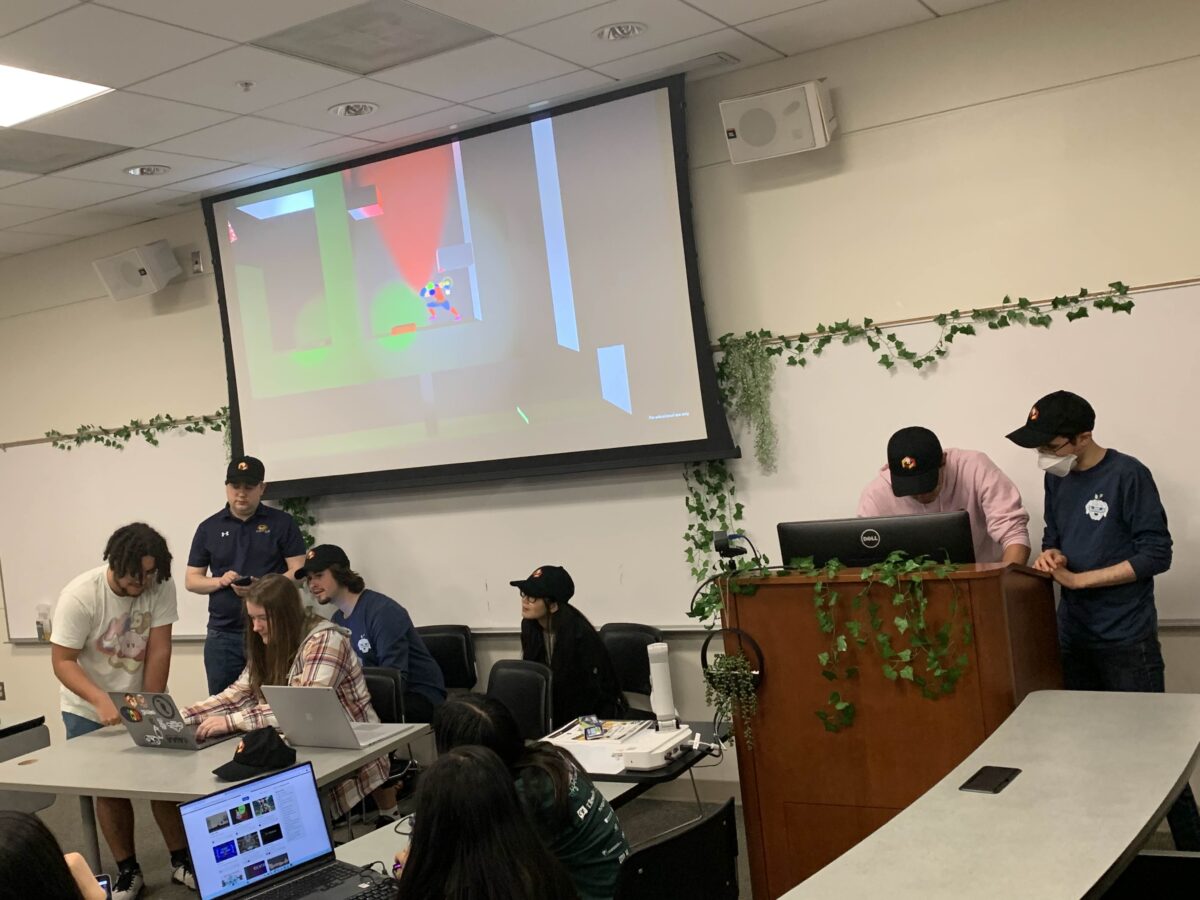 McRae (standing at podium) plays a submission to the Game Jamathon, hosted by hackUMBC and UMBC Game Developers Club. Photo courtesy of McRae.
I’ve also been working on a game called Daylight(available to play on Windows only, the password is: dog)since 2022 through the Game Developers Club. I feel like I’ve really grown as a developer and musician from it, and I’ve met some really cool and talented people through it. For my INDS capstone I’m improving and expanding upon Daylight’s soundtrack, which I’ve been working on for years now. It likely won’t be finished this semester or even next year, but I’m so privileged and grateful to have played such a big part in it.
I also have found a lot of meaning in my internship at UMBC’s Imaging Research Center (IRC). I got a position there thanks to Professor McAlpine, who had previously mentored Tristan King ’21,a former IRC technical specialist, when he was an INDS student. Tristan ended up being my supervisor for my first year there. I’m making virtual reality data visualization concept mapping software using Unreal Engine and solving complex, cutting-edge interface design problems. It’s really challenging my professional coding skills and helping me to grow exponentially as a game developer. I appreciate that I’ve had the opportunity on campus to enrich my learning like that. It’s been so cool to work with this transdisciplinary team and develop something that I think will have a good impact on the world.
Q: How have the ideas of inter/transdisciplinarity enhanced your UMBC experience?
A: What drew me to game development was working among disciplines. I love the idea of being a programmer and musician working with artists, writers, and playtesters to make a very human, cohesive experience: a love letter to players. Finding myself in INDS and at the IRC legitimized this way of thinking for me. I’ve really found myself at home in environments where I can collaborate with people from different backgrounds who are bringing all their skills and influences to the table. I value that process in everything I make and do at UMBC.
Being part of the Honors College also helped broaden my personal horizons as a student. I’ve been able to take a lot of cool courses outside of my disciplines like Mathematics of the Universe with Manil Suri and Sounds Like Social Justice with Earl Brooks, who have also been pretty big inspirations for me when it comes to the interdisciplinarity of technical fields and the ways I can actually make an impact toward issues I care about.
Q: What has being a student leader in the UMBC Game Developers Club been like for you?

A: It actually wasn’t something I knew I wanted to do in the first place until my friend encouraged me to run for vice president during a special election. I think it’s been the happiest accident in my life. I’ve been able to help make UMBC a proper home for students of all disciplines interested in game development, whether it’s for a hobby or a future career. Playing a pivotal role in creating and maintaining that space has been absolutely awesome. (Check out another Game Developers Club creation, Phantom Feline—I was a programmer and musician on this game that can be played in-browser as well as on Windows, Mac, and Linux.) The Game Developers Club has established alumni and mentors in the industry who give talks and network with our students. To be able to stand on that 20-year legacy and be lifted by it is a really special thing.
Written by Tess McRae ’22, Assistant Director for Connective Learning, Center for Democracy and Civic Life
Read more Commencement 2025 stories.
]]>
Before Evan McRae came to UMBC, Tess McRae—his sister—was a student here. So was Evan and Tess’s mother—Sharon McRae.You might say being a legacy Retriever was a family tradition. With Evan...
https://umbc.edu/stories/evan-mcrae-25-followed-familys-retriever-legacy/
https://beta.my.umbc.edu/api/v0/pixel/news/149903/guest@my.umbc.edu/5e648a26fda274bc5c1302e370d47cd1/api/pixel
center-for-democracy-and-civic-life
class-of-2025
coeit
computer-science
inds
news
story
UMBC News & Magazine
https://beta.my.umbc.edu/groups/umbc-news-magazine
https://assets1-beta.my.umbc.edu/system/shared/avatars/groups/000/001/943/24435aa6207c452e7bc15cc74b42c7bb/xsmall.png?1748556657
https://assets1-beta.my.umbc.edu/system/shared/avatars/groups/000/001/943/24435aa6207c452e7bc15cc74b42c7bb/original.png?1748556657
https://assets2-beta.my.umbc.edu/system/shared/avatars/groups/000/001/943/24435aa6207c452e7bc15cc74b42c7bb/xxlarge.png?1748556657
https://assets2-beta.my.umbc.edu/system/shared/avatars/groups/000/001/943/24435aa6207c452e7bc15cc74b42c7bb/xlarge.png?1748556657
https://assets3-beta.my.umbc.edu/system/shared/avatars/groups/000/001/943/24435aa6207c452e7bc15cc74b42c7bb/large.png?1748556657
https://assets1-beta.my.umbc.edu/system/shared/avatars/groups/000/001/943/24435aa6207c452e7bc15cc74b42c7bb/medium.png?1748556657
https://assets2-beta.my.umbc.edu/system/shared/avatars/groups/000/001/943/24435aa6207c452e7bc15cc74b42c7bb/small.png?1748556657
https://assets1-beta.my.umbc.edu/system/shared/avatars/groups/000/001/943/24435aa6207c452e7bc15cc74b42c7bb/xsmall.png?1748556657
https://assets2-beta.my.umbc.edu/system/shared/avatars/groups/000/001/943/24435aa6207c452e7bc15cc74b42c7bb/xxsmall.png?1748556657
UMBC News & Magazine
4
0
false
Wed, 07 May 2025 15:37:48 -0400
Wed, 07 May 2025 15:37:48 -0400
Finding a lifetime of purpose in giving back
A bright yellow bead slides over a red pipe cleaner, then a blue bead followed by green. Soon, the rainbow of beads and wire is twisted this way and that until it resembles the Big Dipper. This same activity is happening throughout PHYS 401, a seminar room in the UMBC Physics building, as 20 Baltimore City middle and high school students and their parents recreate the constellations.
These students are part of their local Sigma Beta Club, a youth auxiliary of Phi Beta Sigma Fraternity, Inc., founded nationally in 1950 to help mentor young men and develop their leadership skills. “When we go out to UMBC, it’s always something special,” says Gary Brooks ’79, history, who played a large part in bringing these young people to Hilltop Circle. “UMBC does things second to none.”
The students came to campus in February with members of the Nu Sigma Sigma Alumni Chapter, which includes Phi Beta Sigma alumni—including Brooks—to tour the UMBC Observatory and attend a men’s basketball game.
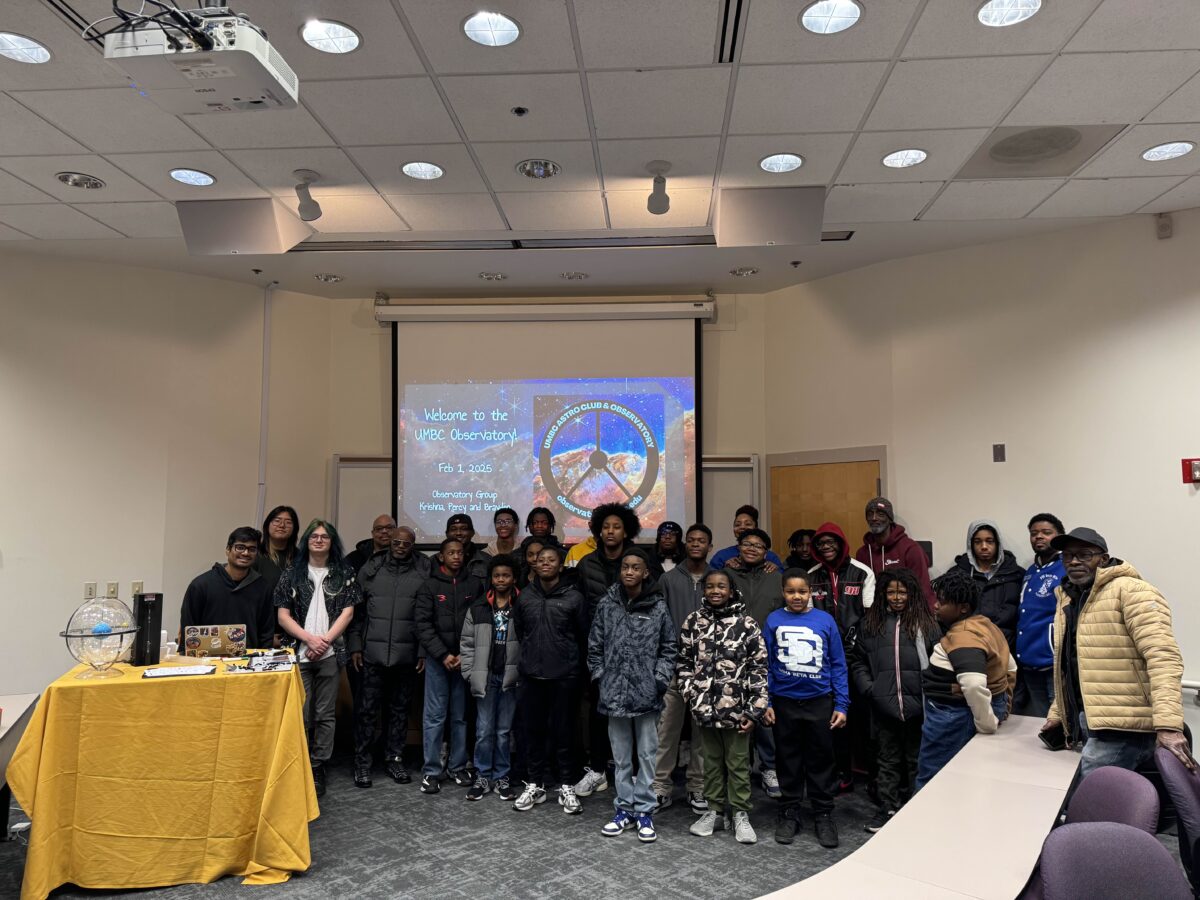 Gary Brooks ’79 and members of the Sigma Beta Club touring the UMBC Observatory with middle and high school students.
Nu Sigma Sigma partners with local universities like UMBC to offer Baltimore City youth interested in STEM the chance to experience college life. Most of these visits involve some sort of athletics event, and that’s about it—but not at UMBC.
Another Sigma Beta Club visit to UMBC involved a FIRST LEGO League competition, and another saw the students observe a robotics event. Brooks also makes sure that each visit includes a member of UMBC senior leadership. Recently, the students had the chance to speak with UMBC President Valerie Sheares Ashby and Athletics Director Tiffany Tucker.
Brooks wants each visit to UMBC to be as meaningful as possible for these young men because he knows how UMBC can change lives.
Staying connected
Even though Brooks graduated 45 years ago, he never really left UMBC. He remains closely involved with Phi Beta Sigma at UMBC, helping mentor students, and he is an active member of Nu Sigma Sigma, working closely with the university to bring Sigma Beta Club members to campus.
“The fraternity got me involved in community service,” says Brooks—a personal mission he carries on to this day.
“Since I met Gary almost 20 years ago, he has been a dedicated champion of UMBC,” says Stanyell Bruce, director of alumni engagement at UMBC.
Brooks also serves on the UMBC Second Generation Scholarship Fund committee. The Second Generation Scholarship is awarded annually to outstanding undergraduate students who intend to pursue study at UMBC, are enrolled in or have completed a course in Africana studies, and demonstrate a commitment to improving the lives of racial/ethnic minorities through community service, extracurricular activities, or other community involvement. Brooks has served on the committee since 1986, when the scholarship was established.
Brooks is also the chairperson for the Historic St. James Episcopal Church Scholarship Fund—a position he has held since 2010—and helped establish the Dr. Lamont Smith, M.D. Scholarship through Sigma R.E.A.C.H., Inc. Brooks has served on that committee since its inception as well.
“Education is dear to my heart,” says Brooks, who went on to earn his M.P.A. from the University of Baltimore and his J.D. from the University of Maryland School of Law—an impressive resume for someone who initially struggled in college.
“My first semester at UMBC wasn’t the best,” admits Brooks. “I didn’t do well at all.”
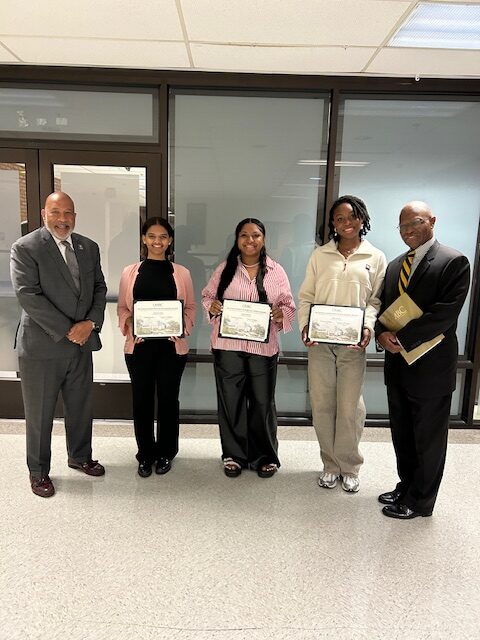
Photo left: Gary Brooks ‘79 and Larry Wiggins ‘75 with the 2024 Second Generation Scholarship recipients.
Finding place and purpose
Instead of giving up, Brooks decided to lean into his weaknesses—reading and writing—by taking courses in Africana studies, a subject that interested him a great deal. These courses involved a lot of reading and writing, but Brooks found himself more immersed in the work. It was still difficult, but he enjoyed the subject matter, and the faculty was incredibly supportive. As a result, his grades began to improve.
“I saw that success, and I got more and more serious about school,” says Brooks.
After graduation, Brooks remained close to the Africana studies department. He spearheaded a committee tasked with hosting the annual “Party with a Purpose,” whose proceeds supported Africana studies and the Second Generation Scholarship. Brooks also continued to correspond with several Africana studies faculty members who mentored Brooks throughout graduate school, law school, and his career.
 Gary Brooks ‘79 and the Party with a Purpose planning committee during UMBC’s 50th anniversary.
After Brooks graduated from law school, one of those professors, Willie Lamousé-Smith, former chair of Africana studies, asked Brooks to step out of his comfort zone and step into the classroom to teach a course on the impact of the criminal justice system on the Black community. Despite some hesitancy—“I do estate planning and bankruptcy,” says Brooks. “I am not a criminal justice attorney.”—the young lawyer decided to take the leap into teaching after more than a little encouragement from Lamousé-Smith.
“Dr. Lamousé-Smith said, ‘Mr. Brooks, you are smart enough,’ and that was enough,” says Brooks. “He believed in me.”
Brooks taught this class for six years, connecting UMBC students with impactful, African American leaders, including the Baltimore City police commissioner and the Baltimore City state’s attorney. Brooks eventually handed the class over to his good friend and former law partner, Larry Wiggins ’75, political science, who played a large role in helping Brooks study for and pass the bar exam.
When the giving goes both ways
Brooks was honored at the 2001 UMBC Alumni Awards with an Alumni Community Leadership Award. He also received a special Visionary Leadership Award in 2006, recognizing members of the Reginald F. Lewis Museum of Maryland African American History and Culture Event Planning Committee for their outstanding contributions to advancing the mission of the UMBC Alumni Association. He’d like to thank his wife, Karen B. Brooks, their four children, Aja, Ashlea, Morgan, and Geron, and their three grandkids, Ryder, Ari, and Amari.
Over the years, Brooks has continued to give back to the UMBC community because of how much the UMBC community has given him.
“Gary’s commitment to UMBC never wavers,” says Bruce. “He’s someone I seek out for advice and guidance, and he embodies what it means to be Retriever Proud.”
]]>
A bright yellow bead slides over a red pipe cleaner, then a blue bead followed by green. Soon, the rainbow of beads and wire is twisted this way and that until it resembles the Big Dipper. This...
https://umbc.edu/stories/finding-a-lifetime-of-purpose-in-giving-back/
https://beta.my.umbc.edu/api/v0/pixel/news/149879/guest@my.umbc.edu/88822ec4ac81192ec039f21af5edb8c6/api/pixel
alumni
alumni-profile
baltimore-city
cahss
gary-brooks
history
impact
magazine
phi-beta-sigma
second-generation-scholarship
sigma-beta-club
spring-2025
story
UMBC News & Magazine
https://beta.my.umbc.edu/groups/umbc-news-magazine
https://assets1-beta.my.umbc.edu/system/shared/avatars/groups/000/001/943/24435aa6207c452e7bc15cc74b42c7bb/xsmall.png?1748556657
https://assets1-beta.my.umbc.edu/system/shared/avatars/groups/000/001/943/24435aa6207c452e7bc15cc74b42c7bb/original.png?1748556657
https://assets2-beta.my.umbc.edu/system/shared/avatars/groups/000/001/943/24435aa6207c452e7bc15cc74b42c7bb/xxlarge.png?1748556657
https://assets2-beta.my.umbc.edu/system/shared/avatars/groups/000/001/943/24435aa6207c452e7bc15cc74b42c7bb/xlarge.png?1748556657
https://assets3-beta.my.umbc.edu/system/shared/avatars/groups/000/001/943/24435aa6207c452e7bc15cc74b42c7bb/large.png?1748556657
https://assets1-beta.my.umbc.edu/system/shared/avatars/groups/000/001/943/24435aa6207c452e7bc15cc74b42c7bb/medium.png?1748556657
https://assets2-beta.my.umbc.edu/system/shared/avatars/groups/000/001/943/24435aa6207c452e7bc15cc74b42c7bb/small.png?1748556657
https://assets1-beta.my.umbc.edu/system/shared/avatars/groups/000/001/943/24435aa6207c452e7bc15cc74b42c7bb/xsmall.png?1748556657
https://assets2-beta.my.umbc.edu/system/shared/avatars/groups/000/001/943/24435aa6207c452e7bc15cc74b42c7bb/xxsmall.png?1748556657
UMBC News & Magazine
1
0
false
Tue, 06 May 2025 17:06:34 -0400
Tue, 06 May 2025 17:06:34 -0400
Additional Updates Regarding Federal Actions and Orders
Dear UMBC Community,
As we continue to monitor and respond to actions and executive orders from the federal government, we are meeting regularly with campus groups, including shared governance leaders, and with individuals who have been impacted by recent changes. Today, we write to share with you a comprehensive update on several areas of activity.
Advocating for UMBC and for higher education
First, we want you to know that in addition to our work on campus, we are coordinating and collaborating closely with the University System of Maryland (USM) and the state, including the Maryland Attorney General’s Office, seeking guidance and opportunities to advocate for UMBC and its community members and for the values that are core to our mission and to higher education.
Among the proposals we are watching closely is the
draft legislation advanced by the U.S. House of Representatives recently that would mean massive changes to the federal student financial aid system, restricting access to aid for parents and students, ending the grad PLUS loan program for graduate students, and more. We are speaking directly to our representatives in Congress about supporting our students and affordability and access to higher education.
We also are standing up for higher education with fellow university leaders. As you may know, the university recently joined hundreds of institutions and associations in signing on to a
statement issued by the American Association of Colleges and Universities that speaks out against the “unprecedented overreach and political interference now endangering American higher education.” Nearly 600 university presidents, chancellors, and other leaders have added their voices to this call for constructive engagement.
You may also be aware that the USM recently joined 85 other institutions and associations in an
amicus brief filed by the Presidents’ Alliance on Higher Education and Immigration in
AAUP v. Rubio, a federal lawsuit challenging the administration’s revocation of visas and detentions of noncitizen students and scholars. USM is a member institution of the President’s Alliance, and we are grateful for the system’s leadership in supporting our community members.
International students and scholars, travel, and immigration
We have a few updates related to our international community and international travel. First, in a
campus message last month, we shared that the U.S. Department of Homeland Security (DHS) had taken action within the federal Student and Exchange Visitor Information System (SEVIS) to terminate the F-1 immigration records of four members of our campus community. Neither the affected students nor UMBC officials were ever notified or given justification by DHS regarding these terminations.
Today, we are pleased to share that the immigration records for the affected UMBC international graduate students have been reactivated by DHS, and all four remain in the U.S. Staff members in UMBC’s Center for Global Engagement will continue to conduct daily audits of immigration records in SEVIS.
Second, we understand that many members of our campus community are planning international travel this summer. We want to remind you of the information and resources shared in an
earlier communication as you make your plans.
The U.S. Department of State has now resumed posting
visa appointment wait time estimates at U.S. embassies and consulates worldwide. While this information can be useful for trip planning purposes, we continue to advise international travelers who require new visas to return to the U.S. that they confirm their visa appointments prior to departing, as appointment wait times can change dramatically without notice.
Finally: In recent weeks, many members of our campus community have contacted the Center for Global Engagement (CGE) with concerns regarding international travel and immigration enforcement. This outreach has included U.S. citizens seeking assurances that they will not face challenges when seeking to reenter the U.S., as well as inquiries related to the immigration status of family members. Given the specific scope of CGE’s services and limitations on the immigration classifications upon which its staff may advise, namely F-1, J-1, and H-1B, we ask that all other inquiries be directed to UMBC’s
Employee Assistance Program or
private immigration counsel. This will help CGE focus resources effectively and ensure timely support for those who depend on the specialized services the office provides. Thank you for your understanding.
Research impacts
Recent executive orders, combined with decisions from a variety of federal agencies, have led to an increasingly significant impact on UMBC’s research endeavor, as has been the case for nearly every research university across the country. For UMBC, the impact has so far amounted to the termination of more than 30 multi-year grants and awards (some of which had started only recently, and some of which were in their final few months of funding). The numbers change frequently, but to date, the net financial impact of these grant terminations is in the range of $30 million, or about $10 million a year over the next three years. This represents a decrease of about 10 – 12 percent in the amount of annual research funding UMBC has received from the federal government in recent years.
We are working closely with our university counsel and the Maryland Attorney General’s Office, as well as with the
Association of Public and Land-grant Universities (Karl Steiner, vice president for research and creative achievement, is a member of the executive committee of APLU’s Council on Research) to understand and mitigate the impact of these terminations.
We also are carefully monitoring the recent release of the president’s federal discretionary budget proposal and the growing list of announcements by federal agencies to cap indirect costs for research, also known as facilities and administrative (F&A) costs, and working with appropriate representatives to address them.
To our research community: Please continue to work with your departments and colleges to pursue external funding opportunities. Our
Office of Research Development (ORD) can provide help in this regard and is actively assisting faculty members who are pursuing alternate funding sources. ORD can share information and guidance on such opportunities and provide grant-writing support.
Please continue to visit our
information and resources website for up-to-date information and for answers to frequently asked questions specific to our research and creative achievement community.
Faculty tenure and promotion
The impacts of federal actions and orders on our research enterprise also stand to disrupt the career trajectories and development of our faculty. To address such potential impact related to research funding, teaching, and service, we are putting in place modifications to the university’s tenure and promotion reviews, beginning in the fall. For more information about these changes, please see the
message sent recently to UMBC faculty.
Accreditation
As you know, UMBC is currently in the final stages of the self-study component of our accreditation by the Middle States Commission on Higher Education (MSCHE), and we certainly took note of the
executive order issued last month concerning higher education accreditation and the related
Dear Colleague Letter from the Department of Education.
MSCHE has issued a statement in response and indicated they will be in contact with universities with additional information when available. For now, we are staying the course with our accreditation process, and we appreciate the work of everyone involved in this significant effort.
Budget planning
One brief note about our budget planning: The
April 9 campus message noted that with the passage of the state of Maryland’s budget, we had clarity on what our funding from the state would look like—amid the ongoing uncertainty of federal support. As we shared then, the USM directed its institutions to prepare three-year budget projections. Our update today is simply that the USM has extended by a few weeks the timeline for completing those projections (which had been early May). We will share further details about the projections and our budget planning process in the coming weeks.
Care and commitment for UMBC and its values
We cherish the incredible breadth of identities, perspectives, and lived experiences of our community members, and we know that some individuals, including members of our LGBTQIA2+ community, may be feeling especially vulnerable in the current moment. Our collective responsibility is to care for one another and to continue to live UMBC’s value of inclusive excellence, to ensure that we provide an educational environment and workplace that is welcoming, inclusive, and safe for all.
As we near the end of the semester and the celebration of our newest graduates later this month, we reaffirm our commitment to inclusive excellence and to academic freedom—core values that are essential to who we are, to what we do, and to why it matters. We will not waver in our devotion to these fundamentals, and we are grateful for your shared vision and dedication to UMBC.
Sincerely,
President Valerie Sheares Ashby
Manfred H. M. van Dulmen
Provost and Senior Vice President for Academic Affairs
]]>
Dear UMBC Community, As we continue to monitor and respond to actions and executive orders from the federal government, we are meeting regularly with campus groups, including shared governance...
https://my3.my.umbc.edu/groups/announcements/posts/149852
https://beta.my.umbc.edu/api/v0/pixel/news/149874/guest@my.umbc.edu/1a59caea50fcb51dd0057fc80c3b5a34/api/pixel
federal-orders
rss
story
UMBC News & Magazine
https://beta.my.umbc.edu/groups/umbc-news-magazine
https://assets1-beta.my.umbc.edu/system/shared/avatars/groups/000/001/943/24435aa6207c452e7bc15cc74b42c7bb/xsmall.png?1748556657
https://assets1-beta.my.umbc.edu/system/shared/avatars/groups/000/001/943/24435aa6207c452e7bc15cc74b42c7bb/original.png?1748556657
https://assets2-beta.my.umbc.edu/system/shared/avatars/groups/000/001/943/24435aa6207c452e7bc15cc74b42c7bb/xxlarge.png?1748556657
https://assets2-beta.my.umbc.edu/system/shared/avatars/groups/000/001/943/24435aa6207c452e7bc15cc74b42c7bb/xlarge.png?1748556657
https://assets3-beta.my.umbc.edu/system/shared/avatars/groups/000/001/943/24435aa6207c452e7bc15cc74b42c7bb/large.png?1748556657
https://assets1-beta.my.umbc.edu/system/shared/avatars/groups/000/001/943/24435aa6207c452e7bc15cc74b42c7bb/medium.png?1748556657
https://assets2-beta.my.umbc.edu/system/shared/avatars/groups/000/001/943/24435aa6207c452e7bc15cc74b42c7bb/small.png?1748556657
https://assets1-beta.my.umbc.edu/system/shared/avatars/groups/000/001/943/24435aa6207c452e7bc15cc74b42c7bb/xsmall.png?1748556657
https://assets2-beta.my.umbc.edu/system/shared/avatars/groups/000/001/943/24435aa6207c452e7bc15cc74b42c7bb/xxsmall.png?1748556657
UMBC News & Magazine
0
0
false
Tue, 06 May 2025 14:04:29 -0400
Updates on Impact of Executive Orders and Federal Actions and Promotion and Tenure Reviews
Dear Colleagues,
We write today to share some updates related to the impact of executive orders and federal actions, as well as some modifications of protocols surrounding promotion and tenure reviews.
Since the start of the spring 2025 semester, faculty members across the university may have experienced disruption to their research, teaching, and service activities due to some of the recent White House Executive Orders and federal actions. Faculty research could be impacted in various ways: stop-work orders to federal grants; inability to access datasets or databases housed in or sponsored by federal agencies; or challenges in travel to present their work at national or international conferences supported by federal funds.
Also, there may have been potential impacts on the faculty’s ability to hire students and staff to support their research using federal support. In other instances, faculty members’ community-engaged scholarship, teaching, and service may have been severely impacted due to programs being curtailed in both the public and private sectors and due to lack of resources to conduct the work. Faculty whose scholarship and teaching could be categorized as diversity, equity, inclusion, and accessibility (DEIA) may have to spend considerable time navigating the current political climate in the process of conducting and publishing their work.
Provost’s modifications of tenure track faculty and librarian faculty promotion protocols: AY 2025 – 2026 Cycle
To address the potential impact of recent executive orders and federal actions related to research funding, curtailment or termination of DEIA initiatives, and related topics on faculty’s research, teaching, and service, the following protocol will be put in place beginning in academic year 2025 – 2026 faculty promotion and tenure (P&T) reviews. These modifications will be communicated to each level of P&T review through the provost’s annual P&T instructions, through the deans’ instructions for the development of letters to external reviewers, through the provost’s charge to the University Faculty Review Committee, and in deliberations made by department promotion and tenure committees.
1. If there have been any impacts on their research, teaching and/or service as a result of the executive orders and federal actions, candidates for P&T review are encouraged to reflect on such impacts in their self-assessment.
If the candidate mentions impacts in their self-evaluation:
2. Every level of review, including outside reviewers, must consider the described impact of such executive orders and federal actions on the usual progression of our faculty towards promotion and tenure when evaluating both the work performed during this period of disruption and their potential as a scholar after promotion and/or tenure when performing on- and off-campus activities.
3. Each level of review must include a Statement of Affirmation that their review, and all previous levels of review, has taken into full consideration the impact of executive orders and federal actions beginning in 2025 on the candidate’s progression.
[I] affirm that [my] review took into full consideration any impacts of current executive orders and federal actions on [X’s] candidacy.
If it is determined that any prior level of review has failed to do so in a way that may have resulted in negative consequences for the candidate, the current level of review shall inform the provost in their own report.
4. All letters providing guidance to external reviewers must include the following statement regarding the impact of executive orders and federal actions on P&T recommendations.
When considering your recommendation regarding this P&T decision, please make sure to consider any potential effects described by the candidate associated with recent federal executive orders and federal actions impacting research, teaching, and service. This impact might include, but it is not limited to, the termination of federal support or faculty’s inability to present at conferences outside the United States.
This statement recognizes the impact that current executive orders and federal actions might have on the research, teaching, and service of faculty going up for promotion and tenure.
This policy applies to the academic year 2025 – 2026 review cycle. The Office of the Provost will provide additional guidance for any promotion and tenure modifications in subsequent cycles as the impact of the executive orders and federal actions evolve.
Sincerely,
Manfred H. M. van Dulmen
Provost and Senior Vice President for Academic Affairs
Ana Oskoz
Vice Provost for Faculty Affairs
]]>
Dear Colleagues, We write today to share some updates related to the impact of executive orders and federal actions, as well as some modifications of protocols surrounding promotion and tenure...
https://my3.my.umbc.edu/groups/announcements-faculty/posts/149807
https://beta.my.umbc.edu/api/v0/pixel/news/149850/guest@my.umbc.edu/e6d79c3e55ca0bda50fc1ddd1c5dc727/api/pixel
federal-orders
rss
story
UMBC News & Magazine
https://beta.my.umbc.edu/groups/umbc-news-magazine
https://assets1-beta.my.umbc.edu/system/shared/avatars/groups/000/001/943/24435aa6207c452e7bc15cc74b42c7bb/xsmall.png?1748556657
https://assets1-beta.my.umbc.edu/system/shared/avatars/groups/000/001/943/24435aa6207c452e7bc15cc74b42c7bb/original.png?1748556657
https://assets2-beta.my.umbc.edu/system/shared/avatars/groups/000/001/943/24435aa6207c452e7bc15cc74b42c7bb/xxlarge.png?1748556657
https://assets2-beta.my.umbc.edu/system/shared/avatars/groups/000/001/943/24435aa6207c452e7bc15cc74b42c7bb/xlarge.png?1748556657
https://assets3-beta.my.umbc.edu/system/shared/avatars/groups/000/001/943/24435aa6207c452e7bc15cc74b42c7bb/large.png?1748556657
https://assets1-beta.my.umbc.edu/system/shared/avatars/groups/000/001/943/24435aa6207c452e7bc15cc74b42c7bb/medium.png?1748556657
https://assets2-beta.my.umbc.edu/system/shared/avatars/groups/000/001/943/24435aa6207c452e7bc15cc74b42c7bb/small.png?1748556657
https://assets1-beta.my.umbc.edu/system/shared/avatars/groups/000/001/943/24435aa6207c452e7bc15cc74b42c7bb/xsmall.png?1748556657
https://assets2-beta.my.umbc.edu/system/shared/avatars/groups/000/001/943/24435aa6207c452e7bc15cc74b42c7bb/xxsmall.png?1748556657
UMBC News & Magazine
0
0
false
Mon, 05 May 2025 14:22:01 -0400
Strategic Planning Conversation Follow Up
Dear UMBC Community,
We would like to thank everyone who participated in last week’s Conversation About Strategic Planning, where we hosted President Valerie Sheares Ashby for a conversation about the university’s strategic priorities. Nearly 450 community members joined in person and virtually to hear about our high-level aspirations for the future of UMBC.
For those who were unable to attend, we invite you to visit the
strategic planning website, where you can find a recording of the discussion.
Sincerely,
Manfred H. M. van Dulmen
Provost and Senior Vice President for Academic Affairs
Renique T. Kersh
Vice President for Student Affairs
Charissa S. L. Cheah
Professor of Psychology and Special Assistant to the Provost for Strategic Planning
]]>
Dear UMBC Community, We would like to thank everyone who participated in last week’s Conversation About Strategic Planning, where we hosted President Valerie Sheares Ashby for a conversation...
https://my3.my.umbc.edu/groups/announcements/posts/149749
https://beta.my.umbc.edu/api/v0/pixel/news/149774/guest@my.umbc.edu/3238d0062eeacc63ebc924d17c20b72a/api/pixel
president
president-valerie-sheares-ashby
rss
story
UMBC News & Magazine
https://beta.my.umbc.edu/groups/umbc-news-magazine
https://assets1-beta.my.umbc.edu/system/shared/avatars/groups/000/001/943/24435aa6207c452e7bc15cc74b42c7bb/xsmall.png?1748556657
https://assets1-beta.my.umbc.edu/system/shared/avatars/groups/000/001/943/24435aa6207c452e7bc15cc74b42c7bb/original.png?1748556657
https://assets2-beta.my.umbc.edu/system/shared/avatars/groups/000/001/943/24435aa6207c452e7bc15cc74b42c7bb/xxlarge.png?1748556657
https://assets2-beta.my.umbc.edu/system/shared/avatars/groups/000/001/943/24435aa6207c452e7bc15cc74b42c7bb/xlarge.png?1748556657
https://assets3-beta.my.umbc.edu/system/shared/avatars/groups/000/001/943/24435aa6207c452e7bc15cc74b42c7bb/large.png?1748556657
https://assets1-beta.my.umbc.edu/system/shared/avatars/groups/000/001/943/24435aa6207c452e7bc15cc74b42c7bb/medium.png?1748556657
https://assets2-beta.my.umbc.edu/system/shared/avatars/groups/000/001/943/24435aa6207c452e7bc15cc74b42c7bb/small.png?1748556657
https://assets1-beta.my.umbc.edu/system/shared/avatars/groups/000/001/943/24435aa6207c452e7bc15cc74b42c7bb/xsmall.png?1748556657
https://assets2-beta.my.umbc.edu/system/shared/avatars/groups/000/001/943/24435aa6207c452e7bc15cc74b42c7bb/xxsmall.png?1748556657
UMBC News & Magazine
0
0
false
Fri, 02 May 2025 16:08:51 -0400
UMBC’s CIDER program supports new Hilltop Institute-led Medicaid study, other cross-collaborative projects
UMBC researchers are collaborating on a study that takes a closer look at specific diagnosis coding patterns that focus on societal factors that potentially influence the health of Maryland’s Medicaid recipients.
Morgan Henderson, director of analytics and research at UMBC’s The Hilltop Institute, and Jun Chu, assistant professor of public health, are among the five cross-collaborative teams selected to receive funding from UMBC’s Center and Institute Departmentally-Engaged Research (CIDER) program. Henderson and Chu’s CIDER-supported project will investigate potential “z code” patterns of the state’s Medicaid recipients. Z codes are a set of diagnosis codes that refer to factors influencing a patient’s health status beyond diseases or injuries, called social determinants of health.
“These specific diagnosis codes indicate certain social determinants of health-related factors, not just traditionally medical things,” explains Henderson, principal investigator of the study. Z code data indicates if a patient has an issue that’s related to social risk factors, such as unstable housing, lack of food, hazardous living environments, and employment status.
“There hasn’t been much analysis of z code patterns and we aim to lay a good foundation for better understanding these diagnosis codes within Maryland’s Medicaid data,” says Henderson.
A deeper look into z code diagnosing could be a useful identification “to bring extra resources to Medicaid recipients who are in need,” says Chu.
Analyzing Medicaid data
The study coincides with recent news of potential billion-dollar federal budget cuts to Maryland’s Medicaid program, which currently supports about 1.7 million Maryland residents. The Hilltop Institute specializes in working with the state’s Medicaid data. According to the institute’s Maryland Medicaid DataPort, two in five of those in Medicaid are children and Medicaid pays for 60 percent of nursing home stays.
Chu’s research has largely focused on social determinants of health with a particular focus on immigrant communities and Medicaid recipients who are children. Henderson helped to develop and currently manages Hilltop’s predictive modeling portfolio. These predictive models, which also utilize z code data, use a variety of risk factors derived from Medicare and Medicaid claims data to estimate the probability that a given patient incurs certain outcomes in the near future.

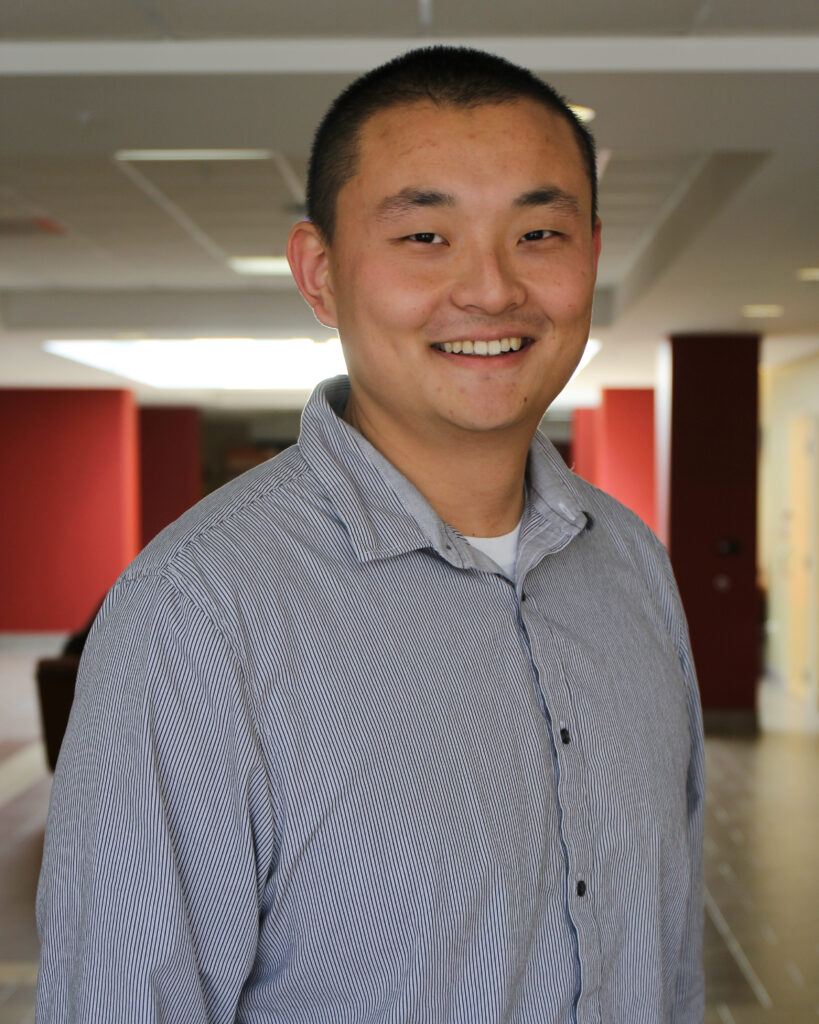 Principal investigator Morgan Henderson (left) and co-investigator Jun Chu of the CIDER Program study, “Analysis of Social Determinant of Health Diagnosis Coding Patterns Among Medicaid Recipients and Providers in Maryland.” (Photos courtesy of The Hilltop Institute and Jun Chu)
The pair’s project will include two studies: one study will focus specifically on the patients ascribed z codes to determine what patterns arise based on patient-specific factors such as demographics, health care utilization, or geography.
The second study will focus on analyzing the characteristics of the healthcare providers that indicate the z codes on Medicaid claims.
“Patient claims are the engine that so much of health analysis relies upon. It’s the decision of the provider on which coding diagnoses to include—it’s not a completely standardized process,” says Henderson.
CIDER 2025 recipients
The CIDER program’s goal includes supporting and promoting collaborative research between scholars based in one of UMBC’s affiliate centers and institutes and the university’s faculty researchers. Selected proposals are awarded up to $50,000 in seed funding for 18 months.
The 2025 CIDER program recipients include:
-
Anin Puthukkudy, Earth and Space Institute, and Vanderlei Martins, professor of physics
-
Jessica Sutton, Goddard Earth Sciences Technology and Research (GESTAR) II, Tejas Gokhale, assistant professor of computer science and electrical engineering, and Thomas Stanley, GESTAR II
-
Kaur Kullman, the Center for Space Sciences and Technology, Alan Sherman, Roberto Yus, and Enis Golaszewski, professors of computer science and electrical engineering
-
Morgan Henderson, The Hilltop Institute at UMBC, and Jun Chu, assistant professor of public health
-
Venkatesh Srinivasan, Center for Advanced Sensor Technology, Tyler Josephson, assistant professor of chemical, biochemical, and environmental engineering
Don Engel, associate vice president for research development, shares that the CIDER program was created to foster collaborations that draw on the full range of UMBC’s strengths in research and creative achievement.
“CIDER helps connect faculty in our research centers with colleagues in degree-granting departments to pursue work with real impact—work that informs policy, advances knowledge, and ultimately serves the public good,” says Engel.
Learn more about UMBC’s funding opportunities.
]]>
UMBC researchers are collaborating on a study that takes a closer look at specific diagnosis coding patterns that focus on societal factors that potentially influence the health of Maryland’s...
https://umbc.edu/stories/cider-program-hilltop-medicaid-study/
https://beta.my.umbc.edu/api/v0/pixel/news/149744/guest@my.umbc.edu/78db6f7fa7d09470bbd8c0df0856a68c/api/pixel
cahss
cbee
coeit
csee
gestar
hilltop-institute
news
policy-and-society
public-health
research
saph
story
UMBC News & Magazine
https://beta.my.umbc.edu/groups/umbc-news-magazine
https://assets1-beta.my.umbc.edu/system/shared/avatars/groups/000/001/943/24435aa6207c452e7bc15cc74b42c7bb/xsmall.png?1748556657
https://assets1-beta.my.umbc.edu/system/shared/avatars/groups/000/001/943/24435aa6207c452e7bc15cc74b42c7bb/original.png?1748556657
https://assets2-beta.my.umbc.edu/system/shared/avatars/groups/000/001/943/24435aa6207c452e7bc15cc74b42c7bb/xxlarge.png?1748556657
https://assets2-beta.my.umbc.edu/system/shared/avatars/groups/000/001/943/24435aa6207c452e7bc15cc74b42c7bb/xlarge.png?1748556657
https://assets3-beta.my.umbc.edu/system/shared/avatars/groups/000/001/943/24435aa6207c452e7bc15cc74b42c7bb/large.png?1748556657
https://assets1-beta.my.umbc.edu/system/shared/avatars/groups/000/001/943/24435aa6207c452e7bc15cc74b42c7bb/medium.png?1748556657
https://assets2-beta.my.umbc.edu/system/shared/avatars/groups/000/001/943/24435aa6207c452e7bc15cc74b42c7bb/small.png?1748556657
https://assets1-beta.my.umbc.edu/system/shared/avatars/groups/000/001/943/24435aa6207c452e7bc15cc74b42c7bb/xsmall.png?1748556657
https://assets2-beta.my.umbc.edu/system/shared/avatars/groups/000/001/943/24435aa6207c452e7bc15cc74b42c7bb/xxsmall.png?1748556657
UMBC News & Magazine
0
0
false
Fri, 02 May 2025 15:04:11 -0400
Fri, 02 May 2025 15:04:11 -0400
Deporting international students risks making the US a less attractive destination, putting its economic engine at risk
Written by David L. Di Maria, vice provost for Global Engagement, UMBC
In early April 2025, the Trump administration terminated the immigration statuses of thousands of international students listed in a government database, meaning they no longer had legal permission to be in the country. Some students self-deported instead of facing deportation.
The U.S. Department of Homeland Security recently announced that it would reverse the terminations after courts across the country determined they did not have merit.
These moves come as the White House seeks to enhance vetting and screening of all foreign nationals.
The State Department in March announced plans to use artificial intelligence to review international students’ social media accounts.
As an administrator and scholar who specializes in international higher education, I know that international students in the United States have long been subjected to a high level of vetting, screening and monitoring.
Inserting additional bureaucracy into current processes could make the U.S. a less attractive study destination. I believe this would ultimately hamper the Trump administration’s ability to achieve its “America First” priorities related to the economy, science and technology, and national security.
International students in the US

The U.S. has long been the global leader in attracting international students. But competition for these students is increasing as other countries, such as Germany and South Korea, enact strategies for attracting international education.
The U.S. hosts 16% of all students studying outside of their home country, down from 22% in 2014 and 28% in 2001, according to the Institute of International Education. Of the more than 1 million international students who were present in the U.S. during the 2023-2024 academic year, 54% came from just two countries, China and India.
Most international students pursue graduate degrees in STEM fields – science, technology, engineering and mathematics. And, according to the National Science Foundation, international students make up a significant portion of enrollment at the master’s and doctoral levels.
How international students are screened
International students in the U.S. are already subjected to intense screening and continuous monitoring. These measures include:
• Vetting the student’s school. Before they can apply for a visa, international students must be admitted to a school authorized by the Department of Homeland Security to enroll people on student visas.
• Vetting at the embassy. As part of the visa application process, international students are subjected to national security reviews carried out by various intelligence and law enforcement agencies. In some cases, such as when a U.S. consular officer in their home country decides that more information is required from external sources to determine visa eligibility, additional screenings occur. That is done through a process known as administrative processing.
• Vetting upon arrival. When they arrive in the U.S., international students are again screened by a U.S. Customs and Border Protection officer. If the officer is unable to verify any information, the student is sent to secondary inspection, a secure interview area where the student waits while officers complete additional assessment. The student is then either admitted to the U.S. or forced to depart the country.
• Ongoing monitoring while in the U.S. If permitted to enter the country, students must enroll full time, earn good grades and notify their school within 10 days of substantive changes to their circumstances.
Examples include a change to their address, academic major or financial sponsor. And school officials are required to report this information to the Student and Exchange Visitor Program, part of U.S. Immigration and Customs Enforcement’s National Security Investigations Division.
Students participating in temporary, postgraduation training programs must continue to comply with reporting requirements. And certain STEM graduates, and their employers, are subject to additional requirements. They include certification of training plans, annual evaluations and site visits.
Most international students prefer to study in the U.S., recent research shows. But they are willing to change their preferences as other countries introduce friendlier visa policies, such as more flexible post-study work opportunities and lower visa costs.
Given the current level of screening and monitoring already imposed on international students in the U.S., it is unclear how additional measures would add value.
Critical to an America First agenda
President Donald Trump’s “America First” agenda aims to grow the U.S. economy.
It also intends to maintain U.S. leadership in science and technology and enhance national security.
Trump administration officials have underlined the importance of recruiting top global talent. And Trump has said that international students who graduate from U.S. colleges should be awarded a green card with their degree.
During the 2023-2024 academic year, international students contributed US$43.8 billion to the U.S. economy through tuition and living expenses, which supported an estimated 378,175 U.S. jobs.
Their contributions don’t end following graduation, according to the National Bureau of Economic Research. Many go on to launch successful startups at a rate that is eight to nine times higher than their domestic peers. In fact, 25% of billion-dollar companies in the U.S. were founded by a former international student.
Such companies include Eventbrite, Grammarly, Moderna, OpenAI, Robinhood and SpaceX.
International students also help the U.S. maintain global leadership in STEM.
Consider that 45% of STEM workers in the U.S. holding a doctoral degree were born outside the U.S.
A 2024 report cautions that the U.S. is failing to develop domestic STEM talent at all levels of the education system. Just 3.2% of U.S. high school graduates are estimated to enter the STEM workforce.
Moreover, the country’s ability to attract and retain international STEM talent is decreasing due to immigration restrictions and increased global competition.
Finally, international students are critical to establishing global networks and promoting soft power diplomacy. This is evidenced by the U.S. having graduated more world leaders than any other nation.
Further restricting the ability of international students to study in the U.S. will ultimately redirect talent to other countries, allies and adversaries alike.
This article is republished from The Conversation under a Creative Commons license. Read the original article and see more than 250 UMBC articles available in The Conversation.
]]>
Written by David L. Di Maria, vice provost for Global Engagement, UMBC In early April 2025, the Trump administration terminated the immigration statuses of thousands of international students...
https://umbc.edu/stories/deporting-international-students-risks-us-economy/
https://beta.my.umbc.edu/api/v0/pixel/news/149687/guest@my.umbc.edu/229020641e1d332a21a91b6f40886801/api/pixel
cahss
cge
cnms
coeit
discovery
internantional
magazine
research
story
UMBC News & Magazine
https://beta.my.umbc.edu/groups/umbc-news-magazine
https://assets1-beta.my.umbc.edu/system/shared/avatars/groups/000/001/943/24435aa6207c452e7bc15cc74b42c7bb/xsmall.png?1748556657
https://assets1-beta.my.umbc.edu/system/shared/avatars/groups/000/001/943/24435aa6207c452e7bc15cc74b42c7bb/original.png?1748556657
https://assets2-beta.my.umbc.edu/system/shared/avatars/groups/000/001/943/24435aa6207c452e7bc15cc74b42c7bb/xxlarge.png?1748556657
https://assets2-beta.my.umbc.edu/system/shared/avatars/groups/000/001/943/24435aa6207c452e7bc15cc74b42c7bb/xlarge.png?1748556657
https://assets3-beta.my.umbc.edu/system/shared/avatars/groups/000/001/943/24435aa6207c452e7bc15cc74b42c7bb/large.png?1748556657
https://assets1-beta.my.umbc.edu/system/shared/avatars/groups/000/001/943/24435aa6207c452e7bc15cc74b42c7bb/medium.png?1748556657
https://assets2-beta.my.umbc.edu/system/shared/avatars/groups/000/001/943/24435aa6207c452e7bc15cc74b42c7bb/small.png?1748556657
https://assets1-beta.my.umbc.edu/system/shared/avatars/groups/000/001/943/24435aa6207c452e7bc15cc74b42c7bb/xsmall.png?1748556657
https://assets2-beta.my.umbc.edu/system/shared/avatars/groups/000/001/943/24435aa6207c452e7bc15cc74b42c7bb/xxsmall.png?1748556657
UMBC News & Magazine
6
0
false
Thu, 01 May 2025 12:53:31 -0400
Thu, 01 May 2025 12:53:31 -0400
Janerra Allen, Ph.D. ’25: A first-generation engineering college grad uplifts fellow students
Janerra Allen, Ph.D. ’25, electrical engineering, studies electrical signals in the brain, looking for patterns that might help doctors diagnose or treat mental disorders such as schizophrenia. As a first-generation college student she forged her own path, mastering complex subjects so that she could reach the pinnacle of higher education—producing new knowledge.
Although she encountered challenges along the way, she never gave up, and she always found time to support her fellow students facing their own challenges. During her time at UMBC, she served as a graduate senator for the College of Engineering and Information Technology, secretary of the Graduate Student Association, and president of the Black Graduate Student Organization. “Janerra works tirelessly to create inclusive, supportive spaces for students,” says Jennifer Artis, the senior director of student belonging at UMBC. “Her ability to balance these leadership roles with her demanding Ph.D. research speaks volumes about her dedication, time management, and unwavering passion for service.”
Q: How did you get interested in science and technology?
A: When I was a child, I was interested in putting things together—“engineer” wasn’t in my vocabulary yet, so I think the word I used then was inventor. I wanted to be an inventor. I remember once trying to make a telescope out of a magnifying glass and an old paper towel roll.
When I was in middle school, I read a magazine article about Denis Mukwege, a doctor from the Democractic Republic of Congo who helped treat victims of sexual violence. Reading about the impact of his work made me realize I wanted to do healthcare related work too.
Q: How did you find your way to UMBC?
 Allen poses on the Golden Gate Bridge in San Francisco, where she completed a 3-month internship at Genentech, Inc. in 2023. (Image courtesy of Allen)
A: I went to the Benjamin Banneker Academy for Community Development in Brooklyn, New York, for high school, and then to the University of Wisconsin Madison for undergrad. I got my degree in material science engineering. It was at Wisconsin that I decided to focus on studying the brain, and I worked in a neuroimaging lab, imaging the brains of people who had suffered a stroke. The idea was to improve rehabilitation by stimulating the correct parts of the brain.
After graduating, and working in a lab for a year, I moved back to the East Coast and worked for a telehealth company, troubleshooting medical devices. But I knew I wanted to pursue graduate school. Someone I knew from Wisconsin actually suggested UMBC as a place to apply. She said it was a small, supportive school. UMBC is the only graduate school I applied to. I thought, “If it’s meant to be, I’m gonna end up here.”
Q: Who at UMBC has had the biggest impact on your time here?
A: So many people have profoundly influenced my time at UMBC. If I had to pick just one, I’d have to say Ms. Justine Johnson, mainly because she’s known me from the very beginning. She’s the associate director of the Graduate Research Training Initiative for Student Enhancement, and before I even arrived, she worked tirelessly with me for months to resolve funding concerns. We had so many phone calls and emails back and forth before I even came. And she really advocated for me in ways that reassured me I was worthy of continuing my graduate pursuits.
Q: What motivates you to get involved with student organizations?
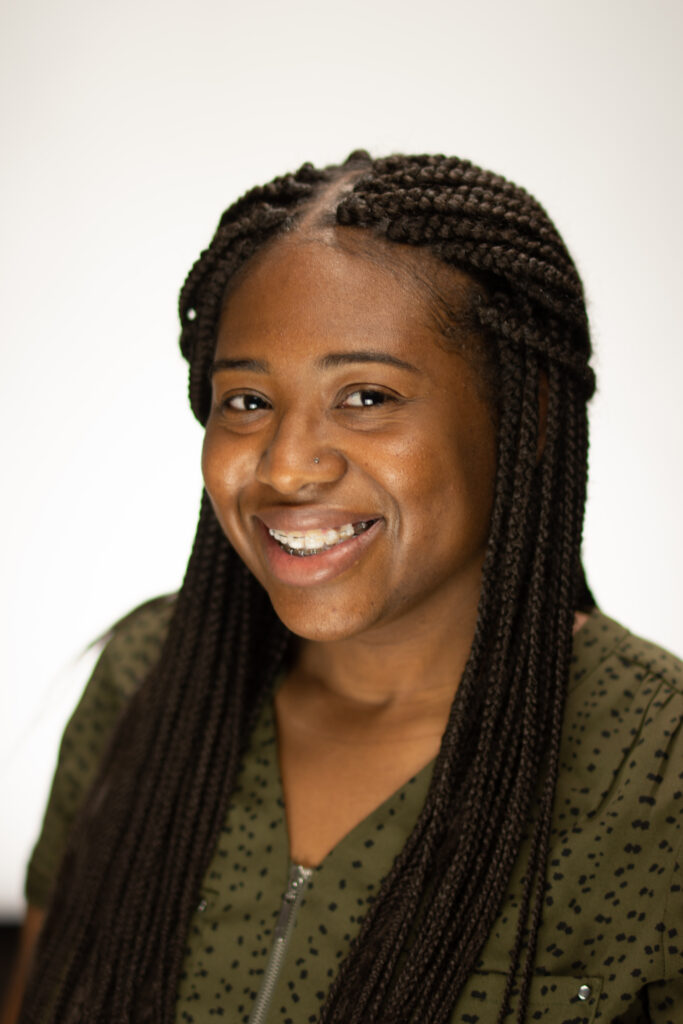
A: When I was in Wisconsin I joined the National Society of Black Engineers (NSBE) and the Society of Women Engineers. At NSBE, I went from being a member to eventually being the president for two years, which I was very, very proud of.
When I first arrived at UMBC, I focused first on my school work and research. But then I started to get more involved. In 2022, I went to the Ebony Ball, which is a yearly celebration held by the Black Graduate Student Organization (BGSO), and the president at the time encouraged me to become part of the executive board.
I know it’s sometimes hard to get grad students to be truly involved because we have so much going on, and we’re at more of an adult stage where we have our separate lives. But in the end, I decided to step up.
BGSO holds a special place in my journey because it fosters community, provides academic and professional resources, and creates a supportive space for Black graduate students. As president for the past two years, I have learned valuable lessons about leadership, resilience, and the importance of appreciating the process.
Q: What are your plans for after graduation?
A: I’ll be working as a post-doc at the Johns Hopkins Applied Physics Lab in their health and human machine systems group. I’ll have to propose my own project, and I’m thinking about how to analyze conditions that affect war veterans’ brains.
I love research, and I love that it can look very different depending on where you are. In the future, I can imagine working as a research director or as a professor. I love people and love mentoring them.
Q: How does your family feel about you graduating with a Ph.D?
A: Funny enough, some of them are just like “Wow, finally!” But they’re definitely proud. My grandma likes to brag, saying “My granddaughter is doing all these things; she’s going to be a doctor.” It’s been nice to have opportunities when my family visited and got to see what graduate student life is like, because that’s something they are not really familiar with.
Overall, they’re grateful that I got to see this process through. They had to live through my complaints and my worries and thinking that it was not meant to be. But with their support, they got to see me come through on the other side.
 Allen (far left) celebrates with UMBC colleagues as President Valerie Sheares Ashby accepts her 2022 Technologist of the Year award at the Women of Color STEM DTX Conference. (Image courtesy of Allen)
Q: How are you going to celebrate?
A: I’ll graduate this summer and my start date for my post-doc is July 14. My birthday is also coming up, so whatever I do, it’ll probably be a combination of relaxation and something else. I want to do something big to celebrate, maybe travel, but I don’t know yet. Right now I’m focused on crossing the finish line.
Read more Commencement 2025 stories.
]]>
Janerra Allen, Ph.D. ’25, electrical engineering, studies electrical signals in the brain, looking for patterns that might help doctors diagnose or treat mental disorders such as schizophrenia. As...
https://umbc.edu/stories/janerra-allen-ph-d-25-first-gen-engineering-grad-uplifts-students/
https://beta.my.umbc.edu/api/v0/pixel/news/149641/guest@my.umbc.edu/dc65d3d74e88b57d5c5a381295a8aaa4/api/pixel
class-of-2025
coeit
csee
news
research
story
UMBC News & Magazine
https://beta.my.umbc.edu/groups/umbc-news-magazine
https://assets1-beta.my.umbc.edu/system/shared/avatars/groups/000/001/943/24435aa6207c452e7bc15cc74b42c7bb/xsmall.png?1748556657
https://assets1-beta.my.umbc.edu/system/shared/avatars/groups/000/001/943/24435aa6207c452e7bc15cc74b42c7bb/original.png?1748556657
https://assets2-beta.my.umbc.edu/system/shared/avatars/groups/000/001/943/24435aa6207c452e7bc15cc74b42c7bb/xxlarge.png?1748556657
https://assets2-beta.my.umbc.edu/system/shared/avatars/groups/000/001/943/24435aa6207c452e7bc15cc74b42c7bb/xlarge.png?1748556657
https://assets3-beta.my.umbc.edu/system/shared/avatars/groups/000/001/943/24435aa6207c452e7bc15cc74b42c7bb/large.png?1748556657
https://assets1-beta.my.umbc.edu/system/shared/avatars/groups/000/001/943/24435aa6207c452e7bc15cc74b42c7bb/medium.png?1748556657
https://assets2-beta.my.umbc.edu/system/shared/avatars/groups/000/001/943/24435aa6207c452e7bc15cc74b42c7bb/small.png?1748556657
https://assets1-beta.my.umbc.edu/system/shared/avatars/groups/000/001/943/24435aa6207c452e7bc15cc74b42c7bb/xsmall.png?1748556657
https://assets2-beta.my.umbc.edu/system/shared/avatars/groups/000/001/943/24435aa6207c452e7bc15cc74b42c7bb/xxsmall.png?1748556657
UMBC News & Magazine
4
0
false
Wed, 30 Apr 2025 11:13:27 -0400
Wed, 30 Apr 2025 11:13:27 -0400
Coming full circle on musical pathways—UMBC students now teach at the programs that launched their success
All musicians start out as absolute beginners. Some might progress as self-taught, others might have private music lessons, and many will pick up their first instrument in school. But without a musical pathway—consistent access to physical instruments and dedicated music educators year after year—budding musicians will falter on their journey.
For Nema Robinson, and the thousands of other Baltimore City student musicians who have benefited from extra-curricular, free, equitable music education through programs like the Baltimore Symphony’s OrchKids and Peabody Institute’s Tuned-In program, these communities have opened musical doors to a professional career in music and so much more. Now on track to graduate with a music education degree, Robinson has reached a full circle moment to teach at the programs that set the stage for her own success.
The first violinist plays a long, drawn out A. The other musicians settle their feet against the stage floor and their backs hover near, but don’t quite touch the backs of their chairs. Suddenly, the noise of the orchestra breaks across your ears—briefly discordant and separate—but as the players all search for the same A, the notes weave together into a pleasing buzz of anticipated energy. In tune together, they look expectantly at the conductor.
 Robinson instructs students at Tuned-In.
Among the Uggs and Vans and Crocs and Nikes nestled under the music stands are Nema Robinson’s double-buckled black platform Mary Janes. Robinson, a fourth-year music education student and Linehan Artist Scholar, is at one of her teaching gigs that supplement and complement her degree. Today, she’s in Friedberg Hall at the Peabody Institute in Mt. Vernon, Baltimore, as part of Tuned-In, a free musical study and youth development program for Baltimore-area students. The elegant marble relief sculptures that flank either side of the stage and the gentle curve of the stairs leading to the second story seating section are just the background to the real art on the stage: Middle and high schoolers are making music.
In Baltimore City, only 60 percent of public schools have some type of musical component, says Nick Skinner, the vice president and founding team member of BSO OrchKids—which also offers free, community-based, high-quality music instruction and programming in the city. Of that, only 12 percent of city schools have instrument programs, compared to nearly 100 percent in nearby Baltimore, Howard, and Montgomery county schools. “There’s no musical pathway. So if you’re lucky enough to have music in your elementary school, you may not be able to continue that music study sequentially into middle or high school,” says Skinner. “It’s a really patchwork model of how students can progress musically through their education.”
When former BSO conductor Marin Alsop began her tenure in the city, she saw a need to fill this gap, and in 2007 founded BSO OrchKids. As Skinner tells it, Alsop saw that “many of our students here in the city were locked out of these opportunities to have the power of music in their life—to benefit from the inherent value of playing an instrument and the benefits that come from the study and the artistic process of learning an instrument.”
Asked to lead
When Robinson was a kid, she was walking around Artscape with her mom waiting to see her cousin perform on stage. Artscape in Baltimore City is the nation’s largest free outdoor arts festival, famously held on whatever is the hottest weekend in the summer. Robinson recalls getting to the event early and waiting in the unbearable heat. They found a place to sit and wait for her cousin’s opera performance and during that period OrchKids took the stage. “And my mom was like, ‘Oh my God, all these Black musicians playing classical music.’ We immediately got applications, and all of this started from there.”
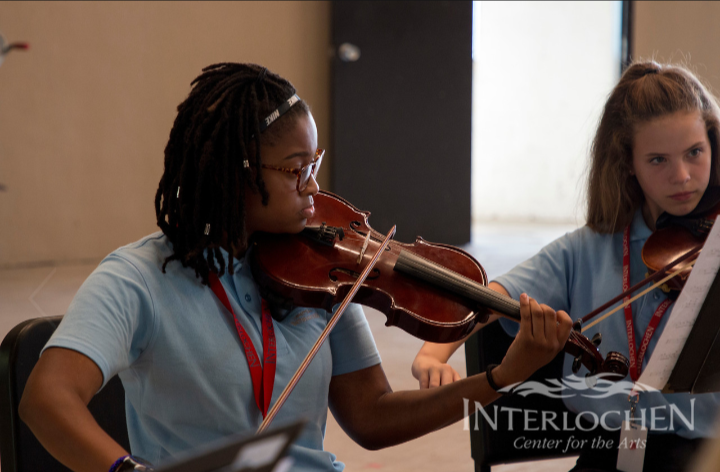
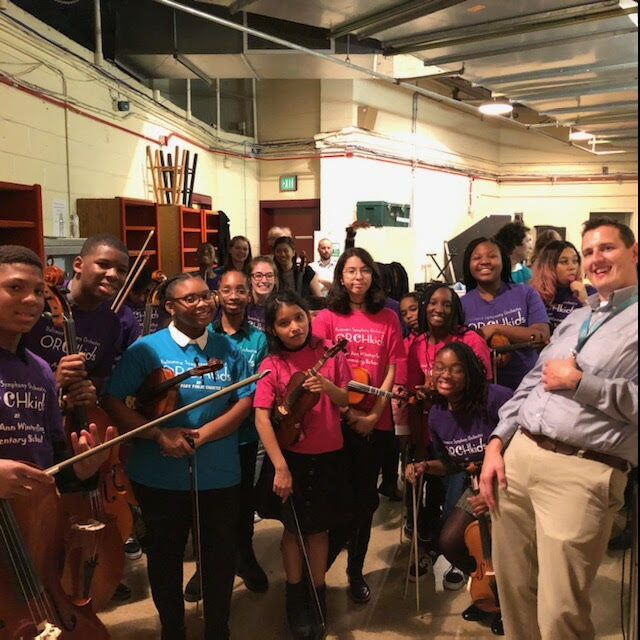
Young Nema Robinson playing the violin and with a group of BSO OrchKids. Robinson is crouching in purple, and fellow UMBC student Rickerra Bassett is standing in front with a teal shirt. Photos courtesy of Robinson.
In fourth grade, Robinson joined OrchKids and thought she wanted to play the tuba. Her mom shot that down for practical reasons, like 11-year-old Nema being able to even carry the instrument. “I’m still too small to play the tuba,” says Robinson. Her instrument of (second) choice was the violin, and through the daily after-school sessions at OrchKids and the all-day Saturdays at Tuned-In, along with numerous other musical opportunities she’s taken part in, Robinson has far surpassed the lauded 10,000 hours on her way to becoming an expert.
On stage in the Linehan Concert Hall rehearsing with UMBC’s Chamber Ensemble, Robinson stands in a semi-circle with a dozen other musicians. At this point, she’s been playing for 10 years. As the group launches into a slow baroque minor key waltz, Philip Mann, the conductor and assistant professor of music, stops them short. “Let’s move closer,” he says to the collection of string instrumentalists. With a shuffle of music stands, the ensemble tightens the circle. Black leather Doc Martens now firmly planted beneath her, Robinson leans into the music with her instrument familiarly tucked beneath her chin.


Before UMBC had a chamber orchestra—an intimate group of musicians—Robinson played in UMBC’s Symphony Orchestra, which is open to staff, students, and community members. She was a section leader her first year at UMBC. “I had to make sure I was locked in because this was a really big deal in a university just starting out. I think for me it was definitely nerve wracking, like, ‘Oh, I can’t mess up. But the conductor said, “You’re doing great. Just play.’” As time went on Robinson saw that as a music major and a Linehan Scholar, she was being asked to lead.
“I slowly adapted,” says Robinson, “and then I started to realize that music majors—maybe that’s why we are the section leaders—because we are setting an example for the community members.”
Listen to different nuances
Ann Sofie Clemmensen, director of the Linehan Artist Scholars Program, knows this was intentional. “Across the arts, we do lean on scholars to lead some assignments because they are receiving resources that others are not. In the music department, in dance and theater, and visual arts, we’re identifying leaders and those who can become leaders. And I think that’s what UMBC is very good at.”
 Robinson at the Peabody Institute.
This May, the Linehan Artist Scholars Program is celebrating three decades of supporting an arts-focused community at UMBC. Founded with support from Earl and Darielle Linehan, the scholarship supports students with an exceptional interest in the arts. Specifically, the program “acknowledges the importance of artists as leaders. As artists, we understand that a production or an orchestra is a component of many things that have to have some sort of organizational aspect,” says Clemmensen. “You have to listen to the different nuances.”
Robinson has found the scholars community to be uplifting and collaborative. “Insanely great,” to use her exact words. “It’s really cool to see how everyone else is very invested in their art, and it made me realize how it’s all tied together,” Robinson says. When she heard fellow OrchKid and Tuned-In student, Rickerra Bassett, was thinking about UMBC, Robinson immediately connected the young violist to Linehan, where she is now a first-year double major music education and performance scholar.
This is the dream
 Rickerra Bassett practices with the UMBC Chamber Ensemble.
Bassett started at BSO OrchKids during kindergarten, practically still a baby, she says. She stayed through her senior year, and like Robinson, has continued to work for the program as a graduate. Despite the camaraderie and the support BSO OrchKids offers, Bassett said it is rare that a student stay in the program for their full K-12 experience. “The main reason why I stuck with it is, well, I enjoyed it. I also realized how high demand violas are—there’s not as much competition for me to participate in orchestras compared with violin, so I feel like I’ve gotten way more opportunities because I play viola.”
“Rickerra and Nema are in so many ways, shape, and form what we always hope OrchKids to be,” says Skinner. “We’re always striving to improve, but looking at their trajectory—that is the dream in a lot of ways.” OrchKids has paved and paid the way for Robinson, Bassett, and many other musicians to attend prestigious music camps in other states, perform on the BSO’s Meyerhoff stage with world-class professional musicians, participate in the YOLA National Festival in Los Angeles, and so many other opportunities in addition to their daily musicianship classes and other education supports. And now they’re at UMBC, learning to mentor the next generation of musicians.
“In so many ways,” Skinner says, “they are the definition of what OrchKids is hoping to achieve.”
Watching other young people discover the joy of sticking with an instrument gave Bassett, who also played with Tuned-In, the idea to double major in music education. “Seeing the younger students get so excited about things that we would probably think of as small was just the sweetest thing,” says Bassett. “I was seeing myself in them since I started that young. And I’m just hoping that they keep going. I want to motivate them to keep going.”
Music as social transformation
It’s not just about the music. Or rather, the music is more than the music classes. “I can’t believe how much the musical development and the social development are connected,” says Daniel Trahey, who co-founded Tuned-In at Peabody in 2007, coincidentally the same year he was a founding team member at OrchKids. “When you see someone like Nema—when she saw what she was able to do—her confidence level just skyrocketed once she started practicing. And this is so key to all of our kids, we need our kids to be thinking about themselves and investing in themselves in order to be better for others. And the thing that’s the most amazing to me is to see someone like Nema start to invest in herself, start to map out time for only themselves to sit down and practice when their other friends are off doing other things.”
Skinner puts it similarly: “When learning an instrument, you’re developing skills that you don’t even really realize that you’re forming—creativity and collaboration, leadership, the responsibility of practicing your instrument or making sure you have your music for a rehearsal. These are skill sets that our students are forming from a very young age that become embedded in them and can then easily be reapplied. There’s a tremendous amount of research that’s been coming out over the past decade about the power of music and how it impacts the brain. There’s almost nothing like playing an instrument when it comes to really enhanced brain function and activity, cognitive development, and executive function capabilities.”


Rickerra Bassett has been playing the viola since kindergarten in programs like OrchKids and Tuned-In. Photos courtesy of Bassett.
For Robinson, the structure and consistency of the programs she played in was key. They gave shape to her education and the expectation of practice and performances, and ultimately shaped her talent and her work ethic that shines through her myriad teaching roles.
Trahey stops mid-sentence to brag on this young professional. “Nema is what, 20 years old? She has the best attendance, the best timeliness. She is the most professional at sending emails. She takes her job so dang seriously, it is inspiring to me. And Nema plays a very important role at Tuned-In because for our high school kids, who are really sick of hearing from me, they’re listening to Nema because Nema’s got real world experience.”
 Robinson looks on while Tuned-In student Mi’Onte McGhee asks a question.
Trahey’s hopes—and part of Tuned-In’s goals—is that the program would be fully staffed one day by graduates of the program. Commitment to continuum is how they put it: students become the teachers. “By valuing the community the student comes from, the student will want to come back and work toward creating an even healthier community,” says Trahey.
In the big picture view, the musicianship classes and camps and performances—they’re all leading toward social transformation, but Trahey doesn’t want that to mean that the students leave their communities behind along the way. “I hope for most of the kids, to do what they want to do, and then find a way to also give back to their communities. We’re already seeing this where our students have gone on to get political science degrees or medical degrees, and then they become our largest advocates, and so for many of the communities that we’re working in.”
“We are really looking at how we can use music as a vehicle to open up the world to our students,” says Skinner.
Robinson saw music education in action by watching Brian Kaufman, associate professor of music education, teach at BSO OrchKids. He helped her discover music education as a major and the idea to pursue it at UMBC. “He was just very passionate about it. And you can just see it in the work and the community he created,” she says. “And when I visited, UMBC felt so welcoming.”
From his years of watching her as a student and then as an assistant, Trahey says, “Nema’s always had it, but I think UMBC and the music education program has really helped her get a more global perspective. Before she would concentrate on maybe one kid’s problem or two kids’ problems. And now I’m seeing her be able to really serve the needs and hear the voices of every single child in her ensemble or in the room that she’s working in, and that’s been a huge growth point for her since being at UMBC.”
Not an everyday type of thing
Back in the marbled hall at the Peabody Institute, Robinson is threading through the music stands on stage to offer encouragement and correction to the young people on stage. The lead instructor has stepped away to give the reins to Robinson.
 Robinson plays outside the Peabody Institute in front of the Washington Monument in Baltimore, Maryland.
Mi’onte McGhee, a high school violinist who has been playing with Tuned-In for four years, says, “Nema is such a big help to us. She’s really good if you ask her a question about technique—you don’t even have to ask sometimes, she just comes up and says I can help you with that, but she’s really nice about it. She never makes you feel like you can’t play. She’s really kind and knowing that she’s gone through all this before helps me relate to her.”
For Robinson, there’s nothing like the feeling of creating music with people. “It’s like you’re in a different zone, if that makes sense. It’s not necessarily an everyday type of thing, she says. “You definitely have to have a good intention and really put your all toward it. It’s doing something you’re very passionate about and then putting it forward. It doesn’t always make sense, but when you do it, it feels right.”
]]>
All musicians start out as absolute beginners. Some might progress as self-taught, others might have private music lessons, and many will pick up their first instrument in school. But without a...
https://umbc.edu/stories/coming-full-circle-on-musical-pathways/
https://beta.my.umbc.edu/api/v0/pixel/news/149597/guest@my.umbc.edu/5851c1c34e6edf58c27f0881b3e27a30/api/pixel
baltimore-city
cahss
campus-life
feature
linehan-artist-scholars
magazine
music
music-education
spring-2025
story
UMBC News & Magazine
https://beta.my.umbc.edu/groups/umbc-news-magazine
https://assets1-beta.my.umbc.edu/system/shared/avatars/groups/000/001/943/24435aa6207c452e7bc15cc74b42c7bb/xsmall.png?1748556657
https://assets1-beta.my.umbc.edu/system/shared/avatars/groups/000/001/943/24435aa6207c452e7bc15cc74b42c7bb/original.png?1748556657
https://assets2-beta.my.umbc.edu/system/shared/avatars/groups/000/001/943/24435aa6207c452e7bc15cc74b42c7bb/xxlarge.png?1748556657
https://assets2-beta.my.umbc.edu/system/shared/avatars/groups/000/001/943/24435aa6207c452e7bc15cc74b42c7bb/xlarge.png?1748556657
https://assets3-beta.my.umbc.edu/system/shared/avatars/groups/000/001/943/24435aa6207c452e7bc15cc74b42c7bb/large.png?1748556657
https://assets1-beta.my.umbc.edu/system/shared/avatars/groups/000/001/943/24435aa6207c452e7bc15cc74b42c7bb/medium.png?1748556657
https://assets2-beta.my.umbc.edu/system/shared/avatars/groups/000/001/943/24435aa6207c452e7bc15cc74b42c7bb/small.png?1748556657
https://assets1-beta.my.umbc.edu/system/shared/avatars/groups/000/001/943/24435aa6207c452e7bc15cc74b42c7bb/xsmall.png?1748556657
https://assets2-beta.my.umbc.edu/system/shared/avatars/groups/000/001/943/24435aa6207c452e7bc15cc74b42c7bb/xxsmall.png?1748556657
UMBC News & Magazine
4
0
false
Tue, 29 Apr 2025 14:51:29 -0400
Tue, 29 Apr 2025 14:51:29 -0400
Ada Glaser ’25—An emerging social worker with a passion for youth development
Ada Glaser ’25, social work and individualized study (INDS), is following in her mother’s footsteps with career pursuits in social work. Growing up, Glaser’s family supported children who were placed into foster care, an experience that informed her passion for helping children and families who’re navigating challenging circumstances. Upon completing her undergraduate studies a year early, the Sondheim Public Affairs Scholar is excited to continue her social work education with a goal of one day supporting young children in their development.
Q: What led you to UMBC, and what motivated your decision to major in social work?
A: As a Baltimore County native, I wanted to stay close to my family. When I went through the college selection process, I didn’t know much about UMBC, but as I looked more into the school, I came across the Sondheim Public Affairs Scholars program, which seemed awesome. I applied and ended up getting into the program. As the oldest of six, the program’s financial support made it really realistic for me to go to college. It was great to see all of the different angles for approaching the general idea of public service as a Sondheim scholar.
My mom is a social worker and has her own private practice. When I was in high school, my family started supporting children in foster care. Getting to see all the work that social workers were doing with foster families opened my eyes to the profession. I started doing research on my own and thought social work seemed like a great field for me. My time in the Baccalaureate Social Work program reaffirmed that decision for me because I loved the classes, the professors, and my peers. I know it’s the right field for me.
Q: As an INDS student, what went into designing your major?
A: I always knew I wanted to work with kids. It’s something I’ve loved for a really long time. As a social work major, you need a second area of concentration. I originally came to UMBC wanting to study psychology, and I realized after my first year that there was so much else that I wanted to learn and do beyond the scope of psychology. I reached out to INDS advisor Holly Cudzilo and she explained the process of creating your own major. Cudzilo was instrumental in helping me develop my INDS concentration and making sure I stayed on track. The program allows you to put together the areas of concentration you want to do, define what the overall focus of the course is, and how to put the threads together that connect everything. That process helped me refine what I care about and what I’m passionate about.
Q: Who has helped you along your academic journey?
A: I met Jayshree Jani, associate professor of social work, during my first year when she was my advisor. During our first advising appointment, she was aware of my plan of wanting to graduate early and wrote out the three-year plan that I’ve followed. She’s shown me how much she cares and how much she wants me to succeed. She’s given me good advice about how to make my senior capstone project come to life and gave me good ideas to try. She encouraged me to feel confident to do difficult things.
 Glaser presenting the findings from her senior capstone project, titled “Goals and Motivations of Baltimore Early Intervention Providers,” at UMBC’s 2025 Undergraduate Research and Creative Achievement Day (URCAD) event. (Photo by Adriana Fraser)
Q: What experiential learning opportunities have you been a part of?
A: My senior year social work field placement was at the Furman Templeton Preparatory Academy elementary school in West Baltimore as a social work intern. I worked with the kids on things like emotional awareness and regulation and goal setting. Some of the students are experiencing a lot of interpersonal conflicts, so I helped them think about how they can address those conflicts. I’ve done lessons in the classroom, such as working with kindergarteners on how to be a good friend. I also worked with my supervisor on school-wide initiatives such as managing testing anxiety for fifth graders and attendance initiatives. It’s been a very intense and emotional experience, but also a great learning experience.
Q: What are some of the things you’ve learned from your experience as a social work intern?
A: I learned just how much there is that I don’t know and sometimes you don’t always know how you’re going to react to something until you’re in the moment. In some of the more intense situations, I thought I would be okay handling them and then I realized those moments affected me a lot more than I thought it would. That’s one of the benefits of why social work has this practicum element to it because you have to practice these skills and get used to being in intense situations. I’ve built up my resilience and learned about my own style as a social worker.
Q: How do you find time to take care of yourself and reset after those intense moments?
A: I’m big on journaling—I’ve been that way since middle school. It’s such a good way to dump all of my feelings and sort through them. I feel lucky to have good friends in my circle so when I’m going through something I talk it through with them and my sister as well. In the last year and a half, because of UMBC, I’ve gotten more into yoga. I took a lot of the free yoga classes at the Retrievers Activities Center, and now I do it at least three times a week. With that physical motion, I can get out of my head a little bit.
 Glaser (left) with fellow UMBC classmates and friends in Summer 2024.
Q: What other activities did you participate in outside of your studies?
A: The Social Work Student Association (SWSA) has been such a big part of my time at UMBC. I was worried about being in a human services field at a more STEM-focused school, but I have found so much support, inspiring people, and encouragement through that group. Getting to be on the SWSA’s executive board and seeing this community develop has been so special. I’m also a part of UMBC’s Symphony Orchestra, which I’ve been involved in since my sophomore year. I play the upright bass. I started playing the bass in the fifth grade and continued through middle and high school. I love playing, growing my skills, and being able to connect with other people outside of my major. I love the end of the semester concerts that we do.
 Glaser (in gray, second to last on the right) with fellow members of the Social Work Student Association during a volunteering event with UMBC’s Retriever Essentials program in Spring 2025.
Q: What are some memorable highlights from your time at UMBC?
A: The people that I’ve met and the friends I’ve made have been highlights for me. Studying abroad in Cape Town, South Africa, in 2023 was also monumental. It was something I didn’t initially think I would have been able to do, but thanks to the Sondheim program, I got to experience community-engaged learning in South Africa as well as learning about the history of the country, the Apartheid movement, and a lot of the political movements that are happening now and how South Africa is dealing with that history. My college experience would have been so different had I not been at UMBC. I credit the university for a lot, and I’m glad that I went here.

 (left) Glaser in Cape Town, South Africa. (right) Glaser (left, second row) and fellow Sondheim Public Affairs scholars during the program’s study abroad trip to Cape Town in 2023.
Q: What are your aspirations for the future?
A: After graduation, my plan is to pursue a master’s degree in social work that focuses on working with children and families. I’m hoping to be placed in a Head Start program for my master’s because I learned during my internship that I love working with kids within the preschool age range. I also learned that I have a passion for working with kids with disabilities and I’m interested in exploring more of that.
Read more Commencement 2025 stories.
]]>
Ada Glaser ’25, social work and individualized study (INDS), is following in her mother’s footsteps with career pursuits in social work. Growing up, Glaser’s family supported children who were...
https://umbc.edu/stories/class-of-2025-ada-glaser/
https://beta.my.umbc.edu/api/v0/pixel/news/149588/guest@my.umbc.edu/1b0c4c5fba86e4f05896594d572f8caf/api/pixel
cahss
class-of-2025
inds
news
social-work
story
UMBC News & Magazine
https://beta.my.umbc.edu/groups/umbc-news-magazine
https://assets1-beta.my.umbc.edu/system/shared/avatars/groups/000/001/943/24435aa6207c452e7bc15cc74b42c7bb/xsmall.png?1748556657
https://assets1-beta.my.umbc.edu/system/shared/avatars/groups/000/001/943/24435aa6207c452e7bc15cc74b42c7bb/original.png?1748556657
https://assets2-beta.my.umbc.edu/system/shared/avatars/groups/000/001/943/24435aa6207c452e7bc15cc74b42c7bb/xxlarge.png?1748556657
https://assets2-beta.my.umbc.edu/system/shared/avatars/groups/000/001/943/24435aa6207c452e7bc15cc74b42c7bb/xlarge.png?1748556657
https://assets3-beta.my.umbc.edu/system/shared/avatars/groups/000/001/943/24435aa6207c452e7bc15cc74b42c7bb/large.png?1748556657
https://assets1-beta.my.umbc.edu/system/shared/avatars/groups/000/001/943/24435aa6207c452e7bc15cc74b42c7bb/medium.png?1748556657
https://assets2-beta.my.umbc.edu/system/shared/avatars/groups/000/001/943/24435aa6207c452e7bc15cc74b42c7bb/small.png?1748556657
https://assets1-beta.my.umbc.edu/system/shared/avatars/groups/000/001/943/24435aa6207c452e7bc15cc74b42c7bb/xsmall.png?1748556657
https://assets2-beta.my.umbc.edu/system/shared/avatars/groups/000/001/943/24435aa6207c452e7bc15cc74b42c7bb/xxsmall.png?1748556657
UMBC News & Magazine
27
0
false
Tue, 29 Apr 2025 11:40:00 -0400
Tue, 29 Apr 2025 11:40:00 -0400