Kimberly Herritt ’25: Building Skills and Connections at UMBC

Major: Media and Communication Studies
Hometown: South Hampton, PA
High School: Council Rock High School South
Kimmie Herritt, a senior at UMBC majoring in information systems, has made the most of her college years, all while preparing for a career at PricewaterhouseCoopers (PWC). Her journey is a testament to how students can blend technical training, personal growth, and real-world experience to build a strong foundation for life after graduation.
Blending Tech, Design, and Business
Kimmie’s path at UMBC reflects a multidisciplinary approach to education. In addition to her major, she earned a certificate in UX web and mobile design, equipping her with tools to create intuitive digital experiences. She also minored in management and entrepreneurship, rounding out her education with business savvy and leadership skills.
This unique combination of tech, design, and management has positioned her as a well-rounded candidate ready to take on challenges in the evolving tech landscape.
Hands-On Learning at DoIT
Outside the classroom, Kimmie worked as a student desktop support specialist with UMBC’s Division of Information Technology (DoIT). Her role included troubleshooting computers, managing printer issues, and updating software. These hands-on tasks sharpened her technical skills while teaching her patience, communication, and creative problem-solving.
But for Kimmie, the experience went far beyond the work. She describes the office environment as “super fun,” full of laughter, shared stories, and collaboration. She credits her boss, Courtney Burkett, and her coworkers with creating an inclusive, welcoming space that made every shift enjoyable.
Making Connections That Matter
One of Kimmie’s favorite parts of the job? The people. From swapping stories in the office to the team’s annual sushi outings, the relationships she built were just as important as the skills she gained. These connections gave her a sense of community, especially valuable as she balanced work and a lighter course load in her final semester.
Looking Ahead to PWC
Kimmie is headed to Philadelphia after graduation, where she’ll work as a digital assurance and transparency associate at PWC. Her time at UMBC, especially her experience at DoIT, played a key role in preparing her for this next step.
]]>
Major: Media and Communication Studies Hometown: South Hampton, PA High School: Council Rock High School South Kimmie Herritt, a senior at UMBC majoring in information systems, has made...
https://umbc.edu/stories/kimberly-herritt-25-building-skills-and-connections-at-umbc/
https://beta.my.umbc.edu/api/v0/pixel/news/150962/guest@my.umbc.edu/91348817de5f2cd68dd8c4ddab74b77b/api/pixel
class-of-2025
story
UMBC News & Magazine
https://beta.my.umbc.edu/groups/umbc-news-magazine
https://assets1-beta.my.umbc.edu/system/shared/avatars/groups/000/001/943/24435aa6207c452e7bc15cc74b42c7bb/xsmall.png?1748556657
https://assets1-beta.my.umbc.edu/system/shared/avatars/groups/000/001/943/24435aa6207c452e7bc15cc74b42c7bb/original.png?1748556657
https://assets2-beta.my.umbc.edu/system/shared/avatars/groups/000/001/943/24435aa6207c452e7bc15cc74b42c7bb/xxlarge.png?1748556657
https://assets2-beta.my.umbc.edu/system/shared/avatars/groups/000/001/943/24435aa6207c452e7bc15cc74b42c7bb/xlarge.png?1748556657
https://assets3-beta.my.umbc.edu/system/shared/avatars/groups/000/001/943/24435aa6207c452e7bc15cc74b42c7bb/large.png?1748556657
https://assets1-beta.my.umbc.edu/system/shared/avatars/groups/000/001/943/24435aa6207c452e7bc15cc74b42c7bb/medium.png?1748556657
https://assets2-beta.my.umbc.edu/system/shared/avatars/groups/000/001/943/24435aa6207c452e7bc15cc74b42c7bb/small.png?1748556657
https://assets1-beta.my.umbc.edu/system/shared/avatars/groups/000/001/943/24435aa6207c452e7bc15cc74b42c7bb/xsmall.png?1748556657
https://assets2-beta.my.umbc.edu/system/shared/avatars/groups/000/001/943/24435aa6207c452e7bc15cc74b42c7bb/xxsmall.png?1748556657
UMBC News & Magazine
1
0
false
Wed, 02 Jul 2025 16:05:42 -0400
Wed, 02 Jul 2025 16:05:42 -0400
Kyle Taylor ’25: Behind the Camera and Finding His Voice at UMBC

Major: Media and Communication Studies
Hometown: Baltimore, MD
High School: Arlington Baptist High School
For Kyle Taylor, college has been more than just lectures and assignments; it’s been about finding purpose, building community, and discovering new opportunities. While he once dreamed of playing college basketball, Kyle found a different way to stay connected to the game behind the scenes.
From Courtside Dreams to Media Production
Basketball shaped much of Kyle’s early aspirations, but when the path to becoming a collegiate athlete didn’t unfold, he pivoted. Through UMBC’s New Media Studio in the Division of Information Technology (DoIT), Kyle found a new role in the world of sports by helping produce live broadcasts for Division I games, including basketball, lacrosse, and soccer.
Working in the sound booth or behind a camera gave Kyle a unique perspective on the game. “It was surreal,” he shares. Being part of the production team that brings games to life let him reconnect with his passion from an entirely new perspective.
Learning by Doing in the New Media Studio
Kyle’s work in the New Media Studio became a training ground where theory and practice converged. Whether he was operating equipment, managing live feeds, or troubleshooting technical issues, the fast-paced environment honed skills in communication, adaptability, and creative thinking.
A commuter student, Kyle was on the hunt for community and he found it through the studio, blending professionalism with camaraderie. The relationships he built through shared responsibilities and creative work became one of the most rewarding parts of his UMBC experience.
Advice for Future Creators
Reflecting on his time in the studio, Kyle offers two key pieces of advice to future media interns and students: Enjoy the process and connect with people around you.
It’s easy to focus on outcomes, but Kyle emphasizes the importance of having fun and being present. Every live show or project brings a new learning opportunity, and staying open to growth makes the journey more meaningful.
Whether it’s fellow students, staff, or faculty, Kyle encourages others to take the time to build relationships.
“You never know who might teach you something unexpected,” he says. Those connections can lead to mentorship, collaboration, and even lifelong friendships.”
Kyle Taylor ’25
Looking Ahead
Kyle leaves UMBC with a portfolio of professional experiences and a clearer sense of purpose. His journey proves that passions can evolve—and sometimes, stepping behind the camera is the best way to move forward.
]]>
Major: Media and Communication Studies Hometown: Baltimore, MD High School: Arlington Baptist High School For Kyle Taylor, college has been more than just lectures and assignments; it’s...
https://umbc.edu/stories/kyle-taylor-25-behind-the-camera-and-finding-his-voice-at-umbc/
https://beta.my.umbc.edu/api/v0/pixel/news/150963/guest@my.umbc.edu/a9b5a7058d50f7d851b7e74a0561d67e/api/pixel
class-of-2025
story
UMBC News & Magazine
https://beta.my.umbc.edu/groups/umbc-news-magazine
https://assets1-beta.my.umbc.edu/system/shared/avatars/groups/000/001/943/24435aa6207c452e7bc15cc74b42c7bb/xsmall.png?1748556657
https://assets1-beta.my.umbc.edu/system/shared/avatars/groups/000/001/943/24435aa6207c452e7bc15cc74b42c7bb/original.png?1748556657
https://assets2-beta.my.umbc.edu/system/shared/avatars/groups/000/001/943/24435aa6207c452e7bc15cc74b42c7bb/xxlarge.png?1748556657
https://assets2-beta.my.umbc.edu/system/shared/avatars/groups/000/001/943/24435aa6207c452e7bc15cc74b42c7bb/xlarge.png?1748556657
https://assets3-beta.my.umbc.edu/system/shared/avatars/groups/000/001/943/24435aa6207c452e7bc15cc74b42c7bb/large.png?1748556657
https://assets1-beta.my.umbc.edu/system/shared/avatars/groups/000/001/943/24435aa6207c452e7bc15cc74b42c7bb/medium.png?1748556657
https://assets2-beta.my.umbc.edu/system/shared/avatars/groups/000/001/943/24435aa6207c452e7bc15cc74b42c7bb/small.png?1748556657
https://assets1-beta.my.umbc.edu/system/shared/avatars/groups/000/001/943/24435aa6207c452e7bc15cc74b42c7bb/xsmall.png?1748556657
https://assets2-beta.my.umbc.edu/system/shared/avatars/groups/000/001/943/24435aa6207c452e7bc15cc74b42c7bb/xxsmall.png?1748556657
UMBC News & Magazine
1
0
false
Wed, 02 Jul 2025 16:05:36 -0400
Wed, 02 Jul 2025 16:05:36 -0400
Jonathan Veale ’25: A Student Filmmaker Directing His Future One Frame at a Time

Major: Visual Arts (Cinematic Arts)
Minors: Photography
Hometown: Baltimore City, MD
High School: Baltimore School for the Arts
Exploring Film and Photography at UMBC
Jonathan Veale, a visual arts major at UMBC with a concentration in cinematic arts and a minor in photography, is turning his passion for storytelling into a promising creative career. A graduate of Baltimore School for the Arts, Jonathan has spent four years honing his craft through UMBC’s Linehan Artist Scholars Program and engaging deeply with the campus art community.
From Behind the Camera to Leading a Film Project
Jonathan’s academic journey culminated with a standout project through UMBC’s Undergraduate Research Awards (URA) program. His short film, showcased at the Undergraduate Research and Creative Achievement Day (URCAD), highlights his talent as a director and storyteller.
He shares, “This project pushed me to do a lot of things that I was not particularly comfortable doing. Being thrust into a position of complete control and basically being a producer and director at the same time was challenging yet exciting.”
Hands-On Experience in Film Production at UMBC
Though Jonathan managed multiple roles, he emphasizes the team effort behind the film’s success. “Most successful films have a team to handle all of these different producer and director roles—or at least assistants—but for this piece, I had to take charge,” he explains. “My actors and costume designers stepped up when they were needed and were with me every step of the process. They provided feedback and stepped up when they were available. This was a team effort, and I am proud of our ability to come together and create such an engaging piece with the wonderful group of students and professionals we had.”
Creating Community Through Art
Jonathan’s experience as a student artist at UMBC has been about more than technical skills. Living in the Visual and Performing Arts Living Learning Community (VPAC) and serving as a resident assistant helped him grow personally and professionally.
“The best part of my UMBC experience was the friends and connections that I made here on campus,” he says. “As a part of the Linehan Artist program and a member of the VAPC floor, I was able to click with my fellow students and artists.”
Jonathan Veale ’25
He adds, “College is about more than just learning your craft. It’s also about creating those connections with others that will outlast even some of the academic knowledge you may gain on campus.”
Ready for What’s Next
While Jonathan is still deciding where his artistic path will lead, he leaves UMBC with strong creative work, professional experience, and a tight-knit network of peers and mentors.
]]>
Major: Visual Arts (Cinematic Arts) Minors: Photography Hometown: Baltimore City, MD High School: Baltimore School for the Arts Exploring Film and Photography at UMBC Jonathan Veale,...
https://umbc.edu/stories/jonathan-veale-25-a-student-filmmaker-directing-his-future-one-frame-at-a-time/
https://beta.my.umbc.edu/api/v0/pixel/news/150964/guest@my.umbc.edu/c3bee500fb0e8454b84f152d0ee843d5/api/pixel
class-of-2025
story
UMBC News & Magazine
https://beta.my.umbc.edu/groups/umbc-news-magazine
https://assets1-beta.my.umbc.edu/system/shared/avatars/groups/000/001/943/24435aa6207c452e7bc15cc74b42c7bb/xsmall.png?1748556657
https://assets1-beta.my.umbc.edu/system/shared/avatars/groups/000/001/943/24435aa6207c452e7bc15cc74b42c7bb/original.png?1748556657
https://assets2-beta.my.umbc.edu/system/shared/avatars/groups/000/001/943/24435aa6207c452e7bc15cc74b42c7bb/xxlarge.png?1748556657
https://assets2-beta.my.umbc.edu/system/shared/avatars/groups/000/001/943/24435aa6207c452e7bc15cc74b42c7bb/xlarge.png?1748556657
https://assets3-beta.my.umbc.edu/system/shared/avatars/groups/000/001/943/24435aa6207c452e7bc15cc74b42c7bb/large.png?1748556657
https://assets1-beta.my.umbc.edu/system/shared/avatars/groups/000/001/943/24435aa6207c452e7bc15cc74b42c7bb/medium.png?1748556657
https://assets2-beta.my.umbc.edu/system/shared/avatars/groups/000/001/943/24435aa6207c452e7bc15cc74b42c7bb/small.png?1748556657
https://assets1-beta.my.umbc.edu/system/shared/avatars/groups/000/001/943/24435aa6207c452e7bc15cc74b42c7bb/xsmall.png?1748556657
https://assets2-beta.my.umbc.edu/system/shared/avatars/groups/000/001/943/24435aa6207c452e7bc15cc74b42c7bb/xxsmall.png?1748556657
UMBC News & Magazine
1
0
false
Wed, 02 Jul 2025 16:05:28 -0400
Wed, 02 Jul 2025 16:05:28 -0400
Mary Rose Khamfong ’25: Turns Psychology into Purpose with Digital Storytelling

Major: Psychology
Minors: Entrepreneurship, Social Welfare
Hometown: Baltimore County, MD
High School: Perry Hall High School
Blending Psychology, Storytelling, and Social Impact
Mary Rose Khamfong, a psychology major at UMBC with minors in entrepreneurship and social welfare, is determined to make well-being science accessible to all. Born in Baltimore County and a graduate of Perry Hall High School, she’s building a future grounded in education, digital storytelling, and purpose-driven content creation.
Her goal? To become a digital content creator who creates meaningful, accessible resources that help people grow, heal, and thrive.
Empowering Others Through Research and Mentorship
During her time at UMBC, Mary served as a McNair teaching fellow and a writing fellow for the psychology department and the Writing Center. In these roles, she mentored first-generation and underrepresented students in academic writing, professional development, and graduate school preparation. She also led workshops on personal branding and reflective writing, thoughtfully incorporating principles of positive psychology and well-being throughout her work.
“These roles allowed me to support students from diverse backgrounds, empowering them to achieve their goals,” she reflects. “Helping others build confidence, refine their narratives, and take ownership of their futures reaffirmed my calling—to uplift others by supporting their holistic well-being.”
Hands-On Research for Real-World Change
Mary’s academic journey took her beyond the classroom. At Brown University, she participated in a prestigious summer research program, conducting a review of long-term services in the veteran healthcare system. At UMBC, she collaborated on a civic storytelling curriculum for Latinx youth through the Interdisciplinary CoLab.
In both roles, she applied psychology to address social inequities, sharpen her communication skills, and deliver impactful presentations at national research conferences.
She earned national recognition through the APIA Scholars Community Service & Leadership Award, a competitive $10,000 scholarship honoring her dedication to service and educational equity.
A UMBC Journey Rooted in Growth and Connection
Mary’s college experience was as much about relationships as it was about academics. Living on campus gave her the opportunity to travel, explore new places, and form deep connections with fellow students, mentors, and faculty.
“The best part of my UMBC experience has been the blend of adventure, building relationships, and having the space to grow,” she says. “These connections will outlast even some of the academic knowledge I’ve gained.”
Mary Rose Khamfong ’25
Looking Ahead
Mary is now focused on creating digital platforms that promote holistic well-being across physical, emotional, financial, relational, and cultural dimensions. By combining evidence-based research with authentic storytelling, she aims to give others the tools they need to build better, more fulfilling lives.
“I don’t just want to create content—I want it to have a purpose and to work,” she says. “There’s science that answers how to live a good life. That knowledge needs to be shared, and I want to be the one who shares it.”
]]>
Major: Psychology Minors: Entrepreneurship, Social Welfare Hometown: Baltimore County, MD High School: Perry Hall High School Blending Psychology, Storytelling, and Social Impact...
https://umbc.edu/stories/mary-rose-khamfong-25-turns-psychology-into-purpose-with-digital-storytelling/
https://beta.my.umbc.edu/api/v0/pixel/news/150965/guest@my.umbc.edu/60c31b42fc033027246bafb88d0c4f1d/api/pixel
class-of-2025
story
UMBC News & Magazine
https://beta.my.umbc.edu/groups/umbc-news-magazine
https://assets1-beta.my.umbc.edu/system/shared/avatars/groups/000/001/943/24435aa6207c452e7bc15cc74b42c7bb/xsmall.png?1748556657
https://assets1-beta.my.umbc.edu/system/shared/avatars/groups/000/001/943/24435aa6207c452e7bc15cc74b42c7bb/original.png?1748556657
https://assets2-beta.my.umbc.edu/system/shared/avatars/groups/000/001/943/24435aa6207c452e7bc15cc74b42c7bb/xxlarge.png?1748556657
https://assets2-beta.my.umbc.edu/system/shared/avatars/groups/000/001/943/24435aa6207c452e7bc15cc74b42c7bb/xlarge.png?1748556657
https://assets3-beta.my.umbc.edu/system/shared/avatars/groups/000/001/943/24435aa6207c452e7bc15cc74b42c7bb/large.png?1748556657
https://assets1-beta.my.umbc.edu/system/shared/avatars/groups/000/001/943/24435aa6207c452e7bc15cc74b42c7bb/medium.png?1748556657
https://assets2-beta.my.umbc.edu/system/shared/avatars/groups/000/001/943/24435aa6207c452e7bc15cc74b42c7bb/small.png?1748556657
https://assets1-beta.my.umbc.edu/system/shared/avatars/groups/000/001/943/24435aa6207c452e7bc15cc74b42c7bb/xsmall.png?1748556657
https://assets2-beta.my.umbc.edu/system/shared/avatars/groups/000/001/943/24435aa6207c452e7bc15cc74b42c7bb/xxsmall.png?1748556657
UMBC News & Magazine
3
0
false
Wed, 02 Jul 2025 16:05:20 -0400
Wed, 02 Jul 2025 16:05:20 -0400
Jensen, Sotilleo Join UMBC Provost Leadership Team
Carlos Jensen and Sophia Sotilleo will join the University of Maryland, Baltimore County provost leadership team beginning August 1. Jensen will serve as vice provost for student success and dean for the division of undergraduate academic affairs and Sotilleo will serve as vice provost and dean of the Albin O. Kuhn Library and Gallery.
Jensen and Sotilleo fill out a provost leadership team that has been reimagined to meet UMBC’s unique needs in an evolving educational landscape. In his role as vice provost for student success and dean of undergraduate academic affairs, Jensen will oversee undergraduate academic programs and services while fostering an environment of inclusive excellence. As vice provost and dean of the Albin O. Kuhn Library and Gallery, Sotilleo will lead the library in its vital efforts to support the teaching and research needs of an R1 institution.
Jensen comes to UMBC from the University of California, San Diego where he has served the last five years as the associate vice chancellor for educational innovation. Sotilleo joins UMBC from its USM sister institution, Bowie State University, where she has served as the dean of the Thurgood Marshall Library since 2022.
Sotilleo’s academic interests center on embedded librarianship, particularly its intersections with access, advocacy, and leadership in higher education. At Bowie State, she led transformative initiatives in digital access, research support, and campus-wide library engagement. She served as previous chair of the Council of Library Deans and Directors for the University System of Maryland and Affiliated Institutions, where she led efforts to improve system-wide digital access, research support, and inter-campus collaboration. Sotilleo is a dedicated academic librarian and higher education leader with a career rooted in intellectual freedom, student-centered service, and inclusive access to information. She brings a collaborative and visionary approach to librarianship, championing innovation, advocacy, and engagement across academic and community contexts.
While at UC San Diego, Jensen provided strategic leadership to advance education and innovation, including the implementation and improvement of curricular analytics to help departments close equity gaps and help all students progress toward their degrees. He oversaw instructional development for educators and comprehensive academic support for students and played a key leadership role in the academic affairs response to the COVID-19 pandemic.
]]>
Carlos Jensen and Sophia Sotilleo will join the University of Maryland, Baltimore County provost leadership team beginning August 1. Jensen will serve as vice provost for student success and dean...
https://umbc.edu/stories/jensen-sotilleo-join-umbc-provost-leadership-team/
https://beta.my.umbc.edu/api/v0/pixel/news/150895/guest@my.umbc.edu/6516181668a31a3e848efa4e527ad070/api/pixel
story
uncategorized
UMBC News & Magazine
https://beta.my.umbc.edu/groups/umbc-news-magazine
https://assets1-beta.my.umbc.edu/system/shared/avatars/groups/000/001/943/24435aa6207c452e7bc15cc74b42c7bb/xsmall.png?1748556657
https://assets1-beta.my.umbc.edu/system/shared/avatars/groups/000/001/943/24435aa6207c452e7bc15cc74b42c7bb/original.png?1748556657
https://assets2-beta.my.umbc.edu/system/shared/avatars/groups/000/001/943/24435aa6207c452e7bc15cc74b42c7bb/xxlarge.png?1748556657
https://assets2-beta.my.umbc.edu/system/shared/avatars/groups/000/001/943/24435aa6207c452e7bc15cc74b42c7bb/xlarge.png?1748556657
https://assets3-beta.my.umbc.edu/system/shared/avatars/groups/000/001/943/24435aa6207c452e7bc15cc74b42c7bb/large.png?1748556657
https://assets1-beta.my.umbc.edu/system/shared/avatars/groups/000/001/943/24435aa6207c452e7bc15cc74b42c7bb/medium.png?1748556657
https://assets2-beta.my.umbc.edu/system/shared/avatars/groups/000/001/943/24435aa6207c452e7bc15cc74b42c7bb/small.png?1748556657
https://assets1-beta.my.umbc.edu/system/shared/avatars/groups/000/001/943/24435aa6207c452e7bc15cc74b42c7bb/xsmall.png?1748556657
https://assets2-beta.my.umbc.edu/system/shared/avatars/groups/000/001/943/24435aa6207c452e7bc15cc74b42c7bb/xxsmall.png?1748556657
UMBC News & Magazine
0
0
false
Wed, 02 Jul 2025 11:45:48 -0400
Van Riper Appointed VP for Communications and Marketing at UMBC
 Lisa K. Van Riper
Lisa K. Van Riper has been appointed as UMBC’s vice president for communications and marketing. She comes to UMBC from Goucher College in Baltimore, where she serves currently as vice president for marketing and communications. She will begin in the role at UMBC on July 21.
Van Riper has more than 25 years of experience in communications and marketing in higher education, consumer packaged goods and services corporations, and public service agencies. At Goucher, she leads a team of professionals who collaborate across campus to support the college’s goals for recruitment, fundraising, reputation-building, and more through an integrated, digital-first approach to storytelling and marketing. She successfully led a major branding initiative for the college and has overseen a broad effort to enhance and modernize the college’s digital marketing strategy and develop a cohesive, unifying brand identity.
As a member of the president’s cabinet at Goucher, Van Riper has also attended thoughtfully to internal communications for the college, serving as lead for crisis and issues management communications and for presidential and cabinet communications generally.
Prior to her role at Goucher, Van Riper served as vice president for marketing, communications, and information technology at Knox College in Galesburg, Illinois, and as vice president for communications and public relations at Common App. Her higher education leadership experience includes several years as assistant vice president for university communications at the University of Richmond, and her professional experience outside of higher education includes communications leadership roles with CarMax, Inc., and Alexandria Renew Enterprises, an independent, special-purpose government unit in Virginia that manages wastewater for the city of Alexandria and surrounding areas.
Van Riper earned a bachelor’s degree in English literature from Trinity College in Hartford, Connecticut, and is currently enrolled in Goucher’s Master of Fine Arts program in nonfiction. She is an active member of Leadership Baltimore County.
“In addition to being an expert marketer and talented communications professional, Lisa is a strong manager and leader who has successfully built and developed teams and fostered effective collaborations with campus partners. I am particularly excited about her skills in these areas and her deep interest in supporting the leadership and staff in University Communications and Marketing (UCM),” UMBC President Valerie Sheares Ashby shared in a message to the campus community.
“Lisa’s expertise and experience will contribute enormously to our shared work to advance UMBC’s strategic priorities and our mission as a dynamic, inclusive public research university.”
]]>
Lisa K. Van Riper Lisa K. Van Riper has been appointed as UMBC’s vice president for communications and marketing. She comes to UMBC from Goucher College in Baltimore, where she serves...
https://umbc.edu/stories/van-riper-vp-communications-and-marketing-at-umbc/
https://beta.my.umbc.edu/api/v0/pixel/news/150871/guest@my.umbc.edu/2feb19154d45954ce95452351cccdcc9/api/pixel
leadership
news
story
ucm
UMBC News & Magazine
https://beta.my.umbc.edu/groups/umbc-news-magazine
https://assets1-beta.my.umbc.edu/system/shared/avatars/groups/000/001/943/24435aa6207c452e7bc15cc74b42c7bb/xsmall.png?1748556657
https://assets1-beta.my.umbc.edu/system/shared/avatars/groups/000/001/943/24435aa6207c452e7bc15cc74b42c7bb/original.png?1748556657
https://assets2-beta.my.umbc.edu/system/shared/avatars/groups/000/001/943/24435aa6207c452e7bc15cc74b42c7bb/xxlarge.png?1748556657
https://assets2-beta.my.umbc.edu/system/shared/avatars/groups/000/001/943/24435aa6207c452e7bc15cc74b42c7bb/xlarge.png?1748556657
https://assets3-beta.my.umbc.edu/system/shared/avatars/groups/000/001/943/24435aa6207c452e7bc15cc74b42c7bb/large.png?1748556657
https://assets1-beta.my.umbc.edu/system/shared/avatars/groups/000/001/943/24435aa6207c452e7bc15cc74b42c7bb/medium.png?1748556657
https://assets2-beta.my.umbc.edu/system/shared/avatars/groups/000/001/943/24435aa6207c452e7bc15cc74b42c7bb/small.png?1748556657
https://assets1-beta.my.umbc.edu/system/shared/avatars/groups/000/001/943/24435aa6207c452e7bc15cc74b42c7bb/xsmall.png?1748556657
https://assets2-beta.my.umbc.edu/system/shared/avatars/groups/000/001/943/24435aa6207c452e7bc15cc74b42c7bb/xxsmall.png?1748556657
UMBC News & Magazine
0
0
false
Tue, 01 Jul 2025 10:06:15 -0400
Tue, 01 Jul 2025 10:06:15 -0400
Leadership Announcement
Dear UMBC Community,
It is my great pleasure to share the news that Lisa K. Van Riper has been appointed as UMBC’s vice president for communications and marketing. She comes to UMBC from Goucher College in Baltimore, where she serves currently as vice president for marketing and communications. She will begin in the role at UMBC on July 21.
Lisa has more than 25 years of experience in communications and marketing in higher education, consumer packaged goods and services corporations, and public service agencies. At Goucher, she leads a team of professionals who collaborate across campus to support the college’s goals for recruitment, fundraising, reputation-building, and more through an integrated, digital-first approach to storytelling and marketing. She successfully led a major branding initiative for the college and has overseen a broad effort to enhance and modernize the college’s digital marketing strategy and develop a cohesive, unifying brand identity.
As a member of the president’s cabinet at Goucher, Lisa has also attended thoughtfully to internal communications for the college, serving as lead for crisis and issues management communications and for presidential and cabinet communications generally.
Prior to her role at Goucher, Lisa served as vice president for marketing, communications, and information technology at Knox College in Galesburg, Illinois, and as vice president for communications and public relations at Common App. Her higher education leadership experience includes several years as assistant vice president for university communications at the University of Richmond, and her professional experience outside of higher education includes communications leadership roles with CarMax, Inc., and Alexandria Renew Enterprises, an independent, special-purpose government unit in Virginia that manages wastewater for the city of Alexandria and surrounding areas.
Lisa earned a bachelor’s degree in English literature from Trinity College in Hartford, Connecticut, and is currently enrolled in Goucher’s Master of Fine Arts program in Nonfiction. She is an active member of Leadership Baltimore County.
In addition to being an expert marketer and talented communications professional, Lisa is a strong manager and leader who has successfully built and developed teams and fostered effective collaborations with campus partners. I am particularly excited about her skills in these areas and her deep interest in supporting the leadership and staff in University Communications and Marketing (UCM). Lisa’s expertise and experience will contribute enormously to our shared work to advance UMBC’s strategic priorities and our mission as a dynamic, inclusive public research university.
My thanks to all who participated in this important search and to the UCM team for its steadfast dedication to their work and to UMBC. I want to offer my sincere thanks, as well, to Tim Cobb, who has provided valuable support as interim vice president of the division since January. Congratulations and welcome, Lisa!
Sincerely,
President Valerie Sheares Ashby
]]>
Dear UMBC Community, It is my great pleasure to share the news that Lisa K. Van Riper has been appointed as UMBC’s vice president for communications and marketing. She comes to UMBC from...
https://my3.my.umbc.edu/groups/announcements/posts/150866
https://beta.my.umbc.edu/api/v0/pixel/news/150869/guest@my.umbc.edu/4c9bbf998747e3d2e2fe06a75112e069/api/pixel
president
president-valerie-sheares-ashby
rss
story
UMBC News & Magazine
https://beta.my.umbc.edu/groups/umbc-news-magazine
https://assets1-beta.my.umbc.edu/system/shared/avatars/groups/000/001/943/24435aa6207c452e7bc15cc74b42c7bb/xsmall.png?1748556657
https://assets1-beta.my.umbc.edu/system/shared/avatars/groups/000/001/943/24435aa6207c452e7bc15cc74b42c7bb/original.png?1748556657
https://assets2-beta.my.umbc.edu/system/shared/avatars/groups/000/001/943/24435aa6207c452e7bc15cc74b42c7bb/xxlarge.png?1748556657
https://assets2-beta.my.umbc.edu/system/shared/avatars/groups/000/001/943/24435aa6207c452e7bc15cc74b42c7bb/xlarge.png?1748556657
https://assets3-beta.my.umbc.edu/system/shared/avatars/groups/000/001/943/24435aa6207c452e7bc15cc74b42c7bb/large.png?1748556657
https://assets1-beta.my.umbc.edu/system/shared/avatars/groups/000/001/943/24435aa6207c452e7bc15cc74b42c7bb/medium.png?1748556657
https://assets2-beta.my.umbc.edu/system/shared/avatars/groups/000/001/943/24435aa6207c452e7bc15cc74b42c7bb/small.png?1748556657
https://assets1-beta.my.umbc.edu/system/shared/avatars/groups/000/001/943/24435aa6207c452e7bc15cc74b42c7bb/xsmall.png?1748556657
https://assets2-beta.my.umbc.edu/system/shared/avatars/groups/000/001/943/24435aa6207c452e7bc15cc74b42c7bb/xxsmall.png?1748556657
UMBC News & Magazine
0
0
false
Tue, 01 Jul 2025 09:00:01 -0400
How can the James Webb Space Telescope see so far?
Written by Adi Foord, assistant professor of physics, UMBC
This article is part of The Conversation‘s “Curious Kids” series.
How does the camera on the James Webb Space Telescope work and see so far out?
– Kieran G., age 12, Minnesota
Imagine a camera so powerful it can see light from galaxies that formed more than 13 billion years ago. That’s exactly what NASA’s James Webb Space Telescope is built to do.
Since it launched in December 2021, Webb has been orbiting more than a million miles from Earth, capturing breathtaking images of deep space. But how does it actually work? And how can it see so far? The secret lies in its powerful cameras – especially ones that don’t see light the way our eyes do.
I’m an astrophysicist who studies galaxies and supermassive black holes, and the Webb telescope is an incredible tool for observing some of the earliest galaxies and black holes in the universe.
When Webb takes a picture of a distant galaxy, astronomers like me are actually seeing what that galaxy looked like billions of years ago. The light from that galaxy has been traveling across space for the billions of years it takes to reach the telescope’s mirror. It’s like having a time machine that takes snapshots of the early universe.
By using a giant mirror to collect ancient light, Webb has been discovering new secrets about the universe.
A telescope that sees heat
Unlike regular cameras or even the Hubble Space Telescope, which take images of visible light, Webb is designed to see a kind of light that’s invisible to your eyes: infrared light. Infrared light has longer wavelengths than visible light, which is why our eyes can’t detect it. But with the right instruments, Webb can capture infrared light to study some of the earliest and most distant objects in the universe.
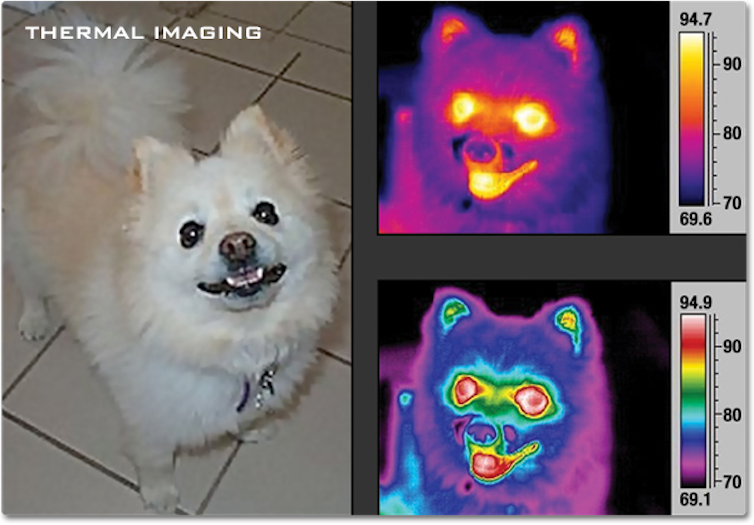 Infrared cameras, like night-vision goggles, allow you to ‘see’ the infrared waves emitting from warm objects such as humans and animals. The temperatures for the images are in degrees Fahrenheit. NASA/JPL-Caltech
Although the human eye cannot see it, people can detect infrared light as a form of heat using specialized technology, such as infrared cameras or thermal sensors. For example, night-vision goggles use infrared light to detect warm objects in the dark. Webb uses the same idea to study stars, galaxies and planets.
Why infrared? When visible light from faraway galaxies travels across the universe, it stretches out. This is because the universe is expanding. That stretching turns visible light into infrared light. So, the most distant galaxies in space don’t shine in visible light anymore – they glow in faint infrared. That’s the light Webb is built to detect.
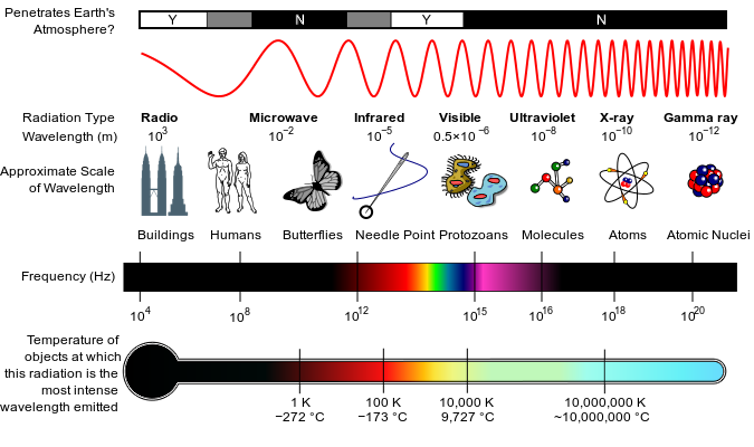 The rainbow of visible light that you can see is only a small slice of all the kinds of light. Some telescopes can detect light with a longer wavelength, such as infrared light, or light with a shorter wavelength, such as ultraviolet light. Others can detect X-rays or radio waves. Inductiveload, NASA/Wikimedia Commons, CC BY-SA
A golden mirror to gather the faintest glow
Before the light reaches the cameras, it first has to be collected by the Webb telescope’s enormous golden mirror. This mirror is over 21 feet (6.5 meters) wide and made of 18 smaller mirror pieces that fit together like a honeycomb. It’s coated in a thin layer of real gold – not just to look fancy, but because gold reflects infrared light extremely well.
The mirror gathers light from deep space and reflects it into the telescope’s instruments. The bigger the mirror, the more light it can collect – and the farther it can see. Webb’s mirror is the largest ever launched into space.
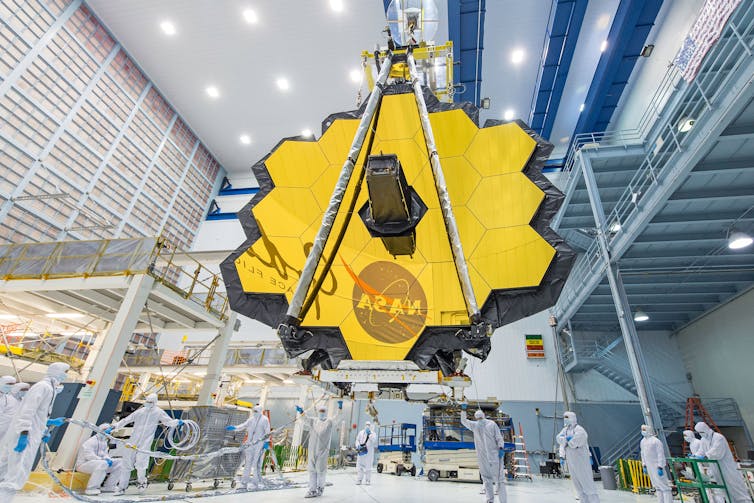 Webb’s 21-foot primary mirror, made of 18 hexagonal mirrors, is coated with a plating of gold. NASA
Inside the cameras: NIRCam and MIRI
The most important “eyes” of the telescope are two science instruments that act like cameras: NIRCam and MIRI.
NIRCam stands for near-infrared camera. It’s the primary camera on Webb and takes stunning images of galaxies and stars. It also has a coronagraph – a device that blocks out starlight so it can photograph very faint objects near bright sources, such as planets orbiting bright stars.
NIRCam works by imaging near-infrared light, the type closest to what human eyes can almost see, and splitting it into different wavelengths. This helps scientists learn not just what something looks like but what it’s made of. Different materials in space absorb and emit infrared light at specific wavelengths, creating a kind of unique chemical fingerprint. By studying these fingerprints, scientists can uncover the properties of distant stars and galaxies.
MIRI, or the mid-infrared instrument, detects longer infrared wavelengths, which are especially useful for spotting cooler and dustier objects, such as stars that are still forming inside clouds of gas. MIRI can even help find clues about the types of molecules in the atmospheres of planets that might support life.
Both cameras are far more sensitive than the standard cameras used on Earth. NIRCam and MIRI can detect the tiniest amounts of heat from billions of light-years away. If you had Webb’s NIRCam as your eyes, you could see the heat from a bumblebee on the Moon. That’s how sensitive it is.
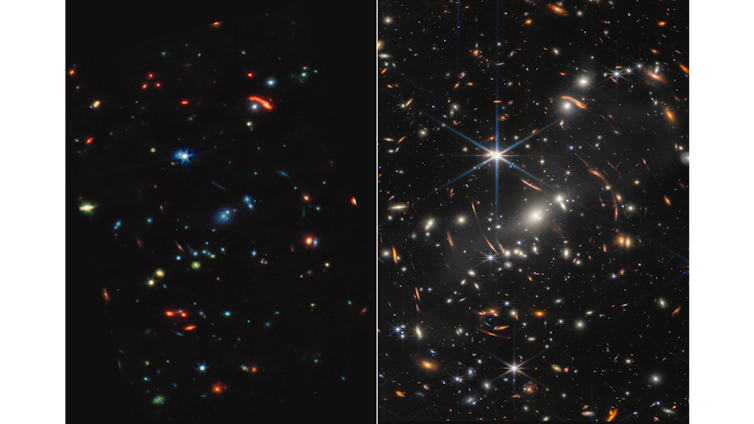 Webb’s first deep-field image: The MIRI image is on the left and the NIRCam image is on the right. NASA
Because Webb is trying to detect faint heat from faraway objects, it needs to keep itself as cold as possible. That’s why it carries a giant sun shield about the size of a tennis court. This five-layer sun shield blocks heat from the Sun, Earth and even the Moon, helping Webb stay incredibly cold: around -370 degrees F (-223 degrees C).
MIRI needs to be even colder. It has its own special refrigerator, called a cryocooler, to keep it chilled to nearly -447 degrees F (-266 degrees C). If Webb were even a little warm, its own heat would drown out the distant signals it’s trying to detect.
Turning space light into pictures
Once light reaches the Webb telescope’s cameras, it hits sensors called detectors. These detectors don’t capture regular photos like a phone camera. Instead, they convert the incoming infrared light into digital data. That data is then sent back to Earth, where scientists process it into full-color images.
The colors we see in Webb’s pictures aren’t what the camera “sees” directly. Because infrared light is invisible, scientists assign colors to different wavelengths to help us understand what’s in the image. These processed images help show the structure, age and composition of galaxies, stars and more.
By using a giant mirror to collect invisible infrared light and sending it to super-cold cameras, Webb lets us see galaxies that formed just after the universe began.
This article is republished from The Conversation under a Creative Commons license. Read the original article and see more than 300 UMBC articles available in The Conversation.
]]>
Written by Adi Foord, assistant professor of physics, UMBC This article is part of The Conversation‘s “Curious Kids” series. How does the camera on the James Webb Space Telescope work and...
https://umbc.edu/stories/how-can-the-james-webb-space-telescope-see-so-far/
https://beta.my.umbc.edu/api/v0/pixel/news/150862/guest@my.umbc.edu/78deae323bed2d055c51a1de187ca6e2/api/pixel
cnms
conversation
discovery
magazine
physics
story
the-conversation
UMBC News & Magazine
https://beta.my.umbc.edu/groups/umbc-news-magazine
https://assets1-beta.my.umbc.edu/system/shared/avatars/groups/000/001/943/24435aa6207c452e7bc15cc74b42c7bb/xsmall.png?1748556657
https://assets1-beta.my.umbc.edu/system/shared/avatars/groups/000/001/943/24435aa6207c452e7bc15cc74b42c7bb/original.png?1748556657
https://assets2-beta.my.umbc.edu/system/shared/avatars/groups/000/001/943/24435aa6207c452e7bc15cc74b42c7bb/xxlarge.png?1748556657
https://assets2-beta.my.umbc.edu/system/shared/avatars/groups/000/001/943/24435aa6207c452e7bc15cc74b42c7bb/xlarge.png?1748556657
https://assets3-beta.my.umbc.edu/system/shared/avatars/groups/000/001/943/24435aa6207c452e7bc15cc74b42c7bb/large.png?1748556657
https://assets1-beta.my.umbc.edu/system/shared/avatars/groups/000/001/943/24435aa6207c452e7bc15cc74b42c7bb/medium.png?1748556657
https://assets2-beta.my.umbc.edu/system/shared/avatars/groups/000/001/943/24435aa6207c452e7bc15cc74b42c7bb/small.png?1748556657
https://assets1-beta.my.umbc.edu/system/shared/avatars/groups/000/001/943/24435aa6207c452e7bc15cc74b42c7bb/xsmall.png?1748556657
https://assets2-beta.my.umbc.edu/system/shared/avatars/groups/000/001/943/24435aa6207c452e7bc15cc74b42c7bb/xxsmall.png?1748556657
UMBC News & Magazine
2
0
false
Mon, 30 Jun 2025 10:51:23 -0400
Erle Ellis and an international team of researchers propose a new way to motivate international action toward a better future for the living world
Imagine a world where, instead of pointing out everything nations are doing wrong to the living world based on how they create, improve, and sustain a thriving environment, we measure what they are doing right. By focusing on the good, people worldwide might be empowered to learn from success, instead of feeling more powerless in the face of all the messages of environmental harm and damage. For nearly three years, Erle Ellis, professor of geography and environmental systems, has collaborated with a team of researchers across six continents, led by the United Nations Development Program’s Human Development Report Office (UNDP-HDRO) to make that vision a reality by developing the Nature Relationship Index (NRI).
The NRI will be the first standardized global metric that measures the quality of a nation’s relationships with nature, including plants and animals, land, rivers, oceans, mountains, forests, deserts, and grasslands. Progress will be measured in terms of each nation’s contributions to the living world, based on three dimensions: the management of landscapes to enable people and nature to connect and thrive together, the use of nature to sustain human development without harming, diminishing, or degrading it, and financial, legal, and institutional support for environmental protections.
Towards a balanced living world
Nature, the world’s leading multidisciplinary science journal, has published this groundbreaking framework by conservation, environment, and human development experts and practitioners. The NRI is now being developed with the aim of a public release as part of the 2026 Human Development Report, with the goal of updating the NRI for all countries of the world annually.
“By focusing on human agency—people’s ability to hold values and make commitments and choices beyond their own individual well-being,” writes Ellis, the lead author, “the human development approach treats people as agents of change, rather than passive recipients of policy interventions, foregrounding people’s values, aspirations and struggles to achieve a better future.”
UMBC’s College of Arts, Humanities, and Social Sciences has named Ellis the 2025 – 2026 Lipitz Professor. The Roger C. Lipitz and the Lipitz Family Foundation endowed professorship that celebrates and sponsors cutting-edge research and teaching. This honor recognizes Ellis’s international leadership in research that supports the health of human-managed ecosystems at both local and global levels, aiming to guide sustainable and responsible stewardship. Ellis served as the 2021 – 2024 UMBC Presidential Research Professor for his contributions to ecology and geography, including landscape ecology and human-environmental interactions.
Learn more about Ellis’s research within UMBC’s Department of Geography and Environmental Systems.
]]>
Imagine a world where, instead of pointing out everything nations are doing wrong to the living world based on how they create, improve, and sustain a thriving environment, we measure what they...
https://umbc.edu/stories/nature-relationship-index-for-the-living-world/
https://beta.my.umbc.edu/api/v0/pixel/news/150852/guest@my.umbc.edu/46f6db96bd2ab3ba21aab6f44fa954cc/api/pixel
cahss
ges
news
policy-and-society
story
UMBC News & Magazine
https://beta.my.umbc.edu/groups/umbc-news-magazine
https://assets1-beta.my.umbc.edu/system/shared/avatars/groups/000/001/943/24435aa6207c452e7bc15cc74b42c7bb/xsmall.png?1748556657
https://assets1-beta.my.umbc.edu/system/shared/avatars/groups/000/001/943/24435aa6207c452e7bc15cc74b42c7bb/original.png?1748556657
https://assets2-beta.my.umbc.edu/system/shared/avatars/groups/000/001/943/24435aa6207c452e7bc15cc74b42c7bb/xxlarge.png?1748556657
https://assets2-beta.my.umbc.edu/system/shared/avatars/groups/000/001/943/24435aa6207c452e7bc15cc74b42c7bb/xlarge.png?1748556657
https://assets3-beta.my.umbc.edu/system/shared/avatars/groups/000/001/943/24435aa6207c452e7bc15cc74b42c7bb/large.png?1748556657
https://assets1-beta.my.umbc.edu/system/shared/avatars/groups/000/001/943/24435aa6207c452e7bc15cc74b42c7bb/medium.png?1748556657
https://assets2-beta.my.umbc.edu/system/shared/avatars/groups/000/001/943/24435aa6207c452e7bc15cc74b42c7bb/small.png?1748556657
https://assets1-beta.my.umbc.edu/system/shared/avatars/groups/000/001/943/24435aa6207c452e7bc15cc74b42c7bb/xsmall.png?1748556657
https://assets2-beta.my.umbc.edu/system/shared/avatars/groups/000/001/943/24435aa6207c452e7bc15cc74b42c7bb/xxsmall.png?1748556657
UMBC News & Magazine
1
0
false
Fri, 27 Jun 2025 14:12:12 -0400
Fri, 27 Jun 2025 14:12:12 -0400
New AI-supported, high-resolution Chesapeake Bay Watershed stream maps reveal additional waterways and will help prioritize restoration projects
A dataset unveiled today more than doubles the documented stream miles in the Chesapeake Bay Watershed, elevating the total from approximately 100,000 to over 200,000 miles. The Hyper-Resolution Hydrography Data used to generate the new stream maps stems from a collaboration between the University of Maryland, Baltimore County (UMBC), the Environmental Protection Agency’s Chesapeake Bay Program (CBP), and the Chesapeake Conservancy (CC), including UMBC alumni at CBP and CC.
The project lays a robust foundation for sustainable management of one of North America’s most critical ecosystems, which spans six states and supports millions of residents and iconic wildlife, such as blue crabs and migrating shorebirds. The new, high-resolution dataset offers the clearest picture yet of how water moves through both pristine landscapes and altered terrain throughout the watershed.
The novel, AI-supported mapping method the research team used also dramatically reduces costs, time, and labor required for stream mapping, making it easy to update as additional data become available or apply in other watersheds to amplify its impact.
“The landscape is shaped by running water. Stream networks are the primary conduit between the watershed and the Bay, and now we can characterize that connection in ways that we’ve never been able to before,” says Matthew Baker, UMBC professor of geography and environmental systems, and a lead on the mapping project. In addition to locating streams and tracing their flow paths with a high degree of precision, the mapping process also allowed the team to report estimates of each channel’s width and depth along its entire length.
 Matthew Baker led the generation of the new hydrography dataset. (Marlayna Demond ’11/UMBC)
A resource for restoration
“When you spend a lot of time looking at hillshade relief maps, you begin to recognize the extent of human manipulation of terrain and how dramatically we have shaped how water flows across the landscape,” Baker adds. The new data will allow individuals and organizations to improve efforts to mitigate any harms from human disruption.
Environmental groups and government agencies, including the CC and CBP, can use the data to prioritize restoration projects, like targeted streamside tree plantings that can mitigate excessive erosion—detected as unusually steep banks or deep channels relative to a stream’s width—and filter pollutants to improve water quality. Farmers and urban planners are likely to find it useful as well, to decrease the detrimental effects of agricultural runoff or wisely manage development to avoid flooding and minimize detrimental effects on wildlife habitat, for example.
“These maps represent over six years of hard work, and I can’t wait to see what people do with this highly anticipated dataset,” says David Saavedra ’14, environmental science. Saavedra’s role as a senior geospatial technical lead at the Chesapeake Conservancy had him intimately involved with the project from brainstorming to implementation.
The project has been personally rewarding for Saavedra, too. “To work alongside Dr. Matt Baker all these years has been a wonderful opportunity,” he says. “I continue to learn from him every day and am proud to consider him a colleague and mentor.”
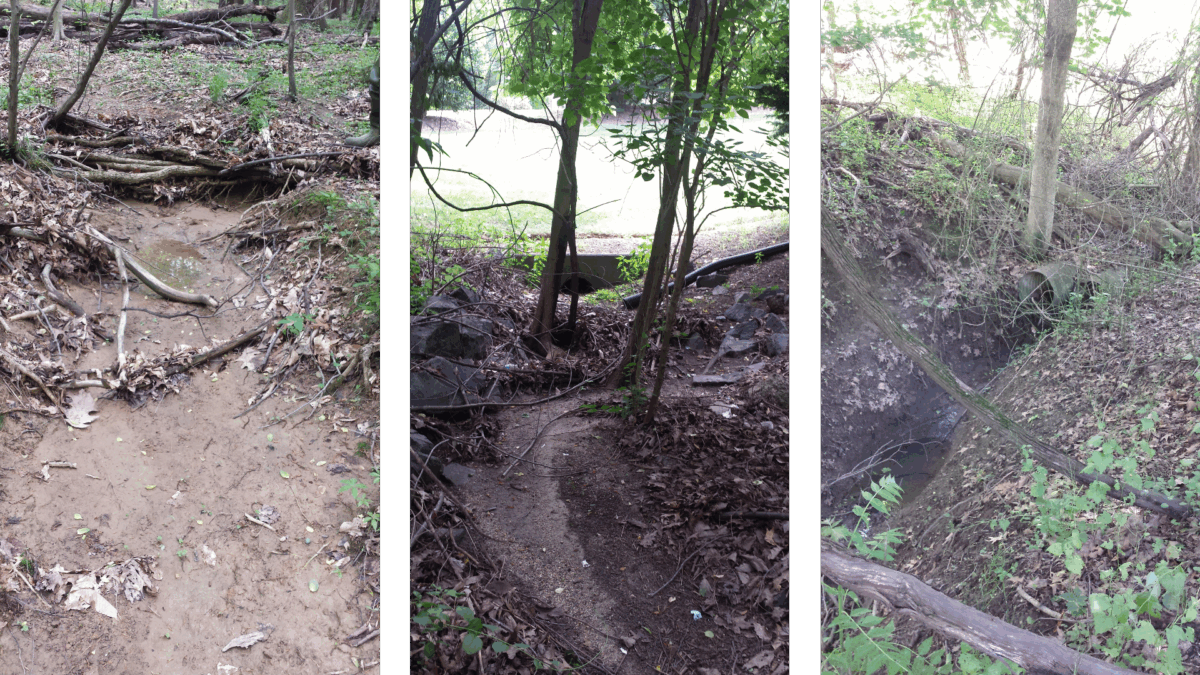 These streams were all missed by the previous dataset, but the new method picked them up. (David Saavedra)
What to leave in, what to leave out?
This project is the first to harness high-resolution LiDAR data and artificial intelligence for large-scale, automated stream mapping. LiDAR, a laser-based system deployed via aircraft, captured elevation data with centimeter-level accuracy, generating a three-dimensional portrait of the terrain. AI algorithms, leveraging resources at UMBC’s High-Performance Computing Facility (HPCF), then processed the data, employing computer-vision techniques to identify channels.
 David Saavedra played a key role in validating the new dataset at the Chesapeake Conservancy. (Courtesy of Saavedra)
The HPCF computers mapped the entire watershed in a mere two weeks—a feat that traditional methods might take years to accomplish. The results achieved 94 percent accuracy for streams represented in existing data, and between 67 and 82 percent accuracy for previously unmapped streams, as validated by Saavedra against two other datasets, aerial imagery and LiDAR-derived topographic maps.
“I led a painstaking process of manually evaluating over 7,000 stream reaches across the watershed to conduct a thorough accuracy assessment on this novel dataset,” Saavedra says. Now that the methodology has been demonstrated effective, that level of manual validation shouldn’t be necessary if the technique is applied elsewhere.
The algorithm needed some tweaks along the way, however. Initially, it included channel-shaped features that made less sense to include on a stream map, like detention ponds, green swales, gutters, and crop furrows. That necessitated modifications to the algorithm to remove those features.
“Part of the challenge in interpreting the terrain was to make distinctions between those features and more natural channels,” Baker says. “So in our model, we had to eliminate some features that were mapped initially. That was unexpected.”
Eye-opening opportunities
 Labeeb Ahmed is excited about the research possibilities the new dataset presents. (Courtesy of Ahmed)
The resulting maps offer a tenfold boost in resolution, moving from a 1:24,000 map scale to a 1:2,400 map scale with each pixel representing one square meter. The new stream maps align with recently-developed land cover maps produced at the same resolution, which are being released at the same time.
“I think when people begin using our hyper-resolution hydrography in conjunction with the one-meter land use data, it will be eye-opening to see just how connected the landscape is to our waterways,” Saavedra says. “There are so many opportunities to improve our region’s water quality, many of which may not have been readily apparent with previous data.”
Labeeb Ahmed ’15, environmental science, has been involved in managing the data release through his role as a geographer in the Chesapeake Bay Program at the EPA.
“The lack of consistent high-resolution hydrography data has always been a challenge, as it is critical for numerous outcomes outlined in the Chesapeake Bay Watershed Agreement, such as mapping forest buffers, non-tidal wetlands, species habitats for brook trout and black duck, and defining stream health,” he says. “This data release will enable novel and interesting research and scientific inquiries. I’m excited to see how other researchers and stakeholders will use this data in their conservation and restoration efforts.”
 The new stream maps (blue) not only show more streams than the old maps (red), but trace their paths in more detail. (Courtesy of Matthew Baker)
]]>
A dataset unveiled today more than doubles the documented stream miles in the Chesapeake Bay Watershed, elevating the total from approximately 100,000 to over 200,000 miles. The Hyper-Resolution...
https://umbc.edu/stories/high-resolution-stream-maps/
https://beta.my.umbc.edu/api/v0/pixel/news/150827/guest@my.umbc.edu/71cd4c5a97bb19a75d35859f8ff5731f/api/pixel
alumni
cahss
ges
news
research
science-and-tech
story
UMBC News & Magazine
https://beta.my.umbc.edu/groups/umbc-news-magazine
https://assets1-beta.my.umbc.edu/system/shared/avatars/groups/000/001/943/24435aa6207c452e7bc15cc74b42c7bb/xsmall.png?1748556657
https://assets1-beta.my.umbc.edu/system/shared/avatars/groups/000/001/943/24435aa6207c452e7bc15cc74b42c7bb/original.png?1748556657
https://assets2-beta.my.umbc.edu/system/shared/avatars/groups/000/001/943/24435aa6207c452e7bc15cc74b42c7bb/xxlarge.png?1748556657
https://assets2-beta.my.umbc.edu/system/shared/avatars/groups/000/001/943/24435aa6207c452e7bc15cc74b42c7bb/xlarge.png?1748556657
https://assets3-beta.my.umbc.edu/system/shared/avatars/groups/000/001/943/24435aa6207c452e7bc15cc74b42c7bb/large.png?1748556657
https://assets1-beta.my.umbc.edu/system/shared/avatars/groups/000/001/943/24435aa6207c452e7bc15cc74b42c7bb/medium.png?1748556657
https://assets2-beta.my.umbc.edu/system/shared/avatars/groups/000/001/943/24435aa6207c452e7bc15cc74b42c7bb/small.png?1748556657
https://assets1-beta.my.umbc.edu/system/shared/avatars/groups/000/001/943/24435aa6207c452e7bc15cc74b42c7bb/xsmall.png?1748556657
https://assets2-beta.my.umbc.edu/system/shared/avatars/groups/000/001/943/24435aa6207c452e7bc15cc74b42c7bb/xxsmall.png?1748556657
UMBC News & Magazine
2
0
false
Thu, 26 Jun 2025 10:08:53 -0400
Thu, 26 Jun 2025 10:08:53 -0400
The new stream maps (blue) not only show more streams than the old maps (red), but trace their paths in more detail. (Courtesy of Matthew Baker)
]]>
A dataset unveiled today more than doubles the documented stream miles in the Chesapeake Bay Watershed, elevating the total from approximately 100,000 to over 200,000 miles. The Hyper-Resolution...
https://umbc.edu/stories/high-resolution-stream-maps/
https://beta.my.umbc.edu/api/v0/pixel/news/150827/guest@my.umbc.edu/71cd4c5a97bb19a75d35859f8ff5731f/api/pixel
alumni
cahss
ges
news
research
science-and-tech
story
UMBC News & Magazine
https://beta.my.umbc.edu/groups/umbc-news-magazine
https://assets1-beta.my.umbc.edu/system/shared/avatars/groups/000/001/943/24435aa6207c452e7bc15cc74b42c7bb/xsmall.png?1748556657
https://assets1-beta.my.umbc.edu/system/shared/avatars/groups/000/001/943/24435aa6207c452e7bc15cc74b42c7bb/original.png?1748556657
https://assets2-beta.my.umbc.edu/system/shared/avatars/groups/000/001/943/24435aa6207c452e7bc15cc74b42c7bb/xxlarge.png?1748556657
https://assets2-beta.my.umbc.edu/system/shared/avatars/groups/000/001/943/24435aa6207c452e7bc15cc74b42c7bb/xlarge.png?1748556657
https://assets3-beta.my.umbc.edu/system/shared/avatars/groups/000/001/943/24435aa6207c452e7bc15cc74b42c7bb/large.png?1748556657
https://assets1-beta.my.umbc.edu/system/shared/avatars/groups/000/001/943/24435aa6207c452e7bc15cc74b42c7bb/medium.png?1748556657
https://assets2-beta.my.umbc.edu/system/shared/avatars/groups/000/001/943/24435aa6207c452e7bc15cc74b42c7bb/small.png?1748556657
https://assets1-beta.my.umbc.edu/system/shared/avatars/groups/000/001/943/24435aa6207c452e7bc15cc74b42c7bb/xsmall.png?1748556657
https://assets2-beta.my.umbc.edu/system/shared/avatars/groups/000/001/943/24435aa6207c452e7bc15cc74b42c7bb/xxsmall.png?1748556657
UMBC News & Magazine
2
0
false
Thu, 26 Jun 2025 10:08:53 -0400
Thu, 26 Jun 2025 10:08:53 -0400


