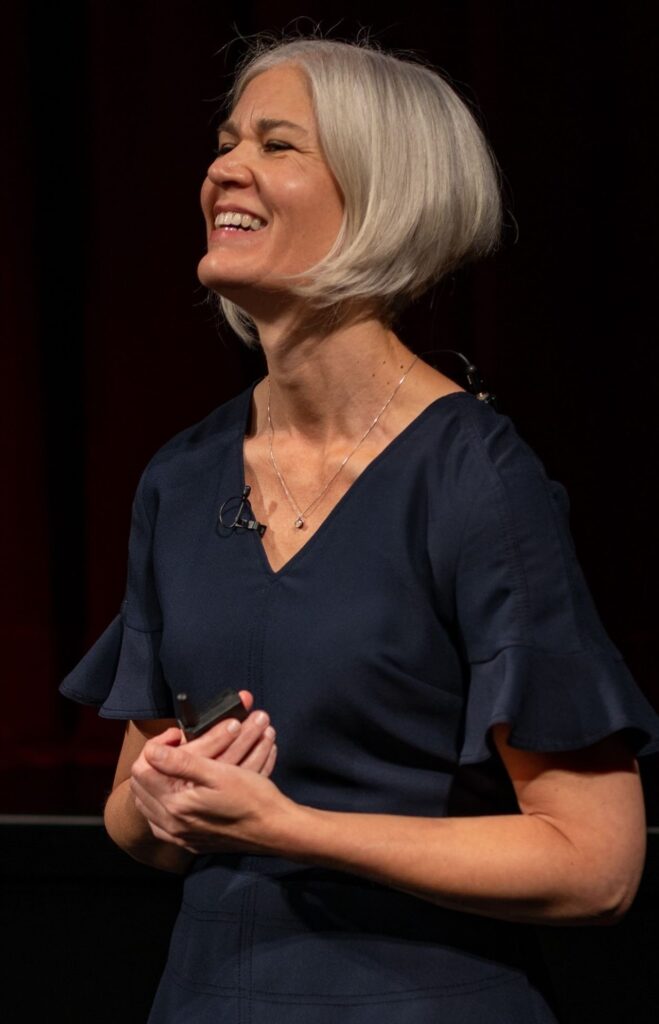
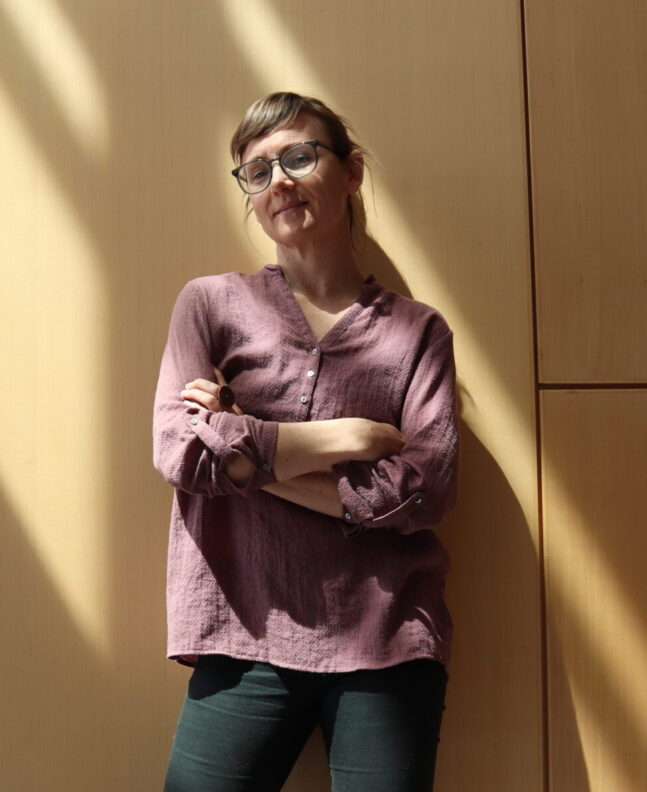
Meet a Retriever—Mary Jumbelic ’79, author and former chief medical examiner
Meet Mary Jumbelic ’79, biological sciences. Mary is an author and former chief medical examiner of Onondaga County, New York. In her 25-year career, she has performed thousands of autopsies and helped pass national safety policies for consumer products, preventing untimely deaths. She’s been an expert witness on Dateline, 48 Hours, the Discovery Channel, and the Law & Crime Network. While retired from government work, Mary continues to consult on cases while pursuing her passion for writing. In 2023, she published her first book, Here, Where Death Delights: A Literary Memoir, and just recently released her second this summer, Speak Her Name: Stories from a Life in True Crime. Take it away, Mary!
Q: What initially brought you to UMBC?
A: When considering colleges, I was looking for lower-cost schooling to which I could commute. I couldn’t afford to move away from home or live on campus. UMBC had an excellent reputation in the sciences, and I planned to go on to medical school. The chance to attend a four-year college, live at home, and receive scholarships was extraordinary to me. Plus, the connection with the University of Maryland system paved the way for medical school.
 Jumbelic at her gamelan angklung concert with her friend, Steven Zachs.
Q: What did you love about your academic programs at UMBC?
A: As a first-generation student, I felt a bit at sea my first semester. UMBC allowed me to repeat a course I failed and receive a new grade. Both were present on my transcript, but the higher grade counted in my GPA. This grace provided me with more confidence. I also struggled as a pre-med student and drifted into accounting, education, and creative writing. UMBC made it easy to sample classes from many different disciplines. I studied under Pulitzer Prize-winning poets, heard preeminent lecturers in chemistry, and settled into a rigorous academic life in biological sciences. Taking the Myers-Briggs personality test, I matched with a career in medicine. Biology turned out to be the perfect fit.
 Jumbelic working the microscope. She worked in forensic pathology for more than 25 years.
Badminton at the gym, gamelan angklung music classes, and foreign language studies rounded out my education. I graduated cum laude in 1979, the first of my family to ever go to college.
Q: Who in the UMBC community has inspired you or supported you?
A: A posting on the biology bulletin board led to the best job I ever had in college, opening the door to four years with the Martin Marietta Environmental Technology Center’s research and development program. Dr. K. Zankel, a brilliant physicist at Martin Marietta, taught me to be a research assistant in the field and in the lab, leading by example and serving as my first, and one of my most cherished, mentors. I worked counting fish populations in the effluent from the nuclear plant (both on sonar tracking and in vivo) as well as in their sulphur dioxide monitoring program with site visits to their plant in St. Croix. UMBC accepted my affiliation and research paper for credit, which helped me graduate.
UMBC made it easy to sample classes from many different disciplines. I studied under Pulitzer Prize-winning poets, heard preeminent lecturers in chemistry, and settled into a rigorous academic life in biological sciences.
Mary Jumbelic ’79
biological sciences
Q: Can you tell us about your career and any upcoming projects?
A: I am a board-certified forensic pathologist and former chief medical examiner of Onondaga County, the first female to hold the role in all of Central New York. In my 25-year career, I’ve performed thousands of autopsies across the United States and abroad as part of special assignments to aid in world disaster sites. I’ve even used forensic evidence to help pass national safety policies for consumer products, preventing untimely deaths. Over time, I’ve received awards for my work from the National Transportation Safety Board and the New York State Senate, among others. I am honored to have been recognized as a trailblazer by the National Organization of Women. While retired from government work, I continue to lend my expertise and consult on cases, as well as speak on forensic pathology topics on national podcasts and for educational speaking engagements. I’ve also had more time to devote to my passion—writing.
 Jumbelic at a book signing at a Rochester Barnes & Noble.
In the last decade, I’ve published numerous short stories across more than 30 publications. I’ve been nominated for a Pushcart Prize and was a top-10 finalist in the Tucson Literary Festival. In 2023, I launched my company, Final Words Publishing, and released my first book Here, Where Death Delights: A Literary Memoir. The book quickly gained international readership, receiving First Prize from The BookFest, Silver Awards from the Nonfiction Authors Association and Reader’s Favorite, as well as Gold from the Colorado Independent Publishers Association. In July 2025, I published my second book, Speak Her Name: Stories from a Life in True Crime. With this work, I give a voice to the many women I found on my autopsy table as I had learned to find my own voice, which I use to educate and empower those still with us today.
My books are true stories of my life in and out of the morgue, where I spent more than 25 years with the dead. I speak for them and demystify death for the living.
* * * * *
UMBC’s greatest strength is its people. When people meet Retrievers and hear about the passion they bring, the relationships they create, the ways they support each other, and the commitment they have to inclusive excellence, they truly get a sense of our community. That’s what “Meet a Retriever” is all about.
Learn more about how UMBC can help you achieve your goals.
]]>
Meet Mary Jumbelic ’79, biological sciences. Mary is an author and former chief medical examiner of Onondaga County, New York. In her 25-year career, she has performed thousands of autopsies and...
https://umbc.edu/stories/meet-mary-jumbelic-author-medical-examiner/
https://beta.my.umbc.edu/api/v0/pixel/news/151225/guest@my.umbc.edu/ec3eb439710a56bc642c82fcc56d3488/api/pixel
alumni
forensic-pathologist
magazine
medical-examiner
meet-a-retriever
retriever-authors
story
UMBC News & Magazine
https://beta.my.umbc.edu/groups/umbc-news-magazine
https://assets1-beta.my.umbc.edu/system/shared/avatars/groups/000/001/943/24435aa6207c452e7bc15cc74b42c7bb/xsmall.png?1748556657
https://assets1-beta.my.umbc.edu/system/shared/avatars/groups/000/001/943/24435aa6207c452e7bc15cc74b42c7bb/original.png?1748556657
https://assets2-beta.my.umbc.edu/system/shared/avatars/groups/000/001/943/24435aa6207c452e7bc15cc74b42c7bb/xxlarge.png?1748556657
https://assets2-beta.my.umbc.edu/system/shared/avatars/groups/000/001/943/24435aa6207c452e7bc15cc74b42c7bb/xlarge.png?1748556657
https://assets3-beta.my.umbc.edu/system/shared/avatars/groups/000/001/943/24435aa6207c452e7bc15cc74b42c7bb/large.png?1748556657
https://assets1-beta.my.umbc.edu/system/shared/avatars/groups/000/001/943/24435aa6207c452e7bc15cc74b42c7bb/medium.png?1748556657
https://assets2-beta.my.umbc.edu/system/shared/avatars/groups/000/001/943/24435aa6207c452e7bc15cc74b42c7bb/small.png?1748556657
https://assets1-beta.my.umbc.edu/system/shared/avatars/groups/000/001/943/24435aa6207c452e7bc15cc74b42c7bb/xsmall.png?1748556657
https://assets2-beta.my.umbc.edu/system/shared/avatars/groups/000/001/943/24435aa6207c452e7bc15cc74b42c7bb/xxsmall.png?1748556657
UMBC News & Magazine
0
0
false
Thu, 31 Jul 2025 09:27:01 -0400
Thu, 31 Jul 2025 09:27:01 -0400
Leaf year: PACE satellite data reveals global plant health
A new study using data collected by NASA’s Plankton, Aerosol, Cloud, ocean Ecosystem (PACE) satellite established a novel method to determine how productive plants are worldwide. The new remote sensing technique could help us better understand plants’ role in capturing carbon on a global scale and reveal how plants are responding to factors like changing water availability and temperature, with relevance for conservation, agriculture, and more.
The research, led by Karl F. Huemmrich, a UMBC research scientist with the Goddard Earth Sciences Technology and Research (GESTAR) Center II, shows that PACE’s advanced camera can track plant health by analyzing the light leaves reflect. By comparing these satellite observations with measurements taken on the ground, the study confirmed that the new method works across diverse landscapes, opening the door to improved global ecosystem monitoring.
Launched in February 2024, PACE’s Ocean Color Instrument (OCI) captures daily images of Earth that show how plants are responding to their environment in real time. While OCI’s primary mission is to study oceans (hence its name), it also collects data over land.
“Although they do not appear to be very active to us, plants are constantly making physiological adjustments to their environment, responding to factors such as changing light, temperature, humidity, water, and nutrient availability,” Huemmrich explains. A plant can change its leaf area, leaf orientation, and the prevalence of different leaf pigments, he says. All of those changes alter the intensity and wavelengths of light the plants reflect, which OCI detects.
“PACE provides almost daily repeat observations,” except for areas blocked by clouds, Huemmrich says. “This time series can be used to describe changes in vegetation productivity related to seasonal change, for example the timing of spring green-up and autumn senescence, or more transient effects, like droughts or cold snaps.”
 This gif shows how PACE’s OCI “sees” plant productivity changing throughout the growing season across North America. (Skye Caplan)
One algorithm to track them all
Unlike older satellite methods, such as MODIS Gross Primary Productivity, which needed weather data like temperature and humidity to estimate plant growth, PACE relies solely on the light reflected by plants.
“By using the information from the spectral reflectance alone, we are letting the plants show us their responses to environmental conditions, rather than trying to predict their responses,” Huemmrich explains. This approach makes it easier to accurately capture short-term changes.
The study tested PACE’s data against ground measurements from National Ecological Observatory Network (NEON) sites across the U.S., covering everything from arctic tundra to tropical dry forests.
“The NEON sites were chosen to cover all of the major ecoclimate types within the U.S.,” Huemmrich notes, “and frankly, it was surprising that a single algorithm could do as well as it did across all of those very different vegetation types.” This success suggests the method can be used globally, and there are plans to include more sites worldwide in future studies to cover even more ecosystems.
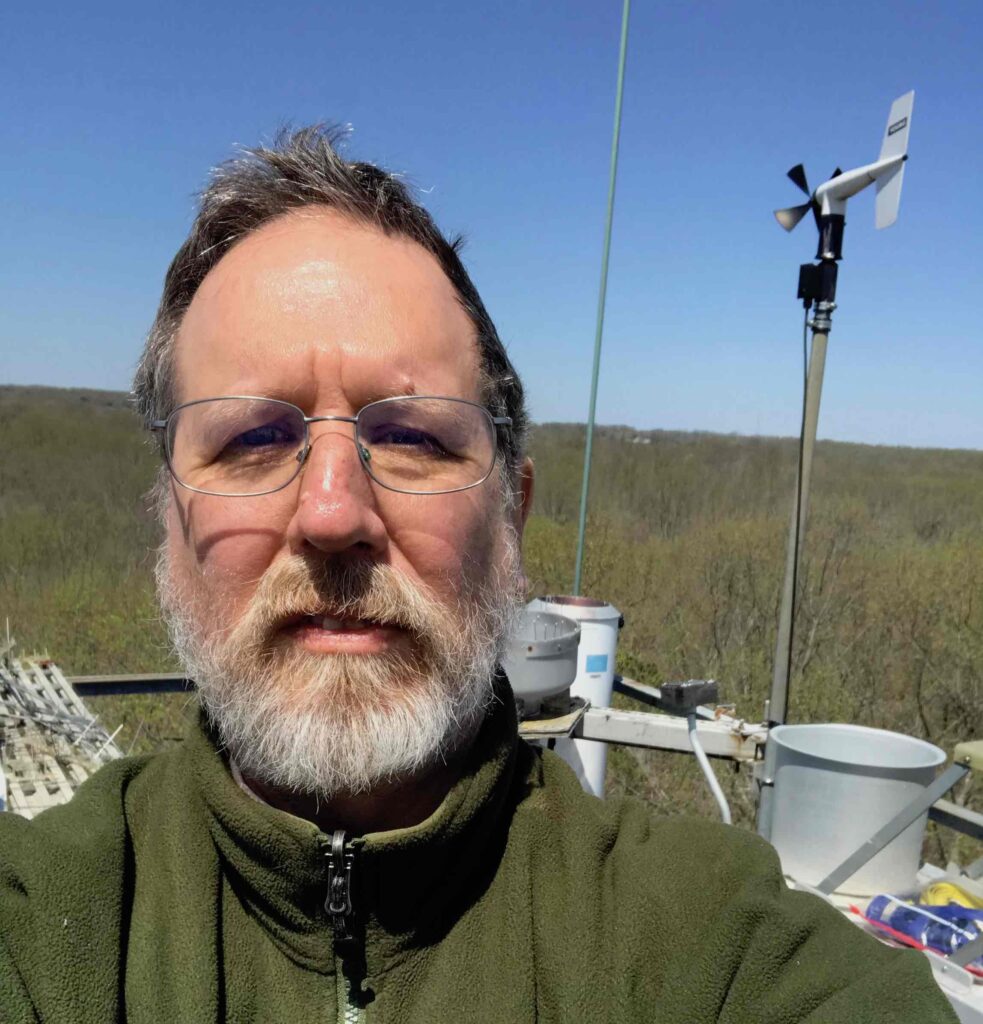 Huemmrich stands 100 feet above the ground on a meteorology tower at the Smithsonian Environmental Research Center in Edgewater, Maryland. (Courtesy of Huemmrich)
“An entirely new view”
This research could transform how scientists track carbon sequestration—how plants absorb and store carbon dioxide, a key greenhouse gas—improving understanding of how different ecosystems influence climate change. The ability to spot stress events early could also help farmers and environmental managers act quickly to improve outcomes for crops and wildlife.
PACE’s global reach is a huge step forward. “I believe this new ability to describe global ecosystem dynamics opens up an entirely new view of the Earth’s ecological functioning that we really have not been able to see before,” Huemmrich says. Unlike earlier methods that relied on labor-intensive ground measurements or expensive airplane flights, PACE offers a cost-effective way to monitor ecosystems worldwide.
Moving into PACE’s second year, Huemmrich is excited to explore how plant responses change over time. “I’m interested in looking at year-to-year differences,” he says. “I want to see how best to use the spectral information for early detection of stress events. Can we learn to diagnose types of stress responses? Do these responses vary among different types of plants?”
These questions will drive future research, aiming to improve how we detect and understand plant stress across diverse ecosystems. PACE’s frequent, detailed satellite data will help scientists, policymakers, and conservationists protect ecosystems and understand how plants are responding to a changing world.
The findings were published in IEEE Transactions on Geoscience and Remote Sensing and co-authored by Petya Campbell, a UMBC research scientist with GESTAR II and senior author; Skye Caplan, Goddard Space Flight Center; and John Gamon, University of Nebraska–Lincoln.
]]>
A new study using data collected by NASA’s Plankton, Aerosol, Cloud, ocean Ecosystem (PACE) satellite established a novel method to determine how productive plants are worldwide. The new remote...
https://umbc.edu/stories/pace-data-plant-health/
https://beta.my.umbc.edu/api/v0/pixel/news/151205/guest@my.umbc.edu/efc63e24949abe2900bbd83c39929fdd/api/pixel
gestar2
news
research
science-and-tech
story
UMBC News & Magazine
https://beta.my.umbc.edu/groups/umbc-news-magazine
https://assets1-beta.my.umbc.edu/system/shared/avatars/groups/000/001/943/24435aa6207c452e7bc15cc74b42c7bb/xsmall.png?1748556657
https://assets1-beta.my.umbc.edu/system/shared/avatars/groups/000/001/943/24435aa6207c452e7bc15cc74b42c7bb/original.png?1748556657
https://assets2-beta.my.umbc.edu/system/shared/avatars/groups/000/001/943/24435aa6207c452e7bc15cc74b42c7bb/xxlarge.png?1748556657
https://assets2-beta.my.umbc.edu/system/shared/avatars/groups/000/001/943/24435aa6207c452e7bc15cc74b42c7bb/xlarge.png?1748556657
https://assets3-beta.my.umbc.edu/system/shared/avatars/groups/000/001/943/24435aa6207c452e7bc15cc74b42c7bb/large.png?1748556657
https://assets1-beta.my.umbc.edu/system/shared/avatars/groups/000/001/943/24435aa6207c452e7bc15cc74b42c7bb/medium.png?1748556657
https://assets2-beta.my.umbc.edu/system/shared/avatars/groups/000/001/943/24435aa6207c452e7bc15cc74b42c7bb/small.png?1748556657
https://assets1-beta.my.umbc.edu/system/shared/avatars/groups/000/001/943/24435aa6207c452e7bc15cc74b42c7bb/xsmall.png?1748556657
https://assets2-beta.my.umbc.edu/system/shared/avatars/groups/000/001/943/24435aa6207c452e7bc15cc74b42c7bb/xxsmall.png?1748556657
UMBC News & Magazine
2
0
false
Tue, 29 Jul 2025 14:52:47 -0400
Tue, 29 Jul 2025 14:52:47 -0400
UMBC publishes first-of-its-kind tutorial for teaching complex computational chemistry technique
Joseph Bennett, assistant professor of chemistry and biochemistry, and Mona Layegh, Ph.D. ’25, chemistry, know how hard it can be to teach density functional theory (DFT) to undergraduates. DFT is a computational method for predicting a substances’ properties at the quantum level, such as how they conduct electricity or react with other compounds. Despite its complexity, DFT is a foundational technique that underpins research in fields like renewable energy, pharmaceuticals, and nanotechnology, so it’s critical that students understand it and know how to apply it.
To address the challenge of teaching DFT well, Bennett and Layegh coauthored a tutorial on teaching the technique, which was published in the Journal of Chemical Education. Their paper was the first ever published in the journal’s brand new Tutorial section, which was inspired by their submission and a need to develop more training tools.
The tutorial, refined over five years of training UMBC students in DFT, is paired with open-source resources on GitHub, including ready-to-use files and visualizations. These allow instructors at community colleges or in areas with limited internet to teach the concepts even without advanced computers.
“If you can erase some of the hurdles to make DFT a little bit more accessible, more students can get into it,” Bennett says.
In sharing these teaching tools, UMBC is leveling the playing field, making it possible for students in all kinds of learning environments to master this core technique. As a result, they’ll be better prepared for careers in growing industries like technology and healthcare, where they may go on to design better batteries, solar panels, life-saving drugs, and more.
]]>
Joseph Bennett, assistant professor of chemistry and biochemistry, and Mona Layegh, Ph.D. ’25, chemistry, know how hard it can be to teach density functional theory (DFT) to undergraduates. DFT is...
https://umbc.edu/quick-posts/chemistry-tutorial-published/
https://beta.my.umbc.edu/api/v0/pixel/news/151117/guest@my.umbc.edu/9396ad05149080141d08e90e009638ea/api/pixel
chembiochem
cnms
graduateschool
news
quick-post
research
science-and-tech
UMBC News & Magazine
https://beta.my.umbc.edu/groups/umbc-news-magazine
https://assets1-beta.my.umbc.edu/system/shared/avatars/groups/000/001/943/24435aa6207c452e7bc15cc74b42c7bb/xsmall.png?1748556657
https://assets1-beta.my.umbc.edu/system/shared/avatars/groups/000/001/943/24435aa6207c452e7bc15cc74b42c7bb/original.png?1748556657
https://assets2-beta.my.umbc.edu/system/shared/avatars/groups/000/001/943/24435aa6207c452e7bc15cc74b42c7bb/xxlarge.png?1748556657
https://assets2-beta.my.umbc.edu/system/shared/avatars/groups/000/001/943/24435aa6207c452e7bc15cc74b42c7bb/xlarge.png?1748556657
https://assets3-beta.my.umbc.edu/system/shared/avatars/groups/000/001/943/24435aa6207c452e7bc15cc74b42c7bb/large.png?1748556657
https://assets1-beta.my.umbc.edu/system/shared/avatars/groups/000/001/943/24435aa6207c452e7bc15cc74b42c7bb/medium.png?1748556657
https://assets2-beta.my.umbc.edu/system/shared/avatars/groups/000/001/943/24435aa6207c452e7bc15cc74b42c7bb/small.png?1748556657
https://assets1-beta.my.umbc.edu/system/shared/avatars/groups/000/001/943/24435aa6207c452e7bc15cc74b42c7bb/xsmall.png?1748556657
https://assets2-beta.my.umbc.edu/system/shared/avatars/groups/000/001/943/24435aa6207c452e7bc15cc74b42c7bb/xxsmall.png?1748556657
UMBC News & Magazine
0
0
false
Tue, 22 Jul 2025 15:32:42 -0400
Making STEM courses more inclusive with lab and lecture hall upgrades
This summer UMBC is partnering with the Maryland Department of Disabilities to upgrade nine teaching labs in the Meyerhoff Chemistry Building. The updates will allow students with mobility disabilities to fully participate in critical chemistry and biochemistry lab courses.
Sinks, lab benches, cabinets, fume hoods, specialized equipment stations, and more will all be constructed that are accessible for wheelchair users. A research lab will be similarly modified to allow students with disabilities to gain research experience.
“These projects are a part of an ongoing campus-wide effort to remove barriers to access throughout our campus buildings,” Celso Guitian, UMBC’s campus planner, says.
A lecture hall in the Engineering Building is also being renovated this summer. The changes are similar to those made in lecture halls in the Administration, Meyerhoff Chemistry, and Biological Sciences buildings in recent years to create multiple spaces for wheelchair-users with fold-down desk tablets, both at the front and rear of the lecture hall. TV monitors will help students with vision disabilities who may not be able to see the whiteboard or screen at the front of these lecture halls. And seating size variations, including standing-desk options, accommodate students of varied body types and disabilities, including supporting pregnant students and students with orthopedic challenges. Assisted listening technology and an area for sign language interpreters support students who are deaf or hard of hearing.
Other projects under construction this summer include accessibility upgrades in four Biological Sciences Building restrooms and elevator upgrades in several academic buildings.
“The Office of Accessibility & Disability Services greatly values our longstanding partnership with Facilities Management to assist us in the mission of inclusive access and elimination of barriers for all UMBC community members,” says Tawny McManus, assistant vice president for accessibility. “Improving our teaching labs allows increased participation of our students with disabilities and shows them UMBC welcomes everyone here.”
]]>
This summer UMBC is partnering with the Maryland Department of Disabilities to upgrade nine teaching labs in the Meyerhoff Chemistry Building. The updates will allow students with mobility...
https://umbc.edu/quick-posts/inclusive-lab-and-lecture-hall-upgrades/
https://beta.my.umbc.edu/api/v0/pixel/news/151118/guest@my.umbc.edu/44b1341b2e8c55dc87ba049142c9d7f2/api/pixel
chembiochem
cnms
coeit
news
quick-post
science-and-tech
student-disability-services
UMBC News & Magazine
https://beta.my.umbc.edu/groups/umbc-news-magazine
https://assets1-beta.my.umbc.edu/system/shared/avatars/groups/000/001/943/24435aa6207c452e7bc15cc74b42c7bb/xsmall.png?1748556657
https://assets1-beta.my.umbc.edu/system/shared/avatars/groups/000/001/943/24435aa6207c452e7bc15cc74b42c7bb/original.png?1748556657
https://assets2-beta.my.umbc.edu/system/shared/avatars/groups/000/001/943/24435aa6207c452e7bc15cc74b42c7bb/xxlarge.png?1748556657
https://assets2-beta.my.umbc.edu/system/shared/avatars/groups/000/001/943/24435aa6207c452e7bc15cc74b42c7bb/xlarge.png?1748556657
https://assets3-beta.my.umbc.edu/system/shared/avatars/groups/000/001/943/24435aa6207c452e7bc15cc74b42c7bb/large.png?1748556657
https://assets1-beta.my.umbc.edu/system/shared/avatars/groups/000/001/943/24435aa6207c452e7bc15cc74b42c7bb/medium.png?1748556657
https://assets2-beta.my.umbc.edu/system/shared/avatars/groups/000/001/943/24435aa6207c452e7bc15cc74b42c7bb/small.png?1748556657
https://assets1-beta.my.umbc.edu/system/shared/avatars/groups/000/001/943/24435aa6207c452e7bc15cc74b42c7bb/xsmall.png?1748556657
https://assets2-beta.my.umbc.edu/system/shared/avatars/groups/000/001/943/24435aa6207c452e7bc15cc74b42c7bb/xxsmall.png?1748556657
UMBC News & Magazine
0
0
false
Tue, 22 Jul 2025 15:28:12 -0400
UMBC researchers pioneer method to discover new 2D materials for advanced electronics
Finding new materials with useful properties is a primary goal for materials scientists, and it’s central to improving technology. One exciting area of current research is 2D materials—super-thin substances made of just a few layers of atoms, which could power the next generation of electronic devices. UMBC researchers have developed a new way to predict 2D materials that might transform electronics, and the results were published in Chemistry of Materials earlier in July.
Picture a sheet of paper so thin that it’s only a few atoms thick, and that’s what 2D materials are like. One might think they would be fragile—but these materials can actually be incredibly strong or conduct electricity in unique ways. They’re held together by weak forces called van der Waals bonds, which allow materials to slightly deform without breaking under stress. Stacked layers of these 2D materials can slide past each other, further reducing brittleness.
The research team, led by Peng Yan, Ph.D. candidate in chemistry, and Joseph Bennett, assistant professor of chemistry and biochemistry, focused on a type of 2D material called van der Waals layered phosphochalcogenides. Some of these materials are ferroelectric, meaning they can hold an electric charge in a particular direction, and then the direction can be reversed on command—sort of like tiny, reversible batteries. Some ferroelectric materials are also magnetic, behaving similarly when a magnetic field is applied. That combination makes them ideal for advanced electronics like memory devices and sensors.
“There’s only two known 2D van der Waals ferroelectric materials with this type of structure,” Bennett said, “so we were asking ourselves, where might others be hiding?” The new publication is their answer to that question.
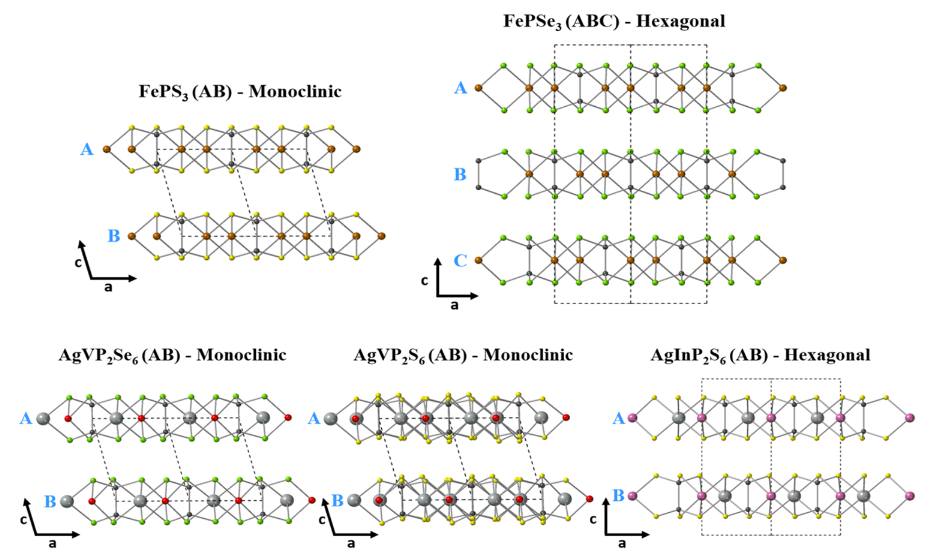 Figure 1 from the new study shows examples of atomic structures that the research team’s algorithm identified as having features conducive for potential use as 2D materials.
A treasure map to new 2D materials
The researchers used a mix of data mining, computer modeling, and structural analysis (because only materials with certain shapes are conducive to use in electronics) to ferret out new material candidates.
“We developed a set of chemical design rules to predict these materials, which could significantly accelerate the discovery of new functional materials,” Yan, the study’s first author, said.
Joshua Birenzvige ’23, chemistry, played a key role by developing a Python script that helped sort the potential materials based on their properties, speeding up the team’s progress. Mona Layegh, a Ph.D. candidate in Bennett’s group, is also a co-author on the new paper.
 Joseph Bennett’s research lab focuses on the discovery and design of new functional materials. (Marlayna Demond ’11/UMBC)
The researchers began by digging into the Inorganic Crystal Structure Database, a huge collection of known crystal structures. Then they used quantum structural diagrams—which map materials on a chart according to how they relate to each other, determined by their atomic traits—to find areas within the diagrams where promising new materials might be hiding.
“By analyzing basic parameters like differences in electronegativity and radius, we were able to separate materials that have the properties we want from those that don’t,” Bennett explained. Electronegativity measures how strongly an atom attracts electrons, and an atom’s radius is the distance from its center to the outer edge of its electron cloud.
“These quantum structural diagrams act like a treasure map,” Bennett said, “guiding us to regions of chemical space where new, stable 2D materials are likely to exist.”
Their results indicated 83 potential new materials that could be made and used in the tech industry, potentially increasing the number of known ferroelectric materials by an incredible margin.
From the computer to the lab bench
After the computer-based analysis, the team took their work a step further. The UMBC researchers collaborated with Ryan Stadel, Peter Zavalij, and Efrain Rodriguez at the University of Maryland, College Park (UMD), who made and tested some of the predicted materials in the lab. Their work proved the UMBC predictions could be used to guide experiments with the predicted materials.
“Being able to predict which compositions are likely to form stable, functional materials gives us a huge head start in the lab,” Bennett said. “It’s like having a recipe book for materials that haven’t been made yet, which saves time and resources.”
These new materials could shine in real-world uses, substantially advancing the electronics industry. For example, they could help build memory devices that can store data after power is shut off, tiny sensors that detect minute amounts of particular substances, or low-power components that make your phone battery last longer. These properties are in high demand across the tech industry and the U.S. government—this work was funded by a substantial grant from the Defense Threat Reduction Agency.
 Joseph Bennett’s students Peng Yan (top left), Joshua Berinzvige (top right), and Mona Layegh (bottom) are all authors on the new study. (Courtesy of Bennett)
An exciting future of discovery
“I’m excited because the work demonstrates a successful data-guided approach to discovering novel 2D materials with promising functional properties, potentially accelerating the design of next-generation electronic materials,” Yan said.
Next up, the team will use a complex computer simulation, called high-throughput density functional theory modeling, to explore these 83 materials in more depth. They’ll check their ferroic traits and how easily they can be made. Plus, they’ll continue their collaboration with the UMD to synthesize and study the materials in the lab, aiming to confirm their special properties and tweak them for specific applications.
The research is a major step forward, paving the way for materials that could change how engineers build electronics—from sensors for the military to longer-lasting laptops and tablets for students on the go.
]]>
Finding new materials with useful properties is a primary goal for materials scientists, and it’s central to improving technology. One exciting area of current research is 2D materials—super-thin...
https://umbc.edu/stories/new-2d-materials-for-advanced-electronics/
https://beta.my.umbc.edu/api/v0/pixel/news/151101/guest@my.umbc.edu/0bb5442dfdd83f7ff2784483866a9272/api/pixel
chembiochem
cnms
gradresearch
news
research
science-and-tech
story
UMBC News & Magazine
https://beta.my.umbc.edu/groups/umbc-news-magazine
https://assets1-beta.my.umbc.edu/system/shared/avatars/groups/000/001/943/24435aa6207c452e7bc15cc74b42c7bb/xsmall.png?1748556657
https://assets1-beta.my.umbc.edu/system/shared/avatars/groups/000/001/943/24435aa6207c452e7bc15cc74b42c7bb/original.png?1748556657
https://assets2-beta.my.umbc.edu/system/shared/avatars/groups/000/001/943/24435aa6207c452e7bc15cc74b42c7bb/xxlarge.png?1748556657
https://assets2-beta.my.umbc.edu/system/shared/avatars/groups/000/001/943/24435aa6207c452e7bc15cc74b42c7bb/xlarge.png?1748556657
https://assets3-beta.my.umbc.edu/system/shared/avatars/groups/000/001/943/24435aa6207c452e7bc15cc74b42c7bb/large.png?1748556657
https://assets1-beta.my.umbc.edu/system/shared/avatars/groups/000/001/943/24435aa6207c452e7bc15cc74b42c7bb/medium.png?1748556657
https://assets2-beta.my.umbc.edu/system/shared/avatars/groups/000/001/943/24435aa6207c452e7bc15cc74b42c7bb/small.png?1748556657
https://assets1-beta.my.umbc.edu/system/shared/avatars/groups/000/001/943/24435aa6207c452e7bc15cc74b42c7bb/xsmall.png?1748556657
https://assets2-beta.my.umbc.edu/system/shared/avatars/groups/000/001/943/24435aa6207c452e7bc15cc74b42c7bb/xxsmall.png?1748556657
UMBC News & Magazine
0
0
false
Mon, 21 Jul 2025 13:54:33 -0400
Mon, 21 Jul 2025 13:54:33 -0400
More life science grad students to be prepared for interdisciplinary success following renewed NIH funding for Chemistry Biology Interface program
For over 20 years, the Chemistry Biology Interface (CBI) program at UMBC has been shaping Ph.D. students into leaders who bridge chemistry and biology. Programs like CBI are critical to help meet the rising demand for researchers with wide-ranging skill sets who can communicate clearly with those outside their specialty. In the joint UMBC-University of Maryland, Baltimore (UMB) CBI program, participants complete their degrees faster than students in similar labs outside the program, and 97 percent graduate—well above the national average of 63 percent for graduate study in the life sciences.
“Everything now is interdisciplinary research,” says Aaron Smith, associate professor of chemistry and biochemistry at UMBC and CBI director.
CBI supports Ph.D. students at UMBC in chemistry, biochemistry, and biological sciences, and pharmacy students at UMB. Now it has secured five more years of funding to continue building community, creating networking opportunities, and training students in interdisciplinary research and science communication.
Communication for career success
CBI alumni credit the program with positioning them to thrive in a range of careers, from the classroom to corporate laboratories.
“I became more confident with public speaking and attribute the success of my job interview talks to the training I received in CBI,” shares Kathryn Wardrup, Ph.D. ’24, biological sciences. Today, she is a postdoctoral fellow at the Fred Hutchinson Cancer Center, an independent research institute in Seattle.
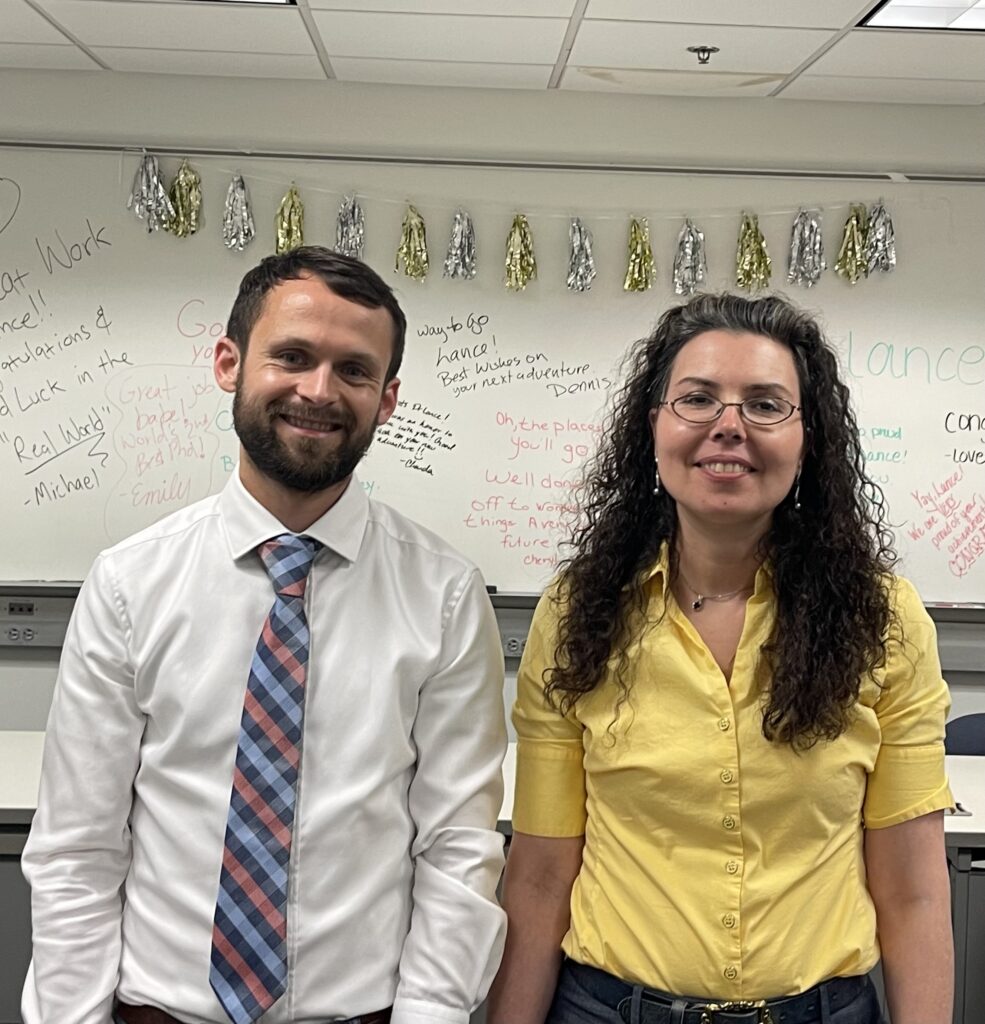 Lance Dockery (left) completed his Ph.D. with Marie-Christine Daniel, associate professor of chemistry and biochemistry. Here they celebrate his thesis defense in 2022. (Courtesy of Dockery)
“Hearing about other research on campus and learning what techniques are being used was a valuable experience,” Wardrup adds. “I felt confident in my ability to be able to have discussions outside of my scientific expertise.”
Scott Riley, Ph.D. ’20, chemistry, also benefited. “I’ve carried many of the lessons I learned into presentations, whether classroom lectures or at meetings and conferences,” he says. “I know many of my interviews were successful because of things I learned in CBI.”
Currently, Riley coordinates internship placements and teaches courses in the master’s program in pharmaceutical sciences at UMB.
Lance Dockery, Ph.D. ’22, chemistry, parlayed skills gained in CBI into a senior scientist role at biotech company AstraZeneca, and recently transitioned to a leadership role at pharmaceutical company Eli Lilly.
“In industry, projects often require coordination between chemists, biochemists, immunologists, and other specialists, similar to the collaborative environment within the CBI program,” Dockery says. “The experience of presenting research to a diverse audience within CBI strengthened my communication skills—something that has given me a clear advantage when interacting with project teams.”
Building a supportive community
CBI participants attend weekly meetings where they take turns teaching their peers about a range of scientific topics selected by the students. Following the more formal instruction period, students partake in group discussions on graduate student life and professional development topics—like mental health, time management, and creating and updating a CV—over pizza.
All this interaction promotes a strong sense of community. “This program builds a really strong rapport among the students, some of whom are in their first semester of graduate school and some of whom are preparing to defend their theses,” Smith says. “They build connections with one another; they learn how to talk with one another. I really think of it as building a community of support among the students.”
Danielle Schmitt, Ph.D. ’17, biochemistry, concurs. “I really benefited from having a cohort of fellow graduate students to support me during my Ph.D.,” she says. Today, Schmitt is an assistant professor of chemistry and biochemistry at UCLA.
CBI’s community feel also fosters shared investment in each participant’s success. “It’s a fun experience to see other students’ data and scientific talks develop as they experience growth during their time in CBI,” Wardrup says.
 Danielle Schmitt (front row, yellow shirt) took a group of her UCLA lab members to the 2nd Annual SoCal Metabolism Symposium in 2022, where several of them presented research posters. She completed her Ph.D. with Songon An, associate professor of chemistry and biochemistry. (Courtesy of Schmitt)
Hands-on cross-training
CBI includes about 40 students per year. Most of them are considered “trainees,” who receive a funding allowance to support conference travel and research expenses for cross-training in a lab outside their work with their primary Ph.D. advisor. Students have received training at the NIH, St. Jude’s Research Hospital, biotech giant Genentech, labs at universities such as UNC-Chapel Hill and UT-Austin, and UMBC and UMB labs.
Riley’s cross-training experience “allowed me to discover a new technique (electron microscopy) which played a critical role in my thesis,” he says. Schmitt adds, as a CBI fellow, “I was able to spend time at the NIH working on a collaborative project related to glucose metabolism. Because CBI supported my time at the NIH, I could move the project forward and learn new skills I might not have gained otherwise.”
 Scott Riley (front row, third from left) with his first class of graduates from the UMB master’s program in pharmaceutical sciences in 2022. (Courtesy of Riley)
Janae Baptiste Brown, Ph.D. ’18, chemistry, adds that “the cross-disciplinary training gave me the unique opportunity to conduct research at the bench with collaborators both at UMBC and the NIH.”
In addition to the benefits trainees receive, six CBI fellows per year further receive full tuition support, health care benefits, and a living stipend. The fellows serve as peer leaders, planning CBI programming in collaboration with Smith and leading group discussions.
“Beyond the bench, I have referred back to some of the leadership skills that I gained as a fellow to encourage an active learning environment in my classes,” says Baptiste Brown, who is now an assistant professor of chemistry and biochemistry at Spelman College.
 Janae Baptiste Brown (right) with members of her lab group at Spelman College. Baptiste Brown completed her Ph.D. with Michael Summers, professor of chemistry and biochemistry. (Courtesy of Baptiste Brown)
Expanding horizons through conferences
Support for conference travel is another major benefit of CBI. Conferences offered “an excellent opportunity to engage with scientists outside my realm of expertise and network with scientists in my field, ultimately landing me a job interview through a connection made at a CBI-sponsored conference,” Wardrup says.
Conferences also offer more opportunities to practice communicating one’s work with a range of audiences. “Having experience in interdisciplinary communication is invaluable,” Dockery says. “It facilitates smoother collaborations and ensures that diverse expertise contributes effectively to project success.”
“I can’t overstate the way this program dramatically enhances the graduate training outcomes for individuals,” Smith says, “so I wish we had more of these training grants for cross-disciplinary training in other fields, like chemistry-engineering or chemistry-physics.”
Embracing growth beyond comfort zones
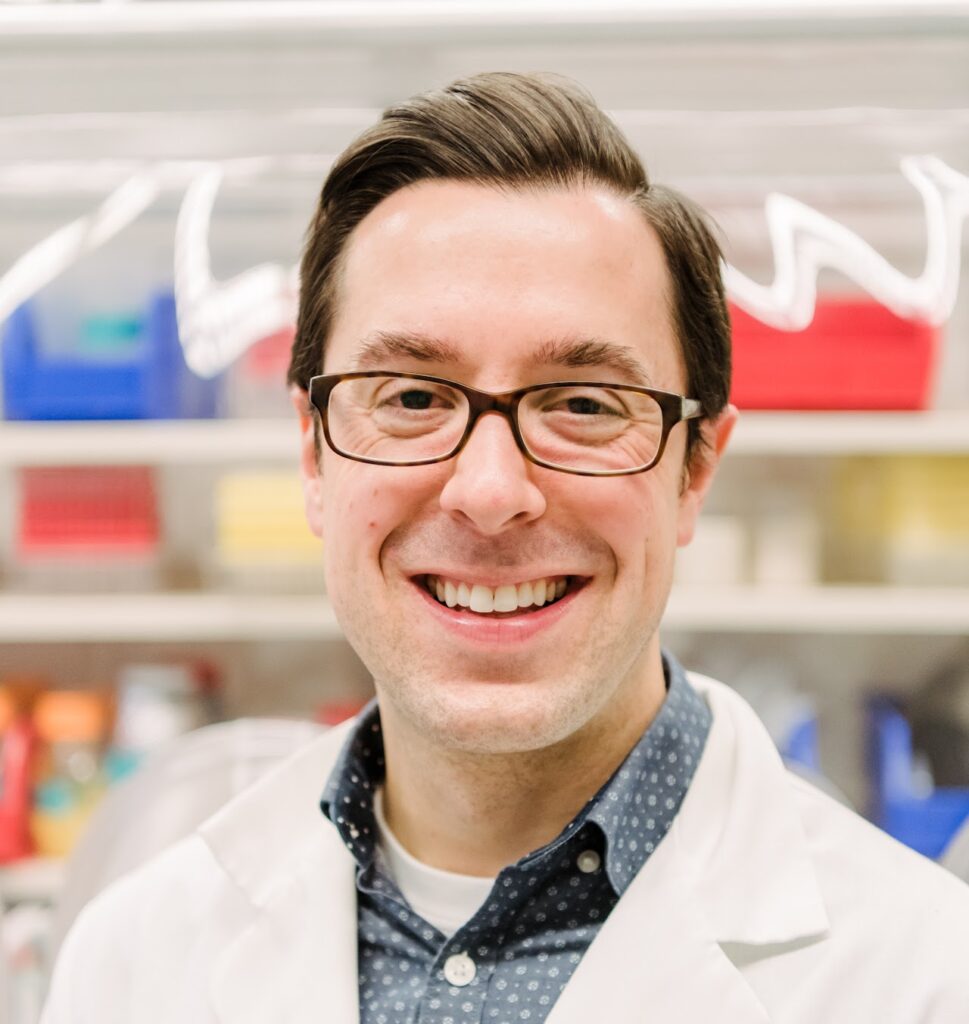 Aaron Smith has led the CBI program since 2022. (Marlayna Demond ’11/UMBC)
Smith took on leading CBI in 2022, after serving as assistant director under previous director Katherine Seley Radtke, professor of chemistry and biochemistry. “It’s a ton of work, but the benefits far outweigh the amount of time and effort that it takes to keep this program running,” he says. “It’s just a fantastic program.”
As Wardrup notes, “It can feel uncomfortable to step outside of your comfort zone to explore something new, but CBI is an extremely supportive environment to take that first step.” Riley echoes this sentiment. “Graduate school is one of the best times in your life to really dig deep and learn as many things as you can,” he says. “You will be surprised how some skills or knowledge will be relevant in your early career.”
The CBI program, with its focus on interdisciplinary training and community building, provides the perfect platform for students to do just that—equipping them with the confidence, skills, and networks to excel.
]]>
For over 20 years, the Chemistry Biology Interface (CBI) program at UMBC has been shaping Ph.D. students into leaders who bridge chemistry and biology. Programs like CBI are critical to help meet...
https://umbc.edu/stories/chemistry-biology-interface-program-impact/
https://beta.my.umbc.edu/api/v0/pixel/news/151067/guest@my.umbc.edu/4b8db02c66ed351fd8a0624d49dd504a/api/pixel
alumni
biology
chembiochem
cnms
gradresearch
news
research
science-and-tech
story
UMBC News & Magazine
https://beta.my.umbc.edu/groups/umbc-news-magazine
https://assets1-beta.my.umbc.edu/system/shared/avatars/groups/000/001/943/24435aa6207c452e7bc15cc74b42c7bb/xsmall.png?1748556657
https://assets1-beta.my.umbc.edu/system/shared/avatars/groups/000/001/943/24435aa6207c452e7bc15cc74b42c7bb/original.png?1748556657
https://assets2-beta.my.umbc.edu/system/shared/avatars/groups/000/001/943/24435aa6207c452e7bc15cc74b42c7bb/xxlarge.png?1748556657
https://assets2-beta.my.umbc.edu/system/shared/avatars/groups/000/001/943/24435aa6207c452e7bc15cc74b42c7bb/xlarge.png?1748556657
https://assets3-beta.my.umbc.edu/system/shared/avatars/groups/000/001/943/24435aa6207c452e7bc15cc74b42c7bb/large.png?1748556657
https://assets1-beta.my.umbc.edu/system/shared/avatars/groups/000/001/943/24435aa6207c452e7bc15cc74b42c7bb/medium.png?1748556657
https://assets2-beta.my.umbc.edu/system/shared/avatars/groups/000/001/943/24435aa6207c452e7bc15cc74b42c7bb/small.png?1748556657
https://assets1-beta.my.umbc.edu/system/shared/avatars/groups/000/001/943/24435aa6207c452e7bc15cc74b42c7bb/xsmall.png?1748556657
https://assets2-beta.my.umbc.edu/system/shared/avatars/groups/000/001/943/24435aa6207c452e7bc15cc74b42c7bb/xxsmall.png?1748556657
UMBC News & Magazine
0
0
false
Thu, 17 Jul 2025 12:02:54 -0400
Thu, 17 Jul 2025 12:02:54 -0400
New pollinator garden builds on years of effort to support wildlife on campus
UMBC recently unveiled a new organic pollinator garden at the Center for Well-Being. The new garden builds on years of work to support wildlife on campus, including pollinator gardens, enhanced habitat at the Library Pond, increasing use of native plants in campus flower beds, a major stream restoration of Herbert Run, and a commitment to long-term conservation of The Knoll, a forest patch on campus that includes trees older than the university.
The new pollinator garden qualifies as a National Wildlife Federation Certified Wildlife Habitat and a Monarch Watch Waystation. The garden includes milkweed plants funded by a grant from Monarch Watch and additional species from Chesapeake Natives, a local nonprofit dedicated to supplying plants native to the coastal and Piedmont regions of the Chesapeake Bay Watershed for home and public landscapes.
The new garden and the UMBC sustainability and grounds teams’ other work to promote ecosystem health on campus also brings UMBC one step closer to achieving the next level in the Green Grounds certification program.
“I am excited that UMBC continues to invest in native habitats on our campus. I’m inspired by the amount of wildlife activity I encounter when I walk around, and it reminds me we can create flourishing habitats even in small spaces,” shares Taylor Smith, assistant director of sustainability. “The new pollinator garden is already filling in, and our pollinators are loving it!”
A monarch butterfly enjoys a swamp milkweed plant in the new pollinator garden. (Nicole Wolf)
]]>
UMBC recently unveiled a new organic pollinator garden at the Center for Well-Being. The new garden builds on years of work to support wildlife on campus, including pollinator gardens, enhanced...
https://umbc.edu/quick-posts/pollinator-garden-supports-wildlife/
https://beta.my.umbc.edu/api/v0/pixel/news/151049/guest@my.umbc.edu/84ae146ada82e1c6e32fe683bc62d295/api/pixel
community
news
quick-post
science-and-tech
sustainability
UMBC News & Magazine
https://beta.my.umbc.edu/groups/umbc-news-magazine
https://assets1-beta.my.umbc.edu/system/shared/avatars/groups/000/001/943/24435aa6207c452e7bc15cc74b42c7bb/xsmall.png?1748556657
https://assets1-beta.my.umbc.edu/system/shared/avatars/groups/000/001/943/24435aa6207c452e7bc15cc74b42c7bb/original.png?1748556657
https://assets2-beta.my.umbc.edu/system/shared/avatars/groups/000/001/943/24435aa6207c452e7bc15cc74b42c7bb/xxlarge.png?1748556657
https://assets2-beta.my.umbc.edu/system/shared/avatars/groups/000/001/943/24435aa6207c452e7bc15cc74b42c7bb/xlarge.png?1748556657
https://assets3-beta.my.umbc.edu/system/shared/avatars/groups/000/001/943/24435aa6207c452e7bc15cc74b42c7bb/large.png?1748556657
https://assets1-beta.my.umbc.edu/system/shared/avatars/groups/000/001/943/24435aa6207c452e7bc15cc74b42c7bb/medium.png?1748556657
https://assets2-beta.my.umbc.edu/system/shared/avatars/groups/000/001/943/24435aa6207c452e7bc15cc74b42c7bb/small.png?1748556657
https://assets1-beta.my.umbc.edu/system/shared/avatars/groups/000/001/943/24435aa6207c452e7bc15cc74b42c7bb/xsmall.png?1748556657
https://assets2-beta.my.umbc.edu/system/shared/avatars/groups/000/001/943/24435aa6207c452e7bc15cc74b42c7bb/xxsmall.png?1748556657
UMBC News & Magazine
0
0
false
Wed, 16 Jul 2025 12:49:03 -0400
Could a robot dance partner help us de-stress? UMBC researchers explore the ‘algo-rhythmic’ possibilities
It wasn’t your usual scientific research presentation. Two dancers—one representing a robot and the other a human—take turns moving around each other. As the dance progresses the human is at first fearful, then curious, and finally happy.
The performance in June during the Movement, Music, and Brain Health National Science Foundation (NSF) AccelNet meeting on the UMBC campus was the brainchild of three UMBC faculty who have joined forces to explore whether and how dancing robots might offer humans new tools to improve their mental health. The research piggybacks off established practices of human-to-human dance/movement therapy, which can be used to treat some mental health challenges, such as schizophrenia, anxiety and depression.
The exact form that robotic dance therapy might take, and the range of mental health conditions it could treat, are still large open-ended questions for the team, which is led by Ramana Vinjamuri, an associate professor in computer science and electrical engineering, who has done extensive work in brain-computer interfaces, and Andrea Kleinsmith, an associate professor in information systems, who specializes in ways that computers can assess humans’ emotions.
“As a healthcare opportunity, dancing with a robot may sound weird at first,” says Ann Sofie Clemmensen, an associate professor of dance, who is also part of the interdisciplinary team. “Why not just dance with a human?” But, she says, people who are socially isolated or struggle with the stressors of human interactions might benefit from robot partners. “As humans we project emotions on objects, but the objects do not judge back,” she says.
“The most exciting thing about this project for me is the collaboration,” says Vinjamuri. “I’ve never done something like this, and so the possibility to bring these fields together to tackle an important issue like mental health is super exciting.”
First steps
The groundwork for the research was laid as part of over a decade of work in Vinjamuri’s lab searching for “alphabets” or “synergies” of hand movements and associated brain activity that combine to build the variety of our everyday movements. Vinjamuri’s Ph.D. student Parthan Olikkal had recently developed contactless human motion tracking methods, which he applied when teaching humanoid robots these alphabets to form new movements.
Against this backdrop, the spark for the interdisciplinary venture was struck when the College of Engineering and Information Technology (COEIT) launched a “COEIT Interdisciplinary Projects” program to encourage faculty to explore collaborations across disciplines to tackle big challenges. Vinjamuri reached out to Kleinsmith and Clemmensen to discuss the possibility of teaming up.
Together, the researchers developed a project proposal to study key questions surrounding the idea of robot-assisted dance therapy. They named the proposal SIVAM after the Indian mythological god of dance (also short for “Synergy-based, Intuitive, Virtual and Augmented therapy for Mental health”). The research would look into questions such as whether the coordination in a person’s arms and legs could be a proxy measure of mental well-being, how existing dance therapy movements affect brain activity, and how a humanoid robot dance partner compares in effectiveness to a flesh-and-blood one.
Creative solutions at the technological frontiers
Like any big endeavor, the project encountered unexpected hurdles. An existing robot that the team had couldn’t move fast enough or with the full range of motion needed for a dance partner. (A new robot will soon be ordered.) The team also had to wait for delivery of a special EEG cap that could measure a dancer’s brain activity without the typical gel and wires that would get in the way. The cap was also equipped to filter out the signal noise that comes from a person moving around.
When the team realized they would have to wait for the humanoid robot, they pivoted to developing a digital avatar. They designed a camera and software system to track a person’s motions and then created a digital representation of a person to mirror the movements back, a technique in dance/movement therapy.
Developing the motion tracking system was a big part of the project to date. “Even just a few years ago, it was so much more difficult to digitally capture a person’s movements without them wearing reflective markers that a camera can easily track,” says Kleinsmith. Now, the team is using the latest in computer vision and machine learning tools to implement a markerless tracking system. Eliminating the need for specialized attire should make the system more accessible and useful.
The team also laid the groundwork for the next stages of the project by testing sensors, including the new cap and wireless sensors that can measure physiological signals such as heart rate, skin conductance, and body temperature. All the equipment will help the team test novel ways of assessing, and perhaps ultimately altering, human subjects’ emotional states.
“If you tighten your body, that may mean anger or fright, if you are more loose, you are more relaxed,” says Clemmensen. “And it’s possible that you could then guide a person through movement into that emotional state. The next part of this research is to get the data on that, and I’m quite excited about it.”
A technology-infused stage debut
The June performance was a chance for the team to creatively demonstrate their progress to brain researchers and artists from around the world.
In the first half of the performance, the human dancer, performed by UMBC graduate Juju Ayoub ’25, dance, and a “robot” dancer, performed by Sarah McHale ’24, dance, sit opposite one another and take turns moving. Their movements are captured and displayed on a large screen by digital avatars. In the second half, the human and robot meet on the dance floor, while the human cycles through the emotions of fear, curiosity, and happiness. Sensors on Ayoub measured her brain activity, heart rate, and other signals that capture emotions, and displayed them on the screen. The second half of the performance was improvised by the dancers, within an accumulative structure provided by Clemmensen.


On left, dancers Juju Ayoub and Sarah McHale get ready to perform while Ph.D. student Parthan Olikkal sets up equipment. On right, Sarah McHale dances in front of the digital avatars. (Photos by Kiirstn Pagan ’11)
“Philosophically speaking, the first part of the performance represents humans and robots working in their own spaces. Part two is where they’re trying to work together, going through these phases of fear, curiosity, and then finally collaboration—and hopefully a happy collaboration,” says Vinjamuri.
The human researchers on the project have certainly found their own happy collaboration.
Clemmensen said she appreciated how the group’s focus could zoom out and in, transitioning from discussions of big ideas to tackling tricky troubleshooting for one piece of equipment.
“I would like to see if I can take that verbal process into the creative space of dance choreography too,” she says.
The students involved in the project—Olikkal, fellow Ph.D. students Sruthi Sundharram and Golnaz Moharrer, and undergraduates Oritsejolomisan Mebaghanje ’25, computer science, and first-year computer science student Viraj Janeja—agree it was a mind-stretching and rewarding experience.
“I was very excited to be involved in the performance, which was an unusual and creative experience,” says Sundharram, who is a first-year Ph.D. student in computer science in Vinjamuri’s lab and who helped set up and connect the cap and sensors before the dance. “It was nerve-racking right before the start, fearing that something wouldn’t work,” Sundharram laughed. But the dancers helped ease her jitters and the performance went well.
“The best part of the experience for me was seeing the virtual environment for the project come alive,” says Mebaghanje, who worked as the lead software developer on the project. “I also really enjoyed working with my team and debugging issues together.”
Olikkal, who has been involved in the project from the beginning, and who worked primarily on the motion capture system, says he’s been able to hone his career aspirations in a meaningful way after joining Vinjamuri’s lab in 2019 as a master’s student.
“Once I started really putting my heart into the research and seeing how these systems can help people, maybe not always immediately but certainly down the line, I felt like I had found my calling,” he says.
After the dancers exited the stage of the Fine Arts Recital Hall, Vinjamuri took the microphone to thank the whole team. And he hinted at the exciting work that lies ahead: “Maybe next time there will be a real robot on stage.”
]]>
It wasn’t your usual scientific research presentation. Two dancers—one representing a robot and the other a human—take turns moving around each other. As the dance progresses the human is at first...
https://umbc.edu/stories/robot-dance-partner-research/
https://beta.my.umbc.edu/api/v0/pixel/news/150994/guest@my.umbc.edu/d0e8122b74ccd4b9af234dffd3a0e5e8/api/pixel
cahss-research
coeit
csee
dance
is
news
research
science-and-tech
story
UMBC News & Magazine
https://beta.my.umbc.edu/groups/umbc-news-magazine
https://assets1-beta.my.umbc.edu/system/shared/avatars/groups/000/001/943/24435aa6207c452e7bc15cc74b42c7bb/xsmall.png?1748556657
https://assets1-beta.my.umbc.edu/system/shared/avatars/groups/000/001/943/24435aa6207c452e7bc15cc74b42c7bb/original.png?1748556657
https://assets2-beta.my.umbc.edu/system/shared/avatars/groups/000/001/943/24435aa6207c452e7bc15cc74b42c7bb/xxlarge.png?1748556657
https://assets2-beta.my.umbc.edu/system/shared/avatars/groups/000/001/943/24435aa6207c452e7bc15cc74b42c7bb/xlarge.png?1748556657
https://assets3-beta.my.umbc.edu/system/shared/avatars/groups/000/001/943/24435aa6207c452e7bc15cc74b42c7bb/large.png?1748556657
https://assets1-beta.my.umbc.edu/system/shared/avatars/groups/000/001/943/24435aa6207c452e7bc15cc74b42c7bb/medium.png?1748556657
https://assets2-beta.my.umbc.edu/system/shared/avatars/groups/000/001/943/24435aa6207c452e7bc15cc74b42c7bb/small.png?1748556657
https://assets1-beta.my.umbc.edu/system/shared/avatars/groups/000/001/943/24435aa6207c452e7bc15cc74b42c7bb/xsmall.png?1748556657
https://assets2-beta.my.umbc.edu/system/shared/avatars/groups/000/001/943/24435aa6207c452e7bc15cc74b42c7bb/xxsmall.png?1748556657
UMBC News & Magazine
0
0
false
Fri, 11 Jul 2025 11:54:44 -0400
Fri, 11 Jul 2025 11:54:44 -0400
Black hole mergers open doors for students
There are black holes, and then there are supermassive black holes (SMBH), with masses millions to billions of times as great as the Sun. A small percentage of SMBH are furiously gobbling up matter; these are called active galactic nuclei (AGN). Adi Foord, assistant professor of physics, is co-leading a research project designed to further understanding of how this rare type of black hole forms and changes over time.
The project, recently funded by a National Science Foundation (NSF) Astronomy and Astrophysics Research Grant, also creates prime opportunities for undergraduate and graduate students to contribute to the research and connect with leaders in the field for networking and mentorship—experiences with the potential to shape these students’ futures.
In addition to Foord, the three other co-leads are giants in the field of black hole research at institutions with powerhouse astronomy programs: Meg Urry at Yale University, David Sanders at the University of Hawaii, and Nico Cappelluti at the University of Miami. All four co-leads have collaborated for years as members of a research consortium known as the Accretion History of AGN (AHA) group.
“The goal of the NSF project is to try to map out the growth of AGN across cosmic time using as much data as humanly possible,” Foord says. “We’ll be looking at data collected by observatories in space and on the ground over a really wide range of wavelengths.”
By analyzing data from various sources, the team has a better chance of shedding light on how these black holes grow and evolve, “and how their growth mechanisms connect to things like their environments,” Foord adds, “so getting information about the host galaxies that they’re in will be key.”
Foord is particularly interested in what happens when two galaxies, each with a supermassive black hole at its center, merge, and her part of the new grant zeroes in on exploring these merging AGN. For example, the percentage of galaxies that begin to interact and then go on to complete a merger is an open question.
 Adi Foord (left) and Ph.D. students Cassie Daniele (center) and Zack Reeves discuss research data in Foord’s office. (Brad Ziegler/UMBC)
Addressing the bottleneck
Zack Reeves, a UMBC Ph.D. student mentored by Foord, is contributing to the project through his research on dual AGN—pairs of black holes in the early stages of a potential merger. Reeves started with a dataset including 2,684 confirmed AGN, based on data from the X-ray Multi-mirror Mission (XMM) Newton observatory and Sloan Digital Sky Survey. Then he pared down the data further, eventually settling on 38 AGN that met particular data standards.
“This summer, I’m going through each of the XMM X-ray sources, and looking to see if the AGN have any other significant X-ray sources nearby that could indicate a dual AGN,” Reeves says.
XMM Newton includes tools that allow scientists to filter and analyze the data to answer their specific questions, “but the process can be manual and tedious to do observation by observation,” Reeves says. To address that bottleneck, he’s coding a Python script to streamline data analysis, which he’ll run on UMBC’s High-Performance Computing Facility (HPCF), which can analyze all of the samples in parallel, producing results many times faster than completing the task sequentially by hand.
The results will provide important insights into how galaxies and AGN form. Multiple theoretical simulations describe those processes, and “these simulations disagree on certain predictions, like how the dual AGN population will evolve over the course of cosmic time,” Reeves says. “So the interesting part of this project is that we can actually look in space and observationally constrain how this population evolves, and through that we can identify what strengths and weaknesses these simulations have.”
 Weekly lab meetings with Adi Foord, left, allow students to share their progress and ask and answer questions. (Brad Ziegler/UMBC)
Empowering the next generation of astrophysicists
The NSF grant not only creates opportunities for Foord’s students to dive into cutting-edge research—it will also connect them with top scientists and grow their professional networks. For example, Reeves will begin attending regular AHA group meetings this summer and attend the AHA workshop in Miami in December.
Foord considers creating these career-building opportunities for her students a core part of her mission as a faculty member at UMBC.
“It’s really important that we give UMBC students not only great research projects and opportunities, but also visibility to the field and the ability to make connections and network with people,” Foord says.
The grant also funds UMBC undergraduate students to conduct research with the co-leads at their institutions. This summer, funded through the same NSF grant, Katherine Carver, a rising senior physics major, is interning at Yale with Meg Urry.
At Yale, “Networking with so many talented astronomers and physicists and attending unique professional development and astronomy events”—like a workshop on dark matter and a watch party for the reveal of the first Vera Rubin Observatory images—“have been the most beneficial opportunities,” Carver says.
“It’s really important that we give UMBC students not only great research projects and opportunities, but also visibility to the field and the ability to make connections and network with people.”
Adi Foord, assistant professor of physics
“The students are getting an opportunity to learn about what’s going on at these other institutions, how research teams work at these different places, and also to network with scientists there,” Foord says, “and that’s only going to help their careers if they decide to continue in astrophysics.”
“Dr. Foord has been instrumental in my success as an aspiring scientist,” Carver says, “from teaching me how to write scientific proposals to aiding the progression of my research at UMBC.”
Reeves is grateful for Foord’s guidance, too. “She’s teaching me a lot about moves that I should be making right now, and how to network and build connections, and also making those connections for me, which means a lot,” he says.
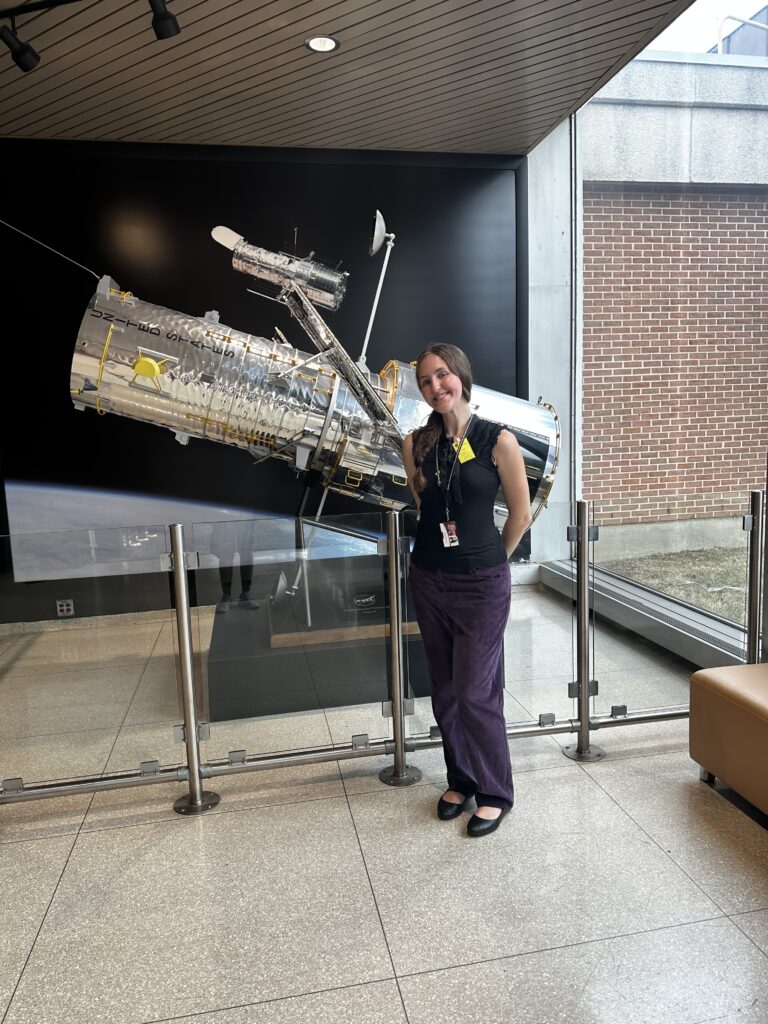 Katherine Carver stands in front of a model of the Hubble Space Telescope at NASA Goddard Space Flight Center in Greenbelt, Maryland. She took a field trip to Goddard in summer 2024 while an intern at the Johns Hopkins Space Telescope Science Institute. (Courtesy of Carver)
Big-picture questions require practical skills
Reeves says that in high school, he romanticized physics; “the lure of figuring out how the universe works” drew him in. Since then, he’s learned that to be successful in the field, big-picture wonder must be backed up with practical skills.
“I consider myself at heart to be an astrophysicist. That’s the dream. That’s what sparks joy in my heart,” he says. Luckily for him, “In practice, I also really enjoy statistics and statistical physics.”
Reeves’ work relies heavily on computer programming, data analysis, and statistics, skills he says are “absolutely critical” for astrophysicists. “I learned quickly in college you have to be really good at problem-solving to succeed in physics,” he notes. Reeves encourages anyone interested in physics to take enough computer science courses to “understand what the code is doing under the hood.” Without that foundation and a solid dose of perseverance, he says, at some point you’ll get stuck.
Thankfully, “Zack is super self-motivated, which is one of the most important aspects to being successful,” Foord says. “I’ve seen so many points in time where he’s hit some sort of wall, and then he comes back the next week and he’s figured out some way to get above that wall.”
 At a lab meeting, Zack Reeves shows how his python script generated the same figure that he created manually previously, demonstrating the code’s efficacy. (Brad Ziegler/UMBC)
Staying close to go far
Carver, too, has picked up additional skills that support her physics research. From her work in Foord’s lab and previous internships at the Johns Hopkins Applied Physics Laboratory and Space Telescope Science Institute, she gained key coding and problem-solving skills. Without that, “I would not have been able to contribute to the level I can now to my project at Yale,” she says. “Those experiences also prepared me to secure the internship.”
Foord’s students benefit from a close relationship with her and other research group members. “The energy in the group meetings and our one-to-ones is always just really positive and encouraging, and there’s no stress,” Reeves says. Foord’s guidance has turbocharged his growth, from tackling advanced projects to presenting his work clearly.
“He already has a really good idea of how to tell a story in a way that will help people who aren’t intimately familiar with his research to understand it,” Foord says.
Through Adi Foord’s mentorship, doors to cutting-edge black hole research have swung wide open for Reeves and Carver, equipping them with skills and networks to explore the cosmos as their careers progress. Already, Reeves is paying it forward, using his communication skills to share his fascination with black holes and spark curiosity about one of the universe’s most mysterious phenomena.
]]>
There are black holes, and then there are supermassive black holes (SMBH), with masses millions to billions of times as great as the Sun. A small percentage of SMBH are furiously gobbling up...
https://umbc.edu/stories/black-hole-mergers-open-doors-for-students/
https://beta.my.umbc.edu/api/v0/pixel/news/150986/guest@my.umbc.edu/f6577e89be8854a0d16bac43da6ba910/api/pixel
cnms
gradresearch
news
physics
research
science-and-tech
story
undergradresearch
UMBC News & Magazine
https://beta.my.umbc.edu/groups/umbc-news-magazine
https://assets1-beta.my.umbc.edu/system/shared/avatars/groups/000/001/943/24435aa6207c452e7bc15cc74b42c7bb/xsmall.png?1748556657
https://assets1-beta.my.umbc.edu/system/shared/avatars/groups/000/001/943/24435aa6207c452e7bc15cc74b42c7bb/original.png?1748556657
https://assets2-beta.my.umbc.edu/system/shared/avatars/groups/000/001/943/24435aa6207c452e7bc15cc74b42c7bb/xxlarge.png?1748556657
https://assets2-beta.my.umbc.edu/system/shared/avatars/groups/000/001/943/24435aa6207c452e7bc15cc74b42c7bb/xlarge.png?1748556657
https://assets3-beta.my.umbc.edu/system/shared/avatars/groups/000/001/943/24435aa6207c452e7bc15cc74b42c7bb/large.png?1748556657
https://assets1-beta.my.umbc.edu/system/shared/avatars/groups/000/001/943/24435aa6207c452e7bc15cc74b42c7bb/medium.png?1748556657
https://assets2-beta.my.umbc.edu/system/shared/avatars/groups/000/001/943/24435aa6207c452e7bc15cc74b42c7bb/small.png?1748556657
https://assets1-beta.my.umbc.edu/system/shared/avatars/groups/000/001/943/24435aa6207c452e7bc15cc74b42c7bb/xsmall.png?1748556657
https://assets2-beta.my.umbc.edu/system/shared/avatars/groups/000/001/943/24435aa6207c452e7bc15cc74b42c7bb/xxsmall.png?1748556657
UMBC News & Magazine
1
0
false
Thu, 10 Jul 2025 17:06:49 -0400
Thu, 10 Jul 2025 17:06:49 -0400
UMBC’s Koirala Lab celebrates students’ award-winning RNA research and peer mentorship
A talented trio of students has earned accolades for their innovative work with Deepak Koirala, assistant professor of chemistry and biochemistry. Their awards are replicating like the RNA they study, as they unravel the complexities of viral RNA and reveal potential therapeutic targets.
Manju Ojha, Ph.D. candidate in biochemistry, Megan Nguyen, rising senior biochemistry and molecular biology major, and Jason Daniels ’25, biochemistry and psychology, all members of Koirala’s lab, recently received awards for their joint research on RNA.
Ojha received the Robert F. Steiner Award in recognition of her significant research contributions and dedicated mentorship of undergraduate students. The award was established in 1999 by Robert Cotter and Catherine Fenselau, former chair of the Department of Chemistry and Biochemistry at UMBC, in tribute to Steiner, a former UMBC faculty member and pioneer in biophysical chemistry.
“This award highlights the growing impact of our work on understanding RNA structure, RNA-protein interactions, and viral replication mechanisms—an area that remains central to advancing structural virology and therapeutic development,” Ojha says. “The recognition underscores the importance of tackling complex questions in RNA structure and function using integrative biochemical and structural approaches.”
 Jason Daniels (right) discusses a research poster with his mentor, Deepak Koirala (center), and lab mate Megan Nguyen, outside the Koirala Lab.
Students at the center of the lab
Koirala’s group focuses on viruses whose genomes are made of RNA, which include those that cause diseases like polio, the common cold, and more. The group is developing novel techniques to determine the 3D structures of RNA, plus running experiments to figure out how RNA structures in the viruses interact with their host cell’s machinery. Students are deeply involved in all of it.
Nguyen has been studying the structure and function of plant RNAs under Ojha’s mentorship since 2023. Plant viruses are a major challenge for some crops. This spring, Nguyen received the Satterfield-Bell Scholarship, established in 2001, which recognizes an outstanding junior in chemistry who has conducted research.
“I have learned so many techniques and so much scientific theory from Manju and other lab members,” Nguyen says. “I’m thankful for this amazing experience and to be recognized for it. However, with the mentorship I’ve received over the past three years, I know this award is not only my own, but everyone’s in the Koirala lab.”
Daniels has leveraged his experience in the Koirala lab into a competitive summer research program, the Children’s Hospital of Philadelphia Research Institute Summer Scholars Program. His long-term goal is to pursue an M.D. Daniels received the Faculty Award for Excellence in Biochemistry, given to a graduating biochemistry major who displays excellence in the classroom and the laboratory.
“I can confidently say that the Koirala lab has been transformative in my academic career and future in science,” Daniels says. “This would not have been possible without mentorship from Manju and Dr. Koirala.”
 Koirala’s lab group includes many undergraduate and graduate students who support and encourage each other. (Marlayna Demond ’11/UMBC)
]]>
A talented trio of students has earned accolades for their innovative work with Deepak Koirala, assistant professor of chemistry and biochemistry. Their awards are replicating like the RNA they...
https://umbc.edu/stories/student-awards-rna-research/
https://beta.my.umbc.edu/api/v0/pixel/news/150930/guest@my.umbc.edu/40a6d0f2568c08a9077487402f6fec48/api/pixel
chembiochem
cnms
news
research
science-and-tech
story
undergradresearch
UMBC News & Magazine
https://beta.my.umbc.edu/groups/umbc-news-magazine
https://assets1-beta.my.umbc.edu/system/shared/avatars/groups/000/001/943/24435aa6207c452e7bc15cc74b42c7bb/xsmall.png?1748556657
https://assets1-beta.my.umbc.edu/system/shared/avatars/groups/000/001/943/24435aa6207c452e7bc15cc74b42c7bb/original.png?1748556657
https://assets2-beta.my.umbc.edu/system/shared/avatars/groups/000/001/943/24435aa6207c452e7bc15cc74b42c7bb/xxlarge.png?1748556657
https://assets2-beta.my.umbc.edu/system/shared/avatars/groups/000/001/943/24435aa6207c452e7bc15cc74b42c7bb/xlarge.png?1748556657
https://assets3-beta.my.umbc.edu/system/shared/avatars/groups/000/001/943/24435aa6207c452e7bc15cc74b42c7bb/large.png?1748556657
https://assets1-beta.my.umbc.edu/system/shared/avatars/groups/000/001/943/24435aa6207c452e7bc15cc74b42c7bb/medium.png?1748556657
https://assets2-beta.my.umbc.edu/system/shared/avatars/groups/000/001/943/24435aa6207c452e7bc15cc74b42c7bb/small.png?1748556657
https://assets1-beta.my.umbc.edu/system/shared/avatars/groups/000/001/943/24435aa6207c452e7bc15cc74b42c7bb/xsmall.png?1748556657
https://assets2-beta.my.umbc.edu/system/shared/avatars/groups/000/001/943/24435aa6207c452e7bc15cc74b42c7bb/xxsmall.png?1748556657
UMBC News & Magazine
0
0
false
Mon, 07 Jul 2025 10:53:54 -0400
Mon, 07 Jul 2025 10:53:54 -0400
Koirala’s lab group includes many undergraduate and graduate students who support and encourage each other. (Marlayna Demond ’11/UMBC)
]]>
A talented trio of students has earned accolades for their innovative work with Deepak Koirala, assistant professor of chemistry and biochemistry. Their awards are replicating like the RNA they...
https://umbc.edu/stories/student-awards-rna-research/
https://beta.my.umbc.edu/api/v0/pixel/news/150930/guest@my.umbc.edu/40a6d0f2568c08a9077487402f6fec48/api/pixel
chembiochem
cnms
news
research
science-and-tech
story
undergradresearch
UMBC News & Magazine
https://beta.my.umbc.edu/groups/umbc-news-magazine
https://assets1-beta.my.umbc.edu/system/shared/avatars/groups/000/001/943/24435aa6207c452e7bc15cc74b42c7bb/xsmall.png?1748556657
https://assets1-beta.my.umbc.edu/system/shared/avatars/groups/000/001/943/24435aa6207c452e7bc15cc74b42c7bb/original.png?1748556657
https://assets2-beta.my.umbc.edu/system/shared/avatars/groups/000/001/943/24435aa6207c452e7bc15cc74b42c7bb/xxlarge.png?1748556657
https://assets2-beta.my.umbc.edu/system/shared/avatars/groups/000/001/943/24435aa6207c452e7bc15cc74b42c7bb/xlarge.png?1748556657
https://assets3-beta.my.umbc.edu/system/shared/avatars/groups/000/001/943/24435aa6207c452e7bc15cc74b42c7bb/large.png?1748556657
https://assets1-beta.my.umbc.edu/system/shared/avatars/groups/000/001/943/24435aa6207c452e7bc15cc74b42c7bb/medium.png?1748556657
https://assets2-beta.my.umbc.edu/system/shared/avatars/groups/000/001/943/24435aa6207c452e7bc15cc74b42c7bb/small.png?1748556657
https://assets1-beta.my.umbc.edu/system/shared/avatars/groups/000/001/943/24435aa6207c452e7bc15cc74b42c7bb/xsmall.png?1748556657
https://assets2-beta.my.umbc.edu/system/shared/avatars/groups/000/001/943/24435aa6207c452e7bc15cc74b42c7bb/xxsmall.png?1748556657
UMBC News & Magazine
0
0
false
Mon, 07 Jul 2025 10:53:54 -0400
Mon, 07 Jul 2025 10:53:54 -0400