Urgent Care

This is what it looks like when researchers push beyond band-aid solutions and design better answers to pressing medical and mental-health issues.
The Patapsco Valley might not bring to mind the disruption of the technology industry the way Silicon Valley has defined itself, but UMBC student and faculty researchers are aggressively tackling disparities related to health care and changing the way people around the world access health technologies.
As a public university, UMBC’s scientific community is actively researching ways to alleviate public-health problems. In some labs this means changing the focus of research to address a more pressing medical issue, like Ph.D. student Mustafa Al-Adhami did when he veered away from studying water purification to address sepsis, a life-threatening condition that strikes over a million Americans each year.
Another example is UMBC faculty member Govind Rao, who feels a sense of urgency in addressing critical challenges that are impacting people’s quality of life. Rao, a professor of chemical, biochemical, and environmental engineering, and director of UMBC’s Center for Advanced Sensor Technology (CAST), sees UMBC students and professors using their skills and interests to make health technologies more equitable, more affordable, and more sustainable. A central focus of Rao’s collaborative work is creating health-care solutions that are not restrained by cost or geography, like an award-winning cardboard incubator his lab produced, accessible for communities with limited resources.
Rao refers to his research and the technologies he’s developed as “disruptive innovations,” and he’s not the only UMBC researcher who is working to help people change how they approach and access medical care. These developments offer novel solutions to challenges facing the world, and faculty and staff at UMBC are changing the way people receive medical care and support from medical providers.
“If I can empower students to think and come up with solutions that have a green footprint and are lower cost and sustainable, I think we can bend the curve,” explains Rao.
Treating sepsis with more accuracy
Mustafa Al-Adhami, M.S ’15, Ph.D. ’19, mechanical engineering, credits a conversation with his wife Stephanie Al-Adhami, a nurse, in changing the focus of his research. At the time Al-Adhami was working to develop a device to determine whether water was safe to consume, but after discovering devices on the market that could already filter most water to make it potable, he shifted his work to address another prevalent challenge that people around the world are facing. “We just pivoted from water to actual blood with this specific application,” he says.
Sepsis is a serious blood infection that, if not treated properly and promptly, can lead to serious complications and even death in mere days. Those at highest risk are the most vulnerable: infants, children, the elderly, and those already facing severe medical problems. According to the Centers for Disease Control and Prevention, more than one million people fight sepsis each year and about a quarter of these cases are fatal. Discouragingly, the number of sepsis cases each year is also on the rise. Al-Adhami and others are working to reverse the trend.

The challenge for physicians isn’t determining whether a person has sepsis, explains Al-Adhami, but rather identifying which antibiotics to administer to the patient. “With every one hour without proper treatment, there is a 7% less chance of survival,” he says.
Working with faculty and student researchers in CAST, Al-Adhami developed a rapid bacterial-detection test that can determine whether a patient has an infection within an hour and helps physicians determine which specific antibiotics should be administered to help fight the infection. Al-Adhami’s device, ASTEK, costs a fraction of the price of the current antibiotic susceptibility test, can reduce the duration of hospital stays, and can prevent antibiotic resistance by avoiding unnecessary antibiotic use.
In addition to its cost effectiveness, ASTEK only requires one milliliter of blood to be run. This is a breakthrough in detecting sepsis in young children. “For [traditional] blood cultures, they take four bottles of blood. Each one is eight milliliters,” explains Al-Adhami. “Because we don’t need this much blood, it could be used for newborns…the concentration of bacteria is much higher in infants.”
The device has successfully been tested in mice, and Al-Adhami hopes that it will be ready for human testing in the next couple of years. If the device is approved for human use, it has the potential to save thousands of patients each year by speeding up the process of diagnosing and administering the correct antibiotics.
Understanding behavior through social media analytics
According to the U.S. Department of Health and Human Services, more than 130 people die from opioid-related overdoses each day, and there are over 14,000 substance abuse facilities across the U.S. that treat people facing these addictions. The opioid epidemic affects every region of the country, and those watching loved ones go through the cycle of substance abuse are seeking any new ways to halt this disease in its tracks.
 Shimei Pan, assistant professor of information systems, is studying human behavior in the context of monitoring, preventing, and treating substance-abuse by analyzing how people with substance use disorders behave on social media. “On social media, there is a lot of information about each individual. Some are related to substance use, like drinking, smoking, and illicit drug use,” she says.
Pan and her collaborator Warren Bickel, a well-known behavior scientist at the Virginia Tech Addiction Treatment Center, are employing large-scale social media analytics to better understand addiction and help medical professionals provide personalized treatment to people facing addiction and substance abuse.
The clues Pan and Bickel are looking for in social media data are subtle, but have the potential to alter the way substance abuse is identified and subsequently treated. “Sometimes, people explicitly mention substance use in their social media posts,” she shares. “These are useful signals. But there are other signals in social media, sometimes even stronger than explicit mentions of substances. Substance abuse is frequently linked to mental disorders such as depression, anxiety and impulsivity. As a result, social media behavior signals related to depression, anxiety and impulsivity can also be very useful in helping us detect and understand substance abuse”
Since substance abuse could be explained by both genetic and environmental factors, with large-scale social media analytics it is possible to identify distinct patterns in its manifestation on social media, says Pan. “We want to see whether we can find those behavioral markers of addiction on social media. By identifying these markers, we can understand substance abuse a little bit better.”
Pan and her collaborators plan to continue conducting basic research, and hope to help develop new screening, diagnostic, and intervention tools in the future—another way of building a bridge to proper health care access for all.
Studying stigma and pain
Another UMBC faculty member studying human behavior is Shawn Bediako, associate professor of psychology, who focuses on the psychosocial impact of sickle cell disease. Bediako is using new technologies to assess sickle cell patients’ pain and experiences.
Previously, Bediako and his collaborators collected data using paper surveys that were sent to patients and required that patients mail them back each week. “We didn’t know when they filled [the surveys] out,” he says. “All we knew is that they would send us a packet back.”
The development of a new app-based tool, however, lessened the lag in survey responses. This new approach gives researchers a more accurate picture by providing data with integrity. Bediako explains that the app allows patients to submit their experiences directly and enables researchers like him to pose bold, new questions to patients. Each night at 7 p.m., the patients automatically receive a survey to fill out by midnight. The rapid turnaround and ease of completing the survey also “cut down on data contamination,” he says.
“Now that data analytics has expanded the range of online behaviors that we can examine, researchers like me can think about the links between health care and health outcomes in a different way,” Bediako explains.
Bediako, who is also the facilitator for UMBC’s Collaborative for the Interdisciplinary Promotion of Health Equity Research (CIPHER), hopes that his work bridges the gap between people who are doing research on sickle cell disease and people who are studying how innovative technologies can be utilized to help people with the disease. “I’m currently integrating information from history, policy, sociology, psychology, and medicine to better understand the genetics of sickle cell pain,” he says, adding this requires some “out-of-the-box type thinking.”
Like Pan, Bediako is interested in how people’s social media use differs depending on whether they are in pain versus not in pain. “Now that data analytics has expanded the range of online behaviors that we can examine, researchers like me can think about the links between health care and health outcomes in a different way,” he explains.
Supporting first responders
In a broad collaboration to understand how the stressful situations first responders encounter in their jobs can lead to anxiety and other mental health issues, UMBC faculty in emergency health services (EHS) and information systems are using existing technologies to tackle the task. Principal investigator Andrea Kleinsmith, assistant professor of information systems, is collaborating with J. Lee Jenkins, associate professor and chair of emergency health services; Helena Mentis, associate professor of information systems and associate dean in the College of Engineering and Information Technology; and Gary Williams, acting paramedic director in emergency health services.
Trainees and first responders on the job may experience an array of physiological responses when they are in a situation that is tense or challenging. UMBC students in their third and fourth years of the emergency health services program move through a series of often intense scenarios in the simulation lab in Sherman Hall to prepare them for a range of situations they may encounter on the job. Involuntary bodily reactions such as increased heart rates or perspiration are tracked by wearable devices, and allow the instructors and trainees the opportunity to assess and manage stress and improve the preparedness for future emergency scenarios.

Working with student researchers, the faculty members design, develop, and evaluate the system to assess how discussions and intentional in-class reflections on stressful situations can help trainees implement stress management strategies during their work. The team is studying how a Team Stress Reflection system can be used by paramedic trainees to “understand the events that trigger stress increases and their ability to mitigate that stress,” according to the grant proposal. This technology allows the students to identify and better understand the correlations between stressful situations and their physiological responses.
Stress, explains Kleinsmith, can lead to errors during care and long-term health concerns for medical personnel, including emergency health professionals. Williams says that it’s important for students to debrief and reflect on the simulation to make sure that they can address any stressors or points that caused them to have strong physiological responses.
“The ability to monitor and manage stress in medical personnel has the potential to improve medical care provided in stressful situations,” explains Kleinsmith.
Understanding the physiological responses during training exercises is important for trainees, explains Williams, because it allows them to improve how they cope with stress in situations that they may encounter on the job. This research is being funded by a three-year grant from the National Science Foundation, which supports the faculty in collecting data from the EHS students and developing the interface to help the students come to their own conclusions about the correlation between physiological measurements and stress to understand their stress triggers. The interface also helps facilitate the team’s discussion about stress.
Motion sensors to inform treatment

Helena Mentis is also using activity trackers and other motion sensors to assess movement and inform treatment for patients with Parkinson’s disease. In collaboration with faculty at the University of Maryland Parkinson Disease and Movement Disorders Center, Mentis designed and developed a sensor using Leap Motion devices to track and assess the movement of patients with Parkinson’s disease during deep brain stimulation.
One observation that Mentis and her collaborators made was that the presentation of data collected from the sensors impacted how the data was interpreted and used to develop customized treatment plans for patients. In 2017, Mentis presented a paper at the Association for Computing Machinery Special Interest Group on Computer-Human Interaction Conference. The paper explains that the data collected by the patients’ activity trackers led to more informed conversations between the patient with Parkinson’s and their physician.
In a well-researched disease like Parkinson’s, there’s still always room for improvements in care and access to care. Researchers have been studying Parkinson’s disease and treatment options for people with Parkinson’s since the 1960s, but there is still work to be done. Every advancement leads to better outcomes and an increased quality of life for Parkinson’s patients. Mentis and her collaborators are now using self-tracking technologies to help physicians customize treatment plans and advocate for patients.
“Determining how sensor data can be incorporated in shared decision-making is fundamental to effective patient-centered care,” explains Mentis. “Even more so for low-resource and marginalized communities, where sensor data could easily be used by medical caregivers to argue for diagnoses or treatments that are based on assumptions and biases. The sensor data in itself does not embody truth and instead should be taken into account alongside a holistic understanding of the patient and their circumstances.”
Doing good through “disruptive innovations”
Through his work, Rao focuses on addressing critical challenges by answering the fundamental question: “How can we help them?”
“These are real lives, real people who are living in desperate conditions,” Rao says, noting that he aims to empower his students to think about how they can make positive changes through their work. Rao explains that his multidisciplinary approach to research has allowed him and his colleagues and students to make tremendous impacts related to health technology. CAST allows him to work with faculty and students from a range of disciplines, and he believes it is important for engineers, scientists, sociologists and psychologists, and policymakers to have a seat at the table, because each perspective is so valuable.

“Disruptive innovation” refers to technologies and other developments that offer novel solutions to challenges facing the world. Like Bediako and other colleagues at UMBC, Rao challenges his students to consider new approaches to addressing challenges and needs in the health technologies space.
While Rao leads this research, he is quick to point out that the collaborative nature of the work and the contributions of his students are crucial to its success. “It’s not about me,” he says. “I’m just privileged enough to have such an amazing team across several disciplines and backgrounds. It’s just a blast.”
With funding and support from federal agencies, including the Defense Advanced Research Projects Agency, Rao has developed a bioreactor or “biomod” that fits inside a suitcase and allows pharmaceuticals to be produced on demand and with limited resources and time. The device was developed with soldiers in conflict zones in mind because it allows them to quickly create customized medicines to save lives based on the needs of the patient.
Additionally, Rao and his colleagues have developed low-cost incubators to support premature babies in communities with limited resources and in areas that do not have access to robust medical facilities. His research team was presented with the 2019 Global Health Research Award at the Pediatric Academic Societies Meeting in Baltimore.
The question “What have you done for others?” is the driving force behind Rao’s lab. He says that many of the health technologies that are currently available are only affordable to a small group of people, and are only helping the people who can afford them. “Just spending five to 10 minutes a day thinking about what they [students] can do with their skill set to improve the lives of others, that’s all it takes to change the world,” Rao says.
*****
All illustrations by Brucie Rosch.
]]>
This is what it looks like when researchers push beyond band-aid solutions and design better answers to pressing medical and mental-health issues. The Patapsco Valley might not bring to mind the...
https://umbc.edu/stories/tackling-disparities-related-to-healthcare-and-care-access/
https://beta.my.umbc.edu/api/v0/pixel/news/120106/guest@my.umbc.edu/2fe6c14f2765ff8f2122bf8dbbdfe314/api/pixel
cast
coeit
discovery
feature
graduateschool
spring-2019
UMBC News & Magazine
https://beta.my.umbc.edu/groups/umbc-news-magazine
https://assets1-beta.my.umbc.edu/system/shared/avatars/groups/000/001/943/24435aa6207c452e7bc15cc74b42c7bb/xsmall.png?1748556657
https://assets1-beta.my.umbc.edu/system/shared/avatars/groups/000/001/943/24435aa6207c452e7bc15cc74b42c7bb/original.png?1748556657
https://assets2-beta.my.umbc.edu/system/shared/avatars/groups/000/001/943/24435aa6207c452e7bc15cc74b42c7bb/xxlarge.png?1748556657
https://assets2-beta.my.umbc.edu/system/shared/avatars/groups/000/001/943/24435aa6207c452e7bc15cc74b42c7bb/xlarge.png?1748556657
https://assets3-beta.my.umbc.edu/system/shared/avatars/groups/000/001/943/24435aa6207c452e7bc15cc74b42c7bb/large.png?1748556657
https://assets1-beta.my.umbc.edu/system/shared/avatars/groups/000/001/943/24435aa6207c452e7bc15cc74b42c7bb/medium.png?1748556657
https://assets2-beta.my.umbc.edu/system/shared/avatars/groups/000/001/943/24435aa6207c452e7bc15cc74b42c7bb/small.png?1748556657
https://assets1-beta.my.umbc.edu/system/shared/avatars/groups/000/001/943/24435aa6207c452e7bc15cc74b42c7bb/xsmall.png?1748556657
https://assets2-beta.my.umbc.edu/system/shared/avatars/groups/000/001/943/24435aa6207c452e7bc15cc74b42c7bb/xxsmall.png?1748556657
UMBC News & Magazine
0
0
false
Mon, 17 Jun 2019 19:56:07 -0400
Learning from Ellicott City
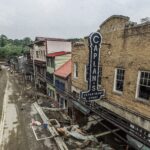
In the aftermath of two “1000-year” floods in three years, can experts, officials, and residents agree on a way to prevent the next big one while preserving this historic town?
By Sarah Hansen M.S. ’15
Ellicott City, Maryland, rests in a steep, narrow valley at the confluence of the Tiber River, its smaller unnamed tributaries, and the much larger Patapsco River. All that water power made it the perfect place to build a mill town—as brothers Jonathan and George Ellicott did beginning in 1772.
The mill town flourished in the 1800s and was the first stop on the Baltimore and Ohio Main Line railroad (the first railroad in the United States) beginning in 1831. Housing and shops quickly sprang up along the winding street to service residents and visitors.
Today, Wilkins Rogers Mills still processes flours and cornmeal on the old site, and the B&O rail station at Ellicott City is the oldest surviving rail station in the United States. It was designated a National Historical Landmark in 1968, and the Main Street area, which retains over 200 historic buildings, was listed on the National Register of Historic Places in 1978.
But while much has stayed the same, much has also changed since Ellicott Mills’ 19th-century heyday. Rather than workaday folk gathering sundries on Main Street, droves of tourists and preservation enthusiasts now stroll the charming byway to patronize boutique shops and cafés.
Or, they used to.
 Main Street in Ellicott City is seen from above the day after a flash flood devastated the historic city on the Patapsco River. Photo: Jerry Jackson, permission from Baltimore Sun Media. All rights reserved.
In 2016, and then, extraordinarily, again in the spring of 2018, Historic Ellicott City was ravaged by flash floods that trapped diners in restaurants’ upper stories, saw empty cars and trucks careening down Main Street, destroyed homes and businesses, left debris for miles downstream, and, in total, took three lives.
The events, both dubbed “1000-year floods” in the media, have left residents and business owners with the tough decision to stay or go. The Howard County government is faced with a dilemma, too: Ellicott City is a popular attraction and has been an economic powerhouse in the county for decades. But when storms come, as they inevitably do, it becomes very dangerous, very quickly.
The floods are changing
“Ellicott City was put there for a reason, to take advantage of water power,” says Andrew Miller, professor of geography and environmental systems. “Therefore, nobody should be surprised that water power is a potential hazard.”
Faculty in UMBC’s geography and environmental systems (GES) department have been studying the local watershed for years. Miller has a particular interest in the role floods play in shaping stream channels and the local ecosystem. Matthew Baker studies watershed ecology and has been deeply involved with the removal of a dam just downstream from Ellicott City. Jeffrey Halverson is a regular contributor to The Washington Post, where he explains the mechanics of regional storm systems for the general public.
Miller says the dam project and flooding studies provide unique opportunities to study aspects of stream ecology, such as sediment movement, from interesting angles. “It’s very rare to have a research project that falls into your lap that’s two miles from your office,” he says, “and to have multiple research projects within two miles of your office intersect with each other is even more unusual.”
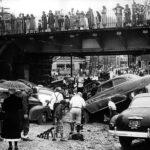
Flooding in Ellicott City is nothing new. One of the worst floods was in 1972, when Hurricane Agnes caused the Patapsco River to overflow its banks by 14.5 feet and fill the lower end of Ellicott City’s Main Street. This was a flood “from the bottom up,” explains Halverson. Most of the town’s previous flooding events have happened in a similar fashion—a massive rainfall event deluges the entire region, and the river slowly rises until it can no longer contain the water. Crucially, residents have plenty of time to evacuate in these storms.
 Flood waters on Main Street in Ellicott City, 1972. Photo from the Howard County Historical Society.
But the 2016 and 2018 floods were different. Rather than heavy rain everywhere over an extended period, forecasters predicted potentially devastating, shorter-term rainfall at a hyper-local level in both storms. “But there was never any attempt to localize the storm down to the county or sub-county level,” wrote Halverson for Weatherwise. Why? “Our ability to do so is practically non-existent.”
As a result, when the deluges hit Ellicott City in 2016 and 2018, “people barely had time to get to the second floor of the restaurant,” Miller says.
[rara_call_to_action title=”” button_text=”Read More” button_url=”https://umbc.edu/a-timeline-of-resilience-in-flood-prone-town/” target=”_blank” button_align=”center”]A Brief History of Major Ellicott City Floods[/rara_call_to_action]
“It’s not just the rain that makes a flash flood, it’s also the terrain and the nature of the landscape,” Halverson wrote. Considering this, other changes since the 19th century come into play. Ellicott City has become a highly desirable place to live, and suburban development now sprawls in all directions from Main Street.
Development means more impervious surfaces—roads, rooftops, driveways, patios—and impervious surfaces make it harder for a landscape to absorb rainfall. So, in the 2018 flood, when the center of the storm was a bit upstream from Ellicott City, Halverson wrote, “the torrent of stormwater runoff cascaded downslope into the topographic bowl of the town, flooding it from the top down.”
The floods are “an example of effectively a small tributary watershed ‘wagging the dog,’ making the entire Patapsco River flood before the rest of the drainage area contributed,” says Baker.
In both floods, “upslope development undoubtedly made things worse,” Miller says, but isn’t fully to blame. These events “would have exceeded any kind of storm water management that you could have put in,” he says.
Because of the way heavy rainfall on a small section of the watershed can cause severe flash flood events, Baker says, “the Patapsco River is now behaving much more like an urban river…than its general land use would suggest.” Why is less clear. It could be increasing development, or it could be changes in rainfall patterns influenced by climate change. More likely, it’s a combination of both as well as other factors.
What to do?
The local government is grappling with what to do with this beloved—and sometimes deadly—section of town. They commissioned the McCormick Taylor Report to provide a menu of options that could keep the town safe in future events similar to 2016 and 2018 while keeping the town as-is. The recommendations included $35 million in immediate improvements, plus $60 to $85 million more for longer-term projects. It’s hard to imagine anyone being willing to spend that much to protect such a small parcel of property. The plans included everything from “pipe farms” underground to store storm water until it could be released more slowly, to tunneling through bedrock to create a pathway for water through town that wouldn’t disturb the street above.
In September 2018, the county government announced a plan that would involve removing up to 10 of the historic buildings to take people out of harm’s way and improve water flow for the next major flood. The public outcry was swift and powerful, and no demolition has occurred.
[rara_call_to_action title=”” button_text=”Read More” button_url=”https://umbc.edu/an-ounce-of-prevention/” target=”_blank” button_align=”center”]UMBC Experts Discuss Preventing Future Floods[/rara_call_to_action]
Most UMBC scientists prefer not to engage in local politics, but based on their work, they can inform conversations on what the county should consider as they’re making decisions. In the days immediately following both storms, Miller and Halverson were in high demand with the news media. One question that kept coming up was whether another storm of this strength could happen again, and when.
Miller is currently working on a paper using evidence to make the case that “it’s an extraordinary event, but it’s not as extraordinary as we think it is. There’s some evidence, although right now it’s not completely conclusive, that we are seeing greater frequency of large floods,” says Miller. “So you cannot assume something like this just won’t happen again.”
 Parts of Main Street have returned to life by summer 2019. Many stores remained shuttered. Photo by Marlayna Demond ’11.
In its current state, “There’s not enough room for Main Street and the river—that’s why the river flows underneath,” explains Miller. “It’s a pipe dream that you can just make this problem go away.” In fact, dealing with the danger of water is a challenge that will only get worse as climate change leads to more strong storms and rising seas. “This is a microcosm of the much bigger problem that we face on a massive scale in this century,” Miller says.
As a local and a hydrologist, Baker sees both sides of the argument. “I appreciate the historic nature of the community, and I think something would be lost if they tore all those buildings down. At the same time, I can understand why any administrator would want to minimize the risk of loss of life, so that’s totally reasonable as well,” Baker says. “I don’t think there’s a real clear solution here, it’s just a value judgment that people have to decide what is most important in this situation.”
And so, the debate rages on. In the meantime, visitors continue to stroll, shop, and snack at the bright and cheery storefronts along Main Street, albeit in reduced numbers. Some establishments, however, remain shuttered, and storm damage is still visible through dirty windows. The contrast reinforces the fragility of this charming historic oasis, reminding tourists, scientists, and public administrators alike what happened here, and what could happen again.
How the community chooses to proceed is still uncertain, but one hopes the expertise of elected officials, scientists, and the public will all be brought to bear in a way that keeps people safe and allows Ellicott City—in whatever form it eventually takes—to thrive for years to come.
****
Header photo by Mark Baxter @SkySightVIP
]]>
In the aftermath of two “1000-year” floods in three years, can experts, officials, and residents agree on a way to prevent the next big one while preserving this historic town? By Sarah Hansen...
https://umbc.edu/stories/learning-from-ellicott-city/
https://beta.my.umbc.edu/api/v0/pixel/news/120107/guest@my.umbc.edu/721adb1f75d2531e583e20b86efbbf42/api/pixel
discovery
ehs
ellicott-city
publicpolicy
spring-2019
UMBC News & Magazine
https://beta.my.umbc.edu/groups/umbc-news-magazine
https://assets1-beta.my.umbc.edu/system/shared/avatars/groups/000/001/943/24435aa6207c452e7bc15cc74b42c7bb/xsmall.png?1748556657
https://assets1-beta.my.umbc.edu/system/shared/avatars/groups/000/001/943/24435aa6207c452e7bc15cc74b42c7bb/original.png?1748556657
https://assets2-beta.my.umbc.edu/system/shared/avatars/groups/000/001/943/24435aa6207c452e7bc15cc74b42c7bb/xxlarge.png?1748556657
https://assets2-beta.my.umbc.edu/system/shared/avatars/groups/000/001/943/24435aa6207c452e7bc15cc74b42c7bb/xlarge.png?1748556657
https://assets3-beta.my.umbc.edu/system/shared/avatars/groups/000/001/943/24435aa6207c452e7bc15cc74b42c7bb/large.png?1748556657
https://assets1-beta.my.umbc.edu/system/shared/avatars/groups/000/001/943/24435aa6207c452e7bc15cc74b42c7bb/medium.png?1748556657
https://assets2-beta.my.umbc.edu/system/shared/avatars/groups/000/001/943/24435aa6207c452e7bc15cc74b42c7bb/small.png?1748556657
https://assets1-beta.my.umbc.edu/system/shared/avatars/groups/000/001/943/24435aa6207c452e7bc15cc74b42c7bb/xsmall.png?1748556657
https://assets2-beta.my.umbc.edu/system/shared/avatars/groups/000/001/943/24435aa6207c452e7bc15cc74b42c7bb/xxsmall.png?1748556657
UMBC News & Magazine
0
0
false
Mon, 17 Jun 2019 19:32:40 -0400
An Ounce of Prevention
Recovery from the flooding in Ellicott City has been long and difficult, and communities have often been left with more questions than answers. UMBC Magazine sat down with experts in public policy and emergency health services for some insight into policy issues and options for flood hazard management. Included are Susan Sterett, director of the School of Public Policy, on the role of public policy in natural disasters; John Rennie Short, public policy, researcher of urban infrastructure; Ryan Miller’99, emergency health services (EHS), former director of emergency management director and deputy chief of fire and rescue for Howard County; and Matt Levy‘00, M.S. ‘08, emergency health services, medical director for EHS, and medical director of Howard County Fire and Rescue Services.
By Catalina Sofia Dansberger Duque
Could you tell us about your emergency response to the Ellicott City floods?
Levy: Our 911 operators and dispatchers are some of the biggest heroes of the Ellicott City Floods that most people won’t know about. They were the ones managing the phone lines and keeping people calm, giving them direction about what to do and not do as flood waters were rising and people were rightfully panicking and scared.
Once our responders received notification, they went into immediate response mode, which is to rescue and to get people out of harm’s way. We train for this. Our responders will risk their lives to try to affect rescues if it is technically feasible and capable. That is not just us but firefighters, police officers, sheriff deputies, and anyone who is responsible for getting people out of harm’s way. Rescuers from the lay public also help – neighbors helping neighbors.
We have the right equipment and use a variety of strategies and tactics to affect as many rescues as possible. Our responders have flotation devices on their apparatus to safely make entry into that environment as well as boats, rigging to remove people, and aerial ladders on trucks to reach people.There are also specially trained swift water rescue teams. The immediate response is to rescue everyone with as many strategies as possible. Once the immediate rescues are done, there is an ongoing process to try to determine that everyone is accounted for.
Eventually we shift to recovery. Once those rescues are made there is a methodical process of assessing the damage to structures after water has rescinded. We look for any potential survivors or casualties and provide a degree of stabilization of those structures to minimize the chance of secondary collapse while our personnel are in them until they can be safely turned over to private contractors who take over that work. Responder work is not as iconic as the media makes it to seem but the work is very important. We continuously train for this and are always looking for improvement to prepare for whatever may come.
What was your role in rescue operations? And how do you work with local government to create policy changes?
Miller: I have been part of three Ellicott City floods. The first one was in 2012. It was associated with Tropical Storm Lee. That is when I personally saw the hazards associated with Ellicott City and flash flooding. It was a relatively minor storm now that we have 2016 and 2018 in perspective. Tropical Storm Lee causes roadway flooding and set off a lot of planning and mitigation planning within the county. It was the predecessor to the 2016 and 2018 which were severe.
Our role in both storms was to set up the emergency operation center in Ellicott City and bring together all the county agencies toward a common response goal and lead the recovery. We also work with the State of Maryland and the Maryland Emergency Management Agency to pull in resources from outside of the region and outside the state and interact with the Federal Emergency Management Agency (FEMA) and all federal agencies that are brought in resources to assist us. After the initial response, we chart the recovery plan, which can be anywhere between six months to a year. Howard County is unique in that we had a similar disaster twice in a short period of time. Alot of our plans and systems that we created in 2016 helped in 2018.
During emergencies, the directors work side by side with the county executive who creates policy. The director then has delegated authority or direct authority to coalesce those county resources toward a response. We are appointed by the governor, so should there be a catastrophic event, the governor can then work through the 26 directors to affect statewide responses and recovery.
What is the impact of floods on local governments? And are there policies that can be implemented to help prevent flooding?
Sterett: It is a challenge for local governments to restrict development in flood-prone zones. Even if there is a potential for risk at the national level, local governments have reasons to want people to rebuild in flood-prone zones because they depend on property taxes. It is also an issue in areas that are fire risks like in California or Arizona where people build in areas where they don’t have access to the water that they need.
We need to be aware of changes in extreme weather events and rethink the National Flood Insurance program. The insurance models need to be reevaluated so that insurance can be priced accordingly.
Building codes would make a difference, but we need to evaluate overbuilding in areas that are at tremendous risk. Local governments need to work with developers to build communities that reduce risks. However, this is not simple. Implementing accurate government maps of flood levels would decrease property values drastically and local government taxes. There is no easy answer.
We also must think of renters and how they are affected by extreme weather. Owners have a range of choices in a devastating situation, but renters are not in control of whether their home will be rebuilt. It is also important to take into account how disasters can deepen existing racial and economic inequalities.
So much of this is about land-use planning. We don’t have a big national plan, and we are not getting rid of flood insurance. Local governments can help by developing adaptation plans as climate changes and more extreme weather occurs.
Is there a model in the U.S. to look towards?
Sterett: Many local governments have adaptation plans developed with the help of different city departments. The Rockefeller 100 Resilient Cities, a non-profit organization, brings people together to think systematically about environmental problems. They fund a resilience officer who provides support and guidance as cities recover from a disaster.
Norfolk, Virginia can also be an example even though it has a military base. The city has a committed local government that has a multipronged plan. It tries to take advantage of every opportunity to engage the community in its adaptation plan. They hold fun community celebrations like “Retain Your Rain,” to encourage rain barrel use, and bring the public into decisions on how they repave, where public housing is built, and how traffic is guided.
It is important to approach public problems with awareness of what the problems are, a bit of hope, and a commitment to try to work on various parts. There is no quick fix. Addressing flooding across different communities is a complicated issue that depends on collaboration between governments, residents, business owners, developers, and environmentalists.
Is there a connection between flooding and global climate change?
Short: It is impossible to discuss flooding without talking about global climate change. When you have two, one-in-a-thousand-year flood, 22 months apart, it creates a new normal. Higher frequency of extreme events like larger hurricanes, longer lasting storm seasons, and more snow make cities more vulnerable to flooding.
What is the relationship between development and long-term environmental impact?
Short: Suburban tracks are everywhere. Acres upon acres of roads, sidewalks, strip malls, housing, and parking lots, all create an impermeable surface leaving water nowhere to go. When you have a green field and it rains two to three inches, you can get some flooding, but it can get absorbed. Cement does not absorb large amounts of water— it just runs off.
This happens because developers push the envelope, local authorities want the revenue, and politicians want the notion of growth. There is so much growth without any sense of the long-term environmental impact. Research has shown that when more impermeable surfaces are built, there is a higher risk of flooding.
Ellicott City is very vulnerable because of its location. It originally was placed there because it was needed for hydraulic power for the mill. Over time, it became more vulnerable because of increased development in the watershed and ignored infrastructural deficits, which, when paired with larger, more frequent storms, created catastrophic events.
*****
Read more: Learning from Ellicott City
Read more: A Timeline of Resilience
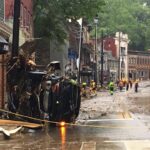
Header image: EHS workers respond to the scene in Ellicott City. Permission from Baltimore Sun Media. All rights reserved.
]]>
Recovery from the flooding in Ellicott City has been long and difficult, and communities have often been left with more questions than answers. UMBC Magazine sat down with experts in public policy...
https://umbc.edu/stories/an-ounce-of-prevention/
https://beta.my.umbc.edu/api/v0/pixel/news/120108/guest@my.umbc.edu/1e1469d65b708f93da9e3c33595ccd3d/api/pixel
discovery
ehs
ellicott-city
publicpolicy
spring-2019
UMBC News & Magazine
https://beta.my.umbc.edu/groups/umbc-news-magazine
https://assets1-beta.my.umbc.edu/system/shared/avatars/groups/000/001/943/24435aa6207c452e7bc15cc74b42c7bb/xsmall.png?1748556657
https://assets1-beta.my.umbc.edu/system/shared/avatars/groups/000/001/943/24435aa6207c452e7bc15cc74b42c7bb/original.png?1748556657
https://assets2-beta.my.umbc.edu/system/shared/avatars/groups/000/001/943/24435aa6207c452e7bc15cc74b42c7bb/xxlarge.png?1748556657
https://assets2-beta.my.umbc.edu/system/shared/avatars/groups/000/001/943/24435aa6207c452e7bc15cc74b42c7bb/xlarge.png?1748556657
https://assets3-beta.my.umbc.edu/system/shared/avatars/groups/000/001/943/24435aa6207c452e7bc15cc74b42c7bb/large.png?1748556657
https://assets1-beta.my.umbc.edu/system/shared/avatars/groups/000/001/943/24435aa6207c452e7bc15cc74b42c7bb/medium.png?1748556657
https://assets2-beta.my.umbc.edu/system/shared/avatars/groups/000/001/943/24435aa6207c452e7bc15cc74b42c7bb/small.png?1748556657
https://assets1-beta.my.umbc.edu/system/shared/avatars/groups/000/001/943/24435aa6207c452e7bc15cc74b42c7bb/xsmall.png?1748556657
https://assets2-beta.my.umbc.edu/system/shared/avatars/groups/000/001/943/24435aa6207c452e7bc15cc74b42c7bb/xxsmall.png?1748556657
UMBC News & Magazine
0
0
false
Mon, 17 Jun 2019 19:20:28 -0400
Ellicott City: A Timeline of Resilience
1772 ⬗ Since its founding in 1772, Ellicott City “has come in for an inordinate amount of disasters from floods, fires and railroad wrecks,” wrote Fred Rasmussen in The Baltimore Sun in 2012.
1868 ⬗ Known as the Great Flood, in 1868 the Patapsco rose more than 20 feet and 43 people were killed. “The sufferers by the flood are very numerous,” The Sun reported on July 27, 1868. Floods would come again in 1901, 1917, 1923, 1942, and 1952.
1972 ⬗ The next most memorable event was Hurricane Agnes in 1972. The Patapsco river flowed 14.5 feet above its banks. It took out a concrete bridge and destroyed the Jonathan Ellicott home and the 1910 Victor Blode water filtration plant. Eloise (1975), Hugo (1989), and Lee (2011) were other vicious storms of note.
1984 ⬗ From an editorial in The Sun from 1984 about Ellicott’s City’s resilience: “The town’s special charm lies in wear-and-tear, in improvisation over the decades, in workaday flavor more comparable to what might be found in a none too prosperous Old World community.”
2016 ⬗ Water again rushed down Main Street on July 30, 2016. The flash flood coursed through many historic buildings, washing away the town’s iconic clock, and ultimately killing two.
2017 ⬗ Originally donated in 2000 by the Ellicott City Kiwanis Club, the restored clock was put back in place in 2017.
 The 2017 restored clock before it was again washed away. Photo by Maryland GovPics on Flickr.
2018 ⬗ Less than two years later, on May 27, 2018, disaster struck again, days before the town’s new flood emergency alert system was to become operational. Homes and businesses were again destroyed, the newly erected clock disappeared, and a National Guardsman lost his life trying to rescue others.
In June and July 2018, the post and the face of the clock were found again, damaged in the Patapsco.
On July 20, 2018, Main Street was opened to cars and pedestrians and some shops reopened, although most continue to deal with the flood fallout.
Howard County Executive Calvin Ball revealed the second phase of the Ellicott City Safe and Sound plan in December 2018.
 Calvin Ball speaks at a community meeting. Photo by R. Scott Kramer, Howard County Government.
2019 ⬗ After considering community feedback, Ball announced his decision on May 13, 2019, to move forward with “3G.7.0,” a five-year, $140 million option to tear down four buildings—Phoenix Emporium, Discoveries, Bean Hollow, and Great Panes Art Glass Studio—and build a tunnel to carry future flood waters away.
2020 ⬗ The 2020 state capital budget includes $3.4 million in funds for Ellicott City’s Safe and Sound plan and a minimum of $8 million investment is planned over the next three years.
*****
Read More: Learning from Ellicott City
Read More: An Ounce of Prevention
Header image by Sun photographer Frank A. Miller.
]]>
1772 ⬗ Since its founding in 1772, Ellicott City “has come in for an inordinate amount of disasters from floods, fires and railroad wrecks,” wrote Fred Rasmussen in The Baltimore Sun in 2012....
https://umbc.edu/stories/a-timeline-of-resilience-in-flood-prone-town/
https://beta.my.umbc.edu/api/v0/pixel/news/120109/guest@my.umbc.edu/777d3e4850b0dc1439ccd1d51027a8de/api/pixel
discovery
ehs
ellicott-city
spring-2019
UMBC News & Magazine
https://beta.my.umbc.edu/groups/umbc-news-magazine
https://assets1-beta.my.umbc.edu/system/shared/avatars/groups/000/001/943/24435aa6207c452e7bc15cc74b42c7bb/xsmall.png?1748556657
https://assets1-beta.my.umbc.edu/system/shared/avatars/groups/000/001/943/24435aa6207c452e7bc15cc74b42c7bb/original.png?1748556657
https://assets2-beta.my.umbc.edu/system/shared/avatars/groups/000/001/943/24435aa6207c452e7bc15cc74b42c7bb/xxlarge.png?1748556657
https://assets2-beta.my.umbc.edu/system/shared/avatars/groups/000/001/943/24435aa6207c452e7bc15cc74b42c7bb/xlarge.png?1748556657
https://assets3-beta.my.umbc.edu/system/shared/avatars/groups/000/001/943/24435aa6207c452e7bc15cc74b42c7bb/large.png?1748556657
https://assets1-beta.my.umbc.edu/system/shared/avatars/groups/000/001/943/24435aa6207c452e7bc15cc74b42c7bb/medium.png?1748556657
https://assets2-beta.my.umbc.edu/system/shared/avatars/groups/000/001/943/24435aa6207c452e7bc15cc74b42c7bb/small.png?1748556657
https://assets1-beta.my.umbc.edu/system/shared/avatars/groups/000/001/943/24435aa6207c452e7bc15cc74b42c7bb/xsmall.png?1748556657
https://assets2-beta.my.umbc.edu/system/shared/avatars/groups/000/001/943/24435aa6207c452e7bc15cc74b42c7bb/xxsmall.png?1748556657
UMBC News & Magazine
0
0
false
Mon, 17 Jun 2019 19:12:03 -0400
CNMS celebrates a year of growth in partnerships to support student success
When Bill LaCourse became dean of UMBC’s College of Natural and Mathematical Sciences (CNMS) in 2012, he had three top priorities in mind: innovate undergraduate science education to boost learning outcomes, forge new partnerships, and develop and support a diverse group of faculty. This year, the college took several steps forward in realizing this vision.
“The college has laid the foundation, and now is really in a strong position for growth,” LaCourse says. “It’s all about paying attention to the people and their needs,” he explains, so faculty, staff, and students can do their best work and create a thriving community together.
Student success at the center
This year, CNMS received a $1.4 million grant from the National Science Foundation for Improving Undergraduate Science Education. Faculty at UMBC and community college partners will use the funding to improve the undergraduate experience in biology—the major of one in six UMBC students. This includes focus areas like enhancing the alignment of curriculum across institutions and making sure advising meets the needs of transfer students, both before and after they come to UMBC.
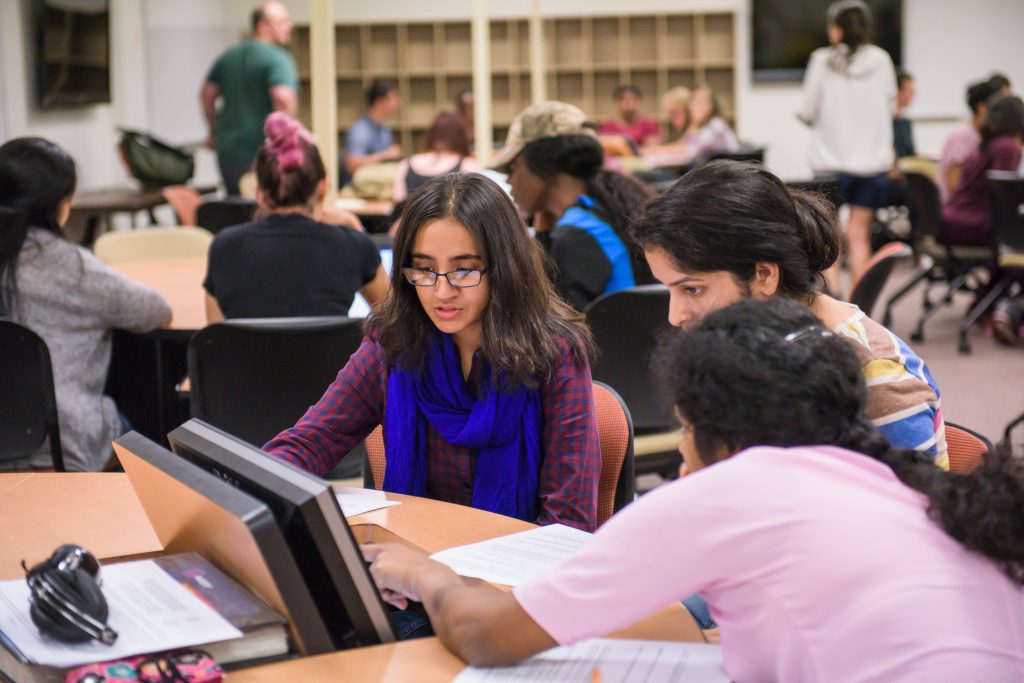
The CNMS Active Science Teaching and Learning Environment (CASTLE) is a classroom designed for team-based instruction. It has tables to facilitate group work, devices set up for screen sharing with large screens at the front and back of the room, and walls covered with whiteboards.
“We’re building community, trust, and relationships with the community colleges,” LaCourse says, and that has huge benefits for students.
The Active Learning Inquiry Teaching (ALIT) certificate offered to UMBC STEM faculty is another growing partnership focused on supporting students. It includes CNMS, the College of Engineering and Information Technology, the Faculty Development Center, and CNMS’s Building Infrastructure Leading to Diversity (BUILD) program. To earn the ALIT certificate, faculty attend a series of workshops on teaching in an active learning style, which has been shown to more effectively engage students and boost performance. They also participate in a teaching observation and other activities.
Initiatives like the Science and Mathematics Advising Resource Team (SMART) are also coming into full swing now. “The program formalizes the relationship between pre-professional advisors, CNMS advisors, and faculty advisors,” explains SMART director Michelle Bulger. “Everyone knows a little about everything,” so no matter which resource they start with, students get the support they need to find their best path through UMBC and into a career.
Celebrating student pioneers
The UMBC STEM BUILD program reached an exciting milestone this academic year: graduating its first program participant, Alexis Waller, in December 2018. Additional BUILD students earned their degrees in May 2019.

BUILD Trainees
Ashley Majekodunmi ’21 (center left) and
Avantika Krishna ’21 (center right) work in the lab with their faculty mentor, Weihong Lin (right).
BUILD is a CNMS initiative funded by the National Institutes of Health. It is designed to help UMBC learn best practices for engaging large numbers of students in mentored research and other practices that support student success in STEM. At some institutions, mentored research experiences are reserved for a select few, often in scholars programs. At UMBC, faculty and staff are actively working to make research accessible to all students.
Three students just became the first to complete another new path through UMBC. Just one day after graduating from UMBC, they were commissioned as officers in the U.S. military. CNMS administers UMBC’s Naval science department, which supports the Naval Reserve Officer Training Corps (NROTC) program. UMBC’s NROTC program was the first of its kind in Maryland when it was launched in 2015.
This spring, ENS Ghazi Nazzal ’19, business technology administration, and ENS Ryan Simpson ’19, environmental science, were commissioned as officers in the U.S. Navy. 2nd Lt Benjamin Dunlap, modern languages, linguistics, and intercultural communication, was commissioned as an officer in the U.S. Marine Corps.
“We’re proud to have them on campus,” says LaCourse, who has a family history of Navy service.
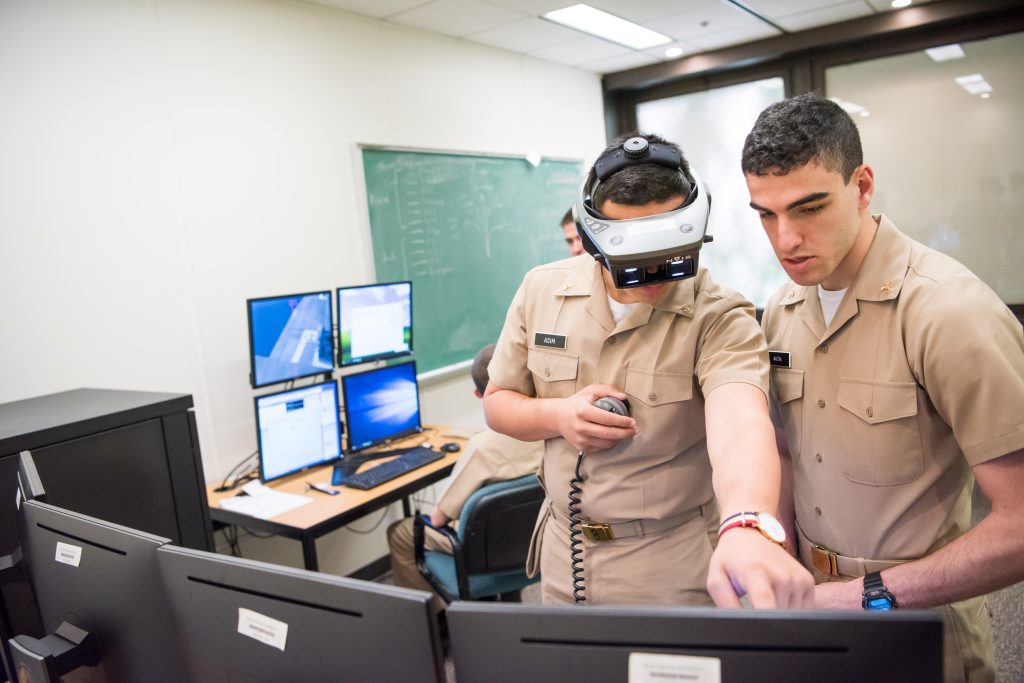
Ghazi Nazzal ’19 (right) assists another midshipman in using UMBC’s state-of-the-art virtual reality naval training system.
Connecting every angle
One of the most exciting CNMS partnerships emerging this year—with the potential to significantly impact students and employers in the region—has a complex name: the Translational Life Science Technology (TLST) program. The program focuses on preparing UMBC students at the Universities at Shady Grove for careers in Montgomery County’s rapidly growing biotech industry. TLST is UMBC’s first undergraduate STEM program at Shady Grove, and this year welcomed its first students.
“With this program as well as the professional master’s degree in biotechnology, CNMS is pioneering UMBC’s expansion at the Shady Grove campus to serve the over one million people in Montgomery County,” says Annica Wayman ’99, M6, mechanical engineering, the new associate dean for Shady Grove affairs for CNMS.
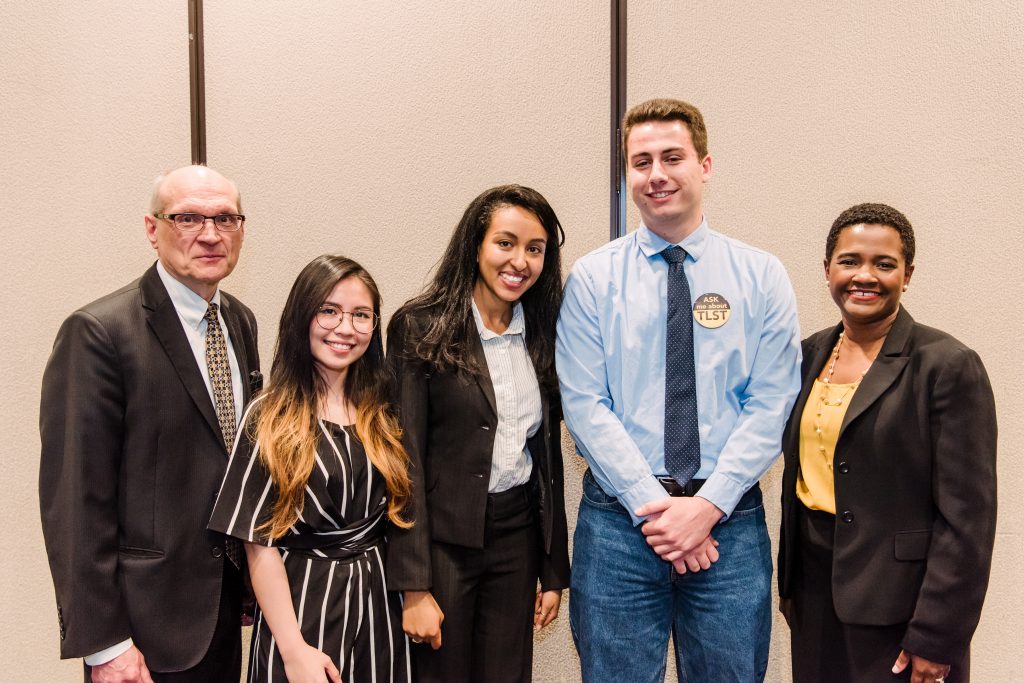
Dean Bill LaCourse (left), Annica Wayman ’99 (right), and some of the first students in the TLST program.
LaCourse sees the new program as the beginning of “a new way of working with Shady Grove.” He shares, “It puts us in a position to bring applied STEM programs to the doorstep of businesses in Montgomery County.”
Constructing collaboration
Perhaps the most visible representation of the college’s commitment to forging partnerships is the Interdisciplinary Life Sciences Building (ILSB), now in the final phases of construction. It will open for classes in fall 2019.
The building includes spacious and bright teaching labs, open faculty laboratory space that promotes collaboration, and classrooms designed for active teaching and learning. Unlike other buildings on campus, faculty who wish to conduct research in the ILSB must propose interdisciplinary projects to be completed there, and the lab spaces are designed to facilitate a variety of kinds of work equally well, from genetics to environmental engineering.
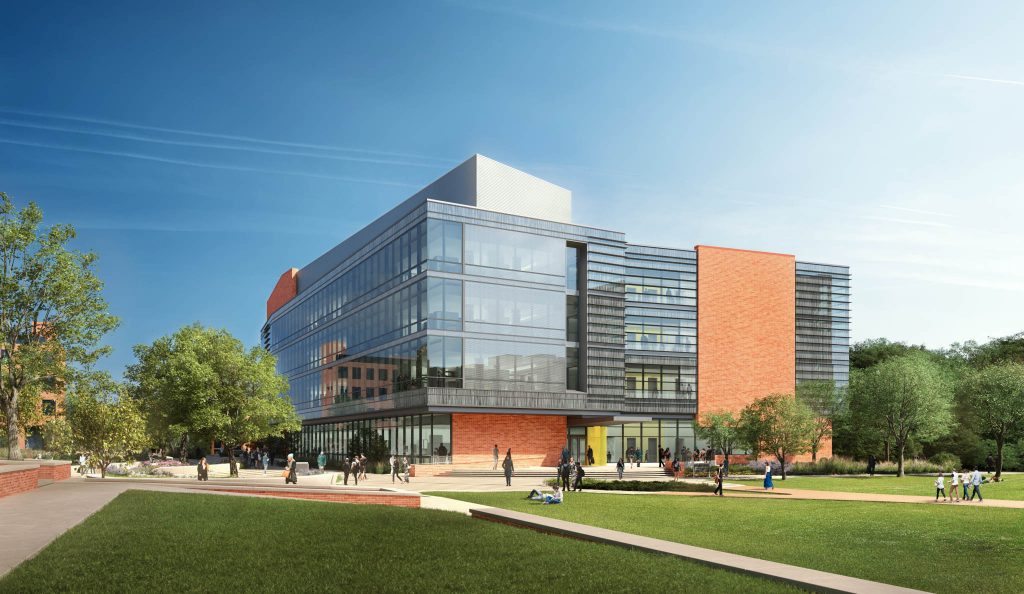
An artist’s rendering of the completed Interdisciplinary Life Sciences Building.
The new building will also house UMBC’s second Maryland Public Art installation: a colorful sculpture that emerges from a large wall and features abstractions of elements found in UMBC research, from bird flight to microscope images of individual cells.
The ILSB is open for use by any department on campus, and is administered by CNMS. “It’s exciting for me to be involved in the operations of the ILSB,” says building manager Dennis Cuddy. “It will be a transformative facility and allow UMBC scientists and students to do important work and cutting edge research in a flexible, state-of-the-art facility.”
Josh Wilhide, manager of UMBC’s Molecular Characterization and Analysis Complex, is particularly excited about new research equipment in the ILSB. One instrument will streamline the process of generating information about the proteins in a sample. It will be “used for drug discovery and genetic exploration for researchers ranging in fields from chemistry to biology to engineering,” Wilhide says. “The ILSB truly is a building designed to drive multi-discipline research.”
Faculty forward
CNMS has also made significant structural changes in the last year to better recruit and support a diverse faculty, and to enhance advancement opportunities and research support for faculty at every level. In addition to Wayman’s new role as associate dean, Kathleen Hoffman, professor of mathematics, now also serves as the CNMS associate dean for faculty advancement. Chuck Bieberich, professor of biological sciences, serves as the associate dean for research.

CNMS Associate Dean for Research Chuck Bieberich
“Our college has a strong history of performing cutting-edge research. However, in recent years, the federal funding climate has created new challenges for even the most seasoned researchers,” Bieberich says. “So one dimension of my role as associate dean is to connect our faculty, both newly hired and long-serving, with resources that can increase the likelihood of funding success.”
Hoffman has been supporting faculty advancement, particularly for women in science, for years. She was a key player in developing UMBC’s ADVANCE program, an initiative funded by an NSF Institutional Transformation Grant in 2003 that has led to a 60 percent increase in the number of women faculty in STEM. At a more granular level, ADVANCE has led to a 75 percent increase in women at the associate professor level and a 140 percent increase at full professor.
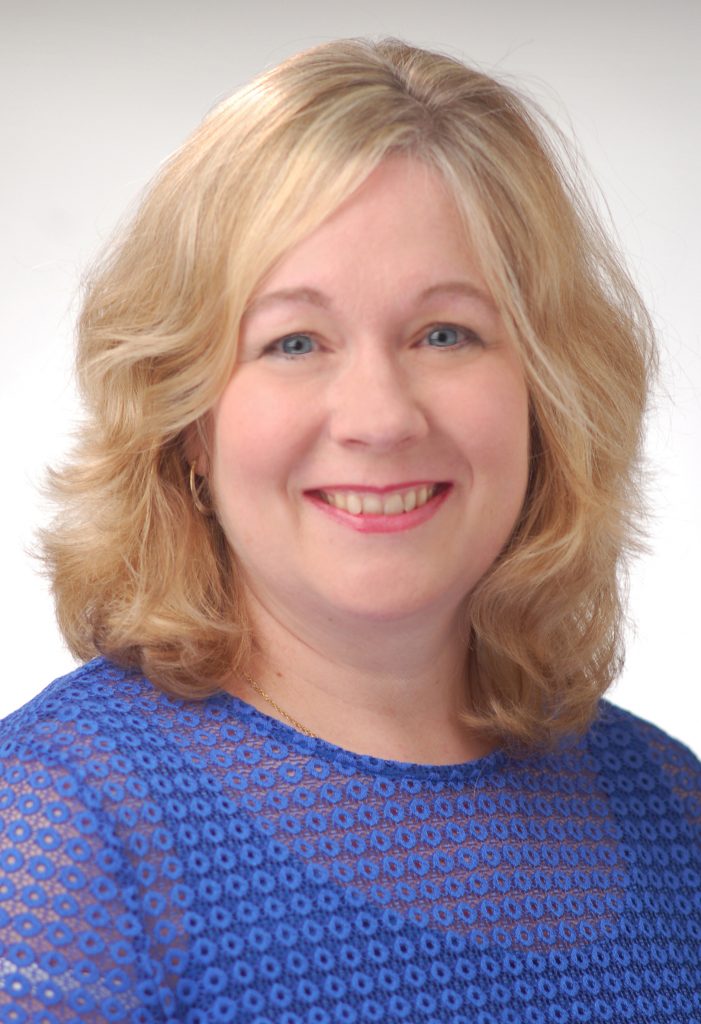
CNMS Associate Dean for Faculty Advancement Kathleen Hoffman
As of fall 2018, 24 percent of faculty in STEM at UMBC are women, which shows both how much progress has been made and how much growth is still needed.
“In this position, I will support CNMS faculty through college-wide workshops and initiatives focused on faculty success,” Hoffman says. She adds that she and Bieberich “will ensure that CNMS faculty have the support they need to fulfill their potential as faculty members in their departments, in the college, and as members of the university community.”
Diversity drives success
This year, CNMS hired two more pre-professoriate fellows. The fellows program is designed to enhance the diversity of CNMS faculty to better reflect the college’s diverse student body and actively welcome faculty who prioritize the value of diversity. Adriana Lima will join physics, and Joseph Bennett will join chemistry and biochemistry.
The biological sciences department led the way with this program, having previously hired Fernando Vonhoff and assistant professor Mercedes Burns. Mathematics and statistics followed with the hire of Yehenew Kifle, who had previously spent a year at UMBC as a visiting professor. Vonhoff and Kifle will successfully convert to assistant professors in August 2019.
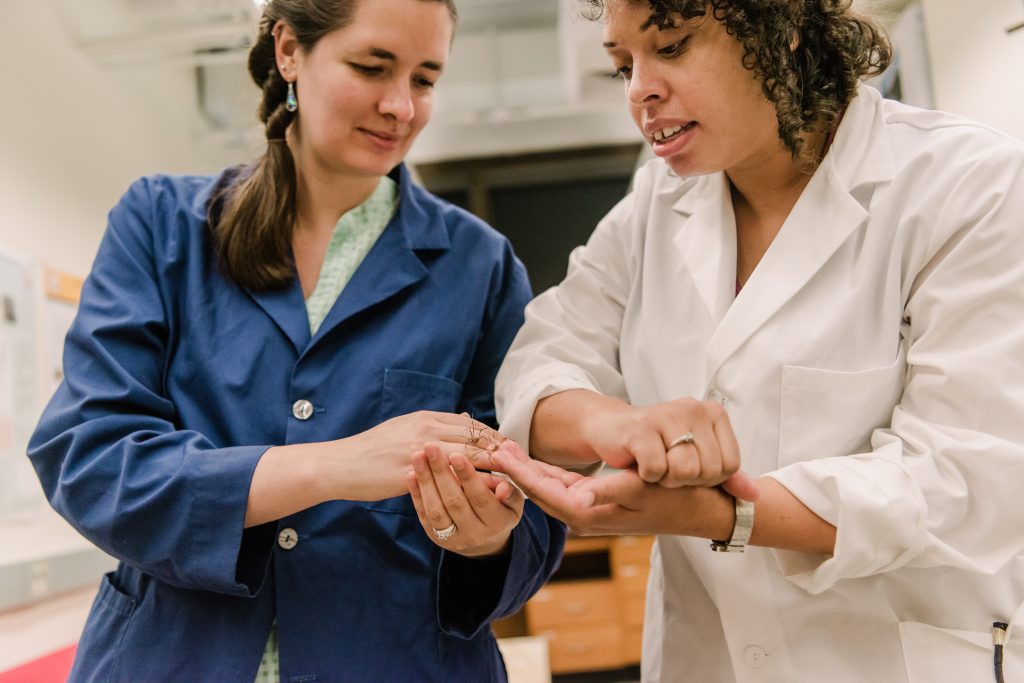
Arachnologist and evolutionary biologist Mercedes Burns (right) and her postdoc, Sarah Stellwagen, transfer a harvestman (commonly known as daddy-long-legs) between them.
“We want to make sure that UMBC can be a good home for faculty from all backgrounds,” says LaCourse. The pre-professoriate program offers incoming faculty two-year appointments as research assistant professors, with structured mentoring and other scaffolds for success. There is the option to convert the fellowship to an assistant professor position.
This year UMBC also partnered in the launch of the PROMISE Academy. This new initiative will draw on the expertise of universities around the nation and evidence-based best practices to recruit and retain a diverse group of faculty members in STEM fields.
With the 15th anniversary of its formation just one year away, “CNMS is coming into its own,” LaCourse says. “We’re ready to move to the next level.”
Banner image: CNMS pre-professoriate fellow Fernando Vonhoff works in the lab with Abby Cruz ’18.
All photos by Marlayna Demond ’11 for UMBC unless otherwise noted.
]]>
When Bill LaCourse became dean of UMBC’s College of Natural and Mathematical Sciences (CNMS) in 2012, he had three top priorities in mind: innovate undergraduate science education to boost...
https://umbc.edu/stories/cnms-celebrates-a-year-of-growth-in-partnerships-to-support-student-success/
https://beta.my.umbc.edu/api/v0/pixel/news/120110/guest@my.umbc.edu/aed9a2081712dfe5aef364009d5e324c/api/pixel
biology
cnms
coeit
community
is
mathstat
naval
science-and-technology
shadygrove
stembuild
UMBC News & Magazine
https://beta.my.umbc.edu/groups/umbc-news-magazine
https://assets1-beta.my.umbc.edu/system/shared/avatars/groups/000/001/943/24435aa6207c452e7bc15cc74b42c7bb/xsmall.png?1748556657
https://assets1-beta.my.umbc.edu/system/shared/avatars/groups/000/001/943/24435aa6207c452e7bc15cc74b42c7bb/original.png?1748556657
https://assets2-beta.my.umbc.edu/system/shared/avatars/groups/000/001/943/24435aa6207c452e7bc15cc74b42c7bb/xxlarge.png?1748556657
https://assets2-beta.my.umbc.edu/system/shared/avatars/groups/000/001/943/24435aa6207c452e7bc15cc74b42c7bb/xlarge.png?1748556657
https://assets3-beta.my.umbc.edu/system/shared/avatars/groups/000/001/943/24435aa6207c452e7bc15cc74b42c7bb/large.png?1748556657
https://assets1-beta.my.umbc.edu/system/shared/avatars/groups/000/001/943/24435aa6207c452e7bc15cc74b42c7bb/medium.png?1748556657
https://assets2-beta.my.umbc.edu/system/shared/avatars/groups/000/001/943/24435aa6207c452e7bc15cc74b42c7bb/small.png?1748556657
https://assets1-beta.my.umbc.edu/system/shared/avatars/groups/000/001/943/24435aa6207c452e7bc15cc74b42c7bb/xsmall.png?1748556657
https://assets2-beta.my.umbc.edu/system/shared/avatars/groups/000/001/943/24435aa6207c452e7bc15cc74b42c7bb/xxsmall.png?1748556657
UMBC News & Magazine
0
0
false
Fri, 14 Jun 2019 21:18:44 -0400
UMBC’s Jeff Leips receives NIH grant to explore how genes affect immune system function as we age
As we age, our immune systems don’t work as well as they did when we were younger. That phenomenon is called immunosenescence, and it’s not exclusive to humans. The decline of the immune system with age has been found in every organism scientists have tested. But why does it happen? And why do some individuals age more quickly than others? While factors like our diet, exercise level, and the air and water quality where we live play a role in our long-term health, so do our genetics, says UMBC’s Jeff Leips.
With funding from a new National Institutes of Health grant, Leips, professor of biological sciences, is on a mission to identify genes that play a role in the decreasing efficacy of the immune system with age. The fourth-leading cause of hospitalization among the elderly is an infection that their immune system can’t handle on its own, Leips says, and being hospitalized poses its own risks, “so it’s a big problem.”
Leips’s lab uses Drosophila, or fruit flies, to study the genetic basis of aging across a range of traits, from immune system function to walking speed, endurance, and strength. While it may seem strange to use an organism so different from us, “We know many aspects of the innate immune system in Drosophila—a lot of the signaling pathways—are conserved between flies and humans,” he explains. “So the idea would be to identify candidate genes that we could then test for their effects on human immunosenescence.”
 Moriah Thompson, Teiona Sanders, and Jeff Leips examine their flies.
The grant will allow Leips and his team of students to compare how quickly 200 different strains of flies, each with a unique genetic makeup, can clear an identical infection. Within each strain, the lab will test at least 20 flies of different ages. All the strains they’ll use have already had their entire genome sequenced, so “we can associate differences at the DNA level with differences in their ability to clear infection,” Leips explains.
With the extensive sequencing and ease of raising flies in the lab, “If you want to know something about basic biology, in an aging context, there’s arguably no species that’s this good.”
Focusing on the first step
Vertebrates, including humans, have a two-stage immune response: innate and adaptive. The adaptive system is the one that “remembers” being infected with a disease, which is what makes vaccines work. Leips is focusing on the innate response, which researchers know less about. The two systems interact in vertebrates, but flies only have an innate system.
“In invertebrates, we can look at effects on the innate system without the complications of the adaptive component feeding back into it,” Leips says. “It’s a simpler system, and maybe more useful.”
The innate immune system also comes in two stages. In the first stage, circulating blood cells engulf bacteria or other invaders and destroy them. If needed, the organism’s innate immune system activates stage two and deploys antimicrobial proteins to tackle the problem. Leips will focus specifically on the first stage, called phagocytosis, “because that’s the first thing that happens,” Leips says. “It’s only if that system is overwhelmed that the antimicrobial proteins respond.”

A tricky technique
Leips and Michelle Starz-Gaiano, associate professor of biological sciences, worked together to develop an imaging technique that allows them to count the number of bacteria swallowed by a fly’s blood cells. Using this method, “We can compare the ability of different genotypes to engulf bacteria across different ages,” Leips explains.
When they found that older flies had more bacteria in their cells, it came as a surprise. But even phagocytosis has multiple stages: the cells must swallow the bacteria, and then digest them. When Leips and Starz-Gaiano injected the flies with microscopic, non-digestible beads, they found that old and young flies had the same number of beads in their cells.
“We think the reason the old cells have many more bacteria in them is because the bacteria are accumulating in the cells, but not being processed,” Leips says. As part of the new grant, they’ll look at genes that might affect how the bacteria are trafficked into the cell and how it digests them.
Thinking big
This work is one of many projects in Leips’s lab. Another involves collaborating with Peter Abadir at Johns Hopkins University to see how flies with different genetic material respond to human medications for high blood pressure.
 Moriah Thompson examines flies under the microscope with guidance from Jeff Leips.
There’s evidence that some human patients (but, notably, not all) experience improved strength and endurance on these medications in addition to lower blood pressure. Leips and his colleague would like to know if differences in how people respond to these medications are genetically driven. If so, the findings could lead to more precise personalized medicine.
“We’d like to be able to identify genes that would predict if you’re going to respond in a positive, negative, or neutral way to a drug,” Leips says. “We’ve gotten some really cool results.” They found that flies respond to the drug even though they don’t have a circulatory system. They do have the same genes that the drug targets, he says, “which means effects of the drug on these traits might be through some other mechanism.”
With his new NIH grant, Leips says, “Ideally, I want to understand the mechanisms—what goes wrong with age and immunity? Once we know that, the next question is whether we can find ways to try to ameliorate the effects of aging on those traits.”
Leips hopes the research will provide data that will fuel future work on aging and immunity with implications for human health. “Getting sick is one of the worst things that happens to people,” he says. “So if you can minimize that when you’re old, it’s going to improve your quality of life. And that’s really what the lab is all about.”
Banner image: Jeff Leips works in the lab with students at UMBC for summer research through the UMBC STEM BUILD program. From left to right: Moriah Thompson, Anne Arundel Community College; Teiona Sanders, Morgan State University; and Bolutife Baiyewu, Morgan State University.
All photos by Marlayna Demond ’11 for UMBC.
]]>
As we age, our immune systems don’t work as well as they did when we were younger. That phenomenon is called immunosenescence, and it’s not exclusive to humans. The decline of the immune system...
https://umbc.edu/stories/umbcs-jeff-leips-receives-nih-grant-to-explore-how-genes-affect-immune-system-function-as-we-age/
https://beta.my.umbc.edu/api/v0/pixel/news/120111/guest@my.umbc.edu/36830412a0046a3ac819715409ff6ebb/api/pixel
biology
cnms
research
science-and-technology
UMBC News & Magazine
https://beta.my.umbc.edu/groups/umbc-news-magazine
https://assets1-beta.my.umbc.edu/system/shared/avatars/groups/000/001/943/24435aa6207c452e7bc15cc74b42c7bb/xsmall.png?1748556657
https://assets1-beta.my.umbc.edu/system/shared/avatars/groups/000/001/943/24435aa6207c452e7bc15cc74b42c7bb/original.png?1748556657
https://assets2-beta.my.umbc.edu/system/shared/avatars/groups/000/001/943/24435aa6207c452e7bc15cc74b42c7bb/xxlarge.png?1748556657
https://assets2-beta.my.umbc.edu/system/shared/avatars/groups/000/001/943/24435aa6207c452e7bc15cc74b42c7bb/xlarge.png?1748556657
https://assets3-beta.my.umbc.edu/system/shared/avatars/groups/000/001/943/24435aa6207c452e7bc15cc74b42c7bb/large.png?1748556657
https://assets1-beta.my.umbc.edu/system/shared/avatars/groups/000/001/943/24435aa6207c452e7bc15cc74b42c7bb/medium.png?1748556657
https://assets2-beta.my.umbc.edu/system/shared/avatars/groups/000/001/943/24435aa6207c452e7bc15cc74b42c7bb/small.png?1748556657
https://assets1-beta.my.umbc.edu/system/shared/avatars/groups/000/001/943/24435aa6207c452e7bc15cc74b42c7bb/xsmall.png?1748556657
https://assets2-beta.my.umbc.edu/system/shared/avatars/groups/000/001/943/24435aa6207c452e7bc15cc74b42c7bb/xxsmall.png?1748556657
UMBC News & Magazine
0
0
false
Thu, 13 Jun 2019 15:17:06 -0400
UMBC’s Hua Lu works to decode plant defense system, with an eye on improving farming and medicine
UMBC’s Hua Lu, professor of biological sciences, and colleagues have found new genetic links between a plant’s circadian rhythm (essentially, an internal clock) and its ability to fend off diseases and pests. The findings were 10 years in the making and published in Nature Communications this week. The results could eventually lead to plants that are more resistant to disease-causing pathogens and better treatment for human diseases.
“It’s quite cool,” Lu says, “because, in both plants and animals, people are beginning to study the crosstalk between the circadian clock and the immunity system.”
Timing is everything
In response to daily attacks from bacteria, fungi, and other pests, plants have evolved various strategies to protect themselves. Plants may close their stomata—small openings in the waxy coating on their leaves—to prevent entry by some bacteria. They might produce chemicals such as salicylic acid and jasmonic acid to repel bacteria and insects. They also make a large number of proteins that are important for successful defense.
Actions like closing stomata, producing salicylic acid, and more happen on a daily schedule, often peaking at the times when certain pathogens and pests are most likely to be active. The rhythmic nature of plant defense suggests plants are coordinating their internal clock with their defense system to increase the effectiveness of their defensive actions.
In this study, Lu and colleagues found for the first time that LUX, a central gene in the plant circadian clock, is important for regulating the opening and closing of the stomata at specific times of day, and also for activating defense mediated by salicylic acid and jasmonic acid.
 Hua Lu
In a typical plant, the stomata open during the day, to enable exchange of gases required for photosynthesis. Then they close at night, to prevent water loss. The stomata also close in response to daytime pathogen attacks. They respond minimally to an attack at night, because they’re already closed.
However, in plants with a non-functional version of the LUX gene, Lu found that the stomata are open both day and night. During a daytime attack, the stomata stay open wider than normal plants. During a nighttime attack, though, some of the stomata close. This means that plants lacking a functional LUX gene have less control over when their stomata open, allowing more opportunistic pathogens to get in. This distinction indicates that LUX is critical for the timing of the stomata-driven defense response, tying defense to the circadian clock in a new way.
Lu’s research also dives into the relationship between the LUX gene and the defense chemicals salicylic acid and jasmonic acid. While it was known that the circadian clock can regulate defense responses, this paper shows that the reverse is also true: “A properly tuned circadian clock is important for defense activation. When defense is activated, it then can feed back to regulate the circadian clock,” Lu says.
The research team specifically showed that the presence of LUX is needed for normal jasmonic acid signaling. In turn, jasmonic acid also affects expression of LUX and the circadian clock. This reciprocal regulation between the circadian clock and defense signaling helps plants balance their energy use for normal growth and development and defense responses.
 Arabidopsis plants used for experiments in Hua Lu’s lab. Photo by Hua Lu.
From farms to pharma
Lu is interested in pursuing further research to figure out how timing influences the plant defense system. How does the circadian clock affect multiple aspects of defense responses? What molecules from pathogens and pests interfere with a plant’s circadian clock and subsequently limit its ability to protect itself? Better understanding how clock genes control plant defense and how pathogens interact with plant defense systems could benefit agriculture and beyond.
“Pathogens are everywhere all the time. Often the most active form of a pathogen varies during a day. Also, plants could have different defense strategies at different times of day,” explains Lu. “So, when is the best time to apply pesticides? That could depend on the pathogen, its infection mode, and the behavior of your crop plants. I think that field tests are needed to figure out the best time to apply chemicals to achieve the most efficacy in preventing infection or the spread of infection.”
Less pesticide use overall would reduce runoff of chemicals into waterways and lower costs for farmers. Reduced use of antibiotics could help stem antibiotic resistance, which would benefit humans, too.
Plus, plants aren’t the only ones whose immune system activity fluctuates throughout the day. Animal systems also have daily cycles. So, “similar ideas can be applied to the medical field,” Lu says.
There are similarities between the ways plants and animals interact with their pathogens and pests at the molecular level. Maybe in the future, your prescription will come with specific timing instructions, or your surgery will be scheduled based on your immune system activity.
 Linda Wiratan ’19, biochemistry and molecular biology, works with Arabidopsis plants in Hua Lu’s lab. She is an author on the new paper.
Science in action
Lu says all of her research, and this multi-part paper in particular, is driven by her lab members. “It’s great to work with this many dedicated people,” she says. “Without them, I couldn’t do it.”
That includes postdoctoral fellow Chong Zhang, who is now employed by the USDA, and current postdoc Min Gao, who are co-first authors on the new paper. Five undergraduate students and a high school student also contributed to this long-term project. Some of the experiments required testing every four hours over a 24-hour period, which meant someone was sleeping on a couch in the lab when they were underway.
Overall, Lu’s team members are driven by the potential benefits their work could contribute to society. They are excited by the prospect of improving crop yields to feed a growing population, reducing pollution, or reducing side effects for human medical treatment through improved timing and dosing.
“This field interests me because I can see my work have some practical applications, and I think that’s important,” Lu says. “That should be every scientist’s goal—to use your knowledge in real life.”
Banner image: Jessica Allison, a graduate student in Hua Lu’s lab (left); Linda Wiratan ’19 (center); and Hua Lu. Photos by Marlayna Demond ’11 for UMBC.
]]>
UMBC’s Hua Lu, professor of biological sciences, and colleagues have found new genetic links between a plant’s circadian rhythm (essentially, an internal clock) and its ability to fend off...
https://umbc.edu/stories/umbcs-hua-lu-works-to-decode-plant-defense-system-with-an-eye-on-improving-farming-and-medicine/
https://beta.my.umbc.edu/api/v0/pixel/news/120112/guest@my.umbc.edu/351e14caa193c7fe0eb7986395dc044f/api/pixel
biology
cnms
research
science-and-technology
UMBC News & Magazine
https://beta.my.umbc.edu/groups/umbc-news-magazine
https://assets1-beta.my.umbc.edu/system/shared/avatars/groups/000/001/943/24435aa6207c452e7bc15cc74b42c7bb/xsmall.png?1748556657
https://assets1-beta.my.umbc.edu/system/shared/avatars/groups/000/001/943/24435aa6207c452e7bc15cc74b42c7bb/original.png?1748556657
https://assets2-beta.my.umbc.edu/system/shared/avatars/groups/000/001/943/24435aa6207c452e7bc15cc74b42c7bb/xxlarge.png?1748556657
https://assets2-beta.my.umbc.edu/system/shared/avatars/groups/000/001/943/24435aa6207c452e7bc15cc74b42c7bb/xlarge.png?1748556657
https://assets3-beta.my.umbc.edu/system/shared/avatars/groups/000/001/943/24435aa6207c452e7bc15cc74b42c7bb/large.png?1748556657
https://assets1-beta.my.umbc.edu/system/shared/avatars/groups/000/001/943/24435aa6207c452e7bc15cc74b42c7bb/medium.png?1748556657
https://assets2-beta.my.umbc.edu/system/shared/avatars/groups/000/001/943/24435aa6207c452e7bc15cc74b42c7bb/small.png?1748556657
https://assets1-beta.my.umbc.edu/system/shared/avatars/groups/000/001/943/24435aa6207c452e7bc15cc74b42c7bb/xsmall.png?1748556657
https://assets2-beta.my.umbc.edu/system/shared/avatars/groups/000/001/943/24435aa6207c452e7bc15cc74b42c7bb/xxsmall.png?1748556657
UMBC News & Magazine
0
0
false
Wed, 12 Jun 2019 16:20:29 -0400
Q&A: Dr. Michael Summers on the Meyerhoff Scholars Program

Dr. Michael Summers is the Robert E. Meyerhoff Chair for Excellence in Research and Mentoring; a Distinguished University Professor; and an Investigator with the Howard Hughes Medical Institute. Over the years, he has worked with dozens of Meyerhoff scholars in his lab. UMBC Magazine sat down with Summers to talk about his history with the Meyerhoff Scholars Program, now celebrating its 30th year.
UMBC Magazine: Can you tell us what your involvement has been with the Meyerhoff Scholars Program over the years?
Mike Summers: Well, I have no administrative role with the Meyerhoff program. I got started when [UMBC President] Freeman [Hrabowski] was vice provost, and I was an assistant professor. He called me up, and we talked about general things, like my life, my background. He said, “Thanks for meeting with me, and I remember leaving, thinking, “What was that about?” Then maybe a couple of months later, a young student, Chianna Paschall, came into my office and wanted to do research. I said, “What’s your GPA?” She said, “Well, I have a 4.0, and I’m a Meyerhoff Scholar.” And I said, “Oh, tell me. What is Meyerhoff?”
Then she ended up doing some very high-profile work that was published on the cover of a journal and now it’s in a lot of textbooks. The next year, there were about four Meyerhoff scholars who wanted to work in my lab. And, now there are typically 20 or so undergraduates in my lab, including not only Meyerhoff Scholars, but MARC and BUILD scholars as well, along with UMBC students who aren’t in any particular program.
UMBC Magazine: How do you make sure students are on the right track with their research?
Mike Summers: What I try to do is get students to start talking to faculty about research after their first semester at UMBC. I encourage them to meet with different faculty, learn about their research, talk to students in the lab, find out if it’s an environment and the kind of research that they’re interested in. Do they think they could have a good rapport with a faculty member? I always say there are no bad mentors. There are just poor mentor-student dyads.
There are some faculty who probably would be terrific mentors to only a few students who need a certain type of mentoring. I think our best mentors are those that can adjust to a broader range of student needs. UMBC is fortunate because we’ve got lots of really terrific mentors and research labs, so students can choose from a multitude of really good opportunities. If a student comes and says they want to work in my lab, I first make sure that they’re on good academic footing because I tell them, “No matter what you want to do when you graduate, people are going to look at your GPA first.”
UMBC Magazine: How would you describe the effects of the Meyerhoff Scholars Program on the way you and others teach? And how has that changed over time?
Mike Summers: Think about what happens when you intentionally put a group of 20 or 25 high-achieving minority students shoulder to shoulder in the front row of a classroom of 350 students. They are in their seats 10 minutes before class, asking good questions and typically doing extremely well on exams. It causes you to change the way you think about the abilities of minorities in science. Prior to Meyerhoff, the well prepared minorities would be sprinkled around the class or sitting in the back. They didn’t stand out, and we tended not to notice or pay attention to them even when they did do well. As a white male who was raised in the South, I had my own set of prejudices and misconceptions when I started at UMBC. But I believe that people who go into academics typically do so because they want to do something good for society. They generally want to do the right thing. So it’s a natural thing for us to see that kind of performance among minorities in our classrooms and laboratory, and then go home and look in the mirror and say, “Wow, I couldn’t have been more wrong in my thinking.” When that happens, faculty like me begin reaching out and communicating in different ways. Our expectations just naturally go up, for all students.
And I think the high visibility of the Meyerhoff Scholars also raises expectations among minorities who are not in the program. Consider a non-Meyerhoff who earns a C on their first entry-level chemistry exam; it’s not that they haven’t studied hard, but they don’t know how to study for a college-level exam. For me, it took years to figure out how to go from a C/B average to a B/A average. They get their first test back, and because they weren’t asked to just recite what they’ve been taught, as happens often in high school, they were asked to take what they’ve been taught and apply it in a way they’ve never seen before, and they don’t know how to do that yet. Now, the sense of imposter syndrome creeps in.
So, I believe that the Meyerhoff program directly addresses imposter syndrome because these students look up in that front row and there are those Meyerhoff Scholars who are making As. Rather than thinking, “I don’t belong here. Society was right. I’ve been hearing this message my whole life,” they instead think, “Okay, what do I have to do differently?” They might go to the tutorial center and be tutored by somebody who looks like them and has common life experiences. What our studies show is that the number of minorities who aren’t even in the program and graduate with science degrees has increased dramatically since Meyerhoff started, even for students who are not in the program. As the saying goes, a rising tide raises all the boats up.
UMBC Magazine: Have you seen these changes happen beyond UMBC?
Mike Summers: Fortunately, yes! Over the years, lots of schools have visited UMBC and learned about our program, but they tended to pick and choose what they wanted to do. They had some success, but nothing like our success. A few years ago, the Howard Hughes Medical Institute funded a partnership experiment between UMBC, UNC, and Penn State. The leadership at those schools expressed a willingness to “go all in.” It was a risky thing for HHMI to support: Freeman has shown what can be done at a majority school by a dynamic, charismatic black leader. The chief diversity officer at Penn State said, “This will never work here because parents of high-achieving black children will not trust us with their kids. They are so isolated. Their minority population is much, much lower than UMBC’s as a percentage, and they don’t have the history.” The question was, can it be done at different institutions with majority leadership and with different histories and different geographies?
Penn State and UNC agreed to try to replicate Meyerhoff as faithfully as they possibly could, and they got help not only from UMBC administrators, faculty, and staff, but even from Meyerhoff Scholars who visited their campuses and helped them recruit their first cohorts.
The best news is that their outcomes dramatically exceeded expectations — reaching Meyerhoff-like academic performance, retention, and matriculation to Ph.D. and/or M.D./Ph.D. programs in their very first year. Both programs are now institutionalized and supported by major endowments, and both continue to share ideas and outcomes with UMBC as we work together to strengthen our programs and show the rest of the nation how true inclusive excellence can be achieved.
]]>
Dr. Michael Summers is the Robert E. Meyerhoff Chair for Excellence in Research and Mentoring; a Distinguished University Professor; and an Investigator with the Howard Hughes Medical...
https://umbc.edu/stories/qa-dr-michael-summers-on-the-meyerhoff-scholars-program/
https://beta.my.umbc.edu/api/v0/pixel/news/120113/guest@my.umbc.edu/14426f64ed04c88f7475dc44484bb9b0/api/pixel
meyerhoff
stories
UMBC News & Magazine
https://beta.my.umbc.edu/groups/umbc-news-magazine
https://assets1-beta.my.umbc.edu/system/shared/avatars/groups/000/001/943/24435aa6207c452e7bc15cc74b42c7bb/xsmall.png?1748556657
https://assets1-beta.my.umbc.edu/system/shared/avatars/groups/000/001/943/24435aa6207c452e7bc15cc74b42c7bb/original.png?1748556657
https://assets2-beta.my.umbc.edu/system/shared/avatars/groups/000/001/943/24435aa6207c452e7bc15cc74b42c7bb/xxlarge.png?1748556657
https://assets2-beta.my.umbc.edu/system/shared/avatars/groups/000/001/943/24435aa6207c452e7bc15cc74b42c7bb/xlarge.png?1748556657
https://assets3-beta.my.umbc.edu/system/shared/avatars/groups/000/001/943/24435aa6207c452e7bc15cc74b42c7bb/large.png?1748556657
https://assets1-beta.my.umbc.edu/system/shared/avatars/groups/000/001/943/24435aa6207c452e7bc15cc74b42c7bb/medium.png?1748556657
https://assets2-beta.my.umbc.edu/system/shared/avatars/groups/000/001/943/24435aa6207c452e7bc15cc74b42c7bb/small.png?1748556657
https://assets1-beta.my.umbc.edu/system/shared/avatars/groups/000/001/943/24435aa6207c452e7bc15cc74b42c7bb/xsmall.png?1748556657
https://assets2-beta.my.umbc.edu/system/shared/avatars/groups/000/001/943/24435aa6207c452e7bc15cc74b42c7bb/xxsmall.png?1748556657
UMBC News & Magazine
0
0
false
Fri, 07 Jun 2019 23:09:50 -0400
Dreams Realized: Celebrating 30 Years of UMBC’s Meyerhoff Scholars Program
Thirty years ago, Baltimore philanthropist Robert E. Meyerhoff came to then-UMBC vice provost Freeman Hrabowski with the seed of an idea: to create a program that would enable all students, regardless of background, access to the highest levels of science.
Last week, hundreds of Meyerhoff Scholars Program alumni filled an auditorium stage to thank Meyerhoff for his bold vision. They also came to share their own experiences as proof that he was right to believe in their potential and invest in their futures so many years ago.
Standing on the shoulders of giants
The night of gratitude kicked off an emotional weekend of fellowship and reflection celebrating the Meyerhoff Scholars Program’s 30th anniversary. Over the course of Friday evening, alumni and supporters shared stories of the successes they attribute to a community that believed in them from the start—one that in the words of poet Langston Hughes let them “hold fast to dreams.”
“Meyerhoffs are ‘all in’ types,” said Keith Harmon, director of the program. “Now as alumni, they are distinguishing themselves as STEM professionals, changing the face of the STEM workforce, and showing the world how right Bob Meyerhoff was to believe in them in the first place.”
Setting a national example
The first of its kind in the country, the Meyerhoff Scholars Program launched in 1989 with a small cohort of African American men interested in pursuing graduate degrees in science, engineering, and related fields. In the years that followed, the program expanded to include women and students of all backgrounds who were committed to increasing the representation of minorities in science and engineering.
Today, more than 1,100 Meyerhoff alumni are changing the face of science across the country. The program is a national leader on the forefront of efforts to increase diversity in STEM fields, and UMBC is the nation’s number one producer of African American undergraduates who go on to earn M.D./Ph.D.s.
This spring, the Chan Zuckerberg Initiative awarded $6.9 million to support a unique partnership to replicate UMBC’s program at UC San Diego and UC Berkeley. Earlier replication efforts at Pennsylvania State University and the University of North Carolina at Chapel Hill, supported by the Howard Hughes Medical Institute, have already yielded tremendously impressive results.
Growth thrives in community
As alumni lined up on stage to share their stories, Kamili Jackson Shaw M5, ’97, M.S. ’99, mechanical engineering, talked about her first impressions of the program as an entering student.
“The Meyerhoff Scholars Program was the first time I had ever been around a critical mass of high-achieving African Americans, and it was extremely important to my growth as an individual,” said Shaw. Today, she leads the safety, quality, and management systems division for the NASA Stennis Space Center. “It gave me confidence and humility at the same time,” she says. “For the first time, I was able to simply ‘be.’”
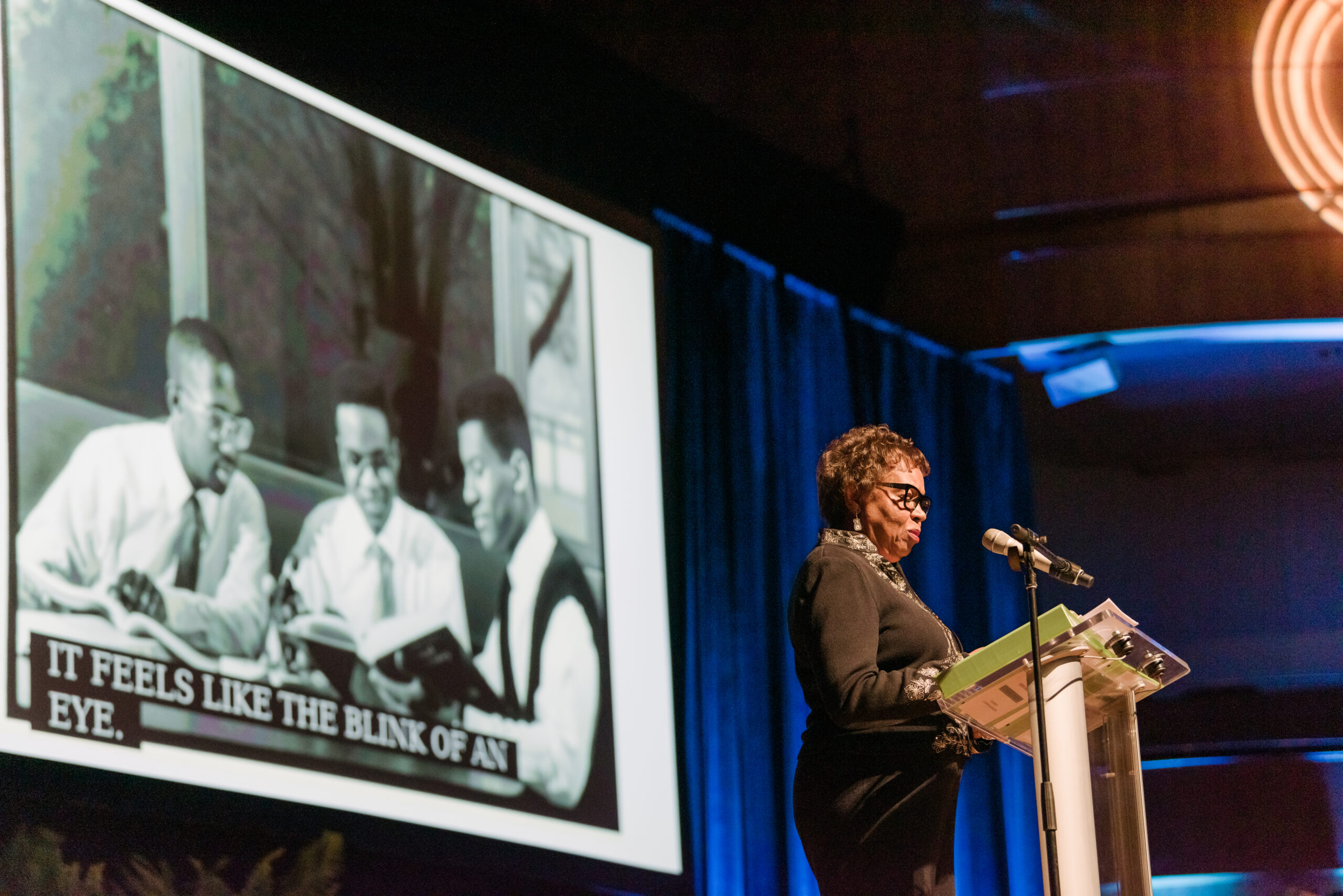
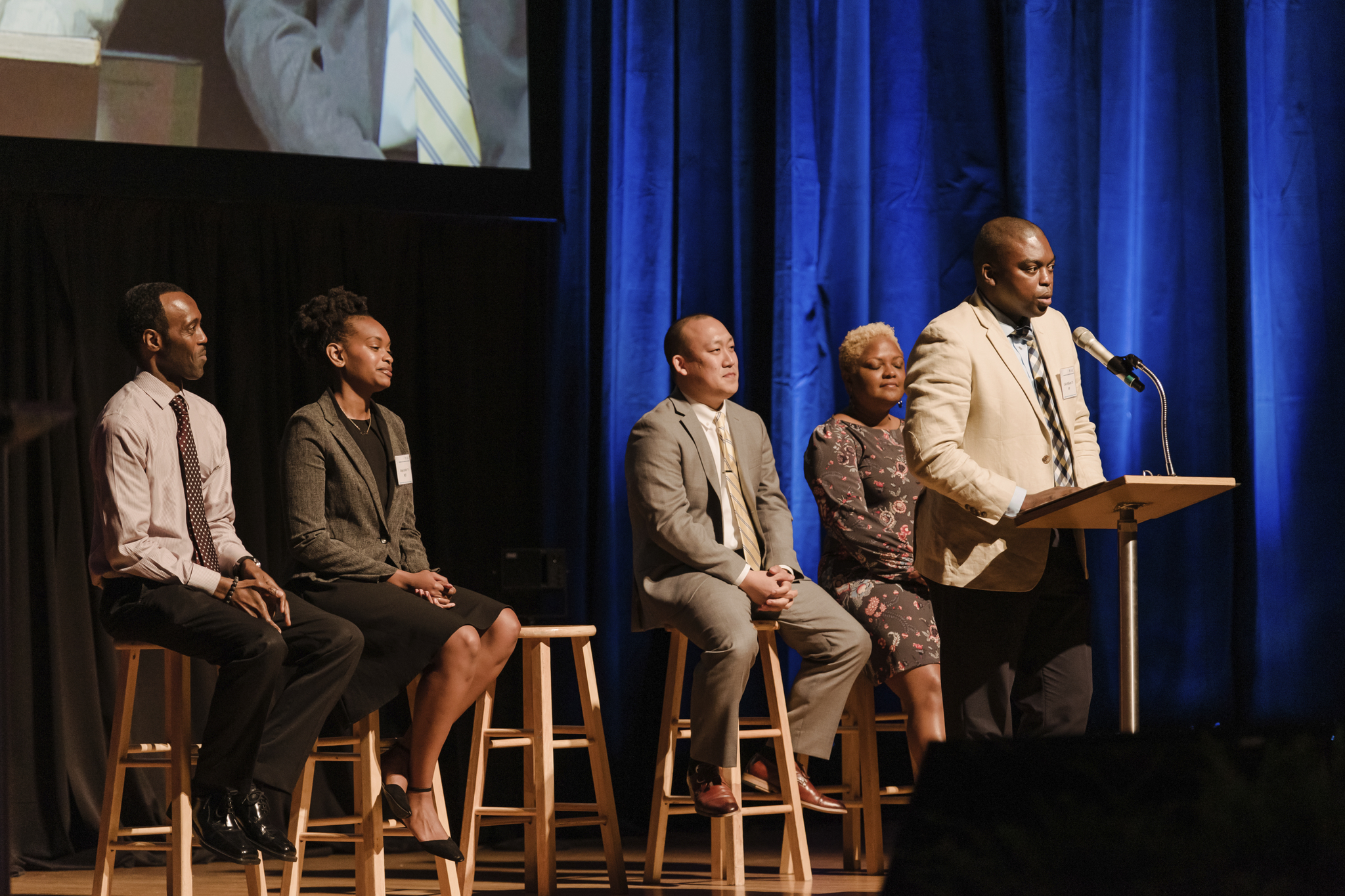
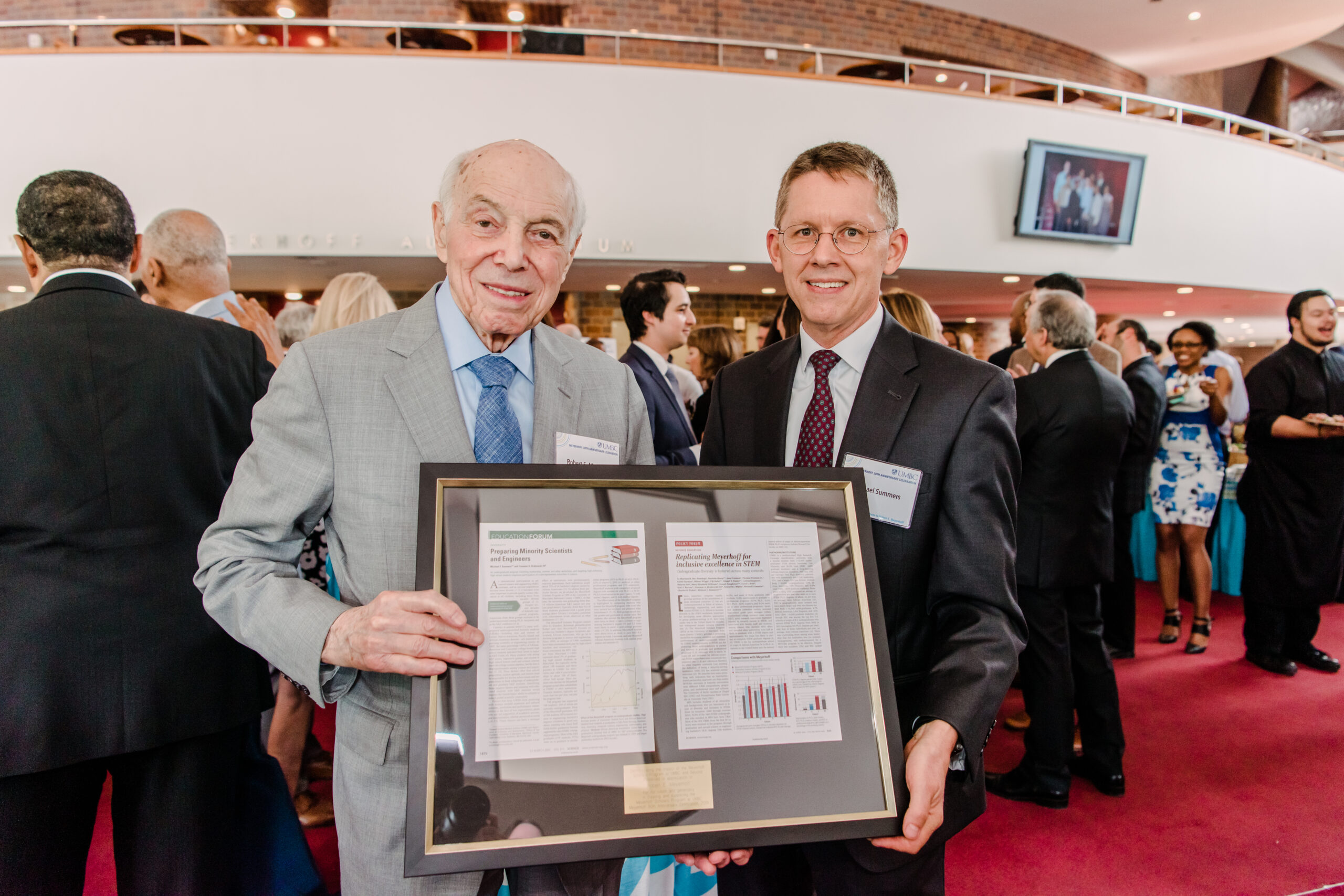
Paying it forward
The night ended with what program alumni called a “Gesture of Gratitude”—the announcement of a $500,000 gift made by alums from across the decades to support the program. As impactful as the gift will be, it was also symbolic, matching Robert Meyerhoff’s original gift to UMBC. And they have no intention of stopping there.
“Sometimes you don’t understand legacy until you see the fruit of it, and 25 years later, I see the magnitude of the program,” says Felicia Sanders M4, ’96, chemical engineering. Sanders, a, leadership-level supporter of the program, says giving back “is a responsibility. It’s a necessity.”
“If someone hadn’t given to us,” she asks, “where would we be?”
Kellie McCants-Price M2, ’95, interdisciplinary studies, was in the first Meyerhoff class that included women, one year after its founding. “I didn’t realize how significant it was until about 10 years out,” says McCants-Price, who holds her Ph.D. in psychology. “I saw how prolific it was—how many women were graduating—and realized that we held the door open for them.”
Alums took to social media to share their memories and thoughts on the celebration, including U.S. Surgeon General Jerome M. Adams M4, ‘97, biochemistry and molecular biology.
I’ve shared that the first time I met a black doctor was when I was in college at @UMBC. That’s why I was so proud to attend the 30th anniversary celebration of the Meyerhoff program tonight. A ballroom packed full of minorities with MDs and PhDs. #RepresentationMatters pic.twitter.com/M8AcSwzQea
— U.S. Surgeon General (@Surgeon_General) June 2, 2019
The family connection
After Friday’s formal event, alumni gathered in the Event Center on Saturday for a family-style reunion. Many of them brought their children to enjoy a day of food, cohort cluster game competitions, networking, and campus tours. Later that evening, many also enjoyed a dance party hosted by the Meyerhoff Alumni Advisory Board.
Alumni left feeling re-connected as friends, as scholars—and ultimately, as part of a family.
Kafui Dzirasa M8, ’01, chemical engineering, summed up this sentiment as he thanked Robert Meyerhoff on Friday night. “What has increasingly become obvious to us—which you have known all along—is that the power of this community is us, working together as a family.”
Visit meyerhoff.umbc.edu/30th for more photos and information about the program.
]]>
Thirty years ago, Baltimore philanthropist Robert E. Meyerhoff came to then-UMBC vice provost Freeman Hrabowski with the seed of an idea: to create a program that would enable all students,...
https://umbc.edu/stories/dreams-realized-celebrating-30-years-of-umbcs-meyerhoff-scholars-program/
https://beta.my.umbc.edu/api/v0/pixel/news/120114/guest@my.umbc.edu/85afae7e027cc2b93188c92a444f767c/api/pixel
alumni
meyerhoff
meyerhoffscholars
mhoff
videos
UMBC News & Magazine
https://beta.my.umbc.edu/groups/umbc-news-magazine
https://assets1-beta.my.umbc.edu/system/shared/avatars/groups/000/001/943/24435aa6207c452e7bc15cc74b42c7bb/xsmall.png?1748556657
https://assets1-beta.my.umbc.edu/system/shared/avatars/groups/000/001/943/24435aa6207c452e7bc15cc74b42c7bb/original.png?1748556657
https://assets2-beta.my.umbc.edu/system/shared/avatars/groups/000/001/943/24435aa6207c452e7bc15cc74b42c7bb/xxlarge.png?1748556657
https://assets2-beta.my.umbc.edu/system/shared/avatars/groups/000/001/943/24435aa6207c452e7bc15cc74b42c7bb/xlarge.png?1748556657
https://assets3-beta.my.umbc.edu/system/shared/avatars/groups/000/001/943/24435aa6207c452e7bc15cc74b42c7bb/large.png?1748556657
https://assets1-beta.my.umbc.edu/system/shared/avatars/groups/000/001/943/24435aa6207c452e7bc15cc74b42c7bb/medium.png?1748556657
https://assets2-beta.my.umbc.edu/system/shared/avatars/groups/000/001/943/24435aa6207c452e7bc15cc74b42c7bb/small.png?1748556657
https://assets1-beta.my.umbc.edu/system/shared/avatars/groups/000/001/943/24435aa6207c452e7bc15cc74b42c7bb/xsmall.png?1748556657
https://assets2-beta.my.umbc.edu/system/shared/avatars/groups/000/001/943/24435aa6207c452e7bc15cc74b42c7bb/xxsmall.png?1748556657
UMBC News & Magazine
0
0
false
Fri, 07 Jun 2019 23:02:09 -0400
How to Be Funny with Christine Ferrera

We all experience levels of humor in our lives. We may giggle at memes on social media, snarf quietly to ourselves when we spy someone make a goof at work, or fall on the floor laughing at the silly things our children say and do. We have “dad jokes” and “potty humor” readily available to us in books and top 10 lists. We know, innately, what works and what doesn’t, and we react accordingly.
Taking it all up a notch, however, by creating the humor yourself, is another level entirely. And getting up in front of an audience, be it a few friends or a giant concert hall of strangers, to deliver it—well, that takes a certain type of guts this author admittedly does not have. Thankfully, we have Christine Ferrera, M.F.A. ’10, intermedia and digital arts, to help us out. For the last five years, Ferrera—who in addition to working as a video producer at UMBC’s New Media Studio is the author of the Starbux Diary, a collection of witty feedback letters she wrote to corporate coffee—has been hitting open mics and comedy festivals non-stop, learning how to hone her craft one punchline at a time.
Tools of the Trade:
    + A notebook, always at the ready
    + A tape recorder for the most honest feedback
    + Free evenings for hitting the open mics
    + A healthy attitude toward rejection
    + The right comedy community for you
STEP 1: Write things down, and don’t censor yourself.
 You never know when an idea will pop into your head, so, you’ve got to be ready when one comes your way. The best way is to always have a notebook on hand. For Ferrera, it’s a small notebook she acquired at the Red Clay Comedy Festival in Atlanta. Inside are tidbits, observations, and scribbles.
“Some of them are bad or embarrassing, but at this point it doesn’t matter. You never know what will be useful later,” says Ferrera, who keeps the book on her nightstand for midnight musings, and even sometimes asks friends to write ideas down for her in it when she’s driving.
“This isn’t where you’re going to write full jokes. It could be you just thought about something funny, like a phrase or an image or something like that,” she says. “And don’t censor yourself. Later is when you’re going to go in and make something out of it.”
STEP 2: Schedule writing sessions with goals in mind.
Once you have some solid—or vaguely solid—ideas, it’s time to work on writing actual jokes. There are many flavors of comedy out there, and the only way you’ll find yours is to start putting pen to paper.
“I’ll take a notebook and go to a coffee shop and I’ll do a writing session where I’ll set a goal for myself,” says Ferrera. “I’ll say, maybe today I’m going to write three jokes, or five jokes. And then I sit there and pretty much make something out of all those tidbits I’ve been writing down.”
Ferrera also draws inspiration—and discipline—from comedians she admires, like Gary Gulman, who offers a comedy writing tip each day on social media, and recommends setting time aside each day to write.
“I know how valuable that is,” she says. “When I did Starbux, that was 10 years of writing a small amount every day….the writing sessions are kinda torture, but it’s exciting and fun when you really get rolling, just like any creative art form.”
STEP 3: Get yourself up on that stage.
 Photo courtesy of Christine Ferrera.
By now you’re probably watching other comics perform fairly often (if not, it’s time to start!), and you’re beginning to make choices about what you might like to do yourself. Just don’t wait too long to jump into performing yourself, says Ferrera, who hits as many open mics as she can.
“So because it’s pretty much universally daunting to most people to, like, get up and try to tell jokes, just get it over with,” says Ferrera. “Don’t write and write and write until you have the perfect set. Throw some stuff together and get up there with a few minutes of something.”
Over time, as you listen to feedback from the audience, polish your jokes and your delivery. Ferrera records herself so she can critique herself later and make changes to her repertoire over time. The ultimate first goal: to have a “tight five,” or five solid no-fail minutes of material in your pocket for anytime you need it. You will probably bomb along the way, she says, but that’s part of learning, too.
“It can be excruciating, but you have to do it. You will sound terrible, and you’ll hear yourself going ‘um, uh,’…but then you’ll quit doing those things,” she says. “The more you perform, you’ll find you do it a little differently, and after a lot of times, you’ll say…‘oh, that really worked!’”
STEP 4: Find your voice.
As you feel more comfortable with the rhythm of your words and performance, the next step is to try to make the comedy your own. We’ve all seen the same jokes rehashed by multiple comics, and we’ve all seen performers who draw from common topics—politics, relationships, etc. So, how do you produce something nobody’s ever seen before?
“What I consider a mistake is when people say, ‘I wanna do comedy,’ and so they’re like ‘Comedy sounds like this. Comedy is talking about dating. Or comedy is making fun of that thing,’” she says. “And that’s so covered already.”
Ferrera likes to draw from her performing arts background, and reminds herself often that her comedy isn’t for everybody. And it doesn’t have to be. Like one of her favorite performers, Maria Bamford, Ferrera wants to stay true to who she is and grow from there.
“Maria Bamford has been out there 30 years sticking to her gut instincts. It’s literally so specific to her, and the way she thinks. That’s what I aspire to,” says Ferrera.
“I would rather bomb or whatever, but be doing stuff that I actually care about saying and doing. Because then, when it’s good, it’s SO good. You can’t beat it.”

*****
All photos by Marlayna Demond ’11, unless otherwise noted.
]]>
We all experience levels of humor in our lives. We may giggle at memes on social media, snarf quietly to ourselves when we spy someone make a goof at work, or fall on the floor laughing at the...
https://umbc.edu/stories/how-to-be-funny-with-christine-ferrera/
https://beta.my.umbc.edu/api/v0/pixel/news/120115/guest@my.umbc.edu/0a1354a9e460758935f4c5020c4383f9/api/pixel
alumni
comedy
intermedia-and-digital-arts
spring-2019
UMBC News & Magazine
https://beta.my.umbc.edu/groups/umbc-news-magazine
https://assets1-beta.my.umbc.edu/system/shared/avatars/groups/000/001/943/24435aa6207c452e7bc15cc74b42c7bb/xsmall.png?1748556657
https://assets1-beta.my.umbc.edu/system/shared/avatars/groups/000/001/943/24435aa6207c452e7bc15cc74b42c7bb/original.png?1748556657
https://assets2-beta.my.umbc.edu/system/shared/avatars/groups/000/001/943/24435aa6207c452e7bc15cc74b42c7bb/xxlarge.png?1748556657
https://assets2-beta.my.umbc.edu/system/shared/avatars/groups/000/001/943/24435aa6207c452e7bc15cc74b42c7bb/xlarge.png?1748556657
https://assets3-beta.my.umbc.edu/system/shared/avatars/groups/000/001/943/24435aa6207c452e7bc15cc74b42c7bb/large.png?1748556657
https://assets1-beta.my.umbc.edu/system/shared/avatars/groups/000/001/943/24435aa6207c452e7bc15cc74b42c7bb/medium.png?1748556657
https://assets2-beta.my.umbc.edu/system/shared/avatars/groups/000/001/943/24435aa6207c452e7bc15cc74b42c7bb/small.png?1748556657
https://assets1-beta.my.umbc.edu/system/shared/avatars/groups/000/001/943/24435aa6207c452e7bc15cc74b42c7bb/xsmall.png?1748556657
https://assets2-beta.my.umbc.edu/system/shared/avatars/groups/000/001/943/24435aa6207c452e7bc15cc74b42c7bb/xxsmall.png?1748556657
UMBC News & Magazine
0
0
false
Fri, 07 Jun 2019 14:41:34 -0400


