Not All Americans Have a Fair Path to a Good Death – Racial Disparities Are Real

By Jason Ashe, doctoral student in human services psychology, UMBC, and Danielle L. Beatty Moody, assistant professor of psychology, UMBC
What does it mean to “die well”?
The world got an idea recently from the 92-year-old Buddhist monk and peace activist Thich Nhat Hanh, who popularized mindfulness and meditation in the U.S. The monk returned to his home in Vietnam to pass his remaining years. Many admired his desire to live his remaining time in peace and dignity.
Researchers from the University of California, San Diego recently did a literature search to understand what Americans might consider to be a “good death” or “successful dying.” As can be expected, their findings varied. People’s views were determined by their religious, social and cultural norms and influences. The researchers urged health care providers, caregivers and the lay community to have open dialogues about preferences for the dying process.
As scholars who study social health and human services psychology, we found something missing in these conversations – how race impacts life span.
It’s important to recognize that not everyone has an equal chance at “dying well.”
Black population and ill health
Take the disease burden of the African American population.
African Americans experience an earlier onset and greater risk of what may be referred to as lifestyle-related diseases, including cardiovascular disease, stroke and diabetes. More than 40% of African Americans over the age of 20 are diagnosed with high blood pressure, compared to 32% of all Americans.
In addition, the Centers for Disease Control and Prevention reports that the likelihood of experiencing a first stroke is nearly twice as high for African Americans compared with whites. African Americans are more than two times more likely to experience a stroke before the age of 55. At age 45, the mortality rate from stroke is three times higher for blacks compared to whites.
This disease burden consequently leads to their higher mortality rates and overall shorter life expectancy for blacks compared to whites.
And while the life expectancy gap differs by only a few years, 75.3 for blacks and 78.9 for whites as of 2016, research suggests that African Americans suffer more sickness. This is due in part to the increased prevalence of high blood pressure, obesity and diabetes in this population.
Genetics, biological factors and lifestyle behaviors, such as diet and smoking, help explain a portion of these differences. However, researchers are still learning how race-related social experiences and physical environments affect health, illness, and mortality.
Access to health care
 African Americans have historically underutilized preventative health services. Photo by rawpixel.com from Pexels.
One factor is that African Americans have historically underutilized preventive medicine and health care services. They also delay seeking routine, necessary health care – or may not follow medical advice.
One study found that during an average month, 35% fewer blacks visited a physician’s office, and 27% fewer visited an outpatient clinic compared with whites.
“The only time I go to the doctor is when something is really hurting. But otherwise, I don’t even know my doctor’s name,” said a young African American male during a research study in Chicago, Illinois.
There are reasons for this mistrust. Researchers who study medical mistrust argue that high-profile cases of medical experiments are still playing a role in how African Americans view health care systems and providers. In the past, physicians have intentionally done harm against people of color. A well-known case is the Tuskegee Study of Untreated Syphilis in African American men, which lasted from 1932 to 1972.
In this clinical study, 399 African American men, who had already contracted syphilis, were told that they were receiving free health care from the government. In fact, doctors, knowing their critical condition, were awaiting their deaths to subsequently conduct autopsies and study the disease’s progression.
Even though penicillin had been proven to treat syphilis by 1947, these men were denied the treatment.
Why discrimination matters for health
Other studies suggest that regardless of their knowledge of past medical abuse, many African Americans have low levels of trust in medical establishments.
 African Americans are exposed to more frequent death of loved ones. Photo by Daan Stevens on Unsplash.
“Doctors, like all other people, are subject to prejudice and discrimination,” writes Damon Tweedy, author of “Black Man in a White Coat: A Doctor’s Reflections on Race and Medicine.” “While bias can be a problem in any profession, in medicine, the stakes are much higher.”
Unfortunately, these fears are underscored by empirical evidence that African Americans are less likely to receive pain medication management, higher-quality care or survive surgical procedures.
In addition, a growing body of literature has established that experiences of discrimination are extremely harmful for physical and mental health, particularly among African Americans.
This research adds to the body of evidence that experiences of discrimination harm people’s health and may contribute to the increased rates of premature decline and death among blacks.
What does it take to die well?
As African American scholars, we argue the “art of dying well” may be a distant and romantic notion for the African American community.
African Americans are also exposed to earlier and more frequent deaths of close loved ones, immediate family members and friends.
Their increased “vulnerability to untimely deaths,” writes Duke University scholar Karla Holloway, shows African Americans’ lack of access to equitable and fair paths in life.
Before defining “a good death,” American society must first begin to fundamentally address how to promote quality living and longevity across all racial groups.
****
Jason Ashe, Doctoral Student (Ph.D.), Human Services Psychology, University of Maryland, Baltimore County and Danielle L. Beatty Moody, Assistant Professor, Behavioral Medicine & Community Psychology Subprograms, University of Maryland, Baltimore County
Header image by Jenna Hamra from Pexels.
This article is republished from The Conversation under a Creative Commons license. Read the original article.
]]>
By Jason Ashe, doctoral student in human services psychology, UMBC, and Danielle L. Beatty Moody, assistant professor of psychology, UMBC What does it mean to “die well”? The world got an idea...
https://umbc.edu/stories/not-all-americans-have-a-fair-path-to-a-good-death-racial-health-disparities-are-real/
https://beta.my.umbc.edu/api/v0/pixel/news/120096/guest@my.umbc.edu/8ea0561ecd75054d68bc97ea62cec902/api/pixel
discovery
psychology
the-conversation
UMBC News & Magazine
https://beta.my.umbc.edu/groups/umbc-news-magazine
https://assets1-beta.my.umbc.edu/system/shared/avatars/groups/000/001/943/24435aa6207c452e7bc15cc74b42c7bb/xsmall.png?1748556657
https://assets1-beta.my.umbc.edu/system/shared/avatars/groups/000/001/943/24435aa6207c452e7bc15cc74b42c7bb/original.png?1748556657
https://assets2-beta.my.umbc.edu/system/shared/avatars/groups/000/001/943/24435aa6207c452e7bc15cc74b42c7bb/xxlarge.png?1748556657
https://assets2-beta.my.umbc.edu/system/shared/avatars/groups/000/001/943/24435aa6207c452e7bc15cc74b42c7bb/xlarge.png?1748556657
https://assets3-beta.my.umbc.edu/system/shared/avatars/groups/000/001/943/24435aa6207c452e7bc15cc74b42c7bb/large.png?1748556657
https://assets1-beta.my.umbc.edu/system/shared/avatars/groups/000/001/943/24435aa6207c452e7bc15cc74b42c7bb/medium.png?1748556657
https://assets2-beta.my.umbc.edu/system/shared/avatars/groups/000/001/943/24435aa6207c452e7bc15cc74b42c7bb/small.png?1748556657
https://assets1-beta.my.umbc.edu/system/shared/avatars/groups/000/001/943/24435aa6207c452e7bc15cc74b42c7bb/xsmall.png?1748556657
https://assets2-beta.my.umbc.edu/system/shared/avatars/groups/000/001/943/24435aa6207c452e7bc15cc74b42c7bb/xxsmall.png?1748556657
UMBC News & Magazine
0
0
false
Mon, 24 Jun 2019 13:59:40 -0400
Video Extra: Lifespan of a Dragonfly
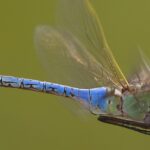
In the spring 2019 issue of UMBC Magazine, writer Sarah Hansen, M.S. ’15, shares the research of Colin Studds, assistant professor of geography and environmental systems, senior author of a recent paper detailing the full life cycle of the dragonfly for the very first time. (Read the full story here.)
To celebrate this exciting discovery, UMBC designer Layla Thompson-Koch created this web extra to show the full cycle. Enjoy!
]]>
In the spring 2019 issue of UMBC Magazine, writer Sarah Hansen, M.S. ’15, shares the research of Colin Studds, assistant professor of geography and environmental systems, senior author of a recent...
https://umbc.edu/stories/video-extra-lifespan-of-a-dragonfly/
https://beta.my.umbc.edu/api/v0/pixel/news/120097/guest@my.umbc.edu/4dcbddd4e694cdee23b57cdb80560dc7/api/pixel
discovery
ges
videos
web-extras
UMBC News & Magazine
https://beta.my.umbc.edu/groups/umbc-news-magazine
https://assets1-beta.my.umbc.edu/system/shared/avatars/groups/000/001/943/24435aa6207c452e7bc15cc74b42c7bb/xsmall.png?1748556657
https://assets1-beta.my.umbc.edu/system/shared/avatars/groups/000/001/943/24435aa6207c452e7bc15cc74b42c7bb/original.png?1748556657
https://assets2-beta.my.umbc.edu/system/shared/avatars/groups/000/001/943/24435aa6207c452e7bc15cc74b42c7bb/xxlarge.png?1748556657
https://assets2-beta.my.umbc.edu/system/shared/avatars/groups/000/001/943/24435aa6207c452e7bc15cc74b42c7bb/xlarge.png?1748556657
https://assets3-beta.my.umbc.edu/system/shared/avatars/groups/000/001/943/24435aa6207c452e7bc15cc74b42c7bb/large.png?1748556657
https://assets1-beta.my.umbc.edu/system/shared/avatars/groups/000/001/943/24435aa6207c452e7bc15cc74b42c7bb/medium.png?1748556657
https://assets2-beta.my.umbc.edu/system/shared/avatars/groups/000/001/943/24435aa6207c452e7bc15cc74b42c7bb/small.png?1748556657
https://assets1-beta.my.umbc.edu/system/shared/avatars/groups/000/001/943/24435aa6207c452e7bc15cc74b42c7bb/xsmall.png?1748556657
https://assets2-beta.my.umbc.edu/system/shared/avatars/groups/000/001/943/24435aa6207c452e7bc15cc74b42c7bb/xxsmall.png?1748556657
UMBC News & Magazine
0
0
false
Fri, 21 Jun 2019 15:53:24 -0400
UMBC honors social work students for commitment to social change

“I am learning at fifty-four that when you walk into communities and do the work that you are all doing, you have to be your authentic self,” said Jodi Kelber-Kaye, in a room of UMBC social work students days before their graduation.
 Kelber-Kaye with Pres. Freeman Hrabowski at an Honors College event.
Kelber-Kaye is the associate director of UMBC’s Honors College. She joined the students at the induction ceremony for the UMBC Delta Omicron Chapter of the Phi Alpha Honor Society, the national social work honor society, to accept an honorary membership.The twenty-four inductees were poised to hear advice from leaders in the field as they prepared to enter social work careers, known for being both highly rewarding and demanding.
Megan Meyer, associate dean for academic affairs at the University of Maryland School of Social Work, also spoke at the event. She reminded the new members to have hope and embody the ideals of the Phi Alpha Honor Society—compassion, social justice, and equity—by being present in the moment. “In order for you to maintain, lead, and make your greatest contribution you have to engage in self-care,” explained Meyer.
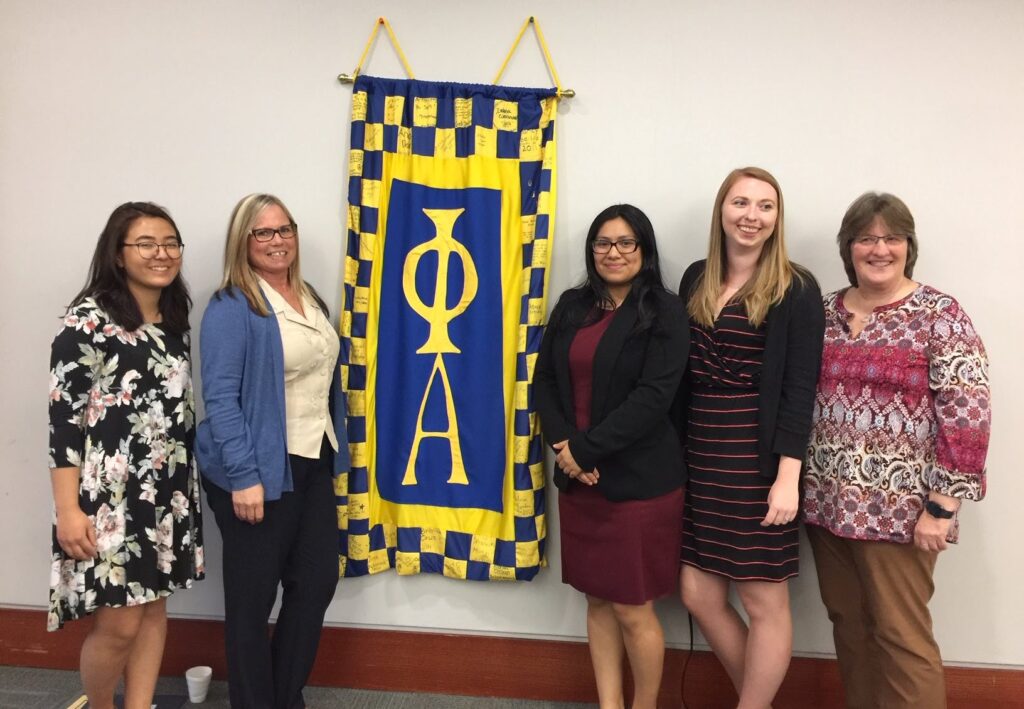
UMBC student executive board of
Phi Alpha Honor Society. Photo courtesy of the social work program.
Her message resonated with the social work students from both UMBC’s Shady Grove and Catonsville campuses, several of whom have overcome personal challenges through self-care and community support. Encouraged by their own abilities to persevere through personal obstacles, they are now pursuing careers in social work to connect families to the services they need to care for themselves.
Self-actualization
“I decided to become a social worker because I survived the last six years of my life with the help of social workers,” remembers Maria Bruno ‘19, social work, who experienced a difficult divorce and the death of her mother in the same year. “If it wasn’t for one in particular social worker, I wouldn’t be where I am today.”
A single mom of three teenagers, Bruno felt the best way to take care of herself was to be the first person in her immediate and extended family to attend college. She plans to earn a master’s degree and a doctorate in social work as well. She shares, “I am really proud of myself. I am getting a Ph.D. because I want to give opportunities, just as I have been given.”
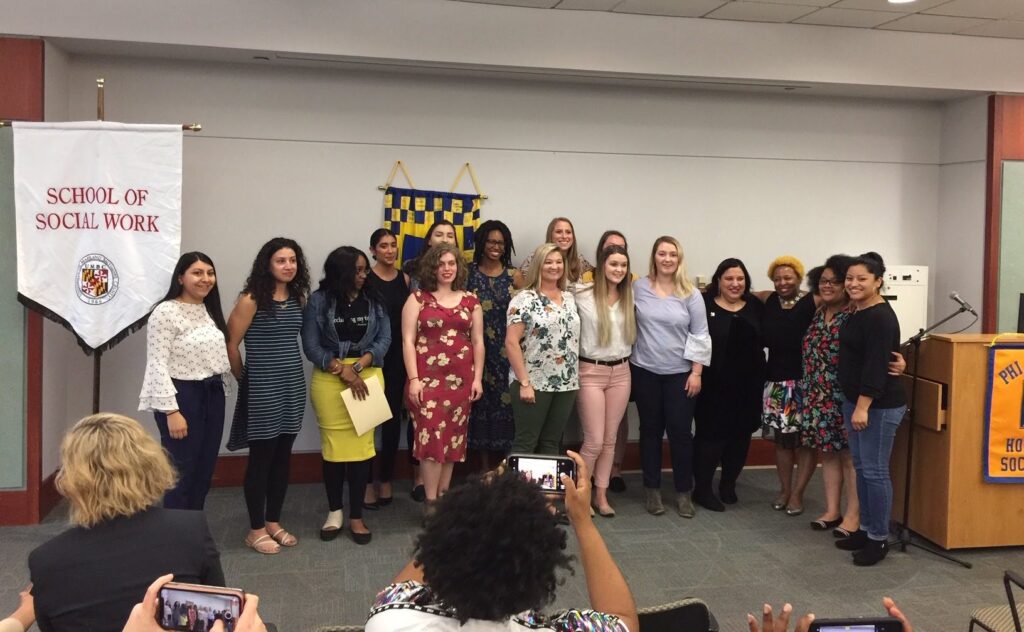 Phi Alpha Honor Society inductees. Bruno is fourth from the right. Rantas is first on the left in the back row. Courtesy of the social work program.
Upon hearing Bruno’s story, Jennifer Rantas ‘20, social work, felt an instant connection with her classmate. “There were many times I also felt lost,” explains Rantas. “I spent a couple of years out of school battling mental illness.” The youngest of four, Rantas leaned on her family for support. When she was ready, Rantas committed herself to a social work major wholeheartedly.
Still, sometimes her confidence falters, and it is in these moments when community affirmation means so much. “It is incredible to be recognized,” says Rantas. “Sometimes I very much doubt my work and it is an honor to have people tell you that you are on the right path and are doing really well.”
An enduring commitment to social change
At one memorable moment during the event, students paused in anticipation, preparing to hear their names and light white candles to symbolize their transition to full honor society members.
Carolyn Tice, associate dean of social work at UMBC, spoke to the group, encouraging them to stay strong through self-doubt and to always remember their motivation. “You committed to academic excellence,” she said, “but you also demonstrated a commitment to community and overwhelming service to people—people who are often left behind.”
To maintain a lasting focus on people who truly need support, over the course of a career, Meyer emphasized her strategy for staying centered. “Be appreciative of the moment that you are in. Mindfulness is an important part of self-care,” she shared. “Taking care of yourself will allow you to endure beyond overwhelming demands into the rewards of being a catalyst for great positive change.”
Visit UMBC social work website to learn more about programs and locations.
Banner image: Graduation cap from UMBC commencement. All photos by Marlayna Demond ’11 for UMBC unless otherwise noted. “Why Study Social Work” video courtesy of the UMBC Division of Professional Studies. “Networking Advice from Dr. Tice…” video courtesy of the UMBC Career Center.
]]>
“I am learning at fifty-four that when you walk into communities and do the work that you are all doing, you have to be your authentic self,” said Jodi Kelber-Kaye, in a room of UMBC social work...
https://umbc.edu/stories/umbc-honors-social-work-students-for-commitment-to-social-change/
https://beta.my.umbc.edu/api/v0/pixel/news/120098/guest@my.umbc.edu/bdb4eb8f35c5366ea88e562a4c8b3b85/api/pixel
policy-and-society
social-work
UMBC News & Magazine
https://beta.my.umbc.edu/groups/umbc-news-magazine
https://assets1-beta.my.umbc.edu/system/shared/avatars/groups/000/001/943/24435aa6207c452e7bc15cc74b42c7bb/xsmall.png?1748556657
https://assets1-beta.my.umbc.edu/system/shared/avatars/groups/000/001/943/24435aa6207c452e7bc15cc74b42c7bb/original.png?1748556657
https://assets2-beta.my.umbc.edu/system/shared/avatars/groups/000/001/943/24435aa6207c452e7bc15cc74b42c7bb/xxlarge.png?1748556657
https://assets2-beta.my.umbc.edu/system/shared/avatars/groups/000/001/943/24435aa6207c452e7bc15cc74b42c7bb/xlarge.png?1748556657
https://assets3-beta.my.umbc.edu/system/shared/avatars/groups/000/001/943/24435aa6207c452e7bc15cc74b42c7bb/large.png?1748556657
https://assets1-beta.my.umbc.edu/system/shared/avatars/groups/000/001/943/24435aa6207c452e7bc15cc74b42c7bb/medium.png?1748556657
https://assets2-beta.my.umbc.edu/system/shared/avatars/groups/000/001/943/24435aa6207c452e7bc15cc74b42c7bb/small.png?1748556657
https://assets1-beta.my.umbc.edu/system/shared/avatars/groups/000/001/943/24435aa6207c452e7bc15cc74b42c7bb/xsmall.png?1748556657
https://assets2-beta.my.umbc.edu/system/shared/avatars/groups/000/001/943/24435aa6207c452e7bc15cc74b42c7bb/xxsmall.png?1748556657
UMBC News & Magazine
0
0
false
Thu, 20 Jun 2019 18:27:52 -0400
Fish out of Water

The challenges of building a human-powered amphibious sculpture include working with nary a blueprint in sight, avoiding flying sparks from your professor’s power tools, returning to the theatre department’s dumpster again and again seeking out items to upcycle into an ever-changing design, and—oh yeah—not sinking in Baltimore’s Inner Harbor when all is said and done.
By Randianne Leyshon ’09
Race day photos by Poulomi Banerjee ’16, all other images by Marlayna Demond ’11, unless otherwise noted.
A dismembered hammerhead shark takes up most of the office space.
Professor Steven McAlpine proudly holds up the dorsal fin and other grey body parts to demonstrate the ingenuity of his student team, which plans to work with the specimen in piecemeal. “It’s like a pile of sushi in here,” laughs McAlpine.
Previously on display in the National Aquarium and then donated for this project, the “shark” in question has skin made of plastic bags from Lowes, melted together to form the exterior of this beast of recycled materials. McAlpine and his students are giving the shark a second life by building it a three-tricycle chassis, complete with pontoons and three pilots to careen 14 miles through the streets of Baltimore—including a stint in the harbor—to compete in Baltimore’s 21st annual Kinetic Sculpture race.
This—in all its fishy, gear-filled glory—is what interdisciplinary learning looks like at UMBC.
Creating jaws from scratch
Working outside under the Fine Arts portico this spring, with a portable speaker blasting “Can’t Touch This,” in homage to the class’s name for their project—MC Hammerhead, the students are engaged in a variety of hands-on tasks: creating a skeleton of two-by-fours to hold up the shark’s wire mesh head and sawing jagged teeth from fiberboard from the theatre’s trash to fill its mouth with double rows.
Two of the three teal trikes sit nearby, connected by a homemade metal apparatus, and with pontoons made of old recycling containers welded on. In December, the team tested out the pontoons’ effectiveness in UMBC’s Pig Pen Pond. As the test pilot (in swimming trunks) prepared to sink or float, Cody Thomas ’19, mechanical engineering, described watching his classmate go down into the water with “hopeful pessimism.”
“I was like, ‘okay, we’ve done the math and we definitely have the right volume in these pontoons’ and then he hit the water. The wheels broke through the ice and then the pontoons sat there and I thought, ‘wow, this is working really, really well.’”
 David Thompson breaks through the ice of Pig Pen Pond. In swim trunks. In December. Photo courtesy of Steven McAlpine.
Not all, but many of the students’ ad hoc solutions would turn out to work really well. To demonstrate the biomimicry of the structure, Lucas McCullum ’19, mechanical engineering, and Lorraine Dell’Acqua ’19, psychology, two students in McAlpine’s class, jump on the swivel-combined tricycles and pedal around campus, the second rider’s direction depending on the steering of the first. The effect is successfully serpentine.
McAlpine says the students identified the design challenge and decided to tackle it head on. “They really get fundamentally why it’s important to take time to design. Design means really coming up with a product that’s appropriate for the context…so if it’s a shark, you want it to have that kind of dynamic fish movement, to move differently from anything we’ve built before. So I credit the capstone team for having the courage to see that like a very generally defined engineering problem: ‘We want it to move like a fish.’”
There’s no textbook for this
This spring marks UMBC’s fifth entry into this wacky, very Baltimore race, and UMBC’s second structure (the first was the squid-shaped Kracken Upcycle, which won Grand Mediocre East Coast Championship in 2015). With detailed rules down to the required homemade sock creature that must be displayed on board, the funky race is the perfect platform for art and engineering to meld together, or in this case, literally weld together.
It’s a project, McAlpine says, that fits perfectly into the UMBC ethos.
“I’ve never before encountered this kind of cross-disciplinary problem-solving,” explains McAlpine, “when actually your strengths in another area can help you tackle the problem in a new way.” The interdisciplinary studies seminar guided by McAlpine also includes a consulting team of mechanical engineering students completing their capstone project under the guidance of Neil Rothman in the College of Engineering and Information Technology. The interplay between the two groups has refined the shark into a well-engineered piece of art.

When a steering or hitch issue stumps the engineers, it’s the psychology and political science students in the class who start doodling on the whiteboard, using their non-traditional sets of knowledge to work out the kinks. “UMBC students allow students of other majors to solve problems for them,” adds McAlpine.
There’s no pre-existing manual for how to create such a beast, so McAlpine and his team of students are learning from the successes and failures of their original Kraken sculpture, which survived in various iterations to run four kinetic sculpture races previously and is currently living out its retirement in front of Fine Arts. They’ve also sought guidance from Arbutus Middle School’s long-standing kinetic sculpture team, as well as from the UMBC Baja design lab, a racing club on campus.
“I was really excited that we were working with an interdisciplinary team,” says Alliana Warner ’19, one of the mechanical engineering capstone consultants. “We provided a lot of mentorship, which I don’t think we expected to do at first.”
“Like our mechanical side, we can do that,” says David Thompson ’19, another of the capstone students. “But we have to connect their art to our mechanical side. So we had to have a lot of communication.” And when their vocabularies didn’t overlap, they turned to art to convey their ideas.
“It was just like a no-barriers way of communicating when everybody picked up the markers and started drawing on the board, and it was cool to see the whole class have their own ideas that they were sketching from stick figures to really elaborate art majors just making these beautiful drawings,” Thompson explains.
The end result of their collaboration is a 20-foot, seven-wheeled, 1,000 pound (with three human pilots on board) upcycled kinetic sculpture that would hopefully mimic the undulating sashay of a shark as they pedaled it through the city.

Quality design on a budget
The challenges of building a human-powered amphibious sculpture that is safe to drive but also stands out in a field that includes local favorites like Tick Tock the Croc, Cowsmic Moobeams, and Platypus Lost is textbook Individualized Study course material. (In fact, the textbook they used was Cradle to Cradle. Remaking the Way We Make Things, an interdisciplinary collaboration between a chemist and an architect.)
McAlpine added to the already complicated rules for entry an additional goal of using 80% upcycled materials, raiding the theater department’s trash after productions and going to facilities management to scrounge for pontoon-like barrels.
Using upcycled materials created additional challenges for the capstone consultants. “We would come up with what we thought was the most sound design,” says Thomas. The class would then push back on their prototypes, asking them to find a cheaper or more sustainable solution. “And we’d be thinking to ourselves, oh, like now I have to use not the best materials but still create something that’s just as quality in design.”
One hurdle was the ball-and-socket hitch that the mechanical engineering students proposed to connect the trikes. After looking at the price and weight of the hitches they’d need, the individualized study students balked. As they sat on their swivel chairs thinking, the motions inspired a new idea.
After some prototyping, the capstone students were able to take the swivel from barstool-like chairs and play with the orientation on the sculpture to make it work as a replacement for their original idea. “I think it made us more proud of it at the end,” adds Brianna Scarpulla ’19, the fourth member of the mechanical engineering group, “by doing something different than what we were going to do.”
Race day dawns
On May 4, MC Hammerhead and 23 other creations lined up to compete in the American Visionary Arts Museum’s Kinetic Sculpture Race. The UMBC pilots and their pit crew gathered all their necessary provisions, including water bottles, life vests, and granola bars. And even though the engineers triple-checked their calculations and crowd sourced their prototypes, they still cross their fingers.
Their gear is tested from the very start. After the gun and a Le Mans-style running start, the human-powered sculptures make their way up Battery Avenue in Federal Hill Park. This daunting climb sets the tone of the race as many other obstacles lay in MC Hammerhead’s way—including cobblestones, water entry and exit, a sand pile, and a mud pit—before the team’s anticipated conclusion six hours later.
Early into the race on Key Highway, MC Hammerhead’s tail fell off, but this was nothing a roll of duct tape couldn’t fix as the team waited for their turn to enter the water. Going into the Chesapeake Bay at full speed blasting “Can’t Touch This” really hyped up the onlookers, but McAlpine held his breath. “I was expecting pontoons to break off,” says McAlpine. “But it was so well engineered. It made a big splash and kind of accordioned, but it was designed to be flexible, so it was fine.”

When the shark emerged from the water, the “kinetic kops” tried to slap the team with several time penalties, but the threats were quickly resolved by some lemon-flavored shark cookies made by McAlpine’s 12-year-old daughter, Lily. Graft is not only encouraged at the race, but there’s even a prize for best bribe.
Through “mysterious mathematical means,” as the race rules nebulously explain, MC Hammerhead came away in 14th place, and while the production is not about the medals, McAlpine didn’t see a single sculpture make it through the mud and sand as well as UMBC’s.
“The shark was light and fast, which attests to Neil Rothman’s engineering capstone class—they really engineered a strong and light pontoon system,” says McAlpine. “Because that’s really something that keeps me up at night: Are they going to capsize? And they didn’t do that even at full speed.”
Looking back on the experience, even the hectic last two weeks before the big day, McAlpine only sees the success of his students. “Probably the biggest interdisciplinary challenge is that you have to take a sculpture that’s meant to be static—not moving and bouncing around—and make that sculpture strong enough to have enough integrity to survive constant vibration for 14 miles of potholes and cobblestones. Given that, I thought the sculpture did remarkably well…the combination of engineering and art was a real crowd pleaser.”

*****
Header image by Poulomi Banerjee ’16.
]]>
The challenges of building a human-powered amphibious sculpture include working with nary a blueprint in sight, avoiding flying sparks from your professor’s power tools, returning to the theatre...
https://umbc.edu/stories/fish-out-of-water/
https://beta.my.umbc.edu/api/v0/pixel/news/120099/guest@my.umbc.edu/ff427de978cc28c1f2ac2378c50cc929/api/pixel
baltimore
campus-life
inds
kinetic-sculpture-race
mcalpine
spring-2019
UMBC News & Magazine
https://beta.my.umbc.edu/groups/umbc-news-magazine
https://assets1-beta.my.umbc.edu/system/shared/avatars/groups/000/001/943/24435aa6207c452e7bc15cc74b42c7bb/xsmall.png?1748556657
https://assets1-beta.my.umbc.edu/system/shared/avatars/groups/000/001/943/24435aa6207c452e7bc15cc74b42c7bb/original.png?1748556657
https://assets2-beta.my.umbc.edu/system/shared/avatars/groups/000/001/943/24435aa6207c452e7bc15cc74b42c7bb/xxlarge.png?1748556657
https://assets2-beta.my.umbc.edu/system/shared/avatars/groups/000/001/943/24435aa6207c452e7bc15cc74b42c7bb/xlarge.png?1748556657
https://assets3-beta.my.umbc.edu/system/shared/avatars/groups/000/001/943/24435aa6207c452e7bc15cc74b42c7bb/large.png?1748556657
https://assets1-beta.my.umbc.edu/system/shared/avatars/groups/000/001/943/24435aa6207c452e7bc15cc74b42c7bb/medium.png?1748556657
https://assets2-beta.my.umbc.edu/system/shared/avatars/groups/000/001/943/24435aa6207c452e7bc15cc74b42c7bb/small.png?1748556657
https://assets1-beta.my.umbc.edu/system/shared/avatars/groups/000/001/943/24435aa6207c452e7bc15cc74b42c7bb/xsmall.png?1748556657
https://assets2-beta.my.umbc.edu/system/shared/avatars/groups/000/001/943/24435aa6207c452e7bc15cc74b42c7bb/xxsmall.png?1748556657
UMBC News & Magazine
0
0
false
Wed, 19 Jun 2019 15:00:30 -0400
Behind the Lens: Photographing UMBC Swimming & Diving
 UMBC Magazine‘s longtime photographer Marlayna Demond ’11 is used to going to great lengths to get her shot. A former Linehan Scholar, she climbs on tables and ladders to achieve the right angle. She waits quietly in the cold for the right moment to snap the shutter. (Here’s one example of that.) She takes hundreds—and sometimes thousands—of photos to get the one perfect for print. And who even knows how many squirrel portraits she’s captured over the years, simply because we asked? In short: she’s a true team player.
So, when we decided to write a feature on UMBC’s award-winning swimming and diving team, the obvious first question was: “How do we safely get Marlayna (and her camera) under water?” (Read the full story here.)
In addition to the challenges of using electronics in and around the waters of the UMBC Natatorium, we also wanted to make sure Marlayna could breathe easily and have as much range of motion underwater as she would on land. Over the course of a month and a half, our team tested out lighting and camera solutions with the guinea pigs—ahem, wonderful student athletes—on the swimming and diving squads. Marlayna borrowed a “dry suit” that allowed her to float and move somewhat gracefully in the water. Some ideas worked right away, others didn’t. In the end, it was a win-win: Marlayna got what she wanted and no one got electrocuted.
Here’s Marlayna’s take: “When we started planning for this feature, the biggest challenge was how to get the underwater photos safely—both for my safety, and for my equipment’s! After searching a bit, the best solution was to use an underwater camera and a borrowed dry suit (it’s like a wet suit, but can also keep air trapped inside making floating much easier!). With the addition of a scuba mask and breathing tube, I hopped in the water for our test round photo shoot (looking absolutely ridiculous) and quickly found that my nervousness about photographing in such an unusual environment floated away, and my love of being in the water kicked in instead! The shoot day itself had lighting and timing obstacles to figure out, but all in all, the swimmers were fantastic and patient, and this was one of the most fun photo shoots I’ve gotten to be a part of here!”
We’re grateful to UMBC’s swimmers and divers and Coach Chad Cradock ’97 and his team for giving us the time and space to explore these new depths of photography with them. And we hope you enjoy these behind-the-scene peeks of our time in the water.
— Jenny O’Grady, Editor

Getting ready to jump in! With Candace Cage, designer.
Marlayna enjoying her time in the “dry suit.”
Marlayna waited in the water to capture Elijah Wright’s dive in slow motion.
Did we mention how amazing the student athletes were?
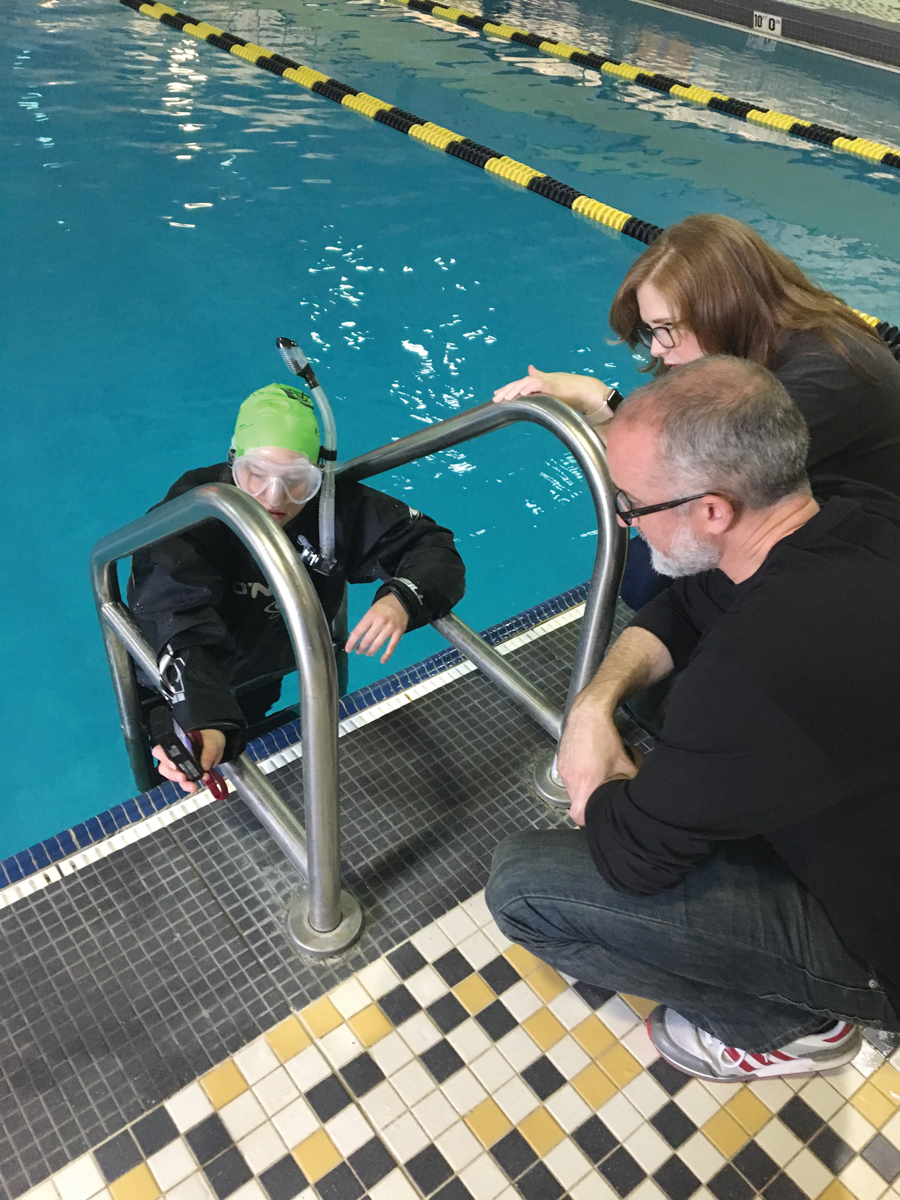
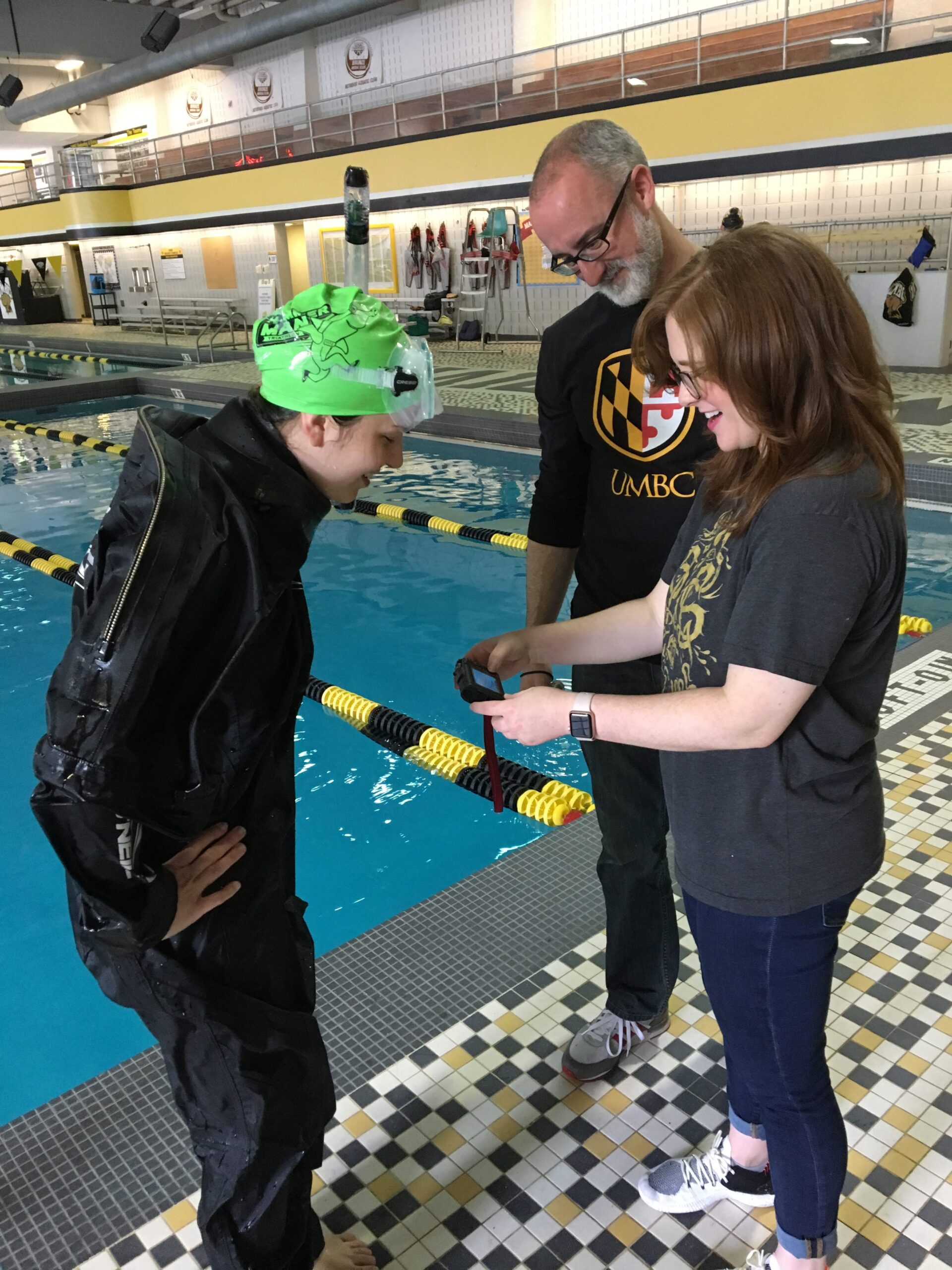
Testing out shot ideas with art director Jim Lord ’99 and designer Candace Cage.
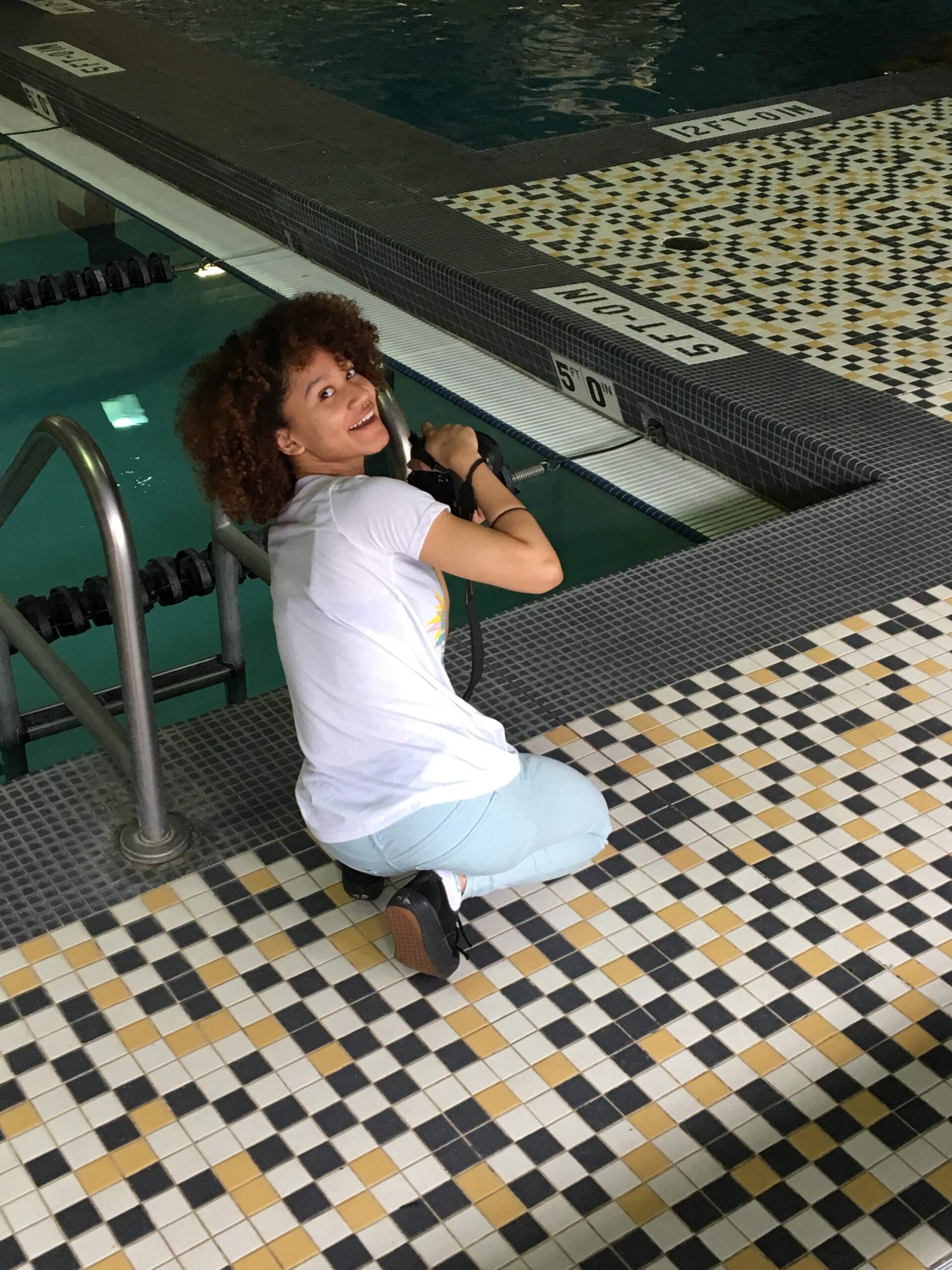
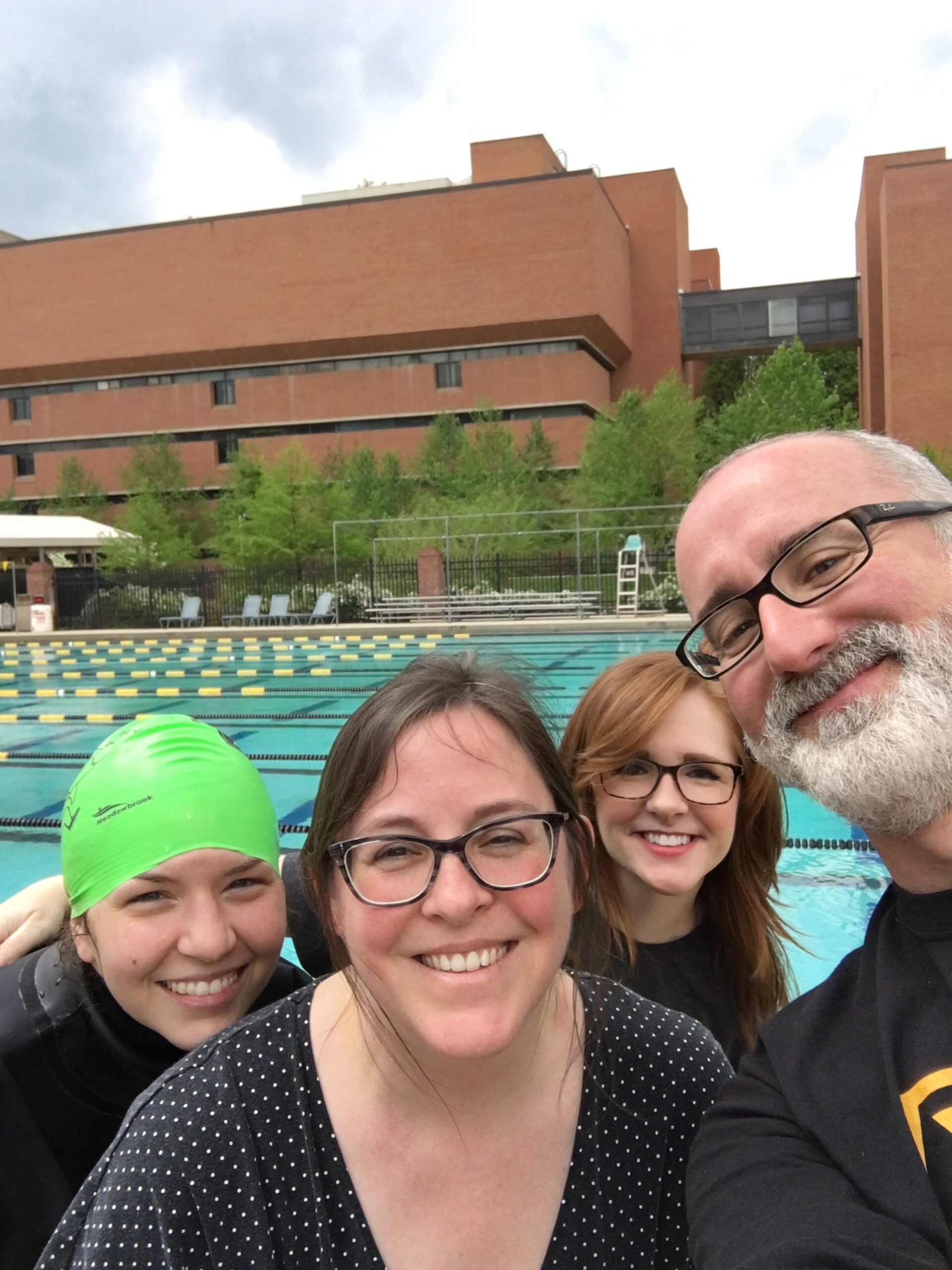
* * * *
Read the full story: The Best Team You’ve Never Heard Of
Header image: There’s a strong possibility they’re cheering because it’s the final shot of the day.
]]>
UMBC Magazine‘s longtime photographer Marlayna Demond ’11 is used to going to great lengths to get her shot. A former Linehan Scholar, she climbs on tables and ladders to achieve the right angle....
https://umbc.edu/stories/swimming/
https://beta.my.umbc.edu/api/v0/pixel/news/120100/guest@my.umbc.edu/0935b44168bc486f1ecc64f838811b6a/api/pixel
athletics
spring-2019
stories
swimming-and-diving
videos
web-extras
UMBC News & Magazine
https://beta.my.umbc.edu/groups/umbc-news-magazine
https://assets1-beta.my.umbc.edu/system/shared/avatars/groups/000/001/943/24435aa6207c452e7bc15cc74b42c7bb/xsmall.png?1748556657
https://assets1-beta.my.umbc.edu/system/shared/avatars/groups/000/001/943/24435aa6207c452e7bc15cc74b42c7bb/original.png?1748556657
https://assets2-beta.my.umbc.edu/system/shared/avatars/groups/000/001/943/24435aa6207c452e7bc15cc74b42c7bb/xxlarge.png?1748556657
https://assets2-beta.my.umbc.edu/system/shared/avatars/groups/000/001/943/24435aa6207c452e7bc15cc74b42c7bb/xlarge.png?1748556657
https://assets3-beta.my.umbc.edu/system/shared/avatars/groups/000/001/943/24435aa6207c452e7bc15cc74b42c7bb/large.png?1748556657
https://assets1-beta.my.umbc.edu/system/shared/avatars/groups/000/001/943/24435aa6207c452e7bc15cc74b42c7bb/medium.png?1748556657
https://assets2-beta.my.umbc.edu/system/shared/avatars/groups/000/001/943/24435aa6207c452e7bc15cc74b42c7bb/small.png?1748556657
https://assets1-beta.my.umbc.edu/system/shared/avatars/groups/000/001/943/24435aa6207c452e7bc15cc74b42c7bb/xsmall.png?1748556657
https://assets2-beta.my.umbc.edu/system/shared/avatars/groups/000/001/943/24435aa6207c452e7bc15cc74b42c7bb/xxsmall.png?1748556657
UMBC News & Magazine
0
0
false
Wed, 19 Jun 2019 14:55:44 -0400
Double Dribble

Karyn Swann ’92, sociology, never imagined that her daughter, Lyric, would attend UMBC, let alone follow in her basketball-shoe footsteps. And Lyric had no idea when she was cheering at the Homecoming games and attending UMBC Nike Basketball Camp in 8th grade that she would one day leave her own legacy on the same court.
Lyric, who signed with UMBC in December 2018, began playing basketball when she was eight after Swann put her in a clinic with her twin sister. She will start playing in the fall.
“It was my UMBC teammate, Angel, who told me about a clinic that she was putting her daughter in, and she suggested I put my twins in” says Swann. “I was hands-off. I never dreamed that I was going to be coaching her. Two years after being in the clinic, she joined a league, and I’ve been coaching her ever since.”
Both Lyric and her mother are left-handed, so Swann’s coaching was key. Lyric quickly became an outstanding athlete, playing both basketball and soccer. After she was named Most Valuable Player at the UMBC Nike Basketball Camp, recruiters started taking note.
“Her sophomore year going into last year, she had a phenomenal summer. So [UMBC] said, ‘Oh gosh, we have got to get this girl before these top top programs get her. The tournament wasn’t even over and they wanted to schedule a visit with her. That’s when it was first surreal, like she could really go here,” says Swann.
Can we put this on our fridge? #RetrieverNation https://t.co/uXyCOk0TOV
— UMBC (@UMBC) June 14, 2019
Currently finishing her senior year at Long Reach High School, Lyric is the top point guard in the area and was the 2017 – 18 Howard County Player of the Year. When it came to making a decision, she had to pick between many schools recruiting her, including Yale.
“She’s a very prolific player. The coach here knows she could have played at a higher level. She realizes that academics are important, and there’s so much that UMBC has to offer in helping you beyond graduation,” says Swann.
When UMBC offered Lyric a full scholarship, she accepted it the same day.
“I was considering some other schools, but I felt like this one was the best fit for me because my mom went here and it’s close to home, and it’s like a home to me. Last year, I verbally committed to this school. This year, I did early signing,” says Lyric. “It was nice because it was a confirmation that I’m here and that my education is secured and my athletic career is secured, and I was just excited to go to college, you know?”
 Karyn and Lyric Swann. Photo courtesy of UMBC Athletics.
Swann, who wasn’t recruited, but became a walk-on-turned-scholarship athlete, remembers a very different UMBC, one that was much smaller, but one that she loved nonetheless. “I had so much fun when I was here. There were a lot of people from my high school here, so it felt really comfortable,” she says. “I loved going to the dining hall and going to some of the parties on Hilltop, and of course I spent a lot of time in the gym and running around the loop for conditioning.”
Incoming women’s basketball head coach Johnetta Hayes said she was thrilled to learn about Lyric well as her mother’s history with the team.
“Lyric will get a chance to create her own story, and I’m excited about that,” Hayes said. “I am thrilled to know she has passion for UMBC. This is home for her. It’s great for her family, and it’s great for UMBC, as well.”
Lyric already knew she wanted to stay in-state so that her mom could come to watch her play. “UMBC is a good school. I’m looking forward to going to an honors school. The people who go here are really smart and focused and they put their future first, as a priority for them. They’re trying to go places in life, and I’m excited to be surrounded by these people,” says Lyric.
She plans to major in graphic design. “I’m looking forward to playing here because basketball is my passion,” says Lyric. “I’m looking forward to making an impact here at UMBC and having fun doing it.”
*****
Header image courtesy of UMBC Athletics.
]]>
Karyn Swann ’92, sociology, never imagined that her daughter, Lyric, would attend UMBC, let alone follow in her basketball-shoe footsteps. And Lyric had no idea when she was cheering at the...
https://umbc.edu/stories/mother-daughter-attend-same-basketball-team-decades-apart/
https://beta.my.umbc.edu/api/v0/pixel/news/120101/guest@my.umbc.edu/8cddea1641aec4c2b18e76099233d8fe/api/pixel
athletics
basketball
campus-life
spring-2019
UMBC News & Magazine
https://beta.my.umbc.edu/groups/umbc-news-magazine
https://assets1-beta.my.umbc.edu/system/shared/avatars/groups/000/001/943/24435aa6207c452e7bc15cc74b42c7bb/xsmall.png?1748556657
https://assets1-beta.my.umbc.edu/system/shared/avatars/groups/000/001/943/24435aa6207c452e7bc15cc74b42c7bb/original.png?1748556657
https://assets2-beta.my.umbc.edu/system/shared/avatars/groups/000/001/943/24435aa6207c452e7bc15cc74b42c7bb/xxlarge.png?1748556657
https://assets2-beta.my.umbc.edu/system/shared/avatars/groups/000/001/943/24435aa6207c452e7bc15cc74b42c7bb/xlarge.png?1748556657
https://assets3-beta.my.umbc.edu/system/shared/avatars/groups/000/001/943/24435aa6207c452e7bc15cc74b42c7bb/large.png?1748556657
https://assets1-beta.my.umbc.edu/system/shared/avatars/groups/000/001/943/24435aa6207c452e7bc15cc74b42c7bb/medium.png?1748556657
https://assets2-beta.my.umbc.edu/system/shared/avatars/groups/000/001/943/24435aa6207c452e7bc15cc74b42c7bb/small.png?1748556657
https://assets1-beta.my.umbc.edu/system/shared/avatars/groups/000/001/943/24435aa6207c452e7bc15cc74b42c7bb/xsmall.png?1748556657
https://assets2-beta.my.umbc.edu/system/shared/avatars/groups/000/001/943/24435aa6207c452e7bc15cc74b42c7bb/xxsmall.png?1748556657
UMBC News & Magazine
0
0
false
Tue, 18 Jun 2019 19:57:44 -0400
The Best Team You’ve Never Heard Of
When a swimmer is good—really good—the sound of their stroke is smooth and quiet. The athlete plunges neatly into the water as if into another layer of air. Gentle ripples of movement belie the engine propelling it powerfully beneath the surface.
For years, the UMBC swimming and diving team has been quietly winning its way into university history. Since 1999, they have amassed 32 championship trophies, not to mention consistent accolades for athletic prowess and coaching. And they’ve done this largely without the fanfare received by more popular sports.
So, what’s the secret to this powerhouse squad’s success? What keeps them coming to the pool again and again?
It’s simple: They don’t do it for the splash.
By Jeff Seidel ’85
Beneath the surface
The UMBC men’s basketball team shocked many and generated a huge amount of publicity when they beat Virginia 74-54 in the first round of the NCAA basketball tournament in March 2018. By now, the story is well-known because it was the first time in the history of that tournament when a No. 16 seed beat a No. 1.
The basketball program and school received a deluge of publicity from all around the country after that. Places like the New York Times, Washington Post, and ESPN suddenly wanted to know not just what the letters “UMBC” meant, but everything about the basketball program and school. The attention seemed endless— and that was all for just one game.
The UMBC men’s and women’s swimming and diving programs have won plenty in their own right—even if most people don’t realize it. They swept the America East championships this past winter, claiming the 31st and 32nd titles for the Retrievers—26 of which have come since Chad Cradock ’97, psychology, became the head swimming and diving coach in 2001.
 The Retrievers swept the America East championships this past winter, claiming their 31st and 32nd titles. Photo by Marlayna Demond ’11.
Those are staggering numbers, but since swimming gets less attention than basketball and other big college sports in this country, the men and women on this team know the score. Even Cradock understands the deal and shrugs it off. What can they do?
“It’s not seen as popular of a sport, and that’s the way America looks at it,” Cradock says. “If we were in Australia, swimming would be the number one. Even in Hungary, it’s very popular. It’s the most-watched sport in the Olympic Games.”
But every day, the swimmers and divers head to the pool anyway. And year after year, the program broadens its family of alumni. It’s a connection that goes far beyond the pennants and tailgating of other sports. It’s a culture all its own.
“We do it because we love it,” Cradock says.
The daily grind
What many don’t realize is the grind the Retrievers endure to find all of their success, Cradock says. This is a year-round gig for the coaches, who often arrive on campus at 6 a.m. and stay until 7:30 p.m., with six to eight more hours on Saturday, plus other work on Sunday.
The workouts are long and laborious. On Monday, Wednesday, and Friday, they do weights from 6:15 to 7 a.m., then swimming drills, kicking technique, and recovery (7 to 7:45 a.m.). Later in the day, they work out on land (1:15 to 1:45 p.m.) and then it’s back in the pool from 1:45 to 3:45 p.m. On Tuesday and Thursday, practices stretch from 1:30 to 1:45 p.m., with a two-hour swim right after that. It all continues into Saturday, a fact the swimmers understand and accept. It’s all part of the game.
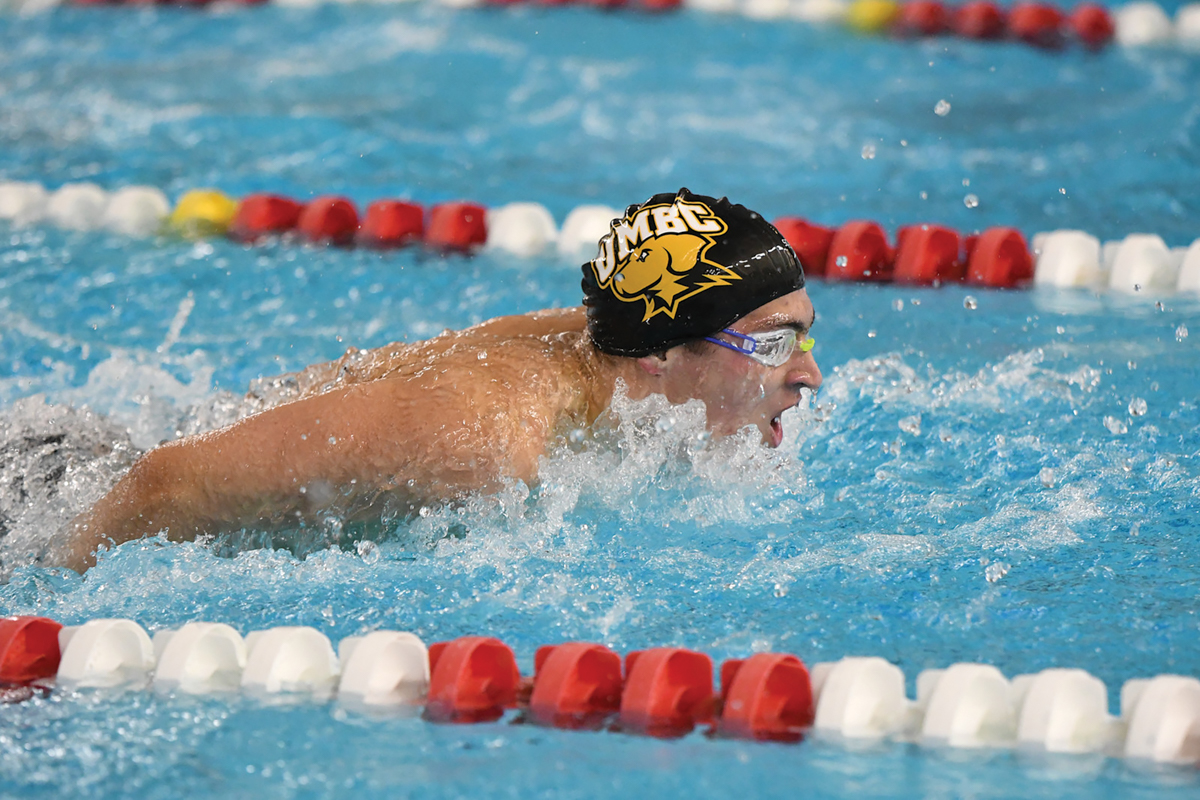
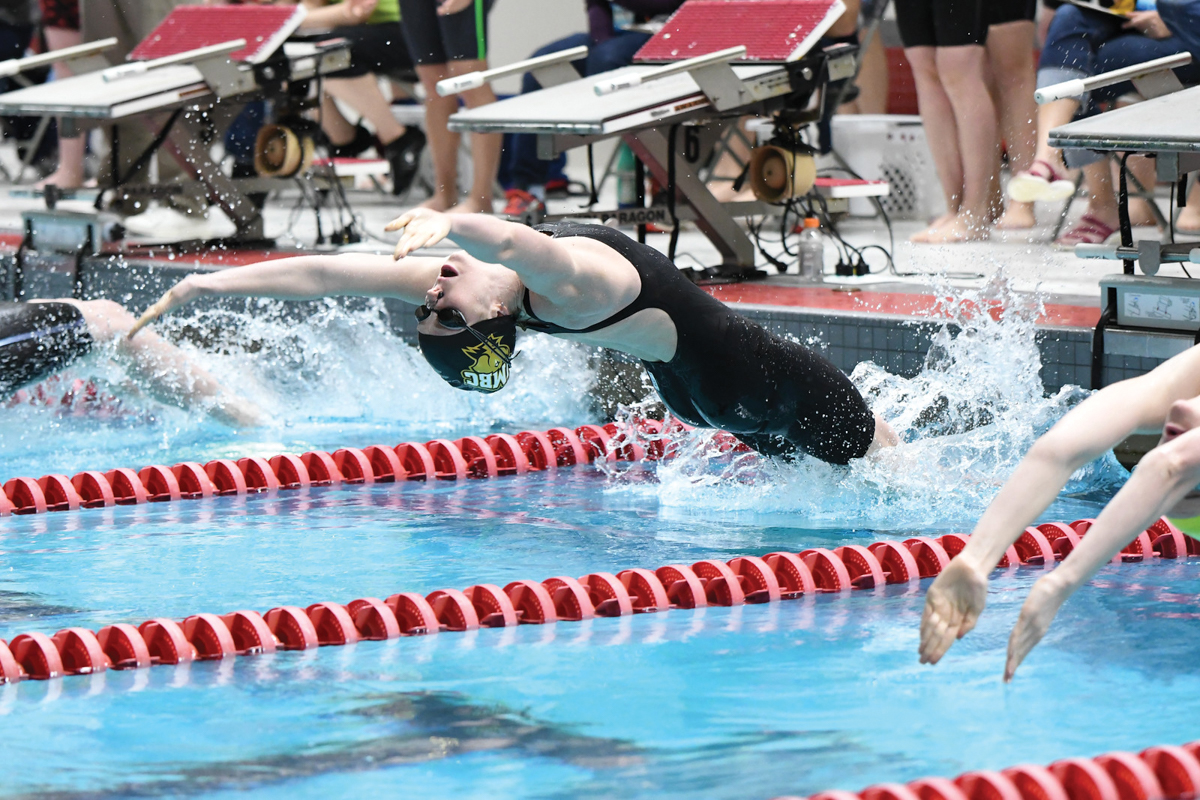
“We enjoy the sport…and we’re not doing it to be famous or anything,” says Hania Moro, a senior financial economics major from Egypt. Hania—who has fallen in love with bagels while at UMBC and wants to open a bagel store when she goes back to her home country—just set the school record in the 1650 free at the America East 2018 title meet. “We love to be here, and we love to be with each other, and we love to enjoy our time. This is about swimming.”
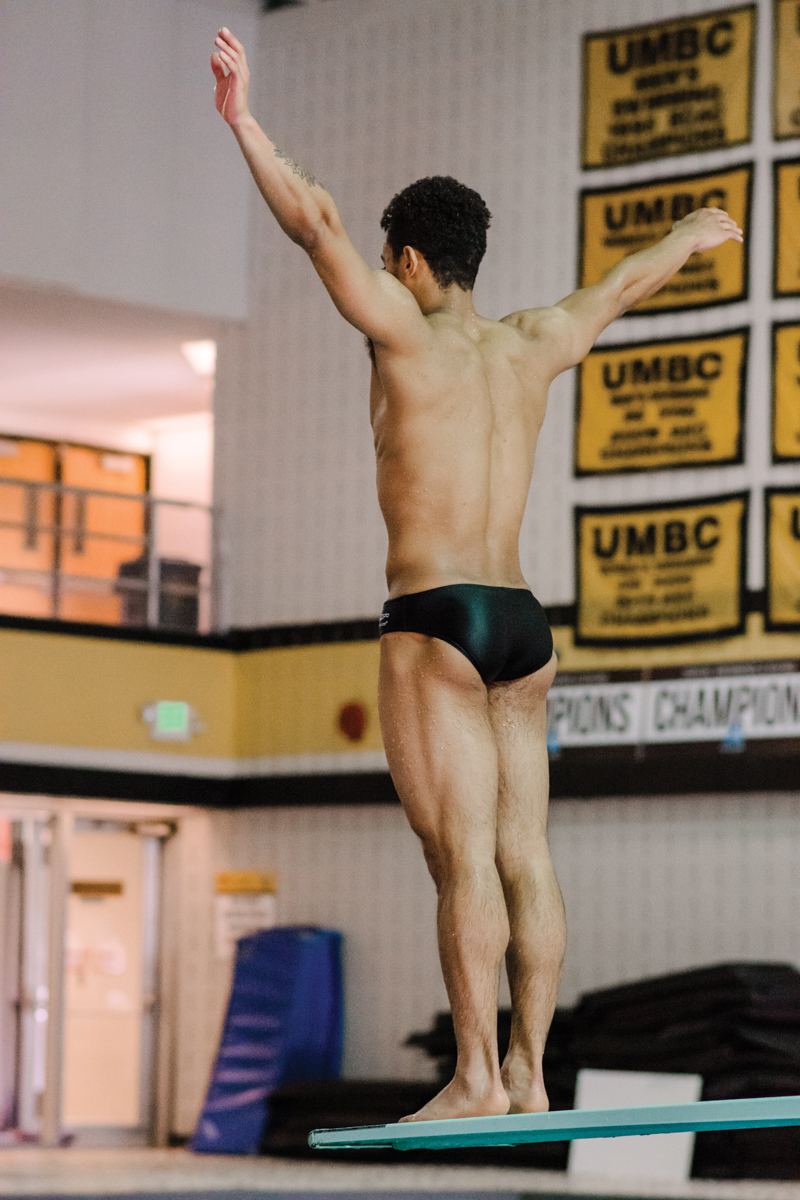
Elijah Wright , a diver from Baltimore, says the Retriever swimmers and divers put in the foundational hard work to find their success. For example, Wright wakes up at 5:30 a.m. Monday through Saturday and goes to practice from 6 to 8 a.m. from early September through February. Plus, he lifts weights on Monday, Wednesday, and Friday.
The swimmers and divers work through a long and tough regimen all season to earn those championship banners, something they all take pride in.
“When you walk into the pool area, you see all the banners, and you would think that’s just decoration if you didn’t see all the hard work we put in each and every day,” Wright says.
Team as family
Cradock swam at UMBC from 1993 to 1997, lettering all four years and earning the Matt Skalsky Outstanding Scholar-Athlete award as a senior. He became head coach in 2001, bringing with him a philosophy that emphasized the coaches working with the student-athletes and not dictating to them.
Growing up at UMBC, so to speak, the team has become a second family for Cradock. Coaching with Cradock now are Chris Gibeau ’93, biological science; Nikola Trajkovic ’18, financial economics; and Elyse Gibson-Clegg ’06, sociology, along with diving coach Petar Trifonov, all of whom work to create an environment where the swimmers and divers feel at home and are comfortable throughout the daunting schedule swimming requires. That means team shout-outs on birthdays and creating spaces where athletes can talk with coaches on a regular basis about problems in swimming, classes, and life. These personal touches help draw the swimmers closer as a group.
 Haylee Committee hugs Tonia Papapertrou after the 100 freestyle. Photo by Colleen Humel.
For junior economics major Sotia Neophytou, who came to UMBC this year from Cyprus (a 30-hour trek to Catonsville), the family spirit shined especially bright around the holidays.
“I didn’t go home for Christmas, but Chad invited me to his house, and I spent an amazing Christmas there,” she says. “Chad is amazing, and he knows what he’s doing. I trust him so much. You need to communicate with your coach, and Chad and I have that.”
Cradock, who has three children of his own, certainly understands the parents’ feelings when they turn their swimmers over to him for four years. UMBC has about 65 swimmers total on this year’s championship teams, and it’s a very diverse group with athletes from around the globe.
And family membership doesn’t end at graduation. Many of Cradock’s swimmers stay in touch long after commencement, often giving back to the program as a way of showing their commitment.
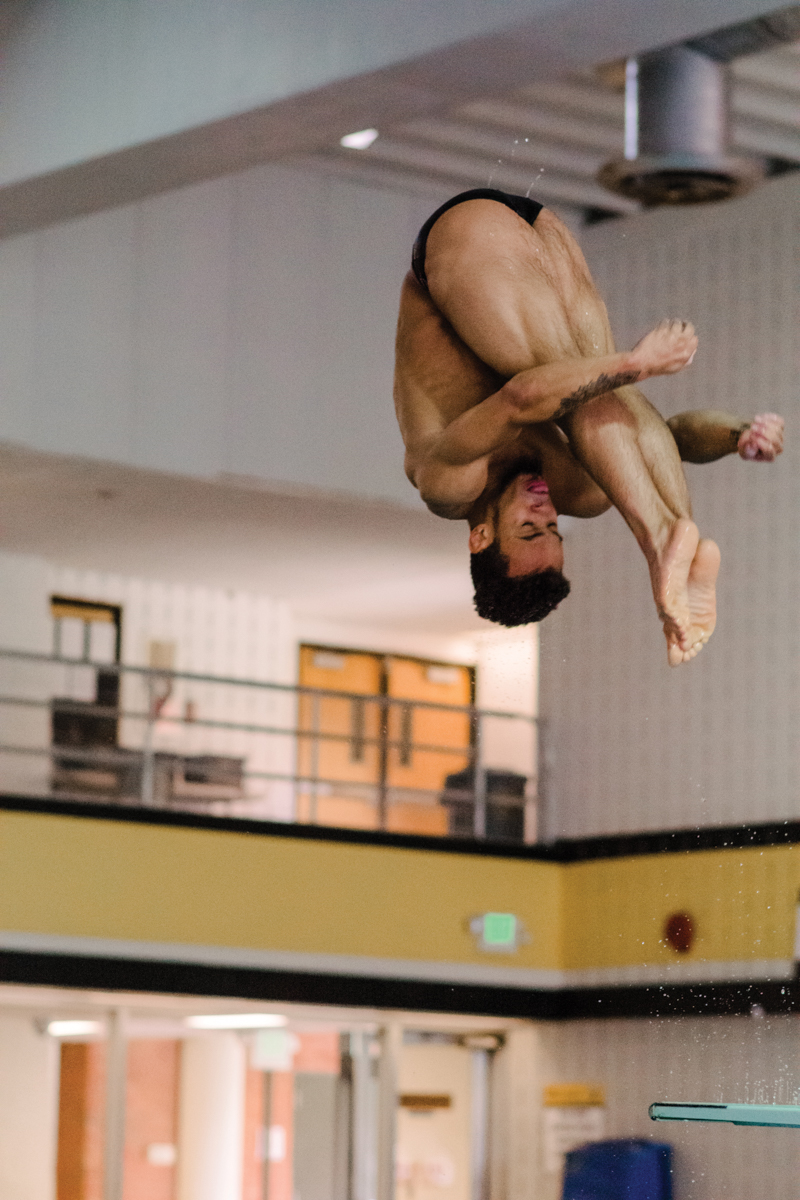
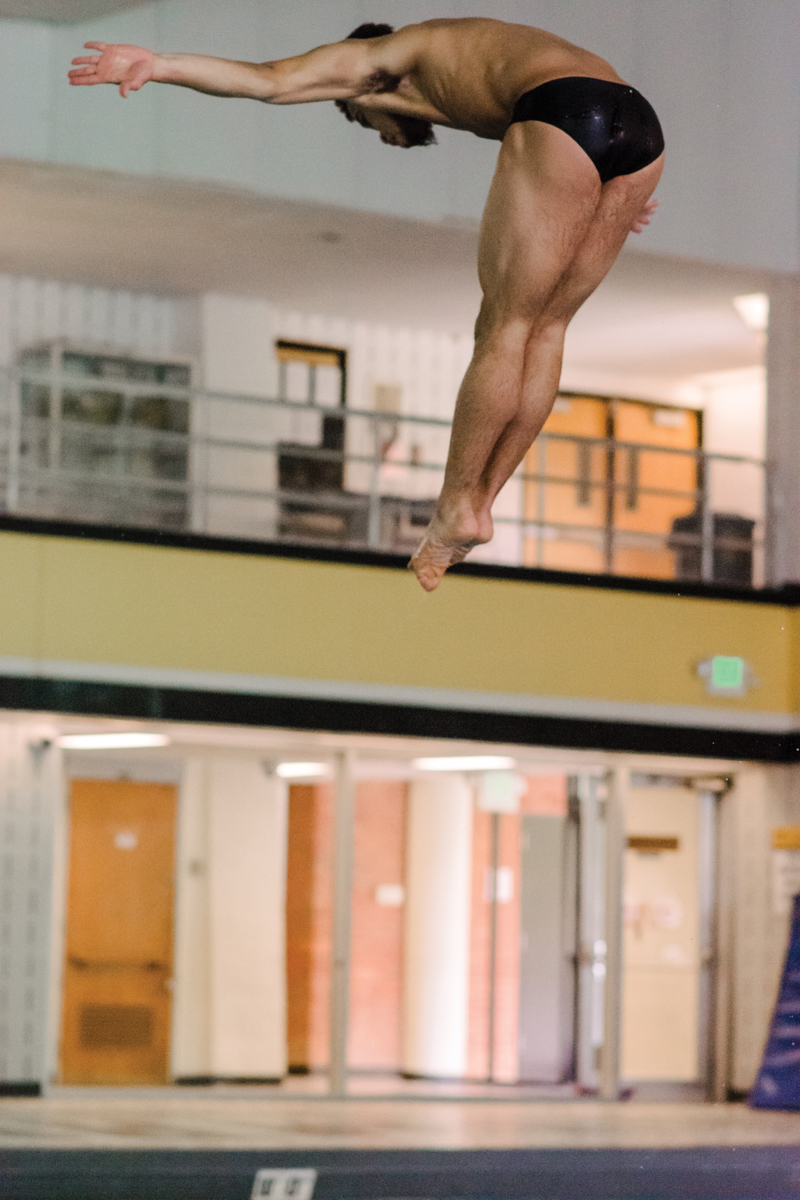
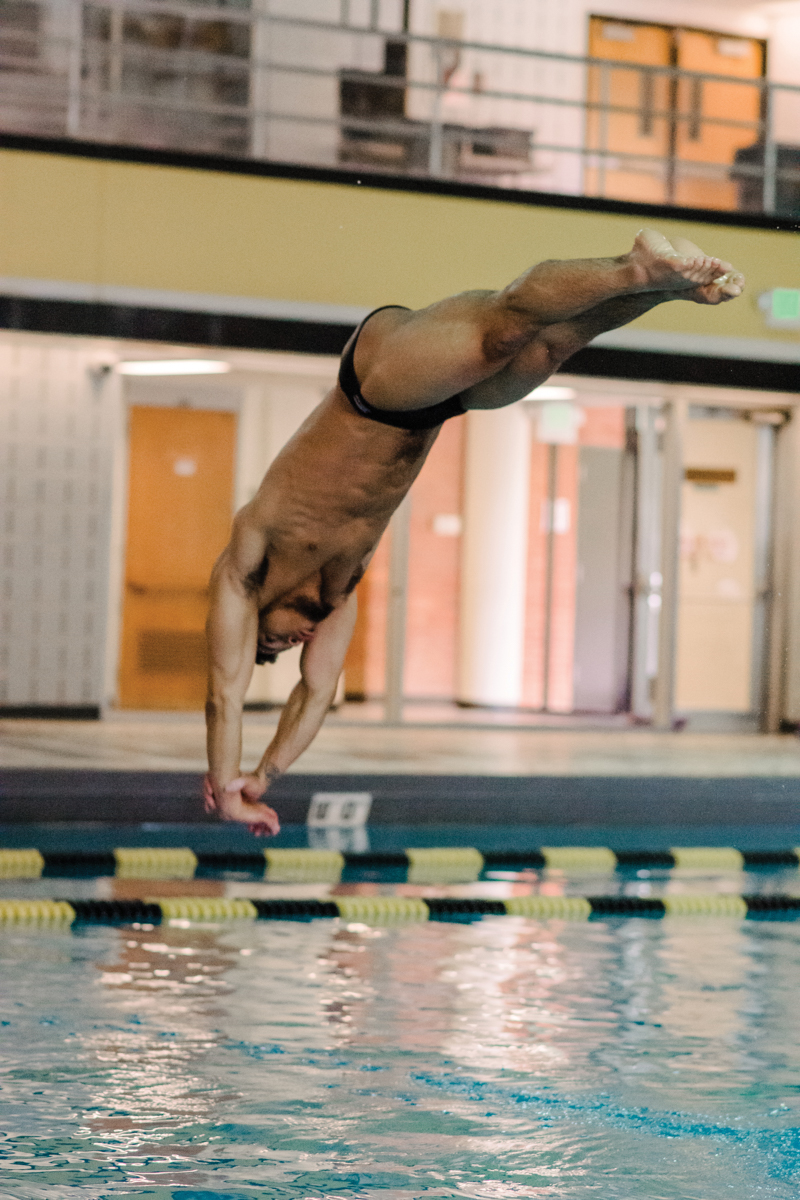
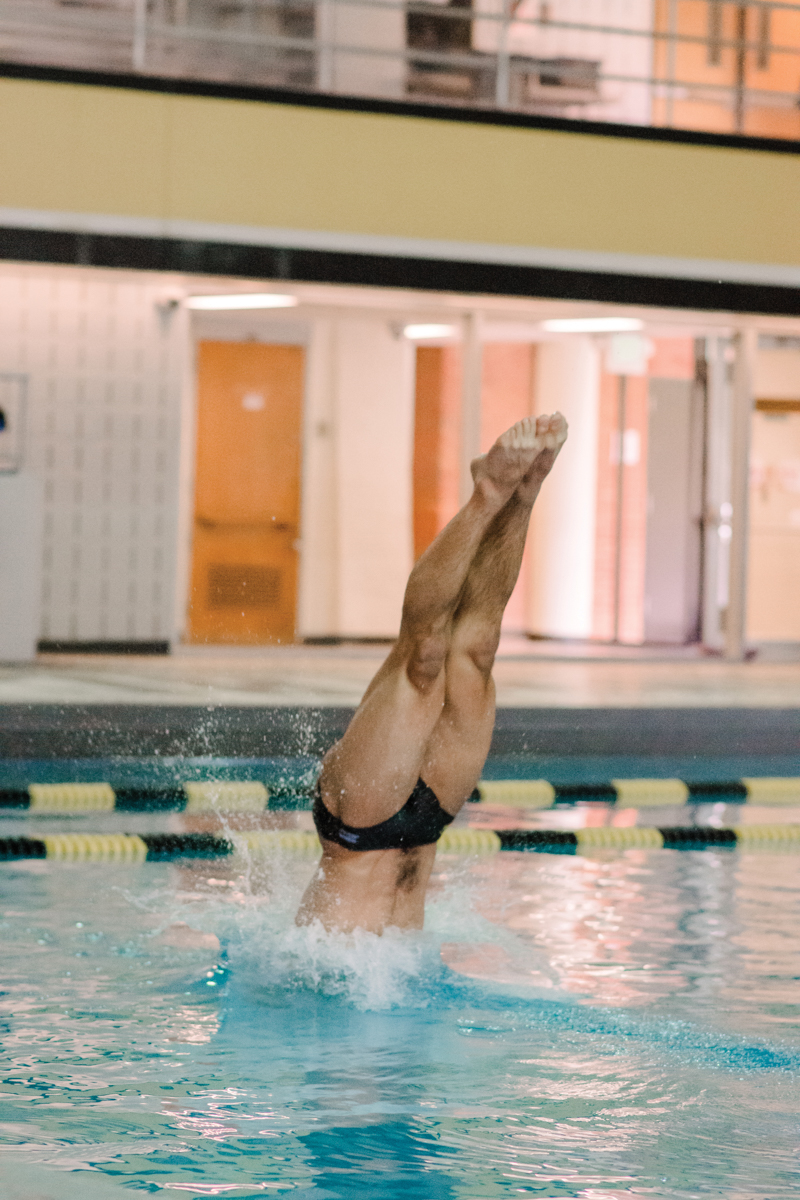
David Miller ’96, economics, is now a corporate lawyer in New York. He swam with UMBC from 1993 to 1996 and still keeps in touch with some from the program, especially when he makes it back to campus. He also ran into other former Retriever swimmers recently at an event that UMBC hosted in New York City at the One World Observatory. Miller still holds the record for the 1,000-yard freestyle in the UMBC pool and was delighted to learn that the younger folks were aware of him.
“They knew who I was, and it was definitely really cool to know that after all these years, that I still hold some sort of presence there…I was still on the record books…so that sort of helped,” he says with a laugh.
Miller says that he remembers his swimming days at UMBC where there were just about a dozen swimmers on the team. There are now more than five times that many, but Cradock has worked to keep the big group close, as he believes that helps with the overall success of the teams.
“[Being a student athlete is] hard in general, but what I’ve tried to do have the swim team become part of my family so that nobody kind of resents each other,” Cradock says. “We treat them the way we would want our kids to be treated wherever they went.”
Olympic aspirations
Another thing that might surprise those new to the sport is the level of international competition the Retriever swimmers and divers engage in throughout the year—including the most watched competition of all, the Olympics.
Neophytou swam for her home country at the Olympics in Rio three years ago and said it was an amazing experience. When she competed in the 100 butterfly on August 6—she still remembers the date—she said, with a smile, “my dad came to see me, [and when] I found him, he was still crying. I made him proud.”
Neophytou, the third Retriever to make the Olympics, said her UMBC teammates often pick her brain about what it was like to swim there, and getting that rare opportunity improved her self-confidence. That, combined with the transfer to UMBC and her respect for Cradock and his coaches, has made her a better swimmer.
“There’s a lot of respect out there for our program [world-wide],” Cradock said. “We are well-respected internationally. It took a lot of time.”
 Mac Hoskins celebrates a great race. Photo by Colleen Humel.
UMBC also has a chance for two others to earn spots in the 2020 Tokyo Olympics. Moro is trying to represent Egypt there while senior mechanical engineering major and Meyerhoff Scholar Alexander Gliese hopes to make it with Denmark, the country he was born in before growing up in nearby Howard County. Both are within range to qualify and will be spending plenty of time this year focusing on that goal.
Gliese is a two-time captain at UMBC and the Danish national record holder in the 200-meter backstroke. He also mentioned that the family atmosphere Cradock and his coaches created gives him help in many ways in and out of the pool.
“It motivates you every single day; you have somebody there who’s pushing you or you have somebody who’s there when you’re not having the greatest day,” Gliese said. “Somebody says ‘hey, it’s OK to have a bad day.’ I’m still [getting better]. I don’t know if I would have seen the same success or not [somewhere else].”
Making their mark
Cradock said one moment that they all enjoyed recently came after winning the America East championship and the team returned to campus. They were honored during a media timeout of a basketball game at the UMBC Event Center and received a large ovation from the crowd that night, something that the swimmers just loved.
It was a moment in the sun on their own campus, one that doesn’t happen often with this sport.
“We went up there to do our job and we did,” Cradock said. “The theme this year was Love It, Live It, Enjoy It, and we did just that.”
The Retrievers certainly did what they planned for when taking the men’s and women’s team titles in the February 2019 America East championships in Worcester, Massachusetts. Moro broke the school record in the 1650 freestyle and won a gold medal in that event. Gliese set a school and conference record for the 200 backstroke (1 minute, 42.56 seconds in a preliminary race) and later took home a gold medal in the event.
Moro also earned the Dave Alexander Coaches’ Award, for the senior who gets the most points during the meet. Gliese received the same honor on the men’s side and was named Most Outstanding Swimmer. He also broke the America East record in the 100 backstroke. Wright won gold in 1 meter and 3 meter dives and was named Most Outstanding Diver of the Meet, while Cradock and his coaches were named the men’s and women’s Coaching Staff of the Year.
Cradock and the team are enjoying their successes and the extra attention that comes with it.
“I think it has a lot of effect, and it starts with name recognition,” Cradock said. “It’s become a lot easier that we’re more respected in the athletic world because of what they did. It’s probably tripled in one year the amount of people that reached out to the swimming program. [UMBC was] the big story last year.”
The publicity that follows the athletic success of some teams, well, that’s for other sports. Building a solid environment to compete, that’s for this program, and it’s why they’ve been so successful.
“Sustained success is one of the most difficult things to accomplish on the Division I level,” said Tim Hall, director of athletics, physical education, and recreation. “This is what UMBC Swimming and Diving programs have achieved under the leadership of Chad and his staff. The student-athletes are wonderful representatives of the university and the alumni stay very connected. All of Retriever Nation should be extremely proud of this model program.”
 The teams celebrate their America East championships victory with a commemorative jump into the pool. Photo by Colleen Humel.
*****
Header image by Marlayna Demond ’11.
 WEB EXTRA: Our photographer, Marlayna Demond ’11, will do almost anything to get her shot — even submerse herself and her camera. Visit umbc.edu/swimming for a first-hand look at what it took to do our DIY underwater photo shoot.
]]>
When a swimmer is good—really good—the sound of their stroke is smooth and quiet. The athlete plunges neatly into the water as if into another layer of air. Gentle ripples of movement belie the...
https://umbc.edu/stories/umbc-swimming-and-diving-the-best-team-youve-never-heard-of/
https://beta.my.umbc.edu/api/v0/pixel/news/120102/guest@my.umbc.edu/ef5c8acae1ff4c9315651e796a1977f1/api/pixel
athletics
campus-life
spring-2019
swimming-and-diving
UMBC News & Magazine
https://beta.my.umbc.edu/groups/umbc-news-magazine
https://assets1-beta.my.umbc.edu/system/shared/avatars/groups/000/001/943/24435aa6207c452e7bc15cc74b42c7bb/xsmall.png?1748556657
https://assets1-beta.my.umbc.edu/system/shared/avatars/groups/000/001/943/24435aa6207c452e7bc15cc74b42c7bb/original.png?1748556657
https://assets2-beta.my.umbc.edu/system/shared/avatars/groups/000/001/943/24435aa6207c452e7bc15cc74b42c7bb/xxlarge.png?1748556657
https://assets2-beta.my.umbc.edu/system/shared/avatars/groups/000/001/943/24435aa6207c452e7bc15cc74b42c7bb/xlarge.png?1748556657
https://assets3-beta.my.umbc.edu/system/shared/avatars/groups/000/001/943/24435aa6207c452e7bc15cc74b42c7bb/large.png?1748556657
https://assets1-beta.my.umbc.edu/system/shared/avatars/groups/000/001/943/24435aa6207c452e7bc15cc74b42c7bb/medium.png?1748556657
https://assets2-beta.my.umbc.edu/system/shared/avatars/groups/000/001/943/24435aa6207c452e7bc15cc74b42c7bb/small.png?1748556657
https://assets1-beta.my.umbc.edu/system/shared/avatars/groups/000/001/943/24435aa6207c452e7bc15cc74b42c7bb/xsmall.png?1748556657
https://assets2-beta.my.umbc.edu/system/shared/avatars/groups/000/001/943/24435aa6207c452e7bc15cc74b42c7bb/xxsmall.png?1748556657
UMBC News & Magazine
0
0
false
Tue, 18 Jun 2019 15:46:45 -0400
From Real Estate to Covert Agent

Most days, Steven O’Farrell ’92, economics, uses the left side of his brain. As a real estate appraiser, O’Farrell’s livelihood depends on his ability to construct well-written, compelling reports. Remembering his time at UMBC quite fondly, he believes that his success is a direct result of his time spent as a Retriever. “My experience at UMBC was outstanding. I really credit a lot of the things that have happened to me afterward as part of these, you know, sort of formative years, when you’re young,” says O’Farrell. “I still use the calculator that I used at UMBC.”
A new calling
 But it was O’Farrell’s creative right brain that took over two and a half years ago while on vacation with his family in Bethany Beach, Delaware, when O’Farrell’s niece pleaded with him to give her a spy name like the other children of the family. Without hesitation, the name Simone LaFray flew from his lips. For the rest of the vacation, he would fixate on the name. Little did O’Farrell know that this one comment would lead to a short story, which would eventually become the published book Simone LaFray and the Chocolatiers’ Ball.
It wasn’t until family and friends encouraged him to expand his short story into a book that O’Farrell took on this new endeavor. “Writing a book of fiction was one of those things that I always wanted to try to do even when I was a little kid,” O’Farrell says. “But, you know, sometimes you prioritize your career over these things. When I wrote the book I was 45. It was time for my next move because time slips away quickly.”
For the next two years, O’Farrell’s life became a jumble of long nights, re-writes, and collaboration with Brandylane Publishers, a group of individuals who he says “want to talk about how things feel”—a refreshing change of pace for the appraiser.
Discovering Simone
Developing the voice of 12-year-old LaFray proved challenging for O’Farrell, a father of two boys, who relied on the help of his wife, Emily O’Farrell ‘92, psychology, for a female perspective. Once O’Farrell understood who Simone was at her core, the story quickly evolved from there, bringing the young spy to life: a dutiful daughter of a world-famous patisserie chef doubling as a covert agent for the Ministry of Foreign Affairs. LaFray lives the best of both worlds until a vengeful thief returns to Paris in search of LaFray’s mother, leaving LaFray to question whether her two worlds are as separate as she once believed.
Released on May 13, 2019, The Chocolatiers’ Ball tracked on the Barnes & Noble Top 10 in preorders and was reviewed by two of UMBC’s faculty members: Writing Center Director Elaine MacDougall, and Maria De Verneil, the coordinator for French language teaching.
Although just recently released, there are plans to turn the book into a series. “I know exactly how I want it to all go, it’s just about connecting all the points to the final,” says O’Farrell.
Exercise your muscles
Though O’Farrell spends most of his days putting together what he calls “dry” appraisals, he fully acknowledges that this sort of writing has prepared him for the author life. Every workday provides him new opportunities to master his technical skills, leaving him with freedom in his downtime to let his creativity flow. And according to O’Farrell, any writing is good writing as long as you’re doing it.
To the students of UMBC or anyone in general thinking about writing their first book, O’Farrell offers the following: “Have persistence and believe in yourself. What you’re writing will find its audience. Just try to align yourself with good people to get you there.”
*****
Learn more about Simone LaFray and the Chocolatiers’ Ball at brandylanepublishers.com.
Photos provided by Steven O’Farrell.
]]>
Most days, Steven O’Farrell ’92, economics, uses the left side of his brain. As a real estate appraiser, O’Farrell’s livelihood depends on his ability to construct well-written, compelling...
https://umbc.edu/stories/from-real-estate-to-covert-agent/
https://beta.my.umbc.edu/api/v0/pixel/news/120103/guest@my.umbc.edu/6d74f6824827b6d99de60536d9fe12c6/api/pixel
alumni
economics
UMBC News & Magazine
https://beta.my.umbc.edu/groups/umbc-news-magazine
https://assets1-beta.my.umbc.edu/system/shared/avatars/groups/000/001/943/24435aa6207c452e7bc15cc74b42c7bb/xsmall.png?1748556657
https://assets1-beta.my.umbc.edu/system/shared/avatars/groups/000/001/943/24435aa6207c452e7bc15cc74b42c7bb/original.png?1748556657
https://assets2-beta.my.umbc.edu/system/shared/avatars/groups/000/001/943/24435aa6207c452e7bc15cc74b42c7bb/xxlarge.png?1748556657
https://assets2-beta.my.umbc.edu/system/shared/avatars/groups/000/001/943/24435aa6207c452e7bc15cc74b42c7bb/xlarge.png?1748556657
https://assets3-beta.my.umbc.edu/system/shared/avatars/groups/000/001/943/24435aa6207c452e7bc15cc74b42c7bb/large.png?1748556657
https://assets1-beta.my.umbc.edu/system/shared/avatars/groups/000/001/943/24435aa6207c452e7bc15cc74b42c7bb/medium.png?1748556657
https://assets2-beta.my.umbc.edu/system/shared/avatars/groups/000/001/943/24435aa6207c452e7bc15cc74b42c7bb/small.png?1748556657
https://assets1-beta.my.umbc.edu/system/shared/avatars/groups/000/001/943/24435aa6207c452e7bc15cc74b42c7bb/xsmall.png?1748556657
https://assets2-beta.my.umbc.edu/system/shared/avatars/groups/000/001/943/24435aa6207c452e7bc15cc74b42c7bb/xxsmall.png?1748556657
UMBC News & Magazine
0
0
false
Tue, 18 Jun 2019 13:11:25 -0400
The Power of Community

One student’s story could appear to inspired onlookers as a meteoric rise: excelling from private school to lauded scholarship programs and landing an ivy school opportunity post-graduation. But Anna Gifty Opoku-Agyeman M26 ’19, mathematics, is clear that her success is firmly grounded in a support network formed early on—and hard fought for—when circumstances seemed to isolate her from the community she knew was necessary in order for her to thrive.
In kindergarten, her principal, Anna Puma, took special notice of her skills and ability and funded a scholarship that helped Opoku-Agyeman’s family keep her in a small private elementary school. The additional support helped her prepare and be accepted to a private school in the area for middle through high school, which would later give Opoku-Agyeman access to unique academic opportunities that would not otherwise have been available. She flourished during her years in her small, supportive school and was excited about college.
However, before Opoku-Agyeman would ultimately create the first conference for Black women in economics, graduate from UMBC surrounded by peers and mentors, and join The Research Scholar Initiative (RSI) program at Harvard University, she would have to learn to keep creating support networks along the way.
“My success is not mine, it is the work of many who saw my potential before I saw it in myself,” she says.
Creating a supportive network
At the first institution Opoku-Agyeman attended—a large campus near Washington, D.C.—she found it difficult to navigate the size and make relationships. Fear, anxiety, and loneliness quickly engulfed her. Attending her classes became difficult. Thinking about her future was overwhelming. Opoku-Agyeman’s elementary school principal, with whom she retained a close relationship, was one of many who helped her see through the clouds. Her family, faith community, and various mentors all listened to the obstacles Opoku-Agyeman was facing, gave her advice, and cheered her on as she figured out her path.
Opoku-Agyeman ultimately transferred to UMBC for its diversity, community, and academic support. Within her first year on campus, she began building critical connections with staff and students. She gained the support of Simon Stacey, director of UMBC Honors College, who referred her to Jacqueline King, assistant director of the MARC U*STAR Program and Meyerhoff team member.
“I’ve witnessed Anna’s metamorphosis from a student who was unsure of her academic capabilities to a young woman who is positioning herself to impact the economic and public policy field,” King says. “Her superpower is her ability to foster connections and collaborations to make a difference.”
 Opoku-Agyeman meets with Dr. Jacqueline King. Photo by Marlayna Demond ’11.
With newfound supports in place, Opoku-Agyeman quickly transitioned from feeling lonely and lost to being part of both program communities. She tapped into the drive she had in high school, created strong friendships, and built a professional network.
As she embarks on her graduate studies, Opoku-Agyeman is now aware of how important it is to embrace and learn from the fear, anxiety, and confusion that sometimes occurs with new experiences. “Don’t let the temporary absence of community deter you from pursuing your goals’” says Opoku-Agyeman. “Being alone helped me to build coping skills, value my family and friends, and develop humility in my achievements.”
A family foundation
In pursuing her goals, Opoku-Agyeman conducted research on the impact of malaria on educational achievement in Ghana, pioneered the first Sadie T.M. Alexander Conference for Economics and Related Fields, and tutored middle and high school students in math throughout Howard County. Opoku-Agyeman shines her way through life with a steadfast dedication for creating opportunities for others. To balance the demands of her many pursuits, she fosters strong relationships, a method modeled by her father, she says.
“I encouraged Anna to study hard from kindergarten through college,” says Ernest Opoku- Agyeman, a registered nurse who holds his Ph.D. in epidemiology. “I wanted her to equip herself for the future and vowed to support her with anything she needed to excel in college and finish debt-free. It has been a pleasure being partners in her education and seeing her present her work widely.”
 Anna with her father. Photo courtesy of the Opoku-Agyeman family.
Reciprocating kindness
As a Meyerhoff and MARC*U*Star Scholar and Honors College student, Opoku-Agyeman was able to depend on a network of faculty and staff to help navigate academic decisions and responsibilities. Her friends, Olanike Awotunde M26 ’18, biochemistry and molecular biology, Naomi Mburu M26 ’18, chemical engineering, and Brandon Enriquez M25 ’17, economics and mathematics, listened to her concerns, celebrations and, at times, served as her role models. Most importantly, her peers have provided a supportive community sharing joy, adventures, and prayer.
After Opoku-Agyeman transferred to UMBC, Awotunde was able to repay a kindness her friend had shown her in high school. “Anna approached me on my first day bubbling with excitement. She immediately introduced me to her friends making me feel welcome,” Awotunde remembers. Awontude introduced the new Retriever to Mburu and her welcoming community. ”I was impressed by her ability to lead. She voiced her opinions even when they were not popular amongst our peers in a high school with little diversity,” says Awotunde.
Throughout college, the two balanced the pressures of rigorous academic and professional paths by having fun. “We prayed together, brainstormed career ideas, and unwound by eating out, shopping, attending on-campus events, and going to the movies,” says Awotunde. A friendship they fostered even after Awotunde graduated and transitioned into a post-baccalaureate fellowship at the National Eye Institute, a part of the National Institute of Health, in preparation for a career as a physician-scientist.
Faith in friendship
Opoku-Agyeman’s strong faith is also something she shares with Mburu. “I am incredibly proud of her achievements and inspired by her discipline to stay humble and point to God throughout all of her success,” says Mburu. Their bond has grown stronger over the last year. Mburu has enjoyed cheering for Opoku-Agyeman as she inaugurated the Sadie T.M. Alexander conference for Black women in economics. “It has been beautiful to see Anna focus her energy on creating spaces for Black women and empowering other women of color to pursue and thrive in economics,” shares Mburu.
 Opoku-Agyeman, Mburu, and Awotunde have retained their close friendship even as post-graduate opportunities have taken them around the world. Photo by Marlayna Demond ’11.
Opoku-Agyeman has also been there for Mburu, helping prepare possible interview questions on a wide array of topics for her Rhodes scholarship interview, providing support on her road to being the first Rhodes Scholar in UMBC’s history. “Our relationship is based on mutual respect for our goals. We learn actively from each other’s experiences and habits,” says Mburu.
Sharing is caring
Opoku-Agyeman also learns from her friends who, like her, are often pursuing paths unfamiliar to them. When she began to think of switching her major from biological sciences to economics she had concerns. She wanted to find a way to combine education and health research to improve economic mobility for underrepresented groups. After Opoku-Agyeman learned about human capital in macroeconomics class, she found that education and health had a high correlation on social and economic mobility.
Her vast network encouraged her to reach out to Enriquez, who is currently a doctoral student in economics at MIT. “We talked about how economists study more than finance, banking, and insurance,” recalls Enriquez. “I was able to share with her how economists also study strategic behavior in labor markets, public health, political systems, and other socially relevant contexts.”
 Opoku-Agyeman with Brandon Enriquez and Terry Bridget Long, dean of the Graduate School for Education at Harvard. Photo courtesy of Opoku-Agyeman.
In addition to questions about economics, Opoku-Agyeman had questions about life post-graduation. Topics that Enriquez could answer. “Anna was strongly leaning towards going down the Ph.D. economics route. She was especially interested in my experience during my Harvard summer research program.” Together they discussed research and classes that would help her prepare for a Ph.D. program. “I was beyond thrilled when Anna shared she will be completing a post-baccalaureate research program at Harvard.”
Strength in community
Over the summer, she will be participating in the prestigious American Economic Association’s Summer Program for Minorities, at Michigan State University, which has been a major pipeline for underrepresented people groups in economics.
 Opoku-Agyeman, front row, center, with her summer cohort at Anna at Michigan State University. Photo courtesy of Opoku-Agyeman.
In fall of 2019, Opoku-Agyeman will join Harvard’s Research Scholar Initiative (RSI) program. Over the next two years, she will have the opportunity to conduct mentored research and enroll in graduate level courses in preparation for doctoral studies.
“As a high achieving student, many people have erroneously perceived my path to this moment as one without twists and turns,” reflects Opoku-Agyeman. “I have struggled greatly. I transferred after my first semester in college, changed my major several times, and dealt with mental health challenges.”
By way of these obstacles, she discovered a network of supporters who care about her well being and success in all facets of her life.
“I hope that my journey shows people that in order to achieve, you must surround yourself with unconditional love, joy, and laughter.”
 After graduation, Opoku-Agyeman is congratulated by Anna Puma, her elementary school principal and longtime mentor. Photo by Catalina Sofia Dansberger Duque.
*****
Header image by Marlayna Demond ’11.
]]>
One student’s story could appear to inspired onlookers as a meteoric rise: excelling from private school to lauded scholarship programs and landing an ivy school opportunity post-graduation. But...
https://umbc.edu/stories/the-power-of-community/
https://beta.my.umbc.edu/api/v0/pixel/news/120104/guest@my.umbc.edu/b678e04a5bd1bd19f806c12560564d1c/api/pixel
alumni
honorscollege
marcustar
meyerhoff
meyerhoffscholars
reachtogether
UMBC News & Magazine
https://beta.my.umbc.edu/groups/umbc-news-magazine
https://assets1-beta.my.umbc.edu/system/shared/avatars/groups/000/001/943/24435aa6207c452e7bc15cc74b42c7bb/xsmall.png?1748556657
https://assets1-beta.my.umbc.edu/system/shared/avatars/groups/000/001/943/24435aa6207c452e7bc15cc74b42c7bb/original.png?1748556657
https://assets2-beta.my.umbc.edu/system/shared/avatars/groups/000/001/943/24435aa6207c452e7bc15cc74b42c7bb/xxlarge.png?1748556657
https://assets2-beta.my.umbc.edu/system/shared/avatars/groups/000/001/943/24435aa6207c452e7bc15cc74b42c7bb/xlarge.png?1748556657
https://assets3-beta.my.umbc.edu/system/shared/avatars/groups/000/001/943/24435aa6207c452e7bc15cc74b42c7bb/large.png?1748556657
https://assets1-beta.my.umbc.edu/system/shared/avatars/groups/000/001/943/24435aa6207c452e7bc15cc74b42c7bb/medium.png?1748556657
https://assets2-beta.my.umbc.edu/system/shared/avatars/groups/000/001/943/24435aa6207c452e7bc15cc74b42c7bb/small.png?1748556657
https://assets1-beta.my.umbc.edu/system/shared/avatars/groups/000/001/943/24435aa6207c452e7bc15cc74b42c7bb/xsmall.png?1748556657
https://assets2-beta.my.umbc.edu/system/shared/avatars/groups/000/001/943/24435aa6207c452e7bc15cc74b42c7bb/xxsmall.png?1748556657
UMBC News & Magazine
0
0
false
Mon, 17 Jun 2019 23:29:03 -0400
UMBC celebrates student achievement in the arts, humanities, and social sciences

Faculty and staff in UMBC’s College of Arts, Humanities, and Social Sciences (CAHSS) celebrated students in the annual CAHSS awards ceremony this spring. Scholars programs and departments recognized undergraduates for academic achievements, public service, and innovation within their major and beyond.
“CAHSS’s amazing students do it all: think and learn across boundaries and borders, develop their identities as scholars and citizens, and contribute their imagination and expertise to local and global communities,” says Scott Casper, dean of CAHSS. “Given all they’ve already accomplished, it’s exciting to envision what they’ll do next.”
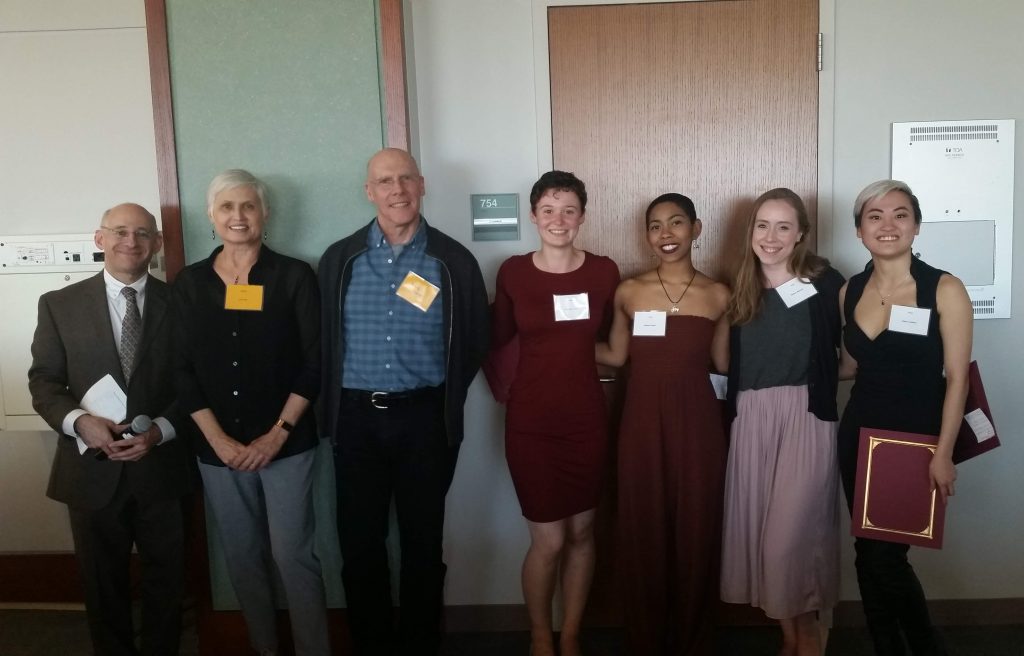 (L to R): Dean Casper; Carol Hess, dance department chair; Doug Hamby, director of the Linehan Artist Scholars program; Samantha Siegel; Giavanni Powell; Kasey Mannion ’19, dance; Emily Godfrey. Photo courtesy of CAHSS.
Combining dual passions
Among the many accolades were twelve awards to graduating students in the college’s hallmark scholar programs: the Humanities Scholars, Sondheim Public Affairs Scholars, and Linehan Artist Scholars. These include several students with dual majors.
For example, four honored dance majors were also earning a degree in another field: Linehan Artist Scholars Emily S. Godfrey ’20, dance and a psychology minor; Melissa Hudson ‘18, dance and economics; and Giavanni Powell ‘19, dance with an entrepreneurship and innovation minor; and Honors College member Samantha L. Siegel ‘19, dance and psychology.
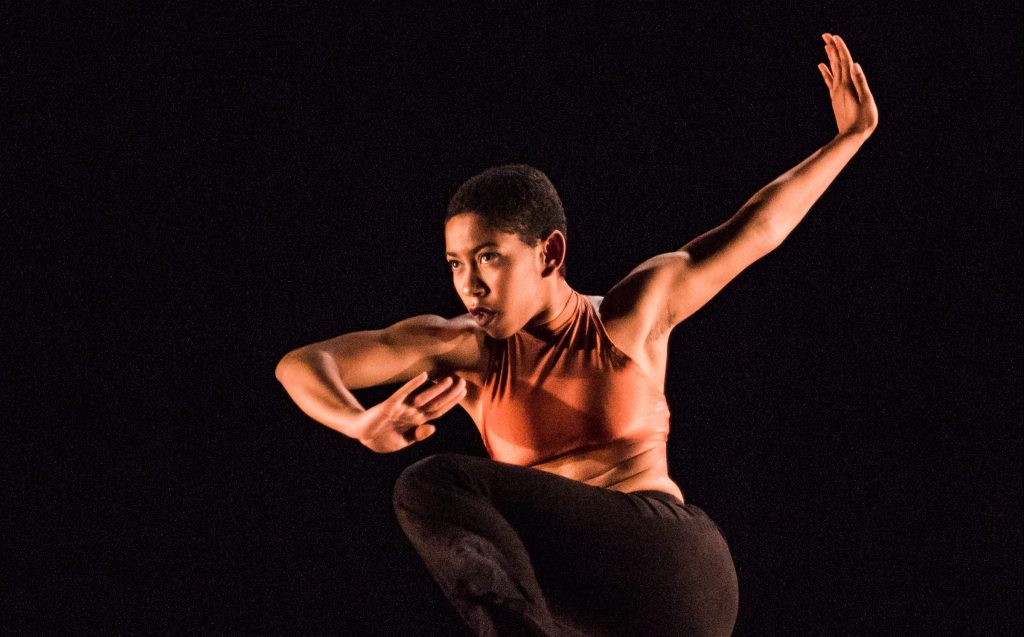
Linehan Artist Scholar Giavanni Powell
Baltimore on my mind
The ceremony also honored students who committed to giving back to Baltimore communities during their time at UMBC. Vanessa Gonzalez ‘19, American studies, worked as a student teacher in Baltimore City as a Sherman STEM Teacher Scholar and received the award for outstanding achievement in American studies.
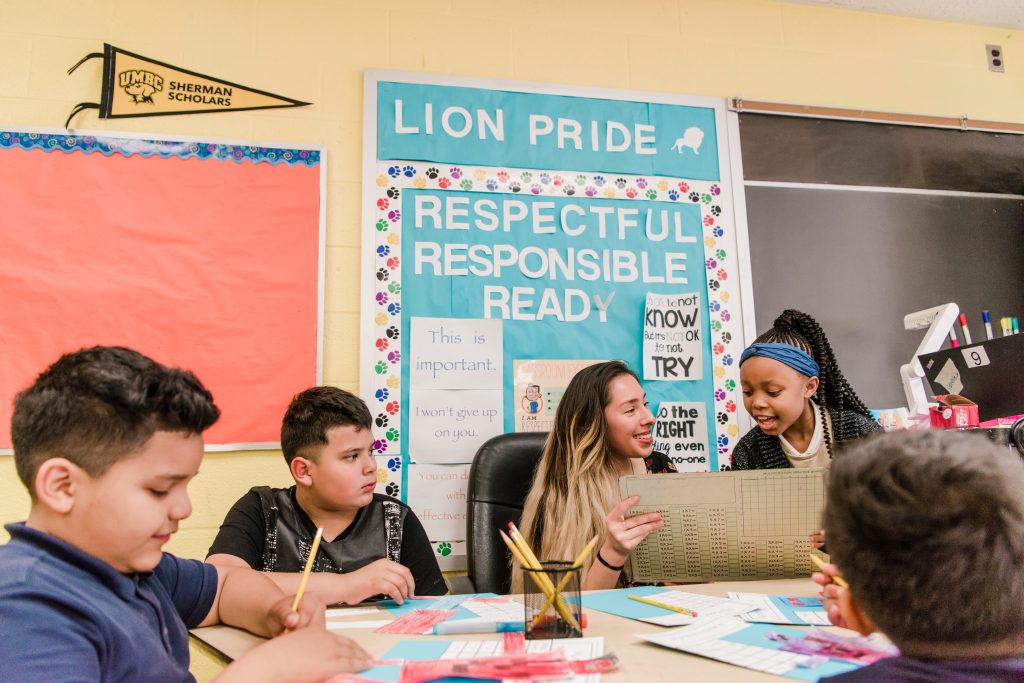
Gonzalez working with students.
Belgian international student Tanguy Ringoir ‘18, financial economics and M.S. ‘20, economic policy analysis, was named the outstanding graduating senior in financial economics. Ringoir, a chess grandmaster, learned to play chess from his father at age seven. As he strengthened his skills he began to enjoy teaching the game.
During his time at UMBC, Ringor was part of a volunteer chess coach team for a program by TouchPoint in collaboration with UMBC and the Johns Hopkins Center for Talented Youth (CTY). TouchPoint is a community organization in Baltimore that provides free chess lessons to Baltimore youth. The coaching team included volunteers from both the UMBC chess team and chess club.
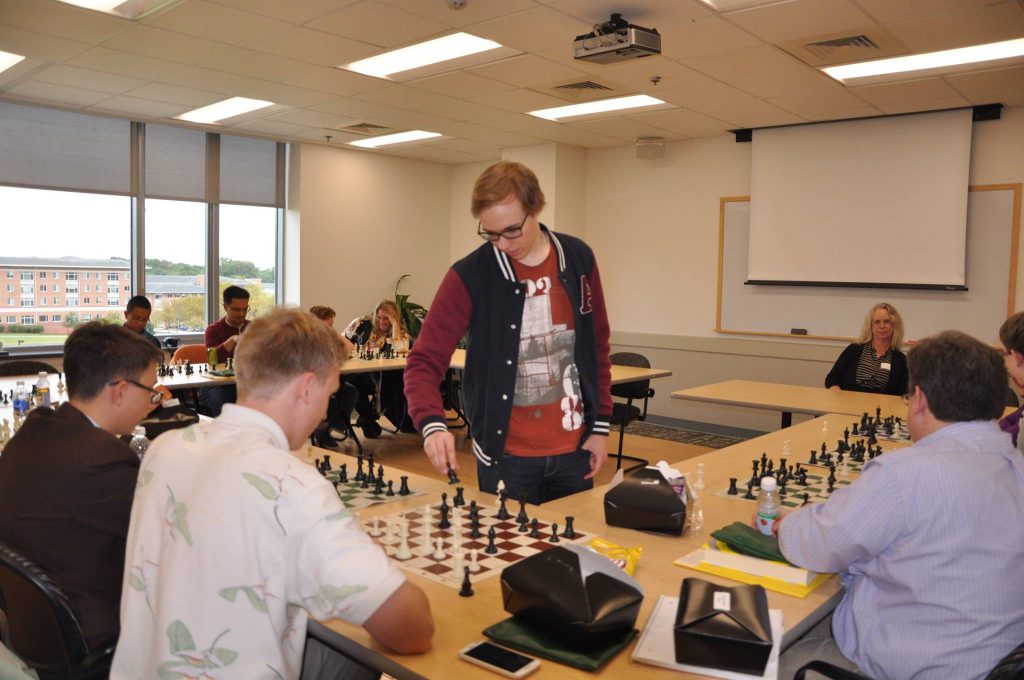
Ringoir, chess grandmaster, working with CTY students. Photo courtesy of Ringoir.
Ringoir also received a Community Service Outreach and Leadership award from the UMBC Division of Professional Studies for his dedication to creating accessible chess teams. He will continue his work with Baltimore K-12 students through the CTY program.
“I personally stay in Baltimore because I can combine my passion for finance with chess,” shares Ringoir. “UMBC gives me an education at the same time that it supports my chess development through the chess team and community volunteer opportunities.”
Like Ringoir, Ciara Jones ‘19, social work, is also an award recipient who has chosen to begin her professional career in Baltimore. She received the excellence award from Africana studies, her minor. Upon graduation, Jones will work with Sarah’s House in Druid Park, as a forensic social worker. She will also serve the Canton community through Renaissance Baltimore Church.
Global skills
In addition to maximizing their academic experience on campus and participating in an exchange of skills within Baltimore communities, CAHSS students seek to sharpen their personal and professional skills by studying abroad.
Miriam Newman-Marshall ‘19, Asian studies with a Japanese minor, received the Constantine Vaporis Academic Excellence in Asian Studies Award. Newman-Marshall has traveled to Thailand and Cambodia, and has completed three study abroad trips to Japan. These trips strengthened her research skills and historical knowledge, which were critical for her work as a research assistant. She assisted Constantine Vaporis, Asian studies director, on his book, Samurai: An Encyclopedia of Japan’s Cultured Warriors.
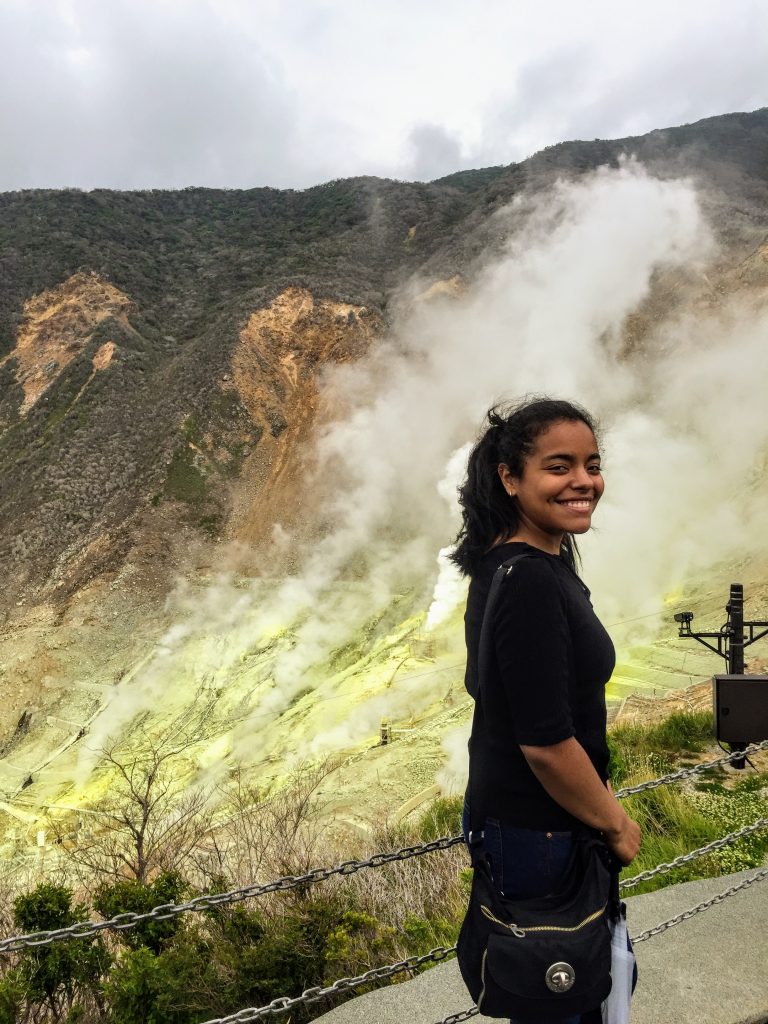
Newman-Marshall next to a volcano in Hakone, Japan. Photo courtesy of Newman-Marshall.
Vaporis encourages all students to study a foreign language overseas to accelerate and deepen their understanding of that language and culture. “Learning a language in its country of origin equips students with skills to conduct more complex research, using multi-lingual sources,” explains Vaporis. “Miriam’s knowledge of Japanese history and her ability to read Japanese greatly facilitated her work in support of my research on the samurai.”
For more CAHSS news follow @UMBC_CAHSS on Twitter.
Banner image: Linehan Artist Scholar Emily Godfrey. All photos by Marlayna Demond ’11 for UMBC unless otherwise noted.
]]>
Faculty and staff in UMBC’s College of Arts, Humanities, and Social Sciences (CAHSS) celebrated students in the annual CAHSS awards ceremony this spring. Scholars programs and departments...
https://umbc.edu/stories/umbc-celebrates-student-achievement-in-the-arts-humanities-and-social-sciences/
https://beta.my.umbc.edu/api/v0/pixel/news/120105/guest@my.umbc.edu/9c3006dfab5fdde38adffccccd67c62c/api/pixel
americanstudies
arts-and-culture
asianstudies
cahss
dance
economics
interdisciplinary
international
linehanscholars
page1
policy-and-society
shermanscholars
socialwork
UMBC News & Magazine
https://beta.my.umbc.edu/groups/umbc-news-magazine
https://assets1-beta.my.umbc.edu/system/shared/avatars/groups/000/001/943/24435aa6207c452e7bc15cc74b42c7bb/xsmall.png?1748556657
https://assets1-beta.my.umbc.edu/system/shared/avatars/groups/000/001/943/24435aa6207c452e7bc15cc74b42c7bb/original.png?1748556657
https://assets2-beta.my.umbc.edu/system/shared/avatars/groups/000/001/943/24435aa6207c452e7bc15cc74b42c7bb/xxlarge.png?1748556657
https://assets2-beta.my.umbc.edu/system/shared/avatars/groups/000/001/943/24435aa6207c452e7bc15cc74b42c7bb/xlarge.png?1748556657
https://assets3-beta.my.umbc.edu/system/shared/avatars/groups/000/001/943/24435aa6207c452e7bc15cc74b42c7bb/large.png?1748556657
https://assets1-beta.my.umbc.edu/system/shared/avatars/groups/000/001/943/24435aa6207c452e7bc15cc74b42c7bb/medium.png?1748556657
https://assets2-beta.my.umbc.edu/system/shared/avatars/groups/000/001/943/24435aa6207c452e7bc15cc74b42c7bb/small.png?1748556657
https://assets1-beta.my.umbc.edu/system/shared/avatars/groups/000/001/943/24435aa6207c452e7bc15cc74b42c7bb/xsmall.png?1748556657
https://assets2-beta.my.umbc.edu/system/shared/avatars/groups/000/001/943/24435aa6207c452e7bc15cc74b42c7bb/xxsmall.png?1748556657
UMBC News & Magazine
0
0
false
Mon, 17 Jun 2019 20:35:09 -0400
