UMBC’s Baja SAE team finishes with second highest total points in program’s 30-year history

Each year, UMBC’s Baja SAE team designs and constructs a vehicle that is built to withstand challenging terrain and weather, while also keeping budget, vehicle weight, and agility in mind. The team ended this year’s season strong, finishing in the top 12 overall at each of three competitions across the country.
“After placing eighth in the world in 2018, the team aimed to build a lighter, faster car that would allow us to finish the year with a higher overall finish,” says Rob Sherwood ‘20, mechanical engineering, a member of the team. “The biggest challenge we faced this season was the increased level of competition among the top-tier schools.”
UMBC’s team, now celebrating its 30th season, competes against institutions from across the country that have strong Baja SAE teams and innovative vehicles. While many of the students who have worked with Baja SAE over the years come from engineering backgrounds, team have also included members from other majors, making it a truly interdisciplinary project.
Leading up to the first competition, the team dedicates hours to making adjustments to the vehicle to prepare for the season. At each competition, teams are scored based on a range of criteria including cost, design, sales, and endurance. Their performance in the cost categories at each competition proved to be their strongest.
 One of UMBC’s Baja vehicles during competition. Photo courtesy of Rob Sherwood.
“While we know the car had the potential to do even better, we are still extremely happy with our results,” says Sherwood. “We had the second most successful season since our establishment in 1989.”
The first competition of the 2019 season was held in Tennessee, April 11-14. The team finished fifth overall, and earned first place in the cost category.
On the west coast, the team competed in California in May. The team’s strength in developing a cost-effective vehicle was recognized again, earning them second place in the category, and 11th overall out of the 99 teams from across the country that participated.
The final competition of the season was held in Rochester, NY, in June. UMBC’s team again earned second place in the cost component of the competition, and 12th overall.
Sherwood shares that the team finished the season with 2,337 points, the second highest number of points in the history of the UMBC Baja SAE team. “The team is young and has a lot of potential,” he says, adding that he is looking forward to next season.
Banner image: A member of the Baja team working on a part of the vehicle. Photo by Marlayna Demond ’11 for UMBC.
]]>
Each year, UMBC’s Baja SAE team designs and constructs a vehicle that is built to withstand challenging terrain and weather, while also keeping budget, vehicle weight, and agility in mind. The...
https://umbc.edu/stories/umbcs-baja-sae-team-finishes-with-second-highest-total-points-in-programs-30-year-history/
https://beta.my.umbc.edu/api/v0/pixel/news/120077/guest@my.umbc.edu/181e5854eecce3790e8423a84eafc85b/api/pixel
coeit
meche
page1
science-and-technology
UMBC News & Magazine
https://beta.my.umbc.edu/groups/umbc-news-magazine
https://assets1-beta.my.umbc.edu/system/shared/avatars/groups/000/001/943/24435aa6207c452e7bc15cc74b42c7bb/xsmall.png?1748556657
https://assets1-beta.my.umbc.edu/system/shared/avatars/groups/000/001/943/24435aa6207c452e7bc15cc74b42c7bb/original.png?1748556657
https://assets2-beta.my.umbc.edu/system/shared/avatars/groups/000/001/943/24435aa6207c452e7bc15cc74b42c7bb/xxlarge.png?1748556657
https://assets2-beta.my.umbc.edu/system/shared/avatars/groups/000/001/943/24435aa6207c452e7bc15cc74b42c7bb/xlarge.png?1748556657
https://assets3-beta.my.umbc.edu/system/shared/avatars/groups/000/001/943/24435aa6207c452e7bc15cc74b42c7bb/large.png?1748556657
https://assets1-beta.my.umbc.edu/system/shared/avatars/groups/000/001/943/24435aa6207c452e7bc15cc74b42c7bb/medium.png?1748556657
https://assets2-beta.my.umbc.edu/system/shared/avatars/groups/000/001/943/24435aa6207c452e7bc15cc74b42c7bb/small.png?1748556657
https://assets1-beta.my.umbc.edu/system/shared/avatars/groups/000/001/943/24435aa6207c452e7bc15cc74b42c7bb/xsmall.png?1748556657
https://assets2-beta.my.umbc.edu/system/shared/avatars/groups/000/001/943/24435aa6207c452e7bc15cc74b42c7bb/xxsmall.png?1748556657
UMBC News & Magazine
0
0
false
Tue, 30 Jul 2019 18:46:07 -0400
Like Mother, Like Daughter

As a kid, global studies major Zena Smith often heard her mother, Nicole Smith ’02, mathematics, talk about her years at UMBC. But until she visited—and experienced campus life in person—she never really considered becoming a Retriever herself.
“There were many factors that went into why I chose UMBC,” says the younger Smith, who originally had been adamant about not attending UMBC because her mother had gone there. But after visiting campus, “I was completely sold, and understood why my mom loves this school so much.”
While most mothers and daughters share some things in common, it’s a special bond to carry on the Retriever legacy. And while UMBC continues to grow by building new structures, creating a new brand, and extending its global influence, no matter how much has changed, that Retriever bond is what makes our community at UMBC feel like family for so many. Even more so if you’re actually family.
The Smiths are certainly not alone in this. When it was time for her to choose a college, UMBC sophomore Miranda Sadtler, psychology, decided on UMBC because she really liked the atmosphere and knew the reputation of the psychology program here. But the stories her mother, Kim Sadtler ’82, told her about her alma mater also influenced her decision.
Sadtler majored in psychology and minored in health science and policy. After graduation, she attended the University of Maryland School of Nursing and worked as a psychiatric nurse. She attributes an internship through the psychology department at UMBC in collaboration with the University of Maryland Hospital for helping her solidify her career path as a psychiatric nurse.
 Kim with her brother on graduation day 1982. Photo courtesy of the Sadtler family.
Taking her mother’s experiences into account, Miranda is choosing a slightly different route and hopes to establish a career on the clinical research side of psychology, which her mother agrees is perfect for her. “Compassion comes second nature to Miranda,” says Sadtler.
Despite pursuing similar degrees from UMBC, Miranda’s time on campus has differed from that of her mother, who worked as the first student athletic trainer under the head athletic trainer, Cindy Stout. During this time, Sadtler got to know the athletes, traveled with them, and shadowed Stout, who was a role model and friend.
While Sadtler was centered on athletics, Miranda works on campus as a desk staffer, and helps the Environmental Task Force clean up trash on campus every week. “I’m really glad I joined different clubs and organizations. Both my job as a desk staffer and a member of the Environmental Task Force have really made my time at UMBC better because of the great friends and opportunities I’ve had so far.”
Despite choosing the same college, Sadtler and Miranda have many differences between them—different fashion sense, different laugh, different smiles—but the one thing they share are the fond memories they have of campus, where they both met some of their best friends.
Sadtler’s favorite memories of 1980s UMBC center on the dorms and friendships with suitemates and roommates, sporting events, and spending time on the Quad. “UMBC gave me opportunities to expand my knowledge, take dance classes, work as a student athletic trainer, learn about policy, and enter the healthcare field,” says Sadtler. Her time at UMBC helped her figure out what her dreams were. This has turned out to be no different for her daughter.
Both women feel that going to UMBC has brought them closer together, and they love that they can share stories about how much UMBC has grown since 1982. “Whenever she visits, my mom will tell me about how things have changed and what’s still the same. UMBC feels somewhat small to me now; I can’t imagine how small it must’ve felt to her when she attended!” Miranda says. Before Miranda’s freshman year, she was pleasantly surprised to find out that she would be living in Patapsco Hall, where her mother lived for four years.
 Kim joins her daughter Miranda on freshmen move-in day. Photo courtesy of the Sadtler family.
Sitting together in their cozy living room, Smith shares her first impressions of UMBC with her daughter Zena.
“I fell in love with UMBC during my visit. The atmosphere was so inviting and the staff was welcoming,” she says. But Smith was looking for an electrical engineering program, which UMBC lacked at the time. It was President Freeman Hrabowski who advised Smith to complete her associate’s degree in engineering first, so Smith started out at University of Maryland, College Park. After spending two semesters at UMD, Smith decided to change her major to mathematics, “and transferred to the school I first fell in love with, UMBC.”
Having attended multiple institutions, Smith says that some of the best benefits at UMBC were the smaller class sizes and the fact that you were able to meet with your professor directly if you had questions regarding the class, instead of a TA.
“My professors at UMBC were the most giving of their time. If a student needed help outside of office hours, they made it a point to stay after class to ensure that the student got the assistance they needed,” says Smith. “They always put the needs of their students before theirs. They made sure that you understood the material before you left the session, no matter how long it took. That’s true dedication.”
 Dr. Hrabowski congratulates Nicole Smith on graduation. Photo courtesy of the Smith family.
Along with the professors and staff members, Smith also loved how welcoming students at UMBC are. “As a transfer student, I thought it would have been difficult to connect with the students that had already bonded during freshman year,” she says, “but that was so far from the truth.”
Now, as an alumna, Smith gets the pleasure of watching her daughter experience and fall in love with UMBC the same way she did. “Not that Zena would remember, but when she was younger she would always say that she wanted to attend UMBC,” says Smith, “but as she got older UMBC was not on her radar. All of that changed when she finally decided to visit UMBC. The inviting atmosphere and the welcoming staff and students that she encountered on her walk to the RAC all made her feel like she was at home.” Smith was so proud when Zena made her college decision.
Both of the Smiths feel that UMBC helped bring them closer together because of their shared experiences. While Smith was a working student, and wasn’t able to join many clubs and organizations, she really pushed Zena to find her place on campus. “Going to the same school really helped us bond over our similar experiences or similar classes we have taken,” says Zena. “UMBC is a part of our lives that we are always going to share.”
 Zena Smith outside of Erickson Hall. Photo courtesy of the Smith family.
*****
Header image: Nicole and Zena Smith with the Baltimore skyline. Photo courtesy of the Smith family.
]]>
As a kid, global studies major Zena Smith often heard her mother, Nicole Smith ’02, mathematics, talk about her years at UMBC. But until she visited—and experienced campus life in person—she never...
https://umbc.edu/stories/mothers-and-daughters-share-institutional-legacy-stories/
https://beta.my.umbc.edu/api/v0/pixel/news/120078/guest@my.umbc.edu/d45d442ddb8374a0b1081b13c119527d/api/pixel
alumni
retriever-legacy
UMBC News & Magazine
https://beta.my.umbc.edu/groups/umbc-news-magazine
https://assets1-beta.my.umbc.edu/system/shared/avatars/groups/000/001/943/24435aa6207c452e7bc15cc74b42c7bb/xsmall.png?1748556657
https://assets1-beta.my.umbc.edu/system/shared/avatars/groups/000/001/943/24435aa6207c452e7bc15cc74b42c7bb/original.png?1748556657
https://assets2-beta.my.umbc.edu/system/shared/avatars/groups/000/001/943/24435aa6207c452e7bc15cc74b42c7bb/xxlarge.png?1748556657
https://assets2-beta.my.umbc.edu/system/shared/avatars/groups/000/001/943/24435aa6207c452e7bc15cc74b42c7bb/xlarge.png?1748556657
https://assets3-beta.my.umbc.edu/system/shared/avatars/groups/000/001/943/24435aa6207c452e7bc15cc74b42c7bb/large.png?1748556657
https://assets1-beta.my.umbc.edu/system/shared/avatars/groups/000/001/943/24435aa6207c452e7bc15cc74b42c7bb/medium.png?1748556657
https://assets2-beta.my.umbc.edu/system/shared/avatars/groups/000/001/943/24435aa6207c452e7bc15cc74b42c7bb/small.png?1748556657
https://assets1-beta.my.umbc.edu/system/shared/avatars/groups/000/001/943/24435aa6207c452e7bc15cc74b42c7bb/xsmall.png?1748556657
https://assets2-beta.my.umbc.edu/system/shared/avatars/groups/000/001/943/24435aa6207c452e7bc15cc74b42c7bb/xxsmall.png?1748556657
UMBC News & Magazine
0
0
false
Thu, 25 Jul 2019 14:05:02 -0400
Depth of Field
By Tom Moore
Close your eyes and picture, if you will, something scientific. Perhaps your mind conjures up an image of space exploration, or a melting glacier affected by climate change, or the eyes of a mosquito enlarged by an electron microscope. Whatever you imagined, it was almost certainly influenced by the field of photography, which since its invention in the early 1800s has cast its eye on the world around us, allowing us to see, share, and interpret our surroundings in new ways.
The intersection of photography and science has long intrigued UMBC visiting senior research scholar Marvin Heiferman. “I’ve been fascinated by science photography for years—pictures of microbes too small to be detected by the human eye, of stars or galaxies too distant to be directly experienced, and of processes that unfold too quickly or slowly to be easily perceived,” he says.
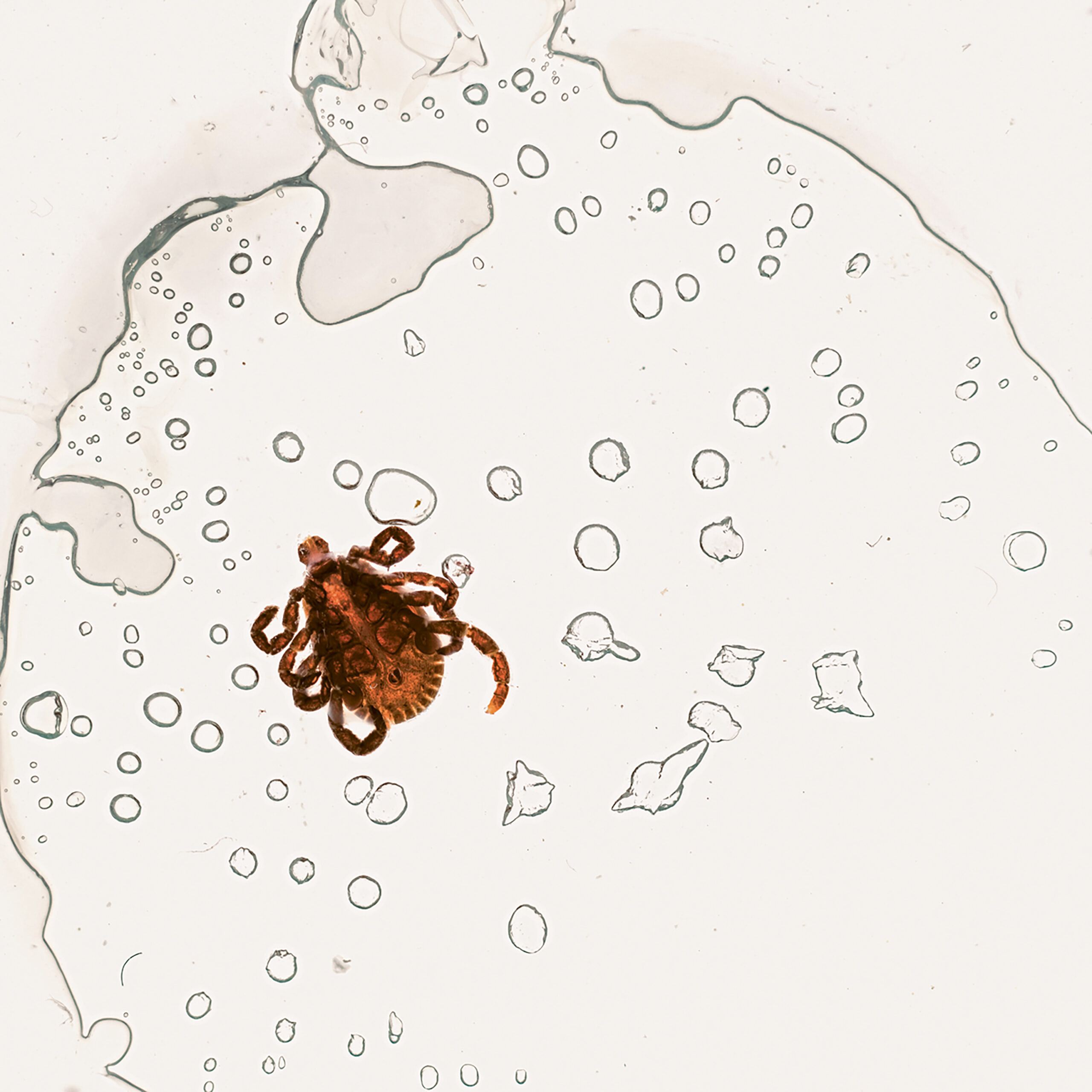
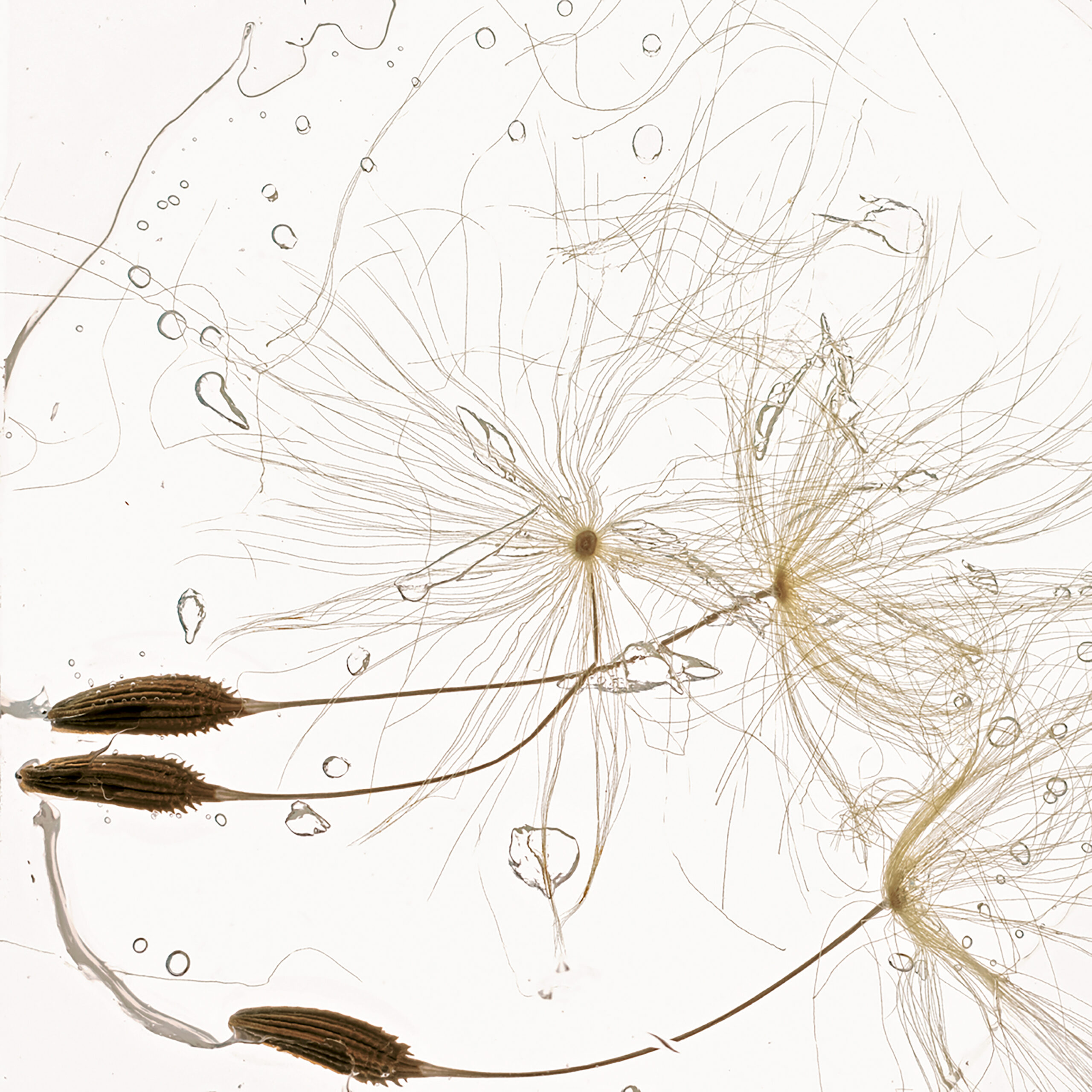
In 2016, Heiferman organized a multi-year project, Seeing Science, funded by the Office of Research and the Center for Art, Design, and Visual Culture. He engaged faculty, students, and alumni from across the disciplines (joined by other eminent scholars around the country) to explore how we see science via a series of public and online events, film screenings, an exhibition, and a website designed to spark interdisciplinary dialogue.
Now, Heiferman’s work has culminated in the publication of a book, Seeing Science: How Photography Reveals the Universe, released this spring as a partnership between UMBC and Aperture, a non-profit foundation and publisher dedicated to the advancement of photography. Replete with images from the dawn of photography through the present day, the handsome volume features dozens of essays—on subjects ranging from facial recognition to the discovery of x-rays to science fiction and more—and, of course, hundreds of photographs.
 Demonstration of site specific poster for transit shelter, North Avenue, Baltimore, 2011. Art by Lynn Cazabon from the series Uncultivated.
Retired astronaut Scott Kelly, who attended UMBC in the 1980s, provided the book’s foreword, in which he describes his year on the International Space Station, taking photographs of the cosmos, of Earth’s geography, of snowstorms, and of cities illuminated at night.
Two UMBC faculty contributed essays to Seeing Science: Mark Alice Durant, professor of visual arts, writes about “The Wonder of Evidence,” tracing a dance between knowledge and wonder, documentation and astonishment, and fact and fiction; and Joseph Tatarewicz, associate professor of history and director of the human context of science and technology program, penned “Science Fiction and Moving Images,” examining film from the time of Georges Méliès’ famous Le voyage dans la lune (A Trip to the Moon, 1902) to Walt Disney’s Man in Space (1955).
Rebecca Adelman, associate professor of media and communication studies, participated in several online discussions, and her perspectives on images are found throughout the book. Heiferman also explores the photography of Lynn Cazabon, professor of visual arts, and Melissa Penley Cormier, M.F.A. ’17, visual arts, program specialist in visual arts.
“Specialized images have become so ingrained in our everyday lives that we forget how profoundly they’re helping us understand the world around us,” shares Heiferman. “An MRI on an injured knee, a sonogram displayed on a refrigerator door, the facial recognition technology that lets you unlock your smartphone: they’re all are routine examples of the ways we use science photography as an everyday tool.”
 Wroclaw, Poland, 2016. From the series Uncultivated by Lynn Cazabon.
*****
Header image: Studio process of Fret & Focus project, a year of documenting worries using microscopic slides, 2016. Art by Melissa Penley Cormier.
]]>
By Tom Moore Close your eyes and picture, if you will, something scientific. Perhaps your mind conjures up an image of space exploration, or a melting glacier affected by climate change, or the...
https://umbc.edu/stories/depth-of-field/
https://beta.my.umbc.edu/api/v0/pixel/news/120079/guest@my.umbc.edu/2fe4487af832714074926a37bc609b05/api/pixel
discovery
graduateschool
imda
seeing-science
spring-19
UMBC News & Magazine
https://beta.my.umbc.edu/groups/umbc-news-magazine
https://assets1-beta.my.umbc.edu/system/shared/avatars/groups/000/001/943/24435aa6207c452e7bc15cc74b42c7bb/xsmall.png?1748556657
https://assets1-beta.my.umbc.edu/system/shared/avatars/groups/000/001/943/24435aa6207c452e7bc15cc74b42c7bb/original.png?1748556657
https://assets2-beta.my.umbc.edu/system/shared/avatars/groups/000/001/943/24435aa6207c452e7bc15cc74b42c7bb/xxlarge.png?1748556657
https://assets2-beta.my.umbc.edu/system/shared/avatars/groups/000/001/943/24435aa6207c452e7bc15cc74b42c7bb/xlarge.png?1748556657
https://assets3-beta.my.umbc.edu/system/shared/avatars/groups/000/001/943/24435aa6207c452e7bc15cc74b42c7bb/large.png?1748556657
https://assets1-beta.my.umbc.edu/system/shared/avatars/groups/000/001/943/24435aa6207c452e7bc15cc74b42c7bb/medium.png?1748556657
https://assets2-beta.my.umbc.edu/system/shared/avatars/groups/000/001/943/24435aa6207c452e7bc15cc74b42c7bb/small.png?1748556657
https://assets1-beta.my.umbc.edu/system/shared/avatars/groups/000/001/943/24435aa6207c452e7bc15cc74b42c7bb/xsmall.png?1748556657
https://assets2-beta.my.umbc.edu/system/shared/avatars/groups/000/001/943/24435aa6207c452e7bc15cc74b42c7bb/xxsmall.png?1748556657
UMBC News & Magazine
0
0
false
Wed, 24 Jul 2019 20:26:36 -0400
Moving Sale
Rice cooker: $20Slow cooker: $15
Small table-top fan: $20
Office chair: $30
electric heating mat(Queen size): $30
Hair dryer: $10
navigation: $30
Wireless router: $15
Electronic Kettle: $15
]]>
Rice cooker: $20 Slow cooker: $15 Small table-top fan: $20 Office chair: $30 electric heating mat(Queen size): $30 Hair dryer: $10 navigation: $30 Wireless router: $15 Electronic Kettle: $15
Image
https://assets4-beta.my.umbc.edu/system/shared/attachments/3949f55f9a339e2555a018b5bc97c0de/6a0ed444/news/000/085/498/79da9938d61a8bb4ddeead82d229441a/IMG_20180810_115016.jpg?1563677066
https://beta.my.umbc.edu/api/v0/pixel/news/85498/guest@my.umbc.edu/02dd6e78d967d12a6c45fe51952e40c4/api/pixel
International Student and Scholar Services (ISSS)
https://beta.my.umbc.edu/groups/ies
https://assets4-beta.my.umbc.edu/system/shared/avatars/groups/000/000/431/46ad84ea8ba0baeed7c3faf29d1fd4ef/xsmall.png?1693323874
https://assets3-beta.my.umbc.edu/system/shared/avatars/groups/000/000/431/46ad84ea8ba0baeed7c3faf29d1fd4ef/original.jpeg?1693323874
https://assets1-beta.my.umbc.edu/system/shared/avatars/groups/000/000/431/46ad84ea8ba0baeed7c3faf29d1fd4ef/xxlarge.png?1693323874
https://assets1-beta.my.umbc.edu/system/shared/avatars/groups/000/000/431/46ad84ea8ba0baeed7c3faf29d1fd4ef/xlarge.png?1693323874
https://assets4-beta.my.umbc.edu/system/shared/avatars/groups/000/000/431/46ad84ea8ba0baeed7c3faf29d1fd4ef/large.png?1693323874
https://assets3-beta.my.umbc.edu/system/shared/avatars/groups/000/000/431/46ad84ea8ba0baeed7c3faf29d1fd4ef/medium.png?1693323874
https://assets1-beta.my.umbc.edu/system/shared/avatars/groups/000/000/431/46ad84ea8ba0baeed7c3faf29d1fd4ef/small.png?1693323874
https://assets4-beta.my.umbc.edu/system/shared/avatars/groups/000/000/431/46ad84ea8ba0baeed7c3faf29d1fd4ef/xsmall.png?1693323874
https://assets3-beta.my.umbc.edu/system/shared/avatars/groups/000/000/431/46ad84ea8ba0baeed7c3faf29d1fd4ef/xxsmall.png?1693323874
IES Marketplace
0
0
true
Sat, 20 Jul 2019 22:45:49 -0400
Inaugural Maryland Arts Summit convenes at UMBC

On June 6–8, UMBC hosted the inaugural Maryland Arts Summit, co-organized the Maryland Citizens for the Arts, the Maryland State Arts Council (MSAC), AEMS: Arts Education in Maryland Schools, and the Fine Arts Office of the Maryland State Department of Education.
During the three-day event, five hundred artists, educators, advocates, and arts administrators from across the state convened in UMBC’s Performing Arts and Humanities Building, Fine Arts Building, and University Center for presentations, workshops, an artists’ bazaar, award programs, networking sessions, and performances.
“The Arts Summit represented the incredible diversity and creativity that exists in Maryland,” said Nicholas Cohen, the executive director of Maryland Citizens for the Arts. “We are especially thankful to UMBC for opening its doors to us and sharing in our excitement as hosts for this inaugural event.”
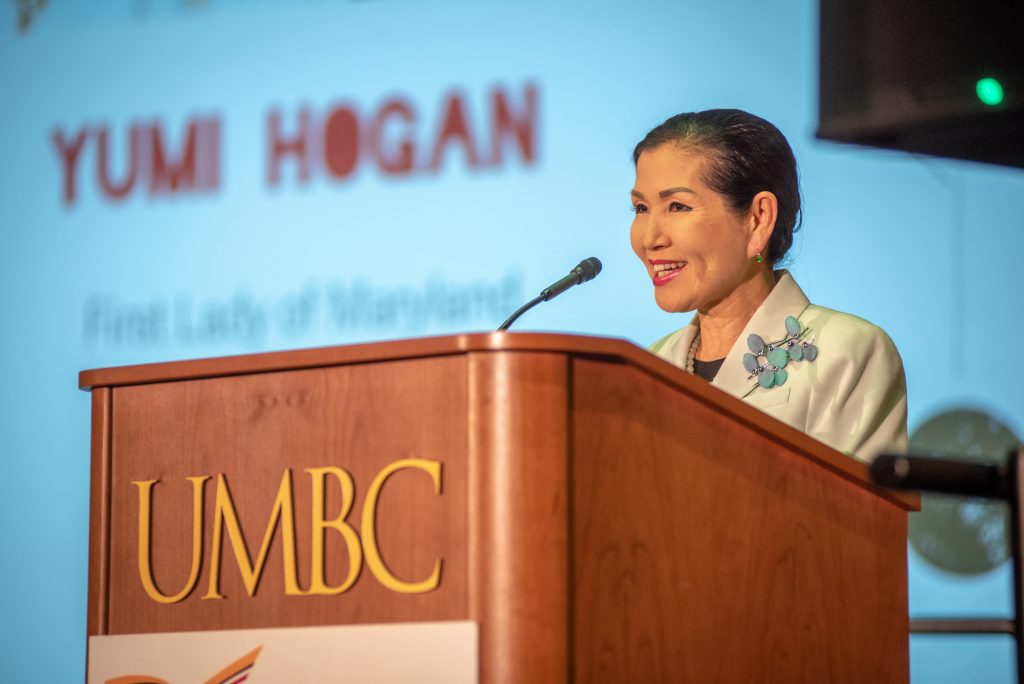
First Lady of Maryland Yumi Hogan spoke of the value of the arts across the state.
Scott Casper, dean of the College of Arts, Humanities and Social Sciences, welcomed summit attendees, many of whom were first-time visitors to UMBC. “We were thrilled to welcome our statewide colleagues and partners in the arts and arts education,” he said. “UMBC and Maryland’s arts organizations share the belief that the arts belong to everyone, and every person has the potential for creative inspiration.”
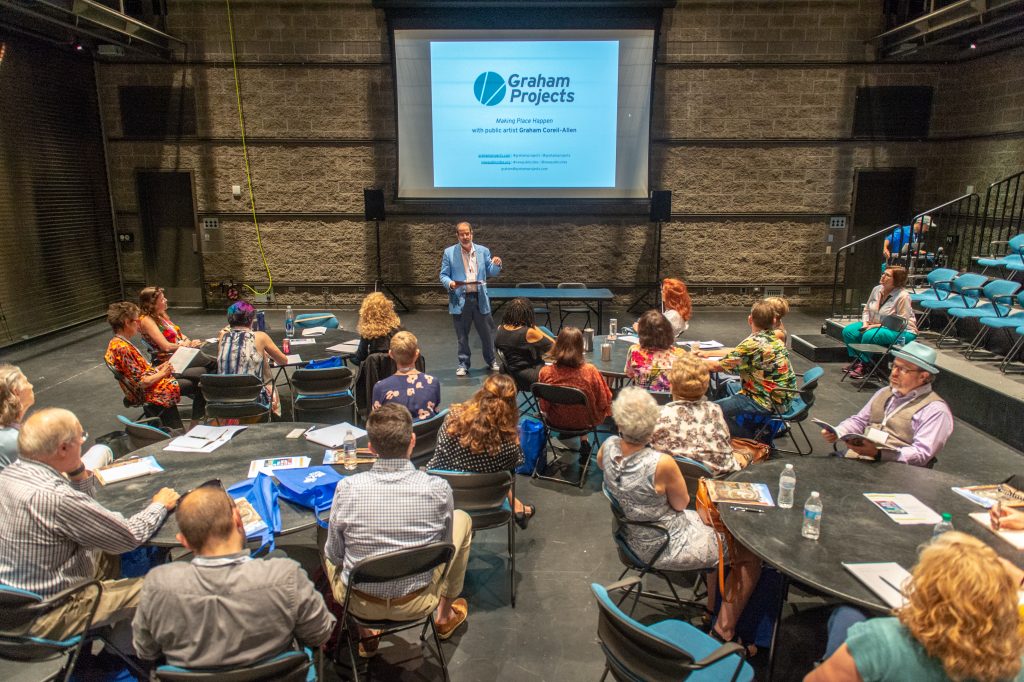
Attendees gathered for a breakout discussion in the Black Box Theatre.
The arts at UMBC were highlighted throughout the summit. Timothy Nohe, director of the Center for Innovation, Research and Creativity in the Arts, and Joe Rexing, director of design and construction and university architect, led a hard hat tour of the new Interdisciplinary Life Sciences Building, where public artwork by Volkan Alkanoglu will be installed in August. The group also visited Thomas Sayre’s Forum (2014) adjacent to the Performing Arts and Humanities Building. The installation of both artworks was funded through the Maryland Public Art Initiative, administered by Liesel Fenner, public art program director at MSAC, who co-presented the tour.
Brian Kauffman, associate professor of music, co-hosted a session on “Achieving a High Quality Inclusive and Equitable Arts Education for Youth.” Mary Dell’Erba ’14, dance, now senior project manager for the Arts Education Partnership, presented on “Policy Opportunities for Arts Education.”
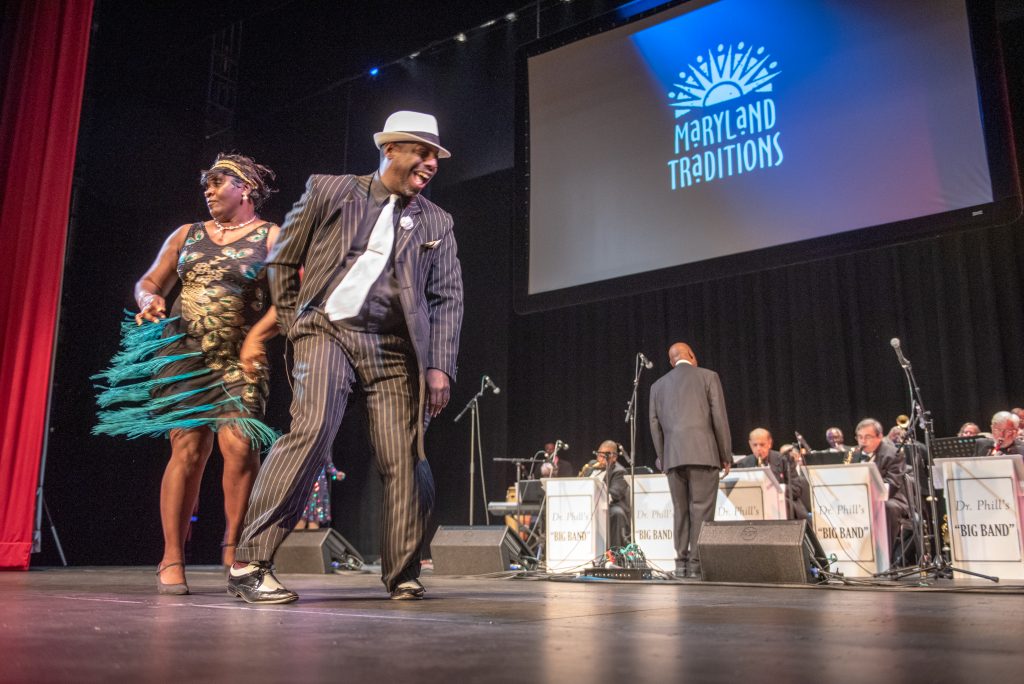
Dancers Donna Hardy and Charles Wilson with Dr. Phill’s Big Band represented the Arch Social Club, winner of a 2019 Maryland Traditions Heritage Award in the category of Place.
The Maryland Arts Summit also featured two long-standing award programs of the Maryland State Arts Council: the Maryland Traditions Heritage Awards and the Individual Artist Awards. Maryland Traditions—the oldest continually running state folklife program in the nation—identifies, documents, supports, and presents Maryland’s living cultural traditions. Additionally, the archives of the folklife program are housed in UMBC’s Special Collections. Folklife honorees for 2019 included Jay Armsworthy (St. Mary’s County), The Arch Social Club (Baltimore City), and Cultura Plenera (Howard County).
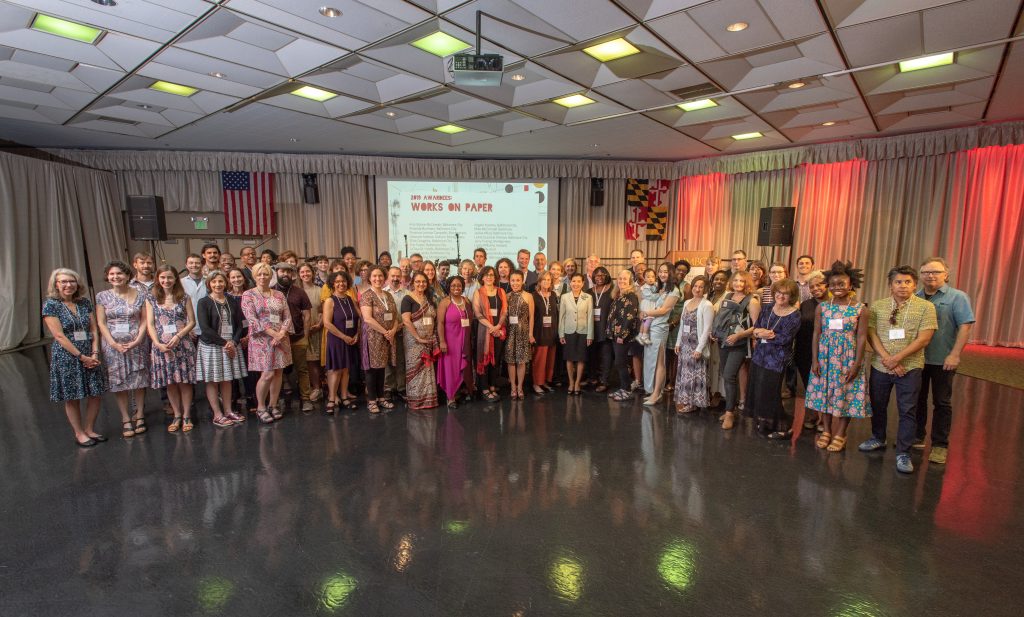
Recipients of the 2019 Maryland State Arts Council Individual Artist Award.
Several UMBC faculty and alumni received Individual Artist Awards. They included Lisa Moren, professor of visual arts; Corrie Francis Parks, assistant professor of visual arts; Kevin Blackistone ’00, visual arts; Tom Boram M.F.A. ’16, IMDA; A. Moon ’99, visual arts; and Seth Sawyers ’99, history.
Organizers are already discussing plans for the 2020 summit, which will again take place at UMBC. “We can’t wait for next year!” said Ken Skrzesz, executive director of the Maryland State Arts Council. “The Maryland Arts Summit was an unprecedented coming together of Maryland creatives. It was a demonstration of the knowledge and generosity of the rich arts sector of our state.”
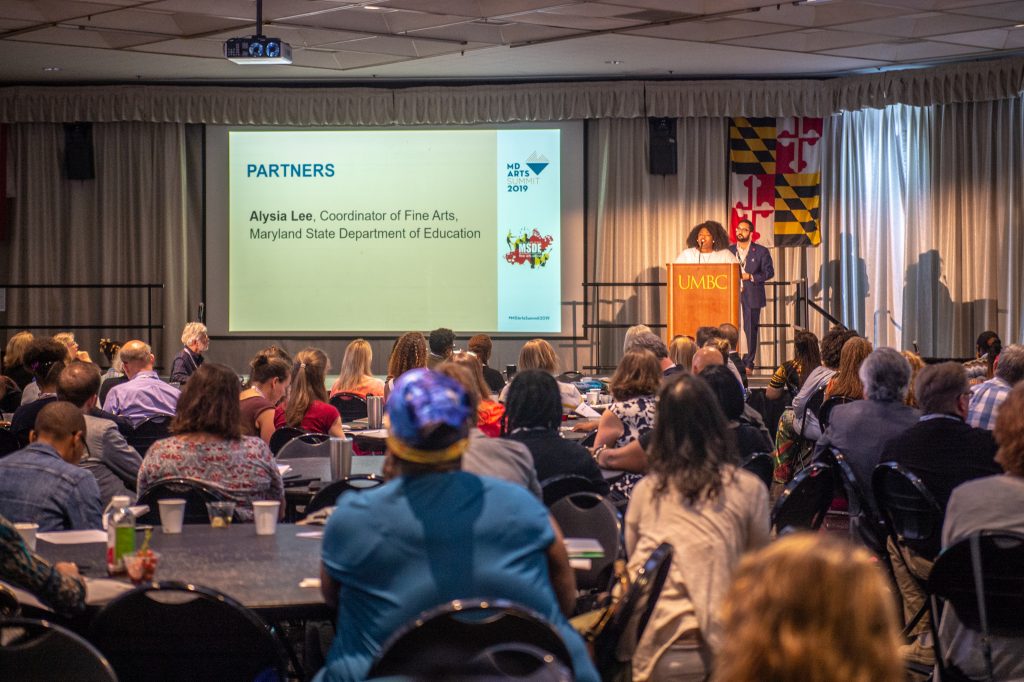
Alysia Lee, coordinator of fine arts for the Maryland State Department of Education, greeted the audience at a plenary session.
Featured image: A two-day artist bazaar attracted a crowd in the Performing Arts and Humanities Building. All photography courtesy of Edwin Remsberg.
]]>
On June 6–8, UMBC hosted the inaugural Maryland Arts Summit, co-organized the Maryland Citizens for the Arts, the Maryland State Arts Council (MSAC), AEMS: Arts Education in Maryland Schools, and...
https://umbc.edu/stories/inaugural-maryland-arts-summit-convenes-at-umbc/
https://beta.my.umbc.edu/api/v0/pixel/news/120080/guest@my.umbc.edu/8b1ff9990373050ac90bc544ee64aab8/api/pixel
alumni
arts-and-culture
cahss
history
music
visualarts
UMBC News & Magazine
https://beta.my.umbc.edu/groups/umbc-news-magazine
https://assets1-beta.my.umbc.edu/system/shared/avatars/groups/000/001/943/24435aa6207c452e7bc15cc74b42c7bb/xsmall.png?1748556657
https://assets1-beta.my.umbc.edu/system/shared/avatars/groups/000/001/943/24435aa6207c452e7bc15cc74b42c7bb/original.png?1748556657
https://assets2-beta.my.umbc.edu/system/shared/avatars/groups/000/001/943/24435aa6207c452e7bc15cc74b42c7bb/xxlarge.png?1748556657
https://assets2-beta.my.umbc.edu/system/shared/avatars/groups/000/001/943/24435aa6207c452e7bc15cc74b42c7bb/xlarge.png?1748556657
https://assets3-beta.my.umbc.edu/system/shared/avatars/groups/000/001/943/24435aa6207c452e7bc15cc74b42c7bb/large.png?1748556657
https://assets1-beta.my.umbc.edu/system/shared/avatars/groups/000/001/943/24435aa6207c452e7bc15cc74b42c7bb/medium.png?1748556657
https://assets2-beta.my.umbc.edu/system/shared/avatars/groups/000/001/943/24435aa6207c452e7bc15cc74b42c7bb/small.png?1748556657
https://assets1-beta.my.umbc.edu/system/shared/avatars/groups/000/001/943/24435aa6207c452e7bc15cc74b42c7bb/xsmall.png?1748556657
https://assets2-beta.my.umbc.edu/system/shared/avatars/groups/000/001/943/24435aa6207c452e7bc15cc74b42c7bb/xxsmall.png?1748556657
UMBC News & Magazine
0
0
false
Mon, 15 Jul 2019 19:03:24 -0400
UMBC’s Mejdulene B. Shomali receives Woodrow Wilson Foundation fellowship for research on gender and sexuality in transnational Arab culture

The Woodrow Wilson National Fellowship Foundation has selected UMBC’s Mejdulene B. Shomali as a Career Enhancement Fellow. She is one of just 32 professors selected from institutions from across the country. The program, funded by The Andrew W. Mellon Foundation, supports junior faculty with particularly promising research. The fund seeks to increase the presence of faculty members who are underrepresented in their fields and other faculty committed to eradicating racial disparities in the arts and humanities.
The highly competitive fellowship funds career development opportunities for junior faculty whose scholarly projects promote the well-being of diverse and democratic societies. Shomali’s award includes funding for a sabbatical year; a stipend for research, travel, or publication support; mentoring from a tenured faculty member in a related field of study; and a professional development retreat.
Diversity in the Arab world
Shomali came to UMBC in 2015 as a member of the third cohort of UMBC’s Postdoctoral Fellows for Faculty Diversity. She is now an assistant professor in gender, women’s, and sexuality studies and is the fourth UMBC junior faculty member to receive the Career Enhancement Fellowship.
Shomali is devoting her fellowship year to completing a book manuscript, Femininities: Queer Critique and Transnational Arab Culture. Her research is a cultural study about how femininity and queerness in Arab and Arab-American cultures are represented by Arab and Arab-American writers and artists. “I am very interested in how Arab and Arab-American artists, producers, and writers navigate the discourse that shapes their culture,” explains Shomali.
Cultural productions by Arab and Arab-American creative professionals create and communicate identities not defined by the West and can help dispel monolithic views of Arab identities. However, to fully understand the meaning and process of this work, explains Shomali, it has to be contextualized within a wider world—a world that does not truly understand who Arabs are and what Arabness is.
“Most people don’t know there are twenty-two countries in the Arab league. These countries share Arabic as the primary national language. Many are Muslim-majority nations,” shares Shomali. “Many, but not all.” She notes, “There is great linguistic, cultural, ethnic, and religious diversity within the Arab world.”
Shomali’s work explores how Arab perspectives are countering stereotypes of Arab culture created by the United States and other Western nations, which are exacerbated by racial and political tensions. She shares, “Arab and Arab-American artists must create while managing the effects of Orientalism, anti-Arab racism, Middle Eastern politics, and politics of cultural authenticity, which influence how they portray gender and sexuality in their worlds.”
Representations of gender and sexuality
Shomali’s teaching also focuses on the diversity of Arab cultures, identities, and experiences, helping students move past stereotypes of the Arab world as being uniformly misogynistic, anti-woman, and homophobic. As a professor of transnational queer literature, Shomali teaches multiple interdisciplinary courses about issues related to gender, sexuality, race, the media, and transnational feminism.
In these courses, Shomali has seen some students struggling with stereotypes created by Western media about Arab culture and identity. “The creation of these gender and sexuality stereotypes is a tactic that the U.S. and the West have used to feel exceptionally inclusive about gender and sexuality,” explains Shomali. “The same statistics of homophobia, anti-queer legislation, and gender-based sexual violence exist in the Western world.”
A strong tradition of humanities scholarship
The Career Enhancement Fellowship will help Shomali delve further into the complexities of Arab identity and its effect on Arab and Arab-American artistic work through text analysis. It will also inform her teaching practices and course development upon her return.
“I want to document, analyze, and create an awareness of this creative process to spotlight the amazing work that is happening within the Arab art world as defined by Arab and Arab-American artists,” says Shomali.
Shomali’s work reflects a strong tradition of UMBC faculty doing important humanities scholarship recognized by the Woodrow Wilson Foundation. Professor Michelle Scott, history, was UMBC’s inaugural recipient of this fellowship in 2005-2006. Scott also served as a program mentor in 2013 and continues to support faculty through the application process.
Scott used her fellowship year to complete a draft her first manuscript, Blues Empress in Black Chattanooga: Bessie Smith and the Emerging Urban South. “The fellowship time was invaluable in creating a network of like-minded scholars to help me navigate manuscript research and publishing while learning the landscape of my first tenure-track job,” remembers Scott.

Professor Michelle Scott.
Viviana MacManus, a former assistant professor of gender and women’s studies, now at the University of Maryland, College Park, was UMBC’s second Woodrow recipient. She used the sixth-month fellowship to work on her book manuscript We Are Protagonists of This History: Gender, Political Violence, and Testimonies of Resistance in Latin America’s Dirty Wars. It centered on Latin America’s history of gender and state violence during the “Dirty Wars” of Argentina and Mexico from the 1960s through the 1980s.
Maleda Belilgne, assistant professor of Africana studies and English, is currently completing her year-long fellowship. She used her award to complete her book manuscript, which explores space, sound, and the speculative in the literature of the African diaspora.
After her year of research and writing Shomali plans to return to the classroom to share new perspectives and resources with her UMBC students.
To learn more about professor Shomali’s work visit her website, read her blog, and watch the Race and Religion in the U.S. panel she organized in spring 2019 with the UMBC Dresher Center for the Humanities. Follow @UMBCHumanities on Twitter for more stories.
Banner image: Postdoctoral fellows for 2015 (L to R) Keisha Allen, Nkiru Nnawulezi, and Mejdulene Shomali. All photos by Marlayna Demond ’11 for UMBC. Race and Religion in the U.S. video by UMBC New Media Studio.
]]>
The Woodrow Wilson National Fellowship Foundation has selected UMBC’s Mejdulene B. Shomali as a Career Enhancement Fellow. She is one of just 32 professors selected from institutions from across...
https://umbc.edu/stories/umbcs-mejdulene-b-shomali-receives-woodrow-wilson-foundation-fellowship-for-research-on-gender-and-sexuality-in-transnational-arab-culture/
https://beta.my.umbc.edu/api/v0/pixel/news/120081/guest@my.umbc.edu/3d56424bc02e47fa3821a7e0abfd834f/api/pixel
africanastudies
cahss
english
gwst
history
majoraward
page1
policy-and-society
research
UMBC News & Magazine
https://beta.my.umbc.edu/groups/umbc-news-magazine
https://assets1-beta.my.umbc.edu/system/shared/avatars/groups/000/001/943/24435aa6207c452e7bc15cc74b42c7bb/xsmall.png?1748556657
https://assets1-beta.my.umbc.edu/system/shared/avatars/groups/000/001/943/24435aa6207c452e7bc15cc74b42c7bb/original.png?1748556657
https://assets2-beta.my.umbc.edu/system/shared/avatars/groups/000/001/943/24435aa6207c452e7bc15cc74b42c7bb/xxlarge.png?1748556657
https://assets2-beta.my.umbc.edu/system/shared/avatars/groups/000/001/943/24435aa6207c452e7bc15cc74b42c7bb/xlarge.png?1748556657
https://assets3-beta.my.umbc.edu/system/shared/avatars/groups/000/001/943/24435aa6207c452e7bc15cc74b42c7bb/large.png?1748556657
https://assets1-beta.my.umbc.edu/system/shared/avatars/groups/000/001/943/24435aa6207c452e7bc15cc74b42c7bb/medium.png?1748556657
https://assets2-beta.my.umbc.edu/system/shared/avatars/groups/000/001/943/24435aa6207c452e7bc15cc74b42c7bb/small.png?1748556657
https://assets1-beta.my.umbc.edu/system/shared/avatars/groups/000/001/943/24435aa6207c452e7bc15cc74b42c7bb/xsmall.png?1748556657
https://assets2-beta.my.umbc.edu/system/shared/avatars/groups/000/001/943/24435aa6207c452e7bc15cc74b42c7bb/xxsmall.png?1748556657
UMBC News & Magazine
0
0
false
Fri, 12 Jul 2019 19:43:37 -0400
Jessica Berman is named the 2019 UMBC Lipitz Professor for her global radio research
UMBC has named Jessica Berman, professor of English and director of the Dresher Center for the Humanities, the 2019 – 2020 Lipitz Professor. This prestigious endowed professorship is awarded to one UMBC faculty member each year in recognition of innovative and distinguished teaching and/or research in the College of Arts, Humanities and Social Sciences (CAHSS). Berman has been selected for both her original research in global radio and her impactful work leading the Dresher Center.
Global radio research
The Lipitz professorship will support Berman’s travel to research different cultural approaches to producing radio. It will also provide time for her to write about the complex collection of voices, languages, literatures, and music that are interconnected through radio programming.
“I will now have the opportunity to research and outline my book’s third chapter as well as shape my existing archival resources,” explains Berman. “I hope to delve deeper into research about global radio environments and the power of media to create complex transnational and often interlinguistic relationships in Latin America, which will inform later research in West Africa.”
Jason Loviglio, founding chair and associate professor of media and communication studies, primarily researches media history and radio studies. As part of the selection committee, Loviglio saw Berman’s research as pathbreaking work in understanding this transnational movement.
 Loviglio speaking on boosting diversity in podcasting.
“Berman’s new book will be an important contribution to the growing academic literature on a previously ignored medium,” shares Loviglio, “pushing radio studies and modernist studies in important new directions.”
The value of sharing research
For faculty in CAHSS, the Lipitz professorship doesn’t only mean an opportunity to focus extra time on research. It is also an opportunity for scholars to share their work with the campus community. The Lipitz Lecture is the culminating event of the professorship. Each spring the selected faculty member shares their work with faculty, staff, and students as part of the Humanities Forum lecture series hosted by the Dresher Center for the Humanities.
Dan Bailey, a professor of visual arts who focuses on animation and interactive media, was the 2018 – 2019 recipient. In the spring of 2019, he presented his work about human scale, perception, and natural landscapes.
Bailey continues to work on projects involving long-duration photography of landscapes and reconstruction of Baltimore’s geographic past. “Research requires time,” he reflects. Through the Lipitz professorship, he says, “I was able to focus on my research and collaborate with professors in history and visual arts, and work with UMBC’s Imaging Research Center and student interns.”
Berman will share her work with the campus community in the spring of 2020 Humanities Forum.
Banner image: Berman at the Dresher Center for the Humanities faculty book celebration. All images by Marlayna Demond ’11 for UMBC. Lipitz lecture video by UMBC New Media Studio.
]]>
UMBC has named Jessica Berman, professor of English and director of the Dresher Center for the Humanities, the 2019 – 2020 Lipitz Professor. This prestigious endowed professorship is awarded to...
https://umbc.edu/stories/jessica-berman-is-named-the-2019-umbc-lipitz-professor-for-her-global-radio-research/
https://beta.my.umbc.edu/api/v0/pixel/news/120082/guest@my.umbc.edu/21132d5b267f97e7f46b77a74ef6c977/api/pixel
cahss
dreshercenter
mcs
policy-and-society
visualarts
UMBC News & Magazine
https://beta.my.umbc.edu/groups/umbc-news-magazine
https://assets1-beta.my.umbc.edu/system/shared/avatars/groups/000/001/943/24435aa6207c452e7bc15cc74b42c7bb/xsmall.png?1748556657
https://assets1-beta.my.umbc.edu/system/shared/avatars/groups/000/001/943/24435aa6207c452e7bc15cc74b42c7bb/original.png?1748556657
https://assets2-beta.my.umbc.edu/system/shared/avatars/groups/000/001/943/24435aa6207c452e7bc15cc74b42c7bb/xxlarge.png?1748556657
https://assets2-beta.my.umbc.edu/system/shared/avatars/groups/000/001/943/24435aa6207c452e7bc15cc74b42c7bb/xlarge.png?1748556657
https://assets3-beta.my.umbc.edu/system/shared/avatars/groups/000/001/943/24435aa6207c452e7bc15cc74b42c7bb/large.png?1748556657
https://assets1-beta.my.umbc.edu/system/shared/avatars/groups/000/001/943/24435aa6207c452e7bc15cc74b42c7bb/medium.png?1748556657
https://assets2-beta.my.umbc.edu/system/shared/avatars/groups/000/001/943/24435aa6207c452e7bc15cc74b42c7bb/small.png?1748556657
https://assets1-beta.my.umbc.edu/system/shared/avatars/groups/000/001/943/24435aa6207c452e7bc15cc74b42c7bb/xsmall.png?1748556657
https://assets2-beta.my.umbc.edu/system/shared/avatars/groups/000/001/943/24435aa6207c452e7bc15cc74b42c7bb/xxsmall.png?1748556657
UMBC News & Magazine
0
0
false
Fri, 12 Jul 2019 19:42:08 -0400
Alumna Appointed Maryland Secretary of Labor
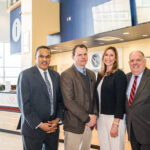
UMBC’s own Tiffany Robinson ’97, political science, was appointed by Governor Larry Hogan as Maryland’s new Secretary of Labor on July 9. The appointment follows Robinson’s service to the state as the Hogan’s deputy chief of staff, where she oversaw issues of labor, human services and health, housing, and education since 2016.
With a leadership background in housing and community development organizations, according to the governor’s office, Robinson is well-suited to serve as labor secretary. In a statement, Hogan said, “Tiffany’s experience as an advocate for Maryland’s workers and small businesses, and her commitment to public service, make her an outstanding choice to be our next labor secretary.”
 Robinson, center, meets with UMBC representatives, including UMBC’s first Rhodes Scholar, Naomi Mburu ’18, left. Photo by Marlayna Demond ’11.
UMBC alumni have been steadily rising through the ranks of Maryland politics in 2019. On May 1, Adrienne A. Jones, ’76, psychology, was unanimously voted in as Maryland’s first female and first African American Speaker of the House. On March 11, Letitia Dzirasa ’03, M11, biological sciences, took on her new role as Baltimore’s Health Commissioner. She is also the first African American woman to hold this position.
Other alumni, of course, populate various leadership positions in regional, state, and federal government, most notably, the U.S. Surgeon General, Jerome Adams ’97, M4, biochemistry and molecular biology, who replaced Rear Admiral Sylvia Trent-Adams Ph.D. ’06, public policy, in August 2017, who was serving as acting surgeon general.
Robinson will continue to work alongside many other alumni in Annapolis, including Hogan’s chief of staff, Matt Clark, ’00, history, in serving the nearly 70 percent of UMBC alumni who live and work in the state. Speaker Jones says of her fellow Retrievers working for the Maryland government, “They believe in the power of education. They are committed advocates for UMBC here in Annapolis. And they continue to be involved with the university as mentors for current students and ambassadors for UMBC in their communities.”
Robinson’s appointment is subject to Senate confirmation in January 2020, but effectively begins her role at the end of the month.
*****
Header image: Tiffany Robinson and Matt Clark join Governor Hogan on a visit to UMBC. Photo by Marlayna Demond ’11.
]]>
UMBC’s own Tiffany Robinson ’97, political science, was appointed by Governor Larry Hogan as Maryland’s new Secretary of Labor on July 9. The appointment follows Robinson’s service to the state as...
https://umbc.edu/stories/alumna-appointed-maryland-secretary-of-labor/
https://beta.my.umbc.edu/api/v0/pixel/news/120083/guest@my.umbc.edu/9f15eabebfc22a9615e16c63f9ab0c84/api/pixel
alumni
annapolis
political-science
UMBC News & Magazine
https://beta.my.umbc.edu/groups/umbc-news-magazine
https://assets1-beta.my.umbc.edu/system/shared/avatars/groups/000/001/943/24435aa6207c452e7bc15cc74b42c7bb/xsmall.png?1748556657
https://assets1-beta.my.umbc.edu/system/shared/avatars/groups/000/001/943/24435aa6207c452e7bc15cc74b42c7bb/original.png?1748556657
https://assets2-beta.my.umbc.edu/system/shared/avatars/groups/000/001/943/24435aa6207c452e7bc15cc74b42c7bb/xxlarge.png?1748556657
https://assets2-beta.my.umbc.edu/system/shared/avatars/groups/000/001/943/24435aa6207c452e7bc15cc74b42c7bb/xlarge.png?1748556657
https://assets3-beta.my.umbc.edu/system/shared/avatars/groups/000/001/943/24435aa6207c452e7bc15cc74b42c7bb/large.png?1748556657
https://assets1-beta.my.umbc.edu/system/shared/avatars/groups/000/001/943/24435aa6207c452e7bc15cc74b42c7bb/medium.png?1748556657
https://assets2-beta.my.umbc.edu/system/shared/avatars/groups/000/001/943/24435aa6207c452e7bc15cc74b42c7bb/small.png?1748556657
https://assets1-beta.my.umbc.edu/system/shared/avatars/groups/000/001/943/24435aa6207c452e7bc15cc74b42c7bb/xsmall.png?1748556657
https://assets2-beta.my.umbc.edu/system/shared/avatars/groups/000/001/943/24435aa6207c452e7bc15cc74b42c7bb/xxsmall.png?1748556657
UMBC News & Magazine
0
0
false
Fri, 12 Jul 2019 18:24:28 -0400
CoLab Continues to Inspire Collaborative Creativity
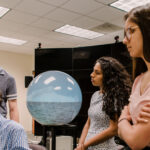
In a dimly lit room in UMBC’s Fine Arts building, two environmental science majors, a biology major, and a theatre-turned-individualized studies major watch weeks worth of coding, compiling videos, and map making come to life on a 4-foot spinning sphere called the Magic Planet.
A captivated audience watches in awe and anguish as videos of global warming glide across the spherical screen. Melting glaciers strand polar bears on thin ice, rising sea levels disrupt the homes of native Greenland tribes, and increased carbon dioxide in the oceans wipes out species of animals.
But not all hope is lost.
“It’s easy to feel hopeless,” says environmental science major Lauren Patel ’20. “There are times when we feel hopeless, too. But we can make all can make a difference.” Images of climate research and activism begin to spin around the sphere as the group explains how the individual actions of environmentally sustainable habits can add up.
The students’ “Stories on a Sphere” project, which focused on raising awareness of climate change in the arctic, was one of three Interdisciplinary CoLab research experiences offered to students over the summer. Throughout the four-week internship, each student brought their own variety of expertise to the table to create maps of temperature changes in the arctic, compile informational videos about melting ice caps, and write a compelling script for their 12-minute video illustrating the devastating effects of a warming northern hemisphere. The students also had to properly format the video onto a spherical structure which required learning new coding and video editing techniques.
 The “Stories on a Sphere” team showcased their project at the National Oceanic and Atmospheric Administration.
“It’s been amazing to watch the students collaborate and learn from each other,” says Ben Daniels, a current UMBC geography and environmental systems Ph.D. student and co-leader of the team. “Creating this product is something that none of them could have done independently. They each had to bring their own diverse sets of skills to the table to complete this task.”
A Unique Teaching Environment
For the second consecutive summer, UMBC’s Interdisciplinary CoLab provided students with an innovative team-based applied learning opportunity through a three-credit paid internship in narrative-based research. The program focuses on giving interdisciplinary student teams a professional research experience while learning how to tell effective stories and ultimately create a final product for a client.
“The CoLab is continuing to provide undergraduates with a unique experience of working across disciplinary lines,” says founding director of the CoLab and chair of gender, women, and sexuality studies, Carole McCann. “This experience gives students a sense of what kind of skills they can bring to a project and what they can learn from others.” In the future, she would love to see more faculty propose projects that connect students with organizations in the Baltimore area so that they can tell stories about the surrounding communities.
Kate Drabinski, a gender, women, and sexuality studies professor took the plunge and co-led “The Neighborhood: A State of Mind” project with media and communications professor, Donald Snyder. Drabinski cherishes her experience with the CoLab as one of the best teaching experiences she’s ever had.
“With the CoLab, faculty have the amazing chance to take an idea and give it to students and see it develop in ways we have never imagined, and we don’t get to do that very often as instructors,” Drabinksi says. “This is the kind of teaching that I want to do, and the CoLab gives me the resources to do it.”
Community Engagement
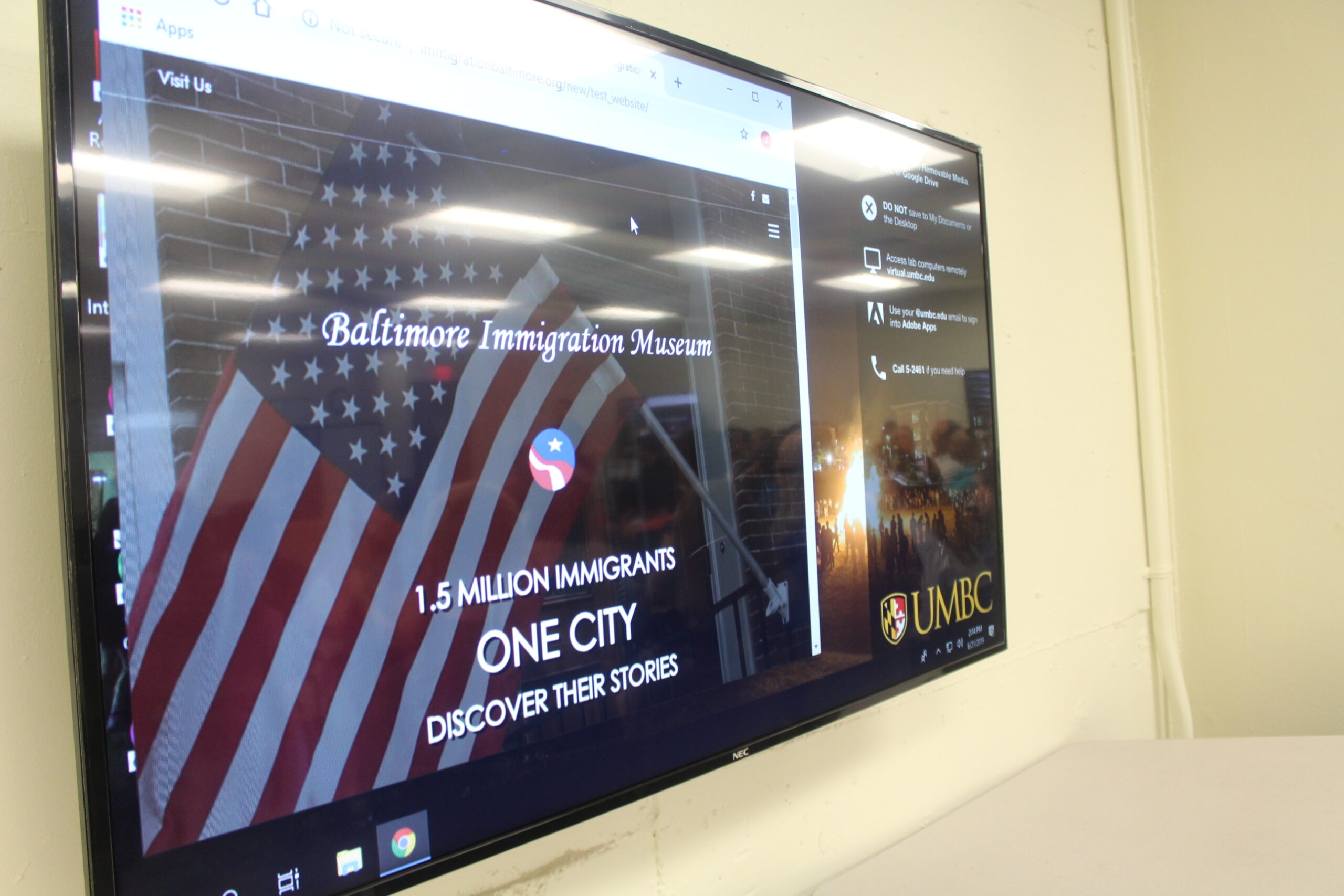
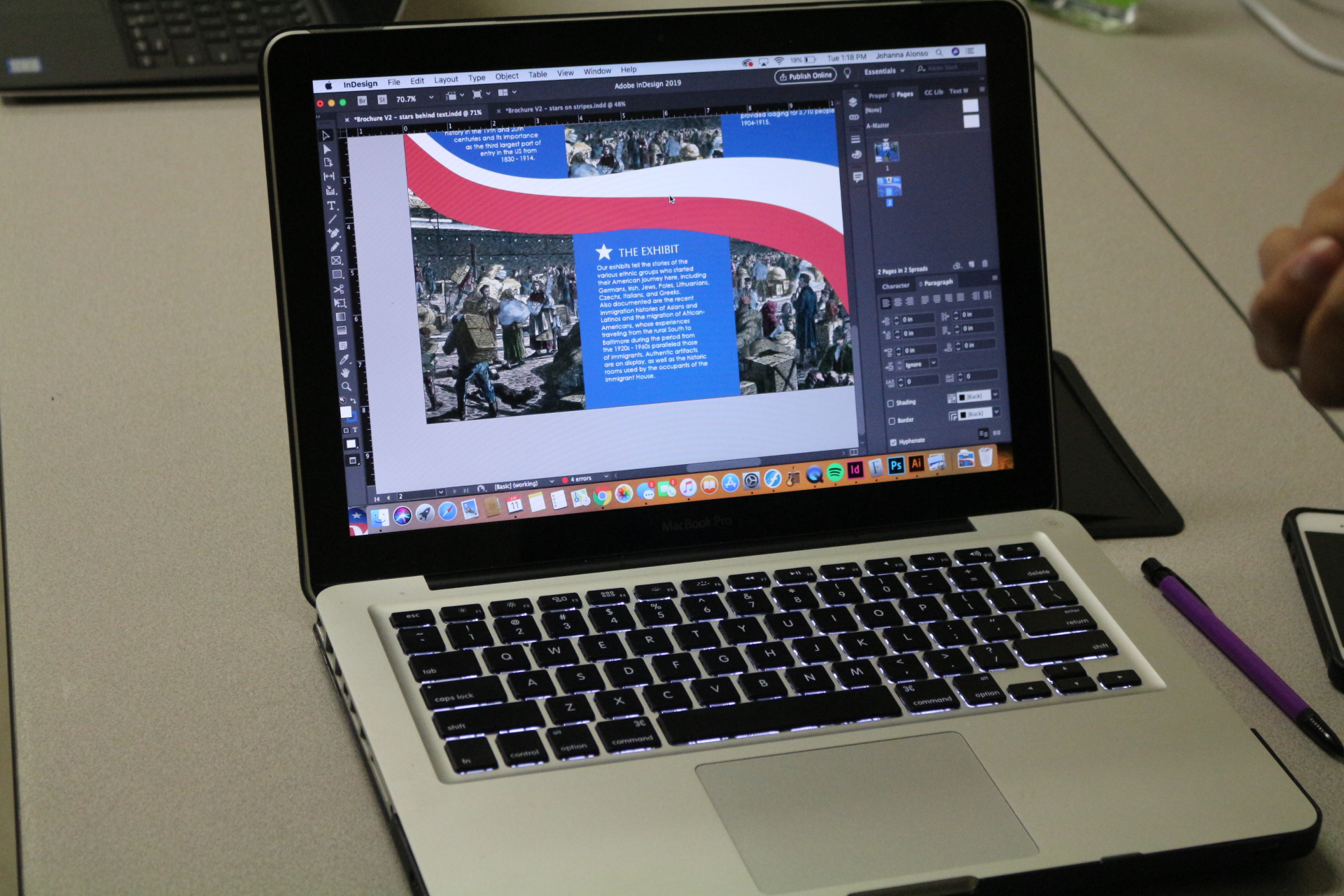
Have you wondered how Baltimore’s Little Italy, Greektown, and Chinatown came to be? For “Baltimore: The Second Ellis Island” project, three CoLab students uncovered the city’s rich immigration history and shed light on the little known Baltimore Immigration Museum. The team collaborated to design a new brochure and revamp the museum’s outdated website in an effort to bring the hidden gem more publicity.
English major Johanna Alonso ’20 used her story-telling skills to demonstrate how immigrants shaped Baltimore’s past. Alonso played a large role in the creation of the museum’s new brochure, while also composing original music for the interactive audio clips of letters written by immigrants on the website.
“Our group’s project demonstrated that the story of Baltimore is the story of its immigrants. Understanding their stories is imperative to having a complete understanding of the city,” she says. “I wasn’t aware of the museum prior to my internship, and I think the real benefit of the CoLab is that it exposes students to people, places, programs, and projects we may never have encountered otherwise.”
 The “Second Ellis Island” team presented their website and brochure for the Baltimore Immigration Museum.
Community engagement has been a key principle since the conception of the CoLab. Co-founder Rachel Carter notes that this is one of the ways that the CoLab adheres to the University’s and the Provost’s mission for interdisciplinary research. She hopes to continue the trend of creating local partnerships and encourages faculty to keep Baltimore communities in mind as they craft new proposals for next summer.
“The Baltimore Immigration Museum project was the first real attempt at community engagement for the CoLab,” says Carter. “We hope that in the years to come we will expand our partnerships and increase our commitment to the areas surrounding UMBC.”
Digging Deep in the Archives
A third project includes a six-person team and over 10,000 photos, hundreds of interview transcripts, and over 50 audio clips documenting various communities in East Baltimore in the 1970s. “The Neighborhood: State of Mind” project required students to sift through the archives of the East Baltimore Documentary Photography Project (EBDPP) housed in UMBC’s Special Collections. Conducted by three photographers at Maryland Institute College of Art from 1976 to 1980 and donated to UMBC in 2019, the sizable archive served as the basis for an online exhibit the students created for the Special Collections website.
Ian Feldmann ’20, a media and communication studies major with minors in entrepreneurship, photography, and information systems, headed up the creation of the website, but stresses that the final product was only possible with the help of every single teammate.
“Working with students from different majors makes you think more creatively,” he says. “The final product came from meshing together two or three different ideas to make it the best that it could be.”
The CoLab is a little nod to the reality we face: real-world problems do not fit neatly into disciplines,” says Lee Boot of UMBC’s Imaging Research Center. “I’m so thankful that UMBC is doing something to prepare students for this.”
The students picked out important themes they discovered while sifting through the EBDPP and dedicated their time to telling those stories in a variety of ways. The ideas for these topics came straight from the EBDPP proposal written in 1976, as well as common themes observed by the students while going through the photos and interviews from the collection.
The online exhibit features three research essays about cleanliness, social life, and family structure in East Baltimore. For another aspect of the project, one student created a six-minute video about the neighborhood’s unique history of decorating window sills. Yet another section of the exhibit examines photographs of important geographic locations and features photos taken by the CoLab students. The students embedded an interactive map on the website so users can click on a popular East Baltimore landmark and see side-by-side pictures by the photographers from the EDBPP and modern day pictures taken by the CoLab students collected on a day-long walking tour of East Baltimore.
 President Hrabowski visits CoLab’s “Neighborhood” project and examines one of the 10,000 photos they worked with.
Real World Applications
The final products for the 2019 CoLab spanned much further than UMBC’s campus. The “Stories on a Sphere” team created the video not only to be presented on the Magic Planet at UMBC, but also for the “Science on a Sphere” screen at the National Oceanic and Atmospheric Administration (NOAA). The video will be archived at NOAA and used during informational sessions for visitors.
“We hope that our spherical presentation is used in classrooms and museums to inspire and engage future students and scientists to learn more about the impacts of climate change,” said biology major Sangita Ramaswamy ’20 at the NOAA presentation in June.
 The “Stories on a Sphere” team’s project will be archived and used for educational tours at NOAA.
Marveling at the final presentations, former CoLab project leader and director of UMBC’s Imaging Research Center, Lee Boot, explains the importance of the skills the students have learned by being a part of this internship.
“This generation of students is coming through universities at a time when more and more institutions are being held accountable for the good they are doing in this world. The CoLab is a little nod to the reality we face: real-world problems do not fit neatly into disciplines,” he says. “I’m so thankful that UMBC is doing something to prepare students for this.”
*****
Header image: Stories on a Sphere project in a research lab. Photo by Marlayna Demond ’11. All other images by Kennedy Lamb ’20.
Kennedy Lamb splits her time as an editorial intern for the UMBC Magazine and a marketing intern for the CoLab.
]]>
In a dimly lit room in UMBC’s Fine Arts building, two environmental science majors, a biology major, and a theatre-turned-individualized studies major watch weeks worth of coding, compiling...
https://umbc.edu/stories/colab-continues-to-inspire-collaborative-creativity/
https://beta.my.umbc.edu/api/v0/pixel/news/120084/guest@my.umbc.edu/5df5db3af56643b26225c814c3292471/api/pixel
campus-life
colab
inds
summer-session
UMBC News & Magazine
https://beta.my.umbc.edu/groups/umbc-news-magazine
https://assets1-beta.my.umbc.edu/system/shared/avatars/groups/000/001/943/24435aa6207c452e7bc15cc74b42c7bb/xsmall.png?1748556657
https://assets1-beta.my.umbc.edu/system/shared/avatars/groups/000/001/943/24435aa6207c452e7bc15cc74b42c7bb/original.png?1748556657
https://assets2-beta.my.umbc.edu/system/shared/avatars/groups/000/001/943/24435aa6207c452e7bc15cc74b42c7bb/xxlarge.png?1748556657
https://assets2-beta.my.umbc.edu/system/shared/avatars/groups/000/001/943/24435aa6207c452e7bc15cc74b42c7bb/xlarge.png?1748556657
https://assets3-beta.my.umbc.edu/system/shared/avatars/groups/000/001/943/24435aa6207c452e7bc15cc74b42c7bb/large.png?1748556657
https://assets1-beta.my.umbc.edu/system/shared/avatars/groups/000/001/943/24435aa6207c452e7bc15cc74b42c7bb/medium.png?1748556657
https://assets2-beta.my.umbc.edu/system/shared/avatars/groups/000/001/943/24435aa6207c452e7bc15cc74b42c7bb/small.png?1748556657
https://assets1-beta.my.umbc.edu/system/shared/avatars/groups/000/001/943/24435aa6207c452e7bc15cc74b42c7bb/xsmall.png?1748556657
https://assets2-beta.my.umbc.edu/system/shared/avatars/groups/000/001/943/24435aa6207c452e7bc15cc74b42c7bb/xxsmall.png?1748556657
UMBC News & Magazine
0
0
false
Fri, 12 Jul 2019 18:09:07 -0400
UMBC partners with five universities in the US, UK, and Japan to launch International Cybersecurity Center of Excellence
UMBC has partnered to create a global university network dedicated to securing critical systems against cyber threats: the International Cybersecurity Center of Excellence (INCS-CoE).
The INCS-CoE has its foundations in a 2018 cybersecurity collaboration that included UMBC, Keio University in Japan, and Royal Holloway University of London. That initial group has now formally expanded to include Northeastern University, Kyushu University in Japan, and Imperial College London.
The INCS-CoE will support the efforts of the participating universities as they work together to address cybersecurity challenges facing society. The collaboration focuses on cybersecurity for critical national infrastructures including information technology, public transit, and financial services. Additionally, the Center of Excellence will include research, advocacy, and education components.
“Trust is one of the key pillars for a free and interconnected world, for commerce and for exchange of information, be it in the real world or in the digital world,” says Karl V. Steiner, UMBC’s vice president for research. “In order for machines to communicate well with each other, we need to put in place policies and technologies that establish a trust basis.”
He explains, “The INCS-CoE is built on a similar strong layer of trust among six institutions from three different continents. This first-of-its-kind global Center of Excellence will enable us to rapidly exchange ideas and find solutions to developing issues in an increasingly networked world.”
In the future, INCS-CoE may expand to include government and corporate partners, says Steiner.
“The challenges this first-of-its-kind partnership aims to solve span a complex set of cybersecurity issues,” said David Luzzi, senior vice provost for research at Northeastern.
Each academic institution has specific strengths and areas of expertise that they bring to the partnership. UMBC’s Center for Cybersecurity and Center for Accelerated Real Time Analytics will be instrumental in contributing to INCS-CoE’s goals for UMBC.
Learn more about the INCS-CoE.
Banner image: Representatives from the partnering institutions at UMBC. Photo by Marlayna Demond ’11 for UMBC.
]]>
UMBC has partnered to create a global university network dedicated to securing critical systems against cyber threats: the International Cybersecurity Center of Excellence (INCS-CoE). The...
https://umbc.edu/stories/umbc-partners-with-five-universities-in-the-us-uk-and-japan-to-launch-international-cybersecurity-center-of-excellence/
https://beta.my.umbc.edu/api/v0/pixel/news/120085/guest@my.umbc.edu/6779a2f53c971a27452456b6fa418c51/api/pixel
cybersecurity
international
research
science-and-technology
UMBC News & Magazine
https://beta.my.umbc.edu/groups/umbc-news-magazine
https://assets1-beta.my.umbc.edu/system/shared/avatars/groups/000/001/943/24435aa6207c452e7bc15cc74b42c7bb/xsmall.png?1748556657
https://assets1-beta.my.umbc.edu/system/shared/avatars/groups/000/001/943/24435aa6207c452e7bc15cc74b42c7bb/original.png?1748556657
https://assets2-beta.my.umbc.edu/system/shared/avatars/groups/000/001/943/24435aa6207c452e7bc15cc74b42c7bb/xxlarge.png?1748556657
https://assets2-beta.my.umbc.edu/system/shared/avatars/groups/000/001/943/24435aa6207c452e7bc15cc74b42c7bb/xlarge.png?1748556657
https://assets3-beta.my.umbc.edu/system/shared/avatars/groups/000/001/943/24435aa6207c452e7bc15cc74b42c7bb/large.png?1748556657
https://assets1-beta.my.umbc.edu/system/shared/avatars/groups/000/001/943/24435aa6207c452e7bc15cc74b42c7bb/medium.png?1748556657
https://assets2-beta.my.umbc.edu/system/shared/avatars/groups/000/001/943/24435aa6207c452e7bc15cc74b42c7bb/small.png?1748556657
https://assets1-beta.my.umbc.edu/system/shared/avatars/groups/000/001/943/24435aa6207c452e7bc15cc74b42c7bb/xsmall.png?1748556657
https://assets2-beta.my.umbc.edu/system/shared/avatars/groups/000/001/943/24435aa6207c452e7bc15cc74b42c7bb/xxsmall.png?1748556657
UMBC News & Magazine
0
0
false
Fri, 12 Jul 2019 13:37:59 -0400


