Retriever Nation welcomes another class to its ranks

The start of the school year is invigorating for the whole university community, whether you’re starting your first year in college, transferring from a different institution, or gearing up to teach for the tenth year. And UMBC is channeling all that energy in classic Retriever ways.
Inflatable games in The Commons, a petting zoo on Erickson Field, food trucks everywhere—nothing says Welcome Week like a campus filled with activity. New students also have opportunities to reflect on what they hope to experience and achieve as college students, as well as learn about the foundational principles that are essential for our campus community to thrive.
Each student has a story
“We received a record number of applications this year, and the class of 2023 has all the strong academic credentials we’ve grown to expect at UMBC,” says Dale Bittinger ’16, M.P.P., assistant vice provost of undergraduate admissions, orientation, and school partnerships. “But even though you might start with the class’s numbers, it goes far beyond that. The students’ stories make the foundation of the class’s greatness.”
Hailing from 28 states and 31 countries, the incoming class of 2023 is eager to join in the unique community UMBC fosters among students. “UMBC has always been on my mind,” says Samiksha Paudel, biology. “I think it’s the best fit for me because of the size and the sense of community.”
 Paudel hugs a newfound friend, Erica Doerrter, pre-nursing. Photo by Kennedy Lamb ’20.
“I chose UMBC because I heard that it’s cool to be a nerd here,” adds Natalie Davenport, psychology, “and so far, I haven’t been disappointed.”
 Before gathering to take the annual class photo, Davenport stands in front of The Commons. Photo by Kennedy Lamb ’20.
Warm welcome from leaders
At Convocation (“a calling together” from Latin, as President Freeman Hrabowski pointed out), leaders of the campus community welcomed new students as fellow Retrievers. He encouraged them to take risks while also reminding them that they are in control of their destiny.
He also emphasized the principles that make Retriever Nation such a special place to grow and learn. He noted, “We value treating others with respect, standing against any kind of prejudice, and speaking out with courage about what is right and wrong.”
In case you missed it, that was President Hrabowski giving all of our new Retrievers their first A! #UMBCwelcome pic.twitter.com/0t5W10SDbE
— UMBC (@UMBC) August 27, 2019
SGA President Vrinda Deshpande affirmed that failure happens—it’s trying new things that is so important.
“When things don’t go according to your plans- take a step back, breathe, forgive yourself, and make a new plan.” – Vrinda Deshpande, @umbcsga president (we heard an audible sigh of relief when she shared that no one expects your first year to be perfect) #UMBCwelcome pic.twitter.com/b7RwtJgyq5
— UMBC (@UMBC) August 27, 2019
At the annual Fall Opening Meeting for faculty and staff, students reminded them of their mission at UMBC. Incoming student and Honors College member Zinedine Partipilo Cornielles fled Venezuela with his family and settled in Howard County in pursuit of stability and access to education. He shared that during his time in high school, all he heard about was UMBC.
“When I first stepped on campus, I felt overwhelmed. Not just because of what college represents in everyone’s lives, but also because of how incredible the school was,” said Partipilo Cornielles. “I was able to see how there were so many opportunities for everyone.”
 Zinedine Partipilo Cornielles at UMBC’s 2019 Fall Opening Program. Photo by Arionna Gonsalves ’19.
President Hrabowski ended the event with a brief version of his State of the University report and the familiar words attributed to Aristotle: “Choice, not chance, determines your destiny.” He then added an addendum, saying that recently a colleague had pressed him, asking, what if someone doesn’t have the chance to have a choice? “The nobility of what we do,” answered President Hrabowski, “is that we are creating opportunities for so many people to have that chance to make a choice.”
Campus is growing for students
Soon came the first day of classes. New and returning students walked through the doors of the Interdisciplinary Life Sciences Building (ILSB) for the first time, glimpsing bold colors and high tech classroom and lab spaces. With anticipation, they patiently stood in line to try the new line up of halal meals in The Commons and relaxed in True Grit’s updated dining hall, reconnecting with friends. Others enjoyed walking across the fresh green grass of the quad and spotting new pocket gardens with native plants.
https://www.instagram.com/p/B1vyJHEhpkx/?utm_source=ig_web_copy_link
UMBC’s Shady Grove campus is also expanding this year as construction continues on a building that will house the new translational life science technology major. Students in this major are eager to apply their skills and interest in the life sciences to creating innovative biotechnology solutions that will transform the health, agriculture, and environment sectors. They will find a welcoming home in the Biomedical Sciences and Engineering (BSE) Education Facility at Shady Grove this fall.
Discovering your place at UMBC
While not all of the first week of the fall semester is fun and games, there are also literal games, as the soccer teams kick off their new season. In an opening game against St. Francis, the women’s team kept the score tied 2-2 into overtime. The men’s soccer team is matched with Incarnate Word at 7 p.m. on August 30, giving new and returning Retrievers a chance to join their voices in a big WOOF WOOF as they cheer on the team.
 Junior Kathryn Moormann deflects the ball from the goal. Photo by Ian Feldmann ’20.
Though it’s a fast-paced introduction to campus, Welcome Week allows incoming students to bond with each other, and get an introduction to the UMBC experience from returning Retrievers. Whether they’re attending a pool party, morning yoga by the UMBC Library pond, or a “unity web” community activity, UMBC students use this week as a chance to start building relationships that will serve as the foundation for their years at UMBC.
 Students collaborate on the unity web project. Photo by Marlayna Demond ’11.
“I’m excited to see what these students can do,” says Bittinger. “I don’t even know if they know what they’re capable of, but I hope they discover their place in the world here at UMBC. I’m as excited as they are to see them succeed.”
Happy first day of classes! Whether you're new to #RetrieverNation or you've called UMBC home for a while, start the year with our favorite mantra in mind: thoughts  words actions habits character destiny. #UMBCwelcome pic.twitter.com/f1dOJi48tg
— UMBC (@UMBC) August 28, 2019
This article was written by Randianne Leyshon ’09, assistant editor of UMBC Magazine, with contributions from Kait McCaffrey.
Banner image: New Retrievers gather to spell out “UMBC” on Erickson Field. Photo by Marlayna Demond ’11.
]]>
The start of the school year is invigorating for the whole university community, whether you’re starting your first year in college, transferring from a different institution, or gearing up to...
https://umbc.edu/stories/retriever-nation-welcomes-another-class-to-its-ranks/
https://beta.my.umbc.edu/api/v0/pixel/news/120058/guest@my.umbc.edu/39f2acddf813704dc2edae02b07e1190/api/pixel
cahss
cnms
coeit
community
honorscollege
UMBC News & Magazine
https://beta.my.umbc.edu/groups/umbc-news-magazine
https://assets1-beta.my.umbc.edu/system/shared/avatars/groups/000/001/943/24435aa6207c452e7bc15cc74b42c7bb/xsmall.png?1748556657
https://assets1-beta.my.umbc.edu/system/shared/avatars/groups/000/001/943/24435aa6207c452e7bc15cc74b42c7bb/original.png?1748556657
https://assets2-beta.my.umbc.edu/system/shared/avatars/groups/000/001/943/24435aa6207c452e7bc15cc74b42c7bb/xxlarge.png?1748556657
https://assets2-beta.my.umbc.edu/system/shared/avatars/groups/000/001/943/24435aa6207c452e7bc15cc74b42c7bb/xlarge.png?1748556657
https://assets3-beta.my.umbc.edu/system/shared/avatars/groups/000/001/943/24435aa6207c452e7bc15cc74b42c7bb/large.png?1748556657
https://assets1-beta.my.umbc.edu/system/shared/avatars/groups/000/001/943/24435aa6207c452e7bc15cc74b42c7bb/medium.png?1748556657
https://assets2-beta.my.umbc.edu/system/shared/avatars/groups/000/001/943/24435aa6207c452e7bc15cc74b42c7bb/small.png?1748556657
https://assets1-beta.my.umbc.edu/system/shared/avatars/groups/000/001/943/24435aa6207c452e7bc15cc74b42c7bb/xsmall.png?1748556657
https://assets2-beta.my.umbc.edu/system/shared/avatars/groups/000/001/943/24435aa6207c452e7bc15cc74b42c7bb/xxsmall.png?1748556657
UMBC News & Magazine
0
0
false
Fri, 30 Aug 2019 21:51:45 -0400
UMBC’s Minjoung Kyoung to help develop first 4D map of a cell’s metabolic pathways
Scientists understand many of the body’s processes, like breaking down sugars and generating energy for the cell, pretty well. They know what chemical reactions are involved, what molecules they produce, and in what order everything happens. Complex maps even exist of how the different processes interact with one another. There’s a problem, though: the maps are two-dimensional, and cells are three-dimensional. Add the element of time, and you’re up to four dimensions.
Minjoung Kyoung, assistant professor of chemistry and biochemistry, has never been satisfied with 2D maps of 4D processes. “I’ve always been interested in how proteins are working in the real system, in real time, in real action,” she says.
To address the limits of current understanding, Kyoung and her graduate student, Erin Kennedy, ordered parts to build an innovative type of microscope, found in just a few labs around the world. This new tool gave them the rare ability to look at entire living cells at exquisite resolution, as they change in real time. Finally, they could move forward with constructing a 4D map of cellular metabolic pathways.
Kyoung’s preliminary results with the new instrument are promising. Now, with a five-year, $1.6 million grant from the National Institutes of Health, she’s poised to make serious breakthroughs in how we understand the functional relationship between metabolic pathways. Her first targets will include essential basic processes like glucose metabolism (sugar breakdown) and cellular respiration (energy production for the cell, which relies on glucose). Both are fundamental to diseases like diabetes, cancer, and obesity.
Anticipating disease
One thing Kyoung’s early results suggested is that the enzymes important for breaking down glucose and for generating energy are physically close together in the cell—but only when both pathways are functioning normally. “So when they are functionally linked, they are spatially related,” Kyoung says. Her continuing research will try to determine how and why that happens, by looking very carefully at what’s going on in whole cells at various time points and under different cellular conditions.
 Minjoung Kyoung and Erin Kennedy work on the lab’s unique microscope. Photo by Marlayna Demond ’11 for UMBC.
Kyoung also finds the glucose pathway itself to be fascinating. It takes place in the cytoplasm, the watery fluid that fills cells. But somehow, the enzymes required to break down glucose form dense clusters, which Kyoung has dubbed “condensates,” even though the clusters don’t have a formal boundary. “The fundamental mechanism for how these condensates are reversibly assembled and disassembled is one of the specific aims that we’re going to study,” Kyoung says.
The enzymes for the cellular energy pathway also cluster, but they are enclosed inside mitochondria, a structure surrounded by a membrane. A single cell can contain from zero to thousands of mitochondria, depending on the cell’s job. Kyoung explains, “Mitochondria are very important for various metabolic diseases—cancer, diabetes, obesity, and so on. How these mitochondria relate to glucose metabolism is the most important part. So, by understanding them, I truly believe that we can get much, much closer to understanding how these diseases are caused, thus promoting therapeutic intervention.”
“My dream is to be able to predict disease before symptoms occur,” she shares. “That would be the best.”
Ready for a challenge
Getting to the point of recognizing disease before symptoms are apparent won’t be easy. The imaging techniques Kyoung, Kennedy, new graduate student Tao Zhang, and UMBC collaborator Songon An, associate professor of chemistry and biochemistry, are employing are so new, and so difficult, Kyoung anticipates many challenges.
“There is no previous data whatsoever. There is no technical approach whatsoever. There is no approach to data analysis whatsoever,” says Kyoung. She describes being at this cutting edge as both exciting and intimidating. To even successfully collect useful data, “many things have to go right,” Kyoung says.
 Minjoung Kyoung explains a result to her students. Photo by Marlayna Demond ’11 for UMBC.
To see what they want to see inside the cells, such as a particular enzyme, Kyoung’s team will need to tag it with a fluorescent protein, a process that is successful in 50 to 60 percent of cells. That’s not a problem when you use a conventional microscope, because you can see lots of cells at once. But the microscope that enables observing living cells with the resolution Kyoung needs can only see a few cells at a time. So finding the tagged cells has been the first challenge.
After the images are collected, a complex mathematical process called “deconvolution” removes the distortion that the microscope’s light beam itself generates in the images. That takes several hours for a single cell. And then they can actually analyze the images to see which enzymes are where, when. This process takes several days for one cell. Only at that point do they know if the experiment worked.
And, “Because no one has done this type of research before, we have to figure out how we are going to validate our results, too,” Kyoung says. “There is no precedent.” Despite all these challenges, Kyoung is excited to get to work. She believes the kinds of relationships they’ve started to see between glucose metabolism and mitochondria are only the tip of the iceberg as far as spatial relationships between metabolic pathways in the cell.
“Just a start”
“This is just a start. So far we have focused on these two metabolic pathways, but I believe this phenomenon is not limited to just these two,” Kyoung says. “So I envision that this will be the beginning for a big 4D map of all the metabolic networks.”
Kyoung and her team have significant funding from NIH to support their work, the microscope they need to do it, a healthy sense of optimism, and a commitment to helping answer some of the fundamental questions surrounding emerging epidemics like cancers, diabetes and obesity. With the key elements in place, they are bound to make breakthroughs that move the needle on tackling some of today’s most challenging diseases.
Banner image: Minjoung Kyoung and her UMBC lab group. From left to right: Keynon Bell, Minjoung Kyoung, Erin Kennedy, Manuel Huerta-Alvarado, and Tao Zhang. Photo by Marlayna Demond ’11 for UMBC.
]]>
Scientists understand many of the body’s processes, like breaking down sugars and generating energy for the cell, pretty well. They know what chemical reactions are involved, what molecules they...
https://umbc.edu/stories/umbcs-minjoung-kyoung-to-help-develop-first-4d-map-of-a-cells-metabolic-pathways/
https://beta.my.umbc.edu/api/v0/pixel/news/120059/guest@my.umbc.edu/e2e25fb813c40e63118cfcf20cd5faea/api/pixel
chembiochem
cnms
research
science-and-technology
UMBC News & Magazine
https://beta.my.umbc.edu/groups/umbc-news-magazine
https://assets1-beta.my.umbc.edu/system/shared/avatars/groups/000/001/943/24435aa6207c452e7bc15cc74b42c7bb/xsmall.png?1748556657
https://assets1-beta.my.umbc.edu/system/shared/avatars/groups/000/001/943/24435aa6207c452e7bc15cc74b42c7bb/original.png?1748556657
https://assets2-beta.my.umbc.edu/system/shared/avatars/groups/000/001/943/24435aa6207c452e7bc15cc74b42c7bb/xxlarge.png?1748556657
https://assets2-beta.my.umbc.edu/system/shared/avatars/groups/000/001/943/24435aa6207c452e7bc15cc74b42c7bb/xlarge.png?1748556657
https://assets3-beta.my.umbc.edu/system/shared/avatars/groups/000/001/943/24435aa6207c452e7bc15cc74b42c7bb/large.png?1748556657
https://assets1-beta.my.umbc.edu/system/shared/avatars/groups/000/001/943/24435aa6207c452e7bc15cc74b42c7bb/medium.png?1748556657
https://assets2-beta.my.umbc.edu/system/shared/avatars/groups/000/001/943/24435aa6207c452e7bc15cc74b42c7bb/small.png?1748556657
https://assets1-beta.my.umbc.edu/system/shared/avatars/groups/000/001/943/24435aa6207c452e7bc15cc74b42c7bb/xsmall.png?1748556657
https://assets2-beta.my.umbc.edu/system/shared/avatars/groups/000/001/943/24435aa6207c452e7bc15cc74b42c7bb/xxsmall.png?1748556657
UMBC News & Magazine
0
0
false
Fri, 30 Aug 2019 19:40:01 -0400
Surveying archaeologists across the globe reveals deeper and more widespread roots of the human age, the Anthropocene
By Erle C. Ellis, professor of geography and environmental systems, UMBC; Ben Marwick, associate professor of archaeology, University of Washington; Lucas Stephens, research affiliate in archaeology, Max Planck Institute for the Science of Human History; and Nicole Boivin, director of the department of archaeology, Max Planck Institute for the Science of Human History
Examples of how human societies are changing the planet abound – from building roads and houses, clearing forests for agriculture and digging train tunnels, to shrinking the ozone layer, driving species extinct, changing the climate and acidifying the oceans. Human impacts are everywhere. Our societies have changed Earth so much that it’s impossible to reverse many of these effects.
 Nuclear bomb testing left its mark in the geologic record. National Nuclear Security Administration/Wikimedia Commons, CC BY
Some researchers believe these changes are so big that they mark the beginning of a new “human age” of Earth history, the Anthropocene epoch. A committee of geologists has now proposed to mark the start of the Anthropocene in the mid-20th century, based on a striking indicator: the widely scattered radioactive dust from nuclear bomb tests in the early 1950s.
But this is not the final word.
Not everyone is sure that today’s industrialized, globalized societies will be around long enough to define a new geological epoch. Perhaps we are just a flash in the pan – an event – rather than a long, enduring epoch.
Others debate the utility of picking a single thin line in Earth’s geological record to mark the start of human impacts in the geological record. Maybe the Anthropocene began at different times in different parts of the world. For example, the first instances of agriculture emerged at different places at different times, and resulted in huge impacts on the environment, through land clearing, habitat losses, extinctions, erosion and carbon emissions, forever changing the global climate.
If there are multiple beginnings, scientists need to answer more complicated questions – like when did agriculture begin to transform landscapes in different parts of the world? This is a tough question because archaeologists tend to focus their research on a limited number of sites and regions and to prioritize locations where agriculture is believed to have appeared earliest. To date, it has proved nearly impossible for archaeologists to put together a global picture of land use changes throughout time.
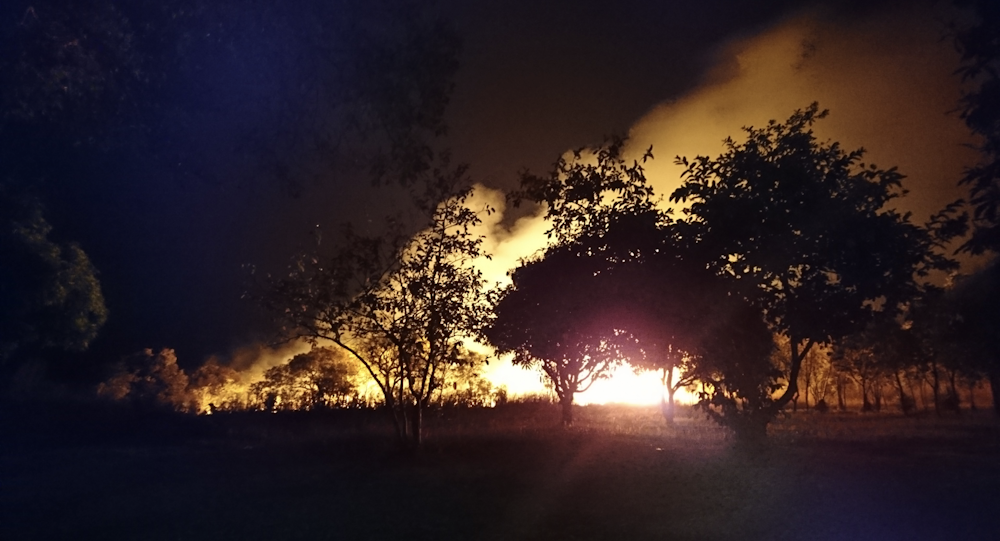
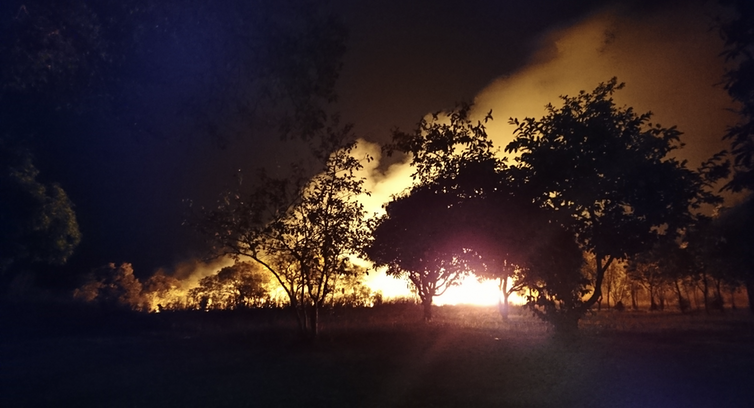 Human practices like burning the landscape – as in this night bush fire outside Kabwe, Zambia – have been affecting the Earth since long before the nuclear era.Andrea Kay, CC BY-SA
Global answers from local experts
To tackle these questions, we pulled together a research collaboration among archaeologists, anthropologists and geographers to survey archaeological knowledge on land use across the planet.
We asked over 1,300 archaeologists from around the world to contribute their knowledge on how ancient people used the land in 146 regions spanning all continents except Antarctica from 10,000 years ago right up to 1850. More than 250 responded, representing the largest expert archaeology crowdsourcing project ever undertaken, though some prior projects have worked with amateur contributions.
Our work has now mapped the current state of archaeological knowledge on land use across the planet, including parts of the world that have rarely been considered in previous studies.
We used a crowdsourcing approach because scholarly publications don’t always include the original data needed to allow global comparisons. Even when these data are shared by archaeologists, they use many different formats from one project to another, making it difficult to combine for large-scale analysis. Our goal from the beginning was to make it easy for anyone to check our work and reuse our data – we’ve put all our research materials online where they can be freely accessed by anyone.
Earlier and more widespread human impacts
Though our study acquired expert archaeological information from across the planet, data were more available in some regions – including Southwest Asia, Europe, northern China, Australia and North America – than in others. This is probably because more archaeologists have worked in these regions than elsewhere, such as parts of Africa, Southeast Asia and South America.
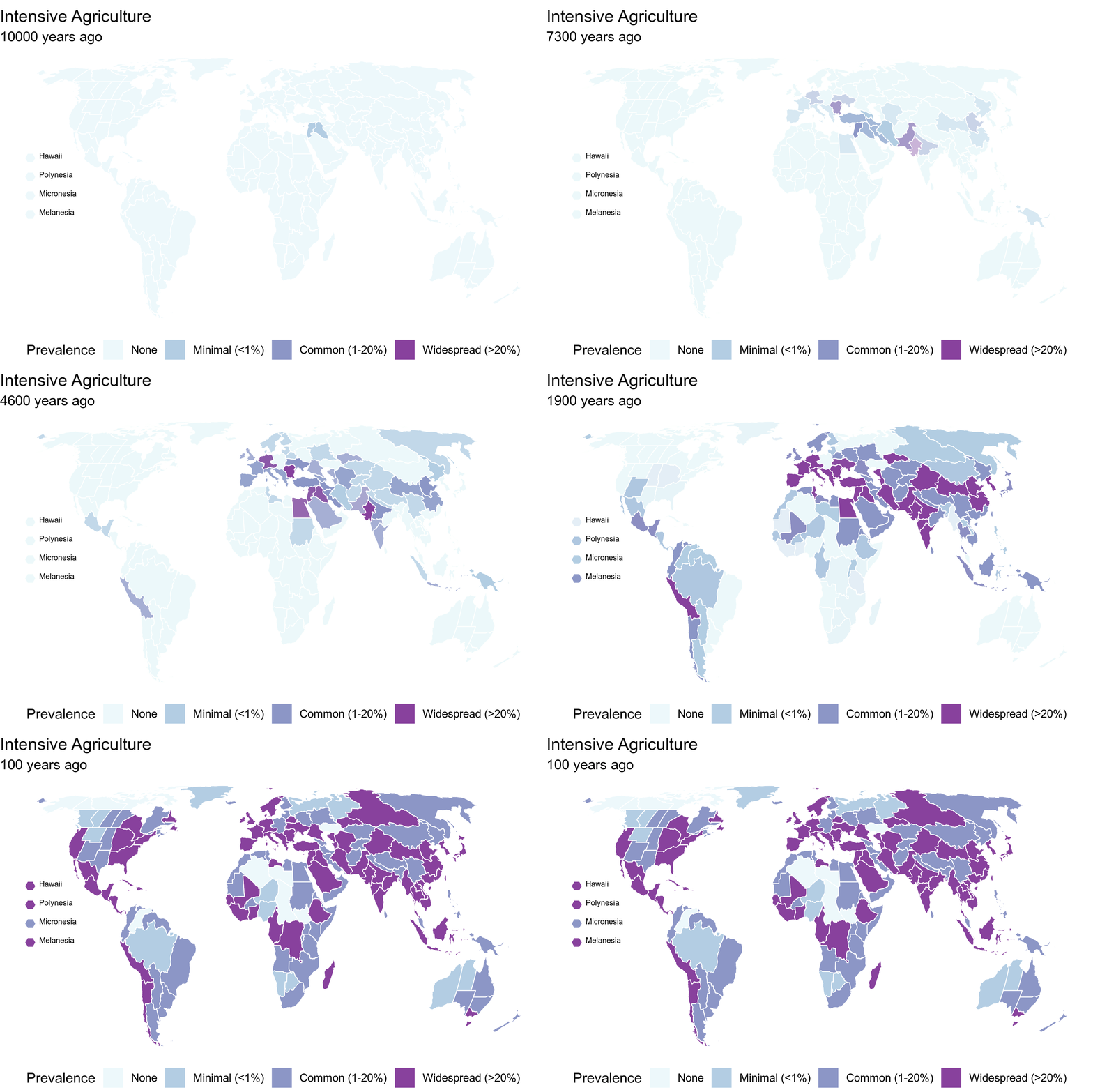 Animation showing the spread of intensive agriculture across the globe over the past 10,000 years, based on ArchaeoGLOBE Project results. (Nicolas Gauthier, 2019, CC-BY-SA)
Our archaeologists reported that nearly half (42%) of our regions had some form of agriculture by 6,000 years ago, highlighting the prevalence of agricultural economies across the globe. Moreover, these results indicate that the onset of agriculture was earlier and more widespread than suggested in the most common global reconstruction of land-use history, the History Database of the Global Environment. This is important because climate scientists often use this database of past conditions to estimate future climate change; according to our research it may be underestimating land-use-associated climate effects.
Our survey also revealed that hunting and foraging was generally replaced by pastoralism (raising animals such as cows and sheep for food and other resources) and agriculture in most places, though there were exceptions. In a few areas, reversals occurred and agriculture did not simply replace foraging but merged with it and coexisted side by side for some time.
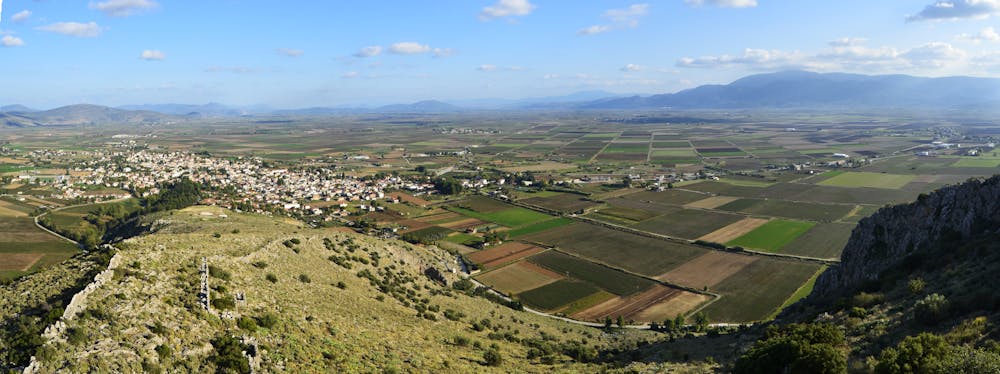
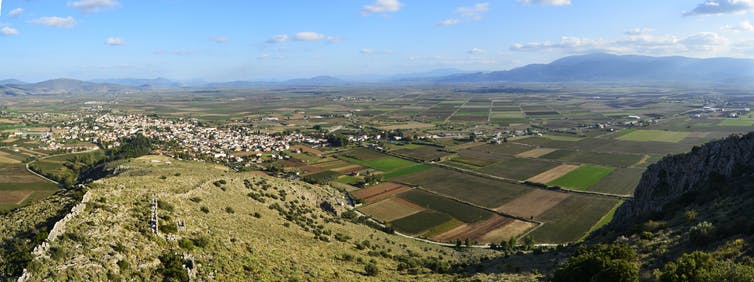 View of the Kopaic Plain in Boeotia, Greece. People first partially drained the area 3,300 years ago to claim land for agriculture and it’s still farmed today.Lucas Stephens, CC BY-SA
The deep roots of the Anthropocene
Global archaeological data show that human transformation of environments began at different times in different regions and accelerated with the emergence of agriculture. Nevertheless, by 3,000 years ago, most of the planet was already transformed by hunter-gatherers, farmers and pastoralists.
To guide this planet toward a better future, we need to understand how we got here. The message from archaeology is clear. It took thousands of years for the pristine planet of long ago to become the human planet of today.
And there is no way to fully understand this human planet without building on the expertise of archaeologists, anthropologists, sociologists and other human scientists. To build a more robust Earth science in the Anthropocene, the human sciences must play as central a role as the natural sciences do today.
*****
Header photo: People have been modifying Earth – as in these rice terraces near Pokhara, Nepal – for millennia. Erle C. Ellis, CC BY-ND

Erle C. Ellis is a member of the American Association of Geographers.The association is a funding partner of The Conversation US.
Ben Marwick, Associate Professor of Archaeology, University of Washington; Erle C. Ellis, Professor of Geography and Environmental Systems, University of Maryland, Baltimore County; Lucas Stephens, Research Affiliate in Archaeology, Max Planck Institute for the Science of Human History, and Nicole Boivin, Director of the Department of Archaeology, Max Planck Institute for the Science of Human History
Disclosure statement
Ben Marwick receives funding from the Australian Research Council, the Wenner-Gren Foundation, and the National Geographic Society
Erle C. Ellis received funding from the National Science Foundation for this project under grant CNS 1125210. He is a fellow of the Global Land Program, a member of the Anthropocene Working Group of the International Commission on Stratigraphy, and a senior fellow of the Breakthrough Institute. He is a member of the American Association of Geographers.
Lucas Stephens receives funding from the American Council of Learned Societies. He is a Mellon/ACLS Public Fellow and Senior Research Analyst at the Environmental Law and Policy Center and a Research Affiliate at the Max Planck Institute for the Science of Human History.
Nicole Boivin receives funding from the Max Planck Society. She is Director at the Max Planck Institute for the Science of Human History, an Honorary Professor at the University of Queensland, and a Research Affiliate at the Smithsonian Institution and University of Calgary.
This article is republished from The Conversation under a Creative Commons license. Read the original article.
]]>
By Erle C. Ellis, professor of geography and environmental systems, UMBC; Ben Marwick, associate professor of archaeology, University of Washington; Lucas Stephens, research affiliate in...
https://umbc.edu/stories/surveying-archaeologists-across-the-globe-reveals-deeper-and-more-widespread-roots-of-the-human-age-the-anthropocene/
https://beta.my.umbc.edu/api/v0/pixel/news/120060/guest@my.umbc.edu/ca46829a8c4b1dfc0a591345ca8299a8/api/pixel
discovery
ges
the-conversation
UMBC News & Magazine
https://beta.my.umbc.edu/groups/umbc-news-magazine
https://assets1-beta.my.umbc.edu/system/shared/avatars/groups/000/001/943/24435aa6207c452e7bc15cc74b42c7bb/xsmall.png?1748556657
https://assets1-beta.my.umbc.edu/system/shared/avatars/groups/000/001/943/24435aa6207c452e7bc15cc74b42c7bb/original.png?1748556657
https://assets2-beta.my.umbc.edu/system/shared/avatars/groups/000/001/943/24435aa6207c452e7bc15cc74b42c7bb/xxlarge.png?1748556657
https://assets2-beta.my.umbc.edu/system/shared/avatars/groups/000/001/943/24435aa6207c452e7bc15cc74b42c7bb/xlarge.png?1748556657
https://assets3-beta.my.umbc.edu/system/shared/avatars/groups/000/001/943/24435aa6207c452e7bc15cc74b42c7bb/large.png?1748556657
https://assets1-beta.my.umbc.edu/system/shared/avatars/groups/000/001/943/24435aa6207c452e7bc15cc74b42c7bb/medium.png?1748556657
https://assets2-beta.my.umbc.edu/system/shared/avatars/groups/000/001/943/24435aa6207c452e7bc15cc74b42c7bb/small.png?1748556657
https://assets1-beta.my.umbc.edu/system/shared/avatars/groups/000/001/943/24435aa6207c452e7bc15cc74b42c7bb/xsmall.png?1748556657
https://assets2-beta.my.umbc.edu/system/shared/avatars/groups/000/001/943/24435aa6207c452e7bc15cc74b42c7bb/xxsmall.png?1748556657
UMBC News & Magazine
0
0
false
Fri, 30 Aug 2019 15:47:41 -0400
Preminda Jacob focuses on building connections as new associate dean of research and community engagement

Preminda Jacob, visual arts, has been named the new associate dean of research and community engagement for UMBC’s College of Humanities, Arts, and Social Sciences (CAHSS). She will join the current team of associate deans in providing support for the College’s many departments, programs, and research centers. Together they will continue to implement CAHSS’ strategic goals and objectives, focusing on projects around recruitment and retention of diverse faculty, promoting interdisciplinary collaboration, and further developing community engagement work.
Scott Casper, dean of CAHSS, is excited about the level of expertise Jacob brings to the team. “Preminda Jacob brings a wealth of experience as a scholar, teacher, and UMBC citizen, and leader to the Dean’s Office,” says Casper. “I am delighted that she has joined our leadership team and look forward to her continued contributions to the College and the University in this new role.”
 Jacob at graduate commencement.
Engaging faculty
Jacob will begin by joining the team of associate deans in working to further foster the current research community within CAHSS and build broader awareness of CAHSS research. One way Jacob hopes to share faculty research is by collaborating with campus partners on updating the university’s current faculty research database capabilities. This digital tool will help academics, researchers, educators, and students from around the world more easily access information about UMBC researchers and their areas of study.
“I see part of community engagement as an accessibility issue,” explains Jacob. “UMBC faculty conduct top-level research. A searchable database elevates our commitment to provide research-based answers to the world’s most pressing questions by placing the research within everyone’s reach.”
Jacob will also help faculty better connect with each other across departments, including for research that involves community partnerships. She looks forward to working with faculty who have research expertise on community engagement by exploring topics through existing brown bag lunch series and working groups in the five CAHSS research centers as well as across UMBC’s colleges.
Engaging the community
Prior to joining the Dean’s Office, Jacob served as chair of visual arts from 2015 to 2018. As a professor of visual arts specializing in art history and visual culture, she worked to connect her passions for research and community engagement.
Jacob recalls a four-year partnership between the Benjamin Banneker Historical Park and Museum in Catonsville and her Space, Place, and Public Art class as a particularly significant collaboration. Jacob partnered students with the museum’s staff to create public art pieces from start to finish in one semester. “Students were excited to work directly with a local organization and leaders within the organizations were equally excited to serve as guides and mentors in the process,” she says.
Over the years, Jacob’s students have created object and wall labels, interactive and interpretive recordings, and works of art for the museum. They produced a video featuring interviews with local leaders and archaeologists talking about the archaeological dig conducted by the Maryland Historical Trust in the 1980s on Benjamin Banneker’s property.
 Museum exhibit three teams of students helped design.
Victor Pineda ‘15, visual arts, who went on to serve as a museum intern after participating in Jacob’s class, helped record an actor’s interpretation of the voice of Benjamin Banneker. The recording became part of an interactive device in the Banneker Gallery. Today, visitors can listen to Benjamin Banneker discuss his letter to Thomas Jefferson.
 Pineda recording audio for interactive exhibit at the museum.
“Through the museum’s partnership with the visual arts department at UMBC,” says Willa Banks, the museum’s former director of education and curatorial affairs, “Dr. Jacob’s public art class provided a phenomenal service that not only benefited UMBC faculty and students but also the museum and the general public as well.”
Jacob plans to work with faculty already engaged with community partners in the Baltimore region to amplify relationships like this one. She is also dedicated to opening pathways for new community engagement opportunities, in the greater Baltimore region and beyond.
Banner Image: Preminda at MFA celebration. All images by Marlayna Demond ’11 for UMBC with the exception of the images of student work at the Benjamin Banneker Historical Park and Museum which were courtesy of Willa Banks.
]]>
Preminda Jacob, visual arts, has been named the new associate dean of research and community engagement for UMBC’s College of Humanities, Arts, and Social Sciences (CAHSS). She will join the...
https://umbc.edu/stories/preminda-jacob-focuses-on-building-connections-as-new-associate-dean-of-research-and-community-engagement/
https://beta.my.umbc.edu/api/v0/pixel/news/120061/guest@my.umbc.edu/63c6265a107de175d42ad8362f039d72/api/pixel
arts-and-culture
cahss
page1
research
visualarts
UMBC News & Magazine
https://beta.my.umbc.edu/groups/umbc-news-magazine
https://assets1-beta.my.umbc.edu/system/shared/avatars/groups/000/001/943/24435aa6207c452e7bc15cc74b42c7bb/xsmall.png?1748556657
https://assets1-beta.my.umbc.edu/system/shared/avatars/groups/000/001/943/24435aa6207c452e7bc15cc74b42c7bb/original.png?1748556657
https://assets2-beta.my.umbc.edu/system/shared/avatars/groups/000/001/943/24435aa6207c452e7bc15cc74b42c7bb/xxlarge.png?1748556657
https://assets2-beta.my.umbc.edu/system/shared/avatars/groups/000/001/943/24435aa6207c452e7bc15cc74b42c7bb/xlarge.png?1748556657
https://assets3-beta.my.umbc.edu/system/shared/avatars/groups/000/001/943/24435aa6207c452e7bc15cc74b42c7bb/large.png?1748556657
https://assets1-beta.my.umbc.edu/system/shared/avatars/groups/000/001/943/24435aa6207c452e7bc15cc74b42c7bb/medium.png?1748556657
https://assets2-beta.my.umbc.edu/system/shared/avatars/groups/000/001/943/24435aa6207c452e7bc15cc74b42c7bb/small.png?1748556657
https://assets1-beta.my.umbc.edu/system/shared/avatars/groups/000/001/943/24435aa6207c452e7bc15cc74b42c7bb/xsmall.png?1748556657
https://assets2-beta.my.umbc.edu/system/shared/avatars/groups/000/001/943/24435aa6207c452e7bc15cc74b42c7bb/xxsmall.png?1748556657
UMBC News & Magazine
0
0
false
Fri, 30 Aug 2019 15:18:49 -0400
Top 9 Features of the New ILSB Not to Miss

Since its groundbreaking two years ago, the UMBC community has watched the new Interdisciplinary Life Sciences Building rise next to The Commons. Students and faculty wondered what it would look like on the inside, and what it would be like to study, take classes, do research, or just hang out in the new space.
Well, the time has come! As the ILSB opens its doors for the fall semester, Retrievers are eagerly trying to figure out how the ILSB will fit into their routines. Grabbing a seat in the atrium for a quick break with friends before class? Conducting experiments in an open lab with floor-to-ceiling windows? Learning about any number of topics in classrooms designed from the ground up for active learning? Taking your lunch to a patio adjacent to the green roof? However you use the ILSB, here are nine features you shouldn’t miss:
1) Stunning staircases
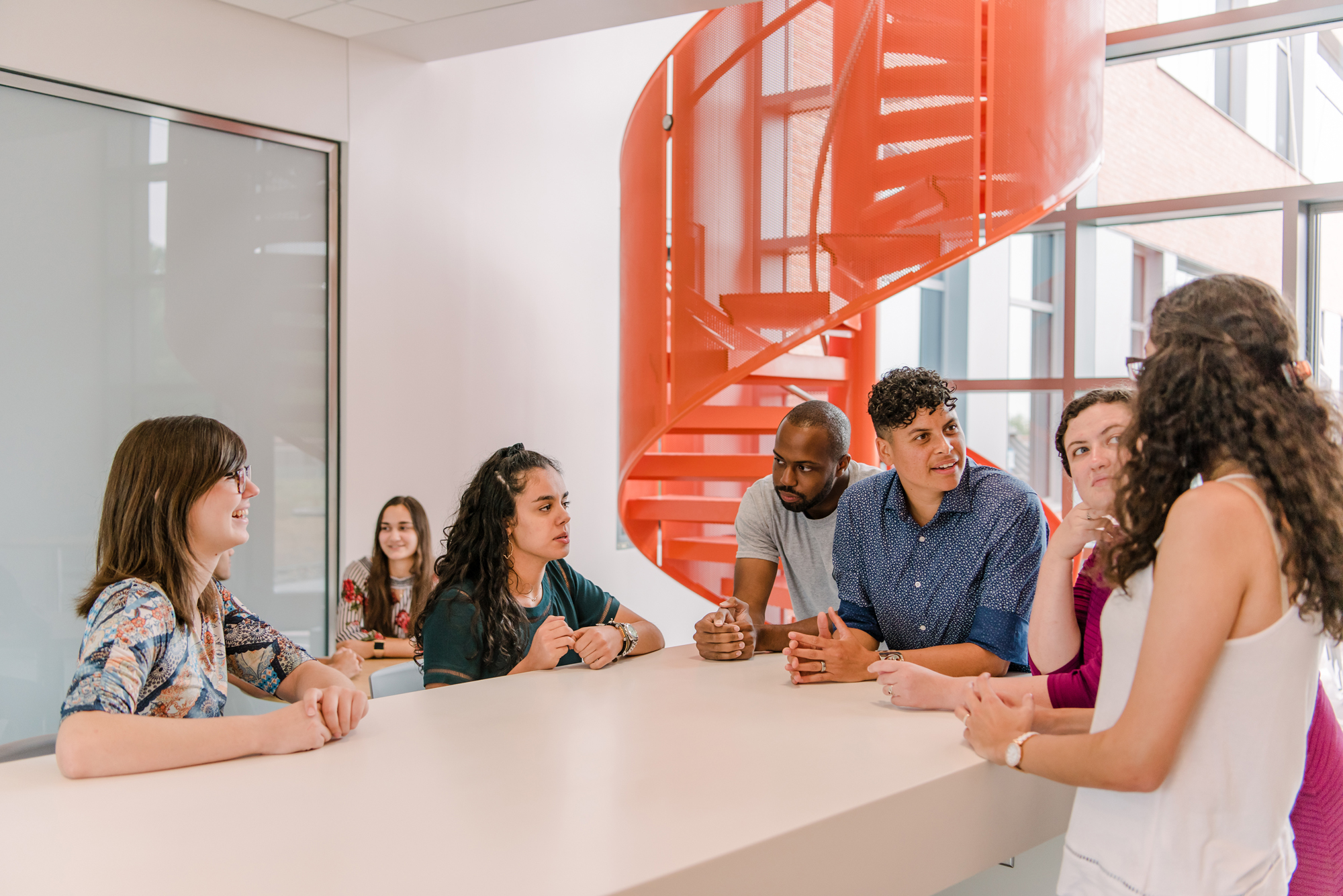
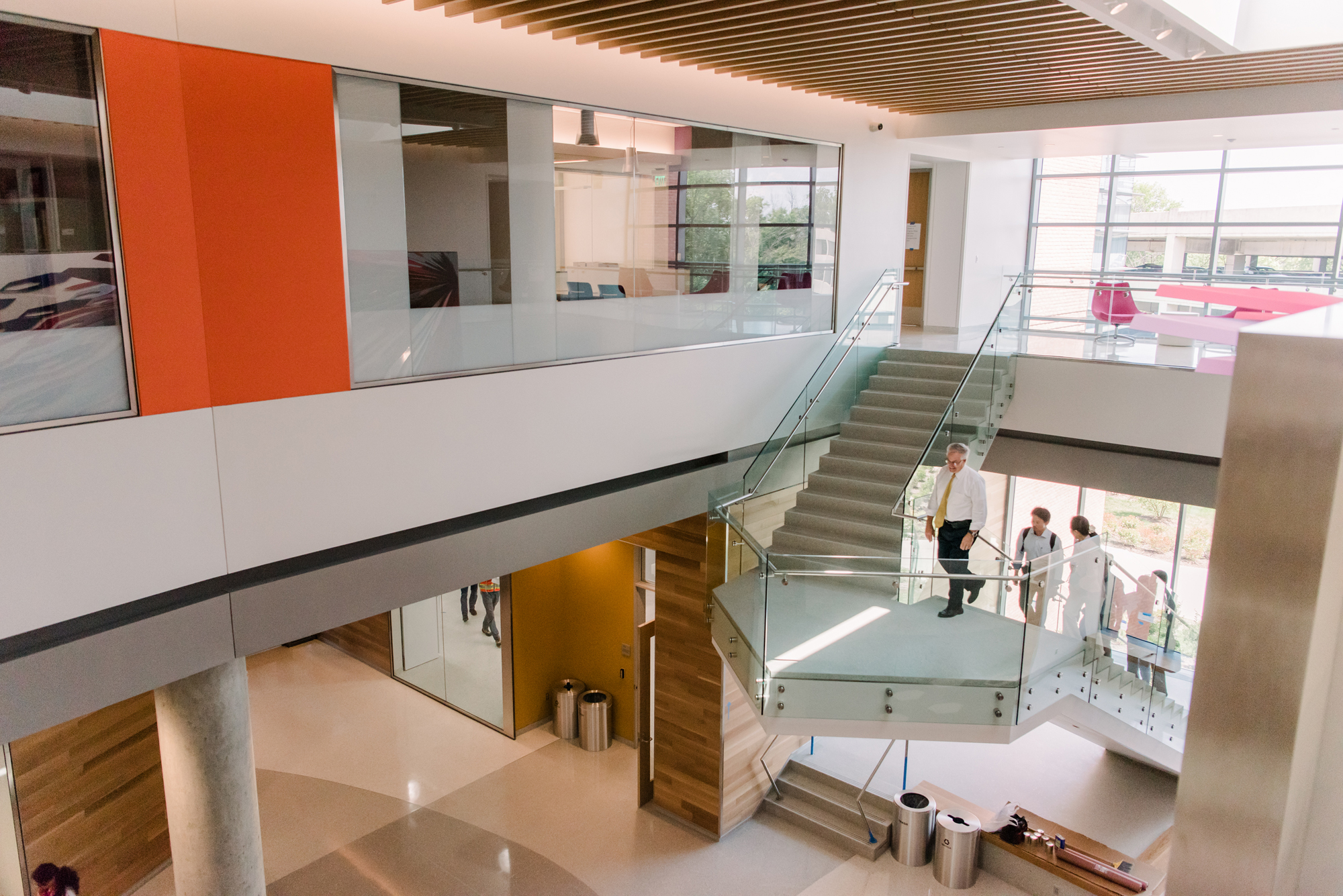
Science isn’t just what happens inside the ILSB, it’s built into the building itself. Two staircases in the building exemplify the designers’ dedication to detail: this bright orange spiral staircase has an uncanny resemblance to a DNA helix, don’t you think? And the stairs in the building’s atrium are cantilevered to appear to float in thin air—reminding us all that anything is possible.
2) Sundial
As you ascend the stairs or peer over the building’s inner balconies, don’t be nervous about the spot of red light slowly migrating across the floor. It’s not a laser experiment gone rogue—it’s a sundial. On the solstice, it traces a special line on the floor. Old and new technologies come together in the ILSB, reminding us all that we’re standing on the shoulders of giants.
3) Green roof
There’s life bursting from every corner of this building, including UMBC’s fifth green roof. Green roofs provide insulation that reduces heating and cooling energy requirements, plus they help purify the air and water. Unfortunately, the roof is off limits to games of ultimate frisbee or other activities, but the adjacent patio is a great spot to enjoy lunch or just take a breather between classes.
4) Environmental systems lab
This lab allows researchers to get their hands dirty conducting environmental experiments in a way never before possible at UMBC. A controlled trial looking at how insects respond to different water chemistry? Sure. An experiment to determine how plants respond to different temperatures? Go for it. Risk of contaminating molecular experiments that could be ruined by a stray speck of dirt? Nada. Have fun, ecologists!
5) Innovative classrooms
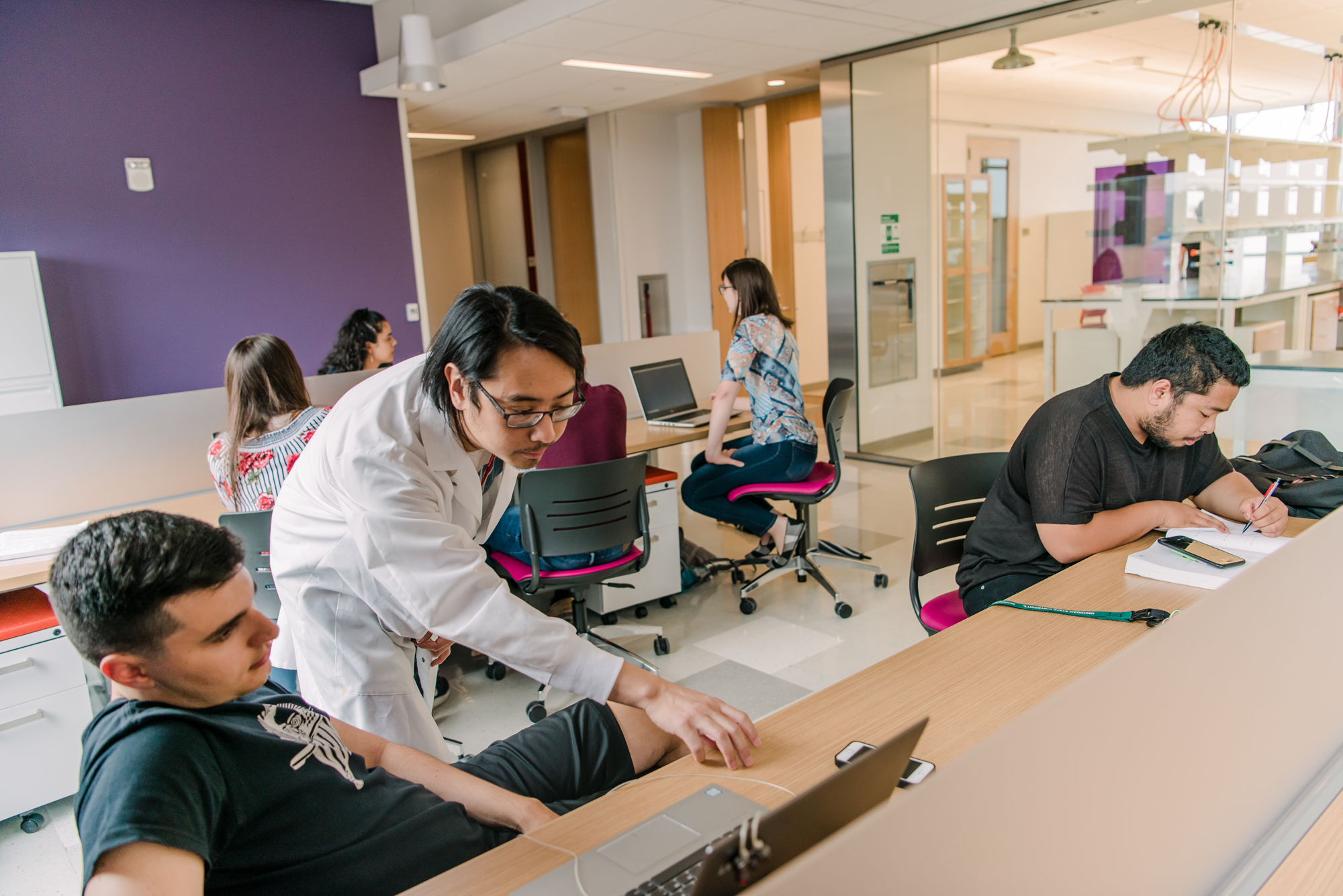

UMBC is consistently ranked in the top 10 nationally for undergraduate teaching for many reasons. One of them is our commitment to teaching in an active-learning and flipped-classroom format. This is when students first encounter material traditionally presented in lectures at home via readings or short instructor-produced videos. That way, class time is saved for team-based problem solving. Implementing this practice has often meant completely revamping core classes such as introductory biology and chemistry. The ILSB adds to UMBC’s capacity to offer this kind of educational experience.
6) Art installation
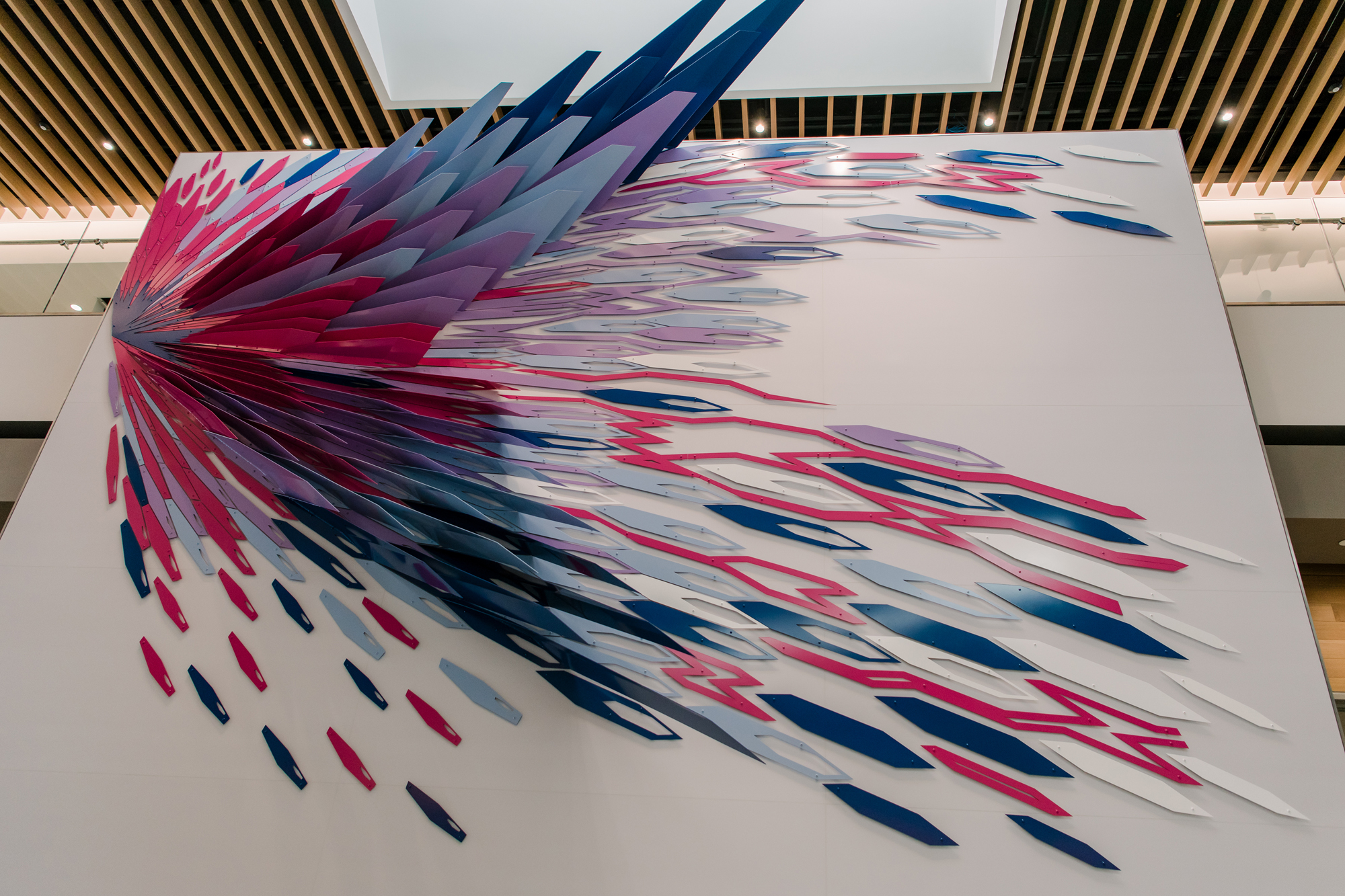
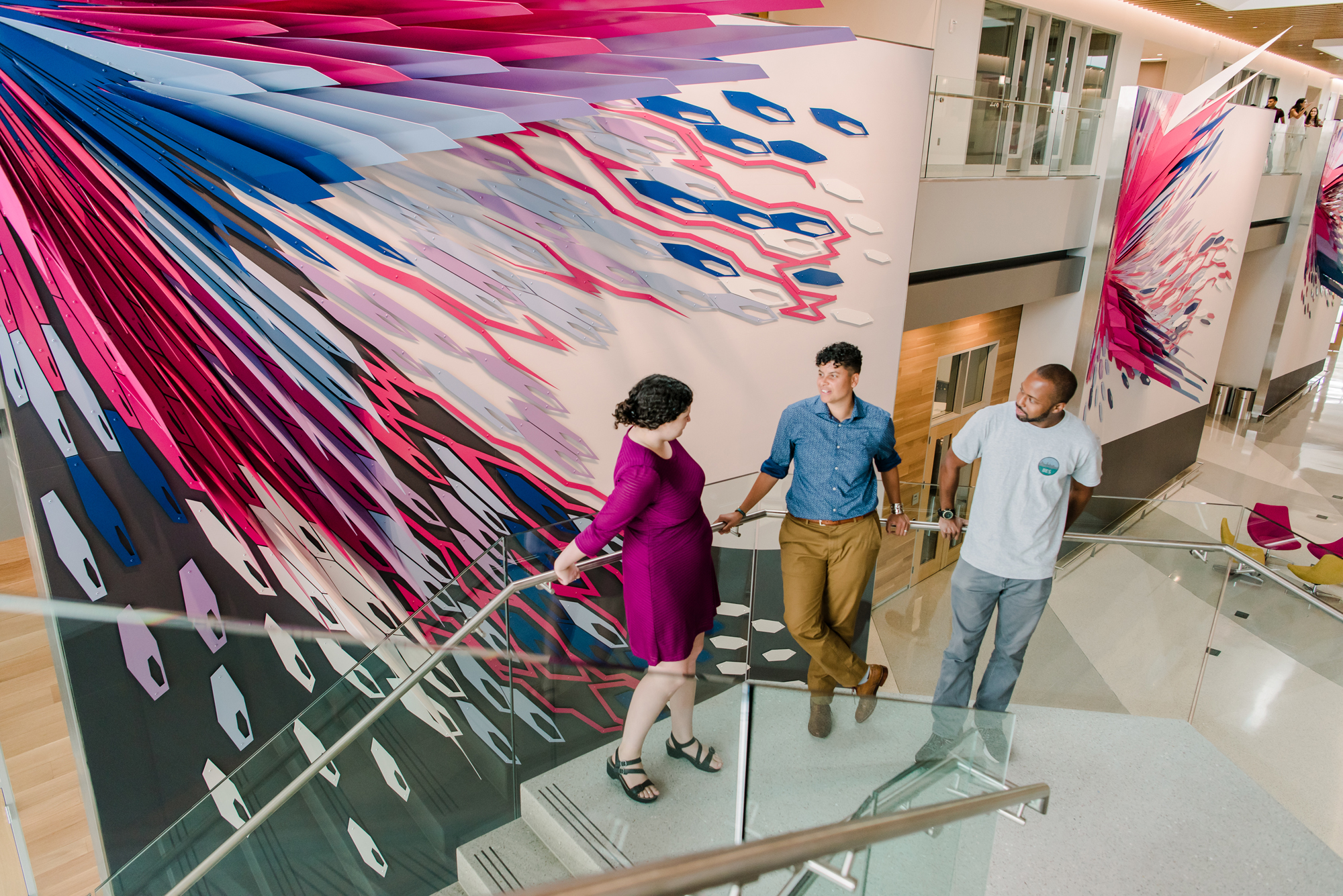
It’s a bird! It’s a neuron! It’s…whatever you want it to be. Volkan Alkanoglu’s brightly-colored artwork INFLIGHT, which seemingly floats from three large walls in the ILSB’s atrium, is striking no matter how you look at it. But did you know the artist carefully incorporated elements from UMBC research into the design, from brain cells to flying orioles? Now that’s interdisciplinary. What do you see?
7) Multi-user all-gender restrooms
Although UMBC is currently in the middle of remodeling many of the restrooms on campus for all-gender use, the ILSB is the first building at UMBC designed with all-gender multi-use in mind from the beginning. These restrooms pave the way for a more inclusive and convenient bathroom experience for our students, faculty, and staff of all gender identities. Learn more about the university’s plan for the addition of all-gender restrooms on campus.
8) Etched windows

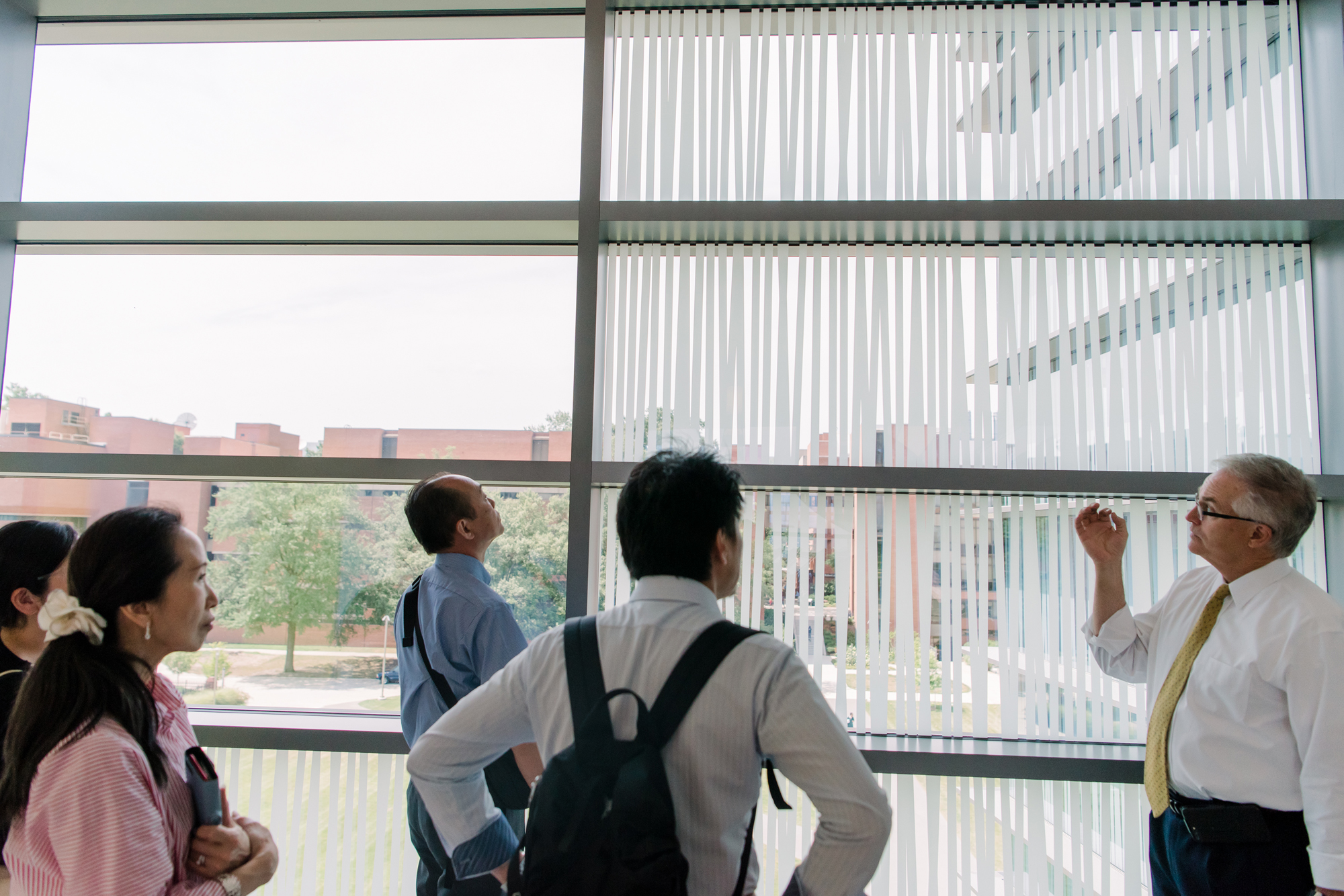
Look closely at the windows—what do you see? The pattern etched on the glass, created especially for UMBC, was designed to symbolize reeds and grasses on the shores of the Chesapeake Bay. The “fritting,” as it’s called, serves to deter bird strikes and reduces the energy required for heating and cooling. It’s a subtle way to honor our unique location and continue to protect it.
9) Brick pathway
As further homage to UMBC’s geography, the curving brick pathway around the ILSB imitates a stream that once flowed across campus (it now runs underground), and all the plants you see are native to the region. So take a stroll, or simply sit on a bench and take it all in, from buzzing pollinators to bright flowers.
*****
All photos, including header, by Marlayna Demond ’11.
]]>
Since its groundbreaking two years ago, the UMBC community has watched the new Interdisciplinary Life Sciences Building rise next to The Commons. Students and faculty wondered what it would look...
https://umbc.edu/stories/9-features-of-the-new-ilsb-not-to-miss/
https://beta.my.umbc.edu/api/v0/pixel/news/120062/guest@my.umbc.edu/5639372b15b67387166f5d9c4dbe12ab/api/pixel
campus-life
ilsb
UMBC News & Magazine
https://beta.my.umbc.edu/groups/umbc-news-magazine
https://assets1-beta.my.umbc.edu/system/shared/avatars/groups/000/001/943/24435aa6207c452e7bc15cc74b42c7bb/xsmall.png?1748556657
https://assets1-beta.my.umbc.edu/system/shared/avatars/groups/000/001/943/24435aa6207c452e7bc15cc74b42c7bb/original.png?1748556657
https://assets2-beta.my.umbc.edu/system/shared/avatars/groups/000/001/943/24435aa6207c452e7bc15cc74b42c7bb/xxlarge.png?1748556657
https://assets2-beta.my.umbc.edu/system/shared/avatars/groups/000/001/943/24435aa6207c452e7bc15cc74b42c7bb/xlarge.png?1748556657
https://assets3-beta.my.umbc.edu/system/shared/avatars/groups/000/001/943/24435aa6207c452e7bc15cc74b42c7bb/large.png?1748556657
https://assets1-beta.my.umbc.edu/system/shared/avatars/groups/000/001/943/24435aa6207c452e7bc15cc74b42c7bb/medium.png?1748556657
https://assets2-beta.my.umbc.edu/system/shared/avatars/groups/000/001/943/24435aa6207c452e7bc15cc74b42c7bb/small.png?1748556657
https://assets1-beta.my.umbc.edu/system/shared/avatars/groups/000/001/943/24435aa6207c452e7bc15cc74b42c7bb/xsmall.png?1748556657
https://assets2-beta.my.umbc.edu/system/shared/avatars/groups/000/001/943/24435aa6207c452e7bc15cc74b42c7bb/xxsmall.png?1748556657
UMBC News & Magazine
0
0
false
Tue, 27 Aug 2019 14:02:52 -0400
UMBC’s Lee Blaney and federal, state partners publish landmark study on contaminants in the Chesapeake Bay
UMBC’s Lee Blaney and research partners have published a landmark study on contaminants of emerging concern in the Chesapeake Bay. Their article in Science of the Total Environment is the first research study that quantifies concentrations of antibiotics, estrogenic hormones, and UV-filters in multiple locations of the Bay.
Blaney, an associate professor of chemical, biochemical, and environmental engineering, conducted the research with Ke He, Ph.D ‘17, chemical engineering, and Ethan Hain ‘21, chemical engineering. They also partnered with collaborators at the U.S. Forest Service and the Maryland Department of Natural Resources.
Underway since 2016, their work highlights the importance of understanding how previously unexamined chemicals impact the environment. The project has been primarily funded by Maryland Sea Grant through a Program Development Fund to Blaney, and a Graduate Research Fellowship to Hain.
The researchers studied the prevalence of contaminants of emerging concern in water, sediment, and oyster tissue collected from the Eastern Shore of the Chesapeake Bay. Their study of how accumulated UV-filters negatively impact the environment is the first of its kind. UV-filters are one of the primary ingredients in personal care products, such as sunscreen and cosmetics. The accumulation of these UV-filters can impact organisms and animals.
Maintaining a healthy Chesapeake Bay
While the Chesapeake Bay is one of the most well-studied ecosystems in the United States, Blaney says that little is known about the sources, occurrence, and impacts of contaminants of emerging concern in this important estuary.
“As the health of the Chesapeake Bay continues to improve due to recent nutrient and sediment regulations, it is important to consider new threats from specialty chemicals like antibiotics, hormones, and UV-filters,” he explains. “The first step to ensuring the safety of the Chesapeake Bay is to measure the concentrations of these contaminants in water, sediment, and tissue.”
 Lee Blaney. Photo by Marlayna Demond ’11 for UMBC.
The discharge of antibiotics into the Chesapeake Bay may speed up the spread and development of antibiotic resistance, a global public health challenge, explains Blaney. He adds that estrogenic hormones and UV-filters are considered priority chemicals of concern due to reported toxicity and other effects on reproductive systems in aquatic and marine organisms.
Over the past two years, Blaney and his team have continued to collect data throughout the Chesapeake Bay to better understand differences in contaminant levels. They have found relatively high levels of antibiotics in the Chesapeake Bay, and the reported concentrations are in the range that can select for antibiotic resistant bacteria. In addition, most samples have contained UV-filters, including two common in sunscreens that were recently banned from being sold in Hawaii due to concerns that they are toxic to corals.
The researchers argue that their findings suggest a need to improve municipal wastewater treatment and agricultural waste management to remove contaminants of emerging concern and prevent their introduction to the environment. In this regard, Blaney and his collaborators are actively working on a number of technologies to improve the transformation of contaminants into benign molecules that do not have antibiotic or estrogenic properties or other toxicity concerns.
Continuing to expand the research
In 2017, Blaney received a CAREER Award from the National Science Foundation to study contaminants of emerging concern and their effects on the urban environment. That research focused on the Gwynns Falls watershed in Baltimore, and the Chesapeake Bay research is an extension of that work. In addition to the public and ecological health concerns highlighted in the current article, Blaney also continues to examine issues like antimicrobial resistance and the impact of agricultural runoff.
Blaney was recently named associate director for sustainability engineering and liaison to the University System of Maryland (USM) vice chancellor for environmental sustainability. In this capacity, he will work closely with collaborators at the University of Maryland Center for Environmental Science and will lead additional sustainability-focused research projects within the USM.
Banner image: Lee Blaney, left, working with a student in the lab. Photo by Marlayna Demond ’11 for UMBC.
]]>
UMBC’s Lee Blaney and research partners have published a landmark study on contaminants of emerging concern in the Chesapeake Bay. Their article in Science of the Total Environment is the first...
https://umbc.edu/stories/umbcs-lee-blaney-and-federal-state-partners-publish-landmark-study-on-contaminants-in-the-chesapeake-bay/
https://beta.my.umbc.edu/api/v0/pixel/news/120063/guest@my.umbc.edu/ec334ea98166276b05e3fb784a8fce1e/api/pixel
cbee
coeit
science-and-technology
UMBC News & Magazine
https://beta.my.umbc.edu/groups/umbc-news-magazine
https://assets1-beta.my.umbc.edu/system/shared/avatars/groups/000/001/943/24435aa6207c452e7bc15cc74b42c7bb/xsmall.png?1748556657
https://assets1-beta.my.umbc.edu/system/shared/avatars/groups/000/001/943/24435aa6207c452e7bc15cc74b42c7bb/original.png?1748556657
https://assets2-beta.my.umbc.edu/system/shared/avatars/groups/000/001/943/24435aa6207c452e7bc15cc74b42c7bb/xxlarge.png?1748556657
https://assets2-beta.my.umbc.edu/system/shared/avatars/groups/000/001/943/24435aa6207c452e7bc15cc74b42c7bb/xlarge.png?1748556657
https://assets3-beta.my.umbc.edu/system/shared/avatars/groups/000/001/943/24435aa6207c452e7bc15cc74b42c7bb/large.png?1748556657
https://assets1-beta.my.umbc.edu/system/shared/avatars/groups/000/001/943/24435aa6207c452e7bc15cc74b42c7bb/medium.png?1748556657
https://assets2-beta.my.umbc.edu/system/shared/avatars/groups/000/001/943/24435aa6207c452e7bc15cc74b42c7bb/small.png?1748556657
https://assets1-beta.my.umbc.edu/system/shared/avatars/groups/000/001/943/24435aa6207c452e7bc15cc74b42c7bb/xsmall.png?1748556657
https://assets2-beta.my.umbc.edu/system/shared/avatars/groups/000/001/943/24435aa6207c452e7bc15cc74b42c7bb/xxsmall.png?1748556657
UMBC News & Magazine
0
0
false
Mon, 26 Aug 2019 20:21:25 -0400
Open spaces nurture open minds in UMBC’s new Interdisciplinary Life Sciences Building

This fall, hundreds of Retrievers will set foot in UMBC’s new Interdisciplinary Life Sciences Building for the first time. They may be inspired by the vibrant art installation, find a quiet nook to study, or work together in research labs with floor-to-ceiling windows overlooking pocket gardens and curving pathways. The new facility offers features that set it apart as a space for learning, and set up students and faculty for transformative moments of discovery.
“New things will brew”
Each research floor in the ILSB is connected along its entire length and bounded by glass on all sides. Inside the labs, benches are configurable so that instrumentation can go in and out as needed. Neon-colored glass surfaces double as marker boards for quick sketches of lab protocols, equations, or encouraging doodles. Just outside the lab are spaces, overlooking an airy atrium, where graduate students can write and undergraduates can meet with mentors.
It’s a research environment that looks toward the future. These shared, open spaces are designed to help anyone who enters sense that they have a role to play in addressing big challenges, discovering more about the world, and developing the next generation of scientists.
 Greg Szeto, right, and Shirin Parsa ’20, biological sciences, conduct research in one of the ILSB’s open-concept labs.
“The ILSB provides an unprecedented opportunity to have researchers who are intellectually next to each other also be physically next to each other,” shares Greg Szeto, assistant professor of chemical, biochemical, and environmental engineering (CBEE). “When you share a kitchenette with a biologist, a chemist, an engineer and somebody from public policy, it’s inevitable that new things will brew.”
Szeto is part of the new Translational Center for Age-Related Disease and Disparities (TCARD2), an initiative made possible by the ILSB. The initiative is led by Chuck Bieberich, professor of biological sciences, and also includes faculty from CBEE and psychology. Bieberich’s lab focuses on cancer biology, especially prostate cancer, while Szeto works on cancer therapies that leverage the immune system. “When we bring our two approaches together, hopefully it will lead to new research, new papers, new grants,” and new cancer treatments, Szeto says.
 Faculty and students relax in one of the ILSB’s break areas. A spiral staircase reminiscent of DNA swirls up to the next floor in the background.
On top of the collaborative advantage, the ILSB offers all the equipment labs need in one place. Szeto’s students were already collaborating with biologists, but that used to mean carrying samples to instruments in other buildings. Not anymore. “Now everything is going to be in the ILSB,” Szeto says. “Being able to centralize the operation both intellectually and logistically is so critical.”
Bringing the outside in
Faculty in the new Interdisciplinary Consortium for Applied Research in Ecology and Evolution (ICARE2) are also taking up residence in the ILSB. Tamra Mendelson, professor of biological sciences, and Chris Swan, professor of geography and environmental systems (GES) co-lead the initiative. It also includes faculty in CBEE and marine biotechnology.
“The collaboration is designed to bring together evolutionary biologists, ecologists, conservationists, social scientists, and engineers,” says Swan. “We want to build a powerful network of people to collaborate on training graduate students, solving environmental problems relevant to Baltimore, and building out UMBC’s focus on ecology.” The ILSB will offer ICARE2 researchers the opportunity to work in a shared space for the first time.
 The ISLB atrium offers spaces to study or just relax. The art installation and a floating staircase add a whimsical, creative feel.
A new, state-of-the-art environmental science lab in the ILSB will also open up the possibilities for these researchers. It’s a space “devoted to environmental work,” which often means, “It’s dirty!” Swan says. The lab will enable larger-scale controlled experiments that can be hard to manage in the field and that would be incompatible with a lab focused on molecular work, where the slightest bit of stray DNA could ruin an experiment.
“A total game-changer”
Chris Hawn, assistant professor of GES, is excited to move to the ILSB because of the doors it will open for their environmental research. Hawn runs chemical analyses on spiderwebs to measure local air quality. They are collaborating with an advocacy group for houseless people that will train them to collect webs in spaces where they are living to send to Hawn for analysis. The goal is that they can use the findings to advocate locally for their health and make the best possible choices about where to stay.
Hawn also studies how pollutants in waterways are passed through the food chain from small aquatic insects, to spiders, to birds.
The ILSB “is a total game-changer for me,” Hawn says. With the instrumentation available at the ILSB, “There are protocols where I can get ‘level unlocked.’ It just opens things up for me and my students.”
 Chris Hawn (center) and their students in the ILSB, backed by the INFLIGHT art installation.
Hawn is the first researcher assigned to their floor of the new building. They note, “I’m excited to make the space my own, but also excited that it will be a shared space very soon. It will be interesting to see how we can work together.”
Even if they aren’t working together directly, having other researchers nearby is a good thing, Hawn adds. “Working simultaneously and having people around you is important, especially for graduate students who are spending a lot of their time in the lab.”
Coming to life
Sarah Leupen, senior lecturer in biological sciences, has been looking forward to teaching in the ILSB—and not just because it’s a new space, but because it’s a new kind of space. Even the building’s largest learning spaces are designed to help students connect with each other and the material in an engaged, intimate, collaborative way.
 Undergraduate researchers gather outside one of the labs in the ILSB. These spaces are designated as writing and meeting space for student researchers.
One of Leupen’s favorite rooms is filled with small round tables that seat six students. Screens and whiteboards appear all around the room and there is plenty of open space. “It’s this kind of flipped classroom that makes possible truly active learning, the kind of teaching that is most well-supported by research.”
Bill LaCourse, dean of the College of Natural and Mathematical Sciences, which administers the building, is thrilled to see it come to life. “For me, it’s been a decade of planning, design and construction to create this building that can serve the needs of our community in essential ways.”
“The process really epitomized the ethos of UMBC, involving the input and collaboration of so many people across the university,” he shares. “To see it evolve from a germ of an idea to the magnificent building we see today is a tribute to UMBC’s strength in the life sciences and commitment to student and faculty success.”
Banner image: Undergraduate researchers outside the TCARD2 lab. All photos by Marlayna Demond ’11 for UMBC.
]]>
This fall, hundreds of Retrievers will set foot in UMBC’s new Interdisciplinary Life Sciences Building for the first time. They may be inspired by the vibrant art installation, find a quiet nook...
https://umbc.edu/stories/open-spaces-nurture-open-minds-in-umbcs-new-interdisciplinary-life-sciences-building/
https://beta.my.umbc.edu/api/v0/pixel/news/120064/guest@my.umbc.edu/25ade5f53340901a658cd6a78e1112ce/api/pixel
biology
cahss
cbee
cnms
coeit
community
ges
interdisciplinary
page1
psychology
publicpolicy
research
science-and-technology
UMBC News & Magazine
https://beta.my.umbc.edu/groups/umbc-news-magazine
https://assets1-beta.my.umbc.edu/system/shared/avatars/groups/000/001/943/24435aa6207c452e7bc15cc74b42c7bb/xsmall.png?1748556657
https://assets1-beta.my.umbc.edu/system/shared/avatars/groups/000/001/943/24435aa6207c452e7bc15cc74b42c7bb/original.png?1748556657
https://assets2-beta.my.umbc.edu/system/shared/avatars/groups/000/001/943/24435aa6207c452e7bc15cc74b42c7bb/xxlarge.png?1748556657
https://assets2-beta.my.umbc.edu/system/shared/avatars/groups/000/001/943/24435aa6207c452e7bc15cc74b42c7bb/xlarge.png?1748556657
https://assets3-beta.my.umbc.edu/system/shared/avatars/groups/000/001/943/24435aa6207c452e7bc15cc74b42c7bb/large.png?1748556657
https://assets1-beta.my.umbc.edu/system/shared/avatars/groups/000/001/943/24435aa6207c452e7bc15cc74b42c7bb/medium.png?1748556657
https://assets2-beta.my.umbc.edu/system/shared/avatars/groups/000/001/943/24435aa6207c452e7bc15cc74b42c7bb/small.png?1748556657
https://assets1-beta.my.umbc.edu/system/shared/avatars/groups/000/001/943/24435aa6207c452e7bc15cc74b42c7bb/xsmall.png?1748556657
https://assets2-beta.my.umbc.edu/system/shared/avatars/groups/000/001/943/24435aa6207c452e7bc15cc74b42c7bb/xxsmall.png?1748556657
UMBC News & Magazine
0
0
false
Mon, 26 Aug 2019 18:49:05 -0400
Wind, solar, and…flutter? UMBC’s Justin Webster is using math to move this emerging tech forward

When Justin Webster sees a flag rippling in the breeze, he thinks about equations. Webster, assistant professor of mathematics, studies “flutter”—a physical phenomenon caused by interactions between a fluid, such as air or water, and a flexible structure, such as a flag, a sail, or even an airplane wing. A small group of engineers and mathematicians has been working for years on how to extract usable energy from fluttering objects as an alternative means of energy production. Now, they have a chance to take flutter technology to the next level.
“There’s no such thing as free energy, but there are lots of situations where there’s ambient energy available,” like a flapping flag, Webster says. “You just have to find an efficient mechanism for turning it into meaningful, useful energy.”
Currently, prototypes exist for doing just that. You start with a narrow flap of material 50 to 100 cm long and coated with piezoelastic material, which can convert mechanical energy (like flapping) into electrical energy. Next, you attach the flap to a pole in a field that tends to get a lot of wind, and voilá, you can generate electric current. If you can efficiently store that energy, you could potentially help power homes and businesses in remote locales, such as the desert or mountains, which also tend to be windy, Webster says.
 Justin Webster teaches a class at UMBC.
Moving the needle
In their current form, these devices are far from optimal. Part of the challenge is that “the mathematical models that we currently have don’t make predictions that are consistent with what engineers see during experiments,” Webster explains.
Without accurate predictions, it can take many experimental attempts to make progress—and the experiments are often difficult and costly to carry out. With a more accurate model, not only would progress be faster, but more research groups might take up this work.
A new grant from the National Science Foundation will help Webster, Jason Howell at Carnegie Mellon University, and Earl Dowell at Duke University move their field closer to making efficient, fluttering energy-harvesters a reality.
Webster is an applied mathematician, Howell is a computational mathematician, and Dowell is an engineer and one of the world’s leading experts on flutter. Over the next three years, they will work together to refine existing mathematical models of “flag” flutter and produce new models that more accurately reflect what engineers like Dowell actually see in their experiments.
Their new model will need to include elements such as wind speed, how many times an object flaps per second, and how much energy is stored in an hour. Each element must be represented in the model by its own equation, and all those individual equations must somehow be connected to each other mathematically. To succeed, it will take analytical acuity plus a degree of finesse.
Webster’s goal is a more accurate model that will help engineers ask and answer questions about the materials used to collect energy from flutter. What is the best size and shape for the flaps? What should they be made of? How should the piezoelastic material be arranged on the flap to optimally capture the energy? “All of these are open—and very difficult—questions,” he says.
 Justin Webster meets with a student in his office.
Problem-solving from every angle
It’s actually fairly unusual for applied mathematicians and engineers to work directly together in this way. Webster explains, “We’re often working on the same problems, but typically from different angles.”
The opportunity to move the renewable energy field forward through collaboration is what drew him to this project. By learning each others’ languages and debating approaches to tackling such a complex problem, he’s confident their research will achieve more than would be possible for a math or engineering team alone. “There’s a myriad of interesting and challenging problems here, as we’re learning from each other every day,” says Webster of his collaboration.
The team will also benefit from the fresh perspectives of student researchers. “I’m excited that the students in my project, as well as other projects in the department recently funded by NSF, can get involved in some really interesting and difficult mathematics,” Webster shares.
So, while charging your cell phone with the streamers on your bicycle may be a ways off, Webster, his colleagues, and his students are hoping to get us one step closer.
Banner Image: Justin Webster. All photos by Marlayna Demond ’11 for UMBC.
]]>
When Justin Webster sees a flag rippling in the breeze, he thinks about equations. Webster, assistant professor of mathematics, studies “flutter”—a physical phenomenon caused by interactions...
https://umbc.edu/stories/wind-solar-andflutter-umbcs-justin-webster-is-using-math-to-move-this-emerging-tech-forward/
https://beta.my.umbc.edu/api/v0/pixel/news/120065/guest@my.umbc.edu/6f52f6eec6ee81b2d39e9e8bca8638ec/api/pixel
cnms
mathstat
page1
research
science-and-technology
UMBC News & Magazine
https://beta.my.umbc.edu/groups/umbc-news-magazine
https://assets1-beta.my.umbc.edu/system/shared/avatars/groups/000/001/943/24435aa6207c452e7bc15cc74b42c7bb/xsmall.png?1748556657
https://assets1-beta.my.umbc.edu/system/shared/avatars/groups/000/001/943/24435aa6207c452e7bc15cc74b42c7bb/original.png?1748556657
https://assets2-beta.my.umbc.edu/system/shared/avatars/groups/000/001/943/24435aa6207c452e7bc15cc74b42c7bb/xxlarge.png?1748556657
https://assets2-beta.my.umbc.edu/system/shared/avatars/groups/000/001/943/24435aa6207c452e7bc15cc74b42c7bb/xlarge.png?1748556657
https://assets3-beta.my.umbc.edu/system/shared/avatars/groups/000/001/943/24435aa6207c452e7bc15cc74b42c7bb/large.png?1748556657
https://assets1-beta.my.umbc.edu/system/shared/avatars/groups/000/001/943/24435aa6207c452e7bc15cc74b42c7bb/medium.png?1748556657
https://assets2-beta.my.umbc.edu/system/shared/avatars/groups/000/001/943/24435aa6207c452e7bc15cc74b42c7bb/small.png?1748556657
https://assets1-beta.my.umbc.edu/system/shared/avatars/groups/000/001/943/24435aa6207c452e7bc15cc74b42c7bb/xsmall.png?1748556657
https://assets2-beta.my.umbc.edu/system/shared/avatars/groups/000/001/943/24435aa6207c452e7bc15cc74b42c7bb/xxsmall.png?1748556657
UMBC News & Magazine
0
0
false
Wed, 14 Aug 2019 20:19:01 -0400
Princeton Review lauds UMBC as one of the best colleges in the nation
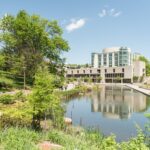
UMBC is once again featured in the Princeton Review guide, The Best 385 Colleges, for 2020. This is widely considered one of the leading guides for prospective undergraduate students in North America.
The University profile specifically recognizes the dedication of UMBC’s professors. Students commented that the University’s faculty “have a knack for inspiring the students” and “UMBC is a place where professors aren’t just talking heads.”
This reflects UMBC’s culture of fostering mentoring relationships between faculty and students. “Being a mentor is the most impactful thing we can do with our time,” says Greg Szeto, assistant professor of chemical, biochemical, and environmental engineering. “We help provide a safe environment where students can explore their interests…and determine what the right path is for their future.”
“The inclusion of UMBC in the most recent Princeton Review best colleges guide affirms our faculty and staff’s dedication and commitment to providing the highest quality of education for our students,” says Katharine Cole, vice provost and dean of undergraduate academic affairs. “We are extremely proud to receive recognition for the outstanding holistic educational experience we provide.”
Students also commend UMBC on a continued commitment to an inclusive and supportive campus community. Retrievers note that the emphasis on diversity “enriches our school and everyone gets to know everyone despite culture or ethnicity.”
UMBC has also just been named to the Best College Values list for 2019 by Kiplinger’s Personal Finance, ranking among the nation’s top 100 public universities for best value.
]]>
UMBC is once again featured in the Princeton Review guide, The Best 385 Colleges, for 2020. This is widely considered one of the leading guides for prospective undergraduate students in North...
https://umbc.edu/stories/princeton-review-lauds-umbc-as-one-of-the-best-colleges-in-the-nation/
https://beta.my.umbc.edu/api/v0/pixel/news/120066/guest@my.umbc.edu/856808a395fbe49d132ff26dd88e907e/api/pixel
community
page1
rankings
UMBC News & Magazine
https://beta.my.umbc.edu/groups/umbc-news-magazine
https://assets1-beta.my.umbc.edu/system/shared/avatars/groups/000/001/943/24435aa6207c452e7bc15cc74b42c7bb/xsmall.png?1748556657
https://assets1-beta.my.umbc.edu/system/shared/avatars/groups/000/001/943/24435aa6207c452e7bc15cc74b42c7bb/original.png?1748556657
https://assets2-beta.my.umbc.edu/system/shared/avatars/groups/000/001/943/24435aa6207c452e7bc15cc74b42c7bb/xxlarge.png?1748556657
https://assets2-beta.my.umbc.edu/system/shared/avatars/groups/000/001/943/24435aa6207c452e7bc15cc74b42c7bb/xlarge.png?1748556657
https://assets3-beta.my.umbc.edu/system/shared/avatars/groups/000/001/943/24435aa6207c452e7bc15cc74b42c7bb/large.png?1748556657
https://assets1-beta.my.umbc.edu/system/shared/avatars/groups/000/001/943/24435aa6207c452e7bc15cc74b42c7bb/medium.png?1748556657
https://assets2-beta.my.umbc.edu/system/shared/avatars/groups/000/001/943/24435aa6207c452e7bc15cc74b42c7bb/small.png?1748556657
https://assets1-beta.my.umbc.edu/system/shared/avatars/groups/000/001/943/24435aa6207c452e7bc15cc74b42c7bb/xsmall.png?1748556657
https://assets2-beta.my.umbc.edu/system/shared/avatars/groups/000/001/943/24435aa6207c452e7bc15cc74b42c7bb/xxsmall.png?1748556657
UMBC News & Magazine
0
0
false
Tue, 13 Aug 2019 15:41:45 -0400
Team of UMBC grad students takes first place at 2019 BMEidea competition
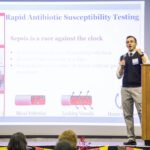
A team of three UMBC graduate students earned first place in an innovation competition for their pioneering work in the rapid detection of bacteria in blood. The students joined teams from the University of Pennsylvania and the University of Michigan, which earned second and third place, respectively, at the BMEidea competition hosted by VentureWell, a national alliance of collegiate inventors and innovators.
UMBC’s team competed in the biomedical and bioengineering innovation student category of the competition, and presented a device called ASTEK, which allows physicians to more effectively treat bacterial infections. The interdisciplinary team included Mustafa Al-Adhami M.S. ‘15, mechanical engineering, Ph.D. ‘19, mechanical engineering; David Burgenson ‘17, chemical engineering, PhD ‘21, chemical engineering, and Benjamin Punshon-Smith M.S. ‘17, electrical engineering, and Ph.D. ‘22, electrical engineering.
 Benjamin Punshon-Smith (left), Mustafa Al-Adhami, and David Burgenson with their award at the BMEidea competition. Photo courtesy of Mustafa Al-Adhami.
“It can be difficult to translate science into relatable terms and a feasible business plan,” says Al-Adhami. “Participating in the BMEidea competition proved not only that they are interested in our research, but there is the potential to create a business around it. The BMEidea competition gave us the opportunity to get validation that we are onto something.”
Al-Adhami, Burgenson, and Punshon-Smith share office and lab space in UMBC’s Center for Advanced Sensor Technology, which is directed by Govind Rao, professor of chemical, biochemical, and environmental engineering. The group is also advised by Yordan Kostov, research professor in chemical, biochemical, and environmental engineering at UMBC, and Alan Cross, professor of medicine at the University of Maryland School of Medicine.
The team will use their $10,000 prize from VentureWell to continue to develop the technology and advance the ASTEK.
In 2016, Al-Adhami earned third place in UMBC’s Cangialosi Business Innovation Competition, and he explains that the feedback from the judges was valuable and helped him refine the design of the device. “I have used feedback and networking connections gained from these competitions to develop my business plan and expand my outreach on a national scale,” he says.
The technology was initially developed to detect bacteria in water, but after Al-Adhami learned about sepsis and the serious complications that it can cause, he changed focus to meet a known need in healthcare. The ASTEK displays results of the blood test in a user-friendly interface, he says.
“The project is at the intersection of mechanical engineering, electrical engineering, chemical engineering, and biology,” Al-Adhami explains. “The best thing about working on a multidisciplinary team is there are always four solutions to every problem we face.”
Banner image: Mustafa Al-Adhami gives his three-minute thesis talk at the 2018 Graduate Research Conference. Photo by Marlayna Demond ’11 for UMBC.
]]>
A team of three UMBC graduate students earned first place in an innovation competition for their pioneering work in the rapid detection of bacteria in blood. The students joined teams from the...
https://umbc.edu/stories/team-of-umbc-grad-students-takes-first-place-at-2019-bmeidea-competition/
https://beta.my.umbc.edu/api/v0/pixel/news/120067/guest@my.umbc.edu/6882de03fdcda614ecaae47e6d9f271d/api/pixel
cbee
coeit
csee
gradresearch
interdisciplinary
meche
science-and-technology
UMBC News & Magazine
https://beta.my.umbc.edu/groups/umbc-news-magazine
https://assets1-beta.my.umbc.edu/system/shared/avatars/groups/000/001/943/24435aa6207c452e7bc15cc74b42c7bb/xsmall.png?1748556657
https://assets1-beta.my.umbc.edu/system/shared/avatars/groups/000/001/943/24435aa6207c452e7bc15cc74b42c7bb/original.png?1748556657
https://assets2-beta.my.umbc.edu/system/shared/avatars/groups/000/001/943/24435aa6207c452e7bc15cc74b42c7bb/xxlarge.png?1748556657
https://assets2-beta.my.umbc.edu/system/shared/avatars/groups/000/001/943/24435aa6207c452e7bc15cc74b42c7bb/xlarge.png?1748556657
https://assets3-beta.my.umbc.edu/system/shared/avatars/groups/000/001/943/24435aa6207c452e7bc15cc74b42c7bb/large.png?1748556657
https://assets1-beta.my.umbc.edu/system/shared/avatars/groups/000/001/943/24435aa6207c452e7bc15cc74b42c7bb/medium.png?1748556657
https://assets2-beta.my.umbc.edu/system/shared/avatars/groups/000/001/943/24435aa6207c452e7bc15cc74b42c7bb/small.png?1748556657
https://assets1-beta.my.umbc.edu/system/shared/avatars/groups/000/001/943/24435aa6207c452e7bc15cc74b42c7bb/xsmall.png?1748556657
https://assets2-beta.my.umbc.edu/system/shared/avatars/groups/000/001/943/24435aa6207c452e7bc15cc74b42c7bb/xxsmall.png?1748556657
UMBC News & Magazine
0
0
false
Mon, 12 Aug 2019 16:09:38 -0400
 Before gathering to take the annual class photo, Davenport stands in front of The Commons. Photo by Kennedy Lamb ’20.
 Zinedine Partipilo Cornielles at UMBC’s 2019 Fall Opening Program. Photo by Arionna Gonsalves ’19.
 Junior Kathryn Moormann deflects the ball from the goal. Photo by Ian Feldmann ’20.
 Students collaborate on the unity web project. Photo by Marlayna Demond ’11.