Immigration Workshop - visa options after graduation
Come learn about immigration options for after F-1, such as H-1b and permanent residency, from 2 immigration attorneys!
Nov 15, 1-2:30pm, Public Policy Building Lecture Hall. Please register here:
]]>
Come learn about immigration options for after F-1, such as H-1b and permanent residency, from 2 immigration attorneys! Nov 15, 1-2:30pm, Public Policy Building Lecture Hall. Please register...https://beta.my.umbc.edu/api/v0/pixel/news/88182/guest@my.umbc.edu/4371f095e869aaa7cce21de78e88acf4/api/pixelInternational Student and Scholar Services (ISSS)https://beta.my.umbc.edu/groups/ieshttps://assets4-beta.my.umbc.edu/system/shared/avatars/groups/000/000/431/46ad84ea8ba0baeed7c3faf29d1fd4ef/xsmall.png?1693323874https://assets3-beta.my.umbc.edu/system/shared/avatars/groups/000/000/431/46ad84ea8ba0baeed7c3faf29d1fd4ef/original.jpeg?1693323874https://assets1-beta.my.umbc.edu/system/shared/avatars/groups/000/000/431/46ad84ea8ba0baeed7c3faf29d1fd4ef/xxlarge.png?1693323874https://assets1-beta.my.umbc.edu/system/shared/avatars/groups/000/000/431/46ad84ea8ba0baeed7c3faf29d1fd4ef/xlarge.png?1693323874https://assets4-beta.my.umbc.edu/system/shared/avatars/groups/000/000/431/46ad84ea8ba0baeed7c3faf29d1fd4ef/large.png?1693323874https://assets3-beta.my.umbc.edu/system/shared/avatars/groups/000/000/431/46ad84ea8ba0baeed7c3faf29d1fd4ef/medium.png?1693323874https://assets1-beta.my.umbc.edu/system/shared/avatars/groups/000/000/431/46ad84ea8ba0baeed7c3faf29d1fd4ef/small.png?1693323874https://assets4-beta.my.umbc.edu/system/shared/avatars/groups/000/000/431/46ad84ea8ba0baeed7c3faf29d1fd4ef/xsmall.png?1693323874https://assets3-beta.my.umbc.edu/system/shared/avatars/groups/000/000/431/46ad84ea8ba0baeed7c3faf29d1fd4ef/xxsmall.png?1693323874IES Marketplacehttps://assets3-beta.my.umbc.edu/system/shared/thumbnails/news/000/088/182/bc1dc12a2240cdacd2ed3ee02898a8f8/xxlarge.jpg?1572990419https://assets2-beta.my.umbc.edu/system/shared/thumbnails/news/000/088/182/bc1dc12a2240cdacd2ed3ee02898a8f8/xlarge.jpg?1572990419https://assets2-beta.my.umbc.edu/system/shared/thumbnails/news/000/088/182/bc1dc12a2240cdacd2ed3ee02898a8f8/large.jpg?1572990419https://assets1-beta.my.umbc.edu/system/shared/thumbnails/news/000/088/182/bc1dc12a2240cdacd2ed3ee02898a8f8/medium.jpg?1572990419https://assets2-beta.my.umbc.edu/system/shared/thumbnails/news/000/088/182/bc1dc12a2240cdacd2ed3ee02898a8f8/small.jpg?1572990419https://assets1-beta.my.umbc.edu/system/shared/thumbnails/news/000/088/182/bc1dc12a2240cdacd2ed3ee02898a8f8/xsmall.jpg?1572990419https://assets2-beta.my.umbc.edu/system/shared/thumbnails/news/000/088/182/bc1dc12a2240cdacd2ed3ee02898a8f8/xxsmall.jpg?157299041900trueTue, 05 Nov 2019 16:47:28 -05002020 U.S. News global ranking names UMBC a top university, a leader in geosciences and space science
U.S. News & World Report has again named UMBC one of the best universities worldwide, with UMBC appearing as one of the top 150 U.S. institutions on the 2020 global list. Thirteen areas of achievement are used to determine this ranking, including global research reputation, regional research reputation, journal citations, and books published. Full methodology can be found here. UMBC performed particularly well in international collaboration and faculty research impact.
The ranking highlights UMBC’s international leadership in geosciences and space science. Recently, the NASA-funded satellite that UMBC’s Vanderlei Martins, physics, developed in collaboration with the Space Dynamics Laboratory launched from NASA’s Wallops Flight Facility to the International Space Station. From there it will be released into Earth orbit.
Banner image: Exterior of UMBC’s new Interdisciplinary Life Sciences Building. Photo by Marlayna Demond ’11 for UMBC.
]]>
U.S. News & World Report has again named UMBC one of the best universities worldwide, with UMBC appearing as one of the top 150 U.S. institutions on the 2020 global list. Thirteen areas of...https://umbc.edu/stories/2020-u-s-news-global-ranking-names-umbc-a-top-university-a-leader-in-geosciences-and-space-science/https://beta.my.umbc.edu/api/v0/pixel/news/120019/guest@my.umbc.edu/5fae190788bf9fa2f7938c8509325bb5/api/pixelcnmscommunityinternationalrankingsUMBC News & Magazinehttps://beta.my.umbc.edu/groups/umbc-news-magazinehttps://assets1-beta.my.umbc.edu/system/shared/avatars/groups/000/001/943/24435aa6207c452e7bc15cc74b42c7bb/xsmall.png?1748556657https://assets1-beta.my.umbc.edu/system/shared/avatars/groups/000/001/943/24435aa6207c452e7bc15cc74b42c7bb/original.png?1748556657https://assets2-beta.my.umbc.edu/system/shared/avatars/groups/000/001/943/24435aa6207c452e7bc15cc74b42c7bb/xxlarge.png?1748556657https://assets2-beta.my.umbc.edu/system/shared/avatars/groups/000/001/943/24435aa6207c452e7bc15cc74b42c7bb/xlarge.png?1748556657https://assets3-beta.my.umbc.edu/system/shared/avatars/groups/000/001/943/24435aa6207c452e7bc15cc74b42c7bb/large.png?1748556657https://assets1-beta.my.umbc.edu/system/shared/avatars/groups/000/001/943/24435aa6207c452e7bc15cc74b42c7bb/medium.png?1748556657https://assets2-beta.my.umbc.edu/system/shared/avatars/groups/000/001/943/24435aa6207c452e7bc15cc74b42c7bb/small.png?1748556657https://assets1-beta.my.umbc.edu/system/shared/avatars/groups/000/001/943/24435aa6207c452e7bc15cc74b42c7bb/xsmall.png?1748556657https://assets2-beta.my.umbc.edu/system/shared/avatars/groups/000/001/943/24435aa6207c452e7bc15cc74b42c7bb/xxsmall.png?1748556657UMBC News & Magazine00falseTue, 05 Nov 2019 15:09:34 -0500Food for Thought
Most students come to college armed with the essential adult knowledge—make a dentist appointment every six months, don’t lose your social security card, and never wash a red sock with your whites. But Tim Dunn, UMBC’s executive chef, and Adam Sachs, UMBC’s dietitian, think we can do a little bit better. Enter: UMBC’s new Teaching Kitchen.
“Most students don’t have great cooking skills, so we want to help them out and teach them about how to construct a meal,” says Dunn.
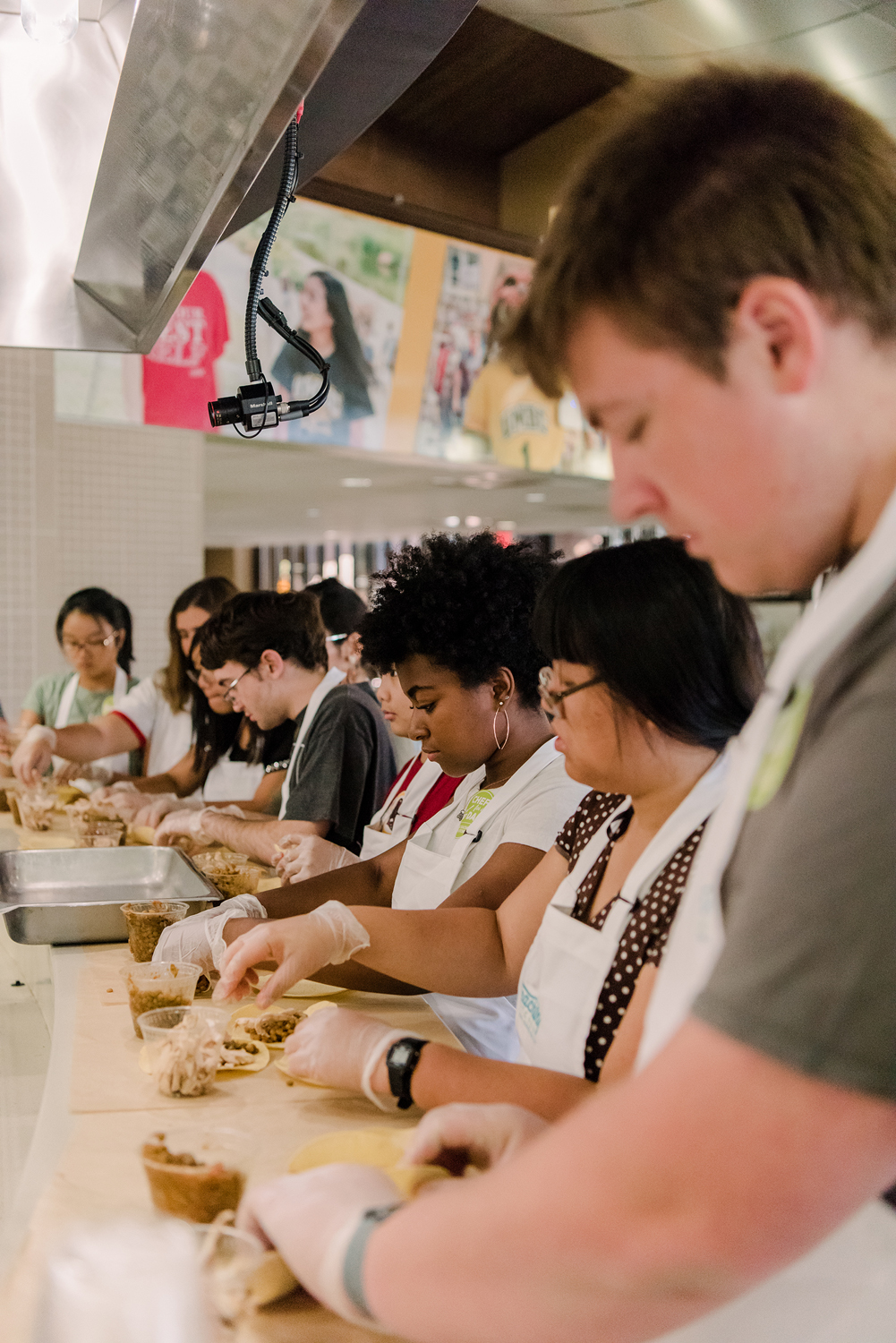
As part of a required Chartwells higher education initiative, UMBC spent the summer of 2019 making updates to True Grit’s Dining Hall to incorporate a Teaching Kitchen. Equipped with cameras and screens, the new addition aims to give students the skills they need to up their culinary game. Students are able to see the chef preparing meals in front of them, utilizing the screens to concentrate on the up-close action of chopping, dicing, and slicing. The scene is set with blazing lights and individual cooking stations so each student has the ability to put their own spin on the recipe.
“The method of using TVs to show the students the cooking process in real time was really helpful. I found it way more effective than if we were just being given verbal directions,” says Johanna Alonso ’20, English, of her first Teaching Kitchen experience. “We were able to look at what the chefs were doing—like how they were cutting the onion and garlic—and imitate it.”
The first meal students prepared at the inaugural Teaching Kitchen in September was chicken and lentil enchiladas. While the entree was fairly simple to create, students were able to produce a meal that both looked and felt more intensive. This was an introduction to lentils for some students, and the nutritional value and cooking process was a valuable kitchen skill.
“We want to help students create meals that are easy to cook, but also well-rounded and full of nutrients,” explains Sachs.
Easy to cook and nutritional value are definitely factors that Sachs and Dunn look at when deciding their menu for the Teaching Kitchens. But they also want to incorporate seasonal favorites and support local vendors. The October menu includes a pumpkin salsa, the designated campus superfood and a fall favorite.
Sachs and Dunn both went to culinary school at Johnson & Wales University in Rhode Island, so perhaps their close partnership was destined for success.
“During the Teaching Kitchen, it’s a lot of going back and forth. I talk about what ingredients we’re using and what the nutritional benefits are, and Tim demonstrates prep techniques and the execution,” Sachs explains. “We are helping students in real time as things constantly change.”
The duo doesn’t expect that students will show up ready to make their “Top Chef” appearance. To lay a proper foundation, they start with the basics—knife skills and technique.
As the program grows, Sachs and Dunn hope to add cooking competitions, visits from professionals in the food industry, and integration with various campus organizations. Students who were part of the pioneer Teaching Kitchen walked away eager to put their newly learned skills to the test— and like any good UMBC student, they’re even prepared to share.
“I’d definitely make these enchiladas for my roommates sometime. And really, I want to try to make some of the other recipes in the cookbook they gave us. I’m already looking forward to the next one,” says Alonso.
****
Sign up for the next Teaching Kitchen workshop on November 13.
All images by Marlayna Demond ’11.
]]>
Most students come to college armed with the essential adult knowledge—make a dentist appointment every six months, don’t lose your social security card, and never wash a red sock with your...https://umbc.edu/stories/food-for-thought/https://beta.my.umbc.edu/api/v0/pixel/news/120020/guest@my.umbc.edu/f3f47ebf2f901962a8b38e2e09635c62/api/pixelcampus-lifedining-hallfall-2019teaching-kitchentrue-gritsUMBC News & Magazinehttps://beta.my.umbc.edu/groups/umbc-news-magazinehttps://assets1-beta.my.umbc.edu/system/shared/avatars/groups/000/001/943/24435aa6207c452e7bc15cc74b42c7bb/xsmall.png?1748556657https://assets1-beta.my.umbc.edu/system/shared/avatars/groups/000/001/943/24435aa6207c452e7bc15cc74b42c7bb/original.png?1748556657https://assets2-beta.my.umbc.edu/system/shared/avatars/groups/000/001/943/24435aa6207c452e7bc15cc74b42c7bb/xxlarge.png?1748556657https://assets2-beta.my.umbc.edu/system/shared/avatars/groups/000/001/943/24435aa6207c452e7bc15cc74b42c7bb/xlarge.png?1748556657https://assets3-beta.my.umbc.edu/system/shared/avatars/groups/000/001/943/24435aa6207c452e7bc15cc74b42c7bb/large.png?1748556657https://assets1-beta.my.umbc.edu/system/shared/avatars/groups/000/001/943/24435aa6207c452e7bc15cc74b42c7bb/medium.png?1748556657https://assets2-beta.my.umbc.edu/system/shared/avatars/groups/000/001/943/24435aa6207c452e7bc15cc74b42c7bb/small.png?1748556657https://assets1-beta.my.umbc.edu/system/shared/avatars/groups/000/001/943/24435aa6207c452e7bc15cc74b42c7bb/xsmall.png?1748556657https://assets2-beta.my.umbc.edu/system/shared/avatars/groups/000/001/943/24435aa6207c452e7bc15cc74b42c7bb/xxsmall.png?1748556657UMBC News & Magazine00falseFri, 01 Nov 2019 15:47:52 -0400Excerpt: The Empowered University
By UMBC President Freeman Hrabowski, Provost Philip Rous, and Peter Henderson
It is challenging to understand fully the culture of an institution. It is even more challenging to change that culture. At UMBC, we have focused our attention and resources on work that is critical to improving our administrative operations, building our research, and supporting student learning and achievement. We were guided in this work by questions that reflected our shared values: Are we putting people first? Are we providing students who come to our campus with the best experience possible? Are we doing the very best we can in all aspects of institutional operations given our mission and resources? Are we then taking that extra step, “above and beyond,” to do more, to do things differently, and to do our work better?
Photo by Marlayna Demond ’11.
When I started at UMBC as vice provost in the late 1980s, our chancellor [Michael Hooker] had just articulated a new vision that asked us to improve our academics, grow our research, and be a more engaged partner with our community. Hooker had set UMBC on a new trajectory toward a new future. Yet, in my first years, if something went wrong, people would often say, “That’s UMBC.” That’s just the way it is, and the way it is just isn’t so great. It is unlikely that an institution with such a negative prevailing attitude could encourage and enable behavior that would lead to sustained excellence. To move toward the vision articulated by our leadership, something had to change. But how?
The larger vision that Hooker articulated was important, yet there was also a new and different feel at a more granular level. We began to take ourselves much more seriously. We created the Meyerhoff program, and it was a success. We became known as a destination for talented students. We built a research park, without which the state would not have taken us seriously as a research university. We evolved rapidly from a commuter school to a residential research university. We upgraded our admissions standards. We looked carefully at our performance on state audits and how to improve our financial and administrative structures. We celebrated as a community our commitment, hard work, and accomplishments (what we now call “grit and greatness”).
It is a cliché, but every journey does begin with a single step and a single success that can demonstrate for others what could be. With each success and subsequent success, more and more members of the community began to look at our goals, values, and work in a different way. Culture change can be imperceptible at times, yet at other times one can recognize that the institution has reached a tipping point. One day, you realize that your campus has changed, the paradigm has shifted, the culture is now perceptibly different. It was in this manner that our campus transformed itself from “That’s UMBC” to “unabashedly aspirational.”
In 2017, our campus was named one of the nation’s top academic workplaces in Great Colleges to Work For by the Chronicle of Higher Education for the ninth year in a row.We were just one of ten four-year institutions with more than 10,000 students featured on an “honor roll” of those with outstanding marks across nearly every measured category.
During this same period, when we went from “that’s UMBC” to “great college to work for,” our six-year graduation rate also climbed from 35 percent to more than 65 percent (more if you include the 10% who transfer out of UMBC and earn a degree at another institution and the 10% still enrolled after six years). So, how did we get from being perceived by some as mediocre to “unabashedly aspirational”? We’ll talk about particular programs and initiatives [later in the book]. Here it suffices to say that small innovations and initiatives can lead to big changes. Eventually, over a period of time, the organization is transformed.
Serious, sustainable change is hard work. It is often far harder than we would like to think it will be. When the change we want to see involves race, diversity, differences, and inclusion, it can be even more challenging, as these are topics most Americans are not comfortable discussing. But when change is the right thing to do, we must nevertheless engage and persist.
At UMBC, we are hungry for change. The imperative to evolve rapidly arises from our collective commitment to do all we can to better serve our students and their families; support student learning, persistence, and completion; connect our students and faculty to opportunities in the Baltimore-Washington region; and work to address our region’s social and economic needs. At just over fifty years of age, we are yet a young, growing institution, and to advance these goals, we must innovate, continually addressing new needs as they arise while simultaneously laying the foundation of a new model of the public university. Our mantra is “success is never final.”
As a campus, we are also a healthy community. This quality is expressed in our ability to be reflective; we can look in the mirror and be honest about what we see, good, bad, or challenging. When issues arise, our culture of reflection leads us to collect data that can inform our decision-making and to have respectful conversations that identify problems and possible solutions. We can acknowledge openly both our strengths and weaknesses, recognize the challenges we face and opportunities we can embrace, and understand how a well-considered response can lead to the desired outcomes. We structure our conversations so that they are inclusive and open to differing perspectives, using our shared governance structures or focus groups with stakeholders for a specific issue.
Change requires grit—commitment and resilience—because it does not happen overnight. Change that matters only succeeds because of long, organized, and sometimes expensive commitments. It requires the engagement of many individuals as leaders and change agents in order to persuade others, and that can require, from time to time, difficult conversations. This can be daunting for some.
Change requires courage, because it requires us to see things differently from the way they are at present. It requires us to recognize our failures as well as successes. For change to be possible, you first have to see the world and the lens through which you view it. Only then can you observe what could be and understand what the possibilities are. To make progress, you need to ask different and often difficult questions of yourself and others and then set different expectations so that others begin to see the world from a different perspective too.
Change necessitates courage because, so often, it requires a leap of faith and an acceptance of substantial risk—believing that a goal is achievable even if the outcome is, as yet, unseen: “No one believed it could be done, because it hadn’t been done before. And then we did it.”
* * * * *
Note: This excerpt is from chapter three of The Empowered University, co-written by UMBC President Freeman Hrabowski, Provost Philip Rous, and Peter Henderson, in Hrabowski’s voice. The excerpt has been modified for length and clarity. The Empowered University is available in the UMBC Bookstore, as well as Holding Fast to Dreams (2016) and President Hrabowski’s earlier books.
]]>
By UMBC President Freeman Hrabowski, Provost Philip Rous, and Peter Henderson It is challenging to understand fully the culture of an institution. It is even more challenging to change that...https://umbc.edu/stories/excerpt-the-empowered-university/https://beta.my.umbc.edu/api/v0/pixel/news/120021/guest@my.umbc.edu/0df4a31712cb6b768f8905814043b357/api/pixelhrabowskiimpactmeyerhoffUMBC News & Magazinehttps://beta.my.umbc.edu/groups/umbc-news-magazinehttps://assets1-beta.my.umbc.edu/system/shared/avatars/groups/000/001/943/24435aa6207c452e7bc15cc74b42c7bb/xsmall.png?1748556657https://assets1-beta.my.umbc.edu/system/shared/avatars/groups/000/001/943/24435aa6207c452e7bc15cc74b42c7bb/original.png?1748556657https://assets2-beta.my.umbc.edu/system/shared/avatars/groups/000/001/943/24435aa6207c452e7bc15cc74b42c7bb/xxlarge.png?1748556657https://assets2-beta.my.umbc.edu/system/shared/avatars/groups/000/001/943/24435aa6207c452e7bc15cc74b42c7bb/xlarge.png?1748556657https://assets3-beta.my.umbc.edu/system/shared/avatars/groups/000/001/943/24435aa6207c452e7bc15cc74b42c7bb/large.png?1748556657https://assets1-beta.my.umbc.edu/system/shared/avatars/groups/000/001/943/24435aa6207c452e7bc15cc74b42c7bb/medium.png?1748556657https://assets2-beta.my.umbc.edu/system/shared/avatars/groups/000/001/943/24435aa6207c452e7bc15cc74b42c7bb/small.png?1748556657https://assets1-beta.my.umbc.edu/system/shared/avatars/groups/000/001/943/24435aa6207c452e7bc15cc74b42c7bb/xsmall.png?1748556657https://assets2-beta.my.umbc.edu/system/shared/avatars/groups/000/001/943/24435aa6207c452e7bc15cc74b42c7bb/xxsmall.png?1748556657UMBC News & Magazine00falseWed, 30 Oct 2019 22:32:35 -0400“The Empowered University” brings UMBC’s story to readers nationwide
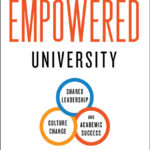
A new read on UMBC’s story is now hitting bookstores across the country. The Empowered University details how the UMBC community has come together to tackle some of higher education’s most intractable challenges, and has become a national model for inclusive excellence along the way. It’s a story of how leaders across administration, faculty, staff, and students have worked to get a full, honest view of UMBC’s strengths and weaknesses, and move the university forward.
UMBC President Freeman Hrabowski will speak about The Empowered University at “Brilliant Baltimore” (November 3, 2 p.m., in the Literary Salon at the USM Columbus Center). UMBC colleagues, students, and alumni are encouraged to attend this free, public talk.
The book’s subtitle is telling: Shared Leadership, Culture Change, and Academic Success. Readers hear directly from President Hrabowski, with coauthors Provost Philip Rous and senior advisor Peter Henderson. At the same time, the book is full of insights and experiences from all corners of the UMBC community.
Taking on the big challenges
How can universities prepare students to be leaders and change-makers—not just for the future, but in their own communities today? How can universities redesign courses to more actively engage students and prepare them for the future? How can universities more actively welcome and include diverse faculty as well as diverse students?
Yvette Mozie-Ross, vice provost for enrollment management and planning, congratulates a new UMBC graduate at commencement.
President Hrabowski narrates the university’s drive to tackle these questions, providing clear and accessible examples from decades of innovation at UMBC. Many of UMBC’s explorations have also been research studies, with program evaluation to determine what works, what doesn’t, and what has the greatest impact for the investment. This means that in addition to boosting student success at UMBC, these innovations can be more readily applied at universities across the country.
Already, UMBC’s tried and tested approaches to providing holistic student support have been implemented at universities in North Carolina, California, Michigan, Pennsylvania, and more. Still, the authors emphasize that supporting students isn’t all about implementing one strategy or another—it’s also creating a healthy, supportive campus culture.
Abby Cruz ‘18, a Meyerhoff affiliate and MARC U*STAR Scholar, works in Fernando Vonhoff’s biology lab. The Chan Zuckerberg Initiative recently invested $6.9M in replicating the Meyerhoff Scholars Program at UCSD and UC Berkeley.
“Culture change is hard as hell”
What does a healthy university community look like? “This quality is expressed in our ability to be reflective; we can look in the mirror and be honest about what we see, good, bad, or challenging,” writes President Hrabowski, in The Empowered University.
And that work takes time. “It is a cliché, but every journey does begin with a single step and a single success that can demonstrate for others what could be. With each success and subsequent success, more and more members of the community began to look at our goals, values, and work in a different way,” President Hrabowski notes.
Faculty and staff connect at the UMBC Retreat, a planning event before the start of each school year.
“Culture change can be imperceptible at times, yet at other times one can recognize that the institution has reached a tipping point,” he writes. “One day, you realize that your campus has changed, the paradigm has shifted, the culture is now perceptibly different. It was in this manner that our campus transformed itself…to ‘unabashedly aspirational.’”
The Empowered University is available in the UMBC Bookstore, as well as Holding Fast to Dreams (2016) and President Hrabowski’s earlier books.
Featured image: President Hrabowski with UMBC students on the roof of the Administration Building. All photos by Marlayna Demond ’11 for UMBC.
]]>
A new read on UMBC’s story is now hitting bookstores across the country. The Empowered University details how the UMBC community has come together to tackle some of higher education’s most...https://umbc.edu/stories/the-empowered-university-brings-umbcs-story-to-readers-nationwide/https://beta.my.umbc.edu/api/v0/pixel/news/120022/guest@my.umbc.edu/ac175a1ab850587d1449eec4a6ae411d/api/pixelcommunityhrabowskipage1UMBC News & Magazinehttps://beta.my.umbc.edu/groups/umbc-news-magazinehttps://assets1-beta.my.umbc.edu/system/shared/avatars/groups/000/001/943/24435aa6207c452e7bc15cc74b42c7bb/xsmall.png?1748556657https://assets1-beta.my.umbc.edu/system/shared/avatars/groups/000/001/943/24435aa6207c452e7bc15cc74b42c7bb/original.png?1748556657https://assets2-beta.my.umbc.edu/system/shared/avatars/groups/000/001/943/24435aa6207c452e7bc15cc74b42c7bb/xxlarge.png?1748556657https://assets2-beta.my.umbc.edu/system/shared/avatars/groups/000/001/943/24435aa6207c452e7bc15cc74b42c7bb/xlarge.png?1748556657https://assets3-beta.my.umbc.edu/system/shared/avatars/groups/000/001/943/24435aa6207c452e7bc15cc74b42c7bb/large.png?1748556657https://assets1-beta.my.umbc.edu/system/shared/avatars/groups/000/001/943/24435aa6207c452e7bc15cc74b42c7bb/medium.png?1748556657https://assets2-beta.my.umbc.edu/system/shared/avatars/groups/000/001/943/24435aa6207c452e7bc15cc74b42c7bb/small.png?1748556657https://assets1-beta.my.umbc.edu/system/shared/avatars/groups/000/001/943/24435aa6207c452e7bc15cc74b42c7bb/xsmall.png?1748556657https://assets2-beta.my.umbc.edu/system/shared/avatars/groups/000/001/943/24435aa6207c452e7bc15cc74b42c7bb/xxsmall.png?1748556657UMBC News & Magazine00falseTue, 29 Oct 2019 17:18:29 -0400UMBC’s newest Postdoctoral Fellows for Faculty Diversity explore who has a voice in literature, policy, and social movements
“UMBC is giving me the ultimate opportunity of time and support to think, write, and teach about what matters to me the most—conducting research about my community,” says Fernando Tormos-Aponte, public policy and political science. He shares the same enthusiasm that Emily Yoon Perez, English, and Blake Francis, philosophy, have about their new appointments as 2019-2020 Postdoctoral Fellows for Faculty Diversity in UMBC’s College of Arts, Humanities, and Social Sciences (CAHSS).
The postdoctoral fellows are pursuing research in a broad range of topics. Perez researches diverse twentieth- and twenty-first-century texts. Francis studies the ethics of environmental problems. Tormos-Aponte focuses on identity and social movements. What connects them all is a dedication to pursuing research involving diverse communities and working closely with students who are eager to explore these subject areas.
Reflecting diversity in literary texts
Perez was born and raised in Baltimore by immigrant parents from Korea who were small business owners in Northeast Baltimore. She was constantly surrounded by the rich diversity Baltimore has to offer and saw that reflected in some of the texts she read throughout high school. “I read African American texts throughout my time in secondary and higher education, which provided an opening to explore other minority literatures,” remembers Perez. In graduate school, she was able to take an African American literature course. This reaffirmed for her the desire to pursue an academic career in English, which was first inspired by Toni Morrison’s writing.
Her current research areas focus on twentieth- and twenty-first-century literature, critical race theory, postcolonial and transnational studies, and feminist theory. Perez’s book project is titled Little Intimacies: Race and Oceanic Migrations in Minority U.S. Fiction. It brings together transnational literary studies, comparative racialization studies, postcolonial theory, and ethnic studies.
“I choose to teach in a way that is inclusive. My courses always center on twentieth- and twenty-first-century authors from marginalized identities,” shares Perez. “Diversity is also what is not seen—students may have jobs or take care of family members. They have lives beyond the classroom that I do not always know about. I use a range of assessments to allow students to show their mastery of the material in different ways and to be mindful of different modes of learning.”
Emily Yoon Perez
Her teaching mentor, Lindsay DiCuirci, English, notes Perez’s background and research focus are a great match for the needs of UMBC students. “Emily’s expertise in contemporary multiethnic U.S. literature and world literatures resonates with our students’ desire to read literature that reflects their own diverse backgrounds,” says DiCuirci.
“Perez’s Analysis of Literary Language course draws from writers like Audre Lorde, Ocean Vuong, Toni Morrison, Jhumpa Lahiri, and Viet Thanh Nguyen,” DiCuirci notes. “She invites students to not only study literary form, but to think about how these forms enable writers to engage with subjects of race and ethnicity, belonging, sexuality, migration, family, language, and power.”
Climate change responsibility
This sense of responsibility to students also drives Francis. He will be teaching a course on climate change and intergenerational justice social justice in the spring that explores issues of environmental racism.
Francis grew up in the southwestern U.S. with a great appreciation for the outdoors. When he identified as a masculine woman, he found it safer to be in distant natural environments, where he did not have to manage issues like which bathroom he could use.
“I began identifying as a transgender man around the time I decided to specialize in environmental ethics,” shares Francis. “Protecting the wild places that have made me who I am is part of what motivates me to work on climate change, intergenerational justice, and environmental values.”
In particular, Francis focuses on moral questions that come up in environmental policy and decision making, including the responsibility of nations to address climate change and what happens when they don’t take responsibility. He is currently examining the responsibility of the U.S. to provide reparations for the victims of climate change and whether taxpayers should be responsible for underwriting those costs.
“I am committed to working across disciplines (including science, public health, and economics) to make progress on climate change,” explains Francis. “I model this commitment to my students, and I design classes at the intersection of ethics, political philosophy, environmental studies, and economics, which are open to students from all backgrounds.”
Blake Francis
Francis hopes to build connections with scientists and social scientists at UMBC and other institutions in the region who are doing intergenerational work on environmental justice issues. “I’ve seen students at UMBC from across all majors gather to protest for sound environmental policy,” he adds. “Successful political action on climate change requires an interdisciplinary approach. It won’t make their message stronger necessarily, but it probably makes it smarter.”
Jessica Pfeifer, philosophy,appreciates Francis’s ability to work across different fields for the greatest impact. “Blake Francis’s work has significant implications for how we balance different sorts of harms and goods and whether we can hold collective agents (such as nations and corporations) accountable for climate change,” explains Pfeiffer. “He also helps build connections to other departments and programs on campus, including the Human Context of Science and Technology Program.”
Identity and social movements
Climate change also underlies much of Tormos-Aponte’s work. “I was born and raised in Puerto Rico,” he shares. “You can’t live in a place like Puerto Rico and not care about the beauty of this planet, the politics that drive it as well as who is impacted by it and who is ignored in that political process.”
Fernando Tormos-Aponte.
Tormos-Aponte spent time working on climate change research and social movements during the 2015 Climate Change Conference in Paris. While there he was able to join a delegation of indigenous people from all over the world protesting for their rights to be included in the climate change agreements. “You cannot separate identity and social movements,” he says.
Tormos-Aponte at the 2015 Climate Change Conference in Paris.
Professor Pamela Bennett, public policy, mentors Tormos-Aponte and sees him as an excellent model for students who want to learn how to combine their scholarly research interests with real-world engagement. “From his work on social justice movements such as Black Lives Matter to his work on climate change and the ongoing impact of Hurricane María in Puerto Rico, Fernando’s research engages with a range of issues that are vitally important to the Baltimore metropolitan region, the state, and around the world,” says Bennett.
For all the fellows, accepting the opportunity to come to UMBC as a postdoctoral fellow was not only about exploring their research in an inclusive scholarly community but also about finding a home for themselves that is open to their many identities and affiliations.
“Being at UMBC is about being able to be myself,” says Tormos-Aponte, “to be proud of my heritage and its positive influence on my research.”
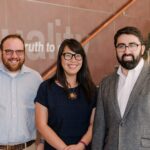
Banner image: (L to R) Francis, Perez, and Tormos-Aponte at UMBC. All photos by Marlayna Demond ’11 for UMBC unless otherwise noted.
]]>
“UMBC is giving me the ultimate opportunity of time and support to think, write, and teach about what matters to me the most—conducting research about my community,” says Fernando Tormos-Aponte,...https://umbc.edu/stories/umbcs-newest-postdoctoral-fellows-for-faculty-diversity-explore-who-has-a-voice-in-literature-policy-and-social-movements/https://beta.my.umbc.edu/api/v0/pixel/news/120023/guest@my.umbc.edu/28219e6986d605fec354aaa8eb5e15aa/api/pixelcahssdiversityandinclusionenglishpage1philosophypolicy-and-societypoliticalsciencepublicpolicyresearchUMBC News & Magazinehttps://beta.my.umbc.edu/groups/umbc-news-magazinehttps://assets1-beta.my.umbc.edu/system/shared/avatars/groups/000/001/943/24435aa6207c452e7bc15cc74b42c7bb/xsmall.png?1748556657https://assets1-beta.my.umbc.edu/system/shared/avatars/groups/000/001/943/24435aa6207c452e7bc15cc74b42c7bb/original.png?1748556657https://assets2-beta.my.umbc.edu/system/shared/avatars/groups/000/001/943/24435aa6207c452e7bc15cc74b42c7bb/xxlarge.png?1748556657https://assets2-beta.my.umbc.edu/system/shared/avatars/groups/000/001/943/24435aa6207c452e7bc15cc74b42c7bb/xlarge.png?1748556657https://assets3-beta.my.umbc.edu/system/shared/avatars/groups/000/001/943/24435aa6207c452e7bc15cc74b42c7bb/large.png?1748556657https://assets1-beta.my.umbc.edu/system/shared/avatars/groups/000/001/943/24435aa6207c452e7bc15cc74b42c7bb/medium.png?1748556657https://assets2-beta.my.umbc.edu/system/shared/avatars/groups/000/001/943/24435aa6207c452e7bc15cc74b42c7bb/small.png?1748556657https://assets1-beta.my.umbc.edu/system/shared/avatars/groups/000/001/943/24435aa6207c452e7bc15cc74b42c7bb/xsmall.png?1748556657https://assets2-beta.my.umbc.edu/system/shared/avatars/groups/000/001/943/24435aa6207c452e7bc15cc74b42c7bb/xxsmall.png?1748556657UMBC News & Magazine00falseMon, 28 Oct 2019 19:05:36 -0400UMBC shines at Brilliant Baltimore with artwork, talks, performances, a reception, and more
From November 1 through 10, UMBC will again join in two of Baltimore’s signature events — Light City and the Baltimore Book Festival — which will be held together in 2019 under the theme of Brilliant Baltimore.
Organized by the Baltimore Office of Promotion and the Arts, Brilliant Baltimore promises to illuminate the city with literature, ideas, world-class light installations, and performances. UMBC’s contributions include a talk by President Freeman Hrabowski, a UMBC-Light Ekphrastic panel discussion, apanel discussion on Baltimore Revisited featuring UMBC faculty, and the SPARK gallery, which will showcase visual artwork and offer performances and presentations.
President Hrabowski: The Empowered University // Sunday, November 3, 2 p.m., Literary Salon, USM Columbus Center
UMBC President Freeman Hrabowski will discuss his new book, The Empowered University: Shared Leadership, Culture Change, and Academic Success, written with Philip Rous and Peter Henderson. The Empowered University examines how university communities support academic success by cultivating an empowering institutional culture and broad leadership for innovation. President Hrabowski argues that higher education can play a unique role in addressing the fundamental divisions in our society and economy by supporting people in reaching their full potential.
Pres. Hrabowski and UMBC students on the roof of the Administration Building.
SPARK Gallery // November 1 – 10, 5 – 10 p.m., USM Columbus Center
The SPARK Gallery represents a the third year of collaboration between UMBC, Towson University, PNC Bank, and BOPA. Curated by Catherine Borg, it features light art by UMBC faculty Corrie Francis Parks, Evan Tedlock, Lisa Moren, Lynn Cazabon, Timothy Nohe, Vin Grabill, and Colette Searls, with presentations of animated films by UMBC students.
Performances and events at SPARK will be presented by the UMBC Jazz Ensemble, directed by Matt Belzer; Lisa Cella and Stephen Bradley; and the UMBC New Music Ensemble; the Umbilicus percussion ensemble. They also include a site-specific dance performance by UMBC students choreographed by Ann Sofie Clemmensen and Carol Hess.
The SPARK gallery (shown here in 2018) will showcase art and performances.
UMBC Light City Reception // Saturday, November 9, 4 – 9 p.m., USM Columbus Center
UMBC alumni and the UMBC community are invited to stop by the Columbus Center to enjoy light refreshments and pick up a fun glow in the dark giveaway (for first 300 guests), and enjoy a breathtaking view of the harbor and Light City Baltimore. Attendees are encouraged to bring friends and family, and to register in advance for the reception.
Light City visitors enjoyed the UMBC reception in 2018.
Word & Image // Saturday, November 2, 6 p.m., World Trade Center
In its first decade, The Light Ekphrastic (TLE) has paired more than 450 artists and writers from Baltimore and around the world to create new works of art and writing inspired by that of their partners. In “Word & Image: Creative Collaborations with UMBC and The Light Ekphrastic,” TLE participants share their work and talk about how the experience of collaborating with strangers has broadened the way they create.
The panel will be co-moderated by Jenny O’Grady, editor of UMBC Magazine; and Timothy Nohe, professor of visual arts and director of the Center for Innovation, Research, and Creativity in the Arts. Panelists will include Melissa Cormier, M.F.A. ’17, visual arts, and Katie Feild ’05, visual arts.
Baltimore Revisited // Sunday, November 3, 2 p.m., Radical Book Fair Pavilion
Baltimore Revisited is an innovative new edited volume that examines the complex histories of Charm City and efforts underway to address the city’s pervasive inequalities. These issues continue to resonate with Baltimore residents almost five years after the death of Freddie Gray and the Baltimore Uprising that followed.
The book is co-edited by Nicole King, associate professor and chair of American Studies; Kate Drabinski, lecturer, gender, women’s, and sexuality studies; and University of Baltimore historian Joshua Clark Davis. King will moderate a panel that will include Baltimore Revisited contributors Drabinski; Michael Casiano, assistant professor, American studies; and Ashley Minner, professor of the practice, American studies. It will take place in the Radical Book Fair Pavilion at the Baltimore Book Festival.
Drabinski has shared, “We hope the book raises questions about how history can inform the present to understand the roots of the city’s many inequalities. We wish readers to imagine new ways of being in and organizing for Baltimore in the future.”
Featured image: The roof of the Columbus Center was illuminated in 2016 with artwork by UMBC’s Kelley Bell and Corrie Francis Parks. Photos by Marlayna Demond ’11 for UMBC.
]]>
From November 1 through 10, UMBC will again join in two of Baltimore’s signature events — Light City and the Baltimore Book Festival — which will be held together in 2019 under the theme of...https://umbc.edu/stories/umbc-shines-at-brilliant-baltimore-with-artwork-talks-performances-a-reception-and-more/https://beta.my.umbc.edu/api/v0/pixel/news/120024/guest@my.umbc.edu/df0accc9e663714ffa48cfdc68e98d37/api/pixelartsarts-and-culturebaltimorebookfestivalbrilliantbaltimorecahsscommunitylightcitypage1UMBC News & Magazinehttps://beta.my.umbc.edu/groups/umbc-news-magazinehttps://assets1-beta.my.umbc.edu/system/shared/avatars/groups/000/001/943/24435aa6207c452e7bc15cc74b42c7bb/xsmall.png?1748556657https://assets1-beta.my.umbc.edu/system/shared/avatars/groups/000/001/943/24435aa6207c452e7bc15cc74b42c7bb/original.png?1748556657https://assets2-beta.my.umbc.edu/system/shared/avatars/groups/000/001/943/24435aa6207c452e7bc15cc74b42c7bb/xxlarge.png?1748556657https://assets2-beta.my.umbc.edu/system/shared/avatars/groups/000/001/943/24435aa6207c452e7bc15cc74b42c7bb/xlarge.png?1748556657https://assets3-beta.my.umbc.edu/system/shared/avatars/groups/000/001/943/24435aa6207c452e7bc15cc74b42c7bb/large.png?1748556657https://assets1-beta.my.umbc.edu/system/shared/avatars/groups/000/001/943/24435aa6207c452e7bc15cc74b42c7bb/medium.png?1748556657https://assets2-beta.my.umbc.edu/system/shared/avatars/groups/000/001/943/24435aa6207c452e7bc15cc74b42c7bb/small.png?1748556657https://assets1-beta.my.umbc.edu/system/shared/avatars/groups/000/001/943/24435aa6207c452e7bc15cc74b42c7bb/xsmall.png?1748556657https://assets2-beta.my.umbc.edu/system/shared/avatars/groups/000/001/943/24435aa6207c452e7bc15cc74b42c7bb/xxsmall.png?1748556657UMBC News & Magazine00falseFri, 25 Oct 2019 22:19:33 -04003 Global Conditions—and a Map—for Saving Nature and Using it Wisely
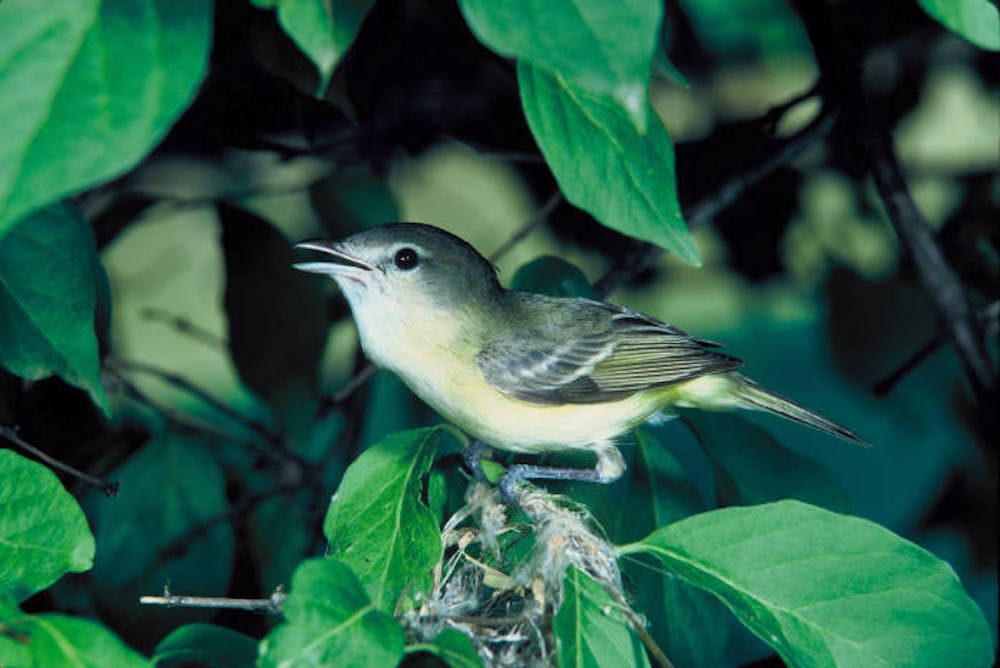
Nature urgently needs our help. Wild creatures, from songbirds to butterflies and from primates to tortoises, are disappearing so rapidly that they could be lost forever together with the wild forests, grasslands and other habitats that long sustained them. We humans already use nearly half of all Earth’s land to sustain ourselves, and the most productive parts at that. Meanwhile, the habitats remaining for the rest of life are shrinking to levels too low to sustain themselves.
To ensure a future in which humanity thrives together with the rest of nature, people around the world will need to work together like never before.
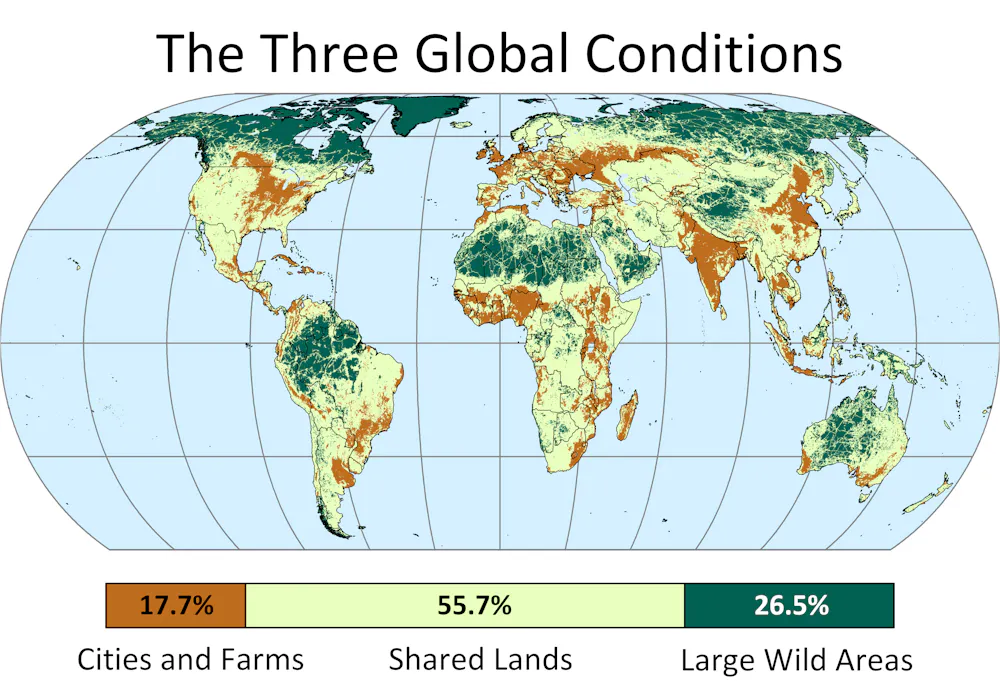
Cities and Farms are more than half covered by intensive agriculture and cities, Large Wild Areas are scarcely altered, and Shared Lands have a level of use somewhere in between. Each landscape condition requires a different conservation strategy.Harvey Locke et al. (2019), CC BY-ND
In a commentary accompanying our map, we argue that for too long, efforts to conserve nature globally have acted as if this entire planet is equally influenced by the human world. Yet different landscapes differ profoundly in how they are used and influenced by people, demanding different strategies to conserve biodiversity. Our map aims to clarify these conditions to enable people to work together to conserve biodiversity more fairly and equitably.
Biodiversity is our natural heritage
The extraordinary richness of life we’ve inherited is an irreplaceable treasure that makes the world an immeasurably better place for people. Biodiversity underpins many of the ecological functions that sustain us, from healthy soils to a stable climate, and provides a wide variety of benefits to human health – mental and physical.
But for any bold conservation agenda to succeed, an unprecedented level of international commitment will be needed. Perhaps the greatest obstacle is the many profound differences in social, economic and natural conditions that persist around the world. Some nations remain rich in unprotected biodiversity and wild habitats but are much less developed economically. Some are the opposite.
So how can such different nations and regions join together to make shared commitments and investments to save nature across this entire planet?
Buffalo grazing near Denver, Colorado, in Rocky Mountain Arsenal National Wildlife Refuge. Mark Byzewski, CC BY
Let’s start with the parts of the world where most of us live and most of our food comes from – the cities and farmlands that take up 18% of Earth’s land surface. These are not just full of people, crops and livestock, but also include some of the densest concentrations of vertebrate diversity on Earth, including many imperiled species of mammals and birds.
In these parts of the world, there needs to be widespread adoption of wildlife-friendly farming practices. Remnant and recovering habitats must be conserved within farmlands and agrichemical production reduced, even while increasing agricultural production. And even in the densest of cities, interconnecting small areas of protected habitat, such as parks and nature reserve networks, can successfully sustain some populations of highly endangered species. In the Indian city of Mumbai, for example, a national park conserves leopards.
A bridge for wildlife in Banff National Park in Canada, one way to enhance biodiversity in protect lands. David Fulmer, CC BY
Large wild areas, where human influences are lowest, including large parts of Amazonia and Canadian boreal forests, still cover about a quarter of Earth’s land. Here, an emphasis on large-scale protection, such as the Five Great Forests Initiative in Central America, will be the most effective strategy. To avoid damaging the last of Earth’s unaltered ecosystems, new infrastructure and land uses, including mining, should be limited as much as possible. Recognizing indigenous people’s rights to land, so they can conserve their own lands, can also be highly effective; a large proportion of large wild areas are indigenous-owned and managed lands.
Perhaps the greatest conservation opportunities of all may reside within the most common condition of Earth’s land today – shared landscapes. Though parts of these working landscapes are still used intensively for agriculture and settlements, most of their area is composed of remnant and recovering habitats and areas lightly used for extensive grazing and forestry.
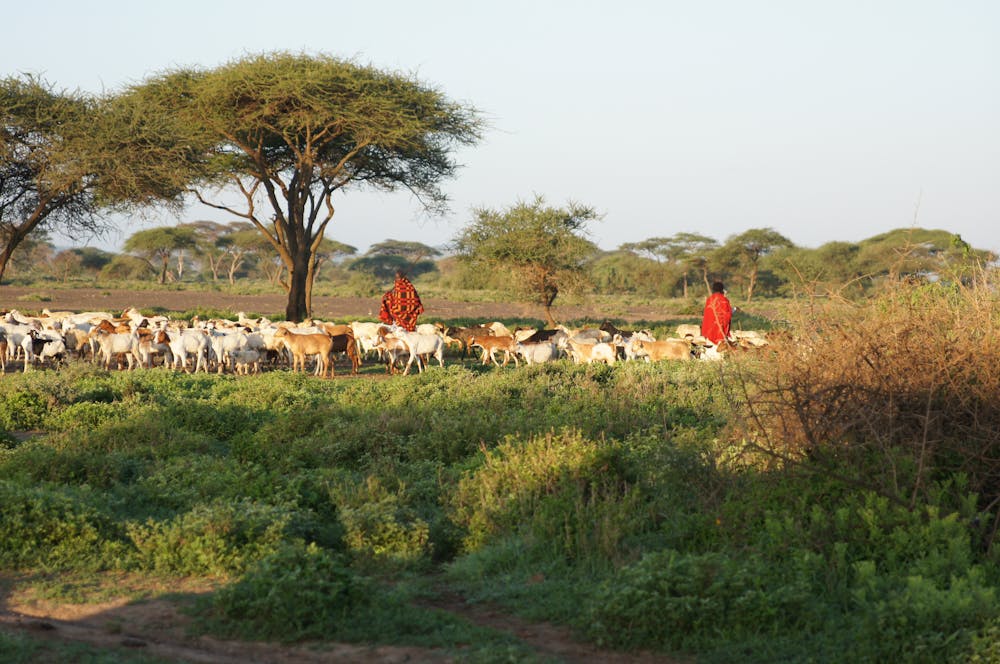
Conservation in shared lands can include regional protected area networks, such as the Yellowstone to Yukon Conservation Initiative, community conservation reserves, and conservation-friendly farms and cities that prioritize the needs of local people. For example, the Lewa community conservancy in Kenya, which protects habitat for endangered black rhinos, includes programs to assist local farmers to maximize their production while minimizing any negative impacts to protected habitats.
Distant wildlands are critical habitat for so many species, but effective conservation also depends on efforts in our own neighborhoods and the regions where our food comes from.
Think of nature when making new friends, caring for family, shopping, working, casting your vote, or donating your time or money to make the world a better place. The challenges ahead are not small, but working together across our farms and cities, shared landscapes, and large wild areas, we can make the nature of our planet whole and healthy again.
Contributors to the creation of the Three Conditions map include Harvey Locke of the International Union for Conservation of Nature World Commission on Protected Areas, Oscar Venter of University of Northern British Columbia, Richard Schuster of Carleton University, Keping Ma of the Chinese Academy of Sciences, Xiaoli Shen of the Chinese Academy of Sciences, Stephen Woodley, IUCN World Commission on Protected Areas, Naomi Kingston and Nina Bhola of the UN Environment Programme World Conservation Monitoring Centre, Bernardo B. N. Strassburg of the Pontifícia Universidade Católica and International Institute for Sustainability in Brazil, Axel Paulsch of the Institute for Biodiversity in Regensburg, Germany and Brooke Williams, University of Queensland.
]]>
By Erle C. Ellis, professor of geography and environmental systems, UMBC, and James Watson, professor, The University of Queensland Nature urgently needs our help. Wild creatures, from songbirds...https://umbc.edu/stories/3-global-conditions%e2%81%a0-and-a-map%e2%81%a0-for-saving-nature-and-using-it-wisely/https://beta.my.umbc.edu/api/v0/pixel/news/120025/guest@my.umbc.edu/bc72ab50576ff2c852f85400ea3fa764/api/pixelcahsserle-ellisgesperspectivesthe-conversationUMBC News & Magazinehttps://beta.my.umbc.edu/groups/umbc-news-magazinehttps://assets1-beta.my.umbc.edu/system/shared/avatars/groups/000/001/943/24435aa6207c452e7bc15cc74b42c7bb/xsmall.png?1748556657https://assets1-beta.my.umbc.edu/system/shared/avatars/groups/000/001/943/24435aa6207c452e7bc15cc74b42c7bb/original.png?1748556657https://assets2-beta.my.umbc.edu/system/shared/avatars/groups/000/001/943/24435aa6207c452e7bc15cc74b42c7bb/xxlarge.png?1748556657https://assets2-beta.my.umbc.edu/system/shared/avatars/groups/000/001/943/24435aa6207c452e7bc15cc74b42c7bb/xlarge.png?1748556657https://assets3-beta.my.umbc.edu/system/shared/avatars/groups/000/001/943/24435aa6207c452e7bc15cc74b42c7bb/large.png?1748556657https://assets1-beta.my.umbc.edu/system/shared/avatars/groups/000/001/943/24435aa6207c452e7bc15cc74b42c7bb/medium.png?1748556657https://assets2-beta.my.umbc.edu/system/shared/avatars/groups/000/001/943/24435aa6207c452e7bc15cc74b42c7bb/small.png?1748556657https://assets1-beta.my.umbc.edu/system/shared/avatars/groups/000/001/943/24435aa6207c452e7bc15cc74b42c7bb/xsmall.png?1748556657https://assets2-beta.my.umbc.edu/system/shared/avatars/groups/000/001/943/24435aa6207c452e7bc15cc74b42c7bb/xxsmall.png?1748556657UMBC News & Magazine00falseFri, 25 Oct 2019 17:56:42 -0400UMBC’s Livewire new music festival celebrates its 10th anniversary
From October 24 through 27, UMBC’s department of music celebrates the tenth anniversary of its fall Livewire festival, an annual event that explores the classical music of our time through concerts, lecture-recitals, paper presentations, multimedia installations, and conversation.
This year’s festival, Livewire 10: Rewind / Fast Forward, features guest composers Mercedes Otero and Mischa Salkind-Pearl, who earned a post-baccalaureate certificate in contemporary American music at UMBC in 2007. Public performances will feature the Inscape Chamber Orchestra, the Third Practice ensemble, sopranos Susan Botti and Tony Arnold, clarinetist Gleb Kasenevich, the Ruckus faculty ensemble, and UMBC students.
The Microkingdom ensemble performs in the Music Box during the 2016 Livewire festival.
During its ten years, including events this forthcoming weekend, Livewire has presented works by hundreds of composers and has featured dozens of leading new music performers from around the world. Additionally, the festival has attained statistics that position it as a leading national voice in new music:
426 compositions
36 world premieres
4 United States premieres
73 electro-acoustic works
250 chamber pieces
87 solo (unaccompanied) works
16 electronic compositions
“Ten years of the Livewire festival speak to the commitment of UMBC and the music department here to embracing the ever-changing present while we continue to teach the past,” says Linda Dusman, chair of the department. “The liveliness of engagement of our students and faculty at this time of year has become a verb: we all are livewired at the end of October!”
Violinist Malcolm Goldstein was a previous composer-performer in residence.
While many college and university music programs across the country focus primarily on the music of the 17th, 18th and 19th centuries, faculty at UMBC have embraced the exploration of the music of the 20th and 21st centuries. UMBC’s faculty have been advocates of new music for decades, stretching well beyond the inaugural Livewire festival in 2010.
“Before Mobtown Modern hit the scene or the Evolution Contemporary Music Series evolved,” critic Tim Smith noted in The Baltimore Sun during a previous Livewire, “Baltimore-area fans of new sounds could get an earful at the University of Maryland, Baltimore County, where the music department continues to champion adventurous repertoire.”
For Livewire’s 10th anniversary, major financial support was provided by the Center for Innovation, Research, and Creativity in the Arts (CIRCA), with additional funding from the College of Arts, Humanities and Social Sciences and the Office of the Provost.
A complete schedule for Livewire 10: Rewind / Fast Forward can be found on the Arts and Culture Calendar.
At a previous Livewire festival, guest pianist Paul Hoffman joined UMBC’s Lisa Cella and Tom Goldstein in a performance of music by Morton Feldman.
Featured image: Members of the Ruckus ensemble perform in 2016. Photos by Marlayna Demond ’11 for UMBC.
]]>
From October 24 through 27, UMBC’s department of music celebrates the tenth anniversary of its fall Livewire festival, an annual event that explores the classical music of our time through...https://umbc.edu/stories/umbcs-livewire-new-music-festival-celebrates-its-10th-anniversary/https://beta.my.umbc.edu/api/v0/pixel/news/120026/guest@my.umbc.edu/20c5124ac11499155e4331f0e813305e/api/pixelartsarts-and-culturecahsslivewiremusicUMBC News & Magazinehttps://beta.my.umbc.edu/groups/umbc-news-magazinehttps://assets1-beta.my.umbc.edu/system/shared/avatars/groups/000/001/943/24435aa6207c452e7bc15cc74b42c7bb/xsmall.png?1748556657https://assets1-beta.my.umbc.edu/system/shared/avatars/groups/000/001/943/24435aa6207c452e7bc15cc74b42c7bb/original.png?1748556657https://assets2-beta.my.umbc.edu/system/shared/avatars/groups/000/001/943/24435aa6207c452e7bc15cc74b42c7bb/xxlarge.png?1748556657https://assets2-beta.my.umbc.edu/system/shared/avatars/groups/000/001/943/24435aa6207c452e7bc15cc74b42c7bb/xlarge.png?1748556657https://assets3-beta.my.umbc.edu/system/shared/avatars/groups/000/001/943/24435aa6207c452e7bc15cc74b42c7bb/large.png?1748556657https://assets1-beta.my.umbc.edu/system/shared/avatars/groups/000/001/943/24435aa6207c452e7bc15cc74b42c7bb/medium.png?1748556657https://assets2-beta.my.umbc.edu/system/shared/avatars/groups/000/001/943/24435aa6207c452e7bc15cc74b42c7bb/small.png?1748556657https://assets1-beta.my.umbc.edu/system/shared/avatars/groups/000/001/943/24435aa6207c452e7bc15cc74b42c7bb/xsmall.png?1748556657https://assets2-beta.my.umbc.edu/system/shared/avatars/groups/000/001/943/24435aa6207c452e7bc15cc74b42c7bb/xxsmall.png?1748556657UMBC News & Magazine00falseWed, 23 Oct 2019 20:52:20 -0400In Baltimore Revisited, UMBC and community authors reflect on the city’s history of inequality and resistance
UMBC’s Nicole King, American studies, and Kate Drabinski, gender, women’s, and sexuality studies, have published Baltimore Revisited. The anthology, edited with the University of Baltimore’s Joshua Clark Davis,reflects the complex history of Charm City and efforts currently underway to address the city’s pervasive inequalities. These issues continue to resonate with Baltimore residents almost five years after the death of Freddie Gray and the Baltimore Uprising that followed.
(L to R) King, Davis, and Drabinski at the Baltimore Revisited launch. Photo by Dinah Winnick.
“Many issues in our city are the result of long histories, whether it’s about the history of policing, environmental justice, vacancy, redlining, or gentrification,” shares Davis. “The roots of these issues are much deeper than a lot of us are aware of. History is not about dusty things in the past. It has usefulness today.”
Baltimore Revisited is a compilation of perspectives from activists, artists, community members, and academics, including several from UMBC. It is also accompanied by a website, Baltimorerevisited.org, for the community to access more information about the project and related events.
“We hope the book raises questions about how history can inform the present to understand the roots of the city’s many inequalities,” says Drabinski. “We wish readers to imagine new ways of being in and organizing for Baltimore in the future.”
Community focus
King and Drabinski, trained as interdisciplinary scholars, are long-time collaborators. The inspiration for Baltimore Revisited came a few years ago when they taught a Humanities Scholar seminar at UMBC. During a labor history walking tour with the class, they realized the content of the tour did not sufficiently incorporate gender, sexuality, race, ethnicity, and other points of view to give a holistic picture of Baltimore.
King and Drabinski recognized the need for an updated history of Baltimore, written by and for scholars and community members alike, so they took up the task. “We wanted our work to reach beyond the academy because these histories belong to everyone,” shares Drabinski. “We hope readers can find pieces that speak to them.”
Nicole King opening the Baltimore Revisited launch.
The book reflects a wide range of methodological approaches to keep up with changes in the fields of history and American studies. The five sections cover a wide range of topics from the Jim Crow era to the present. They include: Place and Power: Roots of (In)Justice in the City; Histories of Contestation and Activism in a Legacy City; Voices from Here: Listening to the Past; Surviving in the Neoliberal City: Redevelopment in Baltimore; and Democratizing the Archives.
The book’s contributors approached these themes through writing in several different formats, such as interviews, analysis of archival research, poetry, and essays. The breadth and diversity of material in the book makes it accessible and useful for a range of audiences. Baltimore Revisited is already being applied at UMBC in media and communication studies and American studies courses.
UMBC perspectives
The authors and supportive community members recently gathered at Red Emma’s restaurant and bookstore in Baltimore City to celebrate the book’s launch. Some read excerpts from the book and others shared reflections. Of the many book contributors, several are from UMBC.
Shawntay Stocks Ph.D. ‘19, language, literacy, and culture, read two poems at the book launch event, including “Placed Love,” which appears at the very start of the book. Ashley Minner, American studies, also spoke at the event, about the chapter she contributed on her Lumbee community in Baltimore’s Fells Point neighborhood.
Stocks doing a poetry reading at the Baltimore Revisited launch. Photo by Dinah Winnick.
Additional UMBC contributors include Denise Meringolo, history, who shared her public archive project to preserve the Baltimore Uprising. Joe Tropea ’06, history, and M.A. ’08, historical studies, explored censorship by Maryland’s Board of Motion Pictures. April Householder, visual and performing arts, and M.A. ‘00, comparative literature, and Jodi Kelber-Kaye wrote about Baltimore’s socialist feminists, with coauthor Elizabeth Morrow Nix. Householder is director of undergraduate research and prestigious scholarships at UMBC and Kelber-Kaye serves as associate director of the Honors College. And Michael Casiano, American studies, wrote about criminalizing Black neighborhoods in Baltimore during the Jim Crow era.
Public humanities
While King and Drabinski worked to include a broad range of voices in a way not often seen in academic volumes, they also note that this is just the beginning. “There are many change agents in Baltimore whose voices need to be heard and many histories that have yet to be documented,” says Drabinski, who also co-authored a chapter with Louise Parker Kelley on Baltimore’s LGBTQ community.
Supporting the collection and sharing of research by and for the communities Baltimore represents is an essential aspect of King and Drabinski’s work and the book. “We can not forget the public in public humanities,” shares King, who also wrote a chapter about development in Baltimore.
During the launch event, the editors emphasized the importance of public-serving institutions, particularly public libraries. “Without institutions like the public library, these histories would not have as much of an opportunity to reach the communities they represent,” said King. With this in mind, the editors are donating all proceeds of the book to the Enoch Pratt Free Library, which they note remained open for city residents during the Baltimore Uprising.
Ultimately, says Drabinski, “The book comes from our love of Baltimore, a city both of us now call home.”
Banner image: Stocks doing a poetry reading at the Baltimore Revisited launch. Photo by Dinah Winnick.
]]>
UMBC’s Nicole King, American studies, and Kate Drabinski, gender, women’s, and sexuality studies, have published Baltimore Revisited. The anthology, edited with the University of Baltimore’s...https://umbc.edu/stories/in-baltimore-revisited-umbc-and-community-authors-reflect-on-the-citys-history-of-inequality-and-resistance/https://beta.my.umbc.edu/api/v0/pixel/news/120027/guest@my.umbc.edu/10c90913995b01ae1cdba9fdb7166d17/api/pixelalumniamericanstudiescahssgwsthistoryhonorscollegepolicy-and-societyUMBC News & Magazinehttps://beta.my.umbc.edu/groups/umbc-news-magazinehttps://assets1-beta.my.umbc.edu/system/shared/avatars/groups/000/001/943/24435aa6207c452e7bc15cc74b42c7bb/xsmall.png?1748556657https://assets1-beta.my.umbc.edu/system/shared/avatars/groups/000/001/943/24435aa6207c452e7bc15cc74b42c7bb/original.png?1748556657https://assets2-beta.my.umbc.edu/system/shared/avatars/groups/000/001/943/24435aa6207c452e7bc15cc74b42c7bb/xxlarge.png?1748556657https://assets2-beta.my.umbc.edu/system/shared/avatars/groups/000/001/943/24435aa6207c452e7bc15cc74b42c7bb/xlarge.png?1748556657https://assets3-beta.my.umbc.edu/system/shared/avatars/groups/000/001/943/24435aa6207c452e7bc15cc74b42c7bb/large.png?1748556657https://assets1-beta.my.umbc.edu/system/shared/avatars/groups/000/001/943/24435aa6207c452e7bc15cc74b42c7bb/medium.png?1748556657https://assets2-beta.my.umbc.edu/system/shared/avatars/groups/000/001/943/24435aa6207c452e7bc15cc74b42c7bb/small.png?1748556657https://assets1-beta.my.umbc.edu/system/shared/avatars/groups/000/001/943/24435aa6207c452e7bc15cc74b42c7bb/xsmall.png?1748556657https://assets2-beta.my.umbc.edu/system/shared/avatars/groups/000/001/943/24435aa6207c452e7bc15cc74b42c7bb/xxsmall.png?1748556657UMBC News & Magazine00falseTue, 22 Oct 2019 16:31:17 -0400








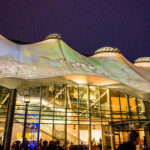

 The SPARK gallery (shown here in 2018) will showcase art and performances.


 Buffalo grazing near Denver, Colorado, in Rocky Mountain Arsenal National Wildlife Refuge.
 Erle Ellis is a member of the American Association of Geographers. The association is a funding partner of The Conversation US.