UMBC receives NSF support to enhance data science courses, research, and student experiences

Data science has rapidly grown at UMBC, and faculty are now working to enhance data science courses, research, and student experiences. The goal is to ensure they are inclusive, empowering, and effective in preparing students to tackle the urgent problems our society is working to solve, and can scale up to meet student and workforce demands.
Faculty in both information systems, and computer science and electrical engineering have recently received two grants from the National Science Foundation to conduct research toward this aim.
Making data science more inclusive
NSF awarded funding to a team of researchers at UMBC; the University of California, Berkeley; and Mills College in California through the Improving Undergraduate STEM Education program. This funding will support the Undergraduate Data Science at Scale project at UMBC, including the development and implementation of a unique data science education program for undergraduate students in STEM and non-STEM disciplines, says Vandana Janeja, professor and interim chair of information systems (IS).
 Vandana Janeja. Photo by Marlayna Demond ’11 for UMBC.
The data science field is relatively new as compared to the more established computing education, Janeja explains, and there are very few studies examining how these topics are taught to students. “This project will generate new knowledge about a data science curriculum and pedagogy designed to promote learning among diverse undergraduate students, many from groups underrepresented in STEM,” she says.
This novel approach to teaching data science will also “empower students as generators of new knowledge rather than passive recipients of existing information,” Janeja explains.
Another component of the project is the data scholars program, which will include students from traditionally underrepresented groups in STEM fields.
With these changes, Janeja anticipates that data science at UMBC will continue to expand. She’s working with UMBC’s Division of Information Technology to explore how UMBC, and other universities, will need to adapt and scale up offerings to meet the changing needs of students over time. “The findings will drive a community transformation in undergraduate data science education that can scale with student demand, and ultimately broaden participation in data science across multiple and diverse institutional settings.”
Janeja and UMBC colleagues are excited to develop a model that can have a nationwide impact, bringing new students into the field, and shaping how they approach work in data science. She expects that this work will set a foundation for colleges across the country looking to implement data science programs and better support the learning of data science students.
High-impact, team-based student research
Outside of the classroom, undergraduate students in computer science, information systems, and business technology administration will have the opportunity to work with government agencies in Baltimore City to tackle real challenges through a new NSF-funded program. Aryya Gangopadhyay, professor of information systems, has received support for the new program through the Data Science Corps under NSF’s Harnessing the Data Revolution (HDR) initiative.
HDR is one of NSF’s 10 “Big Ideas”: bold, visionary, national-scale activities to open up new frontiers in science and engineering. This program allows researchers to answer fundamental questions through new modes of data-driven discovery, Gangopadhyay explains. On this project, he will work with colleagues and students to collect and analyze data for projects that seek to improve Baltimore residents’ quality of life.
Gangopadhyay will partner with UMBC faculty including Anupam Joshi, professor and chair of computer science and electrical engineering (CSEE); Tim Oates, professor of CSEE; Nirmalya Roy, associate professor of IS; and Sanjay Purushotham, assistant professor of IS. The UMBC team will collaborate with faculty at Bowie State University, Towson University, and the University of Baltimore. Gangopadhyay and his team will work with UMBC’s Faculty Development Center to evaluate student learning outcomes for this project.
 The researchers working on the HDR grant. Photo courtesy of Aryya Gangopadhyay.
“The goal of the project is to develop a team-based data science program for undergraduate students in computing,” explains Gangopadhyay. Both undergraduate and graduate students will contribute to this research, gaining hands-on experience with the complexity of addressing urban infrastructure challenges, such as traffic congestion.
Students will also examine a range of ethical considerations, including data privacy, as they process information. Street sensors, for example, can collect sensitive information on peoples’ patterns of daily life. Students will come to better understand their role as researchers in protecting privacy, and other ethical considerations, as they cull through the data, says Gangopadhyay.
“Data science is poised to change the world by improving the quality of life through smart technologies,” explains Gangopadhyay. “Our students will play a part in bringing about some of these changes. Through their projects, students will develop analytical and coding skills and learn how to collaboratively work in real life projects with industry, government and academia, under the guidance of faculty mentors.”
Banner image: A student using a computer. Photo by Marlayna Demond ’11 for UMBC.
]]>
Data science has rapidly grown at UMBC, and faculty are now working to enhance data science courses, research, and student experiences. The goal is to ensure they are inclusive, empowering, and...
https://umbc.edu/stories/umbc-receives-nsf-support-to-enhance-data-science-courses-research-and-student-experiences/
https://beta.my.umbc.edu/api/v0/pixel/news/119982/guest@my.umbc.edu/72ea0190313acfceb29f4681cf33f9fa/api/pixel
coeit
csee
is
science-and-technology
UMBC News & Magazine
https://beta.my.umbc.edu/groups/umbc-news-magazine
https://assets1-beta.my.umbc.edu/system/shared/avatars/groups/000/001/943/24435aa6207c452e7bc15cc74b42c7bb/xsmall.png?1748556657
https://assets1-beta.my.umbc.edu/system/shared/avatars/groups/000/001/943/24435aa6207c452e7bc15cc74b42c7bb/original.png?1748556657
https://assets2-beta.my.umbc.edu/system/shared/avatars/groups/000/001/943/24435aa6207c452e7bc15cc74b42c7bb/xxlarge.png?1748556657
https://assets2-beta.my.umbc.edu/system/shared/avatars/groups/000/001/943/24435aa6207c452e7bc15cc74b42c7bb/xlarge.png?1748556657
https://assets3-beta.my.umbc.edu/system/shared/avatars/groups/000/001/943/24435aa6207c452e7bc15cc74b42c7bb/large.png?1748556657
https://assets1-beta.my.umbc.edu/system/shared/avatars/groups/000/001/943/24435aa6207c452e7bc15cc74b42c7bb/medium.png?1748556657
https://assets2-beta.my.umbc.edu/system/shared/avatars/groups/000/001/943/24435aa6207c452e7bc15cc74b42c7bb/small.png?1748556657
https://assets1-beta.my.umbc.edu/system/shared/avatars/groups/000/001/943/24435aa6207c452e7bc15cc74b42c7bb/xsmall.png?1748556657
https://assets2-beta.my.umbc.edu/system/shared/avatars/groups/000/001/943/24435aa6207c452e7bc15cc74b42c7bb/xxsmall.png?1748556657
UMBC News & Magazine
0
0
false
Wed, 18 Dec 2019 19:37:04 -0500
Preparing for impact: Four new UMBC grads share what drives their research

It’s 3 a.m., and Cindy Chelius rolls out of the pull-out couch in the grad student lounge. Time to check on her fungi. For this experiment, measurements must be taken every four hours for forty hours. Thankfully, the undergraduates she mentors took the day shift. Tonight, as the lead on the project, it’s her turn.
“I think it just makes you feel like you really earned it when those results come back,” Chelius says. She has earned it—on December 18, she’ll walk across the stage to receive her Ph.D. in chemical and biochemical engineering from UMBC. The signaling pathways of fungi might seem like niche research, but fungal species are commonly used in industry as tiny, living factories. They can produce substances found in an array of products, including medications.
 Cindy Chelius, Ph.D. ’19 (third from left) with her advisor Mark Marten (far left) and the rest of their lab group. Photo courtesy Cindy Chelius.
After graduation, Chelius will take her skills to Bristol-Myers Squibb’s upstream processing development team in Devens, Massachusetts. She’ll help the company improve the ways they use organisms to produce therapeutic compounds.
Chelius’s UMBC experience has prepared her well for a research career in ways that go beyond a successful dissertation. Encouraged by her Ph.D. advisor, Mark Marten, professor and chair of chemical, biochemical, and environmental engineering, Chelius learned how to use bioreactors. “These industry positions really like someone coming in with that working knowledge,” she explains.
Chelius also took advantage of the Biochemical Regulatory Certification program at UMBC, organized by Tony Moreira, vice provost for academic affairs. It’s a four-course series including training in FDA regulations and good manufacturing practices, local lab tours, and more. “I think it really helped with my job interviews, because I was able to understand the acronyms they were talking about and reference the literature on these topics,” Chelius says.
She’s also expanded her cultural awareness by being active in a dynamic, diverse department with students and faculty from across the U.S. and the world. By participating in department intramural basketball and soccer teams and other departmental social events, “I definitely learned a lot more about different cultures and opinions,” Chelius shares. “Everyone comes from different places here, and it’s been awesome.”
 Cindy Chelius, Ph.D. ’19, fourth from left, with her intramural soccer team. The team includes members of the labs of Mark Marten and Lee Blaney (third from right). Photo courtesy Cindy Chelius.
Freedom to explore
Miranda Marvel, who is graduating with her Ph.D. in marine and estuarine environmental sciences, studied zebrafish development at the Institute of Marine and Environmental Technology with Yonathan Zohar, professor and chair of marine biotechnology. Her research focused on the role of a fish hormone, revealing that it plays important roles in feeding and reproduction. Understanding both processes is critical to optimize the aquaculture industry. After she defended her thesis in August, Marvel assumed a new post as a postdoctoral fellow at the National Institutes of Health, where she continues to study zebrafish development.
“Yoni encourages independent thinking and gave me the freedom to come up with my own experiments and be the leader on their execution,” Marvel says. “Ten-Tsao Wong was also always willing to drop whatever he was doing to help me.” Wong was a postdoctoral fellow when Marvel joined the lab, but later transitioned to assistant professor of marine biotechnology at UMBC.
 Miranda Marvel, Ph.D. ’19, center in front row, with the IMET REEF program participants. Photo courtesy Miranda Marvel.
Like Chelius, Marvel also took advantage of opportunities to receive training beyond her research. She participated in the Ratcliffe Environmental Entrepreneurship Fellowship (REEF), which offers training in business skills. “The skills you learn—like networking, public speaking, and making an elevator pitch—can be applied anywhere,” Marvel says.
As a result of the program, Marvel developed SensorFish, a line of fish bred to change color when they first experience common stressors, and took third place in UMBC’s 2018 Cangialosi Business Innovation Competition. The color change allows people to take action quickly to keep their fish healthy, even before symptoms may be apparent.
 Miranda Marvel, Ph.D. ’19, gives her pitch at the 2018 Cangialosi Business Innovation Competition. Photo courtesy Miranda Marvel.
When she arrived at UMBC, Marvel says she was quiet and shy. But the REEF training and supportive university environment changed that. “Seeing how helpful and friendly everyone was during my time here really helped me come out of my shell,” she says. “I attribute that to the collaborative nature of UMBC and IMET, and especially the researchers’ willingness to support young scientists.”
Creating positive change
Naqiya Ghulamali ‘19, psychology, has also been transformed by her research and service-learning experiences, which she sees as going hand in hand. Her research with Bronwyn Hunter, assistant professor of psychology at UMBC, focused on factors that influence the experience of re-entering society after incarceration. In an internship at the International Rescue Committee, Ghulamali says, “I got to work directly with clients on their paths to self-sufficiency during resettlement.”
As a result of these experiences, Ghulamali shares, “I am pursuing careers where I can apply my skills and knowledge to create positive social change.”
 Naqiya Ghulamali ’19, psychology, during her internship at the International Rescue Committee. Photo courtesy Naqiya Ghulamali.
UMBC mentors like Hunter and Ghulamali’s academic advisor Nkiru Nnawulezi, assistant professor of psychology, have influenced her future path. “They supported me and encouraged me to pursue my goals,” Ghulamali says. “Dr. Hunter and the graduate students in the lab helped me with projects and conference presentations, and generally created an environment conducive to critical thinking.”
Leaders of UMBC’s Alternative Spring Break and the STRiVE program, a five-day leadership retreat organized by the UMBC Center for Democracy and Civic Life, also shaped Ghulamali’s UMBC experience, and her future. “I’m grateful for how they’ve contributed to my sense of my own civic agency,” she shares.
As a member of the Honors College and a Sondheim Public Affairs Scholar, Ghulamali not only met mentors and established her career path, but also forged friendships “with others deeply invested in public service,” she says.
The power of an open door
Ryan Oliver ’19, biological sciences, also met life-changing mentors at UMBC. After struggling with addiction for almost four years at a college in another state, he took a year off to begin recovery with family in Maryland. When he was ready to return to college, Oliver chose UMBC because of what he had heard about the rigorous academics and supportive atmosphere.
It was a good choice for Oliver. This December, he will graduate with a 4.0 GPA. Next fall, he’s headed to his first-choice graduate school, Hebrew University in Israel.
Oliver’s master’s degree will focus on neuroscience using bees as a model organism. This builds on research he completed with UMBC’s Fernando Vonhoff, assistant professor of biological sciences, for which he received an Undergraduate Research Award. That project explored environmental factors that affect how fruit flies respond to alcohol exposure, and whether or not they become addicted.
 Ryan Oliver ’19, rear, green shirt, with members of Fernando Vonhoff’s lab. The lab members include undergraduates, graduate students, and a high school student. The UMBC students affiliate with programs such as STEM BUILD, LSAMP, MARC U*STAR, and the Meyerhoff Scholars. Photo courtesy Fernando Vonhoff.
The connection between his personal experience and academic research is no accident. “I would say my history has opened the door into neuroscience for me,” Oliver shares.
When he came to UMBC, Oliver knew he wanted to pursue undergraduate research, so he started knocking on doors. The first open office door he came to belonged to Vonhoff, who welcomed him in for an impromptu meeting. “By the end of that first conversation, he told me I could develop any project I wanted, and he would support me,” Oliver recalls. “I think him letting me do that is what really sparked so much enthusiasm and dedication on my part.”
During his time at UMBC, Oliver traveled to University of Chicago to present his research at the Society for Neuroscience Annual Meeting. Oliver is drafting the manuscript for a scientific paper on which he will be the first author.
 Ryan Oliver presents his research at UMBC’s Undergraduate Research and Creative Achievement Day 2019. Photo courtesy of Fernando Vonhoff.
Regarding his identity as a person in recovery, “I’ve been able to create more opportunities by being open about it than if I had hidden it. And I don’t think most people realize that,” Oliver says. “I think it needs to be destigmatized, and hopefully I’m doing my part in that by being as open as I can so that other people can get help, be embraced, and be given a chance in the real world.”
“My message would be that UMBC is a place that encourages and enables success through connection with and discovery of a real, personal identity,” he shares.
As they move beyond UMBC, Chelius, Marvel, Ghulamali, and Oliver all remain driven to contribute to positive change in their communities through their research. They also hope to carry forward the support they found at UMBC as mentors to a future generation of researchers.
Banner image: Ryan Oliver, second from left in back, with Fernando Vonhoff, third from right in back, and members of the lab in summer 2019. Oliver served as a mentor to members of the UMBC STEM BUILD program. Photo courtesy Fernando Vonhoff.
]]>
It’s 3 a.m., and Cindy Chelius rolls out of the pull-out couch in the grad student lounge. Time to check on her fungi. For this experiment, measurements must be taken every four hours for forty...
https://umbc.edu/stories/preparing-for-impact-four-new-umbc-grads-share-what-drives-their-research/
https://beta.my.umbc.edu/api/v0/pixel/news/119983/guest@my.umbc.edu/35253f256cb60233b69a38d36ada912b/api/pixel
biology
campus
cbee
class-of-2019
community
gradresearch
marinebiotech
psychology
research
UMBC News & Magazine
https://beta.my.umbc.edu/groups/umbc-news-magazine
https://assets1-beta.my.umbc.edu/system/shared/avatars/groups/000/001/943/24435aa6207c452e7bc15cc74b42c7bb/xsmall.png?1748556657
https://assets1-beta.my.umbc.edu/system/shared/avatars/groups/000/001/943/24435aa6207c452e7bc15cc74b42c7bb/original.png?1748556657
https://assets2-beta.my.umbc.edu/system/shared/avatars/groups/000/001/943/24435aa6207c452e7bc15cc74b42c7bb/xxlarge.png?1748556657
https://assets2-beta.my.umbc.edu/system/shared/avatars/groups/000/001/943/24435aa6207c452e7bc15cc74b42c7bb/xlarge.png?1748556657
https://assets3-beta.my.umbc.edu/system/shared/avatars/groups/000/001/943/24435aa6207c452e7bc15cc74b42c7bb/large.png?1748556657
https://assets1-beta.my.umbc.edu/system/shared/avatars/groups/000/001/943/24435aa6207c452e7bc15cc74b42c7bb/medium.png?1748556657
https://assets2-beta.my.umbc.edu/system/shared/avatars/groups/000/001/943/24435aa6207c452e7bc15cc74b42c7bb/small.png?1748556657
https://assets1-beta.my.umbc.edu/system/shared/avatars/groups/000/001/943/24435aa6207c452e7bc15cc74b42c7bb/xsmall.png?1748556657
https://assets2-beta.my.umbc.edu/system/shared/avatars/groups/000/001/943/24435aa6207c452e7bc15cc74b42c7bb/xxsmall.png?1748556657
UMBC News & Magazine
0
0
false
Tue, 17 Dec 2019 22:49:37 -0500
UMBC graduates create their own paths to excellence, focused on succeeding together

Each graduating student’s path looks different. For many Retrievers, UMBC offers an opportunity to develop not just knowledge and skills, but also self-awareness that enables them to pursue personal passions. That self-awareness often means understanding what kinds of support made an impact on their experiences, and how they can lend support to those coming up behind them. Excellence for these seniors is about more than accolades; it is about succeeding together.
Supporting student-athletes’ mental health
As a volleyball player, Taylor Dunn ‘19 is very familiar with stereotypes of athletes as powerful, invulnerable, and self-assured. This media and communications studies major with minors in psychology and entrepreneurship has worked hard to help her fellow student-athletes become more comfortable discussing mental health concerns.
 Dunn on the court. Photo courtesy of Dunn.
Dunn is a co-lead in UMBC’s #RetrieverProject, a student-led mental health initiative for athletes. She helps others open up about challenges they might be facing, and shares with them how they can access support. “Athletes have many demands on them and are far away from home,” says Dunn, “Managing all those demands when you are playing regularly is hard, but when you are injured or not playing as much it can actually be a greater challenge.”
Dunn has also excelled in the classroom and on the court. This fall as she became the first player in conference history to be named America East Setter and Defensive Specialist of the Week in the same week. She also applied her communications and marketing skills to an internship working on social media campaigns for nonprofits—skills she hopes to integrate with a master’s degree in psychology that she’ll soon start at UMBC.
“I see all that is possible in helping organizations manage their communications to promote their mission and vision,” shares Dunn. “A master’s in psychology will allow me to understand the social behavior that drives communications and combine it with work similar to the #RetrieverProject.”
Bridging anthropology and genetics
Zachary Nicholas ‘19, anthropology, with a biology minor, remembers encountering genetics for the first time in his eighth-grade biology class, then learning about gene function and individual differences in high school anthropology. By the time he got to UMBC, these fledgling interests grew into a passion for human genetics—a passion he has explored through broad-ranging research.
 Zachary Nicholas. Photo courtesy of UMBC.
This past year Nicholas earned an Undergraduate Research Award and a Distinctive Undergraduate Experience and Research Award from his department for his research project “Deciphering Cultural Roles and Social Pressure on Parents of Children with Special Needs.” At the same time, he’s also completed research in the biology lab of Michelle Starz-Gaiano, where he examined cell migration in fruit flies to track development, wound healing, and disease progression.
 Nicholas at UMBC’s Undergraduate Research and Creative Achievement Day (URCAD). Photo courtesy of Nicholas.
How has he been able to bridge these varied interests? “I work two jobs,” Nicholas explains, “one as a physical therapy technician and another as a youth counselor at an organization helping young people with mental health needs.” This work helps him gain a broader sense of the experiences of people facing physical and mental health challenges, which has shaped his perspective on scientific research.
Nicholas looks forward to pursuing a Ph.D. in human genetics. For students at the start of their UMBC careers, he shares, “This is a really tight-knit community. You have to take advantage of how much professors want to help you. It makes all the difference in what you get out of college and what your next right step is.”
Academic rigor meets community impact
Shiona Wijesekara ‘19, economics, with a minor in statistics, chose UMBC for its rigor but fell in love with the university for the ways UMBC empowers students to impact communities. Wijesekara served as a mentor through the REACH initiative for two years, eventually taking on the roles of assistant director, fundraising chair, and assistant research chair.
Through REACH, she supported young women in high school who were interested in STEM careers. “Many of the young women were scared of the college-level STEM college classes,” initially, she explains. When her team focused on demystifying college STEM, and explaining some of the major concepts in accessible ways, she says, “they became more confident in what they were capable of doing.”
 Shiona Wijesekara (at left) with fellow 2018-19 UMBC France-Merrick Scholars. Photo by Raquel Hammer ’20.
Wijesekara also completed internships running data for a financial intelligence start-up in Baltimore called Ortus Academy and helping with research in education psychology at AIR. Combined, these two experiences have inspired her to pursue a career that will continue to improve the gaps in education with her knowledge in data analysis. She looks forward to supporting future students on a larger scale through quantitative education research.
“Creating a community of doers”
Arif Abdul Kareem’s path toward a career in education and tech has taken unique twists and turns. “After high school, I went to New York to work for five years. I wasn’t ready to go on to college,” shares Kareem. “I returned to Baltimore and enrolled in Baltimore City Community College and, eventually, at UMBC for its computer science engineering program.”
Part-way through his UMBC degree, Kareem took two years off to launch his business, which focuses on K-12 STEM educational technology. He returned to UMBC as a Cyber Scholar, through a program of the Center for Women in Technology that focuses on increasing the participation of women and other underrepresented groups in the cybersecurity field.
 Arif Abdul Kareem with Bianca Monge ’19, receiving CWIT honors cords. Photo courtesy of CWIT.
“UMBC helped me strengthen the foundation I came with,” says Kareem. It also “reflected my passion for a STEM-minded business whose intent, like UMBC’s CWIT, is to create access in STEM fields for as many underrepresented students in the earliest stages of education,” he shares. “This isn’t just about me, it’s about creating a community of doers.”
Banner image: UMBC volleyball team. Photo courtesy of Dunn.
]]>
Each graduating student’s path looks different. For many Retrievers, UMBC offers an opportunity to develop not just knowledge and skills, but also self-awareness that enables them to pursue...
https://umbc.edu/stories/umbc-graduates-create-their-own-paths-to-excellence-focused-on-succeeding-together/
https://beta.my.umbc.edu/api/v0/pixel/news/119984/guest@my.umbc.edu/31bb9ce76d5edebc77705b067affb01d/api/pixel
campus
class-of-2019
community
cwit
english
philosophy
politicalscience
psychology
UMBC News & Magazine
https://beta.my.umbc.edu/groups/umbc-news-magazine
https://assets1-beta.my.umbc.edu/system/shared/avatars/groups/000/001/943/24435aa6207c452e7bc15cc74b42c7bb/xsmall.png?1748556657
https://assets1-beta.my.umbc.edu/system/shared/avatars/groups/000/001/943/24435aa6207c452e7bc15cc74b42c7bb/original.png?1748556657
https://assets2-beta.my.umbc.edu/system/shared/avatars/groups/000/001/943/24435aa6207c452e7bc15cc74b42c7bb/xxlarge.png?1748556657
https://assets2-beta.my.umbc.edu/system/shared/avatars/groups/000/001/943/24435aa6207c452e7bc15cc74b42c7bb/xlarge.png?1748556657
https://assets3-beta.my.umbc.edu/system/shared/avatars/groups/000/001/943/24435aa6207c452e7bc15cc74b42c7bb/large.png?1748556657
https://assets1-beta.my.umbc.edu/system/shared/avatars/groups/000/001/943/24435aa6207c452e7bc15cc74b42c7bb/medium.png?1748556657
https://assets2-beta.my.umbc.edu/system/shared/avatars/groups/000/001/943/24435aa6207c452e7bc15cc74b42c7bb/small.png?1748556657
https://assets1-beta.my.umbc.edu/system/shared/avatars/groups/000/001/943/24435aa6207c452e7bc15cc74b42c7bb/xsmall.png?1748556657
https://assets2-beta.my.umbc.edu/system/shared/avatars/groups/000/001/943/24435aa6207c452e7bc15cc74b42c7bb/xxsmall.png?1748556657
UMBC News & Magazine
0
0
false
Tue, 17 Dec 2019 21:16:59 -0500
Together every step of the way: Three sisters earn UMBC teaching degrees
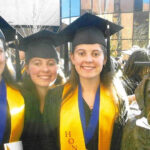
Transferring to a new college often comes with some trepidation about making new friends and finding your crowd. For Michelle, Melissa, and Melanie Biddinger, however, those were the least of their worries when they originally came to UMBC from the Community College of Baltimore County.
The three sisters (Melissa and Melanie are twins) brought their lifelong friendship and communal study habits with them, and their tight-knit family bond propelled them to collectively graduated in 2017 with bachelor’s degrees in psychology. This winter they’ll cross the stage again, having earned their master’s of arts in teaching.
The Biddinger sisters had a common source of inspiration for their shared educational path—their mother. In their formative years, they remember her taking on substitute teaching positions and returning home with stories of students gaining new skills and mastering challenging material. Melissa recalls volunteering in some of her mom’s classrooms and realizing the great responsibility educators have for shaping the next generation of leaders.
Michelle echoes her younger sister’s sentiment about witnessing the influence teachers can have, especially in early education—the sisters’ area of specialty. “These are the years that children learn foundational skills that they will use for the rest of their life and help them achieve higher-level skills.”
Melanie adds that their teaching interests began even before their mother began working in schools. As young children, the sisters would play school and take turns teaching each other. This playacting transformed into dedicated shared studied sessions as the Biddingers pursued higher education together.

Perfect Study Partners
At UMBC, they took all the same classes, navigating quizzes and exams with their built-in structure of support. “It was always comforting knowing that if one of us missed a class announcement, more than likely one of the other two heard and ‘reported back,’” says Melissa. “Preparing for exams was always tolerable given that I had two of my best friends as study partners.”
The Biddingers all identify as having very similar study habits, which was helpful as they progressed through their degrees. “We were equally strong,” Melanie asserts. “If there was a particularly difficult concept we had to understand, we put our heads together to figure it out.”
Their similarities don’t end with their study habits; since childhood, the sisters have chosen to dress identically, planning out their outfits the night before. “This choice is a part of who we are,” Melanie explains, “and in a world where everyone wants to be different, we are being different by wanting to be the same.”
Better Together
Michelle credits UMBC’s early childhood education department for guiding her “to be reflective and create an inclusive classroom.” The sisters, who are all hoping to teach in Baltimore County, say they were influenced by UMBC’s dedication to the surrounding communities where the education program supports and partners with local schools and facilities. Melissa adds, “It is clear that they want their students to succeed and enter the world as role models and citizens that respect and honor diversity.”
As the sisters look for jobs, they’ll be following in their mother’s footsteps and substitute teaching at local schools. Their dream would be to make up an entire grade level team at the same elementary school.
“It has always been a dream of ours to work in the same school,” says Michelle. “Teaching is such a rewarding career. There is no better feeling knowing that you made a difference in someone’s life.”
]]>
Transferring to a new college often comes with some trepidation about making new friends and finding your crowd. For Michelle, Melissa, and Melanie Biddinger, however, those were the least of...
https://umbc.edu/stories/together-every-step-of-the-way-three-sisters-earn-umbc-teaching-degrees/
https://beta.my.umbc.edu/api/v0/pixel/news/119985/guest@my.umbc.edu/f39b0a25d2328ecaf0379c3fb585c2fe/api/pixel
alumni
cahss
commencement
UMBC News & Magazine
https://beta.my.umbc.edu/groups/umbc-news-magazine
https://assets1-beta.my.umbc.edu/system/shared/avatars/groups/000/001/943/24435aa6207c452e7bc15cc74b42c7bb/xsmall.png?1748556657
https://assets1-beta.my.umbc.edu/system/shared/avatars/groups/000/001/943/24435aa6207c452e7bc15cc74b42c7bb/original.png?1748556657
https://assets2-beta.my.umbc.edu/system/shared/avatars/groups/000/001/943/24435aa6207c452e7bc15cc74b42c7bb/xxlarge.png?1748556657
https://assets2-beta.my.umbc.edu/system/shared/avatars/groups/000/001/943/24435aa6207c452e7bc15cc74b42c7bb/xlarge.png?1748556657
https://assets3-beta.my.umbc.edu/system/shared/avatars/groups/000/001/943/24435aa6207c452e7bc15cc74b42c7bb/large.png?1748556657
https://assets1-beta.my.umbc.edu/system/shared/avatars/groups/000/001/943/24435aa6207c452e7bc15cc74b42c7bb/medium.png?1748556657
https://assets2-beta.my.umbc.edu/system/shared/avatars/groups/000/001/943/24435aa6207c452e7bc15cc74b42c7bb/small.png?1748556657
https://assets1-beta.my.umbc.edu/system/shared/avatars/groups/000/001/943/24435aa6207c452e7bc15cc74b42c7bb/xsmall.png?1748556657
https://assets2-beta.my.umbc.edu/system/shared/avatars/groups/000/001/943/24435aa6207c452e7bc15cc74b42c7bb/xxsmall.png?1748556657
UMBC News & Magazine
0
0
false
Tue, 17 Dec 2019 18:50:54 -0500
UMBC’s Lisa Kelly receives NSF grant to develop a safer, greener chemical production method
At some point in its development, every drug, high-tech piece of clothing, and synthetic building material was touched by a chemist. However, getting the atoms attached to each other in just the right way to treat infection, keep you dry in the woods, or construct your home often requires extreme measures. Harsh chemicals and dangerous byproducts from those manufacturing processes have the potential to cause environmental damage and impact the health of lab workers.
Lisa Kelly, associate professor of chemistry and biochemistry at UMBC, is developing techniques to make some of those same chemicals in much safer ways. The National Science Foundation has funded her with $450,000 for three years to further this work, which also has biomedical applications.
“The approach that we propose will induce chemical reactions that would otherwise need a lot of harsh reagents and organic solvents, and just a lot of nasty stuff,” Kelly says. “This is a greener route.”
Radical reactions
The technique Kelly is using can be very helpful for inducing the formation of strong chemical bonds between two molecules, when their interaction would typically be much weaker.
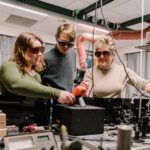
 Gabrielle Pozza ’20, chemistry, Lisa Kelly, and Ph.D. student Ryan Grant examine a fluorescent dye used in their research to determine the properties of compounds they work with.
The first step is to chemically attach a special compound to one of the two molecules you want to connect. Shining UV light on the compound causes it to release a single atom with a negative electric charge, called a radical. Because it is charged, that atom will react strongly with molecules around it. In this case, the radical initiates the formation of a strong bond between the two molecules you want to connect. The only byproduct of the reaction is carbon dioxide, and it can be carried out in water, so it’s much safer than existing methods.
This process can be used for a variety of purposes. For example, you can induce strong bonds between a drug and its target to better understand the drug’s mechanism. This essentially freezes their fleeting interaction in time, giving a scientist the chance to observe it.
“It’s a photochemical tool to be able to visualize where the drug actually bound,” Kelly says. “That lets you say, ‘This drug is so powerful because it binds here and this one is less powerful because it binds here.’” That kind of insight could lead to more effective pharmaceuticals.
This technique can also be used in a more general biological context, to better understand how an enzyme and its target protein interact. And it could increase the efficiency and safety of generating polymers—long chains of molecules—used in various industries, like adhesives or flame retardants. It could also be used to add molecules to surfaces to give them desirable properties.
Adding to the biological toolbox
With the NSF funding, Kelly’s lab will look at how efficiently different compounds can create radicals, and what kinds of reactions the radicals are best at initiating. She’s hoping that their findings will be useful for researchers in a range of fields, including medicine. “They could take the information that we’ve disseminated and then use it in their bigger biological toolbox,” Kelly says.
 Lisa Kelly, Ryan Grant, and Gabrielle Pozza (left to right) discuss results from a recent experiment in the lab.
Kelly is also involved with a startup in Utah using a similar technique to create a natural alternative to the metal stents that treat heart disease. Staining the artery with the special compounds and then exposing them to light creates a rigid structure that avoids the need for a traditional stent. The product is currently undergoing FDA approval.
“We’re able to give guidance to the drug discovery companies based on our insight into the chemical mechanisms,” Kelly says. “That’s what’s really exciting to me: We can actually come up with practical information to help guide better drugs and structural biology tools.”
Creating opportunities for students
Kelly is also excited about how her new funding will impact UMBC students. “Part of the grant support is not just doing the lab work, but also disseminating it, so my team and I can travel to present the work at national conferences,” she says. “It’s really important to me to be able to bring graduate students with me when I go to meetings and have them share the same sort of networking opportunities that I benefited from.”
Kelly has cultivated rich connections within the photochemistry community, a field she chose intentionally. “It struck me as a way to be able to do everything that I was interested in without having to be this or this or that,” she says. “It was a multidisciplinary, practical field that’s served me well in my career.” And now, she’s introducing UMBC graduate students to this unique field and how scientists can bridge multiple disciplines to impact society.
As a photochemist, “It’s not good enough for me to make something and show that it does something cool,” Kelly says. “I want to map out all the driving forces that control it, and when I understand that, then I can make the process happen better.”
Banner image: Lisa Kelly, right, Ryan Grant, center, and Gabriella Pozza work with the laser setup in Kelly’s lab. All photos by Marlayna Demond ’11 for UMBC.
]]>
At some point in its development, every drug, high-tech piece of clothing, and synthetic building material was touched by a chemist. However, getting the atoms attached to each other in just the...
https://umbc.edu/stories/umbcs-lisa-kelly-receives-nsf-grant-to-develop-a-safer-greener-chemical-production-method/
https://beta.my.umbc.edu/api/v0/pixel/news/119986/guest@my.umbc.edu/2b33d90187ff3c37a510e5e9a3374307/api/pixel
chembiochem
cnms
research
science-and-technology
UMBC News & Magazine
https://beta.my.umbc.edu/groups/umbc-news-magazine
https://assets1-beta.my.umbc.edu/system/shared/avatars/groups/000/001/943/24435aa6207c452e7bc15cc74b42c7bb/xsmall.png?1748556657
https://assets1-beta.my.umbc.edu/system/shared/avatars/groups/000/001/943/24435aa6207c452e7bc15cc74b42c7bb/original.png?1748556657
https://assets2-beta.my.umbc.edu/system/shared/avatars/groups/000/001/943/24435aa6207c452e7bc15cc74b42c7bb/xxlarge.png?1748556657
https://assets2-beta.my.umbc.edu/system/shared/avatars/groups/000/001/943/24435aa6207c452e7bc15cc74b42c7bb/xlarge.png?1748556657
https://assets3-beta.my.umbc.edu/system/shared/avatars/groups/000/001/943/24435aa6207c452e7bc15cc74b42c7bb/large.png?1748556657
https://assets1-beta.my.umbc.edu/system/shared/avatars/groups/000/001/943/24435aa6207c452e7bc15cc74b42c7bb/medium.png?1748556657
https://assets2-beta.my.umbc.edu/system/shared/avatars/groups/000/001/943/24435aa6207c452e7bc15cc74b42c7bb/small.png?1748556657
https://assets1-beta.my.umbc.edu/system/shared/avatars/groups/000/001/943/24435aa6207c452e7bc15cc74b42c7bb/xsmall.png?1748556657
https://assets2-beta.my.umbc.edu/system/shared/avatars/groups/000/001/943/24435aa6207c452e7bc15cc74b42c7bb/xxsmall.png?1748556657
UMBC News & Magazine
0
0
false
Tue, 17 Dec 2019 17:41:00 -0500
UMBC’s Jason Schiffman and his YouthFIRST lab advance early identification and treatment of psychosis
UMBC’s Jason Schiffman and his team conduct research on the screening, assessment, and treatment of young people experiencing psychosis. He has recently been awarded two prestigious grants from the National Institute of Mental Health (NIMH) and one from the Substance Abuse and Mental Health Services Administration (SAMHSA) to train clinicians that serve this vulnerable population on how to detect psychosis early, and to offer clinical services to youth in need, dramatically extending the impact of his work nationwide.
Reports by SAMHSA, the Centers for Disease Control and Prevention (CDC), and the U.S. Department of Justice show that one in five adults and one in six youth ages 6-17 experience mental health issues each year. Many of these people experience serious disorders associated with psychosis, which can significantly impact quality of life. Schiffman, psychology professor and director of clinical training, is relentlessly working to change this narrative.
 Schiffman.
Schiffman and his YouthFIRST lab focus on the early identification of young people suffering from disorders associated with psychosis, such as schizophrenia, schizoaffective disorder, major depressive disorder with psychotic features, and bipolar disorder with psychotic features. Further, he is dedicated to addressing concerns about mental health disparities impacting marginalized communities by studying the validity of screening approaches across diverse populations and communities. Schiffman also incorporates his biological approach to understanding early signs of psychosis by using fMRI to measure brain activity, highlighted in a 2017 UMBC Magazine feature.
For Schiffman, research “translating basic science to real-world applications” and “bringing clarity to the nature and identification of poorly misunderstood mental illnesses” goes hand in hand with his work to reduce stigma and ameliorate suffering “through the lens of prevention science.”
A multi-layered approach
Schiffman is one of only three national trainers on the Structured Interview for Psychosis-Risk Syndromes (SIPS), the “gold standard interview” for identifying people at risk for psychosis. He has trained research and clinical teams in cities in Maryland, Texas, Illinois, Virginia, Pennsylvania, and Tennessee on how to use this tool. His trainings have helped psychologists, social workers, and psychiatrists more effectively identify and monitor people at risk for psychosis.
He has been working for years in Maryland to expand the reach of early intervention services. Now, he says, “I am sharing best practices and lessons learned with other mental health professionals across the globe who also provide therapy and services to the people most at risk.”

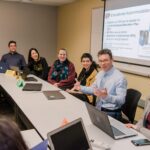
Schiffman with YouthFirst lab.His team is one of twenty-two partners on a $1.6 million SAMHSA grant that provides services for people who are at risk of psychosis. Most of the twenty-two Clinical High Risk for Psychosis (CHiRP) teams are state and private providers. Just a few are academic institutions, including UMBC and Yale University. Schiffman’s CHiRP grant will provide much-needed mental health services to scores of young people in Maryland using a needs-based approach.
“The biggest calling for me is that these disorders are potentially devastating to young people who struggle with them, as well as to their families. They can suffer immensely, lose everything, and disconnect from society if they don’t receive the appropriate help,” explains Schiffman. “I am most interested in social and psychological therapies that can be implemented early on in an effort to limit the impact of emerging psychosis.”
Expanding community reach
Schiffman and his team are also part of a National Institute of Mental Health (NIMH) multi-state grant with Northwestern University and Temple University. The grant funds mental health screening and identification of people in the general population experiencing symptoms related to psychosis. This $2.25 million project expands the target population from the clinical setting to the community.
In addition, NIMH awarded Schiffman a grant to develop an online training and continuing education platform to teach social workers about reducing the duration of untreated psychosis. The three-hour program has been used to train over 1,200 social workers in Maryland. This training helped to increase the number of referrals to the Maryland Early Intervention Program, a collaboration between Schiffman’s team and his colleagues from the University of Maryland School of Medicine.
 Schiffman with YouthFirst lab.
A team focused on prevention
This multi-layered process is the work of many people. Schiffman is quick to highlight that he surrounds himself with dedicated and insightful collaborators. He is proud to have a team of undergraduate and graduate students, a postdoctoral research associate, and staff who help to implement each level of the project.
Dawn Bunch ‘22, psychology, began her position as an undergraduate research assistant in Schiffman’s lab because she was looking to get involved in research impacting mental healthcare. “It’s been an extremely valuable and inspirational learning experience for me,” explains Bunch. “Working in this lab taught me so much about psychological assessment and the research process, which is very important to me since I plan to do both clinical and research work in my career.”
In addition to gaining knowledge about the psychosis risk field, Bunch and the other YouthFIRST undergraduate research assistants contribute to the lab’s mission by entering data, performing data quality checks, and preparing for study visits.
Combating stigma
Schiffman is also dedicated to supporting a positive campus culture around mental health. He is the faculty advisor for the student chapter of the UMBC National Alliance on Mental Illness (NAMI). Each year, with the support of UMBC’s NAMI group, Schiffman holds a panel discussion during Mental Health Awareness Week, where students share their stories of dealing with mental health challenges and successes.
The YouthFIRST lab also created a mental health awareness video with students sharing their stories. In addition to increasing awareness, two doctoral students found that students in distress who watch this video are more likely to seek support at the UMBC Counseling Center.
In all this work, Schiffman and his team are driven by a singular focus: intervening early to help young people suffering from psychosis. And the stakes are high. “On average, life expectancy for someone with schizophrenia is twenty years less than someone without schizophrenia,” says Schiffman. “We are changing the paradigm by moving away from institutionalization and incarceration, and towards prevention—enabling people with psychosis a chance to live a life of their choosing in the community and the opportunity to reach towards their highest potential.”
Banner image: Schiffman with YouthFirst lab.
All images by Marlayna Demond ’11.
]]>
UMBC’s Jason Schiffman and his team conduct research on the screening, assessment, and treatment of young people experiencing psychosis. He has recently been awarded two prestigious grants from...
https://umbc.edu/stories/umbcs-jason-schiffman-and-his-youthfirst-lab-advance-early-identification-and-treatment-of-psychosis/
https://beta.my.umbc.edu/api/v0/pixel/news/119987/guest@my.umbc.edu/9e6e11aaa18c528ddf6297752d5abda4/api/pixel
cahss
cs3
policy-and-society
psychology
UMBC News & Magazine
https://beta.my.umbc.edu/groups/umbc-news-magazine
https://assets1-beta.my.umbc.edu/system/shared/avatars/groups/000/001/943/24435aa6207c452e7bc15cc74b42c7bb/xsmall.png?1748556657
https://assets1-beta.my.umbc.edu/system/shared/avatars/groups/000/001/943/24435aa6207c452e7bc15cc74b42c7bb/original.png?1748556657
https://assets2-beta.my.umbc.edu/system/shared/avatars/groups/000/001/943/24435aa6207c452e7bc15cc74b42c7bb/xxlarge.png?1748556657
https://assets2-beta.my.umbc.edu/system/shared/avatars/groups/000/001/943/24435aa6207c452e7bc15cc74b42c7bb/xlarge.png?1748556657
https://assets3-beta.my.umbc.edu/system/shared/avatars/groups/000/001/943/24435aa6207c452e7bc15cc74b42c7bb/large.png?1748556657
https://assets1-beta.my.umbc.edu/system/shared/avatars/groups/000/001/943/24435aa6207c452e7bc15cc74b42c7bb/medium.png?1748556657
https://assets2-beta.my.umbc.edu/system/shared/avatars/groups/000/001/943/24435aa6207c452e7bc15cc74b42c7bb/small.png?1748556657
https://assets1-beta.my.umbc.edu/system/shared/avatars/groups/000/001/943/24435aa6207c452e7bc15cc74b42c7bb/xsmall.png?1748556657
https://assets2-beta.my.umbc.edu/system/shared/avatars/groups/000/001/943/24435aa6207c452e7bc15cc74b42c7bb/xxsmall.png?1748556657
UMBC News & Magazine
0
0
false
Tue, 17 Dec 2019 17:10:05 -0500
UMBC students confront ethical challenges through new computing curriculum
When UMBC’s Helena Mentis is teaching, her students often bring up ethical challenges in computing, and they are hungry to learn about how to address them. “We want to capitalize on this curiosity and diversity of perspectives,” says Mentis, associate dean for academic programs and learning and associate professor of information systems. “Alongside technical skill development, every week we want to introduce challenges around ethics, equality, human behavior, and societal impact, reiterating that a fundamental component of development is thinking through implications.”
Incorporating ethics into computing curriculum is crucial to ensure that today’s graduates are well prepared to address the complex challenges of the future, Mentis explains. Recently, she and colleagues in UMBC’s College of Engineering and Information Technology received funding from the Mozilla Foundation to support implementing ethics components in their courses.
Research to improve teaching
UMBC was one of 17 universities from across the country that received funding as part of Mozilla’s Responsible Computer Science Challenge. Through this project, UMBC faculty have restructured an introductory computing course, building into it regular opportunities for students to discuss ethical issues in depth. The course framework is team-based and peer-led. The faculty are also examining the efficacy of these course updates to assess student learning and continue to improve their approach.
 Helena Mentis. Photo by Marlayna Demond ’11 for UMBC.
Mentis is the principal investigator of this research. Colleagues leading other aspects of the research and implementation include Anupam Joshi, professor and chair of computer science and electrical engineering; Carolyn Seaman, associate professor of information systems, and interim director of the Center for Women in Technology; and Maria Sanchez, director of education and outreach, and professor of practice in mechanical engineering.
Facilitating conversations in the classroom
Mentis explains that discussions about ethics related to computing often occur organically between students as they work to understand their peers’ perspectives. This initiative takes those discussions to the next level, making them an integral part of the course. More broadly, it is also part of a new course structure for first-year engineering and computing students that emphasizes how technology will impact society. The goal, she explains, is “to develop the next generation of technologists who have the framework and vocabulary to address the relationships between STEM and society.”
Lecturer Mark Berczynski taught the introductory computing course this semester. Through facilitated discussions, he helped his first-year students learn to more effectively explore and evaluate the potential negative impacts of technologies.
Team-based learning focused on peer-to-peer connections also played a major role in the pilot course. “Our concept of peer-led team learning has shown that peer-to-peer engagement with material leads to better understanding, better encoding, and longer retention,” Mentis shares.
Mentis and her collaborators will assess whether their approach for teaching ethics in introductory computing is effective both in the short and longer term. They’ll compare the ethics awareness of students in the original computing course with students in the updated course. One year later, students will be asked to complete a survey about how they have applied their knowledge of ethics in other computing classes that they have taken.
Mentis also hopes this new approach will interest a broader range of students in computing fields. She suggests, “Grounding the introduction to computing within ethics and societal implications of technology design has the potential to excite and engage a more diverse student population.”
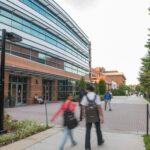
Banner image: ITE building. Photo by Marlayna Demond ’11 for UMBC.
]]>
When UMBC’s Helena Mentis is teaching, her students often bring up ethical challenges in computing, and they are hungry to learn about how to address them. “We want to capitalize on this curiosity...
https://umbc.edu/stories/umbc-students-confront-ethical-challenges-through-new-computing-curriculum/
https://beta.my.umbc.edu/api/v0/pixel/news/119988/guest@my.umbc.edu/98a1edd774cef18a25c90e9f52213b69/api/pixel
coeit
csee
cwit
is
science-and-technology
UMBC News & Magazine
https://beta.my.umbc.edu/groups/umbc-news-magazine
https://assets1-beta.my.umbc.edu/system/shared/avatars/groups/000/001/943/24435aa6207c452e7bc15cc74b42c7bb/xsmall.png?1748556657
https://assets1-beta.my.umbc.edu/system/shared/avatars/groups/000/001/943/24435aa6207c452e7bc15cc74b42c7bb/original.png?1748556657
https://assets2-beta.my.umbc.edu/system/shared/avatars/groups/000/001/943/24435aa6207c452e7bc15cc74b42c7bb/xxlarge.png?1748556657
https://assets2-beta.my.umbc.edu/system/shared/avatars/groups/000/001/943/24435aa6207c452e7bc15cc74b42c7bb/xlarge.png?1748556657
https://assets3-beta.my.umbc.edu/system/shared/avatars/groups/000/001/943/24435aa6207c452e7bc15cc74b42c7bb/large.png?1748556657
https://assets1-beta.my.umbc.edu/system/shared/avatars/groups/000/001/943/24435aa6207c452e7bc15cc74b42c7bb/medium.png?1748556657
https://assets2-beta.my.umbc.edu/system/shared/avatars/groups/000/001/943/24435aa6207c452e7bc15cc74b42c7bb/small.png?1748556657
https://assets1-beta.my.umbc.edu/system/shared/avatars/groups/000/001/943/24435aa6207c452e7bc15cc74b42c7bb/xsmall.png?1748556657
https://assets2-beta.my.umbc.edu/system/shared/avatars/groups/000/001/943/24435aa6207c452e7bc15cc74b42c7bb/xxsmall.png?1748556657
UMBC News & Magazine
0
0
false
Tue, 17 Dec 2019 17:08:45 -0500
50-Foot Woman Tells All

If art is life, then Rahne Alexander is living hers as a collage of towering technicolor.
On stage with her bands Santa Librada and 50’  ; she conjures her musical muses—think Stevie Nicks or the Wilson sisters from Heart—leaning into the lyrics while shredding her guitar. Her hair glows purple in the spotlight.
In quieter moments, in her studio at UMBC’s Lion Brothers Building downtown, she carefully de-archives her collection of hundreds of decades-old cassette tapes. (Among them is a copy of Billy Idol’s 1981 Don’t Stop she stole from a Woolworths, she says, smiling.)
She works on short films like the Marcel Duchamp/Brett Kavanaugh/Atomic Blonde–inspired “Dude Descending a Staircase” that earned her “best creative award” at an international conference of computer-human interaction in China last year. And she never seems to rest.
 Portrait of Rahne Alexander in her Baltimore studio by Marlayna Demond ’11.
“I maintain a pretty high performance and art schedule, and have for a long time,” says Alexander, who is pursuing an MFA in UMBC’s intermedia and digital arts program as much for the community and the push to produce as anything else. “But I love making work, I love being on stage. It’s exhausting, but this is what I’m here for.”
All along the way—as she has for the last 16 years, at least—Alexander also writes. And nowhere is she quite more herself than in Heretic to Housewife, a collection of essays now in its second run from publisher Neon Hemlock Press. Described as “the trans* Marcel Proust,” by one critic, the 10 collected essays delve into what drives Alexander as an artist.
In the first essay, “A Meditation,” which she originally performed as a sort of love letter to herself at the D.C. Women in Comedy show, and later as the opener when author/actress Amber Tamblyn spoke in Baltimore, Alexander dives deeply into her personal story. In others, she un-buries the echos of traumas experienced throughout her life up to age 50. The doors haven’t always been as open to her, and life has not always been as safe. But, “fear is never revolutionary,” she writes, so she does not give in.
 Still from “Dude Descending a Staircase” courtesy of Rahhe Alexander.
But even with the most serious topics, Alexander’s wit and warmth shine through. “It was easier for me to come out as a transsexual lesbian than it was for me to come out as a witch,” she jokes in a monologue about the artist Paulina Peavy.
“[She] brings a multi-faceted body of work that often touches on artists of the past in ways that mine their works for tips on how to move into the future in more critical and equitable ways,” says Kathy O’Dell, associate professor of visual arts, art history, and museum studies. “And she does so with motivational humor—meaning, humor with edges of seriousness that prod us as viewers/participants to make decisions about where we stand on a variety of topics, from humor itself to domesticity, self-care, politics, LGBTQ issues, and many more.”
 (L-R): Jack Pinder, Skizz Cyzyk, Rahne Alexander, Mickey Dehn, Sarah Michaels, and Joseph Mulhollen
If her social media following—and the fact that the first run of her book sold out in two weeks—is any indication, Alexander has amassed a dedicated fan base who can’t wait to see what she does next. So, instead of resting, she presses on.
“It’s a lot, but this is why I moved to Baltimore in the first place—to have an art career and to put it all out there,” she says. “So these are all great problems to have.”
*****
Header image by Marlayna Demond ’11.
]]>
If art is life, then Rahne Alexander is living hers as a collage of towering technicolor. On stage with her bands Santa Librada and 50’ ; she conjures her musical muses—think Stevie Nicks or the...
https://umbc.edu/stories/50-foot-woman-tells-all/
https://beta.my.umbc.edu/api/v0/pixel/news/119989/guest@my.umbc.edu/3fa1e228ea40d4d2fad695dd1cfe0fc1/api/pixel
cahss
digital-arts
discovery
fall-2019
graduateschool
imda-mfa
lion-building
UMBC News & Magazine
https://beta.my.umbc.edu/groups/umbc-news-magazine
https://assets1-beta.my.umbc.edu/system/shared/avatars/groups/000/001/943/24435aa6207c452e7bc15cc74b42c7bb/xsmall.png?1748556657
https://assets1-beta.my.umbc.edu/system/shared/avatars/groups/000/001/943/24435aa6207c452e7bc15cc74b42c7bb/original.png?1748556657
https://assets2-beta.my.umbc.edu/system/shared/avatars/groups/000/001/943/24435aa6207c452e7bc15cc74b42c7bb/xxlarge.png?1748556657
https://assets2-beta.my.umbc.edu/system/shared/avatars/groups/000/001/943/24435aa6207c452e7bc15cc74b42c7bb/xlarge.png?1748556657
https://assets3-beta.my.umbc.edu/system/shared/avatars/groups/000/001/943/24435aa6207c452e7bc15cc74b42c7bb/large.png?1748556657
https://assets1-beta.my.umbc.edu/system/shared/avatars/groups/000/001/943/24435aa6207c452e7bc15cc74b42c7bb/medium.png?1748556657
https://assets2-beta.my.umbc.edu/system/shared/avatars/groups/000/001/943/24435aa6207c452e7bc15cc74b42c7bb/small.png?1748556657
https://assets1-beta.my.umbc.edu/system/shared/avatars/groups/000/001/943/24435aa6207c452e7bc15cc74b42c7bb/xsmall.png?1748556657
https://assets2-beta.my.umbc.edu/system/shared/avatars/groups/000/001/943/24435aa6207c452e7bc15cc74b42c7bb/xxsmall.png?1748556657
UMBC News & Magazine
0
0
false
Tue, 17 Dec 2019 16:44:14 -0500
Swimmer, engineer, composer: Three Retrievers share their unique paths to graduation day
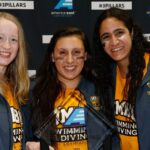
Imagine packing your bags and traveling 6,000 miles from home to spend four years in a country you’ve never visited. That’s exactly what Hania Moro ‘19, financial economics, did when she made the decision to travel from Egypt to UMBC in 2015 to start her collegiate career, and she hasn’t regretted it for a second. Ahead of graduation, Moro and fellow Retrievers Randy Deinlein and Collin David have shared their UMBC stories—unique paths and exceptional achievements thanks to a combination of personal grit and supportive community.
Jumping in feet first
Moro knew that swimming was going to be a major factor in her college decision process. At the suggestion of an a Egyptian friend at UMBC, she reached out to Chad Cradock ’97, psychology, head coach of UMBC swimming and diving. Cradock immediately followed up and Moro instantly knew “that’s the coach I’m gonna be with.”
 Hania Moro poses with coach and mentor Chad Cradock.
UMBC News: What has been most memorable about your time at UMBC?
Moro: Swimming took up most of my time. I was the team captain last year. I went to the World Championships twice. I was an African Game Gold Medalist in four different events. I broke my national records two times. I love the team, I love swimming with the team. When I graduate, I’m going to continue training [for the Olympics] here at UMBC with Chad. I can’t train with anyone else in the world. I wake up every day knowing that I need to work so hard to get to where I want to be.
 Moro shares her medals with friends.
UMBC News: What was your experience like arriving on campus and meeting your teammates?
Moro: I’d never been on a recruiting trip. I didn’t know what the campus was like, what the team was like. I was leaving my family and everything I knew. I figured I would just do it and hope for the best. I traveled for 18 hours—18 hours of tears. Chad picked me up from the airport and he’s just the nicest guy. He welcomed me and made me feel like I belong here. When I first arrived on move-in day, 70 of my teammates were waiting for me. They moved me in and made me feel like I was home. And I just felt like I have a family. Two days in America and I’m already very comfortable and I have 70 friends, not just one. This is my place now.
 UMBC’s swimming and diving team celebrates an America East win. Photo courtesy of Greg M. Cooper, America East.
UMBC News: How did your UMBC experience change you?
Moro: It definitely changed me as a person. I learned a lot of leadership skills. I look at things differently. I also learned to listen a lot—to listen instead of just talking. Chad taught me that it’s not about you, it’s about the team and about the community and what you can give everyone around you. I would swim my races and think, “I want to win this race not for me, but for my team.”
 Moro shows off her hardware.
What’s next for Moro? She’s pursuing her Olympic dreams, and she’s already well on her way to making them come true. At the recent United States Open Swimming Championships, Moro set a pair of Egyptian national records.
She also has her sights set on someday starting her own business. Inspired by an entrepreneurship class with Gib Mason, Moro has started to develop a plan to open a coffee and bagel shop in Egypt.
“The benefit comes from helping others”
Randy Deinlein is used to taking risks. He served in the United States Air Force for over four years, and has explored a range of paths in the time since then. So it may come as a surprise that Deinlein had some uncertainty about starting his UMBC journey.
While he had worries about adjusting to college as a returning student, he quickly channeled his energy and sense of mission into building connections and making a difference on campus. In his time at UMBC, he has been an S-STEM Scholar, Grand Challenge Scholar, member of Engineers Without Borders and the Honors College, and service coordinator for the Tau Beta Pi Engineering Honors Society. He also completed three internships to prepare for the next steps in his career.
 Randy Deinlein ‘19 (center) with Michael LaScola ‘20, chemical engineering, and Maria Sanchez, director of education and outreach for the College of Engineering and Information Technology. Photo courtesy of Rob Lacey.
UMBC News: What was the adjustment like when you arrived on campus—connecting with the UMBC community?
Deinlein: As a veteran, I don’t think the transition was difficult. We’re instilled with this value of having a mission, kind of like a goal. When we have a mission, it’s very easy to just do those steps to get towards it. But as an adult learner, I think that was hard for me…just feeling older and out of place and like I wouldn’t be able to relate to a lot of these young people. And I found I actually relate to a lot of them. I’m so impressed by all of their attitudes and their views of life because it’s nowhere near where I was when I was their age.
UMBC News: What activities have you been involved with at UMBC?
Deinlein: I helped to start the RetrieVets and served as the president. Veterans come here and see it as a kind of mission, but we’re not taught the benefits of being involved in the community. When you’re involved with group organizations and the community, you’re able to grow and challenge yourself in new experiences. The benefit comes from helping others. That’s what I wanted for a veteran organization.
 Deinlein poses with classmates Noelle Ray ‘19, M.S. ‘21, mechanical engineering, and Chelsie Marsh ‘19, mechanical engineering, with a bathroom seat adapter they created for a senior engineering capstone project.
UMBC News: How did your UMBC experience impact you?
Deinlein: It helped me move into the unknown and helped me be okay with challenging myself and doing things I don’t know how to do. I learned how to fail and fail fast…fail forward, as they say. I learned how to reflect on myself and what I have and haven’t done and every experience that I find important to myself, and how to grow from that. The UMBC community and the students, they are very supportive and open-minded. They’re diverse and interdisciplinary and outgoing.
Deinlein will graduate with a mechanical engineering degree and an entrepreneurship minor and has applied for a Fulbright Scholarship at the Lappeenranta University of Technology in Finland for a master’s in Global Management of Innovation and Technology.
Orchestrating his future
Collin David does not believe in downtime. The Carroll County native plays cello, French horn, guitar, piano, and clarinet. And also teaches private lessons. And takes lessons himself. And teaches gymnastics. And composes musical pieces. And maybe sleeps at some point, though that has not yet been confirmed.
After transferring from Carroll Community College, David enrolled in UMBC’s music composition track, a small, close-knit program that afforded him numerous opportunities to pursue his passions.
UMBC News: Why did you choose UMBC?
David: One of the reasons I chose UMBC was that I didn’t have to specialize. I applied to College Park and Shenandoah to do cello performance, but then I wouldn’t be able to take horn lessons or do the other stuff I wanted to do. Being a well-rounded musician is, I think, more important than being a specialist in one area.
 Collin David plays cello during a campus performance.
UMBC News: Is there a faculty member who has served as a mentor on your UMBC path?
David: Dr. [Linda] Dusman. She’ll always help when needed, and it’s basically like her connections are my connections. She sends emails to students when she sees opportunities that would be a good fit. She sent me one in particular about the São Paulo Contemporary Composers Festival. I got in and had a great experience. I was able to go to Brazil for a week and was lucky enough to have my orchestra piece played. Only myself and one other musician were undergraduate students.
The [music] department in general is very close-knit. Speaking about professors, they’ve definitely gone far and above what I would’ve expected. They’re personable and there’s not so much of a gap between the students and professors. I think that’s important.
 David with members of UMBC’s music department.
UMBC News: What is something you had an opportunity to explore at UMBC that you didn’t expect to?
David: I’ve been looking into astronomy. It has always been a hobby of mine, so for the first time, I took a 100-level astronomy class because I needed a science. I figured, “Hey, this will be fun.” But the pieces I’m writing now are influenced by that. I was also able to do frisbee and mountain biking, in addition to all of my musical things.
 David with family and friends following a performance.
UMBC News: What three words or phrases would you use to describe UMBC?
David: It’s definitely welcoming. I think there are many opportunities here for people, regardless of what you’re doing. And is there a word for rigorous but fun at the same time? Third word…I would say exploratory. I think especially in the music department, you’re encouraged to explore areas that are outside of your comfort zone. And that definitely happened for me. I think when I came here I was writing music, but not that forward-thinking. In my two years here I’ve drastically been able to shift styles.
After David graduates, he will interview for master’s and doctoral programs, with the goal of composing for movies, video games and other contemporary formats. Like Moro and Deinlein, he feels driven to create his own unique path forward.
December commencement ceremonies will be livestreamed through both the UMBC Commencement website and UMBC Facebook page. Share well wishes for our grads using #UMBCgrad and #UMBCproud.
Banner image: Hania Moro ’19 (right) holds the America East trophy with teammates Britt Driscoll ’19, biochemistry and molecular biology (left), and Natlie Davis ’19, biological sciences. Photo courtesy of Greg Cooper, America East. All other photos provided by students featured in piece unless otherwise noted.
]]>
Imagine packing your bags and traveling 6,000 miles from home to spend four years in a country you’ve never visited. That’s exactly what Hania Moro ‘19, financial economics, did when she made the...
https://umbc.edu/stories/swimmer-engineer-composer-three-retrievers-share-their-unique-paths-to-graduation-day/
https://beta.my.umbc.edu/api/v0/pixel/news/119990/guest@my.umbc.edu/8de0e73d79da63b4993a864eba1bf37f/api/pixel
athletics
cahss
class-of-2019
coeit
community
economics
honorscollege
international
meche
music
UMBC News & Magazine
https://beta.my.umbc.edu/groups/umbc-news-magazine
https://assets1-beta.my.umbc.edu/system/shared/avatars/groups/000/001/943/24435aa6207c452e7bc15cc74b42c7bb/xsmall.png?1748556657
https://assets1-beta.my.umbc.edu/system/shared/avatars/groups/000/001/943/24435aa6207c452e7bc15cc74b42c7bb/original.png?1748556657
https://assets2-beta.my.umbc.edu/system/shared/avatars/groups/000/001/943/24435aa6207c452e7bc15cc74b42c7bb/xxlarge.png?1748556657
https://assets2-beta.my.umbc.edu/system/shared/avatars/groups/000/001/943/24435aa6207c452e7bc15cc74b42c7bb/xlarge.png?1748556657
https://assets3-beta.my.umbc.edu/system/shared/avatars/groups/000/001/943/24435aa6207c452e7bc15cc74b42c7bb/large.png?1748556657
https://assets1-beta.my.umbc.edu/system/shared/avatars/groups/000/001/943/24435aa6207c452e7bc15cc74b42c7bb/medium.png?1748556657
https://assets2-beta.my.umbc.edu/system/shared/avatars/groups/000/001/943/24435aa6207c452e7bc15cc74b42c7bb/small.png?1748556657
https://assets1-beta.my.umbc.edu/system/shared/avatars/groups/000/001/943/24435aa6207c452e7bc15cc74b42c7bb/xsmall.png?1748556657
https://assets2-beta.my.umbc.edu/system/shared/avatars/groups/000/001/943/24435aa6207c452e7bc15cc74b42c7bb/xxsmall.png?1748556657
UMBC News & Magazine
0
0
false
Tue, 17 Dec 2019 03:28:20 -0500
“We need people just like you”: Transfer students find, and build, supportive communities at UMBC

Students come to UMBC with a variety of experiences and in different stages of life. The unique perspectives of transfer students enrich the University, particularly as students connect with and support each other. Here, three students earning their degrees this week share how they found community, and built community, at UMBC.
Supporting each other
When CJ Jude ‘19, history, met Andrew Nolan, he knew that UMBC at the Universities at Shady Grove was a place where he would succeed. Jude transferred from Montgomery College to UMBC-Shady Grove seeking a challenging and supportive learning community near his home and work. Meeting Nolan, a senior lecturer and director of UMBC’s history program at Shady Grove, gave Jude a sense of the team of faculty and staff dedicated to his learning and growth.
 CJ Jude. Photo by Marlayna Demond ’11 for UMBC.
“I just realized that you’re not going it alone, and that you can share your successes with people but you can also commiserate with them, too,” Jude shares. “When you realize that you’re part of a group like that, it makes your successes [even better].”
 The Universities at Shady Grove. Photo by Marlayna Demond ’11 for UMBC.
Reflecting on how much community support meant to him, Jude quickly developed a passion for helping other students have positive experiences transferring from community college. He connected with Chelsea Moyer, a director at Shady Grove, and became a part of the UMBC-Shady Grove Peer Advisory Team.
“We do a multitude of things, including a lot of open houses and orientations, and we give tours. We walk new students around campus, and help them through registration and verification and transferability forms,” Jude explains. “We try to put students at ease. If there’s a way we can make their transition less jarring, that’s what we do.”
 CJ Jude, left, with some friends at Shady Grove. Photo courtesy of CJ Jude.
Jude particularly recalls the moments when students he has led through orientation have thanked him for making their experience so positive. “I’ve actually had some of the students whom I took the lead for come up to me and say, ‘Hey, you were really helpful to me, and I’m doing okay this semester because you gave me a good heads up,’” he says. “It was one of those moments where I kind of realized how much power my voice had.”
Building a network
Like Jude, Bianca Monge ‘19, information systems, transferred to UMBC from Montgomery College. Monge knew that she was interested in pursuing a career in cybersecurity, specifically focused on computer networking. She was drawn to UMBC’s Cyber Scholars program, run through the Center for Women in Technology (CWIT) and the Center for Cybersecurity. The program has provided her with meaningful and transformative opportunities, and Cindy Greenwood, assistant director of CWIT, has served as a mentor for Monge during her time at UMBC.
Transitioning to life as a UMBC student “was a lot easier and smoother than I thought,” she shares, thanks to her newfound support network. A weekend orientation specifically for Cyber Scholars helped her to become familiar with the campus and make connections with other students. “It was an introduction to how my semester would be as a Cyber Scholar,” she explains. “By the time I came back in the fall to take classes, I already had a network of classmates, friends, and contacts.”
 Bianca Monge, second from the left, and student leaders from the UMBC chapter of the Information System Security Association. Photo courtesy of Bianca Monge.
CWIT networking opportunities and special events have proved beneficial to Monge’s academic and professional growth as she advanced in the Cyber Scholars program, Monge was paired with an incoming Cyber Scholar, whom she has mentored throughout the year. “I didn’t think that I had much to offer,” she shared, but that changed when she found she was able to answer her mentee’s questions based on her own UMBC experience. “I am more than happy to tell her all that I knew, and all that I have learned over the years.”
Outside of CWIT, Monge has been an active member of the UMBC chapter of the Information System Security Association (ISSA), a student organization that helps students pursuing degrees in information systems with career networking and connecting with industry experts. She says that having facetime and interactions with professionals helped her become more confident as a student, and prepare her for her career.
 Bianca Monge, second from right in back row, with her Cyber Scholars cohort. Photo courtesy of Cindy Greenwood.
Monge had an opportunity to intern for Leidos over the summer, and plans to begin working full-time with the company as a cyber intelligence analyst after graduation.
Creating a community
Josie Aquino ‘19, mechanical engineering, came to UMBC after transferring from Harford Community College. When she arrived on campus for a tour, she says, “I immediately felt so at home and not just the physical environment, but the people around me. I knew I could make this my home, and that I could learn a lot here.”
Aquino was eager to get connected on campus, exploring new interests and building new relationships. “I’m a returning student, a first-generation student, and also a transfer student, and I really felt like now is my time to dig in and try all these different things.”
Aquino has been able to challenge herself while also accessing community support as a Returning Women’s Scholar through the UMBC Women’s Center, and a member of the S-STEM program through the mechanical engineering department. These groups, she says, helped her feel part of something larger. As a commuting student, Aquino found that the Women’s Center in particular provided a peaceful and welcoming space for her to use between classes.

Aquino also began conducting research alongside Jamie Gurganus, associate director of engineering education initiatives, on transfer students in STEM. She has focused on transfer students’ beliefs about engineering, and their sense of identity as engineers, which can impact degree attainment and career trajectory.
As she settled in to life at UMBC, Aquino became passionate about helping incoming students have the kind of positive experience that she has enjoyed. Recalling how helpful she found a transfer student seminar in her first semester on campus, Aquino was connected with Laila Shishineh, director of academic engagement and transition programs, by Gurganus to learn how she could get involved on the teaching side. Aquino became a peer facilitator and has now supported transfer students in seminar classes over multiple semesters.
 Josie Aquino, and two peers adjusting a bike to make it accessible for people with disabilities through the Volunteers for Medical Engineering organization. Photo courtesy of Josie Aqunio.
Combined, these experiences have helped Aquino feel confident and prepared for her future career, and energized to support new transfer students in reaching for their goals. “We need people just like you, with your experiences and your perspectives, represented here,” she shares with incoming students. “The community is just really incredible to be a part of.”
Banner image: Josie Aquino, right, in the Women’s Center at UMBC. Photo courtesy of Josie Aquino.
]]>
Students come to UMBC with a variety of experiences and in different stages of life. The unique perspectives of transfer students enrich the University, particularly as students connect with and...
https://umbc.edu/stories/we-need-people-just-like-you-transfer-students-find-and-build-supportive-communities-at-umbc/
https://beta.my.umbc.edu/api/v0/pixel/news/119991/guest@my.umbc.edu/32770160ca35a8087a42fddb9879ff8d/api/pixel
cahss
class-of-2019
coeit
community
cyberscholars
history
is
meche
page1
shadygrove
womenscenter
UMBC News & Magazine
https://beta.my.umbc.edu/groups/umbc-news-magazine
https://assets1-beta.my.umbc.edu/system/shared/avatars/groups/000/001/943/24435aa6207c452e7bc15cc74b42c7bb/xsmall.png?1748556657
https://assets1-beta.my.umbc.edu/system/shared/avatars/groups/000/001/943/24435aa6207c452e7bc15cc74b42c7bb/original.png?1748556657
https://assets2-beta.my.umbc.edu/system/shared/avatars/groups/000/001/943/24435aa6207c452e7bc15cc74b42c7bb/xxlarge.png?1748556657
https://assets2-beta.my.umbc.edu/system/shared/avatars/groups/000/001/943/24435aa6207c452e7bc15cc74b42c7bb/xlarge.png?1748556657
https://assets3-beta.my.umbc.edu/system/shared/avatars/groups/000/001/943/24435aa6207c452e7bc15cc74b42c7bb/large.png?1748556657
https://assets1-beta.my.umbc.edu/system/shared/avatars/groups/000/001/943/24435aa6207c452e7bc15cc74b42c7bb/medium.png?1748556657
https://assets2-beta.my.umbc.edu/system/shared/avatars/groups/000/001/943/24435aa6207c452e7bc15cc74b42c7bb/small.png?1748556657
https://assets1-beta.my.umbc.edu/system/shared/avatars/groups/000/001/943/24435aa6207c452e7bc15cc74b42c7bb/xsmall.png?1748556657
https://assets2-beta.my.umbc.edu/system/shared/avatars/groups/000/001/943/24435aa6207c452e7bc15cc74b42c7bb/xxsmall.png?1748556657
UMBC News & Magazine
0
0
false
Mon, 16 Dec 2019 18:30:49 -0500
 The researchers working on the HDR grant. Photo courtesy of Aryya Gangopadhyay.


