A new world order isn’t coming, it’s already here − and this is what it looks like
Written by John Rennie Short, professor emeritus of public policy, UMBC
On Sept. 3, 2025, China celebrated the 80th anniversary of its victory over Japan by staging a carefully choreographed event in which 26 world leaders were offered a podium view of Beijing’s impressive military might.
The show of strength was deliberate and reignited a debate in Western media over whether we are on the cusp of a China-centric “new world order” to replace the U.S.-dominated international “rules-based order.”
But as someone who writes about geopolitics, I believe we are already there. It might be in flux, and the U.S. still has a big role in it, but a new world order has begun – and as it develops, it will look increasingly different than what it’s replacing.
A brief history of world orders
Global history can be understood as the rise and fall of different orders, defined as a given era’s dominant power relations and attendant institutions and norms.
From 1815 to 1880, the United Kingdom was the undisputed world superpower, with an empire and navy that spanned the globe. The period from 1880 to 1945 was one of imperial rivalries as other countries – largely European and the U.S. – sought to copy Britain’s success and replace its dominance. Supplanting that was the bipolar world of two competing superpowers, the Soviet Union and the U.S., marking the period from 1945 to 1991.
The fall of the Soviet Union was the beginning of a brief period, from 1991 to 2008, of a unipolar world centered on U.S. global dominance, military power and economic might. With the retreat of global communism, the U.S. increased its influence, and that of the international rules-based order it helped establish after 1945, through institutions such as the World Trade Organization, World Bank and International Monetary Fund.
 The tearing down of the Berlin Wall marked the end of the Cold War. Colin Campbell/Getty Images
It did not last long in the face of a long war on terrorism, the fiasco of the invasion of Iraq, the long occupation of Afghanistan and finally the 2008 global financial crisis that undermined U.S. strength and weakened domestic support for Washington’s role as the world’s policeman.
Toward a multipolar world
In recent years, a new multipolar world has emerged with at least four distinct sources of power.
The U.S. remains central to this world order. It is blessed with a huge territory, a dynamic economy and the strategic luxury of large oceans on its east and west and much smaller powers to its north and south. The U.S. had a global military presence in the previous bipolar and unipolar order. But the cost of this imperial overstretch has prompted Washington to shift the cost burden toward its former allies, leading to a new militarization in Europe and East Asia where most countries now aim to increase military spending.
There is also a change in economic arrangements. In the unipolar order, the U.S. promoted a frictionless free trade arrangement and economic globalization. This resulted in the global shift of manufacturing that in turn created a populist backlash in those countries where manufacturing employment was hollowed out.
Now, economic nationalism is becoming a much more common refrain than free trade. Long the promoter of purportedly open markets, the U.S. is now leading the way in resurrecting tariff barriers to levels that haven’t been seen on the global stage in decades.
The military realignments and growing trade barriers will make it increasingly difficult to assemble durable alliances. In the short term the U.S. can leverage its existing power to its advantage, but over the long term other countries will likely pivot away from too much reliance on the U.S. The American Century that publishing magnate Henry Luce famously described in 1941 has to all intents and purposes come to an end.
China is now a peer competitor to the U.S. in both economic and military power. Increasingly, under the powerful leadership of Xi Jinping, China openly seeks a more Sino-centric world order with institutions and a global arrangement to match. To that end, it is assembling an axis of resistance to a U.S.-dominated world order. Russia, suffering from post-imperial syndrome, is an important member but not an equal partner.
Russian power is limited to establishing a Eurasian sphere of influence across its former Soviet republics and disrupting liberal democracies. But in that, Russia is more of a spoiler than an architect of the new order.
And then there is Europe, facing what British Prime Minister Keir Starmer referred to as a “generational challenge” as the U.S. pivots away from Europe toward the Indo-Pacific just as Russia poses a more serious threat to Europe, especially for its easternmost states.
Europe is remilitarizing after decades of demilitarizing. Sweden and Finland joined NATO in 2023 and 2024, respectively. In the coming decades, Europe could emerge as an independent source of both economic and military power with a different agenda from the U.S. – more keen to confront Russia, less willing to support Israel, and perhaps more willing to engage with China.
But all three power centers – the U.S., China and Europe – will struggle with similar and unique internal challenges.
All of them have sluggish economies and aging populations. The U.S. faces growing inequality and political instability as it shifts from a liberal democracy to competitive authoritarianism. China has an untested military, a looming demographic crisis, a faltering economy and a forthcoming succession struggle.
Finally, Europe is beset with a nationalist populism and growing social welfare costs just as military expenditures are set to increase.
The growth of the Global South
This threefold division is strangely reminiscent of the tripartite global division in George Orwell’s “1984,” where Oceania, Eurasia and Eastasia fought a permanent war of shifting alliances.
But Orwell was writing at a time when much of what is now called the Global South was either under the informal or formal control of the superpowers. That is no longer the case in the Global South, especially in the case of the larger countries such as Brazil, India and Indonesia.
The Global South is not yet a coherent bloc, more an informal arrangement of independent actors that tend to hedge between the major powers.
A world in flux
Yet none of this new global reality means that things are now fixed. Indeed, the new world order is in a state of disruptive flux that promises years of growing pains. Both the U.S. and China need allies, and countries in the Global South will continue to hedge between the competing powers.
 It doesn’t have to end this way. Dan Kitwood/Getty Images
As such, the world is in for a process of constant jostling as the major powers seek alliances while dealing with domestic pressures. In that messy status quo, many questions remain: Who will be most effective in building durable alliances? Will China manage its internal challenges? Will Europe get its act together? Will Russia continue its disruptive ways? Could a post-Trump U.S., post-Putin Russia and post-Xi China move the world in yet a different direction altogether?
And there is one large question above all others: Can the major powers manage their competition through shared global interests, such as combating climate change, environmental pollution and pandemic threats? Or will mounting conflict in the newly contested areas of the Arctic, cyberspace, outer space and the oceanic realm, and in ongoing geopolitical hot spots provide the trigger for outright conflict?
All world orders come to an end. The hope is the old one is doing so with a whimper rather than a bang.
John Rennie Short, Professor Emeritus of Public Policy, University of Maryland, Baltimore County
This article is republished from The Conversation under a Creative Commons license. Read the original article and see more than 300 UMBC articles available in The Conversation.
]]>
Written by John Rennie Short, professor emeritus of public policy, UMBC On Sept. 3, 2025, China celebrated the 80th anniversary of its victory over Japan by staging a carefully choreographed...
https://umbc.edu/stories/a-new-world-order-is-already-here-john-short/
https://beta.my.umbc.edu/api/v0/pixel/news/152527/guest@my.umbc.edu/0219ee54cd5c5294b0b91cf59e8545c1/api/pixel
cahss
conversation
discovery
magazine
publicpolicy
research
story
UMBC News & Magazine
https://beta.my.umbc.edu/groups/umbc-news-magazine
https://assets1-beta.my.umbc.edu/system/shared/avatars/groups/000/001/943/24435aa6207c452e7bc15cc74b42c7bb/xsmall.png?1748556657
https://assets1-beta.my.umbc.edu/system/shared/avatars/groups/000/001/943/24435aa6207c452e7bc15cc74b42c7bb/original.png?1748556657
https://assets2-beta.my.umbc.edu/system/shared/avatars/groups/000/001/943/24435aa6207c452e7bc15cc74b42c7bb/xxlarge.png?1748556657
https://assets2-beta.my.umbc.edu/system/shared/avatars/groups/000/001/943/24435aa6207c452e7bc15cc74b42c7bb/xlarge.png?1748556657
https://assets3-beta.my.umbc.edu/system/shared/avatars/groups/000/001/943/24435aa6207c452e7bc15cc74b42c7bb/large.png?1748556657
https://assets1-beta.my.umbc.edu/system/shared/avatars/groups/000/001/943/24435aa6207c452e7bc15cc74b42c7bb/medium.png?1748556657
https://assets2-beta.my.umbc.edu/system/shared/avatars/groups/000/001/943/24435aa6207c452e7bc15cc74b42c7bb/small.png?1748556657
https://assets1-beta.my.umbc.edu/system/shared/avatars/groups/000/001/943/24435aa6207c452e7bc15cc74b42c7bb/xsmall.png?1748556657
https://assets2-beta.my.umbc.edu/system/shared/avatars/groups/000/001/943/24435aa6207c452e7bc15cc74b42c7bb/xxsmall.png?1748556657
UMBC News & Magazine
1
0
false
Tue, 16 Sep 2025 12:25:25 -0400
Tue, 16 Sep 2025 12:25:25 -0400
Meet A Retriever—Kayla Logue ’27, dance major, cinematography minor, and Linehan Artist Scholar
Meet Kayla Logue, a junior with a dance major and a cinematography minor. Kayla is a Linehan Artist Scholar, is an intern for UMBC’s communications and marketing team, and is a Visual and Performing Arts Grit Guide at UMBC. She currently serves as the president of the Dance Council Of Majors; A student organization that works closely with the Department of Dance.
Q: Tell us about someone in the UMBC community who has inspired you or supported you, and how they did it.
A: I have had the pleasure of learning from many incredible professors so far here at UMBC, especially in the Department of Dance. One professor that I have had the pleasure to work closely with and who continuously inspires and supports me is Shaness D. Kemp.
Since my freshman year, I have looked up to Ms. Shaness because she is an incredible artist, teacher, and spirit! I had the opportunity to assist with her work for the Baltimore Dance Project in my sophomore year. Witnessing her rehearsal process and her creative mind inspires me as a dancer every day. As a teacher, professor Kemp always pushes me to be what she knows I am capable of, and she always supports me in achieving my goals.
Q: What’s the one thing you’d want someone who hasn’t joined the UMBC community to know about the support you find here?
A: UMBC is a place where you can find others who share your goals and are equally passionate.
The community here has helped me to believe in myself more than anything.
Kayla Logue ’27
Dance, President of Dance Council Of Majors
Q: What part of your job do you enjoy the most and why?
A: As a Visual and Performing Arts Grit Guide, I absolutely love getting to share my passion for UMBC and its community! So far, I have truly found incredible opportunities in my time here, as well as a beloved home away from home with the family I have in this community.
 Kayla Logue with friends at the Linehan 30th Anniversary party (photo courtesy of Jillian Casey)
Q: What brought you to UMBC in the first place?
A: I came to UMBC because of the opportunities it presented. I loved the Dance Department and its faculty, I would be able to both dance and continue my passions for visual art, and I was still close to home.
Q: Since you’ve been a part of the UMBC community, how have you found support of your WHY? Tell us about the people who have helped you at UMBC, and why it has made such a difference to you.
A: The UMBC community has helped me gain confidence in all my endeavors. I have met so many fellow Retrievers who inspire me with their passion and drive, and I have such incredible support from my professors who want to see me succeed. The community here has helped me to believe in myself more than anything.
 Kayla Logue and fellow dance majors outside the Kennedy Center (Kayla Logue/UMBC)
Q: Are you involved in any campus organizations? Tell us about what you love about them!
A: I currently serve as the president for UMBC’s Dance Council of Majors. I am incredibly honored to be in this leadership position because we foster community engagement amongst those who love to move and groove.
* * * * *
UMBC’s greatest strength is its people. When people meet Retrievers and hear about the passion they bring, the relationships they create, the ways they support each other, and the commitment they have to inclusive excellence, they truly get a sense of our community. That’s what “Meet a Retriever” is all about.
]]>
Meet Kayla Logue, a junior with a dance major and a cinematography minor. Kayla is a Linehan Artist Scholar, is an intern for UMBC’s communications and marketing team, and is a Visual and...
https://umbc.edu/stories/meet-a-retriever-kayla-logue-dance-linehan-artist/
https://beta.my.umbc.edu/api/v0/pixel/news/152528/guest@my.umbc.edu/7f809098ac21dac2f782b1f16652aab6/api/pixel
cahss
campus-life
dance
linehanscholars
magazine
meetaretriever
perspectives
story
UMBC News & Magazine
https://beta.my.umbc.edu/groups/umbc-news-magazine
https://assets1-beta.my.umbc.edu/system/shared/avatars/groups/000/001/943/24435aa6207c452e7bc15cc74b42c7bb/xsmall.png?1748556657
https://assets1-beta.my.umbc.edu/system/shared/avatars/groups/000/001/943/24435aa6207c452e7bc15cc74b42c7bb/original.png?1748556657
https://assets2-beta.my.umbc.edu/system/shared/avatars/groups/000/001/943/24435aa6207c452e7bc15cc74b42c7bb/xxlarge.png?1748556657
https://assets2-beta.my.umbc.edu/system/shared/avatars/groups/000/001/943/24435aa6207c452e7bc15cc74b42c7bb/xlarge.png?1748556657
https://assets3-beta.my.umbc.edu/system/shared/avatars/groups/000/001/943/24435aa6207c452e7bc15cc74b42c7bb/large.png?1748556657
https://assets1-beta.my.umbc.edu/system/shared/avatars/groups/000/001/943/24435aa6207c452e7bc15cc74b42c7bb/medium.png?1748556657
https://assets2-beta.my.umbc.edu/system/shared/avatars/groups/000/001/943/24435aa6207c452e7bc15cc74b42c7bb/small.png?1748556657
https://assets1-beta.my.umbc.edu/system/shared/avatars/groups/000/001/943/24435aa6207c452e7bc15cc74b42c7bb/xsmall.png?1748556657
https://assets2-beta.my.umbc.edu/system/shared/avatars/groups/000/001/943/24435aa6207c452e7bc15cc74b42c7bb/xxsmall.png?1748556657
UMBC News & Magazine
0
0
false
Tue, 16 Sep 2025 12:19:58 -0400
Tue, 16 Sep 2025 12:19:58 -0400
Feeling supported at summer internships gives Retrievers a leg up in applied learning
“Support” is one of the most frequently used words when UMBC students reflect on their internship experiences on and off campus. From resources offered by the Career Center, to guidance from professors, and even sometimes from peers who wind up working side-by-side, UMBC students depend on university support and the many shapes it takes.
This summer, hundreds of Retrievers built upon the foundational knowledge they learned in the classroom and applied it to hands-on, real-world learning through internships. From getting front seat roles in bridge engineering and analyzing cyber threats to using inspiration drawn from campus, these UMBC students had plenty to write about for their “What I Did with My Summer Vacation” essays.
The science of sticking together
Mustafa Akpinar, a senior information systems major; Alek Read, a senior environmental science major; and Ty Allen, a junior mechanical engineering major, honed technical expertise, built teamwork and communication skills, and forged connections with peers and professionals on the Baltimore/D.C. biotech scene working at AstraZeneca.
Akpinar worked as a cyber threat intelligence and threat detection intern, a position that closely aligned with his career trajectory. “This internship is a perfect fit for both my academic path and long-term career goals,” Akpinar says, noting how the role builds on his data communications and networks and database design courses.
 A mixer for UMBC alumni employees and interns at AstraZeneca was a meaningful way for the students to network with potential mentors. (Courtesy of Miriam Friedman)
Read and Allen also used the summer to further their professional goals. Read contributed to sustainability efforts at AstraZeneca’s Frederick Manufacturing Center as an environmental health safety intern and Allen served as a site operations intern, applying his engineering skills to edit technical drawings in AutoCAD.
Building bridges
As all of Baltimore and most of the country recalls, Maryland’s Francis Scott Key Bridge was struck by a cargo ship and collapsed in March of 2024. The impacts of this catastrophe are still felt throughout the region with travel complications, economic hardships, and more. Through a partnership between the Maryland Transportation Authority and the Maryland Higher Education Commission, three Retrievers and six other Maryland-based students had the chance to join the Key Bridge Rebuild Internship Program.
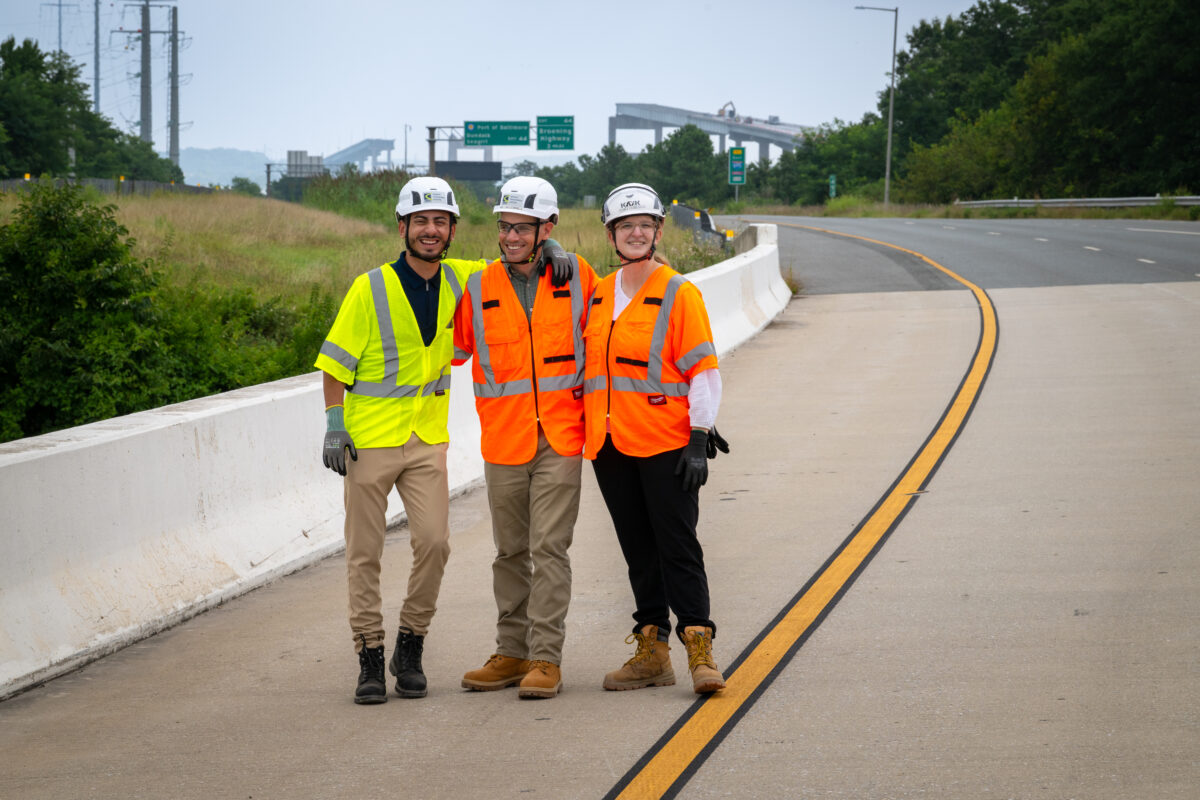 From left to right, Cristian Mena, William McConnell, and Emily DiMarzio pose for a photo near the site of the collapsed Key Bridge. The three worked on the bridge rebuilding project as interns with the Maryland Transportation Authority. (Brad Ziegler/UMBC)
Emily DiMarzio, a junior studying environmental science and geography, and Cristian Mena and William McConnell, both seniors studying mechanical engineering, all explored their individual areas of interest while actively helping to rebuild in their own community.
“It hurt when the bridge went down,” says McConnell, who grew up in Baltimore and now lives with his wife and three kids in Catonsville. “You could practically see it from our neighborhood, and now see that it is missing. So when the opportunity came along to apply for this internship, I jumped on it.”
Bustling Baltimore
The UMBC Career and Internship Fair is a first foot in the door for many UMBC students seeking to make networking connections. This was precisely the case for Wonder Akpabio, a junior computer science major, who connected with a recruiter from T. Rowe Price who helped guide her through the interview process.
With a massive network of UMBC alumni, T. Rowe Price is already a well-known investment management firm with Retrievers, with the added bonus of being headquartered in Baltimore. Gabriel Farmer, another junior computer science major, was impressed with the outreach efforts the company did with UMBC, like sending recruiters to events and hosting online programming.
 Gabriel Farmer in Baltimore’s Inner Harbor, near the headquarters of T. Rowe Price, where he interned in summer 2025. (Brad Ziegler/UMBC)
“Anytime you ask a question, people are ready to help,” Farmer says. “It’s been a very good experience, and T. Rowe Price is definitely a place I could see myself continuing to work at.”
Connections across campus
UMBC is far from a sleepy campus in the summer, with hundreds of research, internship, and student-employment opportunities available. So, while others traveled far and wide to secure an internship in their area of interest, some Retrievers saw the home-field advantage right in front of them.
Giovanna Orfali, a visual arts senior from São Paulo, Brazil, spent this summer behind the camera as a digital content intern at both the Maryland Center for History and Culture and UMBC’s event and conference services. Humanities Scholar Kendal Howell stepped off the plane after studying business management abroad in France this past spring and into the office as an intern at UMBC’s Division of Student Affairs for their new academic partnerships and high-impact experiences unit.
 Kendal Howell updates internship supervisor, James DeVita, on her latest project. (Brad Ziegler/UMBC)
Second-year gerontology doctoral student Claire McDonald also had the opportunity to conduct new research, working with Rowena Winkler, the new assistant director for graduate student career development at the UMBC Career Center, who was seeking graduate students to conduct a 10-week qualitative research project. Caleb Ruck ’22, modern languages, linguistics, and intercultural communication, and M.A. ’24, intercultural communication, continued his work becoming the first year-long graduate assistant for the Center for Social Justice Dialogue.
A numbers game
With so many resources available to help students land their dream internship, it’s not surprising to see the statistics of success—85 percent of recent alumni engaged in applied learning like internships, research, service-learning, or leadership during their time at UMBC. Thanks to the work they’re putting into their futures as a student, 93 percent graduate with firm plans for employment or graduate school within six months of graduation.
“I’m continually inspired by the way our students engage in applied learning to launch their careers,” says Marykate Conroy, associate director of internships and employment. “UMBC students are entering the workforce prepared and in demand.”
 Tanzila Malik speaking at the Women’s History Month panel, hosted by the Women’s, Gender, and Equity Center.
UMBC’s Career Center offers a comprehensive suite of resources including SteppingBlocks to explore alumni career paths and outcomes, UMBC Careers Unleashed Podcast for stories and insights, the Internship and Research Success Practicum course to complement student work experiences, Handshake for employer connections, and the UMBC Career Connectors network of faculty and staff linking the classroom to careers.
The annual Career and Internship Fair will be held on Wednesday, September 17, from 11:30 a.m. – 3:30 p.m. in the Retriever Activity Center. “Get engaged, ask the big questions, push yourself to achieve your goals, and influence the world. The UMBC community will be right there with you along your journey,” recommends Tanzila Malik ’26, women’s studies, who spent two years interning with the Women’s, Gender, and Equity Center.
Read more about where internships took Retrievers this summer.
]]>
“Support” is one of the most frequently used words when UMBC students reflect on their internship experiences on and off campus. From resources offered by the Career Center, to guidance from...
https://umbc.edu/stories/campus-support-umbc-summer-internships-2025/
https://beta.my.umbc.edu/api/v0/pixel/news/152407/guest@my.umbc.edu/bdde959821900d8673fa552b719cbdd0/api/pixel
cahss
careercenter
cnms
coeit
community
computer-science
ges
gwsst
humanities-scholar
internships
is
meche
mlli
news
story
visual-arts
UMBC News & Magazine
https://beta.my.umbc.edu/groups/umbc-news-magazine
https://assets1-beta.my.umbc.edu/system/shared/avatars/groups/000/001/943/24435aa6207c452e7bc15cc74b42c7bb/xsmall.png?1748556657
https://assets1-beta.my.umbc.edu/system/shared/avatars/groups/000/001/943/24435aa6207c452e7bc15cc74b42c7bb/original.png?1748556657
https://assets2-beta.my.umbc.edu/system/shared/avatars/groups/000/001/943/24435aa6207c452e7bc15cc74b42c7bb/xxlarge.png?1748556657
https://assets2-beta.my.umbc.edu/system/shared/avatars/groups/000/001/943/24435aa6207c452e7bc15cc74b42c7bb/xlarge.png?1748556657
https://assets3-beta.my.umbc.edu/system/shared/avatars/groups/000/001/943/24435aa6207c452e7bc15cc74b42c7bb/large.png?1748556657
https://assets1-beta.my.umbc.edu/system/shared/avatars/groups/000/001/943/24435aa6207c452e7bc15cc74b42c7bb/medium.png?1748556657
https://assets2-beta.my.umbc.edu/system/shared/avatars/groups/000/001/943/24435aa6207c452e7bc15cc74b42c7bb/small.png?1748556657
https://assets1-beta.my.umbc.edu/system/shared/avatars/groups/000/001/943/24435aa6207c452e7bc15cc74b42c7bb/xsmall.png?1748556657
https://assets2-beta.my.umbc.edu/system/shared/avatars/groups/000/001/943/24435aa6207c452e7bc15cc74b42c7bb/xxsmall.png?1748556657
UMBC News & Magazine
0
0
false
Fri, 12 Sep 2025 16:12:34 -0400
Fri, 12 Sep 2025 16:12:34 -0400
Picturing Mobility: Black Tourism and Leisure During the Jim Crow Era
The Jim Crow era was marked by strict racial segregation, severely limiting Black individuals’ mobility and dignity. Public leisure spaces were often segregated, making travel dangerous and humiliating for Black people, which affected their leisure habits and options. Picturing Mobility: Black Tourism and Leisure During the Jim Crow Era, an exhibition curated by Elizabeth Patton, chair and associate professor of media and communication studies, is on view through December 19 at UMBC’s Albin O. Kuhn Library Gallery.


 Left to right: Picnic in Highland Beach, Maryland; couple hugging; four women standing in front of a car parked at Carr’s Beach (Courtesy of Addison Scurlock, Stanley B. Burns Archive, Maryland State Archives).
The new exhibit, curated with organizational support from Beth Saunders and Emily Cullen ’06, with exhibition design by Tony Venne and Cullen, highlights how ordinary people captured moments from their personal lives.
These images depict mobility through scenes of relaxation, happiness, amusement, and community, challenging the dominant narrative of Black life during Jim Crow as primarily defined by restrictions and struggle. This exhibition emphasizes the power of these images to affirm Black humanity and provide meaningful insights into life fully lived despite the oppressive system of segregation.

 Left to right: Gloria Lewis, 14, and Marilyn Lewis, 10, sisters from Marrifield, Maryland, enjoying themselves at Carr’s Beach; Boy in Toy Car (Courtesy of the Stanley B. Burns Archive, AFRO Charities).
Picturing Mobility invites viewers to explore what it meant for Black Americans to seek joy, rest, and travel amid a world shaped by exclusion and segregation. It draws on photographs, oral histories, audio, video, and travel ephemera related to Black tourism and leisure activities, mainly from the mid-Atlantic region, from the 1920s to the 1960s. The artifacts show how documenting and taking part in leisure and mobility were powerful forms of resistance.
Patton’s current book project, Documenting Black Leisure as a Form of Resistance, examines the history of Black leisure and tourism in the U.S. through Jim Crow-era media. The AOK Library Gallery will host an opening reception and curatorial talk with Patton on September 19 from 5 to 7 p.m.
The presentation of this exhibition and its public programs is supported by the Arts+ Initiative; the College of Arts, Humanities, and Social Sciences; and an arts program grant from the Maryland State Arts Council, an agency funded by the State of Maryland and the National Endowment for the Arts. Additional support comes from the Libby Kuhn Endowment Fund, as well as individual contributors.
]]>
The Jim Crow era was marked by strict racial segregation, severely limiting Black individuals’ mobility and dignity. Public leisure spaces were often segregated, making travel dangerous and...
https://umbc.edu/stories/black-tourism-and-leisure-during-the-jim-crow-era/
https://beta.my.umbc.edu/api/v0/pixel/news/152408/guest@my.umbc.edu/14d5f3809db70535e60b61444c351c63/api/pixel
arts
arts-and-culture
cahss
library
media-and-communication-studies
news
story
visualarts
UMBC News & Magazine
https://beta.my.umbc.edu/groups/umbc-news-magazine
https://assets1-beta.my.umbc.edu/system/shared/avatars/groups/000/001/943/24435aa6207c452e7bc15cc74b42c7bb/xsmall.png?1748556657
https://assets1-beta.my.umbc.edu/system/shared/avatars/groups/000/001/943/24435aa6207c452e7bc15cc74b42c7bb/original.png?1748556657
https://assets2-beta.my.umbc.edu/system/shared/avatars/groups/000/001/943/24435aa6207c452e7bc15cc74b42c7bb/xxlarge.png?1748556657
https://assets2-beta.my.umbc.edu/system/shared/avatars/groups/000/001/943/24435aa6207c452e7bc15cc74b42c7bb/xlarge.png?1748556657
https://assets3-beta.my.umbc.edu/system/shared/avatars/groups/000/001/943/24435aa6207c452e7bc15cc74b42c7bb/large.png?1748556657
https://assets1-beta.my.umbc.edu/system/shared/avatars/groups/000/001/943/24435aa6207c452e7bc15cc74b42c7bb/medium.png?1748556657
https://assets2-beta.my.umbc.edu/system/shared/avatars/groups/000/001/943/24435aa6207c452e7bc15cc74b42c7bb/small.png?1748556657
https://assets1-beta.my.umbc.edu/system/shared/avatars/groups/000/001/943/24435aa6207c452e7bc15cc74b42c7bb/xsmall.png?1748556657
https://assets2-beta.my.umbc.edu/system/shared/avatars/groups/000/001/943/24435aa6207c452e7bc15cc74b42c7bb/xxsmall.png?1748556657
UMBC News & Magazine
0
0
false
Fri, 12 Sep 2025 15:58:21 -0400
Fri, 12 Sep 2025 15:58:21 -0400
A giant among mantis shrimp: Tom Cronin’s outsized legacy of mentorship ripples outward in visual ecology and beyond
Every biological sciences graduate student at UMBC knows “the face”—Tom Cronin’s signature scowl, which, contrary to appearances, signals rapt attention rather than disapproval. At a day-long symposium honoring Cronin’s remarkable career, alumni handed out life-sized cutouts of “the face” on sticks, which attendees waved playfully during talks, setting the tone for a joyful, family reunion-like event filled with laughter, affection, and mutual respect.
Cronin began his 43-year tenure at UMBC as an assistant professor at the young university. Over time, he became a giant in the field of visual ecology, primarily studying the enigmatic mantis shrimp. His work has helped unravel the mysteries of mantis shrimp eyes—biological marvels that still hold scientific secrets.
On the eve of his retirement, dozens of Cronin’s colleagues and alumni traveled from all over the world to attend the symposium, and still others attended virtually or sent pre-recorded messages. Chuan-Chin Ciao, Ph.D. ’00, biological sciences, may have come the farthest, visiting from National Tsing Hua University in Taiwan. Symposium talks spanned bumblebees, fanworms, deep-sea fish, and more, showcasing the breadth of Cronin’s network.
 “The face” is infamous among UMBC graduate students. Symposium organizers printed out copies for attendees to magnify its effect during the symposium. (Photo by Michelle Starz-Gaiano)
“You taught us how to be scientists”
Cronin’s mentees, many now leading their own labs around the world, shared how he had influenced their lives. Megan Porter, a former postdoctoral fellow in Cronin’s lab, thanked him for expanding her expertise in molecular biology and genetics to visual ecology. “When I came in, I had a Ph.D.; I thought I knew stuff. But at the first lab meeting, I realized I knew nothing about visual ecology,” Porter recalls. “I can’t thank him enough for bringing me into this community and giving me such a broad foundation.” Now she strives to do the same for her students as a professor at the University of Hawai’i.
Michael Bok, Ph.D. ’13, biological sciences, shared “Cronin wisdom,” such as “Work on something ridiculously cool,” “Surround yourself with great scientists and good friends,” and “Have patience and don’t give up”—ideas Bok has carried into his work as a researcher at the University of Lund in Sweden. Kathryn Feller, Ph.D. ’14, biological sciences, the John D. MacArthur Assistant Professor of Biological Sciences at Union College, displayed a pencil drawing of a tomcat, picked up at a thrift store and mounted in the lab for the last decade. Its inscription reads, “Tom is tough, but he’s your friend”—a sentiment that reflects Cronin’s mentorship style.
 (l-r): Megan Porter, Michael Bok, Tom Cronin, and Kate Feller enjoy each other’s company after the symposium. (Photo by Michelle Starz-Gaiano)
Alex Kingston, Ph.D. ’15, biological sciences, now an assistant professor at the University of Tulsa, thanked him for supporting her growth. “Anyone can teach you how to do science, but you taught us how to be scientists,” Kingston shared. One of Cronin’s major lab instruments is moving to Kingston’s lab in Oklahoma to enrich her research program.
Cronin taught nearly 8,000 undergraduates over 86 semesters, valuing their diverse perspectives, and described UMBC as “a place you can really succeed as a young investigator.” He thanked the UMBC faculty and staff and his family for their enduring support, especially his wife, Ros. The symposium was a testament to Cronin’s legacy—a vibrant community built on curiosity, mentorship, and connection—the influence of which will ripple through generations of creative and humble scientists who are eager to enlarge our understanding of nature’s wonders.
Learn more about UMBC graduate programs in biological sciences, or check out the beautiful Color in Nature (2024), co-authored by Tom Cronin.
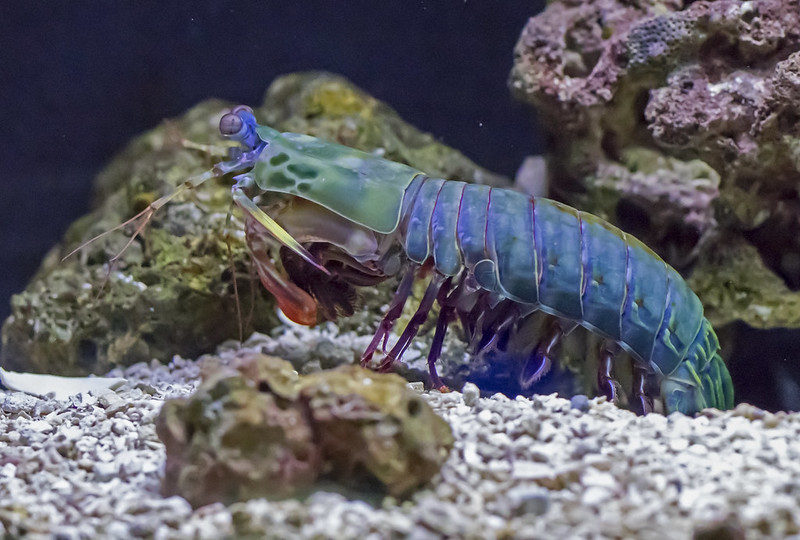 A peacock mantis shrimp, an especially colorful variety of these remarkable animals. (Richard Crook, shared under CC-BY-NC-ND 2.0)
]]>
Every biological sciences graduate student at UMBC knows “the face”—Tom Cronin’s signature scowl, which, contrary to appearances, signals rapt attention rather than disapproval. At a day-long...
https://umbc.edu/stories/tom-cronin-a-giant-among-mantis-shrimp/
https://beta.my.umbc.edu/api/v0/pixel/news/152396/guest@my.umbc.edu/cfcd5d9ed238a497703cee3305cd295b/api/pixel
alumni
biology
cnms
community
international
news
science-and-tech
story
UMBC News & Magazine
https://beta.my.umbc.edu/groups/umbc-news-magazine
https://assets1-beta.my.umbc.edu/system/shared/avatars/groups/000/001/943/24435aa6207c452e7bc15cc74b42c7bb/xsmall.png?1748556657
https://assets1-beta.my.umbc.edu/system/shared/avatars/groups/000/001/943/24435aa6207c452e7bc15cc74b42c7bb/original.png?1748556657
https://assets2-beta.my.umbc.edu/system/shared/avatars/groups/000/001/943/24435aa6207c452e7bc15cc74b42c7bb/xxlarge.png?1748556657
https://assets2-beta.my.umbc.edu/system/shared/avatars/groups/000/001/943/24435aa6207c452e7bc15cc74b42c7bb/xlarge.png?1748556657
https://assets3-beta.my.umbc.edu/system/shared/avatars/groups/000/001/943/24435aa6207c452e7bc15cc74b42c7bb/large.png?1748556657
https://assets1-beta.my.umbc.edu/system/shared/avatars/groups/000/001/943/24435aa6207c452e7bc15cc74b42c7bb/medium.png?1748556657
https://assets2-beta.my.umbc.edu/system/shared/avatars/groups/000/001/943/24435aa6207c452e7bc15cc74b42c7bb/small.png?1748556657
https://assets1-beta.my.umbc.edu/system/shared/avatars/groups/000/001/943/24435aa6207c452e7bc15cc74b42c7bb/xsmall.png?1748556657
https://assets2-beta.my.umbc.edu/system/shared/avatars/groups/000/001/943/24435aa6207c452e7bc15cc74b42c7bb/xxsmall.png?1748556657
UMBC News & Magazine
0
0
false
Fri, 12 Sep 2025 12:23:46 -0400
Fri, 12 Sep 2025 12:23:46 -0400
Understanding the Tree of Life: A fresh look at evolution with biology professor Kevin Omland
A peacock mantis shrimp, an especially colorful variety of these remarkable animals. (Richard Crook, shared under CC-BY-NC-ND 2.0)
]]>
Every biological sciences graduate student at UMBC knows “the face”—Tom Cronin’s signature scowl, which, contrary to appearances, signals rapt attention rather than disapproval. At a day-long...
https://umbc.edu/stories/tom-cronin-a-giant-among-mantis-shrimp/
https://beta.my.umbc.edu/api/v0/pixel/news/152396/guest@my.umbc.edu/cfcd5d9ed238a497703cee3305cd295b/api/pixel
alumni
biology
cnms
community
international
news
science-and-tech
story
UMBC News & Magazine
https://beta.my.umbc.edu/groups/umbc-news-magazine
https://assets1-beta.my.umbc.edu/system/shared/avatars/groups/000/001/943/24435aa6207c452e7bc15cc74b42c7bb/xsmall.png?1748556657
https://assets1-beta.my.umbc.edu/system/shared/avatars/groups/000/001/943/24435aa6207c452e7bc15cc74b42c7bb/original.png?1748556657
https://assets2-beta.my.umbc.edu/system/shared/avatars/groups/000/001/943/24435aa6207c452e7bc15cc74b42c7bb/xxlarge.png?1748556657
https://assets2-beta.my.umbc.edu/system/shared/avatars/groups/000/001/943/24435aa6207c452e7bc15cc74b42c7bb/xlarge.png?1748556657
https://assets3-beta.my.umbc.edu/system/shared/avatars/groups/000/001/943/24435aa6207c452e7bc15cc74b42c7bb/large.png?1748556657
https://assets1-beta.my.umbc.edu/system/shared/avatars/groups/000/001/943/24435aa6207c452e7bc15cc74b42c7bb/medium.png?1748556657
https://assets2-beta.my.umbc.edu/system/shared/avatars/groups/000/001/943/24435aa6207c452e7bc15cc74b42c7bb/small.png?1748556657
https://assets1-beta.my.umbc.edu/system/shared/avatars/groups/000/001/943/24435aa6207c452e7bc15cc74b42c7bb/xsmall.png?1748556657
https://assets2-beta.my.umbc.edu/system/shared/avatars/groups/000/001/943/24435aa6207c452e7bc15cc74b42c7bb/xxsmall.png?1748556657
UMBC News & Magazine
0
0
false
Fri, 12 Sep 2025 12:23:46 -0400
Fri, 12 Sep 2025 12:23:46 -0400
Understanding the Tree of Life: A fresh look at evolution with biology professor Kevin Omland
Kevin Omland, professor of biological sciences, has spent 25 years teaching and researching evolution. His new book, Understanding the Tree of Life, is the latest in the “Understanding Life” series published by Cambridge University Press. Omland’s contribution challenges what he views as an outdated understanding of evolution and celebrates the interconnectedness of all species. Below, Omland shares the inspiration behind the book, its surprising insights, and why everyone from nature lovers to seasoned biologists should seek it out.
Q: How did this book come about?
A: Cambridge University Press wanted a book diving into the history of life and how all species are connected. A few of my colleagues recommended me based on my prior work, including a 2007 article called Tree Thinking for All Biology from my sabbatical in Australia, and a chapter I wrote for The Princeton Guide to Evolution emphasizing how understanding evolutionary trees is central to understanding evolution. My research on bird plumage and birdsong has also given me a fresh perspective on evolution, so I was happy to accept the opportunity to write this book.

 Kevin Omland (left) has authored the latest instance of the “Understanding Life” series published by Cambridge University Press. (Portrait by Marlayna Demond ’11/UMBC)
Q: You’ve been teaching at UMBC since 2000—did that shape the book at all?
A: Absolutely. Teaching “Foundations of Biology: Ecology and Evolution” for 25 years at UMBC played a huge role. I’ve had so many smart students come in with big misconceptions about evolution—like thinking humans are the top of an evolutionary “ladder.” The book is packed with examples I’ve used in class to show that we’re all cousins, with no “higher” or “lower” organisms. I wouldn’t have been in a position to write this without all of those classroom conversations, so I want to thank my students for their indirect contributions to this book.
Q: Who is this book for, and why should they pick it up?
A: Anyone who finds evolution fascinating or loves nature should read it for a fresh angle on how every species on the planet is interconnected. It surveys the tree of life, including everything from primates to invertebrates, challenging outdated concepts like “primitive” species. Even biologists might find some ideas that challenge their understanding—I’d guess that up to half of them might be surprised by what they learn! Ultimately, it’s for general readers and scientists alike who want to think accurately about evolution as a branching tree, rather than a straight line toward ever-more complexity.
 (l-r): Nathan Zekarias ’25, biological sciences; Michelle Moyer, Ph.D. ’24, biological sciences; Ellie Bare ’23, biochemistry and molecular biology; and Kevin Omland (left to right) on a field research trip to Puerto Rico. Omland creates numerous opportunities for his students to get field experience. (Image courtesy of Omland)
Q: What were you hoping to achieve with this book?
A: My main goal is to debunk misconceptions, like human superiority or labeling species as “old” or “living fossils.” Using DNA sequencing and modern genomics, we can now see evolution as continuous, with no clear start to any species, including humans. I want readers to move beyond ideas like the great white shark as ancient or humans as a recent arrival. The book emphasizes shared ancestry—we’re all cousins, from our fellow mammals, to trees, to bacteria—and encourages caring for our interconnected world.
Q: Can you give us an example from the book that flips a common evolution myth?
A: Sure—the platypus is my go-to. People call them “primitive” because they lay eggs, a trait inherited from our ancient tetrapod [four-legged] ancestors. But that’s biased and misleading—the platypus has many recent adaptations like its duck-shaped bill with electro-sensing organs to detect prey in muddy ponds, venomous spurs on males, and webbed feet for underwater swimming. Every organism mixes ancient traits with recent specialized ones matching its ecological niche. This challenges human-centered views: We lack the platypus’s senses, just as it lacks our thumbs or large brains.
 Baby platypuses show off their electro-sensing bills, which are a more recent adaptation, countering assumptions that platypuses are “primitive” because they lay eggs. (Photo by NSW DPI, used under CC-BY-NC-SA 2.0)
Q: How does this book tie into your other research?
A: It ties directly to all the work that my students and I have done on bird plumage and song evolution, which highlights gains and losses of traits; evolution isn’t just accumulation or increasing complexity. For example, tetrapods evolved legs, but many lineages, like snakes and whales, later lost them. Our research shows losses are common and as important as gains, countering dictionary definitions of evolution as “gradual accumulation.” The book extends this lens to the whole tree of life, using genomic insights to reframe how we understand shared ancestry and adaptation.
Q: Where and when can I get my copy?
A: It’s available now! You can order Understanding the Tree of Life from Cambridge University Press, major online retailers or your local bookstore—shops as far away as Norway and Brazil have it on their websites and shelves. Just search for it, as they say, “wherever books are sold.” I hope people enjoy reading it!
 (l-r): Eriberto Osorio ’22, biological sciences; D’Juan Moreland ’24, biological sciences and music composition; and Kevin Omland in Puerto Rico for field research. (Image courtesy of Omland)
]]>
Kevin Omland, professor of biological sciences, has spent 25 years teaching and researching evolution. His new book, Understanding the Tree of Life, is the latest in the “Understanding Life”...
https://umbc.edu/stories/tree-of-life-fresh-look-at-evolution/
https://beta.my.umbc.edu/api/v0/pixel/news/152392/guest@my.umbc.edu/ea25c92a8a3fc7960329089089e4fc37/api/pixel
biology
cnms
news
research
science-and-tech
story
UMBC News & Magazine
https://beta.my.umbc.edu/groups/umbc-news-magazine
https://assets1-beta.my.umbc.edu/system/shared/avatars/groups/000/001/943/24435aa6207c452e7bc15cc74b42c7bb/xsmall.png?1748556657
https://assets1-beta.my.umbc.edu/system/shared/avatars/groups/000/001/943/24435aa6207c452e7bc15cc74b42c7bb/original.png?1748556657
https://assets2-beta.my.umbc.edu/system/shared/avatars/groups/000/001/943/24435aa6207c452e7bc15cc74b42c7bb/xxlarge.png?1748556657
https://assets2-beta.my.umbc.edu/system/shared/avatars/groups/000/001/943/24435aa6207c452e7bc15cc74b42c7bb/xlarge.png?1748556657
https://assets3-beta.my.umbc.edu/system/shared/avatars/groups/000/001/943/24435aa6207c452e7bc15cc74b42c7bb/large.png?1748556657
https://assets1-beta.my.umbc.edu/system/shared/avatars/groups/000/001/943/24435aa6207c452e7bc15cc74b42c7bb/medium.png?1748556657
https://assets2-beta.my.umbc.edu/system/shared/avatars/groups/000/001/943/24435aa6207c452e7bc15cc74b42c7bb/small.png?1748556657
https://assets1-beta.my.umbc.edu/system/shared/avatars/groups/000/001/943/24435aa6207c452e7bc15cc74b42c7bb/xsmall.png?1748556657
https://assets2-beta.my.umbc.edu/system/shared/avatars/groups/000/001/943/24435aa6207c452e7bc15cc74b42c7bb/xxsmall.png?1748556657
UMBC News & Magazine
0
0
false
Fri, 12 Sep 2025 12:00:55 -0400
Fri, 12 Sep 2025 12:00:55 -0400
Meet a Retriever—Anita Das ’83, M.S. ’87, mostly-retired medical researcher and planned giving donor
(l-r): Eriberto Osorio ’22, biological sciences; D’Juan Moreland ’24, biological sciences and music composition; and Kevin Omland in Puerto Rico for field research. (Image courtesy of Omland)
]]>
Kevin Omland, professor of biological sciences, has spent 25 years teaching and researching evolution. His new book, Understanding the Tree of Life, is the latest in the “Understanding Life”...
https://umbc.edu/stories/tree-of-life-fresh-look-at-evolution/
https://beta.my.umbc.edu/api/v0/pixel/news/152392/guest@my.umbc.edu/ea25c92a8a3fc7960329089089e4fc37/api/pixel
biology
cnms
news
research
science-and-tech
story
UMBC News & Magazine
https://beta.my.umbc.edu/groups/umbc-news-magazine
https://assets1-beta.my.umbc.edu/system/shared/avatars/groups/000/001/943/24435aa6207c452e7bc15cc74b42c7bb/xsmall.png?1748556657
https://assets1-beta.my.umbc.edu/system/shared/avatars/groups/000/001/943/24435aa6207c452e7bc15cc74b42c7bb/original.png?1748556657
https://assets2-beta.my.umbc.edu/system/shared/avatars/groups/000/001/943/24435aa6207c452e7bc15cc74b42c7bb/xxlarge.png?1748556657
https://assets2-beta.my.umbc.edu/system/shared/avatars/groups/000/001/943/24435aa6207c452e7bc15cc74b42c7bb/xlarge.png?1748556657
https://assets3-beta.my.umbc.edu/system/shared/avatars/groups/000/001/943/24435aa6207c452e7bc15cc74b42c7bb/large.png?1748556657
https://assets1-beta.my.umbc.edu/system/shared/avatars/groups/000/001/943/24435aa6207c452e7bc15cc74b42c7bb/medium.png?1748556657
https://assets2-beta.my.umbc.edu/system/shared/avatars/groups/000/001/943/24435aa6207c452e7bc15cc74b42c7bb/small.png?1748556657
https://assets1-beta.my.umbc.edu/system/shared/avatars/groups/000/001/943/24435aa6207c452e7bc15cc74b42c7bb/xsmall.png?1748556657
https://assets2-beta.my.umbc.edu/system/shared/avatars/groups/000/001/943/24435aa6207c452e7bc15cc74b42c7bb/xxsmall.png?1748556657
UMBC News & Magazine
0
0
false
Fri, 12 Sep 2025 12:00:55 -0400
Fri, 12 Sep 2025 12:00:55 -0400
Meet a Retriever—Anita Das ’83, M.S. ’87, mostly-retired medical researcher and planned giving donor
Meet Anita Das ’83, M.S. ’87. Anita is a mostly-retired medical researcher specializing in infectious diseases and a UMBC planned giving donor. She still consults with biotech companies as a statistician to stay current with industry trends, and, in her spare time, Anita volunteers for environmental and educational causes, practices (and learns more about) permaculture, and goes on hiking adventures. In 2024, Anita established the Das Endowed Scholarship, and included UMBC in her estate plan to make sure she could help even more students in the future. Take it away, Anita!
Q: What is your WHY? What brought you to UMBC?
A: I went to UMBC because I wanted to study biology. At the time, I thought I wanted to go to medical school, and UMBC was known for having a strong pre-med program. I also received a small scholarship and played on the tennis team. I graduated with my B.S. in biological sciences in 1983, but decided that medical school was not for me. Since I had taken a lot of math classes (and done well), I got a job doing clinical research.
My boss told me I should pursue a master’s degree in statistics. So, I went back to UMBC. At the time, the statistics program was new, and I liked that it had a small number of students and that all of the professors were very interactive with the students. I earned my M.S. in statistics in 1987.
Q: What’s a memory of the UMBC community you have that helped shape your path?
A: I worked (or volunteered—I can’t remember which) at the math lab, which was a place that students came for tutoring. We provided support to students who needed extra help on their math assignments, but were more comfortable working with a peer than going to their professor. I remember this as a wonderful, supportive place that assisted many students and helped me gain and practice my teaching skills.
 Alumni gathered at the 2025 UMBC Bay Area Alumni Reception 2025. From left to right: Tim M., Yinka Bode-George ’16, Caitlyn Reavey ’06, and Das. (Photo by Barak Shrama)
Q: Who in the UMBC community has inspired you or supported you?
A: While I was working on my master’s in statistics, Dr. Bimal Sinha was so supportive. On some of my homework assignments, instead of a grade, he would write “Please see me.” At first, I thought, “Oh no!” But in his office, he would help me through the work and encourage me. Dr. Sinha’s primary interest was to build my confidence and ensure I was learning. Really, all of the professors in my master’s program were student-oriented. They provided encouragement and instilled confidence, which enabled me to continue my education and get my Ph.D. in Epidemiology at George Washington University.
Q: Can you tell us more about your career?
A: My career has been in medical research, working on clinical trials in both the public and private sectors. I spent the first part of my career working in maternal/fetal medicine on National Institutes of Health grants and then moved to the pharmaceutical industry, specializing in the development of anti-infectives. Today, I am mostly retired and do some consulting with biotech companies as a statistician.
This allows me to stay current on new developments in infectious disease (my area of expertise) and work with experts in this field. I spend my non-work time volunteering for environmental and educational causes, learning and practicing permaculture, and going on hiking adventures.
Q: Can you elaborate on your volunteer work and what inspired you to establish a scholarship and become a planned giving donor?
A: I am on the Board of Directors of Sonoma Land Trust (SLT). We work to protect nature in my home county of Sonoma, California, helping to reduce climate impact, restoring habitats, and engaging young people in conservation. Our science-based approach allows me to use my education and experience for a good cause. SLT also mentors the next generation of scientists, and it was this program that inspired me to donate to UMBC to help educate those who will steward the future of our planet.
I recently reconnected with UMBC. Everyone I’ve met, including other graduates in the California Bay Area and the development team, has been so welcoming and enthusiastic about UMBC. I also had a chance to meet President Valerie Sheares Ashby and was wowed by her dedication to the students and learning.
Anita Das ’83, M.S. ’87
As part of my involvement with SLT, I had a chance to listen to high school students present conservation research they conducted on one of our land preserves. These kids were so excited about science and their joy was infectious. They inspired me to start a scholarship fund at UMBC so that anyone who wants to study science would not be limited by a lack of resources.
In 2024, I established the Das Endowed Scholarship to support students in the College of Natural and Mathematical Sciences. Around the same time, I also established a planned gift, naming UMBC in my estate plan to ensure my scholarship can support even more students in the future.
* * * * *
UMBC’s greatest strength is its people. When people meet Retrievers and hear about the passion they bring, the relationships they create, the ways they support each other, and the commitment they have to inclusive excellence, they truly get a sense of our community. That’s what “Meet a Retriever” is all about.
Learn more about how UMBC can help you achieve your goals.
]]>
Meet Anita Das ’83, M.S. ’87. Anita is a mostly-retired medical researcher specializing in infectious diseases and a UMBC planned giving donor. She still consults with biotech companies as a...
https://umbc.edu/stories/meet-anita-das-planned-giving-donor/
https://beta.my.umbc.edu/api/v0/pixel/news/152306/guest@my.umbc.edu/7fe58f3b7003ec32c8fc3c7364653173/api/pixel
alumni
impact
magazine
meet-a-retriever
planned-giving
scholarship
story
uncategorized
UMBC News & Magazine
https://beta.my.umbc.edu/groups/umbc-news-magazine
https://assets1-beta.my.umbc.edu/system/shared/avatars/groups/000/001/943/24435aa6207c452e7bc15cc74b42c7bb/xsmall.png?1748556657
https://assets1-beta.my.umbc.edu/system/shared/avatars/groups/000/001/943/24435aa6207c452e7bc15cc74b42c7bb/original.png?1748556657
https://assets2-beta.my.umbc.edu/system/shared/avatars/groups/000/001/943/24435aa6207c452e7bc15cc74b42c7bb/xxlarge.png?1748556657
https://assets2-beta.my.umbc.edu/system/shared/avatars/groups/000/001/943/24435aa6207c452e7bc15cc74b42c7bb/xlarge.png?1748556657
https://assets3-beta.my.umbc.edu/system/shared/avatars/groups/000/001/943/24435aa6207c452e7bc15cc74b42c7bb/large.png?1748556657
https://assets1-beta.my.umbc.edu/system/shared/avatars/groups/000/001/943/24435aa6207c452e7bc15cc74b42c7bb/medium.png?1748556657
https://assets2-beta.my.umbc.edu/system/shared/avatars/groups/000/001/943/24435aa6207c452e7bc15cc74b42c7bb/small.png?1748556657
https://assets1-beta.my.umbc.edu/system/shared/avatars/groups/000/001/943/24435aa6207c452e7bc15cc74b42c7bb/xsmall.png?1748556657
https://assets2-beta.my.umbc.edu/system/shared/avatars/groups/000/001/943/24435aa6207c452e7bc15cc74b42c7bb/xxsmall.png?1748556657
UMBC News & Magazine
0
0
false
Wed, 10 Sep 2025 13:17:51 -0400
Wed, 10 Sep 2025 13:17:51 -0400
Meet Dean van Briesen: COEIT’s new leader shares her love of teaching and discovery
Chance and faith: These two forces have shaped the trajectory of Jeanne van Briesen’s life (while also inspiring the names for her two Russian Blue cats). It was by chance that she went down the research path after unexpectedly losing her first job—teaching high school science. Faith later gave her the courage to begin an academic career at an institution (Carnegie Mellon University) that felt like the right fit, even when her Ph.D. in civil engineering could have led to the industrial job she originally planned to take. And chance and faith worked together to bring van Briesen to UMBC, where she took the position of Dean of the College of Engineering and Information Technology (COEIT) this summer.
“I first visited UMBC about 15 years ago to give an invited talk, and I really enjoyed the visit,” she says. “The energy on campus, from the students to the faculty and staff, was exciting. I felt like, ‘I should be watching this place.’”
So when the COEIT deanship opened at a time when van Briesen was ready to make her next career move, she once again felt two familiar forces guiding her. “I do feel like there was a little bit of chance involved in this move—the position opening up just as I was leaving the National Science Foundation and my youngest child was finishing his college journey. A little bit of chance and a little bit of faith brought me here. And, I’m loving it. It feels like home.”
As the campus welcomes new and returning students and faculty for the fall semester, van Briesen shares what she loves about higher ed and how excited she is to start the new school year.
Q: How did you decide on a career in academia?
A: I started my career as a high school chemistry and physics teacher. I thought that was the most fun anybody could have. But after a year, I was laid off because the teacher I had been hired to replace decided unexpectedly to return. So I went to graduate school to get my master’s degree, and I fell in love with research. I loved doing research so much that I stayed to do my Ph.D. When I finished that, I was like, ‘Well, what job can I do where I can do both research and teaching?’ And that’s why I became a professor—because I could do both of the things I loved. And every day I get to engage with students and faculty about teaching and research, I know I made the right choice.
Q: Could you tell us more about your research?
A: My research focuses on water systems, both natural systems, like rivers and lakes and streams, and engineered systems, like drinking water and wastewater systems. I look at how reactions—whether biological, chemical, or geological—affect the transport and transformation of synthetic chemicals in these systems.
I also did a fair amount of work looking at microbial species: bacteria that we either don’t like because they make us sick, or bacteria that we do like because they can transform synthetic chemicals and clean up our environment. Over time, the work in my group changed the way we understand how interactions in natural systems affect interactions in engineered systems. For example, we would look at what’s changing in the river and then how those changes make it more difficult to treat the drinking water for people.
Q: Which of your research findings do you feel has had the most impact so far?
 The Monongahela River, photographed as it runs through Pittsburgh. Van Briesen and her colleagues have studied the river to assess the risks associated with bromide in the water. (Ronjamin; CC BY-SA 2.5)
A: Some research I was doing in southwestern Pennsylvania was related to the development of hydraulic fracturing for shale gas development in the region. There was a lot of discussion about whether shale gas development was using too much water or whether it was producing too much wastewater. And in a lot of ways, the answer was no, it wasn’t that different from other industries that used water and produced wastewater. Engineers have been managing those things for a long time to protect the environment while enabling energy production for people.
But one thing that was different was that wastewater from gas development was being discharged into the environment with minimal treatment. The wastewater didn’t have many negative effects on the river. But in the drinking water plant, bromide from the wastewater interacted with naturally-occurring organic matter and the chlorine used to disinfect the water to produce brominated disinfection by-products. These chemicals are carcinogenic and teratogenic, and this can lead to negative health impacts when people use the treated water for drinking and bathing.
The shale gas industry didn’t know that was going to happen, and the drinking water industry wasn’t expecting that outcome either. My research team’s systems-level work—looking at the whole river, including wastewater discharges and drinking water withdrawals—really changed the understanding that the region had about those impacts. It led to the Pennsylvania Department of Environmental Protection working with the industry to stop those discharges.
So that was the work I did where I could look back and say, ‘I had an impact in my own community, for people in my hometown. My work saved lives.’
Q: What attracted you most to the COEIT deanship?
A: When I first visited UMBC, I was so impressed. The students were clearly engaged in their learning. The faculty were really committed to teaching and research, and that combination of research and teaching in higher ed is so important to me. And, the vision—to redefine excellence through an inclusive culture—that really resonated with me.
The deanship was particularly attractive because of the opportunity to expand my impact. A lot of what faculty do is enable the success of students, and I love that role. And as a dean, you enable the success of everyone in the college—faculty, staff, students, and alumni. And so a dean role really takes that faculty role of enabling the success of others to the next level.
Taking on any new role is a leap of faith. And, the chance to lead at UMBC felt worth it.
Q: What have been your strongest impressions since arriving as dean?
A: The thing that’s struck me the most is that everyone’s really committed to the mission of UMBC. When people here talk about inclusive excellence, it’s not a catch phrase, it’s who we are fundamentally at the core of the institution.
And the other thing is that everyone works really hard. Everyone’s invested in student success, and they’re always generating new ideas for how we can help students be successful. That’s very exciting.
Q: What do you love most about being an engineer?
A: I like solving real problems for real people. I mean, I can get lost in the theoretical world, and I love deepening our fundamental understanding, but I always want to tie my research to some real problem, because that’s what engineering is. You don’t hear this often, but engineering and information technology are helping professions.
The other thing I like about being an engineer is that I always feel like we’re needed. The world will always have increasingly complex and interconnected technical problems that have to be solved if we want people to flourish on the planet. The roles for engineers, computer scientists, and information technologists in different industries are always changing, and there are always more problems to solve.
Q: And what do you love most about working in higher ed?
A: Oh, the students, for sure. Every fall, you return to campus, and you get to meet new students. They’re excited to be here, and they bring energy and new ideas every year. They remind me how much I love learning because they love learning. They remind me why I became a teacher. Students arrive with wonderful potential, they grow while they’re here, and they go out into the world and do amazing things. UMBC exists to nurture that potential, help our students grow and learn, and to proudly look on as they change the world.
 Dean van Briesen talks with computer engineering student Jake Whitt at a COEIT summer research poster session in August. (Brad Ziegler/UMBC)
Q: What are you most looking forward to in the coming year?
A: Learning! I would probably give that answer every year because I am happiest when I’m learning. In this particular year, I’ve come to a new place and have a new job, so there will be even more learning fun. I’m going to be meeting students, staff, faculty, and alumni, not just from COEIT, but from everywhere at UMBC, and throughout Maryland and beyond. All of these meetings will help me understand who we are and what we aspire to be. That will help me fulfill my goal to enable success in my college, the university, and our communities.
I am really excited to be here. Since arriving, I’ve learned so much from everyone I’ve met, and I’m looking forward to much more of that during this year.
Learn more about the College of Engineering and Information Technology.
]]>
Chance and faith: These two forces have shaped the trajectory of Jeanne van Briesen’s life (while also inspiring the names for her two Russian Blue cats). It was by chance that she went down the...
https://umbc.edu/stories/meet-dean-van-briesen/
https://beta.my.umbc.edu/api/v0/pixel/news/152259/guest@my.umbc.edu/b8845dd871dc433b6e4837692b9137ea/api/pixel
coeit
community
news
research
science-and-tech
story
UMBC News & Magazine
https://beta.my.umbc.edu/groups/umbc-news-magazine
https://assets1-beta.my.umbc.edu/system/shared/avatars/groups/000/001/943/24435aa6207c452e7bc15cc74b42c7bb/xsmall.png?1748556657
https://assets1-beta.my.umbc.edu/system/shared/avatars/groups/000/001/943/24435aa6207c452e7bc15cc74b42c7bb/original.png?1748556657
https://assets2-beta.my.umbc.edu/system/shared/avatars/groups/000/001/943/24435aa6207c452e7bc15cc74b42c7bb/xxlarge.png?1748556657
https://assets2-beta.my.umbc.edu/system/shared/avatars/groups/000/001/943/24435aa6207c452e7bc15cc74b42c7bb/xlarge.png?1748556657
https://assets3-beta.my.umbc.edu/system/shared/avatars/groups/000/001/943/24435aa6207c452e7bc15cc74b42c7bb/large.png?1748556657
https://assets1-beta.my.umbc.edu/system/shared/avatars/groups/000/001/943/24435aa6207c452e7bc15cc74b42c7bb/medium.png?1748556657
https://assets2-beta.my.umbc.edu/system/shared/avatars/groups/000/001/943/24435aa6207c452e7bc15cc74b42c7bb/small.png?1748556657
https://assets1-beta.my.umbc.edu/system/shared/avatars/groups/000/001/943/24435aa6207c452e7bc15cc74b42c7bb/xsmall.png?1748556657
https://assets2-beta.my.umbc.edu/system/shared/avatars/groups/000/001/943/24435aa6207c452e7bc15cc74b42c7bb/xxsmall.png?1748556657
UMBC News & Magazine
2
0
false
Tue, 09 Sep 2025 15:33:11 -0400
Tue, 09 Sep 2025 15:33:11 -0400
How China uses second world war history in its bid to reshape the global order – podcast
The Conversation Weekly Podcast Interview with Meredith Oyen, Associate Professor of History and Asian Studies, UMBC.
With Russia’s Vladimir Putin and North Korea’s Kim Jong-Un among 26 world leaders watching, China’s president Xi Jinping made a muscular address to 50,000 people in Tiananmen Square marking 80 years since the end of the second world war. China is “never intimidated by bullies” and would “stand by the right side of history”, Xi said, adding that “the great rejuvenation of the Chinese nation was unstoppable”.
Absent from the ceremony was Taiwan’s leader, Lai Ching-te, who instead took to Facebook, writing that Taiwan does not “commemorate peace with the barrel of a gun”. Taiwan had barred public officials from attending the event.
China and Taiwan both claim their forces bore the true burden of Chinese resistance against Japan during the second world war, and use this contested history to lay claim to power and territory. Now China is weaponising this history, pushing for a “correct” perspective of the war as it seeks to reshape the world order and assert its ambitions over Taiwan.
In this episode of The Conversation Weekly podcast, Meredith Oyen, a historian and expert in China-Taiwan relations, explains how disagreements between China and Taiwan over who fought the Japanese more than 80 years ago are still raging and why China’s military parade raised tensions with Taiwan up another notch.
“The second world war has this very long shadow in all of east Asia because there’s a lot of unfinished business,” says Oyen, an associate professor of history and Asian studies at the University of Maryland, Baltimore County.
When Japan officially surrendered on September 9 at a ceremony in Nanjing, it was to the Republic of China, then ruled by Chiang Kai-shek. With the war against Japan over, Chiang’s nationalist Kuomintang resumed their civil war against the Chinese Communist Party. In 1949, Chiang and the Kuomintang were pushed to Taiwan as Mao Zedong declared the People’s Republic of China.
As a result, persistent questions about whether China and Taiwan are two separate entities or a divided nation with Taiwan a part of China are a “really significant geopolitical flashpoint” says Oyen, “something that stems directly out of the second world war”.
Listen to the conversation with Meredith Oyen about how disagreements between China and Taiwan over the second world war on The Conversation Weekly podcast. You can also read an text version of this interview.
This episode of The Conversation Weekly was written and produced by Mend Mariwany and Gemma Ware with assistance from Katie Flood. Mixing and sound design by Eloise Stevens and theme music by Neeta Sarl.
Newclips in this episode from Straits Times , BBC News and NBC News and KinoLibrary .
Listen to The Conversation Weekly via any of the apps listed above, download it directly via our RSS feed or find out how else to listen here. A transcript of this episode is available on Apple Podcasts or Spotify.
Gemma Ware, Host, The Conversation Weekly Podcast, The Conversation
This article is republished from The Conversation under a Creative Commons license. Read the original article and see more than 300 UMBC articles available in The Conversation.
]]>
The Conversation Weekly Podcast Interview with Meredith Oyen, Associate Professor of History and Asian Studies, UMBC. With Russia’s Vladimir Putin and North Korea’s Kim Jong-Un among 26 world...
https://umbc.edu/stories/china-uses-history-to-reshape-global-order/
https://beta.my.umbc.edu/api/v0/pixel/news/152245/guest@my.umbc.edu/b7d2feb9e9f5c8b9041a925c9b447542/api/pixel
asianstudies
cahss
conversation
discovery
history
magazine
story
UMBC News & Magazine
https://beta.my.umbc.edu/groups/umbc-news-magazine
https://assets1-beta.my.umbc.edu/system/shared/avatars/groups/000/001/943/24435aa6207c452e7bc15cc74b42c7bb/xsmall.png?1748556657
https://assets1-beta.my.umbc.edu/system/shared/avatars/groups/000/001/943/24435aa6207c452e7bc15cc74b42c7bb/original.png?1748556657
https://assets2-beta.my.umbc.edu/system/shared/avatars/groups/000/001/943/24435aa6207c452e7bc15cc74b42c7bb/xxlarge.png?1748556657
https://assets2-beta.my.umbc.edu/system/shared/avatars/groups/000/001/943/24435aa6207c452e7bc15cc74b42c7bb/xlarge.png?1748556657
https://assets3-beta.my.umbc.edu/system/shared/avatars/groups/000/001/943/24435aa6207c452e7bc15cc74b42c7bb/large.png?1748556657
https://assets1-beta.my.umbc.edu/system/shared/avatars/groups/000/001/943/24435aa6207c452e7bc15cc74b42c7bb/medium.png?1748556657
https://assets2-beta.my.umbc.edu/system/shared/avatars/groups/000/001/943/24435aa6207c452e7bc15cc74b42c7bb/small.png?1748556657
https://assets1-beta.my.umbc.edu/system/shared/avatars/groups/000/001/943/24435aa6207c452e7bc15cc74b42c7bb/xsmall.png?1748556657
https://assets2-beta.my.umbc.edu/system/shared/avatars/groups/000/001/943/24435aa6207c452e7bc15cc74b42c7bb/xxsmall.png?1748556657
UMBC News & Magazine
0
0
false
Tue, 09 Sep 2025 14:08:14 -0400
Reverse discrimination? In spite of the MAGA bluster over DEI, data shows white Americans are still advantaged
Written by Fred L. Pincus, emeritus professor of Sociology, UMBC.
Two big assumptions underlie President Donald Trump’s attack on diversity, equity and inclusion (DEI) policies. The first is that discrimination against people of color is a thing of the past. The second is that DEI policies and practices discriminate against white people – especially white men – in what’s sometimes called “reverse discrimination.”
I’m a sociologist who’s spent decades studying race and inequality, and when I read the documents and statements coming out of the Trump White House, these assumptions jump out at me again and again – usually implicitly, but always there.
The problem is that the evidence doesn’t back these assumptions up.
For one thing, if discrimination against white Americans were widespread, you might expect large numbers to report being treated unfairly. But polling data shows otherwise. A 2025 Pew survey found that 70% of white Americans think Black people face “some” or “a lot” of discrimination in general, and roughly two-thirds say the same of Asian and Hispanic people. Meanwhile, only 45% of white Americans believe that white people in general experience that degree of discrimination.
In other words, white Americans believe that people of color, as a group, face more discrimination than white people do. People of color agree – and so do Americans overall.
In a second national study, using data collected in 2023, Americans were asked if they had personally experienced discrimination within the past year. Thirty-eight percent of white people said they had, compared to 54% of Black Americans, 50% of Latinos and 42% of Asian Americans. In other words, white Americans are much less likely to say that they’ve been discriminated against than people of color.
The ‘hard’ numbers show persistent privilege
These statistics are sometimes called “soft” data because they reflect people’s perceptions rather than verified incidents. To broaden the picture, it’s worth looking at “hard” data on measures like income, education and employment outcomes. These indicators also suggest that white Americans as a group are advantaged relative to people of color.
For example, federal agencies have documented racial disparities in income for decades, with white Americans, as a group, generally outearning Black and Latino Americans. This is true even when you control for education. When the Census Bureau looked at median annual earnings for Americans between 25 and 64 with at least a bachelor’s degree, it found that Black Americans received only 81% of what comparably educated white Americans earned, while Latinos earned only 80%. Asian Americans, on the other hand, earned 119% of what white people earned.
These gaps persist even when you hold college major constant. In the highest-paying major, electrical engineering, Black Americans earned only 71% of what white people did, while Latinos earned just 73%. Asian Americans, in contrast, earned 104% of what white people earned. In the lowest-paid major, family and consumer sciences, African Americans earned 97% of what white people did, and Latinos earned 94%. Asian Americans earned 117% of what white people earned. The same general pattern of white income advantage existed in all majors with two exceptions: Black people earned more in elementary education and nursing.
Remember, this is comparing individuals with a bachelor’s degree or higher to people with the same college major. Again, white Americans are still advantaged in most career paths over Black Americans and Latinos.
Disparities persist in the job market
Unemployment data show similar patterns. The July 2025 figures for workers at all education levels show that Black people were 1.9 times more likely to be unemployed than white Americans. Latinos were 1.4 times more likely to be unemployed, and Asian Americans, 1.1 times.
This same white advantage still occurs when looking only at workers who have earned a bachelor’s degree or more. Black Americans who have earned bachelor’s degrees or higher were 1.3 times more likely to be unemployed than similarly educated white Americans as of 2021, the last year for which data is available. Latinos with college degrees were 1.4 times more likely to be unemployed than similar white Americans. The white advantage was even higher for those with only a high school degree or less. Unfortunately, data for Asian Americans weren’t available.
In another study, researchers sent 80,000 fake resumes in response to 10,000 job listings posted by 97 of the largest employers in the country. The credentials on the resumes were essentially the same, but the names signaled race: Some had Black-sounding names, like Lakisha or Leroy, while others had more “white-sounding” names like Todd or Allison. This method is known as an “audit study.”
This research, which was conducted between 2019 and 2021, found that employers were 9.5% more likely to contact the Todds and Allisons than the Lakishas and Leroys within 30 days of receiving a resume. Of the 28 audit studies that have been conducted since 1989, each one showed that applicants with Black- or Latino-sounding names were less likely to be contacted that those with white-sounding or racially neutral names.
Finally, a 2025 study analyzed 600,000 letters of recommendation for college-bound students who used the Common App form during the 2018-19 and 2019-20 academic years. Only students who applied to at least one selective college were included. The study found that letters for Black and Latino students were shorter and said less about their intellectual promise.
Similarly, letters in support of first-generation students – that is, whose parents hadn’t graduated from a four-year college, and who are disproportionately likely to be Black and Latino – had fewer sentences dedicated to their scientific, athletic and artistic abilities, or their overall academic potential.
These and other studies don’t provide evidence of massive anti-white discrimination. Although scattered cases of white people being discriminated against undoubtedly exist, the data suggest that white people are still advantaged relative to non-Asian people of color. White Americans may be less advantaged than they were, but they’re still advantaged.
While it’s true that many working-class white Americans are having a tough time in the current economy, it’s not because of their race. It’s because of their class. It’s because of automation and overseas outsourcing taking away good jobs. It’s because of high health care costs and cuts in the safety nets.
In other words, while many working-class white people are struggling now, there’s little evidence race is the problem.
This article is republished from The Conversation under a Creative Commons license. Read the original article and see more than 300 UMBC articles available in The Conversation.
]]>
Written by Fred L. Pincus, emeritus professor of Sociology, UMBC. Two big assumptions underlie President Donald Trump’s attack on diversity, equity and inclusion (DEI) policies. The first is...
https://umbc.edu/stories/dei-data-shows-white-americans-are-advantaged/
https://beta.my.umbc.edu/api/v0/pixel/news/152241/guest@my.umbc.edu/a46e5541d7a915b9572fbe4fded54e77/api/pixel
conversation
discovery
magazine
research
saph
story
UMBC News & Magazine
https://beta.my.umbc.edu/groups/umbc-news-magazine
https://assets1-beta.my.umbc.edu/system/shared/avatars/groups/000/001/943/24435aa6207c452e7bc15cc74b42c7bb/xsmall.png?1748556657
https://assets1-beta.my.umbc.edu/system/shared/avatars/groups/000/001/943/24435aa6207c452e7bc15cc74b42c7bb/original.png?1748556657
https://assets2-beta.my.umbc.edu/system/shared/avatars/groups/000/001/943/24435aa6207c452e7bc15cc74b42c7bb/xxlarge.png?1748556657
https://assets2-beta.my.umbc.edu/system/shared/avatars/groups/000/001/943/24435aa6207c452e7bc15cc74b42c7bb/xlarge.png?1748556657
https://assets3-beta.my.umbc.edu/system/shared/avatars/groups/000/001/943/24435aa6207c452e7bc15cc74b42c7bb/large.png?1748556657
https://assets1-beta.my.umbc.edu/system/shared/avatars/groups/000/001/943/24435aa6207c452e7bc15cc74b42c7bb/medium.png?1748556657
https://assets2-beta.my.umbc.edu/system/shared/avatars/groups/000/001/943/24435aa6207c452e7bc15cc74b42c7bb/small.png?1748556657
https://assets1-beta.my.umbc.edu/system/shared/avatars/groups/000/001/943/24435aa6207c452e7bc15cc74b42c7bb/xsmall.png?1748556657
https://assets2-beta.my.umbc.edu/system/shared/avatars/groups/000/001/943/24435aa6207c452e7bc15cc74b42c7bb/xxsmall.png?1748556657
UMBC News & Magazine
0
0
false
Tue, 09 Sep 2025 13:21:26 -0400